WO2023286436A1 - 扁平形リチウム一次電池 - Google Patents
扁平形リチウム一次電池 Download PDFInfo
- Publication number
- WO2023286436A1 WO2023286436A1 PCT/JP2022/020374 JP2022020374W WO2023286436A1 WO 2023286436 A1 WO2023286436 A1 WO 2023286436A1 JP 2022020374 W JP2022020374 W JP 2022020374W WO 2023286436 A1 WO2023286436 A1 WO 2023286436A1
- Authority
- WO
- WIPO (PCT)
- Prior art keywords
- positive electrode
- lithium primary
- pellet
- graphite
- primary battery
- Prior art date
- Legal status (The legal status is an assumption and is not a legal conclusion. Google has not performed a legal analysis and makes no representation as to the accuracy of the status listed.)
- Ceased
Links
Images


Classifications
-
- H—ELECTRICITY
- H01—ELECTRIC ELEMENTS
- H01M—PROCESSES OR MEANS, e.g. BATTERIES, FOR THE DIRECT CONVERSION OF CHEMICAL ENERGY INTO ELECTRICAL ENERGY
- H01M6/00—Primary cells; Manufacture thereof
- H01M6/14—Cells with non-aqueous electrolyte
-
- H—ELECTRICITY
- H01—ELECTRIC ELEMENTS
- H01M—PROCESSES OR MEANS, e.g. BATTERIES, FOR THE DIRECT CONVERSION OF CHEMICAL ENERGY INTO ELECTRICAL ENERGY
- H01M4/00—Electrodes
- H01M4/02—Electrodes composed of, or comprising, active material
- H01M4/06—Electrodes for primary cells
-
- H—ELECTRICITY
- H01—ELECTRIC ELEMENTS
- H01M—PROCESSES OR MEANS, e.g. BATTERIES, FOR THE DIRECT CONVERSION OF CHEMICAL ENERGY INTO ELECTRICAL ENERGY
- H01M4/00—Electrodes
- H01M4/02—Electrodes composed of, or comprising, active material
- H01M4/13—Electrodes for accumulators with non-aqueous electrolyte, e.g. for lithium-accumulators; Processes of manufacture thereof
-
- H—ELECTRICITY
- H01—ELECTRIC ELEMENTS
- H01M—PROCESSES OR MEANS, e.g. BATTERIES, FOR THE DIRECT CONVERSION OF CHEMICAL ENERGY INTO ELECTRICAL ENERGY
- H01M4/00—Electrodes
- H01M4/02—Electrodes composed of, or comprising, active material
- H01M4/36—Selection of substances as active materials, active masses, active liquids
- H01M4/48—Selection of substances as active materials, active masses, active liquids of inorganic oxides or hydroxides
- H01M4/50—Selection of substances as active materials, active masses, active liquids of inorganic oxides or hydroxides of manganese
- H01M4/502—Selection of substances as active materials, active masses, active liquids of inorganic oxides or hydroxides of manganese for non-aqueous cells
-
- H—ELECTRICITY
- H01—ELECTRIC ELEMENTS
- H01M—PROCESSES OR MEANS, e.g. BATTERIES, FOR THE DIRECT CONVERSION OF CHEMICAL ENERGY INTO ELECTRICAL ENERGY
- H01M4/00—Electrodes
- H01M4/02—Electrodes composed of, or comprising, active material
- H01M4/36—Selection of substances as active materials, active masses, active liquids
- H01M4/48—Selection of substances as active materials, active masses, active liquids of inorganic oxides or hydroxides
- H01M4/50—Selection of substances as active materials, active masses, active liquids of inorganic oxides or hydroxides of manganese
- H01M4/505—Selection of substances as active materials, active masses, active liquids of inorganic oxides or hydroxides of manganese of mixed oxides or hydroxides containing manganese for inserting or intercalating light metals, e.g. LiMn2O4 or LiMn2OxFy
-
- H—ELECTRICITY
- H01—ELECTRIC ELEMENTS
- H01M—PROCESSES OR MEANS, e.g. BATTERIES, FOR THE DIRECT CONVERSION OF CHEMICAL ENERGY INTO ELECTRICAL ENERGY
- H01M4/00—Electrodes
- H01M4/02—Electrodes composed of, or comprising, active material
- H01M4/36—Selection of substances as active materials, active masses, active liquids
- H01M4/58—Selection of substances as active materials, active masses, active liquids of inorganic compounds other than oxides or hydroxides, e.g. sulfides, selenides, tellurides, halogenides or LiCoFy; of polyanionic structures, e.g. phosphates, silicates or borates
- H01M4/583—Carbonaceous material, e.g. graphite-intercalation compounds or CFx
- H01M4/587—Carbonaceous material, e.g. graphite-intercalation compounds or CFx for inserting or intercalating light metals
-
- H—ELECTRICITY
- H01—ELECTRIC ELEMENTS
- H01M—PROCESSES OR MEANS, e.g. BATTERIES, FOR THE DIRECT CONVERSION OF CHEMICAL ENERGY INTO ELECTRICAL ENERGY
- H01M4/00—Electrodes
- H01M4/02—Electrodes composed of, or comprising, active material
- H01M4/62—Selection of inactive substances as ingredients for active masses, e.g. binders, fillers
-
- H—ELECTRICITY
- H01—ELECTRIC ELEMENTS
- H01M—PROCESSES OR MEANS, e.g. BATTERIES, FOR THE DIRECT CONVERSION OF CHEMICAL ENERGY INTO ELECTRICAL ENERGY
- H01M4/00—Electrodes
- H01M4/02—Electrodes composed of, or comprising, active material
- H01M4/62—Selection of inactive substances as ingredients for active masses, e.g. binders, fillers
- H01M4/621—Binders
- H01M4/622—Binders being polymers
- H01M4/623—Binders being polymers fluorinated polymers
-
- H—ELECTRICITY
- H01—ELECTRIC ELEMENTS
- H01M—PROCESSES OR MEANS, e.g. BATTERIES, FOR THE DIRECT CONVERSION OF CHEMICAL ENERGY INTO ELECTRICAL ENERGY
- H01M4/00—Electrodes
- H01M4/02—Electrodes composed of, or comprising, active material
- H01M4/62—Selection of inactive substances as ingredients for active masses, e.g. binders, fillers
- H01M4/624—Electric conductive fillers
- H01M4/625—Carbon or graphite
-
- H—ELECTRICITY
- H01—ELECTRIC ELEMENTS
- H01M—PROCESSES OR MEANS, e.g. BATTERIES, FOR THE DIRECT CONVERSION OF CHEMICAL ENERGY INTO ELECTRICAL ENERGY
- H01M6/00—Primary cells; Manufacture thereof
- H01M6/14—Cells with non-aqueous electrolyte
- H01M6/16—Cells with non-aqueous electrolyte with organic electrolyte
-
- H—ELECTRICITY
- H01—ELECTRIC ELEMENTS
- H01M—PROCESSES OR MEANS, e.g. BATTERIES, FOR THE DIRECT CONVERSION OF CHEMICAL ENERGY INTO ELECTRICAL ENERGY
- H01M4/00—Electrodes
- H01M4/02—Electrodes composed of, or comprising, active material
- H01M2004/021—Physical characteristics, e.g. porosity, surface area
-
- H—ELECTRICITY
- H01—ELECTRIC ELEMENTS
- H01M—PROCESSES OR MEANS, e.g. BATTERIES, FOR THE DIRECT CONVERSION OF CHEMICAL ENERGY INTO ELECTRICAL ENERGY
- H01M4/00—Electrodes
- H01M4/02—Electrodes composed of, or comprising, active material
- H01M2004/026—Electrodes composed of, or comprising, active material characterised by the polarity
- H01M2004/028—Positive electrodes
-
- H—ELECTRICITY
- H01—ELECTRIC ELEMENTS
- H01M—PROCESSES OR MEANS, e.g. BATTERIES, FOR THE DIRECT CONVERSION OF CHEMICAL ENERGY INTO ELECTRICAL ENERGY
- H01M2300/00—Electrolytes
- H01M2300/0017—Non-aqueous electrolytes
-
- Y—GENERAL TAGGING OF NEW TECHNOLOGICAL DEVELOPMENTS; GENERAL TAGGING OF CROSS-SECTIONAL TECHNOLOGIES SPANNING OVER SEVERAL SECTIONS OF THE IPC; TECHNICAL SUBJECTS COVERED BY FORMER USPC CROSS-REFERENCE ART COLLECTIONS [XRACs] AND DIGESTS
- Y02—TECHNOLOGIES OR APPLICATIONS FOR MITIGATION OR ADAPTATION AGAINST CLIMATE CHANGE
- Y02E—REDUCTION OF GREENHOUSE GAS [GHG] EMISSIONS, RELATED TO ENERGY GENERATION, TRANSMISSION OR DISTRIBUTION
- Y02E60/00—Enabling technologies; Technologies with a potential or indirect contribution to GHG emissions mitigation
- Y02E60/10—Energy storage using batteries
Definitions
- the present disclosure relates to a flat lithium primary battery.
- Flat lithium primary batteries are characterized by high energy density and high voltage. Therefore, conventionally, it has been used as a power source for various electronic devices.
- Patent Document 1 proposes a non-aqueous electrolyte battery in which a concave portion is formed in the center of the surface of the positive electrode mixture on the side that contacts the separator, and the density of the central portion of the concave portion is higher than the density of the convex portion on the peripheral edge.
- the positive electrode expands as it discharges.
- the expansion of the positive electrode may deform the battery case (positive electrode can).
- the expansion of the positive electrode can occur at either the central portion or the side peripheral portion of the positive electrode pellet, but the expansion is basically uniform.
- the positive electrode can undergoes deformation such that the bottom portion swells with the corner portion between the cylindrical portion and the bottom portion of the positive electrode can serving as a fulcrum.
- the amount of deformation of the bottom portion of the positive electrode can is greater at the central portion far from the corner portion, which is the fulcrum, and thus contact between the positive electrode can and the positive electrode pellets may be insufficient at the center portion of the bottom portion.
- the central portion of the positive electrode pellet is more likely to be disconnected from the positive electrode can than the side peripheral portion, increasing the internal resistance and making it difficult to obtain a sufficient discharge capacity.
- the volume occupied by the power generating element is equal to the volume occupied by the current collecting member. decreases and the discharge capacity decreases.
- a flat lithium primary battery includes a case, and a positive electrode, a negative electrode, a separator, and a non-aqueous electrolyte arranged in the case.
- the positive electrode includes a cylindrical positive electrode pellet containing a positive electrode active material, a conductive agent, and a binder.
- the conductive agent contains graphite.
- the positive electrode pellet is divided into a first portion including at least a part of the side peripheral surface of the cylinder and a second portion. The first portion has an annular portion surrounding at least a portion of the second portion, and the graphite content in the positive electrode pellet is higher in the second portion than in the first portion.
- This flat lithium primary battery has a large discharge capacity.
- FIG. 1 is a cross-sectional schematic diagram of an example configuration of a lithium primary battery according to an embodiment of the present disclosure
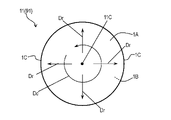
- FIG. 1B is a plan view of the positive electrode of the lithium primary battery shown in FIG. 1A
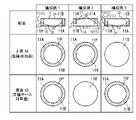
- FIG. 4 is a diagram showing an example of the distribution shape and arrangement of the first portion and the second portion within the positive electrode pellet
- FIG. 4 is a diagram showing an example of the distribution shape and arrangement of the first portion and the second portion within the positive electrode pellet;
- a flat lithium primary battery according to an embodiment of the present disclosure (hereinafter sometimes simply referred to as a “lithium primary battery”) includes a case, a positive electrode, a negative electrode, a separator, and a non-aqueous electrolyte arranged in the case. including.
- the positive electrode and the negative electrode face each other with the separator interposed therebetween.
- the positive electrode includes cylindrical positive electrode pellets containing a positive electrode active material, a conductive agent, and a binder.
- the conductive agent contained in the positive electrode contains graphite.
- the positive electrode pellet is housed in a case and electrically connected to the case.
- the case is also called a "cathode case” or a “cathode can”. Therefore, the case functions as a positive electrode terminal.
- a positive electrode pellet usually has a columnar shape (or disk shape) with a circumferentially extending side peripheral surface surrounding a central axis.
- the columnar shape of the positive electrode pellet has a top surface and a bottom surface that are connected to the side peripheral surface and located on opposite sides of the central axis.
- the surface of the positive electrode pellet that is electrically connected to the case (positive electrode can) is the bottom surface of the cylinder, and the surface that faces the negative electrode via the separator is the top surface of the cylinder.
- the positive electrode pellet is divided into a first portion including at least a part of the side peripheral surface of the cylinder and a second portion. As will be described later, the graphite content is different between the first portion and the second portion.
- the first portion includes at least part of the side peripheral surface of the cylinder.
- the second portion is a region surrounded by the first portion, including, for example, the central portion of the cylinder.
- the first portion has an annulus surrounding at least a portion of the second portion.
- the at least part of the side peripheral surface of the cylinder included in the first portion of the positive electrode pellet surrounds the central axis over the entire circumference in the circumferential direction.
- the content of graphite in the positive electrode pellet is higher in the second part than in the first part.
- the positive electrode pellets expand, the case expands while the positive electrode pellets are kept in close contact with the positive electrode can, and good electrical connection between the positive electrode pellets and the case is maintained.
- an increase in internal resistance during discharge is suppressed.
- the energy stored in the battery can be effectively used to the end, and the discharge capacity is improved.
- the content of graphite in the second portion is higher than that of the graphite in the first portion. It is preferably 4 parts by mass or more larger than the content.
- the content of graphite in the first portion may be 4 parts by mass or less from the viewpoint of suppressing the expansion of the positive electrode pellet in the side peripheral portion.
- the content of graphite means parts by mass with respect to 100 parts by mass of the positive electrode active material.
- Carbon materials such as hard carbon, soft carbon, and graphite are used as conductive agents added to the positive and negative electrodes.
- graphite has planar graphene layers in which carbon atoms are bonded to form a hexagonal network.
- the degree of graphene layer development increases, the volume of graphite particles increases, and one graphite particle can come into contact with a plurality of positive electrode active material particles. For example, when one graphite particle contacts two positive electrode active material particles, the graphite particle contacts the surface of one of the positive electrode active material particles in a certain graphene layer.
- the graphite particles are in contact with the surface of the other positive electrode active material particle in the graphene layer, or are laminated above or below the graphene layer with which the one positive electrode active material particle is in contact with the other positive electrode active material in the graphene layer.
- the surface of the particles can be contacted.
- the graphene layer of graphite in contact with one of the positive electrode active material particles acts as a “lever” to cause movement of the other positive electrode active material particle.
- the expansion of the positive electrode pellets is effectively promoted while maintaining a certain distance between the positive electrode active material particles in the second portion having a high graphite content.
- Graphite means a material with a developed graphite-type crystal structure, and generally refers to a carbon material having an average interplanar spacing d 002 of (002) planes of 0.340 nm or less as measured by an X-ray diffraction method.
- Examples of graphite include earthy graphite, flake graphite, flake graphite, and expanded graphite.
- Expanded graphite is a material in which an acid component such as sulfuric acid is intercalated between graphene layers of graphite, and heat is applied to volatilize the acid component, thereby expanding the interlayer distance.
- Graphene composed of a single layer to about 10 graphene layers is included in graphite. It is desirable that graphite accounts for 90 mass % or more of the conductive agent.
- the graphite includes at least one selected from the group consisting of, for example, expanded graphite, flake graphite, and graphene. is preferred. It is desirable that 90% by mass or more of the graphite be occupied by at least one selected from the group consisting of expanded graphite, flake graphite and graphene.
- graphene is preferable because it has a small interlayer distance and high flexibility due to its small thickness. Expanded graphite is most preferable because it has a large interlayer distance and a large thickness, and thus has a good balance between rigidity and flexibility. In addition to a single layer, graphene includes a stack of multiple layers (for example, about 10 layers) of hexagonal mesh layers.
- the first portion with a low graphite content is a region including the side peripheral surface (side peripheral surface of the cylinder) of the positive electrode pellet, and surrounds at least a part of the second portion with a high graphite content.
- the first portion may be annularly formed along the side peripheral surface of the positive electrode pellet so as to surround the second portion.
- the thickness (width) of the annular portion in the direction of the central axis of the positive electrode pellet (the central axis of the cylinder) may be the same as the width of the side peripheral surface of the positive electrode pellet (the height of the cylinder), or It may be smaller than the width of the surface (the height of the cylinder). That is, the second portion may be exposed on a part of the side peripheral surface on the upper surface side and/or the bottom surface side of the cylindrical positive electrode pellet.
- the second portion with a high graphite content can be a region that includes at least part of the central axis of the positive electrode pellet (the central axis of the cylinder).
- the second portion may be a region having the same thickness as the positive electrode pellet in the axial direction of the cylinder so as to include the entire central axis of the positive electrode pellet (the central axis of the cylinder).
- the thickness of the second portion in the axial direction of the cylinder may be smaller than the thickness of the positive electrode pellet.
- the first portion or the second portion may be exposed in the region including the central axis of the top surface and/or the bottom surface of the cylindrical positive electrode pellet.
- the amount of expansion in the center portion closer to the central axis is greater than that in the side peripheral portion closer to the side peripheral surface, and the position in the central axis direction between the side peripheral portion and the center portion becomes larger. the difference becomes larger.
- the minimum distance from the central axis of the positive electrode pellet in the annular portion of the first portion is preferably 90% or less (more preferably 80% or less) of the radius of the positive electrode pellet.
- the boundary between the annular portion of the first portion and the second portion is 90% or less, more preferably 80% or less of the radius of the positive electrode pellet, from the central axis of the positive electrode pellet. position is preferred. In this case, even when the bulge at the center of the positive electrode pellet is sufficiently large relative to the side circumference and the case (positive electrode can) swells, good electrical connection between the positive electrode pellet and the case can be maintained. Easy.
- the second portion of the cathode pellet selectively expands more than the first portion upon discharge to maintain a good electrical connection between the cathode pellet and the case even when the case (cathode can) bulges. be done.
- the maximum distance from the center axis of the positive electrode pellet to the second portion in the positive electrode pellet is preferably 50% or more, more preferably 60% or more, of the radius of the positive electrode pellet.
- the boundary between the annular portion of the first portion and the second portion is at a distance of 50% or more, more preferably 60% or more of the radius of the positive electrode pellet from the central axis of the positive electrode pellet. position is preferred.
- the boundary between the annular portion of the first portion and the second portion is preferably located at a position where the distance from the central axis of the positive electrode pellet is 50% or more and 90% or less of the radius of the positive electrode pellet. % or more and 80% or less.
- the thickness (width) of the first portion in the central axis direction is preferably 50% or more of the thickness of the positive electrode pellet at the annular portion.
- the thickness of the second portion in the central axis direction is preferably 50% or more of the thickness of the positive electrode pellet.
- the positions of the annular portion and the second portion in the central axis direction in the positive electrode pellet are not particularly limited, and may be arranged in the positive electrode pellet toward the positive electrode can side, or may be arranged in the positive electrode pellet toward the negative electrode or the separator side. They may be placed to one side.
- the positive electrode pellet having the first part and the second part is formed by putting the positive electrode mixture for forming the first part into a mold and temporarily molding the first part, and then The positive electrode mixture for forming two parts is placed inside a mold for forming positive electrode pellets, and the whole is pressure-molded into a pellet shape, or the positive electrode mixture for forming the second part is put into a mold and the second part is formed. After the two parts are temporarily molded, the second part after the temporary molding and the positive electrode mixture for forming the first part are placed inside a positive electrode pellet forming mold, and the whole is pressure molded into a pellet shape.
- a part of the mold for forming the first part and the mold for forming the positive electrode pellet may be shared.
- the positive electrode mixture for forming the first portion and the positive electrode mixture for forming the second portion each contain a positive electrode active material, a conductive agent, and a binder. content is different. The content of graphite contained in the positive electrode mixture for forming the first portion is lower than the content of graphite contained in the positive electrode mixture for forming the second portion.
- the binder contained in the first portion and the binder contained in the second portion may be different.
- the second part preferably contains polytetrafluoroethylene (PTFE) as a binder from the viewpoint of not interfering with the effect of promoting expansion by graphite.
- PTFE polytetrafluoroethylene
- PTFE has a binding structure in which the active material and the conductive agent are entangled in a fibrous state in a mesh-like manner, so that it has high flexibility and hardly hinders the expansion action of the positive electrode pellets by graphite.
- the binder contained in the first part may contain a tetrafluoroethylene-hexafluoropropylene copolymer (FEP) as a binder from the viewpoint of suppressing the expansion of the positive electrode in the first part.
- FEP tetrafluoroethylene-hexafluoropropylene copolymer
- the configuration of the lithium primary battery according to one embodiment of the present disclosure will be described more specifically below.
- Lithium primary battery 10 of FIG. 1A includes positive electrode 11 , separator 12 , negative electrode 13 , and case 20 .
- Case 20 includes a positive electrode case 21 functioning as a positive electrode terminal, a sealing plate 22 functioning as a negative electrode terminal, and a gasket 23 arranged between positive electrode case 21 and sealing plate 22 .
- the positive electrode 11 and the negative electrode 13 face each other with the separator 12 interposed therebetween.
- the positive electrode 11, the separator 12, the negative electrode 13, the gasket 23, and the non-aqueous electrolyte 24 are arranged between the positive electrode case 21 and the sealing plate 22. By bending the upper portion of the positive electrode case 21 inward and crimping, the positive electrode is Case 21 is sealed.
- FIG. 1B is a plan view of the positive electrode 1.
- the positive electrode 11 contains a positive electrode active material, a conductive agent, and a binder, and is provided with a positive electrode pellet 91 that is a molded body that is pressure-molded into a pellet shape (cylindrical shape).
- the positive electrode pellet 91 has a side peripheral surface 1C extending in a circumferential direction Dc surrounding a central axis 11C extending in a central axis direction Da, which is a vertical direction, and an upper surface 1A connected to the side peripheral surface 1C and positioned on opposite sides of the central axis 11C. and a bottom surface 1B.
- the conductive agent contains graphite.
- the positive electrode 11 is divided into a first portion 11A and a second portion 11B depending on the difference in composition.
- the first portion 11A includes at least a portion of the cylindrical side peripheral surface 1C, and can be arranged along the side peripheral surface 1C (for example, annularly) so as to surround at least a portion of the second portion 11B.
- the second portion 11B is the portion of the positive electrode 11 other than the first portion 11A.
- the content of graphite in the second portion 11B is higher than the content of graphite in the first portion 11A.
- the first portion 11A has a portion 1D of the side peripheral surface 1C of the positive electrode pellet 91 .
- a portion 1D of the side peripheral surface 1C extends along the side peripheral surface 1C over the entire circumference in the circumferential direction Dc.
- the portion 1D of the side peripheral surface 1C may be the entire side peripheral surface 1C.
- the portion 1D of the side peripheral surface 1C may be a part of the side peripheral surface 1C, and in this case, the second portion 11B has the portion 1E of the side peripheral surface 1C of the positive electrode pellet 91 .
- FIG. 2 and 3 show examples of the shape and arrangement of the first portion 11A and the second portion 11B in the positive electrode 11.
- the distribution shapes of the first portion 11A and the second portion 11B on the top surface 1A and the bottom surface 1B of the are shown, respectively.
- An upper surface 1A of the positive electrode 11 is a negative electrode facing surface facing the negative electrode 13
- a bottom surface 1B is a positive electrode case facing surface facing the positive electrode case .
- the first portion 11A has an annular portion 11P formed so as to extend over the entire circumference in the circumferential direction Dc along the side peripheral surface 1C of the positive electrode 11 having a cylindrical shape.
- the annular portion 11P surrounds the side peripheral surface 2C of the second portion 11B.
- the annular portion 11P is exposed over the entire circumference of the side circumferential surface 1C of the positive electrode 11 in the circumferential direction Dc.
- the side peripheral surface 1C may have a region in which the first portion 11A is not exposed and the second portion 11B is exposed in a portion of the circumferential direction Dc.
- the second portion 11B may also have a generally cylindrical shape.
- top surface 2A and bottom surface 2B of second portion 11B are defined in the same manner as top surface 1A and bottom surface 1B of positive electrode 11 (positive electrode pellet 91). That is, the upper surface 2A of the second portion 11B faces the negative electrode 13, and the bottom surface 2B faces the positive electrode case 21. As shown in FIG.
- the first portion 11A is exposed over the entire side peripheral surface 1C of the positive electrode 11, and the distance from the central axis 11C of the cylindrical positive electrode 11 is a predetermined value or more.
- the second portion 11B is a region where the distance from the central axis 11C of the cylindrical positive electrode 11 is less than a predetermined value.
- the thickness (width) of the first portion 11A and the second portion 11B in the central axis direction Da are both equal to the thickness of the positive electrode 11 in the central axis direction Da (the height of the cylinder).
- the top surface 1A and the bottom surface 1B of the positive electrode 11 have regions where the first portion 11A and the second portion 11B are exposed, respectively.
- the first portion 11A is exposed on the side peripheral surface 1C side of the top surface 1A and the bottom surface 1B of the positive electrode 11, and the second portion 11B is exposed on the central axis 11C side.
- the distance from the central axis 11C of the positive electrode 11 that defines the boundary between the first portion 11A and the second portion 11B is preferably in the range of 50% or more and 90% or less, more preferably 60% or more and 80% of the radius of the positive electrode 11. It is more preferable to be within the following range.
- the thickness (width) of the first portion 11A in the central axis direction Da may be smaller than the thickness (height of the cylinder) of the positive electrode 11 in the central axis direction Da.
- the first portion 11A is not exposed on at least one of the top surface 1A and the bottom surface 1B of the positive electrode 11, and only the second portion 11B is exposed.
- Configuration example 2 is an example in which the second portion 11B is exposed over the entire bottom surface 1B of the positive electrode 11
- configuration example 3 is an example in which the second portion 11B is exposed over the entire top surface 1A of the positive electrode 11.
- the first portion 11A covers not only the side peripheral surface 2C of the second portion 11B but also at least one of the top surface 2A and the bottom surface 2B of the second portion 11B. good too.
- the second portion 11B is not exposed, and only the first portion 11A is exposed.
- Configuration Example 4 is an example in which the first portion 11A covers the bottom surface 2B of the second portion 11B and the first portion 11A is exposed over the entire bottom surface 1B of the positive electrode 11.
- Configuration Example 5 is an example in which the first portion 11A covers the upper surface 2A of the second portion 11B and the first portion 11A is exposed over the entire upper surface 1A of the positive electrode 11.
- FIG. 3 the portion of the first portion 11A facing the second portion 11B in the radial direction Dr perpendicular to the central axis 11C and away from the central axis 11C is the annular portion 11P.
- the thickness (width) of 11P in the central axis direction Da is equal to the thickness of the second portion 11B in the central axis direction Da.
- the thickness (width) of the first portion 11A in the central axis direction Da is smaller than the thickness (column height) of the positive electrode 11 in the central axis direction Da. This is an example in which the first portion 11A is not exposed on both the top surface 1A and the bottom surface 1B of the positive electrode 11, and only the second portion 11B is exposed.
- the thickness (width) in the central axis direction Da of the first portion 11A constituting the annular portion 11P is preferably 50% or more of the thickness (height of the cylinder) in the central axis direction Da of the positive electrode 11.
- the positive electrode 11 (positive electrode pellet 91) shown in Configuration Examples 1 to 3 and 6, for example, after the positive electrode mixture for the first portion 11A is put into a mold to temporarily mold the first portion 11A, the first portion after the temporary molding is formed. It can be manufactured by placing the positive electrode mixture for the portion 11A and the second portion 11B inside a mold for forming the positive electrode pellet 91 and pressing the whole into a pellet shape.
- the positive electrode 11 (positive electrode pellet 91) shown in Configuration Examples 4 and 5 for example, after the positive electrode mixture for the second portion 11B is put into a mold to temporarily mold the second portion 11B, the second portion 11B after temporary molding is formed.
- the positive electrode material mixture for the portion 11B and the first portion 11A can be placed in a mold for forming positive electrode pellets, and the whole can be manufactured by pressure molding into a pellet shape.
- Components of the positive electrode other than the above, and components other than the positive electrode are not particularly limited, and the battery includes components other than the above components (for example, current collector ) may be included.
- components other than the positive electrode known components used in general lithium primary batteries may be used.
- the positive electrode contains a positive electrode active material.
- the positive electrode may further contain other substances (such as known substances used for positive electrodes of common lithium primary batteries).
- the positive electrode contains a binder (binding agent) and a conductive agent.
- Conductive agents include graphite. Materials other than graphite may be included as a conductive agent. Other materials include carbon-based materials such as carbon black (such as Ketjenblack).
- Binders include polytetrafluoroethylene (PTFE), perfluoroalkoxyalkane (PFA), tetrafluoroethylene-hexafluoropropylene copolymer (FEP), ethylene-tetrafluoroethylene copolymer (ETFE), polyvinylidene fluoride (PVDF) and other fluorocarbon resins.
- PTFE polytetrafluoroethylene
- PFA perfluoroalkoxyalkane
- FEP tetrafluoroethylene-hexafluoropropylene copolymer
- ETFE ethylene-tetrafluoroethylene copolymer
- PVDF polyvinylidene fluoride
- the mass of the binder contained in the positive electrode may be in the range of 1.2-6% (for example, the range of 1.5-3%) of the mass of the positive electrode active material contained in the positive electrode. Containing the binder within these ranges facilitates formation of the positive electrode, and particularly improves mass productivity.
- Manganese dioxide is mentioned as a positive electrode active material contained in the positive electrode.
- a positive electrode containing manganese dioxide develops a relatively high voltage and has excellent pulse discharge characteristics.
- Manganese dioxide may be in a mixed crystal state containing a plurality of crystal states.
- the positive electrode may contain manganese oxides other than manganese dioxide.
- Manganese oxides other than manganese dioxide include MnO, Mn 3 O 4 , Mn 2 O 3 and Mn 2 O 7 . It is preferable that the main component of the manganese oxide contained in the positive electrode is manganese dioxide.
- Part of the manganese dioxide contained in the positive electrode may be doped with lithium. If the doping amount of lithium is small, a high capacity can be secured.
- Manganese dioxide and manganese dioxide doped with a small amount of lithium can be represented by Li x MnO 2 (0 ⁇ x ⁇ 0.05).
- the average composition of all manganese oxides contained in the positive electrode is preferably Li x MnO 2 (0 ⁇ x ⁇ 0.05).
- the ratio x of Li generally increases as the discharge of the lithium primary battery progresses.
- the ratio x of Li is preferably 0.05 or less in the initial state of discharge of the lithium primary battery.
- the positive electrode can contain other positive electrode active materials used in lithium primary batteries. Fluorinated graphite etc. are mentioned as another positive electrode active material.
- the proportion of Li x MnO 2 in the entire positive electrode active material is preferably 90% by mass or more.
- Electrolytic manganese dioxide is preferably used as manganese dioxide. If necessary, electrolytic manganese dioxide that has been subjected to at least one of neutralization treatment, washing treatment, and calcination treatment may be used. Electrolytic manganese dioxide is generally obtained by electrolysis of an aqueous manganese sulfate solution.
- the BET specific surface area of Li x MnO 2 may be 10 m 2 /g or more and 50 m 2 /g or less, or 10 m 2 /g or more and 30 m 2 /g or less.
- the BET specific surface area of Li x MnO 2 can be measured by a known method. For example, it is measured based on the BET method using a specific surface area measuring device (manufactured by Mountec Co., Ltd.). For example, LixMnO 2 separated from the positive electrode taken out of the battery can be used as a measurement sample.
- the average particle size of Li x MnO 2 as the positive electrode active material is preferably 20 to 50 ⁇ m, for example.
- the average particle diameter means the volume-based median diameter D50, which is measured by a laser diffraction particle size distribution analyzer.
- the negative electrode contains, as a negative electrode active material, at least one selected from the group consisting of metallic lithium and lithium alloys.
- the negative electrode may contain metallic lithium or a lithium alloy, or may contain both metallic lithium and a lithium alloy.
- a composite containing metallic lithium and a lithium alloy may be used for the negative electrode.
- the lithium alloy is not particularly limited, and alloys used as negative electrode active materials for lithium primary batteries can be used.
- Examples of lithium alloys include Li--Al alloys, Li--Sn alloys, Li--Ni--Si alloys, and Li--Pb alloys.
- the content of metal elements other than lithium contained in the lithium alloy is preferably 0.05 to 15% by mass from the viewpoint of securing discharge capacity and stabilizing internal resistance.
- Lithium primary batteries usually have a separator interposed between a positive electrode and a negative electrode.
- a separator it is preferable to use a porous sheet made of an insulating material that is resistant to the internal environment of the lithium primary battery.
- synthetic resin nonwoven fabrics, synthetic resin microporous membranes, laminates thereof, and the like can be mentioned.
- Synthetic resins used for nonwoven fabrics include polypropylene, polyphenylene sulfide, and polybutylene terephthalate.
- Synthetic resins used for the microporous membrane include, for example, polyolefin resins such as polyethylene, polypropylene, and ethylene-propylene copolymers.
- the microporous membrane may contain inorganic particles, if necessary.
- the electrolytic solution 24 is not particularly limited, and a non-aqueous electrolytic solution generally used for lithium primary batteries may be used.
- a non-aqueous electrolytic solution in which lithium salt or lithium ions are dissolved in a non-aqueous solvent can be used.
- non-aqueous solvents examples include organic solvents that can be commonly used in non-aqueous electrolytes for lithium primary batteries.
- Non-aqueous solvents include ethers, esters, carbonate esters and the like.
- dimethyl ether, ⁇ -butyl lactone, propylene carbonate, ethylene carbonate, 1,2-dimethoxyethane and the like can be used.
- the non-aqueous electrolyte may contain one non-aqueous solvent, or may contain two or more non-aqueous solvents.
- the non-aqueous solvent preferably contains a cyclic carbonate with a high boiling point and a chain ether with low viscosity even at low temperatures.
- the cyclic carbonate preferably contains at least one selected from the group consisting of propylene carbonate (PC) and ethylene carbonate (EC), with PC being particularly preferred.
- the chain ether preferably has a viscosity of 1 mPa ⁇ s or less at 25° C., and particularly preferably contains dimethoxyethane (DME).
- the viscosity of the non-aqueous solvent can be obtained by measurement using a trace sample viscometer m-VROC manufactured by Leosence Corporation at a temperature of 25° C. and a shear rate of 10000 (1/s).
- lithium salt for example, one that is generally used as a solute in a lithium primary battery can be used.
- lithium salts include LiCF 3 SO 3 , LiN(CF 3 SO 2 ) 2 , LiClO 4 , LiBF 4 , LiPF 6 , LiR a SO 3 (R a is an alkyl fluoride having 1 to 4 carbon atoms).
- the nonaqueous electrolytic solution 24 may contain one kind of these lithium salts, or two or more kinds thereof.
- the concentration of lithium ions contained in the electrolytic solution 24 (total concentration of lithium salts) is, for example, 0.2 to 2.0 mol/L, and may be 0.3 to 1.5 mol/L.
- the electrolytic solution 24 may contain additives as necessary.
- additives include propane sultone, vinylene carbonate, and the like.
- the total concentration of such additives contained in the non-aqueous electrolyte 24 is, for example, 0.003-5 mol/L.
- Case 20 (positive electrode case 21 or positive electrode can) can be made of, for example, conductive stainless steel.
- the shape of the case 20 of the lithium primary battery (that is, the shape of the battery) is flat as a whole.
- Case 20 may be, for example, a flat rectangular shape or a coin shape (including a button shape).
- the lithium primary battery of the present embodiment is a coin-shaped lithium primary battery using the coin-shaped case 20, typically each of the positive electrode and the negative electrode is disc-shaped.
- the case 20 may include a positive electrode case 21 functioning as a positive electrode terminal, a sealing plate 22 functioning as a negative electrode terminal, and a gasket 23 arranged between the positive electrode case 21 and the sealing plate 22 .
- the material of the gasket 23 is not particularly limited, and materials commonly used for the gasket 23 can be used. Examples of materials for gasket 23 include resins such as polypropylene (PP), polyphenylene sulfide (PPS), perfluoroalkoxyalkane (PFA), and polyetheretherketone (PEEK).
- ⁇ Lithium primary batteries A1 to A15, B1 to B6>> (1) Fabrication of Positive Electrode Electrolytic manganese dioxide, a conductive agent, and a binder were mixed at a predetermined mass ratio to prepare a positive electrode mixture. Carbon black and graphite were used as the conductive agent. Examples of graphite include expanded graphite having an average particle size of 50 ⁇ m, a thickness of approximately 3 ⁇ m, and an interlayer distance of approximately 500 nm, and flake graphite having an average particle size of approximately 50 ⁇ m, a thickness of approximately 0.2 ⁇ m, and an interlayer distance of approximately 0.34 nm. , an average particle size of about 50 ⁇ m, a thickness of about 0.01 ⁇ m, and an interlayer distance of about 0.34 nm. PTFE or FEP was selected and used as the binding agent.
- a plurality of types (12 types) of positive electrode mixtures having different conductive agent compositions and/or binder compositions were prepared, and positive electrode mixtures for forming the first portion 11A of the positive electrode or positive electrode mixtures for forming the second portion 11B of the positive electrode were prepared. used as an agent.
- the content ratio of carbon black was constant at 1 part by mass with respect to 100 parts by mass of manganese dioxide.
- Table 1 shows the types and content ratios of graphite and binder contained in each positive electrode mixture. In Table 1, the content ratio is shown in parts by weight per 100 parts by weight of manganese dioxide.
- the positive electrode mixtures X1 to X12 shown in Table 1 one type was selected from the positive electrode mixtures X1 to X6 as the positive electrode mixture for forming the first portion 11A.
- a positive electrode material mixture for forming the first portion 11A was placed in a predetermined mold, pressed and temporarily molded to obtain a ring-shaped temporary molded body.
- the temporary compact had an outer diameter (diameter) of 14.5 mm, an inner diameter (diameter) of 13 mm, and a thickness (width) of 1.9 mm in the central axis direction.
- one of the positive electrode mixtures X1 to X6 shown in Table 1 was selected as the positive electrode mixture for forming the second portion 11B.
- the temporary molded body was fitted into a mold for forming positive electrode pellets, and the inside of the temporary molded body (the part that would become the inside of the ring) was filled with the positive electrode mixture for forming the second portion 11B.
- a positive electrode pellet 91 having an outer diameter (diameter) of 14.5 mm and a height of 1.9 mm was obtained.
- the first portion 11A and the second portion 11B are distributed as shown in Configuration Example 1 of FIG.
- PC Propylene carbonate
- DME 1,2-dimethoxyethane
- a polypropylene non-woven fabric (thickness: 0.5 mm) was prepared as a separator.
- a polypropylene gasket 23 was prepared.
- a positive electrode case 21 was prepared by pressing conductive stainless steel having a thickness of 0.2 mm.
- a sealing plate 22 formed by pressing conductive stainless steel having a thickness of 0.25 mm was prepared.
- a flat lithium primary battery (CR2032 type) having the structure shown in FIG.
- test lithium primary batteries A1 to A15 and B1 to B6 having different configurations of the first portion 11A and the second portion 11B were produced and evaluated as follows.
- the manufactured lithium primary battery was placed in an environment of 20°C.
- the lithium primary battery was discharged while connected to a load resistance of 15 k ⁇ until the terminal voltage reached 2.0V.
- the discharge charge amount that flowed until the terminal voltage reached 2.0 V was determined.
- the amount of discharge charge was measured for 10 lithium primary batteries, and the average value was defined as the discharge capacity (mAh).
- the battery was disassembled and the positive electrode pellet 91 was taken out.
- the positive electrode pellet 91 is placed so that the center axis 11C is aligned with the vertical direction and the upper surface 1A (the surface facing the negative electrode) faces downward.
- h2 was measured.
- the height h2 at the side peripheral portion is located on the circumference located midway between the outer circumference and the inner circumference of the annular portion 11P of the first portion 11A from the central axis 11C, and equiangularly separated by 90 degrees in the circumferential direction Dc.
- the height at the four positions was averaged.
- the height difference ⁇ h was measured for 10 lithium primary batteries, and the average value was evaluated as the degree of expansion ⁇ (mm).
- Table 2 shows the evaluation results. As shown in Table 1, the positive electrode mixtures X1 to X6 have the same type and content ratio of the binder contained in each positive electrode mixture, and the content of graphite (expanded graphite) contained as a conductive agent only differ. Table 2 also shows the positive electrode mixture used in each lithium primary battery and the graphite content rate of the positive electrode mixture.
- the first portion 11A and the second portion 11B have the same positive electrode mixture composition, and the first portion 11A and the second portion 11B have the same graphite content ratio. In this case, there is no difference in expansion coefficient between the first portion 11A and the second portion 11B, and the degree of expansion ⁇ is substantially equal to zero. Also, the discharge capacity is small. In the lithium primary batteries B1 to B6, the discharge capacity tends to decrease as the graphite content ratio increases and the positive electrode pellet 91 expands more easily. This is probably because the positive electrode pellet 91 expands uniformly as a whole, causing the positive electrode case 21 to swell and the electrical connection between the positive electrode pellet 91 and the positive electrode case 21 to become easily broken at the central portion of the positive electrode pellet 91.
- the discharge capacity was improved.
- the center portion of the positive electrode pellet 91 expands more than the peripheral portion, so the degree of expansion ⁇ takes a positive value.
- the electrical connection between the positive electrode pellet 91 and the positive electrode case 21 can be maintained at the center of the positive electrode pellet 91, and a high discharge capacity can be maintained.
- the graphite content ratio of the first portion 11A and the second portion 11B is increased, the positive electrode pellet 91 expands more easily, and the electrolyte solution 24 is more easily absorbed into the positive electrode pellet 91 . As a result, the electrolyte 24 held in the separator decreases, which may lead to an increase in internal resistance and a decrease in discharge capacity.
- a high discharge capacity can be maintained when the graphite content ratio in the first portion 11A is in the range of 4 parts by mass or less with respect to 100 parts by mass of the positive electrode active material.
- the positive electrode material mixture used for forming the first portion 11A was changed from X1 to X7. That is, the binder contained in the first portion 11A was changed from PTFE to FEP.
- Lithium primary batteries B7, A16, and A17 were produced in the same manner as lithium primary batteries B1, A1, and A5, respectively, and evaluated in the same manner.
- the positive electrode mixture used for forming the first portion 11A was changed from X5 to X8. That is, the binder contained in the first portion 11A was changed from PTFE to FEP.
- Lithium primary battery A18 was produced in the same manner as lithium primary battery A15 except for this, and evaluated in the same manner.
- Table 3 shows the evaluation results. Compared with the lithium primary batteries B1, A1, A5, and A15 shown in Table 2, the use of FEP as the binder contained in the first portion 11A improves the discharge capacity.
- the positive electrode mixture X1 was used to form the first portion 11A, and the positive electrode mixture X2 was used to form the second portion 11B.
- a primary battery A19, a lithium primary battery A20 having an inner diameter (diameter) of the first portion 11A of 9 mm, and a lithium primary battery A21 having an inner diameter (diameter) of the first portion 11A of 7 mm were fabricated and evaluated in the same manner.
- the positive electrode mixture X1 was used to form the first portion 11A, and the positive electrode mixture X6 was used to form the second portion 11B.
- a primary battery A22, a lithium primary battery A23 having an inner diameter (diameter) of the first portion 11A of 9 mm, and a lithium primary battery A24 having an inner diameter (diameter) of the first portion 11A of 7 mm were fabricated and evaluated in the same manner.
- the positive electrode mixture X5 was used to form the first portion 11A, and the positive electrode mixture X6 was used to form the second portion 11B.
- a primary battery A25, a lithium primary battery A26 having an inner diameter (diameter) of the first portion 11A of 9 mm, and a lithium primary battery A27 having an inner diameter (diameter) of the first portion 11A of 7 mm were produced and similarly evaluated.
- Table 4 shows the evaluation results. Table 4 shows the values of R 1 /R 2 where R 1 is the inner diameter (diameter) of the first portion 11A and R 2 is the outer diameter (outer diameter of the positive electrode pellet 91) (diameter) of the first portion 11A. is shown. Also, the results of the lithium primary batteries A1, A5, and A15 are reprinted from Table 2 and shown together. From Table 4, in the range where R 1 is 50% or more and 90% or less of R 2 (in other words, the boundary between the first portion 11A and the second portion 11B is the distance from the central axis 11C of the positive electrode pellet 91). 50% to 90% of the radius of 91), a high discharge capacity can be easily achieved. Furthermore, when R 1 is in the range of 60% or more and 80% or less of R 2 , a significantly high discharge capacity can be achieved.
- the positive electrode mixture used for forming the second portion 11B was changed from X2 to X9 or X11. That is, the type of graphite contained in the second portion 11B was changed from expanded graphite to graphene or flake graphite. Except for this, in the same manner as the lithium primary battery A1, a lithium primary battery A28 containing graphene in the second portion 11B and a lithium primary battery A29 containing flake graphite in the second portion 11B were produced and evaluated in the same manner. .
- the positive electrode mixture used for forming the second portion 11B was changed from X6 to X10 or X12. That is, the type of graphite contained in the second portion 11B was changed from expanded graphite to graphene or flake graphite.
- Lithium primary battery A30 containing graphene in second portion 11B and lithium primary battery A31 containing flake graphite in second portion 11B were produced in the same manner as lithium primary battery A5 except for this, and evaluated in the same manner. .
- Table 5 shows the evaluation results.
- Table 5 the results of the lithium primary batteries A1 and A5 are reprinted from Table 2 and shown together.
- the positive electrode mixture X1 was used to form the first portion 11A, and the positive electrode mixture X2 was used to form the second portion 11B.
- the thickness (width) of the temporary molded body in the central axis direction is 1.9 mm to 0.95 mm or changed to 0.80 mm.
- the temporary molded body was fitted into a mold for forming the positive electrode pellets 91, and the remainder not filled with the temporary molded body was filled with the positive electrode mixture for forming the second portion 11B. After that, by press molding, a positive electrode pellet 91 having an outer diameter (diameter) of 14.5 mm and a height of 1.9 mm was obtained.
- Lithium primary batteries A32 to A37 were produced in the same manner as lithium primary battery A1 except for this, and evaluated in the same manner.
- the distribution shape of the first portion 11A and the second portion 11B in the positive electrode pellet 91 is set to either configuration example 2 or 3 in FIG. 2 or configuration example 6 in FIG. bottom.
- Table 6 shows the evaluation results. Table 6 shows the value of the thickness d in the central axis direction Da of the first portion 11A constituting the annular portion 11P and the value of the ratio d/D of the thickness d to the thickness D in the central axis direction Da of the positive electrode pellet 91. are also shown. Also, the results of the lithium primary battery A1 are reprinted from Table 2 and shown together. From Table 6, it is sufficient that the thickness d in the central axis direction Da of the first portion 11A constituting the annular portion 11P is 40% or more of the thickness D of the positive electrode pellet 91, and 50% of the thickness D of the positive electrode pellet 91. It is preferable if it is above.
- the positive electrode mixture X1 was used to form the first portion 11A, and the positive electrode mixture X2 was used to form the second portion 11B.
- the positive electrode material mixture X2 was placed in a predetermined mold and compacted for temporary molding to obtain a pellet-shaped temporary molding for the second portion 11B.
- the temporary compact had an outer diameter (diameter) of 13 mm and a thickness (width) in the central axis direction Da of 0.95 mm or 0.80 mm.
- the temporary molded body was placed in the center of the mold for forming the positive electrode pellet 91, and the remaining portion not filled with the temporary molded body was filled with the positive electrode mixture X1 for forming the first portion 11A. After that, by press molding, a positive electrode pellet 91 having an outer diameter (diameter) of 14.5 mm and a height of 1.9 mm was obtained.
- the lithium primary batteries A38 to A38 which are similar to the lithium primary battery A1 except that the distribution shape of the first portion 11A and the second portion 11B in the positive electrode pellet 91 is represented by the configuration example 4 or 5 in FIG. A41 was produced and similarly evaluated.
- Table 7 shows the evaluation results. Table 7 also shows the value of the thickness d in the central axis direction Da of the second portion 11B and the ratio d/D of the thickness d to the thickness D in the central axis direction Da of the positive electrode pellet 91 . Also, the results of the lithium primary battery A1 are reprinted from Table 2 and shown together. From Table 7, it is sufficient that the thickness d in the central axis direction Da of the second portion 11B is 40% or more of the thickness D of the positive electrode pellet 91, and preferably 50% or more of the thickness D of the positive electrode pellet 91. I understand.
- Lithium primary batteries A42 to A47>> The positive electrode mixture X1 was used to form the first portion 11A, and the positive electrode mixture X6 was used to form the second portion 11B. Other than this, the lithium primary batteries A42 to A47 were produced in the same manner as the lithium primary batteries A32 to A37 while changing the thickness d in the central axis direction Da of the first portion 11A constituting the annular portion 11P. , was similarly evaluated. That is, the lithium primary batteries A42 to A47 are the lithium primary batteries A32 to A37, respectively, in which the graphite content ratio in the second portion 11B is changed from 2 parts by mass to 10 parts by mass with respect to 100 parts by mass of the positive electrode active material. corresponds to
- Table 8 shows the evaluation results. Table 8 also shows the thickness d in the central axis direction of the first portion 11A constituting the annular portion 11P and the ratio d/D of the thickness d to the thickness D in the central axis direction Da of the positive electrode pellet 91. . Also, the results of the lithium primary battery A5 are reprinted from Table 2 and shown together. From Table 8, it is sufficient that the thickness d in the central axis direction Da of the first portion 11A constituting the annular portion 11P is 40% or more of the thickness D of the positive electrode pellet 91, and 50% of the thickness D of the positive electrode pellet 91. It is preferable if it is above.
- Lithium primary batteries A48 to A51>> The positive electrode mixture X1 was used to form the first portion 11A, and the positive electrode mixture X6 was used to form the second portion 11B. Except for this, lithium primary batteries A48 to A51 were produced in the same manner as the lithium primary batteries A38 to A41 while changing the thickness d of the second portion 11B in the central axis direction Da, and evaluated in the same manner. That is, the lithium primary batteries A48 to A51 are the lithium primary batteries A38 to A41 in which the graphite content ratio in the second portion 11B is changed from 2 parts by mass to 10 parts by mass with respect to 100 parts by mass of the positive electrode active material. corresponds to
- Table 9 shows the evaluation results. Table 9 also shows the thickness d in the central axis direction Da of the second portion 11B and the ratio d/D of the thickness d to the thickness D in the central axis direction Da of the positive electrode pellet 91 . Also, the results of the lithium primary battery A5 are reprinted from Table 2 and shown together. From Table 9, a high discharge capacity is obtained when the thickness d in the central axis direction Da of the second portion 11B is 40% or more of the thickness D of the positive electrode pellet 91, and the thickness d in the central axis direction Da of the second portion 11B is A higher discharge capacity can be obtained when the thickness D is 50% or more of the thickness D of the positive electrode pellet 91 .
- vertical direction is relative directions determined only by the relative positional relationship of the constituent members of the flat lithium primary battery such as the positive electrode and the negative electrode. and does not indicate an absolute direction such as a vertical direction.
- the present disclosure can be used for flat lithium primary batteries.
Landscapes
- Chemical & Material Sciences (AREA)
- Chemical Kinetics & Catalysis (AREA)
- Electrochemistry (AREA)
- General Chemical & Material Sciences (AREA)
- Engineering & Computer Science (AREA)
- Inorganic Chemistry (AREA)
- Manufacturing & Machinery (AREA)
- Materials Engineering (AREA)
- Primary Cells (AREA)
- Battery Electrode And Active Subsutance (AREA)
Priority Applications (3)
| Application Number | Priority Date | Filing Date | Title |
|---|---|---|---|
| CN202280047418.0A CN117652043A (zh) | 2021-07-13 | 2022-05-16 | 扁平形锂一次电池 |
| US18/572,848 US20240297291A1 (en) | 2021-07-13 | 2022-05-16 | Flat lithium primary battery |
| JP2023535156A JP7620896B2 (ja) | 2021-07-13 | 2022-05-16 | 扁平形リチウム一次電池 |
Applications Claiming Priority (2)
| Application Number | Priority Date | Filing Date | Title |
|---|---|---|---|
| JP2021115864 | 2021-07-13 | ||
| JP2021-115864 | 2021-07-13 |
Publications (1)
| Publication Number | Publication Date |
|---|---|
| WO2023286436A1 true WO2023286436A1 (ja) | 2023-01-19 |
Family
ID=84919332
Family Applications (1)
| Application Number | Title | Priority Date | Filing Date |
|---|---|---|---|
| PCT/JP2022/020374 Ceased WO2023286436A1 (ja) | 2021-07-13 | 2022-05-16 | 扁平形リチウム一次電池 |
Country Status (4)
| Country | Link |
|---|---|
| US (1) | US20240297291A1 (https=) |
| JP (1) | JP7620896B2 (https=) |
| CN (1) | CN117652043A (https=) |
| WO (1) | WO2023286436A1 (https=) |
Citations (4)
| Publication number | Priority date | Publication date | Assignee | Title |
|---|---|---|---|---|
| JPH02138852U (https=) * | 1989-04-26 | 1990-11-20 | ||
| JPH07201323A (ja) * | 1993-12-29 | 1995-08-04 | Sony Corp | コイン形リチウム電池 |
| JP2008288060A (ja) * | 2007-05-18 | 2008-11-27 | Panasonic Corp | 扁平形電池 |
| JP2019160672A (ja) * | 2018-03-15 | 2019-09-19 | セイコーインスツル株式会社 | 偏平型アルカリ一次電池 |
-
2022
- 2022-05-16 US US18/572,848 patent/US20240297291A1/en active Pending
- 2022-05-16 CN CN202280047418.0A patent/CN117652043A/zh active Pending
- 2022-05-16 JP JP2023535156A patent/JP7620896B2/ja active Active
- 2022-05-16 WO PCT/JP2022/020374 patent/WO2023286436A1/ja not_active Ceased
Patent Citations (4)
| Publication number | Priority date | Publication date | Assignee | Title |
|---|---|---|---|---|
| JPH02138852U (https=) * | 1989-04-26 | 1990-11-20 | ||
| JPH07201323A (ja) * | 1993-12-29 | 1995-08-04 | Sony Corp | コイン形リチウム電池 |
| JP2008288060A (ja) * | 2007-05-18 | 2008-11-27 | Panasonic Corp | 扁平形電池 |
| JP2019160672A (ja) * | 2018-03-15 | 2019-09-19 | セイコーインスツル株式会社 | 偏平型アルカリ一次電池 |
Also Published As
| Publication number | Publication date |
|---|---|
| US20240297291A1 (en) | 2024-09-05 |
| JP7620896B2 (ja) | 2025-01-24 |
| JPWO2023286436A1 (https=) | 2023-01-19 |
| CN117652043A (zh) | 2024-03-05 |
Similar Documents
| Publication | Publication Date | Title |
|---|---|---|
| KR101389337B1 (ko) | 2차 전지 | |
| KR20150126820A (ko) | 리튬이온 이차전지 | |
| JP2010257828A (ja) | リチウム一次電池およびその製造方法 | |
| JP2010056067A (ja) | コイン型リチウム二次電池 | |
| EP3933961A1 (en) | Secondary battery | |
| JP2008010253A (ja) | リチウム二次電池用電極及びその製造方法、並びにリチウム二次電池 | |
| KR20150087132A (ko) | 비수 전해질 2차 전지 | |
| CN112005422B (zh) | 非水电解质二次电池 | |
| KR101270858B1 (ko) | 이차 전지 | |
| JP2006260904A (ja) | 巻回型電池およびその製造方法 | |
| JP4591674B2 (ja) | リチウムイオン二次電池 | |
| JP7246196B2 (ja) | 全固体リチウム二次電池 | |
| JPWO2018088204A1 (ja) | 非水電解質二次電池用電極及び非水電解質二次電池 | |
| EP4456196A1 (en) | Positive electrode active material for secondary battery and method for producing positive electrode active material for secondary battery | |
| JP2011150954A (ja) | コイン形有機電解液二次電池 | |
| EP3876332A1 (en) | Secondary battery | |
| JP6385232B2 (ja) | リチウム一次電池及びその製造方法 | |
| EP2770562B1 (en) | Nonaqueous electrolytic secondary battery | |
| EP4099429B1 (en) | Non-aqueous electrolytic secondary battery | |
| EP4112559B1 (en) | Positive electrode active material for non-aqueous electrolyte secondary battery, and non-aqueous electrolyte secondary battery | |
| JP5844659B2 (ja) | 電極板およびそれを用いた二次電池 | |
| JP4770426B2 (ja) | 捲回型蓄電装置 | |
| EP3961766B1 (en) | Secondary battery positive electrode active material, and secondary battery | |
| JP7620896B2 (ja) | 扁平形リチウム一次電池 | |
| EP4471885A1 (en) | Non-aqueous electrolyte secondary battery |
Legal Events
| Date | Code | Title | Description |
|---|---|---|---|
| 121 | Ep: the epo has been informed by wipo that ep was designated in this application |
Ref document number: 22841783 Country of ref document: EP Kind code of ref document: A1 |
|
| WWE | Wipo information: entry into national phase |
Ref document number: 2023535156 Country of ref document: JP |
|
| WWE | Wipo information: entry into national phase |
Ref document number: 18572848 Country of ref document: US |
|
| WWE | Wipo information: entry into national phase |
Ref document number: 202280047418.0 Country of ref document: CN |
|
| NENP | Non-entry into the national phase |
Ref country code: DE |
|
| 122 | Ep: pct application non-entry in european phase |
Ref document number: 22841783 Country of ref document: EP Kind code of ref document: A1 |