WO2023276785A1 - 歯周病の体外診断方法、及び、Pg菌検出方法 - Google Patents
歯周病の体外診断方法、及び、Pg菌検出方法 Download PDFInfo
- Publication number
- WO2023276785A1 WO2023276785A1 PCT/JP2022/024727 JP2022024727W WO2023276785A1 WO 2023276785 A1 WO2023276785 A1 WO 2023276785A1 JP 2022024727 W JP2022024727 W JP 2022024727W WO 2023276785 A1 WO2023276785 A1 WO 2023276785A1
- Authority
- WO
- WIPO (PCT)
- Prior art keywords
- periodontal disease
- electrode
- information
- electrochemical measurement
- current
- Prior art date
- Legal status (The legal status is an assumption and is not a legal conclusion. Google has not performed a legal analysis and makes no representation as to the accuracy of the status listed.)
- Ceased
Links
Images



Classifications
-
- C—CHEMISTRY; METALLURGY
- C12—BIOCHEMISTRY; BEER; SPIRITS; WINE; VINEGAR; MICROBIOLOGY; ENZYMOLOGY; MUTATION OR GENETIC ENGINEERING
- C12Q—MEASURING OR TESTING PROCESSES INVOLVING ENZYMES, NUCLEIC ACIDS OR MICROORGANISMS; COMPOSITIONS OR TEST PAPERS THEREFOR; PROCESSES OF PREPARING SUCH COMPOSITIONS; CONDITION-RESPONSIVE CONTROL IN MICROBIOLOGICAL OR ENZYMOLOGICAL PROCESSES
- C12Q1/00—Measuring or testing processes involving enzymes, nucleic acids or microorganisms; Compositions therefor; Processes of preparing such compositions
- C12Q1/001—Enzyme electrodes
- C12Q1/004—Enzyme electrodes mediator-assisted
-
- G—PHYSICS
- G01—MEASURING; TESTING
- G01N—INVESTIGATING OR ANALYSING MATERIALS BY DETERMINING THEIR CHEMICAL OR PHYSICAL PROPERTIES
- G01N27/00—Investigating or analysing materials by the use of electric, electrochemical, or magnetic means
- G01N27/26—Investigating or analysing materials by the use of electric, electrochemical, or magnetic means by investigating electrochemical variables; by using electrolysis or electrophoresis
- G01N27/416—Systems
-
- G—PHYSICS
- G01—MEASURING; TESTING
- G01N—INVESTIGATING OR ANALYSING MATERIALS BY DETERMINING THEIR CHEMICAL OR PHYSICAL PROPERTIES
- G01N27/00—Investigating or analysing materials by the use of electric, electrochemical, or magnetic means
- G01N27/26—Investigating or analysing materials by the use of electric, electrochemical, or magnetic means by investigating electrochemical variables; by using electrolysis or electrophoresis
- G01N27/28—Electrolytic cell components
- G01N27/30—Electrodes, e.g. test electrodes; Half-cells
- G01N27/327—Biochemical electrodes, e.g. electrical or mechanical details for in vitro measurements
-
- G—PHYSICS
- G01—MEASURING; TESTING
- G01N—INVESTIGATING OR ANALYSING MATERIALS BY DETERMINING THEIR CHEMICAL OR PHYSICAL PROPERTIES
- G01N33/00—Investigating or analysing materials by specific methods not covered by groups G01N1/00 - G01N31/00
- G01N33/48—Biological material, e.g. blood, urine; Haemocytometers
- G01N33/483—Physical analysis of biological material
- G01N33/487—Physical analysis of biological material of liquid biological material
- G01N33/48707—Physical analysis of biological material of liquid biological material by electrical means
-
- G—PHYSICS
- G01—MEASURING; TESTING
- G01N—INVESTIGATING OR ANALYSING MATERIALS BY DETERMINING THEIR CHEMICAL OR PHYSICAL PROPERTIES
- G01N33/00—Investigating or analysing materials by specific methods not covered by groups G01N1/00 - G01N31/00
- G01N33/48—Biological material, e.g. blood, urine; Haemocytometers
- G01N33/50—Chemical analysis of biological material, e.g. blood, urine; Testing involving biospecific ligand binding methods; Immunological testing
- G01N33/53—Immunoassay; Biospecific binding assay; Materials therefor
- G01N33/569—Immunoassay; Biospecific binding assay; Materials therefor for microorganisms, e.g. protozoa, bacteria, viruses
- G01N33/56911—Bacteria
- G01N33/56955—Bacteria involved in periodontal diseases
-
- C—CHEMISTRY; METALLURGY
- C12—BIOCHEMISTRY; BEER; SPIRITS; WINE; VINEGAR; MICROBIOLOGY; ENZYMOLOGY; MUTATION OR GENETIC ENGINEERING
- C12Q—MEASURING OR TESTING PROCESSES INVOLVING ENZYMES, NUCLEIC ACIDS OR MICROORGANISMS; COMPOSITIONS OR TEST PAPERS THEREFOR; PROCESSES OF PREPARING SUCH COMPOSITIONS; CONDITION-RESPONSIVE CONTROL IN MICROBIOLOGICAL OR ENZYMOLOGICAL PROCESSES
- C12Q1/00—Measuring or testing processes involving enzymes, nucleic acids or microorganisms; Compositions therefor; Processes of preparing such compositions
- C12Q1/02—Measuring or testing processes involving enzymes, nucleic acids or microorganisms; Compositions therefor; Processes of preparing such compositions involving viable microorganisms
- C12Q1/04—Determining presence or kind of microorganism; Use of selective media for testing antibiotics or bacteriocides; Compositions containing a chemical indicator therefor
-
- C—CHEMISTRY; METALLURGY
- C12—BIOCHEMISTRY; BEER; SPIRITS; WINE; VINEGAR; MICROBIOLOGY; ENZYMOLOGY; MUTATION OR GENETIC ENGINEERING
- C12Q—MEASURING OR TESTING PROCESSES INVOLVING ENZYMES, NUCLEIC ACIDS OR MICROORGANISMS; COMPOSITIONS OR TEST PAPERS THEREFOR; PROCESSES OF PREPARING SUCH COMPOSITIONS; CONDITION-RESPONSIVE CONTROL IN MICROBIOLOGICAL OR ENZYMOLOGICAL PROCESSES
- C12Q1/00—Measuring or testing processes involving enzymes, nucleic acids or microorganisms; Compositions therefor; Processes of preparing such compositions
- C12Q1/34—Measuring or testing processes involving enzymes, nucleic acids or microorganisms; Compositions therefor; Processes of preparing such compositions involving hydrolase
- C12Q1/37—Measuring or testing processes involving enzymes, nucleic acids or microorganisms; Compositions therefor; Processes of preparing such compositions involving hydrolase involving peptidase or proteinase
-
- G—PHYSICS
- G01—MEASURING; TESTING
- G01N—INVESTIGATING OR ANALYSING MATERIALS BY DETERMINING THEIR CHEMICAL OR PHYSICAL PROPERTIES
- G01N2800/00—Detection or diagnosis of diseases
- G01N2800/18—Dental and oral disorders
-
- G—PHYSICS
- G01—MEASURING; TESTING
- G01N—INVESTIGATING OR ANALYSING MATERIALS BY DETERMINING THEIR CHEMICAL OR PHYSICAL PROPERTIES
- G01N2800/00—Detection or diagnosis of diseases
- G01N2800/26—Infectious diseases, e.g. generalised sepsis
-
- G—PHYSICS
- G01—MEASURING; TESTING
- G01N—INVESTIGATING OR ANALYSING MATERIALS BY DETERMINING THEIR CHEMICAL OR PHYSICAL PROPERTIES
- G01N33/00—Investigating or analysing materials by specific methods not covered by groups G01N1/00 - G01N31/00
- G01N33/48—Biological material, e.g. blood, urine; Haemocytometers
- G01N33/483—Physical analysis of biological material
- G01N33/487—Physical analysis of biological material of liquid biological material
- G01N33/48707—Physical analysis of biological material of liquid biological material by electrical means
- G01N33/48735—Investigating suspensions of cells, e.g. measuring microbe concentration
Definitions
- the present invention relates to an in vitro diagnostic method for periodontal disease and a method for detecting Pg bacteria.
- Periodontal disease is a general term for diseases in the periodontal tissue, which is the tissue that supports the teeth, and is considered a multifactorial disease caused by various factors. Among these many factors, one of the major ones is the infection of periodontal pathogenic bacteria in periodontal pockets. Due to such bacterial infection, the periodontal tissue is destroyed, and eventually the teeth are lost.
- Treponema denticola (hereinafter also referred to as “Td bacteria”) are highly likely to be causative bacteria of periodontal disease. They are also considered to be related to diseases, and investigations are underway for in vitro diagnostic methods for detecting the activity of these bacteria in the oral cavity of subjects.
- Patent Literature 1 describes "a periodontal disease detection method characterized by using a cysteine protease produced by Lactobacillus gingipalis as a periodontal disease marker for detecting periodontal disease.”
- the periodontal disease detection method described in Patent Document 1 measures enzyme activity, and the activity varies greatly depending on the reaction temperature, and the measurement operation is complicated. There was room.
- a specimen derived from the oral cavity of a subject is brought into contact with an electrode, electrochemically measured in the presence of a sugar source amino acid and an electron mediator under an anaerobic environment, and as a result of the electrochemical measurement, current generation is detected. If so, providing information for determining that periodontal disease is progressing in the oral cavity of the subject.
- the glycogenic amino acid contains at least one selected from the group consisting of arginine, histidine, aspartic acid, and glutamic acid.
- the electronic mediator contains at least one selected from the group consisting of flavin mononucleotide, riboflavin, and 2-hydroxy-1,4-napthoquinone, [ 1] or the method for in vitro diagnosis of periodontal disease according to [2].
- the information for the determination is at least one selected from the group consisting of the time from the start of the electrochemical measurement to the detection of the current generation, and the maximum value of the current density of the generated current.
- the information for the determination is at least one selected from the group consisting of the time from the start of the electrochemical measurement to the detection of the current generation, and the maximum value of the current density of the generated current.
- the Pg bacterium detection method according to any one of [10] to [12], including the measurement result of species.
- the in-vitro diagnostic method of the present invention includes contacting a specimen derived from the oral cavity of a subject with an electrode, performing electrochemical measurement in the presence of a saccharogenic amino acid and an electron mediator under an anaerobic environment, and obtaining the results of the electrochemical measurement. and providing information for determining that periodontal disease is progressing in the subject's oral cavity if current generation is detected. According to this method, information for judging the progress of periodontal disease can be obtained by a simple operation of electrochemically measuring a specimen in the presence of a glycogenic amino acid and an electronic mediator.
- the glycogenic amino acid contains at least one selected from the group consisting of arginine, histidine, aspartic acid, and glutamic acid
- the resulting generated current tends to be larger. Since the measurement can be performed with higher sensitivity than this, more accurate information can be obtained as a result.
- the electronic mediator contains at least one selected from the group consisting of flavin mononucleotide (FMN), riboflavin (RF), and 2-hydroxy-1,4-naphthoquinone (hereinafter also referred to as "HNQ")
- FMN flavin mononucleotide
- RF riboflavin
- HNQ 2-hydroxy-1,4-naphthoquinone
- the above tendency is particularly pronounced when the electronic mediator includes HNQ.
- the inventors have experimentally determined that when the electron mediator comprises HNQ, surprisingly, the time until current production is detected is also shorter. That is, it is possible to shorten the time until information is provided.
- the method of electrochemical measurement is to control the potential of an electrode and measure the current flowing through said electrode as a function of time, the current generation is more detectable, resulting in more accurate information. easy to get
- the information for determination is at least one measurement result selected from the group consisting of the time from the start of the electrochemical measurement until the current generation is detected, and the maximum value of the current density of the generated current.
- the progress of periodontal disease can be determined in chronological order by comparing the obtained information.
- the information for the determination includes comparison information between a predetermined reference value and the measurement result, for example, if the reference value set for each subject is used, the progress of periodontal disease can be evaluated. easier to judge. In addition, if a reference value determined for each attribute of the subject, such as age and gender, is used, even if it is a single measurement, the comparison target becomes clear, so the progress of periodontal disease from the obtained information Easier to judge the degree.
- the method for detecting Pg bacteria of the present invention comprises contacting a specimen with an electrode, performing electrochemical measurement in the presence of a saccharogenic amino acid and HNQ in an anaerobic environment, and detecting current generation as a result of the electrochemical measurement. If so, providing information for determining that the specimen contains Pg bacteria.
- HNQ is used as an electron mediator
- Pg bacteria can be specifically detected with a simple operation even when the sample contains contaminants and/or other bacteria. Since Pg bacteria, which are periodontopathogenic bacteria, can be detected without performing operations such as culturing, it can be easily applied to determination of dental treatment policy.
- the electrochemical measurement method is a method of controlling the potential of the electrode and measuring the current flowing through the electrode as a function of time, it is easier to detect the current generation by Pg bacteria, and as a result, it is easier to detect. Easy to get accurate information.
- the information for the determination is at least one selected from the group consisting of the time from the start of the electrochemical measurement to the detection of the current generation, and the maximum value of the current density of the generated current. Including measurement results is preferable in that quantitative evaluation is easier. For example, it is possible to compare the number of Pg bacteria between specimens.
- the information for judgment includes comparison information between a predetermined reference value and measurement results, for example, creating a reference value based on a blank sample will enable more accurate measurement.
- FIG. 1 is a flow chart of an in-vitro diagnostic method according to an embodiment of the present invention
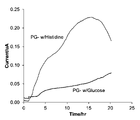
- 4 is a chronoamperogram showing the effect of histidine on the generated current.
- 4 is a chronoamperogram showing the effect of aspartic acid on the generated current.
- 4 is a chronoamperogram showing the effect of glutamic acid on generated current.
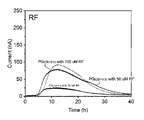
- FIG. 10 is a diagram showing current production specific to Pg bacteria when aspartic acid is used as a saccharogenic amino acid. It is an experimental result of examining the influence of HNQ on current generation. It is an experimental result of examining the influence of FMN on current generation. It is the experimental result which investigated the influence on current generation of RF.
- FIG. 1 is a flow chart of an in-vitro diagnostic method according to an embodiment of the present invention.
- a sample derived from the oral cavity of a subject is brought into contact with an electrode, and electrochemical measurement is performed in the presence of a glycogenic amino acid and an electron mediator under an anaerobic environment (step S11).
- the specimen is not particularly limited as long as it is derived from the oral cavity of the subject, but preferably contains saliva, plaque, blood, pus, mixtures thereof, and the like. Especially, when the specimen contains saliva, it is more non-invasive and easier to collect, which is preferable.
- the specimen may contain water, electrolytes, and the like as components other than those described above.
- the electrolyte is not particularly limited, but known electrolytes can be used. However, it is preferable that the electrolyte does not contain organic substances other than the saccharogenic amino acids described later.
- Electrochemical measurements are performed in the presence of glycogenic amino acids. Electrochemical measurement in the presence of a glycogenic amino acid typically includes a form in which the glycogenic amino acid is added to the sample. Examples of glycogenic amino acids include alanine, glycine, serine, threonine, cysteine, tryptophan, isoleucine, methionine, valine, aspartic acid, arginine, glutamic acid, histidine, proline, tyrosine, and phenylalanine, among others.
- At least one selected from the group consisting of arginine, histidine, aspartic acid, and glutamic acid is preferable, and at least one selected from the group consisting of arginine and histidine from the viewpoint that the generated current (density) tends to be larger 1 type is more preferable.
- histidine Compared to aspartic acid and glutamic acid, histidine has higher water solubility and is preferable in that even when added to a specimen, it tends to be more uniform. If the water solubility is high, there is no need to add an acid or the like to the sample, which is preferable in that the background current in the measurement tends to be small. In addition, the present inventors have experimentally confirmed that when the glycogenic amino acid is histidine, the generated current derived from the Pg bacterium tends to increase (see Examples).
- acid e.g., hydrochloric acid
- the content of the glycogenic amino acid in the sample is not particularly limited, but is generally preferably 0.1 to 1000 mM.
- Electrochemical measurements are also performed in the presence of an electronic mediator. Periodontopathogenic bacteria generate electric current in an anaerobic environment, and some have the function of transferring the electric current to an extracellular electron acceptor (e.g., anode electrode), but electrochemical measurements are performed in the presence of an electron mediator. This is more preferable because electron transfer can be performed more smoothly. Electrochemical measurement in the presence of an electron mediator typically includes a form in which an electron mediator is added to a specimen, as in the case of the sugargenic amino acid described above.
- the electronic mediator that can be used is not particularly limited, and known electronic mediators can be used.
- the electron mediator is preferably water-soluble, and is selected from the group consisting of flavin mononucleotide, riboflavin, and 2-hydroxy-1,4-naphthoquinone (2-hydroxy-1,4-napthoquinone, HNQ). When at least one is included, a larger generated current (density) can be obtained.
- the glycogenic amino acid and the electron mediator may not be added to the specimen.
- the glycogenic amino acid may be immobilized on the electrode surface.
- a method of controlling the potential of the electrode and measuring the current as a function of time is preferable.
- Such methods include, for example, the amperometry method, the cyclic voltammetry method, the linear sweep voltammetry method, and the rectangular wave voltammetry method.
- the material of the electrodes is not particularly limited, and known electrodes for electrochemical measurements can be used.
- Materials for the electrodes include, for example, ITO (indium tin oxide), noble metals (gold (Au), silver (Ag), platinum (Pt), palladium (Pd), rhodium (Rh), iridium (Ir), ruthenium (Ru ), etc.), copper (Cu), aluminum (Al), tungsten (W), molybdenum (Mo), chromium (Cr), titanium (Ti), nickel (Ni), and the like.
- Carbon materials such as carbon and graphite (graphene) may also be used.
- a boron-doped diamond electrode is also preferable in that it has a wide potential window.
- a general electrochemical measuring device can be used for the electrochemical measurement.
- a three-electrode electrochemical measurement device in which a working electrode, a counter electrode, and a reference electrode are housed in a cell can be used.
- the temperature at which the electrochemical measurement is performed is not particularly limited, it can be performed at the same temperature as the sampling site of the sample, or the temperature can be controlled. In that case, the temperature of the specimen is preferably 10 to 40°C.
- the measurement may be performed in a general anaerobic glove box (anaerobic chamber), preferably under anoxic conditions.
- the potential of the electrode (working electrode) exceeds 0 V (vs. Ag/AgCl), and the potential window Control within a range less than the upper limit is preferred. Further, from the viewpoint of easily obtaining a larger generated current or easily generating a current in a shorter time, it is preferable to set the potential of the electrode to 0 to +0.6 V (vs. Ag/AgCl).
- step S12 If current generation is detected by this electrochemical measurement (step S12: Yes), the presence of periodontopathogenic bacteria in the sample is suggested. In this case, information for determining that periodontal disease is progressing in the oral cavity of the subject is provided (step S13).
- step S12 if current generation is not detected by this electrochemical measurement (step S12: No), the diagnosis ends and no information is provided for determining that periodontal disease is progressing.
- the above information is based on the measurement results, and its form is not particularly limited, but it consists of the time from the start of electrochemical measurement to the detection of current generation, and the maximum current density of the generated current.
- Information containing at least one measurement result selected from the group (hereinafter also referred to as “specific information”) is more preferable because it is likely to be information that contributes to quantitative evaluation of the progress of periodontal disease.
- the above-mentioned specific information is a numerical value related to the content of periodontopathogenic bacteria in the specimen, and for example, by comparing it with the value of a healthy subject or comparing it with the past value of the same subject, The information is likely to be useful for judging the degree of periodontal disease occurring in the oral cavity of the subject and the chronological progression of the disease.
- Modification A modification of the in-vitro diagnostic method according to the above-described embodiment compares the obtained measurement result with a reference value when current generation is detected, and provides information including the comparison information as periodontal disease in the oral cavity of the subject. It is an in vitro diagnostic method that provides information for judging progress.
- Examples of the reference value in the extracorporeal diagnostic method include the result of measurement by the same method using a healthy subject's sample, the past test result of the same subject, and the like.
- the comparative information includes, for example, the difference between the specific information measured by the same method using a healthy subject's sample and the specific information of the sample.
- the time from the start of electrochemical measurement to the detection of current generation in the case of measuring by the same method using a healthy subject's specimen, and the same as above for the specimen obtained from the subject The difference from the time measured by the method of . If the time measured for the sample is earlier and the difference is larger, it can be used as information for determining that the sample contains more periodontopathogenic bacteria.
- the above comparison information is an example, and information other than the above may be used.
- the specimen is brought into contact with an electrode, and in the presence of a glycogenic amino acid and 2-hydroxy-1,4-napthoquinone, Including performing electrochemical measurement in an anaerobic environment, and providing information for determining that the specimen contains Porphyromonas gingivalis when current generation is detected as a result of the electrochemical measurement. .
- the specimens in this detection method are not limited to those derived from the oral cavity of the subject, but may be specimens cultured for testing and research, environmental specimens (water and dust), and the like. If the specimen is not liquid, it can be used after extraction and purification using water or the like.
- Figure 2 is a chronoamperogram showing the effect of histidine on the generated current.
- PG-w/Histidine means that the sample contains histidine which is a glycogenic amino acid
- PG-w/Glucose means that the sample does not contain histidine and contains glucose instead. This is the result.
- current production was detected immediately after adding the Pg bacterial solution.
- current generation was detected, but at a smaller magnitude and with a longer time to current generation.
- Fig. 3 is a chronoamperogram showing the effect of aspartic acid on the generated current.
- FIG. 4 is a chronoamperogram showing the effect of glutamic acid on the generated current. In both cases, current production was detected immediately after adding the Pg bacterial solution.
- Figure 5 shows the above results. From FIG. 5, it was found that in the sample containing aspartic acid, Pg-specific current production could be detected.
- FIG. 6 shows experimental results when using HNQ, FIG. 7 using FMN, and FIG. 8 using RF.
- FIGS. 6 to 8 when any of the electron mediators was used, a larger current was rapidly obtained after addition of the bacterial solution (compare with FIG. 2).
- HNQ when HNQ was used, a larger current was obtained than when FMN and RF were used, and this tendency was particularly noticeable at concentrations exceeding 10 ⁇ M.
- saliva can be used as a specimen, and information for determining the progression of periodontal disease can be obtained in a simple manner.
- the information provided by the in-vitro diagnostic method of the present invention can be used not only for dentists to determine treatment strategies, but also for oral health management by patients themselves at home or in remote locations.
- the Pg bacterium detection method of the present invention it is possible to detect Pg bacterium-specific current generation by using a combination of saccharogenic amino acids and HNQ. This method is useful not only in formulating a dental treatment policy but also in the field of experimental research.
Landscapes
- Health & Medical Sciences (AREA)
- Life Sciences & Earth Sciences (AREA)
- Chemical & Material Sciences (AREA)
- Engineering & Computer Science (AREA)
- Immunology (AREA)
- Molecular Biology (AREA)
- Physics & Mathematics (AREA)
- Analytical Chemistry (AREA)
- Biomedical Technology (AREA)
- Biochemistry (AREA)
- General Health & Medical Sciences (AREA)
- General Physics & Mathematics (AREA)
- Pathology (AREA)
- Urology & Nephrology (AREA)
- Hematology (AREA)
- Organic Chemistry (AREA)
- Electrochemistry (AREA)
- Chemical Kinetics & Catalysis (AREA)
- Food Science & Technology (AREA)
- Microbiology (AREA)
- Medicinal Chemistry (AREA)
- Biotechnology (AREA)
- Proteomics, Peptides & Aminoacids (AREA)
- Biophysics (AREA)
- Wood Science & Technology (AREA)
- Zoology (AREA)
- Virology (AREA)
- Cell Biology (AREA)
- Tropical Medicine & Parasitology (AREA)
- Bioinformatics & Cheminformatics (AREA)
- General Engineering & Computer Science (AREA)
- Genetics & Genomics (AREA)
- Investigating Or Analysing Biological Materials (AREA)
- Measuring Or Testing Involving Enzymes Or Micro-Organisms (AREA)
Priority Applications (3)
| Application Number | Priority Date | Filing Date | Title |
|---|---|---|---|
| EP22832933.0A EP4365585A4 (en) | 2021-06-29 | 2022-06-21 | METHOD FOR IN VITRO DIAGNOSIS OF PERIODONTAL DISEASES AND METHOD FOR DETECTING PG BACTERIA |
| US18/569,549 US20240385140A1 (en) | 2021-06-29 | 2022-06-21 | IN VITRO DIAGNOSIS METHOD FOR PERIODONTAL DISEASES, AND Pg BACTERIUM DETECTION METHOD |
| JP2023531840A JP7719526B2 (ja) | 2021-06-29 | 2022-06-21 | 歯周病の体外診断を行うための情報を提供する方法、及び、Pg菌検出方法 |
Applications Claiming Priority (2)
| Application Number | Priority Date | Filing Date | Title |
|---|---|---|---|
| JP2021-107163 | 2021-06-29 | ||
| JP2021107163 | 2021-06-29 |
Publications (1)
| Publication Number | Publication Date |
|---|---|
| WO2023276785A1 true WO2023276785A1 (ja) | 2023-01-05 |
Family
ID=84691742
Family Applications (1)
| Application Number | Title | Priority Date | Filing Date |
|---|---|---|---|
| PCT/JP2022/024727 Ceased WO2023276785A1 (ja) | 2021-06-29 | 2022-06-21 | 歯周病の体外診断方法、及び、Pg菌検出方法 |
Country Status (4)
| Country | Link |
|---|---|
| US (1) | US20240385140A1 (https=) |
| EP (1) | EP4365585A4 (https=) |
| JP (1) | JP7719526B2 (https=) |
| WO (1) | WO2023276785A1 (https=) |
Citations (7)
| Publication number | Priority date | Publication date | Assignee | Title |
|---|---|---|---|---|
| WO2004106541A1 (ja) | 2003-05-30 | 2004-12-09 | Kyushu Tlo Company, Limited | 歯周病マーカー |
| JP2005069836A (ja) * | 2003-08-22 | 2005-03-17 | Daikin Ind Ltd | 電極、タンパク測定装置及び酵素活性の測定方法 |
| JP2007084534A (ja) * | 2005-08-26 | 2007-04-05 | Osaka Univ | 口腔用組成物 |
| JP2018142541A (ja) * | 2017-02-28 | 2018-09-13 | 公立大学法人大阪府立大学 | 電気化学デバイスおよびその製造方法 |
| WO2020204075A1 (ja) * | 2019-04-02 | 2020-10-08 | 国立研究開発法人物質・材料研究機構 | 薬剤感受性測定方法、及び、薬剤感受性測定装置 |
| WO2020235403A1 (ja) * | 2019-05-20 | 2020-11-26 | 国立研究開発法人物質・材料研究機構 | 検出装置、及び、データ収集方法 |
| JP2021082394A (ja) * | 2019-11-14 | 2021-05-27 | Phcホールディングス株式会社 | 酵素電極およびバイオセンサ並びにバイオ燃料電池 |
Family Cites Families (2)
| Publication number | Priority date | Publication date | Assignee | Title |
|---|---|---|---|---|
| KR100303611B1 (ko) * | 1999-07-07 | 2001-09-24 | 박호군 | 미생물의 전기화학적 농화배양 방법 및 유기물질 및 bod 분석용 바이오센서 |
| WO2020013093A1 (ja) * | 2018-07-09 | 2020-01-16 | 国立研究開発法人物質・材料研究機構 | 診断装置、分析方法、及び、プログラム |
-
2022
- 2022-06-21 EP EP22832933.0A patent/EP4365585A4/en active Pending
- 2022-06-21 US US18/569,549 patent/US20240385140A1/en active Pending
- 2022-06-21 JP JP2023531840A patent/JP7719526B2/ja active Active
- 2022-06-21 WO PCT/JP2022/024727 patent/WO2023276785A1/ja not_active Ceased
Patent Citations (7)
| Publication number | Priority date | Publication date | Assignee | Title |
|---|---|---|---|---|
| WO2004106541A1 (ja) | 2003-05-30 | 2004-12-09 | Kyushu Tlo Company, Limited | 歯周病マーカー |
| JP2005069836A (ja) * | 2003-08-22 | 2005-03-17 | Daikin Ind Ltd | 電極、タンパク測定装置及び酵素活性の測定方法 |
| JP2007084534A (ja) * | 2005-08-26 | 2007-04-05 | Osaka Univ | 口腔用組成物 |
| JP2018142541A (ja) * | 2017-02-28 | 2018-09-13 | 公立大学法人大阪府立大学 | 電気化学デバイスおよびその製造方法 |
| WO2020204075A1 (ja) * | 2019-04-02 | 2020-10-08 | 国立研究開発法人物質・材料研究機構 | 薬剤感受性測定方法、及び、薬剤感受性測定装置 |
| WO2020235403A1 (ja) * | 2019-05-20 | 2020-11-26 | 国立研究開発法人物質・材料研究機構 | 検出装置、及び、データ収集方法 |
| JP2021082394A (ja) * | 2019-11-14 | 2021-05-27 | Phcホールディングス株式会社 | 酵素電極およびバイオセンサ並びにバイオ燃料電池 |
Non-Patent Citations (4)
| Title |
|---|
| NAGATA, SHINICHIRO; OHSHIMA, TAKESHI; OHTSUKA, KEIICHI; SATO, SHINOBU; NAGAYOSHI, MASATO; KITAMURA, CHIAKI; NISHIHARA, TATSUJI; TA: "Electrochemical Detection of Periodontal Disease Using Protease Assay", PEPTIDE SCIENCE, PROTEIN RESEARCH FOUNDATION, MINOO,, JP, 1 March 2012 (2012-03-01), JP , pages 407 - 408, XP009542112, ISSN: 1344-7661 * |
| PARK SEONHWA, PARK KIRYEON, NA HEE SAM, CHUNG JIN, YANG HAESIK: "Washing- and Separation-Free Electrochemical Detection of Porphyromonas gingivalis in Saliva for Initial Diagnosis of Periodontitis", ANALYTICAL CHEMISTRY, AMERICAN CHEMICAL SOCIETY, US, vol. 93, no. 13, 6 April 2021 (2021-04-06), US , pages 5644 - 5650, XP093017847, ISSN: 0003-2700, DOI: 10.1021/acs.analchem.1c00572 * |
| SATO SHINOBU, SHINICHIRO NAGATA, JUNPEI SHIMAMOTO, TOSHINORI OKINAGA, WATARU ARIYOSHI, MICHIHIKO USUI, KEISUKE NAKASHIMA, TASTUJI : "An Electrochemical Protease Assay Using Ferrocenylpeptide for Screening of Periodontal Disease", BUNSEKI KAGAKU, vol. 70, no. 3, 5 March 2021 (2021-03-05), pages 199 - 206, XP093017849, DOI: 10.2116/bunsekikagaku.70.199 * |
| See also references of EP4365585A4 |
Also Published As
| Publication number | Publication date |
|---|---|
| JP7719526B2 (ja) | 2025-08-06 |
| JPWO2023276785A1 (https=) | 2023-01-05 |
| EP4365585A4 (en) | 2025-06-18 |
| US20240385140A1 (en) | 2024-11-21 |
| EP4365585A1 (en) | 2024-05-08 |
Similar Documents
| Publication | Publication Date | Title |
|---|---|---|
| Ngamchuea et al. | Understanding electroanalytical measurements in authentic human saliva leading to the detection of salivary uric acid | |
| Timpel et al. | Sensors for in situ monitoring of oral and dental health parameters in saliva | |
| Madhuchandra et al. | Electrochemical determination of Adrenaline and Uric acid at 2-Hydroxybenzimidazole modified carbon paste electrode Sensor: a voltammetric study | |
| Jafari et al. | Non-invasive quantification of malondialdehyde biomarker in human exhaled breath condensate using self-assembled organic-inorganic nanohybrid: a new platform for early diagnosis of lung disease | |
| Liu et al. | Development of an amperometric biosensor on a toothbrush for glucose | |
| Brainina et al. | Platinum electrode regeneration and quality control method for chronopotentiometric and chronoamperometric determination of antioxidant activity of biological fluids | |
| Levent et al. | Application of a pencil graphite electrode for voltammetric simultaneous determination of ascorbic acid, norepinephrine, and uric acid in real samples | |
| Wang et al. | A strategy to differentiate dopamine and levodopa based on their cyclization reaction regulated by pH | |
| Zhang | Monitoring athlete health and performance using an electrochemical sensor based on zinc oxide nanorods | |
| JP6009794B2 (ja) | ダイヤモンド微小電極を用いた還元型グルタチオンの測定装置 | |
| EP3735904A1 (en) | Detecting nicotine in sweat | |
| JP5088148B2 (ja) | 代謝物濃度を測定する方法及びこれに用いられる電気化学センサ | |
| JP7719526B2 (ja) | 歯周病の体外診断を行うための情報を提供する方法、及び、Pg菌検出方法 | |
| Chandra et al. | Determination of dopamine in presence of uric acid at poly (eriochrome black T) film modified graphite pencil electrode | |
| JPH08511625A (ja) | ガス濃度の測定 | |
| Mitsumori et al. | A new approach to noninvasive measurement of blood glucose using saliva analyzing system | |
| TW201102649A (en) | Metabolites for oral health and uses thereof | |
| EP0630204B1 (en) | Measuring sulfides within a periodontal pocket | |
| Sutow et al. | Corrosion potential variation of aged dental amalgam restorations over time | |
| KR100541266B1 (ko) | 경피 글루코스 측정용 전극의 조성 | |
| Motsegood et al. | Detection of acetone on human breath using cyclic voltammetry | |
| Sannino et al. | Preliminary impedance spectroscopy study for carious lesions detection | |
| JP5360907B2 (ja) | 有機化合物検出用電極及びそれを使用した有機化合物濃度の電気化学検出装置 | |
| JPH095321A (ja) | 生化学物質測定装置及びそれに適用する唾液収集方法 | |
| Justice Jr et al. | In vivo voltammetry |
Legal Events
| Date | Code | Title | Description |
|---|---|---|---|
| 121 | Ep: the epo has been informed by wipo that ep was designated in this application |
Ref document number: 22832933 Country of ref document: EP Kind code of ref document: A1 |
|
| WWE | Wipo information: entry into national phase |
Ref document number: 2023531840 Country of ref document: JP |
|
| WWE | Wipo information: entry into national phase |
Ref document number: 18569549 Country of ref document: US |
|
| WWE | Wipo information: entry into national phase |
Ref document number: 2022832933 Country of ref document: EP |
|
| NENP | Non-entry into the national phase |
Ref country code: DE |
|
| ENP | Entry into the national phase |
Ref document number: 2022832933 Country of ref document: EP Effective date: 20240129 |