WO2023248349A1 - 駆動装置および駆動装置を備えるロボット - Google Patents
駆動装置および駆動装置を備えるロボット Download PDFInfo
- Publication number
- WO2023248349A1 WO2023248349A1 PCT/JP2022/024742 JP2022024742W WO2023248349A1 WO 2023248349 A1 WO2023248349 A1 WO 2023248349A1 JP 2022024742 W JP2022024742 W JP 2022024742W WO 2023248349 A1 WO2023248349 A1 WO 2023248349A1
- Authority
- WO
- WIPO (PCT)
- Prior art keywords
- support member
- optical cable
- drive device
- robot
- cavity
- Prior art date
- Legal status (The legal status is an assumption and is not a legal conclusion. Google has not performed a legal analysis and makes no representation as to the accuracy of the status listed.)
- Ceased
Links
Images





Classifications
-
- B—PERFORMING OPERATIONS; TRANSPORTING
- B25—HAND TOOLS; PORTABLE POWER-DRIVEN TOOLS; MANIPULATORS
- B25J—MANIPULATORS; CHAMBERS PROVIDED WITH MANIPULATION DEVICES
- B25J19/00—Accessories fitted to manipulators, e.g. for monitoring, for viewing; Safety devices combined with or specially adapted for use in connection with manipulators
- B25J19/0025—Means for supplying energy to the end effector
- B25J19/0029—Means for supplying energy to the end effector arranged within the different robot elements
-
- B—PERFORMING OPERATIONS; TRANSPORTING
- B25—HAND TOOLS; PORTABLE POWER-DRIVEN TOOLS; MANIPULATORS
- B25J—MANIPULATORS; CHAMBERS PROVIDED WITH MANIPULATION DEVICES
- B25J19/00—Accessories fitted to manipulators, e.g. for monitoring, for viewing; Safety devices combined with or specially adapted for use in connection with manipulators
- B25J19/02—Sensing devices
- B25J19/021—Optical sensing devices
- B25J19/025—Optical sensing devices including optical fibres
Definitions
- the present invention relates to a drive device and a robot equipped with the drive device.
- the robot device includes a work tool that performs work and a robot that moves the work tool.
- a robot can change the position and posture of a work tool by driving a component such as an arm.
- a drive device including an electric motor for moving the component is arranged in the robot.
- a drive device for moving each component is disposed at a joint of a robot. The drive device can rotate one component relative to another component.
- a wire body such as a power cable and a signal line for driving a drive device is arranged inside a component such as a robot arm (for example, Japanese Patent Laid-Open No. 2008-18475).
- a penetration is formed in the drive device arranged at the joint.
- the filamentous body is inserted through the penetrating portion and disposed from the internal space of one component to the internal space of another component.
- piping is arranged along the rotation axis, and a filament such as a power cable is arranged inside the piping (for example, Japanese Patent Application Publication No. 2015-211999).
- a filamentous body In the joints of a robot, one component rotates with respect to another component, so the relative angles between the components change.
- a filamentous body When a filamentous body is placed inside a component of a robot, the direction in which the filament extends changes as the component rotates. For this reason, a force in a predetermined direction is applied to the filamentous body disposed at the joint. For example, a bending force or a twisting force acts on the striatum.
- a robot includes a drive device that rotates a second component of the robot around a rotation axis with respect to a first component of the robot.
- the robot includes a member forming a cavity extending in a direction along the rotation axis.
- the robot includes an optical cable arranged to pass through the interior of the cavity.
- the robot includes a first support member that is disposed on one axial side of the cavity and supports the optical cable, and a second support member that is disposed on the opposite side of the cavity in the axial direction and supports the optical cable. and a support member.
- the first support member is fixed to a member that remains stationary when the drive device is driven.
- the second support member is fixed to a member that rotates when driven by the drive device.
- the first support member and the second support member are formed to support the optical cable substantially on the rotation axis.
- the first support member and the second support member are configured such that when the drive device is driven, the second support member rotates with respect to the first support member and the first support member and the second support member are connected to each other.
- the optical cable is configured to be twisted between the two.
- a drive device rotates two mutually different members relative to each other around a rotation axis, and has a cavity extending in a direction along the rotation axis.
- the drive device includes an electric motor that generates rotational force.
- the drive device includes a first support member that is disposed on one side in the axial direction of the cavity and supports the optical cable so as to pass through the interior of the cavity, and a first support member that is disposed on one side in the axial direction of the cavity and a first support member that supports the optical cable so as to pass through the inside of the cavity. and a second support member arranged to support the optical cable.
- the first support member is fixed to a component of the drive device that is stationary when the electric motor is driven.
- the second support member is fixed to a component of the drive device that rotates when the electric motor is driven.
- the first support member and the second support member are formed to support the optical cable substantially on the rotation axis.
- the first support member and the second support member are arranged such that when the electric motor is driven, the second support member rotates with respect to the first support member, thereby creating a space between the first support member and the second support member.
- the optical cable is configured so that it can be twisted.
- a drive device that suppresses damage to an optical cable as a communication line, and a robot equipped with the drive device.
- FIG. 1 is a perspective view of a robot in an embodiment. It is a schematic sectional view of the joint part in which the 1st drive device in an embodiment is arranged. It is a schematic partial sectional view when the 1st drive device is seen from the 2nd support member side.
- FIG. 1 is a perspective view of an optical cable in an embodiment.
- FIG. 2 is a schematic cross-sectional view of an optical cable. It is a schematic sectional view of the joint part in which the 2nd drive device in an embodiment is arranged. It is a schematic sectional view of the joint part in which the 3rd drive device in an embodiment is arranged. It is a schematic sectional view of the joint part in which the 4th drive device in an embodiment is arranged.
- a drive device and a robot equipped with the drive device in an embodiment will be described with reference to FIGS. 1 to 11.
- the drive device of this embodiment rotates one component of a robot around a predetermined rotation axis.
- An optical cable is arranged as a communication line for transmitting information to the drive device or a communication line for receiving information from the drive device.
- FIG. 1 is a perspective view of the robot in this embodiment.
- the robot 1 of this embodiment is an articulated robot including a plurality of joints 10a to 10f.
- the robot 1 of this embodiment is a collaborative robot that can perform work in cooperation with a worker.
- the collaborative robot is configured such that the movement of the robot 1 is restricted when a predetermined external force is applied to the robot 1.
- the collaborative robot is configured so that the robot 1 stops when a worker comes into contact with the robot.
- the robot 1 includes a plurality of rotatable structural members at joints 10a to 10f.
- Each of the constituent members is formed to rotate around drive shafts J1 to J6 that serve as rotational axes.
- the drive device of this embodiment is arranged inside the joints 10a to 10f to drive the constituent members of the robot 1.
- the robot 1 includes a base portion 14 fixed to an installation surface and a swing base 13 supported by the base portion 14.
- the swing base 13 rotates around the drive shaft J1 with respect to the base portion 14.
- the upper arm 12 of the robot 1 rotates around a drive axis J2 with respect to the rotation base 13.
- the forearm arm 11 of the robot 1 rotates around a drive axis J3 relative to the upper arm arm 12. Furthermore, the forearm arm 11 rotates around a drive axis J4 parallel to the direction in which the forearm arm 11 extends.
- the robot 1 includes a wrist 15 supported on a forearm arm 11. Wrist 15 rotates around drive shaft J5.
- the wrist 15 also includes a flange 16 that rotates around a drive shaft J6.
- a work tool corresponding to the work performed by the robot device is fixed to the flange 16.
- the robot 1 of this embodiment includes a base portion 14, a swing base 13, an upper arm arm 12, a forearm arm 11, and a wrist 15 as constituent members of the robot 1.
- the robot of this embodiment has six drive axes, the invention is not limited to this configuration. A robot that changes its position and posture using any mechanism can be employed.
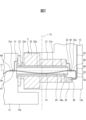
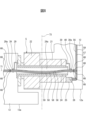
- FIG. 2 shows a schematic cross-sectional view of a joint portion including the first drive device in this embodiment.
- the first drive device 2 is arranged at the joint portion 10b.
- the first drive device 2 rotates the upper arm arm 12 as a second component around a drive shaft J2 as a rotating shaft 71 with respect to the pivot base 13 as a first component.
- a drive device that drives the upper arm arm 12 disposed at the joint portion 10b will be described as an example, but the drive device is not limited to this embodiment.
- the drive device of this embodiment can be disposed at a joint portion that rotates a second component of the robot around a rotation axis with respect to a first component of the robot. That is, the drive device of this embodiment is placed at any joint and can rotate any component.
- the drive device 2 includes an electric motor 21 that generates rotational force, and a reduction gear 22 that amplifies the torque output by the electric motor 21.
- the drive device 2 is driven.
- the housing of the speed reducer 22 is fixed to the housing 12a of the upper arm arm 12.
- the electric motor 21 is fixed to a reduction gear 22.
- the reducer 22 and the electric motor 21 rotate around the rotation axis 71 together with the housing 12a of the upper arm arm 12.
- the drive device 2 includes a torque sensor 23 that detects the torque output from the drive device 2.
- the torque sensor 23 of this embodiment includes an inner ring portion, an outer ring portion, and a plurality of spoke-shaped detection portions connecting the inner ring portion and the outer ring portion.
- the outer ring part of the torque sensor 23 is fixed to the housing 13a of the swing base 13, and the inner ring part is fixed to the output part of the reduction gear 22.
- the housing 13a of the swing base 13 and the torque sensor 23 remain stationary without rotating.
- the torque sensor 23 detects torque around the rotating shaft 71 when the drive device 2 is driven.
- a control device of the robot receives signals related to torque via a communication line.
- a robot control device subtracts a moment related to the robot's own weight and a moment related to the motion of the robot from the torque detected by the torque sensor. The calculated moment corresponds to the external force applied to the robot.
- the robot control device can limit the robot's operation when the external force is larger than a predetermined determination value.
- the drive device of this embodiment includes a torque sensor, it is not limited to this embodiment.
- the drive device does not need to be provided with a torque sensor.
- the output shaft of the speed reducer can be fixed to the housing 13a of the swing base 13.
- the drive device 2 of the present embodiment includes a protection tube 24 as a member forming a cavity 24a extending in a direction along the rotation axis 71.
- the space inside the protective tube 24 corresponds to a cavity 24a that penetrates from one end surface of the drive device 2 to the other end surface.
- the members constituting the cavity 24a of this embodiment are arranged in the drive device 2.
- the electric motor 21 has a cavity 21a extending in a direction along the rotation axis 71.
- the speed reducer 22 has a cavity 22a extending in a direction along the rotating shaft 71.
- the torque sensor 23 has a cavity 23a extending in a direction along the rotation axis 71.
- these cavities 21a, 22a, and 23a have substantially the same inner diameter and are coaxially arranged.
- the protection tube 24 is arranged inside the cavities 21a, 22a, 23a so as to penetrate through the cavities 21a, 22a, 23a.
- the protection tube 24 is arranged at the joint portion 10b of the robot 1.
- the hollow portion 24a is formed coaxially with the rotating shaft 71, it is not limited to this form.
- the axis of the cavity 24a may be apart from the rotating shaft 71.
- the member constituting the cavity may be a member disposed outside the drive device. That is, the cavity through which the optical cable is inserted does not need to be formed inside the drive device.
- a cavity may be formed in the housing of the component of the robot.
- the protection tube 24 of this embodiment is made of resin.
- a filamentous body can be inserted into the protection tube 24 .
- a linearly extending member is referred to as a filament.
- At least some of the filamentary members in this embodiment are laid inside the housing of a component of the robot 1, such as an arm.
- the protection tube 24 is arranged to protect the striatum arranged inside.
- a flange portion at the tip of the protection tube 24 is fixed to the inner ring portion of the torque sensor 23.
- the protection tube 24 maintains a stationary state when the electric motor 21 is driven.
- the protection tube 24 may not be provided.
- the hollow portions 21a, 22a, and 23a may constitute a hollow portion that penetrates the drive device.
- the electric motor 21, the speed reducer 22, and the torque sensor 23 correspond to members forming the cavity.
- a driving device is arranged for each of the joints 10a to 10f. That is, one drive device is arranged in one joint.
- the plurality of drive devices of the robot 1 of this embodiment are configured to perform serial communication with each other.
- Drive device 2 includes a driver 25 that controls electricity supplied to electric motor 21 .
- the driver 25 includes, for example, an inverter, converts DC electricity into AC electricity, and supplies the AC electricity to the motor 21 .
- a signal for controlling the electric motor 21 is transmitted from the robot control device to the driver 25 .
- an optical cable 51 is used as the communication line connected to the driver 25 instead of using an electric wire. That is, the optical cable 51 is employed as the signal line of the drive device 2.
- the optical cable 51 connects the drive devices arranged at each joint.
- the optical cable 51 connects a drive device arranged at the joint and a control device of the robot. For example, an electrical signal can be converted into an optical signal and the signal can be transmitted or received via an optical cable.
- any communication protocol that allows serial communication using an optical cable can be adopted.
- a communication protocol that performs optical communication using a method similar to industrial Ethernet (registered trademark) such as EtherCAT (registered trademark) or field bus such as RS-485 can be adopted.
- the communication method of the robot drive device is not limited to serial communication, and any method can be adopted. For example, it may be configured to perform parallel communication using an optical cable.
- the robot control device is connected to the driver of the drive device disposed on the drive shaft J1 via an optical cable.
- the driver of the drive device arranged on the drive shaft J1 is connected to the driver 25 of the drive device 2 arranged on the drive shaft J2 shown in FIG. 2 by an optical cable.
- the driver 25 of the drive device 2 arranged on the drive shaft J2 is connected to the driver of the drive device arranged on the drive shaft J3 by an optical cable. In this way, adjacent drive devices are connected to each other by optical cables up to the drive device disposed on the drive shaft J6.
- the information communicated through the optical cable includes a motor position command, a motor rotation speed command, a motor current command, a motor voltage command, etc. of each drive device. That is, information regarding electricity supplied to the electric motor is included. Information regarding the electricity of each driver is generated by the robot's control device and received by each drive device via a communication line.
- the information communicated via the optical cable can include information detected by a sensor placed on the robot.
- the information includes information regarding the position or speed detected by a rotational position detector (encoder) attached to the electric motor, and information regarding the current detected by a current detector disposed in the driver.
- information regarding the torque output from the torque sensor may be included. Information regarding the outputs of these sensors is included in the signals output from the driver.
- the information communicated through the optical cable includes at least one of the plurality of pieces of information described above.
- the driver 25 of the drive device 2 includes a communication device 26 that transmits and receives information communicated via an optical cable.
- the communication device 26 in this embodiment is arranged in the drive device 2. Referring to FIG. 2, the driver of the drive device disposed on the drive shaft J1 is connected to an optical cable 50.
- Optical cable 50 is connected to optical cable 51 via connector 66.
- the optical cable 51 is inserted through the cavity 24a inside the protection tube 24.
- Optical cable 51 is connected to optical cable 53 extending from communication device 26 of driver 25 via connector 66 .
- optical cable 54 extending from the communication device 26 of the driver 25 is connected to the optical cable 52 via a connector 66.
- the optical cable 52 is connected to a driver of a drive device arranged on the drive shaft J3. In this way, by employing an optical cable as a communication line and arranging a communication device for optical communication in the robot 1, optical communication can be performed.
- the optical cable of this embodiment includes two optical fibers as at least two signal lines.
- One signal line transmits a signal from the drive device disposed on the drive shaft J1 to the drive device disposed on the drive shaft J6.
- the other signal line transmits a signal from the drive device disposed on the drive shaft J6 toward the drive device disposed on the drive shaft J1.
- a power cable for supplying power to drive the electric motor 21 is connected to the driver 25 of the drive device 2 .
- the power cable that supplies electricity to the electric motor 21 can be laid, for example, outside the housing of the robot. In this way, the power cable does not have to be located inside the component of the robot.
- the signal from the driver of the drive device disposed on the drive shaft J1 includes a signal for driving the electric motor 21 on the drive shaft J2.
- a signal for controlling an inverter that generates a current to be supplied to the electric motor 21 is included.
- the driver 25 of the drive device 2 supplies electricity to the electric motor 21 based on a signal for driving the electric motor 21.
- the driver 25 of the drive device 2 includes information regarding the output of the sensor arranged in the drive device 2 in the output signal.
- the driver 25 includes at least one of information regarding the output of the torque sensor 23, the output of the rotational position detector, or the output of the current detector in the signal output from the driver 25.
- the communication device 26 of this embodiment is arranged inside the casing 12a of the upper arm arm 12 as the second component of the robot 1. By arranging the communication device 26 inside the housing of the robot component, it is possible to suppress the robot from becoming larger.
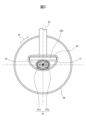
- FIG. 3 shows a partial cross-sectional view of the second support member in the first drive device.
- drive device 2 in this embodiment includes a first support member 31 and a second support member 32 that support optical cable 51.
- Each of the first support member 31 and the second support member 32 is formed to support one point of the optical cable 51.
- the first support member 31 is fixed to a member that remains stationary when the drive device 2 is driven.
- the first support member 31 is fixed to the housing 13a of the swing base 13.
- the first support member 31 may be fixed to the inner ring portion of the torque sensor 23.
- the second support member 32 is fixed to a member that rotates when the drive device 2 is driven.
- the second support member 32 is fixed to the casing of the electric motor 21.
- the second support member 32 rotates around the rotating shaft 71 together with the casing of the electric motor 21, as shown by an arrow 91.
- the second support member 32 may be fixed to the housing 12a.
- the second support member 32 is arranged in the same phase as the first support member 31 .
- the first support member 31 and the second support member 32 support the filamentous body such as the optical cable 51 so that the filament body is bent in the section between the first support member 31 and the second support member 32. .
- the filament bodies are fixed to the first support member 31 and the second support member 32 using the same method.
- the first support member 31 has a fixing portion 31a at its tip.
- the fixed portion 31a has a plate-like shape.
- An optical cable 51 is fixed to the fixed part 31a with a binding band 41.
- the second support member 32 has a fixing portion 32a at its tip.
- the fixed portion 32a is formed into a plate shape.
- the optical cable 51 is fixed to the fixed part 32a with a binding band 42.
- the binding bands 41 and 42 can be made of an elastic member such as nylon.
- the fixing parts 31a and 32a of this embodiment are formed so as to face the outside of the protection tube 24 in the direction of the rotating shaft 71, but the fixing parts are not limited to this form.
- the protective tube 24 may be formed so as to face the inside of the protective tube 24 in the direction shown in FIG.
- the fixing portion may be disposed inside the protective tube by bending each support member toward the inside of the protective tube.
- FIG. 4 shows a perspective view of the optical cable in this embodiment.
- FIG. 5 shows a cross-sectional view of the optical cable of this embodiment.
- FIG. 5 is a cross-sectional view taken along a plane perpendicular to the direction in which the optical cable 51 extends.
- one linear member including one core wire is referred to as an optical fiber.
- the core wire includes a core as a linear light propagation part, and has a structure in which the core is covered with resin.
- the core can be made of quartz glass or plastic such as acrylic resin, for example.
- the optical fiber can have a structure in which the core wire is further covered with a sheath made of resin or the like.
- a communication line including at least one optical fiber is referred to as an optical cable.
- an optical cable can have a structure in which a plurality of optical fibers are integrated with resin.
- optical cable 51 in this embodiment has a structure in which two optical fibers 51a and 51b are fixed to each other and integrated.
- the two optical fibers 51a and 51b are fixed to each other with a sheath 51c made of resin.
- the respective optical fibers 51a and 51b are fixed so as to extend parallel to each other.
- the optical cable 51 in this embodiment has a structure in which a pair of optical fibers 51a and 51b are fixed to each other.
- a communication line is used to transmit information to the drive device of the drive shaft J6 at the tip of the robot 1, and a communication line is used to connect the drive shaft J6 to the drive shaft J1 and the control device of the robot.
- a communication line is required to transmit information to the
- the optical cable 51 of this embodiment is composed of two optical fibers 51a and 51b, which is the minimum number required for serial communication. Since the two optical fibers 51a and 51b are fixed to each other and integrated, the diameter of the optical cable 51 can be reduced. As a result, the drive device 2 can be made smaller. Alternatively, the proportion of the optical cable 51 that occupies the cavity 24a is reduced, and other filament bodies can be placed in the cavity 24a. Furthermore, this configuration improves the workability when laying an optical cable inside a component such as a robot arm. Note that although the optical cable of this embodiment is configured with two optical fibers, the present invention is not limited to this configuration. Optical cables can include any number of optical fibers.
- a cushioning material 61 is wrapped around the optical cable 51 in order to protect the optical cable 51.
- the cushioning material 61 can be made of an elastic member such as sponge or rubber, for example.
- the cushioning material 61 can be arranged, for example, in a region fixed to the fixing parts 31a, 32a with the binding bands 41, 42. Or, with reference to FIG. 2, around the optical cable 51 in the section from the connector 66 disposed on one axial side of the protection tube 24 to the connector 66 disposed on the other axial side of the protection tube 24.
- a cushioning material 61 can be placed at. Alternatively, the buffer material may not be placed around the optical cable.
- optical cables are relatively weak against bending movements but relatively strong against twisting movements. I found it.
- an optical cable has a characteristic in that the twisting motion around the axis of the optical cable is stronger than the motion that changes the direction in which it extends. Based on this feature, the inventor conceived of a structure in which the bending motion of the optical cable is suppressed and the twisting motion occurs preferentially, as in the present embodiment.
- the first support member 31 and the second support member 32 are arranged in the same phase.
- the second support member 32 is placed at a predetermined reference position.
- the cross-sectional shape of the filament in the first support member 31 and the cross-sectional shape of the filament in the second support member 32 are mutually related to the center plane 73 of the cavity 24a in the direction of the axis (rotation shaft 71). Becomes a surface target.
- optical cable 51 is fixed to fixing parts 31a and 32a so that optical fibers 51a and 51b are lined up in the horizontal direction.
- Optical cable 51 is arranged on rotation axis 71 .
- the first support member 31 is arranged on one side of the cavity 24a in the axial direction.
- the first support member 31 is disposed on one side with respect to the axial center surface 73 of the cavity 24a of the protection tube 24.
- the second support member 32 is arranged on one side and the opposite side in the axial direction of the cavity 24a.
- the second support member 32 is disposed on the opposite side to the first support member 31 with respect to the axial center plane 73 of the cavity 24a.
- the first support member 31 and the second support member 32 are arranged on opposite sides of the center surface 73 of the cavity 24a. It is preferable that the first support member 31 and the second support member 32 are arranged near the exits on both sides of the cavity 24a.
- the first support member 31 and the second support member 32 are formed to support the optical cable 51 approximately on the rotation axis 71.
- “supported substantially on the rotational axis” means supported at or near the rotational axis. That is, the first support member 31 and the second support member 32 are formed to support the optical cable 51 on or near the rotation shaft 71.
- the rotating shaft 71 of the fixed parts 31a, 32a is disposed inside the area of the optical cable 51 when the fixed parts 31a, 32a are cut.
- the center of gravity of the cross-sectional shape of the optical cable 51 is located in an area that is half the inner diameter of the protective tube 24.
- the second support member 32 rotates with respect to the first support member 31.
- the second support member 32 rotates together with the electric motor 21 and the upper arm arm 12 about the rotation axis 71 in the direction shown by an arrow 91 . Even when the upper arm arm 12 rotates, the fixed portion 32a is maintained on or near the rotation axis 71.
- the movable part of the optical cable 51 is twisted between the first support member 31 and the second support member 32. Since the first support member 31 and the second support member 32 support the optical cable 51 at or near the rotation axis 71, it is possible to suppress the optical cable 51 from bending. Since the optical cable 51 is resistant to damage due to twisting motion, damage to the optical cable 51 can be suppressed.
- the optical cable 51 is supported so as to be flexible. For this reason, when the electric motor 21 is driven and the optical cable 51 is twisted, it is possible to suppress the application of strong tension in the direction in which the optical cable 51 extends.
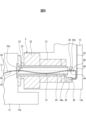
- FIG. 6 shows an enlarged schematic cross-sectional view of the joint portion including the second drive device in this embodiment.
- the second drive device 3 differs from the first drive device 2 in the position of the support member.
- the first support member 33 is fixed to the inner peripheral surface of the protection tube 24.
- An optical cable 51 is fixed to the first support member 33 by a binding band 43 at a fixing portion 33a.
- the first support member 33 is fixed to a member that remains stationary when the electric motor 21 is driven.
- the first support member 33 supports the optical cable 51 on or near the rotation shaft 71 .
- the second support member 34 is fixed to an arm that rotates when the electric motor 21 is driven.
- the second support member 34 is fixed to the inner surface of the housing 12a of the upper arm arm 12.
- An optical cable 51 is fixed to the second support member 34 at the fixing portion 34a with a binding band 44.
- the second support member 34 is formed to support the optical cable 51 on or near the rotation shaft 71 even when the electric motor 21 is driven. In the second drive device 3 as well, when the electric motor 21 is driven, the bending movement of the optical cable 51 can be suppressed, and damage to the optical cable 51 can be suppressed.
- the first support member can be fixed to a member that remains stationary even when the electric motor 21 is driven, it may be fixed to the inner surface of the casing 13a of the swing base 13, for example.
- the second support member can be fixed to a member that rotates when the electric motor 21 is driven. For this reason, for example, when the electric motor includes an encoder, the second support member may be fixed to the housing of the encoder.
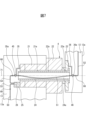
- FIG. 7 shows an enlarged schematic cross-sectional view of the joint portion including the third drive device in this embodiment.
- the third drive device 4 has a different orientation relative to the constituent members of the robot 1 compared to the first drive device 2 and the second drive device 3.
- the electric motor 21 and the speed reducer 22 are fixed to the housing 13a of the swing base 13.
- the torque sensor 23 is fixed to the housing 12a of the upper arm arm 12.
- the torque sensor 23 connected to the output shaft of the speed reducer 22 rotates together with the upper arm 12 when the electric motor 21 is driven.
- the electric motor 21 and the reduction gear 22 are maintained in a stationary state when the electric motor 21 is driven.
- the first support member 35 is fixed to the casing of the electric motor 21.
- An optical cable 51 is fixed to the fixed portion 35a of the first support member 35 with a binding band 45.
- the second support member 36 is fixed to the inner ring portion of the torque sensor 23.
- An optical cable 51 is fixed to the fixed portion 36a of the second support member 36 with a binding band 46.
- Each of the fixing parts 35a and 36a is formed to support the optical cable 51 on or near the rotating shaft 71.
- the driver 25 including the communication device 26 is arranged inside the casing 13a of the swing base 13 as a first component.
- the driver 25 is connected via optical cables 50 and 53 to a driver of a drive device arranged on the drive shaft J1.
- the driver 25 is connected via optical cables 54, 51, and 52 to a driver of a drive device arranged on the drive shaft J3.
- An optical cable 51 is inserted into the cavity 24a inside the protection tube 24.
- the fixed portion 36a of the second support member 36 rotates around the rotation axis 71.
- the fixed portion 35a of the first support member 35 is stationary.
- the optical cable 51 undergoes a twisting motion.
- the bending movement of the optical cable 51 can be suppressed, and damage to the optical cable 51 can be suppressed.
- the first support member may be fixed to the housing 13a of the swing base 13.
- the second support member may be fixed to the housing 12a of the upper arm arm 12.
- FIG. 8 shows an enlarged schematic cross-sectional view of the joint portion including the fourth drive device in this embodiment.
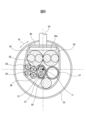
- FIG. 9 shows a schematic partial cross-sectional view of the second support member of the fourth drive device in this embodiment.
- one optical cable 51 is disposed in the cavity 24a inside the protection tube 24, but the present invention is not limited to this configuration.
- a plurality of filaments can be arranged inside the component of the robot.
- a plurality of filamentary bodies other than the optical cable 51 can be inserted into the cavity of the drive device so as to penetrate through the joint.
- the fourth drive device 5 differs from the first drive device 2 in that the first support member 29 and the second support member 30 support a plurality of filamentary bodies. .
- a plurality of filament bodies are fixed to each of the support members 29 and 30 with binding bands 39 and 40.
- the filament of this embodiment includes a power cable 56 as an electric wire that supplies electricity to drive the electric motor 21 to the driver 25, an air supply pipe 57 that supplies pressurized air to drive the work tool, Included are electrical wires 58 that provide backup electricity to the rotary position detector (encoder), and communication cables 59 that transmit signals to drive the work tool.
- the communication cable 59 is comprised of an electric cable and is therefore included in the electric wire.
- the striatum is not limited to this form. Any movable linear body that is resistant to twisting or bending can be used.
- the binding band 40 is arranged so as to surround the plurality of filaments.
- the binding band 40 is integrally fixed to the fixing part 30a so that a plurality of filaments form a bundle.
- Each filament is arranged so as to pass through the cavity 24a inside the protective tube 24.
- the plurality of filament bodies of the filament body of the second support member 30 They are arranged so as to be plane symmetrical with respect to the central plane 73.
- the plurality of filamentary bodies are supported so as to be flexible.
- the plurality of filamentary bodies are not fixed and are arranged so as to be freely deformable.
- the filament bodies are separated from each other when the drive device is driven, so that damage to the filament bodies can be suppressed.
- the first support member 29 and the second support member 30 support the optical cable 51 near the rotating shaft 71.
- the first support member 29 and the second support member 30 support a power cable 56 as an electric wire, a backup electric wire 58, and a communication cable 59 at a position farther from the rotation axis 71 than the optical cable 51.
- the inventor found that when a bundle of electric wires is subjected to reciprocating torsional motion, the closer the wires are placed to the rotation axis, the more the conductor part of the wires becomes metal. We discovered that the lifespan until wire breakage is shortened due to fatigue.
- the fourth drive device 5 by arranging the electric wire at a position away from the rotating shaft 71, the life of the electric wire can be extended. Further, in the fourth drive device 5, the optical cable 51 is arranged near the rotating shaft 71. Therefore, in the fourth drive device 5, the lives of the optical cable 51, the power cable 56, the electric wire 58, and the communication cable 59 can be extended.
- the optical cable 51 in the fixed parts 29a, 30a, it is preferable to arrange the optical cable 51 on or near the rotation axis 71, and arrange a filamentous body other than the optical cable 51, such as an electric wire, around the optical cable 51. .
- the optical cable 51 in the cross section of the bundle of a plurality of filaments, can be arranged in the center, and the electric wires can be arranged in the outer peripheral part outside the center. This configuration can extend the life of the strands of both the optical cable and the electric wire.
- the air supply pipe 57 that supplies compressed air is made of a flexible material.
- the air supply pipe 57 is made of polyurethane, for example.
- the air supply pipe 57 has the characteristic that it is not easily damaged by both bending and twisting movements.
- the air supply pipe 57 can be placed at any position in the cross section of the bundle of filaments.
- a metal binding band can be used in addition to the above-mentioned nylon band.
- a metal band it is preferable to arrange a cushioning material on the inner circumferential surface of the metal band so that the filament is not damaged by contact with the metal band.
- FIG. 10 shows an enlarged schematic cross-sectional view of the second support member of the fifth drive device in this embodiment.
- the fifth drive device includes a second support member 37 having a fixed portion 37a.
- a plurality of filament bodies are fixed to the fixing portion 37a with binding bands 47.
- the first support member supports a plurality of filament bodies with a structure similar to that of the second support member 37.
- the optical cable 51 is in contact with the fixed part 37a via the cushioning material 61.
- the optical cable 51 is in contact with the fixed portion 37a at approximately the center in the width direction.
- the position of the fixing portion 37a is adjusted so that the optical cable 51 is placed on the rotating shaft 71.
- a power cable 56 and an electric wire 58 are arranged around the optical cable 51.
- an air supply pipe 57 is arranged around the optical cable 51.
- a plurality of filament bodies can be bundled with the optical cable 51 in contact with the widthwise center of the fixing portion 37a. For this reason, the optical cable 51 can be easily placed on the rotating shaft 71 to fix the filament.
- FIG. 11 shows an enlarged schematic cross-sectional view of the second support member of the sixth drive device in this embodiment.
- the sixth drive device includes a second support member 38 having a fixed portion 38a.
- the first support member supports the filament with the same configuration as the second support member 38.
- the optical cable 51 and the air supply pipe 57 are arranged near the rotating shaft 71.
- a power cable 56 and an electric wire 58 are arranged around the optical cable 51 and the air supply pipe 57.
- the optical cable 51 and the air supply pipe 57 are arranged at the center of the cavity 24a.
- Power cables 56 and wires 58 are arranged on the outer periphery around the central portion.
- the first support member and the second support member 38 support the electric wire at a position farther from the rotating shaft 71 than the optical cable 51 and the air supply pipe 57.
- the electric wire is placed at a position away from the rotating shaft 71. Since the air supply pipe 57 has a large diameter, it can be used as a spacer. By arranging the optical cable 51 and the air supply pipe 57 near the rotation axis 71 and arranging the electric wires around the optical cable 51 and the air supply pipe 57, the electric wires can be placed at a position away from the rotation axis 71. .
- a metal fitting 48 having a U-shaped cross section is employed as a member for fixing the filament to the fixing portion 38a.
- the metal fitting 48 is made of metal.
- the metal fitting 48 is fixed to the fixed part 38a with a fastening member such as a bolt 49.
- a cushioning material may be placed on the inner circumferential surface of the metal fitting 48 so as not to damage the filament.
- the member for fixing the filament is not limited to a binding band, and any member such as a metal fitting can be used.
- a member made of plastic and having a U-shaped cross section may be used.
- the filament bodies may be fixed to the fixing part with an adhesive serving as a member for binding the plurality of filament bodies.
- a special metal fitting for arranging the optical cable 51 on or near the rotating shaft 71 may be fixed to the fixed part. Then, other filamentary bodies may be arranged around this metal fitting, and the plurality of filamentous bodies may be fixed with a binding band or the like.
- the drive device of this embodiment is arranged at the joint of the robot, it is not limited to this form.
- the drive device of this embodiment can be applied to any device that rotates two different members relative to each other around a rotation axis.
- the device of this embodiment can be applied to a drive device that is disposed on a work tool and drives a component of the work tool, a drive device of an automatic tool changer of a machine tool, or the like.
Landscapes
- Engineering & Computer Science (AREA)
- Robotics (AREA)
- Mechanical Engineering (AREA)
- Manipulator (AREA)
Priority Applications (5)
| Application Number | Priority Date | Filing Date | Title |
|---|---|---|---|
| DE112022006960.0T DE112022006960T5 (de) | 2022-06-21 | 2022-06-21 | Antriebsvorrichtung und Roboter mit Antriebsvorrichtung |
| JP2024528150A JPWO2023248349A1 (https=) | 2022-06-21 | 2022-06-21 | |
| PCT/JP2022/024742 WO2023248349A1 (ja) | 2022-06-21 | 2022-06-21 | 駆動装置および駆動装置を備えるロボット |
| CN202280097046.2A CN119403660A (zh) | 2022-06-21 | 2022-06-21 | 驱动装置以及具备驱动装置的机器人 |
| TW112118912A TW202400373A (zh) | 2022-06-21 | 2023-05-22 | 驅動裝置及具備驅動裝置之機器人 |
Applications Claiming Priority (1)
| Application Number | Priority Date | Filing Date | Title |
|---|---|---|---|
| PCT/JP2022/024742 WO2023248349A1 (ja) | 2022-06-21 | 2022-06-21 | 駆動装置および駆動装置を備えるロボット |
Publications (1)
| Publication Number | Publication Date |
|---|---|
| WO2023248349A1 true WO2023248349A1 (ja) | 2023-12-28 |
Family
ID=89379594
Family Applications (1)
| Application Number | Title | Priority Date | Filing Date |
|---|---|---|---|
| PCT/JP2022/024742 Ceased WO2023248349A1 (ja) | 2022-06-21 | 2022-06-21 | 駆動装置および駆動装置を備えるロボット |
Country Status (5)
| Country | Link |
|---|---|
| JP (1) | JPWO2023248349A1 (https=) |
| CN (1) | CN119403660A (https=) |
| DE (1) | DE112022006960T5 (https=) |
| TW (1) | TW202400373A (https=) |
| WO (1) | WO2023248349A1 (https=) |
Citations (2)
| Publication number | Priority date | Publication date | Assignee | Title |
|---|---|---|---|---|
| JP2008018475A (ja) * | 2006-07-10 | 2008-01-31 | Rorze Corp | 旋回部の配線又は配管機構 |
| JP2015212002A (ja) * | 2014-05-07 | 2015-11-26 | セイコーエプソン株式会社 | 天吊りロボット |
Family Cites Families (1)
| Publication number | Priority date | Publication date | Assignee | Title |
|---|---|---|---|---|
| JP6277850B2 (ja) * | 2014-05-07 | 2018-02-14 | セイコーエプソン株式会社 | 天吊りロボット |
-
2022
- 2022-06-21 JP JP2024528150A patent/JPWO2023248349A1/ja active Pending
- 2022-06-21 CN CN202280097046.2A patent/CN119403660A/zh active Pending
- 2022-06-21 WO PCT/JP2022/024742 patent/WO2023248349A1/ja not_active Ceased
- 2022-06-21 DE DE112022006960.0T patent/DE112022006960T5/de active Pending
-
2023
- 2023-05-22 TW TW112118912A patent/TW202400373A/zh unknown
Patent Citations (2)
| Publication number | Priority date | Publication date | Assignee | Title |
|---|---|---|---|---|
| JP2008018475A (ja) * | 2006-07-10 | 2008-01-31 | Rorze Corp | 旋回部の配線又は配管機構 |
| JP2015212002A (ja) * | 2014-05-07 | 2015-11-26 | セイコーエプソン株式会社 | 天吊りロボット |
Also Published As
| Publication number | Publication date |
|---|---|
| CN119403660A (zh) | 2025-02-07 |
| JPWO2023248349A1 (https=) | 2023-12-28 |
| DE112022006960T5 (de) | 2025-04-24 |
| TW202400373A (zh) | 2024-01-01 |
Similar Documents
| Publication | Publication Date | Title |
|---|---|---|
| US8881617B2 (en) | Robot arm with cable protection structure | |
| US9278455B2 (en) | Robot joint structure | |
| CN100460163C (zh) | 工业用机器人的旋转装置 | |
| US5777267A (en) | Harness assembly to provide signals to end effector | |
| EP1531029A1 (en) | Cable distribution and support equipment for sensor in robot system | |
| JP5265635B2 (ja) | 腱駆動型指作動システム | |
| US9272415B2 (en) | Robot device | |
| US5132601A (en) | Industrial robot | |
| JPH10175188A (ja) | ロボットの構造 | |
| US20110314949A1 (en) | Robot | |
| US20140137687A1 (en) | Robot | |
| EP1452279A1 (en) | Industrial robot with a signal cable including optical fiber conductors | |
| CN1805831B (zh) | 工业机器人 | |
| JP2012096332A (ja) | ロボットの手首構造及びロボット | |
| CN104416580A (zh) | 关节驱动装置和机器人 | |
| US20140137689A1 (en) | Robot | |
| CN105835050B (zh) | 一种三自由度索驱动串联机器人装置 | |
| US20140137691A1 (en) | Robot | |
| JP3830481B2 (ja) | 産業用ロボット | |
| JP7623505B2 (ja) | 線条体固定構造、機械、ロボット、及びアクチュエータ | |
| WO2004096503A1 (en) | An industrial robot | |
| JP7502472B2 (ja) | 線条体一体型アクチュエータ、ユニットおよびロボット | |
| WO2023248349A1 (ja) | 駆動装置および駆動装置を備えるロボット | |
| KR102782209B1 (ko) | 웨어러블 로봇용 케이블 구동 회전 관절 장치 | |
| JP6898577B1 (ja) | ケーブルハーネス、ケーブルハーネスの製造方法及びケーブルハーネスを有する産業用ロボット |
Legal Events
| Date | Code | Title | Description |
|---|---|---|---|
| 121 | Ep: the epo has been informed by wipo that ep was designated in this application |
Ref document number: 22947911 Country of ref document: EP Kind code of ref document: A1 |
|
| WWE | Wipo information: entry into national phase |
Ref document number: 2024528150 Country of ref document: JP |
|
| WWE | Wipo information: entry into national phase |
Ref document number: 18868169 Country of ref document: US |
|
| WWE | Wipo information: entry into national phase |
Ref document number: 112022006960 Country of ref document: DE |
|
| WWE | Wipo information: entry into national phase |
Ref document number: 202280097046.2 Country of ref document: CN |
|
| WWP | Wipo information: published in national office |
Ref document number: 202280097046.2 Country of ref document: CN |
|
| WWP | Wipo information: published in national office |
Ref document number: 112022006960 Country of ref document: DE |
|
| 122 | Ep: pct application non-entry in european phase |
Ref document number: 22947911 Country of ref document: EP Kind code of ref document: A1 |