WO2023243661A1 - 接着剤用洗浄剤組成物 - Google Patents
接着剤用洗浄剤組成物 Download PDFInfo
- Publication number
- WO2023243661A1 WO2023243661A1 PCT/JP2023/022091 JP2023022091W WO2023243661A1 WO 2023243661 A1 WO2023243661 A1 WO 2023243661A1 JP 2023022091 W JP2023022091 W JP 2023022091W WO 2023243661 A1 WO2023243661 A1 WO 2023243661A1
- Authority
- WO
- WIPO (PCT)
- Prior art keywords
- component
- adhesive
- less
- content
- mass
- Prior art date
- Legal status (The legal status is an assumption and is not a legal conclusion. Google has not performed a legal analysis and makes no representation as to the accuracy of the status listed.)
- Ceased
Links
Images

Classifications
-
- C—CHEMISTRY; METALLURGY
- C11—ANIMAL OR VEGETABLE OILS, FATS, FATTY SUBSTANCES OR WAXES; FATTY ACIDS THEREFROM; DETERGENTS; CANDLES
- C11D—DETERGENT COMPOSITIONS; USE OF SINGLE SUBSTANCES AS DETERGENTS; SOAP OR SOAP-MAKING; RESIN SOAPS; RECOVERY OF GLYCEROL
- C11D7/00—Compositions of detergents based essentially on non-surface-active compounds
- C11D7/22—Organic compounds
- C11D7/32—Organic compounds containing nitrogen
- C11D7/3218—Alkanolamines or alkanolimines
-
- C—CHEMISTRY; METALLURGY
- C11—ANIMAL OR VEGETABLE OILS, FATS, FATTY SUBSTANCES OR WAXES; FATTY ACIDS THEREFROM; DETERGENTS; CANDLES
- C11D—DETERGENT COMPOSITIONS; USE OF SINGLE SUBSTANCES AS DETERGENTS; SOAP OR SOAP-MAKING; RESIN SOAPS; RECOVERY OF GLYCEROL
- C11D3/00—Other compounding ingredients of detergent compositions covered in group C11D1/00
- C11D3/16—Organic compounds
- C11D3/18—Hydrocarbons
-
- C—CHEMISTRY; METALLURGY
- C11—ANIMAL OR VEGETABLE OILS, FATS, FATTY SUBSTANCES OR WAXES; FATTY ACIDS THEREFROM; DETERGENTS; CANDLES
- C11D—DETERGENT COMPOSITIONS; USE OF SINGLE SUBSTANCES AS DETERGENTS; SOAP OR SOAP-MAKING; RESIN SOAPS; RECOVERY OF GLYCEROL
- C11D3/00—Other compounding ingredients of detergent compositions covered in group C11D1/00
- C11D3/16—Organic compounds
- C11D3/20—Organic compounds containing oxygen
- C11D3/2068—Ethers
-
- C—CHEMISTRY; METALLURGY
- C11—ANIMAL OR VEGETABLE OILS, FATS, FATTY SUBSTANCES OR WAXES; FATTY ACIDS THEREFROM; DETERGENTS; CANDLES
- C11D—DETERGENT COMPOSITIONS; USE OF SINGLE SUBSTANCES AS DETERGENTS; SOAP OR SOAP-MAKING; RESIN SOAPS; RECOVERY OF GLYCEROL
- C11D3/00—Other compounding ingredients of detergent compositions covered in group C11D1/00
- C11D3/16—Organic compounds
- C11D3/26—Organic compounds containing nitrogen
- C11D3/30—Amines; Substituted amines ; Quaternized amines
-
- C—CHEMISTRY; METALLURGY
- C11—ANIMAL OR VEGETABLE OILS, FATS, FATTY SUBSTANCES OR WAXES; FATTY ACIDS THEREFROM; DETERGENTS; CANDLES
- C11D—DETERGENT COMPOSITIONS; USE OF SINGLE SUBSTANCES AS DETERGENTS; SOAP OR SOAP-MAKING; RESIN SOAPS; RECOVERY OF GLYCEROL
- C11D7/00—Compositions of detergents based essentially on non-surface-active compounds
- C11D7/22—Organic compounds
- C11D7/24—Hydrocarbons
-
- C—CHEMISTRY; METALLURGY
- C11—ANIMAL OR VEGETABLE OILS, FATS, FATTY SUBSTANCES OR WAXES; FATTY ACIDS THEREFROM; DETERGENTS; CANDLES
- C11D—DETERGENT COMPOSITIONS; USE OF SINGLE SUBSTANCES AS DETERGENTS; SOAP OR SOAP-MAKING; RESIN SOAPS; RECOVERY OF GLYCEROL
- C11D7/00—Compositions of detergents based essentially on non-surface-active compounds
- C11D7/22—Organic compounds
- C11D7/26—Organic compounds containing oxygen
-
- C—CHEMISTRY; METALLURGY
- C11—ANIMAL OR VEGETABLE OILS, FATS, FATTY SUBSTANCES OR WAXES; FATTY ACIDS THEREFROM; DETERGENTS; CANDLES
- C11D—DETERGENT COMPOSITIONS; USE OF SINGLE SUBSTANCES AS DETERGENTS; SOAP OR SOAP-MAKING; RESIN SOAPS; RECOVERY OF GLYCEROL
- C11D7/00—Compositions of detergents based essentially on non-surface-active compounds
- C11D7/22—Organic compounds
- C11D7/26—Organic compounds containing oxygen
- C11D7/263—Ethers
-
- C—CHEMISTRY; METALLURGY
- C11—ANIMAL OR VEGETABLE OILS, FATS, FATTY SUBSTANCES OR WAXES; FATTY ACIDS THEREFROM; DETERGENTS; CANDLES
- C11D—DETERGENT COMPOSITIONS; USE OF SINGLE SUBSTANCES AS DETERGENTS; SOAP OR SOAP-MAKING; RESIN SOAPS; RECOVERY OF GLYCEROL
- C11D7/00—Compositions of detergents based essentially on non-surface-active compounds
- C11D7/22—Organic compounds
- C11D7/32—Organic compounds containing nitrogen
-
- C—CHEMISTRY; METALLURGY
- C11—ANIMAL OR VEGETABLE OILS, FATS, FATTY SUBSTANCES OR WAXES; FATTY ACIDS THEREFROM; DETERGENTS; CANDLES
- C11D—DETERGENT COMPOSITIONS; USE OF SINGLE SUBSTANCES AS DETERGENTS; SOAP OR SOAP-MAKING; RESIN SOAPS; RECOVERY OF GLYCEROL
- C11D7/00—Compositions of detergents based essentially on non-surface-active compounds
- C11D7/50—Solvents
-
- H—ELECTRICITY
- H10—SEMICONDUCTOR DEVICES; ELECTRIC SOLID-STATE DEVICES NOT OTHERWISE PROVIDED FOR
- H10P—GENERIC PROCESSES OR APPARATUS FOR THE MANUFACTURE OR TREATMENT OF DEVICES COVERED BY CLASS H10
- H10P52/00—Grinding, lapping or polishing of wafers, substrates or parts of devices
-
- H—ELECTRICITY
- H10—SEMICONDUCTOR DEVICES; ELECTRIC SOLID-STATE DEVICES NOT OTHERWISE PROVIDED FOR
- H10P—GENERIC PROCESSES OR APPARATUS FOR THE MANUFACTURE OR TREATMENT OF DEVICES COVERED BY CLASS H10
- H10P70/00—Cleaning of wafers, substrates or parts of devices
- H10P70/20—Cleaning during device manufacture
-
- H—ELECTRICITY
- H10—SEMICONDUCTOR DEVICES; ELECTRIC SOLID-STATE DEVICES NOT OTHERWISE PROVIDED FOR
- H10P—GENERIC PROCESSES OR APPARATUS FOR THE MANUFACTURE OR TREATMENT OF DEVICES COVERED BY CLASS H10
- H10P95/00—Generic processes or apparatus for manufacture or treatments not covered by the other groups of this subclass
-
- C—CHEMISTRY; METALLURGY
- C11—ANIMAL OR VEGETABLE OILS, FATS, FATTY SUBSTANCES OR WAXES; FATTY ACIDS THEREFROM; DETERGENTS; CANDLES
- C11D—DETERGENT COMPOSITIONS; USE OF SINGLE SUBSTANCES AS DETERGENTS; SOAP OR SOAP-MAKING; RESIN SOAPS; RECOVERY OF GLYCEROL
- C11D2111/00—Cleaning compositions characterised by the objects to be cleaned; Cleaning compositions characterised by non-standard cleaning or washing processes
- C11D2111/10—Objects to be cleaned
- C11D2111/14—Hard surfaces
- C11D2111/22—Electronic devices, e.g. PCBs or semiconductors
Definitions
- the present disclosure relates to an adhesive cleaning composition, a semiconductor substrate manufacturing method and cleaning method using the same, and an adhesive removing agent and a cleaning method using the same.
- the 3DIC technology is a technology in which wafers are stacked in multiple layers while being connected using through-silicon vias (TSV) or the like.
- TSV through-silicon vias
- processing such as polishing the back surface of the wafer on which circuits are formed (the surface on which no circuits are formed) to make it thinner, and then forming electrodes on the back surface.
- the wafer before thinning is bonded (temporarily bonded) to a fixing member (support) with an adhesive, and after processing such as polishing and electrode formation, the wafer is separated from the fixing member. Adhesive often remains on the wafer separated from the fixing member, which may cause problems in subsequent steps. Therefore, a cleaning process is performed to remove the adhesive remaining on the wafer, and various cleaning compositions have been developed for use in the cleaning process.
- Patent Document 1 describes a rework solvent (cleaning agent) for cleaning an adhesive layer adhered to a peeled semiconductor circuit forming substrate or a support substrate, which contains at least an amine solvent and a specific Rework solvents containing glycol ether solvents are disclosed. And in the Examples, a rework solvent consisting of monoethanolamine, dipropylene glycol dimethyl ether and N-methyl-2-pyrrolidone is disclosed. JP 2015-74777A (Patent Document 2) describes a cleaning composition selected from hydrocarbons having 9 to 16 carbon atoms and specific ether compounds or ester compounds as cleaning compositions for removing waxes, adhesives, etc.
- a cleaning composition containing at least one of the following has been proposed in a specific proportion.
- a cleaning liquid composition is composed of a component mainly composed of alkylbenzene having 9 to 11 carbon atoms, a component mainly composed of dimethylnaphthalene and alkylnaphthalene having 12 to 13 carbon atoms, normal dodecane and diethylene glycol monobutyl ether.
- JP 2013-10888 A Patent Document 3 discloses that a cleaning composition for removing wax, etc. contains 1 to 10% of saturated aliphatic hydrocarbons and/or unsaturated aliphatic hydrocarbons having 8 to 20 carbon atoms.
- Agent compositions have been proposed.
- a cleaning composition comprising 53 mass of tetradodecene, diethylene glycol mono-2 ethylhexyl ether, hexyl diglycol, trialkylene glycol monobutyl ether, triethylene glycol monobutyl ether, triethanolamine, and water. has been done.
- the present disclosure provides a cleaning composition for removing adhesive remaining on a wafer, the cleaning composition comprising a glycol ether (component A), a hydrocarbon (component B), and an alkanolamine having a linear alkanol group. (component C), does not contain water or has a water content of 10% by mass or less, and has a mass ratio A/B of the content of component A and the content of component B of 1.7 or less.
- the present invention relates to an adhesive cleaning composition.
- the present disclosure includes (1) a step of bonding a wafer to a fixing member with an adhesive, (2) a step of polishing the back side of the bonding surface of the wafer to the fixing member, and (3) a step of polishing the wafer. (4) separating the processed wafer from a fixing member; and (5) removing adhesive remaining on the separated wafer with a cleaning agent.
- the cleaning agent contains a glycol ether (component A), a hydrocarbon (component B), and an alkanolamine having a linear alkanol group (component C), and does not contain water;
- a method for manufacturing a semiconductor substrate, the cleaning composition having a water content of 10% by mass or less and a mass ratio A/B of component A content and component B content of 1.7 or less. .
- the present disclosure includes a step of removing the adhesive remaining on the wafer with a cleaning agent after separating the wafer bonded to the fixing member with an adhesive from the fixing member, and the cleaning agent includes glycol ether ( Contains component A), a hydrocarbon (component B), and an alkanolamine having a linear alkanol group (component C), does not contain water or has a water content of 10% by mass or less, and contains component A.
- the present invention relates to a cleaning method using a cleaning composition in which the mass ratio A/B of the content and the content of component B is 1.7 or less.
- the present disclosure provides an adhesive remover for removing adhesive remaining on a wafer, the adhesive removing agent comprising a glycol ether (component A), a hydrocarbon (component B), and an alkanolamine having a linear alkanol group. (component C), does not contain water or has a water content of 10% by mass or less, and has a mass ratio A/B of the content of component A and the content of component B of 1.7 or less.
- This invention relates to an adhesive remover.
- the present disclosure includes a step of removing adhesive remaining on the wafer with an adhesive remover after separating the wafer bonded to the fixing member from the fixing member, and wherein the adhesive remover removes the adhesive remaining on the wafer.
- FIG. 1 is a flowchart showing each step of the method for manufacturing a semiconductor substrate according to the present disclosure.
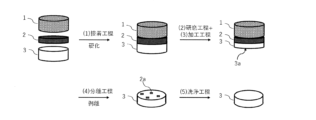
- FIG. 2 is a schematic diagram for explaining each step in an embodiment of the method for manufacturing a semiconductor substrate of the present disclosure.
- processing such as electrode formation after polishing a wafer that has been bonded (temporarily bonded) to a fixing member (supporting body) with adhesive is performed at a high temperature of 150°C or higher. If the adhesive deteriorates due to heating, it tends to be difficult to remove.
- Cleaning compositions are required to have excellent removability (cleanability) for such adhesives. In the cleaning compositions proposed in Patent Documents 1 to 3, there is room for improvement in the removability of adhesives remaining on wafers.
- the present disclosure provides an adhesive cleaning composition with excellent adhesive removability, a method for manufacturing and cleaning a semiconductor substrate using the same, and an adhesive removing agent and a cleaning method using the same.
- an adhesive cleaning composition with excellent adhesive removability, a method for manufacturing and cleaning a semiconductor substrate using the same, and an adhesive removing agent and a cleaning method using the same.
- the present disclosure provides a cleaning composition or an adhesive remover containing a glycol ether, a hydrocarbon, and an alkanolamine having a linear alkanol group, and having a water content of 0% by mass or less than 10% by mass. This is based on the knowledge that adhesives can be removed efficiently by using this method.
- the present disclosure provides a cleaning composition for removing adhesive remaining on a wafer, comprising a glycol ether (component A), a hydrocarbon (component B), and a linear alkanol group.
- alkanolamine (component C) does not contain water or has a water content of 10% by mass or less, and has a mass ratio A/B of the content of component A and the content of component B of 1. 7 or less (hereinafter also referred to as "the cleaning composition of the present disclosure").
- the present disclosure provides an adhesive remover for removing adhesive remaining on a wafer, which comprises a glycol ether (component A), a hydrocarbon (component B), and an alkanol having a linear alkanol group.
- amine does not contain water or has a water content of 10% by mass or less, and has a mass ratio A/B of the content of component A and the content of component B of 1.7.
- the following relates to an adhesive removing agent (hereinafter also referred to as "adhesive removing agent of the present disclosure").
- the present disclosure it is possible to provide a cleaning composition and an adhesive remover that have excellent adhesive removability.
- the cleaning composition or adhesive remover of the present disclosure high-quality semiconductor substrates can be obtained with high yield.
- the glycol ether (component A) and the hydrocarbon (component B) penetrate into the adhesive remaining on the wafer and cause it to swell on the bonding surface of the adhesive. It is thought that stress is generated against the adhesive and promotes peeling of the adhesive.
- alkanolamine (component C) is difficult to penetrate into the adhesive when used alone, but when used in combination with glycol ether (component A) and hydrocarbon (component B), it can easily penetrate into the adhesive.
- the cleaning composition and adhesive remover of the present disclosure are used, in one or more embodiments, to remove adhesive from a wafer to which adhesive has adhered. That is, the present disclosure, in one aspect, relates to the use of the cleaning compositions and adhesive removers of the present disclosure to remove adhesive from a wafer with adhesive deposited thereon.
- An example of the wafer is a semiconductor substrate. Examples of the semiconductor substrate include wafers such as silicon wafers, germanium wafers, gallium-arsenide wafers, gallium-phosphorus wafers, and gallium-arsenide-aluminum wafers. Further, in one or more embodiments, the wafer may be a substrate having pads and/or lands that are parts for bonding and mounting.
- Examples of the adhesive include adhesives that can bond the wafer to the fixing member, have durability that can withstand polishing and processing steps, and can easily separate the wafer from the fixing member in the separation process.
- Examples of the adhesive include polyimide-based, polysiloxane-based, acrylic-based, or methacrylic-based adhesives (adhesive compositions).
- glycol ether (component A) The glycol ether (hereinafter also referred to as "component A") contained in the cleaning composition and adhesive remover of the present disclosure includes, for example, a compound represented by the following formula (I).
- Component A may be used alone or in combination of two or more.
- the content of the compound represented by the following formula (I) in component A is preferably 80% by mass or more, more preferably 90% by mass or more, and even more preferably 100% by mass.
- R represents a hydrocarbon group having 1 to 6 carbon atoms
- AO represents an ethyleneoxy group (EO) or a propyleneoxy group (PO)
- n is the number of moles of AO added. The number is 1 or more and 3 or less.
- R is preferably a phenyl group or an alkyl group having 1 to 6 carbon atoms, more preferably an alkyl group having 1 to 6 carbon atoms, from the viewpoint of improving the removability of the adhesive. An alkyl group of 1 or more and 4 or less is more preferable.
- AO is preferably an ethyleneoxy group (EO).
- n is preferably 1 or more and 3 or less.
- Examples of the compound represented by the above formula (I) include monophenyl ethers such as ethylene glycol monophenyl ether, diethylene glycol monophenyl ether, and triethylene glycol monophenyl ether; having an alkyl group having 1 to 6 carbon atoms; Examples include monoalkyl ethers such as ethylene glycol monoalkyl ether, diethylene glycol monoalkyl ether, triethylene glycol monoalkyl ether, and tripropylene glycol monoalkyl ether.
- monophenyl ethers such as ethylene glycol monophenyl ether, diethylene glycol monophenyl ether, and triethylene glycol monophenyl ether; having an alkyl group having 1 to 6 carbon atoms;
- Examples include monoalkyl ethers such as ethylene glycol monoalkyl ether, diethylene glycol monoalkyl ether, triethylene glycol monoalkyl ether, and tripropylene glycol monoalkyl ether.
- the compounds represented by the above formula (I) include ethylene glycol monoalkyl ether and diethylene glycol monoalkyl ether, which have an alkyl group having 1 to 6 carbon atoms, from the viewpoint of improving the removability of the adhesive. , triethylene glycol monoalkyl ether, and tripropylene glycol monoalkyl ether, more preferably at least one selected from ethylene glycol monobutyl ether, diethylene glycol monobutyl ether (BDG), and propylene glycol monomethyl ether (PGME). Seeds are more preferred.
- component A has a solubility in water at 20° C. of more than 10% by mass.
- the content of component A in the cleaning composition and adhesive remover of the present disclosure is preferably 10% by mass or more, more preferably 15% by mass or more, from the viewpoint of improving adhesive removability and compatibility. From the viewpoint of improving adhesive removability, the content is preferably 65% by mass or less, more preferably 60% by mass or less. More specifically, the content of component A in the cleaning composition and adhesive remover of the present disclosure is preferably 10% by mass or more and 65% by mass or less, more preferably 15% by mass or more and 60% by mass or less. When component A is a combination of two or more types, the content of component A refers to their total content.
- the content of each component in the cleaning composition and adhesive remover refers to the content of each component in the cleaning composition and adhesive remover at the time of cleaning, that is, at the time of starting to use the cleaning composition and adhesive remover for cleaning. It can be the content of the component. In one or more embodiments, the content of each component in the cleaning composition and adhesive remover of the present disclosure is regarded as the amount of each component in the cleaning composition and adhesive remover of the present disclosure. be able to.
- the hydrocarbon (hereinafter also referred to as "component B") contained in the cleaning composition and adhesive remover of the present disclosure is a hydrocarbon-based organic solvent, and From the viewpoint of improving properties, hydrocarbons having a cyclic structure are preferred, and organic solvents such as alicyclic hydrocarbons (component B1) and aromatic hydrocarbons (component B2) are more preferred.
- the alicyclic hydrocarbon (component B1) include cycloalkanes such as cyclohexane.
- aromatic hydrocarbon examples include toluene, ethylbenzene, xylene, and mesitylene (1,3,5-trimethylbenzene).
- Component B may be used alone or in combination of two or more.
- the total content of alicyclic hydrocarbons (component B1) and aromatic hydrocarbons (component B2) in component B is preferably 80% by mass or more, more preferably 90% by mass or more, and even more preferably 100% by mass. be.
- the number of carbon atoms in component B is preferably 5 or more, more preferably 6 or more, from the viewpoint of improving the removability of the adhesive, and from the same viewpoint, 14 or less, more preferably 12 or less, and still more 10 or less. It is preferably 9 or less, and more preferably 9 or less.
- component B is an alicyclic hydrocarbon (component B1), from the same viewpoint, the number of carbon atoms in component B1 is preferably 5 or more, preferably 14 or less, more preferably 10 or less, and still more preferably 8 or less. preferable.
- component B is an aromatic hydrocarbon (component B2)
- the number of carbon atoms in component B2 is preferably 5 or more, more preferably 6 or more, even more preferably 7 or more, and preferably 14 or less. , more preferably 12 or less, even more preferably 10 or less, even more preferably 9 or less.
- Component B includes, for example, at least one selected from ethylbenzene, xylene, mesitylene, and cyclohexane, and from the viewpoint of improving adhesive removability, storage stability, availability, and chemical substance regulations, ethylbenzene or xylene is preferred. is preferred.
- component B is preferably an aromatic hydrocarbon (component B2), more preferably an aromatic hydrocarbon having 5 or more carbon atoms and 14 or less carbon atoms, from the viewpoint of improving the removability of the adhesive.
- Aromatic hydrocarbons having 6 to 12 carbon atoms are more preferable, aromatic hydrocarbons having 7 to 10 carbon atoms are even more preferable, aromatic hydrocarbons having 7 to 9 carbon atoms are even more preferable, and from ethylenebenzene, xylene, and methysylene. At least one selected type is more preferred.
- the content of component B in the cleaning composition and adhesive remover of the present disclosure is preferably 10% by mass or more, more preferably 15% by mass or more, from the viewpoint of improving adhesive removability. From this viewpoint, the content is preferably 80% by mass or less, more preferably 70% by mass or less. More specifically, the content of component B in the cleaning composition and adhesive remover of the present disclosure is preferably 15% by mass or more and 80% by mass or less, more preferably 25% by mass or more and 70% by mass or less.
- the content of component B refers to their total content.
- the content of component A and the content of component B in the cleaning composition and adhesive remover of the present disclosure and the mass ratio A/B (content of component A)/(content of component B) are 1 or In a plurality of embodiments, from the viewpoint of improving adhesive removability, it is 1.7 or less, preferably 1.5 or less, more preferably 1.3 or less, even more preferably 1.0 or less, and 1.0 or less. Even more preferably less than
- the lower limit of the mass ratio A/B is not particularly limited, but from the same viewpoint, it is preferably 0.1 or more, more preferably 0.5 or more, and even more preferably 0.7 or more.
- the mass ratio A/B is preferably 0.1 or more and 1.7 or less, more preferably 0.1 or more and 1.5 or less, even more preferably 0.1 or more and 1.3 or less, and 0.1 More preferably, it is 1.0 or less, and even more preferably 0.1 or more and less than 1.0.
- the alkanolamine (amino alcohol) contained in the cleaning composition and adhesive remover of the present disclosure may include, for example, a compound represented by the following formula (II). Can be mentioned. Component C may be used alone or in combination of two or more. In one or more embodiments, component C is a compound that does not have a branched carbon chain.
- the content of the compound represented by the following formula (II) in component C is preferably 80% by mass or more, more preferably 90% by mass or more, and still more preferably 100% by mass.
- R 1 represents a linear alkanol group having 2 to 4 carbon atoms
- R 2 represents a linear alkanol group having 2 to 4 carbon atoms, a methyl group, or a hydrogen atom
- R 3 represents a methyl group or a hydrogen atom.
- R 1 is preferably a linear alkanol group having 2 or 3 carbon atoms from the viewpoint of improving the removability of the adhesive.
- R 2 is preferably a hydrogen atom.
- R 3 is preferably a hydrogen atom.
- Component C includes, for example, monoethanolamine, N-methylmonoethanolamine, N-ethylmonoethanolamine, diethanolamine, N-dimethylmonoethanolamine, N-methyldiethanolamine, N-diethylmonoethanolamine, N-ethyldiethanolamine. , N-( ⁇ -aminoethyl)ethanolamine, and N-( ⁇ -aminoethyl)diethanolamine.
- alkyl monoalkanolamine or monoalkanolamine is preferred, and monoethanolamine is more preferred.
- the content of component C in the cleaning composition and adhesive remover of the present disclosure is preferably 3% by mass or more, more preferably 5% by mass or more, and 10% by mass or more from the viewpoint of improving adhesive removability. is more preferable, and from the viewpoint of improving the removability of the adhesive, preventing damage to members, and reducing the nitrogen content, it is preferably 50% by mass or less, more preferably 45% by mass or less, and even more preferably 40% by mass or less. More specifically, the content of component C in the cleaning composition and adhesive remover of the present disclosure is preferably 3% by mass or more and 50% by mass or less, more preferably 5% by mass or more and 45% by mass or less, More preferably 10% by mass or more and 40% by mass or less. When component C is a combination of two or more types, the content of component C refers to their total content.
- Water (component D) The cleaning composition and adhesive remover of the present disclosure do not contain water or have a water content of 10% by mass or less.
- water hereinafter also referred to as "component D"
- component D includes ion exchange water, RO water, distilled water, pure water, ultrapure water, and the like.
- the content of component D in the cleaning composition and adhesive remover of the present disclosure can be the remainder after removing component A, component B, component C, and optional components described below.
- the content of component D in the cleaning composition and adhesive remover of the present disclosure is preferably 10% by mass or less, more preferably 5% by mass or less, from the viewpoint of improving adhesive removability. , more preferably 3% by mass or less, even more preferably 1% by mass or less, and even more preferably essentially 0% by mass (ie, not included).
- the cleaning composition and adhesive remover of the present disclosure may further contain water (component D) or other components as necessary.
- Other components include components that can be used in ordinary cleaning agents, such as solvents other than component A, alkaline agents other than component C, amines other than component C, surfactants, chelating agents, and additives. Examples include sticky agents, dispersants, rust preventives, polymer compounds, solubilizers, antioxidants, preservatives, antifoaming agents, antibacterial agents, and the like.
- the cleaning composition and adhesive remover of the present disclosure have excellent adhesive removability even without using N-methyl-2-pyrrolidone, which is a polar solvent with excellent properties.
- the content of N-methyl-2-pyrrolidone as another component is preferably 1% by mass or less, from the viewpoint of exhibiting the effect of adhesive removability. 0% by mass (ie, not included) is more preferred.
- the cleaning composition and adhesive remover of the present disclosure can be substantially free of alkanolamines having branched carbon chains.
- the content of alkanolamine having branched carbon chains in the cleaning compositions and adhesive removers of the present disclosure is preferably less than 1% by weight, more preferably 0.5% by weight or less, and even more preferably 0.5% by weight or less. It is 1% by mass or less, more preferably 0% by mass (ie, not included).
- the cleaning composition and adhesive remover of the present disclosure may be substantially free of nonionic surfactants.
- the content of the nonionic surfactant in the cleaning composition and adhesive remover of the present disclosure is preferably less than 1% by mass, more preferably 0.5% by mass or less, and even more preferably 0.1% by mass. % or less, more preferably 0% by mass (ie, not included).
- the nonionic surfactant include those obtained by adding arbitrary ethylene oxide or propylene oxide to an aliphatic hydrocarbon or aromatic hydrocarbon having 8 to 10 carbon atoms.
- the cleaning composition and adhesive remover of the present disclosure can be substantially free of aliphatic hydrocarbons having 9 to 16 carbon atoms.
- the content of aliphatic hydrocarbons having 9 to 16 carbon atoms in the cleaning composition and adhesive remover of the present disclosure is preferably 5% by mass or less, preferably 1% by mass or less, and more preferably 0.5% by mass or less. It is 1% by mass or less, more preferably 0% by mass (ie, not included).
- the cleaning composition and adhesive remover of the present disclosure can be substantially free of polar organic solvents.
- the content of polar organic solvent in the cleaning composition and adhesive remover of the present disclosure is preferably less than 5% by weight, preferably less than 1% by weight, more preferably less than 0.1% by weight, even more preferably is 0% by mass (ie, not included).
- the cleaning composition and adhesive remover of the present disclosure can be substantially free of quaternary ammonium.
- the content of quaternary ammonium in the cleaning composition and adhesive remover of the present disclosure is preferably less than 3% by weight, preferably less than 1% by weight, more preferably less than 0.1% by weight, and Preferably it is 0% by mass (ie, not included).
- the cleaning composition and adhesive remover of the present disclosure include the above-mentioned components A to C and optionally the above-mentioned optional components (component D and other components) by a known method. It can be manufactured by
- the cleaning composition and adhesive remover of the present disclosure may contain at least the components A to C described above. Therefore, the present disclosure relates to a method for producing a cleaning composition and an adhesive remover, which includes at least the step of blending the components A to C above.
- "blending" includes mixing components A to C and optionally the above-mentioned optional components (component D and other components) simultaneously or in any order.
- the preferred blending amount of each component is the same as the preferred content of each component of the cleaning composition and adhesive remover of the present disclosure described above. be able to.
- the object to be cleaned is a wafer to which adhesive is attached.
- the wafer includes a semiconductor substrate.
- the semiconductor substrate include wafers such as silicon wafers, germanium wafers, gallium-arsenide wafers, gallium-phosphorus wafers, and gallium-arsenide-aluminum wafers.
- the wafer includes a substrate having pads and/or lands that are parts for bonding and mounting. Examples of pad and land members include metals such as gold and copper.
- examples of the wafer to which the adhesive is attached include a wafer that has been adhered to a fixing member with an adhesive and has been separated from the fixing member.
- the wafer after being separated from the fixing member may be a substrate having a metal pad and an adhesive adhered to the metal pad. Accordingly, in one aspect, the present disclosure provides a method for removing adhesive remaining on a wafer after the wafer adhesively adhered to a fixing member is separated from the fixing member using the cleaning composition or the adhesive removing agent of the present disclosure. Concerning its use as a cleaning agent.
- the wafer fixed to the fixing member with an adhesive has been subjected to a heat treatment at a temperature of 230° C. or higher.
- the heat treatment includes heat treatment in a processing step described below.
- the wafer to which an adhesive has been adhered may be a wafer to which an adhesive used in a manufacturing process of a three-dimensional integrated circuit (3DIC) is attached. Accordingly, in one aspect, the present disclosure relates to the use of the cleaning composition or adhesive remover of the present disclosure as a cleaning agent to remove adhesives used in the manufacturing process of three-dimensional integrated circuits.
- the wafer to which the adhesive is attached has been subjected to a heat treatment at a temperature of 230° C. or higher. In one or more embodiments, the heat treatment includes heat treatment in a processing step described below.
- the present disclosure includes (1) a step of bonding a wafer to a fixing member with an adhesive, (2) a step of polishing the back side of the bonding surface of the wafer to the fixing member, and (3) a step of polishing the wafer. (4) separating the processed wafer from a fixing member; and (5) removing adhesive remaining on the separated wafer with a cleaning agent.
- the cleaning agent contains a glycol ether (component A), a hydrocarbon (component B), and an alkanolamine having a linear alkanol group (component C), and does not contain water;
- a method for manufacturing a semiconductor substrate which is a cleaning composition having a water content of 10% by mass or less and a mass ratio A/B of component A content to component B content of 1.7 or less ( (hereinafter also referred to as the "semiconductor substrate manufacturing method of the present disclosure").
- FIG. 1 is a flowchart showing each step of the method for manufacturing a semiconductor substrate according to the present disclosure.
- FIG. 2 is a schematic diagram for explaining each step in an embodiment of the method for manufacturing a semiconductor substrate of the present disclosure.
- Step (1) is a step (adhesion step) of bonding the wafer 3 to the fixing member 1 with the adhesive 2 (step S1).
- step (1) includes a step (1-1) of applying an adhesive to the surface of the wafer or the fixing member to form an adhesive layer, and a step (1-1) of coating the wafer and the fixing member with the adhesive layer. It includes a step (1-2) of bonding through a heat treatment and bonding.
- Examples of the wafer used in step (1) include silicon wafers and glass wafers with a diameter of 100 to 500 mm and a thickness of 500 to 2000 ⁇ m.
- the fixing member used in step (1) is not particularly limited, but includes, for example, a substrate such as a silicon wafer or a glass plate with a diameter of 100 to 500 mm and a thickness of 500 to 20,000 ⁇ m.
- the adhesive used in step (1) must be able to bond the wafer to the fixing member, have durability that can withstand polishing and processing steps, and allow the wafer to be easily separated from the fixing member in the separation step.
- an adhesive for example, an adhesive used in the manufacturing process of 3DIC can be mentioned.
- adhesives used in the 3DIC manufacturing process include polyimide-based, polysiloxane-based, acrylic-based, or methacrylic-based adhesives (adhesive compositions).
- the adhesive composition described in JP-A-2021-161196 can be mentioned.
- the adhesive composition used in step (1) contains a polysiloxane, an acrylic ester, or a methacrylic ester as an adhesive component, and further contains a platinum group metal catalyst and a release agent. It may also contain components, solvents, etc.
- the viscosity of the adhesive composition used in step (1) can be adjusted by appropriately changing the concentration of the contained components, etc., depending on the coating method, film thickness, etc.
- the method for applying the adhesive is not particularly limited, but examples include spin coating.
- the thickness of the coating layer (adhesive layer) of the adhesive (adhesive composition) is, for example, 5 to 500 ⁇ m.
- the temperature of the heat treatment is, for example, 80° C. or higher, and preferably 150° C. or lower from the viewpoint of suppressing excessive curing of the adhesive.
- the heat treatment time is, for example, 30 seconds or more, and is preferably 10 minutes or less from the viewpoint of suppressing deterioration of the adhesive layer and other members. Heating can be performed using a hot plate, oven, or the like.
- the thickness of the adhesive layer after heat treatment is, for example, 5 ⁇ m or more and 100 ⁇ m or less.
- Step (2) is a step (polishing step) of polishing the back surface 3a of the adhesive surface (opposite surface to the adhesive surface) of the wafer 3 to the fixing member 1 (step S2).
- the polishing method include mechanical polishing using abrasive grains, chemical mechanical polishing, and the like.
- the thickness of the polished wafer (thinned wafer) is preferably 200 ⁇ m or less, for example, 50 ⁇ m to 200 ⁇ m.
- Step (3) is a step (processing step) of processing the polished surface (back surface of the thinned wafer) 3a of the wafer 3 (step S3).
- step (3) includes an electrode forming step, a metal wiring forming step, a protective film forming step, and the like.
- metal sputtering to form electrodes wet etching, resist coating, pattern formation, resist peeling, dry etching, metal plating formation, silicon etching to form through-silicon vias (TSV), and oxide film formation on silicon surfaces.
- TSV through-silicon vias
- oxide film formation on silicon surfaces examples include the following.
- the processing is performed at a high temperature of 150° C. or higher in one or more embodiments.
- heat treatment at a temperature of 250° C. or more and 350° C. or less may be performed, for example.
- Step (4) is a step (separation step) of separating the processed wafer 3 and the fixing member 1 (step S4).
- the separation method include solvent peeling, laser peeling, mechanical peeling, and the like.
- Step (5) is a step (cleaning step) of removing the adhesive (adhesive residue) 2a remaining on the separated wafer 3 with a cleaning agent (step S5).
- the cleaning agent used in step (5) include the cleaning composition or adhesive remover of the present disclosure described above.
- the cleaning method (adhesive removal method) in the cleaning step include immersion cleaning.
- the temperature of the cleaning agent is preferably 40° C. or more and 70° C. or less, and the immersion time is preferably 1 minute or more and 60 minutes or less.
- the cleaning agent is subjected to ultrasonic vibration, for example, 25 to 50 kHz is preferable, and 35 to 45 kHz is more preferable from the viewpoint of suppressing damage to the wafer.
- the wafer after cleaning may be rinsed with water or alcohol, and then dried.
- the present disclosure includes a step (cleaning step) of removing the adhesive remaining on the wafer with a cleaning agent after separating the wafer bonded to the fixing member with an adhesive from the fixing member, and the cleaning agent is , contains a glycol ether (component A), a hydrocarbon (component B), and an alkanolamine having a linear alkanol group (component C), and does not contain water or has a water content of 10% by mass or less.
- a cleaning method hereinafter also referred to as "cleaning method of the present disclosure”
- cleaning method of the present disclosure is a cleaning composition in which the mass ratio A/B of the content of component A and the content of component B is 1.7 or less.
- the cleaning agent is the cleaning composition or adhesive remover of the present disclosure described above.
- the cleaning method (adhesive removal method) in the cleaning step of the cleaning method of the present disclosure includes the same method as the cleaning method (removal method) of step (5) in the semiconductor substrate manufacturing method of the present disclosure described above.
- the wafer bonded to the fixing member with an adhesive is preferably subjected to heat treatment at a temperature of 230° C. or higher, more preferably 270° C. or higher. It is.
- heat treatment at a temperature of 230°C or higher is for joining a circuit-formed substrate with a device such as a semiconductor chip and another circuit-formed substrate using solder or metal fine particles.
- Examples include heat treatment.
- the heat treatment step may be performed after the processing step (3) and before step (4).
- the object to be cleaned in the cleaning method of the present disclosure includes a wafer that has undergone steps (1) to (4) in the semiconductor substrate manufacturing method of the present disclosure.
- the present disclosure relates to a kit for use in either the cleaning method of the present disclosure or the semiconductor substrate manufacturing method of the present disclosure (hereinafter also referred to as "the kit of the present disclosure").
- the kit of the present disclosure is a kit for producing the cleaning composition or adhesive remover of the present disclosure. According to the kit of the present disclosure, it is possible to obtain a cleaning composition or an adhesive remover that is excellent in adhesive removability.
- kits of the present disclosure includes a solution containing component A (first solution), a solution containing component B (second solution), and a solution containing component C (third solution). , a kit (three-component cleaning composition) in which the first, second, and third solutions are mixed together at the time of use. After the first liquid, second liquid, and third liquid are mixed, they may be diluted with water (component D) if necessary. Each of the first liquid, second liquid, and third liquid may contain the above-mentioned optional components as necessary.
- kit of the present disclosure include a solution containing component A and component B (first solution) and a solution containing component C (second solution) in a state that they are not mixed with each other, A kit (two-component cleaning composition) in which the first liquid and the second liquid are mixed at the time of use is included. After the first liquid and the second liquid are mixed, they may be diluted with component D (water) as necessary. Each of the first liquid and the second liquid may contain the above-mentioned optional components as necessary.
- Cleaning rate (%) (Adhesive area before cleaning - Adhesive area after cleaning) / (Adhesive area before cleaning) x 100 ⁇ Evaluation criteria> A: Cleaning rate: 99.995% or more B: Cleaning rate: 99.990% or more and less than 99.995% C: Cleaning rate: 99.90% or more and less than 99.990% D: Cleaning rate: less than 99.90% E: Residues present when observed with the naked eye
- the test piece has adhesive residue on a substrate having a size of 40 mm x 40 mm and a silicon wafer coated with polybenzoxazole having a thickness of 5 ⁇ m.
- the adhesive residue is in the form of stripes with a thickness of 50 ⁇ m and a width of 3 mm, and is present at intervals of 15 mm.
- the adhesive used was one that had been applied to the test piece and then heat-treated at 290° C. for 30 minutes under nitrogen.
- a methacrylic adhesive was used as the adhesive.
- the test piece has a size of 15 mm x 15 mm, and has Al electrodes of 3 mm x 2.5 mm on a silicon wafer without any gaps.
- the cleaning compositions of Examples 1 to 9 are Comparative Example 1 which does not contain component B, Comparative Example 2 which does not contain component C, alkanolamine having a branched carbon chain as alkanolamine (non-component C ), Comparative Example 4 where the water content exceeds 10% by mass and the mass ratio A/B exceeds 1.7, and Comparative Example 5 where the mass ratio A/B exceeds 1.7. It was found that the removability of the adhesive was excellent. In Comparative Example 5 in which the mass ratio A/B exceeded 1.7, removability of the adhesive was not observed. It was also found that although Al electrodes may be damaged by polar solvents, the cleaning compositions of Examples 1 to 9 were able to suppress damage to Al electrodes.
- a cleaning composition with excellent adhesive removability can be provided. And by using the cleaning composition of the present disclosure, productivity of semiconductor substrates can be improved.
- Fixing member 2 Adhesive 2a Adhesive residue 3 Wafer 3a Wafer polishing/processing surface
Landscapes
- Chemical & Material Sciences (AREA)
- Life Sciences & Earth Sciences (AREA)
- Engineering & Computer Science (AREA)
- Chemical Kinetics & Catalysis (AREA)
- Oil, Petroleum & Natural Gas (AREA)
- Wood Science & Technology (AREA)
- Organic Chemistry (AREA)
- Health & Medical Sciences (AREA)
- Emergency Medicine (AREA)
- Detergent Compositions (AREA)
- Cleaning Or Drying Semiconductors (AREA)
Priority Applications (2)
| Application Number | Priority Date | Filing Date | Title |
|---|---|---|---|
| CN202380023008.7A CN118742998A (zh) | 2022-06-17 | 2023-06-14 | 粘接剂用清洗剂组合物 |
| KR1020247026964A KR20250025587A (ko) | 2022-06-17 | 2023-06-14 | 접착제용 세정제 조성물 |
Applications Claiming Priority (2)
| Application Number | Priority Date | Filing Date | Title |
|---|---|---|---|
| JP2022-098405 | 2022-06-17 | ||
| JP2022098405 | 2022-06-17 |
Publications (1)
| Publication Number | Publication Date |
|---|---|
| WO2023243661A1 true WO2023243661A1 (ja) | 2023-12-21 |
Family
ID=89191379
Family Applications (1)
| Application Number | Title | Priority Date | Filing Date |
|---|---|---|---|
| PCT/JP2023/022091 Ceased WO2023243661A1 (ja) | 2022-06-17 | 2023-06-14 | 接着剤用洗浄剤組成物 |
Country Status (5)
| Country | Link |
|---|---|
| JP (1) | JP2023184484A (https=) |
| KR (1) | KR20250025587A (https=) |
| CN (1) | CN118742998A (https=) |
| TW (1) | TW202411414A (https=) |
| WO (1) | WO2023243661A1 (https=) |
Cited By (1)
| Publication number | Priority date | Publication date | Assignee | Title |
|---|---|---|---|---|
| JP7804134B1 (ja) * | 2024-07-30 | 2026-01-21 | 花王株式会社 | 半導体基板の製造方法 |
Citations (3)
| Publication number | Priority date | Publication date | Assignee | Title |
|---|---|---|---|---|
| JPH11286698A (ja) * | 1998-04-02 | 1999-10-19 | Asahi Chem Ind Co Ltd | 洗浄剤組成物 |
| JP2009114268A (ja) * | 2007-11-02 | 2009-05-28 | Nagase Chemtex Corp | ポリイミド用剥離剤 |
| WO2016194917A1 (ja) * | 2015-06-01 | 2016-12-08 | 富士フイルム株式会社 | 仮止め接着剤、接着フィルム、接着性支持体、積層体およびキット |
-
2023
- 2023-06-14 WO PCT/JP2023/022091 patent/WO2023243661A1/ja not_active Ceased
- 2023-06-14 JP JP2023097635A patent/JP2023184484A/ja active Pending
- 2023-06-14 CN CN202380023008.7A patent/CN118742998A/zh active Pending
- 2023-06-14 KR KR1020247026964A patent/KR20250025587A/ko active Pending
- 2023-06-16 TW TW112122590A patent/TW202411414A/zh unknown
Patent Citations (3)
| Publication number | Priority date | Publication date | Assignee | Title |
|---|---|---|---|---|
| JPH11286698A (ja) * | 1998-04-02 | 1999-10-19 | Asahi Chem Ind Co Ltd | 洗浄剤組成物 |
| JP2009114268A (ja) * | 2007-11-02 | 2009-05-28 | Nagase Chemtex Corp | ポリイミド用剥離剤 |
| WO2016194917A1 (ja) * | 2015-06-01 | 2016-12-08 | 富士フイルム株式会社 | 仮止め接着剤、接着フィルム、接着性支持体、積層体およびキット |
Cited By (2)
| Publication number | Priority date | Publication date | Assignee | Title |
|---|---|---|---|---|
| JP7804134B1 (ja) * | 2024-07-30 | 2026-01-21 | 花王株式会社 | 半導体基板の製造方法 |
| WO2026028815A1 (ja) * | 2024-07-30 | 2026-02-05 | 花王株式会社 | 半導体基板の製造方法 |
Also Published As
| Publication number | Publication date |
|---|---|
| CN118742998A (zh) | 2024-10-01 |
| KR20250025587A (ko) | 2025-02-24 |
| JP2023184484A (ja) | 2023-12-28 |
| TW202411414A (zh) | 2024-03-16 |
Similar Documents
| Publication | Publication Date | Title |
|---|---|---|
| JP2023184483A (ja) | 半導体基板の製造方法 | |
| US20010025017A1 (en) | Cleaning agent composition, method for cleaning and use thereof | |
| KR102773140B1 (ko) | 포스트 화학적-기계적-폴리싱 세정을 위한 조성물 | |
| CN103003405A (zh) | 含水碱性清洁组合物及其应用方法 | |
| TW201643230A (zh) | 暫時接著劑、接著膜、接著性支持體、積層體及套組 | |
| CN112558434A (zh) | 一种光刻胶清洗剂组合物 | |
| CN111448522A (zh) | 树脂掩膜剥离用清洗剂组合物 | |
| JP3624809B2 (ja) | 洗浄剤組成物、洗浄方法及びその用途 | |
| US10319605B2 (en) | Semiconductor treatment composition and treatment method | |
| WO2023243661A1 (ja) | 接着剤用洗浄剤組成物 | |
| JP2019112498A (ja) | 樹脂マスク剥離洗浄方法 | |
| WO2023228996A1 (ja) | 接着剤用洗浄剤組成物 | |
| JP7804134B1 (ja) | 半導体基板の製造方法 | |
| JP7751760B2 (ja) | ウエハ加工用洗浄剤組成物 | |
| WO2026018807A1 (ja) | 半導体基板の製造方法 | |
| JP2026013370A (ja) | 半導体基板の製造方法 | |
| WO2025183035A1 (ja) | ウエハ加工用洗浄剤組成物 | |
| JP7394968B2 (ja) | フォトレジスト剥離組成物 | |
| WO2010064558A1 (ja) | シアノアクリレート系接着剤剥離用組成物、および該接着剤の除去方法 | |
| TWI812342B (zh) | 移除光阻之剝離劑組成物以及使用其之剝離光阻方法 | |
| TW202118558A (zh) | 清潔方法 | |
| CN111630117B (zh) | 用于剥离切割工艺用保护性涂层剂的剥离剂 | |
| JP2024030127A (ja) | 樹脂マスクの剥離方法 | |
| CN102073226A (zh) | 一种厚膜光刻胶清洗液及其清洗方法 | |
| WO2019220711A1 (ja) | 洗浄剤、洗浄剤の製造方法、および対象物の処理方法 |
Legal Events
| Date | Code | Title | Description |
|---|---|---|---|
| 121 | Ep: the epo has been informed by wipo that ep was designated in this application |
Ref document number: 23823951 Country of ref document: EP Kind code of ref document: A1 |
|
| WWE | Wipo information: entry into national phase |
Ref document number: 202380023008.7 Country of ref document: CN |
|
| NENP | Non-entry into the national phase |
Ref country code: DE |
|
| WWP | Wipo information: published in national office |
Ref document number: 1020247026964 Country of ref document: KR |
|
| 122 | Ep: pct application non-entry in european phase |
Ref document number: 23823951 Country of ref document: EP Kind code of ref document: A1 |