WO2023243493A1 - インクジェット用処理液、並びに、それを用いたインクセット及び捺染方法 - Google Patents
インクジェット用処理液、並びに、それを用いたインクセット及び捺染方法 Download PDFInfo
- Publication number
- WO2023243493A1 WO2023243493A1 PCT/JP2023/021040 JP2023021040W WO2023243493A1 WO 2023243493 A1 WO2023243493 A1 WO 2023243493A1 JP 2023021040 W JP2023021040 W JP 2023021040W WO 2023243493 A1 WO2023243493 A1 WO 2023243493A1
- Authority
- WO
- WIPO (PCT)
- Prior art keywords
- ink
- head
- weight
- treatment liquid
- inkjet
- Prior art date
- Legal status (The legal status is an assumption and is not a legal conclusion. Google has not performed a legal analysis and makes no representation as to the accuracy of the status listed.)
- Ceased
Links
Images


Classifications
-
- C—CHEMISTRY; METALLURGY
- C09—DYES; PAINTS; POLISHES; NATURAL RESINS; ADHESIVES; COMPOSITIONS NOT OTHERWISE PROVIDED FOR; APPLICATIONS OF MATERIALS NOT OTHERWISE PROVIDED FOR
- C09D—COATING COMPOSITIONS, e.g. PAINTS, VARNISHES OR LACQUERS; FILLING PASTES; CHEMICAL PAINT OR INK REMOVERS; INKS; CORRECTING FLUIDS; WOODSTAINS; PASTES OR SOLIDS FOR COLOURING OR PRINTING; USE OF MATERIALS THEREFOR
- C09D11/00—Inks
- C09D11/54—Inks based on two liquids, one liquid being the ink, the other liquid being a reaction solution, a fixer or a treatment solution for the ink
-
- C—CHEMISTRY; METALLURGY
- C09—DYES; PAINTS; POLISHES; NATURAL RESINS; ADHESIVES; COMPOSITIONS NOT OTHERWISE PROVIDED FOR; APPLICATIONS OF MATERIALS NOT OTHERWISE PROVIDED FOR
- C09D—COATING COMPOSITIONS, e.g. PAINTS, VARNISHES OR LACQUERS; FILLING PASTES; CHEMICAL PAINT OR INK REMOVERS; INKS; CORRECTING FLUIDS; WOODSTAINS; PASTES OR SOLIDS FOR COLOURING OR PRINTING; USE OF MATERIALS THEREFOR
- C09D11/00—Inks
- C09D11/02—Printing inks
- C09D11/10—Printing inks based on artificial resins
- C09D11/102—Printing inks based on artificial resins containing macromolecular compounds obtained by reactions other than those only involving unsaturated carbon-to-carbon bonds
-
- C—CHEMISTRY; METALLURGY
- C09—DYES; PAINTS; POLISHES; NATURAL RESINS; ADHESIVES; COMPOSITIONS NOT OTHERWISE PROVIDED FOR; APPLICATIONS OF MATERIALS NOT OTHERWISE PROVIDED FOR
- C09D—COATING COMPOSITIONS, e.g. PAINTS, VARNISHES OR LACQUERS; FILLING PASTES; CHEMICAL PAINT OR INK REMOVERS; INKS; CORRECTING FLUIDS; WOODSTAINS; PASTES OR SOLIDS FOR COLOURING OR PRINTING; USE OF MATERIALS THEREFOR
- C09D11/00—Inks
- C09D11/02—Printing inks
- C09D11/10—Printing inks based on artificial resins
- C09D11/106—Printing inks based on artificial resins containing macromolecular compounds obtained by reactions only involving carbon-to-carbon unsaturated bonds
-
- C—CHEMISTRY; METALLURGY
- C09—DYES; PAINTS; POLISHES; NATURAL RESINS; ADHESIVES; COMPOSITIONS NOT OTHERWISE PROVIDED FOR; APPLICATIONS OF MATERIALS NOT OTHERWISE PROVIDED FOR
- C09D—COATING COMPOSITIONS, e.g. PAINTS, VARNISHES OR LACQUERS; FILLING PASTES; CHEMICAL PAINT OR INK REMOVERS; INKS; CORRECTING FLUIDS; WOODSTAINS; PASTES OR SOLIDS FOR COLOURING OR PRINTING; USE OF MATERIALS THEREFOR
- C09D11/00—Inks
- C09D11/30—Inkjet printing inks
- C09D11/32—Inkjet printing inks characterised by colouring agents
- C09D11/322—Pigment inks
-
- C—CHEMISTRY; METALLURGY
- C09—DYES; PAINTS; POLISHES; NATURAL RESINS; ADHESIVES; COMPOSITIONS NOT OTHERWISE PROVIDED FOR; APPLICATIONS OF MATERIALS NOT OTHERWISE PROVIDED FOR
- C09D—COATING COMPOSITIONS, e.g. PAINTS, VARNISHES OR LACQUERS; FILLING PASTES; CHEMICAL PAINT OR INK REMOVERS; INKS; CORRECTING FLUIDS; WOODSTAINS; PASTES OR SOLIDS FOR COLOURING OR PRINTING; USE OF MATERIALS THEREFOR
- C09D11/00—Inks
- C09D11/30—Inkjet printing inks
- C09D11/38—Inkjet printing inks characterised by non-macromolecular additives other than solvents, pigments or dyes
-
- C—CHEMISTRY; METALLURGY
- C09—DYES; PAINTS; POLISHES; NATURAL RESINS; ADHESIVES; COMPOSITIONS NOT OTHERWISE PROVIDED FOR; APPLICATIONS OF MATERIALS NOT OTHERWISE PROVIDED FOR
- C09D—COATING COMPOSITIONS, e.g. PAINTS, VARNISHES OR LACQUERS; FILLING PASTES; CHEMICAL PAINT OR INK REMOVERS; INKS; CORRECTING FLUIDS; WOODSTAINS; PASTES OR SOLIDS FOR COLOURING OR PRINTING; USE OF MATERIALS THEREFOR
- C09D11/00—Inks
- C09D11/30—Inkjet printing inks
- C09D11/40—Ink-sets specially adapted for multi-colour inkjet printing
-
- D—TEXTILES; PAPER
- D06—TREATMENT OF TEXTILES OR THE LIKE; LAUNDERING; FLEXIBLE MATERIALS NOT OTHERWISE PROVIDED FOR
- D06P—DYEING OR PRINTING TEXTILES; DYEING LEATHER, FURS OR SOLID MACROMOLECULAR SUBSTANCES IN ANY FORM
- D06P1/00—General processes of dyeing or printing textiles, or general processes of dyeing leather, furs, or solid macromolecular substances in any form, classified according to the dyes, pigments, or auxiliary substances employed
- D06P1/44—General processes of dyeing or printing textiles, or general processes of dyeing leather, furs, or solid macromolecular substances in any form, classified according to the dyes, pigments, or auxiliary substances employed using insoluble pigments or auxiliary substances, e.g. binders
-
- D—TEXTILES; PAPER
- D06—TREATMENT OF TEXTILES OR THE LIKE; LAUNDERING; FLEXIBLE MATERIALS NOT OTHERWISE PROVIDED FOR
- D06P—DYEING OR PRINTING TEXTILES; DYEING LEATHER, FURS OR SOLID MACROMOLECULAR SUBSTANCES IN ANY FORM
- D06P1/00—General processes of dyeing or printing textiles, or general processes of dyeing leather, furs, or solid macromolecular substances in any form, classified according to the dyes, pigments, or auxiliary substances employed
- D06P1/44—General processes of dyeing or printing textiles, or general processes of dyeing leather, furs, or solid macromolecular substances in any form, classified according to the dyes, pigments, or auxiliary substances employed using insoluble pigments or auxiliary substances, e.g. binders
- D06P1/52—General processes of dyeing or printing textiles, or general processes of dyeing leather, furs, or solid macromolecular substances in any form, classified according to the dyes, pigments, or auxiliary substances employed using insoluble pigments or auxiliary substances, e.g. binders using compositions containing synthetic macromolecular substances
- D06P1/5207—Macromolecular compounds obtained by reactions involving only carbon-to-carbon unsaturated bonds
- D06P1/5214—Polymers of unsaturated compounds containing no COOH groups or functional derivatives thereof
- D06P1/5242—Polymers of unsaturated N-containing compounds
-
- D—TEXTILES; PAPER
- D06—TREATMENT OF TEXTILES OR THE LIKE; LAUNDERING; FLEXIBLE MATERIALS NOT OTHERWISE PROVIDED FOR
- D06P—DYEING OR PRINTING TEXTILES; DYEING LEATHER, FURS OR SOLID MACROMOLECULAR SUBSTANCES IN ANY FORM
- D06P1/00—General processes of dyeing or printing textiles, or general processes of dyeing leather, furs, or solid macromolecular substances in any form, classified according to the dyes, pigments, or auxiliary substances employed
- D06P1/44—General processes of dyeing or printing textiles, or general processes of dyeing leather, furs, or solid macromolecular substances in any form, classified according to the dyes, pigments, or auxiliary substances employed using insoluble pigments or auxiliary substances, e.g. binders
- D06P1/52—General processes of dyeing or printing textiles, or general processes of dyeing leather, furs, or solid macromolecular substances in any form, classified according to the dyes, pigments, or auxiliary substances employed using insoluble pigments or auxiliary substances, e.g. binders using compositions containing synthetic macromolecular substances
- D06P1/5264—Macromolecular compounds obtained otherwise than by reactions involving only unsaturated carbon-to-carbon bonds
- D06P1/5278—Polyamides; Polyimides; Polylactames; Polyalkyleneimines
-
- D—TEXTILES; PAPER
- D06—TREATMENT OF TEXTILES OR THE LIKE; LAUNDERING; FLEXIBLE MATERIALS NOT OTHERWISE PROVIDED FOR
- D06P—DYEING OR PRINTING TEXTILES; DYEING LEATHER, FURS OR SOLID MACROMOLECULAR SUBSTANCES IN ANY FORM
- D06P5/00—Other features in dyeing or printing textiles, or dyeing leather, furs, or solid macromolecular substances in any form
- D06P5/002—Locally enhancing dye affinity of a textile material by chemical means
-
- D—TEXTILES; PAPER
- D06—TREATMENT OF TEXTILES OR THE LIKE; LAUNDERING; FLEXIBLE MATERIALS NOT OTHERWISE PROVIDED FOR
- D06P—DYEING OR PRINTING TEXTILES; DYEING LEATHER, FURS OR SOLID MACROMOLECULAR SUBSTANCES IN ANY FORM
- D06P5/00—Other features in dyeing or printing textiles, or dyeing leather, furs, or solid macromolecular substances in any form
- D06P5/30—Ink jet printing
Definitions
- the present disclosure relates to an inkjet processing liquid. Furthermore, it relates to an ink set and a textile printing method using the same.
- a pretreatment liquid is applied prior to ink application.
- a method has been reported in which a treatment liquid containing fine particles is used as a component that forms aggregates with the coloring material in the ink.
- Patent Document 1 discloses an inkjet recording method in which a colorless liquid containing fine silica particles is attached to a recording material, and then a non-aqueous recording liquid containing oil black is attached. Further, Patent Document 2 discloses the use of fine particles or a solution containing fine particles and a binder polymer as a processing liquid.
- liquid compositions containing the above-mentioned reactive fine particles inevitably contain corrosive ions during the manufacturing process of the components, and in order to ensure the dispersion stability of components that are reactive with coloring materials, corrosive ions such as chlorine ions and acids must be used.
- the liquid composition contains a high concentration of corrosive ions due to the fact that corrosive ions are added as secondary ions.
- Patent Document 3 Regarding the problem of wettability due to corrosive ions, there is a report that the wettability can be improved by specifying the chloride ion concentration in the treatment liquid containing a cationic polymer to 3000 ppm or less.
- Patent Document 4 A method for producing a treatment liquid characterized by substituting ions with less corrosive ions has also been reported.
- An inkjet processing liquid contains a cationic polymer and succinic acid. Further, the halogen ion concentration is 5 g/L or less, and the pH is 7 to 9.5.
- FIG. 1 is an example of inkjet recording performed using the inkjet processing liquid of this embodiment.
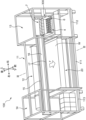
- FIG. 2 is a perspective view showing the overall configuration of a recording apparatus according to an embodiment of the present disclosure.
- FIG. 3 is a schematic cross-sectional view taken along line III-III in FIG.
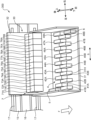
- FIG. 4 is an enlarged perspective view of the carriage shown in FIG. 2.
- cationic polymers, cationic surfactants, etc. are used as cationic substances constituting the liquid composition, but the process is carried out during their synthesis and purification. It states that it contains some chlorine ions such as hydrochloric acid radicals due to acid treatment etc. (Paragraph 0008). Therefore, if the chlorine concentration is set to 3000 ppm or less, it is not possible to increase the amount of the cationic polymer that is a reactive component with the coloring material, and it is considered that a sufficient aggregation effect with the coloring material cannot be obtained.
- Patent Documents 1 to 4 are inkjet processing liquids for printing on paper media such as plain paper, and are not intended to be used for printing on cloth or the like.
- a treatment liquid containing a binder resin is usually used as a pretreatment. This binding resin penetrates into the gaps between the fibers and binds the fibers to each other, resulting in a problem unique to textile printing in which the fabric becomes stiff and loses its feel and texture.
- An inkjet processing liquid (hereinafter sometimes simply referred to as "processing liquid") according to an embodiment of the present disclosure contains a cationic polymer and succinic acid, has a halogen ion concentration of 5 g/L or less, and pH is 7-9.5.
- the treatment liquid of this embodiment is a pretreatment liquid that is applied to the recording target prior to ink application.
- the cationic polymer contained in this treatment liquid reacts and coagulates with the pigment contained in the subsequently applied ink, thereby ensuring excellent color development.
- the inkjet treatment liquid of the present disclosure corrosion of the inkjet head member and yellowing of the recording medium can be suppressed in inkjet recording, and excellent color development (image density) can be obtained. Furthermore, when the inkjet treatment liquid of the present disclosure is used for textile printing, there is an advantage that the texture of the fabric is also improved.
- the treatment liquid of this embodiment has a low halogen ion concentration, corrosion of the inkjet head member due to halogen ions can be suppressed. Furthermore, by containing succinic acid and having a pH within the above range, it is possible to reduce yellowing of a cationic polymer with a low halogen concentration. That is, in this embodiment, yellowing of the treatment liquid can be suppressed. Furthermore, since yellowing of the recording medium can be suppressed, for example, when the treatment liquid of this embodiment is used for textile printing, yellowing of the fabric to be printed can be suppressed.
- the treatment liquid of this embodiment contains succinic acid, and succinate has higher solubility in aqueous solvents (water and organic solvents that dissolve in water) than lactate and the like.
- succinate has higher solubility, but with lactate or the like, there is a risk that a sufficient amount may not be blended from the viewpoint of solubility.
- succinate since succinate has high solubility, a sufficient amount of cationic polymer can be blended, making it possible to obtain excellent color development and fabric texture while suppressing yellowing.
- the inkjet treatment liquid of the present embodiment corrosion of the inkjet head member and yellowing of the recording medium can be suppressed in inkjet recording, and excellent color development (image density) can be obtained. Furthermore, when the inkjet treatment liquid of this embodiment is used for textile printing, there is an advantage that the texture of the fabric is also improved.
- the cationic polymer contained in the inkjet processing liquid of this embodiment is not particularly limited as long as it is a positively charged cationic polymer, but examples include ammonium-containing polymers, amine-containing polymers, polyallylamine, polyvinylamine, polyimine, Examples include cationic polymers such as polyvinylpyrrolidone, polyethyleneimine, polyvinylpyridine, aminoacetalized polyvinyl alcohol, ionene polymer, polyvinylimidazole, polyvinylbenzylphosphonium, polyalkylaryl ammonium, polyamidine, and polyamine sulfone.
- quaternary ammonium-containing polymers diallyldimethylammonium sulfur dioxide copolymers, diallyldimethylammonium chloride acrylamide copolymers, diallyldimethylammonium chloride polymers, dimethylamine- Particularly preferred examples include ammonia/epichlorohydrin polycondensate and dimethylamine/ammonia/epichlorohydrin polycondensate. These can be used alone or in combination of two or more.
- the weight average molecular weight of the cationic polymer used in this embodiment is not particularly limited, but is preferably about 1,000 to 10,000. If the molecular weight is within this range, it is considered that the ejection properties from the inkjet head will be better.
- the content of the cationic polymer is preferably 0.3% by weight or more and 35% by weight or less based on the entire treatment liquid. It is believed that by having the content of the cationic polymer within the above range, color development (image density) can be further enhanced and yellowing of the recording medium can be further suppressed.
- a more preferable lower limit of the content of the cationic polymer is 0.5% by weight or more, and more preferably 1% by weight or more. Further, a more preferable upper limit is 29.5% by weight or less, and further preferably 20% by weight or less.
- the treatment liquid of this embodiment further contains succinic acid
- the succinic acid may be contained in the form of succinate ions.
- the content of the succinic acid is preferably 20% by weight or less based on the entire treatment liquid. It is believed that by having the content of succinic acid within the above range, color development (image density) can be further enhanced and yellowing of the recording medium can be further suppressed.
- a more preferable upper limit of the content of succinic acid is 18% by weight or less, and further preferably 15% by weight or less.
- the lower limit of the succinic acid content is not particularly limited, but from the viewpoint of obtaining the effect of stabilizing the cationic polymer, it is preferably 0.5% by weight or more, and more preferably 1% by weight or more. preferable.
- the weight ratio of the cationic polymer to the succinic acid is preferably 0.20 or more and 3.50 or less. This has the advantage of stabilizing the cationic polymer. A more preferable range of the weight ratio is 0.25 or more and 3.00 or less.
- the remainder other than the above-mentioned components is usually water or an aqueous solvent consisting of water and an organic solvent.
- organic solvents examples include glycols, alcohols, aliphatic hydrocarbons, aromatic hydrocarbons, ketones, esters, ethers, vegetable oils, and the like.
- water-soluble organic solvents include polyhydric alcohols, ether compounds of polyhydric alcohols, nitrogen-containing compounds, alcohol compounds, sulfur-containing compounds, propylene carbonate, and ethylene carbonate.
- polyhydric alcohol examples include a first diol compound having 5 to 8 carbon atoms, a second diol compound having 2 to 4 carbon atoms, 1,2,6-hexanetriol, glycerin, trimethylolpropane, and sugar.
- Alcohols eg xylitol
- sugars eg xylose, glucose and galactose
- Examples of the first diol compound include 2-methylpentane-2,4-diol, triethylene glycol, tetraethylene glycol, 1,5-pentanediol, and 1,2-hexanediol.
- Examples of the second diol compound include ethylene glycol, 1,2-propanediol, 1,3-propanediol, butylene glycol, and diethylene glycol.
- ether compounds of polyhydric alcohols include ethylene glycol monomethyl ether, ethylene glycol monoethyl ether, ethylene glycol monobutyl ether, diethylene glycol monomethyl ether, diethylene glycol monoethyl ether, diethylene glycol monobutyl ether, propylene glycol monobutyl ether, and dipropylene glycol monobutyl ether. and ethylene oxide adducts of diglycerin.
- nitrogen-containing compounds examples include pyrrolidone, N-methyl-2-pyrrolidone, cyclohexylpyrrolidone, and triethanolamine.
- alcohol compounds examples include ethanol, isopropyl alcohol, butyl alcohol, and benzyl alcohol.
- sulfur-containing compounds examples include thiodiethanol, thiodiglycerol, sulfolane, and dimethyl sulfoxide.
- glycols such as propylene glycol. These can be used alone or in combination of two or more.
- the content thereof is preferably 3% by weight or more and 50% by weight or less based on the entire treatment liquid.
- the processing liquid of this embodiment may contain a surfactant for the purpose of adjusting the surface tension to an appropriate level.
- a surfactant for the purpose of adjusting the surface tension to an appropriate level.
- the surfactant that can be used, and examples include nonionic surfactants, cationic surfactants, anionic surfactants, and the like.
- the treatment liquid contains a surfactant
- the content thereof is preferably 0.1% by weight or more and 5% by weight or less based on the entire treatment liquid.
- the processing liquid of this embodiment may contain other additives as long as they do not impair the effects of this embodiment.
- additives include dissolution stabilizers, desiccation inhibitors, antioxidants, viscosity modifiers, pH adjusters, and fungicides.
- the halogen ion concentration is 5 g/L or less, and the pH is 7 to 9.5.
- the halogen ion concentration can be adjusted by using an ion exchange resin to obtain a cationic polymer with an adjusted halogen ion concentration, as described below.
- the pH of the treatment liquid can be adjusted, for example, by adjusting the amount of succinic acid added.
- the halogen ion concentration of the treatment liquid is more preferably 3 g/L or less. Further, a more preferable pH range of the treatment liquid is 7 to 9.
- Method for producing treatment liquid Although there is no particular limitation on the method for producing the treatment liquid of this embodiment, one example will be explained. First, a column is filled with a basic ion exchange resin, and a cationic polymer is passed through the column to obtain a modified cationic polymer with a reduced concentration of halogen ions.
- the treatment liquid of this embodiment can be obtained by mixing the obtained adjusted cationic polymer, succinic acid, an aqueous solvent, and optionally added components (such as a surfactant). can.
- the treatment liquid of this embodiment can be used, for example, as a pretreatment liquid in an inkjet recording apparatus 10 as shown in FIG.
- the inkjet recording apparatus 10 shown in FIG. 4 recording heads 2d may be provided.
- the processing head 1 discharges processing liquid to at least the image forming area of the recording target P for pre-processing before image formation.
- the processing liquid used here is the above-mentioned processing liquid.
- the processing head 1 is not particularly limited, but includes, for example, a piezo head and a thermal inkjet head.
- the inkjet textile printing apparatus 10 of the present embodiment may further include one or more processing liquid tanks (not shown) containing the processing liquid, in which case the processing liquid is transferred from the processing liquid tank to the processing head 2. is supplied.
- the recording head 2 discharges ink onto the image forming area of the recording target P.
- the number of recording heads is not limited to four, and may be one to three, or five or more.
- the recording head 2 is not particularly limited, and examples thereof include a piezo type head and a thermal ink jet type head.
- the recording target P is placed on the mounting table 3.
- a processing head 1 and a recording head 2 are disposed above the mounting table 3 so that processing liquid and ink can be ejected onto the recording target P.
- the mounting table 3 moves horizontally in a direction from the processing head 1 toward the recording head 2 (for example, to the left in FIG. 1). By horizontally moving the mounting table 3, the recording target P on the mounting table 3 is transported.
- the recording target P is not particularly limited and may be a medium such as plain paper, but the processing liquid of this embodiment can exhibit further effects when used for textile printing. Therefore, it is preferable that the recording target P is a medium that can be a textile printing target.
- the mounting table 3 on which the recording target P is placed moves horizontally, and the recording target P is conveyed to a position facing the processing head 1.
- Processing liquid is ejected from the processing head 1 onto the recording target P.
- the processing head 1 may eject the processing liquid only to the image forming area of the recording object P, may eject the processing liquid to an area wider than the image forming area of the recording object P, or may eject the processing liquid to the entire surface of the recording object P.
- the processing liquid may be discharged. In order to reduce the amount of processing liquid used and to suppress deterioration of the tactility of the printed material, it is preferable that the processing head 1 discharges the processing liquid only to the image forming area of the recording target P.
- the mounting table 3 on which the recording object P is placed further moves horizontally, and the recording object P is conveyed to a position facing the recording head 2. Then, ink is ejected from the print head 2 onto the image forming area of the print target P. In this way, an image is formed in the image forming area of the recording target P using ink.
- the post-processing liquid is a non-color-forming processing liquid that does not develop color even if it adheres to the recording object P, and it improves the fixability and fastness (rubbing) of the ink image printed on the recording object P by the recording head 2. It is a processing liquid that has the function of increasing the resistance to scratching and abrasion.
- a silicone-based treatment liquid or the like can be used as such a post-treatment liquid. In this way, a treatment film is formed on the image formed in the image forming area of the recording target P using the post-treatment liquid.
- the mounting table 3 on which the recording target P is placed further moves horizontally, and the recording target P is conveyed to a position facing a heating section (not shown), and the heating section starts recording.
- the heating temperature is, for example, 120°C or higher and 180°C or lower.
- the heating time is, for example, 1 minute or more and 10 minutes or less.
- the heating dries volatile components contained in the ink and treatment liquid, and promotes fixation of the ink and treatment liquid to the recording target P. As a result, a recording target P is formed in which an image is formed with the ink and which is treated with the processing liquid.
- the treatment liquid of this embodiment is not limited to use in the inkjet recording apparatus 10 described above, and can be modified, for example, as shown in the following modified examples.
- the inkjet recording apparatus 10 may include a sprayer that sprays the treatment liquid instead of the treatment head 1 that discharges the treatment liquid.
- the treatment with the treatment liquid may be performed by immersing the recording target P in a tank in which the treatment liquid is stored.
- the mounting table 3 moves horizontally, but the processing head 1 and the recording head 2 may move horizontally while the mounting table 3 is fixed.
- the mounting table 3 moves horizontally in the transport direction of the recording target P, or the processing head 1 and the recording head 2 move horizontally, and the processing head 1 and the recording head 2 move perpendicular to the transport direction of the recording target P. It may be moved horizontally in the direction of
- the ink used for inkjet recording together with the treatment liquid of this embodiment is not particularly limited, but for example, an ink containing a pigment and an aqueous medium can be used.
- the ink may further contain at least one selected from the group consisting of surfactants, polyols, and binder resin particles, if necessary.
- the pigment for example, a dispersible pigment that exists dispersed in an aqueous medium can be used.
- the volume median diameter (D 50 ) of the pigment is preferably 30 nm or more and 250 nm or less, more preferably 70 nm or more and 160 nm or less. preferable.
- the measured value of the volume median diameter (D 50 ) is the median diameter measured using a laser diffraction/scattering particle size distribution analyzer ("LA-950" manufactured by Horiba, Ltd.). be.
- Examples of pigments include yellow pigments, orange pigments, red pigments, blue pigments, purple pigments, and black pigments.
- yellow pigments include C.I. I. pigment yellow (74, 93, 95, 109, 110, 120, 128, 138, 139, 151, 154, 155, 173, 180, 185, and 193).
- orange pigments include C.I. I. Pigment Orange (34, 36, 43, 61, 63, and 71).
- Examples of red pigments include C.I. I. Pigment Red (122 and 202).
- Examples of blue pigments include C.I. I. Pigment Blue (15, more specifically 15:3).
- Examples of the purple pigment include C.I. I. pigment violet (19, 23, and 33).
- black pigments include C.I. I. Pigment Black (7).
- the content of the pigment is preferably 1% by weight or more and 12% by weight or less, and more preferably 1% by weight or more and 7% by weight or less, based on the weight of the entire ink.
- the content of the pigment is 1% by weight or more, the image density of the recorded matter to be formed can be improved.
- the pigment content is 12% by weight or less, an ink with high fluidity can be obtained.
- the ink of this embodiment preferably contains an anionic pigment.
- the cationic polymer and anionic pigment contained in the above-mentioned processing liquid cause electrical reaction and aggregation on the surface of the recording target, so that the binder resin (described later) contained in the ink is absorbed into the recording medium. It is possible to suppress the infiltration of This can prevent the binding resin from penetrating into gaps between fibers and binding the fibers together when the recording medium is fabric. Thereby, the texture (feel, etc.) of the fabric to be printed can be improved.
- anionic pigments having anionic groups such as a carboxyl group, a sulfonic acid group, a phosphoric acid group, a phosphonic acid group, a phenylsulfonic acid group, and a phenylcarboxyl group are more preferable.
- the aqueous medium contained in the ink of this embodiment is a medium containing water as a main component.
- the aqueous medium may function as a solvent or a dispersion medium.
- Specific examples of the aqueous medium include water or a mixture of water and a polar solvent.
- Examples of polar solvents contained in the aqueous medium include methanol, ethanol, isopropyl alcohol, butanol, and methyl ethyl ketone.
- the content of water in the aqueous medium is preferably 90% by weight or more, particularly preferably 100% by weight.
- the content of the aqueous medium is preferably 5% by weight or more and 70% by weight or less, more preferably 40% by weight or more and 60% by weight or less, based on the weight of the entire ink.
- the ink contains a surfactant
- the surfactant include anionic surfactants, cationic surfactants, nonionic surfactants, and amphoteric surfactants.
- the surfactant contained in the ink is preferably a nonionic surfactant.
- the nonionic surfactant is preferably a surfactant having an acetylene glycol structure, and more preferably an acetylene diol ethylene oxide adduct.
- the HLB value of the surfactant is preferably 3 or more and 20 or less, more preferably 6 or more and 16 or less, and even more preferably 7 or more and 10 or less.
- the content of the surfactant is preferably 0.1% by weight or more and 5.0% by weight or less based on the weight of the entire ink, More preferably, it is 0.5% by weight or more and 2.0% by weight or less.
- the ink contains a polyol
- the viscosity of the ink is suitably adjusted.
- the polyol contained in the ink is preferably a diol or a triol.
- diols include glycol compounds, and more specifically include ethylene glycol, propylene glycol, diethylene glycol, triethylene glycol, and tetraethylene glycol.
- triols include glycerin.
- the content of the polyol is preferably 5 to 60% by weight, and 20 to 50% by weight, based on the weight of the entire ink. More preferably, it is less than % by weight.
- the binder resin particles contained in the ink of this embodiment exist in a dispersed state in an aqueous medium.
- the binder resin particles function as a binder that binds the printing object and the pigment. Therefore, by containing the binder resin particles in the ink, it is possible to obtain a printed material with excellent pigment fixing properties.
- the resins contained in the binder resin particles include urethane resin, (meth)acrylic resin, styrene-(meth)acrylic resin, styrene-maleic acid copolymer, vinylnaphthalene-(meth)acrylic acid copolymer, and vinylnaphthalene. - maleic acid copolymers.
- urethane resin is preferable.
- the content of the urethane resin in the binder resin particles is preferably 80% by weight or more, more preferably 100% by weight.
- the content of the binder resin is preferably 1% by weight or more and 20% by weight or less, and more preferably 2% by weight or more and 10% by weight or less, based on the weight of the entire ink.
- the content of the binder resin particles is 1% by weight or more, a recording target with excellent pigment fixing properties can be obtained.
- the content of the binder resin particles is 20% by weight or less, the ink can be stably ejected onto the recording target.
- the ink of this embodiment may contain known additives (more specifically, a dissolution stabilizer, a desiccation inhibitor, an antioxidant, a viscosity modifier, a pH adjuster, a fungicide, etc.) as necessary. may further be contained.
- the ink used in this embodiment can be prepared by mixing the pigment, an aqueous medium, and optionally added components (e.g., surfactant, polyol, and binder resin particles) using a stirrer, for example. Manufactured by.
- the mixing time is, for example, 1 minute or more and 30 minutes or less.
- the present embodiment also includes an ink set including the above-described inkjet processing liquid and inkjet ink.
- the inkjet ink is preferably an ink containing an anionic pigment, and more preferably an ink containing an anionic pigment and a binder resin.
- the ink set of this embodiment is preferably an ink set for textile printing, because when used for textile printing, it exhibits an excellent effect of particularly enhancing the texture of the printing target.
- This embodiment also includes a textile printing method using the above-described inkjet treatment liquid and inkjet ink.
- the above-mentioned problem can be improved by using the above-mentioned treatment liquid.
- the specific method can be carried out by substantially the same method as the recording method described in the above-mentioned "Inkjet recording method using treatment liquid" except that the recording target is changed to the textile printing target.
- the printing target includes all kinds of fabrics, and specifically, it may be woven fabrics, knitted fabrics, or non-woven fabrics. Examples include cotton fabric, silk fabric, linen fabric, acetate fabric, rayon fabric, nylon fabric, polyurethane fabric, and polyester fabric.
- an ink containing an anionic pigment as the inkjet ink for textile printing, and it is further preferable to use an ink containing an anionic pigment and a binder resin.
- the textile printing method of this embodiment it is possible to obtain excellent color development while suppressing corrosion of the inkjet head member and yellowing of the textile object, and also prevents deterioration of the texture of the textile object. This is very useful for industrial use.
- the recording device 10 shown in FIG. 1 will be explained in detail.
- an inkjet printer equipped with an ink head that discharges ink for image formation onto a wide and long recording medium will be exemplified.
- Inkjet printers are suitable for digital textile printing in which images such as characters and patterns are printed using an inkjet method on a recording medium made of fabric such as a woven or knitted fabric.
- the recording device according to the present disclosure can also be used for printing various images on recording media such as paper sheets and resin sheets.
- FIG. 2 is a perspective view showing the overall configuration of the inkjet printer 100 according to the first embodiment of the present disclosure
- FIG. 3 is a schematic cross section taken along line III-III in FIG. 2.
- the inkjet printer 100 is a printer that prints an image on a wide and long workpiece W (recording medium) using an inkjet method. As an example, the width of the work W is several meters.
- the printer 100 includes an apparatus frame 11 and a workpiece transport section 20 and a carriage 300 built into the apparatus frame 11.
- the horizontal direction is the main scanning direction S (FIG. 4) when printing on the workpiece W
- the direction from the back to the front is the subscanning direction (the direction intersecting the main scanning direction S of the workpiece W). transport direction F).
- the device frame 11 forms a framework on which various constituent members of the inkjet printer 100 are mounted.
- the work transport unit 20 is a mechanism that intermittently transports (transports) the work W so that the work W advances in a transport direction F from the rear to the front in a printing area where inkjet printing processing is performed.
- the carriage 300 is equipped with an ink head 4, a pre-treatment liquid head 5, a post-treatment liquid head 6, and a sub-tank 7, and is oriented in a main scanning direction S (horizontal direction) that intersects with the transport direction F of the workpiece W during the inkjet printing process. Travel back and forth.
- the device frame 11 includes a center frame 111, a right frame 112, and a left frame 113.
- the central frame 111 forms a frame on which various constituent members of the inkjet printer 100 are mounted, and has a width in the left and right directions corresponding to the workpiece conveyance section 20.
- the right frame 112 and the left frame 113 are erected on the right and left sides of the center frame 111, respectively.
- the area between the right frame 112 and the left frame 113 is the print area 12 where the print process is performed on the workpiece W.
- the right frame 112 forms a maintenance area 13.
- the maintenance area 13 is an area where the carriage 300 is evacuated when the printing process is not executed.
- the nozzles (discharge holes) of the ink head 4, pre-treatment liquid head 5, and post-treatment liquid head 6 are cleaned, purged, etc., and caps are fitted.
- the left frame 113 forms the folding area 14 of the carriage 300.
- the turning area 14 is an area into which the carriage 300, which has main-scanned the printing area 12 from right to left in the printing process, temporarily enters when performing main-scanning in the reverse direction.
- a carriage guide 15 is assembled on the upper side of the device frame 11 to allow the carriage 300 to reciprocate in the left-right direction.
- the carriage guide 15 is a flat member that is elongated in the left-right direction, and is arranged above the workpiece transport section 20 .
- a timing belt 16 is attached to the carriage guide 15 so as to be movable in the left-right direction (main scanning direction).
- the timing belt 16 is an endless belt, and is driven to rotate in the left direction or the right direction.
- the carriage guide 15 is equipped with a pair of upper and lower guide rails 17 that hold the carriage 300 in a state where it can reciprocate in the main scanning direction S so as to extend in parallel in the left-right direction.
- Carriage 300 is engaged with guide rail 17 . Further, the carriage 300 is fixed to the timing belt 16. The carriage 300 moves leftward or rightward along the carriage guide 15 while being guided by the guide rail 17 as the timing belt 16 rotates leftward or rightward.
- the workpiece transport section 20 includes a feed-out roller 21 that feeds out the workpiece W before printing, and a take-up roller 22 that winds up the workpiece W after printing.
- the feed roller 21 is arranged at the rear lower part of the apparatus frame 11, and is a winding shaft of the feed roll WA, which is a wound body of the workpiece W before printing.
- the take-up roller 22 is arranged at the front lower part of the apparatus frame 11, and is a take-up shaft of a take-up roll WB, which is a wound body of the workpiece W after printing processing.
- a first motor M1 is attached to the take-up roller 22. The first motor M1 rotates the take-up roller 22 around an axis to take up the workpiece W.
- the path between the sending roller 21 and the take-up roller 22 and passing through the printing area 12 becomes the transport path of the workpiece W.
- a first tension roller 23, a work guide 24, a conveyance roller 25, a pinch roller 26, a folding roller 27, and a second tension roller 28 are arranged in order from the upstream side.
- the first tension roller 23 applies a predetermined tension to the workpiece W on the upstream side of the conveyance roller 25 .
- the work guide 24 changes the transport direction of the work W from upward to forward, and transports the work W into the printing area 12 .
- the conveying roller 25 is a roller that generates a conveying force to intermittently feed the workpiece W in the printing area 12.
- the conveyance roller 25 is rotationally driven around an axis by a second motor M2, and moves the workpiece W forward (in a predetermined conveyance direction F) so that the workpiece W passes through the printing area 12 (image forming position) facing the carriage 300. ) intermittently.
- the pinch roller 26 is arranged to face the conveyance roller 25 from above, and forms a conveyance nip portion with the conveyance roller 25 .
- the folding roller 27 changes the conveyance direction of the workpiece W that has passed through the printing area 12 from the front direction to the downward direction, and guides the workpiece W after the printing process to the take-up roller 22.
- the second tension roller 28 applies a predetermined tension to the work W on the downstream side of the conveyance roller 25.
- a platen 29 is arranged below the transport path of the workpiece W in the printing area 12 .
- the carriage 300 is cantilever-supported by the guide rail 17 and reciprocates in the main scanning direction S (in the present embodiment, in the left-right direction) that intersects (perpendicularly intersects in the present embodiment) with the transport direction F.
- the carriage 300 includes a carriage frame 30, an ink head 4, a pre-treatment liquid head 5, a post-treatment liquid head 6, and a sub-tank 7 (FIG. 4) mounted on the carriage frame 30.
- Carriage frame 30 includes a head support frame 31 and a back frame 32.
- the head support frame 31 is a horizontal plate that holds the heads 4 to 6 listed above.
- the back frame 32 is a vertical plate extending upward from the rear end edge of the head support frame 31. As described above, the timing belt 16 is fixed to the back frame 32. Further, the guide rail 17 is engaged with the back frame 32. That is, in this embodiment, the back frame 32 is an engaging portion that is held in a cantilevered manner by the guide rail 17.
- the head support frame 31 is a horizontal plate whose rear end side is cantilever-supported by the guide rail 17 by the engaging portion.
- the cantilevered state means that the engaging portion (back frame 32), which is a portion of the carriage 300 held by the guide rail 17, which is a holding member, is located upstream from the center of the carriage 300 in the conveyance direction F.
- the engaging portion may be arranged in a region other than the range where the ink head 4 and the processing head are arranged in the transport direction F. That is, the engaging portion may be arranged only on the upstream side or only on the downstream side with respect to the range where the ink head 4 and the processing head are arranged in the transport direction F.
- FIG. 4 is an enlarged perspective view of the carriage 300 shown in FIG. 2.
- FIG. 4 shows a transport direction F (sub-scanning direction) of the workpiece W and a main-scanning direction S, which is the moving direction of the carriage 300.
- a plurality of ink heads 4 that eject ink for image formation onto a workpiece W, a pre-processing liquid head 5 and a post-processing liquid head 6 that eject a non-color-forming processing liquid, and these heads 4 are shown.
- An example is shown in which a plurality of sub-tanks 7 for supplying the ink and the processing liquid to the sub-tanks 7 to 6 are mounted on the carriage 300.
- Each of the ink heads 4 includes a large number of nozzles (ink ejection holes) that eject ink droplets using an ejection method such as a piezo method using a piezo element or a thermal method using a heating element, and an ink pipe that guides ink to the nozzles. It is equipped with a passageway.
- the ink for example, the ink described above can be used.
- the plurality of ink heads 4 in this embodiment are capable of ejecting eight colors of ink.
- the ink heads 4 are mounted on the head support frame 31 of the carriage 300 so as to be lined up in two rows in the main scanning direction S. Each color ink head 4 has two heads.
- the ink head 4 includes a first upstream ink head 41A and a first downstream ink head 41B. These ink heads 4 eject yellow ink. Further, the ink head 4 includes a second upstream ink head 42A and a second downstream ink head 42B. These ink heads 4 eject magenta ink. Similarly, as shown in FIG. 4, two ink heads 4 that eject ink of the same color are arranged at mutually shifted positions in the transport direction F and the main scanning direction S. A total of eight ink heads 4 (41A to 48A, 41B to 48B), including these two ink heads 4, eject ink of different colors.
- the pre-treatment liquid head 5 and the post-treatment liquid head 6 are arranged at different positions from the ink head 4 in the transport direction F.
- the pretreatment liquid head 5 is arranged upstream of the ink head 4 in the transport direction F.
- FIG. 4 shows an example in which one pretreatment liquid head 5 is arranged near the left end of the array of ink heads 4.
- the post-treatment liquid head 6 is arranged downstream of the ink head 4 in the transport direction F.
- FIG. 4 shows an example in which one post-processing liquid head 6 is arranged at the right end of the array of ink heads 4.
- multiple pre-treatment liquid heads 5 or multiple post-treatment liquid heads 6 may be arranged.
- the carriage 300 is provided with at least one pre-treatment liquid head 5 and at least one post-treatment liquid head 6, respectively; however, in other embodiments, the pre-treatment liquid head 5 and the post-treatment liquid head 6 are arranged It doesn't have to be done.
- a series of heads along the main scanning direction S which is composed of the ink head 4, the pre-treatment liquid head 5, and the post-treatment liquid head 6, is referred to as a row of heads or simply a row.
- a series of heads along the transport direction F which is composed of the ink head 4, the pre-treatment liquid head 5, and the post-treatment liquid head 6, is referred to as a row of heads or simply a row.
- the pretreatment liquid head 5 discharges a pretreatment liquid for performing a predetermined pretreatment on the workpiece W.
- the pretreatment liquid is discharged from the pretreatment liquid head 5 from the inkhead 4 to a position on the workpiece W where ink has not yet been discharged from the inkhead 4 .
- the treatment liquid of this embodiment is used as the pretreatment liquid. Thereby, yellowing of the treatment liquid or the components of the treatment liquid can be suppressed. Further, since yellowing of the recording medium can be suppressed, for example, when the apparatus of this embodiment is used for textile printing, yellowing of the fabric to be printed can be suppressed.
- the post-processing liquid head 6 discharges a post-processing liquid for performing predetermined post-processing on the work W to which ink has adhered.
- the post-processing liquid is ejected from the post-processing liquid head 6 to a position on the workpiece W after the ink has been ejected from the ink head 4 .
- the post-processing liquid is a non-color-forming processing liquid that does not develop color even if it adheres to the workpiece W, and is used to improve the fixability and fastness (resistance to scratching and scraping) of the ink image printed on the workpiece W by the ink head 4.
- This is a treatment liquid that has the function of increasing resistance.
- a silicone-based treatment liquid or the like can be used. Note that the post-treatment liquid and the pre-treatment liquid are different treatment liquids. Specifically, the components contained in the post-treatment liquid and the pre-treatment liquid are different.
- non-color-forming processing liquid refers to a liquid that cannot be recognized as colored by the naked eye when printed alone on a recording medium.
- the colors here include those with zero saturation, such as black, white, and gray.
- Non-color-forming processing liquids are basically transparent liquids, but for example, if you look at 1 liter of processing liquid in its liquid state, it may not be completely transparent and may appear slightly white. . Such a color is so pale that when it is printed alone on a recording medium, it cannot be recognized by the naked eye. Note that depending on the type of treatment liquid, when printed alone on a recording medium, there may be a change such as glossiness on the recording medium, but such a state is not color development.
- the pre-processing liquid and the post-processing liquid may be ejected onto substantially the entire surface of the workpiece W, and the pre-processing liquid and the post-processing liquid may be selectively applied in accordance with the image to be printed, similar to the ink. It may also be discharged.
- the pre-treatment liquid and the post-treatment liquid are selectively discharged.
- the pre-processing liquid, ink, and post-processing liquid are ejected in this order onto the part of the workpiece W where colors are to be printed in accordance with the image.
- the ink may be of one color or of multiple colors. Basically, neither the pre-processing liquid nor the post-processing liquid is ejected to the areas where no color is printed, that is, the areas where ink is not ejected.
- some of the selections for ejecting the pre-processing liquid and the post-processing liquid may be made different from the ejection of the ink.
- an opening 31H is provided in the head support frame 31 where the head is placed.
- the ink head 4, pre-treatment liquid head 5, and post-treatment liquid head 6 are assembled to the head support frame 31 so as to be fitted into the respective openings 31H. From each opening 31H, nozzles arranged on the lower end surfaces of each of the heads 4, 5, and 6 are exposed.
- the plurality of sub-tanks 7 are supported by the carriage 300 above the heads 4, 5, and 6 via a holding frame (not shown).
- a plurality of sub-tanks 7 are provided corresponding to each of the heads 4, 5, and 6.
- Ink or processing liquid is supplied to each sub-tank 7 from a main tank 90 (described later) containing ink and processing liquid, and these are supplied to each of the heads 4 , 5 , and 6 .
- a main tank 90 described later
- Each of the sub-tanks 7 and the heads 4, 5, and 6 are connected by pipes not shown in FIG.
- the plurality of sub-tanks 7 include a first supply sub-tank 71A to an eighth supply sub-tank 78A, a pre-processing supply sub-tank 7FA, and a post-processing supply sub-tank 7RA arranged along the main scanning direction S on the rear side. Further, the plurality of sub-tanks 7 include a first recovery sub-tank 71B to an eighth recovery sub-tank 78B, a pre-processing recovery sub-tank 7FB, and a post-processing recovery sub-tank 7RB arranged along the main scanning direction S on the front side.
- the first supply sub-tank 71A and the first recovery sub-tank 71B located on the leftmost side of the carriage 300 store yellow ink containing pigment.
- the first supply sub-tank 71A supplies yellow ink to the first upstream ink head 41A and the first downstream ink head 41B (both also referred to as supply destinations).
- the first collection sub-tank 71B stores yellow ink collected from the first upstream ink head 41A and the first downstream ink head 41B. Note that, as described above, some yellow ink is ejected toward the workpiece W from the first upstream ink head 41A and the first downstream ink head 41B.
- the second supply sub-tank 72A supplies magenta ink to the second upstream ink head 42A and the second downstream ink head 42B.
- the second collection sub-tank 72B stores magenta ink collected from the second upstream ink head 42A and the second downstream ink head 42B.
- the other third to eighth sub-tanks have the same structure and function as described above.
- the pretreatment supply subtank 7FA supplies the pretreatment liquid to the pretreatment liquid head 5
- the pretreatment recovery subtank 7FB collects the pretreatment liquid from the pretreatment liquid head 5.
- the post-processing supply sub-tank 7RA supplies the post-processing liquid to the post-processing liquid head 6, and the post-processing recovery sub-tank 7RB collects the post-processing liquid from the post-processing liquid head 6.
- the inkjet printer 100 is an all-in-one printer in which three types of heads, the ink head 4, the pre-treatment liquid head 5, and the post-treatment liquid head 6, are mounted on one carriage 300. be.
- this inkjet printer 100 in a printing process in which inkjet printing is performed on fabric in digital textile printing, for example, a pre-treatment liquid discharging process and a post-treatment liquid discharging process can be performed integrally. Therefore, the textile printing process can be simplified and the textile printing apparatus can be made more compact.
- the inkjet printer 100 performs printing processing on the workpiece W using a serial printing method. Specifically, when the work W has a wide size, printing cannot be performed while continuously feeding the work W.
- the serial printing method is a printing method in which reciprocating movement of a carriage 300 carrying ink heads 4 of each color in the main scanning direction S and intermittent feeding of the workpiece W in the transport direction F are repeated.
- the strip-shaped image is printed while the carriage 300 moves in the forward direction, which is one of the main scanning directions S.
- the feeding of the workpiece W is stopped.
- the workpiece W is sent out in the transport direction F by a predetermined pitch.
- the carriage 300 waits in the turning area 14 on the left end side.
- the carriage 300 turns back in the backward direction opposite to the forward direction as the timing belt 16 moves in reverse.
- the work W is in a stopped state.
- the carriage 300 prints the next band-shaped image upstream of the band-shaped image. Thereafter, similar operations are repeated.
- Example 1 ⁇ Preparation of cationic polymer A column was filled with 0.5 L of strongly basic ion exchange resin (OH type), and 1 L of "PAS-A5" (manufactured by Nitto Bo Medical Co., Ltd.) was passed through it at a flow rate of 50 ml/min to prepare the adjusted cationic polymer. Liquid 1 was obtained.
- PAS-A5 is a cationic polymer of quaternary ammonium salt (diallyldimethylammonium chloride/sulfur dioxide copolymer). The solid content of the obtained adjusted cationic polymer liquid 1 was 40%.
- treatment liquid 1 3 parts by weight (solid content) of the adjusted cationic polymer liquid obtained above, 2 parts by weight of succinic acid, nonionic surfactant "Surfynol 440" (manufactured by Nissin Chemical Industry Co., Ltd.) ): 1 part by weight, propylene glycol: 10 parts by weight, and the remainder: water were mixed and filtered through a 5 ⁇ m filter to obtain treatment liquid 1 (pH 8.0, chloride ion concentration 4.5 g/L). .
- Example 2 A treatment solution 2 was obtained in the same manner as in Example 1, except that the amount of cationic polymer solution 1 in Example 1 was changed from 3 parts by weight to 0.5 parts by weight (pH 7.9, chloride ion concentration 1.0 g). /L).
- Example 3 Treatment liquid 3 was obtained in the same manner as in Example 1 except that the amount of succinic acid in Example 1 was changed from 2 parts by weight to 1 part by weight (pH 7.9, chloride ion concentration 3.5 g/L).
- Example 4 Preparation of cationic polymer
- the adjusted cationic polymer liquid 1 obtained in Example 1 was passed through the column once again at a flow rate of 50 ml/min to obtain the adjusted cationic polymer liquid 2.
- the solid content of the obtained adjusted cationic polymer liquid 2 was 40%.
- Treatment liquid 8 was obtained in the same manner as in Example 1 (pH 8.9, chloride ion concentration 4.5 g/L).
- the specific ink formulation was: pigment: 4% by weight, urethane: 8% by weight, propylene glycol: 30% by weight, surfactant: 1% by weight, balance: water. After mixing at the above ratio, filtration was performed using a 5 ⁇ m filter to obtain an ink.
- a post-treatment liquid was prepared using a silicone oil emulsion "POLON-MF-51" (manufactured by Shin-Etsu Chemical Co., Ltd.) with a silicone oil content of 39%, propylene glycol, and water.
- the specific composition was silicone oil: 10% by weight, propylene glycol: 30% by weight, balance: water. After mixing at the above ratio, filtration was performed using a 5 ⁇ m filter to obtain a post-treatment liquid.
- ⁇ Print> For inkjet printing, a flatbed printing jig with Kyocera KJ4B heads arranged in the transport direction was used. Inkjet printing was performed under the following conditions, with the pretreatment liquid placed in the first head, the ink placed in the second head, and the posttreatment liquid placed in the third head. Note that only Comparative Example 4 was printed without the pretreatment liquid.
- Image density 1.3 or more "Excellent” Color development Very good Image density (OD) 1.25 or more and less than 1.3 "Good” Color development Good Image density (OD) Less than 1.25 "Poor” Color development defective
- the evaluation criteria were as follows. Less than 130% "Good” The change in texture is small and good 130% or more "Poor” The texture has changed hard and is poor
- Comparative Example 1 using a treatment liquid that did not contain succinic acid and had a halogen ion (chloride ion) concentration exceeding 5 g/L, corrosion of metal members occurred. Furthermore, in Comparative Examples 2, 3, and 6, in which treatment liquids with a pH of more than 9 were used, yellowing of the fabric occurred. In Comparative Example 4, in which no pretreatment liquid was used, the image density was low and the texture was poor. Furthermore, yellowing occurred even in Comparative Example 5, which used a treatment solution using acetic acid instead of succinic acid. As described above, although the results of the comparative example were inferior in terms of relative evaluation to the example, the content of the comparative example itself is not excluded or abandoned.
- processing head 2 recording head 2a first recording head 2b second recording head 2c third recording head 2d fourth recording head 3 mounting table 10 inkjet recording apparatus P recording target
Landscapes
- Chemical & Material Sciences (AREA)
- Engineering & Computer Science (AREA)
- Chemical Kinetics & Catalysis (AREA)
- Life Sciences & Earth Sciences (AREA)
- Materials Engineering (AREA)
- Wood Science & Technology (AREA)
- Organic Chemistry (AREA)
- Textile Engineering (AREA)
- General Chemical & Material Sciences (AREA)
- Ink Jet (AREA)
- Ink Jet Recording Methods And Recording Media Thereof (AREA)
- Inks, Pencil-Leads, Or Crayons (AREA)
Priority Applications (4)
| Application Number | Priority Date | Filing Date | Title |
|---|---|---|---|
| CN202380045196.3A CN119255917A (zh) | 2022-06-15 | 2023-06-06 | 喷墨用处理液、和使用它的墨液组及印花方法 |
| JP2024528748A JP7630049B2 (ja) | 2022-06-15 | 2023-06-06 | インクジェット用処理液、並びに、それを用いたインクセット及び捺染方法 |
| EP23823785.3A EP4523920A4 (en) | 2022-06-15 | 2023-06-06 | INKJET PRINTING TREATMENT LIQUID, AND INK SET AND TEXTILE PRINTING PROCESS EACH USING THE SAME |
| JP2025014828A JP2025081351A (ja) | 2022-06-15 | 2025-01-31 | インクジェット用処理液、並びに、それを用いたインクセット及び捺染方法 |
Applications Claiming Priority (2)
| Application Number | Priority Date | Filing Date | Title |
|---|---|---|---|
| JP2022-096193 | 2022-06-15 | ||
| JP2022096193 | 2022-06-15 |
Publications (1)
| Publication Number | Publication Date |
|---|---|
| WO2023243493A1 true WO2023243493A1 (ja) | 2023-12-21 |
Family
ID=89191125
Family Applications (1)
| Application Number | Title | Priority Date | Filing Date |
|---|---|---|---|
| PCT/JP2023/021040 Ceased WO2023243493A1 (ja) | 2022-06-15 | 2023-06-06 | インクジェット用処理液、並びに、それを用いたインクセット及び捺染方法 |
Country Status (4)
| Country | Link |
|---|---|
| EP (1) | EP4523920A4 (https=) |
| JP (2) | JP7630049B2 (https=) |
| CN (1) | CN119255917A (https=) |
| WO (1) | WO2023243493A1 (https=) |
Cited By (1)
| Publication number | Priority date | Publication date | Assignee | Title |
|---|---|---|---|---|
| WO2025142754A1 (ja) * | 2023-12-25 | 2025-07-03 | 京セラ株式会社 | インクジェット捺染用処理液、インクジェット捺染用インクセット、インクジェット捺染方法、及びインクジェット捺染装置 |
Citations (10)
| Publication number | Priority date | Publication date | Assignee | Title |
|---|---|---|---|---|
| JPH04259590A (ja) | 1991-02-13 | 1992-09-16 | Citizen Watch Co Ltd | インクジェット記録方法 |
| JPH0692010A (ja) | 1992-09-10 | 1994-04-05 | Canon Inc | インクジェット記録方法 |
| JPH10237372A (ja) | 1997-02-27 | 1998-09-08 | Canon Inc | 液体組成物、これを用いたインクセット、画像形成方法と画像形成装置 |
| JP2004090456A (ja) | 2002-08-30 | 2004-03-25 | Ricoh Co Ltd | 処理液、インクセット、画像形成方法、画像記録装置 |
| JP2006152454A (ja) * | 2004-11-25 | 2006-06-15 | Konica Minolta Holdings Inc | インクジェット捺染用前処理液及びこれを用いたインクジェット捺染方法 |
| JP2006342455A (ja) * | 2005-06-08 | 2006-12-21 | Canon Electronics Inc | インクジェット捺染方法及びインクジェット捺染物 |
| JP2011251436A (ja) * | 2010-06-01 | 2011-12-15 | Ricoh Co Ltd | インクジェット用前処理液及びインクジェット記録装置 |
| JP2014176996A (ja) * | 2013-03-14 | 2014-09-25 | Ricoh Co Ltd | 画像形成方法及び画像形成物 |
| JP2014194106A (ja) * | 2014-05-20 | 2014-10-09 | Seiko Epson Corp | インクジェット捺染方法 |
| JP2019026963A (ja) * | 2017-07-31 | 2019-02-21 | セイコーエプソン株式会社 | 処理液の記録方法 |
Family Cites Families (4)
| Publication number | Priority date | Publication date | Assignee | Title |
|---|---|---|---|---|
| JP4529601B2 (ja) * | 2004-09-09 | 2010-08-25 | 富士ゼロックス株式会社 | 記録用紙及びこれを用いた画像記録方法 |
| JP6372674B2 (ja) * | 2017-10-05 | 2018-08-15 | 東洋インキScホールディングス株式会社 | 前処理液、及び前記前処理液を含むインキセット |
| JP7547718B2 (ja) | 2019-02-28 | 2024-09-10 | セイコーエプソン株式会社 | 記録方法及び記録装置 |
| JP7371265B2 (ja) | 2020-08-27 | 2023-10-30 | 富士フイルム株式会社 | 非浸透性基材用前処理液及びインクセット |
-
2023
- 2023-06-06 WO PCT/JP2023/021040 patent/WO2023243493A1/ja not_active Ceased
- 2023-06-06 CN CN202380045196.3A patent/CN119255917A/zh active Pending
- 2023-06-06 JP JP2024528748A patent/JP7630049B2/ja active Active
- 2023-06-06 EP EP23823785.3A patent/EP4523920A4/en active Pending
-
2025
- 2025-01-31 JP JP2025014828A patent/JP2025081351A/ja active Pending
Patent Citations (10)
| Publication number | Priority date | Publication date | Assignee | Title |
|---|---|---|---|---|
| JPH04259590A (ja) | 1991-02-13 | 1992-09-16 | Citizen Watch Co Ltd | インクジェット記録方法 |
| JPH0692010A (ja) | 1992-09-10 | 1994-04-05 | Canon Inc | インクジェット記録方法 |
| JPH10237372A (ja) | 1997-02-27 | 1998-09-08 | Canon Inc | 液体組成物、これを用いたインクセット、画像形成方法と画像形成装置 |
| JP2004090456A (ja) | 2002-08-30 | 2004-03-25 | Ricoh Co Ltd | 処理液、インクセット、画像形成方法、画像記録装置 |
| JP2006152454A (ja) * | 2004-11-25 | 2006-06-15 | Konica Minolta Holdings Inc | インクジェット捺染用前処理液及びこれを用いたインクジェット捺染方法 |
| JP2006342455A (ja) * | 2005-06-08 | 2006-12-21 | Canon Electronics Inc | インクジェット捺染方法及びインクジェット捺染物 |
| JP2011251436A (ja) * | 2010-06-01 | 2011-12-15 | Ricoh Co Ltd | インクジェット用前処理液及びインクジェット記録装置 |
| JP2014176996A (ja) * | 2013-03-14 | 2014-09-25 | Ricoh Co Ltd | 画像形成方法及び画像形成物 |
| JP2014194106A (ja) * | 2014-05-20 | 2014-10-09 | Seiko Epson Corp | インクジェット捺染方法 |
| JP2019026963A (ja) * | 2017-07-31 | 2019-02-21 | セイコーエプソン株式会社 | 処理液の記録方法 |
Non-Patent Citations (1)
| Title |
|---|
| See also references of EP4523920A4 |
Cited By (1)
| Publication number | Priority date | Publication date | Assignee | Title |
|---|---|---|---|---|
| WO2025142754A1 (ja) * | 2023-12-25 | 2025-07-03 | 京セラ株式会社 | インクジェット捺染用処理液、インクジェット捺染用インクセット、インクジェット捺染方法、及びインクジェット捺染装置 |
Also Published As
| Publication number | Publication date |
|---|---|
| JPWO2023243493A1 (https=) | 2023-12-21 |
| JP2025081351A (ja) | 2025-05-27 |
| EP4523920A1 (en) | 2025-03-19 |
| JP7630049B2 (ja) | 2025-02-14 |
| CN119255917A (zh) | 2025-01-03 |
| EP4523920A4 (en) | 2025-08-27 |
Similar Documents
| Publication | Publication Date | Title |
|---|---|---|
| JP4937130B2 (ja) | インクジェット組成物 | |
| JP7338079B2 (ja) | インクジェット用処理液、並びに、それを用いたインクセット及び捺染方法 | |
| JP2014091772A (ja) | インクジェット記録用のインク、インクジェット記録システム | |
| JP7275819B2 (ja) | 液体噴射装置、液体噴射装置のメンテナンス方法 | |
| US11827033B2 (en) | Ink jet recording method and ink jet recording apparatus | |
| JP2025081351A (ja) | インクジェット用処理液、並びに、それを用いたインクセット及び捺染方法 | |
| JP2024054184A (ja) | インクジェット用処理液、及び、インクジェット捺染装置 | |
| JP5740793B2 (ja) | インクジェット記録用の処理液、インクジェット記録用水性インクセット、インクジェット記録方法およびインクジェット記録装置 | |
| JP2016159450A (ja) | インクジェット記録装置及び堆積抑制方法 | |
| JP4760359B2 (ja) | 記録液、液体カートリッジ、液体吐出装置及び液体吐出方法 | |
| JP2004074432A (ja) | 水性プレコート液及びインクジェット記録方法 | |
| WO2025142754A1 (ja) | インクジェット捺染用処理液、インクジェット捺染用インクセット、インクジェット捺染方法、及びインクジェット捺染装置 | |
| EP4703514A1 (en) | Ink set for inkjet textile printing, inkjet textile printing method, and inkjet textile printing device | |
| JP7434774B2 (ja) | インクジェット記録装置及びインクジェット方法 | |
| JP7749159B2 (ja) | 捺染物 | |
| WO2024252701A1 (ja) | 捺染物 | |
| EP3434740A1 (en) | Aqueous ink, ink cartridge and image recording method | |
| JP7690761B2 (ja) | インクジェットインク組成物及び記録方法 | |
| JP2025151780A (ja) | 捺染用インクジェットインク組成物 | |
| WO2022208702A1 (ja) | インクジェット記録用インクセット、インクジェット記録方法、メンテナンス方法及びインクジェット記録装置 | |
| EP2818330A1 (en) | Image recording method and apparatus | |
| US20070139500A1 (en) | Recording liquid, liquid cartridge, liquid discharge device, and liquid discharge method | |
| JP2006188633A (ja) | 記録液、液体カートリッジ、液体吐出装置及び液体吐出方法 |
Legal Events
| Date | Code | Title | Description |
|---|---|---|---|
| 121 | Ep: the epo has been informed by wipo that ep was designated in this application |
Ref document number: 23823785 Country of ref document: EP Kind code of ref document: A1 |
|
| WWE | Wipo information: entry into national phase |
Ref document number: 202380045196.3 Country of ref document: CN |
|
| WWE | Wipo information: entry into national phase |
Ref document number: 2023823785 Country of ref document: EP |
|
| WWE | Wipo information: entry into national phase |
Ref document number: 2024528748 Country of ref document: JP |
|
| ENP | Entry into the national phase |
Ref document number: 2023823785 Country of ref document: EP Effective date: 20241210 |
|
| WWP | Wipo information: published in national office |
Ref document number: 202380045196.3 Country of ref document: CN |
|
| NENP | Non-entry into the national phase |
Ref country code: DE |