WO2023223567A1 - 遠心分離装置 - Google Patents
遠心分離装置 Download PDFInfo
- Publication number
- WO2023223567A1 WO2023223567A1 PCT/JP2022/021035 JP2022021035W WO2023223567A1 WO 2023223567 A1 WO2023223567 A1 WO 2023223567A1 JP 2022021035 W JP2022021035 W JP 2022021035W WO 2023223567 A1 WO2023223567 A1 WO 2023223567A1
- Authority
- WO
- WIPO (PCT)
- Prior art keywords
- bowl
- liquid
- discharge port
- solid matter
- separated
- Prior art date
- Legal status (The legal status is an assumption and is not a legal conclusion. Google has not performed a legal analysis and makes no representation as to the accuracy of the status listed.)
- Ceased
Links
Images


Classifications
-
- B—PERFORMING OPERATIONS; TRANSPORTING
- B04—CENTRIFUGAL APPARATUS OR MACHINES FOR CARRYING-OUT PHYSICAL OR CHEMICAL PROCESSES
- B04B—CENTRIFUGES
- B04B1/00—Centrifuges with rotary bowls provided with solid jackets for separating predominantly liquid mixtures with or without solid particles
- B04B1/20—Centrifuges with rotary bowls provided with solid jackets for separating predominantly liquid mixtures with or without solid particles discharging solid particles from the bowl by a conveying screw coaxial with the bowl axis and rotating relatively to the bowl
Definitions
- the present invention relates to a centrifugal separator equipped with a bowl that applies centrifugal force to a processing liquid supplied therein to separate solid and liquid.
- a centrifugal separator called a decanter is known as a device that separates a processing liquid containing solids into solid and liquid.
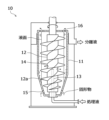
- FIG. 4 schematically shows the basic structure of the decanter.
- a so-called vertical decanter 10 includes a bowl 11 that rotates around a vertical axis and a screw conveyor 12.
- a horizontal decanter in which a bowl 11 and a screw conveyor 12 rotate around a horizontal axis is also known.
- the bowl 11 is a rotary processing container formed into a cylindrical shape.
- the screw conveyor 12 is a rotary conveying means for conveying the solid matter separated within the bowl 11.
- a feed tube 13 for supplying the processing liquid is inserted into the screw conveyor 12.
- the processing liquid discharged from the tip of the feed tube 13 is supplied into the bowl 11 through a supply hole 14 formed on the outer peripheral surface of the screw conveyor 12 using centrifugal force.
- centrifugal force is applied to the processing liquid in the bowl 11 by supplying the processing liquid into the bowl 11 and rotating the bowl 11 at a predetermined rotational speed.
- the solids in the liquid separated by the action of centrifugal force are conveyed toward the lower end of the bowl 11 by the screw conveyor 12, and are separated from the liquid at the conical portion of the bowl 11.
- the solids are then discharged from the solids outlet 15.
- the separated liquid from which the solids have been separated overflows from the separated liquid outlet 16 and is discharged by continuously supplying the processing liquid to the bowl 11.
- the present invention has been made based on the above circumstances, and its purpose is to provide a centrifugal separator that can suppress the generation of vibrations when the rotational speed of the bowl is reduced, such as during stopped operation.
- Our goal is to provide the following.
- the gist of the present invention is as follows.
- the centrifugal separator of the present invention is equipped with a solid matter discharge port and a separated liquid discharge port, and applies centrifugal force to the liquid to be treated supplied inside to separate the solids in the liquid into solid and liquid.
- a screw conveyor disposed within the bowl and rotating at a relative speed with the bowl to convey the solids to the solids discharge port;
- the inflow hole is provided with a flow path formed in a direction perpendicular or oblique to the rotation axis of the bowl, and the inflow hole is located closer to the rotation axis than the deposited layer of solid matter formed on the inner peripheral surface of the bowl during normal operation.
- a liquid draining nozzle in which a tip portion is located.
- L/D is 1.4 or less.
- the centrifugal separator is a vertical centrifuge in which the rotation axis of the bowl is arranged in the vertical direction.
- the centrifugal separator of the present invention is provided with a solid matter discharge port and a separated liquid discharge port, and applies centrifugal force to the liquid to be treated supplied inside to separate solid matter in the liquid from solid to liquid; a bowl for discharging the separated liquid from the separated liquid outlet; and a screw conveyor arranged in the bowl and rotating at a relative speed with respect to the bowl to convey the solids to the solids outlet.
- a liquid draining nozzle whose tip portion protrudes inward from the inner circumferential surface of the bowl, and discharges residual liquid in the bowl before the rotational frequency of the bowl, which is decelerated during stop operation, passes a primary resonance point; It is characterized by having the following.
- the liquid draining nozzle since the liquid draining nozzle is provided, the liquid can be drained while the bowl is rotating, so that the remaining liquid in the bowl can be prevented from becoming an unbalanced element in the rotation, and, for example, Even if the rotational speed of the bowl is reduced during stopped operation, excessive vibration can be suppressed from occurring.
- the liquid draining nozzle is equipped with an inflow hole with a flow path formed in a direction perpendicular to or diagonally to the rotation axis of the bowl, and is located closer to the rotation axis than the solid deposit layer formed on the inner peripheral surface of the bowl during normal operation. By locating the tip of the inflow hole, it is possible to prevent the inflow hole from being blocked by solid matter.
- the centrifugal force acts more directly on it than when the inlet hole is oriented parallel to the rotation axis of the bowl, facilitating the removal of liquid from inside the bowl. be done. As a result, the time required for stop operation can be shortened.
- FIG. 1 is a block diagram of a decanter according to a preferred embodiment of the present invention. It is a partial sectional view of the above-mentioned decanter. It is a sectional view, a front view, and a back view of the liquid draining nozzle of the above-mentioned decanter. It is an explanatory view showing the main composition of a decanter.
- FIG. 1 shows a vertical decanter 1 as an example of a centrifugal separator.
- the decanter 1 includes a bowl 2 that is a rotating container that applies centrifugal force to the processing liquid to separate solid and liquid.
- a rotating shaft is arranged in the vertical direction, and the bowl 2 is arranged so as to rotate, for example, around a vertical axis.
- the process pressure during normal operation for centrifugation varies depending on, for example, the type of processing liquid. In the case of high pressure or reduced pressure, the casing 3 is designed to be a pressure vessel.
- the drive device that rotates the bowl 2 is, for example, a drive motor 31 placed outside the casing 3.
- the driving force of the drive motor 31 is transmitted to a pulley 34 on the bowl 2 side through an endless rotating belt 33 that spans a pulley 32.
- the drive motor 31 rotates the bowl 2 at a predetermined rotational speed.
- the rotation speed is controlled by controlling the output of the drive motor 31 using an inverter.
- the design value of the rotational speed of the bowl 2 is set, for example, within a range of 800 to 8000 rpm, depending on the size of the bowl 2, the type of processing liquid, and the like.
- a shaft 4 that rotates the bowl 2 is supported by a bearing mechanism 41 placed at the top of the casing 3.
- the bearing mechanism 41 is supported by a vibration prevention device 41b based on the casing 3 through a support member 41a arranged around the bearing mechanism 41.
- the vibration prevention device 41b is, for example, an isolator, and is configured to absorb vibrations using elastic force of rubber or the like.
- the bowl 2 has a cylindrical upper side and a conical lower side. Further, the upper opening of the cylindrical portion is sealed with a bowl top 20 which is a disc-shaped member, and a separated liquid discharge port 20a is formed in the bowl top 20. Preferably, a plurality of separated liquid discharge ports 20a are formed at intervals, for example, on a concentric circle centered on the rotation axis of the bowl.
- the cylindrical part of the bowl 2 becomes a pool part that holds the processing liquid due to the action of centrifugal force, and the conical part becomes a beach part from which solids are separated from the liquid.
- a ring dam 21 serving as a weir is placed in front of the bowl top 20 to raise the liquid level formed during normal operation and increase the amount of liquid held.
- the discharged separated liquid is received by a gutter-like liquid receiving part 35 formed on the inner peripheral surface of the casing 3, and is further discharged to the outside of the apparatus through a discharge port 36 communicating with the liquid receiving part 35.
- the solid matter discharge port 22 is formed on the tip side of the conical portion of the bowl 2.
- a screw conveyor 5 that conveys the solids is rotatably arranged within the bowl 2. More specifically, as an example of forming a speed difference, when the bowl 2 and the screw conveyor 5 are connected via a gear box 6, which is a speed difference generating device, and the bowl 2 is rotated by the drive motor 31, the screw conveyor 5 moves to the bowl 2. It is configured to rotate at a relative speed to the rotation of. Thereby, the solid material can be conveyed by the conveyor flight 51 spirally formed in the body of the screw conveyor 5. During normal operation, the solid matter separated into solid and liquid in the bowl 2 by the action of centrifugal force is conveyed downward by the screw conveyor 5. The solids are separated from the liquid at the beach portion of the conical bowl 2 and are discharged from the solids discharge port 22.
- the feed tube 23, which is an example of a supply nozzle, is inserted through an opening formed at the lower end of the screw conveyor 5 so as not to contact the screw conveyor 5.
- a base end 23a of the feed tube 23 is connected to a processing liquid supply source such as a pump, for example. Then, the processing liquid is discharged from the tip of the feed tube 23 and supplied to the buffer chamber 52 formed within the screw conveyor 5. The processing liquid is discharged from the liquid supply hole 53 formed on the outer circumferential surface by the centrifugal force of the rotating screw conveyor 5 and is supplied into the bowl 2 .
- the feed tube 23 has, for example, a double pipe structure.
- the inner pipe is used as a supply path for processing liquid, and the outer pipe is used as a supply path for cleaning liquid.
- the cleaning liquid supply path is connected to the cleaning liquid supply nozzle 24 and further connected to a cleaning liquid supply source such as a pump.
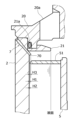
- FIG. 2 is an enlarged view of a portion where the liquid draining nozzle 7 of FIG. 1 is arranged.
- the liquid draining nozzle 7 is a nozzle that discharges liquid from the bowl 2 by using centrifugal force during stopped operation, for example, and therefore, during normal operation, the bowl 2 communicates with a pool holding liquid by the action of centrifugal force. There is.
- the liquid discharged from the liquid drain nozzle 7 is received by the liquid receiving part 35 in the same manner as the separated liquid, and is discharged to the outside of the apparatus through the discharge port 36.
- the decanter 1 has a structure in which the separated liquid outlet 20a is formed in the bowl top 20 and the separated liquid is discharged by overflow, so that ) cannot be drained from there. Further, when a ring dam 21 serving as a weir is provided, a liquid level is formed up to at least the upper end of the ring dam 21. It is undesirable to allow the liquid held in the bowl 2 to fall into the water because it will mix with the separated solids. Therefore, this embodiment has a configuration in which a liquid draining nozzle 7 that can drain liquid while the bowl 2 is rotated is provided.
- symbol 21a in a figure is a sealing material.
- the liquid inside the bowl 2 also flows out from the nozzle during normal operation. Therefore, for example, in order to prevent the solid-liquid separation efficiency from decreasing too much, under normal operating conditions, the flow rate Q2 from the liquid removal nozzle 7 is sufficiently small compared to the flow rate Q1 of the processing liquid supplied to the bowl 2, and the internal fluid It is desirable to design the nozzle so that the time during which centrifugal force acts on the centrifugal force (centrifugal residence time) is not affected, for example, as a guideline, Q2 is one-tenth or less of Q1.
- the drain nozzle 7 can be prevented from being clogged with deposits, and as a result, there is an advantage in that the influence on the throughput Q1 can be set to a minimum.
- a plurality of liquid draining nozzles 7 can be provided. In this case, the total amount of outflow from each nozzle is used as the outflow amount Q2.
- the inner diameter of bowl 2 is 400 mm
- the amount of liquid held in bowl 2 is 30 L (liters)
- the rotation speed of bowl 2 during normal operation is 4000 rpm
- the flow rate of processing liquid is 150 L/min
- the supply of processing liquid is stopped after the end of the normal operation and the rotational speed of the bowl 2 is maintained at 4000 rpm, which is the same as the normal operation, the liquid in the bowl 2 can be drained in 10 minutes after starting the stop operation. It becomes a calculation.
- the liquid draining nozzle 7 is an elongated tubular nozzle that has a flow path formed therein that penetrates in the longitudinal direction.
- the structure of the tip is important to prevent it from being blocked by solid matter. This is because if the drain nozzle 7 is made thinner in order to suppress the amount of outflow during normal operation, the tip of the nozzle becomes more likely to become clogged with solid matter during normal operation. As a result of actual tests, it has been concluded that the position of the nozzle tip in the bowl 2, the shape and orientation of the tip are important in order to prevent clogging with solid matter during normal operation. The reason is detailed below.
- the position of the nozzle tip inside the bowl 2 will be explained.
- solid matter settles on the inner peripheral surface of the bowl due to the action of centrifugal force, and some of the solid matter adheres to and accumulates on the surface of the bowl 2.
- the tip of the liquid removal nozzle 7 is likely to become clogged during normal operation. If the draining nozzle 7 is clogged with solid matter, the liquid in the bowl 2 cannot be drained during stopped operation, resulting in excessive vibration.
- the tip of the inflow hole 70 of the draining nozzle 7 is arranged so as to be located above (on the rotation axis side of the bowl) the layer of solid matter deposited on the inner circumferential surface of the bowl during normal operation.
- the distal end portion is arranged so as to protrude from the inner circumferential surface of the bowl 2 toward the inside of the bowl 2 .
- the thickness of the deposited layer is preferably measured, for example, by opening the bowl 2 after normal operation. Alternatively, it is estimated by simulation or the like.
- distance H1 from the inner peripheral surface of the bowl 2 to the tip of the conveyor flight 51 is 1.7 mm
- the thickness H2 of the deposited layer formed during normal operation is 0.5 mm
- inflow from the inner peripheral surface of the bowl 2 The distance H3 to the tip of the hole 70 is 1.7 mm.
- distance H3 is also the same as distance H1. That is, it is at the same position as the tip of the conveyor flight 51.
- the inflow hole 70 is preferably a circular through hole.
- the channel length L is set to 1.4 mm or less.
- the shape of the inflow hole 70 does not necessarily have to be circular, and may be other shapes such as a polygon, for example.
- the inflow hole 70 communicates with the enlarged diameter portion 71 in the longitudinal direction within the nozzle, and further communicates with a flow path 72 formed to the base end side.
- the expanded diameter portion 71 expands to a diameter of 2.3 mm, for example.
- the length of the flow path 72 is, for example, 32.2 mm.
- symbol 73 is a hexagonal hole.
- the liquid removal nozzle 7 has a small-diameter inflow hole 70 formed at its tip, but the flow path from there is enlarged, so that the liquid can flow smoothly inside the nozzle and be discharged from the end.
- Such a liquid draining nozzle 7 is formed by processing a round bar member, for example.
- the value of L/D increases in two ways: when the opening diameter D is made small, and when the flow path length L is made long. In the former case, blockage by solid objects is likely to occur. In the latter case, the farther the expanded diameter portion 71 is, the greater the liquid resistance becomes and the liquid in the nozzle does not flow smoothly. In some cases, it may induce blockage of solid objects. Since the drain nozzle 7 can be prevented from being blocked by deposits, there is an advantage that the influence on the flow rate can be set to a minimum.
- the liquid draining nozzle 7 is disposed in a direction perpendicular or oblique to the rotation axis (for example, rotation center axis) of the bowl 2.
- the tip of the liquid draining nozzle 7 is arranged in an oblique direction facing downward. In plan view, it is along the diameter line of the bowl 2.
- the angle ⁇ with respect to the axis R perpendicular to the rotation axis is set to be 60 degrees or less, especially as shown in FIG. 3(b). In the illustrated example, the angle ⁇ is 50 degrees.
- the liquid draining nozzle 7 may be arranged in an oblique direction with the tip of the liquid draining nozzle 7 facing upward. Further, it does not necessarily have to be along the diameter line in plan view. For example, it may be arranged obliquely in the direction opposite to the direction of rotation of the bowl 2.
- the liquid draining nozzle 7 is not necessarily entirely linear. That is, the liquid draining nozzle 7 mentioned here does not exclude, for example, one bent in a dogleg shape or curved halfway. It is sufficient that at least the flow path length L of the inflow hole 70 is arranged in a direction perpendicular to the rotation axis of the bowl 2 or in an oblique direction.
- the liquid draining nozzle 7 is arranged so that its tip is located between the ring dam 21 and the conveyor flight 51, as shown in FIG. This area is close to the separated liquid discharge port 21a and is a position where the nozzle tip does not interfere with the rotating conveyor flight 51.
- the drive motor 31 is first started and the rotation of the bowl 2 is accelerated until it reaches a predetermined rotational speed.
- the driving force is transmitted to the screw conveyor 5 through the gear box 6, which is a differential speed generator, and the screw conveyor 5 rotates at a differential speed relative to the rotating bowl 2.
- the rotational speed of the bowl 2 is set to 4000 rpm, and the differential speed is set to 10 min -1 .
- the processing liquid is discharged from the feed tube 23 and supplied into the bowl 2 through the liquid discharge hole 53.
- the types of treatment liquid and solid matter are not particularly limited.
- the processing liquid supplied into the bowl 2 forms a liquid pool on the beach part of the bowl 2 due to the action of centrifugal force, and solid matter in the liquid settles to the inner peripheral surface of the bowl 2 due to the action of the centrifugal force. solid-liquid separation is performed.
- the processing liquid is continuously supplied, whereby the separated liquid overflows from the upper end of the ring dam 21 and is discharged from the separated liquid outlet 20a. At this time, the liquid in the bowl 2 also flows out from the liquid draining nozzle 7 due to the action of centrifugal force.
- the separated liquid from the separated liquid outlet 20a and the liquid flowing from the liquid draining nozzle 7 are discharged toward the inner peripheral surface of the casing 3 by the action of centrifugal force, and are received by the liquid receiving portion 35. Thereafter, it is discharged from the apparatus through the discharge port 36.
- the solids separated into solid and liquid by centrifugal force in the bowl 2 are conveyed toward the lower side of the bowl 2 by the screw conveyor 5, and are separated from the liquid at the conical beach part of the bowl 2 and solidified.
- the material is discharged from the material discharge port 22.
- the solid matter is discharged from the lower side of the casing 3.
- the normal operation is ended and the operation is shifted to a stopped operation.
- the stop operation for example, the supply of the processing liquid is stopped and the bowl 2 continues to rotate, thereby draining the remaining liquid in the bowl 2 from the liquid draining nozzle 7.
- the cleaning liquid is discharged from the liquid draining nozzle 7 by rotating the bowl 2.
- the rotational speed of the bowl 2 is reduced and the apparatus is stopped.
- the bowl 2 may be decelerated by lowering the output of the drive motor 31 using an inverter, or by stopping the drive motor 31 and allowing it to decelerate naturally.
- the draining time may be set using a timer, for example.
- the rotational speed of the bowl 2 during draining does not have to be the same as during normal operation.
- the vehicle may be driven at a constant speed slower than normal operation, or at a reduced speed.
- the rotation speed may be controlled automatically by the control unit or may be controlled manually.
- one of the purposes of increasing the amount of liquid held in the bowl 2 is to improve the throughput of the decanter 1.
- this retained liquid becomes a cause of excessive vibration.
- Excessive vibration occurs when the rotation of the bowl 2 is decelerated with an unbalanced element such as residual liquid, and the rotational frequency is amplified when passing through the primary resonance point of the device (decanter 1). Confirmed on actual machine.
- vibrations generated during normal operation are absorbed by the vibration prevention device 41b, it is difficult to absorb excessive vibrations amplified by resonance.
- the band of the primary resonance point which is the resonance point of the decanter 1 as a device, is 400 to 800 rpm (that is, a frequency of 10 Hz ⁇ 3Hz), and resonance does not occur during normal operation, for example, when rotating at 4000 rpm.
- the band of the primary resonance point can be determined by actually operating the device and measuring the vibration.
- the interior of the decanter can be drained by continuing to rotate the bowl 2 after normal operation. Therefore, it is possible to pass through the primary resonance point after removing the unbalanced rotational element of the residual liquid, and it is possible to suppress the occurrence of excessive vibration.
- a horizontal type decanter in which both sides of the bowl 2 are supported by two shafts, is less prone to excessive vibration than a vertical type, in which the rotating shaft is supported by one shaft. It is also possible to apply it to
Landscapes
- Centrifugal Separators (AREA)
Priority Applications (2)
| Application Number | Priority Date | Filing Date | Title |
|---|---|---|---|
| PCT/JP2022/021035 WO2023223567A1 (ja) | 2022-05-20 | 2022-05-20 | 遠心分離装置 |
| JP2024521535A JPWO2023223567A1 (https=) | 2022-05-20 | 2022-05-20 |
Applications Claiming Priority (1)
| Application Number | Priority Date | Filing Date | Title |
|---|---|---|---|
| PCT/JP2022/021035 WO2023223567A1 (ja) | 2022-05-20 | 2022-05-20 | 遠心分離装置 |
Publications (1)
| Publication Number | Publication Date |
|---|---|
| WO2023223567A1 true WO2023223567A1 (ja) | 2023-11-23 |
Family
ID=88835056
Family Applications (1)
| Application Number | Title | Priority Date | Filing Date |
|---|---|---|---|
| PCT/JP2022/021035 Ceased WO2023223567A1 (ja) | 2022-05-20 | 2022-05-20 | 遠心分離装置 |
Country Status (2)
| Country | Link |
|---|---|
| JP (1) | JPWO2023223567A1 (https=) |
| WO (1) | WO2023223567A1 (https=) |
Citations (3)
| Publication number | Priority date | Publication date | Assignee | Title |
|---|---|---|---|---|
| JPS5453359A (en) * | 1977-09-19 | 1979-04-26 | Pennwalt Corp | Centrifugal separator |
| JPS57140850U (https=) * | 1981-02-25 | 1982-09-03 | ||
| DE102018105079A1 (de) * | 2018-03-06 | 2019-09-12 | Gea Mechanical Equipment Gmbh | Vollmantel-Schneckenzentrifuge |
-
2022
- 2022-05-20 WO PCT/JP2022/021035 patent/WO2023223567A1/ja not_active Ceased
- 2022-05-20 JP JP2024521535A patent/JPWO2023223567A1/ja active Pending
Patent Citations (3)
| Publication number | Priority date | Publication date | Assignee | Title |
|---|---|---|---|---|
| JPS5453359A (en) * | 1977-09-19 | 1979-04-26 | Pennwalt Corp | Centrifugal separator |
| JPS57140850U (https=) * | 1981-02-25 | 1982-09-03 | ||
| DE102018105079A1 (de) * | 2018-03-06 | 2019-09-12 | Gea Mechanical Equipment Gmbh | Vollmantel-Schneckenzentrifuge |
Also Published As
| Publication number | Publication date |
|---|---|
| JPWO2023223567A1 (https=) | 2023-11-23 |
Similar Documents
| Publication | Publication Date | Title |
|---|---|---|
| JP6391984B2 (ja) | 遠心分離機 | |
| CN106999964B (zh) | 包括自清洁喷嘴的可旋转罐清洁喷嘴头部 | |
| EP2440335B1 (en) | A centrifugal separator | |
| JP7336467B2 (ja) | 懸濁している細胞を分離する遠心分離機システム | |
| KR102323606B1 (ko) | 디캔터형 원심분리기 및 디캔터형 원심분리기의 운전방법 | |
| JPH01203063A (ja) | デカンタ型遠心分離機 | |
| JP2013525095A (ja) | セパレータ | |
| WO2023223567A1 (ja) | 遠心分離装置 | |
| JP2009006235A (ja) | 異物除去装置 | |
| US6056685A (en) | Centrifuge having selectively operable harmonic drive for scroll conveyor | |
| US5281195A (en) | Centrifugal liquid cleaning apparatus and method | |
| RU2004139021A (ru) | Шнековая центрифуга со сплошным ротором, содержащая срезающий диск, и способ ее эксплуатации | |
| JP2003313790A (ja) | 紙繊維を含有する懸濁液の浮選時に形成される浮選泡から空気を除去するための装置 | |
| JP2010167361A (ja) | 回転式濃縮装置及び濃縮システム | |
| JPH07246349A (ja) | 分離板型遠心分離機 | |
| JP5832828B2 (ja) | 遠心分離装置の可変ダム及び遠心分離装置 | |
| JP2009297609A (ja) | 回転分離装置 | |
| CN223010800U (zh) | 一种带有排液结构的卧螺离心机 | |
| KR20000051926A (ko) | 연속분리식 원심분리기 | |
| KR100746754B1 (ko) | 알칼리 세척액 정제 시스템 | |
| RU2581392C2 (ru) | Способ обработки продукта в центробежном поле | |
| JP2009195819A (ja) | 液体濾過方法及び設備 | |
| JP6222485B2 (ja) | ドラム型濃縮機 | |
| JP2024058777A (ja) | ろ過装置 | |
| JPH0975783A (ja) | 遠心分離機の洗浄装置 |
Legal Events
| Date | Code | Title | Description |
|---|---|---|---|
| 121 | Ep: the epo has been informed by wipo that ep was designated in this application |
Ref document number: 22941872 Country of ref document: EP Kind code of ref document: A1 |
|
| WWE | Wipo information: entry into national phase |
Ref document number: 2024521535 Country of ref document: JP |
|
| NENP | Non-entry into the national phase |
Ref country code: DE |
|
| 122 | Ep: pct application non-entry in european phase |
Ref document number: 22941872 Country of ref document: EP Kind code of ref document: A1 |