WO2023219080A1 - 加工食品における動物脂様風味の付与方法 - Google Patents
加工食品における動物脂様風味の付与方法 Download PDFInfo
- Publication number
- WO2023219080A1 WO2023219080A1 PCT/JP2023/017424 JP2023017424W WO2023219080A1 WO 2023219080 A1 WO2023219080 A1 WO 2023219080A1 JP 2023017424 W JP2023017424 W JP 2023017424W WO 2023219080 A1 WO2023219080 A1 WO 2023219080A1
- Authority
- WO
- WIPO (PCT)
- Prior art keywords
- oil
- processed food
- sweetener
- flavor
- fat
- Prior art date
- Legal status (The legal status is an assumption and is not a legal conclusion. Google has not performed a legal analysis and makes no representation as to the accuracy of the status listed.)
- Ceased
Links
Classifications
-
- A—HUMAN NECESSITIES
- A23—FOODS OR FOODSTUFFS; TREATMENT THEREOF, NOT COVERED BY OTHER CLASSES
- A23D—EDIBLE OILS OR FATS, e.g. MARGARINES, SHORTENINGS OR COOKING OILS
- A23D7/00—Edible oil or fat compositions containing an aqueous phase, e.g. margarines
- A23D7/005—Edible oil or fat compositions containing an aqueous phase, e.g. margarines characterised by ingredients other than fatty acid triglycerides
-
- A—HUMAN NECESSITIES
- A23—FOODS OR FOODSTUFFS; TREATMENT THEREOF, NOT COVERED BY OTHER CLASSES
- A23D—EDIBLE OILS OR FATS, e.g. MARGARINES, SHORTENINGS OR COOKING OILS
- A23D7/00—Edible oil or fat compositions containing an aqueous phase, e.g. margarines
-
- A—HUMAN NECESSITIES
- A23—FOODS OR FOODSTUFFS; TREATMENT THEREOF, NOT COVERED BY OTHER CLASSES
- A23D—EDIBLE OILS OR FATS, e.g. MARGARINES, SHORTENINGS OR COOKING OILS
- A23D7/00—Edible oil or fat compositions containing an aqueous phase, e.g. margarines
- A23D7/005—Edible oil or fat compositions containing an aqueous phase, e.g. margarines characterised by ingredients other than fatty acid triglycerides
- A23D7/0053—Compositions other than spreads
-
- A—HUMAN NECESSITIES
- A23—FOODS OR FOODSTUFFS; TREATMENT THEREOF, NOT COVERED BY OTHER CLASSES
- A23J—PROTEIN COMPOSITIONS FOR FOODSTUFFS; WORKING-UP PROTEINS FOR FOODSTUFFS; PHOSPHATIDE COMPOSITIONS FOR FOODSTUFFS
- A23J3/00—Working-up of proteins for foodstuffs
-
- A—HUMAN NECESSITIES
- A23—FOODS OR FOODSTUFFS; TREATMENT THEREOF, NOT COVERED BY OTHER CLASSES
- A23J—PROTEIN COMPOSITIONS FOR FOODSTUFFS; WORKING-UP PROTEINS FOR FOODSTUFFS; PHOSPHATIDE COMPOSITIONS FOR FOODSTUFFS
- A23J3/00—Working-up of proteins for foodstuffs
- A23J3/14—Vegetable proteins
- A23J3/16—Vegetable proteins from soybean
-
- A—HUMAN NECESSITIES
- A23—FOODS OR FOODSTUFFS; TREATMENT THEREOF, NOT COVERED BY OTHER CLASSES
- A23J—PROTEIN COMPOSITIONS FOR FOODSTUFFS; WORKING-UP PROTEINS FOR FOODSTUFFS; PHOSPHATIDE COMPOSITIONS FOR FOODSTUFFS
- A23J3/00—Working-up of proteins for foodstuffs
- A23J3/22—Working-up of proteins for foodstuffs by texturising
- A23J3/225—Texturised simulated foods with high protein content
- A23J3/227—Meat-like textured foods
-
- A—HUMAN NECESSITIES
- A23—FOODS OR FOODSTUFFS; TREATMENT THEREOF, NOT COVERED BY OTHER CLASSES
- A23K—FODDER
- A23K20/00—Accessory food factors for animal feeding-stuffs
- A23K20/10—Organic substances
- A23K20/163—Sugars; Polysaccharides
-
- A—HUMAN NECESSITIES
- A23—FOODS OR FOODSTUFFS; TREATMENT THEREOF, NOT COVERED BY OTHER CLASSES
- A23L—FOODS, FOODSTUFFS OR NON-ALCOHOLIC BEVERAGES, NOT OTHERWISE PROVIDED FOR; PREPARATION OR TREATMENT THEREOF
- A23L27/00—Spices; Flavouring agents or condiments; Artificial sweetening agents; Table salts; Dietetic salt substitutes; Preparation or treatment thereof
-
- A—HUMAN NECESSITIES
- A23—FOODS OR FOODSTUFFS; TREATMENT THEREOF, NOT COVERED BY OTHER CLASSES
- A23L—FOODS, FOODSTUFFS OR NON-ALCOHOLIC BEVERAGES, NOT OTHERWISE PROVIDED FOR; PREPARATION OR TREATMENT THEREOF
- A23L27/00—Spices; Flavouring agents or condiments; Artificial sweetening agents; Table salts; Dietetic salt substitutes; Preparation or treatment thereof
- A23L27/20—Synthetic spices, flavouring agents or condiments
- A23L27/26—Meat flavours
-
- A—HUMAN NECESSITIES
- A23—FOODS OR FOODSTUFFS; TREATMENT THEREOF, NOT COVERED BY OTHER CLASSES
- A23L—FOODS, FOODSTUFFS OR NON-ALCOHOLIC BEVERAGES, NOT OTHERWISE PROVIDED FOR; PREPARATION OR TREATMENT THEREOF
- A23L27/00—Spices; Flavouring agents or condiments; Artificial sweetening agents; Table salts; Dietetic salt substitutes; Preparation or treatment thereof
- A23L27/30—Artificial sweetening agents
- A23L27/33—Artificial sweetening agents containing sugars or derivatives
-
- A—HUMAN NECESSITIES
- A23—FOODS OR FOODSTUFFS; TREATMENT THEREOF, NOT COVERED BY OTHER CLASSES
- A23L—FOODS, FOODSTUFFS OR NON-ALCOHOLIC BEVERAGES, NOT OTHERWISE PROVIDED FOR; PREPARATION OR TREATMENT THEREOF
- A23L27/00—Spices; Flavouring agents or condiments; Artificial sweetening agents; Table salts; Dietetic salt substitutes; Preparation or treatment thereof
- A23L27/80—Emulsions
-
- A—HUMAN NECESSITIES
- A23—FOODS OR FOODSTUFFS; TREATMENT THEREOF, NOT COVERED BY OTHER CLASSES
- A23L—FOODS, FOODSTUFFS OR NON-ALCOHOLIC BEVERAGES, NOT OTHERWISE PROVIDED FOR; PREPARATION OR TREATMENT THEREOF
- A23L35/00—Foods or foodstuffs not provided for in groups A23L5/00 - A23L33/00; Preparation or treatment thereof
-
- A—HUMAN NECESSITIES
- A23—FOODS OR FOODSTUFFS; TREATMENT THEREOF, NOT COVERED BY OTHER CLASSES
- A23L—FOODS, FOODSTUFFS OR NON-ALCOHOLIC BEVERAGES, NOT OTHERWISE PROVIDED FOR; PREPARATION OR TREATMENT THEREOF
- A23L5/00—Preparation or treatment of foods or foodstuffs, in general; Food or foodstuffs obtained thereby; Materials therefor
Definitions
- the present invention relates to a method for imparting animal fat-like flavor to processed foods containing vegetable oils and fats.
- Patent Document 1 discloses an oil and fat composition containing protein and/or sodium starch octenyl succinate and fat
- Patent Document 2 discloses an alginic acid propylene glycol ester, alginic acid and/or its salt, a polyvalent metal salt, and a gelling reaction retarder.
- Patent Document 3 discloses meat or processed meat products characterized by containing advantame in the meat.
- Patent Document 1 did not have a fat-like richness, and there is still room for improvement.
- Patent Document 2 describes the presence or absence of body taste, there is only a study example in which livestock meat is blended, and it is unclear whether a similar body taste imparting effect can be obtained in foods containing vegetable protein materials.
- Patent Document 3 discloses that fat-like sweetness can be imparted to meat or processed meat products by adding a predetermined amount of advantame. However, in cases where vegetable protein materials are blended, it is necessary to consider whether fat-like sweetness can be imparted. Furthermore, even if sugars such as granulated sugar or sweeteners are directly added to processed meat products, they will taste more sweet than necessary and the overall flavor balance of the processed food will be disrupted.
- an object of the present invention is to provide a method for imparting animal fat-like flavor to processed foods containing vegetable oils and fats.
- the present inventors conducted a study and found that an animal fat-like flavor can be imparted by dispersing the aqueous phase in which the sweetener is dissolved into the oil phase containing vegetable oil with a particle size of 50 to 2000 nm. They discovered this and completed the present invention.
- the present invention (1) A method for imparting an animal fat-like flavor to a processed food, which comprises dispersing an aqueous phase in which a sweetener is dissolved into an oil phase containing vegetable oil with a particle size of 50 to 2000 nm; (2) The method according to (1), wherein the concentration of the sweetener in the aqueous phase is 15 to 75% by mass in terms of solid content; (3) The method according to (1) or (2), wherein the sweetener is one or more selected from the group consisting of maltose, Luo Han fruit extract, glucose, or sucrose; (4) the method according to (3), wherein the sweetener is maltose; (5) The method according to (1) or (2), wherein the sweetener carried by the aqueous phase in the processed food is 4 to 1000 ppm in terms of solid content; (6) The method according to (3), wherein the sweetener carried by the aqueous phase in the processed food is 4 to 1000 ppm in terms of solid content; (7) The method according to (4), where wherein
- Step (12) of preparing a processed food the method for producing a processed food according to (11), wherein the sweetener is one or more selected from the group consisting of maltose, Luo Han Guo extract, glucose, or sucrose; (13) The method for producing a processed food according to (12), wherein the sweetener is maltose; It is related to.
- the present invention (21) A method for imparting an animal fat-like flavor to processed foods, which comprises dispersing an aqueous phase in which sugar is dissolved in an oil phase containing vegetable oil with a particle size of 50 to 2000 nm; (22) The method according to (21), wherein the concentration of sugar in the aqueous phase is 30 to 75% by mass in terms of solid content; (23) The method according to (21) or (22), wherein the sugar carried by the aqueous phase in the processed food is 5 to 1000 ppm in terms of solid content; (24) A processed food containing an oil phase containing vegetable oil and fat, in which an aqueous phase in which sugar is dissolved is dispersed in an oil phase with a particle size of 50 to 2000 nm, (25) A method for producing a processed food containing an oil phase containing vegetable oil, including the following steps: (A) a step of dispersing the aqueous phase in which sugar is dissolved in the oil phase so that the particle size is 50 to 2000 nm; (A)
- animal fat-like flavor can be easily imparted to processed foods containing vegetable oils and fats.
- the flavor of animal fat refers to the flavor of animal fat that is felt when eating meat or food containing animal fat.
- Animal fat umami is a word that expresses the unique taste, richness, and richness derived from animal fat. It is also sometimes expressed as ⁇ umami''. Therefore, the "flavor of animal fat” is different from the sweetness felt when processed foods contain sweeteners.
- vegetable oils and fats when vegetable oils and fats have the same flavor, richness, and richness as animal fats, they are expressed as "animal fat-like flavor.”
- vegetable protein materials may lack the umami characteristic of animal fat.
- the present invention is characterized in that an aqueous phase in which a sweetener is dissolved is dispersed in an oil phase with a particle size of 50 to 2000 nm, and it is possible to impart an animal fat-like flavor to a processed food containing vegetable oil.
- Japanese Patent Application No. 2022-077181 which is the basic application of this application, there is a section where the animal fat-like flavor of fats and oils is expressed as "sweetness", but this is a unique expression in Japanese and may cause misunderstanding.
- the term "animal fat-like flavor” is unified.
- the invention is the same, and the priority right to Japanese Patent Application No. 2022-077181 is valid.
- the aqueous phase in which the sweetener is dissolved is dispersed in the oil phase.
- the sweeteners mentioned here include monosaccharides such as glucose and fructose, disaccharides such as maltose, sugars such as sucrose, sugar alcohols such as maltitol, sucralose, Luo Han fruit extract, stevia, etc. Sweetness sweeteners can be mentioned, and molasses and fructose glucose liquid sugar containing these can also be used.
- the sweetener includes both those extracted from natural substances and those artificially synthesized.
- a suitable sweetener By using a suitable sweetener, an animal fat-like flavor can be imparted to the processed food. Note that it is desirable not to use advantame as a sweetener.
- Advantame is a type of high-intensity sweetener, and is known to have a strong sweet taste. Even if advantame is dispersed in the oil phase by the method according to the present invention, the intensity of sweetness is strong, so the processed food may be perceived as having a strong sweetness, and the overall flavor of the processed food may be impaired.
- the oil phase in the present invention is composed of fats and oils and components soluble in fats and oils in the raw materials. Specifically, it is composed of part or all of the fat and oil raw materials in the processed food of the present invention.
- the vegetable oil that can be used in the present invention is not particularly limited, and ordinary edible vegetable oils can be used.
- animal fat such as pork fat, beef tallow, and fish oil can also be used as the oil phase.
- a mixture of components soluble in fats and oils can also be referred to as an oil phase.
- animal fats extracted from livestock meat and components derived from animals and soluble in fats and oils can be used as the oil phase.
- the oil phase is vegetable oil or fat derived from plants. Components that are soluble in fats and oils can be used.
- the proportion of vegetable oil contained in the oil phase is preferably 1 to 100% by mass of the fats and oils used in the raw materials. More preferably 70 to 100% by weight, 80 to 100% by weight, 90 to 100% by weight, or 95 to 100% by weight.
- the processed food is a meatless hamburger steak or a meatless hamburger that does not use animal materials
- the vegetable oil contained in the oil phase is 100% by mass because no animal materials are used.
- Oil-soluble components can be dissolved in the oil phase within a range that does not impede the effects of the present invention, and specific examples include oil-soluble emulsifiers, pigments, and fragrances.
- oil-soluble emulsifiers since the water phase has a so-called water-in-oil emulsion structure in which the water phase is finely dispersed in the oil phase, it is preferable to use an oil-soluble emulsifier that has the function of stabilizing the emulsion structure.
- the oil-soluble emulsifier here is an emulsifier that dissolves in fats and oils and has an HLB of 7 or less.
- one or more emulsifiers selected from polyglycerin esters, sugar esters, sorbitan esters, and monoglycerin fatty acid esters are preferred. More preferred are polyglycerin esters, sugar esters, and distilled monoglycerides, and even more preferred are polyglycerin esters. Among these, polyglycerin condensed ricinoleic acid ester is most preferred. Note that polyglycerin condensed ricinoleic acid ester is sometimes abbreviated as PGPR.
- the concentration of the sweetener in the aqueous phase in which the sweetener is dissolved is preferably 15 to 75% by mass in terms of solid content. More preferably 20 to 70% by weight, 30 to 70% by weight, 35 to 65% by weight, and 40 to 65% by weight.
- concentration of the sweetener in the aqueous phase is appropriate, an animal fat-like flavor can be imparted to the processed food.
- the aqueous phase in which the sweetener is dissolved needs to be dispersed in the oil phase, and the particle size of the aqueous phase at this time needs to be 50 to 2000 nm. This value is more preferably 55 to 1200 nm, 60 to 800 nm, 60 to 700 nm, 65 to 650 nm, or 65 to 600 nm. If the particle size of the aqueous phase in the oil phase is appropriate, an animal fat-like flavor can be imparted to the processed food.
- the method for measuring the particle size of the aqueous phase is as follows.
- the amount of sweetener carried into the processed food by the aqueous phase is preferably 4 to 1000 ppm. More preferably 4.5 to 900 ppm, 5 to 900 ppm, 10 to 800 ppm, 20 to 600 ppm, 30 to 500 ppm, 50 to 400 ppm, and 50 to 350 ppm.
- a suitable amount of sweetener carried by the aqueous phase can impart an animal fat-like flavor in the processed food.
- the processed food according to the present invention preferably contains a vegetable protein material.
- the processed food according to the present invention can more preferably obtain the effects of the present invention if the processed food contains preferably 1% by mass or more of a vegetable protein material on a dry weight basis. More preferably, the effect of the present invention can be maximized at 3% by mass or more, 5% by mass or more, 7% by mass or more, or 10% by mass or more.
- processed foods include hamburgers, patties, meatballs, nuggets, meatballs, ham, salami, sausages, gyoza, shumai, meat buns, xiaolongbao, minced meat cutlets, croquettes, frankfurters, American dogs, meat pies, and ravioli. , lasagna, meatloaf, cabbage rolls, and stuffed meats such as green peppers and lotus roots.
- seasoning liquids such as soups for gyudon, sukiyaki, katsutoji, and oyakodon, and dashi for ramen and soups.
- processed foods such as curry, keema curry, and meat sauce.
- Processed foods such as jerky and sliced meat for grilled meat for PBF are also included in the present invention. These processed foods include frozen products, refrigerated products, dried products, and retort products.
- materials suitable for the product form of processed foods such as textured vegetable protein materials, powdered vegetable protein materials, and emulsion cards, can be used as appropriate.
- the textured vegetable protein material that can be used as the vegetable protein material used in the present invention is one obtained by blending plant-derived protein materials and organizing them under high temperature and high pressure using a texturing device such as an extruder. It has shapes such as granules, fibers, flakes, sliced meat, and films.
- Plant-derived protein materials include protein materials derived from oil seeds such as soybeans, peas, mung beans, chickpeas, rapeseed, cottonseed, peanuts, sesame, safflower, sunflower, corn, and safflower, or rice, barley, and wheat.
- Protein materials derived from grain seeds such as
- the protein material includes crushed products of the above-mentioned plants, extracted proteins, concentrated proteins, isolated proteins, and the like. Examples include rice glutelin, barley prolamin, wheat prolamin, wheat gluten, full-fat soybean flour, defatted soybean flour, concentrated soybean protein, isolated soybean protein, isolated pea protein, isolated mung bean protein, and the like. Although there are products that are distributed after being rehydrated, it is preferable to use a dried product (moisture content of 10% by mass or less) in the present invention. Also suitable for the present invention is a soybean material textured by pressing tofu. Textured soybean protein made mainly from soybeans is suitable for the present invention.
- the textured vegetable protein material can be appropriately selected and used in any shape or size depending on the desired product form.
- Product forms called soybean meat and soybean puffs can also be used.
- the protein content in the textured vegetable protein material is preferably at least 30% by mass or more based on the dry weight of the material. More preferably, it is 40% by mass or more, and even more preferably 50% by mass.
- Powdered vegetable protein materials that can be used as the vegetable protein materials used in the present invention are powdered vegetable raw materials such as soybeans, wheat, peas, chickpeas, mung beans, rice, barley, etc. It contains 50% by mass or more of protein based on the solid content after defatting. Soybeans are suitable for the present invention. Commercially available powdered vegetable protein materials can be appropriately selected and used. Further, the powdered vegetable protein material may be powdered by adding oil or fat in advance to improve dispersibility in the dough. Furthermore, oil-in-water emulsions, such as emulsion cards, which have the function of binding fabrics together, can also be used. Also in this case, a powdered soybean protein material whose main ingredient is soybean is suitable. Note that the emulsion curd herein refers to a homogenized emulsion containing a powdered vegetable protein material, water, and fats and oils.
- the processed food according to the present invention may contain animal meat or animal fat.
- Meat here refers to the meat of birds and animals such as cows, pigs, chickens, horses, sheep, deer, boars, turkeys, ducks, ostriches, and whales, and these can be used alone or in combination of two or more types. I can do it.
- the birds and animals may be terrestrial animals or aquatic animals, but terrestrial animals are preferable.
- the part of meat used is not particularly limited. Meat processed into minced meat can also be used.
- livestock meat is used in the processed food, the amount used is preferably 30% by mass or less in the processed food.
- animal fat refers to fats and oils isolated or extracted from the above-mentioned bird and animal meat. When animal fat is used in the processed food, the amount used is preferably 30% by mass or less in the processed food.
- animal fat used may be determined as appropriate depending on the quality and concept desired for the product. For example, in the case of a meatless processed food or a meatless processed food that does not use animal raw materials, the animal meat and animal fat are not used at all. In view of the spirit of the present invention, it is desirable that animal fat is not used.
- the processed food according to the present invention can utilize known materials and food additives.
- vegetables, starches, seasonings (salt, pepper, sugar, soy sauce, etc.), processed starches, dietary fibers, egg yolks, egg whites, emulsifiers, spices, flavorings, and other known additives may interfere with the effects of the present invention. It can be used as appropriate within the range. If you want a meatless processed food or a processed food that does not use animal raw materials, use vegetable raw materials.
- the present invention can also be considered as a processed food containing vegetable oils and fats imparted with an animal fat-like flavor. Specifically, it is characterized in that the aqueous phase in which the sweetener is dissolved is dispersed in the oil phase with particle diameters of 50 to 2000 nm.
- the present invention can also be considered as a method for producing processed foods containing vegetable oils and fats imparted with an animal fat-like flavor. Specifically, it is characterized in that the aqueous phase in which the sweetener is dissolved is dispersed in the oil phase with particle diameters of 50 to 2000 nm.
- a sweetener is dissolved in water to prepare an aqueous phase.
- the type of sweetener used here and the concentration of sugar in the aqueous phase are as described above.
- an oil phase is prepared, and for the oil phase, all or part of the fats and oils as raw materials are used in the processed food according to the present invention. If necessary, an oil-soluble emulsifier or the like is dissolved in the oil phase.
- the obtained aqueous phase is dispersed in an oil phase to prepare a water-in-oil emulsion composition.
- Various methods can be used for dispersion.
- a high-pressure homogenizer an ultrasonic emulsifier, or a two-liquid collision type emulsifier, also called a wet jet mill, can be used.
- a suitable emulsification device By using a suitable emulsification device, a predetermined water-in-oil emulsion composition can be obtained.
- the general emulsification conditions when using a high-pressure homogenizer are 10 to 30 passes at 30 to 40 MPa. This allows the particle size of the aqueous phase in the oil phase to be 50 to 2000 nm.
- the water-in-oil emulsion composition is mixed with other raw materials in the processed food, and the processed food is prepared by a predetermined method.
- a predetermined method for preparing the processed food.
- the water-in-oil emulsion composition may be blended by cutting it into small pieces using a shredding machine such as a Robocoop, chopper, or silent cutter immediately before preparing the paste product. can.
- a shredding machine such as a Robocoop, chopper, or silent cutter immediately before preparing the paste product. can.
- the shape of the piece as long as the longest side is 15 mm or less.
- the shape may be a cylinder, a cube, a circle, a semicircle, a polyhedron such as a polygonal pyramid or a polygonal prism, or a slice.
- a water-in-oil emulsion composition was prepared according to the formulations shown in Tables 1-1 and 1-2.
- the preparation method was as follows. Raw materials classified into a water phase and an oil phase were mixed to prepare a water phase and an oil phase. The oil phase was stirred and the aqueous phase was gradually added thereto to prepare a substantial emulsion. The emulsion was subjected to a high-pressure homogenizer (30 to 40 MPa x 10 to 30 passes) to obtain a water-in-oil emulsion composition. Each water-in-oil emulsion composition was stored in a freezer overnight (12 hours at 4°C). The particle size of the aqueous phase was measured according to the following method.
- the method for preparing emulsion card A was as follows: 4.5 parts of water and 1 part of textured soy protein material ("Fujipro FR", manufactured by Fuji Oil Co., Ltd.) were stirred at 1500 rpm for 1.5 minutes (RoboCoup (Co., Ltd.) (manufactured by FMI), to which 1 part of rapeseed oil was added and stirred for 4 minutes, and then 1 part of dried egg white was added and stirred for 1 minute.
- RobotCoup Co., Ltd.
- beef tallow, vegetable oil, maltose-added vegetable oil, and each water-in-oil emulsion composition were stored in the freezer until used, and before being mixed into the meatless hamburger, they were crushed into 8 mm squares using a RoboCoop before use. .
- the amount of maltose contained in the processed foods of Comparative Examples 1 and 2 was the same as the maltose content brought in from the aqueous phase of Example 2.
- Comparative Example 1 vegetable oil and maltose were directly added to the dough, and in Comparative Example 2, maltose was directly added to melted vegetable oil, mixed, and cooled to solidify. Further, the vegetable oil content in the oil phase was 48.2% by mass in Reference Example 1, and 100.0% by mass in Examples 1 to 7 and Comparative Examples 1 to 4.
- emulsion card B was prepared first, and textured soy protein material A 5 times hydrated and textured soy protein material B 3 times hydrated were added thereto and mixed for 1 minute at 150 rpm in a Kenmix. Add seasonings/spices, bamboo fiber ("BAF90” manufactured by Rettenmeyer), and citrus fiber ("Helvacell AQ Plus CF-D” manufactured by DSP Gokyo Food & Chemical Co., Ltd.) and mix for 1 minute.
- the method for preparing emulsion card B is to stir 3.2 parts of rapeseed oil and 1 part of methyl cellulose ("MCE-100TS", manufactured by Shin-Etsu Chemical Co., Ltd.) at 100 rpm for 1.5 minutes using a Robocup, and then add 13 parts of ice water to the mixture.
- MCE-100TS methyl cellulose
- the mixture was mixed and stirred at 1000 rpm for 5 minutes before use.
- the beef tallow, water-in-oil emulsion composition 12 was stored in a freezer until used, and before being mixed into hamburgers, it was ground into 8 mm square pieces using a Robocup before use.
- the content of vegetable oil in the oil phase was 66.0% by mass in Reference Example 3, and 100.0% by mass in Example 14.
- the flavor was evaluated using the same method as Study 2, and compared with Reference Example 3 (7 panelists). The results are shown in Table 5.
- Example 15 in which water-in-oil emulsion composition 12 was blended, a beef tallow-like flavor was felt, and its strength was 90% of that of Reference Example 4.
- Example 5 In the gyudon-style beef bowl containing the textured soy protein material, Reference Example 5, in which beef tallow was blended, had the flavor of beef tallow. On the other hand, in Example 16, in which water-in-oil emulsion composition 2 was blended, a beef tallow-like flavor was felt, and its strength was 90% of that of Reference Example 5.
- keema curry containing soybean protein material was prepared. That is, fry chopped garlic in a frying pan, then add vegetables, 1.5 times hydrated textured soy protein material E (Vegetex RET, manufactured by Fuji Oil Co., Ltd.), spices, curry powder, and seasonings in this order. and stir-fried for 8 minutes over medium heat. Water was added and heated until the yield was 70%. Beef tallow or water-in-oil emulsion composition 16 was added to this, stirred and mixed until uniform, and then stored in a refrigerator overnight.
- E hydrated textured soy protein material
- the water-in-oil emulsion composition 16 was prepared in the same manner as in Study 1, and had the same formulation as the water-in-oil emulsion composition 8. It was prepared by changing the origin, melting point: 39°C).
- the content of vegetable oil in the oil phase was 0% by mass in Reference Example 6, and 100.0% by mass in Example 17.
- the flavor was evaluated using the same method as in Study 2, and compared with Reference Example 6 (5 panelists). The results are shown in Table 8.
- Example 6 In the keema curry containing the textured soybean protein material, reference example 6, in which beef tallow was blended, had the flavor of beef tallow. On the other hand, in Example 17, in which water-in-oil emulsion composition 16 was blended, a beef tallow-like flavor was felt, and its strength was 90% of that of Reference Example 6.
Landscapes
- Life Sciences & Earth Sciences (AREA)
- Chemical & Material Sciences (AREA)
- Polymers & Plastics (AREA)
- Engineering & Computer Science (AREA)
- Food Science & Technology (AREA)
- Health & Medical Sciences (AREA)
- Nutrition Science (AREA)
- Biochemistry (AREA)
- Oil, Petroleum & Natural Gas (AREA)
- Molecular Biology (AREA)
- Proteomics, Peptides & Aminoacids (AREA)
- Zoology (AREA)
- Animal Husbandry (AREA)
- Meat, Egg Or Seafood Products (AREA)
- Edible Oils And Fats (AREA)
- Seasonings (AREA)
- General Preparation And Processing Of Foods (AREA)
Abstract
Description
(1)甘味料が溶解した水相を、植物油脂を含む油相中に粒子径50~2000nmで分散することを特徴とする、加工食品における、動物脂様風味の付与方法、
(2)該水相における甘味料の濃度が固形分換算で15~75質量%である、(1)に記載の方法、
(3)該甘味料が、麦芽糖、羅漢果抽出物、グルコース、或いはショ糖からなる群より選ばれる1以上である、(1)又は(2)に記載の方法、
(4)該甘味料が麦芽糖である、(3)に記載の方法、
(5)該加工食品における、該水相により持ち込まれる甘味料が固形分換算で4~1000ppmである、(1)又は(2)に記載の方法、
(6)該加工食品における、該水相により持ち込まれる甘味料が固形分換算で4~1000ppmである、(3)に記載の方法、
(7)該加工食品における、該水相により持ち込まれる甘味料が固形分換算で4~1000ppmである、(4)に記載の方法、
(8)甘味料が溶解した水相が、油相中に粒子径50~2000nmで分散した、植物油脂を含む油相を含有する加工食品、
(9)該甘味料が、麦芽糖、羅漢果抽出物、グルコース、或いはショ糖からなる群より選ばれる1以上である、(8)に記載の加工食品、
(10)該甘味料が麦芽糖である、(9)に記載の加工食品、
(11)以下の工程を含む、植物油脂を含む油相を含有する加工食品の製造方法、
(A)甘味料が溶解した水相を、油相中に粒子径50~2000nmとなるように分散させる工程
(B)(A)の工程で得られた油中水型乳化組成物を配合し、加工食品を調製する工程
(12)該甘味料が、麦芽糖、羅漢果抽出物、グルコース、或いはショ糖からなる群より選ばれる1以上である、(11)に記載の加工食品の製造方法、
(13)該甘味料が麦芽糖である、(12)に記載の加工食品の製造方法、
に関するものである。
(21)糖が溶解した水相を、植物油脂を含む油相中に粒子径50~2000nmで分散することを特徴とする、加工食品における、動物脂様風味の付与方法、
(22)該水相における糖の濃度が固形分換算で30~75質量%である、(21)に記載の方法、
(23)該加工食品における、該水相により持ち込まれる糖が固形分換算で5~1000ppmである、(21)又は(22)に記載の方法、
(24)糖が溶解した水相が、油相中に粒子径50~2000nmで分散した、植物油脂を含む油相を含有する加工食品、
(25)以下の工程を含む、植物油脂を含む油相を含有する加工食品の製造方法、
(A)糖が溶解した水相を、油相中に粒子径50~2000nmとなるように分散させる工程、
(B)(A)の工程で得られた油中水型乳化組成物を配合し、加工食品を調製する工程、
に関するものである。
そして、植物性油脂で動物脂と同様の旨味やコク、濃厚感が付与された場合に、本発明及び特許請求の範囲において「動物脂様の風味」と表現する。本発明は、加工食品中に植物性蛋白質素材を配合することが好ましいが、このような加工食品は動物脂特有の旨味が不足する場合がある。本発明は、甘味料が溶解した水相を、油相中に粒子径50~2000nmで分散することを特徴とする、植物油脂を含む加工食品において、動物脂様の風味を付与することができる。
なお、本願の基礎出願である特願2022-077181においては、油脂における動物脂様の風味を「甘み」と表現する箇所があるが、日本語独特の表現であり、誤解を招く恐れがあるため、本願では「動物脂様の風味」との表現に統一した。しかし、発明としては同じものであり、特願2022-077181に対する優先権は有効なものである。
なお、甘味料としてはアドバンテームは使用しないことが望ましい。アドバンテームは高甘味度甘味料の1種であるが、甘味の強度が強いことが知られている。本発明に係る方法でアドバンテームを油相中に分散させても、甘味の強度が強いために該加工食品に甘みが強く感じられ、該加工食品全体の風味が損なわれる場合がある。
組織状植物性蛋白質素材中の蛋白質含量は、該素材の乾燥重量中、少なくとも30質量%以上であることが好ましい。より好ましくは40質量%以上、さらに好ましくは50質量%である。
また、ここでいう動物脂とは上記の鳥獣肉から単離或いは抽出された油脂を指す。動物脂を該加工食品に使用する場合、その使用量は該加工食品中30質量%以下が好ましい。より好ましくは20質量%以下、15質量%以下、10質量%以下、8質量%以下、5質量%以下、4質量%以下、3質量%以下、1質量%以下、又は0質量%である。動物脂の使用量は製品に求める品質やコンセプトに応じて適宜決定すれば良い。例えば、ミートレス加工食品或いは動物性原料不使用のミートレス加工食品とするならば、該畜肉及び該動物脂は全く使用しない。なお、本発明の趣旨から、動物脂は使用しない態様が望ましい。
本発明に係る加工食品は、公知の材料や食品添加物を利用することができる。例えば、野菜、澱粉、調味料(塩、胡椒、砂糖、醤油など)、加工澱粉、食物繊維、卵黄、卵白、乳化剤、香辛料、香料、その他の公知の添加物などを、本発明の効果を妨げない範囲で、適宜使用することができる。ミートレス加工食品或いは動物性原料不使用の加工食品とするならば、植物性の原料を使用する。
本発明において、甘味料を水に溶解し、水相を調製する。ここで使用する甘味料の種類や、水相における糖の濃度は、これまで述べた通りである。また油相を調製するが、油相は本発明に係る加工食品において、原材料である油脂の全部または一部を用いる。必要に応じ、油相に油溶性乳化剤等を溶解する。
次に、得られた水相を、油相に分散し、油中水型乳化組成物を調製する。分散には、各種の方法を使用することができる。具体的には、高圧ホモゲナイザーや超音波乳化機、湿式ジェットミルとも言われる2液衝突型の乳化装置を用いることができる。適当な乳化装置を使用することで、所定の油中水型乳化組成物を得ることができる。なお、高圧ホモゲナイザーを使用する場合の一般的な乳化条件は、30~40MPaで10~30パスの処理である。これにより、油相における水相の粒子径を50~2000nmにすることができる。
なお、該油中水型乳化組成物が常温で固形であって、練り製品に使用する際は、練り製品を調製する直前にロボクープ、チョッパー、サイレントカッター等の細断機で小片化して配合することもできる。小片状の形状は最長辺が15mm以下であれば特に制限はない。具体的には、円柱状、立方体状、円状、半円状、多角錐、多角柱等の多面体、スライス状等が挙げられる。
表1-1、1-2に記載の配合に従い、油中水型乳化組成物を調製した。調製方法は次の方法とした。水相及び油相に分類される原材料をそれぞれ混合し、水相及び油相を調製した。油相を撹拌し、そこへ水相を徐々に添加し、略乳化物を調製した。高圧ホモゲナイザー(30~40MPa×10~30パス)に略乳化物を供し、油中水型乳化組成物を得た。各油中水型乳化組成物は一晩冷凍庫(4℃で12時間)に保管した。なお、水相の粒子径の測定は以下の方法に従って測定した。
油中水型乳化組成物10μLをヘキサン2mLに希釈し、ゼータサイザーナノS(マルバーン株式会社製)で測定した。測定条件は、温度20.0℃、平衡時間240秒、ガラスセル使用、測定角度173°、ポジショニング法:最適ポジション選択、自動減衰の選択あり、とした。油中水型乳化組成物1~8の水相の粒子径は400~660nmであった(表1-1、1-2)。

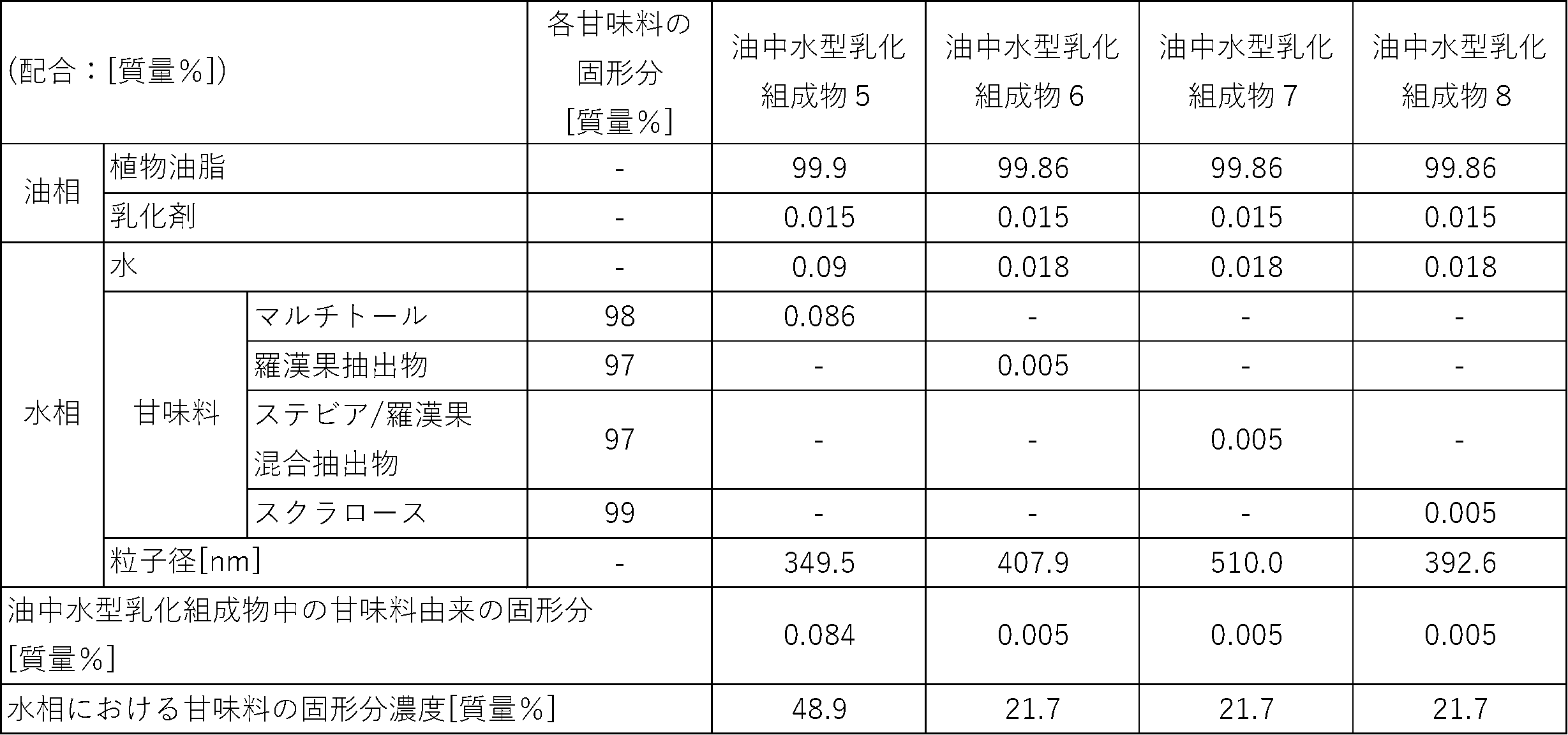
・乳化剤は「ポエムPR-100」(理研ビタミン株式会社製、ポリグリセリン縮合リシノレイン酸エステル、HLB:1)を使用した。
・グルコースは和光純薬株式会社製を使用した。
・麦芽糖は「マルスターMS720N」(三和澱粉工業株式会社製、麦芽糖水あめ)を使用した。
・ショ糖は「グラニュー糖」(和田製糖株式会社製)を使用した。
・スクラロースは「スクラロース」(三栄源エフ・エフ・アイ株式会社製)を使用した。
・マルチトースは「レシス」(三菱商事ライフサイエンス株式会社製)を使用した。
・羅漢果抽出物は「サンナチュレM50」(三栄源エフ・エフ・アイ株式会社製)を使用した。
・ステビア/羅漢果混合抽出物は「サンナチュレMSR」(三栄源エフ・エフ・アイ株式会社製)を使用した。
表2-1、2-2の配合に従い、ミートレスハンバーグを調製した。すなわち、エマルションカードAを先に調製し、そこに5倍加水した組織状大豆蛋白質素材A(「アペックス650」、不二製油株式会社製)及び3倍加水した組織状大豆蛋白質素材B(「アペックス350」、不二製油株式会社製)を添加して、ケンミックス(アイコープレミア KMM770(愛工舎製作所社製))にて1分間混合し(ダイアル:MIN)、そこに調味料・香辛料を加えて1分間混合し、野菜類を加えて30秒間混合し、そこにパン粉、澱粉、牛脂或いは各油中水型乳化組成物、麦芽糖添加植物油脂、植物油脂と麦芽糖を加えて30秒間混合した。混合した生地を1個50gに成型し、300℃で4.5分間焼成した(芯温80℃、スチームコンベクションオーブン(株式会社ラショナル・ジャパン社製))。焼成したミートレスハンバーグを一晩冷蔵保管した後、冷凍庫に保管した。
なお、エマルションカードAの調製方法は、水4.5部と組織状大豆蛋白質素材1部(「フジプロFR」、不二製油株式会社製)を1500rpmで1.5分間撹拌し(ロボクープ(株式会社エフ・エム・アイ社製))、そこに菜種油1部を加えて4分間撹拌し、さらに乾燥卵白1部を加えて1分間撹拌したものを使用した。
また、牛脂、植物油脂、麦芽糖添加植物油脂、各油中水型乳化組成物は使用するまで冷凍庫に保管し、ミートレスハンバーグに配合する前に、ロボクープにて8mm角に粉砕してから使用した。
比較例1及び比較例2の加工食品中に含まれる麦芽糖は、実施例2の水相より持ち込まれた麦芽糖含量と同量配合した。比較例1は生地に直接植物油脂と麦芽糖を添加し、比較例2は融解した植物油脂に直接麦芽糖を添加し、混合して冷やし固めたものを使用した。また、油相中の植物油脂含量は、参考例1では48.2質量%、実施例1~7及び比較例1~4では100.0質量%であった。

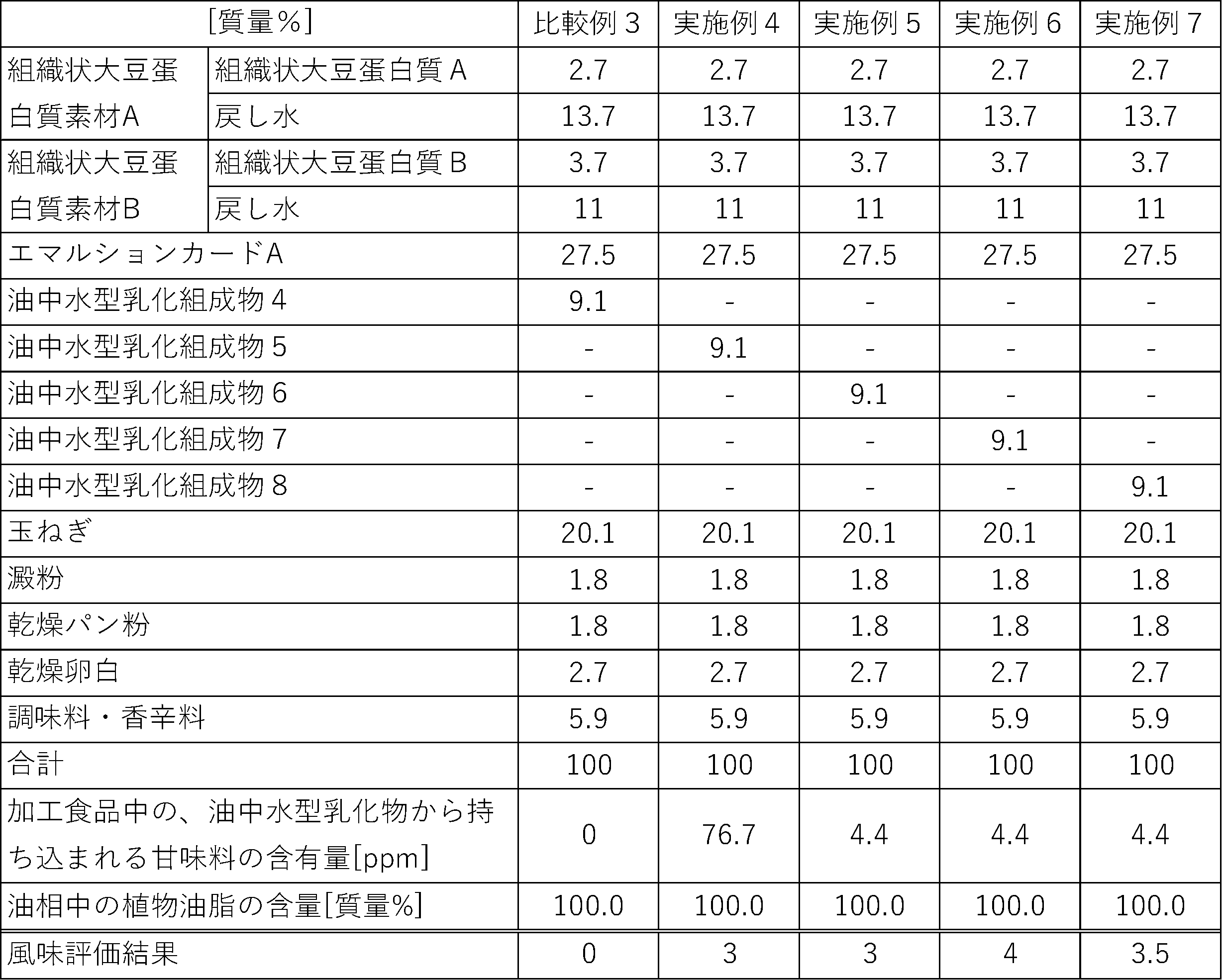
冷凍したハンバーグを電子レンジ(500ワット、2分間)で温めて、解凍及び加熱し、喫食して、以下の基準により評価した。官能評価は熟練したパネラー6名にて行い、合議により評価が2点(平均点)を越えるものを、牛脂様の風味を有すると判断した。評価結果を表2-1、2-2に示した。
牛脂を配合した参考例1のハンバーグで感じられる牛脂の風味(旨味、コク、濃厚感等)を5点とした。
0点:参考例1と比較して、全く牛脂様の風味が感じられなかった。
1点:参考例1で感じられる牛脂の風味と同様の風味が感じられ、その強度が参考例の3割の力価であった。
2点:参考例1で感じられる牛脂の風味と同様の風味が感じられ、その強度が参考例の6割の力価であった。
3点:参考例1で感じられる牛脂の風味と同様の風味が感じられ、その強度が参考例の8割の力価であった。
4点:参考例1で感じられる牛脂の風味と同様の風味が感じられ、その強度が参考例の9割の力価であった。
5点:参考例1で感じられる牛脂の風味と同様の風味が感じられ、その強度が参考例と同等の力価であった。
表3に記載の配合に従い、油中水型乳化組成物を調製した。調製方法は検討1を踏襲した。油中水型乳化組成物に使用した原材料も検討1と同様とした。油中水型乳化組成物9~15の水相の粒子径は84~770nm以下であった(表3)。
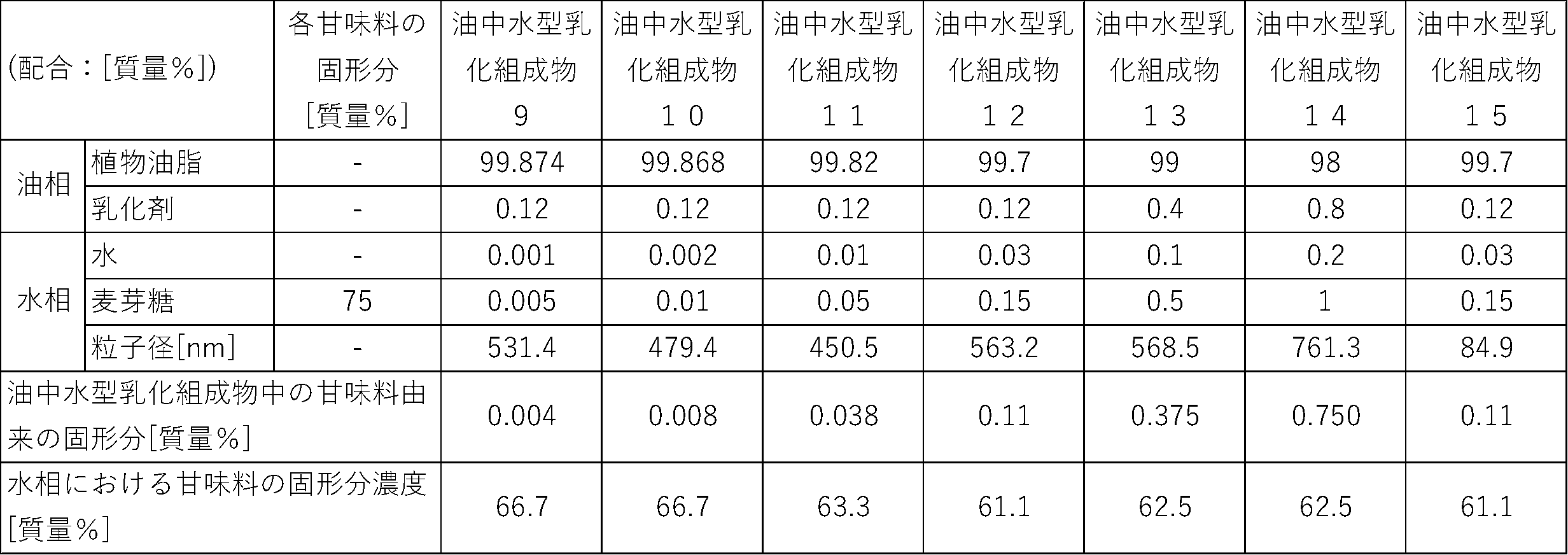
表4の配合に従い、検討2の調製方法と同じ方法でミートレスハンバーグを調製した。風味の評価方法は検討2と同様の方法で実施し、参考例2と比較して風味評価を行った(パネラー7名)。結果を表4に示した。なお、油相中の植物油脂の含量は、参考例2では48.2質量%、実施例8~実施例13、比較例4では100.0質量%であった。

表5の配合に従い、完全に動物性原料を含まない動物性原料不使用のハンバーグを調製した。すなわち、エマルションカードBを先に調製し、そこに5倍加水した組織状大豆蛋白質素材Aおよび3倍加水した組織状大豆蛋白質素材Bを添加して、ケンミックスにて150rpmで1分間混合し、そこに調味料・香辛料、竹繊維(「BAF90」レッテンマイヤー社製)、シトラスファイバー(「ヘルバセルAQプラスCF―D」DSP五協フード&ケミカル株式会社製)を加えて1分間混合し、野菜類を加えて30秒間混合し、そこにパン粉、澱粉、牛脂或いは油中水型乳化組成物12を加えて1分間混合した。混合した生地を1個70gに成型し、300℃で6分間焼成した(芯温80℃、コンベクションオーブン(株式会社ラショナル・ジャパン製))。焼成したハンバーグを一晩冷蔵保管した後、冷凍庫に保管した。なお、エマルションカードBの調製方法は、菜種油3.2部とメチルセルロース(「MCE―100TS」、信越化学工業社製)1部をロボクープにて100rpmで1.5分間撹拌し、そこへ氷水13部を加えて1000rpmで5分間混合撹拌したものを使用した。なお、牛脂、油中水型乳化組成物12は使用するまで冷凍庫に保管し、ハンバーグに配合する前に、ロボクープにて8mm角に粉砕してから使用した。なお、油相中の植物油脂の含量は、参考例3では66.0質量%、実施例14では100.0質量%であった。
風味の評価方法は検討2と同様の方法とし、参考例3との比較で評価した(パネラー7名)。結果を表5に示した。

表6の配合に従い、大豆蛋白質素材を配合した鶏団子を調製した。すなわち、エマルションカードAを先に調製し、そこにミンチ状の鶏むね肉(φ4mm)を添加して、ケンミックスにて1分間混合した(ダイアル:MIN)。そこに3倍加水した組織状大豆蛋白質素材C(「ニューフジニック52S」不二製油株式会社製)、調味料・香辛料、食塩を加えて1分間混合し、みじん切りした玉ねぎを加えて30秒間混合し、そこにパン粉、澱粉、牛脂或いは油中水型乳化組成物12を加えて1分間混合した。混合した生地を1個15gに成型し、90℃で12分間蒸煮した(スチームコンベクションオーブン(株式会社ラショナル・ジャパン社製))。蒸煮した鶏団子は放冷した後に冷凍庫に保管した。
なお、エマルションカードAの調製方法は、検討2と同様とした。また、牛脂、油中水型乳化組成物12は使用するまで冷凍庫に保管し、鶏団子に配合する前に、ロボクープにて8mm角に粉砕してから使用した。なお、油相に含まれる植物油脂の含量は、参考例4では45.8質量%、実施例15では100.0質量%であった。
風味の評価方法は検討2と同様の方法とし、参考例4との比較で評価した(パネラー5名)。結果を表6に示した。
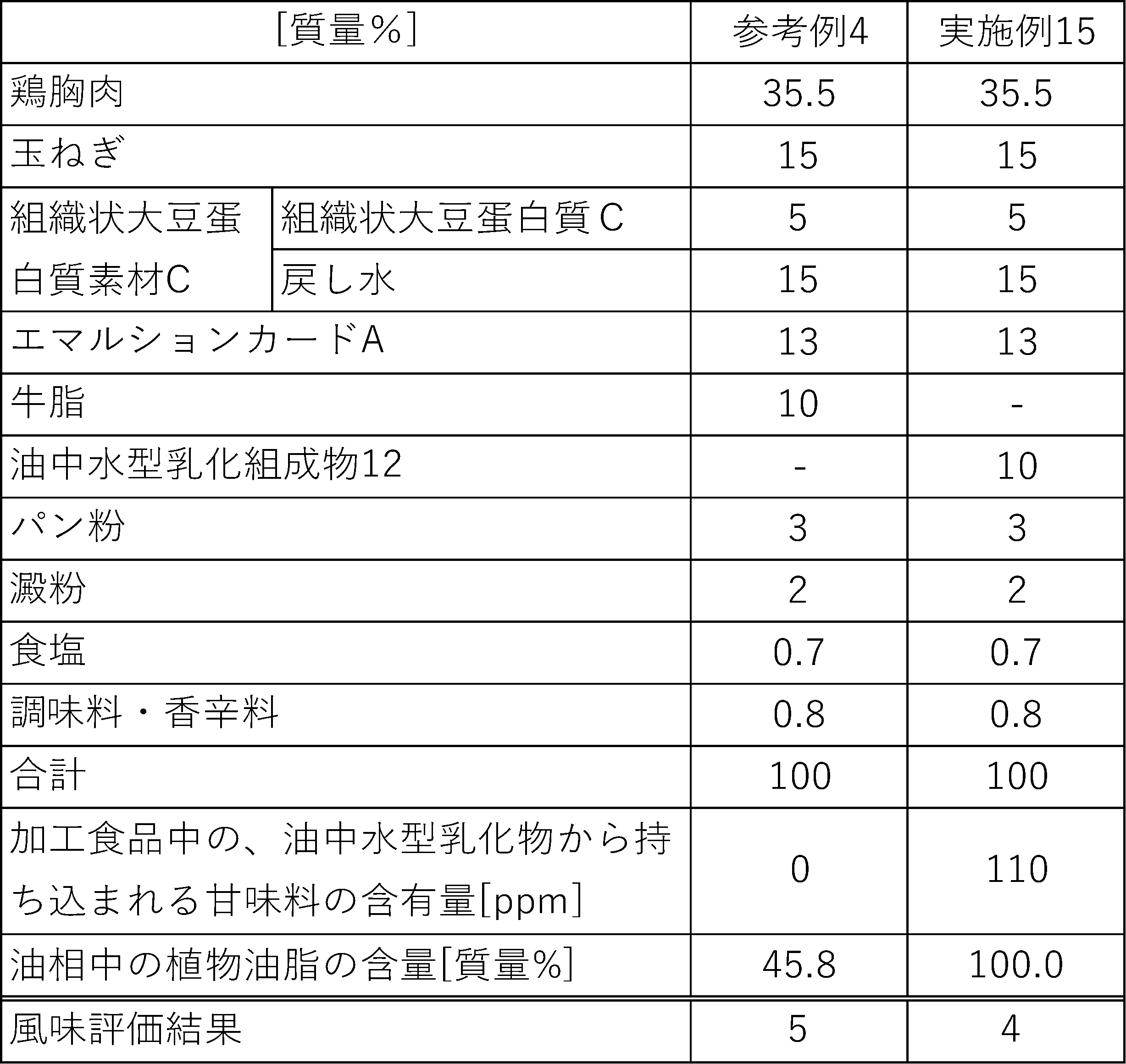
表7の配合に従い、牛丼風を調製した。調味料類、スライスした玉ねぎ、2倍加水した組織状大豆蛋白質素材D(「ベジプラス2900」不二製油株式会社製)を鍋に添加し、歩留まりが90%になるまでコンロ加熱した。これに、牛脂或いは油中水型乳化組成物12を添加し、オーブンにて融解させ(90℃×30分間)、その後一晩冷蔵保存した。冷蔵保存した牛丼風をレトルトパックに50g入れて、121℃で30分レトルト殺菌した。なお、油相中の植物油脂含量は、参考例5では0質量%、実施例16では100.0質量%であった。
風味の評価方法は検討2と同様の方法とし、参考例5との比較で評価した(パネラー5名)。結果を表7に示した。

表8の配合に従い、大豆蛋白質素材を配合したキーマカレーを調製した。すなわち、フライパンで刻んだにんにくを炒め、さらに野菜類、1.5倍加水した組織状大豆蛋白質素材E(「ベジテックスRET」不二製油株式会社製)、香辛料、カレー粉、調味料類を順に添加し、中火で8分間炒めた。水を添加し、歩留り70%になるまで加熱した。これに牛脂或いは油中水型乳化組成物16を添加し、均一になるように攪拌混合し、その後一晩冷蔵保存した。冷蔵保存したキーマカレーをレトルトパックに30g入れて、121℃で30分レトルト殺菌した。なお、油中水型乳化組成物16は検討1と同様の方法で調製し、油中水型乳化組成物8と同配合とし、植物油脂のみ「パーキッドP」(不二製油株式会社製、パーム由来、融点39℃)に変更して調製した。なお、油相中の植物油脂の含量は、参考例6では0質量%、実施例17では100.0質量%であった。
風味の評価方法は検討2と同様の方法とし、参考例6との比較で評価した(パネラー5名)。結果を表8に示した。

Claims (13)
- 甘味料が溶解した水相を、植物油脂を含む油相中に粒子径50~2000nmで分散することを特徴とする、加工食品における、動物脂様風味の付与方法。
- 該水相における甘味料の濃度が固形分換算で15~75質量%である、請求項1に記載の方法。
- 該甘味料が、麦芽糖、羅漢果抽出物、グルコース、或いはショ糖からなる群より選ばれる1以上である、請求項1又は2に記載の方法。
- 該甘味料が麦芽糖である、請求項3に記載の方法。
- 該加工食品における、該水相により持ち込まれる甘味料が固形分換算で4~1000ppmである、請求項1又は2に記載の方法。
- 該加工食品における、該水相により持ち込まれる甘味料が固形分換算で4~1000ppmである、請求項3に記載の方法。
- 該加工食品における、該水相により持ち込まれる甘味料が固形分換算で4~1000ppmである、請求項4に記載の方法。
- 甘味料が溶解した水相が、油相中に粒子径50~2000nmで分散した、植物油脂を含む油相を含有する加工食品。
- 該甘味料が、麦芽糖、羅漢果抽出物、グルコース、或いはショ糖からなる群より選ばれる1以上である、請求項8に記載の加工食品。
- 該甘味料が麦芽糖である、請求項9に記載の加工食品。
- 以下の工程を含む、植物油脂を含む油相を含有する加工食品の製造方法。
(A)甘味料が溶解した水相を、油相中に粒子径50~2000nmとなるように分散させる工程。
(B)(A)の工程で得られた油中水型乳化組成物を配合し、加工食品を調製する工程。 - 該甘味料が、麦芽糖、羅漢果抽出物、グルコース、或いはショ糖からなる群より選ばれる1以上である、請求項11に記載の加工食品の製造方法。
- 該甘味料が麦芽糖である、請求項12に記載の加工食品の製造方法。
Priority Applications (3)
| Application Number | Priority Date | Filing Date | Title |
|---|---|---|---|
| JP2023559002A JP7601251B2 (ja) | 2022-05-09 | 2023-05-09 | 加工食品における動物脂様風味の付与方法 |
| US18/860,928 US20250311744A1 (en) | 2022-05-09 | 2023-05-09 | Method for imparting animal-fat-like flavor in processed food product |
| JP2024075883A JP2024097897A (ja) | 2022-05-09 | 2024-05-08 | 加工食品における動物脂様風味の付与方法 |
Applications Claiming Priority (2)
| Application Number | Priority Date | Filing Date | Title |
|---|---|---|---|
| JP2022077181 | 2022-05-09 | ||
| JP2022-077181 | 2022-05-09 |
Publications (1)
| Publication Number | Publication Date |
|---|---|
| WO2023219080A1 true WO2023219080A1 (ja) | 2023-11-16 |
Family
ID=88730221
Family Applications (1)
| Application Number | Title | Priority Date | Filing Date |
|---|---|---|---|
| PCT/JP2023/017424 Ceased WO2023219080A1 (ja) | 2022-05-09 | 2023-05-09 | 加工食品における動物脂様風味の付与方法 |
Country Status (3)
| Country | Link |
|---|---|
| US (1) | US20250311744A1 (ja) |
| JP (2) | JP7601251B2 (ja) |
| WO (1) | WO2023219080A1 (ja) |
Citations (5)
| Publication number | Priority date | Publication date | Assignee | Title |
|---|---|---|---|---|
| WO2017150558A1 (ja) * | 2016-03-02 | 2017-09-08 | 不二製油グループ本社株式会社 | 抗酸化油脂組成物 |
| JP2017225381A (ja) * | 2016-06-21 | 2017-12-28 | 不二製油株式会社 | 高度不飽和脂肪酸含有可塑性油脂組成物 |
| JP2021180649A (ja) * | 2020-05-15 | 2021-11-25 | 不二製油株式会社 | Dha,epaを含有する、可塑性油脂組成物及びその製造法 |
| WO2022075252A1 (ja) * | 2020-10-05 | 2022-04-14 | 不二製油グループ本社株式会社 | 植物性スープベース及び植物性スープベースの製造方法 |
| WO2022102382A1 (ja) * | 2020-11-10 | 2022-05-19 | 不二製油グループ本社株式会社 | 油性食品の甘味増強方法 |
-
2023
- 2023-05-09 WO PCT/JP2023/017424 patent/WO2023219080A1/ja not_active Ceased
- 2023-05-09 US US18/860,928 patent/US20250311744A1/en active Pending
- 2023-05-09 JP JP2023559002A patent/JP7601251B2/ja active Active
-
2024
- 2024-05-08 JP JP2024075883A patent/JP2024097897A/ja active Pending
Patent Citations (5)
| Publication number | Priority date | Publication date | Assignee | Title |
|---|---|---|---|---|
| WO2017150558A1 (ja) * | 2016-03-02 | 2017-09-08 | 不二製油グループ本社株式会社 | 抗酸化油脂組成物 |
| JP2017225381A (ja) * | 2016-06-21 | 2017-12-28 | 不二製油株式会社 | 高度不飽和脂肪酸含有可塑性油脂組成物 |
| JP2021180649A (ja) * | 2020-05-15 | 2021-11-25 | 不二製油株式会社 | Dha,epaを含有する、可塑性油脂組成物及びその製造法 |
| WO2022075252A1 (ja) * | 2020-10-05 | 2022-04-14 | 不二製油グループ本社株式会社 | 植物性スープベース及び植物性スープベースの製造方法 |
| WO2022102382A1 (ja) * | 2020-11-10 | 2022-05-19 | 不二製油グループ本社株式会社 | 油性食品の甘味増強方法 |
Also Published As
| Publication number | Publication date |
|---|---|
| JP7601251B2 (ja) | 2024-12-17 |
| JP2024097897A (ja) | 2024-07-19 |
| US20250311744A1 (en) | 2025-10-09 |
| JPWO2023219080A1 (ja) | 2023-11-16 |
Similar Documents
| Publication | Publication Date | Title |
|---|---|---|
| US7070827B2 (en) | Vegetable protein meat analog | |
| JP6753216B2 (ja) | 冷凍畜肉様加工食品の製造法 | |
| CA2736157C (en) | Oil composition for the preparation of oil containing food products | |
| JP7099661B1 (ja) | 畜肉様加工食品の製造方法 | |
| TW201106872A (en) | Method for the preparation of oil-containing meat-based products comprising a reduced amount of additives | |
| JP2021194000A (ja) | 加工食品生地および加工食品 | |
| WO2022118663A1 (ja) | 豆タンパクを含有する食肉加工製品の製造方法 | |
| JP7580931B2 (ja) | 肉類代替食品用組成物の製造方法及び肉類代替食品の製造方法 | |
| JP5612374B2 (ja) | 鶏肉を原料とする食肉加工食品 | |
| JP2023166346A (ja) | 加熱調理食品の異風味低減方法 | |
| JP7459978B2 (ja) | エステル交換油脂 | |
| JP7601251B2 (ja) | 加工食品における動物脂様風味の付与方法 | |
| JP7844166B2 (ja) | 肉様食品用食感改良組成物 | |
| WO2023189235A1 (ja) | 加工食品用練り込み油脂 | |
| JP2015216918A (ja) | 乳化した固形油脂様組成物及び固形油脂様組成物の製造方法 | |
| JP7759660B2 (ja) | 肉不含有ハンバーグ様食品及びその製造方法 | |
| JP2025153707A (ja) | 組成物 | |
| WO2003026442A1 (fr) | Emulsion de tofu utilisee en tant que base alimentaire, procede de production de cette emulsion, aliment traite utilisant cette emulsion de tofou et procede de production de ces aliments | |
| JP7091403B2 (ja) | 食肉様加工食品及び食肉様加工食品の製造方法 | |
| JP2023147874A (ja) | 畜肉様加工食品用油脂組成物 | |
| JP2025127811A (ja) | 加工食品 | |
| JP3437463B2 (ja) | 包餡食品 | |
| JP2025010915A (ja) | 麹菌を使用した畜肉代替素材 | |
| WO2023238866A1 (ja) | 加工油脂 | |
| JP2018121600A (ja) | ミンチ状畜肉加工食品用油脂組成物 |
Legal Events
| Date | Code | Title | Description |
|---|---|---|---|
| ENP | Entry into the national phase |
Ref document number: 2023559002 Country of ref document: JP Kind code of ref document: A |
|
| 121 | Ep: the epo has been informed by wipo that ep was designated in this application |
Ref document number: 23803557 Country of ref document: EP Kind code of ref document: A1 |
|
| WWE | Wipo information: entry into national phase |
Ref document number: 18860928 Country of ref document: US |
|
| NENP | Non-entry into the national phase |
Ref country code: DE |
|
| 122 | Ep: pct application non-entry in european phase |
Ref document number: 23803557 Country of ref document: EP Kind code of ref document: A1 |
|
| WWP | Wipo information: published in national office |
Ref document number: 18860928 Country of ref document: US |