WO2023218814A1 - 中間体及び中間体の製造方法 - Google Patents
中間体及び中間体の製造方法 Download PDFInfo
- Publication number
- WO2023218814A1 WO2023218814A1 PCT/JP2023/014197 JP2023014197W WO2023218814A1 WO 2023218814 A1 WO2023218814 A1 WO 2023218814A1 JP 2023014197 W JP2023014197 W JP 2023014197W WO 2023218814 A1 WO2023218814 A1 WO 2023218814A1
- Authority
- WO
- WIPO (PCT)
- Prior art keywords
- cellulose
- cellulose nanofibers
- mass
- rubber
- oxidized
- Prior art date
- Legal status (The legal status is an assumption and is not a legal conclusion. Google has not performed a legal analysis and makes no representation as to the accuracy of the status listed.)
- Ceased
Links
Images
Classifications
-
- C—CHEMISTRY; METALLURGY
- C08—ORGANIC MACROMOLECULAR COMPOUNDS; THEIR PREPARATION OR CHEMICAL WORKING-UP; COMPOSITIONS BASED THEREON
- C08J—WORKING-UP; GENERAL PROCESSES OF COMPOUNDING; AFTER-TREATMENT NOT COVERED BY SUBCLASSES C08B, C08C, C08F, C08G or C08H
- C08J3/00—Processes of treating or compounding macromolecular substances
- C08J3/20—Compounding polymers with additives, e.g. colouring
-
- C—CHEMISTRY; METALLURGY
- C08—ORGANIC MACROMOLECULAR COMPOUNDS; THEIR PREPARATION OR CHEMICAL WORKING-UP; COMPOSITIONS BASED THEREON
- C08J—WORKING-UP; GENERAL PROCESSES OF COMPOUNDING; AFTER-TREATMENT NOT COVERED BY SUBCLASSES C08B, C08C, C08F, C08G or C08H
- C08J3/00—Processes of treating or compounding macromolecular substances
- C08J3/20—Compounding polymers with additives, e.g. colouring
- C08J3/22—Compounding polymers with additives, e.g. colouring using masterbatch techniques
-
- C—CHEMISTRY; METALLURGY
- C08—ORGANIC MACROMOLECULAR COMPOUNDS; THEIR PREPARATION OR CHEMICAL WORKING-UP; COMPOSITIONS BASED THEREON
- C08K—Use of inorganic or non-macromolecular organic substances as compounding ingredients
- C08K3/00—Use of inorganic substances as compounding ingredients
- C08K3/10—Metal compounds
-
- C—CHEMISTRY; METALLURGY
- C08—ORGANIC MACROMOLECULAR COMPOUNDS; THEIR PREPARATION OR CHEMICAL WORKING-UP; COMPOSITIONS BASED THEREON
- C08K—Use of inorganic or non-macromolecular organic substances as compounding ingredients
- C08K5/00—Use of organic ingredients
- C08K5/04—Oxygen-containing compounds
- C08K5/09—Carboxylic acids; Metal salts thereof; Anhydrides thereof
- C08K5/098—Metal salts of carboxylic acids
-
- C—CHEMISTRY; METALLURGY
- C08—ORGANIC MACROMOLECULAR COMPOUNDS; THEIR PREPARATION OR CHEMICAL WORKING-UP; COMPOSITIONS BASED THEREON
- C08L—COMPOSITIONS OF MACROMOLECULAR COMPOUNDS
- C08L1/00—Compositions of cellulose, modified cellulose or cellulose derivatives
- C08L1/02—Cellulose; Modified cellulose
- C08L1/04—Oxycellulose; Hydrocellulose, e.g. microcrystalline cellulose
-
- C—CHEMISTRY; METALLURGY
- C08—ORGANIC MACROMOLECULAR COMPOUNDS; THEIR PREPARATION OR CHEMICAL WORKING-UP; COMPOSITIONS BASED THEREON
- C08L—COMPOSITIONS OF MACROMOLECULAR COMPOUNDS
- C08L21/00—Compositions of unspecified rubbers
-
- C—CHEMISTRY; METALLURGY
- C08—ORGANIC MACROMOLECULAR COMPOUNDS; THEIR PREPARATION OR CHEMICAL WORKING-UP; COMPOSITIONS BASED THEREON
- C08L—COMPOSITIONS OF MACROMOLECULAR COMPOUNDS
- C08L21/00—Compositions of unspecified rubbers
- C08L21/02—Latex
-
- C—CHEMISTRY; METALLURGY
- C08—ORGANIC MACROMOLECULAR COMPOUNDS; THEIR PREPARATION OR CHEMICAL WORKING-UP; COMPOSITIONS BASED THEREON
- C08L—COMPOSITIONS OF MACROMOLECULAR COMPOUNDS
- C08L33/00—Compositions of homopolymers or copolymers of compounds having one or more unsaturated aliphatic radicals, each having only one carbon-to-carbon double bond, and only one being terminated by only one carboxyl radical, or of salts, anhydrides, esters, amides, imides or nitriles thereof; Compositions of derivatives of such polymers
- C08L33/02—Homopolymers or copolymers of acids; Metal or ammonium salts thereof
Definitions
- the present invention relates to an intermediate containing cellulose nanofibers and a method for producing the intermediate.
- Patent Document 1 a rubber composite material using cellulose nanofibers as a fiber reinforcing material has also been proposed.
- an object of the present invention is to provide an intermediate containing cellulose nanofibers and a method for producing the intermediate, which can reduce agglomerates of cellulose nanofibers and can be easily applied to rubber products.
- the present invention has been made to solve at least part of the above-mentioned problems, and can be realized as the following aspects or application examples.
- One embodiment of the intermediate according to the present invention is rubber component, Cellulose nanofibers containing carboxyl groups, Trivalent or higher cations, including;
- the cellulose nanofibers include those derived from oxidized cellulose oxidized using an N-oxyl compound.
- the trivalent or higher valence cation may be an aluminum ion and/or an iron ion.
- One embodiment of the intermediate according to the present invention is rubber component, Cellulose nanofibers containing carboxyl groups, A polymer having repeating units derived from an unsaturated carboxylate containing a monovalent metal ion and/or an unsaturated carboxylate containing a monovalent metal ion; including;
- the cellulose nanofibers include those derived from oxidized cellulose oxidized using an N-oxyl compound.
- the unsaturated carboxylate salt may be sodium acrylate and/or sodium methacrylate.
- the intermediate 100 parts by mass of the rubber component; 10 parts by mass or more and less than 100 parts by mass of the cellulose nanofibers, 0.50 to 6.00 times equivalent to the carboxy group contained in the cellulose nanofibers, the trivalent or higher cation, the unsaturated carboxylate containing the monovalent metal ion, and the 1 at least one polymer selected from polymers having repeating units derived from unsaturated carboxylic acid salts containing valent metal ions; including;
- the cellulose nanofibers have an average fiber diameter of 2 nm or more and 8 nm or less, and an average fiber length of 200 nm or more and 800 nm or less,
- the cellulose nanofiber may have a carboxy group content of 1.2 mmol/g to 1.7 mmol/g.
- One embodiment of the method for producing an intermediate according to the present invention is A rubber latex containing 100 parts by mass of a rubber component, a CNF aqueous dispersion in which 10 parts by mass or more and less than 100 parts by mass of cellulose nanofibers containing carboxyl groups are dispersed in an aqueous solvent, and an inorganic acid containing a trivalent or higher cation.
- a rubber latex containing 100 parts by mass of a rubber component, a CNF aqueous dispersion in which 10 parts by mass or more and less than 100 parts by mass of cellulose nanofibers containing carboxyl groups are dispersed in an aqueous solvent, and an inorganic acid containing a trivalent or higher cation.
- a polyvalent metal salt an unsaturated carboxylate containing a monovalent metal ion
- a polymer having a repeating unit derived from the unsaturated carboxylate containing the monovalent metal ion is
- cellulose nanofibers include those derived from oxidized cellulose oxidized using an N-oxyl compound.
- the intermediate according to the present invention there are few aggregates of cellulose nanofibers, so it has excellent reinforcing properties, and when used as a masterbatch for rubber products, cellulose nanofibers can be easily applied to rubber products. Further, according to one aspect of the method for producing an intermediate according to the present invention, it is possible to produce an intermediate with few aggregates of cellulose nanofibers, and by using the intermediate as a masterbatch for rubber products, cellulose Easy to apply nanofibers to rubber products.
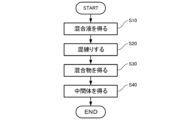
- FIG. 1 is a flowchart of a method for producing an intermediate according to one embodiment.
- FIG. 2 is a SEM image of the tensile fracture surface of the crosslinked sample of Example 1-1.
- FIG. 3 is a SEM image of the tensile fracture surface of the crosslinked sample of Examples 1-4.
- FIG. 4 is a SEM image of the tensile fracture surface of the crosslinked sample of Comparative Example 1-3.
- the intermediate according to the first embodiment includes a rubber component, cellulose nanofibers containing a carboxy group, and a trivalent or higher cation, and the cellulose nanofibers are prepared using an N-oxyl compound. Including those derived from oxidized cellulose. Note that " ⁇ " indicates that the upper limit value and lower limit value are included unless otherwise specified.
- the intermediate according to the second embodiment includes a rubber component, a cellulose nanofiber containing a carboxy group, an unsaturated carboxylic acid salt containing a monovalent metal ion, and/or an unsaturated carboxylic acid containing a monovalent metal ion.
- a polymer having repeating units derived from a salt, and the cellulose nanofibers include those derived from oxidized cellulose oxidized using an N-oxyl compound.
- the intermediate cellulose nanofiber when the intermediate cellulose nanofiber is mixed with the matrix material as a masterbatch, the cellulose nanofibers are derived from the rubber component and trivalent or higher cations derived from inorganic acid polyvalent metal salts and/or unsaturated carboxylic acid salts. Fibrillation and dispersion are easy due to the monovalent or higher valence metal ions. Therefore, according to the intermediate, cellulose nanofibers have excellent reinforcing properties for rubber products because there are few aggregates of cellulose nanofibers, and cellulose nanofibers can be applied to rubber products by simply diluting with rubber components when used as a master batch for rubber products. It's easy to do.
- the quality of the intermediate is determined by the fact that no agglomerates are observed at least through visual observation; however, simply visually observing a portion of the intermediate and confirming the agglomerates is not sufficient because the condition of the entire intermediate cannot be determined. Therefore, it is preferable to judge the fibrillation and dispersion of cellulose nanofibers by testing the physical properties of the intermediate.
- the physical properties of the intermediate can be judged based on the fact that the 50% modulus ( ⁇ 50) in the tensile test is greatly improved by blending cellulose nanofibers, and the improvement in tensile strength (TS) can also be used as a criterion. It can be used as a criterion.
- the intermediate In order to use the intermediate as a masterbatch, it is desirable for the intermediate to have a high content of cellulose nanofibers, but as the content of cellulose nanofibers increases, it becomes difficult to manufacture the intermediate. Therefore, the content of cellulose nanofibers in the intermediate is 10 parts by mass or more and less than 100 parts by mass, for example, 20 parts by mass to 50 parts by mass, based on 100 parts by mass of the rubber component. Since cellulose nanofibers are expected to be less than 10 parts by mass in actual rubber products, if the content of cellulose nanofibers is 10 parts by mass or more, more preferably 20 parts by mass or more, a small amount of intermediate can be used to make rubber. This is advantageous because it allows products to be manufactured. Further, if the content of cellulose nanofibers is 100 parts by mass or more, processing is almost impossible, if it is less than 100 parts by mass, processing is possible, and if the content is 50 parts by mass or less, processing becomes easier.
- the intermediate is an unsaturated carboxylate containing a trivalent or higher cation, a monovalent metal ion, and a monovalent metal ion in an amount of 0.50 to 6.00 times equivalent to the carboxy group contained in the cellulose nanofibers. It can contain at least one selected from polymers having repeating units derived from unsaturated carboxylic acid salts containing valent metal ions.
- Cellulose Nanofiber contains carboxy groups. Since cellulose nanofibers have carboxy groups, they are easily defibrated due to the repulsion between carboxy groups, which are anionic groups, in the process of defibrating cellulose raw materials.
- the cellulose nanofiber may have a carboxy group content of 1.2 mmol/g to 1.7 mmol/g. If the carboxy group content of cellulose nanofibers is less than 1.2 mmol/g, cellulose nanofibers tend to be insufficiently fibrillated, and if it exceeds 1.7 mmol/g, the molecular weight of cellulose nanofibers decreases due to damage caused by TEMPO oxidation.
- a part of the polysaccharide may become a water-soluble polysaccharide component, be separated from the fiber component, and dissolve during washing with water, resulting in a decrease in yield.
- the content of carboxyl groups was determined by preparing a slurry of 0.5 to 1% by mass from a cellulose nanofiber sample whose dry mass was accurately weighed, adjusting the pH to approximately 2.5 with a 0.1M aqueous hydrochloric acid solution, and then adjusting the content to 0.5% by mass.
- 05M sodium hydroxide aqueous solution is added dropwise to measure the electrical conductivity. Measurements are continued until the pH is approximately 11.
- the carboxy group content is determined from the amount (V) of sodium hydroxide consumed in the neutralization stage of the weak acid in which the electrical conductivity changes slowly using the following formula.
- Carboxy group content (mmol/g) V (ml) x 0.05/dry mass of cellulose sample (g)
- the average fiber diameter of the cellulose nanofibers is preferably 2 nm or more and 8 nm or less, more preferably 2 nm or more and 6 nm or less. Moreover, it is preferable that the average fiber length is 200 nm or more and 800 nm or less, and more preferably 300 nm or more and 600 nm or less. It is preferable that the average fiber diameter and average fiber length are in this range because the reinforcing effect of the rubber product, such as stiffness, tensile strength, and elongation at cutting, is improved.
- the average fiber diameter and average fiber length are the arithmetic mean values of the fiber diameter and fiber length obtained from the results of observing each fiber using a field emission scanning electron microscope (FE-SEM).
- Cellulose nanofibers are available on the market as an aqueous dispersion.
- the solid content of cellulose nanofibers can be from 0.01% by mass to 5% by mass, preferably from 0.1% by mass to 2% by mass. If the solid content of cellulose nanofibers in the aqueous dispersion is less than 0.01% by mass, the drying process described below will take time; if it exceeds 5% by mass, the solid content of inorganic acid polyvalent metal salts and unsaturated carboxylic acids described below Salt cannot be treated uniformly and cellulose nanofibers tend to aggregate.
- the raw material for cellulose nanofibers may be derived from plant materials such as wood, or may be derived from animal materials other than plant materials, such as sea squirt, or microorganisms such as bacteria.
- the raw materials are chemically treated to make them easier to defibrate, and then the raw materials are subjected to physical treatment using mechanical shearing force.
- the raw material can be physically defibrated using methods that use known mechanical high shearing force, such as those produced by defibration, high-pressure homogenizer method, grinder grinding method, freeze-pulverization method, high-shear force kneading method, and ball mill grinding method. You can use the one manufactured by
- the method for oxidizing the cellulosic raw material is not particularly limited, but one example is to use an oxidizing agent in the presence of an N-oxyl compound and a substance selected from the group consisting of bromides, iodides, or mixtures thereof.
- Examples include a method of oxidizing cellulose raw materials in water using According to this method, the primary hydroxyl group at the C6 position of the glucopyranose ring on the cellulose surface is selectively oxidized to produce a group selected from the group consisting of an aldehyde group, a carboxy group, and a carboxylate group.
- the concentration of the cellulose raw material during the reaction is not particularly limited, but is preferably 5% by mass or less.
- the N-oxyl compound refers to a compound that can generate nitroxyl radicals.
- nitroxyl radicals include 2,2,6,6-tetramethylpiperidine 1-oxyl (TEMPO).
- TEMPO 2,2,6,6-tetramethylpiperidine 1-oxyl
- any compound can be used as long as it promotes the desired oxidation reaction.
- the amount of the N-oxyl compound used is not particularly limited as long as it is a catalytic amount that can oxidize cellulose as a raw material. For example, it is preferably 0.01 mmol or more, more preferably 0.02 mmol or more, per 1 g of bone dry cellulose.
- the upper limit is preferably 10 mmol or less, more preferably 1 mmol or less, and even more preferably 0.5 mmol or less. Therefore, the amount of the N-oxyl compound used is preferably 0.01 mmol to 10 mmol, more preferably 0.01 mmol to 1 mmol, and even more preferably 0.02 mmol to 0.5 mmol, per 1 g of bone-dry cellulose.
- a bromide is a compound containing bromine, and includes, for example, an alkali metal bromide that can be dissociated and ionized in water, such as sodium bromide.
- iodide is a compound containing iodine, and includes, for example, alkali metal iodide.
- the amount of bromide or iodide used may be selected within a range that can promote the oxidation reaction.
- the total amount of bromide and iodide is preferably 0.1 mmol or more, more preferably 0.5 mmol or more, per 1 g of bone-dry cellulose.
- the upper limit is preferably 100 mmol or less, more preferably 10 mmol or less, and even more preferably 5 mmol or less. Therefore, the total amount of bromide and iodide is preferably 0.1 to 100 mmol, more preferably 0.1 to 10 mmol, and even more preferably 0.5 to 5 mmol, per 1 g of bone-dry cellulose.
- the oxidizing agent is not particularly limited, but examples thereof include halogen, hypohalous acid, halous acid, perhalogenic acid, salts thereof, halogen oxides, peroxides, and the like.
- hypohalous acid or its salt can be used because it is inexpensive and has little environmental impact, and hypochlorous acid or its salt is more preferred, and sodium hypochlorite is even more preferred.
- the amount of the oxidizing agent used is preferably 0.5 mmol or more, more preferably 1 mmol or more, and even more preferably 3 mmol or more, per 1 g of bone-dry cellulose.
- the upper limit is preferably 500 mmol or less, more preferably 50 mmol or less, and even more preferably 25 mmol or less.
- the amount of the oxidizing agent used is preferably 0.5 mmol to 500 mmol, more preferably 0.5 mmol to 50 mmol, even more preferably 1 mmol to 25 mmol, and most preferably 3 to 10 mmol, per 1 g of bone-dry cellulose.
- the amount of the oxidizing agent used is preferably 1 mol or more per 1 mol of the N-oxyl compound.
- the upper limit is preferably 40 mol. Therefore, the amount of the oxidizing agent used is preferably 1 mmol to 40 mol per 1 mol of the N-oxyl compound.
- the reaction temperature is preferably 4°C or higher, more preferably 15°C or higher.
- the upper limit is preferably 40°C or less, more preferably 30°C or less. Therefore, the temperature is preferably 4°C to 40°C, and may be about 15°C to 30°C, that is, room temperature.
- the pH of the reaction solution is preferably 8 or higher, more preferably 10 or higher.
- the upper limit is preferably 12 or less, more preferably 11 or less. Therefore, the pH of the reaction solution is preferably about 8 to 12, more preferably about 10 to 11.
- the reaction time in the oxidation can be appropriately set according to the degree of progress of the oxidation, and is usually 0.5 hours or more.
- the upper limit is usually 6 hours or less, preferably 4 hours or less. Therefore, the reaction time for oxidation is usually about 0.5 to 6 hours, for example about 0.5 to 4 hours.
- the oxidation may be carried out in two or more reaction steps. For example, by oxidizing the oxidized cellulose obtained by filtration after the completion of the first-stage reaction again under the same or different reaction conditions, the efficiency can be improved without being inhibited by the salt produced as a by-product in the first-stage reaction. Can be oxidized well.
- Another example of the carboxylation (oxidation) method is a method of oxidizing by ozone treatment.
- This oxidation reaction oxidizes at least the 2- and 6-position hydroxyl groups of the glucopyranose rings constituting cellulose, and causes decomposition of the cellulose chain.
- Ozone treatment is usually performed by bringing a gas containing ozone into contact with the cellulose raw material.
- the ozone concentration in the gas is preferably 50 g/m 3 or more.
- the upper limit is preferably 250 g/m 3 or less, more preferably 220 g/m 3 or less. Therefore, the ozone concentration in the gas is preferably 50 g/m 3 to 250 g/m 3 , more preferably 50 g/m 3 to 220 g/m 3 .
- the amount of ozone added is preferably 0.1 parts by weight or more, more preferably 5 parts by weight or more, based on 100% by weight of the solid content of the cellulose raw material.
- the upper limit is usually 30% by mass or less. Therefore, the amount of ozone added is preferably 0.1% by mass to 30% by mass, more preferably 5% by mass to 30% by mass, based on 100% by mass of the solid content of the cellulose raw material.
- the ozone treatment temperature is usually 0°C or higher, preferably 20°C or higher.
- the upper limit is usually 50°C or less. Therefore, the ozone treatment temperature is preferably 0°C to 50°C, more preferably 20°C to 50°C.
- the ozone treatment time is usually 1 minute or more, preferably 30 minutes or more.
- the upper limit is usually 360 minutes or less. Therefore, the ozone treatment time is usually about 1 minute to 360 minutes, preferably about 30 minutes to 360 minutes. When the ozone treatment conditions are within the above range, excessive oxidation and decomposition of cellulose can be prevented, and the yield of oxidized cellulose can be improved.
- the resultant obtained after the ozone treatment may be further subjected to additional oxidation treatment using an oxidizing agent.
- the oxidizing agent used in the additional oxidation treatment is not particularly limited, but includes, for example, chlorine-based compounds such as chlorine dioxide and sodium chlorite; oxygen, hydrogen peroxide, persulfuric acid, and peracetic acid.
- Examples of methods for the additional oxidation treatment include a method in which an oxidizing agent solution is prepared by dissolving these oxidizing agents in a polar organic solvent such as water or alcohol, and the cellulose raw material is immersed in the oxidizing agent solution.
- the amount of carboxy groups, carboxylate groups, and aldehyde groups contained in cellulose nanofibers can be adjusted by controlling oxidation conditions such as the amount of oxidizing agent added and reaction time.
- Carboxy-modified nitrile rubber (carboxy-modified acrylonitrile-butadiene rubber) or carboxy-modified styrene-butadiene rubber is a modified diene-based rubber having a carboxy group functionalized by a carboxy group.
- Carboxy-modified nitrile rubber or carboxy-modified styrene-butadiene rubber can increase affinity with cellulose nanofibers that have carboxy groups by having carboxy groups, so the carboxy groups may bond with cellulose nanofibers during kneading. It has the function of increasing the defibration ability. Furthermore, it is thought that the fibrillating ability of natural rubber increases due to the interaction between free radicals generated by mastication and cellulose nanofibers.
- the mixture was wound again on an open roll, a cross-linking agent was added and mixed, and the separated sheet was pressure-formed at 165°C for 30 minutes to give a thickness of 1 mm.
- Sheet-shaped crosslinked samples of each example were obtained.
- Example 2-1 to Example 2-5 The rubber latex shown in Table 3, an aqueous dispersion (solvent is water) of cellulose nanofibers with a concentration of 1% TEMPO oxidized cellulose nanofibers (may be diluted to 0.4% to 0.7%), and acrylic acid.
- aqueous solution of sodium (AANa) or a mixed solution of sodium acrylate (AANa) and iron (III) sulfate crosslinked products and sheet-like products were prepared in the same manner as in Examples 1-1 to 1-4. A sample of the crosslinked product was obtained.
- Example 3-1 Fe 2 (SO 4 ) 3 " of Example 3-1 was blended in a 3.01 times equivalent amount
- AANa of Example 3-2 was blended in a 3.47 times equivalent amount
- MANa in Example 3-3 was blended in an equivalent amount of 3.45 times
- PAANa in Example 3-4 was blended in an equivalent amount of 3.47 times. Note that the same materials as in Example 1-1 were used for “TOCN” and “Fe 2 (SO 4 ) 3 ", and the same materials as in Example 2-1 were used for "AANa”.
- NR manufactured by Regitex, natural rubber latex, ULACOL, solid content 61% by mass
- MANa manufactured by Asada Chemical Industry Co., Ltd., sodium methacrylate, CAS No. 5536-61-8
- PAANa manufactured by Toagosei Co., Ltd., sodium polyacrylate, Aron T50.
- Comparative Examples 3-1 to 3-4 Rubber latex shown in Tables 6 and 7 and an aqueous dispersion (solvent is water) of cellulose nanofibers with a concentration of 1% TEMPO oxidized cellulose nanofibers (may be diluted to 0.4% to 0.7%). , an aqueous solution of iron (III) sulfate or calcium acrylate (AACa), and in the same manner as in Examples 3-1 to 3-4 to obtain crosslinked and sheet-like comparative examples. . Note that Comparative Example 3-1 was a pure rubber formulation that did not contain cellulose nanofibers.
- Example 3-3 Aggregation evaluation and tensile test Each crosslinked sample was visually observed to confirm the presence or absence of aggregates, and evaluated in the same manner as in Example 1-1. In addition, tensile tests were conducted on each sheet-shaped crosslinked sample in the same manner as in Example 1-1, and the results were as follows: 50% modulus ( ⁇ 50 (MPa)), tensile strength (TS (MPa)), elongation at break (Eb (%)) was measured. Note that each increase rate was calculated by setting each measured value of Examples 3-1 to 3-4 and Comparative Examples 3-2 to 3-4 as A, and setting the measured value of Comparative Example 3-1 as B. The measurement results and calculation results are shown in Tables 5 and 6.
Landscapes
- Chemical & Material Sciences (AREA)
- Health & Medical Sciences (AREA)
- Chemical Kinetics & Catalysis (AREA)
- Medicinal Chemistry (AREA)
- Polymers & Plastics (AREA)
- Organic Chemistry (AREA)
- Compositions Of Macromolecular Compounds (AREA)
Abstract
Description
ゴム成分と、
カルボキシ基を含有するセルロースナノファイバーと、
3価以上の陽イオンと、
を含み、
前記セルロースナノファイバーは、N-オキシル化合物を用いて酸化された酸化セルロースに由来するものを含むことを特徴とする。
前記3価以上の陽イオンは、アルミニウムイオン及び/または鉄イオンであることができる。
ゴム成分と、
カルボキシ基を含有するセルロースナノファイバーと、
1価の金属イオンを含む不飽和カルボン酸塩及び/または1価の金属イオンを含む不飽和カルボン酸塩に由来する繰返し単位を有する重合体と、
を含み、
前記セルロースナノファイバーは、N-オキシル化合物を用いて酸化された酸化セルロースに由来するものを含むことを特徴とする。
前記不飽和カルボン酸塩は、アクリル酸ナトリウム及び/またはメタクリル酸ナトリウムであることができる。
前記ゴム成分は、天然ゴム、カルボキシ変性ニトリルゴムまたはカルボキシ変性スチレンブタジエンゴムであることができる。
前記セルロースナノファイバーは、セルロースを構成するグルコピラノース環の第6位の水酸基が酸化されてカルボキシ基が導入された構造を有することができる。
前記ゴム成分100質量部と、
前記セルロースナノファイバー10質量部以上100質量部未満と、
前記セルロースナノファイバーが含有するカルボキシ基に対して0.50倍当量~6.00倍当量の、前記3価以上の陽イオン、前記1価の金属イオンを含む不飽和カルボン酸塩、及び前記1価の金属イオンを含む不飽和カルボン酸塩に由来する繰返し単位を有する重合体から選択される少なくとも一種と、
を含み、
前記セルロースナノファイバーは、平均繊維径が2nm以上8nm以下であり、かつ、平均繊維長が200nm以上800nm以下であり、
前記セルロースナノファイバーは、カルボキシ基の含有量が1.2mmol/g~1.7mmol/gであることができる。
100質量部のゴム成分を含むゴムラテックスと、水系溶媒にカルボキシ基を含有するセルロースナノファイバー10質量部以上100質量部未満が分散したCNF水分散液と、3価以上の陽イオンを含む無機酸多価金属塩、1価の金属イオンを含む不飽和カルボン酸塩及び前記1価の金属イオンを含む不飽和カルボン酸塩に由来する繰返し単位を有する重合体から選択される少なくとも一種と、を混合して混合液を得る工程と、
前記混合液を混練する工程と、
前記混練する工程後の前記混合液を乾燥して水分率が3%以下の混合物を得る工程と、
前記混合物を混練して中間体を得る工程と、
を含み、
前記セルロースナノファイバーは、N-オキシル化合物を用いて酸化された酸化セルロースに由来するものを含むことを特徴とする。
第1実施形態に係る中間体は、ゴム成分と、カルボキシ基を含有するセルロースナノファイバーと、3価以上の陽イオンと、を含み、前記セルロースナノファイバーは、N-オキシル化合物を用いて酸化された酸化セルロースに由来するものを含む。なお、「~」は、特に明示しない限り、上限値と下限値を含むことを表す。
次に、第1実施形態及び第2実施形態に係る中間体の製造に用いる各原料について説明する。
セルロースナノファイバーは、カルボキシ基を含有する。セルロースナノファイバーがカルボキシ基を有することにより、セルロース原料から解繊する工程においてアニオン性基であるカルボキシ基同士の反発作用によって解繊しやすい。セルロースナノファイバーは、カルボキシ基の含有量が1.2mmol/g~1.7mmol/gであることができる。セルロースナノファイバーのカルボキシ基の含有量が1.2mmol/g以下であるとセルロースナノファイバーが解繊不足となりやすく、1.7mmol/gを超えるとTEMPO酸化によるダメージでセルロースナノファイバーの分子量が低下したり、一部が水溶性多糖成分となって繊維成分から分離して水洗時に溶解し収率が低下したりすることがある。カルボキシ基の含有量は、乾燥質量を精秤したセルロースナノファイバーの試料から0.5~1質量%スラリーを調製し、0.1Mの塩酸水溶液によってpHを約2.5とした後、0.05Mの水酸化ナトリウム水溶液を滴下して電気伝導度測定を行う。測定はpHが約11になるまで続ける。電気伝導度の変化が緩やかな弱酸の中和段階において消費された水酸化ナトリウム量(V)から、下記式を用いてカルボキシ基含有量を決定する。
カルボキシ基含有量(mmol/g)=V(ml)×0.05/セルロース試料の乾燥質量(g)
中間体のゴム成分は、ゴム成分を含むゴムラテックスが原料として提供される。ゴム成分は、天然ゴム(NR)、カルボキシ変性ニトリルゴム(X-NBR)またはカルボキシ変性スチレンブタジエンゴム(X-SBR)である。ゴム成分の重量平均分子量は、50,000~3,000,000であることが好ましく、100,000~2,000,000であることがより好ましい。なお、本発明において、「重量平均分子量」とは、テトラヒドロフランを溶媒とするゲルパーミエーションクロマトグラフィー(GPC)により標準ポリスチレン換算で測定したものを意味する。
3価以上の陽イオンを含む無機酸多価金属塩は、中間体の製造に用いられる。そのため、無機酸多価金属塩は水溶性である。無機酸多価金属塩は、20℃における水100mlに対する溶解度が10g/100ml以上であることができる。水溶性の無機酸多価金属塩をCNF水分散液及びラテックスと混合することにより、3価以上の陽イオンがセルロースナノファイバーのカルボキシ基と反応することにより、無機酸多価金属塩はセルロースナノファイバー同士の擬似的な架橋として働く。多価金属としては、3価以上の陽イオンとなる、例えば、鉄及びアルミニウム等の3価以上の金属から選ばれる1種又は2種以上が挙げられる。このような多価金属を含むことにより、セルロースナノファイバー同士の擬似的な架橋という機能を有する。無機酸としては、例えば、硝酸、硫酸、塩化水素(塩酸)から選ばれる1種又は2種以上が挙げられる。
1価の金属イオンを含む不飽和カルボン酸塩は、中間体の製造に用いられる。そのため、不飽和カルボン酸塩は水溶性である。不飽和カルボン酸塩としては、(メタ)アクリル酸、(無水)マレイン酸、フマル酸、(無水)イタコン酸、クロトン酸及びこれらの塩等を示すことができる。水溶性の1価の金属イオンを含む不飽和カルボン酸塩をCNF水分散液及びラテックスと混合することにより、カルボキシ基およびカルボニル基がセルロースナノファイバーのカルボニル基もしくは水酸基と水素結合することにより、セルロースナノファイバー同士の擬似的な架橋という働きをする。これらの塩を形成する金属としては、例えば、ナトリウム、カリウム、リチウム等の1価の金属を示すことができる。これは、無機酸多価金属塩とは異なり1価の金属でもカルボキシ基およびカルボニル基が水素結合するためと考えられる。ここで、「(メタ)アクリル酸」は、メタクリル酸およびアクリル酸の総称である。不飽和カルボン酸塩は、アクリル酸ナトリウム及び/またはメタクリル酸ナトリウムであることができる。また、不飽和カルボン酸塩の化合物を形成するにあたり、上記金属の中で、1種の金属を用いて金属塩化合物を形成してもよいし2種以上を用いてもよい。不飽和カルボン酸塩の含有量は、「C.中間体の製造方法」で説明する。
1価の金属イオンを含む不飽和カルボン酸塩に由来する繰返し単位を有する重合体は、中間体の製造に用いられる。そのため、不飽和カルボン酸塩に由来する繰返し単位を有する重合体は水溶性である。不飽和カルボン酸塩としては、(メタ)アクリル酸、(無水)マレイン酸、フマル酸、(無水)イタコン酸、クロトン酸及びこれらの塩等を示すことができる。水溶性の1価の金属イオンを含む不飽和カルボン酸塩に由来する繰返し単位を有する重合体をセルロースナノファイバー水分散液及びラテックスと混合することにより、カルボキシ基およびカルボニル基がセルロースナノファイバーのカルボニル基もしくは水酸基と水素結合することにより、セルロースナノファイバー同士の擬似的な架橋という働きをする。これらの塩を形成する金属としては、たとえば、ナトリウム、カリウム、リチウム等の1価の金属を示すことができる。当該重合体の繰り返し単位である不飽和カルボン酸塩は、アクリル酸ナトリウム及び/またはメタクリル酸ナトリウムであることができる。当該重合体は、不飽和カルボン酸塩以外の単量体に由来する繰り返し単位を含んでもよい。また、当該重合体を形成するにあたり、上記金属の中で、1種の金属を用いて金属塩化合物を形成してもよいし2種以上を用いてもよい。当該重合体の含有量は、「C.中間体の製造方法」で説明する。
次に、中間体の製造方法について説明する。図1は、一実施形態に係る中間体の製造方法のフローチャートである。中間体の製造方法は、上記Bの原料を用いることができる。中間体の製造方法は、上記Aで説明した第1実施形態または第2実施形態の中間体を得ることができる。
針葉樹由来の漂白済み未叩解クラフトパルプ(白色度85%)5.00g(絶乾)をTEMPO(Sigma Aldrich社)39mg(絶乾1gのセルロースに対し0.05mmol)と臭化ナトリウム514mg(絶乾1gのセルロースに対し1.0mmol)を溶解した水溶液500mlに加え、パルプが均一に分散するまで撹拌した。反応系に次亜塩素酸ナトリウム水溶液を、次亜塩素酸ナトリウムが6.0mmol/gになるように添加し、酸化反応を開始した。反応中は系内のpHが低下するが、3M水酸化ナトリウム水溶液を逐次添加し、pH10に調整した。次亜塩素酸ナトリウムを消費し、系内のpHが変化しなくなった時点で反応を終了した。反応後の混合物を塩酸を用いて酸性化処理した後、ガラスフィルターで濾過してパルプ分離し、パルプを十分に水で洗浄することで酸化されたパルプ(カルボキシル化セルロース)を得た。この時のパルプ収率は90%であり、酸化反応に要した時間は90分、カルボキシル基量は1.6mmol/gであった。これを水で1.0%(w/v)に調整し、超高圧ホモジナイザー(20℃、150Mpa)で3回処理して、TEMPO酸化セルロースナノファイバー(TOCN)の分散液を得た。TOCNは、平均繊維径は3nm、平均繊維長は550nmであった。
(1-1)実施例1-1~実施例1-4
表1に示すゴムラテックスと、TOCN1%濃度(0.4%~0.7%に希釈してもよい)のセルロースナノファイバー水分散液(溶媒は水)と、約30%に溶解した硫酸鉄(III)または硫酸アルミニウムの水溶液と、を自公転攪拌機(シンキー社製、自転公転ミキサー)で混練して混合液を得た。
「XNBR」:カルボキシ変性NBRラテックス、日本ゼオン社製、Nipol1571C2、固形分45質量%、
「TOCN」:TEMPO酸化セルロースナノファイバー、日本製紙社製、TOCNセレンピア、カルボキシ基量1.6mmol/g、平均繊維径3nm、平均繊維長550nm、
「Fe2(SO4)3」:関東化学社製、硫酸鉄(III)n水和物、実施例1-1には3.03倍当量、実施例1-2には3.01倍当量、実施例1-3には1.51倍当量を配合、
「Al2(SO4)3」:富士フィルム和光社製、硫酸アルミニウム(無水)、実施例1-4には5.87倍当量を配合、
また表に記載しないが各実施例に架橋剤として日本油脂社製、パークミルD、3.2phrを配合した。
表2に示すゴムラテックスと、TEMPO酸化セルロースナノファイバー1%濃度のセルロースナノファイバー(0.4%~0.7%に希釈してもよい)の水分散液(溶媒は水)と、硫酸鉄(III)、硫酸アルミニウムまたは硫酸亜鉛の水溶液と、を用いて、実施例1-1~実施例1-4と同様にして中間体及びシート状の各比較例のサンプルを得た。なお、比較例1-1はセルロースナノファイバーを含まない純ゴム配合であり、比較例1-3はセルロースナノファイバーを配合せず硫酸鉄を実施例1-2と同量配合した。
「ZnSO4」:和光純薬工業社製、硫酸亜鉛、比較例1-4には2.31倍当量を配合した。
各中間体を架橋した架橋体の各サンプルの引張試験後の破断面を走査型電子顕微鏡で目視観察して凝集塊の有無を確認した。凝集塊は、セルロースナノファイバーの解繊が不十分な部分であり、目視可能な凝集塊は10μm以上の最大幅を有する。評価基準は、サンプルの引張破断面を目視で観察して、凝集塊がなければ「〇」、それ以外を目視による凝集塊の大きさに応じて、最大幅が50μm以上のものを「×」、最大幅が10μm以上50μm未満のものを「△」と表1及び表2に記入した。また、図2~図4は、実施例1-1、実施例1-4及び比較例1-3の架橋体サンプルの引張破断面を撮影したSEM画像である。図2及び図3の実施例1-2及び実施例1-4のSEM画像には凝集塊が確認できない。図4の比較例1-3のSEM画像には最大幅が50μm以上の凝集塊が確認できる。
各シート状の架橋体サンプルについて、JIS6号のダンベル形状に打ち抜いた試験片について、島津製作所社製オートグラフAG-Xの引張試験機を用いて、23±2℃、標線間距離20mm、引張速度500mm/minでJIS K6251に基づいて引張試験を行い、50%モジュラス(σ50(MPa))、引張強さ(TS(MPa))、切断時伸び(Eb(%))を測定した。また、50%モジュラス(σ50(MPa))、引張強さ(TS(MPa))、切断時伸び(Eb(%))のそれぞれについて、純ゴム配合である比較例1-1の測定結果と比較して増大率((A-B)×100/B(%)、ここでAは実施例の測定値、Bは比較例1-1の測定値)を計算した。測定結果及び計算結果を表1及び表2に示した。
上記凝集評価と上記引張試験の結果を組み合わせて総合判定を行った。総合判定における「〇」は下記の(a)~(c)のいずれかの条件を満たす良品であり、それ以外は「×」の不良品である。
(b)架橋体サンプルの凝集評価が「〇」であって、σ50増大率が300%以上900%未満であり、Eb増大率が-50%以上であること、
(c)架橋体サンプルの凝集評価が「〇」であって、σ50増大率が900%以上であり、Eb増大率が-70%以上であること、とした。


表3に示すゴムラテックスと、TEMPO酸化セルロースナノファイバー1%濃度のセルロースナノファイバー(0.4%~0.7%に希釈してもよい)の水分散液(溶媒は水)と、アクリル酸ナトリウム(AANa)の水溶液またはアクリル酸ナトリウム(AANa)及び硫酸鉄(III)との混合液と、を用いて、実施例1-1~実施例1-4と同様にして架橋体及びシート状の架橋体のサンプルを得た。ここで、実施例2-1の「AANa」は3.47倍当量を配合し、実施例2-2の「AANa」は1.74倍当量を配合し、実施例2-3の「AANa」は0.85倍当量を配合し、実施例2-4の「AANa」は3.44倍当量を配合した。また、実施例2-5は「Fe2(SO4)3」が0.91倍当量と「AANa」が1.72倍当量を配合した。なお、「XNBR」、「TOCN」、「Fe2(SO4)3」は、実施例1-1等と同じ材料を用いた。
「AANa」:浅田化学工業社製、アクリル酸ナトリウム。
表4に示すゴムラテックスと、TEMPO酸化セルロースナノファイバー1%濃度のセルロースナノファイバー(0.4%~0.7%に希釈してもよい)の水分散液(溶媒は水)と、アクリル酸カルシウム(AACa)の水溶液と、を用いて、実施例2-1~実施例2-5と同様にして架橋体及びシート状の各比較例のサンプルを得た。
「AACa」:浅田化学工業社製、アクリル酸カルシウム、比較例2-1には4.03倍当量を配合。
各架橋体のサンプルを目視して凝集塊の有無を確認し、実施例1-1等と同様に評価した。また、各シート状の架橋体サンプルについて、実施例1-1等と同様に引張試験を行い、50%モジュラス(σ50(MPa))、引張強さ(TS(MPa))、切断時伸び(Eb(%))を測定した。なお、各増大率は、実施例2-1~2-5及び比較例2-1の各測定値をAとし、比較例1-1の測定値をBとして計算した。測定結果及び計算結果を表3及び表4に示した。
総合判定の基準は、上記(1-5)と同じとした。

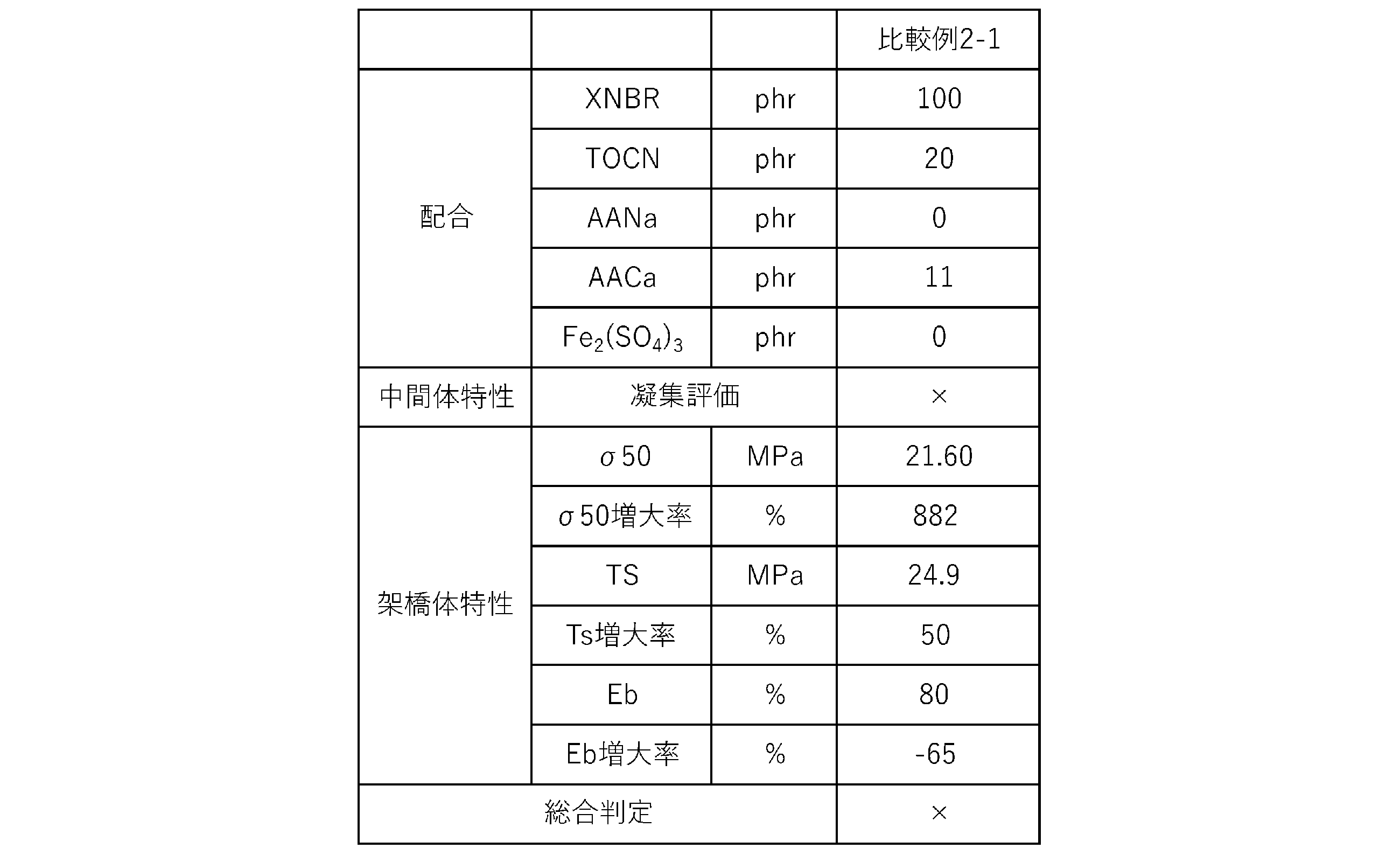
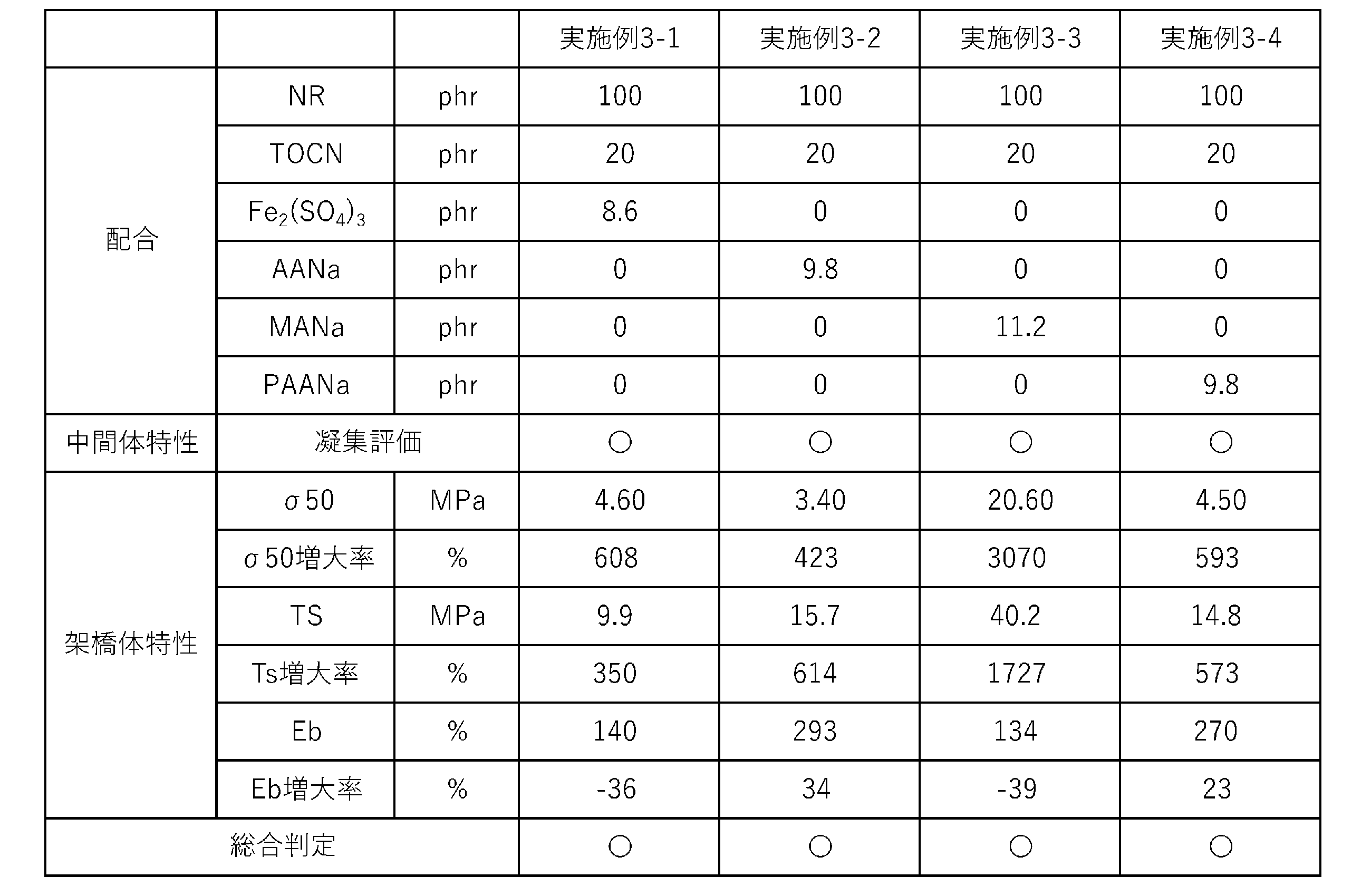
表5に示すゴムラテックスと、TEMPO酸化セルロースナノファイバー1%濃度のセルロースナノファイバー(0.4%~0.7%に希釈してもよい)の水分散液(溶媒は水)と、硫酸鉄(III)、アクリル酸ナトリウム(AANa)、メタクリル酸ナトリウム(MANa)またはポリアクリル酸ナトリウム(PAANa)の水溶液と、を用いて、実施例1-1~実施例1-4と同様にして架橋体及びシート状の架橋体のサンプルを得た。ここで、実施例3-1の「Fe2(SO4)3」は3.01倍当量を配合し、実施例3-2の「AANa」は3.47倍当量を配合し、実施例3-3の「MANa」は3.45倍当量を配合し、実施例3-4の「PAANa」は3.47倍当量を配合した。なお、「TOCN」、「Fe2(SO4)3」は、実施例1-1等と同じ材料を用い、「AANa」は、実施例2-1等と同じ材料を用いた。
「NR」:レジテックス社製、天然ゴムラテックス、ULACOL、固形分61質量%、「MANa」:浅田化学工業社製、メタクリル酸ナトリウム、CAS No.5536-61-8、
「PAANa」:東亞合成社製、ポリアクリル酸ナトリウム、アロンT50。
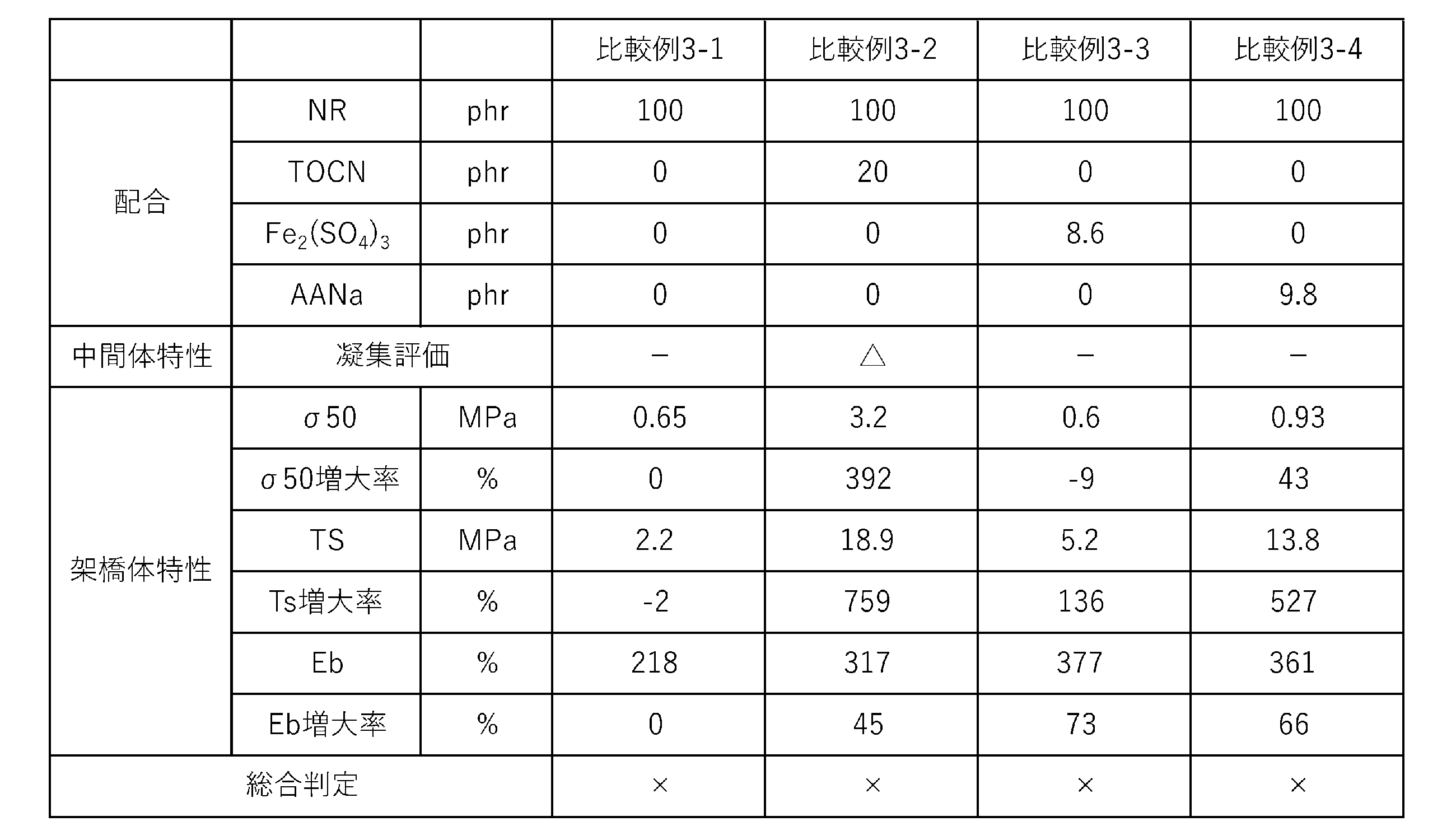
表6及び表7に示すゴムラテックスと、TEMPO酸化セルロースナノファイバー1%濃度のセルロースナノファイバー(0.4%~0.7%に希釈してもよい)の水分散液(溶媒は水)と、硫酸鉄(III)またはアクリル酸カルシウム(AACa)の水溶液と、を用いて、実施例3-1~実施例3-4と同様にして架橋体及びシート状の各比較例のサンプルを得た。なお、比較例3-1はセルロースナノファイバーを含まない純ゴム配合であった。
各架橋体のサンプルを目視して凝集塊の有無を確認し、実施例1-1等と同様に評価した。また、各シート状の架橋体サンプルについて、実施例1-1等と同様に引張試験を行い、50%モジュラス(σ50(MPa))、引張強さ(TS(MPa))、切断時伸び(Eb(%))を測定した。なお、各増大率は、実施例3-1~3-4及び比較例3-2~3-4の各測定値をAとし、比較例3-1の測定値をBとして計算した。測定結果及び計算結果を表5及び表6に示した。
総合判定の基準は、上記(1-5)と同じとした。
Claims (8)
- ゴム成分と、
カルボキシ基を含有するセルロースナノファイバーと、
3価以上の陽イオンと、
を含み、
前記セルロースナノファイバーは、N-オキシル化合物を用いて酸化された酸化セルロースに由来するものを含む、中間体。 - 請求項1において、
前記3価以上の陽イオンは、アルミニウムイオン及び/または鉄イオンである、中間体。 - ゴム成分と、
カルボキシ基を含有するセルロースナノファイバーと、
1価の金属イオンを含む不飽和カルボン酸塩及び/または1価の金属イオンを含む不飽和カルボン酸塩に由来する繰返し単位を有する重合体と、
を含み、
前記セルロースナノファイバーは、N-オキシル化合物を用いて酸化された酸化セルロースに由来するものを含む、中間体。 - 請求項3において、
前記不飽和カルボン酸塩は、アクリル酸ナトリウム及び/またはメタクリル酸ナトリウムである、中間体。 - 請求項1~請求項4のいずれか一項において、
前記ゴム成分は、天然ゴム、カルボキシ変性ニトリルゴムまたはカルボキシ変性スチレンブタジエンゴムである、中間体。 - 請求項1~請求項4のいずれか一項において、
前記セルロースナノファイバーは、セルロースを構成するグルコピラノース環の第6位の水酸基が酸化されてカルボキシ基が導入された構造を有する、中間体。 - 請求項1~請求項4のいずれか一項において、
前記ゴム成分100質量部と、
前記セルロースナノファイバー10質量部以上100質量部未満と、
前記セルロースナノファイバーが含有するカルボキシ基に対して0.50倍当量~6.00倍当量の、前記3価以上の陽イオン、前記1価の金属イオンを含む不飽和カルボン酸塩、及び前記1価の金属イオンを含む不飽和カルボン酸塩に由来する繰返し単位を有する重合体から選択される少なくとも一種と、
を含み、
前記セルロースナノファイバーは、平均繊維径が2nm以上8nm以下であり、かつ、平均繊維長が200nm以上800nm以下であり、
前記セルロースナノファイバーは、カルボキシ基の含有量が1.2mmol/g~1.7mmol/gである、中間体。 - 100質量部のゴム成分を含むゴムラテックスと、水系溶媒にカルボキシ基を含有するセルロースナノファイバー10質量部以上100質量部未満が分散したCNF水分散液と、3価以上の陽イオンを含む無機酸多価金属塩、1価の金属イオンを含む不飽和カルボン酸塩及び前記1価の金属イオンを含む不飽和カルボン酸塩に由来する繰返し単位を有する重合体から選択される少なくとも一種と、を混合して混合液を得る工程と、
前記混合液を混練する工程と、
前記混練する工程後の前記混合液を乾燥して水分率が3%以下の混合物を得る工程と、
前記混合物を混練して中間体を得る工程と、
を含み、
前記セルロースナノファイバーは、N-オキシル化合物を用いて酸化された酸化セルロースに由来するものを含む、中間体の製造方法。
Priority Applications (2)
| Application Number | Priority Date | Filing Date | Title |
|---|---|---|---|
| JP2024520298A JPWO2023218814A1 (ja) | 2022-05-10 | 2023-04-06 | |
| CN202380036787.4A CN119095905A (zh) | 2022-05-10 | 2023-04-06 | 中间体和中间体的制造方法 |
Applications Claiming Priority (2)
| Application Number | Priority Date | Filing Date | Title |
|---|---|---|---|
| JP2022077716 | 2022-05-10 | ||
| JP2022-077716 | 2022-05-10 |
Publications (1)
| Publication Number | Publication Date |
|---|---|
| WO2023218814A1 true WO2023218814A1 (ja) | 2023-11-16 |
Family
ID=88730133
Family Applications (1)
| Application Number | Title | Priority Date | Filing Date |
|---|---|---|---|
| PCT/JP2023/014197 Ceased WO2023218814A1 (ja) | 2022-05-10 | 2023-04-06 | 中間体及び中間体の製造方法 |
Country Status (3)
| Country | Link |
|---|---|
| JP (1) | JPWO2023218814A1 (ja) |
| CN (1) | CN119095905A (ja) |
| WO (1) | WO2023218814A1 (ja) |
Cited By (1)
| Publication number | Priority date | Publication date | Assignee | Title |
|---|---|---|---|---|
| WO2025205216A1 (ja) * | 2024-03-28 | 2025-10-02 | 国立大学法人信州大学 | 複合材料の製造方法及び複合材料 |
Citations (5)
| Publication number | Priority date | Publication date | Assignee | Title |
|---|---|---|---|---|
| JP2018111768A (ja) * | 2017-01-11 | 2018-07-19 | 日信工業株式会社 | 繊維材料及び繊維材料の製造方法並びに複合材料及び複合材料の製造方法 |
| JP2018111769A (ja) * | 2017-01-11 | 2018-07-19 | 日信工業株式会社 | 膨潤繊維材料及び膨潤繊維材料の製造方法並びに複合材料及び複合材料の製造方法 |
| JP2018111770A (ja) * | 2017-01-11 | 2018-07-19 | 日信工業株式会社 | ゲル状体及びゲル状体の製造方法並びに複合材料及び複合材料の製造方法 |
| WO2018147342A1 (ja) * | 2017-02-09 | 2018-08-16 | 日本製紙株式会社 | ゴム組成物およびその製造方法 |
| JP2019094460A (ja) * | 2017-11-27 | 2019-06-20 | 国立大学法人信州大学 | 金属塩含有セルロースナノファイバー |
-
2023
- 2023-04-06 WO PCT/JP2023/014197 patent/WO2023218814A1/ja not_active Ceased
- 2023-04-06 CN CN202380036787.4A patent/CN119095905A/zh active Pending
- 2023-04-06 JP JP2024520298A patent/JPWO2023218814A1/ja active Pending
Patent Citations (5)
| Publication number | Priority date | Publication date | Assignee | Title |
|---|---|---|---|---|
| JP2018111768A (ja) * | 2017-01-11 | 2018-07-19 | 日信工業株式会社 | 繊維材料及び繊維材料の製造方法並びに複合材料及び複合材料の製造方法 |
| JP2018111769A (ja) * | 2017-01-11 | 2018-07-19 | 日信工業株式会社 | 膨潤繊維材料及び膨潤繊維材料の製造方法並びに複合材料及び複合材料の製造方法 |
| JP2018111770A (ja) * | 2017-01-11 | 2018-07-19 | 日信工業株式会社 | ゲル状体及びゲル状体の製造方法並びに複合材料及び複合材料の製造方法 |
| WO2018147342A1 (ja) * | 2017-02-09 | 2018-08-16 | 日本製紙株式会社 | ゴム組成物およびその製造方法 |
| JP2019094460A (ja) * | 2017-11-27 | 2019-06-20 | 国立大学法人信州大学 | 金属塩含有セルロースナノファイバー |
Cited By (1)
| Publication number | Priority date | Publication date | Assignee | Title |
|---|---|---|---|---|
| WO2025205216A1 (ja) * | 2024-03-28 | 2025-10-02 | 国立大学法人信州大学 | 複合材料の製造方法及び複合材料 |
Also Published As
| Publication number | Publication date |
|---|---|
| CN119095905A (zh) | 2024-12-06 |
| JPWO2023218814A1 (ja) | 2023-11-16 |
Similar Documents
| Publication | Publication Date | Title |
|---|---|---|
| JP6615444B2 (ja) | ゴム組成物の製造方法及びゴム組成物 | |
| CN114341250B (zh) | 表面处理纳米纤维素母炼胶 | |
| JP6565535B2 (ja) | 複合体の製造方法 | |
| JP6612038B2 (ja) | 複合体の製造方法 | |
| CN105143318B (zh) | 橡胶组合物的制造方法、橡胶组合物、硫化橡胶和轮胎 | |
| JP7029125B2 (ja) | 複合材料の製造方法 | |
| JP7044300B2 (ja) | ゴム組成物及びゴム組成物の製造方法 | |
| JP6948630B2 (ja) | 繊維材料及び繊維材料の製造方法並びに複合材料及び複合材料の製造方法 | |
| KR20170115505A (ko) | 함금속 산화셀룰로오스 나노 파이버 분산액 및 그 제조 방법 | |
| JP7470324B2 (ja) | 組成物の製造方法 | |
| CN108368277A (zh) | 母料、橡胶组合物和它们的制造方法 | |
| WO2023218814A1 (ja) | 中間体及び中間体の製造方法 | |
| JP2023166971A (ja) | 中間体及び中間体の製造方法 | |
| JP6948631B2 (ja) | 膨潤繊維材料及び膨潤繊維材料の製造方法並びに複合材料の製造方法 | |
| JP6893649B2 (ja) | ゲル状体及びゲル状体の製造方法並びに複合材料及び複合材料の製造方法 | |
| JP2025151649A (ja) | 複合材料の製造方法及び複合材料 | |
| WO2023219077A1 (ja) | 中間体及び中間体の製造方法 | |
| JPWO2018235912A1 (ja) | セルロースザンテート微細繊維含有樹脂組成物 | |
| CN108299701A (zh) | 纤维材料及其制造方法以及复合材料及其制造方法 | |
| JP2025151644A (ja) | 複合材料の製造方法及び複合材料 | |
| JP7283667B2 (ja) | ナノセルロースマスターバッチ | |
| JP6915170B2 (ja) | ゴム組成物の製造方法 | |
| TWI698450B (zh) | 含金屬氧化纖維素奈米纖維分散液之製造方法 | |
| TW202421892A (zh) | 纖維素奈米纖維、及包含其之水系分散組合物 | |
| JP2019112511A (ja) | 摩擦材料用原料組成物、摩擦材料用原料組成物の製造方法、および摩擦材料の製造方法 |
Legal Events
| Date | Code | Title | Description |
|---|---|---|---|
| 121 | Ep: the epo has been informed by wipo that ep was designated in this application |
Ref document number: 23803297 Country of ref document: EP Kind code of ref document: A1 |
|
| WWE | Wipo information: entry into national phase |
Ref document number: 2024520298 Country of ref document: JP |
|
| WWE | Wipo information: entry into national phase |
Ref document number: 202380036787.4 Country of ref document: CN |
|
| NENP | Non-entry into the national phase |
Ref country code: DE |
|
| 122 | Ep: pct application non-entry in european phase |
Ref document number: 23803297 Country of ref document: EP Kind code of ref document: A1 |