WO2023218512A1 - ポリアミド酸含有液及びポリアミド酸含有液の製造方法 - Google Patents
ポリアミド酸含有液及びポリアミド酸含有液の製造方法 Download PDFInfo
- Publication number
- WO2023218512A1 WO2023218512A1 PCT/JP2022/019740 JP2022019740W WO2023218512A1 WO 2023218512 A1 WO2023218512 A1 WO 2023218512A1 JP 2022019740 W JP2022019740 W JP 2022019740W WO 2023218512 A1 WO2023218512 A1 WO 2023218512A1
- Authority
- WO
- WIPO (PCT)
- Prior art keywords
- polyamic acid
- containing liquid
- mass
- prepolymer
- acid
- Prior art date
- Legal status (The legal status is an assumption and is not a legal conclusion. Google has not performed a legal analysis and makes no representation as to the accuracy of the status listed.)
- Ceased
Links
Classifications
-
- C—CHEMISTRY; METALLURGY
- C08—ORGANIC MACROMOLECULAR COMPOUNDS; THEIR PREPARATION OR CHEMICAL WORKING-UP; COMPOSITIONS BASED THEREON
- C08G—MACROMOLECULAR COMPOUNDS OBTAINED OTHERWISE THAN BY REACTIONS ONLY INVOLVING UNSATURATED CARBON-TO-CARBON BONDS
- C08G73/00—Macromolecular compounds obtained by reactions forming a linkage containing nitrogen with or without oxygen or carbon in the main chain of the macromolecule, not provided for in groups C08G12/00 - C08G71/00
- C08G73/06—Polycondensates having nitrogen-containing heterocyclic rings in the main chain of the macromolecule
- C08G73/10—Polyimides; Polyester-imides; Polyamide-imides; Polyamide acids or similar polyimide precursors
- C08G73/1075—Partially aromatic polyimides
- C08G73/1082—Partially aromatic polyimides wholly aromatic in the tetracarboxylic moiety
-
- C—CHEMISTRY; METALLURGY
- C08—ORGANIC MACROMOLECULAR COMPOUNDS; THEIR PREPARATION OR CHEMICAL WORKING-UP; COMPOSITIONS BASED THEREON
- C08G—MACROMOLECULAR COMPOUNDS OBTAINED OTHERWISE THAN BY REACTIONS ONLY INVOLVING UNSATURATED CARBON-TO-CARBON BONDS
- C08G73/00—Macromolecular compounds obtained by reactions forming a linkage containing nitrogen with or without oxygen or carbon in the main chain of the macromolecule, not provided for in groups C08G12/00 - C08G71/00
- C08G73/06—Polycondensates having nitrogen-containing heterocyclic rings in the main chain of the macromolecule
- C08G73/10—Polyimides; Polyester-imides; Polyamide-imides; Polyamide acids or similar polyimide precursors
- C08G73/1003—Preparatory processes
- C08G73/1007—Preparatory processes from tetracarboxylic acids or derivatives and diamines
- C08G73/1028—Preparatory processes from tetracarboxylic acids or derivatives and diamines characterised by the process itself, e.g. steps, continuous
-
- C—CHEMISTRY; METALLURGY
- C08—ORGANIC MACROMOLECULAR COMPOUNDS; THEIR PREPARATION OR CHEMICAL WORKING-UP; COMPOSITIONS BASED THEREON
- C08G—MACROMOLECULAR COMPOUNDS OBTAINED OTHERWISE THAN BY REACTIONS ONLY INVOLVING UNSATURATED CARBON-TO-CARBON BONDS
- C08G73/00—Macromolecular compounds obtained by reactions forming a linkage containing nitrogen with or without oxygen or carbon in the main chain of the macromolecule, not provided for in groups C08G12/00 - C08G71/00
- C08G73/06—Polycondensates having nitrogen-containing heterocyclic rings in the main chain of the macromolecule
- C08G73/10—Polyimides; Polyester-imides; Polyamide-imides; Polyamide acids or similar polyimide precursors
- C08G73/1042—Copolyimides derived from at least two different tetracarboxylic compounds or two different diamino compounds
-
- C—CHEMISTRY; METALLURGY
- C08—ORGANIC MACROMOLECULAR COMPOUNDS; THEIR PREPARATION OR CHEMICAL WORKING-UP; COMPOSITIONS BASED THEREON
- C08G—MACROMOLECULAR COMPOUNDS OBTAINED OTHERWISE THAN BY REACTIONS ONLY INVOLVING UNSATURATED CARBON-TO-CARBON BONDS
- C08G73/00—Macromolecular compounds obtained by reactions forming a linkage containing nitrogen with or without oxygen or carbon in the main chain of the macromolecule, not provided for in groups C08G12/00 - C08G71/00
- C08G73/06—Polycondensates having nitrogen-containing heterocyclic rings in the main chain of the macromolecule
- C08G73/10—Polyimides; Polyester-imides; Polyamide-imides; Polyamide acids or similar polyimide precursors
- C08G73/1046—Polyimides containing oxygen in the form of ether bonds in the main chain
- C08G73/105—Polyimides containing oxygen in the form of ether bonds in the main chain with oxygen only in the diamino moiety
-
- C—CHEMISTRY; METALLURGY
- C09—DYES; PAINTS; POLISHES; NATURAL RESINS; ADHESIVES; COMPOSITIONS NOT OTHERWISE PROVIDED FOR; APPLICATIONS OF MATERIALS NOT OTHERWISE PROVIDED FOR
- C09D—COATING COMPOSITIONS, e.g. PAINTS, VARNISHES OR LACQUERS; FILLING PASTES; CHEMICAL PAINT OR INK REMOVERS; INKS; CORRECTING FLUIDS; WOODSTAINS; PASTES OR SOLIDS FOR COLOURING OR PRINTING; USE OF MATERIALS THEREFOR
- C09D179/00—Coating compositions based on macromolecular compounds obtained by reactions forming in the main chain of the macromolecule a linkage containing nitrogen, with or without oxygen, or carbon only, not provided for in groups C09D161/00 - C09D177/00
- C09D179/04—Polycondensates having nitrogen-containing heterocyclic rings in the main chain; Polyhydrazides; Polyamide acids or similar polyimide precursors
- C09D179/08—Polyimides; Polyester-imides; Polyamide-imides; Polyamide acids or similar polyimide precursors
Definitions
- Embodiments of the present invention relate to a method for manufacturing a polyamic acid-containing liquid, a polyamic acid-containing liquid, and a method for manufacturing a polyimide, a molded body, and a printed circuit board.
- Polyimide is widely used in fields such as automobiles, electronic parts, and displays because it has high heat resistance, chemical resistance, high mechanical properties, and low dielectric constant.
- it has a structure derived from an aliphatic or alicyclic diamine and an aromatic tetracarboxylic dianhydride, or a structure derived from an aromatic diamine and an aliphatic or alicyclic dianhydride.
- Semi-aromatic polyimide is expected to be applied to high-frequency antennas, substrates such as FPCs (flexible printed circuit boards), and coil insulation coatings for inverter-driven motors, which are becoming increasingly high-frequency and high-voltage.
- Patent Document 1 discloses a solvent-insoluble polyimide film in which dimer diamine is used in an amount of more than 15 mol% and less than 50 mol% based on the total diamine components. Furthermore, Patent Document 1 discloses that a polyamic acid solution is mixed in a nitrogen-containing polar solvent so that approximately equimolar amounts of tetracarboxylic dianhydride and diamine are mixed, and the solution is heated at 10 to 70°C. It is disclosed that an optically uniform solution can be obtained by polymerization reaction.
- the present disclosure provides a method for easily producing a polyamic acid-containing liquid that can yield a polyimide exhibiting excellent dielectric properties. Further, the present disclosure provides a polyamic acid-containing liquid that can yield a polyimide exhibiting excellent dielectric properties and exhibits excellent film-forming properties. Further, the present disclosure provides methods for manufacturing polyimides, molded bodies, and printed circuit boards that exhibit excellent dielectric properties.
- One embodiment includes a prepolymer-containing liquid containing an amic acid prepolymer including a structure derived from an aromatic diamine and a structure derived from a tetracarboxylic dianhydride, an aliphatic or alicyclic diamine, and a tetracarboxylic dianhydride.
- the present invention relates to a method for producing a polyamic acid-containing liquid, which includes obtaining a polyamic acid-containing liquid using a polyamic acid-containing liquid.
- Another embodiment includes a prepolymer-containing liquid containing an amic acid prepolymer including a structure derived from an aliphatic or alicyclic diamine and a structure derived from a tetracarboxylic dianhydride, a diamine, and a tetracarboxylic dianhydride.
- the present invention relates to a method for producing a polyamic acid-containing liquid, which includes obtaining a polyamic acid-containing liquid using a polyamic acid-containing liquid.
- Another embodiment contains a polyamic acid containing a structure derived from an aliphatic or alicyclic diamine and a structure derived from a tetracarboxylic dianhydride, and a solvent
- the present invention relates to a polyamic acid-containing liquid that satisfies one or both of the following (1) and (2).
- (1) The content of components derived from amines and carboxylic acid anhydrides is 20.0% by mass or more, and the turbidity is 2.5 NTU or less.
- the content of the polyamic acid is 20.0% by mass or more based on the total mass of the polyamic acid and the solvent.
- Another embodiment contains a polyamic acid containing a structure derived from an aliphatic or alicyclic diamine and a structure derived from a tetracarboxylic dianhydride, and a solvent
- the present invention relates to a polyamic acid-containing liquid that satisfies one or both of the following (3) and (4).
- (3) The turbidity is 2.5 NTU or less, and the ratio of the mass of the component derived from the amine and carboxylic acid anhydride obtained by heating the polyamic acid-containing liquid to the mass of the polyamic acid-containing liquid is 18 .0% by mass or more.
- the ratio of the mass of polyimide obtained by heating the filtrate of the polyamic acid-containing liquid to the mass of the polyamic acid-containing liquid is 18.0% by mass or more.
- Some other embodiments relate to the above-mentioned polyamic acid-containing liquid, which is for insulating materials, heat-resistant insulating materials, or printed circuit boards. Some other embodiments relate to methods for producing polyimide, molded bodies, and printed circuit boards using the polyamic acid-containing liquid.
- a method for easily producing a polyamic acid-containing liquid that can yield a polyimide exhibiting excellent dielectric properties is provided. Further, according to the present disclosure, a polyamic acid-containing liquid that can obtain a polyimide exhibiting excellent dielectric properties and exhibits excellent film-forming properties is provided. Further, according to the present disclosure, a method for manufacturing a polyimide, a molded body, and a printed circuit board exhibiting excellent dielectric properties is provided.
- each component may contain multiple types of applicable substances. If there are multiple types of substances corresponding to each component in the composition, the content rate or content of each component is the total content rate or content of the multiple types of substances present in the composition, unless otherwise specified.
- each structure in the polymer may include multiple types of corresponding structures. If multiple types of structures corresponding to each structure exist in the polymer, the content rate or content of each structure is the total content rate or content of the multiple types of structures present in the polymer, unless otherwise specified. means.
- the term "process” includes not only a process that is independent from other processes, but also a process that cannot be clearly distinguished from other processes, if the intended effect of the process is achieved. included.
- the term "layer” includes a layer formed only in a part of the region, in addition to a layer formed in the entire region when observing the region where the layer exists. It will be done.
- the method for producing a polyamic acid-containing liquid includes obtaining a polyamic acid-containing liquid containing a polyamic acid using a prepolymer-containing liquid containing an amic acid prepolymer, a diamine, and a tetracarboxylic dianhydride.
- the method for producing a polyamic acid-containing liquid includes a prepolymer-containing liquid containing an amic acid prepolymer containing an aromatic diamine-derived structure and a tetracarboxylic dianhydride-derived structure, and an aliphatic or It includes obtaining a polyamic acid-containing liquid containing polyamic acid using an alicyclic diamine and a tetracarboxylic dianhydride.
- this manufacturing method may be referred to as "manufacturing method R.”
- the method for producing a polyamic acid-containing liquid includes a prepolymer-containing amic acid prepolymer containing an aliphatic or alicyclic diamine-derived structure and a tetracarboxylic dianhydride-derived structure.
- the method includes obtaining a polyamic acid-containing liquid containing a polyamic acid using a liquid, a diamine, and a tetracarboxylic dianhydride.
- this manufacturing method may be referred to as "manufacturing method L.”
- Polyamic acid is usually synthesized by addition condensation, that is, polymerization of diamine and tetracarboxylic dianhydride.
- addition condensation that is, polymerization of diamine and tetracarboxylic dianhydride.
- the reaction generally proceeds easily at room temperature.
- diamines including aliphatic or alicyclic diamines and tetracarboxylic dianhydrides there has been a problem in that precipitates are generated and the reaction is difficult to proceed.
- the basicity of aliphatic or cycloaliphatic diamines is considerably higher than that of aromatic diamines.
- the precipitate is composed of unreacted aliphatic or alicyclic diamine that exhibits high basicity and the carboxylic acid (i.e., ring-opened carboxylic dianhydride) produced during the addition condensation process or the carboxyl group obtained by the addition condensation process. It is thought that the salts formed by the polyamic acid and the polyamic acid having the
- the formation of a salt can be suppressed or The reaction can proceed by dissolving the added salt, or both.
- a polyamic acid-containing liquid containing a polyamic acid containing a structure derived from an aliphatic or alicyclic diamine can be easily produced.
- a polyamic acid-containing liquid containing polyamic acid at a high concentration can be produced in a short time.
- Production method R includes a prepolymer-containing liquid containing an amic acid prepolymer containing a structure derived from an aromatic diamine and a structure derived from a tetracarboxylic dianhydride, an aliphatic or alicyclic diamine, and a tetracarboxylic dianhydride. (In this disclosure, it may be referred to as "Step R2").
- Production method R includes preparing a prepolymer-containing liquid containing an amic acid prepolymer containing a structure derived from an aromatic diamine and a structure derived from a tetracarboxylic dianhydride (in this disclosure, it may be referred to as "Step R1").
- tetracarboxylic dianhydride may be referred to as "acid dianhydride.”
- an amic acid prepolymer containing a structure derived from an aromatic diamine and a structure derived from a tetracarboxylic dianhydride may be referred to as an "aromatic prepolymer”
- a prepolymer-containing liquid containing an aromatic prepolymer may be referred to as an "aromatic prepolymer”.
- Aromatic prepolymer-containing liquid is sometimes referred to as an "aromatic prepolymer-containing liquid.”
- Manufacturing method R can include any steps other than step R1 and step R2.
- Production Method R polymerization can proceed even when an aliphatic or alicyclic diamine is used.
- a polyamic acid is obtained by reacting an aromatic prepolymer, an aliphatic or alicyclic diamine, and an acid dianhydride.
- Aliphatic or cycloaliphatic diamines form salts with aromatic prepolymers and acid dianhydrides, respectively.
- a salt of an aliphatic or alicyclic diamine and an aromatic prepolymer is formed.
- Aromatic prepolymer salts are more soluble than acid dianhydride salts due to structural effects.
- production method R a salt of an aromatic prepolymer that is easily soluble is formed, and formation of a salt of an acid dianhydride that is difficult to dissolve is suppressed.
- production method R is a method in which the amount of poorly soluble salt is reduced and the easily soluble salt is included to promote the dissolution of the entire salt, thereby allowing the polymerization reaction to proceed.
- the present invention is not limited by this assumption.
- step R1 an aromatic prepolymer-containing liquid is prepared.
- an aromatic prepolymer is produced using a prepolymer-containing liquid containing an amic acid prepolymer containing a structure derived from an aromatic diamine and a structure derived from an acid dianhydride, which has been prepared in advance.
- the step may be to prepare a containing liquid (step R1-s).
- step R1 includes obtaining an aromatic prepolymer-containing liquid containing an aromatic prepolymer using an aromatic diamine, an acid dianhydride, and a solvent (step R1-i ).
- a polyamic acid-containing liquid is obtained using an aromatic prepolymer-containing liquid, an aliphatic or alicyclic diamine, and an acid dianhydride.
- Aromatic diamines may also be used.
- an aliphatic or alicyclic diamine and an acid dianhydride are added to an aromatic prepolymer-containing liquid to obtain a polyamic acid-containing liquid containing polyamic acid (step R2-a). It's good.
- An aliphatic or alicyclic diamine, an acid dianhydride, and further an aromatic diamine may be added to the aromatic prepolymer-containing liquid.
- Examples of embodiments of the manufacturing method R include a manufacturing method Rs including a step R1-s and a step R2-a, and a manufacturing method Ri including a step R1-i and a step R2-a.
- step R2-a is preferably performed consecutively to step R1-i.
- a prepolymer-containing liquid containing an amic acid prepolymer containing a structure derived from an aromatic diamine and a structure derived from an acid dianhydride prepared in advance is used as an aromatic acid for use as it is in step R2. It can be a liquid containing a group prepolymer.
- a prepolymer-containing liquid prepared in advance may be diluted or concentrated as necessary to adjust the concentration to obtain an aromatic prepolymer-containing liquid for use in step R2. I can do it.
- the previously prepared prepolymer-containing liquid used in step R1-s may be, for example, a separately prepared prepolymer-containing liquid or a commercially available prepolymer-containing liquid.
- the prepolymer-containing liquid can be produced by a known method for producing a polyamic acid solution, a method for producing a polyamic acid-containing solution according to the present disclosure, or the like.
- step R1-i examples include the following method. First, an aromatic diamine is dissolved in a solvent to prepare an aromatic diamine solution. Next, the acid dianhydride is added to the aromatic diamine solution and stirred. The stirring time is, for example, 5 minutes to 5 hours, 10 minutes to 3 hours, or 30 minutes to 2 hours. The stirring temperature is, for example, 10 to 50°C, 15 to 40°C, or 20 to 35°C.
- the entire amount of the acid dianhydride may be added to the aromatic diamine solution at once, or the entire amount may be added to the aromatic diamine solution in two or more portions.
- the number of times is, for example, 10 or less, 7 or less, or 4 or less.
- the interval between each time is, for example, 5 minutes or more, or 10 minutes or more.
- the interval between each session is, for example, 120 minutes or less, 60 minutes or less, 30 minutes or less, or 15 minutes or less.
- step R1-i an aromatic prepolymer-containing liquid containing a high concentration of aromatic prepolymer can be easily prepared.
- step R2-a for example, the following method may be mentioned.
- an aliphatic or alicyclic diamine is dissolved in a solvent to prepare an aliphatic or alicyclic diamine solution.
- an aliphatic or alicyclic diamine solution and an acid dianhydride are added to the aromatic prepolymer-containing liquid prepared in step R1 and stirred.
- the stirring time is, for example, 10 minutes or more, 1 hour or more, or 3 hours or more.
- the stirring time is, for example, 72 hours or less, 48 hours or less, 24 hours or less, 12 hours or less, or 5 hours or less.
- the stirring temperature is, for example, 10 to 50°C, 15 to 40°C, or 20 to 35°C.
- the rotation speed is, for example, 50 to 2,000 min -1 , 200 to 1,000 min -1 , or 300 to 800 min -1 .
- the stirring time is preferably longer than the time required to dissolve the salt.
- the stirring time it is preferable that the stirring time be short. According to production method R, since the salt can be dissolved in a short time, the polyamic acid-containing liquid can be efficiently produced. The higher the stirring temperature, the faster the salt can be dissolved. Therefore, stirring may be performed while heating. On the other hand, from the viewpoint of easy production, it is preferable to perform stirring without heating.
- polyamic acid can be efficiently produced because the salt can be dissolved in a short time without heating.
- Salts can be dissolved in a short time by using additives that can dissolve salts, such as acetic acid. Therefore, stirring may be carried out in the presence of an additive capable of dissolving the salt.
- polyamic acid can be efficiently produced because the salt can be dissolved in a short time without using additives.
- the aliphatic or alicyclic diamine solution and the acid dianhydride may be added to the aromatic prepolymer-containing liquid simultaneously or separately.
- the aliphatic or cycloaliphatic diamine solution, the acid dianhydride, or both the aliphatic or cycloaliphatic diamine solution and the acid dianhydride can be added in their entirety to the aromatic prepolymer-containing liquid at once. Alternatively, the entire amount may be divided into two or more portions and added to the aromatic prepolymer-containing liquid. In the case of dividing into two or more times, the number of times is, for example, 10 or less, 7 or less, or 4 or less. The interval between each time is, for example, 5 minutes or more, or 10 minutes or more.
- the interval between each session is, for example, 120 minutes or less, 60 minutes or less, 30 minutes or less, or 15 minutes or less.
- the solution may be dropped over a predetermined period of time, or the solid may be added little by little.
- the predetermined time is, for example, 10 to 60 minutes.
- An aliphatic or alicyclic diamine and an aromatic diamine may be added to the aromatic prepolymer-containing liquid.
- the aliphatic or alicyclic diamine and the aromatic diamine may be added to the aromatic prepolymer-containing liquid simultaneously or separately.
- the entire amount of the aromatic diamine may be added to the aromatic prepolymer-containing liquid at once, or the entire amount may be added to the aromatic prepolymer-containing liquid in two or more portions.
- step R1-i and step R2-a are performed continuously, the aliphatic or alicyclic Preferably, the addition of at least one of the diamine solution and the acid dianhydride is initiated.
- step R1-i and step R2-a consecutively, add an aliphatic or alicyclic diamine solution and an acid dianhydride to the container in which the aromatic prepolymer-containing liquid was obtained in step R1-i. Add and stir.
- the aromatic prepolymer may contain any structure other than the aromatic diamine-derived structure and the acid dianhydride-derived structure.
- the aromatic prepolymer can include any diamine-derived structures, such as aliphatic or cycloaliphatic diamine-derived structures.
- the content of aromatic diamine-derived structures is, for example, more than 50% by mass, 70% by mass or more, 90% by mass or more, or 100% by mass, based on the mass of all diamine-derived structures.
- the weight average molecular weight of the aromatic prepolymer is preferably 500 to 80,000, more preferably 1,000 to 50,000, and even more preferably 5,000 to 30,000.
- the mass average molecular weight may be 20,000 or less, or 10,000 or less.
- the salt formed by the aromatic prepolymer and the aliphatic or alicyclic diamine tends to have low crystallinity and become easily soluble.
- the mass average molecular weight is 80,000 or less, the viscosity can be prevented from becoming too high, the miscibility with the acid dianhydride and aliphatic or alicyclic diamine is good, and the dissolution rate of the salt can be increased easily.
- the mass average molecular weight can be determined by measuring by gel permeation chromatography (GPC) and converting using a standard polystyrene calibration curve.
- the mass average molecular weight can be specifically measured by the method described in Examples.
- the content of the aromatic prepolymer in the aromatic prepolymer-containing liquid is, for example, 30.0% by mass or less, based on the mass of the aromatic prepolymer-containing liquid. It is 20.0% by mass or less, 12.0% by mass or less, or 8.0% by mass or less.
- the content of the aromatic prepolymer is, for example, 3.0% by mass or more, 5.0% by mass or more, or 10% by mass, based on the mass of the aromatic prepolymer-containing liquid. It is 0% by mass or more.
- the mass ratio of the aromatic prepolymer used in production method R is, for example, 10.0% by mass or more and 15.0% by mass based on the mass of the polyamic acid obtained.
- the content is 20.0% by mass or more, 30.0% by mass or more, or 40.0% by mass or more.
- the mass ratio of the aromatic prepolymer is, for example, 70.0% by mass or less, 60% by mass or less based on the mass of the polyamic acid, taking into account the amount of aliphatic or alicyclic diamine and acid dianhydride used. , 50% by mass or less, 40% by mass or less, or 30% by mass or less.
- the aromatic prepolymer content in the aromatic prepolymer-containing liquid is, for example, 15.0% based on the mass of the aromatic prepolymer-containing liquid. It is at least 18.0% by mass, or at least 20.0% by mass.
- the content of the aromatic prepolymer is, for example, 30.0% by mass or less, or 25.0% by mass or less, based on the mass of the aromatic prepolymer-containing liquid.
- the mass ratio of the aromatic prepolymer used in production method R is, for example, 50.0% by mass or more with respect to the mass of the obtained polyamic acid. , 65.0% by mass or more, or 65.0% by mass or more.
- the mass ratio of the aromatic prepolymer is, for example, 90.0% by mass or less, 80% by mass or less based on the mass of the polyamic acid, taking into account the amount of aliphatic or alicyclic diamine and acid dianhydride used. , or 75.0% by mass or less.
- the polyamic acid-containing liquid obtained by manufacturing method R usually contains polyamic acid and a solvent.
- the content of polyamic acid is not particularly limited, and can be set to an appropriate content depending on the use of the polyamic acid-containing liquid. According to manufacturing method R, a polyamic acid-containing liquid containing a high content of polyamic acid can be manufactured.
- the content of the polyamic acid is, for example, 10.0% by mass or more, 15.0% by mass or more, 20.0% by mass or more, or 25.0% by mass or more, based on the total mass of the polyamic acid and the solvent. It's good.
- the content of the polyamic acid may be, for example, 50.0% by mass or less, 40.0% by mass or less, or 30.0% by mass or less, based on the total mass of the polyamic acid and the solvent.
- the polyamic acid obtained by production method R contains at least a structure derived from an aromatic diamine, a structure derived from an aliphatic or alicyclic diamine, and a structure derived from an acid dianhydride.
- the polyamic acid may further include any structure.
- monomers such as diamines and acid dianhydrides may be selected and used depending on the structure contained in the target polyamic acid.
- amines such as diamines, acids such as acid dianhydrides, and solvents that can be used in production method R, This will be explained later.
- Production method L uses a prepolymer-containing liquid containing an amic acid prepolymer containing a structure derived from an aliphatic or alicyclic diamine and a structure derived from an acid dianhydride, a diamine, and an acid dianhydride to produce a polyamide.
- the process includes obtaining a polyamic acid-containing liquid containing an acid (sometimes referred to as "Step L2" in the present disclosure).
- Production method L involves preparing a prepolymer-containing liquid containing an amic acid prepolymer containing a structure derived from an aliphatic or alicyclic diamine and a structure derived from an acid dianhydride (in this disclosure, referred to as "Step L1"). ) may further be included.
- an amic acid prepolymer containing a structure derived from an aliphatic or alicyclic diamine and a structure derived from an acid dianhydride may be referred to as an "aliphatic or alicyclic prepolymer";
- a prepolymer-containing liquid containing the formula prepolymer is sometimes referred to as an "aliphatic or alicyclic prepolymer-containing liquid.”
- Manufacturing method L can include any steps other than step L1 and step L2.
- Production Method L when an aliphatic or alicyclic diamine is not used, polymerization can proceed because a salt of an aliphatic or alicyclic diamine is not formed. Alternatively, according to Production Method L, polymerization can proceed even when an aliphatic or alicyclic diamine is used.
- a polyamic acid is obtained by reacting an aliphatic or alicyclic prepolymer, an aliphatic or alicyclic diamine, and an acid dianhydride.
- Aliphatic or cycloaliphatic diamines form salts with aliphatic or cycloaliphatic prepolymers and acid dianhydrides, respectively.
- a salt of an aliphatic or alicyclic diamine and an aliphatic or alicyclic prepolymer is formed.
- the amount of the salt of an aliphatic or alicyclic diamine and an acid dianhydride is reduced. Salts of aliphatic or cycloaliphatic prepolymers are more soluble than acid dianhydride salts due to structural influences.
- production method L a salt of an aliphatic or alicyclic prepolymer that is easily soluble is formed, and formation of a salt of an acid dianhydride that is difficult to dissolve is suppressed.
- production method L is a method in which when the diamine contains an aliphatic or alicyclic diamine, the amount of hardly soluble salt is reduced and the easily soluble salt is included to promote the dissolution of the entire salt. The reaction can proceed.
- the present invention is not limited by this assumption.
- step L1 an aliphatic or alicyclic prepolymer-containing liquid is prepared.
- step L1 uses a prepolymer-containing liquid containing an amic acid prepolymer containing a previously prepared aliphatic or alicyclic diamine-derived structure and an acid dianhydride-derived structure, The step may be to prepare an aliphatic or alicyclic prepolymer-containing liquid (step L1-s).
- step L1 comprises forming an aliphatic or cycloaliphatic prepolymer containing an aliphatic or cycloaliphatic prepolymer using an aliphatic or cycloaliphatic diamine, an acid dianhydride, and a solvent. It may be to obtain a prepolymer-containing liquid (step L1-i).
- a polyamic acid-containing liquid is obtained using an aliphatic or alicyclic prepolymer-containing liquid, a diamine, and an acid dianhydride.
- Diamines can include one or both of aliphatic or cycloaliphatic diamines and aromatic diamines.
- step L2 is to obtain a polyamic acid-containing liquid containing polyamic acid by adding a diamine and an acid dianhydride to an aliphatic or alicyclic prepolymer-containing liquid (step L2-a); good.
- Examples of embodiments of the manufacturing method L include a manufacturing method Ls including a step L1-s and a step L2-a, and a manufacturing method Li including a step L1-i and a step L2-a.
- step L2-a is preferably performed consecutively to step L1-i.
- process R1-s, process R1-i, and process R2-a in manufacturing method R has been changed to process L1-s, process L1-i, and process L2-a in manufacturing method L, with necessary changes. Can be applied.
- the examples given in step R1-s, step R1-i, and step R2-a can be used. .
- step L1-i since aliphatic or alicyclic diamines tend to form salts with acid dianhydrides, in order to prevent salt precipitation, aliphatic or alicyclic diamines and acid dianhydrides are
- concentration of the resulting aliphatic or alicyclic prepolymer-containing liquid may be kept low by adjusting the amount of the solvent used.
- the content of the aliphatic or alicyclic prepolymer is particularly preferably 15.0% by mass or less based on the mass of the aliphatic or alicyclic prepolymer-containing liquid.
- step L2-a when adding an alicyclic or aliphatic diamine and an aromatic diamine as diamines to the aliphatic or alicyclic prepolymer-containing liquid, the aliphatic or alicyclic prepolymer-containing liquid is It is preferable to add a cyclic or aliphatic diamine solution and a solid aromatic diamine, or to add a solution containing an alicyclic or aliphatic diamine and an aromatic diamine.
- the aliphatic or alicyclic prepolymer may contain any structure other than the aliphatic or alicyclic diamine-derived structure and the acid dianhydride-derived structure.
- the aliphatic or cycloaliphatic prepolymer can include any diamine-derived structure, such as an aromatic diamine-derived structure.
- the content of structures derived from aliphatic or alicyclic diamines is, for example, 50% by mass or more, 70% by mass or more, 90% by mass or more, or 100% by mass, based on the mass of all diamine-derived structures. .
- the weight average molecular weight of the aliphatic or alicyclic prepolymer is preferably 500 to 80,000, more preferably 1,000 to 50,000, and even more preferably 5,000 to 30,000.
- the weight average molecular weight may be 10,000 or more, 20,000 or more, or 30,000 or more.
- the mass average molecular weight is 500 or more, the salt formed by the aliphatic or alicyclic prepolymer and the aliphatic or alicyclic diamine tends to have low crystallinity and become easily soluble.
- the mass average molecular weight is 80,000 or less, the viscosity can be prevented from becoming too high, the miscibility with acid dianhydrides and diamines becomes good, and the dissolution rate of the salt tends to be increased.
- the content of the aliphatic or alicyclic prepolymer in the aliphatic or alicyclic prepolymer-containing liquid is based on the mass of the aliphatic or alicyclic prepolymer-containing liquid, from the viewpoint of dissolving the salt in a short time. , for example, 15.0% by mass or less, 13.0% by mass or less, 10.0% by mass or less, or 8.0% by mass or less.
- the content of the aliphatic or alicyclic prepolymer is, for example, 3.0% by mass or more, based on the mass of the aliphatic or alicyclic prepolymer-containing liquid.5. It is 0% by mass or more, or 10.0% by mass or more.
- the mass ratio of the aliphatic or alicyclic prepolymer used in production method L is, for example, 10.0% by mass or more, 15% by mass, based on the mass of the polyamic acid obtained.
- the content is .0% by mass or more, 20.0% by mass or more, 30.0% by mass or more, or 40.0% by mass or more.
- the mass ratio of the aliphatic or alicyclic prepolymer is, for example, 70.0% by mass or less, 60% by mass or less, 50% by mass or less, based on the mass of the polyamic acid, considering the amount of diamine and acid dianhydride used. 0% by mass or less, 40.0% by mass or less, or 30.0% by mass or less.
- the polyamic acid-containing liquid obtained by manufacturing method L usually contains polyamic acid and a solvent.
- the content of polyamic acid is not particularly limited, and can be set to an appropriate content depending on the use of the polyamic acid-containing liquid. According to manufacturing method L, a polyamic acid-containing liquid containing polyamic acid at a high concentration can be manufactured.
- the content of polyamic acid is, for example, 10.0% by mass or more, 15.0% by mass or more, 20.0% by mass or more, or 25.0% by mass or more, based on the mass of the polyamic acid-containing liquid. good.
- the content of polyamic acid may be, for example, 50.0% by mass or less, 40.0% by mass or less, or 30.0% by mass or less, based on the mass of the polyamic acid-containing liquid.
- the polyamic acid obtained by Production Method L contains at least a structure derived from an aliphatic or alicyclic diamine and a structure derived from an acid dianhydride.
- the polyamic acid may further include any structure.
- the polyamic acid can include any diamine-derived structure, such as an aromatic diamine-derived structure.
- monomers such as diamines and acid dianhydrides may be selected and used depending on the structure contained in the target polyamic acid.
- amines such as diamines, acids such as acid dianhydrides, and solvents that can be used in production method L, This will be explained later.
- the polyamic acid-containing liquid contains a polyamic acid containing a structure derived from an aliphatic or alicyclic diamine and a structure derived from an acid dianhydride, and a solvent.
- the polyamic acid may include any structure such as an amine-derived structure other than an aliphatic or alicyclic diamine-derived structure, or a carboxylic acid anhydride-derived structure other than an acid dianhydride-derived structure.
- the polyamic acid can further include a structure derived from a diamine, such as a structure derived from an aromatic diamine.
- the structure derived from acid dianhydride preferably includes a structure derived from pyromellitic dianhydride.
- the content of polyamic acid contained in the polyamic acid-containing liquid is preferably high.
- the content of polyamic acid is high, when producing a molded article, for example, a film, using a polyamic acid-containing liquid, the amount of solvent that evaporates is reduced, and a film with a more uniform in-plane thickness is easily obtained.
- the polyamic acid content is high, the viscosity of the polyamic acid-containing liquid can be increased, and a film with a large thickness can be produced depending on the application.
- the content of components derived from amines and carboxylic acid anhydrides in the polyamic acid-containing liquid is, for example, 20.0% by mass or more based on the mass of the polyamic acid-containing liquid.
- the ratio of the mass of the component derived from the amine and carboxylic acid anhydride obtained by heating the polyamic acid-containing liquid to the mass of the polyamic acid-containing liquid is, for example, 18.0% by mass or more. . When one or both of this content and this ratio is large, a polyamic acid-containing liquid with high viscosity tends to be obtained.
- components derived from amines and carboxylic acid anhydrides include polyamic acids, salts of aliphatic or cycloaliphatic diamines and carboxylic acids, and aliphatic or aliphatic diamines. Examples include salts of cyclic diamines and amic acid prepolymers, polyimides, and the like.
- the monomer-derived component includes at least one selected from these.
- the content of polyamic acid in the polyamic acid-containing liquid is, for example, 20.0% by mass or more based on the total mass of the polyamic acid and the solvent.
- the ratio of the mass of the polyimide obtained by heating the filtrate of the polyamic acid-containing liquid to the mass of the polyamic acid-containing liquid is, for example, 18.0% by mass or more. When one or both of this content and this ratio is large, good film formability tends to be obtained.
- precipitates such as salts derived from monomers may occur during the production process. If the precipitate is not dissolved, it will remain as a solid in the polyamic acid-containing liquid. It is preferable that the polyamic acid-containing liquid does not contain solid matter, or if it contains solid matter, the content is small. If the polyamic acid-containing liquid does not contain solids or has a low solid content, a uniform film with excellent surface flatness is likely to be obtained when the polyamic acid-containing liquid is used to produce a molded article, for example, a film.
- the turbidity of the polyamic acid-containing liquid is, for example, 2.5 NTU (Nephelometric Turbidity Unit) or less.
- the turbidity is low, good film forming properties tend to be obtained.
- the content of solids in the polyamic acid-containing liquid is high, the turbidity usually becomes high.
- the polyamic acid-containing liquid contains a polyamic acid containing a structure derived from an aliphatic or alicyclic diamine and a structure derived from an acid dianhydride, and a solvent, and includes the following (1) to (4). satisfies at least one of the following.
- the polyamic acid-containing liquid satisfies one or both of the following (1) and (2), or one or both of the following (3) or (4).
- the content of components derived from amines and carboxylic acid anhydrides is 20.0% by mass or more, and the turbidity is 2.5 NTU or less.
- the content of polyamic acid is 20.0% by mass or more based on the total mass of polyamic acid and solvent.
- the turbidity is 2.5 NTU or less, and the ratio of the mass of the component derived from the amine and carboxylic acid anhydride obtained by heating the polyamic acid-containing liquid to the mass of the polyamic acid-containing liquid is 18.0 % by mass or more.
- the ratio of the mass of polyimide obtained by heating the filtrate of the polyamic acid-containing liquid to the mass of the polyamic acid-containing liquid is 18.0% by mass or more.
- the content of the monomer-derived component in the polyamic acid-containing liquid is preferably 20.0% by mass or more, 20.1% by mass or more, 20.2% by mass or more, 20. It may be 5% by mass or more, 21.0% by mass or more, 23.0% by mass or more, 25.0% by mass or more, or 25.1% by mass or more.
- the upper limit of the content of monomer-derived components in the polyamic acid is not particularly limited.
- the content of the monomer-derived component is, for example, 50.0% by mass or less, 40.0% by mass or less, 30.0% by mass or less, 28.0% by mass or less, or 26% by mass or less, based on the mass of the polyamic acid-containing liquid. .0% by mass or less.
- the ratio of monomer-derived components obtained by heating the polyamic acid-containing liquid is preferably 18.0% by mass or more, 18.3% by mass or more, 18.5% by mass or more based on the mass of the polyamic acid-containing liquid. , 19.0% by mass or more, 20.0% by mass or more, 22.0% by mass or more, 22.5% by mass or more, 23.0% by mass or more, or 23.5% by mass or more.
- the upper limit of the ratio of monomer-derived components in the polyamic acid is not particularly limited.
- the ratio of the monomer-derived components is, for example, 48.0% by mass or less, 38.0% by mass or less, 28.0% by mass or less, 26.0% by mass or less, or 24.0% by mass or less, based on the mass of the polyamic acid-containing liquid. It is 0% by mass or less.
- the content and ratio of monomer-derived components can be adjusted by changing the amounts of diamine, acid dianhydride, solvent, etc. used to prepare the polyamic acid-containing liquid.
- the content and ratio of components derived from amines and carboxylic acid anhydrides can be measured by the method described in Examples. Note that the calculation formula for correcting the water content may be used by changing the type of monomer and the average molecular weight as appropriate.
- the content of polyamic acid is preferably 20.0% by mass or more, 20.1% by mass or more, 20.2% by mass or more, 20.5% by mass or more, 21.% by mass or more, based on the mass of the polyamic acid-containing liquid. It may be 0% by mass or more, 23.0% by mass or more, 25.0% by mass or more, or 25.1% by mass or more.
- the upper limit of the content of polyamic acid is not particularly limited.
- the content of polyamic acid is, for example, 50.0% by mass or less, 40.0% by mass or less, 30.0% by mass or less, 28.0% by mass or less, or 26.0% by mass or less, based on the mass of the polyamic acid-containing liquid. It is 0% by mass or less.
- the ratio of polyimide obtained by heating the filtrate of the polyamic acid-containing liquid is preferably 18.0% by mass or more, 18.3% by mass or more, or 18.5% by mass, based on the mass of the polyamic acid-containing liquid.
- the content may be 19.0% by mass or more, 20.0% by mass or more, 22.0% by mass or more, 22.5% by mass or more, 23.0% by mass or more, or 23.5% by mass or more.
- the upper limit of the ratio of polyimide is not particularly limited.
- the ratio of polyimide is, for example, 48.0% by mass or less, 38.0% by mass or less, 28.0% by mass or less, 26.0% by mass or less, or 24.0% by mass based on the mass of the polyamic acid-containing liquid. % or less.
- a polyamic acid-containing liquid with a high content of polyamic acid or a high ratio of polyimide can be easily manufactured, for example, by the manufacturing method of the above-described embodiment.
- the polyamic acid content and polyimide ratio can be measured using a filtrate obtained by filtering a polyamic acid-containing liquid to remove solids such as salts derived from monomers.
- a stainless steel 150 mesh filter can be used for filtration.
- the content of polyamic acid and the ratio of polyimide can be measured by the method described in Examples. Note that the calculation formula for correcting the water content may be used by changing the type of monomer and the average molecular weight as appropriate.
- the content rate of polyamic acid and the ratio of polyimide may be the content rate or ratio at the temperature when the polyamic acid-containing liquid is actually used.
- the temperature of the polyamic acid-containing liquid when determining these contents and ratios may be different from the temperature when the polyamic acid-containing liquid is actually used.
- These contents and ratios may be, for example, the contents or ratios when the temperature of the polyamic acid-containing liquid is between 20 and 35°C, preferably when the temperature of the polyamic acid-containing liquid is 25°C. It is the content rate or ratio at the time.
- the polyamic acid-containing liquid may be filtered at a temperature of 20 to 35°C (preferably 25°C), and the content or ratio may be measured using the obtained filtrate.
- the turbidity of the polyamic acid-containing liquid is preferably 2.5 NTU or less, 2.0 NTU or less, 1.5 NTU or less, 1.0 NTU or less, 0.5 NTU or less, or 0 NTU.
- turbidity is turbidity based on a formazin standard solution measured by a transmitted scattered light method. Turbidity can be specifically measured by the method described in Examples. Usually, the lower the turbidity, the lower the content of solids such as salt. The turbidity may be the turbidity at the temperature at which the polyamic acid-containing liquid is actually used.
- the temperature of the polyamic acid-containing liquid when determining the turbidity and the temperature when the polyamic acid-containing liquid is actually used may be different.
- the turbidity may be, for example, the turbidity when the temperature of the polyamic acid-containing liquid is between 20 and 35°C, preferably the turbidity when the temperature of the polyamic acid-containing liquid is 25°C. .
- the viscosity ( ⁇ inh) of the polyamic acid-containing liquid is preferably 0.3 dL/g or more, more preferably 0.5 dL/g or more, and still more preferably 0.6 dL/g or more.
- the viscosity of the polyamic acid-containing liquid is, for example, 1.5 dL/g or less, 1.3 dL/g or less, or 1.0 dL/g or less.
- the viscosity of the polyamic acid-containing liquid is a viscosity measured at 30° C. using an Ostwald viscometer. The viscosity can be specifically measured by the method described in Examples.
- the mass average molecular weight of the polyamic acid is preferably 5,000 to 130,000, more preferably 10,000 to 120,000, even more preferably 15,000 to 110,000, particularly preferably over 15,000 and 100,000. It is as follows. When the mass average molecular weight is within the above range, good film formability tends to be obtained.
- the content of structures derived from aliphatic or alicyclic diamines is preferably 20% by mass or more, for example, 30% by mass, based on the mass of all diamine-derived structures contained in the polyamic acid.
- the content is 50% by mass or more, 70% by mass or more, 80% by mass or more, or 100% by mass.
- excellent dielectric properties tend to be obtained.
- the content of structures derived from aliphatic or alicyclic diamines is, for example, 80% by mass or less, 60% by mass or less, 50% by mass or less, based on the mass of all diamine-derived structures contained in the polyamic acid, or It may be 40% by mass or less.
- the content of aromatic diamine-derived structures is preferably 80% by mass or less, for example, 70% by mass or less, 50% by mass or less, based on the mass of all diamine-derived structures contained in the polyamic acid. % or less, 30% by mass or less, 20% by mass or less, or 0% by mass.
- the content of the aromatic diamine-derived structure is 20% by mass based on the mass of all the diamine-derived structures contained in the polyamic acid from the viewpoint of mechanical strength. % or more, 40 mass % or more, 50 mass % or more, or 60 mass % or more.
- the content of structures derived from pyromellitic dianhydride is preferably 50% by mass or more, for example, 70% by mass or more, based on the mass of all acid dianhydride-derived structures contained in the polyamic acid. It is at least 85% by mass, or at least 100% by mass.
- the content of structures derived from aliphatic or alicyclic diamines is 20% by mass or more based on the mass of all diamine-derived structures contained in the polyamic acid, and the structure is derived from acid dianhydride.
- the content is preferably 50% by mass or more based on the mass of all structures derived from tetracarboxylic dianhydride contained in the polyamic acid.
- the molar ratio of the structure derived from diamine and the structure derived from acid dianhydride is, for example, 1.00:0.90 to 1.00:1.10, preferably 1.00:0.95 to 1.00. :1.05.
- the structure derived from an aliphatic or alicyclic diamine preferably includes a structure derived from an alicyclic diamine, and more preferably includes a structure derived from a dimer diamine.
- the dielectric constant and dielectric loss tangent of the polyimide can be lowered.
- Polyimide which has a low dielectric constant and dielectric loss tangent, can suppress transmission loss and is therefore suitable for use in substrates such as FPCs, high-frequency antennas, and the like.
- the polyamic acid-containing liquid contains a solvent.
- the polyamic acid-containing liquid can contain any components other than the polyamic acid and the solvent. Examples of solvents that can be contained in the polyamic acid-containing liquid will be described later.
- the solvent may be a polar organic solvent, and preferably includes an amide solvent containing an amide bond.
- the method for producing the polyamic acid-containing liquid is not particularly limited, the production method of the above embodiment can be preferably used.
- the diamine that can be used in the method for producing the polyamic acid-containing liquid of the above-described embodiment and the diamine in the "diamine-derived structural unit" contained in the polyamic acid contained in the polyamic acid-containing liquid of the above-described embodiment are aromatic diamines. , aliphatic or cycloaliphatic diamines, or both.
- the aromatic diamine may be a diamine having at least one aromatic ring and two amino groups bonded to the at least one aromatic ring.
- the aromatic diamine has two or more aromatic rings, the two or more aromatic rings may be the same or different from each other.
- the aromatic diamine has two or more aromatic rings, the two amino groups may be bonded to one aromatic ring, or the two amino groups may be bonded to different aromatic rings.
- the aromatic diamine may further have at least one group selected from an aliphatic hydrocarbon group and an alicyclic hydrocarbon group.
- an aliphatic or alicyclic diamine has at least one group selected from an aliphatic hydrocarbon group and an alicyclic hydrocarbon group and two amino groups, and does not fall under aromatic diamine. It may be a diamine.
- the aliphatic or cycloaliphatic diamine may further have at least one aromatic ring. At least one of the two amino groups is bonded to an aliphatic hydrocarbon group or an alicyclic hydrocarbon group. Even if both of the two amino groups are bonded to an aliphatic or cycloaliphatic hydrocarbon group, or only one of the two amino groups is bonded to an aliphatic or cycloaliphatic diamine. It's okay.
- the two or more groups may be the same or different from each other. You can.
- the two amino groups have one aliphatic hydrocarbon group and one alicyclic hydrocarbon group. It may be bonded to a group selected from hydrogen groups, or two amino groups may be bonded to different groups selected from aliphatic hydrocarbon groups and alicyclic hydrocarbon groups. Amino groups bonded to aliphatic hydrocarbon groups or alicyclic hydrocarbon groups are more basic than amino groups bonded to aromatic rings, and therefore tend to form salts with carboxylic acids.
- aromatic diamines examples include 1,4-phenylenediamine, 1,2-phenylenediamine, 1,3-phenylenediamine, 4,4'-(biphenyl-2,5-diylbisoxy)bisaniline, 4,4' -diaminodiphenyl ether, 3,4'-diaminodiphenyl ether, 1,4-bis(4-aminophenoxy)benzene, 1,3-bis(4-aminophenoxy)benzene, 2,2-bis(4-(4-amino phenoxy)phenyl)propane, bis(4-(4-aminophenoxy)phenyl)sulfone, bis(4-(3-aminophenoxy)phenyl)sulfone, 1,3-bis(4-aminophenoxy)neopentane, 4,4 '-Diamino-3,3'-dimethylbiphenyl, 4,4'-diamino-2,2'-dimethyl
- aliphatic or cycloaliphatic diamines examples include: 1,2-ethylenediamine, 1,2-diaminopropane, 1,3-diaminopropane, 1,4-diaminobutane, 1,5-diaminopentane, 1,6-diaminohexane, 1,9-diaminononane, 1,10 - diamines having a saturated aliphatic hydrocarbon group such as diaminodecane, 1,11-diaminoundecane, 1,12-diaminododecane, 1,14-diaminotetradecane, 1,16-diaminohexadecane; Unsaturated aliphatic carbonization of 1,9-diaminononene, 1,10-diaminodecene, 1,11-diaminoundecene, 1,12-diaminododecene, 1,14-diaminotetradecene, 1,
- Diamine having a hydrogen group 1,4-diaminocyclohexane, 1,3-bis(aminomethyl)cyclohexane, 1,4-bis(aminomethyl)cyclohexane, norbornanediamine, isophoronediamine, bis(aminomethyl)norbornane, 1,3-diaminoadamantane, 4 , 4'-diaminodicyclohexylmethane, 3,3'-dimethyl-4,4'-diaminodicyclohexylmethane, 3,3'-diethyl-4,4'-diaminodicyclohexylmethane, 3,3',5,5'- Tetramethyl-4,4'-diaminodicyclohexylmethane, 3,3',5,5'-tetraethyl-4,4'-diaminodicyclohexylmethane, 3,5-diethyl-3',5'
- Diunsaturated fatty acids Dimers of unsaturated fatty acids (also called dimer acids) such as triunsaturated fatty acids such as linolenic acid, pinolenic acid, eleostearic acid, Mead acid, dihomo- ⁇ -linolenic acid, and eicosatrienoic acid.
- Diamines derived from these diamines include dimer diamines such as hydrogenated diamines in which the carbon-carbon double bond contained within the molecule is hydrogenated.
- the diamine preferably includes an alicyclic diamine from the viewpoint of lowering the dielectric constant.
- the diamine contains at least one selected from dimer diamines (non-hydrogenated dimer diamines and hydrogenated dimer diamines).
- dimer diamines non-hydrogenated dimer diamines and hydrogenated dimer diamines.
- the diamine preferably includes aromatic diamine from the viewpoint of maintaining mechanical strength.
- the content of aliphatic or alicyclic diamine-derived structures is preferably 20% by mass or more based on the mass of all diamine-derived structures contained in the polyamic acid. More preferably, it is 30% by mass or more, 50% by mass or more, 70% by mass or more, 90% by mass or more, or 100% by mass.
- the content of structures derived from aliphatic or alicyclic diamines is 100% by mass or less, for example, 90% by mass or less, or 70% by mass, based on the mass of all diamine-derived structures contained in the polyamic acid. It is as follows.
- tetracarboxylic dianhydride that can be used in the method for producing the polyamic acid-containing liquid of the above-described embodiment, and the “tetracarboxylic dianhydride-derived
- the tetracarboxylic dianhydride in "structural unit” may include aromatic tetracarboxylic dianhydride, aliphatic or cycloaliphatic tetracarboxylic dianhydride, or both thereof.
- the aromatic tetracarboxylic dianhydride may be a compound having at least one aromatic ring and two acid anhydride groups bonded to the at least one aromatic ring.
- the aromatic tetracarboxylic dianhydride has two or more aromatic rings, the two or more aromatic rings may be the same or different from each other.
- the aromatic tetracarboxylic dianhydride has two or more aromatic rings, the two acid anhydride groups may be bonded to one aromatic ring, or the two acid anhydride groups may have different aromatic rings. May be bonded to a ring.
- the aromatic tetracarboxylic dianhydride may further have at least one group selected from an aliphatic hydrocarbon group and an alicyclic hydrocarbon group.
- the aliphatic or alicyclic tetracarboxylic dianhydride has at least one group selected from an aliphatic hydrocarbon group and an alicyclic hydrocarbon group and two acid anhydride groups.
- diamines that do not correspond to aromatic tetracarboxylic dianhydrides may be used.
- the aliphatic or alicyclic tetracarboxylic dianhydride may further have at least one aromatic ring.
- aromatic tetracarboxylic dianhydrides include pyromellitic dianhydride, 1,2,3,4-benzenetetracarboxylic dianhydride, and 1,1-bis(2,3-dicarboxyphenyl)ethane.
- Dianhydride bis(2,3-dicarboxyphenyl)methane dianhydride, bis(3,4-dicarboxyphenyl)methane dianhydride, 3,3',4,4'-biphenyltetracarboxylic dianhydride 2,2-bis(3,4-dicarboxyphenyl)propane dianhydride, 2,2-bis(2,3-dicarboxyphenyl)propane dianhydride, bis(3,4-dicarboxyphenyl) Sulfone dianhydride, bis(3,4-dicarboxyphenyl)ether dianhydride, bis(2,3-dicarboxyphenyl)ether dianhydride, 3,3',4,4'-benzophenonetetracarboxylic acid dianhydride Anhydride, 2,2',3,3'-benzophenonetetracarboxylic dianhydride, 4,4'-oxydiphthalic dianhydride, 4,4-(p-phenylenedioxy
- Examples of aliphatic or cycloaliphatic tetracarboxylic dianhydrides include Tetracarboxylic dianhydride having a saturated aliphatic hydrocarbon group such as ethylene tetracarboxylic dianhydride and butane tetracarboxylic dianhydride; 1,2,3,4-cyclobutanetetracarboxylic dianhydride, 1,2,3,4-cyclopentanetetracarboxylic dianhydride, 1,2,4,5-cyclohexanetetracarboxylic dianhydride, 1 , 2,3,4-tetramethyl-1,2,3,4-cyclobutanetetracarboxylic dianhydride having a saturated alicyclic hydrocarbon group; 1,1-bis(2,3-dicarboxycyclohexyl)ethane dianhydride, bis(2,3-dicarboxycyclohexyl)methane dianhydride, bis(3,4-dicarboxycyclohexyl)
- the tetracarboxylic dianhydride preferably includes aromatic tetracarboxylic dianhydride.
- the tetracarboxylic dianhydride preferably contains at least one selected from pyromellitic dianhydride and 3,3',4,4'-biphenyltetracarboxylic dianhydride.
- the content of structures derived from pyromellitic dianhydride is 50% by mass or more based on the mass of all structures derived from tetracarboxylic dianhydride contained in the polyamic acid. More preferably, it is 60% by mass or more, 70% by mass or more, 80% by mass or more, 90% by mass or more, or 100% by mass.
- the content of the structure derived from pyromellitic dianhydride is 100% by mass or less, for example, 90% by mass or less, based on the mass of all the structures derived from tetracarboxylic dianhydride contained in the polyamic acid. Or 70% by mass or less.
- any monomer such as amines other than diamines and acid anhydrides other than tetracarboxylic dianhydride can be used.
- the polyamic acid contained in the polyamic acid-containing liquid of the above-described embodiment can include any structure such as a structure derived from an amine other than a diamine, or a structure derived from an acid anhydride other than tetracarboxylic dianhydride.
- amines include diamines, monoamines, trifunctional or higher functional amines, and the like.
- acid anhydrides include tetracarboxylic dianhydride, dicarboxylic anhydride, tricarboxylic anhydride, and the like.
- the content of diamine-derived structures is, for example, 90% by mass or more, 95% by mass or more, or 100% by mass, based on the mass of all amine-derived structures contained in the polyamic acid.
- the content of the tetracarboxylic dianhydride structure is, for example, 90% by mass or more, 95% by mass or more, or 100% by mass, based on the mass of all acid anhydride-derived structures contained in the polyamic acid. Mass%.
- solvent that can be used in the method for producing the polyamic acid-containing liquid of the above-described embodiment and the solvent that can be contained in the polyamic acid-containing liquid of the above-described embodiment include N-methyl-2-pyrrolidone (NMP).
- NMP N-methyl-2-pyrrolidone
- N-ethyl-2-pyrrolidone NEP
- GBL ⁇ -butyrolactone
- MPA 3-methoxy-N,N-dimethylpropanamide
- N,N'-dimethylformamide N,N'-dimethylpropylene urea
- polar organic solvents such as [1,3-dimethyl-3,4,5,6-tetrahydropyridimin-2(1H)-one], dimethyl sulfoxide, dimethylacetamide (DMAc), diethylene glycol dimethyl ether, triethylene glycol dimethyl ether, etc. It will be done.
- the solvents were N-methyl-2-pyrrolidone (NMP), N-ethyl-2-pyrrolidone (NEP), ⁇ -butyrolactone (GBL), 3-methoxy-N,N-dimethylpropanamide (MPA), and dimethylacetamide.
- NMP N-methyl-2-pyrrolidone
- NEP N-ethyl-2-pyrrolidone
- GBL ⁇ -butyrolactone
- MPA 3-methoxy-N,N-dimethylpropanamide
- DMAc dimethylacetamide
- DMAc dimethylacetamide
- the polyamic acid-containing liquid can be preferably used as an insulator composition, a heat-resistant insulator composition, or a printed circuit board composition. These compositions may further contain optional components such as polyamide, polyether sulfone, acrylic polymer, epoxy compound, isocyanate compound, melamine compound, filler, antifoaming agent, preservative, surfactant, etc., depending on the application. You may do so.
- the composition can be manufactured, for example, by a method in which a polyamic acid-containing liquid and optional components used as necessary are mixed and stirred.
- the content of polyamic acid can be within a range suitable for the use of the composition.
- the content of polyamic acid is, for example, 5 to 30% by weight, 8 to 25% by weight, or 10 to 23% by weight based on the weight of the composition.
- a polyimide can be obtained by subjecting a polyamic acid to cyclodehydration (sometimes referred to as "imidization").
- the method for producing polyimide includes obtaining polyimide using a polyamic acid-containing liquid.
- the imidization method is not particularly limited. Since it is simple, the method of heating the polyamic acid-containing liquid can be preferably used. The heating temperature is, for example, 250 to 400°C.
- Polyamic acids can be used in the production of molded bodies, insulators, and heat-resistant insulators.
- a method for producing a molded article, an insulator, and a heat-resistant insulator includes obtaining them using a polyamic acid-containing liquid.
- the shapes of the molded body, the insulator, and the heat-resistant insulator and any shape suitable for the purpose may be used. For example, it may be in the form of a film, plate, membrane, layer, or the like.
- the molded body, insulator, and heat-resistant insulator can be used in various electronic and mechanical parts.
- Polyamic acids can be used in the manufacture of printed circuit boards.
- the method for manufacturing a printed circuit board includes obtaining a printed circuit board using a polyamic acid-containing liquid.
- Examples of printed circuit boards include printed wiring boards and printed circuit boards.
- Examples of printed circuit boards include flexible circuit boards and rigid circuit boards.
- Examples of printed circuit boards include single-sided boards, double-sided boards, and multilayer boards. For example, these substrate materials, protective films, insulating layers, etc. can be obtained using a polyamic acid-containing liquid.
- An example of a flexible substrate is a substrate that includes a base film and the base film is obtained using a polyamic acid-containing liquid.
- Another example of the flexible substrate is a substrate that includes a base film and a heat-resistant insulating layer formed on the base film, and at least the heat-resistant insulating layer is obtained using a polyamic acid-containing liquid.
- a method for producing a polyamic acid-containing liquid which includes obtaining a polyamic acid-containing liquid containing a polyamic acid using a prepolymer-containing liquid containing an amic acid prepolymer, a diamine, and a tetracarboxylic acid.
- the amic acid prepolymer is a polyamic acid that includes a structure derived from a diamine and a structure derived from a tetracarboxylic acid.
- a preferred embodiment of the above step (1) includes the following [3] to [10].
- a preferred embodiment of the above step (2) includes the following [11] to [17].
- the obtained polyamic acid is preferably one of the following [18] to [31].
- a method for producing a polyamic acid-containing liquid comprising obtaining a polyamic acid-containing liquid containing a polyamic acid using.
- a method for producing a polyamic acid-containing liquid comprising: obtaining a polyamic acid-containing liquid containing a polyamic acid.
- [18] Contains a polyamic acid containing a structure derived from an aliphatic or alicyclic diamine and a structure derived from a tetracarboxylic dianhydride, and a solvent, A polyamic acid-containing liquid that satisfies one or both of the following (1) and (2).
- the content of components derived from amines and carboxylic acid anhydrides is 20.0% by mass or more, and the turbidity is 2.5 NTU or less.
- the content of the polyamic acid is 20.0% by mass or more based on the total mass of the polyamic acid and the solvent.
- the ratio of the mass of polyimide obtained by heating the filtrate of the polyamic acid-containing liquid to the mass of the polyamic acid-containing liquid is 18.0% by mass or more.
- the polyamic acid-containing liquid may further satisfy any one of the above [18] to [20].
- the polyamic acid-containing liquid may further satisfy any one of the above [18] to [20].
- the content of the structure derived from the aliphatic or alicyclic diamine is 20% by mass or more based on the mass of all diamine-derived structures contained in the polyamic acid, [18] to [ 25].
- the content of the structure derived from the pyromellitic dianhydride is 50% by mass or more based on the mass of all the structures derived from the tetracarboxylic dianhydride contained in the polyamic acid. 24] polyamic acid-containing liquid.
- the content of the aliphatic or alicyclic diamine-derived structure is 20% by mass or more based on the mass of all diamine-derived structures contained in the polyamic acid
- the content of the structure derived from the pyromellitic dianhydride is 50% by mass or more based on the mass of all the structures derived from the tetracarboxylic dianhydride contained in the polyamic acid [24] to The polyamic acid-containing liquid according to any one of [27].
- a method for producing polyimide comprising obtaining polyimide using the polyamic acid-containing liquid according to any one of [18] to [31] above.
- a method for producing a molded article the method comprising obtaining a molded article using the polyamic acid-containing liquid according to any one of [18] to [31] above.
- a method for manufacturing a printed circuit board comprising obtaining a printed circuit board using the polyamic acid-containing liquid according to any one of [18] to [31] above.
- Embodiments of the present invention will be specifically described with reference to Examples. Embodiments of the present invention are not limited to the following examples.
- PMDA Pyromellitic dianhydride
- ODA Oxydianiline
- PACM Paradiaminodicyclohexylmethane
- NBDA Norbornanediamine
- DDA Dimer diamine (molecular weight 534.99, "PRIAMINE1075", Croda Japan Co., Ltd.)
- DMAc dimethylacetamide
- Example 1 In a fume hood, an amic acid prepolymer-containing solution containing an amic acid prepolymer (0.586 g) shown in Table 1 and dehydrated DMAc (4.696 g) was prepared in a 50 mL screw tube. Next, ODA (0.295 g, 1.47 mmol), PACM (0.575 g, 2.73 mmol), and dehydrated DMAc (4.683 g) were charged into a sample bottle and stirred to prepare a diamine solution.
- the diamine solution and the total amount of PMDA (0.910 g, 0.417 mmol) were added to the amic acid prepolymer-containing solution, and the mixture was stirred at room temperature for a total of 24 hours to obtain polyamic acid-containing solution 1.
- Example 2 In a fume hood, an amic acid prepolymer-containing solution containing an amic acid prepolymer (0.588 g) shown in Table 1 and dehydrated DMAc (4.694 g) was prepared in a 50 mL screw tube. Next, PACM (0.863 g, 4.10 mmol) and dehydrated DMAc (4.683 g) were charged into a sample bottle and stirred to prepare a diamine solution. The diamine solution and the entire amount of PMDA (0.900 g, 0.410 mmol) were added to the amic acid prepolymer-containing solution, and the mixture was stirred at room temperature for 8 hours to obtain polyamic acid-containing solution 2.
- Example 3 In a fume hood, an amic acid prepolymer-containing solution containing an amic acid prepolymer (0.588 g) shown in Table 1 and dehydrated DMAc (4.694 g) was prepared in a 50 mL screw tube. Next, PACM (0.863 g, 4.10 mmol) and dehydrated DMAc (4.683 g) were charged into a sample bottle and stirred to prepare a diamine solution. Thereafter, the diamine solution and PMDA (0.900 g, 4.10 mmol) were each divided into four equal parts into the amic acid prepolymer-containing solution, and the amic acid prepolymer was added in four portions every 10 minutes while stirring, and the mixture was heated to room temperature. The mixture was stirred for a total of 8 hours to obtain polyamic acid-containing liquid 3. The stirring time is the time from the first addition to the end of stirring.
- Example 4 In a fume hood, an amic acid prepolymer-containing solution containing an amic acid prepolymer (0.586 g) shown in Table 1 and dehydrated DMAc (7.027 g) was prepared in a 50 mL screw tube. Next, ODA (0.575 g, 2.87 mmol), PACM (0.288 g, 1.37 mmol), and dehydrated DMAc (2.342 g) were charged into a sample bottle and stirred to prepare a diamine solution.
- ODA 0.575 g, 2.87 mmol
- PACM 0.288 g, 1.37 mmol
- dehydrated DMAc 2.342 g
- Example 5 In a fume hood, an amic acid prepolymer-containing solution containing an amic acid prepolymer (0.360 g) shown in Table 1 and dehydrated DMAc (6.123 g) was prepared in a 50 mL screw tube. Next, ODA (0.575 g, 2.87 mmol), PACM (0.400 g, 1.90 mmol), and dehydrated DMAc (3.278 g) were charged into a sample bottle and stirred to prepare a diamine solution. The diamine solution and the entire amount of PMDA (1.04 g, 4.77 mmol) were added to the amic acid prepolymer-containing solution, and the mixture was stirred at room temperature for 24 hours to obtain polyamic acid-containing solution 5.
- the polyamic acid solution added to the aluminum petri dish was heated at 200° C. for 2 hours to volatilize the solvent, and the polyamic acid was dehydrated and ring-closed to obtain polyimide.
- the value obtained by weighing the polyimide using a high-precision electronic balance was taken as the mass after heating.
- the NV2 value (mass%) (Nonvolatile content) was obtained by dividing the mass after heating by 1.5 g (initial mass) and multiplying by 100.
- the content of polyamic acid was determined by correcting the amount of water lost due to the cyclodehydration reaction of polyamic acid using the following calculation formula.
- the average molecular weight of the diamine was calculated using the molecular weight and mole fraction of each diamine in the structure derived from "diamine" contained in the polyamic acid.
- the average molecular weight of tetracarboxylic dianhydride was calculated using the molecular weight and mole fraction of each tetracarboxylic dianhydride in the structure derived from "tetracarboxylic dianhydride" contained in polyamic acid.
- Polyamic acid content (mass%) NV2 value ⁇ ⁇ (average molecular weight of diamine) + (average molecular weight of tetracarboxylic dianhydride) ⁇ / ⁇ (average molecular weight of diamine) + (average molecular weight of tetracarboxylic dianhydride) - molecular weight of water 18.01 ⁇ 2 ⁇
- the NV1 value (mass %) was determined using the same procedure as above (content rate of polyamic acid) except that the unfiltered polyamic acid-containing liquid was heated. In the above calculation formula, the NV1 value (mass%) is used instead of the NV2 value (mass%), and the average molecular weight of the diamine in the component derived from the amine and carboxylic acid anhydride contained in the polyamic acid-containing liquid is Using the average molecular weight of the anhydride, the content of components derived from the amine and carboxylic acid anhydride with respect to the mass of the polyamic acid-containing liquid was determined.
- NV2 value (mass%) obtained above was taken as the ratio of the mass of polyimide obtained by heating the filtrate of the polyamic acid-containing liquid to the mass of the polyamic acid-containing liquid.
- Turbidity Turbidity was measured using a transmitted scattered light method and was determined based on a calibration curve using a formazin standard solution. The measurement conditions are shown below.
- Measuring device Spectrocolorimeter “COH400” (Nippon Denshoku Industries Co., Ltd.)
- Light source tungsten lamp, color temperature 2500 degrees (absolute temperature)
- Cell dimension (optical path length): 10mm Acceptance angle for incident light: 90 ⁇ 30° Peak sensitivity characteristic: 500nm Sample temperature: 25°C
- Viscosity Viscosity ( ⁇ inh) was measured using an Ostwald viscometer in a constant temperature bath KINEMATIC VISCOSITY BATH TV-5S (THOMAS KAGAKU CO., Ltd.). A sample was prepared by dissolving the polyamic acid in DMAc so that the concentration was 0.5 g/dL, and the flow time was measured at 30°C.
- the mass average molecular weight was measured by gel permeation chromatography (GPC) and converted using a standard polystyrene calibration curve.
- the calibration curve was approximated by a cubic equation using a set of 5 standard polystyrene samples ("TSK standard POLYSTYRENE", Tosoh Corporation). The conditions for GPC are shown below.
- a film was produced using a polyamic acid-containing liquid (varnish) according to the following procedure.
- the surface of a commercially available glass substrate was degreased with acetone, and a polyamic acid varnish was applied using a film applicator with a film thickness adjustment function so that the film thickness after imidization was 25 ⁇ m.
- the applied varnish was pre-dried at 80° C. for 60 minutes using a hot plate to form a layer of polyamic acid.
- the polyamic acid layer was heated at 350° C. for 1 hour in a nitrogen atmosphere using an inert gas oven to obtain a polyimide film 1.
- Film 1 was cut into a size of 60 mm x 60 mm, dried at 125° C. for 1 hour, and then quickly measured.
- the dielectric properties (dielectric constant Dk and dielectric loss tangent Df) of the film were measured using a cavity resonator method (TE mode).
- TE mode cavity resonator method
- a compact USB vector network analyzer (“MS46122B", Anritsu Corporation) was used for the measurement. The conditions were a frequency of 10 GHz and a measurement temperature of 25°C.
- ⁇ When applied so that the film thickness after imidization is 25 ⁇ m, the variation in the in-plane distribution of film thickness is within 25 ⁇ m ⁇ 3 ⁇ m (that is, the film thickness at all 15 points is 22 to 28 ⁇ m).
- ⁇ When coating is applied so that the film thickness after imidization is 25 ⁇ m, the variation in the in-plane distribution of film thickness is greater than 25 ⁇ m ⁇ 3 ⁇ m (that is, the film thickness at one or more points is less than 22 ⁇ m or 28 ⁇ m larger.)
- ODA 0.575 g, 2.87 mmol
- PMDA 0.586 g, 2.67 mmol
- dehydrated DMAc 7.025 g
- PACM 0.575 g, 2.73 mmol
- dehydrated DMAc 2.342 g
- Example 7 ODA (0.626 g, 3.13 mmol), PMDA (0.634 g, 2.91 mmol), and dehydrated DMAc (9.366 g) were charged into a 50 mL screw tube in a draft and stirred for 1 hour. Separately, NBDA (0.626 g, 4.06 mmol) and dehydrated DMAc (1.873 g) were placed in a sample bottle and stirred to prepare a diamine solution. Thereafter, the entire amount of the diamine solution and PMDA (0.933 g, 4.28 mmol) was charged into a screw tube, and the mixture was stirred at room temperature for a total of 8 hours to obtain a polyamic acid-containing liquid 7.
- Example 8 ODA (0.870 g, 4.34 mmol), PMDA (0.220 g, 1.01 mmol), and dehydrated DMAc (7.025 g) were charged into a 50 mL screw tube in a draft and stirred for 1 hour. Separately, DDA (0.378 g, 0.71 mmol) and dehydrated DMAc (2.342 g) were placed in a sample bottle and stirred to prepare a diamine solution. Thereafter, the entire amount of the diamine solution and PMDA (0.881 g, 4.04 mmol) was charged into a screw tube, and the mixture was stirred at room temperature for a total of 8 hours to obtain a polyamic acid-containing liquid 8.
- Example 9 ODA (0.703 g, 3.51 mmol), PMDA (0.204 g, 0.94 mmol), and dehydrated DMAc (7.025 g) were charged into a 50 mL screw tube in a draft and stirred for 1 hour. Separately, DDA (0.626 g, 1.17 mmol) and dehydrated DMAc (2.342 g) were placed in a sample bottle and stirred to prepare a diamine solution. Thereafter, the entire amount of the diamine solution and PMDA (0.817 g, 3.74 mmol) was charged into a screw tube, and the mixture was stirred at room temperature for a total of 3 hours to obtain a polyamic acid-containing liquid 9.
- Example 10 ODA (0.402 g, 2.01 mmol), PMDA (0.175 g, 0.80 mmol), and dehydrated DMAc (7.025 g) were charged into a 50 mL screw tube in a draft and stirred for 1 hour. Separately, DDA (1.073 g, 2.01 mmol) and dehydrated DMAc (2.342 g) were placed in a sample bottle and stirred to prepare a diamine solution. Thereafter, the entire amount of the diamine solution and PMDA (0.700 g, 3.21 mmol) was charged into a screw tube, and the mixture was stirred at room temperature for a total of 3 hours to obtain a polyamic acid-containing liquid 10.
- Example 11 In a fume hood, ODA (0.288 g, 1.44 mmol), PACM (0.288 g, 1.37 mmol), PMDA (0.613 g, 2.81 mmol), and dehydrated DMAc (8.429 g) were charged into a 50 mL screw tube. , and stirred for 1 hour. Separately, PACM (0.288 g, 1.37 mmol) and dehydrated DMAc (0.937 g) were placed in a sample bottle and stirred to prepare a diamine solution.
- Example 15 PACM (0.288 g, 1.37 mmol) and dehydrated DMAc (4.683 g) were charged into a 50 mL screw tube in a fume hood and stirred to prepare diamine solution 1. Next, PMDA (0.300 g, 1.37 mmol) was added to diamine solution 1 and stirred for 10 minutes. Separately, PACM (0.863 g, 4.10 mmol) and dehydrated DMAc (4.683 g) were placed in a sample bottle and stirred to prepare diamine solution 2.
- NBDA 0.575 g, 3.73 mmol
- PMDA 0.586 g, 2.69 mmol
- dehydrated DMAc 8.429 g
- PACM 0.575 g, 2.73 mmol
- dehydrated DMAc 0.937 g
- Example 17 (Preparation of polyamic acid-containing liquid 17a) Polyamic acid-containing liquid 17a was prepared using manufacturing method Ri. ODA (24.5 g, 0.122 mol), PMDA (7.11 g, 0.033 mol), and dehydrated DMAc (300.0 g) were placed in a 500 mL three-necked flask in a fume hood and stirred for 1 hour. Separately, DDA (21.8 g, 0.041 mol) and dehydrated DMAc (20.0 g) were placed in a sample bottle and stirred to prepare diamine solution a. Thereafter, the entire amount of diamine solution a and PMDA (26.6 g, 0.122 mol) was charged into a screw tube and stirred at room temperature for a total of 8 hours to obtain polyamic acid-containing liquid 17a.
- a polyamic acid-containing liquid 17b was prepared according to manufacturing method Rs.
- ODA (10.2 g, 0.051 mol) and PMDA (2.97 g, 0.014 mol) were charged into a 500 mL three-necked flask containing the polyamic acid-containing liquid 17a, and stirred for 1 hour.
- DDA (9.10 g, 0.017 mol) and dehydrated DMAc (18.2 g) were placed in a sample bottle and stirred to prepare diamine solution b. Thereafter, the entire amount of diamine solution b and PMDA (11.1 g, 0.051 mol) was charged into a screw tube and stirred at room temperature for a total of 8 hours to obtain polyamic acid-containing liquid 17b.
- viscosity The viscosity was measured using a rotary B-type viscometer ("TVB-10M", Toki Sangyo Co., Ltd.) at a temperature of the polyamic acid-containing liquid at 30°C. Measured using 3 rotors.
Landscapes
- Chemical & Material Sciences (AREA)
- Chemical Kinetics & Catalysis (AREA)
- Organic Chemistry (AREA)
- Health & Medical Sciences (AREA)
- Medicinal Chemistry (AREA)
- Polymers & Plastics (AREA)
- Life Sciences & Earth Sciences (AREA)
- Engineering & Computer Science (AREA)
- Materials Engineering (AREA)
- Wood Science & Technology (AREA)
- Macromolecular Compounds Obtained By Forming Nitrogen-Containing Linkages In General (AREA)
Abstract
Description
一実施形態は、芳香族ジアミン由来の構造及びテトラカルボン酸二無水物由来の構造を含むアミド酸プレポリマーを含有するプレポリマー含有液と、脂肪族又は脂環式ジアミンと、テトラカルボン酸二無水物とを用いてポリアミド酸を含有するポリアミド酸含有液を得ることを含む、ポリアミド酸含有液の製造方法に関する。
下記の(1)及び(2)の一方又は両方を満たす、ポリアミド酸含有液に関する。
(1)アミン及びカルボン酸無水物に由来する成分の含有率が20.0質量%以上であり、濁度が2.5NTU以下である。
(2)前記ポリアミド酸の含有率が、前記ポリアミド酸と前記溶剤の合計の質量を基準として、20.0質量%以上である。
下記の(3)及び(4)の一方又は両方を満たす、ポリアミド酸含有液に関する。
(3)濁度が2.5NTU以下であり、前記ポリアミド酸含有液の質量に対する、前記ポリアミド酸含有液を加熱して得られるアミン及びカルボン酸無水物に由来する成分の質量の比率が、18.0質量%以上である。
(4)前記ポリアミド酸含有液の質量に対する、前記ポリアミド酸含有液のろ液を加熱して得られるポリイミドの質量の比率が、18.0質量%以上である。
他のいくつかの実施形態は、上記ポリアミド酸含有液を用いる、ポリイミド、成形体、及びプリント基板の製造方法に関する。
本開示において、各成分には、該当する物質が複数種含まれていてもよい。組成物中に各成分に該当する物質が複数種存在する場合、各成分の含有率又は含有量は、特に断らない限り、組成物中に存在する当該複数種の物質の合計の含有率又は含有量を意味する。
本開示において、ポリマー中の各構造には、該当する構造が複数種含まれていてもよい。ポリマー中に各構造に該当する構造が複数種存在する場合、各構造の含有率又は含有量は、特に断らない限り、ポリマー中に存在する当該複数種の構造の合計の含有率又は含有量を意味する。
本開示において「工程」の語には、他の工程から独立した工程に加え、他の工程と明確に区別できない工程であってもその工程の所期の作用が達成されれば、当該工程も含まれる。
本開示において「層」の語には、当該層が存在する領域を観察したときに、当該領域の全体に形成されている層に加え、当該領域の一部にのみ形成されている層も含まれる。
ポリアミド酸含有液の製造方法は、アミド酸プレポリマーを含有するプレポリマー含有液と、ジアミンと、テトラカルボン酸二無水物とを用いてポリアミド酸を含有するポリアミド酸含有液を得ることを含む。
製造方法Rは、芳香族ジアミン由来の構造及びテトラカルボン酸二無水物由来の構造を含むアミド酸プレポリマーを含有するプレポリマー含有液と、脂肪族又は脂環式ジアミンと、テトラカルボン酸二無水物とを用いてポリアミド酸を含有するポリアミド酸含有液を得ること(本開示において、「工程R2」という場合がある。)を含む。製造方法Rは、芳香族ジアミン由来の構造及びテトラカルボン酸二無水物由来の構造を含むアミド酸プレポリマーを含有するプレポリマー含有液を用意すること(本開示において、「工程R1」という場合がある。)を更に含むことができる。本開示においては、テトラカルボン酸二無水物を「酸二無水物」という場合がある。本開示においては、芳香族ジアミン由来の構造及びテトラカルボン酸二無水物由来の構造を含むアミド酸プレポリマーを「芳香族プレポリマー」という場合があり、芳香族プレポリマーを含有するプレポリマー含有液を「芳香族プレポリマー含有液」という場合がある。製造方法Rは、工程R1と工程R2以外の任意の工程を含むことができる。
製造方法Lは、脂肪族又は脂環式ジアミン由来の構造及び酸二無水物由来の構造を含むアミド酸プレポリマーを含有するプレポリマー含有液と、ジアミンと、酸二無水物とを用いてポリアミド酸を含有するポリアミド酸含有液を得ること(本開示において、「工程L2」という場合がある。)を含む。製造方法Lは、脂肪族又は脂環式ジアミン由来の構造及び酸二無水物由来の構造を含むアミド酸プレポリマーを含有するプレポリマー含有液を用意すること(本開示において、「工程L1」という場合がある。)を更に含むことができる。本開示においては、脂肪族又は脂環式ジアミン由来の構造及び酸二無水物由来の構造を含むアミド酸プレポリマーを「脂肪族又は脂環式プレポリマー」という場合があり、脂肪族又は脂環式プレポリマーを含有するプレポリマー含有液を、「脂肪族又は脂環式プレポリマー含有液」という場合がある。製造方法Lは、工程L1と工程L2以外の任意の工程を含むことができる。
ポリアミド酸含有液は、脂肪族又は脂環式ジアミン由来の構造及び酸二無水物由来の構造を含むポリアミド酸と溶剤とを含有する。ポリアミド酸は、脂肪族又は脂環式ジアミン由来の構造以外のアミン由来の構造、酸二無水物由来の構造以外のカルボン酸無水物由来の構造等の任意の構造を含んでよい。ポリアミド酸は、芳香族ジアミン由来の構造等のジアミン由来の構造を更に含むことができる。酸二無水物由来の構造は、ピロメリット酸二無水物由来の構造を含むことが好ましい。
(1)アミン及びカルボン酸無水物に由来する成分の含有率が20.0質量%以上であり、濁度が2.5NTU以下である。
(2)ポリアミド酸の含有率が、ポリアミド酸と溶剤の合計の質量を基準として、20.0質量%以上である。
(3)濁度が2.5NTU以下であり、ポリアミド酸含有液の質量に対する、ポリアミド酸含有液を加熱して得られるアミン及びカルボン酸無水物に由来する成分の質量の比率が、18.0質量%以上である。
(4)ポリアミド酸含有液の質量に対する、ポリアミド酸含有液のろ液を加熱して得られるポリイミドの質量の比率が、18.0質量%以上である。
上述の実施形態のポリアミド酸含有液の製造方法に使用できるジアミン、及び、上述の実施形態のポリアミド酸含有液が含有するポリアミド酸に含まれる「ジアミン由来の構造単位」におけるジアミンは、芳香族ジアミン、脂肪族又は脂環式ジアミン、又はこれらの両方を含んでよい。
1,2-エチレンジアミン、1,2-ジアミノプロパン、1,3-ジアミノプロパン、1,4-ジアミノブタン、1,5-ジアミノペンタン、1,6-ジアミノヘキサン、1,9-ジアミノノナン、1,10-ジアミノデカン、1,11-ジアミノウンデカン、1,12-ジアミノドデカン、1,14-ジアミノテトラデカン、1,16-ジアミノヘキサデカン等の飽和脂肪族炭化水素基を有するジアミン;
1,9-ジアミノノネン、1,10-ジアミノデセン、1,11-ジアミノウンデセン、1,12-ジアミノドデセン、1,14-ジアミノテトラデセン、1,16-ジアミノヘキサデセン等の不飽和脂肪族炭化水素基を有するジアミン;
1,4-ジアミノシクロヘキサン、1,3-ビス(アミノメチル)シクロヘキサン、1,4-ビス(アミノメチル)シクロヘキサン、ノルボルナンジアミン、イソホロンジアミン、ビス(アミノメチル)ノルボルナン、1,3-ジアミノアダマンタン、4,4’-ジアミノジシクロヘキシルメタン、3,3’-ジメチル-4,4’-ジアミノジシクロヘキシルメタン、3,3’-ジエチル-4,4’-ジアミノジシクロヘキシルメタン、3,3’,5,5’-テトラメチル-4,4’-ジアミノジシクロヘキシルメタン、3,3’,5,5’-テトラエチル-4,4’-ジアミノジシクロヘキシルメタン、3,5-ジエチル-3’,5’-ジメチル-4,4’-ジアミノジシクロヘキシルメタン、4,4’-ジアミノジシクロヘキシルエーテル、3,3’-ジメチル-4,4’-ジアミノジシクロヘキシルエーテル、3,3’-ジエチル-4,4’-ジアミノジシクロヘキシルエーテル、3,3’,5,5’-テトラメチル-4,4’-ジアミノジシクロヘキシルエーテル、3,3’,5,5’-テトラエチル-4,4’-ジアミノジシクロヘキシルエーテル、3,5-ジエチル-3’,5’-ジメチル-4,4’-ジアミノジシクロヘキシルエーテル、2,2-ビス(4-アミノシクロヘキシル)プロパン、2,2-ビス(3-メチル-4-アミノシクロヘキシル)プロパン、2,2-ビス(3-エチル-4-アミノシクロヘキシル)プロパン、2,2-ビス(3,5-ジメチル-4-アミノシクロヘキシル)プロパン、2,2-ビス(3,5-ジエチル-4-アミノシクロヘキシル)プロパン、2,2-(3,5-ジエチル-3’,5’-ジメチル-4,4’-ジアミノジシクロヘキシル)プロパン等の飽和脂肪族炭化水素基を有するジアミン;
ビス(アミノメチル)ノルボルネン、4,4’-ジアミノジシクロヘキセニルメタン等の不飽和脂環式炭化水素基を有するジアミン;
クロトン酸、ミリストレイン酸、パルミトレイン酸、サピエン酸、オレイン酸、エライジン酸、バクセン酸、ガドレイン酸、エイコセン酸、エルカ酸、ネルボン酸等のモノ不飽和脂肪酸;リノール酸、エイコサジエン酸、ドコサジエン酸等のジ不飽和脂肪酸;リノレン酸、ピノレン酸、エレオステアリン酸、ミード酸、ジホモ-γ-リノレン酸、エイコサトリエン酸等のトリ不飽和脂肪酸などの不飽和脂肪酸の二量体(ダイマー酸ともいう。)から誘導されるジアミン;これらのジアミンにおいて、分子内に含まれる炭素-炭素二重結合が水素化された水添ジアミンなどのダイマージアミン
などが挙げられる。
上述の実施形態のポリアミド酸含有液の製造方法に使用できるテトラカルボン酸二無水物、及び、上述の実施形態のポリアミド酸含有液が含有するポリアミド酸に含まれる「テトラカルボン酸二無水物由来の構造単位」におけるテトラカルボン酸二無水物は、芳香族テトラカルボン酸二無水物、脂肪族又は脂環式テトラカルボン酸二無水物、又はこれらの両方を含んでよい。
エチレンテトラカルボン酸二無水物、ブタンテトラカルボン酸二無水物等の飽和脂肪族炭化水素基を有するテトラカルボン酸二無水物;
1,2,3,4-シクロブタンテトラカルボン酸二無水物、1,2,3,4-シクロペンタンテトラカルボン酸二無水物、1,2,4,5-シクロヘキサンテトラカルボン酸二無水物、1,2,3,4-テトラメチル-1,2,3,4-シクロブタンテトラカルボン酸二無水物等の飽和脂環式炭化水素基を有するテトラカルボン酸二無水物;
1,1-ビス(2,3-ジカルボキシシクロヘキシル)エタン二無水物、ビス(2,3-ジカルボキシシクロヘキシル)メタン二無水物、ビス(3,4-ジカルボキシシクロヘキシル)メタン二無水物、3,3’,4,4’-ビシクロヘキシルテトラカルボン酸二無水物、2,2-ビス(3,4-ジカルボキシシクロヘキシル)プロパン二無水物、2,2-ビス(2,3-ジカルボキシシクロヘキシル)プロパン二無水物、ビス(3,4-ジカルボキシシクロヘキシル)スルホン二無水物、ビス(3,4-ジカルボキシシクロヘキシル)エーテル二無水物、ビス(2,3-ジカルボキシシクロヘキシル)エーテル二無水物、2,2’,6,6’-ビシクロヘキシルテトラカルボン酸二無水物、1,2,5,6-デカヒドロナフタレンジカルボン酸二無水物、1,4,5,8-デカヒドロナフタレンジカルボン酸二無水物、2,3,6,7-デカヒドロナフタレンジカルボン酸二無水物、オクタヒドロビフェニレン-4a,8b:4b,8a-テトラカルボン酸二無水物、1,2,3,4-テトラメチル-1,2,3,4-シクロブタンテトラカルボン酸二無水物、ジシクロヘキシル-3,4,3’,4’-テトラカルボン酸二無水物、5-(2,5-ジオキソテトラヒドロフリル)-3-メチル-3-シクロヘキセン-1,2-ジカルボン酸無水物等の脂環式炭化水素基を有するテトラカルボン酸二無水物
などが挙げられる。
上述の実施形態のポリアミド酸含有液の製造方法には、ジアミン以外のアミン、テトラカルボン酸二無水物以外の酸無水物等の任意のモノマーを使用できる。上述の実施形態のポリアミド酸含有液が含有するポリアミド酸は、ジアミン以外のアミン由来の構造、テトラカルボン酸二無水物以外の酸無水物由来の構造等の任意の構造を含むことができる。アミンの例として、ジアミン、モノアミン、3官能以上のアミン等が挙げられる。酸無水物の例として、テトラカルボン酸二無水物、ジカルボン酸無水物、トリカルボン酸無水物等が挙げられる。
上述の実施形態のポリアミド酸含有液の製造方法に使用できる溶剤、及び、上述の実施形態のポリアミド酸含有液が含有することができる溶剤としては、例えば、N-メチル-2-ピロリドン(NMP)、N-エチル-2-ピロリドン(NEP)、γ-ブチロラクトン(GBL)、3-メトキシ-N,N-ジメチルプロパンアミド(MPA)、N,N’-ジメチルホルムアミド、N,N’-ジメチルプロピレン尿素〔1,3-ジメチル-3,4,5,6-テトラヒドロピリジミン-2(1H)-オン〕、ジメチルスルホキシド、ジメチルアセトアミド(DMAc)、ジエチレングリコールジメチルエーテル、トリエチレングリコールジメチルエーテル等の極性有機溶剤が挙げられる。溶剤は、N-メチル-2-ピロリドン(NMP)、N-エチル-2-ピロリドン(NEP)、γ-ブチロラクトン(GBL)、3-メトキシ-N,N-ジメチルプロパンアミド(MPA)、及びジメチルアセトアミド(DMAc)からなる群から選択される少なくとも1種を含むことが好ましく、N-メチル-2-ピロリドン(NMP)、γ-ブチロラクトン(GBL)、3-メトキシ-N,N-ジメチルプロパンアミド(MPA)、及びジメチルアセトアミド(DMAc)からなる群から選択される少なくとも1種を含むことがより好ましい。
ポリアミド酸含有液は、絶縁体用組成物、耐熱絶縁体用組成物、又はプリント基板用組成物として好ましく使用できる。これらの組成物は、用途に応じて、ポリアミド、ポリエーテルスルホン、アクリルポリマー、エポキシ化合物、イソシアネート化合物、メラミン化合物、充填材、消泡剤、防腐剤、界面活性剤等の任意の成分を更に含有してよい。組成物は、例えば、ポリアミド酸含有液と、必要に応じて使用される任意の成分とを混合し、撹拌する方法により製造することができる。ポリアミド酸の含有率は、組成物の用途に適した範囲にできる。ポリアミド酸の含有率は、組成物の質量を基準として、例えば、5~30質量%、8~25質量%、又は、10~23質量%である。
ポリアミド酸を脱水環化(「イミド化」という場合がある。)させることにより、ポリイミドが得られる。ポリイミドの製造方法は、ポリアミド酸含有液を用いてポリイミドを得ることを含む。イミド化の方法は特に限定されない。簡便であることから、ポリアミド酸含有液を加熱する方法を好ましく使用できる。加熱温度は、例えば、250~400℃である。
ポリアミド酸は、成形体、絶縁体、及び耐熱絶縁体の製造に使用できる。成形体、絶縁体、及び耐熱絶縁体の製造方法は、ポリアミド酸含有液を用いてこれらを得ることを含む。成形体、絶縁体、及び耐熱絶縁体の形状に特に制限はなく、用途に適した形状でよい。例えば、フィルム、板、膜、層等の形状であってよい。成形体、絶縁体、及び耐熱絶縁体は、各種の電子部品及び機械部品に使用できる。
ポリアミド酸は、プリント基板の製造に使用できる。プリント基板の製造方法は、ポリアミド酸含有液を用いてプリント基板を得ることを含む。プリント基板の例として、プリント配線板とプリント回路板とが挙げられる。プリント基板の例として、フレキシブル基板とリジッド基板とが挙げられる。プリント基板の例として、片面基板、両面基板、及び多層基板が挙げられる。例えば、これらの基板の材料、保護膜、絶縁層等をポリアミド酸含有液を用いて得ることができる。
本発明の実施形態の好ましい例を以下に挙げる。本発明の実施形態は以下の例に限定されない。
[2]下記の工程(1)又は工程(2)のいずれか一方を含む、上記[1]に記載のポリアミド酸含有液の製造方法。
(1)芳香族ジアミン由来の構造及びテトラカルボン酸二無水物由来の構造を含むアミド酸プレポリマーを含有するプレポリマー含有液と、脂肪族又は脂環式ジアミンと、テトラカルボン酸二無水物とを用いてポリアミド酸を含有するポリアミド酸含有液を得ること。
(2)脂肪族又は脂環式ジアミン由来の構造及びテトラカルボン酸二無水物由来の構造を含むアミド酸プレポリマーを含有するプレポリマー含有液と、ジアミンと、テトラカルボン酸二無水物とを用いてポリアミド酸を含有するポリアミド酸含有液を得ること。
上記の工程(1)の好ましい実施形態は、下記の[3]~[10]を含む。上記の工程(2)の好ましい実施形態は、下記の[11]~[17]を含む。
得られるポリアミド酸は、好ましくは、下記の[18]~[31]のいずれかである。
[4]芳香族ジアミンと、テトラカルボン酸二無水物と、溶剤とを用いて前記プレポリマー含有液を得ること、及び、
前記プレポリマー含有液に、前記脂肪族又は脂環式ジアミンと、前記テトラカルボン酸二無水物とを加えて前記ポリアミド酸含有液を得ることを含む、上記[3]に記載のポリアミド酸含有液の製造方法。
[5]前記プレポリマー含有液に、前記脂肪族又は脂環式ジアミン及び前記テトラカルボン酸二無水物の一方又は両方を、2回以上に分けて加えることを含む、上記[3]又は[4]に記載のポリアミド酸含有液の製造方法。
[6]前記プレポリマー含有液中の前記アミド酸プレポリマーの含有率が、30.0質量%以下である、上記[3]~[5]のいずれかに記載のポリアミド酸含有液の製造方法。
[7]前記ポリアミド酸の質量に対する前記アミド酸プレポリマーの質量が、10.0質量%以上である、上記[3]~[6]のいずれかに記載のポリアミド酸含有液の製造方法。
[8]前記プレポリマー含有液中の前記アミド酸プレポリマーの含有率が、15.0質量%以上であり、前記ポリアミド酸の質量に対する前記アミド酸プレポリマーの質量が、50.0質量%以上である、上記[3]~[7]のいずれかに記載のポリアミド酸含有液の製造方法。
[9]前記アミド酸プレポリマーが、脂肪族又は脂環式ジアミン由来の構造を更に含む、上記[3]~[8]のいずれかに記載のポリアミド酸含有液の製造方法。
[10]上記[3]~[9]のいずれかの実施形態と、下記[18]~[31]のいずれかの実施形態とを満たす、ポリアミド酸含有液の製造方法。
[12]脂肪族又は脂環式ジアミンと、テトラカルボン酸二無水物と、溶剤とを用いて前記プレポリマー含有液を得ること、及び、
前記プレポリマー含有液に、前記ジアミンと、前記テトラカルボン酸二無水物とを加えて前記ポリアミド酸含有液を得ることを含む、上記[11]に記載のポリアミド酸含有液の製造方法。
[13]前記プレポリマー含有液に、前記ジアミン及び前記テトラカルボン酸二無水物の一方又は両方を、2回以上に分けて加えることを含む、上記[11]又は[12]に記載のポリアミド酸含有液の製造方法。
[14]前記プレポリマー含有液中の前記アミド酸プレポリマーの含有率が、15.0質量%以下である、上記[11]~[13]のいずれかに記載のポリアミド酸含有液の製造方法。
[15]前記ポリアミド酸の質量に対する前記アミド酸プレポリマーの質量が、10.0質量%以上である、上記[11]~[14]のいずれかに記載のポリアミド酸含有液の製造方法。
[16]前記アミド酸プレポリマーが、芳香族ジアミン由来の構造を更に含む、上記[11]~[15]のいずれかに記載のポリアミド酸含有液の製造方法。
[17]上記[11]~[16]のいずれかの実施形態と、下記[18]~[31]のいずれかの実施形態とを満たす、ポリアミド酸含有液の製造方法。
下記の(1)及び(2)の一方又は両方を満たす、ポリアミド酸含有液。
(1)アミン及びカルボン酸無水物に由来する成分の含有率が20.0質量%以上であり、濁度が2.5NTU以下である。
(2)前記ポリアミド酸の含有率が、前記ポリアミド酸と前記溶剤の合計の質量を基準として、20.0質量%以上である。
[19]前記(1)を満たす、上記[18]に記載のポリアミド酸含有液。
[20]前記(2)を満たす、上記[18]又は[19]に記載のポリアミド酸含有液。
[21]脂肪族又は脂環式ジアミン由来の構造及びテトラカルボン酸二無水物由来の構造を含むポリアミド酸と、溶剤とを含有し、
下記の(3)及び(4)の一方又は両方を満たす、ポリアミド酸含有液。
(3)濁度が2.5NTU以下であり、前記ポリアミド酸含有液の質量に対する、前記ポリアミド酸含有液を加熱して得られるアミン及びカルボン酸無水物に由来する成分の質量の比率が、18.0質量%以上である。
(4)前記ポリアミド酸含有液の質量に対する、前記ポリアミド酸含有液のろ液を加熱して得られるポリイミドの質量の比率が、18.0質量%以上である。
[22]前記(3)を満たす、上記[21]に記載のポリアミド酸含有液。前記ポリアミド酸含有液は、更に上記[18]~[20]のいずれかを満たしてよい。
[23]前記(4)を満たす、上記[21]又は[22]に記載のポリアミド酸含有液。前記ポリアミド酸含有液は、更に上記[18]~[20]のいずれかを満たしてよい。
[24]前記テトラカルボン酸二無水物由来の構造が、ピロメリット酸二無水物由来の構造を含む、上記[18]~[23]のいずれかに記載のポリアミド酸含有液。
[25]前記ポリアミド酸が、芳香族ジアミン由来の構造を更に含む、上記[18]~[24]のいずれかに記載のポリアミド酸含有液。
[26]前記脂肪族又は脂環式ジアミン由来の構造の含有率が、前記ポリアミド酸に含まれる全てのジアミン由来の構造の質量を基準として、20質量%以上である、上記[18]~[25]のいずれかに記載のポリアミド酸含有液。
[27]前記ピロメリット酸二無水物由来の構造の含有率が、前記ポリアミド酸に含まれる全てのテトラカルボン酸二無水物由来の構造の質量を基準として、50質量%以上である、上記[24]に記載のポリアミド酸含有液。
[28]前記脂肪族又は脂環式ジアミン由来の構造の含有率が、前記ポリアミド酸に含まれる全てのジアミン由来の構造の質量を基準として、20質量%以上であり、
前記ピロメリット酸二無水物由来の構造の含有率が、前記ポリアミド酸に含まれる全てのテトラカルボン酸二無水物由来の構造の質量を基準として、50質量%以上である、上記[24]~[27]のいずれかに記載のポリアミド酸含有液。
[29]前記脂肪族又は脂環式ジアミン由来の構造が、脂環式ジアミン由来の構造を含む、上記[18]~[28]のいずれかに記載のポリアミド酸含有液。
[30]前記脂肪族又は脂環式ジアミン由来の構造が、ダイマージアミン由来の構造を含む、上記[18]~[29]のいずれかに記載のポリアミド酸含有液。
[31]絶縁材料用、耐熱絶縁材料用、又はプリント基板用である、上記[18]~[30]のいずれかに記載のポリアミド酸含有液。
[33]上記[18]~[31]のいずれかに記載のポリアミド酸含有液を用いて成形体を得ることを含む、成形体の製造方法。
[34]上記[18]~[31]のいずれかに記載のポリアミド酸含有液を用いてプリント基板を得ることを含む、プリント基板の製造方法。
PMDA:ピロメリット酸二無水物
ODA: オキシジアニリン
PACM:パラジアミノジシクロヘキシルメタン
NBDA:ノルボルナンジアミン
DDA: ダイマージアミン(分子量534.99、「PRIAMINE1075」、クローダジャパン株式会社)
DMAc:ジメチルアセトアミド
製造方法Rs又は製造方法Lsを用いてポリアミド酸含有液を調製し、評価した。
ドラフト内で、50mLスクリュー管に表1に示すアミド酸プレポリマー(0.586g)と脱水DMAc(4.696g)とを含有するアミド酸プレポリマー含有液を用意した。次いで、ODA(0.295g,1.47mmol)、PACM(0.575g,2.73mmol)、及び脱水DMAc(4.683g)をサンプル瓶に仕込み、撹拌し、ジアミン溶液を調製した。アミド酸プレポリマー含有液に、ジアミン溶液とPMDA(0.910g,0.417mmol)の全量を加え、室温で計24時間撹拌し、ポリアミド酸含有液1を得た。
ドラフト内で、50mLスクリュー管内に表1に示すアミド酸プレポリマー(0.588g)と脱水DMAc(4.694g)とを含有するアミド酸プレポリマー含有液を用意した。次いで、PACM(0.863g,4.10mmol)と脱水DMAc(4.683g)をサンプル瓶に仕込み、撹拌し、ジアミン溶液を調製した。アミド酸プレポリマー含有液に、ジアミン溶液とPMDA(0.900g,0.410mmol)の全量を加え、室温で8時間撹拌し、ポリアミド酸含有液2を得た。
ドラフト内で、50mLスクリュー管内に表1に示すアミド酸プレポリマー(0.588g)と脱水DMAc(4.694g)とを含有するアミド酸プレポリマー含有液を用意した。次いで、PACM(0.863g,4.10mmol)と脱水DMAc(4.683g)をサンプル瓶に仕込み、撹拌し、ジアミン溶液を調製した。その後、アミド酸プレポリマー含有液に、ジアミン溶液とPMDA(0.900g,4.10mmol)をそれぞれ4等分し、アミド酸プレポリマーを撹拌しながら10分毎に4回に分けて加え、室温で計8時間撹拌し、ポリアミド酸含有液3を得た。撹拌時間は、1回目の添加から撹拌終了までの時間である。
ドラフト内で、50mLスクリュー管に表1に示すアミド酸プレポリマー(0.586g)と脱水DMAc(7.027g)とを含有するアミド酸プレポリマー含有液を用意した。次いで、ODA(0.575g,2.87mmol)、PACM(0.288g,1.37mmol)、及び脱水DMAc(2.342g)をサンプル瓶に仕込み、撹拌し、ジアミン溶液を調製した。その後、アミド酸プレポリマー含有液に、ジアミン溶液とPMDA(0.923g,4.23mmol)の全量を加え、室温で3時間撹拌し、ポリアミド酸含有液4を得た。
ドラフト内で、50mLスクリュー管に表1に示すアミド酸プレポリマー(0.360g)と脱水DMAc(6.123g)とを含有するアミド酸プレポリマー含有液を用意した。次いで、ODA(0.575g,2.87mmol)、PACM(0.400g,1.90mmol)、及び脱水DMAc(3.278g)をサンプル瓶に仕込み、撹拌し、ジアミン溶液を調製した。アミド酸プレポリマー含有液に、ジアミン溶液とPMDA(1.04g,4.77mmol)の全量を加え、室温で24時間撹拌し、ポリアミド酸含有液5を得た。
以下の方法によりポリアミド酸の含有率、ポリアミド酸含有液の濁度等を測定した。測定結果を表1に示す。実施例1~5のポリアミド酸含有液は、重合反応中に生じた析出物が溶解していたために、ろ過により固形分残渣が回収されなかった。
ポリアミド酸の含有率は、以下の手順により測定した。
ポリアミド酸含有液(25℃)をステンレスメッシュ(150メッシュ、「ステンレスメッシュ#150」(材質:SUS316、メッシュ数:150、線径:0.06mm、目開き:0.109mm、開口率:41.6%、織方:平織)、tantore株式会社)を用いて加圧ろ過し、固形分残渣を取り除き、ろ液としてポリアミド酸溶液を得た。ポリアミド酸溶液から高精度電子天びんを用いて1.5g(初期質量)を計量し、アルミシャーレに加えた。アルミシャーレに加えたポリアミド酸溶液を200℃で2時間にわたり加熱することで溶剤を揮発させるとともに、ポリアミド酸を脱水閉環させてポリイミドを得た。ポリイミドを高精度電子天秤で計量して得た値を加熱後質量とした。加熱後質量を1.5g(初期質量)で除して100を乗じることによりNV2値(質量%)(Nonvolatile content)を得た。以下の計算式によりポリアミド酸の脱水環化反応により減量した水分量を補正することで、ポリアミド酸の含有率を求めた。ジアミンの平均分子量は、ポリアミド酸に含まれる「ジアミン」に由来する構造における各ジアミンの分子量とモル分率とを用いて算出した。テトラカルボン酸二無水物の平均分子量は、ポリアミド酸に含まれる「テトラカルボン酸二無水物」に由来する構造における各テトラカルボン酸二無水物の分子量とモル分率とを用いて算出した。
ポリアミド酸の含有率(質量%)=
NV2値×{(ジアミンの平均分子量)+(テトラカルボン酸二無水物の平均分子量)}/{(ジアミンの平均分子量)+(テトラカルボン酸二無水物の平均分子量)-水の分子量18.01×2}
ろ過していないポリアミド酸含有液を加熱したこと以外は上記(ポリアミド酸の含有率)と同じ手順を用いてNV1値(質量%)を求めた。上記の計算式においてNV2値(質量%)に代えてNV1値(質量%)を用い、ポリアミド酸含有液に含まれるアミン及びカルボン酸無水物に由来する成分におけるジアミンの平均分子量とテトラカルボン酸二無水物の平均分子量とを用いて、ポリアミド酸含有液の質量に対する、アミン及びカルボン酸無水物に由来する成分の含有率を求めた。
上記で得たNV2値(質量%)を、ポリアミド酸含有液の質量に対する、ポリアミド酸含有液のろ液を加熱して得られるポリイミドの質量の比率とした。
上記で得たNV1値(質量%)を、ポリアミド酸含有液の質量に対する、ポリアミド酸含有液を加熱して得られるアミン及びカルボン酸無水物に由来する成分の質量の比率とした。
濁度は、透過散乱光方式により測定を行い、ホルマジン標準液を用いた検量線に基づき求めた。測定の条件を以下に示す。
測定装置:分光色彩計「COH400」(日本電色工業株式会社)
光源:タングステンランプ、色温度2500度(絶対温度)
セル寸法(光路長):10mm
入射光に対する受光角:90±30°
感度特性のピーク:500nm
試料温度:25℃
粘度(ηinh)測定は、オストワルド粘度計を使用し、恒温槽KINEMATIC VISCOSITY BATH TV-5S(THOMAS KAGAKU CO.,Ltd.)中で行った。ポリアミド酸濃度が0.5g/dLになるようにDMAcに溶解して試料を調製し、30℃で流下時間を測定した。
質量平均分子量は、ゲルパーミエーションクロマトグラフィー(GPC)によって測定し、標準ポリスチレンの検量線を用いて換算した。検量線は、標準ポリスチレンの5サンプルセット(「TSK standard POLYSTYRENE」、東ソー株式会社)を用いて3次式で近似した。GPCの条件を、以下に示す。
GPC装置:高速GPC装置「HLC-8320GPC」(東ソー株式会社)
検出器:紫外吸光検出器「UV-8320」(東ソー株式会社)
カラム:「Gelpack GL-S300MDT-5」(計2本)(昭和電工マテリアルズ株式会社)
溶離液:THF/DMF=1/1(容積比)+LiBr(0.06mol/L)+H3PO4(0.06mol/L)
流量:1mL/分
カラムサイズ:8mmI.D.×300mm
試料濃度:5mg/1mL
注入量:5μL
測定温度:40℃
(フィルムの作製)
ポリアミド酸含有液(ワニス)を用いて以下の手順に従ってフィルムを作製した。
市販のガラス基板の表面をアセトンで脱脂し、膜厚調整機能付きフィルムアプリケーターを用いてイミド化後の膜厚が25μmになるようポリアミド酸のワニスを塗布した。塗布したワニスを、熱板(ホットプレート)を用いて80℃で60分間にわたり予備乾燥させ、ポリアミド酸の層を形成した。次に、ポリアミド酸の層をイナートガスオーブンを用いて窒素雰囲気にて350℃で1時間にわたり加熱してポリイミドのフィルム1を得た。フィルムが形成されたガラス基板を15分ほど温水に浸した後、フィルム1をガラス基板上から剥離した。
また、ポリアミド酸含有液(ワニス)をイミド化後の膜厚が50μmになるように塗布したこと以外は上記と同じ手順を用いてポリイミドのフィルム2を得て、フィルム2をガラス基板上から剥離した。
フィルム1を60mm×60mmサイズに切り出し、125℃で1時間にわたり乾燥処理を行った後、素早く測定した。フィルムの誘電特性(誘電率Dk及び誘電正接Df)を空洞共振器法(TEモード)にて測定した。測定には、コンパクトUSBベクトルネットワークアナライザ(「MS46122B」、アンリツ株式会社)を使用した。条件は周波数10GHz、測定温度25℃とした。
フィルム1とフィルム2とを縦140mm×横70mmに切り出した後、それぞれ、高精度デジマチックマイクロメーター(「MDH-25MB」、株式会社ミツトヨ)を用いて15点(20~30mm間隔で、縦5点、横3点)のフィルム厚みを測定し、以下の基準で評価した。
◎:イミド化後の膜厚が50μmになるように塗布した際に、膜厚の面内分布のばらつきが50μm±3μm以内(すなわち、15点全ての膜厚が47~53μmである。)
〇:イミド化後の膜厚が25μmになるように塗布した際に、膜厚の面内分布のばらつきが25μm±3μm以内(すなわち、15点全ての膜厚が22~28μmである。)
×:イミド化後の膜厚が25μmになるように塗布した際に、膜厚の面内分布のばらつきが25μm±3μmより大きい(すなわち、1点以上の膜厚が22μm未満であるか又は28μmより大きい。)

製造方法Ri又は製造方法Liを用いてポリアミド酸含有液を調製し、評価した。
ドラフト内でODA(0.575g,2.87mmol)、PMDA(0.586g,2.67mmol)、及び脱水DMAc(7.025g)を50mLスクリュー管に仕込み、1時間撹拌した。別途、PACM(0.575g,2.73mmol)と脱水DMAc(2.342g)をサンプル瓶に仕込み、撹拌し、ジアミン溶液を調製した。その後、スクリュー管にジアミン溶液とPMDA(0.637g,2.92mmol)の全量を仕込み、室温で計24時間撹拌し、ポリアミド酸含有液6を得た。
ドラフト内でODA(0.626g,3.13mmol)、PMDA(0.634g,2.91mmol)、及び脱水DMAc(9.366g)を50mLスクリュー管に仕込み、1時間撹拌した。別途、NBDA(0.626g,4.06mmol)と脱水DMAc(1.873g)をサンプル瓶に仕込み、撹拌し、ジアミン溶液を調製した。その後、スクリュー管にジアミン溶液とPMDA(0.933g,4.28mmol)の全量を仕込み、室温で計8時間撹拌し、ポリアミド酸含有液7を得た。
ドラフト内でODA(0.870g,4.34mmol)、PMDA(0.220g,1.01mmol)、及び脱水DMAc(7.025g)を50mLスクリュー管に仕込み、1時間撹拌した。別途、DDA(0.378g,0.71mmol)と脱水DMAc(2.342g)をサンプル瓶に仕込み、撹拌し、ジアミン溶液を調製した。その後、スクリュー管にジアミン溶液とPMDA(0.881g,4.04mmol)の全量を仕込み、室温で計8時間撹拌することで、ポリアミド酸含有液8を得た。
ドラフト内でODA(0.703g,3.51mmol)、PMDA(0.204g,0.94mmol)、及び脱水DMAc(7.025g)を50mLスクリュー管に仕込み、1時間撹拌した。別途、DDA(0.626g,1.17mmol)と脱水DMAc(2.342g)をサンプル瓶に仕込み、撹拌し、ジアミン溶液を調製した。その後、スクリュー管にジアミン溶液とPMDA(0.817g,3.74mmol)の全量を仕込み、室温で計3時間撹拌することで、ポリアミド酸含有液9を得た。
ドラフト内でODA(0.402g,2.01mmol)、PMDA(0.175g,0.80mmol)、及び脱水DMAc(7.025g)を50mLスクリュー管に仕込み、1時間撹拌した。別途、DDA(1.073g,2.01mmol)と脱水DMAc(2.342g)をサンプル瓶に仕込み、撹拌し、ジアミン溶液を調製した。その後、スクリュー管にジアミン溶液とPMDA(0.700g,3.21mmol)の全量を仕込み、室温で計3時間撹拌することで、ポリアミド酸含有液10を得た。
ドラフト内でODA(0.288g,1.44mmol)、PACM(0.288g,1.37mmol)、PMDA(0.613g,2.81mmol)、及び脱水DMAc(8.429g)を50mLスクリュー管に仕込み、1時間撹拌した。別途、PACM(0.288g,1.37mmol)と脱水DMAc(0.937g)をサンプル瓶に仕込み、撹拌し、ジアミン溶液を調製した。その後、スクリュー管に、ジアミン溶液、ODA(0.288g,1.44mmol)、及びPMDA(0.610g,2.80mmol)の全量を仕込み、室温で計8時間撹拌することで、ポリアミド酸含有液11を得た。
ドラフト内でPACM(0.575g,2.73mmol)、PMDA(0.596g,2.73mmol)、及び脱水DMAc(9.366g)を50mLスクリュー管に仕込み、1時間撹拌した。次いで、スクリュー管にODA(0.575g,2.87mmol)とPMDA(0.627g,2.87mmol)の全量を仕込み、室温で計3時間撹拌することで、ポリアミド酸含有液12を得た。
ドラフト内でPACM(0.575g,2.73mmol)、PMDA(0.596g,2.73mmol)、及び脱水DMAc(8.429g)を50mLスクリュー管に仕込み、1時間撹拌した。別途、PACM(0.288g,1.37mmol)と脱水DMAc(0.937g)をサンプル瓶に仕込み、撹拌し、ジアミン溶液を調製した。その後、スクリュー管に、ジアミン溶液、ODA(0.288g,1.44mmol)、及びPMDA(0.627g,2.87mmol)の全量を仕込み、室温で計8時間撹拌することで、ポリアミド酸含有液13を得た。
ドラフト内でPACM(0.577g,2.74mmol)、PMDA(0.598g,2.74mmol)、及び脱水DMAc(8.429g)を50mLスクリュー管に仕込み、1時間撹拌した。別途、PACM(0.577g,2.74mmol)とDMAc(0.937g)をサンプル瓶に仕込み、撹拌し、ジアミン溶液を調製した。その後、スクリュー管にジアミン溶液とPMDA(0.637g,2.92mmol)の全量を仕込み、室温で計8時間撹拌することで、ポリアミド酸含有液14を得た。
ドラフト内でPACM(0.288g,1.37mmol)と脱水DMAc(4.683g)を50mLスクリュー管に仕込み、撹拌し、ジアミン溶液1を調製した。次いで、PMDA(0.300g,1.37mmol)をジアミン溶液1に加え10分間撹拌した。別途、PACM(0.863g,4.10mmol)と脱水DMAc(4.683g)をサンプル瓶に仕込み、撹拌し、ジアミン溶液2を調製した。その後、スクリュー管にPMDA(0.900g,4.10mmol)とジアミン溶液2をそれぞれ3等分し、スクリュー管内を撹拌しながら10分毎に3回に分けて加え、室温で計8時間撹拌し、ポリアミド酸含有液15を得た。撹拌時間は、1回目の添加から撹拌終了までの時間である。
ドラフト内でNBDA(0.575g,3.73mmol)、PMDA(0.586g,2.69mmol)、及び脱水DMAc(8.429g)を50mLスクリュー管に仕込み、1時間撹拌した。別途、PACM(0.575g,2.73mmol)と脱水DMAc(0.937g)をサンプル瓶に仕込み、ジアミン溶液を調製した。その後、スクリュー管にジアミン溶液とPMDA(0.637g,2.92mmol)を、それぞれ2回と3回に分けて10分毎に加え、室温で計8時間撹拌し、ポリアミド酸溶液16を得た。ジアミン溶液は2等分して2回に分け、PMDAは5:4:1の比で3回に分けた。
ドラフト内でPACM(1.151g,5.47mmol)と脱水DMAc(9.366g)を50mLスクリュー管に仕込み、ジアミン溶液を調製した。その後、PMDA(1.195g,5.48mmol)を10分毎に4回に分けて加えた。添加後、室温で計24時間にわたり撹拌し、ポリアミド酸含有液を得た。
ドラフト内でPACM(0.342g,1.62mmol)と脱水DMAc(9.366g)を50mLスクリュー管に仕込み、ジアミン溶液を調製した。その後、ODA(0.797g,3.98mmol)とPMDA(1.221g,5.60mmol)の全量を加えた。添加後、室温で計24時間にわたり撹拌し、ポリアミド酸含有液を得た。
ポリアミド酸含有液の調製及び評価(1)と同様にして測定した。測定結果を表2-1~2-3に示す。実施例6~16のポリアミド酸含有液は、重合反応中に生じた析出物が溶解していたために、ろ過により固形分残渣が回収されなかった。
ポリアミド酸含有液の調製及び評価(1)と同様にして評価した。評価結果を表2に示す。なお、比較例1及び2では、ポリアミド酸含有液を用いてフィルムを作製することができなかった。

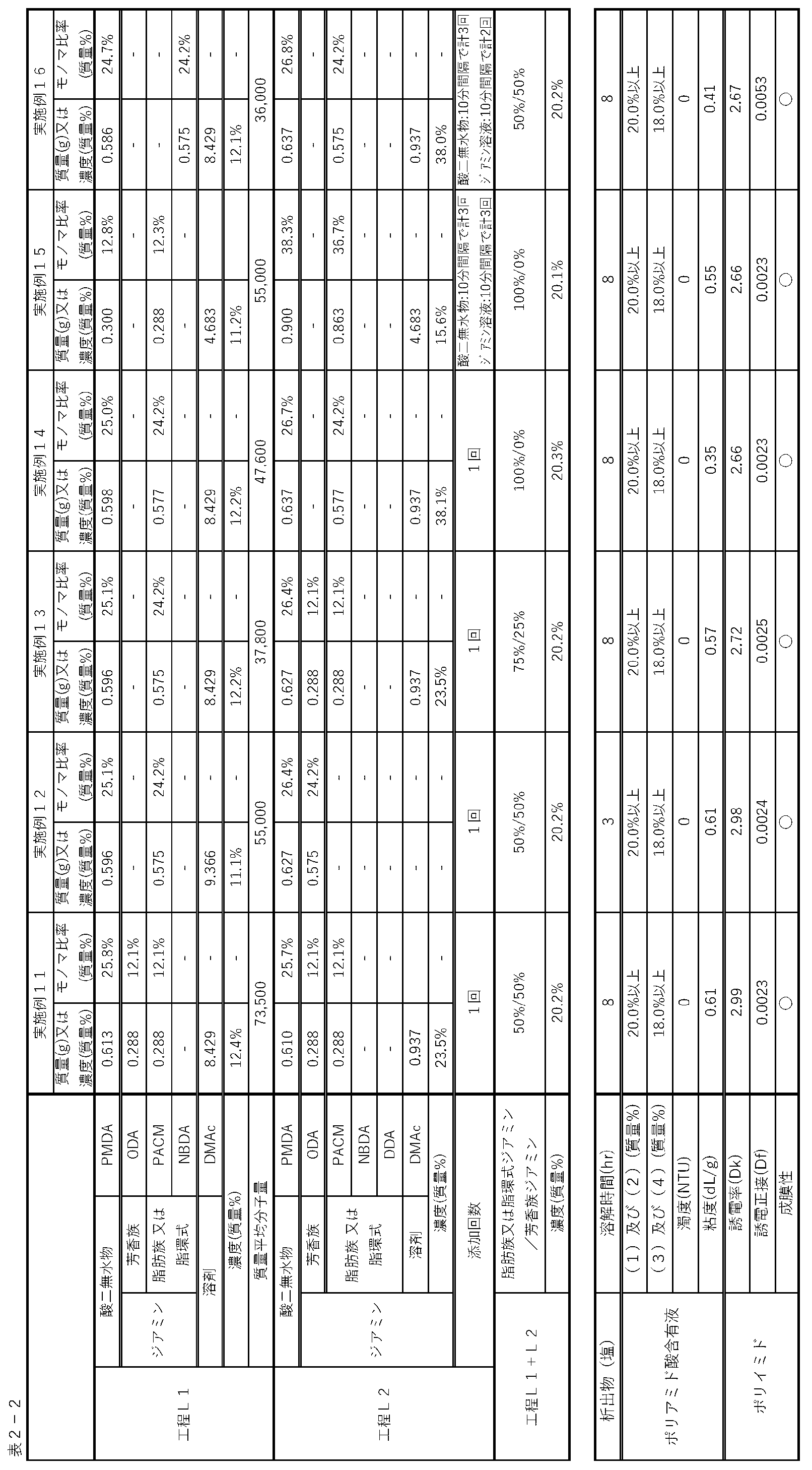
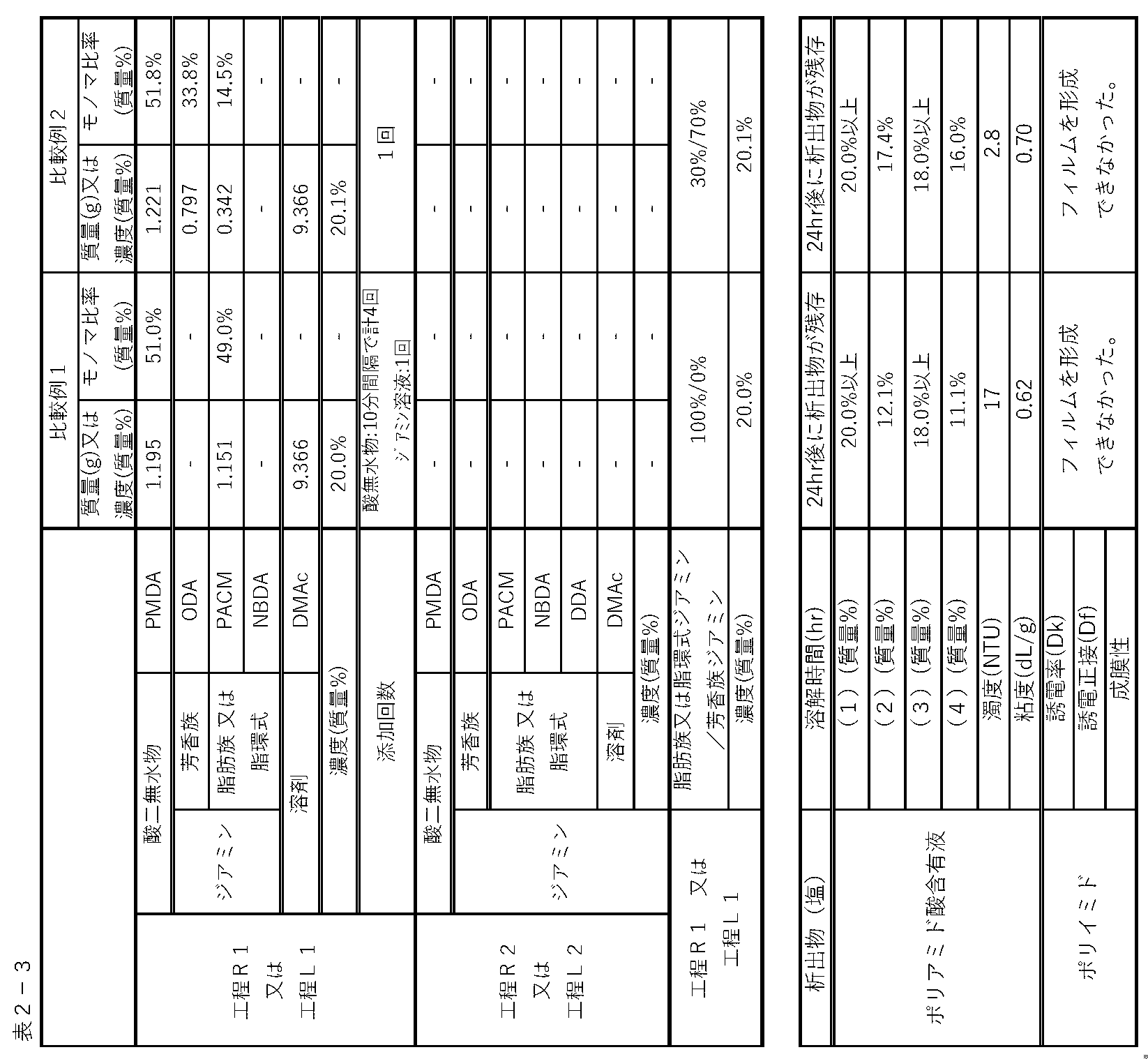
[実施例17]
(ポリアミド酸含有液17aの調製)
製造方法Riを用いてポリアミド酸含有液17aを調製した。
ドラフト内でODA(24.5g,0.122mol)、PMDA(7.11g,0.033mol)、及び脱水DMAc(300.0g)を500mL三口フラスコに仕込み、1時間撹拌した。別途、DDA(21.8g,0.041mol)と脱水DMAc(20.0g)をサンプル瓶に仕込み、撹拌し、ジアミン溶液aを調製した。その後、スクリュー管にジアミン溶液aとPMDA(26.6g,0.122mol)の全量を仕込み、室温で計8時間撹拌することで、ポリアミド酸含有液17a得た。
ポリアミド酸含有液17aを芳香族プレポリマー含有液として用い、製造方法Rsによりポリアミド酸含有液17bを調製した。
ポリアミド酸含有液17aが入った500mL三口フラスコにODA(10.2g,0.051mol)とPMDA(2.97g,0.014mol)を仕込み、1時間撹拌した。別途、DDA(9.10g,0.017mol)と脱水DMAc(18.2g)をサンプル瓶に仕込み、撹拌し、ジアミン溶液bを調製した。その後、スクリュー管にジアミン溶液bとPMDA(11.1g,0.051mol)の全量を仕込み、室温で計8時間撹拌することで、ポリアミド酸含有液17bを得た。
粘度を以下の方法で測定したこと以外はポリアミド酸含有液の調製及び評価(1)と同様にして測定した。測定結果を表3に示す。実施例17のポリアミド酸含有液は、重合反応中に生じた析出物が溶解していたために、ろ過により固形分残渣が回収されなかった。
粘度は、回転式B型粘度計(「TVB-10M」、東機産業株式会社)を用い、ポリアミド酸含有液の温度を30℃とし、No.3ローターを用いて測定した。
ポリアミド酸含有液の調製及び評価(1)と同様にして評価した。評価結果を表3に示す。

Claims (30)
- 芳香族ジアミン由来の構造及びテトラカルボン酸二無水物由来の構造を含むアミド酸プレポリマーを含有するプレポリマー含有液と、脂肪族又は脂環式ジアミンと、テトラカルボン酸二無水物とを用いてポリアミド酸を含有するポリアミド酸含有液を得ることを含む、ポリアミド酸含有液の製造方法。
- 芳香族ジアミンと、テトラカルボン酸二無水物と、溶剤とを用いて前記プレポリマー含有液を得ること、及び、
前記プレポリマー含有液に、前記脂肪族又は脂環式ジアミンと、前記テトラカルボン酸二無水物とを加えて前記ポリアミド酸含有液を得ることを含む、請求項1に記載のポリアミド酸含有液の製造方法。 - 前記プレポリマー含有液に、前記脂肪族又は脂環式ジアミン及び前記テトラカルボン酸二無水物の一方又は両方を、2回以上に分けて加えることを含む、請求項1又は2に記載のポリアミド酸含有液の製造方法。
- 前記プレポリマー含有液中の前記アミド酸プレポリマーの含有率が、30.0質量%以下である、請求項1~3のいずれかに記載のポリアミド酸含有液の製造方法。
- 前記ポリアミド酸の質量に対する前記アミド酸プレポリマーの質量の比率が、10.0質量%以上である、請求項1~4のいずれかに記載のポリアミド酸含有液の製造方法。
- 前記プレポリマー含有液中の前記アミド酸プレポリマーの含有率が、15.0質量%以上であり、前記ポリアミド酸の質量に対する前記アミド酸プレポリマーの質量が、50.0質量%以上である、請求項1~5のいずれかに記載のポリアミド酸含有液の製造方法。
- 前記アミド酸プレポリマーが、脂肪族又は脂環式ジアミン由来の構造を更に含む、請求項1~6のいずれかに記載のポリアミド酸含有液の製造方法。
- 脂肪族又は脂環式ジアミン由来の構造及びテトラカルボン酸二無水物由来の構造を含むアミド酸プレポリマーを含有するプレポリマー含有液と、ジアミンと、テトラカルボン酸二無水物とを用いてポリアミド酸を含有するポリアミド酸含有液を得ることを含む、ポリアミド酸含有液の製造方法。
- 脂肪族又は脂環式ジアミンと、テトラカルボン酸二無水物と、溶剤とを用いて前記プレポリマー含有液を得ること、及び、
前記プレポリマー含有液に、前記ジアミンと、前記テトラカルボン酸二無水物とを加えて前記ポリアミド酸含有液を得ることを含む、請求項8に記載のポリアミド酸含有液の製造方法。 - 前記プレポリマー含有液に、前記ジアミン及び前記テトラカルボン酸二無水物の一方又は両方を、2回以上に分けて加えることを含む、請求項8又は9に記載のポリアミド酸含有液の製造方法。
- 前記プレポリマー含有液中の前記アミド酸プレポリマーの含有率が、15.0質量%以下である、請求項8~10のいずれかに記載のポリアミド酸含有液の製造方法。
- 前記ポリアミド酸の質量に対する前記アミド酸プレポリマーの質量の比率が、10.0質量%以上である、請求項8~11のいずれかに記載のポリアミド酸含有液の製造方法。
- 前記アミド酸プレポリマーが、芳香族ジアミン由来の構造を更に含む、請求項8~12のいずれかに記載のポリアミド酸含有液の製造方法。
- 脂肪族又は脂環式ジアミン由来の構造及びテトラカルボン酸二無水物由来の構造を含むポリアミド酸と、溶剤とを含有し、
下記の(1)及び(2)の一方又は両方を満たす、ポリアミド酸含有液。
(1)アミン及びカルボン酸無水物に由来する成分の含有率が20.0質量%以上であり、濁度が2.5NTU以下である。
(2)前記ポリアミド酸の含有率が、前記ポリアミド酸と前記溶剤の合計の質量を基準として、20.0質量%以上である。 - 前記(1)を満たす、請求項14に記載のポリアミド酸含有液。
- 前記(2)を満たす、請求項14又は15に記載のポリアミド酸含有液。
- 脂肪族又は脂環式ジアミン由来の構造及びテトラカルボン酸二無水物由来の構造を含むポリアミド酸と、溶剤とを含有し、
下記の(3)及び(4)の一方又は両方を満たす、ポリアミド酸含有液。
(3)濁度が2.5NTU以下であり、前記ポリアミド酸含有液の質量に対する、前記ポリアミド酸含有液を加熱して得られるアミン及びカルボン酸無水物に由来する成分の質量の比率が、18.0質量%以上である。
(4)前記ポリアミド酸含有液の質量に対する、前記ポリアミド酸含有液のろ液を加熱して得られるポリイミドの質量の比率が、18.0質量%以上である。 - 前記(3)を満たす、請求項17に記載のポリアミド酸含有液。
- 前記(4)を満たす、請求項17又は18に記載のポリアミド酸含有液。
- 前記テトラカルボン酸二無水物由来の構造が、ピロメリット酸二無水物由来の構造を含む、請求項14~19のいずれかに記載のポリアミド酸含有液。
- 前記ポリアミド酸が、芳香族ジアミン由来の構造を更に含む、請求項14~20のいずれかに記載のポリアミド酸含有液。
- 前記脂肪族又は脂環式ジアミン由来の構造の含有率が、前記ポリアミド酸に含まれる全てのジアミン由来の構造の質量を基準として、20質量%以上である、請求項14~21のいずれかに記載のポリアミド酸含有液。
- 前記ピロメリット酸二無水物由来の構造の含有率が、前記ポリアミド酸に含まれる全てのテトラカルボン酸二無水物由来の構造の質量を基準として、50質量%以上である、請求項20~22のいずれかに記載のポリアミド酸含有液。
- 前記脂肪族又は脂環式ジアミン由来の構造の含有率が、前記ポリアミド酸に含まれる全てのジアミン由来の構造の質量を基準として、20質量%以上であり、
前記ピロメリット酸二無水物由来の構造の含有率が、前記ポリアミド酸に含まれる全てのテトラカルボン酸二無水物由来の構造の質量を基準として、50質量%以上である、請求項20~23のいずれかに記載のポリアミド酸含有液。 - 前記脂肪族又は脂環式ジアミン由来の構造が、脂環式ジアミン由来の構造を含む、請求項14~24のいずれかに記載のポリアミド酸含有液。
- 前記脂肪族又は脂環式ジアミン由来の構造が、ダイマージアミン由来の構造を含む、請求項14~25のいずれかに記載のポリアミド酸含有液。
- プリント基板用である、請求項14~26のいずれかに記載のポリアミド酸含有液。
- 請求項14~26のいずれかに記載のポリアミド酸含有液を用いてポリイミドを得ることを含む、ポリイミドの製造方法。
- 請求項14~26のいずれかに記載のポリアミド酸含有液を用いて成形体を得ることを含む、成形体の製造方法。
- 請求項14~26のいずれかに記載のポリアミド酸含有液を用いてプリント基板を得ることを含む、プリント基板の製造方法。
Priority Applications (5)
| Application Number | Priority Date | Filing Date | Title |
|---|---|---|---|
| CN202280095614.5A CN119137186A (zh) | 2022-05-09 | 2022-05-09 | 聚酰胺酸含有液及聚酰胺酸含有液的制造方法 |
| JP2024520107A JP7835278B2 (ja) | 2022-05-09 | 2022-05-09 | ポリアミド酸含有液及びポリアミド酸含有液の製造方法 |
| US18/861,767 US20250304749A1 (en) | 2022-05-09 | 2022-05-09 | Polyamic acid-containing liquid and method for producing polyamic acid containing liquid |
| PCT/JP2022/019740 WO2023218512A1 (ja) | 2022-05-09 | 2022-05-09 | ポリアミド酸含有液及びポリアミド酸含有液の製造方法 |
| TW112117069A TW202406981A (zh) | 2022-05-09 | 2023-05-09 | 含聚醯胺酸的液體及含聚醯胺酸的液體、成形體以及印刷基板的製造方法 |
Applications Claiming Priority (1)
| Application Number | Priority Date | Filing Date | Title |
|---|---|---|---|
| PCT/JP2022/019740 WO2023218512A1 (ja) | 2022-05-09 | 2022-05-09 | ポリアミド酸含有液及びポリアミド酸含有液の製造方法 |
Publications (1)
| Publication Number | Publication Date |
|---|---|
| WO2023218512A1 true WO2023218512A1 (ja) | 2023-11-16 |
Family
ID=88729942
Family Applications (1)
| Application Number | Title | Priority Date | Filing Date |
|---|---|---|---|
| PCT/JP2022/019740 Ceased WO2023218512A1 (ja) | 2022-05-09 | 2022-05-09 | ポリアミド酸含有液及びポリアミド酸含有液の製造方法 |
Country Status (5)
| Country | Link |
|---|---|
| US (1) | US20250304749A1 (ja) |
| JP (1) | JP7835278B2 (ja) |
| CN (1) | CN119137186A (ja) |
| TW (1) | TW202406981A (ja) |
| WO (1) | WO2023218512A1 (ja) |
Citations (8)
| Publication number | Priority date | Publication date | Assignee | Title |
|---|---|---|---|---|
| JP2009294538A (ja) * | 2008-06-06 | 2009-12-17 | Hitachi Chem Co Ltd | 感光性樹脂組成物及び感光性エレメント |
| WO2010113412A1 (ja) * | 2009-03-31 | 2010-10-07 | 三井化学株式会社 | 低熱膨張性ブロックポリイミドおよびその前駆体ならびにその用途 |
| WO2012081644A1 (ja) * | 2010-12-15 | 2012-06-21 | 宇部興産株式会社 | ポリイミドシームレスベルト、その製造方法、ポリイミド前駆体溶液組成物 |
| JP2013067769A (ja) * | 2011-09-09 | 2013-04-18 | Ube Industries Ltd | ポリイミド前駆体水溶液組成物、及びポリイミド前駆体水溶液組成物の製造方法 |
| JP2020076072A (ja) * | 2018-10-12 | 2020-05-21 | ユニチカ株式会社 | ポリイミドフィルム |
| WO2021176779A1 (ja) * | 2020-03-03 | 2021-09-10 | 昭和電工マテリアルズ株式会社 | ポリイミド前駆体、樹脂組成物、絶縁電線、及びフレキシブル基板 |
| JP2021161387A (ja) * | 2020-03-31 | 2021-10-11 | 日鉄ケミカル&マテリアル株式会社 | ポリイミド、架橋ポリイミド、接着剤フィルム、積層体、カバーレイフィルム、樹脂付き銅箔、金属張積層板、回路基板及び多層回路基板 |
| JP2022046213A (ja) * | 2020-09-10 | 2022-03-23 | 合肥漢之和新材料科技有限公司 | 接着剤、接着シート及びフレキシブル銅張積層板 |
-
2022
- 2022-05-09 CN CN202280095614.5A patent/CN119137186A/zh active Pending
- 2022-05-09 WO PCT/JP2022/019740 patent/WO2023218512A1/ja not_active Ceased
- 2022-05-09 US US18/861,767 patent/US20250304749A1/en active Pending
- 2022-05-09 JP JP2024520107A patent/JP7835278B2/ja active Active
-
2023
- 2023-05-09 TW TW112117069A patent/TW202406981A/zh unknown
Patent Citations (8)
| Publication number | Priority date | Publication date | Assignee | Title |
|---|---|---|---|---|
| JP2009294538A (ja) * | 2008-06-06 | 2009-12-17 | Hitachi Chem Co Ltd | 感光性樹脂組成物及び感光性エレメント |
| WO2010113412A1 (ja) * | 2009-03-31 | 2010-10-07 | 三井化学株式会社 | 低熱膨張性ブロックポリイミドおよびその前駆体ならびにその用途 |
| WO2012081644A1 (ja) * | 2010-12-15 | 2012-06-21 | 宇部興産株式会社 | ポリイミドシームレスベルト、その製造方法、ポリイミド前駆体溶液組成物 |
| JP2013067769A (ja) * | 2011-09-09 | 2013-04-18 | Ube Industries Ltd | ポリイミド前駆体水溶液組成物、及びポリイミド前駆体水溶液組成物の製造方法 |
| JP2020076072A (ja) * | 2018-10-12 | 2020-05-21 | ユニチカ株式会社 | ポリイミドフィルム |
| WO2021176779A1 (ja) * | 2020-03-03 | 2021-09-10 | 昭和電工マテリアルズ株式会社 | ポリイミド前駆体、樹脂組成物、絶縁電線、及びフレキシブル基板 |
| JP2021161387A (ja) * | 2020-03-31 | 2021-10-11 | 日鉄ケミカル&マテリアル株式会社 | ポリイミド、架橋ポリイミド、接着剤フィルム、積層体、カバーレイフィルム、樹脂付き銅箔、金属張積層板、回路基板及び多層回路基板 |
| JP2022046213A (ja) * | 2020-09-10 | 2022-03-23 | 合肥漢之和新材料科技有限公司 | 接着剤、接着シート及びフレキシブル銅張積層板 |
Also Published As
| Publication number | Publication date |
|---|---|
| US20250304749A1 (en) | 2025-10-02 |
| CN119137186A (zh) | 2024-12-13 |
| TW202406981A (zh) | 2024-02-16 |
| JPWO2023218512A1 (ja) | 2023-11-16 |
| JP7835278B2 (ja) | 2026-03-25 |
Similar Documents
| Publication | Publication Date | Title |
|---|---|---|
| JP7514369B2 (ja) | ポリアミド酸、ポリアミド酸溶液、ポリイミド、ポリイミド膜、積層体およびフレキシブルデバイス | |
| JP7728901B2 (ja) | ポリアミド酸組成物およびその製造方法、ポリイミドフィルム、積層体およびその製造方法、ならびにフレキシブルデバイス | |
| US11421081B2 (en) | Polyimide-polybenzoxazole precursor solution, polyimide-polybenzoxazole film, and preparation method therefor | |
| TWI589643B (zh) | Polyamic acid composition, polyamic acid, polyimide composition And Polyimide | |
| JP5473601B2 (ja) | ポリイミド樹脂組成物、該ポリイミド樹脂組成物を与えるポリイミド前駆体樹脂組成物およびそれらの製造方法、ならびにポリイミドフィルムおよびその製造方法 | |
| WO2010050491A1 (ja) | ポリイミド前駆体溶液組成物 | |
| JPWO2010113412A1 (ja) | 低熱膨張性ブロックポリイミドおよびその前駆体ならびにその用途 | |
| JP6935623B2 (ja) | 光特性及び位相遅延特性に優れた高透明性のポリイミド前駆体樹脂組成物、これを用いたポリイミド樹脂フィルムの製造方法、及びこれによって製造されたポリイミド樹脂フィルム | |
| JP2017149796A (ja) | ポリイミド前駆体組成物、及びポリイミド前駆体組成物の製造方法 | |
| JPWO2018042999A1 (ja) | ポリアミド酸、ポリアミド酸溶液、ポリイミド、ポリイミド膜、積層体およびフレキシブルデバイス、ならびにポリイミド膜の製造方法 | |
| EP3106487A1 (en) | Polyamide acid composition and polyimide composition | |
| KR20210057942A (ko) | 고탄성 및 고내열 폴리이미드 필름 및 그 제조방법 | |
| KR102095599B1 (ko) | 폴리이미드 수지의 제조 방법, 폴리이미드막의 제조 방법, 폴리아믹산 용액의 제조 방법, 폴리이미드막 및 폴리아믹산 용액 | |
| KR20210055230A (ko) | 저유전 폴리이미드 필름 및 그 제조방법 | |
| JP2020521036A (ja) | レーザー剥離容易性及び高耐熱性を有するポリアミド酸樹脂の製造方法及びこれを用いて製造したポリイミド樹脂フィルム | |
| KR20160094551A (ko) | 폴리아믹산 조성물 및 폴리이미드 기재 | |
| KR20220013387A (ko) | 폴리아미드산 용액 및 그의 제조 방법, 폴리이미드 필름, 적층체 및 그의 제조 방법, 그리고 플렉시블 디바이스 | |
| JP2015178542A (ja) | ポリイミド前駆体組成物、ポリイミド成形体の製造方法、及びポリイミド成形体 | |
| KR102292265B1 (ko) | 폴리이미드 수지의 제조 방법, 폴리이미드막의 제조 방법, 폴리아믹산 용액의 제조 방법, 폴리이미드막 및 폴리아믹산 용액 | |
| JP2024005109A (ja) | ポリイミド樹脂及びポリイミド樹脂組成物の製造方法 | |
| JP7835278B2 (ja) | ポリアミド酸含有液及びポリアミド酸含有液の製造方法 | |
| JP6760083B2 (ja) | ポリイミド前駆体組成物およびそれを用いた絶縁被覆層の製造方法 | |
| WO2024228304A1 (ja) | ブロック共重合体、ブロック共重合体の製造方法、絶縁材料、ポリイミド、及びプリント基板 | |
| WO2022196664A1 (ja) | ポリイミド前駆体組成物 | |
| TWI922627B (zh) | 聚醯亞胺前驅物組成物、清漆、聚醯亞胺薄膜、及聚醯亞胺薄膜之製造方法 |
Legal Events
| Date | Code | Title | Description |
|---|---|---|---|
| 121 | Ep: the epo has been informed by wipo that ep was designated in this application |
Ref document number: 22941594 Country of ref document: EP Kind code of ref document: A1 |
|
| WWE | Wipo information: entry into national phase |
Ref document number: 2024520107 Country of ref document: JP |
|
| WWE | Wipo information: entry into national phase |
Ref document number: 18861767 Country of ref document: US |
|
| WWE | Wipo information: entry into national phase |
Ref document number: 202280095614.5 Country of ref document: CN |
|
| NENP | Non-entry into the national phase |
Ref country code: DE |
|
| 122 | Ep: pct application non-entry in european phase |
Ref document number: 22941594 Country of ref document: EP Kind code of ref document: A1 |
|
| WWP | Wipo information: published in national office |
Ref document number: 18861767 Country of ref document: US |