WO2023209964A1 - 係合構造および端子台 - Google Patents
係合構造および端子台 Download PDFInfo
- Publication number
- WO2023209964A1 WO2023209964A1 PCT/JP2022/019313 JP2022019313W WO2023209964A1 WO 2023209964 A1 WO2023209964 A1 WO 2023209964A1 JP 2022019313 W JP2022019313 W JP 2022019313W WO 2023209964 A1 WO2023209964 A1 WO 2023209964A1
- Authority
- WO
- WIPO (PCT)
- Prior art keywords
- dovetail
- housing
- insertion direction
- protrusion
- module
- Prior art date
- Legal status (The legal status is an assumption and is not a legal conclusion. Google has not performed a legal analysis and makes no representation as to the accuracy of the status listed.)
- Ceased
Links
Images




Classifications
-
- H—ELECTRICITY
- H01—ELECTRIC ELEMENTS
- H01R—ELECTRICALLY-CONDUCTIVE CONNECTIONS; STRUCTURAL ASSOCIATIONS OF A PLURALITY OF MUTUALLY-INSULATED ELECTRICAL CONNECTING ELEMENTS; COUPLING DEVICES; CURRENT COLLECTORS
- H01R9/00—Structural associations of a plurality of mutually-insulated electrical connecting elements, e.g. terminal strips or terminal blocks; Terminals or binding posts mounted upon a base or in a case; Bases therefor
- H01R9/22—Bases, e.g. strip, block, panel
- H01R9/24—Terminal blocks
-
- H—ELECTRICITY
- H01—ELECTRIC ELEMENTS
- H01R—ELECTRICALLY-CONDUCTIVE CONNECTIONS; STRUCTURAL ASSOCIATIONS OF A PLURALITY OF MUTUALLY-INSULATED ELECTRICAL CONNECTING ELEMENTS; COUPLING DEVICES; CURRENT COLLECTORS
- H01R9/00—Structural associations of a plurality of mutually-insulated electrical connecting elements, e.g. terminal strips or terminal blocks; Terminals or binding posts mounted upon a base or in a case; Bases therefor
- H01R9/16—Fastening of connecting parts to base or case; Insulating connecting parts from base or case
Definitions
- the present invention relates to an engagement structure and a terminal block including the engagement structure.
- JP 2014-135280A discloses a frame and a mounting portion.
- the frame has a dovetail block.
- the mounting portion has a dovetail groove (dovetail hole). By engaging the dovetail block and the dovetail groove, the frame and the mounting portion are engaged.
- a member to be accommodated is accommodated in the accommodating member having an opening through the opening.
- a dovetail hole is formed in the housing member from the open end of the opening along the insertion direction of the housing member.
- a dovetail tenon is formed on the accommodated member along the insertion direction.
- the dovetail tenon and dovetail hole engage with each other as the accommodated member is accommodated in the accommodation member. Thereby, the housing member and the housing member can be engaged with each other while housing the housing member in the housing member.
- the present invention aims to solve the above-mentioned problems.
- a first aspect of the present invention is an engagement structure that engages a housing member having an opening and a member to be housed in the housing member by being inserted into the opening along the insertion direction.
- the dovetail structure includes a dovetail tenon provided at an end of the accommodated member, and a dovetail tenon formed on the accommodation member along the insertion direction from the open end, and the dovetail structure includes a dovetail tenon provided at an end of the accommodated member, a dovetail hole that engages with the dovetail tenon while allowing the dovetail tenon to move to a predetermined position along the direction;
- the engagement structure is such that the protrusion and the open end engage with the dovetail hole before coming into contact with each other.
- a second aspect of the present invention is a terminal block including a housing having an opening and a module housed in the housing by being inserted into the opening along the insertion direction, Among them, a locking hole is formed at a location apart from the opening end of the opening along the insertion direction, and a locking hole is provided in the module according to the arrangement of the locking hole in the casing and is connected to the locking hole.
- the tenon is a terminal block that engages with the dovetail hole before the protrusion and the open end come into contact when the module is inserted into the housing.
- the possibility that the accommodated member will fall off from the accommodation member is reduced.
- FIG. 1A is a perspective view of an I/O unit according to an embodiment.
- FIG. 1B is an exploded view of the I/O unit.
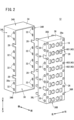
- FIG. 2 is an exploded view of the terminal block.
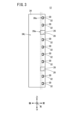
- FIG. 3 is a left side view of the terminal block.
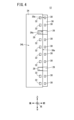
- FIG. 4 is a schematic diagram showing a state in which the tip of the dovetail tenon has reached the open end of the housing during the work of housing the module in the housing.
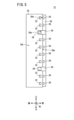
- FIG. 5 is a schematic diagram showing the casing and the module further moved backward from the state shown in FIG.
- FIG. 6A is a schematic diagram showing the casing and the module further moved backward from the state of FIG. 5.
- FIG. FIG. 6B is a diagram of the terminal block of FIG. 6A viewed from another direction.
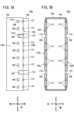
- FIG. 7A is a schematic diagram of a terminal block according to a comparative example.
- FIG. 7B is a diagram of the terminal block of FIG. 7A viewed from another direction.
- FIG. 8 is a diagram illustrating a module according to modification 1.
- FIG. 9 is a diagram showing a module and a casing according to Modification 2.
- FIG. 10 is a diagram showing a module and a casing according to Modification 3.
- FIG. 1A is a perspective view of the I/O unit 10 according to the embodiment.
- FIG. 1B is an exploded view of the I/O unit 10.
- a plurality of arrows shown in each drawing indicate each direction (front, back, left, right, top, bottom) used in the explanation below.
- the up-down direction (first direction), the left-right direction (second direction), and the front-back direction are orthogonal to each other.
- the left-right direction and the front-back direction are, for example, parallel to the horizontal plane.
- the I/O unit 10 is included in a communication system including, for example, a PLC (Programmable Logic Controller).
- the I/O unit 10 is an electronic device (input/output device) including a terminal block 12 and a signal processing unit 14.
- the signal processing unit 14 includes a plurality of contactors 14a and a signal processing module 14b.
- the plurality of contactors 14a are a group of terminals arranged on both sides of the signal processing unit 14 in the left and right direction.
- a plurality of contactors 14a arranged on the left side of the signal processing unit 14 are provided for electrical connection with another I/O unit 10 arranged on the left side of the signal processing unit 14.
- a plurality of contactors 14a disposed on the right side of the signal processing unit 14 are provided for electrical connection with another I/O unit 10 disposed on the right side of the signal processing unit 14.
- the I/O unit 10 is substantially symmetrical left and right. Based on this, illustration of the right side of the I/O unit 10 is omitted.
- the signal processing module 14b is a module that performs processing required of the I/O unit 10 in the aforementioned communication system.
- the signal processing module 14b includes, for example, an electric circuit such as a control IC (Integrated Circuit).
- the signal processing module 14b is electrically connected to the plurality of contactors 14a in the signal processing unit 14.
- the terminal block 12 is arranged ahead of the signal processing unit 14.
- the terminal block 12 is attached to the signal processing unit 14 from the front of the signal processing unit 14 along the rear direction.
- the terminal block 12 includes a plurality of connection ports 16 and an engagement structure 18.
- Each of the plurality of connection ports 16 is a portion to which an external terminal 20 is connected.
- the external terminal 20 is, for example, a terminal provided in various actuators such as machine tools and robots, various detectors, and the like.
- Each connection port 16 is provided with a terminal (401) for electrical connection with the external terminal 20 (see FIG. 2). Via that terminal, the external terminal 20 is connected to the signal processing module 14b.
- the engagement structure 18 includes a dovetail structure 22 and a latch structure 24.
- Each dovetail structure 22 has a dovetail tenon 26 and a dovetail hole 28 (see FIG. 2).
- each latch structure 24 has a protrusion 30 and a locking hole 32 (see FIG. 2).
- the number of dovetail structures 22 and latch structures 24 is not particularly limited.
- the engagement structure 18 shown in FIG. 1A includes, by way of example, a plurality of dovetail structures 22 and a plurality of latching structures 24.
- FIG. 2 is an exploded view of the terminal block 12.
- the terminal block 12 can be divided into a housing 34 and a module 36.
- the housing 34 is a housing member that houses the module 36.
- the housing 34 is formed with an opening 38, a plurality of dovetail holes 28, and a plurality of locking holes 32.
- Module 36 is inserted into housing 34 through opening 38 .
- the opening direction of the opening 38 is the front direction. Therefore, the opening end 38a of the opening 38 is located at the front end of the housing 34.
- the module 36 is inserted into the housing 34 from the front of the housing 34 along the rear direction.
- the insertion direction of the module 36 is the rear direction.
- Each of the plurality of dovetail holes 28 is a notch formed in the housing 34 along the rear direction from the opening end 38a of the opening 38.
- the plurality of dovetail holes 28 are formed on the sides of the housing 34 in the left, right, up and down directions. In this embodiment, a case will be described in which a plurality of dovetail holes 28 are formed on both sides of the casing 34 in the left-right direction.
- the plurality of locking holes 32 are formed on the side of the housing 34 where the plurality of dovetail holes 28 are formed. That is, when the plurality of dovetail holes 28 are arranged on the left side 34L and right side 34R of the housing 34, the plurality of locking holes 32 are also arranged on the left side 34L and right side 34R of the housing 34. When the plurality of dovetail holes 28 are arranged on the upper side 34U of the housing 34, the plurality of locking holes 32 are also arranged on the upper side 34U of the housing 34. When the plurality of dovetail holes 28 are arranged on the lower side 34B of the housing 34, the plurality of locking holes 32 are also arranged on the lower side 34B of the housing 34.
- Each of the plurality of locking holes 32 is arranged at a location in the housing 34 that is away from the opening end 38a along the insertion direction. That is, in this embodiment, each locking hole 32 is arranged at the rear of the open end 38a.
- the material of the housing 34 preferably includes a flexible material.
- the flexible material includes, for example, a resin material.
- the casing 34 can be deformed to some extent depending on the force applied to the casing 34.
- the module 36 is a member to be accommodated in the housing 34.
- Module 36 includes multiple components 40 .
- the plurality of components 40 include, for example, a terminal 401 arranged in the connection port 16 described above. However, the plurality of components 40 may further include a release operator 402 and a light guide member 403.
- the release operator 402 is an operator operated by the operator in order to release the connection between the connection port 16 and the external terminal 20 connected to the connection port 16.
- the release operator 402 is, for example, a pusher.
- the terminal block 12 may include a plurality of release operators 402. Accordingly, multiple components 40 may include multiple release operators 402.
- the light guide member 403 is a member that guides light from a predetermined light source to a lamp provided in the terminal block 12, for example, in order to light the lamp.
- the light guide member 403 is, for example, a light pipe.
- the terminal block 12 may include a plurality of light guide members 403. Therefore, the plurality of components 40 may include the plurality of light guide members 403.
- a plurality of dovetail tenons 26 and a plurality of protrusions 30 are formed on the module 36.
- the plurality of dovetail tenons 26 are provided on the side of the module 36 according to the arrangement of the plurality of dovetail holes 28 in the housing 34. That is, when the plurality of dovetail holes 28 are arranged on the left side 34L and right side 34R of the housing 34, the plurality of dovetail tenons 26 are arranged on the left side 36L and right side 36R of the module 36. When the plurality of dovetail holes 28 are arranged on the upper side 34U of the housing 34, the plurality of dovetail tenons 26 are arranged on the upper side 36U of the module 36. When the plurality of dovetail holes 28 are arranged on the lower side 34B of the housing 34, the plurality of dovetail tenons 26 are arranged on the lower side 36B of the module 36.
- Each of the plurality of dovetail tenons 26 extends in the insertion direction from the end of the module 36 in the opposite direction to the insertion direction. That is, in this embodiment, each dovetail tenon 26 extends rearward from the front end 36a of the module 36.
- the plurality of protrusions 30 are provided on the side of the module 36 according to the arrangement of the plurality of locking holes 32 in the housing 34. That is, when the plurality of locking holes 32 are arranged on the left side 34L and right side 34R of the housing 34, the plurality of protrusions 30 are arranged on the left side 36L and right side 36R of the module 36. . When the plurality of locking holes 32 are arranged on the upper side part 34U of the housing 34, the plurality of protrusions 30 are arranged on the upper side part 36U of the module 36. When the plurality of locking holes 32 are arranged on the lower side part 34B of the housing 34, the plurality of protrusions 30 are arranged on the lower side part 36B of the module 36.
- FIG. 3 is a left side view of the terminal block 12.
- the plurality of dovetail tenons 26 are provided corresponding to different dovetail holes 28. Each dovetail tenon 26 engages a corresponding dovetail hole 28 when module 36 is housed in housing 34 .
- each dovetail hole 28 Since each dovetail hole 28 is long in the insertion direction, it engages with the corresponding dovetail tenon 26 while allowing the dovetail tenon 26 to move to some extent in the insertion direction. Each dovetail hole 28 allows the corresponding dovetail tenon 26 to move into position along the insertion direction.
- the predetermined position is, for example, a position where both sides (36L, 36R) of the module 36 in the left and right direction are completely accommodated in the housing 34.
- the engagement between the dovetail tenon 26 and the dovetail hole 28 restricts relative movement of the module 36 with respect to the housing 34 in a direction perpendicular to the insertion direction.
- the engagement between the dovetail tenon 26 and the dovetail hole 28 restricts relative movement of the module 36 with respect to the housing 34 in the vertical direction and the left/right direction.
- the engagement between the dovetail tenon 26 and the dovetail hole 28 prevents the side portion of the housing 34 in which the dovetail hole 28 is formed from bending.
- the dovetail tenon 26 of the left side 36L of the module 36 and the dovetail hole 28 of the left side 34L of the housing 34 are engaged, so that the left side 34L of the housing 34 is bent. things are regulated.
- the dovetail tenon 26 on the right side 36R of the module 36 and the dovetail hole 28 on the right side 34R of the casing 34 cause the right side 34R of the casing 34 to flex. It is regulated that
- the plurality of protrusions 30 are provided corresponding to different locking holes 32. Each protrusion 30 engages with a corresponding locking hole 32 when the module 36 is housed in the housing 34.
- the engagement between the protrusion 30 and the locking hole 32 restricts relative movement of the module 36 with respect to the housing 34 in the insertion direction and the opposite direction to the insertion direction.
- the engagement between the protrusion 30 and the locking hole 32 restricts relative movement of the module 36 with respect to the housing 34 in the front-back direction.
- the engagement between the protrusion 30 and the locking hole 32 causes the module 36 to move relative to the housing 34 in the extending direction of the side of the housing 34 where the locking hole 32 is formed. things are regulated. For example, in the case of this embodiment, the left and right side portions (34L, 34R) of the housing 34 extend in the vertical and front-back directions. Therefore, the engagement between the protrusion 30 and the locking hole 32 restricts relative movement of the module 36 with respect to the housing 34 in the up-down and front-back directions.
- the engagement between the protrusion 30 and the locking hole 32 restricts relative movement of the module 36 with respect to the housing 34 in the front-back direction. That is, according to the latch structure 24 (protrusion 30, locking hole 32), the module 36 moves relative to the housing 34 in the insertion direction that cannot be controlled by the dovetail structure 22 (dovetail tenon 26, dovetail hole 28). can be regulated. This prevents, for example, the module 36 from accidentally falling off from the housing 34 through the opening 38.
- the engagement between the dovetail tenon 26 and the dovetail hole 28 restricts relative movement of the module 36 with respect to the housing 34 in the vertical direction. Further, by the engagement between the protrusion 30 and the locking hole 32, relative movement of the module 36 in the vertical direction with respect to the housing 34 is more strongly restricted.
- the engagement between the dovetail tenon 26 and the dovetail hole 28 restricts relative movement of the module 36 with respect to the housing 34 in the left-right direction.
- the dovetail structure 22 (dovetail tenon 26, dovetail hole 28) prevents the module 36 from moving relative to the housing 34 in a direction that cannot be regulated by the latch structure 24 (protrusion 30, locking hole 32). can be regulated.
- the engagement between the protrusion 30 and the locking hole 32 may be inadvertently released due to the relative movement. is prevented.
- the engagement between the dovetail tenon 26 and the dovetail hole 28 restricts the casing 34 from bending in the left-right direction. This prevents the engagement between the protrusion 30 and the locking hole 32 from being inadvertently released due to the bending.
- the terminal block 12 described above it is possible to restrict relative movement of the module 36 with respect to the housing 34 in all directions including front, rear, left, right, up and down directions. Furthermore, the state in which the module 36 is housed in the housing 34 can be maintained more reliably.
- the dovetail tenon 26 has a tip 26a in the insertion direction.
- the protrusion 30 has a tip 30a in the insertion direction.
- the tip 26a of the dovetail tenon 26 is located closer to the insertion direction than the tip 30a of the protrusion 30. That is, in the case of the present embodiment, it is preferable that the tip 26a of each dovetail tenon 26 be located rearward than the tips 30a of the plurality of protrusions 30 in each of the left side 36L and right side 36R of the module 36 (Fig. (See also 3).
- the tip 26a of the dovetail tenon 26 is positioned further back than the tip 30a of the protrusion 30.
- FIG. 4 is a schematic diagram showing a state in which the tip 26a of the dovetail tenon 26 has reached the open end 38a of the housing 34 during the work of housing the module 36 in the housing 34.
- the module 36 is housed in the housing 34 through the opening 38 of the housing 34.
- the tips 26a of each of the plurality of dovetail tenons 26 reach the open end 38a of the housing 34.
- the tips 30a of each of the plurality of protrusions 30 have not reached the open end 38a.
- FIG. 5 is a schematic diagram showing the casing 34 and the module 36 further moved backward from the state shown in FIG. 4.
- FIG. 6A is a schematic diagram showing the casing 34 and the module 36 further moved backward from the state of FIG. 5.
- FIG. 6B is a diagram of the terminal block 12 in FIG. 6A viewed from another direction.
- FIG. 6B is a diagram of the terminal block 12 in FIG. 6A viewed from the front.
- illustrations of the plurality of connection ports 16, parts 40, etc. are omitted.
- the module 36 is further moved in the rear direction, so that the tips 30a of each protrusion 30 enter into the housing 34.
- Each of the plurality of protrusions 30 that has entered the housing 34 presses the housing 34 from inside the housing 34 in the respective protruding directions.
- the plurality of protrusions 30 arranged on the left side 36L of the module 36 protrude leftward.
- the plurality of protrusions 30 arranged on the right side 36R of the module 36 protrude rightward.
- the casing 34 receives a force from the plurality of protrusions 30 in a direction that pushes the casing 34 outward in the left-right direction.
- the housing 34 deforms according to the force received from the plurality of protrusions 30.
- the engagement between the dovetail tenon 26 and the dovetail hole 28 prevents the left and right sides (34L, 34R) of the housing 34 from bending. Therefore, the housing 34 does not bend significantly in the left-right direction.
- each of the plurality of dovetail tenons 26 continues to move backward along the corresponding dovetail hole 28.
- each of the plurality of protrusions 30 reaches the corresponding locking hole 32.
- the plurality of protrusions 30 and the plurality of locking holes 32 engage with each other. That is, the terminal block 12 in the state shown in FIG. 3 is obtained.
- FIG. 7A is a schematic diagram of a terminal block 100 according to a comparative example.
- the terminal block 100 includes a housing 102 and a module 104.
- the housing 102 includes an opening 105, a plurality of dovetail holes 106, and a plurality of locking holes 108.
- the opening direction of the opening 105 is the front direction.
- An open end 105a of the opening 105 is located at the front end of the housing 102. Note that the housing 102 has flexibility.
- the module 104 includes a plurality of dovetail tenons 110 and a plurality of protrusions 112.
- the module 104 is housed in the housing 102 from the front of the housing 102 along the rear direction.
- the plurality of dovetail tenons 110 are arranged corresponding to different dovetail holes 106. Furthermore, the plurality of protrusions 112 are arranged corresponding to different locking holes 108.
- each dovetail tenon 110 is located more forward than the rear end 112a of the plurality of protrusions 112. Therefore, when module 104 is housed in housing 102, protrusion 112 enters housing 102 before dovetail tenon 110 and dovetail hole 106 engage.
- FIG. 7B is a diagram of the terminal block 100 in FIG. 7A viewed from a different direction.
- the housing 102 deforms in response to the protrusion 112 entering the housing 102.
- the housing 102 deforms before the dovetail hole 106 and the locking hole 108 engage with each other. Therefore, the position of the edge of each dovetail hole 106 may change significantly depending on the deformation of the housing 102.
- the edges of the plurality of dovetail holes 106 arranged on the left side 102L of the housing 102 are shifted to the left more than the dovetail tenon 110.
- the edges of the plurality of dovetail holes 106 arranged on the right side 102R of the housing 102 are shifted to the right more than the dovetail tenons 110.
- the tip 26a of the dovetail tenon 26 is farther in the insertion direction than the tip 30a of the protrusion 30. located on the side.
- the dovetail tenon 26 and the dovetail hole 28 engage with each other before the projection 30 deforms the housing 34.
- the engagement between the dovetail tenon 26 and the dovetail hole 28 is not hindered by the latch structure 24. Therefore, the operator can easily assemble the terminal block 12 in which the module 36 can be maintained in the housing 34 more reliably.
- FIG. 8 is a diagram showing a module 361 (36) according to Modification 1.
- FIG. 8 is a diagram showing a module 361 (36) according to Modification 1.
- illustrations of parts not mentioned in the following explanation will be omitted as much as possible.
- the shape of the protrusion 30 provided in the module 36 may be modified. That is, the module 361 includes a plurality of protrusions 301 (30). Each protrusion 301 is inclined so that the thickness in the protrusion direction becomes smaller along the insertion direction. For example, the module 361 is housed in the housing 34 along the rear direction. In this case, each protrusion 301 is inclined such that the thickness of each protrusion direction becomes smaller along the rear direction.
- each protrusion 301 By slanting each protrusion 301 as described above, each protrusion 301 can be smoothly inserted into the casing 34 when the module 361 is housed in the casing 34.
- the tip 30a of the protrusion 301 may be located behind the tip 26a of the dovetail tenon 26. good. Further, within the same range, the tip 30a of the protrusion 301 and the tip 26a of the dovetail tenon 26 may be arranged at substantially the same position in the front-back direction.
- FIG. 9 is a diagram showing a module 362 (36) and a housing 342 (34) according to Modification 2. Note that FIG. 9 shows a part of the left side 36L of the module 362 and a part of the left side 34L of the housing 342.
- Module 362 includes the components of module 36 (see embodiments). However, the dovetail tenon 26 of the module 362 and the protrusion 30 are connected. Note that a plurality of protrusions 30 may be connected to one dovetail tenon 26. For example, in the example shown in FIG. 9, a plurality of protrusions 30 are arranged to sandwich one dovetail tenon 26 in a direction perpendicular to the insertion direction.
- the housing 342 includes the components of the housing 34 (see embodiment).
- the dovetail hole 28 of the housing 342 and the locking hole 32 are arranged according to the arrangement of the dovetail tenon 26 of the module 362 and the protrusion 30.
- the dovetail hole 28 and the locking hole 32 of the housing 342 are connected.
- the plurality of protrusions 30 may include both protrusions 30 that are connected to the dovetail tenon 26 and protrusions 30 that are not connected to the dovetail tenon 26. .
- FIG. 10 is a diagram showing a module 363 (36) and a housing 343 (34) according to Modification 3. Note that FIG. 10 shows a part of the left side 36L of the module 363 and a part of the left side 34L of the housing 343.
- the module 363 includes the components of the module 36 (see embodiment). Furthermore, the module 363 further includes a protrusion 42 . Module 363 may include a plurality of protrusions 42 .
- the protrusion direction of the protrusion 42 matches the protrusion direction of the protrusion 30. Therefore, in the example of FIG. 10, the protrusion 42 protrudes to the left.
- the protrusion 42 is arranged on the same side of the module 363 as the dovetail tenon 26.
- the dovetail tenon 26 is arranged at least on the left side 36L of the module 363. Therefore, the protrusion 42 is disposed at least on the left side 36L of the module 363.
- the protruding portion 42 is connected to the side portion of the dovetail tenon 26 in the direction in which the side portion of the module 363 in which the dovetail tenon 26 is arranged extends, and in the direction orthogonal to the insertion direction.
- the left side portion 36L of the module 363 extends in the front-rear, up-down direction.
- the insertion direction is posterior.
- the up-down direction is perpendicular to the rear direction.
- the protrusion 42 is connected to the lower part 26b or the upper part 26c of the dovetail tenon 26.
- the protrusion 42 in FIG. 10 is connected to the lower part 26b.
- the protrusion 42 has an inclined surface 42a.
- the inclined surface 42a is a surface of the protrusion 42 that faces in the opposite direction to the insertion direction. Therefore, in the example of FIG. 10, the inclined surface 42a is the front surface of the protrusion 42.
- the inclined surface 42a is inclined along the rear direction (insertion direction) from the dovetail tenon 26.
- the housing 343 includes the components of the housing 34 (see the embodiment). Furthermore, a notch 44 for engaging with the protrusion 42 is further formed in the housing 343.
- the notch 44 has an edge 44a in the opposite direction to the insertion direction.
- the edge 44a is the edge of the notch 44 in the front direction.
- the edge 44a is preferably parallel to the above-mentioned inclined surface 42a.
- the module 363 when the module 363 is housed in the housing 343, the inclined surface 42a of the protrusion 42 slides in the insertion direction (backward direction) along the edge 44a of the notch 44. Therefore, according to this modification, the module 363 can be smoothly housed in the housing 343.
- the module 363 when the module 363 is provided with a plurality of dovetail tenons 26, the module 363 may be provided with a plurality of protrusions 42 corresponding to each of the plurality of dovetail tenons 26. However, the protrusion 42 corresponding to at least one of the plurality of dovetail tenons 26 may be omitted.
- the engagement structure 18 of the embodiment may be applied to members other than the terminal block 12.
- the housing member (34) having the opening (38) is inserted into the opening (38) along the insertion direction to connect the housing member (36) housed in the housing member (34).
- the engagement structure 18 may be applied to other than the terminal block 12 within the range of matching.
- a first invention engages a housing member (34) having an opening (38) with a housing member (36) that is housed in the housing member by being inserted into the opening along the insertion direction.
- the engagement structure (18) includes a latch structure (24) and a dovetail structure (22), and the latch structure extends from the opening end (38a) of the opening in the housing member along the insertion direction.
- a dovetail tenon formed in the housing member from the open end along the insertion direction, and allowing the dovetail tenon to move to a predetermined position along the insertion direction; a dovetail hole (28) that engages with the dovetail hole (28), and the dovetail tenon has a dovetail hole (28) that engages with the dovetail hole (28) before the protrusion and the open end come into contact when the accommodated member is inserted into the accommodation member. It is an engagement structure that engages with a hole.
- the tip (26a) of the dovetail tenon in the insertion direction may be located closer to the insertion direction than the tip (30a) of the protrusion in the insertion direction. As a result, the engagement on the dovetail structure side is started before the engagement on the latch structure side.
- the protrusion is inclined such that the thickness in the protrusion direction of the protrusion becomes smaller in the insertion direction, and the tip (26a) of the dovetail tenon in the insertion direction is closer to the protrusion in the insertion direction.
- the protrusion may be located at the same position as the tip (30a) in the insertion direction, or on the opposite side from the tip of the protrusion.
- the protrusion and the dovetail tenon may be connected. This reduces the possibility that the accommodated member will fall off from the accommodation member.
- Two of the protrusions may be provided so as to sandwich the dovetail tenon. This reduces the possibility that the accommodated member will fall off from the accommodation member.
- a protrusion (42) provided on the accommodated member and connected to the side portion (26b) of the dovetail tenon in a direction perpendicular to the insertion direction; and a notch provided on the accommodation member that engages with the protrusion.
- a cutout (44) the protrusion has an inclined surface (42a) in the opposite direction that slopes from the dovetail tenon along the insertion direction, and the cutout extends from the dovetail hole.
- the opposite edge (44a) may be inclined along the insertion direction.
- a terminal block (12) comprising a housing (34) having an opening (38) and a module (36) housed in the housing by being inserted into the opening along the insertion direction, the terminal block (12) comprising: A locking hole (32) formed in the housing apart from the opening end (38a) of the opening along the insertion direction, and a locking hole (32) formed in the module according to the arrangement of the locking hole in the housing. a protrusion (30) that is provided and engages with the locking hole to restrict relative movement of the module with respect to the casing along a direction opposite to the insertion direction; and an end of the module.
- a dovetail tenon (26) provided in the housing, and a dovetail tenon (26) formed in the housing from the opening end along the insertion direction, allowing the dovetail tenon to move to a predetermined position along the insertion direction; a dovetail hole (28) that engages with a dovetail tenon, and when the module is inserted into the housing, the dovetail hole (28) engages with the dovetail hole before the protrusion and the open end come into contact with each other. It is a terminal block that engages with the terminal block.
- Dovetail tenon 26a Tip of dovetail tenon (tip) 26b...Lower part (side part) of dovetail tenon 26c...Top part (side part) of dovetail tenon 28... Dovetail hole 30, 301... Protrusion 30a... Tip (tip) of protrusion 32... Locking hole 34, 342, 343... Housing 36, 361 to 363...Module 38...Opening 42...Protrusion 42a...Slanted surface of protrusion (slanted surface) 44...Notch 44a...Edge (edge) of notch 401...Terminal
Landscapes
- Connector Housings Or Holding Contact Members (AREA)
- Battery Mounting, Suspending (AREA)
- Switch Cases, Indication, And Locking (AREA)
- Connections Arranged To Contact A Plurality Of Conductors (AREA)
Priority Applications (6)
| Application Number | Priority Date | Filing Date | Title |
|---|---|---|---|
| JP2024517773A JP7827843B2 (ja) | 2022-04-28 | 2022-04-28 | 係合構造および端子台 |
| CN202280095120.7A CN119096430A (zh) | 2022-04-28 | 2022-04-28 | 卡合构造以及端子台 |
| PCT/JP2022/019313 WO2023209964A1 (ja) | 2022-04-28 | 2022-04-28 | 係合構造および端子台 |
| DE112022006686.5T DE112022006686T5 (de) | 2022-04-28 | 2022-04-28 | Eingriffsstruktur und Anschlussblock |
| US18/858,625 US20250279595A1 (en) | 2022-04-28 | 2022-04-28 | Engagement structure, and terminal block |
| TW112115724A TW202410559A (zh) | 2022-04-28 | 2023-04-27 | 卡合構造及端子台 |
Applications Claiming Priority (1)
| Application Number | Priority Date | Filing Date | Title |
|---|---|---|---|
| PCT/JP2022/019313 WO2023209964A1 (ja) | 2022-04-28 | 2022-04-28 | 係合構造および端子台 |
Publications (1)
| Publication Number | Publication Date |
|---|---|
| WO2023209964A1 true WO2023209964A1 (ja) | 2023-11-02 |
Family
ID=88518106
Family Applications (1)
| Application Number | Title | Priority Date | Filing Date |
|---|---|---|---|
| PCT/JP2022/019313 Ceased WO2023209964A1 (ja) | 2022-04-28 | 2022-04-28 | 係合構造および端子台 |
Country Status (6)
| Country | Link |
|---|---|
| US (1) | US20250279595A1 (https=) |
| JP (1) | JP7827843B2 (https=) |
| CN (1) | CN119096430A (https=) |
| DE (1) | DE112022006686T5 (https=) |
| TW (1) | TW202410559A (https=) |
| WO (1) | WO2023209964A1 (https=) |
Citations (3)
| Publication number | Priority date | Publication date | Assignee | Title |
|---|---|---|---|---|
| JP2007282322A (ja) * | 2006-04-03 | 2007-10-25 | Ngk Spark Plug Co Ltd | 回路基板収容ケース |
| WO2013168335A1 (ja) * | 2012-05-09 | 2013-11-14 | パナソニック株式会社 | 端子装置 |
| US20190202381A1 (en) * | 2018-01-04 | 2019-07-04 | Sumitomo Wiring Systems, Ltd. | Power distribution box assembly with alignment features |
Family Cites Families (4)
| Publication number | Priority date | Publication date | Assignee | Title |
|---|---|---|---|---|
| JPS63197386A (ja) * | 1987-02-12 | 1988-08-16 | Murata Mfg Co Ltd | 圧電アクチユエ−タ |
| JP2003283158A (ja) * | 2002-03-26 | 2003-10-03 | Hirohide Fuse | コード整理ケース |
| JP4389498B2 (ja) * | 2003-07-01 | 2009-12-24 | 富士電機システムズ株式会社 | パラメータ設定ユニット |
| TWM458000U (zh) | 2013-01-11 | 2013-07-21 | Molex Taiwan Ltd | 電連接裝置 |
-
2022
- 2022-04-28 CN CN202280095120.7A patent/CN119096430A/zh active Pending
- 2022-04-28 US US18/858,625 patent/US20250279595A1/en active Pending
- 2022-04-28 DE DE112022006686.5T patent/DE112022006686T5/de active Pending
- 2022-04-28 JP JP2024517773A patent/JP7827843B2/ja active Active
- 2022-04-28 WO PCT/JP2022/019313 patent/WO2023209964A1/ja not_active Ceased
-
2023
- 2023-04-27 TW TW112115724A patent/TW202410559A/zh unknown
Patent Citations (3)
| Publication number | Priority date | Publication date | Assignee | Title |
|---|---|---|---|---|
| JP2007282322A (ja) * | 2006-04-03 | 2007-10-25 | Ngk Spark Plug Co Ltd | 回路基板収容ケース |
| WO2013168335A1 (ja) * | 2012-05-09 | 2013-11-14 | パナソニック株式会社 | 端子装置 |
| US20190202381A1 (en) * | 2018-01-04 | 2019-07-04 | Sumitomo Wiring Systems, Ltd. | Power distribution box assembly with alignment features |
Also Published As
| Publication number | Publication date |
|---|---|
| JPWO2023209964A1 (https=) | 2023-11-02 |
| CN119096430A (zh) | 2024-12-06 |
| JP7827843B2 (ja) | 2026-03-10 |
| DE112022006686T5 (de) | 2025-01-30 |
| TW202410559A (zh) | 2024-03-01 |
| US20250279595A1 (en) | 2025-09-04 |
Similar Documents
| Publication | Publication Date | Title |
|---|---|---|
| JP6458745B2 (ja) | 装置ユニット | |
| CN101522474B (zh) | 电路单元收容箱 | |
| KR102355948B1 (ko) | 커넥터 어셈블리 | |
| JP5809463B2 (ja) | フローティング型コネクタ | |
| WO2020017286A1 (ja) | シールドコネクタ及び外導体端子 | |
| KR20170045128A (ko) | 커넥터 | |
| JP6717420B1 (ja) | プログラマブルコントローラ用のベースボード及びプログラマブルコントローラシステム | |
| JP6270144B2 (ja) | 調心機能付きコネクタ | |
| JP2024068763A (ja) | 電気コネクタ | |
| JP2016157643A (ja) | コネクタ組立体 | |
| CN107535066B (zh) | 基板引导构件和壳体 | |
| WO2023209964A1 (ja) | 係合構造および端子台 | |
| US11183823B2 (en) | Electric junction box unit | |
| CN112744155B (zh) | 照明单元 | |
| JP6091355B2 (ja) | 電気接続箱 | |
| JP2006019297A (ja) | プラグ型コネクタ | |
| JP6199348B2 (ja) | コネクタ | |
| CN112839455A (zh) | 电子装置 | |
| JP7360886B2 (ja) | 第一コネクタ、第二コネクタ、コネクタ組立体 | |
| JP7603137B2 (ja) | 電気コネクタ及びこれを備えた電気コネクタ対 | |
| JP7854967B2 (ja) | 電子装置 | |
| CN119277703A (zh) | 电子装置 | |
| JP4415903B2 (ja) | リモコン配線器具 | |
| JP2012014862A (ja) | コネクタ | |
| JP4426470B2 (ja) | 電気接続箱の取付構造 |
Legal Events
| Date | Code | Title | Description |
|---|---|---|---|
| 121 | Ep: the epo has been informed by wipo that ep was designated in this application |
Ref document number: 22940238 Country of ref document: EP Kind code of ref document: A1 |
|
| ENP | Entry into the national phase |
Ref document number: 2024517773 Country of ref document: JP Kind code of ref document: A |
|
| WWE | Wipo information: entry into national phase |
Ref document number: 112022006686 Country of ref document: DE |
|
| WWE | Wipo information: entry into national phase |
Ref document number: 202280095120.7 Country of ref document: CN |
|
| 122 | Ep: pct application non-entry in european phase |
Ref document number: 22940238 Country of ref document: EP Kind code of ref document: A1 |
|
| WWP | Wipo information: published in national office |
Ref document number: 18858625 Country of ref document: US |