WO2023199787A1 - 卵風味付与剤、卵風味付与剤の製造方法、及び食品へ卵風味を付与する方法 - Google Patents
卵風味付与剤、卵風味付与剤の製造方法、及び食品へ卵風味を付与する方法 Download PDFInfo
- Publication number
- WO2023199787A1 WO2023199787A1 PCT/JP2023/013893 JP2023013893W WO2023199787A1 WO 2023199787 A1 WO2023199787 A1 WO 2023199787A1 JP 2023013893 W JP2023013893 W JP 2023013893W WO 2023199787 A1 WO2023199787 A1 WO 2023199787A1
- Authority
- WO
- WIPO (PCT)
- Prior art keywords
- egg
- oil
- egg flavor
- mushroom
- imparting agent
- Prior art date
- Legal status (The legal status is an assumption and is not a legal conclusion. Google has not performed a legal analysis and makes no representation as to the accuracy of the status listed.)
- Ceased
Links
Classifications
-
- A—HUMAN NECESSITIES
- A23—FOODS OR FOODSTUFFS; TREATMENT THEREOF, NOT COVERED BY OTHER CLASSES
- A23L—FOODS, FOODSTUFFS OR NON-ALCOHOLIC BEVERAGES, NOT OTHERWISE PROVIDED FOR; PREPARATION OR TREATMENT THEREOF
- A23L15/00—Egg products; Preparation or treatment thereof
-
- A—HUMAN NECESSITIES
- A23—FOODS OR FOODSTUFFS; TREATMENT THEREOF, NOT COVERED BY OTHER CLASSES
- A23D—EDIBLE OILS OR FATS, e.g. MARGARINES, SHORTENINGS OR COOKING OILS
- A23D9/00—Other edible oils or fats, e.g. shortenings or cooking oils
-
- A—HUMAN NECESSITIES
- A23—FOODS OR FOODSTUFFS; TREATMENT THEREOF, NOT COVERED BY OTHER CLASSES
- A23L—FOODS, FOODSTUFFS OR NON-ALCOHOLIC BEVERAGES, NOT OTHERWISE PROVIDED FOR; PREPARATION OR TREATMENT THEREOF
- A23L27/00—Spices; Flavouring agents or condiments; Artificial sweetening agents; Table salts; Dietetic salt substitutes; Preparation or treatment thereof
- A23L27/10—Natural spices, flavouring agents or condiments; Extracts thereof
-
- A—HUMAN NECESSITIES
- A23—FOODS OR FOODSTUFFS; TREATMENT THEREOF, NOT COVERED BY OTHER CLASSES
- A23L—FOODS, FOODSTUFFS OR NON-ALCOHOLIC BEVERAGES, NOT OTHERWISE PROVIDED FOR; PREPARATION OR TREATMENT THEREOF
- A23L27/00—Spices; Flavouring agents or condiments; Artificial sweetening agents; Table salts; Dietetic salt substitutes; Preparation or treatment thereof
- A23L27/20—Synthetic spices, flavouring agents or condiments
-
- A—HUMAN NECESSITIES
- A23—FOODS OR FOODSTUFFS; TREATMENT THEREOF, NOT COVERED BY OTHER CLASSES
- A23L—FOODS, FOODSTUFFS OR NON-ALCOHOLIC BEVERAGES, NOT OTHERWISE PROVIDED FOR; PREPARATION OR TREATMENT THEREOF
- A23L27/00—Spices; Flavouring agents or condiments; Artificial sweetening agents; Table salts; Dietetic salt substitutes; Preparation or treatment thereof
- A23L27/20—Synthetic spices, flavouring agents or condiments
- A23L27/21—Synthetic spices, flavouring agents or condiments containing amino acids
-
- A—HUMAN NECESSITIES
- A23—FOODS OR FOODSTUFFS; TREATMENT THEREOF, NOT COVERED BY OTHER CLASSES
- A23L—FOODS, FOODSTUFFS OR NON-ALCOHOLIC BEVERAGES, NOT OTHERWISE PROVIDED FOR; PREPARATION OR TREATMENT THEREOF
- A23L27/00—Spices; Flavouring agents or condiments; Artificial sweetening agents; Table salts; Dietetic salt substitutes; Preparation or treatment thereof
- A23L27/60—Salad dressings; Mayonnaise; Ketchup
Definitions
- the present invention relates to an egg flavoring agent, a method for producing an egg flavoring agent, and a method for imparting egg flavor to foods.
- Patent Document 1 describes an egg flavoring agent obtained by heat-treating a composition containing edible oil and fat and dried egg raw material.
- Patent Document 2 describes an egg yolk-flavored oil obtained by subjecting egg yolks and non-fat milk solid components to lactic acid fermentation, adding protease for enzymatic decomposition, heating in fats and oils at 130 to 180°C, and removing insoluble components.
- Patent Document 3 describes a seasoning oil having an egg flavor, which is obtained by heating a composition containing egg yolk solids, non-fat milk solids, and water in oil and fat, and then separating insoluble matter.
- Patent Document 4 describes a flavor oil that is made of egg yolk lipid extracted from defatted egg yolk with an organic solvent and has excellent effects as an egg yolk flavor imparting material.
- Patent Document 5 describes a taste enhancing composition such as egg flavor, which contains purified soybean oil with an oleic acid content and an iodine value in a specific range, and has a total tocopherol content and a ⁇ -tocopherol content in a specific range. has been done.
- the problem to be solved by the present invention is to provide an egg flavor imparting agent that can impart a good egg flavor even without containing egg-derived components, and a method for producing the same.
- Another problem to be solved by the present invention is to provide a method for imparting egg flavor to foods by adding the egg flavor imparting agent to foods.
- the present inventors have repeatedly studied in view of the above problems, and have found that an oil and fat extract containing an extract of at least one type of mushroom selected from the group consisting of eryngii mushroom, oyster mushroom, maitake mushroom, enoki mushroom, and white mushroom can impart egg flavor to foods. I found out.
- the present invention has been completed based on these findings.
- the present invention is an egg flavor imparting agent containing an extract of at least one type of mushroom selected from the group consisting of Eringi mushroom, Oyster mushroom, Maitake mushroom, Enoki mushroom, and white mushroom.
- the mushroom extract is preferably an oil and fat extract of the fruiting body of the mushroom.
- the egg flavoring agent preferably further contains at least one selected from the group consisting of protein hydrolysates, saccharides, and amino acids.
- the egg flavor imparting agent preferably does not contain components derived from eggs.
- the present invention provides an egg-based egg including a heating step of heating a mixture containing an edible fat and oil and the fruiting body of at least one mushroom selected from the group consisting of oyster mushroom, oyster mushroom, maitake mushroom, enoki mushroom, and white mushroom.
- This is a method for producing a flavoring agent.
- the heating step is preferably performed by heating at 90° C. or higher and 120° C. or lower for 10 minutes or more and 60 minutes or less.
- the mixture further contains at least one selected from the group consisting of protein hydrolysates, saccharides, and amino acids.
- the present invention is a method for imparting egg flavor to food, which includes the step of adding the egg flavor imparting agent to food.
- the egg flavor imparting agent of the present invention can impart egg flavor to foods even if it does not contain egg-derived components.
- the method for producing an egg flavor imparting agent of the present invention can produce the egg flavor imparting agent.
- the egg flavor can be imparted to food by adding the egg flavor imparting agent to the food.
- the egg flavor imparting agent of the present invention can enhance the egg flavor of foods containing egg-derived components.
- the egg flavor imparting agent of the present invention contains an extract of at least one type of mushroom selected from the group consisting of eryngium mushroom, oyster mushroom, maitake mushroom, enoki mushroom, and white mushroom.
- the extract of the mushroom is preferably an oil and fat extract of the fruiting body of the mushroom.
- edible oil or fat used in the oil/fat extract of the fruiting body of the mushroom there is no particular restriction on the edible oil or fat used in the oil/fat extract of the fruiting body of the mushroom, and any edible oil or fat well known to those skilled in the art may be appropriately employed.
- vegetable oils such as soybean oil, rapeseed oil, palm oil, corn oil, olive oil, sesame oil, safflower oil, sunflower oil, cottonseed oil, rice oil, peanut oil, palm kernel oil, coconut oil, beef tallow, pork fat, chicken fat
- animal fats such as fish oil and milk fat, medium-chain fatty acid triglycerides, and processed fats and oils obtained by fractionating, hydrogenating, and transesterifying these fats and oils.
- the edible oil and fat one type may be used alone, or a mixture of two or more types may be used. Among them, from the viewpoint of workability during production, etc., 60 mass of one or two or more kinds selected from raw material oils and fats having a solid fat content of 0% to 5% at 10°C, such as rapeseed oil, corn oil, rice oil, etc. % or more and 100% by mass or less are preferred, and oils and fats containing 80% by mass or more and 100% by mass or less are more preferred.
- the solid fat content of fats and oils can be measured according to Method I described in AOCS Official Method Cd 16b-93.
- the egg flavor imparting agent of the present invention preferably further contains at least one selected from the group consisting of protein hydrolysates, saccharides, and amino acids.
- the protein hydrolyzate used in the present invention can be obtained by hydrolyzing a protein.
- the protein hydrolysis treatment is not particularly limited, but includes, for example, enzyme treatment, acid treatment, alkali treatment, heat treatment, etc., and two or more of these treatments may be combined as appropriate.
- Proteins that serve as starting materials for obtaining protein hydrolysates include, for example, legumes such as soybeans, peas, lentils, chickpeas, black beans, fava beans, mung beans, lupine beans, and kidney beans; wheat, barley, and oats ( Grains such as oats), rice, rye, buckwheat, millet, millet, teff, and corn; almonds, coconuts, peanuts, cashews, hazelnuts, pecans, macadamia nuts, pistachios, walnuts, Brazil nuts, pili nuts, chestnuts, sesame seeds, and pine nuts.
- legumes such as soybeans, peas, lentils, chickpeas, black beans, fava beans, mung beans, lupine beans, and kidney beans
- wheat, barley, and oats Grains such as oats
- Nuts such as nuts; Plant proteins derived from seeds such as hemp seeds, chia seeds, chia, amaranth, canary seeds, flaxseed, etc.; Meats such as cows, pigs, and chickens, fish, milk, etc. Examples include one type or a mixture of two or more types selected from derived animal proteins. The mixture may be mixed in any proportion.
- the protein is preferably a vegetable protein, more preferably a vegetable protein derived from one or more types selected from beans and cereals, and one or more types selected from soybeans and corn. It is more preferable that the protein is a vegetable protein derived from seeds or more, and corn is particularly preferable.
- a general method for obtaining a protein hydrolyzate will be described below, but the method is not particularly limited thereto.
- a protein aqueous solution is prepared by dispersing raw protein in water or hot water and dissolving it. Furthermore, the aqueous protein solution is subjected to an ion exchange method using a sodium type or potassium type cation exchange resin (preferably a strongly acidic cation exchange resin), an electrodialysis method, an ultrafiltration membrane method, a loose reverse osmosis membrane method, etc. Desalt and adjust pH and calcium concentration as appropriate. For desalting, either a column method or a batch method may be employed. Further, the aqueous protein solution may be heat sterilized as appropriate before desalting.
- the aqueous protein solution is subjected to hydrolysis treatment.
- hydrolysis treatment include enzyme treatment, acid treatment, alkali treatment, heat treatment, etc., and two or more of these treatments may be combined as appropriate.
- the protein hydrolyzate can be produced as described above, but commercially available products may also be used.
- Commercially available products include "Proami” ST and “Alomate” MB-KF (both trade names) manufactured by Ajinomoto Co., Inc.
- the sugar used in the present invention may be any sugar that can produce flavor through reaction with amino acids, and may be, for example, sugar classified as monosaccharides, disaccharides, oligosaccharides, etc. More specifically, for example, the monosaccharide may be glucose, fructose, xylose, galactose, mannose, etc., and the disaccharide may be lactose, sucrose, maltose, trehalose, etc. Among them, monosaccharides are preferably used from the viewpoint of imparting egg flavor, glucose, fructose, and xylose are more preferably used, and glucose, D-fructose, and D-xylose are even more preferably used.
- sugar used in the present invention examples include starch hydrolyzed syrup, honey, and high-fructose sugar, and a sugar-containing composition containing the above sugars may also be used.
- the above sugars may be used singly or in combination of two or more.
- the amino acids used in the present invention may be any amino acids that can produce flavor by reaction with sugar, and are classified into basic amino acids, neutral amino acids, acidic amino acids, aromatic amino acids, etc. It may be an amino acid. More specifically, basic amino acids may include lysine, arginine, histidine, etc., and neutral amino acids include alanine, glycine, valine, leucine, isoleucine, serine, threonine, cystine, methionine, asparagine, The amino acid may be glutamine, proline, etc., the acidic amino acid may be aspartic acid, glutamic acid, etc., and the aromatic amino acid may be phenylalanine, tyrosine, tryptophan, etc.
- basic amino acids neutral amino acids, acidic amino acids, and aromatic amino acids are preferably used from the viewpoint of imparting egg flavor, including alanine, glycine, leucine, isoleucine, serine, threonine, cystine, Methionine, asparagine, glutamine, proline, phenylalanine, lysine, histidine, aspartic acid, glutamic acid, and tryptophan are more preferably used, L-cystine, DL-methionine, and L-proline are even more preferably used, and DL-methionine and L-proline are more preferably used. is particularly preferably used.
- One type of amino acid may be used alone, or two or more types may be used in combination.
- the egg flavor imparting agent of the present invention is not limited to this, it is preferable that it does not contain components derived from eggs.
- the method for producing the egg flavor imparting agent of the present invention involves heating a mixture containing edible oil and fat and fruiting bodies of at least one type of mushroom selected from the group consisting of eryngium mushrooms, oyster mushrooms, maitake mushrooms, enoki mushrooms, and white mushrooms to extract fats and oils. Includes a heating step to obtain the product.
- the heating step is preferably performed by heating extraction at a temperature of 90° C. or higher and 120° C. or lower for 10 minutes or more and 60 minutes or less.
- heating extraction is preferably carried out while refluxing, and it is particularly preferable to start refluxing after reaching a temperature of 90°C.
- the means for reaching a predetermined temperature is not particularly limited, and means well known to those skilled in the art may be appropriately employed.
- the mixture is stored in a container such as a tank, and while being stirred by an appropriate stirring means, heating means such as an electric heating type, direct burner type, microwave type, steam type, hot air type, etc. provided in the tank or other container are used. Just heat it.
- the mixture preferably contains at least one selected from the group consisting of protein hydrolysates, saccharides, and amino acids.
- the method for producing an egg flavor imparting agent of the present invention preferably includes a cooling step of cooling the mixture after the heating step.
- a cooling step of cooling the mixture For example, after the oil temperature reaches a predetermined temperature, it is preferable to stop heating and cool the mixture.
- the cooling method include means such as natural cooling, air cooling, and water cooling.
- auxiliary materials may be added to the mixture as appropriate.
- soy sauce, water, fragrance, spice extract, animal extract, emulsifier, silicone, etc. may be blended in appropriate amounts to form the above mixture.
- the amount of the fruiting body of the mushroom in the mixture is preferably 0.1 parts by mass or more and 100 parts by mass or less, more preferably 0.5 parts by mass or more and 75 parts by mass, based on 100 parts by mass of edible oil or fat. or less, more preferably 1 part by mass or more and 60 parts by mass or less.
- the amount of the protein hydrolyzate in the mixture is preferably 0.1 parts by mass or more and 5 parts by mass or less, more preferably 0.5 parts by mass or more and 3 parts by mass or less, based on 100 parts by mass of edible oil or fat. More preferably, it is 1 part by mass or more and 2 parts by mass or less.
- the amount of the saccharide in the mixture is preferably 0.5 parts by mass or more and 5 parts by mass or less, more preferably 1 part by mass or more and 4 parts by mass or less, still more preferably 1. It is 5 parts by mass or more and 3 parts by mass or less.
- the blending amount of the amino acid in the mixture is preferably 0.1 parts by mass or more and 5 parts by mass or less, more preferably 0.3 parts by mass or more and 3 parts by mass or less, and even more preferably The amount is 0.5 parts by mass or more and 1 part by mass or less.
- the amount of methionine used per 100 parts by mass of the oil or fat is preferably 0.001 parts by mass or more and 0.02 parts by mass or less, more preferably 0.003 parts by mass or more and 0.02 parts by mass or less. It is 0.01 part by mass or less, more preferably 0.005 part by mass or more and 0.008 part by mass or less.
- the amount of proline used per 100 parts by mass of the oil or fat is preferably 0.1 parts by mass or more and 3 parts by mass or less, more preferably 0.3 parts by mass or more and 1.5 parts by mass. It is not more than 0.5 part by mass and not more than 1 part by mass, more preferably not less than 0.5 part by mass and not more than 1 part by mass.
- a separation step of separating a liquid fraction using an appropriate solid-liquid separation means such as static separation, centrifugation, or filtration.
- the separation step is more preferably performed after the cooling step.
- the oil/fat extract obtained as described above may be mixed with other edible oil/fat to form an egg flavor imparting agent containing the oil/fat extract.
- the other edible oils include soybean oil, rapeseed oil, palm oil, corn oil, olive oil, sesame oil, safflower oil, sunflower oil, cottonseed oil, rice oil, peanut oil, palm kernel oil, coconut oil and other vegetable oils, beef tallow,
- animal fats such as pork fat, chicken fat, and milk fat, medium-chain fatty acid triglydes, and processed fats and oils obtained by fractionating, hydrogenating, and transesterifying these fats and oils.
- the content of the fat and oil extract relative to the total mass of the fat and oil extract and other edible fats and oils must be 0.1% by mass or more and less than 100% by mass. is preferable, and more preferably 0.5% by mass or more and less than 100% by mass.
- the egg flavor imparting agent obtained as described above may contain additive materials within a range that does not impair the effects of the invention.
- additive materials include antioxidants such as ascorbic acid fatty acid esters, lignans, coenzyme Q, ⁇ -oryzanol, and tocopherol, flavor imparting materials such as fragrances, spice extracts, and animal extracts, emulsifiers, silicones, and the like.
- the egg flavor imparting agent of the present invention By adding the egg flavor imparting agent of the present invention to various food and drink products, it is possible to impart a good egg flavor to the food and drink products. Furthermore, when added to foods and drinks containing eggs, the egg flavor can be enhanced. That is, by using it as cooking oil such as loosening oil, rice cooking oil, and frying oil when cooking, processing, or manufacturing various foods and drinks; seasoning oil such as kneading oil, injection oil, and finishing oil, etc. Alternatively, by using it as a seasoning oil that is added, mixed, applied, dissolved, dispersed, emulsified, etc. to various foods and drinks before eating, it is possible to impart egg flavor to the foods and drinks and enhance the flavor of the foods and drinks.
- cooking oil such as loosening oil, rice cooking oil, and frying oil when cooking, processing, or manufacturing various foods and drinks
- seasoning oil such as kneading oil, injection oil, and finishing oil, etc.
- seasoning oil such as kn
- Foods and beverages that impart egg flavor may be any food or drink that is expected to impart or enhance egg flavor, and are not particularly limited, such as tamagoyaki, boiled eggs, scrambled eggs, egg tofu, chawanmushi, egg soup, Cooked items such as egg salad, omelets, quiches, pilaf, fried rice, carbonara sauce, egg sandwiches, tinned eggs, oyakodon, okonomiyaki, crab balls, batter for fried foods; creams such as custard cream; cakes, cream puffs, waffles, Baked goods such as crepes, puddings, biscuits, cookies, crackers, sables, wafers, pretzels, and bolo; Bakery foods such as bread, donuts, steamed bread, egg bread, Baumkuchen, madeleines, financiers, soufflés, and castella; potato chips Confectionery such as pancakes, Bavarois, jellies, caramels, candies, tablets, snacks, and cereals; Frozen dessert
- instant foods such as instant ramen in bags, instant ramen in cups, instant udon in bags, instant udon in cups, instant soba in bags, instant soba in cups, and other instant noodles, milkshakes, eggnog
- beverages such as egg liquor and energy drinks, and nutritional supplements such as supplements.
- the egg flavor imparting agent of the present invention can be suitably used in alternative food and drink products that require egg flavor without containing egg-derived components.
- the content of the egg flavor imparting agent in the food/beverage product is preferably 0.1% by mass or more and 10% by mass or less, and 0.5% by mass or more, from the viewpoint of imparting a good egg flavor to the food/beverage product. It is more preferably 8% by mass or less, and even more preferably 1% by mass or more and 6% by mass or less.
- Protein hydrolyzate Protein hydrolyzate A: Proami ST manufactured by Ajinomoto Co., Inc., a protein hydrolyzate derived from soybeans and corn Protein hydrolyzate B: Aromate MB-KF, manufactured by Ajinomoto Co., Inc., a protein hydrolyzate derived from soybeans (saccharides)
- D-Fructose Anhydrous crystalline crystal-300 manufactured by Tate & Lyle Japan Co., Ltd.
- Fructose Glucose TDH (hydrated crystalline glucose) manufactured by Sanei Toka Co., Ltd.
- D-xylose D-xylose granules (amino acid) manufactured by Okamura Oil Co., Ltd.
- DL-Methionine DL-Methionine JSFA manufactured by Ajinomoto Healthy Supply Co., Ltd.
- L-proline L-proline manufactured by Ajinomoto Healthy Supply Co., Ltd.
- Egg-free mayonnaise Nissin Oilio Group Co., Ltd. Mayodore Egg-based mayonnaise: Ajinomoto Co., Ltd. Pure Select Mayonnaise Soy sauce: Kikkoman Co., Ltd. Koikuchi soy sauce
- Examples 1 to 5 and Comparative Example 1 Cut eryngii mushrooms, oyster mushrooms, maitake mushrooms, enoki mushrooms, and white mushrooms into 5 mm cubes, put a mixture of 30 g of each cut mushroom and 270 g of rapeseed oil, or 300 g of the rapeseed oil into a flask, and stir at a stirring speed of 150 rpm. After heating to 90°C, start refluxing, and after reaching a temperature of 105°C to 110°C, extract by heating for 30 minutes while maintaining that temperature, then let it cool, and leave to cool with a filter paper to remove the insoluble mixture.
- each fat and oil extract as an egg flavor imparting agent or heated rapeseed oil as a comparative example.
- Each oil/fat extract or rapeseed oil was added to egg-free mayonnaise at a content of 2% by mass, and the strength of the egg flavor was evaluated using the method described above. The results are shown in Table 1.
- the heated rapeseed oil did not have the effect of imparting egg flavor.
- the effect of imparting egg flavor was observed for oil and fat extracts containing extracts of eryngium mushroom, oyster mushroom, maitake mushroom, enoki mushroom, and white mushroom. More specifically, it had the effect of imparting the flavor of egg yolk.
- the effect of imparting egg flavor was high in the oil and fat extracts containing extracts of eryngium eringii, maitake mushrooms, and enoki mushrooms, and the oil and fat extract containing extracts of eryngium eringi had the highest effect.
- Example 6 to 10 and Comparative Example 2 Examples 1 to 5 and Comparative except that each oil extract obtained in Examples 1 to 5 or the heated rapeseed oil obtained in Comparative Example 1 was added to the egg-based mayonnaise so that the content was 2% by mass. The intensity of egg flavor was evaluated in the same manner as in Example 1. The results are shown in Table 2.
- rapeseed oil was not found to have the effect of enhancing egg taste.
- the effect of enhancing egg flavor was observed for oil and fat extracts containing extracts of eryngium mushroom, oyster mushroom, maitake mushroom, enoki mushroom, and white mushroom. More specifically, the flavor of egg yolk was strongly felt. From the results in Tables 1 and 2, it can be seen that oil and fat extracts, including extracts of eryngii mushroom, oyster mushroom, maitake mushroom, enoki mushroom, and white mushroom, not only impart the flavor of egg yolk to foods that do not contain eggs; It was found that it has the effect of enhancing the flavor of.
- Examples 11 to 13 A mixture of raw materials according to the formulation shown in Table 3 was put into a flask, heated while stirring at a stirring speed of 150 rpm, and after reaching a temperature of 90°C, reflux was started, and after reaching a temperature of 105°C or more and 110°C or less. The mixture was extracted by heating while maintaining the temperature, and then allowed to cool. Insoluble matter was filtered off from the cooled mixture using a filter paper to obtain fat and oil extracts as each egg flavor imparting agent. Each fat and oil extract was added to egg-free mayonnaise at a content of 2% by mass, and the strength of the egg flavor was evaluated using the method described above. The results are shown in Table 3.
- Example 14 to 16 The strength of the egg flavor was evaluated in the same manner as in Examples 11 to 13, except that each oil and fat extract obtained in Examples 11 to 13 was added to the egg-based mayonnaise at a content of 2% by mass. The results are shown in Table 4.
- Examples 17 to 19 A mixture of eringi mushrooms cut into 5 mm squares and rapeseed oil according to the composition shown in Table 5 was put into a flask and heated with stirring at a stirring speed of 150 rpm.After reaching a temperature of 90°C, reflux was started, and the mixture was heated to 110°C above 105°C. After reaching the temperature below °C, extraction is carried out by heating for 10, 30 or 60 minutes while maintaining the temperature, then allowed to cool, and the insoluble matter of the cooled mixture is filtered out using a filter paper to extract each oil and fat as an egg flavor imparting agent. I got something. Each fat and oil extract was added to egg-free mayonnaise at a content of 2% by mass, and the strength of the egg flavor was evaluated using the method described above. The results are shown in Table 5.
- Example 20-22 The intensity of the egg flavor was evaluated in the same manner as in Examples 17 to 19, except that each oil and fat extract obtained in Examples 17 to 19 was added to the egg-based mayonnaise at a content of 2% by mass. The results are shown in Table 6.
- Examples 23 to 25 A mixture of eringi mushrooms cut into 5 mm squares and rapeseed oil according to the composition shown in Table 7 was put into a flask and heated while stirring at 150 rpm. After reaching 90°C, reflux was started and the temperature was maintained at 90°C. The mixture was extracted by heating for 60 minutes, then allowed to cool, and the insoluble matter was filtered off using a filter paper to obtain the fat and oil extract of Example 23 as an egg flavor imparting agent. An oil and fat extract of Example 24 was obtained in the same manner as in Example 23, except that reflux was started after reaching 90°C, and after reaching 105°C, heating extraction was carried out for 30 minutes while maintaining that temperature.
- Example 25 oil and fat extract of Example 25 was obtained in the same manner as Example 23, except that reflux was started after reaching 90°C, and after reaching 120°C, heating extraction was performed for 10 minutes while maintaining that temperature. .
- Each fat and oil extract was added to egg-free mayonnaise at a content of 2% by mass, and the strength of the egg flavor was evaluated using the method described above. The results are shown in Table 7.
- Example 26 to 28 The strength of the egg flavor was evaluated in the same manner as in Examples 23 to 25, except that each oil and fat extract obtained in Examples 23 to 25 was added to the egg-based mayonnaise at a content of 2% by mass. The results are shown in Table 8.
- Examples 29-31 A mixture of raw materials according to the formulation shown in Table 9 was put into a flask, heated while stirring at a stirring speed of 150 rpm, and after reaching a temperature of 90°C, reflux was started, and after reaching a temperature of 105°C or more and 110°C or less. The mixture was extracted by heating for 30 minutes while maintaining the temperature, and then allowed to cool. Insoluble matter from the cooled mixture was filtered off using a filter paper to obtain each fat and oil extract as an egg flavor imparting agent. Each fat and oil extract was added to egg-free mayonnaise at a content of 2% by mass, and the strength of the egg flavor was evaluated using the method described above. The results are shown in Table 9.
- the effect of imparting egg flavor was confirmed by adding an oil and fat extract obtained by heat-extracting a mixture containing protein hydrolyzate, monosaccharides, and amino acids in addition to Eryngium elegans.
- the effect of imparting egg flavor was high regardless of the type of edible fat or protein hydrolyzate used in the fat/oil extract.
- Example 32 to 34 The intensity of the egg flavor was evaluated in the same manner as in Examples 29 to 31, except that each oil and fat extract obtained in Examples 32 to 34 was added to the egg-based mayonnaise at a content of 2% by mass. The results are shown in Table 10.
- the effect of enhancing egg flavor was confirmed by adding an oil and fat extract obtained by heat-extracting a mixture containing protein hydrolyzate, monosaccharides, and amino acids in addition to Eryngium elegans.
- the effect of enhancing egg flavor was high regardless of the type of edible fat or protein hydrolyzate used for the fat/oil extract. From Tables 9 and 10, it was found that the egg flavor imparting agent of the present invention has the most excellent egg flavor imparting effect and egg flavor enhancing effect when rice oil is used as the edible fat.
- Examples 35 to 37 A mixture of raw materials according to the formulation shown in Table 11 was put into a flask, heated while stirring at a stirring speed of 150 rpm, and after reaching a temperature of 90°C, reflux was started, and a temperature of 105°C to 110°C was reached. Thereafter, the mixture was heated and extracted for 30 minutes while maintaining that temperature, and then allowed to cool, and insoluble matter from the cooled mixture was filtered off using a filter paper to obtain each fat and oil extract as an egg flavor imparting agent of the present invention. Each fat and oil extract was added to egg-free mayonnaise at a content of 2% by mass, and the strength of the egg flavor was evaluated using the method described above. The results are shown in Table 11.
- Examples 38-40 The intensity of the egg flavor was evaluated in the same manner as in Examples 35 to 37, except that each oil and fat extract obtained in Examples 35 to 37 was added to the egg-based mayonnaise at a content of 2% by mass. The results are shown in Table 12.
- Examples 38 to 40 the effect of enhancing egg flavor was confirmed by adding an oil and fat extract obtained by heat-extracting a mixture containing protein hydrolyzate, monosaccharides, and amino acids in addition to Eryngium elegans. From Tables 11 and 12, it was found that by using D-fructose as the monosaccharide and DL-methionine and L-proline as the amino acids, an egg flavor imparting agent with excellent egg flavor imparting effect and egg flavor enhancing effect could be obtained.
- Examples 41-43 A mixture of raw materials according to the formulation shown in Table 13 was put into a flask, heated while stirring at a stirring speed of 150 rpm, and after reaching a temperature of 90°C, reflux was started, and after reaching the extraction temperature shown in Table 13. While maintaining the temperature, extraction was carried out by heating for the extraction time shown in Table 13, then allowed to cool, and the insoluble matter from the cooled mixture was filtered out using a filter paper to obtain each fat and oil extract as an egg flavor imparting agent of the present invention. Obtained. Each fat and oil extract was added to egg-free mayonnaise at a content of 2% by mass, and the strength of the egg flavor was evaluated using the method described above. The results are shown in Table 13.
- Example 44-466 The intensity of the egg flavor was evaluated in the same manner as in Examples 41 to 43, except that each oil and fat extract obtained in Examples 41 to 43 was added to the egg-based mayonnaise at a content of 2% by mass. The results are shown in Table 14.
Landscapes
- Life Sciences & Earth Sciences (AREA)
- Chemical & Material Sciences (AREA)
- Engineering & Computer Science (AREA)
- Food Science & Technology (AREA)
- Polymers & Plastics (AREA)
- Health & Medical Sciences (AREA)
- Nutrition Science (AREA)
- Proteomics, Peptides & Aminoacids (AREA)
- Oil, Petroleum & Natural Gas (AREA)
- Seasonings (AREA)
Abstract
卵由来の成分を含まなくても、良好な卵風味を付与できる卵風味付与剤、その製造方法、及び食品へ卵風味を付与する方法を提供する。 本発明の卵風味付与剤は、エリンギ、ヒラタケ、マイタケ、エノキ及びホワイトマッシュルームからなる群から選ばれる少なくとも1種のキノコの抽出物を含む。本発明の卵風味付与剤の製造方法は、上記から選ばれる少なくとも1種のキノコの子実体と食用油脂とを含む混合物を加熱して油脂抽出物を得る加熱工程を含む。本発明の食品へ卵風味を付与する方法は、上記卵風味付与剤を食品に添加する工程を含む。
Description
本発明は、卵風味付与剤、卵風味付与剤の製造方法、及び食品へ卵風味を付与する方法に関する。
従来、卵風味を付与するための様々な食品用素材が提案されてきた。例えば、特許文献1には、食用油脂及び乾燥卵原料を含む組成物を加熱処理してなる卵風味付与剤が記載されている。特許文献2には、卵黄と無脂乳固形成分を乳酸発酵させ、プロテアーゼを添加して酵素分解し、130~180℃の油脂中で加熱し、不溶性成分を除去して得られる卵黄風味油が記載されている。特許文献3には、卵黄固形分、無脂乳固形分及び水を含有する組成物を油脂中で加熱した後、不溶解物を分離した、卵風味を有する調味油が記載されている。特許文献4には、脱脂卵黄から有機溶剤で抽出した卵黄脂質からなる、卵黄風味等付与材として優れた効果を有する風味油が記載されている。特許文献5には、オレイン酸含有率及びヨウ素価がそれぞれ特定範囲の精製大豆油を含有し、全トコフェロール及びδ-トコフェロールの含有量がそれぞれ特定範囲の卵風味等の呈味増強組成物が記載されている。
近年、アレルギーの原因となり得る卵由来の成分を含まない卵風味付与剤が希求されている。そのような卵風味付与剤として、例えば特許文献5に記載されている特殊な油脂を用いる呈味増強組成物も提案されているが、卵を含有しない料理に対する効果は確認されていない。
本発明が解決しようとする課題は、卵由来の成分を含まなくても、良好な卵風味を付与できる卵風味付与剤及びその製造方法を提供することである。本発明が解決しようとする別の課題は、当該卵風味付与剤を食品に添加して食品へ卵風味を付与する方法を提供することである。
本発明者らは上記課題に鑑み検討を重ね、エリンギ、ヒラタケ、マイタケ、エノキ及びホワイトマッシュルームからなる群から選ばれる少なくとも1種のキノコの抽出物を含む油脂抽出物が食品に卵風味を付与できることを見出した。本発明はこれらの知見に基づき完成されるに至ったものである。
本発明は、エリンギ、ヒラタケ、マイタケ、エノキ及びホワイトマッシュルームからなる群から選ばれる少なくとも1種のキノコの抽出物を含む卵風味付与剤である。
前記キノコの抽出物は、好ましくは前記キノコの子実体の油脂抽出物である。
前記卵風味付与剤は、好ましくは、タンパク質加水分解物、糖類及びアミノ酸からなる群から選ばれる少なくとも1種を更に含む。
前記卵風味付与剤は、好ましくは卵に由来する成分を含まない。
前記キノコの抽出物は、好ましくは前記キノコの子実体の油脂抽出物である。
前記卵風味付与剤は、好ましくは、タンパク質加水分解物、糖類及びアミノ酸からなる群から選ばれる少なくとも1種を更に含む。
前記卵風味付与剤は、好ましくは卵に由来する成分を含まない。
また本発明は、エリンギ、ヒラタケ、マイタケ、エノキ及びホワイトマッシュルームからなる群から選ばれる少なくとも1種のキノコの子実体と食用油脂とを含む混合物を加熱して油脂抽出物を得る加熱工程を含む卵風味付与剤の製造方法である。
前記加熱工程を、好ましくは、90℃以上120℃以下で10分間以上60分間以下加熱して行う。
前記卵風味付与剤の製造方法は、好ましくは、前記混合物が、タンパク質加水分解物、糖類及びアミノ酸からなる群から選ばれる少なくとも1種を更に含む。
前記加熱工程を、好ましくは、90℃以上120℃以下で10分間以上60分間以下加熱して行う。
前記卵風味付与剤の製造方法は、好ましくは、前記混合物が、タンパク質加水分解物、糖類及びアミノ酸からなる群から選ばれる少なくとも1種を更に含む。
さらに本発明は、前記卵風味付与剤を食品に添加する工程を含む、食品へ卵風味を付与する方法である。
本発明の卵風味付与剤は、卵由来の成分を含んでいなくても、食品に卵風味を付与できる。本発明の卵風味付与剤の製造方法は、当該卵風味付与剤を製造できる。本発明の食品へ卵風味を付与する方法は、当該卵風味付与剤を食品に添加して食品へ卵風味を付与できる。
さらに、本発明の卵風味付与剤は、卵由来の成分を含んでいる食品の卵風味を増強することができる。
さらに、本発明の卵風味付与剤は、卵由来の成分を含んでいる食品の卵風味を増強することができる。
本発明について更に詳細に説明する。
<卵風味付与剤>
本発明の卵風味付与剤は、エリンギ、ヒラタケ、マイタケ、エノキ及びホワイトマッシュルームからなる群から選ばれる少なくとも1種のキノコの抽出物を含む。当該キノコの抽出物は、好ましくは当該キノコの子実体の油脂抽出物である。
<卵風味付与剤>
本発明の卵風味付与剤は、エリンギ、ヒラタケ、マイタケ、エノキ及びホワイトマッシュルームからなる群から選ばれる少なくとも1種のキノコの抽出物を含む。当該キノコの抽出物は、好ましくは当該キノコの子実体の油脂抽出物である。
前記当該キノコの子実体の油脂抽出物に使用される食用油脂としては、特に制限はなく、当業者に周知の食用油脂を適宜採用し得る。例えば、大豆油、菜種油、パーム油、コーン油、オリーブ油、ゴマ油、紅花油、ひまわり油、綿実油、米油、落花生油、パーム核油、ヤシ油等の植物油脂、牛脂、豚脂、鶏脂、魚油、乳脂等の動物脂、中鎖脂肪酸トリグリセリド、あるいはこれら油脂に分別、水素添加、エステル交換等を施した加工油脂などが挙げられる。当該食用油脂として、1種類を単品で用いてもよく、あるいは2種類以上が混合されたものを用いてもよい。なかでも、製造時の作業性等の点で、菜種油、コーン油、米油等の10℃における固体脂含量が0%以上5%以下の原料油脂から選ばれる1種又は2種以上を60質量%以上100質量%以下配合した油脂が好ましく、80質量%以上100質量%以下配合した油脂がより好ましい。油脂の固体脂含量は、AOCS Official Method Cd 16b-93に記載のMethod Iの方法に従って測定できる。
本発明の卵風味付与剤は、好ましくは、タンパク質加水分解物、糖類及びアミノ酸からなる群から選ばれる少なくとも1種を更に含む。
タンパク質を加水分解して、本発明に用いる前記タンパク質加水分解物を取得できる。タンパク質の加水分解処理としては、特に限定されないが、例えば酵素処理、酸処理、アルカリ処理、熱処理等が挙げられ、これらの2種以上の処理を適宜組み合わせてもよい。
タンパク質加水分解物を取得するにあたり出発原料となるタンパク質は、例えば、大豆、えんどう豆、レンズ豆、ひよこ豆、黒豆、空豆、緑豆、ルピン豆、インゲン豆等の豆類;小麦、大麦、燕麦(オート麦)、米、ライムギ、そば、ひえ、あわ、テフ、トウモロコシなどの穀類;アーモンド、ココナッツ、ピーナッツ、カシューナッツ、ヘーゼルナッツ、ペカンナッツ、マカダミアナッツ、ピスタチオ、クルミ、ブラジルナッツ、ピリナッツ、栗、ゴマ、松の実等のナッツ類;大麻種子、チア種子、キア、アマランサス、カナリーシ―ド、アマニなどの種子類等に由来する植物性タンパク質;牛、豚、鶏などの畜肉類、魚類、乳等などに由来する動物性タンパク質等から選ばれる1種又は2種以上の混合物が挙げられる。当該混合物は任意の割合で混合されていてよい。
また、前記タンパク質は、植物性タンパク質であることが好ましく、豆類及び穀類から選ばれる1種または2種以上に由来する植物性タンパク質であることがより好ましく、大豆およびトウモロコシから選ばれる1種または2種以上に由来する植物性タンパク質であることがさらに好ましく、トウモロコシであることが特に好ましい。
また、前記タンパク質は、植物性タンパク質であることが好ましく、豆類及び穀類から選ばれる1種または2種以上に由来する植物性タンパク質であることがより好ましく、大豆およびトウモロコシから選ばれる1種または2種以上に由来する植物性タンパク質であることがさらに好ましく、トウモロコシであることが特に好ましい。
以下にタンパク質加水分解物の一般的な取得方法を説明するが、特にこれに限定されるものではない。
原料タンパク質を水又は温湯に分散し、溶解してタンパク質水溶液を調製する。
さらに、前記タンパク質水溶液を、ナトリウム型又はカリウム型陽イオン交換樹脂(好適には強酸性陽イオン交換樹脂)を用いたイオン交換法、電気透析法、限界濾過膜法、ルーズ逆浸透膜法等で脱塩し、適宜pH調整及びカルシウム濃度調整を行う。脱塩の際には、カラム式及びバッチ式の何れを採用してもよい。また、タンパク質水溶液を、脱塩前等に適宜、加熱殺菌してもよい。
原料タンパク質を水又は温湯に分散し、溶解してタンパク質水溶液を調製する。
さらに、前記タンパク質水溶液を、ナトリウム型又はカリウム型陽イオン交換樹脂(好適には強酸性陽イオン交換樹脂)を用いたイオン交換法、電気透析法、限界濾過膜法、ルーズ逆浸透膜法等で脱塩し、適宜pH調整及びカルシウム濃度調整を行う。脱塩の際には、カラム式及びバッチ式の何れを採用してもよい。また、タンパク質水溶液を、脱塩前等に適宜、加熱殺菌してもよい。
次いで、前記タンパク質水溶液を、加水分解処理する。当該加水分解処理として、例えば酵素処理、酸処理、アルカリ処理、熱処理等が挙げられ、これらの2種以上の処理を適宜組み合わせてもよい。
前記タンパク質加水分解物は、上述のように製造できるが、市販品を用いてもよい。市販品としては、味の素株式会社製の「プロアミ」ST、「アロメイト」MB-KF(いずれも商品名)等が挙げられる。
本発明に用いる糖としては、アミノ酸との反応により風味を生じさせることができる糖であればよく、例えば単糖類、二糖類、オリゴ糖類等に分類される糖であってよい。より具体的には、例えば単糖類として、グルコース、フルクトース、キシロース、ガラクトース、マンノース等であってよく、二糖類として、ラクトース、スクロース、マルトース、トレハロース等であってよい。なかでも、卵風味付与を付与する点からは、単糖類が好ましく用いられ、グルコース、フルクトース、キシロースがより好ましく用いられ、グルコース、D-フルクトース、D-キシロースが更に好ましく用いられる。本発明に用いる糖としては、例えばデンプン加水分解シラップ、蜂蜜、異性化糖等であって、上記糖を含有する糖含有組成物を用いてもよい。上記糖は、1種類を単品で用いてもよく、あるいは2種類以上を併用してもよい。
本発明に用いるアミノ酸としては、糖との反応により風味を生じさせることができるアミノ酸であればよく、例えば塩基性アミノ酸類、中性アミノ酸類、酸性アミノ酸類、芳香族アミノ酸類等に分類されるアミノ酸であってよい。より具体的には、例えば塩基性アミノ酸類として、リジン、アルギニン、ヒスチジン等であってよく、中性アミノ酸類として、アラニン、グリシン、バリン、ロイシン、イソロイシン、セリン、スレオニン、シスチン、メチオニン、アスパラギン、グルタミン、プロリン等であってよく、酸性アミノ酸類として、アスパラギン酸、グルタミン酸等であってよく、芳香族アミノ酸類として、フェニルアラニン、チロシン、トリプトファン等であってもよい。なかでも、卵風味付与を付与する点からは、塩基性アミノ酸類、中性アミノ酸類、酸性アミノ酸類、芳香族アミノ酸類が好ましく用いられ、アラニン、グリシン、ロイシン、イソロイシン、セリン、スレオニン、シスチン、メチオニン、アスパラギン、グルタミン、プロリン、フェニルアラニン、リジン、ヒスチジン、アスパラギン酸、グルタミン酸、トリプトファンがより好ましく用いられ、L-シスチン、DL-メチオニン、L-プロリンが更に好ましく用いられ、DL-メチオニン及びL-プロリンが特に好ましく用いられる。アミノ酸は、1種類を単品で用いてもよく、あるいは2種類以上を併用してもよい。
本発明の卵風味付与剤は、限定するものではないが、卵に由来する成分を含まないことが好ましい。
<卵風味付与剤の製造方法>
本発明の卵風味付与剤の製造方法は、食用油脂と、エリンギ、ヒラタケ、マイタケ、エノキ及びホワイトマッシュルームからなる群から選ばれる少なくとも1種のキノコの子実体とを含む混合物を加熱して油脂抽出物を得る加熱工程を含む。
本発明の卵風味付与剤の製造方法は、食用油脂と、エリンギ、ヒラタケ、マイタケ、エノキ及びホワイトマッシュルームからなる群から選ばれる少なくとも1種のキノコの子実体とを含む混合物を加熱して油脂抽出物を得る加熱工程を含む。
前記加熱工程は、好ましくは、90℃以上120℃以下の温度で10分間以上60分間以下加熱抽出して行う。当該加熱工程は、卵風味付与剤の力価を増強する観点から、還流を行いながらの加熱抽出であることが好ましく、90℃達温後から還流を開始することが特に好ましい。
本発明において、所定温度に達温させるための手段としては、特に制限はなく、当業者に周知の手段を適宜採用し得る。例えば、前記混合物をタンク等の容器に収容し、適当な撹拌手段により撹拌しつつ、そのタンク等の容器に備わる電熱式、直火バーナー式、マイクロ波式、蒸気式、熱風式の加熱手段などで加熱すればよい。
本発明の卵風味付与剤の製造方法は、好ましくは、前記混合物が、タンパク質加水分解物、糖類及びアミノ酸からなる群から選ばれる少なくとも1種を含むものである。
限定するものではないが、また、本発明の卵風味付与剤の製造方法は、加熱工程後に前記混合物を冷却する冷却工程を含むことが好ましい。例えば、油温を所定温度に達温させた後、加熱を停止し、前記混合物を冷却することが好ましい。冷却方法は、例えば、放冷、空冷、水冷等の手段が挙げられる。達温させた後の時間を抑えることにより、生産性が高められるとともに、焦げの発生や風味の成分の飛散消失が防がれる。
前記混合物には、適宜適当な副素材を配合してもよい。例えば、醤油、水、香料、香辛料抽出物、動物エキス、乳化剤、シリコーン等を適宜適当量で配合して、上記混合物をなすようにしてもよい。
前記混合物中における前記キノコの子実体の配合量は、食用油脂100質量部に対して、好ましくは0.1質量部以上100質量部以下であり、より好ましくは0.5質量部以上75質量部以下であり、更に好ましくは1質量部以上60質量部以下である。
前記混合物中における前記タンパク質加水分解物の配合量は、食用油脂100質量部に対して、好ましくは0.1質量部以上5質量部以下、より好ましくは0.5質量部以上3質量部以下、更に好ましくは1質量部以上2質量部以下である。
前記混合物中における前記糖類の配合量は、食用油脂100質量部に対して、好ましくは0.5質量部以上5質量部以下、より好ましくは1質量部以上4質量部以下、更に好ましくは1.5質量部以上3質量部以下である。
前記混合物中における前記アミノ酸の配合量は、食用油脂100質量部に対して、好ましくは0.1質量部以上5質量部以下、より好ましくは0.3質量部以上3質量部以下、更に好ましくは0.5質量部以上1質量部以下である。本発明の卵風味付与剤がメチオニンを含む場合、前記油脂100質量部に対するメチオニンの使用量は、好ましくは0.001質量部以上0.02質量部以下、より好ましくは0.003質量部以上0.01質量部以下、更に好ましくは0.005質量部以上0.008質量部以下である。本発明の卵風味付与剤がプロリンを含む場合、前記油脂100質量部に対するプロリンの使用量は、好ましくは0.1質量部以上3質量部以下、より好ましくは0.3質量部以上1.5質量部以下、更に好ましくは0.5質量部以上1質量部以下である。
加熱工程後には、静置分離、遠心分離、ろ別などの適当な固液分離手段で、液体画分を分離する分離工程を含むことが好ましい。分離工程は、より好適には冷却工程後である。液体画分を回収することで、良好な卵風味を付与可能な卵風味付与剤としての油脂抽出物を得ることができる。
上記のようにして得られた油脂抽出物は、他の食用油脂と混合して、前記油脂抽出物を含有してなる卵風味付与剤としてもよい。前記他の食用油脂としては、大豆油、菜種油、パーム油、コーン油、オリーブ油、ゴマ油、紅花油、ひまわり油、綿実油、米油、落花生油、パーム核油、ヤシ油等の植物油脂、牛脂、豚脂、鶏脂、乳脂等の動物脂、中鎖脂肪酸トリグリド、あるいはこれら油脂に分別、水素添加、エステル交換等を施した加工油脂などが挙げられる。他の食用油脂との配合比に特に制限はないが、油脂抽出物と他の食用油脂との合計質量に対する前記油脂抽出物の含有量が、0.1質量%以上100質量%未満であることが好ましく、0.5質量%以上100質量%未満であることがより好ましい。
上記のようにして得られた卵風味付与剤は、発明の効果を損ねない範囲において添加素材を配合していてもよい。添加素材は、例えば、アスコルビン酸脂肪酸エステル、リグナン、コエンザイムQ、γ-オリザノール、トコフェロール等の酸化防止剤、香料、香辛料抽出物、動物エキス等の風味付与材、乳化剤、シリコーンなどが挙げられる。
<卵風味付与剤の応用>
本発明の卵風味付与剤は、各種飲食品に添加することで、当該飲食品に良好な卵風味を付与することができる。また、卵を含む飲食品に添加した場合には、卵風味を増強することができる。すなわち、各種飲食品を調理、加工、あるいは製造する際のほぐし油、炊飯油及び炒め油等の調理用油;練りこみ油、インジェクション用油及び仕上げ油等の調味用油等として用いることによって、あるいは各種飲食品の喫食前に添加、混合、塗布、溶解、分散及び乳化等する調味油として用いることによって、卵風味をその飲食品に付与して、その飲食品の風味を高めることができる。卵風味を付与する飲食品としては、卵風味の付与もしくは増強を期待される飲食品であればよく、特に限定されないが、例えば、卵焼き、ゆで卵、スクランブルエッグ、卵豆腐、茶碗蒸し、卵スープ、卵サラダ、オムレツ、キッシュ、ピラフ、チャーハン、カルボナーラソース、卵サンド、錦糸卵、親子丼、お好み焼き、かに玉、揚げ物の衣などの調理品類;カスタードクリームなどのクリーム類;ケーキ、シュークリーム、ワッフル、クレープ、プディング、ビスケット、クッキー、クラッカー、サブレ、ウェハース、プレッツェル、ボーロなどの焼き菓子類;パン、ドーナツ、蒸しパン、玉子パン、バームクーヘン、マドレーヌ、フィナンシェ、スフレ、カステラなどのベーカリー食品類;ポテトチップス、ホットケーキ、ババロア、ゼリー、キャラメル、キャンディー、錠菓、スナック、シリアルなどの菓子類;アイスクリーム類、シャーベット、氷菓などの冷菓類; マヨネーズ、タルタルソース、ドレッシング、ソース、調味油などの調味料; 袋入り即席ラーメン、カップ入り即席ラーメン、袋入り即席うどん、カップ入り即席うどん、袋入り即席そば、カップ入り即席そば、その他の即席麺などの各種類のインスタント食品類のほか、ミルクセーキ、エッグノッグ、卵酒、栄養ドリンクなどの飲料、サプリメントなどの栄養補助剤等が挙げられる。また、本発明の卵風味付与剤は、卵由来の成分を含まずに卵風味が求められる代替飲食品に好適に用いることができる。
本発明の卵風味付与剤は、各種飲食品に添加することで、当該飲食品に良好な卵風味を付与することができる。また、卵を含む飲食品に添加した場合には、卵風味を増強することができる。すなわち、各種飲食品を調理、加工、あるいは製造する際のほぐし油、炊飯油及び炒め油等の調理用油;練りこみ油、インジェクション用油及び仕上げ油等の調味用油等として用いることによって、あるいは各種飲食品の喫食前に添加、混合、塗布、溶解、分散及び乳化等する調味油として用いることによって、卵風味をその飲食品に付与して、その飲食品の風味を高めることができる。卵風味を付与する飲食品としては、卵風味の付与もしくは増強を期待される飲食品であればよく、特に限定されないが、例えば、卵焼き、ゆで卵、スクランブルエッグ、卵豆腐、茶碗蒸し、卵スープ、卵サラダ、オムレツ、キッシュ、ピラフ、チャーハン、カルボナーラソース、卵サンド、錦糸卵、親子丼、お好み焼き、かに玉、揚げ物の衣などの調理品類;カスタードクリームなどのクリーム類;ケーキ、シュークリーム、ワッフル、クレープ、プディング、ビスケット、クッキー、クラッカー、サブレ、ウェハース、プレッツェル、ボーロなどの焼き菓子類;パン、ドーナツ、蒸しパン、玉子パン、バームクーヘン、マドレーヌ、フィナンシェ、スフレ、カステラなどのベーカリー食品類;ポテトチップス、ホットケーキ、ババロア、ゼリー、キャラメル、キャンディー、錠菓、スナック、シリアルなどの菓子類;アイスクリーム類、シャーベット、氷菓などの冷菓類; マヨネーズ、タルタルソース、ドレッシング、ソース、調味油などの調味料; 袋入り即席ラーメン、カップ入り即席ラーメン、袋入り即席うどん、カップ入り即席うどん、袋入り即席そば、カップ入り即席そば、その他の即席麺などの各種類のインスタント食品類のほか、ミルクセーキ、エッグノッグ、卵酒、栄養ドリンクなどの飲料、サプリメントなどの栄養補助剤等が挙げられる。また、本発明の卵風味付与剤は、卵由来の成分を含まずに卵風味が求められる代替飲食品に好適に用いることができる。
上記飲食品中の前記卵風味付与剤の含有量は、飲食品に良好な卵風味を付与する観点から、0.1質量%以上10質量%以下であることが好ましく、0.5質量%以上8質量%以下であることがより好ましく、1質量%以上6質量%以下であることがさらに好ましい。
以下、本発明を実施例に基づき更に詳細に説明するが、本発明はこれらに限定されるものではない。
<原材料の説明>
実施例に用いた原材料について説明する。
(食用油脂)
菜種油:株式会社J-オイルミルズ製「AJINOMOTO」さらさら(登録商標)キャノーラ油
コーン油:株式会社J-オイルミルズ製「AJINOMOTO」コーンサラダ油
米油:株式会社J-オイルミルズ製「AJINOMOTO」こめ油
(タンパク質加水分解物)
タンパク質加水分解物A:味の素株式会社製プロアミST、大豆及びトウモロコシ由来のタンパク質加水分解物
タンパク質加水分解物B:味の素株式会社製アロメイトMB-KF、大豆由来のタンパク質加水分解物
(糖類)
D-フルクトース:テート&ライルジャパン株式会社製無水結晶クリスタ―300果糖
グルコース:サンエイ糖化株式会社製TDH(含水結晶ブドウ糖)
D-キシロース:岡村製油株式会社製D-キシロース顆粒
(アミノ酸)
DL-メチオニン:味の素ヘルシーサプライ株式会社製DL-メチオニンJSFA
L-プロリン:味の素ヘルシーサプライ株式会社製L-プロリン
(その他)
卵不使用マヨネーズ:日清オイリオグループ株式会社製マヨドレ
卵使用マヨネーズ:味の素株式会社製ピュアセレクトマヨネーズ
醤油:キッコーマン株式会社製こいくちしょうゆ
実施例に用いた原材料について説明する。
(食用油脂)
菜種油:株式会社J-オイルミルズ製「AJINOMOTO」さらさら(登録商標)キャノーラ油
コーン油:株式会社J-オイルミルズ製「AJINOMOTO」コーンサラダ油
米油:株式会社J-オイルミルズ製「AJINOMOTO」こめ油
(タンパク質加水分解物)
タンパク質加水分解物A:味の素株式会社製プロアミST、大豆及びトウモロコシ由来のタンパク質加水分解物
タンパク質加水分解物B:味の素株式会社製アロメイトMB-KF、大豆由来のタンパク質加水分解物
(糖類)
D-フルクトース:テート&ライルジャパン株式会社製無水結晶クリスタ―300果糖
グルコース:サンエイ糖化株式会社製TDH(含水結晶ブドウ糖)
D-キシロース:岡村製油株式会社製D-キシロース顆粒
(アミノ酸)
DL-メチオニン:味の素ヘルシーサプライ株式会社製DL-メチオニンJSFA
L-プロリン:味の素ヘルシーサプライ株式会社製L-プロリン
(その他)
卵不使用マヨネーズ:日清オイリオグループ株式会社製マヨドレ
卵使用マヨネーズ:味の素株式会社製ピュアセレクトマヨネーズ
醤油:キッコーマン株式会社製こいくちしょうゆ
<卵風味の強さの評価方法>
4名のパネラーが、各油脂抽出物又は加熱した菜種油を添加したマヨネーズを口に含み、卵風味の強さを下記基準に従って0.5点きざみで採点し、平均点を算出した。
-卵風味の強さの評価基準-
0:無添加のマヨネーズと同等の風味だった。
1:無添加のマヨネーズに比べて卵風味がわずかに強く感じられた。
2:無添加のマヨネーズに比べて卵風味が明らかに強く感じられた。
3:無添加のマヨネーズに比べて卵風味がとても強く感じられた。
4名のパネラーが、各油脂抽出物又は加熱した菜種油を添加したマヨネーズを口に含み、卵風味の強さを下記基準に従って0.5点きざみで採点し、平均点を算出した。
-卵風味の強さの評価基準-
0:無添加のマヨネーズと同等の風味だった。
1:無添加のマヨネーズに比べて卵風味がわずかに強く感じられた。
2:無添加のマヨネーズに比べて卵風味が明らかに強く感じられた。
3:無添加のマヨネーズに比べて卵風味がとても強く感じられた。
(実施例1~5及び比較例1)
エリンギ、ヒラタケ、マイタケ、エノキ、ホワイトマッシュルームそれぞれを5mm角にカットし、カットされた各キノコ30gと270gの菜種油との混合物、又は当該菜種油300gをフラスコに投入して150rpmの攪拌速度で攪拌しながら加熱し、90℃に達温後還流を開始し、105℃以上110℃以下に達温後その温度を保持した状態で30分間加熱抽出し、その後放冷し、濾紙で放冷した混合物の不溶物を濾別して、卵風味付与剤としての各油脂抽出物又は比較例の加熱した菜種油を得た。各油脂抽出物又は菜種油を卵不使用マヨネーズに2質量%の含有量となるように添加し、既述の方法で卵風味の強さを評価した。結果を表1に示す。
エリンギ、ヒラタケ、マイタケ、エノキ、ホワイトマッシュルームそれぞれを5mm角にカットし、カットされた各キノコ30gと270gの菜種油との混合物、又は当該菜種油300gをフラスコに投入して150rpmの攪拌速度で攪拌しながら加熱し、90℃に達温後還流を開始し、105℃以上110℃以下に達温後その温度を保持した状態で30分間加熱抽出し、その後放冷し、濾紙で放冷した混合物の不溶物を濾別して、卵風味付与剤としての各油脂抽出物又は比較例の加熱した菜種油を得た。各油脂抽出物又は菜種油を卵不使用マヨネーズに2質量%の含有量となるように添加し、既述の方法で卵風味の強さを評価した。結果を表1に示す。

比較例1に示されるように、加熱した菜種油には卵風味を付与する効果は認められなかった。一方、実施例1~5に示されるように、エリンギ、ヒラタケ、マイタケ、エノキ及びホワイトマッシュルームそれぞれの抽出物を含む油脂抽出物について、卵風味を付与する効果が認められた。より具体的には、卵の黄身の風味を付与する効果があった。また、卵風味を付与する効果は、エリンギ、マイタケおよびエノキの抽出物を含む油脂抽出物が高く、エリンギの抽出物を含む油脂抽出物が最も高かった。
(実施例6~10及び比較例2)
実施例1~5で得られた各油脂抽出物又は比較例1で得られた加熱した菜種油を卵使用マヨネーズに2質量%の含有量となるように添加した以外、実施例1~5及び比較例1と同じ方法で卵風味の強さを評価した。結果を表2に示す。
実施例1~5で得られた各油脂抽出物又は比較例1で得られた加熱した菜種油を卵使用マヨネーズに2質量%の含有量となるように添加した以外、実施例1~5及び比較例1と同じ方法で卵風味の強さを評価した。結果を表2に示す。
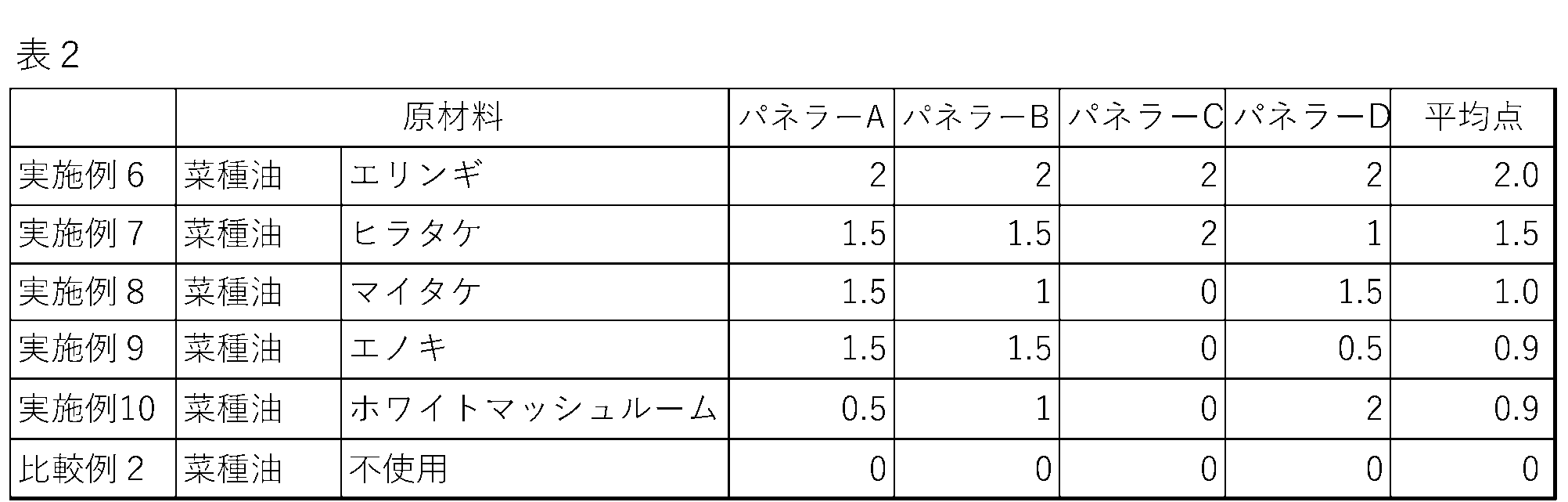
比較例2に示されるように、菜種油には卵風を増強する効果は認められなかった。一方、実施例6~10に示されるように、エリンギ、ヒラタケ、マイタケ、エノキおよびホワイトマッシュルームそれぞれの抽出物を含む油脂抽出物について卵風味を増強する効果が認められた。より具体的には、卵の黄身の風味が強く感じられた。
表1及び2の結果から、エリンギ、ヒラタケ、マイタケ、エノキおよびホワイトマッシュルームの抽出物を含む油脂抽出物は、卵を含まない食品に卵の黄身の風味を付与するだけでなく、食品中の卵の風味を増強する効果があることが分かった。
表1及び2の結果から、エリンギ、ヒラタケ、マイタケ、エノキおよびホワイトマッシュルームの抽出物を含む油脂抽出物は、卵を含まない食品に卵の黄身の風味を付与するだけでなく、食品中の卵の風味を増強する効果があることが分かった。
(実施例11~13)
表3に示す配合にて原材料を混合した混合物をフラスコに投入して150rpmの攪拌速度で攪拌しながら加熱し、90℃に達温後還流を開始し、105℃以上110℃以下に達温後その温度を保持した状態で加熱抽出し、その後放冷し、濾紙で放冷した混合物の不溶物を濾別して、各卵風味付与剤としての油脂抽出物を得た。各油脂抽出物を卵不使用マヨネーズに2質量%の含有量となるように添加し、既述の方法で卵風味の強さを評価した。結果を表3に示す。
表3に示す配合にて原材料を混合した混合物をフラスコに投入して150rpmの攪拌速度で攪拌しながら加熱し、90℃に達温後還流を開始し、105℃以上110℃以下に達温後その温度を保持した状態で加熱抽出し、その後放冷し、濾紙で放冷した混合物の不溶物を濾別して、各卵風味付与剤としての油脂抽出物を得た。各油脂抽出物を卵不使用マヨネーズに2質量%の含有量となるように添加し、既述の方法で卵風味の強さを評価した。結果を表3に示す。
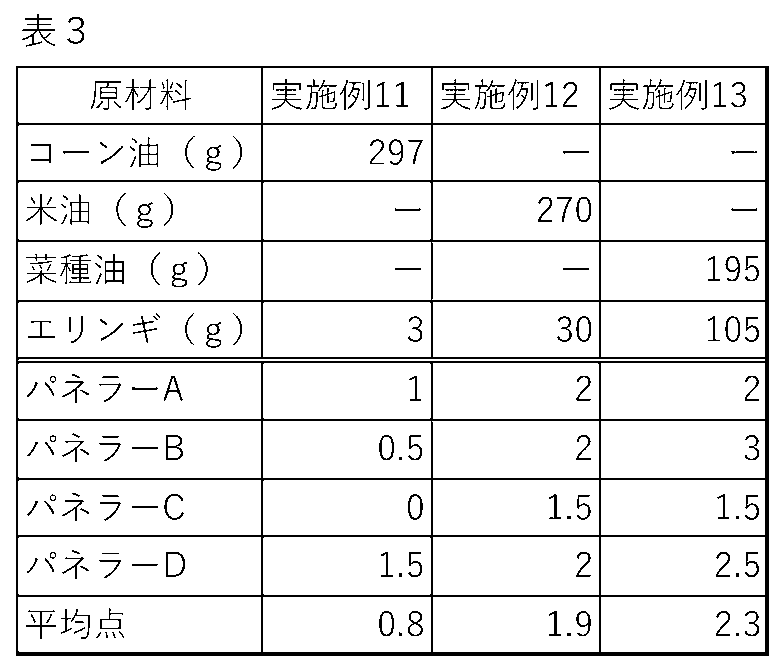
実施例11~13に示されるように、食用油脂に対するエリンギの配合量が増大するにしたがって、卵風味が強く感じられた。この結果から、食用油脂100gに対して、エリンギを1.0g、11.1gまたは53.8g配合し加熱抽出することで卵風味を付与する効果が得られ、エリンギの配合量が多い程、風味付与効果が高くなることがわかった。
(実施例14~16)
実施例11~13で得られた各油脂抽出物を卵使用マヨネーズに2質量%の含有量となるように添加した以外、実施例11~13と同じ方法で卵風味の強さを評価した。結果を表4に示す。
実施例11~13で得られた各油脂抽出物を卵使用マヨネーズに2質量%の含有量となるように添加した以外、実施例11~13と同じ方法で卵風味の強さを評価した。結果を表4に示す。
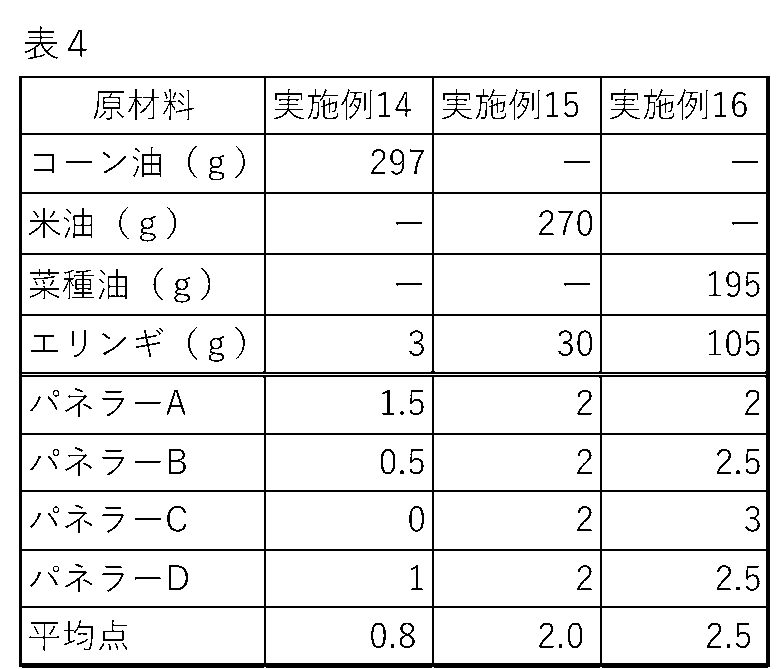
実施例14~16に示されるように、食用油脂に対するエリンギの配合量が増大するにしたがって、卵風味が強く感じられた。この結果から、食用油脂100gに対して、エリンギを1.0g、11.1gまたは53.8g配合し加熱抽出することで卵風味を増強する効果が得られ、配合量が多い程、効果が高くなることがわかった。
(実施例17~19)
表5に示す配合にて5mm角にカットしたエリンギおよび菜種油との混合物をフラスコに投入して150rpmの攪拌速度で攪拌しながら加熱し、90℃に達温後還流を開始し、105℃以上110℃以下に達温後その温度を保持した状態で10、30又は60分間加熱抽出し、その後放冷し、濾紙で放冷した混合物の不溶物を濾別して、卵風味付与剤としての各油脂抽出物を得た。各油脂抽出物を卵不使用マヨネーズに2質量%の含有量となるように添加し、既述の方法で卵風味の強さを評価した。結果を表5に示す。
表5に示す配合にて5mm角にカットしたエリンギおよび菜種油との混合物をフラスコに投入して150rpmの攪拌速度で攪拌しながら加熱し、90℃に達温後還流を開始し、105℃以上110℃以下に達温後その温度を保持した状態で10、30又は60分間加熱抽出し、その後放冷し、濾紙で放冷した混合物の不溶物を濾別して、卵風味付与剤としての各油脂抽出物を得た。各油脂抽出物を卵不使用マヨネーズに2質量%の含有量となるように添加し、既述の方法で卵風味の強さを評価した。結果を表5に示す。

実施例17~19に示されるように、抽出時間10分以上60分以下の条件で調製された油脂抽出物について卵風味を付与する効果が確認された。また、抽出時間が長い程、当該付与効果が向上することが分かった。
(実施例20~22)
実施例17~19で得られた各油脂抽出物を卵使用マヨネーズに2質量%の含有量となるように添加した以外、実施例17~19と同じ方法で卵風味の強さを評価した。結果を表6に示す。
実施例17~19で得られた各油脂抽出物を卵使用マヨネーズに2質量%の含有量となるように添加した以外、実施例17~19と同じ方法で卵風味の強さを評価した。結果を表6に示す。
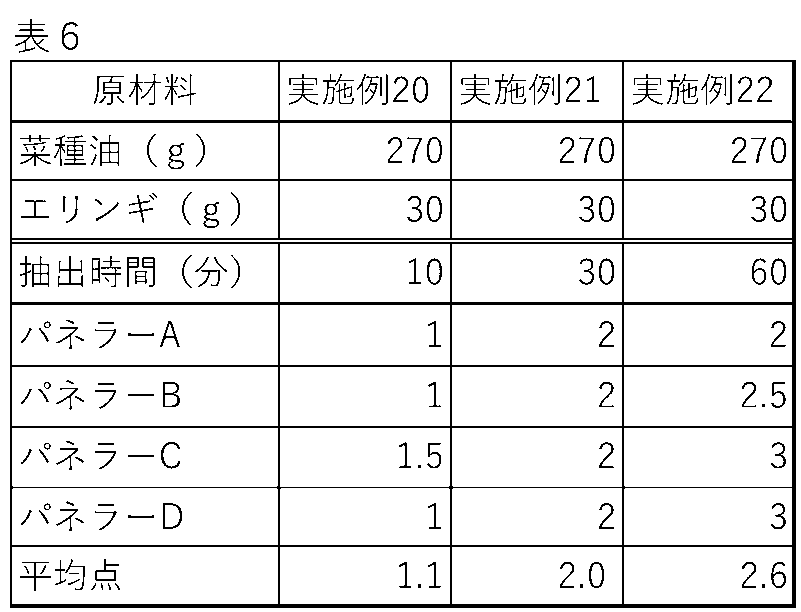
実施例20~22に示されるように、抽出時間10分以上60分以下の条件で調製された油脂抽出物にて卵風味を増強する効果が確認された。また、抽出時間が長い程、当該増強効果が向上することが分かった。
(実施例23~25)
表7に示す配合にて5mm角にカットしたエリンギと菜種油との混合物をフラスコに投入して150rpmの攪拌条件で攪拌しながら加熱し、90℃に達温後還流を開始し、90℃を保持した状態で60分間加熱抽出し、その後放冷し、濾紙で放冷した混合物の不溶物を濾別して、卵風味付与剤としての実施例23の油脂抽出物を得た。90℃に達温後還流を開始し、105℃に達温後その温度を保持した状態で30分間加熱抽出した以外は実施例23と同じ方法で実施例24の油脂抽出物を得た。また、90℃に達温後還流を開始し、120℃に達温後その温度を保持した状態で10分間加熱抽出した以外は実施例23と同じ方法で実施例25の油脂抽出物を得た。各油脂抽出物を卵不使用マヨネーズに2質量%の含有量となるように添加し、既述の方法で卵風味の強さを評価した。結果を表7に示す。
表7に示す配合にて5mm角にカットしたエリンギと菜種油との混合物をフラスコに投入して150rpmの攪拌条件で攪拌しながら加熱し、90℃に達温後還流を開始し、90℃を保持した状態で60分間加熱抽出し、その後放冷し、濾紙で放冷した混合物の不溶物を濾別して、卵風味付与剤としての実施例23の油脂抽出物を得た。90℃に達温後還流を開始し、105℃に達温後その温度を保持した状態で30分間加熱抽出した以外は実施例23と同じ方法で実施例24の油脂抽出物を得た。また、90℃に達温後還流を開始し、120℃に達温後その温度を保持した状態で10分間加熱抽出した以外は実施例23と同じ方法で実施例25の油脂抽出物を得た。各油脂抽出物を卵不使用マヨネーズに2質量%の含有量となるように添加し、既述の方法で卵風味の強さを評価した。結果を表7に示す。

実施例23~25に示されるように、90℃に達温後還流を開始し、90℃以上で加熱抽出することで、油脂抽出物の卵風味を付与する効果が向上することが確認された。特に、105℃で30分間加熱抽出することが好ましく、120℃で10分間加熱抽出することがより好ましいことが分かった。
(実施例26~28)
実施例23~25で得られた各油脂抽出物を卵使用マヨネーズに2質量%の含有量となるように添加した以外、実施例23~25と同じ方法で卵風味の強さを評価した。結果を表8に示す。
実施例23~25で得られた各油脂抽出物を卵使用マヨネーズに2質量%の含有量となるように添加した以外、実施例23~25と同じ方法で卵風味の強さを評価した。結果を表8に示す。
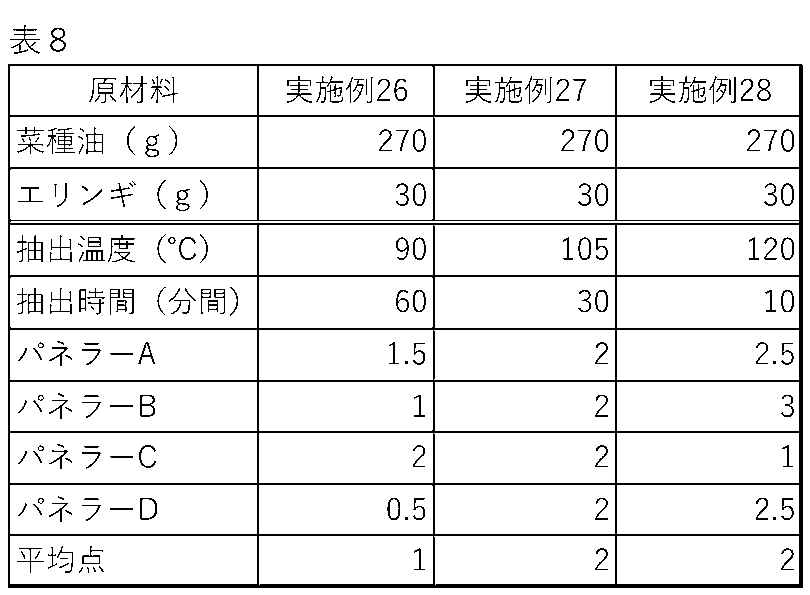
実施例26~28に示されるように、90℃に達温後還流を開始し、90℃以上で加熱抽出することで、油脂抽出物の卵風味を増強する効果が向上することが確認された。特に、105℃で30分間加熱抽出することが好ましく、120℃で10分間加熱抽出することがより好ましいことが分かった。
(実施例29~31)
表9に示す配合にて原材料を混合した混合物をフラスコに投入して150rpmの攪拌速度で攪拌しながら加熱し、90℃に達温後還流を開始し、105℃以上110℃以下に達温後その温度を保持した状態で30分間加熱抽出し、その後放冷し、濾紙で放冷した混合物の不溶物を濾別し卵風味付与剤としての各油脂抽出物を得た。各油脂抽出物を卵不使用マヨネーズに2質量%の含有量となるように添加し、既述の方法で卵風味の強さを評価した。結果を表9に示す。
表9に示す配合にて原材料を混合した混合物をフラスコに投入して150rpmの攪拌速度で攪拌しながら加熱し、90℃に達温後還流を開始し、105℃以上110℃以下に達温後その温度を保持した状態で30分間加熱抽出し、その後放冷し、濾紙で放冷した混合物の不溶物を濾別し卵風味付与剤としての各油脂抽出物を得た。各油脂抽出物を卵不使用マヨネーズに2質量%の含有量となるように添加し、既述の方法で卵風味の強さを評価した。結果を表9に示す。
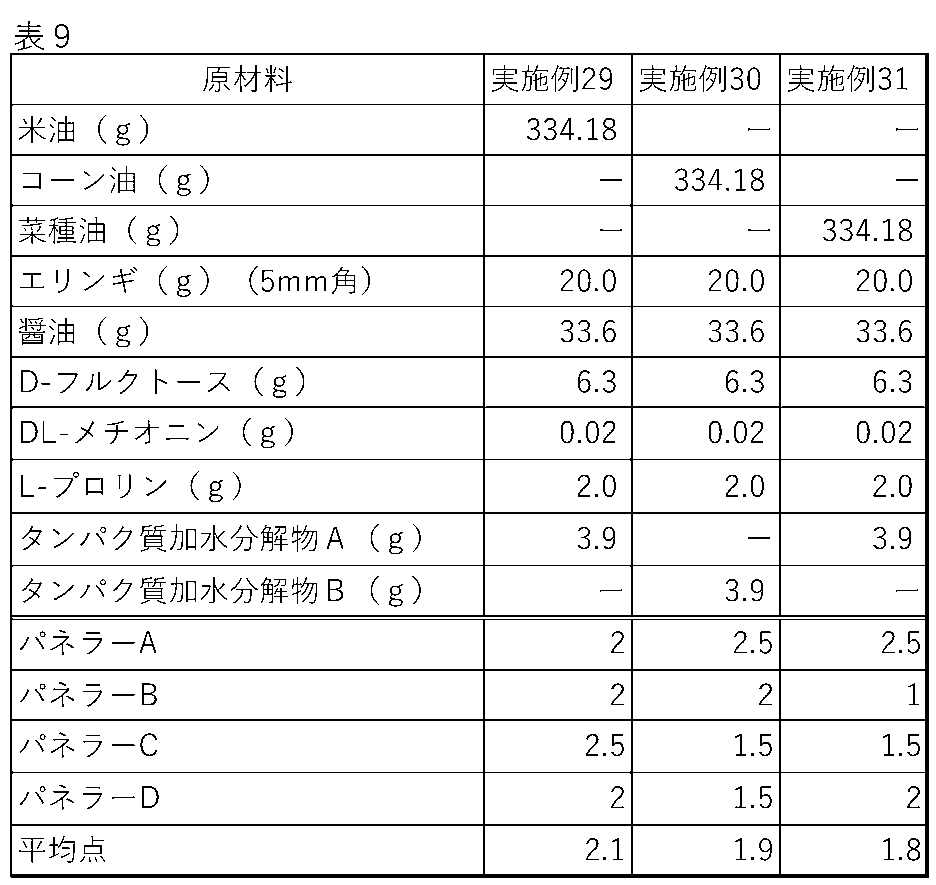
実施例29~31に示されるように、エリンギに加えてタンパク質加水分解物、単糖及びアミノ酸を含む混合物を加熱抽出した油脂抽出物を添加することにより卵風味を付与する効果が確認された。卵風味を付与する効果は、油脂抽出物に用いた食用油脂、タンパク質加水分解物の種類を選ばず、いずれにおいても高い付与効果が得られた。
(実施例32~34)
実施例32~34で得られた各油脂抽出物を卵使用マヨネーズに2質量%の含有量となるように添加した以外、実施例29~31と同じ方法で卵風味の強さを評価した。結果を表10に示す。
実施例32~34で得られた各油脂抽出物を卵使用マヨネーズに2質量%の含有量となるように添加した以外、実施例29~31と同じ方法で卵風味の強さを評価した。結果を表10に示す。
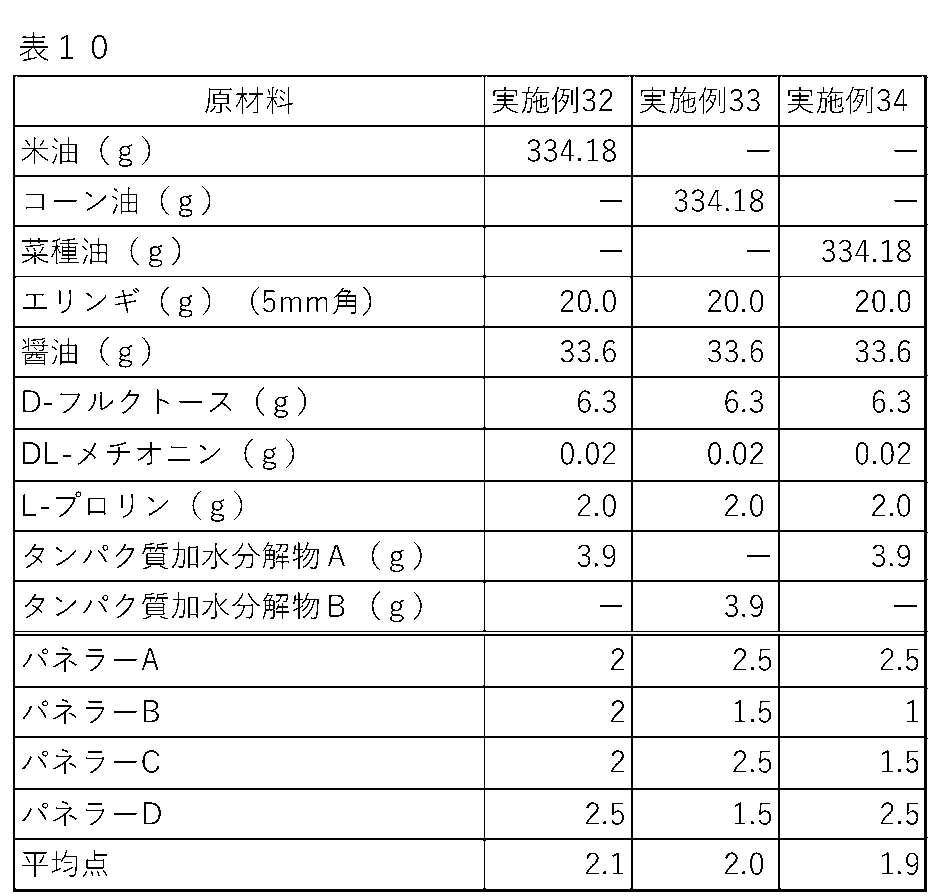
実施例32~34に示されるように、エリンギに加えてタンパク質加水分解物、単糖及びアミノ酸を含む混合物を加熱抽出した油脂抽出物を添加することにより卵風味を増強する効果が確認された。卵風味を増強する効果は、油脂抽出物に用いた食用油脂、タンパク質加水分解物の種類を選ばず、いずれにおいても高い効果が得られた。
表9及び10より、本発明の卵風味付与剤は、食用油脂として米油を用いることで最も卵風味付与効果および卵風味増強効果に優れていることが分かった。
表9及び10より、本発明の卵風味付与剤は、食用油脂として米油を用いることで最も卵風味付与効果および卵風味増強効果に優れていることが分かった。
(実施例35~37)
表11に示す配合にて原材料を混合した混合物をフラスコに投入して150rpmの攪拌速度で攪拌しながら加熱し、90℃に達温後還流を開始し、105℃以上110℃以下の温度達温後その温度を保持した状態で30分間加熱抽出し、その後放冷し、濾紙で放冷した混合物の不溶物を濾別し、本発明の卵風味付与剤としての各油脂抽出物を得た。各油脂抽出物を卵不使用マヨネーズに2質量%の含有量となるように添加し、既述の方法で卵風味の強さを評価した。結果を表11に示す。
表11に示す配合にて原材料を混合した混合物をフラスコに投入して150rpmの攪拌速度で攪拌しながら加熱し、90℃に達温後還流を開始し、105℃以上110℃以下の温度達温後その温度を保持した状態で30分間加熱抽出し、その後放冷し、濾紙で放冷した混合物の不溶物を濾別し、本発明の卵風味付与剤としての各油脂抽出物を得た。各油脂抽出物を卵不使用マヨネーズに2質量%の含有量となるように添加し、既述の方法で卵風味の強さを評価した。結果を表11に示す。

実施例35~37に示されるように、エリンギに加えてタンパク質加水分解物、単糖及びアミノ酸を含む混合物を加熱抽出した油脂抽出物を添加することにより卵風味を付与する効果が確認された。
(実施例38~40)
実施例35~37で得られた各油脂抽出物を卵使用マヨネーズに2質量%の含有量となるように添加した以外、実施例35~37と同じ方法で卵風味の強さを評価した。結果を表12に示す。
実施例35~37で得られた各油脂抽出物を卵使用マヨネーズに2質量%の含有量となるように添加した以外、実施例35~37と同じ方法で卵風味の強さを評価した。結果を表12に示す。
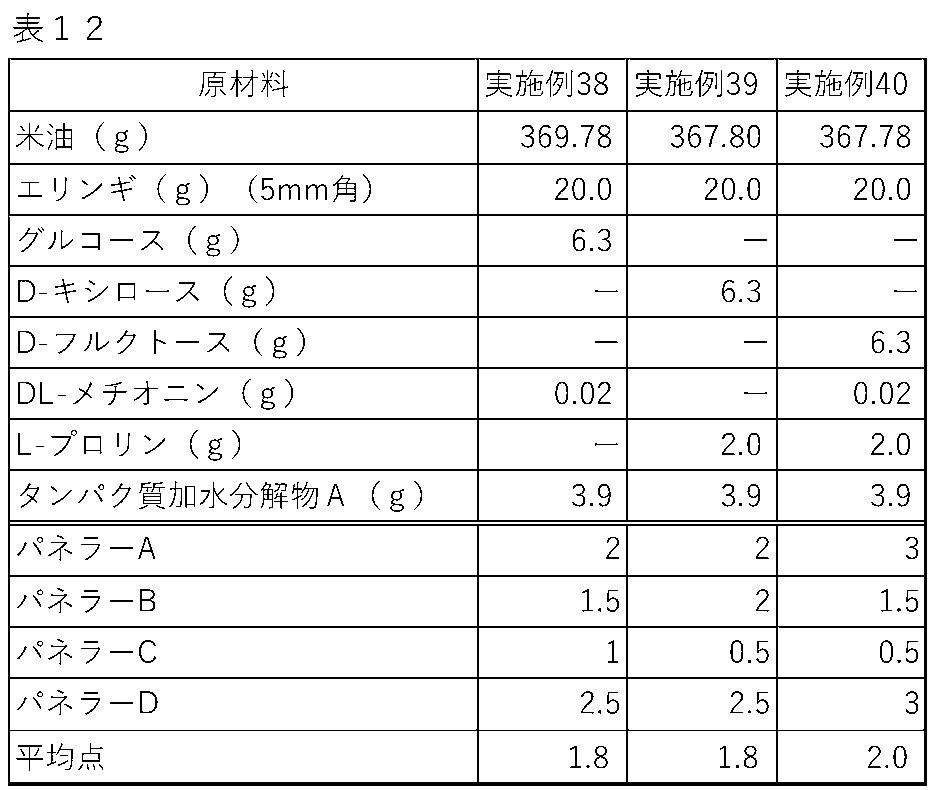
実施例38~40に示されるように、エリンギに加えてタンパク質加水分解物、単糖及びアミノ酸を含む混合物を加熱抽出した油脂抽出物を添加することにより卵風味を増強する効果が確認された。
表11及び12より、単糖としてD-フルクトース、アミノ酸としてDL-メチオニンおよびL-プロリンを用いることで卵風味付与効果および卵風味増強効果に優れた卵風味付与剤が得られることが分かった。
表11及び12より、単糖としてD-フルクトース、アミノ酸としてDL-メチオニンおよびL-プロリンを用いることで卵風味付与効果および卵風味増強効果に優れた卵風味付与剤が得られることが分かった。
(実施例41~43)
表13に示す配合にて原材料を混合した混合物をフラスコに投入して150rpmの攪拌速度で攪拌しながら加熱し、90℃に達温後還流を開始し、表13に示す抽出温度に達温後その温度を保持した状態で表13に示す抽出時間加熱抽出し、その後放冷し、濾紙で放冷した混合物の不溶物を濾別し、本発明の卵風味付与剤としての各油脂抽出物を得た。各油脂抽出物を卵不使用マヨネーズに2質量%の含有量となるように添加し、既述の方法で卵風味の強さを評価した。結果を表13に示す。
表13に示す配合にて原材料を混合した混合物をフラスコに投入して150rpmの攪拌速度で攪拌しながら加熱し、90℃に達温後還流を開始し、表13に示す抽出温度に達温後その温度を保持した状態で表13に示す抽出時間加熱抽出し、その後放冷し、濾紙で放冷した混合物の不溶物を濾別し、本発明の卵風味付与剤としての各油脂抽出物を得た。各油脂抽出物を卵不使用マヨネーズに2質量%の含有量となるように添加し、既述の方法で卵風味の強さを評価した。結果を表13に示す。

実施例41~43に示されるように、エリンギに加えてタンパク質加水分解物、単糖及びアミノ酸を含む混合物を90℃に達温後還流を開始し、90℃~120℃の抽出温度で10分間~60分間加熱抽出して得た油脂抽出物によって、卵風味を付与できることが確認された。特に、105℃で30分間加熱抽出することが好ましく、120℃で10分間加熱抽出することがより好ましいことが分かった。
(実施例44~46)
実施例41~43で得られた各油脂抽出物を卵使用マヨネーズに2質量%の含有量となるように添加した以外、実施例41~43と同じ方法で卵風味の強さを評価した。結果を表14に示す。
実施例41~43で得られた各油脂抽出物を卵使用マヨネーズに2質量%の含有量となるように添加した以外、実施例41~43と同じ方法で卵風味の強さを評価した。結果を表14に示す。

実施例44~46に示されるように、エリンギに加えてタンパク質加水分解物、単糖及びアミノ酸を含む混合物を90℃に達温後還流を開始し、90℃~120℃の抽出温度で10分間~60分間加熱抽出して得た油脂抽出物によって、卵風味を増強できることが確認された。特に、加熱抽出条件が105℃で30分間、及び120℃で10分間とすることで格別な卵風味の増強効果が得られることが分かった。
Claims (8)
- エリンギ、ヒラタケ、マイタケ、エノキ及びホワイトマッシュルームからなる群から選ばれる少なくとも1種のキノコの抽出物を含むことを特徴とする卵風味付与剤。
- 前記キノコの抽出物は、前記キノコの子実体の油脂抽出物である、請求項1に記載された卵風味付与剤。
- タンパク質加水分解物、糖類及びアミノ酸からなる群から選ばれる少なくとも1種を更に含む、請求項1又は2に記載された卵風味付与剤。
- 卵に由来する成分を含まない、請求項1又は2に記載された卵風味付与剤。
- エリンギ、ヒラタケ、マイタケ、エノキ及びホワイトマッシュルームからなる群から選ばれる少なくとも1種のキノコの子実体と食用油脂とを含む混合物を加熱して油脂抽出物を得る加熱工程を含むことを特徴とする卵風味付与剤の製造方法。
- 前記加熱処理を、90℃以上120℃以下で10分間以上60分間以下加熱して行う、請求項5に記載された卵風味付与剤の製造方法。
- 前記混合物が、タンパク質加水分解物、糖類及びアミノ酸からなる群から選ばれる少なくとも1種を更に含む、請求項5又は6に記載された卵風味付与剤の製造方法。
- 請求項1又は2に記載された卵風味付与剤を食品に添加する工程を含むことを特徴とする食品へ卵風味を付与する方法。
Priority Applications (1)
| Application Number | Priority Date | Filing Date | Title |
|---|---|---|---|
| JP2024514899A JPWO2023199787A1 (ja) | 2022-04-15 | 2023-04-04 |
Applications Claiming Priority (2)
| Application Number | Priority Date | Filing Date | Title |
|---|---|---|---|
| JP2022-067668 | 2022-04-15 | ||
| JP2022067668 | 2022-04-15 |
Publications (1)
| Publication Number | Publication Date |
|---|---|
| WO2023199787A1 true WO2023199787A1 (ja) | 2023-10-19 |
Family
ID=88329621
Family Applications (1)
| Application Number | Title | Priority Date | Filing Date |
|---|---|---|---|
| PCT/JP2023/013893 Ceased WO2023199787A1 (ja) | 2022-04-15 | 2023-04-04 | 卵風味付与剤、卵風味付与剤の製造方法、及び食品へ卵風味を付与する方法 |
Country Status (2)
| Country | Link |
|---|---|
| JP (1) | JPWO2023199787A1 (ja) |
| WO (1) | WO2023199787A1 (ja) |
Citations (2)
| Publication number | Priority date | Publication date | Assignee | Title |
|---|---|---|---|---|
| JPS61187769A (ja) * | 1985-02-14 | 1986-08-21 | Akita:Kk | えのき茸を原料とする食品の製造方法 |
| JPS61285960A (ja) * | 1985-06-13 | 1986-12-16 | Nakamura Kinokoen Kenkyusho Kk | ペ−スト状きのこ含有食品 |
-
2023
- 2023-04-04 WO PCT/JP2023/013893 patent/WO2023199787A1/ja not_active Ceased
- 2023-04-04 JP JP2024514899A patent/JPWO2023199787A1/ja active Pending
Patent Citations (2)
| Publication number | Priority date | Publication date | Assignee | Title |
|---|---|---|---|---|
| JPS61187769A (ja) * | 1985-02-14 | 1986-08-21 | Akita:Kk | えのき茸を原料とする食品の製造方法 |
| JPS61285960A (ja) * | 1985-06-13 | 1986-12-16 | Nakamura Kinokoen Kenkyusho Kk | ペ−スト状きのこ含有食品 |
Non-Patent Citations (2)
| Title |
|---|
| ANONYMOUS: "This will become popular after soy meat! The plant-based egg "UMAMI EGG" was delicious as an egg itself.", SYOKURAKU WEB, 27 February 2022 (2022-02-27), XP093098567, Retrieved from the Internet <URL: https://www.syokuraku-web.com/column/83772/2> [retrieved on 20231107] * |
| MUNIZ ADRIANA, DU XIAOFEN, SHANKS MARCUS: "Flavor impartment of mushroom on egg whites and sensory properties of egg whites with mushroom topping using quantitative descriptive analysis", JOURNAL OF THE SCIENCE OF FOOD AND AGRICULTURE, WILEY & SONS, CHICHESTER., GB, vol. 102, no. 1, 15 January 2022 (2022-01-15), GB , pages 73 - 84, XP093098566, ISSN: 0022-5142, DOI: 10.1002/jsfa.11332 * |
Also Published As
| Publication number | Publication date |
|---|---|
| JPWO2023199787A1 (ja) | 2023-10-19 |
Similar Documents
| Publication | Publication Date | Title |
|---|---|---|
| JP6026768B2 (ja) | 風味素材の製造方法及び風味改良油脂の製造方法 | |
| RU2003115982A (ru) | Белково-витаминный продукт сои "пробужденное семя", способ его получения, пищевой продукт быстрого приготовления, продукт питания и сухой белково-витаминный продукт | |
| US20130344222A1 (en) | Taste improvement agent | |
| CN117915783A (zh) | 水包油型乳化物 | |
| Medhe et al. | Dietary fibers, dietary peptides and dietary essential fatty acids from food processing by‐products | |
| JP7078198B1 (ja) | ルウ用油脂組成物 | |
| WO2023199787A1 (ja) | 卵風味付与剤、卵風味付与剤の製造方法、及び食品へ卵風味を付与する方法 | |
| RU2333657C2 (ru) | Способ получения растительного молока из семян зерновых и/или бобовых культур и орехов | |
| KR20080065220A (ko) | 마늘 가식부 전체를 이용한 마늘 장류의 상업적 제조방법 | |
| KR20260044840A (ko) | 효모 엑기스 균체 잔사를 포함하는 유 대체 조성물 | |
| WO2023199788A1 (ja) | 油脂組成物、卵風味付与剤、油脂組成物の製造方法、飲食品へ卵風味を付与する方法、飲食品の製造方法、及び飲食品 | |
| JP5354520B2 (ja) | コク味付与機能を有する新規ペプチド組成物 | |
| KR102369767B1 (ko) | 고단백질 두부과자의 제조방법과 이를 이용한 두부과자 | |
| CN1628541A (zh) | 一种生产来源于动物蛋白的蛋白间质的方法以及含有该蛋白间质的食品 | |
| JP2023072945A (ja) | 植物性タンパク含有飲料、植物性タンパク含有飲料の作製方法、および植物性タンパク含有飲料用組成物 | |
| CN103859063A (zh) | 含油脂食品、菜籽油以及强化含油脂食品呈味显现的方法 | |
| CN117979835A (zh) | 含叶绿素食品的制造方法 | |
| JP7329330B2 (ja) | 風味付与調味料 | |
| KR101880022B1 (ko) | 액상 곤약을 이용한 어묵 제조방법 | |
| KR20170075598A (ko) | 짜장소스의 제조방법 | |
| JP4795511B2 (ja) | α−グルコシダーゼ阻害剤の製造法 | |
| JP2002010743A (ja) | 玄米成分強化加工もち米 | |
| JP3399914B2 (ja) | 玄米成分強化剤 | |
| EA019051B1 (ru) | Пищевой продукт из соевых бобов и содержащие его композиции | |
| RU2710161C1 (ru) | Способ производства формованных кулинарных изделий |
Legal Events
| Date | Code | Title | Description |
|---|---|---|---|
| 121 | Ep: the epo has been informed by wipo that ep was designated in this application |
Ref document number: 23788206 Country of ref document: EP Kind code of ref document: A1 |
|
| ENP | Entry into the national phase |
Ref document number: 2024514899 Country of ref document: JP Kind code of ref document: A |
|
| NENP | Non-entry into the national phase |
Ref country code: DE |
|
| 122 | Ep: pct application non-entry in european phase |
Ref document number: 23788206 Country of ref document: EP Kind code of ref document: A1 |