WO2023199534A1 - 香料組成物の製造方法 - Google Patents
香料組成物の製造方法 Download PDFInfo
- Publication number
- WO2023199534A1 WO2023199534A1 PCT/JP2022/029855 JP2022029855W WO2023199534A1 WO 2023199534 A1 WO2023199534 A1 WO 2023199534A1 JP 2022029855 W JP2022029855 W JP 2022029855W WO 2023199534 A1 WO2023199534 A1 WO 2023199534A1
- Authority
- WO
- WIPO (PCT)
- Prior art keywords
- aroma
- model
- drinking
- analysis
- beverage
- Prior art date
- Legal status (The legal status is an assumption and is not a legal conclusion. Google has not performed a legal analysis and makes no representation as to the accuracy of the status listed.)
- Ceased
Links
Classifications
-
- C—CHEMISTRY; METALLURGY
- C11—ANIMAL OR VEGETABLE OILS, FATS, FATTY SUBSTANCES OR WAXES; FATTY ACIDS THEREFROM; DETERGENTS; CANDLES
- C11B—PRODUCING, e.g. BY PRESSING RAW MATERIALS OR BY EXTRACTION FROM WASTE MATERIALS, REFINING OR PRESERVING FATS, FATTY SUBSTANCES, e.g. LANOLIN, FATTY OILS OR WAXES; ESSENTIAL OILS; PERFUMES
- C11B9/00—Essential oils; Perfumes
-
- A—HUMAN NECESSITIES
- A23—FOODS OR FOODSTUFFS; TREATMENT THEREOF, NOT COVERED BY OTHER CLASSES
- A23L—FOODS, FOODSTUFFS OR NON-ALCOHOLIC BEVERAGES, NOT OTHERWISE PROVIDED FOR; PREPARATION OR TREATMENT THEREOF
- A23L27/00—Spices; Flavouring agents or condiments; Artificial sweetening agents; Table salts; Dietetic salt substitutes; Preparation or treatment thereof
- A23L27/20—Synthetic spices, flavouring agents or condiments
- A23L27/29—Fruit flavours
-
- A—HUMAN NECESSITIES
- A23—FOODS OR FOODSTUFFS; TREATMENT THEREOF, NOT COVERED BY OTHER CLASSES
- A23G—COCOA; COCOA PRODUCTS, e.g. CHOCOLATE; SUBSTITUTES FOR COCOA OR COCOA PRODUCTS; CONFECTIONERY; CHEWING GUM; ICE-CREAM; PREPARATION THEREOF
- A23G3/00—Sweetmeats; Confectionery; Marzipan; Coated or filled products
- A23G3/34—Sweetmeats, confectionery or marzipan; Processes for the preparation thereof
- A23G3/36—Sweetmeats, confectionery or marzipan; Processes for the preparation thereof characterised by the composition containing organic or inorganic compounds
-
- A—HUMAN NECESSITIES
- A23—FOODS OR FOODSTUFFS; TREATMENT THEREOF, NOT COVERED BY OTHER CLASSES
- A23L—FOODS, FOODSTUFFS OR NON-ALCOHOLIC BEVERAGES, NOT OTHERWISE PROVIDED FOR; PREPARATION OR TREATMENT THEREOF
- A23L2/00—Non-alcoholic beverages; Dry compositions or concentrates therefor; Preparation or treatment thereof
- A23L2/52—Adding ingredients
- A23L2/56—Flavouring or bittering agents
-
- A—HUMAN NECESSITIES
- A23—FOODS OR FOODSTUFFS; TREATMENT THEREOF, NOT COVERED BY OTHER CLASSES
- A23L—FOODS, FOODSTUFFS OR NON-ALCOHOLIC BEVERAGES, NOT OTHERWISE PROVIDED FOR; PREPARATION OR TREATMENT THEREOF
- A23L27/00—Spices; Flavouring agents or condiments; Artificial sweetening agents; Table salts; Dietetic salt substitutes; Preparation or treatment thereof
-
- A—HUMAN NECESSITIES
- A61—MEDICAL OR VETERINARY SCIENCE; HYGIENE
- A61B—DIAGNOSIS; SURGERY; IDENTIFICATION
- A61B5/00—Measuring for diagnostic purposes; Identification of persons
- A61B5/40—Detecting, measuring or recording for evaluating the nervous system
- A61B5/4005—Detecting, measuring or recording for evaluating the nervous system for evaluating the sensory system
- A61B5/4011—Evaluating olfaction, i.e. sense of smell
-
- B—PERFORMING OPERATIONS; TRANSPORTING
- B01—PHYSICAL OR CHEMICAL PROCESSES OR APPARATUS IN GENERAL
- B01D—SEPARATION
- B01D53/00—Separation of gases or vapours; Recovering vapours of volatile solvents from gases; Chemical or biological purification of waste gases, e.g. engine exhaust gases, smoke, fumes, flue gases, aerosols
- B01D53/02—Separation of gases or vapours; Recovering vapours of volatile solvents from gases; Chemical or biological purification of waste gases, e.g. engine exhaust gases, smoke, fumes, flue gases, aerosols by adsorption, e.g. preparative gas chromatography
- B01D53/025—Separation of gases or vapours; Recovering vapours of volatile solvents from gases; Chemical or biological purification of waste gases, e.g. engine exhaust gases, smoke, fumes, flue gases, aerosols by adsorption, e.g. preparative gas chromatography with wetted adsorbents; Chromatography
-
- G—PHYSICS
- G01—MEASURING; TESTING
- G01N—INVESTIGATING OR ANALYSING MATERIALS BY DETERMINING THEIR CHEMICAL OR PHYSICAL PROPERTIES
- G01N30/00—Investigating or analysing materials by separation into components using adsorption, absorption or similar phenomena or using ion-exchange, e.g. chromatography or field flow fractionation
- G01N30/02—Column chromatography
- G01N30/88—Integrated analysis systems specially adapted therefor, not covered by a single one of the groups G01N30/04 - G01N30/86
-
- G—PHYSICS
- G01—MEASURING; TESTING
- G01N—INVESTIGATING OR ANALYSING MATERIALS BY DETERMINING THEIR CHEMICAL OR PHYSICAL PROPERTIES
- G01N33/00—Investigating or analysing materials by specific methods not covered by groups G01N1/00 - G01N31/00
- G01N33/02—Food
-
- G—PHYSICS
- G01—MEASURING; TESTING
- G01N—INVESTIGATING OR ANALYSING MATERIALS BY DETERMINING THEIR CHEMICAL OR PHYSICAL PROPERTIES
- G01N30/00—Investigating or analysing materials by separation into components using adsorption, absorption or similar phenomena or using ion-exchange, e.g. chromatography or field flow fractionation
- G01N30/02—Column chromatography
- G01N30/62—Detectors specially adapted therefor
- G01N30/72—Mass spectrometers
-
- G—PHYSICS
- G01—MEASURING; TESTING
- G01N—INVESTIGATING OR ANALYSING MATERIALS BY DETERMINING THEIR CHEMICAL OR PHYSICAL PROPERTIES
- G01N30/00—Investigating or analysing materials by separation into components using adsorption, absorption or similar phenomena or using ion-exchange, e.g. chromatography or field flow fractionation
- G01N30/02—Column chromatography
- G01N30/86—Signal analysis
- G01N30/8624—Detection of slopes or peaks; baseline correction
- G01N30/8631—Peaks
Definitions
- the present invention relates to a method for producing a fragrance composition.
- flavor compositions for food and drink products have been developed based on the experience and sensibilities of flavorists who are skilled in evaluating flavor compositions, while referring to the results of aroma analysis of food and drink products.
- Flavor analysis of foods and beverages can be done, for example, by using an adsorbent to collect and concentrate aroma components floating in the headspace of foods and beverages, or by extracting aroma components from foods and beverages with organic solvents and then distilling them.
- Information on aroma components can be obtained by preparing an aroma concentrate using a method of concentrating aroma components and performing gas chromatography analysis.
- Patent Documents 1 and 2 disclose a method for analyzing aroma components contained in exhaled breath using gas chromatography, etc. to evaluate aroma expression characteristics, and a method for searching for aroma components for unique characterization. is disclosed.
- Patent Document 3 defines the aroma components remaining in saliva after drinking a beverage as "residual aroma", and adds a flavor composition containing a group of aroma components characteristic of the residual aroma to give a sense of volume to the beverage. A method has been proposed.
- Patent Document 4 discloses that a fragrance composition is added to an intra-oral model environment solution containing artificial saliva as a base and a non-oral environment environment solution that does not contain artificial saliva, and the volatilized aroma components are collected and analyzed.
- a method for preparing a perfume is disclosed in which a correction value is calculated from the difference between the two and the composition ratio of the perfume composition is corrected.
- the processed food to which the flavor composition is added often has physical properties that are significantly different from the analyte, and it is difficult to create a flavor that reproduces the aroma composition inherent in the analyte. Even if a composition is prepared, it is difficult to evoke the sensation of eating the analyte when eating a food or drink flavored with the composition.
- the present invention has been made in view of the above-mentioned conventional situation, and when eating or drinking a food or drink scented with the prepared flavor composition, the sensation of eating or drinking an analyte is improved.
- To provide a method for producing a fragrance composition that can evoke the mind of a person, and which adjusts the amount of aroma components blended based on scientific and objective data obtained using humans. is an issue that needs to be solved.
- the present inventors have determined that the aroma balance of retronasal aroma when eating or drinking processed foods to which a flavoring composition has been added is By matching the aroma balance of retronasal aroma when ingested, we thought that it would be possible to recall the flavor when eating or drinking the food/drink to be analyzed, and we included it in retronasal aroma.
- the inventors have discovered that the above-mentioned problems can be solved by analyzing, comparing, and blending a plurality of aroma components, and have completed the present invention.
- the present invention relates to the following ⁇ 1> to ⁇ 4>.
- the detection ratio t of the plurality of aroma components contained in the retronasal aroma of step (1) is calculated from the results of the gas chromatography analysis of step (1), and the first fragrance composition containing the aroma components is prepared.
- step (2) a step (3) of preparing a model food/beverage product 1 containing the first flavor composition; a step (4) of performing gas chromatography analysis on the retronasal aroma obtained when eating or drinking the model food/beverage product 1; a step (5) of calculating a detection ratio 1 of a plurality of aroma components contained in the retronasal aroma of the step (4) from the results of the gas chromatography analysis of the step (4); A step (6) of adjusting the composition of the first perfume composition so that the detection ratio 1 approaches the detection ratio t, and obtaining a second perfume composition; A step (7) of repeatedly performing the same operations as steps (3) to (6) to obtain a final fragrance composition having an aroma balance that matches the detection ratio t; A method for producing a fragrance composition, comprising: ⁇ 2> The perfume according to ⁇ 1>, comprising the step of performing gas chromatography olfactometry analysis on the retronasal aroma of step (1) and incorporating the recognized aroma component into the first perfume composition.
- Method for producing the composition ⁇ 3> The method for producing a fragrance composition according to ⁇ 2>, wherein the gas chromatography olfactometry analysis includes a step of adjusting aroma intensity using an aroma extract dilution analysis method. ⁇ 4> Any one of ⁇ 1> to ⁇ 3>, wherein in steps (1) and (4), the retronasal aroma is adsorbed to an adsorbent and the adsorbed retronasal aroma is desorbed.
- the method for producing a fragrance composition of the present invention includes the following steps (1) to (7).
- step (1) gas chromatography analysis is performed on the Retronasal Aroma obtained when eating or drinking the substance to be analyzed. Note that blank exhaled breath can be analyzed before or after eating or drinking the substance to be analyzed, and the results can be subtracted in step (2) described below.
- Examples of the object to be analyzed include foods and drinks.
- the food or drink may be a solid food or a drink, and its type is not limited. Specifically, for example, fruits such as peaches, apples, grapes, strawberries, mangoes, pineapples, pears, pears, kiwis, figs, oranges, lemons, melons, watermelons, muscats; carrots, cucumbers, radish, corn, etc.
- Vegetables Cooked and processed meat such as steak, grilled meat, hamburger, ham; Cooked seafood such as grilled fish, braised shellfish, and sashimi; Ice cream, iced milk, lacto ice, frozen desserts, yogurt, and pudding Desserts such as , jelly, and daily desserts; Confectionery such as caramels, candies, tablets, crackers, biscuits, cookies, pies, chocolates, snacks, and chewing gum; Japanese sweets such as red bean paste, manju, dango, and Uiro; miso soup, Japanese style Soups such as soups and Western-style soups; Jams; spices, flavor seasonings; various instant beverages; various instant foods; carbonated drinks, soft drinks, fruit juice drinks, milk drinks, lactic acid bacteria drinks, drinks, soy milk, coffee , beverages such as tea beverages; alcoholic beverages such as beer, chuhai, cocktail drinks, low-malt beer, fruit wine, and condiments; stews such as beef stew and cream stew; demi-glace sauce, oyster sauce
- Retronasal aroma is a fragrance component contained in the exhaled air that passes from the oral cavity into the nasal cavity and is expelled from the front nostril when eating or drinking an analyte such as food or drink. It is closely related to the flavor that humans feel when eating or drinking the analyte.
- the method for obtaining retronasal aroma is not particularly limited, but includes, for example, a method of collecting aroma components discharged from the nostrils using an adsorbent. At this time, a step of adsorbing the retronasal aroma onto an adsorbent and desorbing the adsorbed retronasal aroma is further provided. Note that the method of attachment and detachment is not particularly limited.
- adsorbents for aroma components include porous resin adsorbents such as weakly polar porous polymer beads based on 2,6-diphenyl-p-phenylene oxide.
- Gas chromatography (GC) analysis is an analysis method for identifying and quantifying each component contained in an analysis target (gas such as exhaled breath), and can be performed using a general gas chromatography device. Note that gas chromatography/mass spectrometry (GC/MS) performed by a combination of a gas chromatography device and a mass spectrometer is preferably used.
- GC/MS gas chromatography/mass spectrometry
- the retronasal aroma in step (1) is analyzed by gas chromatography/olfactometry (GC/O), and the recognized aroma components are included in the first fragrance composition described below. It is preferable.
- GC/O gas chromatography/olfactometry
- GC/O is an analytical method that combines gas chromatography analysis with the senses sensed by the human nose. By introducing GC/O, it can be expected to obtain information on aroma components that are closer to the flavor felt when actually eating or drinking the analyte. In other words, by using GC/O, when an object to be analyzed contains trace amounts of aroma components that are difficult to detect by gas chromatography analysis or gas chromatography mass spectrometry, humans can detect and compensate for trace amounts of aroma components. is also possible.
- the GC/O also includes a step in which the aroma intensity is adjusted using an aroma extract dilution analysis (AEDA) method in which the amount of collected aroma components is adjusted stepwise. But that's fine.
- AEDA aroma extract dilution analysis
- step (2) the detection ratio t of a plurality of aroma components contained in the retronasal aroma of step (1) is calculated from the results of the gas chromatography analysis of step (1), and the detection ratio t of a plurality of aroma components contained in the retronasal aroma of step (1) is calculated.
- a fragrance composition of No. 1 is obtained.
- the results of the gas chromatography analysis are obtained in the form of the area of each aroma component contained in the retronasal aroma, that is, the integrated area of the peak of the aroma component.
- the detection ratio t of each aroma component can be calculated from the area of each aroma component.
- the first fragrance composition can be obtained by converting the detection ratio t into mass % and mixing each aroma component having the converted mass % (content), but the first fragrance composition is It is not particularly limited as long as it contains the aromatic component group detected in the retronasal aroma in step (1).
- step (3) a model food/beverage product 1 containing the first flavor composition is prepared.
- the content of the first flavor composition in the model food/beverage product 1 is not particularly limited, but is, for example, 0.0001 to 10% by mass, preferably 0.001 to 1.0% by mass.
- the model food/beverage product 1 can contain various compounds in order to reproduce the flavor of the analyte.
- the method for preparing the model food/beverage product 1 is not particularly limited. Note that the model food/beverage product 1 may be a solid food or a drink.
- step (4) gas chromatography analysis is performed on the retronasal aroma obtained when eating or drinking the model food/beverage product 1. Note that before or after eating or drinking the model food/beverage product 1, a blank exhaled breath can be analyzed and the results can be subtracted in step (5) described below.
- the tester instead of obtaining a finished food/beverage product using the produced first flavor composition, the tester eats or drinks the model food/beverage product 1 again, and the obtained retronatide is Analyze colander aroma.
- Retronasal aroma and gas chromatography analysis are as described in step (1).
- step (5) the detection ratio 1 of a plurality of aroma components contained in the retronasal aroma in step (4) is calculated from the results of the gas chromatography analysis in step (4).
- the results of the gas chromatography analysis in step (4) are obtained in the form of the area of each aroma component contained in the retronasal aroma of step (4), that is, the integrated area of the peak of the aroma component.
- the detection ratio 1 of each aroma component can be calculated from the area of each aroma component.
- step (6) the composition of the first perfume composition is adjusted so that the detection ratio 1 approaches the detection ratio t, and a second perfume composition is obtained.
- step (6) while referring to the detection ratio t, that is, the balance of each aroma component of the retronasal aroma derived from the analyte, the amount of each aroma component in the first fragrance composition that is insufficient is increased. Make adjustments such as reducing excessive amounts of components. Foods and beverages flavored with the second flavor composition obtained through such adjustment have a flavor closer to the original analyte than foods and drinks flavored with the first flavor composition. Become.
- step (7) operations similar to steps (3) to (6) are repeated to obtain a final fragrance composition having an aroma balance that matches the detection ratio t.
- steps (3) to (6) are repeated again based on the second fragrance composition, and the third fragrance composition, further the fourth fragrance composition, the fifth fragrance composition, etc. If the aroma balance of the perfume composition obtained after production matches the aroma balance of each aroma component obtained in step (1), the obtained perfume composition is used as the final perfume composition.
- step (7) is not only a complete match, but also a case where the flavor of the analysis target and the flavor of the final flavored food/beverage product match to an extent that ordinary consumers can understand. Also included.
- the flavor composition produced by the method for producing a flavor composition of the present invention and the food and drink containing the same can reproduce the flavor balance when eating or drinking the target analyte. We manufacture products after objectively evaluating them. With this method, even if you are not a skilled flavorist, it is possible to relatively easily reproduce the flavor of an analyte when ingested in foods and beverages with different matrices (processed foods and beverages).
- Example 1 Production of apple-like flavor composition for beverages ⁇ Collection of exhaled breath while eating apples> Immediately before aroma collection, an internal standard substance (Nonan-5-one) was added to an aroma component adsorbent (TENAX TA: manufactured by Gestel), and exhaled air was collected when eating an apple cut into bite-sized pieces and during the first breath after swallowing. It was sucked in with a pump and adsorbed on an aroma component adsorbent. Aroma collection was performed three times for GC/MS and once for GC/O. In addition, the exhaled breath of the test subject was collected with nothing in the mouth for the same time as the apple eating time, and was used as a blank exhaled breath. Aroma was collected once for GC/MS and once for GC/O.
- TDU Thermal desorption temperature 250°C Thermal desorption time: 5 minutes
- Temperature rising conditions 30°C -250°C, 720°C/min CIS (Cooled Injection System) Trap temperature 10°C Temperature rising conditions 10°C -150°C, 960°C/min -250°C, 720°C/min (15 minute hold)
- GC Gas Chromatography
- Column BC-WAX manufactured by GL Sciences, 0.25mm i.d. x 50m, film thickness 0.15 ⁇ m
- TDU Thermal desorption Unit
- Thermal desorption temperature 250°C Thermal desorption time: 1.5 minutes
- Temperature rising conditions 40°C-250°C, 2700°C/min
- CIS Cooled Injection System
- Temperature rising conditions 10°C -150°C, 960°C/min -250°C, 720°C/min (15 minute hold)
- GC Gas Chromatography
- BC-WAX manufactured by GL Sciences, 0.25mm i.d. x 50m, film thickness 0.15 ⁇ m
- Model apple beverage 1 was prepared by adding 0.1% by mass of the first flavor composition (apple flavor A) thereto. In addition, an unflavored beverage was prepared for blank measurement.
- Exhaled breath collection when drinking one model apple drink> Exhaled breath was collected while drinking model apple drink 1 and the blank drink using the same method as when eating apples. The model apple drink 1 was collected three times and the blank drink was collected once.
- GC/MS analysis of exhaled breath when drinking Model Apple Beverage 1 and the blank drink was performed using the same method and analysis conditions as for exhaled breath when eating apples.
- ⁇ Calculation of detection rate 1> Calculate the detection rate 1 with the total as 100% from the internal standard ratio of retronasal aroma when drinking 1 model apple drink calculated by the same method as ⁇ Preparation of the first flavor composition (apple flavor A)> did.
- Model apple drink 2 was prepared by adding 0.1% by mass of the second flavor composition (apple flavor B) to the above-mentioned drink dough. In addition, an unflavored beverage was prepared for blank measurement.
- the second flavor composition apple flavor B
- GC/MS analysis of the exhaled air when drinking the model apple drink 2 and the blank drink was performed using the same method and analysis conditions as the exhaled air when drinking the model apple drink 1.
- Detection rate 2 was calculated from the internal standard ratio of retronasal aroma when drinking model apple beverage 2, which was calculated using the same method as detection rate 1, with the total as 100%.
- Model apple drink 3 was prepared by adding 0.1% by mass of the third flavor composition (apple flavor C) to the above-mentioned drink dough. In addition, an unflavored beverage was prepared for blank measurement.
- the third flavor composition apple flavor C
- GC/MS analysis of the exhaled air when drinking the model apple drink 3 and the blank drink was performed using the same method and analysis conditions as the exhaled air when drinking the model apple drink 1.
- Detection rate 3 was calculated from the internal standard ratio of retronasal aroma when drinking model apple beverage 3, which was calculated using the same method as detection rate 1, with the total as 100%.
- Example 2 Production of grape-like flavor composition for beverages ⁇ Collection of exhaled breath when eating grapes> Exhaled breath was collected while eating grapes using the same method as for apples.
- first flavor composition (grape flavor A)> The internal standard ratio of retronasal aroma when eating grapes was calculated using the same method as for apples, and then the detection rate t was calculated from this internal standard ratio, taking the total as 100%. Thereafter, this detection ratio t was converted to mass %, the components detected only by GC/O analysis were added thereto, and the mixture was further diluted appropriately with a solvent to form a first flavor composition (grape flavor A).
- the prescription ratio of components detected only by GC/O analysis was set to the same ratio as the lowest prescription value among the aroma components detected by GC/MS (Table 2).
- model grape drink 1 A sugar-acid analysis was conducted on commercially available grapes purchased during the peak season, and beverage dough with an adjusted sugar-acid ratio was created based on the results.
- a model grape beverage 1 was prepared in which 0.1% by mass of the first flavor composition (grape flavor A) was added. In addition, an unflavored beverage was prepared for blank measurement.
- GC/O analysis of exhaled air when drinking Model Grape Beverage 1 and blank drink was performed using the same method and analysis conditions as for exhaled air when drinking grapes. As a result, it was confirmed that the components detected only by GC/O analysis were present in the exhaled breath after drinking one model grape beverage, and that the odor intensity was the same as in the exhaled breath when eating grapes.
- ⁇ Calculation of detection rate 1> Calculate the detection rate 1 with the total as 100% from the internal standard ratio of retronasal aroma when drinking 1 model grape beverage calculated using the same method as ⁇ Preparation of the first flavor composition (grape flavor A)> did.
- ⁇ Preparation of second flavor composition (grape flavor B)> In order to bring the detection rate 1 closer to the detection rate t, a calibration curve was created from the internal standard ratio of retronasal aroma when drinking one model grape drink and the prescription (%), and the inside of the retronasal aroma when drinking grapes was calculated. The blending amount of each aroma component was calculated from the standard ratio, and the components detected only by GC/O analysis were added thereto in the same proportion as the previous time to formulate the second flavor composition (grape flavor B) (%). Table 2).
- Model grape beverage 2 was prepared by adding 0.1% by mass of the second flavor composition (grape flavor B) to the above-mentioned beverage dough. In addition, an unflavored beverage was prepared for blank measurement.
- the second flavor composition (grape flavor B)
- GC/MS analysis of the exhaled air when drinking the model grape beverage 2 and the blank drink was performed using the same method and analysis conditions as the exhaled air when drinking the model grape beverage 1.
- GC/O analysis of exhaled air when drinking model grape beverage 2 and blank beverage was performed using the same method and analysis conditions as for exhaled air when drinking model grape beverage 1.
- the components detected only by GC/O analysis were present in the exhaled breath when drinking model grape beverage 2, and the odor intensity was equivalent to that of the exhaled breath when eating grapes.
- Detection rate 2 was calculated from the internal standard ratio of retronasal aroma when drinking model grape beverage 2, which was calculated using the same method as detection rate 1, with the total as 100%.
- model grape beverage 3 was prepared by adding 0.1% by mass of the third flavor composition (grape flavor C) to the above-mentioned beverage dough. In addition, an unflavored beverage was prepared for blank measurement.
- GC/MS analysis of the exhaled air when drinking the model grape beverage 3 and the blank beverage was performed using the same method and analysis conditions as for the exhaled air of the model grape beverage 1.
- GC/O analysis of the exhaled air when drinking the model grape beverage 3 and the blank beverage was performed using the same method and analysis conditions as for the exhaled air of the model grape beverage 1.
- the components detected only by GC/O analysis were present in the exhaled breath when drinking model grape drink 3, and that the odor intensity was equivalent to that of the exhaled breath when eating grapes.
- Detection rate 3 was calculated from the internal standard ratio of retronasal aroma when drinking model grape beverage 3, which was calculated using the same method as detection rate 1, with the total as 100%.
- Example 3 Production of a peach-like flavor composition for beverages ⁇ Collection of breath when eating peaches> Exhaled breath from peaches was collected using the same method as for apples.
- model peach drink 1 A sugar-acid analysis was conducted on commercially available peaches purchased during the peak season, and based on the results, beverage dough was prepared with an adjusted sugar-acid ratio.
- a model peach beverage 1 was prepared in which 0.1% by mass of the first flavor composition (peach flavor A) was added. In addition, an unflavored beverage was prepared for blank measurement.
- GC/MS analysis of exhaled breath when drinking Model Peach Beverage 1 and the blank drink was performed using the same method and analysis conditions as for exhaled breath when eating peaches.
- GC/O analysis of exhaled breath while drinking Model Peach Beverage 1 and the blank drink was performed using the same method and analysis conditions as the GC/O analysis of exhaled breath while drinking peach. As a result, it was confirmed that the components detected only by GC/O analysis were present in the exhaled breath after drinking one model peach beverage, and that the odor intensity was equivalent to that of the exhaled breath when eating peaches.
- Detection rate 1 was calculated from the internal standard ratio of retronasal aroma when drinking one model peach beverage calculated using the same method as ⁇ Preparation of first flavor composition (peach flavor A)>, with the total being 100%. did.
- Model peach beverage 2 was prepared by adding 0.1% by mass of the second flavor composition (peach flavor B) to the above-mentioned beverage dough. In addition, an unflavored beverage was prepared for blank measurement.
- peach flavor B the second flavor composition
- GC/MS analysis of the exhaled air when drinking the model peach beverage 2 and the blank drink was performed using the same method and analysis conditions as the exhaled air when drinking the model peach beverage 1.
- GC/O analysis was performed on exhaled breath when drinking model peach beverage 2 and the blank drink using the same method and analysis conditions as for exhaled breath when drinking model peach beverage 1.
- the components detected only by GC/O analysis were present in the exhaled breath after drinking model peach beverage 2, and that the odor intensity was the same as in the exhaled breath when eating peaches.
- Detection rate 2 was calculated from the internal standard ratio of retronasal aroma when drinking model peach beverage 2, which was calculated using the same method as detection rate 1, with the total as 100%.
- Model peach beverage 3 was prepared by adding 0.1% by mass of the third flavor composition (peach flavor C) to the above-mentioned beverage dough. In addition, an unflavored beverage was prepared for blank measurement.
- peach flavor C the third flavor composition
- GC/MS analysis of exhaled breath when drinking model peach drink 3 and blank drink was performed using the same method and analysis conditions as for exhaled breath when drinking model peach drink 1.
- GC/O analysis was performed on exhaled breath when model peach beverage 3 and blank beverage were consumed using the same method and analysis conditions as for exhaled breath when drinking model peach beverage 1.
- the components detected only by GC/O analysis were present in the exhaled breath after drinking model peach beverage 3, and that the odor intensity was the same as in the exhaled breath when eating peaches.
- Detection rate 3 was calculated from the internal standard ratio of retronasal aroma when drinking model peach beverage 3, which was calculated using the same method as detection rate 1, with the total as 100%.
- Model Peach Beverage 3 and Model Peach Beverage 1 were presented with a three-digit random numerical value, without disclosing to the subjects which flavoring agent was added. As a result, all respondents answered that model peach drink 3, compared to model peach drink 1, reminded them of the flavor of eating peach fruit.
- Example 4 Production of strawberry-like flavor composition for beverages ⁇ Collection of exhaled breath when eating strawberries> Exhaled breath while eating strawberries was collected using the same method as for apples.
- first fragrance composition (strawberry flavor A)> The internal standard ratio of retronasal aroma when eating strawberries was calculated using the same method as that for apples, and then the detection rate t was calculated from this internal standard ratio, taking the total as 100% (Table 4). Thereafter, this detection ratio t was converted to mass %, the components detected only by GC/O analysis were added thereto, and the mixture was further diluted appropriately with a solvent to form a first fragrance composition (strawberry flavor A). The prescription ratio of components detected only by GC/O analysis was set to the same ratio as the lowest prescription value among the aroma components detected by GC/MS.
- Model strawberry beverage 1 was prepared by adding 0.1% by mass of the first flavor composition (strawberry flavor A) thereto. This model strawberry drink 1 had a strong aroma of sulfur-containing compounds and was unsuitable for drinking.
- Model strawberry drink 2 was prepared by adding 0.1% by mass of the second flavor composition (strawberry flavor B) to the above-mentioned drink dough. In addition, an unflavored beverage was prepared for blank measurement.
- GC/O analysis of the exhaled air when drinking model strawberry drink 2 and the blank drink was performed using the same method and analysis conditions as the exhaled air when drinking strawberries.
- the presence of components detected only by GC/O analysis could not be confirmed in the exhaled breath after drinking model strawberry beverage 2.
- Detection rate 2 was calculated from the internal standard ratio of retronasal aroma when drinking model strawberry beverage 2, which was calculated using the same method as ⁇ Preparation of first flavor composition (strawberry flavor A)>, taking the total as 100%. did.
- model strawberry drink 3 was prepared by adding 0.1% by mass of the third flavor composition (strawberry flavor C) to the above-mentioned drink dough. In addition, an unflavored beverage was prepared for blank measurement.
- the third flavor composition strawberry flavor C
- GC/MS analysis of the exhaled air when drinking the model strawberry beverage 3 and the blank drink was performed using the same method and analysis conditions as the exhaled air when drinking the model strawberry beverage 2.
- GC/O analysis of the exhaled air when drinking the model strawberry beverage 3 and the blank drink was performed using the same method and analysis conditions as the exhaled air when drinking the model strawberry beverage 2.
- the components detected only by GC/O analysis were present in the exhaled breath after drinking model strawberry drink 3, and the odor intensity was equivalent to that of the exhaled breath when eating strawberries.
- Detection rate 3 was calculated from the internal standard ratio of retronasal aroma when drinking model strawberry beverage 3, which was calculated using the same method as detection rate 2, with the total as 100%.
- Model strawberry drink 4 was prepared by adding 0.1% by mass of the fourth flavor composition (strawberry flavor D) to the above-mentioned drink dough. In addition, an unflavored beverage was prepared for blank measurement.
- the fourth flavor composition strawberry flavor D
- GC/MS analysis of exhaled breath when drinking model strawberry beverage 4 and blank beverage was performed using the same method and analysis conditions as for exhaled breath when drinking model strawberry beverage 2.
- GC/O analysis of the exhaled air when drinking the model strawberry beverage 4 and the blank drink was performed using the same method and analysis conditions as the exhaled air when drinking the model strawberry beverage 2.
- the components detected only by GC/O analysis were present in the exhaled breath after drinking model strawberry beverage 4, and that the odor intensity was the same as in the exhaled breath when eating strawberries.
- Detection rate 4 was calculated from the internal standard ratio of retronasal aroma when drinking model strawberry beverage 4, which was calculated using the same method as detection rate 2, with the total as 100%.
- Example 5 Production of strawberry-like flavor composition for gummies The detection rate t of the target retronasal aroma when eating strawberries was determined by the method shown in Example 4 (manufacture of strawberry-like flavor composition for beverages). Obtained.
- Model strawberry gummy 1 was prepared by adding 0.2% by mass of the first flavor composition (strawberry flavor E) to a general gummy dough formulation. In addition, unflavored gummies were prepared for blank measurements.
- the first flavor composition strawberry flavor E
- Detection rate 1 was calculated from the internal standard ratio of retronasal aroma when eating one model strawberry gummy, which was calculated using the same method as exhalation when eating strawberries, with the total as 100%.
- Model strawberry gummy 2 was prepared by adding 0.2% by mass of the second flavor composition (strawberry flavor F) to the gummy dough described above. In addition, unflavored gummies were prepared for blank measurements.
- the second flavor composition strawberry flavor F
- Detection rate 2 was calculated from the internal standard ratio of retronasal aroma when eating model strawberry gummy 2, which was calculated using the same method as detection rate 1, taking the total as 100%.
- Model strawberry gummy 3 was prepared by adding 0.2% by mass of the third flavor composition (strawberry flavor G) to the gummy dough described above. In addition, unflavored gummies were prepared for blank measurements.
- the third flavor composition strawberry flavor G
- Detection rate 3 was calculated from the internal standard ratio of retronasal aroma when eating model strawberry gummy 3 using the same method as detection rate 1, with the total as 100%.
Landscapes
- Chemical & Material Sciences (AREA)
- Life Sciences & Earth Sciences (AREA)
- Health & Medical Sciences (AREA)
- Engineering & Computer Science (AREA)
- Food Science & Technology (AREA)
- Polymers & Plastics (AREA)
- Analytical Chemistry (AREA)
- Nutrition Science (AREA)
- General Health & Medical Sciences (AREA)
- Pathology (AREA)
- Physics & Mathematics (AREA)
- Oil, Petroleum & Natural Gas (AREA)
- Chemical Kinetics & Catalysis (AREA)
- Biochemistry (AREA)
- General Physics & Mathematics (AREA)
- Immunology (AREA)
- Surgery (AREA)
- General Chemical & Material Sciences (AREA)
- Medical Informatics (AREA)
- Animal Behavior & Ethology (AREA)
- Heart & Thoracic Surgery (AREA)
- Public Health (AREA)
- Veterinary Medicine (AREA)
- Biomedical Technology (AREA)
- Biophysics (AREA)
- Physiology (AREA)
- Inorganic Chemistry (AREA)
- Molecular Biology (AREA)
- Neurosurgery (AREA)
- Neurology (AREA)
- Medicinal Chemistry (AREA)
- Wood Science & Technology (AREA)
- Organic Chemistry (AREA)
- Non-Alcoholic Beverages (AREA)
- Seasonings (AREA)
- Fats And Perfumes (AREA)
- Other Investigation Or Analysis Of Materials By Electrical Means (AREA)
- Investigating Or Analysing Biological Materials (AREA)
Abstract
Description
<1>分析対象物を喫食又は喫飲する際に得られるレトロネーザルアロマについてガスクロマトグラフィー分析を行う工程(1)と、
工程(1)のガスクロマトグラフィー分析の結果から工程(1)のレトロネーザルアロマに含まれる複数の香気成分の検出割合tを算出して、前記香気成分を含有する第1の香料組成物を得る工程(2)と、
前記第1の香料組成物を含有するモデル飲食品1を調製する工程(3)と、
前記モデル飲食品1を喫食又は喫飲する際に得られるレトロネーザルアロマについてガスクロマトグラフィー分析を行う工程(4)と、
工程(4)のガスクロマトグラフィー分析の結果から工程(4)のレトロネーザルアロマに含まれる複数の香気成分の検出割合1を算出する工程(5)と、
前記検出割合1を前記検出割合tに近づけるように前記第1の香料組成物の組成を調整し、第2の香料組成物を得る工程(6)と、
工程(3)~(6)と同様の操作を繰り返し行い、前記検出割合tと一致する香気バランスを有する最終香料組成物を得る工程(7)と、
を有する、香料組成物の製造方法。
<2>工程(1)のレトロネーザルアロマについてガスクロマトグラフィーオルファクトメトリー分析を行い、認識される香気成分を前記第1の香料組成物に含有させる工程を有する、<1>に記載の香料組成物の製造方法。
<3>前記ガスクロマトグラフィーオルファクトメトリー分析が、アロマ・エキストラクト・ダイリューション・アナリシス法を用いて香気強度を調整する工程を含む、<2>に記載の香料組成物の製造方法。
<4>工程(1)及び(4)において、前記レトロネーザルアロマを吸着剤に吸着させ、前記吸着したレトロネーザルアロマを脱着させる工程を有する、<1>~<3>のいずれか1つに記載の香料組成物の製造方法。
工程(1)では、分析対象物を喫食又は喫飲する際に得られるレトロネーザルアロマ(Retronasal Aroma)についてガスクロマトグラフィー分析を行う。なお、分析対象物を喫食又は喫飲する前又は後に、ブランクの呼気を分析し、その結果を後述の工程(2)で差し引くことができる。
工程(2)では、工程(1)のガスクロマトグラフィー分析の結果から工程(1)のレトロネーザルアロマに含まれる複数の香気成分の検出割合tを算出して、前記香気成分を含有する第1の香料組成物を得る。
工程(3)では、第1の香料組成物を含有するモデル飲食品1を調製する。
なお、モデル飲食品1は、固形食品であってもよいし、飲料であってもよい。
工程(4)では、モデル飲食品1を喫食又は喫飲する際に得られるレトロネーザルアロマについてガスクロマトグラフィー分析を行う。なお、モデル飲食品1を喫食又は喫飲する前又は後に、ブランクの呼気を分析し、その結果を後述の工程(5)で差し引くことができる。
工程(5)では、工程(4)のガスクロマトグラフィー分析の結果から工程(4)のレトロネーザルアロマに含まれる複数の香気成分の検出割合1を算出する。
工程(6)では、検出割合1を上記検出割合tに近づけるように第1の香料組成物の組成を調整し、第2の香料組成物を得る。
工程(7)では、工程(3)~(6)と同様の操作を繰り返し行い、検出割合tと一致する香気バランスを有する最終香料組成物を得る。
<りんご喫食時の呼気捕集>
香気捕集直前に内部標準物質(Nonan-5-one)を香気成分吸着剤(TENAX TA:ゲステル社製)に添加し、一口大にカットしたりんご喫食時及び嚥下後1呼吸目の呼気をエアーポンプで吸引して、香気成分吸着剤に吸着させた。GC/MS用に3回、GC/O用に1回香気捕集した。また、りんご喫食時間と同時間、口腔内に何も入れていない状態で被験者の呼気を捕集し、ブランクの呼気とした。GC/MS用に1回、GC/O用に1回香気捕集した。
香気成分吸着剤は、窒素パージ(100mL/分、30分間)してから、Thermal Desorption Unit (TDU)にて加熱脱着後、質量分析計を装備したガスクロマトグラフ(アジレント・テクノロジー株式会社製「GC6890NGC」)へ導入し、りんご喫食時およびブランクの呼気のGC/MS分析を行い、各香気成分のピーク面積値を得た。
TDU(Thermal Desorption Unit)
加熱脱着温度 250℃
加熱脱着時間 5分間
昇温条件 30℃ -250℃, 720℃/分
CIS(Cooled Injection System)
トラップ温度 10℃
昇温条件 10℃ -150℃, 960℃/分 -250℃,720℃/分(15分 hold)GC(Gas Chromatography)
Column BC-WAX(ジーエルサイエンス株式会社製、0.25mm i.d.×50m, film thickness 0.15μm)
Oven temp.40℃ -200℃,4℃/分 -230℃,20℃/分
Detector MS(アジレント・テクノロジー株式会社製「5977A」)
香気成分吸着剤は、窒素パージ(100mL/分、30分間)してから、香気成分をジーエルサイエンス社製ポータブル・サーマル・ディソーバー「Handy TD TD265」でGC-Oポートを装備したガスクロマトグラフへ導入し、りんご喫食時の呼気、及びブランクの呼気のGC/O分析を行った。その結果、GC/O分析のみで検出した香気成分はなかった。
TDU(Thermal Desorption Unit)
加熱脱着温度 250℃
加熱脱着時間 1.5分間
昇温条件 40℃-250℃, 2700℃/分
CIS(Cooled Injection System)
トラップ温度 10℃
昇温条件 10℃ -150℃, 960℃/分 -250℃, 720℃/分(15分 hold)
GC(Gas Chromatography)
Column BC-WAX(ジーエルサイエンス株式会社製、0.25mm i.d.×50m, film thickness 0.15μm)
Oven temp. 70℃ -230℃
Detector FID(アジレント・テクノロジー株式会社製「7980A」)
りんご喫食時の呼気の各化合物のGC/MS解析で検出した、各香気成分のエリア値と内部標準物質として使用したNonan-5-oneのエリア値から内標比を算出した。次にブランクの呼気で同様に内標比を算出し、りんご喫食時の内標比から差し引いた。その値を各香気成分のりんご喫食時のレトロネーザルアロマの内標比とした。次にこの内標比からトータルを100%とする検出割合tを算出した。その後この検出割合tを質量%に換算し、溶剤で希釈して第1の香料組成物(リンゴフレーバーA)の処方とした。(表1)
旬の時期に購入した市販のりんごの糖酸分析を実施し、その結果を元に糖酸比を調整した飲料生地を作製した。そこに、第1の香料組成物(リンゴフレーバーA)を0.1質量%賦香したモデルリンゴ飲料1を作製した。また、ブランク測定用に無賦香の飲料を作製した。
りんご喫食時と同様の手法で、モデルリンゴ飲料1及びブランク飲料喫飲時の呼気を捕集した。モデルリンゴ飲料1で3回捕集し、ブランク飲料で1回捕集した。
りんご喫食時の呼気と同様の手法、分析条件でモデルリンゴ飲料1及びブランク飲料喫飲時の呼気のGC/MS分析を行った。
<第1の香料組成物(リンゴフレーバーA)の作製>と同様の手法で算出したモデルリンゴ飲料1喫飲時のレトロネーザルアロマの内標比からトータルを100%とする検出割合1を算出した。
表1に示すように、りんご喫食時のレトロネーザルアロマの検出割合tとモデルリンゴ飲料1喫飲時のレトロネーザルアロマの検出割合1を比較すると香気バランスが大きく異なっていた。
また、モデルリンゴ飲料1を喫飲した結果、りんご果実喫食時のフレッシュな香味は不足していた。
検出割合1を検出割合tに近づけるために、モデルリンゴ飲料1喫飲時のレトロネーザルアロマの内標比と処方(%)から検量線を作製し、りんご喫食時のレトロネーザルアロマの内標比から第2の香料組成物(リンゴフレーバーB)の処方(%)を算出した(表1)。
上述の飲料生地に、第2の香料組成物(リンゴフレーバーB)を0.1質量%賦香したモデルリンゴ飲料2を作製した。また、ブランク測定用に無賦香の飲料を作製した。
モデルリンゴ飲料1と同様の手法で、モデルリンゴ飲料2及びブランク飲料喫飲時の呼気捕集を行った。
モデルリンゴ飲料1喫飲時の呼気と同様の手法、分析条件でモデルリンゴ飲料2及びブランク飲料喫飲時の呼気のGC/MS分析を行った。
検出割合1と同様の手法で算出したモデルリンゴ飲料2喫飲時のレトロネーザルアロマの内標比からトータルを100%とする検出割合2を算出した。
表1に示すように、りんご喫食時のレトロネーザルアロマの検出割合tとモデルリンゴ飲料2喫飲時のレトロネーザルアロマの検出割合2を比較すると香気バランスが若干異なっていた。
また、モデルリンゴ飲料2を喫飲した結果、モデルリンゴ飲料1と比べるとりんご果実喫食時の甘さを伴うフレッシュな香味は上がっているが、まだ不足していた。
検出割合2を検出割合tに近づけるために、モデルリンゴ飲料1及びモデルリンゴ飲料2喫飲時のレトロネーザルアロマの内標比と処方(%)から検量線を作製し、りんご喫食時のレトロネーザルアロマの内標比から第3の香料組成物(リンゴフレーバーC)の処方(%)を算出した(表1)。
上述の飲料生地に、第3の香料組成物(リンゴフレーバーC)を0.1質量%賦香したモデルリンゴ飲料3を作製した。また、ブランク測定用に無賦香の飲料を作製した。
モデルリンゴ飲料1喫飲時と同様の手法で、モデルリンゴ飲料3及びブランク飲料喫飲時の呼気捕集を行った。
モデルリンゴ飲料1喫飲時の呼気と同様の手法、分析条件でモデル飲料3及びブランク飲料喫飲時の呼気のGC/MS分析を行った。
検出割合1と同様の手法で算出したモデルリンゴ飲料3喫飲時のレトロネーザルアロマの内標比からトータルを100%とする検出割合3を算出した。
表1に示すように、りんご喫食時のレトロネーザルアロマの検出割合tとモデルリンゴ飲料3喫飲時のレトロネーザルアロマの検出割合3を比較すると香気バランスが類似していた。
また、モデルリンゴ飲料3を喫飲した結果、りんご果実喫食時の甘さを伴うフレッシュでみずみずしい香味を想起させた。
まず、専門パネル4名によりりんご喫食時の香味を官能評価した。次に、モデルリンゴ飲料3及びモデルリンゴ飲料1喫飲時の香味を官能評価した。モデルリンゴ飲料3及びモデルリンゴ飲料1は、どちらの香料を添加しているかは被験者には開示せず、3桁のランダムな数値を付与して提示した。
その結果、モデルリンゴ飲料3はモデルリンゴ飲料1に比べて、りんご果実喫食時の香味を想起させると全員が回答した。

<ぶどう喫食時の呼気捕集>
りんごと同様の手法でぶどう喫食時の呼気を捕集した。
りんご喫食時の呼気と同様の分析条件で、ぶどう喫食時及びブランクの呼気のGC/MS分析を行った。
りんご喫食時の呼気と同様の分析条件で、ぶどう喫食時及びブランクの呼気のGC/O分析を行った。その結果、ぶどう喫食時の呼気でGC/MSでは検出されなかった香気成分の存在とその匂い強度を確認した。
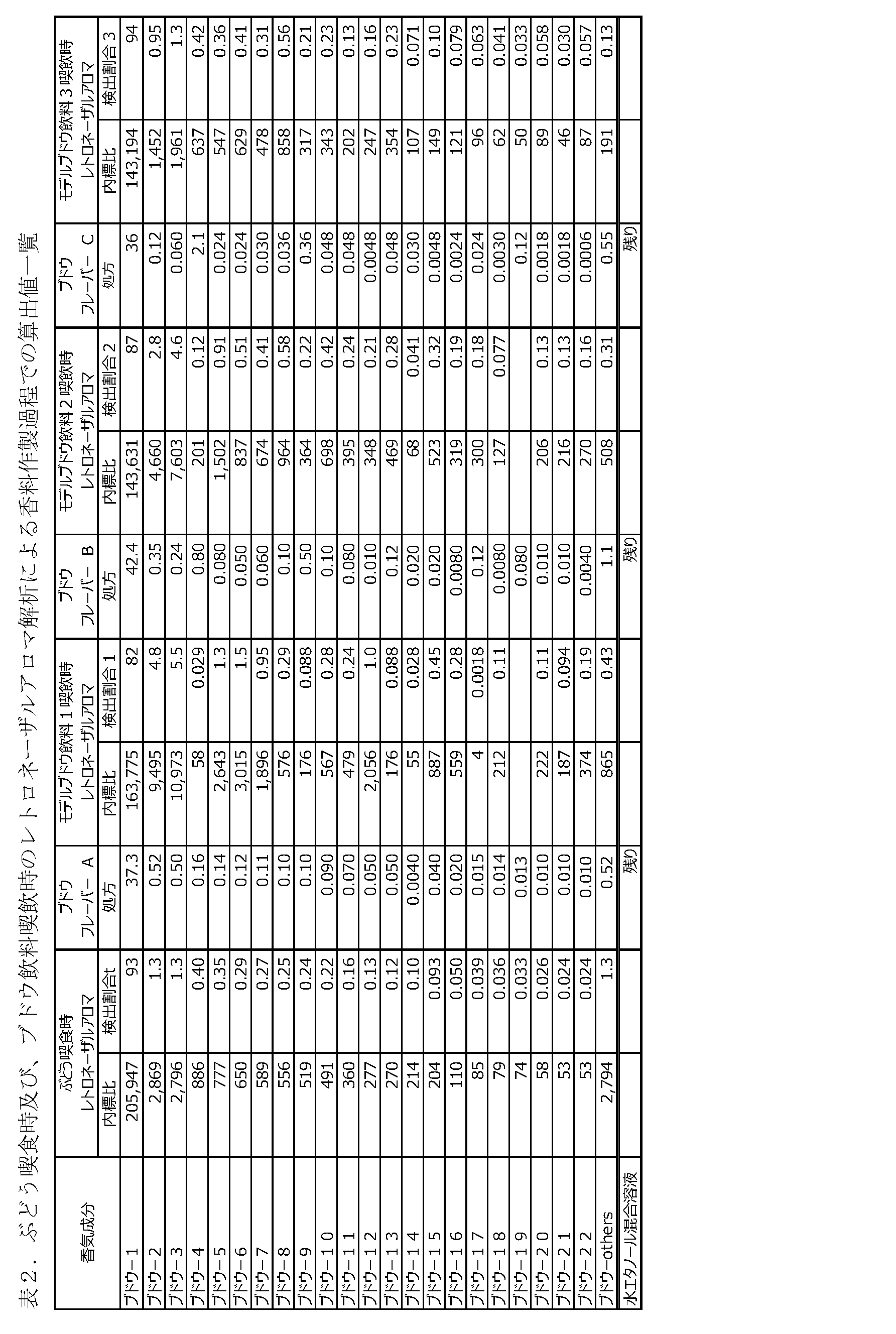
りんごと同様の手法でぶどう喫食時のレトロネーザルアロマの内標比を算出し、次にこの内標比からトータルを100%とする検出割合tを算出した。その後この検出割合tを質量%に換算し、そこにGC/O分析のみで検出した成分を加えて更に溶剤で適度に希釈して第1の香料組成物(ブドウフレーバーA)の処方とした。GC/O分析のみで検出した成分の処方の割合は、GC/MSで検出した香気成分の中で処方値が最低の値と同じ割合とした(表2)。
旬の時期に購入した市販のぶどうの糖酸分析を実施し、その結果を元に糖酸比を調整した飲料生地を作製した。そこに、第1の香料組成物(ブドウフレーバーA)を0.1質量%賦香したモデルブドウ飲料1を作製した。また、ブランク測定用に無賦香の飲料を作製した。
モデルリンゴ飲料1と同様の手法でモデルブドウ飲料1喫飲時の呼気をGC/MS用に3回、GC/O用に1回捕集した。またブランク飲料を用いて同様の手法でGC/MS用に1回、GC/O用に1回捕集した。
ぶどう喫食時の呼気と同様の手法、分析条件でモデルブドウ飲料1及びブランク飲料喫飲時の呼気のGC/MS分析を行った。
ぶどう喫食時の呼気と同様の手法、分析条件でモデルブドウ飲料1及びブランク飲料喫飲時の呼気のGC/O分析を行った。その結果、モデルブドウ飲料1喫飲時の呼気でGC/O分析のみで検出した成分の存在と、ぶどう喫食時の呼気と同等の匂い強度である事を確認した。
<第1の香料組成物(ブドウフレーバーA)の作製>と同様の手法で算出したモデルブドウ飲料1喫飲時のレトロネーザルアロマの内標比からトータルを100%とする検出割合1を算出した。
表2に示すように、ぶどう喫食時のレトロネーザルアロマの検出割合tとモデルブドウ飲料1喫飲時のレトロネーザルアロマの検出割合1を比較すると香気バランスが大きく異なっていた。
また、モデルブドウ飲料1を喫飲した結果、ぶどう果実喫食時のフレッシュな香味は不足していた。
検出割合1を検出割合tに近づけるために、モデルブドウ飲料1喫飲時のレトロネーザルアロマの内標比と処方(%)から検量線を作製し、ぶどう喫食時のレトロネーザルアロマの内標比から各香気成分の配合量を算出し、そこにGC/O分析のみで検出した成分を前回と同割合で加え第2の香料組成物(ブドウフレーバーB)の処方(%)とした(表2)。
上述の飲料生地に、第2の香料組成物(ブドウフレーバーB)を0.1質量%賦香したモデルブドウ飲料2を作製した。また、ブランク測定用に無賦香の飲料を作製した。
モデルブドウ飲料1と同様の手法で、モデルブドウ飲料2及びブランク飲料喫飲時の呼気捕集を行った。
モデルブドウ飲料1喫飲時の呼気と同様の手法、分析条件でモデルブドウ飲料2及びブランク飲料喫飲時の呼気のGC/MS分析を行った。
モデルブドウ飲料1喫飲時の呼気と同様の手法、分析条件でモデルブドウ飲料2及びブランク飲料喫飲時の呼気のGC/O分析を行った。その結果、モデルブドウ飲料2喫飲時の呼気で、GC/O分析のみで検出した成分の存在と、ぶどう喫食時の呼気と同等の匂い強度である事を確認した。
検出割合1と同様の手法で算出したモデルブドウ飲料2喫飲時のレトロネーザルアロマの内標比からトータルを100%とする検出割合2を算出した。
表2に示すように、ぶどう喫食時のレトロネーザルアロマの検出割合tとモデルブドウ飲料2喫飲時のレトロネーザルアロマの検出割合2を比較すると香気バランスが若干異なっていた。
また、モデルブドウ飲料2を喫飲した結果、モデルブドウ飲料1と比べると、ぶどう果実喫食時の甘さを伴うフレッシュな香味は上がっているが、まだ不足していた。
検出割合2を検出割合tに近づけるために、モデルブドウ飲料1及びモデルブドウ飲料2喫飲時のレトロネーザルアロマの内標比と処方(%)から検量線を作製し、ぶどう喫食時のレトロネーザルアロマの内標比から各香気成分の配合量を算出し、そこにGC/O分析のみで検出した成分を前回と同割合で加え、第3の香料組成物(ブドウフレーバーC)の処方(%)とした。(表2)
上述の飲料生地に、第3の香料組成物(ブドウフレーバーC)を0.1質量%賦香したモデルブドウ飲料3を作製した。また、ブランク測定用に無賦香の飲料を作製した。
モデルブドウ飲料1と同様の手法で、モデルブドウ飲料3及びブランク飲料喫飲時の呼気捕集を行った。
モデルブドウ飲料1の呼気と同様の手法、分析条件でモデルブドウ飲料3及びブランク飲料喫飲時の呼気のGC/MS分析を行った。
モデルブドウ飲料1の呼気と同様の手法、分析条件でモデルブドウ飲料3及びブランク飲料喫飲時の呼気のGC/O分析を行った。その結果、モデルブドウ飲料3喫飲時の呼気でGC/O分析のみで検出した成分の存在と、ぶどう喫食時の呼気と同等の匂い強度である事を確認した。
検出割合1と同様の手法で算出したモデルブドウ飲料3喫飲時のレトロネーザルアロマの内標比からトータルを100%とする検出割合3を算出した。
表2に示すように、ぶどう喫食時のレトロネーザルアロマの検出割合tとモデルブドウ飲料3喫飲時のレトロネーザルアロマの検出割合3を比較すると香気バランスが類似していた。
また、モデルブドウ飲料3を喫飲した結果、ぶどう果実喫食時の繊維感と甘さを伴うフレッシュでみずみずしい香味を想起させた。
まず、専門パネル4名によりぶどう喫食時の香味を官能評価した。次に、モデルブドウ飲料3及びモデルブドウ飲料1喫飲時の香味を官能評価した。モデルブドウ飲料3及びモデルブドウ飲料1は、どちらの香料を添加しているかは被験者には開示せず、3桁のランダムな数値を付与して提示した。
その結果、モデルブドウ飲料3はモデルブドウ飲料1に比べて、ぶどう果実喫食時の香味を想起させると全員が回答した。
<桃喫食時の呼気捕集>
りんごと同様の手法で桃喫食時の呼気を捕集した。
りんご喫食時の呼気と同様の分析条件で、桃喫食時及びブランクの呼気のGC/MS分析を行った。
りんご喫食時の呼気と同様の分析条件で、桃喫食時及びブランクの呼気のGC/O分析を行った。その結果、桃喫食時の呼気でGC/MSでは検出されなかった香気成分の存在とその匂い強度を確認した。
りんごと同様の手法で桃喫食時のレトロネーザルアロマの内標比を算出し、次にこの内標比からトータルを100%とする検出割合tを算出した。その後、この検出割合tを質量%に換算し、そこにGC/O分析のみで検出した成分を加えて更に溶剤で適度に希釈し、第1の香料組成物(モモフレーバーA)の処方とした。GC/O分析のみで検出した成分の処方の割合は、GC/MSで検出された香気成分の中で処方値が最低の値と同じ割合とした。(表3)
旬の時期に購入した市販の桃の糖酸分析を実施し、その結果を元に糖酸比を調整した飲料生地を作製した。そこに、第1の香料組成物(モモフレーバーA)を0.1質量%賦香したモデルモモ飲料1を作製した。また、ブランク測定用に無賦香の飲料を作製した。
モデルブドウ飲料1と同様の手法でモデルモモ飲料1及びブランク飲料喫飲時の呼気捕集を行った。
桃喫食時の呼気と同様の手法、分析条件でモデルモモ飲料1及びブランク飲料喫飲時の呼気のGC/MS分析を行った。
桃喫食時の呼気のGC/Oと同様の手法、分析条件でモデルモモ飲料1及びブランク飲料喫飲時の呼気のGC/O分析を行った。その結果、モデルモモ飲料1喫飲時の呼気でGC/O分析のみで検出した成分の存在と、桃喫食時の呼気と同等の匂い強度である事を確認した。
<第1の香料組成物(モモフレーバーA)の作製>と同様の手法で算出したモデルモモ飲料1喫飲時のレトロネーザルアロマの内標比からトータルを100%とする検出割合1を算出した。
表3に示すように、桃喫食時のレトロネーザルアロマの検出割合tとモデルモモ飲料1喫飲時のレトロネーザルアロマの検出割合1を比較すると香気バランスが大きく異なっていた。
また、モデルモモ飲料1を喫飲した結果、桃果実喫食時のフレッシュな香味は不足していた。
検出割合1を検出割合tに近づけるために、モデルモモ飲料1喫飲時の内標比と処方(%)から検量線を作製し、桃喫食時の内標比から各香気成分の配合量を算出し、そこにGC/O分析のみで検出した成分を前回と同割合で加え、第2の香料組成物(モモフレーバーB)の処方(%)とした。(表3)
上述の飲料生地に、第2の香料組成物(モモフレーバーB)を0.1質量%賦香したモデルモモ飲料2を作製した。また、ブランク測定用に無賦香の飲料を作製した。
モデルモモ飲料1と同様の手法で、モデルモモ飲料2及びブランク飲料喫飲時の呼気捕集を行った。
モデルモモ飲料1喫飲時の呼気と同様の手法、分析条件でモデルモモ飲料2及びブランク飲料喫飲時の呼気のGC/MS分析を行った。
モデルモモ飲料1喫飲時の呼気と同様の手法、分析条件でモデルモモ飲料2及びブランク飲料喫飲時の呼気のGC/O分析を行った。その結果、モデルモモ飲料2喫飲時の呼気で、GC/O分析のみで検出した成分の存在と、桃喫食時の呼気と同等の匂い強度である事を確認した。
検出割合1と同様の手法で算出したモデルモモ飲料2喫飲時のレトロネーザルアロマの内標比からトータルを100%とする検出割合2を算出した。
表3に示すように、桃喫食時のレトロネーザルアロマの検出割合tとモデルモモ飲料2喫飲時のレトロネーザルアロマの検出割合2を比較すると香気バランスが若干異なっていた。
また、モデルモモ飲料2を喫飲した結果、モデルモモ飲料1と比べると桃果実喫食時のフレッシュな香味は上がっているが、まだ不足していた。
検出割合2を検出割合tに近づけるために、モデルモモ飲料1喫飲時及びモデルモモ飲料2喫飲時の内標比と処方(%)から検量線を作製し、桃喫食時の内標比から各香気成分の配合量を算出し、そこにGC/O分析のみで検出した成分を前回と同割合で加え、第3の香料組成物(モモフレーバーC)の処方(%)とした。(表3)
上述の飲料生地に、第3の香料組成物(モモフレーバーC)を0.1質量%賦香したモデルモモ飲料3を作製した。また、ブランク測定用に無賦香の飲料を作製した。
モデルモモ飲料1と同様の手法で、モデルモモ飲料3及びブランク飲料喫飲時の呼気捕集を行った。
モデルモモ飲料1喫飲時の呼気と同様の手法、分析条件でモデルモモ飲料3及びブランク飲料喫飲時の呼気のGC/MS分析を行った。
モデルモモ飲料1喫飲時の呼気と同様の手法、分析条件でモデルモモ飲料3及びブランク飲料喫飲時の呼気のGC/O分析を行った。その結果、モデルモモ飲料3喫飲時の呼気でGC/O分析のみで検出した成分の存在と、桃喫食時の呼気と同等の匂い強度である事を確認した。
検出割合1と同様の手法で算出したモデルモモ飲料3喫飲時のレトロネーザルアロマの内標比からトータルを100%とする検出割合3を算出した。
表3に示すように、桃喫食時のレトロネーザルアロマの検出割合tとモデルモモ飲料3喫飲時のレトロネーザルアロマの検出割合3を比較すると香気バランスが類似していた。
また、モデルモモ飲料3を喫飲した結果、桃果実喫食時のとろっとした果肉感を伴うフレッシュでみずみずしい香味を想起させた。
まず、専門パネル4名により桃喫飲時の香味を官能評価した。次に、モデルモモ飲料3及びモデルモモ飲料1喫飲時の香味を官能評価した。モデルモモ飲料3及びモデルモモ飲料1は、どちらの香料を添加しているかは被験者には開示せず、3桁のランダムな数値を付与して提示した。
その結果、モデルモモ飲料3はモデルモモ飲料1に比べて、桃果実喫食時の香味を想起させると全員が回答した。

<いちご喫食時の呼気捕集>
りんごと同様の手法でいちご喫食時の呼気を捕集した。
りんご喫食時の呼気と同様の分析条件で、いちご喫食時及びブランクの呼気のGC/MS分析を行った。
りんご喫食時の呼気と同様の分析条件で、いちご喫食時及びブランクの呼気のGC/O分析を行った。その結果、いちご喫食時の呼気でGC/MSでは検出されなかった香気成分の存在とその匂い強度を確認した。
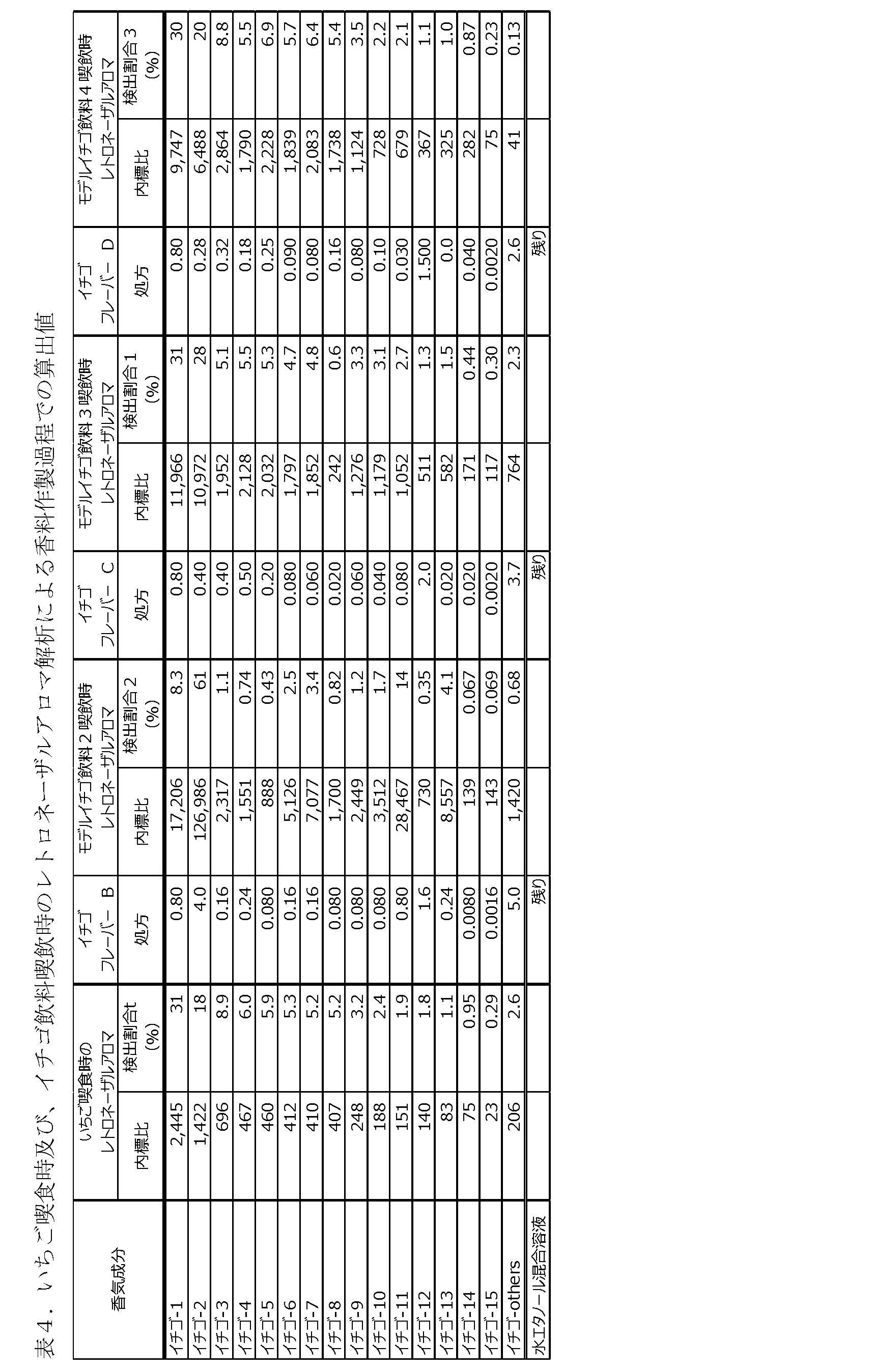
りんごと同様の手法でいちご喫食時のレトロネーザルアロマの内標比を算出し、次にこの内標比からトータルを100%とする検出割合tを算出した(表4)。その後、この検出割合tを質量%に換算し、そこにGC/O分析のみで検出した成分を加えて更に溶剤で適度に希釈し第1の香料組成物(イチゴフレーバーA)の処方とした。GC/O分析のみで検出した成分の処方の割合は、GC/MSで検出された香気成分の中で処方値が最低の値と同じ割合とした。
旬の時期に購入した市販のいちごの糖酸分析を実施し、その結果を元に糖酸比を調整した飲料生地を作製した。そこに、第1の香料組成物(イチゴフレーバーA)を0.1質量%賦香したモデルイチゴ飲料1を作製した。このモデルイチゴ飲料1は含硫化合物の香りが強く喫飲に不適であった。
イチゴフレーバーAの代わりに、いちご喫食時の呼気解析によって検出された香気成分を含有した表4に示す第2の香料組成物(イチゴフレーバーB)を使用した。上述の飲料生地に、第2の香料組成物(イチゴフレーバーB)を0.1質量%賦香したモデルイチゴ飲料2を作製した。また、ブランク測定用に無賦香の飲料を作製した。
モデルブドウ飲料1と同様の手法で、モデルイチゴ飲料2及びブランク飲料喫飲時の呼気捕集を行った。
いちご喫食時の呼気と同様の手法、分析条件でモデルイチゴ飲料2及びブランク飲料喫飲時の呼気のGC/MS分析を行った。
いちご喫食時の呼気と同様の手法、分析条件でモデルイチゴ飲料2及びブランク飲料喫飲時の呼気のGC/O分析行った。その結果、モデルイチゴ飲料2喫飲時の呼気でGC/O分析のみで検出した成分の存在が確認できなかった。
<第1の香料組成物(イチゴフレーバーA)の作製>と同様の手法で算出したモデルイチゴ飲料2喫飲時のレトロネーザルアロマの内標比からトータルを100%とする検出割合2を算出した。
表4に示すように、いちご喫食時のレトロネーザルアロマの検出割合tとモデルイチゴ飲料2喫飲時のレトロネーザルアロマの検出割合2を比較すると香気バランスが大きく異なっていた。
また、モデルイチゴ飲料2を喫飲した結果、いちご果実喫食時のフレッシュな香味は不足していた。
検出割合2を検出割合tに近づけるために、モデルイチゴ飲料2喫飲時のレトロネーザルアロマの内標比と処方(%)から検量線を作製し、いちご喫食時のレトロネーザルアロマの内標比から各香気成分の配合量を算出し、そこにGC/O分析のみで検出した成分を前回よりも多い割合で加え、第3の香料組成物(イチゴフレーバーC)の処方(%)とした。(表4)
上述の飲料生地に、第3の香料組成物(イチゴフレーバーC)を0.1質量%賦香したモデルイチゴ飲料3を作製した。また、ブランク測定用に無賦香の飲料を作製した。
モデルイチゴ飲料2と同様の手法で、モデルイチゴ飲料3及びブランク飲料喫飲時の呼気捕集を行った。
モデルイチゴ飲料2喫飲時の呼気と同様の手法、分析条件でモデルイチゴ飲料3及びブランク飲料喫飲時の呼気のGC/MS分析を行った。
モデルイチゴ飲料2喫飲時の呼気と同様の手法、分析条件でモデルイチゴ飲料3及びブランク飲料喫飲時の呼気のGC/O分析を行った。その結果、モデルイチゴ飲料3喫飲時の呼気で、GC/O分析のみで検出した成分の存在と、いちご喫食時の呼気と同等の匂い強度である事を確認した。
検出割合2と同様の手法で算出したモデルイチゴ飲料3喫飲時のレトロネーザルアロマの内標比からトータルを100%とする検出割合3を算出した。
表4に示すように、いちご喫食時のレトロネーザルアロマの検出割合tとモデルイチゴ飲料3喫飲時のレトロネーザルアロマの検出割合3を比較すると香気バランスが若干異なっていた。
また、モデルイチゴ飲料3を喫飲した結果、モデルイチゴ飲料2と比べると果実喫食時の甘さを伴うフレッシュな香味は上がっているが、まだ不足していた。
検出割合3を検出割合tに近づけるために、モデルイチゴ飲料2及びモデルイチゴ飲料3喫飲時のレトロネーザルアロマの内標比と処方(%)から検量線を作製し、いちご喫食時のレトロネーザルアロマの内標比から各香気成分の配合量を算出し、そこにGC/O分析のみで検出した成分を前回と同割合で加え、第4の香料組成物(イチゴフレーバーD)の処方(%)とした。(表4)
上述の飲料生地に、第4の香料組成物(イチゴフレーバーD)を0.1質量%賦香したモデルイチゴ飲料4を作製した。また、ブランク測定用に無賦香の飲料を作製した。
モデルイチゴ飲料2と同様の手法で、モデルイチゴ飲料4及びブランク飲料喫飲時の呼気捕集を行った。
モデルイチゴ飲料2喫飲時の呼気と同様の手法、分析条件でモデルイチゴ飲料4及びブランク飲料喫飲時の呼気のGC/MS分析を行った。
モデルイチゴ飲料2喫飲時の呼気と同様の手法、分析条件でモデルイチゴ飲料4及びブランク飲料喫飲時の呼気のGC/O分析を行った。その結果、モデルイチゴ飲料4喫飲時の呼気でGC/O分析のみで検出した成分の存在と、いちご喫食時の呼気と同等の匂い強度である事を確認した。
検出割合2と同様の手法で算出したモデルイチゴ飲料4喫飲時のレトロネーザルアロマの内標比からトータルを100%とする検出割合4を算出した。
表4に示すように、いちご喫食時のレトロネーザルアロマの検出割合tとモデルイチゴ飲料4喫飲時のレトロネーザルアロマの検出割合4を比較すると香気バランスが類似していた。
また、モデルイチゴ飲料4を喫飲した結果、いちご果実喫食時の甘さを伴うフレッシュでみずみずしい香味を想起させた。
まず、専門パネル4名によりいちご喫食時の香味を官能評価した。次に、モデルイチゴ飲料4及びモデルイチゴ飲料2喫飲時の香味を官能評価した。モデルイチゴ飲料4及びモデルイチゴ飲料2は、どちらの香料を添加しているかは被験者には開示せず、3桁のランダムな数値を付与して提示した。
その結果、モデルイチゴ飲料4はモデルイチゴ飲料2に比べて、いちご果実喫食時の香味を想起させると全員が回答した。
ターゲットとなるいちご喫食時のレトロネーザルアロマの検出割合tは、実施例4(飲料向けイチゴ様香料組成物の製造)に示した手法で得た。
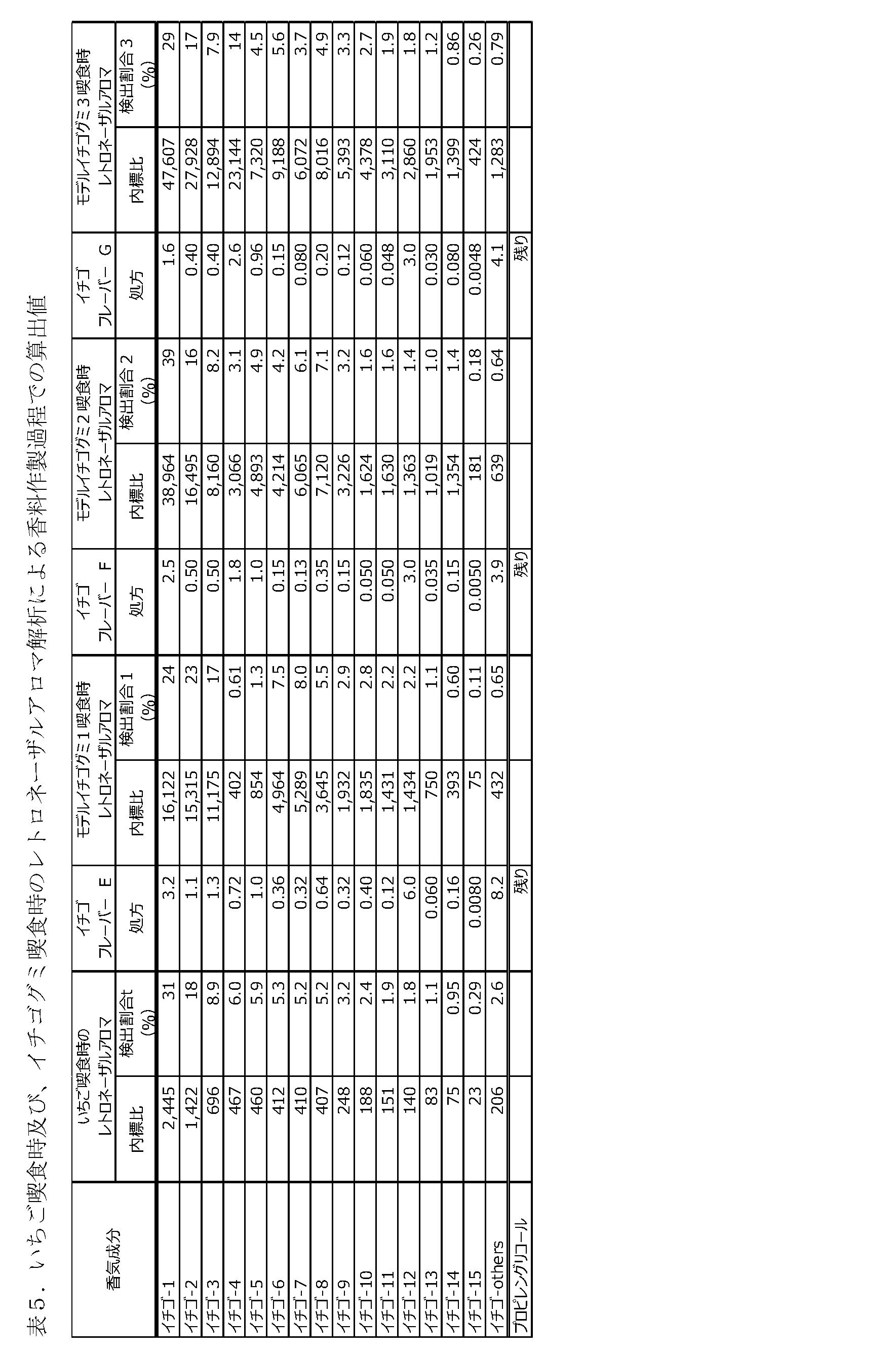
イチゴ飲料で開発したイチゴフレーバーDをもとに、全体の力価を強めたイチゴフレーバーEを作製した。(表5)
一般的なグミの生地処方に、第1の香料組成物(イチゴフレーバーE)を0.2質量%賦香したモデルイチゴグミ1を作製した。また、ブランク測定用に無賦香のグミを作製した。
いちご喫食時と同様の手法でモデルイチゴグミ1及びブランクグミ喫食時の呼気を捕集した。
いちご喫食時の呼気と同様の手法、分析条件でモデルイチゴグミ1及びブランクグミ喫食時の呼気のGC/MS分析を行った。
いちご喫食時の呼気と同様の手法、分析条件でモデルイチゴグミ1及びブランクグミ喫食時の呼気のGC/O分析行った。その結果、モデルイチゴグミ1喫食時の呼気でGC/MSでは検出されなかった香気成分の存在を確認した。匂い強度はいちご喫食時の呼気と比較して強い事を確認した。
いちご喫食時の呼気と同様の手法で算出したモデルイチゴグミ1喫食時のレトロネーザルアロマの内標比からトータルを100%とする検出割合1を算出した。
表5に示すように、いちご喫食時のレトロネーザルアロマの検出割合tとモデルイチゴグミ1喫食時のレトロネーザルアロマの検出割合1を比較すると香気バランスが大きく異なっていた。
また、モデルイチゴグミ1を喫食した結果、いちご果実喫食時のフレッシュな香味は不足していた。
検出割合1を検出割合tに近づけるために、モデルイチゴグミ1喫食時のレトロネーザルアロマの内標比と処方(%)から検量線を作製し、いちご喫食時のレトロネーザルアロマの内標比から各香気成分の配合量を算出し、そこにGC/O分析のみで検出した成分を前回よりも少ない割合で加え、第2の香料組成物(イチゴフレーバーF)の処方(%)とした。(表5)
上述のグミ生地に、第2の香料組成物(イチゴフレーバーF)を0.2質量%賦香したモデルイチゴグミ2を作製した。また、ブランク測定用に無賦香のグミを作製した。
モデルイチゴグミ1と同様の手法で、モデルイチゴグミ2及びブランクグミ喫食時の呼気捕集を行った。
モデルイチゴグミ1喫食時の呼気と同様の手法、分析条件でモデルイチゴグミ2及びブランクグミ喫食時の呼気のGC/MS分析を行った。
モデルイチゴグミ1喫食時の呼気と同様の手法、分析条件でモデルイチゴグミ2及びブランクグミ喫食時の呼気のGC/O分析を行った。その結果、モデルイチゴグミ2喫食時の呼気でGC/O分析のみで検出した成分の存在と、いちご喫食時の呼気と同等の匂い強度である事を確認した。
検出割合1と同様の手法で算出したモデルイチゴグミ2喫食時のレトロネーザルアロマの内標比からトータルを100%とする検出割合2を算出した。
表5に示すように、いちご喫食時のレトロネーザルアロマの検出割合tとモデルイチゴグミ2喫食時のレトロネーザルアロマの検出割合2を比較すると香気バランスが若干異なっていた。
また、モデルイチゴグミ2を喫食した結果、モデルイチゴグミ1と比べると果実喫食時の甘さを伴うフレッシュな香味は上がっているが、まだ不足していた。
検出割合2を検出割合tに近づけるために、モデルイチゴグミ1及びモデルイチゴグミ2喫食時のレトロネーザルアロマの内標比と処方(%)から検量線を作製し、いちご喫食時のレトロネーザルアロマの内標比から各香気成分の配合量を算出し、そこにGC/O分析のみで検出した成分を前回と同割合で加え、第2の香料組成物(イチゴフレーバーG)の処方(%)とした。(表5)
上述のグミ生地に、第3の香料組成物(イチゴフレーバーG)を0.2質量%賦香したモデルイチゴグミ3を作製した。また、ブランク測定用に無賦香のグミを作製した。
モデルイチゴグミ1と同様の手法で、モデルイチゴグミ3及びブランクグミ喫食時の呼気捕集を行った。
モデルイチゴグミ1喫食時の呼気と同様の手法、分析条件でモデルイチゴグミ3及びブランクグミ喫食時の呼気のGC/MS分析を行った。
検出割合1と同様の手法で算出したモデルイチゴグミ3喫食時のレトロネーザルアロマの内標比からトータルを100%とする検出割合3を算出した。
モデルイチゴグミ1喫食時の呼気と同様の手法、分析条件でモデルイチゴグミ3及びブランクグミ喫食時の呼気のGC/O分析を行った。その結果、モデルイチゴグミ3喫食時の呼気でGC/O分析のみで検出した成分の存在と、いちご喫食時の呼気と同等の匂い強度である事を確認した。
表5に示すように、いちご喫食時のレトロネーザルアロマの検出割合tとモデルイチゴグミ3喫食時のレトロネーザルアロマの検出割合3を比較すると香気バランスが類似していた。
また、モデルイチゴグミ3を喫食した結果、いちご果実喫食時の甘さを伴うフレッシュでみずみずしい香味を想起させた。
まず、専門パネル4名によりいちご喫食時の香味を官能評価した。次に、モデルイチゴグミ3及びモデルイチゴグミ1喫食時の香味を官能評価した。モデルイチゴグミ3及びモデルイチゴグミ1は、どちらの香料を添加しているかは被験者には開示せず、3桁のランダムな数値を付与して提示した。
その結果、モデルイチゴグミ3はモデルイチゴグミ1に比べて、いちご果実喫食時の香味を想起させると全員が回答した。
Claims (4)
- 分析対象物を喫食又は喫飲する際に得られるレトロネーザルアロマについてガスクロマトグラフィー分析を行う工程(1)と、
工程(1)のガスクロマトグラフィー分析の結果から工程(1)のレトロネーザルアロマに含まれる複数の香気成分の検出割合tを算出して、前記香気成分を含有する第1の香料組成物を得る工程(2)と、
前記第1の香料組成物を含有するモデル飲食品1を調製する工程(3)と、
前記モデル飲食品1を喫食又は喫飲する際に得られるレトロネーザルアロマについてガスクロマトグラフィー分析を行う工程(4)と、
工程(4)のガスクロマトグラフィー分析の結果から工程(4)のレトロネーザルアロマに含まれる複数の香気成分の検出割合1を算出する工程(5)と、
前記検出割合1を前記検出割合tに近づけるように前記第1の香料組成物の組成を調整し、第2の香料組成物を得る工程(6)と、
工程(3)~(6)と同様の操作を繰り返し行い、前記検出割合tと一致する香気バランスを有する最終香料組成物を得る工程(7)と、
を有する、香料組成物の製造方法。 - 工程(1)のレトロネーザルアロマについてガスクロマトグラフィーオルファクトメトリー分析を行い、認識される匂いの香気成分を前記第1の香料組成物に含有させる工程を有する、請求項1に記載の香料組成物の製造方法。
- 前記ガスクロマトグラフィーオルファクトメトリー分析が、アロマ・エキストラクト・ダイリューション・アナリシス法を用いて香気強度を調整する分析を含む、請求項2に記載の香料組成物の製造方法。
- 工程(1)において、前記レトロネーザルアロマを吸着剤に吸着させ、前記吸着したレトロネーザルアロマを脱着させる工程を有する、請求項1~3のいずれか1項に記載の香料組成物の製造方法。
Priority Applications (3)
| Application Number | Priority Date | Filing Date | Title |
|---|---|---|---|
| CN202280094917.5A CN119012924A (zh) | 2022-04-15 | 2022-08-03 | 香料组合物的生产方法 |
| DE112022007063.3T DE112022007063T5 (de) | 2022-04-15 | 2022-08-03 | Verfahren zur herstellung einer aromazusammensetzung |
| US18/856,467 US20250261674A1 (en) | 2022-04-15 | 2022-08-03 | Production method for flavor composition |
Applications Claiming Priority (2)
| Application Number | Priority Date | Filing Date | Title |
|---|---|---|---|
| JP2022-067737 | 2022-04-15 | ||
| JP2022067737A JP7817061B2 (ja) | 2022-04-15 | 2022-04-15 | 香料組成物の製造方法 |
Publications (1)
| Publication Number | Publication Date |
|---|---|
| WO2023199534A1 true WO2023199534A1 (ja) | 2023-10-19 |
Family
ID=88329491
Family Applications (1)
| Application Number | Title | Priority Date | Filing Date |
|---|---|---|---|
| PCT/JP2022/029855 Ceased WO2023199534A1 (ja) | 2022-04-15 | 2022-08-03 | 香料組成物の製造方法 |
Country Status (5)
| Country | Link |
|---|---|
| US (1) | US20250261674A1 (ja) |
| JP (1) | JP7817061B2 (ja) |
| CN (1) | CN119012924A (ja) |
| DE (1) | DE112022007063T5 (ja) |
| WO (1) | WO2023199534A1 (ja) |
Citations (4)
| Publication number | Priority date | Publication date | Assignee | Title |
|---|---|---|---|---|
| JP2004325116A (ja) * | 2003-04-22 | 2004-11-18 | Takasago Internatl Corp | 香気成分分析法、香料の製造方法および香料 |
| JP2007236233A (ja) * | 2006-03-07 | 2007-09-20 | Soda Aromatic Co Ltd | 香料調合における新規調合方法 |
| JP2018141741A (ja) * | 2017-02-28 | 2018-09-13 | 高砂香料工業株式会社 | 香料化合物のレトロネーザルアロマにおける貢献度の評価方法 |
| JP2019045243A (ja) * | 2017-08-31 | 2019-03-22 | 小川香料株式会社 | 余韻性付与香気成分の探索方法 |
Family Cites Families (3)
| Publication number | Priority date | Publication date | Assignee | Title |
|---|---|---|---|---|
| JP6470526B2 (ja) | 2014-08-26 | 2019-02-13 | 小川香料株式会社 | 香気成分の香気発現特性の評価方法 |
| JP6534646B2 (ja) | 2016-10-31 | 2019-06-26 | 長谷川香料株式会社 | 飲食品特有の残り香成分の探索方法 |
| JP2022067737A (ja) | 2020-10-21 | 2022-05-09 | プラスマン合同会社 | 3次元医用画像の表示方法、サーバー、システムおよびプログラム |
-
2022
- 2022-04-15 JP JP2022067737A patent/JP7817061B2/ja active Active
- 2022-08-03 WO PCT/JP2022/029855 patent/WO2023199534A1/ja not_active Ceased
- 2022-08-03 US US18/856,467 patent/US20250261674A1/en active Pending
- 2022-08-03 DE DE112022007063.3T patent/DE112022007063T5/de active Pending
- 2022-08-03 CN CN202280094917.5A patent/CN119012924A/zh active Pending
Patent Citations (4)
| Publication number | Priority date | Publication date | Assignee | Title |
|---|---|---|---|---|
| JP2004325116A (ja) * | 2003-04-22 | 2004-11-18 | Takasago Internatl Corp | 香気成分分析法、香料の製造方法および香料 |
| JP2007236233A (ja) * | 2006-03-07 | 2007-09-20 | Soda Aromatic Co Ltd | 香料調合における新規調合方法 |
| JP2018141741A (ja) * | 2017-02-28 | 2018-09-13 | 高砂香料工業株式会社 | 香料化合物のレトロネーザルアロマにおける貢献度の評価方法 |
| JP2019045243A (ja) * | 2017-08-31 | 2019-03-22 | 小川香料株式会社 | 余韻性付与香気成分の探索方法 |
Also Published As
| Publication number | Publication date |
|---|---|
| US20250261674A1 (en) | 2025-08-21 |
| CN119012924A (zh) | 2024-11-22 |
| JP7817061B2 (ja) | 2026-02-18 |
| JP2023157676A (ja) | 2023-10-26 |
| DE112022007063T5 (de) | 2025-02-20 |
Similar Documents
| Publication | Publication Date | Title |
|---|---|---|
| JP6470526B2 (ja) | 香気成分の香気発現特性の評価方法 | |
| KR102045592B1 (ko) | 식품 향미 화합물로서의 n-아실 프롤린 유도체 | |
| KR102045591B1 (ko) | 식품 향미 화합물로서의 감마 아미노-부티르산 및 베타 알라닌의 n-아실 유도체 | |
| Theron et al. | Sensory profiling of honeybush tea (Cyclopia species) and the development of a honeybush sensory wheel | |
| CN113226479A (zh) | 风味组合物 | |
| JP2018526006A (ja) | 非動物由来のタンパク質含有消費物のためのフレーバーシステム | |
| EP4066652B1 (en) | Acetic acid-containing food or drink | |
| JP6846947B2 (ja) | 香料化合物のレトロネーザルアロマにおける貢献度の評価方法 | |
| JP6534646B2 (ja) | 飲食品特有の残り香成分の探索方法 | |
| JP6936663B2 (ja) | 余韻性付与香気成分の探索方法 | |
| WO2018053344A1 (en) | Sweetness enhancing volatile compositions and methods of increasing perceived sweetness of a comestible | |
| Giudici et al. | The flavor and taste of cereal Chinese vinegars. | |
| EP4442801A1 (en) | Acetic acid-containing food or beverage | |
| JP7817061B2 (ja) | 香料組成物の製造方法 | |
| JP7406945B2 (ja) | 飲食品が有するオフフレーバーを有効にマスキング可能な香気成分の探索方法 | |
| JP2016002008A (ja) | リンゴ風味増強剤およびリンゴ風味増強方法 | |
| EP4094586A1 (en) | Acetic acid-containing food or beverage | |
| US20240044859A1 (en) | Method for assessing aroma component and method for preparing flavor composition | |
| Moazzem | Sensory Evaluation of Fruits and Selected Food Items by Descriptive Analysis, Electronic Nose, and Electronic Tongue | |
| Meng et al. | Quantification and odor contribution of volatile thiols in Japanese soy sauce | |
| Taylor et al. | Understanding flavour release: the key to better food flavour? | |
| Fu | Identification of non-volatile compounds that impact consumer liking of roasted hybrid American hazelnuts using LC-MS Flavoromics | |
| WO2022138890A1 (ja) | 香料組成物 | |
| JP7281986B2 (ja) | 飲食品の評価方法 | |
| Liu | Flavor Chemistry of Pea Proteins |
Legal Events
| Date | Code | Title | Description |
|---|---|---|---|
| 121 | Ep: the epo has been informed by wipo that ep was designated in this application |
Ref document number: 22937511 Country of ref document: EP Kind code of ref document: A1 |
|
| WWE | Wipo information: entry into national phase |
Ref document number: 18856467 Country of ref document: US |
|
| WWE | Wipo information: entry into national phase |
Ref document number: 202280094917.5 Country of ref document: CN |
|
| WWE | Wipo information: entry into national phase |
Ref document number: 112022007063 Country of ref document: DE |
|
| WWE | Wipo information: entry into national phase |
Ref document number: 11202407142S Country of ref document: SG |
|
| WWP | Wipo information: published in national office |
Ref document number: 112022007063 Country of ref document: DE |
|
| 122 | Ep: pct application non-entry in european phase |
Ref document number: 22937511 Country of ref document: EP Kind code of ref document: A1 |
|
| WWP | Wipo information: published in national office |
Ref document number: 18856467 Country of ref document: US |