WO2023189966A1 - 識別媒体及び物品 - Google Patents
識別媒体及び物品 Download PDFInfo
- Publication number
- WO2023189966A1 WO2023189966A1 PCT/JP2023/011303 JP2023011303W WO2023189966A1 WO 2023189966 A1 WO2023189966 A1 WO 2023189966A1 JP 2023011303 W JP2023011303 W JP 2023011303W WO 2023189966 A1 WO2023189966 A1 WO 2023189966A1
- Authority
- WO
- WIPO (PCT)
- Prior art keywords
- layer
- adhesive
- identification medium
- polarized light
- circularly polarized
- Prior art date
- Legal status (The legal status is an assumption and is not a legal conclusion. Google has not performed a legal analysis and makes no representation as to the accuracy of the status listed.)
- Ceased
Links
Images










Classifications
-
- B—PERFORMING OPERATIONS; TRANSPORTING
- B42—BOOKBINDING; ALBUMS; FILES; SPECIAL PRINTED MATTER
- B42D—BOOKS; BOOK COVERS; LOOSE LEAVES; PRINTED MATTER CHARACTERISED BY IDENTIFICATION OR SECURITY FEATURES; PRINTED MATTER OF SPECIAL FORMAT OR STYLE NOT OTHERWISE PROVIDED FOR; DEVICES FOR USE THEREWITH AND NOT OTHERWISE PROVIDED FOR; MOVABLE-STRIP WRITING OR READING APPARATUS
- B42D25/00—Information-bearing cards or sheet-like structures characterised by identification or security features; Manufacture thereof
- B42D25/30—Identification or security features, e.g. for preventing forgery
- B42D25/36—Identification or security features, e.g. for preventing forgery comprising special materials
- B42D25/364—Liquid crystals
-
- B—PERFORMING OPERATIONS; TRANSPORTING
- B42—BOOKBINDING; ALBUMS; FILES; SPECIAL PRINTED MATTER
- B42D—BOOKS; BOOK COVERS; LOOSE LEAVES; PRINTED MATTER CHARACTERISED BY IDENTIFICATION OR SECURITY FEATURES; PRINTED MATTER OF SPECIAL FORMAT OR STYLE NOT OTHERWISE PROVIDED FOR; DEVICES FOR USE THEREWITH AND NOT OTHERWISE PROVIDED FOR; MOVABLE-STRIP WRITING OR READING APPARATUS
- B42D25/00—Information-bearing cards or sheet-like structures characterised by identification or security features; Manufacture thereof
- B42D25/30—Identification or security features, e.g. for preventing forgery
- B42D25/351—Translucent or partly translucent parts, e.g. windows
-
- B—PERFORMING OPERATIONS; TRANSPORTING
- B42—BOOKBINDING; ALBUMS; FILES; SPECIAL PRINTED MATTER
- B42D—BOOKS; BOOK COVERS; LOOSE LEAVES; PRINTED MATTER CHARACTERISED BY IDENTIFICATION OR SECURITY FEATURES; PRINTED MATTER OF SPECIAL FORMAT OR STYLE NOT OTHERWISE PROVIDED FOR; DEVICES FOR USE THEREWITH AND NOT OTHERWISE PROVIDED FOR; MOVABLE-STRIP WRITING OR READING APPARATUS
- B42D25/00—Information-bearing cards or sheet-like structures characterised by identification or security features; Manufacture thereof
- B42D25/30—Identification or security features, e.g. for preventing forgery
- B42D25/36—Identification or security features, e.g. for preventing forgery comprising special materials
- B42D25/378—Special inks
- B42D25/391—Special inks absorbing or reflecting polarised light
-
- G—PHYSICS
- G09—EDUCATION; CRYPTOGRAPHY; DISPLAY; ADVERTISING; SEALS
- G09F—DISPLAYING; ADVERTISING; SIGNS; LABELS OR NAME-PLATES; SEALS
- G09F3/00—Labels, tag tickets, or similar identification or indication means; Seals; Postage or like stamps
- G09F3/02—Forms or constructions
- G09F3/0291—Labels or tickets undergoing a change under particular conditions, e.g. heat, radiation, passage of time
- G09F3/0292—Labels or tickets undergoing a change under particular conditions, e.g. heat, radiation, passage of time tamper indicating labels
-
- G—PHYSICS
- G02—OPTICS
- G02B—OPTICAL ELEMENTS, SYSTEMS OR APPARATUS
- G02B5/00—Optical elements other than lenses
- G02B5/30—Polarising elements
- G02B5/3016—Polarising elements involving passive liquid crystal elements
Definitions
- the present invention relates to identification media and articles.
- an identification medium that cannot be easily duplicated.
- an identification medium one using a material having a circularly polarized light separating function is known.
- a material having a circularly polarized light separation function has a function of transmitting one of right-handed circularly polarized light and left-handed circularly polarized light and reflecting part or all of the other circularly polarized light.
- Different images appear when an identification medium made of such a material is observed through a right-handed circularly polarizing plate and when observed through a left-handed circularly polarizing plate. Therefore, in determining the authenticity of an article provided with such an identification medium, it is common to use a viewer equipped with two circularly polarizing plates, a right-handed circularly polarizing plate and a left-handed circularly polarizing plate.
- Authenticity determination using conventional identification media requires a viewer equipped with two circularly polarizing plates as described above, resulting in high costs.
- it is difficult for general users to obtain a viewer it is difficult to determine authenticity, and the implementation of authenticity determination is limited to genuine product manufacturers, some retail stores, public institutions, etc. . Therefore, there has been a need for an identification medium that can determine authenticity without using a special viewer as described above.
- the present inventor has developed a first layer that can reflect one circularly polarized light and transmit the other circularly polarized light, and a circularly polarized light that is rotated in the same direction as the circularly polarized light reflected by the first layer.
- a second layer that reflects, is arranged to overlap with the first layer, and is capable of transmitting circularly polarized light having a direction of rotation opposite to that of the circularly polarized light reflected by the first layer;
- Patent Document 2 does not relate to an identification medium including the first layer and second layer, it discloses an identification medium with a reuse prevention function for identifying authenticity. Are listed.
- the identification medium including the first layer and the second layer is semi-transparent and can be seen from one side to the other, when the identification medium is observed from the second layer side, This makes it possible to visually confirm that only the second layer is observed, and that when the identification medium is observed from the side opposite to the second layer side (the first layer side), the second layer is not observed.
- it is expected to be used as an identification medium to be attached to transparent adherends such as glass.
- Identification media that are used by being affixed to adherends are strongly required to have a function that prevents the identification medium from being peeled off and reused once it is affixed to the adherend.
- the present invention has been devised in view of the above-mentioned problems, and an object of the present invention is to provide an identification medium that allows determination of authenticity without using a special viewer and prevents reuse, and an article containing the same. With the goal.
- the inventor of the present invention has conducted extensive studies on the above-mentioned problems, and has found that when the adhesive layer of the identification medium, the second layer, and the first layer are laminated in this order on the adherend, the first layer
- the adhesive force F1 between the layer and the second layer is made smaller than the adhesive force F2 between the second layer and the adhesive layer, and the adhesive force F3 between the adhesive layer and the adherend, and the identification
- the optical function of the identification medium can be lost and reuse can be prevented by creating a structure that allows the first layer and the second layer to be separated when the medium is peeled off from the adherend.
- the present invention has now been completed.
- the present invention includes the following.
- a layer that can reflect either polarized light or left-handed circularly polarized light and transmit the other circularly polarized light and includes a layer of resin having cholesteric regularity, and the second layer reflects the first layer.
- a resin having cholesteric regularity which is a layer capable of reflecting at least a part of circularly polarized light in the same direction of rotation as the circularly polarized light and transmitting circularly polarized light in the opposite direction of rotation to the circularly polarized light reflected by the first layer.
- the adhesive force F1 between the first layer and the second layer, and the adhesive force F1 between the second layer and the adhesive layer are An identification medium in which an adhesive force F2 and an adhesive force F3 between the adhesive layer and the adherend satisfy the relationships of formulas (1) and (2) below.
- the second layer is a layer provided on a part of the surface of the first layer
- the adhesive layer is a layer provided on the first layer and the second layer.
- the identification medium according to [1] or [2], which satisfies the relationship (4).
- a third layer provided on a surface of the first layer opposite to the surface on which the second layer is provided so as to overlap with the first layer, and the third layer [1] to [3] are layers that can transmit circularly polarized light in a direction of rotation opposite to the circularly polarized light reflected by the first layer, and that contain resin flakes having cholesteric regularity.
- the identification medium according to any one of the items.
- the present invention it is possible to determine authenticity without using a special viewer having a right-handed circularly polarizing plate and a left-handed circularly polarizing plate, and to provide an identification medium that prevents reuse, and an article containing the same. can do.
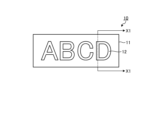
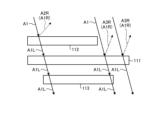
- FIG. 1 is a plan view schematically showing an identification medium according to Embodiment 1 of the present invention.
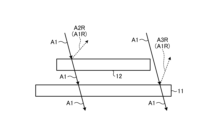
- FIG. 2 is a cross-sectional view schematically showing a cross section taken along the line X1-X1 in FIG.
- FIG. 3 is an exploded cross-sectional view schematically showing the adhesive force between each layer of the identification medium shown in FIG. 2.
- FIG. 4 is an exploded cross-sectional view schematically showing the path of light when light is irradiated from the second layer side of the identification medium.
- FIG. 5 is an exploded cross-sectional view schematically showing the path of light when light is irradiated from the first layer side of the identification medium.
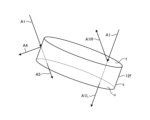
- FIG. 6 is a perspective view schematically showing a flake and a path of light irradiated onto the flake.
- FIG. 7 is an exploded perspective view schematically showing an identification medium according to Embodiment 2 of the present invention.
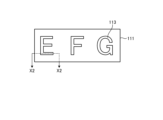
- FIG. 8 is a schematic plan view of the identification medium of FIG. 7 viewed from the second layer side.
- FIG. 9 is a schematic plan view of the identification medium of FIG. 7 viewed from the third layer side.
- FIG. 10 is a cross-sectional view schematically showing a cross section in the X2-X2 direction of FIGS. 8 and 9.
- FIG. FIG. 11 is an exploded cross-sectional view schematically showing the path of light when light is irradiated from the second layer side of the identification medium.
- FIG. 8 is a schematic plan view of the identification medium of FIG. 7 viewed from the second layer side.
- FIG. 9 is a schematic plan view of the identification medium of FIG. 7 viewed from the third layer side.
- FIG. 10 is a cross-
- FIG. 12 is an exploded cross-sectional view schematically showing the path of light when light is irradiated from the third layer side of the identification medium.
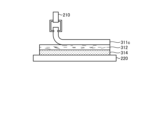
- FIG. 13 is a cross-sectional view schematically showing a method for measuring the adhesive force F1 between the first layer and the second layer in the example.
- FIG. 14 is a cross-sectional view schematically showing a method for measuring the adhesive force F2 between the second layer and the adhesive layer in Examples.
- FIG. 15 is a cross-sectional view schematically showing a method for measuring the adhesive force F3 between the adhesive layer and the adherend in Examples.
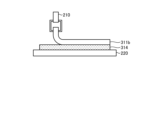
- FIG. 16 is a cross-sectional view schematically showing a method for measuring the adhesive force F4 between the first layer and the adhesive layer in Examples.
- FIG. 13 is a cross-sectional view schematically showing a method for measuring the adhesive force F1 between the first layer and the second layer in the example.
- FIG. 14 is a cross-sectional view schematically showing a method for measuring the adhesive force F2 between the second layer
- FIG. 17 is a cross-sectional view schematically showing a method for measuring the tension T1 that deforms the adhesive layer in the example.
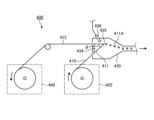
- FIG. 18 is a side view schematically showing a peelable piece manufacturing apparatus used in manufacturing peelable pieces (flakes) of the cholesteric resin layer in Examples.
- pattern refers to the shape of a flat object unless otherwise specified. This pattern includes, for example, letters, numbers, and figures.
- the "visible light region” refers to a wavelength range of 400 nm or more and 780 nm or less.
- the in-plane retardation of a film or layer indicates a value expressed by (nx-ny) ⁇ d. Further, the retardation in the thickness direction of the film or layer has a value expressed by ⁇ (nx+ny)/2-nz ⁇ d.
- nx represents the refractive index in the direction perpendicular to the thickness direction of the film or layer (in-plane direction) and giving the maximum refractive index.
- ny represents the refractive index in the in-plane direction of the film or layer and perpendicular to the nx direction.
- nz indicates the refractive index in the thickness direction of the film or layer.
- d indicates the thickness of the film or layer.
- (meth)acrylic includes acrylic, methacrylic, and combinations thereof.
- (meth)acrylate includes acrylate, methacrylate, and combinations thereof.
- (thio)epoxy includes epoxy, thioepoxy and combinations thereof.
- iso(thio)cyanate includes isocyanate, isothiocyanate, and combinations thereof.
- adhesives and pressure-sensitive adhesives are distinguished by shear storage modulus unless otherwise specified.
- the adhesive refers to a material having a shear storage modulus of 1 MPa to 500 MPa at 23° C. after energy ray irradiation or heat treatment.
- the adhesive refers to a material having a shear storage modulus at 23° C. of less than 1 MPa.
- FIG. 1 is a plan view schematically showing an identification medium according to Embodiment 1 of the present invention.
- FIG. 2 is a cross-sectional view schematically showing a cross section taken along the line X1-X1 in FIG.
- FIG. 3 is an exploded cross-sectional view schematically showing the adhesive force between each layer of the identification medium shown in FIG. 2.
- FIG. 4 is an exploded cross-sectional view schematically showing the path of light when light is irradiated from the second layer side of the identification medium.
- FIG. 5 is an exploded cross-sectional view schematically showing the path of light when light is irradiated from the first layer side of the identification medium.
- an identification medium 10 includes a first layer 11, a second layer 12 provided so as to overlap with the first layer 11, and a second layer 12 provided so as to overlap with the first layer 11. It has an adhesive layer 14 provided on the layer 12 of.
- a certain layer and another certain layer overlap
- at least a part of them is at the same planar position. say something.
- the adhesive layer 14 is usually a layer provided directly (that is, in contact with) the second layer 12. Further, as shown in FIGS. 1 to 3, when the second layer 12 is a layer provided on a part of the surface of the first layer 11, the adhesive layer 14 is formed on the first layer 11 and on the second layer 11. This layer is provided on layer 12 of . In this case, the adhesive layer 14 is usually a layer provided directly (that is, in contact with) each of the first layer 11 and the second layer 12.
- the adhesive layer 14 provided on at least the second layer 12 will also be referred to as an "adhesive layer (A)" to distinguish it from adhesive layers provided at other positions.
- the first layer 11 is a layer that can reflect either right-handed circularly polarized light or left-handed circularly polarized light and transmit the other circularly polarized light. Further, the first layer 11 includes a resin layer 11a having cholesteric regularity. The first layer 11 may be a layer including a layer 11a of a resin having cholesteric regularity, a layer 11b containing a norbornene-based resin, and an adhesive layer 11c (or adhesive layer), if necessary.
- the second layer 12 reflects at least a part of the circularly polarized light in the same direction of rotation as the circularly polarized light reflected by the first layer 11, and reflects at least a part of the circularly polarized light in the opposite direction of rotation to the circularly polarized light reflected by the first layer 11.
- This is a layer that can transmit polarized light.
- the second layer 12 is a layer containing resin flakes 12f having cholesteric regularity.
- the second layer 12 is a portion of the character pattern ABCD formed directly on the layer 11b of the first layer 11.
- the second layer 12 is formed at a position where its entire area completely overlaps the first layer 11.
- FIG. 2 is a schematic diagram
- the cross-sectional shape of the second layer 12 is shown as a schematic diagram.
- the second layer 12 a schematic cross-sectional shape of a layer having a planar shape of a character pattern and a constant thickness is shown.
- the identification medium 10 has a protective layer 16 provided on the surface of the first layer 11 opposite to the surface on which the second layer 12 is provided, with an adhesive layer 15 (or adhesive layer) interposed therebetween, if necessary.
- a protective layer 16 provided on the surface of the first layer 11 opposite to the surface on which the second layer 12 is provided, with an adhesive layer 15 (or adhesive layer) interposed therebetween, if necessary.
- the adhesive force F2 between the adhesive layer (A) 14 and the adhesive force F3 between the adhesive layer (A) 14 and the adherend 20 satisfy the relationships of the following formulas (1) and (2).
- the identification medium 10 provides the adhesive layer (A) 14 on the layer 11b of the first layer 11, the adhesive force F3 between the adhesive layer (A) 14 and the adherend 20 and the first
- the adhesive force F4 between the layer 11b and the adhesive layer (A) 14 in the layer satisfies the relationship of formula (4) below.
- the identification medium when the identification medium is attached to the adherend, the adhesive force between each layer of the identification medium and the adhesive force F3 between the adhesive layer (A) and the adherend have a predetermined relationship.
- the identification medium can be separated between the first layer and the second layer.
- the identification medium according to the present embodiment can be configured such that when it is attached to an adherend and then peeled off, the first layer and the laminated portion of the second layer and the adhesive layer are separated.
- the identification medium according to this embodiment has a structure in which the first layer and the second layer are laminated, so that it exhibits an optical function, and by utilizing this function, it can be used without using a special viewer. This makes it possible to determine authenticity. Therefore, when the first layer and the second layer are separated, the optical function is lost and the identification medium no longer functions as an identification medium, so it is possible to prevent the identification medium peeled from the adherend from being reused.
- FIG. 4 is an exploded cross-sectional view schematically showing the path of light when light is irradiated from the second layer 12 side of the identification medium.
- FIG. 5 is an exploded cross-sectional view schematically showing the path of light when light is irradiated from the first layer 11 side of the identification medium.
- the first layer 11 is a layer that can reflect right-handed circularly polarized light and transmit left-handed circularly polarized light
- the second layer 12 reflects at least a portion of right-handed circularly polarized light
- the right-handed circularly polarized light A1R of the unpolarized light A1 is the first layer 11.
- the light is specularly reflected and becomes reflected light A3R.
- the left-handed circularly polarized light A1L is transmitted through the first layer 11.
- the right-handed circularly polarized light A1R of the unpolarized light A1 is specularly reflected by the first layer 11, and becomes the reflected light A3R.
- the left-handed circularly polarized light A1L is transmitted through the first layer 11.
- the left-handed circularly polarized light A1L that has passed through the first layer 11 is transmitted through the second layer 12.
- backscattered light A2R is generated in the area where the second layer 12 of the identification medium is provided due to the unpolarized light A1 irradiated from the second layer 12 side. Since the reflected light A3R due to specular reflection from the first layer 11 is visible in the area where the second layer 12 is not provided, the observer can see the difference between the backscattered light A2R and the reflected light A3R. , information on the second layer 12 can be visually recognized.
- the left Circularly polarized light A1L is transmitted. Therefore, when the identification medium is observed from the second layer side, the transmitted light A1L from the first layer side has no effect on the visibility of information in the second layer 12, or even if it does, it has very little effect. can be taken as a thing.
- the identification medium is observed from the first layer 11 side, reflected light A3R is visually recognized on the entire surface of the first layer 11 due to the irradiation of the non-polarized light A1 from the first layer 11 side.
- the non-polarized light A1 is irradiated from the second layer 12 side, in the area where the second layer 12 is provided in the identification medium and the area 12 where the second layer is not provided, the left side of the same extent Circularly polarized light A1L is transmitted. Therefore, when observing the identification medium from the first layer 11 side, regardless of the area where the second layer 12 is provided and the area where the second layer 12 is not provided, the Since the reflected light A3R from the first layer 11 and the transmitted light A1L from the second layer 12 side, which are observed on the entire surface, can be made to the same level, information on the second layer 12 can be prevented from being visually recognized. can do.
- the identification medium when the structure in which the first layer and the second layer are stacked is observed from the front and back sides of the identification medium, the difference in visibility between the front and back sides can be identified. . Therefore, when each of the first layer and the second layer is used alone, no difference in visibility between the front and back surfaces occurs and the identification function is lost, so that reuse of the identification medium can be prevented.
- the identification medium has an adhesive force F1 between the first layer and the second layer and an adhesive force F1 between the second layer and the adhesive layer when the adhesive layer (A) is attached to the adherend.
- the adhesive force F2 satisfies the relationship of formula (1) below. F1 ⁇ F2 (1)
- the "adhesive force F1 between the first layer and the second layer" is determined by This refers to the adhesive force between the first layer and the second layer.
- the difference (F2-F1) between adhesive force F2 and adhesive force F1 is usually larger than 0 N/10 mm, preferably 1 N/10 mm or more, more preferably 2 N/10 mm or more, and preferably 5 N/10 mm or less, more Preferably it is 4.5N/10mm or less.
- the difference (F3-F1) between adhesive force F3 and adhesive force F1 is usually larger than 0 N/10 mm, preferably 1 N/10 mm or more, more preferably 2 N/10 mm or more, and preferably 7 N/10 mm or less, more Preferably it is 6.5N/10mm or less.
- the "adhesive force F4 between the first layer and the adhesive layer (A)" refers to the adhesive force F4 between the adhesive layer (A) among the first layers. This refers to the adhesive force between a directly applied layer and the adhesive layer (A).
- the difference (F3-F4) between adhesive force F3 and adhesive force F4 is usually larger than 0 N/10 mm, preferably 1 N/10 mm or more, more preferably 2 N/10 mm or more, and preferably 6 N/10 mm or less. , more preferably 5.5N/10mm or less.
- F1 the absolute value of the difference between the adhesive force F1 and the adhesive force F4 is small or there is no difference. This is because the separability between the first layer and the second layer and between the first layer and the adhesive layer (A) can be improved.
- the absolute value of the difference between adhesive force F1 and adhesive force F4 is preferably 1 N/10 mm or less, more preferably 0.8 N/10 mm, preferably 0 N/10 mm, and 0.1 N/10 mm. It can be 10 mm or more.
- each of the adhesive forces F1 to F4 should be in the range of, for example, 1 N/10 mm or more and 20 N/10 mm or less. is preferred.
- the adhesive strength between each layer provided on the side of the first layer on which the second layer is provided, and the adhesive layer (A) and Each of the adhesive forces between the adherends is the adhesive force between each layer provided on the side opposite to the side on which the second layer of the first layer is provided.
- the adhesive force is preferably smaller than each of the adhesive forces F5 and F6).
- the first layer includes multiple layers, the adhesive force between each layer provided on the side of the first layer on which the second layer is provided, and the adhesive force between the adhesive layer (A) and the adherend.
- each of the adhesion forces F1 to F4 in FIG. 3 is smaller than each of the adhesion forces between the respective layers of the first layer (adhesion forces F7 and F8 in FIG. 3).
- the adhesive strength between each layer of the identification medium and the adhesive strength between the adhesive layer (A) and the adherend can be measured by a 90 degree peel test using the force gauge described below.
- a sample was prepared by cutting the identification medium into a width of 10 mm, and after pasting the sample on the adherend, the tip of a force gauge (for example, "Standard type digital force gauge ZTS-100N” manufactured by Imada Co., Ltd.) was Among the layers to be measured, sandwich the laminated part from the layer opposite to the adhesive layer side to the resurfacing layer (single layer in the case of resurfacing layer), and measure in the normal direction of the surface of the adherend.
- a force gauge for example, "Standard type digital force gauge ZTS-100N" manufactured by Imada Co., Ltd.
- the laminated portion (or single layer) is pulled at a speed of 300 mm/min, and the magnitude of the pulling force when peeling occurs can be measured as the adhesive force.
- the measurement can be performed, for example, under conditions of a temperature of 22° C. ⁇ 10° C. and a humidity of 50% ⁇ 20%. If it is difficult to sandwich each layer of the identification medium between the tips of the force gauge, prepare an evaluation sample using the same constituent material as the two layers located between the layers you want to measure, and then apply the method described above to the evaluation sample. Adhesive strength can be measured by performing a 90 degree peel test.
- the adhesive strength between each layer of the identification medium and the adhesive strength between the adhesive layer (A) and the adherend can be adjusted by selecting.
- selecting the material it is preferable to measure the adhesive force in advance by the 90 degree peel test described above, and select the material based on the results.
- the identification medium according to the present embodiment has a configuration in which when the adhesive layer of the laminated portion separated from the identification medium is peeled from the adherend, the adhesive layer is deformed and the second layer is destroyed. be able to.
- the difference between the adhesive force F3 and the tension T1 is usually larger than 0 N/10 mm, preferably 1 N/10 mm or more, more preferably 2 N/10 mm or more, and preferably 5 N/10 mm or less, more preferably 4.5 N/10 mm. It is as follows.
- the magnitude of the tension T1 is, for example, 1 N/10 mm or more and, for example, 20 N/10 mm or less.
- the tension T1 that deforms the adhesive layer (A) can be measured by a 90 degree peel test using the force gauge described below.
- the space part is sandwiched between the tip of a force gauge (for example, "Standard Type Digital Force Gauge ZTS-100N" manufactured by Imada Co., Ltd.), and the space is inserted at a speed of 300 mm/min in the normal direction to the surface of the adherend.
- a force gauge for example, "Standard Type Digital Force Gauge ZTS-100N” manufactured by Imada Co., Ltd.
- the amount of pulling force when the space begins to stretch can be measured as tension.
- the measurement can be performed, for example, under conditions of a temperature of 22° C. ⁇ 10° C. and a humidity of 50% ⁇ 20%
- the material for the adhesive layer (A) it is preferable to measure the tension in advance by the 90 degree peel test described above, and select the material based on the results.
- the identification medium of this embodiment has at least a first layer, a second layer, and an adhesive layer (A).
- the first layer is a layer that can reflect either right-handed circularly polarized light or left-handed circularly polarized light and transmit the other circularly polarized light.
- the first layer includes a layer of resin having cholesteric regularity (hereinafter also referred to as "cholesteric resin layer").
- the cholesteric regularity of a resin layer with cholesteric regularity means that on one plane, the molecular axes are aligned in a fixed direction, but on the next plane that overlaps the molecular axes, the direction of the molecular axes is shifted at a slight angle. It has a structure in which the angle of the molecular axis in the plane shifts (twists) as it passes through the overlapping planes one after another, such that the angle shifts further in the next plane. That is, when the molecules in the layer have cholesteric regularity, the molecules are arranged in the resin layer in a manner that forms a layer of many molecules.
- the molecules are aligned so that the molecular axes are in a certain direction, and in the adjacent layer B, the molecules are aligned at an angle with the direction in layer A.
- the molecules are aligned in the direction, and in the layer C further adjacent thereto, the molecules are aligned in a direction that is further shifted from the direction in the layer B at an angle.
- the angles of the molecular axes are continuously shifted, forming a structure in which the molecules are twisted.
- a structure in which the direction of the molecular axis is twisted in this way becomes an optically chiral structure.
- the cholesteric resin layer usually has a circularly polarized light separating function. That is, the cholesteric resin layer has a property of transmitting one of the right-handed circularly polarized light and the left-handed circularly polarized light and reflecting a part or all of the other circularly polarized light.
- the cholesteric resin layer reflects circularly polarized light while maintaining its chirality.
- the wavelength that exhibits the circularly polarized light separation function depends on the pitch of the helical structure in the cholesteric resin layer.
- the pitch of a helical structure is the distance in the normal direction of the plane in which the direction of the molecular axis in the helical structure gradually shifts in angle as it moves along the plane, until it returns to the original direction of the molecular axis.
- the cholesteric resin layer can be obtained, for example, by providing a film of the cholesteric liquid crystal composition on a suitable support for resin layer formation, and curing the film of the cholesteric liquid crystal composition.
- the obtained layer can be used as it is as a cholesteric resin layer.
- This cholesteric resin layer is a layer made of a material itself that can reflect one of right-handed circularly polarized light and left-handed circularly polarized light and transmit the other circularly polarized light. Therefore, the cholesteric resin layer itself can be used as the first layer.
- the cholesteric liquid crystal composition for forming the cholesteric resin layer for example, a composition containing a liquid crystal compound and capable of exhibiting a cholesteric liquid crystal phase when a film is formed on a support can be used.
- the liquid crystal compound a liquid crystal compound which is a polymer compound and a polymerizable liquid crystal compound can be used.
- a polymerizable liquid crystal compound By polymerizing such a polymerizable liquid crystal compound while exhibiting cholesteric regularity, it is possible to cure a film of the cholesteric liquid crystal composition and obtain a hardened non-liquid crystal resin layer while exhibiting cholesteric regularity. can.
- Suitable cholesteric resin layers with high reflectance in the wavelength range of 420 nm to 650 nm include (i) cholesteric resin layers in which the pitch of the helical structure is changed in stages, (ii) the pitch of the helical structure Examples include a cholesteric resin layer with a continuous change in strength.
- a cholesteric resin layer in which the pitch of the helical structure is changed in stages can be obtained by forming a plurality of cholesteric resin layers having different pitches in the helical structure.
- a cholesteric resin layer can be manufactured by preparing in advance a plurality of cholesteric resin layers having different helical pitches, and then fixing each layer with a pressure-sensitive adhesive or an adhesive.
- it can be manufactured by forming one cholesteric resin layer and then sequentially forming other cholesteric resin layers.
- the cholesteric resin layer in which the pitch size of the helical structure is continuously changed is not particularly limited by its manufacturing method, but a preferred example of the manufacturing method of such a cholesteric resin layer is to form a cholesteric resin layer.
- a cholesteric liquid crystal composition containing a polymerizable liquid crystal compound is preferably applied onto another layer such as an alignment film to obtain a layer of the liquid crystal composition, and then subjected to one or more light irradiation and/or treatment. Examples include a method of curing the layer while continuously changing the pitch of the helical structure by heat treatment. Such an operation is an operation for expanding the reflection band of the cholesteric resin layer, and is therefore called a band widening process.
- a wide reflection band can be realized even with a cholesteric resin layer having a thin thickness of, for example, 5 ⁇ m or less, which is preferable.
- a preferred embodiment of the cholesteric liquid crystal composition to be subjected to such broadband processing includes cholesteric liquid crystal composition (X) described in detail below.
- the cholesteric resin layer in which the pitch size of the helical structure is continuously changed may be used alone or in multiple layers. For example, by combining a cholesteric resin layer that exhibits a circularly polarized light separation function in some regions of the visible light region and a cholesteric resin layer that exhibits a circularly polarized light separation function in other regions, The first resin layer may be configured to exhibit a circularly polarized light separation function in the region.
- the cholesteric resin layer may be a resin layer consisting of only one layer, or may be a resin layer consisting of two or more layers.
- the cholesteric resin layer may include two or more cholesteric resin layers of the above (i), and may include two or more cholesteric resin layers of the above (ii), Two or more layers may be provided by combining both of these.
- the number of layers constituting the cholesteric resin layer is preferably 1 to 100 layers, more preferably 1 to 20 layers, from the viewpoint of ease of production.
- the cholesteric liquid crystal composition (X) contains a compound represented by the following formula (5) and a specific rod-like liquid crystal compound. Further, the compound represented by formula (5) and the rod-like liquid crystal compound may each be used singly or in combination of two or more in any ratio. Each of these components will be explained in turn below.
- R 1 -A 1 -B-A 2 -R 2 each independently represent a linear or branched alkyl group having 1 to 20 carbon atoms, or a linear or branched alkyl group having 1 to 20 carbon atoms. or a group selected from the group consisting of a branched alkylene oxide group, a hydrogen atom, a halogen atom, a hydroxyl group, a carboxyl group, a (meth)acrylic group, an epoxy group, a mercapto group, an isocyanate group, an amino group, and a cyano group. It is.
- the alkyl group and alkylene oxide group may be unsubstituted or substituted with one or more halogen atoms.
- the halogen atom, hydroxyl group, carboxyl group, (meth)acrylic group, epoxy group, mercapto group, isocyanate group, amino group, and cyano group are an alkyl group having 1 to 2 carbon atoms, and an alkylene oxide group. May be combined with
- R 1 and R 2 include a halogen atom, a hydroxyl group, a carboxyl group, a (meth)acrylic group, an epoxy group, a mercapto group, an isocyanate group, an amino group, and a cyano group.
- At least one of R 1 and R 2 is a reactive group.
- the compound represented by the formula (5) is fixed in the cholesteric resin layer during curing, and a stronger layer can be formed.
- the reactive group include a carboxyl group, a (meth)acrylic group, an epoxy group, a mercapto group, an isocyanate group, and an amino group.
- a 1 and A 2 each independently represent a 1,4-phenylene group, a 1,4-cyclohexylene group, a 1,4-cyclohexenylene group, a 4,4'-biphenylene group, 4, Represents a group selected from the group consisting of a 4'-bicyclohexylene group and a 2,6-naphthylene group.
- the 1,4-phenylene group, 1,4-cyclohexylene group, 1,4-cyclohexenylene group, 4,4'-biphenylene group, 4,4'-bicyclohexylene group, and 2,6-naphthylene group is unsubstituted or substituted with one or more substituents such as halogen atom, hydroxyl group, carboxyl group, cyano group, amino group, alkyl group having 1 to 10 carbon atoms, halogenated alkyl group, etc. You can leave it there. When two or more substituents are present in each of A 1 and A 2 , they may be the same or different.
- a 1 and A 2 are groups selected from the group consisting of 1,4-phenylene group, 4,4'-biphenylene group, and 2,6-naphthylene group. These aromatic ring skeletons are relatively rigid compared to alicyclic skeletons, have a high affinity with mesogens of rod-like liquid crystal compounds, and have higher uniformity of alignment.
- At least one of the compounds of formula (5) preferably has liquid crystallinity, and also preferably has chirality.
- the cholesteric liquid crystal composition (X) preferably contains a mixture of a plurality of optical isomers as the compound of formula (5). For example, it may contain a mixture of multiple types of enantiomers and/or diastereomers.
- At least one of the compounds of formula (5) preferably has a melting point within the range of 50°C to 150°C.
- ⁇ n is high.
- the ⁇ n of the cholesteric liquid crystal composition (X) can be improved, and a cholesteric resin layer with a wide wavelength range capable of reflecting circularly polarized light can be created. can do.
- ⁇ n of at least one of the compounds of formula (5) is preferably 0.18 or more, more preferably 0.22 or more.
- the upper limit of ⁇ n can be, for example, 0.50.
- Particularly preferable specific examples of the compound of formula (5) include the following compounds (A1) to (A10):
- the cholesteric liquid crystal composition (X) usually has a ⁇ n of 0.18 or more and contains a rod-like liquid crystal compound having at least two or more reactive groups in one molecule.
- the rod-like liquid crystal compound include a compound represented by formula (6). R 3 -C 3 -D 3 -C 5 -MC 6 -D 4 -C 4 -R 4 (6)
- R 3 and R 4 are reactive groups, and each independently represents a (meth)acrylic group, a (thio)epoxy group, an oxetane group, a thietanyl group, an aziridinyl group, a pyrrole group, a vinyl group. , allyl group, fumarate group, cinnamoyl group, oxazoline group, mercapto group, iso(thio)cyanate group, amino group, hydroxyl group, carboxyl group, and alkoxysilyl group.
- the film strength that can withstand practical use is usually HB or higher, preferably H or higher in terms of pencil hardness (JIS K5400). By increasing the film strength in this way, it is possible to make the film less likely to be scratched, thereby improving handling properties.
- D 3 and D 4 are a single bond, a linear or branched alkyl group having 1 to 20 carbon atoms, and a linear or branched alkyl group having 1 to 20 carbon atoms. Represents a group selected from the group consisting of chain alkylene oxide groups.
- M represents a mesogenic group.
- M is azomethines, azoxys, phenyls, biphenyls, terphenyls, naphthalenes, anthracenes, benzoic acid esters, cyclohexane carbon, which may be unsubstituted or have a substituent.
- R 5 and R 7 represent a hydrogen atom or an alkyl group having 1 to 10 carbon atoms.
- R 5 and R 7 are alkyl groups
- R 6 represents a hydrogen atom or an alkyl group having 1 to 6 carbon atoms.
- alkyl group having 1 to 10 carbon atoms which may have a substituent examples include halogen atoms, hydroxyl groups, carboxyl groups, cyano groups, amino groups, and 1 to 6 carbon atoms.
- the rod-like liquid crystal compound has an asymmetric structure.
- the asymmetric structure refers to a structure in which R 3 -C 3 -D 3 -C 5 - and -C 6 -D 4 -C 4 -R 4 differ around the mesogenic group M in formula (6). means.
- the ⁇ n of the rod-like liquid crystal compound is preferably 0.18 or more, more preferably 0.22 or more.
- a rod-like liquid crystal compound having a ⁇ n value of 0.30 or more the absorption edge on the long wavelength side of the ultraviolet absorption spectrum may extend into the visible region.
- rod-like liquid crystal compounds whose absorption edges in the spectrum extend into the visible range can also be used as long as they do not adversely affect the desired optical performance of the spectrum.
- a rod-like liquid crystal compound having such a high ⁇ n a cholesteric resin layer having high optical performance (for example, selective reflection performance of circularly polarized light) can be obtained.
- the upper limit of ⁇ n can be, for example, 0.50.
- rod-like liquid crystal compounds include the following compounds (B1) to (B14).
- the rod-like liquid crystal compound is not limited to the following compounds.
- the weight ratio of (total weight of compounds of formula (5))/(total weight of rod-like liquid crystal compounds) is preferably 0.05 or more, more preferably 0.1 or more, It is particularly preferably 0.15 or more, preferably 1 or less, more preferably 0.65 or less, particularly preferably 0.45 or less.
- the weight ratio above the lower limit of the range, alignment uniformity can be improved.
- the value below the upper limit alignment uniformity can be increased, stability of the liquid crystal phase can be increased, and ⁇ n as a liquid crystal composition can be increased to achieve desired optical performance (for example, circularly polarized light can be selected). It is possible to stably obtain the characteristic of reflecting the light.
- the total weight indicates the weight when one type is used, and indicates the total weight when two or more types are used.
- the molecular weight of the compound of formula (5) is preferably less than 600, and the molecular weight of the rod-like liquid crystal compound is preferably 600 or more. Thereby, the compound of formula (5) can enter into the gaps between the rod-like liquid crystal compounds having a larger molecular weight than the compound of formula (5), and the alignment uniformity can be improved.
- a cholesteric liquid crystal composition such as cholesteric liquid crystal composition (X) may optionally contain a crosslinking agent in order to improve film strength and durability after curing.
- a crosslinking agent it may react at the same time as the film of the cholesteric liquid crystal composition is cured, heat treatment may be performed after curing to promote the reaction, or the reaction may proceed naturally due to moisture to increase the crosslinking density of the cholesteric resin layer.
- a material that can be used and that does not deteriorate alignment uniformity can be appropriately selected and used. Therefore, for example, any crosslinking agent that is cured by ultraviolet light, heat, moisture, etc. can be suitably used.
- crosslinking agent examples include trimethylolpropane tri(meth)acrylate, pentaerythritol tri(meth)acrylate, pentaerythritol tetra(meth)acrylate, dipentaerythritol hexa(meth)acrylate, 2-(2-vinyloxyethoxy) Polyfunctional acrylate compounds such as ethyl acrylate; Epoxy compounds such as glycidyl (meth)acrylate, ethylene glycol diglycidyl ether, glycerin triglycidyl ether, and pentaerythritol tetraglycidyl ether; 2,2-bishydroxymethylbutanol-tris[3-( aziridine compounds such as 1-aziridinyl)propionate], 4,4-bis(ethyleneiminocarbonylamino)diphenylmethane, trimethylolpropane-tri- ⁇ -aziridinylpropionate; he
- the amount of the crosslinking agent is preferably such that the amount of the crosslinking agent in the cured film obtained by curing the film of the cholesteric liquid crystal composition is 0.1% by weight to 15% by weight.
- the cholesteric liquid crystal composition may optionally contain a photoinitiator.
- a photoinitiator for example, known compounds that generate radicals or acids when exposed to ultraviolet rays or visible rays can be used.
- Specific examples of photoinitiators include benzoin, benzyl dimethyl ketal, benzophenone, biacetyl, acetophenone, Michler's ketone, benzyl, benzyl isobutyl ether, tetramethylthiuram mono(di)sulfide, 2,2-azobisisobutyronitrile, 2 , 2-azobis-2,4-dimethylvaleronitrile, benzoyl peroxide, di-tert-butyl peroxide, 1-hydroxycyclohexyl phenyl ketone, 2-hydroxy-2-methyl-1-phenyl-propan-1-one, 1-(4-isopropylphenyl)-2-hydroxy-2-methylpropan-1-one, thiox
- the amount of photoinitiator is preferably 0.03% to 7% by weight in the cholesteric liquid crystal composition.
- the cholesteric liquid crystal composition may optionally contain a surfactant.
- a surfactant for example, a surfactant that does not inhibit orientation may be appropriately selected and used.
- Suitable examples of such surfactants include nonionic surfactants containing siloxane or fluorinated alkyl groups in their hydrophobic groups. Among these, oligomers having two or more hydrophobic group moieties in one molecule are particularly suitable.
- surfactants include OMNOVA's PolyFox PF-151N, PF-636, PF-6320, PF-656, PF-6520, PF-3320, PF-651, PF-652; Ftergent's FTX-209F, FTX-208G, FTX-204D; Seimi Chemical's Surflon KH-40; etc. can be used.
- one type of surfactant may be used alone, or two or more types may be used in combination in any ratio.
- the amount of surfactant is preferably such that the amount of surfactant in the cured film obtained by curing the cholesteric liquid crystal composition is 0.05% by weight to 3% by weight.
- the cholesteric liquid crystal composition may optionally contain a chiral agent.
- the twist direction of the cholesteric resin layer can be appropriately selected depending on the type and structure of the chiral agent used. When the twist is to the right, this can be achieved by using a chiral agent that imparts dextrorotation, and when the twist is to the left, a chiral agent that imparts levorotation can be used.
- Specific examples of chiral agents include JP-A No. 2005-289881, JP-A No. 2004-115414, JP-A No. 2003-66214, JP-A No. 2003-313187, JP-A No. 2003-342219, and JP-A No. 2003-342219.
- the amount of the chiral agent can be arbitrarily set within a range that does not reduce the desired optical performance.
- the specific amount of the chiral agent is usually 1% to 60% by weight in the cholesteric liquid crystal composition.
- the cholesteric liquid crystal composition may further contain other optional components as necessary.
- the optional components include a solvent, a polymerization inhibitor for improving pot life, an antioxidant for improving durability, an ultraviolet absorber, and a light stabilizer. Further, these optional components may be used alone or in combination of two or more in any ratio. The amounts of these optional components can be set arbitrarily within a range that does not deteriorate the desired optical performance.
- the method for producing the cholesteric liquid crystal composition is not particularly limited, and it can be produced by mixing the above-mentioned components.
- the cholesteric resin layer is formed by subjecting the surface of a support made of a film such as a transparent resin to corona discharge treatment, rubbing treatment, etc. as necessary, and further providing an alignment film as necessary. It can be obtained by providing a film of a cholesteric liquid crystal composition thereon, and further performing alignment treatment and/or curing treatment as necessary.
- Supports that can be used to form the cholesteric resin layer include, for example, alicyclic olefin polymers, chain olefin polymers such as polyethylene and polypropylene, triacetyl cellulose, polyvinyl alcohol, polyesters such as polyimide, polyarylate, and polyethylene terephthalate, and polycarbonates. , polysulfone, polyethersulfone, modified acrylic polymer, epoxy resin, polystyrene, acrylic resin, and other synthetic resins.
- the alignment film can be formed by applying a solution of the alignment film material dissolved in a solvent onto the surface of the support, after applying a corona discharge treatment as necessary, drying it, and then subjecting it to a rubbing treatment.
- a material for the alignment film for example, cellulose, silane coupling agent, polyimide, polyamide, polyvinyl alcohol, epoxy acrylate, silanol oligomer, polyacrylonitrile, phenol resin, polyoxazole, cyclized polyisoprene, etc. can be used.
- the cholesteric liquid crystal composition can be applied onto the support or the alignment film by a known method, such as an extrusion coating method, a direct gravure coating method, a reverse gravure coating method, a die coating method, a bar coating method, etc. .
- the alignment treatment can be performed, for example, by heating the film of the cholesteric liquid crystal composition at 50° C. to 150° C. for 0.5 minutes to 10 minutes. By performing the alignment treatment, the cholesteric liquid crystal composition in the film can be well aligned.
- the curing process can be performed by a combination of one or more light irradiations and a heating process.
- the heating conditions are, for example, usually 1 second or more, preferably 5 seconds or more, and usually 3 minutes at a temperature of usually 40°C or higher, preferably 50°C or higher, and usually 200°C or lower, preferably 140°C or lower.
- the time may preferably be 120 seconds or less.
- the light used for light irradiation includes not only visible light but also ultraviolet rays and other electromagnetic waves.
- Light irradiation can be performed, for example, by irradiating light with a wavelength of 200 nm to 500 nm for 0.01 seconds to 3 minutes.
- the steps of applying and curing the cholesteric liquid crystal composition onto other layers such as the alignment film are not limited to one time, and the application and curing may be repeated multiple times to form two or more cholesteric resin layers.
- a cholesteric liquid crystal composition such as cholesteric liquid crystal composition (X)
- X cholesteric liquid crystal composition
- a rod-shaped liquid crystal compound having a well-oriented ⁇ n of 0.18 or more can be obtained even by applying and curing the cholesteric liquid crystal composition only once.
- a cholesteric resin layer having a thickness of 5 ⁇ m or more can be easily formed.
- the cholesteric resin layer thus obtained can be used as the first layer together with the support and the alignment film. Further, if necessary, the support and the like can be peeled off and only the cholesteric resin layer can be transferred and used as the first layer.
- the thickness of the first layer is preferably 2 ⁇ m or more, more preferably 3 ⁇ m or more, and preferably 1000 ⁇ m or less, more preferably 500 ⁇ m or less.
- the thickness of the first layer refers to the total thickness of each layer when the first layer is two or more layers, and refers to the thickness when the first layer is one layer. Point.
- the in-plane retardation of the support is preferably 20 nm or less, more preferably 10 nm or less, and ideally 0 nm.
- the first layer may be a laminate of the cholesteric resin layer described above and a layer containing norbornene resin (hereinafter also referred to as "norbornene resin layer").
- the adhesive forces F1 and F4 can be reduced, so that the identification medium It is possible to easily adjust the adhesive forces F1 to F8 between the layers.
- the norbornene-based resin is a resin containing at least one of a norbornene-based polymer and its hydride, and is usually a thermoplastic resin.
- Examples of norbornene-based polymers and hydrides thereof include ring-opening polymers of monomers having a norbornene structure and hydrides thereof; addition polymers of monomers having a norbornene structure and hydrides thereof.
- examples of ring-opened polymers of monomers having a norbornene structure include ring-opened homopolymers of one type of monomer having a norbornene structure, and ring-opened polymers of two or more types of monomers having a norbornene structure. Examples include copolymers and ring-opened copolymers of monomers having a norbornene structure and any monomers copolymerizable with this.
- addition polymers of monomers having a norbornene structure include addition homopolymers of one type of monomer having a norbornene structure, and addition copolymers of two or more types of monomers having a norbornene structure. , and an addition copolymer of a monomer having a norbornene structure and any monomer copolymerizable therewith. Examples of these polymers include those disclosed in JP-A No. 2002-321302 and the like.
- norbornene polymers and their hydrides include "Zeonor” manufactured by Nippon Zeon; "Arton” manufactured by JSR; and “TOPAS” manufactured by TOPAS ADVANCED POLYMERS.
- the thickness of the norbornene resin layer is not particularly limited, but may be, for example, 10 ⁇ m or more and 100 ⁇ m or less. Further, the retardation of the norbornene resin layer is preferably 20 nm or less, more preferably 10 nm or less, and ideally 0 nm.
- the first layer includes a cholesteric resin layer and a norbornene resin layer
- the two are bonded together via an adhesive layer or an adhesive layer, if necessary.
- adhesives used in the adhesive layer include acrylic adhesives, epoxy adhesives, urethane adhesives, polyester adhesives, polyvinyl alcohol adhesives, and modified polyvinyl alcohol adhesives.
- UV-curable adhesives are preferred, but from the viewpoint of making the adhesive layer thinner, water-based adhesives such as polyvinyl alcohol or modified polyvinyl alcohol are preferred. There may be.
- the thickness of the adhesive layer is usually larger than 0 ⁇ m and preferably 5 ⁇ m or less when using an ultraviolet curable adhesive, and usually larger than 0 ⁇ m and preferably 0.1 ⁇ m or less when using a water-based adhesive. .
- the adhesive and thickness used in the adhesive layer may be appropriately selected from those described below as adhesives and thicknesses as materials for the adhesive layer (A).
- the adhesive used for the adhesive layer and the adhesive used for the adhesive layer usually have the following characteristics: the adhesive strength between each layer provided on the side of the first layer on which the second layer is provided, and the adhesive strength between the adhesive layer (A) and the covering layer.
- the adhesive force between the cholesteric resin layer and the adhesive layer (or adhesive layer) (adhesive force F5 in FIG. 3), and , the adhesive force (adhesive force F6 in FIG. 3) between the norbornene resin layer and the adhesive layer (or adhesive layer) is selected to be large.
- the second layer is a layer provided to overlap the first layer, and is separated from the first layer directly (i.e., in contact with it) or indirectly (i.e., through another layer, etc.). It is a layer provided so as to overlap the first layer directly (i.e., in contact with it) or indirectly (i.e., through another layer, etc.). It is a layer provided so as to overlap the first layer directly (i.e., in contact with it) or indirectly (i.e., through another layer, etc.). It is a layer provided so as to overlap the
- the second layer 12 may be a layer provided on a part of the surface of the first layer 11. Further, although not shown, the second layer may be a layer provided on the entire surface of the first layer.
- the second layer 12 is a layer provided on a part of the surface of the first layer 11. On the same plane of the first layer 11, the area having the second layer 12 and the second layer 12, regardless of the size of each area.
- the second layer 12 When the second layer 12 is a layer provided on a part of the surface of the first layer 11, the second layer 12 may have a predetermined pattern shape including, for example, letters, numbers, and figures. Further, the second layer can form a pattern by repeatedly arranging fixed shapes such as straight lines and figures, for example. When the second layer has a predetermined pattern shape or forms a pattern, the deformation of the second layer when the adhesive layer (A) is peeled off can be easily recognized, and the identification medium can be recycled. This is preferable because it can effectively prevent its use.
- the second layer reflects at least a portion of circularly polarized light having the same rotational direction as the circularly polarized light reflected by the first layer, and transmits circularly polarized light having a rotational direction opposite to that of the circularly polarized light reflected by the first layer. It is a layer that can be used. In other words, the second layer is a layer that does not reflect, or hardly reflects, circularly polarized light in the opposite direction of rotation to the circularly polarized light reflected by the first layer.
- the second layer is a layer containing flakes of a resin with cholesteric regularity (also referred to as "cholesteric resin").
- the cholesteric resin layer suitable as the first layer 11 is capable of reflecting either right-handed circularly polarized light or left-handed circularly polarized light and transmitting the other circularly polarized light in at least a part of the visible light region, even when it is crushed. Therefore, it is preferable to use the crushed material as flakes for the second layer.
- the volume average particle diameter (D50) of the flakes contained in the second layer is preferably 70 ⁇ m or more, more preferably 75 ⁇ m or more, preferably 300 ⁇ m or less, more preferably 200 ⁇ m or less, particularly preferably 150 ⁇ m or less. .
- the volume average particle diameter of the flakes is equal to or larger than the lower limit value, the base area of the flakes can be relatively increased and the lateral area can be decreased, so visibility of the front and back sides of the identification medium can be improved. Because you can.
- the volume average particle diameter of the flakes is equal to or less than the above-mentioned condition value, reflected light from the second layer can be scattered well, and information on the second layer can be easily recognized visually.
- the inventor speculates as follows about the reason why the visibility of the front and back sides of the identification medium can be improved by setting the volume average particle diameter of the flakes to the above range.
- the technical scope of the present invention is not limited to the mechanism shown below.
- FIG. 6 is a perspective view schematically showing a flake and a path of light irradiated onto the flake.
- the flakes 12f included in the second layer usually have a bottom surface (a top surface t and a bottom surface u) and a side surface s.
- the non-polarized light A1 irradiated on one bottom surface (top surface t) at least a part of one circularly polarized light (for example, right-handed circularly polarized light A1R) is reflected on its surface and inside and reflected on the top surface.
- one circularly polarized light for example, right-handed circularly polarized light A1R
- the first layer can transmit one circularly polarized light that can be reflected by the second layer and the other circularly polarized light in the opposite direction, so when the identification medium is observed from the first layer side, the second layer In the area where is arranged and its vicinity, when the other circularly-woven light of the non-polarized reflected light A4 and the emitted light A5 are almost non-polarized, the other circularly-knitted light of the non-polarized light is, There is a concern that the information in the second layer may be seen through the first layer and seen by the observer.
- the volume average particle diameter (D50) of the flakes is set to a predetermined value or more, the base area on one side of the flakes can be made relatively large and the side area of the flakes relatively small. It is possible to suppress a decrease in the degree of polarization of the emitted light due to interface reflection of unpolarized light on the side surface of the flake or incidence of unpolarized light from the side surface of the flake. Therefore, when the identification medium is observed from the first layer side, information on the second layer can be prevented from being seen through.
- D50 volume average particle diameter
- the particle diameter of a flake refers to the diameter of the bottom surface when the flake is assumed to be disc-shaped.
- the volume average particle diameter (D50) of the flakes is determined by a dry method using a particle size distribution measuring device based on a laser scattering/diffraction method (for example, a laser diffraction/scattering particle size distribution measuring device “LA-960V series” manufactured by Horiba, Ltd.). This is the measured and calculated 50% volume average particle diameter.
- the 50% volume average particle diameter is the particle diameter at a point where the cumulative frequency integrated from the small diameter side is 50% in the obtained particle size distribution (volume basis). In the above measuring device, the diameter of the bottom surface of the flake can be measured assuming that the flake is a true sphere having the above diameter.
- the ratio of the base area of one side to the side area (base area/side area, S ratio) of the flakes is preferably 1.5 or more, more preferably 1.7 or more, and preferably 3.0 or less, More preferably it is 2.7 or less.
- S ratio is equal to or greater than the lower limit value, it is possible to effectively suppress the second layer from being transparent when the identification medium is observed from the first layer side. Further, when the S ratio is equal to or less than the upper limit value, reflected light from the second layer can be scattered well, and information on the second layer can be easily recognized visually.
- the thickness of the flakes can be appropriately selected according to the desired volume average particle diameter of the flakes, and is not particularly limited, but is preferably 2 ⁇ m or more, more preferably 3 ⁇ m or more, and preferably 10 ⁇ m or less, more preferably is 7.5 ⁇ m or less.
- the thickness of the flakes may be, for example, the same thickness as the first layer, or may be different.
- the average refractive index of the flakes can be appropriately selected depending on the cholesteric resin that is the material of the flakes, but is, for example, 1.4 or more, preferably 1.5 or more, preferably 1.8 or less, more preferably 1. .7 or less. This is because by setting the average refractive index of the flakes within the above range, the difference in refractive index with the binder can be reduced, and reflection at the interface with the outside of the flakes can be suppressed.
- the average refractive index of the flakes can be measured as the average refractive index of a cholesteric resin layer having the same thickness as the flakes.
- the cholesteric resin layer has a helical structure formed by the rod-like liquid crystal compounds contained in the cured product of the cholesteric liquid crystal composition arranging in a spiral, and the molecules of the rod-like liquid crystal compound have anisotropic refractive index. have sex. Therefore, the refractive index of the entire cholesteric resin layer can be evaluated by measuring the refractive index in each of the four in-plane directions of the cholesteric resin layer and finding the average refractive index that is the arithmetic mean of the refractive index.
- the average refractive index of the cholesteric resin layer can be measured, for example, by measuring a single layer of the cholesteric resin layer in four in-plane directions (x1, x2, x3, and x4) using a prism coupler (for example, model 2010 manufactured by Metricon). It can be determined by measuring at a wavelength of 560 nm, a temperature of 20° C. ⁇ 2° C., and a humidity of 60 ⁇ 5%, and calculating the arithmetic mean of the four obtained refractive indices.
- a prism coupler for example, model 2010 manufactured by Metricon
- x1 when x1 is used as a reference (0°), x2 may be a 45° direction, x3 may be a 90° direction, and x4 may be a 135° direction.
- the area ratio of flakes per unit area of the second layer is preferably less than 60%, more preferably 50% or less, preferably 20% or more, and can be 25% or more.
- the area ratio of the flakes per unit area of the second layer is preferably less than the upper limit value, overlapping of the flakes is suppressed, and the bottom surfaces of the flakes are tilted and dispersed with respect to the surface direction of the second layer. This is because interfacial reflection on the side surface of non-polarized light can be suppressed.
- the area ratio is equal to or greater than the lower limit value, visibility of the second layer can be improved.
- the area ratio of flakes per unit area of the second layer can be determined by observing the second layer with a digital microscope (for example, "VHX-7000" manufactured by Keyence Corporation) and performing image analysis on the digital microscope. However, it can be determined by measuring the area of a plurality of flakes present per unit volume (1 mm 2 ) of the second layer and calculating the total value.
- a digital microscope for example, "VHX-7000" manufactured by Keyence Corporation
- the cholesteric resin used as the material for the flakes has a reflectance as high as possible in order to clearly identify its authenticity and provide a high degree of freedom in design.As a result, the reflectance in the wavelength range that should be reflected is The higher the price, the better.
- Cholesteric resin flakes can be produced, for example, by the method for producing peelable pieces described in Japanese Patent No. 6142714.
- flakes of a material that does not have polarizing properties can be used.
- flakes without polarizing properties include carbon black, and at least one kind selected from oxides, nitrides, and nitrides of metals belonging to Groups 3 to 11 of the fourth period of the periodic table of elements. Examples include flakes. These may be used alone or in combination of two or more in any ratio.
- the second layer is formed by applying, for example, an ink containing flakes made of a pulverized cholesteric resin layer, a solvent, a binder, and optional components on a support, and drying the ink. It can be manufactured by
- an inorganic solvent such as water
- an organic solvent is usually used.
- organic solvents include organic solvents such as ketones, alkyl halides, amides, sulfoxides, heterocyclic compounds, hydrocarbons, esters, and ethers. Among these, ketones are preferred in consideration of the burden on the environment.
- one type of solvent may be used alone, or two or more types may be used in combination in any ratio.
- the amount of the solvent is usually 40 parts by weight or more, preferably 60 parts by weight or more, more preferably 80 parts by weight or more, and usually 1000 parts by weight or less, preferably 800 parts by weight, based on 100 parts by weight of the crushed material of the cholesteric resin layer. It is not more than 600 parts by weight, more preferably not more than 600 parts by weight.
- a polymer is usually used as the binder.
- the polymer include polyester polymers, acrylic polymers, polystyrene polymers, polyamide polymers, polyurethane polymers, polyolefin polymers, polycarbonate polymers, polyvinyl polymers, and the like.
- One type of binder may be used alone, or two or more types may be used in combination in any ratio.
- the refractive index of the binder is preferably 1.4 or more, preferably 1.5 or more, and preferably 1.8 or less, more preferably 1.7 or less.
- the absolute value of the difference between the refractive index of the binder and the average refractive index of the flakes is preferably 0.2 or less, more preferably 0.1 or less, particularly preferably 0.05 or less, and ideally 0. However, it can be 0.001 or more.
- the refractive index of the binder can be measured using a prism coupler (for example, model 2010, manufactured by Metricon) under conditions of a measurement wavelength of 560 nm, a temperature of 20° C. ⁇ 2° C., and a humidity of 60 ⁇ 5%.
- a prism coupler for example, model 2010, manufactured by Metricon
- the amount of the binder is usually 20 parts by weight or more, preferably 40 parts by weight or more, more preferably 60 parts by weight or more, and usually 1000 parts by weight or less, preferably 800 parts by weight, based on 100 parts by weight of the pulverized material of the cholesteric resin layer. It is not more than 600 parts by weight, more preferably not more than 600 parts by weight.
- optional components that the ink may contain include antioxidants, ultraviolet absorbers, light stabilizers, bluing agents, and the like. Further, these may be used alone or in combination of two or more in any ratio.
- the second layer can be obtained as a layer containing flakes made of pulverized cholesteric resin layer by printing the above-mentioned ink in a predetermined pattern shape on the first layer and drying it. can.
- the ink described above may contain monomers of the polymer instead of or in combination with the polymer as a binder.
- the second layer containing flakes made of the pulverized cholesteric resin layer and the binder can be produced by applying the ink to the support, drying it, and then polymerizing the monomer.
- the ink contains a monomer, it is preferable that the ink contains a polymerization initiator.
- Adhesive layer (A) The adhesive layer is a layer provided on the second layer.
- the identification medium has a layer provided as a second layer on a part of the surface of the first layer
- the adhesive layer is a layer provided on the first layer and the second layer.
- the adhesive as a material for the adhesive layer examples include adhesives such as rubber adhesives, acrylic adhesives, polyvinyl ether adhesives, urethane adhesives, silicone adhesives, and polyolefin adhesives.
- adhesives such as rubber adhesives, acrylic adhesives, polyvinyl ether adhesives, urethane adhesives, silicone adhesives, and polyolefin adhesives.
- acrylic adhesives and polyolefin adhesives are preferred from the viewpoint of heat resistance and productivity, and acrylic adhesives are particularly preferred.
- one type of adhesive may be used alone, or two or more types may be used in combination in any ratio.
- the refractive index of the adhesive layer (A) is preferably 1.4 or more, preferably 1.5 or more, and preferably 1.8 or less, more preferably 1.7 or less.
- the refractive index of the adhesive layer (A) is such that the absolute value of the difference from the refractive index of the binder in the second layer is preferably 0.2 or less, more preferably 0.1 or less, particularly preferably 0. 0.05 or less, ideally 0, but may be 0.001 or more.
- the refractive index of the adhesive layer (A) can be measured using a prism coupler (for example, model 2010, manufactured by Metricon) under conditions of a measurement wavelength of 560 nm, a temperature of 20° C. ⁇ 2° C., and a humidity of 60 ⁇ 5%.
- a prism coupler for example, model 2010, manufactured by Metricon
- the thickness of the adhesive layer is not particularly limited, but may be, for example, 1 ⁇ m or more and 200 ⁇ m or less.
- the identification medium may optionally have a protective layer provided on the surface of the first layer opposite to the surface on which the second layer is provided, via an adhesive layer or an adhesive layer.
- a transparent base material can be used as the protective layer.
- the base material that can be used as the material for the protective layer include plastic films and sheets such as vinyl chloride sheets and acrylic resin sheets, and glass base materials.
- the thickness of the protective layer may preferably be 50 ⁇ m or more and 1000 ⁇ m or less.
- the visible light transmittance of the protective layer is preferably 80% or more, more preferably 85% or more.
- the in-plane retardation of the protective layer is preferably 20 nm or less, more preferably 10 nm or less, and ideally 0. Visible light transmittance can be measured using an ultraviolet/visible spectrometer.
- the haze value of the protective layer is preferably 1.0% or less, preferably 0.5% or less.
- the haze value is ideally 0%. Haze can be measured using a haze meter (turbidity meter) in accordance with JIS K7361-1997.
- the adhesive and thickness as the material for the adhesive layer and the adhesive and thickness as the material for the adhesive layer can be appropriately selected from those explained as the materials for the adhesive layer and the adhesive layer.
- the ratio (Ssf 2 /S 2 ) of Ssf 2 defined by the following formula (9) to S 2 defined by the following formula (8) (Ssf 2 /S 2 ) is usually larger than 0.7. .
- ⁇ represents the wavelength (nm)
- Rf 2 ( ⁇ ) represents the reflectance of the second layer at the wavelength ⁇ .
- the S 2 value defined by equation (8) is the integral value of the reflectance Rf 2 of the second layer at a wavelength of 400 nm to 780 nm.
- ⁇ represents the wavelength (nm)
- Rs( ⁇ ) represents the reflectance of the first layer at the wavelength ⁇ .
- the Ssf 2 value defined by Equation (9) is the integral value of the square root of the product of the reflectance Rs of the first layer and the reflectance Rf 2 of the second layer at a wavelength of 400 nm to 780 nm.
- Rs ( ⁇ ) and Rf 2 ( ⁇ ) are the reflectances at the wavelength ( ⁇ ) when unpolarized light with a wavelength of 400 nm to 780 nm is incident on the target layer, and the reflectances are measured using, for example, an ultraviolet-visible spectrophotometer. (UV-Vis 550, manufactured by JASCO Corporation). Since the measured values measured by the device may include interface reflection, in such a case, the reflectance Rs( ⁇ ) and Rf 2 ( ⁇ ) are calculated by subtracting the interface reflection.
- Ssf 2 /S 2 is larger than 0.7, the information on the second layer can be visually recognized when the identification medium is observed from the second layer side, but if the identification medium is reversed and the identification medium is When viewed from the side, the information on the second layer is not visible. Therefore, a large Ssf 2 /S 2 value is effective in determining authenticity.
- the Ssf 2 /S 2 value is preferably 0.75 or more, more preferably 1.0 or more. When the Ssf 2 /S 2 value is 1.0 or more, there is almost no difference between people in determining whether visibility is not visible or visible, and the determination can be made objectively.
- the upper limit of the Ssf 2 /S 2 value is not particularly limited, but is preferably 5 or less, more preferably 3 or less. With such a range, information such as character patterns on the second layer can be clearly recognized.
- the reflectance of the first layer for incident unpolarized light is preferably 35% or more and 50% or less at all wavelengths in the wavelength range of 420 nm to 650 nm.
- the reflectance is more preferably 40% or more, still more preferably 45% or more.
- the first layer can be a broadband layer, which allows the reflection spectrum of the first layer and the second layer to be different from each other.
- the wavelength range in which the reflection spectra of the layers overlap becomes larger, and the Ssf 2 /S 2 value can be increased.
- the reflectance of the first layer for unpolarized incident light may include an interface reflection component.
- the wavelength of the reflected light from the first layer and the wavelength of the reflected light from the second layer are usually within the visible light range, respectively, and the hue due to the reflected light from the first layer and the hue due to the reflected light from the second layer are different from each other.
- the difference in hue is ⁇ E *
- the hue difference ⁇ E * is present, its value can be selected as appropriate.
- a method for measuring the hue difference ⁇ E * will be explained in Embodiment 2, which will be described later.
- the identification medium according to this embodiment is preferably transparent or translucent. It is preferable that the identification medium 10 be transparent or semi-transparent, since this makes it difficult to copy or forge the identification medium.
- the transparency of the identification medium may be such that when the identification medium is placed on an article on which characters, pictures, etc. are printed, the characters, etc. printed on the article can be visually recognized through the identification medium.
- the transmittance of unpolarized light incident on the identification medium may be preferably 20% or more, more preferably 40% or more.
- the upper limit of the transmittance is not limited, but may be, for example, 90%.
- the transmittance can be measured using, for example, the ultraviolet/visible spectrometer described above.
- FIG. 7 is an exploded perspective view schematically showing an identification medium according to Embodiment 2 of the present invention.
- FIG. 8 is a schematic plan view of the identification medium of FIG. 7 viewed from the second layer side.
- FIG. 9 is a schematic plan view of the identification medium of FIG. 7 viewed from the third layer side.
- FIG. 10 is a cross-sectional view schematically showing a cross section in the X2-X2 direction of FIGS. 8 and 9.
- FIG. FIG. 11 is an exploded cross-sectional view schematically showing the path of light when light is irradiated from the second layer side of the identification medium.
- FIG. 12 is an exploded cross-sectional view schematically showing the path of light when light is irradiated from the third layer side of the identification medium.
- the identification medium 100 according to the present embodiment has a third layer 113 provided on the surface of the first layer 111 opposite to the surface on which the second layer 112 is provided so as to overlap with the first layer 111.
- This embodiment is different from the first embodiment in that it includes the following.
- the identification medium 100 according to the present embodiment has a third layer provided on the surface of the first layer 11 of the identification medium 10 according to the first embodiment opposite to the surface on which the second layer 12 is provided. It is.
- the first layer 111 (the cholesteric resin layer 111a, the norbornene resin layer 111b, and the adhesive layer 111c) of the identification medium 100 according to the present embodiment
- the adhesive layer 115 and the protective layer 116 are the first layer 11 (the cholesteric resin layer 11a, the norbornene resin layer 11b, and the adhesive layer 11c) of the identification medium 10 according to the first embodiment, and the second layer containing flakes 12f, respectively.
- 12 corresponds to the adhesive layer (A) 14, the adhesive layer 15, and the protective layer 16.
- the identification medium 100 includes a first layer 111, a second layer 112 provided to overlap the first layer 111, and a first layer 111.
- a third layer 113 is provided on the surface opposite to the surface on which the second layer 112 is provided so as to overlap with the first layer 111 .
- the third layer 113 is a layer that can transmit circularly polarized light having a rotational direction opposite to that of the circularly polarized light reflected by the first layer 111, that is, a layer that does not reflect or hardly reflects the circularly polarized light.
- the third layer 113 is a layer containing resin flakes 113f having cholesteric regularity.
- the third layer 113 is a portion of the character pattern EFG formed directly on the lower surface (in FIGS. 10 and 13) of the base material layer 114 (see FIG. 12).
- the third layer 113 is formed at a position where its entire area completely overlaps the first layer 111.
- the layer 111b in the first layer 111 and the second layer The adhesive force F1 between the adhesive layer 112, the adhesive force F2 between the second layer 112 and the adhesive layer (A) 114, and the adhesive force F3 between the adhesive layer (A) 114 and the adherend are expressed by the following formula ( 1) and formula (2), and further, when the adhesive layer (A) 14 is provided on the layer 111b in the first layer 111, the adhesive force between the adhesive layer (A) 14 and the adherend F3 and the adhesive force F4 between the layer 111b and the adhesive layer (A) 114 in the first layer 111 satisfy the relationship of formula (4) below.
- the adhesive forces F1 and F2 between each layer of the identification medium and the adhesive force F3 between the adhesive layer and the adherend have a predetermined relationship.
- the identification medium can be separated between the first layer and the second layer.
- the identification medium according to this embodiment has a structure in which the first layer, the second layer, and the third layer are stacked, and thereby exhibits an optical function, and uses this function to create a special viewer. This makes it possible to determine authenticity without using Therefore, when the first layer and the second layer are separated, the optical function is lost and the identification medium no longer functions as an identification medium, so it is possible to prevent the identification medium peeled from the adherend from being reused.
- FIG. 11 is an exploded cross-sectional view schematically showing the path of light when light is irradiated from the second layer 112 side of the identification medium.
- FIG. 12 is an exploded cross-sectional view schematically showing the path of light when light is irradiated from the third layer 113 side of the identification medium.
- the first layer 111 is a layer that can reflect right-handed circularly polarized light and transmit left-handed circularly polarized light
- the second layer 112 and the third layer 113 are layers that can reflect right-handed circularly polarized light and transmit right-handed circularly polarized light.
- An example is shown in which a layer is partially reflective and can transmit left-handed circularly polarized light, that is, a layer that does not reflect left-handed circularly polarized light or hardly reflects left-handed circularly polarized light.
- the left-handed circularly polarized light A1L that has passed through the first layer 111 is transmitted through the third layer 113.
- the right-handed circularly polarized light A1R of the unpolarized light A1 is transmitted to the first layer 111.
- the light is specularly reflected and becomes reflected light A3R.
- the left-handed circularly polarized light A1L of the non-polarized light A1 is transmitted through the first layer 111.
- the left-handed circularly polarized light A1L that has passed through the first layer 111 passes through the third layer 113.
- the left-handed circularly polarized light A1L that has passed through the first layer 111 passes through the second layer 112.
- the right-handed circularly polarized light A1R of the unpolarized light A1 is transmitted to the first layer 111.
- the light is specularly reflected and becomes reflected light A3R.
- the left-handed circularly polarized light A1L of the non-polarized light A1 is transmitted through the first layer 111.
- the left-handed circularly polarized light that has passed through the first layer 111 passes through the second layer 112 .
- backscattered light A2R is generated in the area where the second layer 112 of the identification medium is provided due to the unpolarized light A1 irradiated from the second layer 112 side. Since the reflected light A3R due to specular reflection is visible in the area where the second layer 112 is not provided, the observer can recognize the difference between the backscattered light A2R and the reflected light A3R. Information can be viewed visually.
- the unpolarized light A1 is irradiated from the third layer 113
- the left side of the same extent also appears in the area where the third layer 113 is provided and the area where the third layer 113 is not provided in the identification medium.
- Circularly polarized light A1L is transmitted. Therefore, when the identification medium is observed from the second layer 112 side, does the transmitted light A1L from the third layer 113 side have any effect on the visibility of information in the second layer 112, or even if it does have an effect? It can be made extremely small. Specifically, the information on the third layer 113 can be made invisible. On the other hand, when the identification medium is observed from the third layer 113 side, backscattered light A2R is generated in the area where the third layer 113 of the identification medium is provided due to the unpolarized light A1 irradiated from the third layer 113 side.
- the observer can recognize the difference between the backscattered light A2R and the reflected light A3R. Information can be viewed visually. Furthermore, when the non-polarized light A1 is irradiated from the second layer 112 side, in the area where the second layer 112 is provided and the area where the second layer 112 is not provided in the identification medium, the left Circularly polarized light A1L is transmitted. Therefore, when the identification medium is observed from the third layer 113 side, there is no influence on the visibility of information in the third layer 113 due to the transmitted light A1L from the second layer 112 side, or even if there is an influence, It can be made extremely small. Specifically, the information on the second layer 112 can be made invisible.
- the identification medium when the structure in which the third layer, the first layer, and the second layer are laminated in this order is observed from the front and back sides of the identification medium, Able to distinguish between genders. Therefore, the intended difference in visibility cannot be distinguished between the laminate of the third layer and the first layer and the single layer of the second layer, and the identification function is lost, thus preventing the reuse of the identification medium. be able to.
- the authenticity can be determined more clearly, and the anti-counterfeiting effect can be improved. It increases.
- the first layer, second layer, and arbitrary configuration may be the same as those described in the identification medium according to the first embodiment.
- the third layer is a layer provided so as to overlap the first layer, and the third layer is a layer provided to overlap the first layer, and the third layer is directly (i.e., in contact with the first layer) or indirectly (i.e., via another layer).
- the layers are arranged so as to overlap with each other and are equally spaced apart.
- the third layer is a layer that can transmit circularly polarized light in the opposite direction of rotation to the circularly polarized light reflected by the first layer.
- the second layer is a layer that does not reflect, or hardly reflects, circularly polarized light in the opposite direction of rotation to the circularly polarized light reflected by the first layer.
- the third layer is preferably a layer capable of reflecting at least a portion of circularly polarized light in the same rotational direction as the circularly polarized light reflected by the first layer.
- the third layer is a layer provided on the surface of the first layer opposite to the surface on which the second layer is provided, the second layer of the first layer is provided.
- the adhesive force between the first layer and the third layer is stronger than the adhesive force between each layer provided on the surface side and the adhesive force between the adhesive layer (A) and the adherend, that is, the adhesive force between the first layer and the third layer. It is preferable that the force is large.
- the adhesive force between the third layer and the other layer is greater than each of the adhesive forces F1 to F4 described above. It is preferable.
- the materials included in the third layer, the manufacturing method, and the physical properties of the third layer may be the same as those described in the section of the second layer in Embodiment 1.
- the ratio (Ssf 3 /S 3 ) of Ssf 3 defined by the following formula (11) to S 3 defined by formula (10) is greater than 0.7.
- Rf 3 ( ⁇ ) represents the reflectance of the third layer at the wavelength ( ⁇ ).
- the S 3 value defined by equation (10) is the integral value of the reflectance Rf 3 of the third layer.
- the Ssf 3 value defined by Equation (11) is the integral value of the square root of the product of the reflectance Rs of the first layer and the reflectance Rf 3 of the third layer at a wavelength of 400 nm to 780 nm.
- Rs ( ⁇ ) and Rf 3 ( ⁇ ) are the reflectances at the wavelength ( ⁇ ) when unpolarized light with a wavelength of 400 nm to 780 nm is incident on the target layer, and the reflectances are measured using, for example, an ultraviolet-visible spectrophotometer. (UV-Vis 550, manufactured by JASCO Corporation). Since the measured values measured by the above device may include interface reflection, in such a case, the reflectance Rs( ⁇ ) and Rf 3 ( ⁇ ) are calculated by subtracting the interface reflection.
- Ssf 3 /S 3 is larger than 0.7, information in the third layer can be visually recognized when observing the identification medium from the third layer side, but if the identification medium is reversed and the second layer is When viewed from the side, the information on the third layer is not visible, which is effective in determining authenticity.
- the Ssf 3 /S 3 value is preferably 0.75 or more, more preferably 1.0 or more. When the Ssf 3 /S 3 value is 1.0 or more, there is almost no difference between people in the determination of non-visibility/visibility, and the determination can be made objectively.
- the upper limit of the Ssf 3 /S 3 value is not particularly limited, but is preferably 5 or less, more preferably 3 or less. With such a range, the information on the third layer can be clearly recognized.
- the wavelength of the reflected light from the first layer and the wavelength of the reflected light from the third layer are usually within the visible light range, respectively, and the hue due to the reflected light from the first layer and the hue due to the reflected light from the third layer are usually within the visible light range.
- the difference in hue is ⁇ E *
- the hue difference ⁇ E * is present, its value can be selected as appropriate.
- the wavelength of the reflected light from the second layer and the wavelength of the reflected light from the third layer are each within the visible light region.
- the hue difference ⁇ E * is preferably 10 or more, more preferably 30 or more, particularly preferably 50 or more. When ⁇ E * is equal to or greater than the lower limit value, it is easy to visually confirm that the second layer and the third layer have different reflected colors, making it more difficult to copy or forge the identification medium.
- the upper limit of ⁇ E * may be, for example, 140.
- the hue difference ⁇ E * can be quantitatively evaluated using a color difference meter. Any color system can be used for quantitative evaluation, such as the XYZ color system or the L * a * b * color system.
- the identification medium according to this embodiment is preferably transparent or translucent.
- the transparency of the identification medium may be the same as the transparency of the identification medium according to the first embodiment.
- the second layer and the third layer a method of printing ink containing cholesteric resin flakes as a predetermined pattern (for example, a character pattern) was shown, but the second layer And the method of forming the third layer is not limited to this.
- the second layer and the third layer can be formed by a method of printing an ink containing flakes in a pattern, or a method of forming a dispersion containing flakes into a layered shape by a molding method such as an extrusion method or a solvent casting method. may be formed.
- An article according to an embodiment of the present invention includes the above-described identification medium and an adherend to which the identification medium is attached.
- the article since the article includes the above-mentioned identification medium, the authenticity of the article can be identified without using a special viewer.
- it since it includes an identification medium that prevents reuse, it is possible to prevent fraud such as peeling off the genuine identification medium and attaching it to a counterfeit adherend, thereby increasing the reliability of the product itself. It is possible to increase the sex.
- the material of the adherend is preferably transparent, and more preferably transparent glass. This is because since it is possible to see through the article and observe the front and back sides of the identification medium, the authenticity can be suitably determined using the identification medium according to this embodiment.
- the visible light transmittance of transparent glass is, for example, 70% or more, preferably 80% or more, and more preferably 85% or more.
- the haze value of transparent glass is, for example, 1.0% or less, preferably 0.5% or less, and ideally 0%.
- the form of the adherend is not particularly limited, and typically includes perfume bottles, liquor bottles, tableware, etc.
- volume average particle diameter of flakes The volume average particle diameter (D50) of the flakes was measured using a laser diffraction/scattering particle size distribution measuring device "LA-960V series" manufactured by Horiba Ltd. based on the laser diffraction method using a paint containing flakes as a sample. In the particle size distribution (volume basis), the particle size at the point where the cumulative frequency integrated from the small diameter side is 50% was calculated.
- a sample film for evaluation was prepared using the first norbornene resin layer (ZNR film), the second layer (printed layer containing flakes), easily adhesive PET film, and adhesive layer (A) in the example. Created.
- a film piece was prepared from a sample film for evaluation, and after laminating the film piece and blue plate glass, a 90 degree peel test was performed to measure the adhesive strength between each layer. In bonding the film pieces to the soda-lime glass, pressure was applied by pressing a 2 kg roller back and forth from one side of the film at a speed of 300 mm/min, and then the film was allowed to stand for 20 minutes.
- the adhesive strength and tension were measured in an environment with a temperature of 22° C. and a humidity of 50%.
- FIG. 13 is a cross-sectional view schematically showing a method for measuring the adhesive force F1 between the first layer and the second layer in the example.
- FIG. 14 is a cross-sectional view schematically showing a method for measuring the adhesive force F2 between the second layer and the adhesive layer in Examples.
- FIG. 15 is a cross-sectional view schematically showing a method for measuring the adhesive force F3 between the adhesive layer and the adherend in Examples.
- FIG. 16 is a cross-sectional view schematically showing a method for measuring the adhesive force F4 between the first layer and the adhesive layer in Examples.
- a printed layer was produced on one side of the ZNR film by a screen printing method using the paint containing the flakes of the example.
- An 80-mesh full-page printing plate was used as the screen printing plate.
- a space of about 10 mm was provided from one end of the ZNR film, and the printed layer was produced outside the space.
- an adhesive layer (A) having release layers on both sides was prepared, the release layer on one side was peeled off, and the adhesive layer (A) and the printed layer were bonded together to prepare a sample film.
- the obtained sample film was cut into a width of 10 mm to obtain a film piece having a ZNR film (norbornene resin layer) 311b and a printed layer (second layer) 312, as shown in FIG. At this time, the sample film was cut in a direction parallel to the width direction of the space so that one end of the film piece had a space.
- the release layer (not shown) of this film piece was peeled off, and the adhesive layer 314 of the film piece was bonded to the soda-lime glass 220.
- the space part of the ZNR film 311b of the film piece is sandwiched between the tip of the force gauge 210, and the ZNR film 311b is pulled in the linear direction of the surface of the blue plate glass 220 at a speed of 300 mm/min to remove the printed layer 312.
- the strength of the traction force when the ZNR film 311b was peeled off was measured as the adhesive force F1.
- the adhesive force F1 was 1.5 N/10 mm.
- a printed layer was produced on one side of an easily adhesive PET film ((PET Film A4100 manufactured by Toyobo Co., Ltd., hereinafter referred to as "PET Film”) by a screen printing method using the paint containing the flakes of the example.Screen Printing Plate An 80-mesh plate for full-page printing was used as a printing plate.When manufacturing the printing layer, a printing layer was manufactured on the entire surface of one side of the PET film.Next, an adhesive layer (A) with a release layer was prepared, and printing A sample film was prepared by bonding the adhesive layer (A) and the printing layer with a space of about 10 mm from one end of the layer.
- the obtained sample film was cut into a width of 10 mm to obtain a film piece having a PET film 320, a printed layer 312, and an adhesive layer (A) 314, as shown in FIG. At this time, the sample film was cut in a direction parallel to the width direction of the space so that one end of the film piece had a space.
- the release layer (not shown) of this film piece was peeled off, and the adhesive layer 314 of the film piece was bonded to the soda-lime glass 220.
- the space part of the laminated part of the PET film 320 and printed layer 312 of the film piece is sandwiched between the tip of the force gauge 210, and the laminated part is pulled in the linear direction of the surface of the blue plate glass 220 at a speed of 300 mm/min.
- the strength of the traction force when the printed layer 312 was peeled off from the adhesive layer 314 was measured as the adhesive force F2.
- the adhesive force F2 was 5.8 N/10 mm.
- the obtained sample film was cut into a width of 10 mm to obtain a film piece having a PET film 320 and an adhesive layer (A) 314 as shown in FIG.
- the release layer (not shown) of this film piece was peeled off, and the adhesive layer 314 of the film piece was bonded to the soda-lime glass 220.
- a space portion that was not bonded to the blue plate glass was provided about 10 mm from one end of the short side of the film piece.
- the space part of the laminated part of the PET film 320 and the adhesive layer 314 of the film piece is sandwiched between the tip of the force gauge 210, and the laminated part is pulled in the linear direction of the surface of the blue plate glass 220 at a speed of 300 mm/min.
- the strength of the traction force when the adhesive layer (A) 314 was peeled off from the blue plate glass 220 was measured as the adhesive force F3.
- Adhesive force F3 was 7.8 N/10 mm.
- a sample film was prepared by laminating the adhesive layer (A) on one side of the ZNR film. At this time, a space portion where the adhesive layer (A) was not bonded was provided about 10 mm from one end of the ZNR film.
- the obtained sample film was cut into a width of 10 mm. At this time, the sample film was cut in a direction parallel to the width direction of the space so that one end of the film piece had a space. Thereby, as shown in FIG. 16, a film piece having the ZNR film 311b and the adhesive layer 314 was obtained. The release layer (not shown) of this film piece was peeled off, and the adhesive layer 314 of the film piece was bonded to the soda-lime glass 220.
- the space part of the ZNR film 311b of the film piece is sandwiched between the tip of the force gauge 210, and the ZNR film 311b is pulled in the linear direction of the surface of the blue plate glass 220 at a speed of 300 mm/min to separate it from the adhesive layer 314.
- the strength of the traction force when the ZNR film 311b was peeled off was measured as the adhesive force F4.
- Adhesive force F4 was 2.3 N/10 mm.
- FIG. 17 is a cross-sectional view schematically showing a method for measuring the tension T1 that deforms the adhesive layer in the example.
- the adhesive layer (A) having release layers on both sides was cut into a width of 10 mm.
- the release layers (not shown) on both sides of this adhesive layer piece 314 were peeled off and bonded to blue plate glass.
- a space portion that was not bonded to the blue plate glass 220 was provided about 10 mm from one end of the short side of the adhesive layer piece 314.
- LC756 As the chiral agent, "LC756” manufactured by BASF was used.
- a photopolymerization initiator “Irgacure OXEO2” manufactured by Ciba Japan was used.
- surfactant “Ftergent 209F” manufactured by Neos was used.
- Example [Example] [1. Production of cholesteric resin layer] Using photocurable liquid crystal compositions prepared by the method shown below, cholesteric resin layers used in the production of identification media in Examples and Comparative Examples were produced. The cholesteric resin layer was used in one case as the first layer and in another case crushed into flakes and used as a pigment in a paint forming the second layer.
- photocurable liquid crystal composition 21.9 parts of photopolymerizable liquid crystal compound, 5.47 parts of photopolymerizable non-liquid crystal compound, 1.69 parts of chiral agent, 0.9 part of photopolymerizable initiator, 0.03 part of surfactant, and cyclopenta
- a photocurable liquid crystal composition was prepared by mixing 70 parts of non-alcoholic acid.
- PET film A4100 manufactured by Toyobo Co., Ltd.; thickness 100 ⁇ m, hereinafter referred to as "PET film”
- PET film a long polyethylene terephthalate film
- This PET film was attached to the feeding section of a film transport device, and the following operations were performed while transporting the PET film in the longitudinal direction. First, rubbing treatment was performed in the longitudinal direction parallel to the conveyance direction. Next, the prepared liquid crystal composition was applied to the rubbed surface using a die coater. As a result, a film of an uncured liquid crystal composition was formed on one side of the PET film. The film of the uncured liquid crystal composition was subjected to alignment treatment at 120° C. for 4 minutes.
- the film was subjected to the first ultraviolet irradiation treatment (illuminance: 5 mJ/cm 2 , 1 minute), the first heating treatment (100°C, 1 minute), and the second ultraviolet irradiation treatment (illuminance: 30 mJ/cm 2 for 1 minute) and a second heating treatment (100°C for 1 minute), the liquid crystal composition film was irradiated with ultraviolet rays of 800 mJ/cm 2 in a nitrogen atmosphere. The film of the composition was completely cured. As a result, a multilayer film including a cholesteric resin layer with a thickness of 5.2 ⁇ m on one side of a long PET film was obtained.
- FIG. 18 is a side view schematically showing an apparatus for manufacturing a peelable piece of a cholesteric resin layer.
- a manufacturing apparatus 400 including a film delivery section 420, a peeling section 430, and a film recovery section 440 was prepared.
- the angle of the corner portion 435 of the bar 434 was set so that the multilayer film 410 could be folded back at an angle ⁇ (45°).
- the multilayer film 410 was attached to the film delivery unit 420 in such a direction that the multilayer film 410 could be folded back with the cholesteric resin layer 411 outside the PET film 412 at the corner portion 435 of the bar 434. Then, the multilayer film 410 was sent out from the film delivery section 420 while the film recovery section 440 applied tension to the multilayer film 410 in the transport direction. At this time, the magnitude of the tension applied to the multilayer film 410 was set to 80 N/m. Furthermore, air was injected from the nozzle 436 at a pressure of 0.5 MPa.
- the multilayer film 410 was folded back at the corner portion 435 of the bar 434, and many cracks were formed. Thereafter, the cracked cholesteric resin layer 411 was peeled off and blown away by the air injected from the nozzle 436, and a peeled piece 411A was obtained. The obtained peeled piece 411A was recovered by a recovery device.
- the recovered peeled pieces of the cholesteric resin layer were crushed using a stone mill type crusher ("Micro Powder MPW-G008" manufactured by West Corporation) to obtain flakes.
- the volume average particle diameter (D50) of the obtained flakes was 78 ⁇ m, and the area ratio of the bottom area of one side to the side area of the flakes was 1.78.
- a multilayer film comprising the above cholesteric resin layer and PET film, and a resin film ((Nippon Zeon Co., Ltd. "ZF16-100"; thickness 100 ⁇ m, ZNR film) as a layer containing a norbornene polymer were prepared.
- Multilayer A UV curing adhesive (“UVX-6298” manufactured by Toagosei Co., Ltd.) is applied on the cholesteric resin layer of the film, the ZNR film is pasted, and 350 mJ/cm 2 of ultraviolet rays are irradiated from the ZNR film side. The cured adhesive was cured. Next, the PET film was peeled from the multilayer film. Through the above procedure, a laminate of a cholesteric resin layer, a UV cured adhesive layer (thickness: 2 ⁇ m), and a ZNR film was obtained.
- a protective film with an adhesive layer ("Protective film for tack title” manufactured by KOKUYO) was laminated on the cholesteric resin layer side of the laminate including the printed layer.
- an adhesive layer with a release layer (A) ("Double-sided adhesive film OCA100" manufactured by ID Create Co., Ltd.) was prepared.
- the adhesive layer (A) with a release layer is an acrylic adhesive without a base material, and has a structure in which a release layer, an adhesive layer (A), and a release layer are laminated in this order.
- One of the release layers of the adhesive layer (A) with a release layer was peeled off, and the adhesive layer (A) was bonded to the ZNR film side surface of the laminate including the printed layer.
Landscapes
- Chemical & Material Sciences (AREA)
- Crystallography & Structural Chemistry (AREA)
- Physics & Mathematics (AREA)
- General Physics & Mathematics (AREA)
- Engineering & Computer Science (AREA)
- Theoretical Computer Science (AREA)
- Credit Cards Or The Like (AREA)
- Laminated Bodies (AREA)
Priority Applications (3)
| Application Number | Priority Date | Filing Date | Title |
|---|---|---|---|
| CN202380024339.2A CN118786371A (zh) | 2022-03-30 | 2023-03-22 | 识别介质和物品 |
| EP23779978.8A EP4502677A4 (en) | 2022-03-30 | 2023-03-22 | IDENTIFICATION SUPPORT AND ARTICLE |
| JP2024512230A JPWO2023189966A1 (https=) | 2022-03-30 | 2023-03-22 |
Applications Claiming Priority (2)
| Application Number | Priority Date | Filing Date | Title |
|---|---|---|---|
| JP2022-057254 | 2022-03-30 | ||
| JP2022057254 | 2022-03-30 |
Publications (1)
| Publication Number | Publication Date |
|---|---|
| WO2023189966A1 true WO2023189966A1 (ja) | 2023-10-05 |
Family
ID=88201957
Family Applications (1)
| Application Number | Title | Priority Date | Filing Date |
|---|---|---|---|
| PCT/JP2023/011303 Ceased WO2023189966A1 (ja) | 2022-03-30 | 2023-03-22 | 識別媒体及び物品 |
Country Status (4)
| Country | Link |
|---|---|
| EP (1) | EP4502677A4 (https=) |
| JP (1) | JPWO2023189966A1 (https=) |
| CN (1) | CN118786371A (https=) |
| WO (1) | WO2023189966A1 (https=) |
Citations (20)
| Publication number | Priority date | Publication date | Assignee | Title |
|---|---|---|---|---|
| JPH0672962A (ja) | 1992-08-28 | 1994-03-15 | Asahi Denka Kogyo Kk | 光学活性フェニル化合物 |
| JP2000290315A (ja) | 1999-04-08 | 2000-10-17 | Asahi Denka Kogyo Kk | 重合性光学活性化合物 |
| JP2002192634A (ja) * | 2000-12-25 | 2002-07-10 | Fuji Seal Inc | 不正防止用ラベルの製造方法及び不正防止用ラベル |
| US6468444B1 (en) | 1999-03-25 | 2002-10-22 | Basf Aktiengesellschaft | Chiral compounds and their use as chiral dopants for producing cholesteric liquid crystal compositions |
| JP2002321302A (ja) | 2001-04-26 | 2002-11-05 | Nippon Zeon Co Ltd | 脂環式構造含有重合体樹脂積層体 |
| JP2002351330A (ja) * | 2001-05-30 | 2002-12-06 | Dainippon Printing Co Ltd | ホログラム積層体およびホログラムラベル |
| JP2003066214A (ja) | 2001-08-22 | 2003-03-05 | Fuji Photo Film Co Ltd | コレステリック液晶カラーフィルタの製造方法 |
| JP2003313187A (ja) | 2002-04-18 | 2003-11-06 | Fuji Photo Film Co Ltd | 光学活性イソソルビド誘導体及びその製造方法、光反応型キラル剤、液晶組成物、液晶カラーフィルター、光学フィルム及び記録媒体、並びに液晶の螺旋構造を変化させる方法、液晶の螺旋構造を固定化する方法 |
| JP2003342219A (ja) | 2002-05-27 | 2003-12-03 | Asahi Denka Kogyo Kk | 光学活性化合物及び該化合物を含有した液晶組成物 |
| JP2004115414A (ja) | 2002-09-25 | 2004-04-15 | Asahi Denka Kogyo Kk | 光学活性化合物及び該光学活性化合物を含有した液晶組成物 |
| JP2005289881A (ja) | 2004-03-31 | 2005-10-20 | Asahi Denka Kogyo Kk | 光学活性化合物及び該化合物を含有した液晶組成物 |
| JP2007176870A (ja) | 2005-12-28 | 2007-07-12 | Nippon Zeon Co Ltd | キラル剤 |
| JP2014074835A (ja) * | 2012-10-05 | 2014-04-24 | Nhk Spring Co Ltd | 識別媒体 |
| JP6142714B2 (ja) | 2013-07-30 | 2017-06-07 | 日本ゼオン株式会社 | 樹脂薄膜の剥離片の製造方法、樹脂薄膜顔料の製造方法、塗料、偽造防止物品、セキュリティ物品及び加飾性物品 |
| US9800428B2 (en) | 2013-02-20 | 2017-10-24 | Panasonic Intellectual Property Corporation Of America | Control method for information apparatus and computer-readable recording medium |
| JP2018072388A (ja) * | 2016-10-24 | 2018-05-10 | 凸版印刷株式会社 | 印刷物および真正性の判定方法 |
| WO2020004155A1 (ja) | 2018-06-29 | 2020-01-02 | 日本ゼオン株式会社 | 識別媒体、真正性判定方法、及び物品 |
| WO2021065484A1 (ja) * | 2019-09-30 | 2021-04-08 | 日本ゼオン株式会社 | 表示媒体、表示物品及び表示セット |
| WO2021153761A1 (ja) * | 2020-01-31 | 2021-08-05 | 日本ゼオン株式会社 | 識別媒体、物品、及び識別媒体の使用方法 |
| WO2021241226A1 (ja) * | 2020-05-28 | 2021-12-02 | 日本ゼオン株式会社 | 真贋判定部材及びその真正性判定方法 |
-
2023
- 2023-03-22 JP JP2024512230A patent/JPWO2023189966A1/ja active Pending
- 2023-03-22 CN CN202380024339.2A patent/CN118786371A/zh active Pending
- 2023-03-22 WO PCT/JP2023/011303 patent/WO2023189966A1/ja not_active Ceased
- 2023-03-22 EP EP23779978.8A patent/EP4502677A4/en active Pending
Patent Citations (23)
| Publication number | Priority date | Publication date | Assignee | Title |
|---|---|---|---|---|
| JPH0672962A (ja) | 1992-08-28 | 1994-03-15 | Asahi Denka Kogyo Kk | 光学活性フェニル化合物 |
| US6468444B1 (en) | 1999-03-25 | 2002-10-22 | Basf Aktiengesellschaft | Chiral compounds and their use as chiral dopants for producing cholesteric liquid crystal compositions |
| JP2000290315A (ja) | 1999-04-08 | 2000-10-17 | Asahi Denka Kogyo Kk | 重合性光学活性化合物 |
| JP2002192634A (ja) * | 2000-12-25 | 2002-07-10 | Fuji Seal Inc | 不正防止用ラベルの製造方法及び不正防止用ラベル |
| JP2002321302A (ja) | 2001-04-26 | 2002-11-05 | Nippon Zeon Co Ltd | 脂環式構造含有重合体樹脂積層体 |
| JP2002351330A (ja) * | 2001-05-30 | 2002-12-06 | Dainippon Printing Co Ltd | ホログラム積層体およびホログラムラベル |
| JP2003066214A (ja) | 2001-08-22 | 2003-03-05 | Fuji Photo Film Co Ltd | コレステリック液晶カラーフィルタの製造方法 |
| JP2003313187A (ja) | 2002-04-18 | 2003-11-06 | Fuji Photo Film Co Ltd | 光学活性イソソルビド誘導体及びその製造方法、光反応型キラル剤、液晶組成物、液晶カラーフィルター、光学フィルム及び記録媒体、並びに液晶の螺旋構造を変化させる方法、液晶の螺旋構造を固定化する方法 |
| JP2003342219A (ja) | 2002-05-27 | 2003-12-03 | Asahi Denka Kogyo Kk | 光学活性化合物及び該化合物を含有した液晶組成物 |
| JP2004115414A (ja) | 2002-09-25 | 2004-04-15 | Asahi Denka Kogyo Kk | 光学活性化合物及び該光学活性化合物を含有した液晶組成物 |
| JP2005289881A (ja) | 2004-03-31 | 2005-10-20 | Asahi Denka Kogyo Kk | 光学活性化合物及び該化合物を含有した液晶組成物 |
| JP2007176870A (ja) | 2005-12-28 | 2007-07-12 | Nippon Zeon Co Ltd | キラル剤 |
| JP2014074835A (ja) * | 2012-10-05 | 2014-04-24 | Nhk Spring Co Ltd | 識別媒体 |
| US20150323898A1 (en) | 2012-10-05 | 2015-11-12 | Nhk Spring Co., Ltd. | Identification medium |
| JP6180095B2 (ja) | 2012-10-05 | 2017-08-16 | 日本発條株式会社 | 識別媒体 |
| US9800428B2 (en) | 2013-02-20 | 2017-10-24 | Panasonic Intellectual Property Corporation Of America | Control method for information apparatus and computer-readable recording medium |
| JP6142714B2 (ja) | 2013-07-30 | 2017-06-07 | 日本ゼオン株式会社 | 樹脂薄膜の剥離片の製造方法、樹脂薄膜顔料の製造方法、塗料、偽造防止物品、セキュリティ物品及び加飾性物品 |
| JP2018072388A (ja) * | 2016-10-24 | 2018-05-10 | 凸版印刷株式会社 | 印刷物および真正性の判定方法 |
| WO2020004155A1 (ja) | 2018-06-29 | 2020-01-02 | 日本ゼオン株式会社 | 識別媒体、真正性判定方法、及び物品 |
| US20210300105A1 (en) | 2018-06-29 | 2021-09-30 | Zeon Corporation | Identification medium, authenticity determination method, and article |
| WO2021065484A1 (ja) * | 2019-09-30 | 2021-04-08 | 日本ゼオン株式会社 | 表示媒体、表示物品及び表示セット |
| WO2021153761A1 (ja) * | 2020-01-31 | 2021-08-05 | 日本ゼオン株式会社 | 識別媒体、物品、及び識別媒体の使用方法 |
| WO2021241226A1 (ja) * | 2020-05-28 | 2021-12-02 | 日本ゼオン株式会社 | 真贋判定部材及びその真正性判定方法 |
Non-Patent Citations (1)
| Title |
|---|
| See also references of EP4502677A4 |
Also Published As
| Publication number | Publication date |
|---|---|
| JPWO2023189966A1 (https=) | 2023-10-05 |
| EP4502677A4 (en) | 2026-04-15 |
| CN118786371A (zh) | 2024-10-15 |
| EP4502677A1 (en) | 2025-02-05 |
Similar Documents
| Publication | Publication Date | Title |
|---|---|---|
| JP7396275B2 (ja) | 識別媒体、真正性判定方法、及び物品 | |
| EP3330079B1 (en) | Cholesteric resin laminate, production method, and use | |
| JP6065667B2 (ja) | 識別媒体、物品の識別方法、及び積層構造体 | |
| JP7556351B2 (ja) | 表示媒体、真正性判定方法、及び表示媒体を含む物品 | |
| JP2014174471A (ja) | 識別媒体、物品の識別方法、及び積層構造体 | |
| JP2015027743A (ja) | 樹脂薄膜の剥離片の製造方法、樹脂薄膜顔料の製造方法、塗料、偽造防止物品、セキュリティ物品及び加飾性物品 | |
| WO2016002765A1 (ja) | 識別媒体、識別媒体の製造方法、及び、識別媒体の使用方法 | |
| JP6307864B2 (ja) | 真正性識別用の識別媒体の製造方法 | |
| JP7380554B2 (ja) | 識別媒体及び識別媒体の真正性を識別する方法 | |
| JP7099519B2 (ja) | 樹脂薄膜の剥離片の製造方法 | |
| JP2014141057A (ja) | 識別用表示媒体 | |
| JP7658272B2 (ja) | 複合顔料、識別媒体及び真正性判定方法 | |
| WO2023189966A1 (ja) | 識別媒体及び物品 | |
| WO2023189967A1 (ja) | 識別媒体 | |
| WO2024203549A1 (ja) | 転写用積層シート及びその製造方法 | |
| WO2024181192A1 (ja) | フレーク、印刷物及びそれを備える物品、並びに識別媒体 |
Legal Events
| Date | Code | Title | Description |
|---|---|---|---|
| 121 | Ep: the epo has been informed by wipo that ep was designated in this application |
Ref document number: 23779978 Country of ref document: EP Kind code of ref document: A1 |
|
| ENP | Entry into the national phase |
Ref document number: 2024512230 Country of ref document: JP Kind code of ref document: A |
|
| WWE | Wipo information: entry into national phase |
Ref document number: 202380024339.2 Country of ref document: CN |
|
| WWE | Wipo information: entry into national phase |
Ref document number: 2023779978 Country of ref document: EP |
|
| NENP | Non-entry into the national phase |
Ref country code: DE |
|
| ENP | Entry into the national phase |
Ref document number: 2023779978 Country of ref document: EP Effective date: 20241030 |