WO2023181286A1 - ハイブリッド車両 - Google Patents
ハイブリッド車両 Download PDFInfo
- Publication number
- WO2023181286A1 WO2023181286A1 PCT/JP2022/014068 JP2022014068W WO2023181286A1 WO 2023181286 A1 WO2023181286 A1 WO 2023181286A1 JP 2022014068 W JP2022014068 W JP 2022014068W WO 2023181286 A1 WO2023181286 A1 WO 2023181286A1
- Authority
- WO
- WIPO (PCT)
- Prior art keywords
- engine
- control
- power generation
- rotational speed
- motoring
- Prior art date
- Legal status (The legal status is an assumption and is not a legal conclusion. Google has not performed a legal analysis and makes no representation as to the accuracy of the status listed.)
- Ceased
Links
Images



Classifications
-
- B—PERFORMING OPERATIONS; TRANSPORTING
- B60—VEHICLES IN GENERAL
- B60K—ARRANGEMENT OR MOUNTING OF PROPULSION UNITS OR OF TRANSMISSIONS IN VEHICLES; ARRANGEMENT OR MOUNTING OF PLURAL DIVERSE PRIME-MOVERS IN VEHICLES; AUXILIARY DRIVES FOR VEHICLES; INSTRUMENTATION OR DASHBOARDS FOR VEHICLES; ARRANGEMENTS IN CONNECTION WITH COOLING, AIR INTAKE, GAS EXHAUST OR FUEL SUPPLY OF PROPULSION UNITS IN VEHICLES
- B60K6/00—Arrangement or mounting of plural diverse prime-movers for mutual or common propulsion, e.g. hybrid propulsion systems comprising electric motors and internal combustion engines
- B60K6/20—Arrangement or mounting of plural diverse prime-movers for mutual or common propulsion, e.g. hybrid propulsion systems comprising electric motors and internal combustion engines the prime-movers consisting of electric motors and internal combustion engines, e.g. HEVs
- B60K6/42—Arrangement or mounting of plural diverse prime-movers for mutual or common propulsion, e.g. hybrid propulsion systems comprising electric motors and internal combustion engines the prime-movers consisting of electric motors and internal combustion engines, e.g. HEVs characterised by the architecture of the hybrid electric vehicle
- B60K6/44—Series-parallel type
- B60K6/442—Series-parallel switching type
-
- B—PERFORMING OPERATIONS; TRANSPORTING
- B60—VEHICLES IN GENERAL
- B60W—CONJOINT CONTROL OF VEHICLE SUB-UNITS OF DIFFERENT TYPE OR DIFFERENT FUNCTION; CONTROL SYSTEMS SPECIALLY ADAPTED FOR HYBRID VEHICLES; ROAD VEHICLE DRIVE CONTROL SYSTEMS FOR PURPOSES NOT RELATED TO THE CONTROL OF A PARTICULAR SUB-UNIT
- B60W20/00—Control systems specially adapted for hybrid vehicles
- B60W20/10—Controlling the power contribution of each of the prime movers to meet required power demand
- B60W20/13—Controlling the power contribution of each of the prime movers to meet required power demand in order to stay within battery power input or output limits; in order to prevent overcharging or battery depletion
- B60W20/14—Controlling the power contribution of each of the prime movers to meet required power demand in order to stay within battery power input or output limits; in order to prevent overcharging or battery depletion in conjunction with braking regeneration
Definitions
- This case relates to a hybrid vehicle that implements regenerative motoring control.
- hybrid vehicles have been known that can obtain regenerative braking force by charging a battery with regenerative power generated in a driving motor.
- this type of hybrid vehicle there is a risk that regenerative braking power may not be obtained if the battery charging is restricted (for example, when the battery is near full charge or when the battery fails).
- a control regenerative motoring control
- balances the power balance by causing a motor other than the travel motor to consume regenerative power and idle the engine. Through such control, regenerative braking force can be ensured while limiting charging of the battery (see, for example, Patent Document 1).
- the rotational speed when the engine is idle is set according to the magnitude of the regenerative power.
- the engine starting conditions are met when the accelerator pedal is pressed during regenerative motoring control and regenerative power generation ends, the engine will rotate independently at a rotation speed that corresponds to the accelerator opening. controlled by. This causes a problem in that the rotational speed of the engine changes rapidly, which may give a sense of discomfort to the driver.
- the accelerator pedal is lightly depressed in a situation where the engine rotational speed is relatively high during regenerative motoring control, the engine rotational speed may suddenly decrease, causing engine noise and vibration to become extremely low.
- the driver feels as if the engine is sluggish even though he/she is trying to accelerate the vehicle. Therefore, the driver feels that the operation of the vehicle and the actual behavior of the vehicle are not in harmony, and a good driving feeling cannot be obtained.
- One of the purposes of this invention which was created in light of the above-mentioned issues, is to provide a hybrid vehicle that can improve the driving feeling.
- this purpose is not limited to this purpose, and it is also possible to achieve effects derived from each configuration shown in "Details for Carrying Out the Invention" that will be described later, which cannot be obtained with conventional techniques. It is positioned as a purpose.
- the disclosed hybrid vehicle can be realized as the embodiments or application examples disclosed below, and solves at least part of the above problems.
- the disclosed hybrid vehicle includes an engine, a motor that drives wheels and performs regenerative braking, a generator that generates electricity using the driving force of the engine and drives the engine, a battery that is connected to the motor and the generator, and a motor that drives wheels and performs regenerative braking. and a control device that performs regenerative motoring control to supply regenerative power of the motor to the generator and motor the engine at a predetermined target rotational speed when the accelerator is off.
- the control device calculates the required power generation amount according to the driving state, and when the regenerative motoring control is stopped by an accelerator-on operation during the execution of the regenerative motoring control, even if the required power generation amount is less than a threshold value. For example, continuous motoring control is performed in which electric power from the battery is supplied to the generator to continue motoring the engine.
- Continuous motoring control is control that continues motoring of the engine by supplying battery power to the generator without regenerative braking of the motor.
- FIG. 1 is a block diagram showing the configuration of a hybrid vehicle. It is a graph illustrating the relationship between accelerator opening and driver requested output. It is a graph which illustrates the relationship between vehicle speed and target rotational speed of an engine. 2 is a graph illustrating a relationship between engine rotational speed and a required power generation threshold. It is a graph illustrating the output characteristics of an engine. 3 is a flowchart illustrating the flow of control. It is a time chart illustrating a control action.
- the disclosed hybrid vehicle can be implemented by the following embodiments.
- FIG. 1 is a block diagram illustrating the configuration of a hybrid vehicle 1 as an example.
- This hybrid vehicle 1 (also simply referred to as vehicle 1) is a hybrid vehicle (hybrid electric vehicle, HEV, Hybrid Electric Vehicle) or plug-in hybrid electric vehicle (PHEV, Plug-in Hybrid Electric Vehicle).
- a plug-in hybrid vehicle means a hybrid vehicle in which the battery 5 can be externally charged or power can be externally supplied from the battery 5.
- Plug-in hybrid vehicles are equipped with a charging port (inlet) into which a charging cable that supplies power from an external charging facility is inserted, and an outlet (outlet) for external power supply.
- the engine 2 is, for example, an internal combustion engine such as a gasoline engine or a diesel engine.
- a generator 4 is connected to the drive shaft of the engine 2 .
- the generator 4 is a generator (electric motor/generator) that has both the function of driving the engine 2 with the electric power of the battery 5 and the function of generating electricity using the driving force of the engine 2.
- the power generated by the generator 4 is used to drive the motor 3 and charge the battery 5.
- a transmission mechanism (not shown) may be interposed on the power transmission path connecting the engine 2 and the generator 4.
- the motor 3 is an electric motor (motor/generator) that has both the function of driving the vehicle 1 using the electric power of the battery 5 and the electric power generated by the generator 4, and the function of charging the battery 5 with electric power generated by regenerative power generation.
- the battery 5 is, for example, a secondary battery such as a lithium ion secondary battery or a nickel hydride battery.
- a drive shaft of the motor 3 is connected to drive wheels of the vehicle 1.
- a transmission mechanism (not shown) may be interposed on the power transmission path connecting the motor 3 and the drive wheels.
- a clutch 6 is interposed on the power transmission path connecting the engine 2 and the motor 3.
- the engine 2 is connected to the driving wheels via the clutch 6, and the motor 3 is arranged closer to the driving wheels than the clutch 6.
- the generator 4 is connected closer to the engine 2 than the clutch 6 is.
- the clutch 6 is disengaged (released)
- the engine 2 and generator 4 are disconnected from the drive wheels, and the motor 3 is connected to the drive wheels. Therefore, for example, by operating only the motor 3, "EV driving (motor independent driving)" is realized.
- series running is realized by operating the engine 2 and causing the generator 4 to generate electricity.
- Series running means running with the driving force of the motor 3 while causing the generator 4 to generate electricity using the driving force of the engine 2.
- the operating states of the engine 2, motor 3, generator 4, battery 5, and clutch 6 are controlled by a control device 10.
- the control device 10 is a computer (electronic control unit, ECU, Electronic Control Unit) that has a function of controlling at least the operating states of the engine 2 and the generator 4.
- the control device 10 includes a processor (arithmetic processing unit) and a memory (storage device).
- the contents of control (control program) executed by the control device 10 are stored in a memory, and are executed by being read into the processor as appropriate.
- the accelerator opening sensor 7 is a sensor that detects parameters (accelerator opening, accelerator pedal stroke, throttle opening, etc.) corresponding to the amount of depression of the accelerator pedal.
- the brake opening sensor 8 is a sensor that detects parameters (brake opening, brake pedal stroke, brake fluid pressure, etc.) corresponding to the amount of depression of the brake pedal.
- the vehicle speed sensor 9 is a sensor that detects the traveling speed (vehicle speed) of the vehicle 1. Information detected by each of these sensors 7 to 9 is transmitted to the control device 10.
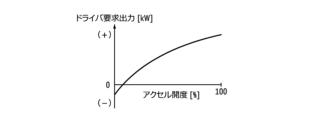
- FIG. 2 is a graph illustrating a characteristic defining the relationship between the accelerator opening [%] detected by the accelerator opening sensor 7 and the driver required output [kW] set by the control device 10.
- the accelerator opening degree is the amount of depression of the accelerator pedal (for example, the accelerator pedal stroke, the rotation angle of the accelerator pedal with respect to the fulcrum, etc.) expressed as a percentage.
- the driver-required output is a parameter corresponding to the magnitude of the output (in other words, horsepower, electric power, and power) that the driver requests in order to run the vehicle 1.
- the driver request output is set to a larger value as the accelerator opening degree becomes larger. Note that the output of the drive source of the vehicle 1 is controlled such that, for example, the larger the driver requested output or vehicle speed is, the larger the output is.
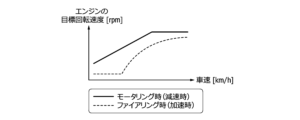
- FIG. 3 is a graph illustrating the relationship between the vehicle speed [km/h] detected by the vehicle speed sensor 9 and the target rotational speed [rpm] of the engine 2.
- the solid line graph in FIG. 3 shows the characteristics when engine 2 is motoring (when vehicle 1 is decelerating), and the broken line graph in FIG. 3 shows the characteristics when engine 2 is firing (when vehicle 1 is accelerating). show.
- Motoring means running the engine 2 idly using the generator 4 (driving the engine 2 to rotate without burning the fuel mixture in the cylinder), and firing means running the engine 2 idly using the generator 4. This means that the cylinder rotates independently by supplying intake air (burning the fuel mixture in the cylinder). Firing can be performed at least in a driving mode in which the engine 2 is operating, and can be performed, for example, during series driving.
- the target rotational speed of the engine 2 during motoring is set to increase as the vehicle speed increases, as shown by the solid line graph in FIG. However, in a high-speed region where the vehicle speed is equal to or higher than a predetermined vehicle speed, the target rotational speed of the engine 2 is limited (clipped) to a predetermined upper limit rotational speed. Further, the target rotational speed of the engine 2 during firing is set to a smaller value than the target rotational speed set during motoring for the same vehicle speed, as shown by the broken line graph in FIG.
- the control device 10 of the present embodiment is configured to control the operation of the broken line in FIG. Setting and controlling a target rotation speed that is different from the characteristics of the graph.
- the control device 10 performs at least regenerative motoring control and continuous motoring control. Continuous motoring control is executed when regenerative motoring control is stopped by accelerator-on operation. Further, the control device 10 preferably performs first power generation control and second power generation control in addition to these controls.
- Regenerative motoring control means that when the accelerator is off while driving (the accelerator opening is below a predetermined opening, the driver required torque and the driver required output are below a predetermined threshold), the regenerative power of the motor 3 is transferred to the generator 4.
- This is a control in which the engine 2 is motored (idle running) at a predetermined target rotational speed.
- the conditions for implementing the regenerative motoring control include at least that the vehicle 1 is traveling and the accelerator is off.
- conditions such as the charging rate of the battery 5, presence or absence of battery failure, battery temperature, brake opening, braking force required of the vehicle 1, operating state of the friction brake device (not shown), and road surface condition are checked for the regenerative motor. It may be included in the ring control execution conditions. If the accelerator is turned on during the regenerative motoring control, the regenerative motoring control is stopped and the motor 3 enters a state in which it drives the wheels.
- the continuous motoring control, the first power generation control, and the second power generation control are each controls that are performed in place of the regenerative motoring control when the regenerative motoring control is stopped by the accelerator-on operation.
- One of these controls is selected and executed based on the required power generation amount and the driver's required output when the accelerator is on. In this embodiment, a case will be described in which each of the continuous motoring control, the first power generation control, and the second power generation control is implemented, but the first power generation control and the second power generation control can be omitted.
- Table 1 summarizes typical implementation conditions and control details for each of regenerative motoring control, continuous motoring control, first power generation control, and second power generation control.
- Continuous motoring control is selected when the required power generation amount is relatively small.
- first power generation control and the second power generation control are selected when the required power generation amount is relatively large.
- the first power generation control is selected when the driver required output is relatively small.
- the second power generation control is selected when the driver requested output is relatively large.
- Continuous motoring control is a control that continues motoring of the engine 2 by supplying electric power from the battery 5 to the generator 4 without causing the motor 3 to perform regenerative braking.
- the continuous motoring control is a control in which the engine 2 is idled while the motor 3 is driving the wheels (EV driving state).
- the continuous motoring control is a control that wastes the electric power of the battery 5 in the generator 4 regardless of whether the vehicle 1 is traveling, and can be said to be a control that has a disadvantage in terms of electricity consumption.
- changes in the rotational speed of engine 2 can be easily suppressed and the drive feeling can be improved. Benefits can be obtained.
- the rotational speed of the engine 2 during continuous motoring control is preferably fixed to the target rotational speed at that point in time (for example, at the time when the accelerator pedal is depressed). As a result, the rotational speed of the engine 2 becomes constant before and after the regenerative motoring control ends, and the operating sound (noise) and vibration of the engine 2 do not change, so that the driver does not feel uncomfortable.
- the target rotational speed of the engine 2 may be set based on the characteristics shown by the solid line graph in FIG. In other words, the target rotation speed during continuous motoring control may be set in the same way as during regenerative motoring control.
- the rotational speed of the engine 2 during continuous motoring control is fixed at a predetermined speed different from the target rotational speed (for example, a rotational speed slightly lower than the target rotational speed) to the extent that the drive feeling is not impaired.
- the predetermined speed may be set within the range between the solid line graph and the broken line graph in FIG. 3 according to the vehicle speed. The closer the predetermined speed set here is to the solid line graph in FIG. 3, the better the drive feeling becomes, and the closer the predetermined speed set here is to the broken line graph in FIG. 3, the lower the power consumption is.
- condition 1 The starting conditions for continuous motoring control are illustrated below.
- continuous motoring control is started when at least both Condition 1 and Condition 2 are satisfied. Thereafter, if Condition 2 is satisfied and the accelerator is turned on, continuous motoring control can be continued.
- Condition 3 is an additional condition for confirming that there is surplus battery power.
- Condition 1. It is the time when regenerative motoring control ends due to accelerator-on operation.
- Condition 2. The required power generation amount is less than the threshold.
- the charging rate of the battery 5 is equal to or higher than a predetermined first charging rate.
- the required power generation amount is the amount of power that various electrical components (vehicle-mounted electrical components) mounted on the vehicle 1 and the driver request the vehicle 1 to generate, and means the amount of power that the generator 4 should generate.
- the required power generation amount is calculated based on at least the driving condition of the vehicle 1, and is calculated based on, for example, the vehicle speed and the electrical components installed in the vehicle (air conditioner, multimedia device, various electronic control devices, electrical appliances connected to external power outlets, etc.). Calculated based on operating conditions.
- the required power generation amount increases as the vehicle speed increases, and as the power consumption of the on-vehicle electrical components increases.
- the required power generation amount may be calculated in consideration of the operating state (charging rate, health level, etc.) of the battery 5. For example, when the charging rate or health of the battery 5 is low, the required power generation amount may be increased.
- the threshold value is the state in which the operating state of the engine 2 that drives the generator 4 becomes a highly efficient operating state (above a predetermined thermal efficiency set in advance) when the generator 4 generates power corresponding to the required power generation amount. This is an index value for determining whether or not. In other words, the threshold value is the minimum value of the required power generation amount that allows the engine 2 to operate with high efficiency. If the generator 4 generates the required power generation amount that is equal to or greater than the threshold value, the thermal efficiency of the engine 2 becomes equal to or greater than the predetermined efficiency, and the engine 2 enters a highly efficient operating state.
- the generator 4 generates the required power generation amount that is less than the threshold value, the thermal efficiency of the engine 2 becomes less than the predetermined efficiency, resulting in an inefficient operating state. Therefore, in this embodiment, when the required power generation amount is less than a threshold value, motoring of the engine 2 is continued (that is, "firing of the engine 2 and power generation by the generator 4" are suspended), thereby preventing a decrease in fuel efficiency. ing.
- FIG. 4 is a graph illustrating the relationship between the rotational speed of the engine 2 and the required power generation threshold.
- the threshold value is set based on at least the rotational speed of the engine 2.
- a graph showing changes in the threshold value with respect to the rotational speed of the engine 2 can be expressed by a curve (high efficiency power generation line) as shown by a solid line in FIG.
- FIG. 5 is a graph illustrating the output characteristics (relationship between rotational speed and torque) of the engine 2.
- the thick solid line in FIG. 5 shows the relationship between the rotational speed of the engine 2 and the maximum torque.
- the thin solid lines in FIG. 5 are curves connecting operating points at which the same thermal efficiency (fuel efficiency) can be obtained at fixed thermal efficiency intervals, and are contour lines regarding the level of thermal efficiency.
- the broken line graph in FIG. 5 is a line indicating the lower limit of torque at the operating point where high efficiency (predetermined thermal efficiency) is achieved.
- the shape of the broken line graph in FIG. 5 is reflected in the shape of the solid line graph in FIG.
- the output (power) of the engine 2 at each operating point located on the broken line in FIG. 5 is expressed as the product of the torque and rotational speed at that operating point. Further, the maximum power generation amount of the generator 4 is approximately proportional to the output of the engine 2. Therefore, by calculating the product of torque, rotation speed, and predetermined coefficient at each operating point located on the broken line in FIG. 5, and plotting the relationship between that value and the rotation speed of the engine 2 on a graph, A solid line graph in FIG. 4 can be obtained. Note that if it is desired to operate the engine 2 with higher thermal efficiency, a broken line graph corresponding to the thermal efficiency may be drawn in FIG. 5, and a solid line graph (high efficiency power generation line) corresponding to the broken line graph may be obtained.
- the first power generation control is control that causes the generator 4 to generate power while firing the engine 2 while maintaining the rotational speed of the engine 2.
- the generator 4 is caused to generate electricity while firing the engine 2 while keeping the rotational speed of the engine 2 fixed at the target rotational speed at that time.
- the first power generation control means that when the regenerative motoring control is stopped by the accelerator-on operation, setting of the target rotation speed based on the broken line graph in FIG. 3 is suspended and the target rotation speed at that point is maintained. It is control. As a result, sudden changes in the operating noise and vibrations of the engine 2 before and after the accelerator is turned on are suppressed, and the driving feeling is improved.
- the first In the power generation control as well, the rotational speed of the engine 2 may be fixed at the predetermined speed.
- the torque of the engine 2 can be set to be larger as the accelerator opening (or the corresponding driver requested output) is larger.
- the rotational speed of the engine 2 is maintained stably without sudden changes.
- the rotational speed of the engine 2 can be changed by adjusting the load of the generator 4 on the engine 2 (power that the generator 4 converts into electric power). In this way, during the first power generation control, the control device 10 can function to maintain the rotational speed of the engine 2 while increasing the torque of the engine 2 as the accelerator opening becomes larger.
- condition 1 is satisfied and condition 5 is also satisfied. Thereafter, if condition 5 is satisfied and the accelerator is turned on, the first power generation control can be continued.
- Condition 6 is an additional condition for implementing the first power generation control only when the driver required output is relatively small.
- Condition 7 is an additional condition for confirming that there is little remaining battery power, and is, for example, “second charging rate ⁇ first charging rate”.
- Condition 4. Continuous motoring control must be implemented.
- Condition 5. The required power generation amount must be greater than or equal to the threshold.
- the driver requested output is below a predetermined value.
- Condition 7. The charging rate of the battery 5 is less than a predetermined second charging rate.
- the second power generation control is based on the premise that the conditions for implementing the first power generation control include the above condition 6, and when the condition 6 is not satisfied (when the driver requested output exceeds a predetermined value) ) is a control performed in place of the first power generation control, and is control for increasing the rotational speed of the engine 2.
- the fixation of the rotational speed of the engine 2 is released, and the engine 2 enters a state in which it can operate at a rotational speed higher than the target rotational speed (or predetermined speed).
- the second power generation control can be said to be a control that restarts the setting of the target rotational speed based on the broken line graph in FIG. 3 when the driver depresses the accelerator pedal significantly.
- Condition 10 is an additional condition for confirming that there is no surplus battery power, and is, for example, "third charging rate ⁇ second charging rate.”
- Condition 8 First power generation control is being implemented.
- Condition 9 The driver requested output exceeds the specified value.
- Condition 10 The charging rate of the battery 5 is less than a predetermined third charging rate.
- the rotation speed of the engine 2 is fixed at the target rotation speed (or predetermined speed).
- the operating state of the engine 2 is controlled so that the rotational speed of the engine 2 increases to a value higher than the target rotational speed (or predetermined speed).
- the rotational speed of the engine 2 is controlled according to, for example, the vehicle speed.
- FIG. 6 is a flowchart illustrating the flow of control performed by the control device 10.
- the control shown in this flowchart is repeatedly executed within the control device 10 at a predetermined period, for example, when the power switch of the vehicle 1 (not shown) is on and the vehicle 1 is ready to travel (in a READY state).
- Steps A1 to A3 mainly correspond to regenerative motoring control
- steps A4 to A7 mainly correspond to continuous motoring control.
- steps A8 to A11 mainly correspond to the first power generation control
- step A12 corresponds to the second power generation control.
- step A1 it is determined whether conditions for implementing regenerative motoring control are satisfied. If this condition is met, control proceeds to step A2. On the other hand, if the condition of step A1 is not satisfied, the control in this cycle ends.
- step A2 a target rotational speed of the engine 2 is set in accordance with the vehicle speed based on, for example, the characteristics shown in the solid line graph in FIG. Here, the higher the vehicle speed is, the higher the target rotational speed of the engine 2 is set. In other words, the faster the vehicle speed is, the greater the regenerative power generated by the motor 3 becomes, so the target rotational speed of the engine 2 driven by the generator 4 is set so that the generator 4 consumes an amount of power commensurate with the regenerated power. set high.
- step A3 regenerative motoring control is performed based on the target rotational speed set in step A2. That is, the regenerated power of the motor 3 is supplied to the generator 4, and the generator 4 motors the engine 2 so that the rotational speed of the engine 2 reaches the target rotational speed.
- step A4 it is determined whether the accelerator is on. Here, if it is determined that the accelerator is not on, the control in this cycle ends. From the next period onwards, the regenerative motoring control is continued as long as the conditions for implementing the regenerative motoring control are satisfied. On the other hand, if it is determined in step A4 that the accelerator is on, the regenerative motoring control ends and the control proceeds to step A5.
- the required power generation amount and threshold value are calculated.
- the required power generation amount is calculated based on, for example, the vehicle speed and the operating state of on-vehicle electrical components. For example, the value of the required power generation amount is calculated to be a larger value as the vehicle speed is faster. Alternatively, the required power generation amount is calculated as a larger value as the power consumption of the on-vehicle electrical equipment increases.
- the threshold value is calculated as a value corresponding to the rotational speed of the engine 2 at that time, based on the characteristics as shown in FIG. 4, for example.
- step A6 it is determined whether the required power generation amount calculated in step A5 is less than a threshold value.
- the control proceeds to step A7, and continuous motoring control is performed instead of regenerative motoring control.
- the generator 4 is controlled to a power running state using the electric power of the battery 5, and the engine 2 is driven to idle.
- the motor 3 is also controlled to a power running state so as to generate a driving force according to the accelerator opening degree, and the wheels are driven.
- the rotational speed of the engine 2 during continuous motoring control is set according to the vehicle speed at least within the range between the solid line graph and the broken line graph in FIG.
- the rotational speed of the engine 2 is fixed to the target rotational speed during the previous regenerative motoring control.
- the rotational speed of the engine 2 remains unchanged, so that the driver does not feel uncomfortable.
- step A6 If the required power generation amount is equal to or greater than the threshold value in step A6, it is determined that the engine 2 can be operated with high efficiency, and the control proceeds to step A8.
- step A8 the driver required output is calculated based on the accelerator opening based on the characteristics as shown in FIG. 2, for example. The larger the accelerator opening, the larger the driver request output is set.
- step A9 it is determined whether the driver request output calculated in step A8 is less than or equal to a predetermined value. If this condition is met, control proceeds to step A10.
- step A10 the first power generation control is performed to cause the generator 4 to generate electricity while firing the engine 2 while keeping the rotational speed of the engine 2 fixed at the target rotational speed at that time.
- the operating state of the engine 2 shifts from the motoring state to the firing state.
- the torque of the engine 2 is set according to the driver's requested output.
- the target rotational speed of the engine 2 in the firing state is maintained at the same speed as the target rotational speed of the engine 2 in the motoring state. Therefore, the operating noise and vibration of the engine 2 hardly change, and the driving feeling is improved.
- step A11 it is determined whether the accelerator is off. Here, if it is determined that the accelerator is not off, the control returns to step A8 and the driver requested output is calculated again. Thereafter, the first power generation control is continued as long as the driver requested output is less than or equal to the predetermined value. Further, if it is determined in step A11 that the accelerator is off, the control in this cycle ends. From the next cycle onward, regenerative motoring control is restarted as long as the conditions for implementing regenerative motoring control are met.
- step A12 the second power generation control is performed instead of the first power generation control, and the rotational speed of the engine 2 is changed to a rotational speed higher than the target rotational speed at that time.
- the torque of the engine 2 is set according to the driver's requested output.
- the output of the engine 2 becomes larger than during the first power generation control, and the power generated by the generator 4 also increases.
- step A11 it is determined whether the accelerator is off. Here, if it is determined that the accelerator is not off, the control returns to step A8 and the driver requested output is calculated again. Thereafter, the second power generation control is continued as long as the driver requested output exceeds the predetermined value. Furthermore, if it is determined in step A11 that the accelerator is off, the control in this cycle ends. From the next cycle onward, regenerative motoring control is restarted as long as the conditions for implementing regenerative motoring control are met.
- FIG. 7 is a time chart illustrating the operation of the control performed by the control device 10.
- regenerative motoring control has been performed before time t1 and the accelerator is off.
- the accelerator pedal is slightly depressed to turn on the accelerator at time t1 .
- regenerative motoring control is stopped and continuous motoring control is started.
- the state of the motor 3 transitions from a regenerative power generation (regenerative braking) state to a power running state after time t1 .
- the state of the engine 2 remains in the motoring state even after time t1 .
- the rotational speed of the engine 2 is fixed, for example, to the target rotational speed during regenerative motoring control. Since the power for the generator 4 to idle the engine 2 is taken from the battery 5, the output of the battery 5 increases slightly after time t1 .
- a threshold value is calculated according to the rotational speed of the engine 2 being motored. Continuous motoring control is maintained as long as the required power generation amount is less than the threshold value. The reason for this is that even if the engine 2 is started when the required power generation amount is less than the threshold, the operating state of the engine 2 will not become highly efficient (above a predetermined thermal efficiency). be.
- first power generation control is performed instead of continuous motoring control.
- the state of the engine 2 transitions from the motoring state to the firing state at time t3 .
- the target rotational speed of the engine 2 is maintained at the target rotational speed before time t3 , and the actual rotational speed of the engine 2 also becomes a constant value. Therefore, the operating noise and vibration of the engine 2 hardly change, and the driving feeling is improved.
- the larger the accelerator opening the larger the torque of the engine 2 is set.
- the target rotational speed of the engine 2 is kept constant even after time t3 , the output of the engine 2 (the product of rotational speed and torque) increases as the torque increases, and the power generated by the generator 4 also gradually increases. increases to This reduces the power taken out of the battery 5, and the output of the battery 5 decreases as the torque of the engine 2 increases in the positive range.
- second power generation control is performed instead of first power generation control.
- setting of the target rotation speed based on the broken line graph in FIG. 3 is restarted.
- the rotational speed of the engine 2 increases, and the torque of the engine 2 and the power generated by the generator 4 also increase. Therefore, as the accelerator opening degree increases, the operating noise and vibrations of the engine 2 become louder, and a natural and intuitively understandable drive feeling is realized.
- the electric power taken out from the battery 5 further decreases, and the output of the battery 5 also decreases further. Thereafter, when the accelerator opening stops increasing at time t5 , the rotational speed and torque of the engine 2 also stop increasing, and the output of the battery 5 becomes constant.
- point P1 in FIG. 4 is a point representing the rotational speed and required power generation amount of the engine 2 at time t1 in FIG. 7, and is a state point representing the state of the vehicle 1 at the start of continuous motoring control. be.
- Point P1 is located within the motoring continuation region, which is a region below the threshold value graph (high efficiency power generation line).
- the rotational speed of the engine 2 is fixed at a target rotational speed (or a predetermined speed).
- the state point of the vehicle 1 moves directly above point P1 as the required power generation amount increases, and reaches point P2 when the required power generation amount and the threshold value become equal.
- Point P2 is a point representing the rotation speed and required power generation amount of the engine 2 at time t3 in FIG. 7, and is a point representing the state of the vehicle 1 at the start of the first power generation control.
- the rotational speed of the engine 2 is fixed at a target rotational speed (or a predetermined speed). Therefore, the state point of the vehicle 1 enters the firing power generation region, which is a region above the threshold value graph (high efficiency power generation line).
- the state point of the vehicle 1 moves directly upward from point P2 as the required power generation amount increases, and reaches point P3 when the driver required output becomes equal to the predetermined value.
- Point P3 is a point representing the rotational speed and required power generation amount of the engine 2 at time t4 in FIG. 7, and is a point representing the state of the vehicle 1 at the start of the second power generation control.
- the rotational speed of the engine 2 may increase higher than the target rotational speed (or predetermined speed). Therefore, the state point of the vehicle 1 moves to the right in FIG. 7 as the rotational speed of the engine 2 increases, and moves upward in FIG. 7 as the required power generation amount increases.
- the hybrid vehicle 1 of this embodiment includes an engine 2, a motor 3 that drives wheels and performs regenerative braking, a generator 4 that generates electricity using the driving force of the engine 2 and drives the engine 2, and a motor 3 and a generator that drive the engine 2. 4 and a battery 5 connected to the battery 5.
- the vehicle also includes a control device 10 that performs regenerative motoring control that supplies regenerative power from the motor 3 to the generator 4 and motors the engine 2 at a predetermined target rotational speed when the vehicle is running and the accelerator is off.
- the control device 10 calculates the required power generation amount according to the driving state, and performs continuous motoring control if the required power generation amount is less than a threshold value when stopping the regenerative motoring control by turning on the accelerator.
- Continuous motoring control is control that continues motoring of the engine 2 by supplying power from the battery 5 to the generator 4.
- continuous motoring control is implemented only in situations where the required power generation amount is less than a threshold value. In other words, motoring of the engine 2 is continued only when the remaining power of the battery 5 (electric power stored in the battery 5) is not expected to decrease much. Therefore, there is no shortage of power for running the vehicle 1 during continuous motoring control, and a good driving feeling can be provided.
- the control device 10 described above can continue motoring the engine 2 while fixing the rotational speed of the engine 2 to the target rotational speed at that time. In this way, by fixing the rotational speed of the engine 2 to the target rotational speed, it is possible to suppress fluctuations in the rotational speed of the engine 2 after the regenerative motoring control ends. In other words, since the rotational speed of the engine 2 does not change during the transition from regenerative motoring control to continuous motoring control, changes in the operating noise and vibrations of the engine 2 can be suppressed. Therefore, the drive feeling during acceleration from regenerative motoring control can be improved.
- the above-mentioned control device 10 performs first power generation control that causes the generator 4 to generate power while firing the engine 2 while maintaining the rotational speed of the engine 2. sell.
- the generator 4 can generate power while suppressing changes in the operating noise and vibrations of the engine 2. Therefore, it is possible to prevent the power of the battery 5 from decreasing while improving the drive feeling. Further, since the electric power of the battery 5 is secured, there is no fear that the electric power for driving the motor 3 will be insufficient, and a good feeling of acceleration can be realized.
- the control device 10 described above can perform control to maintain the rotational speed of the engine 2 while increasing the torque of the engine 2 as the accelerator opening degree becomes larger.
- a driver requested output is set based on the characteristics shown in FIG. 2, and the torque of the engine 2 is controlled based on this driver requested output.
- Such control makes it possible to increase the output of the engine 2 while suppressing changes in the operating noise and vibrations of the engine 2, thereby further improving the driving feeling.
- the amount of power generated by the generator 4 can be increased. Therefore, the electric power for driving the motor 3 can be increased, and a good feeling of acceleration can be achieved.
- the control device 10 described above can implement a second power generation control in which the rotational speed of the engine 2 is increased when the driver requested output exceeds a predetermined value. For example, when the driver's requested output increases, as after time t4 in FIG. 7, by increasing the rotational speed of the engine 2, it is possible to realize a natural behavior of the engine 2 and improve the drive feeling. can. Further, by increasing the power generated by the generator 4, the acceleration performance of the vehicle 1 can be improved, and the driving feeling can be improved.
- the above-mentioned required power generation amount can be calculated based on the vehicle speed or the operating state of the on-vehicle electrical components. Through such control, it is possible to accurately calculate the amount of power generation required of the vehicle 1 by various electrical components (in-vehicle electrical components) and the driver. Therefore, it is possible to appropriately judge the timing for transitioning the engine 2 from the motoring state to the firing state, and it is possible to realize a good acceleration feeling while improving the drive feeling. Moreover, the above threshold value can be set based on the rotational speed of the engine 2. Through such control, it is possible to accurately determine whether the engine 2 is in a state where it can operate with high efficiency. Therefore, it is possible to improve the fuel consumption during power generation while improving the drive feeling.
- control device 10 that performs regenerative motoring control, continuous motoring control, first power generation control, and second power generation control is illustrated, but the first power generation control and the second power generation control are omitted. It is possible. At least, when the regenerative motoring control is stopped by the accelerator-on operation, the required power generation amount and the threshold value are used to determine whether or not to perform the continuous motoring control, thereby obtaining the same effect as the above embodiment. can.
- the rotational speed of the engine 2 during continuous motoring control may be fixed at the target rotational speed, or may be fixed at a predetermined speed other than the target rotational speed (for example, a rotational speed slightly lower than the target rotational speed). Good too.
- the rotational speed of the engine 2 may not be fixed, but may be treated as a variable value, as long as the drive feeling is not impaired.
- the rotational speed of the engine 2 may be set so that it falls within a predetermined speed range that includes the target rotational speed. The same applies to the rotational speed of the engine 2 during the first power generation control, and it may be fixed to the target rotational speed, may be fixed to a predetermined speed other than the target rotational speed, or may be a variable value.
- the present invention can be used in the manufacturing industry of hybrid vehicles, and can also be used in the manufacturing industry of control devices for hybrid vehicles.
- Vehicle (hybrid vehicle) 2 Engine 3 Motor 4 Generator 5 Battery 6 Clutch 7 Accelerator opening sensor 8 Brake opening sensor 9 Vehicle speed sensor 10 Control device
Landscapes
- Engineering & Computer Science (AREA)
- Transportation (AREA)
- Mechanical Engineering (AREA)
- Automation & Control Theory (AREA)
- Chemical & Material Sciences (AREA)
- Combustion & Propulsion (AREA)
- Electric Propulsion And Braking For Vehicles (AREA)
- Hybrid Electric Vehicles (AREA)
Priority Applications (2)
| Application Number | Priority Date | Filing Date | Title |
|---|---|---|---|
| PCT/JP2022/014068 WO2023181286A1 (ja) | 2022-03-24 | 2022-03-24 | ハイブリッド車両 |
| JP2024509601A JP7709099B2 (ja) | 2022-03-24 | 2022-03-24 | ハイブリッド車両 |
Applications Claiming Priority (1)
| Application Number | Priority Date | Filing Date | Title |
|---|---|---|---|
| PCT/JP2022/014068 WO2023181286A1 (ja) | 2022-03-24 | 2022-03-24 | ハイブリッド車両 |
Publications (1)
| Publication Number | Publication Date |
|---|---|
| WO2023181286A1 true WO2023181286A1 (ja) | 2023-09-28 |
Family
ID=88100696
Family Applications (1)
| Application Number | Title | Priority Date | Filing Date |
|---|---|---|---|
| PCT/JP2022/014068 Ceased WO2023181286A1 (ja) | 2022-03-24 | 2022-03-24 | ハイブリッド車両 |
Country Status (2)
| Country | Link |
|---|---|
| JP (1) | JP7709099B2 (https=) |
| WO (1) | WO2023181286A1 (https=) |
Citations (2)
| Publication number | Priority date | Publication date | Assignee | Title |
|---|---|---|---|---|
| JP2016031030A (ja) * | 2014-07-28 | 2016-03-07 | 富士重工業株式会社 | 車両用制御装置 |
| WO2019116584A1 (ja) * | 2017-12-15 | 2019-06-20 | 日産自動車株式会社 | ハイブリッド車両の制御方法及び制御装置 |
-
2022
- 2022-03-24 WO PCT/JP2022/014068 patent/WO2023181286A1/ja not_active Ceased
- 2022-03-24 JP JP2024509601A patent/JP7709099B2/ja active Active
Patent Citations (2)
| Publication number | Priority date | Publication date | Assignee | Title |
|---|---|---|---|---|
| JP2016031030A (ja) * | 2014-07-28 | 2016-03-07 | 富士重工業株式会社 | 車両用制御装置 |
| WO2019116584A1 (ja) * | 2017-12-15 | 2019-06-20 | 日産自動車株式会社 | ハイブリッド車両の制御方法及び制御装置 |
Also Published As
| Publication number | Publication date |
|---|---|
| JPWO2023181286A1 (https=) | 2023-09-28 |
| JP7709099B2 (ja) | 2025-07-16 |
Similar Documents
| Publication | Publication Date | Title |
|---|---|---|
| CN100436886C (zh) | 混合动力车辆的电动油泵控制装置 | |
| JP6988913B2 (ja) | ハイブリッド車両の制御方法及びハイブリッド車両の制御装置 | |
| CN102958773B (zh) | 再生控制装置、混合动力汽车及再生控制方法 | |
| CN103282255B (zh) | 车辆及车辆用控制方法 | |
| CN109383292B (zh) | 显示装置 | |
| US20220274615A1 (en) | Driving force control system for vehicle | |
| CN103140404A (zh) | 再生控制装置、混合动力汽车、再生控制方法、以及程序 | |
| US10322714B2 (en) | Hybrid vehicle and control method for same | |
| CN113924238A (zh) | 电动装置控制方法以及电动装置 | |
| JP5692140B2 (ja) | 駆動制御装置 | |
| JP5185052B2 (ja) | 車両の制御装置および制御方法 | |
| JP2001211506A (ja) | パラレル・ハイブリッド車両の駆動制御装置 | |
| JP7235783B2 (ja) | 制御装置、および車両 | |
| JP7709099B2 (ja) | ハイブリッド車両 | |
| JP7687524B2 (ja) | ハイブリッド車両 | |
| CN115803240A (zh) | 电动车辆的控制装置 | |
| JP7709098B2 (ja) | ハイブリッド車両 | |
| JP5040487B2 (ja) | ハイブリッド車両の駆動力制御装置 | |
| JP2001103602A (ja) | ハイブリッド車の回生制御方法 | |
| JP7615975B2 (ja) | ハイブリッド車両の制御装置 | |
| JP2015077823A (ja) | 車両の制御装置 | |
| JP7582217B2 (ja) | ハイブリッド車両 | |
| JP7782408B2 (ja) | 車両の制御装置 | |
| JPH10201012A (ja) | パラレルハイブリッド車両の制御装置 | |
| JP3894049B2 (ja) | ハイブリッド車両とその制御装置 |
Legal Events
| Date | Code | Title | Description |
|---|---|---|---|
| 121 | Ep: the epo has been informed by wipo that ep was designated in this application |
Ref document number: 22933426 Country of ref document: EP Kind code of ref document: A1 |
|
| ENP | Entry into the national phase |
Ref document number: 2024509601 Country of ref document: JP Kind code of ref document: A |
|
| NENP | Non-entry into the national phase |
Ref country code: DE |
|
| 122 | Ep: pct application non-entry in european phase |
Ref document number: 22933426 Country of ref document: EP Kind code of ref document: A1 |