WO2023162916A1 - 電解コンデンサおよびその製造方法 - Google Patents
電解コンデンサおよびその製造方法 Download PDFInfo
- Publication number
- WO2023162916A1 WO2023162916A1 PCT/JP2023/005926 JP2023005926W WO2023162916A1 WO 2023162916 A1 WO2023162916 A1 WO 2023162916A1 JP 2023005926 W JP2023005926 W JP 2023005926W WO 2023162916 A1 WO2023162916 A1 WO 2023162916A1
- Authority
- WO
- WIPO (PCT)
- Prior art keywords
- electrolytic capacitor
- liquid component
- conductive polymer
- mass
- separator
- Prior art date
- Legal status (The legal status is an assumption and is not a legal conclusion. Google has not performed a legal analysis and makes no representation as to the accuracy of the status listed.)
- Ceased
Links
Images
Classifications
-
- H—ELECTRICITY
- H01—ELECTRIC ELEMENTS
- H01G—CAPACITORS; CAPACITORS, RECTIFIERS, DETECTORS, SWITCHING DEVICES, LIGHT-SENSITIVE OR TEMPERATURE-SENSITIVE DEVICES OF THE ELECTROLYTIC TYPE
- H01G9/00—Electrolytic capacitors, rectifiers, detectors, switching devices, light-sensitive or temperature-sensitive devices; Processes of their manufacture
- H01G9/004—Details
- H01G9/022—Electrolytes; Absorbents
- H01G9/035—Liquid electrolytes, e.g. impregnating materials
-
- H—ELECTRICITY
- H01—ELECTRIC ELEMENTS
- H01G—CAPACITORS; CAPACITORS, RECTIFIERS, DETECTORS, SWITCHING DEVICES, LIGHT-SENSITIVE OR TEMPERATURE-SENSITIVE DEVICES OF THE ELECTROLYTIC TYPE
- H01G11/00—Hybrid capacitors, i.e. capacitors having different positive and negative electrodes; Electric double-layer [EDL] capacitors; Processes for the manufacture thereof or of parts thereof
- H01G11/52—Separators
-
- H—ELECTRICITY
- H01—ELECTRIC ELEMENTS
- H01G—CAPACITORS; CAPACITORS, RECTIFIERS, DETECTORS, SWITCHING DEVICES, LIGHT-SENSITIVE OR TEMPERATURE-SENSITIVE DEVICES OF THE ELECTROLYTIC TYPE
- H01G9/00—Electrolytic capacitors, rectifiers, detectors, switching devices, light-sensitive or temperature-sensitive devices; Processes of their manufacture
- H01G9/0029—Processes of manufacture
-
- H—ELECTRICITY
- H01—ELECTRIC ELEMENTS
- H01G—CAPACITORS; CAPACITORS, RECTIFIERS, DETECTORS, SWITCHING DEVICES, LIGHT-SENSITIVE OR TEMPERATURE-SENSITIVE DEVICES OF THE ELECTROLYTIC TYPE
- H01G9/00—Electrolytic capacitors, rectifiers, detectors, switching devices, light-sensitive or temperature-sensitive devices; Processes of their manufacture
- H01G9/004—Details
- H01G9/02—Diaphragms; Separators
-
- H—ELECTRICITY
- H01—ELECTRIC ELEMENTS
- H01G—CAPACITORS; CAPACITORS, RECTIFIERS, DETECTORS, SWITCHING DEVICES, LIGHT-SENSITIVE OR TEMPERATURE-SENSITIVE DEVICES OF THE ELECTROLYTIC TYPE
- H01G9/00—Electrolytic capacitors, rectifiers, detectors, switching devices, light-sensitive or temperature-sensitive devices; Processes of their manufacture
- H01G9/004—Details
- H01G9/022—Electrolytes; Absorbents
- H01G9/025—Solid electrolytes
- H01G9/028—Organic semiconducting electrolytes, e.g. TCNQ
-
- H—ELECTRICITY
- H01—ELECTRIC ELEMENTS
- H01G—CAPACITORS; CAPACITORS, RECTIFIERS, DETECTORS, SWITCHING DEVICES, LIGHT-SENSITIVE OR TEMPERATURE-SENSITIVE DEVICES OF THE ELECTROLYTIC TYPE
- H01G9/00—Electrolytic capacitors, rectifiers, detectors, switching devices, light-sensitive or temperature-sensitive devices; Processes of their manufacture
- H01G9/004—Details
- H01G9/04—Electrodes or formation of dielectric layers thereon
- H01G9/048—Electrodes or formation of dielectric layers thereon characterised by their structure
-
- H—ELECTRICITY
- H01—ELECTRIC ELEMENTS
- H01G—CAPACITORS; CAPACITORS, RECTIFIERS, DETECTORS, SWITCHING DEVICES, LIGHT-SENSITIVE OR TEMPERATURE-SENSITIVE DEVICES OF THE ELECTROLYTIC TYPE
- H01G9/00—Electrolytic capacitors, rectifiers, detectors, switching devices, light-sensitive or temperature-sensitive devices; Processes of their manufacture
- H01G9/004—Details
- H01G9/07—Dielectric layers
-
- H—ELECTRICITY
- H01—ELECTRIC ELEMENTS
- H01G—CAPACITORS; CAPACITORS, RECTIFIERS, DETECTORS, SWITCHING DEVICES, LIGHT-SENSITIVE OR TEMPERATURE-SENSITIVE DEVICES OF THE ELECTROLYTIC TYPE
- H01G9/00—Electrolytic capacitors, rectifiers, detectors, switching devices, light-sensitive or temperature-sensitive devices; Processes of their manufacture
- H01G9/004—Details
- H01G9/08—Housing; Encapsulation
-
- H—ELECTRICITY
- H01—ELECTRIC ELEMENTS
- H01G—CAPACITORS; CAPACITORS, RECTIFIERS, DETECTORS, SWITCHING DEVICES, LIGHT-SENSITIVE OR TEMPERATURE-SENSITIVE DEVICES OF THE ELECTROLYTIC TYPE
- H01G9/00—Electrolytic capacitors, rectifiers, detectors, switching devices, light-sensitive or temperature-sensitive devices; Processes of their manufacture
- H01G9/145—Liquid electrolytic capacitors
-
- H—ELECTRICITY
- H01—ELECTRIC ELEMENTS
- H01G—CAPACITORS; CAPACITORS, RECTIFIERS, DETECTORS, SWITCHING DEVICES, LIGHT-SENSITIVE OR TEMPERATURE-SENSITIVE DEVICES OF THE ELECTROLYTIC TYPE
- H01G9/00—Electrolytic capacitors, rectifiers, detectors, switching devices, light-sensitive or temperature-sensitive devices; Processes of their manufacture
- H01G9/15—Solid electrolytic capacitors
-
- H—ELECTRICITY
- H01—ELECTRIC ELEMENTS
- H01G—CAPACITORS; CAPACITORS, RECTIFIERS, DETECTORS, SWITCHING DEVICES, LIGHT-SENSITIVE OR TEMPERATURE-SENSITIVE DEVICES OF THE ELECTROLYTIC TYPE
- H01G9/00—Electrolytic capacitors, rectifiers, detectors, switching devices, light-sensitive or temperature-sensitive devices; Processes of their manufacture
- H01G9/15—Solid electrolytic capacitors
- H01G9/151—Solid electrolytic capacitors with wound foil electrodes
Definitions
- the present disclosure relates to electrolytic capacitors and manufacturing methods thereof.
- a solid electrolytic capacitor includes a capacitor element containing a conductive polymer component (conjugated polymer, dopant, etc.). Electrolytic capacitors are also known that include a liquid component along with a capacitor element that includes a conductive polymer component. Electrolytic capacitors containing a liquid component are expected to be small in size, high in capacitance and low in ESR (equivalent series resistance).
- a non-aqueous solvent an electrolytic solution (a solution obtained by dissolving a solute in a non-aqueous solvent, etc.), or the like is used.
- a capacitor element a capacitor element including an anode foil and a cathode foil having dielectric layers on their surfaces, a separator interposed therebetween, and a conductive polymer component is sometimes used.
- Patent Document 1 discloses a method for manufacturing a solid electrolytic capacitor comprising an anode portion, a cathode portion, and a conductive polymer layer, wherein the surface of the anode portion made of a sintered valve metal or a roughened valve metal foil is and a second step of immersing the anode part in a dispersion containing conductive polymer particles and a solvent and applying vibration of a frequency of 20 Hz to 500 Hz to the dispersion. and a third step of drying the anode portion and forming a conductive polymer layer on the surface of the dielectric film.
- Patent document 2 includes a capacitor element and an electrolytic solution, and the capacitor element includes an anode foil on which a dielectric layer is formed, and a conductive layer facing the anode foil and including a carbon layer containing conductive carbon. and a conductive polymer layer interposed between the anode foil and the cathode foil and containing a conductive polymer, wherein the conductive polymer layer contains the conductive polymer and a water content of the electrolyte is 0.1 to 6.0% by mass.
- Patent Document 3 discloses a wound solid electrolytic capacitor in which a separator supporting a solid electrolyte is interposed between a porous anode foil and a cathode foil on which a dielectric layer is formed. It proposes a solid electrolytic capacitor containing a conductive composite having a cationized conductive polymer and a polymer anion, and water content of 7% by mass or less.
- Separators using cellulose fibers are readily available and inexpensive, and are often used in electrolytic capacitors.
- cellulose fibers are originally relatively low in heat resistance and physical strength, and are decomposed during chemical conversion, resulting in a decrease in strength even in electrolytic capacitors.
- separators using synthetic resin fibers have higher heat resistance and strength than separators using cellulose fibers.
- a first aspect of the present disclosure includes a capacitor element and a liquid component containing a non-aqueous solvent
- the capacitor element includes an anode foil having a dielectric layer on its surface, a cathode foil, a separator and a conductive polymer component interposed between the anode foil and the cathode foil,
- the separator contains synthetic resin fibers, It relates to the electrolytic capacitor, wherein the water concentration in the liquid component is 1000 ppm or more and 10000 ppm or less on a mass basis.
- a second aspect of the present disclosure provides a capacitor element including an anode foil having a dielectric layer on its surface, a cathode foil, and a separator and a conductive polymer component interposed between the anode foil and the cathode foil. and obtaining an electrolytic capacitor by housing the capacitor element and a liquid component containing a non-aqueous solvent and having a water concentration of 1000 ppm or more and 10000 ppm or less on a mass basis in a case;
- the separator relates to a method for manufacturing an electrolytic capacitor, in which the separator contains synthetic resin fibers.
- the short circuit resistance performance can be improved.
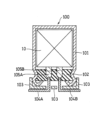
- FIG. 1 is a cross-sectional schematic diagram of an electrolytic capacitor according to an embodiment of the present disclosure
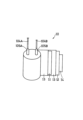
- FIG. 2 is a schematic diagram in which a part of a capacitor element of the electrolytic capacitor of FIG. 1 is developed;
- a separator containing synthetic resin fibers in an electrolytic capacitor is expected to improve the heat resistance and strength of the separator.
- a separator containing synthetic resin fibers is used in an electrolytic capacitor containing a conductive polymer component (conjugated polymer, dopant, etc.)
- the durability is lower than that of conventional separators containing cellulose fibers. It has become clear that the short-circuit performance may be significantly degraded.
- the electrolytic capacitor according to the first aspect of the present disclosure includes a capacitor element and a liquid component containing a non-aqueous solvent.
- the capacitor element includes an anode foil having a dielectric layer on its surface, a cathode foil, a separator and a conductive polymer component interposed between the anode foil and the cathode foil.
- the separator includes synthetic resin fibers.
- the water concentration in the liquid component is 1000 ppm or more and 10000 ppm or less on a mass basis.
- a separator containing synthetic resin fibers and a capacitor element containing a conductive polymer component are combined with a liquid component having a water concentration of 1000 ppm or more and 10000 ppm or less on a mass basis.
- the dielectric layer formed on the surface of the anode foil has improved film repairability, which reduces leakage current and reduces the occurrence of minute short circuits. be done.
- insulation of the conductive polymer component is promoted, and the short current can be quickly converged.
- the rush current from other capacitor elements is suppressed from flowing to the short-circuit portion, and short-circuit failure at a relatively early stage can be suppressed.
- a separator containing synthetic resin fibers even if the electrolytic capacitor is used for a long period of time, deterioration of the separator is suppressed and high strength is maintained compared to a separator containing cellulose fibers. Therefore, in the present disclosure, it is also possible to suppress short-circuit failure due to deterioration of the separator. Thus, in the present disclosure, it is possible to improve the short-circuit resistance performance in an electrolytic capacitor using a separator containing synthetic resin fibers.
- an electrolytic capacitor contains moisture, the deterioration of the conductive polymer component is likely to progress, and a large amount of gas is generated during reflow, which applies a large amount of pressure to the capacitor element and causes cracks in the exterior body. or Therefore, it is necessary to control the amount of water contained in the electrolytic capacitor to some extent. However, it is difficult to control the moisture content in the capacitor element with high accuracy. In the present disclosure, since the water concentration in the liquid component can be adjusted, it is possible to control the water content in the electrolytic capacitor with relatively high accuracy. Therefore, high short-circuit resistance can be ensured while suppressing the amount of gas generated during reflow.
- the water concentration in the liquid component can be measured with a Karl Fischer moisture measuring device using the liquid component collected from the electrolytic capacitor.
- the liquid component is preferably collected from the initial electrolytic capacitor.
- An initial electrolytic capacitor is an electrolytic capacitor after aging or break-in charge/discharge, or an unused electrolytic capacitor if it is a commercial product.
- the synthetic resin constituting the synthetic resin fiber may contain at least one selected from the group consisting of aromatic polyamide and polyester.
- the liquid component may contain an aprotic polar solvent at a concentration of 50% by mass or more.
- the proportion of the aprotic polar solvent in the non-aqueous solvent may be 50% by mass or more.
- the aprotic polar solvent may have a boiling point of 180°C or higher.
- the aprotic polar solvent may contain at least one selected from the group consisting of lactone compounds, cyclic sulfone compounds and sulfoxide compounds.
- the liquid component may contain no protic organic solvent or may contain a protic organic solvent.
- the concentration of the protic organic solvent in the liquid component may be 20% by mass or less.
- the liquid component may contain no solute or may contain solute.
- the concentration of the solute in the liquid component may be 1% by mass or less.
- the conductive polymer component does not contain an additive that serves as an oxygen supply source, or may contain an additive that serves as an oxygen supply source.
- the conductive polymer component contains the additive, the content of the additive in the conductive polymer component may be 0.1% by mass or less.
- the present disclosure also includes a method for manufacturing an electrolytic capacitor.
- a method for manufacturing an electrolytic capacitor comprises preparing a capacitor element including an anode foil having a dielectric layer on its surface, a cathode foil, a separator and a conductive polymer component interposed between the anode foil and the cathode foil. and obtaining an electrolytic capacitor by housing the capacitor element and a liquid component containing a non-aqueous solvent and having a water concentration of 1000 ppm or more and 10000 ppm or less on a mass basis in a case.
- the separator includes synthetic resin fibers.
- the capacitor element in the step of preparing the capacitor element, a precursor containing the anode foil, the cathode foil, and the separator is impregnated with a treatment liquid containing the conductive polymer component.
- the capacitor element may be prepared by drying.
- the treatment liquid may not contain an additive that serves as an oxygen supply source, or may contain an additive that serves as an oxygen supply source.
- the content of the additive in the treatment liquid may be 15% by mass or less.
- the electrolytic capacitor of the present disclosure and its manufacturing method will be described in more detail, including the above (1) to (12). At least one of the above (1) to (12) may be combined with at least one of the elements described below within a technically consistent range.
- a capacitor element included in an electrolytic capacitor includes an anode foil having a dielectric layer on its surface, a cathode foil, and a separator and a conductive polymer component interposed therebetween.
- the anode foil may contain a valve action metal, an alloy containing a valve action metal, a compound containing a valve action metal, and the like. These materials may be used singly or in combination of two or more.
- Preferred valve metals are, for example, aluminum, tantalum, niobium, and titanium.
- the anode foil may have a porous portion having pores on its surface.
- An anode foil having a porous portion is obtained, for example, by roughening the surface of a base material (such as a foil-like or plate-like base material) containing a valve metal. Roughening may be performed by etching (eg, electrolytic etching or chemical etching) or the like.
- the dielectric layer is formed by anodizing the valve metal on the surface of the anode foil. Anodization is performed by, for example, chemical conversion treatment. The dielectric layer is formed, for example, to cover at least part of the surface of the anode foil.
- the dielectric layer contains an oxide of a valve metal.
- the dielectric layer contains Ta 2 O 5 when tantalum is used as the valve metal, and the dielectric layer contains Al 2 O 3 when aluminum is used as the valve metal.
- the dielectric layer is not limited to this, and may be any material as long as it functions as a dielectric.
- a dielectric layer is usually formed on the surface of the anode foil.
- the dielectric layer is formed on the surface of the porous portion of the anode foil, it is formed along the inner wall surfaces of the pores of the porous portion and the depressions (pits) on the surface of the anode foil.
- a conductive polymer component includes, for example, a conjugated polymer and a dopant.
- a conductive polymer component is interposed between the anode foil and the cathode foil.
- the conductive polymer component may be impregnated in a separator interposed between the anode foil and the cathode foil.
- the conductive polymer component may be in contact with at least a portion of the dielectric layer and at least a portion of the cathode foil.
- the conductive polymer component may constitute a layer.
- a conductive polymer component is sometimes called a solid electrolyte.
- the conductive polymer component constitutes at least part of the cathode body in the electrolytic capacitor.
- the conductive polymer component may further contain additives as needed.
- Conjugated polymers include known conjugated polymers used in electrolytic capacitors, such as ⁇ -conjugated polymers.
- Conjugated polymers include, for example, polymers having polypyrrole, polythiophene, polyaniline, polyfuran, polyacetylene, polyphenylene, polyphenylenevinylene, polyacene, and polythiophenevinylene as a basic skeleton.
- the above polymer may contain at least one type of monomer unit that constitutes the basic skeleton.
- the above polymers also include homopolymers, copolymers of two or more monomers, and derivatives thereof (substituents having substituents, etc.).
- polythiophenes also include poly(3,4-ethylenedioxythiophene) (PEDOT).
- Conjugated polymers may be used singly or in combination of two or more.
- the weight average molecular weight (Mw) of the conjugated polymer is not particularly limited, and is, for example, 1,000 or more and 1,000,000 or less.
- the weight average molecular weight (Mw) is a polystyrene-equivalent value measured by gel permeation chromatography (GPC). GPC is usually measured using a polystyrene gel column and water/methanol (volume ratio 8/2) as a mobile phase.
- dopant examples include relatively low-molecular-weight anions and polymeric anions. Examples of anions include sulfate, nitrate, phosphate, borate, organic sulfonate, carboxylate and the like. Compounds that generate these anions are used as dopants. Dopants that generate sulfonate ions include, for example, paratoluenesulfonic acid and naphthalenesulfonic acid.
- polymeric anions examples include polyvinylsulfonic acid, polystyrenesulfonic acid (PSS), polyallylsulfonic acid, polyacrylsulfonic acid, polymethacrylsulfonic acid, poly(2-acrylamido-2-methylpropanesulfonic acid), polyisoprene sulfonic acid acids, polyestersulfonic acids (such as aromatic polyestersulfonic acids), phenolsulfonic acid novolak resins and polyacrylic acids.
- the polymeric anion may be a polymer of a single monomer, a copolymer of two or more monomers, or a substituent having a substituent. Among them, polyanions derived from polystyrene sulfonic acid are preferred.
- dopants are merely examples and are not limited to these.
- One type of dopant may be used alone, or two or more types may be used in combination.
- the conductive polymer component may be formed, for example, by subjecting a conjugated polymer precursor to at least one of chemical polymerization and electrolytic polymerization on the dielectric layer in the presence of a dopant.
- the conductive polymer component may be formed by bringing a solution in which the conductive polymer component is dissolved or a dispersion liquid in which the conductive polymer component is dispersed into contact with the dielectric layer.
- the conductive polymer component used in these solutions or dispersions can be obtained by polymerizing a conjugated polymer precursor in the presence of a dopant.
- precursors of conjugated polymers include starting monomers for conjugated polymers, oligomers and prepolymers in which a plurality of molecular chains of starting monomers are linked.
- One type of precursor may be used, or two or more types may be used in combination.
- the amount of the dopant contained in the conductive polymer component is, for example, 10 parts by mass or more and 1000 parts by mass or less, and may be 20 parts by mass or more and 500 parts by mass or less with respect to 100 parts by mass of the conjugated polymer. .
- the conductive polymer component may contain an additive that serves as an oxygen supply source.
- additives include polyhydric alcohols (alkylene glycol, glycerin, polyglycerin, sugar alcohol, etc.) or their alkylene oxide adducts (ethylene oxide adducts, C 2-4 alkylene oxide adducts such as polyethylene oxide adducts, ), polyalkylene glycol (polyethylene glycol, polypropylene glycol, oxyethylene-oxypropylene copolymer, etc.).
- the conductive polymer component may contain one of these additives, or may contain two or more of them in combination.
- Additives such as those described above can improve the film repairability of the dielectric layer, and can promote oxidative deterioration of the conductive polymer component when a short current flows.
- the water concentration in the liquid component is within a specific range, when the conductive polymer component does not contain such an additive or when the content of the additive in the conductive polymer component is low
- high film repairability of the dielectric layer can be ensured, and excellent short-circuit resistance can be ensured.
- the above additives are used in a relatively large proportion with respect to the total amount of the conjugated polymer and dopant.
- the additive may be used in an amount of 1000 parts by mass or more and 1200 parts by mass or less with respect to a total of 100 parts by mass of the conjugated polymer and the dopant.
- the content of the above additive in the conductive polymer component may be, for example, 30% by mass or less, 15% by mass or less, or 10% by mass. It may be less than or equal to 5% by mass or less. It is also preferable if the conductive polymer component does not contain the above additives. This case includes the case where traces of the additive in the conductive polymer component are below the detection limit.
- the cathode foil is composed of metal foil.
- the type of metal is not particularly limited, it is preferable to use a valve-acting metal such as aluminum, tantalum, or niobium, or an alloy containing a valve-acting metal. If necessary, the surface of the metal foil may be roughened.
- the surface of the metal foil may be provided with a chemical conversion coating, or may be provided with a coating of a metal (dissimilar metal) different from the metal constituting the metal foil (dissimilar metal) or a non-metal coating. Examples of dissimilar metals and non-metals include metals such as titanium and non-metals such as carbon.
- the separator contains synthetic resin fibers.
- the separator may be a nonwoven fabric containing synthetic resin fibers, or a laminate containing nonwoven fabric of synthetic resin fibers.
- the nonwoven fabric containing synthetic resin fibers is preferably a nonwoven fabric made of synthetic resin fibers.
- the separator may optionally contain known additives used in separator formation.
- the synthetic resin constituting the fiber from the viewpoint of excellent strength or heat resistance, at least one resin (first resin) selected from the group consisting of polyester and polyamide (aliphatic polyamide, aromatic polyamide, etc.) is used. mentioned. From the viewpoint of obtaining higher strength or heat resistance, polyesters (such as aromatic polyesters), aromatic polyamides, and the like are preferable. These synthetic resins have high initial strength and are less likely to deteriorate than cellulose. However, the film repairability of the dielectric layer is poor, and even if a short current flows, it is difficult to insulate the conductive polymer component, making it difficult to stop the short current.
- first resin selected from the group consisting of polyester and polyamide (aliphatic polyamide, aromatic polyamide, etc.) is used. mentioned. From the viewpoint of obtaining higher strength or heat resistance, polyesters (such as aromatic polyesters), aromatic polyamides, and the like are preferable. These synthetic resins have high initial strength and are less likely to deteriorate than cellulose. However, the film repairability of the dielectric layer is
- the liquid component has a specific moisture concentration, so that the film repairability of the dielectric layer can be improved, and the short current causes the conductive polymer Insulation of components can be promoted.
- the separator itself since deterioration of the separator itself is suppressed, the risk of short circuit failure occurring during long-term use can be reduced.
- Aromatic polyesters include polyalkylene arylates (eg, poly(C 2-4 alkylene-C 6-10 arylate)) such as polyethylene terephthalate.
- polyalkylene arylates eg, poly(C 2-4 alkylene-C 6-10 arylate)
- aromatic polyamide a wholly aromatic polyamide such as aramid may be used.
- the synthetic resin fibers may contain the first resin alone or in combination of two or more.
- the synthetic resin fiber may contain a resin (second resin) other than the first resin.
- the second resin include cellulose or derivatives thereof (regenerated cellulose, cellulose ether, cellulose ester, etc.), vinylon, polyurethane, acrylic resin, polyolefin, and the like. However, they have relatively low strength or heat resistance.
- resins such as cellulose and vinylon that contain many hydroxyl groups that serve as oxygen supply sources. Therefore, in the electrolytic capacitor of the present disclosure, it is preferable that the content of the second resin in the separator is low. It is also preferable if the separator does not contain the second resin.
- the ratio of the first resin in the separator is preferably 80% by mass or more, and may be 90% by mass or more.
- the ratio of the first resin in the separator is 100% by mass or less.
- the fibers constituting the separator may be composed only of fibers made of the first resin.
- the electrolytic capacitor may be of wound type, chip type or laminated type.
- An electrolytic capacitor has at least one capacitor element.
- the electrolytic capacitor may have multiple capacitor elements.
- an electrolytic capacitor may comprise a stack of two or more capacitor elements, or may comprise two or more wound capacitor elements. The configuration or number of capacitor elements may be selected according to the type or application of the electrolytic capacitor.
- liquid component contains a non-aqueous solvent.
- the liquid component may further contain a solute (electrolyte).
- the water concentration in the liquid component is 1000 ppm or more and 10000 ppm or less on a mass basis.
- the water concentration in the liquid component may be 2000 ppm or more and 5000 ppm or less on a mass basis.
- the dielectric layer can be provided with higher film repairability, and the amount of gas generated during reflow can be further reduced.
- the water concentration in the liquid component may be 3000 ppm or more and 10000 ppm or less on a mass basis.
- the moisture concentration in the liquid component may be 1000 ppm or more and 5000 ppm or less, or 1500 ppm or more and 4000 ppm or less on a mass basis.
- the water may seep into the liquid component.
- the moisture concentration in the liquid component should be within the above range to improve the short circuit resistance and reflow resistance. It is possible to ensure the effect of reducing the amount of gas generated at time.
- Non-aqueous solvent At least a polar solvent is used as the non-aqueous solvent.
- Non-aqueous solvents may include polar solvents and non-polar solvents. Examples of non-aqueous solvents include sulfone compounds, lactone compounds, carbonate compounds, and alcohol compounds.
- the liquid component may contain one type of non-aqueous solvent, or may contain two or more types in combination.
- the liquid component preferably contains an aprotic polar solvent.
- the aprotic polar solvent include non-aqueous solvents other than alcohol compounds among the above non-aqueous solvents, specifically sulfone compounds, lactone compounds, and carbonate compounds.
- the liquid component may contain one type of aprotic polar solvent, or may contain two or more types in combination. Compared to protic polar solvents such as alcohol compounds, aprotic polar solvents have lower dielectric layer repair properties and less oxygen supply sources such as hydroxy groups that cause oxidative deterioration of conductive polymer components. Poor ability to insulate the conductive polymer component when current flows.
- the present disclosure even when such an aprotic polar solvent is used as the liquid component, by setting the water concentration in the liquid component to a specific range, high film repairability of the dielectric layer can be obtained, and short current Insulation of the conductive polymer component is promoted even when the current flows, so high short-circuit resistance performance can be ensured. Even if the concentration of the aprotic polar solvent in the liquid component is high, excellent short-circuit resistance performance can be ensured.
- the concentration of the aprotic polar solvent in the liquid component may be 50% by mass or more, 70% by mass or more, or 80% by mass or more. In the present disclosure, even if the concentration of the aprotic polar solvent is thus high, it is possible to ensure excellent short-circuit resistance.
- the proportion of the aprotic polar solvent in the non-aqueous solvent contained in the liquid component may be 50% by mass or more, 67% by mass or more, 70% by mass or more, or 80% by mass or more. may be 90% by mass or more.
- the proportion of the aprotic polar solvent in the non-aqueous solvent is 100% by mass or less.
- the non-aqueous solvent may be composed only of the aprotic polar solvent.
- sulfone compounds include cyclic sulfone compounds (such as sulfolane (SL)) and sulfoxide compounds (such as dimethylsulfoxide and diethylsulfoxide).
- Lactone compounds include ⁇ -butyrolactone (GBL), ⁇ -valerolactone and the like.
- Carbonate compounds include chain carbonates (dimethyl carbonate, diethyl carbonate, ethylmethyl carbonate, etc.), cyclic carbonates (ethylene carbonate, propylene carbonate, fluoroethylene carbonate, etc.), and the like.
- sulfone compounds and lactone compounds are preferable from the viewpoint of obtaining high ionic conductivity and easily obtaining excellent capacitor performance (for example, low ESR and high capacity).
- aprotic polar solvents may be used singly or in combination of two or more.
- the boiling point of the aprotic polar solvent may be 180°C or higher, or 200°C or higher. In this case, generation of gas during reflow can be reduced. Since evaporation of the liquid component is reduced, the durability of the electrolytic capacitor can be improved.
- the aprotic polar solvent having such a boiling point at least one selected from the group consisting of lactone compounds, cyclic sulfone compounds and sulfoxide compounds (such as dimethylsulfoxide) is preferred.
- alcohol compounds that are protic polar solvents include monohydric alcohols and polyhydric alcohols.
- Polyhydric alcohols include glycol compounds (alkylene glycol (ethylene glycol, propylene glycol, etc.), polyalkylene glycol (polyethylene glycol, polypropylene glycol, etc.), glycerin compounds (glycerin, polyglycerin, etc.), sugar alcohol compounds, or these alkylene oxide adducts (ethylene oxide adducts, polyethylene oxide adducts, etc.).
- Alcohol compounds are protic organic solvents with hydroxy groups. Since the alcohol compound has a hydroxyl group, it has a relatively high film-repairing performance of the dielectric layer. Even when a separator containing synthetic resin fibers is used, the hydroxy group can serve as an oxygen supply source for insulating the conductive polymer component by oxidative deterioration when a short current flows.
- the liquid component since a liquid component containing water at a specific concentration is used, the liquid component (or non-aqueous solvent) does not contain a protic organic solvent (such as an alcohol compound) or has a low protic organic solvent content. Even in this case, it is possible to obtain high film repairability of the dielectric layer and ensure excellent short-circuit resistance.
- a protic organic solvent such as an alcohol compound
- the liquid component may not contain a protic organic solvent.
- the concentration of the protic organic solvent in the liquid component may be 50% by mass or less or 30% by mass or less, or 20% by mass or less or 10% by mass. or less, or less than 3% by mass, or 2% by mass or less, or 1% by mass or less.
- the liquid component may contain a solute (electrolyte).
- solutes include acid components, base components, and the like.
- acid components include aromatic carboxylic acids (in particular, aromatic hydroxy acids (benzoic acid, salicylic acid, etc.), aromatic polycarboxylic acids (phthalic acid, pyromellitic acid, etc.)).
- aromatic carboxylic acids in particular, aromatic hydroxy acids (benzoic acid, salicylic acid, etc.), aromatic polycarboxylic acids (phthalic acid, pyromellitic acid, etc.)
- borodisalicylic acid, borodisoxalic acid, borodiglycolic acid, borodigallic acid, borodicatechol, borodipyrogallol, and the like may be used.
- the acid component is not limited to these.
- the liquid component may contain one type of acid component, or may contain two or more types.
- the acid component may be contained in the liquid component in a free form, an anion form, or a salt form. All these forms are sometimes referred to as an acid component.
- the liquid component may contain a base component together with the acid component.
- Base components include, for example, ammonia, amines (specifically, primary amines, secondary amines, tertiary amines), quaternary ammonium compounds and amidinium compounds.
- the liquid component may contain one or more base components.
- Amines may be aliphatic, aromatic, or heterocyclic.
- Amines include, for example, trimethylamine, diethylamine, ethyldimethylamine, triethylamine, ethylenediamine, aniline, pyrrolidine, imidazole (such as 1,2,3,4-tetramethylimidazolinium), and 4-dimethylaminopyridine.
- imidazole such as 1,2,3,4-tetramethylimidazolinium
- 4-dimethylaminopyridine such as 1,2,3,4-tetramethylimidazolinium
- Examples of quaternary ammonium compounds include amidine compounds (including imidazole compounds).
- the liquid component may contain the base component in free form, cation form, or salt form. All these forms are sometimes referred to as base components.
- the liquid component contains a solute
- the film repairability of the dielectric layer is enhanced, and the conductive polymer component is easily insulated when a short current flows.
- the liquid component contains water at a specific concentration, even if the liquid component does not contain the solute or the solute concentration is low, it is possible to ensure high film repairability of the dielectric layer and to Short-circuit resistance performance can be ensured.
- the concentration of the solute in the liquid component may be 1% by mass or less, or 0.1% by mass or less. It is also preferred if the liquid component does not contain a solute. This case includes cases where traces of solutes in the liquid component are below the detection limit.
- solute concentration is the sum of the acid and base components. Concentrations of acid components are determined in terms of free acids, not anions or salts. Similarly, concentrations of base components are determined in terms of free base, not cations or salts.
- Infrared absorption spectrum, ultraviolet-visible absorption spectrum, gas chromatograph mass spectrometry, liquid chromatograph mass spectrometry, magnetic resonance spectrum, etc. are used to determine the components contained in the liquid component using the liquid component collected from the electrolytic capacitor. can be identified by The liquid component is preferably collected from the initial electrolytic capacitor.
- the initial electrolytic capacitor is an electrolytic capacitor after break-in charging and discharging or an unused electrolytic capacitor if it is a commercial product. Quantitative analysis of the components contained in the liquid component can be performed using the calibration curve method or the like in the analysis method described above.
- An electrolytic capacitor is manufactured, for example, by a manufacturing method including a step of preparing a capacitor element (first step) and a step of obtaining an electrolytic capacitor by housing the capacitor element and liquid component in a case (third step). .
- the liquid component contained in the case contains a non-aqueous solvent and has a water concentration within the above range.
- the manufacturing method of an electrolytic capacitor usually includes a step of preparing a liquid component (second step) prior to the third step.
- a capacitor element is prepared that includes an anode foil having a dielectric layer on its surface, a cathode foil, and a separator and a conductive polymer component interposed therebetween.
- the separator contains synthetic resin fibers as described above. The preparation of each component can refer to the description of each component of the electrolytic capacitor.
- a capacitor element may be prepared by impregnating a precursor containing an anode foil, a cathode foil, and a separator in a treatment liquid containing a conductive polymer component and drying it.
- the precursor include a wound body or laminate containing an anode foil, a cathode foil, and a separator interposed therebetween.
- a polymerization liquid for chemical polymerization or electrolytic polymerization a solution in which a conductive polymer component is dissolved (or a dispersion liquid in which a conductive polymer component is dispersed), or the like is used.
- a solution containing a conductive polymer component from the viewpoint of allowing the conductive polymer component to be easily interposed between the anode foil and the cathode foil and reducing the contamination of additives and unreacted components during polymerization.
- the treatment liquid may contain an oxidizing agent as necessary.
- the liquid component contains a specific concentration of moisture, It is possible to ensure high film repairability of the dielectric layer and to ensure excellent short-circuit resistance.
- the processing liquid contains an additive that serves as an oxygen supply source
- the content of this additive in the processing liquid may be 0.1% by mass or less, or may be 0.01% by mass or less. It is also preferred if the treatment liquid does not contain such additives. This case includes the case where traces of the additive serving as the oxygen supply source in the processing liquid are below the detection limit.
- the capacitor element is in a dried state prior to housing in the case. Therefore, the moisture content of the capacitor element before being housed in the case is low.
- the moisture content of the capacitor element before being housed in the case may be, for example, 5000 ppm or less, 1000 ppm or less, 500 ppm or less, or 300 ppm or less on a mass basis.
- the moisture content in the electrolytic capacitor element can be adjusted with high accuracy by the liquid component, so the amount of gas generated during reflow can be reduced. can be kept low while ensuring high short-circuit resistance.
- the water content of the capacitor element is the mass ratio of water when the capacitor element (excluding water) is 100% by mass.
- each lead terminal may be joined to an electrode (metal foil or the like) by welding or the like, or may be joined to the electrode via a conductive adhesive.
- a liquid component containing a non-aqueous solvent and having a water concentration within the specific range described above is prepared.
- the liquid component may be prepared, for example, by mixing constituents (non-aqueous solvent, water, electrolyte, additives, etc., if necessary). For example, the water concentration is adjusted by adjusting the mixing ratio of the components.
- the capacitor element prepared in the first step and the liquid component prepared in the second step are placed in a case.
- the opening of the case is sealed to obtain an electrolytic capacitor.
- Sealing can be performed by a known method depending on the shape of the case.
- an electrolytic capacitor may be formed by housing a capacitor element and a liquid component in a bottomed case and sealing the opening of the bottomed case with a sealing member.
- the other end of the anode lead terminal and the other end of the cathode lead terminal are pulled out from the case.
- the other end of each terminal exposed from the case is used for solder connection with a board on which the electrolytic capacitor is to be mounted.
- the electrolytic capacitor of the present disclosure will be described more specifically based on the embodiments.
- the electrolytic capacitor of the present disclosure is not limited only to the following embodiments.
- FIG. 1 is a schematic cross-sectional view of an electrolytic capacitor according to this embodiment
- FIG. 2 is a schematic diagram showing a part of a capacitor element of the same electrolytic capacitor.
- the electrolytic capacitor includes, for example, a capacitor element 10, a bottomed case 101 that accommodates the capacitor element 10 and a liquid component (not shown), a sealing member 102 that closes the opening of the bottomed case 101, and a seat plate 103 that covers the sealing member 102. , lead wires 104A and 104B led out from the sealing member 102 and passing through the seat plate 103, and lead tabs 105A and 105B connecting the lead wires and the electrodes of the capacitor element 10, respectively.
- the vicinity of the open end of the bottomed case 101 is drawn inward, and the open end is curled so as to be crimped to the sealing member 102 .
- the capacitor element 10 is, for example, a wound body as shown in FIG.
- the wound body includes anode foil 11 connected to lead tab 105A, cathode foil 12 connected to lead tab 105B, and separator 13 .
- Anode foil 11 and cathode foil 12 are wound with separator 13 interposed therebetween.
- the outermost circumference of the wound body is fixed by a winding stop tape 14 .
- FIG. 2 shows a partially unfolded state before stopping the outermost circumference of the wound body.
- a dielectric layer (not shown) is formed on at least a part of the anode foil 11 in the capacitor element 10 .
- a separator 13 and a conductive polymer component (not shown) are interposed between the anode foil 11 and the cathode foil 12 .
- a conductive polymer component is in contact with at least a portion of the dielectric layer.
- the conductive polymer component is in contact with at least a portion of the cathode foil 12 .
- the conductive polymer component and the separator are impregnated with a liquid component.
- a wound type electrolytic capacitor (diameter 10 mm ⁇ length 12 mm) was produced by the following procedure.
- An Al foil (thickness: 100 ⁇ m) whose surface was roughened by etching was subjected to a chemical conversion treatment. Specifically, the Al foil was anodized at 150 V in an ammonium adipate aqueous solution (2% concentration). Thus, a dielectric layer was formed on the surface of the Al foil to obtain an anode foil.
- An anode lead tab and a cathode lead tab to which lead wires were connected were connected to the prepared anode foil and cathode foil, respectively. Then, the anode foil and the cathode foil were wound with a separator sandwiched therebetween, and the outer surfaces were fixed with a winding stop tape. Thus, a wound body (diameter 8.5 mm, height 7.0 mm) was produced as an electrode group. A non-woven fabric of aramid fibers (thickness: 40 ⁇ m) was used as the separator.
- treatment liquid A aqueous dispersion of PEDOT/PSS (concentration 2% by mass)
- PEDOT/PSS means PEDOT doped with PSS.
- the wound body was immersed in the treatment liquid A once and dried. Next, the treatment liquid A was dripped onto the wound body using a dispenser, and left for 5 minutes under a reduced pressure atmosphere. Next, the wound body was dried at 150° C. for 30 minutes under atmospheric pressure. Thus, a capacitor element was obtained in which the conductive polymer component was interposed between the anode foil and the cathode foil of the wound body. The moisture content in the dried capacitor element was 288 ppm.
- a capacitor element and a liquid component were housed in an aluminum bottomed case (thickness 0.3 mm), and the opening of the bottomed case was sealed by arranging a rubber sealing member and a seat plate.
- An aging treatment was performed at 130° C. for 2 hours while applying a rated voltage. In this way, a total of 100 electrolytic capacitors were obtained for each example.
- Table 1 shows the evaluation results.
- E1 to E3 are examples, and C1 to C2 are comparative examples.
- the water concentration in Table 1 is the average value obtained after aging five electrolytic capacitor samples for each example produced in the same manner as the electrolytic capacitors E1 to E3 and C1 to C2. More specifically, after the sample was aged, the liquid component was extracted, and the water concentration was measured with a Karl Fischer water measuring device, and the average value of five samples was obtained.
- the electrolytic capacitor of the present disclosure has excellent short-circuit resistance, and short-circuit failures in the initial stage and after long-term use are reduced. Therefore, it is particularly suitable for applications that require high reliability.
- the uses of electrolytic capacitors are not limited to these.
- Electrolytic capacitor 101 Bottomed case 102: Sealing member 103: Seat plate 104A, 104B: Lead wire 105A, 105B: Lead tab 10: Capacitor element 11: Anode foil 12: Cathode foil 13: Separator 14: Winding tape
Landscapes
- Engineering & Computer Science (AREA)
- Power Engineering (AREA)
- Microelectronics & Electronic Packaging (AREA)
- Chemical & Material Sciences (AREA)
- Chemical Kinetics & Catalysis (AREA)
- Electrochemistry (AREA)
- Manufacturing & Machinery (AREA)
- Fixed Capacitors And Capacitor Manufacturing Machines (AREA)
Priority Applications (3)
| Application Number | Priority Date | Filing Date | Title |
|---|---|---|---|
| US18/841,233 US20250174410A1 (en) | 2022-02-28 | 2023-02-20 | Electrolytic capacitor and manufacturing method therefor |
| CN202380023917.0A CN118765429A (zh) | 2022-02-28 | 2023-02-20 | 电解电容器及其制造方法 |
| JP2024503130A JPWO2023162916A1 (https=) | 2022-02-28 | 2023-02-20 |
Applications Claiming Priority (2)
| Application Number | Priority Date | Filing Date | Title |
|---|---|---|---|
| JP2022029173 | 2022-02-28 | ||
| JP2022-029173 | 2022-02-28 |
Publications (1)
| Publication Number | Publication Date |
|---|---|
| WO2023162916A1 true WO2023162916A1 (ja) | 2023-08-31 |
Family
ID=87765772
Family Applications (1)
| Application Number | Title | Priority Date | Filing Date |
|---|---|---|---|
| PCT/JP2023/005926 Ceased WO2023162916A1 (ja) | 2022-02-28 | 2023-02-20 | 電解コンデンサおよびその製造方法 |
Country Status (4)
| Country | Link |
|---|---|
| US (1) | US20250174410A1 (https=) |
| JP (1) | JPWO2023162916A1 (https=) |
| CN (1) | CN118765429A (https=) |
| WO (1) | WO2023162916A1 (https=) |
Families Citing this family (1)
| Publication number | Priority date | Publication date | Assignee | Title |
|---|---|---|---|---|
| US20250166929A1 (en) * | 2022-02-28 | 2025-05-22 | Panasonic Intellectual Property Management Co., Ltd. | Electrolytic capacitor |
Citations (3)
| Publication number | Priority date | Publication date | Assignee | Title |
|---|---|---|---|---|
| WO2016174807A1 (ja) * | 2015-04-28 | 2016-11-03 | パナソニックIpマネジメント株式会社 | 電解コンデンサ |
| WO2017073062A1 (ja) * | 2015-10-30 | 2017-05-04 | パナソニックIpマネジメント株式会社 | 電解コンデンサおよびその製造方法 |
| WO2019049848A1 (ja) * | 2017-09-05 | 2019-03-14 | 日本ケミコン株式会社 | 固体電解コンデンサ |
Family Cites Families (3)
| Publication number | Priority date | Publication date | Assignee | Title |
|---|---|---|---|---|
| EP3252789B1 (en) * | 2010-02-15 | 2021-06-23 | Panasonic Intellectual Property Management Co., Ltd. | Electrolytic capacitor |
| CN114981906B (zh) * | 2020-01-24 | 2024-12-13 | 松下知识产权经营株式会社 | 电解电容器及其制造方法以及电解电容器模块 |
| CN116897404A (zh) * | 2020-08-20 | 2023-10-17 | 基美电子公司 | 具有改进的esr稳定性的混合电容器 |
-
2023
- 2023-02-20 JP JP2024503130A patent/JPWO2023162916A1/ja active Pending
- 2023-02-20 WO PCT/JP2023/005926 patent/WO2023162916A1/ja not_active Ceased
- 2023-02-20 CN CN202380023917.0A patent/CN118765429A/zh active Pending
- 2023-02-20 US US18/841,233 patent/US20250174410A1/en active Pending
Patent Citations (4)
| Publication number | Priority date | Publication date | Assignee | Title |
|---|---|---|---|---|
| WO2016174807A1 (ja) * | 2015-04-28 | 2016-11-03 | パナソニックIpマネジメント株式会社 | 電解コンデンサ |
| JP2021121037A (ja) * | 2015-04-28 | 2021-08-19 | パナソニックIpマネジメント株式会社 | 電解コンデンサおよびその製造方法 |
| WO2017073062A1 (ja) * | 2015-10-30 | 2017-05-04 | パナソニックIpマネジメント株式会社 | 電解コンデンサおよびその製造方法 |
| WO2019049848A1 (ja) * | 2017-09-05 | 2019-03-14 | 日本ケミコン株式会社 | 固体電解コンデンサ |
Also Published As
| Publication number | Publication date |
|---|---|
| CN118765429A (zh) | 2024-10-11 |
| JPWO2023162916A1 (https=) | 2023-08-31 |
| US20250174410A1 (en) | 2025-05-29 |
Similar Documents
| Publication | Publication Date | Title |
|---|---|---|
| US10679800B2 (en) | Electrolytic capacitor and manufacturing method therefor | |
| JP2022123125A (ja) | 電解コンデンサ | |
| JP7531108B2 (ja) | 電解コンデンサ | |
| US12183519B2 (en) | Electrolytic capacitor and production method therefor | |
| US20260011508A1 (en) | Electrolytic capacitor and production method therefor | |
| WO2020022471A1 (ja) | 電解コンデンサ | |
| CN110098057B (zh) | 电解电容器的制造方法 | |
| WO2023008288A1 (ja) | 電解コンデンサ | |
| JP7072487B2 (ja) | 電解コンデンサの製造方法 | |
| WO2023162916A1 (ja) | 電解コンデンサおよびその製造方法 | |
| US12562317B2 (en) | Electrolytic capacitor and liquid component for electrolytic capacitor | |
| US20240177942A1 (en) | Liquid component for electrolytic capacitor and electrolytic capacitor | |
| WO2022210513A1 (ja) | 電解コンデンサの製造方法 | |
| JP2023026045A (ja) | 固体電解コンデンサの製造方法 |
Legal Events
| Date | Code | Title | Description |
|---|---|---|---|
| 121 | Ep: the epo has been informed by wipo that ep was designated in this application |
Ref document number: 23759917 Country of ref document: EP Kind code of ref document: A1 |
|
| ENP | Entry into the national phase |
Ref document number: 2024503130 Country of ref document: JP Kind code of ref document: A |
|
| WWE | Wipo information: entry into national phase |
Ref document number: 18841233 Country of ref document: US |
|
| WWE | Wipo information: entry into national phase |
Ref document number: 202380023917.0 Country of ref document: CN |
|
| NENP | Non-entry into the national phase |
Ref country code: DE |
|
| 122 | Ep: pct application non-entry in european phase |
Ref document number: 23759917 Country of ref document: EP Kind code of ref document: A1 |
|
| WWP | Wipo information: published in national office |
Ref document number: 18841233 Country of ref document: US |