WO2023162759A1 - 二次電池 - Google Patents
二次電池 Download PDFInfo
- Publication number
- WO2023162759A1 WO2023162759A1 PCT/JP2023/004855 JP2023004855W WO2023162759A1 WO 2023162759 A1 WO2023162759 A1 WO 2023162759A1 JP 2023004855 W JP2023004855 W JP 2023004855W WO 2023162759 A1 WO2023162759 A1 WO 2023162759A1
- Authority
- WO
- WIPO (PCT)
- Prior art keywords
- positive electrode
- secondary battery
- coating material
- active material
- electrode active
- Prior art date
- Legal status (The legal status is an assumption and is not a legal conclusion. Google has not performed a legal analysis and makes no representation as to the accuracy of the status listed.)
- Ceased
Links
Images


Classifications
-
- H—ELECTRICITY
- H01—ELECTRIC ELEMENTS
- H01M—PROCESSES OR MEANS, e.g. BATTERIES, FOR THE DIRECT CONVERSION OF CHEMICAL ENERGY INTO ELECTRICAL ENERGY
- H01M4/00—Electrodes
- H01M4/02—Electrodes composed of, or comprising, active material
- H01M4/13—Electrodes for accumulators with non-aqueous electrolyte, e.g. for lithium-accumulators; Processes of manufacture thereof
- H01M4/131—Electrodes based on mixed oxides or hydroxides, or on mixtures of oxides or hydroxides, e.g. LiCoOx
-
- H—ELECTRICITY
- H01—ELECTRIC ELEMENTS
- H01M—PROCESSES OR MEANS, e.g. BATTERIES, FOR THE DIRECT CONVERSION OF CHEMICAL ENERGY INTO ELECTRICAL ENERGY
- H01M10/00—Secondary cells; Manufacture thereof
- H01M10/05—Accumulators with non-aqueous electrolyte
- H01M10/052—Li-accumulators
-
- H—ELECTRICITY
- H01—ELECTRIC ELEMENTS
- H01M—PROCESSES OR MEANS, e.g. BATTERIES, FOR THE DIRECT CONVERSION OF CHEMICAL ENERGY INTO ELECTRICAL ENERGY
- H01M10/00—Secondary cells; Manufacture thereof
- H01M10/05—Accumulators with non-aqueous electrolyte
- H01M10/052—Li-accumulators
- H01M10/0525—Rocking-chair batteries, i.e. batteries with lithium insertion or intercalation in both electrodes; Lithium-ion batteries
-
- H—ELECTRICITY
- H01—ELECTRIC ELEMENTS
- H01M—PROCESSES OR MEANS, e.g. BATTERIES, FOR THE DIRECT CONVERSION OF CHEMICAL ENERGY INTO ELECTRICAL ENERGY
- H01M10/00—Secondary cells; Manufacture thereof
- H01M10/05—Accumulators with non-aqueous electrolyte
- H01M10/056—Accumulators with non-aqueous electrolyte characterised by the materials used as electrolytes, e.g. mixed inorganic/organic electrolytes
- H01M10/0564—Accumulators with non-aqueous electrolyte characterised by the materials used as electrolytes, e.g. mixed inorganic/organic electrolytes the electrolyte being constituted of organic materials only
- H01M10/0566—Liquid materials
-
- H—ELECTRICITY
- H01—ELECTRIC ELEMENTS
- H01M—PROCESSES OR MEANS, e.g. BATTERIES, FOR THE DIRECT CONVERSION OF CHEMICAL ENERGY INTO ELECTRICAL ENERGY
- H01M4/00—Electrodes
- H01M4/02—Electrodes composed of, or comprising, active material
- H01M4/36—Selection of substances as active materials, active masses, active liquids
-
- H—ELECTRICITY
- H01—ELECTRIC ELEMENTS
- H01M—PROCESSES OR MEANS, e.g. BATTERIES, FOR THE DIRECT CONVERSION OF CHEMICAL ENERGY INTO ELECTRICAL ENERGY
- H01M4/00—Electrodes
- H01M4/02—Electrodes composed of, or comprising, active material
- H01M4/36—Selection of substances as active materials, active masses, active liquids
- H01M4/362—Composites
- H01M4/366—Composites as layered products
-
- H—ELECTRICITY
- H01—ELECTRIC ELEMENTS
- H01M—PROCESSES OR MEANS, e.g. BATTERIES, FOR THE DIRECT CONVERSION OF CHEMICAL ENERGY INTO ELECTRICAL ENERGY
- H01M4/00—Electrodes
- H01M4/02—Electrodes composed of, or comprising, active material
- H01M4/36—Selection of substances as active materials, active masses, active liquids
- H01M4/48—Selection of substances as active materials, active masses, active liquids of inorganic oxides or hydroxides
- H01M4/485—Selection of substances as active materials, active masses, active liquids of inorganic oxides or hydroxides of mixed oxides or hydroxides for inserting or intercalating light metals, e.g. LiTi2O4 or LiTi2OxFy
-
- H—ELECTRICITY
- H01—ELECTRIC ELEMENTS
- H01M—PROCESSES OR MEANS, e.g. BATTERIES, FOR THE DIRECT CONVERSION OF CHEMICAL ENERGY INTO ELECTRICAL ENERGY
- H01M4/00—Electrodes
- H01M4/02—Electrodes composed of, or comprising, active material
- H01M4/36—Selection of substances as active materials, active masses, active liquids
- H01M4/48—Selection of substances as active materials, active masses, active liquids of inorganic oxides or hydroxides
- H01M4/50—Selection of substances as active materials, active masses, active liquids of inorganic oxides or hydroxides of manganese
- H01M4/505—Selection of substances as active materials, active masses, active liquids of inorganic oxides or hydroxides of manganese of mixed oxides or hydroxides containing manganese for inserting or intercalating light metals, e.g. LiMn2O4 or LiMn2OxFy
-
- H—ELECTRICITY
- H01—ELECTRIC ELEMENTS
- H01M—PROCESSES OR MEANS, e.g. BATTERIES, FOR THE DIRECT CONVERSION OF CHEMICAL ENERGY INTO ELECTRICAL ENERGY
- H01M4/00—Electrodes
- H01M4/02—Electrodes composed of, or comprising, active material
- H01M4/36—Selection of substances as active materials, active masses, active liquids
- H01M4/48—Selection of substances as active materials, active masses, active liquids of inorganic oxides or hydroxides
- H01M4/52—Selection of substances as active materials, active masses, active liquids of inorganic oxides or hydroxides of nickel, cobalt or iron
- H01M4/525—Selection of substances as active materials, active masses, active liquids of inorganic oxides or hydroxides of nickel, cobalt or iron of mixed oxides or hydroxides containing iron, cobalt or nickel for inserting or intercalating light metals, e.g. LiNiO2, LiCoO2 or LiCoOxFy
-
- H—ELECTRICITY
- H01—ELECTRIC ELEMENTS
- H01M—PROCESSES OR MEANS, e.g. BATTERIES, FOR THE DIRECT CONVERSION OF CHEMICAL ENERGY INTO ELECTRICAL ENERGY
- H01M4/00—Electrodes
- H01M4/02—Electrodes composed of, or comprising, active material
- H01M4/36—Selection of substances as active materials, active masses, active liquids
- H01M4/58—Selection of substances as active materials, active masses, active liquids of inorganic compounds other than oxides or hydroxides, e.g. sulfides, selenides, tellurides, halogenides or LiCoFy; of polyanionic structures, e.g. phosphates, silicates or borates
-
- H—ELECTRICITY
- H01—ELECTRIC ELEMENTS
- H01M—PROCESSES OR MEANS, e.g. BATTERIES, FOR THE DIRECT CONVERSION OF CHEMICAL ENERGY INTO ELECTRICAL ENERGY
- H01M4/00—Electrodes
- H01M4/02—Electrodes composed of, or comprising, active material
- H01M4/36—Selection of substances as active materials, active masses, active liquids
- H01M4/58—Selection of substances as active materials, active masses, active liquids of inorganic compounds other than oxides or hydroxides, e.g. sulfides, selenides, tellurides, halogenides or LiCoFy; of polyanionic structures, e.g. phosphates, silicates or borates
- H01M4/5825—Oxygenated metallic salts or polyanionic structures, e.g. borates, phosphates, silicates, olivines
-
- H—ELECTRICITY
- H01—ELECTRIC ELEMENTS
- H01M—PROCESSES OR MEANS, e.g. BATTERIES, FOR THE DIRECT CONVERSION OF CHEMICAL ENERGY INTO ELECTRICAL ENERGY
- H01M4/00—Electrodes
- H01M4/02—Electrodes composed of, or comprising, active material
- H01M4/62—Selection of inactive substances as ingredients for active masses, e.g. binders, fillers
-
- H—ELECTRICITY
- H01—ELECTRIC ELEMENTS
- H01M—PROCESSES OR MEANS, e.g. BATTERIES, FOR THE DIRECT CONVERSION OF CHEMICAL ENERGY INTO ELECTRICAL ENERGY
- H01M4/00—Electrodes
- H01M4/02—Electrodes composed of, or comprising, active material
- H01M4/62—Selection of inactive substances as ingredients for active masses, e.g. binders, fillers
- H01M4/628—Inhibitors, e.g. gassing inhibitors, corrosion inhibitors
-
- H—ELECTRICITY
- H01—ELECTRIC ELEMENTS
- H01M—PROCESSES OR MEANS, e.g. BATTERIES, FOR THE DIRECT CONVERSION OF CHEMICAL ENERGY INTO ELECTRICAL ENERGY
- H01M4/00—Electrodes
- H01M4/02—Electrodes composed of, or comprising, active material
- H01M2004/026—Electrodes composed of, or comprising, active material characterised by the polarity
- H01M2004/028—Positive electrodes
-
- Y—GENERAL TAGGING OF NEW TECHNOLOGICAL DEVELOPMENTS; GENERAL TAGGING OF CROSS-SECTIONAL TECHNOLOGIES SPANNING OVER SEVERAL SECTIONS OF THE IPC; TECHNICAL SUBJECTS COVERED BY FORMER USPC CROSS-REFERENCE ART COLLECTIONS [XRACs] AND DIGESTS
- Y02—TECHNOLOGIES OR APPLICATIONS FOR MITIGATION OR ADAPTATION AGAINST CLIMATE CHANGE
- Y02E—REDUCTION OF GREENHOUSE GAS [GHG] EMISSIONS, RELATED TO ENERGY GENERATION, TRANSMISSION OR DISTRIBUTION
- Y02E60/00—Enabling technologies; Technologies with a potential or indirect contribution to GHG emissions mitigation
- Y02E60/10—Energy storage using batteries
Definitions
- the present disclosure relates to secondary batteries.
- Non-aqueous electrolyte secondary batteries represented by lithium-ion secondary batteries, have high energy density and high output, and are used as power sources for mobile devices such as smartphones, power sources for vehicles such as electric vehicles, and natural energy sources such as sunlight. It is considered promising as a storage device for A composite oxide containing, for example, lithium and a transition metal is used as a positive electrode active material for a non-aqueous electrolyte secondary battery.
- Patent Document 1 in order to improve cycle characteristics and rate characteristics, metal oxides, Li and It has been proposed to form a coating layer containing a P-containing compound.
- the above metal oxides contain at least one metal element selected from the group consisting of Groups 3 and 13 of the periodic table and lanthanides.
- Compounds containing Li and P include Li3PO4 , Li4P2O7 , and Li3PO3 .
- the present disclosure provides a secondary battery with a new coating layer.
- a secondary battery with a new coating layer can be provided.
- FIG. 1 is a vertical cross-sectional view schematically showing a secondary battery 10 according to one embodiment of the present disclosure.
- FIG. 2 is a graph showing charge-discharge curves of the batteries of Example 1 and Comparative Example 1 at the first cycle.
- 3 is a graph showing charge-discharge curves at the 50th cycle of the batteries of Example 1 and Comparative Example 1.
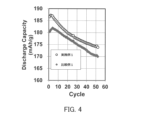
- FIG. 4 is a graph showing changes in discharge capacity of the batteries of Example 1 and Comparative Example 1.
- the secondary battery according to the first aspect of the present disclosure includes A positive electrode, a negative electrode, and an electrolytic solution
- the positive electrode comprises a positive electrode active material and a coating material covering at least part of the surface of the positive electrode active material, the coating material comprises Li, Ti, M1, and X;
- M1 is at least one selected from the group consisting of Be, Mg, Ca, Sr, Ba, Sc, Y, Al, Ga, In, Zr, and Sn, and X is F, Cl, Br, and I
- the electrolytic solution contains an electrolyte and a non-aqueous solvent.
- the resistance at the interface between the electrolytic solution and the positive electrode active material is reduced, so the capacity is increased. Furthermore, decomposition due to contact between the electrolytic solution and the positive electrode active material is suppressed, and cycle characteristics can be improved.
- X may include F in the secondary battery according to the first aspect.
- the coating material contains a material represented by the following compositional formula (2), Li 6-(4-a)b (Ti 1-a M1 a ) b X 6 Formula (2)
- 0 ⁇ a ⁇ 1 and 0 ⁇ b ⁇ 2 may be satisfied.
- the ratio of the amount of Li substance to the total amount of Ti and M1 is 0.5 or more and It may be 4.5 or less.
- M1 may be Al.
- Al is inexpensive and suitable as an element that improves the ionic conductivity of the coating material. According to the above configuration, it is possible to improve the capacity and cycle characteristics of the secondary battery.
- the covering material may cover 80% or more of the surface of the positive electrode active material.
- the covering material may cover 95% or more of the surface of the positive electrode active material.
- the positive electrode active material may contain a composite oxide containing lithium and a transition metal.
- the composite oxide has a composition represented by the following compositional formula (3), LiNix1Coy1M21 -x1-y1O2 Formula ( 3) where 0 ⁇ x1 ⁇ 1, 0 ⁇ y1 ⁇ 1, and 0 ⁇ 1 ⁇ x1 ⁇ y1 ⁇ 0.35 are satisfied, and M2 is at least one selected from the group consisting of Al and Mn; good too.
- compositional formula (3) LiNix1Coy1M21 -x1-y1O2 Formula ( 3) where 0 ⁇ x1 ⁇ 1, 0 ⁇ y1 ⁇ 1, and 0 ⁇ 1 ⁇ x1 ⁇ y1 ⁇ 0.35 are satisfied, and M2 is at least one selected from the group consisting of Al and Mn; good too.
- the composite oxide has a composition represented by the following compositional formula (5), Li x3 M4 y3 (PO 4 ) z3 Formula (5) where 2.7 ⁇ x3 ⁇ 3.3, 0.9 ⁇ y3 ⁇ 2.2, and 0.9 ⁇ z3 ⁇ 3.3 are satisfied, and M4 is Ni, Co, Mn, Fe, and V It may be at least one selected from the group consisting of
- the secondary battery according to any one of the first to eleventh aspects may not contain a solid electrolyte other than the solid electrolyte contained as the coating material.
- a secondary battery includes a positive electrode, a negative electrode, and an electrolytic solution.
- the positive electrode includes a positive electrode active material and a coating material that covers at least part of the surface of the positive electrode active material.
- the coating material contains Li, Ti, M1, and X, and M1 is at least selected from the group consisting of Be, Mg, Ca, Sr, Ba, Sc, Y, Al, Ga, In, Zr, and Sn. and X is at least one selected from the group consisting of F, Cl, Br, and I;
- the electrolytic solution contains an electrolyte and a non-aqueous solvent.
- the resistance at the interface between the electrolytic solution and the positive electrode active material is reduced, so the capacity of the secondary battery is increased. Furthermore, decomposition of the electrolyte solution due to contact between the electrolyte solution and the positive electrode active material is suppressed, and the cycle characteristics of the secondary battery are improved.
- FIG. 1 is a longitudinal sectional view schematically showing a secondary battery 10 according to one embodiment of the present disclosure.
- the secondary battery 10 is a cylindrical battery including a cylindrical battery case, a wound electrode group 14, and an electrolyte (not shown).
- the electrode group 14 is accommodated in the battery case and is in contact with the electrolyte.
- the battery case is composed of a case body 15 which is a bottomed cylindrical metal container and a sealing member 16 which seals the opening of the case body 15 .
- a gasket 27 is arranged between the case main body 15 and the sealing member 16 . Gasket 27 ensures hermeticity of the battery case.
- Insulating plates 17 and 18 are arranged at both ends of the electrode group 14 in the winding axis direction of the electrode group 14 in the case main body 15 .
- the case body 15 has a stepped portion 21, for example.
- the stepped portion 21 can be formed by partially pressing the sidewall of the case body 15 from the outside.
- the stepped portion 21 may be annularly formed on the side wall of the case body 15 along the circumferential direction of a virtual circle defined by the case body 15 .
- the sealing member 16 is supported by, for example, the surface of the step portion 21 on the opening side.
- the sealing body 16 includes a filter 22, a lower valve body 23, an insulating member 24, an upper valve body 25, and a cap 26. In the sealing member 16, these members are laminated in this order.
- the sealing member 16 is attached to the opening of the case body 15 so that the cap 26 is positioned outside the case body 15 and the filter 22 is positioned inside the case body 15 .
- Each of the above-described members constituting the sealing member 16 is, for example, disk-shaped or ring-shaped. Each member described above is electrically connected to each other except for the insulating member 24 .
- the electrode group 14 has a positive electrode 11, a negative electrode 12, and a separator 13.
- Each of the positive electrode 11, the negative electrode 12, and the separator 13 is strip-shaped.
- the width direction of the strip-shaped positive electrode 11 and negative electrode 12 is parallel to the winding axis of the electrode group 14, for example.
- a separator 13 is arranged between the positive electrode 11 and the negative electrode 12 .
- the positive electrode 11 and the negative electrode 12 are spirally wound with a separator 13 interposed therebetween.
- positive electrode 11 and negative electrode 12 are defined by case body 15 with separator 13 interposed between these electrodes. are alternately stacked in the radial direction of the virtual circle.
- the negative electrode 12 is electrically connected via a negative electrode lead 20 to a case body 15 that also serves as a negative electrode terminal.
- One end of the negative electrode lead 20 is connected to, for example, an end of the negative electrode 12 in the length direction of the negative electrode 12 .
- the other end of the negative electrode lead 20 is welded to the inner bottom surface of the case body 15, for example.
- the positive electrode 11 can occlude or desorb lithium.
- the positive electrode 11 includes a positive electrode active material and a coating material that covers at least part of the surface of the positive electrode active material.
- the coating material contains Li, Ti, M1, and X.
- M1 is at least one selected from the group consisting of Be, Mg, Ca, Sr, Ba, Sc, Y, Al, Ga, In, Zr, and Sn
- X is F, Cl, Br , and at least one selected from the group consisting of I.
- the coating material may contain anions other than X in order to increase the ionic conductivity.
- Anions other than X are at least one selected from the group consisting of O and Se.
- the coating material may consist essentially of Li, Ti, M1, and X.
- the coating material consists essentially of Li, Ti, M1, and X
- the coating material means the substances of Li, Ti, M1, and X with respect to the total amount of substances of all the elements constituting the coating material. It means that the total ratio of the amounts (ie, mole fraction) is 90% or more. As an example, the ratio may be 95% or greater.
- the coating may consist of Li, Ti, M1, and X only.
- X may include F.
- X may be F.
- the oxidation resistance of the coating material is improved.
- an increase in the internal resistance of the battery can be suppressed, and the capacity of the secondary battery is further increased.
- the ratio of the amount of Li substance to the total amount of Ti and M1 may be 0.5 or more and 4.5 or less.
- the ratio of the substance amount of X to the sum of the substance amounts of Li, Ti, M1, and X may be 0.4 or more and 0.8 or less, or 0.5 or more and 0.7 or less good.
- ⁇ may be a value larger than ⁇ .
- ⁇ may be a value greater than each of ⁇ , ⁇ , and ⁇ .
- composition formula (1) 1.7 ⁇ 3.7, 0 ⁇ 1.5, 0 ⁇ 1.5, and 5 ⁇ 7 may be satisfied.
- composition formula (1) 2.5 ⁇ 3, 0.1 ⁇ 0.6, 0.4 ⁇ 0.9, and 5 ⁇ 6 may be satisfied.
- the covering material may contain the material represented by the compositional formula (1) as a main component.
- the "main component” is the component that is contained most in terms of mass ratio.
- the coating material contains a material represented by the following compositional formula (2), Li 6-(4-a)b (Ti 1-a M1 a ) b X 6 Formula (2)
- 0 ⁇ a ⁇ 1 and 0 ⁇ b ⁇ 2 may be satisfied.
- Equation (2) 0.1 ⁇ a ⁇ 0.9 and 0.8 ⁇ b ⁇ 1.2 may be satisfied, and 0.5 ⁇ a ⁇ 0.9, and 0.8 ⁇ b ⁇ 1.2 may be satisfied.
- the thickness of the coating material is 1 nm or more, direct contact between the positive electrode active material and the electrolytic solution can be suppressed, and oxidative decomposition of the electrolytic solution can be suppressed. Therefore, the charging and discharging efficiency of the battery can be improved.
- the thickness of the covering material is 500 nm or less, the thickness of the covering material does not become too thick. Therefore, the internal resistance of the battery can be sufficiently reduced. Therefore, the energy density of the battery can be increased.
- the method for measuring the thickness of the coating material is not particularly limited, it can be obtained by directly observing the thickness of the coating material using, for example, a transmission electron microscope.
- the mass ratio of the coating material to the positive electrode active material may be 0.01% or more and 30% or less.
- the mass ratio of the coating material to the positive electrode active material is 0.01% or more, direct contact between the positive electrode active material and the electrolytic solution can be suppressed, and oxidative decomposition of the electrolytic solution can be suppressed. Therefore, the charging and discharging efficiency of the battery can be improved.
- the mass ratio of the covering material to the positive electrode active material is 30% or less, the thickness of the covering material does not become too thick. Therefore, the internal resistance of the battery can be sufficiently reduced. Therefore, the energy density of the battery can be increased.
- the covering material may evenly cover the surface of the positive electrode active material. As a result, direct contact between the positive electrode active material and the electrolytic solution can be suppressed, and oxidative decomposition of the electrolytic solution can be suppressed. Therefore, the charge/discharge characteristics of the battery can be further improved, and an increase in the internal resistance of the battery during charging can be suppressed.
- the coating material may cover part of the surface of the positive electrode active material. Electron conductivity between the positive electrode active materials is improved by direct contact between the plurality of positive electrode active materials via portions not covered with the coating material. Therefore, the battery can operate at high output.
- the coating material may cover 30% or more of the surface of the positive electrode active material, 60% or more, 80% or more, 90% or more, or 95% or more. may be covered.
- the coating material may substantially cover the entire surface of the positive electrode active material.
- a positive electrode active material is a material that can absorb or release lithium.
- the positive electrode active material may contain a composite oxide containing lithium and a transition metal.
- Transition metals include nickel (Ni), cobalt (Co), manganese (Mn), iron (Fe), copper (Cu), chromium (Cr), titanium (Ti), niobium (Nb), zirconium (Zr), vanadium. (V), at least one selected from the group consisting of tantalum (Ta) and molybdenum (Mo).
- composite oxide means a composite oxide containing lithium and a transition metal.
- a composite oxide is synthesized using a coprecipitation method or the like.
- a lithium compound is mixed with a compound containing a transition metal obtained by a coprecipitation method or the like, and the resulting mixture is fired under predetermined conditions.
- obtained by doing Composite oxides usually form secondary particles in which a plurality of primary particles are aggregated.
- the average particle size (D50) of the composite oxide particles is, for example, 3 ⁇ m or more and 25 ⁇ m or less.
- the average particle size (D50) means the particle size (volume average particle size) at which the volume integrated value is 50% in the volume-based particle size distribution measured by the laser diffraction scattering method.
- the composite oxide may contain metals other than transition metals.
- Metals other than transition metals include at least one selected from the group consisting of aluminum (Al), magnesium (Mg), calcium (Ca), strontium (Sr), zinc (Zn), and silicon (Si). good.
- the composite oxide may further contain boron (B) or the like in addition to the metal.
- the transition metal may contain Ni.
- the composite oxide may contain Ni and at least one selected from the group consisting of Co, Mn, Al, Ti and Fe. From the viewpoint of increasing the capacity and output, among others, the composite oxide may contain Ni and at least one selected from the group consisting of Co, Mn and Al, Ni, Co, Mn and and at least one selected from the group consisting of Al.
- the composite oxide further contains Co in addition to Li and Ni, the phase transition of the composite oxide containing Li and Ni is suppressed during charging and discharging, the stability of the crystal structure is improved, and the cycle characteristics are improved. is easy to improve. Thermal stability is improved when the composite oxide further contains at least one selected from the group consisting of Mn and Al.
- the atomic ratio of Ni to the total of metals other than Li may be 0.3 or more and less than 1, or 0.5 or more and less than 1.
- the composite oxide includes a composite oxide having a layered rock salt crystal structure and containing at least one selected from the group consisting of Ni and Co. Alternatively, it may contain a composite oxide having a spinel-type crystal structure and containing Mn. From the viewpoint of increasing the capacity, the composite oxide has a layered rock salt type crystal structure, contains Ni and a metal other than Ni, and has an atomic ratio of Ni to the total of metals other than Li (Ni/Me). 0.3 or more and less than 1 composite oxide (hereinafter also referred to as nickel-based composite oxide) may be used.
- a nickel-based composite oxide has a relatively unstable crystal structure, and is easily deteriorated due to the elution of Ni due to contact with a non-aqueous electrolyte at a high-potential positive electrode, and the cycle characteristics are easily deteriorated. Therefore, in the case of the nickel-based composite oxide, the effect of improving the cycle characteristics by being coated with the coating material can be obtained remarkably. By being coated with the coating material, the high capacity of the nickel-based composite oxide can be fully brought out.
- the composite oxide has a composition represented by the following compositional formula (3), LiNix1Coy1M21 -x1-y1O2 Formula ( 3)
- 0.3 ⁇ x1 ⁇ 1, 0 ⁇ y1 ⁇ 0.5, and 0 ⁇ 1-x1-y1 ⁇ 0.35 are satisfied, and M2 is at least one selected from the group consisting of Al and Mn may be
- 0.5 ⁇ x1 ⁇ 1 may be satisfied.
- 0 ⁇ y1 ⁇ 0.35 may be satisfied.
- the composite oxide has a composition represented by the following compositional formula (4), LiNi x2 M3 1-x2 O 2 Formula (4)
- 0.3 ⁇ x2 ⁇ 1 may be satisfied
- M3 may be at least one selected from the group consisting of Co, Mn, Al, Ti and Fe.
- x2 may be 0.5 or more, or may be 0.75 or more.
- the composite oxide has a composition represented by the following compositional formula (5), Li x3 M4 y3 (PO 4 ) z3 Formula (5) where 2.7 ⁇ x3 ⁇ 3.3, 0.9 ⁇ y3 ⁇ 2.2, and 0.9 ⁇ z3 ⁇ 3.3 are satisfied, and M4 is Ni, Co, Mn, Fe, and V It may be at least one selected from the group consisting of
- Coating materials include, for example, oxides.
- the oxides used for the coating material include Li--Nb--O compounds such as LiNbO 3 , Li--B--O compounds such as LiBO 2 and Li 3 BO 3 , Li--Al--O compounds such as LiAlO 2 and Li 4 Li—Si—O compounds such as SiO 4 , Li—S—O compounds such as Li 2 SO 4 , Li—Ti—O compounds such as Li 4 Ti 5 O 12 , Li—Zr—O compounds such as Li 2 ZrO 3 compounds, Li--Mo--O compounds such as Li 2 MoO 3 , Li--VO compounds such as LiV 2 O 5 , Li--WO compounds such as Li 2 WO 4 , Li--P such as Li 3 PO 4 —O compounds.
- the oxidation resistance of the positive electrode active material can be further improved. As a result, an increase in battery internal resistance during charging can be suppressed.
- the coating material in the secondary battery according to one embodiment and the positive electrode active material having at least part of the surface coated with the coating material can be produced, for example, by the following method.
- a raw material powder of a binary halide is prepared so as to have a compounding ratio for the composition of the desired coating material.
- the compounding ratio may be adjusted in advance so as to offset the change.
- the mechanochemical milling method is used to mix, pulverize, and react the raw material powders. After that, it may be fired in vacuum or in an inert atmosphere. Alternatively, after mixing the raw material powders well, the mixture may be fired in a vacuum or in an inert atmosphere. As for the firing conditions, it is preferable to perform firing for one hour or more within the range of 100° C. or higher and 300° C. or lower, for example. Moreover, in order to suppress a change in the composition during the firing process, it is preferable that the raw material powder is sealed in a sealed container such as a quartz tube and then fired.
- a sealed container such as a quartz tube
- a composite oxide having a predetermined mass ratio is prepared as a positive electrode active material.
- Li(NiCoMn)O 2 is prepared as a composite oxide.
- Li(NiCoMn) O2 and the coating material Li2.7Ti0.3Al0.7F6 are placed in the same reaction vessel and a rotating blade is used to apply a shear force to these two materials, or a jet stream
- At least a part of the surface of the composite oxide Li(NiCoMn)O 2 can be coated with Li 2.7 Ti 0.3 Al 0.7 F 6 as a coating material by a technique such as colliding these two materials with a .
- devices such as a dry particle compounding device Nobilta (manufactured by Hosokawa Micron), a high-speed airflow impact device (manufactured by Nara Machinery Co., Ltd.), and a jet mill can be used.
- the positive electrode 11 may include a positive electrode current collector and a positive electrode mixture layer carried on the surface of the positive electrode current collector.
- the positive electrode mixture layer can be formed, for example, by applying a positive electrode slurry in which a positive electrode mixture is dispersed in a dispersion medium on the surface of the positive electrode current collector and drying the slurry. The dried coating film may be rolled if necessary.
- the positive electrode material mixture layer may be formed on one surface of the positive electrode current collector, or may be formed on both surfaces.
- the dispersion medium for example, N-methyl-2-pyrrolidone (NMP) or the like is used.
- the positive electrode mixture layer includes a positive electrode active material and a coating material that covers at least part of the surface of the positive electrode active material.
- the positive electrode mixture layer may further contain a binder, a conductive agent, and the like.
- binders include resin materials such as fluorine resins, polyolefin resins, polyamide resins, polyimide resins, acrylic resins, and vinyl resins.
- fluororesins include polytetrafluoroethylene (PTFE) and polyvinylidene fluoride (PVDF).
- the binder may be used alone or in combination of two or more.
- conductive agents examples include carbon blacks such as acetylene black, conductive fibers such as carbon fibers or metal fibers, and carbon fluoride. Conductive agents may be used singly or in combination of two or more.
- a metal foil can be used for the positive electrode current collector.
- metals forming the positive electrode current collector include aluminum, titanium, alloys containing these metal elements, and stainless steel.
- the thickness of the positive electrode current collector is not particularly limited, it is, for example, 3 ⁇ m or more and 50 ⁇ m or less.
- the negative electrode 12 includes a material that has the property of intercalating and deintercalating metal ions (eg, lithium ions).
- the negative electrode 12 contains, for example, a negative electrode active material.
- the negative electrode active material may contain a carbon material that absorbs and releases lithium ions.
- Carbon materials that occlude and release lithium ions include graphite (natural graphite, artificial graphite), easily graphitizable carbon (soft carbon), non-graphitizable carbon (hard carbon), and the like. Among them, graphite is preferable because it has excellent charging/discharging stability and low irreversible capacity.
- the negative electrode active material may contain an alloy material.
- An alloy material is a material containing at least one metal capable of forming an alloy with lithium, and examples thereof include silicon, tin, silicon alloys, tin alloys, and silicon compounds.
- a composite material comprising a lithium ion conducting phase and silicon particles dispersed in the phase may be used as the silicon compound.
- a silicate phase such as a lithium silicate phase, a silicon oxide phase in which 95 mass % or more is silicon dioxide, a carbon phase, or the like may be used.
- An alloy material and a carbon material may be used together as the negative electrode active material.
- the ratio of the carbon material to the total of the alloy-based material and the carbon material may be, for example, 80% by mass or more, or may be 90% by mass or more.
- the negative electrode active material may contain lithium titanium oxide.
- the lithium titanium oxide may contain at least one selected from the group consisting of Li4Ti5O12 , Li7Ti5O12 , and LiTi2O4 . Furthermore, TiO 2 may be included.
- An alloy material and a carbon material, or a lithium titanium oxide and a carbon material may be used together as the negative electrode active material.
- the negative electrode may include a negative electrode current collector and a negative electrode mixture layer carried on the surface of the negative electrode current collector.
- the negative electrode mixture layer can be formed, for example, by applying a negative electrode slurry in which a negative electrode mixture is dispersed in a dispersion medium on the surface of the negative electrode current collector and drying the slurry. The dried coating film may be rolled if necessary.
- the negative electrode mixture layer may be formed on one surface of the negative electrode current collector, or may be formed on both surfaces. Water or NMP is used as the dispersion medium, for example.
- the negative electrode mixture layer contains a negative electrode active material.
- the negative electrode mixture layer may further contain a binder, a conductive agent, a thickener, and the like.
- a binder and the conductive agent those exemplified for the positive electrode can be used.
- a rubber material such as styrene-butadiene copolymer rubber (SBR) may be used as the binder.
- thickeners include carboxymethyl cellulose (CMC) and modified products thereof (Na salts, etc.).
- the electrolytic solution contains a non-aqueous solvent and an electrolyte.
- the electrolyte may include a non-aqueous solvent and a lithium salt dissolved in the non-aqueous solvent.
- the lithium salt concentration in the electrolytic solution may be, for example, 0.5 mol/liter or more and 2 mol/liter or less. By controlling the lithium salt concentration within the above range, it is possible to obtain an electrolytic solution having excellent ion conductivity and moderate viscosity. However, the lithium salt concentration is not limited to the above.
- cyclic carbonate for example, cyclic carbonate, chain carbonate, cyclic carboxylate, chain carboxylate, and the like are used.
- Cyclic carbonates include propylene carbonate (PC), ethylene carbonate (EC), and the like.
- the cyclic carbonate may include a fluorinated cyclic carbonate such as fluoroethylene carbonate (FEC), and a cyclic carbonate having a carbon-carbon unsaturated bond such as vinylene carbonate (VC) and vinylethylene carbonate.
- Chain carbonates include diethyl carbonate (DEC), ethyl methyl carbonate (EMC), dimethyl carbonate (DMC) and the like.
- Cyclic carboxylic acid esters include ⁇ -butyrolactone (GBL) and ⁇ -valerolactone (GVL).
- Chain carboxylic acid esters include methyl formate, ethyl formate, propyl formate, methyl acetate, ethyl acetate, propyl acetate, methyl propionate, ethyl propionate, and propyl propionate.
- the non-aqueous solvent may be used singly or in combination of two or more.
- a known lithium salt can be used as the lithium salt.
- Preferred lithium salts include , for example, LiClO4 , LiBF4 , LiPF6, LiAlCl4, LiSbF6, LiSCN, LiCF3SO3 , LiCF3CO2 , LiAsF6 , LiB10Cl10 , lithium lower aliphatic carboxylate, LiCl, LiBr, LiI, borates, imide salts and the like.
- Borates include bis(1,2-benzenediolate(2-)-O,O')lithium borate, bis(2,3-naphthalenediolate(2-)-O,O')boric acid lithium, bis(2,2'-biphenyldiolate(2-)-O,O') lithium borate, bis(5-fluoro-2-olate-1-benzenesulfonic acid-O,O') lithium borate etc.
- imide salts examples include lithium bis(fluorosulfonyl)imide (LiN(FSO2 ) 2 ), lithium bistrifluoromethanesulfonimide (LiN( CF3SO2 ) 2 ), lithium trifluoromethanesulfonate nonafluorobutanesulfonate imido. (LiN(CF 3 SO 2 )(C 4 F 9 SO 2 )), lithium bispentafluoroethanesulfonic acid imide (LiN(C 2 F 5 SO 2 ) 2 ), and the like. Lithium salts may be used singly or in combination of two or more.
- Separator 13 Generally, it is desirable to interpose a separator between the positive electrode and the negative electrode.
- the separator 13 has a high ion permeability and moderate mechanical strength and insulation.
- a microporous thin film, a woven fabric, a non-woven fabric, or the like can be used.
- a polymer can be used as the material of the separator 13, for example.
- the polymer may be a polyolefin such as polypropylene and polyethylene.
- the electrolyte may be impregnated in a polymer provided as a separator, for example. That is, the secondary battery of the present disclosure may have a structure in which an electrolytic solution and a polymer are used together.
- the secondary battery of the present disclosure may further contain a solid electrolyte as an electrolyte. That is, the secondary battery of the present disclosure may have a hybrid structure in which an electrolytic solution and a solid electrolyte are used together.
- solid electrolytes are halide solid electrolytes, sulfide solid electrolytes, oxide solid electrolytes or organic polymer solid electrolytes.
- halide solid electrolyte means a solid electrolyte containing a halogen element as a main component among anions.
- a “sulfide solid electrolyte” means a solid electrolyte containing sulfur as a main component among anions.
- the secondary battery of the present disclosure may contain no solid electrolyte except for the solid electrolyte contained as a coating material.
- the secondary battery of the present disclosure may not contain a solid electrolyte as an electrolyte.
- the configuration example shown in FIG. A contained secondary battery 10 is described.
- the secondary battery according to the present disclosure is not limited to this configuration example.
- the secondary battery according to the present disclosure may be in any form, such as cylindrical, square, coin, button, and laminate.
- the electrode group in the secondary battery according to the present disclosure instead of the wound electrode group, other forms such as a laminated electrode group in which a positive electrode and a negative electrode are laminated with a separator interposed therebetween. Groups of electrodes may be applied.
- Composite oxide particles (average particle size (D50): 5 ⁇ m) having a composition of layered rock salt type LiNi 0.6 Co 0.2 Mn 0.2 (NCM), which is a positive electrode active material, and Li 2.7 Ti 0.3 Al 0.7 F 6 were combined with NCM:Li 2.7 Ti 0.3 Al 0.7 F 6 were weighed so that the mass ratio was 100:3. These materials were put into a dry particle compounding device Nobilta (manufactured by Hosokawa Micron) and compounded at 6000 rpm for 30 minutes to obtain a positive electrode active material whose surface was coated with a coating material.
- NCM layered rock salt type LiNi 0.6 Co 0.2 Mn 0.2
- NMP N-methyl-2-pyrrolidone
- the positive electrode slurry was applied to the surface of the aluminum foil, the coating film was dried, and then rolled to form a positive electrode mixture layer.
- a positive electrode mixture layer was formed on one side of an aluminum foil.
- NMP N-methyl-2-pyrrolidone
- a negative electrode slurry was applied to the surface of an aluminum foil, the coating film was dried, and then rolled to form a negative electrode mixture layer.
- a negative electrode mixture layer was formed on one side of the aluminum foil.
- FEC fluoroethylene carbonate
- DMC dimethyl carbonate
- the concentration of LiPF 6 in the electrolyte was 1 mol/liter.
- a positive electrode lead made of Al was attached to the positive electrode obtained above.
- a negative electrode lead made of Al was attached to the negative electrode obtained above.
- the positive electrode and the negative electrode were spirally wound with a polyethylene thin film separator interposed therebetween to prepare a wound electrode group.
- the electrode group was housed in a bag-shaped exterior body formed of a laminate sheet having an Al layer, and after the electrolyte solution was injected, the exterior body was sealed.
- the electrode group was accommodated in the package, part of the positive electrode lead and the negative electrode lead were each exposed to the outside from the package. Thus, the battery of Example 1 was obtained.
- AB acetylene black
- PVDF polyvinylidene fluoride
- FIG. 2 is a graph showing charge-discharge curves of the batteries of Example 1 and Comparative Example 1 in the first cycle.
- 3 is a graph showing charge-discharge curves at the 50th cycle of the batteries of Example 1 and Comparative Example 1.
- FIG. 2 is a graph showing charge-discharge curves of the batteries of Example 1 and Comparative Example 1 in the first cycle.
- Table 1 shows the relative values of the internal resistance after 3 cycles and 50 cycles of Example 1 and Comparative Example 1 when the value of the internal resistance after 3 cycles of the battery of Example 1 is set to 1.
- Example 1 a higher discharge capacity was obtained than in Comparative Example 1, and a higher discharge capacity was maintained than in Comparative Example 1 even after 50 cycles.
- the internal resistance of Example 1 was lower than that of Comparative Example 1 as a result of measuring the internal resistance. It is inferred that this result contributes to the fact that the discharge capacity of Example 1 is higher than that of Comparative Example 1.
- the increase in resistance after 50 cycles is smaller in Example 1 than in Comparative Example 1. It is inferred that this contributes to the maintenance of the discharge capacity.
- the secondary battery according to the present disclosure is suitably used, for example, as a power source for mobile devices such as smartphones, a power source for vehicles such as electric vehicles, and a storage device for natural energy such as sunlight.
Landscapes
- Chemical & Material Sciences (AREA)
- Chemical Kinetics & Catalysis (AREA)
- Electrochemistry (AREA)
- General Chemical & Material Sciences (AREA)
- Inorganic Chemistry (AREA)
- Engineering & Computer Science (AREA)
- Composite Materials (AREA)
- Manufacturing & Machinery (AREA)
- Materials Engineering (AREA)
- Crystallography & Structural Chemistry (AREA)
- Physics & Mathematics (AREA)
- Condensed Matter Physics & Semiconductors (AREA)
- General Physics & Mathematics (AREA)
- Battery Electrode And Active Subsutance (AREA)
- Secondary Cells (AREA)
Priority Applications (4)
| Application Number | Priority Date | Filing Date | Title |
|---|---|---|---|
| US18/841,776 US20250183315A1 (en) | 2022-02-28 | 2023-02-13 | Secondary battery |
| JP2024503040A JPWO2023162759A1 (https=) | 2022-02-28 | 2023-02-13 | |
| EP23759762.0A EP4489131A4 (en) | 2022-02-28 | 2023-02-13 | SECONDARY BATTERY |
| CN202380023085.2A CN118891753A (zh) | 2022-02-28 | 2023-02-13 | 二次电池 |
Applications Claiming Priority (2)
| Application Number | Priority Date | Filing Date | Title |
|---|---|---|---|
| JP2022-030167 | 2022-02-28 | ||
| JP2022030167 | 2022-02-28 |
Publications (1)
| Publication Number | Publication Date |
|---|---|
| WO2023162759A1 true WO2023162759A1 (ja) | 2023-08-31 |
Family
ID=87765856
Family Applications (1)
| Application Number | Title | Priority Date | Filing Date |
|---|---|---|---|
| PCT/JP2023/004855 Ceased WO2023162759A1 (ja) | 2022-02-28 | 2023-02-13 | 二次電池 |
Country Status (5)
| Country | Link |
|---|---|
| US (1) | US20250183315A1 (https=) |
| EP (1) | EP4489131A4 (https=) |
| JP (1) | JPWO2023162759A1 (https=) |
| CN (1) | CN118891753A (https=) |
| WO (1) | WO2023162759A1 (https=) |
Cited By (1)
| Publication number | Priority date | Publication date | Assignee | Title |
|---|---|---|---|---|
| JP2025076387A (ja) * | 2023-10-31 | 2025-05-15 | 三星エスディアイ株式会社 | 正極活物質、その製造方法、これを含む正極、およびリチウム二次電池 |
Families Citing this family (2)
| Publication number | Priority date | Publication date | Assignee | Title |
|---|---|---|---|---|
| CN119673988B (zh) * | 2024-11-29 | 2025-12-19 | 浙江锂威能源科技有限公司 | 一种正极材料、极片及二次电池 |
| CN120895642B (zh) * | 2025-09-29 | 2026-03-10 | 宁德时代新能源科技股份有限公司 | 正极活性材料、二次电池和用电装置 |
Citations (3)
| Publication number | Priority date | Publication date | Assignee | Title |
|---|---|---|---|---|
| US20130071745A1 (en) * | 2011-09-19 | 2013-03-21 | Samsung Electronics Co., Ltd. | Electrode active material, preparation method thereof, and electrode and lithium battery containing the same |
| WO2013047877A1 (ja) | 2011-09-30 | 2013-04-04 | 旭硝子株式会社 | リチウムイオン二次電池用正極活物質、およびその製造方法 |
| WO2021186809A1 (ja) * | 2020-03-18 | 2021-09-23 | パナソニックIpマネジメント株式会社 | 固体電解質材料およびそれを用いた電池 |
Family Cites Families (1)
| Publication number | Priority date | Publication date | Assignee | Title |
|---|---|---|---|---|
| JP7777797B2 (ja) * | 2020-03-18 | 2025-12-01 | パナソニックIpマネジメント株式会社 | 正極材料、および、電池 |
-
2023
- 2023-02-13 US US18/841,776 patent/US20250183315A1/en active Pending
- 2023-02-13 CN CN202380023085.2A patent/CN118891753A/zh active Pending
- 2023-02-13 JP JP2024503040A patent/JPWO2023162759A1/ja active Pending
- 2023-02-13 WO PCT/JP2023/004855 patent/WO2023162759A1/ja not_active Ceased
- 2023-02-13 EP EP23759762.0A patent/EP4489131A4/en active Pending
Patent Citations (3)
| Publication number | Priority date | Publication date | Assignee | Title |
|---|---|---|---|---|
| US20130071745A1 (en) * | 2011-09-19 | 2013-03-21 | Samsung Electronics Co., Ltd. | Electrode active material, preparation method thereof, and electrode and lithium battery containing the same |
| WO2013047877A1 (ja) | 2011-09-30 | 2013-04-04 | 旭硝子株式会社 | リチウムイオン二次電池用正極活物質、およびその製造方法 |
| WO2021186809A1 (ja) * | 2020-03-18 | 2021-09-23 | パナソニックIpマネジメント株式会社 | 固体電解質材料およびそれを用いた電池 |
Non-Patent Citations (1)
| Title |
|---|
| See also references of EP4489131A4 |
Cited By (1)
| Publication number | Priority date | Publication date | Assignee | Title |
|---|---|---|---|---|
| JP2025076387A (ja) * | 2023-10-31 | 2025-05-15 | 三星エスディアイ株式会社 | 正極活物質、その製造方法、これを含む正極、およびリチウム二次電池 |
Also Published As
| Publication number | Publication date |
|---|---|
| US20250183315A1 (en) | 2025-06-05 |
| CN118891753A (zh) | 2024-11-01 |
| JPWO2023162759A1 (https=) | 2023-08-31 |
| EP4489131A4 (en) | 2025-08-06 |
| EP4489131A1 (en) | 2025-01-08 |
Similar Documents
| Publication | Publication Date | Title |
|---|---|---|
| JP3625680B2 (ja) | リチウム二次電池 | |
| JP4270109B2 (ja) | 電池 | |
| CN110679018B (zh) | 正极活性物质和其制造方法、正极复合材料糊剂和非水系电解质二次电池 | |
| KR20190059115A (ko) | 리튬 이차전지용 양극재에 포함되는 비가역 첨가제, 이의 제조방법, 및 이 및 포함하는 양극재 | |
| JPWO2016147564A1 (ja) | 非水電解質二次電池 | |
| JP2004139743A (ja) | 非水電解質二次電池 | |
| JP2011001256A (ja) | 窒化リチウム−遷移金属複合酸化物の製造方法、窒化リチウム−遷移金属複合酸化物およびリチウム電池 | |
| WO2023162759A1 (ja) | 二次電池 | |
| JP6607188B2 (ja) | 正極及びそれを用いた二次電池 | |
| JP2017059302A (ja) | 電極、非水電解質電池および電池パック | |
| JP7612642B2 (ja) | 正極活物質及びこれを含むリチウム二次電池 | |
| JP7214662B2 (ja) | 非水電解質二次電池 | |
| JP2015170542A (ja) | 非水電解質二次電池 | |
| WO2021020290A1 (ja) | 非水電解質蓄電素子、その製造方法、及び蓄電装置 | |
| CN110088970A (zh) | 非水电解质二次电池 | |
| JP2013229304A (ja) | リチウムイオン二次電池用非水電解液およびリチウムイオン二次電池 | |
| JP5910730B2 (ja) | 活物質、およびそれを用いた電極、ならびにリチウムイオン二次電池 | |
| JP6481907B2 (ja) | リチウム鉄マンガン系複合酸化物、それを用いたリチウムイオン二次電池用正極活物質、リチウムイオン二次電池用正極、及びリチウムイオン二次電池 | |
| JP7024386B2 (ja) | 負極活物質、負極、非水電解質蓄電素子、及び非水電解質蓄電素子の製造方法 | |
| JP2013073818A (ja) | リチウムイオン二次電池用複合負極活物質 | |
| CN115413377A (zh) | 非水电解质二次电池用正极和非水电解质二次电池 | |
| JP7318344B2 (ja) | 非水電解質蓄電素子、その使用方法及びその製造方法 | |
| JP2018150217A (ja) | 複合酸化物、正極活物質、正極、非水電解質蓄電素子、及び複合酸化物の製造方法 | |
| JP2003077544A (ja) | 二次電池 | |
| JP2020030886A (ja) | 非水電解質二次電池用正極活物質 |
Legal Events
| Date | Code | Title | Description |
|---|---|---|---|
| 121 | Ep: the epo has been informed by wipo that ep was designated in this application |
Ref document number: 23759762 Country of ref document: EP Kind code of ref document: A1 |
|
| ENP | Entry into the national phase |
Ref document number: 2024503040 Country of ref document: JP Kind code of ref document: A |
|
| WWE | Wipo information: entry into national phase |
Ref document number: 202380023085.2 Country of ref document: CN |
|
| WWE | Wipo information: entry into national phase |
Ref document number: 18841776 Country of ref document: US |
|
| WWE | Wipo information: entry into national phase |
Ref document number: 2023759762 Country of ref document: EP |
|
| NENP | Non-entry into the national phase |
Ref country code: DE |
|
| ENP | Entry into the national phase |
Ref document number: 2023759762 Country of ref document: EP Effective date: 20240930 |
|
| WWP | Wipo information: published in national office |
Ref document number: 18841776 Country of ref document: US |