WO2023162317A1 - 全固体電池 - Google Patents
全固体電池 Download PDFInfo
- Publication number
- WO2023162317A1 WO2023162317A1 PCT/JP2022/036665 JP2022036665W WO2023162317A1 WO 2023162317 A1 WO2023162317 A1 WO 2023162317A1 JP 2022036665 W JP2022036665 W JP 2022036665W WO 2023162317 A1 WO2023162317 A1 WO 2023162317A1
- Authority
- WO
- WIPO (PCT)
- Prior art keywords
- positive electrode
- oxide
- transition metal
- layer
- active material
- Prior art date
- Legal status (The legal status is an assumption and is not a legal conclusion. Google has not performed a legal analysis and makes no representation as to the accuracy of the status listed.)
- Ceased
Links
Images


Classifications
-
- H—ELECTRICITY
- H01—ELECTRIC ELEMENTS
- H01M—PROCESSES OR MEANS, e.g. BATTERIES, FOR THE DIRECT CONVERSION OF CHEMICAL ENERGY INTO ELECTRICAL ENERGY
- H01M10/00—Secondary cells; Manufacture thereof
- H01M10/05—Accumulators with non-aqueous electrolyte
- H01M10/052—Li-accumulators
- H01M10/0525—Rocking-chair batteries, i.e. batteries with lithium insertion or intercalation in both electrodes; Lithium-ion batteries
-
- H—ELECTRICITY
- H01—ELECTRIC ELEMENTS
- H01M—PROCESSES OR MEANS, e.g. BATTERIES, FOR THE DIRECT CONVERSION OF CHEMICAL ENERGY INTO ELECTRICAL ENERGY
- H01M10/00—Secondary cells; Manufacture thereof
- H01M10/05—Accumulators with non-aqueous electrolyte
- H01M10/056—Accumulators with non-aqueous electrolyte characterised by the materials used as electrolytes, e.g. mixed inorganic/organic electrolytes
- H01M10/0561—Accumulators with non-aqueous electrolyte characterised by the materials used as electrolytes, e.g. mixed inorganic/organic electrolytes the electrolyte being constituted of inorganic materials only
- H01M10/0562—Solid materials
-
- H—ELECTRICITY
- H01—ELECTRIC ELEMENTS
- H01M—PROCESSES OR MEANS, e.g. BATTERIES, FOR THE DIRECT CONVERSION OF CHEMICAL ENERGY INTO ELECTRICAL ENERGY
- H01M4/00—Electrodes
- H01M4/02—Electrodes composed of, or comprising, active material
- H01M4/13—Electrodes for accumulators with non-aqueous electrolyte, e.g. for lithium-accumulators; Processes of manufacture thereof
- H01M4/131—Electrodes based on mixed oxides or hydroxides, or on mixtures of oxides or hydroxides, e.g. LiCoOx
-
- H—ELECTRICITY
- H01—ELECTRIC ELEMENTS
- H01M—PROCESSES OR MEANS, e.g. BATTERIES, FOR THE DIRECT CONVERSION OF CHEMICAL ENERGY INTO ELECTRICAL ENERGY
- H01M4/00—Electrodes
- H01M4/02—Electrodes composed of, or comprising, active material
- H01M4/36—Selection of substances as active materials, active masses, active liquids
- H01M4/48—Selection of substances as active materials, active masses, active liquids of inorganic oxides or hydroxides
- H01M4/52—Selection of substances as active materials, active masses, active liquids of inorganic oxides or hydroxides of nickel, cobalt or iron
- H01M4/525—Selection of substances as active materials, active masses, active liquids of inorganic oxides or hydroxides of nickel, cobalt or iron of mixed oxides or hydroxides containing iron, cobalt or nickel for inserting or intercalating light metals, e.g. LiNiO2, LiCoO2 or LiCoOxFy
-
- H—ELECTRICITY
- H01—ELECTRIC ELEMENTS
- H01M—PROCESSES OR MEANS, e.g. BATTERIES, FOR THE DIRECT CONVERSION OF CHEMICAL ENERGY INTO ELECTRICAL ENERGY
- H01M4/00—Electrodes
- H01M4/02—Electrodes composed of, or comprising, active material
- H01M4/36—Selection of substances as active materials, active masses, active liquids
- H01M4/48—Selection of substances as active materials, active masses, active liquids of inorganic oxides or hydroxides
- H01M4/54—Selection of substances as active materials, active masses, active liquids of inorganic oxides or hydroxides of silver
-
- H—ELECTRICITY
- H01—ELECTRIC ELEMENTS
- H01M—PROCESSES OR MEANS, e.g. BATTERIES, FOR THE DIRECT CONVERSION OF CHEMICAL ENERGY INTO ELECTRICAL ENERGY
- H01M2300/00—Electrolytes
- H01M2300/0017—Non-aqueous electrolytes
- H01M2300/0065—Solid electrolytes
- H01M2300/0068—Solid electrolytes inorganic
- H01M2300/0071—Oxides
-
- Y—GENERAL TAGGING OF NEW TECHNOLOGICAL DEVELOPMENTS; GENERAL TAGGING OF CROSS-SECTIONAL TECHNOLOGIES SPANNING OVER SEVERAL SECTIONS OF THE IPC; TECHNICAL SUBJECTS COVERED BY FORMER USPC CROSS-REFERENCE ART COLLECTIONS [XRACs] AND DIGESTS
- Y02—TECHNOLOGIES OR APPLICATIONS FOR MITIGATION OR ADAPTATION AGAINST CLIMATE CHANGE
- Y02E—REDUCTION OF GREENHOUSE GAS [GHG] EMISSIONS, RELATED TO ENERGY GENERATION, TRANSMISSION OR DISTRIBUTION
- Y02E60/00—Enabling technologies; Technologies with a potential or indirect contribution to GHG emissions mitigation
- Y02E60/10—Energy storage using batteries
Definitions
- the present invention relates to all-solid-state batteries. This application claims priority based on Japanese Patent Application No. 2022-029456 filed in Japan on February 28, 2022, the content of which is incorporated herein.
- All-solid-state batteries come in thin-film and bulk types.
- the thin film type is manufactured using thin film technology such as physical vapor deposition (PVD) method and sol-gel method.
- PVD physical vapor deposition
- a bulk mold is produced using a powder molding method, a sintering method, or the like.
- the respective all-solid-state batteries differ in applicable materials and performance due to differences in manufacturing methods. For example, a bulk type using a sintered body needs to use a material that can withstand sintering, but each layer can be made thicker, resulting in a high capacity.
- Patent Document 1 discloses a sintered all-solid-state battery that uses an oxide-based solid electrolyte as the solid electrolyte.
- the present invention has been made in view of the above problems, and aims to improve the cycle characteristics of all-solid-state batteries.
- An all-solid-state battery includes a sintered body having a positive electrode, a negative electrode, and a solid electrolyte layer between the positive electrode and the negative electrode, and the positive electrode is a compound containing Ag and a Li-containing transition metal oxide, and an oxide having a composition different from that of the Li transition metal oxide, the oxide containing Ag, and the compound containing Ag and the Li transition metal oxide at least part of is present inside the positive electrode through the oxide, an all-solid-state battery.
- the oxide may contain a transition metal element that constitutes the Li transition metal oxide.
- the minimum thickness of the oxide at least partially interposed between the Ag-containing compound and the Li transition metal oxide is 0.01 ⁇ m or more and 2.0 ⁇ m or less, and good too.
- a contact ratio between the Li transition metal oxide and the Ag-containing compound in the cross section of the positive electrode may be 0.1% or more and 10% or less.
- the compound containing Ag may be either Ag or Ag/Pd.
- the positive electrode includes a first layer and a second layer on at least one main surface of the first layer, and the first layer is a compound containing Ag. , the Li-containing transition metal oxide, and the oxide.
- the second layer may contain the Li transition metal oxide.
- the first layer and the second layer may contain Li transition metal oxides having the same composition.
- the positive electrode may contain lithium cobalt oxide.
- the all-solid-state battery according to the above aspect can improve cycle characteristics.
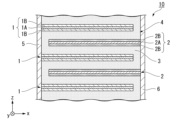
- FIG. 1 is a cross-sectional view of an all-solid-state battery according to a first embodiment
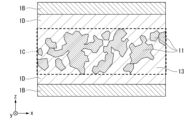
- FIG. 2 is a cross-sectional view enlarging a part of the positive electrode according to the first embodiment
- FIG. FIG. 4 is a partially enlarged cross-sectional view of another example of the positive electrode according to the first embodiment
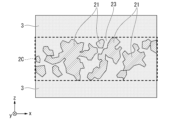
- 3 is a cross-sectional view enlarging a part of the negative electrode according to the first embodiment
- FIG. FIG. 4 is a partially enlarged cross-sectional view of another example of the negative electrode according to the first embodiment
- the stacking direction of the laminate 4 is the z-direction, one direction in the plane perpendicular to the z-direction is the x-direction, and the direction perpendicular to the x-direction and the z-direction is the y-direction.
- one direction of the z direction may be expressed as "up”, and the opposite direction as “down”. Up and down do not necessarily match the direction in which gravity is applied.
- FIG. 1 is a schematic cross-sectional view of an all-solid-state battery 10 according to this embodiment.
- the all-solid-state battery 10 has a laminate 4 and terminal electrodes 5 and 6 .
- the terminal electrodes 5 and 6 are in contact with the opposing surfaces of the laminate 4, respectively.
- the terminal electrodes 5 and 6 extend in the z-direction that intersects (perpendicularly) with the lamination surface of the laminate 4 .
- the laminate 4 has a positive electrode 1, a negative electrode 2, and a solid electrolyte layer 3.
- the laminate 4 is a sintered body in which the positive electrode 1, the negative electrode 2, and the solid electrolyte layer 3 are laminated and sintered.
- the number of layers of the positive electrode 1 and the negative electrode 2 does not matter.
- the solid electrolyte layer 3 is present at least between the positive electrode 1 and the negative electrode 2 .
- One end of the positive electrode 1 is connected to the terminal electrode 5 .
- One end of the negative electrode 2 is connected to the terminal electrode 6 .
- the all-solid-state battery 10 is charged or discharged by transferring ions between the positive electrode 1 and the negative electrode 2 through the solid electrolyte layer 3 .
- a laminated battery is shown, but a wound battery may also be used.
- the all-solid-state battery 10 is used, for example, as a laminate battery, a prismatic battery, a cylindrical battery, a coin-shaped battery, a button-shaped battery, and the like. Further, the all-solid-state battery 10 may be an injection type in which the solid electrolyte layer 3 is dissolved or dispersed in a solvent.
- FIG. 2 is an enlarged view of part of the positive electrode 1 according to the first embodiment.
- the positive electrode 1 includes, for example, a positive electrode current collector layer 1A (sometimes referred to as “first layer” in this specification) and a positive electrode active material layer 1B (“second layer” in this specification). (sometimes referred to as “layer”).
- the positive electrode 1 includes, for example, a compound containing Ag, a Li-containing transition metal oxide, and an oxide having a composition different from the Li-containing transition metal oxide (hereinafter referred to as "oxide"). have The oxide contains Ag. At least part of the Ag-containing compound and the Li-containing transition metal oxide passes through the oxide to the inside of the positive electrode (for example, the inside of the positive electrode current collector layer or the positive electrode current collector layer and the positive electrode active material). material layer).
- the positive electrode current collector layer (first layer) 1A includes, for example, a positive electrode current collector 11 (sometimes referred to as a "compound containing Ag” in this specification) and a positive electrode active material 12 (" and an oxide 13 (oxide) having a composition different from that of the Li transition metal oxide.
- a positive electrode current collector 11 sometimes referred to as a "compound containing Ag” in this specification
- a positive electrode active material 12 and an oxide 13 (oxide) having a composition different from that of the Li transition metal oxide.
- oxide 13 oxide having a composition different from that of the Li transition metal oxide
- the positive electrode current collector 11 contains Ag.
- the positive electrode current collector 11 contains, for example, a metal or alloy containing Ag. The Ag metal or alloy does not melt even when the laminate 4 is heated in the atmosphere and is not easily oxidized.
- the positive electrode current collector 11 is Ag, AgPd alloy, for example.
- the positive electrode current collector 11 is made of, for example, a plurality of conductive particles. A plurality of conductive particles are connected to each other and electrically connected in the xy plane.
- the positive electrode current collector 11 is not limited to this example, and may be, for example, a foil extending in the xy plane, a punched film, or an expanded form.
- the positive electrode active material 12 is mixed together with the positive electrode current collector 11 in the positive electrode current collector layer 1A.
- the transfer of electrons between the positive electrode active material 12 and the positive electrode current collector 11 becomes smooth.
- the positive electrode active material 12 is not particularly limited as long as it can reversibly progress the release and absorption of lithium ions and the desorption and insertion of lithium ions.
- positive electrode active materials used in known lithium ion secondary batteries can be used.
- the positive electrode active material 12 is, for example, a composite transition metal oxide (including Li transition metal oxide).
- the positive electrode active material 12 is preferably a transition metal oxide containing at least one selected from the group consisting of Co, Ni, Mn, Fe and V.
- the positive electrode active material 12 is preferably lithium manganese composite oxide, lithium nickel composite oxide, lithium cobalt composite oxide, lithium vanadium composite oxide, lithium titanium composite oxide, manganese dioxide, titanium oxide, niobium oxide, vanadium oxide. , tungsten oxide and the like.
- the positive electrode active material 12 is LiCoO 2 or LiMnO 2 . These compounds may have deviations from the stoichiometric composition.
- the positive electrode active material 12 is lithium cobalt oxide represented by Li x CoO 2 , and even if x varies in the range of 0.4 to 1.2 as the all-solid-state battery is charged and discharged. good.
- a positive electrode active material that does not contain lithium can also be used as the positive electrode active material 12 .
- These positive electrode active materials can be used by arranging a negative electrode active material doped with metallic lithium or lithium ions in advance on the negative electrode and starting the battery from discharging.
- lithium-free metal oxides MnO 2 , V 2 O 5 , etc. are examples of these positive electrode active materials.
- the oxide 13 (oxide) having a composition different from that of the Li transition metal oxide is present between the positive electrode current collector 11 and the positive electrode active material 12 .
- the oxide 13 having a composition different from that of the Li transition metal oxide is an oxide containing Ag.
- the oxide 13 having a composition different from that of the Li transition metal oxide prevents oxidation of Ag contained in the positive electrode current collector 11 and improves the cycle characteristics of the all-solid-state battery 10 .
- the oxide 13 having a composition different from that of the Li transition metal oxide preferably contains constituent elements that constitute the positive electrode active material 12 .
- the oxide 13 having a different composition from the Li transition metal oxide is preferably AgCoO 2 .
- the oxide 13 having a different composition from the Li transition metal oxide is preferably AgMn 2 O 4 .
- the thickness of the oxide 13 having a composition different from that of the Li transition metal oxide is, for example, 0.01 ⁇ m or more.
- the thickness of the oxide 13 having a composition different from that of the Li transition metal oxide is preferably 0.1 ⁇ m or more.
- the thickness of the oxide 13 having a composition different from that of the Li transition metal oxide can be obtained from a scanning electron microscope image. First, in the image, a first imaginary line passing through the top of the positive electrode current collector 11 is drawn. A second imaginary line is then drawn through the top of oxide 13 having a different composition than the Li transition metal oxide. Let the width between the first and second virtual lines be the thickness of the oxide 13 having a composition different from that of the Li transition metal oxide in the image.
- the processing was performed on 10 images, and the average value was calculated as "the thickness of the oxide 13 having a composition different from the medium Li transition metal oxide (the thickness of the oxide through at least a part of the compound containing Ag and the Li transition metal oxide. thickness)”.
- the first virtual line and the second virtual line are respectively a line passing through the top of the positive electrode current collector 11 and a line passing through the top of the oxide 13 having a composition different from that of the Li transition metal oxide. , may be defined by lines passing through the bottom of each.
- the positive electrode active material layer 1B (second layer) is formed on one side or both sides of the positive electrode current collector layer 1A.
- the positive electrode active material layer 1B contains a positive electrode active material.
- the positive electrode active material layer 1B may contain a conductive aid, a binder, and a solid electrolyte described later.
- the boundary between the xy plane passing through the outermost part of the positive electrode active material and the positive electrode current collector layer 1A is regarded as the positive electrode active material layer 1B.
- the positive electrode active material contained in the positive electrode active material layer 1B is the same as the positive electrode active material 12 contained in the positive electrode current collector layer 1A.
- the conductive aid is not particularly limited as long as it improves the electron conductivity in the positive electrode active material layer 1B, and known conductive aids can be used.
- Conductive agents include, for example, carbon-based materials such as graphite, carbon black, graphene, and carbon nanotubes, metals such as gold, platinum, silver, palladium, aluminum, copper, nickel, stainless steel, iron, and conductive oxides such as ITO. or mixtures thereof.
- the conductive aid may be in the form of powder or fiber.
- the binder bonds the positive electrode current collector layer 1A and the positive electrode active material layer 1B, the positive electrode active material layer 1B and the solid electrolyte layer 3, and various materials constituting the positive electrode active material layer 1B.
- the binder can be used within a range that does not impair the function of the positive electrode active material layer 1B.
- the binder may not be contained if unnecessary.
- the content of the binder in the positive electrode active material layer 1B is, for example, 0.5 to 30% by volume of the positive electrode active material layer.
- the resistance of the positive electrode active material layer 1B is sufficiently low.
- the volume % substantially coincides with the area % in a cross section measured with a scanning electron microscope, for example. Therefore, the area ratio in the cross section measured by the scanning electron microscope can be regarded as the volume ratio as it is.
- binding material may be used as long as the above bonding is possible, and examples thereof include fluororesins such as polyvinylidene fluoride (PVDF) and polytetrafluoroethylene (PTFE).
- PVDF polyvinylidene fluoride
- PTFE polytetrafluoroethylene
- the binder for example, cellulose, styrene/butadiene rubber, ethylene/propylene rubber, polyimide resin, polyamideimide resin, or the like may be used.
- a conductive polymer having electronic conductivity or an ion-conductive polymer having ionic conductivity may be used as the binder. Examples of conductive polymers having electronic conductivity include polyacetylene.
- the binder since the binder also exhibits the function of a conductive additive, it is not necessary to add a conductive additive.
- the ion-conductive polymer having ion conductivity for example, one that conducts lithium ions can be used, and polymer compounds (polyether-based polymer compounds such as polyethylene oxide and polypropylene oxide, polyphosphazene etc.) with a lithium salt such as LiClO 4 , LiBF 4 , LiPF 6 or an alkali metal salt mainly composed of lithium.
- Polymerization initiators used for compositing include, for example, photopolymerization initiators or thermal polymerization initiators compatible with the above monomers. Properties required for the binder include oxidation/reduction resistance and good adhesiveness.
- the positive electrode current collector layer (first layer) may consist of only the positive electrode current collector 11 (a compound containing Ag).
- oxide 13 (oxide) having a composition different from the Li transition metal oxide is present between the positive electrode current collector layer (first layer) and the positive electrode active material layer (second layer).
- the positive electrode is a single unit in which a positive electrode current collector 11 (compound containing Ag), a positive electrode active material 12 (Li transition metal oxide), and an oxide 13 (oxide) having a composition different from the Li transition metal oxide are mixed. It can be layers.
- FIG. 3 is a cross-sectional view along the stacking direction of another example of the positive electrode according to the first embodiment.
- the positive electrode shown in FIG. 3 has a positive electrode collector layer 1C, an intermediate layer 1D, and a positive electrode active material layer 1B.
- the positive electrode current collector layer 1C has a positive electrode current collector 11 and an oxide 13 (oxide) having a composition different from that of the Li transition metal oxide.
- the intermediate layer 1D is made of oxide 13 (oxide) having a different composition from the Li transition metal oxide.
- the example shown in FIG. 3 corresponds to the case where the oxide 13 (oxide) having a different composition from the Li transition metal oxide is thicker than the example shown in FIG.
- Solid electrolyte layer 3 contains a solid electrolyte.
- a solid electrolyte is a material in which ions can be moved by an externally applied electric field.
- the solid electrolyte layer 3 conducts lithium ions and inhibits movement of electrons.
- the solid electrolyte layer 3 is, for example, a sintered body obtained by sintering.
- the solid electrolyte layer 3 includes, for example, a solid electrolyte having a ⁇ -Li 3 PO 4 type crystal structure.
- a solid electrolyte having a ⁇ -Li 3 PO 4 type crystal structure is excellent in ionic conductivity.
- Solid electrolytes include, for example, Li 3+x Si x P 1-x O 4 , Li 3+x Si x V 1-x O 4 , Li 3+x Ge x P 1-x O 4 , Li 3+x Ge x V 1-x O 4 and the like. and preferably Li 3+x Si x P 1-x O 4 . x satisfies 0.4 ⁇ x ⁇ 0.8.
- the solid electrolyte may be a ternary lithium oxide containing Si, V, Ge, and the like.
- FIG. 4 is an enlarged view of part of the negative electrode 2 according to the first embodiment.
- the negative electrode 2 has, for example, a negative electrode current collector layer 2A and a negative electrode active material layer 2B containing a negative electrode active material.
- the negative electrode current collector layer 2A has, for example, a negative electrode current collector 21 and a negative electrode active material 22 .
- the area between the xy plane passing through the top of the negative electrode current collector 21 and the xy plane passing through the bottom thereof is regarded as the negative electrode current collector layer 2A.
- the negative electrode current collector 21 comprises, for example, a metal or alloy containing any one selected from the group consisting of Ag, Pd, Au, and Pt.
- the negative electrode current collector 21 is preferably AgPd alloy, Au, or Pt, for example.
- the negative electrode current collector 21 is made of, for example, a plurality of conductive particles. A plurality of conductive particles are connected to each other and electrically connected in the xy plane.
- the negative electrode current collector 21 is not limited to this example, and may be, for example, a foil extending in the xy plane, a punched film, or an expanded form.
- the negative electrode active material 22 is, for example, mixed together with the negative electrode current collector 21 in the negative electrode current collector layer 2A.
- the negative electrode active material 22 is in contact with the negative electrode current collector 21 .
- the transfer of electrons between the negative electrode active material 22 and the negative electrode current collector 21 becomes smooth.
- the negative electrode active material 22 is the same as the negative electrode active material contained in the negative electrode active material layer 2B described later.
- the negative electrode active material layer 2B is formed on one side or both sides of the negative electrode collector layer 2A.
- the negative electrode active material layer 2B contains a negative electrode active material.
- the negative electrode active material layer 2B may contain a conductive aid, a binder, and the solid electrolyte described above.
- the negative electrode active material layer 2B contains a solid electrolyte, the space between the xy plane passing through the outermost part of the negative electrode active material and the interface with the negative electrode current collector layer 2A is regarded as the negative electrode active material layer 2B.
- a negative electrode active material is a compound that can occlude and release ions.
- the negative electrode active material is a compound that exhibits a lower potential than the positive electrode active material.
- the negative electrode active material the same material as the positive electrode active material can be used.
- the negative electrode active material and the positive electrode active material used in the all-solid-state battery 10 are determined in consideration of the potential of the negative electrode active material and the potential of the positive electrode active material.
- the negative electrode active material is, for example, Li 4 Ti 5 O 12 , LiTiO 2 , Li 2 TiO 3 , Li 2 TiSiO 5 .
- the conductive aid improves the electron conductivity of the negative electrode active material layer 2B.
- a material similar to that of the positive electrode active material layer 1B can be used as the conductive aid.
- the binder bonds the negative electrode current collector layer 2A and the negative electrode active material layer 2B, the negative electrode active material layer 2B and the solid electrolyte layer 3, and the various materials that constitute the negative electrode active material layer 2B.
- a material similar to that of the positive electrode active material layer 1B can be used as the binder.
- the content ratio of the binder can also be the same as in the positive electrode active material layer 1B. If the binder is unnecessary, it may not be contained.
- FIG. 4 shows an example in which the negative electrode 2 is composed of the negative electrode current collector layer 2A and the negative electrode active material layer 2B, the present invention is not limited to this case.
- the negative electrode current collector layer 2A may consist of only the negative electrode current collector 21 .
- FIG. 5 is an enlarged view of part of another example of the negative electrode according to the first embodiment.
- a negative electrode 2 ⁇ /b>C shown in FIG. 5 has a negative electrode current collector 21 and a solid electrolyte 23 .
- the negative electrode current collector 21 is, for example, a metal or alloy containing Ag. Ag also functions as an active material.
- Ag functions as a negative electrode active material, the potential window of the all-solid-state battery widens, and charging and discharging reactions occur between a high potential (about 3.8 V) and a low potential (about 0 V).
- the all-solid-state battery has a high capacity, and the energy density of the all-solid-state battery is improved.
- the laminated body 4 is produced.
- the laminate 4 is produced by, for example, a simultaneous firing method or a sequential firing method.
- the simultaneous firing method is a method of manufacturing the laminate 4 by stacking the materials forming each layer and then firing them all at once.
- the sequential firing method is a method in which firing is performed each time each layer is formed.
- the simultaneous firing method can produce the laminate 4 with fewer work steps than the sequential firing method.
- the laminate 4 produced by the simultaneous firing method is denser than the laminate 4 produced by the sequential firing method. A case of using the simultaneous firing method will be described below as an example.
- each material of the positive electrode current collector layer 1A, the positive electrode active material layer 1B, the solid electrolyte layer 3, the negative electrode active material layer 2B, and the negative electrode current collector layer 2A that constitute the laminate 4 is pasted.
- the positive electrode current collector 11 is coated with the oxide 13 having a composition different from that of the Li transition metal oxide, and then made into a paste.
- the material forming the intermediate layer 1D is also pasted.
- the method of making each material into a paste is not particularly limited, and for example, a method of mixing the powder of each material with a vehicle to obtain a paste is used.
- the vehicle is a general term for medium in the liquid phase.
- Vehicles include solvents and binders.
- a green sheet is obtained by applying a paste prepared for each material onto a base material such as a PET (polyethylene terephthalate) film, drying it if necessary, and peeling off the base material.
- a base material such as a PET (polyethylene terephthalate) film
- the method of applying the paste is not particularly limited, and known methods such as screen printing, application, transfer, and doctor blade can be used.
- the green sheets produced for each material are stacked in a desired order and number of layers to produce a laminated sheet.
- alignment and cutting are performed as necessary. For example, when producing a parallel type or series-parallel type battery, alignment is performed so that the end surface of the positive electrode current collector layer 1A and the end surface of the negative electrode current collector layer 2A do not match, and the respective green sheets are stacked. .
- the laminated sheet may be produced by producing a positive electrode unit and a negative electrode unit, and laminating these units.
- the positive electrode unit is a laminate sheet in which a solid electrolyte layer 3, a positive electrode active material layer 1B, a positive electrode current collector layer 1A, and a positive electrode active material layer 1B are laminated in this order.
- an intermediate layer 1D is laminated between the positive electrode current collector layer 1A and the positive electrode active material layer 1B.
- the negative electrode unit is a laminate sheet in which the solid electrolyte layer 3, the negative electrode active material layer 2B, the negative electrode collector layer 2A, and the negative electrode active material layer 2B are laminated in this order.
- the solid electrolyte layer 3 of the positive electrode unit and the negative electrode active material layer 2B of the negative electrode unit are laminated so as to face each other, or the positive electrode active material layer 1B of the positive electrode unit and the solid electrolyte layer 3 of the negative electrode unit face each other.
- the produced laminated sheets are collectively pressurized to increase the adhesion of each layer.
- Pressurization can be performed by, for example, a die press, a hot water isostatic press (WIP), a cold water isostatic press (CIP), an isostatic press, or the like. Pressurization is preferably performed while heating. The heating temperature during crimping is, for example, 40 to 95.degree.
- a dicing machine is used to cut the laminate after being pressed into chips. Then, by removing the binder from the chip and firing it, the laminated body 4 made of the sintered body is obtained.
- the binder removal process can be performed as a separate process from the firing process.
- the binder removal process is performed, the binder component contained in the chip is thermally decomposed before the firing process, and rapid decomposition of the binder component in the firing process can be suppressed.
- the binder removal step is performed, for example, by heating at a temperature of 300 to 800° C. for 0.1 to 10 hours in an air atmosphere.
- the atmosphere of the binder removal step is an oxygen partial pressure environment in which the materials composing the positive electrode, the negative electrode and the solid electrolyte are not oxidized or reduced, or the materials composing the positive electrode, the negative electrode and the solid electrolyte and the atmosphere.
- the gas species can be arbitrarily selected so that the gas does not react. For example, it may be carried out in a nitrogen atmosphere, an argon atmosphere, a nitrogen-hydrogen mixed atmosphere, a water vapor atmosphere, or a mixed atmosphere thereof.
- the firing process is performed by placing the chip on a ceramic table. Firing is performed, for example, by heating to 600 to 1000° C. in an air atmosphere.
- the atmosphere of the sintering process is an oxygen partial pressure environment in which the materials composing the positive electrode, the negative electrode and the solid electrolyte are not or hardly oxidized and reduced.
- the gas species can be arbitrarily selected so that the gas does not react. For example, it may be carried out in a nitrogen atmosphere, an argon atmosphere, a nitrogen-hydrogen mixed atmosphere, a water vapor atmosphere, or a mixed atmosphere thereof.
- the sintered laminate 4 (sintered body) may be placed in a cylindrical container together with an abrasive such as alumina, and barrel-polished. This makes it possible to chamfer the corners of the laminate. Polishing may be performed using sandblasting. Sandblasting is preferable because it can grind only specific portions.
- Terminal electrodes 5 and 6 are formed on the side faces of the laminated body 4 thus produced, which face each other.
- the terminal electrodes 5 and 6 can be formed using means such as a sputtering method, a dipping method, a screen printing method, and a spray coating method.
- the all-solid-state battery 10 can be produced through the steps described above. When the terminal electrodes 5 and 6 are to be formed only on predetermined portions, the above process is performed after masking with tape or the like.
- the all-solid-state battery according to this embodiment has excellent cycle characteristics. Although the reason for this is not clear, it is considered that the oxide 13 having a composition different from that of the Li transition metal oxide functions as a film that prevents oxidation of Ag during charging and discharging. Ag contained in the positive electrode is oxidized at a potential of 3.84 V or higher. The use of energy for the Ag oxidation reaction means that the energy is consumed for reactions other than the charge/discharge reaction of the all-solid-state battery, resulting in poor energy efficiency. Oxidation of Ag can be suppressed by previously forming an oxide 13 having a composition different from that of the Li transition metal oxide between the positive electrode current collector 11 and the positive electrode active material 12 . As a result, it is considered that the cycle characteristics of the all-solid-state battery are improved.
- Example 1 Preparation of positive electrode paste
- AgCoO 2 powder was prepared as an oxide having a composition different from the Li transition metal oxide.
- these powders were put into a mechanochemical reactor (manufactured by Hosokawa Micron Corporation, product name: circulation-type mechanofusion (registered trademark) system AMS).
- AMS circulation-type mechanofusion
- ethyl cellulose and dihydroterpineol were added to a powder obtained by mixing this powder and LiCoO 2 as a positive electrode active material at a volume ratio of 50:50, and the mixture was mixed to prepare a positive electrode current collector layer paste.
- Ethyl cellulose is the binder and dihydroterpineol is the solvent.
- the positive electrode active material layer paste was prepared by adding ethyl cellulose and dihydroterpineol to LiCoO 2 and mixing them. LiCoO 2 is the positive electrode active material.
- Li 2 CO 3 , SiO 2 and Li 3 PO 4 were used as starting materials and mixed in a molar ratio of 2:1:1.
- the mixture was wet mixed for 16 hours using a ball mill with water as a dispersion medium.
- the mixture was calcined at 950° C. for 2 hours to prepare Li 3.5 Si 0.5 P 0.5 O 4 .
- 100 parts by mass of this calcined powder, 100 parts by mass of ethanol, and 200 parts by mass of toluene were added to a ball mill and wet-mixed.
- 16 parts of a polyvinyl butyral-based binder and 4.8 parts by mass of benzyl butyl phthalate were added and mixed to prepare a solid electrolyte layer paste.
- negative electrode paste As the negative electrode paste, a powder obtained by mixing Ag, Pd and Li 3.5 Si 0.5 P 0.5 O 4 at a volume ratio of 40:10:50 was used. Ethyl cellulose and dihydroterpineol were added to this powder and mixed. Ag functions as a negative electrode current collector and a negative electrode active material. Since Ag functions as a negative electrode active material, the output voltage of the all-solid-state battery becomes close to 3.8V.
- a positive electrode unit and a negative electrode unit were produced by the following procedure.
- the positive electrode active material layer paste was printed with a thickness of 5 ⁇ m on the solid electrolyte layer sheet using screen printing.
- the printed positive electrode active material layer paste was dried at 80° C. for 5 minutes.
- the positive electrode current collector layer paste was printed with a thickness of 5 ⁇ m using screen printing.
- the printed positive electrode current collector layer paste was dried at 80° C. for 5 minutes.
- the positive electrode active material layer paste was printed again in a thickness of 5 ⁇ m on the dried positive electrode current collector layer paste by screen printing, and dried. After that, the PET film was peeled off.
- a positive electrode unit was obtained in which the positive electrode active material layer/positive electrode current collector layer/positive electrode active material layer were laminated in this order on the main surface of the solid electrolyte layer.
- a negative electrode paste was printed on the main surface of the solid electrolyte layer with a thickness of 10 ⁇ m.
- the printed negative electrode paste was dried at 80° C. for 5 minutes. A negative electrode unit was produced by this procedure.
- a solid electrolyte unit was produced by stacking five solid electrolyte layer sheets.
- the laminate was produced by alternately stacking 50 electrode units (25 positive electrode units, 25 negative electrode units) so as to sandwich the solid electrolyte unit. At this time, each unit was staggered and stacked so that the odd-numbered electrode units extended only to one end face and the even-numbered electrode units extended only to the opposite end face.
- Six solid electrolyte layer sheets were stacked on top of this stacked unit. After that, this was molded by thermocompression bonding and then cut to produce a laminated chip. After that, the laminated chips were co-fired to obtain a laminated body. In the simultaneous firing, the temperature was raised to a firing temperature of 800° C. at a rate of temperature increase of 200° C./hour in an air atmosphere, held at that temperature for 2 hours, and naturally cooled after firing.
- An all-solid-state battery was produced by attaching terminal electrodes 5 and 6 to the sintered laminate (sintered body) by a known method. Then, the cross section of the produced all-solid-state battery was confirmed with a scanning electron microscope, and the film thickness of the oxide having a composition different from that of the Li transition metal oxide was measured. The film thickness of the oxide having a composition different from that of the Li transition metal oxide of Example 1 was 0.01 ⁇ m. Moreover, the volume ratio of each layer did not change between the paste state before sintering and the state after sintering. Ag can be present as Ag alone or contained as an element contained in an AgPd alloy.
- Cycle characteristics of the all-solid-state battery fabricated under the same conditions were measured. Cycle characteristics were evaluated by holding the first external terminal and the second external terminal between spring probes so as to face each other and repeating a charge/discharge test at a temperature of 60°C. The measurement conditions were a current of 100 ⁇ A during charging and discharging, and a final voltage of 3.9 V and 0 V during charging and discharging, respectively. The capacity at the time of the 10th discharge when the discharge capacity stabilized was defined as the initial discharge capacity. The cycle characteristics were obtained by dividing the discharge capacity at the 500th cycle by the discharge capacity at the 10th cycle.
- Examples 2 to 5 differ from Example 1 in that the film thickness of the oxide having a composition different from that of the Li transition metal oxide was changed.
- the film thickness of the oxide having a composition different from that of the Li transition metal oxide was controlled by increasing the amount of AgCoO 2 added during the mechanochemical reaction.
- the film thickness of the oxide having a composition different from that of the Li transition metal oxide of Example 2 was 0.1 ⁇ m.
- the film thickness of the oxide having a composition different from that of the Li transition metal oxide of Example 3 was 0.5 ⁇ m.
- the film thickness of the oxide having a composition different from that of the Li transition metal oxide of Example 4 was 1.0 ⁇ m.
- the film thickness of the oxide having a composition different from that of the Li transition metal oxide of Example 5 was 2.0 ⁇ m.
- Other conditions were the same as in Example 1 to obtain cycle characteristics.
- Example 6 differs from Example 1 in that the positive electrode active material contained in the positive electrode current collector layer paste and the positive electrode active material layer paste was changed from LiCoO 2 to LiMn 2 O 4 . Other conditions were the same as in Example 1 to obtain cycle characteristics.
- Example 7 In Example 7, the positive electrode active material contained in the positive electrode current collector layer paste and the positive electrode active material layer paste was changed from LiCoO 2 to LiMn 2 O 4 , and AgCoO 2 was an oxide having a composition different from that of the Li transition metal oxide. is changed to AgMn 2 O 4 , which is different from Example 1. Other conditions were the same as in Example 1 to obtain cycle characteristics.
- Example 8 differs from Example 1 in that AgCoO 2 , which is an oxide having a composition different from that of the Li transition metal oxide, was changed to AgMn 2 O 4 . Other conditions were the same as in Example 1 to obtain cycle characteristics.
- Example 9 differs from Example 1 in that the film thickness of the oxide having a composition different from that of the Li transition metal oxide was changed.
- the film thickness of the oxide having a composition different from that of the Li transition metal oxide was controlled by increasing the amount of AgCoO 2 added during the mechanochemical reaction.
- the film thickness of the oxide having a composition different from that of the Li transition metal oxide of Example 9 was 0.009 ⁇ m.
- the film thickness of the oxide having a composition different from that of the Li transition metal oxide of Example 10 was 2.1 ⁇ m.
- Example 11 differs from Example 1 in that the contact ratio between the positive electrode active material and the positive electrode current collector was changed.
- the contact ratio between the positive electrode active material and the positive electrode current collector was adjusted by changing the time for the mechanochemical reaction. Specifically, by shortening the time during which the mechanochemical reaction is performed, the amount of AgCoO 2 film formed in contact with the surface of the AgPd powder is reduced, so that the positive electrode active material and the AgCoO 2 film are coated with The contact ratio with the positive electrode current collector that was not coated increased.
- the positive electrode active material and the AgCoO 2 coating are covered.
- the contact rate with the positive electrode current collector without The film thickness of the oxide having a composition different from that of the Li transition metal oxide of Example 9 was 0.009 ⁇ m.
- the film thickness of the oxide having a composition different from that of the Li transition metal oxide of Example 10 was 2.1 ⁇ m.
- Example 15 differs from Example 1 in that the positive electrode current collector is changed from AgPd to Ag.
- Examples 16 to 18 differ from Example 15 in that the film thickness of the oxide having a composition different from that of the Li transition metal oxide was changed.
- the film thickness of the oxide having a composition different from that of the Li transition metal oxide was controlled by increasing the amount of AgCoO 2 added during the mechanochemical reaction.
- the film thickness of the oxide having a composition different from that of the medium Li transition metal oxide in Example 15 was 0.01 ⁇ m.
- the film thickness of the oxide having a composition different from that of the Li transition metal oxide of Example 16 was 0.1 ⁇ m.
- the film thickness of the oxide having a composition different from that of the Li transition metal oxide of Example 17 was 0.5 ⁇ m.
- the film thickness of the oxide having a composition different from that of the Li transition metal oxide of Example 18 was 1.0 ⁇ m.
- Other conditions were the same as in Example 1 to obtain cycle characteristics.
- Comparative Example 1 does not form an oxide having a composition different from that of the Li transition metal oxide, and changes the positive electrode active material contained in the positive electrode current collector layer paste and the positive electrode active material layer paste from LiCoO 2 to LiMn 2 O 4 . It differs from the first embodiment in that Other conditions were the same as in Example 1 to obtain cycle characteristics.
- Comparative Example 2 differs from Example 1 in that an oxide having a composition different from that of the Li transition metal oxide was not formed. Other conditions were the same as in Example 1 to obtain cycle characteristics.
- Comparative Example 3 differs from Example 15 in that an oxide having a composition different from that of the Li transition metal oxide was not formed. Other conditions were the same as in Example 15 to obtain cycle characteristics.
- Examples 1-18 were superior in cycle characteristics compared to Comparative Examples 1-3. This is probably because the oxide (oxide) having a composition different from that of the Li transition metal oxide suppressed the oxidation of Ag during charging and discharging.
Landscapes
- Chemical & Material Sciences (AREA)
- Engineering & Computer Science (AREA)
- General Chemical & Material Sciences (AREA)
- Chemical Kinetics & Catalysis (AREA)
- Electrochemistry (AREA)
- Manufacturing & Machinery (AREA)
- Inorganic Chemistry (AREA)
- Materials Engineering (AREA)
- General Physics & Mathematics (AREA)
- Condensed Matter Physics & Semiconductors (AREA)
- Physics & Mathematics (AREA)
- Secondary Cells (AREA)
- Battery Electrode And Active Subsutance (AREA)
Priority Applications (4)
| Application Number | Priority Date | Filing Date | Title |
|---|---|---|---|
| EP22928838.6A EP4489091A4 (en) | 2022-02-28 | 2022-09-30 | COMPLETELY SOLID BATTERY |
| US18/841,125 US20250167286A1 (en) | 2022-02-28 | 2022-09-30 | All-solid-state battery |
| CN202280092561.1A CN118749140A (zh) | 2022-02-28 | 2022-09-30 | 全固体电池 |
| JP2024502808A JPWO2023162317A1 (https=) | 2022-02-28 | 2022-09-30 |
Applications Claiming Priority (2)
| Application Number | Priority Date | Filing Date | Title |
|---|---|---|---|
| JP2022029456 | 2022-02-28 | ||
| JP2022-029456 | 2022-02-28 |
Publications (1)
| Publication Number | Publication Date |
|---|---|
| WO2023162317A1 true WO2023162317A1 (ja) | 2023-08-31 |
Family
ID=87765307
Family Applications (1)
| Application Number | Title | Priority Date | Filing Date |
|---|---|---|---|
| PCT/JP2022/036665 Ceased WO2023162317A1 (ja) | 2022-02-28 | 2022-09-30 | 全固体電池 |
Country Status (5)
| Country | Link |
|---|---|
| US (1) | US20250167286A1 (https=) |
| EP (1) | EP4489091A4 (https=) |
| JP (1) | JPWO2023162317A1 (https=) |
| CN (1) | CN118749140A (https=) |
| WO (1) | WO2023162317A1 (https=) |
Citations (5)
| Publication number | Priority date | Publication date | Assignee | Title |
|---|---|---|---|---|
| US6159636A (en) * | 1996-04-08 | 2000-12-12 | The Gillette Company | Mixtures of lithium manganese oxide spinel as cathode active material |
| US6599662B1 (en) * | 1999-01-08 | 2003-07-29 | Massachusetts Institute Of Technology | Electroactive material for secondary batteries and methods of preparation |
| WO2007135790A1 (ja) | 2006-05-23 | 2007-11-29 | Incorporated National University Iwate University | 全固体二次電池 |
| WO2008099468A1 (ja) * | 2007-02-13 | 2008-08-21 | Incorporated National University Iwate University | 全固体二次電池 |
| JP2022029456A (ja) | 2017-09-22 | 2022-02-17 | ロート製薬株式会社 | アンチエージング効果評価方法及びアンチエージング物質スクリーニング方法 |
Family Cites Families (1)
| Publication number | Priority date | Publication date | Assignee | Title |
|---|---|---|---|---|
| US12412926B2 (en) * | 2018-11-30 | 2025-09-09 | Tdk Corporation | All-solid-state secondary battery |
-
2022
- 2022-09-30 WO PCT/JP2022/036665 patent/WO2023162317A1/ja not_active Ceased
- 2022-09-30 EP EP22928838.6A patent/EP4489091A4/en active Pending
- 2022-09-30 US US18/841,125 patent/US20250167286A1/en active Pending
- 2022-09-30 CN CN202280092561.1A patent/CN118749140A/zh active Pending
- 2022-09-30 JP JP2024502808A patent/JPWO2023162317A1/ja active Pending
Patent Citations (5)
| Publication number | Priority date | Publication date | Assignee | Title |
|---|---|---|---|---|
| US6159636A (en) * | 1996-04-08 | 2000-12-12 | The Gillette Company | Mixtures of lithium manganese oxide spinel as cathode active material |
| US6599662B1 (en) * | 1999-01-08 | 2003-07-29 | Massachusetts Institute Of Technology | Electroactive material for secondary batteries and methods of preparation |
| WO2007135790A1 (ja) | 2006-05-23 | 2007-11-29 | Incorporated National University Iwate University | 全固体二次電池 |
| WO2008099468A1 (ja) * | 2007-02-13 | 2008-08-21 | Incorporated National University Iwate University | 全固体二次電池 |
| JP2022029456A (ja) | 2017-09-22 | 2022-02-17 | ロート製薬株式会社 | アンチエージング効果評価方法及びアンチエージング物質スクリーニング方法 |
Non-Patent Citations (1)
| Title |
|---|
| See also references of EP4489091A4 |
Also Published As
| Publication number | Publication date |
|---|---|
| US20250167286A1 (en) | 2025-05-22 |
| EP4489091A1 (en) | 2025-01-08 |
| JPWO2023162317A1 (https=) | 2023-08-31 |
| EP4489091A4 (en) | 2026-03-18 |
| CN118749140A (zh) | 2024-10-08 |
Similar Documents
| Publication | Publication Date | Title |
|---|---|---|
| JP2006107812A (ja) | 二次電池及び二次電池の製造方法 | |
| CN109792080B (zh) | 全固体锂离子二次电池 | |
| CN109792079B (zh) | 全固体锂离子二次电池 | |
| CN113169372B (zh) | 全固体二次电池 | |
| WO2018062079A1 (ja) | 活物質及び全固体リチウムイオン二次電池 | |
| WO2022173002A1 (ja) | 固体電解質層及び全固体電池 | |
| JP2009081140A (ja) | 二次電池及び二次電池の製造方法 | |
| CN113273015A (zh) | 全固体电池 | |
| US20250167296A1 (en) | All-solid-state battery | |
| WO2023282146A1 (ja) | 全固体電池 | |
| WO2023162316A1 (ja) | 全固体電池 | |
| JP7812914B2 (ja) | 全固体二次電池 | |
| WO2023162317A1 (ja) | 全固体電池 | |
| JP7812909B2 (ja) | 全固体電池 | |
| JP7850872B2 (ja) | 全固体電池 | |
| JP7829352B2 (ja) | 全固体電池 | |
| WO2023162314A1 (ja) | 全固体電池 | |
| JP2023125397A (ja) | 全固体電池 | |
| WO2024135262A1 (ja) | 全固体電池 | |
| WO2024135831A1 (ja) | 全固体電池及び電子機器 | |
| CN118946936A (zh) | 固体电解质层及全固体二次电池 | |
| CN118765453A (zh) | 全固体二次电池 | |
| CN118922895A (zh) | 固体电解质层及全固体二次电池 | |
| CN113169375A (zh) | 全固体电池 |
Legal Events
| Date | Code | Title | Description |
|---|---|---|---|
| 121 | Ep: the epo has been informed by wipo that ep was designated in this application |
Ref document number: 22928838 Country of ref document: EP Kind code of ref document: A1 |
|
| ENP | Entry into the national phase |
Ref document number: 2024502808 Country of ref document: JP Kind code of ref document: A |
|
| WWE | Wipo information: entry into national phase |
Ref document number: 18841125 Country of ref document: US |
|
| WWE | Wipo information: entry into national phase |
Ref document number: 202280092561.1 Country of ref document: CN |
|
| WWE | Wipo information: entry into national phase |
Ref document number: 2022928838 Country of ref document: EP |
|
| NENP | Non-entry into the national phase |
Ref country code: DE |
|
| ENP | Entry into the national phase |
Ref document number: 2022928838 Country of ref document: EP Effective date: 20240930 |
|
| WWP | Wipo information: published in national office |
Ref document number: 18841125 Country of ref document: US |