WO2023153260A1 - Co2固定化セラミックス、およびco2固定化物の製造方法 - Google Patents
Co2固定化セラミックス、およびco2固定化物の製造方法 Download PDFInfo
- Publication number
- WO2023153260A1 WO2023153260A1 PCT/JP2023/002893 JP2023002893W WO2023153260A1 WO 2023153260 A1 WO2023153260 A1 WO 2023153260A1 JP 2023002893 W JP2023002893 W JP 2023002893W WO 2023153260 A1 WO2023153260 A1 WO 2023153260A1
- Authority
- WO
- WIPO (PCT)
- Prior art keywords
- mass
- ceramics
- fixing
- ceramic
- immobilized
- Prior art date
- Legal status (The legal status is an assumption and is not a legal conclusion. Google has not performed a legal analysis and makes no representation as to the accuracy of the status listed.)
- Ceased
Links
Images

Classifications
-
- B—PERFORMING OPERATIONS; TRANSPORTING
- B01—PHYSICAL OR CHEMICAL PROCESSES OR APPARATUS IN GENERAL
- B01J—CHEMICAL OR PHYSICAL PROCESSES, e.g. CATALYSIS OR COLLOID CHEMISTRY; THEIR RELEVANT APPARATUS
- B01J20/00—Solid sorbent compositions or filter aid compositions; Sorbents for chromatography; Processes for preparing, regenerating or reactivating thereof
- B01J20/02—Solid sorbent compositions or filter aid compositions; Sorbents for chromatography; Processes for preparing, regenerating or reactivating thereof comprising inorganic material
- B01J20/10—Solid sorbent compositions or filter aid compositions; Sorbents for chromatography; Processes for preparing, regenerating or reactivating thereof comprising inorganic material comprising silica or silicate
-
- B—PERFORMING OPERATIONS; TRANSPORTING
- B01—PHYSICAL OR CHEMICAL PROCESSES OR APPARATUS IN GENERAL
- B01D—SEPARATION
- B01D53/00—Separation of gases or vapours; Recovering vapours of volatile solvents from gases; Chemical or biological purification of waste gases, e.g. engine exhaust gases, smoke, fumes, flue gases, aerosols
- B01D53/34—Chemical or biological purification of waste gases
- B01D53/46—Removing components of defined structure
- B01D53/62—Carbon oxides
-
- B—PERFORMING OPERATIONS; TRANSPORTING
- B01—PHYSICAL OR CHEMICAL PROCESSES OR APPARATUS IN GENERAL
- B01D—SEPARATION
- B01D53/00—Separation of gases or vapours; Recovering vapours of volatile solvents from gases; Chemical or biological purification of waste gases, e.g. engine exhaust gases, smoke, fumes, flue gases, aerosols
- B01D53/34—Chemical or biological purification of waste gases
- B01D53/74—General processes for purification of waste gases; Apparatus or devices specially adapted therefor
- B01D53/81—Solid phase processes
-
- B—PERFORMING OPERATIONS; TRANSPORTING
- B01—PHYSICAL OR CHEMICAL PROCESSES OR APPARATUS IN GENERAL
- B01J—CHEMICAL OR PHYSICAL PROCESSES, e.g. CATALYSIS OR COLLOID CHEMISTRY; THEIR RELEVANT APPARATUS
- B01J20/00—Solid sorbent compositions or filter aid compositions; Sorbents for chromatography; Processes for preparing, regenerating or reactivating thereof
- B01J20/02—Solid sorbent compositions or filter aid compositions; Sorbents for chromatography; Processes for preparing, regenerating or reactivating thereof comprising inorganic material
- B01J20/04—Solid sorbent compositions or filter aid compositions; Sorbents for chromatography; Processes for preparing, regenerating or reactivating thereof comprising inorganic material comprising compounds of alkali metals, alkaline earth metals or magnesium
- B01J20/041—Oxides or hydroxides
-
- B—PERFORMING OPERATIONS; TRANSPORTING
- B01—PHYSICAL OR CHEMICAL PROCESSES OR APPARATUS IN GENERAL
- B01J—CHEMICAL OR PHYSICAL PROCESSES, e.g. CATALYSIS OR COLLOID CHEMISTRY; THEIR RELEVANT APPARATUS
- B01J20/00—Solid sorbent compositions or filter aid compositions; Sorbents for chromatography; Processes for preparing, regenerating or reactivating thereof
- B01J20/02—Solid sorbent compositions or filter aid compositions; Sorbents for chromatography; Processes for preparing, regenerating or reactivating thereof comprising inorganic material
- B01J20/06—Solid sorbent compositions or filter aid compositions; Sorbents for chromatography; Processes for preparing, regenerating or reactivating thereof comprising inorganic material comprising oxides or hydroxides of metals not provided for in group B01J20/04
- B01J20/08—Solid sorbent compositions or filter aid compositions; Sorbents for chromatography; Processes for preparing, regenerating or reactivating thereof comprising inorganic material comprising oxides or hydroxides of metals not provided for in group B01J20/04 comprising aluminium oxide or hydroxide; comprising bauxite
-
- B—PERFORMING OPERATIONS; TRANSPORTING
- B01—PHYSICAL OR CHEMICAL PROCESSES OR APPARATUS IN GENERAL
- B01J—CHEMICAL OR PHYSICAL PROCESSES, e.g. CATALYSIS OR COLLOID CHEMISTRY; THEIR RELEVANT APPARATUS
- B01J20/00—Solid sorbent compositions or filter aid compositions; Sorbents for chromatography; Processes for preparing, regenerating or reactivating thereof
- B01J20/28—Solid sorbent compositions or filter aid compositions; Sorbents for chromatography; Processes for preparing, regenerating or reactivating thereof characterised by their form or physical properties
- B01J20/28014—Solid sorbent compositions or filter aid compositions; Sorbents for chromatography; Processes for preparing, regenerating or reactivating thereof characterised by their form or physical properties characterised by their form
- B01J20/28016—Particle form
-
- B—PERFORMING OPERATIONS; TRANSPORTING
- B01—PHYSICAL OR CHEMICAL PROCESSES OR APPARATUS IN GENERAL
- B01J—CHEMICAL OR PHYSICAL PROCESSES, e.g. CATALYSIS OR COLLOID CHEMISTRY; THEIR RELEVANT APPARATUS
- B01J20/00—Solid sorbent compositions or filter aid compositions; Sorbents for chromatography; Processes for preparing, regenerating or reactivating thereof
- B01J20/28—Solid sorbent compositions or filter aid compositions; Sorbents for chromatography; Processes for preparing, regenerating or reactivating thereof characterised by their form or physical properties
- B01J20/28014—Solid sorbent compositions or filter aid compositions; Sorbents for chromatography; Processes for preparing, regenerating or reactivating thereof characterised by their form or physical properties characterised by their form
- B01J20/2803—Sorbents comprising a binder, e.g. for forming aggregated, agglomerated or granulated products
-
- C—CHEMISTRY; METALLURGY
- C04—CEMENTS; CONCRETE; ARTIFICIAL STONE; CERAMICS; REFRACTORIES
- C04B—LIME, MAGNESIA; SLAG; CEMENTS; COMPOSITIONS THEREOF, e.g. MORTARS, CONCRETE OR LIKE BUILDING MATERIALS; ARTIFICIAL STONE; CERAMICS; REFRACTORIES; TREATMENT OF NATURAL STONE
- C04B20/00—Use of materials as fillers for mortars, concrete or artificial stone according to more than one of groups C04B14/00 - C04B18/00 and characterised by shape or grain distribution; Treatment of materials according to more than one of the groups C04B14/00 - C04B18/00 specially adapted to enhance their filling properties in mortars, concrete or artificial stone; Expanding or defibrillating materials
- C04B20/02—Treatment
- C04B20/023—Chemical treatment
-
- C—CHEMISTRY; METALLURGY
- C04—CEMENTS; CONCRETE; ARTIFICIAL STONE; CERAMICS; REFRACTORIES
- C04B—LIME, MAGNESIA; SLAG; CEMENTS; COMPOSITIONS THEREOF, e.g. MORTARS, CONCRETE OR LIKE BUILDING MATERIALS; ARTIFICIAL STONE; CERAMICS; REFRACTORIES; TREATMENT OF NATURAL STONE
- C04B28/00—Compositions of mortars, concrete or artificial stone, containing inorganic binders or the reaction product of an inorganic and an organic binder, e.g. polycarboxylate cements
- C04B28/02—Compositions of mortars, concrete or artificial stone, containing inorganic binders or the reaction product of an inorganic and an organic binder, e.g. polycarboxylate cements containing hydraulic cements other than calcium sulfates
- C04B28/025—Belite cements
-
- C—CHEMISTRY; METALLURGY
- C04—CEMENTS; CONCRETE; ARTIFICIAL STONE; CERAMICS; REFRACTORIES
- C04B—LIME, MAGNESIA; SLAG; CEMENTS; COMPOSITIONS THEREOF, e.g. MORTARS, CONCRETE OR LIKE BUILDING MATERIALS; ARTIFICIAL STONE; CERAMICS; REFRACTORIES; TREATMENT OF NATURAL STONE
- C04B7/00—Hydraulic cements
- C04B7/345—Hydraulic cements not provided for in one of the groups C04B7/02 - C04B7/34
- C04B7/3453—Belite cements, e.g. self-disintegrating cements based on dicalciumsilicate
-
- B—PERFORMING OPERATIONS; TRANSPORTING
- B01—PHYSICAL OR CHEMICAL PROCESSES OR APPARATUS IN GENERAL
- B01D—SEPARATION
- B01D2251/00—Reactants
- B01D2251/40—Alkaline earth metal or magnesium compounds
- B01D2251/404—Alkaline earth metal or magnesium compounds of calcium
-
- B—PERFORMING OPERATIONS; TRANSPORTING
- B01—PHYSICAL OR CHEMICAL PROCESSES OR APPARATUS IN GENERAL
- B01D—SEPARATION
- B01D2251/00—Reactants
- B01D2251/60—Inorganic bases or salts
- B01D2251/602—Oxides
-
- B—PERFORMING OPERATIONS; TRANSPORTING
- B01—PHYSICAL OR CHEMICAL PROCESSES OR APPARATUS IN GENERAL
- B01D—SEPARATION
- B01D2253/00—Adsorbents used in seperation treatment of gases and vapours
- B01D2253/10—Inorganic adsorbents
- B01D2253/104—Alumina
-
- B—PERFORMING OPERATIONS; TRANSPORTING
- B01—PHYSICAL OR CHEMICAL PROCESSES OR APPARATUS IN GENERAL
- B01D—SEPARATION
- B01D2253/00—Adsorbents used in seperation treatment of gases and vapours
- B01D2253/10—Inorganic adsorbents
- B01D2253/106—Silica or silicates
-
- B—PERFORMING OPERATIONS; TRANSPORTING
- B01—PHYSICAL OR CHEMICAL PROCESSES OR APPARATUS IN GENERAL
- B01D—SEPARATION
- B01D2257/00—Components to be removed
- B01D2257/50—Carbon oxides
- B01D2257/504—Carbon dioxide
-
- C—CHEMISTRY; METALLURGY
- C04—CEMENTS; CONCRETE; ARTIFICIAL STONE; CERAMICS; REFRACTORIES
- C04B—LIME, MAGNESIA; SLAG; CEMENTS; COMPOSITIONS THEREOF, e.g. MORTARS, CONCRETE OR LIKE BUILDING MATERIALS; ARTIFICIAL STONE; CERAMICS; REFRACTORIES; TREATMENT OF NATURAL STONE
- C04B2111/00—Mortars, concrete or artificial stone or mixtures to prepare them, characterised by specific function, property or use
- C04B2111/00034—Physico-chemical characteristics of the mixtures
- C04B2111/00215—Mortar or concrete mixtures defined by their oxide composition
-
- Y—GENERAL TAGGING OF NEW TECHNOLOGICAL DEVELOPMENTS; GENERAL TAGGING OF CROSS-SECTIONAL TECHNOLOGIES SPANNING OVER SEVERAL SECTIONS OF THE IPC; TECHNICAL SUBJECTS COVERED BY FORMER USPC CROSS-REFERENCE ART COLLECTIONS [XRACs] AND DIGESTS
- Y02—TECHNOLOGIES OR APPLICATIONS FOR MITIGATION OR ADAPTATION AGAINST CLIMATE CHANGE
- Y02C—CAPTURE, STORAGE, SEQUESTRATION OR DISPOSAL OF GREENHOUSE GASES [GHG]
- Y02C20/00—Capture or disposal of greenhouse gases
- Y02C20/40—Capture or disposal of greenhouse gases of CO2
Definitions
- the present invention relates to CO 2 immobilized ceramics and methods for producing CO 2 immobilized products.
- CO 2 absorbing concrete As an effort to reduce greenhouse gases, some concrete products (hereinafter referred to as CO 2 absorbing concrete) in which CO 2 is forcibly absorbed or carbonized during manufacture have been put to practical use.
- CO2 absorbing concrete which is a type of CCUS technology (abbreviation of Carbon dioxide Capture, Utilization and Storage, carbon dioxide capture and storage technology), was also mentioned in the "Carbon Recycling Technology Roadmap" announced by the Ministry of Economy, Trade and Industry in 2019. , technology development is being carried out for the spread and expansion.
- Patent Literature 1 discloses a method of forcibly absorbing or carbonating CO 2 during the production of concrete. Specifically, fixation of carbon dioxide, including a contacting step of bringing a carbon dioxide-containing gas into contact with a hardened cementitious material to fix the carbon dioxide contained in the carbon dioxide-containing gas in the hardened cementitious material. A method is disclosed.
- the hardened cementitious material of Patent Document 1 is obtained by filling a mold with a cement paste obtained by mixing high-early-strength Portland cement and water, and curing the mold with water (paragraph 0019 of Patent Document 1). .
- An object of the present invention is to provide a CO 2 -fixing ceramic that can fix CO 2 by carbonation, and a method for producing a CO 2 -fixing material using the same.
- the inventors of the present invention found that by using ceramics containing ⁇ -2CaO ⁇ SiO 2 and 2CaO ⁇ Al 2 O 3 ⁇ SiO 2 , it is possible to realize CO 2 -fixing ceramics capable of fixing CO 2 by carbonation. I have completed my invention.
- the following CO 2 -fixing ceramics and a method for producing a CO 2 -fixing product are provided.
- a ⁇ crystal phase composed of ⁇ -2CaO.SiO 2 ( ⁇ -C 2 S); 2CaO.Al2O3.SiO2 ( C2AS ) .
- a CO 2 immobilizing ceramic according to CO 2 -fixing ceramics wherein the content of the disaccharide is 0.5 parts by mass or more and 10 parts by mass or less in 100 parts by mass of the CO 2 -fixing ceramics. 12. 10. or 11. A CO 2 immobilizing ceramic according to A CO2 - fixing ceramic, wherein the disaccharide comprises trehalose. 13. 1. ⁇ 12. A CO 2 immobilizing ceramic according to any one of A CO 2 -fixing ceramic that is in powder form.
- a method for producing a CO 2- fixed material comprising a step of carbonating the CO 2- fixing ceramics according to any one of .
- a CO 2 -fixing ceramic having excellent CO 2 -fixing ability and a method for producing a CO 2 -fixed product using the same are provided.
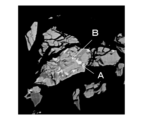
- FIG. 4 is an SEM image of immobilized ceramics A.
- FIG. 4 is an SEM image of immobilized ceramics B;
- the CO 2 immobilizing ceramics of this embodiment includes a ⁇ crystal phase composed of ⁇ -2CaO.SiO 2 (hereinafter sometimes abbreviated as ⁇ -C 2 S) and 2CaO.Al 2 O 3 .SiO 2 (hereinafter sometimes abbreviated as C 2 AS).
- CO 2 -fixing ceramics capable of fixing CO 2 by carbonation.
- CO 2 fixation is promoted by carbonation treatment under relatively low temperature and/or relatively high humidity conditions such as less than 75° C. and/or 50% RH or more. It is possible.
- the CO 2 -fixing ceramics of this embodiment are, for example, trap materials that adsorb CO 2 gas emitted from industrial facilities, power generation facilities, or transportation vehicles including automobiles, and waste heat in factories and the amount of power generated by the weather. It can be used for various purposes as a chemical heat storage material that stores fluctuating renewable energy, and as a CO2 absorbent that absorbs CO2 in exhaled breath to enable safe anesthesia and accurate examination with medical equipment. CO 2 -fixing ceramics can also be used as a cement additive (admixture).
- An example of the method for producing a CO 2- fixed material of the present embodiment includes a step of carbonating the CO 2- fixed ceramics at 75° C. or lower and/or 50% RH or higher.
- the method of carbonation treatment is not particularly limited, but for example, treatment is performed by appropriately heating and/or humidifying (adding water) so as to achieve predetermined temperature and humidity conditions in a CO 2 -containing gas atmosphere. and the like.
- the temperature of the carbonation treatment is, for example, preferably 5°C or higher and lower than 75°C, more preferably 5°C or higher and 50°C or lower.
- the relative humidity of the carbonation treatment is preferably 50% RH or more and 100% RH or less, more preferably 80% RH or more and 100% RH or less.
- CO 2 -containing gas exhaust gas generated from cement plants and coal-fired power plants, exhaust gas generated from exhaust treatment in painting plants, and the like can be used.
- the proportion of CO2 in the CO2- containing gas is preferably 5% by volume or more, preferably 10% by volume or more, and more preferably 15% by volume or more.
- the CO 2 -containing gas may contain moisture (water vapor).
- the CO 2 -fixing ceramics of this embodiment not only can effectively fix CO 2 in the atmosphere, but can also be effectively used as a concrete material. That is, the CO 2 immobilized product can be used, for example, as a cement additive (admixture), and can also be used as it is as a material for mortar or concrete aggregate, roadbed material, embankment material, backfill material, etc. can. In addition, the CO 2 immobilized product can be used as a filler extender for paints, inks and rubbers.
- CO 2 -fixing ceramics include inorganic calcined products containing ⁇ -C 2 S and C 2 AS.
- the inorganic calcined product means a molded product or powder having a predetermined shape obtained by heating and calcining an inorganic raw material.
- the CO 2 fixing ceramics may be configured in a powder form.
- the CaO/SiO 2 molar ratio according to the content of Al 2 O 3 contained in the inorganic raw material, a completely powdered CO 2 immobilized ceramic can be realized.
- the CO 2 -fixing ceramics may contain not only inorganic substances such as inorganic calcined products, but also organic substances such as disaccharides, which will be described later.
- a CO 2 -fixing ceramic containing an organic substance can be obtained, for example, by mixing a powdery inorganic sintered body and a disaccharide.
- Crystal forms such as ⁇ -type, ⁇ -type, and ⁇ -type are known for ⁇ -C 2 S. They differ from each other in crystal structure and density. Among them, ⁇ -C 2 S, which is a ⁇ type, exerts a neutralization inhibitory effect. By applying forced carbonation, ⁇ -C 2 S can enhance the densification of hardened cement.
- ⁇ -C 2 S constitutes the ⁇ crystal phase of CO 2 immobilized ceramics.
- the gamma crystalline phase may be included as an inorganic matrix in CO2 - fixing ceramics.
- the lower limit of the content of ⁇ -C 2 S is, for example, 30 parts by mass or more, preferably 35 parts by mass or more, more preferably 40 parts by mass or more in 100 parts by mass of the CO 2 immobilized ceramics.
- the upper limit of the content of ⁇ -C 2 S is, for example, 98 parts by mass or less, preferably 95 parts by mass or less, more preferably 93 parts by mass or less per 100 parts by mass of the CO 2 immobilized ceramics. By setting it within such a range, the carbonation rate can be improved.
- CO2 - fixing ceramics may contain heterogeneous phases present in the ⁇ -crystalline phase.
- the heterogeneous phase is inside the crystal grains of the crystal body composed of the ⁇ crystal phase composed of ⁇ -C 2 S, or along the interface of the crystal grains. It exists.
- one or two or more different phases may be included in the crystal grains.
- the CO 2 -fixing ceramics preferably contains C 2 AS as a component constituting the heterophase. Thereby, the carbonation rate can be further improved. Components other than C 2 AS may inevitably exist in the heterophase.
- the lower limit of the content of C 2 AS is, for example, 0.5% by mass or more, preferably 1.0% by mass or more, more preferably 2.0% by mass or more with respect to 100% by mass of ⁇ -C 2 S. is. This allows CO2 to be fixed in a short period of time.
- the upper limit of the content of C 2 AS is, for example, 50% by mass or less, preferably 40% by mass or less, more preferably 30% by mass or less with respect to 100% by mass of ⁇ -C 2 S. This makes it possible to avoid an excessive reduction in carbonation rate.
- the present embodiment for example, by appropriately selecting the type and amount of each component contained in the CO 2 -fixing ceramics, the preparation method of the CO 2 -fixing ceramics, etc., the existence of the above-mentioned different phases and the components constituting the different phases It is possible to control the content of Among these, for example, using a raw material mixture containing CaO raw material, SiO 2 raw material, Al 2 O 3 raw material, using a rotary kiln with a furnace lining of high purity aluminum bricks, Applying alumina mortar of a predetermined concentration to the surface, and appropriately adjusting conditions such as the firing temperature, dry pulverization, and granulation size, etc. can control the presence of the heterophase and the content of the components constituting the heterophase to the desired state. It is mentioned as an element to do.
- each mineral composition in the CO 2 immobilized ceramics can be confirmed by a general analytical method.
- the mineral composition can be quantified by confirming the mineral composition of the pulverized sample by the powder X-ray diffraction method and analyzing the data by the Rietveld method.
- the mineral composition can be obtained by calculation based on the identification results of the chemical components and powder X-ray diffraction.
- the CO 2 immobilizing ceramics may be constructed so that the ⁇ crystal phase does not contain Al 2 O 3 . Thereby, the carbonation rate can be improved.
- the CO 2 immobilizing ceramics may be configured to contain a ⁇ crystal phase composed of ⁇ -2CaO.SiO 2 (hereinafter sometimes abbreviated as ⁇ -C 2 S).
- the lower limit of the content of ⁇ -C 2 S is, for example, 1.0% by mass or more, preferably 2.0% by mass or more, more preferably 3.0% by mass with respect to 100% by mass of ⁇ -C 2 S. % or more. This allows CO2 to be fixed in a short period of time.
- the upper limit of the content of ⁇ -C 2 S is, for example, 50% by mass or less, preferably 30% by mass or less, more preferably 20% by mass or less with respect to 100% by mass of ⁇ -C 2 S. . As a result, it is possible to avoid a decrease in the carbonation rate due to the progress of the hydration reaction and formation of a dense mass.
- CO 2 -fixing ceramics containing ⁇ -C 2 S may be constructed to include Al 2 O 3 in the ⁇ -crystalline phase.
- the CO 2 immobilizing ceramics may contain a glass phase and/or CaO.2Al 2 O 3 (hereinafter sometimes abbreviated as CA 2 ).
- the lower limit of the content of the glass phase is, for example, 20% by mass or more, preferably 30% by mass or more, more preferably 40% by mass or more with respect to 100% by mass of ⁇ -C 2 S. As a result, it is possible to realize a CO 2 -fixing ceramic that is entirely pulverized.
- the upper limit of the content of the glass phase is, for example, 120% by mass or less, preferably 100% by mass or less, more preferably 90% by mass or less with respect to 100% by mass of ⁇ -C 2 S. As a result, it is possible to realize a CO 2 -fixing ceramic that is entirely pulverized.
- the lower limit of the content of CA 2 is, for example, 0.01% by mass or more, preferably 0.05% by mass or more, and more preferably 0.1% by mass or more with respect to 100% by mass of ⁇ -C 2 S. be. As a result, it is possible to realize a CO 2 -fixing ceramic that is entirely pulverized.
- the upper limit of the content of CA 2 is, for example, 20% by mass or less, preferably 18% by mass or less, more preferably 15% by mass or less with respect to 100% by mass of ⁇ -C 2 S. As a result, it is possible to realize a CO 2 -fixing ceramic that is entirely pulverized.
- the water content of the CO 2 -fixing ceramics is, for example, preferably 10% by mass or less, more preferably 0.01 to 10% by mass. This makes it possible to maintain proper contact between the surface of the CO2 - fixed ceramics and the CO2- containing gas.
- the moisture content can be determined from the difference in mass between the sample before drying and the mass after drying by heating at 105°C. Also, the water content of the CO 2 -fixing ceramics can be adjusted by heating and drying at 105° C. and then adding an appropriate amount of water and stirring.
- the average particle size of the CO 2 immobilized ceramics is, for example, preferably 1 to 100 ⁇ m, more preferably 1 to 70 ⁇ m.
- the average particle size can be obtained by measuring with a laser diffraction/scattering particle size distribution analyzer.
- the Blaine specific surface area of the CO 2 -fixing ceramics is preferably, for example, 1,000 to 10,000 cm 2 /g, more preferably 2,500 to 10,000 cm 2 /g.
- the Blaine specific surface area can be obtained by measuring with a Blaine air permeation device described in JIS R 5201.
- immobilization of CO2 refers to the material being carbonated such that the CO2 forms a carbonate compound with the material.
- the CO2 - fixing ceramics when the CO2 - fixing ceramics come into contact with CO2 , it forms a carbonate compound by carbonation, thereby forming (fixing) this carbonate compound in and/or on the surface of the CO2 - fixing ceramics.
- a CO 2 immobilized material is a CO 2 immobilized ceramic material in which CO 2 is immobilized as a carbonate compound.
- Carbonation of such CO 2 -fixing ceramics can be accelerated by a given carbonation treatment.
- conditions of relatively low temperature and/or relatively high humidity can be adopted, but for example, conditions of less than 75° C. and/or 50% RH or more may be adopted.
- CO 2 can be fixed in the CO 2 -fixing ceramics of this embodiment not only by high temperature but also by carbonation treatment under relatively low temperature conditions.
- the carbonation rate is the ratio of the CaO component in the CO2- fixing ceramics to the theoretically fixed CO2 .
- Carbonation rate can be calculated from the following formula.
- Carbonation rate ( ⁇ M x 56.08) / (M x wCaO x 44.01)
- ⁇ M mass increase due to carbonation [g]
- M mass of CO 2 immobilized ceramics before carbonation [g]
- wCaO CaO in CO 2 immobilized ceramics before carbonation [ wt %].
- the increased mass due to carbonation refers to the mass obtained by subtracting the weight of the sample before carbonation from the weight of the sample after carbonation.
- CaO in CO2 - fixing ceramics before carbonation can be measured by X-ray fluorescence analysis.
- An example of a method for producing CO 2 fixed ceramics includes a step of firing a raw material mixture containing CaO raw material, SiO 2 raw material, and Al 2 O 3 raw material, for example, in a kiln.
- CaO raw material those commercially available as industrial raw materials may be used.
- one or two or more selected from the group consisting of limestone, coal ash, quicklime, slaked lime, and acetylene-generated scrap may be included.
- slaked lime and byproduct slaked lime may be used.
- SiO2 raw material those commercially available as industrial raw materials may be used, and examples thereof include silica stone, silica sand, quartz, and diatomaceous earth. These may be used alone or in combination of two or more. These materials may not be used if the necessary amount of SiO 2 is contained in the CaO raw material or the Al 2 O 3 raw material. For example, when coal ash containing SiO 2 is used as the CaO raw material, the above SiO 2 raw material may not be added.
- coal ash is a general term for combustion ash obtained by burning coal, such as coal combustion ash discharged from a boiler of a thermal power plant.
- Coal ash is, for example, ash generated from a coal-fired power plant, produced by pulverized coal combustion, and coal ash that is dropped and collected when passing through an air preheater, a coal economizer, etc. from the combustion gas of a combustion boiler. , coal ash collected by an electrostatic precipitator, and coal ash that has fallen to the bottom of a combustion boiler.
- Al 2 O 3 raw material commercially available industrial raw materials may be used, and for example, one or more selected from the group consisting of bauxite, aluminum hydroxide, and aluminum residual ash may be included.
- the aluminum residue ash may be mainly composed of aluminum hydroxide.
- bauxite may be used.
- These raw materials are mixed and crushed so as to have a predetermined mineral composition ratio after firing to obtain a raw material mixture.
- the method of mixed pulverization is not particularly limited, and a dry pulverization method or a wet pulverization method can be applied.
- a wet pulverization method it is necessary to perform dehydration treatment for subsequent granulation.
- quicklime when used as a raw material, it is desirable to use a dry method.
- the ⁇ -C 2 S/C 2 AS ratio in the CO 2 -fixed ceramics can be controlled by adjusting the charging ratio of the raw materials.
- the raw material mixture may be granulated before firing.
- the granules are adjusted to an appropriate size, and may be, for example, 0.5 to 3.0 cm.
- the firing temperature may be, for example, 1,200°C to 1,600°C, preferably 1,300°C to 1,550°C, more preferably 1,400°C to 1,450°C.
- a kiln such as a rotary kiln can be used for firing.
- a rotary kiln in which the bricks in the firing zone are composed of high-purity alumina bricks having an Al 2 O 3 content of 99% or more in terms of mass may be used, and / or the firing zone of the rotary kiln may be used before firing.
- Alumina mortar adjusted to an appropriate concentration may be applied to the inner surface of the brick.
- the CO 2 -fixing ceramics may be obtained as an inorganic fired product (clinker) by firing an inorganic raw material, or may be obtained as a powdery inorganic fired product by pulverizing the clinker.
- the CO 2 immobilizing ceramics may contain a disaccharide as another organic component in addition to the inorganic fired product containing the inorganic components such as ⁇ -C 2 S and C 2 AS.
- a disaccharide By containing a disaccharide, it is possible to form a chelate with Ca eluted in the surface water of the baked inorganic material, thereby promoting further elution.
- the CO 2 -fixing ceramic preferably contains, for example, one or more disaccharides selected from the group consisting of trehalose, maltose, and sucrose. Among them, it is more preferable to contain trehalose, which has a high effect of promoting the carbonation reaction.
- the CO 2- fixing ceramics preferably contains 0.5 to 10 parts by mass, more preferably 5 to 10 parts by mass, of a disaccharide with respect to 100 parts by mass of the CO 2 -fixing ceramics. is more preferable.
- the content of trehalose in the disaccharide is preferably 90% by mass or more, more preferably 95% by mass or more, based on 100% by mass of the disaccharide in order to obtain a sufficient effect of promoting carbonation.
- Silica stone silica fine powder, 99.3% by weight of SiO2 , 0.01% by weight of Al2O3 , 0.0% by weight of Fe2O3 , 0.0% by weight of CaO , 0.0% by weight of MgO 04 wt%, Na2O 0.02 wt%, K2O 0.3 wt%, SO3 0.04 wt%, loss on ignition (L.O.I.) 0.6 wt% .
- Alumina 99.03 wt% Al2O3 , 0.14 wt% SiO2 , ⁇ 0.01 wt% Fe2O3 , ⁇ 0.01 wt% CaO , 0.06 wt% TiO2 % by weight, with a loss on ignition (L.O.I.) of 0.82% by weight.
- Example 1 (Immobilized ceramics A) As a raw material containing CaO and SiO 2 , the above-mentioned by-product slaked lime and silica stone were blended so as to have the CaO/SiO 2 molar ratio shown in Table 1, and mixed and pulverized in a dry process to obtain a mixed raw material. The obtained mixed raw material was granulated to produce granules having a diameter of about 1 cm to 2.5 cm. The obtained granules are put into a rotary kiln in which the bricks in the firing zone are composed of high-purity alumina bricks (the Al 2 O 3 content is 99% or more in terms of mass), and the firing temperature is 1,400 ° C.
- a pulverized clinker was synthesized in the process of firing and cooling to room temperature.
- the resulting clinker powder was used as CO 2 -fixing ceramics A. Note that the CO 2 immobilizing ceramics may be simply abbreviated as "immobilizing ceramics”.
- (Immobilized ceramics D) A calcium carbonate powder with a purity of 99.0% by mass or more and a silicon oxide powder with a purity of 99.0% by mass or more are mixed so that the CaO/SiO 2 molar ratio is 2.0, and 1, It was heat-treated at 400° C. for 2 hours and slowly cooled in an electric furnace to synthesize ⁇ -C 2 S powder. The obtained ⁇ -C 2 S powder was used as CO 2 immobilized ceramic D. The ⁇ -C 2 S powder obtained here did not contain C 2 AS and C 12 A 7 as a solid solution.
- Elemental surface analysis was performed using the obtained SEM image and an energy dispersive X-ray spectrometer (EDS).
- EDS energy dispersive X-ray spectrometer
- FIG. 1 shows an SEM image of the fractured surface of the clinker of the immobilized ceramics A
- FIG. 2 shows the SEM image of the fractured surface of the clinker of the immobilized ceramics B.
- Carbonation rate ( ⁇ M x 56.08) / (M x wCaO x 44.01)
- ⁇ M increased mass due to carbonation treatment [g]
- M mass of immobilized ceramics before carbonation [g]
- wCaO content of CaO in immobilized ceramics before carbonation [ wt %].
- the mass increase due to carbonation treatment was the mass obtained by subtracting the sample weight before carbonation treatment from the sample weight after carbonation treatment.
- the content of CaO in the CO 2 -fixed ceramics before carbonation was measured by X-ray fluorescence analysis.
- Example 2 Various auxiliary agents were added to 100 parts by mass of the CO 2 -fixed ceramics A in predetermined proportions shown in Table 2 and mixed to obtain the CO 2 -fixed ceramics E. Carbonation treatment was performed on the obtained CO 2 -immobilized ceramics E in the same manner as in Experimental Example 1 above, and the carbonation rate was calculated. Table 2 shows the results.
- CO 2 -fixing ceramics of Examples 1 to 3 By using the CO 2 -fixing ceramics of Examples 1 to 3 and subjecting them to a carbonation treatment under relatively low-temperature and/or relatively high-humidity conditions, a CO 2 -fixing product with CO 2 fixed is obtained.
- CO 2 immobilized products can be used, for example, as a cement additive in the fields of civil engineering and construction. It can also be effectively used as a filler extender for paints, inks and rubbers.
Landscapes
- Chemical & Material Sciences (AREA)
- Chemical Kinetics & Catalysis (AREA)
- Engineering & Computer Science (AREA)
- Organic Chemistry (AREA)
- Analytical Chemistry (AREA)
- Ceramic Engineering (AREA)
- Inorganic Chemistry (AREA)
- General Chemical & Material Sciences (AREA)
- Structural Engineering (AREA)
- Materials Engineering (AREA)
- Environmental & Geological Engineering (AREA)
- Health & Medical Sciences (AREA)
- Biomedical Technology (AREA)
- Oil, Petroleum & Natural Gas (AREA)
- Compositions Of Oxide Ceramics (AREA)
- Catalysts (AREA)
- Silicates, Zeolites, And Molecular Sieves (AREA)
Priority Applications (5)
| Application Number | Priority Date | Filing Date | Title |
|---|---|---|---|
| US18/835,653 US20250144593A1 (en) | 2022-02-10 | 2023-01-30 | Co2-fixing ceramic and method for producing co2-fixing product |
| CN202380017397.2A CN118742384A (zh) | 2022-02-10 | 2023-01-30 | Co2固定化陶瓷、及co2固定化物的制造方法 |
| KR1020247023195A KR20240119305A (ko) | 2022-02-10 | 2023-01-30 | Co2 고정화 세라믹스 및 co2 고정화물의 제조 방법 |
| EP23752725.4A EP4464410B1 (en) | 2022-02-10 | 2023-01-30 | Co2 fixation ceramic and method for producing co2 fixation product |
| JP2023580179A JP7826345B2 (ja) | 2022-02-10 | 2023-01-30 | Co2固定化セラミックス、およびco2固定化物の製造方法 |
Applications Claiming Priority (2)
| Application Number | Priority Date | Filing Date | Title |
|---|---|---|---|
| JP2022019300 | 2022-02-10 | ||
| JP2022-019300 | 2022-02-10 |
Publications (1)
| Publication Number | Publication Date |
|---|---|
| WO2023153260A1 true WO2023153260A1 (ja) | 2023-08-17 |
Family
ID=87564223
Family Applications (1)
| Application Number | Title | Priority Date | Filing Date |
|---|---|---|---|
| PCT/JP2023/002893 Ceased WO2023153260A1 (ja) | 2022-02-10 | 2023-01-30 | Co2固定化セラミックス、およびco2固定化物の製造方法 |
Country Status (7)
| Country | Link |
|---|---|
| US (1) | US20250144593A1 (https=) |
| EP (1) | EP4464410B1 (https=) |
| JP (1) | JP7826345B2 (https=) |
| KR (1) | KR20240119305A (https=) |
| CN (1) | CN118742384A (https=) |
| TW (1) | TW202337823A (https=) |
| WO (1) | WO2023153260A1 (https=) |
Cited By (1)
| Publication number | Priority date | Publication date | Assignee | Title |
|---|---|---|---|---|
| WO2025263512A1 (ja) * | 2024-06-17 | 2025-12-26 | デンカ株式会社 | Co2固定化材、co2固定化材含有組成物、co2固定化材含有セメントコンクリート、co2固定化硬化体 |
Citations (7)
| Publication number | Priority date | Publication date | Assignee | Title |
|---|---|---|---|---|
| JP2004340774A (ja) * | 2003-05-16 | 2004-12-02 | Denki Kagaku Kogyo Kk | 高炉徐冷スラグの品質管理方法 |
| JP2007008749A (ja) * | 2005-06-29 | 2007-01-18 | Takenaka Komuten Co Ltd | 二酸化炭素固定化成型体形成用コンクリート組成物、該組成物からなる二酸化炭素固定化成型体、及び、その製造方法 |
| JP2011168436A (ja) * | 2010-02-18 | 2011-09-01 | Kajima Corp | コンクリート混練物並びにco2吸収プレキャストコンクリートおよびその製造方法 |
| JP2019058091A (ja) * | 2017-09-26 | 2019-04-18 | デンカ株式会社 | 防草材及びそれの使用方法 |
| JP2020015659A (ja) | 2018-07-11 | 2020-01-30 | 太平洋セメント株式会社 | 二酸化炭素の固定化方法 |
| JP2022019300A (ja) | 2020-07-17 | 2022-01-27 | 住友ゴム工業株式会社 | タイヤ用ゴム組成物及びタイヤ |
| JP2022036364A (ja) * | 2020-08-18 | 2022-03-08 | デンカ株式会社 | セメント混和材、及びセメント組成物 |
Family Cites Families (2)
| Publication number | Priority date | Publication date | Assignee | Title |
|---|---|---|---|---|
| EA036120B1 (ru) * | 2014-08-04 | 2020-09-30 | Солидиа Текнолоджиз, Инк. | Карбонизируемые композиции на основе силиката кальция и способы их изготовления и использования |
| WO2021257757A1 (en) * | 2020-06-17 | 2021-12-23 | Solidia Technologies, Inc. | Carbonatable compositions with admixtures |
-
2023
- 2023-01-30 US US18/835,653 patent/US20250144593A1/en active Pending
- 2023-01-30 JP JP2023580179A patent/JP7826345B2/ja active Active
- 2023-01-30 CN CN202380017397.2A patent/CN118742384A/zh active Pending
- 2023-01-30 WO PCT/JP2023/002893 patent/WO2023153260A1/ja not_active Ceased
- 2023-01-30 KR KR1020247023195A patent/KR20240119305A/ko active Pending
- 2023-01-30 EP EP23752725.4A patent/EP4464410B1/en active Active
- 2023-02-06 TW TW112104031A patent/TW202337823A/zh unknown
Patent Citations (7)
| Publication number | Priority date | Publication date | Assignee | Title |
|---|---|---|---|---|
| JP2004340774A (ja) * | 2003-05-16 | 2004-12-02 | Denki Kagaku Kogyo Kk | 高炉徐冷スラグの品質管理方法 |
| JP2007008749A (ja) * | 2005-06-29 | 2007-01-18 | Takenaka Komuten Co Ltd | 二酸化炭素固定化成型体形成用コンクリート組成物、該組成物からなる二酸化炭素固定化成型体、及び、その製造方法 |
| JP2011168436A (ja) * | 2010-02-18 | 2011-09-01 | Kajima Corp | コンクリート混練物並びにco2吸収プレキャストコンクリートおよびその製造方法 |
| JP2019058091A (ja) * | 2017-09-26 | 2019-04-18 | デンカ株式会社 | 防草材及びそれの使用方法 |
| JP2020015659A (ja) | 2018-07-11 | 2020-01-30 | 太平洋セメント株式会社 | 二酸化炭素の固定化方法 |
| JP2022019300A (ja) | 2020-07-17 | 2022-01-27 | 住友ゴム工業株式会社 | タイヤ用ゴム組成物及びタイヤ |
| JP2022036364A (ja) * | 2020-08-18 | 2022-03-08 | デンカ株式会社 | セメント混和材、及びセメント組成物 |
Non-Patent Citations (1)
| Title |
|---|
| See also references of EP4464410A4 |
Cited By (1)
| Publication number | Priority date | Publication date | Assignee | Title |
|---|---|---|---|---|
| WO2025263512A1 (ja) * | 2024-06-17 | 2025-12-26 | デンカ株式会社 | Co2固定化材、co2固定化材含有組成物、co2固定化材含有セメントコンクリート、co2固定化硬化体 |
Also Published As
| Publication number | Publication date |
|---|---|
| TW202337823A (zh) | 2023-10-01 |
| JP7826345B2 (ja) | 2026-03-09 |
| CN118742384A (zh) | 2024-10-01 |
| JPWO2023153260A1 (https=) | 2023-08-17 |
| EP4464410A1 (en) | 2024-11-20 |
| EP4464410A4 (en) | 2025-05-21 |
| US20250144593A1 (en) | 2025-05-08 |
| KR20240119305A (ko) | 2024-08-06 |
| EP4464410B1 (en) | 2026-03-18 |
Similar Documents
| Publication | Publication Date | Title |
|---|---|---|
| EP4119517B1 (en) | Cement admixture and cement composition | |
| JP2017527516A (ja) | 炭酸塩化可能なケイ酸カルシウム組成物及びその製造方法 | |
| ES2693394T3 (es) | Procedimiento para la producción de cementos altamente reactivos | |
| JP7826345B2 (ja) | Co2固定化セラミックス、およびco2固定化物の製造方法 | |
| JP7569777B2 (ja) | Co2固定化材及びco2固定化物の製造方法 | |
| WO2023063236A1 (ja) | γ-2CaO・SiO2を含有する焼成物の製造方法 | |
| JP7026741B1 (ja) | セメント混和材、及びセメント組成物 | |
| TW202323218A (zh) | 水泥混合材、水泥混合材之製造方法及水泥組成物 | |
| Nikolov et al. | Products of carbonation of cement kiln dust | |
| JP7062225B2 (ja) | 強度増進剤及びその製造方法並びにポルトランドセメントの強度増進方法 | |
| US20250136520A1 (en) | Cement, cement composition, cured cement product, and method for producing cured cement product | |
| WO2012169005A1 (ja) | 膨張材クリンカの製造方法 | |
| WO2020128077A1 (en) | Versatile method for preparing carbonatable clinker materials | |
| JP7210677B1 (ja) | 非水硬性セメント組成物及びセメント系材料 | |
| JP6536215B2 (ja) | 地盤改良材及び地盤改良方法 | |
| JP4315565B2 (ja) | セメント混和材及びセメント組成物 | |
| JP6186170B2 (ja) | セメント急結材及びそれを用いたセメント組成物 | |
| Alimi et al. | Reactivity and CO2 Uptake in Thermally and Mechanochemically Activated Basaltic Fines and Olivine | |
| JP2007076966A (ja) | アーウィンの製造方法 |
Legal Events
| Date | Code | Title | Description |
|---|---|---|---|
| 121 | Ep: the epo has been informed by wipo that ep was designated in this application |
Ref document number: 23752725 Country of ref document: EP Kind code of ref document: A1 |
|
| ENP | Entry into the national phase |
Ref document number: 2023580179 Country of ref document: JP Kind code of ref document: A |
|
| ENP | Entry into the national phase |
Ref document number: 20247023195 Country of ref document: KR Kind code of ref document: A |
|
| WWE | Wipo information: entry into national phase |
Ref document number: 202380017397.2 Country of ref document: CN |
|
| WWE | Wipo information: entry into national phase |
Ref document number: 18835653 Country of ref document: US |
|
| ENP | Entry into the national phase |
Ref document number: 2023752725 Country of ref document: EP Effective date: 20240815 |
|
| NENP | Non-entry into the national phase |
Ref country code: DE |
|
| WWP | Wipo information: published in national office |
Ref document number: 18835653 Country of ref document: US |
|
| WWG | Wipo information: grant in national office |
Ref document number: 2023752725 Country of ref document: EP |