WO2023148844A1 - 電動機、圧縮機および冷凍サイクル装置 - Google Patents
電動機、圧縮機および冷凍サイクル装置 Download PDFInfo
- Publication number
- WO2023148844A1 WO2023148844A1 PCT/JP2022/004069 JP2022004069W WO2023148844A1 WO 2023148844 A1 WO2023148844 A1 WO 2023148844A1 JP 2022004069 W JP2022004069 W JP 2022004069W WO 2023148844 A1 WO2023148844 A1 WO 2023148844A1
- Authority
- WO
- WIPO (PCT)
- Prior art keywords
- electric motor
- coil
- core
- stator core
- motor according
- Prior art date
- Legal status (The legal status is an assumption and is not a legal conclusion. Google has not performed a legal analysis and makes no representation as to the accuracy of the status listed.)
- Ceased
Links
Images




Classifications
-
- H—ELECTRICITY
- H02—GENERATION; CONVERSION OR DISTRIBUTION OF ELECTRIC POWER
- H02K—DYNAMO-ELECTRIC MACHINES
- H02K1/00—Details of the magnetic circuit
- H02K1/06—Details of the magnetic circuit characterised by the shape, form or construction
- H02K1/22—Rotating parts of the magnetic circuit
Definitions
- the present disclosure relates to electric motors, compressors, and refrigeration cycle devices.
- a compressor may use a refrigerant containing a substance that causes a disproportionation reaction (see Patent Document 1, for example).
- the above refrigerants may cause a disproportionation reaction when ignition energy is applied under high pressure and high temperature conditions.
- There is a correlation between pressure and temperature in the compressor the higher the pressure, the higher the temperature. Disproportionation reactions are most likely to occur when the compressor is operating under high pressure, high temperature operating conditions. The disproportionation reaction causes failure of compressor cylinders and the like.
- the present disclosure has been made to solve the above problems, and aims to suppress the occurrence of refrigerant disproportionation reaction, thereby suppressing the occurrence of compressor failure.
- the electric motor of the present disclosure is an electric motor that is placed in a compressor and used with a refrigerant containing a substance that causes a disproportionation reaction, and includes an annular rotor core centered on the axis and a permanent magnet attached to the rotor core. a stator having a stator core surrounding the rotor core from the outside in a radial direction about the axis; and a coil wound around the stator core. Permanent magnets are composed of ferrite magnets.
- the permanent magnet is composed of a ferrite magnet, irreversible demagnetization of the permanent magnet in a high-pressure, high-temperature environment is suppressed, thereby suppressing a decrease in control accuracy of the electric motor and stabilizing the output. be able to. As a result, the occurrence of disproportionation reaction of the refrigerant can be suppressed, and the occurrence of compressor failure can be suppressed.
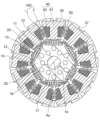
- FIG. 2 is a cross-sectional view showing the electric motor of Embodiment 1;
- FIG. 2 is a cross-sectional view showing the rotor of Embodiment 1;
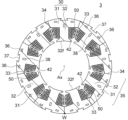
- FIG. FIG. 2 is a diagram showing a stator according to Embodiment 1;
- FIG. 4 is a cross-sectional view showing a first core portion of the stator of Embodiment 1;
- FIG. 4 is a cross-sectional view showing a second core portion of the stator of Embodiment 1;
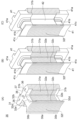
- FIG. 1 is a perspective view (A) showing the stator core of Embodiment 1, a perspective view (B) showing the stator core and insulators, and a perspective view (C) showing the stator core, insulators and insulating films;
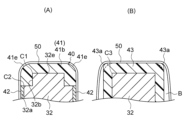
- FIG. 4A is a cross-sectional view showing a state in which a coil is wound around teeth of Embodiment 1, and a cross-sectional view (B) showing a state in which a coil is wound around teeth in a comparative example.
- 4A and 4B are plan views showing examples of split cores that constitute the stator core of the first embodiment;
- FIG. FIG. 4 is a schematic diagram showing a method of winding coils around teeth according to the first embodiment;
- FIG. 4 is a cross-sectional view showing a coil winding state around the teeth of the first embodiment;
- FIG. 2A is a side view (A) showing a state in which coils are wound around the teeth of the first embodiment, and (B) is a view showing aligned winding of the coils.
- FIG. 1 is a cross-sectional view showing a compressor of Embodiment 1;
- FIG. 1 is a diagram showing a refrigeration cycle apparatus of Embodiment 1;
- FIG. 1 is a block diagram showing a drive device for an electric motor according to Embodiment 1;
- FIG. 11 is a cross-sectional view showing a rotor of a modified example;
- FIG. 1 is a cross-sectional view showing electric motor 100 according to the first embodiment.
- Electric motor 100 shown in FIG. 1 is used, for example, in compressor 500 (FIG. 12) of a refrigeration cycle apparatus. Also, the electric motor 100 is used with a refrigerant containing a substance that causes a disproportionation reaction.
- the electric motor 100 has a rotor 1 and a stator 3 provided so as to surround the rotor 1 .
- An air gap of 0.3 to 1.0 mm is formed between the stator 3 and the rotor 1, for example.
- Stator 3 is incorporated inside cylindrical shell 55 of compressor 500 (FIG. 12).
- the direction of the axis Ax which is the central axis of rotation of the rotor 1, will be referred to as the "axial direction”.
- a radial direction centered on the axis Ax is defined as a “radial direction”.
- a circumferential direction about the axis Ax is defined as a “circumferential direction”.
- FIG. 2 is a sectional view showing the rotor 1.
- the rotor 1 has an annular rotor core 10 centered on the axis Ax and permanent magnets 20 embedded in the rotor core 10 .
- the rotor core 10 is composed of magnetic steel sheets laminated in the axial direction.
- the electromagnetic steel sheets are fixed by caulking, for example.
- the plate thickness of the electromagnetic steel plate is, for example, 0.1 to 0.7 mm.
- a center hole 14 is formed in the radial center of the rotor core 10 .
- a shaft 25 as a rotating shaft is fixed to the center hole 14 of the rotor core 10 by shrink fitting, press fitting, or the like.
- a plurality of magnet insertion holes 11 are formed along the outer circumference of the rotor core 10 .
- One permanent magnet 20 is inserted into each magnet insertion hole 11 .
- One magnet insertion hole 11 corresponds to one magnetic pole. Since the rotor core 10 has six magnet insertion holes 11, the rotor 1 has six poles. However, the number of poles of the rotor 1 is not limited to six, and may be two or more.
- the center of the magnet insertion hole 11 in the circumferential direction corresponds to the pole center P.
- a radial straight line passing through the pole center P is referred to as the pole centerline.
- An interpolar portion M is formed between adjacent magnet insertion holes 11 .
- the permanent magnet 20 is flat and has a first surface 20a on the outer peripheral side and a second surface 20b on the inner peripheral side. Both the first surface 20a and the second surface 20b are planes perpendicular to the magnetic pole centerline.
- the permanent magnet 20 has a thickness in the direction of the magnetic pole centerline and a width in a direction orthogonal thereto. The thickness of the permanent magnet 20 is constant over the width of the permanent magnet 20 .
- the permanent magnet 20 is composed of a ferrite magnet.
- Ferrite magnets include sintered ferrite magnets formed by powder metallurgy and bonded ferrite magnets formed by mixing magnetic powder and binder resin. A sintered ferrite magnet is used here, but a bonded ferrite magnet may also be used.
- the electric motor 100 is used in the compressor 500 at a high temperature of, for example, 150°C, and ferrite magnets have a higher coercive force than rare earth magnets at such high temperatures. That is, the ferrite magnet is less likely to be irreversibly demagnetized under the high temperature environment inside the compressor 500 .
- ferrite magnets include anisotropic ferrite magnets in which the directions of easy magnetization of crystal grains are aligned and isotropic ferrite magnets in which the directions of easy magnetization are random.
- Anisotropic ferrite magnets are more susceptible to irreversible demagnetization at low temperatures than at high temperatures.
- isotropic ferrite magnets are more susceptible to irreversible demagnetization at high temperatures than at low temperatures, as compared to anisotropic ferrite magnets.
- ferrite magnets are preferable to rare earth magnets, and anisotropic ferrite magnets are most preferable.
- the ferrite magnet preferably contains iron oxide (Fe 2 O 3 ) as a main component and further contains lanthanum (La) and cobalt (Co).
- Fe 2 O 3 iron oxide
- La lanthanum
- Co cobalt
- a ferrite magnet containing La and Co has high residual magnetic flux density and high coercive force, so that the magnetic force of the permanent magnet 20 is increased and irreversible demagnetization is difficult to occur at high temperatures.
- the permanent magnet 20 is magnetized in its thickness direction.
- the permanent magnets 20 inserted into adjacent magnet insertion holes 11 have magnetic pole faces with opposite polarities on the radially outer side.
- one permanent magnet 20 is inserted into each magnet insertion hole 11 here, two or more permanent magnets 20 may be inserted.
- the magnet insertion hole 11 extends linearly in the direction orthogonal to the magnetic pole center line here, it may extend in a V shape, for example.
- the magnet insertion hole 11 has flux barriers 12, which are air gaps, at both ends in the circumferential direction.
- a thin portion is formed between the flux barrier 12 and the outer circumference of the rotor core 10 .
- the radial width of the thin portion is set to be the same as the plate thickness of the electromagnetic steel sheet.
- a plurality of radially elongated slits 13 are formed on the outer peripheral side of each magnet insertion hole 11 in the rotor core 10 .
- Each slit 13 has the effect of making the magnetic flux distribution in the outer peripheral portion of the rotor core 10 closer to a sine wave.
- seven slits 13 are formed symmetrically with respect to the pole center P. As shown in FIG. However, the number and arrangement of the slits 13 are arbitrary. Also, the slits 13 may not necessarily be formed in the rotor core 10 .
- Through holes 16 and 17 are formed radially inside each magnet insertion hole 11 in the rotor core 10 .
- the through-holes 16 and 17 form a coolant channel through which the coolant passes in the axial direction.
- the circumferential position of the through hole 16 coincides with the pole center P, and the circumferential position of the through hole 17 coincides with the interpolar portion M.
- the positions of the through holes 16 and 17 are not limited to these.
- the stator 3 has a stator core 30 , an insulating portion 40 attached to the stator core 30 , and a coil 50 wound around the stator core 30 via the insulating portion 40 .
- the stator core 30 is composed of magnetic steel sheets laminated in the axial direction.
- the electromagnetic steel sheets are fixed by caulking, for example.
- the plate thickness of the electromagnetic steel plate is, for example, 0.1 to 0.7 mm.
- the insulating portion 40 has an insulator 41 attached to the axial end surface of the stator core 30 and an insulating film 42 attached to the inner surface of the slot 33 .
- FIG. 3 is a cross-sectional view showing the stator 3.
- the stator core 30 has an annular yoke 31 centered on the axis Ax and a plurality of teeth 32 extending radially inward from the yoke 31 .
- the outer circumference of yoke 31 is fixed to the inner circumference of shell 55 ( FIG. 12 ) of compressor 500 .
- the teeth 32 are formed at regular intervals in the circumferential direction. Although the number of teeth 32 is 9 here, it may be 2 or more. Teeth 32 have tooth tip portions 32 f facing rotor 1 . The tip portion 32f is wider than other portions of the tooth 32. As shown in FIG. Slots 33 for accommodating coils 50 are formed between adjacent teeth 32 .
- An insulating film 42 is attached to the inner surface of the slot 33 .
- Insulators 41 FIG. 1 .
- a coil 50 is wound around the tooth 32 via an insulator 41 and an insulating film 42 .
- the coil 50 is made of aluminum wire or copper wire, preferably aluminum wire.
- An aluminum wire is a conductor made of aluminum covered with an insulating coating. Since the aluminum wire is softer than the copper wire, it has the advantage that it can be easily wound around the teeth 32 with the insulating portion 40 interposed therebetween.
- a wire diameter of the coil 50 is, for example, 1.0 mm.
- the coil 50 is wound around each tooth 32 by salient pole concentrated winding, for example, 80 turns.
- the yoke 31 is formed with a crimped portion 36 for integrally fixing the electromagnetic steel plates forming the stator core 30 .
- the crimped portions 36 are formed, for example, on both sides in the circumferential direction with respect to a radial straight line passing through the center of the tooth 32 .
- the yoke 31 is formed with fitting holes 38 into which projections formed on the insulator 41 are fitted.
- the fitting hole 38 is formed radially inward of the crimped portion 36 and on a radial straight line passing through the center of the tooth 32 .
- the number and arrangement of the crimped portions 36 and the fitting holes 38 are arbitrary.
- the stator core 30 is fitted inside the shell 55 (FIG. 12) of the compressor 500 by shrink fitting or press fitting.
- a recess 37 is formed in the outer periphery of the yoke 31 .
- Recess 37 forms a refrigerant passage with shell 55 of compressor 500 .
- the recessed portion 37 is formed on a radial straight line passing through the center of the tooth 32, but is not limited to this position.
- the stator core 30 has a configuration in which a plurality of split cores 35 are connected in the circumferential direction for each tooth 32 .
- the number of split cores 35 is nine, for example.
- These split cores 35 are connected by a split surface 34 formed on the yoke 31 .
- the split cores 35 may be welded to each other at the split surfaces 34 or may be connected to each other at thin portions formed on the outer peripheries of the split surfaces 34 .
- the stator core 30, as shown in FIG. 6(A), which will be described later, has a first core portion 30a located in the center in the axial direction and second core portions 30b located in the ends in the axial direction.
- the second core portion 30b is not limited to both ends in the axial direction of the stator core 30, and may be provided at least at one end in the axial direction.
- FIG. 4 is a cross-sectional view showing the first core portion 30a of the stator core 30.
- the yoke 31 has an inner circumference 31 a facing the slots 33 and the teeth 32 have side surfaces 32 a facing the slots 33 .
- the radial width of the yoke 31 in the first core portion 30a is H1, and the circumferential width of the teeth 32 is W1.
- the radial width H1 of the yoke 31 of the first core portion 30a is the radial distance between the outer circumference of the yoke 31 and the inner circumference 31a.
- the circumferential width W1 of the teeth 32 of the first core portion 30a is the distance between the two side surfaces 32a of the teeth 32 in the circumferential direction.
- FIG. 5 is a cross-sectional view showing the second core portion 30b of the stator core 30.
- the yoke 31 has an inner circumference 31 b facing the slots 33 and the teeth 32 have side surfaces 32 b facing the slots 33 .
- the radial width of the yoke 31 in the second core portion 30b is H2, and the circumferential width of the teeth 32 is W2.
- the radial width H2 of the yoke 31 of the second core portion 30b is the radial distance between the outer circumference of the yoke 31 and the inner circumference 31b.
- the circumferential width W2 of the teeth 32 of the second core portion 30b is the distance between the two side surfaces 32b of the teeth 32 in the circumferential direction.
- the inner circumference 31b (Fig. 5) of the yoke 31 of the second core portion 30b is located radially outwardly displaced from the inner circumference 31a (Fig. 4) of the yoke 31 of the first core portion 30a.
- the side surfaces 32b of the teeth 32 of the second core portion 30b are positioned inward in the width direction from the side surfaces 32a of the teeth 32 of the first core portion 30a.
- the width H2 of the yoke 31 in the second core portion 30b is narrower than the width H1 of the yoke 31 in the first core portion 30a (that is, H1>H2), and the width W2 of the teeth 32 in the second core portion 30b is the same as that of the first core. It is narrower than the width W1 of the tooth 32 at the portion 30a (that is, W1>W2).
- the outer circumference of the yoke 31 is located at the same radial position between the first core portion 30a and the second core portion 30b.
- the area A2 of the slot 33 in the second core portion 30b is larger than the area A1 of the slot 33 in the first core portion 30a (A1 ⁇ A2).
- widths W1 and W2 of the teeth 32 satisfy W1>W2 and the widths H1 and T2 of the yoke 31 satisfy T1>T2, at least the widths W1 and W2 of the teeth 32 satisfy W1>W2. It's fine if you do.
- the side surfaces 32b (FIG. 5) of the teeth 32 of the second core portion 30b are displaced inward in the width direction of the teeth 32 with respect to the side surfaces 32a (FIG. 4) of the teeth 32 of the first core portion 30a. I wish I had.
- the facing surface 32d (FIG. 5), which is the surface on the slot 33 side of the tooth tip portion 32f of the second core portion 30b, faces the facing surface 32c (FIG. 4) of the tooth tip portion 32f of the first core portion 30a. It is desirable to form it at a position displaced inward in the radial direction.
- FIG. 6(A) is a perspective view showing the split core 35 of the stator core 30.
- FIG. A stepped portion is formed between the side surface 32a of the tooth 32 of the first core portion 30a and the side surface 32b of the tooth 32 of the second core portion 30b.
- a stepped portion is also formed between the inner periphery 31a of the yoke 31 of the first core portion 30a and the inner periphery 31b of the yoke 31 of the second core portion 30b.
- a stepped portion is also formed between the facing surface 32c of the tooth tip portion 32f of the first core portion 30a and the facing surface 32d of the tooth tip portion 32f of the second core portion 30b.
- the insulator 41 is engaged with these stepped portions formed on the stator core 30 .
- FIG. 6(B) is a perspective view showing a state where the insulator 41 is attached to the split core 35.
- FIG. The insulators 41 are attached to both ends of the split core 35 in the axial direction, that is, to the second core portions 30b (FIG. 6A).
- the insulator 41 is made of resin such as PBT (polybutylene terephthalate). Insulator 41 also has projections (not shown) that engage with fitting holes 38 ( FIG. 4 ) formed in stator core 30 .
- Each insulator 41 has a wall portion 41 a positioned on the yoke 31 , a body portion 41 b positioned on the teeth 32 , and a flange portion 41 c positioned on the tip portions 32 f of the teeth 32 .
- the flange portion 41c and the wall portion 41a face each other in the radial direction with the body portion 41b interposed therebetween.
- a coil 50 is wound around the trunk portion 41b.
- the wall portion 41a and the flange portion 41c guide the coil 50 wound around the body portion 41b from both sides in the radial direction.
- the wall portion 41a and the flange portion 41c may be provided with a stepped portion for positioning the coil 50 wound around the body portion 41b.
- FIG. 6(C) is a perspective view showing a state in which the insulator 41 and the insulating film 42 are attached to the stator core 30.
- FIG. An insulating film 42 is attached to the inner surface of the slot 33 of the second core portion 30b.
- the insulating film 42 covers the inner periphery 31a of the yoke 31 of the first core portion 30a, the side surfaces 32a of the teeth 32, and the facing surfaces 32c of the tooth tip portions 32f (all are shown in FIG. 6(B)).
- the insulating film 42 is made of resin such as PET (polyethylene terephthalate).
- the thickness of the insulating film 42 is, for example, 0.35-0.4 mm.
- FIG. 7(A) is a cross-sectional view taken along a plane orthogonal to the extending direction of the teeth 32, showing a state in which the coils 50 are wound around the teeth 32 of the first embodiment.
- the body portion 41b of the insulator 41 is attached so as to cover the axial end surface 32e of the tooth 32 and fit into the stepped portions on both sides of the side surface 32b.
- the teeth 32 have a corner portion C1 between the end surface 32e and the side surface 32b and a corner portion C2 between the stepped portion and the side surface 32a in a cross section perpendicular to the extending direction of the tooth 32.
- the insulator 41 has curved corner portions 41e that cover these corner portions C1 and C2. Since the corner portion 41e extends so as to cover the corner portions C1 and C2, the radius of curvature of the corner portion 41e can be increased.
- the radius of curvature of the corners 41e of the insulator 41 is large, and the insulating film 42 is provided on the slot 33 side of the teeth 32, so that the coil 50, the insulator 41 and the insulating film 42 can be brought into close contact with each other without gaps.
- FIG. 7(B) is a cross-sectional view of a plane orthogonal to the extending direction of the teeth 32, showing a state in which the coils 50 are wound around the teeth 32 of the comparative example.
- the tooth 32 of the comparative example has a rectangular cross section and does not have a stepped portion.
- the insulators 43 are attached so as to surround the teeth 32 from both circumferential and axial sides.
- the width of the teeth 32 of the stator core 30 is narrower in the second core portion 30b than in the first core portion 30a, and stepped portions are formed at both ends of the teeth 32 in the axial direction. Therefore, the coil 50 can be tightly wound around the teeth 32 via the insulating portion 40 . As a result, fluctuations in the magnetic flux interlinking with the coil 50 can be suppressed, and fluctuations in the output of the electric motor 100 can be suppressed, as will be described later.
- FIG. 8(A) is a diagram showing a state in which the stator core 30 is linearly spread.
- adjacent split cores 35 are connected to each other by a connecting portion 34 a provided on the outer peripheral side of the dividing surface 34 .
- the connecting portion 34a is a thin portion that is plastically deformable or a crimped portion.
- the insulator 41 (FIG. 6(B)) and the insulating film 42 (FIG. 6(C)) are attached to each of the split cores 35 while the stator core 30 is spread linearly.
- the coil 50 is wound around the teeth 32 through the gap.
- the winding nozzle used for winding can be relatively freely moved without interfering with the stator core 30, and the coil 50 can be wound at a higher density.
- stator core 30 After the coil 50 is wound around the teeth 32 of each split core 35, the stator core 30 is bent into an annular shape, and both ends of the stator core 30 (indicated by symbol W in FIG. 3) are welded to form the stator 3 shown in FIG. can get.
- FIG. 8(B) is a diagram showing another example of the stator core 30.
- FIG. 8B the split cores 35 forming the stator core 30 are not connected to each other. These split cores 35 are integrated by being welded together at split surfaces 34 .
- the insulator 41 (FIG. 6(B)) and the insulating film 42 (FIG. 6(C)) are attached to each split core 35, and the coil 50 can be wound around the teeth 32 at high density through these. After that, the split cores 35 are welded together at the split surfaces 34 to obtain the stator 3 shown in FIG.
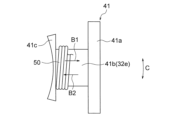
- FIG. 9 is a schematic diagram showing a method of winding the coil 50 of Embodiment 1.
- FIG. FIG. 9 is a view of the insulator 41 viewed from one side in the axial direction. The circumferential direction is indicated by an arrow C in FIG.
- the coil 50 is wound around the trunk portion 41b of the insulator 41 attached to the teeth 32 as described above.
- the first layer of the coil 50 is wound from the flange portion 41c of the insulator 41 toward the wall portion 41a as indicated by an arrow B1. Also, the second layer of the coil 50 is wound from the wall portion 41a of the insulator 41 toward the flange portion 41c as indicated by an arrow B2. Note that the directions of the arrows B1 and B2 may be reversed.
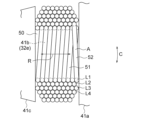
- FIG. 10 is a cross-sectional view of the winding pattern of the coil 50 of Embodiment 1 taken along a plane perpendicular to the axial direction.
- arrow C indicates the circumferential direction
- arrow R indicates the radial direction.
- the first, second, third, and fourth layers of the coil 50 are indicated by L1, L2, L3, and L4, respectively.
- the coil wires of each layer of the coil 50 are arranged radially without gaps. That is, the coil wires 51 forming the first layer L1 extend parallel to each other, and the coil wires 52 forming the second layer L2 also extend parallel to each other.
- the coil wire 52 of the second layer L2 extends obliquely with respect to the coil wire 51 of the first layer L1. That is, on the end face 32e of the tooth 32, a cross point A is located where the coil wire 51 of the first layer L1 and the coil wire 52 of the second layer L2 intersect.
- the coil wires of the odd-numbered layers (for example, the third layer L3) of the coil 50 extend parallel to the coil wires 51 of the first layer L1.
- the coil wires of the even layers (for example, the fourth layer L4) of the coil 50 extend parallel to the coil wires 52 of the second layer L2. Therefore, if N is an integer, the coil wire of the Nth layer and the coil wire of the (N+1)th layer intersect on the end face 32 e of the tooth 32 .
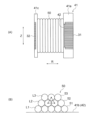
- FIG. 11(A) is a side view of the coil 50 viewed from the slot 33 side.
- the coil wires of each layer of the coil 50 all extend in a direction (indicated by arrow Z) parallel to the axis Ax. That is, within the slot 33, all the coil wires of the coil 50 run parallel and there are no cross points.
- FIG. 11(B) is a schematic diagram showing the stacking state of the coils 50 positioned inside the slots 33. As shown in FIG. In the slot 33, the coils 50 are stacked such that one coil wire on the N+1th layer is in contact with two coil wires on the Nth layer. For example, one coil wire 53 on the third layer L3 contacts two coil wires 52 on the second layer L2.
- the coils 50 are laminated so that the center of one coil wire on the N+1th layer and the center of two coil wires on the Nth layer form an equilateral triangle.
- the center of one coil wire 53 on the third layer L3 and the center of two coil wires 52 on the second layer L2 form an equilateral triangle.
- aligned winding Such a winding method is called aligned winding.
- aligned winding the gaps between the coil wires forming the coil 50 are small, and the coil 50 is wound at the highest density.
- the space factor of the coil 50 in the slot 33 is improved.
- one coil wire of the N+1th layer overlaps one coil wire of the Nth layer, as shown in FIG. 11B.
- one coil wire 53 on the third layer L3 contacts only one of the coil wires 52 on the second layer L2.
- the gaps between the coil wires forming the coil 50 widen, and the arrangement density of the coils 50 decreases.
- one coil wire of the N+1-th layer of the coil 50 is wound so as to be in contact with two coil wires of the N-th layer, except for a portion such as the cross point A (see FIG. 11B), It can be called aligned winding.
- the tooth 32 has the end surface 32e and side surfaces 32a and 32b as described above, and the axial length of the side surfaces 32a and 32b is longer than the circumferential width of the end surface 32e. Therefore, the end faces 32e of the teeth 32 are also called short sides, and the side faces 32a and 32b are also called long sides.
- a winding method in which the cross point A of the coil 50 is located on the end face 32e of the tooth 32 is called short side cross winding.
- a winding method in which the cross point A of the coil 50 is located on the side surface 32a of the tooth 32 is called long side cross winding.
- the winding method of the coil 50 of the first embodiment is short side cross winding.
- the arrangement density of the coils 50 is reduced at the cross points A, by arranging the cross points A on the end surfaces 32e of the teeth 32, the coils 50 are brought into close contact with the teeth 32 via the insulating portions 40, and the coils 50 are arranged at high density. can be wrapped.
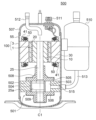
- FIG. 12 is a longitudinal sectional view showing compressor 500 having electric motor 100 .
- Compressor 500 is a rotary compressor here and is used in refrigeration cycle device 400 (FIG. 13).
- Compressor 500 is not limited to a rotary compressor, and may be, for example, a scroll compressor.
- the compressor 500 includes a compression mechanism 501, an electric motor 100 that drives the compression mechanism 501, a shaft 25 that connects the compression mechanism 501 and the electric motor 100, and a sealed container 507 that accommodates them.
- the axial direction of the shaft 25 is the vertical direction, and the electric motor 100 is arranged above the compression mechanism 501 .
- the sealed container 507 is a container made of a steel plate, and has a cylindrical shell 55 , a container top covering the upper side of the shell 55 , and a container bottom covering the lower side of the shell 55 .
- the stator 3 of the electric motor 100 is incorporated inside the shell 55 by shrink fitting, press fitting, welding, or the like.
- a discharge pipe 512 for discharging the refrigerant to the outside and a terminal 511 for supplying electric power to the electric motor 100 are provided in the upper part of the sealed container 507 .
- An accumulator 510 for storing refrigerant gas is attached to the outside of the sealed container 507 .
- Refrigerating machine oil that lubricates the bearings of the compression mechanism 501 is stored in the container bottom of the sealed container 507 .
- the compression mechanism 501 includes a cylinder 502 having a cylinder chamber 503, a rolling piston 504 fixed to the shaft 25, vanes dividing the inside of the cylinder chamber 503 into a suction side and a compression side, and both ends of the cylinder chamber 503 in the axial direction. It has a closing upper frame 505 and lower frame 506 .
- Both the upper frame 505 and the lower frame 506 have bearings that rotatably support the shaft 25 .
- An upper discharge muffler 508 and a lower discharge muffler 509 are attached to the upper frame 505 and lower frame 506, respectively.
- the cylinder 502 has a cylindrical cylinder chamber 503 centered on the axis Ax.
- the eccentric shaft portion 25 a of the shaft 25 is positioned inside the cylinder chamber 503 .
- the eccentric shaft portion 25a has a center that is eccentric with respect to the axis Ax.
- a rolling piston 504 is fitted to the outer circumference of the eccentric shaft portion 25a. When the electric motor 100 rotates, the eccentric shaft portion 25 a and the rolling piston 504 rotate eccentrically within the cylinder chamber 503 .
- the cylinder 502 also has an intake port 515 for sucking refrigerant gas into the cylinder chamber 503 .
- a suction pipe 513 connected to the accumulator 510 is connected to the suction port 515 .
- Refrigerant gas is supplied from the accumulator 510 to the cylinder chamber 503 via the intake pipe 513 .
- a mixture of low-pressure refrigerant gas and liquid refrigerant is supplied to the compressor 500 from the refrigerant circuit of the refrigeration cycle device 400 (FIG. 13).
- the accumulator 510 separates the liquid refrigerant and refrigerant gas, and only the refrigerant gas is supplied to the compression mechanism 501 .
- the operation of the compressor 500 is as follows.
- a current is supplied from the terminal 511 to the coil 50 of the stator 3
- the rotating magnetic field generated by the current and the magnetic field of the permanent magnet 20 of the rotor 1 generate attractive force and repulsive force between the stator 3 and the rotor 1.
- the rotor 1 rotates.
- the shaft 25 fixed to the rotor 1 also rotates.
- a low-pressure refrigerant gas is sucked into the cylinder chamber 503 of the compression mechanism 501 from the accumulator 510 through the suction port 515 .
- the eccentric shaft portion 25 a of the shaft 25 and the rolling piston 504 attached thereto rotate eccentrically, compressing the refrigerant in the cylinder chamber 503 .
- the refrigerant compressed in the cylinder chamber 503 is discharged into the sealed container 507 through a discharge port and discharge mufflers 508 and 509 (not shown).
- Refrigerant discharged into sealed container 507 rises through through holes 16 and 17 (FIG. 2) of rotor core 10 and recessed portion 37 (FIG. 3) of stator core 30, and is discharged from discharge pipe 512, where it is discharged from the refrigeration cycle apparatus. 400 (FIG. 13) into the refrigerant circuit.
- a refrigerant containing a substance that causes a disproportionation reaction is used as the refrigerant for the compressor 500 . Moreover, from the viewpoint of global warming prevention, a refrigerant with a low GWP (global warming potential) is desirable.
- R1234yf R1234ze(E)
- R448A R449A
- R452A R452B
- R454A R454B
- R454C R463A
- R513A R515B
- R1234yf has a chemical formula of CF 3 CH ⁇ CHF (2,3,3,3-tetrafluoropropene) and a GWP of 1.
- Other refrigerants are mixed refrigerants.
- R448A is a mixture of R32, R125, R1234yf, R134a and R1234ze (E) in a weight ratio of 26.0:26.0:20.0:21.0:7.0. be.
- the chemical formula of R32 is CH 2 F 2 (difluoromethane)
- the chemical formula of R125 is CHF 2 CF 3 (pentafluoroethane)
- the chemical formula of R134a is CH 2 FCF 3 (tetrafluoroethane).
- R449A is a mixture of R32, R125, R1234yf and R134a in a weight ratio of 24.3:24.7:25.3:25.7.
- R452A is a mixture of R32, R125 and R1234yf at a weight ratio of 11.0:59.0:30.0.
- R452B is a mixture of R32, R125 and R1234yf at a weight ratio of 67.0:7.0:26.0.
- R454A is a mixture of R32 and R1234yf at a weight ratio of 35.0:65.0.
- R454B is a mixture of R32 and R1234yf at a weight ratio of 68.9:31.1.
- R454C is a mixture of R32 and R1234yf at a weight ratio of 21.5:78.5.
- R463A is a mixture of R744, R32, R125, R1234yf and R134a in a weight ratio of 6.0:36.0:30.0:14.0:14.0.
- the chemical formula of R744 is CO 2 (carbon dioxide).
- R513A is a mixture of R1234yf and R134a at a weight ratio of 56.0:44.0.
- R513B is a mixture of R1234yf and R134a at a weight ratio of 58.5:41.5.
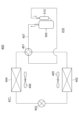
- FIG. 13 shows a refrigeration cycle apparatus 400 including compressor 500 shown in FIG.
- Refrigeration cycle device 400 is an air conditioner here.
- the refrigeration cycle device 400 is not limited to an air conditioner, and may be a refrigerator or the like.
- the refrigeration cycle device 400 includes a compressor 500, a four-way valve 401 as a switching valve, a condenser 402 that condenses the refrigerant, a decompression device 403 that decompresses the refrigerant, and an evaporator 404 that evaporates the refrigerant.
- Compressor 500, condenser 402, decompression device 403 and evaporator 404 are connected by refrigerant pipe 407 to form a refrigerant circuit.
- the refrigeration cycle device 400 is an air conditioner
- the condenser 402 the decompression device 403 and the evaporator 404 are arranged in the outdoor unit 410
- the evaporator 404 is arranged in the indoor unit 411.
- An outdoor fan 405 is arranged in the outdoor unit 410
- an indoor fan 406 is arranged in the indoor unit 411 .
- the operation of the refrigeration cycle device 400 is as follows. Compressor 500 compresses the sucked refrigerant and sends it out as a high-temperature, high-pressure refrigerant gas.
- the four-way valve 401 switches the flow direction of the refrigerant.
- the refrigerant from the compressor 500 is sent to the condenser 402 as indicated by the solid line in FIG.
- the condenser 402 exchanges heat between the refrigerant sent from the compressor 500 and the outdoor air sent by the outdoor fan 405, condenses the refrigerant, and sends it out as a liquid refrigerant.
- the decompression device 403 expands the liquid refrigerant sent from the condenser 402 and sends it out as a low-temperature, low-pressure liquid refrigerant.
- the evaporator 404 exchanges heat between the low-temperature, low-pressure liquid refrigerant sent out from the decompression device 403 and the indoor air, evaporates the refrigerant, and sends it out as refrigerant gas.
- the air from which heat has been removed by the evaporator 404 is supplied indoors by the indoor fan 406 .
- the four-way valve 401 sends refrigerant from the compressor 500 to the evaporator 404 as indicated by the dashed line in FIG.
- evaporator 404 functions as a condenser and condenser 402 functions as an evaporator.
- FIG. 14 is a block diagram showing a driving device 80 that drives electric motor 100.
- the drive device 80 is a drive circuit mounted on the refrigeration cycle device 400 shown in FIG.
- the driving device 80 includes a rectifier circuit 81 that converts AC voltage supplied from a commercial AC power source into DC voltage, and a DC voltage output from the rectifier circuit 81 that converts the DC voltage into AC voltage to , a controller 85 for driving the inverter 82 , a voltage detection circuit 86 and a current detection circuit 87 .
- the rectifier circuit 81 has bridge diodes 81a, 81b, 81c, 81d and a smoothing capacitor 81e. Between the bus lines of the rectifier circuit 81, voltage dividing resistors 84a and 84b are connected in series. A voltage detection circuit 86 detects the electrical signal converted to a low voltage by the voltage dividing resistors 84a and 84b. A shunt resistor 88 is connected to the bus of the rectifier circuit 81 . A current detection circuit 87 is connected to the shunt resistor 88 and detects the current value of the current input to the inverter 82 .
- the inverter 82 is connected to the electric motor 100 via the terminal 511 (FIG. 12) of the compressor 500.
- Inverter 82 has U-phase switching elements 82a and 82b, V-phase switching elements 82c and 82d, and W-phase switching elements 82e and 82f.
- Switching elements 82a, 82c, 82e are upper arms, and switching elements 82b, 82d, 82f are lower arms.
- the coil 50 of the electric motor 100 has U-phase, V-phase, and W-phase coils 50U, 50V, and 50W.
- Switching elements 82a and 82b are connected to U-phase coil 50U.
- the switching elements 82c and 82d are connected to the V-phase coil 50V.
- the switching elements 82e and 82f are connected to the W-phase coil 50W.
- Rectifying elements 83a to 83f for freewheeling are connected in parallel to the switching elements 82a to 82f.
- the AC voltage output from the inverter 82 is supplied to the coils 50U, 50V, 50W of the electric motor 100.
- a control device (controller) 85 detects the position information of the rotor 1 based on the current values of the currents flowing through the coils 50U and 50W.
- Information on the induced voltage constant, the d-axis inductance, and the q-axis inductance is given to the control device 85 .
- These pieces of information are indexes of the magnetic properties of the electric motor 100 and are input to the control device 85 when the refrigeration cycle device 400 is manufactured, for example.
- control device 85 receives a driving instruction signal transmitted from a remote control device (remote controller), detection signals from the voltage detection circuit 86 and the current detection circuit 87, and the position of the rotor 1. Based on the information, a PWM (Pulse Width Modulation) signal is output to the inverter 82 .
- a remote control device remote controller
- detection signals from the voltage detection circuit 86 and the current detection circuit 87
- the position of the rotor 1 Based on the information, a PWM (Pulse Width Modulation) signal is output to the inverter 82 .
- PWM Pulse Width Modulation
- the control device 85 selects the coils 50U, 50V , 50W.
- Vo is the induced voltage
- ⁇ is the angular rotation speed
- ⁇ a is the induced voltage constant
- Ld is the d-axis inductance
- Id is the d-axis current
- Lq is the q-axis inductance
- Iq is the q-axis Current
- T represents generated torque
- Pn represents the number of pole pairs.
- the control device 85 controls the electric motor 100 based on the induced voltage constant ⁇ a, the d-axis inductance Ld, and the q-axis inductance Lq stored in advance. Therefore, if these values deviate from the values stored in the control device 85, the control accuracy will deteriorate.
- Irreversible demagnetization of the permanent magnet 20 is one of the causes of changes in magnetic properties such as the induced voltage constant, d-axis inductance, and q-axis inductance.
- the induced voltage constant decreases, and the d-axis inductance and the q-axis inductance also change.
- Irreversible demagnetization means that the magnetization direction of the permanent magnet 20 is reversed by the magnetic field (also called demagnetizing field) from the stator 3, and the magnetization direction does not return to the original direction even if the demagnetizing field disappears.
- the difficulty of irreversible demagnetization of the permanent magnet 20 is called coercive force.
- a rare earth magnet is generally used for the electric motor 100 of the compressor 500 .
- the inside of the compressor 500 reaches a high temperature of, for example, 150° C., and the rare earth magnet has a small coercive force at such a high temperature and is likely to be irreversibly demagnetized.
- the motor 100 can continue to operate even when the permanent magnet 20 is irreversibly demagnetized, the induced voltage constant, the d-axis inductance, and the q-axis inductance change due to the irreversible demagnetization, resulting in a decrease in control accuracy.
- the various refrigerants described above may cause a disproportionation reaction when ignition energy is applied under high pressure and high temperature conditions.
- pressure and temperature within the compressor 500 the higher the pressure the higher the temperature.
- the disproportionation reaction is most likely to occur when the compressor 500 is operated under high-pressure, high-temperature operating conditions.
- the permanent magnet 20 is composed of a ferrite magnet.
- Ferrite magnets have low coercive force at low temperatures (eg, ⁇ 20° C. to ⁇ 30° C.), but high coercive force at high temperatures (eg, 150° C.), and are less prone to irreversible demagnetization at high temperatures. Therefore, changes in the induced voltage constant, the d-axis inductance, and the q-axis inductance are less likely to occur in the high-pressure, high-temperature environment inside the compressor 500 .
- the control device 85 controls the electric motor 100 based on the induced voltage constant, the d-axis inductance, and the q-axis inductance stored in advance. That is, it is possible to suppress the occurrence of a disproportionation reaction due to an instantaneous pressure rise of the refrigerant.
- Another cause of changes in magnetic properties such as the induced voltage constant, d-axis inductance, and q-axis inductance is changes in the winding state due to thermal expansion of the coil 50 .
- the thermal conductivity of the conductor of the coil 50 is higher than the thermal conductivity of the electromagnetic steel sheet of the stator core 30, a gap is likely to occur between the coil 50 and the insulating portion 40 surrounding the teeth 32 due to the difference in thermal expansion at high temperatures. If a gap occurs between the coil 50 and the insulating portion 40, the amount of magnetic flux interlinking with the coil 50 changes, which may change the magnetic characteristics.
- the coil 50 is made of aluminum wire. Since the aluminum wire is softer than the copper wire, it can be tightly wound around the teeth 32 via the insulating portion 40 . That is, by winding the coil 50 while stretching it along the end surface 32e and the side surface 32a of the tooth 32, the coil 50 and the insulating portion 40 can be kept in close contact even at high temperatures. As a result, changes in magnetic properties can be suppressed, and the output of electric motor 100 can be stabilized. That is, it is possible to suppress the occurrence of a disproportionation reaction due to an instantaneous pressure rise of the refrigerant.
- stator core 30 has a first core portion 30a in the center in the axial direction and a second core portion 30b in the axial end portion, and the width W2 of the teeth 32 of the second core portion 30b is the same as that of the teeth 32 of the first core portion 30a. is narrower than the width W1 of the coil 50, the coil 50 can be easily wound with no gap between it and the insulating portion 40 (FIG. 7(A)). Therefore, the effect of suppressing changes in magnetic properties can be enhanced.
- the coil 50 is wound in an aligned manner, not only the coil 50 and the insulating portion 40 can be brought into close contact, but also the coil wires of the coil 50 can be brought into close contact with each other. Therefore, the effect of suppressing changes in magnetic properties can be enhanced.
- the gap between the coil 50 and the insulating portion 40 becomes large. and the insulating portion 40 are less likely to form a gap. Therefore, the effect of suppressing changes in magnetic properties can be further enhanced.
- the coil 50 is wound with short-side cross winding and the cross point A is located on the end face 32e of the tooth 32, a gap between the coil 50 and the insulating portion 40 is less likely to occur. Therefore, the effect of suppressing changes in magnetic properties can be further enhanced.
- the coil 50 and the tooth 32 can be brought closer, and more magnetic flux can be linked to the coil 50 .
- the electric motor 100 is an IPM (embedded magnet type) motor in which the permanent magnets 20 are attached to the magnet insertion holes 11 of the rotor core 10. It may be a motor.
- the electric motor 100 of the first embodiment is used in the compressor 500 together with a refrigerant containing a substance that causes a disproportionation reaction. and a stator 3 having a stator core 30 and a coil 50, and the permanent magnet 20 is composed of a ferrite magnet. Therefore, irreversible demagnetization of the permanent magnet 20 in a high-pressure, high-temperature environment can be suppressed, a decrease in control accuracy of the electric motor 100 can be suppressed, and the output can be stabilized. As a result, it is possible to suppress the occurrence of a disproportionation reaction that accompanies an instantaneous pressure rise of the refrigerant, and suppress the occurrence of failure of the compressor 500 .
- the coil 50 is made of aluminum wire, the coil 50 can be easily wound around the teeth 32 with the insulating portion 40 interposed therebetween. Therefore, the generation of a gap between the coil 50 and the insulating portion 40 due to thermal expansion can be suppressed, and the output of the electric motor 100 can be further stabilized.
- the permanent magnet 20 is composed of an anisotropic ferrite magnet, the coercive force of the permanent magnet 20 at high temperatures is increased, and the effect of suppressing irreversible demagnetization of the permanent magnet 20 can be enhanced.
- the permanent magnet 20 is composed of a ferrite magnet containing lanthanum and cobalt, both the residual magnetic flux density and the coercive force of the permanent magnet 20 are increased, the magnetic force of the permanent magnet 20 is increased, and irreversible demagnetization is prevented. The suppression effect can be enhanced.
- the area of the slot 33 in the second core portion 30b of the stator core 30 is larger than the area of the slot 33 in the first core portion 30a. More specifically, the width W2 of the teeth 32 in the second core portion 30b is narrower than the width W1 of the teeth 32 in the first core portion 30a. Therefore, it is easy to wind the coil 50 around the tooth 32 so as to be in close contact with the insulating portion 40 interposed therebetween. Accordingly, widening of the gap between the coil 50 and the tooth 32 due to thermal expansion can be suppressed, and the output of the electric motor 100 can be further stabilized.
- the coil 50 is wound by regular winding, salient pole concentrated winding, and short-side cross winding, the coil 50 and the teeth 32 can be brought into close contact with each other via the insulating portion 40 .
- the stator core 30 is formed by combining a plurality of split cores 35 in an annular shape, the coils 50 can be wound at high density in the assembly process of the stator 3 . Accordingly, widening of the gap between the coil 50 and the tooth 32 due to thermal expansion can be suppressed, and the output of the electric motor 100 can be further stabilized.
- the refrigerant used with the electric motor 100 contains at least one of R1234yf, R1234ze(E), R448A, R449A, R452A, R452B, R454A, R454B, R454C, R463A, R513A, and R515B, global warming prevention While responding to the request of , the operability of the compressor 500 can also be improved.
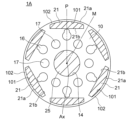
- FIG. 15 is a sectional view showing a modified rotor 1A.
- Permanent magnets 20 of rotor 1 of Embodiment 1 had a rectangular shape in a cross section perpendicular to the axial direction.
- the permanent magnet 21 of the rotor 1A of the modified example has a curved shape that protrudes radially outward in a cross section perpendicular to the axial direction.
- the permanent magnet 21 has a first surface 21a on the outer peripheral side and a second surface 21b on the inner peripheral side.
- the first surface 21a is formed in a curved shape along the outer circumference of the rotor core 10, more specifically in an arc shape.
- the second surface 21b is a plane that passes through the pole center P and is orthogonal to the magnetic pole center line.
- a thin portion 102 is formed between the magnet insertion hole 101 and the outer circumference of the rotor core 10 .
- the rotor core 10 is not provided with the slits 13 (FIG. 3) described in the first embodiment.
- flux barriers 12 may be formed on both sides of the magnet insertion hole 101 in the circumferential direction.
- the volume of the permanent magnet 21 of the modified example can be made larger than that of the permanent magnet 20 of the first embodiment.
- the rotor core 10 of the rotor 1A has magnet insertion holes 101 into which permanent magnets 21 are inserted.
- the inner surface of the magnet insertion hole 101 is a plane perpendicular to the magnetic pole center line.
- a surface of the magnet insertion hole 101 on the outer peripheral side is a curved surface in which a portion corresponding to the pole center P is convex toward the outer peripheral side.
- a modified rotor 1A is configured in the same manner as the rotor 1 of the first embodiment except for the shape of the permanent magnets 21 and the shape of the magnet insertion holes 101.
- the rotor 1A of the modified example since the first surface 21a of the permanent magnet 21 has a curved shape, the rotor 1A has a larger volume than the permanent magnet 20 of the first embodiment, and therefore can generate a larger magnetic force. Therefore, the output of the electric motor can be increased.
Landscapes
- Engineering & Computer Science (AREA)
- Power Engineering (AREA)
- Iron Core Of Rotating Electric Machines (AREA)
Priority Applications (2)
| Application Number | Priority Date | Filing Date | Title |
|---|---|---|---|
| PCT/JP2022/004069 WO2023148844A1 (ja) | 2022-02-02 | 2022-02-02 | 電動機、圧縮機および冷凍サイクル装置 |
| JP2023578243A JPWO2023148844A1 (https=) | 2022-02-02 | 2022-02-02 |
Applications Claiming Priority (1)
| Application Number | Priority Date | Filing Date | Title |
|---|---|---|---|
| PCT/JP2022/004069 WO2023148844A1 (ja) | 2022-02-02 | 2022-02-02 | 電動機、圧縮機および冷凍サイクル装置 |
Publications (1)
| Publication Number | Publication Date |
|---|---|
| WO2023148844A1 true WO2023148844A1 (ja) | 2023-08-10 |
Family
ID=87553354
Family Applications (1)
| Application Number | Title | Priority Date | Filing Date |
|---|---|---|---|
| PCT/JP2022/004069 Ceased WO2023148844A1 (ja) | 2022-02-02 | 2022-02-02 | 電動機、圧縮機および冷凍サイクル装置 |
Country Status (2)
| Country | Link |
|---|---|
| JP (1) | JPWO2023148844A1 (https=) |
| WO (1) | WO2023148844A1 (https=) |
Citations (6)
| Publication number | Priority date | Publication date | Assignee | Title |
|---|---|---|---|---|
| JP2001274010A (ja) * | 2000-03-23 | 2001-10-05 | Tdk Corp | 極異方性円筒状フェライト磁石及び磁場顆粒材 |
| JP2002034190A (ja) * | 2000-07-14 | 2002-01-31 | Hitachi Ltd | 回転機 |
| JP2008251801A (ja) * | 2007-03-30 | 2008-10-16 | Mitsubishi Electric Corp | コイル及びその製造方法 |
| JP2015050880A (ja) * | 2013-09-03 | 2015-03-16 | アイシン精機株式会社 | 電動モータ |
| WO2015136977A1 (ja) * | 2014-03-14 | 2015-09-17 | 三菱電機株式会社 | 圧縮機及び冷凍サイクル装置 |
| JP2017103850A (ja) * | 2015-11-30 | 2017-06-08 | 三菱電機株式会社 | 回転電機 |
-
2022
- 2022-02-02 WO PCT/JP2022/004069 patent/WO2023148844A1/ja not_active Ceased
- 2022-02-02 JP JP2023578243A patent/JPWO2023148844A1/ja not_active Withdrawn
Patent Citations (6)
| Publication number | Priority date | Publication date | Assignee | Title |
|---|---|---|---|---|
| JP2001274010A (ja) * | 2000-03-23 | 2001-10-05 | Tdk Corp | 極異方性円筒状フェライト磁石及び磁場顆粒材 |
| JP2002034190A (ja) * | 2000-07-14 | 2002-01-31 | Hitachi Ltd | 回転機 |
| JP2008251801A (ja) * | 2007-03-30 | 2008-10-16 | Mitsubishi Electric Corp | コイル及びその製造方法 |
| JP2015050880A (ja) * | 2013-09-03 | 2015-03-16 | アイシン精機株式会社 | 電動モータ |
| WO2015136977A1 (ja) * | 2014-03-14 | 2015-09-17 | 三菱電機株式会社 | 圧縮機及び冷凍サイクル装置 |
| JP2017103850A (ja) * | 2015-11-30 | 2017-06-08 | 三菱電機株式会社 | 回転電機 |
Also Published As
| Publication number | Publication date |
|---|---|
| JPWO2023148844A1 (https=) | 2023-08-10 |
Similar Documents
| Publication | Publication Date | Title |
|---|---|---|
| JP6537623B2 (ja) | ステータ、電動機、圧縮機、及び冷凍空調装置 | |
| CN204517521U (zh) | 永久磁铁嵌入式电动机、压缩机和制冷空调装置 | |
| US10483816B2 (en) | Motor, rotor, compressor, and refrigeration and air conditioning apparatus | |
| JP6053910B2 (ja) | 永久磁石埋込型電動機、圧縮機、および冷凍空調装置 | |
| KR20210021070A (ko) | 전동기, 압축기 및 공기 조화 장치 | |
| JP6727314B2 (ja) | ステータコア、ステータ、電動機、駆動装置、圧縮機、空気調和機、及びステータコアの製造方法 | |
| JP6942246B2 (ja) | ロータ、電動機、圧縮機および空気調和装置 | |
| JP7150181B2 (ja) | モータ、圧縮機、及び空気調和機 | |
| CN109792168B (zh) | 定子及其制造方法、电动机、驱动装置、压缩机、制冷空调装置 | |
| JP7154373B2 (ja) | 電動機、圧縮機、及び空気調和機 | |
| US20240120787A1 (en) | Motor, compressor, and refrigeration cycle apparatus | |
| WO2023032134A1 (ja) | 電動機、圧縮機および冷凍サイクル装置 | |
| US20240305155A1 (en) | Motor, compressor, and refrigeration cycle apparatus | |
| WO2023148844A1 (ja) | 電動機、圧縮機および冷凍サイクル装置 | |
| JP7500733B2 (ja) | ロータ、電動機、圧縮機および冷凍サイクル装置 | |
| JP7286019B2 (ja) | 固定子、電動機、圧縮機、冷凍サイクル装置及び空気調和装置 | |
| JP7612041B2 (ja) | 電動機、圧縮機および冷凍サイクル装置 | |
| JP7486911B2 (ja) | 電動機、圧縮機、冷凍サイクル装置、着磁方法および着磁装置 | |
| JP7285961B2 (ja) | ステータ、電動機、圧縮機および空気調和装置 | |
| WO2025158644A1 (ja) | 電動機、圧縮機および冷凍サイクル装置 | |
| WO2023233629A1 (ja) | ステータ、電動機、圧縮機および冷凍サイクル装置 | |
| WO2022113346A1 (ja) | ステータ、モータ、圧縮機および冷凍サイクル装置 | |
| WO2022054226A1 (ja) | 固定子、電動機、圧縮機および空気調和装置 |
Legal Events
| Date | Code | Title | Description |
|---|---|---|---|
| 121 | Ep: the epo has been informed by wipo that ep was designated in this application |
Ref document number: 22924757 Country of ref document: EP Kind code of ref document: A1 |
|
| WWE | Wipo information: entry into national phase |
Ref document number: 2023578243 Country of ref document: JP |
|
| NENP | Non-entry into the national phase |
Ref country code: DE |
|
| 122 | Ep: pct application non-entry in european phase |
Ref document number: 22924757 Country of ref document: EP Kind code of ref document: A1 |