WO2023145942A1 - 湿気硬化型ホットメルト樹脂組成物、電子部品用接着剤及び硬化体 - Google Patents
湿気硬化型ホットメルト樹脂組成物、電子部品用接着剤及び硬化体 Download PDFInfo
- Publication number
- WO2023145942A1 WO2023145942A1 PCT/JP2023/002904 JP2023002904W WO2023145942A1 WO 2023145942 A1 WO2023145942 A1 WO 2023145942A1 JP 2023002904 W JP2023002904 W JP 2023002904W WO 2023145942 A1 WO2023145942 A1 WO 2023145942A1
- Authority
- WO
- WIPO (PCT)
- Prior art keywords
- polyol
- moisture
- resin composition
- melt resin
- curable hot
- Prior art date
- Legal status (The legal status is an assumption and is not a legal conclusion. Google has not performed a legal analysis and makes no representation as to the accuracy of the status listed.)
- Ceased
Links
Images
Classifications
-
- C—CHEMISTRY; METALLURGY
- C09—DYES; PAINTS; POLISHES; NATURAL RESINS; ADHESIVES; COMPOSITIONS NOT OTHERWISE PROVIDED FOR; APPLICATIONS OF MATERIALS NOT OTHERWISE PROVIDED FOR
- C09J—ADHESIVES; NON-MECHANICAL ASPECTS OF ADHESIVE PROCESSES IN GENERAL; ADHESIVE PROCESSES NOT PROVIDED FOR ELSEWHERE; USE OF MATERIALS AS ADHESIVES
- C09J175/00—Adhesives based on polyureas or polyurethanes; Adhesives based on derivatives of such polymers
- C09J175/04—Polyurethanes
- C09J175/06—Polyurethanes from polyesters
-
- C—CHEMISTRY; METALLURGY
- C08—ORGANIC MACROMOLECULAR COMPOUNDS; THEIR PREPARATION OR CHEMICAL WORKING-UP; COMPOSITIONS BASED THEREON
- C08G—MACROMOLECULAR COMPOUNDS OBTAINED OTHERWISE THAN BY REACTIONS ONLY INVOLVING UNSATURATED CARBON-TO-CARBON BONDS
- C08G18/00—Polymeric products of isocyanates or isothiocyanates
- C08G18/06—Polymeric products of isocyanates or isothiocyanates with compounds having active hydrogen
- C08G18/08—Processes
-
- C—CHEMISTRY; METALLURGY
- C08—ORGANIC MACROMOLECULAR COMPOUNDS; THEIR PREPARATION OR CHEMICAL WORKING-UP; COMPOSITIONS BASED THEREON
- C08G—MACROMOLECULAR COMPOUNDS OBTAINED OTHERWISE THAN BY REACTIONS ONLY INVOLVING UNSATURATED CARBON-TO-CARBON BONDS
- C08G18/00—Polymeric products of isocyanates or isothiocyanates
- C08G18/06—Polymeric products of isocyanates or isothiocyanates with compounds having active hydrogen
- C08G18/08—Processes
- C08G18/10—Prepolymer processes involving reaction of isocyanates or isothiocyanates with compounds having active hydrogen in a first reaction step
-
- C—CHEMISTRY; METALLURGY
- C08—ORGANIC MACROMOLECULAR COMPOUNDS; THEIR PREPARATION OR CHEMICAL WORKING-UP; COMPOSITIONS BASED THEREON
- C08G—MACROMOLECULAR COMPOUNDS OBTAINED OTHERWISE THAN BY REACTIONS ONLY INVOLVING UNSATURATED CARBON-TO-CARBON BONDS
- C08G18/00—Polymeric products of isocyanates or isothiocyanates
- C08G18/06—Polymeric products of isocyanates or isothiocyanates with compounds having active hydrogen
- C08G18/08—Processes
- C08G18/10—Prepolymer processes involving reaction of isocyanates or isothiocyanates with compounds having active hydrogen in a first reaction step
- C08G18/12—Prepolymer processes involving reaction of isocyanates or isothiocyanates with compounds having active hydrogen in a first reaction step using two or more compounds having active hydrogen in the first polymerisation step
-
- C—CHEMISTRY; METALLURGY
- C08—ORGANIC MACROMOLECULAR COMPOUNDS; THEIR PREPARATION OR CHEMICAL WORKING-UP; COMPOSITIONS BASED THEREON
- C08G—MACROMOLECULAR COMPOUNDS OBTAINED OTHERWISE THAN BY REACTIONS ONLY INVOLVING UNSATURATED CARBON-TO-CARBON BONDS
- C08G18/00—Polymeric products of isocyanates or isothiocyanates
- C08G18/06—Polymeric products of isocyanates or isothiocyanates with compounds having active hydrogen
- C08G18/28—Polymeric products of isocyanates or isothiocyanates with compounds having active hydrogen characterised by the compounds used containing active hydrogen
- C08G18/30—Low-molecular-weight compounds
-
- C—CHEMISTRY; METALLURGY
- C08—ORGANIC MACROMOLECULAR COMPOUNDS; THEIR PREPARATION OR CHEMICAL WORKING-UP; COMPOSITIONS BASED THEREON
- C08G—MACROMOLECULAR COMPOUNDS OBTAINED OTHERWISE THAN BY REACTIONS ONLY INVOLVING UNSATURATED CARBON-TO-CARBON BONDS
- C08G18/00—Polymeric products of isocyanates or isothiocyanates
- C08G18/06—Polymeric products of isocyanates or isothiocyanates with compounds having active hydrogen
- C08G18/28—Polymeric products of isocyanates or isothiocyanates with compounds having active hydrogen characterised by the compounds used containing active hydrogen
- C08G18/40—High-molecular-weight compounds
-
- C—CHEMISTRY; METALLURGY
- C08—ORGANIC MACROMOLECULAR COMPOUNDS; THEIR PREPARATION OR CHEMICAL WORKING-UP; COMPOSITIONS BASED THEREON
- C08G—MACROMOLECULAR COMPOUNDS OBTAINED OTHERWISE THAN BY REACTIONS ONLY INVOLVING UNSATURATED CARBON-TO-CARBON BONDS
- C08G18/00—Polymeric products of isocyanates or isothiocyanates
- C08G18/06—Polymeric products of isocyanates or isothiocyanates with compounds having active hydrogen
- C08G18/28—Polymeric products of isocyanates or isothiocyanates with compounds having active hydrogen characterised by the compounds used containing active hydrogen
- C08G18/40—High-molecular-weight compounds
- C08G18/42—Polycondensates having carboxylic or carbonic ester groups in the main chain
-
- C—CHEMISTRY; METALLURGY
- C08—ORGANIC MACROMOLECULAR COMPOUNDS; THEIR PREPARATION OR CHEMICAL WORKING-UP; COMPOSITIONS BASED THEREON
- C08G—MACROMOLECULAR COMPOUNDS OBTAINED OTHERWISE THAN BY REACTIONS ONLY INVOLVING UNSATURATED CARBON-TO-CARBON BONDS
- C08G18/00—Polymeric products of isocyanates or isothiocyanates
- C08G18/06—Polymeric products of isocyanates or isothiocyanates with compounds having active hydrogen
- C08G18/28—Polymeric products of isocyanates or isothiocyanates with compounds having active hydrogen characterised by the compounds used containing active hydrogen
- C08G18/40—High-molecular-weight compounds
- C08G18/42—Polycondensates having carboxylic or carbonic ester groups in the main chain
- C08G18/4236—Polycondensates having carboxylic or carbonic ester groups in the main chain containing only aliphatic groups
- C08G18/4238—Polycondensates having carboxylic or carbonic ester groups in the main chain containing only aliphatic groups derived from dicarboxylic acids and dialcohols
-
- C—CHEMISTRY; METALLURGY
- C08—ORGANIC MACROMOLECULAR COMPOUNDS; THEIR PREPARATION OR CHEMICAL WORKING-UP; COMPOSITIONS BASED THEREON
- C08G—MACROMOLECULAR COMPOUNDS OBTAINED OTHERWISE THAN BY REACTIONS ONLY INVOLVING UNSATURATED CARBON-TO-CARBON BONDS
- C08G18/00—Polymeric products of isocyanates or isothiocyanates
- C08G18/06—Polymeric products of isocyanates or isothiocyanates with compounds having active hydrogen
- C08G18/28—Polymeric products of isocyanates or isothiocyanates with compounds having active hydrogen characterised by the compounds used containing active hydrogen
- C08G18/40—High-molecular-weight compounds
- C08G18/42—Polycondensates having carboxylic or carbonic ester groups in the main chain
- C08G18/44—Polycarbonates
-
- C—CHEMISTRY; METALLURGY
- C08—ORGANIC MACROMOLECULAR COMPOUNDS; THEIR PREPARATION OR CHEMICAL WORKING-UP; COMPOSITIONS BASED THEREON
- C08G—MACROMOLECULAR COMPOUNDS OBTAINED OTHERWISE THAN BY REACTIONS ONLY INVOLVING UNSATURATED CARBON-TO-CARBON BONDS
- C08G18/00—Polymeric products of isocyanates or isothiocyanates
- C08G18/06—Polymeric products of isocyanates or isothiocyanates with compounds having active hydrogen
- C08G18/70—Polymeric products of isocyanates or isothiocyanates with compounds having active hydrogen characterised by the isocyanates or isothiocyanates used
- C08G18/72—Polyisocyanates or polyisothiocyanates
- C08G18/74—Polyisocyanates or polyisothiocyanates cyclic
- C08G18/76—Polyisocyanates or polyisothiocyanates cyclic aromatic
- C08G18/7657—Polyisocyanates or polyisothiocyanates cyclic aromatic containing two or more aromatic rings
- C08G18/7664—Polyisocyanates or polyisothiocyanates cyclic aromatic containing two or more aromatic rings containing alkylene polyphenyl groups
- C08G18/7671—Polyisocyanates or polyisothiocyanates cyclic aromatic containing two or more aromatic rings containing alkylene polyphenyl groups containing only one alkylene bisphenyl group
-
- C—CHEMISTRY; METALLURGY
- C09—DYES; PAINTS; POLISHES; NATURAL RESINS; ADHESIVES; COMPOSITIONS NOT OTHERWISE PROVIDED FOR; APPLICATIONS OF MATERIALS NOT OTHERWISE PROVIDED FOR
- C09J—ADHESIVES; NON-MECHANICAL ASPECTS OF ADHESIVE PROCESSES IN GENERAL; ADHESIVE PROCESSES NOT PROVIDED FOR ELSEWHERE; USE OF MATERIALS AS ADHESIVES
- C09J11/00—Features of adhesives not provided for in group C09J9/00, e.g. additives
- C09J11/02—Non-macromolecular additives
- C09J11/06—Non-macromolecular additives organic
-
- C—CHEMISTRY; METALLURGY
- C09—DYES; PAINTS; POLISHES; NATURAL RESINS; ADHESIVES; COMPOSITIONS NOT OTHERWISE PROVIDED FOR; APPLICATIONS OF MATERIALS NOT OTHERWISE PROVIDED FOR
- C09J—ADHESIVES; NON-MECHANICAL ASPECTS OF ADHESIVE PROCESSES IN GENERAL; ADHESIVE PROCESSES NOT PROVIDED FOR ELSEWHERE; USE OF MATERIALS AS ADHESIVES
- C09J175/00—Adhesives based on polyureas or polyurethanes; Adhesives based on derivatives of such polymers
- C09J175/04—Polyurethanes
- C09J175/08—Polyurethanes from polyethers
-
- C—CHEMISTRY; METALLURGY
- C08—ORGANIC MACROMOLECULAR COMPOUNDS; THEIR PREPARATION OR CHEMICAL WORKING-UP; COMPOSITIONS BASED THEREON
- C08G—MACROMOLECULAR COMPOUNDS OBTAINED OTHERWISE THAN BY REACTIONS ONLY INVOLVING UNSATURATED CARBON-TO-CARBON BONDS
- C08G2170/00—Compositions for adhesives
- C08G2170/20—Compositions for hot melt adhesives
-
- C—CHEMISTRY; METALLURGY
- C09—DYES; PAINTS; POLISHES; NATURAL RESINS; ADHESIVES; COMPOSITIONS NOT OTHERWISE PROVIDED FOR; APPLICATIONS OF MATERIALS NOT OTHERWISE PROVIDED FOR
- C09J—ADHESIVES; NON-MECHANICAL ASPECTS OF ADHESIVE PROCESSES IN GENERAL; ADHESIVE PROCESSES NOT PROVIDED FOR ELSEWHERE; USE OF MATERIALS AS ADHESIVES
- C09J2301/00—Additional features of adhesives in the form of films or foils
- C09J2301/30—Additional features of adhesives in the form of films or foils characterized by the chemical, physicochemical or physical properties of the adhesive or the carrier
- C09J2301/304—Additional features of adhesives in the form of films or foils characterized by the chemical, physicochemical or physical properties of the adhesive or the carrier the adhesive being heat-activatable, i.e. not tacky at temperatures inferior to 30°C
Definitions
- the present invention relates to a moisture-curable hot-melt resin composition, an adhesive for electronic parts comprising the moisture-curable hot-melt resin composition, and a cured body of the moisture-curable hot-melt resin composition.
- double-sided tape was often used to glue and assemble parts of smart devices such as smartphones and wearable devices.
- adhesives have come to be used in order to cope with narrow bonding areas and complicated bonding surfaces. Since mobile electronic devices such as smart devices are carried around, they may be accidentally dropped while being carried or used. Therefore, the bonded part of the device is required to have impact resistance so that the bonded parts do not fall off due to the impact when dropped.
- Patent Document 1 discloses a urethane prepolymer (i) having an isocyanate group obtained by reacting a polyester polyol (A) and a polyether polyol (B) with an isocyanate (C), and a urethane prepolymer (i) and Moisture curable hot melt adhesive compositions containing non-reactive component (ii) are disclosed.
- Patent Document 2 a moisture-curable hot melt adhesive containing a urethane prepolymer having an isocyanate group, which is a reaction product of a polyol component containing a polyester polyol, a polyether polyol and a polybutadiene polyol and an isocyanate component, and an antioxidant. Agent compositions are disclosed.
- Patent Documents 1 and 2 describe that moisture-curable hot-melt adhesive compositions have excellent impact resistance.
- an object of the present invention is to provide a moisture-curable hot-melt resin composition capable of achieving both excellent impact resistance and sebum resistance, and an adhesive for electronic parts and a cured product using the same.
- the present inventor found that the above problems can be solved by using a urethane prepolymer having a specific structure and setting the initial PUSH adhesive strength to a certain value or more, and completed the following invention. rice field.
- the present invention provides the following [1] to [19].
- the polyol (A) contains a polyether polycarbonate polyol (a1) and a polyol (a2) different from the polyether polycarbonate polyol (a1), and the polyol (a2) is a group consisting of a polyester polyol and a polycarbonate polyol. is at least one selected from A moisture-curable hot-melt resin composition having an initial PUSH adhesive strength of 3 kgf/cm 2 or more.
- the moisture-curable hot-melt resin composition according to any one of [1] to [3] above.
- the linear polyol is an aliphatic polyol having 3 to 12 carbon atoms and having hydroxyl groups at both ends
- the linear polycarboxylic acid is an aliphatic carboxylic acid having 4 to 12 carbon atoms and having carboxyl groups at both ends.
- the linear polyol is 1,6-hexanediol
- the linear polycarboxylic acid is at least one selected from the group consisting of adipic acid and sebacic acid [ 5], the moisture-curable hot-melt resin composition.
- the moisture-curable hot-melt resin composition according to any one of [1] to [7] above, wherein the polycarbonate polyol contains structural units derived from a linear polyol having 8 or more carbon atoms.
- the constituent units derived from the linear polyol having 8 or more carbon atoms are 75 mol% or more and 100 mol% or less based on the total amount of constituent units derived from the polyhydroxy compound, above
- Moisture-curable hot-melt resin composition according to .
- the present invention it is possible to provide a moisture-curable hot-melt resin composition that achieves both excellent impact resistance and sebum resistance, and an adhesive for electronic parts and a cured product using the composition.
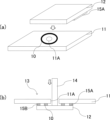
- FIG.1 (a) is a top view
- FIG.1(b) is a side view.
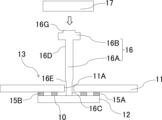
- FIG.1(b) is a side view which shows the impact-resistant evaluation method.
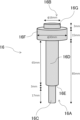
- 1 is a schematic perspective view of a shooting die used in impact resistance; FIG.
- the moisture-curable hot-melt resin composition of the present invention contains a urethane prepolymer.
- a urethane prepolymer is a reaction product of a polyol (A) and a polyisocyanate compound (B) and has an isocyanate group.
- the urethane prepolymer can impart moisture curability to the resin composition by containing an isocyanate group.
- the isocyanate group contained in the urethane prepolymer is not particularly limited, and may be an aromatic isocyanate group, an aliphatic isocyanate group, or a combination thereof. When these isocyanate groups are used in combination, as the urethane prepolymer, a urethane prepolymer having an aromatic isocyanate group and a urethane prepolymer having an aliphatic isocyanate group may be used in combination. may be a compound having both an aromatic isocyanate group and an aliphatic isocyanate group.
- the aromatic isocyanate group is an isocyanate group directly bonded to an aromatic ring, and the aliphatic isocyanate group is an isocyanate group directly bonded to an aliphatic carbon atom.
- the aromatic isocyanate group is an isocyanate group derived from an aromatic isocyanate compound, and the details of the aromatic isocyanate compound are as described later.
- the aliphatic isocyanate group is an isocyanate group derived from an aliphatic isocyanate compound, and the details of the aliphatic isocyanate compound are as described later.
- the urethane prepolymer preferably contains aromatic isocyanate groups.
- aromatic isocyanate groups When the urethane prepolymer contains an aromatic isocyanate group, it becomes easier to improve the adhesive strength (final adhesive strength) of the moisture-curable hot-melt resin composition after moisture curing. In addition, the resistance to sebum of the cured body of the moisture-curable hot-melt resin composition is improved, and the adhesive force can be easily maintained at a high value even after coming into contact with sebum.
- the number of isocyanate groups in the urethane prepolymer is not particularly limited, but preferably two or more per molecule, and isocyanate groups at both ends of the urethane prepolymer are preferred.
- the urethane prepolymer of the present invention can be obtained by reacting the polyol (A) and the polyisocyanate compound (B).
- Polyol (A) is a compound having two or more hydroxyl groups
- polyisocyanate compound (B) is a compound having two or more isocyanate groups.
- the polyol (A) includes a polyether polycarbonate polyol (a1) and a polyol (a2) different from the polyether polycarbonate polyol (a1).
- the polyol (a2) is at least one selected from the group consisting of polyester polyols and polycarbonate polyols.
- Polyether polycarbonate polyol (a1)) Polyether polycarbonate polyol (a1) has a polyether skeleton and a carbonate bond.
- Polyether polycarbonate polyol (a1) is a compound having two or more hydroxyl groups in the molecule.
- the polyether polycarbonate polyol (a1) preferably has two or more carbonate bonds in the molecule.
- the polyether polycarbonate polyol (a1) by using the polyether polycarbonate polyol (a1) as the polyol (A), it becomes easier to achieve excellent sebum resistance.
- the polyether skeleton typically has a structure in which divalent hydrocarbon groups are linked by ether bonds.
- the divalent hydrocarbon group is not particularly limited, it has, for example, 2 to 12 carbon atoms, preferably 3 to 8 carbon atoms.
- the divalent hydrocarbon group may be either an aliphatic hydrocarbon group or an aromatic hydrocarbon group having an aromatic ring, but an aliphatic hydrocarbon group is preferred.
- the aliphatic hydrocarbon group may be linear, branched, or have an alicyclic structure, but is preferably linear.
- the polyether polycarbonate polyol (a1) preferably has a straight-chain alkylene group having 3 to 8 carbon atoms.
- the polyether polycarbonate polyol (a1) has a straight-chain alkylene group with 3 to 8 carbon atoms, so that sebum resistance and final adhesive strength are easily improved.
- the alkylene group is preferably contained in the polyether skeleton, and the divalent hydrocarbon group in the polyether skeleton is preferably a straight-chain alkylene group having 3 to 8 carbon atoms. Therefore, the polyether skeleton preferably has a structure in which straight-chain alkylene groups having 3 to 8 carbon atoms are linked via ether bonds, and the alkylene groups preferably have 3 to 5 carbon atoms. , is most preferably 4 carbon atoms.
- the polyether polycarbonate polyol (a1) preferably has a structure in which a plurality of polyether skeletons are linked via carbonate bonds.
- the polyether polycarbonate polyol (a1) is preferably a polyether polycarbonate diol containing two hydroxyl groups in one molecule.
- the polyether polycarbonate diol preferably has hydroxyl groups at both ends of the molecule.
- the polyether polycarbonate polyol (a1) is more preferably a compound represented by the following formula (1).
- R represents a divalent hydrocarbon group having 2 to 12 carbon atoms, n is an integer of 2 to 90, and m is an integer of 1 to 35.
- R may be the same, and may differ.
- R preferably has 2 to 10 carbon atoms, more preferably 3 to 8 carbon atoms, still more preferably 3 to 5 carbon atoms, and most preferably 4 carbon atoms.
- R may be an aliphatic hydrocarbon group or an aromatic hydrocarbon group having an aromatic ring, preferably an aliphatic hydrocarbon group, more preferably a saturated aliphatic hydrocarbon group, especially linear and An alkylene group having 3 to 8 carbon atoms is more preferred.
- R examples include a trimethylene group, a tetramethylene group, a pentamethylene group, a hexamethylene group, a heptamethylene group and an octamethylene group, and among them, a trimethylene group, a tetramethylene group and a pentamethylene group are more preferable.
- the tetramethylene group is most preferred.
- These alkylene groups may be used singly or in combination of two or more.
- n is 2 to 90, preferably 2 to 45, more preferably 2 to 15, still more preferably 2 to 10, and most preferably 2 to 5.
- m is 1 to 35, preferably 1 to 15, more preferably 1 to 10, even more preferably 1 to 6, and most preferably 2 to 6.
- the polyether polycarbonate polyol (a1) is preferably produced using a polyoxyalkylene glycol as a raw material by a known method such as the phosgene method or the transesterification method. Therefore, the polyether skeleton described above is preferably derived from polyoxyalkylene glycol.
- polyoxyalkylene glycol include polypropylene glycol, polytetramethylene ether glycol, copolymer polyether glycol of propylene oxide and tetrahydrofuran, etc.
- polytetramethylene ether glycol (PTMG) is preferred. more preferred.
- polyoxyalkylene glycol may use only 1 type, and may use 2 or more types together.
- the polyether polycarbonate polyol (a1) is preferably liquid at room temperature (25°C).
- the polyether polycarbonate polyol (a1) is liquid, as will be described later, by making the polyol (a2) solid, the resin composition can be hot-melted and the open time can be moderately long. It becomes easy to improve the impact resistance.
- the number average molecular weight (Mn) of the polyether polycarbonate polyol (a1) is not particularly limited, but is, for example, 600 or more, preferably 800 or more, more preferably 1,000 or more, still more preferably 1,500 or more, Also, for example, it is 6,000 or less, preferably 5,000 or less, more preferably 4,000 or less, and still more preferably 3,500 or less.
- Mn number average molecular weight of the polyether polycarbonate polyol (a1) is within the above range, it becomes easy to improve sebum resistance, impact resistance, etc. while improving handleability.
- Polyol (a2) Polyol (a2) used as polyol (A) is at least either polyester polyol or polycarbonate polyol, and these may be used in combination.
- Polyol (a2) is preferably other than polyether polycarbonate polyol having a polyether skeleton and a carbonate bond.
- Polyester polyols used as the polyol (a2) include, for example, polyester polyols obtained by reacting polycarboxylic acids with polyols, poly- ⁇ -caprolactone polyols obtained by ring-opening polymerization of ⁇ -caprolactone, and the like. . Among these, polyester polyol obtained by reaction of polycarboxylic acid and polyol is preferable. Moreover, the polyester polyol is preferably a polyester diol. Polyester polyols may be used singly or in combination of two or more.
- polycarboxylic acids used as raw materials for polyester polyols include divalent aromatic carboxylic acids such as terephthalic acid, isophthalic acid, 1,5-naphthalic acid and 2,6-naphthalic acid, succinic acid, glutaric acid, and adipine. acid, pimelic acid, suberic acid, azelaic acid, sebacic acid, decamethylenedicarboxylic acid, divalent aliphatic carboxylic acids such as dodecamethylenedicarboxylic acid, trimellitic acid, trimesic acid, pyromellitic acid, naphthalenetricarboxylic acid, etc.
- divalent aromatic carboxylic acids such as terephthalic acid, isophthalic acid, 1,5-naphthalic acid and 2,6-naphthalic acid, succinic acid, glutaric acid, and adipine. acid, pimelic acid, suberic acid, azelaic acid, sebacic acid, decamethylenedicarboxylic acid,
- trivalent or higher aliphatic carboxylic acids such as aromatic carboxylic acids having a valence or higher, cyclohexanetricarboxylic acid, hexanetricarboxylic acid, and the like. These polycarboxylic acids may be used singly or in combination of two or more.
- Examples include chain aliphatic polyols, aliphatic polyols having branched structures such as neopentyl glycol, and aliphatic polyols having a cyclic skeleton such as cyclohexanediol. These polyols may be used singly or in combination of two or more.
- linear polycarboxylic acids are preferred as the polycarboxylic acids used in the polyester polyol.
- the crystallinity tends to be high, and the set time tends to be moderately fast.
- the initial PUSH adhesive strength is increased, making it easier to improve the impact resistance.
- the straight-chain polycarboxylic acid may be used alone as the polycarboxylic acid, or may be used in combination with a polycarboxylic acid other than the straight-chain polycarboxylic acid.
- the polyester polyol preferably contains linear polycarboxylic acid-derived structural units, the content of which is based on the total amount of all polycarboxylic acid-derived structural units, for example, 75 mol% or more and 100 mol% or less, preferably 85 mol % or more and 100 mol % or less, more preferably 95 mol % or more and 100 mol % or less, and most preferably 100 mol %.
- the straight-chain polycarboxylic acid is a divalent straight-chain aliphatic carboxylic acid having carboxyl groups at both ends.
- the linear polycarboxylic acid is preferably an aliphatic carboxylic acid having 4 to 12 carbon atoms, more preferably an aliphatic carboxylic acid having 6 to 10 carbon atoms. Therefore, among the above aliphatic carboxylic acids, adipic acid, pimelic acid, suberic acid, azelaic acid and sebacic acid are preferred, and adipic acid and sebacic acid are particularly preferred.
- the polyester polyol preferably contains polycarboxylic acid-derived structural units selected from the group consisting of adipic acid and sebacic acid, and the content thereof is based on the total amount of polycarboxylic acid-derived structural units, for example 75 mol. % or more and 100 mol % or less, preferably 85 mol % or more and 100 mol % or less, more preferably 95 mol % or more and 100 mol % or less, most preferably 100 mol %.
- linear polycarboxylic acid may be used individually by 1 type, and may be used together 2 or more types.
- linear polyols are preferred as the polyols used in the polyester polyols.
- the crystallinity tends to be high and the set time tends to be moderately fast.
- the initial PUSH adhesive strength is increased, making it easier to improve the impact resistance.
- the straight-chain polyol may be used alone as the polyol, or may be used in combination with a polyol other than the straight-chain polyol.
- the polyester polyol preferably contains linear polyol-derived structural units, and the content thereof is, for example, 75 mol% or more and 100 mol% or less, based on the total amount of polyol-derived structural units, and is preferably is 85 mol % or more and 100 mol % or less, more preferably 95 mol % or more and 100 mol % or less, most preferably 100 mol %.
- Linear polyols are divalent linear aliphatic polyols having hydroxyl groups at both ends.
- the straight-chain polyol is preferably a straight-chain polyol having 3 to 12 carbon atoms, more preferably a straight-chain polyol having 5 to 8 carbon atoms, and most preferably a straight-chain polyol having 6 carbon atoms.
- Preferred examples of linear polyols are 1,4-butanediol, 1,5-pentanediol, 1,6-hexanediol and diethylene glycol, with 1,6-hexanediol being most preferred.
- the polyester polyol preferably contains structural units derived from 1,6-hexanediol, and the content thereof is, for example, 75 mol% or more and 100 mol% or less based on the total amount of polyol-derived structural units, It is preferably 85 mol % or more and 100 mol % or less, more preferably 95 mol % or more and 100 mol % or less, and most preferably 100 mol %.
- linear polyol may be used individually by 1 type, and may be used in combination of 2 or more types.
- the polycarbonate polyol used in the polyol (a2) has a structure in which structural units derived from a polyhydroxy compound are linked by carbonate bonds.
- the production method of the polycarbonate polyol is not particularly limited, and may be produced by a known method such as a phosgene method or a transesterification method using a polyhydroxy compound as a raw material.
- Polyhydroxy compounds are generally dihydroxy compounds.
- the polyhydroxy compound may be a linear aliphatic polyol, an alicyclic polyol having a branched structure or an alicyclic structure, an aromatic polyhydroxy compound, or the like, but the polyhydroxy compound is preferably a linear polyol. .
- the polyhydroxy compound should not have an ether bond.
- Linear polyols are divalent linear aliphatic polyols having hydroxyl groups at both ends.
- the linear polyol has, for example, 4 or more carbon atoms, and among these, linear polyols having 8 or more carbon atoms are preferred. Also, the number of carbon atoms in the linear polyol is, for example, 16 or less, preferably 12 or less.
- the straight-chain polyol is preferably a straight-chain aliphatic diol having no ether bond, and more preferably an alkanediol having hydroxyl groups at both ends.
- linear polyols used as raw materials for polycarbonate polyols include 1,4-butanediol, 1,5-pentanediol, 1,6-hexanediol, 1,7-heptanediol, 1,8-octanediol, 1 ,9-nonanediol, 1,10-decanediol, 1,11-undecanediol, 1,12-dodecanediol, 1,13-tridecanediol, 1,14-tetradecanediol, 1,15-pentadecanediol, 1 , 16-hexadecanediol and the like.
- 1,8-octanediol, 1,9-nonanediol, 1,10-decanediol, 1,11-undecanediol, and 1,12-dodecanediol are preferable, and 1,8-octanediol, 1,10-decanediol and 1,12-dodecanediol are more preferred, and 1,10-decanediol and 1,12-dodecanediol are most preferred.
- the polycarbonate polyol preferably contains structural units derived from linear polyols, and more preferably contains structural units derived from linear polyols having 8 or more carbon atoms.
- the polycarbonate polyol contains a structural unit derived from a linear polyol having a relatively large number of carbon atoms, the crystallinity of the polycarbonate polyol is increased, and the setting time of the composition tends to be moderately fast. Therefore, the initial PUSH adhesive strength is increased, and the impact resistance can be easily improved.
- Structural units derived from a linear polyol having 8 or more carbon atoms, based on the total amount of structural units derived from a polyhydroxy compound, are, for example, 75 mol% or more and 100 mol% or less, preferably 85 mol% or more and 100 mol% or less, It is more preferably 95 mol % or more and 100 mol % or less, and most preferably 100 mol %.
- linear polyol may be used individually by 1 type, and may be used in combination of 2 or more types.
- the polycarbonate polyol is preferably a polycarbonate diol, and specific examples of the polycarbonate diol include compounds represented by the following formula (2).
- R is a divalent hydrocarbon group having 4 to 16 carbon atoms, and n is an integer of 2 to 120.
- R is preferably an aliphatic saturated hydrocarbon group.
- R composed of an aliphatic saturated hydrocarbon group may have a chain structure or a cyclic structure, but preferably has a chain structure.
- R in the chain structure may be linear or branched, but preferably linear.
- n is preferably 2-25, more preferably 2-20, even more preferably 5-20, and most preferably 5-15.
- R contained in the polycarbonate polyol may be used singly or in combination of two or more. When two or more are used in combination, R is preferably a linear saturated aliphatic hydrocarbon group having 8 or more carbon atoms.
- the crystallinity is increased and the set time tends to be moderately fast. Therefore, the initial PUSH adhesive strength tends to increase, and the impact resistance also tends to improve.
- R may be linear saturated aliphatic hydrocarbon groups having 8 or more carbon atoms, but some may be linear saturated aliphatic hydrocarbon groups having 8 or more carbon atoms.
- R is, for example, 75 mol% or more and 100 mol% or less, preferably 85 mol% or more and 100 mol% or less, more preferably 95 mol% or more and 100 mol% or less, most preferably 100 mol% or less, relative to all R. It is preferably a straight-chain saturated aliphatic hydrocarbon group having 8 or more carbon atoms at a ratio of mol %.
- the linear saturated aliphatic hydrocarbon group having 8 or more carbon atoms preferably has 12 or less carbon atoms.
- R examples include tetramethylene group, pentamethylene group, hexamethylene group, heptamethylene group, octamethylene group, nonamethylene group, decamethylene group, undecamethylene group and dodecamethylene group.
- a methylene group, a nonamethylene group, a decamethylene group, an undecamethylene group and a dodecamethylene group are preferable, an octamethylene group, a decamethylene group and a dodecamethylene group are more preferable, a decamethylene group and a dodecamethylene group are more preferable, and a decamethylene group is still more preferable.
- polycarbonate polyol may be used individually by 1 type, and may be used in combination of 2 or more type.
- the polyol (a2) is preferably solid at room temperature (25°C). When the polyol (a2) is solid at room temperature, the resin composition can easily be hot-melted.
- the number average molecular weight (Mn) of the polyol (a2) is not particularly limited, but is, for example, 1,000 or more, preferably 1,500 or more, more preferably 2,000 or more. ,000 or less, preferably 5,000 or less, more preferably 4,000 or less.
- Polyol (a2) can have moderate crystallinity because the number average molecular weight is within the above range. Therefore, it has suitable open time and set time, high initial PUSH adhesive strength, and good impact resistance.
- the number average molecular weight (Mn) of the polyether polycarbonate polyol (a1) and polyol (a2) can be calculated from the measured hydroxyl value (mgKOH/g) by the following procedure. Specifically, first, the hydroxyl value (mgKOH/g) of the polyol is measured according to JIS K 1557-1. Next, the amount of hydroxyl groups (mmol/g) is obtained from the measured hydroxyl value (mgKOH/g) and the formula weight of KOH. Then, after converting the obtained hydroxyl group amount (mmol/g) into "g/mol" by reciprocal, the number average molecular weight (Mn) can be obtained by multiplying by the number of functional groups (number of hydroxyl groups).
- a urethane prepolymer can be obtained by reacting a mixture of a polyether polycarbonate polyol (a1) and a polyol (a2) with a polyisocyanate compound (B). Therefore, at least a part or all of the urethane prepolymer has both the structural unit derived from the polyether polycarbonate polyol (a1) and the structural unit derived from the polyol (a2) in one molecule.
- the polyether polycarbonate polyol (a1) is contained in an amount of 35% by mass or more and 75% by mass or less and the polyol (a2) is contained in an amount of 25% by mass or more and 65% by mass or less.
- the polyether polycarbonate polyol (a1) makes it easier to improve sebum resistance and impact resistance
- the polyol (a2) makes it easier to improve the initial PUSH adhesive strength. becomes large, and it becomes easy to improve the impact resistance.
- the content of the polyether polycarbonate polyol (a1) in the polyol (A) is more preferably 40% by mass or more, further preferably 50% by mass or more, and more preferably 70% by mass or less, and 65% by mass. More preferred are:
- the content of the polyol (a2) in the polyol (A) is more preferably 30% by mass or more, still more preferably 35% by mass or more, more preferably 60% by mass or less, and even more preferably 50% by mass or less.
- the polyol (A) may contain polyols (other polyols) other than the polyether polycarbonate polyol (a1) and the polyol (a2) as long as the effects of the present invention are not impaired.
- the content of other polyols is, for example, 0% by mass or more and 20% by mass or less, preferably 0% by mass or more and 10% by mass or less, more preferably 0% by mass or more and 5% by mass or less, most preferably It is 0% by mass.
- Polyisocyanate compound (B) Polyisocyanate compounds include aromatic polyisocyanate compounds and aliphatic polyisocyanate compounds. Examples of aromatic polyisocyanate compounds include diphenylmethane diisocyanate, liquid modified diphenylmethane diisocyanate, tolylene diisocyanate, and naphthalene-1,5-diisocyanate. The aromatic polyisocyanate compound may be a multimer of these compounds, polymeric MDI, or the like.
- aliphatic polyisocyanate compounds include hexamethylene diisocyanate, trimethylhexamethylene diisocyanate, lysine diisocyanate, norbornane diisocyanate, transcyclohexane-1,4-diisocyanate, isophorone diisocyanate, hydrogenated xylylene diisocyanate, hydrogenated diphenylmethane diisocyanate, and cyclohexane diisocyanate. , bis(isocyanatomethyl)cyclohexane, dicyclohexylmethane diisocyanate, and the like. Aliphatic polyisocyanate compounds may be those obtained by increasing these.
- a polyisocyanate compound may be used independently and may be used in combination of 2 or more type.
- the urethane prepolymer when an aromatic polyisocyanate compound is used in the synthesis of a urethane prepolymer, the urethane prepolymer contains an aromatic isocyanate group, and when an aliphatic polyisocyanate compound is used, the urethane prepolymer contains an aliphatic isocyanate group. contains.
- an aromatic polyisocyanate compound as the polyisocyanate compound (B), and among them, diphenylmethane diisocyanate (MDI) is more preferable.
- the content of the urethane prepolymer in the moisture-curable hot-melt resin composition is not particularly limited, but is, for example, 30% by mass or more, preferably 50% by mass or more, more preferably 50% by mass or more, based on the total amount of the moisture-curable hot-melt resin composition. It is 70% by mass or more, more preferably 80% by mass or more.
- the content of the urethane prepolymer may be 100% by mass or less, but is preferably 99.9% by mass or less, more preferably 99.5% by mass or less, and more preferably 99.5% by mass or less in order to contain other components appropriately. % or less by mass is more preferable.
- the moisture-curable hot-melt resin composition may contain a moisture curing acceleration catalyst that accelerates the moisture curing reaction of the urethane prepolymer.
- a moisture-curing acceleration catalyst By using a moisture-curing acceleration catalyst, the moisture-curable hot-melt resin composition becomes more excellent in moisture-curing properties, making it easier to increase adhesive strength.
- Specific examples of moisture curing acceleration catalysts include amine-based compounds and metal-based catalysts, with amine-based compounds being preferred.
- Examples of amine compounds include compounds having a morpholine skeleton such as di(methylmorpholino) diethyl ether, 4-morpholinopropyl morpholine, bis(2-morpholinoethyl) ether, bis(2-dimethylaminoethyl) ether, 1,2- Dimethylamino group-containing amine compounds having two dimethylamino groups such as bis(dimethylamino)ethane, triethylamine, 1,4-diazabicyclo[2.2.2]octane, 2,6,7-trimethyl-1,4- diazabicyclo[2.2.2]octane and the like.
- a morpholine skeleton such as di(methylmorpholino) diethyl ether, 4-morpholinopropyl morpholine, bis(2-morpholinoethyl) ether, bis(2-dimethylaminoethyl) ether, 1,2- Dimethylamino group-containing amine compounds having two dimethyla
- metal-based catalysts examples include tin compounds such as di-n-butyltin dilaurate, di-n-butyltin diacetate and tin octylate; zinc compounds such as zinc octoate and zinc naphthenate; zirconium tetraacetylacetonate; copper naphthenate; Other metal compounds such as cobalt naphthenate are included.
- the content of the moisture curing acceleration catalyst is preferably 0.01 parts by mass or more and 5 parts by mass or less, more preferably 0.05 parts by mass or more and 3 parts by mass or less, and still more preferably 0 parts by mass with respect to 100 parts by mass of the urethane prepolymer. .1 mass parts or more and 2 mass parts or less.
- the moisture-curable hot-melt resin composition may contain a coupling agent.
- a coupling agent By including a coupling agent in the moisture-curable hot-melt resin composition, it becomes easier to improve the adhesive force.
- Examples of coupling agents include silane coupling agents, titanate coupling agents, zirconate coupling agents, and the like.
- a silane coupling agent is preferable because it is excellent in the effect of improving adhesiveness.
- mercaptan-based silane coupling agents and amine-based silane coupling agents are preferable, and amine-based silane coupling agents are more preferable, since they are excellent in the effect of improving impact resistance.
- An amine-containing silane coupling agent having an aromatic ring is more preferred, and an aromatic amine-containing silane coupling agent having an aromatic amine is particularly preferred.
- Examples of the amine-based silane coupling agent include N-phenyl-3-aminopropyltrimethoxysilane, 3-aminopropyltrimethoxysilane, 3-aminopropyltriethoxysilane, 3-(2-aminoethyl)aminopropyl trimethoxysilane, 3-(2-aminoethyl)aminopropyltriethoxysilane, 3-(2-aminoethyl)aminopropylmethyldimethoxysilane and the like.
- N-phenyl-3-aminopropyltrimethoxysilane is preferred.
- Examples of the mercaptan-based silane coupling agent include 3-mercaptopropyltrimethoxysilane, 3-mercaptopropylmethyldimethoxysilane, 3-mercaptopropyltriethoxysilane, 3-mercaptopropylmethyldiethoxysilane, and the like.
- silane coupling agents other than mercaptan-based silane coupling agents and amine-based silane coupling agents may be used.
- Other silane coupling agents include, for example, 3-glycidoxypropyltrimethoxysilane, 3-glycidoxypropylmethyldimethoxysilane, 3-glycidoxypropyltriethoxysilane, 2-(3,4-epoxycyclohexyl ) Ethyltrimethoxysilane, 3-glycidoxypropylmethyldiethoxysilane, 3-(meth)acryloyloxypropyltrimethoxysilane, 3-(meth)acryloyloxypropyltriethoxysilane, 3-(meth)acryloyloxypropylmethyl dimethoxysilane, 3-(meth)acryloyloxypropylmethyldiethoxysilane, vinyltrimethoxysilane, vinyltriethoxysilane, 3-isocyanatopropyltrimeth
- titanate-based coupling agent examples include titanium diisopropoxybis(acetylacetonate), titanium tetraacetylacetonate, and titanium diisopropoxybis(ethylacetoacetate).
- zirconate-based coupling agent examples include zirconium tetra-normal propoxide and zirconium tetra-normal butoxide.
- a coupling agent may be used individually by 1 type, and 2 or more types may be used in combination.
- the content of the coupling agent is preferably 0.05 parts by mass or more and 8 parts by mass or less, more preferably 0.2 parts by mass or more and 6 parts by mass or less, and 0.5 parts by mass with respect to 100 parts by mass of the urethane prepolymer. Above 4 mass parts or less is more preferable. By setting the content of the coupling agent within these ranges, the adhesive strength can be easily improved without affecting various performances of the cured product.
- Moisture-curable hot-melt resin compositions include thermosetting resins, photo-curable resins, moisture-curable resins, and other curable resins that are cured by heat, active energy rays, moisture, etc., in addition to the urethane prepolymers described above. It may contain, or may contain a thermoplastic resin. Further, it may contain a radically polymerizable compound having a photopolymerizable double bond such as a vinyl group or (meth)acrylic group that undergoes polymerization upon irradiation with an active energy ray. Examples of active energy rays include visible light, ultraviolet rays, infrared rays, X-rays, ⁇ rays, ⁇ rays, and ⁇ rays.
- the moisture-curable hot-melt resin composition of the present invention may contain additives (also referred to as "other additives") in addition to the moisture-curing accelerating catalyst and coupling agent.
- additives include plasticizers, tackifiers, colorants such as pigments and dyes, fillers, antioxidants, surfactants, flame retardants, wax particles, ionic liquids, foamed particles, expanded particles, reactive diluents and the like.
- the moisture-curable hot-melt resin composition of the present invention has an initial PUSH adhesive strength of 3 kgf/cm 2 or more.
- the initial PUSH adhesive strength is measured by melting the moisture-curable hot-melt resin composition and applying it to the adherend, and after a predetermined open time has passed, the moisture-curable hot-melt resin composition is applied to the adherend. It is the adhesive strength measured when the adhesive is attached to another adherend by pressure and allowed to pass for 5 minutes.
- the open time is measured for 30 seconds or 300 seconds, and the higher numerical value is defined as the initial PUSH adhesive strength.
- the moisture-curable hot-melt resin composition has a moderately high crystallinity and a relatively high solidification speed, so that the set time is also moderately fast, and the initial PUSH adhesive strength can be set to a certain value or more.
- the moisture-curable hot-melt resin composition has too high crystallinity, it will solidify before bonding the adherends together, resulting in low initial PUSH adhesive strength.
- the moisture-curable hot-melt resin composition has too low crystallinity, it will not be sufficiently solidified after 5 minutes, and the initial PUSH adhesive strength will be low.
- the moisture-curable hot-melt resin composition has an initial PUSH adhesive strength of 3 kgf/cm 2 or more, it can also be said to be an index indicating that the urethane prepolymer has appropriate crystallinity.
- the above-mentioned specific urethane prepolymer is used, and the initial PUSH adhesive strength is set to 3 kgf/cm 2 or more to give appropriate crystallinity to the urethane prepolymer, thereby improving impact resistance. .
- the initial PUSH adhesive strength is preferably 4 kgf/cm 2 or higher, more preferably 5 kgf/cm 2 or higher, and even more preferably 6 kgf/cm 2 or higher, from the viewpoint of improving the initial adhesive strength and impact resistance.
- the initial PUSH adhesive strength is not particularly limited, but may be, for example, 50 kgf/cm 2 or less, or 25 kgf/cm 2 or less. Specifically, the initial PUSH adhesive strength can be measured by the method described in Examples.
- the initial PUSH adhesive strength can be adjusted, for example, by the components that make up the urethane prepolymer, and as described above, it becomes easier to increase the initial PUSH adhesive strength to a certain value or more by imparting moderate crystallinity to the moisture-curable hot-melt resin composition. More specifically, by using a polyol having moderate crystallinity as the polyol (a2), which is the raw material of the urethane prepolymer, the initial PUSH adhesive strength can be increased. In addition, by using a polyol having low crystallinity (preferably liquid) as the polyether polycarbonate polyol (a1), moderate flexibility can be obtained, and the initial PUSH adhesive strength can be easily increased.
- the weight increase rate of the cured body after immersion in oleic acid is preferably 15% or less, more preferably 12% or less, further preferably 10% or less, and 8% or less. Even more preferable.
- the cured body comes into contact with sebum, sweat, chemicals, etc., but by reducing the weight increase rate after immersion in oleic acid, the cured body can Prevents absorption of sebum. Therefore, it is possible to prevent the adhesion strength to adherends from decreasing with use, and it can be suitably used as an adhesive for portable electronic devices.
- the weight increase rate after immersion in oleic acid was obtained by moisture-curing a moisture-curable hot-melt resin composition, as shown in Examples described later. It is the weight increase rate when immersed in acid for 3 days.
- the moisture-curable hot-melt resin composition of the present invention is a measurement sample obtained by bonding a pair of adherends via the moisture-curable hot-melt resin composition and then moisture-curing the resin composition.
- the number of times of endurance when an impact resistance test is carried out is preferably 50 times or more, more preferably 100 times or more, and even more preferably 150 times or more.
- the impact resistance is improved, and even if the electronic device is dropped during use, it is possible to prevent the parts adhered by the resin composition from falling off when dropped.
- a DuPont drop impact tester is used to repeatedly drop a 200 g stainless steel weight from a height of 150 mm onto one adherend until the other adherend is peeled off.
- the durability is defined as the number of times the weight is dropped before one of the adherends peels off.
- a urethane prepolymer is prepared.
- the urethane prepolymer can be obtained by reacting the polyol (A) with the polyisocyanate compound (B). Then, if necessary, the urethane prepolymer is added with a moisture curing acceleration catalyst, a coupling agent, and other components other than these, and mixed with a known mixer to obtain a moisture-curable hot-melt resin composition.
- mixers include, but are not limited to, homodispers, homomixers, universal mixers, planetary mixers, planetary stirrers, kneaders, and three rolls.
- the moisture-curable hot-melt resin composition of the present invention is cured and used as a cured product.
- the moisture-curable hot-melt resin composition of the present invention may be used, for example, as an adhesive, and the cured moisture-curable hot-melt resin composition may bond, for example, a pair of adherends.
- the moisture-curable hot-melt resin composition of the present invention is, for example, heated until it melts, applied to one adherend in a molten state, and then applied through the moisture-curable hot-melt resin composition. Then, the other adherend is superimposed on the one adherend. As a result, the adherends are temporarily fixed by the cooled and solidified moisture-curable hot-melt resin composition.
- the moisture-curable hot-melt resin composition may be melted by heating to, for example, 60° C. or higher and 130° C. or lower, preferably 80° C. or higher and 110° C. or lower.
- the moisture-curable hot-melt resin composition is, for example, left in the atmosphere to be cured by moisture, and the adherends are separated from each other by the cured moisture-curable hot-melt resin composition from the time of temporary fixing. It is preferable that the main fixing is performed with a high adhesive strength (final adhesive strength).
- the moisture-curable hot-melt resin composition of the present invention is preferably used, for example, as an adhesive for electronic parts.
- the adherend is not particularly limited, but is preferably various electronic components that constitute electronic devices, more preferably electronic components that constitute portable electronic devices.
- the material of the adherend may be metal, glass, plastic, or the like.
- the shape of the adherend is not particularly limited, and examples thereof include film-like, sheet-like, plate-like, panel-like, tray-like, rod-like, box-like, and housing-like shapes.
- portable electronic devices include, but are not limited to, mobile phones such as smartphones, digital cameras, wearable terminals, portable game devices, tablet computers, notebook computers, action cameras, and the like, among which smartphones and wearable terminals. is preferred.
- Electronic parts generally have a substrate, therefore, electronic devices such as portable electronic devices in which the moisture-curable hot-melt resin composition of the present invention is used are It is preferable to have a cured body and a substrate. Various electronic circuits and the like are generally provided on the substrate.
- substrates may be used as adherends, and the substrates may be bonded together via the moisture-curable hot-melt resin composition of the present invention. It may be joined to another electronic component (for example, a housing) of the electronic device through the wire.
- the moisture-curable hot-melt resin composition of the present invention may be used, for example, to bond substrates together to obtain assembled parts inside electronic devices.
- the assembly part thus obtained has a first substrate, a second substrate, and the cured product of the present invention, wherein at least a portion of the first substrate is at least a portion of the second substrate. is joined through a hardened body.
- the moisture-curable hot-melt resin composition of the present invention may also be used for fixing display members.
- the electronic component using the moisture-curable hot-melt resin composition may be a component constituting a display member.
- the display member is a member used for image display and the like, and includes, for example, a liquid crystal panel, an organic EL panel, an LED display panel, a segment display panel, a plasma display panel, a backlight panel for display devices, and the like.
- the moisture-curable hot-melt resin composition of the present invention may be used to adhere a display member to a member other than the display member (for example, a housing), or may be used to adhere members constituting the display member to each other. You may let
- a first substrate 11 having a size of 90 mm ⁇ 50 mm and a thickness of 5 mm and a circular hole 11A having a diameter of 12 mm in the center and a second substrate 12 having a size of 50 mm ⁇ 50 mm and a thickness of 5 mm were prepared.
- Both the first substrate 11 and the second substrate 12 were polycarbonate plates.
- Spacers 15A and 15B were attached to both side ends of the second substrate 12 (see FIG. 1(b)).
- the spacers 15A and 15B were tapes having a width of 3 mm, a length of 50 mm and a thickness of 0.15 mm.
- a single-sided adhesive tape was used as the tape for the spacers 15A and 15B.
- Moisture-curable hot-melt resin composition 10 heated to 100° C. is applied so as to surround hole 11A of first substrate 11 using a dispenser (manufactured by Musashi Engineering Co., Ltd., “Shotmaster 200DS”) at a coating speed of 12 mm/ s, a width of 1 mm ⁇ 0.2 mm, a height of 0.15 mm ⁇ 0.05 mm, and a circular shape of ⁇ 25 mm.
- the center positions of the first and second substrates 11 and 12 are aligned, and the moisture-curable hot melt resin
- a second substrate 12 is overlaid on the first substrate 11 with the composition 10 interposed therebetween, and a weight of 250 g is allowed to stand still on the second substrate 12 for 3 minutes to form the first and second substrates.
- the substrates 11 and 12 of were pressed together with the moisture-curable hot-melt resin composition 10 interposed therebetween to obtain a sample 13 for measurement.
- the distance between the first and second substrates 11 and 12 was kept at 0.15 mm by the spacers 15A and 15B.
- a weight of 250 g was removed from the measurement sample 13 and left at 25° C.
- the measurement sample 13 was placed so that the first substrate 11 was on the upper side and the second substrate 12 was on the lower side, and the first substrate 11 was supported by a jig made of stainless steel.
- a rod-shaped member 14 having a circular cross section of 10 mm was inserted into the hole 11A.
- the second substrate 12 is pushed vertically downward at a speed of 10 mm/min by the bar member 14, and the stress when the second substrate 12 is peeled off from the first substrate 11 is
- the initial PUSH adhesive strength was measured.
- the initial PUSH adhesive strength was measured after 5 minutes from the start of pressure bonding by adjusting the time of standing at 25° C. and 50% RH. In addition, from application to measurement of the initial PUSH adhesive strength, the conditions were 25° C. and 50% RH.
- the moisture-curable hot melt resin composition is filled in a 30cc syringe ("PSY-30F” manufactured by Musashi Engineering Co., Ltd.), and a needle with an inner diameter of 0.66 mm (manufactured by Musashi Engineering Co., Ltd.) is attached to the tip of the syringe. , “PN-20G-A”).
- PSY-30F manufactured by Musashi Engineering Co., Ltd.
- a needle with an inner diameter of 0.66 mm manufactured by Musashi Engineering Co., Ltd.
- the moisture-curable hot-melt resin composition was discharged from a syringe by pressing with air pressure, and an air pressure control unit "ML-5000XII” manufactured by Musashi Engineering Co., Ltd. was used.
- the discharge amount of the moisture-curable hot-melt resin composition was adjusted by varying the air pressure between 0.01 and 0.30 MPa.
- the measurement sample 13 was left in an environment of 25° C. and 50% RH for 72 hours. After being left for 72 hours, the first substrate 11 was arranged on the upper side and the second substrate 12 was arranged on the lower side, and then the first substrate 11 was supported by a jig made of stainless steel.
- an aluminum plate was used as the first substrate 11 and a tempered glass plate was used as the second substrate 12 .
- the aluminum plate had the same dimensions as the polycarbonate plate used in the initial PUSH adhesion measurement, and the tempered glass plate had the same dimensions as the polycarbonate plate except that the thickness was 1.5 mm.
- the aluminum plate used was pretreated as follows. The process of washing with a 25 mmol/L aqueous sodium hydroxide solution for 1 minute and then rinsing with distilled water for 30 seconds was repeated three times. Thereafter, the moisture on the surface was wiped off, followed by wiping the surface with acetone, air drying, and plasma treatment. The bonding was performed within 30 minutes after the plasma treatment.
- the plasma treatment conditions were as follows. Nitrogen gas flow rate: 200L/min Clean dry air (CDA) flow rate: 1000mL/min Voltage: 255V Current: 0.63A Plasma head speed: 250mm/min Distance between plasma head and substrate: 3 mm Apparatus: "AP-T03" manufactured by Sekisui Chemical Co., Ltd.
- the shot die 16 is a rod-shaped member having a head 16B at one end.
- a cylindrical large-diameter portion 16D having a length of 65 mm is provided on the 16B side, and the large-diameter portion 16D and the small-diameter portion 16C are connected via a connecting portion 16E having a length of 3 mm.
- the connecting portion 16E has a tapered shape with a diameter gradually decreasing from the large diameter portion 16D toward the small diameter portion 16C.
- the head portion 16B has a cylindrical base portion 16F with a diameter of 30 mm and a height of 15 mm connected to the large diameter portion 16D. It has a tip 16G.
- the shooting die 16 inserts the large-diameter portion 16D of the rod-shaped portion 16A into the support hole (not shown) of the DuPont drop impact tester so as to stand on the center of the second substrate 12. Then, the small diameter portion 16C of the rod-shaped portion 16A was inserted into the hole 11A of the first substrate 11.
- a 200 g stainless steel weight 17 is repeatedly dropped vertically downward onto the tip 16G of the head 16B from a position where the height of the head 16B with respect to the tip 16G is 150 mm. The number of times the weight fell until the second substrate 12 peeled off due to the impact of the weight 17 was evaluated as the number of durability. The higher the number of times of durability, the higher the impact resistance.
- a moisture-curable hot-melt resin composition melted by heating to 100° C. was poured into a Teflon (registered trademark) mold having a width of 6 mm, a length of 35 mm, and a thickness of 0.5 mm, and cured to obtain a cured film. Curing of the moisture-curable hot-melt resin composition was carried out by allowing it to stand at 25° C. and 50% RH for 72 hours for moisture curing. 16 mL of oleic acid (reagent, manufactured by Fujifilm Wako Pure Chemical Industries, Ltd.) was placed in a glass container (manufactured by Maruem Co., Ltd., screw tube No.
- Weight increase rate [%] (weight after immersion - weight before immersion) x 100 / weight before immersion
- PEPCD polyether polycarbonate diol
- PED polytetramethylene glycol
- PEsD1 Toyokuni Oil Co., Ltd., "HS 2H-351A”, polyol: 1,6-hexanediol (HD), polycarboxylic acid: adipic acid (AA), solid at room temperature
- PEsD2 Toyokuni Oil Co., Ltd., "HS 2H- 200S”, polyol: 1,6-hexanediol (HD), polycarboxylic acid: sebacic acid (SA), solid at room temperature PEsD3: manufactured by Toyokuni Oil Co., Ltd., "HS 2H-458T”, polyol: 1,6-hexanediol (HD), polycarboxylic acid: copolymer of adipic acid (AA) and TPA (terephthalic acid), solid at room temperature PEsD4: manufactured by Toyokuni Oil Co., Ltd., "HS 2H-201AP”, polyol: 1,6-hexanediol ( HD),
- PCD1 Ube Industries, Ltd., "Etanacoll UH-200", polycarbonate diol derived from 1,6-hexanediol (HD), solid at room temperature
- PCD2 Mitsubishi Chemical Corporation
- BENEBiOL NL2000D 1,10-decanediol ( 1,10-DDO)-derived polycarbonate diol, solid, solid at room temperature
- PCD3 Mitsubishi Chemical Corporation, "BENEBiOL NL2010DB", 1,4-butanediol (BD), and 1,10-decanediol (1,10-DDO )-derived copolymerized polycarbonate diol, solid at room temperature
- ⁇ Polyisocyanate compound > "Sumidur 44S41” manufactured by Sumika Covestro Co., Ltd., diphenylmethane diisocyanate (MDI) ⁇ Coupling agent> Shin-Etsu Chemical Co., Ltd., "KBM-573", N-phenyl-3-aminopropyltrimethoxysilane ⁇ moisture curing catalyst> "U-cat660M”, bis(2-morpholinoethyl) ether manufactured by San-Apro Co., Ltd.
- Example 1 60 parts by mass of PEPCD as polyol (A) and 40 parts by mass of PEsD1 were placed in a 500 mL separable flask. The inside of the flask was stirred under vacuum (20 mmHg or less) at 110° C. until the water content became 200 ppm or less, and the mixture was dehydrated and mixed. After that, the flask was filled with nitrogen to normal pressure, and 22 parts by mass of diphenylmethane diisocyanate as the polyisocyanate compound (B) was put into the flask and stirred at 80° C. for 3 hours to react to obtain an isocyanate group-containing urethane prepolymer.
- a coupling agent and a moisture curing catalyst were added according to the formulation shown in Table 1, and the mixture was stirred at a temperature of 80°C with a planetary stirrer (manufactured by THINKY Co., Ltd., "Awatori Mixer”). to obtain a moisture-curable hot-melt resin composition of Example 1.
- Example 1 was carried out in the same manner as in Example 1, except that the raw materials and amounts of the polyol used in synthesizing the urethane prepolymer and the amount of the polyisocyanate compound used were changed as shown in Table 1.
- Mn is the number average molecular weight obtained from the hydroxyl group amount (mmol/g) obtained from the hydroxyl value and the number of functional groups.
- polyisocyanate compounds it is the molecular weight obtained from NCO% and the number of functional groups. be.
- the PUSH strength 5 minutes after the start of crimping is the higher numerical value among the results measured with an open time of 30 seconds or 300 seconds. The values in parentheses indicate the open time (seconds) when the indicated values were measured.
- the moisture-curable hot melt resin composition of each example contains a polyether polycarbonate polyol (a1) and a urethane prepolymer obtained from a polyol having either a polyester polyol or a polycarbonate polyol. and the initial PUSH adhesive strength was a certain value or more. Therefore, both impact resistance and sebum resistance were excellent.
- the moisture-curable hot-melt resin compositions of Comparative Examples 1 and 4 contain a polyether polycarbonate polyol (a1) and a urethane prepolymer obtained from a polyol having either a polyester polyol or a polycarbonate polyol.
- the initial PUSH adhesive strength was low, the impact resistance could not be improved.
- the polyether polycarbonate polyol (a1) was not used in Comparative Example 2
- the sebum resistance could not be improved.
- the polyether polycarbonate polyol (a1) was not used in Comparative Example 3, the impact resistance could not be improved.
Landscapes
- Chemical & Material Sciences (AREA)
- Organic Chemistry (AREA)
- Health & Medical Sciences (AREA)
- Chemical Kinetics & Catalysis (AREA)
- Medicinal Chemistry (AREA)
- Polymers & Plastics (AREA)
- Adhesives Or Adhesive Processes (AREA)
- Polyurethanes Or Polyureas (AREA)
Priority Applications (3)
| Application Number | Priority Date | Filing Date | Title |
|---|---|---|---|
| JP2023514395A JPWO2023145942A1 (https=) | 2022-01-31 | 2023-01-30 | |
| KR1020247025316A KR20240142434A (ko) | 2022-01-31 | 2023-01-30 | 습기 경화형 핫 멜트 수지 조성물, 전자 부품용 접착제 및 경화체 |
| CN202380019351.4A CN118647642A (zh) | 2022-01-31 | 2023-01-30 | 湿气固化型热熔树脂组合物、电子元件用粘接剂和固化物 |
Applications Claiming Priority (2)
| Application Number | Priority Date | Filing Date | Title |
|---|---|---|---|
| JP2022-013573 | 2022-01-31 | ||
| JP2022013573 | 2022-01-31 |
Publications (1)
| Publication Number | Publication Date |
|---|---|
| WO2023145942A1 true WO2023145942A1 (ja) | 2023-08-03 |
Family
ID=87471709
Family Applications (1)
| Application Number | Title | Priority Date | Filing Date |
|---|---|---|---|
| PCT/JP2023/002904 Ceased WO2023145942A1 (ja) | 2022-01-31 | 2023-01-30 | 湿気硬化型ホットメルト樹脂組成物、電子部品用接着剤及び硬化体 |
Country Status (5)
| Country | Link |
|---|---|
| JP (1) | JPWO2023145942A1 (https=) |
| KR (1) | KR20240142434A (https=) |
| CN (1) | CN118647642A (https=) |
| TW (1) | TW202337922A (https=) |
| WO (1) | WO2023145942A1 (https=) |
Citations (5)
| Publication number | Priority date | Publication date | Assignee | Title |
|---|---|---|---|---|
| JPH04214713A (ja) * | 1990-02-16 | 1992-08-05 | Basf Ag | 熱可塑性エラストマー |
| JP2020128461A (ja) * | 2019-02-07 | 2020-08-27 | 三菱ケミカル株式会社 | ポリウレタンエラストマー及びその製造方法 |
| CN113462339A (zh) * | 2020-03-30 | 2021-10-01 | 南通天洋新材料有限公司 | 一种耐皮脂及汗液的湿固化聚氨酯热熔胶的制备方法 |
| CN113881388A (zh) * | 2021-10-20 | 2022-01-04 | 烟台德邦科技股份有限公司 | 一种湿固化聚氨酯热熔胶及其制备方法 |
| CN113980631A (zh) * | 2021-10-13 | 2022-01-28 | 烟台德邦科技股份有限公司 | 一种反应型聚氨酯热熔胶及其制备方法 |
-
2023
- 2023-01-30 JP JP2023514395A patent/JPWO2023145942A1/ja active Pending
- 2023-01-30 CN CN202380019351.4A patent/CN118647642A/zh active Pending
- 2023-01-30 KR KR1020247025316A patent/KR20240142434A/ko active Pending
- 2023-01-30 WO PCT/JP2023/002904 patent/WO2023145942A1/ja not_active Ceased
- 2023-01-31 TW TW112103249A patent/TW202337922A/zh unknown
Patent Citations (5)
| Publication number | Priority date | Publication date | Assignee | Title |
|---|---|---|---|---|
| JPH04214713A (ja) * | 1990-02-16 | 1992-08-05 | Basf Ag | 熱可塑性エラストマー |
| JP2020128461A (ja) * | 2019-02-07 | 2020-08-27 | 三菱ケミカル株式会社 | ポリウレタンエラストマー及びその製造方法 |
| CN113462339A (zh) * | 2020-03-30 | 2021-10-01 | 南通天洋新材料有限公司 | 一种耐皮脂及汗液的湿固化聚氨酯热熔胶的制备方法 |
| CN113980631A (zh) * | 2021-10-13 | 2022-01-28 | 烟台德邦科技股份有限公司 | 一种反应型聚氨酯热熔胶及其制备方法 |
| CN113881388A (zh) * | 2021-10-20 | 2022-01-04 | 烟台德邦科技股份有限公司 | 一种湿固化聚氨酯热熔胶及其制备方法 |
Also Published As
| Publication number | Publication date |
|---|---|
| KR20240142434A (ko) | 2024-09-30 |
| JPWO2023145942A1 (https=) | 2023-08-03 |
| CN118647642A (zh) | 2024-09-13 |
| TW202337922A (zh) | 2023-10-01 |
Similar Documents
| Publication | Publication Date | Title |
|---|---|---|
| JP5597397B2 (ja) | 貼合せ用ポリウレタン接着剤 | |
| JP5472525B1 (ja) | 接着剤組成物、並びに積層体およびその製造方法 | |
| JP4770370B2 (ja) | ウレタン樹脂の製造方法および粘着剤 | |
| JP6291889B2 (ja) | 接着剤組成物およびそれを用いた積層体 | |
| HK1080097B (zh) | 水性聚氨酯分散体及其制造和使用方法 | |
| JP7453606B2 (ja) | 接着シートを含む積層体の製造方法 | |
| JP2021165385A (ja) | 接着シート、ならびに該接着シートを用いた積層体及びその製造方法 | |
| JP7306014B2 (ja) | 硬化性接着剤組成物、及びそれを用いた接着シート、その接着シートを含む積層体及びその製造方法 | |
| CN114698371B (zh) | 皮肤粘贴用粘着剂、硬化物和皮肤粘贴用粘着带 | |
| JP3063342B2 (ja) | ポリウレタンおよびその製造方法 | |
| WO2023145942A1 (ja) | 湿気硬化型ホットメルト樹脂組成物、電子部品用接着剤及び硬化体 | |
| CN111819262A (zh) | 固化性粘接剂组合物、使用了此组合物的粘接片、含有此粘接片的层叠体及其制造方法 | |
| JP2019173002A (ja) | 硬化性接着剤組成物、それを用いた接着シート、それを含む積層体及びその製造方法 | |
| JPWO2019017133A1 (ja) | 反応性ホットメルト樹脂用剥離剤 | |
| KR20230028207A (ko) | 광 습기 경화형 수지 조성물, 및 경화체 | |
| JP2021165386A (ja) | 接着シート、該接着シートを用いた積層体及びその製造方法 | |
| JP2024148329A (ja) | 光湿気硬化型ホットメルト樹脂組成物、電子部品用接着剤及び硬化体 | |
| JP2024148330A (ja) | 光湿気硬化型ホットメルト樹脂組成物、電子部品用接着剤及び硬化体 | |
| WO2024130663A1 (en) | Dually curable adhesive composition | |
| JP2014062207A (ja) | ウレタン(メタ)アクリレート共重合体およびその硬化物。 | |
| JP2020094120A (ja) | 塩化ビニル樹脂用接着剤、及び接着方法 | |
| WO2023176795A1 (ja) | 光湿気硬化性樹脂組成物、電子部品用接着剤及び表示素子用接着剤 | |
| JP2025113635A (ja) | 粘着シート及び携帯電子機器 | |
| WO2026054059A1 (ja) | 湿気硬化性樹脂組成物 | |
| TW202411370A (zh) | 反應型熱熔樹脂組成物、硬化物、反應型熱熔樹脂組成物之用途、及端面保護方法 |
Legal Events
| Date | Code | Title | Description |
|---|---|---|---|
| WWE | Wipo information: entry into national phase |
Ref document number: 2023514395 Country of ref document: JP |
|
| 121 | Ep: the epo has been informed by wipo that ep was designated in this application |
Ref document number: 23747152 Country of ref document: EP Kind code of ref document: A1 |
|
| WWE | Wipo information: entry into national phase |
Ref document number: 202380019351.4 Country of ref document: CN |
|
| NENP | Non-entry into the national phase |
Ref country code: DE |
|
| 122 | Ep: pct application non-entry in european phase |
Ref document number: 23747152 Country of ref document: EP Kind code of ref document: A1 |