WO2023145802A1 - チップ抵抗器 - Google Patents
チップ抵抗器 Download PDFInfo
- Publication number
- WO2023145802A1 WO2023145802A1 PCT/JP2023/002378 JP2023002378W WO2023145802A1 WO 2023145802 A1 WO2023145802 A1 WO 2023145802A1 JP 2023002378 W JP2023002378 W JP 2023002378W WO 2023145802 A1 WO2023145802 A1 WO 2023145802A1
- Authority
- WO
- WIPO (PCT)
- Prior art keywords
- resistance value
- resistor
- folded
- value adjusting
- chip resistor
- Prior art date
- Legal status (The legal status is an assumption and is not a legal conclusion. Google has not performed a legal analysis and makes no representation as to the accuracy of the status listed.)
- Ceased
Links
Images



Classifications
-
- H—ELECTRICITY
- H01—ELECTRIC ELEMENTS
- H01C—RESISTORS
- H01C17/00—Apparatus or processes specially adapted for manufacturing resistors
- H01C17/22—Apparatus or processes specially adapted for manufacturing resistors adapted for trimming
- H01C17/24—Apparatus or processes specially adapted for manufacturing resistors adapted for trimming by removing or adding resistive material
-
- H—ELECTRICITY
- H01—ELECTRIC ELEMENTS
- H01C—RESISTORS
- H01C7/00—Non-adjustable resistors formed as one or more layers or coatings; Non-adjustable resistors made from powdered conducting material or powdered semi-conducting material with or without insulating material
Definitions
- the present disclosure relates generally to chip resistors, and more particularly to chip resistors comprising a pair of electrodes and a resistor.
- Patent Document 1 discloses a resistor having an S-shaped portion and rectangular portions at both ends, in which linear trimming grooves are formed in the rectangular portions.
- microcracks may occur near the end of the trimming groove (meandering groove).
- resistance value fluctuations are caused by the load of the resistance value, and the reliability of the chip resistor is lowered.
- An object of the present disclosure is to provide a highly reliable chip resistor.
- a chip resistor includes a substrate, a pair of electrodes, and a resistor.
- the pair of electrodes are provided at both ends of one surface of the substrate.
- the resistor is provided between the pair of electrodes on the one surface of the substrate.
- the resistor has a pair of connecting portions and a resistance adjusting portion.
- the pair of connection portions are connected to the pair of electrodes, respectively.
- the resistance adjusting section is provided between the pair of connecting sections.
- a meandering formation groove is formed in the resistance value adjusting portion to form the resistance value adjusting portion in a meandering shape.
- the meandering groove has a linear portion extending from the edge of the resistance value adjusting portion and a folded portion formed at one end of the linear portion.
- a chip resistor includes a substrate, a pair of electrodes, and a resistor.
- the pair of electrodes are provided at both ends of one surface of the substrate.
- the resistor is provided between the pair of electrodes on the one surface of the substrate.
- a trimming groove is formed in the resistor.
- the trimming groove has a linear portion extending from an edge of the resistor along the direction in which the pair of electrodes are arranged, and one end of the linear portion, and has a shape having a curvature in plan view from the thickness direction of the substrate. and a folded portion that is folded back so as to be.
- FIG. 1 is a top view of a chip resistor according to a first embodiment of the present disclosure
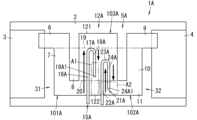
- FIG. FIG. 2 is a top view of a chip resistor according to the second embodiment of the present disclosure
- FIG. FIG. 3 is a top view of a chip resistor according to a third embodiment of the present disclosure
- FIG. FIG. 4 is a top view of a chip resistor according to a fourth embodiment of the present disclosure
- FIG. 5 is a top view of a chip resistor according to the fifth embodiment of the present disclosure
- FIG. 6 is a top view of a chip resistor according to the sixth embodiment of the present disclosure
- FIG. 7 is a top view of a chip resistor according to the seventh embodiment of the present disclosure
- a chip resistor according to an embodiment will be described below with reference to the drawings.
- Each drawing described in the following embodiments is a schematic drawing, and the ratio of the size and thickness of each component does not necessarily reflect the actual dimensional ratio.
- the configurations described in the following embodiments are merely examples of the present disclosure.
- the present disclosure is not limited to the following embodiments, and various modifications are possible according to design and the like as long as the effects of the present disclosure can be achieved.
- the chip resistor 1 has an insulating substrate 2 (an example of a substrate), a first electrode 3 , a second electrode 4 and a resistor 5 .
- the insulating substrate 2 is made of, for example, alumina containing 96% Al 2 O 3 and has a rectangular shape (rectangular when viewed from above).
- the horizontal direction in FIG. 1 is defined as the longitudinal direction
- the vertical direction in FIG. 1 is defined as the lateral direction. 1 is the first side in the longitudinal direction
- the left side in FIG. 1 is the second side in the longitudinal direction
- the upper side in FIG. 1 is the first side in the transverse direction
- the lower side in FIG. side the longitudinal direction and the lateral direction are orthogonal to each other.
- the first electrode 3 and the second electrode 4 are provided at both ends in the longitudinal direction of the surface 2A of the insulating substrate 2, and are formed by printing and baking a thick film material containing metal such as silver.
- a pair of rear surface electrodes (not shown) are formed on the rear surface of the insulating substrate 2 so as to be spaced apart from each other by a predetermined distance.
- an edge electrode (not shown) for electrically connecting the first electrode 3 and a back electrode (not shown) is provided on the outer surface of the insulating substrate 2 in the longitudinal direction.
- an edge electrode (not shown) is provided to electrically connect the second electrode 4 and a back electrode (not shown).
- the resistor 5 is formed by printing a thick film material made of copper nickel, silver palladium, or ruthenium oxide between the first electrode 3 and the second electrode 4 on the surface 2A of the insulating substrate 2, and then baking the material. and connected to the first electrode 3 and the second electrode 4 .
- both ends of the resistor 5 are formed on the upper surfaces of both ends of the first electrode 3 and the second electrode 4, but they may be formed on the lower surfaces of both ends.
- the resistor 5 has a first connection portion 31 , a second connection portion 32 and a resistance value adjustment portion 12 .
- the resistance adjusting part 12 is arranged in the middle of the insulating substrate 2 in the longitudinal direction, that is, separated between the first electrode 3 and the second electrode 4 .
- the resistance value adjustment portion 12 is a portion where the resistance value of the resistor 5 is adjusted by laser trimming, as will be described later.
- the edge on the first side in the short direction of the resistance value adjusting portion 12 is called a first edge 121
- the edge on the second side in the short direction is called a second edge 122 .
- the first connecting portion 31 includes a first rectangular portion 6 , a second rectangular portion 7 and a third rectangular portion 8 .
- the first rectangular portion 6 is connected to the first side portion of the first electrode 3 in the transverse direction and extends to the first side in the longitudinal direction.
- the second rectangular portion 7 extends from the tip of the first rectangular portion 6 to the second side in the transverse direction.
- the third rectangular portion 8 extends from the tip of the second rectangular portion 7 to the first side in the longitudinal direction and is connected to the resistance value adjusting portion 12 .
- the second connecting portion 32 includes a fourth rectangular portion 9 , a fifth rectangular portion 10 and a sixth rectangular portion 11 .
- the fourth rectangular portion 9 is connected to the first side portion of the second electrode 4 in the transverse direction and extends to the second side in the longitudinal direction.
- the fifth rectangular portion 10 extends from the tip of the fourth rectangular portion 9 to the second side in the transverse direction.
- the sixth rectangular portion 11 extends from the tip of the fifth rectangular portion 10 to the second longitudinal side and is connected to the resistance value adjusting portion 12 .
- a trimming groove 15 (an example of a meandering groove) is formed in the resistance value adjusting portion 12 .
- the trimming groove 15 is a groove for forming the resistance value adjusting portion 12 into a meandering shape.
- the trimming groove 15 includes a first straight portion 16 (an example of a straight portion) extending from the second edge 122 of the resistance value adjusting portion 12 to the first side in the short direction, and a first side end of the first straight portion 16 in the short direction. It has a folded portion 17 (an example of a folded portion) formed in the .
- the first linear portion 16 extends in the lateral direction.
- the folded portion 17 has a semicircular arc shape in a plan view from the thickness direction of the insulating substrate 2 .
- the trimming groove 15 further has a second straight portion 18 extending from the folded portion 17 so as to fold back with respect to the first straight portion 16 .
- the second straight portion 18 extends parallel to the first straight portion 16 .
- the first rectangular portion 6, the second rectangular portion 7, the third rectangular portion 8, and the resistance value adjusting portion 12 form a first turn 101 folded back to the first side in the short direction.
- the fourth rectangular portion 9, the fifth rectangular portion 10, the sixth rectangular portion 11, and the resistance value adjusting portion 12 form a second turn 102 folded back to the first side in the width direction.
- the trimming groove 15 forms a third turn 103 folded back to the second side in the short direction.
- a current path having the same width as that of the first rectangular portion 6 and the fourth rectangular portion 9 is formed near the first edge 121 side of the resistance value adjustment portion 12.
- position at or near imaginary extension line 19 extending in the longitudinal direction from the second lateral side edge of first rectangular portion 6 and fourth rectangular portion 9.
- the terminal end 181 of the second straight portion 18 is located within the resistance value adjusting portion 12 relative to the imaginary extension line 20 extending in the longitudinal direction from the first lateral side edges of the third rectangular portion 8 and the sixth rectangular portion 11 . It is located on the first side in the short direction.
- the position of the terminal end 181 of the second linear portion 18 is located at a place where the influence of the resistance value is small. Therefore, the reliability of the load characteristics of the resistor 5 is improved.
- the location where the resistance value is less affected is the portion where the current distribution density is low in the resistance value adjusting section 12 .
- the current distribution density is high near the farthest portion (in this embodiment, the folded portion 17) in the extending direction of the trimming groove, so it is preferable that the terminal end 181 is deviated therefrom, and more preferably further apart.
- the second linear portion 18 is extended so that the terminal end 181 is positioned on the second side in the short direction from the center of the resistance value adjusting portion 12 in the short direction.
- electrode paste is screen-printed on both ends of the insulating substrate 2 made of alumina in the longitudinal direction and fired at 850°C to form the first electrode 3 and the second electrode 4. do.
- a resistor paste is screen-printed between the first electrode 3 and the second electrode 4 and fired at 850° C. to form the resistor 5 .
- a trimming groove 15 is formed in order to form the resistance value adjusting portion 12 into a meandering shape by laser trimming.
- the resistor 5 has a meandering shape with three turns.
- the arrow (black) in FIG. 1 indicates the direction of laser trimming.
- the trimming groove 15 since the trimming groove 15 has the folded portion 17, microcracks are less likely to occur in the forwardmost portion of the trimming groove 15 in the extending direction.
- the folded portion 17 since the folded portion 17 has a semicircular arc shape, the above effect is enhanced.
- the terminal end 181 of the trimming groove 15 can be arranged at a position away from the folded portion 17 in the lateral direction. Since the terminal end 181 of the second linear portion 18 is arranged at a position where the influence of the resistance value is small in the resistance value adjusting portion 12 in this way, even if a microcrack occurs near the terminal end 181, the resistance value does not easily fluctuate.
- the second embodiment discloses a chip resistor 1A in which one resistance adjusting groove is formed in the resistor in addition to the meandering forming groove.
- it since it demonstrates centering around difference with 1st Embodiment, it abbreviate
- a first trimming groove 15A (an example of a meandering groove) is formed in the resistance value adjusting portion 12A.
- the first trimming groove 15A is a groove for forming the resistance value adjusting portion 12A into a meandering shape.
- the first trimming groove 15A includes a first linear portion 16A (an example of a linear portion) extending from a second edge 122 of the resistance value adjusting portion 12A to the first side in the short direction, and a first straight portion 16A extending in the first width direction of the first straight portion 16A. and a first folded portion 17A (an example of a folded portion) formed at the side end.
- the first linear portion 16A extends in the lateral direction.
- the first folded portion 17A has a semicircular arc shape when viewed from above in the thickness direction of the insulating substrate 2 .
- the first trimming groove 15A further has a second straight portion 18A extending from the first folded portion 17A so as to fold back with respect to the first straight portion 16A.
- the second straight portion 18A extends parallel to the first straight portion 16A.
- the first rectangular portion 6, the second rectangular portion 7, the third rectangular portion 8, and the resistance value adjusting portion 12A form a first turn 101A folded back to the first side in the short direction.
- the fourth rectangular portion 9, the fifth rectangular portion 10, the sixth rectangular portion 11, and the resistance value adjusting portion 12A form a second turn 102A folded back to the first side in the short direction.
- the first trimming groove 15A forms a third turn 103A that folds back to the second side in the transverse direction.
- a second trimming groove 21A (an example of a resistance value adjusting groove) is formed in the resistance value adjusting portion 12A of the chip resistor 1A.
- the second trimming groove 21A is a groove for adjusting the resistance value of the resistance value adjusting portion 12A.
- 21 A of 2nd trimming grooves are arrange
- the second trimming groove 21A includes a third linear portion 22A (an example of a resistance value adjusting linear portion) extending from the second edge 122 of the resistance value adjusting portion 12A to the first side in the width direction, and a short portion of the third linear portion 22A. and a second folded portion 23A (an example of a folded portion for resistance value adjustment) formed at the first side end in the hand direction.
- the third linear portion 22A extends in the lateral direction.
- the second folded portion 23A has a semicircular arc shape in a plan view from the thickness direction of the insulating substrate 2 .
- the second trimming groove 21A further has a fourth straight portion 24A that extends from the second folded portion 23A so as to fold back with respect to the third straight portion 22A.
- the fourth straight portion 24A extends parallel to the third straight portion 22A.
- the position of the apex of the first folded portion 17A of the first trimming groove 15A in the lateral direction is such that the current path having the same width as the first rectangular portion 6 and the fourth rectangular portion 9 is the resistance value adjusting portion 12A. (the same position as or near the imaginary extension line 19 of the second side edge in the short direction of the first rectangular portion 6 and the fourth rectangular portion 9).
- the terminal end 18A1 of the second straight portion 18A is located within the resistance value adjusting portion 12A relative to the imaginary extension line 20 extending in the longitudinal direction from the first lateral side edges of the third rectangular portion 8 and the sixth rectangular portion 11. It is located on the first side in the short direction.
- the area A1 is set as a place where the influence of the resistance value is small.
- a region A1 is a region from the center of the resistance value adjusting portion 12A in the short direction to the second edge 122. As shown in FIG. That is, the terminal end 18A1 is preferably located on the second side in the widthwise direction of the center of the resistance value adjustment portion 12A in the widthwise direction.
- the apex of the second folded portion 23A of the second trimming groove 21A is located on the second side in the transverse direction from the apex of the first folded portion 17A of the first trimming groove 15A. Further, the terminal end 24A1 of the fourth linear portion 24A is located on the second side in the short direction of the imaginary extension line 20 in the resistance value adjusting portion 12A.
- a region A2 is set as a place where the influence of the resistance value is small.
- a region A2 is a region from the imaginary extension line 20 to the second edge 122 .
- a third embodiment will be described with reference to FIG.
- the third embodiment discloses a chip resistor 1B in which two resistance adjusting grooves are formed in the resistor in addition to the meandering grooves.
- symbol is attached
- the first connecting portion 31 is the same as in the first and second embodiments, but the second connecting portion 32B is different from the first and second embodiments, and only the rectangular portion 9B is consists of The rectangular portion 9B is connected to the second lateral side portion of the resistance value adjusting portion 12B.
- a first trimming groove 15B (an example of a meandering groove) is formed in the resistance value adjusting portion 12B of the chip resistor 1B.
- the first trimming groove 15B is a groove for forming the resistance value adjusting portion 12B into a meandering shape.
- the first trimming groove 15B includes a first straight portion 16B (an example of a straight portion) extending from the second edge 122 of the resistance value adjusting portion 12B to the first side in the short direction, and a first straight portion 16B extending in the first short direction of the first straight portion 16B. and a first folded portion 17B (an example of a folded portion) formed at the side end.
- the first linear portion 16B extends in the lateral direction.
- the first folded portion 17B has a semi-circular arc shape when viewed from above in the thickness direction of the insulating substrate 2 .
- the first trimming groove 15B further has a second straight portion 18B that extends from the first folded portion 17B so as to fold back with respect to the first straight portion 16B.
- the second straight portion 18B extends parallel to the first straight portion 16B.
- the second linear portion 18B has a terminal end 18B1 within the resistance value adjusting portion 12B.
- a second trimming groove 21B (an example of a resistance value adjusting groove) is formed in the resistance value adjusting portion 12B of the chip resistor 1A.
- the second trimming groove 21B is a groove for adjusting the resistance value of the resistance value adjusting portion 12B.
- the second trimming groove 21B includes a third straight portion 22B (an example of a resistance value adjusting straight portion) extending from the first edge 121 of the resistance value adjusting portion 12B to the second side in the short direction, and a short length of the third straight portion 22B. and a second folded portion 23B (an example of a folded portion for resistance value adjustment) formed at the second side end in the hand direction.
- the second folded portion 23B has a semicircular arc shape in a plan view from the thickness direction of the insulating substrate 2 .
- the second trimming groove 21B further has a fourth straight portion 24B extending from the second folded portion 23B so as to fold back toward the third straight portion 22B.
- the fourth straight portion 24B extends parallel to the third straight portion 22B.
- the fourth linear portion 24B has a terminal end 24B1 within the resistance value adjusting portion 12B.
- a third trimming groove 25B (an example of a resistance value adjusting groove) is formed in the resistance value adjusting portion 12B of the chip resistor 1B.
- the third trimming groove 25B is a groove for adjusting the resistance value of the resistance value adjusting portion 12B.
- the third trimming groove 25B includes a fifth linear portion 26B (an example of a resistance value adjusting linear portion) extending from the second edge 122 of the resistance value adjusting portion 12B to the first side in the transverse direction, and a short portion of the fifth linear portion 26B. and a third folded portion 27B (an example of a folded portion for resistance value adjustment) formed at the first side end in the hand direction.
- the fifth straight portion 26B extends in the lateral direction.
- the third folded portion 27B has a semicircular arc shape when viewed from the thickness direction of the insulating substrate 2 in a plan view.
- the third trimming groove 25B further has a sixth straight portion 28B that extends from the third folded portion 27B so as to fold toward the fifth straight portion 26B.
- the sixth straight portion 28B extends parallel to the fifth straight portion 26B.
- the sixth linear portion 28B has a terminal end 28B1 within the resistance value adjusting portion 12B.
- the lateral position of the vertex 17B1 of the first folded portion 17B of the first trimming groove 15B is such that the current path having the same width as that of the first rectangular portion 6 is the first edge 121 of the resistance value adjusting portion 12B. It is a position formed in the vicinity of the side (a position that is the same as or near the imaginary extension line 19 extending in the longitudinal direction from the second lateral side edge of the first rectangular portion 6).
- the terminal end 18B1 of the second straight portion 18B is located in the resistance value adjusting portion 12B in the short direction from the imaginary extension line 20 extending in the longitudinal direction from the first side edge in the short direction of the third rectangular portion 8 and the rectangular portion 9B. It is located on the second side of the direction.
- the area B1 is set as a place where the influence of the resistance value is small.
- a region B ⁇ b>1 is a region from the imaginary extension line 20 to the second edge 122 .
- a current path having the same width as that of the third rectangular portion 8 and the rectangular portion 9B is formed near the second edge 122 of the resistance value adjusting portion 12B at the lateral position of the vertex of the second folded portion 23B of the second trimming groove 21B. (the same position as or near the imaginary extension line 19 extending in the longitudinal direction from the first side edge in the short direction of the third rectangular portion 8 and the rectangular portion 9B).
- a terminal end 24B1 of the fourth linear portion 24B is located on the first side in the short direction of the imaginary extension line 19 in the resistance value adjusting portion 12B.
- a region B2 is set as a place where the influence of the resistance value is small.
- a region B ⁇ b>2 is a region from the imaginary extension line 19 to the first edge 121 .
- the lateral position of the vertex of the third folded portion 27B of the third trimming groove 25B is on the first side in the lateral direction of the vertex of the second folded portion 23B of the second trimming groove 21B.
- a terminal end 28B1 of the sixth straight portion 28B is located within the region B1. Therefore, it is possible to suppress the resistance value fluctuation after the resistance value correction, thereby improving the resistance value accuracy.
- the folded portion of the trimming groove is not limited to a semicircular arc shape. However, it is preferable that the folded portion has no corners and is smooth.
- the folding side (which side in the lateral direction) of the folding portion of the trimming groove is not particularly limited.
- the number of trimming grooves is not particularly limited.
- the direction in which the plurality of trimming grooves extend is not particularly limited.
- the length and thickness of the trimming groove are not particularly limited.
- the presence or absence and length of the second straight portion are not particularly limited.
- At least one of the plurality of trimming grooves must have a folded portion, but there may be trimming grooves that do not have a folded portion.
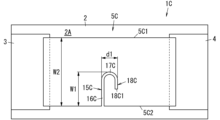
- the chip resistor 1C has an insulating substrate 2 (an example of a substrate), a first electrode 3, a second electrode 4, and a resistor 5C.
- the insulating substrate 2 is made of, for example, alumina containing 96% Al 2 O 3 and has a rectangular shape (rectangular when viewed from above).
- the horizontal direction in FIG. 4 is defined as the longitudinal direction
- the vertical direction in FIG. 4 is the first side in the longitudinal direction
- the left side in FIG. 4 is the second side in the longitudinal direction
- the upper side in FIG. 4 is the first side in the transverse direction
- the lower side in FIG. side is orthogonal to each other.
- the first electrode 3 and the second electrode 4 are provided at both ends in the longitudinal direction of the surface 2A of the insulating substrate 2, and are formed by printing and baking a thick film material containing metal such as silver.
- a pair of rear surface electrodes (not shown) are formed on the rear surface of the insulating substrate 2 so as to be spaced apart from each other by a predetermined distance.
- an edge electrode (not shown) for electrically connecting the first electrode 3 and a back electrode (not shown) is provided on the outer surface of the insulating substrate 2 in the longitudinal direction.
- an edge electrode (not shown) is provided to electrically connect the second electrode 4 and a back electrode (not shown).
- the resistor 5C is formed by printing a thick film material made of copper nickel, silver palladium, or ruthenium oxide between the first electrode 3 and the second electrode 4 on the surface 2A of the insulating substrate 2, and then baking the material. and connected to the first electrode 3 and the second electrode 4 .
- both ends of the resistor 5C are formed on the upper surfaces of both ends of the first electrode 3 and the second electrode 4, but they may be formed on the lower surfaces of both ends.
- the resistor 5C is arranged in the middle of the insulating substrate 2 in the longitudinal direction, that is, between the first electrode 3 and the second electrode 4 .
- 5 C of resistors are rectangles elongated in the left-right direction in top view.
- the resistance value of the resistor 5C is adjusted by laser trimming as will be described later.
- the edge on the first side in the short direction of the resistor 5D is defined as the first edge 5C1
- the edge on the second side in the short direction is the second edge 5C2 (an example of an edge along the direction in which the pair of electrodes are arranged in the resistor). ).
- a trimming groove 15C is formed in the resistor 5C.
- the trimming groove 15C is formed at the first straight portion 16C (an example of the straight portion) extending from the second edge 5C2 of the resistor 5C to the first side in the short direction, and at the first side end in the short direction of the first straight portion 16C.
- folded portion 17C (an example of the folded portion).
- the first linear portion 16C extends in the lateral direction.
- the folded portion 17C has a shape having a curvature in plan view from the thickness direction of the insulating substrate 2 .
- a conventional chip resistor for example, in the case of an I-shaped trimming groove, current concentration occurs near the tip of the trimming groove, and heat is generated in the narrowed portion of the resistance path, resulting in deterioration of the resistor. , and as a result, there is a problem that the pulse characteristics are deteriorated.
- power concentration occurs at the corners and near the tip of the L-shape, and heat is generated in the narrowed portion of the resistance path. There was a problem that the body deteriorated and, as a result, the pulse characteristics deteriorated.
- the trimming groove 15C has the first straight portion 16C and the bent portion 17C having a curvature, so that excessive load concentration can be prevented when current flows. A long correction length of the groove can be secured. Therefore, it is possible to realize a high resistance value correction magnification while improving load characteristics.
- the trimming groove 15C further has a second straight portion 18C extending from the folded portion 17C so as to fold back with respect to the first straight portion 16C.
- the second straight portion 18C extends parallel to the first straight portion 16C. Note that "the second straight portion 18C is parallel to the first straight portion 16C" includes a state of being inclined by 2 to 3 degrees.
- the resistance value can be precisely adjusted to a desired value by the second linear portion 18C while maintaining a high pulse resistance characteristic.
- the folded portion 17C includes an arc portion, and in the arc portion, the angle of the portion connected to the first straight portion 16C with respect to the first straight portion 16C exceeds 90 degrees and is 180 degrees or less. Due to the action of the arc portion of the folded portion 17C, load concentration is less likely to occur than in conventional chip resistors, and therefore the pulse characteristics of the chip resistor 1C are improved.
- the arc portion of the folded portion 17C includes a semicircle, and the diameter d1 of the semicircle is 1/10 or more of the width W2 (length in the lateral direction) of the resistor 5C.
- the length W1 of the trimming groove 15C is 75% or less of the width W2 of the resistor 5C.
- the position of the terminal end 18C1 of the second straight portion 18C is located at a place where the influence of the resistance value is small. Therefore, the reliability of load characteristics is improved in the resistor 5C.
- the place where the resistance value is less affected is the part where the current distribution density is low in the resistor 5C.
- the current distribution density is high near the farthest portion (in this embodiment, the folded portion 17C) of the trimming groove in the extending direction, so it is preferable that the terminal end 18C1 is deviated therefrom, and more preferably further apart.
- electrode paste is screen-printed on both longitudinal ends of the insulating substrate 2 made of alumina, and fired at, for example, 850°C to form the first electrode 3 and the second electrode 4. Form.
- a resistor paste is screen-printed between the first electrode 3 and the second electrode 4, and fired at 850°C to form the resistor 5C.
- a trimming groove 15C is formed in the resistor 5C by laser trimming.
- a fifth embodiment will be described with reference to FIG. A fifth embodiment discloses a chip resistor 1D in which two trimming grooves extend from the same edge of the resistor.
- description is suitably abbreviate
- a first trimming groove 15D1 (an example of a trimming groove) is formed in the resistor 5D.
- the first trimming groove 15D1 includes a first linear portion 16D1 (a linear portion, an example of the first linear portion) extending from the second edge 5D2 of the resistor 5D to the first side in the width direction, and a width of the first linear portion 16D1. and a first folded portion 17D1 (an example of a folded portion) formed at the first direction side end.
- the first folded portion 17D1 has a shape having a curvature in plan view from the thickness direction of the insulating substrate 2 .
- the first trimming groove 15D1 further has a second straight portion 18D1 (an example of a second straight portion) extending from the first folded portion 17D1 so as to fold back with respect to the first straight portion 16D1.
- the second straight portion 18D1 extends parallel to the first straight portion 16D1.
- a second trimming groove 15D2 (an example of a trimming groove) is formed in the resistor 5D of the chip resistor 1D.
- the second trimming groove 15D21 is arranged on the first longitudinal side (right side in FIG. 5) of the first trimming groove 15D1.
- the second trimming groove 15D2 includes a third linear portion 16D2 (a linear portion, an example of the first linear portion) extending from the second edge 5D2 of the resistor 5D to the first side in the width direction, and a width of the third linear portion 16D2. and a second folded portion 17D2 (an example of a folded portion) formed at the first direction side end.
- the third linear portion 16D2 extends in the lateral direction.
- the second folded portion 17D2 has a shape having a curvature in plan view from the thickness direction of the insulating substrate 2 .
- the first folded portion 17D1 of the first trimming groove 15D1 extends from the first straight portion 16D1 to the first side in the longitudinal direction
- the second folded portion 17D2 of the second trimming groove 15D2 extends from the third straight portion 16D2 in the longitudinal direction. extending to the second side. In other words, both folded portions are folded back to face each other.
- the second trimming groove 15D2 further has a fourth straight portion 18D2 (an example of a second straight portion) extending from the second folded portion 17D2 so as to fold back to the third straight portion 16D2.
- the fourth linear portion 24D1 extends parallel to the third linear portion 16D2.
- the chip resistor 1D since the chip resistor 1D has two trimming grooves, load concentration can be further suppressed. Therefore, the adjustment range of the resistance value of the chip resistor 1D is increased (the resistance value correction rate can be increased).
- the length of the second trimming groove 15D2 in the widthwise direction is shorter than the length of the first trimming groove 15D1 in the widthwise direction. Furthermore, the fourth straight portion 18D2 of the second trimming groove 15D2 is shorter than the second straight portion 18D1 of the first trimming groove 15D1.
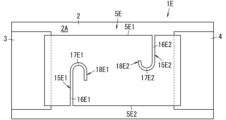
- FIG. 1E A sixth embodiment will be described with reference to FIG.
- the sixth embodiment discloses a chip resistor 1E with two trimming grooves extending from different edges of the resistor.
- description is suitably abbreviate
- a first trimming groove 15E1 (an example of a trimming groove) is formed in the resistor 5E.
- the first trimming groove 15E1 includes a first straight portion 16E1 (a straight portion, an example of the first straight portion) extending from the second edge 5E2 of the resistor 5E to the first side in the short direction, and a short side of the first straight portion 16E1. and a first folded portion 17E1 (an example of a folded portion) formed at the first direction side end.
- the first folded portion 17E1 has a shape having a curvature in plan view from the thickness direction of the insulating substrate 2 .
- the first trimming groove 15E1 further has a second straight portion 18E1 (an example of a second straight portion) extending from the first folded portion 17E1 so as to fold back with respect to the first straight portion 16E1.
- the second straight portion 18E1 extends parallel to the first straight portion 16E1.
- a second trimming groove 15E2 (an example of a trimming groove) is formed in the resistor 5E of the chip resistor 1E.
- the second trimming groove 15E2 is arranged on the first longitudinal side (right side in FIG. 6) of the first trimming groove 15E1.
- the second trimming groove 15E2 includes a third straight portion 16E2 (a straight portion, an example of the first straight portion) extending from the first edge 5E1 of the resistor 5E to the second side in the short direction, and a short side of the third straight portion 16E2. and a second folded portion 17E2 (an example of a folded portion) formed at the first direction side end.
- the third linear portion 16E2 extends in the lateral direction.
- the second folded portion 17E2 has a shape having a curvature in plan view from the thickness direction of the insulating substrate 2 .
- the first folded portion 17E1 of the first trimming groove 15E1 extends from the first straight portion 16E1 to the first side in the longitudinal direction
- the second folded portion 17E2 of the second trimming groove 15E2 extends from the third straight portion 16E2 in the longitudinal direction. extending to the second side. In other words, both folded portions are folded back toward each other.
- the second trimming groove 15E2 further has a fourth straight portion 18E2 (an example of a second straight portion) extending from the second folded portion 17E2 so as to fold back to the third straight portion 16E2.
- the fourth straight portion 18E2 extends parallel to the third straight portion 16E2.
- the chip resistor 1E has two trimming grooves, so load concentration can be further suppressed. Therefore, the adjustment range of the resistance value of the chip resistor 1E is increased (the resistance value correction rate can be increased).
- the two trimming grooves extend from different edges of the resistor 5E. Line length can be lengthened. As a result, the correction width of the resistance value can be doubled or longer.
- the folded portion of the trimming groove has a semicircular shape, but it is not limited to a semicircular shape as long as it has a curvature.
- the second straight portion of the trimming groove is parallel to the first straight portion, but the extending direction is not limited as long as it is folded back with respect to the first straight portion. .
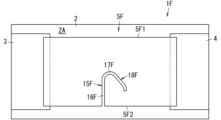
- a trimming groove 15F (an example of a trimming groove) is formed in the resistor 5F.
- the trimming groove 15F is formed at the first straight portion 16F (an example of the straight portion) extending from the second edge 5F2 of the resistor 5F to the first side in the short direction, and at the first side end in the short direction of the first straight portion 16F.
- folded portion 17F (an example of the folded portion).
- the folded portion 17 ⁇ /b>F has a shape having a curvature in plan view from the thickness direction of the insulating substrate 2 .
- the folded portion 17F includes an arc but is not semicircular.
- the trimming groove 15F further has a second straight portion 18F (an example of a second straight portion) extending from the folded portion 17F so as to fold back with respect to the first straight portion 16F.
- the second straight portion 18F extends at an angle with respect to the first straight portion 16F. Specifically, the second straight portion 18F separates from the first straight portion 16F toward the first side in the longitudinal direction as it goes to the second side in the short direction. It extends like
- the folded portion of the trimming groove is not limited to a semicircular shape.
- the folding side (which side in the lateral direction) of the folding portion of the trimming groove is not particularly limited.
- the number of trimming grooves is not particularly limited.
- the direction in which the plurality of trimming grooves extend is not particularly limited.
- the length and thickness of the trimming groove are not particularly limited.
- the presence or absence and length of the second straight portion are not particularly limited.
- At least one of the plurality of trimming grooves must have a folded portion, but there may be trimming grooves that do not have a folded portion.
- the folded portion may be formed separately.
- a chip resistor (1, 1A, 1B) according to the first aspect comprises a substrate (2), a pair of electrodes (3, 4), and resistors (5, 5A, 5B).
- a pair of electrodes (3, 4) are provided at both ends of one surface (2A) of the substrate (2).
- a resistor (5, 5A, 5B) is provided between a pair of electrodes (3, 4) on one surface (2A) of the substrate (2).
- the resistors (5, 5A, 5B) have a pair of connection portions (31, 32) and resistance value adjustment portions (12, 12A, 12B).
- a pair of connection portions (31, 32) are connected to a pair of electrodes (3, 4), respectively.
- the resistance value adjusting portions (12, 12A, 12B) are provided between the pair of connecting portions (31, 32).
- Meandering forming grooves (15, 15A, 15B) are formed in the resistance value adjusting portions (12, 12A, 12B) to form the resistance value adjusting portions (12, 12A, 12B) in a meandering shape.
- the meandering grooves (15, 15A, 15B) are composed of linear portions (16, 16A, 16B) extending from the edges (122) of the resistance value adjusting portions (12, 12A, 12B) and linear portions (16, 16A, 16B). and a folded portion (17, 17A, 17B) formed at one end of the .
- microcracks are formed in the furthest portions of the meandering grooves (15) in the extending direction. is less likely to occur.
- the folded portions (17, 17A, 17B) are semicircular in plan view from the thickness direction of the substrate (2). be.
- the folded portions (17, 17A, 17B) have a semicircular arc shape, microcracks are less likely to occur in the furthest portion of the extending direction of the meandering grooves (15, 15A, 15B).
- the meandering grooves (15, 15A, 15B) extend from the folded portions (17, 17A, 17B) as straight portions. It further has a second straight portion (18, 18A, 18B) extending so as to fold back with respect to the first straight portion (16, 16A, 16B).
- the second straight portions (18, 18A, 18B) have ends (181, 18A1, 18B1) within the resistance adjusting portions (12, 12A, 12B).
- the meandering grooves (15, 15A, 15B) have the second straight portions (18, 18A, 18B) extending from the folded portions (17, 17A, 17B)
- the meandering grooves ( 15, 15A, 15B) ends (181, 18A1, 18B1) can be arranged at positions separated in the lateral direction from the folded portions (17, 17A, 17B).
- the terminal ends (181, 18A1, 18B1) can be separated from the vicinity of the folded portions (17, 17A, 17B) where the current distribution density is high, so microcracks occurred near the terminal ends (181, 18A1, 18B1). Even if the
- the terminal end (181, 18A1, 18B1) of the second linear portion (18, 18A, 18B) is the resistance value adjusting portion (12 , 12A and 12B) at a position where the influence of the resistance value is small.
- the terminal ends (181, 18A1, 18B1) of the second linear portions (18, 18A, 18B) are arranged at positions where the influence of the resistance value is small in the resistance value adjusting portions (12, 12A, 12B). Therefore, even if microcracks occur near the ends (181, 18A1, 18B1), the resistance value does not fluctuate easily.
- the resistance value adjuster (12A, 12B) has the resistance value of the resistance value adjuster (12A, 12B) are formed with resistance value adjusting grooves (21A, 21B, 25B) for adjusting the .
- the resistance value adjusting grooves (21A, 21B, 25B) include resistance value adjusting linear portions (22A, 22B, 26B) extending from the edges (121, 122) of the resistance value adjusting portions (12A, 12B) and resistance value adjusting grooves (22A, 22B, 26B). It has folded portions (23A, 23B, 27B) for resistance value adjustment formed at one end of the linear portions (22A, 22B, 26B).
- the resistance value adjusting grooves (21A, 21B, 25B) have the resistance value adjusting folded portions (23A, 23B, 27B), the resistance value adjusting grooves (21A, 21B, 25B) Microcracks are less likely to occur at the farthest portion in the stretching direction.
- a chip resistor (1C, 1D, 1E, 1F) according to a sixth aspect comprises a substrate (2), a pair of electrodes (3, 4), and resistors (5C, 5D, 5E, 5F) there is A pair of electrodes (3, 4) are provided at both ends of one surface (2A) of the substrate (2). Resistors (5C, 5D, 5E, 5F) are provided between a pair of electrodes (3, 4) on one surface (2A) of the substrate (2). Trimming grooves (15C, 15D1, 15D2, 15E1, 15E2, 15F) are formed in the resistors (5C, 5D, 5E, 5F).
- the trimming grooves (15C, 15D1, 15D2, 15E1, 15E2, 15F) are the edges (5C2, 5D1, 5D2, 5E1, 5E2, 5C2, 5D1, 5D2, 5E1, 5E2, 5F2) extending from (16C, 16D1, 16D2, 16E1, 16E2, 16F), and formed at one end of the straight portions (16C, 16D1, 16D2, 16E1, 16E2, 16F) in the thickness direction of the substrate (2). It has folded portions (17C, 17D1, 17D2, 17E1, 17E2) that are folded so as to have a shape having a curvature when viewed from above.
- trimming grooves (15C, 15D1, 15D2, 15E1) having linear portions (16C, 16D1, 16D2, 16E1, 16E2, 16F) and curved folded portions (17C, 17D1, 17D2, 17E1, 17E2) , 15E2, 15F) provide good control of current flow in resistors (5C, 5D, 5E, 5F) and prevent excessive load concentration when current flows. As a result, the pulse resistance of the chip resistors (1C, 1D, 1E, 1F) is improved.
- the trimming grooves (15C, 15D1, 15D2, 15E1, 15E2) has a second linear portion (18C, 18D1, 18D2, 18E1, 18E2) extending parallel to the first linear portion as a linear portion (16C, 16D1, 16D2, 16E1, 16E2) from one end of the .
- the second linear portions (18C, 18D1, 18D2, 18E1, 18E2) can accurately adjust the resistance value to a desired value while maintaining high pulse resistance characteristics.
- the length (W1) of the trimming grooves (15C, 15D1, 15D2, 15E1, 15E2, 15F) is 75% or less of the length (W2) of the resistors (5C, 5D, 5E, 5F) be.
- a plurality of trimming grooves (15D1, 15D2, 15E1, 15E2) are formed.
- the chip resistors (1D, 1E) have a plurality of trimming grooves (15D1, 15D2, 15E1, 15E2), load concentration can be further suppressed. Therefore, the adjustment range of the resistance values of the chip resistors (1D, 1E) is increased.
- the plurality of trimming grooves (15E1, 15E2) are arranged along the direction in which the pair of electrodes (3, 4) of the resistor (5E) are aligned. extending from each of the two edges (5E1, 5E2).
- the resistor (5E) can be trimmed without causing large load concentrations.
- the meandering shape allows the line length to be lengthened. As a result, the correction width of the resistance value can be doubled or longer.
- the folded portion (17C, 17D1, 17D2, 17E1, 17E2, 17F) is at least partially It has an arc portion.
- the pulse resistance of the chip resistors (1C, 1D, 1E, 1F) is improved.
- the arc portions of the folded portions (17C, 17D1, 17D2, 17E1, 17E2, 17F) are linear portions (16C, 16D1 , 16D2, 16E1, 16E2, 16F) with respect to the straight line portion (16C, 16D1, 16D2, 16E1, 16E2, 16F) is more than 90 degrees and 180 degrees or less.
- the pulse resistance of the chip resistors (1C, 1D, 1E, 1F) is improved.
- the arc portion includes a semicircle.
- the diameter (D) of the semicircle is 1/10 or more of the length (W2) of the resistors (5C, 5D, 5E) in the direction crossing the direction in which the pair of electrodes (3, 4) are arranged.
- the pulse resistance of the chip resistors (1C, 1D, 1E) is improved.
- 1, 1A, 1B, 1C, 1D, 1E, 1F chip resistor 2: insulating substrate 2A: surface 3: first electrode 4: second electrode 5, 5A, 5B, 5C, 5D, 5E, 5F: resistor 12, 12A, 12B: resistance value adjusting portion 15: trimming grooves 15A, 15B, 15D1, 16E1: first trimming groove 15C: trimming grooves 15D2, 16E2: second trimming groove 16: first linear portions 16A, 16B, 16C, 16D1, 16E1: first straight portions 16D2, 16E2: third straight portions 17, 17C: folded portions 17A, 17B, 17D1, 17E1: first folded portions 17D2, 17E2: second folded portions 18, 18A, 18B, 18C, 18D1, 18E1: Second straight portions 18D2, 18E2: Fourth straight portions 181, 18A1, 18B1: Terminal ends 21A, 21B: Second trimming grooves 22A, 22B: Third straight portion 26B: Fifth straight portion 27B: Third folded back Part 28B: sixth straight part
Landscapes
- Engineering & Computer Science (AREA)
- Microelectronics & Electronic Packaging (AREA)
- Manufacturing & Machinery (AREA)
- Physics & Mathematics (AREA)
- Electromagnetism (AREA)
- Apparatuses And Processes For Manufacturing Resistors (AREA)
- Non-Adjustable Resistors (AREA)
Priority Applications (2)
| Application Number | Priority Date | Filing Date | Title |
|---|---|---|---|
| CN202380018589.5A CN118591847A (zh) | 2022-01-31 | 2023-01-26 | 片式电阻器 |
| JP2023576965A JPWO2023145802A1 (cg-RX-API-DMAC7.html) | 2022-01-31 | 2023-01-26 |
Applications Claiming Priority (4)
| Application Number | Priority Date | Filing Date | Title |
|---|---|---|---|
| JP2022-013571 | 2022-01-31 | ||
| JP2022013571 | 2022-01-31 | ||
| JP2022030474 | 2022-02-28 | ||
| JP2022-030474 | 2022-02-28 |
Publications (1)
| Publication Number | Publication Date |
|---|---|
| WO2023145802A1 true WO2023145802A1 (ja) | 2023-08-03 |
Family
ID=87471490
Family Applications (1)
| Application Number | Title | Priority Date | Filing Date |
|---|---|---|---|
| PCT/JP2023/002378 Ceased WO2023145802A1 (ja) | 2022-01-31 | 2023-01-26 | チップ抵抗器 |
Country Status (2)
| Country | Link |
|---|---|
| JP (1) | JPWO2023145802A1 (cg-RX-API-DMAC7.html) |
| WO (1) | WO2023145802A1 (cg-RX-API-DMAC7.html) |
Cited By (1)
| Publication number | Priority date | Publication date | Assignee | Title |
|---|---|---|---|---|
| WO2025204058A1 (ja) * | 2024-03-25 | 2025-10-02 | パナソニックIpマネジメント株式会社 | チップ抵抗器及びチップ抵抗器の製造方法 |
Citations (5)
| Publication number | Priority date | Publication date | Assignee | Title |
|---|---|---|---|---|
| JPH1140401A (ja) * | 1997-07-22 | 1999-02-12 | Rohm Co Ltd | チップ抵抗器及びそのレーザートリミング方法 |
| JPH11126701A (ja) * | 1987-10-22 | 1999-05-11 | Hokuriku Electric Ind Co Ltd | チップ抵抗器 |
| JP2000012305A (ja) * | 1998-04-22 | 2000-01-14 | Kamaya Denki Kk | チップ形ヒューズ抵抗器 |
| JP2002033203A (ja) * | 2000-07-13 | 2002-01-31 | K-Tech Devices Corp | 複合電子部品 |
| JP2018026519A (ja) * | 2016-08-11 | 2018-02-15 | サムソン エレクトロ−メカニックス カンパニーリミテッド. | チップ抵抗素子及びチップ抵抗素子アセンブリー |
-
2023
- 2023-01-26 WO PCT/JP2023/002378 patent/WO2023145802A1/ja not_active Ceased
- 2023-01-26 JP JP2023576965A patent/JPWO2023145802A1/ja active Pending
Patent Citations (5)
| Publication number | Priority date | Publication date | Assignee | Title |
|---|---|---|---|---|
| JPH11126701A (ja) * | 1987-10-22 | 1999-05-11 | Hokuriku Electric Ind Co Ltd | チップ抵抗器 |
| JPH1140401A (ja) * | 1997-07-22 | 1999-02-12 | Rohm Co Ltd | チップ抵抗器及びそのレーザートリミング方法 |
| JP2000012305A (ja) * | 1998-04-22 | 2000-01-14 | Kamaya Denki Kk | チップ形ヒューズ抵抗器 |
| JP2002033203A (ja) * | 2000-07-13 | 2002-01-31 | K-Tech Devices Corp | 複合電子部品 |
| JP2018026519A (ja) * | 2016-08-11 | 2018-02-15 | サムソン エレクトロ−メカニックス カンパニーリミテッド. | チップ抵抗素子及びチップ抵抗素子アセンブリー |
Cited By (1)
| Publication number | Priority date | Publication date | Assignee | Title |
|---|---|---|---|---|
| WO2025204058A1 (ja) * | 2024-03-25 | 2025-10-02 | パナソニックIpマネジメント株式会社 | チップ抵抗器及びチップ抵抗器の製造方法 |
Also Published As
| Publication number | Publication date |
|---|---|
| JPWO2023145802A1 (cg-RX-API-DMAC7.html) | 2023-08-03 |
Similar Documents
| Publication | Publication Date | Title |
|---|---|---|
| TWI701687B (zh) | 矩形片式電阻器及其製造方法 | |
| US9583242B2 (en) | Resistive voltage divider with high voltage ratio | |
| WO2023145802A1 (ja) | チップ抵抗器 | |
| US7049928B2 (en) | Resistor and method of manufacturing the same | |
| JP2019079963A (ja) | チップ抵抗器およびチップ抵抗器の製造方法 | |
| CN115206609B (zh) | 片式电阻器和片式电阻器的制造方法 | |
| JP3138631B2 (ja) | チップ抵抗器及びその製造方法 | |
| CN118591847A (zh) | 片式电阻器 | |
| JP2009141171A (ja) | チップ抵抗器 | |
| JP7491727B2 (ja) | シャント抵抗器 | |
| JPH08288111A (ja) | 抵抗体のトリミング方法 | |
| JP2017152431A (ja) | チップ抵抗器 | |
| JP4212457B2 (ja) | 抵抗器 | |
| JP2001203101A (ja) | 抵抗器 | |
| KR20060069350A (ko) | 칩 저항기와 그 제조방법 | |
| JP4674403B2 (ja) | 抵抗器 | |
| JP2005093717A (ja) | チップ抵抗器とその製造方法 | |
| JP6220646B2 (ja) | チップ抵抗器とその製造方法 | |
| JPWO2024162186A5 (ja) | チップ抵抗器、及びチップ抵抗器の製造方法 | |
| JP7636965B2 (ja) | チップ抵抗器 | |
| CN120476454A (zh) | 片式电阻器 | |
| JP2007142165A (ja) | チップ抵抗器とその製造方法 | |
| JP2024091145A (ja) | チップ抵抗器 | |
| JP2019046879A (ja) | チップ抵抗器の製造方法 | |
| WO2025204058A1 (ja) | チップ抵抗器及びチップ抵抗器の製造方法 |
Legal Events
| Date | Code | Title | Description |
|---|---|---|---|
| 121 | Ep: the epo has been informed by wipo that ep was designated in this application |
Ref document number: 23747012 Country of ref document: EP Kind code of ref document: A1 |
|
| ENP | Entry into the national phase |
Ref document number: 2023576965 Country of ref document: JP Kind code of ref document: A |
|
| WWE | Wipo information: entry into national phase |
Ref document number: 202380018589.5 Country of ref document: CN |
|
| NENP | Non-entry into the national phase |
Ref country code: DE |
|
| 122 | Ep: pct application non-entry in european phase |
Ref document number: 23747012 Country of ref document: EP Kind code of ref document: A1 |