WO2023145737A1 - 近赤外線吸収粒子、近赤外線吸収粒子の製造方法、近赤外線吸収粒子分散液、近赤外線吸収粒子分散体、近赤外線吸収積層体、近赤外線吸収透明基材 - Google Patents
近赤外線吸収粒子、近赤外線吸収粒子の製造方法、近赤外線吸収粒子分散液、近赤外線吸収粒子分散体、近赤外線吸収積層体、近赤外線吸収透明基材 Download PDFInfo
- Publication number
- WO2023145737A1 WO2023145737A1 PCT/JP2023/002130 JP2023002130W WO2023145737A1 WO 2023145737 A1 WO2023145737 A1 WO 2023145737A1 JP 2023002130 W JP2023002130 W JP 2023002130W WO 2023145737 A1 WO2023145737 A1 WO 2023145737A1
- Authority
- WO
- WIPO (PCT)
- Prior art keywords
- infrared absorbing
- particle dispersion
- resin
- absorbing particles
- particles
- Prior art date
- Legal status (The legal status is an assumption and is not a legal conclusion. Google has not performed a legal analysis and makes no representation as to the accuracy of the status listed.)
- Ceased
Links
Images


Classifications
-
- G—PHYSICS
- G02—OPTICS
- G02B—OPTICAL ELEMENTS, SYSTEMS OR APPARATUS
- G02B5/00—Optical elements other than lenses
- G02B5/20—Filters
- G02B5/208—Filters for use with infrared or ultraviolet radiation, e.g. for separating visible light from infrared and/or ultraviolet radiation
-
- C—CHEMISTRY; METALLURGY
- C01—INORGANIC CHEMISTRY
- C01G—COMPOUNDS CONTAINING METALS NOT COVERED BY SUBCLASSES C01D OR C01F
- C01G41/00—Compounds of tungsten
-
- C—CHEMISTRY; METALLURGY
- C09—DYES; PAINTS; POLISHES; NATURAL RESINS; ADHESIVES; COMPOSITIONS NOT OTHERWISE PROVIDED FOR; APPLICATIONS OF MATERIALS NOT OTHERWISE PROVIDED FOR
- C09C—TREATMENT OF INORGANIC MATERIALS, OTHER THAN FIBROUS FILLERS, TO ENHANCE THEIR PIGMENTING OR FILLING PROPERTIES ; PREPARATION OF CARBON BLACK ; PREPARATION OF INORGANIC MATERIALS WHICH ARE NO SINGLE CHEMICAL COMPOUNDS AND WHICH ARE MAINLY USED AS PIGMENTS OR FILLERS
- C09C1/00—Treatment of specific inorganic materials other than fibrous fillers; Preparation of carbon black
- C09C1/0081—Composite particulate pigments or fillers, i.e. containing at least two solid phases, except those consisting of coated particles of one compound
-
- C—CHEMISTRY; METALLURGY
- C09—DYES; PAINTS; POLISHES; NATURAL RESINS; ADHESIVES; COMPOSITIONS NOT OTHERWISE PROVIDED FOR; APPLICATIONS OF MATERIALS NOT OTHERWISE PROVIDED FOR
- C09D—COATING COMPOSITIONS, e.g. PAINTS, VARNISHES OR LACQUERS; FILLING PASTES; CHEMICAL PAINT OR INK REMOVERS; INKS; CORRECTING FLUIDS; WOODSTAINS; PASTES OR SOLIDS FOR COLOURING OR PRINTING; USE OF MATERIALS THEREFOR
- C09D133/00—Coating compositions based on homopolymers or copolymers of compounds having one or more unsaturated aliphatic radicals, each having only one carbon-to-carbon double bond, and at least one being terminated by only one carboxyl radical, or of salts, anhydrides, esters, amides, imides, or nitriles thereof; Coating compositions based on derivatives of such polymers
- C09D133/04—Homopolymers or copolymers of esters
-
- C—CHEMISTRY; METALLURGY
- C09—DYES; PAINTS; POLISHES; NATURAL RESINS; ADHESIVES; COMPOSITIONS NOT OTHERWISE PROVIDED FOR; APPLICATIONS OF MATERIALS NOT OTHERWISE PROVIDED FOR
- C09D—COATING COMPOSITIONS, e.g. PAINTS, VARNISHES OR LACQUERS; FILLING PASTES; CHEMICAL PAINT OR INK REMOVERS; INKS; CORRECTING FLUIDS; WOODSTAINS; PASTES OR SOLIDS FOR COLOURING OR PRINTING; USE OF MATERIALS THEREFOR
- C09D5/00—Coating compositions, e.g. paints, varnishes or lacquers, characterised by their physical nature or the effects produced; Filling pastes
- C09D5/32—Radiation-absorbing paints
-
- C—CHEMISTRY; METALLURGY
- C09—DYES; PAINTS; POLISHES; NATURAL RESINS; ADHESIVES; COMPOSITIONS NOT OTHERWISE PROVIDED FOR; APPLICATIONS OF MATERIALS NOT OTHERWISE PROVIDED FOR
- C09D—COATING COMPOSITIONS, e.g. PAINTS, VARNISHES OR LACQUERS; FILLING PASTES; CHEMICAL PAINT OR INK REMOVERS; INKS; CORRECTING FLUIDS; WOODSTAINS; PASTES OR SOLIDS FOR COLOURING OR PRINTING; USE OF MATERIALS THEREFOR
- C09D7/00—Features of coating compositions, not provided for in group C09D5/00; Processes for incorporating ingredients in coating compositions
- C09D7/40—Additives
- C09D7/60—Additives non-macromolecular
- C09D7/61—Additives non-macromolecular inorganic
-
- C—CHEMISTRY; METALLURGY
- C09—DYES; PAINTS; POLISHES; NATURAL RESINS; ADHESIVES; COMPOSITIONS NOT OTHERWISE PROVIDED FOR; APPLICATIONS OF MATERIALS NOT OTHERWISE PROVIDED FOR
- C09D—COATING COMPOSITIONS, e.g. PAINTS, VARNISHES OR LACQUERS; FILLING PASTES; CHEMICAL PAINT OR INK REMOVERS; INKS; CORRECTING FLUIDS; WOODSTAINS; PASTES OR SOLIDS FOR COLOURING OR PRINTING; USE OF MATERIALS THEREFOR
- C09D7/00—Features of coating compositions, not provided for in group C09D5/00; Processes for incorporating ingredients in coating compositions
- C09D7/40—Additives
- C09D7/66—Additives characterised by particle size
- C09D7/67—Particle size smaller than 100 nm
-
- C—CHEMISTRY; METALLURGY
- C09—DYES; PAINTS; POLISHES; NATURAL RESINS; ADHESIVES; COMPOSITIONS NOT OTHERWISE PROVIDED FOR; APPLICATIONS OF MATERIALS NOT OTHERWISE PROVIDED FOR
- C09D—COATING COMPOSITIONS, e.g. PAINTS, VARNISHES OR LACQUERS; FILLING PASTES; CHEMICAL PAINT OR INK REMOVERS; INKS; CORRECTING FLUIDS; WOODSTAINS; PASTES OR SOLIDS FOR COLOURING OR PRINTING; USE OF MATERIALS THEREFOR
- C09D7/00—Features of coating compositions, not provided for in group C09D5/00; Processes for incorporating ingredients in coating compositions
- C09D7/40—Additives
- C09D7/66—Additives characterised by particle size
- C09D7/68—Particle size between 100-1000 nm
-
- C—CHEMISTRY; METALLURGY
- C09—DYES; PAINTS; POLISHES; NATURAL RESINS; ADHESIVES; COMPOSITIONS NOT OTHERWISE PROVIDED FOR; APPLICATIONS OF MATERIALS NOT OTHERWISE PROVIDED FOR
- C09K—MATERIALS FOR MISCELLANEOUS APPLICATIONS, NOT PROVIDED FOR ELSEWHERE
- C09K3/00—Materials not provided for elsewhere
-
- G—PHYSICS
- G02—OPTICS
- G02B—OPTICAL ELEMENTS, SYSTEMS OR APPARATUS
- G02B5/00—Optical elements other than lenses
- G02B5/20—Filters
- G02B5/206—Filters comprising particles embedded in a solid matrix
-
- C—CHEMISTRY; METALLURGY
- C01—INORGANIC CHEMISTRY
- C01P—INDEXING SCHEME RELATING TO STRUCTURAL AND PHYSICAL ASPECTS OF SOLID INORGANIC COMPOUNDS
- C01P2002/00—Crystal-structural characteristics
- C01P2002/50—Solid solutions
- C01P2002/52—Solid solutions containing elements as dopants
-
- C—CHEMISTRY; METALLURGY
- C01—INORGANIC CHEMISTRY
- C01P—INDEXING SCHEME RELATING TO STRUCTURAL AND PHYSICAL ASPECTS OF SOLID INORGANIC COMPOUNDS
- C01P2002/00—Crystal-structural characteristics
- C01P2002/70—Crystal-structural characteristics defined by measured X-ray, neutron or electron diffraction data
- C01P2002/72—Crystal-structural characteristics defined by measured X-ray, neutron or electron diffraction data by d-values or two theta-values, e.g. as X-ray diagram
-
- C—CHEMISTRY; METALLURGY
- C01—INORGANIC CHEMISTRY
- C01P—INDEXING SCHEME RELATING TO STRUCTURAL AND PHYSICAL ASPECTS OF SOLID INORGANIC COMPOUNDS
- C01P2002/00—Crystal-structural characteristics
- C01P2002/70—Crystal-structural characteristics defined by measured X-ray, neutron or electron diffraction data
- C01P2002/76—Crystal-structural characteristics defined by measured X-ray, neutron or electron diffraction data by a space-group or by other symmetry indications
-
- C—CHEMISTRY; METALLURGY
- C01—INORGANIC CHEMISTRY
- C01P—INDEXING SCHEME RELATING TO STRUCTURAL AND PHYSICAL ASPECTS OF SOLID INORGANIC COMPOUNDS
- C01P2004/00—Particle morphology
- C01P2004/01—Particle morphology depicted by an image
- C01P2004/03—Particle morphology depicted by an image obtained by SEM
-
- C—CHEMISTRY; METALLURGY
- C01—INORGANIC CHEMISTRY
- C01P—INDEXING SCHEME RELATING TO STRUCTURAL AND PHYSICAL ASPECTS OF SOLID INORGANIC COMPOUNDS
- C01P2004/00—Particle morphology
- C01P2004/01—Particle morphology depicted by an image
- C01P2004/04—Particle morphology depicted by an image obtained by TEM, STEM, STM or AFM
-
- C—CHEMISTRY; METALLURGY
- C01—INORGANIC CHEMISTRY
- C01P—INDEXING SCHEME RELATING TO STRUCTURAL AND PHYSICAL ASPECTS OF SOLID INORGANIC COMPOUNDS
- C01P2004/00—Particle morphology
- C01P2004/60—Particles characterised by their size
- C01P2004/62—Submicrometer sized, i.e. from 0.1-1 micrometer
-
- C—CHEMISTRY; METALLURGY
- C01—INORGANIC CHEMISTRY
- C01P—INDEXING SCHEME RELATING TO STRUCTURAL AND PHYSICAL ASPECTS OF SOLID INORGANIC COMPOUNDS
- C01P2004/00—Particle morphology
- C01P2004/60—Particles characterised by their size
- C01P2004/64—Nanometer sized, i.e. from 1-100 nanometer
-
- C—CHEMISTRY; METALLURGY
- C01—INORGANIC CHEMISTRY
- C01P—INDEXING SCHEME RELATING TO STRUCTURAL AND PHYSICAL ASPECTS OF SOLID INORGANIC COMPOUNDS
- C01P2004/00—Particle morphology
- C01P2004/80—Particles consisting of a mixture of two or more inorganic phases
-
- C—CHEMISTRY; METALLURGY
- C01—INORGANIC CHEMISTRY
- C01P—INDEXING SCHEME RELATING TO STRUCTURAL AND PHYSICAL ASPECTS OF SOLID INORGANIC COMPOUNDS
- C01P2006/00—Physical properties of inorganic compounds
- C01P2006/60—Optical properties, e.g. expressed in CIELAB-values
Definitions
- the present invention relates to near-infrared absorbing particles, a method for producing near-infrared absorbing particles, a near-infrared absorbing particle dispersion, a near-infrared absorbing particle dispersion, a near-infrared absorbing laminate, and a near-infrared absorbing transparent substrate.
- the near-infrared rays contained in the sun's rays pass through window materials, etc., enter the room, and raise the surface temperature of the walls and floors of the room, as well as the indoor air temperature. Therefore, in order to make the indoor thermal environment comfortable, it has been conventional practice to suppress the increase in indoor temperature by blocking near-infrared rays entering through the window, such as by using a light-shielding member for the window material. .
- Patent Document 1 discloses that at least one side of a base film contains a binder resin, black fine powder having an average particle size of 1 ⁇ m or less, an organic filler having an average particle size of 0.5 to 10 ⁇ m, and A light-shielding film has been proposed, comprising a light-shielding layer made of a lubricant having an average particle size of 0.1 to 10 ⁇ m, and the binder resin being a thermoplastic resin having a Tg of 40° C. or higher and a softening point of 80° C. or higher.
- black fine powder inorganic pigments such as carbon black and titanium black, and organic pigments such as aniline black.
- Patent Document 2 discloses a heat-retaining sheet made of a woven or woven fabric using a band-shaped film having infrared reflectivity and a band-shaped film having infrared absorptivity as warp or weft, respectively. It also describes the use of a strip-shaped film having infrared reflectivity, which is obtained by subjecting a synthetic resin film to aluminum vapor deposition processing and further laminating a synthetic resin film.
- Patent Document 3 an infrared shielding material fine particle dispersion in which infrared material fine particles are dispersed in a medium, wherein the infrared material fine particles are tungsten oxide fine particles and/or composite tungsten oxide fine particles.
- the present inventors have proposed an infrared shielding material fine particle dispersion in which the dispersed particle diameter of the infrared material fine particles is 1 nm or more and 800 nm or less.
- near-infrared shielding materials have come to be used in various applications and modes, and there has been a demand for new near-infrared absorbing particles.
- one aspect of the present invention aims to provide novel near-infrared absorbing particles.
- the Cs/W ratio which is the substance amount ratio between cesium (Cs) contained and tungsten (W)
- the O/W ratio which is the substance amount ratio between the contained oxygen (O) and tungsten (W)
- O/W ratio is 2.6 or more and less than 2.99
- near-infrared absorbing particles containing intergrown tungsten bronze crystals in which tungsten oxide and hexagonal tungsten bronze are mixed in a band shape.
- One aspect of the present invention can provide novel near-infrared absorbing particles.
- FIG. 1 is a schematic diagram of a near-infrared absorbing particle dispersion.
- FIG. 2 is a schematic diagram of a near-infrared absorbing particle dispersion.
- FIG. 3 is a schematic diagram of a near-infrared absorbing laminate.
- FIG. 4 is a schematic diagram of a near-infrared absorbing transparent substrate.
- FIG. 5 shows X-ray powder diffraction patterns of powders A to F obtained in Examples 1 to 6.
- FIG. 6 is an STEM HAADF image of the powder I obtained in Example 9.
- FIG. 7A is an SEM image of Powder I obtained in Example 9.
- FIG. 7B is a selected area electron diffraction image of Powder I obtained in Example 9.
- FIG. 8A is a pattern obtained by fast Fourier transforming the atomic image of region A in FIG.
- FIG. 8B is a pattern obtained by fast Fourier transforming the atomic image of region B in FIG.
- FIG. 8C is a pattern obtained by fast Fourier transforming an atomic image of a wide area spanning area A and area B in FIG. 9 shows permeation profiles of the dispersions obtained in Example 1, Comparative Example 1, and Example 4.
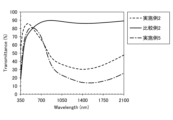
- FIG. 10 shows permeation profiles of the dispersions obtained in Example 2, Comparative Example 2, and Example 5.
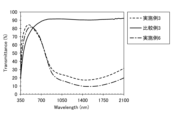
- FIG. 11 shows the permeation profiles of the dispersions obtained in Example 3, Comparative Example 3, and Example 6.
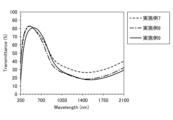
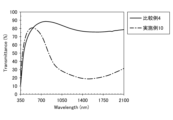
- FIG. FIG. 12 shows permeation profiles of the dispersions obtained in Examples 7-9. 13 shows permeation profiles of the dispersions obtained in Comparative Example 4 and Example 10.
- the Cs/W ratio which is the material amount ratio between cesium (Cs) and tungsten (W)
- oxygen (O ) and tungsten (W) can be 2.6 or more and less than 2.99.
- the near-infrared absorbing particles of the present embodiment can contain intergrown tungsten bronze crystals in which tungsten oxide and hexagonal tungsten bronze are mixed in a band shape.
- the near-infrared absorbing particles of the present embodiment can be composed of the above-described intergrown tungsten bronze crystals, but even in such a case, the inclusion of unavoidable impurities due to the manufacturing process or the like is not excluded.
- hexagonal tungsten bronze As particles that are oxides containing Cs and W and absorb near-infrared rays, hexagonal tungsten bronze (hereinafter, hexagonal tungsten bronze is referred to as "HTB”, and hexagonal tungsten bronze containing cesium is also referred to as "Cs-HTB”.
- a hexagonal tungsten bronze structure is also referred to as an “HTB structure”) is well known.
- the composition of the above-mentioned oxide in the case of taking the HTB structure, which has been used for near-infrared absorption particles is the case where the Cs/W ratio is 0.20 or more and 0.33 or less. Therefore, in conventional Cs-HTB materials, no attention has been paid to compositions with a Cs/W ratio of less than 0.20.
- Non-Patent Document 1 when the Cs/W ratio is between 0 and 0.20, it is known that two phases of WO 3 and Cs 0.2 WO 3 are separated, It is called an intergrown tungsten bronze crystal (hereinafter also referred to as "ITB"). More specifically, the structure of the ITB is a band-like structure in which WO 3 layers and Cs 0.2 WO 3 layers are alternately present. It is a common theory that near-infrared absorption does not occur or is very weak in ITB, and it is judged that there is no practical superiority, and a composition region that forms an ITB structure (hereinafter also referred to as “ITB composition region”). That is, the optical properties of particles in the composition range where the Cs/W ratio is less than 0.2 have not been investigated.
- tungsten bronze particles in this ITB composition range have unique absorption characteristics. Specifically, in the ITB composition range, similar to the production of Cs-HTB particles, a raw material containing cesium and tungsten is heated in a reducing atmosphere and crystallized, so that the product is Cs outside the ITB composition range. It was confirmed that the particles had visible light transmission and near-infrared absorption characteristics comparable to those of -HTB particles.
- the near-infrared absorbing particles of the present embodiment which are novel near-infrared absorbing particles discovered by the inventors of the present invention, are composed of a mixture of tungsten oxide and hexagonal tungsten bronze in the form of a band, as described above. Intergrown tungsten bronze crystals can be included. In addition, since the intergrown tungsten bronze crystals are included, the Cs/W ratio, which is the material amount ratio between the contained cesium (Cs) and tungsten (W), can be set to 0.01 or more and less than 0.20.
- a part of the cesium contained in the hexagonal tungsten bronze in the near-infrared absorbing particles of the present embodiment may be replaced with an additive element.
- additive elements include one or more selected from Na, Tl, In, Li, Be, Mg, Ca, Sr, Ba, Al, and Ga.
- the Cs/W ratio described above becomes the (Cs+M)/W ratio, and the range can be the above range.
- tungsten oxide can be tungsten trioxide (WO 3 ), for example.
- the ITB contained in the near-infrared absorbing particles obtained as described above is basically phase-separated into tungsten oxide and Cs-HTB. However, both tungsten oxide and Cs-HTB are reduced to substantially WO 3-y1 and Cs x WO 3 - y2 . It turned out to be a strong ITB.
- y1 and y2 of WO 3-y1 and Cs x WO 3- y2 may have different values
- y1 is an arbitrary value in the range of 0 ⁇ y1 ⁇ 0.30
- y2 is -0 .1 ⁇ y2 ⁇ 0.46.
- the O/W ratio which is the substance amount ratio of the near-infrared absorbing particles, is 2.6 or more and less than 2.99.
- a reduction crystallization step is performed in which a raw material mixture containing a cesium-containing compound and a tungsten-containing compound is heated and crystallized in a reducing gas atmosphere.
- the raw material mixture is preferably heated at 350° C. or higher and 950° C. or lower, more preferably at 450° C. or higher and 650° C. in a reducing atmosphere.
- the desired near-infrared absorbing particles can be obtained by heating in a reducing atmosphere once in the reduction crystallization step, but they may be further annealed in a neutral atmosphere (annealing step). Crystals can be further stabilized by annealing.
- the neutral atmosphere for the annealing treatment is an inert atmosphere such as an Ar atmosphere or an N2 atmosphere, and the annealing temperature is desirably 350° C. or higher and 950° C. or lower.
- the WO 3 component which is the other phase after phase separation, is partially reduced to form WO 3-y1 having various y1 values in the range of 0 ⁇ y1 ⁇ 0.30.
- WO 3-y1 becomes a typical Magneli phase when the y1 value exceeds 0.10, and becomes conductive, resulting in absorption of near-infrared rays.
- the visible transmittance of the Magneli phase particles is strongly blue-colored, and ITB and near-infrared absorbing particles containing ITB also become strongly blue-colored particles.
- the powder obtained in the reduction crystallization step can be heated in an oxidizing or weakly reducing atmosphere.
- the heating temperature at this time is not particularly limited, it can be performed at, for example, 300° C. or higher and 550° C. or lower.
- WO 3-y1 can be oxidized to WO 3 while preserving Cs-HTB. That is, in the oxidation step, oxidation of WO3 -y1 proceeds preferentially over Cs-HTB. This is because in Cs-HTB, Cs, which has a large ionic radius, blocks the hexagonal tunnel and inhibits oxygen diffusion, so the oxygen diffusion rate in WO3 -y1 is much higher than that in Cs-HTB. be. Since Cs-HTB and WO 3-y1 are generated in advance, when the oxidation step is performed, the oxidation step can be performed after the reduction crystallization step.
- the higher the ratio of HTB that is, the higher the Cs/W ratio, the greater the amount of near-infrared absorption, but the blue color.
- the oxidation step is preferably performed in a low oxygen concentration atmosphere with an oxygen concentration of 1% by volume or more and 10% by volume or less. It is more preferable that the low oxygen concentration atmosphere has an oxygen concentration of 1% by volume or more and 7% by volume or less.
- the low oxygen concentration atmosphere it is preferable to use a mixed gas of air and an inert gas such as Ar gas or N 2 gas.
- the oxygen concentration in the low oxygen concentration atmosphere By setting the oxygen concentration in the low oxygen concentration atmosphere to 1% by volume or more, the oxidation of WO 3-y1 proceeds and the color of the near-infrared absorbing particles can be easily adjusted. Further, by setting the oxygen concentration in the low oxygen concentration atmosphere to 10% by volume or less, excessive oxidation of the Cs-HTB phase is suppressed, and the infrared absorption characteristics of the near-infrared absorbing particles of the present embodiment are enhanced. can be done.
- the heating temperature in the oxidation step is desirably 300° C. or higher and 550° C. or lower, and more desirably 350° C. or higher and 500° C. or lower.
- the heating temperature in the oxidation step is desirably 300° C. or higher and 550° C. or lower, and more desirably 350° C. or higher and 500° C. or lower.
- heat treatment may be performed at a temperature of 350° C. or higher and 950° C. or lower in an inert atmosphere such as Ar gas (annealing step).
- Oxygen in the WO 6 octahedron forming the skeleton of Cs-HTB constituting the ITB contained in the near-infrared absorbing particles of the present embodiment may be partially deficient.
- the amount of such oxygen vacancies tends to increase as the Cs/W ratio, which is the material amount ratio between cesium (Cs) and tungsten (W) contained in the near-infrared absorbing particles of the present embodiment, increases.
- the octahedral oxygen deficiency generates localized electrons and free electrons, and induces localized surface plasmon resonance and polaronic near-infrared absorption.
- Oxygen vacancies are the main cause of light absorption in Cs-HTB (Non-Patent Document 2), so it is preferable to introduce oxygen vacancies into Cs-HTB contained in ITB as much as possible. Therefore, at least one selected from tungsten oxide and hexagonal tungsten bronze contained in the near-infrared absorbing particles of the present embodiment preferably contains oxygen deficiency. As described above, one or more selected from tungsten oxide and hexagonal tungsten bronze contained in the near-infrared absorbing particles contain oxygen defects, thereby enhancing the near-infrared absorbing properties. From the viewpoint of particularly enhancing the near-infrared absorption characteristics, oxygen deficiency in the hexagonal tungsten bronze is important, and at least the hexagonal tungsten bronze preferably has oxygen deficiency.
- the O/W ratio which is the substance amount ratio between oxygen (O) and tungsten (W), to 2.6 or more.
- the O/W ratio is preferably less than 2.99.
- the average particle size of the near-infrared absorbing particles of the present embodiment is not particularly limited, it is preferably 0.1 nm or more and 200 nm or less.
- the average particle size of the near-infrared absorbing particles is set to 200 nm or less, the localized surface plasmon resonance is more significantly expressed, so that the near-infrared absorbing properties can be particularly enhanced, that is, the solar transmittance can be particularly improved. This is because it can be suppressed.
- the average particle size of the near-infrared absorbing particles is set to 0.1 nm or more, industrial production can be easily performed.
- the particle size is closely related to the color of the near-infrared absorbing particle dispersion, which is a dispersion transmission film in which the near-infrared absorbing particles are dispersed. Scattering of short wavelengths in the visible region is reduced.
- increasing the particle size has the effect of particularly suppressing the blue color tone, but if the particle size exceeds 100 nm, the haze of the film may increase due to light scattering. In some cases, LSPR absorption is reduced due to suppression of plasmon generation.
- the average particle diameter of the near-infrared absorbing particles is the median diameter of a plurality of near-infrared absorbing particles measured from a transmission electron microscope image, or measured by a particle size measuring device based on the dynamic light scattering method of a dispersion. It can be a dispersed particle size.
- the average particle size of the near-infrared absorbing particles is more preferably 100 nm or less, more preferably 30 nm or less.
- the near-infrared absorbing particles can be surface-treated for the purpose of protecting the surface, improving durability, preventing oxidation, and improving water resistance.
- the near-infrared absorbing particles of the present embodiment treat the surface of the near-infrared absorbing particles with one or more atoms selected from Si, Ti, Zr, and Al. It can be coated and modified with a compound containing. At this time, the compound containing one or more atoms (elements) selected from Si, Ti, Zr, and Al includes one or more selected from oxides, nitrides, carbides, and the like.
- (2) Method for producing near-infrared absorbing particles Next, a method for producing near-infrared absorbing particles of the present embodiment will be described. According to the method for producing the near-infrared absorbing particles of the present embodiment, the above-described near-infrared absorbing particles can be produced, so the explanation of the already explained matters will be omitted.
- the method for producing the near-infrared absorbing particles of the present embodiment is not particularly limited, and any method that can produce near-infrared absorbing particles that satisfy the properties described above can be used without particular limitations.
- one structural example of the method for producing near-infrared absorbing particles will be described.
- the method for producing near-infrared absorbing particles of the present embodiment is a method for producing near-infrared absorbing particles as described above, and can include, for example, the following mixing step and reduction crystallization step.
- a cesium-containing compound and a tungsten-containing compound can be mixed to prepare a raw material mixture.
- the raw material mixture can be prepared so that the Cs/W ratio, which is the material amount ratio between cesium (Cs) and tungsten (W) contained in the raw material mixture, is 0.01 or more and 0.20 or less. .
- the cesium-containing compound and the tungsten-containing compound to be subjected to the mixing step are not particularly limited as long as they contain cesium and tungsten, respectively.
- Examples include cesium carbonate, cesium nitrate, cesium chloride, tungsten trioxide, Tungstic acid hydrate and the like can be used.
- the raw material containing the additive element can also be added to and mixed with the raw material mixture.
- the raw material mixture can be heated and crystallized at 350°C or higher and 950°C or lower in a reducing gas atmosphere, and the heating and crystallization is more preferably performed at 450°C or higher and 650°C.
- the reduction treatment When the reduction treatment is performed, it is preferably performed under a stream of reducing gas.
- a mixed gas containing a reducing gas such as hydrogen and one or more inert gases selected from Ar gas, N2 gas, and the like can be used.
- other mild heating and reducing conditions such as heating in a steam atmosphere or vacuum atmosphere may be used together.
- heat treatment may be performed at a temperature of 350° C. or more and 950° C. or less in an inert atmosphere (neutral atmosphere) such as Ar gas or N 2 gas (annealing process).
- inert atmosphere neutral atmosphere
- Ar gas or N 2 gas annealing process
- the method for producing the near-infrared absorbing particles of the present embodiment is not particularly limited to the above embodiment.
- a method for producing the near-infrared absorbing particles various methods can be used which are capable of forming a predetermined structure including an ITB structure in which WO 3-y1 and Cs x WO 3-y2 are mixed.
- methods for producing near-infrared absorbing particles include a method of reducing tungstate obtained by a solid-phase method, a liquid-phase method, and a gas-phase method, and a method of reducing WO3 in a molten alkali halide.
- the method for producing near-infrared absorbing particles may further include optional steps.
- the method for producing near-infrared absorbing particles of the present embodiment can further include an oxidation step.
- the powder obtained by the reduction crystallization step can be heated at 300°C or higher and 550°C or lower in a low oxygen concentration atmosphere.
- the blue color due to WO3 -y1 can be avoided and the color can be adjusted.
- the oxidation step can be appropriately carried out according to the desired color tone depending on the application.
- the oxidation step is preferably performed in a low oxygen concentration atmosphere with an oxygen concentration of 1% by volume or more and 10% by volume or less. It is more preferable that the low oxygen concentration atmosphere has an oxygen concentration of 1% by volume or more and 7% by volume or less.
- the low oxygen concentration atmosphere it is preferable to use a mixed gas of air and an inert gas such as Ar gas or N 2 gas.
- the oxygen concentration in the low oxygen concentration atmosphere By setting the oxygen concentration in the low oxygen concentration atmosphere to 1% by volume or more, the oxidation of WO 3-y1 proceeds and the color of the near-infrared absorbing particles can be easily adjusted. Further, by setting the oxygen concentration in the low oxygen concentration atmosphere to 10% by volume or less, excessive oxidation of the Cs-HTB phase is suppressed, and the infrared absorption characteristics of the near-infrared absorbing particles of the present embodiment are enhanced. can be done.
- the heating temperature in the oxidation step is desirably 300° C. or higher and 550° C. or lower, and more desirably 350° C. or higher and 500° C. or lower, as described above.
- the heating temperature in the oxidation step is desirably 300° C. or higher and 550° C. or lower, and more desirably 350° C. or higher and 500° C. or lower, as described above.
- the method for producing near-infrared absorbing particles can also include a pulverizing step of pulverizing the powder obtained by the reduction crystallization step.
- the pulverization process can be performed after these processes.
- a specific means for pulverizing and refining the powder is not particularly limited, and various means capable of mechanical pulverization can be used.
- a mechanical pulverization method a dry pulverization method using a jet mill or the like can be used.
- mechanical pulverization may be performed in a liquid medium as a solvent in the process of obtaining a near-infrared absorbing particle dispersion, which will be described later.
- the near-infrared absorbing particles are dispersed in the liquid medium in the pulverization step, it can also be called a pulverization and dispersion step.
- the near-infrared absorbing particles may have their surfaces modified with a compound containing one or more atoms selected from Si, Ti, Zr, and Al. Therefore, the method for producing near-infrared absorbing particles may further include, for example, a modification step of modifying the near-infrared absorbing particles with a compound containing one or more atoms selected from Si, Ti, Zr, and Al.
- the modification step specific conditions for modifying the near-infrared absorbing particles are not particularly limited.
- an alkoxide or the like containing one or more atoms selected from the above atomic group (metal group) is added to the near-infrared absorbing particles to be modified. It can also have a modification step of forming a coating on the surface of the infrared absorbing particles.
- Near-infrared absorbing particle dispersion Next, one structural example of the near-infrared absorbing particle dispersion liquid of the present embodiment will be described.
- the near-infrared absorbing particle dispersion of the present embodiment contains the above-described near-infrared absorbing particles and a liquid medium that is at least one selected from water, organic solvents, fats and oils, liquid resins, and liquid plasticizers. can be done. That is, for example, as shown in FIG. 1, the near-infrared absorbing particle dispersion liquid 10 of the present embodiment can contain the near-infrared absorbing particles 11 and the liquid medium 12 described above.
- the near-infrared absorbing particle dispersion liquid preferably has a structure in which the near-infrared absorbing particles are dispersed in a liquid medium.
- FIG. 1 is a schematic diagram, and the near-infrared absorbing particle dispersion liquid of the present embodiment is not limited to such a form.
- the near-infrared absorbing particles 11 are described as spherical particles in FIG. 1, the shape of the near-infrared absorbing particles 11 is not limited to such a form, and can have any shape. As described above, the near-infrared absorbing particles 11 may have a coating or the like on the surface, for example.
- the near-infrared absorbing particle dispersion liquid 10 can also contain other additives, if necessary, in addition to the near-infrared absorbing particles 11 and the liquid medium 12 .
- liquid medium as described above, one or more selected from water, organic solvents, oils, liquid resins, and liquid plasticizers can be used.
- organic solvents such as alcohols, ketones, hydrocarbons, and glycols can be selected as the organic solvent.
- alcohol solvents such as isopupyl alcohol, methanol, ethanol, 1-puptopanol, isopuptopanol, butanol, pentanol, benzyl alcohol, diacetone alcohol, 1-methoxy-2-puptopanol, etc.
- ketone solvents such as dimethyl ketone, acetone, methyl ethyl ketone, methyl butyl ketone, methyl isobutyl ketone, cyclohexanone, and isophocotone; Glycol Monomethyl Ether, Ethylene Glycol Monoethyl Ether, Ethylene Glycol Isopropyl Ether, Polypyrene Glycol Monomethyl Ether, Polypyrene Glycol Monoethyl Ether, Polypyrene Glycol Methyl Ether Acetate, Polypyrene Glycol Ethyl Ether Acetate Glycol derivatives such as dichloride; Amides such as formamide, N-methylformamide, dimethylformamide, dimethylacetamide, N-methyl-2-pyteridone; Aromatic hydrocarbons such as toluene and xylene; Ethylene chloride , cumolbenzene, etc., and one or more selected from halogenated hydrocarbon
- organic solvents with low polarity are preferred, and in particular, isopropyl alcohol, ethanol, 1-methoxy-2-butanol, dimethyl ketone, methyl ethyl ketone, methyl isobutyl ketone, toluene, butyl pyrene glycol monomethyl ether acetate. Tate, n-butyl acetate and the like are more preferred.
- These organic solvents can be used singly or in combination of two or more.
- fats and oils examples include drying oils such as linseed oil, sunflower oil, and tung oil, semi-drying oils such as sesame oil, cottonseed oil, rapeseed oil, soybean oil, and rice bran oil, and non-drying oils such as olive oil, coconut oil, palm oil, and dehydrated castor oil.
- drying oils such as linseed oil, sunflower oil, and tung oil
- semi-drying oils such as sesame oil, cottonseed oil, rapeseed oil, soybean oil, and rice bran oil
- non-drying oils such as olive oil, coconut oil, palm oil, and dehydrated castor oil.
- Fatty acid monoesters obtained by directly esterifying vegetable oil fatty acids and monoalcohols, ethers, Isopar (registered trademark) E, Exol (registered trademark) Hexane, Heptane, E, D30, D40, D60, D80, D95, D110,
- One or more selected from petroleum solvents such as D130 (manufactured by ExxonMobil) can be used.
- liquid resin for example, one or more selected from liquid acrylic resin, liquid epoxy resin, liquid polyester resin, liquid urethane resin, etc. can be used.
- liquid plasticizer for example, a liquid plasticizer for plastics can be used.
- the components contained in the near-infrared absorbing particle dispersion are not limited to the above-described near-infrared absorbing particles and liquid medium.
- the near-infrared absorbing particle dispersion may further contain optional components as required.
- acid or alkali may be added to the near-infrared absorbing particle dispersion as necessary to adjust the pH of the dispersion.
- various surfactants and coupling agents are added in order to further improve the dispersion stability of the near-infrared absorbing particles and to avoid coarsening of the dispersed particle size due to reaggregation. etc. can be added as a dispersing agent to the near-infrared absorbing particle dispersion.
- Dispersants such as surfactants and coupling agents can be selected according to the application, and the dispersant is one or more selected from amine-containing groups, hydroxyl groups, carboxyl groups, and epoxy groups. It is preferable to have it as a functional group. These functional groups adsorb to the surfaces of the near-infrared absorbing particles to prevent aggregation, and have the effect of uniformly dispersing the near-infrared absorbing particles even in the infrared shielding film formed using the near-infrared absorbing particles.
- a polymeric dispersant having in its molecule at least one type selected from the above functional groups (functional group group) is more desirable.
- dispersants that can be suitably used include Solsperse (registered trademark) 9000, 12000, 17000, 20000, 21000, 24000, 26000, 27000, 28000, 32000, 35100, 54000, 250 (manufactured by Nippon Lubrizol Co., Ltd.) ), EFKA (registered trademark) 4008, 4009, 4010, 4015, 4046, 4047, 4060, 4080, 7462, 4020, 4050, 4055, 4400, 4401, 4402, 4403, 4300, 4320, 4330, 4340, 6220, 6225 , 6700, 6780, 6782, 8503 (manufactured by Efka Additives), Ajisper (registered trademark) PA111, PB821, PB822, PN411, Famex L-12 (manufactured by Ajinomoto Fine-Techno Co., Ltd.), Disper BYK (registered trademark) 101 , 102,
- the method for dispersing the near-infrared absorbing particles in the liquid medium is not particularly limited as long as it is a method that allows the near-infrared absorbing particles to be dispersed in the liquid medium. At this time, it is preferable that the near-infrared absorbing particles can be dispersed so that the average particle diameter is 200 nm or less, and more preferably 0.1 nm or more and 200 nm or less.
- Examples of methods for dispersing the near-infrared absorbing particles in a liquid medium include dispersing methods using devices such as bead mills, ball mills, sand mills, paint shakers, and ultrasonic homogenizers.
- dispersing methods using devices such as bead mills, ball mills, sand mills, paint shakers, and ultrasonic homogenizers.
- pulverizing and dispersing with a medium stirring mill such as a bead mill, ball mill, sand mill, paint shaker, etc. using medium media (beads, balls, Ottawa sand) shortens the time required to obtain the desired average particle size. preferable from this point of view.
- the near-infrared absorbing particles are dispersed in the liquid medium, and at the same time, the near-infrared absorbing particles collide with each other, and the medium media collides with the near-infrared absorbing particles, thereby progressing into fine particles.
- the near-infrared absorbing particles can be made finer and dispersed. That is, pulverization-dispersion processing is performed.
- the average particle size of the near-infrared absorbing particles is preferably 0.1 nm or more and 200 nm or less as described above. This is because, if the average particle size is small, the scattering of light in the visible light region with a wavelength of 400 nm or more and 780 nm or less due to geometric scattering or Mie scattering is reduced. This is because the obtained near-infrared absorbing particle dispersion in which the near-infrared absorbing particles are dispersed in a resin or the like can be prevented from becoming frosted glass and failing to obtain clear transparency. That is, when the average particle size is 200 nm or less, the light scattering mode of the geometric scattering or the Mie scattering is weakened and becomes the Rayleigh scattering mode.
- the scattered light is proportional to the sixth power of the dispersed particle size, so that the scattering decreases as the dispersed particle size decreases and the transparency improves. Further, when the average particle diameter is 100 nm or less, scattered light is extremely reduced, which is preferable. More preferably, the average particle size is 30 nm or less.
- the dispersion state of the near-infrared absorbing particles in the near-infrared absorbing particle dispersion in which the near-infrared absorbing particles are dispersed in a solid medium such as a resin obtained by using the near-infrared absorbing particle dispersion liquid of the present embodiment is different from that of the solid medium.
- the near-infrared absorbing particles in the dispersion will not aggregate to a size larger than the average particle size.
- the average particle size of the near-infrared absorbing particles is 0.1 nm or more and 200 nm or less
- the produced near-infrared absorbing particle dispersion or its molded body has a gray color with a monotonously decreased transmittance. You can avoid becoming a system.
- the content of the near-infrared absorbing particles in the near-infrared absorbing particle dispersion liquid of the present embodiment is not particularly limited, it is preferably 0.01% by mass or more and 80% by mass or less, for example. This is because by setting the content of the near-infrared absorbing particles to 0.01% by mass or more, a sufficient solar transmittance can be exhibited, that is, the solar transmittance can be sufficiently suppressed. Also, by setting the amount to 80% by mass or less, the near-infrared absorbing particles can be uniformly dispersed in the dispersion medium. [Near-infrared absorbing particle dispersion] Next, one structural example of the near-infrared absorbing particle dispersion of the present embodiment will be described.
- the near-infrared absorbing particle dispersion of the present embodiment contains the near-infrared absorbing particles described above and a solid medium.
- the near-infrared absorbing particle dispersion 20 can include the near-infrared absorbing particles 21 and the solid medium 22, and the near-infrared absorbing particles 21 can be placed in a solid medium 22 .
- the near-infrared absorbing particles are preferably dispersed in a solid medium.
- FIG. 2 is a schematic diagram, and the near-infrared absorbing particle dispersion of the present embodiment is not limited to such a form.
- the near-infrared absorbing particles 21 are described as spherical particles in FIG. 2, the shape of the near-infrared absorbing particles 21 is not limited to such a form, and can have any shape.
- the near-infrared absorbing particles 21 can also have a coating or the like on the surface, for example.
- the near-infrared absorbing particle dispersion 20 can also contain other additives, if necessary, in addition to the near-infrared absorbing particles 21 and the solid medium 22 .
- Solid medium includes medium resins such as thermoplastic resins, thermosetting resins, and ultraviolet curable resins. That is, a resin can be suitably used as the solid medium.
- Specific materials of the resin used for the solid medium are not particularly limited, but examples include polyester resins, polycarbonate resins, acrylic resins, styrene resins, polyamide resins, polyethylene resins, vinyl chloride resins, olefin resins, epoxy resins, polyimide resins, and fluorine resins. It is preferably one resin selected from the resin group consisting of resins, ethylene-vinyl acetate copolymers, polyvinyl acetal resins, and ultraviolet curable resins, or a mixture of two or more resins selected from the resin group. .
- polyester resin polyethylene terephthalate resin can be preferably used as the polyester resin.
- These medium resins can also contain a polymeric dispersant having, as functional groups, one or more selected from amine-containing groups, hydroxyl groups, carboxyl groups, and epoxy groups in the main skeleton.
- the solid medium is not limited to medium resin, and it is also possible to use a binder using metal alkoxide as a solid medium.
- Typical metal alkoxides are alkoxides of Si, Ti, Al, Zr, and the like. By hydrolyzing and polycondensing a binder using these metal alkoxides by heating or the like, it is possible to obtain a near-infrared absorbing particle dispersion in which the solid medium contains an oxide.
- the content ratio of the near-infrared absorbing particles in the near-infrared absorbing particle dispersion according to the present embodiment is not particularly limited, the near-infrared absorbing particle dispersion should contain 0.001% by mass or more and 80% by mass or less of the near-infrared absorbing particles. is preferred.
- the shape of the near-infrared absorbing particle dispersion of the present embodiment is also not particularly limited, but the near-infrared absorbing particle dispersion of the present embodiment preferably has a sheet shape, a board shape, or a film shape. This is because the near-infrared absorbing particle dispersion can be applied to various uses by making it sheet-shaped, board-shaped, or film-shaped.
- the color tone of the near-infrared absorbing particle dispersion of the present embodiment changes depending on the concentration of the near-infrared absorbing particles contained.
- the near-infrared absorbing particle dispersion preferably has a near-infrared shielding property with a solar transmittance of 65% or less and exhibits color tone neutrality satisfying b * ⁇ 1.6 ⁇ a * +8.0.
- a higher color index a * requires a higher b * value for the dispersion to appear neutral in color.
- the near-infrared absorbing particle dispersion of this embodiment can be produced using, for example, a masterbatch.
- the method for producing a near-infrared absorbing particle dispersion of the present embodiment can also have, for example, the following masterbatch production process.
- a masterbatch production process that obtains a masterbatch in which near-infrared absorbing particles are dispersed in a solid medium.
- a masterbatch in which near-infrared absorbing particles are dispersed in a solid medium can be produced.
- a masterbatch can be produced by dispersing a near-infrared absorbing particle dispersion or near-infrared absorbing particles in a solid medium and pelletizing the solid medium.
- a near-infrared absorbing particle dispersion powder obtained by removing the liquid medium from the near-infrared absorbing particle dispersion can also be used.
- a near-infrared absorbing particle dispersion liquid, near-infrared absorbing particles, near-infrared absorbing particle dispersion powder, solid medium powder or pellets, and, if necessary, other additives are uniformly mixed to prepare a mixture. . Then, the mixture is kneaded with a vented single-screw or twin-screw extruder, and the melt-extruded strands are cut into pellets to produce a masterbatch.
- the shape of the pellet may be cylindrical or prismatic.
- the near-infrared absorbing particle dispersion when using the near-infrared absorbing particle dispersion as a raw material, it is preferable to reduce or remove the liquid medium derived from the near-infrared absorbing particle dispersion.
- the extent to which the liquid medium contained in the near-infrared absorbing particle dispersion is removed is not particularly limited.
- the entire amount of the liquid plasticizer may remain in the near-infrared absorbing particle dispersion.
- the method for reducing or removing the liquid medium contained in the near-infrared absorbing particle dispersion from the near-infrared absorbing particle dispersion or the mixture of the near-infrared absorbing particle dispersion and the solid medium is not particularly limited.
- the near-infrared absorbing particle dispersion or the like is dried under reduced pressure while being stirred to separate the near-infrared absorbing particle-containing composition from the liquid medium components.
- An apparatus used for the reduced-pressure drying includes a vacuum agitation dryer, but is not particularly limited as long as it has the above functions.
- the pressure value at the time of reducing the pressure in the drying step in which the above-described reduced pressure drying is performed is appropriately selected.
- the removal efficiency of the liquid medium derived from the near-infrared absorbing particle dispersion is improved, and the near-infrared absorbing particle dispersion powder obtained after drying under reduced pressure and the raw material near-infrared absorbing particle dispersion are improved. Since the liquid is not exposed to a high temperature for a long time, the near-infrared absorbing particle-dispersed powder and the near-infrared-absorbing particles dispersed in the near-infrared-absorbing particle-dispersed liquid do not aggregate, which is preferable. Further, the productivity of the dispersed powder of near-infrared absorbing particles is increased, and the solvent such as the evaporated liquid medium can be easily recovered, which is preferable in terms of environmental considerations.
- the residual amount of the solvent component is preferably 2.5% by mass or less. If the residual solvent component is 2.5% by mass or less, no bubbles are generated when the near-infrared absorbing particle dispersion powder or the like is processed into, for example, a near-infrared absorbing particle dispersion, and the appearance and optical properties are good.
- the solvent component remaining in the dispersed powder of the near-infrared absorbing particles is 2.5% by mass or less, when the dispersed powder of the near-infrared absorbing particles is stored for a long period of time, the residual solvent component will aggregate due to natural drying. long-term stability is maintained.
- the dispersion concentration of the near-infrared absorbing particles contained in the masterbatch which is a near-infrared absorbing particle dispersion, can be adjusted while maintaining the dispersed state.
- the obtained masterbatch or the masterbatch obtained by adding a solid medium as described above is molded to obtain a desired shape.
- the specific method for molding the near-infrared absorbing particle dispersion is not particularly limited, for example, known methods such as extrusion molding and injection molding can be used.
- a sheet-shaped, board-shaped, or film-shaped near-infrared absorbing particle dispersion molded into a flat or curved surface can be produced.
- the method for forming into a sheet shape, board shape, or film shape there is no particular limitation on the method for forming into a sheet shape, board shape, or film shape, and various known methods can be used. For example, a calendar roll method, an extrusion method, a casting method, an inflation method, or the like can be used.
- the method for producing the near-infrared absorbing particle dispersion of the present embodiment is not limited to the form having the above masterbatch production process.
- the method for producing a near-infrared absorbing particle dispersion of the present embodiment can also be configured to include the following steps.
- a solid medium monomer, oligomer, and uncured liquid solid medium precursor are mixed with near-infrared absorbing particles, near-infrared absorbing particle dispersion powder, and near-infrared absorbing particle dispersion to obtain a near-infrared absorbing particle dispersion precursor.
- Precursor liquid preparation step for preparing a liquid for preparing a liquid.
- a process for producing a near-infrared absorbing particle dispersion in which a solid medium precursor such as the above-mentioned monomer is cured by a chemical reaction such as condensation or polymerization to produce a near-infrared absorbing particle dispersion.
- an acrylic resin when used as a solid medium, an acrylic monomer or an acrylic UV-curable resin can be mixed with near-infrared absorbing particles to obtain a near-infrared absorbing particle dispersion precursor liquid.
- a predetermined mold or the like is filled with the near-infrared absorbing particle dispersion precursor liquid, and radical polymerization is performed to obtain a near-infrared absorbing particle dispersion using an acrylic resin.
- a near-infrared absorbing particle dispersion can be obtained by subjecting the near-infrared absorbing particle dispersion precursor solution to a cross-linking reaction, as in the case of using the acrylic resin described above. can.
- the near-infrared absorbing particle dispersion of the present embodiment contains known additives such as plasticizers, flame retardants, anti-coloring agents and fillers that are usually added to these resins. Agents (additives) can also be contained.
- the solid medium is not limited to resin, and a binder using metal alkoxide can also be used.
- the shape of the near-infrared absorbing particle dispersion according to the present embodiment is not particularly limited, it can take, for example, a sheet shape, a board shape, or a film shape, as described above.
- the solid medium contained in the near-infrared absorbing particle dispersion is not flexible or transparent as it is. It may not have sufficient adhesion to the base material.
- the near-infrared absorbing particle dispersion preferably contains a plasticizer.
- the near-infrared absorbing particle dispersion preferably further contains a plasticizer.
- the plasticizer described above a substance that is used as a plasticizer in the solid medium used for the near-infrared absorbing particle dispersion of the present embodiment can be used.
- the plasticizer used in the near-infrared absorbing particle dispersion in which the solid medium is composed of a polyvinyl acetal resin includes a plasticizer that is a compound of a monohydric alcohol and an organic acid ester, a polyhydric alcohol organic acid ester compound, and the like. Phosphate-based plasticizers such as ester-based plasticizers and organic phosphoric acid-based plasticizers can be used. Any plasticizer is preferably liquid at room temperature.
- the near-infrared absorbing particle dispersion of the present embodiment can be used in various aspects, and the usage and application aspects are not particularly limited.
- a near-infrared absorbing particle dispersion of the present embodiment a near-infrared absorbing intermediate film, a near-infrared absorbing laminate, and a near-infrared absorbing transparent substrate will be described below.
- the near-infrared-absorbing laminate of the present embodiment may have a laminate structure including the near-infrared-absorbing particle dispersion described above and a transparent substrate. can.
- the near-infrared absorbing laminate of the present embodiment can be a laminate obtained by laminating the above-described near-infrared absorbing particle dispersion and a transparent substrate as elements.
- a near-infrared absorbing laminate for example, there is an example in which two or more transparent substrates and the already-described near-infrared absorbing particle dispersion are laminated.
- the near-infrared absorbing particle dispersion can be arranged, for example, between transparent substrates and used as an intermediate film for absorbing near-infrared rays.
- the near-infrared absorbing laminate 30 includes a plurality of transparent layers. It can have substrates 321 , 322 and a near-infrared absorbing particle dispersion 31 . Further, the near-infrared absorbing particle dispersion 31 can be arranged between a plurality of transparent substrates 321 and 322 .
- FIG. 3 shows an example in which two transparent substrates 321 and 322 are provided, the present invention is not limited to such a form.
- the near-infrared absorbing particle dispersion that forms the near-infrared absorbing intermediate film preferably has a sheet-like, board-like, or film-like shape.
- the transparent base material one or more selected from plate glass, plate-like plastic, and film-like plastic that are transparent in the visible light region can be suitably used.
- the material of the plastic is not particularly limited and can be selected according to the application.
- examples include polycarbonate resin, acrylic resin, polyester resin, polyamide resin, vinyl chloride resin, and olefin resin. , epoxy resins, polyimide resins, ionomer resins, fluorine resins, and the like.
- polyester resin polyethylene terephthalate resin can be preferably used.
- the transparent base material may contain particles that have a solar radiation shielding function.
- particles having a solar radiation shielding function near-infrared absorbing particles having near-infrared shielding properties can be used.
- the transmitted color has a more neutral color tone.
- a solar radiation shielding laminate structure which is a type of near-infrared absorption laminate capable of ensuring the transmittance of the sensor wavelength.
- the above-described near-infrared absorbing laminate can also be obtained by bonding and integrating a plurality of transparent substrates facing each other with a near-infrared absorbing particle dispersion sandwiched therebetween by a known method.
- the solid medium described in the near-infrared absorbing particle dispersion can be used.
- the solid medium is preferably polyvinyl acetal resin.
- the near-infrared absorbing intermediate film of the present embodiment can be produced by the above-described method for producing a near-infrared absorbing particle dispersion, and has, for example, a sheet shape, a board shape, or a film shape. It can be a membrane.
- the near-infrared absorbing intermediate film does not have sufficient flexibility or adhesion to the transparent substrate, it is preferable to add a liquid plasticizer for the medium resin.
- the medium resin used for the intermediate film for absorbing near-infrared rays is a polyvinyl acetal resin
- the addition of a liquid plasticizer for the polyvinyl acetal resin is beneficial for improving the adhesion to the transparent substrate.
- a plasticizer a substance that is used as a plasticizer for solid medium resins can be used.
- a plasticizer to be applied to a near-infrared absorbing particle dispersion using a polyvinyl acetal resin as a solid medium a plasticizer that is a compound of a monohydric alcohol and an organic acid ester, an ester type such as a polyhydric alcohol organic acid ester compound, etc. and phosphoric acid-based plasticizers such as organic phosphoric acid-based plasticizers.
- Any plasticizer is preferably liquid at room temperature.
- a plasticizer that is an ester compound synthesized from a polyhydric alcohol and a fatty acid is preferable.
- At least one selected from the group consisting of silane coupling agents, metal salts of carboxylic acids, metal hydroxides, and metal carbonates can also be added to the near-infrared absorbing intermediate film.
- Metals constituting metal salts of carboxylic acids, metal hydroxides, and metal carbonates are not particularly limited, but at least one selected from sodium, potassium, magnesium, calcium, manganese, cesium, lithium, rubidium, and zinc. is preferably In the near-infrared absorbing intermediate film, the content of at least one selected from the group consisting of metal salts of carboxylic acids, metal hydroxides, and metal carbonates is 1% by mass or more relative to the near-infrared absorbing particles. It is preferably 100% by mass or less.
- the intermediate film for near-infrared absorption may include Sb, V, Nb, Ta, W, Zr, F, Zn, Al, Ti, Pb, Ga, Re, in addition to the above-described near-infrared absorbing particles, if necessary.
- the intermediate film for near-infrared absorption can contain such particles in the range of 5% by mass or more and 95% by mass or less when the total of the particles together with the near-infrared absorbing particles is 100% by mass.
- the near-infrared absorbing laminate may contain an ultraviolet absorber in at least one intermediate layer (intermediate film) disposed between the transparent substrates.
- ultraviolet absorbers include compounds having a malonic acid ester structure, compounds having an oxalic acid anilide structure, compounds having a benzotriazole structure, compounds having a benzophenone structure, compounds having a triazine structure, compounds having a benzoate structure, and hindered amine structures. one or more selected from compounds having
- the intermediate layer of the near-infrared absorbing laminate may be composed only of the near-infrared absorbing intermediate film according to this embodiment.
- the near-infrared absorbing intermediate film described here is one aspect of the near-infrared absorbing particle dispersion. It goes without saying that the near-infrared absorbing particle dispersion according to this embodiment can be used without being sandwiched between two or more transparent substrates that transmit visible light. That is, the near-infrared absorbing particle dispersion according to this embodiment can be established as a near-infrared absorbing particle dispersion by itself.
- the near-infrared absorbing laminate according to the present embodiment is not limited to the form in which the near-infrared absorbing particle dispersion is arranged between the transparent substrates as described above, and the near-infrared absorbing particle dispersion and the transparent substrate Any configuration can be adopted as long as it has a laminated structure including a material.
- (4-2) Near-infrared absorbing transparent substrate The near-infrared absorbing transparent substrate of the present embodiment comprises a transparent substrate and a near-infrared absorbing layer disposed on at least one surface of the transparent substrate, The near-infrared absorbing layer can be the above-described near-infrared absorbing particle dispersion.
- the near-infrared absorbing transparent base material 40 includes a transparent base material 41 and a near-infrared absorbing layer. an absorbent layer 42;
- the near-infrared absorption layer 42 can be arranged on at least one surface 41A of the transparent substrate 41 .
- the near-infrared absorbing transparent base material of this embodiment can have a transparent base material as described above.
- the transparent substrate for example, one or more selected from transparent film substrates and transparent glass substrates can be preferably used.
- the film base is not limited to a film shape, and may be board-shaped or sheet-shaped, for example.
- the material for the film substrate one or more selected from polyester resins, acrylic resins, urethane resins, polycarbonate resins, polyethylene resins, ethylene-vinyl acetate copolymers, vinyl chloride resins, fluorine resins, etc., may be preferably used. can be used for various purposes.
- the material of the film substrate is preferably polyester resin, and more preferably polyethylene terephthalate resin (PET resin). That is, the film substrate is preferably a polyester resin film, more preferably a polyethylene terephthalate resin film.
- the surface of the film substrate is preferably surface-treated in order to facilitate adhesion with the near-infrared absorption layer.
- an intermediate layer is formed on the glass substrate or film substrate, and the near-infrared absorption layer is formed on the intermediate layer.
- the structure of the intermediate layer is not particularly limited, and may be composed of, for example, a polymer film, a metal layer, an inorganic layer (for example, an inorganic oxide layer such as silica, titania, zirconia, etc.), an organic/inorganic composite layer, or the like. .
- the shape of the near-infrared absorbing particle dispersion is not particularly limited, it preferably has a sheet shape, a board shape, or a film shape, for example.
- the near-infrared absorbing transparent substrate of the present embodiment is a near-infrared absorbing particle dispersion in which near-infrared absorbing particles are dispersed in a solid medium on a transparent substrate using, for example, the above-described near-infrared absorbing particle dispersion. It can be manufactured by forming a certain near-infrared absorption layer.
- the method for producing the near-infrared absorbing transparent base material of the present embodiment can have, for example, the following steps.
- a coating step of coating the surface of a transparent base material with a coating liquid containing the aforementioned near-infrared absorbing particle dispersion liquid is a coating step of coating the surface of a transparent base material with a coating liquid containing the aforementioned near-infrared absorbing particle dispersion liquid.
- the coating liquid used in the coating process can be prepared, for example, by adding and mixing a resin, a solid medium such as a metal alkoxide, or a solid medium precursor to the near-infrared absorbing particle dispersion described above.
- the solid medium precursor means one or more selected from solid medium monomers, oligomers, and uncured liquid solid medium precursors, as described above.
- the near-infrared absorbing layer which is a coating film
- the near-infrared absorbing layer is in a state in which near-infrared absorbing particles are dispersed in a solid medium. Therefore, the near-infrared absorbing layer becomes a near-infrared absorbing particle dispersion.
- a near-infrared absorbing transparent substrate can be produced.
- the solid medium and solid medium precursor have been described in (1) Characteristics of solid medium and near-infrared absorbing particle dispersion, and (2) Manufacturing method of near-infrared absorbing particle dispersion, so descriptions thereof will be omitted here.
- the method of applying the coating liquid on the transparent base material in order to provide the near-infrared absorbing layer on the transparent base material is not particularly limited as long as the coating liquid can be uniformly applied to the surface of the transparent base material.
- the coating liquid can be uniformly applied to the surface of the transparent base material.
- bar coating, gravure coating, spray coating, dip coating, spin coating, screen printing, roll coating, flow coating and the like can be used.
- the procedure for forming a near-infrared absorbing layer on the surface of a transparent base material is described using an example of forming a near-infrared absorbing layer by applying a coating liquid using a bar coating method using an ultraviolet curable resin as a solid medium. explain.
- a wire bar with a bar number that can satisfy the thickness of the near-infrared absorbing layer and the content of the near-infrared absorbing particles for the coating liquid with the concentration and additives appropriately adjusted so as to have an appropriate leveling property. is applied onto a transparent substrate using A coating layer, which is a near-infrared absorbing layer, can be formed on the transparent base material by removing the solvent such as the liquid medium contained in the coating liquid by drying and then curing the coating liquid by irradiating it with ultraviolet rays.
- drying conditions for the coating film vary depending on the type and usage ratio of each component and solvent, it can usually be carried out at a temperature of 60°C or higher and 140°C or lower for about 20 seconds or more and 10 minutes or less.
- an ultraviolet exposure machine such as an ultra-high pressure mercury lamp can be preferably used.
- the adhesion between the substrate and the near-infrared absorbing layer, the smoothness of the coating film during coating, the drying property of the organic solvent, etc. can be controlled by the processes before and after the formation of the near-infrared absorbing layer (pre-process, post-process).
- pre-process, post-process can also examples of the pre- and post-processes include a base material surface treatment process, a pre-baking (pre-heating of the base material) process, and a post-baking (post-heating of the base material) process, and can be appropriately selected.
- the heating temperature in the pre-baking process and the post-baking process is 80° C. or more and 200° C. or less, and the heating time is 30 seconds or more and 240 seconds or less.
- the method for producing the near-infrared absorbing transparent base material of this embodiment is not limited to the above method.
- Another configuration example of the method for producing the near-infrared absorbing transparent base material of the present embodiment includes a mode having the following steps.
- a near-infrared absorbing particle dispersion coating and drying process in which the above-mentioned near-infrared absorbing particle dispersion is applied to the surface of the transparent base material and dried.
- a binder coating and curing step in which a resin, a solid medium such as a metal alkoxide, or a binder using a solid medium precursor is applied and cured on the surface coated with the near-infrared absorbing particle dispersion.
- a film in which the near-infrared absorbing particles are dispersed is formed on the surface of the transparent base material by applying the near-infrared absorbing particle dispersion liquid and drying the process.
- the near-infrared absorbing particle dispersion can be applied by the same method as the coating step in the method for producing the near-infrared absorbing transparent base material.
- a binder is applied to the film in which the near-infrared absorbing particles are dispersed and cured, whereby the cured binder is arranged between the near-infrared absorbing particles to form a near-infrared absorbing layer.
- the near-infrared absorbing transparent substrate may further have a coating layer on the surface of the near-infrared absorbing particle dispersion. That is, a multilayer film can also be provided.
- the coating layer can be, for example, an oxide coating film containing one or more selected from Si, Ti, Zr, and Al.
- the coating layer is, for example, on the near-infrared absorbing layer, one or more selected from alkoxides containing one or more of Si, Ti, Zr, and Al, and partially hydrolyzed polycondensates of the alkoxides. It can be formed by applying the containing coating liquid (coating liquid) and then heating.
- the coated component fills the gaps in which the near-infrared absorbing particles that are the first layer are deposited to suppress the refraction of visible light, so the haze value of the film is further reduced. Visible light transmittance can be improved. Moreover, the binding property of the near-infrared absorbing particles to the substrate can be improved.
- a near-infrared absorbing particle alone or a film containing near-infrared absorbing particles is coated with an alkoxide containing one or more of Si, Ti, Zr, and Al, or a partially hydrolyzed polycondensate thereof.
- a coating method is preferable from the viewpoint of ease of film-forming operation and cost.
- the coating liquid used in the above coating method one or more types of alkoxide containing one or more of Si, Ti, Zr, and Al, or partial hydrolysis condensation products of the alkoxide in a solvent such as water or alcohol. Those containing can be preferably used.
- the content of the alkoxide or the like in the coating liquid is not particularly limited, but is preferably 40% by mass or less in terms of oxides in the coating obtained after heating, for example. Also, if necessary, acid or alkali can be added to adjust the pH.
- the coating liquid is applied as a second layer on a film containing near-infrared absorbing particles as a main component and heated to oxidize one or more selected from Si, Ti, Zr, and Al in the coating layer. It is easy to form a film. It is also preferable to use an organosilazane solution as a binder component used in the coating liquid or as a component of the coating liquid.
- the substrate heating temperature after application of the near-infrared absorbing particle dispersion liquid containing one or more metal alkoxides of Si, Ti, Zr, and Al, and the hydrolyzed polymer thereof, and the coating liquid is not particularly limited.
- the substrate heating temperature is preferably 100° C. or higher, and more preferably higher than the boiling point of the solvent in the coating liquid such as the near-infrared absorbing particle dispersion.
- the substrate heating temperature is 100°C or higher, the polymerization reaction of the metal alkoxide contained in the coating film or the hydrolyzed polymer of the metal alkoxide can be completed.
- the substrate heating temperature is 100° C. or higher, almost no solvent such as water or organic solvent remains in the film. because it will not.
- the thickness of the near-infrared absorbing layer on the transparent base material of the near-infrared absorbing transparent base material of the present embodiment is not particularly limited, it is practically preferably 10 ⁇ m or less, more preferably 6 ⁇ m or less. If the thickness of the near-infrared absorbing layer is 10 ⁇ m or less, in addition to exhibiting sufficient pencil hardness and scratch resistance, the solvent in the near-infrared absorbing layer evaporates and the binder hardens. This is because it is possible to avoid the occurrence of process abnormalities such as warping of the material film.
- the X-ray diffraction measurement was carried out by powder XRD measurement using a Cu-K ⁇ ray with an X'Pert-PRO/MPD apparatus from Spectris.
- VLT Visible light transmittance
- ST solar transmittance
- the transmittance was measured at intervals of 5 nm over a wavelength range of 300 nm or more and 2100 nm or less.
- the concentration of the near-infrared absorbing particle dispersion was adjusted so that the VLT was around 80%.
- the L * a * b * color index is determined by calculating the tristimulus values X, Y, and Z for a D65 standard light source and a light source angle of 10° in accordance with JIS Z 8701 (1999), and from the tristimulus values, JIS Z 8729 ( 2004).
- the obtained raw material mixture which is the kneaded product, was placed in a carbon boat and heated in a tubular furnace at 550° C. for 2 hours in a reducing gas stream of 3% H 2 -97% Ar (reduction crystallization step).
- 3% H 2 -97% Ar means a reducing gas (mixed gas) composed of 3% by volume of H 2 and the balance of Ar.
- a dark blue powder A was obtained by slow cooling after the reductive crystallization process.
- the X-ray powder diffraction pattern of the obtained powder A showed a mixed pattern containing many phases, as shown in FIG.
- representative phases identified in a series of examples Cs 0.20 WO 3 , W 19 O 55 , WO 2.90 (WO 2.9 ), WO 3 , Cs 6 W 11 O 36 ICDD profiles are shown.
- the phases considered to exist with certainty are Cs 0.20 WO 3 , W 19 O 55 , WO 2.9 , Cs 4 in descending order. W 11 O 35 , Cs 6 W 11 O 36 and CsW 1.6 O 6 .
- the composition Cs/W 0.1 in the raw material mixture, which is the starting material, the amount of Cs was not sufficient to form hexagonal tungsten bronze, so it separated into a Cs-containing phase and a tungsten trioxide phase. A lot of phases were generated because the heat treatment temperature and time were not enough. However, the main phases were Cs 0.20 WO 3 HTB and W 19 O 55 tungsten trioxide, which was confirmed as ITB.
- the near-infrared absorbing particles similarly obtained in Examples 2 to 10 below contained intergrown tungsten bronze crystals in which tungsten oxide and hexagonal tungsten bronze were mixed in a band shape. are doing.
- MIBK methyl isobutyl ketone
- the average particle size of the near-infrared absorbing particles in the dispersion liquid A (dispersed particle size measured by ELS-8000 manufactured by Otsuka Electronics Co., Ltd., which is a particle size measuring device based on the dynamic light scattering method) is measured, It was 33.4 nm.
- the average particle size is shown in the column of average particle size in Table 2.
- This dispersion A was diluted with MIBK to a concentration of 0.05 wt %, placed in a transparent cell with an optical path length of 10 mm, and the transmittance was measured with a U-4100 spectrophotometer manufactured by Hitachi High-Tech. Profiles are shown in FIG. A drop due to the absorption of WO 3-y is seen near 600 nm, and the profile emphasizes the transmission of blue wavelengths from 400 nm to 500 nm.
- VLT Visible light transmittance
- ST solar transmittance
- the X-ray powder diffraction pattern of the obtained powder B showed a mixed pattern containing many phases, as shown in FIG.
- the phases considered to exist with certainty are Cs 0.20 WO 3 , W 19 O 55 , WO 2.9 , Cs 4 W 11 O 35 , Cs 6 W 11 O 36 and CsW 1.6 O 6 .
- Example 3 Dark blue powder C was obtained in the same procedure as in Example 1, except that when mixing cesium carbonate and tungsten trioxide in the mixing step, they were weighed and mixed so that the material amount ratio was 1:10. .
- the X-ray powder diffraction pattern of the obtained powder C showed a mixed pattern containing many phases, as shown in FIG.
- the phases that are considered to exist reliably are Cs 0.20 WO 3 , WO 2.9 , Cs 4 W 11 O 35 in descending order, and these are mixed. It showed a pattern to do.
- Example 4 a near-infrared absorbing particle dispersion was prepared and evaluated in the same manner as in Example 1 except that powder C was used. The evaluation results are shown in Table 2 and FIG. [Example 4]
- the powder A obtained in Example 1 is spread thinly and evenly on a carbon boat, placed in a tubular furnace, and heated from room temperature in an Ar mixed atmosphere containing 25% by volume of air, that is, an atmosphere of 25% Air-75% Ar. Heated to 400° C. (oxidation step).
- the oxygen content in the atmosphere in the oxidation step is 5.25% by volume.
- the powder D taken out had a grayish blue color tone.
- the X - ray powder diffraction pattern of the obtained powder D is, as shown in FIG . showed that. Unlike Examples 1 and 2, the W 19 O 55 phase disappeared and the WO 3 phase appeared.
- the infrared-absorbing particles produced in this example have suppressed transmission of blue wavelengths of 400 nm to 500 nm and increased transmittance of green to red wavelengths of 600 nm to 700 nm. is in profile. This seems to be the effect of WO 3-y being oxidized to WO 3 .
- Example 5 Powder B and powder C obtained in Examples 2 and 3 were subjected to an oxidation process under the same conditions as in Example 4 to obtain powder E and powder F.
- Tables 1 and 2 show the identification results of X-ray powder diffraction and the results of SEM-EDX composition analysis. As shown in FIG. 5, the X-ray powder diffraction patterns of the obtained powder E and powder F showed that WO3 -y disappeared and became WO3 .
- the relative amount of WO3 decreased, and Cs oxides other than Cs0.2WO3 decreased .
- Example 7 In Examples 7, 9, and 10, the powder A obtained in Example 1 was oxidized, and in Example 8, the powder B obtained in Example 2 was oxidized under the conditions of the oxidation step shown in Table 1 to obtain powders G to Powder J was obtained.
- Tables 1 and 2 show the results of identification by X-ray powder diffraction and the results of SEM-EDX composition analysis.
- Example 9 An atomic image of the powder I obtained in Example 9 was observed in the HAADF (Annular High Angle Scattering Dark Field) mode of STEM. As shown in FIG. 6, in this sample, ITB was observed in which two phases separated by a clear linear boundary coexisted in one particle. A selected area electron diffraction image taken from region 71 of FIG. 7A is shown in FIG. 7B. According to FIG. 7B, it was analyzed that the monoclinic [100] M crystal zone axis pattern and the hexagonal [001] H crystal zone axis pattern were superimposed. When the atomic images of regions A and B in FIG. 6 were subjected to fast Fourier transform, patterns as shown in FIGS. 8A and 8B were obtained, respectively.
- HAADF Annular High Angle Scattering Dark Field
- Figures 8A and 8B show the [100] M and [001] H zone axis patterns, respectively. Therefore, it was confirmed that region A and region B were pure monoclinic WO 3 and hexagonal Cs 0.20 WO 3 , respectively.
- FIG. 8C is obtained by fast Fourier transform of the atomic image of the wide region straddling both crystals, and it is confirmed that the diffraction image has the same pattern as the selected area electron diffraction image actually obtained from the entire grain. Furthermore, from the diffraction image showing the overlap of these two crystal zone axis patterns, it was found that the joint surface of both crystals was (220) H //(002) M.
- Example 1 near-infrared absorbing particle dispersions were prepared and evaluated in the same manner as in Example 1 except that powders G to K were used. The evaluation results are shown in Table 2, FIGS. 12 and 13.
- the powder A obtained in Example 1 was spread thinly and evenly on a carbon boat, placed in a tubular furnace, and heated in air from room temperature to 600° C. (oxidation step). After holding the temperature at 600° C. for 1 hour, it was gradually cooled to room temperature, and the powder i was taken out. The color tone of the powder i taken out was yellow.
- the X-ray powder diffraction pattern of the obtained powder i showed a pattern in which Cs 0.20 WO 3 and WO 3 were mixed.
- the powder B obtained in Example 2 was spread thinly and evenly on a carbon boat, placed in a tubular furnace, and heated from room temperature to 600° C. in the atmosphere (oxidation step). After holding the temperature at 600° C. for 30 minutes, it was slowly cooled to room temperature and powder ii was taken out. The color tone of the powder ii taken out was yellow.
- the X-ray powder diffraction pattern of the obtained powder ii showed a pattern in which Cs 0.20 WO 3 and WO 3 were mixed.
- Example 3 A near-infrared absorbing particle dispersion was prepared and evaluated in the same manner as in Example 1, except that powder ii was used. The evaluation results are shown in Table 2 and FIG. [Comparative Example 3] The powder C obtained in Example 3 was spread thinly and evenly on a carbon boat, placed in a tubular furnace, heated from room temperature to 550°C in the atmosphere, and held at 550°C for 30 minutes (oxidation step). After that, the mixture was slowly cooled to room temperature, and powder iii was taken out. The color tone of the powder iii taken out was yellow.
- the X-ray powder diffraction pattern of the obtained powder iii showed a pattern in which Cs 0.20 WO 3 and WO 3 were mixed.
- Example 4 A near-infrared absorbing particle dispersion was prepared and evaluated in the same manner as in Example 1 except that powder iii was used. The evaluation results are shown in Table 2 and FIG. [Comparative Example 4]
- the powder A carbon boat obtained in Example 1 is spread thinly and flatly, placed in a tubular furnace, heated from room temperature to 600 ° C. in an Ar mixed atmosphere containing 25% by volume of air, and held at 600 ° C. for 10 minutes. (oxidation step). After that, the mixture was slowly cooled to room temperature, and powder iv was taken out. The color tone of the powder iv taken out was yellow.
- the X-ray powder diffraction pattern of the obtained powder iv showed a pattern in which Cs 0.20 WO 3 and WO 3 were mixed.
- a near-infrared absorbing particle dispersion was prepared and evaluated in the same manner as in Example 1, except that powder iv was used. The evaluation results are shown in Table 2 and FIG.
- near-infrared absorbing particle dispersions 11 near-infrared absorbing particles 12 liquid medium 20, 31 near-infrared absorbing particle dispersion 22 solid medium 30 near-infrared absorbing laminates 321, 322, 41 transparent substrate 40 near-infrared absorbing transparent substrate 41A one side 42 near-infrared absorption layer
Landscapes
- Chemical & Material Sciences (AREA)
- Organic Chemistry (AREA)
- Engineering & Computer Science (AREA)
- Materials Engineering (AREA)
- Life Sciences & Earth Sciences (AREA)
- Wood Science & Technology (AREA)
- Inorganic Chemistry (AREA)
- Physics & Mathematics (AREA)
- Optics & Photonics (AREA)
- General Physics & Mathematics (AREA)
- Nanotechnology (AREA)
- Composite Materials (AREA)
- Health & Medical Sciences (AREA)
- Toxicology (AREA)
- Inorganic Compounds Of Heavy Metals (AREA)
Priority Applications (4)
| Application Number | Priority Date | Filing Date | Title |
|---|---|---|---|
| JP2023576923A JP7819707B2 (ja) | 2022-01-26 | 2023-01-24 | 近赤外線吸収粒子、近赤外線吸収粒子の製造方法、近赤外線吸収粒子分散液、近赤外線吸収粒子分散体、近赤外線吸収積層体、近赤外線吸収透明基材 |
| US18/833,131 US20250155619A1 (en) | 2022-01-26 | 2023-01-24 | Near-infrared absorbing particles, production method for near-infrared absorbing particles, near-infrared absorbing particle dispersion liquid, near-infrared absorbing particle dispersion, near-infrared absorbing stack, and near-infrared absorbing transparent base |
| KR1020247026241A KR20240137598A (ko) | 2022-01-26 | 2023-01-24 | 근적외선 흡수 입자, 근적외선 흡수 입자의 제조 방법, 근적외선 흡수 입자 분산액, 근적외선 흡수 입자 분산체, 근적외선 흡수 적층체, 근적외선 흡수 투명 기재 |
| EP23746948.1A EP4470768A4 (en) | 2022-01-26 | 2023-01-24 | Near-infrared absorbing particles, process for producing near-infrared absorbing particles, near-infrared absorbing particle dispersion liquid, near-infrared absorbing particle dispersion, near-infrared absorbing multilayer body, and near-infrared absorbing transparent base material |
Applications Claiming Priority (2)
| Application Number | Priority Date | Filing Date | Title |
|---|---|---|---|
| JP2022010415 | 2022-01-26 | ||
| JP2022-010415 | 2022-01-26 |
Publications (1)
| Publication Number | Publication Date |
|---|---|
| WO2023145737A1 true WO2023145737A1 (ja) | 2023-08-03 |
Family
ID=87471967
Family Applications (1)
| Application Number | Title | Priority Date | Filing Date |
|---|---|---|---|
| PCT/JP2023/002130 Ceased WO2023145737A1 (ja) | 2022-01-26 | 2023-01-24 | 近赤外線吸収粒子、近赤外線吸収粒子の製造方法、近赤外線吸収粒子分散液、近赤外線吸収粒子分散体、近赤外線吸収積層体、近赤外線吸収透明基材 |
Country Status (5)
| Country | Link |
|---|---|
| US (1) | US20250155619A1 (https=) |
| EP (1) | EP4470768A4 (https=) |
| JP (1) | JP7819707B2 (https=) |
| KR (1) | KR20240137598A (https=) |
| WO (1) | WO2023145737A1 (https=) |
Citations (7)
| Publication number | Priority date | Publication date | Assignee | Title |
|---|---|---|---|---|
| JPH09107815A (ja) | 1995-10-16 | 1997-04-28 | Kanebo Ltd | 保温用シート |
| JP2003029314A (ja) | 2001-07-17 | 2003-01-29 | Somar Corp | 遮光フィルム |
| WO2005037932A1 (ja) | 2003-10-20 | 2005-04-28 | Sumitomo Metal Mining Co., Ltd. | 赤外線遮蔽材料微粒子分散体、赤外線遮蔽体、及び赤外線遮蔽材料微粒子の製造方法、並びに赤外線遮蔽材料微粒子 |
| WO2017094909A1 (ja) * | 2015-12-02 | 2017-06-08 | 住友金属鉱山株式会社 | 熱線遮蔽微粒子、熱線遮蔽微粒子分散液、熱線遮蔽フィルム、熱線遮蔽ガラス、熱線遮蔽分散体、および、熱線遮蔽合わせ透明基材 |
| WO2017159790A1 (ja) * | 2016-03-16 | 2017-09-21 | 住友金属鉱山株式会社 | 近赤外線遮蔽材料微粒子とその製造方法、および、近赤外線遮蔽材料微粒子分散液 |
| WO2021153693A1 (ja) * | 2020-01-31 | 2021-08-05 | 住友金属鉱山株式会社 | 電磁波吸収粒子分散体、電磁波吸収積層体、電磁波吸収透明基材 |
| JP2022010415A (ja) | 2017-08-04 | 2022-01-14 | 株式会社ナビタイムジャパン | 情報処理システム、情報処理プログラム、情報処理装置、および情報処理方法 |
Family Cites Families (5)
| Publication number | Priority date | Publication date | Assignee | Title |
|---|---|---|---|---|
| KR101782173B1 (ko) * | 2009-07-07 | 2017-10-23 | 바스프 에스이 | 칼륨 세슘 텅스텐 브론즈 입자 |
| US11345607B2 (en) * | 2016-07-26 | 2022-05-31 | Sumitomo Metal Mining Co., Ltd. | Near-infrared absorbing fine particle dispersion liquid, near-infrared absorbing fine particle dispersion body, near-infrared absorbing transparent substrate, near-infrared absorbing laminated transparent substrate |
| CN110997572A (zh) * | 2017-08-09 | 2020-04-10 | 住友金属矿山株式会社 | 电磁波吸收颗粒、电磁波吸收颗粒分散液、电磁波吸收颗粒的制造方法 |
| CN112744865A (zh) * | 2019-10-31 | 2021-05-04 | 北京信息科技大学 | 一种铯钨青铜/氧化钨复合材料的制备方法 |
| WO2021132450A1 (ja) * | 2019-12-25 | 2021-07-01 | 住友金属鉱山株式会社 | 近赤外線吸収材料粒子、近赤外線吸収材料粒子分散液、近赤外線吸収材料粒子分散体 |
-
2023
- 2023-01-24 KR KR1020247026241A patent/KR20240137598A/ko active Pending
- 2023-01-24 JP JP2023576923A patent/JP7819707B2/ja active Active
- 2023-01-24 US US18/833,131 patent/US20250155619A1/en active Pending
- 2023-01-24 WO PCT/JP2023/002130 patent/WO2023145737A1/ja not_active Ceased
- 2023-01-24 EP EP23746948.1A patent/EP4470768A4/en active Pending
Patent Citations (7)
| Publication number | Priority date | Publication date | Assignee | Title |
|---|---|---|---|---|
| JPH09107815A (ja) | 1995-10-16 | 1997-04-28 | Kanebo Ltd | 保温用シート |
| JP2003029314A (ja) | 2001-07-17 | 2003-01-29 | Somar Corp | 遮光フィルム |
| WO2005037932A1 (ja) | 2003-10-20 | 2005-04-28 | Sumitomo Metal Mining Co., Ltd. | 赤外線遮蔽材料微粒子分散体、赤外線遮蔽体、及び赤外線遮蔽材料微粒子の製造方法、並びに赤外線遮蔽材料微粒子 |
| WO2017094909A1 (ja) * | 2015-12-02 | 2017-06-08 | 住友金属鉱山株式会社 | 熱線遮蔽微粒子、熱線遮蔽微粒子分散液、熱線遮蔽フィルム、熱線遮蔽ガラス、熱線遮蔽分散体、および、熱線遮蔽合わせ透明基材 |
| WO2017159790A1 (ja) * | 2016-03-16 | 2017-09-21 | 住友金属鉱山株式会社 | 近赤外線遮蔽材料微粒子とその製造方法、および、近赤外線遮蔽材料微粒子分散液 |
| JP2022010415A (ja) | 2017-08-04 | 2022-01-14 | 株式会社ナビタイムジャパン | 情報処理システム、情報処理プログラム、情報処理装置、および情報処理方法 |
| WO2021153693A1 (ja) * | 2020-01-31 | 2021-08-05 | 住友金属鉱山株式会社 | 電磁波吸収粒子分散体、電磁波吸収積層体、電磁波吸収透明基材 |
Non-Patent Citations (5)
| Title |
|---|
| A. HUSSAIN: "Phase analyses of potassium, rubidium and cesium tungsten bronzes", ACTA CHEM. SCAND., vol. A32, 1978, pages 479 |
| K. MACHIDAM. OKADAK. ADACHI: "Excitations of free and localized electrons at nearby energies in reduced cesium tungsten bronze nanocrystals", J. APPL. PHYS., vol. 125, 2019, pages 103103, XP012236137, DOI: 10.1063/1.5085374 |
| MACHIDA KEISUKE; OKADA MIKA; ADACHI KENJI: "Excitations of free and localized electrons at nearby energies in reduced cesium tungsten bronze nanocrystals", JOURNAL OF APPLIED PHYSICS, AMERICAN INSTITUTE OF PHYSICS, 2 HUNTINGTON QUADRANGLE, MELVILLE, NY 11747, vol. 125, no. 10, 12 March 2019 (2019-03-12), 2 Huntington Quadrangle, Melville, NY 11747, XP012236137, ISSN: 0021-8979, DOI: 10.1063/1.5085374 * |
| OKADA MIKA, KATSUSHI ONO, SATOSHI YOSHIO, HIDEAKI FUKUYAMA, KENJI ADACHI: "Oxygen vacancies and pseudo Jahn‐Teller destabilization in cesium‐doped hexagonal tungsten bronzes", JOURNAL OF THE AMERICAN CERAMIC SOCIETY, BLACKWELL PUBLISHING, MALDEN, MA., US, vol. 102, no. 9, 31 December 2019 (2019-12-31), US , pages 5386 - 5400, XP055973955, ISSN: 0002-7820, DOI: 10.1111/jace.16414 * |
| See also references of EP4470768A4 |
Also Published As
| Publication number | Publication date |
|---|---|
| US20250155619A1 (en) | 2025-05-15 |
| JPWO2023145737A1 (https=) | 2023-08-03 |
| JP7819707B2 (ja) | 2026-02-25 |
| KR20240137598A (ko) | 2024-09-20 |
| EP4470768A4 (en) | 2026-01-21 |
| EP4470768A1 (en) | 2024-12-04 |
Similar Documents
| Publication | Publication Date | Title |
|---|---|---|
| JP6922742B2 (ja) | 近赤外線遮蔽超微粒子分散体、日射遮蔽用中間膜、赤外線遮蔽合わせ構造体、および近赤外線遮蔽超微粒子分散体の製造方法 | |
| EP4098620B1 (en) | Electromagnetic wave absorbing particle dispersion, electromagnetic wave absorbing laminate, and electromagnetic wave absorbing transparent substrate | |
| JP6848685B2 (ja) | 近赤外線遮蔽超微粒子分散体、近赤外線遮蔽中間膜、近赤外線遮蔽合わせ構造体、および近赤外線遮蔽超微粒子分散体の製造方法 | |
| CN116783146A (zh) | 电磁波吸收粒子、电磁波吸收粒子分散液、电磁波吸收粒子分散体、电磁波吸收层叠体 | |
| KR20250162787A (ko) | 복합 텅스텐 산화물 입자, 근적외선 흡수 입자 분산액, 및 근적외선 흡수 입자 분산체 | |
| JP2023162692A (ja) | セシウムタングステン酸化物粒子の製造方法、セシウムタングステン酸化物粒子の評価方法 | |
| JP7819707B2 (ja) | 近赤外線吸収粒子、近赤外線吸収粒子の製造方法、近赤外線吸収粒子分散液、近赤外線吸収粒子分散体、近赤外線吸収積層体、近赤外線吸収透明基材 | |
| JP7800437B2 (ja) | 近赤外線吸収粒子、近赤外線吸収粒子の製造方法、近赤外線吸収粒子分散体、近赤外線吸収積層体、近赤外線吸収透明基材 | |
| EP4501857A1 (en) | Composite tungsten oxide particles, near-infrared-absorbing particle dispersion liquid, and near-infrared-absorbing particle dispersion | |
| JP7282326B2 (ja) | 光吸収透明基材、光吸収粒子分散体、および光吸収合わせ透明基材 | |
| WO2025063217A1 (ja) | 赤外線吸収粒子、赤外線吸収粒子分散液、赤外線吸収透明基材、赤外線吸収粒子分散体、赤外線吸収合わせ透明基材 | |
| WO2025070678A1 (ja) | 複合タングステン酸化物粒子、近赤外線吸収粒子分散液、および近赤外線吸収粒子分散体 | |
| KR20260057504A (ko) | 복합 텅스텐 산화물 입자, 근적외선 흡수 입자 분산액, 및 근적외선 흡수 입자 분산체 | |
| KR20260053048A (ko) | 적외선 흡수 입자, 적외선 흡수 입자 분산액, 적외선 흡수 투명 기재, 적외선 흡수 입자 분산체, 적외선 흡수 접합 투명 기재 | |
| JP2024130306A (ja) | 赤外線吸収粒子、赤外線吸収粒子分散液、赤外線吸収粒子分散体、赤外線吸収積層体 | |
| JP2026072001A (ja) | 赤外線透過材料粒子、赤外線透過材料粒子分散液、赤外線透過材料粒子分散体、および赤外線透過積層体 |
Legal Events
| Date | Code | Title | Description |
|---|---|---|---|
| 121 | Ep: the epo has been informed by wipo that ep was designated in this application |
Ref document number: 23746948 Country of ref document: EP Kind code of ref document: A1 |
|
| ENP | Entry into the national phase |
Ref document number: 2023576923 Country of ref document: JP Kind code of ref document: A |
|
| ENP | Entry into the national phase |
Ref document number: 20247026241 Country of ref document: KR Kind code of ref document: A |
|
| NENP | Non-entry into the national phase |
Ref country code: DE |
|
| ENP | Entry into the national phase |
Ref document number: 2023746948 Country of ref document: EP Effective date: 20240826 |
|
| WWE | Wipo information: entry into national phase |
Ref document number: 18833131 Country of ref document: US |
|
| WWP | Wipo information: published in national office |
Ref document number: 18833131 Country of ref document: US |