WO2023136146A1 - 樹脂組成物 - Google Patents
樹脂組成物 Download PDFInfo
- Publication number
- WO2023136146A1 WO2023136146A1 PCT/JP2022/048325 JP2022048325W WO2023136146A1 WO 2023136146 A1 WO2023136146 A1 WO 2023136146A1 JP 2022048325 W JP2022048325 W JP 2022048325W WO 2023136146 A1 WO2023136146 A1 WO 2023136146A1
- Authority
- WO
- WIPO (PCT)
- Prior art keywords
- adhesive layer
- pressure
- sensitive adhesive
- active energy
- resin composition
- Prior art date
- Legal status (The legal status is an assumption and is not a legal conclusion. Google has not performed a legal analysis and makes no representation as to the accuracy of the status listed.)
- Ceased
Links
Images



Classifications
-
- C—CHEMISTRY; METALLURGY
- C09—DYES; PAINTS; POLISHES; NATURAL RESINS; ADHESIVES; COMPOSITIONS NOT OTHERWISE PROVIDED FOR; APPLICATIONS OF MATERIALS NOT OTHERWISE PROVIDED FOR
- C09J—ADHESIVES; NON-MECHANICAL ASPECTS OF ADHESIVE PROCESSES IN GENERAL; ADHESIVE PROCESSES NOT PROVIDED FOR ELSEWHERE; USE OF MATERIALS AS ADHESIVES
- C09J4/00—Adhesives based on organic non-macromolecular compounds having at least one polymerisable carbon-to-carbon unsaturated bond ; adhesives, based on monomers of macromolecular compounds of groups C09J183/00 - C09J183/16
- C09J4/06—Organic non-macromolecular compounds having at least one polymerisable carbon-to-carbon unsaturated bond in combination with a macromolecular compound other than an unsaturated polymer of groups C09J159/00 - C09J187/00
-
- C—CHEMISTRY; METALLURGY
- C08—ORGANIC MACROMOLECULAR COMPOUNDS; THEIR PREPARATION OR CHEMICAL WORKING-UP; COMPOSITIONS BASED THEREON
- C08F—MACROMOLECULAR COMPOUNDS OBTAINED BY REACTIONS ONLY INVOLVING CARBON-TO-CARBON UNSATURATED BONDS
- C08F265/00—Macromolecular compounds obtained by polymerising monomers on to polymers of unsaturated monocarboxylic acids or derivatives thereof as defined in group C08F20/00
- C08F265/04—Macromolecular compounds obtained by polymerising monomers on to polymers of unsaturated monocarboxylic acids or derivatives thereof as defined in group C08F20/00 on to polymers of esters
- C08F265/06—Polymerisation of acrylate or methacrylate esters on to polymers thereof
-
- C—CHEMISTRY; METALLURGY
- C09—DYES; PAINTS; POLISHES; NATURAL RESINS; ADHESIVES; COMPOSITIONS NOT OTHERWISE PROVIDED FOR; APPLICATIONS OF MATERIALS NOT OTHERWISE PROVIDED FOR
- C09J—ADHESIVES; NON-MECHANICAL ASPECTS OF ADHESIVE PROCESSES IN GENERAL; ADHESIVE PROCESSES NOT PROVIDED FOR ELSEWHERE; USE OF MATERIALS AS ADHESIVES
- C09J133/00—Adhesives based on homopolymers or copolymers of compounds having one or more unsaturated aliphatic radicals, each having only one carbon-to-carbon double bond, and at least one being terminated by only one carboxyl radical, or of salts, anhydrides, esters, amides, imides, or nitriles thereof; Adhesives based on derivatives of such polymers
-
- C—CHEMISTRY; METALLURGY
- C09—DYES; PAINTS; POLISHES; NATURAL RESINS; ADHESIVES; COMPOSITIONS NOT OTHERWISE PROVIDED FOR; APPLICATIONS OF MATERIALS NOT OTHERWISE PROVIDED FOR
- C09J—ADHESIVES; NON-MECHANICAL ASPECTS OF ADHESIVE PROCESSES IN GENERAL; ADHESIVE PROCESSES NOT PROVIDED FOR ELSEWHERE; USE OF MATERIALS AS ADHESIVES
- C09J201/00—Adhesives based on unspecified macromolecular compounds
-
- C—CHEMISTRY; METALLURGY
- C09—DYES; PAINTS; POLISHES; NATURAL RESINS; ADHESIVES; COMPOSITIONS NOT OTHERWISE PROVIDED FOR; APPLICATIONS OF MATERIALS NOT OTHERWISE PROVIDED FOR
- C09J—ADHESIVES; NON-MECHANICAL ASPECTS OF ADHESIVE PROCESSES IN GENERAL; ADHESIVE PROCESSES NOT PROVIDED FOR ELSEWHERE; USE OF MATERIALS AS ADHESIVES
- C09J4/00—Adhesives based on organic non-macromolecular compounds having at least one polymerisable carbon-to-carbon unsaturated bond ; adhesives, based on monomers of macromolecular compounds of groups C09J183/00 - C09J183/16
-
- C—CHEMISTRY; METALLURGY
- C09—DYES; PAINTS; POLISHES; NATURAL RESINS; ADHESIVES; COMPOSITIONS NOT OTHERWISE PROVIDED FOR; APPLICATIONS OF MATERIALS NOT OTHERWISE PROVIDED FOR
- C09J—ADHESIVES; NON-MECHANICAL ASPECTS OF ADHESIVE PROCESSES IN GENERAL; ADHESIVE PROCESSES NOT PROVIDED FOR ELSEWHERE; USE OF MATERIALS AS ADHESIVES
- C09J7/00—Adhesives in the form of films or foils
- C09J7/20—Adhesives in the form of films or foils characterised by their carriers
- C09J7/22—Plastics; Metallised plastics
-
- C—CHEMISTRY; METALLURGY
- C09—DYES; PAINTS; POLISHES; NATURAL RESINS; ADHESIVES; COMPOSITIONS NOT OTHERWISE PROVIDED FOR; APPLICATIONS OF MATERIALS NOT OTHERWISE PROVIDED FOR
- C09J—ADHESIVES; NON-MECHANICAL ASPECTS OF ADHESIVE PROCESSES IN GENERAL; ADHESIVE PROCESSES NOT PROVIDED FOR ELSEWHERE; USE OF MATERIALS AS ADHESIVES
- C09J7/00—Adhesives in the form of films or foils
- C09J7/30—Adhesives in the form of films or foils characterised by the adhesive composition
- C09J7/35—Heat-activated
-
- C—CHEMISTRY; METALLURGY
- C09—DYES; PAINTS; POLISHES; NATURAL RESINS; ADHESIVES; COMPOSITIONS NOT OTHERWISE PROVIDED FOR; APPLICATIONS OF MATERIALS NOT OTHERWISE PROVIDED FOR
- C09J—ADHESIVES; NON-MECHANICAL ASPECTS OF ADHESIVE PROCESSES IN GENERAL; ADHESIVE PROCESSES NOT PROVIDED FOR ELSEWHERE; USE OF MATERIALS AS ADHESIVES
- C09J7/00—Adhesives in the form of films or foils
- C09J7/30—Adhesives in the form of films or foils characterised by the adhesive composition
- C09J7/38—Pressure-sensitive adhesives [PSA]
-
- C—CHEMISTRY; METALLURGY
- C09—DYES; PAINTS; POLISHES; NATURAL RESINS; ADHESIVES; COMPOSITIONS NOT OTHERWISE PROVIDED FOR; APPLICATIONS OF MATERIALS NOT OTHERWISE PROVIDED FOR
- C09J—ADHESIVES; NON-MECHANICAL ASPECTS OF ADHESIVE PROCESSES IN GENERAL; ADHESIVE PROCESSES NOT PROVIDED FOR ELSEWHERE; USE OF MATERIALS AS ADHESIVES
- C09J7/00—Adhesives in the form of films or foils
- C09J7/30—Adhesives in the form of films or foils characterised by the adhesive composition
- C09J7/38—Pressure-sensitive adhesives [PSA]
- C09J7/381—Pressure-sensitive adhesives [PSA] based on macromolecular compounds obtained by reactions involving only carbon-to-carbon unsaturated bonds
- C09J7/385—Acrylic polymers
-
- H—ELECTRICITY
- H10—SEMICONDUCTOR DEVICES; ELECTRIC SOLID-STATE DEVICES NOT OTHERWISE PROVIDED FOR
- H10P—GENERIC PROCESSES OR APPARATUS FOR THE MANUFACTURE OR TREATMENT OF DEVICES COVERED BY CLASS H10
- H10P72/00—Handling or holding of wafers, substrates or devices during manufacture or treatment thereof
- H10P72/70—Handling or holding of wafers, substrates or devices during manufacture or treatment thereof for supporting or gripping
- H10P72/74—Handling or holding of wafers, substrates or devices during manufacture or treatment thereof for supporting or gripping using temporarily an auxiliary support
- H10P72/7402—Wafer tapes, e.g. grinding or dicing support tapes
-
- H—ELECTRICITY
- H10—SEMICONDUCTOR DEVICES; ELECTRIC SOLID-STATE DEVICES NOT OTHERWISE PROVIDED FOR
- H10P—GENERIC PROCESSES OR APPARATUS FOR THE MANUFACTURE OR TREATMENT OF DEVICES COVERED BY CLASS H10
- H10P95/00—Generic processes or apparatus for manufacture or treatments not covered by the other groups of this subclass
-
- C—CHEMISTRY; METALLURGY
- C09—DYES; PAINTS; POLISHES; NATURAL RESINS; ADHESIVES; COMPOSITIONS NOT OTHERWISE PROVIDED FOR; APPLICATIONS OF MATERIALS NOT OTHERWISE PROVIDED FOR
- C09J—ADHESIVES; NON-MECHANICAL ASPECTS OF ADHESIVE PROCESSES IN GENERAL; ADHESIVE PROCESSES NOT PROVIDED FOR ELSEWHERE; USE OF MATERIALS AS ADHESIVES
- C09J2203/00—Applications of adhesives in processes or use of adhesives in the form of films or foils
- C09J2203/326—Applications of adhesives in processes or use of adhesives in the form of films or foils for bonding electronic components such as wafers, chips or semiconductors
-
- C—CHEMISTRY; METALLURGY
- C09—DYES; PAINTS; POLISHES; NATURAL RESINS; ADHESIVES; COMPOSITIONS NOT OTHERWISE PROVIDED FOR; APPLICATIONS OF MATERIALS NOT OTHERWISE PROVIDED FOR
- C09J—ADHESIVES; NON-MECHANICAL ASPECTS OF ADHESIVE PROCESSES IN GENERAL; ADHESIVE PROCESSES NOT PROVIDED FOR ELSEWHERE; USE OF MATERIALS AS ADHESIVES
- C09J2301/00—Additional features of adhesives in the form of films or foils
- C09J2301/10—Additional features of adhesives in the form of films or foils characterized by the structural features of the adhesive tape or sheet
- C09J2301/12—Additional features of adhesives in the form of films or foils characterized by the structural features of the adhesive tape or sheet by the arrangement of layers
- C09J2301/124—Additional features of adhesives in the form of films or foils characterized by the structural features of the adhesive tape or sheet by the arrangement of layers the adhesive layer being present on both sides of the carrier, e.g. double-sided adhesive tape
-
- C—CHEMISTRY; METALLURGY
- C09—DYES; PAINTS; POLISHES; NATURAL RESINS; ADHESIVES; COMPOSITIONS NOT OTHERWISE PROVIDED FOR; APPLICATIONS OF MATERIALS NOT OTHERWISE PROVIDED FOR
- C09J—ADHESIVES; NON-MECHANICAL ASPECTS OF ADHESIVE PROCESSES IN GENERAL; ADHESIVE PROCESSES NOT PROVIDED FOR ELSEWHERE; USE OF MATERIALS AS ADHESIVES
- C09J2301/00—Additional features of adhesives in the form of films or foils
- C09J2301/20—Additional features of adhesives in the form of films or foils characterized by the structural features of the adhesive itself
- C09J2301/208—Additional features of adhesives in the form of films or foils characterized by the structural features of the adhesive itself the adhesive layer being constituted by at least two or more adjacent or superposed adhesive layers, e.g. multilayer adhesive
-
- C—CHEMISTRY; METALLURGY
- C09—DYES; PAINTS; POLISHES; NATURAL RESINS; ADHESIVES; COMPOSITIONS NOT OTHERWISE PROVIDED FOR; APPLICATIONS OF MATERIALS NOT OTHERWISE PROVIDED FOR
- C09J—ADHESIVES; NON-MECHANICAL ASPECTS OF ADHESIVE PROCESSES IN GENERAL; ADHESIVE PROCESSES NOT PROVIDED FOR ELSEWHERE; USE OF MATERIALS AS ADHESIVES
- C09J2301/00—Additional features of adhesives in the form of films or foils
- C09J2301/40—Additional features of adhesives in the form of films or foils characterized by the presence of essential components
- C09J2301/416—Additional features of adhesives in the form of films or foils characterized by the presence of essential components use of irradiation
Definitions
- the present invention relates to resin compositions. More particularly, the present invention relates to a resin composition that can be suitably used for forming a pressure-sensitive adhesive layer that is useful as a shock-absorbing layer used for transferring small electronic parts such as semiconductor chips and LED chips.
- a semiconductor wafer is singulated by dicing in a state temporarily fixed on a dicing tape, and the singulated semiconductor chips are pushed by a pin member from the dicing tape side of the back surface of the wafer to form a collet. It is picked up by a suction jig called and mounted on a mounting board such as a circuit board (for example, Patent Document 1).
- laser transfer As a means of solving the above problems, a technology called laser transfer is under consideration (see Patent Documents 2 and 3, for example).
- small electronic components such as semiconductor chips (for example, squares with a size of 100 ⁇ m or less on each side) are arranged in a grid pattern on a temporary fixing material, and the surface on which the electronic components are arranged is arranged facing downward.
- a transfer substrate for transferring (receiving) the electronic component is arranged with a gap so as to face the surface of the temporary fixing material on which the electronic component is arranged.
- the temporary fixing is released and the electronic component is peeled off.
- the electronic component transferred to the transfer substrate can be transferred to another carrier substrate and mounted on the mounting substrate, or can be mounted by directly transferring from the transfer substrate to the mounting substrate.
- the temporary fixing material and the transfer substrate are arranged with a gap (clearance), so when the peeled electronic component collides with the transfer substrate, it is impacted and damaged, or bounces and shifts in position. Since there is a problem that the transferability deteriorates due to problems such as turning over and turning over, the surface of the transfer substrate has a shock absorbing layer to absorb the impact when the electronic component collides with the transfer substrate. provided (for example, Patent Document 2). Such impact absorbing layers are designed to have flexibility due to low elasticity so as to sufficiently absorb impacts when electronic parts collide.
- thermocompression bonding is performed in order to improve the connection reliability of the electronic components to the electronic circuit provided on the mounting board (for example, patented Reference 3).
- connection metal connection metal
- the bumps should be sufficiently plastically deformed to ensure electrical connection to the circuit.
- thermocompression bonding at a high temperature of 250° C. or higher (see, for example, Patent Document 4).
- a separate A method of transferring an electronic component directly from a transfer substrate to a mounting substrate without using a carrier substrate is preferably performed (for example, Patent Document 3).
- the impact-absorbing layer which has improved impact-absorbing properties due to its low elasticity, has low heat resistance, expands during thermocompression bonding, and outgassing occurs, causing misalignment of electronic components and deteriorating connection reliability. I had a problem.
- the shock absorbing layer is made highly elastic in order to improve the heat resistance, there is a problem that the shock absorbing property is lowered and the transferability is impaired. As described above, there is a trade-off relationship between the impact absorption property and the heat resistance of the impact absorption layer, and it has been a difficult task to achieve both.
- the present invention has been made in view of the above problems, and an object of the present invention is to provide a resin composition suitable for forming a pressure-sensitive adhesive layer suitable as a shock absorbing layer that achieves both shock absorption and heat resistance. It is to be.
- a first aspect of the present invention provides a resin composition.
- the resin composition of the first aspect of the present invention is used for forming a pressure-sensitive adhesive layer.
- the resin composition of the first aspect of the present invention is referred to as the "resin composition of the present invention”
- the pressure-sensitive adhesive layer formed from the resin composition of the first aspect of the present invention is referred to as the "adhesive of the present invention.” It may be referred to as "agent layer”.
- the pressure-sensitive adhesive layer of the present invention can be suitably used as a shock-absorbing layer for receiving electronic components placed on a temporary fixing material, and more specifically, it can be suitably used in the following steps. be. ⁇ The adhesive layer (shock absorption layer) is arranged on the temporary fixing material with a gap facing the surface on which the electronic components are arranged, and the electronic components are received ⁇ The adhesive layer (shock absorption layer) is received The process of transferring the electronic components to another carrier board or transferring them directly to the mounting board. From the viewpoint of preventing a decrease in positional accuracy, it is preferable to transfer the electronic component directly from the transfer substrate to the mounting substrate without using another carrier substrate.
- the pressure-sensitive adhesive layer of the present invention has shock absorption properties for mitigating the impact when receiving the electronic component, and suppresses expansion and outgassing even in thermocompression bonding when transferring the electronic component to the mounting substrate. It also has excellent heat resistance that can be achieved.
- the resin composition of the present invention can be suitably used to form the pressure-sensitive adhesive layer of the present invention that has both impact absorption and heat resistance.
- the pressure-sensitive adhesive layer of the present invention has a storage modulus G' (100k) at 100 kHz and 25°C of 60 MPa or less.
- G' storage modulus
- the transfer of electronic parts is completed within an optical time scale, so the impact relaxation properties of the pressure-sensitive adhesive on this time scale are important.
- the optical time scale is correlated with the sweeping frequency of the laser light, such as 100 kHz. When converted to a time scale, it is about 10 microseconds, and the adhesive needs to be deformed in response to the impact on this time scale.
- the configuration in which the G' (100k) is 60 MPa or less realizes excellent impact absorption of the pressure-sensitive adhesive layer on an optical time scale, and the pressure-sensitive adhesive layer of the present invention is achieved. It is suitable in that excellent transferability can be imparted when used as an impact absorption layer of a transfer substrate.
- the resin composition of the present invention contains an active energy ray-curable compound.
- the pressure-sensitive adhesive layer of the present invention exhibits excellent impact absorption before irradiation with an active energy ray, and after irradiation with an active energy ray.
- the elastic modulus of the pressure-sensitive adhesive layer of the present invention is improved by forming a crosslinked structure through the reaction of the active energy ray-curable compound, and even in thermocompression bonding when transferring electronic parts to a mounting substrate, expansion and outgassing are prevented. It is suitable in that it exhibits excellent heat resistance that can be suppressed, and in that the adhesive force is reduced to prevent adhesive residue on electronic parts and poor transfer of electronic parts.
- the ratio (G 1 /G 0 ) of the gel fraction G 1 (%) after active energy ray irradiation to the gel fraction G 0 (%) before active energy ray irradiation of the pressure-sensitive adhesive layer of the present invention is 1. It is preferably 1 or more.
- the pressure-sensitive adhesive layer of the present invention exhibits excellent impact absorption before active energy ray irradiation, and after active energy ray irradiation, the active energy
- the elastic modulus of the pressure-sensitive adhesive layer of the present invention is improved by forming a crosslinked structure through the reaction of the ray-curable compound, and even in thermocompression bonding when transferring electronic parts to a mounting substrate, expansion and outgassing can be suppressed. It is suitable in that it exhibits heat resistance.
- the linear expansion coefficient ⁇ (200 to 210) at 200 to 210° C. of the adhesive layer of the present invention after irradiation with active energy rays is preferably 500 ⁇ 10 ⁇ 5 /K or less.
- the configuration in which the ⁇ (200 to 210) is 500 ⁇ 10 -5 /K or less is such that the elastic modulus of the pressure-sensitive adhesive layer of the present invention increases due to the formation of a crosslinked structure by the active energy ray-curable compound after irradiation with an active energy ray. It exhibits excellent heat resistance that can suppress the occurrence of expansion during thermocompression bonding when electronic components are transferred to a mounting substrate, and can prevent the positional accuracy of electronic components from declining due to linear expansion of the adhesive layer. preferable.
- the tensile elastic modulus E'(200) at 200°C after the active energy ray irradiation of the pressure-sensitive adhesive layer of the present invention is preferably 0.3 MPa or more.
- the elastic modulus of the pressure-sensitive adhesive layer of the present invention is improved by forming a crosslinked structure with the active energy ray-curable compound after irradiation with the active energy ray, and the mounting substrate It exhibits excellent heat resistance that can suppress expansion and outgassing in thermocompression bonding when transferring electronic parts to , and is suitable in that it can prevent deterioration of connection reliability due to deterioration of positional accuracy of electronic parts.
- the linear expansion coefficient ⁇ (260-270) at 260-270° C. of the pressure-sensitive adhesive layer of the present invention after irradiation with active energy rays is preferably 500 ⁇ 10 ⁇ 5 /K or less.
- the configuration in which the ⁇ (260 to 270) is 500 ⁇ 10 ⁇ 5 /K or less is such that the elastic modulus of the pressure-sensitive adhesive layer of the present invention increases due to the formation of a crosslinked structure by the active energy ray-curable compound after irradiation with an active energy ray.
- thermocompression bonding is performed at a high temperature exceeding 250 ° C. in order to improve connection reliability, it has excellent heat resistance that can suppress the occurrence of expansion. It is preferable in that it exhibits good properties and prevents the positional accuracy of the electronic component from being lowered due to the linear expansion of the pressure-sensitive adhesive layer.
- the tensile elastic modulus E'(260) at 260°C of the pressure-sensitive adhesive layer of the present invention after irradiation with active energy rays is preferably 0.05 MPa or more.
- the configuration in which the tensile elastic modulus E′ (260) is 0.05 MPa or more is such that the elastic modulus of the pressure-sensitive adhesive layer of the present invention is improved by forming a crosslinked structure with the active energy ray-curable compound after irradiation with active energy rays,
- thermocompression bonding is performed at a high temperature exceeding 250°C to improve connection reliability, it has excellent heat resistance that can suppress expansion and outgassing. , and is suitable in that it is possible to prevent a decrease in connection reliability due to a decrease in the positional accuracy of electronic components.
- the active energy ray-curable compound is preferably a polyfunctional monomer and/or a polyfunctional oligomer.
- the elastic modulus of the pressure-sensitive adhesive layer is further increased by forming a crosslinked structure with a plurality of reactive functional groups, and the mounting substrate It is preferable in terms of exhibiting superior heat resistance capable of suppressing expansion and generation of outgassing in thermocompression bonding when transferring an electronic component to a substrate.
- the active energy ray-curable compound preferably has 3 or more reactive functional groups.
- the configuration in which the active energy ray-curable compound has three or more reactive functional groups further increases the elastic modulus of the pressure-sensitive adhesive layer by forming a three-dimensional crosslinked structure with three or more reactive functional groups. It is preferable in that it exhibits excellent heat resistance that can suppress expansion and generation of outgassing in thermocompression bonding when transferring an electronic component to a mounting substrate.
- the active energy ray-curable compound preferably has a molecular weight of less than 20,000.
- the configuration in which the molecular weight of the active energy ray-curable compound is less than 20000 imparts flexibility to the pressure-sensitive adhesive layer of the present invention before active energy ray irradiation, and the G′ (100 k) is adjusted to 60 MPa or less.
- the pressure-sensitive adhesive layer of the present invention is used as an impact-absorbing layer of a transfer substrate, it is preferable in that excellent impact-absorbing properties can be imparted.
- the active-energy-ray-curable compound of this invention is a polymer (oligomer)
- the said molecular weight shall include a weight average molecular weight (Mw).
- the thickness of the adhesive layer of the present invention is preferably 1 ⁇ m or more and 500 ⁇ m or less.
- the configuration in which the thickness of the pressure-sensitive adhesive layer of the present invention is 1 ⁇ m or more is preferable from the viewpoint of being excellent in shock absorption due to collision of electronic parts.
- the configuration in which the thickness of the pressure-sensitive adhesive layer of the present invention is 500 ⁇ m or less is preferable from the viewpoint of transferability when transferring received electronic components to a mounting substrate.
- the resin composition of the present invention is preferably an acrylic adhesive composition.
- the configuration that the resin composition of the present invention is an acrylic pressure-sensitive adhesive composition facilitates the design of the pressure-sensitive adhesive that adjusts the G' (100 k) to 60 MPa or less, and crosslinks with the active energy ray-curable compound. It is preferable in that the structure can be formed to improve the heat resistance of the pressure-sensitive adhesive layer, transparency, adhesiveness, cost, and the like.
- the adhesive layer of the present invention may be laminated with another adhesive layer.
- the pressure-sensitive adhesive layer of the present invention can achieve both excellent impact absorption before irradiation with active energy rays and excellent heat resistance after irradiation with active energy rays, and furthermore, another pressure-sensitive adhesive layer to be laminated. can be attached to the base material constituting the transfer substrate, carrier substrate, or the like, and can be prevented from floating from the transfer substrate.
- the pressure-sensitive adhesive layer of the present invention may be further laminated with a base material layer. It is preferable that the pressure-sensitive adhesive layer of the present invention further has a substrate layer, in that the stability and handleability when receiving the electronic component are improved.
- another pressure-sensitive adhesive layer may be laminated on the surface of the base material layer on which the pressure-sensitive adhesive layer is not laminated.
- another pressure-sensitive adhesive layer By laminating another pressure-sensitive adhesive layer on the surface of the base material layer on which the pressure-sensitive adhesive layer is not laminated, for example, another pressure-sensitive adhesive layer can be fixed to the carrier substrate, and from the viewpoint of workability preferred from
- the base layer is formed from a light-transmitting heat-resistant film from the viewpoint of stability and handling when receiving the electronic component, and from the viewpoint of heat resistance in thermocompression bonding when transferring the electronic component to the mounting substrate. is preferred.
- a second aspect of the present invention provides an adhesive layer formed from the resin composition of the present invention.
- a third aspect of the present invention provides a pressure-sensitive adhesive sheet having the pressure-sensitive adhesive layer of the second aspect of the present invention.
- the pressure-sensitive adhesive layer of the second aspect of the present invention and the pressure-sensitive adhesive sheet of the third aspect of the present invention have excellent impact absorption before active energy ray irradiation and excellent heat resistance after active energy ray irradiation. Since it has a compatible pressure-sensitive adhesive layer of the present invention, it can be suitably used to receive electronic components placed on the temporary fixing material. It is arranged with a gap facing the surface and can be preferably used to receive an electronic component.
- the pressure-sensitive adhesive layer formed from the resin composition of the present invention exhibits excellent impact absorption before irradiation with active energy rays, and damage, misalignment, turning inside out, etc. when receiving electronic components. and exhibit excellent heat resistance after irradiation with active energy rays. A decrease in connection reliability can be prevented. Therefore, the resin composition of the present invention forms a pressure-sensitive adhesive layer having both impact absorption and heat resistance, which is used in laser transfer for directly transferring electronic components received on a transfer substrate onto a mounting substrate. It can be suitably used for
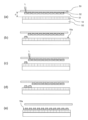
- 6 is a schematic cross-sectional view showing a first step in an embodiment of a method for processing an electronic component using an adhesive sheet fixed to a carrier substrate shown in FIG. 5;
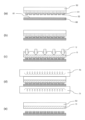
- 6A and 6B are schematic cross-sectional views showing second to fourth steps in an embodiment of the electronic component processing method using the adhesive sheet fixed to the carrier substrate shown in FIG. 5;
- the resin composition of the present invention is used to form an adhesive layer (the adhesive layer of the present invention).
- the pressure-sensitive adhesive layer of the present invention is used in processing technology for transferring small electronic components such as semiconductor chips and LED chips to mounting substrates such as circuit boards. Specifically, it is suitable for the following processes. can be used for ⁇ The adhesive layer (shock absorption layer) is arranged on the temporary fixing material with a gap facing the surface on which the electronic components are arranged, and the electronic components are received ⁇ The adhesive layer (shock absorption layer) is received The process of transferring the electronic components to another carrier board or transferring them directly to the mounting board. In order to prevent deterioration of positional accuracy, it is preferable to transfer the electronic component directly from the transfer substrate to the mounting substrate without using another carrier substrate.
- the pressure-sensitive adhesive layer of the present invention By using the pressure-sensitive adhesive layer of the present invention for transferring electronic components, it becomes possible to place a plurality of electronic components on the pressure-sensitive adhesive layer of the present invention on an optical time scale, eliminating the need to pick them up individually.
- the pressure-sensitive adhesive layer of the present invention has excellent shock absorption properties for alleviating the impact when receiving the electronic component before irradiation with active energy rays, and after irradiation with active energy rays, the electronic component is thermocompression bonded. It has excellent heat resistance that prevents expansion and outgassing due to heating when transferred onto a mounting substrate.
- the electronic component transferred to the pressure-sensitive adhesive layer of the present invention can be directly transferred from the pressure-sensitive adhesive layer of the present invention to the mounting substrate, the step of transferring to another carrier substrate and then transferring to the mounting substrate. can be omitted, and the manufacturing cost can be reduced. Further, it is possible to prevent the deterioration of the connection reliability due to the deterioration of the positional accuracy of the electronic parts caused by repeating the transfer twice.
- the form of the pressure-sensitive adhesive layer of the present invention is not particularly limited.
- a single-sided pressure-sensitive adhesive sheet having only one side with an adhesive surface may be configured, or a double-sided pressure-sensitive adhesive sheet with both sides having an adhesive surface may be configured.
- the double-sided pressure-sensitive adhesive sheet may have a form in which both pressure-sensitive adhesive surfaces are provided by the pressure-sensitive adhesive layer of the present invention.
- the adhesive surface is provided by the adhesive layer of the present invention, and the other adhesive surface is provided by an adhesive layer other than the adhesive layer of the present invention (in this specification, sometimes referred to as "another adhesive layer"). It may have a form to be
- the pressure-sensitive adhesive layer of the present invention may constitute a so-called “substrate-less type” pressure-sensitive adhesive sheet that does not have a substrate (base layer), or may constitute a type pressure-sensitive adhesive sheet that has a substrate. good.
- a "base-less type” pressure-sensitive adhesive sheet may be referred to as a “base-less pressure-sensitive adhesive sheet”
- a type pressure-sensitive adhesive sheet having a base may be referred to as a “base-attached pressure-sensitive adhesive sheet”.
- Examples of the substrate-less pressure-sensitive adhesive sheet include a double-sided pressure-sensitive adhesive sheet consisting only of the pressure-sensitive adhesive layer of the present invention, and a pressure-sensitive adhesive layer separate from the pressure-sensitive adhesive layer of the present invention (a pressure-sensitive adhesive layer other than the pressure-sensitive adhesive layer of the present invention).
- a double-sided pressure-sensitive adhesive sheet consisting of Examples of the PSA sheet with a substrate include a single-sided PSA sheet having the PSA layer of the present invention on one side of the substrate, a double-sided PSA sheet having the PSA layer of the present invention on both sides of the substrate, and , a double-sided pressure-sensitive adhesive sheet having the pressure-sensitive adhesive layer of the present invention on one side of a substrate and another pressure-sensitive adhesive layer on the other side.
- base material means a support, and when the pressure-sensitive adhesive layer of the present invention is used, it is a part that receives an electronic component together with the pressure-sensitive adhesive layer.
- a release liner that is released when the pressure-sensitive adhesive layer is used is not included in the base material.
- the meaning of an "adhesive tape” shall be included in an “adhesive sheet.” That is, the adhesive sheet may be an adhesive tape having a tape-like shape.
- the adhesive surface of the adhesive layer of the present invention is preferably protected with a release liner.
- the release liner is laminated on at least one adhesive surface in order to protect the impact absorbing properties of the adhesive layer of the present invention.
- the release liner preferably protects the adhesive surface on which the adhesive layer of the present invention is to receive the electronic component, in which case the adhesive layer of the present invention is peeled off immediately before being used to receive the electronic component. is preferred.
- FIG. 1 is a schematic cross-sectional view showing one embodiment of a pressure-sensitive adhesive sheet having a pressure-sensitive adhesive layer of the present invention, wherein 1 indicates a pressure-sensitive adhesive sheet, 10 indicates a pressure-sensitive adhesive layer, and R1 and R2 indicate release liners.
- the adhesive sheet 1 has a laminated structure in which a release liner R1, an adhesive layer 10, and a release liner R2 are laminated in this order.
- the adhesive sheet 1 is used in processing technology for mounting small electronic components such as semiconductor chips and LED chips on mounting substrates such as circuit boards.
- the pressure-sensitive adhesive layer 10 is composed of the pressure-sensitive adhesive layer of the present invention, and is preferably used for separating the electronic components placed on the temporary fixing material and receiving the separated electronic components. It is what is done.
- the release liner R1 is peeled off from the adhesive layer 10 before use and receives the electronic component with the exposed adhesive surface 10a.
- the adhesive surface 10b exposed by peeling off the release liner R2 is adhered to a base material constituting a transfer substrate, a carrier substrate, or the like. Since the pressure-sensitive adhesive layer 10 in the pressure-sensitive adhesive sheet 1 is composed of the pressure-sensitive adhesive layer of the present invention, the pressure-sensitive adhesive layer 10 before irradiation with active energy rays has excellent impact absorption when receiving electronic components, and the active energy The pressure-sensitive adhesive layer 10 after irradiation exhibits excellent heat resistance when electronic components are transferred onto a mounting substrate by thermocompression bonding.
- FIG. 2 is a schematic cross-sectional view showing another embodiment of the pressure-sensitive adhesive sheet having a pressure-sensitive adhesive layer of the present invention, wherein 2 is the pressure-sensitive adhesive sheet, 20 and 21 are pressure-sensitive adhesive layers, and R1 and R2 are release liners.
- the adhesive sheet 2 has a laminated structure in which a release liner R1, an adhesive layer 20, an adhesive layer 21, and a release liner R2 are laminated in this order.
- the adhesive sheet 2 is used in processing technology for mounting small electronic components such as semiconductor chips and LED chips on mounting substrates such as circuit boards.
- the pressure-sensitive adhesive layer 20 is composed of the pressure-sensitive adhesive layer of the present invention, and is preferably used for separating the electronic components placed on the temporary fixing material and receiving the separated electronic components. It is what is done.
- the pressure-sensitive adhesive layer 21 and the pressure-sensitive adhesive layer 20 are capable of adjusting the shock absorbing property when receiving electronic components.
- the adhesive layer 21 may be composed of the adhesive layer of the present invention, or may be composed of an adhesive layer other than the adhesive layer of the present invention.
- the release liner R1 is peeled off from the adhesive layer 20 before use and receives the electronic component with the exposed adhesive surface 20a.
- the adhesive surface 21b exposed by peeling off the release liner R2 is adhered to a base material constituting a transfer substrate, a carrier substrate, or the like.
- the pressure-sensitive adhesive layer 20 in the pressure-sensitive adhesive sheet 2 is composed of the pressure-sensitive adhesive layer of the present invention, the pressure-sensitive adhesive layer 20 before irradiation with active energy rays has excellent impact absorption when receiving electronic components, and the active energy The adhesive layer 20 after irradiation exhibits excellent heat resistance when the electronic component is transferred onto the mounting substrate by thermocompression bonding.
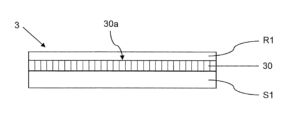
- FIG. 3 is a schematic cross-sectional view showing another embodiment of the pressure-sensitive adhesive sheet having a pressure-sensitive adhesive layer of the present invention, wherein 3 is the pressure-sensitive adhesive sheet, 30 is the pressure-sensitive adhesive layer, S1 is the substrate, and R1 is the release liner. .
- the adhesive sheet 3 has a laminated structure in which a release liner R1, an adhesive layer 30, and a substrate S1 are laminated in this order.
- the adhesive sheet 3 is used in processing technology for mounting small electronic components such as semiconductor chips and LED chips on mounting substrates such as circuit boards.
- the pressure-sensitive adhesive layer 30 is composed of the pressure-sensitive adhesive layer of the present invention. It is what is done.
- the base material S1 improves the stability and handleability when receiving electronic components.
- the release liner R1 is peeled off from the adhesive layer 30 before use and receives the electronic component with the exposed adhesive surface 30a.
- the pressure-sensitive adhesive layer 30 in the pressure-sensitive adhesive sheet 3 is composed of the pressure-sensitive adhesive layer of the present invention, the pressure-sensitive adhesive layer 30 before irradiation with active energy rays has excellent impact absorption when receiving electronic components, and the active energy The adhesive layer 30 after irradiation exhibits excellent heat resistance when transferring an electronic component onto a mounting substrate by thermocompression bonding.
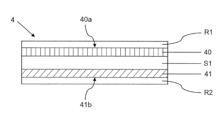
- FIG. 4 is a schematic cross-sectional view showing another embodiment of a pressure-sensitive adhesive sheet having a pressure-sensitive adhesive layer of the present invention, wherein 4 is a pressure-sensitive adhesive sheet, 40 and 41 are pressure-sensitive adhesive layers, S1 is a substrate, and R1 and R2 are A release liner is shown.
- the adhesive sheet 4 has a laminate structure in which a release liner R1, an adhesive layer 40, a substrate S1, an adhesive layer 41, and a release liner R2 are laminated in this order.
- the adhesive sheet 4 is used in processing technology for mounting small electronic components such as semiconductor chips and LED chips on mounting substrates such as circuit boards.
- the pressure-sensitive adhesive layer 40 is composed of the pressure-sensitive adhesive layer of the present invention. It is what is done.
- the base material S1 improves the stability and handleability when receiving electronic components.
- the pressure-sensitive adhesive layer 41 and the pressure-sensitive adhesive layer 40 can adjust the shock absorption when receiving the electronic component.
- the adhesive layer 41 may be composed of the adhesive layer of the present invention, or may be composed of an adhesive layer other than the adhesive layer of the present invention.
- the release liner R1 is peeled off from the adhesive layer 40 before use and receives the electronic component with the exposed adhesive surface 40a.
- the adhesive surface 41b exposed by peeling off the release liner R2 is adhered to a base material constituting a transfer substrate, a carrier substrate, or the like. Since the adhesive layer 40 in the adhesive sheet 4 is composed of the adhesive layer of the present invention, the adhesive layer 40 before the active energy ray irradiation has excellent impact absorption when receiving the electronic component, and the active energy
- the adhesive layer 40 after irradiation exhibits excellent heat resistance when transferring an electronic component onto a mounting substrate by thermocompression bonding. Each configuration will be described below.
- the pressure-sensitive adhesive layer of the present invention has a storage modulus G' (100k) at 100 kHz and 25°C of 60 MPa or less.
- G' storage modulus
- the transfer of electronic parts is completed within an optical time scale, so the impact relaxation properties of the pressure-sensitive adhesive on this time scale are important.
- the optical time scale is correlated with the sweeping frequency of the laser light, such as 100 kHz. When converted to a time scale, it is about 10 microseconds, and the adhesive needs to be deformed in response to the impact on this time scale.
- the G'(100k) is more preferably 30 MPa or less, still more preferably 15 MPa or less, and may be 10 MPa or less in terms of realizing better impact absorption of the pressure-sensitive adhesive layer on an optical time scale. .
- the G'(100k) is preferably 0.03 MPa or more, more preferably 0.05 MPa or more, and even more preferably 0.1 MPa or more.
- the adhesive layer of the present invention preferably has a tan ⁇ (100k) of 1 or more at 100kHz and 25°C. Tan ⁇ (loss factor) is one of the indicators of viscoelasticity represented by the ratio (G′′/G′) of loss elastic modulus (G′′) to storage elastic modulus (G′). It can be said that it is easy to plastically deform, and if it is low, it has high elasticity.
- Tan ⁇ (100k) is 1 or more realizes excellent impact absorption of the pressure-sensitive adhesive layer on an optical time scale, and the pressure-sensitive adhesive layer of the present invention is used as a substrate for transfer.
- the tan ⁇ (100k) is preferably 1.1 or more, more preferably 1.2 or more, in terms of achieving better impact absorption of the pressure-sensitive adhesive layer on an optical time scale. Moreover, from the viewpoint of preventing misalignment of received electronic components, the tan ⁇ (100k) is preferably 3 or less, and may be 2 or less.
- G'(100k) and tan ⁇ (100k) represent the storage elastic modulus and loss factor of the pressure-sensitive adhesive layer before irradiation with active energy rays.
- activation energy ray irradiation means "ultraviolet irradiation” in the examples described later, unless otherwise specified, and specifically, 8280 mJ/cm 2 of ultraviolet irradiation. .
- the above G' (100k) and tan ⁇ (100k) are specifically measured by dynamic viscoelasticity measurement described in Examples below, and the resin constituting the pressure-sensitive adhesive layer of the present invention It can be adjusted by the type and composition (monomer composition) of the composition (the resin composition of the present invention), the type and amount of the active energy ray-curable compound described later, the type and amount of the cross-linking agent, and the like.
- the ratio (G 1 /G 0 ) of the gel fraction G 1 (%) after active energy ray irradiation to the gel fraction G 0 (%) before active energy ray irradiation of the pressure-sensitive adhesive layer of the present invention is 1. It is preferably 1 or more.
- the pressure-sensitive adhesive layer of the present invention exhibits excellent impact absorption before active energy ray irradiation, and after active energy ray irradiation, the active energy
- the elastic modulus of the pressure-sensitive adhesive layer of the present invention is improved by forming a crosslinked structure through the reaction of the ray-curable compound, and even in thermocompression bonding when transferring electronic parts to a mounting substrate, expansion and outgassing can be suppressed. It is suitable in that it exhibits heat resistance.
- the G 1 /G 0 is more preferably 1.15 or more, and 1.2 in terms of achieving a higher level of both the impact absorption property before the active energy ray irradiation and the heat resistance after the active energy ray irradiation. More preferably, it may be 1.3 or more.
- the upper limit of G 1 /G 0 is not particularly limited, and the higher the better. , or 100 or less.
- the gel fraction G 0 (%) of the pressure-sensitive adhesive layer of the present invention before active energy ray irradiation realizes excellent impact absorption of the pressure-sensitive adhesive layer, and the pressure-sensitive adhesive layer of the present invention is used as the impact absorption layer of the transfer substrate. 85% or less is preferable, and 80% or less is more preferable in terms of being able to impart excellent transferability when used as. Moreover, from the viewpoint of preventing misalignment of received electronic components, the G 0 (%) is preferably 10% or more, and may be 20% or more.
- the gel fraction G 1 (%) of the pressure-sensitive adhesive layer of the present invention after irradiation with active energy rays is excellent heat resistance that can suppress expansion and outgassing even in thermocompression bonding when transferring electronic parts to a mounting substrate. is preferably 90% or more, more preferably 93% or more.
- the upper limit of the gel fraction G 1 (%) is preferably as high as possible and is not particularly limited, but may be, for example, less than 100%.
- the gel fractions G 0 , G 1 and the ratio G 1 /G 0 thereof are specifically measured by the gel fraction measurement described in Examples below, and the adhesive of the present invention It can be adjusted by the type and composition (monomer composition) of the resin composition (the resin composition of the present invention) constituting the layer, the type and amount of the active energy ray-curable compound described later, the type and amount of the cross-linking agent, and the like. can.
- the linear expansion coefficient ⁇ (200 to 210) at 200 to 210° C. of the adhesive layer of the present invention after irradiation with active energy rays is preferably 500 ⁇ 10 ⁇ 5 /K or less.
- the configuration in which the ⁇ (200 to 210) is 500 ⁇ 10 -5 /K or less is such that the elastic modulus of the pressure-sensitive adhesive layer of the present invention increases due to the formation of a crosslinked structure by the active energy ray-curable compound after irradiation with an active energy ray. It exhibits excellent heat resistance that can suppress the occurrence of expansion during thermocompression bonding when electronic components are transferred to a mounting substrate, and can prevent the positional accuracy of electronic components from declining due to linear expansion of the adhesive layer. preferable.
- the ⁇ (200 to 210) is 250 ⁇ 10 -5 /K or less. More preferably, it is 150 ⁇ 10 ⁇ 5 /K or less.
- the lower limit of ⁇ (200 to 210) is not particularly limited, and the lower the better, but it may be 1 ⁇ 10 ⁇ 5 /K or more.
- the linear expansion coefficient ⁇ (260-270) at 260-270° C. of the pressure-sensitive adhesive layer of the present invention after irradiation with active energy rays is preferably 500 ⁇ 10 ⁇ 5 /K or less.
- the configuration in which the ⁇ (260 to 270) is 500 ⁇ 10 ⁇ 5 /K or less is such that the elastic modulus of the pressure-sensitive adhesive layer of the present invention increases due to the formation of a crosslinked structure by the active energy ray-curable compound after irradiation with an active energy ray.
- thermocompression bonding is performed at a high temperature exceeding 250 ° C. in order to improve connection reliability, it has excellent heat resistance that can suppress the occurrence of expansion.
- the ⁇ (260 to 270) is 350 ⁇ 10 -5 /K or less is more preferable, and 200 ⁇ 10 ⁇ 5 /K or less is even more preferable.
- the lower limit of ⁇ (260 to 270) is not particularly limited, and the lower the better, but it may be 1 ⁇ 10 ⁇ 5 /K or more.
- ⁇ (200 to 210) and ⁇ (260 to 270) are measured in accordance with JIS K 7197, specifically by measuring the coefficient of linear expansion described in the Examples below,
- the type and composition (monomer composition) of the resin composition constituting the pressure-sensitive adhesive layer of the present invention (the resin composition of the present invention), the type and amount of the active energy ray-curable compound described later, the type and amount of the cross-linking agent, It can be adjusted by the thickness of the pressure-sensitive adhesive layer.
- the tensile elastic modulus E'(200) at 200°C after the active energy ray irradiation of the pressure-sensitive adhesive layer of the present invention is preferably 0.3 MPa or more.
- the elastic modulus of the pressure-sensitive adhesive layer of the present invention is improved by forming a crosslinked structure with the active energy ray-curable compound after irradiation with the active energy ray, and the mounting substrate It exhibits excellent heat resistance that can suppress expansion and outgassing in thermocompression bonding when transferring electronic parts to , and is suitable in that it can prevent deterioration of connection reliability due to deterioration of positional accuracy of electronic parts.
- E′(200) is more preferably 0.5 MPa or more from the viewpoint of exhibiting better heat resistance and being able to prevent a higher level of deterioration in positional accuracy of electronic components due to expansion of the adhesive layer and generation of outgassing. 0.9 MPa or more is more preferable.
- the upper limit of E′ (200) is not particularly limited, and the higher the better. Therefore, it may be, for example, 1000 MPa or less.
- the tensile elastic modulus E'(260) at 260°C of the pressure-sensitive adhesive layer of the present invention after irradiation with active energy rays is preferably 0.05 MPa or more.
- the configuration in which the tensile elastic modulus E′ (260) is 0.05 MPa or more is such that the elastic modulus of the pressure-sensitive adhesive layer of the present invention is improved by forming a crosslinked structure with the active energy ray-curable compound after irradiation with active energy rays,
- thermocompression bonding is performed at a high temperature exceeding 250°C to improve connection reliability, it has excellent heat resistance that can suppress expansion and outgassing.
- E′(260) is 0.1 MPa or more from the viewpoint of exhibiting superior heat resistance at high temperatures and being able to prevent a higher level of deterioration in the positional accuracy of the bumps of the electronic component due to expansion of the adhesive layer and generation of outgassing. is more preferable, and 0.5 MPa or more is even more preferable.
- the upper limit of E′ (260) is not particularly limited, and the higher the better. Therefore, it may be, for example, 1000 MPa or less.
- E'(200) and E'(260) are specifically measured by the tensile elasticity test measurement described in the examples below, and the resin constituting the pressure-sensitive adhesive layer of the present invention
- the type and composition (monomer composition) of the composition (the resin composition of the present invention), the type and amount of the active energy ray-curable compound described later, the type and amount of the cross-linking agent, the thickness of the pressure-sensitive adhesive layer, etc. can be adjusted. can be done.
- thermomechanical analysis TMA
- Probe diameter 1.0mm
- Pushing load 0.05N
- Measurement ambient temperature -40°C
- Indentation load time 20 minutes
- the physical properties of the adhesive in the frequency range of 100 kHz correspond to the physical properties of the adhesive in the low temperature range of -40°C according to the temperature-time conversion rule, so when a load is applied to the adhesive in this temperature range It means that the larger the amount of deformation, the better the impact relaxation property.
- the above ratio (sinking depth/thickness ⁇ 100) when a load is applied to the pressure-sensitive adhesive layer at ⁇ 40° C. by thermomechanical analysis (TMA) can be used as an index of impact relaxation properties.
- TMA thermomechanical analysis
- the ratio is 5% or more can sufficiently absorb the impact caused by the collision of the electronic component, and the electronic component It is preferable in that it can be received without damage or misalignment.
- the ratio is more preferably 10% or more, further preferably 30% or more, and particularly preferably 50% or more. From the viewpoint of transferability of received electronic components to a mounting board, the above ratio is preferably 95% or less, and may be 90% or less.
- the ratio (sinking depth/thickness x 100) is specifically measured by the method described in Examples below, and the resin composition ( The resin composition of the present invention) can be adjusted by the type and composition (monomer composition), the type and amount of the active energy ray-curable compound described later, the type and amount of the cross-linking agent, the thickness of the pressure-sensitive adhesive layer, and the like.
- the 5% weight loss temperature (T d5 ) of the pressure-sensitive adhesive layer of the present invention after irradiation with active energy rays is preferably 340° C. or higher.
- the elastic modulus of the pressure-sensitive adhesive layer of the present invention is improved by forming a crosslinked structure by the active energy ray-curable compound after irradiation with active energy rays, and electronic components are attached to the mounting substrate.
- T d5 is more preferably 345° C. or higher, even more preferably 350° C. or higher, from the viewpoint of exhibiting better heat resistance and being able to prevent a higher level of deterioration in positional accuracy of electronic components due to outgassing of the pressure-sensitive adhesive layer.
- the upper limit of T d5 is not particularly limited, and although it is preferably as high as possible, it may be 500° C. or less.
- the 5% weight loss temperature (T d5 ) of the pressure-sensitive adhesive layer of the present invention after irradiation with the energy beam is specifically measured by the method described in Examples below.
- the thickness of the adhesive layer of the present invention is preferably 1 ⁇ m or more and 500 ⁇ m or less.
- the configuration in which the thickness of the pressure-sensitive adhesive layer of the present invention is 1 ⁇ m or more is preferable from the viewpoint of excellent shock absorbing properties due to collision of electronic parts.
- the thickness of the pressure-sensitive adhesive layer of the present invention is preferably 5 ⁇ m or more, and may be 10 ⁇ m or more, 20 ⁇ m or more, or 30 ⁇ m or more.
- the configuration in which the thickness of the pressure-sensitive adhesive layer of the present invention is 500 ⁇ m or less is preferable from the viewpoint of transferability when transferring to a mounting substrate for electronic components, and may be 400 ⁇ m or less or 300 ⁇ m or less.
- the thickness of the pressure-sensitive adhesive layer is the thickness of the entire laminated structure.
- the thickness of the pressure-sensitive adhesive layer of the present invention that does not include another pressure-sensitive adhesive layer is preferably 1 ⁇ m or more and 450 ⁇ m or less.
- the configuration in which the thickness of the pressure-sensitive adhesive layer of the present invention is 1 ⁇ m or more is preferable from the viewpoint of excellent shock absorbing properties due to collision of electronic parts, and is preferably 2 ⁇ m or more, and more preferably 5 ⁇ m or more.
- the configuration in which the thickness of the pressure-sensitive adhesive layer of the present invention is 450 ⁇ m or less is preferable from the viewpoint of transferability when transferring to a mounting board for electronic components, and may be 350 ⁇ m or less or 250 ⁇ m or less.
- the probe tack value at normal temperature of the pressure-sensitive adhesive layer before irradiation with active energy rays of the present invention is preferably 7 N/cm 2 or more and 42 N/cm 2 or less.
- the configuration in which the probe tack value is 10 N/cm 2 or more can sufficiently absorb the impact caused by the collision of the electronic component or the like with the adhesive layer, and can suppress the displacement or turning inside out due to the bounce of the electronic component at the time of collision.
- the probe tack value is preferably 9 N/cm 2 or more, and may be 11 N/cm 2 or more, or 13 N/cm 2 or more, in order to suppress misalignment or turning over of the electronic component.
- the configuration that the probe tack value is 42 N/cm 2 or less is preferable from the viewpoint of preventing adhesion of the adhesive to the received electronic component and adhesive residue, and is 40 N/cm 2 or less, or 35 N/cm 2 or less. There may be.
- the probe tack value is measured using a probe tack measuring machine (for example, manufactured by RHESCA, trade name "TACKINESS Model TAC-II"), and the resin composition (
- the resin composition of the present invention can be adjusted by the type and composition (monomer composition), the type and amount of the active energy ray-curable compound described later, the type and amount of the cross-linking agent, the thickness of the pressure-sensitive adhesive layer, and the like.
- the adhesive strength of the pressure-sensitive adhesive layer of the present invention to stainless steel after irradiation with active energy rays at room temperature is preferably 0.01 N/20 mm or more and 4.2 N/20 mm or less.
- the configuration in which the adhesive strength of the adhesive layer to stainless steel after irradiation with the active energy ray is 0.01 N/20 mm or more at room temperature suppresses misalignment of received electronic components when transporting them to the next step. It is preferable in terms of retention, and the adhesive strength is more preferably 0.03 N/20 mm or more, and may be 0.05 N/20 mm or more.
- the configuration in which the adhesive strength of the adhesive layer to stainless steel after irradiation with the active energy ray is 4.2 N/20 mm or less at normal temperature is preferable from the viewpoint of transferability to the mounting board of the received electronic component, and is 3.0 N. /20 mm or less, or 2.0 N/20 mm or less.
- the adhesive strength of the pressure-sensitive adhesive layer of the present invention to stainless steel at room temperature after irradiation with active energy rays is more preferably 1 N/20 mm or less.
- the adhesive layer has an adhesive strength of 1 N/20 mm or less at room temperature to stainless steel after irradiation with active energy rays, which improves the transferability of received electronic components to a mounting substrate and suppresses adhesive residue on electronic components. 0.75 N/20 mm or less, or 0.5 N/20 mm or less.
- the adhesive strength of the pressure-sensitive adhesive layer to stainless steel after irradiation with active energy rays at room temperature may be 0.001 N/20 mm or more, or 0.005 N/20 mm or more.
- the adhesive strength of the pressure-sensitive adhesive layer of the present invention to stainless steel at normal temperature before irradiation with active energy rays is preferably 0.01 N/20 mm or more.
- a configuration in which the adhesive layer has an adhesive strength of 0.01 N/20 mm or more before irradiation with an active energy ray is preferable in terms of suppressing displacement and turning inside out due to splashing of electronic parts upon collision.
- the adhesive strength of the adhesive layer before irradiation with the active energy ray is more preferably 0.02 N/20 mm or more, and may be 0.03 N/20 mm or more, in order to suppress misalignment and turning over of the electronic component.
- the upper limit of the adhesive strength of the adhesive layer before the active energy ray irradiation is not particularly limited, but may be 20 N/20 mm or less, 18 N/20 mm or less, or 15 N/20 mm or less.
- the adhesive strength is measured, for example, in accordance with JIS Z 0237, etc., and the type and composition (monomer composition) of the resin composition (the resin composition of the present invention) constituting the adhesive layer of the present invention. , the type and amount of the active energy ray-curable compound described later, the type and amount of the cross-linking agent, the thickness of the pressure-sensitive adhesive layer, and the like.
- the impact absorption rate (%) in the falling ball test described later is preferably 10% or more, more preferably 15% or more, 20% or more, 25% or more. , 30% or more, 35% or more, or 40% or more.
- the ratio of the depth of subduction of the adhesive layer to the thickness of the adhesive layer before irradiation with active energy rays was 7. % or more, more preferably 10% or more, and may be 15% or more, 20% or more, 25% or more, or 30% or more.
- the configuration in which the ratio (sinking depth/thickness x 100) is 7% or more indicates that the pressure-sensitive adhesive layer of the present invention before irradiation with active energy rays exhibits excellent impact absorption, and when receiving an electronic component. , it is preferable in that it is possible to prevent troubles such as breakage, jumping to cause misalignment, and turning over.
- the ratio (sinking depth/thickness ⁇ 100) is preferably 95% or less, more preferably 90% or less.
- a falling ball test can be performed by the following method. First, a 2 kg hand roller was applied to a SUS plate (thickness 5 mm) via a double-sided adhesive tape on the entire surface opposite to the adhesive layer on the evaluation surface of the adhesive sheet (width 30 mm ⁇ length 30 mm). affix it. Using a falling ball tester, a 1 g iron ball is allowed to fall freely from a height of 1 m onto the adhesive layer surface of the evaluation sample obtained as described above. The depth of sinking of the iron ball into the pressure-sensitive adhesive layer surface is measured with a confocal laser microscope.
- the subduction depth ( ⁇ m) is divided by the thickness ( ⁇ m) of the adhesive sheet, and the ratio of the subduction depth of the adhesive to the thickness of the adhesive (depth of subduction of the adhesive after the falling ball test/thickness ⁇ 100).
- the impact load F when the impact is applied under the above conditions is measured using the falling ball tester, and the impact absorption rate (%) is obtained from the following formula.
- Impact absorption rate (%) ⁇ ( F0 - F1 )/ F0 ⁇ x 100 (In the above formula, F 0 is the impact load when an iron ball hits only the SUS plate without sticking the adhesive sheet, and F 1 is the adhesive sheet of the structure consisting of the SUS plate and the adhesive sheet. It is the impact load when an iron ball collides with it.)
- the impact absorption rate in the iron ball drop test depends on the type and composition (monomer composition ), the type and amount of the active energy ray-curable compound described later, the type and amount of the cross-linking agent, the thickness of the pressure-sensitive adhesive layer, and the like.
- the resin composition (adhesive composition) constituting the adhesive layer of the present invention is not particularly limited, but examples include acrylic adhesives, rubber adhesives, vinyl alkyl ether adhesives, silicone adhesives, Examples include polyester-based adhesives, polyamide-based adhesives, urethane-based adhesives, fluorine-based adhesives, and epoxy-based adhesives.
- acrylic pressure-sensitive adhesives and silicone-based pressure-sensitive adhesives are preferable.
- the various desired physical properties of the pressure-sensitive adhesive layer of the present invention in particular, the G′(100k) is 60 MPa or less.
- an acrylic pressure-sensitive adhesive is preferable from the viewpoints of ease of designing the pressure-sensitive adhesive to be adjusted to , transparency, adhesiveness, cost, and the like. That is, the pressure-sensitive adhesive layer of the present invention is preferably an acrylic pressure-sensitive adhesive layer composed of an acrylic pressure-sensitive adhesive composition.
- the pressure-sensitive adhesives may be used alone or in combination of two or more.
- the acrylic pressure-sensitive adhesive composition contains an acrylic polymer as a base polymer.
- the above acrylic polymer is a polymer containing an acrylic monomer (a monomer having a (meth)acryloyl group in the molecule) as a monomer component constituting the polymer.
- the acrylic polymer is preferably a polymer containing a (meth)acrylic acid alkyl ester as a monomer component constituting the polymer.
- an acrylic polymer can be used individually or in combination of 2 or more types.
- the adhesive composition forming the adhesive layer of the present invention may be in any form.
- the pressure-sensitive adhesive composition may be an emulsion type, a solvent type (solution type), an active energy ray-curable type, a heat-melting type (hot-melt type), or the like.
- solvent-type and active energy ray-curable pressure-sensitive adhesive compositions are preferable from the viewpoint of productivity and the ease with which a pressure-sensitive adhesive layer having excellent optical properties and appearance can be obtained.
- An active energy ray-curable pressure-sensitive adhesive composition is preferable from the viewpoint of exhibiting excellent heat resistance capable of suppressing expansion by heating and generation of outgassing.
- the pressure-sensitive adhesive layer of the present invention is an acrylic pressure-sensitive adhesive layer containing an acrylic polymer as a base polymer, and is preferably formed from an active energy ray-curable acrylic pressure-sensitive adhesive composition.
- the active energy rays include ionizing radiation such as ⁇ -rays, ⁇ -rays, ⁇ -rays, neutron beams and electron beams, and ultraviolet rays, with ultraviolet rays being particularly preferred. That is, the active energy ray-curable pressure-sensitive adhesive composition is preferably an ultraviolet-curable pressure-sensitive adhesive composition.
- the pressure-sensitive adhesive composition (acrylic pressure-sensitive adhesive composition) forming the acrylic pressure-sensitive adhesive layer includes, for example, an acrylic pressure-sensitive adhesive composition containing an acrylic polymer as an essential component, or a single Examples include acrylic pressure-sensitive adhesive compositions containing a mixture of monomers (sometimes referred to as a "monomer mixture") or a partial polymer thereof as an essential component.
- the former includes, for example, a so-called solvent-type acrylic pressure-sensitive adhesive composition. again. Examples of the latter include so-called active energy ray-curable acrylic pressure-sensitive adhesive compositions.
- the "monomer mixture” means a mixture containing monomer components that constitute a polymer.
- the above-mentioned "partially polymerized product” may also be referred to as a "prepolymer", and means a composition in which one or more of the monomer components in the monomer mixture is partially polymerized. do.
- the above acrylic polymer is a polymer composed (formed) of an acrylic monomer as an essential monomer component (monomer component).
- the acrylic polymer is preferably a polymer composed (formed) of a (meth)acrylic acid alkyl ester as an essential monomer component. That is, the acrylic polymer preferably contains a (meth)acrylic acid alkyl ester as a structural unit.
- “(meth)acryl” represents “acryl” and/or "methacryl” (either or both of "acryl” and “methacryl"), and so on.
- the said acrylic polymer is comprised by 1 type, or 2 or more types of monomer components.
- acrylic pressure-sensitive adhesive examples include, for example, an acrylic pressure-sensitive adhesive whose base polymer is an acrylic polymer (homopolymer or copolymer) using one or more of (meth)acrylic acid alkyl esters as a monomer component. etc.
- (meth) acrylic acid alkyl esters include methyl (meth) acrylate, ethyl (meth) acrylate, propyl (meth) acrylate, isopropyl (meth) acrylate, butyl (meth) acrylate, (meth) ) isobutyl acrylate, s-butyl (meth)acrylate, t-butyl (meth)acrylate, pentyl (meth)acrylate, hexyl (meth)acrylate, heptyl (meth)acrylate, octyl (meth)acrylate , 2-ethylhexyl (meth)acrylate, isooctyl (meth)acrylate, nonyl (meth)acrylate, isononyl (meth)acrylate, decyl (meth)acrylate, isodecyl (meth)acrylate, (meth)acrylic acid Undecyl, dodecyl
- (meth)acrylic acid alkyl esters having a linear or branched alkyl group having 2 to 18 carbon atoms are preferably used.
- the content of the (meth)acrylic acid alkyl ester structural unit in the acrylic polymer is preferably 70 parts by weight to 100 parts by weight, more preferably 75 parts by weight to 99 parts by weight, with respect to 100 parts by weight of the acrylic polymer. .9 parts by weight, more preferably 80 to 99.9 parts by weight.
- the above acrylic polymer can be copolymerized with the above (meth)acrylic acid alkyl ester as necessary for the purpose of modifying cohesive strength, heat resistance, crosslinkability, etc., improving the dimensional stability of the adhesive layer, etc. It may contain structural units derived from other monomers. Examples of such monomers include the following monomers.
- Carboxy group-containing monomers ethylenically unsaturated monocarboxylic acids such as acrylic acid (AA), methacrylic acid (MAA), crotonic acid; ethylenically unsaturated dicarboxylic acids such as maleic acid, itaconic acid, citraconic acid and their anhydrides (maleic anhydride, itaconic anhydride, etc.); hydroxyl group-containing monomers: hydroxyalkyl (meth)acrylates such as 2-hydroxyethyl (meth)acrylate, 2-hydroxypropyl (meth)acrylate, 3-hydroxypropyl (meth)acrylate, 2-hydroxybutyl (meth)acrylate; Unsaturated alcohols such as vinyl alcohol and allyl alcohol; Ether compounds such as 2-hydroxyethyl vinyl ether, 4-hydroxybutyl vinyl ether and diethylene glycol monovinyl ether; amino group-containing monomers: for example aminoethyl (meth)acrylate, N,N-dimethylamino
- Keto group-containing monomers for example diacetone (meth)acrylamide, diacetone (meth)acrylate, vinyl methyl ketone, vinyl ethyl ketone, allyl acetoacetate, vinyl acetoacetate; Monomers having a nitrogen atom-containing ring: such as N-vinyl-2-pyrrolidone, N-methylvinylpyrrolidone, N-vinylpyridine, N-vinylpiperidone, N-vinylpyrimidine, N-vinylpiperazine, N-vinylpyrazine, N-vinyl pyrrole, N-vinylimidazole, N-vinyloxazole, N-vinylmorpholine, N-vinylcaprolactam, N-(meth)acryloylmorpholine; Alkoxysilyl group-containing monomers: such as 3-(meth)acryloxypropyltrimethoxysilane, 3-
- the acrylic polymer preferably contains structural units derived from a carboxy group-containing monomer.
- the content of structural units derived from a carboxy group-containing monomer in the acrylic polymer is preferably 1 part by weight to 20 parts by weight, more preferably 2 parts by weight to 15 parts by weight, with respect to 100 parts by weight of the acrylic polymer. and more preferably 3 to 10 parts by weight.
- the acrylic polymer containing a structural unit derived from a carboxy group-containing monomer is preferably used in combination with an epoxy-based cross-linking agent described below.
- an acrylic polymer containing a structural unit derived from a carboxy group-containing monomer and an epoxy crosslinking agent When used in combination, a pressure-sensitive adhesive layer having excellent heat resistance and excellent dimensional stability at high temperatures can be formed.
- the combined use of the acrylic polymer and the epoxy-based cross-linking agent is also advantageous in that a pressure-sensitive adhesive layer with little expansion or outgassing can be formed even in thermocompression bonding when transferring electronic components to a mounting substrate.
- the acrylic polymer preferably contains structural units derived from hydroxyl group-containing monomers.
- the content of structural units derived from a hydroxyl group-containing monomer is preferably 0.01 to 10 parts by weight, more preferably 0.05 to 10 parts by weight, with respect to 100 parts by weight of the acrylic polymer. 8 parts by weight, more preferably 0.1 to 5 parts by weight.
- the acrylic polymer containing a structural unit derived from a hydroxyl group-containing monomer is preferably used in combination with an isocyanate-based cross-linking agent described below.
- other monomers copolymerizable with (meth)acrylic acid alkyl esters include, for example, polyfunctional monomers.
- the polyfunctional monomer include hexanediol di(meth)acrylate, butanediol di(meth)acrylate, (poly)ethylene glycol di(meth)acrylate, (poly)propylene glycol di(meth)acrylate, neopentyl glycol di(meth)acrylate, pentaerythritol di(meth)acrylate, pentaerythritol tri(meth)acrylate, dipentaerythritol hexa(meth)acrylate, trimethylolpropane tri(meth)acrylate, tetramethylolmethane tri(meth)acrylate, Allyl (meth)acrylate, vinyl (meth)acrylate, divinylbenzene, epoxy acrylate, polyester acrylate, urethane acrylate and the like
- the proportion of the polyfunctional monomer in the total monomer components (100% by weight) constituting the acrylic polymer is although not particularly limited, it is preferably 5% by weight or less (e.g., more than 0% by weight and 5% by weight or less), more preferably 3% by weight or less (e.g., more than 0% by weight and 3% by weight or less), particularly preferably is 1% by weight or less (eg, more than 0% by weight and 1% by weight or less).
- the acrylic polymer contains, as a monomer component constituting the polymer, a monomer having a low glass transition temperature (Tg) when forming a homopolymer (hereinafter sometimes referred to as a "low Tg monomer"). preferably included.
- Tg glass transition temperature
- the pressure-sensitive adhesive containing the acrylic polymer becomes soft, and the above-mentioned properties of the pressure-sensitive adhesive layer of the present invention (in particular, impact absorption) are controlled, and the impact of electronic parts It is preferable from the viewpoint of being able to absorb impacts and suppress misalignment and turning inside out of the electronic component.
- the glass transition temperature when the homopolymer of the low Tg monomer is formed is not particularly limited, but is, for example, 0°C or lower, preferably -10°C or lower, more preferably -20°C or lower.
- the Tg of the low Tg monomer is within the above range, the impact absorption of the pressure-sensitive adhesive layer is enhanced.
- the above-mentioned low Tg monomer may be the above-mentioned monomers exemplified as the monomers contained in the monomer component constituting the acrylic polymer, or may be other monomers.
- the monomer component constituting the acrylic polymer contains a monomer component exemplified as the monomer component constituting the acrylic polymer described above and which is a low Tg monomer.
- the low Tg monomers may be of one kind, or may be of two or more kinds.
- Examples of the low Tg monomer include, but are not limited to, 2-ethylhexyl acrylate (EHA, Tg of homopolymer: -70°C), butyl acrylate (BA, Tg of homopolymer: -55°C), acrylic acid Ethyl (EA, Tg of homopolymer: -24°C), Lauryl methacrylate (LMA, Tg of homopolymer: -65°C), Lauryl acrylate (LA, Tg of homopolymer: -23°C), Isononyl acrylate ( iNAA, homopolymer Tg: -58°C), etc., and 2-ethylhexyl acrylate, butyl acrylate, and lauryl methacrylate are preferred.
- EHA 2-ethylhexyl acrylate
- BA Tg of homopolymer: -55°C
- acrylic acid Ethyl EA, Tg of homopolymer: -24°
- the proportion of the low Tg monomer in the total monomer components (100% by weight) constituting the acrylic polymer is particularly limited. Although not required, it is preferably 40% by weight or more, and may be 60% by weight or more, or 80% by weight or more.
- the upper limit of the proportion of the low Tg monomer is also not particularly limited, but may be 99% by weight or less, or 98% by weight or less.
- the ratio of the low Tg monomer is within the above range, the above characteristics (especially impact absorption) can be controlled, the impact due to the collision of the electronic component can be absorbed, and the displacement and turning over of the electronic component can be suppressed. Therefore, it is preferable.
- the above "proportion of low Tg monomers" is the sum of the proportions of the above two or more types of low Tg monomers.
- the content of the base polymer (especially acrylic polymer) in the pressure-sensitive adhesive layer of the present invention is not particularly limited, but is 10% by weight or more (for example, 10 to 100% by weight), more preferably 15% by weight or more (eg, 15 to 100% by weight), and still more preferably 20% by weight or more (eg, 20 to 100% by weight).
- the base polymer such as the acrylic polymer contained in the pressure-sensitive adhesive composition of the present invention is obtained by polymerizing monomer components.
- the polymerization method is not particularly limited, but includes, for example, a solution polymerization method, an emulsion polymerization method, a bulk polymerization method, and a polymerization method using active energy ray irradiation (active energy ray polymerization method).
- the solution polymerization method and the active energy ray polymerization method are preferable, and the active energy ray polymerization method is more preferable, from the viewpoints of the transparency of the pressure-sensitive adhesive layer and the cost.
- various general solvents may be used in the polymerization of the above monomer components.
- the solvent include esters such as ethyl acetate and n-butyl acetate; aromatic hydrocarbons such as toluene and benzene; aliphatic hydrocarbons such as n-hexane and n-heptane; cyclohexane, methylcyclohexane and the like. alicyclic hydrocarbons; and organic solvents such as ketones such as methyl ethyl ketone and methyl isobutyl ketone.
- a solvent can be used individually or in combination of 2 or more types.
- a polymerization initiator such as a thermal polymerization initiator or a photopolymerization initiator (photoinitiator) may be used depending on the type of polymerization reaction.
- a polymerization initiator can be used individually or in combination of 2 or more types.
- thermal polymerization initiator examples include, but are not limited to, azo polymerization initiators, peroxide polymerization initiators (eg, dibenzoyl peroxide, tert-butyl permaleate, etc.), redox polymerization initiators, and the like. is mentioned. Among them, a peroxide-based polymerization initiator is preferred.
- the azo polymerization initiator examples include 2,2'-azobisisobutyronitrile (hereinafter sometimes referred to as "AIBN”), 2,2'-azobis-2-methylbutyronitrile (hereinafter, "AMBN”), 2,2′-azobis(2-methylpropionate)dimethyl, 4,4′-azobis-4-cyanovaleric acid and the like.
- a thermal polymerization initiator can be used individually or in combination of 2 or more types.
- the amount of the thermal polymerization initiator to be used is not particularly limited. 1 part by weight or more, preferably 0.5 parts by weight or less, more preferably 0.3 parts by weight or less.
- the photopolymerization initiator is not particularly limited. Active oxime-based photopolymerization initiators, benzoin-based photopolymerization initiators, benzyl-based photopolymerization initiators, benzophenone-based photopolymerization initiators, ketal-based photopolymerization initiators, thioxanthone-based photopolymerization initiators, and the like are included. Other examples include acylphosphine oxide photopolymerization initiators and titanocene photopolymerization initiators.
- benzoin ether-based photopolymerization initiator examples include benzoin methyl ether, benzoin ethyl ether, benzoin propyl ether, benzoin isopropyl ether, benzoin isobutyl ether, 2,2-dimethoxy-1,2-diphenylethan-1-one, anisole methyl ether and the like.
- acetophenone-based photopolymerization initiator examples include 2,2-diethoxyacetophenone, 2,2-dimethoxy-2-phenylacetophenone, 1-hydroxycyclohexylphenylketone, 4-phenoxydichloroacetophenone, 4-(t-butyl ) and dichloroacetophenone.
- Examples of the ⁇ -ketol photopolymerization initiator include 2-methyl-2-hydroxypropiophenone, 1-[4-(2-hydroxyethyl)phenyl]-2-methylpropan-1-one, and the like. be done.
- Examples of the aromatic sulfonyl chloride photopolymerization initiator include 2-naphthalenesulfonyl chloride.
- Examples of the photoactive oxime photopolymerization initiator include 1-phenyl-1,1-propanedione-2-(O-ethoxycarbonyl)-oxime.
- Examples of the benzoin-based photopolymerization initiator include benzoin.
- Examples of the benzyl-based photopolymerization initiator include benzyl.
- benzophenone-based photopolymerization initiator examples include benzophenone, benzoylbenzoic acid, 3,3′-dimethyl-4-methoxybenzophenone, polyvinylbenzophenone, ⁇ -hydroxycyclohexylphenyl ketone, and the like.
- ketal photopolymerization initiator examples include benzyl dimethyl ketal.
- Examples of the thioxanthone-based photopolymerization initiator include thioxanthone, 2-chlorothioxanthone, 2-methylthioxanthone, 2,4-dimethylthioxanthone, isopropylthioxanthone, 2,4-diisopropylthioxanthone, and dodecylthioxanthone.
- Examples of the acylphosphine oxide-based photopolymerization initiator include 2,4,6-trimethylbenzoyl-diphenyl-phosphine oxide and bis(2,4,6-trimethylbenzoyl)-phenylphosphine oxide.
- titanocene photopolymerization initiator examples include bis( ⁇ 5 -2,4-cyclopentadien-1-yl)-bis(2,6-difluoro-3-(1H-pyrrol-1-yl)-phenyl ) titanium and the like.
- a photoinitiator can be used individually or in combination of 2 or more types.
- the amount of the photopolymerization initiator used is not particularly limited. It is preferably 0.01 parts by weight or more, more preferably 0.1 parts by weight or more, and preferably 3 parts by weight or less, more preferably 1.5 parts by weight or less.
- the resin composition (adhesive composition) of the present invention contains an active energy ray-curable compound.
- the pressure-sensitive adhesive layer of the present invention exhibits excellent impact absorption before irradiation with active energy rays, and after irradiation with active energy rays,
- the elastic modulus of the pressure-sensitive adhesive layer of the present invention is improved by the formation of a crosslinked structure through the reaction of the active energy ray-curable compound, and expansion and outgassing are suppressed even in thermocompression bonding when transferring electronic parts to a mounting substrate. It is suitable in terms of exhibiting excellent heat resistance that can be achieved.
- the active energy ray-curable compound is preferably a polyfunctional monomer and/or a polyfunctional oligomer.
- the elastic modulus of the pressure-sensitive adhesive layer is further increased by forming a crosslinked structure with a plurality of reactive functional groups, and the mounting substrate It is preferable in terms of exhibiting superior heat resistance capable of suppressing expansion and generation of outgassing in thermocompression bonding when transferring an electronic component to a substrate.
- the active energy ray-curable compound preferably has 3 or more reactive functional groups.
- the configuration in which the active energy ray-curable compound has three or more reactive functional groups further increases the elastic modulus of the pressure-sensitive adhesive layer by forming a three-dimensional crosslinked structure with three or more reactive functional groups. It is preferable in that it exhibits excellent heat resistance that can suppress expansion and generation of outgassing in thermocompression bonding when transferring an electronic component to a mounting substrate.
- the number of reactive functional groups is more preferably 4 or more, more preferably 5 or more, 6 or more, 7 or more, 8 or more, 9 or more, Or it may be 10 or more.
- the active energy ray-curable compound preferably has a molecular weight of less than 20,000.
- the configuration in which the molecular weight of the active energy ray-curable compound is less than 20000 imparts flexibility to the pressure-sensitive adhesive layer of the present invention before irradiation with a sexual energy ray, and the G′ (100 k) is adjusted to 60 MPa or less.
- the pressure-sensitive adhesive layer of the present invention is used as an impact-absorbing layer of a transfer substrate, it is preferable in that excellent impact-absorbing properties can be imparted.
- the molecular weight of the active energy ray-curable compound of the present invention is more preferably 10000 or less, more preferably 3000 or less, from the viewpoint of realizing more excellent impact absorption of the pressure-sensitive adhesive layer of the present invention before active energy ray irradiation. It may be 1500 or less. Although the molecular weight of the active energy ray-curable compound of the present invention is not particularly limited, it is preferably 100 or more, and may be 200 or more. In addition, when the active-energy-ray-curable compound of this invention is a polymer (oligomer), the said molecular weight shall include a weight average molecular weight (Mw).
- Mw weight average molecular weight
- the softening point of the active energy ray-curable compound of the present invention is not particularly limited.
- the melting point of the active energy ray-curable compound of the present invention is not particularly limited, but is preferably -140°C or higher. , ⁇ 120° C. or higher.
- the "softening point" is the temperature at which a material such as glass or resin begins to rise and deform, and is specifically measured by the method described in Examples below.
- a low softening point compound is contained in the adhesive layer, it is extracted using an organic solvent in which the softening point compound is dissolved (for example, a polar solvent such as THF (tetrahydrofuran)), and the polar solvent is sufficiently removed.
- a sample for evaluation can be prepared by volatilization, and the softening point can also be measured.
- the softening point of the active energy ray-curable compound of the present invention can be measured, for example, by the following method. About 5.0 mg of a compound sample is collected in an aluminum pan having a diameter of 4.0 mm to obtain a sample sheet for evaluation. When the compound sample is diluted with an organic solvent, it is sufficiently volatilized at a temperature equal to or higher than the boiling point of the organic solvent to prepare a sample for evaluation.
- the sheet of the evaluation sample obtained above is set in TMA Q400 (manufactured by TA-instruments), using a ⁇ 3.0 mm probe, nitrogen gas flow rate: 50.0 ml / min in penetration mode, pushing The thickness reduction of the sheet of the evaluation sample is measured while increasing the temperature under the following conditions: load: 0.01 N, ambient temperature range for measurement: -75°C to 40°C, temperature increase rate: 3°C/min. From the obtained data, the temperature at which the thickness reduction is 10% is extracted and taken as the softening point (10% heat distortion temperature).
- polyfunctional (meth)acrylate monomer a polyfunctional (meth)acrylate monomer having a molecular weight of less than about 1000 can be preferably used.
- polyfunctional (meth)acrylate monomers include trimethylolpropane tri(meth)acrylate, dipentaerythritol tri(meth)acrylate, propionic acid-modified dipentaerythritol tri(meth)acrylate, and pentaerythritol tri(meth)acrylate.
- polyfunctional oligomer examples include polyester acrylate-based, epoxy acrylate-based, urethane acrylate-based, polyether acrylate-based, polybutadiene acrylate-based, and silicone acrylate-based oligomers. These may be used singly or in combination of two or more.
- the weight-average molecular weight (Mw) of the polyfunctional oligomer is preferably less than 20,000, more preferably 10,000 or less, and further preferably less than 20,000, from the viewpoint of achieving better impact absorption of the pressure-sensitive adhesive layer of the present invention before irradiation with active energy rays. It is preferably 3000 or less, or may be 1500 or less, and the weight average molecular weight (Mw) of the polyfunctional oligomer is preferably 100 or more, and may be 200 or more.
- the content is not particularly limited. After irradiation with an active energy ray, it is preferably 10 parts by weight or more with respect to 100 parts by weight of all the monomer components constituting the acrylic polymer in that the pressure-sensitive adhesive layer of the present invention exhibits excellent heat resistance. , more preferably 20 parts by weight or more, still more preferably 30 parts by weight or more, and preferably 1000 parts by weight or less, more preferably 500 parts by weight or less.
- the resin composition (adhesive composition) of the present invention preferably contains a cross-linking agent.
- a cross-linking agent in the resin composition of the present invention, an appropriate cross-linked structure is formed in the pressure-sensitive adhesive layer, and excellent workability can be imparted, and misalignment when receiving electronic parts can be suppressed. is. It is also advantageous in that it is excellent in heat resistance and can form a pressure-sensitive adhesive layer with little expansion or outgassing even in thermocompression bonding when transferring an electronic component to a mounting substrate.
- a crosslinking agent can be used individually or in combination of 2 or more types.
- the cross-linking agent is not particularly limited. cross-linking agents, metal salt-based cross-linking agents, carbodiimide-based cross-linking agents, oxazoline-based cross-linking agents, aziridine-based cross-linking agents, and amine-based cross-linking agents. Among them, an isocyanate-based cross-linking agent and an epoxy-based cross-linking agent are preferable, and an epoxy-based cross-linking agent is more preferable.
- Examples of the isocyanate-based cross-linking agent include lower aliphatic polyisocyanates such as 1,2-ethylene diisocyanate, 1,4-butylene diisocyanate, and 1,6-hexamethylene diisocyanate; cyclopentylene diisocyanate; , cyclohexylene diisocyanate, isophorone diisocyanate, hydrogenated tolylene diisocyanate, hydrogenated xylene diisocyanate and other alicyclic polyisocyanates; 2,4-tolylene diisocyanate, 2,6-tolylene diisocyanate, 4,4'-diphenylmethane diisocyanate and aromatic polyisocyanates such as xylylene diisocyanate.
- lower aliphatic polyisocyanates such as 1,2-ethylene diisocyanate, 1,4-butylene diisocyanate, and 1,6-hexamethylene diisocyanate
- cyclopentylene diisocyanate
- isocyanate-based cross-linking agent examples include trimethylolpropane/tolylene diisocyanate adduct (trade name "Coronate L”, manufactured by Nippon Polyurethane Industry Co., Ltd.), trimethylolpropane/hexamethylene diisocyanate adduct (trade name " Coronate HL”, manufactured by Nippon Polyurethane Industry Co., Ltd.), trimethylolpropane/xylylene diisocyanate adduct (trade name "Takenate D-110N", manufactured by Mitsui Chemicals, Inc.), toluene diisocyanate adduct (trade name "Takenate D-101A , manufactured by Mitsui Chemicals, Inc.).
- epoxy-based cross-linking agent examples include N,N,N',N'-tetraglycidyl-m-xylenediamine, diglycidylaniline, 1,3-bis(N,N-diglycidyl aminomethyl)cyclohexane, 1,6-hexanediol diglycidyl ether, neopentyl glycol diglycidyl ether, ethylene glycol diglycidyl ether, propylene glycol diglycidyl ether, polyethylene glycol diglycidyl ether, polypropylene glycol diglycidyl ether, sorbitol polyglycidyl ether , glycerol polyglycidyl ether, pentaerythritol polyglycidyl ether, polyglycerol polyglycidyl ether, sorbitan polyglycidyl ether, trimethylolpropane polyglycidyl ether,
- the amount of the cross-linking agent used is not particularly limited.
- the pressure-sensitive adhesive layer of the present invention When the pressure-sensitive adhesive layer of the present invention is used as a shock-absorbing layer of a transfer substrate, it provides excellent shock-absorbing properties and workability, and prevents misalignment of electronic parts. From the viewpoint that a pressure-sensitive adhesive layer with little expansion or outgassing can be formed even in thermocompression bonding when transferring electronic parts to a mounting substrate, the amount is 0.5 parts by weight or more with respect to 100 parts by weight of the base polymer. is preferred, more preferably 1.0 parts by weight or more, and still more preferably 1.5 parts by weight or more.
- the upper limit of the amount used is preferably 10 parts by weight or less with respect to 100 parts by weight of the base polymer, more preferably 10 parts by weight or less, from the viewpoint of obtaining appropriate flexibility in the pressure-sensitive adhesive layer and improving the adhesive strength. is 5 parts by weight or less.
- the acrylic pressure-sensitive adhesive composition of the present invention is not particularly limited, it may contain a cross-linking accelerator.
- the type of cross-linking accelerator can be appropriately selected according to the type of cross-linking agent used.
- the term "crosslinking accelerator” refers to a catalyst that increases the speed of the cross-linking reaction by the cross-linking agent.
- Such crosslinking accelerators include tin (Sn)-containing compounds such as dioctyltin dilaurate, dibutyltin dilaurate, dibutyltin diacetate, dibutyltin diacetylacetonate, tetra-n-butyltin, trimethyltin hydroxide; amines such as N',N'-tetramethylhexanediamine and triethylamine; N-containing compounds such as imidazoles; Among them, Sn-containing compounds are preferred.
- cross-linking accelerators are particularly effective when a hydroxyl group-containing monomer is used as the secondary monomer and an isocyanate-based cross-linking agent is used as the cross-linking agent.
- the amount of the cross-linking accelerator contained in the adhesive composition is, for example, about 0.001 to 0.5 parts by mass (preferably about 0.001 to 0.1 parts by mass with respect to 100 parts by mass of the acrylic polymer. ).
- the pressure-sensitive adhesive layer of the present invention may be a pressure-sensitive adhesive layer (adhesion-reducing pressure-sensitive adhesive layer) capable of intentionally reducing the adhesive force by an external action, or may be an adhesive layer capable of reducing the adhesive force by an external action. may be an adhesive layer in which the adhesive force is hardly or not reduced at all (non-adhesive force-reducing adhesive layer), and can be appropriately selected according to the method and conditions for mounting electronic components.
- the state in which the pressure-sensitive adhesive layer of the present invention exhibits a relatively high pressure-sensitive adhesive strength and the state in which the pressure-sensitive adhesive layer of the present invention exhibits a relatively low pressure-sensitive adhesive strength can be selectively used. It becomes possible.
- the state in which the pressure-sensitive adhesive layer of the present invention exhibits relatively high adhesive strength is used to transfer the pressure-sensitive adhesive layer of the electronic component or the like. It can sufficiently absorb the impact caused by a collision, and can suppress misalignment and turning inside out due to bounces of electronic parts at the time of collision.
- the transferability is improved and the adhesive residue on the electronic component is suppressed. can do.
- the adhesive that forms such an adhesive layer capable of reducing adhesive strength examples include radiation-curable adhesives and heat-foamable adhesives, with radiation-curable adhesives being preferred in terms of operability. That is, the pressure-sensitive adhesive layer of the invention is preferably formed from a radiation-curable pressure-sensitive adhesive.
- the adhesive for forming the adhesive force-reducing adhesive layer one kind of adhesive may be used, or two or more kinds of adhesives may be used.
- the radiation-curable adhesive for example, an adhesive that is cured by irradiation with electron beams, ultraviolet rays, ⁇ -rays, ⁇ -rays, ⁇ -rays, or X-rays can be used.
- Adhesives ultraviolet curable adhesives
- an internal radiation-curable adhesive containing a base polymer having a radiation-polymerizable carbon-carbon double bond or other functional group in the polymer side chain, in the polymer main chain, or at the polymer main chain end. Also included are adhesives. The use of such an internal radiation-curable adhesive tends to suppress unintended changes in adhesive properties over time due to migration of low-molecular-weight components within the formed adhesive layer.
- an acrylic polymer is preferable as the base polymer contained in the internal radiation-curable pressure-sensitive adhesive.
- a method for introducing a radiation-polymerizable carbon-carbon double bond into an acrylic polymer for example, an acrylic polymer is obtained by polymerizing (copolymerizing) raw material monomers containing a monomer component having a first functional group. After that, a compound having a second functional group capable of reacting with the first functional group and a radiation polymerizable carbon-carbon double bond is added to an acrylic polymer while maintaining the radiation polymerizability of the carbon-carbon double bond. Condensation reaction or addition reaction method can be used.
- Combinations of the first functional group and the second functional group include, for example, a carboxy group and an epoxy group, an epoxy group and a carboxy group, a carboxy group and an aziridyl group, an aziridyl group and a carboxy group, a hydroxy group and an isocyanate group, An isocyanate group, a hydroxy group, and the like can be mentioned.
- a combination of a hydroxy group and an isocyanate group, and a combination of an isocyanate group and a hydroxy group are preferred from the viewpoint of ease of reaction tracking.
- the first functional group is A preferred combination is a hydroxy group and the second functional group is an isocyanate group.
- Compounds having an isocyanate group and a radiation-polymerizable carbon-carbon double bond, that is, radiation-polymerizable unsaturated functional group-containing isocyanate compounds include, for example, methacryloyl isocyanate, 2-methacryloyloxyethyl isocyanate, m-isopropenyl- ⁇ , ⁇ -dimethylbenzyl isocyanate and the like.
- acrylic polymer having a hydroxy group examples include those containing structural units derived from ether compounds such as the above-mentioned hydroxy group-containing monomers, 2-hydroxyethyl vinyl ether, 4-hydroxybutyl vinyl ether, and diethylene glycol monovinyl ether. be done.
- the content of the radiation-polymerizable unsaturated functional group-containing isocyanate compound in the radiation-curable pressure-sensitive adhesive forming the pressure-sensitive adhesive layer of the present invention is , for example, 5 to 100 parts by mass, preferably about 7 to 50 parts by mass, per 100 parts by mass of the base polymer.
- the radiation-curable adhesive preferably contains a photopolymerization initiator.
- the photopolymerization initiator include ⁇ -ketol compounds, acetophenone compounds, benzoin ether compounds, ketal compounds, aromatic sulfonyl chloride compounds, photoactive oxime compounds, benzophenone compounds, thioxanthone compounds, camphorquinone, halogenated ketone, acylphosphinate, acylphosphonate and the like.
- Examples of the ⁇ -ketol compounds include 4-(2-hydroxyethoxy)phenyl(2-hydroxy-2-propyl)ketone, ⁇ -hydroxy- ⁇ , ⁇ '-dimethylacetophenone, 2-methyl-2-hydroxy propiophenone, 1-hydroxycyclohexylphenyl ketone, 2-hydroxy-1-(4-(4-(2-hydroxy-2-methylpropionyl)benzyl)phenyl)-2-methylpropan-1-one and the like.
- Examples of the acetophenone compounds include methoxyacetophenone, 2,2-dimethoxy-2-phenylacetophenone, 2,2-diethoxyacetophenone, 2-methyl-1-[4-(methylthio)-phenyl]-2-morpholino propane-1 and the like.
- Examples of the benzoin ether compounds include benzoin ethyl ether, benzoin isopropyl ether, and anisoin methyl ether.
- Examples of the ketal compounds include benzyl dimethyl ketal.
- Examples of the aromatic sulfonyl chloride compounds include 2-naphthalenesulfonyl chloride.
- Examples of the photoactive oxime compound include 1-phenyl-1,2-propanedione-2-(O-ethoxycarbonyl)oxime.
- Examples of the benzophenone-based compounds include benzophenone, benzoylbenzoic acid, and 3,3'-dimethyl-4-methoxybenzophenone.
- thioxanthone compounds include thioxanthone, 2-chlorothioxanthone, 2-methylthioxanthone, 2,4-dimethylthioxanthone, isopropylthioxanthone, 2,4-dichlorothioxanthone, 2,4-diethylthioxanthone, and 2,4-diisopropyl. thioxanthone and the like.
- the content of the photopolymerization initiator in the radiation-curable adhesive is, for example, 0.05 to 20 parts by weight with respect to 100 parts by weight of the base polymer.
- the heat-expandable pressure-sensitive adhesive is a pressure-sensitive adhesive containing components that foam or expand when heated (foaming agent, thermally expandable microspheres, etc.).
- foaming agent include various inorganic foaming agents and organic foaming agents.
- the inorganic foaming agent include ammonium carbonate, ammonium hydrogencarbonate, sodium hydrogencarbonate, ammonium nitrite, sodium borohydride, and azides.
- organic foaming agent examples include alkane hydrochlorides such as trichloromonofluoromethane and dichloromonofluoromethane; azo compounds such as azobisisobutyronitrile, azodicarbonamide, and barium azodicarboxylate; and paratoluene.
- alkane hydrochlorides such as trichloromonofluoromethane and dichloromonofluoromethane
- azo compounds such as azobisisobutyronitrile, azodicarbonamide, and barium azodicarboxylate
- paratoluene examples include paratoluene.
- Hydrazine compounds such as sulfonyl hydrazide, diphenylsulfone-3,3'-disulfonyl hydrazide, 4,4'-oxybis(benzenesulfonylhydrazide), allylbis(sulfonylhydrazide); p-toluylenesulfonyl semicarbazide, 4,4'- Semicarbazide compounds such as oxybis (benzenesulfonyl semicarbazide); triazole compounds such as 5-morpholyl-1,2,3,4-thiatriazole; N,N'-dinitrosopentamethylenetetramine, N,N'-dimethyl- Examples include N-nitroso compounds such as N,N'-dinitrosoterephthalamide.
- heat-expandable microspheres examples include microspheres having a structure in which a substance that easily gasifies and expands upon heating is encapsulated in the shell.
- Isobutane, propane, pentane, and the like are examples of substances that easily gasify and expand when heated.
- Thermally expandable microspheres can be produced by encapsulating a substance that is easily gasified and expanded by heating in a shell-forming substance by a coacervation method, an interfacial polymerization method, or the like.
- the shell-forming substance a substance exhibiting thermal melting properties and a substance capable of bursting due to the action of thermal expansion of the enclosed substance can be used.
- Examples of such substances include vinylidene chloride-acrylonitrile copolymer, polyvinyl alcohol, polyvinyl butyral, polymethyl methacrylate, polyacrylonitrile, polyvinylidene chloride, polysulfone, and the like.
- non-reducing adhesive layer examples include a pressure-sensitive adhesive layer.
- a pressure-sensitive adhesive layer an adhesive layer formed from the radiation-curable adhesive described above with respect to the adhesive force-reducing adhesive layer is cured by irradiation in advance and has a certain adhesive force.
- An adhesive layer is included.
- the adhesive that forms the non-adhesion-reducing adhesive layer one kind of adhesive may be used, or two or more kinds of adhesives may be used.
- the adhesive layer of the present invention may be a non-adhesive force-reducing adhesive layer as a whole, or a part thereof may be an adhesive force-non-reducing adhesive layer.
- the entire pressure-sensitive adhesive layer of the present invention may be a non-adhesion-reducing pressure-sensitive adhesive layer, or a specific portion of the pressure-sensitive adhesive layer of the present invention may be the non-adhesion-reducing pressure-sensitive adhesive layer, and the other part may be the pressure-sensitive adhesive layer capable of reducing the adhesion force.
- the pressure-sensitive adhesive layer of the present invention has a laminated structure
- all the pressure-sensitive adhesive layers in the laminated structure may be non-adhesive strength-reducing pressure-sensitive adhesive layers, or a part of the pressure-sensitive adhesive layers in the laminated structure may be It may be a non-adhesion-reducing pressure-sensitive adhesive layer.
- the pressure-sensitive adhesive layer formed by pre-curing the pressure-sensitive adhesive layer (radiation-unexposed radiation-curable pressure-sensitive adhesive layer) formed from a radiation-curable pressure-sensitive adhesive by irradiation with radiation Even if the adhesive strength is reduced by irradiation, the adhesive strength resulting from the contained polymer component can be exhibited, and the adhesive layer of the present invention can exhibit the minimum required adhesive strength.
- the entire pressure-sensitive adhesive layer of the present invention may be the irradiated radiation-curing pressure-sensitive adhesive layer in the surface spreading direction of the pressure-sensitive adhesive layer of the present invention.
- a part of the pressure-sensitive adhesive layer of the invention may be an irradiated radiation-curable pressure-sensitive adhesive layer and the other part may be a non-irradiated radiation-curable pressure-sensitive adhesive layer.
- radiation-curable pressure-sensitive adhesive layer refers to a pressure-sensitive adhesive layer formed from a radiation-curable pressure-sensitive adhesive. It includes both the radiation-cured radiation-curable pressure-sensitive adhesive layer after the agent layer has been cured by irradiation.
- the adhesive that forms the pressure-sensitive adhesive layer a known or commonly used pressure-sensitive adhesive can be used, and an acrylic adhesive that uses an acrylic polymer as a base polymer can be preferably used.
- the pressure-sensitive adhesive layer of the present invention contains an acrylic polymer as a pressure-sensitive pressure-sensitive adhesive
- the acrylic polymer is a polymer containing the structural unit derived from (meth)acrylic acid ester as the largest structural unit in terms of mass ratio.
- the acrylic polymer for example, the acrylic polymer described as the acrylic polymer that can be included in the additive-type radiation-curable pressure-sensitive adhesive can be employed.
- the silicone-based pressure-sensitive adhesive is not particularly limited, and a known or commonly used silicone-based pressure-sensitive adhesive can be used. An adhesive or the like can be used.
- the silicone pressure-sensitive adhesive may be either one-pack type or two-pack type. One type of silicone pressure-sensitive adhesive can be used alone, or two or more types can be used in combination.
- the addition-type silicone pressure-sensitive adhesive generally comprises an organopolysiloxane having an alkenyl group such as a vinyl group on the silicon atom and an organopolysiloxane having a hydrosilyl group, using a platinum compound catalyst such as chloroplatinic acid for an addition reaction (A pressure-sensitive adhesive that generates a silicone-based polymer through a hydrosilylation reaction.
- a peroxide-curable silicone-based pressure-sensitive adhesive is generally a pressure-sensitive adhesive that cures (crosslinks) organopolysiloxane with a peroxide to form a silicone-based polymer.
- Condensation-type silicone-based pressure-sensitive adhesives are generally pressure-sensitive adhesives that generate a silicone-based polymer through a dehydration or dealcoholization reaction between polyorganosiloxanes having hydrolyzable silyl groups such as silanol groups or alkoxysilyl groups at their terminals. .
- silicone-based adhesive As a silicone-based adhesive, it is easy to control low tackiness and low tackiness, the impact absorption of the adhesive layer on an optical time scale, and thermocompression bonding when transferring electronic parts to a mounting board.
- the balance between excellent heat resistance that can suppress expansion and outgassing is controlled at a high level, and when the pressure-sensitive adhesive layer of the present invention is used as an impact absorption layer of a transfer substrate, excellent impact absorption and heat resistance can be achieved. From the point of view that both properties and properties can be compatible, for example, a silicone-based pressure-sensitive adhesive composition containing a silicone rubber and a silicone resin can be used.
- the silicone rubber is not particularly limited as long as it is a silicone-based rubber component, but for example, organopolysiloxane having dimethylsiloxane, methylphenylsiloxane, or the like as a main constituent unit can be used.
- silicone rubber having alkenyl groups bonded to silicon atoms alkenyl group-containing organopolysiloxane; in the case of addition reaction type), silicone rubber having at least methyl groups (peroxide curing type ), a silicone rubber having a terminal silanol group or a hydrolyzable alkoxysilyl group (in the case of condensation type) can be used.
- the weight average molecular weight of the organopolysiloxane in the silicone rubber is usually 150,000 or more, preferably 280,000 to 1,000,000, and more preferably 500,000 to 900,000.
- the silicone resin is not particularly limited as long as it is a silicone-based resin used in silicone-based pressure -sensitive adhesives. 2 ”, T units consisting of the structural unit “RSiO 3/2 ”, and D units consisting of the structural unit “R 2 SiO”.
- Examples include silicone resins made of organopolysiloxane.
- R in the said structural unit shows a hydrocarbon group or a hydroxyl group.
- the hydrocarbon group include aliphatic hydrocarbon groups (alkyl groups such as methyl group and ethyl group), alicyclic hydrocarbon groups (cycloalkyl groups such as cyclohexyl group), aromatic hydrocarbon groups ( phenyl group, aryl group such as naphthyl group, etc.).
- Various functional groups such as a vinyl group may be introduced into the organopolysiloxane in such a silicone resin, if necessary.
- the functional group to be introduced may be a functional group capable of causing a cross-linking reaction.
- an MQ resin composed of M units and Q units is preferred.
- the weight average molecular weight of the organopolysiloxane in the silicone resin is usually 1,000 or more, preferably 1,000 to 20,000, and more preferably 1,500 to 10,000.
- the mixing ratio of the silicone rubber and the silicone resin is not particularly limited, but from the viewpoint of easy control of low tackiness and low tackiness, for example, 100 parts by weight of the silicone rubber and 100 to 220 parts by weight of the silicone resin. (in particular, 120 to 180 parts by weight).
- the silicone rubber and the silicone resin may be in a mixed state in which they are simply mixed, and react with each other to form condensates (especially partial condensate), a cross-linking reaction product, an addition reaction product, or the like.
- addition-type silicone pressure-sensitive adhesives include the product name “SD4580,” the product name “SD4584,” the product name “SD4585,” the product name “SD4587L,” the product name “SD4560,” the product name “SD4570,” and the product name “SD4600FC.” ”, trade name “SD4593”, trade name “SE1700” (manufactured by Dow Toray Industries, Inc.); trade name “KR-3700”, trade name “KR-3701”, trade name “X-40-3237-1 ”, trade name “X-40-3240”, trade name “X-40-3291-1”, and trade name “X-40-3306” (manufactured by Shin-Etsu Chemical Co., Ltd.).
- peroxide-curable silicone-based adhesive for example, the trade name "KR-100”, the trade name “KR-101-10”, the trade name “KR-130” (manufactured by Shin-Etsu Chemical Co., Ltd.) etc., are commercially available.
- a silicone pressure-sensitive adhesive composition containing silicone rubber and silicone resin is easy to control low tackiness and low tackiness. Excellent heat resistance that can suppress expansion and outgassing even in thermocompression bonding when transferring is controlled at a high level. It is preferable that a cross-linking agent is included from the viewpoint of achieving both impact absorption and heat resistance.
- the silicone rubber and silicone resin in the silicone adhesive layer are crosslinked to suppress expansion and outgassing during thermocompression bonding when electronic components are transferred to a mounting substrate. It is considered that excellent heat resistance can be realized, and excellent heat resistance can be imparted when the pressure-sensitive adhesive layer of the present invention is used as an impact absorption layer of a transfer substrate.
- Such a cross-linking agent is not particularly limited, but siloxane-based cross-linking agents (silicone-based cross-linking agents) and peroxide-based cross-linking agents can be preferably used. Among them, a siloxane-based cross-linking agent is preferable.
- a crosslinking agent can be used individually by 1 type or in combination of 2 or more types.
- siloxane-based cross-linking agent for example, polyorganohydrogensiloxane having two or more hydrogen atoms bonded to silicon atoms in the molecule can be suitably used.
- various organic groups other than hydrogen atoms may be bonded to silicon atoms to which hydrogen atoms are bonded.
- the organic group include alkyl groups such as a methyl group and an ethyl group; aryl groups such as a phenyl group; and halogenated alkyl groups.
- the skeleton structure of the polyorganohydrogensiloxane may have a linear, branched, or cyclic skeleton structure, but is preferably linear.
- peroxide-based cross-linking agent examples include diacyl peroxide, alkylperoxyester, peroxydicarbonate, monoperoxycarbonate, peroxyketal, dialkyl peroxide, hydroperoxide, and ketone peroxide.
- siloxane-based cross-linking agents for example, trade name “BY24-741”, trade name “SE1700Catalyst” (manufactured by Dow Toray Industries, Inc.); trade name “X-92-122” (manufactured by Shin-Etsu Chemical Co., Ltd. ) are commercially available.
- the amount of the cross-linking agent used is not particularly limited. From the viewpoint of achieving both excellent impact absorption and heat resistance, it is preferably 0.5 parts by weight or more, more preferably 0.7 parts by weight or more, relative to 100 parts by weight of the base polymer. , more preferably 1 part by weight or more.
- the upper limit of the amount used is preferably 10 parts by weight or less with respect to 100 parts by weight of the base polymer, more preferably 10 parts by weight or less, from the viewpoint of obtaining appropriate flexibility in the pressure-sensitive adhesive layer and improving the adhesive strength. is 5 parts by weight or less.
- the addition-type silicone pressure-sensitive adhesive composition preferably contains a curing catalyst such as a platinum catalyst.
- a platinum catalyst for example, trade names "CAT-PL-50T” (manufactured by Shin-Etsu Chemical Co., Ltd.), "DOWSIL NC-25 Catalyst” or “DOWSIL SRX212 Catalyst” (manufactured by Dow Toray Industries, Inc.) are commercially available. It is From the viewpoint of the balance between the receptivity of the adhesive layer for electronic components, the positional accuracy, the transferability to the mounting board, and the tack strength, the content of the curing catalyst should be adjusted to the amount of the silicone-based polymer (silicone rubber, silicone resin, etc.) used as the base polymer. It is preferably about 0.1 to 10 parts by weight with respect to 100 parts by weight.
- the resin composition of the present invention may optionally further contain a tackifying resin (rosin derivative, polyterpene resin, petroleum resin, oil-soluble phenol, etc.), an antioxidant, a filler, a coloring agent (pigment, dye, etc.), Additives such as ultraviolet absorbers, antioxidants, chain transfer agents, plasticizers, softeners, surfactants, and antistatic agents may be contained within the range that does not impair the effects of the present invention. Such additives can be used alone or in combination of two or more.
- the method for producing the pressure-sensitive adhesive layer (particularly, the acrylic pressure-sensitive adhesive layer) of the present invention is not particularly limited, but for example, the above resin composition is applied (coated) on a substrate or release liner, and the pressure-sensitive adhesive layer obtained is
- the adhesive composition layer may be dried and cured, or the resin composition may be applied (coated) onto a substrate or a release liner, and the resulting adhesive composition layer may be irradiated with active energy rays for curing. mentioned. Moreover, you may heat-dry further as needed.
- the active energy rays include ionizing radiation such as ⁇ -rays, ⁇ -rays, ⁇ -rays, neutron beams and electron beams, and ultraviolet rays, with ultraviolet rays being particularly preferred.
- the irradiation energy of the active energy ray, the irradiation time, the irradiation method, etc. are not particularly limited.
- the above resin composition can be produced by a known or commonly used method.
- a solvent-based acrylic pressure-sensitive adhesive composition can be prepared by mixing an additive (for example, an ultraviolet absorber, etc.) with a solution containing the acrylic polymer, if necessary.
- an active energy ray-curable acrylic pressure-sensitive adhesive composition can be prepared by mixing an additive (for example, an ultraviolet absorber, etc.) with the mixture of acrylic monomers or a partial polymer thereof, if necessary. can be made.
- a known coating method may be used for applying (coating) the resin composition.
- coaters such as gravure roll coaters, reverse roll coaters, kiss roll coaters, dip roll coaters, bar coaters, knife coaters, spray coaters, comma coaters and direct coaters may be used.
- the active energy ray-curable adhesive composition when the adhesive layer is formed from an active energy ray-curable adhesive composition, the active energy ray-curable adhesive composition preferably contains a photopolymerization initiator.
- the active energy ray-curable pressure-sensitive adhesive composition contains an ultraviolet absorber, it preferably contains at least a photopolymerization initiator having light absorption properties in a wide wavelength range as a photopolymerization initiator.
- it preferably contains at least a photopolymerization initiator that absorbs not only ultraviolet light but also visible light.
- the adhesive composition contains a photopolymerization initiator that has light absorption characteristics in a wide wavelength range, high photocurability will be achieved in the adhesive composition. This is because it becomes easier to obtain.
- the pressure-sensitive adhesive layer of the present invention and/or the pressure-sensitive adhesive surface of another pressure-sensitive adhesive layer may be protected with a release liner until use.
- each pressure-sensitive adhesive surface may be protected by two release liners, respectively, or may be protected by one release liner having release surfaces on both sides. It may be protected in a form wound in a shape (wound body).
- the release liner is used as an impact-absorbing and adhesive protective material for the pressure-sensitive adhesive layer, and is peeled off when used.
- the release liner also serves as a support for the pressure-sensitive adhesive layer.
- a conventional release paper or the like can be used, and it is not particularly limited, but examples thereof include a base material having a release layer.
- the base material having the release layer include plastic films and paper surface-treated with release agents such as silicone, long-chain alkyl, and fluorine-based release agents.
- silicone-based release agent examples include known silicone-based release agents such as addition reaction type, condensation reaction type, cationic polymerization type, and radical polymerization type.
- Products commercially available as addition reaction type silicone release agents include, for example, KS-776A, KS-847T, KS-779H, KS-837, KS-778, KS-830 (manufactured by Shin-Etsu Chemical Co., Ltd.), SRX-211, SRX-345, SRX-357, SD7333, SD7220, SD7223, LTC-300B, LTC-350G, LTC-310 (manufactured by Dow Toray Industries, Inc.) and the like.
- SRX-290 and SYLOFF-23 commercially available products of the condensation reaction type include, for example, SRX-290 and SYLOFF-23 (manufactured by Dow Toray Industries, Inc.).
- examples of commercially available cationic polymerized products include TPR-6501, TPR-6500, UV9300, VU9315, UV9430 (manufactured by Momentive Performance Materials) and X62-7622 (manufactured by Shin-Etsu Chemical Co., Ltd.). etc.
- examples of commercially available radical polymerizable products include X62-7205 (manufactured by Shin-Etsu Chemical Co., Ltd.).
- silicone resin silicone resin composed of R 3 SiO 1/2 units and SiO 4/2 units
- silica silica
- Long-chain alkyl group diameter release agents include long-chain alkyl group-containing aminoalkyd resins, long-chain alkyl group-containing acrylic resins, long-chain aliphatic pendant type resins (polyvinyl alcohol, ethylene/vinyl alcohol copolymer, polyethyleneimine, and Known long-chain alkyl-based release agents such as reaction products of at least one active hydrogen-containing polymer selected from the group of compounds consisting of hydroxyl-containing cellulose derivatives and long-chain alkyl-containing isocyanates) can be mentioned.
- a release agent that causes a curing reaction by adding a curing agent or an ultraviolet initiator, or a release agent that solidifies by volatilizing a solvent may be used.
- an alkyl group having 8 to 30 carbon atoms is preferable, and the number of carbon atoms may be 10 or more, 12 or more, 18 or less, 24 or less, etc. Among them, a linear alkyl group is preferable.
- decyl group undecyl group, lauryl group, dodecyl group, tridecyl group, myristyl group, tetradecyl group, pentadecyl group, cetyl group, palmityl group, hexadecyl group, heptadecyl group, stearyl group, octadecyl group, nonadecyl group,
- One or two or more alkyl groups selected from icosyl groups, docosyl groups and the like can be mentioned.
- Products commercially available as long-chain alkyl release agents include, for example, Asio Sangyo Co., Ltd. Asio Resin (registered trademark) RA-30, Ipposha Yushi Kogyo Co., Ltd. Peeloyl (registered trademark) 1010, Peeloyl 1010S, and Peeloil 1050. , Pyroil HT, Resem N-137 manufactured by Chukyo Yushi Co., Ltd., Excepal (registered trademark) PS-MA manufactured by Kao Corporation, Tesfine (registered trademark) 303 manufactured by Hitachi Chemical Co., Ltd., and the like.
- fluorine-based release agents include coating agents in which perfluoroalkyl group-containing vinyl ether polymers and fluorine resins such as tetrafluoroethylene and trifluoroethylene are dispersed in binder resins.
- the release agent may contain an antistatic agent, a silane coupling agent, a lubricant, etc., if necessary.
- a known method may be used to form a release agent layer on the surface of a plastic film or paper. Specifically, known coating methods such as gravure coating, Meyer bar coating, and air knife coating can be used.
- the thickness of the release liner is not particularly limited, and may be appropriately selected from the range of 5 to 100 ⁇ m.
- the pressure-sensitive adhesive layer of the present invention may constitute a pressure-sensitive adhesive sheet laminated with another pressure-sensitive adhesive layer. That is, the pressure-sensitive adhesive layer of the present invention may constitute a substrate-less double-sided pressure-sensitive adhesive sheet having a two-layer pressure-sensitive adhesive layer.
- the pressure-sensitive adhesive layer of the present invention constitutes a substrate-less double-sided pressure-sensitive adhesive sheet having a pressure-sensitive adhesive layer with a two-layer structure. can do.
- another pressure-sensitive adhesive layer can be fixed to another substrate (carrier substrate), which is preferable from the viewpoint of workability.
- the separate adhesive layer may be composed of the same adhesive as the adhesive layer of the present invention, or may be composed of an adhesive different from that of the adhesive layer of the present invention.
- it is preferably a pressure-sensitive adhesive layer capable of reducing the pressure-sensitive adhesive force, such as a radiation-curable pressure-sensitive adhesive or a heat-foaming pressure-sensitive adhesive.
- An electronic component can be transferred while the adhesion between another adhesive layer and the carrier substrate is high, and after that, the adhesive strength of the other adhesive layer is reduced by irradiation or heating, so that it can be easily peeled off from the carrier substrate. Since the carrier substrate can be easily reused, it is preferable from the viewpoint of excellent reworkability.
- the thickness of the separate adhesive layer is not particularly limited, but is preferably 1 ⁇ m or more, more preferably 3 ⁇ m or more. When the thickness is at least a certain value, the impact absorbing property can be easily controlled, and the substrate can be stably fixed to the carrier substrate, which is preferable.
- the upper limit of the thickness of the separate pressure-sensitive adhesive layer is not particularly limited, but is preferably 450 ⁇ m or less, more preferably 300 ⁇ m or less. When the thickness is less than a certain value, it becomes easier to separate from the carrier substrate and reworkability is improved, which is preferable.
- the pressure-sensitive adhesive layer of the present invention may constitute a pressure-sensitive adhesive sheet laminated with a substrate layer. That is, the pressure-sensitive adhesive layer of the present invention (including a two-layer structure with another pressure-sensitive adhesive layer) may constitute a pressure-sensitive adhesive sheet with a substrate.
- the substrate functions as a support, which is preferable in terms of improving the stability and handleability when receiving electronic components.
- thermoplastic resins are preferable as the constituent material of the plastic base material from the viewpoint of stability and handleability when receiving electronic parts.
- thermoplastic resins include polyolefins, polyesters, polyurethanes, polycarbonates, polyetheretherketones, polyimides, polyetherimides, polyamides, wholly aromatic polyamides, polyvinyl chlorides, polyvinylidene chlorides, polyphenylsulfides, aramids, and fluorine resins. , cellulosic resins, and silicone resins, with polyester films being preferred.
- Polyolefins include, for example, low-density polyethylene, linear low-density polyethylene, medium-density polyethylene, high-density polyethylene, ultra-low-density polyethylene, random copolymer polypropylene, block copolymer polypropylene, homopolypropylene, polybutene, polymethylpentene, Ethylene-vinyl acetate copolymer, ionomer resin, ethylene-(meth)acrylic acid copolymer, ethylene-(meth)acrylic acid ester copolymer, ethylene-butene copolymer, and ethylene-hexene copolymer. be done.
- Polyesters include, for example, polyethylene terephthalate, polyethylene naphthalate, and polybutylene terephthalate.
- the base material is formed from a light-transmitting heat-resistant film, such as a polyester film, from the viewpoint of stability and handling when receiving electronic parts, and from the viewpoint of heat resistance in thermocompression bonding when transferring electronic parts to a mounting substrate.
- the substrate may consist of one kind of material, or may consist of two or more kinds of materials.
- the substrate may have a single layer structure or a multilayer structure. When the substrate is made of a plastic film, it may be a non-stretched film, a uniaxially stretched film, or a biaxially stretched film. A release liner that is peeled off at the time of use is not included in the "substrate".
- the thickness of the base material is not particularly limited, it is preferably 10 ⁇ m or more, more preferably 30 ⁇ m or more, from the viewpoint of ensuring strength for functioning as a support. Moreover, from the viewpoint of realizing appropriate flexibility, the thickness of the substrate is preferably 200 ⁇ m or less, more preferably 180 ⁇ m or less. In addition, the substrate may have either a single-layer structure or a multilayer structure. In addition, in order to increase the adhesion with the pressure-sensitive adhesive layer of the present invention, the surface of the base material may be subjected to known and commonly used treatments such as physical treatments such as corona discharge treatment and plasma treatment, and chemical treatments such as undercoating treatment. Surface treatment may be applied as appropriate.
- the pressure-sensitive adhesive layer of the present invention (including a two-layer structure with another pressure-sensitive adhesive layer) constitutes a pressure-sensitive adhesive sheet with a substrate
- another pressure-sensitive adhesive Agent layers may be laminated. That is, the pressure-sensitive adhesive layer of the present invention (including a two-layer structure with another pressure-sensitive adhesive layer) may constitute a double-sided pressure-sensitive adhesive sheet with a substrate. Since the pressure-sensitive adhesive layer of the present invention (including a two-layer structure with another pressure-sensitive adhesive layer) constitutes a double-sided pressure-sensitive adhesive sheet with a substrate, the substrate functions as a support and provides stability when receiving electronic components. and handleability are improved, and another adhesive layer can be fixed to another substrate (carrier substrate), which is preferable from the viewpoint of workability.
- the method for producing the pressure-sensitive adhesive sheet having the pressure-sensitive adhesive layer of the present invention comprises the composition of the resin composition (pressure-sensitive adhesive composition) of the present invention, etc. It is not particularly limited, and a known formation method can be used, and examples thereof include the following methods (1) to (4).
- the resin composition is applied (coated) on a substrate to form a composition layer, and the composition layer is cured (for example, cured by heat curing or irradiation of active energy rays such as ultraviolet rays).
- Method of forming a pressure-sensitive adhesive layer to produce a pressure-sensitive adhesive sheet (2)
- the above resin composition is applied (coated) onto a release liner to form a composition layer, and the composition layer is cured (for example, by heating). Curing or curing by irradiation with active energy rays such as ultraviolet rays) to form a pressure-sensitive adhesive layer, and then transferring the pressure-sensitive adhesive layer onto a substrate to produce a pressure-sensitive adhesive sheet (3).
- the above resin composition is applied (coated) onto a release liner and dried to form an adhesive sheet.
- a method for producing a pressure-sensitive adhesive sheet by forming an agent layer and then transferring the pressure-sensitive adhesive layer onto a base material
- a known coating method can be employed, and is not particularly limited, but examples include roll coating, kiss roll coating, gravure coating, reverse coating, Examples include roll brushing, spray coating, dip roll coating, bar coating, knife coating, air knife coating, curtain coating, lip coating, and extrusion coating using a die coater.
- the thickness (total thickness) of the adhesive sheet of the present invention is not particularly limited, it is preferably 1 ⁇ m or more, more preferably 2 ⁇ m or more, and still more preferably 3 ⁇ m or more. When the thickness is at least a certain value, electronic components are easily transferred to the pressure-sensitive adhesive layer of the present invention with high accuracy, which is preferable.
- the upper limit of the thickness (total thickness) of the pressure-sensitive adhesive sheet of the present invention is not particularly limited, but is preferably 500 ⁇ m or less, more preferably 300 ⁇ m or less. When the thickness is less than a certain value, the electronic component can be easily transferred to the mounting substrate with high accuracy, which is preferable.
- the thickness of the pressure-sensitive adhesive sheet of the present invention does not include the thickness of the release liner.
- the pressure-sensitive adhesive sheet of the present invention is used in an electronic component processing method (electronic component processing application). More specifically, the pressure-sensitive adhesive sheet of the present invention is preferably used for receiving electronic components arranged on a temporary fixing material (substrate or pressure-sensitive adhesive sheet) with the pressure-sensitive adhesive layer of the present invention. Since the pressure-sensitive adhesive sheet of the present invention has the pressure-sensitive adhesive layer of the present invention, before irradiation with active energy rays, it is possible to sufficiently absorb the impact caused by the collision of electronic parts and the like against the pressure-sensitive adhesive layer, and the impact caused by the bounce of the electronic parts at the time of collision can be sufficiently absorbed. It is possible to suppress misalignment, turning inside out, and the like.
- the pressure-sensitive adhesive sheet of the present invention has the pressure-sensitive adhesive layer of the present invention, it is excellent in suppressing expansion and outgassing even in thermocompression bonding when transferring electronic components to a mounting substrate after irradiation with active energy rays. It has excellent heat resistance.
- the adhesive sheet of the present invention is preferably fixed to a carrier substrate when subjected to the electronic component processing method of the present invention.
- the carrier substrate may be a glass plate or the above plastic film, and is preferably a glass plate from the viewpoint of stability.
- FIG. 5 is a schematic cross-sectional view showing one embodiment of a method for fixing the pressure-sensitive adhesive sheet of the present invention using the pressure-sensitive adhesive sheet 1 shown in FIG. 1 to a carrier substrate.
- the release liner R2 of the pressure-sensitive adhesive sheet 1 is peeled off to expose the pressure-sensitive adhesive surface 10b (see FIGS. 5(a) and 5(b)).
- the carrier substrate S2 is adhered to the adhesive surface 10b (see FIG. 5C), and then the release liner R1 of the adhesive sheet 1 is peeled off to expose the adhesive surface 10a (FIGS. 5D and 5E). )reference).
- the release liner R2 is peeled off from the adhesive layer 10 of the adhesive sheet 1 adsorbed to the adsorption stage (not shown) to expose the adhesive surface 10b of the adhesive layer 10.
- the release force of the release liner R2 to the adhesive surface 10b is controlled to be smaller than the release force of the release liner R1 to the adhesive surface 10a from the viewpoint of preventing so-called "crying apart".
- “crying apart” refers to a phenomenon in which the release liner R1 is also peeled off when the release liner R2 is peeled off in this embodiment.
- the release force of the release liner R2 from the adhesive surface 10b is not particularly limited as long as it is smaller than the release force from the release liner R1 against the adhesive surface 10a. It may be set to about 1/3 to 1/2 of the peeling force against.
- FIG. 5(b) shows a state in which the release liner R2 is completely peeled off and the entire surface of the adhesive surface 10b is exposed. Then, in FIG. 5(c), the carrier substrate S2 is adhered to the exposed adhesive surface 10b.
- FIG. 5(d) the release liner R1 is peeled off from the adhesive layer 10 to expose the adhesive surface 10a.
- FIG. 5(e) shows a state in which the release liner R1 is completely peeled off and the entire surface of the adhesive surface 10a is exposed.
- the surface of the temporary fixing material on which the electronic components are arranged faces the adhesive surface of the pressure-sensitive adhesive layer of the pressure-sensitive adhesive sheet of the present invention. is preferably arranged with This configuration is preferable in that the positional relationship between the temporary fixing material and the pressure-sensitive adhesive sheet of the present invention can be controlled, and the electronic component can be arranged at a desired position on the pressure-sensitive adhesive sheet.
- the electronic component processing method of the present invention includes a step (first step) of receiving the electronic component placed on the temporary fixing material with the adhesive surface of the adhesive layer of the adhesive sheet of the present invention.
- the pressure-sensitive adhesive sheet of the present invention can sufficiently absorb the impact caused by the collision of the electronic component or the like with the adhesive layer, and suppresses misalignment, flipping, etc. due to the bounce of the electronic component at the time of collision. can.
- the surface on which the electronic component is arranged on the temporary fixing material and the adhesive surface of the adhesive layer of the adhesive sheet of the present invention are arranged facing each other with a gap provided. is preferred.
- This configuration is preferable in that the positional relationship between the temporary fixing material and the pressure-sensitive adhesive sheet of the present invention can be controlled, and the electronic component can be arranged at a desired position on the pressure-sensitive adhesive sheet.
- the electronic component processing method of the present invention further includes a step of placing the electronic component on the adhesive sheet on a mounting substrate (second step), and a step of thermocompression bonding the electronic component onto the mounting substrate (second step). 3 step), and a step of peeling the electronic component from the adhesive surface of the adhesive layer of the adhesive sheet (fourth step).
- the electronic component processing method of the present invention includes the second step, the third step, and the fourth step, so that the electronic component can be efficiently transferred onto the mounting board.
- FIG. 6 is a schematic cross-sectional view showing the first step in one embodiment of the electronic component processing method of the present invention using the adhesive sheet (see FIG. 5(e)) fixed to the carrier substrate shown in FIG. .
- the first step of the electronic component processing method of the present invention is to separate the electronic component 51 (see FIG. 6A) placed on the temporary fixing material 50 and fix it to the carrier substrate S2. This is a step of receiving with the adhesive surface 10a of the adhesive layer 10 (see FIGS. 6B and 6C).
- a plurality of electronic components 51 are arranged on one side of a temporary fixing material 50 with bumps 52 interposed therebetween.
- the bumps 52 are protruding electrodes provided on one side of the electronic component 51 and are connected to an electronic circuit provided on a mounting substrate which will be described later.
- the material constituting the temporary fixing material 50 is not particularly limited, and examples thereof include the plastic film and the glass substrate described above.
- the temporary fixing material 50 may be an adhesive sheet, in which case the electronic component 51 may be arranged on the adhesive surface of the adhesive sheet via the bumps 52 .
- the temporary fixing member 50 is preferably made of a radiolucent material.
- the method of arranging the electronic component 51 on one side of the temporary fixing material 50 is not particularly limited.
- the temporarily fixed state can be released by irradiating or heating the adhesive layer capable of reducing adhesive strength.
- the electronic component 51 is placed on the temporary fixing member 50 via the radiation-curable adhesive layer (not shown).
- a plurality of electronic components 51 are arranged on one side of the temporary fixing material 50 via bumps 52 .
- the size of the electronic component 51 is, for example, 1 ⁇ m 2 to 250000 ⁇ m 2 . According to the electronic component processing method of the present invention, such a small electronic component can be efficiently transferred.
- the surface of the temporary fixing material 50 on which the electronic component 51 is arranged is arranged facing downward, and the adhesive surface 10a of the adhesive layer 10 fixed to the carrier substrate S2 is arranged facing upward.
- the surface of the fixing member 50 to which the electronic component 51 is temporarily fixed and the adhesive surface 10a of the adhesive layer 10 face each other with a gap d provided therebetween.
- the gap d By providing the gap d, the positional relationship between the temporary fixing material 50 and the adhesive layer 10 can be controlled, and the electronic component 51 can be arranged at a desired position on the adhesive layer 10 .
- the interval of the gap d is not particularly limited, it is, for example, about 1 to 1000 ⁇ m.
- the electronic component 51 is released from the temporarily fixed state by irradiating the electronic component 51 with the laser light L from the temporary fixing member 50 side, and the electronic component 51 is separated from the temporary fixing member 50 . More specifically, when the part of the temporary fixing material 50 that is in contact with the electronic component 51 via the bump 52 is irradiated with the laser beam L, the adhesive strength is reduced, and the electronic component 51 is separated from the temporary fixing material 50 . is separated by The laser light L may be applied to a plurality of electronic components 51 individually, may be applied to a part of them, may be applied to all electronic components 51 at once, or may be applied by sweeping. good. In this embodiment, a part of the plurality of electronic components 51 is irradiated.
- the pressure-sensitive adhesive layer 10 is composed of the pressure-sensitive adhesive layer of the present invention, and exhibits excellent impact absorption, so it absorbs the impact caused by the collision of electronic components, prevents damage, and suppresses displacement and turning over of electronic components. can.
- another electronic component 51 placed on the temporary fixing material 50 is irradiated with a laser beam L, separated and dropped, and received by the adhesive surface 10a of the adhesive layer 10 (transfer do).
- the electronic component 51 adjacent to the electronic component 51 irradiated with the laser beam L in FIG. 6A is irradiated with the laser beam L.
- the positional relationship between the temporary fixing material 50 and the adhesive layer 10 may be the same as in FIG. 6(b), or may be shifted.
- the temporary fixing material 50 is shifted rightward in FIG.
- the electronic components 51 can be arranged on the pressure-sensitive adhesive layer 10 while being controlled to a desired pitch.
- FIG. 6(e) shows a form in which all the electronic components 51 are received by the adhesive layer 10 by repeating the steps shown in FIGS. 6(c) and 6(d).
- the electronic components 51 are arranged with a desired pitch.
- FIG. 7 is a schematic cross-sectional view showing the second to fourth steps in one embodiment of the electronic component processing method of the present invention using the adhesive sheet fixed to the carrier substrate shown in FIG.
- the electronic components 51 arranged on the adhesive layer 10 fixed to the carrier substrate S2 are arranged facing the mounting substrate 60 and separated from each other.
- the process of transferring to another carrier substrate and then transferring to the mounting substrate can be omitted, and the manufacturing cost can be reduced. Furthermore, it is possible to prevent the connection reliability from deteriorating due to the positional accuracy of the electronic parts being degraded by repeating the transfer twice.
- FIG. 7(a) the electronic component 51 in the state of FIG. 6(e) is reversed and placed facing the surface 61 of the mounting substrate 60 with the bumps 52 facing downward.
- a circuit surface (not shown) is formed on a surface 61 of the mounting board 60 facing the electronic component 51, and the bumps 52 on the electronic component 51 are arranged to face and connect to the circuit.
- the surface 61 of the mounting substrate 60 and the electronic components 51 arranged on the adhesive surface 10a of the adhesive layer 10 are brought close to each other, and the bumps 52 on the electronic components 51 and the surfaces are bonded together.
- the electronic component 51 can be placed on the surface 61 of the mounting board 60 and the electronic circuit formed on the surface 61 and the bumps 52 can be connected.
- the adhesive layer 10 is irradiated with an active energy ray U from the carrier substrate S2 side.
- the active energy ray-curable compound contained in the pressure-sensitive adhesive layer 10 reacts to form a crosslinked structure, improving the elastic modulus and suppressing thermal expansion and outgassing. Shows heat resistance.
- Reference numeral 11 denotes a pressure-sensitive adhesive layer whose heat resistance is improved by irradiation with active energy rays U. As shown in FIG. Further, the adhesive strength of the adhesive layer 11 is lowered, and the electronic component 51 can be peeled off.
- All the adhesive layers 10 may be irradiated with the active energy ray U, or a part of the adhesive layers 10 may be irradiated with a mask or the like as necessary.
- active energy rays U are applied to all adhesive layers 10 .
- the adhesive layer 10 may be irradiated with active energy rays U (not shown) before the electronic component 51 is brought into contact with the mounting substrate 60 (FIG. 7A).
- Examples of the active energy ray U include ionizing radiation such as ⁇ -rays, ⁇ -rays, ⁇ -rays, neutron beams and electron beams, and ultraviolet rays, with ultraviolet rays being particularly preferred.
- ionizing radiation such as ⁇ -rays, ⁇ -rays, ⁇ -rays, neutron beams and electron beams
- ultraviolet rays are particularly preferred.
- the conditions for ultraviolet irradiation are not particularly limited, specifically, ultraviolet irradiation of 8280 mJ/cm 2 is preferable.
- thermocompression heads 70 and 71 are brought into contact with the carrier substrate S2 and the mounting substrate, respectively, and pressed while being heated (thermocompression bonding step). Ultrasonic vibration may be applied during the thermocompression bonding process. The thermocompression bonding process plastically deforms the bumps 52, thereby improving the reliability of connection to the electronic circuit on the mounting substrate.
- the heating temperature of the thermocompression bonding heads 70 and 71 is preferably controlled to be the same temperature in order to prevent displacement of the mounting position due to the effects of thermal expansion and contraction. 250 to 400° C. is preferable from the viewpoint of improving the properties.
- the pressure-sensitive adhesive layer 11 whose heat resistance is improved by the irradiation of the active energy ray U suppresses expansion and generation of outgassing even during heating in the above-mentioned thermocompression bonding process, so that a decrease in connection reliability due to misalignment of the electronic component 51 is prevented. Suppressed.
- the electronic component 51 can be peeled off from the adhesive layer 11, and at the same time, the surface of the mounting board 60 is removed. 61. Since the adhesive strength of the adhesive layer 11 is lowered by the irradiation of the active energy rays U, the electronic component 51 can be easily peeled off, transferred to the surface 61 of the mounting substrate 60, and arranged. The electronic components 51 are transferred and arranged on the surface 61 while maintaining the arrangement pattern of the electronic components 51 on the adhesive layer 10 .
- the adhesive layer 11 from which the electronic component 51 has been peeled has an elastic property due to an improvement in the storage elastic modulus due to the irradiation of the active energy ray U, and can be peeled off from the carrier substrate S2 without leaving an adhesive residue. It is possible. Therefore, it is also preferable in that the carrier substrate S2 can be recovered without performing a careful cleaning process.
- the adhesive sheets 2 to 4 shown in FIGS. instead of the adhesive sheet 1, the adhesive sheets 2 to 4 shown in FIGS.
- the substrate S1 may be fixed to the carrier substrate S2 via double-sided adhesive tape or the like.
- the electronic component to be mounted on the mounting board is not particularly limited, but it can be suitably used for fine and thin semiconductor chips and LED chips.
- Example 1 (Preparation of adhesive) Acrylic polymer solution A containing 100 parts by weight of acrylic polymer A was added with a polyfunctional monomer (manufactured by Toagosei Co., Ltd., trade name "Aronix M-321", propylene oxide-modified trimethylolpropane tri (meth) as an active energy ray-curable compound.
- a polyfunctional monomer manufactured by Toagosei Co., Ltd., trade name "Aronix M-321”
- meth propylene oxide-modified trimethylolpropane tri (meth)
- acrylate number of functional groups: 3, molecular weight: 644, softening point: -59 ° C. 50 parts by weight, cross-linking agent (Mitsubishi Gas Chemical Co., Ltd., trade name “Tetrad C”, 1,3-bis (N, N -diglycidylaminomethyl)cyclohexane) 3 parts by weight, ⁇ -hydroxyketone-based photopolymerization initiator (manufactured by BASF Japan, trade name “Irgacure 127”, molecular weight: 340.4, absorption coefficient at wavelength 365 nm: 1.07 ⁇ 10 2 ml/g ⁇ cm) was added to obtain an adhesive.
- cross-linking agent Mitsubishi Gas Chemical Co., Ltd., trade name “Tetrad C”, 1,3-bis (N, N -diglycidylaminomethyl)cyclohexane
- ⁇ -hydroxyketone-based photopolymerization initiator manufactured by BASF Japan, trade name “Irgacure 127
- release sheet The pressure-sensitive adhesive above was applied to the release-treated surface of release liner 1 (manufactured by Fujiko Co., Ltd., product name “PET-75-SCA1”, thickness: 75 ⁇ m) so that the thickness after solvent evaporation (drying) was 50 ⁇ m. to form an adhesive layer.
- the adhesive surface of the obtained adhesive layer was protected with a release liner 2 (manufactured by Toray Industries, Inc., trade name "Therapeal MDA", thickness: 38 ⁇ m), and the adhesive layer was separated from (release liner 1/adhesive layer/release liner 2). An adhesive sheet was obtained.
- Example 2 A pressure-sensitive adhesive sheet consisting of (release liner 1/pressure-sensitive adhesive layer/release liner 2) was obtained in the same manner as in Example 1, except that the amount of the polyfunctional monomer was changed to 100 parts by weight.
- Example 3 A pressure-sensitive adhesive sheet consisting of (release liner 1/pressure-sensitive adhesive layer/release liner 2) was obtained in the same manner as in Example 1, except that the amount of the polyfunctional monomer was changed to 150 parts by weight.
- Example 4 Consists of (release liner 1/adhesive layer/release liner 2) in the same manner as in Example 1 except that the amount of the polyfunctional monomer was 100 parts by weight and the amount of the cross-linking agent was 5 parts by weight. A sticky sheet was obtained.
- Example 5 As the active energy ray-curable compound, instead of a multifunctional monomer, a multifunctional oligomer (manufactured by Mitsubishi Chemical Corporation, trade name "Shikou UV-1700B", urethane acrylate, number of functional groups: 10, weight average molecular weight (Mw): 2000, softening point: ⁇ 26° C.) was added in the same manner as in Example 1, except that 100 parts by weight of the adhesive sheet was composed of (release liner 1/adhesive layer/release liner 2).
- a multifunctional oligomer manufactured by Mitsubishi Chemical Corporation, trade name "Shikou UV-1700B", urethane acrylate, number of functional groups: 10, weight average molecular weight (Mw): 2000, softening point: ⁇ 26° C.
- the sheet of the evaluation sample obtained above is set in TMA Q400 (manufactured by TA-instruments), using a ⁇ 3.0 mm probe, nitrogen gas flow rate: 50.0 ml / min in penetration mode, pushing The thickness reduction of the evaluation sample sheet was measured while increasing the temperature under the following conditions: load: 0.01 N, ambient temperature range for measurement: -75°C to 40°C, temperature increase rate: 3°C/min. From the obtained data, the temperature at which the thickness decreased by 10% was extracted and used as the softening point (10% heat distortion temperature).
- the reference temperature is set to 25 ° C.
- the measurement data is swept based on the WLF formula
- the master curve is synthesized to synthesize the storage modulus and the frequency dependence data of tan ⁇ . got From the obtained data, values of 100 kHz storage modulus (G'(100k)) and loss factor (tan ⁇ (100k)) were extracted.
- the sample was irradiated with UV rays of 8280 mJ/cm 2 once from both sides with a release liner attached on both sides, then punched into a size of 4 mm ⁇ 30 mm, and peeled off at an interval of 8 mm to the “TMA Q400” probe.
- the adhesive layer from which the liner was removed was set.
- the dimensional change of the sample was measured while increasing the temperature from 20° C. to 300° C. at a rate of temperature increase of 10° C./min. From the obtained data, the slope of the dimensional change at 200 to 210° C. and 260 to 270° C. was calculated to obtain the coefficient of linear expansion.
- the distance between chucks was 20 mm, and the temperature was changed from 0°C to 300°C at 5°C/min. was measured at a heating rate of From the obtained data, the values of tensile elastic modulus E' at 200°C and 260°C were extracted.
- the gel fraction was obtained by substituting each value into the following formula.
- Gel fraction (%) [(W4-W2-W3)/W1] x 100
- the gel fraction G 0 was measured by the gel fraction measurement method described above using a pressure-sensitive adhesive layer that had not been irradiated with ultraviolet rays.
- the pressure-sensitive adhesive layer with release liners attached to both sides of the pressure-sensitive adhesive layer was irradiated with ultraviolet rays of 8280 mJ/cm 2 and then the release liner was removed.
- the gel fraction was measured by the method.
- a sinking depth ratio (sinking depth/thickness ⁇ 100) with respect to the initial thickness of the pressure-sensitive adhesive layer was calculated and evaluated according to the following criteria.
- ⁇ Good acceptance: Depth of sinking/thickness x 100 is 30% or more
- ⁇ No problem in practical use: Depth of sinking/thickness x 100 is 5% or more 30 % less than x (poor receptivity) ... sinking depth/thickness x 100 is less than 5%
- the weight loss of the pressure-sensitive adhesive sheet was measured while increasing the temperature from 20°C to 500°C at a rate of 10°C/min. From the data obtained, the temperature at which the weight loss was 5% was extracted. ⁇ (good heat resistance) 5% weight loss temperature is 340 ° C. or higher ⁇ (poor heat resistance) 5% weight loss temperature is less than 340 ° C.
- Appendix 1 A resin composition for forming an adhesive layer, The storage elastic modulus G' (100k) of the pressure-sensitive adhesive layer at 100 kHz and 25°C is 60 MPa or less, A resin composition containing an active energy ray-curable compound.
- Appendix 2 The resin composition according to Appendix 1, wherein the pressure-sensitive adhesive layer is used in the following steps.
- Appendix 4 Any one of Appendices 1 to 3, wherein the pressure-sensitive adhesive layer has a linear expansion coefficient ⁇ (200 to 210) at 200 to 210°C after irradiation with an active energy ray of 500 ⁇ 10 -5 /K or less.
- Appendix 5 The resin composition according to any one of Appendices 1 to 4, wherein the adhesive layer has a tensile elastic modulus E′(200) at 200° C. after irradiation with an active energy ray of 0.3 MPa or more. .
- Appendix 6 Any one of Appendices 1 to 5, wherein the pressure-sensitive adhesive layer has a linear expansion coefficient ⁇ (260 to 270) at 260 to 270°C after irradiation with an active energy ray of 500 ⁇ 10 -5 /K or less.
- Appendix 7 The resin composition according to any one of Appendixes 1 to 6, wherein the adhesive layer has a tensile elastic modulus E'(260) at 260°C after irradiation with an active energy ray of 0.05 MPa or more. .
- [Appendix 12] The resin composition according to any one of Appendices 1 to 11, which is an acrylic pressure-sensitive adhesive composition.
- [Appendix 13] The resin composition according to any one of Appendices 1 to 12, wherein the pressure-sensitive adhesive layer is further laminated with another pressure-sensitive adhesive layer.
- [Appendix 14] The resin composition according to any one of Appendices 1 to 13, wherein the pressure-sensitive adhesive layer is further laminated with a substrate layer.
- Additional remark 15 The resin composition according to Additional remark 14, wherein another adhesive layer is laminated on the surface of the base material layer on which the adhesive layer is not laminated.
- Appendix 16 The resin composition according to Appendix 14 or 15, wherein the substrate layer is formed from a light-transmitting heat-resistant film.
- Appendix 17 A pressure-sensitive adhesive layer formed from the resin composition according to any one of Appendices 1 to 16.
- Appendix 18 A pressure-sensitive adhesive sheet having the pressure-sensitive adhesive layer according to Appendix 17.
- Adhesive sheet 10 Adhesive layers R1, R2 Release liner 2 Adhesive sheets 20, 21 Adhesive layer 3 Adhesive sheet 30 Adhesive layer S1 Base material 4 Adhesive sheets 40, 41 Adhesive layer S2 Carrier substrate 50 Temporary fixing material (substrate or adhesive sheet) 51 electronic component 52 bump (projection electrode) 11 Adhesive layer (after active energy ray irradiation) 60 Mounting substrates 70, 71 Thermocompression bonding head
Landscapes
- Chemical & Material Sciences (AREA)
- Organic Chemistry (AREA)
- Chemical Kinetics & Catalysis (AREA)
- Health & Medical Sciences (AREA)
- Medicinal Chemistry (AREA)
- Polymers & Plastics (AREA)
- Adhesives Or Adhesive Processes (AREA)
- Adhesive Tapes (AREA)
- Dicing (AREA)
- Compositions Of Macromolecular Compounds (AREA)
Abstract
Description
本明細書において、本発明の第1の側面の樹脂組成物を「本発明の樹脂組成物」、本発明の第1の側面の樹脂組成物により形成される粘着剤層を「本発明の粘着剤層」と称する場合がある。
・粘着剤層(衝撃吸収層)を、仮固定材上に電子部品が配置された面と対向して隙間を設けて配置し、電子部品を受け取る工程
・粘着剤層(衝撃吸収層)に受け取られた電子部品を、別のキャリア基板に転写するか、又は、直接実装基板に転写する工程
工程を減らしてコストを削減し、また、転写を繰り返すことによる電子部品の実装基板上の回路への位置精度の低下を防止する観点から、別のキャリア基板を介することなく、転写用基板から直接、電子部品を実装基板に転写する工程が好ましい。
レーザートランスファー工程においては、光学的な時間スケールで電子部品の転写が完了するため、この時間スケールでの粘着剤の衝撃緩和特性が重要となる。具体的には、光学的な時間スケールとは、レーザー光を掃引する周波数と相関があり、例えば、100kHzなどである。時間スケールに換算するとおよそ10マイクロ秒であり、この時間スケールでの衝撃に対して粘着剤が応答して変形する必要がある。
なお、本発明の活性エネルギー線硬化型化合物が重合体(オリゴマー)である場合、前記分子量は、重量平均分子量(Mw)を含むものとする。
前記基材層は、電子部品を受け取る際の安定性や取り扱い性の観点、実装基板に電子部品を転写する際の熱圧着における耐熱性の観点から、光透過性の耐熱フィルムから形成されることが好ましい。
本発明の粘着剤層は、半導体チップやLEDチップなどの小型の電子部品を回路基板などの実装基板に移載する加工技術に使用されるものであり、具体的には、以下の工程に好適に使用できるものである。
・粘着剤層(衝撃吸収層)を、仮固定材上に電子部品が配置された面と対向して隙間を設けて配置し、電子部品を受け取る工程
・粘着剤層(衝撃吸収層)に受け取られた電子部品を、別のキャリア基板に転写するか、又は、直接実装基板に転写する工程
工程を減らしてコストを削減し、また、転写を繰り返すことによる電子部品の実装基板上の回路への位置精度の低下を防止するために、別のキャリア基板を介することなく、転写用基板から直接、電子部品を実装基板に転写する工程が好ましい。
図1は、本発明の粘着剤層を有する粘着シートの一実施形態を示す断面模式図であり、1は粘着シート、10は粘着剤層、R1、R2ははく離ライナーを示す。
以下、各構成について、説明する。
本発明の粘着剤層は、100kHz、25℃における貯蔵弾性率G'(100k)が、60MPa以下である。
レーザートランスファー工程においては、光学的な時間スケールで電子部品の転写が完了するため、この時間スケールでの粘着剤の衝撃緩和特性が重要となる。具体的には、光学的な時間スケールとは、レーザー光を掃引する周波数と相関があり、例えば、100kHzなどである。時間スケールに換算するとおよそ10マイクロ秒であり、この時間スケールでの衝撃に対して粘着剤が応答して変形する必要がある。
・熱機械分析(TMA)
プローブ直径:1.0mm
モード:針入モード
押し込み荷重:0.05N
測定雰囲気温度:-40℃
押し込み負荷時間:20分
-40℃での熱機械分析(TMA)における上記割合(沈み込み深さ/厚さ×100)が5%以上であるという構成は、電子部品の衝突による衝撃を十分に吸収でき、電子部品を損傷や位置ずれなく受け取ることができる点で好ましい。電子部品の衝突による衝撃を十分に吸収できる点から、当該割合は、10%以上がより好ましく、30%以上がさらに好ましく、50%以上が特に好ましい。受け取った電子部品の実装基板への転写性の観点から、上記割合は、95%以下が好ましく、90%以下であってもよい。
まず、粘着シート(幅30mm×長さ30mm)の評価面の粘着剤層とは反対側の面の全面に、両面接着テープを介して、SUS板(厚さ5mm)に、2kgハンドローラーを用いて貼着する。
上記のようにして得られた評価用試料の粘着剤層面に、落球試験機を用いて、1gの鉄球を高さ1mから自由落下させる。該鉄球による粘着剤層面への沈み込み深さを、共焦点レーザー顕微鏡により計測する。次に、該沈み込み深さ(μm)を粘着シートの厚さ(μm)で割り、粘着剤の厚みに対する粘着剤の沈み込み深さの割合(落球試験後の粘着剤沈み込み深さ/厚み×100)を求める。
また、該落球試験機にて、上記条件で衝撃を加えた際の衝撃荷重Fを計測し、以下の式より衝撃吸収率(%)を求める。
衝撃吸収率(%)={(F0-F1)/F0}×100
(上記式において、F0は粘着シートを貼着せず、SUS板のみに鉄球を衝突させた時の衝撃荷重のことであり、F1はSUS板と粘着シートとからなる構造体の粘着シート上に鉄球を衝突させた時の衝撃荷重のことである)
本発明の粘着剤層を構成する樹脂組成物(粘着剤組成物)としては、特に限定されないが、例えば、アクリル系粘着剤、ゴム系粘着剤、ビニルアルキルエーテル系粘着剤、シリコーン系粘着剤、ポリエステル系粘着剤、ポリアミド系粘着剤、ウレタン系粘着剤、フッ素系粘着剤、エポキシ系粘着剤などが挙げられる。粘着剤層を構成する樹脂組成物としては、アクリル系粘着剤、シリコーン系粘着剤が好ましく、中でも、本発明の粘着剤層の上記所望の各種物性、特に、前記G'(100k)を60MPa以下に調整する粘着剤の設計のしやすさ、透明性、粘着性、コスト等の点より、アクリル系粘着剤が好ましい。つまり、本発明の粘着剤層は、アクリル系粘着剤組成物から構成されたアクリル系粘着剤層であることが好ましい。上記粘着剤は、単独で又は2種以上組み合わせて用いることができる。
カルボキシ基含有モノマー:例えばアクリル酸(AA)、メタクリル酸(MAA)、クロトン酸等のエチレン性不飽和モノカルボン酸;マレイン酸、イタコン酸、シトラコン酸等のエチレン性不飽和ジカルボン酸およびその無水物(無水マレイン酸、無水イタコン酸等);
水酸基含有モノマー:例えば2-ヒドロキシエチル(メタ)アクリレート、2-ヒドロキシプロピル(メタ)アクリレート、3-ヒドロキシプロピル(メタ)アクリレート、2-ヒドロキシブチル(メタ)アクリレート等のヒドロキシアルキル(メタ)アクリレート類;ビニルアルコール、アリルアルコール等の不飽和アルコール類;2-ヒドロキシエチルビニルエーテル、4-ヒドロキシブチルビニルエーテル、ジエチレングリコールモノビニルエーテル等のエーテル系化合物;
アミノ基含有モノマー:例えばアミノエチル(メタ)アクリレート、N,N-ジメチルアミノエチル(メタ)アクリレート、t-ブチルアミノエチル(メタ)アクリレート;
エポキシ基含有モノマー:例えばグリシジル(メタ)アクリレート、メチルグリシジル(メタ)アクリレート、アリルグリシジルエーテル;
シアノ基含有モノマー:例えばアクリロニトリル、メタクリロニトリル;
ケト基含有モノマー:例えばジアセトン(メタ)アクリルアミド、ジアセトン(メタ)アクリレート、ビニルメチルケトン、ビニルエチルケトン、アリルアセトアセテート、ビニルアセトアセテート;
窒素原子含有環を有するモノマー:例えばN-ビニル-2-ピロリドン、N-メチルビニルピロリドン、N-ビニルピリジン、N-ビニルピペリドン、N-ビニルピリミジン、N-ビニルピペラジン、N-ビニルピラジン、N-ビニルピロール、N-ビニルイミダゾール、N-ビニルオキサゾール、N-ビニルモルホリン、N-ビニルカプロラクタム、N-(メタ)アクリロイルモルホリン;
アルコキシシリル基含有モノマー:例えば3-(メタ)アクリロキシプロピルトリメトキシシラン、3-(メタ)アクリロキシプロピルトリエトキシシラン、3-(メタ)アクリロキシプロピルメチルジメトキシシラン、3-(メタ)アクリロキシプロピルメチルジエトキシシラン;
イソシアネート基含有モノマー:(メタ)アクリロイルイソシアネート、2-(メタ)アクリロイルオキシエチルイソシアネート、m-イソプロペニル-α,α-ジメチルベンジルイソシアネート。
これらのモノマーは、単独で、または2種以上組み合わせて用いてもよい。
なお、本発明の活性エネルギー線硬化型化合物が重合体(オリゴマー)である場合、前記分子量は、重量平均分子量(Mw)を含むものとする。
前記「軟化点」とは、ガラスや樹脂などの物質の温度が上昇し、変形し始めるときの温度であり、具体的には、後掲の実施例の方法により、測定されるものである。
なお、低軟化点化合物が粘着剤層に含有されている場合は、該軟化点化合物が溶解する有機溶剤(例えばTHF(テトラヒドロフラン)などの極性溶剤)を用いて抽出し、該極性溶剤を十分に揮発させることで評価用サンプルを準備して、軟化点を測定することもできる。
化合物サンプル約5.0mgを、Φ4.0mmのアルミパンに採取し、評価用サンプルのシートを得る。化合物サンプルが有機溶剤で希釈されている場合は、該有機溶剤の沸点以上の温度で十分に揮発させて評価用サンプルを準備する。
上記で得られた評価用サンプルのシートを、TMA Q400(TA-instruments社製)にセットし、Φ3.0mmのプローブを使用し、針入モードにて窒素ガス流量:50.0ml/min、押し込み荷重:0.01N、測定雰囲気温度範囲:-75℃~40℃、昇温速度:3℃/minの昇温速度条件で昇温しながら、評価用サンプルのシートの厚み減少を測定する。得られたデータから、厚み減少が10%となる温度を抽出し、軟化点(10%熱変形温度)とする。
本発明の粘着剤層及び/又は別の粘着剤層の粘着面は、使用時までははく離ライナーにより保護されていてもよい。本発明の粘着剤層が両面粘着シートを構成する場合の各粘着面は、2枚のはく離ライナーによりそれぞれ保護されていてもよいし、両面が剥離面となっているはく離ライナー1枚により、ロール状に巻回される形態(巻回体)で保護されていてもよい。はく離ライナーは粘着剤層の衝撃吸収性、粘着性の保護材として用いられ、使用する際に剥がされる。また、本発明の粘着剤層が基材レス粘着シートを構成する場合、はく離ライナーは粘着剤層の支持体としての役割も担う。
プラスチックフィルムや紙の表面に、剥離剤層を形成するのは、公知の方法で行えばよい。具体的には、グラビアコーティング、メイヤーバーコーティング、エアーナイフコーティングなどの、公知の塗工方法を使用することができる。
はく離ライナーの厚さは、特に限定されず、5~100μmの範囲から適宜選択すればよい。
本発明の粘着剤層は、別の粘着剤層が積層した粘着シートを構成してもよい。すなわち、本発明の粘着剤層は、2層構造の粘着剤層を有する基材レス両面粘着シートを構成してもよい。本発明の粘着剤層が、2層構造の粘着剤層を有する基材レス両面粘着シートを構成することにより、例えば、本発明の粘着剤層が別の粘着剤層と共に、衝撃吸収性を制御することができる。また、別の粘着剤層を他の基板(キャリア基板)に固定することができ、作業性の観点から好ましい。
本発明の粘着剤層(別の粘着剤層との2層構造を含む)は、基材層が積層されている粘着シートを構成してもよい。すなわち、本発明の粘着剤層(別の粘着剤層との2層構造を含む)は基材付き粘着シートを構成していてもよい。本発明の粘着剤層が基材付き粘着シートを構成することにより、基材が支持体として機能し、電子部品を受け取る際の安定性や取り扱い性が向上する点で好ましい。
本発明の粘着剤層を有する粘着シート(本明細書において、「本発明の粘着シート」と称する場合がある。)の製造方法は、本発明の樹脂組成物(粘着剤組成物)の組成などによって異なり、特に限定されず、公知の形成方法を利用することができるが、例えば、以下の(1)~(4)などの方法が挙げられる。
(1)上記樹脂組成物を基材上に塗布(塗工)して組成物層を形成し、該組成物層を硬化(例えば、熱硬化や紫外線などの活性エネルギー線照射による硬化)させて粘着剤層を形成して粘着シートを製造する方法
(2)上記樹脂組成物を、はく離ライナー上に塗布(塗工)して組成物層を形成し、該組成物層を硬化(例えば、熱硬化や紫外線などの活性エネルギー線照射による硬化)させて粘着剤層を形成した後、該粘着剤層を基材上に転写して粘着シートを製造する方法
(3)上記樹脂組成物を、基材上に塗布(塗工)し、乾燥させて粘着剤層を形成して粘着シートを製造する方法
(4)上記樹脂組成物を、はく離ライナー上に塗布(塗工)し、乾燥させて粘着剤層を形成した後、該粘着剤層を基材上に転写して粘着シートを製造する方法
本発明の粘着シートは、電子部品の加工方法(電子部品の加工用途)に用いられる。より具体的には、本発明の粘着シートは、仮固定材(基板、もしくは粘着シート)上に配置された電子部品を本発明の粘着剤層で受け取るために好ましく使用される。本発明の粘着シートは、本発明の粘着剤層を有するため、活性エネルギー線照射前は、電子部品などの粘着剤層への衝突による衝撃を十分に吸収でき、衝突時の電子部品の跳ねによる位置ずれや裏返りなどを抑制できる。また、本発明の粘着シートは、本発明の粘着剤層を有するため、活性エネルギー線照射後は、実装基板に電子部品を転写する際の熱圧着においても、膨張やアウトガスの発生を抑制できる優れた耐熱性を有する。
また、別の実施形態では、電子部品51を実装基板60に接触させる前の段階(図7(a))で、粘着剤層10に活性エネルギー線Uを照射してもよい(図示略)。
トルエン中に、エチルアクリレート50重量部と、ブチルアクリレート50重量部と、アクリル酸5重量部と、2-ヒドロキシエチルアクリレート0.1重量部と、多官能モノマーとしてトリメチロールプロパントリアクリレート0.3重量部と、重合開始剤として過酸化ベンゾイル0.1重量部とを加えた後、窒素ガス気流下60℃で重合反応を行い、アクリル系共重合体(アクリルポリマーA)のトルエン溶液を得た。
トルエン中に、2-エチルヘキシルアクリレート100重量部と、アクリル酸2重量部と、多官能モノマーとしてトリメチロールプロパントリアクリレート0.01重量部と、重合開始剤として過酸化ベンゾイル0.2重量部とを加えた後、窒素ガス気流下60℃で重合反応を行い、アクリル系共重合体(アクリルポリマーB)のトルエン溶液を得た。
酢酸エチル中に、2-エチルヘキシルアクリレート30重量部と、メチルアクリレート70重量部と、アクリル酸10重量部と、重合開始剤として過酸化ベンゾイル0.2重量部とを加えた後、窒素ガス気流下60℃で重合反応を行い、アクリル系共重合体(アクリルポリマーC)の酢酸エチル溶液を得た。
トルエン中に、2-エチルヘキシルアクリレート30重量部と、エチルアクリレート70重量部と、メチルメタクリレート5重量部と、2-ヒドロキシエチルアクリレート4重量部と、重合開始剤として過酸化ベンゾイル0.2重量部とを加えた後、窒素ガス気流下60℃で重合反応を行い、アクリル系共重合体(アクリルポリマーD)のトルエン溶液を得た。
(粘着剤の調製)
アクリルポリマーAを100重量部含むアクリル系ポリマー溶液Aに、活性エネルギー線硬化型化合物として多官能モノマー(東亞合成株式会社製、商品名「アロニックスM-321」、プロピレンオキシド変性トリメチロールプロパントリ(メタ)アクリレート、官能基数:3個、分子量:644、軟化点:-59℃)50重量部、架橋剤(三菱ガス化学株式会社製、商品名「テトラッドC」、1,3-ビス(N,N-ジグリシジルアミノメチル)シクロヘキサン)3重量部、α-ヒドロキシケトン系光重合開始剤(BASFジャパン製、商品名「イルガキュア127」、分子量:340.4、波長365nmの吸光係数:1.07×10²ml/g・cm)0.5重量部を加え粘着剤を得た。
(粘着シート)
はく離ライナー1(株式会社フジコー製、商品名「PET-75-SCA1」、厚み:75μm)の離型処理面に上記の粘着剤を溶剤揮発(乾燥)後の厚みが50μmとなるように塗布して粘着剤層を形成した。得られた粘着剤層の粘着面をはく離ライナー2(東レ株式会社製、商品名「セラピールMDA」、厚さ:38μm)で保護して、(はく離ライナー1/粘着剤層/はく離ライナー2)からなる粘着シートを得た。
多官能モノマーの配合量を100重量部としたこと以外は、実施例1と同様にして、(はく離ライナー1/粘着剤層/はく離ライナー2)からなる粘着シートを得た。
多官能モノマーの配合量を150重量部としたこと以外は、実施例1と同様にして、(はく離ライナー1/粘着剤層/はく離ライナー2)からなる粘着シートを得た。
多官能モノマーの配合量を100重量部とし、架橋剤の配合量を5重量部としたこと以外は、実施例1と同様にして、(はく離ライナー1/粘着剤層/はく離ライナー2)からなる粘着シートを得た。
活性エネルギー線硬化型化合物として、多官能モノマーに替えて、多官能オリゴマー(三菱ケミカル株式会社製、商品名「紫光UV-1700B」、ウレタンアクリレート、官能基数:10個、重量平均分子量(Mw):2000、軟化点:-26℃)を100重量部配合したこと以外は、実施例1と同様にして、(はく離ライナー1/粘着剤層/はく離ライナー2)からなる粘着シートを得た。
(粘着剤の調製)
アクリルポリマーBを100重量部含むアクリル系ポリマー溶液Bに、活性エネルギー線硬化型化合物として多官能モノマー(東亞合成株式会社製、商品名「アロニックスM-321」、プロピレンオキシド変性トリメチロールプロパントリ(メタ)アクリレート、官能基数:3個、分子量:644、軟化点:-59℃)30重量部、架橋剤(三菱ガス化学株式会社製、商品名「テトラッドC」、1,3-ビス(N,N-ジグリシジルアミノメチル)シクロヘキサン)2重量部、α-ヒドロキシケトン系光重合開始剤(BASFジャパン製、商品名「イルガキュア127」、分子量:340.4、波長365nmの吸光係数:1.07×10²ml/g・cm)3重量部を加え粘着剤を得た。
(粘着シート)
上記の粘着剤を使用したこと以外は、実施例1と同様にして、(はく離ライナー1/粘着剤層/はく離ライナー2)からなる粘着シートを得た。
(粘着剤の調製)
アクリルポリマーCを100重量部含むアクリル系ポリマー溶液Cに、架橋剤(三菱ガス化学株式会社製、商品名「テトラッドC」、1,3-ビス(N,N-ジグリシジルアミノメチル)シクロヘキサン)0.1重量部を加え粘着剤を得た。
(粘着シート)
上記の粘着剤を使用したこと以外は、実施例1と同様にして、(はく離ライナー1/粘着剤層/はく離ライナー2)からなる粘着シートを得た。
(粘着剤の調製)
アクリルポリマーDを100重量部含むアクリル系ポリマー溶液Dに、架橋剤(日本ポリウレタン工業株式会社製、商品名「コロネートL」、トリメチロールプロパン/トリレンジイソシアネート付加物)1重量部を加え粘着剤を得た。
(粘着シート)
上記の粘着剤を使用したこと以外は、実施例1と同様にして、(はく離ライナー1/粘着剤層/はく離ライナー2)からなる粘着シートを得た。
実施例及び比較例で得られた粘着シートについて、以下の評価を行った。結果を表1に示す。
化合物サンプル約5.0mgを、Φ4.0mmのアルミパンに採取し、評価用サンプルのシートを得た。化合物サンプルが有機溶剤で希釈されている場合は、該有機溶剤の沸点以上の温度で十分に揮発させて評価用サンプルを準備した。
上記で得られた評価用サンプルのシートを、TMA Q400(TA-instruments社製)にセットし、Φ3.0mmのプローブを使用し、針入モードにて窒素ガス流量:50.0ml/min、押し込み荷重:0.01N、測定雰囲気温度範囲:-75℃~40℃、昇温速度:3℃/minの昇温速度条件で昇温しながら、評価用サンプルのシートの厚み減少を測定した。得られたデータから、厚み減少が10%となる温度を抽出し、軟化点(10%熱変形温度)とした。
実施例及び比較例で得られた粘着シートの粘着剤層を厚さ1.0mm以上になるように積層し、治具を用いてΦ8mmサイズに打抜き、ARES-G2(TA instruments社製)のプローブにセットした。-45℃から30℃まで5℃毎に、歪み0.05%で0.1Hzから10Hzの周波数で測定した。その後、該分析装置に内蔵されている解析ツールを用いて、基準温度25℃として、WLF式に基づき測定データを掃引し、マスターカーブを合成することで貯蔵弾性率、およびtanδの周波数依存性データを得た。得られたデータから、100kHzの貯蔵弾性率(G'(100k))、および損失係数(tanδ(100k))の値を抽出した。
「TMA Q400」(TA-instruments社製)を用いて、引張モードにて窒素ガス流量:50.0ml/min、印加荷重:0.0196Nの条件で、粘着剤層の200~210℃と260~270℃における線膨張係数を測定した。具体的には、下記方法により測定した。
各実施例および比較例で用いた粘着剤と同様の粘着剤を用いて、厚さ50μmの粘着剤層を形成し、当該粘着剤層を積層して厚さ200μmのサンプルを得た。当該サンプルを、両側に剥離ライナーが付いた状態で、8280mJ/cm2の紫外線を両側から1回ずつ照射した後に、4mm×30mmサイズに打抜き、「TMA Q400」のプローブに8mm間隔を空けて剥離ライナーを除去した粘着剤層をセットした。20℃から300℃まで10℃/minの昇温速度で昇温しながらサンプルの寸法変化を測定した。得られたデータから、200~210℃と260~270℃における寸法変化の傾きを算出し、線膨張係数の値を得た。
動的粘弾性測定装置(TA Instruments社製、商品名「RSA-3」)を用いて、測定周波数1Hz、歪み0.05%、25℃における引張弾性率E'を測定した。具体的には、実施例及び比較例で得られた粘着剤を用いて、厚さ50μmの基材を有しない粘着シートを作製し、該粘着シートを厚さ200μm以上になるように積層した。サンプルの両側に剥離ライナーが付いた状態で、8280mJ/cm2の紫外線を両側から1回ずつ照射した後に剥離ライナーを除去した粘着剤層を、幅10mmのサンプルとした。なお、チャック間距離は20mmとし、0℃から300℃まで5℃/min.の昇温速度で測定した。得られたデータから、200℃と260℃における引張弾性率E'の値を抽出した。
粘着剤層約0.5gを精秤して、これをサンプルとした(重量W1)。当該サンプルを、多孔質ポリテトラフルオロエチレン膜(日東電工社製、商品名「ニトフロンNTF1122」、平均孔径:0.2μm、気孔率75%、厚さ85μm、重量W2)で巾着状に包み、口を糸(重量W3)で縛った。この包みをトルエン50mLに浸し、室温(25℃)で7日間保持して粘着層中のゾル成分のみを上記膜外に溶出させた後、上記包みを取り出して外表面に付着しているトルエンを拭き取り、該包みを130℃で2時間乾燥させ、該包みの重量(W4)を測定した。そして、各値を下式に代入することによりゲル分率を求めた。
ゲル分率(%)=[(W4-W2-W3)/W1]×100
ゲル分率G0は、紫外線照射していない粘着剤層を用いて、上述のゲル分率測定方法により測定した。一方、ゲル分率G1については、粘着剤層の両側に剥離ライナーが付いた状態で、8280mJ/cm2の紫外線を照射した後に剥離ライナーを除去した粘着剤層を、上述のゲル分率測定方法によりゲル分率を測定した。
TMA Q400(TA-instruments社製)を用いて、Φ1.0mmのプローブを使用し、針入モードにて窒素ガス流量:50.0ml/min、押し込み荷重:0.05N、測定雰囲気温度:-40℃、押し込み負荷時間:20minの条件で、はく離ライナーを剥離して曝露された粘着剤層の沈み込み深さを計測した。測定はN=5で実施し、これら測定値の中の最大値と最小値を除くN=3の平均値をサンプルの沈み込み深さとした。
初期の粘着剤層の厚さに対する沈み込み深さ割合(沈み込み深さ/厚さ×100)を算出し、以下の基準にて評価した。
〇(受け取り性が良好)・・・沈み込み深さ/厚さ×100が30%以上
△(受け取り性が実用上問題ない)・・・沈み込み深さ/厚さ×100が5%以上30%未満
×(受け取り性が不良)・・・沈み込み深さ/厚さ×100が5%未満
示差熱分析装置(TA Instruments社製、商品名「Discovery TGA」)を用いて、昇温温度10℃/min、N2雰囲気、ガス流量25ml/minの条件下、粘着剤層の重量が5%減少する温度を測定した。具体的には、下記方法により測定した。
粘着剤層の両側に剥離ライナーが付いた状態で、8280mJ/cm2の紫外線を照射した後に、剥離ライナーを除去した粘着剤層サンプル約0.01gを、「Discovery TGA」にセットした。20℃から500℃まで10℃/minの昇温速度で昇温しながら粘着シートの重量減少を測定した。得られたデータから、重量減少が5%となる温度を抽出した。
〇(耐熱性良好)・・・5%重量減少温度が340℃以上
×(耐熱性不良)・・・5%重量減少温度が340℃未満

〔付記1〕粘着剤層を形成するための樹脂組成物であって、
前記粘着剤層の100kHz、25℃における貯蔵弾性率G'(100k)が、60MPa以下であり、
活性エネルギー線硬化型化合物を含有する、樹脂組成物。
〔付記2〕前記粘着剤層が、以下の工程に使用される、付記1に記載の樹脂組成物。
・前記粘着剤層を、仮固定材上に電子部品が配置された面と対向して隙間を設けて配置し、電子部品を受け取る工程
・前記粘着剤層に受け取られた電子部品を、別のキャリア基板に転写するか、又は、直接実装基板に転写する工程
〔付記3〕前記粘着剤層の活性エネルギー線照射前のゲル分率G0(%)に対する、活性エネルギー線照射後のゲル分率G1(%)の比(G1/G0)が、1.1以上である、付記1又は2に記載の樹脂組成物。
〔付記4〕前記粘着剤層の活性エネルギー線照射後の200~210℃における線膨張係数α(200~210)が、500×10-5/K以下である、付記1~3のいずれか1つに記載の樹脂組成物。
〔付記5〕前記粘着剤層の活性エネルギー線照射後の200℃における引張弾性率E'(200)が、0.3MPa以上である、付記1~4のいずれか1つに記載の樹脂組成物。
〔付記6〕前記粘着剤層の活性エネルギー線照射後の260~270℃における線膨張係数α(260~270)が、500×10-5/K以下である、付記1~5のいずれか1つに記載の樹脂組成物。
〔付記7〕前記粘着剤層の活性エネルギー線照射後の260℃における引張弾性率E'(260)が、0.05MPa以上である、付記1~6のいずれか1つに記載の樹脂組成物。
〔付記8〕前記活性エネルギー線硬化型化合物が、多官能モノマー及び/又は多官能オリゴマーである、付記1~7のいずれか1つに記載の樹脂組成物。
〔付記9〕前記活性エネルギー線硬化型化合物が、反応性官能基を3個以上有する、付記1~8のいずれか1つに記載の樹脂組成物。
〔付記10〕前記活性エネルギー線硬化型化合物の分子量が、20000未満である、付記1~9のいずれか1つに記載の樹脂組成物。
〔付記11〕前記粘着剤層の厚みが、1μm以上500μm以下である、付記1~10のいずれか1つに記載の樹脂組成物。
〔付記12〕アクリル系粘着剤組成物である、付記1~11のいずれか1つに記載の樹脂組成物。
〔付記13〕前記粘着剤層が、さらに別の粘着剤層と積層されている、付記1~12のいずれか1つに記載の樹脂組成物。
〔付記14〕前記粘着剤層が、さらに基材層と積層されている、付記1~13のいずれか1つに記載の樹脂組成物。
〔付記15〕前記基材層の前記粘着剤層が積層されていない面に、別の粘着剤層が積層されている、付記14に記載の樹脂組成物。
〔付記16〕前記基材層が、光透過性の耐熱フィルムから形成される、付記14又は15に記載の樹脂組成物。
〔付記17〕付記1~16のいずれか1つに記載の樹脂組成物により形成される粘着剤層。
〔付記18〕付記17に記載の粘着剤層を有する粘着シート。
10 粘着剤層
R1、R2 はく離ライナー
2 粘着シート
20、21 粘着剤層
3 粘着シート
30 粘着剤層
S1 基材
4 粘着シート
40、41 粘着剤層
S2 キャリア基板
50 仮固定材(基板もしくは粘着シート)
51 電子部品
52 バンプ(突起電極)
11 粘着剤層(活性エネルギー線照射後)
60 実装基板
70、71 熱圧着ヘッド
Claims (18)
- 粘着剤層を形成するための樹脂組成物であって、
前記粘着剤層の100kHz、25℃における貯蔵弾性率G'(100k)が、60MPa以下であり、
活性エネルギー線硬化型化合物を含有する、樹脂組成物。 - 前記粘着剤層が、以下の工程に使用される、請求項1に記載の樹脂組成物。
・前記粘着剤層を、仮固定材上に電子部品が配置された面と対向して隙間を設けて配置し、電子部品を受け取る工程
・前記粘着剤層に受け取られた電子部品を、別のキャリア基板に転写するか、又は、直接実装基板に転写する工程 - 前記粘着剤層の活性エネルギー線照射前のゲル分率G0(%)に対する、活性エネルギー線照射後のゲル分率G1(%)の比(G1/G0)が、1.1以上である、請求項1又は2に記載の樹脂組成物。
- 前記粘着剤層の活性エネルギー線照射後の200~210℃における線膨張係数α(200~210)が、500×10-5/K以下である、請求項1~3のいずれか1項に記載の樹脂組成物。
- 前記粘着剤層の活性エネルギー線照射後の200℃における引張弾性率E'(200)が、0.3MPa以上である、請求項1~4のいずれか1項に記載の樹脂組成物。
- 前記粘着剤層の活性エネルギー線照射後の260~270℃における線膨張係数α(260~270)が、500×10-5/K以下である、請求項1~5のいずれか1項に記載の樹脂組成物。
- 前記粘着剤層の活性エネルギー線照射後の260℃における引張弾性率E'(260)が、0.05MPa以上である、請求項1~6のいずれか1項に記載の樹脂組成物。
- 前記活性エネルギー線硬化型化合物が、多官能モノマー及び/又は多官能オリゴマーである、請求項1~7のいずれか1項に記載の樹脂組成物。
- 前記活性エネルギー線硬化型化合物が、反応性官能基を3個以上有する、請求項1~8のいずれか1項に記載の樹脂組成物。
- 前記活性エネルギー線硬化型化合物の分子量が、20000未満である、請求項1~9のいずれか1項に記載の樹脂組成物。
- 前記粘着剤層の厚みが、1μm以上500μm以下である、請求項1~10のいずれか1項に記載の樹脂組成物。
- アクリル系粘着剤組成物である、請求項1~11のいずれか1項に記載の樹脂組成物。
- 前記粘着剤層が、さらに別の粘着剤層と積層されている、請求項1~12のいずれか1項に記載の樹脂組成物。
- 前記粘着剤層が、さらに基材層と積層されている、請求項1~13のいずれか1項に記載の樹脂組成物。
- 前記基材層の前記粘着剤層が積層されていない面に、別の粘着剤層が積層されている、請求項14に記載の樹脂組成物。
- 前記基材層が、光透過性の耐熱フィルムから形成される、請求項14又は15に記載の樹脂組成物。
- 請求項1~16のいずれか1項に記載の樹脂組成物により形成される粘着剤層。
- 請求項17に記載の粘着剤層を有する粘着シート。
Priority Applications (2)
| Application Number | Priority Date | Filing Date | Title |
|---|---|---|---|
| KR1020247023997A KR20240134135A (ko) | 2022-01-11 | 2022-12-27 | 수지 조성물 |
| CN202280088113.4A CN118510861A (zh) | 2022-01-11 | 2022-12-27 | 树脂组合物 |
Applications Claiming Priority (2)
| Application Number | Priority Date | Filing Date | Title |
|---|---|---|---|
| JP2022002574A JP7854300B2 (ja) | 2022-01-11 | 2022-01-11 | 樹脂組成物 |
| JP2022-002574 | 2022-01-11 |
Publications (1)
| Publication Number | Publication Date |
|---|---|
| WO2023136146A1 true WO2023136146A1 (ja) | 2023-07-20 |
Family
ID=87279117
Family Applications (1)
| Application Number | Title | Priority Date | Filing Date |
|---|---|---|---|
| PCT/JP2022/048325 Ceased WO2023136146A1 (ja) | 2022-01-11 | 2022-12-27 | 樹脂組成物 |
Country Status (5)
| Country | Link |
|---|---|
| JP (1) | JP7854300B2 (ja) |
| KR (1) | KR20240134135A (ja) |
| CN (1) | CN118510861A (ja) |
| TW (1) | TW202334263A (ja) |
| WO (1) | WO2023136146A1 (ja) |
Families Citing this family (1)
| Publication number | Priority date | Publication date | Assignee | Title |
|---|---|---|---|---|
| TW202603112A (zh) * | 2024-03-22 | 2026-01-16 | 日商琳得科股份有限公司 | 黏著片及自黏著片之物體剝離方法 |
Citations (5)
| Publication number | Priority date | Publication date | Assignee | Title |
|---|---|---|---|---|
| JP2007277282A (ja) * | 2006-04-03 | 2007-10-25 | Nitto Denko Corp | 半導体ウエハ加工用粘着シート |
| JP2018090776A (ja) * | 2016-12-02 | 2018-06-14 | 日東電工株式会社 | マスキング材 |
| JP2019067892A (ja) * | 2017-09-29 | 2019-04-25 | 東レエンジニアリング株式会社 | 転写基板、及び転写方法 |
| JP2020033401A (ja) * | 2018-08-27 | 2020-03-05 | 日東電工株式会社 | 補強フィルム |
| WO2022138458A1 (ja) * | 2020-12-25 | 2022-06-30 | 日東電工株式会社 | 衝撃吸収粘着シート |
Family Cites Families (4)
| Publication number | Priority date | Publication date | Assignee | Title |
|---|---|---|---|---|
| JP2015170690A (ja) | 2014-03-06 | 2015-09-28 | 信越化学工業株式会社 | Ledチップ圧着用熱伝導性複合シート及びその製造方法 |
| JP2018060993A (ja) | 2016-09-29 | 2018-04-12 | 東レエンジニアリング株式会社 | 転写方法、実装方法、転写装置、及び実装装置 |
| JP6995505B2 (ja) | 2017-06-22 | 2022-01-14 | 日東電工株式会社 | ダイシングダイボンドフィルム |
| JP6636491B2 (ja) * | 2017-12-01 | 2020-01-29 | 株式会社コロプラ | ゲームプログラム、方法、および情報処理装置 |
-
2022
- 2022-01-11 JP JP2022002574A patent/JP7854300B2/ja active Active
- 2022-12-27 KR KR1020247023997A patent/KR20240134135A/ko active Pending
- 2022-12-27 CN CN202280088113.4A patent/CN118510861A/zh active Pending
- 2022-12-27 WO PCT/JP2022/048325 patent/WO2023136146A1/ja not_active Ceased
-
2023
- 2023-01-06 TW TW112100611A patent/TW202334263A/zh unknown
Patent Citations (5)
| Publication number | Priority date | Publication date | Assignee | Title |
|---|---|---|---|---|
| JP2007277282A (ja) * | 2006-04-03 | 2007-10-25 | Nitto Denko Corp | 半導体ウエハ加工用粘着シート |
| JP2018090776A (ja) * | 2016-12-02 | 2018-06-14 | 日東電工株式会社 | マスキング材 |
| JP2019067892A (ja) * | 2017-09-29 | 2019-04-25 | 東レエンジニアリング株式会社 | 転写基板、及び転写方法 |
| JP2020033401A (ja) * | 2018-08-27 | 2020-03-05 | 日東電工株式会社 | 補強フィルム |
| WO2022138458A1 (ja) * | 2020-12-25 | 2022-06-30 | 日東電工株式会社 | 衝撃吸収粘着シート |
Also Published As
| Publication number | Publication date |
|---|---|
| TW202334263A (zh) | 2023-09-01 |
| JP7854300B2 (ja) | 2026-05-01 |
| JP2023102163A (ja) | 2023-07-24 |
| KR20240134135A (ko) | 2024-09-06 |
| CN118510861A (zh) | 2024-08-16 |
Similar Documents
| Publication | Publication Date | Title |
|---|---|---|
| KR101505373B1 (ko) | 재박리 점착제 조성물, 점착 시트, 및 전자 부품의 절단 가공 방법 | |
| TWI907610B (zh) | 衝擊吸收黏著片 | |
| JP2011054940A (ja) | 半導体ウェハ保持保護用粘着シート及び半導体ウェハの裏面研削方法 | |
| JP2024003066A (ja) | 粘着シート及び半導体装置の製造方法 | |
| JP2005239884A (ja) | 半導体ウエハ加工用粘着シート | |
| KR102929214B1 (ko) | 반도체 가공용 보호 시트 및 반도체 장치의 제조 방법 | |
| TWI818393B (zh) | 黏著片 | |
| JP7084535B1 (ja) | 樹脂組成物 | |
| KR20230140549A (ko) | 전자 부품 전사용 점착 시트 및 전자 부품 전사용 점착 시트를 사용한 전자 부품의 가공 방법 | |
| WO2023136146A1 (ja) | 樹脂組成物 | |
| WO2023136145A1 (ja) | 樹脂組成物 | |
| TWI818392B (zh) | 樹脂組合物 | |
| TWI791802B (zh) | 工件加工用薄片及其使用方法 | |
| WO2024247356A1 (ja) | 半導体パッケージ製造用粘着シート | |
| WO2025205625A1 (ja) | 粘着シート、構造体、構造体の製造方法および方法 | |
| TW202432760A (zh) | 黏著片材 | |
| WO2025023120A1 (ja) | 部材の分離方法および粘着シート | |
| CN120396449A (zh) | 表面保护膜、光学器件以及电子器件 |
Legal Events
| Date | Code | Title | Description |
|---|---|---|---|
| 121 | Ep: the epo has been informed by wipo that ep was designated in this application |
Ref document number: 22920662 Country of ref document: EP Kind code of ref document: A1 |
|
| WWE | Wipo information: entry into national phase |
Ref document number: 202280088113.4 Country of ref document: CN |
|
| ENP | Entry into the national phase |
Ref document number: 20247023997 Country of ref document: KR Kind code of ref document: A |
|
| NENP | Non-entry into the national phase |
Ref country code: DE |
|
| 122 | Ep: pct application non-entry in european phase |
Ref document number: 22920662 Country of ref document: EP Kind code of ref document: A1 |