WO2023120355A1 - アルカリ可溶性樹脂、感光性樹脂組成物及びその硬化物 - Google Patents
アルカリ可溶性樹脂、感光性樹脂組成物及びその硬化物 Download PDFInfo
- Publication number
- WO2023120355A1 WO2023120355A1 PCT/JP2022/046165 JP2022046165W WO2023120355A1 WO 2023120355 A1 WO2023120355 A1 WO 2023120355A1 JP 2022046165 W JP2022046165 W JP 2022046165W WO 2023120355 A1 WO2023120355 A1 WO 2023120355A1
- Authority
- WO
- WIPO (PCT)
- Prior art keywords
- group
- alkali
- acid
- formula
- soluble resin
- Prior art date
- Legal status (The legal status is an assumption and is not a legal conclusion. Google has not performed a legal analysis and makes no representation as to the accuracy of the status listed.)
- Ceased
Links
Classifications
-
- C—CHEMISTRY; METALLURGY
- C08—ORGANIC MACROMOLECULAR COMPOUNDS; THEIR PREPARATION OR CHEMICAL WORKING-UP; COMPOSITIONS BASED THEREON
- C08G—MACROMOLECULAR COMPOUNDS OBTAINED OTHERWISE THAN BY REACTIONS ONLY INVOLVING UNSATURATED CARBON-TO-CARBON BONDS
- C08G59/00—Polycondensates containing more than one epoxy group per molecule; Macromolecules obtained by polymerising compounds containing more than one epoxy group per molecule using curing agents or catalysts which react with the epoxy groups
- C08G59/14—Polycondensates modified by chemical after-treatment
-
- G—PHYSICS
- G03—PHOTOGRAPHY; CINEMATOGRAPHY; ANALOGOUS TECHNIQUES USING WAVES OTHER THAN OPTICAL WAVES; ELECTROGRAPHY; HOLOGRAPHY
- G03F—PHOTOMECHANICAL PRODUCTION OF TEXTURED OR PATTERNED SURFACES, e.g. FOR PRINTING, FOR PROCESSING OF SEMICONDUCTOR DEVICES; MATERIALS THEREFOR; ORIGINALS THEREFOR; APPARATUS SPECIALLY ADAPTED THEREFOR
- G03F7/00—Photomechanical, e.g. photolithographic, production of textured or patterned surfaces, e.g. printing surfaces; Materials therefor, e.g. comprising photoresists; Apparatus specially adapted therefor
- G03F7/004—Photosensitive materials
- G03F7/027—Non-macromolecular photopolymerisable compounds having carbon-to-carbon double bonds, e.g. ethylenic compounds
- G03F7/032—Non-macromolecular photopolymerisable compounds having carbon-to-carbon double bonds, e.g. ethylenic compounds with binders
Definitions
- the present invention relates to an alkali-soluble resin and a photosensitive resin composition. More particularly, the present invention relates to an alkali-soluble resin, a photosensitive resin composition, and a cured product thereof that can give a cured product with excellent solvent resistance even under low-temperature curing conditions.
- Alkali-soluble resins are compounds used in various fields ranging from civil engineering and construction materials to electronic information materials, and are preferably used as materials such as alkali-developable resist compositions (also referred to as photosensitive resin compositions).
- the photosensitive resin composition is a composition whose physical properties change when the coating film is irradiated with light or electron beams, that is, for example, the exposed part cures and the other part exhibits solubility. It is a composition and is used in various fields such as electronic information materials and optical materials by utilizing this property.
- various optical members and electric and electronic devices such as color filters, inks, printing plates, printed wiring boards, semiconductor elements, photoresists, organic insulating films, organic protective films, etc.
- Patent Document 1 a compound (a) having an epoxy group, a photobase generator (b), a curing agent (c) having a thiol group, a monomer having an unsaturated bond (d), and photoirradiation
- a photocurable resin composition containing a radical generating agent (e) that generates radicals is disclosed, and a photocurable resin composition having no tackiness when used as a coating film formed before exposure has been found.
- Patent Document 2 a copolymer containing three types of (meth)acrylate repeating units classified according to the types of functional groups present at the terminals and having alkali solubility, photocurability and thermosetting properties,
- the photosensitive resin composition used is disclosed. It has excellent thermosetting properties at relatively low temperatures, can be photo-cured by light irradiation, has an improved degree of curing, and has excellent durability and chemical resistance. is obtained. However, there is room for improvement in solvent resistance.
- Patent Document 3 a resin having a structure in which a monocarboxylic acid is added to a part of the epoxy groups of a polyfunctional epoxy resin and a polybasic acid is added to another part of the epoxy groups, is disclosed. Although this is excellent in crack resistance when cured, it is assumed to be used for filling holes in printed wiring boards, and there is room for improvement in alkali solubility.
- JP 2013-181991 A Japanese Patent Publication No. 2021-521310 JP 2013-40233 A
- the present invention has been made in view of the above-mentioned current situation, and can provide a cured product having excellent solvent resistance even under low temperature curing conditions, and can be suitably used for various applications such as color filters.
- An object of the present invention is to provide an alkali-soluble resin and a photosensitive resin composition containing the resin.
- an alkali-soluble resin having a specific structural unit having an acid group and a polymerizable unsaturated double bond and an epoxy equivalent weight of 5000 g/equivalent or less.
- a photosensitive resin composition containing a specific alkali-soluble resin (A), for example, a cresol novolak type alkali-soluble resin (A) having a main chain, a polymerizable compound (B), and a photopolymerization initiator (C)
- A specific alkali-soluble resin
- A cresol novolak type alkali-soluble resin having a main chain
- B polymerizable compound
- C photopolymerization initiator
- ⁇ 1> An alkali-soluble resin having an acid group and a polymerizable unsaturated double bond and having an epoxy equivalent of 5000 g/equivalent or less, wherein the alkali-soluble resin is a structural unit represented by the following formula (1): , a structural unit represented by the following formula (2), and an alkali-soluble resin having a structural unit represented by the following formula (3).
- A represents a benzene ring or a naphthalene ring
- R 1 represents a divalent hydrocarbon group having 1 to 20 carbon atoms
- R 2 represents a substituent bonded to A, a hydroxyl group, or , represents an organic group having 1 to 20 carbon atoms
- a represents the number of R 2 and is an integer of 0 to 5. When there are two or more R 2 , they may be the same or different. is also good.
- A represents a benzene ring or a naphthalene ring
- R 3 represents a divalent hydrocarbon group having 1 to 20 carbon atoms
- R 4 represents a substituent bonded to A, a hydroxyl group, or , represents an organic group having 1 to 20 carbon atoms
- b represents the number of R 4 and is an integer of 0 to 5.
- X represents an organic group.
- A represents a benzene ring or a naphthalene ring
- R 5 represents a divalent hydrocarbon group having 1 to 20 carbon atoms
- R 6 represents a substituent bonded to A, a hydroxyl group, or , represents an organic group having 1 to 20 carbon atoms
- c represents the number of R 6 and is an integer of 0 to 5.
- Y represents an organic group.
- the structural unit represented by the above formula (1) is a structural unit represented by the following formula (1-1), and the structural unit represented by the above formula (2) is a structural unit represented by the following formula (2- 1), and the structural unit represented by the above formula (3) is a structural unit represented by the following formula (3-1), the alkali-soluble resin according to ⁇ 1> above. .
- R 2 represents a hydrogen atom or an alkyl group having 1 to 6 carbon atoms.
- R 4 represents a hydrogen atom or an alkyl group having 1 to 6 carbon atoms.
- X represents an organic group.
- R 6 represents a hydrogen atom or an alkyl group having 1 to 6 carbon atoms.
- Y represents an organic group.
- Z represents a divalent organic group.
- a photosensitive resin composition containing the alkali-soluble resin (A) is a structural unit represented by the following formula (1), a structural unit represented by the following formula (2), and the following formula (3)
- A represents a benzene ring or a naphthalene ring
- R 1 represents a divalent hydrocarbon group having 1 to 20 carbon atoms
- R 2 represents a substituent bonded to A, a hydroxyl group, or , represents an organic group having 1 to 20 carbon atoms
- a represents the number of R 2 and is an integer of 0 to 5. When there are two or more R 2 , they may be the same or different. is also good.
- A represents a benzene ring or a naphthalene ring
- R 3 represents a divalent hydrocarbon group having 1 to 20 carbon atoms
- R 4 represents a substituent bonded to A, a hydroxyl group, or , represents an organic group having 1 to 20 carbon atoms
- b represents the number of R 4 and is an integer of 0 to 5.
- X represents an organic group.
- A represents a benzene ring or a naphthalene ring
- R 5 represents a divalent hydrocarbon group having 1 to 20 carbon atoms
- R 6 represents a substituent bonded to A, a hydroxyl group, or , represents an organic group having 1 to 20 carbon atoms
- c represents the number of R 6 and is an integer of 0 to 5.
- Y represents an organic group
- Z represents a divalent organic group.
- ⁇ 5> The photosensitive resin composition according to ⁇ 3> or ⁇ 4> above, further comprising an acid compound having an acid dissociation constant pKa of 4.2 or less.
- ⁇ 6> The photosensitive resin composition according to ⁇ 3> or ⁇ 4> above, further comprising a phosphoric acid derivative.
- ⁇ 7> The photosensitive resin composition according to any one of ⁇ 3> to ⁇ 6> above, further comprising a basic compound.
- ⁇ 8> The photosensitive resin composition according to any one of ⁇ 3> to ⁇ 7>, wherein the alkali-soluble resin (A) further has a structural unit represented by the following formula (4).
- L represents a divalent linking group.
- R 9 and R 10 are the same or different and represent a substituent.
- d represents the number of R 9 and is an integer of 0 to 4.
- e represents the number of R 10 and is an integer of 0 to 4.
- R 9 and R 10 are plural, they may be the same or different.
- ⁇ 9> A cured product obtained by curing the alkali-soluble resin described in ⁇ 1> or ⁇ 2> above or the photosensitive resin composition described in any one of ⁇ 3> to ⁇ 8> above.
- ⁇ 10> A display device member comprising the cured product according to ⁇ 9> above.
- ⁇ 11> A display device comprising the cured product according to ⁇ 9> above.
- the alkali-soluble resin and photosensitive resin composition of the present invention can give a cured product with excellent solvent resistance even under relatively low temperature curing conditions of 160° C. or less.
- the cured product of the present invention can be used for various applications such as various optical members used in liquid crystal, organic EL, quantum dot, micro LED liquid crystal display devices, solid-state imaging devices, touch panel display devices, etc., and structural members for electrical and electronic equipment. is preferably used for
- (meth)acrylic acid means “acrylic acid and/or methacrylic acid”
- (meth)acrylate means “acrylate and/or methacrylate”.
- Min to Max means the minimum value Min or more and the maximum value Max or less. Furthermore, when describing preferred numerical values in stages for the upper and lower limits, a numerical range obtained by appropriately combining the upper and lower limits that are separately described is also a preferred numerical range.
- total solid content means the total amount of components forming the cured product, i.e., the total amount of components (solid content, non-volatile content) excluding the solvent that volatilizes during the formation of the cured product.
- an alkali-soluble resin, a polymerizable compound, a photopolymerization initiator, and other cured product-forming components e.g., coloring materials, dispersing agents, etc.
- the total solid means fractional mass.
- the alkali-soluble resin (A)] of the present invention is a resin exhibiting alkali solubility and has an acid group in its molecule.
- the acid group is preferably a carboxyl group, and other acid groups include functional groups that undergo a neutralization reaction with alkaline water, such as phenolic hydroxyl groups, carboxylic acid anhydride groups, phosphoric acid groups, and sulfonic acid groups. It may have only seeds, or may have two or more kinds.
- the alkali-soluble resin (A) can also act as a binder resin in the photosensitive resin composition described below.
- the alkali-soluble resin (A) of the present invention is an alkali-soluble resin having an acid group and a polymerizable unsaturated double bond and an epoxy equivalent of 5000 g/equivalent or less, and the alkali-soluble resin is represented by the above formula ( 1), a structural unit represented by the above formula (2), and a structural unit represented by the above formula (3).
- the "structural unit" in alkali-soluble resin means the repeating unit which comprises alkali-soluble resin.
- the alkali-soluble resin (A) has an acid group and a polymerizable unsaturated double bond, has an epoxy equivalent in a predetermined range, and is a structural unit represented by the above formula (1), and the above formula (2).
- the effect of the present invention is exhibited by having the structural unit represented by the above formula (3).
- the solvent resistance of the cured product is improved by photo-radical cross-linking by polymerizable unsaturated double bonds (preferably (meth)acryloyl groups). The inventor speculates that it will improve.
- A represents a benzene ring or a naphthalene ring, preferably a benzene ring in terms of the balance between alkali solubility and physical properties of the cured product.
- R 1 represents a divalent hydrocarbon group having 1 to 20 carbon atoms.
- Examples of the divalent hydrocarbon group include a hydrocarbon group having a chain structure or a hydrocarbon group containing a cyclic structure.
- Examples of the chain-structured hydrocarbon group include aliphatic hydrocarbon groups.
- Examples of divalent aliphatic hydrocarbon groups include methylene group, ethylene group, propylene group, isopropylene group, butylene group, isobutylene group, t-butylene group, pentylene group, neopentylene group, hexamethylene group, heptylene group, Alkylene groups such as octylene group, 2-ethylhexylene group, nonylene group, decylene group, undecylene group, dodecylene group; vinylene group, propenylene group, isopropenylene group, butenylene group, butadienylene group, pentenylene group, hexenylene group, heptenylene group alkenylene group such as group; alkynylene group such as ethynylene group, propynylene group, 1-butynylene group, 2-butynylene group
- hydrocarbon group containing a cyclic structure examples include a hydrocarbon group having a cyclic structure and a hydrocarbon group having a cyclic structure and a chain structure.
- hydrocarbon group having a cyclic structure examples include an alicyclic hydrocarbon group and an aromatic hydrocarbon group.
- divalent alicyclic hydrocarbon groups include a cyclopropylene group, a cyclobutylene group, a cyclopentylene group, a cyclohexylene group, a norbornylene group, an adamantylene group, a tricyclodecanylene group, a tetracyclodecanylene group, and the like.
- cycloalkenylene groups such as cyclopropenylene group, cyclobutenylene group and cyclopentenylene group
- cycloalkylidene groups such as cyclopentylidene group and cyclohexylidene group
- divalent aromatic hydrocarbon group examples include arylene groups such as phenylene group, tolylene group and naphthylene group.
- the hydrocarbon group having a cyclic structure and a chain structure includes a hydrocarbon group composed of a combination of a hydrocarbon group having a cyclic structure and a hydrocarbon group having a chain structure, such as a cinnamylidene group and a biphenylene group. is mentioned.
- the divalent hydrocarbon group is more preferably a divalent aliphatic hydrocarbon group, and even more preferably an alkylene group, in view of easy availability.
- the divalent hydrocarbon group preferably has 1 to 14 carbon atoms, more preferably 1 to 10 carbon atoms, and even more preferably 1 carbon atom.
- the divalent hydrocarbon group at least one atom constituting the hydrocarbon group may be substituted with an oxygen atom, a nitrogen atom, a sulfur atom, or a halogen atom. Moreover, the divalent hydrocarbon group may have a substituent such as an alkoxy group.
- R 2 represents a substituent bonded to A.
- substituents include a hydroxyl group and an organic group having 1 to 20 carbon atoms.
- Examples of the organic group represented by R 2 include an optionally substituted hydrocarbon group, or the above optionally substituted hydrocarbon group and -O-, -COO-, Groups combined with a bonding group such as —CO—, —NH—, —S—, —SO— or —SO 2 — are included.
- hydrocarbon group examples include a monovalent or divalent hydrocarbon group having a chain structure or a hydrocarbon group containing a cyclic structure.
- hydrocarbon group containing a cyclic structure examples include a hydrocarbon group having a cyclic structure and a hydrocarbon group having a cyclic structure and a chain structure.
- hydrocarbon group having a cyclic structure examples include an alicyclic hydrocarbon group and an aromatic hydrocarbon group.
- the divalent hydrocarbon group is as described above.
- Examples of monovalent hydrocarbon groups include those obtained by converting the above-mentioned divalent hydrocarbon groups into monovalent groups.
- the monovalent aliphatic hydrocarbon group includes an alkyl group, an alkenyl group and the like
- the alicyclic hydrocarbon group includes a cycloalkyl group and the like
- the aromatic hydrocarbon group includes an aryl group. etc.
- hydrocarbon group having a cyclic structure and a chain structure examples include a hydrocarbon group composed of a combination of the above-described hydrocarbon group having a cyclic structure and a hydrocarbon group having a chain structure.
- examples include a benzyl group, a phenethyl group, biphenyl group, tolyl group, xylyl group and the like.
- the number of carbon atoms in the hydrocarbon group is preferably 1-20, more preferably 1-10.
- At least one atom constituting the hydrocarbon group may be substituted with an oxygen atom, a sulfur atom, a nitrogen atom, or a halogen atom.
- the hydrocarbon group may have a substituent, and examples of the substituent include an alkoxy group, an amide group, an amino group, an epoxy group, a glycidyl group, and a hydroxyl group.
- the substituent represented by R 2 is —OH, —O—CH 2 —(C 2 H 3 O), —CR a1 R a2 —(C 6 H 4 ) —O—CH 2 —(C 2 H 3 O), —CR a1 R a2 —(C 6 H 4 )—OH (wherein R a1 and R a2 are the same or different and are hydrogen or methyl ), preferably an aliphatic hydrocarbon group having 1 to 20 carbon atoms, more preferably an aliphatic hydrocarbon group having 1 to 10 carbon atoms, and an alkyl group having 1 to 6 carbon atoms. is more preferred, and a methyl group is particularly preferred.
- a represents the number of substituents R 2 and is an integer of 0-5.
- a is preferably from 0 to 3, more preferably from 0 to 1, and even more preferably 1 from the viewpoint that the developability of the resin is good.
- each R 2 may be the same or different.
- the structural unit (A-1) represented by formula (1) above preferably includes a structural unit represented by formula (1-1) below.
- R 2 represents a hydrogen atom or an alkyl group having 1 to 6 carbon atoms.
- A represents a benzene ring or a naphthalene ring, preferably a benzene ring.
- R 3 represents a divalent hydrocarbon group having 1 to 20 carbon atoms.
- the divalent hydrocarbon group having 1 to 20 carbon atoms represented by R 3 includes the same groups as the divalent hydrocarbon group having 1 to 20 carbon atoms represented by R 1 in the above formula (1). mentioned. Among them, R 3 is preferably a divalent aliphatic hydrocarbon group, more preferably an alkylene group.
- R 4 represents a substituent bonded to A.
- substituent include a hydroxyl group and an organic group having 1 to 20 carbon atoms.
- organic group having 1 to 20 carbon atoms represented by R 4 include the same groups as the organic group having 1 to 20 carbon atoms represented by R 2 above.
- R 4 the substituents represented by R 4 are —OH, —O—CH 2 —(C 2 H 3 O), —CR a1 R a2 —(C 6 H 4 )—O—CH 2 —(C 2 H 3 O), —CR a1 R a2 —(C 6 H 4 ) —OH (wherein R a1 and R a2 are the same or different and represent a hydrogen atom or a methyl group), 1 to It is preferably an aliphatic hydrocarbon group of 20, more preferably an aliphatic hydrocarbon group having 1 to 10 carbon atoms, more preferably an alkyl group having 1 to 6 carbon atoms, and is a methyl group. is particularly preferred.
- b represents the number of substituents R 4 and is an integer of 0-5.
- b is preferably 0 to 3, more preferably 0 to 1, and even more preferably 1, from the viewpoint of good developability.
- each R 4 may be the same or different.
- X represents an organic group.
- the organic group represented by X include the above-described organic groups, preferably an organic group having 1 to 20 carbon atoms, more preferably an organic group having 1 to 10 carbon atoms, and an organic group having 1 to 5 carbon atoms.
- Organic groups are more preferred.
- An organic group having a vinyl group or an allyl group is particularly preferred, and an organic group having a (meth)acryloyl group is more preferred.
- —CH 2 —OOC-CR a4 ⁇ CH 2 (R a4 represents a hydrogen atom or a methyl group) is more preferred.
- the structural unit (A-2) represented by the above formula (2) preferably includes a structural unit represented by the following formula (2-1), more preferably the following formula (2-1- 1) may be used as a structural unit.
- R 4 represents a hydrogen atom or an alkyl group having 1 to 6 carbon atoms.
- X is the same as described above.
- R 4 represents a hydrogen atom or an alkyl group having 1 to 6 carbon atoms
- R 7 represents a hydrogen atom or a methyl group.
- A represents a benzene ring or a naphthalene ring, preferably a benzene ring.
- R 5 represents a divalent hydrocarbon group having 1 to 20 carbon atoms.
- the divalent hydrocarbon group having 1 to 20 carbon atoms represented by R 5 includes the same groups as the divalent hydrocarbon group having 1 to 20 carbon atoms represented by R 1 in the above formula (1). mentioned. Among them, R 5 is preferably a divalent aliphatic hydrocarbon group, more preferably an alkylene group.
- R6 represents a substituent bonded to A.
- substituent include a hydroxyl group and an organic group having 1 to 20 carbon atoms.
- organic group having 1 to 20 carbon atoms represented by R 6 include the same groups as the organic group having 1 to 20 carbon atoms represented by R 2 above.
- R 6 the substituents represented by R 6 are —OH, —O—CH 2 —(C 2 H 3 O), —CR a1 R a2 —(C 6 H 4 )—O—CH 2 —(C 2 H 3 O), —CR a1 R a2 —(C 6 H 4 ) —OH (wherein R a1 and R a2 are the same or different and represent a hydrogen atom or a methyl group), 1 to It is preferably an aliphatic hydrocarbon group of 20, more preferably an aliphatic hydrocarbon group having 1 to 10 carbon atoms, more preferably an alkyl group having 1 to 6 carbon atoms, and is a methyl group. is particularly preferred.
- c represents the number of substituents R 6 and is an integer of 0-5.
- c is preferably from 0 to 3, more preferably from 0 to 1, from the viewpoint of good developability.
- c is 2 or more, that is, when there are 2 or more R 6 , each R 6 may be the same or different.
- Y represents an organic group.
- the organic group represented by Y include the above-described organic groups, preferably an organic group having 1 to 20 carbon atoms, more preferably an organic group having 1 to 10 carbon atoms, and an organic group having 1 to 5 carbon atoms.
- Organic groups are more preferred.
- An organic group having a vinyl group or an allyl group is more preferred, and an organic group having a (meth)acryloyl group is even more preferred.
- Examples of the organic group having a (meth)acryloyl group include the same groups as the organic group having a (meth)acryloyl group represented by X described above.
- Z represents a divalent organic group.
- the divalent organic group represented by Z include an alkylene group having 1 to 20 carbon atoms, an arylene group and the like, which may be partially substituted.
- the substituent is not particularly limited, and examples thereof include halogen atoms such as fluorine, chlorine and iodine atoms.
- substituents include alkyl groups such as methyl and ethyl groups in addition to halogen atoms.
- the alkylene group may have a linear structure, or may have a branched structure or an alicyclic structure. Specifically, for example, methylene group, ethylene group, propylene group, isopropylene group, butylene group, isobutylene group, t-butylene group, pentylene group, neopentylene group, hexamethylene group, heptylene group, octylene group, 2-ethylhethylene xylene group, nonylene group, decylene group, undecylene group, dodecylene group and the like.
- Specific examples of the arylene group include a phenylene group, a tolylene group, a naphthylene group, a diethylnaphthylene group and the like.
- examples of the divalent organic group include the following groups in addition to the above-described alkylene group and arylene group: —O—, —SO 2 —, —CO—, —COO—, —C 6 H 5 O—, —(C n H 2n )O— (n represents an integer of 1 to 10), —NH— .
- the divalent organic group is preferably an alkylene group having 1 to 10 carbon atoms, —COO—, —C 6 H 5 O—, —SO 2 —, or —NH—, and preferably has 1 carbon atom. ⁇ 5 alkylene groups are more preferred.
- the alkylene group may be linear or branched.
- the structural unit (A-3) represented by the above formula (3) preferably includes a structural unit represented by the following formula (3-1), more preferably the following formula (3-1- 1) may be used as a structural unit.
- R 6 represents a hydrogen atom or an alkyl group having 1 to 6 carbon atoms.
- Y and Z are the same as described above.
- R 6 represents a hydrogen atom or an alkyl group having 1 to 6 carbon atoms
- R 8 represents a hydrogen atom or a methyl group.
- the molar ratio of the structural unit (A-3) is preferably 1/0.05-6.75/0.40-8.10, more preferably 1/0.5-2.0/0.2-2 .0.
- the alkali-soluble resin (A) may contain one or more of the structural units (A-1), (A-2), and (A-3).
- the alkali-soluble resin (A) of the present invention preferably further has a structural unit represented by the following formula (4) in addition to the structural units represented by the above formulas (1) to (3). Any molecular weight can be designed by chain extension by introducing the following structural unit.
- L represents a divalent linking group.
- R 9 and R 10 are the same or different and represent a substituent.
- d represents the number of R 9 and is an integer of 0 to 4.
- e represents the number of R 10 and is an integer of 0 to 4.
- R 9 and R 10 are plural, they may be the same or different.
- L represents a divalent linking group.
- the linking group L includes divalent linking groups such as an alkylene group, an arylene group, a heteroarylene group, -O-, -CO-, -S-, -SO-, -SO 2 -, and -NH-.
- the alkylene group is preferably an alkylene group having 1 to 20 carbon atoms, more preferably an alkylene group having 1 to 10 carbon atoms. Moreover, it may be linear, branched, or cyclic. Moreover, the alkylene group and the arylene group may have a substituent.
- the substituent is not particularly limited, and examples thereof include halogen atoms such as a fluorine atom, a chlorine atom, and an iodine atom.
- examples of substituents include alkyl groups such as methyl and ethyl groups in addition to halogen atoms.
- the substituent represented by R 9 and R 10 preferably includes a hydrocarbon group having 1 to 6 carbon atoms, more preferably an alkyl group having 1 to 3 carbon atoms. d and e are preferably zero.
- the structural units represented by the above formula (4) include bisphenol A, bisphenol AP, bisphenol AF, bisphenol B, bisphenol BP, bisphenol C, bisphenol E, bisphenol F, bisphenol G, bisphenol M, bisphenol S, bisphenol P, bisphenol It is preferably a structural unit derived from any one compound selected from PH, bisphenol TMC, and bisphenol Z, and particularly preferably a structural unit derived from bisphenol S, bisphenol A, and bisphenol F. It is most preferably a structural unit.
- Particularly preferred structural units are structural units represented by the following formulas (4-1) to (4-3).
- the molar ratio of structural unit (A-3)/structural unit (A-4) represented by formula (4) is 1/0.05 to 6.75/0.40 to 8.10/0.01 to 0.1 is preferred, more preferably 1/0.5 to 2.0/0.2 to 2.0/0.01 to 0.1.
- the molar ratio of other structural units is preferably 0.3 or less, more preferably 0.1 or less, and particularly preferably substantially free.
- a suitable range of the acid value of the alkali-soluble resin (A) is preferably 30 to 200 mgKOH/g, more preferably 40 to 160 mgKOH/g, still more preferably 50 to 140 mgKOH/g, particularly preferably 50 to 120 mgKOH/g. is. Within the above range, good alkali solubility (developability) can be obtained, and high curability and alkali resistance and solvent resistance of the cured product can be maintained.
- the acid value can be measured by the method described in Examples below.
- the weight average molecular weight (Mw) of the alkali-soluble resin (A) is preferably, for example, 3000 or more. Thereby, it is possible to give a cured product which is more excellent in heat resistance and mechanical strength. It is more preferably 4,000 or more, and still more preferably 5,000 or more. Such a high molecular weight is very suitable because the dispersibility and heat resistance of the coloring material are improved and the deterioration of the alkali-soluble resin is sufficiently suppressed to improve the reliability.
- the upper limit of Mw is not particularly limited, it is preferably 200,000 or less, more preferably 150,000 or less, even more preferably 100,000 or less, and particularly preferably, from the viewpoint of achieving a lower viscosity and further improving developability. 50,000 or less, most preferably 30,000 or less. In the present specification, the weight average molecular weight can be measured by the method described in Examples below.
- the alkali-soluble resin (A) has an epoxy equivalent weight of 5000 g/equivalent or less. By controlling the content within this range, the curability is improved and the solvent resistance is improved.
- the epoxy equivalent is more preferably 3000 g/equivalent or less, still more preferably 2000 g/equivalent or less, and most preferably 1500 g/equivalent or less.
- the epoxy equivalent is preferably 400 g/equivalent or more, more preferably 600 g/equivalent or more, and even more preferably 800 g/equivalent or more, from the viewpoint of storage stability.
- the epoxy equivalent can be obtained by dividing the resin solid content by the number of moles of epoxy groups contained in the resin.
- the epoxy equivalent can also be obtained by a method conforming to JIS K7236:2001.
- the glass transition temperature (Tg) of the alkali-soluble resin (A) is preferably 40°C or higher, more preferably 50°C or higher, even more preferably 60°C or higher, and particularly preferably 70°C or higher. It is believed that such a glass transition temperature improves the strength of the cured product.
- the alkali-soluble resin (A) has a photosensitive polymerizable unsaturated double bond in its side chain.
- the polymerizable unsaturated double bond equivalent of the alkali-soluble resin (A) is preferably 100 to 5000 g/equivalent. By setting it to such a range, it can be expected that both sufficient storage stability of the resin and good plate-making properties such as sensitivity and pattern shape of the photosensitive resin composition of the present invention are achieved at a higher level. .
- the polymerizable unsaturated double bond equivalent is more preferably 330 g/equivalent or more, still more preferably 400 g/equivalent or more, particularly preferably 500 g/equivalent or more, more preferably 3000 g/equivalent or less, still more preferably 2000 g/equivalent.
- the equivalent weight or less particularly preferably 1000 g/equivalent or less.
- polymerizable unsaturated double bond equivalent refers to the mass (g) of the solid content of the resin solution per 1 mol of the polymerizable unsaturated double bond of the alkali-soluble resin. It can be obtained by dividing the mass of the solid content of the resin solution by the amount of polymerizable unsaturated double bonds in the resin. It can also be measured by titration, elemental analysis, various analyzes such as NMR and IR, and differential scanning calorimetry. For example, it may be calculated by measuring the number of ethylenic double bonds contained per 1 g of resin in accordance with the iodine value test method described in JIS K 0070:1992.
- the alkali-soluble resin (A) of the present invention is, for example, a reaction product of a novolak-type epoxy resin and an unsaturated monocarboxylic acid described later, a dibasic acid anhydride such as succinic anhydride, trimellitic anhydride, or pyromellitic anhydride. It can be obtained by reacting it with an acid anhydride such as an aromatic polyvalent carboxylic anhydride such as an acid. In this case, the reaction is carried out by adjusting the charge amount of the compound so that it has an acid group and a polymerizable unsaturated double bond and an epoxy equivalent weight of 5000 g/equivalent or less.
- a reaction product of a novolak-type epoxy resin and an unsaturated monocarboxylic acid described later a dibasic acid anhydride such as succinic anhydride, trimellitic anhydride, or pyromellitic anhydride. It can be obtained by reacting it with an acid anhydride such as an aromatic polyvalent carb
- the number of ethylenically unsaturated bonds (polymerizable unsaturated double bonds) present in one molecule of the alkali-soluble resin (A) is increased to improve photocurability.
- a novolak-type epoxy resin as a raw material.
- Typical novolak-type epoxy resins include phenol novolak-type epoxy resins and cresol novolak-type epoxy resins, and resins obtained by known methods are used. be able to.
- the novolak-type epoxy resin those that are solid at room temperature are preferable, and cresol novolak-type epoxy resins are particularly preferable.
- cresol novolak-type epoxy resin examples include cresol novolak-type epoxy resins represented by the following formula (5).
- R is an alkyl group having 1 to 6 carbon atoms and may be the same or different. Also, n is an integer. Preferably, all R are methyl groups.
- cresol novolac epoxy resin represented by the above formula (5) examples include YDCN-704A, YDCN-700-10, and YDCN-700-7 (all manufactured by Nippon Steel Chemical & Materials Co., Ltd.). be done. These are used alone or in combination of two or more.
- the cresol novolak type epoxy resin preferably has a softening point of 120° C. or lower. It is preferably 68-100°C, most preferably 88-100°C. Within the above range, a cured product having high transparency and high strength can be obtained.
- unsaturated monocarboxylic acids include monobasic acids having one carboxyl group and one or more radically polymerizable unsaturated bonds, and specific examples include acrylic acid, methacrylic acid, crotonic acid, cinnamic acid, ⁇ -acryloxypropionic acid, a reaction product of a hydroxyalkyl (meth)acrylate having one hydroxyl group and one (meth)acryloyl group and a dibasic acid anhydride, one hydroxyl group and two or more Reaction products of polyfunctional (meth)acrylates having (meth)acryloyl groups and dibasic acid anhydrides, caprolactone-modified products of these monobasic acids, etc. can be used alone or in combination of two or more. Among them, those having a (meth)acryloyl group such as acrylic acid and methacrylic acid are preferable.
- Representative acid anhydrides include maleic anhydride, succinic anhydride, itaconic anhydride, phthalic anhydride, tetrahydrophthalic anhydride, hexahydrophthalic anhydride, methylhexahydrophthalic anhydride, endomethylene tetrahydro phthalic anhydride, methylendomethylenetetrahydrophthalic anhydride, chlorendic anhydride, methyltetrahydrophthalic anhydride, octenylsuccinic anhydride, pentadodecenylsuccinic anhydride, 3,6-endomethylenetetrahydrophthalic anhydride, tetrabromophthalic anhydride, 9,10 -Dibasic acid anhydrides such as reaction products of dihydro-9-oxa-10-phosphaphenanthrene-10-oxide with itaconic anhydride or maleic anhydride; trimellitic anhydride, pyromellitic anhydr
- the resin in addition, as a means to set the final physical properties of the resin to an arbitrary amount of polymerizable unsaturated double bonds and acid value, in combination with unsaturated monocarboxylic acid, a long-chain alkyl group, a substituent containing an aromatic ring, an alcoholic hydroxyl 1 or 2 or more of monocarboxylic acids having no polymerizable unsaturated double bond such as a phenol compound or thiophenol compound which may have a group, or acetic acid, propionic acid, dimethylolpropionic acid, etc. You can use it.
- the types and amounts used are appropriately selected according to the required properties such as the physical properties of the cured product.
- the alkali-soluble resin (A) of the present invention is not particularly limited, and can be obtained through the above-described reaction steps and similar reaction steps such as changing the order of preparation, and is synthesized by the following reactions. is preferred.
- a predetermined amount of unsaturated monocarboxylic acid is reacted with a novolac type epoxy resin.
- an epoxy group and a carboxyl group are reacted at a ratio of 1:1 to open the epoxy ring and ester-bond an unsaturated monocarboxylic acid residue to the resin skeleton.
- an OH group is generated by ring-opening of the epoxy ring.
- the acid equivalent/epoxy equivalent ratio is preferably in the range of 0.1 to 0.9. Within this range, both storage stability and low-temperature curability are further improved.
- the first step it is preferable to react while stirring at 70°C to 150°C.
- a known phosphorus compound or a known amine compound as a catalyst, more preferably a phosphorus compound from the viewpoint of suppressing ring-opening polymerization of epoxy groups, and most preferably triphenylphosphine.
- the amine compound triethylamine, dimethylbenzylamine, and the like are preferable from the viewpoint of activity. It is also preferable to use an antioxidant such as p-methoxyphenol to prevent oxidation of unsaturated bonds. It is preferable that a resin having the structural unit (A-1) and the structural unit (A-2) is obtained by the reaction in the first step.
- the product of the first step is reacted with a predetermined amount of acid anhydride.
- the OH group generated by ring-opening of the epoxy ring reacts with the acid anhydride at a ratio of 1:1 to form an ester bond.
- the acid anhydride is a dicarboxylic acid anhydride
- a carboxyl group is generated at the other end of the acid anhydride residue at the same time. Therefore, a carboxyl group is bound to the resin skeleton via an ester bond.
- an alkali-soluble resin having the structural unit (A-3) is obtained by the reaction in the second step.
- the resin by adding and reacting a bisphenol compound during the reaction of the first step.
- a bisphenol compound By increasing the molecular weight, the hardness of the cured product can be increased.
- the most preferable alkali-soluble resin (A) in the present invention is synthesized from an epoxy resin, a phenol compound, an unsaturated monocarboxylic acid, and an acid anhydride, and uses a cresol novolak type epoxy resin as at least a part of the epoxy resin, is obtained by using one having a bisphenol skeleton as at least a part of.
- an alkali-soluble resin having the above structural unit (A-4) in addition to the above structural units (A-1) to (A-3) is obtained.
- Any molecular weight can be designed by introducing the structural unit (A-4) to extend the chain.
- epoxy resin other known epoxy resins other than the cresol novolac type epoxy resin described above may be used in combination.
- epoxy resins include hydrogenated (hydrogenated) alicyclic epoxy resins such as bisphenol A type ; diglycidyl ester type epoxy resin; polyhydric alcohol diglycidyl ether type epoxy resin, particularly polyalkylene glycols such as polyethylene glycol, polypropylene glycol, polytetramethylene glycol, or bisphenol which is a precursor of the above bisphenol type epoxy resin Dihydric alcohols obtained by adding alkylene oxide to a compound, and diglycidyl ether type epoxy resins obtained by reacting epichlorohydrin; bifunctional epoxy compounds such as diglycidylamine type epoxy resins, tetraglycidylaminodiphenylmethane, etc.
- polyfunctional glycidyl amine resins polyfunctional glycidyl ether resins such as tetraphenylglycidyl ether ethane; phenolic novolac type epoxy resins; Reaction product of epichlorohydrin with polyphenol compound obtained by condensation reaction with aromatic aldehyde; Reaction of epichlorohydrin with polyphenol compound obtained by addition reaction of phenol compound and diolefin compound such as divinylbenzene or dicyclopentadiene product; epoxidized ring-opening polymer of 4-vinylcyclohexene-1-oxide with peracid; trifunctional or higher epoxy compounds such as epoxy resins having a heterocyclic ring such as triglycidyl isocyanurate.
- the amount used is preferably 50 mol % or less when the total solid content of the epoxy resin is 100 mol %.
- a more preferred amount of other epoxy resins used is 30 mol % or less, and a further preferred amount is 10 mol % or less.
- the most preferable usage amount is 5 mol % or less, and it is preferable not to use it substantially. Within the above range, more rigidity is exhibited, and the effect of improving the dimensional stability of the cured product is sufficiently obtained.
- the alkali-soluble resin (A) of the present invention is chain-extended in order to increase the molecular weight
- a phenol compound having a bisphenol skeleton as at least a part thereof.
- those having a bisphenol S skeleton are preferable, and since the sulfone group is electron-withdrawing, the acidity of the phenolic hydroxyl group increases, and the reactivity with the epoxy group increases.
- Examples of such a phenol compound having a bisphenol S skeleton include bisphenol S, tetrabromobisphenol S, tetramethylbisphenol S, and the like, and they can be used singly or in combination of two or more.
- bisphenol S is most preferable from the viewpoint of availability.
- phenol compound a known bifunctional phenol compound having no bisphenol S skeleton may be used in combination.
- examples of such phenol compounds include bisphenol A, bisphenol F, and 9,9-bis(4-hydroxyphenyl).
- Known bisphenols other than bisphenol S such as fluorene and bis(4-hydroxyphenyl)sulfide, and biphenols can be mentioned.
- a trifunctional or higher functional phenol compound may be partially used in combination, examples of which include novolak resins and 1,1,1-tris(4-hydroxyphenyl)ethane.
- the amount used is preferably 50 mol % or less when the total solid content of the phenol compound is 100 mol %.
- a more preferable usage amount is 30 mol % or less, and a further preferable usage amount is 10 mol % or less.
- the most preferable usage amount is 5 mol % or less, and it is preferable not to use it substantially. Within the above range, the reactivity is improved and the chain elongation reaction proceeds more efficiently.
- the synthesis reaction of the precursor of the alkali-soluble resin (A) in the present invention (before the reaction with the acid anhydride), that is, the reaction of the first stage described above, ⁇ Method of preparing phenol compound, epoxy resin and unsaturated monocarboxylic acid at the same time and synthesizing them all at once, - A method in which a phenol compound and an epoxy resin are first subjected to a chain extension reaction, and then an unsaturated monocarboxylic acid is reacted.
- the reaction solvent is not limited as long as it is an inert organic solvent in which the above compounds are dissolved, but hydrocarbons such as toluene and xylene; cellosolves such as cellosolve and butyl cellosolve; carbitols such as carbitol and butyl carbitol; Esters such as cellosolve acetate, carbitol acetate, (di)propylene glycol monomethyl ether acetate, (dimethyl)glutarate, (dimethyl)succinate, and (dimethyl)adipate; ketones such as methyl isobutyl ketone and methyl ethyl ketone ; ethers such as (di)ethylene glycol dimethyl ether and the like.
- the total amount of the phenolic hydroxyl group in the phenolic compound and the carboxyl group in the unsaturated monocarboxylic acid is 0.01 to 0.8 mol with respect to 1 mol of the epoxy group in the epoxy resin. It is preferable to let
- Synthesis reaction conditions of the alkali-soluble resin (precursor) are not particularly limited, but in the presence or absence of diluents such as polymerizable compounds and solvents described later, hydroquinone and oxygen and a tertiary amine such as triethylamine, a quaternary ammonium salt such as triethylbenzylammonium chloride, an imidazole compound such as 2-ethyl-4-methylimidazole, a tertiary phosphine such as triphenylphosphine, benzyltriphenyl
- a reaction catalyst such as a quaternary phosphonium salt such as phosphonium bromide, an organic acid or inorganic salt of a metal, or a chelate compound
- the reaction is usually carried out at 80 to 150°C.
- the alkali-soluble resin (precursor) obtained above contains an alcoholic hydroxyl group formed by ring-opening of the epoxy group through reaction between the epoxy group of the epoxy resin and a phenolic hydroxyl group or unsaturated monocarboxylic acid. base exists.
- the alkali-soluble resin ( A) is obtained.
- the solvent for the addition reaction in the second step is not particularly limited, and any solvent that can be used in the synthesis in the first step can be used. Industrially, it is convenient to add an acid anhydride to the reaction solution to carry out the second-stage addition reaction following the first-stage synthesis.
- a catalyst may be used for the above addition reaction, if necessary.
- Specific catalysts include tertiary amines such as triethylamine, quaternary ammonium salts such as triethylbenzylammonium chloride, imidazole compounds such as 2-ethyl-4-methylimidazole, and phosphorus compounds such as triphenylphosphine and tetraphenylphosphonium bromide. , carboxylic acid metal salts such as lithium acetate, and inorganic metal salts such as lithium carbonate.
- the above acid anhydride is such that the acid anhydride group in the acid anhydride is 0.1 to 1 mol per 1 mol of the hydroxyl group in the vinyl ester (precursor of the alkali-soluble resin obtained in the first step reaction). It is preferable to react so that the amount becomes 1 mol, more preferably 0.15 to 0.9 mol, and still more preferably 0.2 to 0.8 mol.
- the reaction temperature is preferably 45 to 150°C, more preferably 50 to 70°C, still more preferably 55 to 65°C.
- the alkali-soluble resin (A) of the present invention preferably contains an acid compound having an acid dissociation constant pKa of 4.2 or less. That is, it is preferably an alkali-soluble resin solution containing the alkali-soluble resin (A) and an acid compound having an acid dissociation constant pKa of 4.2 or less. By containing the acid compound, the storage stability of the alkali-soluble resin (A) can be improved.
- the acid dissociation constant pKa means the negative common logarithm (reciprocal logarithm) of the equilibrium constant Ka in the dissociation reaction in which hydrogen ions are released from an acid, and particularly means the value in water at 25°C.
- pKa values for example, reference can be made to literature such as Kagaku Binran, Basic Edition II (revised 5th edition, Maruzen Co., Ltd.), and values not listed in the literature are calculated by the method described in the literature. can do.
- acid compounds having an acid dissociation constant pKa of 4.2 or less include hydrochloric acid, hydrobromic acid, hydroiodic acid, phosphoric acid, phosphorous acid, hypophosphorous acid, phosphonic acid, and phosphine.
- Aromatic sulfonic acids such as sulfinic acid, naphthalenesulfinic acid, benzenesulfonic acid, toluenesulfonic acid, trifluoromethanesulfonic acid, dodecylbenzenesulfonic acid, naphthalenesulfonic acid, diisopropylnaphthalenesulfonic acid, diisobutylna
- the phosphoric acid derivative is preferably phosphate, phosphite, phosphorous acid, hypophosphorous acid, phosphonic acid or phosphinic acid, and more preferably phosphate, phosphonic acid or phosphinic acid.
- Examples of the ester group of the phosphate or phosphite include an alkyl ester group, an aryl ester group, an aralkyl ester group, and an ester group having a polymerizable unsaturated double bond.
- the alkyl of the alkyl ester group includes methyl, ethyl, octyl, 2-ethylhexyl and the like.
- Aryl of the above aryl ester group includes phenyl, tolyl, naphthyl and the like. Benzyl etc. are mentioned as aralkyl of the said aralkyl ester group.
- Examples of the ester group having a polymerizable unsaturated double bond include a 2-acryloyloxyethyl ester group and a 2-methacryloyloxyethyl ester group.
- phosphoric acid esters include monoalkyl phosphates such as methyl phosphate; dialkyl phosphates such as dibutyl phosphate; trimethyl phosphate, triethyl phosphate, tributyl phosphate, trioctyl phosphate, tridecyl phosphate, trioctadecyl phosphate, distearyl trialkyl phosphates such as pentaerythrityl diphosphate, tris(2-chloroethyl) phosphate, tris(2,3-dichloropropyl) phosphate; tricycloalkyl phosphates such as tricyclohexyl phosphate; monoaryl phosphate; diaryl phosphate; , tricresyl phosphate, tris(nonylphenyl) phosphate, triaryl phosphates such as 2-ethylphenyl diphenyl phosphate; 2-methacryloyloxye
- the phosphonic acid examples include alkylphosphonic acids such as methylphosphonic acid and arylphosphonic acids such as phenylphosphonic acid.
- the phosphinic acid examples include alkylphosphinic acids such as methylphosphinic acid and arylphosphinic acids such as phenylphosphinic acid.
- a phosphate ester containing an ester group having a polymerizable unsaturated double bond is preferable.
- the photosensitive resin composition containing the alkali-soluble resin solution (composition) is cured, together with the alkali-soluble resin and the polymerizable compound It forms a crosslinked structure, suppresses volatilization and elution of contained components, and can significantly suppress problems such as contamination of the reaction system and deterioration of electrical insulation.
- the phosphate ester preferably contains 2 or 3 or more polymerizable unsaturated double bonds.
- commercially available products can be used as the phosphate ester containing an ester group having a polymerizable unsaturated double bond.
- Kagaku Kagaku
- Phosmer M manufactured by Unichemical
- light ester P-2M is preferred.
- the molecular weight of the phosphoric acid derivative is preferably 400 or less, more preferably 350 or less.
- the resin solid content when added can be reduced, and the storage stability is further improved.
- the effects of improving the anionicity of the acid group and reducing the nucleophilic force are further enhanced.
- the molecular weight of the phosphoric acid derivative is preferably 150 or more, more preferably 250 or more. When the molecular weight of the phosphoric acid derivative is 150 or more, the compatibility with the resin composition can be further improved.
- the content of the phosphoric acid derivative is not particularly limited, and may be appropriately set according to the application and the blending of other components. , preferably 0.01 to 5% by mass, more preferably 0.01 to 3% by mass, and even more preferably 0.02 to 2% by mass.
- total solid content means the total amount of components forming the cured product (excluding the solvent and the like that volatilize during the formation of the cured product).
- the content of the phosphoric acid derivative is preferably 0.01 to 10 parts by mass, more preferably 0.05 to 5 parts by mass, with respect to 100 parts by mass of the alkali-soluble resin in the alkali-soluble resin solution. It is preferably 0.1 to 3 parts by mass, and more preferably 0.1 to 3 parts by mass.
- the content of the phosphoric acid derivative is preferably 50 to 400 mol% with respect to 100 mol% of the basic compound used, It is more preferably 70 to 300 mol %, even more preferably 80 to 200 mol %.
- the alkali-soluble resin solution and the photosensitive resin composition containing the alkali-soluble resin are stored stably. The properties are further improved, and the coloring of the cured product can be further suppressed.
- the alkali-soluble resin solution preferably contains a protic polar solvent.
- Storage stability can be improved by containing a protic polar solvent.
- the said alkali-soluble resin has an acid group and an epoxy group as above-mentioned. Since these groups are highly reactive, curing of the alkali-soluble resin at low temperatures is facilitated, but storage stability may decrease. can be suppressed.
- protic polar solvent examples include water, alcohol solvents, amine solvents, and phenol solvents.
- the protic polar solvent is preferably an alcohol solvent.
- saturated alcohols are preferably mentioned, and monofunctional alcohols (monoalcohols), polyhydric alcohols, glycol monoethers and the like are mentioned.
- alcohol solvent examples include methanol, ethanol, 1-propanol, 1-butanol, 1-pentanol, 1-hexanol, ethylene glycol, ethylene glycol monomethyl ether, ethylene glycol monoethyl ether, ethylene glycol mono-n.
- - propyl ether ethylene glycol mono-n-butyl ether, ethylene glycol monophenyl ether, diethylene glycol, diethylene glycol monomethyl ether, diethylene glycol monoethyl ether, diethylene glycol mono-n-propyl ether, diethylene glycol mono-n-butyl ether, triethylene glycol, triethylene Primary alcohols such as glycol monomethyl ether, triethylene glycol mono-n-butyl ether, tripropylene glycol, tripropylene glycol mono-n-butyl ether; Isopropanol, 2-butanol, 2-pentanol, 3-pentanol, 2-hexanol, cyclohexanol, 2-heptanol, 3-heptanol, propylene glycol, propylene glycol monomethyl ether, propylene glycol monoethyl ether, propylene glycol mono-n -propyl ether, propylene glycol mono-n-
- the alcohol-based solvent is a secondary alcohol or a tertiary alcohol in terms of suppressing reactivity with epoxy groups and reducing the viscosity of the alkali-soluble resin solution (curable resin composition). is preferred.
- the number of carbon atoms in the alcohol-based solvent is preferably 1 to 10, more preferably 2 to 8, and 3 to 6 in that the boiling point is relatively low and removal by heating is easy. is more preferred.
- Propylene glycol monomethyl ether is particularly preferred as the alcohol solvent.
- Examples of the amine-based solvent include diethyleneamine, dimethylamine, and oleylamine.
- phenolic solvent examples include phenol, cresol, o-cresol, m-cresol, p-cresol and xylenol.
- protic polar solvent Only one type of the protic polar solvent may be used, or two or more types may be used in combination.
- the boiling point of the protic polar solvent is preferably 70 to 170° C., and 100 to 160° C. because it is easy to remove by heating, has a certain boiling point, and is easy to form a flat film. more preferably 120 to 150°C.
- the content of the protic polar solvent is preferably 10% by mass or more, more preferably 30% by mass, and 40% by mass or more with respect to 100% by mass of the total solid content of the alkali-soluble resin solution. It is even more preferable to have
- the content of the protic polar solvent is preferably 1000% by mass or less with respect to 100% by mass of the total solid content of the alkali-soluble resin solution in terms of facilitating concentration adjustment in the alkali-soluble resin solution. , is more preferably 300% by mass or less, and even more preferably 200% by mass or less.
- the alkali-soluble resin solution may contain a basic compound.
- the crosslinking reaction proceeds well even under low-temperature curing conditions of 160° C. or less when curing the photosensitive resin composition containing the alkali-soluble resin solution, and the solvent resistance is further improved. Excellent cured products can be obtained.
- Examples of the basic compound include ammonia; primary amines such as methylamine; secondary amines such as dimethylamine; tertiary amines such as triethylamine and diethylmethylamine; Amines; Cycloaliphatic amines such as cyclohexylamine; Heterocyclic amines such as piperidine, morpholine, N-ethylpiperidine, N-ethylmorpholine and pyridine; Aromatics such as benzylamine, N-methylaniline and N,N-dimethylaniline amines; tetraalkylammonium halides such as tetramethylammonium chloride and tetraethylammonium chloride; tetraalkylammonium organic acid salts such as tetramethylammonium acetate; tetraalkylammonium inorganic acid salts such as tetramethylammonium hydrogensulfate and tetraeth
- the content of the above-mentioned basic compound is not particularly limited, and may be appropriately set according to the application and the blending of other components. It is preferably 10 mass %, more preferably 0.01 to 6 mass %, even more preferably 0.02 to 4 mass %.
- the content of the basic compound is preferably 0.01 to 20 parts by mass, more preferably 0.1 to 10 parts by mass, with respect to 100 parts by mass of the alkali-soluble resin. .1 to 6 parts by mass is more preferable.
- the amount of the basic compound can be added to adjust the content in the alkali-soluble resin solution.
- the photosensitive resin composition of the present invention comprises an alkali-soluble resin (A) having a specific structural unit having an acid group and a polymerizable unsaturated double bond and an epoxy equivalent of 5000 g/equivalent or less, a polymerizable compound ( B) and a photoinitiator (C) are included at least. If necessary, one or more other components may be included, and one or more of each component may be used. Moreover, the said photosensitive resin composition may contain the alkali-soluble resin solution mentioned above as said alkali-soluble resin (A).
- the alkali-soluble resin (A) contained in the photosensitive resin composition of the present invention is the alkali-soluble resin (A) described above.
- the content of the alkali-soluble resin (A) in the photosensitive resin composition is not particularly limited, and may be appropriately set according to the application and the blending of other components. It is preferably 5% by mass or more, more preferably 10% by mass or more, still more preferably 15% by mass or more, and 80% by mass or less with respect to the total amount of 100% by mass. It is preferably 75% by mass or less, more preferably 70% by mass or less.
- the polymerizable compound is a polymerizable unsaturated bond (also referred to as a polymerizable unsaturated group) that can be polymerized by irradiation of free radicals, electromagnetic waves (e.g., infrared rays, ultraviolet rays, X-rays, etc.), active energy rays such as electron beams, etc. Examples thereof include monofunctional compounds having one polymerizable unsaturated group in the molecule and polyfunctional compounds having two or more polymerizable unsaturated groups.
- Examples of the monofunctional compounds include N-substituted maleimide-based monomers; (meth)acrylic acid esters; (meth)acrylamides; unsaturated monocarboxylic acids; unsaturated polyvalent carboxylic acids; Unsaturated monocarboxylic acids with chain extension between groups; Unsaturated acid anhydrides; Aromatic vinyls; Conjugated dienes; Vinyl esters; Vinyl ethers; is mentioned.
- a monomer having an active methylene group or an active methine group can also be used.
- polyfunctional compound examples include the following compounds. Ethylene glycol di(meth)acrylate, diethylene glycol di(meth)acrylate, polyethylene glycol di(meth)acrylate, propylene glycol di(meth)acrylate, butylene glycol di(meth)acrylate, hexanediol di(meth)acrylate, cyclohexanedimethanol Bifunctional (meth)acrylate compounds such as di(meth)acrylate, bisphenol A alkylene oxide di(meth)acrylate, bisphenol F alkylene oxide di(meth)acrylate; trimethylolpropane tri(meth)acrylate, ditrimethylolpropane tetra(meth)acrylate, glycerin tri(meth)acrylate, pentaerythritol tri(meth)acrylate, pentaerythritol tetra(meth)acrylate, dipentaerythritol penta(meth)acrylate, Dip
- a trifunctional or higher polyfunctional (meth)acrylate compound such as a modified product of dipentaerythritol hexaacrylate represented by; Ethylene glycol divinyl ether, diethylene glycol divinyl ether, polyethylene glycol divinyl ether, propylene glycol divinyl ether, butylene glycol divinyl ether, hexanediol divinyl ether, bisphenol A alkylene oxide divinyl ether, bisphenol F alkylene oxide divinyl ether, trimethylolpropane trivinyl ether, ditri Methylolpropane tetravinyl ether, glycerin trivinyl ether, pentaerythritol tetravinyl ether, dipentaerythritol pentavinyl ether, dipentaerythritol hexavinyl ether, ethylene oxide-added trimethylolpropane trivinyl
- Polyfunctional urethane (meth)acrylates obtained by reaction of polyfunctional isocyanate with hydroxyl group-containing (meth)acrylic acid esters such as 2-hydroxyethyl (meth)acrylate and 2-hydroxypropyl (meth)acrylate; polyfunctional aromatic vinyls such as divinylbenzene; These polymerizable compounds may be used singly or in combination of two or more.
- the polymer having a vinyl ether group in the side chain improves the curability of the resin composition, it may reduce the storage stability. It is preferable not to contain a polymer having a vinyl ether group in a side chain.
- the functionality of the polyfunctional polymerizable compound is preferably 3 or more, more preferably 4 or more. Further, the functional number is preferably 10 or less, more preferably 8 or less. Although the molecular weight of the polymerizable compound is not particularly limited, it is preferably 2000 or less from the viewpoint of handling.
- polyfunctional polymerizable compounds from the viewpoint of reactivity, economy, availability, etc., preferably polyfunctional (meth)acrylate compounds, polyfunctional urethane (meth)acrylate compounds, (meth)acryloyl groups
- examples include compounds having a (meth)acryloyl group, such as containing isocyanurate compounds, and more preferably polyfunctional (meth)acrylate compounds.
- the photosensitive resin composition becomes more excellent in photosensitivity and curability, and a cured product with higher hardness and higher transparency can be obtained.
- the polyfunctional polymerizable compound it is more preferable to use a trifunctional or higher polyfunctional (meth)acrylate compound.
- the above polymerizable compounds may be used alone or in combination of two or more.
- the content of the polymerizable compound is not particularly limited as long as the effect of the present invention is exhibited and may be set appropriately. From the standpoint of viscosity, it is preferably 5 to 60% by mass, more preferably 10 to 50% by mass, relative to 100% by mass of the total solid content of the photosensitive resin composition.
- the photopolymerization initiator (C) is preferably a radically polymerizable photopolymerization initiator.
- a radically polymerizable photopolymerization initiator is one that generates polymerization initiation radicals upon irradiation with active energy rays such as electromagnetic waves and electron beams.
- the photopolymerization initiator include, for example, 2-methyl-1-[4-(methylthio)phenyl]-2-morpholinopropan-1-one (“IRGACURE907”, manufactured by BASF), 2-benzyl -2-dimethylamino-1-(4-morpholinophenyl)-butanone-1 (“IRGACURE369”, manufactured by BASF), 2-dimethylamino-2-(4-methyl-benzyl)-1-(4-morpho Aminoketone compounds such as phosphorus-4-yl-phenyl)-butan-1-one (“IRGACURE379”, manufactured by BASF); 2,2-dimethoxy-1,2-diphenylethan-1-one (“IRGACURE651”, BASF), benzyl ketal compounds such as phenylglyoxylic acid methyl ester (“DAROCUR MBF”, manufactured by BASF); 1-hydroxy-cyclohexyl-phenyl-ketone (“IRGACURE184”, manufactured by BASF), 2- Hydr
- the content of the photopolymerization initiator (C) is not particularly limited as long as the effect of the present invention is exhibited, and may be set as appropriate. It is preferably 0.3 to 20% by mass, more preferably 0.5 to 10% by mass, and even more preferably 1 to 8% by mass with respect to the total amount of 100% by mass.
- the photosensitive resin composition preferably further contains an acid compound having an acid dissociation constant pKa of 4.2 or less.
- the acid compound include those similar to those described above.
- the content of the oxide includes the same amount as the content of the oxide for the alkali-soluble resin described above.
- the photosensitive resin composition preferably further contains a basic compound.
- the basic compound include those similar to those described above.
- the content of the basic compound includes the same amount as the content of the basic compound for the alkali-soluble resin described above.
- the photosensitive resin composition may further contain a coloring material.
- the coloring materials may be used singly or in combination according to the color of the target pixel.
- Pigments organic pigments, inorganic pigments), dyes, and the like are preferably used as the coloring material.
- the above pigments are not particularly limited, but examples include azo pigments, phthalocyanine pigments, polycyclic pigments (quinacridone-based, perylene-based, perinone-based, isoindolinone-based, isoindoline-based, dioxazine-based, thioindigo-based, and anthraquinone-based pigments).
- organic pigments such as dye lake-based pigments; white and extender pigments (titanium oxide, zinc oxide, zinc sulfide, clay, talc, barium sulfate, calcium carbonate, etc.) , Chromatic pigments (yellow, cadmium, chrome vermilion, nickel titanium, chrome titanium, yellow iron oxide, red iron oxide, zinc chromate, red lead, ultramarine blue, Prussian blue, cobalt blue, chrome green, chromium oxide, bismuth vanadate, etc.) ), black pigments (carbon black, bone black, graphite, iron black, titanium black, etc.), luster pigments (pearl pigments, aluminum pigments, bronze pigments, etc.), fluorescent pigments (zinc sulfide, strontium sulfide, strontium aluminate, etc.) Inorganic pigments such as; Among them
- pigments include C.I. I. Pigment Yellow 1, 3, 12, 13, 14, 15, 16, 17, 20, 24, 31, 53, 83, 86, 93, 94, 109, 110, 117, 125, 128, 137, 138, 139, 147, 148, 150, 153, 154, 166, 173, 194, 214; I. Pigment Orange 13, 31, 36, 38, 40, 42, 43, 51, 55, 59, 61, 64, 65, 71, 73 and other orange pigments; C.I. I.
- red pigments such as Pigment Red 9, 97, 105, 122, 123, 144, 149, 166, 168, 176, 177, 180, 192, 209, 215, 216, 224, 242, 254, 255, 264, 265; C. I. Blue pigments such as Pigment Blue 15, 15:3, 15:4, 15:6, 60; C.I. I. Violet color pigments such as Pigment Violet 1, 19, 23, 29, 32, 36, 38; C.I. I. Green pigments such as Pigment Green 7, 36, 58, 59; C.I. I. Pigment Brown 23, 25 and other brown pigments; C.I. I. Pigment Black 1, 7, carbon black, titanium black, black pigments such as iron oxide, and the like.
- Blue pigments such as Pigment Blue 15, 15:3, 15:4, 15:6, 60
- C.I. I. Violet color pigments such as Pigment Violet 1, 19, 23, 29, 32, 36, 38
- C.I. I. Green pigments such as Pigment Green 7, 36, 58
- the dye is not particularly limited, but for example, the organic dyes described in JP-A-2010-9033, JP-A-2010-211198, JP-A-2009-51896, and JP-A-2008-50599. can be used. Among them, azo dyes, anthraquinone dyes, phthalocyanine dyes, quinoneimine dyes, quinoline dyes, nitro dyes, carbonyl dyes, methine dyes, xanthene dyes and the like are preferable.
- dyes include acid alizarin violet N; acid black 1, 2, 24, 48; , 112, 113, 120, 129, 147; acid chrome violet K; acid Fuchsin; acid green 1, 3, 5, 25, 27, 50; , 63, 74, 95; 80, 87, 88, 91, 92, 94, 97, 103, 111, 114, 129, 133, 134, 138, 143, 145, 150, 151, 158, 176, 183, 198, 211, 215, 216, 217, 249, 252, 257, 260, 266, 274; acid violet 6B, 7, 9, 17, 19; acid yellow 1, 3, 9, 11, 17, 23, 25, 29, 34, 36, 42, 54 , 72, 73, 76, 79, 98, 99, 111, 112, 114, 116; food yellow 3 and derivatives thereof.
- the present invention it is preferable to use at least a dye as a coloring material in order to meet the recent demands for higher color purity and higher brightness, and even if a dye is used, excellent physical properties of the cured product can be exhibited. Therefore, it is very useful.
- the content of the dye is preferably 10% by mass or more with respect to 100% by mass of the total amount of the coloring materials. More preferably 20% by mass or more, still more preferably 40% by mass or more, particularly preferably 60% by mass or more, and most preferably 80% by mass or more.
- the upper limit is 100% by mass, that is, a mode in which only a dye is used as a coloring material is also suitable, and a mode in which less than 100% by mass, that is, a mode in which a dye and another coloring material (for example, a pigment) are used together is also suitable.
- the mass ratio is preferably 10 to 99/90 to 1, more preferably 20 to 99/80 to 1, still more preferably 40 to 99/60 to 1, Especially preferably 60-99/40-1, most preferably 80-99/20-1.
- the total amount of the colorant is preferably 1% by mass or more with respect to 100% by mass of the total solid content of the photosensitive resin composition.
- the content is more preferably 5% by mass or more, and still more preferably 10% by mass or more, thereby making it possible to sufficiently meet recent demands for higher color purity and higher brightness.
- the upper limit is not particularly limited, but from the viewpoint of sufficiently exhibiting image forming properties such as photosensitivity, solubility and curability due to other components (for example, alkali-soluble resins and polymerizable compounds), it is 80% by mass. The following are preferable. More preferably 70 mass % or less, still more preferably 60 mass % or less.
- the photosensitive resin composition of the present invention preferably further contains a photoacid generator.
- a photoacid generator is a compound that generates an acid when exposed to an active energy ray such as radiation.
- Onium salts such as iodonium salts or selenium salts; iron-allene complexes; silanol-metal chelate complexes; sulfonic acid derivatives; organic halogen compounds; and the like.
- the content of the photoacid generator (E) is preferably 0.3 to 20% by mass, more preferably 0.5 to 10% by mass, relative to 100% by mass of the total solid content of the photosensitive resin composition. is more preferable, and 1 to 8% by mass is even more preferable.
- the photosensitive resin composition of the present invention preferably further contains a polyfunctional thiol compound.
- the resin of the present invention preferably contains a (meth)acryloyl group in the side chain, and it is presumed that this is because an enethiol reaction occurs concurrently during exposure or heating to improve the crosslink density.
- the polyfunctional thiol compound has two or more mercapto groups in one molecule, preferably has a molecular weight of 200 to 1000, and particularly preferably a tri- to penta-functional secondary thiol. Curability and storage stability can be further improved by adding these polyfunctional thiol compounds.
- polyfunctional thiol compounds examples include butanediol bisthiopropionate, ethylene glycol bisthiopropionate, trimethylolpropane tristhiopropionate, pentaerythritol tetrakisthiopropionate, pentaerythritol tetrakis(3-mercaptobutyrate ) (Karenzu PE-1), 1,4-bis(3-mercaptobutyryloxy)butane (Karenzu BD-1), 1,3,5-tris(3-mercaptobutyryloxyethyl)-1,3, Mercaptopropionic acid derivatives such as 5-triazine-2,4,6(1H,3H,5H)-trione (Karenz NR-1) can be used.
- the polyfunctional thiol compound preferably does not have hydroxyl groups and/or aromatic rings in its molecule.
- polyfunctional thiol compounds include, for example, “Thiocalcol 20” manufactured by Kao Corporation, “Karenzu MT PE1” manufactured by Showa Denko K.K., “Karenzu MT BD1", “Karenzu MT NR1", “TPMB”, “TEMB ”, SC Organic Chemical Co., Ltd. “TMMP”, “TEMPIC”, “PEMP”, “EGMP-4”, “DPMP”, “TMMP II-20P”, “PEMP II-20P”.
- the content of the polyfunctional thiol compound (F) is preferably 0.3 to 15% by mass, preferably 0.5 to 10% by mass, with respect to 100% by mass of the total solid content of the photosensitive resin composition. is more preferable, and 1 to 8% by mass is even more preferable.
- the photosensitive resin composition of the present invention preferably contains a solvent.
- the solvent is not particularly limited, and examples thereof include inert organic solvents used in the synthesis reaction of the above-described alkali-soluble resin. Among them, it is preferable to use glycol monoether esters, monoalcohols and/or glycol monoethers. More preferably, at least glycol monoether esters are used, and it is also preferable to use glycol monoether esters and glycol monoethers in combination.
- the content of the solvent (G) is not particularly limited, and is preferably set appropriately according to the mode of use (for example, coating) of the photosensitive resin composition.
- the total solid content in 100% by mass of the photosensitive resin composition is more preferably 5 to 70% by mass, particularly preferably 10 to 50% by mass.
- the photosensitive resin composition of the present invention preferably also contains a dispersant.
- the dispersant is not particularly limited, for example, it has an interaction site for the coloring material and an interaction site for the dispersion medium (alkali-soluble resin, solvent, etc.), and stabilizes the dispersion of the coloring material in the dispersion medium. It is preferable to have the function of In general, dispersants that are classified into resin-type dispersants (polymeric dispersants), surfactants (low-molecular-weight dispersants), and pigment derivatives and that are commonly used may be used.
- the content of the dispersant (H) is not particularly limited, and may be appropriately set according to the purpose and application. Considering such a balance, the solid content of the dispersant is preferably 0.01 to 60 parts by mass with respect to 100 parts by mass of the total solid content of the coloring material. More preferably 0.1 to 50 parts by mass, still more preferably 0.5 to 40 parts by mass.
- the photosensitive resin composition of the present invention may optionally contain other components in addition to the components described above.
- other components include binder resins other than the alkali-soluble resin (A); other solvents; other coloring materials; other dispersing agents; fine particles; silane-based, aluminum-based, titanium-based coupling agents; fillers, other epoxy resins, other phenolic resins, thermosetting resins such as polyvinylphenol; plasticizers; polymerization inhibitors; antistatic agents; slip agents; surface modifiers; thixotropic agents; thixotropic aids; quinonediazide compounds; These may be used individually by 1 type, and may be used in combination of 2 or more type. These other components may be appropriately selected from known ones and used, and the amount thereof to be used can be set as appropriate.
- the photosensitive resin composition preferably contains a colorant.
- the content of the other component (I) may be appropriately set according to the purpose and application. preferable. More preferably 0.01 to 30% by mass, still more preferably 0.1 to 20% by mass, and particularly preferably 0.3 to 10% by mass.
- the method for preparing the photosensitive resin composition of the present invention is not particularly limited, and a known method may be used.
- each component described above is mixed and dispersed using various mixers and dispersers. method.
- the mixing/dispersing step is not particularly limited, and may be performed by a known method. In addition, other steps that are normally performed may be further included.
- the photosensitive resin composition contains a colorant, it is preferably prepared through known steps such as a colorant dispersion treatment step.
- a cured product obtained by curing the alkali-soluble resin or photosensitive resin composition of the present invention has excellent solvent resistance.
- a cured product of such an alkali-soluble resin or a photosensitive resin composition is also one aspect of the present invention.
- the film thickness is preferably 0.1 ⁇ m or more. When the film thickness is 0.1 ⁇ m or more, even better solvent resistance can be exhibited.
- the film thickness is more preferably 0.5 ⁇ m or more, and even more preferably 1 ⁇ m or more.
- the upper limit of the film thickness is not particularly limited, and may be appropriately set according to the purpose and application of the cured film. It is even more preferable to have
- the method for obtaining the cured product is not particularly limited, and a known method may be used.
- the above-described alkali-soluble resin (solution) or photosensitive resin composition is applied on a substrate, or molded.
- a cured product can be obtained by drying, heating, or irradiating energy rays such as ultraviolet rays, or a combination thereof, to obtain a cured product.
- a cured product having excellent solvent resistance can be obtained even under low-temperature curing conditions.
- the method for producing such a cured product include, for example, a step of applying the photosensitive resin composition on a substrate to form a coating film, a step of irradiating the formed coating film with light, and light irradiation
- a preferred method includes a step of heating the coated film at 160° C. or lower.
- the base material is not particularly limited, and may be appropriately selected according to the purpose and application. Examples thereof include base materials made of various materials such as a glass plate and a plastic plate.
- the method of applying the photosensitive resin composition to form a coating film is not particularly limited, and known methods such as spin coating, slit coating, roll coating and cast coating can be used.
- a coating film by coating the photosensitive resin composition on a substrate and then drying the coating.
- the drying can be performed by a known method, and specifically, it can be performed by a method similar to the drying method described in the "arrangement step" of " ⁇ color filter manufacturing method>” described later.
- the manufacturing method includes a step of irradiating the coating film with light after forming the coating film.
- the method of irradiating the coating film formed above with light is not particularly limited, and can be carried out by a known method. can be carried out in a manner similar to that described in .
- the light irradiation may be performed through a photomask.
- a photomask a mask in which a light-shielding portion is formed according to an intended pattern is preferably used.
- a desired pattern can be formed on the coating film by performing the development step.
- the development method is not particularly limited, and can be carried out by a known method. Specifically, it is carried out by the same method as described in "Development step" in " ⁇ Color filter manufacturing method>" described later. be able to.
- the manufacturing method also includes a step of heating the irradiated coating film at 160° C. or less. Since the above-described production method uses the photosensitive resin composition described above, the heating step (post-curing step) after light irradiation can be performed under relatively low temperature conditions such as 160° C. or lower.
- the heating temperature is preferably 155° C. or lower, more preferably 150° C. or lower.
- the lower limit of the heating temperature is preferably 70° C. or higher, more preferably 90° C. or higher, from the viewpoint of maintaining curability.
- the heating method other than the temperature is not particularly limited, and can be performed by a known method. It can be carried out.
- the alkali-soluble resin of the present invention and the photosensitive resin composition containing the same are excellent in alkali developability. Further, even under low-temperature curing conditions of 160° C. or lower, for example, about 90° C., the curing reaction proceeds sufficiently, and a cured product having excellent solvent resistance can be obtained. Therefore, it can be suitably used in applications that require sufficient curing under low-temperature conditions and applications that require solvent resistance.
- the alkali-soluble resin and the photosensitive resin composition of the present invention are, for example, color filters used in liquid crystal, organic EL, quantum dot, micro LED liquid crystal display devices, solid-state imaging devices, touch panel display devices, etc. , black matrix, photospacer, black column spacer, ink, printing plate, printed wiring board, semiconductor element, photoresist, insulating film, film, organic protective film, etc. It can be suitably used for the purpose of Among them, it is preferably used for color filter applications.
- the photosensitive resin composition of the present invention is suitably used as an optical material, and is also suitably used as a negative type.
- a color filter having a cured product of the above photosensitive resin composition on a substrate is also one of preferred embodiments of the present invention.
- the cured product formed from the above-mentioned photosensitive resin composition is particularly suitable as, for example, a black matrix or a segment that needs to be colored, such as each pixel of red, green, blue, yellow, etc.
- a black matrix or a segment that needs to be colored such as each pixel of red, green, blue, yellow, etc.
- segments that do not necessarily require coloring such as photospacers, protective layers, and alignment control ribs.
- the substrate used in the color filter examples include glass substrates such as white plate glass, soda plate glass, alkali-strengthened glass, silica-coated soda plate glass; Sheets, films or substrates made of thermoplastic resins such as additives; Sheets, films or substrates made of thermosetting resins such as epoxy resins and unsaturated polyester resins; Metal substrates such as aluminum plates, copper plates, nickel plates and stainless steel plates a ceramic substrate; a semiconductor substrate having a photoelectric conversion element; a member composed of various materials such as a glass substrate having a coloring material layer on its surface (for example, a color filter for LCD); Among them, a glass substrate and a sheet, film or substrate made of a heat-resistant resin are preferable from the viewpoint of heat resistance. Also, the substrate is preferably a transparent substrate. If necessary, the substrate may be subjected to corona discharge treatment, ozone treatment, chemical treatment using a silane coupling agent, or the like.
- a step of disposing the above-described photosensitive resin composition on a substrate also referred to as an arrangement step
- a step of irradiating the arranged photosensitive resin composition with light also referred to as a light irradiation step
- a step of developing with a developer also referred to as a developing step
- a step of heat treatment also referred to as a heating step.
- a manufacturing method that employs a technique that includes a single color and then repeats the same technique for each color. Note that the order in which the pixels of each color are formed is not particularly limited.
- Placement step (preferably coating step)
- the placement step is preferably performed by coating.
- the method for applying the photosensitive resin composition on the substrate include spin coating, slit coating, roll coating, casting coating, and the like, and any of these methods can be preferably used.
- the coating film after coating the photosensitive resin composition on the substrate. Drying of the coating film can be performed using, for example, a hot plate, an IR oven, a convection oven, or the like.
- the drying conditions are appropriately selected according to the boiling point of the solvent component contained, the type of curing component, the film thickness, the performance of the dryer, etc., but usually the drying can be performed at a temperature of 50 to 160° C. for 10 to 300 seconds. preferred.
- the light source of actinic rays used includes, for example, a xenon lamp, a halogen lamp, a tungsten lamp, a high-pressure mercury lamp, an ultra-high pressure mercury lamp, a metal halide lamp, a medium-pressure mercury lamp, a low-pressure mercury lamp, Lamp light sources such as carbon arcs and fluorescent lamps, laser light sources such as argon ion lasers, YAG lasers, excimer lasers, nitrogen lasers, helium cadmium lasers, and semiconductor lasers are used.
- the system of the exposure machine there are a proximity system, a mirror projection system, and a stepper system, and the proximity system is preferably used.
- the active energy beam may be irradiated through a predetermined mask pattern.
- the exposed portion is cured, and the cured portion becomes insoluble or slightly soluble in the developer.
- Development process is a process in which, after the light irradiation process described above, development is performed with a developer to remove the unexposed portions to form a pattern. Thereby, a patterned cured film can be obtained. Development can be carried out at a development temperature of generally 10 to 50° C. by methods such as immersion development, spray development, brush development and ultrasonic development.
- the developer used in the development step is not particularly limited as long as it dissolves the photosensitive resin composition, but usually an organic solvent or an alkaline aqueous solution is used, and a mixture thereof may be used.
- alkaline aqueous solution it is preferable to wash with water after development.
- the organic solvent and alkaline aqueous solution include those described in JP-A-2015-157909.
- the heating step is a step of further hardening the exposed portion (cured portion) by baking after the above-described developing step (also referred to as a "post-curing step").
- Examples include a step of post-exposure with a light amount of 0.5 to 5 J/cm 2 using a light source such as a high-pressure mercury lamp, and a step of post-heating at a temperature of 60 to 200° C. for 10 seconds to 120 minutes. be done.
- a post-curing step it is possible to further increase the hardness and adhesion of the patterned cured film.
- the heating step is generally carried out at a temperature of about 200 to 260° C., but if the photosensitive resin composition is used, the heating process can be performed under relatively low temperature conditions of 200° C. or less, preferably 160° C. or less. Sufficient curing can be performed. Therefore, it is possible to obtain excellent solvent resistance without impairing the properties held by the substrate or the cured product.
- the heating temperature is preferably 160° C. or lower, more preferably 155° C. or lower, and even more preferably 150° C. or lower. Moreover, the heating temperature is preferably 70° C. or higher, more preferably 90° C. or higher, and even more preferably 95° C. or higher.
- the heating time in the heating step is not particularly limited, but is preferably 5 to 60 minutes, for example.
- the heating method is not particularly limited, either, but for example, it can be performed using a heating device such as a hot plate, a convection oven, or a high-frequency heater.
- the thickness of the cured film obtained by the heating step is preferably 0.1 to 20 ⁇ m.
- the film thickness is more preferably 0.5 to 15 ⁇ m, still more preferably 1 to 10 ⁇ m.
- a display device including the color filter described above is also one of preferred embodiments of the present invention.
- a member for a display device and a display device having a cured product of the photosensitive resin composition are also included in preferred embodiments of the present invention.
- the cured product (cured film) formed from the photosensitive resin composition is stable, has excellent adhesion and solvent resistance, and has high hardness, exhibits high smoothness, and has high transmittance. Therefore, it is particularly suitable as a transparent member, and is also useful as a protective film or an insulating film in various display devices.
- the display device for example, a liquid crystal display device, a solid-state imaging device, a touch panel display device, or the like is suitable.
- the member When the cured product (cured film) is used as a member for a display device, the member may be a film-like single-layer or multilayer member composed of the cured film, or the single-layer or multilayer It may be a member in which another layer is further combined with the member of (1), or a member including the cured film in its configuration.
- the alkali-soluble resin and photosensitive resin composition of the present invention are excellent in alkali developability and can give a cured product excellent in solvent resistance even under low-temperature curing conditions.
- the alkali-soluble resin and photosensitive resin composition of the present invention can be used as various optical members and structural members used in liquid crystal, organic EL, quantum dot, micro LED liquid crystal display devices, solid-state imaging devices, touch panel display devices, etc. It can be suitably used for various applications such as electric and electronic equipment.
- Solvent-resistant photosensitive resin composition is spin-coated on a 5 cm square glass substrate, dried at 90 ° C. for 2 minutes, exposed at 100 mJ using a high pressure mercury lamp, and heat treated at 90 ° C. for 30 minutes (after curing) to obtain a cured film having a thickness of 2 ⁇ m. Then, the cured film was immersed in 20 g of propylene glycol monomethyl ether at 30° C. for 5 minutes and then taken out, and the absorbance of the immersion solvent after the cured film was taken out was measured with a spectrophotometer UV3100 (manufactured by Shimadzu Corporation).
- the photosensitive resin composition is applied to a 10 cm square glass substrate by spin coating, and after heat treatment (90 ° C., 3 minutes), a 30 ⁇ m line-and-space opening is placed at a distance of 50 ⁇ m from the coating film.
- a UV aligner manufactured by Dai Nippon Kaken Co., Ltd., trade name “MA-1100” equipped with a 2.0 kW ultra-high pressure mercury lamp was used to irradiate 60 mJ/cm 2 (365 nm illuminance conversion).
- Exposure is performed with an exposure amount, a 0.05% potassium hydroxide aqueous solution is sprayed with a spin developing machine to dissolve and remove unexposed areas, and the remaining exposed areas are washed with pure water for 10 seconds for development. Then, the developability was evaluated. Specifically, the coating film developed through the photomask as described above was observed with a surface roughness meter (manufactured by Ryoka System Co., Ltd., trade name “VertScan 2.0”), and line thickness from 30 ⁇ m was observed. evaluated. The smaller the numerical value, the smaller the thickness of the pattern line and the better the miniaturization.
- Example 1 Preparation of alkali-soluble resin solution A-1 (SAH adduct solution of AA adduct of YDCN-704A) Propylene glycol monomethyl ether was added to a reaction vessel equipped with a thermometer, a stirrer, a gas inlet tube, a cooling tube and a dropping vessel inlet port.
- Acetate 132.2 g, YDCN-704A 100.0 g manufactured by Nippon Steel Chemical & Material, epoxy equivalent 207.8 g / equivalent), triphenylphosphine 0.18 g, Antage W-400 0.18 g (Kawaguchi Chemical Industry Co., Ltd. company) and heated to 115°C.
- Example 2 Preparation of alkali-soluble resin solution A-2 (SAH adduct solution of MAA adduct of YDCN-704A) Propylene glycol monomethyl ether was added to a reaction vessel equipped with a thermometer, a stirrer, a gas inlet tube, a cooling tube and a dropping vessel inlet port. 128.5 g of acetate, 100.0 g of YDCN-704A, 0.18 g of triphenylphosphine and 0.18 g of Antage W-400 were charged and heated to 115°C.
- SAH adduct solution of MAA adduct of YDCN-704A Propylene glycol monomethyl ether was added to a reaction vessel equipped with a thermometer, a stirrer, a gas inlet tube, a cooling tube and a dropping vessel inlet port. 128.5 g of acetate, 100.0 g of YDCN-704A, 0.18 g of triphenylphosphine and 0.
- Example 4 Preparation of alkali-soluble resin solution A-4 (SAH adduct solution of AA adduct of BS-PN adduct of YDCN-704A) Reaction tank equipped with thermometer, stirrer, gas inlet pipe, cooling pipe and dropping tank inlet 117.0 g of propylene glycol monomethyl ether acetate, 100.0 g of YDCN-704A, 0.37 g of triphenylphosphine, and 1.2 g of BS-PN (manufactured by Konishi Kagaku Kogyo Co., Ltd.) were charged and heated while replacing with nitrogen. The temperature was raised to 115°C.
- SAH adduct solution of AA adduct of BS-PN adduct of YDCN-704A Reaction tank equipped with thermometer, stirrer, gas inlet pipe, cooling pipe and dropping tank inlet 117.0 g of propylene glycol monomethyl ether acetate, 100.0 g of YDCN-7
- Example 7 Preparation of alkali-soluble resin solution A-7 (SAH adduct solution of AA/PA adduct of YDCN-704A) Propylene glycol 140.1 g of monomethyl ether acetate, 100.0 g of YDCN-704A, 0.18 g of triphenylphosphine and 0.19 g of Antage W-400 were charged and heated to 115°C.
- SAH adduct solution of AA/PA adduct of YDCN-704A Propylene glycol 140.1 g of monomethyl ether acetate, 100.0 g of YDCN-704A, 0.18 g of triphenylphosphine and 0.19 g of Antage W-400 were charged and heated to 115°C.
- a dropping tank prepare a beaker in which 20.8 g of acrylic acid and 3.6 g of propionic acid are well mixed, and after the temperature of the reaction tank reaches 115° C., oxygen/nitrogen While bubbling MIX gas at 20 ml/min, dropping was started from the dropping tank over 2 hours to carry out an addition reaction. After completion of dropping, 0.18 g of triphenylphosphine was additionally added, and the reaction was allowed to proceed for 4 hours to complete the reaction.
- Example 8 Preparation of alkali-soluble resin solution A-8 (SAH adduct solution of AA/PA adduct of YDCN-704A) Into a reaction vessel equipped with a thermometer, a stirrer, a gas inlet tube, a condenser tube and a dropping vessel inlet, propylene glycol was added. 115.6 g of monomethyl ether acetate, 100.0 g of YDCN-704A, 0.35 g of triphenylphosphine and 0.17 g of Antage W-400 were charged and heated to 115°C. On the other hand, a mixture of 6.9 g of acrylic acid and 8.9 g of propionic acid was prepared in a beaker.
- SAH adduct solution of AA/PA adduct of YDCN-704A Into a reaction vessel equipped with a thermometer, a stirrer, a gas inlet tube, a condenser tube and a dropping vessel inlet, propy
- n-dodecyl mercaptan 2.0 g of n-dodecyl mercaptan and 8 g of propylene glycol monomethyl ether acetate were stirred and mixed in a dropping tank (B). After the temperature of the reactor reached 90° C., while maintaining the same temperature, dropping was started from the dropping tank over 3 hours to carry out polymerization. After the dropping was completed, the temperature was maintained at 90° C. for 30 minutes, then the temperature was raised to 115° C., and aging was performed for 90 minutes.
- Pigment Dispersion 1 (Preparation of pigment dispersion 1) 12.9 parts of propylene glycol monomethyl ether acetate, 0.4 parts of Disparlon DA-7301 as a dispersant, and C.I. I. Pigment Green 58 at 2.25 parts and C.I. I. Pigment Yellow 138 was mixed with 1.5 parts and dispersed for 3 hours using a paint shaker to obtain Pigment Dispersion 1 (solid content: 22% by mass).
- Example 9 Solid content, 35.0 parts of alkali-soluble resin solution A-1, 30.0 parts of dipentaerythritol hexaacrylate as a polymerizable compound, 5. Irgacure OXE-02 (manufactured by BASF Japan) as a photopolymerization initiator. 0 part, 30.0 parts of Pigment Dispersion 1, and further a dilution solvent (propylene glycol monomethyl ether acetate) were added so that the solid content concentration was 20% by mass, and the mixture was stirred to obtain a photosensitive resin composition 1. .
- a dilution solvent propylene glycol monomethyl ether acetate
- the obtained photosensitive resin compositions 1 to 11 were evaluated for solvent resistance and line thickness. Table 3 shows the results.
- the photosensitive resin composition containing an alkali-soluble resin having a specific structural unit and an epoxy equivalent of 5000 g/equivalent or less exhibits excellent solvent resistance even under low-temperature curing conditions of 90°C. was found to give
- the photosensitive resin composition of Example 13 using an alkali-soluble resin A-5 synthesized without chain extension with BS-PN (bisphenol S) and using triethylamine as a catalyst, and THPA In the photosensitive resin composition of Example 14 using the alkali-soluble resin A-6 synthesized using tetrahydrophthalic anhydride), the solvent resistance of the cured product was good.
- Example 9 when Example 9 and Example 15 are compared, solvent resistance was further improved by blending a polyfunctional thiol. It is believed that polyfunctional thiols could accelerate curing.
- Examples 16 and 17 containing alkali-soluble resin solutions A-7 and A-8 to which propionic acid is added which is not involved in photocuring or thermosetting have little line thickness of the pattern and are excellent in fineness characteristics.
- Met. Although not shown in the table, each photosensitive resin composition of Examples also had good alkali developability.
- Examples 1, 2, 3, 6, 7, and 8 with the addition of an acid compound have less viscosity increase during storage than the resins of Examples 4 and 5 without addition, and have good storage stability. Met.
- the photosensitive resin composition of the present invention has excellent curability and alkali developability, is suitable for resists for forming members in the field of electronic information, such as plating resists and color filter resists, and has excellent solvent resistance. Therefore, it is particularly suitable for forming pixels (colored layers) of color filters.
Landscapes
- Physics & Mathematics (AREA)
- Chemical & Material Sciences (AREA)
- Spectroscopy & Molecular Physics (AREA)
- General Physics & Mathematics (AREA)
- Chemical Kinetics & Catalysis (AREA)
- Health & Medical Sciences (AREA)
- General Chemical & Material Sciences (AREA)
- Medicinal Chemistry (AREA)
- Polymers & Plastics (AREA)
- Organic Chemistry (AREA)
- Macromonomer-Based Addition Polymer (AREA)
- Materials For Photolithography (AREA)
- Addition Polymer Or Copolymer, Post-Treatments, Or Chemical Modifications (AREA)
Abstract
低温硬化条件下でも、耐溶剤性に優れた硬化物を与えることができ、カラーフィルター等の各種用途に、好適に使用することができるアルカリ可溶性樹脂及び感光性樹脂組成物を提供する。本発明は、酸基と重合性不飽和二重結合を有し、エポキシ当量が5000g/当量以下であるアルカリ可溶性樹脂であって、上記アルカリ可溶性樹脂は、下記式(1)で表される構成単位、下記式(2)で表される構成単位、及び、下記式(3)で表される構成単位を有するアルカリ可溶性樹脂である。式中、Aは、ベンゼン環又はナフタレン環を表す。R1、R3、R5は、それぞれ炭素数1~20の2価の炭化水素基を表す。R2、R4、R6は、それぞれAに結合する置換基を表し、水酸基、又は、炭素数1~20の有機基を表す。aはR2の個数を表し、bはR4の個数を表し、cはR6の個数を表し、それぞれ0~5の整数である。R2、R4、R6がそれぞれ2個以上ある場合、互いに同一であっても、異なっていてもよい。X、Yはそれぞれ有機基を表す。Zは2価の有機基を表す。
Description
本発明は、アルカリ可溶性樹脂、感光性樹脂組成物に関する。より詳しくは、低温硬化条件でも耐溶剤性に優れた硬化物を与えることができるアルカリ可溶性樹脂、感光性樹脂組成物及びその硬化物に関する。
アルカリ可溶性樹脂は、土木建築材料から電子情報材料に至るまで様々な分野で使用される化合物であり、アルカリ現像型のレジスト組成物(感光性樹脂組成物とも称す)等の材料として好ましく使用されている。感光性樹脂組成物は、塗工膜に光や電子線を照射することによって物性が変化する組成物、すなわち例えば、露光された部分が硬化し、その他の部分が溶解性を示すといった特性を有する組成物であり、この特性を利用して電子情報材料や光学材料等の様々な分野で使用されている。例えば、液晶表示装置や固体撮像素子等に用いられるカラーフィルター、インキ、印刷版、プリント配線板、半導体素子、フォトレジスト、有機絶縁膜、有機保護膜等の、各種の光学部材や電機・電子機器等の各種用途への適用が種々検討されている。近年では、光学部材や電機・電子機器等の小型化・薄型化・省エネルギー化が進みつつあり、それに伴って、使用される各種部材等にはより高品位な性能が要望されている。そのような要望に応えるため、各種部材等の材料となる感光性樹脂組成物について研究が行われている。
これまでに、様々な要求に応じた感光性樹脂組成物が開発されている。例えば、特許文献1では、エポキシ基を有する化合物(a)、光塩基発生剤(b)、チオール基を有する硬化剤(c)、不飽和結合を有する単量体(d)、及び光照射によりラジカルを発生するラジカル発生剤(e)を含有する光硬化型樹脂組成物が開示されており、露光前に形成される塗膜とした際にタック性の無い光硬化型樹脂組成物を見出している。しかしながら、低温硬化性には改善の余地があった。
また、特許文献2では、末端に存在する官能基種類によって区分される3種の(メタ)アクリレート繰り返し単位を含有してアルカリ可溶性、光硬化性および熱硬化性を全て有する共重合体、これを用いた感光性樹脂組成物が開示されている。これは、相対的に低い温度で優れた熱硬化性を有し、光照射による光硬化も行うことができて、向上した硬化度を有し、優れた耐久性および耐化学性を有するパターンフィルムが得られている。しかしながら、耐溶剤性には改善の余地があった。
さらに、特許文献3では、多官能エポキシ樹脂のエポキシ基のうちの一部にモノカルボン酸が付加すると共に上記エポキシ基のうちの別の一部に多塩基酸が付加した構造を有する樹脂、これを用いたレジスト用樹脂組成物が開示されている。これは硬化物としたときのクラック耐性には優れるものの、プリント配線板の穴埋めとしての使用を想定しており、アルカリ溶解性に改善の余地があった。
上述のように、感光性樹脂組成物について、これまでに色々検討されているが、従来の感光性樹脂組成物を、例えばカラーフィルター等の原料として色材とともに使用すると、カラーフィルターの製造中に原料から洗浄溶媒中に色材が溶出するという問題があった。そのため、感光性樹脂組成物の耐溶剤性の更なる向上が求められていた。
また、近年、特にカラーフィルター用途において、カラー液晶表示装置等の高品質化や用途の拡大により、表示パネルの高輝度化、高コントラスト化等、より高度な性能が強く求められている。しかしながら、カラーフィルターの製造では、露光して現像した後の焼成処理工程(後硬化工程)を200℃超の高温で行うと、得られた硬化物に黄変等の変色が生じ、所望の色による高着色化を十分に行うことができないといった問題があった。また、焼成処理工程を高温で行うと、不要な反応が進行して副生物が生じ、基材や硬化膜の特性を低下させるという問題もあった。そのような不要な反応を抑制し、所望の特性を有するカラーフィルターを効率良く得るには、200℃以下の比較的低温な加熱条件下でも硬化反応が十分に進行することが望ましい。また、感光性樹脂組成物を比較的低温で硬化させることができると、カラーフィルターの製造効率も向上させることができる。特許文献1、2に記載の組成物では、硬化性および耐溶剤性において改善の余地があった。
本発明は、上記現状に鑑みてなされたものであり、低温硬化条件下でも、耐溶剤性に優れた硬化物を与えることができ、カラーフィルター等の各種用途に、好適に使用することができるアルカリ可溶性樹脂、その樹脂を含む感光性樹脂組成物を提供することを目的とする。
本発明者は上記の課題を解決するために鋭意検討した結果、酸基と重合性不飽和二重結合を有し、エポキシ当量が5000g/当量以下である特定の構成単位を有するアルカリ可溶性樹脂を用いること、さらには特定のアルカリ可溶性樹脂(A)、例えば主鎖がクレゾールノボラック型のアルカリ可溶性樹脂(A)、重合性化合物(B)、及び光重合開始剤(C)を含む感光性樹脂組成物を用いることで、上記の課題を解決できることの知見を得て、本発明を完成するに至った。
すなわち、本発明の目的は、下記<1>~<11>により達成される。
<1>酸基と重合性不飽和二重結合を有し、エポキシ当量が5000g/当量以下であるアルカリ可溶性樹脂であって、該アルカリ可溶性樹脂は、下記式(1)で表される構成単位、下記式(2)で表される構成単位、及び、下記式(3)で表される構成単位を有するアルカリ可溶性樹脂。
<1>酸基と重合性不飽和二重結合を有し、エポキシ当量が5000g/当量以下であるアルカリ可溶性樹脂であって、該アルカリ可溶性樹脂は、下記式(1)で表される構成単位、下記式(2)で表される構成単位、及び、下記式(3)で表される構成単位を有するアルカリ可溶性樹脂。
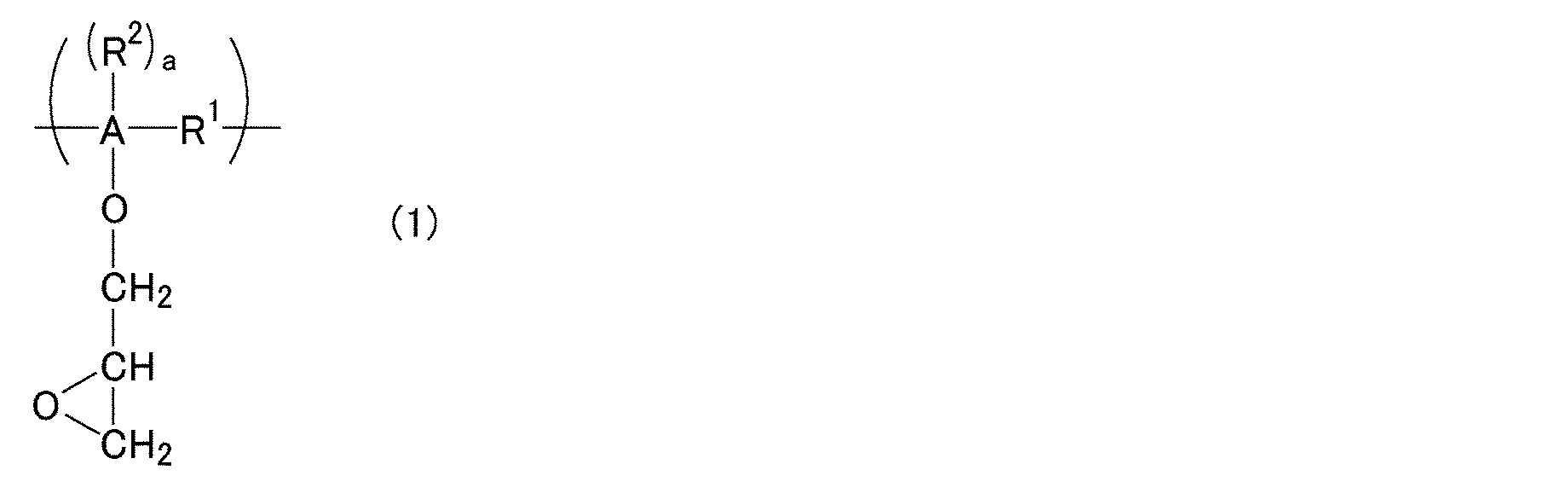
(式中、Aは、ベンゼン環又はナフタレン環を表す。R1は、炭素数1~20の2価の炭化水素基を表す。R2は、Aに結合する置換基を表し、水酸基、又は、炭素数1~20の有機基を表す。aは、R2の個数を表し、0~5の整数である。R2が2個以上ある場合、それぞれ互いに同一であっても、異なっていてもよい。)

(式中、Aは、ベンゼン環又はナフタレン環を表す。R3は、炭素数1~20の2価の炭化水素基を表す。R4は、Aに結合する置換基を表し、水酸基、又は、炭素数1~20の有機基を表す。bは、R4の個数を表し、0~5の整数である。R4が2個以上ある場合、それぞれ互いに同一であっても、異なっていてもよい。Xは、有機基を表す。)

(式中、Aは、ベンゼン環又はナフタレン環を表す。R5は、炭素数1~20の2価の炭化水素基を表す。R6は、Aに結合する置換基を表し、水酸基、又は、炭素数1~20の有機基を表す。cは、R6の個数を表し、0~5の整数である。R6が2個以上ある場合、それぞれ互いに同一であっても、異なっていてもよい。Yは、有機基を表す。Zは、2価の有機基を表す。)
<2>上記式(1)で表される構成単位は、下記式(1-1)で表される構成単位であり、上記式(2)で表される構成単位は、下記式(2-1)で表される構成単位であり、上記式(3)で表される構成単位は、下記式(3-1)で表される構成単位である、上記<1>に記載のアルカリ可溶性樹脂。
<2>上記式(1)で表される構成単位は、下記式(1-1)で表される構成単位であり、上記式(2)で表される構成単位は、下記式(2-1)で表される構成単位であり、上記式(3)で表される構成単位は、下記式(3-1)で表される構成単位である、上記<1>に記載のアルカリ可溶性樹脂。
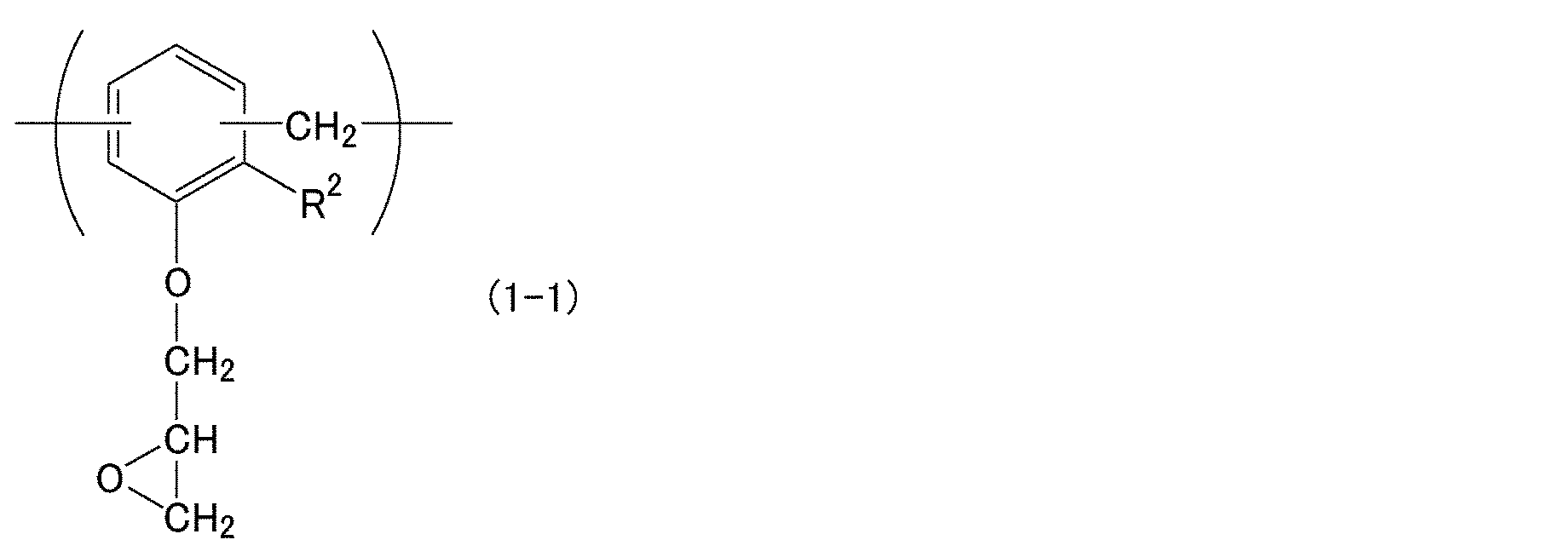

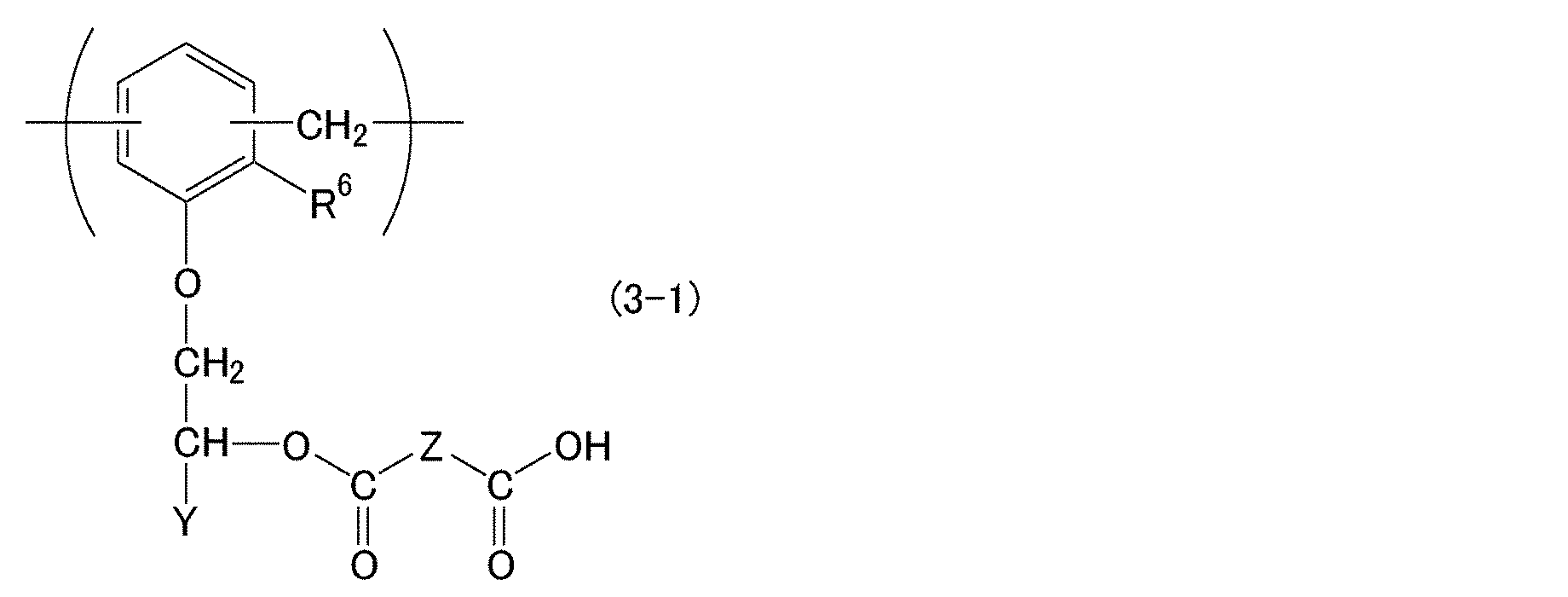
<3>酸基と重合性不飽和二重結合を有し、エポキシ当量が5000g/当量以下であるアルカリ可溶性樹脂(A)、重合性化合物(B)、及び、光重合開始剤(C)を含む感光性樹脂組成物であって、該アルカリ可溶性樹脂(A)は、下記式(1)で表される構成単位、下記式(2)で表される構成単位、及び、下記式(3)で表される構成単位を有するアルカリ可溶性樹脂である感光性樹脂組成物。
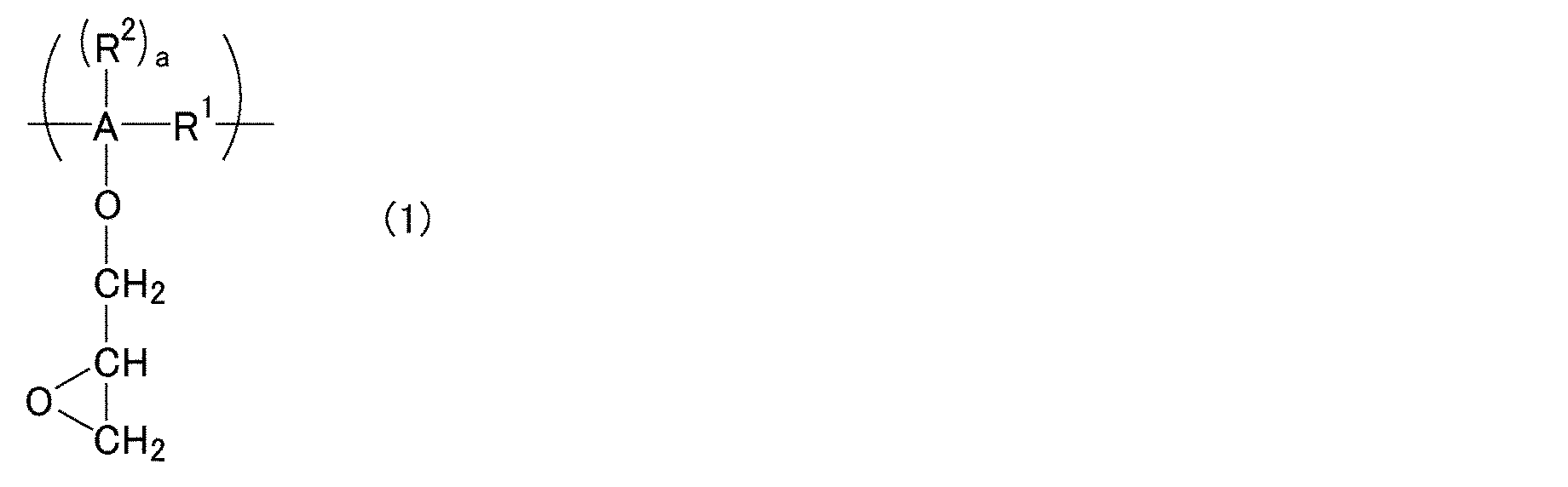
(式中、Aは、ベンゼン環又はナフタレン環を表す。R1は、炭素数1~20の2価の炭化水素基を表す。R2は、Aに結合する置換基を表し、水酸基、又は、炭素数1~20の有機基を表す。aは、R2の個数を表し、0~5の整数である。R2が2個以上ある場合、それぞれ互いに同一であっても、異なっていてもよい。)
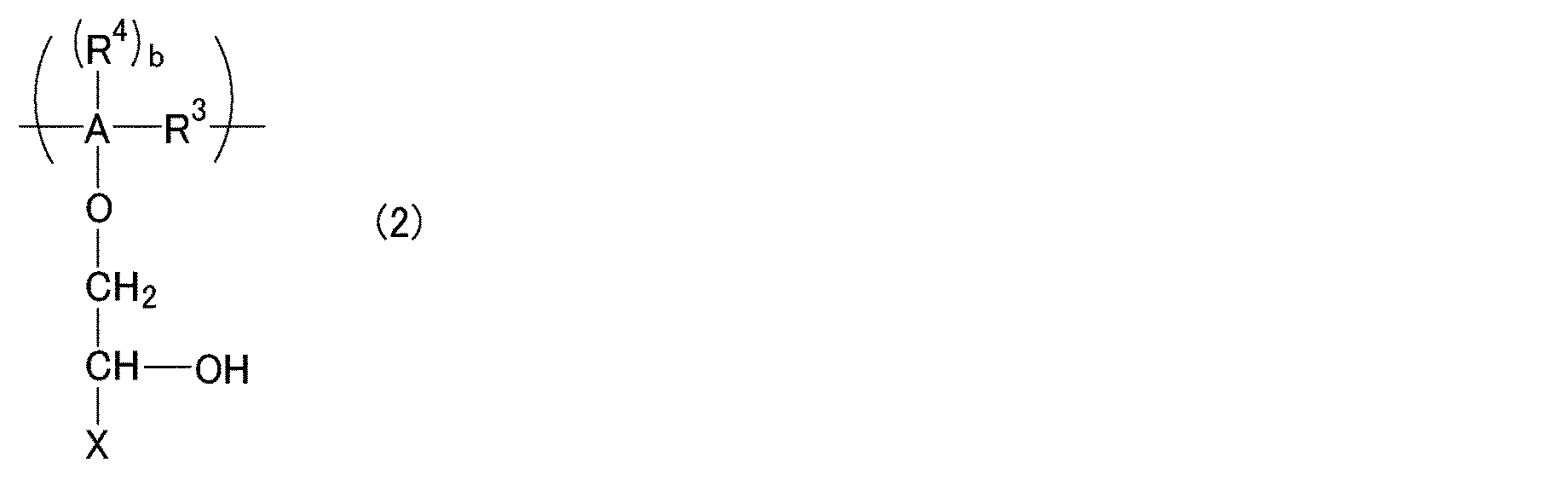
(式中、Aは、ベンゼン環又はナフタレン環を表す。R3は、炭素数1~20の2価の炭化水素基を表す。R4は、Aに結合する置換基を表し、水酸基、又は、炭素数1~20の有機基を表す。bは、R4の個数を表し、0~5の整数である。R4が2個以上ある場合、それぞれ互いに同一であっても、異なっていてもよい。Xは、有機基を表す。)
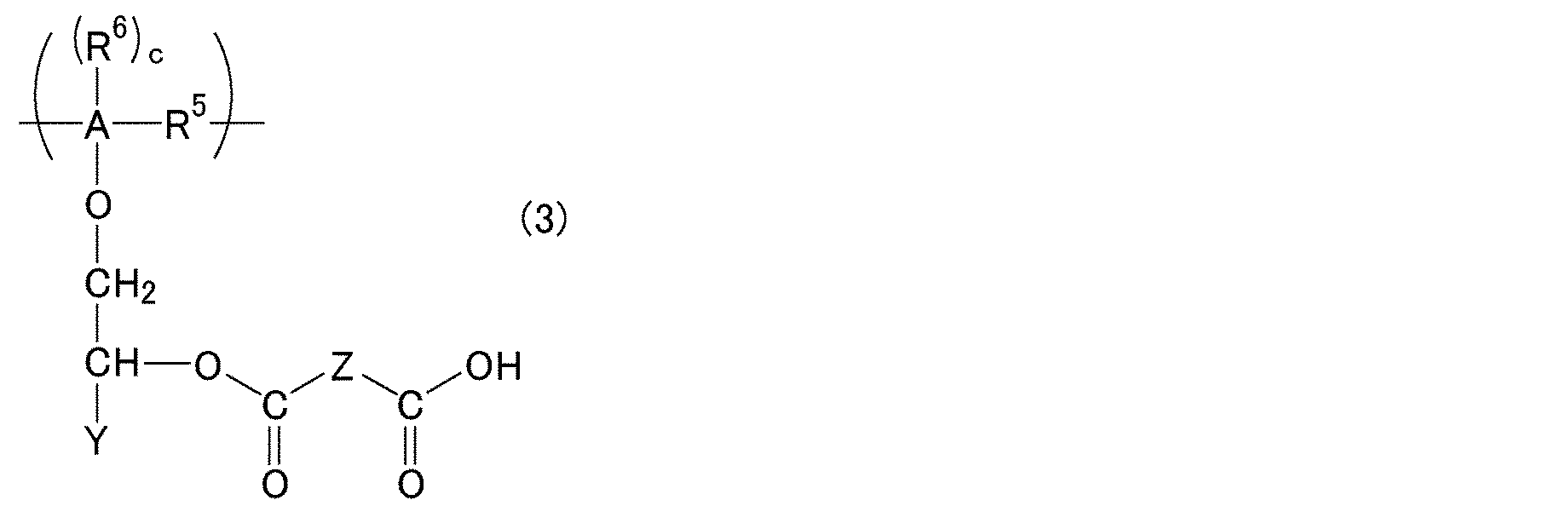
(式中、Aは、ベンゼン環又はナフタレン環を表す。R5は、炭素数1~20の2価の炭化水素基を表す。R6は、Aに結合する置換基を表し、水酸基、又は、炭素数1~20の有機基を表す。cは、R6の個数を表し、0~5の整数である。R6が2個以上ある場合、それぞれ互いに同一であっても、異なっていてもよい。Yは、有機基を表す。Zは、2価の有機基を表す。)
<4>上記式(2)中のXは、(メタ)アクリロイル基を有する有機基である上記<3>に記載の感光性樹脂組成物。
<5>更に、酸解離定数pKaが4.2以下の酸化合物を含む上記<3>又は<4>に記載の感光性樹脂組成物。
<6>更に、リン酸誘導体を含む上記<3>又は<4>に記載の感光性樹脂組成物。
<7>更に、塩基性化合物を含む上記<3>~<6>のいずれかに記載の感光性樹脂組成物。
<8>上記アルカリ可溶性樹脂(A)は、更に、下記式(4)で表される構成単位を有する上記<3>~<7>のいずれかに記載の感光性樹脂組成物。
<4>上記式(2)中のXは、(メタ)アクリロイル基を有する有機基である上記<3>に記載の感光性樹脂組成物。
<5>更に、酸解離定数pKaが4.2以下の酸化合物を含む上記<3>又は<4>に記載の感光性樹脂組成物。
<6>更に、リン酸誘導体を含む上記<3>又は<4>に記載の感光性樹脂組成物。
<7>更に、塩基性化合物を含む上記<3>~<6>のいずれかに記載の感光性樹脂組成物。
<8>上記アルカリ可溶性樹脂(A)は、更に、下記式(4)で表される構成単位を有する上記<3>~<7>のいずれかに記載の感光性樹脂組成物。

(式中、Lは、2価の連結基を表す。R9及びR10は、同一又は異なって、置換基を表す。dは、R9の個数を表し、0~4の整数である。eは、R10の個数を表し、0~4の整数である。R9及びR10が複数の場合、それぞれ互いに同一であってもよいし、異なっていてもよい。)
<9>上記<1>又は<2>に記載のアルカリ可溶性樹脂、又は、上記<3>~<8>のいずれかに記載の感光性樹脂組成物を硬化してなる硬化物。
<10>上記<9>に記載の硬化物を有する表示装置用部材。
<11>上記<9>に記載の硬化物を有する表示装置。
<9>上記<1>又は<2>に記載のアルカリ可溶性樹脂、又は、上記<3>~<8>のいずれかに記載の感光性樹脂組成物を硬化してなる硬化物。
<10>上記<9>に記載の硬化物を有する表示装置用部材。
<11>上記<9>に記載の硬化物を有する表示装置。
本発明のアルカリ可溶性樹脂および感光性樹脂組成物は、160℃以下の比較的低温な硬化条件であっても耐溶剤性に優れた硬化物を与えることができる。本発明の硬化物は、液晶・有機EL・量子ドット・マイクロLED液晶表示装置や固体撮像素子、タッチパネル式表示装置等に用いられる各種の光学部材や電機・電子機器等の構成部材等の各種用途に好適に使用される。
以下に本発明の好ましい形態について具体的に説明するが、本発明は以下の記載のみに限定されるものではなく、本発明の要旨を変更しない範囲において適宜変更して適用することができる。なお、以下に記載される本発明の個々の好ましい形態を2又は3以上組み合わせた形態も、本発明の好ましい形態に該当する。
また、本明細書において、「(メタ)アクリル酸」は、「アクリル酸及び/又はメタクリル酸」を意味し、「(メタ)アクリレート」は、「アクリレート及び/又はメタクリレート」を意味する。
また、本明細書において、数値範囲「Min~Max」は、最小値Min以上、且つ、最大値Max以下を意味する。さらに、上限値および下限値について、好適な数値を段階的に記載する場合、各々分けて記載した上限値と下限値を、適宜組み合わせた数値範囲も好適な数値範囲である。
また、本明細書中、「固形分総量」とは、硬化物を形成する成分の総量、すなわち硬化物の形成時に揮発する溶媒等を除く成分(固形分、不揮発分)の総量を意味する。具体的には、アルカリ可溶性樹脂と、重合性化合物と、光重合開始剤と、更に他の硬化物形成成分(例えば、色材、分散剤等)を含む場合は当該成分と、の合計の固形分質量を意味する。
[アルカリ可溶性樹脂(A)]
本発明のアルカリ可溶性樹脂(「アルカリ可溶性樹脂(A)」とも記す。)は、アルカリ可溶性を示す樹脂であり、分子内に酸基を有する。酸基としては、カルボキシル基が好ましく、他の酸基としてフェノール性水酸基、カルボン酸無水物基、リン酸基、スルホン酸基等、アルカリ水と中和反応する官能基が挙げられ、これらの1種のみを有していてもよいし、2種以上有していてもよい。アルカリ可溶性樹脂(A)は、後述する感光性樹脂組成物中でバインダー樹脂としても作用し得る。
本発明のアルカリ可溶性樹脂(「アルカリ可溶性樹脂(A)」とも記す。)は、アルカリ可溶性を示す樹脂であり、分子内に酸基を有する。酸基としては、カルボキシル基が好ましく、他の酸基としてフェノール性水酸基、カルボン酸無水物基、リン酸基、スルホン酸基等、アルカリ水と中和反応する官能基が挙げられ、これらの1種のみを有していてもよいし、2種以上有していてもよい。アルカリ可溶性樹脂(A)は、後述する感光性樹脂組成物中でバインダー樹脂としても作用し得る。
本発明のアルカリ可溶性樹脂(A)は、酸基と重合性不飽和二重結合を有し、エポキシ当量が5000g/当量以下であるアルカリ可溶性樹脂であって、上記アルカリ可溶性樹脂は、上記式(1)で表される構成単位、上記式(2)で表される構成単位、及び、上記式(3)で表される構成単位を有する。なお、本明細書において、アルカリ可溶性樹脂における「構成単位」とは、アルカリ可溶性樹脂を構成する繰り返し単位を意味する。
上記アルカリ可溶性樹脂(A)は、酸基と重合性不飽和二重結合を有し、所定範囲のエポキシ当量を有し、上記式(1)で表される構成単位、上記式(2)で表される構成単位、上記式(3)で表される構成単位を有することで本発明の効果を奏する。上記構成単位に含まれるエポキシ基と酸基のエステル化反応による架橋に加えて、重合性不飽和二重結合(好ましくは、(メタ)アクリロイル基)による光ラジカル架橋によって硬化物の耐溶剤性が向上すると本発明者は推察している。
<式(1)で表される構成単位(A-1)>
上記式(1)において、Aは、ベンゼン環又はナフタレン環を表すが、アルカリ可溶性と硬化物物性のバランスの点で、好ましくはベンゼン環を表す。
上記式(1)において、Aは、ベンゼン環又はナフタレン環を表すが、アルカリ可溶性と硬化物物性のバランスの点で、好ましくはベンゼン環を表す。
上記式(1)において、R1は、炭素数1~20の2価の炭化水素基を表す。
上記2価の炭化水素基としては、鎖状構造の炭化水素基、又は、環状構造を含む炭化水素基が挙げられる。
上記2価の炭化水素基としては、鎖状構造の炭化水素基、又は、環状構造を含む炭化水素基が挙げられる。
上記鎖状構造の炭化水素基としては、例えば、脂肪族炭化水素基が挙げられる。
2価の脂肪族炭化水素基としては、例えば、メチレン基、エチレン基、プロピレン基、イソプロピレン基、ブチレン基、イソブチレン基、t-ブチレン基、ペンチレン基、ネオペンチレン基、ヘキサメチレン基、ヘプチレン基、オクチレン基、2-エチルヘキシレン基、ノニレン基、デシレン基、ウンデシレン基、ドデシレン基等のアルキレン基;ビニレン基、プロペニレン基、イソプロペニレン基、ブテニレン基、ブタジエニレン基、ペンテニレン基、ヘキセニレン基、ヘプテニレン基等のアルケニレン基;エチニレン基、プロピニレン基、1-ブチニレン基、2-ブチニレン基等のアルキニレン基;等が挙げられる。
2価の脂肪族炭化水素基としては、例えば、メチレン基、エチレン基、プロピレン基、イソプロピレン基、ブチレン基、イソブチレン基、t-ブチレン基、ペンチレン基、ネオペンチレン基、ヘキサメチレン基、ヘプチレン基、オクチレン基、2-エチルヘキシレン基、ノニレン基、デシレン基、ウンデシレン基、ドデシレン基等のアルキレン基;ビニレン基、プロペニレン基、イソプロペニレン基、ブテニレン基、ブタジエニレン基、ペンテニレン基、ヘキセニレン基、ヘプテニレン基等のアルケニレン基;エチニレン基、プロピニレン基、1-ブチニレン基、2-ブチニレン基等のアルキニレン基;等が挙げられる。
上記環状構造を含む炭化水素基としては、環状構造の炭化水素基、又は、環状構造と鎖状構造を有する炭化水素基が挙げられる。
上記環状構造の炭化水素基としては、脂環式炭化水素基、及び、芳香族炭化水素基が挙げられる。
上記環状構造の炭化水素基としては、脂環式炭化水素基、及び、芳香族炭化水素基が挙げられる。
2価の脂環式炭化水素基としては、例えば、シクロプロピレン基、シクロブチレン基、シクロペンチレン基、シクロヘキシレン基、ノルボルニレン基、アダマンチレン基、トリシクロデカニレン基、テトラシクロデカニレン基等のシクロアルキレン基;シクロプロペニレン基、シクロブテニレン基、シクロペンテニレン基等のシクロアルケニレン基;シクロペンチリデン基、シクロヘキシリデン基等のシクロアルキリデン基等が挙げられる。
2価の芳香族炭化水素基としては、例えば、フェニレン基、トリレン基、ナフチレン基等のアリーレン基が挙げられる。
上記環状構造と鎖状構造を有する炭化水素基は、上述した環状構造の炭化水素基と鎖状構造の炭化水素基との組み合わせからなる炭化水素基が挙げられ、例えば、シンナミリデン基、ビフェニレン基等が挙げられる。
なかでも、入手容易である点で、上記2価の炭化水素基としては、2価の脂肪族炭化水素基であることがより好ましく、アルキレン基であることが更に好ましい。
上記2価の炭化水素基の炭素数は、1~14であることが好ましく、1~10であることがより好ましく、1であることが更に好ましい。
上記2価の炭化水素基は、当該炭化水素基を構成する原子の少なくとも一つが、酸素原子、窒素原子、硫黄原子、又は、ハロゲン原子に置換されていてもよい。
また、上記2価の炭化水素基は、アルコキシ基等の置換基を有していてもよい。
また、上記2価の炭化水素基は、アルコキシ基等の置換基を有していてもよい。
上記式(1)において、R2は、Aに結合する置換基を表す。
上記置換基としては、水酸基、又は、炭素数1~20の有機基が挙げられる。
上記置換基としては、水酸基、又は、炭素数1~20の有機基が挙げられる。
R2で表される有機基としては、例えば、置換基を有していてもよい炭化水素基、又は、上記置換基を有していてもよい炭化水素基と-O-、-COO-、-CO-、-NH-、-S-、-SO-若しくは-SO2-等の結合基とを組み合わせた基等が挙げられる。
上記炭化水素基としては、1価又は2価の、鎖状構造の炭化水素基、又は、環状構造を含む炭化水素基が挙げられる。上記環状構造を含む炭化水素基としては、環状構造の炭化水素基、又は、環状構造と鎖状構造を有する炭化水素基が挙げられる。上記環状構造の炭化水素基としては、脂環式炭化水素基、及び、芳香族炭化水素基が挙げられる。2価の炭化水素基については、上述したとおりである。
1価の炭化水素基としては、上述した2価の炭化水素基を、1価の基にしたものが挙げられる。例えば、1価の脂肪族炭化水素基としては、アルキル基、アルケニル基等が挙げられ、脂環式炭化水素基としては、シクロアルキル基等が挙げられ、芳香族炭化水素基としては、アリール基等が挙げられる。
上記環状構造と鎖状構造を有する炭化水素基は、上述した環状構造の炭化水素基と鎖状構造の炭化水素基との組み合わせからなる炭化水素基が挙げられ、例えば、ベンジル基、フェネチル基、ビフェニル基、トリル基、キシリル基等が挙げられる。
上記炭化水素基の炭素数は、1~20であることが好ましく、1~10であることがより好ましい。
上記炭化水素基はまた、当該炭化水素基を構成する少なくとも1の原子が、酸素原子、硫黄原子、窒素原子、ハロゲン原子に置換されていてもよい。
また、上記炭化水素基は、置換基を有していてもよく、上記置換基としては、アルコキシ基、アミド基、アミノ基、エポキシ基、グリシジル基、水酸基等が挙げられる。
また、上記炭化水素基は、置換基を有していてもよく、上記置換基としては、アルコキシ基、アミド基、アミノ基、エポキシ基、グリシジル基、水酸基等が挙げられる。
なかでも、低温硬化性が良好である点で、R2で表される置換基は、-OH、-O-CH2-(C2H3O)、-CRa1Ra2-(C6H4)-O-CH2-(C2H3O)、-CRa1Ra2-(C6H4)-OH(式中、Ra1及びRa2は、同一又は異なって、水素原子又はメチル基を表す。)、炭素数1~20の脂肪族炭化水素基であることが好ましく、炭素数1~10の脂肪族炭化水素基であることがより好ましく、炭素数1~6のアルキル基であることが更に好ましく、メチル基であることが特に好ましい。
上記式(1)において、aは、置換基R2の個数を表し、0~5の整数である。aは、樹脂の現像性が良好である点で、0~3であることが好ましく、0~1であることがより好ましく、1であることが更に好ましい。aが2以上の場合、すなわち、R2が2個以上ある場合、R2はそれぞれ互いに同一であっても、異なっていてもよい。
上記式(1)で表される構成単位(A-1)としては、好ましくは、下記式(1-1)で表される構成単位が挙げられる。
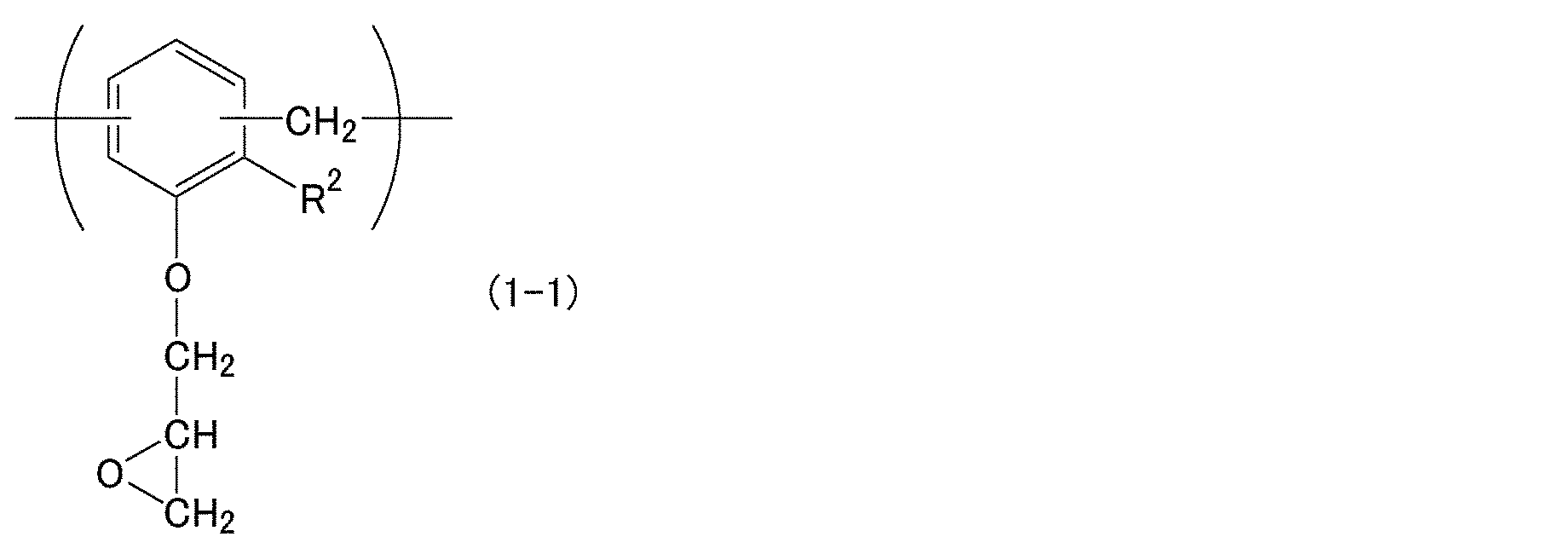
<式(2)で表される構成単位(A-2)>
上記式(2)において、Aは、ベンゼン環又はナフタレン環を表し、好ましくはベンゼン環を表す。
上記式(2)において、R3は、炭素数1~20の2価の炭化水素基を表す。R3で表される炭素数1~20の2価の炭化水素基としては、上記式(1)のR1で表される炭素数1~20の2価の炭化水素基と同様の基が挙げられる。なかでも、R3は、2価の脂肪族炭化水素基であることが好ましく、アルキレン基であることがより好ましい。
上記式(2)において、Aは、ベンゼン環又はナフタレン環を表し、好ましくはベンゼン環を表す。
上記式(2)において、R3は、炭素数1~20の2価の炭化水素基を表す。R3で表される炭素数1~20の2価の炭化水素基としては、上記式(1)のR1で表される炭素数1~20の2価の炭化水素基と同様の基が挙げられる。なかでも、R3は、2価の脂肪族炭化水素基であることが好ましく、アルキレン基であることがより好ましい。
上記式(2)において、R4は、Aに結合する置換基を表す。上記置換基としては、水酸基、又は、炭素数1~20の有機基が挙げられる。
R4で表される炭素数1~20の有機基としては、上記R2で表される炭素数1~20の有機基と同様の基が挙げられる。
なかでも、R4で表される置換基は、-OH、-O-CH2-(C2H3O)、-CRa1Ra2-(C6H4)-O-CH2-(C2H3O)、-CRa1Ra2-(C6H4)-OH(式中、Ra1及びRa2は、同一又は異なって、水素原子又はメチル基を表す。)、炭素数1~20の脂肪族炭化水素基であることが好ましく、炭素数1~10の脂肪族炭化水素基であることがより好ましく、炭素数1~6のアルキル基であることが更に好ましく、メチル基であることが特に好ましい。
R4で表される炭素数1~20の有機基としては、上記R2で表される炭素数1~20の有機基と同様の基が挙げられる。
なかでも、R4で表される置換基は、-OH、-O-CH2-(C2H3O)、-CRa1Ra2-(C6H4)-O-CH2-(C2H3O)、-CRa1Ra2-(C6H4)-OH(式中、Ra1及びRa2は、同一又は異なって、水素原子又はメチル基を表す。)、炭素数1~20の脂肪族炭化水素基であることが好ましく、炭素数1~10の脂肪族炭化水素基であることがより好ましく、炭素数1~6のアルキル基であることが更に好ましく、メチル基であることが特に好ましい。
上記式(2)において、bは、置換基R4の個数を表し、0~5の整数である。bは、現像性が良好である点で、0~3であることが好ましく、0~1であることがより好ましく、1であることが更に好ましい。bが2以上の場合、すなわち、R4が2個以上ある場合、R4はそれぞれ互いに同一であっても、異なっていてもよい。
上記式(2)において、Xは、有機基を表す。Xで表される有機基としては、例えば、上述した有機基が挙げられるが、炭素数1~20の有機基が好ましく、炭素数1~10の有機基がより好ましく、炭素数1~5の有機基が更に好ましい。特にビニル基またはアリル基を有する有機基が好ましく、(メタ)アクリロイル基を有する有機基がより好ましい。
上記(メタ)アクリロイル基を有する有機基としては、-Ra3-OOC-CRa4=CH2(Ra3は、直接結合又は2価の炭化水素基を表す。Ra4は、水素原子又はメチル基を表す。)が好ましく挙げられ、-Ra3-OOC-CRa4=CH2(Ra3は、直接結合又はアルキレン基を表す。Ra4は、水素原子又はメチル基を表す。)がより好ましく挙げられ、-CH2-OOC-CRa4=CH2(Ra4は、水素原子又はメチル基を表す。)が更に好ましく挙げられる。
上記式(2)で表される構成単位(A-2)としては、好ましくは、下記式(2-1)で表される構成単位が挙げられ、より好ましくは、下記式(2-1-1)で表される構成単位が挙げられる。

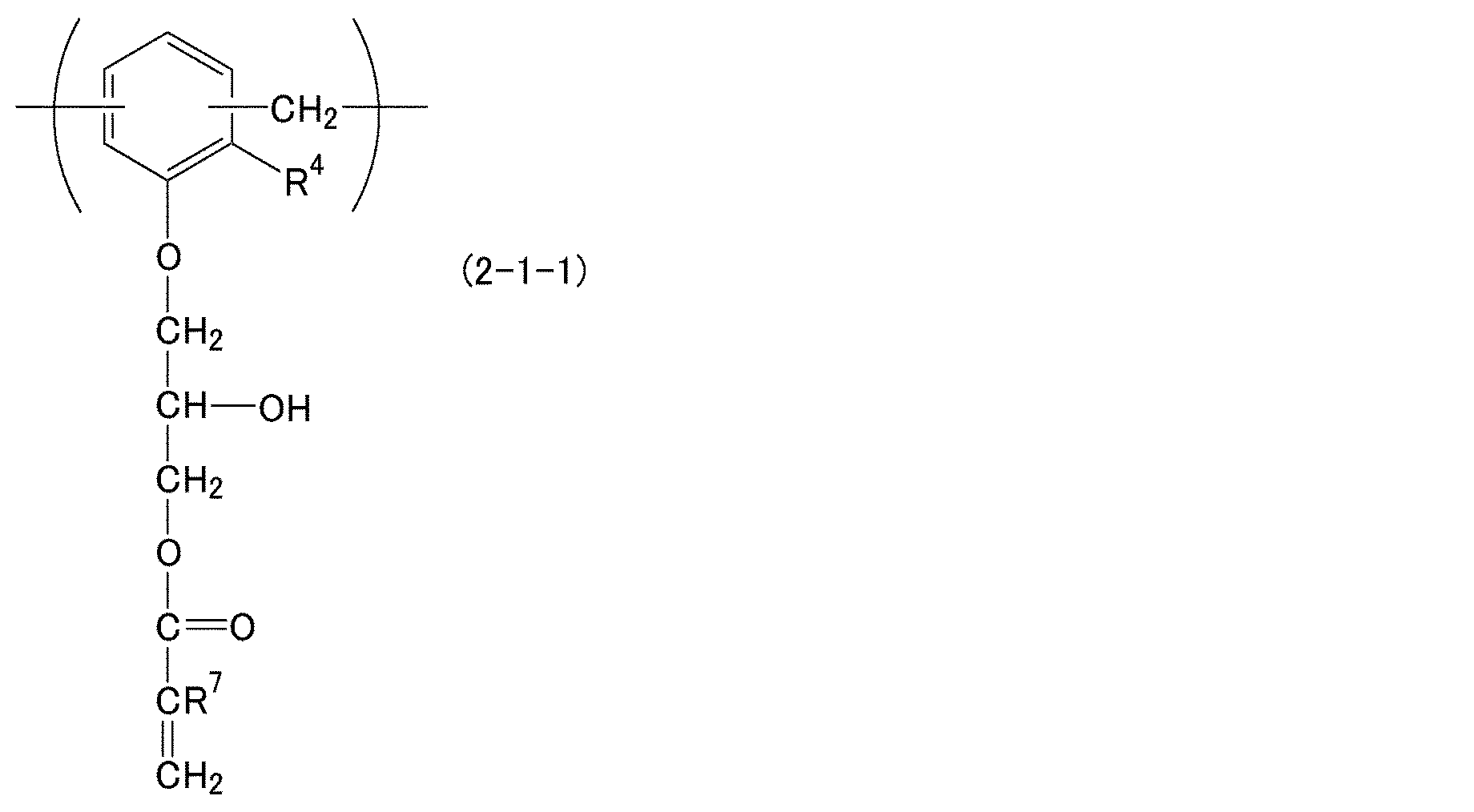
<式(3)で表される構成単位(A-3)>
上記式(3)において、Aは、ベンゼン環又はナフタレン環を表し、好ましくはベンゼン環を表す。
上記式(3)において、R5は、炭素数1~20の2価の炭化水素基を表す。R5で表される炭素数1~20の2価の炭化水素基としては、上記式(1)のR1で表される炭素数1~20の2価の炭化水素基と同様の基が挙げられる。なかでも、R5は、2価の脂肪族炭化水素基であることが好ましく、アルキレン基であることがより好ましい。
上記式(3)において、Aは、ベンゼン環又はナフタレン環を表し、好ましくはベンゼン環を表す。
上記式(3)において、R5は、炭素数1~20の2価の炭化水素基を表す。R5で表される炭素数1~20の2価の炭化水素基としては、上記式(1)のR1で表される炭素数1~20の2価の炭化水素基と同様の基が挙げられる。なかでも、R5は、2価の脂肪族炭化水素基であることが好ましく、アルキレン基であることがより好ましい。
上記式(3)において、R6は、Aに結合する置換基を表す。上記置換基としては、水酸基、又は、炭素数1~20の有機基が挙げられる。
R6で表される炭素数1~20の有機基としては、例えば、上記R2で表される炭素数1~20の有機基と同様の基が挙げられる。
なかでも、R6で表される置換基は、-OH、-O-CH2-(C2H3O)、-CRa1Ra2-(C6H4)-O-CH2-(C2H3O)、-CRa1Ra2-(C6H4)-OH(式中、Ra1及びRa2は、同一又は異なって、水素原子又はメチル基を表す。)、炭素数1~20の脂肪族炭化水素基であることが好ましく、炭素数1~10の脂肪族炭化水素基であることがより好ましく、炭素数1~6のアルキル基であることが更に好ましく、メチル基であることが特に好ましい。
R6で表される炭素数1~20の有機基としては、例えば、上記R2で表される炭素数1~20の有機基と同様の基が挙げられる。
なかでも、R6で表される置換基は、-OH、-O-CH2-(C2H3O)、-CRa1Ra2-(C6H4)-O-CH2-(C2H3O)、-CRa1Ra2-(C6H4)-OH(式中、Ra1及びRa2は、同一又は異なって、水素原子又はメチル基を表す。)、炭素数1~20の脂肪族炭化水素基であることが好ましく、炭素数1~10の脂肪族炭化水素基であることがより好ましく、炭素数1~6のアルキル基であることが更に好ましく、メチル基であることが特に好ましい。
上記式(3)において、cは、置換基R6の個数を表し、0~5の整数である。cは、現像性が良好である点で、0~3であることが好ましく、0~1であることがより好ましい。cが2以上の場合、すなわち、R6が2個以上ある場合、R6はそれぞれ互いに同一であっても、異なっていてもよい。
上記式(3)において、Yは、有機基を表す。Yで表される有機基としては、例えば、上述した有機基が挙げられるが、炭素数1~20の有機基が好ましく、炭素数1~10の有機基がより好ましく、炭素数1~5の有機基が更に好ましい。ビニル基又はアリル基を有する有機基が更に好ましく、(メタ)アクリロイル基を有する有機基がより一層好ましい。
上記(メタ)アクリロイル基を有する有機基としては、上述したXで表される(メタ)アクリロイル基を有する有機基と同様の基が挙げられる。
上記式(3)において、Zは、2価の有機基を表す。Zで表される2価の有機基としては、例えば、炭素数1~20のアルキレン基、アリーレン基等が挙げられ、これらは一部が置換されていてもよい。置換基としては、特に限定されず、例えば、フッ素原子、塩素原子、ヨウ素原子等のハロゲン原子が挙げられる。また、2価の有機基が環構造を有する場合は、置換基として、ハロゲン原子の他、メチル基やエチル基等のアルキル基も挙げられる。
上記アルキレン基は、直鎖構造からなるものでもよいし、分岐構造や脂環構造を有するものであってもよい。具体的には例えば、メチレン基、エチレン基、プロピレン基、イソプロピレン基、ブチレン基、イソブチレン基、t-ブチレン基、ペンチレン基、ネオペンチレン基、ヘキサメチレン基、ヘプチレン基、オクチレン基、2-エチルヘキシレン基、ノニレン基、デシレン基、ウンデシレン基、ドデシレン基等が挙げられる。
上記アリーレン基として具体的には、例えば、フェニレン基、トリレン基、ナフチレン基、ジエチルナフチレン基等が挙げられる。
上記アリーレン基として具体的には、例えば、フェニレン基、トリレン基、ナフチレン基、ジエチルナフチレン基等が挙げられる。
また、上記2価の有機基としては、上述したアルキレン基、アリーレン基以外に、例えば、以下の基が挙げられる:
-O-、-SO2-、-CO-、-COO-、-C6H5O-、-(CnH2n)O-(nは1~10の整数を表す。)、-NH-。
-O-、-SO2-、-CO-、-COO-、-C6H5O-、-(CnH2n)O-(nは1~10の整数を表す。)、-NH-。
なかでも、上記2価の有機基は、炭素数1~10のアルキレン基、-COO-、-C6H5O-、-SO2-、又は-NH-であることが好ましく、炭素数1~5のアルキレン基が更に好ましい。アルキレン基は、直鎖状、分岐状のいずれであってもよい。
上記式(3)で表される構成単位(A-3)としては、好ましくは、下記式(3-1)で表される構成単位が挙げられ、より好ましくは、下記式(3-1-1)で表される構成単位が挙げられる。
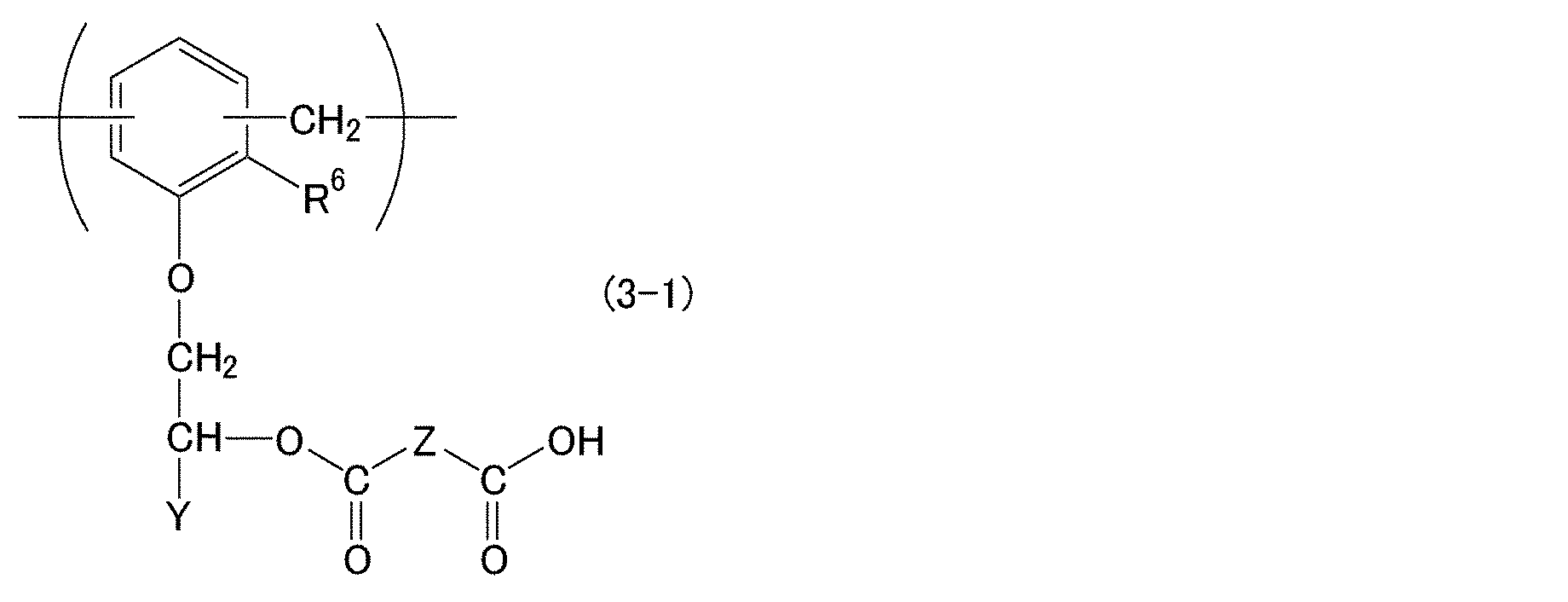
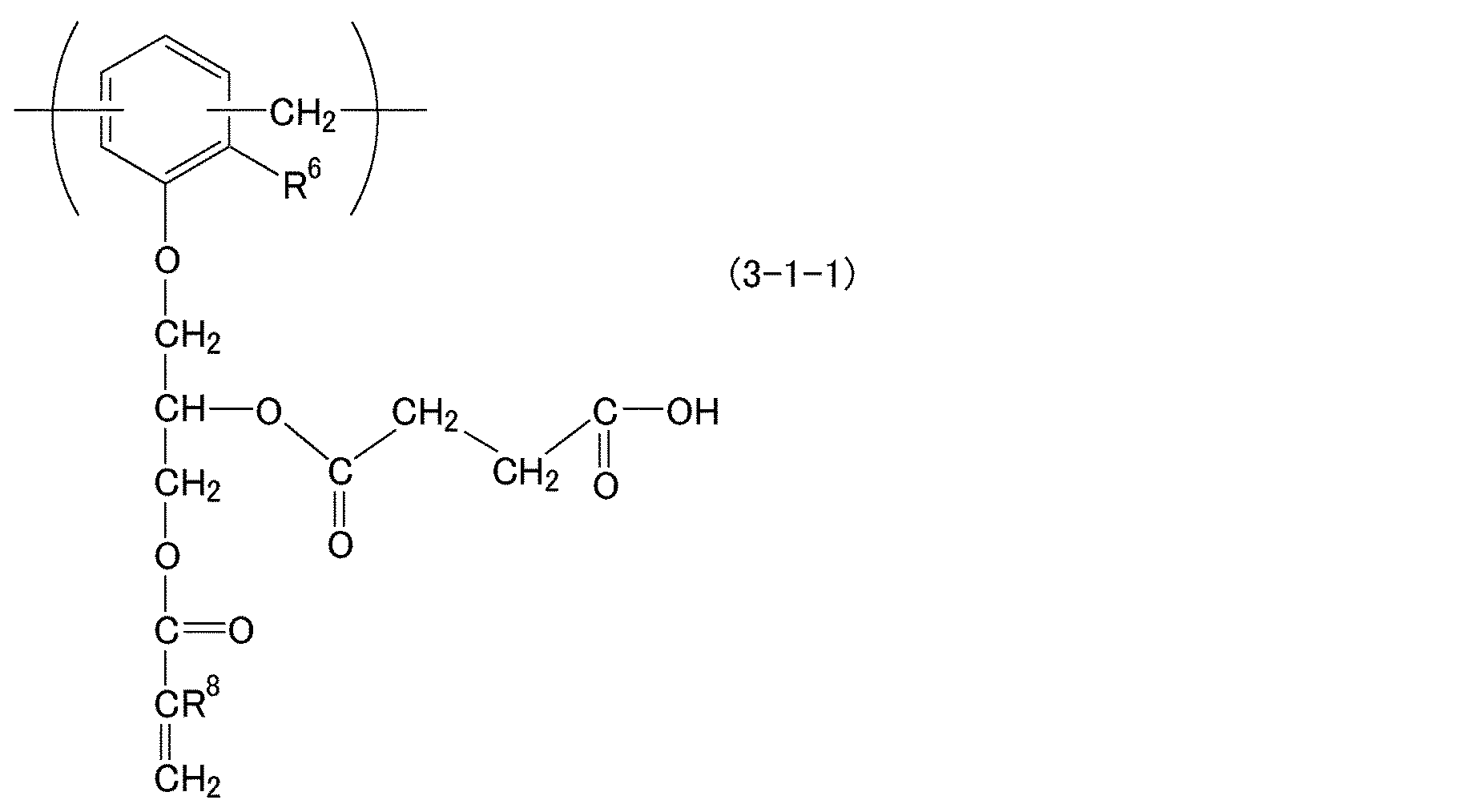
上記アルカリ可溶性樹脂(A)において、上記式(1)で表される構成単位(A-1)/式(2)で表される構成単位(A-2)/式(3)で表される構成単位(A-3)のモル比率は、1/0.05~6.75/0.40~8.10が好ましく、より好ましくは1/0.5~2.0/0.2~2.0である。
上記アルカリ可溶性樹脂(A)は、1種又は2種以上の上記構成単位(A-1)、構成単位(A-2)、構成単位(A-3)をそれぞれ含むものであってもよい。
上記アルカリ可溶性樹脂(A)は、1種又は2種以上の上記構成単位(A-1)、構成単位(A-2)、構成単位(A-3)をそれぞれ含むものであってもよい。
<式(4)で表される構成単位(A-4)>
本発明のアルカリ可溶性樹脂(A)はまた、上記式(1)~(3)で表される構成単位に加えて、更に下記式(4)で表される構成単位を有することが好ましい。下記構成単位の導入により鎖延長を行うことで、任意の分子量に設計できる。
本発明のアルカリ可溶性樹脂(A)はまた、上記式(1)~(3)で表される構成単位に加えて、更に下記式(4)で表される構成単位を有することが好ましい。下記構成単位の導入により鎖延長を行うことで、任意の分子量に設計できる。

(式中、Lは2価の連結基を表す。R9及びR10は、同一又は異なって、置換基を表す。dは、R9の個数を表し、0~4の整数である。eは、R10の個数を表し、0~4の整数である。R9及びR10が複数の場合、それぞれ互いに同一であってもよいし、異なっていてもよい。)
上記式(4)において、Lは2価の連結基を表す。連結基Lとしては、アルキレン基、アリーレン基、ヘテロアリーレン基、-O-、-CO-、-S-、-SO-、-SO2-、-NH-等の2価の連結基が挙げられる。アルキレン基は、炭素数1~20のアルキレン基が好ましく、炭素数1~10のアルキレン基がより好ましい。また、直鎖状、分岐状、環状のいずれであってもよい。また、アルキレン基とアリーレン基は、置換基を有していてもよい。上記置換基としては、特に限定されず、例えば、フッ素原子、塩素原子、ヨウ素原子等のハロゲン原子が挙げられる。また、2価の有機基が環構造を有する場合は、置換基として、ハロゲン原子の他、メチル基やエチル基等のアルキル基も挙げられる。
上記式(4)において、R9及びR10で表される置換基としては、好ましくは炭素数1~6の炭化水素基、より好ましくは炭素数1~3のアルキル基が挙げられる。d及びeは、0が好ましい。
上記式(4)で表される構成単位は、ビスフェノールA、ビスフェノールAP、ビスフェノールAF、ビスフェノールB、ビスフェノールBP、ビスフェノールC、ビスフェノールE、ビスフェノールF、ビスフェノールG、ビスフェノールM、ビスフェノールS、ビスフェノールP、ビスフェノールPH、ビスフェノールTMC、ビスフェノールZから選択される何れか1種の化合物由来の構成単位であることが好ましく、ビスフェノールS、ビスフェノールA、ビスフェノールF由来の構成単位であることが特に好ましく、ビスフェノールS由来の構成単位であることが最も好ましい。特に好ましい構成単位は下記式(4-1)~(4-3)で表される構成単位である。



上記アルカリ可溶性樹脂(A)において、上記式(1)で表される構成単位(A-1)/式(2)で表される構成単位(A-2)/式(3)で表される構成単位(A-3)/式(4)で表される構成単位(A-4)のモル比率は、1/0.05~6.75/0.40~8.10/0.01~0.1が好ましく、より好ましくは1/0.5~2.0/0.2~2.0/0.01~0.1である。その他の構成単位のモル比率は0.3以下が好ましく、0.1以下が更に好ましく、実質的に含まないことが特に好ましい。上記構成単位(A-4)を含むことにより、後述の適切な分子量範囲となり、硬化物の可撓性がより一層向上する。また後述の重合性化合物や溶媒といった希釈剤の存在下あるいは非存在下において十分な流動性を得ることができるため、製造時や塗布作業時の取り扱いがより容易となる。また分子量向上は、架橋時の架橋密度も上昇させ耐溶剤性がより一層向上する。
上記アルカリ可溶性樹脂(A)の酸価の好適な範囲は、好ましくは30~200mgKOH/g、より好ましくは40~160mgKOH/g、更に好ましくは50~140mgKOH/g、特に好ましくは50~120mgKOH/gである。上記範囲にすることで、アルカリ溶解性(現像性)が良好となり、硬化性や硬化物の耐アルカリ性、耐溶剤性も高く維持できる。
酸価は、後述する実施例に記載の方法により測定することができる。
酸価は、後述する実施例に記載の方法により測定することができる。
上記アルカリ可溶性樹脂(A)の重量平均分子量(Mw)は、例えば、3000以上であることが好ましい。これにより、耐熱性や機械的強度により優れる硬化物を与えることができる。より好ましくは4000以上であり、さらに好ましくは5000以上である。このように高分子量であると、色材の分散性や耐熱性がより良好になる他、アルカリ可溶性樹脂の劣化が充分に抑制されて信頼性が向上するために非常に好適である。Mwの上限は特に限定されないが、低粘度化をより達成して現像性をより高める観点から、例えば、20万以下が好ましく、より好ましくは15万以下、更に好ましくは10万以下、特に好ましくは5万以下、最も好ましくは3万以下である。
本明細書中、重量平均分子量は、後述する実施例に記載の方法により測定することができる。
本明細書中、重量平均分子量は、後述する実施例に記載の方法により測定することができる。
上記アルカリ可溶性樹脂(A)は、エポキシ当量が5000g/当量以下である。この範囲に制御することで硬化性が向上し、耐溶剤性が良好となる。エポキシ当量は、3000g/当量以下であることがより好ましく、2000g/当量以下であることが更に好ましく、1500g/当量以下であることが最も好ましい。また、上記エポキシ当量は、貯蔵安定性の点で、400g/当量以上であることが好ましく、600g/当量以上であることがより好ましく、800g/当量以上であることが更に好ましい。上記エポキシ当量は、樹脂固形分量を樹脂中に含まれるエポキシ基のモル数で除すことで求めることができる。また、上記エポキシ当量は、JIS K7236:2001に準拠した方法でも求めることができる。
上記アルカリ可溶性樹脂(A)のガラス転移温度(Tg)としては、40℃以上が好ましく、より好ましくは50℃以上、さらに好ましくは60℃以上、特に好ましくは70℃以上である。このようなガラス転移温度であると、硬化物の強度が向上すると考えられる。
上記アルカリ可溶性樹脂(A)は側鎖に感光性の重合性不飽和二重結合を有する。上記アルカリ可溶性樹脂(A)の重合性不飽和二重結合当量は、100~5000g/当量であることが好ましい。このような範囲とすることにより、樹脂の充分な保存安定性と、本発明の感光性樹脂組成物の感度やパターン形状等における良好な製版特性等とを更に高いレベルで両立することが期待できる。上記重合性不飽和二重結合当量は、より好ましくは330g/当量以上、更に好ましくは400g/当量以上、特に好ましくは500g/当量以上であり、より好ましくは3000g/当量以下、更に好ましくは2000g/当量以下、特に好ましくは1000g/当量以下である。これらの数値範囲で使用することによって、露光時の架橋密度を調整でき、また耐溶剤性がより一層向上する。
上記重合性不飽和二重結合当量とは、アルカリ可溶性樹脂の重合性不飽和二重結合1molあたりの樹脂溶液の固形分の質量(g)である。樹脂溶液の固形分の質量を樹脂の重合性不飽和二重結合量で除することにより、求めることが可能である。また、滴定及び元素分析、NMR、IR等の各種分析や示差走査熱量計法を用いて測定することもできる。例えば、JIS K 0070:1992に記載のよう素価の試験方法に準拠して、樹脂1gあたりに含まれるエチレン性二重結合の数を測定することにより算出してもよい。
(アルカリ可溶性樹脂(A)の製造方法)
本発明のアルカリ可溶性樹脂(A)は、例えば、後述するノボラック型エポキシ樹脂と不飽和モノカルボン酸との反応物と、無水コハク酸などの二塩基酸無水物あるいは無水トリメリット酸、無水ピロメリット酸などの芳香族多価カルボン酸無水物などの酸無水物とを反応させて得ることができる。この場合、酸基と重合性不飽和二重結合を有し、エポキシ当量が5000g/当量以下となるように上記化合物の仕込み量を調整して反応させる。
本発明のアルカリ可溶性樹脂(A)は、例えば、後述するノボラック型エポキシ樹脂と不飽和モノカルボン酸との反応物と、無水コハク酸などの二塩基酸無水物あるいは無水トリメリット酸、無水ピロメリット酸などの芳香族多価カルボン酸無水物などの酸無水物とを反応させて得ることができる。この場合、酸基と重合性不飽和二重結合を有し、エポキシ当量が5000g/当量以下となるように上記化合物の仕込み量を調整して反応させる。
酸基と重合性不飽和二重結合を有する骨格を得る他の手法としては、特許文献3に記載されているように、多官能エポキシ樹脂のエポキシ基の一部にモノカルボン酸を、別の一部に多塩基酸を付加させる方法もある。しかしながら、多塩基酸のうちの一つだけを反応させて酸基を導入するという制御は困難であり、分子間架橋体が生成してアルカリ溶解性が損なわれ易い。本発明においては、酸無水物はエポキシ基とカルボン酸との反応よりもマイルドな条件(低温)で反応することから、生成した酸基が引き続いてエポキシ基と反応することを抑制することができる。また、エポキシ基が開環して生成した水酸基との反応であることから、比較的主鎖の近傍に酸基が存在することとなり、立体障害により、保存安定性も良好となる。
上記アルカリ可溶性樹脂(A)の製造では、アルカリ可溶性樹脂(A)の一分子中のエチレン性不飽和結合(重合性不飽和二重結合)の存在数を多くし、光硬化性を向上させるために、ノボラック型エポキシ樹脂を原料とすることが好ましく、ノボラック型エポキシ樹脂の代表的なものとしては、フェノールノボラック型エポキシ樹脂、クレゾールノボラック型エポキシ樹脂などがあり、公知の方法により得られる樹脂を用いることができる。上記ノボラック型エポキシ樹脂としては、常温にて固体を呈するものが好ましく、なかでも、クレゾールノボラック型エポキシ樹脂が好ましい。
上記クレゾールノボラック型エポキシ樹脂としては、例えば、下記式(5)で表されるクレゾールノボラック型エポキシ樹脂が挙げられる。
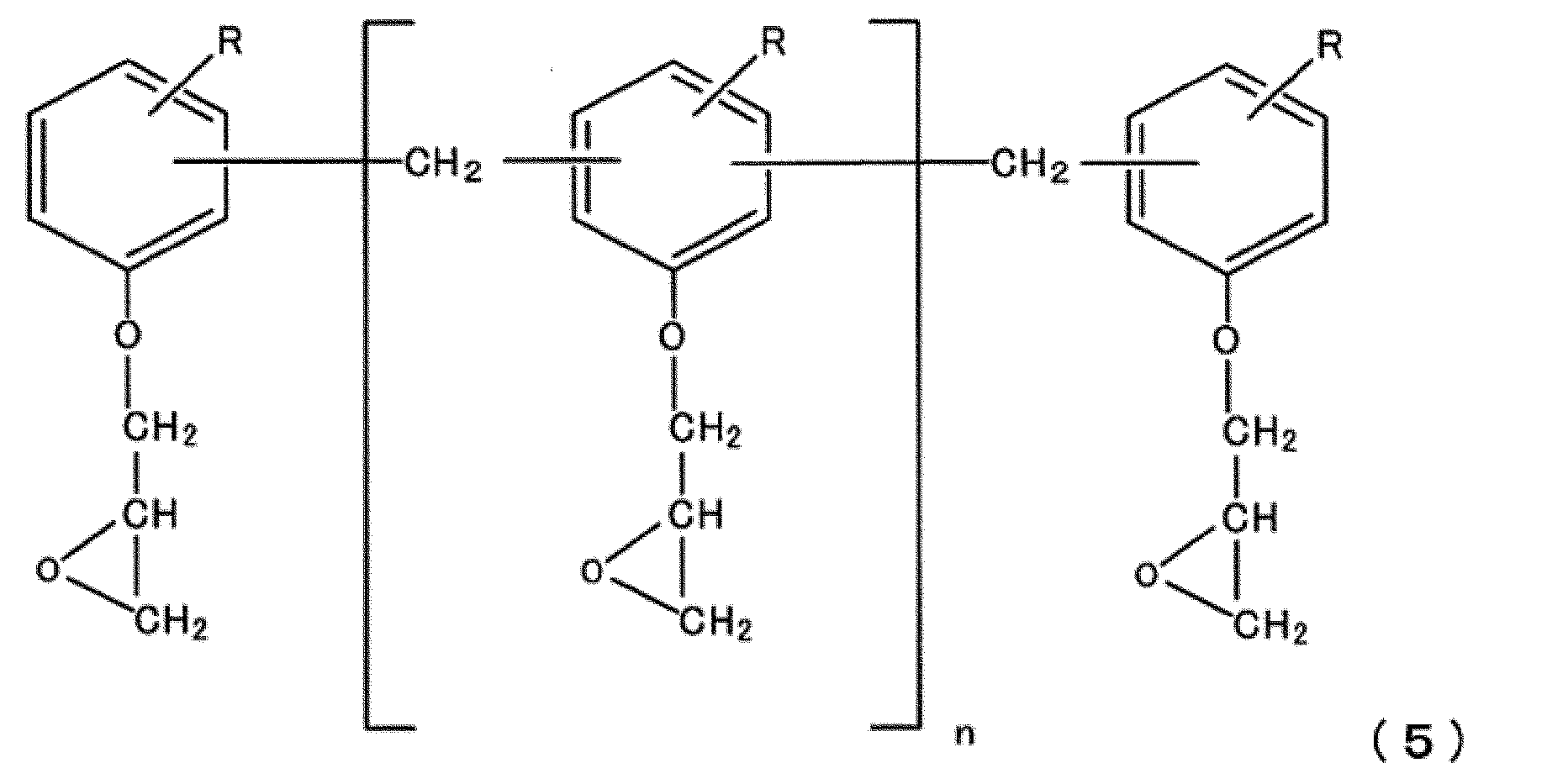
上記式(5)において、Rは、炭素数1~6のアルキル基であって、互いに同じであっても異なっていてもよい。また、nは整数である。Rは全てメチル基であることが好ましい。
上記式(5)で表されるクレゾールノボラック型エポキシ樹脂として、具体的には、YDCN-704A、YDCN-700-10、YDCN-700-7(いずれも日鉄ケミカル&マテリアル社製)等が挙げられる。これらは単独でもしくは二種以上併せて用いられる。
上記クレゾールノボラック型エポキシ樹脂としては、軟化点が120℃以下であることが好ましい。好ましくは68~100℃であり、最も好ましくは88~100℃である。上記範囲により、透明性が高く強度の高い硬化物が得られる。
不飽和モノカルボン酸としては、1個のカルボキシル基と1個以上のラジカル重合性不飽和結合を有する一塩基酸が挙げられ、具体例としては、アクリル酸、メタクリル酸、クロトン酸、ケイヒ酸、β-アクリロキシプロピオン酸、1個のヒドロキシル基と1個の(メタ)アクリロイル基を有するヒドロキシアルキル(メタ)アクリレートと二塩基酸無水物との反応物、1個のヒドロキシル基と2個以上の(メタ)アクリロイル基を有する多官能(メタ)アクリレートと二塩基酸無水物との反応物、これらの一塩基酸のカプロラクトン変性物等が挙げられ、1種または2種以上を用いることができる。中でも好ましいものは、アクリル酸、メタクリル酸等の(メタ)アクリロイル基を有するものである。
酸無水物としては、代表的なものとして、無水マレイン酸、無水コハク酸、無水イタコン酸、無水フタル酸、無水テトラヒドロフタル酸、無水ヘキサヒドロフタル酸、メチルヘキサヒドロ無水フタル酸、無水エンドメチレンテトラヒドロフタル酸、無水メチルエンドメチレンテトラヒドロフタル酸、無水クロレンド酸、メチルテトラヒドロ無水フタル酸、オクテニル無水コハク酸、ペンタドデセニル無水コハク酸、3,6-エンドメチレンテトラヒドロ無水フタル酸、テトラブロモ無水フタル酸、9,10-ジヒドロ-9-オキサ-10-フォスファフェナントレン-10-オキシドと無水イタコン酸あるいは無水マレイン酸との反応物等の二塩基酸無水物;無水トリメリット酸、無水ピロメリット酸、ベンゾフェノンテトラカルボン酸二無水物などの芳香族多価カルボン酸無水物;その他これに付随する例えば5-(2,5-ジオキソテトラヒドロフリル)-3-メチル-3-シクロヘキセン-1,2-ジカルボン酸無水物のような多価カルボン酸無水物誘導体;ビフェニルテトラカルボン酸二無水物、ナフタレンテトラカルボン酸二無水物、ジフェニルエーテルテトラカルボン酸二無水物、ブタンテトラカルボン酸二無水物、シクロペンタンテトラカルボン酸二無水物等の脂肪族あるいは芳香族四塩基酸二無水物等が挙げられ、これらのうち1種または2種以上を用いることができる。
また樹脂の最終物性を任意の重合性不飽和二重結合量・酸価に設定する手段として、不飽和モノカルボン酸と併用して、長鎖アルキル基、芳香環を含む置換基、アルコール性ヒドロキシル基等を有していても良いフェノール化合物やチオフェノール化合物、あるいは酢酸、プロピオン酸、ジメチロールプロピオン酸等の重合性不飽和二重結合を有さないモノカルボン酸を、1種または2種以上用いても良い。これらの種類や使用量は、硬化物物性等の各要求特性に応じて適宜選択される。重合性不飽和二重結合をもたないモノカルボン酸を用いることで、熱硬化にも光硬化にも関与しない成分が導入できるため、パターンを微細化可能となる。
本発明のアルカリ可溶性樹脂(A)は、特に限定されず、上記反応工程や、仕込みの順序を変更するなどの同様の反応工程を経ることで得ることができるが、以下の反応によって合成されることが好ましい。
第一段階では、ノボラック型エポキシ樹脂に対して所定量の不飽和モノカルボン酸を反応させる。この反応ではエポキシ基とカルボキシル基とが1:1で反応し、エポキシ環が開環すると共に樹脂骨格に不飽和モノカルボン酸残基がエステル結合される。また、エポキシ環の開環によってOH基が発生する。上記反応では、酸当量/エポキシ当量比を0.1~0.9の範囲とすることが好ましい。この範囲では保存安定性と低温硬化性の両方がより一層良好となる。
第一段階では、70℃~150℃で攪拌しながら反応させることが好ましい。なお、この第一段階の反応では触媒として公知のリン化合物や公知のアミン化合物を用いるのが好ましく、エポキシ基の開環重合を抑制する観点からリン化合物がさらに好ましく、トリフェニルホスフィンが最も好ましい。アミン化合物としてはトリエチルアミンやジメチルベンジルアミン等が活性の観点から好ましい。また不飽和結合の酸化を防止するためにp-メトキシフェノール等の酸化防止剤を用いるのが好ましい。
上記第一段階の反応により、上記構成単位(A-1)及び構成単位(A-2)を有する樹脂が得られることが好ましい。
上記第一段階の反応により、上記構成単位(A-1)及び構成単位(A-2)を有する樹脂が得られることが好ましい。
第二段階では、第一段階の生成物に対して所定量の酸無水物を反応させる。これにより、エポキシ環の開環で発生したOH基と酸無水物とが1:1で反応し、エステル結合が形成される。酸無水物がジカルボン酸無水物の場合、同時に、酸無水物残基の他端にはカルボキシル基が発生する。従って、樹脂骨格にはエステル結合を介してカルボキシル基が結合されることになる。
上記第二段階の反応により、上記構成単位(A-3)を有するアルカリ可溶性樹脂が得られることが好ましい。
上記第二段階の反応により、上記構成単位(A-3)を有するアルカリ可溶性樹脂が得られることが好ましい。
また、上記第一段階の反応時に、ビスフェノール化合物を添加し反応させることで樹脂の鎖延長を行うことが好ましい。分子量を大きくすることで硬化物の硬度を高めることができる。
本発明における最も好ましいアルカリ可溶性樹脂(A)は、エポキシ樹脂、フェノール化合物、不飽和モノカルボン酸、酸無水物とから合成され、エポキシ樹脂の少なくとも一部としてクレゾールノボラック型エポキシ樹脂を用い、フェノール化合物の少なくとも一部としてビスフェノール骨格を有するものを用いて得られるものである。
上記反応により、上記構成単位(A-1)~(A-3)に加えて、上記構成単位(A-4)を有するアルカリ可溶性樹脂が得られる。上記構成単位(A-4)の導入により鎖延長を行うことで、任意の分子量に設計できる。
上記反応により、上記構成単位(A-1)~(A-3)に加えて、上記構成単位(A-4)を有するアルカリ可溶性樹脂が得られる。上記構成単位(A-4)の導入により鎖延長を行うことで、任意の分子量に設計できる。
エポキシ樹脂として、上述したクレゾールノボラック型エポキシ樹脂以外の他の公知のエポキシ樹脂を併用しても良く、このようなエポキシ樹脂としては、水添(水素化)ビスフェノールA型等の脂環式エポキシ樹脂;ジグリシジルエステル型エポキシ樹脂;多価アルコールのジグリシジルエーテル型エポキシ樹脂、特に、ポリエチレングリコール、ポリプロピレングリコール、ポリテトラメチレングリコール等のポリアルキレングリコール類、あるいは上記ビスフェノール型エポキシ樹脂の前駆体であるビスフェノール化合物にアルキレンオキサイドを付加させたものである二価アルコール類と、エピクロルヒドリンを反応させて得られるジグリシジルエーテル型エポキシ樹脂;ジグリシジルアミン型エポキシ樹脂等の二官能エポキシ化合物や、テトラグリシジルアミノジフェニルメタン等の多官能性グリシジルアミン樹脂;テトラフェニルグリシジルエーテルエタン等の多官能性グリシジルエーテル樹脂;フェノールノボラック型エポキシ樹脂;フェノール、o-クレゾール、m-クレゾール、ナフトール等のフェノール化合物と、フェノール性ヒドロキシル基を有する芳香族アルデヒドとの縮合反応により得られるポリフェノール化合物と、エピクロルヒドリンとの反応物;フェノール化合物とジビニルベンゼンやジシクロペンタジエン等のジオレフィン化合物との付加反応により得られるポリフェノール化合物と、エピクロルヒドリンとの反応物;4-ビニルシクロヘキセン-1-オキサイドの開環重合物を過酸でエポキシ化したもの;トリグリシジルイソシアヌレート等の複素環を有するエポキシ樹脂等の三官能以上のエポキシ化合物が挙げられる。
ここで、他のエポキシ樹脂を併用する場合の使用量は、エポキシ樹脂固形分総量を100モル%としたとき、50モル%以下とすることが好ましい。他のエポキシ樹脂のより好ましい使用量は30モル%以下、さらに好ましい使用量は10モル%以下である。最も好ましい使用量は5モル%以下であり、実質的に使用しないことが好ましい。上記範囲では、剛直性がより発現し、硬化物の寸法安定性向上効果が十分に得られる。
本発明のアルカリ可溶性樹脂(A)について、分子量を大きくするために、鎖延長する場合、フェノール化合物の少なくとも一部にビスフェノール骨格を有するものを用いることが好ましい。中でもビスフェノールS骨格を有するものが好ましく、スルホン基が電子吸引性のためフェノール性水酸基の酸性度が高くなり、エポキシ基との反応性が高くなる。このようなビスフェノールS骨格を有するフェノール化合物としては、ビスフェノールS、テトラブロモビスフェノールS、テトラメチルビスフェノールS等が挙げられ、1種または2種以上を組み合わせて用いることができる。これらの中でも、入手し易さという点から、ビスフェノールSが最も好ましい。
また、フェノール化合物としてビスフェノールS骨格を有さない公知の二官能フェノール化合物を併用しても良く、このようなフェノール化合物としては、ビスフェノールA、ビスフェノールF、9,9-ビス(4-ヒドロキシフェニル)フルオレン、ビス(4-ヒドロキシフェニル)スルフィド等のビスフェノールSを除く公知のビスフェノール類や、ビフェノール等が挙げられる。さらに、三官能以上のフェノール化合物を一部併用しても良く、これらの例として、ノボラック樹脂、1,1,1-トリス(4-ヒドロキシフェニル)エタン等が挙げられる。
ここで、ビスフェノールS骨格を有さないフェノール化合物を併用する場合の使用量は、フェノール化合物固形分総量を100モル%としたとき、50モル%以下とすることが好ましい。より好ましい使用量は30モル%以下、さらに好ましい使用量は10モル%以下である。最も好ましい使用量は5モル%以下であり、実質的に使用しないことが好ましい。上記範囲では、反応性が向上し、鎖延長の反応がより一層効率的に進行する。
本発明におけるアルカリ可溶性樹脂(A)の前駆体(酸無水物との反応前)の合成反応、すなわち、上述した第一段階の反応としては、
・フェノール化合物、エポキシ樹脂、不飽和モノカルボン酸を同時に仕込み、一括して合成する方法、
・フェノール化合物とエポキシ樹脂による鎖延長反応を先に行い、次いで不飽和モノカルボン酸を反応させる方法、等が挙げられる。
・フェノール化合物、エポキシ樹脂、不飽和モノカルボン酸を同時に仕込み、一括して合成する方法、
・フェノール化合物とエポキシ樹脂による鎖延長反応を先に行い、次いで不飽和モノカルボン酸を反応させる方法、等が挙げられる。
反応溶媒としては、上記化合物が溶解する不活性有機溶媒であれば限定されないが、トルエン、キシレン等の炭化水素類;セロソルブ、ブチルセロソルブ等のセロソルブ類;カルビトール、ブチルカルビトール等のカルビトール類;セロソルブアセテート、カルビトールアセテート、(ジ)プロピレングリコールモノメチルエーテルアセテート、グルタル酸(ジ)メチル、コハク酸(ジ)メチル、アジピン酸(ジ)メチル等のエステル類;メチルイソブチルケトン、メチルエチルケトン等のケトン類;(ジ)エチレングリコールジメチルエーテル等のエーテル類等が挙げられる。
ここで、エポキシ樹脂中のエポキシ基1モルに対し、フェノール化合物中のフェノール性ヒドロキシル基と不飽和モノカルボン酸中のカルボキシル基の合計が0.01~0.8モルとなるように仕込んで反応させることが好ましい。
アルカリ可溶性樹脂(前駆体)の合成反応条件(すなわち、上記第一段階の反応条件)は特に限定されないが、後述の重合性化合物や溶媒といった希釈剤の存在下あるいは非存在下で、ハイドロキノンや酸素等の重合禁止剤、およびトリエチルアミン等の三級アミン、トリエチルベンジルアンモニウムクロライド等の4級アンモニウム塩、2-エチル-4-メチルイミダゾール等のイミダゾール化合物、トリフェニルホスフィン等の三級ホスフィン、ベンジルトリフェニルホスホニウムブロマイド等の4級ホスホニウム塩、金属の有機酸または無機塩あるいはキレート化合物等の反応触媒の共存下、通常80~150℃で行えばよい。
上記により得られたアルカリ可溶性樹脂(前駆体)には、エポキシ樹脂が有するエポキシ基と、フェノール性ヒドロキシル基や不飽和モノカルボン酸との反応により、エポキシ基が開環して生成したアルコール性ヒドロキシル基が存在している。上記第二段階の反応で、これらのヒドロキシル基に、酸無水物を付加反応させてカルボキシル基を導入することにより、アルカリ現像が可能な本発明の感光性樹脂組成物に用いられるアルカリ可溶性樹脂(A)が得られる。
上記第二段階の付加反応時の溶媒としては特に限定されず、第一段階の合成に用いることのできる溶媒が使用可能である。工業的には、第一段階の合成に引き続いて、反応溶液中に酸無水物を添加して第二段階の付加反応を行うのが簡便である。
上記付加反応には必要に応じて触媒を使用してもよい。具体的な触媒としては、トリエチルアミン等の三級アミン、トリエチルベンジルアンモニウムクロライド等の4級アンモニウム塩、2-エチル-4-メチルイミダゾール等のイミダゾール化合物、トリフェニルホスフィンやテトラフェニルホスホニウムブロマイド等のリン化合物、酢酸リチウム等のカルボン酸金属塩、炭酸リチウム等の無機金属塩等が挙げられる。
上記酸無水物は、ビニルエステル(第一段階の反応で得られるアルカリ可溶性樹脂の前駆体)中のヒドロキシル基1モルに対して、酸無水物中の酸無水物基が0.1~1.1モルとなるように反応させることが好ましく、より好ましくは0.15~0.9モル、更に好ましくは0.2~0.8モルである。
反応温度については、好ましくは45~150℃で、より好ましくは50~70℃であり、更に好ましくは55~65℃である。
<酸化合物>
本発明のアルカリ可溶性樹脂(A)は、酸解離定数pKaが4.2以下の酸化合物を含むことが好ましい。すなわち、上記アルカリ可溶性樹脂(A)と、酸解離定数pKaが4.2以下の酸化合物とを含むアルカリ可溶性樹脂溶液であることが好ましい。
上記酸化合物を含むことにより、上記アルカリ可溶性樹脂(A)の保存安定性を向上させることができる。
本発明のアルカリ可溶性樹脂(A)は、酸解離定数pKaが4.2以下の酸化合物を含むことが好ましい。すなわち、上記アルカリ可溶性樹脂(A)と、酸解離定数pKaが4.2以下の酸化合物とを含むアルカリ可溶性樹脂溶液であることが好ましい。
上記酸化合物を含むことにより、上記アルカリ可溶性樹脂(A)の保存安定性を向上させることができる。
酸解離定数pKaは、酸から水素イオンが放出される解離反応における平衡定数Kaの負の常用対数(逆数の対数)を意味し、特に25℃の水中における値を意味する。
pKaの値は、例えば、化学便覧、基礎編II(改訂5版、丸善株式会社)等の文献を参照することができ、当該文献に掲載されてない数値は、当該文献に記載の方法で算出することができる。
pKaの値は、例えば、化学便覧、基礎編II(改訂5版、丸善株式会社)等の文献を参照することができ、当該文献に掲載されてない数値は、当該文献に記載の方法で算出することができる。
上記酸解離定数pKaが4.2以下である酸化合物の具体例としては、例えば、塩酸、臭化水素酸、ヨウ化水素酸、リン酸、亜リン酸、次亜リン酸、ホスホン酸、ホスフィン酸、ピロリン酸、ポリリン酸、硫酸、亜硫酸、チオ硫酸、ジメチル亜硫酸、ジエチル亜硫酸、ジプロピル亜硫酸、ジブチル亜硫酸、ジフェニル亜硫酸、ジメチル硫酸、ジエチル硫酸、ジプロピル硫酸、ジブチル硫酸、ジフェニル硫酸、ベンゼンスルフィン酸、トルエンスルフィン酸、ナフタレンスルフィン酸、ベンゼンスルホン酸、トルエンスルホン酸、トリフルオロメタンスルホン酸、ドデシルベンゼンスルホン酸、ナフタレンスルホン酸、ジイソプロピルナフタレンスルホン酸、ジイソブチルナフタレンスルホン酸等の芳香族スルホン酸類、メチルスルホン酸、エチルスルホン酸、プロピルスルホン酸等のアルキルスルホン酸類、α-オレフィンスルホン酸類、スルホン化ポリスチレン類、アクリル酸メチル-スルホン化スチレン共重合体及びこれらの誘導体が挙げられる。なかでも、溶剤への溶解性が良好である点で、リン酸誘導体が好ましい。
上記リン酸誘導体としては、リン酸エステル、亜リン酸エステル、亜リン酸、次亜リン酸、ホスホン酸、ホスフィン酸が好ましく挙げられ、リン酸エステル、ホスホン酸、ホスフィン酸がより好ましく挙げられる。
上記リン酸エステル又は亜リン酸エステルのエステル基としては、アルキルエステル基、アリールエステル基、アラルキルエステル基、重合性不飽和二重結合を有するエステル基等が挙げられる。上記アルキルエステル基のアルキルとしては、メチル、エチル、オクチル、2-エチルヘキシル等が挙げられる。上記アリールエステル基のアリールとしては、フェニル、トリル、ナフチル等が挙げられる。上記アラルキルエステル基のアラルキルとしては、ベンジル等が挙げられる。上記重合性不飽和二重結合を有するエステル基としては、2-アクリロイロキシエチルエステル基、2-メタクリロイロキシエチルエステル基等が挙げられる。
上記リン酸エステルの具体例としては、例えば、メチルホスフェート等のモノアルキルホスフェート;ジブチルホスフェート等のジアルキルホスフェート;トリメチルホスフェート、トリエチルホスフェート、トリブチルホスフェート、トリオクチルホスフェート、トリデシルホスフェート、トリオクタデシルホスフェート、ジステアリルペンタエリスリチルジホスフェート、トリス(2-クロロエチル)ホスフェート、トリス(2,3-ジクロロプロピル)ホスフェート等のトリアルキルホスフェート;トリシクロヘキシルホスフェート等のトリシクロアルキルホスフェート;モノアリールホスフェート;ジアリールホスフェート;トリフェニルホスフェート、トリクレジルホスフェート、トリス(ノニルフェニル)ホスフェート、2-エチルフェニルジフェニルホスフェート等のトリアリールホスフェート;2-メタクリロイロキシエチルアシッドホスフェート、2-アクリロイロキシエチルアシッドホスフェート、3-メタクロイロキシプロピルアシッドホスフェート、メタクリロイロキシポリオキシエチレングリコールアシッドホスフェート、メタクリロイロキシポリオキシプロピレングリコールアシッドホスフェート等の重合性不飽和二重結合を有するエステル基を含むリン酸エステルが挙げられる。
上記ホスホン酸の具体例としては、メチルホスホン酸等のアルキルホスホン酸、フェニルホスホン酸等のアリールホスホン酸等が挙げられる。
上記ホスフィン酸の具体例としては、メチルホスフィン酸等のアルキルホスフィン酸、フェニルホスフィン酸等のアリールホスフィン酸等が挙げられる。
上記ホスフィン酸の具体例としては、メチルホスフィン酸等のアルキルホスフィン酸、フェニルホスフィン酸等のアリールホスフィン酸等が挙げられる。
なかでも、上記リン酸エステルとしては、上記重合性不飽和二重結合を有するエステル基を含むリン酸エステルが好ましい。上記重合性不飽和二重結合を有するエステル基を含むリン酸エステルを使用すると、上記アルカリ可溶性樹脂溶液(組成物)を含む感光性樹脂組成物の硬化時に、上記アルカリ可溶性樹脂や重合性化合物とともに架橋構造を形成し、含まれる成分の揮発や溶出が抑制され、反応系の汚染や電気絶縁性の低下等の不具合が生じるのを格段に抑制できる。
上記リン酸エステルは、重合性不飽和二重結合を2個又は3個以上含むことが好ましい。
本発明では、上記重合性不飽和二重結合を有するエステル基を含むリン酸エステルとして、市販品を使用することができ、例えば、ライトエステルP-1M、ライトエステルP-2M(いずれも、共栄社化学製)、ホスマーM(ユニケミカル社製)等が使用できる。なかでも、ライトエステルP-2Mが好ましい。
本発明では、上記重合性不飽和二重結合を有するエステル基を含むリン酸エステルとして、市販品を使用することができ、例えば、ライトエステルP-1M、ライトエステルP-2M(いずれも、共栄社化学製)、ホスマーM(ユニケミカル社製)等が使用できる。なかでも、ライトエステルP-2Mが好ましい。
上記リン酸誘導体の分子量は、400以下であることが好ましく、350以下であることがより好ましい。上記リン酸誘導体の分子量が400以下であると、添加した際の樹脂固形分を低くでき、保存安定性がより向上する。また、酸基のアニオン性向上や求核力低下の効果がより大きくなる。上記リン酸誘導体の分子量は、150以上であることが好ましく、250以上であることがより好ましい。上記リン酸誘導体の分子量が150以上であると、樹脂組成物との相溶性がより向上しうる。
上記リン酸誘導体の含有量は、特に限定されず、用途や他成分の配合等に応じて適宜設定すればよいが、好ましくは、アルカリ可溶性樹脂溶液の固形分総量100質量%に対して、通常、0.01~5質量%が好ましく、0.01~3質量%がより好ましく、0.02~2質量%が更に好ましい。なお、本明細書において、「固形分総量」とは、硬化物を形成する成分(硬化物の形成時に揮発する溶媒等を除く)の総量を意味する。
上記リン酸誘導体の含有量は、アルカリ可溶性樹脂溶液中のアルカリ可溶性樹脂100質量部に対して、0.01~10質量部であることが好ましく、0.05~5質量部であることがより好ましく、0.1~3質量部であることが更に好ましい。
上記アルカリ可溶性樹脂溶液が更に後述する塩基性化合物を含む場合は、上記リン酸誘導体の含有量は、塩基性化合物の使用量100モル%に対して、50~400モル%であることが好ましく、70~300モル%であることがより好ましく、80~200モル%であることが更に好ましい。上記リン酸誘導体の含有量を、塩基性化合物100モル%に対して50~400モル%の範囲にすることで、上記アルカリ可溶性樹脂溶液、そのアルカリ可溶性樹脂を含む感光性樹脂組成物の保存安定性がより一層向上し、硬化物の着色をより一層抑制することができる。
<プロトン性極性溶媒>
また、上記アルカリ可溶性樹脂溶液は、プロトン性極性溶媒を含むことが好ましい。プロトン性極性溶媒を含むことにより、保存安定性が向上しうる。上記アルカリ可溶性樹脂は、上述のとおり、酸基とエポキシ基を有する。これらの基は反応性が高いため、低温での上記アルカリ可溶性樹脂の硬化が容易となる一方、保存安定性が低下するおそれがあるが、プロトン性極性溶媒を含むことで、保存安定性の低下を抑制することができる。
また、上記アルカリ可溶性樹脂溶液は、プロトン性極性溶媒を含むことが好ましい。プロトン性極性溶媒を含むことにより、保存安定性が向上しうる。上記アルカリ可溶性樹脂は、上述のとおり、酸基とエポキシ基を有する。これらの基は反応性が高いため、低温での上記アルカリ可溶性樹脂の硬化が容易となる一方、保存安定性が低下するおそれがあるが、プロトン性極性溶媒を含むことで、保存安定性の低下を抑制することができる。
上記プロトン性極性溶媒としては、例えば、水、アルコール系溶媒、アミン系溶媒、及び、フェノール系溶媒が挙げられる。なかでも、上記プロトン性極性溶媒は、アルコール系溶媒であることが好ましい。
上記アルコール系溶媒としては、飽和アルコールが好ましく挙げられ、1官能のアルコール(モノアルコール)類、多価アルコール類、グリコールモノエーテル類等が挙げられる。
上記アルコール系溶媒の具体例としては、メタノール、エタノール、1-プロパノール、1-ブタノール、1-ペンタノール、1-ヘキサノール、エチレングリコール、エチレングリコールモノメチルエーテル、エチレングリコールモノエチルエーテル、エチレングリコールモノ-n-プロピルエーテル、エチレングリコールモノ-n-ブチルエーテル、エチレングリコールモノフェニルエーテル、ジエチレングリコール、ジエチレングリコールモノメチルエーテル、ジエチレングリコールモノエチルエーテル、ジエチレングリコールモノ-n-プロピルエーテル、ジエチレングリコールモノ-n-ブチルエーテル、トリエチレングリコール、トリエチレングリコールモノメチルエーテル、トリエチレングリコールモノ-n-ブチルエーテル、トリプロピレングリコール、トリプロピレングリコールモノ-n-ブチルエーテル等の第一級アルコール;
イソプロパノール、2-ブタノール、2-ペンタノール、3-ペンタノール、2-ヘキサノール、シクロヘキサノール、2-ヘプタノール、3-ヘプタノール、プロピレングリコール、プロピレングリコールモノメチルエーテル、プロピレングリコールモノエチルエーテル、プロピレングリコールモノ-n-プロピルエーテル、プロピレングリコールモノ-n-ブチルエーテル、プロピレングリコールモノフェニルエーテル、ジプロピレングリコール、ジプロピレングリコールモノメチルエーテル、ジプロピレングリコールモノエチルエーテル、ジプロピレングリコールモノ-n-プロピルエーテル、ジプロピレングリコールモノ-n-ブチルエーテル、又は、トリプロピレングリコールモノメチルエーテル等の第二級アルコール;
tert-ブタノール、tert-ペンタノール、tert-ヘキサノール等の第三級アルコール等が挙げられる。
なかでも、上記アルコール系溶媒は、エポキシ基との反応性抑制と、アルカリ可溶性樹脂溶液(硬化性樹脂組成物)を低粘度化できる点で、第二級アルコール、又は、第三級アルコールであることが好ましい。
上記アルコール系溶媒の炭素数は、沸点が比較的低く、加熱による除去が容易である点で、1~10であることが好ましく、2~8であることがより好ましく、3~6であることが更に好ましい。上記アルコール系溶媒としては、プロピレングリコールモノメチルエーテルが特に好ましい。
上記アミン系溶媒としては、例えば、ジエチレンアミン、ジメチルアミン、オレイルアミン等が挙げられる。
上記フェノール系溶媒としては、例えば、フェノール、クレゾール、o-クレゾール、m-クレゾール、p-クレゾール、キシレノール等が挙げられる。
上記プロトン性極性溶媒は、1種のみ用いてもよいし、2種以上を併用してもよい。
上記プロトン性極性溶媒の沸点は、加熱による除去が容易であり、かつ、ある程度の沸点を有し、平坦膜を形成しやすい点で、70~170℃であることが好ましく、100~160℃であることがより好ましく、120~150℃であることが更に好ましい。
上記プロトン性極性溶媒の含有量は、アルカリ可溶性樹脂溶液の固形分総量100質量%に対して、10質量%以上であることが好ましく、30質量%であることがより好ましく、40質量%以上であることが更に好ましい。また、上記プロトン性極性溶媒の含有量は、アルカリ可溶性樹脂溶液における濃度調整を容易にする点で、アルカリ可溶性樹脂溶液の固形分総量100質量%に対して、1000質量%以下であることが好ましく、300質量%以下であることがより好ましく、200質量%以下であることが更に好ましい。
<塩基性化合物>
上記アルカリ可溶性樹脂溶液は、塩基性化合物を含んでもよい。上記アルカリ可溶性樹脂溶液が塩基性化合物を含むことにより、そのアルカリ可溶性樹脂溶液を含む感光性樹脂組成物の硬化時に160℃以下の低温硬化条件でも架橋反応が良好に進行し、耐溶剤性により一層優れた硬化物を与えることができる。
上記アルカリ可溶性樹脂溶液は、塩基性化合物を含んでもよい。上記アルカリ可溶性樹脂溶液が塩基性化合物を含むことにより、そのアルカリ可溶性樹脂溶液を含む感光性樹脂組成物の硬化時に160℃以下の低温硬化条件でも架橋反応が良好に進行し、耐溶剤性により一層優れた硬化物を与えることができる。
上記塩基性化合物としては、例えば、アンモニア;メチルアミン等の一級アミン;ジメチルアミン等の二級アミン;トリエチルアミン、ジエチルメチルアミン等の三級アミン;ジメチルエタノールアミン、n-ブチルアミン、ジエチルアミン等の脂肪族アミン;シクロヘキシルアミン等の環状脂肪族アミン;ピペリジン、モルホリン、N-エチルピペリジン、N-エチルモルホリン、ピリジン等のヘテロ環状アミン;ベンジルアミン、N-メチルアニリン、N,N-ジメチルアニリン等の芳香族アミン;テトラメチルアンモニウムクロライド、テトラエチルアンモニウムクロライド等のテトラアルキルアンモニウムハライド;酢酸テトラメチルアンモニウム等のテトラアルキルアンモニウム有機酸塩;硫酸水素テトラメチルアンモニウム、硫酸水素テトラエチルアンモニウム等のテトラアルキルアンモニウム無機酸塩;テトラメチルアンモニウムヒドロキシド、テトラエチルアンモニウムヒドロキシド、モノヒドロキシエチルトリメチルアンモニウムヒドロキシド等の(ヒドロキシ)アルキルアンモニウムヒドロキシド;ナトリウム、カリウム等のアルカリ金属の水酸化物;バリウム、ストロンチウム、カルシウム、ランタン等の遷移金属の水酸化物;[Pt(NH3)6](OH)4等の錯塩の遊離塩;トリフェニルホスフィン、トリシクロヘキシルホスフィン、トリメチルホスフィン等のリン化合物等が挙げられる。なかでも、蒸散のしやすさ、取り扱いやすさの点で、二級アミン、三級アミン、ヘテロ環状アミン、リン化合物であることが好ましく、副反応を抑制でき、付加後の樹脂の分子量の上昇を抑制することができる点で、三級アミン、トリフェニルホスフィンであることがより好ましい。
上記塩基性化合物の含有量は、特に限定されず、用途や他の成分の配合等に応じて適宜設定すればよいが、アルカリ可溶性樹脂溶液の固形分総量100質量%に対して、0.01~10質量%であることが好ましく、0.01~6質量%であることがより好ましく、0.02~4質量%であることが更に好ましい。
また、上記塩基性化合物の含有量は、上記アルカリ可溶性樹脂100質量部に対して、0.01~20質量部であることが好ましく、0.1~10質量部であることがより好ましく、0.1~6質量部であることが更に好ましい。
なお、上述のアルカリ可溶性樹脂の合成時(付加反応時)に触媒として用いた上記塩基性化合物がアルカリ可溶性樹脂の合成後の溶液に残存している場合は、その残存量に応じて塩基性化合物を添加することでアルカリ可溶性樹脂溶液中の含有量を調整すれば良い。
[感光性樹脂組成物]
本発明の感光性樹脂組成物は、酸基と重合性不飽和二重結合を有し、エポキシ当量が5000g/当量以下である特定の構成単位を有するアルカリ可溶性樹脂(A)、重合性化合物(B)及び光重合開始剤(C)を少なくとも含む。必要に応じ、更に他の成分を1種又は2種以上含んでいてもよく、各含有成分はそれぞれ1種又は2種以上を使用することができる。また、上記感光性樹脂組成物は、上記アルカリ可溶性樹脂(A)として、上述したアルカリ可溶性樹脂溶液を含んでいてもよい。
本発明の感光性樹脂組成物は、酸基と重合性不飽和二重結合を有し、エポキシ当量が5000g/当量以下である特定の構成単位を有するアルカリ可溶性樹脂(A)、重合性化合物(B)及び光重合開始剤(C)を少なくとも含む。必要に応じ、更に他の成分を1種又は2種以上含んでいてもよく、各含有成分はそれぞれ1種又は2種以上を使用することができる。また、上記感光性樹脂組成物は、上記アルカリ可溶性樹脂(A)として、上述したアルカリ可溶性樹脂溶液を含んでいてもよい。
本発明の感光性樹脂組成物に含まれるアルカリ可溶性樹脂(A)は、上述したアルカリ可溶性樹脂(A)である。感光性樹脂組成物における上記アルカリ可溶性樹脂(A)の含有量は、特に限定されず、用途や他成分の配合等に応じて適宜設定すればよいが、例えば、感光性樹脂組成物の固形分総量100質量%に対して、5質量%以上であることが好ましく、10質量%以上であることがより好ましく、15質量%以上であることが更に好ましく、また、80質量%以下であることが好ましく、75質量%以下であることがより好ましく、70質量%以下であることが更に好ましい。
[重合性化合物(B)]
上記重合性化合物は、フリーラジカル、電磁波(例えば赤外線、紫外線、X線等)、電子線等の活性エネルギー線の照射等により重合し得る、重合性不飽和結合(重合性不飽和基とも称す)を有する低分子化合物であり、例えば、重合性不飽和基を分子中に1つ有する単官能の化合物と、2個以上有する多官能の化合物が挙げられる。
上記重合性化合物は、フリーラジカル、電磁波(例えば赤外線、紫外線、X線等)、電子線等の活性エネルギー線の照射等により重合し得る、重合性不飽和結合(重合性不飽和基とも称す)を有する低分子化合物であり、例えば、重合性不飽和基を分子中に1つ有する単官能の化合物と、2個以上有する多官能の化合物が挙げられる。
上記単官能の化合物としては、例えば、N置換マレイミド系単量体;(メタ)アクリル酸エステル類;(メタ)アクリルアミド類;不飽和モノカルボン酸類;不飽和多価カルボン酸類;不飽和基とカルボキシル基の間が鎖延長されている不飽和モノカルボン酸類;不飽和酸無水物類;芳香族ビニル類;共役ジエン類;ビニルエステル類;ビニルエーテル類;N-ビニル化合物類;不飽和イソシアネート類;等が挙げられる。また、活性メチレン基や活性メチン基を有する単量体等を用いることもできる。
上記多官能の化合物としては、例えば、下記の化合物等が挙げられる。
エチレングリコールジ(メタ)アクリレート、ジエチレングリコールジ(メタ)アクリレート、ポリエチレングリコールジ(メタ)アクリレート、プロピレングリコールジ(メタ)アクリレート、ブチレングリコールジ(メタ)アクリレート、ヘキサンジオールジ(メタ)アクリレート、シクロヘキサンジメタノールジ(メタ)アクリレート、ビスフェノールAアルキレンオキシドジ(メタ)アクリレート、ビスフェノールFアルキレンオキシドジ(メタ)アクリレート等の2官能(メタ)アクリレート化合物;
トリメチロールプロパントリ(メタ)アクリレート、ジトリメチロールプロパンテトラ(メタ)アクリレート、グリセリントリ(メタ)アクリレート、ペンタエリスリトールトリ(メタ)アクリレート、ペンタエリスリトールテトラ(メタ)アクリレート、ジペンタエリスリトールペンタ(メタ)アクリレート、ジペンタエリスリトールヘキサ(メタ)アクリレート、トリペンタエリスリトールヘプタ(メタ)アクリレート、トリペンタエリスリトールオクタ(メタ)アクリレート、エチレンオキシド付加トリメチロールプロパントリ(メタ)アクリレート、エチレンオキシド付加ジトリメチロールプロパンテトラ(メタ)アクリレート、エチレンオキシド付加ペンタエリスリトールテトラ(メタ)アクリレート、エチレンオキシド付加ジペンタエリスリトールヘキサ(メタ)アクリレート、プロピレンオキシド付加トリメチロールプロパントリ(メタ)アクリレート、プロピレンオキシド付加ジトリメチロールプロパンテトラ(メタ)アクリレート、プロピレンオキシド付加ペンタエリスリトールテトラ(メタ)アクリレート、プロピレンオキシド付加ジペンタエリスリトールヘキサ(メタ)アクリレート、ε-カプロラクトン付加トリメチロールプロパントリ(メタ)アクリレート、ε-カプロラクトン付加ジトリメチロールプロパンテトラ(メタ)アクリレート、ε-カプロラクトン付加ペンタエリスリトールテトラ(メタ)アクリレート、ε-カプロラクトン付加ジペンタエリスリトールヘキサ(メタ)アクリレート、ジペンタエリスリトールペンタアクリレートコハク酸変性物、ペンタエリスリトールトリアクリレートコハク酸変性物、ジペンタエリスリトールペンタアクリレートフタル酸変性物、ペンタエリスリトールトリアクリレートフタル酸変性物、下記式(6):
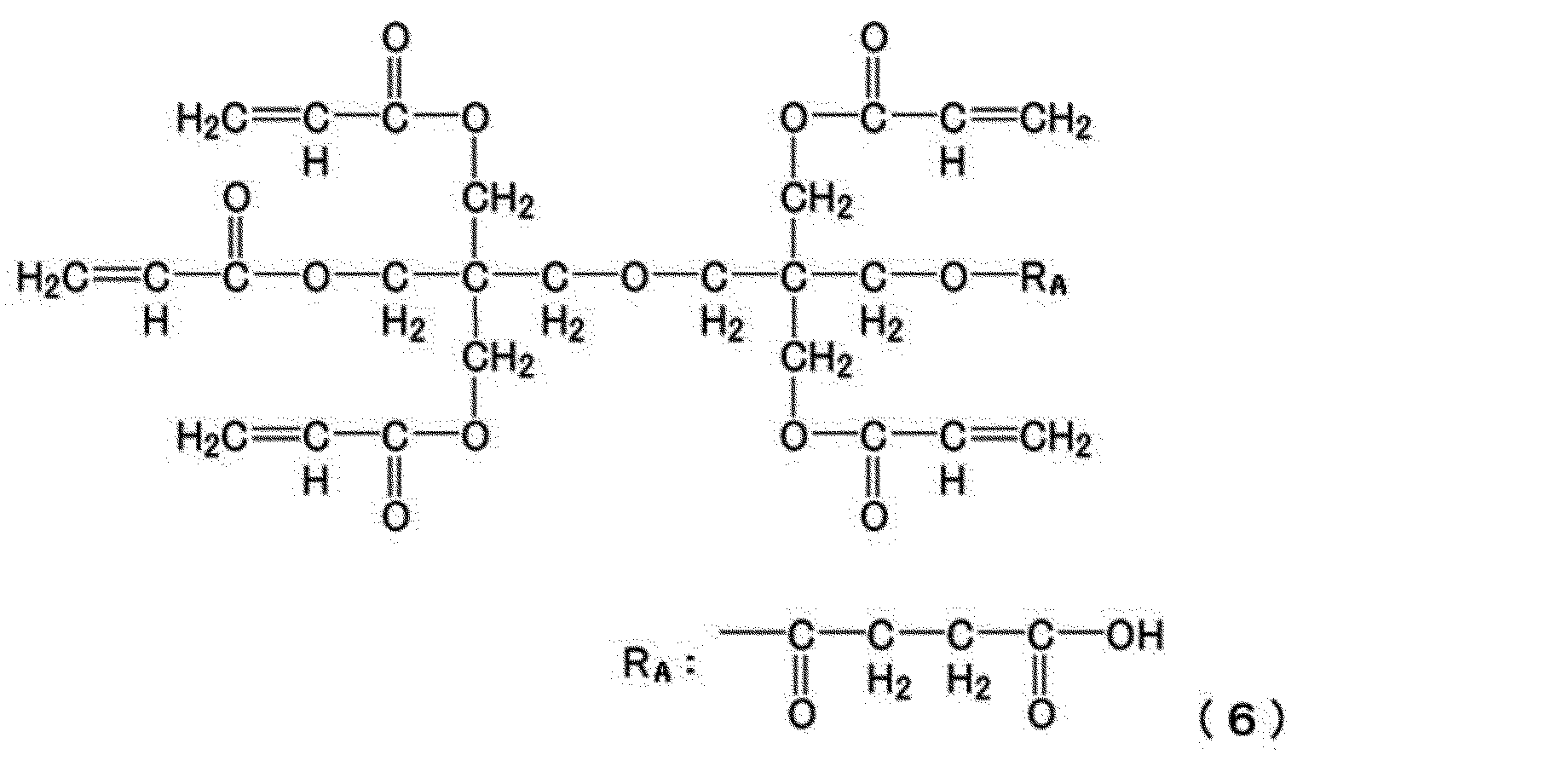
で表されるジペンタエリスリトールヘキサアクリレートの変性物等の3官能以上の多官能(メタ)アクリレート化合物;
エチレングリコールジビニルエーテル、ジエチレングリコールジビニルエーテル、ポリエチレングリコールジビニルエーテル、プロピレングリコールジビニルエーテル、ブチレングリコールジビニルエーテル、ヘキサンジオールジビニルエーテル、ビスフェノールAアルキレンオキシドジビニルエーテル、ビスフェノールFアルキレンオキシドジビニルエーテル、トリメチロールプロパントリビニルエーテル、ジトリメチロールプロパンテトラビニルエーテル、グリセリントリビニルエーテル、ペンタエリスリトールテトラビニルエーテル、ジペンタエリスリトールペンタビニルエーテル、ジペンタエリスリトールヘキサビニルエーテル、エチレンオキシド付加トリメチロールプロパントリビニルエーテル、エチレンオキシド付加ジトリメチロールプロパンテトラビニルエーテル、エチレンオキシド付加ペンタエリスリトールテトラビニルエーテル、エチレンオキシド付加ジペンタエリスリトールヘキサビニルエーテル等の多官能ビニルエーテル類;
(メタ)アクリル酸2-ビニロキシエチル、(メタ)アクリル酸3-ビニロキシプロピル、(メタ)アクリル酸1-メチル-2-ビニロキシエチル、(メタ)アクリル酸2-ビニロキシプロピル、(メタ)アクリル酸4-ビニロキシブチル、(メタ)アクリル酸4-ビニロキシシクロヘキシル、(メタ)アクリル酸5-ビニロキシペンチル、(メタ)アクリル酸6-ビニロキシヘキシル、(メタ)アクリル酸4-ビニロキシメチルシクロヘキシルメチル、(メタ)アクリル酸p-ビニロキシメチルフェニルメチル、(メタ)アクリル酸2-(ビニロキシエトキシ)エチル、(メタ)アクリル酸2-(ビニロキシエトキシエトキシエトキシ)エチル等のビニルエーテル基含有(メタ)アクリル酸エステル類;
エチレングリコールジアリルエーテル、ジエチレングリコールジアリルエーテル、ポリエチレングリコールジアリルエーテル、プロピレングリコールジアリルエーテル、ブチレングリコールジアリルエーテル、ヘキサンジオールジアリルエーテル、ビスフェノールAアルキレンオキシドジアリルエーテル、ビスフェノールFアルキレンオキシドジアリルエーテル、トリメチロールプロパントリアリルエーテル、ジトリメチロールプロパンテトラアリルエーテル、グリセリントリアリルエーテル、ペンタエリスリトールテトラアリルエーテル、ジペンタエリスリトールペンタアリルエーテル、ジペンタエリスリトールヘキサアリルエーテル、エチレンオキシド付加トリメチロールプロパントリアリルエーテル、エチレンオキシド付加ジトリメチロールプロパンテトラアリルエーテル、エチレンオキシド付加ペンタエリスリトールテトラアリルエーテル、エチレンオキシド付加ジペンタエリスリトールヘキサアリルエーテル等の多官能アリルエーテル類;
(メタ)アクリル酸アリル等のアリル基含有(メタ)アクリル酸エステル類;トリ(アクリロイルオキシエチル)イソシアヌレート、トリ(メタクリロイルオキシエチル)イソシアヌレート、アルキレンオキシド付加トリ(アクリロイルオキシエチル)イソシアヌレート、アルキレンオキシド付加トリ(メタクリロイルオキシエチル)イソシアヌレート等の多官能(メタ)アクリロイル基含有イソシアヌレート類;トリアリルイソシアヌレート等の多官能アリル基含有イソシアヌレート類;トリレンジイソシアネート、イソホロンジイソシアネート、キシリレンジイソシアネート等の多官能イソシアネートと(メタ)アクリル酸2-ヒドロキシエチル、(メタ)アクリル酸2-ヒドロキシプロピル等の水酸基含有(メタ)アクリル酸エステル類との反応で得られる多官能ウレタン(メタ)アクリレート類;ジビニルベンゼン等の多官能芳香族ビニル類;等。これらの重合性化合物は、1種単独で用いてもよいし、2種以上を組み合わせて用いてもよい。
ただし、ビニルエーテル基を側鎖に有する重合体は、樹脂組成物の硬化性を向上させるが、保存安定性を低下させることがあるので、保存安定性の点では、上記感光性樹脂組成物は、ビニルエーテル基を側鎖に有する重合体を含まないことが好ましい。
上記重合性化合物のなかでも、感光性樹脂組成物の硬化性をより高める観点から、多官能の重合性化合物を用いることが好ましい。上記多官能の重合性化合物の官能数としては、3以上が好ましく、4以上がより好ましい。また、上記官能数は10以下が好ましく、8以下がより好ましい。
また上記重合性化合物の分子量としては特に限定されないが、取り扱いの観点から、例えば、2000以下が好ましい。
また上記重合性化合物の分子量としては特に限定されないが、取り扱いの観点から、例えば、2000以下が好ましい。
上記多官能の重合性化合物としては、なかでも、反応性、経済性、入手性等の観点から、好ましくは多官能(メタ)アクリレート化合物、多官能ウレタン(メタ)アクリレート化合物、(メタ)アクリロイル基含有イソシアヌレート化合物等の、(メタ)アクリロイル基を有する化合物が挙げられ、より好ましくは多官能(メタ)アクリレート化合物が挙げられる。(メタ)アクリロイル基を有する化合物を含むことにより、感光性樹脂組成物が感光性及び硬化性により優れたものとなり、より一層高硬度で高透明性の硬化物を得ることができる。上記多官能の重合性化合物としては、3官能以上の多官能(メタ)アクリレート化合物を用いることが更に好ましい。
上記重合性化合物は、1種のみ使用してもよいし、2種以上組み合わせて使用してもよい。
上記重合性化合物は、1種のみ使用してもよいし、2種以上組み合わせて使用してもよい。
本発明の感光性樹脂組成物において、上記重合性化合物の含有量は、本発明の効果が発揮される範囲であれば特に制限されず適宜設定すればよいが、感光性樹脂組成物を適切な粘度にできる点から、感光性樹脂組成物の固形分総量100質量%に対して、好ましくは5~60質量%であり、より好ましくは10~50質量%である。
[光重合開始剤(C)]
光重合開始剤(C)としては、好ましくはラジカル重合性の光重合開始剤が挙げられる。ラジカル重合性の光重合開始剤とは、電磁波や電子線等の活性エネルギー線の照射により重合開始ラジカルを発生させるものである。
光重合開始剤(C)としては、好ましくはラジカル重合性の光重合開始剤が挙げられる。ラジカル重合性の光重合開始剤とは、電磁波や電子線等の活性エネルギー線の照射により重合開始ラジカルを発生させるものである。
上記光重合開始剤の具体例としては、例えば、2-メチル-1-[4-(メチルチオ)フェニル]-2-モルフォリノプロパン-1-オン(「IRGACURE907」、BASF社製)、2-ベンジル-2-ジメチルアミノ-1-(4-モルフォリノフェニル)-ブタノン-1(「IRGACURE369」、BASF社製)、2-ジメチルアミノ-2-(4-メチル-ベンジル)-1-(4-モルフォリン-4-イル-フェニル)-ブタン-1-オン(「IRGACURE379」、BASF社製)等のアミノケトン系化合物;2,2-ジメトキシ-1,2-ジフェニルエタン-1-オン(「IRGACURE651」、BASF社製)、フェニルグリオキシリックアシッドメチルエステル(「DAROCUR MBF」、BASF社製)等のベンジルケタール系化合物;1-ヒドロキシ-シクロヘキシル-フェニル-ケトン(「IRGACURE184」、BASF社製)、2-ヒドロキシ-2-メチル-1-フェニル-プロパン-1-オン(「DAROCUR1173」、BASF社製)、1-[4-(2-ヒドロキシエトキシ)-フェニル]-2-ヒドロキシ-2-メチル-1-プロパン-1-オン(「IRGACURE2959」、BASF社製)、2-ヒドロキシ-1-{4-[4-(2-ヒドロキシ-2-メチル-プロピオニル)-ベンジル]-フェニル}-2-メチル-プロパン-1-オン(「IRGACURE127」、BASF社製)、[1-ヒドロキシ-シクロヘキシル-フェニル-ケトン+ベンゾフェノン](「IRGACURE500」、BASF社製)等のハイドロケトン系化合物;等の他、特開2013-227485号公報段落[0084]~[0086]に例示された、他のアルキルフェノン系化合物;1,2-オクタンジオン,1-[4-(フェニルチオ)フェニル]-,2-(O-ベンゾイルオキシム)(「OXE01」、BASF社製)、エタノン,1-[9-エチル-6-(2-メチルベンゾイル)-9H-カルバゾール-3-イル]-,1-(O-アセチルオキシム)(「OXE02」、BASF社製)、1,2-オクタンジオン、1-[4-(フェニルチオ)-,2-,(O-ベンゾイルオキシム)]、エタノン(「OXE03」、BASF社製)、1-[9-エチル-6-(2-メチルベンゾイル)-9H-カルバゾール-3-イル]-,1-(O-アセチルオキシム)(「OXE04」、BASF社製)等のオキシムエステル系化合物;ベンゾフェノン系化合物;ベンゾイン系化合物;チオキサントン系化合物;ハロメチル化トリアジン系化合物;ハロメチル化オキサジアゾール系化合物;ビイミダゾール系化合物;チタノセン系化合物;安息香酸エステル系化合物;アクリジン系化合物等;ホスフィンオキシド系化合物;等が挙げられる。なかでも、アミノケトン系化合物、オキシムエステル系化合物が好ましい。
上記光重合開始剤(C)は、1種単独で用いてもよいし、2種以上を組み合わせて用いてもよい。
上記光重合開始剤(C)は、1種単独で用いてもよいし、2種以上を組み合わせて用いてもよい。
上記光重合開始剤(C)の含有量は、本発明の効果が発揮される範囲であれば、特に制限されず、適宜設定すればよいが、例えば、本発明の感光性樹脂組成物の固形分総量100質量%に対し、0.3~20質量%であることが好ましく、0.5~10質量%であることがより好ましく、1~8質量%であることが更に好ましい。
上記感光性樹脂組成物はまた、更に、酸解離定数pKaが4.2以下の酸化合物を含むことが好ましい。上記酸化合物としては、上述したものと同様のものが挙げられる。
上記酸化物の含有量としては、上述したアルカリ可溶性樹脂に対する酸化物の含有量と同様の量が挙げられる。
上記酸化物の含有量としては、上述したアルカリ可溶性樹脂に対する酸化物の含有量と同様の量が挙げられる。
上記感光性樹脂組成物はまた、更に、塩基性化合物を含むことが好ましい。上記塩基性化合物としては、上述したものと同様のものが挙げられる。
上記塩基性化合物の含有量としては、上述したアルカリ可溶性樹脂に対する塩基性化合物の含有量と同様の量が挙げられる。
上記塩基性化合物の含有量としては、上述したアルカリ可溶性樹脂に対する塩基性化合物の含有量と同様の量が挙げられる。
[色材(D)]
上記感光性樹脂組成物は、色材を更に含んでもよい。色材は目的とする画素の色に応じて単独で用いてもよく、複数を併用してもよい。
色材としては、顔料(有機顔料、無機顔料)や染料等を用いることが好ましい。
上記顔料としては特に限定されないが、例えば、アゾ系顔料、フタロシアニン系顔料、多環式顔料(キナクリドン系、ペリレン系、ペリノン系、イソインドリノン系、イソインドリン系、ジオキサジン系、チオインジゴ系、アントラキノン系、キノフタロン系、金属錯体系、ジケトピロロピロール系等)、染料レーキ系顔料等の有機顔料;白色・体質顔料(酸化チタン、酸化亜鉛、硫化亜鉛、クレー、タルク、硫酸バリウム、炭酸カルシウム等)、有彩顔料(黄鉛、カドミニウム系、クロムバーミリオン、ニッケルチタン、クロムチタン、黄色酸化鉄、ベンガラ、ジンククロメート、鉛丹、群青、紺青、コバルトブルー、クロムグリーン、酸化クロム、バナジン酸ビスマス等)、黒色顔料(カーボンブラック、ボーンブラック、グラファイト、鉄黒、チタンブラック等)、光輝材顔料(パール顔料、アルミ顔料、ブロンズ顔料等)、蛍光顔料(硫化亜鉛、硫化ストロンチウム、アルミン酸ストロンチウム等)等の無機顔料;等が挙げられる。中でも、有機顔料が好ましい。
上記顔料の具体例としては、C.I.ピグメントイエロー1、3、12、13、14、15、16、17、20、24、31、53、83、86、93、94、109、110、117、125、128、137、138、139、147、148、150、153、154、166、173、194、214等の黄色顔料;C.I.ピグメントオレンジ13、31、36、38、40、42、43、51、55、59、61、64、65、71、73等の橙色顔料;C.I.ピグメントレッド9、97、105、122、123、144、149、166、168、176、177、180、192、209、215、216、224、242、254、255、264、265等の赤色顔料;C.I.ピグメントブルー15、15:3、15:4、15:6、60等の青色顔料;C.I.ピグメントバイオレット1、19、23、29、32、36、38等のバイオレット色顔料;C.I.ピグメントグリーン7、36、58、59等の緑色顔料;C.I.ピグメントブラウン23、25等の茶色顔料;C.I.ピグメントブラック1、7、カーボンブラック、チタンブラック、酸化鉄等の黒色顔料などが挙げられる。
上記染料としては特に限定されないが、例えば、特開2010-9033号公報、特開2010-211198号公報、特開2009-51896号公報、特開2008-50599号公報に記載されている有機染料を使用することができる。中でも、アゾ系染料、アントラキノン系染料、フタロシアニン系染料、キノンイミン系染料、キノリン系染料、ニトロ系染料、カルボニル系染料、メチン系染料、キサンテン系染料等が好ましい。
上記染料の具体例としては、acid alizarin violet N;acid black1、2、24、48;acid blue1、7、9、25、29、40、45、62、70、74、80、83、90、92、112、113、120、129、147;acid chrome violet K;acid Fuchsin;acid green1、3、5、25、27、50;acid orange6、7、8、10、12、50、51、52、56、63、74、95;acid red1、4、8、14、17、18、26、27、29、31、34、35、37、42、44、50、51、52、57、69、73、80、87、88、91、92、94、97、103、111、114、129、133、134、138、143、145、150、151、158、176、183、198、211、215、216、217、249、252、257、260、266、274;acid violet 6B、7、9、17、19;acid yellow1、3、9、11、17、23、25、29、34、36、42、54、72、73、76、79、98、99、111、112、114、116; food yellow3及びこれらの誘導体等が挙げられる。
これらの中でも、本発明では、近年の高色純度化や高輝度化の要望に応えるべく、色材として染料を少なくとも用いることが好適であり、染料を用いても優れた硬化物物性を発揮できるため、非常に有用である。染料を少なくとも用いる場合、染料の含有量は、色材の総量100質量%に対し10質量%以上であることが好ましい。より好ましくは20質量%以上、一層好ましくは40質量%以上、特に好ましくは60質量%以上、最も好ましくは80質量%以上である。上限は100質量%、すなわち色材として染料のみを使用する形態も好適であるし、100質量%未満、すなわち染料と他の色材(例えば顔料)とを併用する形態も好適である。染料と顔料とを併用する場合、その質量比(染料/顔料)は10~99/90~1が好ましく、より好ましくは20~99/80~1、更に好ましくは40~99/60~1、特に好ましくは60~99/40~1、最も好ましくは80~99/20~1である。
上記色材の総量は、感光性樹脂組成物の固形分総量100質量%に対し1質量%以上であることが好ましい。より好ましくは5質量%以上、更に好ましくは10質量%以上であり、これにより、近年の高色純度化や高輝度化の要望に充分に応えることが可能になる。上限は特に限定されないが、他の含有成分(例えば、アルカリ可溶性樹脂や重合性化合物)に起因する感光性、溶解性及び硬化性等の画像形成性をより充分に発揮させる観点から、80質量%以下であることが好ましい。より好ましくは70質量%以下、更に好ましくは60質量%以下である。
[光酸発生剤(E)]
本発明の感光性樹脂組成物は、更に、光酸発生剤を含むことが好ましい。光酸発生剤を更に含むことにより、感光性樹脂組成物の硬化性がより一層向上しうる。
上記光酸発生剤は、放射線等の活性エネルギー線に暴露されることにより酸を発生する化合物であり、例えば、トルエンスルホン酸または四フッ化ホウ素などの強酸、スルホニウム塩、アンモニウム塩、ホスホニウム塩、ヨードニウム塩またはセレニウム塩などのオニウム塩類;鉄-アレン錯体類;シラノール-金属キレート錯体類;ジスルホン類、ジスルホニルジアゾメタン類、ジスルホニルメタン類、スルホニルベンゾイルメタン類、イミドスルホネート類、ベンゾインスルホネート類などのスルホン酸誘導体;有機ハロゲン化合物類;等が挙げられる。
上記光酸発生剤(E)の含有量は、感光性樹脂組成物の固形分総量100質量%に対し、0.3~20質量%であることが好ましく、0.5~10質量%であることがより好ましく、1~8質量%であることが更に好ましい。
[多官能チオール化合物(F)]
本発明の感光性樹脂組成物は、更に、多官能チオール化合物を含むことが好ましい。本発明の樹脂は側鎖に(メタ)アクリロイル基を含むことが好ましく、露光または加熱時にエンチオール反応が併発し、架橋密度が向上するためと推察できる。
本発明の感光性樹脂組成物は、更に、多官能チオール化合物を含むことが好ましい。本発明の樹脂は側鎖に(メタ)アクリロイル基を含むことが好ましく、露光または加熱時にエンチオール反応が併発し、架橋密度が向上するためと推察できる。
上記多官能チオール化合物は、1分子中にメルカプト基を2以上有し、分子量は200~1000が好ましく、3~5官能の2級チオールが特に好ましい。これらの多官能チオール化合物を添加することで、硬化性、保存安定性がより一層向上し得る。
上記多官能チオール化合物としては、ブタンジオールビスチオプロピオネート、エチレングリコールビスチオプロピオネート、トリメチロールプロパントリスチオプロピオネート、ペンタエリスリトールテトラキスチオプロピオネート、ペンタエリスリトールテトラキス(3-メルカプトブチレート)(カレンズPE-1)、1,4-ビス(3-メルカプトブチリルオキシ)ブタン(カレンズBD-1)、1,3,5-トリス(3-メルカプトブチリルオキシエチル)-1,3,5-トリアジン-2,4,6(1H,3H,5H)-トリオン(カレンズNR-1)等のメルカプトプロピオン酸誘導体を使用できる。
なお、多官能チオール化合物としては分子内に水酸基及び/又は芳香環を有しないほうが好ましい。
多官能チオール化合物の市販品としては、例えば、花王株式会社製「チオカルコール20」、昭和電工株式会社製「カレンズMT PE1」、「カレンズMT BD1」、「カレンズMT NR1」、「TPMB」、「TEMB」、SC有機化学株式会社製「TMMP」、「TEMPIC」、「PEMP」、「EGMP-4」、「DPMP」、「TMMP II-20P」、「PEMP II-20P」が挙げられる。
上記多官能チオール化合物(F)の含有量は、感光性樹脂組成物の固形分総量100質量%に対し、0.3~15質量%であることが好ましく、0.5~10質量%であることがより好ましく、1~8質量%であることが更に好ましい。
[溶剤(G)]
本発明の感光性樹脂組成物は、溶剤を含むことが好ましい。
溶剤としては特に限定されず、上述のアルカリ可溶性樹脂の合成反応時に用いた不活性有機溶媒が挙げられる。中でも、グリコールモノエーテルのエステル類、モノアルコール類、及び/又は、グリコールモノエーテル類を用いることが好ましい。より好ましくは、グリコールモノエーテルのエステル類を少なくとも用いることであり、グリコールモノエーテルのエステル類とグリコールモノエーテル類とを併用することも好適である。
本発明の感光性樹脂組成物は、溶剤を含むことが好ましい。
溶剤としては特に限定されず、上述のアルカリ可溶性樹脂の合成反応時に用いた不活性有機溶媒が挙げられる。中でも、グリコールモノエーテルのエステル類、モノアルコール類、及び/又は、グリコールモノエーテル類を用いることが好ましい。より好ましくは、グリコールモノエーテルのエステル類を少なくとも用いることであり、グリコールモノエーテルのエステル類とグリコールモノエーテル類とを併用することも好適である。
上記溶剤(G)の含有量は特に限定されず、感光性樹脂組成物の使用形態(例えば塗布等)に応じて適宜設定することが好ましい。例えば、感光性樹脂組成物100質量%中の固形分総量(固形分濃度)が1~90質量%になるように、溶剤の含有割合を設定することが好ましい。感光性樹脂組成物100質量%中の固形分総量は、より好ましくは5~70質量%、特に好ましくは10~50質量%である。
[分散剤(H)]
本発明の感光性樹脂組成物はまた、分散剤を含むことが好ましい。分散剤としては特に限定されないが、例えば、色材への相互作用部位と分散媒(アルカリ可溶性樹脂や溶剤等)への相互作用部位とを有し、分散媒への色材の分散を安定化する働きを持つものが好ましい。一般には、樹脂型分散剤(高分子分散剤)、界面活性剤(低分子分散剤)、色素誘導体に分類され、通常使用されている分散剤を用いればよい。
本発明の感光性樹脂組成物はまた、分散剤を含むことが好ましい。分散剤としては特に限定されないが、例えば、色材への相互作用部位と分散媒(アルカリ可溶性樹脂や溶剤等)への相互作用部位とを有し、分散媒への色材の分散を安定化する働きを持つものが好ましい。一般には、樹脂型分散剤(高分子分散剤)、界面活性剤(低分子分散剤)、色素誘導体に分類され、通常使用されている分散剤を用いればよい。
上記分散剤(H)の含有量は特に限定されず、目的や用途に応じて適宜設定すればよいが、例えば、分散安定性、耐久性(耐熱性、耐光性、耐候性等)及び透明性等のバランスを考慮すると、色材の固形分総量100質量部に対し、分散剤の固形分が0.01~60質量部であることが好ましい。より好ましくは0.1~50質量部、更に好ましくは0.5~40質量部である。
[他の成分(I)]
本発明の感光性樹脂組成物は、上述した成分以外に、必要に応じて他の成分を含んでいてもよい。上記他の成分としては、例えば、アルカリ可溶性樹脂(A)以外のバインダー樹脂;他の溶剤;他の色材;他の分散剤;耐熱向上剤;レベリング剤;現像助剤;シリカ微粒子等の無機微粒子;シラン系、アルミニウム系、チタン系等のカップリング剤;フィラー、他のエポキシ樹脂、他のフェノール樹脂、ポリビニルフェノール等の熱硬化性樹脂;可塑剤;重合禁止剤;紫外線吸収剤;酸化防止剤;艶消し剤;消泡剤;帯電防止剤;スリップ剤;表面改質剤;揺変化剤;揺変助剤;キノンジアジド化合物;カチオン重合性化合物;等が挙げられる。これらは、1種単独で用いてもよいし、2種以上を組み合わせて用いてもよい。これらの他の成分は、公知のものから適宜選択して使用するとよく、その使用量も適宜設定することができる。例えば、上記感光性樹脂組成物をカラーフィルター用途に使用する場合には、上記感光性樹脂組成物は色材を含むことが好ましい。
本発明の感光性樹脂組成物は、上述した成分以外に、必要に応じて他の成分を含んでいてもよい。上記他の成分としては、例えば、アルカリ可溶性樹脂(A)以外のバインダー樹脂;他の溶剤;他の色材;他の分散剤;耐熱向上剤;レベリング剤;現像助剤;シリカ微粒子等の無機微粒子;シラン系、アルミニウム系、チタン系等のカップリング剤;フィラー、他のエポキシ樹脂、他のフェノール樹脂、ポリビニルフェノール等の熱硬化性樹脂;可塑剤;重合禁止剤;紫外線吸収剤;酸化防止剤;艶消し剤;消泡剤;帯電防止剤;スリップ剤;表面改質剤;揺変化剤;揺変助剤;キノンジアジド化合物;カチオン重合性化合物;等が挙げられる。これらは、1種単独で用いてもよいし、2種以上を組み合わせて用いてもよい。これらの他の成分は、公知のものから適宜選択して使用するとよく、その使用量も適宜設定することができる。例えば、上記感光性樹脂組成物をカラーフィルター用途に使用する場合には、上記感光性樹脂組成物は色材を含むことが好ましい。
上記他の成分(I)の含有量は、目的や用途に応じて適宜設定すればよいが、例えば、感光性樹脂組成物の固形分総量100質量%中、0~50質量%であることが好ましい。より好ましくは0.01~30質量%、更に好ましくは0.1~20質量%、特に好ましくは0.3~10質量%である。
〔感光性樹脂組成物の製造方法〕
本発明の感光性樹脂組成物を調製する方法としては、特に制限されず公知の方法を用いればよく、例えば、上述した各含有成分を、各種の混合機や分散機を用いて混合・分散する方法が挙げられる。混合・分散工程は特に制限されず、公知の方法により行えばよい。また、通常行われる他の工程を更に含んでいてもよい。上記感光性樹脂組成物が色材を含む場合は、色材の分散処理工程等の公知の工程を経て調製することが好ましい。
本発明の感光性樹脂組成物を調製する方法としては、特に制限されず公知の方法を用いればよく、例えば、上述した各含有成分を、各種の混合機や分散機を用いて混合・分散する方法が挙げられる。混合・分散工程は特に制限されず、公知の方法により行えばよい。また、通常行われる他の工程を更に含んでいてもよい。上記感光性樹脂組成物が色材を含む場合は、色材の分散処理工程等の公知の工程を経て調製することが好ましい。
〔硬化物〕
本発明のアルカリ可溶性樹脂又は感光性樹脂組成物を硬化して得られる硬化物は、優れた耐溶剤性を有する。そのようなアルカリ可溶性樹脂、又は感光性樹脂組成物の硬化物も本発明の一つである。
本発明のアルカリ可溶性樹脂又は感光性樹脂組成物を硬化して得られる硬化物は、優れた耐溶剤性を有する。そのようなアルカリ可溶性樹脂、又は感光性樹脂組成物の硬化物も本発明の一つである。
上記硬化物が硬化膜である場合、その膜厚は0.1μm以上であることが好ましい。上記膜厚が0.1μm以上であると、より一層優れた耐溶剤性を発揮することができる。上記膜厚は、0.5μm以上であることがより好ましく、1μm以上であることが更に好ましい。上記膜厚の上限値は、特に限定されず、硬化膜の目的、用途に応じて適宜設定すればよいが、例えば20μm以下であることが好ましく、15μm以下であることがより好ましく、10μm以下であることが更に好ましい。
上記硬化物を得る方法としては、特に制限されず、公知の方法を用いればよく、例えば、上述したアルカリ可溶性樹脂(溶液)、又は感光性樹脂組成物を、基材上に塗布、又は、成形したものを、乾燥、加熱、又は紫外線等のエネルギー線の照射、あるいはこれらの組み合わせにより硬化させて硬化物を得る方法が挙げられる。
本発明のアルカリ可溶性樹脂、アルカリ可溶性樹脂溶液、又は感光性樹脂組成物を用いると、低温硬化条件でも耐溶剤性に優れた硬化物を与えることができる。そのような硬化物の製造方法としては、例えば、基材上に、上記感光性樹脂組成物を塗布して塗布膜を形成する工程、形成された塗布膜に光照射する工程、及び、光照射された塗布膜を160℃以下で加熱する工程を含む方法が好ましく挙げられる。
上記基材としては、特に制限されず、目的や用途に応じて適宜選択すればよく、例えば、ガラス板、プラスチック板等、種々の材料からなる基材が挙げられる。
上記感光性樹脂組成物を塗布して塗布膜を形成する方法としては、特に制限されず、スピン塗布、スリット塗布、ロール塗布、流延塗布等の公知の方法で行うことができる。
上記製造方法においては、上記感光性樹脂組成物を基材上に塗布した後、塗布物を乾燥させて塗布膜を形成することが好ましい。上記乾燥は、公知の方法で行うことができ、具体的には、後述する「<カラーフィルターの製造方法>」の「配置工程」に記載の乾燥方法と同様の方法で行うことができる。
上記製造方法は、塗布膜を形成した後、上記塗布膜に光照射する工程を含む。
上記形成された塗布膜に光照射する方法としては、特に制限されず、公知の方法で行うことができ、具体的には、後述する「<カラーフィルターの製造方法>」の「光照射工程」に記載の方法と同様の方法で行うことができる。
上記形成された塗布膜に光照射する方法としては、特に制限されず、公知の方法で行うことができ、具体的には、後述する「<カラーフィルターの製造方法>」の「光照射工程」に記載の方法と同様の方法で行うことができる。
上記塗布膜に光照射する場合、フォトマスクを介して光照射を行ってもよい。フォトマスクとして、目的とするパターンに応じて遮光部が形成されたマスクを用いるとよい。フォトマスクを介して光照射を行った場合、その後に現像工程を行うことが好ましい。現像工程を行うことで、塗布膜に目的とするパターンを形成することができる。現像方法としては、特に制限されず、公知の方法で行うことができ、具体的には、後述する「<カラーフィルターの製造方法>」の「現像工程」に記載の方法と同様の方法で行うことができる。
上記製造方法はまた、光照射された塗布膜を160℃以下で加熱する工程を含む。上記製造方法は、上述した感光性樹脂組成物を用いるので、光照射後の加熱工程(後硬化工程)を160℃以下のような比較的低温条件下で行うことができる。
加熱温度は、155℃以下であることが好ましく、150℃以下であることがより好ましい。加熱温度の下限としては、硬化性が維持できる点で、70℃以上であることが好ましく、90℃以上であることがより好ましい。
温度以外の上記加熱方法については、特に制限されず、公知の方法で行うことができ、例えば、後述する「<カラーフィルターの製造方法>」の「加熱工程」に記載の方法と同様の方法で行うことができる。
〔用途〕
本発明のアルカリ可溶性樹脂、及びこれを含む感光性樹脂組成物は、アルカリ現像性に優れる。また、160℃以下、例えば90℃程度の低温硬化条件でも、硬化反応が十分に進行し、耐溶剤性に優れた硬化物を与えることができる。そのため、低温条件で充分に硬化させる必要がある用途や、耐溶剤性が必要とされる用途に好適に使用することができる。
本発明のアルカリ可溶性樹脂、及びこれを含む感光性樹脂組成物は、アルカリ現像性に優れる。また、160℃以下、例えば90℃程度の低温硬化条件でも、硬化反応が十分に進行し、耐溶剤性に優れた硬化物を与えることができる。そのため、低温条件で充分に硬化させる必要がある用途や、耐溶剤性が必要とされる用途に好適に使用することができる。
本発明のアルカリ可溶性樹脂、及び感光性樹脂組成物は、具体的には、例えば、液晶・有機EL・量子ドット・マイクロLED液晶表示装置や固体撮像素子、タッチパネル式表示装置等に用いられるカラーフィルター、ブラックマトリクス、フォトスペーサー、ブラックカラムスペーサー、インキ、印刷版、プリント配線板、半導体素子、フォトレジスト、絶縁膜、フィルム、有機保護膜等の、各種の光学部材や電機・電子機器等の構成部材の用途に好適に使用することができる。なかでも、カラーフィルター用途に好ましく使用される。本発明の感光性樹脂組成物は、光学材料用として好適に使用され、また、ネガ型用として好適に使用される。
〔カラーフィルター〕
基板上に、上述の感光性樹脂組成物の硬化物を有するカラーフィルターも、本発明の好ましい形態の一つである。
基板上に、上述の感光性樹脂組成物の硬化物を有するカラーフィルターも、本発明の好ましい形態の一つである。
上記カラーフィルターにおいて、上述の感光性樹脂組成物により形成される硬化物は、例えば、ブラックマトリクスや、赤色、緑色、青色、黄色等の各画素のような着色が必要なセグメントとして特に好適であるが、フォトスペーサー、保護層、配向制御用リブ等の着色が必ずしも必要としないセグメントとしても好適である。
上記カラーフィルターに使用される基板としては、例えば、白板ガラス、青板ガラス、アルカリ強化ガラス、シリカコート青板ガラス等のガラス基板;ポリエステル、ポリカーボネート、ポリオレフィン、ポリスルホン、環状オレフィンの開環重合体やその水素添加物等の熱可塑性樹脂からなるシート、フィルム又は基板;エポキシ樹脂、不飽和ポリエステル樹脂等の熱硬化性樹脂からなるシート、フィルム又は基板;アルミニウム板、銅板、ニッケル板、ステンレス板等の金属基板;セラミック基板;光電変換素子を有する半導体基板;表面に色材層を備えるガラス基板(例えばLCD用カラーフィルター)等の各種材料から構成される部材;等が挙げられる。なかでも、耐熱性の点から、ガラス基板や、耐熱性樹脂からなるシート、フィルム又は基板が好ましい。また、上記基板は透明基板であることが好適である。
また上記基板には、必要に応じて、コロナ放電処理、オゾン処理、シランカップリング剤等による薬品処理等を行ってもよい。
また上記基板には、必要に応じて、コロナ放電処理、オゾン処理、シランカップリング剤等による薬品処理等を行ってもよい。
<カラーフィルターの製造方法>
上記カラーフィルターを得るには、例えば、画素一色につき(すなわち、一色の画素ごとに)、基板上に、上述の感光性樹脂組成物を配置する工程(配置工程とも称す)と、当該基板上に配置された感光性樹脂組成物に光を照射する工程(光照射工程とも称す)と、現像液により現像処理する工程(現像工程とも称す)と、加熱処理する工程(加熱工程とも称す)とを含む手法を採用し、これと同じ手法を各色で繰り返す製造方法を採用することが好適である。なお、各色の画素の形成順序は、特に限定されるものではない。
上記カラーフィルターを得るには、例えば、画素一色につき(すなわち、一色の画素ごとに)、基板上に、上述の感光性樹脂組成物を配置する工程(配置工程とも称す)と、当該基板上に配置された感光性樹脂組成物に光を照射する工程(光照射工程とも称す)と、現像液により現像処理する工程(現像工程とも称す)と、加熱処理する工程(加熱工程とも称す)とを含む手法を採用し、これと同じ手法を各色で繰り返す製造方法を採用することが好適である。なお、各色の画素の形成順序は、特に限定されるものではない。
(1)配置工程(好ましくは塗布工程)
上記配置工程は、塗布により行うことが好適である。基板上に上記感光性樹脂組成物を塗布する方法としては、例えば、スピン塗布、スリット塗布、ロール塗布、流延塗布等が挙げられ、いずれの方法も好ましく用いることができる。
上記配置工程は、塗布により行うことが好適である。基板上に上記感光性樹脂組成物を塗布する方法としては、例えば、スピン塗布、スリット塗布、ロール塗布、流延塗布等が挙げられ、いずれの方法も好ましく用いることができる。
上記配置工程ではまた、上記感光性樹脂組成物を基板上に塗布した後、塗膜を乾燥することが好適である。塗膜の乾燥は、例えば、ホットプレート、IRオーブン、コンベクションオーブン等を用いて行うことができる。乾燥条件は、含まれる溶媒成分の沸点、硬化成分の種類、膜厚、乾燥機の性能等に応じて適宜選択されるが、通常、50~160℃の温度で10秒~300秒間行うことが好適である。
(2)光照射工程
上記光照射工程において、使用される活性光線の光源としては、例えば、キセノンランプ、ハロゲンランプ、タングステンランプ、高圧水銀灯、超高圧水銀灯、メタルハライドランプ、中圧水銀灯、低圧水銀灯、カーボンアーク、蛍光ランプ等のランプ光源、アルゴンイオンレーザー、YAGレーザー、エキシマレーザー、窒素レーザー、ヘリウムカドミニウムレーザー、半導体レーザー等のレーザー光源等が使用される。また、露光機の方式としては、プロキシミティー方式、ミラープロジェクション方式、ステッパー方式が挙げられるが、プロキシミティー方式が好ましく用いられる。
上記光照射工程において、使用される活性光線の光源としては、例えば、キセノンランプ、ハロゲンランプ、タングステンランプ、高圧水銀灯、超高圧水銀灯、メタルハライドランプ、中圧水銀灯、低圧水銀灯、カーボンアーク、蛍光ランプ等のランプ光源、アルゴンイオンレーザー、YAGレーザー、エキシマレーザー、窒素レーザー、ヘリウムカドミニウムレーザー、半導体レーザー等のレーザー光源等が使用される。また、露光機の方式としては、プロキシミティー方式、ミラープロジェクション方式、ステッパー方式が挙げられるが、プロキシミティー方式が好ましく用いられる。
なお、活性エネルギー光線の照射工程では、用途によっては、所定のマスクパターンを介して活性エネルギー光線を照射することとしてもよい。この場合、露光部が硬化し、硬化部が現像液に対して不溶化又は難溶化されることになる。
(3)現像工程
上記現像工程は、上述した光照射工程の後、現像液によって現像処理し、未露光部を除去しパターンを形成する工程である。これにより、パターン化された硬化膜を得ることができる。現像処理は、通常、10~50℃の現像温度で、浸漬現像、スプレー現像、ブラシ現像、超音波現像等の方法で行うことができる。
上記現像工程は、上述した光照射工程の後、現像液によって現像処理し、未露光部を除去しパターンを形成する工程である。これにより、パターン化された硬化膜を得ることができる。現像処理は、通常、10~50℃の現像温度で、浸漬現像、スプレー現像、ブラシ現像、超音波現像等の方法で行うことができる。
上記現像工程で使用される現像液は、上記感光性樹脂組成物を溶解するものであれば特に限定されないが、通常、有機溶媒やアルカリ性水溶液が用いられ、これらの混合物を用いてもよい。なお、現像液としてアルカリ性水溶液を用いる場合には、現像後、水で洗浄することが好ましい。有機溶媒やアルカリ性水溶液としては、特開2015-157909号公報に記載のものと同様のものが挙げられる。
(4)加熱工程
上記加熱工程は、上述した現像工程の後、焼成によって露光部(硬化部)を更に硬化させる工程(「後硬化工程」とも称す)である。例えば、高圧水銀灯等の光源を使用して、0.5~5J/cm2の光量で後露光する工程や、例えば60~200℃の温度で10秒~120分間にわたって後加熱する工程等が挙げられる。このような後硬化工程を行うことにより、パターン化された硬化膜の硬度及び密着性を更に強固なものとすることが可能になる。
上記加熱工程は、上述した現像工程の後、焼成によって露光部(硬化部)を更に硬化させる工程(「後硬化工程」とも称す)である。例えば、高圧水銀灯等の光源を使用して、0.5~5J/cm2の光量で後露光する工程や、例えば60~200℃の温度で10秒~120分間にわたって後加熱する工程等が挙げられる。このような後硬化工程を行うことにより、パターン化された硬化膜の硬度及び密着性を更に強固なものとすることが可能になる。
上記加熱工程は、一般的には、200~260℃程度の温度で行われるが、上記感光性樹脂組成物を使用すれば、200℃以下、好ましくは160℃以下の比較的低温な条件下で十分な硬化を行うことができる。そのため、基板や硬化物が保持する特性を損なうことなく、耐溶剤性に優れたものを得ることができる。
上記加熱工程において、加熱温度は、160℃以下が好ましく、155℃以下がより好ましく、150℃以下が更に好ましい。また、加熱温度は、70℃以上が好ましく、90℃以上がより好ましく、95℃以上が更に好ましい。
上記加熱工程における加熱時間は特に限定されないが、例えば、5~60分間とすることが好適である。また、加熱方法も特に限定されないが、例えば、ホットプレート、コンベクションオーブン、高周波加熱機等の加熱機器を用いて行うことができる。
上記加熱工程によって得られる硬化膜(すなわち、上記感光性樹脂組成物を熱硬化して得られる硬化塗膜)の膜厚は、0.1~20μmであることが好適である。上記膜厚は、より好ましくは0.5~15μm、更に好ましくは1~10μmである。
〔表示装置〕
上述したカラーフィルターを備える表示装置も本発明における好ましい形態の一つである。上記感光性樹脂組成物の硬化物を有する表示装置用部材及び表示装置もまた、本発明の好適な実施形態に含まれる。上記感光性樹脂組成物により形成される硬化物(硬化膜)は、安定して、密着性、耐溶剤性に優れ、かつ高硬度であるうえ、高平滑性を示し、高い透過率を有するものであるから、透明部材として特に好適であり、また、各種表示装置における保護膜や絶縁膜としても有用である。
上記表示装置としては、例えば、液晶表示装置、固体撮像素子、タッチパネル式表示装置等が好適である。
上述したカラーフィルターを備える表示装置も本発明における好ましい形態の一つである。上記感光性樹脂組成物の硬化物を有する表示装置用部材及び表示装置もまた、本発明の好適な実施形態に含まれる。上記感光性樹脂組成物により形成される硬化物(硬化膜)は、安定して、密着性、耐溶剤性に優れ、かつ高硬度であるうえ、高平滑性を示し、高い透過率を有するものであるから、透明部材として特に好適であり、また、各種表示装置における保護膜や絶縁膜としても有用である。
上記表示装置としては、例えば、液晶表示装置、固体撮像素子、タッチパネル式表示装置等が好適である。
なお、上記硬化物(硬化膜)を表示装置用部材として用いる場合、当該部材は、上記硬化膜から構成されるフィルム状の単層又は多層の部材であってもよいし、上記単層又は多層の部材に更に他の層が組み合わされた部材であってもよいし、また、上記硬化膜を構成中に含む部材であってもよい。
本発明のアルカリ可溶性樹脂、及び感光性樹脂組成物は、アルカリ現像性に優れ、低温硬化条件下であっても耐溶剤性に優れた硬化物を与えることができる。本発明のアルカリ可溶性樹脂、及び感光性樹脂組成物は、液晶・有機EL・量子ドット・マイクロLED液晶表示装置や固体撮像素子、タッチパネル式表示装置等に用いられる各種の光学部材や構成部材として、電機・電子機器等の各種用途に好適に使用することができる。
以下、実施例によって本発明をさらに詳述するが、下記実施例は本発明を制限するものではなく、本発明の趣旨を逸脱しない範囲で変更実施することは全て本発明の技術的範囲に包含される。
本発明に関し、実施例、比較例および特性評価により具体的に示す。なお、実施例および比較例では、特に記載しない限り%、wt%は質量%を、部は質量部を意味する。
以下の実施例等において、各種物性等は以下のようにして評価した。
本発明に関し、実施例、比較例および特性評価により具体的に示す。なお、実施例および比較例では、特に記載しない限り%、wt%は質量%を、部は質量部を意味する。
以下の実施例等において、各種物性等は以下のようにして評価した。
[評価方法]
(1)重量平均分子量(Mw)
ポリスチレンを標準物質とし、テトラヒドロフランを溶離液として、HLC-8220GPC(東ソー社製)、カラム:TSKgel SuperHZM-M(東ソー社製)によるGPC(ゲル浸透クロマトグラフィー)法にて重量平均分子量を測定した。
(1)重量平均分子量(Mw)
ポリスチレンを標準物質とし、テトラヒドロフランを溶離液として、HLC-8220GPC(東ソー社製)、カラム:TSKgel SuperHZM-M(東ソー社製)によるGPC(ゲル浸透クロマトグラフィー)法にて重量平均分子量を測定した。
(2)固形分
樹脂溶液をアルミカップに約1gはかり取り、アセトン約3gを加えて溶解させた後、常温で自然乾燥させた。そして、熱風乾燥機(商品名:PHH-101、エスペック社製)を用い、真空下140℃で1.5時間乾燥した後、デシケータ内で放冷し、質量を測定した。その質量減少量から、樹脂溶液の固形分(質量%)を計算した。
樹脂溶液をアルミカップに約1gはかり取り、アセトン約3gを加えて溶解させた後、常温で自然乾燥させた。そして、熱風乾燥機(商品名:PHH-101、エスペック社製)を用い、真空下140℃で1.5時間乾燥した後、デシケータ内で放冷し、質量を測定した。その質量減少量から、樹脂溶液の固形分(質量%)を計算した。
(3)酸価
樹脂溶液を3g精秤し、アセトン90gと水10gの混合溶媒に溶解させ、0.1NのKOH水溶液を滴定液として用いて滴定した。滴定は、自動滴定装置(商品名:COM-555、平沼産業社製)を用いて行い、溶液の酸価と溶液の固形分から固形分1g当たりの酸価(mgKOH/g)を求めた。
樹脂溶液を3g精秤し、アセトン90gと水10gの混合溶媒に溶解させ、0.1NのKOH水溶液を滴定液として用いて滴定した。滴定は、自動滴定装置(商品名:COM-555、平沼産業社製)を用いて行い、溶液の酸価と溶液の固形分から固形分1g当たりの酸価(mgKOH/g)を求めた。
(4)エポキシ当量(g/当量)
樹脂固形分の質量(g)を樹脂中に含まれるエポキシ基のモル数(mol)で除することにより求めた。
樹脂固形分の質量(g)を樹脂中に含まれるエポキシ基のモル数(mol)で除することにより求めた。
(5)重合性不飽和二重結合当量(g/当量)
樹脂固形分の質量(g)を樹脂の重合性不飽和二重結合量(mol)で除することにより求めた。
樹脂固形分の質量(g)を樹脂の重合性不飽和二重結合量(mol)で除することにより求めた。
(6)耐溶剤性
感光性樹脂組成物を5cm角のガラス基板上にスピンコートし、90℃で2分間乾燥後、高圧水銀灯を用いて100mJで露光を行い、90℃で30分間熱処理(後硬化)を行い、膜厚2μmの硬化膜を得た。そして、その硬化膜をプロピレングリコールモノメチルエーテル20gに30℃で5分間浸漬した後取り出し、硬化膜を取り出した後の浸漬溶剤について、分光光度計UV3100(島津製作所社製)で吸光度を測定した。
感光性樹脂組成物を5cm角のガラス基板上にスピンコートし、90℃で2分間乾燥後、高圧水銀灯を用いて100mJで露光を行い、90℃で30分間熱処理(後硬化)を行い、膜厚2μmの硬化膜を得た。そして、その硬化膜をプロピレングリコールモノメチルエーテル20gに30℃で5分間浸漬した後取り出し、硬化膜を取り出した後の浸漬溶剤について、分光光度計UV3100(島津製作所社製)で吸光度を測定した。
(7)線太り
感光性樹脂組成物を10cm角のガラス基板にスピンコート法により塗布し、加熱処理(90℃、3分間)した後、塗布膜から50μmの距離に30μmのラインアンドスペースの開口部を設けたフォトマスクを介して、2.0kWの超高圧水銀ランプを装着したUVアライナ(大日本科研社製、商品名「MA-1100」)によって、60mJ/cm2(365nm照度換算)の露光量で露光を行い、0.05%水酸化カリウム水溶液をスピン現像機にて散布し、未露光部を溶解、除去し、残った露光部を純水で10秒間水洗することにより現像することで、現像性の評価を行った。
具体的には、上記のようにフォトマスクを介して現像された塗布膜を、表面粗さ計(菱化システム社製、商品名「VertScan2.0」)にて観察し、30μmからの線太りを評価した。数値が小さい方が、パターン線太りが少なく、微細化に優れる。
(実施例1)
アルカリ可溶性樹脂溶液A-1(YDCN-704AのAA付加体のSAH付加体溶液)の調製
温度計、攪拌機、ガス導入管、冷却管及び滴下槽導入口を備えた反応槽に、プロピレングリコールモノメチルエーテルアセテートを132.2g、YDCN-704Aを100.0g(日鉄ケミカル&マテリアル製、エポキシ当量207.8g/当量)、トリフェニルホスフィン0.18g、アンテージW-400を0.18g(川口化学工業株式会社製)仕込み、加熱して115℃まで昇温した。他方、滴下槽として、ビーカーにアクリル酸24.3gを準備し、反応槽の温度が115℃になった後、同温度を保持しながら、酸素/窒素MIXガスを20ml/minでバブリングしながら、滴下槽から2時間かけて滴下を開始し、付加反応を行った。滴下終了後、トリフェニルホスフィン0.18gを追加投入し、4時間反応させ反応を完結させた。その後、室温まで冷却した後、無水コハク酸23.6g、触媒として、トリエチルアミン0.44g、プロピレングリコールモノメチルエーテルアセテート212.6gを投入し60℃7時間反応させ、更にプロピレングリコールモノメチルエーテルを54.8g加え、60℃1時間反応させることで、残存する無水コハク酸を消失させた。樹脂を冷却し、ライトエステルP-2M(共栄社化学製、溶液酸価275.6mgKOH/g)を1.8g投入し、アルカリ可溶性樹脂溶液A-1を得た。得られたアルカリ可溶性樹脂の各種物性を表1に示す。
(実施例2)
アルカリ可溶性樹脂溶液A-2(YDCN-704AのMAA付加体のSAH付加体溶液)の調製
温度計、攪拌機、ガス導入管、冷却管及び滴下槽導入口を備えた反応槽に、プロピレングリコールモノメチルエーテルアセテートを128.5g、YDCN-704Aを100.0g、トリフェニルホスフィン0.18g、アンテージW-400を0.18g仕込み、加熱して115℃まで昇温した。他方、滴下槽として、ビーカーにメタクリル酸20.7gを準備し、反応槽の温度が115℃になった後、同温度を保持しながら、酸素/窒素MIXガスを20ml/minでバブリングしながら、滴下槽から2時間かけて滴下を開始し、付加反応を行った。滴下終了後、トリフェニルホスフィン0.18gを追加投入し、4時間反応させ反応を完結させた。その後、室温まで冷却した後、無水コハク酸7.2g、触媒として、トリエチルアミン0.44g、プロピレングリコールモノメチルエーテルアセテート170.0gを投入し60℃7時間反応させ、更にプロピレングリコールモノメチルエーテルを47.4g加え、60℃1時間反応させることで、残存する無水コハク酸を消失させた。樹脂を冷却し、ライトエステルP-2M(共栄社化学製、溶液酸価275.6mgKOH/g)を1.5g投入し、アルカリ可溶性樹脂溶液A-2を得た。得られたアルカリ可溶性樹脂の各種物性を表1に示す。
(実施例3)
アルカリ可溶性樹脂溶液A-3(YDCN-704Aのp-フェニルフェノール付加体のAA付加体のSAH付加体溶液)の調製
温度計、攪拌機、ガス導入管、冷却管及び滴下槽導入口を備えた反応槽に、プロピレングリコールモノメチルエーテルアセテートを48.1g、YDCN-704Aを100.0g、トリフェニルホスフィン0.13g、p-フェニルフェノールを12.3g仕込み、窒素置換しながら加熱して120℃まで昇温した。反応槽の温度が120℃になった後、エポキシ基定量によりp-フェニルフェノール付加反応終点が確認できるまで反応を継続した。トリフェニルホスフィン0.2g、アンテージW-400を0.19g、プロピレングリコールモノメチルエーテルアセテートを40.6g仕込み、また滴下槽としてビーカーにアクリル酸20.8gを準備し、反応槽の温度が115℃を保持しながら、酸素/窒素MIXガスを20ml/minでバブリングしながら、滴下槽から2時間かけて滴下を開始し、付加反応を行った。滴下終了後、トリフェニルホスフィン0.2gを追加投入し、4時間反応させ反応を完結させた。その後、室温まで冷却した後、無水コハク酸12.1g、触媒として、トリエチルアミン0.4g、プロピレングリコールモノメチルエーテルアセテート250.1gを投入し60℃7時間反応させ、更にプロピレングリコールモノメチルエーテルを53.8g加え、60℃1時間反応させることで、残存する無水コハク酸を消失させた。樹脂を冷却し、ライトエステルP-2M(共栄社化学製、溶液酸価275.6mgKOH/g)を1.7g投入し、アルカリ可溶性樹脂溶液A-3を得た。得られたアルカリ可溶性樹脂の各種物性を表1に示す。
(実施例4)
アルカリ可溶性樹脂溶液A-4(YDCN-704AのBS-PN付加体のAA付加体のSAH付加体溶液)の調製
温度計、攪拌機、ガス導入管、冷却管及び滴下槽導入口を備えた反応槽に、プロピレングリコールモノメチルエーテルアセテートを117.0g、YDCN-704Aを100.0g、トリフェニルホスフィン0.37g、BS-PN(小西化学工業社製)を1.2g仕込み、窒素置換しながら加熱して115℃まで昇温した。反応槽の温度が115℃になった後、酸価が0になるまで反応を継続した。トリフェニルホスフィン0.18g、アンテージW-400を0.18g、プロピレングリコールモノメチルエーテルアセテート16.1g仕込み、また滴下槽としてビーカーにアクリル酸24.3gを準備し、反応槽の温度が115℃を保持しながら、酸素/窒素MIXガスを20ml/minでバブリングしながら、滴下槽から2時間かけて滴下を開始し、付加反応を行った。滴下終了後、トリフェニルホスフィン0.18gを追加投入し、4時間反応させ反応を完結させた。その後、室温まで冷却した後、無水コハク酸13.5g、触媒として、トリエチルアミン0.44g、プロピレングリコールモノメチルエーテルアセテート190.6gを投入し60℃7時間反応させ、更にプロピレングリコールモノメチルエーテルを51.5g加え、60℃1時間反応させることで、残存する無水コハク酸を消失させ、アルカリ可溶性樹脂溶液A-4を得た。得られたアルカリ可溶性樹脂の各種物性を表1に示す。
(実施例5)
アルカリ可溶性樹脂溶液A-5(YDCN-704AのBS-PN付加体のAA付加体のSAH付加体溶液、トリエチルアミン不使用)の調製
温度計、攪拌機、ガス導入管、冷却管及び滴下槽導入口を備えた反応槽に、プロピレングリコールモノメチルエーテルアセテートを37.1g、YDCN-704Aを100.0g、トリフェニルホスフィン0.25g、BS-PN(小西化学工業社製)を1.2g仕込み、窒素置換しながら加熱して130℃まで昇温した。反応槽の温度が130℃になった後、酸価が0になるまで反応を継続した。トリフェニルホスフィン0.19g、アンテージW-400を0.13g、プロピレングリコールモノメチルエーテルアセテートを18.5g仕込み、また滴下槽としてビーカーにアクリル酸24.3gを準備し、反応槽の温度が115℃を保持しながら、酸素/窒素MIXガスを20ml/minでバブリングしながら、滴下槽から2時間かけて滴下を開始し、付加反応を行った。滴下終了後、トリフェニルホスフィン0.19gを追加投入し、4時間反応させ反応を完結させた。その後、室温まで冷却した後、無水コハク酸13.5g、プロピレングリコールモノメチルエーテルアセテート37.1gを投入し60℃13時間反応させた後、プロピレングリコールモノメチルエーテルアセテートを115.8g加え、アルカリ可溶性樹脂溶液A-5を得た。得られたアルカリ可溶性樹脂の各種物性を表1に示す。
(実施例6)
アルカリ可溶性樹脂溶液A-6(YDCN-704AのBS-PN付加体のAA付加体のTHPA付加体溶液)の調製
温度計、攪拌機、ガス導入管、冷却管及び滴下槽導入口を備えた反応槽に、プロピレングリコールモノメチルエーテルアセテートを120.0g、YDCN-704Aを100.0g、トリフェニルホスフィン0.37g、BS-PNを3.6g仕込み、窒素置換しながら加熱して115℃まで昇温した。反応槽の温度が115℃になった後、酸価が0になるまで反応を継続した。トリフェニルホスフィン0.18g、アンテージW-400を0.18g、プロピレングリコールモノメチルエーテルアセテート15.9g仕込み、また滴下槽としてビーカーにアクリル酸24.3gを準備し、反応槽の温度が115℃を保持しながら、酸素/窒素MIXガスを20ml/minでバブリングしながら、滴下槽から2時間かけて滴下を開始し、付加反応を行った。滴下終了後、トリフェニルホスフィン0.18gを追加投入し、4時間反応させ反応を完結させた。その後、室温まで冷却した後、無水テトラヒドロフタル酸21.7g、触媒として、トリエチルアミン0.44g、プロピレングリコールモノメチルエーテルアセテート212.8gを投入し60℃7時間反応させ、更にプロピレングリコールモノメチルエーテルを55.4g加え、60℃1時間反応させることで、残存する無水テトラヒドロフタル酸を消失させた。樹脂を冷却し、ライトエステルP-2M(共栄社化学製、溶液酸価275.6mgKOH/g)を1.8g投入し、アルカリ可溶性樹脂溶液A-6を得た。得られたアルカリ可溶性樹脂の各種物性を表1に示す。
(実施例7)
アルカリ可溶性樹脂溶液A-7(YDCN-704AのAA/PA付加体のSAH付加体溶液)の調製
温度計、攪拌機、ガス導入管、冷却管及び滴下槽導入口を備えた反応槽に、プロピレングリコールモノメチルエーテルアセテートを140.1g、YDCN-704Aを100.0g、トリフェニルホスフィン0.18g、アンテージW-400を0.19g仕込み、加熱して115℃まで昇温した。他方、滴下槽として、ビーカーにアクリル酸20.8gとプロピオン酸3.6gをよく混合したものを準備し、反応槽の温度が115℃になった後、同温度を保持しながら、酸素/窒素MIXガスを20ml/minでバブリングしながら、滴下槽から2時間かけて滴下を開始し、付加反応を行った。滴下終了後、トリフェニルホスフィン0.18gを追加投入し、4時間反応させ反応を完結させた。その後、室温まで冷却した後、無水コハク酸15.9g、触媒として、トリエチルアミン0.42g、プロピレングリコールモノメチルエーテルアセテート187.1gを投入し60℃7時間反応させ、更にプロピレングリコールモノメチルエーテルを52.0g加え、60℃1時間反応させることで、残存する無水コハク酸を消失させた。樹脂を冷却し、ライトエステルP-2M(共栄社化学製、溶液酸価275.6mgKOH/g)を1.7g投入し、アルカリ可溶性樹脂溶液A-7を得た。得られたアルカリ可溶性樹脂の各種物性を表1に示す。
(実施例8)
アルカリ可溶性樹脂溶液A-8(YDCN-704AのAA/PA付加体のSAH付加体溶液)の調製
温度計、攪拌機、ガス導入管、冷却管及び滴下槽導入口を備えた反応槽に、プロピレングリコールモノメチルエーテルアセテートを115.6g、YDCN-704Aを100.0g、トリフェニルホスフィン0.35g、アンテージW-400を0.17g仕込み、加熱して115℃まで昇温した。他方、ビーカーにアクリル酸6.9gとプロピオン酸8.9gをよく混合したものを準備し、反応槽の温度が115℃になった後、酸素/窒素MIXガスを20ml/minでバブリングしながら一括投入し、付加反応を行った。8時間反応させ反応を完結させた。その後、室温まで冷却した後、無水コハク酸19.7g、触媒として、トリエチルアミン0.42g、プロピレングリコールモノメチルエーテルアセテート6.0gを投入し60℃11時間反応させ、プロピレングリコールモノメチルエーテルアセテートを244.6g加え冷却し、ライトエステルP-2M(共栄社化学製、溶液酸価275.6mgKOH/g)を1.7g投入し、アルカリ可溶性樹脂溶液A-8を得た。得られたアルカリ可溶性樹脂の各種物性を表1に示す。
(比較例1)
アルカリ可溶性樹脂溶液B-1(MMA-MAA共重合体のGMA付加体溶液)の調製
温度計、攪拌機、ガス導入管、冷却管及び滴下槽導入口を備えた反応槽に、プロピレングリコールモノメチルエーテルアセテート79.5g、プロピレングリコールモノメチルエーテル34.1gを仕込み、窒素置換し、90℃に昇温した。
他方、滴下槽(A)にメタクリル酸メチル75.0g、メタクリル酸25.0g、プロピレングリコールモノメチルエーテルアセテート52.5g、プロピレングリコールモノメチルエーテル22.5g、t-ブチルパーオキシ-2-エチルヘキサノエート2.0gを攪拌混合したものを準備し、滴下槽(B)に、n-ドデシルメルカプタン4.5g、プロピレングリコールモノメチルエーテルアセテート5.5gを攪拌混合したものを準備した。
反応槽の温度が90℃になった後、同温度を保持しながら、滴下槽から3時間かけて滴下を開始し、重合を行った。滴下終了後30分間90℃を保った後、115℃まで昇温し、90分間熟成を行った。得られたベースポリマー溶液に、メタクリル酸グリシジル21.5g、トリエチルアミン0.4g、アンテージW400を0.2gを添加し、酸素濃度7%に調整した酸素/窒素MIXガスを20ml/minでバブリングしながら115℃に昇温し、8時間反応を行った。その後、室温まで冷却し、アルカリ可溶性樹脂溶液B-1を得た。得られたアルカリ可溶性樹脂の各種物性を表2に示す。
(比較例2)
アルカリ可溶性樹脂溶液B-2(CHMA-HEMA-GMA共重合体のAA付加体のSAH付加体溶液)の調製
温度計、攪拌機、ガス導入管、冷却管及び滴下槽導入口を備えた反応槽に、プロピレングリコールモノメチルエーテルアセテート162.0g仕込み、窒素置換した後、加熱して90℃まで昇温した。他方、滴下槽(A)として、ビーカーにメタクリル酸シクロヘキシル30.0g、メタクリル酸2-ヒドロキシエチル30.0g、メタクリル酸グリシジル40.0g、t-ブチルパーオキシ-2-エチルヘキサノエート2.0gを攪拌混合したものを準備し、滴下槽(B)に、n-ドデシルメルカプタン2.0g、プロピレングリコールモノメチルエーテルアセテート8gを攪拌混合したものを準備した。反応槽の温度が90℃になった後、同温度を保持しながら、滴下槽から3時間かけて滴下を開始し、重合を行った。滴下終了後30分間90℃を保った後、115℃まで昇温し、90分間熟成を行った。その後、室温まで冷却した後、アクリル酸11.0g、トリエチルアミン0.32g、アンテージW-400を0.16g投入し、酸素濃度7%に調整した酸素/窒素MIXガスを20ml/minでバブリングしながら115℃7時間反応させた。その後、室温まで冷却した後、無水コハク酸15.3g、プロピレングリコールモノメチルエーテルアセテート128g投入し、60℃10時間反応させ、アルカリ可溶性樹脂溶液B-2を得た。得られたアルカリ可溶性樹脂の各種物性を表2に示す。
なお、表1、2中の記載は、下記のとおりである。
CHMA:メタクリル酸シクロヘキシル
HEMA:メタクリル酸-2-ヒドロキシエチル
GMA:メタクリル酸グリシジル
MMA:メタクリル酸メチル
MAA:メタクリル酸
AA:アクリル酸
PA:プロピオン酸
SAH:無水コハク酸
THPA:無水テトラヒドロフタル酸
YDCN-704A:クレゾールノボラック型エポキシ樹脂
BS-PN:ビスフェノールS
CHMA:メタクリル酸シクロヘキシル
HEMA:メタクリル酸-2-ヒドロキシエチル
GMA:メタクリル酸グリシジル
MMA:メタクリル酸メチル
MAA:メタクリル酸
AA:アクリル酸
PA:プロピオン酸
SAH:無水コハク酸
THPA:無水テトラヒドロフタル酸
YDCN-704A:クレゾールノボラック型エポキシ樹脂
BS-PN:ビスフェノールS
(顔料分散体1の調製)
プロピレングリコールモノメチルエーテルアセテートを12.9部、分散剤としてディスパロンDA-7301を0.4部、色材としてC.I.ピグメントグリーン58を2.25部、及び、C.I.ピグメントイエロー138を1.5部混合し、ペイントシェーカーにて3時間分散することで顔料分散体1(固形分22質量%)を得た。
プロピレングリコールモノメチルエーテルアセテートを12.9部、分散剤としてディスパロンDA-7301を0.4部、色材としてC.I.ピグメントグリーン58を2.25部、及び、C.I.ピグメントイエロー138を1.5部混合し、ペイントシェーカーにて3時間分散することで顔料分散体1(固形分22質量%)を得た。
(実施例9)
固形分で、アルカリ可溶性樹脂溶液A-1を35.0部、重合性化合物としてジペンタエリスリトールヘキサアクリレートを30.0部、光重合開始剤としてイルガキュアOXE-02(BASFジャパン社製)を5.0部、顔料分散体1を30.0部、更に希釈溶媒(プロピレングリコールモノメチルエーテルアセテート)を、固形分濃度20質量%となるように加え、攪拌することで感光性樹脂組成物1を得た。
固形分で、アルカリ可溶性樹脂溶液A-1を35.0部、重合性化合物としてジペンタエリスリトールヘキサアクリレートを30.0部、光重合開始剤としてイルガキュアOXE-02(BASFジャパン社製)を5.0部、顔料分散体1を30.0部、更に希釈溶媒(プロピレングリコールモノメチルエーテルアセテート)を、固形分濃度20質量%となるように加え、攪拌することで感光性樹脂組成物1を得た。
(実施例10~17、比較例3~4)
表3に示す配合にしたこと以外は実施例9と同様に調製して感光性樹脂組成物2~11を得た。
表3に示す配合にしたこと以外は実施例9と同様に調製して感光性樹脂組成物2~11を得た。
得られた感光性樹脂組成物1~11の耐溶剤性と線太りについて評価した。結果を表3に示す。
表1より、特定量のエポキシ基と重合性不飽和二重結合を含有するアルカリ可溶性樹脂を合成できることがわかった。各構成単位に含まれるエポキシ基とカルボキシル基のエステル化反応による架橋に加えて、(メタ)アクリレートによる光ラジカル架橋できる樹脂である。低温硬化性に優れ、耐溶剤性が良好な硬化物となり得る。
表3より、特定の構成単位を有し、エポキシ当量が5000g/当量以下のアルカリ可溶性樹脂を含む感光性樹脂組成物は、90℃の低温硬化条件であっても耐溶剤性に優れた硬化物を与えることがわかった。特に、BS-PN(ビスフェノールS)で鎖延長し、触媒としてトリエチルアミンを使用せず合成されたアルカリ可溶性樹脂A-5を用いた実施例13の感光性樹脂組成物や、酸無水物としてTHPA(無水テトラヒドロフタル酸)を使用して合成されたアルカリ可溶性樹脂A-6を用いた実施例14の感光性樹脂組成物では、硬化物の耐溶剤性が良好であった。
また実施例9と実施例15を比較すると、多官能チオールを配合することで、耐溶剤性はさらに向上した。多官能チオールは硬化を促進できたと考えられる。
また光硬化にも熱硬化にも関与しないプロピオン酸を付加させたアルカリ可溶性樹脂溶液A-7やA-8を含む実施例16と17はパターンの線太りが少なく、微細化特性に優れる組成物であった。
なお、表には示していないが、実施例の各感光性樹脂組成物はアルカリ現像性も良好であった。また、酸化合物の添加のある実施例1、2、3、6、7、8は、添加のない実施例4、5の樹脂と比較して、保管中の増粘が少なく保存安定性が良好であった。
なお、表には示していないが、実施例の各感光性樹脂組成物はアルカリ現像性も良好であった。また、酸化合物の添加のある実施例1、2、3、6、7、8は、添加のない実施例4、5の樹脂と比較して、保管中の増粘が少なく保存安定性が良好であった。
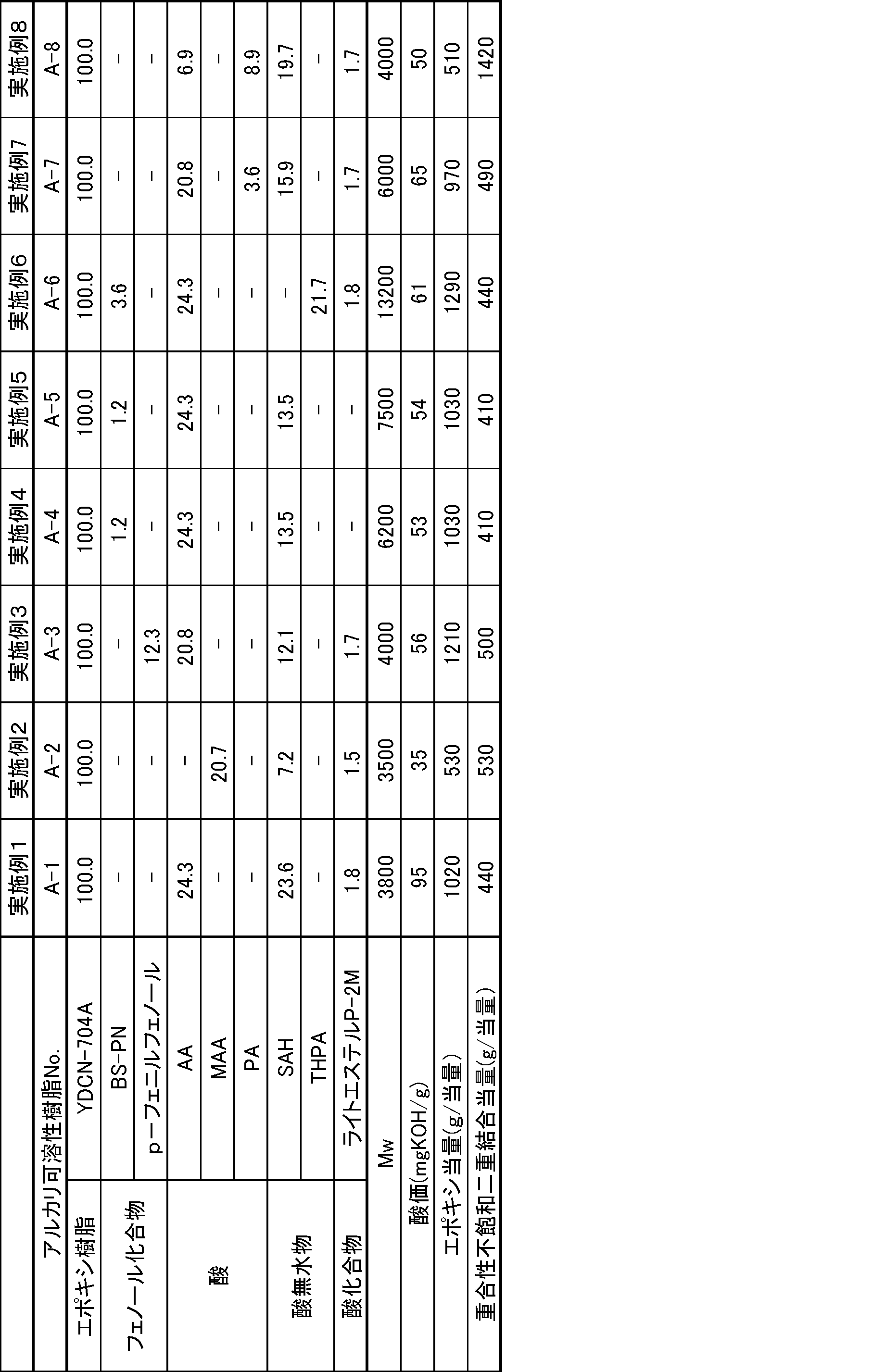
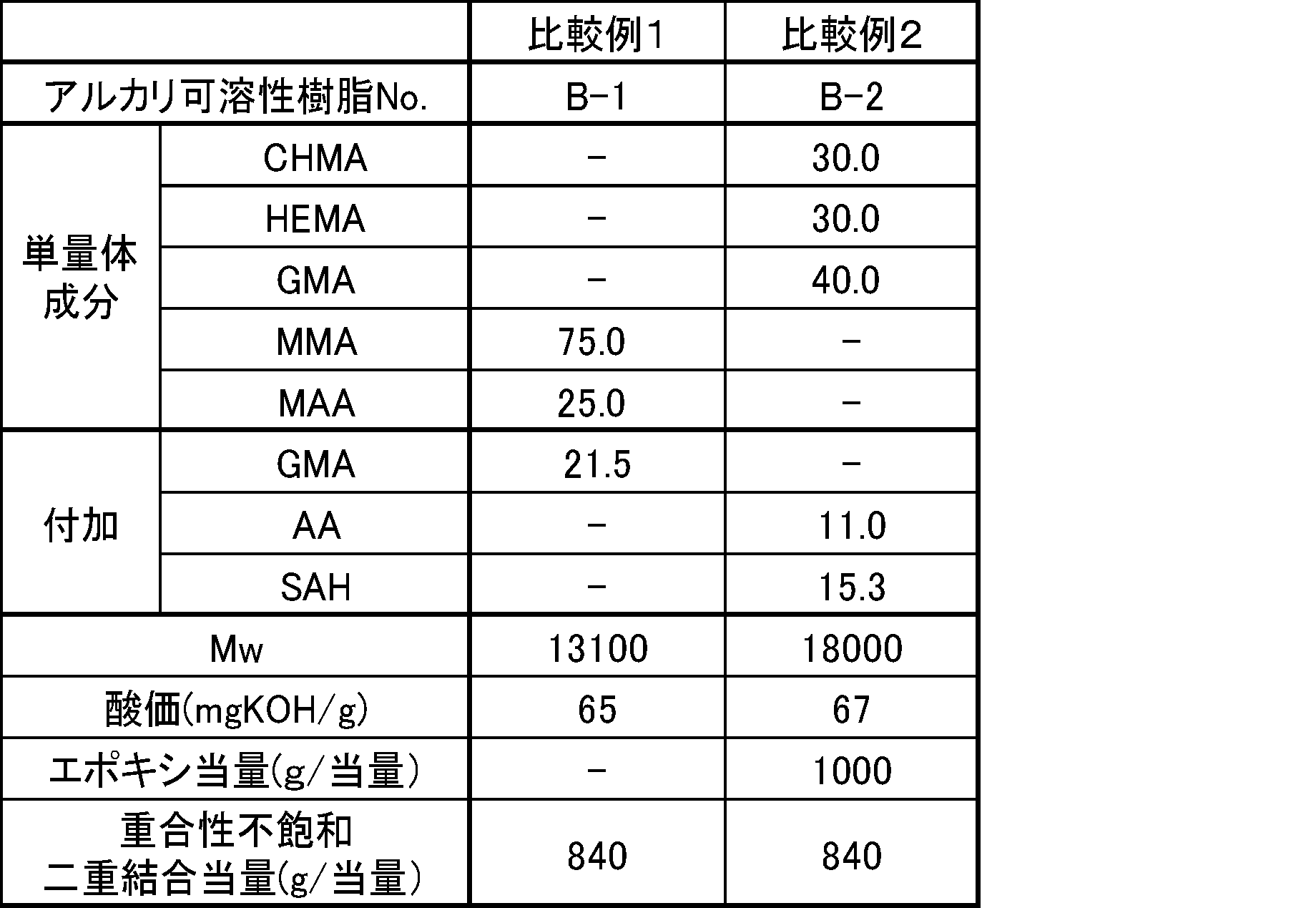
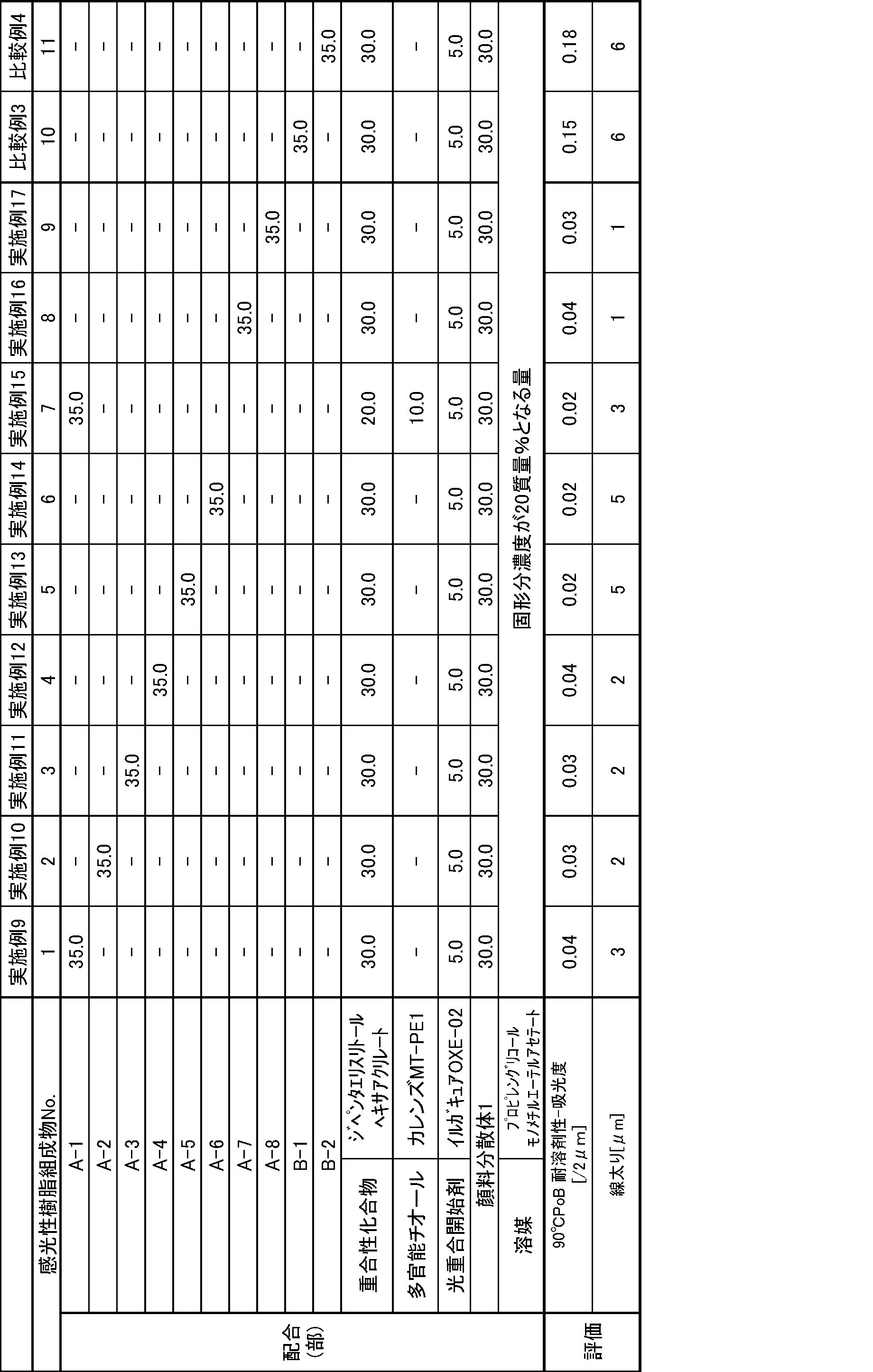
本発明の感光性樹脂組成物は、硬化性、アルカリ現像性に優れ、電子情報分野の部材を形成するためのレジスト、例えばめっきレジスト、カラーフィルター用レジストに好適であり、耐溶剤性に優れることから、特にカラーフィルターの画素(着色層)形成用として好適である。
Claims (11)
- 酸基と重合性不飽和二重結合を有し、エポキシ当量が5000g/当量以下であるアルカリ可溶性樹脂であって、
該アルカリ可溶性樹脂は、下記式(1)で表される構成単位、下記式(2)で表される構成単位、及び、下記式(3)で表される構成単位を有するアルカリ可溶性樹脂。
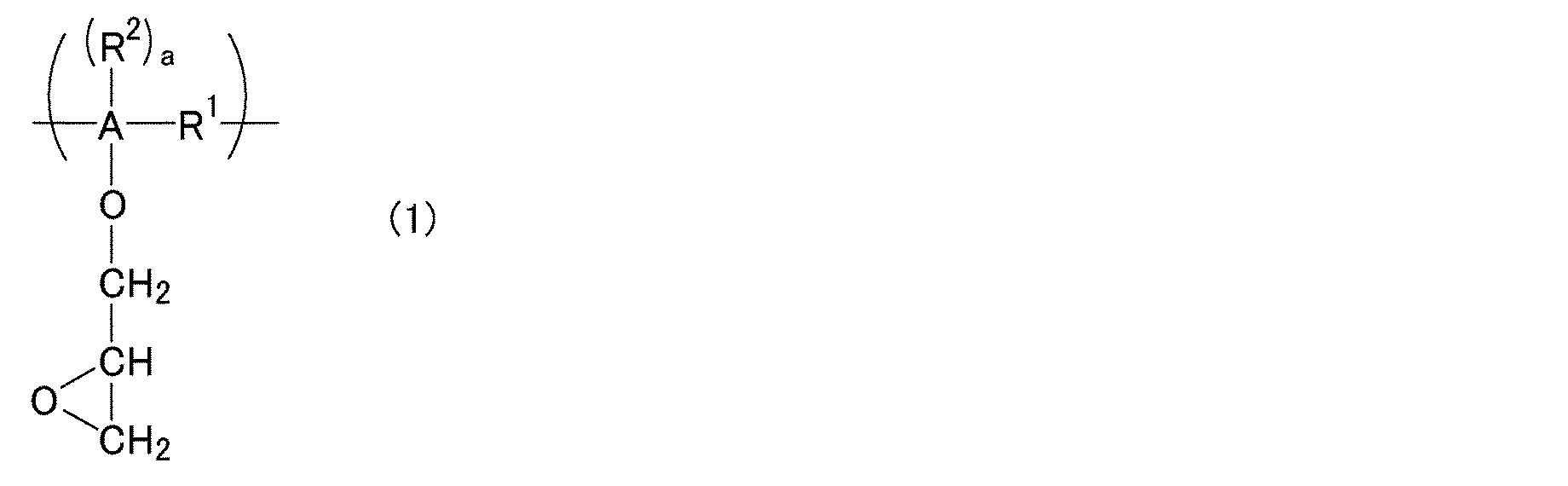
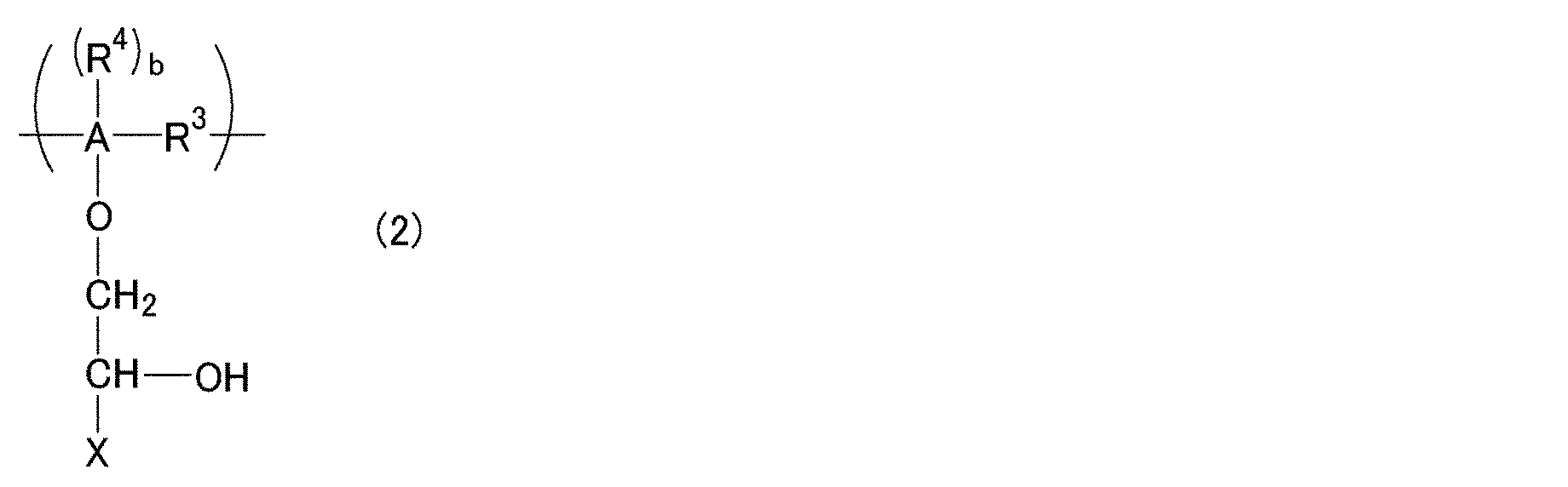
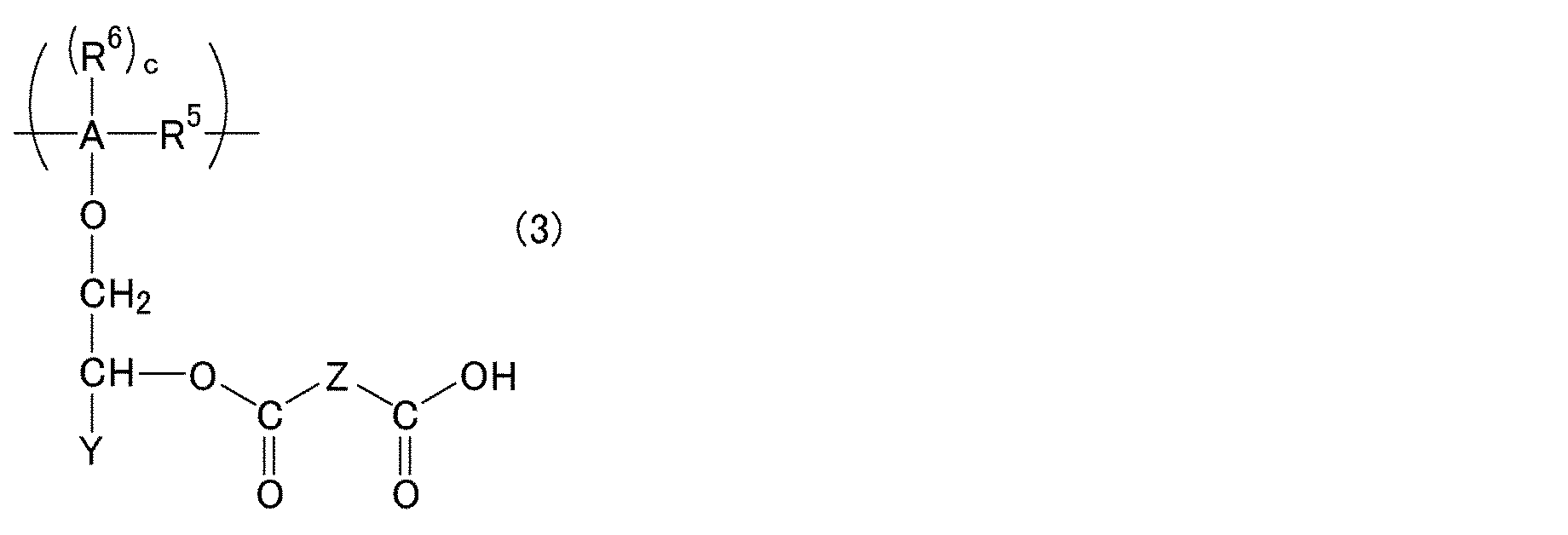
- 前記式(1)で表される構成単位は、下記式(1-1)で表される構成単位であり、
前記式(2)で表される構成単位は、下記式(2-1)で表される構成単位であり、
前記式(3)で表される構成単位は、下記式(3-1)で表される構成単位である、請求項1に記載のアルカリ可溶性樹脂。
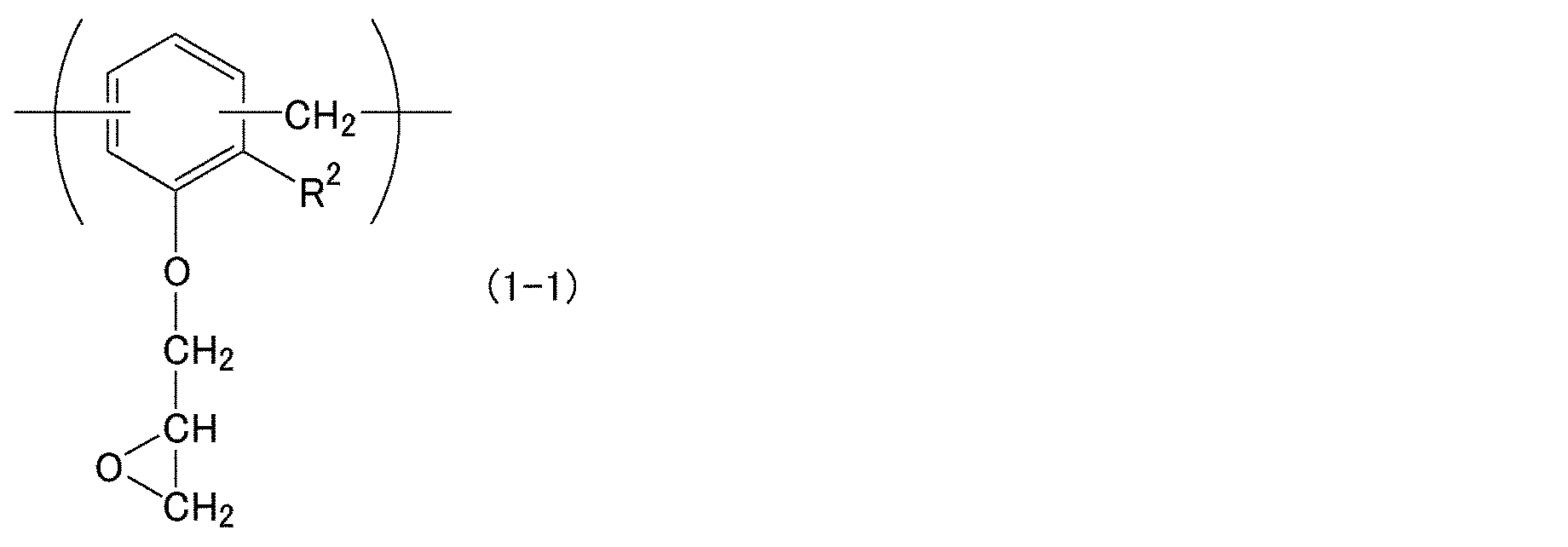

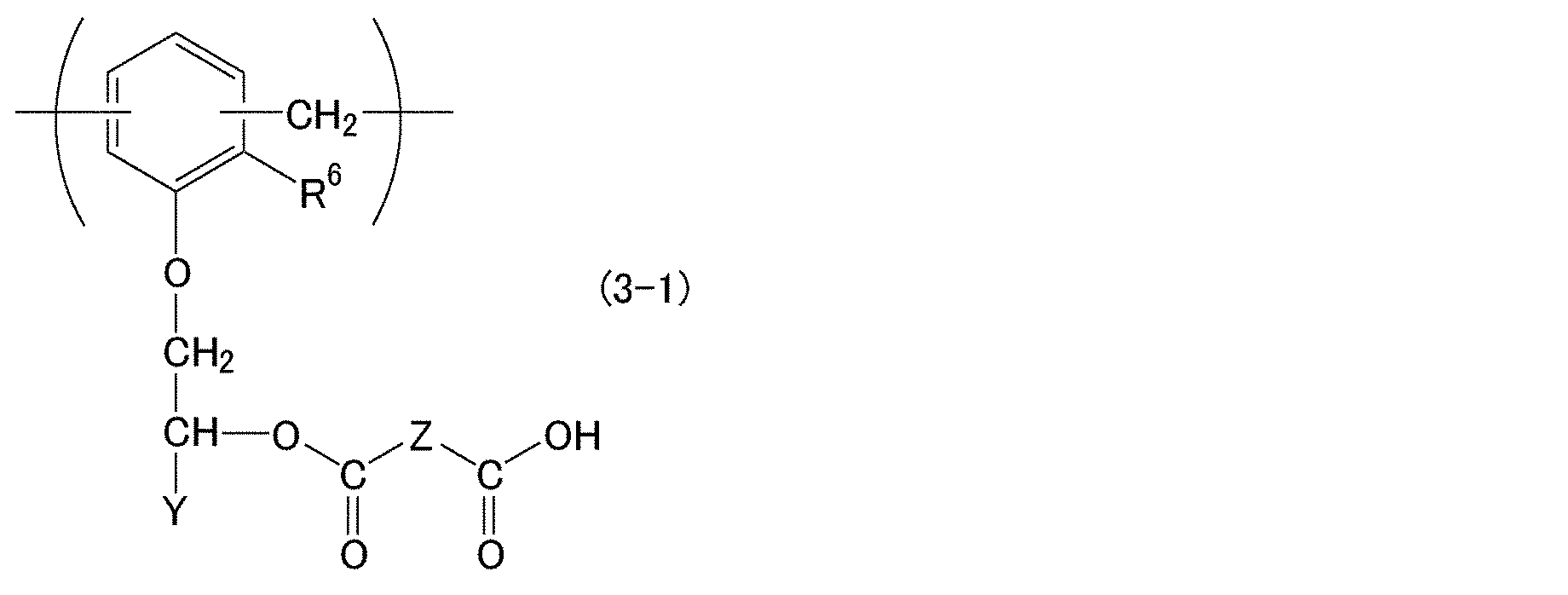
- 酸基と重合性不飽和二重結合を有し、エポキシ当量が5000g/当量以下であるアルカリ可溶性樹脂(A)、重合性化合物(B)、及び、光重合開始剤(C)を含む感光性樹脂組成物であって、
該アルカリ可溶性樹脂(A)は、下記式(1)で表される構成単位、下記式(2)で表される構成単位、及び、下記式(3)で表される構成単位を有するアルカリ可溶性樹脂である感光性樹脂組成物。
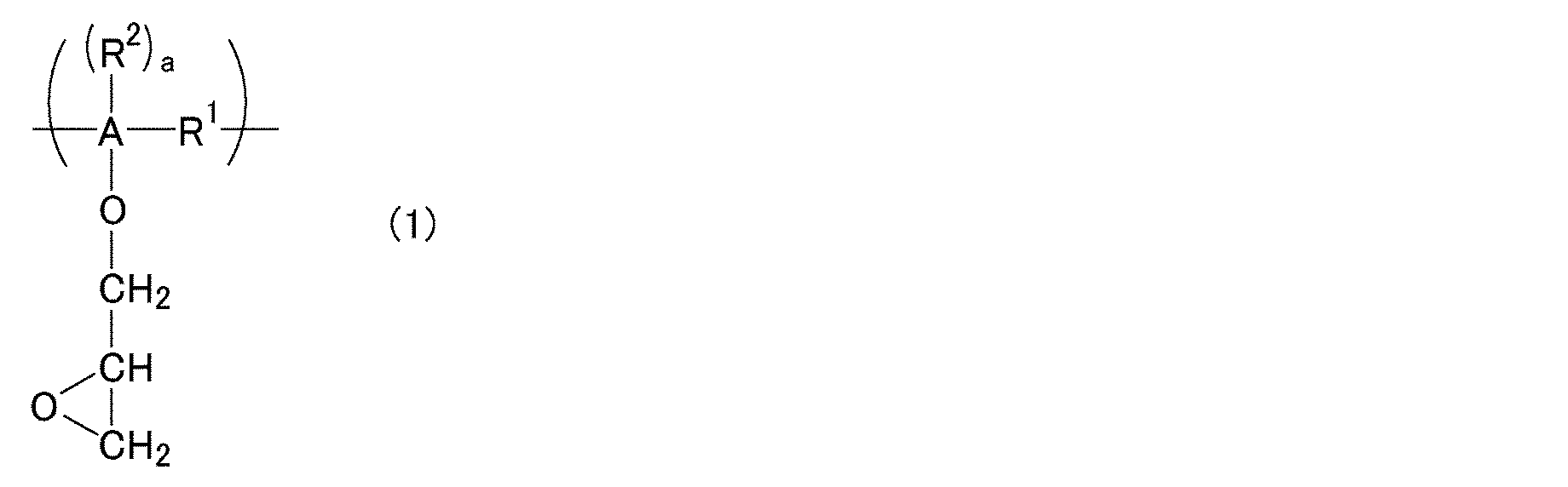
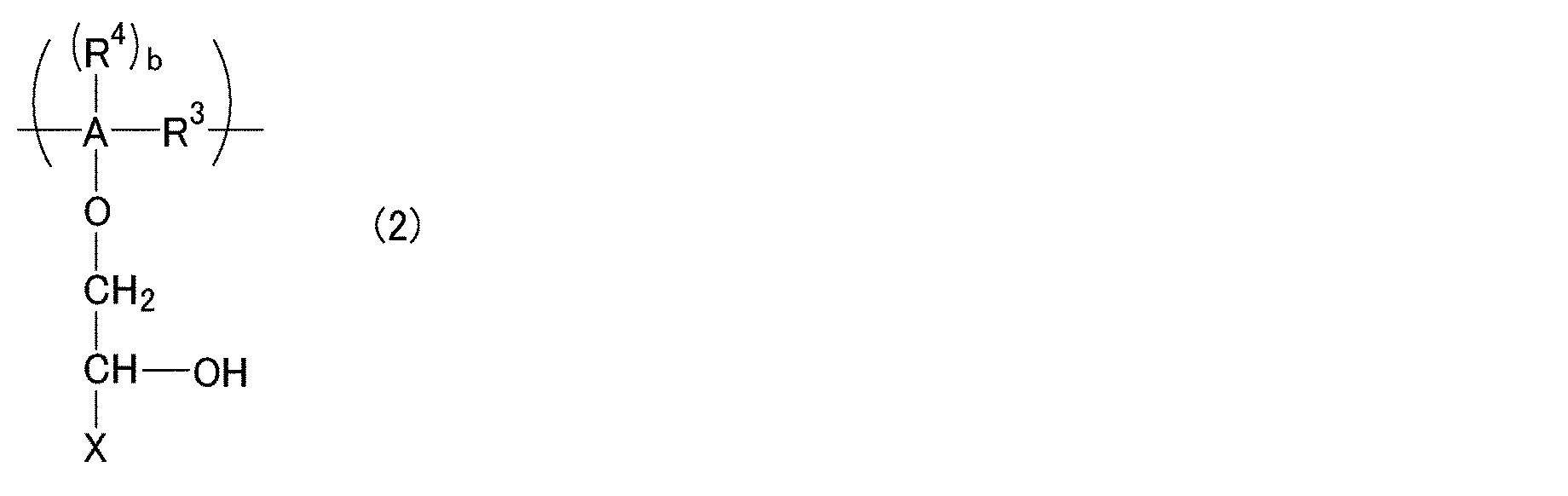

- 前記式(2)中のXは、(メタ)アクリロイル基を有する有機基である請求項3に記載の感光性樹脂組成物。
- 更に、酸解離定数pKaが4.2以下の酸化合物を含むことを特徴とする請求項3又は4に記載の感光性樹脂組成物。
- 更に、リン酸誘導体を含むことを特徴とする請求項3又は4に記載の感光性樹脂組成物。
- 更に、塩基性化合物を含むことを特徴とする請求項3~6のいずれかに記載の感光性樹脂組成物。
- 前記アルカリ可溶性樹脂(A)は、更に、下記式(4)で表される構成単位を有する請求項3~7のいずれかに記載の感光性樹脂組成物。

- 請求項1又は2に記載のアルカリ可溶性樹脂、又は、請求項3~8のいずれかに記載の感光性樹脂組成物を硬化してなる硬化物。
- 請求項9に記載の硬化物を有する表示装置用部材。
- 請求項9に記載の硬化物を有する表示装置。
Priority Applications (1)
| Application Number | Priority Date | Filing Date | Title |
|---|---|---|---|
| JP2023569364A JP7688727B2 (ja) | 2021-12-21 | 2022-12-15 | アルカリ可溶性樹脂、感光性樹脂組成物及びその硬化物 |
Applications Claiming Priority (4)
| Application Number | Priority Date | Filing Date | Title |
|---|---|---|---|
| JP2021-207332 | 2021-12-21 | ||
| JP2021207332 | 2021-12-21 | ||
| JP2022165600 | 2022-10-14 | ||
| JP2022-165600 | 2022-10-14 |
Publications (1)
| Publication Number | Publication Date |
|---|---|
| WO2023120355A1 true WO2023120355A1 (ja) | 2023-06-29 |
Family
ID=86902554
Family Applications (1)
| Application Number | Title | Priority Date | Filing Date |
|---|---|---|---|
| PCT/JP2022/046165 Ceased WO2023120355A1 (ja) | 2021-12-21 | 2022-12-15 | アルカリ可溶性樹脂、感光性樹脂組成物及びその硬化物 |
Country Status (3)
| Country | Link |
|---|---|
| JP (1) | JP7688727B2 (ja) |
| TW (1) | TW202340302A (ja) |
| WO (1) | WO2023120355A1 (ja) |
Cited By (2)
| Publication number | Priority date | Publication date | Assignee | Title |
|---|---|---|---|---|
| JP2023146965A (ja) * | 2022-03-29 | 2023-10-12 | 日油株式会社 | 熱硬化性樹脂組成物及びその硬化膜を備えるカラーフィルター |
| WO2025027985A1 (ja) * | 2023-08-01 | 2025-02-06 | 株式会社Adeka | 組成物、ブラックマトリクス、硬化物及び硬化物の製造方法、並びに、表示装置 |
Citations (4)
| Publication number | Priority date | Publication date | Assignee | Title |
|---|---|---|---|---|
| JP2006071880A (ja) * | 2004-09-01 | 2006-03-16 | Taiyo Ink Mfg Ltd | 光導波路材料用の光硬化性・熱硬化性ドライフィルム、及びその硬化物並びに光・電気混載基板 |
| JP2017068242A (ja) * | 2015-09-30 | 2017-04-06 | 太陽インキ製造株式会社 | 硬化性樹脂組成物、ドライフィルム、硬化物およびプリント配線板 |
| JP2020186325A (ja) * | 2019-05-15 | 2020-11-19 | 株式会社日本触媒 | アルカリ可溶性樹脂、及び、硬化性樹脂組成物 |
| WO2021039799A1 (ja) * | 2019-08-27 | 2021-03-04 | 株式会社日本触媒 | 硬化性組成物 |
-
2022
- 2022-12-15 JP JP2023569364A patent/JP7688727B2/ja active Active
- 2022-12-15 WO PCT/JP2022/046165 patent/WO2023120355A1/ja not_active Ceased
- 2022-12-16 TW TW111148448A patent/TW202340302A/zh unknown
Patent Citations (4)
| Publication number | Priority date | Publication date | Assignee | Title |
|---|---|---|---|---|
| JP2006071880A (ja) * | 2004-09-01 | 2006-03-16 | Taiyo Ink Mfg Ltd | 光導波路材料用の光硬化性・熱硬化性ドライフィルム、及びその硬化物並びに光・電気混載基板 |
| JP2017068242A (ja) * | 2015-09-30 | 2017-04-06 | 太陽インキ製造株式会社 | 硬化性樹脂組成物、ドライフィルム、硬化物およびプリント配線板 |
| JP2020186325A (ja) * | 2019-05-15 | 2020-11-19 | 株式会社日本触媒 | アルカリ可溶性樹脂、及び、硬化性樹脂組成物 |
| WO2021039799A1 (ja) * | 2019-08-27 | 2021-03-04 | 株式会社日本触媒 | 硬化性組成物 |
Cited By (3)
| Publication number | Priority date | Publication date | Assignee | Title |
|---|---|---|---|---|
| JP2023146965A (ja) * | 2022-03-29 | 2023-10-12 | 日油株式会社 | 熱硬化性樹脂組成物及びその硬化膜を備えるカラーフィルター |
| JP7872917B2 (ja) | 2022-03-29 | 2026-06-11 | 日油株式会社 | 熱硬化性樹脂組成物及びその硬化膜を備えるカラーフィルター |
| WO2025027985A1 (ja) * | 2023-08-01 | 2025-02-06 | 株式会社Adeka | 組成物、ブラックマトリクス、硬化物及び硬化物の製造方法、並びに、表示装置 |
Also Published As
| Publication number | Publication date |
|---|---|
| TW202340302A (zh) | 2023-10-16 |
| JPWO2023120355A1 (ja) | 2023-06-29 |
| JP7688727B2 (ja) | 2025-06-04 |
Similar Documents
| Publication | Publication Date | Title |
|---|---|---|
| KR101930099B1 (ko) | 옥심에스테르 화합물 및 그 화합물을 함유하는 광중합 개시제 | |
| CN111132963B (zh) | 化合物、组合物、固化物及固化物的制造方法 | |
| KR101963931B1 (ko) | 흑색 감광성 수지 조성물, 이를 이용한 블랙매트릭스 및 이를 구비한 화상 표시 장치 | |
| JP7716466B2 (ja) | 共重合体、共重合体溶液、感光性樹脂組成物、硬化物、共重合体の製造方法、及び、共重合体溶液の製造方法 | |
| CN104380199A (zh) | 感光性组合物 | |
| JP7049067B2 (ja) | 重合性組成物、ブラックマトリクス用感光性組成物及び硬化物 | |
| JP7688727B2 (ja) | アルカリ可溶性樹脂、感光性樹脂組成物及びその硬化物 | |
| TW583510B (en) | Ultraviolet-curing resin composition and photo solder resist ink containing the same | |
| KR102094372B1 (ko) | 알칼리 가용성 수지, 이를 포함하는 감광성 수지 조성물 및 컬러필터 | |
| JPWO2018159265A1 (ja) | 重合性組成物及びブラックカラムスペーサー用感光性組成物 | |
| TWI796387B (zh) | 含氟活性能量線硬化性樹脂及其製造方法、撥液劑、包含其之樹脂組成物及硬化膜 | |
| KR102597826B1 (ko) | 중합성 조성물, 블랙 매트릭스용 감광성 조성물 및 블랙 칼럼 스페이서용 감광성 조성물 | |
| TW202222848A (zh) | 聚合物、聚合物溶液及感光性樹脂組成物 | |
| KR20230084120A (ko) | 화합물, 중합 개시제, 중합성 조성물, 경화물, 컬러 필터 및 경화물의 제조 방법 | |
| CN111032720A (zh) | 树脂、感光性树脂组合物、树脂固化膜及图像显示装置 | |
| JP2024036282A (ja) | アルカリ可溶性樹脂及びその製造方法、感光性樹脂組成物、硬化物、表示装置用部材、及び、表示装置 | |
| WO2023132296A1 (ja) | 組成物、硬化物の製造方法、硬化物、カラーフィルタ及び化合物 | |
| JP2008233605A (ja) | カラーフィルター用感光性レジスト組成物およびカラーフィルター | |
| JP6529213B2 (ja) | タッチパネル用遮光性組成物及びタッチパネル | |
| JPWO2004057380A1 (ja) | カラーフィルター用感光性着色組成物、カラーフィルター及びその製造方法 | |
| JP7857726B2 (ja) | 共重合体、共重合体溶液、感光性樹脂組成物、硬化物、共重合体の製造方法 | |
| WO2023218876A1 (ja) | アルカリ可溶性樹脂、感光性樹脂組成物及びその硬化物 | |
| JP2009169049A (ja) | カラーフィルター用感光性レジスト組成物およびカラーフィルター | |
| KR20250103750A (ko) | 알칼리 가용성 수지, 감광성 수지 조성물, 그 제조 방법, 및 그 용도 | |
| CN117631451A (zh) | 着色感光性树脂组合物、滤色器和图像显示装置 |
Legal Events
| Date | Code | Title | Description |
|---|---|---|---|
| 121 | Ep: the epo has been informed by wipo that ep was designated in this application |
Ref document number: 22911063 Country of ref document: EP Kind code of ref document: A1 |
|
| ENP | Entry into the national phase |
Ref document number: 2023569364 Country of ref document: JP Kind code of ref document: A |
|
| NENP | Non-entry into the national phase |
Ref country code: DE |
|
| 122 | Ep: pct application non-entry in european phase |
Ref document number: 22911063 Country of ref document: EP Kind code of ref document: A1 |