WO2023106263A1 - クロマトグラフィー用展開液、キット、クロマトグラフ装置及び被験物質を検出する方法 - Google Patents
クロマトグラフィー用展開液、キット、クロマトグラフ装置及び被験物質を検出する方法 Download PDFInfo
- Publication number
- WO2023106263A1 WO2023106263A1 PCT/JP2022/044748 JP2022044748W WO2023106263A1 WO 2023106263 A1 WO2023106263 A1 WO 2023106263A1 JP 2022044748 W JP2022044748 W JP 2022044748W WO 2023106263 A1 WO2023106263 A1 WO 2023106263A1
- Authority
- WO
- WIPO (PCT)
- Prior art keywords
- developing solution
- sample
- surfactant
- general formula
- alkylene oxide
- Prior art date
- Legal status (The legal status is an assumption and is not a legal conclusion. Google has not performed a legal analysis and makes no representation as to the accuracy of the status listed.)
- Ceased
Links
Images




Classifications
-
- G—PHYSICS
- G01—MEASURING; TESTING
- G01N—INVESTIGATING OR ANALYSING MATERIALS BY DETERMINING THEIR CHEMICAL OR PHYSICAL PROPERTIES
- G01N33/00—Investigating or analysing materials by specific methods not covered by groups G01N1/00 - G01N31/00
- G01N33/48—Biological material, e.g. blood, urine; Haemocytometers
- G01N33/50—Chemical analysis of biological material, e.g. blood, urine; Testing involving biospecific ligand binding methods; Immunological testing
- G01N33/53—Immunoassay; Biospecific binding assay; Materials therefor
- G01N33/569—Immunoassay; Biospecific binding assay; Materials therefor for microorganisms, e.g. protozoa, bacteria, viruses
- G01N33/56983—Viruses
-
- G—PHYSICS
- G01—MEASURING; TESTING
- G01N—INVESTIGATING OR ANALYSING MATERIALS BY DETERMINING THEIR CHEMICAL OR PHYSICAL PROPERTIES
- G01N33/00—Investigating or analysing materials by specific methods not covered by groups G01N1/00 - G01N31/00
- G01N33/48—Biological material, e.g. blood, urine; Haemocytometers
- G01N33/50—Chemical analysis of biological material, e.g. blood, urine; Testing involving biospecific ligand binding methods; Immunological testing
- G01N33/53—Immunoassay; Biospecific binding assay; Materials therefor
- G01N33/543—Immunoassay; Biospecific binding assay; Materials therefor with an insoluble carrier for immobilising immunochemicals
-
- G—PHYSICS
- G01—MEASURING; TESTING
- G01N—INVESTIGATING OR ANALYSING MATERIALS BY DETERMINING THEIR CHEMICAL OR PHYSICAL PROPERTIES
- G01N33/00—Investigating or analysing materials by specific methods not covered by groups G01N1/00 - G01N31/00
- G01N33/48—Biological material, e.g. blood, urine; Haemocytometers
- G01N33/50—Chemical analysis of biological material, e.g. blood, urine; Testing involving biospecific ligand binding methods; Immunological testing
- G01N33/53—Immunoassay; Biospecific binding assay; Materials therefor
- G01N33/543—Immunoassay; Biospecific binding assay; Materials therefor with an insoluble carrier for immobilising immunochemicals
- G01N33/54313—Immunoassay; Biospecific binding assay; Materials therefor with an insoluble carrier for immobilising immunochemicals the carrier being characterised by its particulate form
- G01N33/54346—Nanoparticles
-
- G—PHYSICS
- G01—MEASURING; TESTING
- G01N—INVESTIGATING OR ANALYSING MATERIALS BY DETERMINING THEIR CHEMICAL OR PHYSICAL PROPERTIES
- G01N33/00—Investigating or analysing materials by specific methods not covered by groups G01N1/00 - G01N31/00
- G01N33/48—Biological material, e.g. blood, urine; Haemocytometers
- G01N33/50—Chemical analysis of biological material, e.g. blood, urine; Testing involving biospecific ligand binding methods; Immunological testing
- G01N33/53—Immunoassay; Biospecific binding assay; Materials therefor
- G01N33/543—Immunoassay; Biospecific binding assay; Materials therefor with an insoluble carrier for immobilising immunochemicals
- G01N33/54366—Apparatus specially adapted for solid-phase testing
- G01N33/54386—Analytical elements
- G01N33/54387—Immunochromatographic test strips
-
- G—PHYSICS
- G01—MEASURING; TESTING
- G01N—INVESTIGATING OR ANALYSING MATERIALS BY DETERMINING THEIR CHEMICAL OR PHYSICAL PROPERTIES
- G01N2333/00—Assays involving biological materials from specific organisms or of a specific nature
- G01N2333/005—Assays involving biological materials from specific organisms or of a specific nature from viruses
- G01N2333/08—RNA viruses
- G01N2333/165—Coronaviridae, e.g. avian infectious bronchitis virus
-
- G—PHYSICS
- G01—MEASURING; TESTING
- G01N—INVESTIGATING OR ANALYSING MATERIALS BY DETERMINING THEIR CHEMICAL OR PHYSICAL PROPERTIES
- G01N2469/00—Immunoassays for the detection of microorganisms
- G01N2469/10—Detection of antigens from microorganism in sample from host
Definitions
- the present disclosure relates to a developing solution for chromatography, a kit, a chromatographic apparatus, and a method of detecting a test substance.
- test technologies that apply the principles of chromatography have been developed as diagnostic methods for viral infections.
- a sample called a mobile phase
- a test technique for detecting a test substance from a sample by utilizing such interaction. Examples of such examination techniques include immunochromatography using immunochromatography and nucleic acid chromatography using nucleic acid chromatography.
- a capture substance holding portion is formed by applying a capture substance (immobilized reagent) such as an antibody that specifically binds to an antigen, which is a test substance, on a predetermined position of a solid-phase carrier.
- a detection reagent such as an antibody that specifically binds to an antigen, which is a test substance, is complexed with colloidal gold or the like to obtain a labeling substance.
- Patent Document 1 discloses a sample suspension preparation medium composition that can prevent false positive reactions caused by non-specific reactions in immunoassays such as immunochromatography.
- the specimen suspension preparation medium composition disclosed in Patent Document 1 is a specimen suspension preparation medium composition for immunoassay containing an ionic surfactant and further containing a nonionic surfactant. It is disclosed that there may be
- the inventors of the present invention have conducted intensive studies with the aim of further improving inspection techniques that apply the principle of chromatography.
- the inventors have found that highly sensitive chromatography can be achieved by acting on a labeling substance.
- an object of the present disclosure is to provide a chromatographic developing solution capable of realizing highly sensitive chromatography.
- it is intended to provide a kit, a chromatographic device, and a method for detecting a test substance contained in a sample, which are capable of realizing highly sensitive chromatography and which include a chromatographic developing solution and a chromatographic device. With the goal.
- a chromatography developing solution containing an alkylene oxide addition type cationic surfactant and a nonionic surfactant [1] A chromatography developing solution containing an alkylene oxide addition type cationic surfactant and a nonionic surfactant. [2] The chromatography developing solution according to [1], wherein the alkylene oxide-added cationic surfactant contains an ethylene oxide-added cationic surfactant.
- the alkylene oxide addition type cationic surfactant is at least one selected from surfactants represented by the following general formula (I) and surfactants represented by the following general formula (II)
- R 2 is a saturated or unsaturated hydrocarbon group having 1 to 30 carbon atoms, x, y and z are each independently an integer of 1 to 48, and x + y + z is 3 ⁇ 50.
- the alkylene oxide addition-type cationic surfactant is PEG-5 stearylammonium chloride, PEG-2 oleammonium chloride, PEG-2 cocomonium chloride, PEG-15 cocomonium chloride, and P
- the nonionic surfactant is a surfactant represented by the following general formula (III), a surfactant represented by the following general formula (IV), or a surfactant represented by the following general formula (V). selected from surfactants, surfactants represented by the following general formula (VI), surfactants represented by the following general formula (VII), and surfactants represented by the following general formula (VIII)
- the chromatography developing solution according to any one of [1] to [4], containing at least one surfactant.
- R 3 is a saturated or unsaturated hydrocarbon group having 1 to 30 carbon atoms, and n is an integer of 1 to 50.
- R 4 to R 7 are each independently a group represented by general formula (IV-A) above or a hydroxy group, and at least one of R 4 to R 7 is the above a group represented by general formula (IV-A), wherein at least one of R 4 to R 7 is a hydroxy group; w, x, y and z are each independently an integer of 1-47, and w+x+y+z is 4-50.
- R 8 is a saturated or unsaturated hydrocarbon group having 1 to 30 carbon atoms, and the wavy line indicates the bonding site to carbon.
- R 9 is a saturated or unsaturated hydrocarbon group having 1 to 30 carbon atoms, and n is an integer of 1 to 50.
- R 10 is a saturated or unsaturated hydrocarbon group having 1 to 30 carbon atoms, m and n are each independently an integer of 1 to 49, and m+n is 2 to 50 is.
- R 11 is a saturated or unsaturated hydrocarbon group having 1 to 30 carbon atoms, and q is an integer of 1 to 300.
- R 11 and R 12 are each independently a saturated or unsaturated hydrocarbon group having 1 to 30 carbon atoms, and r is an integer of 1 to 300.
- the nonionic surfactant is at least one selected from polyoxyethylene alkyl ethers, polyoxyethylene sorbitan fatty acid esters, polyoxyethylene alkylphenyl ethers, polyoxyethylene alkylamines, and polyethylene glycol fatty acid esters.
- a chromatographic apparatus comprising the chromatographic developing solution according to any one of [1] to [16], a sample receiving section, a labeling substance holding section, and a solid phase carrier,
- the labeling substance holding unit contains a labeling substance that can bind to the test substance,
- a chromatographic device comprising a chromatographic developing solution, a sample receiving portion, a labeling substance holding portion, and a solid phase carrier
- the labeling substance holding unit contains a labeling substance that can bind to the test substance
- the solid phase carrier has a capture substance holding portion containing a capture substance capable of binding to the test substance
- An alkylene oxide-added cationic surfactant and a nonionic surfactant are each independently contained in at least one selected from the chromatographic developing solution, the sample receiving portion, and the labeling substance holding portion.
- a kit for detecting a test substance [19] The kit of [17] or [18], wherein the labeling substance contains colored particles.
- the chromatographic apparatus A chromatographic apparatus comprising, in order from the upstream side in the direction of sample flow, a sample pad as the sample receiving portion, a conjugate pad as the labeling substance holding portion, and a membrane as the solid phase carrier, [17]- The kit according to any one of [19].
- a chromatographic device comprising a sample receiving part, a labeling substance holding part, and a solid phase carrier
- the labeling substance holding unit contains a labeling substance that can bind to the test substance
- the solid phase carrier has a capture substance holding portion containing a capture substance capable of binding to the test substance
- a chromatographic apparatus comprising an alkylene oxide-added cationic surfactant and a nonionic surfactant independently contained in at least one selected from the sample receiving portion and the labeling substance holding portion.
- the sample and a labeling substance capable of binding to the test substance are developed as a mobile phase on a solid-phase carrier of a chromatographic device.
- Highly sensitive chromatography is realized by the developing solution for chromatography of the present disclosure, the kit including the developing solution for chromatography, and the chromatographic device, the chromatographic device, and the method for detecting a test substance contained in a sample. be able to.
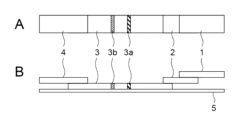
- FIG. 1 is a schematic diagram of an example of the chromatograph
- FIG. 1A is a plan view of the example of the chromatograph
- FIG. 1B is a cross-sectional view of the example of the chromatograph.
- FIG. 2 is a diagram showing the relationship between the color development intensity and elapsed time of the positive samples prepared in Examples 16-18 and Comparative Examples 20-22.
- FIG. 3 is a diagram showing the relationship between the color development intensity and elapsed time of the negative samples prepared in Examples 16-18 and Comparative Examples 20-22.
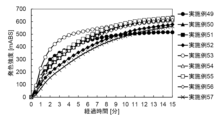
- FIG. 4 is a diagram showing the relationship between the color intensity of the positive samples prepared in Examples 49 to 57 and the elapsed time.
- FIG. 1 is a schematic diagram of an example of the chromatograph
- FIG. 1A is a plan view of the example of the chromatograph
- FIG. 1B is a cross-sectional view of the example of the chromatograph.
- FIG. 2 is a diagram showing the relationship between the color development intensity and elapsed time
- FIG. 5 is a diagram showing the relationship between the color intensity of the positive samples prepared in Example 58 and Comparative Example 25 and the elapsed time.
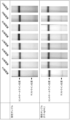
- FIG. 6 is a diagram showing an immunochromatographic device appearance photograph after developing the negative samples or positive samples prepared in Examples 74 to 81.
- FIG. 7 is a photograph showing the appearance of the immunochromatographic device after developing the negative samples prepared in Examples 82-85.
- the chromatography developing solution according to the present embodiment is a chromatography developing solution containing an alkylene oxide-added cationic surfactant and a nonionic surfactant.
- the developing liquid for chromatography of the embodiment is also referred to as the developing liquid for chromatography of Embodiment A.
- the developing solution for chromatography of Embodiment A contains an alkylene oxide addition-type cationic surfactant and a nonionic surfactant in the developing solution, the developing solution and the labeling substance or the test substance and the labeling substance By contacting the complex with, it is possible to allow the alkylene oxide addition type cationic surfactant and nonionic surfactant to act on the labeling substance, realizing highly sensitive chromatography. can do.
- the kit includes the chromatography developing solution of Embodiment A, a sample receiving portion, a labeling substance holding portion, and a chromatographic device comprising a solid phase carrier, wherein the labeling substance holding portion is , a kit for detecting a test substance, which contains a labeling substance capable of binding to the test substance, and wherein the solid phase carrier has a capture substance holding portion containing a capture substance capable of binding to the test substance.
- the kit of this embodiment is also referred to as the kit of embodiment B.
- the kit includes a chromatography developing solution, a sample receiving portion, a labeling substance holding portion, and a chromatographic device including a solid phase carrier, wherein the labeling substance holding portion It contains a labeling substance capable of binding to a substance, the solid phase carrier has a capture substance holding portion containing a capture substance capable of binding to a test substance, and comprises an alkylene oxide-added cationic surfactant and a nonionic interface. and an active agent, each independently contained in at least one selected from the developing solution for chromatography, the sample receiving portion, and the labeling substance holding portion, for detecting a test substance.
- the kit of this embodiment is also referred to as the kit of embodiment C.
- the kit of Embodiment C when the alkylene oxide addition type cationic surfactant and the nonionic surfactant are contained in the chromatography developing solution, the kit of Embodiment C is the kit of Embodiment B. Equivalent to a kit. That is, the kit of Embodiment C is a concept that includes the kit of Embodiment B.
- a chromatographic apparatus is a chromatographic apparatus comprising a sample receiving portion, a labeling substance holding portion, and a solid phase carrier, wherein the labeling substance holding portion contains a labeling substance capable of binding to a test substance, and the The solid-phase carrier has a capture substance holding portion containing a capture substance capable of binding to the test substance, and independently receives an alkylene oxide-added cationic surfactant and a nonionic surfactant for sample reception.
- the chromatographic apparatus includes in at least one selected from a section and a labeling substance holding section.
- the chromatographic apparatus of the above embodiment is also referred to as the chromatographic apparatus of Embodiment D.
- a method for detecting a test substance contained in a sample is a method for detecting a test substance contained in a sample, including the following steps (1) and (2).
- (1) In the presence of an alkylene oxide-added cationic surfactant and a nonionic surfactant, the sample and a labeling substance capable of binding to the test substance are developed as a mobile phase on a solid-phase carrier of a chromatographic device.
- (2) detecting the test substance in the developed mobile phase with a capture substance holding portion containing a capture substance capable of binding to the test substance possessed by the solid phase carrier;
- the method of detecting the test substance of the above embodiment is also referred to as the method of detecting the test substance of Embodiment E.
- the method for detecting a test substance of Embodiment E uses at least one of the developing solution for chromatography of Embodiment A, the kit of Embodiment B, the kit of Embodiment C, and the chromatographic apparatus of Embodiment D. , is a method that can be implemented.
- kits of Embodiment B, the kit of Embodiment C, the chromatographic apparatus of Embodiment D, and the method for detecting a test substance of Embodiment E, an alkylene oxide-added cationic surfactant and a nonionic It is possible to react with a surfactant, and highly sensitive chromatography can be realized.
- the use of an alkylene oxide-added cationic surfactant promotes aggregation of the labeling substance or the complex of the test substance and the labeling substance, while maintaining dispersibility due to moderate hydrophilicity,
- a nonionic surfactant By using a nonionic surfactant, overaggregation of the labeling substance or the complex of the test substance and the labeling substance can be further suppressed, and high sensitivity and excellent developability of chromatography can be achieved.
- the chromatography to which the present invention is applied is not particularly limited, but includes, for example, immunochromatography and nucleic acid chromatography. At least one of immunochromatography and nucleic acid chromatography is preferred, and immunochromatography is more preferred.
- test substances include, but are not limited to, proteins, peptides, antigens, antibodies, nucleic acids (DNA, RNA, etc.), sugars (glycoproteins, glycolipids), complex carbohydrates, viruses, bacteria, and the like.
- a test substance is, for example, a substance whose presence or absence in a specimen is required to be confirmed, in other words, a substance whose presence or absence in a sample is required to be confirmed.
- Samples include nasal discharge, nasal swab, nasopharyngeal swab, pharyngeal swab, sputum, whole blood, serum, plasma, urine, saliva, sweat, tears, mucosal scrapings, fecal extracts, etc., and are readily available.
- Nasal discharge, nasal swabs, nasopharyngeal swabs, pharyngeal swabs or sputum are preferred.
- Specimens are usually required to be analyzed for the presence or absence of the test substance.
- a sample is a liquid component that is placed (for example, dropped) and developed on a chromatographic device, and is an object to be analyzed by the chromatographic device.
- a sample that has been previously confirmed to contain the test substance is also referred to as a positive sample, and a sample that has been previously confirmed to not contain the test substance is also referred to as a negative sample.
- the sample usually contains a developing solution, and examples of the sample include a sample containing a developing solution and a specimen, a sample containing a developing solution and a test substance (positive sample), a sample consisting only of a developing solution (negative sample), and the like.
- a developing solution (developing solution for chromatography) is a liquid used to suitably develop a sample on a chromatographic device, and is a liquid that can be mixed with a specimen or a test substance.
- a developing solution may be used as a sample diluent.
- the developing liquid containing an alkylene oxide-added cationic surfactant and a nonionic surfactant corresponds to the developing liquid of the above-described Embodiment A.
- the developing solution may contain the labeling substance described in the ⁇ Chromatography device> section below.
- a labeling substance holding section such as a conjugate pad can be omitted in the chromatograph.
- a chromatographic apparatus for performing chromatography a chromatographic apparatus including a sample receiving portion, a labeling substance holding portion, and a solid phase carrier is usually used. Note that the chromatographic apparatus is also referred to as a chromatographic device. In addition, a chromatographic apparatus in which immunochromatography is performed is also referred to as an immunochromatographic device. A chromatographic apparatus will be described with reference to FIG.
- FIG. 1 is a schematic diagram of an example of a chromatographic apparatus.
- FIG. 1A is a plan view of an example of a chromatographic apparatus
- FIG. 1B is a cross-sectional view of an example of a chromatographic apparatus.
- the chromatographic apparatus (test piece) shown in FIG. 1 has a sample receiving portion 1, a labeling substance holding portion 2, and a solid phase carrier 3, and the solid phase carrier 3 has a capturing substance holding portion 3a. ing.
- the sample receiving part 1 is, for example, a sample pad, and is a part where a sample is placed (for example, dropped).
- a sample pad for example, a glass fiber sample pad or a cellulose fiber sample pad can be used.
- the labeling substance holding part 2 is, for example, a conjugate pad, and is a site containing a labeling substance that can bind to the test substance.
- the labeling substance preferably contains colored particles.
- the colored particles negatively charged colored particles are preferable, and examples thereof include metal particles, colored latex particles, colored polystyrene particles, colored cellulose particles, fluorescent cellulose particles, and silica nanoparticles containing pigments.
- metal particles include colloidal metal particles such as colloidal gold particles, colloidal silver particles, and colloidal platinum particles.
- the labeling substance has a site capable of binding, usually specifically binding, to the test substance, and when the test substance is an antigen, for example, it has an antibody (polyclonal antibody or monoclonal antibody) against the antigen.
- the site that can bind to the test substance can be appropriately set according to the type of the test substance, and those that have been employed in the conventional fields of immunochromatography and nucleic acid chromatography can be applied.
- conjugate pads include glass fiber conjugate pads, cellulose fiber conjugate pads, polyester fiber conjugate pads, polyethylene fiber conjugate pads, and polypropylene fiber conjugate pads. can be done.
- the solid phase carrier 3 is, for example, a membrane, and is a site where a mobile phase containing a sample and a labeling substance capable of binding to the test substance is developed.
- the mobile phase contains a complex of the test substance and the labeling substance.
- membranes that can be used include nitrocellulose membranes, cellulose membranes, cellulose acetate membranes, polyethersulfone membranes, nylon membranes, polyester membranes, and glass fiber membranes. .
- the capture substance holding portion 3a of the solid phase carrier 3 is a site containing a capture substance that can bind to the test substance, such as a test line.
- a complex of the test substance and the labeling substance binds to the capture substance to form the three components of the labeling substance-test substance-capture substance.
- a sandwich-type complex is formed. Any capture substance can be used as long as it can bind to the test substance.
- the test substance is an antigen, for example, an antibody (polyclonal antibody or monoclonal antibody) against the antigen can be used as the capture substance.
- the capture substance can be appropriately selected according to the type of the test substance, and it is possible to apply those that have been employed in the conventional fields of immunochromatography and nucleic acid chromatography.
- the solid phase carrier 3 preferably has a control line 3b.
- the control line 3b is a site that captures a labeling substance, more specifically, a labeling substance that does not form a complex between the test substance and the labeling substance.
- the control line is a site containing a substance that captures the labeling substance, for example, a site containing a component (antibody) capable of capturing an antibody contained in the labeling substance.
- the substance that captures the labeling substance can be appropriately set according to the type of the labeling substance, and those that have been employed in the conventional fields of immunochromatography and nucleic acid chromatography can be applied.
- the chromatographic device preferably has an absorbent pad 4.
- the absorbent pad is preferably capable of holding the mobile phase so as not to flow back.
- an absorbent pad made of cellulose fiber, an absorbent pad made of glass fiber, or an absorbent pad made of polystyrene fiber can be used.
- the chromatographic device preferably has a backing sheet 5.
- the backing sheet 5 has, for example, an adhesive layer on its surface and is fixed to the solid phase carrier 3 .
- the sample receiving part 1, the labeling substance holding part 2 and the absorbent pad 4 are not fixed to the backing sheet 5, but at least one of the sample receiving part 1, the labeling substance holding part 2 and the absorbent pad 4 is attached to the backing sheet. 5, and in one preferred embodiment, the sample receiving part 1, labeling substance holding part 2 and absorbent pad 4 are all fixed to the backing sheet 5.
- the backing sheet for example, a backing sheet made of polypropylene, a backing sheet made of polystyrene, a backing sheet made of polyester, and a backing sheet made of vinyl chloride can be used.
- the chromatograph (test piece) is not particularly limited in terms of shape and size, but for example, the length is 40 mm or more and 120 mm or less, the width is 3 mm or more and 20 mm or less, and the thickness is 10 ⁇ m or more and 5.0 mm or less. , can be a substantially rectangular parallelepiped.
- the shape and size can be appropriately changed depending on the type of test substance, the number of capture substance holding portions, and the like.
- the chromatographic apparatus has a housing case (Fig. not shown).
- the housing case consists of a water-impermeable moldable material, for example polyethylene, polypropylene, polystyrene, polyethylene terephthalate, polyvinyl chloride, etc., and covers the entire test strip and contains the sample receiver 1 and the capture substance. It has a shape in which an opening or window is provided at a position corresponding to the holding portion 3a, preferably further at a position corresponding to the control line 3b. By providing the housing, leakage of the deployed mobile phase can be prevented.
- alkylene oxide addition type cationic surfactant In this embodiment, an alkylene oxide addition type cationic surfactant is used.
- alkylene oxide contained in the alkylene oxide addition type cationic surfactant include ethylene oxide and propylene oxide, with ethylene oxide being preferred. That is, the alkylene oxide addition type cationic surfactant preferably contains an ethylene oxide addition type cationic surfactant.
- the alkylene oxide addition type cationic surfactant may be used singly or in combination of two or more.
- the alkylene oxide addition type cationic surfactant is at least one surfactant selected from surfactants represented by the following general formula (I) and surfactants represented by the following general formula (II) It is one of preferred embodiments to include
- R 1 is a saturated or unsaturated hydrocarbon group having 1 to 30 carbon atoms, x and y are each independently an integer of 1 to 49, and x+y is 2 to 50 is.
- R 2 is a saturated or unsaturated hydrocarbon group having 1 to 30 carbon atoms, x, y and z are each independently an integer of 1 to 48, and x + y + z is 3 ⁇ 50.
- R 1 and R 2 are each independently a saturated or unsaturated hydrocarbon group having 1 to 30 carbon atoms, preferably a saturated or unsaturated hydrocarbon group having 4 to 26 carbon atoms, A saturated or unsaturated hydrocarbon group of 24 is more preferred, and a saturated or unsaturated hydrocarbon group of 8 to 22 carbon atoms is particularly preferred.
- the saturated or unsaturated hydrocarbon group having 1 to 30 carbon atoms is an unsaturated hydrocarbon group, the degree of unsaturation is preferably 1 to 3, more preferably 1.
- a saturated or unsaturated hydrocarbon group having 1 to 30 carbon atoms a saturated or unsaturated hydrocarbon group having a degree of unsaturation of 1 is preferable, and a saturated hydrocarbon group is more preferable.
- the saturated or unsaturated hydrocarbon group having 1 to 30 carbon atoms is synonymous with the alkyl group having 1 to 30 carbon atoms.
- the saturated or unsaturated hydrocarbon group having 1 to 30 carbon atoms may be a linear hydrocarbon group, a branched hydrocarbon group, or a hydrocarbon group having a ring structure. However, a straight-chain hydrocarbon group or a branched hydrocarbon group is preferable, and a straight-chain hydrocarbon group is more preferable.
- x and y are each independently an integer of 1 to 49, preferably an integer of 1 to 34, more preferably an integer of 1 to 24, An integer is particularly preferred.
- x+y is 2 to 50, preferably 2 to 35, more preferably 2 to 25, and particularly preferably 2 to 15.
- x, y and z are each independently an integer of 1 to 48, preferably an integer of 1 to 33, more preferably an integer of 1 to 23, 1 to Thirteen integers are particularly preferred.
- x+y+z is 3-50, preferably 3-35, more preferably 3-25, particularly preferably 3-15.
- the alkylene oxide adduct cationic surfactant is selected from PEG-5 stearylammonium chloride, PEG-2 oleammonium chloride, PEG-2 cocomonium chloride, PEG-15 cocomonium chloride, and PEG-15 stearmonium chloride. It is one of preferred embodiments to contain at least one surfactant.
- the HLB value of the alkylene oxide addition type cationic surfactant is preferably 22 or more and 31 or less, more preferably 22.5 or more and 29 or less, and particularly preferably 22.5 or more and 28 or less.
- the HLB value of the alkylene oxide addition type cationic surfactant is usually the HLB value determined by the Davis method. In the Davis method, the HLB value can be obtained by the following formula.
- the radix used in the Davis method is O Boen Ho, J. Colloid Interface Sci. , 198, 249-260 (1998) and A.M. N. S. C. LLC, "Surface Chemistry HLB & Emulsification,” Akzo Nobel Surf. Chem. , 1-15 (2008).
- a commercially available product may be used as the alkylene oxide addition type cationic surfactant.
- Commercially available products include, for example, Catinal (registered trademark. Hereinafter, the description as a registered trademark may be omitted.) SPC-20V-S (tri(polyoxyethylene)stearylammonium chloride (5E.O.), PEG- 5 Stearyl ammonium chloride, HLB value 25.4 (Davis method), manufactured by Toho Chemical Industry), Liposocard (registered trademark. Hereinafter, the description of registered trademark may be omitted.) C / 12 (ETHOQUAD (registered Trademark.
- Nonionic surfactant is used in this embodiment.
- the nonionic surfactant may be used singly or in combination of two or more.
- the nonionic surfactant is a surfactant represented by the following general formula (III), a surfactant represented by the following general formula (IV), or a surfactant represented by the following general formula (V).
- a surfactant represented by the following general formula (VI) a surfactant represented by the following general formula (VII)
- R 3 is a saturated or unsaturated hydrocarbon group having 1 to 30 carbon atoms, and n is an integer of 1 to 50.
- R 4 to R 7 are each independently a group represented by general formula (IV-A) above or a hydroxy group, and at least one of R 4 to R 7 is the above a group represented by general formula (IV-A), wherein at least one of R 4 to R 7 is a hydroxy group; w, x, y and z are each independently an integer of 1-47, and w+x+y+z is 4-50.
- R 8 is a saturated or unsaturated hydrocarbon group having 1 to 30 carbon atoms, and the wavy line indicates the bonding site to carbon.
- R 9 is a saturated or unsaturated hydrocarbon group having 1 to 30 carbon atoms, and n is an integer of 1 to 50.
- R 10 is a saturated or unsaturated hydrocarbon group having 1 to 30 carbon atoms, m and n are each independently an integer of 1 to 49, and m+n is 2 to 50 is.
- R 11 is a saturated or unsaturated hydrocarbon group having 1 to 30 carbon atoms, and q is an integer of 1 to 300.
- R 11 and R 12 are each independently a saturated or unsaturated hydrocarbon group having 1 to 30 carbon atoms, and r is an integer of 1 to 300.
- R 3 , R 8 , R 9 , R 10 , R 11 and R 12 are each independently a saturated or unsaturated hydrocarbon group having 1 to 30 carbon atoms, and a saturated or unsaturated hydrocarbon group having 4 to 26 carbon atoms.
- a saturated hydrocarbon group is preferred, a saturated or unsaturated hydrocarbon group having 6 to 24 carbon atoms is more preferred, and a saturated or unsaturated hydrocarbon group having 8 to 22 carbon atoms is particularly preferred.
- the saturated or unsaturated hydrocarbon group having 1 to 30 carbon atoms is an unsaturated hydrocarbon group
- the degree of unsaturation is preferably 1 to 3, more preferably 1.
- saturated or unsaturated hydrocarbon group having 1 to 30 carbon atoms a saturated or unsaturated hydrocarbon group having a degree of unsaturation of 1 is preferable, and a saturated hydrocarbon group is more preferable.
- the saturated or unsaturated hydrocarbon group having 1 to 30 carbon atoms is synonymous with the alkyl group having 1 to 30 carbon atoms.
- the saturated or unsaturated hydrocarbon group having 1 to 30 carbon atoms may be a linear hydrocarbon group, a branched hydrocarbon group, or a hydrocarbon group having a ring structure. However, it is preferably a straight-chain hydrocarbon group or a branched hydrocarbon group.
- n is an integer of 1-50, preferably an integer of 2-49, more preferably an integer of 3-48.
- R 4 to R 7 are each independently a group represented by general formula (IV-A) or a hydroxy group, and at least one of R 4 to R 7 is the general A group represented by formula (IV-A), wherein at least one of R 4 to R 7 is a hydroxy group.
- R 4 to R 7 is a group represented by general formula (IV-A) above, and three of R 4 to R 7 are preferably hydroxy groups.
- w, x, y and z are each independently an integer of 1 to 47, preferably an integer of 1 to 32, more preferably an integer of 1 to 22, Integers from 1 to 17 are particularly preferred.
- w+x+y+z is 4-50, preferably 4-35, more preferably 4-25, particularly preferably 4-20.
- n is an integer of 1-50, preferably an integer of 3-40, more preferably an integer of 5-30.
- n are each independently an integer of 1 to 49, preferably an integer of 2 to 46, more preferably an integer of 3 to 41, and an integer of 5 to 35. An integer is particularly preferred.
- m+n is 2 to 50, preferably 4 to 48, more preferably 6 to 44, and particularly preferably 10 to 40.
- q is an integer of 1-300, preferably an integer of 2-100, more preferably an integer of 3-50.
- r is an integer of 1-300, preferably an integer of 2-100, more preferably an integer of 3-50.
- the nonionic surfactant is at least one surfactant selected from polyoxyethylene alkyl ethers, polyoxyethylene sorbitan fatty acid esters, polyoxyethylene alkylphenyl ethers, polyoxyethylene alkylamines, and polyethylene glycol fatty acid esters. It is one of preferred embodiments to include
- the HLB value of the nonionic surfactant is preferably 10 or more and 19 or less, more preferably 10.5 or more and 18.5 or less.
- the HLB value of nonionic surfactants is usually the HLB value determined by the Griffin method. According to the Griffin method, the HLB value can be obtained by the following formula.
- a commercially available product may be used as the nonionic surfactant.
- Commercially available products include, for example, Triton (registered trademark. Hereinafter, the description of registered trademark may be omitted.)
- X-100 polyoxyethylene octylphenyl ether (9.5 E.O.), HLB value 13.4 (Griffin method), manufactured by Sigma-Aldrich), Tween (registered trademark. Hereinafter, the description of the registered trademark may be omitted.) 20 (polyoxyethylene sorbitan monolaurate (20E.O.), polysorbate 20, HLB value 16.7 (Griffin method), manufactured by Sigma-Aldrich), Emulgen (registered trademark.
- 35 polyoxyethylene lauryl ether (23E.O.) , Polyoxyethylene dodecyl ether (23E.O.), HLB value 16.9 (Griffin method), manufactured by Sigma-Aldrich), Amit (registered trademark.
- 105A Polyoxyethylene coconut alkylamine (5E.O.), polyoxyethylene coconut alkylamine (5E.O.), HLB value 10.8 (Griffin method), manufactured by Kao), Amit 320 (polyoxyethylene hardened beef tallow) Amine (20 E.O.), polyoxyethylene cured tallow amine (20 E.O.), HLB value 15.4 (Griffin method), manufactured by Kao Corporation), Tween 40 (polyoxyethylene sorbitan monopalmitate (20 E.O.) , HLB value 15.6 (Griffin method), manufactured by Sigma-Aldrich), Tween 60 (polyoxyethylene sorbitan monostearate (20E.O.), HLB value 14.9 (Griffin method), manufactured by Sigma-Aldrich), Tween 80 (polyoxyethylene sorbitan monooleate (20 E.O.), HLB value 15.0 (Griffin method), manufactured by Sigma-Aldrich), Tween 65 (polyoxyethylene coconut alkylamine (5E.O.), polyoxyethylene coconut
- HLB value 13.1 (Griffin method), manufactured by Sigma-Aldrich), Triton X-102 (octylphenol ethoxylate (12E.O.), HLB value 14.6 (Griffin method), manufactured by Sigma-Aldrich), Triton X-114 (octylphenol ethoxylate (7-8 E.O.), HLB value 12.4 (Griffin method), manufactured by Sigma-Aldrich), Triton X-165 (octylphenol ethoxylate (15-16 E.O.), HLB value 15.8 (Griffin method), manufactured by Sigma-Aldrich), Triton X-405 (octylphenol ethoxylate (40E.O.), HLB value 17.9 (Griffin method), manufactured by Sigma-Aldrich), Triton N-101 (Nonylphenol ethoxylate (9-10 E.O.), HLB value 13.5 (Griffin method), manufactured by Sigma-Aldrich) can be used.
- the chromatographic developing solution of Embodiment A contains the alkylene oxide-added cationic surfactant and the nonionic surfactant.
- As the developing liquid for chromatography of Embodiment A it is one of preferred aspects that it is a sample diluent.
- the chromatographic developing solution of Embodiment A is a nonionic surfactant/alkylene oxide addition type that is the ratio of the content of the nonionic surfactant to the content of the alkylene oxide addition type cationic surfactant.
- the cationic surfactant (weight ratio) is preferably 0.14 or more and 40 or less, more preferably 0.15 or more and 30 or less, and 0.16 or more and 20 or less. Especially preferred.
- the chromatography developing solution of Embodiment A preferably contains 0.05 wt% or more and 14 wt% or less of an alkylene oxide addition type cationic surfactant, and more preferably contains 0.07 wt% or more and 13 wt% or less. It is particularly preferable to contain 0.1 wt % or more and 12.5 wt % or less.
- the chromatography developing solution of Embodiment A preferably contains 0.6 wt % or more and 12 wt % or less, more preferably 0.65 wt % or more and 11 wt % or less, of a nonionic surfactant. It is particularly preferable to contain 75 wt % or more and 10 wt % or less.
- the chromatographic developing solution of Embodiment A usually uses water as a solvent and may contain components other than the alkylene oxide addition type cationic surfactant and the nonionic surfactant.
- Components other than the alkylene oxide addition type cationic surfactant and the nonionic surfactant include, for example, components used in conventional chromatographic developing solutions.
- Components other than the alkylene oxide addition type cationic surfactant and nonionic surfactant include, for example, buffering agents, stabilizing components, antiseptic components, and the like.
- Buffers include Tris buffer, phosphate buffer, citrate buffer, Veronal buffer, borate buffer, Good's buffer and the like.
- Stabilizing components include MPC (2-methacryloyloxyethylphosphorylcholine) polymer, polyethylene glycol, polyvinylpyrrolidone, polyvinyl alcohol, poly(2-ethyl-2-oxazoline) and other high-molecular compounds, albumins such as bovine serum albumin, and globulin. , casein, serum, water-soluble gelatin, surfactants, sugars, polysaccharides, chelating agents and the like.
- salicylic acid, benzoic acid, sodium azide etc. are mentioned as an antiseptic component.
- the chromatography developing solution of Embodiment A further contains a non-specific adsorption inhibitor.
- Non-specific adsorption inhibitors include, for example, L-arginine hydrochloride, ethylenediaminetetraacetic acid (EDTA), salts of EDTA such as EDTA.2Na, organic acids such as succinic acid, malic acid, tartaric acid and citric acid, or salts thereof. , sodium chloride, lithium chloride, potassium chloride, and magnesium chloride.
- the chromatography developing solution of Embodiment A further contains a dispersibility improving agent.
- dispersibility improvers include amphoteric surfactants and water-miscible organic solvents.
- amphoteric surfactants include CHAPS (3-[(3-cholamidopropyl)dimethylammonio]-1-propanesulfonate), CHAPSO (3-[(3-cholamidopropyl)dimethylammonio ]-2-hydroxy-1-propanesulfonate), sulfobetaine-8 (3-(dimethyloctylammonio)propanesulfonate), sulfobetaine-10 (3-(decyldimethylammonio)propanesulfonate), sulfo betaine-12 (3-(dodecyldimethylammonio)propanesulfonate), sulfobetaine-14 (3-(myristyldimethylammonio)prop
- water-miscible organic solvents examples include ethanol, methanol, isopropanol, DMSO (dimethylsulfoxide), DMF (N,N-dimethylformamide), NMP (N-methyl-2-pyrrolidone) and the like.
- a chromatographic developing solution containing a dispersibility-improving agent By using a chromatographic developing solution containing a dispersibility-improving agent, the dispersion stability during development of the labeling substance is enhanced, thereby further improving the developability of the developing solution, thereby reducing the background (membrane test line and control It is possible to suppress the occurrence of residual coloring of the labeling substance in the portion other than the line), and reduce the risk of misjudgment as a false positive due to background coloring that looks like a test line. In particular, even in a chromatograph device that has been in a state where a long period of time has passed since the manufacture of the product, it is possible to improve the spreadability by increasing the dispersion stability during the development of
- the chromatography developing solution of Embodiment A further contains an interference suppressing agent.
- interfering factors such as heterophilic antibodies (HA) and rheumatoid factors (RF) that may be contained in specimens can cause false positives and false negatives in immunochromatography.
- Heterophilic antibodies include, for example, human anti-mouse antibody (HAMA; Human Anti-Mouse Antibody), human anti-goat antibody (HAGA; Human Anti-Goat Antibody), human anti-sheep antibody (HASA; Human Anti-Sheep Antibody), A human anti-rabbit antibody (HARA; Human Anti-Rabbit Antibody) can be mentioned.
- interference suppressing agents include antibodies against interfering factors present in specimens, immunoglobulins produced in the same or different animal species as antibodies used as capture or labeling substances in immunoassays, HBR1 (manufactured by Scantibodies Laboratory), TRU Block ( (manufactured by Meridian Life Science) and the like.
- a kit according to Embodiment B includes the chromatography developing solution according to Embodiment A, and a chromatographic device comprising a sample receiving portion, a labeling substance holding portion, and a solid phase carrier, wherein the labeling substance holding portion contains a test substance and A kit for detecting a test substance, comprising a labeling substance capable of binding to the test substance, wherein the solid phase carrier has a capture substance holding portion containing a capture substance capable of binding to the test substance.
- the kit of Embodiment B is one of the modes of use of the developing solution for chromatography of Embodiment A.
- the kit of Embodiment C includes a chromatography developing solution, a sample receiving portion, a labeling substance holding portion, and a chromatographic apparatus including a solid phase carrier, and the labeling substance holding portion is capable of binding to a test substance.
- the solid phase carrier has a capture substance holding portion containing a capture substance capable of binding to the test substance, and the alkylene oxide addition type cationic surfactant and the nonionic surfactant and are independently contained in at least one selected from the chromatographic developing solution, the sample receiving portion, and the labeling substance holding portion, for detecting a test substance.
- the alkylene oxide addition-type cationic surfactant and the nonionic surfactant are independently extracted from the chromatography developing solution, the sample receiving portion, and the labeling substance holding portion.
- both the alkylene oxide addition type cationic surfactant and the nonionic surfactant may be included in the chromatographic developing solution, It may be contained in the sample receiving portion or may be contained in the labeled substance holding portion.
- the nonionic surfactant is contained in the chromatographic developing solution, and the alkylene oxide addition type cationic surfactant is included in at least the sample receiving portion and the labeling substance holding portion. It may be included in one side.
- the alkylene oxide addition type cationic surfactant may be contained in two or three selected from a developing solution for chromatography, a sample receiving portion, and a labeling substance holding portion.
- the nonionic surfactant may be contained in two or three selected from the developing solution for chromatography, the sample receiving portion, and the labeling substance holding portion.
- the chromatography developing solution contains the nonionic surfactant, and the labeling substance holding portion contains the alkylene oxide addition type cationic surfactant and the nonionic surfactant. It is one of the preferable aspects that is included.
- the kit of Embodiment B contains the developing solution for chromatography of Embodiment A
- the developing solution contains the alkylene oxide addition type cationic surfactant and the nonionic surfactant
- At least one of the alkylene oxide addition type cationic surfactant and the nonionic surfactant may be further contained in other portions such as the sample receiving portion and labeling substance holding portion.
- the alkylene oxide addition-type cationic surfactant and the nonionic surfactant are added to the solid phase carrier before the sample is developed, or Since the labeling substance can act while the sample is developed on the solid-phase carrier, high sensitivity (high chromogenicity) and excellent developability can be exhibited.
- the total alkylene oxide addition type cationic surfactant contained in the developing solution for chromatography developed in the sample receiving part, the sample receiving part and the labeling substance holding part The ratio of the content of the total nonionic surfactant to the content of the total nonionic surfactant/total alkylene oxide addition type cationic surfactant (weight ratio) is 0.14 Above, it is preferably 40 or less, more preferably 0.15 or more and 30 or less, and particularly preferably 0.16 or more and 20 or less.
- kits of Embodiment B and the kit of Embodiment C at least one component selected from nonspecific adsorption inhibitors, dispersibility improvers and interference inhibitors is independently added to the chromatographic development It may be contained in at least one selected from a liquid, a sample receiving portion, and a labeling substance holding portion.
- the kit may contain one component selected from at least one component selected from non-specific adsorption inhibitors, dispersibility improvers and interference inhibitors, and two components may be contained in the kit. or the three components may be included in the kit.
- the two or more components are the chromatographic development They may be contained in the same portion of the liquid, the sample receiving portion and the labeling substance holding portion, or may be contained in different portions. Also, a particular component may be contained in multiple portions.
- the chromatographic apparatus of Embodiment D is a chromatographic apparatus comprising a sample receiving portion, a labeling substance holding portion, and a solid phase carrier, wherein the labeling substance holding portion contains a labeling substance capable of binding to a test substance, and the solid
- the phase carrier has a capture substance holding portion containing a capture substance capable of binding to the test substance, and the alkylene oxide addition type cationic surfactant and the nonionic surfactant are independently added to the sample.
- a chromatographic apparatus including at least one selected from a receptor and a labeling substance holding unit.
- At least one of the alkylene oxide-added cationic surfactant and the nonionic surfactant is independently selected from a sample receiving portion and a labeling substance holding portion.
- both the alkylene oxide addition-type cationic surfactant and the nonionic surfactant may be contained in the sample receiving portion, and may be contained in the labeling substance holding portion.
- the nonionic surfactant may be contained in the sample receiving portion, and the alkylene oxide addition type cationic surfactant may be contained in the labeling substance holding portion.
- the alkylene oxide addition type cationic surfactant may be contained in both the sample receiving portion and the labeled substance holding portion.
- the nonionic surfactant may be contained in both the sample receiving portion and the labeled substance holding portion.
- the chromatographic apparatus of Embodiment D contains the alkylene oxide addition-type cationic surfactant and the nonionic surfactant in at least one selected from the sample receiving portion and the labeling substance holding portion, the chromatographic Even when a conventional developing solution is used as a developing solution for graphics, the alkylene oxide addition type cationic surfactant and the nonionic surfactant are used to develop the sample on the solid phase carrier. Since it is possible to act on the labeling substance in between, high sensitivity (high chromogenicity) and excellent developability can be exhibited.
- the ratio of the total nonionic surfactant content to the total alkylene oxide addition type cationic surfactant content contained in the sample receiving portion and labeling substance holding portion is preferably 0.14 or more and 40 or less, and 0.15 or more and 30 or less is more preferable, and 0.16 or more and 20 or less is particularly preferable.
- At least one component selected from a nonspecific adsorption inhibitor, a dispersibility improver, and an interference inhibitor is independently contained in at least one selected from the sample receiving section and the labeling substance holding section. good too.
- one of at least one component selected from nonspecific adsorption inhibitors, dispersibility improvers and interference inhibitors may be included in the chromatographic apparatus, and two components may be included in the chromatographic apparatus. It may be included in a graphing device and the three components may be included in a chromatographic device.
- the chromatographic apparatus contains two or more at least one component selected from nonspecific adsorption inhibitors, dispersibility improvers and interference inhibitors
- two or more components are It may be contained in the same part of the part and the labeling substance holding part, or may be contained in different parts. Also, a particular component may be contained in multiple portions.
- a method for detecting a test substance contained in a sample of Embodiment E is a method for detecting a test substance contained in a sample, including the following steps (1) and (2).
- the method for detecting a test substance of Embodiment E uses at least one of the developing solution for chromatography of Embodiment A, the kit of Embodiment B, the kit of Embodiment C, and the chromatographic apparatus of Embodiment D. , is a method that can be implemented.
- the alkylene oxide addition-type cationic surfactant and the nonionic surfactant present in the mobile phase may be contained in the chromatographic developing solution or contained in the sample receiving portion. It may be the one contained in the labeling substance holding portion.
- Nonionic surfactant Triton X-100 (polyoxyethylene octylphenyl ether (9.5 E.O.), HLB value 13.4 (Griffin method, quoted from Dow Chemical data), manufactured by Sigma-Aldrich), Tween 20 (polyoxyethylene sorbitan monolaurate (20 E.O.), HLB value 16.7 (Griffin method, quoted from manufacturer's documentation), manufactured by Sigma-Aldrich), Emulgen 150 (polyoxyethylene lauryl ether (47 E.O.
- HLB value 18.4 (Griffin method, quoted from manufacturer's data), manufactured by Kao), Emulgen 108 (polyoxyethylene lauryl ether (6E.O.), HLB value 12.1 (Griffin method, quoted from manufacturer's data), manufactured by Kao), Brij 35 (polyoxyethylene lauryl ether (23 E.O.), HLB value 16.9 (Griffin method, quoted from manufacturer's documentation), manufactured by Sigma-Aldrich), Amit 105A (polyoxyethylene coconut alkylamine (5E.O.), HLB value 10.8 (Griffin method, quoted from manufacturer's data), manufactured by Kao), Amit 320 (Polyoxyethylene cured beef tallow amine (20E.O.), HLB value 15.4 (Griffin method, quoted from manufacturer's data), manufactured by Kao)
- Cationic surfactant Catinal SPC-20V-S (tri(polyoxyethylene) stearyl ammonium chloride (5E.O.) (20 wt%), HLB value 25.4 (Davis method), manufactured by Toho Chemical Industry), Liposocard C/12 (Palm alkyl bis (2-hydroxyethyl) methyl ammonium chloride (70-80 wt%), HLB value 25.8 (Davis method, quoted from Akzo Nobel (now Noorion) materials), Lion Specialty Chemicals Co., Ltd.
- Liposocard O/12 (oleyl bis (2-hydroxyethyl) methyl ammonium chloride (70-80 wt%), HLB value 23.4 (Davis method, quoted from Akzo Nobel (now Noorion) materials), Lion Specialty Chemicals), CTAC (cetyltrimethylammonium chloride, HLB value 21.4 (Davis method), manufactured by Sigma-Aldrich), STAC (stearyltrimethylammonium chloride, HLB value 20.5 (Davis method), manufactured by FUJIFILM Wako Pure Chemical Industries, Ltd.)
- Anionic surfactant SDS (sodium dodecyl sulfate), manufactured by Fujifilm Wako Pure Chemical Industries, Ltd. SDBS (sodium dodecylbenzenesulfonate), manufactured by Kanto Chemical
- Zwitterionic surfactant CHAPS (3-[(3-cholamidopropyl)dimethylammonio]-1-propanesulfonate), Dojindo Laboratories Sulfobetaine-14 (3-(myristyldimethylammonio)propanesulfonate), Tokyo Chemical Industry Lecithin (derived from soybean), Amphithol 20AB (lauramidopropyl betaine (30 wt%)) manufactured by Fujifilm Wako Pure Chemical, manufactured by Kao
- MPC (2-methacryloyloxyethylphosphorylcholine) polymer, N102, NOF polyethylene glycol (average molecular weight 4,000), FUJIFILM Wako Pure Chemical polyvinylpyrrolidone (average molecular weight 40,000), FUJIFILM Wako Pure Chemical polyvinyl alcohol (Polymerization degree 500), Fujifilm Wako Pure Chemical Poly(2-ethyl-2-oxazoline) (average molecular weight 50,000), Sigma-Aldrich dextran (average molecular weight 40,000), Fujifilm Wako Pure Chemical Bovine Serum albumin, FUJIFILM Wako Pure Chemical casein, FUJIFILM Wako Pure Chemical DMSO (dimethyl sulfoxide), FUJIFILM Wako Pure Chemical DMF (N,N-dimethylformamide), FUJIFILM Wako Pure Chemical mouse IgM, special immunity Laboratory made
- Example 1 (1) Preparation of anti-SARS-CoV-2 NP antibody-bound colloidal gold A colloidal gold solution adjusted to pH 8.0 with 5 mM phosphate buffer (particle size: 40 nm, concentration: 9.0 ⁇ 10 10 [number of particles/mL ], manufactured by BBI Solutions) was mixed with 1 mL of a 100 ⁇ g/mL mouse anti-SARS-CoV-2 NP monoclonal antibody aqueous solution and incubated at room temperature for 15 minutes.
- the antibody-bound colloidal gold suspension prepared in (1) above contains 5 wt% sucrose and polyethylene glycol (average molecular weight 20,000). was added to 0.05 wt % and bovine serum albumin was added to 1 wt % to prepare an antibody-bound colloidal gold coating solution.
- An antibody-bound colloidal gold coating solution was uniformly applied to a glass fiber pad cut into a shape of 7 mm in height and 300 mm in length at 0.5 ⁇ L/mm 2 . Thereafter, the glass fiber pad coated with the antibody-bound colloidal gold coating solution was dried in a vacuum dryer to obtain a conjugate pad.
- a solution containing 1 mg/mL goat anti-mouse immunoglobulin polyclonal antibody and 2.5 wt% sucrose in 5 mM phosphate buffer was applied to the nitrocellulose membrane at a height of 16 mm using a dispenser.
- a control line was prepared by applying 1 ⁇ L/cm in a line having a width of 1 mm perpendicular to the developing direction.
- the nitrocellulose membrane on which the test line and control line were prepared by coating was dried in a vacuum dryer to obtain an antibody-coated membrane.
- the coloring intensity was evaluated as - when less than 5 mABS, +/- when 5 mABS or more and less than 15 mABS, + when 15 mABS or more and less than 100 mABS, ++ when 100 mABS or more and less than 300 mABS, and +++ when 300 mABS or more. If it is less than 5 mABS, it is difficult to judge the test line, and if it is 5 mABS or more and less than 15 mABS, although the test line is visible, it may be overlooked due to the light color, so the threshold was set.
- Example 2 The procedure of Example 1 was repeated except that the 5 wt% Catinal SPC-20V-S in (5) of Example 1 was changed to 1.33 wt% Liposocard C/12.
- the developing solution prepared in Example 2 contains 1 wt % of coconut alkylbis(2-hydroxyethyl)methylammonium chloride.
- Example 3 The procedure was carried out in the same manner as in Example 1, except that 5 wt% Catinal SPC-20V-S in (5) of Example 1 was changed to 1.33 wt% Liposocard O/12.
- the developing solution prepared in Example 3 contains 1 wt % of oleylbis(2-hydroxyethyl)methylammonium chloride.
- Example 1 The procedure of Example 1 was repeated except that Catinal SPC-20V-S in (5) of Example 1 was not used.
- Example 2 The procedure of Example 1 was repeated except that 5 wt% catinal SPC-20V-S in (5) of Example 1 was changed to 1 wt% CTAC (cetyltrimethylammonium chloride).
- CTAC cetyltrimethylammonium chloride
- Example 3 The procedure of Example 1 was repeated except that 5 wt% catinal SPC-20V-S in (5) of Example 1 was changed to 1 wt% STAC (stearyltrimethylammonium chloride).
- STAC stearyltrimethylammonium chloride
- Table 1 shows the surfactants used in the preparation of the developing solutions of Examples 1-3 and Comparative Examples 1-3 and the results of detection performance evaluation.
- the amount (wt%) of surfactant indicates the amount (wt%) of each surfactant in the developing solution, and It does not refer to the amount (wt%) of surfactant.
- Examples 1 to 3 showed high color development intensity when any of the positive samples were used. Color development intensity tended to increase in an antigen concentration-dependent manner. Even when the antigen concentration was low (antigen concentration 0.4 ng/mL), Examples 1 to 3 stably showed a color development intensity of 15 mABS or more, and the coloration of the test line could be visually recognized. As described above, it was possible to realize highly sensitive chromatography using a chromatography developing solution containing an alkylene oxide addition type cationic surfactant and a nonionic surfactant.
- Example 4 The procedure of Example 1 was repeated except that 1.5 wt% Triton X-100 in (5) of Example 1 was changed to 1.5 wt% Tween 20.
- Example 5 1.5 wt% Triton X-100 in (5) of Example 1 was changed to 1.5 wt% Tween 20, 5 wt% Catinal SPC-20V-S, and 1.33 wt% Liposo Card C/12 was carried out in the same manner as in Example 1, except that it was changed to The developing solution prepared in Example 5 contains 1 wt % of coconut alkylbis(2-hydroxyethyl)methylammonium chloride.
- Example 6 1.5 wt% Triton X-100 in (5) of Example 1 was changed to 1.5 wt% Tween 20, and 5 wt% Catinal SPC-20V-S was replaced with 1.33 wt% Liposo Card O/12. was carried out in the same manner as in Example 1, except that it was changed to The developing solution prepared in Example 6 contains 1 wt % of oleylbis(2-hydroxyethyl)methylammonium chloride.
- Example 1 except that 1.5 wt% Triton X-100 in (5) of Example 1 was changed to 1.5 wt% Tween 20 and 5 wt% Catinal SPC-20V-S was not used. went as well.
- Table 2 shows the surfactants used in the preparation of the developing solutions of Examples 4-6 and Comparative Examples 4-6 and the results of detection performance evaluation.
- Examples 4-6 showed high color development intensity when any of the positive samples were used. Color development intensity tended to increase in an antigen concentration-dependent manner. Even when the antigen concentration was low (antigen concentration 0.4 ng/mL), Examples 4 to 6 stably showed a color development intensity of 15 mABS or more, and the coloration of the test line could be visually recognized. As described above, it was possible to realize highly sensitive chromatography using a chromatography developing solution containing an alkylene oxide addition type cationic surfactant and a nonionic surfactant.
- Example 7 The procedure of Example 1 was repeated except that 1.5 wt% of Triton X-100 in (5) of Example 1 was changed to 1.5 wt% of Emulgen 150.
- Example 8 1.5 wt% Triton X-100 in (5) of Example 1 was changed to 1.5 wt% Emulgen 150, and 5 wt% Catinal SPC-20V-S was replaced with 1.33 wt% Liposo Card C/12. was carried out in the same manner as in Example 1, except that it was changed to The developing solution prepared in Example 8 contains 1 wt % of coconut alkylbis(2-hydroxyethyl)methylammonium chloride.
- Example 9 1.5 wt% Triton X-100 in (5) of Example 1 was changed to 1.5 wt% Emulgen 150, and 5 wt% Catinal SPC-20V-S was replaced with 1.33 wt% Liposo Card O/12. was carried out in the same manner as in Example 1, except that it was changed to The developing solution prepared in Example 9 contains 1 wt % of oleylbis(2-hydroxyethyl)methylammonium chloride.
- Example 7 Example 1, except that 1.5 wt% Triton X-100 in (5) of Example 1 was changed to 1.5 wt% Emulgen 150 and 5 wt% Catinal SPC-20V-S was not used. did the same.
- Table 3 shows the surfactants used in the preparation of the developing solutions of Examples 7-9 and Comparative Examples 7-9 and the results of detection performance evaluation.
- Examples 7 to 9 compared with Comparative Examples 7-9, the developing solutions of Examples 7-9 showed high color development intensity when any of the positive samples were used. Color development intensity tended to increase in an antigen concentration-dependent manner. Even when the antigen concentration was low (antigen concentration 0.4 ng/mL), Examples 7 to 9 stably exhibited a color development intensity of 15 mABS or more, and the coloration of the test line could be visually recognized. As described above, it was possible to realize highly sensitive chromatography using a chromatography developing solution containing an alkylene oxide addition type cationic surfactant and a nonionic surfactant.
- Example 10 1.5 wt% Triton X-100 in (5) of Example 1 was changed to 1.5 wt% Emulgen 108, and only positive samples with an antigen concentration of 10 ng / mL were used as samples in (6) of Example 1. was carried out in the same manner as in Example 1, except that the was prepared.
- Example 11 1.5 wt% Triton X-100 in (5) of Example 1 was changed to 1.5 wt% Emulgen 108, and 5 wt% Catinal SPC-20V-S was replaced with 1.33 wt% Liposo Card C/12. , and only positive samples with an antigen concentration of 10 ng/mL were prepared as the samples in (6) of Example 1 in the same manner as in Example 1.
- the developing solution prepared in Example 11 contains 1 wt % of coconut alkylbis(2-hydroxyethyl)methylammonium chloride.
- Table 4 shows the surfactants used in the preparation of the developing solutions of Examples 10 and 11 and Comparative Examples 10-12 and the results of detection performance evaluation.
- Example 12 1.5 wt% Triton X-100 in (5) of Example 1 was changed to 1.5 wt% Brij 35, and only positive samples with an antigen concentration of 10 ng / mL were used as samples in (6) of Example 1. was carried out in the same manner as in Example 1, except that the was prepared.
- Example 13 1.5 wt% Triton X-100 in (5) of Example 1 was changed to 1.5 wt% Brij 35, and 5 wt% Catinal SPC-20V-S was replaced with 1.33 wt% Liposo Card C/12. , and only positive samples with an antigen concentration of 10 ng/mL were prepared as the samples in (6) of Example 1 in the same manner as in Example 1.
- the developing solution prepared in Example 13 contains 1 wt % of coconut alkylbis(2-hydroxyethyl)methylammonium chloride.
- Table 5 shows the surfactants used in the preparation of the developing solutions of Examples 12 and 13 and Comparative Examples 13-15 and the results of detection performance evaluation.
- Example 14 1.5 wt% Triton X-100 in (5) of Example 1 was changed to 1.5 wt% Amit 105A, and only positive samples with an antigen concentration of 10 ng / mL were used as samples in (6) of Example 1. was carried out in the same manner as in Example 1, except that the was prepared.
- Example 15 1.5 wt% Triton X-100 in (5) of Example 1 was changed to 1.5 wt% Amit 105A, and 5 wt% Catinal SPC-20V-S was replaced with 1.33 wt% Liposo Card O/12. , and only positive samples with an antigen concentration of 10 ng/mL were prepared as the samples in (6) of Example 1 in the same manner as in Example 1.
- the developing solution prepared in Example 15 contains 1 wt % of oleylbis(2-hydroxyethyl)methylammonium chloride.
- Table 6 shows the surfactants used in the preparation of the developing solutions of Examples 14 and 15 and Comparative Examples 16-18 and the results of detection performance evaluation.
- Example 19 5 wt% Catinal SPC-20V-S in (5) of Example 1 was changed to 1 wt% Amit 105A, and only positive samples with an antigen concentration of 10 ng/mL were prepared as samples in (6) of Example 1. The procedure was the same as in Example 1, except that
- Table 7 shows the surfactants used in the preparation of the developing solution of Comparative Example 19 and the results of detection performance evaluation. Table 7 also shows the weighted average HLB value calculated from the HLB value and amount of Triton X-100 and the HLB value and amount of Ameat 105A.
- Comparative Example 19 no alkylene oxide addition type cationic surfactant was used, and instead a nonionic surfactant having a polyoxyethylene structure (alkylene oxide structure) was used. Comparative Example 19 suggested the superiority of using an alkylene oxide addition-type cationic surfactant rather than simply using an alkylene oxide addition-type surfactant.
- Example 16 As a positive sample in (6) of Example 1, prepare only a positive sample with an antigen concentration of 10 ng / mL, use a developing solution to which no antigen is added as a negative sample, drop 75 ⁇ L of the sample onto the sample pad, and perform immunochromatography. The procedure was carried out in the same manner as in Example 1, except that a reader was used to measure the color development intensity of the test line every 30 seconds until 15 minutes had passed.
- Example 17 5 wt% Catinal SPC-20V-S in Example 1 (5) was changed to 1.33 wt% Liposocard C/12, and as a positive sample in Example 1 (6), an antigen concentration of 10 ng / mL Prepare a positive sample only, use a developing solution to which no antigen is added as a negative sample, drop 75 ⁇ L of the sample onto the sample pad, and use an immunochromatographic reader to color the test line every 30 seconds until 15 minutes have passed. It was carried out in the same manner as in Example 1, except that the strength was measured.
- the developing solution prepared in Example 17 contains 1 wt % of coconut alkylbis(2-hydroxyethyl)methylammonium chloride.
- Example 18 5 wt% Catinal SPC-20V-S in Example 1 (5) was changed to 1.33 wt% Liposocard O/12, and as a positive sample in Example 1 (6), an antigen concentration of 10 ng / mL Prepare a positive sample only, use a developing solution to which no antigen is added as a negative sample, drop 75 ⁇ L of the sample onto the sample pad, and use an immunochromatographic reader to color the test line every 30 seconds until 15 minutes have passed. It was carried out in the same manner as in Example 1, except that the strength was measured.
- the developing solution prepared in Example 18 contains 1 wt % of oleylbis(2-hydroxyethyl)methylammonium chloride.
- Example 21 5 wt% catinal SPC-20V-S in (5) of Example 1 was changed to 1 wt% CTAC (cetyltrimethylammonium chloride), and the positive sample in (6) of Example 1 had an antigen concentration of 10 ng/mL.
- CTAC cetyltrimethylammonium chloride
- Example 22 5 wt% catinal SPC-20V-S in (5) of Example 1 was changed to 1 wt% STAC (stearyltrimethylammonium chloride), and the positive sample in (6) of Example 1 had an antigen concentration of 10 ng/mL.
- STAC stearyltrimethylammonium chloride
- Table 8 shows the surfactants used in the preparation of the developing solutions of Examples 16-18 and Comparative Examples 20-22.
- FIG. 3 shows the relationship between the color development intensity and the elapsed time.
- Examples 16 to 18 compared to Comparative Examples 20 to 22, the intensity of color development increased rapidly after dropping the positive sample onto the sample pad. After 30 seconds from the dropping of the positive sample, Examples 16 to 18 exhibited a color development intensity of 15 mABS or more, and the coloration of the test line could be visually recognized. Moreover, when compared at the same elapsed time, Examples 16 to 18 always showed higher color intensity than Comparative Examples 20 to 22. From FIG. 3, Examples 16 to 18 and Comparative Examples 20 to 22 exhibited a color development intensity of less than 5 mABS after dropping the negative sample onto the sample pad, and no coloration of the test line was observed. As described above, it was possible to realize highly sensitive chromatography using a chromatography developing solution containing an alkylene oxide addition type cationic surfactant and a nonionic surfactant.
- Example 19 1.5 wt% Triton X-100 in (5) of Example 1 was changed to 0.75 wt% Triton X-100, and as a positive sample in (6) of Example 1, an antigen concentration of 10 ng / mL The procedure was carried out in the same manner as in Example 1, except that only positive samples were prepared and a developing solution containing no antigen was used as a negative sample.
- Example 20 1.5 wt% Triton X-100 in (5) of Example 1 was changed to 1 wt% Triton X-100, and a positive sample with an antigen concentration of 10 ng/mL was used as the positive sample in (6) of Example 1. The procedure was carried out in the same manner as in Example 1, except that a developing solution containing no antigen was used as a negative sample.
- Example 21 As the positive sample in (6) of Example 1, the procedure was carried out in the same manner as in Example 1, except that only a positive sample with an antigen concentration of 10 ng/mL was prepared, and a developing solution to which no antigen was added was used as a negative sample. rice field.
- Example 22 1.5 wt% Triton X-100 in (5) of Example 1 was changed to 2 wt% Triton X-100, and a positive sample with an antigen concentration of 10 ng/mL was used as the positive sample in (6) of Example 1. The procedure was carried out in the same manner as in Example 1, except that a developing solution containing no antigen was used as a negative sample.
- Example 23 1.5 wt% Triton X-100 in (5) of Example 1 was changed to 3 wt% Triton X-100, and a positive sample with an antigen concentration of 10 ng/mL was used as the positive sample in (6) of Example 1. The procedure was carried out in the same manner as in Example 1, except that a developing solution containing no antigen was used as a negative sample.
- Example 24 1.5 wt% Triton X-100 in (5) of Example 1 was changed to 5 wt% Triton X-100, and a positive sample with an antigen concentration of 10 ng/mL was used as the positive sample in (6) of Example 1. The procedure was carried out in the same manner as in Example 1, except that a developing solution containing no antigen was used as a negative sample.
- Example 25 1.5 wt% Triton X-100 in Example 1 (5) was changed to 7.5 wt% Triton X-100, and as a positive sample in Example 1 (6), an antigen concentration of 10 ng / mL The procedure was carried out in the same manner as in Example 1, except that only positive samples were prepared and a developing solution containing no antigen was used as a negative sample.
- Example 26 1.5 wt% Triton X-100 in (5) of Example 1 was changed to 10 wt% Triton X-100, and a positive sample with an antigen concentration of 10 ng/mL was used as the positive sample in (6) of Example 1. The procedure was carried out in the same manner as in Example 1, except that a developing solution containing no antigen was used as a negative sample.
- Example 27 1.5 wt% Triton X-100 in (5) of Example 1 was changed to 2 wt% Triton X-100, and 5 wt% catinal SPC-20V-S was replaced with 0.5 wt% catinal SPC-20V. -S, except that only a positive sample with an antigen concentration of 10 ng / mL was prepared as a positive sample in (6) of Example 1, and a developing solution to which no antigen was added was used as a negative sample. As in Example 1. The developing solution prepared in Example 27 contains 0.1 wt % of tri(polyoxyethylene)stearylammonium chloride (5E.O.).
- Example 28 1.5 wt% Triton X-100 in (5) of Example 1 was changed to 2 wt% Triton X-100, and 5 wt% catinal SPC-20V-S was replaced with 1 wt% catinal SPC-20V-S. , except that only a positive sample with an antigen concentration of 10 ng / mL was prepared as a positive sample in (6) of Example 1, and a developing solution to which no antigen was added was used as a negative sample. went as well.
- the developing solution prepared in Example 28 contains 0.2 wt % of tri(polyoxyethylene)stearyl ammonium chloride (5E.O.).
- Example 29 1.5 wt% Triton X-100 in (5) of Example 1 was changed to 2 wt% Triton X-100, and 5 wt% catinal SPC-20V-S was replaced with 2.5 wt% catinal SPC-20V. -S, except that only a positive sample with an antigen concentration of 10 ng / mL was prepared as a positive sample in (6) of Example 1, and a developing solution to which no antigen was added was used as a negative sample. As in Example 1. The developing solution prepared in Example 29 contains 0.5 wt % of tri(polyoxyethylene)stearyl ammonium chloride (5E.O.).
- Example 30 1.5 wt% Triton X-100 in (5) of Example 1 was changed to 2 wt% Triton X-100, and a positive sample with an antigen concentration of 10 ng/mL was used as the positive sample in (6) of Example 1. The procedure was carried out in the same manner as in Example 1, except that a developing solution containing no antigen was used as a negative sample.
- Example 31 1.5 wt% Triton X-100 in (5) of Example 1 was changed to 2 wt% Triton X-100, and 5 wt% catinal SPC-20V-S was replaced with 7.5 wt% catinal SPC-20V- S, except that only a positive sample with an antigen concentration of 10 ng / mL was prepared as a positive sample in (6) of Example 1, and a developing solution to which no antigen was added was used as a negative sample. Same as 1.
- the developing solution prepared in Example 31 contains 1.5 wt % of tri(polyoxyethylene)stearylammonium chloride (5E.O.).
- Example 32 1.5 wt% Triton X-100 in (5) of Example 1 was changed to 2 wt% Triton X-100, and 5 wt% catinal SPC-20V-S was replaced with 10 wt% catinal SPC-20V-S. , except that only a positive sample with an antigen concentration of 10 ng / mL was prepared as a positive sample in (6) of Example 1, and a developing solution to which no antigen was added was used as a negative sample. went as well.
- the developing solution prepared in Example 32 contains 2 wt % of tri(polyoxyethylene)stearyl ammonium chloride (5E.O.).
- Example 33 1.5 wt% Triton X-100 in (5) of Example 1 was changed to 2 wt% Triton X-100, and 5 wt% catinal SPC-20V-S was replaced with 15 wt% catinal SPC-20V-S. , except that only a positive sample with an antigen concentration of 10 ng / mL was prepared as a positive sample in (6) of Example 1, and a developing solution to which no antigen was added was used as a negative sample. went as well.
- the developing solution prepared in Example 33 contains 3 wt % of tri(polyoxyethylene)stearyl ammonium chloride (5E.O.).
- Example 34 1.5 wt% Triton X-100 in (5) of Example 1 was changed to 2 wt% Triton X-100, and 5 wt% catinal SPC-20V-S was replaced with 30 wt% catinal SPC-20V-S. , except that only a positive sample with an antigen concentration of 10 ng / mL was prepared as a positive sample in (6) of Example 1, and a developing solution to which no antigen was added was used as a negative sample. went as well.
- the developing solution prepared in Example 34 contains 6 wt % of tri(polyoxyethylene)stearyl ammonium chloride (5E.O.).
- Example 35 1.5 wt% Triton X-100 in (5) of Example 1 was changed to 2 wt% Triton X-100, and 5 wt% Catinal SPC-20V-S was replaced with 50 wt% Catinal SPC-20V-S. , except that only a positive sample with an antigen concentration of 10 ng / mL was prepared as a positive sample in (6) of Example 1, and a developing solution to which no antigen was added was used as a negative sample. went as well.
- the developing solution prepared in Example 35 contains 10 wt % of tri(polyoxyethylene)stearyl ammonium chloride (5E.O.).
- Example 36 1.5 wt% Triton X-100 in (5) of Example 1 was changed to 2 wt% Triton X-100, and 5 wt% catinal SPC-20V-S was replaced with 62.5 wt% catinal SPC-20V- S, except that only a positive sample with an antigen concentration of 10 ng / mL was prepared as a positive sample in (6) of Example 1, and a developing solution to which no antigen was added was used as a negative sample. Same as 1.
- the developing solution prepared in Example 36 contains 12.5 wt % of tri(polyoxyethylene)stearylammonium chloride (5E.O.).
- Example 37 1.5 wt% Triton X-100 in (5) of Example 1 was changed to 2 wt% Triton X-100, 5 wt% Catinal SPC-20V-S, and 1.33 wt% Liposo Card C/12 , and only positive samples with an antigen concentration of 10 ng/mL were prepared as the samples in (6) of Example 1 in the same manner as in Example 1.
- the developing solution prepared in Example 37 contains 1 wt % of coconut alkylbis(2-hydroxyethyl)methylammonium chloride.
- Example 38 1.5 wt% Triton X-100 in (5) of Example 1 was changed to 2 wt% Triton X-100, and 5 wt% Catinal SPC-20V-S was changed to 2 wt% Liposocard C/12.
- the sample in (6) of Example 1 the procedure was carried out in the same manner as in Example 1, except that only a positive sample with an antigen concentration of 10 ng/mL was prepared.
- the developing solution prepared in Example 38 contains 1.5 wt % of coconut alkylbis(2-hydroxyethyl)methylammonium chloride.
- Example 39 1.5 wt% Triton X-100 in (5) of Example 1 was changed to 2 wt% Triton X-100 and 1 wt% Tween 20, and 5 wt% Catinal SPC-20V-S was replaced with 2 wt% The procedure was carried out in the same manner as in Example 1, except that the liposocard C/12 was used and only the positive sample with an antigen concentration of 10 ng/mL was prepared as the sample in (6) of Example 1.
- the developing solution prepared in Example 39 contains 1.5 wt % of coconut alkylbis(2-hydroxyethyl)methylammonium chloride.
- Example 40 1.5 wt% Triton X-100 in (5) of Example 1 was changed to 2 wt% Triton X-100 and 1 wt% Emulgen 150, and 5 wt% Catinal SPC-20V-S was replaced with 2 wt% The procedure was carried out in the same manner as in Example 1, except that the liposocard C/12 was used and only the positive sample with an antigen concentration of 10 ng/mL was prepared as the sample in (6) of Example 1.
- the developing solution prepared in Example 40 contains 1.5 wt % of coconut alkylbis(2-hydroxyethyl)methylammonium chloride.
- Example 41 1.5 wt% Triton X-100 in (5) of Example 1 was changed to 2 wt% Triton X-100 and 1 wt% Emulgen 108, and 5 wt% Catinal SPC-20V-S was replaced with 2 wt% The procedure was carried out in the same manner as in Example 1, except that the liposocard C/12 was used and only the positive sample with an antigen concentration of 10 ng/mL was prepared as the sample in (6) of Example 1.
- the developing solution prepared in Example 41 contains 1.5 wt % of coconut alkylbis(2-hydroxyethyl)methylammonium chloride.
- Example 42 1.5 wt% Triton X-100 in (5) of Example 1 was changed to 2 wt% Triton X-100 and 1 wt% Brij 35, and 5 wt% Catinal SPC-20V-S was replaced with 2 wt% The procedure was carried out in the same manner as in Example 1, except that the liposocard C/12 was used and only the positive sample with an antigen concentration of 10 ng/mL was prepared as the sample in (6) of Example 1.
- the developing solution prepared in Example 42 contains 1.5 wt % of coconut alkylbis(2-hydroxyethyl)methylammonium chloride.
- Example 43 1.5 wt% Triton X-100 in (5) of Example 1 was changed to 2 wt% Triton X-100 and 1 wt% Amit 105A, and 5 wt% Catinal SPC-20V-S was replaced with 2 wt% The procedure was carried out in the same manner as in Example 1, except that the liposocard C/12 was used and only the positive sample with an antigen concentration of 10 ng/mL was prepared as the sample in (6) of Example 1.
- the developing solution prepared in Example 43 contains 1.5 wt % of coconut alkylbis(2-hydroxyethyl)methylammonium chloride.
- Example 44 1.5 wt% Triton X-100 in (5) of Example 1 was changed to 2 wt% Triton X-100 and 1 wt% Amit 320, and 5 wt% Catinal SPC-20V-S was replaced with 2 wt% The procedure was carried out in the same manner as in Example 1, except that the liposocard C/12 was used and only the positive sample with an antigen concentration of 10 ng/mL was prepared as the sample in (6) of Example 1.
- the developing solution prepared in Example 44 contains 1.5 wt % of coconut alkylbis(2-hydroxyethyl)methylammonium chloride.
- Example 45 1.5 wt% Triton X-100 in (5) of Example 1 was changed to 2 wt% Triton X-100, and 5 wt% catinal SPC-20V-S was replaced with 5 wt% catinal SPC-20V-S. and 1.33 wt% liposocard C/12, and the same procedure as in Example 1 was performed except that only the positive sample with an antigen concentration of 10 ng/mL was prepared as the sample in (6) of Example 1.
- the developing solution prepared in Example 45 contains 1 wt % of tri(polyoxyethylene)stearylammonium chloride (5E.O.) and 1 wt % of palmalkylbis(2-hydroxyethyl)methylammonium chloride.
- Example 46 1.5 wt% Triton X-100 in (5) of Example 1 was changed to 2 wt% Triton X-100, and 5 wt% catinal SPC-20V-S was replaced with 5 wt% catinal SPC-20V-S. and 1.33 wt% liposocard O/12, and the same procedure as in Example 1 was performed except that only the positive sample with an antigen concentration of 10 ng/mL was prepared as the sample in (6) of Example 1.
- the developing solution prepared in Example 46 contains 1 wt % of tri(polyoxyethylene)stearylammonium chloride (5E.O.) and 1 wt % of oleylbis(2-hydroxyethyl)methylammonium chloride.
- Example 47 1.5 wt% Triton X-100 in (5) of Example 1 was changed to 2 wt% Triton X-100 and 1 wt% Tween 20, and 5 wt% Catinal SPC-20V-S was replaced with 5 wt% Example 1, except that Catinal SPC-20V-S and 1.33 wt% Liposocard C/12 were used, and only positive samples with an antigen concentration of 10 ng/mL were prepared as samples in (6) of Example 1. went as well.
- the developing solution prepared in Example 47 contains 1 wt % of tri(polyoxyethylene)stearylammonium chloride (5E.O.) and 1 wt % of palmalkylbis(2-hydroxyethyl)methylammonium chloride.
- Example 48 1.5 wt% Triton X-100 in (5) of Example 1 was changed to 2 wt% Triton X-100 and 1 wt% Emulgen 150, and the sample in (6) of Example 1 had an antigen concentration of 10 ng. Example 1 was repeated, except that only positive samples were prepared at 1/mL.
- Table 11 shows the surfactants used in the preparation of the developing solutions of Examples 37-48 and the results of detection performance evaluation.
- the HLB value was the HLB value of each nonionic surfactant and the weighted average HLB value calculated from the amount.
- the HLB value was the HLB value of each cationic surfactant and the weighted average HLB value calculated from the amount.
- the developing solutions of Examples 37-48 all exhibited high color intensity. Therefore, it was found that the alkylene oxide addition type cationic surfactant and the nonionic surfactant contained in the developing solution may be used singly or in combination of two or more. .
- Example 49 As the sample in (6) of Example 1, prepare only a positive sample with an antigen concentration of 10 ng / mL, drop 75 ⁇ L of the sample onto the sample pad, and use an immunochromatographic reader to apply the test line every 30 seconds until 15 minutes have passed. The procedure was carried out in the same manner as in Example 1, except that the color development intensity of was measured.
- Example 50 In (5) of Example 1, N102 (MPC (2-methacryloyloxyethylphosphorylcholine) polymer, manufactured by NOF) was added to 10 v / v%, and as a sample in (6) of Example 1, an antigen Only a positive sample with a concentration of 10 ng / mL was prepared, 75 ⁇ L of the sample was dropped on the sample pad, and using an immunochromatographic reader, the color development intensity of the test line was measured every 30 seconds until 15 minutes had passed. went as well.
- MPC 2-methacryloyloxyethylphosphorylcholine
- Example 51 In Example 1 (5), polyethylene glycol (average molecular weight 4,000) was added to 1 wt%, and as the sample in Example 1 (6), only a positive sample with an antigen concentration of 10 ng/mL was prepared. Then, 75 ⁇ L of the sample was dropped onto the sample pad, and the color development intensity of the test line was measured every 30 seconds until 15 minutes had passed using an immunochromatographic reader.
- polyethylene glycol average molecular weight 4,000
- Example 52 In Example 1 (5), polyvinylpyrrolidone (average molecular weight 40,000) was added to 1 wt%, and as the sample in Example 1 (6), only a positive sample with an antigen concentration of 10 ng/mL was prepared. Then, 75 ⁇ L of the sample was dropped onto the sample pad, and the color development intensity of the test line was measured every 30 seconds until 15 minutes had passed using an immunochromatographic reader.
- polyvinylpyrrolidone average molecular weight 40,000
- Example 53 In (5) of Example 1, polyvinyl alcohol (degree of polymerization 500) was added to 1 wt%, and only a positive sample with an antigen concentration of 10 ng/mL was prepared as the sample in (6) of Example 1, The procedure of Example 1 was repeated except that 75 ⁇ L of the sample was dropped onto the sample pad, and the color development intensity of the test line was measured every 30 seconds until 15 minutes had passed using an immunochromatographic reader.
- Example 54 In Example 1 (5), poly(2-ethyl-2-oxazoline) (average molecular weight 50,000) was added to 1 wt%, and the antigen concentration was 10 ng as the sample in Example 1 (6). / mL positive sample only, 75 ⁇ L of the sample was dropped on the sample pad, and using an immunochromatographic reader, the color development intensity of the test line was measured every 30 seconds until 15 minutes had passed. went to
- Example 55 In (5) of Example 1, dextran (average molecular weight 40,000) was added to 1 wt%, and only a positive sample with an antigen concentration of 10 ng/mL was prepared as the sample in (6) of Example 1. , 75 ⁇ L of the sample was dropped onto the sample pad, and the color development intensity of the test line was measured every 30 seconds until 15 minutes had passed, using an immunochromatographic reader.
- dextran average molecular weight 40,000
- Example 56 In (5) of Example 1, bovine serum albumin was added to 1 wt%, and only a positive sample with an antigen concentration of 10 ng/mL was prepared as the sample in (6) of Example 1, and the sample was applied to the sample pad. The procedure was carried out in the same manner as in Example 1, except that 75 ⁇ L of the solution was added dropwise and the color development intensity of the test line was measured every 30 seconds until 15 minutes had passed using an immunochromatographic reader.
- Example 57 In (5) of Example 1, casein was added to 1 wt%, and only a positive sample with an antigen concentration of 10 ng/mL was prepared as the sample in (6) of Example 1, and 75 ⁇ L of the sample was added to the sample pad. The procedure was carried out in the same manner as in Example 1, except that the solution was added dropwise and the color development intensity of the test line was measured every 30 seconds until 15 minutes had passed using an immunochromatographic reader.
- Table 12 shows the additives (stabilizing components) used in Examples 49 to 57 and the results of detection performance evaluation after 15 minutes.
- FIG. 4 shows the relationship between the color development intensity and elapsed time for the positive samples prepared in Examples 49-57.
- the developing solutions of Examples 49 to 57 showed high color development intensity 15 minutes after dropping the positive sample onto the sample pad.
- the developing solution containing the additive (stabilizing component) tended to exhibit higher color intensity than the developing solution containing no additive (stabilizing component). From the above, it was found that various additives may be used as components of the developing solution.
- Examples 49 to 57 rapidly increased the intensity of color development after dropping the positive sample onto the sample pad. Thirty seconds after the positive sample was dropped, Examples 49 to 57 exhibited a color development intensity of 15 mABS or more, and the coloration of the test line could be visually recognized. As described above, it was possible to realize highly sensitive chromatography using a chromatography developing solution containing an alkylene oxide-added cationic surfactant, a nonionic surfactant, and various additives.
- Example 58 The procedure of Example 1 was repeated except that (6) of Example 1 was changed as follows.
- Heat-inactivated SARS-CoV-2 virus antigen (ATCC No. VR-1986HK, 2019-nCoV/USA-WA1/2020) is used as the developing solution at 6.45 ⁇ 10 5 TCID 50 /mL. to prepare a positive sample.
- Example 25 In the same manner as in Example 1, except that 5 wt% catinal SPC-20V-S in (5) of Example 1 was not used, and (6) of Example 1 was changed to (6) of Example 58. gone.
- Table 13 shows the surfactants used in the preparation of the developing solutions of Example 58 and Comparative Example 25 and the results of detection performance evaluation after 15 minutes. 5 shows the relationship between the color development intensity and elapsed time for the positive samples prepared in Example 58 and Comparative Example 25.
- FIG. 13 shows the surfactants used in the preparation of the developing solutions of Example 58 and Comparative Example 25 and the results of detection performance evaluation after 15 minutes. 5 shows the relationship between the color development intensity and elapsed time for the positive samples prepared in Example 58 and Comparative Example 25.
- Example 58 had a higher color intensity than Comparative Example 25. It was confirmed that an evaluation using a viral antigen yields the same effect as when using a nucleocapsid protein (NP) antigen.
- NP nucleocapsid protein
- Example 59 The procedure of Example 1 was repeated except that (2), (4), (5) and (6) of Example 1 were changed as follows.
- Example 2 Preparation of anti-SARS-CoV-2 NP antibody-bound colloidal gold-coated conjugate pad
- An antibody-bound colloidal gold coating solution was prepared by the method described in Example 1 (2).
- An antibody-bound colloidal gold coating solution was uniformly applied to a glass fiber pad cut into a shape of 15 mm in height and 300 mm in length at 0.5 ⁇ L/mm 2 . Thereafter, the glass fiber pad coated with the antibody-bound colloidal gold coating solution was dried in a vacuum dryer to obtain a conjugate pad.
- a positive sample was prepared by adding the SARS-CoV-2 NP antigen to the negative sample at 1 ng/mL.
- Example 60 The procedure of Example 59 was repeated except that the 1.33 wt% liposocard C/12 in (5) of Example 59 was changed to 2 wt% liposocard C/12.
- the developing solution prepared in Example 60 contains 1.5 wt % of coconut alkylbis(2-hydroxyethyl)methylammonium chloride.
- Example 61 1.33 wt% Liposocard C/12 in (5) of Example 59 was changed to 2 wt% Liposocard C/12, and L-arginine hydrochloride was added to 0.2 wt% as a non-specific adsorption inhibitor. in the same manner as in Example 59, except that ethylenediaminetetraacetic acid/disodium was added so that the concentration became 10 mM.
- the developing solution prepared in Example 61 contains 1.5 wt % of coconut alkylbis(2-hydroxyethyl)methylammonium chloride.
- Example 59 was repeated except that the 1.33 wt% Liposo Card C/12 in (5) of Example 59 was not used.
- Table 14 shows the surfactants, additives (excluding buffers and sodium chloride) used in the preparation of the developing solutions of Examples 59-61 and Comparative Example 26, and the results of detection performance evaluation.
- Examples 59 to 61 had higher color intensity than Comparative Example 26. It was confirmed that the sample to which the nasopharyngeal swab was added had the same effect as the sample to which the nucleocapsid protein (NP) antigen was used. In Example 60, some gold colloid coloring residue was observed in the background (parts other than the test line and control line of the membrane), but in Example 61 using a non-specific adsorption inhibitor, the background coloring was suppressed. and improved the visibility of the coloring of the test and control lines.
- NP nucleocapsid protein
- Example 62 Immunochromatographic device performed in the same manner as in (1) to (4) of Example 1 except that the glass fiber sample pad in (4) of Example 1 was changed to the pretreated sample pad obtained in (A) below. was made.
- sample pad coating solution contains 1 wt % of tri(polyoxyethylene)stearyl ammonium chloride (5E.O.).
- the sample pad coating liquid was applied at 0.5 ⁇ L/mm 2 so as to be uniform on the sample pad made of glass fiber. After that, the sample pad coated with the sample pad coating liquid was dried in a vacuum dryer to obtain a pretreated sample pad.
- Example 63 The procedure of Example 62 was repeated except that in (A) of Example 62, Triton X-100 was added to the sample pad coating liquid so as to be 1.5 wt %.
- Example 27 The procedure of Example 62 was repeated, except that 5 wt% Catinal SPC-20V-S was not used in (A) of Example 62.
- Example 28 The procedure of Example 62 was repeated except that 5 wt% Catinal SPC-20V-S was changed to 1.5 wt% Triton X-100 in Example 62 (A).
- Table 15 shows the surfactants used in the preparation of the sample pad coating liquids of Examples 62 and 63 and Comparative Examples 27 and 28 and the results of detection performance evaluation.
- Examples 62 and 63 had higher color intensity than Comparative Examples 27 and 28.
- the developing solution contains a nonionic surfactant
- the sample pad contains at least an alkylene oxide addition type cationic surfactant. Presumably, this is due to the presence of an alkylene oxide addition type cationic surfactant.
- Example 64 An immunochromatographic device was produced in the same manner as in (1) to (4) of Example 1, except that (2) of Example 1 was changed as follows.
- the antibody-bound colloidal gold suspension prepared in (1) above contains 5 wt% sucrose and polyethylene glycol (average molecular weight 20,000). was added to 0.05 wt%, and bovine serum albumin was added to 1 wt%, respectively, Triton X-100 was added to 0.5 wt%, and Catinal SPC-20V-S was added to 1.65 wt%, An antibody-bound colloidal gold coating solution was prepared. The resulting antibody-bound colloidal gold coating solution contains 0.33 wt % of tri(polyoxyethylene)stearyl ammonium chloride (5E.O.).
- An antibody-bound colloidal gold coating solution was uniformly applied to a glass fiber pad cut into a shape of 7 mm in height and 300 mm in length at 0.5 ⁇ L/mm 2 . Thereafter, the glass fiber pad coated with the antibody-bound colloidal gold coating solution was dried in a vacuum dryer to obtain a conjugate pad.
- Example 29 The procedure of Example 64 was repeated except that 0.5 wt% Triton X-100 and 1.65 wt% Catinal SPC-20V-S were not used in (2) of Example 64.
- Example 30 The procedure of Example 64 was repeated, except that 1.65 wt% catinal SPC-20V-S was not used in (2) of Example 64.
- Table 16 shows the surfactants used in the preparation of the antibody-bound colloidal gold coating liquids of Example 64 and Comparative Examples 29 and 30 and the results of detection performance evaluation.
- Example 64 had a higher color intensity than Comparative Examples 29 and 30.
- the developing solution contains a nonionic surfactant
- the conjugate pad contains a nonionic surfactant and an alkylene oxide addition type cationic surfactant. This is probably due to the presence of a nonionic surfactant and an alkylene oxide addition type cationic surfactant.
- Example 65 (1) and (2) of Example 1 are changed as follows, and in (3) of Example 1, the nitrocellulose membrane (HF120, manufactured by Merck Millipore) is replaced with a nitrocellulose membrane (HF075, manufactured by Merck Millipore). , and only positive samples with an antigen concentration of 10 ng/mL were prepared as the samples in (6) of Example 1 in the same manner as in Example 1.
- Triton X-100 aqueous solution 0.2 mL of 0.1 wt% Triton X-100 aqueous solution and 0.15 mL of 1 mg/mL mouse anti-SARS-CoV-2 NP monoclonal antibody aqueous solution were mixed with 1.15 mL of latex suspension, and then incubated at 37°C for 60 minutes. Stir for a minute.
- EDC N-(3-dimethylaminopropyl)-N'-ethylcarbodiimide hydrochloride
- NHS N-Hydroxysuccinimide
- the antibody-bound colored latex solution prepared in (1) above contains 5 wt% sucrose and 0.5 wt% Triton X-100. to prepare an antibody-bonded colored latex coating solution.
- a glass fiber pad cut into a shape of 7 mm in height and 300 mm in length was uniformly coated with an antibody-bound colored latex coating solution at 0.5 ⁇ L/mm 2 . After that, the glass fiber pad coated with the antibody-bonded colored latex coating solution was dried in a vacuum dryer to obtain a conjugate pad.
- Example 65 was repeated except that the 5 wt% Catinal SPC-20V-S in Example 65 (5) was not used.
- Example 65 The procedure of Example 65 was repeated except that the 1.5 wt% Triton X-100 in (5) of Example 65 was not used.
- Example 33 The procedure was carried out in the same manner as in Example 65, except that the 5 wt% cathinal SPC-20V-S in (5) of Example 65 was changed to 1 wt% CTAC (cetyltrimethylammonium chloride).
- CTAC cetyltrimethylammonium chloride
- Table 17 shows the surfactants used in the preparation of the developing solutions of Example 65 and Comparative Examples 31-33 and the results of detection performance evaluation.
- Example 65 had a higher color intensity than Comparative Examples 31-33. It was confirmed that the use of the antibody-bound latex also provided the same effect as the use of the antibody-bound gold colloid.
- Example 66 (1) Preparation of antibody-bound colloidal gold Example 1 (1 ) to obtain an anti-influenza A virus NP antibody-bound colloidal gold suspension (antibody-bound colloidal gold suspension).
- Example 1 (1) The procedure was carried out in the same manner as in Example 1 (1), except that the mouse anti-SARS-CoV-2 NP monoclonal antibody in Example 1 (1) was changed to a mouse anti-influenza B virus NP monoclonal antibody. A suspension of influenza virus NP antibody-bound colloidal gold (antibody-bound colloidal gold suspension) was obtained.
- a suspension of anti-SARS-CoV-2 NP antibody-bound colloidal gold was obtained in the same manner as in Example 1 (1). That is, in Example 66, three types of antibody-bound colloidal gold suspensions were prepared.
- a glass fiber pad cut into a shape of 10 mm in height and 300 mm in length was uniformly coated with 0.5 ⁇ L/mm 2 of the coating solution obtained by mixing equal amounts of the three types of antibody-bound colloidal gold coating solutions. coated with Thereafter, the glass fiber pad coated with the antibody-bound colloidal gold coating solution was dried in a vacuum dryer to obtain a conjugate pad.
- a solution containing 1 mg/mL mouse anti-influenza B NP monoclonal antibody and 2.5 wt% sucrose in 5 mM phosphate buffer was applied to the nitrocellulose membrane at a height of 15 mm using a dispenser. , 1 ⁇ L/cm in a line with a width of 1 mm perpendicular to the direction of development to prepare a type B influenza test line (B line).
- a solution containing 1 mg/mL mouse anti-SARS-CoV-2 NP monoclonal antibody and 2.5 wt% sucrose in 5 mM phosphate buffer was applied to the nitrocellulose membrane using a dispenser to a height of 18 mm.
- a SARS-CoV-2 test line (S line) was prepared by applying 1 ⁇ L/cm in a line shape with a width of 1 mm perpendicular to the development direction.
- a solution containing 1 mg/mL goat anti-mouse immunoglobulin polyclonal antibody and 2.5 wt% sucrose in 5 mM phosphate buffer was applied to the nitrocellulose membrane at a height of 21 mm using a dispenser.
- a control line (C line) was prepared by applying a line having a width of 1 mm perpendicular to the developing direction at 1 ⁇ L/cm.
- the nitrocellulose membrane on which the test line and control line were prepared by coating was dried in a vacuum dryer to obtain an antibody-coated membrane.
- a positive sample of 1 mg/mL was obtained by adding the developing solution to the inactivated influenza B virus antigen (1.5 mg/mL, manufactured by Bio-Rad). Further, a developing solution was added to dilute the mixture in 10-fold steps to prepare an influenza B virus-positive sample (antigen concentration: 1 ⁇ g/mL).
- a SARS-CoV-2 positive sample (antigen concentration 1 ng/mL) was prepared by adding a developing solution to a PBS solution (1 mg/mL) of the SARS-CoV-2 NP antigen and diluting it stepwise by 10 times.
- Example 67 The procedure of Example 66 was repeated except that the 5 wt% Catinal SPC-20V-S in (5) of Example 66 was changed to 1.33 wt% Liposocard C/12.
- the developing solution prepared in Example 67 contains 1 wt % of coconut alkylbis(2-hydroxyethyl)methylammonium chloride.
- Example 68 Example 66, except that CHAPS (3-[(3-cholamidopropyl)dimethylammonio]-1-propanesulfonate) was added to 0.1 wt% in (5) of Example 66. went as well.
- Example 34 The procedure of Example 66 was repeated except that Catinal SPC-20V-S in (5) of Example 66 was not used.
- Example 35 The procedure was carried out in the same manner as in Example 66, except that 5 wt% catinal SPC-20V-S in (5) of Example 66 was changed to 1 wt% STAC (stearyltrimethylammonium chloride).
- STAC stearyltrimethylammonium chloride
- Example 36 The procedure of Example 66 was repeated except that 5 wt% catinal SPC-20V-S in (5) of Example 66 was changed to 1 wt% SDS (sodium dodecyl sulfate).
- Tables 18 and 19 show the surfactants used in the preparation of the developing solutions of Examples 66-68 and Comparative Examples 34-36 and the results of detection performance evaluation.
- colloidal gold bound to mouse anti-influenza A virus NP monoclonal antibody or colloidal gold bound to mouse anti-influenza B virus NP monoclonal antibody was used as the labeling substance, and mouse anti-influenza A virus NP monoclonal antibody or mouse anti-B influenza virus was used as the capturing substance.
- Influenza virus NP monoclonal antibody was used, and inactivated influenza A virus antigen or inactivated influenza B virus antigen was used as the test substance.
- Highly sensitive chromatography could be achieved with a chromatographic developing solution containing.
- Example 68 showed almost the same high color development intensity as Example 66 without non-specific reaction. It was confirmed that the addition of the amphoteric surfactant did not adversely affect the intensity of the color development.
- Example 69 The mouse anti-SARS-CoV-2 NP monoclonal antibody in (1) to (3) of Example 1 was changed to a mouse anti-D-dimer monoclonal antibody, and the SARS-CoV-2 NP antigen in (6) of Example 1 was changed. , D-dimer antigen (D-dimer calibrator, 60 ⁇ g / mL, manufactured by Sekisui Medical) was changed, a developing solution was added and diluted, and a D-dimer positive sample (antigen concentration 1 ⁇ g / mL) was prepared. Same as 1.
- the developing solution prepared in Example 69 contains 1 wt % of tri(polyoxyethylene)stearylammonium chloride (5E.O.).
- Example 70 The procedure of Example 69 was repeated except that 5 wt% Catinal SPC-20V-S in (5) of Example 69 was changed to 1.33 wt% Liposocard C/12.
- the developing solution prepared in Example 70 contains 1 wt % of coconut alkylbis(2-hydroxyethyl)methylammonium chloride.
- Example 37 The procedure of Example 69 was repeated except that Catinal SPC-20V-S in (5) of Example 69 was not used.
- Example 38 The procedure of Example 69 was repeated except that 5 wt% catinal SPC-20V-S in (5) of Example 69 was changed to 1 wt% CTAC (cetyltrimethylammonium chloride).
- CTAC cetyltrimethylammonium chloride
- Example 39 The procedure was carried out in the same manner as in Example 69, except that 5 wt% catinal SPC-20V-S in (5) of Example 69 was changed to 1 wt% STAC (stearyltrimethylammonium chloride).
- STAC stearyltrimethylammonium chloride
- Example 40 The procedure of Example 69 was repeated except that 5 wt% catinal SPC-20V-S in (5) of Example 69 was changed to 1 wt% SDS (sodium dodecyl sulfate).
- Example 41 The procedure of Example 69 was repeated except that 5 wt% catinal SPC-20V-S in (5) of Example 69 was changed to 1 wt% SDBS (sodium dodecylbenzenesulfonate).
- Table 20 shows the surfactants used in the preparation of the developing solutions of Examples 69 and 70 and Comparative Examples 37-41 and the results of detection performance evaluation.
- the developing solutions of Examples 69 and 70 exhibited higher color intensity than Comparative Examples 37-41. In Comparative Example 41, the developing solution did not reach the C line.
- colloidal gold bound to mouse anti-D-dimer monoclonal antibody is used as the labeling substance
- mouse anti-D-dimer monoclonal antibody is used as the capture substance
- D-dimer antigen is used as the test substance
- the alkylene oxide-added cationic surfactant and Highly sensitive chromatography could be achieved by using a chromatographic developing solution containing a nonionic surfactant.
- Example 71 Immunochromatographic device performed in the same manner as in (1) to (4) of Example 66, except that the glass fiber sample pad in (4) of Example 66 was changed to the pretreated sample pad obtained in (A) below. was made.
- the sample pad coating liquid was applied at 0.75 ⁇ g/mm 2 so as to be uniform on the sample pad made of glass fiber. 0.375 ⁇ g of cocoalkylbis(2-hydroxyethyl)methylammonium chloride was applied to the sample pad.
- the sample pad coated with the sample pad coating liquid was dried in a vacuum dryer to obtain a pretreated sample pad.
- Example 66 In (5) of Example 66, 1.5 wt% Triton X-100 was changed to 2 wt% Triton X-100, cathinal SPC-20V-S was not used, and in (6) of Example 66 , except that only influenza A virus-positive samples (antigen concentration 10 ⁇ g/mL) were prepared and used in the same manner as in Example 66.
- Example 71 (A) was carried out in the same manner as in Example 71, except that Liposocard C/12 was added to the sample pad coating liquid so as to be 3.33 wt %.
- the sample pad coating liquid contains 2.5 wt % of coconut alkylbis(2-hydroxyethyl)methylammonium chloride. Also, 0.75 ⁇ g of cocoalkylbis(2-hydroxyethyl)methylammonium chloride was applied to the sample pad.
- Example 71 (A) was carried out in the same manner as in Example 71, except that Liposocard C/12 was added to the sample pad coating liquid so as to be 6.66 wt %.
- the sample pad coating solution contains 5 wt % of coconut alkylbis(2-hydroxyethyl)methylammonium chloride. Also, 1.5 ⁇ g of cocoalkylbis(2-hydroxyethyl)methylammonium chloride was applied to the sample pad.
- Example 42 The procedure of Example 71 was repeated except that the sample pad was not pretreated in (A) of Example 71. Therefore, no cocoalkylbis(2-hydroxyethyl)methylammonium chloride was applied to the sample pad.
- Table 21 shows the surfactants used in the preparation of the developing solutions and sample pads of Examples 71 to 73 and Comparative Example 42 and the results of detection performance evaluation.
- the developing solutions of Examples 71 to 73 exhibited high color intensity.
- the test line corresponding to each positive sample was colored, and the other test lines were not colored.
- the developing solution contains a nonionic surfactant, and the sample pad contains at least an alkylene oxide addition type cationic surfactant. Presumably, this is due to the presence of an alkylene oxide addition type cationic surfactant.
- Example 74 Using the immunochromatographic device after 8 weeks at 60 ° C. (equivalent to about 4 years at room temperature), as a positive sample in (6) of Example 1, prepare only a positive sample with an antigen concentration of 0.5 ng / mL. The procedure was carried out in the same manner as in Example 1, except that a developing solution containing no antigen was used as a negative sample.
- Example 75 In (5) of Example 1, CHAPS (3-[(3-cholamidopropyl)dimethylammonio]-1-propanesulfonate) was further added to 0.1 wt%, and 8 Using the immunochromatographic device after a week (equivalent to about 4 years at room temperature), in (6) of Example 1, only a positive sample with an antigen concentration of 0.5 ng / mL was prepared as a positive sample, and the antigen was The procedure was carried out in the same manner as in Example 1, except that a developing solution without addition was used as a negative sample.
- Example 76 1.5 wt% Triton X-100 in (5) of Example 1 was changed to 1.5 wt% Tween 20, and CHAPS (3-[(3-cholamidopropyl)dimethylammonio]-1- Propanesulfonate) was added to 0.1 wt%, and after 8 weeks at 60 ° C. (equivalent to about 4 years at room temperature), using an immunochromatographic device, in (6) of Example 1, As a positive sample, only a positive sample with an antigen concentration of 0.5 ng/mL was prepared, and the same procedure as in Example 1 was performed except that a developing solution to which no antigen was added was used as a negative sample.
- Example 77 In (5) of Example 1, sulfobetaine-14 (3-(myristyldimethylammonio)propanesulfonate) was further added to 0.1 wt% and allowed to stand at 60°C for 8 weeks (approximately Equivalent to 4 years), using the immunochromatographic device after (6) of Example 1, only a positive sample with an antigen concentration of 0.5 ng / mL was prepared as a positive sample, and a developing solution without the addition of antigen was used as a negative sample.
- sulfobetaine-14 3-(myristyldimethylammonio)propanesulfonate
- Example 78 In (5) of Example 1, lecithin (derived from soybean) was further added to 0.1 wt%, and an immunochromatographic device was used after 8 weeks at 60 ° C. (equivalent to about 4 years at room temperature). Therefore, in (6) of Example 1, only a positive sample with an antigen concentration of 0.5 ng / mL was prepared as a positive sample, and a developing solution to which no antigen was added was used as a negative sample. Same as 1.
- Example 79 In (5) of Example 1, further amphithol 20AB was added to 0.33 wt%, and after 8 weeks at 60 ° C. (equivalent to about 4 years at room temperature), the immunochromatographic device was used. Same as Example 1 except that in (6) of Example 1, only a positive sample with an antigen concentration of 0.5 ng/mL was prepared as a positive sample, and a developing solution to which no antigen was added was used as a negative sample. went to The developer prepared in Example 79 contains 0.1 wt % of lauramidopropyl betaine.
- Example 80 In (5) of Example 1, DMSO (dimethyl sulfoxide) was further added to 0.1 wt%, and after 8 weeks at 60 ° C. (equivalent to about 4 years at room temperature), an immunochromatographic device was used. Therefore, in (6) of Example 1, only a positive sample with an antigen concentration of 0.5 ng / mL was prepared as a positive sample, and a developing solution to which no antigen was added was used as a negative sample. Same as 1.
- DMSO dimethyl sulfoxide
- Example 81 In (5) of Example 1, DMF (N,N-dimethylformamide) was further added to 0.1 wt%, and after 8 weeks at 60 ° C. (equivalent to about 4 years at room temperature) Using an immunochromatographic device, in (6) of Example 1, as a positive sample, only a positive sample with an antigen concentration of 0.5 ng / mL was prepared, and a developing solution to which no antigen was added was used as a negative sample. was performed in the same manner as in Example 1.
- FIG. 6 shows photographs of the appearance of the immunochromatographic device after developing the negative samples and positive samples prepared in Examples 74-81. All of Examples 74 to 81, which were evaluated using an immunochromatographic device that was accelerated at 60°C to simulate a long-term elapsed state, showed a color development intensity of 15 mABS or more when using a positive sample, and the test line. Coloring was visible.
- Example 74 when a negative sample was used, the background (parts other than the test line and control line of the membrane) was colored with colloidal gold, resulting in a light color that could look like a test line ( 5 mABS or more and less than 15 mABS) was sometimes seen, but such coloring was not seen in Examples 75 to 81 using a dispersibility improving agent, and the risk of misjudgment as a false positive could be reduced. .
- Example 82 HAMA serum (HAMA Serum Type II (dissolved in 1 mL of sterile distilled water) manufactured by Roche) was added as an interfering factor at a 20-fold dilution, and an antigen-free developing solution was added. was used as a negative sample.
- HAMA serum HAMA Serum Type II (dissolved in 1 mL of sterile distilled water) manufactured by Roche) was added as an interfering factor at a 20-fold dilution, and an antigen-free developing solution was added. was used as a negative sample.
- Example 83 In (5) of Example 66, CHAPS (3-[(3-cholamidopropyl)dimethylammonio]-1-propanesulfonate) was added to 0.1 wt%, and ( In 6), HAMA serum (HAMA Serum Type II (dissolved in 1 mL of sterilized distilled water) manufactured by Roche) was added as an interfering factor to a 20-fold dilution, and an antigen-free developing solution was used as a negative sample. The procedure was carried out in the same manner as in Example 66, except that
- Example 84 In Example 66 (5), mouse IgM was added to 0.1 mg/mL, and in Example 66 (6), HAMA Serum Type II (to 1 mL of sterile distilled water The procedure was carried out in the same manner as in Example 66, except that a developing solution containing no antigen was used as a negative sample.
- Example 85 In (5) of Example 66, mouse IgM was added to 0.1 mg/mL, and CHAPS (3-[(3-cholamidopropyl)dimethylammonio]-1-propanesulfonate) was added, HAMA serum (HAMA Serum Type II (dissolved in 1 mL of sterile distilled water) manufactured by Roche) was added as an interfering factor in (6) of Example 66 so as to be 20-fold diluted. The procedure was carried out in the same manner as in Example 66, except that the developing solution to which no antigen was added was used as a negative sample.
- CHAPS 3-[(3-cholamidopropyl)dimethylammonio]-1-propanesulfonate
- Fig. 7 shows a photograph of the appearance of the immunochromatographic device after developing the negative samples prepared in Examples 82-85.
- Example 82 showed a color development intensity of 15 mABS or more on the A line, 5 mABS or more and less than 15 mABS on the B line, and less than 5 mABS on the S line, and false positives due to HAMA interference were confirmed.
- Example 83 showed a color development intensity of 5 mABS or more and less than 15 mABS on the A line and less than 5 mABS on the B and S lines, confirming mitigation of false positives due to HAMA interference.
- Example 84 no color development intensity was detected in the A line, B line, and S line, suggesting inhibition of HAMA interference by mouse IgM.
- Example 85 Coloring residue of was generated in a wide range.
- Example 85 no color development intensity was detected in the A line, B line, and S line, and no gold colloidal color remained in the background.
- Examples 83 and 85 using the dispersibility improving agent background coloration was not observed, and the risk of erroneous determination as false positive could be reduced.
- a preferred range can be defined by arbitrarily combining the upper and lower limits of the numerical range
- a preferred range can be defined by arbitrarily combining the upper limits of the numerical range
- the lower limit of the numerical range Any combination of values can be used to define a preferred range.
- a numerical range represented using the symbol "-" includes the numerical values described before and after the symbol "-" as lower and upper limits, respectively.
- Sample receiving part 2 Labeling substance holding part 3: Solid phase carrier 3a: Capture substance holding part 3b: Control line 4: Absorbent pad 5: Backing sheet
Landscapes
- Health & Medical Sciences (AREA)
- Life Sciences & Earth Sciences (AREA)
- Immunology (AREA)
- Engineering & Computer Science (AREA)
- Chemical & Material Sciences (AREA)
- Urology & Nephrology (AREA)
- Hematology (AREA)
- Biomedical Technology (AREA)
- Molecular Biology (AREA)
- Medicinal Chemistry (AREA)
- Analytical Chemistry (AREA)
- Cell Biology (AREA)
- Pathology (AREA)
- Food Science & Technology (AREA)
- Biotechnology (AREA)
- Physics & Mathematics (AREA)
- Microbiology (AREA)
- Biochemistry (AREA)
- General Health & Medical Sciences (AREA)
- General Physics & Mathematics (AREA)
- Virology (AREA)
- Nanotechnology (AREA)
- Tropical Medicine & Parasitology (AREA)
- Investigating Or Analysing Biological Materials (AREA)
Priority Applications (3)
| Application Number | Priority Date | Filing Date | Title |
|---|---|---|---|
| CN202280089784.2A CN118541606A (zh) | 2021-12-07 | 2022-12-05 | 色谱用展开液、试剂盒、色谱装置及检测被检测物质的方法 |
| JP2023566310A JPWO2023106263A1 (https=) | 2021-12-07 | 2022-12-05 | |
| US18/734,211 US20240319190A1 (en) | 2021-12-07 | 2024-06-05 | Chromatography developing solution, kit, chromatograph device, and method for detecting test substance |
Applications Claiming Priority (2)
| Application Number | Priority Date | Filing Date | Title |
|---|---|---|---|
| JP2021-198213 | 2021-12-07 | ||
| JP2021198213 | 2021-12-07 |
Related Child Applications (1)
| Application Number | Title | Priority Date | Filing Date |
|---|---|---|---|
| US18/734,211 Continuation US20240319190A1 (en) | 2021-12-07 | 2024-06-05 | Chromatography developing solution, kit, chromatograph device, and method for detecting test substance |
Publications (1)
| Publication Number | Publication Date |
|---|---|
| WO2023106263A1 true WO2023106263A1 (ja) | 2023-06-15 |
Family
ID=86730360
Family Applications (1)
| Application Number | Title | Priority Date | Filing Date |
|---|---|---|---|
| PCT/JP2022/044748 Ceased WO2023106263A1 (ja) | 2021-12-07 | 2022-12-05 | クロマトグラフィー用展開液、キット、クロマトグラフ装置及び被験物質を検出する方法 |
Country Status (4)
| Country | Link |
|---|---|
| US (1) | US20240319190A1 (https=) |
| JP (1) | JPWO2023106263A1 (https=) |
| CN (1) | CN118541606A (https=) |
| WO (1) | WO2023106263A1 (https=) |
Cited By (1)
| Publication number | Priority date | Publication date | Assignee | Title |
|---|---|---|---|---|
| WO2024005055A1 (ja) * | 2022-06-30 | 2024-01-04 | 積水メディカル株式会社 | 検査方法、検査試薬、及び検査キット |
Citations (4)
| Publication number | Priority date | Publication date | Assignee | Title |
|---|---|---|---|---|
| JP2003344406A (ja) * | 2002-05-24 | 2003-12-03 | Towns:Kk | イムノクロマトグラフィー用展開溶媒、測定法およびキット |
| JP2005291783A (ja) * | 2004-03-31 | 2005-10-20 | Denka Seiken Co Ltd | 免疫測定に供する検体浮遊液調製用媒体組成物及びそれを用いる免疫測定方法 |
| JP2019196917A (ja) * | 2018-05-07 | 2019-11-14 | 東洋紡株式会社 | 測定試料希釈液 |
| JP2021067492A (ja) * | 2019-10-18 | 2021-04-30 | キヤノンメディカルシステムズ株式会社 | 検体懸濁液、検体懸濁液の製造方法及び検出方法 |
-
2022
- 2022-12-05 CN CN202280089784.2A patent/CN118541606A/zh active Pending
- 2022-12-05 WO PCT/JP2022/044748 patent/WO2023106263A1/ja not_active Ceased
- 2022-12-05 JP JP2023566310A patent/JPWO2023106263A1/ja active Pending
-
2024
- 2024-06-05 US US18/734,211 patent/US20240319190A1/en active Pending
Patent Citations (4)
| Publication number | Priority date | Publication date | Assignee | Title |
|---|---|---|---|---|
| JP2003344406A (ja) * | 2002-05-24 | 2003-12-03 | Towns:Kk | イムノクロマトグラフィー用展開溶媒、測定法およびキット |
| JP2005291783A (ja) * | 2004-03-31 | 2005-10-20 | Denka Seiken Co Ltd | 免疫測定に供する検体浮遊液調製用媒体組成物及びそれを用いる免疫測定方法 |
| JP2019196917A (ja) * | 2018-05-07 | 2019-11-14 | 東洋紡株式会社 | 測定試料希釈液 |
| JP2021067492A (ja) * | 2019-10-18 | 2021-04-30 | キヤノンメディカルシステムズ株式会社 | 検体懸濁液、検体懸濁液の製造方法及び検出方法 |
Cited By (1)
| Publication number | Priority date | Publication date | Assignee | Title |
|---|---|---|---|---|
| WO2024005055A1 (ja) * | 2022-06-30 | 2024-01-04 | 積水メディカル株式会社 | 検査方法、検査試薬、及び検査キット |
Also Published As
| Publication number | Publication date |
|---|---|
| CN118541606A (zh) | 2024-08-23 |
| JPWO2023106263A1 (https=) | 2023-06-15 |
| US20240319190A1 (en) | 2024-09-26 |
Similar Documents
| Publication | Publication Date | Title |
|---|---|---|
| JP5567932B2 (ja) | イムノクロマトグラフィー用試薬組成物およびそれを用いた測定方法 | |
| CN105452863B (zh) | 溶血性链球菌诊断免疫层析试剂、试剂盒及检测方法 | |
| JP6659406B2 (ja) | イムノクロマトグラフィー装置 | |
| JP7141458B2 (ja) | クロマトグラフキットおよびクロマトグラフ方法 | |
| WO2013141122A1 (ja) | イムノクロマトグラフィー検出方法 | |
| JP5416159B2 (ja) | 高感度なイムノクロマトグラフ方法 | |
| KR20160124905A (ko) | 면역 크로마토그래피 분석 방법 | |
| JP5667125B2 (ja) | 高感度なイムノクロマトグラフ方法及びイムノクロマトグラフ用キット | |
| WO2015166969A1 (ja) | 免疫クロマト分析キット、免疫クロマト分析装置及び免疫クロマト分析方法 | |
| WO2023106263A1 (ja) | クロマトグラフィー用展開液、キット、クロマトグラフ装置及び被験物質を検出する方法 | |
| CN108496082A (zh) | 层析介质 | |
| CN107709994B (zh) | 层析分析装置及层析分析方法 | |
| JP5706315B2 (ja) | 検査試薬及びそれを用いた被検試料中の被測定物の測定方法 | |
| JP5782533B2 (ja) | クロマトグラフ方法及びクロマトグラフキット | |
| JP7740995B2 (ja) | 免疫検査方法 | |
| US12613240B2 (en) | Immunochromatography | |
| JP6533216B2 (ja) | 免疫クロマト分析装置及び免疫クロマト分析方法 | |
| JP4718301B2 (ja) | 塩基性多糖類を含有する免疫測定法用検体処理液組成物及びキット、並びにこれらを用いる免疫測定法 | |
| JP2019219393A (ja) | イムノクロマトグラフィー装置、イムノクロマトキット並びにイムノクロマト検出方法 | |
| JP6595215B2 (ja) | 免疫クロマト分析装置およびその製造方法並びに免疫クロマト分析方法 | |
| JP2019219394A (ja) | イムノクロマトグラフィー装置用パッド、これを用いたイムノクロマトグラフィー装置、イムノクロマトキット並びにイムノクロマト検出方法 | |
| JP2002122598A (ja) | 酵素免疫クロマトグラフ法用試験片および展開組成物 | |
| WO2021065144A1 (ja) | イムノクロマトグラフィー | |
| WO2016194986A1 (ja) | マイコプラズマ・ニューモニエ検出用免疫クロマト分析装置 |
Legal Events
| Date | Code | Title | Description |
|---|---|---|---|
| 121 | Ep: the epo has been informed by wipo that ep was designated in this application |
Ref document number: 22904191 Country of ref document: EP Kind code of ref document: A1 |
|
| ENP | Entry into the national phase |
Ref document number: 2023566310 Country of ref document: JP Kind code of ref document: A |
|
| NENP | Non-entry into the national phase |
Ref country code: DE |
|
| WWE | Wipo information: entry into national phase |
Ref document number: 202280089784.2 Country of ref document: CN |
|
| 122 | Ep: pct application non-entry in european phase |
Ref document number: 22904191 Country of ref document: EP Kind code of ref document: A1 |