WO2023100815A1 - 蓄電装置および蓄電装置の製造方法 - Google Patents
蓄電装置および蓄電装置の製造方法 Download PDFInfo
- Publication number
- WO2023100815A1 WO2023100815A1 PCT/JP2022/043799 JP2022043799W WO2023100815A1 WO 2023100815 A1 WO2023100815 A1 WO 2023100815A1 JP 2022043799 W JP2022043799 W JP 2022043799W WO 2023100815 A1 WO2023100815 A1 WO 2023100815A1
- Authority
- WO
- WIPO (PCT)
- Prior art keywords
- negative electrode
- positive electrode
- current collector
- separator
- power storage
- Prior art date
- Legal status (The legal status is an assumption and is not a legal conclusion. Google has not performed a legal analysis and makes no representation as to the accuracy of the status listed.)
- Ceased
Links
Images


Classifications
-
- H—ELECTRICITY
- H01—ELECTRIC ELEMENTS
- H01G—CAPACITORS; CAPACITORS, RECTIFIERS, DETECTORS, SWITCHING DEVICES, LIGHT-SENSITIVE OR TEMPERATURE-SENSITIVE DEVICES OF THE ELECTROLYTIC TYPE
- H01G11/00—Hybrid capacitors, i.e. capacitors having different positive and negative electrodes; Electric double-layer [EDL] capacitors; Processes for the manufacture thereof or of parts thereof
- H01G11/04—Hybrid capacitors
- H01G11/06—Hybrid capacitors with one of the electrodes allowing ions to be reversibly doped thereinto, e.g. lithium ion capacitors [LIC]
-
- H—ELECTRICITY
- H01—ELECTRIC ELEMENTS
- H01G—CAPACITORS; CAPACITORS, RECTIFIERS, DETECTORS, SWITCHING DEVICES, LIGHT-SENSITIVE OR TEMPERATURE-SENSITIVE DEVICES OF THE ELECTROLYTIC TYPE
- H01G11/00—Hybrid capacitors, i.e. capacitors having different positive and negative electrodes; Electric double-layer [EDL] capacitors; Processes for the manufacture thereof or of parts thereof
- H01G11/10—Multiple hybrid or EDL capacitors, e.g. arrays or modules
- H01G11/12—Stacked hybrid or EDL capacitors
-
- H—ELECTRICITY
- H01—ELECTRIC ELEMENTS
- H01G—CAPACITORS; CAPACITORS, RECTIFIERS, DETECTORS, SWITCHING DEVICES, LIGHT-SENSITIVE OR TEMPERATURE-SENSITIVE DEVICES OF THE ELECTROLYTIC TYPE
- H01G11/00—Hybrid capacitors, i.e. capacitors having different positive and negative electrodes; Electric double-layer [EDL] capacitors; Processes for the manufacture thereof or of parts thereof
- H01G11/52—Separators
-
- H—ELECTRICITY
- H01—ELECTRIC ELEMENTS
- H01G—CAPACITORS; CAPACITORS, RECTIFIERS, DETECTORS, SWITCHING DEVICES, LIGHT-SENSITIVE OR TEMPERATURE-SENSITIVE DEVICES OF THE ELECTROLYTIC TYPE
- H01G11/00—Hybrid capacitors, i.e. capacitors having different positive and negative electrodes; Electric double-layer [EDL] capacitors; Processes for the manufacture thereof or of parts thereof
- H01G11/66—Current collectors
- H01G11/70—Current collectors characterised by their structure
-
- H—ELECTRICITY
- H01—ELECTRIC ELEMENTS
- H01G—CAPACITORS; CAPACITORS, RECTIFIERS, DETECTORS, SWITCHING DEVICES, LIGHT-SENSITIVE OR TEMPERATURE-SENSITIVE DEVICES OF THE ELECTROLYTIC TYPE
- H01G11/00—Hybrid capacitors, i.e. capacitors having different positive and negative electrodes; Electric double-layer [EDL] capacitors; Processes for the manufacture thereof or of parts thereof
- H01G11/66—Current collectors
- H01G11/72—Current collectors specially adapted for integration in multiple or stacked hybrid or EDL capacitors
-
- H—ELECTRICITY
- H01—ELECTRIC ELEMENTS
- H01G—CAPACITORS; CAPACITORS, RECTIFIERS, DETECTORS, SWITCHING DEVICES, LIGHT-SENSITIVE OR TEMPERATURE-SENSITIVE DEVICES OF THE ELECTROLYTIC TYPE
- H01G11/00—Hybrid capacitors, i.e. capacitors having different positive and negative electrodes; Electric double-layer [EDL] capacitors; Processes for the manufacture thereof or of parts thereof
- H01G11/84—Processes for the manufacture of hybrid or EDL capacitors, or components thereof
-
- H—ELECTRICITY
- H01—ELECTRIC ELEMENTS
- H01M—PROCESSES OR MEANS, e.g. BATTERIES, FOR THE DIRECT CONVERSION OF CHEMICAL ENERGY INTO ELECTRICAL ENERGY
- H01M10/00—Secondary cells; Manufacture thereof
- H01M10/04—Construction or manufacture in general
- H01M10/0413—Large-sized flat cells or batteries for motive or stationary systems with plate-like electrodes
-
- H—ELECTRICITY
- H01—ELECTRIC ELEMENTS
- H01M—PROCESSES OR MEANS, e.g. BATTERIES, FOR THE DIRECT CONVERSION OF CHEMICAL ENERGY INTO ELECTRICAL ENERGY
- H01M10/00—Secondary cells; Manufacture thereof
- H01M10/04—Construction or manufacture in general
- H01M10/0436—Small-sized flat cells or batteries for portable equipment
-
- H—ELECTRICITY
- H01—ELECTRIC ELEMENTS
- H01M—PROCESSES OR MEANS, e.g. BATTERIES, FOR THE DIRECT CONVERSION OF CHEMICAL ENERGY INTO ELECTRICAL ENERGY
- H01M10/00—Secondary cells; Manufacture thereof
- H01M10/05—Accumulators with non-aqueous electrolyte
- H01M10/052—Li-accumulators
- H01M10/0525—Rocking-chair batteries, i.e. batteries with lithium insertion or intercalation in both electrodes; Lithium-ion batteries
-
- H—ELECTRICITY
- H01—ELECTRIC ELEMENTS
- H01M—PROCESSES OR MEANS, e.g. BATTERIES, FOR THE DIRECT CONVERSION OF CHEMICAL ENERGY INTO ELECTRICAL ENERGY
- H01M10/00—Secondary cells; Manufacture thereof
- H01M10/05—Accumulators with non-aqueous electrolyte
- H01M10/058—Construction or manufacture
- H01M10/0585—Construction or manufacture of accumulators having only flat construction elements, i.e. flat positive electrodes, flat negative electrodes and flat separators
-
- H—ELECTRICITY
- H01—ELECTRIC ELEMENTS
- H01M—PROCESSES OR MEANS, e.g. BATTERIES, FOR THE DIRECT CONVERSION OF CHEMICAL ENERGY INTO ELECTRICAL ENERGY
- H01M50/00—Constructional details or processes of manufacture of the non-active parts of electrochemical cells other than fuel cells, e.g. hybrid cells
- H01M50/40—Separators; Membranes; Diaphragms; Spacing elements inside cells
- H01M50/403—Manufacturing processes of separators, membranes or diaphragms
-
- H—ELECTRICITY
- H01—ELECTRIC ELEMENTS
- H01M—PROCESSES OR MEANS, e.g. BATTERIES, FOR THE DIRECT CONVERSION OF CHEMICAL ENERGY INTO ELECTRICAL ENERGY
- H01M50/00—Constructional details or processes of manufacture of the non-active parts of electrochemical cells other than fuel cells, e.g. hybrid cells
- H01M50/40—Separators; Membranes; Diaphragms; Spacing elements inside cells
- H01M50/409—Separators, membranes or diaphragms characterised by the material
- H01M50/449—Separators, membranes or diaphragms characterised by the material having a layered structure
-
- H—ELECTRICITY
- H01—ELECTRIC ELEMENTS
- H01M—PROCESSES OR MEANS, e.g. BATTERIES, FOR THE DIRECT CONVERSION OF CHEMICAL ENERGY INTO ELECTRICAL ENERGY
- H01M50/00—Constructional details or processes of manufacture of the non-active parts of electrochemical cells other than fuel cells, e.g. hybrid cells
- H01M50/40—Separators; Membranes; Diaphragms; Spacing elements inside cells
- H01M50/46—Separators, membranes or diaphragms characterised by their combination with electrodes
-
- H—ELECTRICITY
- H01—ELECTRIC ELEMENTS
- H01M—PROCESSES OR MEANS, e.g. BATTERIES, FOR THE DIRECT CONVERSION OF CHEMICAL ENERGY INTO ELECTRICAL ENERGY
- H01M50/00—Constructional details or processes of manufacture of the non-active parts of electrochemical cells other than fuel cells, e.g. hybrid cells
- H01M50/40—Separators; Membranes; Diaphragms; Spacing elements inside cells
- H01M50/463—Separators, membranes or diaphragms characterised by their shape
-
- H—ELECTRICITY
- H01—ELECTRIC ELEMENTS
- H01M—PROCESSES OR MEANS, e.g. BATTERIES, FOR THE DIRECT CONVERSION OF CHEMICAL ENERGY INTO ELECTRICAL ENERGY
- H01M50/00—Constructional details or processes of manufacture of the non-active parts of electrochemical cells other than fuel cells, e.g. hybrid cells
- H01M50/50—Current conducting connections for cells or batteries
- H01M50/531—Electrode connections inside a battery casing
- H01M50/533—Electrode connections inside a battery casing characterised by the shape of the leads or tabs
-
- H—ELECTRICITY
- H01—ELECTRIC ELEMENTS
- H01M—PROCESSES OR MEANS, e.g. BATTERIES, FOR THE DIRECT CONVERSION OF CHEMICAL ENERGY INTO ELECTRICAL ENERGY
- H01M50/00—Constructional details or processes of manufacture of the non-active parts of electrochemical cells other than fuel cells, e.g. hybrid cells
- H01M50/50—Current conducting connections for cells or batteries
- H01M50/572—Means for preventing undesired use or discharge
- H01M50/584—Means for preventing undesired use or discharge for preventing incorrect connections inside or outside the batteries
- H01M50/59—Means for preventing undesired use or discharge for preventing incorrect connections inside or outside the batteries characterised by the protection means
- H01M50/593—Spacers; Insulating plates
-
- Y—GENERAL TAGGING OF NEW TECHNOLOGICAL DEVELOPMENTS; GENERAL TAGGING OF CROSS-SECTIONAL TECHNOLOGIES SPANNING OVER SEVERAL SECTIONS OF THE IPC; TECHNICAL SUBJECTS COVERED BY FORMER USPC CROSS-REFERENCE ART COLLECTIONS [XRACs] AND DIGESTS
- Y02—TECHNOLOGIES OR APPLICATIONS FOR MITIGATION OR ADAPTATION AGAINST CLIMATE CHANGE
- Y02E—REDUCTION OF GREENHOUSE GAS [GHG] EMISSIONS, RELATED TO ENERGY GENERATION, TRANSMISSION OR DISTRIBUTION
- Y02E60/00—Enabling technologies; Technologies with a potential or indirect contribution to GHG emissions mitigation
- Y02E60/10—Energy storage using batteries
-
- Y—GENERAL TAGGING OF NEW TECHNOLOGICAL DEVELOPMENTS; GENERAL TAGGING OF CROSS-SECTIONAL TECHNOLOGIES SPANNING OVER SEVERAL SECTIONS OF THE IPC; TECHNICAL SUBJECTS COVERED BY FORMER USPC CROSS-REFERENCE ART COLLECTIONS [XRACs] AND DIGESTS
- Y02—TECHNOLOGIES OR APPLICATIONS FOR MITIGATION OR ADAPTATION AGAINST CLIMATE CHANGE
- Y02P—CLIMATE CHANGE MITIGATION TECHNOLOGIES IN THE PRODUCTION OR PROCESSING OF GOODS
- Y02P70/00—Climate change mitigation technologies in the production process for final industrial or consumer products
- Y02P70/50—Manufacturing or production processes characterised by the final manufactured product
Definitions
- the present disclosure relates to a power storage device and a method for manufacturing the power storage device.
- a secondary battery which is a power storage device, includes a positive electrode, a negative electrode, and a separator.
- Various proposals have been conventionally made for their arrangement.
- Patent Document 1 Japanese Unexamined Patent Application Publication No. 2017-59326 discloses that "a positive electrode mixture layer is provided on both sides of a positive electrode metal foil having a long side and a short side, and a positive electrode metal foil is provided along one long side of the positive electrode metal foil.
- a negative electrode mixture layer is provided on both sides of a positive electrode having a foil exposed portion and a negative electrode metal foil having long sides and short sides, and a negative electrode metal foil exposed portion is formed along one long side of the negative electrode metal foil.
- the formed negative electrode is wound in the long side direction with the separator interposed therebetween, and the positive electrode metal foil exposed portion and the negative electrode metal foil exposed portion are arranged on one side and the other side in the winding axial direction.
- the separator is folded back facing the end surface of the negative electrode metal foil to form a folded portion, and the folded portion is wound further than the positive electrode mixture layer.
- a secondary battery provided on the outer side in the rotation axis direction.” is disclosed.
- Patent Document 2 Japanese Unexamined Patent Application Publication No. 2016-039041 describes "a power storage element having an electrode body formed by laminating an electrode and a separator, wherein the electrode is a forming portion in which an active material layer is formed. and a non-forming portion adjacent to the forming portion and in which the active material layer is not formed, and the electrode body includes an electrode body portion in which a plurality of the forming portions and the separator are laminated, and the electrode and a laminated portion arranged at one end of the body and formed by laminating a plurality of said non-forming portions, wherein said laminated portion includes one or more converging portions formed by overlapping and converging the ends of said adjacent non-formed portions. and the widths of the plurality of non-formed portions are constant, and the alignment direction of the boundary between the formed portion and the non-formed portion adjacent to the formed portion is inclined from the stacking direction of the electrodes and the separators.
- a power storage device such as a lithium ion secondary battery
- metal fine particles adhere to the active material layer of one electrode for example, the positive electrode active material layer
- dendrites are formed on the active material layer of the other electrode. may precipitate in the form of
- a minute short circuit occurs between the positive electrode and the negative electrode, which may cause deterioration in characteristics such as a voltage drop and a decrease in production yield.
- the end surface current collecting structure generally refers to a structure in which an exposed portion of a current collector protrudes from an end surface of a laminate (for example, a wound body) of electrodes and is welded to a current collector plate.
- a laminate for example, a wound body
- spatter fine metal particles
- one object of the present disclosure is to provide a power storage device capable of suppressing deterioration in characteristics due to metal fine particles and the like.
- the power storage device includes an electrode group including a positive electrode, a negative electrode, and a separator, and in the electrode group, the positive electrode and the negative electrode are arranged such that the separator is disposed between the positive electrode and the negative electrode. and the separator are stacked in a stacking direction, the positive electrode includes a positive electrode current collector and a positive electrode active material layer disposed on the positive electrode current collector, and the negative electrode includes a negative electrode current collector and the a negative electrode active material layer disposed on a negative electrode current collector; and the separator includes a projecting portion projecting from a region where the positive electrode active material layer and the negative electrode active material layer face each other, At least a portion of the portion is curved.
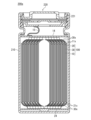
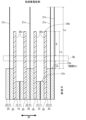
- FIG. 1 is a cross-sectional view schematically showing the configuration of a battery of Embodiment 1.
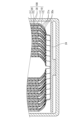
- FIG. FIG. 2 is a cross-sectional view schematically showing a part of FIG. 1; 2 is a cross-sectional view schematically showing one step of the method for manufacturing the battery of Embodiment 1.
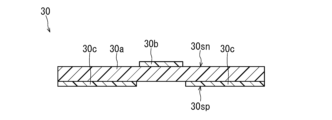
- FIG. FIG. 4 is a top view schematically showing an example of a separator;
- FIG. 4B is a diagram schematically showing a cross section taken along line IVB-IVB in FIG. 4A;
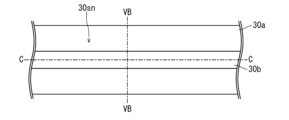
- FIG. 4 is a top view schematically showing an example of a method for manufacturing a separator;
- FIG. 5B is a diagram schematically showing a cross section along line VB-VB in FIG. 5A;
- FIG. 3 is a cross-sectional view schematically showing the configuration of a battery of Embodiment 2;
- FIG. 7 is a cross-sectional view schematically showing a part of FIG. 6;
- FIG. 10 is a cross-sectional view schematically showing one step of a method for manufacturing a battery of Embodiment 2;
- a power storage device (D) is a power storage device including an electrode group including a positive electrode, a negative electrode, and a separator. In the electrode group, the positive electrode, the negative electrode, and the separator are laminated in the stacking direction such that the separator is arranged between the positive electrode and the negative electrode.
- the positive electrode includes a positive current collector and a positive active material layer disposed on the positive current collector.
- the negative electrode includes a negative current collector and a negative active material layer disposed on the negative current collector.
- the separator includes a protruding portion protruding from a region where the positive electrode active material layer and the negative electrode active material layer face each other. At least part of the protrusion is curved.
- first to third power storage devices will be described below.
- power storage device (D1a),” “power storage device (D1b),” and “power storage device (D2) respectively.
- D1a and the second power storage device (D1b) may be collectively referred to as “power storage device (D1)”.
- the first power storage device (D1a) includes an electrode group including a positive electrode, a negative electrode, and a separator.
- the positive electrode, the negative electrode, and the separator are laminated in the stacking direction such that the separator is arranged between the positive electrode and the negative electrode.
- the positive electrode includes a positive electrode current collector and a positive electrode active material layer disposed on the positive electrode current collector.
- the negative electrode includes a negative electrode current collector and a negative electrode active material layer disposed on the negative electrode current collector.
- the separator includes protrusions that protrude from regions where the positive electrode active material layer and the negative electrode active material layer face each other.
- the separator includes a positive-side surface on the adjacent positive electrode side and a negative-electrode-side surface on the adjacent negative electrode side. At least a portion of the projection has a curled portion at the end of the projection.
- the protruding portion may protrude in a direction substantially perpendicular to the stacking direction from a region where the positive electrode active material layer and the negative electrode active material layer face each other.
- curled portions are present at the ends of the protrusions of the separator. This curled portion can prevent metal fine particles (such as spatter) from reaching the inside of the electrode group (for example, the active material layer).
- the cross section of the curled part is semicircular.
- the cross section of the curled portion is circular.
- the end portion of the protruding portion is wound half a turn or more on average, and may be wound 0.75 turn or more (for example, one turn or more) on average.
- the average value of the number of turns is obtained by arbitrarily selecting 10 curled portions, measuring the rotation angle of the end of the protruding portion in each curled portion, and arithmetically averaging the obtained 10 rotation angles. can ask.
- the number of turns at the end of the protrusion in each curled portion can be measured by cutting the battery and observing the cross section.
- metal fine particles adhere to the inside of the electrode group it may cause a decrease in characteristics such as a decrease in voltage and a decrease in yield during manufacturing.
- a copper foil is used as a current collector and a power storage device having an end face current collection structure is manufactured.
- spatter containing copper copper fine particles
- the scattered copper fine particles adhere to the positive electrode active material layer they are ionized and further deposited on the negative electrode active material layer during charging and discharging. If the copper deposited on the negative electrode active material layer grows like a dendrite, it causes a micro short circuit between the positive electrode and the negative electrode.
- a micro-short circuit causes deterioration in characteristics such as a voltage (for example, battery voltage) drop.
- the curled portion of the power storage device (D1a) prevents the metal fine particles from reaching the inside of the electrode group. Therefore, according to the power storage device (D1a), deterioration of the characteristics of the power storage device can be suppressed. In addition, according to the power storage device (D1a), the yield in manufacturing can be improved.
- spatter generated during welding may scatter during welding, but may remain in the vicinity of the welded portion during welding and move over time. According to the power storage device (D1a), it is also possible to suppress migration of spatter into the electrode group over time.
- the folding structure of the separator in Patent Document 1 is not formed only by the separator. Therefore, the folding structure of the separator of Patent Document 1 is affected by the expansion and contraction of the electrodes due to charging and discharging.
- the curled portion is formed at a position where the protruding portion of the separator is separated from the adjacent electrode (the electrode opposite to the electrode joined to the current collector plate among the positive and negative electrodes) in the direction perpendicular to the stacking direction.
- the curled portion of the power storage device (D1a) can be formed only by the separator. That is, the curled portion of the power storage device (D1a) can be formed without depending on the shape and configuration of other members. Therefore, the curled portion of the power storage device (D1a) is less susceptible to the expansion and contraction of the electrode due to charging and discharging.
- the curled portion may be formed at all the ends of the projection, or may be formed at only some of the ends of the projection.
- the curled portion may curl toward the positive electrode side adjacent to the projecting portion.
- the curled portion of the projection on the negative electrode current Preferably curled to the side.
- the curled portion may be curled toward the negative electrode adjacent to the projecting portion.
- part of the curled portion may curl toward the positive electrode side adjacent to the protrusion, and the other portion of the curled portion may curl toward the negative electrode side adjacent to the protrusion.
- the power storage device (D1a) may further include a negative electrode current collector, and the negative electrode current collector may be welded to the negative electrode current collector.
- the separator preferably includes a protruding portion having a curled portion on the side of the negative electrode current collector plate. According to this configuration, it is possible to prevent spatter generated when the negative electrode current collector is welded to the negative electrode current collector plate from reaching the inside of the electrode group. Further, as will be described later, it is possible to form a curled portion when welding the negative electrode current collector to the negative electrode current collector plate.
- the power storage device (D1a) may further include a positive collector plate, and the positive collector plate may be welded to the positive collector plate.
- the separator may include a protruding portion having a curled portion on the side of the positive electrode current collector plate. At this time, the curled portion on the positive electrode collector plate side may curl toward the negative electrode side.
- the separator may include protrusions having curled portions on both the negative electrode current collector side and the positive electrode current collector side. The pair of curled portions may protrude from the projecting portion so as to approach each other in the stacking direction. According to this configuration, it is possible to particularly prevent the metal fine particles from reaching the inside of the electrode group.
- Either one of the positive electrode and the negative electrode may be current-collected by a known structure other than the end face current-collecting structure.
- one of the positive electrode and the negative electrode may be connected to a strip-shaped lead, and the lead may be connected to the case or the sealing plate.
- the side of the positive collector plate and the side of the negative collector plate may be read as the opening side of the bottomed cylindrical case and the bottom side of the case.
- the positive electrode may be electrically connected to the case, and the negative electrode may be electrically connected to the sealing plate.
- separators usually include a first separator and a second separator that are arranged to sandwich the positive electrode.
- the curled portion may be formed in both the first separator and the second separator.
- the curled portion may include a first curled portion formed on the first separator and a second curled portion of the second separator.
- the pair of curled portions may be curled so as to come closer to each other, and more specifically, may be curled so as to come closer to each other in the stacking direction.
- the position of the first curled portion and the position of the second curled portion may be different in the direction perpendicular to the stacking direction, and further, from the direction perpendicular to the stacking direction (for example, the axial direction of the wound body) As seen, the first curled portion and the second curled portion may overlap.
- the curled portion may be formed only on the first separator or only on the second separator.
- the positive electrode, the negative electrode, and the separator may be laminated by winding the positive electrode, the negative electrode, and the separator. That is, the electrode group may be a wound body. In this case, the positive electrode, the negative electrode, and the separator are strip-shaped. In the wound body, the positive electrode, the negative electrode, and the separator are laminated in the radial direction of the wound body. At this time, the positive electrode and the negative electrode stacked with the separator interposed may be stacked in a state of being shifted in a direction (axial direction) perpendicular to the stacking direction.
- the wound body may be a cylindrical wound body, or may be another wound body.
- a negative electrode current collector may be arranged on the outermost periphery.
- the case also serves as the negative electrode terminal, the outermost negative electrode current collector and the inner surface of the case come into contact with each other to form a current collection path.
- This configuration can be realized by arranging the negative electrode on the outermost periphery and not forming the negative electrode active material layer on at least part of the outermost periphery.
- the electrode group of the power storage device (D1a) may be a laminate obtained by laminating a plurality of flat positive electrodes, a plurality of flat negative electrodes, and a sheet separator. Such a stack can be formed by stacking the positive and negative electrodes such that they alternate and the separator is positioned between the positive and negative electrodes. In such a layered electrode group, the plurality of positive electrodes and the plurality of negative electrodes may be arranged so as to be shifted in a direction perpendicular to the stacking direction.
- the heat resistance of the surface on the positive electrode side and the heat resistance of the surface on the negative electrode side are different.
- the projection can be curled toward the side with lower heat resistance.
- the heat resistance of the negative electrode side surface of the curled portion (projection) may be higher than the heat resistance of the positive electrode side surface. According to this configuration, the curled portion (protruding portion) can be curled toward the positive electrode side to which the curled portion is adjacent.
- the curled portion is curled toward the negative electrode side to which the curled portion is adjacent. be able to.
- the heat resistance of the surface can be enhanced by forming a heat-resistant layer.
- the heat-resistant layer is a layer having higher heat resistance than the base material of the separator.
- the amount of thermal shrinkage of the heat-resistant layer is smaller than that of the substrate.
- a heat-resistant layer (first heat-resistant layer) is formed only on either one of the positive electrode-side surface and the negative electrode-side surface of the protrusion of the power storage device (D1a), and the protrusion is formed on the opposite side of the region where the heat-resistant layer is formed. It is preferable that no heat-resistant layer is formed on the surface of the. As described in the manufacturing method (M1a), the curled portion can be easily formed by heating the protruding portion having the heat-resistant layer formed on only one side.
- the separator of the power storage device (D1a) may satisfy the following condition (1), may satisfy the following conditions (1) and (2), and may satisfy the following conditions (1), (2) and (3). ) may be satisfied.
- the curled portion includes a first heat-resistant layer formed on the negative electrode-side surface, and no heat-resistant layer is formed on the positive electrode-side surface of the curled portion.
- a heat-resistant layer is not formed on the negative electrode-side surface of the portion sandwiched between the positive electrode active material layer and the negative electrode active material layer.
- the separator includes a second heat-resistant layer formed in a region of the positive electrode side surface that overlaps with the positive electrode active material layer.
- the curled portion can be easily formed by heating the projecting portion on which the first heat-resistant layer is formed.
- the heat-resistant layer may be formed only on the protruding portion on the negative electrode side surface of the separator.
- the heat-resistant layer formed to face the positive electrode active material layer contributes more to improving the heat resistance of the battery than the heat-resistant layer formed to face the negative electrode active material layer. Therefore, by satisfying the condition (3), the heat resistance of the separator is particularly improved.
- a heat-resistant layer may be formed on the surface on the negative electrode side.
- the power storage device (D1a) may be a power storage device that does not satisfy the above conditions (1) to (3).
- the power storage device (D1a) may satisfy condition (4) below, may satisfy conditions (4) and (5) below, and may satisfy conditions (4), (5) and (6) below. ) may be satisfied.
- the curled portion includes a first heat-resistant layer formed on the surface facing the positive electrode, and no heat-resistant layer is formed on the surface of the curled portion facing the negative electrode.
- a heat-resistant layer is not formed on the positive electrode side surface of the portion sandwiched between the positive electrode active material layer and the negative electrode active material layer.
- the separator includes a second heat-resistant layer formed on a region of the negative electrode-side surface that overlaps with the negative electrode active material layer.
- the separator may satisfy at least one of the conditions (1) to (3).
- another part of the separator may satisfy at least one of conditions (4) to (6), and may satisfy conditions (4) and/or (5) and condition (3).
- the electrode group is a wound body
- one of two separators facing each other with the positive electrode therebetween may satisfy at least one of the conditions (1) to (3).
- the other separator may satisfy at least one of conditions (4) to (6), or may satisfy conditions (4) and/or (5) and condition (3).
- the current collector when adopting the end face current collection structure, the current collector is bent and connected to the current collector plate.
- the protrusions of the separator may be folded together with the current collector.
- a protruding portion having a curled portion may be folded together with the current collector.
- Manufacturing method of power storage device (D1a) A method for manufacturing the power storage device (D1a) according to this embodiment will be described below.
- the manufacturing method may be hereinafter referred to as “manufacturing method (M1a)”.
- the power storage device (D1a) can be manufactured.
- the power storage device (D1a) may be manufactured by a manufacturing method other than the manufacturing method described below. Since the items described for the power storage device (D1a) can be applied to the manufacturing method (M1a), redundant description may be omitted.
- the items described for the manufacturing method (M1a) may be applied to the power storage device (D1a).
- the manufacturing method (M1a) is a method of manufacturing a power storage device including an electrode group including a positive electrode, a negative electrode, and a separator.
- Production method (M1a) includes step (i) and step (ii) in this order. These steps are described below.
- Step (i) is a step of forming an electrode group by laminating a positive electrode, a negative electrode, and a separator such that the separator is arranged between the positive electrode and the negative electrode.
- the positive electrode includes a positive electrode current collector and a positive electrode active material layer disposed on the positive electrode current collector.
- the negative electrode includes a negative electrode current collector and a negative electrode active material layer disposed on the negative electrode current collector.
- the method of laminating the positive electrode, the negative electrode and the separator is not particularly limited, and a known method may be used.
- the positive electrode, the negative electrode, and the separator may be laminated by winding the positive electrode, the negative electrode, and the separator.
- the laminate may be formed by laminating a plurality of flat positive electrodes, a plurality of flat negative electrodes, and a sheet separator in one direction.
- the electrode group is formed so that a part of the separator is a protruding portion that protrudes from the region where the positive electrode active material layer and the negative electrode active material layer face each other.
- the amount of protrusion of the protrusion can be changed by changing the size of the separator.
- the separator includes a positive-side surface on the adjacent positive electrode side and a negative-electrode-side surface on the adjacent negative electrode side.
- the separator includes a base material and a first heat-resistant layer formed on the surface of the protrusion.
- the method for forming the positive electrode and the negative electrode is not limited, and they may be formed by a known method.
- the positive electrode can be formed, for example, by coating a positive electrode current collector with a positive electrode slurry that will form a positive electrode active material layer, followed by drying and rolling.
- the negative electrode can be formed, for example, by coating a negative electrode current collector with a negative electrode slurry that will form a negative electrode active material layer, followed by drying and rolling.
- the separator can be formed by forming a heat-resistant layer (for example, a first heat-resistant layer) on a predetermined position of the substrate.
- the method for forming the heat-resistant layer is not limited, and it may be formed by a known method.
- the heat-resistant layer may be formed, for example, by applying a material for the heat-resistant layer (for example, slurry or coating liquid) to the base material and then drying the material.
- the coating method and drying method of the material are not limited, and known methods can be used.
- Step (ii) is a step of curling at least a portion of the projection by heating at least a portion of the projection. Step (ii) may be performed by heating a portion of the electrode assembly.
- the protrusion includes a base material and a first heat-resistant layer having higher heat resistance than the base material.
- the amount of heat shrinkage of the base material is greater than the amount of heat shrinkage of the first heat-resistant layer. Therefore, when the protruding portion on which the first heat-resistant layer is formed is heated, the base material thermally shrinks more, and the protruding portion curls toward the side where the first heat-resistant layer is not formed. As a result, a curled portion is formed in the protrusion.
- the first heat-resistant layer may be formed on the surface of the projection on the negative electrode side. In that case, in step (ii), at least part of the projection can be curled toward the positive electrode side adjacent to the projection. As described above, at least part of the separator may satisfy at least one of the above conditions (1) to (3), and may satisfy at least one of the above conditions (4) to (6). good.
- a welding step of welding the negative electrode current collector to the negative electrode current collector plate may be further included after step (i).
- the manufacturing method (M1a) may include a welding step of welding the positive electrode current collector to the positive electrode current collector plate after the step (i).
- a welding method is not particularly limited, and a known method may be applied. For example, laser welding, arc welding (eg, TIG welding), or other welding methods may be used.
- step (ii) may be performed by heat generated during the welding process. According to this configuration, the projecting portion in the vicinity of the welded portion can be curled particularly effectively. Therefore, it is highly effective against spatters generated by welding.
- the heating process of process (ii) may be performed before the welding process.
- step (ii) may be further performed after the welding step.
- the heating method is not particularly limited, and for example, heating with a heater or the like may be performed.
- the heating is performed at a temperature higher than the temperature at which the base material thermally shrinks and at a temperature at which the separator is less damaged.
- the heating conditions may be selected according to the type of base material and heat-resistant layer.
- the method of forming the curled portion is not limited to the method of forming the curled portion by applying heat to the protruding portion of the separator as described above.
- the tips of the protrusions of the separator may be mechanically pressed with a mold or the like to be curled.
- the deformed portion is formed by applying heat to the protruding portion of the separator as described above.
- the method of laminating the positive electrode, the negative electrode and the separator is not particularly limited, and a known method may be used.
- the positive electrode, the negative electrode, and the separator may be laminated by winding the positive electrode, the negative electrode, and the separator.
- the laminate may be formed by laminating a plurality of flat positive electrodes, a plurality of flat negative electrodes, and a sheet separator in one direction.
- the steps after step (ii) are not particularly limited, and the power storage device may be manufactured using a known method.
- the positive electrode may be electrically connected to a positive electrode terminal
- the negative electrode may be electrically connected to a negative electrode terminal (for example, a package)
- the electrode group and the electrolyte may be enclosed in the package.
- the second power storage device (D1b) includes an electrode group including a positive electrode, a negative electrode, and a separator.
- the positive electrode, the negative electrode, and the separator are laminated in the stacking direction such that the separator is arranged between the positive electrode and the negative electrode.
- the positive electrode includes a positive electrode current collector and a positive electrode active material layer disposed on the positive electrode current collector.
- the negative electrode includes a negative electrode current collector and a negative electrode active material layer disposed on the negative electrode current collector.
- the separator includes protrusions that protrude from regions where the positive electrode active material layer and the negative electrode active material layer face each other.
- the separator includes a positive-side surface on the adjacent positive electrode side and a negative-electrode-side surface on the adjacent negative electrode side.
- At least part of the protruding portion includes a deformed portion in which the first heat-resistant layer is formed only on one of the positive electrode side surface and the negative electrode side surface.
- the deformed portion is bent with the first heat-resistant layer facing outward.
- at least part of the protruding portion has higher heat resistance on either one of the positive electrode side surface and the negative electrode side surface than the other surface.
- the projecting portion is bent so that the surface of the side with high heat resistance faces the outside of the electrode group.
- the protruding portion may protrude in a direction substantially perpendicular to the stacking direction from a region where the positive electrode active material layer and the negative electrode active material layer face each other.
- a heat-resistant layer may not be formed on the surface of any one of the above surfaces, which is sandwiched between the positive electrode and the negative electrode.
- the protruding portion may protrude in a direction perpendicular to the stacking direction from one of the positive electrode and the negative electrode, and the deformation portion may be located outside the electrode group from the one electrode.
- the heat-resistant layer is a layer having higher heat resistance than the base material of the separator.
- the amount of thermal shrinkage of the heat-resistant layer is smaller than that of the substrate.
- a deformed portion exists at the end of the protruding portion of the separator. This deformed portion can prevent metal fine particles (such as spatter) from reaching the inside of the electrode group (for example, the active material layer).
- metal fine particles adhere to the inside of the electrode group it may cause a decrease in characteristics such as a decrease in voltage and a decrease in yield during manufacturing.
- a copper foil is used as a current collector and a power storage device having an end face current collection structure is manufactured.
- spatter containing copper copper fine particles
- the scattered copper fine particles adhere to the positive electrode active material layer they are ionized and further deposited on the negative electrode active material layer during charging and discharging. If the copper deposited on the negative electrode active material layer grows like a dendrite, it causes a micro short circuit between the positive electrode and the negative electrode.
- a micro-short circuit causes deterioration in characteristics such as a voltage (for example, battery voltage) drop.
- the deformed portion of the power storage device (D1b) prevents the metal microparticles from reaching the inside of the electrode group. Therefore, according to the power storage device (D1b), deterioration of the characteristics of the power storage device can be suppressed. In addition, according to the power storage device (D1b), the yield in manufacturing can be improved.
- spatter generated during welding may scatter during welding, but may remain in the vicinity of the welded portion during welding and move over time. According to the power storage device (D1b), it is also possible to suppress migration of spatter into the electrode group over time.
- the folding structure of the separator in Patent Document 1 is not formed only by the separator. Therefore, the folding structure of the separator of Patent Document 1 is affected by the expansion and contraction of the electrodes due to charging and discharging.
- the deformed portion of the power storage device (D1b) can be formed without depending on the shape and configuration of other members. Therefore, the deformed portion of the power storage device (D1b) is less susceptible to the expansion and contraction of the electrodes due to charging and discharging.
- a deformable portion can be formed by forming a heat-resistant layer on the surface of the protruding portion of the separator.
- the deformable portion may be formed in the entire region of the projecting portion, or may be formed only in part of the projecting portion.
- one of the surfaces on which the first heat-resistant layer is formed may be the negative electrode side surface.
- the deformation portion can be bent (for example, curled) toward the positive electrode side.
- metal fine particles adhere to the positive electrode active material layer micro short circuits are particularly likely to occur due to ionization and deposition of the metal fine particles. Therefore, in order to suppress adhesion of metal fine particles to the positive electrode active material layer, it is preferable that the deformed portion is bent toward the positive electrode side adjacent to the projecting portion.
- the first heat-resistant layer may be formed on the positive electrode side surface. Thereby, the deformation portion can be bent toward the negative electrode.
- the first heat-resistant layers of some protrusions may be formed on the surface facing the positive electrode, and the first heat-resistant layers of other protrusions may be formed on the surface facing the negative electrode.
- the separator may include a second heat-resistant layer formed in a region of the other surface that is not one of the surfaces and overlaps the positive electrode active material layer or the negative electrode active material layer.
- the separator has a second heat-resistant layer formed in a region of the positive electrode-side surface that overlaps the positive electrode active material layer.
- the separator includes a second heat-resistant layer formed on a region of the negative electrode-side surface that overlaps the negative electrode active material layer. It's okay.
- the shrinkage of the separator can be suppressed even when the temperature of the power storage device (D1b) rises. Therefore, by forming the second heat-resistant layer, heat resistance of the power storage device (D1b) can be improved.
- the power storage device (D1b) may further include a negative electrode current collector.
- the negative electrode current collector may be welded to the negative electrode current collector plate.
- the projecting portion disposed on the side of the negative electrode current collecting plate includes a deformed portion. According to this configuration, it is possible to prevent spatter generated when the negative electrode current collector is welded to the negative electrode current collector plate from reaching the inside of the electrode group. In addition, as will be described later, it is possible to deform the deformation portion when welding the negative electrode current collector to the negative electrode current collector plate.
- the projecting portion disposed on the side of the negative electrode current collecting plate includes a deformed portion.
- the power storage device (D1b) may further include a positive collector plate, and the positive collector plate may be welded to the positive collector plate.
- the separator may include a protrusion having a deformed portion on the positive electrode current collector side. At this time, the deformed portion on the side of the positive electrode current collector plate may be bent toward the negative electrode side with the first heat-resistant layer facing outward.
- the separator may include protrusions having deformed portions on both the negative electrode current collector side and the positive electrode current collector side. According to this configuration, it is possible to particularly prevent the metal fine particles from reaching the inside of the electrode group. Either one of the positive electrode and the negative electrode may be current-collected by a known structure other than the end face current-collecting structure.
- the side of the positive collector plate and the side of the negative collector plate may be read as the opening side of the bottomed cylindrical case and the bottom side of the case.
- the positive electrode may be electrically connected to the case
- the negative electrode may be electrically connected to the sealing plate.
- the separator may include a first separator and a second separator arranged to sandwich the positive electrode.
- the deformable portion may include a first deformable portion of the first separator and a second deformable portion of the second separator.
- the deformed portion may be formed only in the first separator or only in the second separator.
- the positive electrode, the negative electrode, and the separator may be laminated by winding the positive electrode, the negative electrode, and the separator. That is, the electrode group may be a wound body. In this case, the positive electrode, the negative electrode, and the separator are strip-shaped. In the wound body, the positive electrode, the negative electrode, and the separator are laminated in the radial direction of the wound body.
- the wound body may be a cylindrical wound body, or may be another wound body.
- a negative electrode current collector may be arranged on the outermost periphery.
- the case also serves as the negative electrode terminal, the outermost negative electrode current collector and the inner surface of the case come into contact with each other to form a current collection path.
- This configuration can be realized by arranging the negative electrode on the outermost periphery and not forming the negative electrode active material layer on at least part of the outermost periphery.
- the electrode group of the power storage device (D1b) may be a laminate obtained by laminating a plurality of flat positive electrodes, a plurality of flat negative electrodes, and a sheet separator. Such a stack can be formed by stacking the positive and negative electrodes such that they alternate and the separator is positioned between the positive and negative electrodes. In such a layered electrode group, the plurality of positive electrodes and the plurality of negative electrodes may be arranged so as to be shifted in a direction perpendicular to the stacking direction.
- the collector when adopting the end surface collector structure, the collector is bent and connected to the collector plate.
- the protrusions of the separator may be folded together with the current collector.
- a protrusion having a deformed portion may be folded together with the current collector.
- Manufacturing method of power storage device (D1b) A method for manufacturing the power storage device (D1b) according to this embodiment will be described below.
- the manufacturing method may be hereinafter referred to as “manufacturing method (M1b)”.
- the power storage device (D1b) can be manufactured.
- the power storage device (D1b) may be manufactured by a manufacturing method other than the manufacturing method described below. Since the items described for the power storage device (D1b) can be applied to the manufacturing method (M1b), redundant description may be omitted.
- the items described for the manufacturing method (M1b) may be applied to the power storage device (D1b).
- the manufacturing method (M1b) is a method of manufacturing a power storage device including an electrode group including a positive electrode, a negative electrode, and a separator.
- Production method (M1b) includes step (i) and step (ii) in this order. These steps are described below.
- Step (i) is a step of forming an electrode group by laminating a positive electrode, a negative electrode, and a separator such that the separator is arranged between the positive electrode and the negative electrode.
- the positive electrode includes a positive electrode current collector and a positive electrode active material layer disposed on the positive electrode current collector.
- the negative electrode includes a negative electrode current collector and a negative electrode active material layer disposed on the negative electrode current collector.
- the method of laminating the positive electrode, the negative electrode and the separator is not particularly limited, and a known method may be used.
- the positive electrode, the negative electrode, and the separator may be laminated by winding the positive electrode, the negative electrode, and the separator.
- the laminate may be formed by laminating a plurality of flat positive electrodes, a plurality of flat negative electrodes, and a sheet separator in one direction.
- the electrode group is formed so that a part of the separator is a protruding portion that protrudes from the region where the positive electrode active material layer and the negative electrode active material layer face each other.
- the amount of protrusion of the protrusion can be changed by changing the size of the separator.
- the separator includes a positive-side surface on the adjacent positive electrode side and a negative-electrode-side surface on the adjacent negative electrode side. At least part of the protruding portion includes a deformed portion in which the first heat-resistant layer is formed only on one of the positive electrode side surface and the negative electrode side surface. That is, the separator includes a base material and a first heat-resistant layer formed on the surface of the protrusion. A heat-resistant layer is not formed on one of the surfaces on which the first heat-resistant layer is formed, which is sandwiched between the positive electrode and the negative electrode.
- the method for forming the positive electrode and the negative electrode is not limited, and they may be formed by a known method.
- the positive electrode can be formed, for example, by coating a positive electrode current collector with a positive electrode slurry that will form a positive electrode active material layer, followed by drying and rolling.
- the negative electrode can be formed, for example, by coating a negative electrode current collector with a negative electrode slurry that will form a negative electrode active material layer, followed by drying and rolling.
- the separator can be formed by forming a heat-resistant layer (for example, a first heat-resistant layer) on a predetermined position of the substrate.
- the method for forming the heat-resistant layer is not limited, and it may be formed by a known method.
- the heat-resistant layer may be formed, for example, by applying a material for the heat-resistant layer (for example, slurry or coating liquid) to the base material and then drying the material.
- the coating method and drying method of the material are not limited, and known methods can be used.
- Step (ii) is a step of deforming at least a portion of the deformable portion by heating at least a portion of the protruding portion. Step (ii) may be performed by heating a portion of the electrode assembly.
- the protrusion includes a base material and a first heat-resistant layer having higher heat resistance than the base material.
- the amount of heat shrinkage of the base material is greater than the amount of heat shrinkage of the first heat-resistant layer. Therefore, when the protruding portion on which the first heat-resistant layer is formed is heated, the base material thermally shrinks more, and the protruding portion curls toward the side where the first heat-resistant layer is not formed. As a result, the deformed portion of the projection is deformed.
- a welding step of welding the negative electrode current collector to the negative electrode current collector plate may be further included after step (i).
- the manufacturing method (M1b) may include a welding step of welding the positive electrode current collector to the positive electrode current collector plate after the step (i).
- a welding method is not particularly limited, and a known method may be applied. For example, laser welding, arc welding (eg, TIG welding), or other welding methods may be used.
- step (ii) may be performed by heat generated during the welding process. According to this configuration, the deformed portion in the vicinity of the welded portion can be curled particularly effectively. Therefore, it is highly effective against spatters generated by welding.
- the heating process of process (ii) may be performed before the welding process. Alternatively, step (ii) may be further performed after the welding step. In those cases, the heating method is not particularly limited, and for example, heating with a heater or the like may be performed. The heating is performed at a temperature higher than the temperature at which the base material thermally shrinks and at a temperature at which the separator is less damaged. The heating conditions may be selected according to the type of base material and heat-resistant layer.
- the steps after step (ii) are not particularly limited, and the power storage device may be manufactured using a known method.
- the positive electrode may be electrically connected to a positive electrode terminal
- the negative electrode may be electrically connected to a negative electrode terminal (for example, a package)
- the electrode group and the electrolyte may be enclosed in the package.
- a third power storage device (D2) includes an electrode group including a positive electrode, a negative electrode, and a separator, and at least one current collector plate.
- a positive electrode, a negative electrode, and a separator are laminated such that the separator is arranged between the positive electrode and the negative electrode.
- the positive electrode includes a positive electrode current collector and a positive electrode active material layer disposed on the positive electrode current collector.
- the negative electrode includes a negative electrode current collector and a negative electrode active material layer disposed on the negative electrode current collector.
- the positive electrode current collector includes a first exposed portion where the positive electrode active material layer is not formed.
- the negative electrode current collector includes a second exposed portion where the negative electrode active material layer is not formed.
- the separator includes protrusions that protrude from regions where the positive electrode active material layer and the negative electrode active material layer face each other. At least one exposed portion selected from the group consisting of the first exposed portion and the second exposed portion is welded to the at least one current collector plate in a bent state. The at least one exposed portion may hereinafter be referred to as "exposed portion (E)". At least part of the protruding portion is folded together with the exposed portion (E) (at least one exposed portion). The protrusion protrudes from the end of the positive electrode active material layer and the end of the negative electrode active material layer.
- metal fine particles adhere to the inside of the electrode group it may cause a decrease in characteristics such as a decrease in voltage and a decrease in yield during manufacturing.
- a copper foil is used as a current collector and a power storage device having an end face current collection structure is manufactured.
- spatter containing copper copper fine particles
- the scattered copper particles adhere to the positive electrode active material layer they are ionized and deposited on the negative electrode active material layer during charging and discharging. If the copper deposited on the negative electrode active material layer grows like a dendrite, it causes a micro short circuit between the positive electrode and the negative electrode.
- a micro-short circuit causes deterioration in characteristics such as a voltage (for example, battery voltage) drop.
- a voltage for example, battery voltage
- the protruding portion of the separator is bent together with the exposed portion (E), so that it is possible to suppress the metal fine particles from reaching the inside of the electrode group. Therefore, according to the power storage device (D2), deterioration of the characteristics of the power storage device can be suppressed. Further, according to the power storage device (D2), manufacturing yield can be improved.
- spatter generated during welding may scatter during welding, but may remain in the vicinity of the welded portion during welding and move over time.
- the power storage device (D2) it is also possible to suppress migration of spatter into the electrode group over time.
- the protruding portion of the separator is folded together with the exposed portion of the current collector. Therefore, it is preferable that the length of the projecting portion in the power storage device (D2) be longer than the projecting portion in the separator of a general power storage device.
- the length of the projecting portion the length of the exposed portion (E), the bending position of the exposed portion (E), and the relationship between them, the ranges and relationships exemplified in the second embodiment may be adopted.
- At least one exposed portion (E) may include a plurality of exposed regions arranged along the stacking direction SD of the electrode group, and at least part of the protrusions are arranged along the stacking direction SD of the electrode group. It may also include a plurality of protruding regions that are aligned. Two protruding regions sandwiched between two adjacent exposed regions may be folded together with the two exposed regions. In this case, it is preferable that the two protruding regions sandwiched between the two exposed regions are in contact with each other. According to these configurations, it is possible to particularly prevent the metal fine particles from reaching the inside of the electrode group.
- the power storage device (D2) may satisfy the following condition (1), may satisfy the following conditions (1) and (2), and the following conditions (1), (2), and (3) may be satisfied.
- the at least one collector plate to which the exposed portion (E) is welded includes a negative collector plate, and the at least one exposed portion (E) includes a second exposed portion.
- the negative electrode current collector contains copper.
- the condition (1) it is possible to suppress the spatter generated when the negative electrode current collector is welded to the negative electrode current collector plate from reaching the inside of the electrode group.
- a particularly high effect can be obtained by satisfying the condition (2).
- a metal foil containing copper is used as the negative electrode current collector, spatter containing copper is generated during welding.
- spatter containing copper adheres to the positive electrode active material layer, copper is ionized and then deposited on the negative electrode active material, which tends to cause micro short circuits. Therefore, when the negative electrode current collector contains copper, it is particularly preferable to bend the projecting portion together with the second exposed portion on the side of the negative electrode current collector.
- the at least one current collector plate to which the exposed portion (E) is welded further includes a positive electrode current collector plate, and the at least one exposed portion (E) further includes a first exposed portion.
- all of the projecting portions present on the side of the positive current collector plate are bent together with the first exposed portion.
- condition (4) When condition (4) is satisfied, the first exposed portion of the positive electrode current collector is bent and welded to the positive electrode current collector plate, and the second exposed portion of the negative electrode current collector is bent and welded to the negative electrode collector. Welded to the plate. According to this configuration, it is possible to suppress the spatter from the positive current collector plate side and the spatter from the negative current collector plate side from reaching the inside of the electrode group. A particularly high effect can be obtained by satisfying the condition (5).
- the electrode group of the power storage device (D2) may be a wound body.
- the positive electrode, the negative electrode, and the separator are laminated by winding the positive electrode, the negative electrode, and the separator.
- the wound body may be a cylindrical wound body, or may be another wound body.
- At least one exposed portion (E) may be bent toward the center (central axis) of the wound body. It may be folded outward. In the case of bending toward the center of the wound body, in principle, the exposed portion (E) does not interfere with the case when the exposed portion (E) is bent.
- the negative electrode current collector (second exposed portion) may be present on the outermost periphery of the wound body.
- the negative electrode current collector (second exposed portion) may be present on the outermost periphery of the wound body.
- the negative electrode current collector and the protrusion are entirely tilted toward the inner periphery of the wound body. It is possible to cover and protect all the protruding regions arranged in the stacking direction, including the outermost periphery of the protruding portion, with the exposed region of the negative electrode current collector.
- the negative electrode current collector and the projecting portion are tilted toward the outer periphery of the winding body, if the negative electrode current collector is located on the innermost periphery of the winding body, the negative electrode current collector is located on the outermost periphery of the winding body.
- An effect similar to that of a configuration with a current collector can be obtained.
- a current collection path can be formed between the inner surface of the case and the outermost negative electrode current collector when the case also serves as a negative electrode terminal.
- the first exposed portion on the positive electrode current collector plate side is bent together with at least part of the protrusion on the positive electrode current collector plate side and welded to the positive electrode current collector plate.
- the second exposed portion on the side of the negative electrode current collector may be bent together with at least part of the projecting portion on the side of the negative electrode current collector and welded to the negative electrode current collector.
- the side of the positive collector plate and the side of the negative collector plate may be read as the opening side of the bottomed cylindrical case and the bottom side of the case.
- the positive electrode may be electrically connected to the case, and the negative electrode may be electrically connected to the sealing plate.
- the electrode group may be a laminate obtained by laminating a plurality of flat positive electrodes, a plurality of flat negative electrodes, and a sheet separator.
- a stack can be formed by stacking the positive and negative electrodes so that they are alternately arranged and the separator is located between the positive and negative electrodes.
- Manufacturing method of power storage device (D2) A method for manufacturing the power storage device (D2) according to this embodiment will be described below.
- the manufacturing method may be hereinafter referred to as “manufacturing method (M2)”.
- the power storage device (D2) can be manufactured.
- the power storage device (D2) may be manufactured by a manufacturing method other than the manufacturing method described below. Since the items described for the power storage device (D2) can be applied to the manufacturing method (M2), redundant description may be omitted. The items described for the manufacturing method (M2) may be applied to the power storage device (D2).
- the manufacturing method (M2) is a method of manufacturing a power storage device including an electrode group including a positive electrode, a negative electrode, and a separator. Manufacturing method (M2) includes step (I) and step (II) in this order. These steps are described below.
- Step (I) is a step of forming an electrode group by laminating a positive electrode, a negative electrode, and a separator such that the separator is arranged between the positive electrode and the negative electrode.
- the positive electrode includes a positive electrode current collector and a positive electrode active material layer disposed on the positive electrode current collector.
- the negative electrode includes a negative electrode current collector and a negative electrode active material layer disposed on the negative electrode current collector.
- the method of laminating the positive electrode, the negative electrode and the separator is not particularly limited, and a known method may be used.
- the positive electrode, the negative electrode, and the separator may be laminated by winding the positive electrode, the negative electrode, and the separator.
- the laminate may be formed by laminating a plurality of flat positive electrodes, a plurality of flat negative electrodes, and a sheet separator in one direction.
- step (I) the electrode group is formed so that a part of the separator is a protruding portion that protrudes from the region where the positive electrode active material layer and the negative electrode active material layer face each other.
- the protrusion length of the protrusion can be changed by changing the size of the separator.
- the method for forming the positive electrode and the negative electrode is not limited, and they may be formed by a known method.
- the positive electrode can be formed, for example, by coating a positive electrode current collector with a positive electrode slurry that will form a positive electrode active material layer, followed by drying and rolling.
- the negative electrode can be formed, for example, by coating a negative electrode current collector with a negative electrode slurry that will form a negative electrode active material layer, followed by drying and rolling.
- Step (II) is a step of welding the exposed portion (E) to the current collector plate while bending at least a portion of the projecting portion together with the exposed portion (E).
- Step (II) is a step of welding the exposed portion (E) to the current collector plate while bending at least a portion of the projecting portion together with the exposed portion (E).
- the welding method is not particularly limited, and known methods may be applied. For example, laser welding, arc welding (eg, TIG welding), or other welding methods may be used.
- the steps after step (II) are not particularly limited, and the power storage device may be manufactured using a known method.
- the positive electrode may be electrically connected to a positive electrode terminal
- the negative electrode may be electrically connected to a negative electrode terminal (for example, a package)
- the electrode group and the electrolyte may be enclosed in the package.
- Example of configuration of power storage device (D) An example of the configuration of the power storage device (D) (the power storage device (D1) and the power storage device (D2)) will be described below. However, the configuration of the power storage device (D) is not limited to the example described below.
- Examples of power storage devices include secondary batteries and capacitors.
- Examples of secondary batteries include non-aqueous electrolyte secondary batteries and other secondary batteries.
- Examples of nonaqueous electrolyte secondary batteries include lithium ion secondary batteries.
- Examples of capacitors include lithium ion capacitors.
- a power storage device (D) includes a positive electrode (positive electrode plate), a negative electrode (negative electrode plate), and a separator, and usually further includes an electrolyte and an exterior body. They are selected according to the type of power storage device (D).
- a known configuration may be applied to the configuration not described above regarding the power storage device (D).
- An example of the configuration when the power storage device (D) is a lithium ion secondary battery will be described below.
- each member is selected according to the type of the power storage device (D).
- the positive electrode includes a positive current collector and a positive active material layer formed on one or both sides of the positive current collector.
- a metal foil can be used for the positive electrode current collector, and for example, an aluminum foil or an aluminum alloy foil can be used.
- the thickness of the positive electrode current collector may be in the range of 100 ⁇ m to 300 ⁇ m (for example, in the range of 140 ⁇ m to 210 ⁇ m), or may be in other ranges.
- the positive electrode active material layer contains a positive electrode active material and, if necessary, other additives (a conductive material, a binder, etc.). Examples of positive electrode active materials include lithium-containing transition metal oxides and the like.
- the negative electrode includes a negative electrode current collector and a negative electrode active material layer formed on one side or both sides of the negative electrode current collector.
- Metal foil can be used for the negative electrode current collector, and for example, copper foil or copper alloy foil can be used.
- the thickness of the negative electrode current collector may be in the range of 100 ⁇ m to 300 ⁇ m (for example, in the range of 150 ⁇ m to 210 ⁇ m), or may be in other ranges.
- the negative electrode active material layer contains a negative electrode active material and, if necessary, other additives (such as a conductive material and a binder). Examples of negative electrode active materials include carbonaceous materials (such as graphite).
- Positive electrode current collector and negative electrode current collector There is no particular limitation on the positive electrode current collector plate and the negative electrode current collector plate, and known current collector plates may be used.
- an aluminum plate or a copper plate may be used as the positive electrode current collector plate and the negative electrode current collector plate, or a metal plate having a predetermined metal coating layer (for example, a plating layer) formed thereon may be used.
- the metal coating layer may be a plated layer of nickel.
- the current collector plate may be a nickel-plated iron plate or a nickel-plated copper plate.
- a separator as an example of the power storage device (D1) includes a base material and a heat-resistant layer formed on a predetermined portion of the base material.
- Examples of the heat-resistant layer include the above-described first heat-resistant layer, second heat-resistant layer, and the like.
- the base material is not particularly limited, and known base materials used as base materials for separators in lithium ion secondary batteries may be used.
- a microporous membrane, a woven fabric, a nonwoven fabric, or the like can be used as the base material.
- materials for the substrate include resins such as polyolefins (polypropylene, polyethylene, etc.).
- the thickness of the substrate may be in the range of 5 ⁇ m to 25 ⁇ m (10 ⁇ m to 20 ⁇ m), or in other ranges.
- the heat-resistant layer has higher heat resistance than the base material.
- the resin constituting the heat-resistant layer by using a resin having higher heat resistance than the resin constituting the base material (for example, a resin having a higher melting point or softening point), the heat resistance of the heat-resistant layer is made higher than that of the base material. can be higher.
- the heat-resistant layer may be composed of a resin, or may contain a resin and an inorganic filler.
- Examples of highly heat-resistant resins used in the heat-resistant layer include aramid resin.
- Examples of inorganic fillers used in the heat-resistant layer include inorganic particles such as alumina, silica and titania. By including the inorganic filler, the heat resistance of the heat-resistant layer can be enhanced.
- the composition of the first heat-resistant layer formed on the projecting portion and the composition of the second heat-resistant layer disposed between the positive electrode active material layer and the negative electrode active material layer may be the same or different. good too.
- the thickness of the first heat-resistant layer may be in the range of 2 ⁇ m to 10 ⁇ m (eg, in the range of 2 ⁇ m to 5 ⁇ m).
- a curled portion (or deformed portion) is particularly likely to be formed by setting the thickness within this range.
- the thickness of the second heat-resistant layer may be in the range of 2 ⁇ m to 10 ⁇ m (eg, in the range of 2 ⁇ m to 5 ⁇ m).
- the thickness of the heat-resistant layer may be a thickness other than the range illustrated here.
- a preferable example of a separator is a microporous membrane made of polyolefin resin (polypropylene, polyethylene, etc.) as a base material, and a heat-resistant layer containing aramid resin.
- the heat-resistant layer may contain an aramid resin and an inorganic filler (for example, alumina particles).
- the heat-resistant layer may contain only an inorganic filler without the aramid resin.
- the separator of the power storage device (D2) is not particularly limited, and a known separator used as a separator for lithium ion secondary batteries may be used.
- a microporous membrane, a woven fabric, a nonwoven fabric, or the like can be used for the separator.
- separator materials include resins such as polyolefins (polypropylene, polyethylene, etc.).
- the thickness of the separator may be in the range of 5 ⁇ m to 25 ⁇ m (10 ⁇ m to 20 ⁇ m), or may be in other ranges.
- the separator of the power storage device (D2) may include a base material and a heat-resistant layer disposed on the base material. You may use the separator mentioned above for a base material.
- the heat-resistant layer has higher heat resistance than the substrate.
- the heat-resistant layer may be composed of a resin, or may contain a resin and an inorganic filler.
- Examples of highly heat-resistant resins used in the heat-resistant layer include aramid resin.
- Examples of inorganic fillers used in the heat-resistant layer include inorganic particles such as alumina, silica and titania. By including the inorganic filler, the heat resistance of the heat-resistant layer can be enhanced.
- the electrolyte is not particularly limited, and a known non-aqueous electrolyte used for lithium ion secondary batteries may be used.
- An example non-aqueous electrolyte has lithium ion conductivity and includes a lithium salt and a non-aqueous solvent that dissolves the lithium salt.
- the exterior body is not particularly limited, and a known exterior body used for lithium ion secondary batteries may be used.
- Embodiment 1 of the power storage device (D1a) can be applied to the power storage device (D1b) as long as there is no contradiction in the description. In that case, “curled portion” should be read as “transforming portion”, and “curling” should be read as “transforming”.
- FIG. 1 is a longitudinal sectional view schematically showing the configuration of the battery 200 of Embodiment 1.
- FIG. Battery 200 is an example of a power storage device (D1a) and is a cylindrical lithium ion secondary battery.
- Battery 200 includes cylindrical wound body (electrode group) 100 , non-aqueous electrolyte (not shown), case 210 , sealing plate 220 and gasket 221 .
- a bottomed metal case 210 accommodates the wound body 100 and a non-aqueous electrolyte.
- the sealing plate 220 seals the opening of the case 210 .
- Battery 200 further includes positive current collector 14 , negative current collector 24 , and tab leads 15 .
- the wound body 100 is formed by winding a strip-shaped positive electrode 10 and a strip-shaped negative electrode 20 with a strip-shaped separator 30 interposed therebetween.
- the positive electrode 10, the negative electrode 20, and the separator 30 are laminated in the radial direction.
- a separator 30 is arranged between the positive electrode 10 and the negative electrode 20 .
- a gasket 221 is arranged on the periphery of the sealing plate 220 .
- the inside of the case 210 is sealed by caulking the open end of the case 210 to the gasket 221 .
- the positive electrode 10 includes a positive electrode current collector 11 and positive electrode active material layers 12 formed on both sides of the positive electrode current collector 11 .
- the positive electrode current collector 11 includes an exposed portion 11x where the positive electrode active material layer 12 is not formed.
- the exposed portion 11 x on the side of the positive electrode current collector plate 14 is bent toward the center of the wound body 100 and welded to the positive electrode current collector plate 14 .
- the tab lead 15 is connected to the positive collector plate 14 and the sealing plate 220 .
- the positive electrode 10 is electrically connected to the sealing plate 220, and the sealing plate 220 functions as an external positive electrode terminal.
- the negative electrode 20 includes a negative electrode current collector 21 and negative electrode active material layers 22 formed on both sides of the negative electrode current collector 21 .
- the negative electrode current collector 21 includes an exposed portion 21x where the negative electrode active material layer 22 is not formed.
- the exposed portion 21 x on the negative electrode current collector 24 side is bent toward the center of the wound body 100 and welded to the negative electrode current collector 24 .
- the negative collector plate 24 is welded to the inner bottom surface of the case 210 .
- the negative electrode 20 is electrically connected to the case 210, and the case 210 functions as an external negative terminal.
- FIGS. 1 and 2 a slight gap is provided between the exposed portion 11x and the positive electrode current collector plate 14 and between the exposed portion 21x and the negative electrode current collector plate 24 for easy viewing of the figures. but they are welded and connected. Further, in FIGS. 1 and 2, illustration of the heat-resistant layer is omitted in order to make the drawings easier to see.
- the separator 30 protrudes from the region where the positive electrode active material layer 12 and the negative electrode active material layer 22 face each other, and further protrudes from the end of the positive electrode 10 on the negative electrode current collector 24 side on the negative electrode current collector 24 side.
- Embodiment 1 shows an example in which the protruding portion 30x on the side of the positive electrode current collecting plate 14 and the protruding portion 30x of the negative electrode current collecting plate 24 include the curled portion 30xa.
- the curled portion 30xa provides the above-described effects.
- a heat-resistant layer is formed on the surface of the curled portion 30xa on the negative electrode side (see FIG. 3).
- the positive electrode 10 the negative electrode 20, and the separator 30 are prepared. These can be formed by the methods described above.
- FIG. 3 schematically shows a portion of the wound body 100 formed by the positive electrode 10, the negative electrode 20, and the separator 30 (a portion near the negative electrode current collector plate 24).
- the wound body shown in FIG. 3 is the wound body before the curled portion 30xa is formed.
- the separator 30 includes a substrate 30a and heat-resistant layers 30b and 30c formed on the substrate 30a.
- the separator 30 has a positive electrode side surface 30sp on the adjacent positive electrode 10 side and a negative electrode side surface 30sn on the adjacent negative electrode 20 side.
- the heat-resistant layer 30b is a heat-resistant layer (first heat-resistant layer) formed on the negative electrode-side surface 30sn of the projecting portion 30x (later curled portion 30xa).
- the heat-resistant layer 30c is a heat-resistant layer (second heat-resistant layer) formed in a region (overlapping region) of the positive electrode side surface 30sp of the separator 30 that is in contact with the positive electrode active material layer 12 (overlapping region).
- a heat-resistant layer is not formed on the positive electrode side surface 30sp of the projecting portion 30x (later curled portion 30xa).
- a heat-resistant layer is not formed on the negative electrode side surface 30sn of the portion of the surface of the separator 30 sandwiched between the positive electrode active material layer 12 and the negative electrode active material layer 22 .
- the arrangement of the heat-resistant layers is not limited to the arrangement shown in FIG.
- the heat-resistant layer may be formed on at least one side of the projecting portion 30x.
- the separator 30 is formed on the base material 30a as shown in FIGS. 4A and 4B. Layers 30b and 30c may be formed.
- FIG. 4B is a cross-sectional view taken along line IVB--IVB of FIG. 4A.
- the separator 30 shown in FIG. 4 includes a portion that serves as the projecting portion 30x and a portion 30y sandwiched between the positive electrode active material layer 12 and the negative electrode active material layer 22. As shown in FIG.
- the heat-resistant layer 30b may be formed only on the outer edge of the substrate 30a on which the curled portion is formed. In that case, the material of the heat-resistant layer 30b may be applied only to one outer edge of the substrate 30a.
- separator 30 may be formed as follows. First, as shown in FIGS. 5A and 5B, a heat-resistant layer 30b and a heat-resistant layer 30c are formed on a long base material 30a. FIG. 5B is a cross-sectional view taken along line VB-VB in FIG. 5A. Next, the base material 30a is cut along the center line C in the width direction of the base material 30a into two sheets, and each sheet is cut to a predetermined length. Thus, a plurality of separators 30 are obtained.
- welding is performed after forming the wound body 100 . Specifically, as shown in FIG. 1, the exposed portion 11x of the positive electrode current collector 11 is welded to the positive electrode current collector plate 14, and the exposed portion 21x of the negative electrode current collector 21 is welded to the negative electrode current collector plate .
- the heat generated during welding heats the projecting portion 30x.
- the heat-resistant layer 30b is formed only on the surface on the adjacent negative electrode 20 side of the projecting portion 30x. Therefore, the protrusion 30x is curled toward the positive electrode 10 due to thermal contraction of the base material 30a, and a curled portion 30xa is formed.
- the heating process for heating the projecting portion 30x may be performed after the welding process, or the heating process for heating the projecting part 30x may be performed before the welding process. By performing the heating process separately from the welding process, it becomes easier to uniformly form the curled portion 30xa.
- the wound body 100 and the electrolyte are housed in the case 210, and the case 210 is sealed with the sealing plate 220 and the gasket 221.
- the wound body 100 is accommodated in the case, the above-described connection by the tab lead 15 and the negative electrode current collector plate 24 is performed.
- battery 200 is obtained.
- FIG. 6 is a longitudinal sectional view schematically showing the configuration of the battery 200a of Embodiment 2.
- FIG. Battery 200a is an example of a power storage device (D2) and is a cylindrical lithium ion secondary battery.
- Battery 200 a includes cylindrical wound body (electrode group) 100 , non-aqueous electrolyte (not shown), case 210 , sealing plate 220 and gasket 221 .
- a bottomed metal case 210 accommodates the wound body 100 and a non-aqueous electrolyte.
- the sealing plate 220 seals the opening of the case 210 .
- Battery 200 a further includes a positive current collector 14 , a negative current collector 24 , and tab leads 15 .
- the wound body 100 is formed by winding a strip-shaped positive electrode 10 and a strip-shaped negative electrode 20 with a strip-shaped separator 30 interposed therebetween.
- a separator 30 is arranged between the positive electrode 10 and the negative electrode 20 .
- a gasket 221 is arranged on the periphery of the sealing plate 220 .
- the inside of the case 210 is sealed by caulking the open end of the case 210 to the gasket 221 .
- the cathode 10 includes a cathode current collector 11 and cathode active material layers 12 formed on both sides of the cathode current collector 11 .
- the positive electrode current collector 11 includes an exposed portion 11x where the positive electrode active material layer 12 is not formed.
- the exposed portion 11 x on the side of the positive electrode current collector plate 14 is bent toward the center of the wound body 100 and welded to the positive electrode current collector plate 14 .
- the tab lead 15 is connected to the positive collector plate 14 and the sealing plate 220 .
- the positive electrode 10 is electrically connected to the sealing plate 220, and the sealing plate 220 functions as an external positive electrode terminal.
- the negative electrode 20 includes a negative electrode current collector 21 and negative electrode active material layers 22 formed on both sides of the negative electrode current collector 21 .
- the negative electrode current collector 21 includes an exposed portion 21x where the negative electrode active material layer 22 is not formed.
- the exposed portion 21 x on the negative electrode current collector 24 side is bent toward the center of the wound body 100 and welded to the negative electrode current collector 24 .
- the negative collector plate 24 is welded to the inner bottom surface of the case 210 .
- the negative electrode 20 is electrically connected to the case 210, and the case 210 functions as an external negative terminal.
- FIGS. 6 and 7 a slight gap is provided between the exposed portion 11x and the positive electrode current collector plate 14 and between the exposed portion 21x and the negative electrode current collector plate 24 for easy viewing of the figures. but they are welded and connected. Moreover, in FIGS. 6 and 7, the positions at which the exposed portions 11x are bent are shown to be different in the radial direction. This is for the purpose of making the drawing easier to see. Actually, since the separator 30 is thin, it is possible to make the distance between the bent portion Bp and the end portion En shown in FIG. 8 substantially constant.
- the separator 30 includes protrusions 30x that protrude beyond the ends of the positive electrode active material layer 12 and the negative electrode active material layer 22 .
- the positive electrode 10 In the wound body 100, which is the electrode group, the positive electrode 10, the negative electrode 20, and the separator 30 are laminated in the radial direction.
- the exposed portion 11x of the positive electrode current collector 11 can be regarded as including a plurality of exposed regions arranged along the stacking direction SD (radial direction, see FIG. 8) of the wound body 100 .
- the projecting portion 30x can be regarded as including a plurality of projecting regions arranged along the stacking direction SD of the wound body 100.
- Two protruding regions (protruding portions 30x) sandwiched between two adjacent exposed regions (exposed portions 11x) are folded together with the two exposed regions. Two protruding regions sandwiched between two exposed regions are in contact with each other. Their contact particularly suppresses the intrusion of metal fine particles between them.
- the exposed portion 21x of the negative electrode current collector 21 exists on the outermost circumference of the wound body 100.
- the projecting portion 30x inside thereof can be protected from spatter.
- the projecting portion 30x is bent together with the exposed portion of the current collector.
- only the projecting portion 30x on the side of the positive electrode current collector 14 may be bent together with the exposed portion 11x of the positive electrode current collector 11, or only the projecting portion 30x on the side of the negative electrode current collector 24 may be bent together with the exposed portion of the negative electrode current collector 21. 21x may be folded.
- the projecting length Ls of the projecting portion 30x will be described below together with an example of the manufacturing method of the battery 200a.
- the positive electrode 10, the negative electrode 20, and the separator 30 are prepared. These can be formed by the methods described above.
- FIG. 8 schematically shows a portion of the wound body 100 formed by the positive electrode 10, the negative electrode 20, and the separator 30 (the portion near the negative electrode current collector plate 24).
- the wound body shown in FIG. 8 is the wound body before bending the exposed portions 11x and 21x.
- FIG. 8 shows the protruding length Ls of the protruding portion 30x and the exposed length Lc of the exposed portion 21x.
- the protruding length Ls is the length of the protruding portion 30x when the protruding portion 30x is flattened. It is the length that protrudes from the outer end En of the wound body 100) (outer in the axial direction of the wound body 100).
- the negative electrode 20 is larger than the positive electrode 10 in the battery 200a of the second embodiment. Therefore, in the battery 200 a , the end En is the end 22 e of the negative electrode active material layer 22 .
- the exposed length Lc is the length of protrusion of the exposed portion 21x when the exposed portion 21x is flattened, and is the length of the electrode group between the end portion 12e of the positive electrode active material layer 12 and the end portion 22e of the negative electrode active material layer 22. It is the length protruding from the outer end En of (the wound body 100). Since the exposed portion 11x is bent on the positive electrode current collector plate 14 side, the exposed length Lc of the exposed portion 11x, not the exposed length Lc of the exposed portion 21x, is the predetermined length.
- the exposed length Lc is the length of protrusion of the exposed portion 11x when the exposed portion 11x is flattened, and the length of the end portion 12e of the positive electrode active material layer 12 and the end portion 22e of the negative electrode active material layer 22. It is the length that protrudes from the outer end portion En of the electrode group (wound body 100).
- FIG. 8 shows an example of the position of the bent portion Bp where the exposed region is bent at this time.
- the bent portion Bp is located closer to the active material layer than the end portion 30e of the projecting portion 30x.
- bent portion Bp is formed by an end portion En, which is located more outwardly in the electrode group (wound body 100) among the end portion 12e of the positive electrode active material layer 12 and the end portion 22e of the negative electrode active material layer 22, and the protrusion portion 30x. It is sufficient if it is between the end portion 30e.
- the protruding length Ls may be 3 mm or longer, 4 mm or longer, or 5 mm or longer.
- the upper limit of the protrusion length Ls is not particularly limited, and may be 10 mm or less, 8 mm or less, 6 mm or less, or 5 mm or less.
- the protrusion length Ls may be in the range of 3-10 mm, 3-8 mm, 3-6 mm, or 3-5 mm. In these ranges, the lower limit may be replaced by 4 mm or 5 mm, so long as the lower limit is not greater than or equal to the upper limit.
- the projection length Ls of the power storage device (D2) according to the present disclosure is longer than the projection length Ls of a known general power storage device.
- the exposed length Lc is longer than the protruding length Ls.
- a difference (Lc ⁇ Ls) between the exposed length Lc and the protruding length Ls may be 1 mm or more, 2 mm or more, 3 mm or more, or 4 mm or more.
- the upper limit of the difference (Lc ⁇ Ls) is not particularly limited, and may be 10 mm or less, 8 mm or less, 6 mm or less, or 4 mm or less.
- the difference (Lc-Ls) may be in the range of 1-10 mm, 1-8 mm, 1-6 mm, or 1-4 mm. In these ranges, the lower limit may be replaced by 2 mm, 3 mm, or 4 mm, so long as the lower limit is not greater than or equal to the upper limit.
- the bent portion Bp is between the end portion En and the end portion 30e of the projecting portion 30x.
- the position of the bent portion Bp may have a certain amount of width. That is, the position of the bent portion Bp may vary depending on the position of the exposed portion.
- the shortest distance Lb from the end En to the bent portion Bp is smaller than the projection length Ls.
- the shortest distance D between the end portion 22e and the bent portion Bp may be 0.5 mm or more, 1.0 mm or more, or 2.0 mm or more.
- the upper limit of the shortest distance D is not particularly limited, and may be 6.0 mm or less, 4.0 mm or less, or 3.0 mm or less. The larger the shortest distance D, the easier it is to prevent the metal microparticles from entering the electrode group.
- FIG. 8 shows an example of the arrangement on the side of the negative electrode current collector 24, the exposed length Lc, the protrusion length Ls, the shortest distance Lb, and the difference D in the arrangement on the side of the positive electrode current collector 14 are also The range can be the same as those on the negative electrode current collector plate 24 side.
- Welding is performed after forming the wound body 100 .
- the exposed portion 11 x of the positive electrode current collector 11 is welded to the positive electrode current collector plate 14
- the exposed portion 21 x of the negative electrode current collector 21 is welded to the negative electrode current collector plate 24 .
- the exposed portion 11x is bent toward the central axis of the wound body 100
- the exposed portion 21x is bent toward the central axis of the wound body 100.
- the exposed portions 11x and 21x are bent, the projecting portion 30x of the separator 30 between them is also bent.
- the wound body 100 and the electrolyte are housed in the case 210, and the case 210 is sealed with the sealing plate 220 and the gasket 221.
- the wound body 100 is accommodated in the case, the above-described connection by the tab lead 15 and the negative electrode current collector plate 24 is performed.
- battery 200a is obtained.
Landscapes
- Engineering & Computer Science (AREA)
- Chemical & Material Sciences (AREA)
- Power Engineering (AREA)
- Chemical Kinetics & Catalysis (AREA)
- Electrochemistry (AREA)
- General Chemical & Material Sciences (AREA)
- Manufacturing & Machinery (AREA)
- Microelectronics & Electronic Packaging (AREA)
- Materials Engineering (AREA)
- Secondary Cells (AREA)
Priority Applications (3)
| Application Number | Priority Date | Filing Date | Title |
|---|---|---|---|
| EP22901247.1A EP4443638A4 (en) | 2021-11-30 | 2022-11-28 | ENERGY STORAGE DEVICE AND METHOD FOR PRODUCING THE ENERGY STORAGE DEVICE |
| CN202280078925.0A CN118318350A (zh) | 2021-11-30 | 2022-11-28 | 蓄电装置和蓄电装置的制造方法 |
| JP2023564966A JPWO2023100815A1 (https=) | 2021-11-30 | 2022-11-28 |
Applications Claiming Priority (6)
| Application Number | Priority Date | Filing Date | Title |
|---|---|---|---|
| JP2021-194859 | 2021-11-30 | ||
| JP2021-194857 | 2021-11-30 | ||
| JP2021194857 | 2021-11-30 | ||
| JP2021-194849 | 2021-11-30 | ||
| JP2021194849 | 2021-11-30 | ||
| JP2021194859 | 2021-11-30 |
Publications (1)
| Publication Number | Publication Date |
|---|---|
| WO2023100815A1 true WO2023100815A1 (ja) | 2023-06-08 |
Family
ID=86612232
Family Applications (1)
| Application Number | Title | Priority Date | Filing Date |
|---|---|---|---|
| PCT/JP2022/043799 Ceased WO2023100815A1 (ja) | 2021-11-30 | 2022-11-28 | 蓄電装置および蓄電装置の製造方法 |
Country Status (3)
| Country | Link |
|---|---|
| EP (1) | EP4443638A4 (https=) |
| JP (1) | JPWO2023100815A1 (https=) |
| WO (1) | WO2023100815A1 (https=) |
Cited By (1)
| Publication number | Priority date | Publication date | Assignee | Title |
|---|---|---|---|---|
| WO2024255514A1 (zh) * | 2023-06-13 | 2024-12-19 | 宁德新能源科技有限公司 | 电芯、电池及用电设备 |
Citations (8)
| Publication number | Priority date | Publication date | Assignee | Title |
|---|---|---|---|---|
| JP2016039041A (ja) | 2014-08-07 | 2016-03-22 | 株式会社Gsユアサ | 蓄電素子及びその製造方法 |
| JP2016115410A (ja) * | 2014-12-11 | 2016-06-23 | 株式会社Gsユアサ | 蓄電素子及びその製造方法 |
| WO2016133095A1 (ja) * | 2015-02-17 | 2016-08-25 | 株式会社Gsユアサ | 蓄電素子、蓄電装置及び自動車 |
| JP2016171050A (ja) * | 2015-03-16 | 2016-09-23 | トヨタ自動車株式会社 | 非水電解質二次電池 |
| JP2017059326A (ja) | 2015-09-14 | 2017-03-23 | 日立オートモティブシステムズ株式会社 | 二次電池 |
| JP2017084539A (ja) * | 2015-10-26 | 2017-05-18 | 株式会社Gsユアサ | 蓄電素子及び蓄電素子の製造方法 |
| JP2017126471A (ja) * | 2016-01-13 | 2017-07-20 | 株式会社Gsユアサ | 蓄電素子 |
| JP2020053150A (ja) * | 2018-09-25 | 2020-04-02 | 株式会社Soken | 電池 |
Family Cites Families (2)
| Publication number | Priority date | Publication date | Assignee | Title |
|---|---|---|---|---|
| JP6232849B2 (ja) * | 2012-09-26 | 2017-11-22 | 株式会社Gsユアサ | 蓄電素子 |
| JP6045921B2 (ja) * | 2013-01-21 | 2016-12-14 | オートモーティブエナジーサプライ株式会社 | 積層型電池とその製造方法 |
-
2022
- 2022-11-28 WO PCT/JP2022/043799 patent/WO2023100815A1/ja not_active Ceased
- 2022-11-28 JP JP2023564966A patent/JPWO2023100815A1/ja active Pending
- 2022-11-28 EP EP22901247.1A patent/EP4443638A4/en active Pending
Patent Citations (8)
| Publication number | Priority date | Publication date | Assignee | Title |
|---|---|---|---|---|
| JP2016039041A (ja) | 2014-08-07 | 2016-03-22 | 株式会社Gsユアサ | 蓄電素子及びその製造方法 |
| JP2016115410A (ja) * | 2014-12-11 | 2016-06-23 | 株式会社Gsユアサ | 蓄電素子及びその製造方法 |
| WO2016133095A1 (ja) * | 2015-02-17 | 2016-08-25 | 株式会社Gsユアサ | 蓄電素子、蓄電装置及び自動車 |
| JP2016171050A (ja) * | 2015-03-16 | 2016-09-23 | トヨタ自動車株式会社 | 非水電解質二次電池 |
| JP2017059326A (ja) | 2015-09-14 | 2017-03-23 | 日立オートモティブシステムズ株式会社 | 二次電池 |
| JP2017084539A (ja) * | 2015-10-26 | 2017-05-18 | 株式会社Gsユアサ | 蓄電素子及び蓄電素子の製造方法 |
| JP2017126471A (ja) * | 2016-01-13 | 2017-07-20 | 株式会社Gsユアサ | 蓄電素子 |
| JP2020053150A (ja) * | 2018-09-25 | 2020-04-02 | 株式会社Soken | 電池 |
Non-Patent Citations (1)
| Title |
|---|
| See also references of EP4443638A4 |
Cited By (1)
| Publication number | Priority date | Publication date | Assignee | Title |
|---|---|---|---|---|
| WO2024255514A1 (zh) * | 2023-06-13 | 2024-12-19 | 宁德新能源科技有限公司 | 电芯、电池及用电设备 |
Also Published As
| Publication number | Publication date |
|---|---|
| EP4443638A4 (en) | 2025-05-28 |
| EP4443638A1 (en) | 2024-10-09 |
| JPWO2023100815A1 (https=) | 2023-06-08 |
Similar Documents
| Publication | Publication Date | Title |
|---|---|---|
| KR102836930B1 (ko) | 탭리스 전극을 구비한 전지 | |
| JP7206562B2 (ja) | 二次電池 | |
| US8808922B2 (en) | Electrode assembly and secondary battery using the same | |
| JP6684000B2 (ja) | 角形二次電池 | |
| JP5214543B2 (ja) | 二次電池 | |
| JP7187481B2 (ja) | 非水電解質二次電池 | |
| JP7330211B2 (ja) | 角形二次電池 | |
| US8637182B2 (en) | Secondary battery including a plurality of aligned positive and negative electrode tabs | |
| JP6531216B2 (ja) | バイメタルタブを用いて安全性を改善させたリチウム二次電池 | |
| KR100601504B1 (ko) | 전극조립체 및 이를 이용하는 리튬이온 이차전지 | |
| US20130157110A1 (en) | Stacked battery | |
| KR101243591B1 (ko) | 전극 조립체 및 이를 포함하는 이차전지 | |
| JP2008293681A (ja) | リチウムイオン二次電池 | |
| JP2022002167A (ja) | 蓄電素子、蓄電素子の製造方法 | |
| EP4057403A1 (en) | Electrode assembly manufacturing device, electrode assembly manufactured thereby, and secondary battery | |
| JPWO2014188501A1 (ja) | 非水電解液二次電池 | |
| JP2018055904A (ja) | 電気化学セルおよび電気化学セルの製造方法 | |
| WO2023100815A1 (ja) | 蓄電装置および蓄電装置の製造方法 | |
| JP7182861B2 (ja) | 電池及びその製造方法 | |
| JP2017084539A (ja) | 蓄電素子及び蓄電素子の製造方法 | |
| CN118318350A (zh) | 蓄电装置和蓄电装置的制造方法 | |
| KR20240030811A (ko) | 전극 조립체 및 이를 포함하는 이차 전지 | |
| WO2024143469A1 (ja) | 蓄電装置、蓄電装置用のセパレータおよびその製造方法 | |
| US20260031384A1 (en) | Electrode Assembly, Cylindrical Battery, and Battery Pack and Vehicle Including the Same | |
| WO2025094570A1 (ja) | 二次電池 |
Legal Events
| Date | Code | Title | Description |
|---|---|---|---|
| 121 | Ep: the epo has been informed by wipo that ep was designated in this application |
Ref document number: 22901247 Country of ref document: EP Kind code of ref document: A1 |
|
| ENP | Entry into the national phase |
Ref document number: 2023564966 Country of ref document: JP Kind code of ref document: A |
|
| WWE | Wipo information: entry into national phase |
Ref document number: 202280078925.0 Country of ref document: CN |
|
| WWE | Wipo information: entry into national phase |
Ref document number: 202447042926 Country of ref document: IN |
|
| NENP | Non-entry into the national phase |
Ref country code: DE |
|
| ENP | Entry into the national phase |
Ref document number: 2022901247 Country of ref document: EP Effective date: 20240701 |