WO2023100504A1 - 電子部品用ペースト - Google Patents
電子部品用ペースト Download PDFInfo
- Publication number
- WO2023100504A1 WO2023100504A1 PCT/JP2022/038493 JP2022038493W WO2023100504A1 WO 2023100504 A1 WO2023100504 A1 WO 2023100504A1 JP 2022038493 W JP2022038493 W JP 2022038493W WO 2023100504 A1 WO2023100504 A1 WO 2023100504A1
- Authority
- WO
- WIPO (PCT)
- Prior art keywords
- resin
- cellulose
- binder
- electronic component
- group
- Prior art date
- Legal status (The legal status is an assumption and is not a legal conclusion. Google has not performed a legal analysis and makes no representation as to the accuracy of the status listed.)
- Ceased
Links
Images
Classifications
-
- C—CHEMISTRY; METALLURGY
- C08—ORGANIC MACROMOLECULAR COMPOUNDS; THEIR PREPARATION OR CHEMICAL WORKING-UP; COMPOSITIONS BASED THEREON
- C08K—Use of inorganic or non-macromolecular organic substances as compounding ingredients
- C08K3/00—Use of inorganic substances as compounding ingredients
- C08K3/01—Use of inorganic substances as compounding ingredients characterized by their specific function
- C08K3/013—Fillers, pigments or reinforcing additives
-
- C—CHEMISTRY; METALLURGY
- C08—ORGANIC MACROMOLECULAR COMPOUNDS; THEIR PREPARATION OR CHEMICAL WORKING-UP; COMPOSITIONS BASED THEREON
- C08J—WORKING-UP; GENERAL PROCESSES OF COMPOUNDING; AFTER-TREATMENT NOT COVERED BY SUBCLASSES C08B, C08C, C08F, C08G or C08H
- C08J3/00—Processes of treating or compounding macromolecular substances
- C08J3/02—Making solutions, dispersions, lattices or gels by other methods than by solution, emulsion or suspension polymerisation techniques
- C08J3/09—Making solutions, dispersions, lattices or gels by other methods than by solution, emulsion or suspension polymerisation techniques in organic liquids
-
- C—CHEMISTRY; METALLURGY
- C08—ORGANIC MACROMOLECULAR COMPOUNDS; THEIR PREPARATION OR CHEMICAL WORKING-UP; COMPOSITIONS BASED THEREON
- C08J—WORKING-UP; GENERAL PROCESSES OF COMPOUNDING; AFTER-TREATMENT NOT COVERED BY SUBCLASSES C08B, C08C, C08F, C08G or C08H
- C08J3/00—Processes of treating or compounding macromolecular substances
- C08J3/20—Compounding polymers with additives, e.g. colouring
-
- C—CHEMISTRY; METALLURGY
- C08—ORGANIC MACROMOLECULAR COMPOUNDS; THEIR PREPARATION OR CHEMICAL WORKING-UP; COMPOSITIONS BASED THEREON
- C08K—Use of inorganic or non-macromolecular organic substances as compounding ingredients
- C08K3/00—Use of inorganic substances as compounding ingredients
-
- C—CHEMISTRY; METALLURGY
- C08—ORGANIC MACROMOLECULAR COMPOUNDS; THEIR PREPARATION OR CHEMICAL WORKING-UP; COMPOSITIONS BASED THEREON
- C08K—Use of inorganic or non-macromolecular organic substances as compounding ingredients
- C08K3/00—Use of inorganic substances as compounding ingredients
- C08K3/02—Elements
- C08K3/08—Metals
-
- C—CHEMISTRY; METALLURGY
- C08—ORGANIC MACROMOLECULAR COMPOUNDS; THEIR PREPARATION OR CHEMICAL WORKING-UP; COMPOSITIONS BASED THEREON
- C08L—COMPOSITIONS OF MACROMOLECULAR COMPOUNDS
- C08L1/00—Compositions of cellulose, modified cellulose or cellulose derivatives
- C08L1/08—Cellulose derivatives
-
- C—CHEMISTRY; METALLURGY
- C08—ORGANIC MACROMOLECULAR COMPOUNDS; THEIR PREPARATION OR CHEMICAL WORKING-UP; COMPOSITIONS BASED THEREON
- C08L—COMPOSITIONS OF MACROMOLECULAR COMPOUNDS
- C08L1/00—Compositions of cellulose, modified cellulose or cellulose derivatives
- C08L1/08—Cellulose derivatives
- C08L1/26—Cellulose ethers
- C08L1/28—Alkyl ethers
- C08L1/282—Alkyl ethers with halogen-substituted hydrocarbon radicals
-
- C—CHEMISTRY; METALLURGY
- C08—ORGANIC MACROMOLECULAR COMPOUNDS; THEIR PREPARATION OR CHEMICAL WORKING-UP; COMPOSITIONS BASED THEREON
- C08L—COMPOSITIONS OF MACROMOLECULAR COMPOUNDS
- C08L1/00—Compositions of cellulose, modified cellulose or cellulose derivatives
- C08L1/08—Cellulose derivatives
- C08L1/26—Cellulose ethers
- C08L1/28—Alkyl ethers
- C08L1/286—Alkyl ethers substituted with acid radicals, e.g. carboxymethyl cellulose [CMC]
-
- C—CHEMISTRY; METALLURGY
- C08—ORGANIC MACROMOLECULAR COMPOUNDS; THEIR PREPARATION OR CHEMICAL WORKING-UP; COMPOSITIONS BASED THEREON
- C08L—COMPOSITIONS OF MACROMOLECULAR COMPOUNDS
- C08L33/00—Compositions of homopolymers or copolymers of compounds having one or more unsaturated aliphatic radicals, each having only one carbon-to-carbon double bond, and only one being terminated by only one carboxyl radical, or of salts, anhydrides, esters, amides, imides or nitriles thereof; Compositions of derivatives of such polymers
-
- H—ELECTRICITY
- H01—ELECTRIC ELEMENTS
- H01B—CABLES; CONDUCTORS; INSULATORS; SELECTION OF MATERIALS FOR THEIR CONDUCTIVE, INSULATING OR DIELECTRIC PROPERTIES
- H01B1/00—Conductors or conductive bodies characterised by the conductive materials; Selection of materials as conductors
- H01B1/20—Conductive material dispersed in non-conductive organic material
- H01B1/22—Conductive material dispersed in non-conductive organic material the conductive material comprising metals or alloys
-
- H—ELECTRICITY
- H01—ELECTRIC ELEMENTS
- H01G—CAPACITORS; CAPACITORS, RECTIFIERS, DETECTORS, SWITCHING DEVICES, LIGHT-SENSITIVE OR TEMPERATURE-SENSITIVE DEVICES OF THE ELECTROLYTIC TYPE
- H01G4/00—Fixed capacitors; Processes of their manufacture
- H01G4/30—Stacked capacitors
Definitions
- the present invention relates to a paste for electronic parts containing inorganic particles, a dispersant, a binder and an organic solvent, which is used in the manufacture of electronic parts, and particularly relates to improvement of the binder.
- cellulose-based resins have been used as binders in conductive pastes used to form internal electrode layers, but cellulose-based resins lack adhesion to acetal-based resins that are commonly used as binders in dielectric sheets. Therefore, there is a problem that delamination may occur.
- Patent Document 1 for example, by blending a cellulose-based resin and an acetal-based resin as a binder used in the conductive paste, the dielectric layers and the internal electrode layers are formed. or, as described in Japanese Patent No. 5224722 (Patent Document 2), for example, by blending a cellulose resin and an acetal resin, the adhesion between the dielectric layer and the internal electrode layer is improved.
- Patent Document 2 for example, by blending a cellulose resin and an acetal resin, the adhesion between the dielectric layer and the internal electrode layer is improved.
- Patent Document 3 resin blends such as those described in Patent Documents 1 and 2 have relatively low compatibility. Therefore, for example, in the technique described in International Publication No. WO 2015/107811 (Patent Document 3), using the hydroxyl groups possessed by the cellulose resin and the acetal resin, using a binder crosslinked with a dicarboxylic acid-containing binder, It is intended to improve adhesion and compatibility.
- a polysaccharide solution containing many hydroxyl groups increases in viscosity and gels as the concentration of the polysaccharide increases. It is said that when the concentration of polysaccharide in a liquid increases, the polysaccharide molecules become entangled and partially bonded, forming a mesh-like network with that part as a starting point, and the entire solution becomes a gel.
- Patent Document 3 a low-reactivity portion remaining as a hydroxyl group in the cellulose-based resin is devised to make it easier to react with the acetal-based resin by using a binder having a lower molecular weight than that of the acetal-based resin.
- the base resin and the acetal resin are combined.
- the polymer adhesion phenomenon is greatly affected by the molecular structure of the polymer main chain and side chains, but it is speculated that the molecular structure of the polymer end is the next most influential factor. This is because the polymer has a very large molecular size and is entangled with each other, so it is difficult for the entire polymer to move during the adhesion process. This is because the molecular structure of the polymer terminal, which has a relatively high degree of freedom of movement, is thought to contribute to adhesion.
- the object of the present invention is to provide a smooth coating film in which the binder has both the characteristics of a cellulose resin and the characteristics of a terminal functional group derived from another type of resin or another type of low-molecular-weight polymer, and has good compatibility between the two. It is to provide a paste for electronic parts that can be obtained.
- the present invention is directed to a paste for electronic parts containing inorganic particles, a dispersant, a binder and an organic solvent, wherein the binder is (A) The first binding portion at one end of the molecular chain of the cellulose-based resin is connected to another type of resin or another type of low molecule via an ester bond or an amide bond.
- a copolymer represented by the general formula of the following chemical formula 3 or the general formula of the following chemical formula 4 is characterized by including at least
- R 1 represents hydrogen, an alkyl group, a hydroxyalkyl group or an acyl group
- R 2 represents another kind of resin or alkyl group.
- R 1 represents hydrogen, an alkyl group, a hydroxyalkyl group or an acyl group
- R 4 represents another type of resin
- R 3 represents an alkyl or sulfide-containing binder
- X represents an ester bond or an amide bond.
- the binder contained therein has both the characteristics of a cellulose resin and the characteristics of a terminal functional group derived from another type of resin or another type of low molecular weight resin, while at the same time Good compatibility can be achieved with different resins or different small molecules.
- a resin that leads to gelation is less likely to form in the binder, it is possible to obtain an electronic component paste that does not impair the smoothness of the coating film.
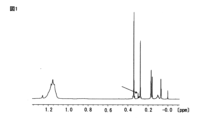
- FIG. 1 shows 1 H-NMR spectra of ethyl cellulose derivatized products.
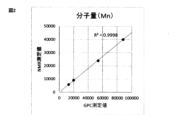
- FIG. 2 is a diagram showing the correlation between the molecular weight of ethyl cellulose determined by NMR and that determined by GPC.
- the electronic component paste according to the present invention contains inorganic particles, a dispersant, a binder and an organic solvent.
- the binder is (A) The first binding portion at one end of the molecular chain of the cellulose-based resin is connected to another type of resin or another type of low molecule via an ester bond or an amide bond.
- R 1 represents hydrogen, an alkyl group, a hydroxyalkyl group or an acyl group
- R 2 represents another kind of resin or alkyl group.
- the alkyl group for R 2 preferably has 1 to 4 carbon atoms.
- R 1 represents hydrogen, an alkyl group, a hydroxyalkyl group or an acyl group
- R 4 represents another type of resin
- R 3 represents an alkyl or sulfide-containing binder
- X represents an ester bond or an amide bond.
- the method of bonding the cellulose resin contained in the above-mentioned binder with another type of resin or another type of low-molecular-weight molecule may be by commonly used ester bond or amide bond reaction. There is a wide selection of materials as long as the molecule has a hydroxyl group or an amino group.
- characteristics of terminal functional groups derived from different resins or other low molecules for example, viscosity characteristics, other resins. If the cellulose resin is combined with another type of resin or another type of low molecule by the synthesis method described above, the properties of the cellulose type resin can be combined with another type of resin or another type of resin. It is possible to obtain a binder to which the properties of terminal functional groups derived from low molecular weight are added.
- the compatibility between the cellulosic resin and the different type of resin can be improved. Furthermore, since one of the terminal carboxyl groups of the cellulose-based resin is used to bond with another type of resin, only a graft structure can be formed instead of a network structure as a bond between cellulose-based resins. Since the resin that leads to gelation is less likely to form, the smoothness of the coating film formed by the paste for electronic components according to the present invention is less likely to be impaired.
- the binder (R 3 ) is an alkyl- or sulfide-containing binder. Does not generate a combined body with each other. Therefore, it is preferable not to use a vinyl group- or allyl group-introduced binder.
- the cellulose resin is preferably cellulose ether having a carboxyl group at one end of the molecular chain. This is because it is more realistic to obtain a cellulose ether having a carboxyl group at one end of the molecular chain as the cellulose resin, considering the synthetic reaction scheme described later.
- the cellulose ether is preferably alkyl cellulose.
- a terminal functional group derived from a different type of resin and a different type of low-molecular-weight polymer, for example, is intended to compensate for properties not found in cellulose-based resins or to enhance the properties of cellulose-based resins.
- Another type of resin is not particularly limited, and includes, for example, polyvinyl acetal-based resins, acrylic-based resins, polycarbonate-based resins, polyurethane-based resins, polyether-based resins, and polyester-based resins having hydroxyl groups or amino groups. Those containing at least one selected from the group are applied.
- an ester group or an amide group which is relatively advantageous for hydrogen bonding and can improve adhesive strength, is applied.
- the content ratio of the cellulose resin and the other resin is preferably in the range of 80:20 to 20:80 in terms of mass, more preferably in the range of 60:40 to 40:60 in terms of mass. By selecting such a ratio, the performance of both the cellulose-based resin and the resin of another type can be exhibited reliably.
- the dispersant is not particularly limited, such as a general low-molecular one-end adsorption dispersant or a comb-shaped polymer dispersant, but a polycarboxylic acid-based dispersant is particularly preferred.
- the inorganic particles contained in the electronic component paste according to the present invention preferably contain at least one of ceramic particles and metal particles.
- a paste for forming dielectric layers in a multilayer ceramic capacitor contains at least ceramic particles
- a paste for forming internal electrode layers contains at least metal particles.
- the ceramic particles described above contain at least one element selected from, for example, Ba, Ti, Ca, Zr and Sr.
- the metal particles described above contain, for example, at least one metal selected from Cu, Ni, Au and Ag.
- a cellulose derivative with one terminal carboxyl group was synthesized as follows.
- a method for synthesizing a cellulose derivative having one terminal carboxyl group a method for synthesizing ethyl cellulose, which is a kind of cellulose derivative and is widely used in pastes for electronic parts and the like, was adopted.
- the synthesis method is not particularly limited to the method shown below.
- the first single-end carboxylated ethyl cellulose (labeled "CC1" in Table 3) having a number average molecular weight Mn of 13,000, A second single-ended carboxylated ethyl cellulose having an average molecular weight Mn of 20,000, a third single-ended carboxylated ethyl cellulose having a number average molecular weight Mn of 54,000, and a fourth single-ended carboxylated ethyl cellulose having a number average molecular weight Mn of 88,000 (Table 3). 4 types of one-end carboxylated ethyl cellulose were able to be produced, as indicated by "CC4".
- the number-average molecular weight was obtained by performing gel permeation chromatography (GPC) measurement using polystyrene as a standard polymer and tetrahydrofuran (THF) as an eluent.
- GPC gel permeation chromatography
- the TMS derivatization method is a method of substituting a trimethylsilyl group (Si(CH 3 ) 3 ) for H of a hydroxyl group contained in a carboxyl group of ethyl cellulose. Due to this derivatization, the number of hydrogen atoms in the carboxyl group is changed from 1H to 9H, so the detection sensitivity in 1 H-NMR is increased ninefold.
- a derivatized product is obtained by adding ethyl cellulose and a derivatizing reagent (BSTFA) to a dehydrated chloroform solvent and heating at 70° C. for 1 hour. Since the derivatization reagent acts on both hydroxyl groups and carboxyl groups of ethyl cellulose, the amount of reagent to be added was about 1.5 times the molar number of hydroxyl groups and terminal carboxyl groups of ethyl cellulose. In addition, it was confirmed that the quantitative values of TMS hydroxyl groups and carboxyl groups did not change even when the amount of the reagent was added in excess of 1.5 times the molar amount.
- BSTFA derivatizing reagent
- the number of carboxyl groups in ethyl cellulose decreases as the molecular weight increases, suggesting that the carboxyl groups are present in sites that depend on the molecular weight. Since the terminal concentration of the polymer decreases as the molecular weight of one molecular chain increases, it is considered that the quantified carboxyl groups are present at the terminal. From the aspect of the synthesis reaction scheme of the sample, it can be determined that the carboxyl group analyzed by NMR exists at one end.
- the molecular weight of ethyl cellulose was calculated by determining the number of repetitions of ethyl cellulose.
- Table 2 shows the average molecular weight determined by NMR and the average molecular weight determined by GPC.
- the average molecular weight determined by GPC is in terms of polystyrene, the average molecular weight determined by NMR does not match the average molecular weight determined by GPC in absolute value.
- FIG. 2 when the molecular weight values obtained by both methods were compared for samples with different molecular weights, a high correlation was shown. This result indicates that a carboxyl group exists at one end of ethyl cellulose, and it can be said that NMR quantified the carboxyl group present at one end.
- Example 1 Synthesis of first copolymer of one-end carboxylated ethyl cellulose and polyvinyl acetal-based resin
- diisopropylcarbodiimide as a condensing agent was added in an amount 1.1 times the molar amount of the first one-end carboxylated ethyl cellulose, and dimethylaminopyridine as a reaction accelerator was added in an amount 0.01 times the molar amount of the condensing agent.
- a molar amount was added and the reaction was carried out by stirring at a temperature of 50° C. for 24 hours to prepare a binder solution. After that, ethyl acetate was distilled off to obtain a solid copolymer formed by an ester bond between a cellulose derivative having one terminal carboxyl group and a polyvinyl acetal-based resin.
- Example 2 Synthesis of fourth one-end carboxylated ethyl cellulose and polyvinyl acetal-based resin copolymer
- BH-S polyvinyl acetal resin having a hydroxyl group
- Example 3 Synthesis of first copolymer of one-end carboxylated ethyl cellulose and polyvinyl acetal-based resin
- BH-S polyvinyl acetal resin having a hydroxyl group
- Mn number average molecular weight
- Example 4 (Synthesis of fourth one-end carboxylated ethyl cellulose and polyvinyl acetal-based resin copolymer)
- the cellulose derivative having one terminal carboxyl group was reacted under the same conditions as in Example 1 except that the cellulose derivative having one terminal carboxyl group was changed to the fourth one-terminal carboxylated ethyl cellulose, and the cellulose derivative having one terminal carboxyl group and the polyvinyl acetal resin were reacted.
- a binder solution containing a copolymer with an ester bond was prepared.
- Example 5 Synthesis of first copolymer of one-end carboxylated ethyl cellulose and acrylic resin
- Example 5 Synthesis of first copolymer of one-end carboxylated ethyl cellulose and acrylic resin
- a binder solution containing a copolymer formed by an ester bond between a cellulose derivative having a carboxyl group at one end and an acrylic resin was prepared.
- Example 6 Synthesis of first copolymer of one-end carboxylated ethyl cellulose and aliphatic polycarbonate resin
- a binder solution containing a copolymer formed by an ester bond between a polystyrene resin and a polycarbonate resin was prepared.
- Example 7 Synthesis of first copolymer of one-end carboxylated ethyl cellulose and polyurethane resin
- a binder solution containing a copolymer formed by an ester bond between a cellulose derivative having a carboxyl group at one end and a polyurethane resin was prepared.
- Example 9 Synthesis of first copolymer of one-end carboxylated ethyl cellulose and polyether resin
- a binder solution containing a copolymer formed by ester bonding with an ether-based resin was prepared.
- Example 10 Synthesis of fourth one-end carboxylated ethyl cellulose and aliphatic polyester resin copolymer
- a binder solution was prepared containing a copolymer formed by ester bonding of a polyester-based resin and a polyester-based resin.
- Comparative Examples 1 to 10 binder solutions were obtained in which a cellulose derivative having a carboxyl group at one end and another type of resin were simply mixed. It should be noted that Comparative Examples 1 to 10 share a different resin from Examples 1 to 10, respectively.
- BH-S polyvinyl acetal resin having hydroxyl groups
- Comparative Example 6 Preparation of mixture of first one-end carboxylated ethyl cellulose and aliphatic polycarbonate resin
- Synthesis Examples 1 to 3 below are copolymers in which a cellulose derivative having a carboxyl group at one end and another type of resin are linked via a binder.
- a cellulose derivative according to Synthesis Example 1 was produced as a solid, in which allyl alcohol was introduced into the cellulose derivative having one terminal carboxyl group.
- the obtained cellulose derivative according to Synthesis Example 1 was analyzed by FT-IR and 1 H-NMR, and the formation of ester bonds and allyl groups derived from allyl alcohol was confirmed, confirming the progress of the reaction.
- Example 15 (Synthesis of Copolymer of Cellulose Derivative Introduced with Allyl Alcohol and Polyvinyl Acetal Resin Derivative Introduced with Methacrylic Acid) 5 parts by mass of the cellulose derivative into which allyl alcohol according to Synthesis Example 1 has been introduced and 5 parts by mass of the polyvinyl acetal resin derivative into which methacrylic acid according to Synthesis Example 2 has been introduced as a different resin are dried under reduced pressure, 90 parts by mass of dihydroterpinyl acetate was added thereto and dissolved at 50° C. under a nitrogen atmosphere.
- the binder solution was poured into methanol to precipitate the binder and dried under reduced pressure to obtain the copolymer as a solid.
- Example 16 Synthesis of Copolymer of Cellulose Derivative Introduced with Allyl Alcohol and Polyvinyl Acetal Resin Derivative Introduced with Thioglycolic Acid
- a binder solution containing a copolymer was prepared by reacting under the same conditions as in Example 15 except that the different resin was changed to the polyvinyl acetal resin derivative into which thioglycolic acid was introduced according to Synthesis Example 3.
- a copolymer of the allyl alcohol-introduced cellulose derivative of Synthesis Example 1 and the polyvinyl acetal resin derivative of Synthesis Example 3 was obtained from this binder solution.
- Example 17 (Preparation of binder resin in which a terminal functional group derived from a different low molecular weight is introduced into a cellulose derivative having one terminal carboxyl group) 10 parts by mass of the fourth one-end carboxylated ethyl cellulose as a cellulose derivative having a one-end carboxyl group was dried under reduced pressure, 90 parts by mass of ethyl acetate was added, and dissolved at 50° C. under a nitrogen atmosphere.
- ethanol was added in an amount 5 times the molar amount of the fourth one-end carboxylated ethyl cellulose, diisopropylcarbodiimide as a condensing agent was added in an amount 5 times the molar amount, and dimethylaminopyridine was added as a reaction accelerator to the molar amount of the condensing agent.
- a 0.01-fold molar amount was added and reacted by stirring at a temperature of 50° C. for 24 hours to prepare a binder solution.
- SSA specific surface area
- the dispersion method is not limited to the above method, and various methods such as roll mill, ball mill, bead mill, and high-pressure dispersion can be applied.
- the dried solid content of the dried supernatant was reacted with sodium hydroxide in a water-methanol mixed solvent to carry out heat hydrolysis.
- the cellulose resin was separated from the polymer component by HPLC , the dried solid content was converted to TMS, and NMR measurement was performed. peak was confirmed.
- a conductive paste as a sample was applied on a glass substrate with a 9 ⁇ m doctor blade, and the smoothness of the electrode coating film after heat drying was evaluated using a hybrid laser microscope (OPTELICS) manufactured by Lasertec Co., Ltd.
- the measurement conditions for the hybrid laser microscope were: measurement mode: surface shape, magnification: 50 times, resolution in height direction: 0.04 ⁇ m, measurement area: 1.44 mm 2 .
- Sz in-plane distribution of maximum height
- Sz in-plane distribution of maximum height
- Table 3 summarizes the number average molecular weights Mn of the copolymers according to Examples and Comparative Examples and the evaluation results of smoothness.
- the conductive paste contains a binder in which a carboxyl group at one end of the molecular chain of the cellulose resin and another type of resin are combined, so that the cellulose resin and It was confirmed that the compatibility with other resins was improved and the smoothness of the coating film was not impaired.
- this effect can be obtained by using, for example, alkyl cellulose as a cellulose resin, and other resins having hydroxyl groups or amino groups, such as polyvinyl acetal resins, acrylic resins, polycarbonate resins, polyurethane resins, and polyether resins. It can be obtained by using either the resin or the polyester resin, and the content ratio of the cellulosic resin and the other resin is surely obtained in the range of 80:20 to 20:80 in terms of mass.
- the inorganic particles contained in the electronic component paste may be any inorganic particles.
Landscapes
- Chemical & Material Sciences (AREA)
- Organic Chemistry (AREA)
- Health & Medical Sciences (AREA)
- Chemical Kinetics & Catalysis (AREA)
- Medicinal Chemistry (AREA)
- Polymers & Plastics (AREA)
- Power Engineering (AREA)
- Engineering & Computer Science (AREA)
- Dispersion Chemistry (AREA)
- Spectroscopy & Molecular Physics (AREA)
- Physics & Mathematics (AREA)
- Manufacturing & Machinery (AREA)
- Microelectronics & Electronic Packaging (AREA)
- Paints Or Removers (AREA)
- Compositions Of Macromolecular Compounds (AREA)
- Adhesives Or Adhesive Processes (AREA)
Priority Applications (4)
| Application Number | Priority Date | Filing Date | Title |
|---|---|---|---|
| CN202280073133.4A CN118215974A (zh) | 2021-12-01 | 2022-10-15 | 电子部件用糊剂 |
| JP2023564784A JP7652288B2 (ja) | 2021-12-01 | 2022-10-15 | 電子部品用ペースト |
| KR1020247014497A KR102937110B1 (ko) | 2021-12-01 | 2022-10-15 | 전자부품용 페이스트 |
| TW111145910A TW202336122A (zh) | 2021-12-01 | 2022-11-30 | 電子零件用膏 |
Applications Claiming Priority (2)
| Application Number | Priority Date | Filing Date | Title |
|---|---|---|---|
| JP2021-195052 | 2021-12-01 | ||
| JP2021195052 | 2021-12-01 |
Publications (1)
| Publication Number | Publication Date |
|---|---|
| WO2023100504A1 true WO2023100504A1 (ja) | 2023-06-08 |
Family
ID=86612001
Family Applications (1)
| Application Number | Title | Priority Date | Filing Date |
|---|---|---|---|
| PCT/JP2022/038493 Ceased WO2023100504A1 (ja) | 2021-12-01 | 2022-10-15 | 電子部品用ペースト |
Country Status (5)
| Country | Link |
|---|---|
| JP (1) | JP7652288B2 (https=) |
| KR (1) | KR102937110B1 (https=) |
| CN (1) | CN118215974A (https=) |
| TW (1) | TW202336122A (https=) |
| WO (1) | WO2023100504A1 (https=) |
Cited By (2)
| Publication number | Priority date | Publication date | Assignee | Title |
|---|---|---|---|---|
| WO2024062857A1 (ja) * | 2022-09-21 | 2024-03-28 | 住友金属鉱山株式会社 | 導電性ペースト、電子部品及び積層セラミックコンデンサ |
| WO2025150393A1 (ja) * | 2024-01-09 | 2025-07-17 | 住友金属鉱山株式会社 | ビヒクル、導電性ペースト、電子部品及び積層セラミックコンデンサ |
Families Citing this family (1)
| Publication number | Priority date | Publication date | Assignee | Title |
|---|---|---|---|---|
| JP2025107821A (ja) * | 2024-01-09 | 2025-07-22 | 住友金属鉱山株式会社 | 導電性ペースト、電子部品及び積層セラミックコンデンサ |
Citations (3)
| Publication number | Priority date | Publication date | Assignee | Title |
|---|---|---|---|---|
| WO2015107811A1 (ja) * | 2014-01-17 | 2015-07-23 | 昭栄化学工業株式会社 | バインダー樹脂の製造方法および樹脂組成物の製造方法ならびにバインダー樹脂および樹脂組成物 |
| JP2016213440A (ja) * | 2015-04-28 | 2016-12-15 | 三星エスディアイ株式会社Samsung SDI Co., Ltd. | 電極形成用組成物ならびに当該組成物を用いて製造される電極および太陽電池 |
| JP2020029479A (ja) * | 2018-08-20 | 2020-02-27 | 新中村化学工業株式会社 | 高分子化合物及びそれを含む高分子組成物、並びに無機粒子含有組成物 |
Family Cites Families (4)
| Publication number | Priority date | Publication date | Assignee | Title |
|---|---|---|---|---|
| DE2054644C3 (de) | 1970-11-06 | 1974-09-26 | Daimler-Benz Ag, 7000 Stuttgart | Pneumatisch arbeitende Regelvorrichtung zur selbsttätigen Ausrichtung von Kraftfahrzeugscheinwerfern |
| JPS5641444Y2 (https=) | 1976-01-27 | 1981-09-29 | ||
| JP5224722B2 (ja) | 2007-05-17 | 2013-07-03 | 積水化学工業株式会社 | 樹脂組成物、導電ペースト及びセラミックペースト |
| JP5600488B2 (ja) | 2009-08-04 | 2014-10-01 | 積水化学工業株式会社 | 無機微粒子分散ペースト |
-
2022
- 2022-10-15 WO PCT/JP2022/038493 patent/WO2023100504A1/ja not_active Ceased
- 2022-10-15 KR KR1020247014497A patent/KR102937110B1/ko active Active
- 2022-10-15 JP JP2023564784A patent/JP7652288B2/ja active Active
- 2022-10-15 CN CN202280073133.4A patent/CN118215974A/zh active Pending
- 2022-11-30 TW TW111145910A patent/TW202336122A/zh unknown
Patent Citations (3)
| Publication number | Priority date | Publication date | Assignee | Title |
|---|---|---|---|---|
| WO2015107811A1 (ja) * | 2014-01-17 | 2015-07-23 | 昭栄化学工業株式会社 | バインダー樹脂の製造方法および樹脂組成物の製造方法ならびにバインダー樹脂および樹脂組成物 |
| JP2016213440A (ja) * | 2015-04-28 | 2016-12-15 | 三星エスディアイ株式会社Samsung SDI Co., Ltd. | 電極形成用組成物ならびに当該組成物を用いて製造される電極および太陽電池 |
| JP2020029479A (ja) * | 2018-08-20 | 2020-02-27 | 新中村化学工業株式会社 | 高分子化合物及びそれを含む高分子組成物、並びに無機粒子含有組成物 |
Cited By (2)
| Publication number | Priority date | Publication date | Assignee | Title |
|---|---|---|---|---|
| WO2024062857A1 (ja) * | 2022-09-21 | 2024-03-28 | 住友金属鉱山株式会社 | 導電性ペースト、電子部品及び積層セラミックコンデンサ |
| WO2025150393A1 (ja) * | 2024-01-09 | 2025-07-17 | 住友金属鉱山株式会社 | ビヒクル、導電性ペースト、電子部品及び積層セラミックコンデンサ |
Also Published As
| Publication number | Publication date |
|---|---|
| KR102937110B1 (ko) | 2026-03-11 |
| JPWO2023100504A1 (https=) | 2023-06-08 |
| TW202336122A (zh) | 2023-09-16 |
| KR20240089212A (ko) | 2024-06-20 |
| JP7652288B2 (ja) | 2025-03-27 |
| CN118215974A (zh) | 2024-06-18 |
Similar Documents
| Publication | Publication Date | Title |
|---|---|---|
| JP7652288B2 (ja) | 電子部品用ペースト | |
| TWI658109B (zh) | 黏著劑樹脂之製造方法及樹脂組成物之製造方法以及黏著劑樹脂及樹脂組成物 | |
| Yan et al. | Design and characterization of ultrastable, biopassive and lubricious cyclic poly (2-alkyl-2-oxazoline) brushes | |
| Pathan et al. | Synthesis, characterization and the effect of the s-triazine ring on physico-mechanical and electrochemical corrosion resistance performance of waterborne castor oil alkyd | |
| Han et al. | GMA grafted sago starch as a reactive component in ultra violet radiation curable coatings | |
| JP7061795B2 (ja) | 高分子化合物及びそれを含む高分子組成物、並びに無機粒子含有組成物 | |
| JP6580424B2 (ja) | 導電性高分子組成物、その分散液、その製造方法およびその用途 | |
| TWI609059B (zh) | Inorganic particle dispersion paste, adhesive resin and inorganic particle dispersion paste | |
| Ramos et al. | Benzylation of cellulose in the solvent dimethylsulfoxide/tetrabutylammonium fluoride trihydrate | |
| CN113396053A (zh) | 透明导电基体及包含该透明导电基体的触摸面板 | |
| JP6542476B2 (ja) | 共重合体及びその製造方法、並びに共重合体組成物 | |
| Zou et al. | Cationic polyurethane from CO 2-polyol as an effective barrier binder for polyaniline-based metal anti-corrosion materials | |
| KR102421441B1 (ko) | 한천을 포함하는 생분해성 필름 및 이의 제조 방법 | |
| JP2003272442A (ja) | 導電性ペースト及びこれを用いた印刷回路 | |
| WO2023100503A1 (ja) | 電子部品用ペースト | |
| CN113227198B (zh) | 共聚聚酯及其水分散体 | |
| JP6742791B2 (ja) | 焼成ペースト組成物、及び共重合体の製造方法 | |
| Yoshida et al. | Preparation of polymer brush-type cellulose β-ketoesters using LiCl/1, 3-dimethyl-2-imidazolidinone as a solvent | |
| JP2001115121A (ja) | 層間接着剤およびそれを用いた抄紙方法 | |
| TW202146519A (zh) | 聚酯、黏接劑、以及薄膜 | |
| WO2025150391A1 (ja) | 導電性ペースト、電子部品及び積層セラミックコンデンサ | |
| JP3405124B2 (ja) | シラン重合体含浸紙 | |
| JP2025092234A (ja) | 組成物 | |
| JPS6254323B2 (https=) | ||
| WO2025150392A1 (ja) | 導電性ペースト、電子部品及び積層セラミックコンデンサ |
Legal Events
| Date | Code | Title | Description |
|---|---|---|---|
| 121 | Ep: the epo has been informed by wipo that ep was designated in this application |
Ref document number: 22900938 Country of ref document: EP Kind code of ref document: A1 |
|
| WWE | Wipo information: entry into national phase |
Ref document number: 2023564784 Country of ref document: JP |
|
| WWE | Wipo information: entry into national phase |
Ref document number: 202280073133.4 Country of ref document: CN |
|
| ENP | Entry into the national phase |
Ref document number: 20247014497 Country of ref document: KR Kind code of ref document: A |
|
| NENP | Non-entry into the national phase |
Ref country code: DE |
|
| 122 | Ep: pct application non-entry in european phase |
Ref document number: 22900938 Country of ref document: EP Kind code of ref document: A1 |