WO2023095494A1 - タイヤの補強材用コーティングゴム組成物、及びタイヤ - Google Patents
タイヤの補強材用コーティングゴム組成物、及びタイヤ Download PDFInfo
- Publication number
- WO2023095494A1 WO2023095494A1 PCT/JP2022/038826 JP2022038826W WO2023095494A1 WO 2023095494 A1 WO2023095494 A1 WO 2023095494A1 JP 2022038826 W JP2022038826 W JP 2022038826W WO 2023095494 A1 WO2023095494 A1 WO 2023095494A1
- Authority
- WO
- WIPO (PCT)
- Prior art keywords
- mass
- rubber composition
- parts
- tire
- rubber
- Prior art date
- Legal status (The legal status is an assumption and is not a legal conclusion. Google has not performed a legal analysis and makes no representation as to the accuracy of the status listed.)
- Ceased
Links
Images
Classifications
-
- B—PERFORMING OPERATIONS; TRANSPORTING
- B60—VEHICLES IN GENERAL
- B60C—VEHICLE TYRES; TYRE INFLATION; TYRE CHANGING; CONNECTING VALVES TO INFLATABLE ELASTIC BODIES IN GENERAL; DEVICES OR ARRANGEMENTS RELATED TO TYRES
- B60C1/00—Tyres characterised by the chemical composition or the physical arrangement or mixture of the composition
-
- C—CHEMISTRY; METALLURGY
- C08—ORGANIC MACROMOLECULAR COMPOUNDS; THEIR PREPARATION OR CHEMICAL WORKING-UP; COMPOSITIONS BASED THEREON
- C08K—Use of inorganic or non-macromolecular organic substances as compounding ingredients
- C08K3/00—Use of inorganic substances as compounding ingredients
- C08K3/02—Elements
- C08K3/04—Carbon
-
- C—CHEMISTRY; METALLURGY
- C08—ORGANIC MACROMOLECULAR COMPOUNDS; THEIR PREPARATION OR CHEMICAL WORKING-UP; COMPOSITIONS BASED THEREON
- C08K—Use of inorganic or non-macromolecular organic substances as compounding ingredients
- C08K3/00—Use of inorganic substances as compounding ingredients
- C08K3/10—Metal compounds
- C08K3/11—Compounds containing metals of Groups 4 to 10 or of Groups 14 to 16 of the Periodic Table
-
- C—CHEMISTRY; METALLURGY
- C08—ORGANIC MACROMOLECULAR COMPOUNDS; THEIR PREPARATION OR CHEMICAL WORKING-UP; COMPOSITIONS BASED THEREON
- C08K—Use of inorganic or non-macromolecular organic substances as compounding ingredients
- C08K5/00—Use of organic ingredients
- C08K5/04—Oxygen-containing compounds
- C08K5/09—Carboxylic acids; Metal salts thereof; Anhydrides thereof
-
- C—CHEMISTRY; METALLURGY
- C08—ORGANIC MACROMOLECULAR COMPOUNDS; THEIR PREPARATION OR CHEMICAL WORKING-UP; COMPOSITIONS BASED THEREON
- C08K—Use of inorganic or non-macromolecular organic substances as compounding ingredients
- C08K5/00—Use of organic ingredients
- C08K5/16—Nitrogen-containing compounds
- C08K5/17—Amines; Quaternary ammonium compounds
- C08K5/18—Amines; Quaternary ammonium compounds with aromatically bound amino groups
-
- C—CHEMISTRY; METALLURGY
- C08—ORGANIC MACROMOLECULAR COMPOUNDS; THEIR PREPARATION OR CHEMICAL WORKING-UP; COMPOSITIONS BASED THEREON
- C08L—COMPOSITIONS OF MACROMOLECULAR COMPOUNDS
- C08L101/00—Compositions of unspecified macromolecular compounds
-
- C—CHEMISTRY; METALLURGY
- C08—ORGANIC MACROMOLECULAR COMPOUNDS; THEIR PREPARATION OR CHEMICAL WORKING-UP; COMPOSITIONS BASED THEREON
- C08L—COMPOSITIONS OF MACROMOLECULAR COMPOUNDS
- C08L7/00—Compositions of natural rubber
-
- C—CHEMISTRY; METALLURGY
- C08—ORGANIC MACROMOLECULAR COMPOUNDS; THEIR PREPARATION OR CHEMICAL WORKING-UP; COMPOSITIONS BASED THEREON
- C08L—COMPOSITIONS OF MACROMOLECULAR COMPOUNDS
- C08L9/00—Compositions of homopolymers or copolymers of conjugated diene hydrocarbons
-
- Y—GENERAL TAGGING OF NEW TECHNOLOGICAL DEVELOPMENTS; GENERAL TAGGING OF CROSS-SECTIONAL TECHNOLOGIES SPANNING OVER SEVERAL SECTIONS OF THE IPC; TECHNICAL SUBJECTS COVERED BY FORMER USPC CROSS-REFERENCE ART COLLECTIONS [XRACs] AND DIGESTS
- Y02—TECHNOLOGIES OR APPLICATIONS FOR MITIGATION OR ADAPTATION AGAINST CLIMATE CHANGE
- Y02T—CLIMATE CHANGE MITIGATION TECHNOLOGIES RELATED TO TRANSPORTATION
- Y02T10/00—Road transport of goods or passengers
- Y02T10/80—Technologies aiming to reduce greenhouse gasses emissions common to all road transportation technologies
- Y02T10/86—Optimisation of rolling resistance, e.g. weight reduction
Definitions
- the present invention relates to a coating rubber composition for a tire reinforcing material and a tire.
- Patent Document 1 discloses a compound containing a rubber component, a sulfenamide-based vulcanization accelerator having a specific structure, a di- or tri-substituted benzene ring having at least one hydroxyl group as a substituent, and a methylene group donor. and a cobalt compound. It is disclosed that it has excellent adhesion to metal reinforcing materials.
- tires are subjected to various heat histories during manufacturing and use, and are subject to thermal deterioration before the end of their product life.
- the present inventors have investigated and found that the rubber composition used for the conventional coating rubber for the reinforcing material of tires has insufficient heat deterioration resistance, and in particular, has poor crack resistance after heat deterioration. It turns out that there is room for improvement.
- an object of the present invention is to solve the above-described problems of the prior art and to provide a coating rubber composition for a tire reinforcing material which is excellent in heat deterioration resistance and crack resistance after heat deterioration.
- Another object of the present invention is to provide a tire having excellent durability using such a coating rubber composition for tire reinforcement.
- the main structure of the coating rubber composition for tire reinforcement and the tire of the present invention which solves the above problems, is as follows.
- the rubber component contains 60 to 100% by mass of isoprene skeleton rubber
- the content of the cobalt compound in terms of cobalt is 0.01 parts by mass or more with respect to 100 parts by mass of the rubber component
- the amine antioxidant has the following general formula (1): [Wherein, R 1 and R 2 are each independently a monovalent saturated hydrocarbon group], A coating rubber composition for a tire reinforcing material, wherein the content of the amine anti-aging agent is 0.1 parts by mass or more and 0.9 parts by mass or less with respect to 100 parts by mass of the rubber component.
- R 1 and R 2 in the general formula (1) are each independently a linear or cyclic monovalent saturated hydrocarbon group having 1 to 20 carbon atoms; 2.
- a tire comprising a reinforcing material coated with the coating rubber composition for a tire reinforcing material according to any one of [1] to [10].
- the coating rubber composition for the reinforcing material of a tire which is excellent in heat deterioration resistance and crack resistance after heat deterioration can be provided. Further, according to the present invention, it is possible to provide a tire having excellent durability using such a coating rubber composition for tire reinforcement.
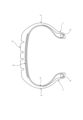
- FIG. 1 is a cross-sectional view of one embodiment of the tire of the present invention.
- the coating rubber composition for tire reinforcement and the tire of the present invention will be illustrated and described in detail below based on the embodiments thereof.
- the coating rubber composition for tire reinforcing material of the present invention (hereinafter sometimes abbreviated as “coating rubber composition” or “rubber composition”) comprises a rubber component, carbon black, a cobalt compound, an amine and a system anti-aging agent.
- the rubber component contains 60 to 100% by mass of isoprene skeleton rubber, and the cobalt-equivalent content of the cobalt compound is 0 per 100 parts by mass of the rubber component.
- the amine antioxidant has the following general formula (1): [In the formula, R 1 and R 2 are each independently a monovalent saturated hydrocarbon group], and the content of the amine antioxidant is 0 per 100 parts by mass of the rubber component. .1 parts by mass or more and 0.9 parts by mass or less.
- the coating rubber composition of the present invention contains a cobalt compound, and the content of the cobalt compound in terms of cobalt is 0.01 parts by mass or more with respect to 100 parts by mass of the rubber component. can be ensured.
- cobalt compounds tend to reduce the heat deterioration resistance of the rubber composition, particularly the crack resistance after heat deterioration.
- the coating rubber composition of the present invention contains 0.1 parts by mass or more of the amine antioxidant represented by the general formula (1) with respect to 100 parts by mass of the rubber component. The heat deterioration resistance of is improved, and as a result, the crack resistance after heat deterioration can be improved. Therefore, the coating rubber composition of the present invention is excellent in heat deterioration resistance (in particular, crack resistance after heat deterioration).
- the coating rubber composition of the present invention comprises a rubber component that provides rubber elasticity to the composition. Further, the rubber component contains an isoprene skeleton rubber, and the content of the isoprene skeleton rubber in the rubber component is 60 to 100% by mass, preferably 80 to 100% by mass. When the content of the isoprene skeleton rubber in the rubber component is 60% by mass or more, the durability of the coating rubber composition is improved.
- the isoprene-skeletal rubber is a rubber having isoprene units as a main skeleton, and specific examples thereof include natural rubber (NR), synthetic isoprene rubber (IR), and the like.
- the rubber component preferably contains 1 to 20% by mass, more preferably 10 to 20% by mass, of synthetic isoprene rubber (IR) as the isoprene skeleton rubber.
- IR synthetic isoprene rubber
- the content of the isoprene rubber in the rubber component is 1% by mass or more, the workability in kneading the coating rubber composition is improved, and when it is 20% by mass or less, the synthetic isoprene rubber in the rubber component is reduced.
- the content of the isoprene skeleton rubber other than the above is increased, and the durability of the coating rubber composition is further improved.
- the rubber component may contain rubbers other than isoprene skeleton rubber, and such other rubbers are preferably diene rubbers such as styrene-butadiene rubber (SBR), butadiene rubber (BR), chloroprene rubber (CR). etc.
- SBR styrene-butadiene rubber
- BR butadiene rubber
- CR chloroprene rubber
- the total content of the isoprene skeleton rubber and the diene rubber other than the isoprene skeleton rubber in the rubber component is preferably 80% by mass or more, more preferably 90% by mass or more, and may be 100% by mass.
- the rubber component may be used alone or in a blend of two or more.
- Carbon black The coating rubber composition of the present invention contains carbon black.
- the carbon black can reinforce the rubber composition and improve the reinforcing properties of the rubber composition.
- Examples of carbon black include, but are not limited to, GPF, FEF, HAF, ISAF, and SAF grade carbon blacks. These carbon blacks may be used singly or in combination of two or more.
- the carbon black preferably has a dibutyl phthalate (DBP) absorption of 50 to 100 cm 3 /100 g.
- DBP dibutyl phthalate
- the carbon black with a relatively low structure having a DBP absorption of 50 to 100 cm 3 /100 g it is possible to achieve both reinforcing properties and appropriate flexibility of the rubber composition, and to obtain better crack resistance. be able to.
- the DBP absorption is 50 cm 3 /100 g or more, the reinforcing properties of the rubber composition are improved. Flexibility is ensured without excessively high toughness, and better crack resistance can be obtained.
- the DBP absorption amount of the carbon black is preferably 90 cm 3 /100 g or less, more preferably 80 cm 3 /100 g or less.
- the carbon black having a dibutyl phthalate (DBP) absorption of 50 to 100 cm 3 /100 g any hard carbon produced by the oil furnace method can be used.
- DBP dibutyl phthalate
- HAF grade carbon black is preferable from the viewpoint of realizing more excellent low-loss property and crack resistance.
- the structure of carbon black refers to the size of a structure (aggregate of carbon black particles) formed as a result of fusing and connecting spherical carbon black particles.
- the DBP absorption amount of carbon black refers to the amount (cm 3 ) of DBP (dibutyl phthalate) absorbed by 100 g of carbon black, and can be measured according to JIS K 6217-4 (2008). .
- the content of the carbon black is preferably 30 parts by mass or more and preferably 65 parts by mass or less with respect to 100 parts by mass of the rubber component.
- the content of carbon black is 30 parts by mass or more with respect to 100 parts by mass of the rubber component, the reinforcing properties and crack resistance of the rubber composition are improved, and the content of carbon black is reduced to 100 parts by mass of the rubber component.
- the amount is 65 parts by mass or less, the low-loss property of the rubber composition is improved.
- the content of the carbon black is more preferably 35 parts by mass or more, and even more preferably 45 parts by mass or more with respect to 100 parts by mass of the rubber component, from the viewpoint of reinforcing properties and crack resistance of the rubber composition.
- 60 parts by mass or less is more preferable.
- the coating rubber composition of the present invention contains a cobalt compound.
- the cobalt compound can improve the adhesion of the rubber composition to the reinforcing material.
- the cobalt compound is preferably an organic acid cobalt salt or a composite salt in which a part of the organic acid of the organic acid cobalt salt is replaced with boric acid or the like.
- the organic acid cobalt salt may be saturated, unsaturated, linear, or branched.
- the content of the cobalt compound in terms of cobalt is 0.01 parts by mass or more and preferably 0.5 parts by mass or less with respect to 100 parts by mass of the rubber component.
- the cobalt-equivalent content of the cobalt compound is 0.01 parts by mass or more with respect to 100 parts by mass of the rubber component, the adhesiveness of the rubber composition to the reinforcing material can be sufficiently ensured.
- the cobalt-equivalent content of the cobalt compound is 0.5 parts by mass or less with respect to 100 parts by mass of the rubber component, deterioration in heat deterioration resistance (durability to deterioration) of the rubber composition can be suppressed.
- the content of the cobalt compound in terms of cobalt is preferably 0.05 parts by mass or more with respect to 100 parts by mass of the rubber component from the viewpoint of adhesion to the reinforcing material of the rubber composition. From the viewpoint of heat deterioration resistance (durability to deterioration) of the product, it is more preferably 0.4 parts by mass or less, and even more preferably 0.3 parts by mass or less.
- the coating rubber composition of the present invention contains an amine anti-aging agent, and the amine anti-aging agent is represented by the general formula (1).
- the amine anti-aging agent represented by the general formula (1) is a general-purpose anti-aging agent N-phenyl-N'-(1,3-dimethylbutyl)-p-phenylenediamine (anti-aging agent 6PPD). Although it also contains a phenylenediamine moiety, it differs from the antioxidant 6PPD in that it has no double bond other than the phenylenediamine moiety.
- the amine anti-aging agent represented by the general formula (1) improves the heat deterioration resistance of the rubber composition, suppresses the decrease in elongation at break (EB) and tensile strength (TB) after heat deterioration, Moreover, it has the effect
- R 1 and R 2 are each independently a monovalent saturated hydrocarbon group.
- R 1 and R 2 may be the same or different, but are preferably the same from the viewpoint of synthesis.
- the monovalent saturated hydrocarbon group preferably has 1 to 20 carbon atoms, more preferably 3 to 10 carbon atoms, and particularly preferably 6 and 7 carbon atoms.
- R 1 and R 2 in the above general formula (1) are each independently a chain having 1 to 20 carbon atoms or A cyclic monovalent saturated hydrocarbon group is preferred.
- Examples of the monovalent saturated hydrocarbon group include an alkyl group and a cycloalkyl group.
- the alkyl group may be linear or branched, and the cycloalkyl group may further include an alkyl group as a substituent. etc. may be combined.
- alkyl group examples include methyl group, ethyl group, n-propyl group, isopropyl group, n-butyl group, isobutyl group, sec-butyl group, tert-butyl group, 1,2-dimethylbutyl group, 1,3- dimethylbutyl group, 2,3-dimethylbutyl group, n-pentyl group, isopentyl group, neopentyl group, 1-methylpentyl group, 2-methylpentyl group, 3-methylpentyl group, 4-methylpentyl group, 1,2 -dimethylpentyl group, 1,3-dimethylpentyl group, 1,4-dimethylpentyl group, 2,3-dimethylpentyl group, 2,4-dimethylpentyl group, 3,4-dimethylpentyl group, n-hexyl group, Examples include 1-methylhexyl group, 2-methylhexyl group, various
- 1,4-dimethylpentyl group is preferred.
- the cycloalkyl group include a cyclopentyl group, a methylcyclopentyl group, a cyclohexyl group, a methylcyclohexyl group, a cycloheptyl group, a cyclooctyl group, etc.
- a cyclohexyl group is preferred.
- amine antioxidant represented by the general formula (1) examples include N,N'-bis(1,4-dimethylpentyl)-p-phenylenediamine (antiaging agent 77PD), N, N'-bis(1-ethyl-3-methylpentyl)-p-phenylenediamine, N,N'-dicyclohexyl-p-phenylenediamine (antiaging agent CCPD) and the like, among these, N,N' -Bis(1,4-dimethylpentyl)-p-phenylenediamine (antiaging agent 77PD), N,N'-dicyclohexyl-p-phenylenediamine (CCPD) are preferred, and N,N'-bis(1,4- Dimethylpentyl)-p-phenylenediamine (antiaging agent 77PD) is particularly preferred.
- the amine anti-aging agents may be used singly or in combination of two or more.
- the content of the amine anti-aging agent is 0.1 parts by mass or more and 0.9 parts by mass or less with respect to 100 parts by mass of the rubber component. If the content of the amine antioxidant is less than 0.1 parts by mass with respect to 100 parts by mass of the rubber component, the heat deterioration resistance of the rubber composition cannot be sufficiently ensured, and after heat deterioration A decrease in crack resistance cannot be sufficiently suppressed. Further, when the content of the amine anti-aging agent is 0.9 parts by mass or less with respect to 100 parts by mass of the rubber component, adverse effects on rubber physical properties (heat buildup, etc.) other than heat deterioration resistance can be suppressed. and is more suitable for tire applications.
- the content of the amine anti-aging agent is preferably 0.5 parts by mass or more with respect to 100 parts by mass of the rubber component from the viewpoint of heat deterioration resistance and crack resistance after thermal deterioration.
- the coating rubber composition of the present invention may contain a quinoline antioxidant.
- the quinoline anti-aging agent is an anti-aging agent having a quinoline moiety or a derivative thereof (such as a dihydroquinoline moiety).
- the quinoline anti-aging agent has the effect of improving the heat deterioration resistance of the rubber composition and suppressing the decrease in elongation at break (EB) and tensile strength (TB) after heat deterioration.
- the quinoline antioxidant preferably has a dihydroquinoline moiety, more preferably a 1,2-dihydroquinoline moiety.
- Specific examples of the quinoline antioxidant include a polymer of 2,2,4-trimethyl-1,2-dihydroquinoline (antioxidant TMDQ), 6-ethoxy-2,2,4-trimethyl-1 ,2-dihydroquinoline, 6-anilino-2,2,4-trimethyl-1,2-dihydroquinoline and the like.
- the quinoline antioxidant preferably contains a polymer of 2,2,4-trimethyl-1,2-dihydroquinoline (antiaging agent TMDQ).
- a quinoline anti-aging agent containing a polymer of 2,2,4-trimethyl-1,2-dihydroquinoline is said to be highly effective in improving the heat deterioration resistance of a rubber composition, and is less likely to discolor the rubber composition. It also has advantages.
- the polymer of 2,2,4-trimethyl-1,2-dihydroquinoline includes dimers, trimers and tetramers of 2,2,4-trimethyl-1,2-dihydroquinoline. mentioned.
- the content of the quinoline antioxidant is preferably 0.1 to 5 parts by mass with respect to 100 parts by mass of the rubber component.
- the content of the quinoline antioxidant is 0.1 parts by mass or more with respect to 100 parts by mass of the rubber component, the heat deterioration resistance of the rubber composition is improved, and the rubber composition is cut after heat deterioration. A decrease in elongation (EB) and tensile strength (TB) can be further suppressed.
- the content of the quinoline antioxidant is 5 parts by mass or less with respect to 100 parts by mass of the rubber component, it is possible to suppress adverse effects on rubber physical properties (heat buildup, etc.) other than heat deterioration resistance. , more suitable for tire applications.
- the content of the quinoline antioxidant is more preferably 0.3 parts by mass or more, still more preferably 0.5 parts by mass or more, with respect to 100 parts by mass of the rubber component. From the viewpoint of affecting other rubber physical properties, it is more preferably 4 parts by mass or less, and even more preferably 3 parts by mass or less, relative to 100 parts by mass of the rubber component.
- the coating rubber composition of the present invention preferably does not contain silica or has a silica content of 1 part by mass or less per 100 parts by mass of the rubber component. Since silica deteriorates the workability in kneading the rubber composition, if it does not contain silica, or if the content of silica is 1 part by mass or less with respect to 100 parts by mass of the rubber component, the rubber composition Workability in kneading can be improved.
- thermoplastic resin The coating rubber composition of the present invention preferably does not contain a thermoplastic resin.
- the thermoplastic resin makes the rubber composition prone to creep and reduces the durability against repeated input, so if the rubber composition does not contain a thermoplastic resin, the durability of the rubber composition can be improved.
- thermoplastic resins include C5 - based resins, C5 - C9 -based resins, C9 - based resins, dicyclopentadiene resins, terpenephenol resins, terpene resins, rosin resins, and alkylphenol resins.
- the coating rubber composition of the present invention preferably contains a thermosetting resin.
- the thermosetting resin can reduce the hysteresis loss of the rubber composition (improve the low-loss property), improve the crack resistance, and improve the durability. Therefore, when the coating rubber composition contains a thermosetting resin, the loss reduction property of the rubber composition can be improved, and the crack resistance (durability) can be further improved.
- a phenol resin is preferable as the thermosetting resin.
- a phenolic resin preferably together with a methylene donor described below
- the phenol resin is not particularly limited and can be appropriately selected according to the required performance. Examples include those produced by condensation reaction of phenols such as phenol, cresol, resorcinol, tert-butylphenol, or mixtures thereof with formaldehyde in the presence of an acid catalyst such as hydrochloric acid or oxalic acid.
- modified phenolic resins can be used, for example, modified with oils such as rosin oil, tall oil, cashew oil, linoleic acid, oleic acid, and linolenic acid.
- oils such as rosin oil, tall oil, cashew oil, linoleic acid, oleic acid, and linolenic acid.
- about a phenol resin, 1 type can also be included independently and can also be included in mixture of multiple types.
- the content of the thermosetting resin is preferably 2 to 10 parts by mass, more preferably 3 to 7 parts by mass, based on 100 parts by mass of the rubber component.
- the coating rubber composition of the present invention contains a phenolic resin as a thermosetting resin, it preferably further contains a methylene donor.
- a melamine donor as a curing agent for the phenolic resin, it is possible to improve the reinforcing property of the rubber composition while maintaining the low loss property of the rubber composition.
- the methylene donor is not particularly limited and can be appropriately selected according to the required performance.
- hexamethylenetetramine hexamethoxymethylolmelamine, pentamethoxymethylolmelamine, hexamethoxymethylmelamine, pentamethoxymethylmelamine, hexaethoxymethylmelamine, hexakis-(methoxymethyl)melamine, N,N′,N′′-trimethyl-N ,N′,N′′-trimethylolmelamine, N,N′,N′′-trimethylolmelamine, N-methylolmelamine, N,N′-(methoxymethyl)melamine, N,N′,N′′-tributyl-N ,N′,N′′-trimethylolmelamine, paraformaldehyde, etc.
- methylene donors hexamethylenetetramine, hexamethoxymethylmelamine, hexamethoxymethylolmelamine and paraformaldehyde are preferred. These methylene donors are preferred. may be used alone or in combination.
- the ratio of the content of the phenol resin to the content of the methylene donor is 0 from the viewpoint of achieving both low loss property and crack resistance at a higher level. .6 to 7, more preferably 1 to 5.
- the ratio of the content of the phenolic resin to the content of the methylene donor is 0.6 or more, the crack resistance is further improved, and when the ratio is 7 or less, the low-loss property is further improved.
- the coating rubber composition of the present invention preferably does not contain 2,2′-methylenebis(4-methyl-6-tert-butylphenol) (anti-aging agent o-MBp14). Without the antioxidant o-MBp14, the rubber composition is more environmentally friendly.
- the coating rubber composition of the present invention preferably does not contain N-phenyl-N'-(1,3-dimethylbutyl)-p-phenylenediamine (antiaging agent 6PPD). Without the antioxidant 6PPD, the rubber composition becomes more environmentally friendly.
- the coating rubber composition of the present invention may contain wax.
- the ozone resistance of the rubber composition is improved.
- the wax include paraffin wax and microcrystalline wax.
- the content of the wax is preferably 0.1 to 5 parts by mass with respect to 100 parts by mass of the rubber component.
- the wax content is 0.1 parts by mass or more with respect to 100 parts by mass of the rubber component, the ozone resistance of the rubber composition is further improved.
- the wax content is 5 parts by mass or less with respect to 100 parts by mass of the rubber component, the effect on rubber physical properties other than ozone resistance is small.
- the content of the wax is more preferably 0.5 parts by mass or more, and even more preferably 1 part by mass or more, with respect to 100 parts by mass of the rubber component. From the viewpoint of influence, it is more preferably 4 parts by mass or less, and even more preferably 3 parts by mass or less with respect to 100 parts by mass of the rubber component.
- the coating rubber composition of the present invention preferably contains sulfur.
- sulfur When the rubber composition contains sulfur, it becomes vulcanizable, and the durability (in particular, elongation at break (EB) and tensile strength (TB)) of the rubber composition is improved.
- sulfur various types of sulfur can be used, but ordinary sulfur (soluble sulfur (powder sulfur), etc.) is preferable to insoluble sulfur, and oil treated sulfur, etc. are also preferable.
- insoluble sulfur is sulfur insoluble in carbon disulfide (amorphous polymeric sulfur), and soluble sulfur (powder sulfur) is sulfur soluble in carbon disulfide.
- the sulfur content is preferably in the range of 0.1 to 10 parts by mass, more preferably in the range of 1 to 5 parts by mass, per 100 parts by mass of the rubber component. If the sulfur content is 0.1 parts by mass or more per 100 parts by mass of the rubber component, the durability of the vulcanized rubber can be ensured, and if it is 10 parts by mass or less per 100 parts by mass of the rubber component , sufficient rubber elasticity can be ensured.
- the coating rubber composition of the present invention contains, if necessary, in addition to the rubber component, carbon black, cobalt compound, amine-based antioxidant, quinoline-based antioxidant, thermosetting resin, wax, sulfur, etc. described above.
- Various components commonly used in the rubber industry such as fillers other than carbon black and silica (calcium carbonate, etc.), silane coupling agents, softeners, processing aids, surfactants, organic acids (stearic acid etc.), zinc oxide (zinc white), a vulcanization accelerator, a vulcanizing agent other than sulfur, and the like may be appropriately selected and contained within a range that does not impair the object of the present invention. Commercially available products can be suitably used as these compounding agents.
- the amine anti-aging agent represented by the general formula (1) may be supported on any carrier.
- the amine anti-aging agent represented by the general formula (1) may be carried on an inorganic filler such as calcium carbonate.
- the amine anti-aging agent represented by the general formula (1) may form a masterbatch together with the rubber component.
- the rubber component used in forming the masterbatch is not particularly limited, and may be diene rubber such as natural rubber (NR), ethylene-propylene-diene rubber (EPDM), or the like.
- the amine anti-aging agent represented by the general formula (1) may be a salt with an organic acid.
- the organic acid used for forming the salt is not particularly limited, but stearic acid and the like can be mentioned.
- the method for producing the coating rubber composition is not particularly limited. can be produced by blending, kneading, heating, extrusion, or the like. Further, vulcanized rubber can be obtained by vulcanizing the obtained rubber composition.
- the kneading conditions are not particularly limited, and various conditions such as the input volume of the kneading device, the rotation speed of the rotor, the ram pressure, the kneading temperature, the kneading time, the type of the kneading device, etc. It can be selected as appropriate.
- the kneading device include Banbury mixers, intermixes, kneaders, rolls, etc., which are usually used for kneading rubber compositions.
- heating conditions there are no particular restrictions on the heating conditions, and various conditions such as the heating temperature, heating time, and heating device can be appropriately selected according to the purpose.
- the heating device include a heating roll machine or the like which is usually used for heating the rubber composition.
- the extrusion conditions are also not particularly limited, and various conditions such as extrusion time, extrusion speed, extrusion equipment, and extrusion temperature can be appropriately selected according to the purpose.
- the extrusion device include an extruder or the like that is usually used for extrusion of a rubber composition.
- the extrusion temperature can be determined appropriately.
- a molding vulcanizer with a mold used for vulcanization of a rubber composition can be used.
- the temperature is, for example, about 100 to 190.degree.
- the reinforcing material to which the coating rubber composition of the present invention is applied is preferably made of metal, that is, the reinforcing material is preferably a metal reinforcing material.
- a metal reinforcing material-rubber composite By coating a metal reinforcing material with a coating rubber composition (coating rubber), a metal reinforcing material-rubber composite can be formed.
- the metal reinforcing material for example, steel, iron, stainless steel, lead, aluminum, copper, brass, bronze, Monel metal alloy, nickel, zinc, or other metals in the form of wire, plate, or chain. mentioned.
- a steel cord is particularly preferable as the metal reinforcing material. The diameter of the steel cord is appropriately selected depending on the application.
- the metal reinforcing material may have a plated layer on its surface.
- the plated layer include a brass plated layer, a zinc plated layer, and a copper plated layer.
- a brass-plated layer is preferable from the viewpoint of adhesiveness to an object (coating rubber).
- the ratio of copper and zinc in the brass plating layer is preferably in the range of 60:40 to 70:30 on a mass basis.
- the tire of the present invention is characterized by comprising a reinforcing material coated with the coating rubber composition for a tire reinforcing material described above. Since the tire of the present invention includes a reinforcing material coated with the above coating rubber composition for a reinforcing material for a tire, it has high heat deterioration resistance, particularly high crack resistance after heat deterioration, and excellent durability.
- the tire of the present invention is preferably for heavy loads, that is, it is preferably a tire for heavy loads. Since the thickness of each part of a heavy-duty tire is thick, it is easy for parts to become hot during vulcanization molding. Since the total running distance tends to be long, high heat deterioration resistance, particularly crack resistance after heat deterioration, is required. On the other hand, by applying the above-mentioned coating rubber composition that is excellent in heat deterioration resistance (especially crack resistance after heat deterioration), durability after heat deterioration (especially crack resistance) is maintained at a high level. can do.
- the tire of the present invention is particularly preferable as a heavy-duty tire, for example, for trucks, buses, off-the-road (for example, construction vehicles, mining, etc.), small trucks (light trucks), industrial vehicles, and aircraft. It can be suitably used as a tire for heavy loads such as
- FIG. 1 is a cross-sectional view of one embodiment of the tire of the present invention.
- the tire shown in FIG. 1 includes a pair of bead portions 1, a pair of sidewall portions 2, a tread portion 3, and a carcass (preferably a radial A carcass 5 and a belt 6 made up of two belt layers disposed in the tread portion 3 (more specifically, disposed outside the crown portion of the carcass 5 in the tire radial direction).
- a carcass preferably a radial A carcass 5 and a belt 6 made up of two belt layers disposed in the tread portion 3 (more specifically, disposed outside the crown portion of the carcass 5 in the tire radial direction).
- the carcass 5 is composed of one carcass ply, and includes a main body portion extending in a toroidal shape between a pair of bead cores 4 embedded in the bead portion 1, and each bead core. 4, which is wound radially outward from the inside to the outside in the tire width direction, but in the tire of the present invention, the number of plies and the structure of the carcass 5 are not limited to this.
- the carcass ply that constitutes the carcass 5 is formed by covering a plurality of reinforcing cords (reinforcing materials such as steel cords and organic fiber cords) with a covering rubber.
- the belt 6 of the tire shown in FIG. 1 is composed of two belt layers, and each belt layer is usually a rubberized layer of reinforcing cords (reinforcing materials) extending obliquely with respect to the tire equatorial plane.
- the belt is composed of a rubber-coated layer of steel cords (reinforcing material), and further, two belt layers are laminated so that the reinforcing cords constituting the belt layers intersect with each other across the tire equatorial plane. 6.
- the belt 6 in FIG. 1 is composed of two belt layers, but in the tire of the present invention, the number of belt layers constituting the belt 6 may be one or more, and is not limited to this. do not have.
- the belt 6, the carcass 5, the bead core 4 and the like are suitable examples of the tire member to which the reinforcing material (reinforcing material-rubber composite) coated with the coating rubber composition is applied.
- the tire of the present invention may be obtained by vulcanizing after molding using an unvulcanized rubber composition, or using a semi-vulcanized rubber that has undergone a pre-vulcanization step or the like. After molding, it may be obtained by further vulcanization.
- the tire of the present invention may be either a pneumatic tire or a solid tire.
- the gas to be filled in the pneumatic tire may be normal air or air with adjusted oxygen partial pressure, or an inert gas such as nitrogen, argon, or helium. can be done.
- Examples 1 to 7 and Comparative Example 1> (Preparation of rubber composition) A rubber composition is produced according to the formulation shown in Table 1. The resulting rubber composition is evaluated for elongation at break (EB) and tensile strength (TB) after heat deterioration and crack resistance after heat deterioration by the following methods.
- EB elongation at break
- TB tensile strength
- Elongation at break (EB) and tensile strength (TB) after thermal aging A rubber composition is vulcanized to prepare a vulcanized rubber test piece. Next, the vulcanized rubber test piece is left at 100 ° C. for 24 hours to be thermally deteriorated, and a tensile test is performed on the test piece after thermal deterioration in accordance with JIS K 6251 to determine the elongation at break after thermal deterioration.
- EB and tensile strength (TB) are measured, and indexed with the elongation at break (EB) and tensile strength (TB) after heat deterioration of Comparative Example 1 as 100, respectively.
- the larger the index value the higher the elongation at break (EB) and tensile strength (TB) after heat deterioration, indicating that the resistance to heat deterioration (durability after heat deterioration) is high.
- a vulcanized rubber is obtained by vulcanizing the rubber composition of each sample.
- the vulcanized rubber is left at 120° C. for 7 days for thermal deterioration, punched out to obtain a test piece of 2 mm ⁇ 50 mm ⁇ 6 mm, and a small hole is made in the center of the test piece to form an initial crack.
- stress is repeatedly applied to the test piece in the long side direction under conditions of a stress of 2.0 MPa, a frequency of 6 Hz, and an ambient temperature of 80°C. For each sample, the number of repetitions from the application of repeated stress until the test piece breaks is measured, and the common logarithm of the number of repetitions is calculated.
- the measurement test until breakage is performed four times for each sample, the common logarithms are calculated, and the average thereof is taken as the average common logarithm.
- the evaluation is shown as an index when the average common logarithm of Comparative Example 1 is 100, and the larger the average common logarithm of the sample, the better the crack growth resistance.
- Example 8 and Comparative Example 2> (Preparation of rubber composition) A rubber composition was produced according to the formulation shown in Table 2. The obtained rubber composition was evaluated for retention of elongation at break (EB) after heat deterioration and crack resistance after heat deterioration by the following methods.
- EB elongation at break
- the retention rate of the elongation at break (EB) after heat deterioration was calculated according to the following formula.
- Retention rate of elongation at break after heat deterioration (EB) elongation at break after heat deterioration (EB) / initial elongation at break (EB) ⁇ 100 (%)
- the retention rate of the elongation at break (EB) after heat deterioration in Comparative Example 2 was set to 100, and indicated as an index. The larger the index value, the higher the retention of elongation at break (EB) after heat deterioration, indicating that the resistance to heat deterioration (durability after heat deterioration) is high.
- the measurement test until breakage was performed four times for each sample, and the common logarithm was calculated, and the average thereof was taken as the average common logarithm.
- the evaluation is shown as an index when the average common logarithm of Comparative Example 1 is 100, and the larger the average common logarithm of the sample, the better the crack growth resistance.
- the content of cobalt compounds and the content in terms of cobalt are shown in parentheses *13 Sulfur: Eastman MFG Japan Co., Ltd., trade name “CRYTEX HS OT20”
- Example 8 From Table 2, it can be seen that the rubber composition of Example 8 according to the present invention has a higher retention of elongation at break (EB) after heat deterioration than the rubber composition of Comparative Example 2. Moreover, it can be seen that the rubber composition of Example 8 has improved crack resistance after heat deterioration as compared with the rubber composition of Comparative Example 2.
- EB elongation at break
Landscapes
- Chemical & Material Sciences (AREA)
- Health & Medical Sciences (AREA)
- Chemical Kinetics & Catalysis (AREA)
- Medicinal Chemistry (AREA)
- Polymers & Plastics (AREA)
- Organic Chemistry (AREA)
- Engineering & Computer Science (AREA)
- Mechanical Engineering (AREA)
- Compositions Of Macromolecular Compounds (AREA)
Priority Applications (1)
| Application Number | Priority Date | Filing Date | Title |
|---|---|---|---|
| JP2023563557A JPWO2023095494A1 (https=) | 2021-11-24 | 2022-10-18 |
Applications Claiming Priority (2)
| Application Number | Priority Date | Filing Date | Title |
|---|---|---|---|
| JP2021190608 | 2021-11-24 | ||
| JP2021-190608 | 2021-11-24 |
Publications (1)
| Publication Number | Publication Date |
|---|---|
| WO2023095494A1 true WO2023095494A1 (ja) | 2023-06-01 |
Family
ID=86539324
Family Applications (1)
| Application Number | Title | Priority Date | Filing Date |
|---|---|---|---|
| PCT/JP2022/038826 Ceased WO2023095494A1 (ja) | 2021-11-24 | 2022-10-18 | タイヤの補強材用コーティングゴム組成物、及びタイヤ |
Country Status (2)
| Country | Link |
|---|---|
| JP (1) | JPWO2023095494A1 (https=) |
| WO (1) | WO2023095494A1 (https=) |
Citations (3)
| Publication number | Priority date | Publication date | Assignee | Title |
|---|---|---|---|---|
| JPS612543A (ja) * | 1984-03-22 | 1986-01-08 | ユニローヤル グッドリッチ ライセンシング サービシス,インコーポレイティド | ベルテツド空気入りゴムタイヤの大量生産方法 |
| JP2020045408A (ja) * | 2018-09-18 | 2020-03-26 | 住友ゴム工業株式会社 | タイヤ内層用ゴム組成物およびその製造方法 |
| WO2020059673A1 (ja) * | 2018-09-18 | 2020-03-26 | 住友ゴム工業株式会社 | 空気入りタイヤ |
-
2022
- 2022-10-18 JP JP2023563557A patent/JPWO2023095494A1/ja active Pending
- 2022-10-18 WO PCT/JP2022/038826 patent/WO2023095494A1/ja not_active Ceased
Patent Citations (3)
| Publication number | Priority date | Publication date | Assignee | Title |
|---|---|---|---|---|
| JPS612543A (ja) * | 1984-03-22 | 1986-01-08 | ユニローヤル グッドリッチ ライセンシング サービシス,インコーポレイティド | ベルテツド空気入りゴムタイヤの大量生産方法 |
| JP2020045408A (ja) * | 2018-09-18 | 2020-03-26 | 住友ゴム工業株式会社 | タイヤ内層用ゴム組成物およびその製造方法 |
| WO2020059673A1 (ja) * | 2018-09-18 | 2020-03-26 | 住友ゴム工業株式会社 | 空気入りタイヤ |
Also Published As
| Publication number | Publication date |
|---|---|
| JPWO2023095494A1 (https=) | 2023-06-01 |
Similar Documents
| Publication | Publication Date | Title |
|---|---|---|
| US10864774B2 (en) | Rubber composite reinforced by at least one steel reinforcing element rendered adhesive by an adhesive composition containing aromatic aldehyde and polyphenol | |
| CN103781835B (zh) | 硫可交联的胶化混合物 | |
| JP6648820B2 (ja) | 空気入りタイヤ | |
| JP2010184992A (ja) | スチールコード被覆用ゴム組成物及び空気入りタイヤ | |
| EP3444298A1 (en) | Rubber composition | |
| US20090151838A1 (en) | Tire containing an internal cord reinforced rubber component | |
| JP7485510B2 (ja) | スチールコード-ゴム複合体及びそれを用いたタイヤ、ホース、クローラ又はコンベア | |
| JP7572954B2 (ja) | スチールコード-ゴム複合体、タイヤ、コンベヤベルト、ホース、及びゴムクローラ | |
| US8921470B2 (en) | Rubber composition for adhering steel cord | |
| JP5917197B2 (ja) | ベルトコード又はカーカスコード被覆用ゴム組成物及び空気入りタイヤ | |
| JP5389535B2 (ja) | トレッドクッション用ゴム組成物及び空気入りタイヤ | |
| CN113840958B (zh) | 钢丝帘线-橡胶复合体和充气轮胎 | |
| JP2023077416A (ja) | 積層体及びタイヤ | |
| CN111295418B (zh) | 橡胶组合物、金属-橡胶复合体和轮胎 | |
| JP7385442B2 (ja) | スチールコード被覆用ゴム組成物及び空気入りタイヤ | |
| JP7488698B2 (ja) | ゴム-スチールコード複合体及び空気入りタイヤ | |
| WO2023095494A1 (ja) | タイヤの補強材用コーティングゴム組成物、及びタイヤ | |
| US20250002744A1 (en) | Coating rubber composition for tire reinforcing members, and tire | |
| WO2023095480A1 (ja) | タイヤの補強材用コーティングゴム組成物、及びタイヤ | |
| JP7354509B2 (ja) | スチールコード被覆用ゴム組成物及び空気入りタイヤ | |
| JP7504289B2 (ja) | 非空気式支持構成要素のためのゴム組成物 | |
| JP7500188B2 (ja) | タイヤ | |
| JP2023077082A (ja) | 加硫ゴム-金属複合体並びにタイヤ、ホース、及びクローラ | |
| JP2022094169A (ja) | スチールコード被覆用ゴム組成物及び空気入りタイヤ | |
| JP7849630B1 (ja) | 金属接着用ゴム組成物 |
Legal Events
| Date | Code | Title | Description |
|---|---|---|---|
| 121 | Ep: the epo has been informed by wipo that ep was designated in this application |
Ref document number: 22898278 Country of ref document: EP Kind code of ref document: A1 |
|
| WWE | Wipo information: entry into national phase |
Ref document number: 2023563557 Country of ref document: JP |
|
| NENP | Non-entry into the national phase |
Ref country code: DE |
|
| 122 | Ep: pct application non-entry in european phase |
Ref document number: 22898278 Country of ref document: EP Kind code of ref document: A1 |