WO2023074164A1 - インダクタおよびその製造方法 - Google Patents
インダクタおよびその製造方法 Download PDFInfo
- Publication number
- WO2023074164A1 WO2023074164A1 PCT/JP2022/034358 JP2022034358W WO2023074164A1 WO 2023074164 A1 WO2023074164 A1 WO 2023074164A1 JP 2022034358 W JP2022034358 W JP 2022034358W WO 2023074164 A1 WO2023074164 A1 WO 2023074164A1
- Authority
- WO
- WIPO (PCT)
- Prior art keywords
- magnetic core
- electrode member
- mold
- magnetic
- end surface
- Prior art date
- Legal status (The legal status is an assumption and is not a legal conclusion. Google has not performed a legal analysis and makes no representation as to the accuracy of the status listed.)
- Ceased
Links
Images


Classifications
-
- H—ELECTRICITY
- H01—ELECTRIC ELEMENTS
- H01F—MAGNETS; INDUCTANCES; TRANSFORMERS; SELECTION OF MATERIALS FOR THEIR MAGNETIC PROPERTIES
- H01F41/00—Apparatus or processes specially adapted for manufacturing or assembling magnets, inductances or transformers; Apparatus or processes specially adapted for manufacturing materials characterised by their magnetic properties
- H01F41/02—Apparatus or processes specially adapted for manufacturing or assembling magnets, inductances or transformers; Apparatus or processes specially adapted for manufacturing materials characterised by their magnetic properties for manufacturing cores, coils, or magnets
- H01F41/04—Apparatus or processes specially adapted for manufacturing or assembling magnets, inductances or transformers; Apparatus or processes specially adapted for manufacturing materials characterised by their magnetic properties for manufacturing cores, coils, or magnets for manufacturing coils
-
- H—ELECTRICITY
- H01—ELECTRIC ELEMENTS
- H01F—MAGNETS; INDUCTANCES; TRANSFORMERS; SELECTION OF MATERIALS FOR THEIR MAGNETIC PROPERTIES
- H01F17/00—Fixed inductances of the signal type
- H01F17/04—Fixed inductances of the signal type with magnetic core
-
- H—ELECTRICITY
- H01—ELECTRIC ELEMENTS
- H01F—MAGNETS; INDUCTANCES; TRANSFORMERS; SELECTION OF MATERIALS FOR THEIR MAGNETIC PROPERTIES
- H01F27/00—Details of transformers or inductances, in general
- H01F27/24—Magnetic cores
- H01F27/255—Magnetic cores made from particles
-
- H—ELECTRICITY
- H01—ELECTRIC ELEMENTS
- H01F—MAGNETS; INDUCTANCES; TRANSFORMERS; SELECTION OF MATERIALS FOR THEIR MAGNETIC PROPERTIES
- H01F27/00—Details of transformers or inductances, in general
- H01F27/28—Coils; Windings; Conductive connections
- H01F27/29—Terminals; Tapping arrangements for signal inductances
-
- H—ELECTRICITY
- H01—ELECTRIC ELEMENTS
- H01F—MAGNETS; INDUCTANCES; TRANSFORMERS; SELECTION OF MATERIALS FOR THEIR MAGNETIC PROPERTIES
- H01F27/00—Details of transformers or inductances, in general
- H01F27/28—Coils; Windings; Conductive connections
- H01F27/29—Terminals; Tapping arrangements for signal inductances
- H01F27/292—Surface mounted devices
-
- H—ELECTRICITY
- H01—ELECTRIC ELEMENTS
- H01F—MAGNETS; INDUCTANCES; TRANSFORMERS; SELECTION OF MATERIALS FOR THEIR MAGNETIC PROPERTIES
- H01F3/00—Cores, Yokes, or armatures
- H01F3/08—Cores, Yokes, or armatures made from powder
-
- H—ELECTRICITY
- H01—ELECTRIC ELEMENTS
- H01F—MAGNETS; INDUCTANCES; TRANSFORMERS; SELECTION OF MATERIALS FOR THEIR MAGNETIC PROPERTIES
- H01F41/00—Apparatus or processes specially adapted for manufacturing or assembling magnets, inductances or transformers; Apparatus or processes specially adapted for manufacturing materials characterised by their magnetic properties
- H01F41/02—Apparatus or processes specially adapted for manufacturing or assembling magnets, inductances or transformers; Apparatus or processes specially adapted for manufacturing materials characterised by their magnetic properties for manufacturing cores, coils, or magnets
- H01F41/0206—Manufacturing of magnetic cores by mechanical means
-
- H—ELECTRICITY
- H01—ELECTRIC ELEMENTS
- H01F—MAGNETS; INDUCTANCES; TRANSFORMERS; SELECTION OF MATERIALS FOR THEIR MAGNETIC PROPERTIES
- H01F41/00—Apparatus or processes specially adapted for manufacturing or assembling magnets, inductances or transformers; Apparatus or processes specially adapted for manufacturing materials characterised by their magnetic properties
- H01F41/02—Apparatus or processes specially adapted for manufacturing or assembling magnets, inductances or transformers; Apparatus or processes specially adapted for manufacturing materials characterised by their magnetic properties for manufacturing cores, coils, or magnets
- H01F41/04—Apparatus or processes specially adapted for manufacturing or assembling magnets, inductances or transformers; Apparatus or processes specially adapted for manufacturing materials characterised by their magnetic properties for manufacturing cores, coils, or magnets for manufacturing coils
- H01F41/06—Coil winding
- H01F41/064—Winding non-flat conductive wires, e.g. rods, cables or cords
- H01F41/066—Winding non-flat conductive wires, e.g. rods, cables or cords with insulation
-
- H—ELECTRICITY
- H01—ELECTRIC ELEMENTS
- H01F—MAGNETS; INDUCTANCES; TRANSFORMERS; SELECTION OF MATERIALS FOR THEIR MAGNETIC PROPERTIES
- H01F17/00—Fixed inductances of the signal type
- H01F17/04—Fixed inductances of the signal type with magnetic core
- H01F2017/048—Fixed inductances of the signal type with magnetic core with encapsulating core, e.g. made of resin and magnetic powder
Definitions
- the present disclosure relates to inductors used in various electronic devices and manufacturing methods thereof.
- an inductor has been proposed in which a magnetic core is formed by burying a coil element in a mixed powder of a metal magnetic powder and a binder made of a thermosetting resin, followed by pressure molding.
- an inductor has been proposed in which a member that becomes the external electrodes is formed at the same time as the magnetic core is formed.
- Patent Document 1 An inductor similar to the above inductor is disclosed in Patent Document 1, for example.
- the inductor includes a magnetic core, a coil element embedded in the magnetic core and having an end protruding from an end face of the magnetic core, and an electrode member electrically and mechanically connected to the end of the coil element.
- the electrode member is bent along the end face and bottom face of the magnetic core and has an end face portion facing the end face of the magnetic core and a bottom face portion facing the bottom face of the magnetic core. Ends of the coil elements are overlapped and connected to the electrode members.
- the end face of the magnetic core is located on both sides of the first region connected to the bottom face of the magnetic core and provided with the end face portion of the electrode member, and the first region connected to the bottom face of the magnetic core and having the first region therebetween. and two second regions.
- the angle formed between the bottom surface of the magnetic core and the two second regions of the end surface of the magnetic core is larger than the angle formed between the bottom surface of the magnetic core and the outer surface of the end surface portion of the electrode member and smaller than 90.0°.
- This inductor is small, can handle high power, and has excellent solderability.
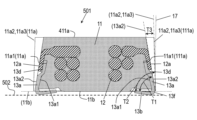
- FIG. 1 is a see-through perspective view of an inductor according to one embodiment of the present disclosure.
- FIG. 2 is a cross-sectional view of the inductor shown in FIG. 1 along line II-II.
- FIG. 3 is a cross-sectional view for explaining the method of manufacturing the inductor according to the embodiment.
- FIG. 4 is a cross-sectional view explaining the method of manufacturing the inductor according to the embodiment.
- FIG. 5 is a cross-sectional view for explaining the method of manufacturing the inductor according to the embodiment.
- FIG. 6 is a cross-sectional view explaining the method of manufacturing the inductor according to the embodiment.
- FIG. 1 is a see-through perspective view of inductor 501 according to an embodiment of the present disclosure
- FIG. 2 is a cross-sectional view of inductor 501 taken along line II-II.
- Inductor 501 includes magnetic core 11 , coil element 12 embedded in magnetic core 11 , and electrode member 13 electrically and mechanically connected to coil element 12 .
- the outer shape of the magnetic core 11 is represented by a dashed line.
- the coil element 12 consists of a wound insulated conductor wire with a diameter of about 0.3 mm. A portion of the insulating coating 12c located at the end portion 12a of the coil element 12 is peeled off, and the end portion 12a is crushed into a flat shape with a thickness of about 0.2 mm.
- the magnetic core 11 is formed by embedding the coil element 12 in a magnetic material powder mixture obtained by mixing a magnetic material powder made of an Fe--Si--Cr alloy and a binder made of silicone, and molding the magnetic material powder mixture under pressure. It is The magnetic core 11 has a rectangular parallelepiped shape with a planar shape of about 10 mm square and a height of about 5 mm.
- the magnetic core 11 has a bottom surface 11b, a top surface 411a on the opposite side of the bottom surface 11b, and end surfaces 11a, 111a, 211a, and 311a connected to the bottom surface 11b and the top surface 411a.
- the end surfaces 11a, 111a are located opposite each other, and the end surfaces 211a, 311a are located opposite each other.
- An end portion 12 a of the coil element 12 protrudes from the end surfaces 11 a and 111 a of the magnetic core 11 .
- An electrode member 13 is fixed to the end surface 11a (111a) of the magnetic core 11 and is bent along the bottom surface 11b of the magnetic core 11.
- the electrode member 13 is provided on the end surface 11a (111a) and extends along the end surface 11a (111a). It has an end surface portion 13a that extends, and a bottom surface portion 13b that is provided on the bottom surface 11b and extends along the bottom surface 11b.
- the end surface portion 13a of the electrode member 13 positioned on the end surface 11a is fixed to the magnetic core 11 by embedding at least a portion of the thickness direction thereof in the magnetic core 11 .
- the end surface portion 13a of the electrode member 13 has an inner surface 13a1 facing the magnetic core 11 and an outer surface 13a2 opposite to the inner surface 13a1.
- An inner surface 13 a 1 of the end surface portion 13 a contacts a region 11 a 1 of the end surface 11 a ( 111 a ) of the magnetic core 11 .
- the outer surface 13a2 of the end surface portion 13a of the electrode member 13 is provided with a recess 13d recessed toward the magnetic core 11 and entering the magnetic core 11. As shown in FIG.
- An end portion 12a of the coil element 12 is superimposed on the recess 13d and electrically and mechanically connected to the electrode member 13.
- a convex portion 13e deformed along the shape of the concave portion 13d is provided, and is embedded in the magnetic core 11 as deeply as the thickness of the end portion 12a of the coil element 12. It is By providing the convex portion 13e on the inner surface 13a1 of the electrode member 13 facing the magnetic core 11 in this way, the fixing strength of the electrode member 13 to the magnetic core 11 can be increased.
- the electrode member 13 is made by punching a flat copper plate containing 99% or more of copper, and has a thickness of about 0.15 mm.
- One surface (outer surface 13a2) of the electrode member 13 is provided with a plated layer 13f plated with nickel and tin in that order, and the other surface (inner surface 13a1) on the opposite side is not provided with a plated layer and is made of copper.
- the end portion 12a of the coil element 12 is electrically and mechanically connected by welding to the outer surface 13a2 of the end surface portion 13a of the electrode member 13 provided on the end surface 11a of the magnetic core 11, on which the plated layer 13f is provided.
- An inner surface 13 a 1 of the end surface portion 13 a of the electrode member 13 which is not provided with a plated layer, is embedded in the magnetic core 11 and abuts on the magnetic core 11 . Since the plated layer 13f is provided on the outer surface 13a2 of the end surface portion 13a of the electrode member 13, soldering is facilitated. If a plating layer with a low melting point such as tin is present in the portion embedded in the magnetic core 11 of the electrode member 13, the plating layer melts during reflow soldering or the like, which may cause problems in reliability. be. In contrast, in the inductor 501 of the embodiment, the portion of the electrode member 13 where the plated layer 13f is provided is not embedded in the magnetic core 11, so the inductor 501 with high reliability can be obtained.
- the angle T1 between the bottom surface 11b of the magnetic core 11 and the outer surface 13a2 of the end surface portion 13a of the electrode member 13 positioned on the end surface 11a (111a) of the magnetic core 11 is set to about 86.5°.
- the extended line of the bottom surface 11b of the magnetic core 11 is indicated by a broken line
- the outer surface 13a2 of the end surface portion 13a of the electrode member 13 is indicated by a dashed line.
- the angle T2 between the end face portion 13a of the electrode member 13 on the end face 11a of the magnetic core 11, that is, the regions 11a2 and 11a3 on both sides of the region 11a1 on the end face 11a (111a) of the magnetic core 11 and the bottom face 11b of the magnetic core 11 is about 89.5. °.
- Region 11a1 of end face 11a (111a) of magnetic core 11 is located between regions 11a2 and 11a3.
- regions 11a2 and 11a3 of the end face 11a of the magnetic core 11 are indicated by two-dot chain lines.
- the reference plane of the bottom surface 11b of the magnetic core 11 means the plane of the flat plate on which the magnetic core 11 is placed with the bottom portion 13b of the electrode member 13 positioned on the bottom surface 11b of the magnetic core 11 removed.
- the angle T2 formed between the bottom surface 11b of the magnetic core 11 and the regions 11a2 and 11a3 of the end surfaces 11a of the magnetic core 11 on both sides of the electrode member 13 is about 89.5°, which is smaller than 90.0° (indicated by the dotted line 17 in FIG. 2). The reason for this is that the magnetic core 11 is easily removed from the press-molded mold, and the regions 11a2 and 11a3 of the end face 11a are slightly inclined.
- the entire magnetic core 11 tries to expand when it is removed from the mold. Therefore, the end face portion 13a of the electrode member 13 arranged on the end face 11a (111a) of the magnetic core 11 is also pressed against the mold wall with a strong stress, and the end face portion 13a is easily damaged.
- the regions 11a2 and 11a3 of the end surface 11a of the magnetic core 11 on both sides of the electrode member 13 on the end surface 11a side of the magnetic core 11 are closer to each other than the end surface portion 13a of the electrode member 13.
- the outer surface 13a2 of the end surface portion 13a of the electrode member 13 has a larger inclination than the regions 11a2 and 11a3 of the end surface 11a of the magnetic core 11 on both sides of the electrode member 13, it spreads in the direction of the end surface 11a of the magnetic core 11 during pressure molding. Since the pressure that causes the force to escape is dispersed along the inclination, expansion of the magnetic core 11 as a whole can be suppressed.
- the inductor 501 is configured to be mounted on a mounting surface 502 facing the bottom surface 11 b of the magnetic core 11 . Since the end surface portion 13a of the electrode member 13 is forward tapered with respect to the mounting surface 502, when the inductor 501 is mounted and soldered, the solder easily wets the end surface portion 13a of the electrode member 13, and the solder is easily applied from above. This makes it easier to check the state of soldering.
- the magnetic core 11 contains magnetic material powder and a binder mixed with the magnetic material powder, and has a bottom surface 11b and an end surface 11a (111a) connected to the bottom surface 11b.
- Coil element 12 is embedded in magnetic core 11 and has end portion 12a protruding from end surface 11a of magnetic core 11 .
- the electrode member 13 is electrically and mechanically connected to the end portion 12 a of the coil element 12 .
- the electrode member 13 is bent along the end surface 11a and the bottom surface 11b of the magnetic core 11 so as to have an end surface portion 13a facing the end surface 11a of the magnetic core 11 and a bottom surface portion 13b facing the bottom surface 11b of the magnetic core 11. .
- the end surface portion 13a of the electrode member 13 has an inner surface 13a1 facing the magnetic core 11 and an outer surface 13a2 opposite to the inner surface 13a1.
- An outer surface 13a2 of the end surface portion 13a of the electrode member 13 is formed with a recess 13d recessed toward the magnetic core 11.
- the end portion 12a of the coil element 12 is overlaid on the recess 13d of the electrode member 13 and connected to the electrode member 13 .
- An inner surface 13 a 1 of the end surface portion 13 a of the electrode member 13 is embedded in the magnetic core 11 .
- the end surface 11a of the magnetic core 11 is located on both sides of the area 11a1 connected to the bottom surface 11b of the magnetic core 11 and provided with the inner surface 13a1 of the electrode member 13, and the area 11a1 connected to the bottom surface 11b of the magnetic core 11. It has two regions 11a2 and 11a3 that An angle T2 formed between the bottom surface 11b of the magnetic core 11 and the two regions 11a2 and 11a3 of the end surface 11a of the magnetic core 11 is larger than an angle T1 formed between the bottom surface 11b of the magnetic core 11 and the outer surface 13a2 of the end surface portion 13a of the electrode member 13, and less than 90.0°.
- the angle T3 between the outer surface 13a2 of the end face portion 13a of the electrode member 13 and the two regions 11a2 and 11a3 of the end face 11a of the magnetic core 11 may be 2.0° or more and 5.0° or less.
- the inner surface 13a1 of the end surface portion 13a of the electrode member 13 may have a convex portion 13e located on the opposite side of the concave portion 13d and protruding toward the magnetic core 11.
- the electrode member 13 may further have a plated layer 13f provided on the surface (outer surface 13a2) of the electrode member 13 not facing the magnetic core 11.
- the surface (inner surface 13a1) of electrode member 13 facing magnetic core 11 may not be provided with a plated layer.
- 3 to 6 are cross-sectional views explaining a method of manufacturing inductor 501 according to the embodiment.
- a coil element 12 is formed by spirally winding a conducting wire 12d having an insulating coating 12c on its surface and pulling out both ends 12a in opposite directions.
- An insulated copper wire with a diameter of about 0.3 mm is used for the conductor 12d, and the portion 112c of the insulating coating 12c at the end 12a of the coil element 12 is peeled off, and the end 12a is crushed to a thickness of about 0.2 mm. It has a flattened shape.
- the electrode member 13 is obtained by punching out a flat plate having a plated layer 13f plated with nickel and tin in this order on one surface of a copper plate containing 99% or more of copper.
- the electrode member 13 has an end surface portion 13a that is arranged on the end surface 11a of the magnetic core 11 and is connected to the end portion 12a of the coil element, and a bottom surface portion 13b that is connected to the end surface portion 13a and arranged on the bottom surface 11b of the magnetic core 11. and a supporting portion 13c connected to the bottom portion 13b on the opposite side of the end portion 13a and supported by a mold when the magnetic core 11, which will be described later, is pressure-molded.
- the thickness of the electrode member 13 is approximately 0.15 mm.
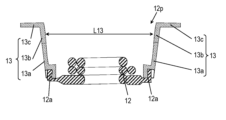
- FIG. 4 shows a cross section of the coil assembly 12p.
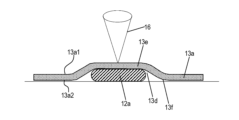
- An end face portion 13a of the electrode member 13 on which the end portion 12a of the coil element 12 overlaps is provided with a recess 13d in advance by press working. It is desirable that the end portion 12a of the coil element 12 is housed in the recess 13d and welded.
- An inner surface 13a1 facing the magnetic core 11 of the electrode member 13 on the opposite side of the recess 13d is provided with a protrusion 13e deformed along the shape of the recess 13d.
- the inner surface 13a1 of the electrode member 13 not provided with the plated layer 13f is irradiated with the laser beam 16.
- the heat generated by the laser beam 16 is transferred to the opposite outer surface 13a2, melts the plated layer 13f, adheres to the end portion 12a of the coil element 12, and conducts heat to the end portion 12a of the coil element 12. end 12a and the electrode member 13 can be welded.
- a step of bending the end portion 12a of the coil element 12 and the electrode member 13 is performed.
- the coil element 12 and the end surface portion 13a of the electrode member 13 are press-molded to form the magnetic core 11, which will be described later. Prepare to enter the mold cavity.
- the magnetic core 11 of the coil assembly 12p is pressure-molded, as shown in FIG.
- the portion 13c is bent outward with respect to the coil element 12 so as to be separated from the coil element 12. As shown in FIG.
- Preparations for forming the magnetic core 11 are made.
- a compacted magnetic powder obtained by mixing a magnetic material powder made of an Fe—Si—Cr alloy and a binder made of silicone is placed in a tablet molding mold and compressed at a pressure of about 0.25 tons/cm 2 .
- a magnetic powder tablet that easily disintegrates under pressure is formed.
- a lower magnetic powder tablet for forming the lower portion of the magnetic core 11 and an upper magnetic powder tablet for forming the upper portion of the magnetic core 11 are prepared.
- the magnetic powder tablet for the lower portion preferably has a cylindrical concave portion for accommodating the coil element 12, and is desirably pot-shaped with an E-shaped cross section.
- the shape of the upper magnetic powder tablet is desirably flat so as to close the concave portion of the lower magnetic powder tablet.
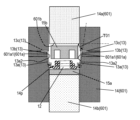
- FIGS. 5 and 6 are cross-sectional views for explaining the method of manufacturing the inductor 501.
- FIG. FIGS. 5 and 6 schematically show the state before the upper magnetic powder tablet 15a, the coil assembly 12p, and the lower magnetic powder tablet 15b are put into the cavity 14p of the mold 14 and pressure-molded. It is represented. 5 corresponds to the cross-section shown in FIG. 2 through line II-II of inductor 501 shown in FIGS. 1 and 2, and FIG. 6 corresponds to the cross-section through line VI-VI of inductor 501 shown in FIG.
- the upper magnetic powder tablet 15a is put into the cavity 14p of the mold 14, then the coil assembly 12p is put thereon, then the lower magnetic powder tablet 15b is put, and the upper punch is pressed. 14a is put down, the lower punch 14b is raised, and the magnetic powder tablets 15a and 15b are press-molded with a pressure of about 4 tons/cm 2 .
- the pressurization is completed, the magnetic core 11 is formed within the cavity 14p of the mold 14, and the bottom portion 13b and the supporting portion 13c of the electrode member 13 are outside the magnetic core 11 (the cavity 14p of the mold 14). It has become.
- the coil element 12 is fixed by being supported by the mold 14 at the supporting portion 13c of the electrode member 13, so that the magnetic powder tablets 15a and 15b are less likely to be misaligned during pressure molding. can.
- the lower magnetic powder tablet 15b may be put into the mold 14 after the coil assembly 12p is put into the mold 14.
- the lower magnetic powder tablet 15b may be placed in the mold 14 while the lower magnetic powder tablet 15b is attached to the coil assembly 12p.
- the angle T01 formed between the outer surface 13a2 of the end surface portion 13a of the mold 14 and the portion 601a1 of the inner wall surface 601a of the mold 14 in contact with the outer surface 13a is set to about 86.5°.
- the angle T02 formed with 601a3 is approximately 89.5°.
- the inclination of the portion 601a1 of the inner wall surface 601a of the mold 14 that contacts the end surface portion 13a of the electrode member 13 with respect to the inner wall surface 601b is defined as regions 11a2 of the end surfaces 11a of the magnetic cores 11 on both sides of the electrode member 13,
- Portions of the inner wall surface of the mold 14 on both sides of the end surface portion 13a of the member 13 serve as supports for supporting the outer surface 13a2 of the end surface portion 13a of the electrode member 13, thereby suppressing the expansion of the outer surface 13a2 of the end surface portion 13a of the electrode member 13. . Therefore, the end surface portion 13a of the electrode member 13 on the side of the end surface 11a of the magnetic core 11 can be made less likely to be damaged.
- the shape of the inductor 501 is stabilized. Therefore, when the inductor 501 is mounted and soldered, it can be stably soldered.
- the coil assembly 12p in which the coil element 12 and the electrode member 13 are integrated is put into the cavity 14p of the mold 14, the coil assembly is arranged such that the distance L13 between the end surface portions 13a of the pair of electrode members 13 is small.
- the three-dimensional body 12p is deformed and inserted into the cavity 14p, and then the distance L13 between the end face portions 13a of the electrode member 13 is widened so that the outer surface 13a2 of the end face portion 13a of the electrode member 13 contacts the inner wall surface portion of the mold 14.
- the magnetic powder tablet 15b for the lower portion may be put in and pressure-molded.
- the magnetic core 11 is thermally cured, the supporting portion 13c of the electrode member 13 is cut, and the bottom portion 13b is bent to obtain the inductor 501.
- the coil assembly 12p is prepared as described above.
- the coil assembly 12p includes a coil element 12 having both ends 12a drawn out in opposite directions, and electrode members 13 electrically and mechanically connected to the ends 12a of the coil element 12, respectively.
- the electrode member 13 has an end face portion 13a electrically and mechanically connected to the end portion 12a of the coil element 12, and a bottom face portion 13b connected to the end face portion 13a.
- a magnetic powder tablet 15a containing magnetic material powder and a resin mixed with the magnetic material powder is prepared.
- a magnetic powder tablet 15a and a coil assembly 12p are placed in a mold 601. As shown in FIG.
- the magnetic core 11 is formed by pressing the magnetic powder tablet 15a while the magnetic powder tablet 15a and the coil assembly 12p are contained in the mold 601 .
- the bottom portion 13b of the electrode member 13 and the bottom portion 13b of the electrode member 13 are bent.
- the magnetic core 11 has a bottom surface 11b, an end surface 11a connected to the bottom surface 11b, and an end surface 111a connected to the bottom surface 11b on the opposite side of the end surface 11a.
- the end surface 11a of the magnetic core 11 is divided into a region 11a1 connected to the bottom surface 11b of the magnetic core 11 and provided with the inner surface 13a1 of the end surface portion 13a of the electrode member 13, and a region 11a1 connected to the bottom surface 11b of the magnetic core 11 with the region 11a1 therebetween. has two regions 11a2 and 11a3 located on both sides of the .
- the end surface 111a of the magnetic core 11 is divided into a region 11a1 connected to the bottom surface 11b of the magnetic core 11 and provided with the inner surface 13a1 of the end surface portion 13a of the electrode member 13, and a region 11a1 connected to the bottom surface 11b of the magnetic core 11 with the region 11a1 therebetween. has two regions 11a2 and 11a3 located on both sides of the .
- the inner wall surface 601a of the mold 601 abuts on the outer surface 13a2 of the end surface portion 13a of the electrode member 13 and the two regions 11a2 and 11a3 of the end surface 11a of the magnetic core 11.
- 601 a contacts two regions 11 a 2 of the outer surface 13 a 2 of the end surface portion 13 a of the electrode member 13 and the end surface 111 a of the magnetic core 11 .
- the angle T2 formed between each of the two regions 11a2 and 11a3 of the end surface 11a of the magnetic core 11 and the bottom surface 11b of the magnetic core 11 is larger than the angle T1 formed between the bottom surface 11b of the magnetic core 11 and the outer surface 13a2 of the end surface portion 13a of the electrode member 13.
- a portion 601a1 (see FIG. 5) of the inner wall surface 601a of the mold 601 that abuts the outer surface 13a2 of the end surface portion 13a of the electrode member 13 when forming the magnetic core 11 is large and smaller than 90.0°.
- an angle T2 formed between each of the two regions 11a2 of the end surface 111a of the magnetic core 11 and the bottom surface 11b of the magnetic core 11 is larger than an angle T1 formed between the bottom surface 11b of the magnetic core 11 and the outer surface 13a2 of the end surface portion 13a of the electrode member 13;
- the inclination of the portion 601a1 of the inner wall surface 601a of the mold 601 that contacts the outer surface 13a2 of the end surface portion 13a of the electrode member 13 when forming the magnetic core 11 is less than 90.0°.
- the coil assembly 12p and the electrode member 13 are put into the mold 601, the coil assembly 12p is deformed so that the distance L13 between the end face portions 13a of the electrode member 13 becomes smaller. After that, with the coil assembly 12p in the mold 601, the distance L13 between the end surface portions 13a of the electrode member 13 is widened to separate the end surface portions 13a and 13a.
- the inner wall surface 601a of the mold 601 may be brought into contact with the inner wall surface 601a.
- a magnetic powder tablet 15b containing magnetic material powder and resin may be further prepared.
- the magnetic powder tablet 15a, the magnetic powder tablet 15b, and the coil assembly 12p are placed in the mold 601, and the magnetic powder tablet 15a and the magnetic powder tablet 15b are pressure-molded to form the magnetic core 11. may be formed.
- the step of putting the coil assembly 12p into the mold 601 may be performed after the step of putting the magnetic powder tablet 15a into the mold 601.
- the step of putting the magnetic powder tablet 15b into the mold 601 may be performed after the step of putting the coil assembly 12p into the mold 601 .
- the coil assembly 12p may be prepared as follows. A conducting wire 12d having a surface provided with an insulating coating 12c is spirally wound. The coil element 12 is formed by pulling out both ends of the conducting wire 12d in opposite directions and peeling off portions of the insulating coating 12c located at both ends of the conducting wire 12d.
- the ends 12a of the coil elements 12 and the electrode members 13 may be bent.
- the electrode member 13 may further have a supporting portion 13c connected to the bottom portion 13b.
- the supporting portion 13c of the electrode member 13 may be separated from the bottom portion 13b after the magnetic core 11 is formed and before the bottom portion 13b of the electrode member 13 is bent.
- the magnetic core 11 may be formed by pressing the magnetic powder tablet 15a (15b) while supporting the supporting portion 13c of the electrode member 13.
- the magnetic core 11 may be formed by pressing the magnetic powder tablet 15a (15b) while supporting the supporting portion 13c of the electrode member 13 with the mold 601.
- the inductor according to the present disclosure is industrially useful because the electrode member is less likely to be damaged even if the electrode member is placed in a mold and the magnetic core is pressure-molded, and the inductor can be provided with excellent solderability. .
Landscapes
- Engineering & Computer Science (AREA)
- Power Engineering (AREA)
- Manufacturing & Machinery (AREA)
- Microelectronics & Electronic Packaging (AREA)
- Coils Or Transformers For Communication (AREA)
Priority Applications (4)
| Application Number | Priority Date | Filing Date | Title |
|---|---|---|---|
| DE112022005178.7T DE112022005178T5 (de) | 2021-10-29 | 2022-09-14 | Induktivität und Verfahren zu deren Herstellung |
| US18/701,275 US20240347255A1 (en) | 2021-10-29 | 2022-09-14 | Inductor and method for manufacturing same |
| JP2023556183A JPWO2023074164A1 (https=) | 2021-10-29 | 2022-09-14 | |
| CN202280068802.9A CN118140287A (zh) | 2021-10-29 | 2022-09-14 | 电感器及其制造方法 |
Applications Claiming Priority (2)
| Application Number | Priority Date | Filing Date | Title |
|---|---|---|---|
| JP2021-177061 | 2021-10-29 | ||
| JP2021177061 | 2021-10-29 |
Publications (1)
| Publication Number | Publication Date |
|---|---|
| WO2023074164A1 true WO2023074164A1 (ja) | 2023-05-04 |
Family
ID=86157819
Family Applications (1)
| Application Number | Title | Priority Date | Filing Date |
|---|---|---|---|
| PCT/JP2022/034358 Ceased WO2023074164A1 (ja) | 2021-10-29 | 2022-09-14 | インダクタおよびその製造方法 |
Country Status (5)
| Country | Link |
|---|---|
| US (1) | US20240347255A1 (https=) |
| JP (1) | JPWO2023074164A1 (https=) |
| CN (1) | CN118140287A (https=) |
| DE (1) | DE112022005178T5 (https=) |
| WO (1) | WO2023074164A1 (https=) |
Citations (7)
| Publication number | Priority date | Publication date | Assignee | Title |
|---|---|---|---|---|
| JPS61186272U (https=) * | 1985-05-10 | 1986-11-20 | ||
| JP2005310869A (ja) * | 2004-04-19 | 2005-11-04 | Matsushita Electric Ind Co Ltd | コイル部品 |
| JP2011249770A (ja) * | 2010-04-27 | 2011-12-08 | Sumida Corporation | コイル部品 |
| JP2016207793A (ja) * | 2015-04-21 | 2016-12-08 | パナソニックIpマネジメント株式会社 | 電子部品 |
| JP2019117914A (ja) * | 2017-12-27 | 2019-07-18 | 太陽誘電株式会社 | コイル部品及び電子機器 |
| JP2019216197A (ja) * | 2018-06-13 | 2019-12-19 | Tdk株式会社 | コイル部品 |
| JP2020017684A (ja) * | 2018-07-27 | 2020-01-30 | パナソニックIpマネジメント株式会社 | インダクタおよびそれを用いた電子機器 |
Family Cites Families (1)
| Publication number | Priority date | Publication date | Assignee | Title |
|---|---|---|---|---|
| JP4301988B2 (ja) | 2004-03-31 | 2009-07-22 | アルプス電気株式会社 | コイル封入圧粉成型体の製造方法 |
-
2022
- 2022-09-14 US US18/701,275 patent/US20240347255A1/en active Pending
- 2022-09-14 CN CN202280068802.9A patent/CN118140287A/zh active Pending
- 2022-09-14 JP JP2023556183A patent/JPWO2023074164A1/ja active Pending
- 2022-09-14 WO PCT/JP2022/034358 patent/WO2023074164A1/ja not_active Ceased
- 2022-09-14 DE DE112022005178.7T patent/DE112022005178T5/de active Pending
Patent Citations (7)
| Publication number | Priority date | Publication date | Assignee | Title |
|---|---|---|---|---|
| JPS61186272U (https=) * | 1985-05-10 | 1986-11-20 | ||
| JP2005310869A (ja) * | 2004-04-19 | 2005-11-04 | Matsushita Electric Ind Co Ltd | コイル部品 |
| JP2011249770A (ja) * | 2010-04-27 | 2011-12-08 | Sumida Corporation | コイル部品 |
| JP2016207793A (ja) * | 2015-04-21 | 2016-12-08 | パナソニックIpマネジメント株式会社 | 電子部品 |
| JP2019117914A (ja) * | 2017-12-27 | 2019-07-18 | 太陽誘電株式会社 | コイル部品及び電子機器 |
| JP2019216197A (ja) * | 2018-06-13 | 2019-12-19 | Tdk株式会社 | コイル部品 |
| JP2020017684A (ja) * | 2018-07-27 | 2020-01-30 | パナソニックIpマネジメント株式会社 | インダクタおよびそれを用いた電子機器 |
Also Published As
| Publication number | Publication date |
|---|---|
| JPWO2023074164A1 (https=) | 2023-05-04 |
| DE112022005178T5 (de) | 2024-08-08 |
| CN118140287A (zh) | 2024-06-04 |
| US20240347255A1 (en) | 2024-10-17 |
Similar Documents
| Publication | Publication Date | Title |
|---|---|---|
| CN100541680C (zh) | 板构件、使用该板构件的磁性元件以及磁性元件的制造方法 | |
| US10453587B2 (en) | Conductor assembly, electronic component using same, and manufacturing method thereof | |
| CN106104719B (zh) | 线圈部件及其制造方法 | |
| JP5572350B2 (ja) | 電線の超音波接合方法 | |
| JP7108826B2 (ja) | インダクタ部品およびその製造方法 | |
| CN208111262U (zh) | 线圈部件 | |
| CN104064319A (zh) | 磁性元件及其制造方法 | |
| CN106165035A (zh) | 线圈部件及线圈部件的制造方法 | |
| TW201243878A (en) | Inductance element | |
| JP6547123B2 (ja) | コイル部品およびその製造方法 | |
| US20250299870A1 (en) | Inductor and method for manufacturing inductor | |
| JP6686978B2 (ja) | コイル部品およびその製造方法 | |
| JP2010109211A (ja) | 電子部品及びその製造方法 | |
| JP6681544B2 (ja) | 電子部品およびそれを用いた電子機器 | |
| WO2023074164A1 (ja) | インダクタおよびその製造方法 | |
| JP7769929B2 (ja) | インダクタ | |
| JP6817509B2 (ja) | インダクター部品およびその製造方法 | |
| JP2006140301A (ja) | コイル部品 | |
| JP2016207793A (ja) | 電子部品 | |
| JP2015201537A (ja) | コイル部品およびその製造方法 | |
| JP2015076498A (ja) | コイル部品およびその製造方法 | |
| JP2018157123A (ja) | コイル部品 | |
| JP2020017684A (ja) | インダクタおよびそれを用いた電子機器 | |
| WO2023032516A1 (ja) | インダクタおよびその製造方法 | |
| JP7245062B2 (ja) | コイル部品、電子機器、及びコイル部品の製造方法 |
Legal Events
| Date | Code | Title | Description |
|---|---|---|---|
| 121 | Ep: the epo has been informed by wipo that ep was designated in this application |
Ref document number: 22886498 Country of ref document: EP Kind code of ref document: A1 |
|
| WWE | Wipo information: entry into national phase |
Ref document number: 202280068802.9 Country of ref document: CN |
|
| ENP | Entry into the national phase |
Ref document number: 2023556183 Country of ref document: JP Kind code of ref document: A |
|
| WWE | Wipo information: entry into national phase |
Ref document number: 18701275 Country of ref document: US |
|
| WWE | Wipo information: entry into national phase |
Ref document number: 112022005178 Country of ref document: DE |
|
| 122 | Ep: pct application non-entry in european phase |
Ref document number: 22886498 Country of ref document: EP Kind code of ref document: A1 |