WO2023063257A1 - 発泡成形品用補強材に用いられる不織布、発泡成形品用補強材、及び発泡成形品用補強材に用いられる不織布の製造方法 - Google Patents
発泡成形品用補強材に用いられる不織布、発泡成形品用補強材、及び発泡成形品用補強材に用いられる不織布の製造方法 Download PDFInfo
- Publication number
- WO2023063257A1 WO2023063257A1 PCT/JP2022/037640 JP2022037640W WO2023063257A1 WO 2023063257 A1 WO2023063257 A1 WO 2023063257A1 JP 2022037640 W JP2022037640 W JP 2022037640W WO 2023063257 A1 WO2023063257 A1 WO 2023063257A1
- Authority
- WO
- WIPO (PCT)
- Prior art keywords
- nonwoven fabric
- reinforcing material
- foam
- fabric used
- fibers
- Prior art date
- Legal status (The legal status is an assumption and is not a legal conclusion. Google has not performed a legal analysis and makes no representation as to the accuracy of the status listed.)
- Ceased
Links
Images



Classifications
-
- B—PERFORMING OPERATIONS; TRANSPORTING
- B32—LAYERED PRODUCTS
- B32B—LAYERED PRODUCTS, i.e. PRODUCTS BUILT-UP OF STRATA OF FLAT OR NON-FLAT, e.g. CELLULAR OR HONEYCOMB, FORM
- B32B38/00—Ancillary operations in connection with laminating processes
- B32B38/0036—Heat treatment
-
- A—HUMAN NECESSITIES
- A47—FURNITURE; DOMESTIC ARTICLES OR APPLIANCES; COFFEE MILLS; SPICE MILLS; SUCTION CLEANERS IN GENERAL
- A47C—CHAIRS; SOFAS; BEDS
- A47C27/00—Spring, stuffed or fluid mattresses or cushions specially adapted for chairs, beds or sofas
- A47C27/14—Spring, stuffed or fluid mattresses or cushions specially adapted for chairs, beds or sofas with foamed material inlays
- A47C27/16—Spring, stuffed or fluid mattresses or cushions specially adapted for chairs, beds or sofas with foamed material inlays reinforced with sheet-like or rigid elements, e.g. profiled
-
- B—PERFORMING OPERATIONS; TRANSPORTING
- B29—WORKING OF PLASTICS; WORKING OF SUBSTANCES IN A PLASTIC STATE IN GENERAL
- B29C—SHAPING OR JOINING OF PLASTICS; SHAPING OF MATERIAL IN A PLASTIC STATE, NOT OTHERWISE PROVIDED FOR; AFTER-TREATMENT OF THE SHAPED PRODUCTS, e.g. REPAIRING
- B29C39/00—Shaping by casting, i.e. introducing the moulding material into a mould or between confining surfaces without significant moulding pressure; Apparatus therefor
- B29C39/02—Shaping by casting, i.e. introducing the moulding material into a mould or between confining surfaces without significant moulding pressure; Apparatus therefor for making articles of definite length, i.e. discrete articles
- B29C39/10—Shaping by casting, i.e. introducing the moulding material into a mould or between confining surfaces without significant moulding pressure; Apparatus therefor for making articles of definite length, i.e. discrete articles incorporating preformed parts or layers, e.g. casting around inserts or for coating articles
-
- B—PERFORMING OPERATIONS; TRANSPORTING
- B29—WORKING OF PLASTICS; WORKING OF SUBSTANCES IN A PLASTIC STATE IN GENERAL
- B29C—SHAPING OR JOINING OF PLASTICS; SHAPING OF MATERIAL IN A PLASTIC STATE, NOT OTHERWISE PROVIDED FOR; AFTER-TREATMENT OF THE SHAPED PRODUCTS, e.g. REPAIRING
- B29C44/00—Shaping by internal pressure generated in the material, e.g. swelling or foaming ; Producing porous or cellular expanded plastics articles
-
- B—PERFORMING OPERATIONS; TRANSPORTING
- B29—WORKING OF PLASTICS; WORKING OF SUBSTANCES IN A PLASTIC STATE IN GENERAL
- B29C—SHAPING OR JOINING OF PLASTICS; SHAPING OF MATERIAL IN A PLASTIC STATE, NOT OTHERWISE PROVIDED FOR; AFTER-TREATMENT OF THE SHAPED PRODUCTS, e.g. REPAIRING
- B29C44/00—Shaping by internal pressure generated in the material, e.g. swelling or foaming ; Producing porous or cellular expanded plastics articles
- B29C44/02—Shaping by internal pressure generated in the material, e.g. swelling or foaming ; Producing porous or cellular expanded plastics articles for articles of definite length, i.e. discrete articles
- B29C44/12—Incorporating or moulding on preformed parts, e.g. inserts or reinforcements
-
- B—PERFORMING OPERATIONS; TRANSPORTING
- B29—WORKING OF PLASTICS; WORKING OF SUBSTANCES IN A PLASTIC STATE IN GENERAL
- B29C—SHAPING OR JOINING OF PLASTICS; SHAPING OF MATERIAL IN A PLASTIC STATE, NOT OTHERWISE PROVIDED FOR; AFTER-TREATMENT OF THE SHAPED PRODUCTS, e.g. REPAIRING
- B29C44/00—Shaping by internal pressure generated in the material, e.g. swelling or foaming ; Producing porous or cellular expanded plastics articles
- B29C44/02—Shaping by internal pressure generated in the material, e.g. swelling or foaming ; Producing porous or cellular expanded plastics articles for articles of definite length, i.e. discrete articles
- B29C44/12—Incorporating or moulding on preformed parts, e.g. inserts or reinforcements
- B29C44/14—Incorporating or moulding on preformed parts, e.g. inserts or reinforcements the preformed part being a lining
-
- B—PERFORMING OPERATIONS; TRANSPORTING
- B32—LAYERED PRODUCTS
- B32B—LAYERED PRODUCTS, i.e. PRODUCTS BUILT-UP OF STRATA OF FLAT OR NON-FLAT, e.g. CELLULAR OR HONEYCOMB, FORM
- B32B5/00—Layered products characterised by the non- homogeneity or physical structure, i.e. comprising a fibrous, filamentary, particulate or foam layer; Layered products characterised by having a layer differing constitutionally or physically in different parts
- B32B5/02—Layered products characterised by the non- homogeneity or physical structure, i.e. comprising a fibrous, filamentary, particulate or foam layer; Layered products characterised by having a layer differing constitutionally or physically in different parts characterised by structural features of a fibrous or filamentary layer
- B32B5/022—Non-woven fabric
-
- B—PERFORMING OPERATIONS; TRANSPORTING
- B32—LAYERED PRODUCTS
- B32B—LAYERED PRODUCTS, i.e. PRODUCTS BUILT-UP OF STRATA OF FLAT OR NON-FLAT, e.g. CELLULAR OR HONEYCOMB, FORM
- B32B5/00—Layered products characterised by the non- homogeneity or physical structure, i.e. comprising a fibrous, filamentary, particulate or foam layer; Layered products characterised by having a layer differing constitutionally or physically in different parts
- B32B5/02—Layered products characterised by the non- homogeneity or physical structure, i.e. comprising a fibrous, filamentary, particulate or foam layer; Layered products characterised by having a layer differing constitutionally or physically in different parts characterised by structural features of a fibrous or filamentary layer
- B32B5/06—Layered products characterised by the non- homogeneity or physical structure, i.e. comprising a fibrous, filamentary, particulate or foam layer; Layered products characterised by having a layer differing constitutionally or physically in different parts characterised by structural features of a fibrous or filamentary layer characterised by a fibrous or filamentary layer mechanically connected, e.g. by needling to another layer, e.g. of fibres, of paper
-
- B—PERFORMING OPERATIONS; TRANSPORTING
- B32—LAYERED PRODUCTS
- B32B—LAYERED PRODUCTS, i.e. PRODUCTS BUILT-UP OF STRATA OF FLAT OR NON-FLAT, e.g. CELLULAR OR HONEYCOMB, FORM
- B32B5/00—Layered products characterised by the non- homogeneity or physical structure, i.e. comprising a fibrous, filamentary, particulate or foam layer; Layered products characterised by having a layer differing constitutionally or physically in different parts
- B32B5/02—Layered products characterised by the non- homogeneity or physical structure, i.e. comprising a fibrous, filamentary, particulate or foam layer; Layered products characterised by having a layer differing constitutionally or physically in different parts characterised by structural features of a fibrous or filamentary layer
- B32B5/08—Layered products characterised by the non- homogeneity or physical structure, i.e. comprising a fibrous, filamentary, particulate or foam layer; Layered products characterised by having a layer differing constitutionally or physically in different parts characterised by structural features of a fibrous or filamentary layer the fibres or filaments of a layer being of different substances, e.g. conjugate fibres, mixture of different fibres
-
- B—PERFORMING OPERATIONS; TRANSPORTING
- B32—LAYERED PRODUCTS
- B32B—LAYERED PRODUCTS, i.e. PRODUCTS BUILT-UP OF STRATA OF FLAT OR NON-FLAT, e.g. CELLULAR OR HONEYCOMB, FORM
- B32B5/00—Layered products characterised by the non- homogeneity or physical structure, i.e. comprising a fibrous, filamentary, particulate or foam layer; Layered products characterised by having a layer differing constitutionally or physically in different parts
- B32B5/18—Layered products characterised by the non- homogeneity or physical structure, i.e. comprising a fibrous, filamentary, particulate or foam layer; Layered products characterised by having a layer differing constitutionally or physically in different parts characterised by features of a layer of foamed material
- B32B5/20—Layered products characterised by the non- homogeneity or physical structure, i.e. comprising a fibrous, filamentary, particulate or foam layer; Layered products characterised by having a layer differing constitutionally or physically in different parts characterised by features of a layer of foamed material foamed in situ
-
- B—PERFORMING OPERATIONS; TRANSPORTING
- B32—LAYERED PRODUCTS
- B32B—LAYERED PRODUCTS, i.e. PRODUCTS BUILT-UP OF STRATA OF FLAT OR NON-FLAT, e.g. CELLULAR OR HONEYCOMB, FORM
- B32B5/00—Layered products characterised by the non- homogeneity or physical structure, i.e. comprising a fibrous, filamentary, particulate or foam layer; Layered products characterised by having a layer differing constitutionally or physically in different parts
- B32B5/22—Layered products characterised by the non- homogeneity or physical structure, i.e. comprising a fibrous, filamentary, particulate or foam layer; Layered products characterised by having a layer differing constitutionally or physically in different parts characterised by the presence of two or more layers which are next to each other and are fibrous, filamentary, formed of particles or foamed
- B32B5/24—Layered products characterised by the non- homogeneity or physical structure, i.e. comprising a fibrous, filamentary, particulate or foam layer; Layered products characterised by having a layer differing constitutionally or physically in different parts characterised by the presence of two or more layers which are next to each other and are fibrous, filamentary, formed of particles or foamed one layer being a fibrous or filamentary layer
- B32B5/245—Layered products characterised by the non- homogeneity or physical structure, i.e. comprising a fibrous, filamentary, particulate or foam layer; Layered products characterised by having a layer differing constitutionally or physically in different parts characterised by the presence of two or more layers which are next to each other and are fibrous, filamentary, formed of particles or foamed one layer being a fibrous or filamentary layer another layer next to it being a foam layer
-
- D—TEXTILES; PAPER
- D04—BRAIDING; LACE-MAKING; KNITTING; TRIMMINGS; NON-WOVEN FABRICS
- D04H—MAKING TEXTILE FABRICS, e.g. FROM FIBRES OR FILAMENTARY MATERIAL; FABRICS MADE BY SUCH PROCESSES OR APPARATUS, e.g. FELTS, NON-WOVEN FABRICS; COTTON-WOOL; WADDING ; NON-WOVEN FABRICS FROM STAPLE FIBRES, FILAMENTS OR YARNS, BONDED WITH AT LEAST ONE WEB-LIKE MATERIAL DURING THEIR CONSOLIDATION
- D04H1/00—Non-woven fabrics formed wholly or mainly of staple fibres or like relatively short fibres
- D04H1/40—Non-woven fabrics formed wholly or mainly of staple fibres or like relatively short fibres from fleeces or layers composed of fibres without existing or potential cohesive properties
- D04H1/42—Non-woven fabrics formed wholly or mainly of staple fibres or like relatively short fibres from fleeces or layers composed of fibres without existing or potential cohesive properties characterised by the use of certain kinds of fibres insofar as this use has no preponderant influence on the consolidation of the fleece
- D04H1/4282—Addition polymers
- D04H1/4291—Olefin series
-
- D—TEXTILES; PAPER
- D04—BRAIDING; LACE-MAKING; KNITTING; TRIMMINGS; NON-WOVEN FABRICS
- D04H—MAKING TEXTILE FABRICS, e.g. FROM FIBRES OR FILAMENTARY MATERIAL; FABRICS MADE BY SUCH PROCESSES OR APPARATUS, e.g. FELTS, NON-WOVEN FABRICS; COTTON-WOOL; WADDING ; NON-WOVEN FABRICS FROM STAPLE FIBRES, FILAMENTS OR YARNS, BONDED WITH AT LEAST ONE WEB-LIKE MATERIAL DURING THEIR CONSOLIDATION
- D04H1/00—Non-woven fabrics formed wholly or mainly of staple fibres or like relatively short fibres
- D04H1/40—Non-woven fabrics formed wholly or mainly of staple fibres or like relatively short fibres from fleeces or layers composed of fibres without existing or potential cohesive properties
- D04H1/42—Non-woven fabrics formed wholly or mainly of staple fibres or like relatively short fibres from fleeces or layers composed of fibres without existing or potential cohesive properties characterised by the use of certain kinds of fibres insofar as this use has no preponderant influence on the consolidation of the fleece
- D04H1/4326—Condensation or reaction polymers
- D04H1/435—Polyesters
-
- D—TEXTILES; PAPER
- D04—BRAIDING; LACE-MAKING; KNITTING; TRIMMINGS; NON-WOVEN FABRICS
- D04H—MAKING TEXTILE FABRICS, e.g. FROM FIBRES OR FILAMENTARY MATERIAL; FABRICS MADE BY SUCH PROCESSES OR APPARATUS, e.g. FELTS, NON-WOVEN FABRICS; COTTON-WOOL; WADDING ; NON-WOVEN FABRICS FROM STAPLE FIBRES, FILAMENTS OR YARNS, BONDED WITH AT LEAST ONE WEB-LIKE MATERIAL DURING THEIR CONSOLIDATION
- D04H1/00—Non-woven fabrics formed wholly or mainly of staple fibres or like relatively short fibres
- D04H1/40—Non-woven fabrics formed wholly or mainly of staple fibres or like relatively short fibres from fleeces or layers composed of fibres without existing or potential cohesive properties
- D04H1/42—Non-woven fabrics formed wholly or mainly of staple fibres or like relatively short fibres from fleeces or layers composed of fibres without existing or potential cohesive properties characterised by the use of certain kinds of fibres insofar as this use has no preponderant influence on the consolidation of the fleece
- D04H1/4382—Stretched reticular film fibres; Composite fibres; Mixed fibres; Ultrafine fibres; Fibres for artificial leather
-
- D—TEXTILES; PAPER
- D04—BRAIDING; LACE-MAKING; KNITTING; TRIMMINGS; NON-WOVEN FABRICS
- D04H—MAKING TEXTILE FABRICS, e.g. FROM FIBRES OR FILAMENTARY MATERIAL; FABRICS MADE BY SUCH PROCESSES OR APPARATUS, e.g. FELTS, NON-WOVEN FABRICS; COTTON-WOOL; WADDING ; NON-WOVEN FABRICS FROM STAPLE FIBRES, FILAMENTS OR YARNS, BONDED WITH AT LEAST ONE WEB-LIKE MATERIAL DURING THEIR CONSOLIDATION
- D04H1/00—Non-woven fabrics formed wholly or mainly of staple fibres or like relatively short fibres
- D04H1/40—Non-woven fabrics formed wholly or mainly of staple fibres or like relatively short fibres from fleeces or layers composed of fibres without existing or potential cohesive properties
- D04H1/42—Non-woven fabrics formed wholly or mainly of staple fibres or like relatively short fibres from fleeces or layers composed of fibres without existing or potential cohesive properties characterised by the use of certain kinds of fibres insofar as this use has no preponderant influence on the consolidation of the fleece
- D04H1/4382—Stretched reticular film fibres; Composite fibres; Mixed fibres; Ultrafine fibres; Fibres for artificial leather
- D04H1/43825—Composite fibres
- D04H1/43828—Composite fibres sheath-core
-
- D—TEXTILES; PAPER
- D04—BRAIDING; LACE-MAKING; KNITTING; TRIMMINGS; NON-WOVEN FABRICS
- D04H—MAKING TEXTILE FABRICS, e.g. FROM FIBRES OR FILAMENTARY MATERIAL; FABRICS MADE BY SUCH PROCESSES OR APPARATUS, e.g. FELTS, NON-WOVEN FABRICS; COTTON-WOOL; WADDING ; NON-WOVEN FABRICS FROM STAPLE FIBRES, FILAMENTS OR YARNS, BONDED WITH AT LEAST ONE WEB-LIKE MATERIAL DURING THEIR CONSOLIDATION
- D04H1/00—Non-woven fabrics formed wholly or mainly of staple fibres or like relatively short fibres
- D04H1/40—Non-woven fabrics formed wholly or mainly of staple fibres or like relatively short fibres from fleeces or layers composed of fibres without existing or potential cohesive properties
- D04H1/42—Non-woven fabrics formed wholly or mainly of staple fibres or like relatively short fibres from fleeces or layers composed of fibres without existing or potential cohesive properties characterised by the use of certain kinds of fibres insofar as this use has no preponderant influence on the consolidation of the fleece
- D04H1/4382—Stretched reticular film fibres; Composite fibres; Mixed fibres; Ultrafine fibres; Fibres for artificial leather
- D04H1/43835—Mixed fibres, e.g. at least two chemically different fibres or fibre blends
-
- D—TEXTILES; PAPER
- D04—BRAIDING; LACE-MAKING; KNITTING; TRIMMINGS; NON-WOVEN FABRICS
- D04H—MAKING TEXTILE FABRICS, e.g. FROM FIBRES OR FILAMENTARY MATERIAL; FABRICS MADE BY SUCH PROCESSES OR APPARATUS, e.g. FELTS, NON-WOVEN FABRICS; COTTON-WOOL; WADDING ; NON-WOVEN FABRICS FROM STAPLE FIBRES, FILAMENTS OR YARNS, BONDED WITH AT LEAST ONE WEB-LIKE MATERIAL DURING THEIR CONSOLIDATION
- D04H1/00—Non-woven fabrics formed wholly or mainly of staple fibres or like relatively short fibres
- D04H1/40—Non-woven fabrics formed wholly or mainly of staple fibres or like relatively short fibres from fleeces or layers composed of fibres without existing or potential cohesive properties
- D04H1/44—Non-woven fabrics formed wholly or mainly of staple fibres or like relatively short fibres from fleeces or layers composed of fibres without existing or potential cohesive properties the fleeces or layers being consolidated by mechanical means, e.g. by rolling
- D04H1/46—Non-woven fabrics formed wholly or mainly of staple fibres or like relatively short fibres from fleeces or layers composed of fibres without existing or potential cohesive properties the fleeces or layers being consolidated by mechanical means, e.g. by rolling by needling or like operations to cause entanglement of fibres
-
- D—TEXTILES; PAPER
- D04—BRAIDING; LACE-MAKING; KNITTING; TRIMMINGS; NON-WOVEN FABRICS
- D04H—MAKING TEXTILE FABRICS, e.g. FROM FIBRES OR FILAMENTARY MATERIAL; FABRICS MADE BY SUCH PROCESSES OR APPARATUS, e.g. FELTS, NON-WOVEN FABRICS; COTTON-WOOL; WADDING ; NON-WOVEN FABRICS FROM STAPLE FIBRES, FILAMENTS OR YARNS, BONDED WITH AT LEAST ONE WEB-LIKE MATERIAL DURING THEIR CONSOLIDATION
- D04H1/00—Non-woven fabrics formed wholly or mainly of staple fibres or like relatively short fibres
- D04H1/40—Non-woven fabrics formed wholly or mainly of staple fibres or like relatively short fibres from fleeces or layers composed of fibres without existing or potential cohesive properties
- D04H1/44—Non-woven fabrics formed wholly or mainly of staple fibres or like relatively short fibres from fleeces or layers composed of fibres without existing or potential cohesive properties the fleeces or layers being consolidated by mechanical means, e.g. by rolling
- D04H1/46—Non-woven fabrics formed wholly or mainly of staple fibres or like relatively short fibres from fleeces or layers composed of fibres without existing or potential cohesive properties the fleeces or layers being consolidated by mechanical means, e.g. by rolling by needling or like operations to cause entanglement of fibres
- D04H1/48—Non-woven fabrics formed wholly or mainly of staple fibres or like relatively short fibres from fleeces or layers composed of fibres without existing or potential cohesive properties the fleeces or layers being consolidated by mechanical means, e.g. by rolling by needling or like operations to cause entanglement of fibres in combination with at least one other method of consolidation
- D04H1/485—Non-woven fabrics formed wholly or mainly of staple fibres or like relatively short fibres from fleeces or layers composed of fibres without existing or potential cohesive properties the fleeces or layers being consolidated by mechanical means, e.g. by rolling by needling or like operations to cause entanglement of fibres in combination with at least one other method of consolidation in combination with weld-bonding
-
- D—TEXTILES; PAPER
- D04—BRAIDING; LACE-MAKING; KNITTING; TRIMMINGS; NON-WOVEN FABRICS
- D04H—MAKING TEXTILE FABRICS, e.g. FROM FIBRES OR FILAMENTARY MATERIAL; FABRICS MADE BY SUCH PROCESSES OR APPARATUS, e.g. FELTS, NON-WOVEN FABRICS; COTTON-WOOL; WADDING ; NON-WOVEN FABRICS FROM STAPLE FIBRES, FILAMENTS OR YARNS, BONDED WITH AT LEAST ONE WEB-LIKE MATERIAL DURING THEIR CONSOLIDATION
- D04H1/00—Non-woven fabrics formed wholly or mainly of staple fibres or like relatively short fibres
- D04H1/40—Non-woven fabrics formed wholly or mainly of staple fibres or like relatively short fibres from fleeces or layers composed of fibres without existing or potential cohesive properties
- D04H1/44—Non-woven fabrics formed wholly or mainly of staple fibres or like relatively short fibres from fleeces or layers composed of fibres without existing or potential cohesive properties the fleeces or layers being consolidated by mechanical means, e.g. by rolling
- D04H1/46—Non-woven fabrics formed wholly or mainly of staple fibres or like relatively short fibres from fleeces or layers composed of fibres without existing or potential cohesive properties the fleeces or layers being consolidated by mechanical means, e.g. by rolling by needling or like operations to cause entanglement of fibres
- D04H1/498—Non-woven fabrics formed wholly or mainly of staple fibres or like relatively short fibres from fleeces or layers composed of fibres without existing or potential cohesive properties the fleeces or layers being consolidated by mechanical means, e.g. by rolling by needling or like operations to cause entanglement of fibres entanglement of layered webs
-
- D—TEXTILES; PAPER
- D04—BRAIDING; LACE-MAKING; KNITTING; TRIMMINGS; NON-WOVEN FABRICS
- D04H—MAKING TEXTILE FABRICS, e.g. FROM FIBRES OR FILAMENTARY MATERIAL; FABRICS MADE BY SUCH PROCESSES OR APPARATUS, e.g. FELTS, NON-WOVEN FABRICS; COTTON-WOOL; WADDING ; NON-WOVEN FABRICS FROM STAPLE FIBRES, FILAMENTS OR YARNS, BONDED WITH AT LEAST ONE WEB-LIKE MATERIAL DURING THEIR CONSOLIDATION
- D04H1/00—Non-woven fabrics formed wholly or mainly of staple fibres or like relatively short fibres
- D04H1/40—Non-woven fabrics formed wholly or mainly of staple fibres or like relatively short fibres from fleeces or layers composed of fibres without existing or potential cohesive properties
- D04H1/54—Non-woven fabrics formed wholly or mainly of staple fibres or like relatively short fibres from fleeces or layers composed of fibres without existing or potential cohesive properties by welding together the fibres, e.g. by partially melting or dissolving
- D04H1/541—Composite fibres, e.g. sheath-core, sea-island or side-by-side; Mixed fibres
-
- D—TEXTILES; PAPER
- D04—BRAIDING; LACE-MAKING; KNITTING; TRIMMINGS; NON-WOVEN FABRICS
- D04H—MAKING TEXTILE FABRICS, e.g. FROM FIBRES OR FILAMENTARY MATERIAL; FABRICS MADE BY SUCH PROCESSES OR APPARATUS, e.g. FELTS, NON-WOVEN FABRICS; COTTON-WOOL; WADDING ; NON-WOVEN FABRICS FROM STAPLE FIBRES, FILAMENTS OR YARNS, BONDED WITH AT LEAST ONE WEB-LIKE MATERIAL DURING THEIR CONSOLIDATION
- D04H1/00—Non-woven fabrics formed wholly or mainly of staple fibres or like relatively short fibres
- D04H1/40—Non-woven fabrics formed wholly or mainly of staple fibres or like relatively short fibres from fleeces or layers composed of fibres without existing or potential cohesive properties
- D04H1/54—Non-woven fabrics formed wholly or mainly of staple fibres or like relatively short fibres from fleeces or layers composed of fibres without existing or potential cohesive properties by welding together the fibres, e.g. by partially melting or dissolving
- D04H1/542—Adhesive fibres
- D04H1/544—Olefin series
-
- D—TEXTILES; PAPER
- D04—BRAIDING; LACE-MAKING; KNITTING; TRIMMINGS; NON-WOVEN FABRICS
- D04H—MAKING TEXTILE FABRICS, e.g. FROM FIBRES OR FILAMENTARY MATERIAL; FABRICS MADE BY SUCH PROCESSES OR APPARATUS, e.g. FELTS, NON-WOVEN FABRICS; COTTON-WOOL; WADDING ; NON-WOVEN FABRICS FROM STAPLE FIBRES, FILAMENTS OR YARNS, BONDED WITH AT LEAST ONE WEB-LIKE MATERIAL DURING THEIR CONSOLIDATION
- D04H1/00—Non-woven fabrics formed wholly or mainly of staple fibres or like relatively short fibres
- D04H1/40—Non-woven fabrics formed wholly or mainly of staple fibres or like relatively short fibres from fleeces or layers composed of fibres without existing or potential cohesive properties
- D04H1/54—Non-woven fabrics formed wholly or mainly of staple fibres or like relatively short fibres from fleeces or layers composed of fibres without existing or potential cohesive properties by welding together the fibres, e.g. by partially melting or dissolving
- D04H1/559—Non-woven fabrics formed wholly or mainly of staple fibres or like relatively short fibres from fleeces or layers composed of fibres without existing or potential cohesive properties by welding together the fibres, e.g. by partially melting or dissolving the fibres being within layered webs
-
- D—TEXTILES; PAPER
- D04—BRAIDING; LACE-MAKING; KNITTING; TRIMMINGS; NON-WOVEN FABRICS
- D04H—MAKING TEXTILE FABRICS, e.g. FROM FIBRES OR FILAMENTARY MATERIAL; FABRICS MADE BY SUCH PROCESSES OR APPARATUS, e.g. FELTS, NON-WOVEN FABRICS; COTTON-WOOL; WADDING ; NON-WOVEN FABRICS FROM STAPLE FIBRES, FILAMENTS OR YARNS, BONDED WITH AT LEAST ONE WEB-LIKE MATERIAL DURING THEIR CONSOLIDATION
- D04H3/00—Non-woven fabrics formed wholly or mainly of yarns or like filamentary material of substantial length
- D04H3/08—Non-woven fabrics formed wholly or mainly of yarns or like filamentary material of substantial length characterised by the method of strengthening or consolidating
- D04H3/10—Non-woven fabrics formed wholly or mainly of yarns or like filamentary material of substantial length characterised by the method of strengthening or consolidating with bonds between yarns or filaments made mechanically
- D04H3/105—Non-woven fabrics formed wholly or mainly of yarns or like filamentary material of substantial length characterised by the method of strengthening or consolidating with bonds between yarns or filaments made mechanically by needling
-
- D—TEXTILES; PAPER
- D04—BRAIDING; LACE-MAKING; KNITTING; TRIMMINGS; NON-WOVEN FABRICS
- D04H—MAKING TEXTILE FABRICS, e.g. FROM FIBRES OR FILAMENTARY MATERIAL; FABRICS MADE BY SUCH PROCESSES OR APPARATUS, e.g. FELTS, NON-WOVEN FABRICS; COTTON-WOOL; WADDING ; NON-WOVEN FABRICS FROM STAPLE FIBRES, FILAMENTS OR YARNS, BONDED WITH AT LEAST ONE WEB-LIKE MATERIAL DURING THEIR CONSOLIDATION
- D04H3/00—Non-woven fabrics formed wholly or mainly of yarns or like filamentary material of substantial length
- D04H3/08—Non-woven fabrics formed wholly or mainly of yarns or like filamentary material of substantial length characterised by the method of strengthening or consolidating
- D04H3/14—Non-woven fabrics formed wholly or mainly of yarns or like filamentary material of substantial length characterised by the method of strengthening or consolidating with bonds between thermoplastic yarns or filaments produced by welding
- D04H3/147—Composite yarns or filaments
-
- B—PERFORMING OPERATIONS; TRANSPORTING
- B32—LAYERED PRODUCTS
- B32B—LAYERED PRODUCTS, i.e. PRODUCTS BUILT-UP OF STRATA OF FLAT OR NON-FLAT, e.g. CELLULAR OR HONEYCOMB, FORM
- B32B41/00—Arrangements for controlling or monitoring lamination processes; Safety arrangements
- B32B2041/04—Detecting wrong registration, misalignment, deviation, failure
-
- B—PERFORMING OPERATIONS; TRANSPORTING
- B32—LAYERED PRODUCTS
- B32B—LAYERED PRODUCTS, i.e. PRODUCTS BUILT-UP OF STRATA OF FLAT OR NON-FLAT, e.g. CELLULAR OR HONEYCOMB, FORM
- B32B2262/00—Composition or structural features of fibres which form a fibrous or filamentary layer or are present as additives
- B32B2262/02—Synthetic macromolecular fibres
- B32B2262/0253—Polyolefin fibres
-
- B—PERFORMING OPERATIONS; TRANSPORTING
- B32—LAYERED PRODUCTS
- B32B—LAYERED PRODUCTS, i.e. PRODUCTS BUILT-UP OF STRATA OF FLAT OR NON-FLAT, e.g. CELLULAR OR HONEYCOMB, FORM
- B32B2262/00—Composition or structural features of fibres which form a fibrous or filamentary layer or are present as additives
- B32B2262/02—Synthetic macromolecular fibres
- B32B2262/0276—Polyester fibres
- B32B2262/0284—Polyethylene terephthalate [PET] or polybutylene terephthalate [PBT]
-
- B—PERFORMING OPERATIONS; TRANSPORTING
- B32—LAYERED PRODUCTS
- B32B—LAYERED PRODUCTS, i.e. PRODUCTS BUILT-UP OF STRATA OF FLAT OR NON-FLAT, e.g. CELLULAR OR HONEYCOMB, FORM
- B32B2262/00—Composition or structural features of fibres which form a fibrous or filamentary layer or are present as additives
- B32B2262/12—Conjugate fibres, e.g. core/sheath or side-by-side
- B32B2262/124—Non-woven fabric
-
- B—PERFORMING OPERATIONS; TRANSPORTING
- B32—LAYERED PRODUCTS
- B32B—LAYERED PRODUCTS, i.e. PRODUCTS BUILT-UP OF STRATA OF FLAT OR NON-FLAT, e.g. CELLULAR OR HONEYCOMB, FORM
- B32B2262/00—Composition or structural features of fibres which form a fibrous or filamentary layer or are present as additives
- B32B2262/14—Mixture of at least two fibres made of different materials
- B32B2262/144—Non-woven fabric
-
- B—PERFORMING OPERATIONS; TRANSPORTING
- B32—LAYERED PRODUCTS
- B32B—LAYERED PRODUCTS, i.e. PRODUCTS BUILT-UP OF STRATA OF FLAT OR NON-FLAT, e.g. CELLULAR OR HONEYCOMB, FORM
- B32B2305/00—Condition, form or state of the layers or laminate
- B32B2305/08—Reinforcements
-
- B—PERFORMING OPERATIONS; TRANSPORTING
- B32—LAYERED PRODUCTS
- B32B—LAYERED PRODUCTS, i.e. PRODUCTS BUILT-UP OF STRATA OF FLAT OR NON-FLAT, e.g. CELLULAR OR HONEYCOMB, FORM
- B32B2305/00—Condition, form or state of the layers or laminate
- B32B2305/22—Fibres of short length
-
- B—PERFORMING OPERATIONS; TRANSPORTING
- B32—LAYERED PRODUCTS
- B32B—LAYERED PRODUCTS, i.e. PRODUCTS BUILT-UP OF STRATA OF FLAT OR NON-FLAT, e.g. CELLULAR OR HONEYCOMB, FORM
- B32B2307/00—Properties of the layers or laminate
- B32B2307/70—Other properties
- B32B2307/732—Dimensional properties
- B32B2307/737—Dimensions, e.g. volume or area
- B32B2307/7375—Linear, e.g. length, distance or width
- B32B2307/7376—Thickness
Definitions
- the present disclosure relates to a nonwoven fabric used as a reinforcing material for foam-molded products, a reinforcing material for foam-molded products, and a method for manufacturing a nonwoven fabric used for reinforcing foam-molded products.
- a reinforcing material for foam molded products there is a non-woven fabric that is joined to a urethane foam molded product (for example, Patent Document 1).
- the reinforcing material is set in the mold, and the mold is closed after supplying the foamed urethane material to the inside of the mold. Then, the gas generated by the urethane foaming passes through the gaps between the fibers of the nonwoven fabric, and the urethane foam is joined to the reinforcing material.
- a reinforcing material is a seat pad used in vehicle seats.
- a seat pad may be placed in contact with a metal part, such as a pipe frame or a spring. This is because the reinforcing material is used to prevent the foam material from being damaged by localized forces received from the metal parts.
- An object of the present disclosure is to provide a nonwoven fabric used as a reinforcing material for foam-molded products, a reinforcing material for foam-molded products, and a method for manufacturing a nonwoven fabric used for reinforcing foam-molded products.
- the nonwoven fabric used for the reinforcing material for the foam molded product that is joined to the foam molded product to reinforce the foam molded product is a single-layer material in which laminated webs are bonded to each other. , a thickness of 1 to 8 mm at a load of 7 g/cm 2 , and a delamination strength of 0.05 to 2.45 N/cm, wherein the delamination strength is sufficient to separate the bonded webs from each other. is the value of the tensile force required for
- FIG. 1 is a perspective view of a reinforcing member according to an embodiment
- FIG. Figure 2 is a plan view of the nonwoven prior to being formed into the reinforcement of Figure 1
- FIG. 4 is a cross-sectional view of a foamed molded article manufactured by the method of FIG. 3; It is a flow which shows the manufacturing method of the nonwoven fabric of FIG.
- It is a schematic diagram which shows the lamination process of FIG.
- FIG. 5 is a schematic diagram explaining the needle punch process of FIG. 5, and a heat processing process.
- FIG. 8 is a side view of a needle used in the needle punching process of FIG.
- FIG. 7 is a perspective view of a molding apparatus for molding the stiffener of FIG. 1;
- FIG. FIG. 10 is a perspective view showing how the forming apparatus of FIG. 9 is covered with a nonwoven fabric;
- FIG. 10 is a perspective view showing how a nonwoven fabric is formed using the forming apparatus of FIG. 9;
- FIG. 10 is a perspective view of a first auxiliary cover included in the molding apparatus of FIG. 9;
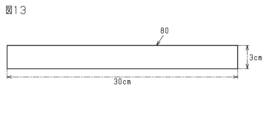
- Fig. 2 is a plan view of a test piece used for measurement of delamination strength;
- FIG. 14 is a schematic diagram showing how the test piece of FIG. 13 is used to measure the delamination strength.
- FIG. 10 is a perspective view showing how the forming apparatus of FIG. 9 is covered with a nonwoven fabric;
- FIG. 10 is a perspective view showing how a nonwoven fabric is formed using the forming apparatus of FIG. 9;
- FIG. 10 is a perspective view of a first auxiliary cover included in the molding apparatus of FIG. 9;
- a nonwoven fabric used as a reinforcing material for a foam molded product that is joined to a foam molded product to reinforce the foam molded product is a single-layer material in which laminated webs are mutually bonded, and has a weight of 7 g/cm 2 . It has a thickness under load of 1 to 8 mm and a delamination strength of 0.05 to 2.45 N/cm, said delamination strength being the amount of tensile force required to separate said bonded webs from each other. value.
- the nonwoven fabric used in the foam reinforcement that is bonded to the foam to reinforce the foam is a single layer material in which laminated webs are bonded together, 7 g/ The thickness at a cm 2 load is 2.5-6 mm and the delamination strength is 0.05-2.45 N/cm, said delamination strength being sufficient to separate said bonded webs from each other. It is the value of the required pulling force.
- the nonwoven fabric When the nonwoven fabric is manufactured by needle punching, for example, the laminated webs are bonded together by entangling the fibers with a plurality of needles having protrusions.
- the higher the delamination strength value the stronger the fibers are bound, and the higher the punch density in the needle punching process, the higher the delamination strength.
- a nonwoven fabric with a high punch density contains many through-holes generated by needle penetration. Therefore, a nonwoven fabric having a high punch density allows the foam material to easily pass through when joined to the foam molding material. Therefore, the foam material is likely to be exposed on the surface of the molded product.
- the nonwoven fabric of the present disclosure has an interlaminar peel strength of 0.05 to 2.45 N/cm by bonding the webs to such an extent that the webs peel from each other when pulled.
- the lower limit of the delamination strength of 0.05 N / cm is the minimum required strength for maintaining the shape of the nonwoven fabric
- the upper limit of the delamination strength of 2.45 N / cm is the shape of the layer. It is the maximum value at which the non-woven fabric can be peeled off.
- the delamination strength is less than the lower limit of 0.05 N/cm, it means that it is difficult to use as a nonwoven fabric, and if the delamination strength is greater than the upper limit of 2.45 N/cm, it means that the webs It means that the layer cannot be peeled off. Therefore, with conventional nonwoven fabrics, even if it is attempted to separate the webs from each other, it is not possible to separate the webs from each other in the thickness direction while maintaining the shape of the layers.
- the nonwoven fabric of the present disclosure may have a thickness of 1-8 mm at 7 g/cm 2 load, or 2.5-6 mm at 7 g/cm 2 load. If the nonwoven fabric is thickened, the passage of the foam material can be suppressed, but the workability during molding deteriorates. More specifically, if the thickness is less than 1 mm, the foam material will easily pass through, and if the thickness exceeds 8 mm, workability will be poor. In this respect, if the thickness of the nonwoven fabric having the above delamination strength is set to 1 to 8 mm under a load of 7 g/cm 2 , it is possible to achieve both suppression of exposure of the foam material and good workability.
- non-woven fabrics which are multi-layered materials, can suppress the passage of foamed materials, but the workability during molding deteriorates. Therefore, if the nonwoven fabric has the above-described delamination strength, even if it is a single-layer material, it is possible to appropriately suppress the passage of the foam material, and since it is a single-layer material, it is excellent in workability. In addition, the single-layer material is generally cheaper than the multi-layer material, so it is economical.
- the web used to manufacture such nonwoven fabrics is not limited to needle punching, but can also be formed using an air laying machine that aligns short fibers with an air flow.
- the nonwoven fabric of the present disclosure can be produced by adjusting at least one of the heating temperature, compression distance, and compression time.
- the web may contain 20-60% by weight of polyethylene terephthalate fibers and 40-80% by weight of polypropylene fibers.
- Polypropylene (PP) has a lower specific gravity than polyethylene terephthalate (PET). Therefore, by including PP, the number of fibers can be increased without increasing the weight. By increasing the number of fibers constituting the nonwoven fabric, it is possible to suppress passage of the foam material.
- the polyethylene terephthalate fiber may have a core-sheath structure, and the core-sheath structure may include a core and a sheath having a lower melting point than the core. According to this configuration, the fibers can be bonded to each other by melting the sheath by heating, while the strength of the fibers can be maintained by the core, which is difficult to melt.
- the nonwoven fabric has a heat-treated first surface, a heat-treated second surface opposite to the first surface, and a heat-treated second surface between the first surface and the second surface. and non-heat-treated inner fibers in.
- the above nonwoven fabric is processed so that the bonding of the web is not strong, so the surface tends to become fuzzy.
- the nonwoven fabric will become stiff and will have poor formability. Since the nonwoven fabric of the present disclosure is heat-treated only on the surface, fuzzing is suppressed. Also, since the internal fibers between the first and second surfaces are not heat treated, good workability can be maintained.
- a reinforcing material for a foam molded article formed from the above nonwoven fabric In particular, a reinforcing material for a foam-molded article obtained by molding the above nonwoven fabric by a molding process accompanied by heating.
- a reinforcing material with high molding accuracy can be obtained.
- the high workability of the nonwoven fabric is useful when the reinforcing material is three-dimensionally formed by a molding process involving heating.
- the method for producing a nonwoven fabric used as a reinforcing material for a foam molded product includes joining laminated webs together by needle punching to form a single-layer material, and heat-treating only the surface of the single-layer material. and adding, the nonwoven fabric has a thickness of 1 to 8 mm at a load of 7 g/cm 2 and a delamination strength of 0.05 to 2.45 N/cm, wherein the delamination strength is is the value of the pulling force required to separate the webs that have been bonded together.
- a method for manufacturing a nonwoven fabric used as a reinforcing material for a foam molded product includes joining laminated webs to each other by needle punching to form a single layer material, and applying only the surface of the single layer material. applying a heat treatment, wherein the nonwoven fabric has a thickness of 2.5 to 6 mm at a load of 7 g/cm 2 and a delamination strength of 0.05 to 2.45 N/cm, and the delamination Strength is the amount of pulling force required to separate the bonded webs from each other.
- a single layer material having a delamination strength of 0.05 to 2.45 N/cm can be formed. Further, by heat-treating only the surface of the single-layer material, the thickness can be adjusted to 1 to 8 mm under a load of 7 g/cm 2 .
- the heat-treated surface suppresses fluffing caused by low punch density.
- the nonwoven fabric is heated to the inside, the internal fibers of the nonwoven fabric are altered by the heat, and the rigidity of the nonwoven fabric increases. Nonwoven fabrics with increased rigidity have poor workability. Therefore, a nonwoven fabric whose surface is heat-treated so as not to heat the internal fibers has excellent moldability.
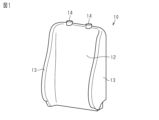
- a reinforcing material for foam molded product 10 is, for example, a seat pad for reinforcing a cushion material of an automobile seat.
- the cushion material is an example of the foam molded product 19 (see FIG. 4).
- the foam molded product 19 is not limited to a seat pad, and may be, for example, a cushioning material for furniture.
- the reinforcing member 10 has a back portion 12 corresponding to the surface of the backrest, two side portions 13 projecting from the left and right sides of the back portion 12 toward the front of the vehicle, and two through holes 14 corresponding to the mounting locations of the headrest. You may
- the reinforcing material 10 is obtained, for example, by molding or sewing the nonwoven fabric 11 shown in FIG. Molding can be performed by any method such as press molding or vacuum molding.
- the nonwoven fabric 11 is obtained by cutting a nonwoven fabric sheet 33 (see FIG. 7) into a desired shape, for example, the shape of the backrest of an automobile seat.
- the nonwoven fabric 11 may comprise a central wrap 15 and two side wraps 16 .
- the central wrapping portion 15 is a portion that wraps around the back surface of the back portion 12 during molding.
- the side wrapping portion 16 is a portion that wraps around the rear surface of the side portion 13 during molding.
- the nonwoven fabric 11 of the present disclosure is a single layer material manufactured by a needle punching method. More specifically, a plurality of layers of webs formed from short fibers are superimposed and the fibers of those layers are entangled with each other by reciprocating motion of metal needles to form a single layer material.
- the number of web layers to be superimposed is, for example, seven layers, but is not limited to this and can be arbitrarily changed.
- the reinforcing member 10 may be molded using a mold 20.
- the stiffener 10 may be bonded to the foam 18 .
- the mold 20 may include an upper mold 21 , a core mold 22 and a lower mold 23 .
- the reinforcement member 10 is set to cover the core mold 22, for example.
- a foaming material 17 containing a foaming agent, such as urethane is injected into the mold 20 .
- the foam molding material 18 is foam-molded.
- the reinforcing material 10 provides a gap for releasing gas in the mold 20 during foam molding of the foam molding material 18 .
- the foam molded product 19 may include a foam molded material 18 and a reinforcing material 10 joined to the foam molded material 18 .
- the stiffener 10 may be arranged to protect the surface of the foam molding 18 .
- the stiffeners 10 may be placed in those parts of the foam molding 19 that come into contact with metal parts, for example pipe frames or springs. The interposition of the reinforcing material 10 suppresses the abnormal noise caused by the foam molding material 18 rubbing against the metal parts.
- FIG. 5 shows an example of a method for manufacturing the nonwoven fabric 11.
- the web 31 (see FIG. 6) is formed in the web forming process of step S11.
- the web 31 is formed by arranging short fibers, which are at least one of polyethylene terephthalate fibers and polypropylene fibers, by a machine or an air stream.
- the web 31 may comprise 20-60% by weight polyethylene terephthalate (PET) fibers and 40-80% by weight polypropylene (PP) fibers. As an example, it may be 55% by weight of PP fibers and 45% by weight of PET fibers.
- the basis weight of the nonwoven fabric 11 may be, for example, 50-500 g/m 2 , or 80-250 g/m 2 , more specifically, 140 g/m 2 .
- PP fibers may be used by mixing fibers with different thicknesses. If thin fibers are used, the number of fibers can be increased without changing the weight, so the passage of the foam material 17 can be suppressed.
- PET fibers may have a core-sheath structure. This core-sheath structure may include a core and a sheath having a lower melting point than the core. The melting point of the sheath material may be, for example, around 110°C. The melting point of these fibers can vary depending on the processing method, eg molding.
- the web 31 is laminated in a plurality of layers, for example seven layers, to form the laminated material 30.
- the web 31 may be laminated by folding a continuous elongated web 31 .
- the web 31 may be continuously processed by continuously laminating the laminated material 30 while conveying it in the conveying direction.
- the laminated material 30 is repeatedly pierced with a plurality of needles 40 by needle punching.
- the punch density of the needle punch is set low so that the delamination strength is 0.05 to 2.45 N/cm.
- the delamination strength is the value of the tensile force required to separate the bonded webs 31 from each other. A method for measuring the delamination strength will be described later.
- each needle 40 has multiple projections 41 .
- the needle 40 repeatedly reciprocates so as to pass through the laminated material 30 in forward movement and be pulled out of the laminated material 30 in backward movement.
- the plurality of projections 41 hook the fibers, thereby entangling the fibers between the webs 31 and the laminated web 31 becomes the single layer material 32 .
- One or a plurality of support beds 45 and one or a plurality of moving devices 44 arranged to face the support beds 45 may be arranged on the transport path of the laminated material 30 .
- Each moving device 44 may hold multiple needles 40 .
- two moving devices 44 may be arranged on the transport path.
- the needle 40 may pierce only one side of the laminated material 30 conveyed on the support bed 45 .
- a plurality of, for example, two needle groups 42 and 43 may be arranged in the conveying path of the laminated material 30 .
- Needle groups 42 and 43 may be held by respective moving devices 44 .
- the operation of needle groups 42, 43 may differ from each other.
- the depth of penetration of the needles 40 or the number of penetrations may be different from each other.
- the needle density (the number of penetrations) of the first needle group 42 may be 50 needles/cm 2 and the needle density (the number of penetrations) of the second needle group 43 may be 75 needles/cm 2 .
- the needle density of the first needle group 42 may be 50/cm 2 and the needle density of the second needle group 43 may be 75/cm 2 .
- the needle depth of the first needle group 42 may be 9 mm
- the needle depth of the second needle group 43 may be 3 mm.
- Needle depth is the length that the tip of needle 40 passes through support bed 45 .
- a shallow needle depth results in fewer protrusions 41 passing through the web 31 . Therefore, in the second needle group 43 having a shallow needle depth, the effect of entangling the fibers is lower than in the first needle group 42 .
- the needle depth of the second needle group 43 may be shallow to such an extent that the protrusions 41 do not catch the fibers. This reduces the effect of entangling the fibers.
- Calender rolls 46 may include rolls 47 and 48 that sandwich single layer material 32 and one or more heating devices 49 that heat rolls 47 and 48 .
- Two heating devices 49 may be arranged to heat rolls 47 and 48 respectively.
- the surface temperature of the heating rolls 47 and 48 is, for example, 130.degree.
- the distance between the rolls 47 and 48 is set so as not to crush the single layer material 32 .
- the distance between rolls 47, 48 is, for example, 4 mm.
- the transport speed of the single layer material 32 transported between the rolls 47 and 48 is, for example, 5 m/min.
- the single layer material 32 becomes the nonwoven fabric sheet 33 by applying heat treatment.
- the nonwoven fabric sheet 33 has a heat-treated first surface 33a, a second surface 33b on the opposite side of the first surface 33a, and a heat-treated second surface 33b, and the first surface 33a and the second surface 33b. and the non-heat treated internal fibers 33c in between.
- the purpose of heat treatment processing is to remove fluff from the surface of the single layer material 32, not to heat the internal fibers 33c. Therefore, the heating temperature, the distance between the rolls 47 and 48, and the transport speed in the heat treatment process are within the range where the heat treatment does not reach the inside of the single layer material 32, and the thickness at a load of 7 g / cm 2 is 1 to 8 mm. can be changed arbitrarily.
- the nonwoven fabric sheet 33 having a thickness of 1 to 8 mm under a load of 7 g/cm 2 and an interlayer peel strength of 0.05 to 2.45 N/cm is manufactured.
- the nonwoven fabric sheet 33 may be wound into a roll.
- the winding direction at this time is along the conveying direction at the time of manufacture.
- the nonwoven fabric 11 is obtained.
- the nonwoven fabric 11 has properties substantially similar to those of the nonwoven fabric sheet 33 .
- a molding device 50 for the reinforcing material 10 shown in FIG. 9 includes, for example, a molding die 51, legs 53 and 54, a base 60, and an air supply/exhaust unit 61. As shown in FIG. Mold 51 has an internal space and a plurality of vent holes 51a communicating with the internal space. The mold 51 may have two cylindrical portions 52 at positions corresponding to the headrest. The molding die 51 may be supported by the base 60 via the air supply leg portion 53 and the exhaust leg portion 54 .
- the base 60 has an air supply path 60a and an exhaust path 60b inside.
- the air supply path 60a and the exhaust path 60b may communicate with the internal space of the mold 51 through the air supply leg portion 53 and the exhaust leg portion 54, respectively.
- the air supply path 60a and the exhaust path 60b may communicate with the air supply/exhaust unit 61 through an air supply pipe 62 and an exhaust pipe 63, respectively.
- the air supply/exhaust unit 61 may be configured to supply heated steam or heated air through the air supply pipe 62 . Further, the air supply/exhaust unit 61 may be configured to take air through the exhaust pipe 63 .
- the nonwoven fabric 11 to be molded is covered with a molding die 51 .
- the molding device 50 may further include a cover material 64, a first auxiliary cover 70, and two second auxiliary covers 56.
- the first auxiliary cover 70 may be arranged between the air supply leg 53 and the exhaust leg 54 .
- the first auxiliary cover 70 includes two cover bodies 71, four magnets 72, and a connecting bar 73.
- the connecting bar 73 connects the two cover bodies 71 .
- Each cover body 71 has an edge region 71a curved along the bottom edge of the mold 51.
- Two magnets 72 are attached to each cover body 71 so as to face each other.
- a magnet (not shown) may be arranged in the lower end region of the mold 51 .
- the first auxiliary cover 70 may be fixed to the mold 51 by magnets 72 so as to fix the lower end of the nonwoven fabric 11 covering the mold 51 to the mold 51 .
- the two second auxiliary covers 56 are attached to the sides of the mold 51 so as to hold down the side portions 13 of the nonwoven fabric 11 . or fixed with screws. Furthermore, the nonwoven fabric 11 may be fixed to the mold 51 with a plurality of strings 58 .
- the cover material 64 forms the closed space 65 by fixing the edge of the cover material 64 to the base 60 while covering the mold 51 . At this time, the auxiliary covers 56 and 70 are arranged inside the closed space 65 .
- the air supply/exhaust unit 61 supplies heated steam or heating steam or Supply heated air. Thereby, the nonwoven fabric 11 and the mold 51 are heated. At this time, the supplied heating steam inflates the cover material 64 .
- the air supply/exhaust unit 61 exhausts the air from the closed space 65 by sucking through the exhaust pipe 63, the exhaust path 60b, the exhaust leg 54, and the ventilation hole 51a.
- the swollen cover material 64 contracts so as to be attracted to the molding die 51 .
- the nonwoven fabric 11 which has been heated and has increased plasticity, adheres to the molding die 51 and is molded into a shape along the outer shape of the molding die 51 .
- the covered portions of the nonwoven fabric 11 covered with the auxiliary covers 56 and 70 are not only difficult to heat, but also cannot be pressed against the mold 51 by the cover material 64 . Therefore, this covered portion has lower rigidity and is softer than the other portions. That is, the reinforcing member 10 has a first portion having a first rigidity (the portion not covered by the auxiliary covers 56 and 70) and a second portion having a second rigidity lower than the first rigidity (auxiliary covered portion covered with the covers 56 and 70). By arranging the second portion at a portion of the foam molded product 19 where abnormal noise is likely to occur, the generation of abnormal noise can be suppressed.
- the molding device 50 does not have to include at least one of the first auxiliary cover 70 and the second auxiliary cover 56 .
- the molding method of the reinforcing member 10 may not include at least one of the first auxiliary cover fixing step and the second auxiliary cover fixing step.
- test piece 80 A method for measuring the delamination strength will be described below. As shown in FIG. 13, the nonwoven fabric sheet 33 (see FIG. 7) is cut to prepare a test piece 80 having a width of 3 cm and a length of 30 cm. The width and length of the test piece 80 can be changed, but the width is preferably 1 cm or more.
- the longitudinal end regions of the test piece 80 are delaminated by about 50 mm.
- the length of the end region to be peeled off in the preparation step can be arbitrarily changed as long as the peeling length required for the test can be secured.
- “delamination” refers to separating the non-woven fabric webs, which have been made into single-layer materials by needle punching, into the first layer 81 and the second layer 82.
- the first layer 81 includes the first surface 33a and the second layer 82 includes the second surface 33b.
- test strip 80 may be delaminated by 20 cm at a tensile rate of 970 mm/min.
- the pulling speed and peel length can be changed arbitrarily. Any device can be used as the tensile tester as long as the tensile strength can be measured.
- Table 1 shows the test results of delamination strength using Examples 1-4.
- Examples 1 to 4 are test pieces 80 made of nonwoven fabric formed using the same web, and have different punch densities.
- Example 2 has a higher punch density than Example 1
- Example 3 has a higher punch density than Example 2.
- Example 4 has a lower punch density than Example 1.
- the same test was performed 10 times. The results of each ten tests, ie the tensile force, were averaged and divided by 3 in order to convert the average value to strength per unit width (1 cm width). The value thus calculated is the delamination strength.
- the delamination strength of Examples 1 to 4 are all in the range of 0.05 to 2.45 N/cm. In order to calculate a stable value, the delamination strength can be measured multiple times and the average value can be taken, but the number of tests can be changed arbitrarily.
- Comparative examples in Table 1 are conventional nonwoven fabrics. In the comparative example, even if it is subjected to the delamination strength test, it does not separate into two layers, so the value of the delamination strength cannot be calculated.
- Table 1 shows the test results of the degree of exudation using Examples 1 to 4 and Comparative Example. The degree of exudation was determined by creating test pieces of 30 cm x 30 cm each from the nonwoven fabrics of Examples 1 to 4 and Comparative Example, joining each test piece with a foam material in a test mold, and then passing through the test piece. The ratio (%) of the exposed area of the exuded foam material was calculated visually. Visual observation was performed by a plurality of people, and numerical values were determined in increments of 5%.
- the conventional nonwoven fabric has a bleeding degree of 80%
- the bleeding degrees of Examples 1 to 4 are 40%, 60%, 65%, and 30%, respectively. It can be seen that the lower the punch density, the smaller the degree of bleeding.
- the nonwoven fabric 11 may be pinched and delaminated. That is, when the nonwoven fabric 11 is manually pulled in the thickness direction, if the nonwoven fabric 11 can be separated into two layers while maintaining the layered shape without being partially torn, the delamination strength required for the nonwoven fabric 11 can be obtained. You can judge that you are ready. In other words, a nonwoven fabric that does not have delamination strength cannot be separated into two layers, and a nonwoven fabric that cannot be separated into two layers cannot obtain a numerical value for delamination strength itself.
- the nonwoven fabric 11 (or nonwoven fabric sheet 33) of the present disclosure will be described below.
- the nonwoven fabric 11 the webs 31 are bonded together with a punch density so low that delamination is possible.
- the nonwoven fabric 11 has a delamination strength of 0.05 to 2.45 N/cm.
- Such a nonwoven fabric 11 has fewer holes pierced by the needles 40 than conventional nonwoven fabrics in which the webs are bonded together at a punch density high enough to avoid delamination. Therefore, it is difficult for the foam material 17 to pass through the nonwoven fabric 11 (reinforcing material 10) during foam molding. Therefore, exposure or seepage of the foam material 17 to the surface of the foam molded product 19 is suppressed. Therefore, even if the foam molding material 18 rubs against the metal parts via the reinforcing material 10, noise is less likely to occur.
- the nonwoven fabric 11 of the present disclosure the following effects can be obtained.
- the nonwoven fabric 11 having delamination strength makes it difficult for the foam material to pass through.
- the nonwoven fabric 11 is moderately flexible and is a thin single-layer material with a thickness of 1 to 8 mm, it is excellent in moldability. More specifically, since the nonwoven fabric 11 is moderately stretchable, it is easy to set in the mold 20 or the forming mold 51 or to be sewn, and has good conformability to the molds 20 and 51 .
- the web 31 containing PP fibers with a weight ratio of 40 to 80% can increase the number of fibers without increasing the weight as compared with a web consisting only of PET fibers. Since the nonwoven fabric 11 has a larger number of fibers than the conventional one, the passage of the foam material 17 can be suppressed.
- the fibers contained in the nonwoven fabric 11 have a core-sheath structure, the fibers can be bonded to each other by melting the sheath when heated, and the strength of the fibers can be maintained by the hard-to-melt core.
- the surface 33a, 33b of the nonwoven fabric 11 is heat-treated to suppress fluffing.
- the heat treatment does not reach the internal fibers 33c, so the nonwoven fabric 11 is kept flexible. Therefore, the nonwoven fabric 11 is excellent in workability even in shaping processing involving heating, for example. Further, when the reinforcing material 10 is molded by heating, the effect of reducing molding wrinkles by shrinkage can be further exhibited.
- the nonwoven fabric 11 may be formed by sewing.
- a group of needles that pierce the first surface 33a and a group of needles that pierce the second surface 33b may be arranged in the conveying path of the laminated material 30 .
Landscapes
- Engineering & Computer Science (AREA)
- Textile Engineering (AREA)
- Mechanical Engineering (AREA)
- Physics & Mathematics (AREA)
- Thermal Sciences (AREA)
- Chemical & Material Sciences (AREA)
- Chemical Kinetics & Catalysis (AREA)
- Nonwoven Fabrics (AREA)
- Laminated Bodies (AREA)
- Molding Of Porous Articles (AREA)
- Mattresses And Other Support Structures For Chairs And Beds (AREA)
- Casting Or Compression Moulding Of Plastics Or The Like (AREA)
Priority Applications (2)
| Application Number | Priority Date | Filing Date | Title |
|---|---|---|---|
| US18/700,267 US12545007B2 (en) | 2021-10-14 | 2022-10-07 | Nonwoven fabric used for foamed article reinforcing material, foamed article reinforcing material, and method for producing nonwoven fabric used for foamed article reinforcing material |
| CN202280066743.1A CN118043510A (zh) | 2021-10-14 | 2022-10-07 | 在发泡成形品用增强材料中使用的无纺布、发泡成形品用增强材料、以及在发泡成形品用增强材料中使用的无纺布的制造方法 |
Applications Claiming Priority (2)
| Application Number | Priority Date | Filing Date | Title |
|---|---|---|---|
| JP2021-168789 | 2021-10-14 | ||
| JP2021168789A JP7444408B2 (ja) | 2021-10-14 | 2021-10-14 | 発泡成形品用補強材に用いられる不織布、発泡成形品用補強材、及び発泡成形品用補強材に用いられる不織布の製造方法 |
Publications (1)
| Publication Number | Publication Date |
|---|---|
| WO2023063257A1 true WO2023063257A1 (ja) | 2023-04-20 |
Family
ID=85987740
Family Applications (1)
| Application Number | Title | Priority Date | Filing Date |
|---|---|---|---|
| PCT/JP2022/037640 Ceased WO2023063257A1 (ja) | 2021-10-14 | 2022-10-07 | 発泡成形品用補強材に用いられる不織布、発泡成形品用補強材、及び発泡成形品用補強材に用いられる不織布の製造方法 |
Country Status (4)
| Country | Link |
|---|---|
| US (1) | US12545007B2 (https=) |
| JP (1) | JP7444408B2 (https=) |
| CN (1) | CN118043510A (https=) |
| WO (1) | WO2023063257A1 (https=) |
Cited By (1)
| Publication number | Priority date | Publication date | Assignee | Title |
|---|---|---|---|---|
| WO2024214317A1 (ja) * | 2023-04-12 | 2024-10-17 | 株式会社AETEC-α | 発泡成形品用補強材に用いられる不織布、不織布を含む多層構造材、発泡成形品用補強材、及び発泡成形品用補強材に用いられる不織布の製造方法 |
Citations (5)
| Publication number | Priority date | Publication date | Assignee | Title |
|---|---|---|---|---|
| WO2007049627A1 (ja) * | 2005-10-27 | 2007-05-03 | Toyo Boseki Kabushiki Kaisha | 不織布及びその製造方法 |
| JP2012007260A (ja) * | 2010-06-24 | 2012-01-12 | Toyobo Co Ltd | 発泡成形品補強材用不織布及び発泡成形品 |
| JP2013076179A (ja) * | 2011-09-30 | 2013-04-25 | Toyobo Co Ltd | 発泡成形品補強用不織布 |
| JP2013129950A (ja) * | 2011-12-20 | 2013-07-04 | Kurashiki Seni Kako Kk | モールドパッド用不織布及びその製造方法 |
| JP2017226936A (ja) * | 2016-06-24 | 2017-12-28 | 豊田通商株式会社 | ウレタン発泡成形用補強布およびその製造方法 |
Family Cites Families (8)
| Publication number | Priority date | Publication date | Assignee | Title |
|---|---|---|---|---|
| JP3877842B2 (ja) * | 1997-03-05 | 2007-02-07 | ユニチカ株式会社 | 面ファスナー用雌材の製造方法 |
| JP5605148B2 (ja) | 2010-10-12 | 2014-10-15 | 東洋紡株式会社 | 発泡成型品補強材用不織布及びその製造方法 |
| CN107034589A (zh) * | 2012-06-04 | 2017-08-11 | 东洋纺株式会社 | 一种发泡模塑制品补强用无纺布及使用该无纺布的产品 |
| DE102012025023A1 (de) * | 2012-12-20 | 2014-06-26 | Johns Manville Europe Gmbh | Filtermedium |
| MY158150A (en) * | 2013-09-06 | 2016-09-15 | Mitsui Chemicals Inc | Multilayer nonwoven fabric for foam molding, method of producing multilayer nonwoven fabric for foam molding, urethane-foam molded complex using multilayer nonwoven fabric, vehicle seat, and chair |
| CN203779977U (zh) * | 2013-12-31 | 2014-08-20 | 浙江华江科技发展有限公司 | 一种低克重及高剥离强度纤维增强热塑性树脂复合板材 |
| JP6862717B2 (ja) * | 2016-08-22 | 2021-04-21 | 東洋紡株式会社 | ウレタン発泡成形用補強材の製造方法 |
| JP7111523B2 (ja) * | 2018-06-25 | 2022-08-02 | 帝人コードレ株式会社 | シート状物およびその製造方法 |
-
2021
- 2021-10-14 JP JP2021168789A patent/JP7444408B2/ja active Active
-
2022
- 2022-10-07 WO PCT/JP2022/037640 patent/WO2023063257A1/ja not_active Ceased
- 2022-10-07 CN CN202280066743.1A patent/CN118043510A/zh active Pending
- 2022-10-07 US US18/700,267 patent/US12545007B2/en active Active
Patent Citations (5)
| Publication number | Priority date | Publication date | Assignee | Title |
|---|---|---|---|---|
| WO2007049627A1 (ja) * | 2005-10-27 | 2007-05-03 | Toyo Boseki Kabushiki Kaisha | 不織布及びその製造方法 |
| JP2012007260A (ja) * | 2010-06-24 | 2012-01-12 | Toyobo Co Ltd | 発泡成形品補強材用不織布及び発泡成形品 |
| JP2013076179A (ja) * | 2011-09-30 | 2013-04-25 | Toyobo Co Ltd | 発泡成形品補強用不織布 |
| JP2013129950A (ja) * | 2011-12-20 | 2013-07-04 | Kurashiki Seni Kako Kk | モールドパッド用不織布及びその製造方法 |
| JP2017226936A (ja) * | 2016-06-24 | 2017-12-28 | 豊田通商株式会社 | ウレタン発泡成形用補強布およびその製造方法 |
Cited By (1)
| Publication number | Priority date | Publication date | Assignee | Title |
|---|---|---|---|---|
| WO2024214317A1 (ja) * | 2023-04-12 | 2024-10-17 | 株式会社AETEC-α | 発泡成形品用補強材に用いられる不織布、不織布を含む多層構造材、発泡成形品用補強材、及び発泡成形品用補強材に用いられる不織布の製造方法 |
Also Published As
| Publication number | Publication date |
|---|---|
| JP7444408B2 (ja) | 2024-03-06 |
| JP2023058955A (ja) | 2023-04-26 |
| US20240416616A1 (en) | 2024-12-19 |
| US12545007B2 (en) | 2026-02-10 |
| CN118043510A (zh) | 2024-05-14 |
Similar Documents
| Publication | Publication Date | Title |
|---|---|---|
| JP5619407B2 (ja) | 成形体、衣料品及び成形体の製造方法 | |
| JP6040166B2 (ja) | 曲げ剛性を備えた積層板、同積層板からの成形品、及びその製造方法 | |
| JP4955530B2 (ja) | 表皮一体発泡成形用の表皮材 | |
| US8727417B2 (en) | Molded laying interior material for vehicle | |
| US11993027B2 (en) | Self-rising board molding | |
| WO2023063257A1 (ja) | 発泡成形品用補強材に用いられる不織布、発泡成形品用補強材、及び発泡成形品用補強材に用いられる不織布の製造方法 | |
| CN101473082A (zh) | 发泡聚氨酯强化材料 | |
| JP5605148B2 (ja) | 発泡成型品補強材用不織布及びその製造方法 | |
| WO2024214317A1 (ja) | 発泡成形品用補強材に用いられる不織布、不織布を含む多層構造材、発泡成形品用補強材、及び発泡成形品用補強材に用いられる不織布の製造方法 | |
| JP7219624B2 (ja) | プレス成形体、車両用シートバックボード、およびプレス成形体製造方法 | |
| US20070037463A1 (en) | Fiber batt having a separator layer | |
| JPH06136651A (ja) | 発泡成形用被覆材 | |
| JP2012165798A (ja) | 車両用内装材とその製造方法 | |
| US12589557B2 (en) | Self-rising board molding | |
| WO2007049627A1 (ja) | 不織布及びその製造方法 | |
| JP5624870B2 (ja) | 発泡成形体および発泡成形体の製造方法 | |
| JP7340950B2 (ja) | 積層体およびその製造方法 | |
| JP2005177198A (ja) | シート用パッド | |
| JP2019030519A (ja) | 冷感シート及びその製造方法 | |
| JP3543361B2 (ja) | 表皮材およびその製造方法 | |
| JP2024078973A (ja) | 表皮一体発泡成形用の表皮材 | |
| JP2017087777A (ja) | 発泡成形品及び車両用シート | |
| JP2011101996A (ja) | 積層体、成形品、衣料品及び積層体の製造方法 | |
| JPH0649349B2 (ja) | シートクツシヨン部材およびその製造方法ならびにそれを使用するシートクツシヨン | |
| HK1171420B (en) | Molded product, clothing, process for production of laminate, and process for production of molded product |
Legal Events
| Date | Code | Title | Description |
|---|---|---|---|
| 121 | Ep: the epo has been informed by wipo that ep was designated in this application |
Ref document number: 22880952 Country of ref document: EP Kind code of ref document: A1 |
|
| WWE | Wipo information: entry into national phase |
Ref document number: 202280066743.1 Country of ref document: CN |
|
| WWE | Wipo information: entry into national phase |
Ref document number: 202417031300 Country of ref document: IN |
|
| NENP | Non-entry into the national phase |
Ref country code: DE |
|
| 122 | Ep: pct application non-entry in european phase |
Ref document number: 22880952 Country of ref document: EP Kind code of ref document: A1 |