WO2023062818A1 - 超硬合金及びそれを用いた切削工具 - Google Patents
超硬合金及びそれを用いた切削工具 Download PDFInfo
- Publication number
- WO2023062818A1 WO2023062818A1 PCT/JP2021/038226 JP2021038226W WO2023062818A1 WO 2023062818 A1 WO2023062818 A1 WO 2023062818A1 JP 2021038226 W JP2021038226 W JP 2021038226W WO 2023062818 A1 WO2023062818 A1 WO 2023062818A1
- Authority
- WO
- WIPO (PCT)
- Prior art keywords
- less
- cemented carbide
- tungsten carbide
- particles
- phase
- Prior art date
- Legal status (The legal status is an assumption and is not a legal conclusion. Google has not performed a legal analysis and makes no representation as to the accuracy of the status listed.)
- Ceased
Links
Images


Classifications
-
- C—CHEMISTRY; METALLURGY
- C22—METALLURGY; FERROUS OR NON-FERROUS ALLOYS; TREATMENT OF ALLOYS OR NON-FERROUS METALS
- C22C—ALLOYS
- C22C29/00—Alloys based on carbides, oxides, nitrides, borides, or silicides, e.g. cermets, or other metal compounds, e.g. oxynitrides, sulfides
- C22C29/02—Alloys based on carbides, oxides, nitrides, borides, or silicides, e.g. cermets, or other metal compounds, e.g. oxynitrides, sulfides based on carbides or carbonitrides
- C22C29/06—Alloys based on carbides, oxides, nitrides, borides, or silicides, e.g. cermets, or other metal compounds, e.g. oxynitrides, sulfides based on carbides or carbonitrides based on carbides, but not containing other metal compounds
- C22C29/08—Alloys based on carbides, oxides, nitrides, borides, or silicides, e.g. cermets, or other metal compounds, e.g. oxynitrides, sulfides based on carbides or carbonitrides based on carbides, but not containing other metal compounds based on tungsten carbide
-
- B—PERFORMING OPERATIONS; TRANSPORTING
- B22—CASTING; POWDER METALLURGY
- B22F—WORKING METALLIC POWDER; MANUFACTURE OF ARTICLES FROM METALLIC POWDER; MAKING METALLIC POWDER; APPARATUS OR DEVICES SPECIALLY ADAPTED FOR METALLIC POWDER
- B22F3/00—Manufacture of workpieces or articles from metallic powder characterised by the manner of compacting or sintering; Apparatus specially adapted therefor ; Presses and furnaces
- B22F3/10—Sintering only
- B22F3/1003—Use of special medium during sintering, e.g. sintering aid
- B22F3/1007—Atmosphere
-
- B—PERFORMING OPERATIONS; TRANSPORTING
- B23—MACHINE TOOLS; METAL-WORKING NOT OTHERWISE PROVIDED FOR
- B23B—TURNING; BORING
- B23B27/00—Tools for turning or boring machines; Tools of a similar kind in general; Accessories therefor
- B23B27/14—Cutting tools of which the bits or tips or cutting inserts are of special material
- B23B27/148—Composition of the cutting inserts
-
- C—CHEMISTRY; METALLURGY
- C22—METALLURGY; FERROUS OR NON-FERROUS ALLOYS; TREATMENT OF ALLOYS OR NON-FERROUS METALS
- C22C—ALLOYS
- C22C1/00—Making non-ferrous alloys
- C22C1/04—Making non-ferrous alloys by powder metallurgy
- C22C1/05—Mixtures of metal powder with non-metallic powder
- C22C1/051—Making hard metals based on borides, carbides, nitrides, oxides or silicides; Preparation of the powder mixture used as the starting material therefor
-
- C—CHEMISTRY; METALLURGY
- C22—METALLURGY; FERROUS OR NON-FERROUS ALLOYS; TREATMENT OF ALLOYS OR NON-FERROUS METALS
- C22C—ALLOYS
- C22C29/00—Alloys based on carbides, oxides, nitrides, borides, or silicides, e.g. cermets, or other metal compounds, e.g. oxynitrides, sulfides
- C22C29/02—Alloys based on carbides, oxides, nitrides, borides, or silicides, e.g. cermets, or other metal compounds, e.g. oxynitrides, sulfides based on carbides or carbonitrides
- C22C29/06—Alloys based on carbides, oxides, nitrides, borides, or silicides, e.g. cermets, or other metal compounds, e.g. oxynitrides, sulfides based on carbides or carbonitrides based on carbides, but not containing other metal compounds
- C22C29/067—Alloys based on carbides, oxides, nitrides, borides, or silicides, e.g. cermets, or other metal compounds, e.g. oxynitrides, sulfides based on carbides or carbonitrides based on carbides, but not containing other metal compounds comprising a particular metallic binder
-
- B—PERFORMING OPERATIONS; TRANSPORTING
- B22—CASTING; POWDER METALLURGY
- B22F—WORKING METALLIC POWDER; MANUFACTURE OF ARTICLES FROM METALLIC POWDER; MAKING METALLIC POWDER; APPARATUS OR DEVICES SPECIALLY ADAPTED FOR METALLIC POWDER
- B22F5/00—Manufacture of workpieces or articles from metallic powder characterised by the special shape of the product
- B22F2005/001—Cutting tools, earth boring or grinding tool other than table ware
-
- B—PERFORMING OPERATIONS; TRANSPORTING
- B22—CASTING; POWDER METALLURGY
- B22F—WORKING METALLIC POWDER; MANUFACTURE OF ARTICLES FROM METALLIC POWDER; MAKING METALLIC POWDER; APPARATUS OR DEVICES SPECIALLY ADAPTED FOR METALLIC POWDER
- B22F2998/00—Supplementary information concerning processes or compositions relating to powder metallurgy
- B22F2998/10—Processes characterised by the sequence of their steps
-
- H—ELECTRICITY
- H05—ELECTRIC TECHNIQUES NOT OTHERWISE PROVIDED FOR
- H05K—PRINTED CIRCUITS; CASINGS OR CONSTRUCTIONAL DETAILS OF ELECTRIC APPARATUS; MANUFACTURE OF ASSEMBLAGES OF ELECTRICAL COMPONENTS
- H05K3/00—Apparatus or processes for manufacturing printed circuits
- H05K3/0011—Working of insulating substrates or insulating layers
- H05K3/0044—Mechanical working of the substrate, e.g. drilling or punching
- H05K3/0047—Drilling of holes
Definitions
- the present disclosure relates to cemented carbide and cutting tools using the same.
- cemented carbides used for tools such as small-diameter drills so-called fine-grained cemented carbides, in which the hard phase consists of tungsten carbide particles with an average particle size of 1 ⁇ m or less, are used (for example, Japanese Patent Application Laid-Open No. 2007-92090 JP-A-2012-52237 (Patent Document 2), JP-A-2012-117100 (Patent Document 3)).
- JP-A-2007-92090 JP 2012-52237 A Japanese Patent Application Laid-Open No. 2012-117100
- a cemented carbide comprising a first phase composed of a plurality of tungsten carbide particles and a second phase containing cobalt,
- the cemented carbide contains 78 vol% or more and less than 100 vol% of the first phase and more than 0 vol% and 22 vol% or less of the second phase,
- the average equivalent circle diameter of the tungsten carbide particles is 0.5 ⁇ m or more and 1.2 ⁇ m or less
- the tungsten carbide particles contain 13% or less on a number basis of first tungsten carbide particles having an equivalent circle diameter of 0.3 ⁇ m or less
- the tungsten carbide particles contain 12% or less on a number basis of second tungsten carbide particles having an equivalent circle diameter of more than 1.3 ⁇ m
- Fmax/Fmin which is the ratio of the maximum frequency Fmax to the minimum frequency Fmin
- the class on the horizontal axis of the histogram indicates the equivalent circle
- the cemented carbide has a cobalt content of more than 0% by mass and not more than 10% by mass.
- FIG. 1 is a photograph substitute view showing an example of a backscattered electron image of the cemented carbide of this embodiment.
- FIG. 2 is a photograph substitute view showing an image obtained by performing a binarization process on the backscattered electron image of FIG.
- FIG. 3 is a histogram showing an example of distribution of equivalent circle diameters of tungsten carbide particles in the cemented carbide of the present embodiment.
- FIG. 4 is a histogram showing an example of the distribution of equivalent circle diameters of tungsten carbide particles in the cemented carbide of the comparative example.
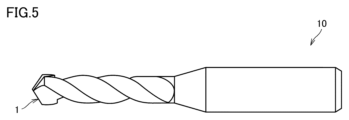
- FIG. 5 is a diagram showing an example of the cutting tool (small diameter drill) of this embodiment.
- the present disclosure provides a cemented carbide and a cutting tool comprising the same that can provide a cutting tool having excellent processing accuracy even in microfabrication of printed circuit boards when used as a tool material. for the purpose.
- the cemented carbide of the present disclosure is a cemented carbide comprising a first phase composed of a plurality of tungsten carbide particles and a second phase containing cobalt,
- the cemented carbide contains 78 vol% or more and less than 100 vol% of the first phase and more than 0 vol% and 22 vol% or less of the second phase,
- the average equivalent circle diameter of the tungsten carbide particles is 0.5 ⁇ m or more and 1.2 ⁇ m or less
- the tungsten carbide particles contain 13% or less on a number basis of first tungsten carbide particles having an equivalent circle diameter of 0.3 ⁇ m or less
- the tungsten carbide particles contain 12% or less on a number basis of second tungsten carbide particles having an equivalent circle diameter of more than 1.3 ⁇ m
- Fmax/Fmin which
- the cemented carbide has a cobalt content of more than 0% by mass and not more than 10% by mass.
- the cemented carbide of the present disclosure it is possible to provide a cutting tool with excellent machining accuracy, especially in fine machining of printed circuit boards.
- the cutting tool having excellent machining accuracy means that the cutting tool has a long tool life while maintaining excellent hole position accuracy.
- the hole position accuracy is an index relating to the difference between the target position in the hole punching process and the actual hole position. The smaller the difference, the better the hole position accuracy.
- the cemented carbide preferably contains 5% by volume or more and 12% by volume or less of the second phase. According to this, the tool life is improved.
- the content of chromium in the cemented carbide is preferably 0.15% by mass or more and 1.00% by mass or less. According to this, the tool life is improved.
- the mass-based percentage of chromium relative to cobalt is preferably 5% or more and 10% or less. According to this, the tool life is improved.
- the mass-based content of vanadium in the cemented carbide is 0 ppm or more and less than 2000 ppm. According to this, the tool life is improved.
- the difference between the maximum frequency Fmax and the frequency Fa in a class that is one lower than the class corresponding to the maximum frequency Fmax is 2.5% or less; It is preferable that the difference between the maximum frequency Fmax and the frequency Fb of the class that is one higher than the maximum frequency Fmax is 2.5% or less. According to this, the tool life is further improved.
- the cutting tool of the present disclosure is a cutting tool having a cutting edge made of the cemented carbide.
- the cutting tool of the present disclosure has excellent machining accuracy.
- the cutting tool is preferably a rotary tool for processing printed circuit boards.
- the cutting tools of the present disclosure are particularly suitable for microfabrication of printed circuit boards.
- a compound or the like when represented by a chemical formula, it shall include any conventionally known atomic ratio unless the atomic ratio is particularly limited, and should not necessarily be limited only to those within the stoichiometric range.
- the ratio of the number of atoms constituting WC includes all conventionally known atomic ratios.
- This embodiment is a cemented carbide comprising a first phase composed of a plurality of tungsten carbide particles and a second phase containing cobalt,
- the cemented carbide contains 78 vol% or more and less than 100 vol% of the first phase and more than 0 vol% and 22 vol% or less of the second phase,
- the average equivalent circle diameter of the tungsten carbide particles is 0.5 ⁇ m or more and 1.2 ⁇ m or less
- the tungsten carbide particles contain 13% or less on a number basis of first tungsten carbide particles having an equivalent circle diameter of 0.3 ⁇ m or less
- the tungsten carbide particles contain 12% or less on a number basis of second tungsten carbide particles having an equivalent circle diameter of more than 1.3 ⁇ m
- Fmax/Fmin which is the ratio of
- the cemented carbide has a cobalt content of more than 0% by mass and not more than 10% by mass.
- cemented carbide of the present disclosure it is possible to provide a cutting tool with excellent machining accuracy, especially in fine machining of printed circuit boards.
- the reason for this is not clear, but is presumed to be the following (i) to (vi).
- the cemented carbide of the present embodiment comprises a first phase composed of a plurality of tungsten carbide particles (hereinafter also referred to as "WC particles") and a second phase containing cobalt, and the cemented carbide contains 78% by volume or more and less than 100% by volume of the first phase and more than 0% by volume and 22% by volume or less of the second phase. Accordingly, cemented carbide can have the necessary hardness and wear resistance for microfabrication of printed circuit boards.
- WC particles tungsten carbide particles
- the average equivalent circle diameter of WC grains is 0.5 ⁇ m or more and 1.2 ⁇ m or less. According to this, a cutting tool using the cemented carbide is less likely to wear off during use, and can maintain a sharp cutting edge shape. Therefore, a cutting tool using the cemented carbide can have excellent machining accuracy. Moreover, the cemented carbide has excellent transverse rupture strength, and a cutting tool using the cemented carbide can have excellent breakage resistance.
- the WC grains contain 13% or less of first tungsten carbide grains having an equivalent circle diameter of 0.3 ⁇ m or less on a number basis. According to this, it is possible to maintain a sharp shape of the edge of the cutting edge without the occurrence of drop-off wear due to use. Therefore, a cutting tool using the cemented carbide can have excellent machining accuracy.
- the WC particles contain 12% or less of second tungsten carbide particles having an equivalent circle diameter of more than 1.3 ⁇ m on a number basis. According to this, the cemented carbide has a high transverse rupture strength, and a cutting tool using the cemented carbide has excellent machining accuracy and excellent breaking resistance.
- the content of cobalt in the cemented carbide is more than 0% by mass and 10% by mass or less. According to this, the cemented carbide has high hardness, can have excellent wear resistance, and can maintain excellent machining accuracy.
- the first phase consists of a plurality of tungsten carbide grains.
- the tungsten carbide particles include not only "pure WC particles (including WC that does not contain any impurity elements, and WC that contains less than the detection limit of impurity elements)", but also "the effects of the present disclosure. WC grains in which impurity elements are intentionally or unavoidably contained in the interior thereof, as long as they do not cause damage.
- the content of impurities in the first phase (when two or more elements constitute the impurities, their total concentration) is less than 0.1% by mass.
- the impurity element content of the first phase is measured by ICP emission spectroscopy (Inductively Coupled Plasma) Emission Spectroscopy (measuring device: Shimadzu Corporation "ICPS-8100" (trademark)).
- the average equivalent circle diameter of the tungsten carbide particles (hereinafter also referred to as “average particle diameter of WC particles”) is 0.5 ⁇ m or more and 1.2 ⁇ m or less.
- the average value of equivalent circle diameters of tungsten carbide particles means a number-based arithmetic average of equivalent circle diameters of WC particles measured on the surface or cross section of a cemented carbide.
- a cutting tool using the cemented carbide can have excellent machining accuracy.
- the cemented carbide has excellent transverse rupture strength, and a cutting tool using the cemented carbide can have excellent breakage resistance. .
- the lower limit of the average particle size of WC particles is 0.5 ⁇ m or more, preferably 0.55 ⁇ m or more, and preferably 0.6 ⁇ m or more, from the viewpoint of improving processing accuracy.
- the upper limit of the average particle size of the WC particles is preferably 1.2 ⁇ m or less, preferably 1.1 ⁇ m or less, and preferably 1.0 ⁇ m or less, from the viewpoint of improving breakage resistance.
- the average particle size of the WC particles is 0.5 ⁇ m or more and 1.2 ⁇ m or less, preferably 0.55 ⁇ m or more and 1.1 ⁇ m or less, and preferably 0.6 ⁇ m or more and 1.0 ⁇ m or less.
- the average equivalent circle diameter of tungsten carbide particles is measured by the following procedures (A1) to (E1).
- A1 Any surface or any section of the cemented carbide is mirror-finished. Examples of the mirror finishing method include a method of polishing with diamond paste, a method of using a focused ion beam device (FIB device), a method of using a cross section polisher device (CP device), and a method of combining these.
- FIB device focused ion beam device
- CP device cross section polisher device
- (B1) The machined surface of the cemented carbide is photographed with a scanning electron microscope ("S-3400N” manufactured by Hitachi High-Technologies Corporation). Three shot images are prepared. The shooting areas of the three images are different from each other. The shooting location can be set arbitrarily. The conditions are an observation magnification of 5000 times, an acceleration voltage of 10 kV, and a backscattered electron image. An example of a backscattered electron image of the cemented carbide of this embodiment is shown in FIG.
- (C1) The three backscattered electron images obtained in (B1) above are imported into a computer using image analysis software (ImageJ, version 1.51j8: https://imagej.nih.gov/ij/) and binarized. process.
- the binarization process is executed under conditions preset in the image analysis software by pressing the display "Make Binary" on the computer screen after capturing the image.
- the first phase composed of tungsten carbide particles and the second phase containing cobalt can be distinguished by color densities.
- the first phase consisting of tungsten carbide particles is indicated by black areas and the second phase containing cobalt is indicated by white areas.
- FIG. 2 shows an image obtained by performing binarization processing on the backscattered electron image of FIG.
- the tungsten carbide particles contain 13% or less on a number basis of first tungsten carbide particles (hereinafter also referred to as "first WC particles”) having an equivalent circle diameter of 0.3 ⁇ m or less.
- the tungsten carbide particles contain 12% or less of second tungsten carbide particles (hereinafter also referred to as "second WC particles”) having an equivalent circle diameter of more than 1.3 ⁇ m.
- Fmax/Fmin which is the ratio of the maximum frequency Fmax to the minimum frequency Fmin, is 7.0 or less in the first range of the histogram showing the distribution of equivalent circle diameters of tungsten carbide particles.
- the first range is a range in which the equivalent circle diameter of the tungsten carbide particles is more than 0.3 ⁇ m and 1.3 ⁇ m or less.
- the number-based percentage of the first WC particles to the entire WC particles is 13% or less, preferably 11% or less and 9% or less from the viewpoint of improving processing accuracy.
- the lower limit of the number-based percentage of the first WC grains to the total WC grains is not particularly limited, it can be, for example, 0% or more, 2% or more, or 4% or more.
- the number-based percentage of the first WC particles to the total WC particles is 0% to 13%, 0% to 11%, 0% to 9%, 2% to 13%, 2% to 11%, 2 % or more and 9% or less, 4% or more and 13% or less, 4% or more and 11% or less, or 4% or more and 9% or less.
- the cemented carbide has a high transverse rupture strength, and a cutting tool using the cemented carbide can have excellent breakage resistance.
- the number-based percentage of the second WC particles to the entire WC particles is 12% or less, preferably 11% or less and 10% or less from the viewpoint of improving breakage resistance.
- the lower limit of the number-based percentage of the second WC particles to the total number of WC particles is not particularly limited, but can be, for example, 0% or more, 2% or more, or 4% or more.
- the number-based percentage of the second WC particles with respect to the entire WC particles is 0% to 12%, 0% to 11%, 0% to 10%, 2% to 12%, 2% to 11%, 2 % or more and 10% or less, 4% or more and 12% or less, 4% or more and 11% or less, or 4% or more and 10% or less.
- the number-based percentage of the first WC particles with respect to all WC particles and the number-based percentage of the second WC particles with respect to all WC particles are calculated according to the following procedures (A2) to (C2).
- (B2) Calculate the number-based percentage of first WC particles having an equivalent circle diameter of 0.3 ⁇ m or less with respect to all tungsten carbide particles in the three measurement fields.
- the number-based percentage of the first WC grains corresponds to the number-based percentage of the first WC grains with respect to all WC grains contained in the cemented carbide.
- (C2) Calculate the number-based percentage of the second WC particles having an equivalent circle diameter of more than 1.3 ⁇ m with respect to all the tungsten carbide particles in the three measurement fields.
- the number-based percentage of the second WC grains corresponds to the number-based percentage of the second WC grains with respect to the total number of WC grains contained in the cemented carbide.
- the difference in the number of WC particles included in each class is small in the first range of the histogram showing the distribution of equivalent circle diameters of tungsten carbide particles. That is, in the first range, the equivalent circle diameters of the WC particles are non-uniform. As a result, the WC particles are densely adhered to each other, and the Young's modulus of the cemented carbide is increased, so that the cutting tool using the cemented carbide is hard to bend during use. Furthermore, the cutting tool is less likely to wear off during use, and can maintain a sharp cutting edge shape. As described above, a cutting tool using the cemented carbide can have excellent machining accuracy.
- Fmax/Fmin is 7.0 or less, preferably 6.0 or less, more preferably 5.0 or less, from the viewpoint of improving machining accuracy.
- the lower limit of Fmax/Fmin is not particularly limited, it can be, for example, 2.0 or more.
- Fmax/Fmin can be 2.0 or more and 7.0 or less, 2.0 or more and 6.0 or less, or 2.0 or more and 5.0 or less.
- the distribution of equivalent circle diameters of WC particles contained in the cemented carbide of the present embodiment preferably satisfies the following condition (d).
- the difference (Fmax-Fa) between the maximum frequency Fmax and the frequency Fa in the class one level lower than the class corresponding to the maximum frequency Fmax is 2.5% or less, and corresponds to the maximum frequency Fmax and the maximum frequency Fmax
- the difference (Fmax-Fb) from the frequency Fb of the class that is one higher than the class in question is 2.5% or less.
- the width of the class corresponding to the maximum frequency Fmax (hereinafter also referred to as “class N”) is more than (0.1 ⁇ n) ⁇ m ⁇ 0.1 ⁇ (n + 1) ⁇ ⁇ m or less (here, n is an integer of 0 or more), the width of the class one smaller than class N (hereinafter also referred to as “class N-1”) is ⁇ 0.1 ⁇ (n-1) ⁇ ⁇ m It is indicated by more than ⁇ 0.1 ⁇ (n) ⁇ ⁇ m or less.
- class N is (0.1 ⁇ n) ⁇ m or more ⁇ 0.1 ⁇ (n + 1) ⁇ ⁇ m or less (here, n is an integer of 0 or more), one class higher than class N (Hereinafter, it is also referred to as “class N+1”.) The width is indicated by more than ⁇ 0.1 ⁇ (n+1) ⁇ ⁇ m and below ⁇ 0.1 ⁇ (n+2) ⁇ ⁇ m.
- the upper limit of the difference between Fmax and Fa (Fmax-Fa) is preferably 2.5% or less, more preferably 2.3% or less, and even more preferably 2.0% or less.
- the lower limit of the difference between Fmax and Fa (Fmax-Fa) can be 0% or more.
- a 0% difference between Fmax and Fa means that class N and class N ⁇ 1 have the same maximum frequency.
- the difference between Fmax and a (Fmax-Fa) is preferably 0% or more and 2.5% or less, more preferably 0% or more and 2.3% or less, and even more preferably 0% or more and 2.0% or less.
- the upper limit of the difference between Fmax and Fb (Fmax-Fb) is preferably 2.5% or less, more preferably 2.3% or less, and even more preferably 2.0% or less.
- the lower limit of the difference (Fmax-Fb) between Fmax and Fb can be 0% or more.
- a 0% difference between Fmax and Fb means that class N and class N+1 have the same maximum frequency.
- the difference between Fmax and Fb (Fmax-Fb) is preferably 0% or more and 2.5% or less, more preferably 0% or more and 2.3% or less, and even more preferably 0% or more and 2.0% or less.
- a histogram showing the distribution of equivalent circle diameters of tungsten carbide particles is created by the following procedures (A3) to (B3).
- (B3) Based on the circle-equivalent diameters of all the tungsten carbide particles measured in the three measurement fields, create a histogram with the frequency on the vertical axis and the class on the horizontal axis.
- the frequency indicates the number-based percentage of tungsten carbide particles belonging to each class with respect to all tungsten carbide particles
- the class indicates the equivalent circle diameter of the tungsten carbide particles
- the width of the class is 0.1 ⁇ m.
- the width of each class is indicated by more than (0.1 ⁇ n) ⁇ m and not more than ⁇ 0.1 ⁇ (n+1) ⁇ ⁇ m (here, n is an integer of 0 or more).
- the maximum frequency Fmax is the maximum frequency in the first range in which the equivalent circle diameter is more than 0.3 ⁇ m and 1.3 ⁇ m or less in the above histogram.
- the minimum frequency Fmin is the minimum frequency in the first range in which the equivalent circle diameter is more than 0.3 ⁇ m and not more than 1.3 ⁇ m in the above histogram.
- FIG. 3 is a histogram showing an example of distribution of equivalent circle diameters of tungsten carbide particles in the cemented carbide of the present embodiment. Specifically, it is a histogram showing the distribution of equivalent circle diameters of tungsten carbide grains in the cemented carbide of sample 8 of the following example.
- FIG. 4 is a histogram showing an example of the distribution of equivalent circle diameters of tungsten carbide particles in a cemented carbide that does not correspond to the cemented carbide of the present embodiment (corresponds to a comparative example).
- FIGS. 3 and 4 it is a histogram showing the distribution of equivalent circle diameters of tungsten carbide particles in the cemented carbide of sample 15 of the following example.
- the horizontal axis indicates the class in which the equivalent circle diameter is separated by 0.1 ⁇ m intervals in ascending order
- the vertical axis indicates the number-based percentage (%) of the tungsten carbide particles belonging to each class with respect to all the tungsten carbide particles.
- the notation “C to D” means C over D and below. Specifically, the notation “0 to 0.1" on the horizontal axis of FIGS. It means more than 1 ⁇ m and 0.2 ⁇ m or less.
- the number-based ratio of the second tungsten carbide particles having an equivalent circle diameter of more than 1.3 ⁇ m to the entire tungsten carbide particles is 12% or less (about 9.9%). Therefore, the distribution of equivalent circle diameters of the tungsten carbide particles shown in FIG. 3 satisfies the above (b).
- the maximum frequency Fmax (about 12.8%) and the class (equivalent circle diameter exceeding 0.5 ⁇ m and 0.6 ⁇ m) corresponding to the maximum frequency Fmax (equivalent circle diameter exceeding 0.4 ⁇ m) 0.5 ⁇ m or less) and the frequency Fa (about 11.5%) is 2.5% or less (about 1.3%)
- the maximum frequency Fmax and the class (equivalent to a circle) one higher than the maximum frequency Fmax The difference from the frequency Fb (approximately 10.8%) is 2.5% or less (approximately 2.0%). Therefore, the distribution of equivalent circle diameters of the tungsten carbide particles shown in FIG. 3 satisfies the above (d).
- the number-based ratio of the second tungsten carbide particles having an equivalent circle diameter of more than 1.3 ⁇ m to the entire tungsten carbide particles is 12% or less (about 3.1%). Therefore, the distribution of equivalent circle diameters of the tungsten carbide particles shown in FIG. 4 satisfies the above (b).
- the maximum frequency for the minimum frequency Fmin (class 1.2 ⁇ m or more and 1.3 ⁇ m or less frequency 2.1%)
- Fmax/Fmin which is the ratio of Fmax (about 17.1% of frequencies in the class of more than 0.5 ⁇ m and 0.6 ⁇ m or less)
- Fmax/Fmin is more than 7.0 (about 8.1). Therefore, the distribution of equivalent circle diameters of the tungsten carbide particles shown in FIG. 4 does not satisfy the above condition (c).
- the second phase contains cobalt.
- the second phase is a binding phase that binds the tungsten carbide particles that make up the first phase.
- the second phase contains cobalt (Co)
- the main component of the second phase is Co.
- the second phase is mainly composed of Co” means that the cobalt content of the second phase is 80% by mass or more and 100% by mass or less.
- the cobalt content of the second phase can be measured by ICP emission spectrometry (equipment used: "ICPS-8100” (trademark) manufactured by Shimadzu Corporation).
- the second phase can contain iron (Fe), nickel (Ni), melts in the alloy (chromium (Cr), tungsten (W), vanadium (V), etc.).
- the second phase can consist of cobalt and at least one selected from the group consisting of iron, nickel, chromium, tungsten and vanadium.
- the second phase can consist of cobalt, at least one selected from the group consisting of iron, nickel, chromium, tungsten and vanadium, and unavoidable impurities.
- the inevitable impurities include manganese (Mn), magnesium (Mg), calcium (Ca), molybdenum (Mo), sulfur (S), titanium (Ti) and aluminum (Al).
- Cemented carbide consists of a first phase consisting of a plurality of tungsten carbide grains and a second phase containing cobalt. That is, the total content of the first and second phases in the cemented carbide is 100% by volume.
- the cemented carbide contains 78% by volume or more and less than 100% by volume of the first phase and more than 0% by volume and 22% by volume or less of the second phase. According to this, the hardness and wear resistance required for processing the printed circuit board can be exhibited, and the occurrence of variation in tool life can be suppressed.
- the content of the first phase in the cemented carbide is 78% by volume or more, the hardness of the cemented carbide is improved.
- the lower limit of the content of the first phase in the cemented carbide is 78% by volume or more, preferably 88% by volume or more, more preferably 88.5% by volume or more, and even more preferably 89% by volume or more.
- the upper limit of the content of the first phase in the cemented carbide is less than 100% by volume, and from the viewpoint of improving breakage resistance, it is preferably 95% by volume or less, more preferably 93% by volume or less, and 91% by volume or less. More preferred.
- the content of the first phase in the cemented carbide is 78% by volume or more and less than 100% by volume, preferably 88% by volume or more and 95% by volume or less, more preferably 88.5% by volume or more and 93% by volume or less, and 89% by volume. % or more and 91 volume % or less is more preferable.
- the content of the second phase in the cemented carbide is 22% by volume or less, the hardness of the cemented carbide is improved.
- the lower limit of the content of the second phase in the cemented carbide is more than 0% by volume, and from the viewpoint of improving breakage resistance, it is preferably 1% by volume or more, preferably 5% by volume or more, and more preferably 7% by volume or more. , more preferably 9% by volume or more.
- the upper limit of the content of the second phase in the cemented carbide is 22% by volume or less, preferably 12% by volume or less, more preferably 11.5% by volume or less, and even more preferably 11% by volume or less.
- the content of the second phase in the cemented carbide is more than 0% by volume and 22% by volume or less, preferably 1% by volume or more and 22% by volume or less, preferably 1% by volume or more and 12% by volume or less, and 5% by volume or more and 12% by volume. % by volume is preferable, 7% by volume or more and 11.5% by volume or less is more preferable, and 9% by volume or more and 11% by volume or less is even more preferable.
- the content of the first phase in the cemented carbide is preferably 88% by volume or more and 95% by volume or less, and the content of the second phase is preferably 5% by volume or more and 12% by volume or less. More preferably, the content of the first phase in the cemented carbide is 88.5% by volume or more and 93% by volume or less, and the content of the second phase is 7% by volume or more and 11.5% by volume or less. More preferably, the cemented carbide has a first phase content of 89% by volume or more and 91% by volume or less, and a second phase content of 9% by volume or more and 11% by volume or less.
- the cemented carbide consists of a first phase and a second phase
- the cemented carbide includes the first phase and the second phase as well as other phase and/or unavoidable impurities.
- Other phase components include, for example, Cr 3 C 2 added as a grain growth inhibitor in the manufacturing process of cemented carbide, chromium (Cr) derived from VC, vanadium (V), carbon (C ).
- the unavoidable impurities include iron, molybdenum and sulfur.
- the content of each of the first and second phases of the cemented carbide is measured by the following procedures (A4) to (B4).
- (A4) Take an image of the cemented carbide with a scanning electron microscope according to the procedures (A1) and (B1) of the method for measuring the average equivalent circle diameter of WC particles. Three shot images are prepared. The photographing areas of the three images are different from each other. The shooting location can be set arbitrarily. The image is binarized according to the above procedure (C1). A rectangular measurement field of 25.3 ⁇ m long ⁇ 17.6 ⁇ m wide is set in each of the three binarized images. In each of the three measurement fields, the area % of each of the first phase and the second phase is measured using the entire measurement field as the denominator.
- the average of the area % of the first phase obtained in the three measurement fields is defined as the content (volume %) of the first phase of the cemented carbide.
- the average of the area % of the second phase obtained in the three measurement fields is defined as the second phase content (volume %) of the cemented carbide.
- the cobalt content of the cemented carbide of the present embodiment is more than 0% by mass and 10% by mass or less. According to this, cemented carbide can have high hardness and excellent wear resistance.
- the upper limit of the cobalt content of the cemented carbide is preferably 9% by mass or less, and 8% by mass or less.
- the lower limit of the cobalt content of the cemented carbide is preferably 1% by mass or more and 2% by mass or more.
- the cobalt content of the cemented carbide is preferably more than 0% by mass and 9% by mass or less, more than 0% by mass and 8% by mass or less, 1% by mass or more and 9% by mass or less, and 2% by mass or more and 8% by mass or less.
- the content of cobalt in the cemented carbide is measured by ICP emission spectrometry.
- the cemented carbide of the present embodiment contains chromium (Cr), and the chromium content of the cemented carbide is preferably 0.15% by mass or more and 1.00% by mass or less. Chromium has an effect of suppressing grain growth of tungsten carbide grains. When the chromium content of the cemented carbide is 0.15% by mass or more and 1.00% by mass or less, it is possible to effectively suppress the raw material fine tungsten carbide particles from remaining as they are in the obtained cemented carbide. In addition, the generation of coarse grains can be effectively suppressed, and the tool life is improved.
- Cr chromium
- the upper limit of the chromium content of the cemented carbide is preferably 0.95% by mass or less and 0.90% by mass or less.
- the lower limit of the chromium content of the cemented carbide is preferably 0.20% by mass or more, and preferably 0.25% by mass or more.
- the content of chromium in the cemented carbide is preferably 0.20% by mass or more and 0.95% by mass or less, and 0.25% by mass or more and 0.90% by mass or less.
- the chromium content of cemented carbide is measured by ICP emission spectrometry.
- the mass-based percentage of chromium with respect to cobalt is preferably 5% or more and 10% or less. Chromium has an effect of suppressing grain growth of tungsten carbide grains. Further, by forming a solid solution in cobalt, it promotes the lattice distortion of cobalt. Therefore, when the cemented carbide contains chromium in the above content, the breaking resistance is further improved.
- chromium may precipitate as carbide and become the starting point of breakage.
- mass-based percentage of chromium relative to cobalt is 5% or more and 10% or less, precipitation of chromium carbide is less likely to occur, and an effect of improving the breaking resistance can be obtained.
- the mass-based percentage of chromium with respect to cobalt is 10% or less, the degree of grain growth inhibition becomes moderate, and the amount of tungsten carbide particles having an equivalent circle diameter of more than 1.3 ⁇ m in the cemented carbide becomes excessive. can be prevented from becoming
- the lower limit of the mass-based percentage of chromium to cobalt is preferably 5% or more, more preferably 7% or more.
- the mass-based percentage of chromium to cobalt is preferably 10% or less, more preferably 9% or less.
- the mass percentage of chromium relative to cobalt can be 5% or more and 10% or less, or 7% or more and 9% or less.
- the mass-based vanadium content of the cemented carbide of the present embodiment is preferably 0 ppm or more and less than 2000 ppm. That is, the cemented carbide of the present disclosure is preferably (a) free of vanadium, or (b) if vanadium is included, the content of vanadium on a mass basis is less than 2000 ppm.
- vanadium Because vanadium has an effect of suppressing grain growth, it was used in the production of conventional ultrafine-grained cemented carbide. However, when vanadium is added to suppress grain growth, fine tungsten carbide grains used as a raw material tend to remain in the resulting cemented carbide.
- the present inventors found that fine grain tungsten carbide particles of the raw material remain in the cemented carbide obtained even when vanadium is not added or when a trace amount of vanadium is added. can be effectively suppressed, and the production conditions that can effectively suppress the generation of coarse grains have been newly found. Details of the manufacturing conditions will be described later.
- the upper limit of the content of vanadium in the cemented carbide is less than 2000 ppm, preferably less than 1900 ppm, less than 1200 ppm, less than 1000 ppm, less than 500 ppm and less than 100 ppm. Since the vanadium content in cemented carbide is preferably as low as possible, the lower limit is 0 ppm.
- the vanadium content of the cemented carbide can be 0 ppm to less than 2000 ppm, 0 ppm to 1900 ppm, 0 ppm to 1200 ppm, 0 ppm to 1000 ppm, 0 ppm to 500 ppm, and 0 ppm to less than 100 ppm.
- the content of vanadium in cemented carbide is measured by ICP emission spectrometry.
- ⁇ Method for producing cemented carbide> As a method of making the equivalent circle diameters of WC particles contained in the cemented carbide non-uniform, it is conceivable to use two types of WC powders having different average particle diameters as raw materials. In addition, in order to make the number-based percentage of the first tungsten carbide grains having an equivalent circle diameter of 0.3 ⁇ m or less in the WC grains contained in the cemented carbide to be 13% or less, sintering under conditions that promote grain growth is necessary. It is conceivable to tie Specifically, it is conceivable not to use a grain growth inhibitor, to perform sintering at a high temperature, and the like.
- the cemented carbide of the present embodiment can typically be produced by performing the raw material powder preparation process, mixing process, molding process, sintering process, and cooling process in the above order. Each step will be described below.
- the preparation step is a step of preparing all the raw material powders of the materials that constitute the cemented carbide.
- raw material powders tungsten carbide powder, which is the raw material of the first phase
- cobalt (Co) powder which is the raw material of the second phase
- chromium carbide (Cr 3 C 2 ) powder can be prepared as a grain growth inhibitor as needed.
- Commercially available tungsten carbide powder, cobalt powder, and chromium carbide powder can be used.
- tungsten carbide powder having non-uniform particle diameters (hereinafter also referred to as "WC powder") is prepared.
- the WC powder contains many ultra-fine WC particles having a particle size that is significantly different from the average particle size of the WC powder, grain growth accompanying sintering results in overall coarsening of the particles.
- the grain size of WC grains can be uniform. Therefore, the WC powder should be non-uniform in a narrow range of particle size (particle size range of 0.6 ⁇ m or more and 1.4 ⁇ m or less), but should contain almost no ultrafine WC particles with a particle size of less than 0.2 ⁇ m. adopt.
- the average particle diameter is 0.7 to 1.3 ⁇ m, and the particle diameter distribution is such that the ratio d30/d70 between the 30% volume particle diameter d30 and the 70% volume particle diameter d70 is 0.7 ⁇ m.
- WC powder having a particle size of 7 or less and a 5% volume particle diameter d5 of 0.5 ⁇ m or more is prepared.
- WC powder having an average particle size of 0.7 to 1.3 ⁇ m and a ratio of d30/d70 of 0.7 or less is inadequate in a narrow particle size range (particle size range of 0.6 ⁇ m or more and 1.4 ⁇ m or less). Uniform.
- the WC powder with d5 of 0.5 ⁇ m or more contains almost no ultrafine WC particles with a particle size of less than 0.2 ⁇ m.
- the average particle size of the raw material powder means the average particle size measured by the FSSS (Fisher Sub-Sieve Sizer) method.
- the average particle size is measured using a Fisher Scientific "Sub-Sieve Sizer Model 95" (trademark).
- the particle size of each WC particle contained in the WC powder and the particle size distribution of the WC powder are measured using a particle size distribution analyzer (trade name: MT3300EX) manufactured by Microtrack.
- the average particle size of the cobalt powder can be 0.5 ⁇ m or more and 1.5 ⁇ m or less.
- the average particle size of the chromium carbide powder can be 1.0 ⁇ m or more and 2.0 ⁇ m or less. These average particle sizes are measured using a "Sub-Sieve Sizer Model 95" (trademark) manufactured by Fisher Scientific.
- vanadium carbide (VC) powder which is generally used in the production of conventional fine-grained cemented carbide and has a high grain growth suppression effect, is not used, or even if it is used. It is in a very small amount (for example, the mass-based content in the raw material powder is less than 2000 ppm). If a large amount of vanadium is added to the raw material powder, fine tungsten carbide particles (particle size: 0.1 to 0.3 ⁇ m) in the raw material remain in the resulting cemented carbide. In the present embodiment, vanadium carbide (VC) powder is not used, or if it is used, it is used in a very small amount, so fine WC particles can be suppressed from remaining in the obtained cemented carbide.
- VC vanadium carbide
- the mixing step is a step of mixing each raw material powder prepared in the preparation step.
- a mixed powder in which each raw material powder is mixed is obtained by the mixing step.
- the content of each raw material powder in the mixed powder is appropriately adjusted in consideration of the content of each component such as the first phase and second phase of the cemented carbide.
- the content of the tungsten carbide powder in the mixed powder can be, for example, 88.60% by mass or more and less than 99.83% by mass.
- the content of cobalt powder in the mixed powder can be, for example, more than 0% by mass and 10% by mass or less.
- the content of chromium carbide powder in the mixed powder can be, for example, 0.17% by mass or more and 1.15% by mass or less.
- the mixing method a method is used in which the particle size of the WC powder can be maintained in a non-uniform state in the mixed powder after mixing. Specifically, a ball mill is used. In the mixing method using the ball mill, pulverization of each WC particle in the WC powder can be suppressed. Mixing time can be, for example, 15 to 36 hours.
- a mixing method with a strong crushing force for example, an attritor
- a strong crushing force for example, an attritor
- the mixed powder may be granulated as needed.
- it is easy to fill the mixed powder into a die or mold during the molding process described below.
- a known granulation method can be applied for granulation, and for example, a commercially available granulator such as a spray dryer can be used.
- the molding step is a step of molding the mixed powder obtained in the mixing step into a predetermined shape to obtain a compact.
- General methods and conditions may be adopted for the molding method and molding conditions in the molding step, and are not particularly limited.
- the predetermined shape may be, for example, the shape of a cutting tool (for example, the shape of a small diameter drill).
- the sintering step is a step of sintering the compact obtained in the forming step to obtain a cemented carbide.
- the sintering temperature can be 1350-1450°C. According to this, the equivalent circle diameter of the WC grains in the cemented carbide can be made non-uniform. In addition, generation of coarse WC particles is suppressed. Also, the content of fine tungsten carbide particles in the obtained cemented carbide can be reduced.
- the sintering temperature When the sintering temperature is lower than 1350°C, grain growth tends to be suppressed and the content of fine tungsten carbide grains in the resulting cemented carbide tends to increase. On the other hand, if the sintering temperature exceeds 1450° C., abnormal grain growth tends to occur.
- a cooling process is a process of cooling the cemented carbide after completion of sintering.
- General cooling conditions may be adopted, and there is no particular limitation.
- the cutting tool of this embodiment includes a cutting edge made of the cemented carbide of the first embodiment.
- the cutting edge means a part involved in cutting, and in cemented carbide, the distance along the cutting edge ridge line and the perpendicular line of the tangent to the cutting edge ridge line from the cutting edge ridge line to the cemented carbide side is 2 mm. and the area surrounded by .
- cutting tools include cutting tools, drills, end mills, indexable cutting inserts for milling, indexable cutting inserts for turning, metal saws, gear cutting tools, reamers, and taps.
- the cutting tool of this embodiment can exhibit excellent effects in the case of a small-diameter drill 10 for processing printed circuit boards, as shown in FIG.
- a cutting edge 1 of a small-diameter drill 10 shown in FIG. 5 is made of the cemented carbide of the first embodiment.
- the cemented carbide of this embodiment may constitute the whole of these tools, or may constitute a part of them.
- the term "constituting a part” indicates a mode of forming a cutting edge portion by brazing the cemented carbide of the present embodiment at a predetermined position of an arbitrary base material.
- the cutting tool according to the present embodiment may further include a hard film that covers at least part of the surface of the substrate made of cemented carbide.
- a hard film that covers at least part of the surface of the substrate made of cemented carbide.
- diamond-like carbon or diamond can be used as the hard film.
- the total content of the first and second phases in the cemented carbide of the present disclosure is preferably 100% by volume.
- the cemented carbide of the present disclosure consists of a first phase, a second phase, and/or other phases and incidental impurities.
- the cemented carbide of the present disclosure preferably consists of primary phases, secondary phases and incidental impurities.
- the Fmax/Fmin is preferably 6.0 or less. In the cemented carbide of the present disclosure, the Fmax/Fmin is preferably 5.0 or less. In the cemented carbide of the present disclosure, the Fmax/Fmin is preferably 2.0 or more and 7.0 or less. In the cemented carbide of the present disclosure, the Fmax/Fmin is preferably 2.0 or more and 6.0 or less. In the cemented carbide of the present disclosure, the Fmax/Fmin is preferably 2.0 or more and 5.0 or less.
- the cobalt content of the cemented carbide of the present disclosure is preferably more than 0% by mass and 10.0% by mass or less.
- the cobalt content of the cemented carbide of the present disclosure is preferably more than 0% by mass and 9.0% by mass or less.
- the cobalt content of the cemented carbide of the present disclosure is preferably more than 0% by mass and 8.0% by mass or less.
- the cobalt content of the cemented carbide of the present disclosure is preferably more than 1.0% by mass and 9.0% by mass or less.
- the cobalt content of the cemented carbide of the present disclosure is preferably more than 2.0% by mass and 8.0% by mass or less.
- the mass-based percentage of chromium relative to cobalt is preferably 5.0% or more and 10.0% or less. In the cemented carbide of the present disclosure, the mass-based percentage of chromium relative to cobalt is preferably 7.0% or more and 9.0% or less.
- cemented carbides of samples 1 to 15 were produced by changing the type and compounding ratio of the raw material powder.
- a small-diameter drill having a cutting edge made of the cemented carbide was produced and evaluated.
- ⁇ Preparation of sample> ⁇ Preparation process ⁇
- powders having compositions shown in the "raw materials” column of Table 1 were prepared.
- a plurality of tungsten carbide (WC) powders having different average particle diameters and particle diameter distributions were prepared.
- d30/d70 and d5 indicating the average particle size and distribution of the WC powder are the "average particle size ( ⁇ m)", "d30/d70” and "d5 ( ⁇ m )” column.
- Co powder has an average particle size of 1 ⁇ m
- chromium carbide (Cr 3 C 2 ) powder has an average particle size of 1 ⁇ m
- vanadium carbide (VC) powder has an average particle size of 0.8 ⁇ m.
- Co powder, Cr 3 C 2 powder and VC powder are commercial products.
- ⁇ Average particle diameter of WC particles>> The average grain size of WC grains was measured for the cemented carbide of each sample. Since a specific measuring method is described in Embodiment 1, the description thereof will not be repeated. The results are shown in Table 1, "Cemented Carbide”, “WC Particles”, “Average Particle Size ( ⁇ m)”.
- ⁇ Cutting test> A round bar of each sample was processed to prepare a small-diameter drill (rotary tool for processing a printed circuit board) having a blade diameter of ⁇ 0.35 mm.
- a drill rotary tool for processing a printed circuit board
- the drill was used to drill holes in a commercially available in-vehicle printed circuit board.
- the drilling conditions were a rotational speed of 100 krpm and a feed rate of 1.9 m/min. The machining accuracy was measured after 4000 holes were drilled.
- the amount of deviation between the drilling position on the back side of the substrate and the originally planned drilling position is measured for each hole, and the average value ave (unit: ⁇ m) of the deviation amount is measured. and standard deviation ⁇ (unit ⁇ m) were measured. Based on the average value ave and the standard deviation ⁇ , the value of “ave+3 ⁇ ” was calculated. The value of "ave+3 ⁇ ” was used as an index of machining accuracy. The smaller the machining accuracy (ave+3 ⁇ ), the better the machining accuracy of the drill.
- Cemented carbides and drills of Samples 1 to 10 correspond to Examples.
- Cemented carbides and drills of Samples 11 to 15 correspond to comparative examples. It was confirmed that the drills of Samples 1 to 10 (Example) were superior in machining accuracy to the drills of Samples 11 to 15.
Landscapes
- Chemical & Material Sciences (AREA)
- Engineering & Computer Science (AREA)
- Mechanical Engineering (AREA)
- Materials Engineering (AREA)
- Metallurgy (AREA)
- Organic Chemistry (AREA)
- Manufacturing & Machinery (AREA)
- Cutting Tools, Boring Holders, And Turrets (AREA)
- Powder Metallurgy (AREA)
- Drilling Tools (AREA)
Priority Applications (6)
| Application Number | Priority Date | Filing Date | Title |
|---|---|---|---|
| EP21873694.0A EP4194576B1 (en) | 2021-10-15 | 2021-10-15 | Cemented carbide and cutting tool using same |
| PCT/JP2021/038226 WO2023062818A1 (ja) | 2021-10-15 | 2021-10-15 | 超硬合金及びそれを用いた切削工具 |
| JP2022502986A JP7215806B1 (ja) | 2021-10-15 | 2021-10-15 | 超硬合金及びそれを用いた切削工具 |
| US17/767,443 US12098448B2 (en) | 2021-10-15 | 2021-10-15 | Cemented carbide and cutting tool using same |
| CN202180005784.5A CN115053004B (zh) | 2021-10-15 | 2021-10-15 | 硬质合金及使用该硬质合金的切削工具 |
| TW111126622A TWI917673B (zh) | 2021-10-15 | 2022-07-15 | 超硬合金及使用其之切削工具 |
Applications Claiming Priority (1)
| Application Number | Priority Date | Filing Date | Title |
|---|---|---|---|
| PCT/JP2021/038226 WO2023062818A1 (ja) | 2021-10-15 | 2021-10-15 | 超硬合金及びそれを用いた切削工具 |
Publications (1)
| Publication Number | Publication Date |
|---|---|
| WO2023062818A1 true WO2023062818A1 (ja) | 2023-04-20 |
Family
ID=83156283
Family Applications (1)
| Application Number | Title | Priority Date | Filing Date |
|---|---|---|---|
| PCT/JP2021/038226 Ceased WO2023062818A1 (ja) | 2021-10-15 | 2021-10-15 | 超硬合金及びそれを用いた切削工具 |
Country Status (5)
| Country | Link |
|---|---|
| US (1) | US12098448B2 (https=) |
| EP (1) | EP4194576B1 (https=) |
| JP (1) | JP7215806B1 (https=) |
| CN (1) | CN115053004B (https=) |
| WO (1) | WO2023062818A1 (https=) |
Cited By (3)
| Publication number | Priority date | Publication date | Assignee | Title |
|---|---|---|---|---|
| WO2026048532A1 (ja) * | 2024-08-28 | 2026-03-05 | 京セラ株式会社 | 超硬合金、切削工具用ブランク、切削工具、および切削加工物の製造方法 |
| WO2026069583A1 (ja) * | 2024-09-27 | 2026-04-02 | 住友電気工業株式会社 | 炭化タングステン粉末および炭化タングステン混合粉末 |
| WO2026069584A1 (ja) * | 2024-09-27 | 2026-04-02 | 住友電気工業株式会社 | 炭化タングステン粉末および炭化タングステン混合粉末 |
Families Citing this family (1)
| Publication number | Priority date | Publication date | Assignee | Title |
|---|---|---|---|---|
| CN120259314B (zh) * | 2025-06-06 | 2025-08-05 | 西安博尔新材料有限责任公司 | 一种基于图像处理的碳化硅晶粒度检测方法 |
Citations (7)
| Publication number | Priority date | Publication date | Assignee | Title |
|---|---|---|---|---|
| JP2004256852A (ja) * | 2003-02-25 | 2004-09-16 | Kyocera Corp | 超硬合金およびそれを用いたドリル |
| JP2007092090A (ja) | 2005-09-27 | 2007-04-12 | Hitachi Tool Engineering Ltd | Wc基超硬合金部材 |
| JP2009242181A (ja) * | 2008-03-31 | 2009-10-22 | Allied Material Corp | 炭化タングステン粉末、炭化タングステン粉末の製造方法 |
| JP2012052237A (ja) | 2011-10-07 | 2012-03-15 | Kyocera Corp | 超硬合金およびその製造方法、並びにそれを用いた回転工具 |
| JP2012117100A (ja) | 2010-11-30 | 2012-06-21 | Sumitomo Electric Ind Ltd | 超硬合金 |
| CN105624447A (zh) * | 2016-04-06 | 2016-06-01 | 北京工业大学 | 一种超细晶硬质合金晶粒细化及尺寸分布均匀化的方法 |
| JP2021161539A (ja) * | 2020-03-31 | 2021-10-11 | 住友電工ハードメタル株式会社 | 超硬合金及びそれを備える切削工具 |
Family Cites Families (9)
| Publication number | Priority date | Publication date | Assignee | Title |
|---|---|---|---|---|
| WO2009001929A1 (ja) * | 2007-06-27 | 2008-12-31 | Kyocera Corporation | 超硬合金、切削工具ならびに切削加工装置 |
| CN101824575B (zh) * | 2010-05-27 | 2011-09-07 | 中南大学 | 一种超细晶WC/Co系硬质合金及其制备方法 |
| ES2613643T3 (es) * | 2011-10-17 | 2017-05-25 | Sandvik Intellectual Property Ab | Método para producir un polvo de carburo cementado o de metal cerámico usando un mezclador acústico resonante |
| CN102628138B (zh) * | 2012-03-23 | 2013-10-30 | 华南理工大学 | 一种含微量钴的无粘结相碳化钨硬质合金及其制备方法 |
| KR102452868B1 (ko) * | 2018-01-09 | 2022-10-07 | 스미또모 덴꼬오 하드메탈 가부시끼가이샤 | 초경합금 및 절삭 공구 |
| EP3871809A4 (en) * | 2019-10-25 | 2022-01-26 | Sumitomo Electric Industries, Ltd. | CARBIDE AND CUTTING TOOL CONTAINING THIS AS BASE MATERIAL |
| CN110923535A (zh) * | 2019-12-13 | 2020-03-27 | 株洲硬质合金集团有限公司 | 一种硬质合金及其制备方法和应用 |
| CN111088445B (zh) * | 2019-12-31 | 2022-04-01 | 株洲硬质合金集团有限公司 | 一种硬质合金及其制备方法和应用 |
| CN111088449B (zh) * | 2020-01-02 | 2022-02-01 | 四川轻化工大学 | 一种双晶wc结构硬质合金及其制备方法 |
-
2021
- 2021-10-15 US US17/767,443 patent/US12098448B2/en active Active
- 2021-10-15 WO PCT/JP2021/038226 patent/WO2023062818A1/ja not_active Ceased
- 2021-10-15 JP JP2022502986A patent/JP7215806B1/ja active Active
- 2021-10-15 CN CN202180005784.5A patent/CN115053004B/zh active Active
- 2021-10-15 EP EP21873694.0A patent/EP4194576B1/en active Active
Patent Citations (7)
| Publication number | Priority date | Publication date | Assignee | Title |
|---|---|---|---|---|
| JP2004256852A (ja) * | 2003-02-25 | 2004-09-16 | Kyocera Corp | 超硬合金およびそれを用いたドリル |
| JP2007092090A (ja) | 2005-09-27 | 2007-04-12 | Hitachi Tool Engineering Ltd | Wc基超硬合金部材 |
| JP2009242181A (ja) * | 2008-03-31 | 2009-10-22 | Allied Material Corp | 炭化タングステン粉末、炭化タングステン粉末の製造方法 |
| JP2012117100A (ja) | 2010-11-30 | 2012-06-21 | Sumitomo Electric Ind Ltd | 超硬合金 |
| JP2012052237A (ja) | 2011-10-07 | 2012-03-15 | Kyocera Corp | 超硬合金およびその製造方法、並びにそれを用いた回転工具 |
| CN105624447A (zh) * | 2016-04-06 | 2016-06-01 | 北京工业大学 | 一种超细晶硬质合金晶粒细化及尺寸分布均匀化的方法 |
| JP2021161539A (ja) * | 2020-03-31 | 2021-10-11 | 住友電工ハードメタル株式会社 | 超硬合金及びそれを備える切削工具 |
Cited By (3)
| Publication number | Priority date | Publication date | Assignee | Title |
|---|---|---|---|---|
| WO2026048532A1 (ja) * | 2024-08-28 | 2026-03-05 | 京セラ株式会社 | 超硬合金、切削工具用ブランク、切削工具、および切削加工物の製造方法 |
| WO2026069583A1 (ja) * | 2024-09-27 | 2026-04-02 | 住友電気工業株式会社 | 炭化タングステン粉末および炭化タングステン混合粉末 |
| WO2026069584A1 (ja) * | 2024-09-27 | 2026-04-02 | 住友電気工業株式会社 | 炭化タングステン粉末および炭化タングステン混合粉末 |
Also Published As
| Publication number | Publication date |
|---|---|
| TW202317781A (zh) | 2023-05-01 |
| EP4194576B1 (en) | 2024-06-12 |
| CN115053004A (zh) | 2022-09-13 |
| EP4194576A1 (en) | 2023-06-14 |
| US12098448B2 (en) | 2024-09-24 |
| EP4194576A4 (en) | 2023-06-14 |
| CN115053004B (zh) | 2023-07-18 |
| JP7215806B1 (ja) | 2023-01-31 |
| JPWO2023062818A1 (https=) | 2023-04-20 |
| US20240240291A1 (en) | 2024-07-18 |
Similar Documents
| Publication | Publication Date | Title |
|---|---|---|
| JP7215806B1 (ja) | 超硬合金及びそれを用いた切削工具 | |
| JP7367905B1 (ja) | 超硬合金 | |
| TWI748676B (zh) | 超硬合金及具備其之切削工具 | |
| JP7401048B1 (ja) | 超硬合金及びそれを用いた切削工具 | |
| JP7173426B1 (ja) | 超硬合金及び切削工具 | |
| JP6957828B1 (ja) | 超硬合金及びそれを備える切削工具 | |
| CN119365618A (zh) | 硬质合金以及包含硬质合金的工具 | |
| US12420342B1 (en) | Cemented carbide and cutting tool | |
| TWI917673B (zh) | 超硬合金及使用其之切削工具 | |
| WO2023139726A1 (ja) | 超硬合金およびそれを含む工具 | |
| JP2022158173A (ja) | 超硬合金及び切削工具 | |
| US20260115803A1 (en) | Cemented carbide and cutting tool | |
| JP7782777B1 (ja) | 超硬合金および切削工具 | |
| WO2026033733A1 (ja) | 超硬合金および切削工具 | |
| WO2024166195A1 (ja) | 超硬合金およびそれを用いた切削工具 | |
| CN119497760A (zh) | 硬质合金以及使用该硬质合金的切削工具 |
Legal Events
| Date | Code | Title | Description |
|---|---|---|---|
| WWE | Wipo information: entry into national phase |
Ref document number: 2022502986 Country of ref document: JP |
|
| ENP | Entry into the national phase |
Ref document number: 2021873694 Country of ref document: EP Effective date: 20220406 |
|
| WWE | Wipo information: entry into national phase |
Ref document number: 17767443 Country of ref document: US |
|
| NENP | Non-entry into the national phase |
Ref country code: DE |