WO2023047999A1 - 基板載置機構、検査装置、および検査方法 - Google Patents
基板載置機構、検査装置、および検査方法 Download PDFInfo
- Publication number
- WO2023047999A1 WO2023047999A1 PCT/JP2022/034025 JP2022034025W WO2023047999A1 WO 2023047999 A1 WO2023047999 A1 WO 2023047999A1 JP 2022034025 W JP2022034025 W JP 2022034025W WO 2023047999 A1 WO2023047999 A1 WO 2023047999A1
- Authority
- WO
- WIPO (PCT)
- Prior art keywords
- temperature
- heating
- electronic device
- temperature controller
- substrate
- Prior art date
- Legal status (The legal status is an assumption and is not a legal conclusion. Google has not performed a legal analysis and makes no representation as to the accuracy of the status listed.)
- Ceased
Links
Images




Classifications
-
- H—ELECTRICITY
- H10—SEMICONDUCTOR DEVICES; ELECTRIC SOLID-STATE DEVICES NOT OTHERWISE PROVIDED FOR
- H10P—GENERIC PROCESSES OR APPARATUS FOR THE MANUFACTURE OR TREATMENT OF DEVICES COVERED BY CLASS H10
- H10P72/00—Handling or holding of wafers, substrates or devices during manufacture or treatment thereof
- H10P72/06—Apparatus for monitoring, sorting, marking, testing or measuring
- H10P72/0602—Temperature monitoring
-
- H—ELECTRICITY
- H10—SEMICONDUCTOR DEVICES; ELECTRIC SOLID-STATE DEVICES NOT OTHERWISE PROVIDED FOR
- H10P—GENERIC PROCESSES OR APPARATUS FOR THE MANUFACTURE OR TREATMENT OF DEVICES COVERED BY CLASS H10
- H10P72/00—Handling or holding of wafers, substrates or devices during manufacture or treatment thereof
- H10P72/04—Apparatus for manufacture or treatment
- H10P72/0402—Apparatus for fluid treatment
-
- H—ELECTRICITY
- H10—SEMICONDUCTOR DEVICES; ELECTRIC SOLID-STATE DEVICES NOT OTHERWISE PROVIDED FOR
- H10P—GENERIC PROCESSES OR APPARATUS FOR THE MANUFACTURE OR TREATMENT OF DEVICES COVERED BY CLASS H10
- H10P72/00—Handling or holding of wafers, substrates or devices during manufacture or treatment thereof
- H10P72/04—Apparatus for manufacture or treatment
- H10P72/0431—Apparatus for thermal treatment
-
- H—ELECTRICITY
- H10—SEMICONDUCTOR DEVICES; ELECTRIC SOLID-STATE DEVICES NOT OTHERWISE PROVIDED FOR
- H10P—GENERIC PROCESSES OR APPARATUS FOR THE MANUFACTURE OR TREATMENT OF DEVICES COVERED BY CLASS H10
- H10P72/00—Handling or holding of wafers, substrates or devices during manufacture or treatment thereof
- H10P72/30—Handling or holding of wafers, substrates or devices during manufacture or treatment thereof for conveying, e.g. between different workstations
- H10P72/34—Handling or holding of wafers, substrates or devices during manufacture or treatment thereof for conveying, e.g. between different workstations the wafers being stored in a carrier, involving loading and unloading
- H10P72/3411—Handling or holding of wafers, substrates or devices during manufacture or treatment thereof for conveying, e.g. between different workstations the wafers being stored in a carrier, involving loading and unloading involving loading and unloading of wafers
-
- H—ELECTRICITY
- H10—SEMICONDUCTOR DEVICES; ELECTRIC SOLID-STATE DEVICES NOT OTHERWISE PROVIDED FOR
- H10P—GENERIC PROCESSES OR APPARATUS FOR THE MANUFACTURE OR TREATMENT OF DEVICES COVERED BY CLASS H10
- H10P72/00—Handling or holding of wafers, substrates or devices during manufacture or treatment thereof
- H10P72/70—Handling or holding of wafers, substrates or devices during manufacture or treatment thereof for supporting or gripping
- H10P72/76—Handling or holding of wafers, substrates or devices during manufacture or treatment thereof for supporting or gripping using mechanical means, e.g. clamps or pinches
- H10P72/7604—Handling or holding of wafers, substrates or devices during manufacture or treatment thereof for supporting or gripping using mechanical means, e.g. clamps or pinches the wafers being placed on a susceptor, stage or support
- H10P72/7624—Handling or holding of wafers, substrates or devices during manufacture or treatment thereof for supporting or gripping using mechanical means, e.g. clamps or pinches the wafers being placed on a susceptor, stage or support characterised by the mechanical construction of the susceptor, stage or support
-
- H—ELECTRICITY
- H10—SEMICONDUCTOR DEVICES; ELECTRIC SOLID-STATE DEVICES NOT OTHERWISE PROVIDED FOR
- H10P—GENERIC PROCESSES OR APPARATUS FOR THE MANUFACTURE OR TREATMENT OF DEVICES COVERED BY CLASS H10
- H10P74/00—Testing or measuring during manufacture or treatment of wafers, substrates or devices
Definitions
- the present disclosure relates to a substrate mounting mechanism, an inspection apparatus, and an inspection method.
- Patent Document 1 discloses an inspection apparatus in which a mounting table on which a substrate to be inspected is mounted is divided into a plurality of regions in the radial direction of the substrate mounting surface, and a heater is provided in each of the plurality of regions. is disclosed. Then, the inspection apparatus of Patent Document 1 performs feedback control so that the centralmost region of the plurality of regions on the substrate mounting surface is at the set temperature, and It has a control unit that performs feedback control so that the temperature difference between a region outside the centermost region of and a region adjacent in the radial direction becomes a preset value.
- Patent Document 2 discloses a technique of using a plurality of LEDs as heating means to perform temperature control in a plurality of zones in a similar inspection device.
- the present disclosure provides a substrate mounting mechanism, an inspection apparatus, and an inspection method that can easily control the temperature of electronic devices in a short time when inspecting a plurality of electronic devices formed on a substrate.
- a mounting mechanism is a substrate mounting mechanism that mounts a substrate in an inspection apparatus that sequentially inspects a plurality of electronic devices provided on a substrate, and includes a substrate provided with a plurality of electronic devices. and a temperature control section for controlling the temperature of the electronic device on the substrate on the stage, wherein the stage includes a top plate having a mounting surface for the substrate, and the top plate a heating section for heating and a plurality of temperature sensors provided on the top plate, wherein the heating section is divided into a plurality of heating zones; and the temperature control section corresponds to an electronic device under test.
- a first temperature controller for controlling the output of one or more of the heating zones based on the values detected by corresponding ones of the plurality of temperature sensors to control the temperature of the electronic device under inspection; controlling the output of one or more of the heating zones corresponding to the electronic devices to be tested next or after the electronic device of the above based on the detection value of the corresponding one of the plurality of temperature sensors, and and a second temperature controller for controlling the temperature of an electronic device tested next to or after the electronic device.
- a substrate mounting mechanism, an inspection apparatus, and an inspection method that can easily control the temperature of electronic devices in a short time when inspecting a plurality of electronic devices formed on a substrate.
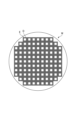
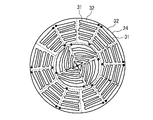
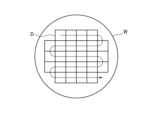
- FIG. 1 It is a perspective view showing a schematic structure of an inspection device concerning one embodiment. It is a front view which shows a part of inspection apparatus of FIG. 1 in a cross section. 2 is a plan view schematically showing the configuration of a wafer, which is a substrate to be inspected; FIG. It is a sectional view showing an example of a substrate placement mechanism used for an inspection device concerning one embodiment. It is a figure which shows the structure of the resistance heater used as a heating source. 4 is a circuit diagram showing an example of a specific circuit configuration of a heating section divided into a plurality of heating zones, a first temperature controller and a second temperature controller of a main control section, and a heating selection section; FIG. FIG.
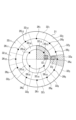
- FIG. 4 is a diagram showing an example of the relationship between a plurality of temperature sensors provided on the stage and a plurality of heating zones;
- FIG. 4 is a schematic diagram illustrating an example of serially inspecting a plurality of electronic devices;
- FIG. 4 is a schematic diagram illustrating an example of testing a plurality of electronic devices at random;
- FIG. 1 is a perspective view showing a schematic configuration of an inspection apparatus according to one embodiment
- FIG. 2 is a front view showing a cross section of a part of the inspection apparatus of FIG.
- an inspection apparatus 1 inspects the electrical characteristics of each of a plurality of electronic devices formed on a wafer W as a substrate. and a tester 4 .
- the inspection unit 2 has a housing 11 whose interior is hollow, and has a stage 20 in the housing 11 on which a wafer W to be inspected is placed.
- the stage 20 has a mounting surface on which the wafer W is mounted. and a plurality of temperature sensors 26 provided on the top plate 21 .
- the stage 20 is configured to be movable horizontally and vertically by a moving mechanism 16 .
- the heating section 24 and the cooling section 25 are controlled by the temperature control section 23 , and the stage 20 and the temperature control section 23 constitute the substrate mounting mechanism 10 . Details of the substrate mounting mechanism 10 will be described later.
- a probe card 12 is arranged above the stage 20 in the inspection section 2 so as to face the stage 20 .
- the probe card 12 has a plurality of probes 12a as contacts.
- the probe card 12 is connected to the tester 4 via an interface 13 .
- each probe 12a contacts the electrode of each electronic device on the wafer W
- each probe 12a supplies power to the electronic device from the tester 4 via the interface 13, or receives a signal from the electronic device via the interface 13. and transmit it to the tester 4. Therefore, the interface 13 and the probe 12a function as supply members that supply power to the electronic device.
- the loader 3 has a housing 14 in which a FOUP (not shown), which is a transfer container containing wafers W, is arranged.
- the loader 3 also has a transfer device (not shown), which takes out the wafer W accommodated in the FOUP and transfers it to the stage 20 of the inspection section 2 .
- the wafer W on the stage 20 whose electrical characteristics have been inspected is transferred by the transfer device and accommodated in the FOUP.
- control unit 15 that performs various types of control such as temperature control of the electronic device to be inspected is provided in the housing 14 of the loader 3 .
- the control unit 15 is composed of a computer and has a main control unit that controls each component of the inspection device 1.
- the main control unit controls the operation of each component of the inspection device.
- the control unit 15 has an input device, an output device, a display device, and a storage device. Control of each component by the main controller is executed by a processing recipe, which is a control program stored in a storage medium (hard disk, optical disk, semiconductor memory, etc.) built into the storage device.
- the control unit 15 controls the temperature control unit 23 .
- the arrangement position of the control unit 15 is not limited to the inside of the housing 14 and may be provided inside the housing 11 of the inspection unit 2, for example.
- a user interface section 18 that constitutes a part of the control section 15 is provided on the housing 11 of the inspection section 2 .
- the user interface unit 18 is for displaying information for the user and allowing the user to input instructions, and includes, for example, an input unit such as a touch panel or keyboard and a display unit such as a liquid crystal display.
- the tester 4 has a test board (not shown) that reproduces part of the circuit configuration of the motherboard on which the electronic device is mounted.
- the test board is connected to a tester computer 17 which determines whether the electronic device under test is good or bad based on signals from the electronic device.
- the tester 4 can reproduce circuit configurations of multiple types of motherboards by replacing the test board.
- the probe card 12, interface 13, and tester 4 constitute an inspection mechanism.
- the tester computer 17 When inspecting the electrical characteristics of the electronic device, the tester computer 17 transmits data to the test board connected to the electronic device via each probe 12a. Then, the tester computer 17 determines whether or not the transmitted data is correctly processed by the test board based on the electrical signal from the test board.
- the wafer W which is a substrate to be inspected, has a plurality of wafers formed on the surface thereof at predetermined intervals by performing etching processing and wiring processing on a substantially disk-shaped silicon substrate.
- FIG. 4 is a cross-sectional view showing an example of the substrate mounting mechanism 10. As shown in FIG. The substrate mounting mechanism 10 has the stage 20 and the temperature controller 23 as described above.
- the stage 20 has the top plate 21, the heating section 24, the cooling section 25, and a plurality of temperature sensors 26, as described above.
- the heating section 24 is provided under the top plate 21 and the cooling section 25 is provided below the heating section 24, but the heating section 24 and the cooling section 25 may be reversed.
- the top plate 21 has a disc shape corresponding to the wafer W, for example, and is made of a material with high thermal conductivity such as Cu, Al, SiC, AlN, or carbon fiber. By forming the top plate 21 from a material with high thermal conductivity, temperature control accuracy and efficiency can be enhanced.
- the heating part 24 is a plate-like body in which a heating source 31 is built, and the heating source 31 heats the top plate 21 .
- the heating unit 24 is divided into a plurality (three or more) of heating zones 32, the heating source 31 is also divided corresponding to each heating zone 32, and the plurality of heating zones 32 is configured to be capable of being heated independently. ing.
- a plurality of heating zones 32 are provided corresponding to each of the plurality of temperature sensors 26 .
- a resistance heater formed in a specific pattern can be used as the heating source 31, for example, as shown in FIG. 5, a resistance heater formed in a specific pattern can be used. Resistive heaters can be made by screen-printing a copper foil onto a polymer and etching it into a specific shape.
- the cooling part 25 is a plate-like body in which a cooling medium flow path 35 is formed. .
- a plurality of temperature sensors 26 are provided inside the top plate 21 and are fitted into holes formed in the top plate 21 .
- an RTD (resistance temperature detector) sensor can be used.
- other sensors such as a PN junction using a thermocouple, a diode, a transistor, or the like may be used.
- a plurality of temperature sensors 26 may be collectively arranged at the measurement position while being attached to the positioning unit.
- the positioning unit can be composed of a flexible substrate.
- the temperature control section 23 controls the temperature of the electronic device D on the wafer W placed on the top plate 21 and has a main control section 41 , a sensor selection section 42 and a heating selection section 43 .
- the main control unit 41 Based on a command from the control unit 15, the main control unit 41 supplies a sensor selection signal to the sensor selection unit 42, and a signal for selecting the heating zone 32 corresponding to the selected temperature sensor 26 to the heating selection unit 43. give.
- the main control unit 41 also has a first temperature controller 45a and a second temperature controller 45b, which output a temperature signal from the power supply 50 to the heating zone 32 of the heating unit 24 based on the signal from the temperature sensor 26. controls the voltage applied.
- the first temperature controller 45a and the second temperature controller 45b are not particularly limited, PID controllers can be preferably used.
- the main control unit 41 is configured to control the amount of cooling medium supplied to the cooling unit 25, the temperature, and the like.
- the sensor selection unit 42 selects the temperature sensor 26 closest to the electronic device D (first electronic device) under test and the electronic device D (first electronic device) to be tested next or thereafter. The one closest to the second electronic device) is selected, and detection signals are sent from these two selected temperature sensors 26 to the first temperature controller 45a and the second temperature controller 45b, respectively.
- the heating selection unit 43 selects the heating zone 32 to which the control voltage output from the first temperature controller 45a and the second temperature controller 45b is applied. This selection is made based on the selection signal from the main control section 41 as described above.
- a controlled voltage is applied from the first temperature controller 45a to the heating source 31 of the one or more heating zones 32 selected by the heating selection unit 43, and the temperature of the first electronic device under test reaches a desired temperature. controlled.
- the voltage controlled by the second temperature controller 45b is applied to the heating source 31 of the one or more heating zones 32 selected by the heating selection unit 43, and the second electron The temperature of the device is controlled to the desired temperature.
- the target electronic device D When the target electronic device D is positioned at the boundary between two heating zones 32, it is preferable to apply a voltage to the heating sources 31 of the plurality of heating zones 32. At this time, the position of the electronic device D is It is preferable to distribute the power (voltage) of the plurality of heating zones 32 accordingly. Further, when the electronic device D to be measured next or thereafter corresponds to the same heating zone, the second temperature controller 45b further controls the temperature of the heating zone 32 corresponding to the next electronic device D. good too.
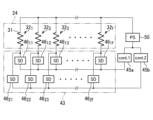
- FIG. 6 shows an example of a specific circuit configuration of the heating section 24 divided into a plurality of heating zones, the first temperature controller 45a and the second temperature controller 45b of the main control section 41, and the heating selection section 43. It is a circuit diagram showing.
- the heating section 24 has a plurality of heating zones 32 1 to 32 2 , 32 3 , . . .
- the heating selector 43 includes a plurality of first solid state relays (SD) 46 11 to 46 1f connected to the plurality of heating zones 32 1 to 32 f , respectively, and similarly to the plurality of heating zones 32 1 to 32 f, respectively. It has a plurality of connected second solid state relays (SD) 46 21 to 46 2f .
- SD solid state relays
- the first temperature controller 45a is connected to first solid state relays (SD) 46 11 to 46 1f
- the second temperature controller 45b is connected to second solid state relays (SD) 46 21 to 46 2f . It is By turning on one or more of the first solid state relays (SD) 46 11 to 46 1f , the control voltage from the first temperature controller 45a is applied to the heating zones 32 1 to 32 f . is selected. Also, by turning on one or more of the second solid state relays (SD) 46 21 to 46 2f , the control voltage from the second temperature controller 45b is applied to the heating zones 32 1 to 32 f . is selected.
- the heating selection unit 43 is composed of a plurality of solid state relays in this way, by arranging the heating selection unit 43 directly below the heating unit 24, the wiring from the solid state relay to the heating source 31 of the heating zone 32 is reduced. can be minimized.
- a solid state relay is an example of a switching element, and the switching element is not limited to a solid state relay, and may be a switching transistor or the like.
- FIG. 7 is a diagram showing an example of the relationship between a plurality of temperature sensors provided on the stage and a plurality of heating zones.
- the heating section 24 has 16 heating zones 32 1 to 32 16 .
- the heating zones 32 1 to 32 12 are on the outer peripheral side and the heating zones 32 13 to 32 16 are on the central side.
- the top plate 21 is provided with 16 temperature sensors 26 1 to 26 16 corresponding to these heating zones 32 1 to 32 16 .
- the control is as follows. That is, the heating zone 32-13 corresponding to the electronic device D1 is temperature-controlled by the first temperature controller 45a based on the detection value of the temperature sensor 26-13 , and the detection value of the heating zone 32-4 corresponding to the electronic device D2 . Based on this, it is controlled by the second temperature controller 45b.
- the wafer W is taken out from the FOUP of the loader 3 by the transfer device, transferred to the stage 20, and placed thereon.
- the stage 20 is moved to a predetermined position.
- the probe 12a provided above the stage 20 is brought into contact with the electrode E of the electronic device D to be inspected on the wafer W, thereby starting the inspection.
- the temperature of the electronic device D under inspection is controlled in order to guarantee the operation of the electronic device D in the operating environment.
- inspection is continuously performed with respect to several electronic devices D.
- the temperature control at this time is performed by controlling the heating by the heating unit 24 after adjusting the flow rate of the cooling medium flowing through the cooling unit 25 to adjust the base temperature of the stage 20 .
- the temperature control of the electronic device D under inspection by the heating unit 24 is performed using the signal of the temperature sensor 26 closest to the electronic device D under inspection among the plurality of temperature sensors 26 arranged.
- a controlled voltage is applied from the first temperature controller 45a to the heating source 31 of one or more heating zones 32 corresponding to the electronic device D under test, thereby controlling the temperature of the electronic device under test. .
- a plurality of temperature sensors 26 are arranged, and the temperature is controlled using the signal of the temperature sensor 26 closest to the electronic device to be tested.
- High-precision temperature control can be performed by controlling the temperature of subsequent electronic devices using the signal from the temperature sensor 26, which is the closest. In this case, even if the temperature control of the heating section 24 is performed in one zone, highly accurate temperature control can be achieved.
- the heat generation affects the temperature control and reduces the voltage applied to the heater. Recovery latency can reduce throughput.
- the heating unit 24 is divided into a plurality of heating zones 32, and the output of one or a plurality of heating zones 32 corresponding to the electronic device D under test is controlled by the first temperature controller 45a.
- a second temperature controller 45b controls the output of one or more heating zones 32 corresponding to the next or subsequent electronic devices D to be tested. More specifically, the first temperature controller 45a controls the heating source 31 of the corresponding one or more heating zones 32 based on the detection value of the (closest) temperature sensor 26 corresponding to the electronic device D under test. to control the temperature of the electronic device D under test.
- the second temperature controller 45b controls the heating source 31 of the corresponding one or more heating zones 32 based on the detected value of the (closest) temperature sensor corresponding to the electronic device D to be tested next or later. Control the power output and control the temperature of the next or subsequent electronic device D to be tested.
- the heating zone 32-13 corresponding to the electronic device D1 under inspection is temperature-controlled by the first temperature controller 45a based on the detection value of the temperature sensor 26-13 . It is controlled by the second temperature controller 45b based on the detected value of the heating zone 324 corresponding to the electronic device D2 . Further, when the electronic device D to be measured next or thereafter corresponds to the same heating zone, the same effect can be obtained by further controlling the temperature of the heating zone 32 corresponding to the next electronic device D. can. As a result, temperature control can be performed in a short period of time even if the next or subsequent electronic device to be tested is separated from the electronic device being tested.
- Patent Documents 1 and 2 dividing the heating unit into a plurality of heating zones is also described in Patent Documents 1 and 2.
- the temperatures of a plurality of heating zones are controlled by temperature controllers corresponding to each, which complicates the control system and increases the cost.
- the first temperature controller 45a controls the temperature of the electronic device D under test
- the second temperature controller 45a controls the temperature of the second electronic device to be tested next or later.
- 45b are used to select the heating zone 32 controlled by them in the heating selection section 43.
- Patent Document 2 uses a plurality of units having a plurality of LEDs as a heating unit, and by controlling the temperature of these units, thermal resistance and heat capacity are minimized to achieve high-speed and high-precision temperature control. and is suitable for testing expensive high power density electronic devices.
- a resistance heater as the heating source 31 of the heating unit 24 is shown.
- temperature control for random testing can be performed quickly, easily and at low cost.
- the first temperature controller controls one or more heating zones corresponding to the electronic device under test and the one or more heating zones corresponding to the next or subsequent electronic devices to be tested.
- a second temperature controller controlling the temperature of the zone.
- a third temperature controller may be provided to control the temperature of one or more heating zones corresponding to electronic devices to be subsequently tested.
- a PID controller can also be suitably used as the third temperature controller.
- a plurality of third temperature controllers may be provided. However, the total number of first temperature controllers, second temperature controllers, and third temperature controllers must be less than the number of heating zones.
- the present invention is not limited to this, and another heating source such as an LED may be used.
- the substrate is not limited to a wafer, and may be any substrate on which a plurality of electronic devices are formed.
Landscapes
- Testing Or Measuring Of Semiconductors Or The Like (AREA)
- Tests Of Electronic Circuits (AREA)
Priority Applications (2)
| Application Number | Priority Date | Filing Date | Title |
|---|---|---|---|
| KR1020247011980A KR20240053003A (ko) | 2021-09-24 | 2022-09-12 | 기판 탑재 기구, 검사 장치, 및 검사 방법 |
| CN202280062354.1A CN117941047A (zh) | 2021-09-24 | 2022-09-12 | 基片载置机构、检查装置和检查方法 |
Applications Claiming Priority (2)
| Application Number | Priority Date | Filing Date | Title |
|---|---|---|---|
| JP2021-155287 | 2021-09-24 | ||
| JP2021155287A JP7724668B2 (ja) | 2021-09-24 | 2021-09-24 | 基板載置機構、検査装置、および検査方法 |
Publications (1)
| Publication Number | Publication Date |
|---|---|
| WO2023047999A1 true WO2023047999A1 (ja) | 2023-03-30 |
Family
ID=85720644
Family Applications (1)
| Application Number | Title | Priority Date | Filing Date |
|---|---|---|---|
| PCT/JP2022/034025 Ceased WO2023047999A1 (ja) | 2021-09-24 | 2022-09-12 | 基板載置機構、検査装置、および検査方法 |
Country Status (5)
| Country | Link |
|---|---|
| JP (1) | JP7724668B2 (https=) |
| KR (1) | KR20240053003A (https=) |
| CN (1) | CN117941047A (https=) |
| TW (1) | TW202331870A (https=) |
| WO (1) | WO2023047999A1 (https=) |
Families Citing this family (1)
| Publication number | Priority date | Publication date | Assignee | Title |
|---|---|---|---|---|
| JP2025102474A (ja) * | 2023-12-26 | 2025-07-08 | 東京エレクトロン株式会社 | 基板支持台の温度調整方法及び検査装置 |
Citations (5)
| Publication number | Priority date | Publication date | Assignee | Title |
|---|---|---|---|---|
| JP2001210683A (ja) * | 2000-01-25 | 2001-08-03 | Tokyo Seimitsu Co Ltd | プローバのチャック機構 |
| JP2002500432A (ja) * | 1997-12-31 | 2002-01-08 | テンプトロニック コーポレイション | ワークピースチャック用温度制御システム |
| JP2004186492A (ja) * | 2002-12-04 | 2004-07-02 | Sumitomo Heavy Ind Ltd | チャック温度制御方式 |
| JP2006147612A (ja) * | 2004-11-16 | 2006-06-08 | Seiko Epson Corp | 半導体試験装置及び半導体装置の試験方法 |
| JP2007142301A (ja) * | 2005-11-22 | 2007-06-07 | Tokyo Seimitsu Co Ltd | プローバ |
Family Cites Families (1)
| Publication number | Priority date | Publication date | Assignee | Title |
|---|---|---|---|---|
| JP7300310B2 (ja) | 2019-05-20 | 2023-06-29 | 東京エレクトロン株式会社 | 載置台の温度調整方法、検査装置及び載置台 |
-
2021
- 2021-09-24 JP JP2021155287A patent/JP7724668B2/ja active Active
-
2022
- 2022-09-12 CN CN202280062354.1A patent/CN117941047A/zh active Pending
- 2022-09-12 KR KR1020247011980A patent/KR20240053003A/ko not_active Ceased
- 2022-09-12 WO PCT/JP2022/034025 patent/WO2023047999A1/ja not_active Ceased
- 2022-09-15 TW TW111134887A patent/TW202331870A/zh unknown
Patent Citations (5)
| Publication number | Priority date | Publication date | Assignee | Title |
|---|---|---|---|---|
| JP2002500432A (ja) * | 1997-12-31 | 2002-01-08 | テンプトロニック コーポレイション | ワークピースチャック用温度制御システム |
| JP2001210683A (ja) * | 2000-01-25 | 2001-08-03 | Tokyo Seimitsu Co Ltd | プローバのチャック機構 |
| JP2004186492A (ja) * | 2002-12-04 | 2004-07-02 | Sumitomo Heavy Ind Ltd | チャック温度制御方式 |
| JP2006147612A (ja) * | 2004-11-16 | 2006-06-08 | Seiko Epson Corp | 半導体試験装置及び半導体装置の試験方法 |
| JP2007142301A (ja) * | 2005-11-22 | 2007-06-07 | Tokyo Seimitsu Co Ltd | プローバ |
Also Published As
| Publication number | Publication date |
|---|---|
| JP2023046600A (ja) | 2023-04-05 |
| TW202331870A (zh) | 2023-08-01 |
| KR20240053003A (ko) | 2024-04-23 |
| JP7724668B2 (ja) | 2025-08-18 |
| CN117941047A (zh) | 2024-04-26 |
Similar Documents
| Publication | Publication Date | Title |
|---|---|---|
| US11340283B2 (en) | Testing device | |
| US11385280B2 (en) | Inspection apparatus and temperature control meihod | |
| JP7300310B2 (ja) | 載置台の温度調整方法、検査装置及び載置台 | |
| JP7304722B2 (ja) | 温度制御装置、温度制御方法、および検査装置 | |
| US20210247786A1 (en) | Temperature control device and method, and inspection apparatus | |
| US20250076232A1 (en) | Inspection Apparatus and Mounting Base | |
| CN114496838B (zh) | 载置台、检查装置和检查方法 | |
| KR102623795B1 (ko) | 탑재대의 온도 조정 방법 및 검사 장치 | |
| JP2021128006A (ja) | 加熱源の寿命推定システム、寿命推定方法、および検査装置 | |
| WO2023047999A1 (ja) | 基板載置機構、検査装置、および検査方法 | |
| KR20250130649A (ko) | 검사 시스템 및 온도 제어 방법 | |
| US12356508B2 (en) | Heater temperature control method, heater, and placement stand | |
| JP2545648B2 (ja) | プローバ | |
| JP7616877B2 (ja) | プロービング装置 | |
| JP2022032473A (ja) | 検査方法及び検査装置 |
Legal Events
| Date | Code | Title | Description |
|---|---|---|---|
| 121 | Ep: the epo has been informed by wipo that ep was designated in this application |
Ref document number: 22872753 Country of ref document: EP Kind code of ref document: A1 |
|
| WWE | Wipo information: entry into national phase |
Ref document number: 202280062354.1 Country of ref document: CN |
|
| ENP | Entry into the national phase |
Ref document number: 20247011980 Country of ref document: KR Kind code of ref document: A |
|
| NENP | Non-entry into the national phase |
Ref country code: DE |
|
| 122 | Ep: pct application non-entry in european phase |
Ref document number: 22872753 Country of ref document: EP Kind code of ref document: A1 |
|
| WWR | Wipo information: refused in national office |
Ref document number: 1020247011980 Country of ref document: KR |