WO2023042923A1 - ポリウレタンフォーム用整泡剤、ポリウレタンフォームおよびポリウレタンフォーム積層体、ならびにこれらの製造方法 - Google Patents
ポリウレタンフォーム用整泡剤、ポリウレタンフォームおよびポリウレタンフォーム積層体、ならびにこれらの製造方法 Download PDFInfo
- Publication number
- WO2023042923A1 WO2023042923A1 PCT/JP2022/034979 JP2022034979W WO2023042923A1 WO 2023042923 A1 WO2023042923 A1 WO 2023042923A1 JP 2022034979 W JP2022034979 W JP 2022034979W WO 2023042923 A1 WO2023042923 A1 WO 2023042923A1
- Authority
- WO
- WIPO (PCT)
- Prior art keywords
- foam
- parts
- polyurethane foam
- polymerizable unsaturated
- foam stabilizer
- Prior art date
- Legal status (The legal status is an assumption and is not a legal conclusion. Google has not performed a legal analysis and makes no representation as to the accuracy of the status listed.)
- Ceased
Links
Images
Classifications
-
- B—PERFORMING OPERATIONS; TRANSPORTING
- B32—LAYERED PRODUCTS
- B32B—LAYERED PRODUCTS, i.e. PRODUCTS BUILT-UP OF STRATA OF FLAT OR NON-FLAT, e.g. CELLULAR OR HONEYCOMB, FORM
- B32B27/00—Layered products comprising a layer of synthetic resin
- B32B27/40—Layered products comprising a layer of synthetic resin comprising polyurethanes
-
- B—PERFORMING OPERATIONS; TRANSPORTING
- B32—LAYERED PRODUCTS
- B32B—LAYERED PRODUCTS, i.e. PRODUCTS BUILT-UP OF STRATA OF FLAT OR NON-FLAT, e.g. CELLULAR OR HONEYCOMB, FORM
- B32B5/00—Layered products characterised by the non- homogeneity or physical structure, i.e. comprising a fibrous, filamentary, particulate or foam layer; Layered products characterised by having a layer differing constitutionally or physically in different parts
- B32B5/18—Layered products characterised by the non- homogeneity or physical structure, i.e. comprising a fibrous, filamentary, particulate or foam layer; Layered products characterised by having a layer differing constitutionally or physically in different parts characterised by features of a layer of foamed material
-
- C—CHEMISTRY; METALLURGY
- C08—ORGANIC MACROMOLECULAR COMPOUNDS; THEIR PREPARATION OR CHEMICAL WORKING-UP; COMPOSITIONS BASED THEREON
- C08F—MACROMOLECULAR COMPOUNDS OBTAINED BY REACTIONS ONLY INVOLVING CARBON-TO-CARBON UNSATURATED BONDS
- C08F220/00—Copolymers of compounds having one or more unsaturated aliphatic radicals, each having only one carbon-to-carbon double bond, and only one being terminated by only one carboxyl radical or a salt, anhydride ester, amide, imide or nitrile thereof
- C08F220/02—Monocarboxylic acids having less than ten carbon atoms; Derivatives thereof
- C08F220/10—Esters
- C08F220/12—Esters of monohydric alcohols or phenols
- C08F220/16—Esters of monohydric alcohols or phenols of phenols or of alcohols containing two or more carbon atoms
- C08F220/18—Esters of monohydric alcohols or phenols of phenols or of alcohols containing two or more carbon atoms with acrylic or methacrylic acids
-
- C—CHEMISTRY; METALLURGY
- C08—ORGANIC MACROMOLECULAR COMPOUNDS; THEIR PREPARATION OR CHEMICAL WORKING-UP; COMPOSITIONS BASED THEREON
- C08F—MACROMOLECULAR COMPOUNDS OBTAINED BY REACTIONS ONLY INVOLVING CARBON-TO-CARBON UNSATURATED BONDS
- C08F220/00—Copolymers of compounds having one or more unsaturated aliphatic radicals, each having only one carbon-to-carbon double bond, and only one being terminated by only one carboxyl radical or a salt, anhydride ester, amide, imide or nitrile thereof
- C08F220/02—Monocarboxylic acids having less than ten carbon atoms; Derivatives thereof
- C08F220/10—Esters
- C08F220/26—Esters containing oxygen in addition to the carboxy oxygen
-
- C—CHEMISTRY; METALLURGY
- C08—ORGANIC MACROMOLECULAR COMPOUNDS; THEIR PREPARATION OR CHEMICAL WORKING-UP; COMPOSITIONS BASED THEREON
- C08G—MACROMOLECULAR COMPOUNDS OBTAINED OTHERWISE THAN BY REACTIONS ONLY INVOLVING UNSATURATED CARBON-TO-CARBON BONDS
- C08G18/00—Polymeric products of isocyanates or isothiocyanates
Definitions
- the present invention relates to a foam stabilizer for polyurethane foams, polyurethane foams, polyurethane foam laminates, and methods for producing these.
- Polyurethane foam is made by mixing polyisocyanate with NCO (isocyanate) groups and polyol with OH (hydroxyl) groups together with catalysts, foaming agents, foam stabilizers, etc., and performing foaming reaction and resinification reaction at the same time. It is a homogeneous plastic foam obtained by applying Polyurethane foams are broadly classified into flexible polyurethane foams (hereinafter referred to as “soft urethane foams”) and rigid polyurethane foams (hereinafter referred to as “rigid urethane foams").
- Patent Document 1 discloses a polyurethane foam foam stabilizer containing at least a polyether-modified silicone compound synthesized by a hydrosilylation reaction between an organohydrogenpolysiloxane and an allyl group-containing polyoxyalkylene compound. .
- rigid urethane foam has an excellent feature of self-adhesion. Due to this self-adhesiveness, a mixture of polyisocyanate, polyol, catalyst, foaming agent, foam stabilizer, etc. is directly foamed on the surface of the object (base material) such as metal, plywood, concrete, etc. to generate rigid urethane foam. As a result, a heat insulating layer strongly adhered to the object can be formed without using an adhesive.
- cyclic siloxane contained in the silicone-based foam stabilizer diffuses into the air, causing damage to electrical and electronic circuits and affecting semiconductor production lines.
- cyclic siloxanes are considered to be environmental pollutants, and the reduction of emissions and restrictions on their use are being considered.
- the present invention has been made in view of the above circumstances, and has a foam stabilizing ability equal to or higher than that of a silicone foam stabilizer without using a silicone foam stabilizer, and a polypropylene resin or the like.
- a foam stabilizer for polyurethane foam capable of imparting sufficient adhesive strength to a polyurethane foam even to a difficult-to-adhere substrate, a polyurethane foam obtained using this foam stabilizer, and a laminate of this polyurethane foam on the surface of a substrate
- An object of the present invention is to provide polyurethane foam laminates and methods for producing them.
- the present inventors have made intensive studies to solve the above problems, and found that a copolymer of a specific polymerizable unsaturated monomer having an ether group and a specific polymerizable unsaturated monomer having a hydrophobic group.
- a polyurethane foam that, when used as a foam stabilizer, has a foam-stabilizing ability equal to or greater than that of a silicone-based foam stabilizer, and that can impart sufficient adhesive strength to polyurethane foam even to difficult-to-adhere substrates such as polypropylene resin.
- the present inventors have found that a foam stabilizer can be obtained, and have completed the present invention based on this finding.
- the present invention provides a foam stabilizer for polyurethane foam which is mixed with a polyisocyanate and a polyol and used for the production of polyurethane foam, wherein the structural unit derived from the polymerizable unsaturated monomer (A) is % by mass, and a copolymer containing 5 to 95% by mass of structural units derived from the polymerizable unsaturated monomer (B), and the polymerizable unsaturated monomer (A) is represented by the following general formula (1 ), and the polymerizable unsaturated monomer (B) is a polymerizable unsaturated monomer group that does not satisfy the general formula (1) and has a hydrophobic group
- a foam stabilizer for polyurethane foam which is at least one monomer selected from the above.
- R1-( CmH2mO ) n -R2 ( 1) (In the general formula (1), R1 is a (meth)acrylic group, R2 is a hydrogen atom, a (meth)acrylic group, or an alkyl or aryl group having 1 to 22 carbon atoms, and m is A natural number of 2 to 4, and n is a natural number of 1 to 100.)
- the SP value of the foam stabilizer for polyurethane foam is preferably 1.0 to 3.1 lower than the SP value of the polyol.
- the copolymer may have a weight average molecular weight of 1,000 to 500,000.
- the copolymer contains, as the polymerizable unsaturated monomer (A), only polymerizable unsaturated monomers in which R1 in the general formula (1) is a (meth)acrylic group. is preferred.
- the hydrophobic group of the polymerizable unsaturated monomer (B) may be a linear, branched or cyclic hydrocarbon group.
- the hydrophobic group of the polymerizable unsaturated monomer (B) may be free of oxygen atoms, nitrogen atoms, fluorine atoms and silicon atoms.
- the present invention is obtained by foaming and curing a urethane raw material mixture Mu containing at least a polyisocyanate, a polyol, and the foam stabilizer for polyurethane foam described above, and the urethane raw material mixture Mu is obtained by foaming and curing the foam stabilizer Mu.
- the SP value of the foam stabilizer is preferably 1.0 to 3.1 lower than the SP value of the polyol.
- the present invention provides a polyurethane foam lamination in which a substrate selected from the group consisting of polypropylene resin, polyethylene resin, fluororesin and silicone resin, or a substrate coated with wax, and the polyurethane foam described above are laminated. is the body.
- the present invention also provides a method for producing a polyurethane foam foam stabilizer mixed with a polyisocyanate and a polyol and used for producing a polyurethane foam, wherein the polymerizable unsaturated monomer (A) is added in an amount of 5 to 95% by mass.
- a method for producing a polyurethane foam foam stabilizer comprising at least one monomer selected from a group of saturated monomers.
- R1-( CmH2mO ) n -R2 ( 1)
- R1 is a (meth)acryl group
- R2 is a hydrogen atom, (meth)acryl group, an alkyl group having 1 to 22 carbon atoms or an aryl group
- m is 2 is a natural number from ⁇ 4
- n is a natural number from 1 to 100.
- the SP value of the foam stabilizer is preferably 1.0 to 3.1 lower than the SP value of the polyol.
- the copolymer may have a weight average molecular weight of 1,000 to 500,000.
- the copolymer contains, as the polymerizable unsaturated monomer (A), only polymerizable unsaturated monomers in which R1 in the general formula (1) is a (meth)acrylic group. is preferred.
- the hydrophobic group of the polymerizable unsaturated monomer (B) may be a linear, branched or cyclic hydrocarbon group.
- the hydrophobic group of the polymerizable unsaturated monomer (B) may be free of oxygen atoms, nitrogen atoms, fluorine atoms and silicon atoms.
- the present invention includes a foam stabilizer mixing step of mixing a polyol and the foam stabilizer for polyurethane foam described above to obtain a polyol mixture Mo, and foaming and curing while mixing the polyol mixture Mo and a polyisocyanate. and a foam production step of obtaining a polyurethane foam.
- the present invention includes a lamination step of laminating a substrate selected from the group consisting of polypropylene resin, polyethylene resin, fluororesin and silicone resin, or a substrate coated with wax, and polyurethane foam, wherein
- the said polyurethane foam is a manufacturing method of the polyurethane-foam laminated body which is the foam obtained by the manufacturing method of the polyurethane foam mentioned above.
- a copolymer of a specific polymerizable unsaturated monomer having an ether group and a specific polymerizable unsaturated monomer having a hydrophobic group is used as a foam stabilizer in producing a polyurethane foam.
- a foam stabilizer for polyurethane foam having a foam stabilizer equal to or higher than that of a silicone-based foam stabilizer and to impart sufficient adhesion to a difficult-to-adhere base material such as a polypropylene resin to a polyurethane foam. becomes possible.
- (meth)acrylic group refers to at least one selected from “acrylic group” and “methacrylic group”
- (meth)acrylate refers to at least one selected from “acrylate” and “methacrylate”. 1 species.
- a foam stabilizer for polyurethane foam according to a preferred embodiment of the present invention is mixed with polyisocyanate, polyol and other components (catalyst, blowing agent, etc.) and used to produce polyurethane foam.
- the foam stabilizer according to the present invention comprises, as essential components, a copolymer X containing a structural unit A derived from a polymerizable unsaturated monomer (A) and a structural unit B derived from a polymerizable unsaturated monomer (B).
- this copolymer X is composed of a hydrophobic trunk polymer derived from the polymerizable unsaturated monomer (B) and a hydrophilic branch polymer having an ether group derived from the polymerizable unsaturated monomer (A). is a graft copolymer having a molecular skeleton of
- the copolymer X in the foam stabilizer according to the present invention, it is possible to obtain a foam stabilizer for polyurethane foam having a foam stabilizing ability equal to or greater than that of a silicone-based foam stabilizer. It is possible to impart sufficient adhesive strength to the polyurethane foam even to difficult-to-adhere substrates such as resins and polyethylene resins.
- the "foam stabilizing ability" in the present specification means the ability to sufficiently exert the role of the foam stabilizing agent described below, specifically, the foam volume of the polyurethane foam is large and the cell diameter of the polyurethane foam is It means the performance that can reduce
- the role of the foam stabilizer in the production of polyurethane foam is to improve the compatibility of each component (polyisocyanate, polyol, etc.) of the polyurethane raw material and to lower the surface tension of the mixed solution of the polyurethane raw material.
- the gas involved in the mixed solution can be easily dispersed, so that the cells in the foam can be made uniform and stabilized, and coarsening and non-uniformity of the cells can be suppressed.
- foam volume volume of foam containing cells
- cell diameter of the produced polyurethane foam.
- the foam volume and cell diameter of these polyurethane foams also greatly affect the physical properties of the polyurethane foam (eg, heat insulation, water resistance, heat resistance, cushioning properties, shock absorption, sound absorption, weight, etc.).
- the term "difficult-to-adhere base material” refers to a base material that is difficult to bond with a polyurethane foam using a self-adhesive property of a rigid polyurethane foam or a general adhesive. say.
- difficult-to-adhere substrates include substrates such as polypropylene resin, polyethylene resin, fluororesin, and silicone resin, and substrates coated with wax.
- the "adhesive strength" in this specification includes both the adhesive strength based on the self-adhesiveness of rigid polyurethane foam and the adhesive strength with polyurethane foam using a general adhesive. The essential components and optional components contained in the foam stabilizer according to the present invention are described in detail below.
- the polymerizable unsaturated monomer (A) is a polymerizable unsaturated monomer having at least one ether group represented by general formula (1) below.
- the "polymerizable unsaturated monomer” in the present invention means "a monomer having a polymerizable unsaturated hydrocarbon group (carbon-carbon double bond or triple bond)”.
- R1 is a (meth)acryl group
- R2 is a hydrogen atom, a (meth)acryl group, an alkyl group having 1 to 22 carbon atoms or an aryl group
- m is 2 to 4 is a natural number
- n is a natural number from 1 to 100.
- Examples of the polymerizable unsaturated monomer (A) include (meth)acrylates, allyl ethers, vinyl ethers, and the like.
- (meth)acrylates include polyethylene glycol mono(meth)acrylate, poly(ethylene-propylene)glycol mono(meth)acrylate, polypropylene glycol mono(meth)acrylate, polytetramethylene glycol mono(meth)acrylate, methoxy Polyethylene glycol (meth)acrylate, methoxypolypropylene glycol (meth)acrylate, methoxypoly(ethylene-propylene)glycol (meth)acrylate, methoxypoly(ethylene-tetramethyleneglycol (meth)acrylate, butoxypoly(ethylene-propyleneglycol) (meth)acrylate , octoxypolyethylene glycol (meth)acrylate, lauroxypolyethyleneglycol (meth)acrylate, stearoxypolyethyleneglycol (meth)acrylate, behenyloxypolyethyleneglycol (meth)acrylate, phenoxypolyethyleneglycol (meth)acrylate, phenoxy
- allyl ethers examples include polyethylene glycol monoallyl ether, polypropylene glycol monoallyl ether, methoxypolyethylene glycol allyl ether, polyethylene glycol polypropylene glycol monoallyl ether, butoxypolyethylene glycol polypropylene glycol monoallyl ether, polyethylene glycol diallyl ether, and polypropylene glycol. Diallyl ether etc. are mentioned.
- vinyl ethers examples include polyethylene glycol monovinyl ether and polypropylene glycol monovinyl ether.
- the above monomers may be used singly or in combination of two or more.
- R2 in the general formula (1) is a (meth)acryl group, an alkyl group having 1 to 22 carbon atoms or an aryl group having 1 to 22 carbon atoms. is preferred, and an alkyl group having 1 to 22 carbon atoms is more preferred.
- an ether group-containing polymerizable unsaturated monomer (A) in which R1 in general formula (1) is a (meth)acrylic group As the constituent monomers of the copolymer X, an ether group-containing polymerizable unsaturated monomer in which R1 in the general formula (1) is a vinyl ether group or an allyl group, and a polymerizable unsaturated monomer in which R1 is a (meth)acrylic group It may be used in combination with (A).
- the adhesive strength to the difficult-to-adhere substrate can be increased more than when R1 is used in combination with a polymerizable unsaturated monomer (A) other than a (meth)acrylic group (for example, a vinyl ether group, an allyl group, etc.).
- R2 in the general formula (1) is a hydrogen atom, a (meth)acryl group, an alkyl group having 1 to 22 carbon atoms, or an aryl group. It is essential to use a polyunsaturated monomer (A).
- the alkyl chain length m of the ether chain of the polymerizable unsaturated monomer (A) is a natural number of 2 or more and 4 or less. If m is 5 or more, the effect as a polar group, that is, the effect of imparting hydrophilicity to the copolymer X may not be expected. It is generally difficult to obtain an ether group-containing polymerizable unsaturated monomer satisfying general formula (1) where m is 5 or more.
- the ether chain length n of the polymerizable unsaturated monomer (A) is a natural number of 1 or more and 100 or less, preferably 4 or more and 50 or less, more preferably 4 or more and 23 or less. If n exceeds 100, there is a possibility that the effect of imparting sufficient adhesive strength to the substrate to the polyurethane foam cannot be obtained. Incidentally, it is generally difficult to obtain an ether group-containing polymerizable unsaturated monomer satisfying general formula (1) where n exceeds 100.
- the content of the structural unit A derived from the polymerizable unsaturated monomer (A) is 5% by mass or more and 95% by mass or less when the total mass of the structural unit A and the structural unit B is 100% by mass. If the content of the structural unit A is less than 5% by mass, the adhesive strength to difficult-to-bond substrates will be insufficient. On the other hand, if the content of the structural unit A exceeds 95% by mass, the foam stabilizing ability of the foam stabilizer deteriorates. In order to increase the adhesive strength to difficult-to-bond substrates, the content of structural unit A is preferably 10% by mass or more. Moreover, in order to improve the foam stabilizing ability, the content of the structural unit A is preferably 90% by mass or less.
- the polymerizable unsaturated monomer (B) is at least one monomer selected from the group of polymerizable unsaturated monomers that do not satisfy general formula (1) above and have a hydrophobic group. That is, the polymerizable unsaturated monomer (B) is a polymerizable unsaturated monomer that is different from the polymerizable unsaturated monomer (A) and has a hydrophobic group.
- the hydrophobic group possessed by the polymerizable unsaturated monomer (B) is, for example, a linear, branched or cyclic hydrocarbon group. Also, the hydrophobic group preferably does not contain any of oxygen, nitrogen, fluorine and silicon atoms.
- the hydrophobic group of the polymerizable unsaturated monomer (B) is a functional group such as those described above, it is possible to achieve both high levels of foam stabilizing ability and adhesion to hard-to-adhere substrates.
- Examples of the polymerizable unsaturated monomer (B) include (meth)acrylates, vinyl ethers, vinyl esters, dialkyl maleates, dialkyl fumarate, dialkyl itaconate, aromatic hydrocarbon-based vinyl compounds, ⁇ -olefin compounds, and the like.
- (meth)acrylates include methyl (meth)acrylate, ethyl (meth)acrylate, normal propyl (meth)acrylate, isopropyl (meth)acrylate, normal butyl (meth)acrylate, isobutyl (meth)acrylate, tertiary Butyl (meth)acrylate, hexyl (meth)acrylate, normal octyl (meth)acrylate, isooctyl (meth)acrylate, 2-ethylhexyl (meth)acrylate, isononyl (meth)acrylate, normal decyl (meth)acrylate, isodecyl (meth)acrylate Acrylates, Lauryl (meth)acrylate, Stearyl (meth)acrylate, Isostearyl (meth)acrylate, Oleyl (meth)acrylate, Behenyl (meth)acrylate, Benzyl (meth)acrylate, Cyclohexy
- vinyl ethers include methyl vinyl ether, ethyl vinyl ether, normal propyl vinyl ether, isopropyl vinyl ether, normal butyl vinyl ether, isobutyl vinyl ether, tertiary butyl vinyl ether, normal octyl vinyl ether, 2-ethylhexyl vinyl ether, decyl vinyl ether, lauryl vinyl ether, stearyl vinyl ether, behenyl vinyl ether and the like.
- vinyl esters include vinyl acetate, vinyl neononanoate, vinyl 2,2-dimethyloctanoate, and vinyl neoundecanoate.
- dialkyl maleates include dimethyl maleate, diethyl maleate, diisopropyl maleate, dibutyl maleate, di-2-ethylhexyl maleate, dilauryl maleate, and distearyl maleate.
- dialkyl fumarate include dimethyl fumarate, diethyl fumarate, diisopropyl fumarate, dibutyl fumarate, di-2-ethylhexyl fumarate, dilauryl fumarate, and distearyl fumarate.
- dialkyl itaconate examples include dimethyl itaconate, dibutyl itaconate, di-2-ethylhexyl itaconate, dilauryl itaconate, and distearyl itaconate.
- aromatic hydrocarbon-based vinyl compounds include styrene, ⁇ -methylstyrene, chlorostyrene, and vinyltoluene.
- ⁇ -olefin compounds include 1-hexene, 1-octene, 1-dodecene and the like.
- the above monomers may be used singly or in combination of two or more.
- the number of carbon atoms in the hydrophobic group possessed by the polymerizable unsaturated monomer (B) is preferably 2 or more and 22 or less. , 4 or more and 18 or less.
- the content of the structural unit B derived from the polymerizable unsaturated monomer (B) is 5% by mass or more and 95% by mass or less when the total mass of the structural unit A and the structural unit B is 100% by mass. If the content of the structural unit B is less than 5% by mass, the foam stabilizing ability of the foam stabilizer deteriorates. On the other hand, if the content of the structural unit B exceeds 95% by mass, the adhesive strength to difficult-to-bond substrates will be insufficient. In order to improve the foam stabilizing ability, the content of the structural unit B is preferably 10% by mass or more. Moreover, in order to increase the adhesive strength to the difficult-to-bond substrate, the content of the structural unit B is preferably 90% by mass or less.
- the copolymer X according to the present invention is a structural unit derived from a copolymerizable unsaturated monomer (C) different from both the copolymerizable unsaturated monomer (A) and the copolymerizable unsaturated monomer (B) described above. It may further contain C.
- the foam stabilizing ability improves, but the adhesive strength to the difficult-to-adhere substrate tends to decrease.
- a polymerizable unsaturated monomer (C) may be added to the monomer mixture Mm when synthesizing the copolymer X.
- a polymerizable unsaturated monomer (C) it is also possible to improve surface activity (performance to reduce surface tension) and affinity (adhesiveness) with a substrate.
- Examples of the copolymerizable unsaturated monomer (C) include, for example, hydroxyl group-containing (meth)acrylates which are monoesterified products of (meth)acrylic acid and a dihydric alcohol having 2 to 8 carbon atoms, and glycol (meth)acrylates.
- hydroxyl group-containing (meth)acrylates which are monoesterified products of (meth)acrylic acid and a dihydric alcohol having 2 to 8 carbon atoms
- glycol (meth)acrylates examples include, for example, hydroxyl group-containing (meth)acrylates which are monoesterified products of (meth)acrylic acid and a dihydric alcohol having 2 to 8 carbon atoms, and glycol (meth)acrylates.
- acrylamide or methacrylamides hydrophilic vinyl compounds
- carboxyl group-containing polymerizable unsaturated monomers ether group-containing polymerizable unsaturated monomers
- reactive silicones having methacryloyloxy groups
- hydroxyl group-containing (meth)acrylates which are monoesterified products of (meth)acrylic acid and a dihydric alcohol having 2 to 8 carbon atoms, include 2-hydroxyethyl (meth)acrylate, 2-hydroxypropyl (meth) ) acrylate, 2-hydroxy-1-methylethyl (meth)acrylate, 4-hydroxybutyl (meth)acrylate, 3-hydroxy-2,2-dimethylpropyl (meth)acrylate and the like.
- glycol (meth)acrylates examples include methoxypolyethylene glycol (meth)acrylate, methoxypropylene glycol (meth)acrylate, phenoxyethylene glycol (meth)acrylate, and phenoxypropylene glycol (meth)acrylate.
- acrylamides or methacrylamides include acrylamide, N-methylacrylamide, N-methylmethacrylamide, N-methylolacrylamide butyl ether, N-methylolmethacrylamide butyl ether, N-ethylacrylamide, N-ethylmethacrylamide, Nn - propylacrylamide, Nn-propylmethacrylamide, N-isopropylacrylamide, N-isopropylmethacrylamide, N-cyclopropylacrylamide, N-cyclopropylmethacrylamide, diacetoneacrylamide, diacetonemethacrylamide, N-hydroxymethylacrylamide , N-hydroxymethylmethacrylamide, N-hydroxyethylacrylamide, N-hydroxyethylmethacrylamide, N,N-dimethylacrylamide, N,N-dimethylmethacrylamide, N,N-diethylacrylamide, N,N-diethylmethacrylamide , N-methyl, N-ethylacryl
- hydrophilic vinyl compounds include N-vinyl-2-pyrrolidone.
- carboxyl group-containing polymerizable unsaturated monomers include (meth)acrylic acid, maleic acid, fumaric acid, itaconic acid, crotonic acid, ⁇ -carboxyethyl acrylate and the like.
- ether group-containing unsaturated monomers include, for example, tetrahydrofurfuryl (meth)acrylate, glycidyl (meth)acrylate, (3-ethyloxetan-3-yl)methyl (Meth)acrylate, cyclic trimethylolpropane formal (meth)acrylate, (2-methyl-2-ethyl-1,3-dioxolan-4-yl)methyl (meth)acrylate and the like.
- reactive silicone having a methacryloyloxy group Commercial products of reactive silicone having a methacryloyloxy group include, for example, Silaplane FM-0711, FM-0721, FM-0725 and TM-0701T manufactured by JNC Corporation, AK-5 and AK- manufactured by Toagosei Co., Ltd. 30, X22-164A, X22-164B and X22-164C manufactured by Shin-Etsu Silicone Co., Ltd.;
- fluorine-containing (meth)acrylate monomers include trifluoroethyl (meth)acrylate, tetrafluoropropyl (meth)acrylate, octafluoropentyl (meth)acrylate, and tridecafluorooctyl (meth)acrylate.
- polyfunctional unsaturated monomers examples include divinylbenzene, ethylene glycol di(meth)acrylate, propylene glycol di(meth)acrylate, tetramethylene glycol di(meth)acrylate, 1,6-hexamethylene glycol di(meth)acrylate. ) acrylate, neopentyl glycol di(meth)acrylate, and the like.
- These monomers may be used singly or in combination of two or more.
- the content of the structural unit C derived from the polymerizable unsaturated monomer (C) is 50 when the total mass of the polymerizable unsaturated monomer (A) and the polymerizable unsaturated monomer (B) is 100 parts by mass. It is preferably no more than parts by mass. If the content of the structural unit C exceeds 50 parts by mass, it may adversely affect the foam stabilizing ability, the adhesive strength to difficult-to-adhere substrates, the stability of the polyurethane foam, and the like.
- the weight average molecular weight Mw of the copolymer X according to the present invention is preferably 1,000 to 500,000, more preferably 5,000 to 500,000, and even more preferably 5,000 to 100,000.
- the weight-average molecular weight Mw is within the above range, high foam stabilizing ability can be exhibited while maintaining adhesive strength to difficult-to-adhere substrates at a practical level or higher.
- the weight average molecular weight is preferably 5,000 or more and 40,000 or less.
- the weight average molecular weight Mw exceeds 500,000, although it has a high foam stabilizing ability, poorly dispersed substances (undispersed aggregates) may occur and the effect of the foam stabilizing agent may not be sufficiently exhibited.
- the molecular weight Mw is preferably 500,000 or less.
- the weight average molecular weight Mw is a value calculated based on the molecular weight of standard polystyrene from a chromatogram measured by gel permeation chromatography (GPC).
- GPC gel permeation chromatography
- the solubility parameter (hereinafter referred to as "SP value") of the foam stabilizer according to the present invention is lower than the SP value of polyol, which is a raw material for producing polyurethane foam, and the difference ( SP difference) is preferably in the range of 1.0 or more and 3.1 or less.
- the foam stabilizer dissolves in the mixed solution of the polyurethane foam raw materials, and the effect of adding the foam stabilizer (foam stabilization ability is sufficiently exhibited. effect) may not be obtained.
- the SP difference exceeds 3.1, the foam stabilizer cannot be finely dispersed in the mixed solution of the polyurethane foam raw materials, and the foam is broken rather than stabilized (acts like an antifoaming agent).
- the SP difference is more preferably 1.3 or more, and even more preferably 1.5 or more.
- the SP difference is more preferably 2.9 or less, even more preferably 2.8 or less, and even more preferably 2.0 or less.
- the SP value of the polyol is the value measured by the turbidity point titration method
- the SP value of the foam stabilizer is the value calculated by the Fedors calculation method.
- the SP value by turbidity point titration can be measured by the following method (see SUH, CLARKE, JPSA-1, 5, 1671-1681 (1967)).
- a poor solvent is added dropwise to this sample solution at a measurement temperature of 20° C. using a 50 ml buret, and the drop amount (turbidity point) is defined as the point at which turbidity occurs (turbidity point titration).
- ⁇ ml is the SP value of the poor solvent (n-hexane in this specification) when titrated with a low SP poor solvent
- Vmh is the poor solvent at the turbid point when titrated with a high SP poor solvent (here The molecular volume [mL/mol] of the ion-exchanged water) and ⁇ mh respectively indicate the SP value of the poor solvent (here, ion-exchanged water) when titrated with a high SP poor solvent.
- Vml, Vmh, ⁇ ml and ⁇ mh in formula (2) can be calculated by the following formulas (2a) and (2b) using the titration amount titrated with each poor solvent.
- Vm V1V2/( ⁇ 1V2+ ⁇ 2V1) (2a)
- ⁇ m ⁇ 1 ⁇ 1+ ⁇ 2 ⁇ 2 (2b)
- Vm is Vml or Vmh
- ⁇ m is ⁇ ml or ⁇ mh
- V1 is the molecular volume of the sample solution solvent (acetone in this specification) at the turbid point [mL/mol]
- V2 is the molecular volume [mL/mol] of the poor solvent (here, ion-exchanged water or n-hexane) at the turbid point
- ⁇ 1 is the volume fraction of the sample solution solvent (here, acetone) at the turbid point
- ⁇ 2 indicates the volume fraction of the poor solvent (in this specification, ion-exchanged water or n-hexane) at the turbid point.
- the SP value of the polyol was measured by the turbidity point titration method described above.
- the SP value by the Fedors calculation method is F. It can be calculated by the calculation method described in "Polymer Engineering and Science” by Fedors, 14(2), 147 (1974). In the Fedors calculation method, the SP value is calculated based on the cohesive energy and molecular volume of the substituent (atom or atomic group) of the target compound.
- the use of the foam stabilizer according to the present invention is not particularly limited as long as it is used as a foam stabilizer for controlling the foam volume, cell diameter, etc. of a foam in the production of polyurethane foam. However, it can be particularly suitably used as a foam stabilizer for rigid polyurethane foams.
- the method for producing a foam stabilizer for polyurethane foam according to the present invention described above includes a polymerization step of obtaining the copolymer X described above.
- the copolymer X is a monomer mixture containing 5 to 95% by mass of the above polymerizable unsaturated monomer (A) and 5 to 95% by mass of the above polymerizable unsaturated monomer (B). It is synthesized by copolymerizing Mm. A predetermined amount of the polymerizable unsaturated monomer (C) described above may be added to the monomer mixture Mm used for synthesizing the copolymer X, if necessary.
- the method for synthesizing the copolymer X according to the present invention is not particularly limited, and known methods such as a solution polymerization method, a dispersion polymerization method, a bulk polymerization method, an emulsion polymerization method, a suspension polymerization method, and a living radical polymerization method.
- a polymerization method is used.
- the polymerization initiator known azo polymerization initiators, peroxides and the like can be used, and an appropriate initiator may be used depending on the type of polymerization reaction.
- the blending amount of the polymerizable unsaturated monomer (A) is 5% by mass or more and 95% by mass or less when the total mass of the polymerizable unsaturated monomer (A) and the polymerizable unsaturated monomer (B) is 100% by mass. is. If the content of the polymerizable unsaturated monomer (A) is less than 5% by mass, the adhesive strength to difficult-to-adhere substrates will be insufficient. On the other hand, when the blending amount of the polymerizable unsaturated monomer (A) exceeds 95% by mass, the foam stabilizing ability of the foam stabilizing agent deteriorates.
- the blending amount of the polymerizable unsaturated monomer (A) is preferably 10% by mass or more. Moreover, in order to improve the foam stabilizing ability, the blending amount of the polymerizable unsaturated monomer (A) is preferably 90% by mass or less.
- the blending amount of the polymerizable unsaturated monomer (B) is 5% by mass or more and 95% by mass when the total mass of the polymerizable unsaturated monomer (A) and the polymerizable unsaturated monomer (B) is 100% by mass. % or less. If the blending amount of the polymerizable unsaturated monomer (B) is less than 5% by mass, the foam stabilizing ability of the foam stabilizing agent is deteriorated. On the other hand, if the blending amount of the polymerizable unsaturated monomer (B) exceeds 95% by mass, the adhesive strength to difficult-to-adhere substrates will be insufficient.
- the blending amount of the polymerizable unsaturated monomer (B) is preferably 10% by mass or more. Moreover, in order to increase the adhesive strength to the difficult-to-adhere substrate, the blending amount of the polymerizable unsaturated monomer (B) is preferably 90% by mass or less.
- the blending amount of the polymerizable unsaturated monomer (C) is 50 parts by mass or less when the total mass of the polymerizable unsaturated monomer (A) and the polymerizable unsaturated monomer (B) is 100 parts by mass. is preferred. If the blending amount of the polymerizable unsaturated monomer (C) exceeds 50 parts by mass, it may adversely affect the foam stabilizing ability, the adhesive strength to difficult-to-adhere substrates, the stability of the polyurethane foam, and the like.
- the polyurethane foam according to the present invention is a foam obtained by foaming and curing a urethane raw material mixture Mu (mixed solution as a polyurethane foam raw material) containing a polyisocyanate, a polyol, and the foam stabilizer for polyurethane foam described above. is.
- Polyurethane foams according to the present invention include all rigid polyurethane foams, flexible polyurethane foams and semi-rigid polyurethane foams.
- rigid polyurethane foam has an excellent feature of self-adhesion that is not found in other heat insulating materials. This is due to the property that a layer strongly adhered to the object can be formed by directly foaming the mixed solution on the surface of the object such as metal, plywood, concrete, resin, etc., without using an adhesive. be. Using this property, the surface of the object (substrate) such as a composite panel, laminate board, etc. can be cured simply by applying the mixed solution to the object by spraying and foaming and curing the mixed solution on the surface of various objects.
- Polyurethane foam laminates can be produced in which polyurethane foam is laminated to If the surface of the object (base material) is previously coated with a primer or the like, the polyurethane foam can be adhered to the surface of the object more strongly.
- the content of the foam stabilizer according to the present invention is preferably 0.1% by mass or more and 5.0% by mass or less in the urethane raw material mixture Mu (mixed solution as a polyurethane foam raw material). If the content of the foam stabilizer is less than 0.1% by mass, the foam stabilizing ability may deteriorate. On the other hand, if the content of the foam stabilizer exceeds 5.0% by mass, the mechanical properties of the polyurethane foam may deteriorate, and it may cause stickiness and contamination. From the viewpoint of increasing the foam stabilizing ability, the content of the foam stabilizer is more preferably 0.3% by mass or more, further preferably 0.7% by mass or more, and 1.5% by mass or more. It is even more preferred to have In addition, from the viewpoint of increasing adhesive strength, the content of the foam stabilizer is more preferably 2.5% by mass or less, further preferably 1.5% by mass or less, and 0.7% by mass or less. is even more preferable.
- the SP value of the foam stabilizer according to the present invention is 1.0 to 3.1 lower than the SP value of the polyol that is the raw material for producing the polyurethane foam, that is, the SP value of the polyol It is preferably low and the difference (SP difference) is in the range of 1.0 or more and 3.1 or less.
- the polyurethane foam of the present invention can be suitably used as a building material, a ship for oil and gas transportation, and a heat retaining material, a heat insulating material, etc. in electric appliances such as a refrigerator.
- a heat retaining material such as a heat insulating material
- it can be used as a foam for the spraying method because it is easy to perform insulation work.
- the method for producing a polyurethane foam according to the present invention described above includes a foam stabilizer mixing step and a foam producing step.
- the foam stabilizer mixing step In the foam stabilizer mixing step, the polyol and the foam stabilizer for polyurethane foam described above are mixed to obtain a polyol mixture Mo.
- the polyol mixture Mo of the present invention may contain a foaming agent, a catalyst, other additives, and the like.
- a method for mixing each raw material in the polyol mixture Mo a known method can be used. For example, each raw material can be mixed by stirring using a disper.
- Each component in the polyol mixture Mo will be described in detail below.
- polyol Polyol
- the polyol used in the method for producing the polyurethane foam of the present invention is not particularly limited as long as it is generally used for the production of polyurethane foam.
- Examples include polyester polyol, polyether polyol, polyether ester polyol, and polylactone polyol. , polycarbonate polyols, aromatic polyols, alicyclic polyols, aliphatic polyols, polymer polyols, and the like.
- polyester polyols and polyether polyols are suitable as the polyols of the present invention.
- Polyester polyols include, for example, polymers obtained by dehydration condensation of polybasic acids and polyhydric alcohols, and ring-opening polymerization of lactones such as ⁇ -caprolactone, ⁇ -methyl- ⁇ -caprolactone and methylvalerolactone. and condensates of hydroxycarboxylic acids and the above polyhydric alcohols.
- the polybasic acid include adipic acid, azelaic acid, sebacic acid, terephthalic acid, isophthalic acid, malonic acid, succinic acid, and naphthalenedicarboxylic acid.
- Polyhydric alcohols used in the synthesis of polyester polyols include ethylene glycol, diethylene glycol, propylene glycol, dipropylene glycol, butanediol, pentanediol, hexanediol, neopentyl glycol, octanediol, nonanediol, bisphenol A, and the like. is mentioned.
- hydroxycarboxylic acids include, for example, castor oil, reaction products of castor oil and ethylene glycol, and the like.
- polyether polyols examples include alkylene oxide adducts of polyhydric alcohols.
- polyhydric alcohols used in the synthesis of polyether polyols include ethylene glycol, diethylene glycol, propylene glycol, dipropylene glycol, butanediol, neopentyl glycol, glycerin, pentaerythritol, trimethylolpropane, sorbitol, and the like.
- examples of the alkylene oxide include ethylene oxide and propylene oxide.
- polyether ester polyols include those obtained by reacting the above-described polyether polyols with polybasic acids to esterify them, and those having both polyether and polyester segments in one molecule.
- polylactone polyols examples include polypropiolactone glycol, polycaprolactone glycol, and polyvalerolactone glycol.
- Polycarbonate polyols are obtained by dealcoholization reaction of hydroxyl group-containing compounds such as ethylene glycol, propylene glycol, butanediol, pentanediol, hexanediol, octanediol and nonanediol with diethylene carbonate, dipropylene carbonate and the like. polyols and the like.
- aromatic polyols examples include bisphenol A, bisphenol F, phenol novolak, and cresol novolak.
- Alicyclic polyols include, for example, cyclohexanediol, methylcyclohexanediol, isophoronediol, dicyclohexylmethanediol, and dimethyldicyclohexylmethanediol.
- examples of aliphatic polyols include ethylene glycol, propylene glycol, butanediol, pentanediol, hexanediol, and the like.
- polyols may be used singly or in combination of two or more.
- the hydroxyl value of these polyols is preferably 10 to 600 mgKOH/g, more preferably 30 to 500 mgKOH/g.
- the hydroxyl value in the present invention is a value measured according to JIS-K0070.
- the blending amount of polyol is preferably 20 to 80% by mass when the total amount of polyurethane foam raw materials is taken as 100% by mass.
- the foam stabilizer according to the present invention is blended in order to increase the compatibility of each component (polyisocyanate, polyol, etc.) of the polyurethane raw material and to reduce the surface tension of the mixed solution of the polyurethane raw material.
- the gas involved in the mixed solution can be easily dispersed, so that the cells in the foam can be made uniform and stabilized, and the cell structure (foam volume, cell diameter, etc.) can be adjusted.
- This cell structure has a great influence on the physical properties of the polyurethane foam.
- the polyurethane foam foam stabilizer described above is used in the present invention.
- the blending amount of the foam stabilizer according to the present invention is preferably 0.1% by mass or more and 5.0% by mass or less in the urethane raw material mixture Mu (mixed solution as a polyurethane foam raw material). If the amount of the foam stabilizer is less than 0.1% by mass, the foam-stabilizing ability may be lowered. On the other hand, if the amount of the foam stabilizer exceeds 5.0% by mass, the mechanical properties of the polyurethane foam may be lowered, and stickiness and contamination may be caused. From the viewpoint of enhancing the foam stabilizing ability, the amount of the foam stabilizer is more preferably 0.3% by mass or more, further preferably 0.7% by mass or more, and more preferably 1.5% by mass or more. It is even more preferred to have In addition, from the viewpoint of increasing the adhesive strength, the amount of the foam stabilizer is more preferably 2.5% by mass or less, further preferably 1.5% by mass or less, and 0.7% by mass or less. is even more preferable.
- foaming agent improves the foaming action when the polyisocyanate (first liquid) and other components (second liquid) are mixed to form a foam (polyurethane foam). Specifically, it is blended to promote foaming of the urethane resin.
- foaming agents include organic physical foaming agents such as water, hydrocarbons, chlorinated aliphatic hydrocarbons, fluorine compounds, hydrochlorofluorocarbons, hydrofluorocarbons, hydrofluoroolefins, ethers, or mixtures thereof, or , nitrogen gas, oxygen gas, argon gas, and carbon dioxide gas.
- organic physical foaming agents such as water, hydrocarbons, chlorinated aliphatic hydrocarbons, fluorine compounds, hydrochlorofluorocarbons, hydrofluorocarbons, hydrofluoroolefins, ethers, or mixtures thereof, or , nitrogen gas, oxygen gas, argon gas, and carbon dioxide gas.
- One of these foaming agents may be used alone, or two or more thereof may be used in combination.
- hydrocarbon examples include propane, butane, pentane, hexane, heptane, cyclopropane, cyclobutane, cyclopentane, cyclohexane, and cycloheptane.
- chlorinated aliphatic hydrocarbons examples include dichloroethane, propyl chloride, isopropyl chloride, butyl chloride, isobutyl chloride, pentyl chloride, isopentyl chloride and the like.
- fluorine compounds examples include CHF 3 , CH 2 F 2 , CH 3 F and the like.
- Hydrochlorofluorocarbons include, for example, trichloromonofluoromethane, trichlorotrifluoroethane, dichloromonofluoroethane (e.g., HCFC141b (1,1-dichloro-1-fluoroethane), HCFC22 (chlorodifluoromethane), HCFC142b (1 -chloro-1,1-difluoroethane)) and the like.
- hydrofluorocarbons include HFC-245fa (1,1,1,3,3-pentafluoropropane) and HFC-365mfc (1,1,1,3,3-pentafluorobutane).
- hydrofluoroolefins include HFO-1233zd ((E)-1-chloro-3,3,3-trifluoropropene).
- Ethers include, for example, diisopropyl ether and the like.
- the blending amount of the foaming agent is preferably 0.1 to 50 parts by mass with respect to 100 parts by mass of the polyol.
- the catalyst used in the method for producing a polyurethane foam according to the present invention mainly includes a trimerization catalyst. Moreover, you may use a foaming catalyst and a resin-forming catalyst as a catalyst.
- trimerization catalyst is blended in order to react and trimerize the isocyanate groups contained in the polyisocyanate described later, thereby promoting the formation of isocyanurate rings.
- trimerization catalysts can be used, for example, tris(dimethylaminomethyl)phenol, 2,4-bis(dimethylaminomethyl)phenol, 2,4,6-tris(dialkylaminoalkyl)hexahydro-S - Nitrogen-containing aromatic compounds such as triazine, carboxylic acid alkali metal salts such as potassium acetate, potassium 2-ethylhexanoate and potassium octylate, tertiary ammonium salts such as trimethylammonium salts, triethylammonium salts and triphenylammonium salts, Examples include quaternary ammonium salts such as tetramethylammonium salts, tetraethylammonium salts, tetrapheny
- the blending amount of the trimerization catalyst is preferably 0.5 to 20% by mass when the total of the raw materials for the polyurethane foam is 100% by mass.
- a foaming catalyst accelerates the reaction between polyisocyanate and water. Specifically, it is blended to promote foaming of the mixed solution of the polyurethane foam raw materials by the carbon dioxide generated by the reaction of the polyisocyanate and water.
- the foaming catalyst a known one can be used. acid-block type catalysts in which the substance is neutralized with carboxylic acid;
- the blending amount of the foaming catalyst is preferably 0.1 to 10% by mass when the total amount of the raw materials for the polyurethane foam is 100% by mass.
- a resinification catalyst (metal catalyst) is added to promote the reaction between polyisocyanate and polyol.
- a known resinification catalyst can be used, and examples thereof include metal salts of lead, tin, bismuth, copper, zinc, cobalt, nickel and the like.
- organic acid metal salts composed of lead, tin, bismuth, copper, zinc, cobalt, nickel and the like are suitable as the resinification catalyst.
- the blending amount of the resinification catalyst is preferably 0.1 to 10% by mass when the total of the raw materials for the polyurethane foam is 100% by mass.
- the polyol mixture Mo of the present invention contains flame retardants, dispersants, cross-linking agents, chain extenders, fillers, dyes, pigments, antioxidants, ultraviolet absorbers, antibacterial agents, etc., as long as they do not impair the effects of the present invention. known additives may be blended.
- a flame retardant is added to impart flame retardancy to the polyurethane foam according to the present invention.
- red phosphorus is not included as a flame retardant.
- red phosphorus reacts with water to produce phosphoric acid.
- the generated phosphoric acid corrodes the polyurethane resin and may open holes up to the surface of the resin. In this case, the mechanical strength of the polyurethane foam is lowered.
- the present invention does not contain red phosphorus as a flame retardant in order to obtain sufficient adhesive strength to hard-to-adhere substrates.
- a dispersant is added to improve the dispersibility of additives such as flame retardants in the mixed solution of polyurethane foam raw materials.
- the cross-linking agent is added to adjust the hardness of the polyurethane foam.
- the polyol mixture Mo obtained in the foam stabilizer mixing step and the polyisocyanate are foamed and cured while being mixed to obtain a polyurethane foam.
- a known method can be used as a method for mixing the polyol mixture Mo and the polyisocyanate and a method for foaming the polyol mixture Mo and the polyisocyanate in the foam generation step. , foaming and resin curing reactions proceed.
- the polyisocyanates that can be used in the present invention are described in detail below.
- polyisocyanate Polyisocyanate
- polyisocyanate Polyisocyanate
- the polyisocyanate used in the method for producing the polyurethane foam of the present invention is not particularly limited as long as it is generally used for the production of polyurethane foam. isocyanate and the like.
- examples of the aromatic polyisocyanate include phenylene diisocyanate, tolylene diisocyanate, xylylene diisocyanate, diphenylmethane diisocyanate, dimethyldiphenylmethane diisocyanate, triphenylmethane triisocyanate, naphthalene diisocyanate, and polymethylene polyphenyl polyisocyanate.
- examples of the alicyclic polyisocyanate include cyclohexylene diisocyanate, methylcyclohexylene diisocyanate, isophorone diisocyanate, dicyclohexylmethane diisocyanate, dimethyldicyclohexylmethane diisocyanate, and the like.
- examples of the aliphatic polyisocyanate include methylene diisocyanate, ethylene diisocyanate, propylene diisocyanate, tetramethylene diisocyanate, hexamethylene diisocyanate, and the like.
- These polyisocyanates may be used singly or in combination of two or more.
- the isocyanate index of the polyurethane foam used in the present invention is preferably 100-600.
- the isocyanate index is used as an index indicating the mixing ratio of polyol and polyisocyanate, and is obtained by dividing the number of moles of isocyanate groups (NCO) in polyisocyanate by the total number of moles of all active hydrogen groups in the polyurethane foam raw material. It is a value obtained by multiplying the value by 100, and is calculated by [(NCO equivalent in polyurethane foam raw material/equivalent of active hydrogen in polyurethane foam raw material) ⁇ 100].
- the blending amount of polyisocyanate is preferably 20 to 80% by mass when the total amount of polyurethane foam raw materials is taken as 100% by mass.
- the polyurethane foam laminate according to the present invention is a laminate in which the polyurethane foam described above is laminated on the surface of a substrate.
- the substrate on which the polyurethane foam of the present invention is laminated is a substrate selected from the group consisting of polypropylene resin, polyethylene resin, fluororesin and silicone resin, or a difficult-to-adhere substrate such as a substrate coated with wax.
- the term "difficult-to-adhere base material” refers to a base material that is difficult to bond with a polyurethane foam using the self-adhesiveness of a rigid polyurethane foam or with a general adhesive, as described above.
- the "wax" in the present invention is not particularly limited, and known waxes such as waxes, paraffin waxes, and lustering agents containing microwax as a main component can be used, for example.
- a silicone-based foam stabilizer is used as a foam stabilizer for producing polyurethane foam.
- the reason why the polyurethane foam does not have sufficient adhesion to the above-mentioned difficult-to-adhere substrate is due to the use of the silicone-based foam stabilizer.
- the reason for this is presumed by the present inventors as follows. There is the concept of adhesion work, which indicates the work of separating objects 1 and 2 that are in contact with each other at the interface.
- the ether group-containing polymerizable unsaturated monomer (A) as described above and a polymerizable unsaturated monomer having a hydrophobic group ( A copolymer X obtained by copolymerizing a monomer mixture Mm containing B) is used as a foam stabilizer.
- a copolymer X obtained by copolymerizing a monomer mixture Mm containing B is used as a foam stabilizer.
- the foam stabilizer according to the present invention can exhibit foam-stabilizing ability without lowering the surface free energy of the polyurethane foam as much as the silicone-based foam stabilizer. Therefore, the polyurethane foam obtained using the foam stabilizer according to the present invention has a larger work of adhesion Wa than when a silicone-based foam stabilizer is used, and thus has sufficient adhesion even to a difficult-to-bond substrate. Forces can be imparted to polyurethane foam.
- the method for producing a polyurethane foam laminate according to the present invention comprises a substrate selected from the group consisting of polypropylene resin, polyethylene resin, fluororesin and silicone resin, or a wax-coated substrate (difficult-to-bond substrate); It includes a lamination step of laminating polyurethane foam, which is a foam obtained by the manufacturing method described above.
- a mixed solution of polyurethane foam raw materials is applied to a substrate, and foamed and cured directly on the surface of the substrate to laminate a layer of polyurethane foam on the surface of the substrate.
- a mixed solution of polyurethane foam raw materials is applied to the target base material by spraying or the like, and the mixed solution is applied to the surface of the base material.
- a polyurethane foam laminate in which polyurethane foam is laminated to the surface of an object such as a composite panel, laminate board, etc., simply by foaming and curing the .
- the polyol mixture Mo and the polyisocyanate can be mixed in advance in a spraying device such as a sprayer immediately before the application of the polyurethane foam raw material (construction of the foam).
- the surface of the object (base material) is previously coated with a primer, etc., it becomes possible to bond the polyurethane foam to the surface of the object more strongly.
- foam stabilizers of Synthesis Examples 1 to 60 and Foam Stabilizer Comparative Examples 1 and 2 were synthesized as follows.
- foam stabilizer comparative examples 3 and 4 commercially available silicone foam stabilizers were prepared. Details of the method for synthesizing the foam stabilizer and commercially available products are described below.
- Synthesis example 2 175.0 parts of ethyl acrylate, 62.5 parts of dibutyl fumarate, methoxy polyethylene glycol methacrylate (trade name NK Ester M-40G: Shin-Nakamura Chemical Co., Ltd.) 12.5 parts, 100.0 parts of propylene glycol monomethyl ether and 45.0 parts of tertiary-amylperoxy-2-ethylhexanoate 50% solution, and the reaction temperature during dropping was A copolymer as a foam stabilizer in Synthesis Example 2 was obtained in the same manner as in Synthesis Example 1, except that the temperature was set to 125°C. The synthesized copolymer had a weight average molecular weight of 1900 and an SP value of 10.1.
- Synthesis Example 10 0 parts, 12.5 parts of 2-hydroxyethyl methacrylate, 137.5 parts of methoxypolyethylene glycol acrylate (trade name Blenmer AME-400: manufactured by NOF Corporation), 50.0 parts of butyl acetate and tertiary - amyl peroxy - Copolymerization as a foam stabilizer in Synthesis Example 10 was carried out in the same manner as in Synthesis Example 1 except that 5.0 parts of a 50% solution of 2-ethylhexanoate was used and the reaction temperature during dropping was set to 130 ° C. got a union. The weight average molecular weight of the synthesized copolymer was 16000 and the SP value was 9.6.
- Synthesis was performed in the same manner as in Synthesis Example 1. A copolymer as a foam stabilizer of Example 11 was obtained. The synthesized copolymer had a weight average molecular weight of 21,500 and an SP value of 9.7.
- a copolymer as a foam stabilizer of Synthesis Example 14 was obtained in the same manner as in Synthesis Example 1 except that 5.6 parts of the solution was used and the reaction temperature during dropping was set to 110°C.
- the synthesized copolymer had a weight average molecular weight of 68,100 and an SP value of 9.7.
- Synthesis Example 1 100.0 parts of methoxyethyl acrylate (trade name: 2-MTA: manufactured by Osaka Organic Chemical Industry Co., Ltd.), 100.0 parts of methoxypolyethylene glycol acrylate (trade name: Blemmer AME-400: manufactured by NOF Corporation),
- the procedure of Synthesis Example 1 was repeated except that 50.0 parts of butyl acetate and 5.0 parts of a 50% solution of tertiary-amylperoxy-2-ethylhexanoate were used, and the reaction temperature during dropping was set to 130°C.
- a copolymer as a foam stabilizer of Synthesis Example 23 was obtained by the method.
- the synthesized copolymer had a weight average molecular weight of 12,100 and an SP value of 9.4.
- a copolymer as a foam stabilizer of Synthesis Example 30 was obtained by the method. Due to the presence of cationic groups, the weight average molecular weight of the synthesized copolymer could not be measured. Moreover, the SP value of the synthesized copolymer was 9.2.
- a copolymer as a foam stabilizer of Synthesis Example 44 was obtained in the same manner as in Synthesis Example 1, except that 0.0 part was used and the reaction temperature during dropping was set to 130°C.
- the synthesized copolymer had a weight average molecular weight of 7900 and an SP value of 9.2.
- a copolymer as a foam stabilizer of Synthesis Example 46 was obtained in the same manner as in Synthesis Example 1, except that 4.4 parts of the solution was used and the reaction temperature during dropping was set to 130°C.
- the synthesized copolymer had a weight average molecular weight of 14400 and an SP value of 9.5.
- Synthesis Example 53 125.0 parts of isostearyl acrylate, 12.5 parts of 2-hydroxyethyl acrylate, 5.0 parts of hydroxypropyl acrylate as a dropping solution (b-53) instead of the dropping solution (b-1) of Synthesis Example 1, methoxy polyethylene Glycol acrylate (trade name Blemmer AME-400: manufactured by NOF Corporation) 107.5 parts, propylene glycol monomethyl ether 100.0 parts and tertiary-amylperoxy-2-ethylhexanoate 50% solution 15.0 parts was used, and a copolymer as a foam stabilizer of Synthesis Example 53 was obtained in the same manner as in Synthesis Example 1, except that the reaction temperature during dropping was set to 120°C.
- the synthesized copolymer had a weight average molecular weight of 2900 and an SP value of 8.8.
- Foam Stabilizer Comparative Example 3 Foam Stabilizer As a foam stabilizer in Comparative Example 3, a silicone-based foam stabilizer (trade name SH193: manufactured by Dow Toray Industries, Inc.) was prepared.
- Foam Stabilizer Comparative Example 4 Foam Stabilizer As a foam stabilizer in Comparative Example 4, a silicone foam stabilizer (trade name: L-3184J, manufactured by Momentive) was prepared.
- Table 1 shows the compositions and physical properties of Synthesis Examples 1-60 and Foam Stabilizer Comparative Examples 1-2 synthesized as described above.
- polyols As shown in Table 2, as polyols, two types of polyester polyols, specifically RFK-505 manufactured by Kawasaki Kasei Co., Ltd. (hydroxyl value: 250 mg KOH / g, OH equivalent: 224.40) 13.75 and 17.00 parts of FLEXOREZ A308 (hydroxyl value: 260 mgKOH/g, OH equivalent: 215.77) manufactured by King Industries. The SP value of these polyols (mixture) was 11.9 (measured by turbidity point titration method).
- trimerization catalyst 0.70 parts of TOYOCAT TR-20 manufactured by Tosoh Corporation and 0.50 parts of potassium 2-ethylhexanoate manufactured by Tokyo Chemical Industry Co., Ltd. were used, and as a resinification catalyst (metal catalyst) , 0.10 parts of K-KAT 348 manufactured by King Industries, and 0.60 parts of tetramethylethylenediamine manufactured by Tokyo Chemical Industry Co., Ltd. was used as a foaming catalyst.
- the isocyanate index of the polyurethane foam obtained with the formulation shown in Table 2 is 450.
- the foam stabilizing ability of the foam stabilizers of Synthesis Examples and Foam Stabilizer Comparative Examples was evaluated by measuring the bulkiness (foam volume) and cell diameter of the polyurethane foams obtained as described above. The larger the bulkiness of the polyurethane foam and the smaller the cell diameter of the polyurethane foam, the more excellent the foam stabilizer becomes. Specifically, the bulkiness and cell diameter of the polyurethane foam were evaluated according to the following criteria. The cell diameter of the polyurethane foam was measured by microscopic observation of the cross section of the obtained polyurethane foam sample.
- ⁇ Bulk height of polyurethane foam (foam volume)> 5 Foaming volume of 1200 mL or more 4 Foaming volume of 1000 mL or more and less than 1200 mL 3 Foaming volume of 800 mL or more and less than 1000 mL 2 Foaming volume of 600 mL or more and less than 800 mL 1 Foaming volume of less than 600 mL ⁇ Polyurethane foam cell diameter> 5 Bubble diameter is less than 0.5 mm 4 Bubble diameter is 0.5 mm or more and less than 1.0 mm 3 Bubble diameter is 1.0 mm or more and less than 2.0 mm 2 Bubble diameter is 2.0 mm or more and less than 3.0 mm 1 Bubble diameter is 3.0 mm or more. 0 mm or more
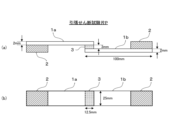
- base materials 1a and 1b (two sheets) having a thickness of 2 mm to which polyurethane foam is to be adhered were placed on a jig (not shown) with a spacer 2 interposed therebetween so as to have a predetermined gap.
- the urethane raw material mixture Mu (mixed solution) of the polyurethane foam raw materials obtained as described above is injected into the gap between the two substrates placed on the jig to form the substrate 1a and the substrate 1b.
- a tensile shear test piece P was prepared by laminating with a polyurethane foam 3. After allowing the test piece to stand at 20° C.
- FIG. 1(a) is a side view of the tensile shear test piece P
- FIG. 1(b) is a top view of the tensile shear test piece P.
- the polyurethane foam 3 cannot actually be seen from the upper surface of the tensile shear test piece P, in FIG. clearly shown.
- Adhesion strength S is 140 kPa or more 4 Adhesion strength S is 120 kPa or more and less than 140 kPa 3 Adhesion strength S is 100 kPa or more and less than 120 kPa 2 Adhesion strength S is 80 kPa or more and less than 100 kPa 1 Adhesion strength S is less than 80 kPa
- Test Example 1 Example of adhering polyurethane foam to a polypropylene resin substrate
- the foam stabilizers of Synthesis Examples 1 to 60 and Foam Stabilizer Comparative Examples 1 to 4 were blended in the amounts (% by mass) shown in Table 3 below, using a urethane raw material mixture Mu of polyurethane foam raw materials.
- This is an example of evaluating the performance of the polyurethane foams produced in Examples 1-1 to 1-64 and Comparative Examples 1-1 to 1-4.
- the foam stabilizing ability of the foam stabilizers used in Examples 1-1 to 1-64 and Comparative Examples 1-1 to 1-4 was evaluated by the method described above.
- Polypropylene (PP) resin was used as the substrates 1a and 1b, and the adhesion of the polyurethane foam 3 to the substrates 1a and 1b was evaluated.
- polymerizable unsaturated monomer (A) when a polymerizable unsaturated monomer in which R1 in the general formula (1) is an acrylic group is used alone, when used in combination with other polymerizable unsaturated monomers It had a higher adhesive strength to difficult-to-adhere substrates.
- the amount of the foam stabilizer is preferably 0.7% by mass or more, more preferably 1.5% by mass or more.
- the amount of the foam stabilizer is preferably 2.5% by mass or less, more preferably 1.5% by mass or less, and 0.7% by mass or less. It is even more preferable to have
- the SP value of the foam stabilizer is lower than the SP value of the polyol, and the difference between the SP values is 1.0 or more.
- the foam stabilizing ability can be enhanced while maintaining good adhesive strength (evaluation of 3 or more).
- the SP value difference is more preferably 1.3 or more, and further preferably 1.5 or more and 2.0 or less.
- the weight average molecular weight of the copolymer used as a foam stabilizer is above the practical level when it is 5000 to 500000. It can be seen that it has a high foam stabilizing ability while maintaining adhesive strength to difficult-to-adhere substrates.
- the weight-average molecular weight exceeds 500,000, although it has a high foam stabilizing ability, poorly dispersed substances (undispersed aggregates) are generated (see Example 1-27), and the effect of the foam stabilizing agent is sufficiently exhibited. Therefore, the weight average molecular weight is preferably 500,000 or less.
- Example 6 is an example in which a polymerizable unsaturated monomer (B) having many branched hydrophobic groups is used.
- the hydrophobic group has a large number of branched portions, the hydrophobic group tends to be oriented on the surface, resulting in relatively low adhesion to the difficult-to-adhere base material.
- Example 38 is an example in which the same polymerizable unsaturated monomer (B) as in Example 6 is used, and the blending amount of the polymerizable unsaturated monomer (B) is less than in Example 6. .
- the foam stabilizing ability was slightly lowered, the adhesive strength to difficult-to-adhere substrates was greatly improved.
- Example 14 is an example in which the blending amount of the polymerizable unsaturated monomer (B) is as large as 60%. Therefore, in Example 14, although the foam stabilizing ability was high, the adhesion to the difficult-to-bond substrate was relatively low.
- Example 46 is an example in which the same polymerizable unsaturated monomer (B) as in Example 14 is used, and the blending amount of the polymerizable unsaturated monomer (B) is less than in Example 14. . As a result, it can be seen that although the foam stabilizing ability was slightly lowered, the adhesive strength to difficult-to-adhere substrates was greatly improved.
- Comparative Example 1-1 which used a foam stabilizer synthesized without blending the polymerizable unsaturated monomer (A), resulted in inferior foam stabilizing ability and adhesive strength to difficult-to-adhere substrates.
- Comparative Example 1-2 which used a foam stabilizer synthesized without blending the polymerizable unsaturated monomer (B), resulted in inferior foam-stabilizing performance.
- Comparative Examples 1-3 and 1-4 using a silicone-based foam stabilizer resulted in poor adhesion to difficult-to-adhere substrates.
- Test Example 2 Example of adhering polyurethane foam to a polyethylene resin substrate
- the foam stabilizers of Synthesis Examples 2, 5, 7, 9, 10, 13, 15, 21, 22, 25, 28, and 34 and Foam Stabilizer Comparative Examples 1 and 3 were used as shown in Table 4 below.
- the performance of the polyurethane foams of Examples 2-1 to 2-12 and Comparative Examples 2-1 to 2-2 prepared using the urethane raw material mixture Mu of the polyurethane foam raw material blended in the compounding amount (% by mass) was evaluated.
- polyethylene (PE) resin was used as the substrates 1a and 1b of the tensile shear test piece P for Examples 2-1 to 2-12 and Comparative Examples 2-1 to 2-2 by the method described above.
- the adhesive strength of the polyurethane foam 3 to the substrates 1a and 1b was evaluated.
- Test Example 3 is a urethane raw material mixture of polyurethane foam raw materials in which the foam stabilizers of Synthesis Examples 16, 21, 25, and 34 and Foam Stabilizer Comparative Examples 3 and 4 are blended in the amounts (% by mass) shown in Table 5 below. This is an example of evaluating the performance of the polyurethane foams of Reference Examples 3-1 to 3-6 produced using Mu.
- polyacetal (POM) resin was used as the substrates 1a and 1b of the tensile shear test piece P for Reference Examples 3-1 to 3-6 by the method described above, and the substrates 1a and 1b of the polyurethane foam 3 were used. was evaluated. These evaluation results are shown in Table 5.
- the adhesive strength shown in Table 5 is not an index based on the evaluation criteria described above, but an actual measurement value of adhesive strength S (kPa) in a tensile shear test.
Landscapes
- Chemical & Material Sciences (AREA)
- Health & Medical Sciences (AREA)
- Chemical Kinetics & Catalysis (AREA)
- Medicinal Chemistry (AREA)
- Polymers & Plastics (AREA)
- Organic Chemistry (AREA)
- Polyurethanes Or Polyureas (AREA)
- Addition Polymer Or Copolymer, Post-Treatments, Or Chemical Modifications (AREA)
Priority Applications (1)
| Application Number | Priority Date | Filing Date | Title |
|---|---|---|---|
| JP2023548529A JP7642841B2 (ja) | 2021-09-17 | 2022-09-20 | ポリウレタンフォーム用整泡剤、ポリウレタンフォームおよびポリウレタンフォーム積層体、ならびにこれらの製造方法 |
Applications Claiming Priority (2)
| Application Number | Priority Date | Filing Date | Title |
|---|---|---|---|
| JP2021152684 | 2021-09-17 | ||
| JP2021-152684 | 2021-09-17 |
Publications (1)
| Publication Number | Publication Date |
|---|---|
| WO2023042923A1 true WO2023042923A1 (ja) | 2023-03-23 |
Family
ID=85602995
Family Applications (1)
| Application Number | Title | Priority Date | Filing Date |
|---|---|---|---|
| PCT/JP2022/034979 Ceased WO2023042923A1 (ja) | 2021-09-17 | 2022-09-20 | ポリウレタンフォーム用整泡剤、ポリウレタンフォームおよびポリウレタンフォーム積層体、ならびにこれらの製造方法 |
Country Status (2)
| Country | Link |
|---|---|
| JP (1) | JP7642841B2 (https=) |
| WO (1) | WO2023042923A1 (https=) |
Citations (5)
| Publication number | Priority date | Publication date | Assignee | Title |
|---|---|---|---|---|
| JPS60199015A (ja) * | 1984-03-22 | 1985-10-08 | Daikin Ind Ltd | 整泡剤 |
| JP2007186557A (ja) * | 2006-01-12 | 2007-07-26 | Shin Etsu Chem Co Ltd | ポリウレタンフォーム用整泡剤及びポリウレタンフォームの製造方法 |
| JP2009167285A (ja) * | 2008-01-16 | 2009-07-30 | Bridgestone Corp | ポリウレタン発泡体成形物 |
| JP2010536965A (ja) * | 2007-08-23 | 2010-12-02 | バイエル・マテリアルサイエンス・アクチェンゲゼルシャフト | Purフォーム用安定剤としてのeo/poブロックコポリマー |
| WO2018074257A1 (ja) * | 2016-10-18 | 2018-04-26 | 東レ・ダウコーニング株式会社 | ポリエーテル変性シリコーン組成物、それを含む界面活性剤、整泡剤、ポリウレタン発泡体形成組成物、化粧料およびその製造方法 |
-
2022
- 2022-09-20 JP JP2023548529A patent/JP7642841B2/ja active Active
- 2022-09-20 WO PCT/JP2022/034979 patent/WO2023042923A1/ja not_active Ceased
Patent Citations (5)
| Publication number | Priority date | Publication date | Assignee | Title |
|---|---|---|---|---|
| JPS60199015A (ja) * | 1984-03-22 | 1985-10-08 | Daikin Ind Ltd | 整泡剤 |
| JP2007186557A (ja) * | 2006-01-12 | 2007-07-26 | Shin Etsu Chem Co Ltd | ポリウレタンフォーム用整泡剤及びポリウレタンフォームの製造方法 |
| JP2010536965A (ja) * | 2007-08-23 | 2010-12-02 | バイエル・マテリアルサイエンス・アクチェンゲゼルシャフト | Purフォーム用安定剤としてのeo/poブロックコポリマー |
| JP2009167285A (ja) * | 2008-01-16 | 2009-07-30 | Bridgestone Corp | ポリウレタン発泡体成形物 |
| WO2018074257A1 (ja) * | 2016-10-18 | 2018-04-26 | 東レ・ダウコーニング株式会社 | ポリエーテル変性シリコーン組成物、それを含む界面活性剤、整泡剤、ポリウレタン発泡体形成組成物、化粧料およびその製造方法 |
Also Published As
| Publication number | Publication date |
|---|---|
| JP7642841B2 (ja) | 2025-03-10 |
| JPWO2023042923A1 (https=) | 2023-03-23 |
Similar Documents
| Publication | Publication Date | Title |
|---|---|---|
| CN101583641B (zh) | 固化性树脂及固化性组合物 | |
| KR102847956B1 (ko) | 경화성 수지 조성물 | |
| WO2008062790A1 (en) | Method for producing polymer-dispersed polyol | |
| TW200906883A (en) | New urethane (meth)acrylates and their use in curable coating compositions | |
| JPWO2009142143A1 (ja) | 硬質ポリウレタンフォームの製造方法 | |
| JP6855655B2 (ja) | アクリル系ポリマー及びそれを含有する帯電防止剤、帯電防止性樹脂組成物 | |
| CN104159940B (zh) | 氨基甲酸酯(甲基)丙烯酸酯树脂组合物及被覆材料 | |
| WO2008062794A1 (en) | Method for producing hard polyurethane foam | |
| JP5482234B2 (ja) | ウレタン変性アクリル樹脂及びそれを用いたコーティング剤及び接着剤 | |
| WO2008062792A1 (en) | Method for producing hard polyurethane foam | |
| JP6801125B2 (ja) | 塗料組成物 | |
| JP6281217B2 (ja) | ラジカル重合性樹脂組成物及び土木建築材料 | |
| KR101455422B1 (ko) | 수성 우레탄 수지 조성물 | |
| JP7642841B2 (ja) | ポリウレタンフォーム用整泡剤、ポリウレタンフォームおよびポリウレタンフォーム積層体、ならびにこれらの製造方法 | |
| JP5112715B2 (ja) | 活性エネルギー線硬化樹脂発泡体及びその製造方法 | |
| JP2007211040A (ja) | 一液型湿気硬化性組成物、シーリング材組成物及び接着剤組成物 | |
| JP6399336B2 (ja) | 水性プライマー組成物 | |
| JP2010090269A (ja) | 湿気硬化性組成物 | |
| JP2014177583A (ja) | 硬化性組成物および積層体 | |
| JP7826082B2 (ja) | 硬化性組成物およびその硬化物 | |
| JP7476748B2 (ja) | 接着剤、硬化物及び積層体 | |
| WO2023233962A1 (ja) | 接着剤組成物及び物品 | |
| JP2007291223A (ja) | 一液型ウレタン系湿気硬化性組成物 | |
| JP2008256957A (ja) | 粘着剤層付き光学積層体 | |
| JP4589876B2 (ja) | ポリウレタン発泡体及びそれを用いたシール材 |
Legal Events
| Date | Code | Title | Description |
|---|---|---|---|
| 121 | Ep: the epo has been informed by wipo that ep was designated in this application |
Ref document number: 22870069 Country of ref document: EP Kind code of ref document: A1 |
|
| WWE | Wipo information: entry into national phase |
Ref document number: 2023548529 Country of ref document: JP |
|
| NENP | Non-entry into the national phase |
Ref country code: DE |
|
| 122 | Ep: pct application non-entry in european phase |
Ref document number: 22870069 Country of ref document: EP Kind code of ref document: A1 |