WO2023037807A1 - 止血弁の開閉機構、長尺状医療機器の固定機構および医療用コネクタ - Google Patents
止血弁の開閉機構、長尺状医療機器の固定機構および医療用コネクタ Download PDFInfo
- Publication number
- WO2023037807A1 WO2023037807A1 PCT/JP2022/030209 JP2022030209W WO2023037807A1 WO 2023037807 A1 WO2023037807 A1 WO 2023037807A1 JP 2022030209 W JP2022030209 W JP 2022030209W WO 2023037807 A1 WO2023037807 A1 WO 2023037807A1
- Authority
- WO
- WIPO (PCT)
- Prior art keywords
- opening
- pressing
- housing
- closing mechanism
- penetrating member
- Prior art date
- Legal status (The legal status is an assumption and is not a legal conclusion. Google has not performed a legal analysis and makes no representation as to the accuracy of the status listed.)
- Ceased
Links
Images










Classifications
-
- A—HUMAN NECESSITIES
- A61—MEDICAL OR VETERINARY SCIENCE; HYGIENE
- A61M—DEVICES FOR INTRODUCING MEDIA INTO, OR ONTO, THE BODY; DEVICES FOR TRANSDUCING BODY MEDIA OR FOR TAKING MEDIA FROM THE BODY; DEVICES FOR PRODUCING OR ENDING SLEEP OR STUPOR
- A61M39/00—Tubes, tube connectors, tube couplings, valves, access sites or the like, specially adapted for medical use
- A61M39/02—Access sites
- A61M39/06—Haemostasis valves, i.e. gaskets sealing around a needle, catheter or the like, closing on removal thereof
-
- A—HUMAN NECESSITIES
- A61—MEDICAL OR VETERINARY SCIENCE; HYGIENE
- A61M—DEVICES FOR INTRODUCING MEDIA INTO, OR ONTO, THE BODY; DEVICES FOR TRANSDUCING BODY MEDIA OR FOR TAKING MEDIA FROM THE BODY; DEVICES FOR PRODUCING OR ENDING SLEEP OR STUPOR
- A61M39/00—Tubes, tube connectors, tube couplings, valves, access sites or the like, specially adapted for medical use
- A61M39/02—Access sites
- A61M39/06—Haemostasis valves, i.e. gaskets sealing around a needle, catheter or the like, closing on removal thereof
- A61M39/0693—Haemostasis valves, i.e. gaskets sealing around a needle, catheter or the like, closing on removal thereof including means for seal penetration
-
- A—HUMAN NECESSITIES
- A61—MEDICAL OR VETERINARY SCIENCE; HYGIENE
- A61M—DEVICES FOR INTRODUCING MEDIA INTO, OR ONTO, THE BODY; DEVICES FOR TRANSDUCING BODY MEDIA OR FOR TAKING MEDIA FROM THE BODY; DEVICES FOR PRODUCING OR ENDING SLEEP OR STUPOR
- A61M39/00—Tubes, tube connectors, tube couplings, valves, access sites or the like, specially adapted for medical use
- A61M39/02—Access sites
- A61M39/06—Haemostasis valves, i.e. gaskets sealing around a needle, catheter or the like, closing on removal thereof
- A61M2039/0633—Haemostasis valves, i.e. gaskets sealing around a needle, catheter or the like, closing on removal thereof the seal being a passive seal made of a resilient material with or without an opening
- A61M2039/064—Slit-valve
-
- A—HUMAN NECESSITIES
- A61—MEDICAL OR VETERINARY SCIENCE; HYGIENE
- A61M—DEVICES FOR INTRODUCING MEDIA INTO, OR ONTO, THE BODY; DEVICES FOR TRANSDUCING BODY MEDIA OR FOR TAKING MEDIA FROM THE BODY; DEVICES FOR PRODUCING OR ENDING SLEEP OR STUPOR
- A61M39/00—Tubes, tube connectors, tube couplings, valves, access sites or the like, specially adapted for medical use
- A61M39/02—Access sites
- A61M39/06—Haemostasis valves, i.e. gaskets sealing around a needle, catheter or the like, closing on removal thereof
- A61M2039/0673—Haemostasis valves, i.e. gaskets sealing around a needle, catheter or the like, closing on removal thereof comprising means actively pressing on the device passing through the seal, e.g. inflatable seals, diaphragms, clamps
-
- A—HUMAN NECESSITIES
- A61—MEDICAL OR VETERINARY SCIENCE; HYGIENE
- A61M—DEVICES FOR INTRODUCING MEDIA INTO, OR ONTO, THE BODY; DEVICES FOR TRANSDUCING BODY MEDIA OR FOR TAKING MEDIA FROM THE BODY; DEVICES FOR PRODUCING OR ENDING SLEEP OR STUPOR
- A61M39/00—Tubes, tube connectors, tube couplings, valves, access sites or the like, specially adapted for medical use
- A61M39/02—Access sites
- A61M39/06—Haemostasis valves, i.e. gaskets sealing around a needle, catheter or the like, closing on removal thereof
- A61M39/0613—Haemostasis valves, i.e. gaskets sealing around a needle, catheter or the like, closing on removal thereof with means for adjusting the seal opening or pressure
-
- A—HUMAN NECESSITIES
- A61—MEDICAL OR VETERINARY SCIENCE; HYGIENE
- A61M—DEVICES FOR INTRODUCING MEDIA INTO, OR ONTO, THE BODY; DEVICES FOR TRANSDUCING BODY MEDIA OR FOR TAKING MEDIA FROM THE BODY; DEVICES FOR PRODUCING OR ENDING SLEEP OR STUPOR
- A61M39/00—Tubes, tube connectors, tube couplings, valves, access sites or the like, specially adapted for medical use
- A61M39/22—Valves or arrangement of valves
Definitions
- the technology disclosed in this specification relates to a hemostatic valve opening/closing mechanism, a fixing mechanism for a long medical device, and a medical connector.
- a Y connector is a medical connector that is used by being connected to a guiding catheter.
- the Y connector has a main tube and a branch tube branched from the main tube.
- An elongated medical device such as a guide wire or a catheter is introduced into the guiding catheter through the main tube and branched.
- Liquid agents such as a contrast medium and physiological saline are supplied through the tube.
- the Y connector is provided with an opening/closing mechanism for opening and closing a hemostatic valve that suppresses the outflow of blood through the lumen of the main tube, and a fixing mechanism for fixing the long medical device.
- a penetrating member (opener) having a through hole coaxial with the lumen of the main pipe is provided.
- an open state in which the hemostatic valve is opened by the penetrating member pressing the hemostatic valve, and a closed state in which the hemostatic valve is closed by the penetrating member being separated from the hemostatic valve.
- an elastic fixing valve having a through hole through which the long medical device is inserted is provided, and the screw is inserted into the fixing valve.
- the fixed valve is elastically deformed by being pressed by the pusher, and the inner diameter of the through hole of the fixed valve is reduced to form a long medical device.
- a fixed state in which the device is fixed and a release state in which the fixation valve is not pressed by the pusher and the inner diameter of the through hole of the fixation valve is expanded to release the fixation of the elongated medical device are switched.
- the opening and closing operation of the hemostatic valve is an operation of pressing the penetrating member in the axial direction of the lumen of the main tube portion, so the operation may be difficult.
- the fixing/unfixing operation of the elongated medical device is an operation of rotating the screw, the operation is complicated, and the fixation condition of the elongated medical device cannot be perceived visually or by touch. .
- This specification discloses a technology capable of solving the above-described problems.
- a hemostatic valve opening/closing mechanism disclosed in the present specification includes a housing, a hemostatic valve, a penetrating member, an operating member, and a biasing member.
- the housing is a tubular member having a lumen that communicates with the distal opening and the proximal opening.
- the hemostasis valve is mounted in the housing, is normally in a closed state, and when pressed from the proximal end side, is in an open state in which a through hole communicating with the distal end side opening of the housing is formed.
- the penetrating member is housed in the housing to be slidable along the first direction, which is the extending direction of the lumen, on the proximal side of the hemostasis valve.
- a through hole is formed in the through member to communicate with the base end side opening of the housing.
- the penetrating member has a first position in which the hemostatic valve is in the closed state, and a position that is closer to the distal end in the first direction than the first position, and presses the hemostatic valve. a second position in which the hemostasis valve is in the open state and the through hole of the hemostasis valve and the through hole of the penetrating member are communicated with each other.
- the surface of the penetrating member is formed with a movement restricting groove that is continuous along one circumference.
- the operating member is housed in the housing so as to be partially exposed from the housing and slidable along a second direction non-parallel to the first direction.
- the operation member is configured to be able to press the penetrating member and displace it toward the distal end side by sliding toward the inside of the housing along the second direction.
- a biasing member biases the penetrating member proximally.
- the opening/closing mechanism of the hemostatic valve further comprises a pin attached to the housing so that the end thereof is loosely fitted in the movement restricting groove.
- a closed position portion, a first top portion, an open holding portion, and a second top portion are formed in the movement restricting groove.
- the closed position portion is a portion into which the end portion of the pin is fitted without restricting movement of the penetrating member toward the distal end side when the penetrating member is in the first position.
- the first top portion is adapted to extend toward the base end side of the penetrating member when the penetrating member is pressed by the operating member from the first state to reach a position on the distal side from the second position in a second state. It is the part into which the end of the pin fits without restricting movement.
- the open holding portion restricts movement of the penetrating member toward the proximal side in a third state in which the penetrating member is displaced from the second state to the second position by the biasing force of the biasing member. This is the part into which the end of the pin is fitted.
- the second top portion is adapted to extend toward the base end side of the penetrating member when the penetrating member is pressed by the operating member from the third state to reach a position on the distal side from the second position in a fourth state. It is the part into which the end of the pin fits without restricting movement.
- the operation member receives the pressing force and moves inside the housing along the second direction.
- the penetrating member is slid to the side, the penetrating member is pressed by the operating member and moves from the second position to a position on the distal side, and as a result, the end of the pin moves toward the proximal side of the penetrating member in the movement restricting groove. It reaches the first top, which is a part that fits without restricting movement.
- the penetrating member is moved to the second position toward the proximal side by the biasing force of the biasing member, and the hemostatic valve is switched from the closed state to the open state.
- the end portion of the pin moves from the first top portion of the operation restricting groove to the open holding portion, the proximal movement of the penetrating member is restricted and the penetrating member is maintained at the second position. , the hemostasis valve is kept open.
- the penetrating member is pressed by the operating member and moves to a position on the distal end side from the second position, As a result, the end portion of the pin reaches the second top portion, which is a portion that fits without restricting the proximal movement of the penetrating member in the operation restricting groove.
- the penetrating member is moved to the first position by the biasing force of the biasing member, and the hemostatic valve is switched from the open state to the closed state.
- the operating member is slidable along the second direction non-parallel to the first direction, which is the extending direction of the lumen of the housing.
- the opening/closing operation is an operation of pressing the operating member in a second direction non-parallel to the extending direction of the lumen of the housing. Therefore, according to the opening and closing mechanism of the hemostatic valve, the operator can easily open and close the hemostatic valve with the thumb while holding the device having the opening and closing mechanism, thereby improving the operability of the opening and closing mechanism. be able to.
- the biasing member is cylindrical, and the surface of the penetrating member facing the biasing member has a protrusion that is inserted into the hollow portion of the biasing member. may be formed. According to the opening/closing mechanism of the hemostasis valve, positioning between the penetrating member and the biasing member can be performed easily and accurately, and the biasing force of the biasing member can be effectively transmitted to the penetrating member. It is possible to improve the accuracy of the operation of the opening and closing mechanism.
- an angle between the first direction and the second direction may be 35 degrees or more and 55 degrees or less. According to the opening and closing mechanism of the hemostatic valve, the operator can easily open and close the hemostatic valve with the thumb while holding the device equipped with the opening and closing mechanism. can be improved.
- the biasing member and the operation member may be arranged to face each other in the first direction. According to the opening/closing mechanism of the hemostatic valve, the pressing force applied to the operating member can be efficiently transmitted to the biasing member to deform the biasing member, thereby effectively improving the operability of the opening/closing mechanism. can.
- the penetrating member includes a body portion having the through hole formed therein, a flange portion projecting from the body portion in a third direction perpendicular to the first direction, wherein the operating member is configured to be slidable relative to the penetrating member along the third direction while abutting on the proximal surface of the flange portion good too.
- the operating member slides along the second direction non-parallel to the first direction, which is the extending direction of the lumen of the housing, and the penetrating member slides in the extending direction. The motion can be efficiently converted, and the operability of the opening/closing mechanism can be effectively improved.
- the angle between the first direction and the second direction may be approximately 90 degrees. According to the present hemostatic valve opening/closing mechanism, the operator can very easily perform the opening/closing operation of the hemostatic valve with the thumb and/or forefinger while holding the device equipped with the present opening/closing mechanism. can be effectively improved.
- the operation member is composed of a first piece and a second piece facing each other in the second direction, and the first piece and the second piece are arranged in the second direction.
- the penetrating member may be pressed and displaced toward the distal end by sliding toward each other along the direction of .
- the operator grips the device provided with the present opening/closing mechanism, and performs an operation of pinching the first piece and the second piece with the thumb and forefinger to perform the opening/closing operation of the hemostatic valve. can be performed very easily and stably, and the operability of the opening/closing mechanism can be effectively improved.
- each of the first piece and the second piece is parallel to a fourth direction orthogonal to both the first direction and the second direction, and an operation member side contact surface that is a surface non-parallel to both the first direction and the second direction
- the penetrating member is parallel to the fourth direction
- the a penetrating member-side first contact surface that is a surface that is non-parallel to both the first direction and the second direction and contacts the operation member-side contact surface of the first piece; direction and non-parallel to both the first direction and the second direction, the second penetrating member-side surface contacting the operation member-side contact surface of the second piece. and a contact surface.
- the sliding of the operation member along the second direction substantially orthogonal to the extending direction of the lumen of the housing and the sliding of the penetrating member in the extending direction can be efficiently performed. It can be converted, and the operability of the opening and closing mechanism can be effectively improved.
- a fixing mechanism for a long medical device disclosed in this specification includes a housing, a tubular body, a pressing member, an operating member, a force transmission member, and a holding mechanism.
- the housing is a tubular member having a lumen that communicates with the distal opening and the proximal opening.
- a circular tubular body is a flexible member that is attached within the housing and has a through hole formed therein, into which the elongated medical device is inserted.
- the through-hole of the tubular body communicates with the distal side opening and the proximal side opening of the housing.
- the pressing member is housed in the housing slidably along a sixth direction orthogonal to a fifth direction parallel to the axis of the tubular body.
- the pressing member is at a fifth position and a sixth position displaced from the fifth position along the sixth direction, and presses a portion of the cylindrical body excluding both end portions from the outer peripheral side. and a sixth position that deforms the
- the operation member is a member slidable along a seventh direction non-parallel to the fifth direction.
- the force transmission member is disposed between the pressing member and the operation member so as to be slidable in the seventh direction, and moves along the seventh direction so that the operation member approaches the pressing member. It is a member that transmits force to the pressing member.
- the force transmission member can be positioned at a seventh position that positions the pressing member at the fifth position, and an eighth position that presses the pressing member to position the pressing member at the sixth position.
- the holding mechanism 260 holds the force transmission member at the seventh position and holds the force transmission member at the eighth position every time the operation member slides along the seventh direction.
- the state is switched between holding state and .
- the fixation mechanism for the elongated medical device is configured such that when the pressing member is positioned at the sixth position, the deformed inner peripheral surface of the circular tubular body is pressed against the elongated medical device, thereby fixing the length of the elongated medical device.
- a scale-shaped medical device is configured to be fixed to the circular tubular body.
- the holding mechanism holds the force transmission member at the seventh position and the force transmission member is held at the seventh position. and a state in which the transmission member is held at the eighth position.
- the holding mechanism switches to the state where the force transmission member is held at the eighth position as the operation member slides, the pressing member moves from the fifth position to the sixth position, elastically deforming the cylindrical body.
- An elongated medical device is secured to the tubular body.
- the holding mechanism holds the force transmission member at the eighth position, thereby maintaining the fixed state of the long medical device.
- the holding mechanism switches to the state in which the force transmission member is held at the seventh position as the operation member slides again, the pressing member moves from the sixth position to the fifth position, and the cylindrical body is moved. The shape is restored and the fixation of the elongated medical device is released. At this time, the holding mechanism holds the force transmission member at the seventh position, so that the elongated medical device is kept unlocked.
- the fixation mechanism for the elongated medical device the operating member can slide along the seventh direction that is non-parallel to the direction parallel to the axis of the tubular body.
- the fixing operation and the fixing release operation are operations for pressing the operating member in a seventh direction non-parallel to the direction parallel to the axis of the tubular body.
- the fixation mechanism of the long medical device the operator can easily operate the operation member by pressing the operation member with the thumb while holding the device including the fixation mechanism. Since it is possible to realize fixation and release of the fixation, and the degree of fixation of the long medical device can be grasped by touch and sight, the operability of the fixation mechanism can be improved.
- the holding mechanism has a tubular biasing member that biases the force transmission member in a direction toward the pressing member, and
- the surface facing the biasing member may be formed with a convex portion that is inserted into the hollow portion of the biasing member.
- the fifth direction and the seventh direction may form an angle of 35 degrees or more and 55 degrees or less. According to the fixation mechanism of the long medical device, it is possible to operate the operation member very easily with the thumb while holding the device equipped with the fixation mechanism, effectively improving the operability of the fixation mechanism. can be made
- the force transmission member is slidable relative to the pressing member along the fifth direction while being in contact with the surface of the pressing member. It is good also as the structure comprised in. According to the fixing mechanism of the elongated medical device, it is possible to efficiently convert the sliding of the force transmission member along the seventh direction and the sliding of the pressing member along the seventh direction. It is possible to effectively improve the operability of the fixing mechanism.
- the housing is a tubular member having a lumen that communicates with the distal opening and the proximal opening, and that can accommodate the elongated medical device in the lumen.
- the circular tubular body is a flexible circular tubular body mounted in the housing and having a first through hole into which the elongated medical device is inserted, wherein the first through hole is located in the housing. communicates with the distal side opening and the proximal side opening of the.
- the distal end connecting portion connects the distal end portion of the cylindrical body to the housing, and is formed with a second through hole that communicates with the first through hole of the cylindrical body.
- the proximal end connecting portion connects the proximal end portion of the tubular body to the housing, and has a third through hole communicating with the first through hole of the tubular body.
- the pressing member is configured to press a pressing portion excluding both ends of the tubular body from a direction non-parallel to the axis of the tubular body, and is accommodated in the housing.
- the area of the second through-hole in the cross-section of the fixing mechanism of the distal end-side connecting portion and the area of the third through-hole in the cross-section of the proximal-side connecting portion are the same as the cross-section of the pressing portion. is larger than the area of the first through hole in .
- the fixation mechanism for the elongated medical device when the pressing member presses the pressing portion excluding both end portions of the tubular body, the tubular body is elastically deformed and the elongated medical device becomes the tubular body. Fixed. At this time, since the area of the second through-hole of the distal-side connecting portion and the area of the third through-hole of the proximal-side connecting portion are larger than the area of the first through-hole in the pressing portion of the cylindrical body, Even in a state where the long medical device is fixed by the member pressing the pressing portion of the tubular body, the long medical device is pressed against the inner peripheral surfaces of the distal end side connecting portion and the proximal end side connecting portion. is suppressed, and damage to the long medical device can be suppressed more effectively.
- the technology disclosed in the present specification can be implemented in various forms. It can be realized in the form of a medical connector provided with a fixing mechanism for a scale-shaped medical device, a medical device provided with a medical connector, and the like.
- FIG. 4 is a perspective view showing the external configuration of the cylindrical body, pressing member, and force transmission member of the fixing mechanism;
- FIG. 4 is a perspective view showing an external configuration of an operating member of a fixing mechanism and a holding mechanism;
- FIG. 25 is an explanatory diagram showing a state in which the fixation of the elongated medical device is released in the fixing mechanism shown in FIG. 24 ;
- FIG. 25 is an explanatory view showing a state in which an elongated medical device is fixed in the fixing mechanism shown in FIG. 24;
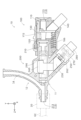
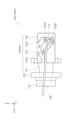
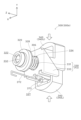
- FIG. 1 schematically shows the external configuration of the medical connector 10
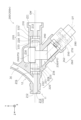
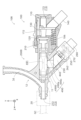
- FIG. 2 shows the configuration of its longitudinal section (YZ section).
- the medical connector 10 is a Y connector that is used by being connected to the guiding catheter GC via the rotator 20 .
- the side to which the guiding catheter GC is connected (positive Z-axis direction) is called the distal side
- the opposite side negative Z-axis direction
- the distal end is referred to as the “distal end”, the distal end and its vicinity as the “distal portion”, and the proximal end as the “basal end”.
- the end and the vicinity thereof are referred to as the "base end”.
- the Z-axis direction is also called the front-rear direction
- the Y-axis direction is also called the vertical direction
- the Y-axis positive direction is also called the upward direction
- the Y-axis negative direction is also called the downward direction
- the X-axis direction is also called the horizontal direction.
- the orientation of the medical connector 10 is not limited to this.
- the cross-sectional view as shown in FIG. 2 may show the side surface of some members.
- the medical connector 10 has a tubular main pipe portion 11 extending in the front-rear direction, and a tubular branch pipe portion 12 branching from the vicinity of the distal end portion of the main pipe portion 11 and obliquely extending upward toward the base end side.
- the main tube portion 11 is formed with a lumen 13 that extends in the front-rear direction and penetrates the main tube portion 11 . is introduced into the guiding catheter GC.
- the branch tube portion 12 is formed with a lumen 14 that communicates with the lumen 13 of the main tube portion 11 . Via the cavity 14 liquid agents such as contrast agents and saline are supplied.
- the medical connector 10 includes a hemostasis valve opening/closing mechanism 100 and a long medical device fixing mechanism 200 .
- the opening/closing mechanism 100 is provided closer to the proximal side than the fixing mechanism 200 .
- the opening/closing mechanism 100 constitutes a portion of the base end side of the main pipe portion 11 of the medical connector 10
- the fixing mechanism 200 connects a portion of the distal end side of the main pipe portion 11 of the medical connector 10 and the branch pipe portion 12 .
- Configure The configurations of the opening/closing mechanism 100 and the fixing mechanism 200 will be described in order below.
- the medical connector 10 is held and used by an operator such as a doctor, for example.
- the operator puts the main tube portion 11 of the medical connector 10 in the posture shown in FIG.
- the main tube 11 is supported, and the medical connector 10 is gripped so that the thumb is positioned near the operating member 140 of the opening/closing mechanism 100 or the operating member 280 of the fixing mechanism 200 .
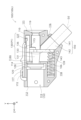
- FIG. 3 shows the configuration of a longitudinal section (YZ section) of the opening/closing mechanism 100
- FIGS. 4 and 5 show sectional perspective views thereof.
- 3 and 4 show the opening/closing mechanism 100 with the hemostatic valve 120 closed (hereinafter referred to as "closed-state opening/closing mechanism 100c")
- FIG. 5 shows the hemostatic valve 120 in the opened state.
- the opening/closing mechanism 100 (hereinafter referred to as "open-state opening/closing mechanism 100o") is shown.
- the opening/closing mechanism 100 is a mechanism for opening/closing the hemostasis valve 120 that suppresses the outflow of blood through the lumen 13 of the main tube portion 11 of the medical connector 10 .
- the opening/closing mechanism 100 is a mechanism that switches between a state in which the hemostatic valve 120 is closed and a state in which the hemostatic valve 120 is opened each time the operating member 140 is pressed by the operator.
- the opening/closing mechanism 100 includes a housing 110 , a hemostatic valve 120 , a penetrating member 130 , an operating member 140 , a biasing member 106 and a pin 172 .
- FIG. 6 is a cross-sectional perspective view showing the configuration of the housing 110.
- the housing 110 is a tubular member having a distal opening 112 and a proximal opening 111 and a lumen 113 communicating between the distal opening 112 and the proximal opening 111 .
- the lumen 113 is a through-hole extending in the front-rear direction (Z-axis direction) and constitutes part of the lumen 13 of the main tube portion 11 of the medical connector 10 .
- the housing 110 is made of resin, for example.
- the base end portion of the fixing mechanism 200 is inserted and fixed in the lumen 113 .
- the Z-axis direction is an example of a first direction in the scope of claims.
- a substantially flat plate-like partition wall 114 that is substantially orthogonal to the front-rear direction is formed inside the housing 110 near the center in the front-rear direction.
- a through hole 114 ⁇ /b>A that penetrates the partition wall 114 in the front-rear direction and constitutes a part of the lumen 113 is formed.
- the cross-sectional shape of 114 A of through-holes is substantially circular, for example.
- a guide groove 115 extending from the position of the partition wall 114 toward the base end is formed on the side surface inside the housing 110 .
- a pair of guide grooves 115 are formed so as to face each other in the left-right direction (X-axis direction).
- an operation member accommodating space 116 is formed that communicates with the lumen 113 and that extends obliquely downward to the proximal end side and opens to the surface of the housing 110 .
- a biasing member accommodation space 118 extending in the front-rear direction is formed in the lower portion inside the housing 110 .
- a groove 117 for accommodating the pin 172 is formed in the upper portion inside the housing 110 .
- the hemostatic valve 120 is a substantially disk-shaped member made of an elastic material such as silicone rubber.
- the hemostasis valve 120 is fixed inside the housing 110 at a position distal to the partition wall 114 .
- a slit 121 is formed at a substantially central position in the hemostasis valve 120 as viewed in the Z-axis direction (FIG. 4). Hemostasis valve 120 is normally in a closed state in which slit 121 is closed and the valve is closed (FIGS. 3 and 4).
- the hemostasis valve 120 When the hemostasis valve 120 is in the closed state, the hemostasis valve 120 closes the lumen 113 of the housing 110 (that is, the lumen 13 of the main tube portion 11), and the proximal end of the hemostasis valve 120 passes through the lumen 113. Outflow of blood is suppressed.
- each piece divided by the slit 121 is elastically deformed so as to be displaced toward the distal side, forming a through hole 122 that penetrates the hemostatic valve 120 in the front-rear direction. It will be in the closed open state (Fig. 5). In the open state, the through-hole 122 communicates with the distal opening 112 via the lumen 113 .
- a substantially annular boss 128 is arranged between the hemostatic valve 120 and the partition wall 114 .
- FIG. 7 is a perspective view showing the external configuration of the penetrating member 130 and the operating member 140.
- the penetrating member 130 is a member in which a through hole 132 extending in the front-rear direction is formed, and is made of resin, for example. More specifically, the penetrating member 130 includes a substantially cylindrical main body portion 131 in which a through hole 132 extending in the front-rear direction is formed, and a substantially cylindrical main body portion 131 that protrudes downward from near the center of the main body portion 131 in the front-rear direction and extends substantially perpendicular to the front-rear direction.
- the flange portion 133 has a flat plate-shaped flange portion 133 and a substantially flat plate-shaped upper wall portion 136 that is disposed above the main body portion 131 and substantially perpendicular to the vertical direction.
- the flange portion 133 also protrudes upward from the body portion 131
- the upper wall portion 136 has a shape extending from the upper end of the flange portion 133 toward the base end side.
- a pair of guide protrusions 134 projecting in the left-right direction are formed on the side surface of the flange portion 133, and a continuous guide portion 134 extending in the vertical direction is provided on the proximal surface of the flange portion 133.
- a guide projection 135 is formed.
- a movement restricting groove 137 is formed on the upper surface of the upper wall portion 136 .
- the movement restricting groove 137 is a so-called heart cam groove, which is a heart-shaped groove that is connected around one circumference.
- the vertical direction is an example of a third direction in the scope of claims.
- the penetrating member 130 is accommodated inside the housing 110 on the proximal side of the hemostatic valve 120 .
- the through hole 132 of the body portion 131 communicates with the proximal opening 111 of the housing 110 .
- the through hole 132 and the lumen 113 are coaxial with each other.
- a pair of guide projections 134 ( FIG. 7 ) formed with a flange portion 133 are fitted into a pair of guide grooves 115 ( FIG. 6 ) formed in the housing 110 .
- the penetrating member 130 is slidable in the front-rear direction using the guide groove 115 as a guide in a state in which the vertical and horizontal positions of the penetrating member 130 are determined with respect to the housing 110 .
- Penetrating member 130 is positioned such that body portion 131 thereof faces through hole 114A of partition wall 114 in the front-rear direction.
- the penetrating member 130 which is slidable in the front-rear direction, has a pressing position P2 (shown in FIG. 5) in which the distal end portion of the body portion 131 is inserted into the through hole 114A and presses the hemostatic valve 120 to open the hemostatic valve 120. state), and an unpressed position P1 (state shown in FIGS. 3 and 4) in which the hemostatic valve 120 is not pressed and the hemostatic valve 120 is closed.
- P2 shown in FIG. 5
- the through hole 122 formed in the hemostatic valve 120 and the through hole 132 of the penetrating member 130 communicate with each other.
- Penetrating member 130 is movable to a position where flange portion 133 contacts partition wall 114 on the distal end side, and the proximal end of penetrating member 130 is formed at the proximal end portion of housing 110 on the proximal end side. 3 and 6).
- the pressing position P2 is an example of a second position in the claims, and the non-pressing position P1 is an example of a first position in the claims.
- the biasing member 106 is a member that biases the penetrating member 130 toward the base end side, and is housed in the biasing member housing space 118 of the housing 110 .
- a substantially cylindrical spring is used as the biasing member 106 .
- the spring is made of metal such as stainless steel.
- Penetrating member 130 biased proximally by biasing member 106 is in a non-pressing position P1 (FIGS. 3 and 4) where penetrating member 130 does not press hemostatic valve 120 in a state where it does not receive force from operating member 140 or pin 172 (FIGS. 3 and 4).
- a protruding portion 139 is formed on the surface of the flange portion 133 of the penetrating member 130 facing the urging member 106 , and the protruding portion 139 extends into the hollow portion of the urging member 106 . inserted.
- the pin 172 is an elongated member with a small diameter, and is made of metal such as stainless steel.
- the pin 172 is attached to the housing 110 so as to extend in the front-rear direction.
- the tip end of the pin 172 is housed in a groove 117 formed in the housing 110 and fixed in position.
- a proximal end portion 173 of the pin 172 is bent and loosely fitted in an operation restricting groove 137 formed in an upper wall portion 136 of the penetrating member 130 .
- the position of the end portion 173 in the movement restricting groove 137 changes as the penetrating member 130 slides in the front-rear direction (Z-axis direction).
- FIG. 8 and 9 are explanatory diagrams showing the position of the pin 172 in the movement restricting groove 137.
- FIG. 8 and 9 show top configurations of the pin 172, the penetrating member 130 and the hemostasis valve 120.
- FIG. 8 shows the closed state opening/closing mechanism 100c in which the penetrating member 130 is at the non-pressing position P1 and the hemostatic valve 120 is closed, and
- FIG. An open state opening/closing mechanism 100o having a through hole 122 formed in 120 is shown.
- the end portion 173 of the pin 172 swings in the left-right direction (X-axis direction). while moving relatively in one direction (counterclockwise in the illustrated example) in the movement restricting groove 137 . That is, as shown in FIG. 8, in the first state where the penetrating member 130 is at the non-pressing position P1, the end portion 173 is positioned at the heart-shaped bottom portion (hereinafter referred to as the "closed position portion 137A") of the movement restricting groove 137. do. In this state, the pins 172 do not restrict the forward and backward movement of the penetrating member 130 .
- the end portion 173 When the penetrating member 130 moves from the first state to the distal side (positive direction of the Z-axis), the end portion 173 relatively moves in the movement restricting groove 137 to the proximal side.
- the end portion 173 In the second state in which the penetrating member 130 is displaced from the non-pressing position P1 to the pressing position P2 and further reaches a position on the distal side of the pressing position P2, the end portion 173 moves along the heart-shaped trough portion of the movement restricting groove 137. It is positioned at one of a pair of sandwiched tops (hereinafter referred to as "first top 137B"). In this state, the pin 172 does not restrict the proximal movement of the penetrating member 130 .
- the end portion 173 relatively moves in the movement restricting groove 137 toward the proximal end. It is positioned at the other of a pair of top portions (hereinafter referred to as “second top portion 137D”) sandwiching the heart-shaped trough portion of motion restricting groove 137 .
- second top portion 137D a pair of top portions sandwiching the heart-shaped trough portion of motion restricting groove 137 .
- the operation member 140 is an elongated member extending in a direction (hereinafter referred to as "operation direction D2") non-parallel to the front-rear direction (Z-axis direction).
- operation direction D2 is a direction with an angle of 35 degrees or more and 55 degrees or less with the front-rear direction. 45-degree oblique direction toward the side).
- the operation member 140 is accommodated in the operation member accommodation space 116 of the housing 110 so as to be slidable in the operation direction D2.
- the operating member 140 is arranged to face the biasing member 106 in the front-rear direction.
- the operating member 140 is made of resin, for example.
- the operation direction D2 is an example of a second direction in the claims.
- the operation member 140 has a substantially cylindrical operation receiving portion 141 and a substantially polyhedral connecting portion 142 located on the distal end side thereof. A portion of the proximal end side of the operation receiving portion 141 is exposed from the housing 110 and can be pressed by an operator such as a doctor.
- a distal end surface 143 of the connecting portion 142 has a planar shape substantially orthogonal to the front-rear direction, and is in contact with the proximal surface of the flange portion 133 of the penetrating member 130 . As shown in FIG. 7, a guide groove 144 extending in the vertical direction is formed in the distal end surface 143 . is mated.
- a concave portion 145 capable of accommodating the base end portion of the main body portion 131 of the penetrating member 130 is formed on the upper surface of the connecting portion 142 .
- the operating member 140 Since the operating member 140 is configured as described above, it can slide relative to the penetrating member 130 along the vertical direction while contacting the proximal surface of the flange portion 133 of the penetrating member 130 . That is, as shown in FIGS. 3 and 4, when the penetrating member 130 is at the non-pressing position P1 in which the hemostatic valve 120 is not pressed, the operating member 140 is at the retracted position retracted downward to the proximal side. Further, when the operation member 140 slides toward the inside of the housing 110 (that is, obliquely upward) along the operation direction D2 from the retracted position, the operation member 140 moves along the guide protrusion 135 of the penetrating member 130.
- the sliding range of the operating member 140 is set to a range that allows the penetrating member 130 to move from the pressing position P2 to the distal end side.
- the opening/closing mechanism 100 of the hemostatic valve 120 will be described.
- the penetrating member 130 receives the biasing force of the biasing member 106 and is positioned at the non-pressing position P1 where the hemostasis valve 120 is not pressed. It receives the force indirectly via the penetrating member 130 and is positioned at the retracted position.
- the hemostasis valve 120 is closed, and the opening/closing mechanism 100 is a closed state opening/closing mechanism 100c.
- the end 173 of the pin 172 is positioned at the closed position portion 137A in the movement restricting groove 137 of the upper wall portion 136 of the penetrating member 130 .
- the thumb of the operator holding the medical connector 10 presses the operation receiving portion 141 of the operation member 140 toward the inside of the housing 110 (that is, obliquely upward) along the operation direction D2 to open the valve.
- the operating member 140 slides obliquely upward along the operating direction D2.
- the penetrating member 130 is pressed by the operating member 140 and moves to the distal end side.
- the end portion 173 of the pin 172 moves relatively to the base end side within the movement restricting groove 137 formed in the penetrating member 130 .
- the penetrating member 130 moves toward the distal end side by a certain distance or more, the distal end portion of the body portion 131 of the penetrating member 130 presses the hemostatic valve 120 to open the hemostatic valve 120 .
- the penetrating member 130 After the penetrating member 130 has reached the position on the distal side from the pressing position P2 and the end portion 173 has reached the first top portion 137B of the movement restricting groove 137, when the operator cancels the valve opening operation, as shown in FIG. Then, the penetrating member 130 returns a little to the base end side due to the biasing force of the biasing member 106, and along with this movement, the end portion 173 moves relatively to the distal end side within the operation restricting groove 137 and reaches the open holding portion 137C.
- the opening/closing mechanism 100 becomes the open state opening/closing mechanism 100o shown in FIG.
- opening/closing mechanism 100o When the opening/closing mechanism 100 is in the open state opening/closing mechanism 100o, for example, the operator's thumb moves the housing along the operation direction D2 with respect to the operation receiving portion 141 of the operation member 140 in the same manner as the valve opening operation.
- a valve closing operation is applied to press the inner side of 110 (that is, obliquely upward)
- the operating member 140 slides obliquely upward along the operation direction D2.
- the penetrating member 130 is pressed by the operating member 140 and moves to a position on the distal side from the pressing position P2.
- the end portion 173 relatively moves from the open holding portion 137C in the operation restricting groove 137 toward the base end side to reach the second top portion 137D.
- the pin 172 does not restrict the proximal movement of the penetrating member 130 . Therefore, when the valve closing operation by the operator is released, the penetrating member 130 moves toward the proximal side by the biasing force of the biasing member 106 and returns to the non-pressing position P1. Along with this, as shown in FIG. 8, the end portion 173 relatively moves toward the distal end side within the movement restricting groove 137 and returns to the closed position portion 137A. As a result, the hemostatic valve 120 is closed, and the opening/closing mechanism 100 becomes the closed state opening/closing mechanism 100c shown in FIGS.
- opening and closing mechanism 100 of the present embodiment when the penetrating member 130 is positioned at the non-pressing position P1 and the hemostatic valve 120 is changed from the open state to the closed state, or from the closed state to the open state, The operating member 140 is pressed. At this time, since the operation member 140 is slidable along the operation direction D2 that is not parallel to the extension direction (Z-axis direction) of the lumen 113 of the housing 110, the opening and closing operation of the hemostatic valve 120 is performed by the operation member 140 is pressed in the operation direction D2 that is non-parallel to the direction in which the lumen 113 of the housing 110 extends. Therefore, according to the opening/closing mechanism 100 of the present embodiment, the operator can easily open/close the hemostatic valve 120 with the thumb while holding the medical connector 10, thereby improving the operability of the opening/closing mechanism 100. can be made
- the biasing member 106 has a tubular shape, and a convex portion 139 that is inserted into the hollow portion of the biasing member 106 is formed on the surface of the penetrating member 130 facing the biasing member 106 . Therefore, according to the opening/closing mechanism 100, the positioning between the penetrating member 130 and the biasing member 106 can be performed easily and accurately, and the biasing force of the biasing member 106 can be effectively transmitted to the penetrating member 130. and the accuracy of the operation of the opening/closing mechanism 100 can be improved.
- the angle formed by the extension direction (Z-axis direction) of the lumen 113 of the housing 110 and the operation direction D2 of the operation member 140 is 35 degrees or more and 55 degrees or less. Therefore, according to the opening/closing mechanism 100 of the present embodiment, the operator can very easily open/close the hemostatic valve 120 with the thumb while holding the medical connector 10, and the operability of the opening/closing mechanism 100 is improved. can be effectively improved.
- the biasing member 106 and the operating member 140 are arranged to face each other in the extending direction (Z-axis direction) of the lumen 113 of the housing 110 . Therefore, according to the opening/closing mechanism 100 of the present embodiment, the pressing force applied to the operation member 140 can be efficiently transmitted to the biasing member 106 to deform the biasing member 106, and the operability of the opening/closing mechanism 100 can be improved. can be effectively improved.
- the penetrating member 130 has a main body portion 131 in which a through hole 132 is formed, and a flange portion 133 projecting vertically from the main body portion 131 . It is configured to be slidable relative to the penetrating member 130 along the vertical direction while abutting on the surface of the penetrating member 130 . Therefore, according to the opening/closing mechanism 100 of the present embodiment, the operation member 140 slides along the operation direction D2 that is not parallel to the extending direction (Z-axis direction) of the lumen 113 of the housing 110, and the penetrating member 130 slides. The sliding in the extension direction (Z-axis direction) can be efficiently converted, and the operability of the opening/closing mechanism 100 can be effectively improved.
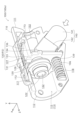
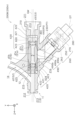
- FIG. 10 shows a fixing mechanism 200 (hereinafter referred to as “released state fixing mechanism 200n") in which the fixation of the long medical device such as the guide wire GW is released, and FIG.
- the fixing mechanism 200 (hereinafter referred to as “fixed state fixing mechanism 200f”) is shown in a state where the medical device is fixed.
- the fixing mechanism 200 is a mechanism for fixing and releasing the fixation of the elongated medical device inserted through the lumen 13 of the main tube portion 11 (FIG. 2) of the medical connector 10 . Each time the operating member 280 is pressed by the operator, the fixing mechanism 200 is in a fixed state in which the elongated medical device is fixed, or in an unfixed state in which the fixed lengthy medical device is released. , is a mechanism for switching the state.
- the fixing mechanism 200 includes a housing 210 , a tubular body 290 , a pressing member 240 , an operating member 280 , a force transmission member 230 and a holding mechanism 260 .
- the housing 210 is a tubular member having a distal opening 212 and a proximal opening 211 and a lumen 213 communicating between the distal opening 212 and the proximal opening 211 .
- the lumen 213 is a through hole extending in the front-rear direction (Z-axis direction) and constitutes a part of the lumen 13 of the medical connector 10 .
- the housing 210 is made of resin, for example.
- a branch pipe portion 12 is formed at the distal end portion of the housing 210 .
- the proximal end of the housing 210 is inserted into and fixed to the lumen 113 at the distal end of the housing 110 of the opening/closing mechanism 100 .
- the proximal end portion of the housing 210 of the fixing mechanism 200 restricts the distal movement of the hemostatic valve 120 of the opening/closing mechanism 100 .
- a cylindrical body accommodation space 215 which is a portion of the lumen 213 whose diameter is enlarged.
- a retraction space 214 is formed that communicates with the vicinity of the center of the tubular body accommodation space 215 in the front-rear direction.
- a member accommodation space 216 communicates with the vicinity of the center of the tubular body accommodation space 215 in the front-rear direction, extends obliquely toward the base end side downward, and opens onto the surface of the housing 210 . is formed.
- FIG. 12 is a perspective view showing the external configuration of the circular tubular body 290, the pressing member 240 and the force transmission member 230 in the first embodiment.
- the tubular body 290 is a flexible tubular member having a through hole 291 into which an elongated medical device such as a guide wire GW is inserted.
- the tubular body 290 is made of an elastic material such as silicone rubber.
- the tubular body 290 is mounted in the tubular body housing space 215 in such a posture that its axis is parallel to the front-rear direction (Z-axis direction).
- through hole 291 communicates with distal opening 212 and proximal opening 211 of housing 210 .
- the through hole 291 and the lumen 213 of the housing 210 are coaxial with each other.
- the front-rear direction (Z-axis direction) is an example of a fifth direction in the scope of claims.
- substantially circular tubular stoppers 220 are attached to both ends of the circular tubular body 290 .
- Each stopper 220 includes a main body portion 221 having approximately the same diameter as the circular tubular body 290, a first small diameter portion 223 positioned on the circular tubular body 290 side with respect to the main body portion 221 and having a diameter smaller than that of the main body portion 221, and a main body portion 221.
- a second small-diameter portion 222 having a diameter smaller than that of the main body portion 221 is located on the opposite side of the circular tubular body 290 .
- the first small diameter portion 223 of each stopper 220 is inserted into the through hole 291 of the tubular body 290 .
- each stopper 220 is formed with a concave portion 224 into which a convex portion (not shown) of the housing 210 is fitted.
- Each stopper 220 is positioned in the longitudinal direction with respect to the housing 210 by fitting the convex portion and the concave portion 224 , and as a result, the cylindrical body 290 is positioned in the longitudinal direction with respect to the housing 210 .
- the pressing member 240 is a member in which a through hole 241 extending in the front-rear direction is formed, and is made of resin, for example.
- the pressing member 240 has a substantially rectangular parallelepiped shape, and the length (dimension in the front-rear direction) of the portion above the center position of the through hole 241 is longer than the other portions.
- the inner diameter of the through-hole 241 is substantially the same as the outer diameter of the tubular body 290 , and the tubular body 290 is inserted into the through-hole 241 .
- the lower surface 244 of the pressing member 240 is a substantially flat surface that is substantially perpendicular to the vertical direction, and has a guide convex portion 245 that continuously extends in the front-rear direction.
- the pressing member 240 is accommodated in the housing 210 across the evacuation space 214, the cylindrical body accommodation space 215 and the member accommodation space 216. As shown in FIGS.
- the pressing member 240 is slidable along the vertical direction (Y-axis direction), which is a direction orthogonal to the axial direction (Z-axis direction) of the tubular body 290 .
- the vertically slidable pressing member 240 has a non-pressing position P5 where the through hole 241 is coaxial with the through hole 291 of the cylindrical body 290 as shown in FIG. 10, and a non-pressing position P5 as shown in FIG. and a pressing position P6 displaced upward from the position P5.
- the state in which the pressing member 240 is not substantially pressed means a state in which the inner peripheral surface of the through hole 241 of the pressing member 240 and the outer peripheral surface of the tubular body 290 are separated from each other, and the through hole 241 of the pressing member 240 is not pressed. Since the inner diameter is the same as or slightly smaller than the outer shape of the cylindrical body 290 before being inserted into the through hole 241, the inner peripheral surface of the through hole 241 of the pressing member 240 and the outer peripheral surface of the cylindrical body 290 are in close contact. including the state of being The vertical direction (Y-axis direction) is an example of a sixth direction in the claims, and the non-pressing position P5 is an example of a fifth position in the claims.
- the pressing member 240 presses a portion of the cylindrical body 290 excluding both end portions (in this embodiment, the central portion in the front-rear direction) upward from the outer peripheral side. to elastically deform the circular tubular body 290 .
- the inner peripheral surface of the elastically deformed cylindrical body 290 (mainly the contact point CP1, which is the lower portion of the inner peripheral surface of the deformed portion of the cylindrical body 290) is pressed against the elongated medical device.
- the retraction space 214 of the housing 210 has a sufficient size for the pressing member 240 to deform the cylindrical body 290 to the extent that the long medical device can be fixed.
- the pressed position P6 is an example of a sixth position in the claims.
- FIG. 13 is a perspective view showing the external configuration of the operating member 280 and the holding mechanism 260 in the first embodiment.
- the operation member 280 is a substantially cylindrical member extending in a direction (hereinafter referred to as "operation direction D7") non-parallel to the front-rear direction (Z-axis direction).
- operation direction D7 is a direction with an angle of 35 degrees or more and 55 degrees or less with the front-rear direction. 45-degree oblique direction toward the side).
- the operation member 280 is supported by an outer cylinder 250 of a holding mechanism 260, which will be described later, and is slidable along the operation direction D7.
- the operation member 280 is made of resin, for example.
- the operation direction D7 is an example of a seventh direction in the claims.
- the force transmission member 230 is a substantially polygonal member and is made of resin, for example.
- An upper surface 234 of the force transmission member 230 is a substantially flat surface that is substantially orthogonal to the vertical direction, and has a guide groove 235 that continuously extends in the front-rear direction.
- a guide protrusion 245 of the pressing member 240 is fitted in the guide groove 235 .
- a protruding portion 232 is formed on a surface 233 on the lower base end side of the force transmission member 230 .
- the force transmission member 230 is housed in the member housing space 216 of the housing 210 so as to be positioned between the pressing member 240 and the operation member 280, and is arranged in the operation direction D7. It is slidable along.
- the force transmission member 230 can transmit to the pressing member 240 a force that moves the operating member 280 closer to the pressing member 240 along the operation direction D7.
- the force transmission member 230 Since the force transmission member 230 is configured as described above, it can slide relative to the pressing member 240 in the front-rear direction (Z-axis direction) while contacting the lower surface 244 of the pressing member 240 . That is, as shown in FIG. 10, when the pressing member 240 is at the non-pressing position P5 where it does not press the cylindrical body 290, the force transmission member 230 is at the retracted position P7 retracted toward the lower proximal side. The force transmission member 230 does not press the pressing member 240 when the force transmission member 230 is at the retracted position P7. When the pressing member 240 is not pressed by the force transmission member 230, the elastic restoring force of the cylindrical body 290 positions the pressing member 240 at the non-pressing position P5.
- the retracted position P7 is an example of a seventh position in the claims.
- the force transmission member 230 slides obliquely upward along the operation direction D7 from the retracted position P7 and moves from the retracted position P7 to the advanced position P8 closer to the cylindrical body 290, , the force transmission member 230 slides toward the distal end side relative to the pressure member 240 while maintaining the state in which the guide protrusion 245 of the pressure member 240 is fitted in the guide groove 235 of the force transmission member 230. .
- the force transmission member 230 presses the pressing member 240 to position the pressing member 240 at the pressing position P6.
- the forward position P8 is an example of an eighth position in the claims.
- the holding mechanism 260 employs a so-called double knock mechanism, and each time the operation member 280 slides along the operation direction D7, the force transmission member 230 is held at the retracted position P7. , and the state in which the force transmission member 230 is held at the forward position P8.
- the holding mechanism 260 has an outer cylinder 250 , a rotor 270 and a biasing member 262 . Note that, in the present embodiment, part of the operating member 280 also constitutes part of the holding mechanism 260 .
- FIG. 14 is a perspective view showing the external configuration of the outer cylinder 250 in the first embodiment.
- the outer cylinder 250 is a substantially cylindrical member made of resin, for example.
- the outer cylinder 250 is attached to the distal end of the portion of the housing 210 where the member accommodating space 216 is formed, with its axial direction aligned with the operation direction D7.
- a toothed outer cylinder end face cam 253 is formed on the inner peripheral surface of the outer cylinder 250 .
- the outer cylinder end surface cam 253 is a cam in which shallow groove portions 254 and deep groove portions 255 are alternately formed in the circumferential direction.
- the outer cylinder end face cam 253 has four shallow groove portions 254 and four deep groove portions 255 .
- a tooth-shaped operating member end face cam 282 is formed on the end face of the substantially cylindrical operating member 280 on the upper tip side. Further, on the outer peripheral surface of the operation member 280, a plurality of (four) sliding contacts 281, which are substantially rectangular parallelepiped projections, are formed.
- the operating member 280 is inserted into the hollow portion of the outer cylinder 250 , and each sliding contact 281 on the outer peripheral surface of the operating member 280 is fitted into each deep groove 255 on the inner peripheral surface of the outer cylinder 250 .
- the operation member 280 is slidable relative to the outer cylinder 250 in the axial direction of the outer cylinder 250, that is, along the operation direction D7, while the rotation thereof is restricted.
- the rotor 270 is a substantially disk-shaped member and is made of resin, for example.
- a plurality of (four) protrusions 273 are formed on the outer peripheral surface of the rotor 270 . Teeth are formed on the surface on the lower base end side of each projection 273 of the rotor 270 .
- the pitch of the crest portions of the operating member end cam 282 of the operating member 280 is shifted from the pitch of the crest portions of the outer cylinder end cam 253 of the outer cylinder 250 by about 1/2.
- Each projection 273 is structured so that it cannot mesh with both the operating member end face cam 282 and the outer cylinder end face cam 253 at the same time.
- a concave portion 274 is formed in the surface of the rotor 270 on the upper tip side.
- the biasing member 262 is a substantially cylindrical spring and is made of metal such as stainless steel.
- the biasing member 262 is arranged between the rotor 270 and the force transmission member 230 ( FIG. 12 ), and biases the force transmission member 230 toward the pressing member 240 .
- One end of the biasing member 262 is inserted into the recessed portion 274 of the rotor 270 , and the projection 232 of the force transmission member 230 is inserted into the hollow portion of the other end of the biasing member 262 .
- the rotor 270 In the rotor retracted state in which the protruding portions 273 of the rotor 270 are fitted into the deep groove portions 255 of the outer cylinder end surface cam 253 of the outer cylinder 250, the rotor 270 is retracted downward to the base end side using the deep groove portions 255 as guides. Located in Therefore, in the rotor retracted state, as shown in FIG. 10, the force transmission member 230 is located at the retracted position P7 in which the force transmission member 230 is retracted toward the lower base end side, and as a result, the pressing member 240 is located at the non-pressing position P5. The rotor retracted state is maintained as long as the operating member 280 does not slide.
- each convex portion 273 of the rotor 270 is formed not by the deep groove portion 255 of the outer cylinder end surface cam 253 of the outer cylinder 250 but by the shallow groove portion 254. to fit.
- the rotor forward state in which the projections 273 of the rotor 270 are fitted in the shallow grooves 254 the rotor 270 is advanced to the upper tip side compared to the rotor backward state in which the deep grooves 255 are fitted. retained.
- the force transmission member 230 advances to the advance position P8, and as a result, the pressing member 240 moves to the pressing position P6.
- the operating member 280 does not slide, the rotor advance state is maintained.
- each convex portion 273 of the rotor 270 is formed not by the shallow groove portion 254 of the outer cylinder end surface cam 253 of the outer cylinder 250 but by the deep groove portion 255. to fit.
- the holding mechanism 260 returns to the rotor retracted state, the force transmission member 230 retracts to the retracted position P7, and the pressing member 240 moves to the non-pressing position P5. In this manner, the holding mechanism 260 holds the force transmission member 230 at the retracted position P7 and the forward position P8 each time the operation member 280 slides along the operation direction D7.
- the state of the holding mechanism 260 is switched between the state shown in FIG.
- the holding mechanism 260 is in the rotor retracted state.
- the force transmission member 230 is located at the retracted position P7, and the pressing member 240 is not pressed by the force transmission member 230 and is located at the non-pressing position P5.
- the elongated medical device such as the guide wire GW inserted through the lumen 213 of the housing 210 (the lumen 13 of the main tube portion 11) is not fixed. That is, the fixing mechanism 200 is a released state fixing mechanism 200n.
- the operation member 280 when the operator's thumb holding the medical connector 10 presses the operation member 280 obliquely upward along the operation direction D7 (hereinafter referred to as "fixing operation"), the operation member 280 is It slides obliquely upward along the operation direction D7. Accordingly, the holding mechanism 260 switches from the rotor backward state to the rotor forward state. In this state, as shown in FIG. 11, the force transmission member 230 is positioned at the forward position P8, and the pressing member 240 is pressed by the force transmission member 230 and positioned at the pressing position P6. In addition, the circular tubular body 290 is pressed by the pressing member 240 and elastically deformed to fix the long medical device inserted through the lumen 213 of the housing 210 . As a result, the fixing mechanism 200 becomes a fixed state fixing mechanism 200f.
- the fixing mechanism 200 when the fixing mechanism 200 is in the fixed state fixing mechanism 200f, for example, an operator's thumb can press the operation member 280 obliquely upward along the operation direction D7 in the same manner as the fixing operation ( hereinafter referred to as "unlocking operation"), the operating member 280 slides obliquely upward along the operating direction D7.
- the holding mechanism 260 switches from the rotor advance state to the rotor retreat state. In this state, as shown in FIG. 10, the force transmission member 230 is located at the retracted position P7, and the pressing member 240 is not pressed by the force transmission member 230 and moved to the non-pressing position P5 by the elastic restoring force of the cylindrical body 290. return.
- the circular tubular body 290 is not pressed by the pressing member 240 and is not elastically deformed, so that the long medical device inserted through the lumen 213 of the housing 210 is released from fixation. As a result, the fixing mechanism 200 returns to the released state fixing mechanism 200n.
- the fixing mechanism 200 switches between the released state fixing mechanism 200n and the fixed state fixing mechanism 200f.
- the holding mechanism 260 holds the force transmission member 230 at the retracted position P7, or , a state in which the force transmission member 230 is held at the forward position P8. Therefore, the operator can easily press the operation member 280 with the thumb while holding the medical connector 10 to fix and release the long medical device.
- the operability of the fixing mechanism 200 can be improved because the fixing condition of the device can be grasped by touch and sight.
- the holding mechanism 260 has a cylindrical biasing member 262 that biases the force transmission member 230 in a direction toward the pressing member 240.
- a surface of the force transmission member 230 facing the biasing member 262 has a biasing member.
- a convex portion 232 is formed to be inserted into the hollow portion of 262 . Therefore, according to the fixing mechanism 200 of the present embodiment, the force transmission member 230 and the biasing member 262 can be positioned easily and accurately, and the biasing force of the biasing member 262 can be effectively applied. The force can be transmitted to the force transmission member 230, and the precision of the operation of the fixing mechanism 200 can be improved.
- the angle between the direction parallel to the axis of the circular tubular body 290 (the Z-axis direction) and the operating direction D7 of the operating member 280 is 35 degrees or more and 55 degrees or less. Therefore, according to the fixation mechanism 200 of the present embodiment, the operator can very easily operate the operation member 280 with the thumb while holding the medical connector 10, and the operability of the fixation mechanism 200 is improved. can be substantially improved.
- the force transmission member 230 is configured to be slidable relative to the pressing member 240 along the direction (Z-axis direction) parallel to the axis of the cylindrical body 290 while contacting the surface of the pressing member 240 .
- sliding of the force transmission member 230 along the operation direction D7 and sliding of the pressing member 240 along the vertical direction can be efficiently converted. , the operability of the fixing mechanism 200 can be effectively improved.
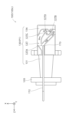
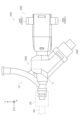
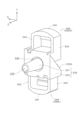
- FIG. 15 is an explanatory diagram showing the external configuration of the medical connector 10A according to the second embodiment.
- the same configurations as those of the medical connector 10 of the first embodiment described above are denoted by the same reference numerals, and descriptions thereof will be omitted as appropriate.
- the medical connector 10A of the second embodiment includes an opening/closing mechanism 300 and a fixing mechanism 200.
- the configuration of the fixing mechanism 200 included in the medical connector 10A of the second embodiment is the same as the configuration of the fixing mechanism 200 included in the medical connector 10 of the first embodiment. Therefore, below, the opening-and-closing mechanism 300 with which 10 A of medical connectors of 2nd Embodiment are provided is demonstrated.
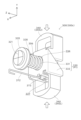
- 16 to 18 are explanatory diagrams showing the configuration of the opening/closing mechanism 300 in the second embodiment, and FIG. 17 and 18 show cross-sectional perspective views (outer perspective views of some members). 17 and 18, illustration of the housing 310 is omitted. 16 and 17 show the opening/closing mechanism 300 with the hemostatic valve 320 closed (hereinafter referred to as "closed opening/closing mechanism 300c"), and FIG. 18 shows the hemostatic valve 320 opened.
- the opening/closing mechanism 300 in the open state hereinafter referred to as "open opening/closing mechanism 300o" is shown.
- the opening/closing mechanism 300 is a mechanism for opening/closing a hemostatic valve 320 that suppresses the outflow of blood through the lumen 13 of the main pipe portion 11 (FIG. 15) of the medical connector 10A.
- the opening/closing mechanism 300 of the present embodiment is a mechanism that switches between a state in which the hemostatic valve 320 is closed and a state in which the hemostatic valve 320 is opened each time the operating member 340 is pressed by the operator. be.
- the opening/closing mechanism 300 includes a housing 310 , a hemostatic valve 320 , a penetrating member 330 , an operating member 340 , a biasing member 306 and a pin 372 .
- the housing 310 is a tubular member having a distal opening 312 and a proximal opening 311, and a lumen 313 communicating between the distal opening 312 and the proximal opening 311.
- the housing 310 has a generally tubular distal member 318 and a lid-shaped proximal member 319 that closes the proximal opening of the distal member 318 .
- the opening formed in the distal end side member 319 constitutes the distal side opening 312
- the through hole formed in the proximal side member 319 constitutes the proximal side opening 311 .
- the lumen 313 is a through-hole extending in the front-rear direction (Z-axis direction), and constitutes part of the lumen 13 of the main tube portion 11 of the medical connector 10A.
- the housing 310 is made of resin, for example.
- the Z-axis direction is an example of a first direction in the scope of claims.
- a substantially flat plate-like partition wall 314 that is substantially perpendicular to the front-rear direction is formed inside the housing 310 near the center in the front-rear direction.
- the partition 314 is formed with a through hole 314 ⁇ /b>A that penetrates the partition 314 in the front-rear direction and constitutes a part of the lumen 313 .
- the cross-sectional shape of 314 A of through-holes is substantially circular, for example.
- a groove 317 for receiving the pin 372 is formed in the lower portion inside the housing 310 .
- a pair of upper and lower operation member through-holes 316 are formed in the base end portion of the housing 310 .
- the hemostasis valve 320 is a member having the same configuration as the hemostasis valve 120 of the first embodiment.
- the hemostasis valve 320 is fixed inside the housing 310 at a position distal to the partition wall 314 .
- Hemostasis valve 320 is normally in a closed state in which slit 321 is closed and the valve is closed (FIGS. 16 and 17).
- the hemostatic valve 320 is in an open state in which a through hole 322 is formed to penetrate the hemostatic valve 320 in the front-rear direction (FIG. 18).
- a substantially annular boss 328 is arranged between the hemostatic valve 320 and the partition wall 314 of the housing 310 .
- the through member 330 is a member in which a through hole 332 extending in the front-rear direction is formed, and is made of resin, for example. More specifically, the penetrating member 330 is connected to a substantially cylindrical main body portion 331 having a distal end portion of a through hole 332 formed therein, and a proximal end side of the main body portion 331. The proximal end portion of the through hole 332 is connected to and a substantially rectangular parallelepiped connecting portion 333 formed.
- a concave portion 334 surrounding the outer periphery of the main body portion 331 is formed on the front end side surface of the connecting portion 333 . Further, as shown in FIGS. 17, 18, and 20, an operation restricting groove 337 is formed in the lower surface of the connecting portion 333. As shown in FIGS. The movement restricting groove 337 is a so-called heart cam groove, which is a heart-shaped groove that is connected around one circumference.
- a contact surface 335 is formed. More specifically, on the proximal surface of the connecting portion 333, a pair of penetrating member side first contact surfaces 335A facing the upper proximal side and a pair of penetrating member side second contact surfaces 335A facing the lower proximal side. A contact surface 335B is formed.
- the pair of penetrating member side first contact surfaces 335A are arranged to face each other in the left-right direction with the through hole 332 interposed therebetween. are arranged so as to face each other in the left-right direction.
- the inclination angle of each penetrating member side contact surface 335 with respect to the front-rear direction is, for example, 45 degrees.
- the vertical direction is an example of a second direction in the scope of claims, and the horizontal direction is an example of a fourth direction in the scope of claims.
- the penetrating member 330 is housed inside the housing 310 on the proximal side of the hemostatic valve 320 .
- a through hole 332 in the through member 330 communicates with the proximal opening 311 of the housing 310 .
- the through hole 332 and the lumen 313 of the housing 310 are coaxial with each other.
- the penetrating member 330 housed in the housing 310 is slidable in the front-rear direction while being positioned vertically and horizontally with respect to the housing 310 .
- the penetrating member 330 is positioned so that the body portion 331 of the penetrating member 330 faces the through hole 314A of the partition wall 314 in the front-rear direction.
- the penetrating member 330 which is slidable in the front-rear direction, has a pressing position P2 where the tip of the body portion 331 is inserted into the through hole 314A and presses the hemostatic valve 320 to open the hemostatic valve 320. and a non-pressing position P1 in which the hemostatic valve 320 is closed without pressing the . As shown in FIG.
- the through hole 322 formed in the hemostatic valve 320 and the through hole 332 of the penetrating member 330 communicate with each other.
- the penetrating member 330 can move to a position where the connection portion 333 contacts the partition wall 314 of the housing 310 on the distal end side, and a position where the proximal end of the penetrating member 330 contacts the housing 310 on the proximal end side. You can move up to
- the pressing position P2 is an example of a second position in the claims
- the non-pressing position P1 is an example of a first position in the claims.
- the biasing member 306 has the same configuration as the biasing member 106 of the first embodiment, and biases the penetrating member 330 toward the base end. As shown in FIG. 16, biasing member 306 is housed in housing 310 at a location between hemostasis valve 320 and penetrating member 330 . A body portion 331 of a penetrating member 330 is inserted into the hollow portion of the biasing member 306 from the proximal end side, and the proximal end portion of the biasing member 306 is housed in a concave portion 334 formed in a connecting portion 333 of the penetrating member 330 .
- the penetrating member 330 biased toward the proximal end by the biasing member 306 is in a non-pressing position P1 (FIGS. 16 and 17) where the hemostatic valve 320 is not pressed when it is not subjected to force from the operating member 340 or the pin 372. Located in
- the pin 372 is a member having the same configuration as the pin 172 of the first embodiment.
- the pin 372 is attached to the housing 310 so as to extend in the front-rear direction.
- the tip end of the pin 372 is accommodated and fixed in a groove 317 formed in the housing 310 .
- a proximal end portion 373 of the pin 372 is bent upward and is loosely fitted in an operation restricting groove 337 formed in a connecting portion 333 of the penetrating member 330 .
- the position of the end portion 373 of the pin 372 in the movement restricting groove 337 changes as the penetrating member 330 slides in the front-rear direction (Z-axis direction).
- 21 and 22 are explanatory diagrams showing the position of the pin 372 in the movement restricting groove 337 in the second embodiment.
- 21 and 22 show the bottom configuration of pin 372, penetrating member 330 and hemostasis valve 320.
- FIG. FIG. 21 shows the closed state opening/closing mechanism 300c in which the penetrating member 330 is at the non-pressing position P1 and the hemostatic valve 320 is closed, and
- An open state opening/closing mechanism 300o having a through hole 322 formed in 320 is shown.
- the end portion 373 of the pin 372 swings in the left-right direction (X-axis direction). while relatively moving in one direction (counterclockwise in the illustrated example) in the movement restricting groove 337 . That is, as shown in FIG. 21, in the first state where the penetrating member 330 is at the non-pressing position P1, the end portion 373 is positioned at the heart-shaped bottom portion (hereinafter referred to as the "closed position portion 337A") of the movement restricting groove 337. do. In the first state, the pin 372 does not restrict the forward and backward movement of the penetrating member 330 .
- the end portion 373 When the penetrating member 330 moves from the first state toward the distal side (positive direction of the Z-axis), the end portion 373 relatively moves within the movement restricting groove 337 toward the proximal side.
- the end portion 373 sandwiches the heart-shaped valley portion of the movement restricting groove 337. It is positioned at the first top portion 337B, which is one of the pair of top portions. In this state, the pin 372 does not restrict the proximal movement of the penetrating member 330 .
- the penetrating member 330 moves back a little toward the base end side from the second state and moves to the pressing position P2, as shown in FIG. , and reaches a heart-shaped trough portion (hereinafter referred to as “open holding portion 337C”) in the movement restricting groove 337 .
- the interference between the pin 372 and the movement restricting groove 337 restricts the movement of the penetrating member 330 toward the base end side, and the penetrating member 330 is maintained at the pressing position P2.
- the end portion 373 moves relatively toward the proximal end side within the movement restricting groove 337, It is positioned at the other of a pair of top portions (hereinafter referred to as “second top portion 337D”) sandwiching the heart-shaped trough portion of the movement restricting groove 337 .
- the pin 372 does not restrict the proximal movement of the penetrating member 330 .
- FIG. 23 is an external perspective view showing the configuration of the operating member 340 in the second embodiment.
- the operation member 340 has a first piece 340U and a second piece 340L that vertically face each other.
- the second piece 340L is arranged below the first piece 340U.
- the first piece 340U and the second piece 340L are housed in the housing 310 so as to be slidable in a direction (hereinafter referred to as "operation direction D2") non-parallel to the front-rear direction (Z-axis direction).
- the operating direction D2 is a vertical direction that forms an angle of approximately 90 degrees with the front-rear direction.
- approximately 90 degrees means a range of about 90 degrees plus or minus 5 degrees.
- the operation direction D2 is an example of a second direction in the claims.
- Each of the first piece 340U and the second piece 340L that constitute the operation member 340 has a pair of arms 342 extending in the vertical direction and a connecting portion 341 that connects the ends of the pair of arms 342 to each other.
- the connecting portions 341 of the first piece 340U and the second piece 340L are exposed from the housing 310 via the operation member through-holes 316, and can be pressed by an operator such as a doctor. It is possible.
- each arm portion 342 of each of the first piece 340U and the second piece 340L is non-parallel in the front-rear direction (Z-axis direction) and the vertical direction (Y-axis direction), and is not parallel to the left-right direction (
- An operating member side contact surface 345 is formed parallel to the X-axis direction).
- the distal end of each arm 342 of the first piece 340U is formed with an operation member side first contact surface 345A facing downward toward the distal end.
- Each operating member-side first contact surface 345A is a surface that contacts with each of the pair of penetrating member-side first contact surfaces 335A of the penetrating member 330 .
- each operating member side second contact surface 345B facing the upper tip side is formed at the tip of each arm 342 of the second piece 340L.
- Each operating member-side second contact surface 345B is a surface that comes into contact with each of the pair of penetrating member-side second contact surfaces 335B of the penetrating member 330 .
- the inclination angle of each operation member side contact surface 345 with respect to the front-rear direction is, for example, 45 degrees.
- the first piece 340U and the second piece 340L that constitute the operating member 340 are arranged in the vertical direction. They are in a state of being separated from each other (hereinafter referred to as "separated state").
- the first piece 340U and the second piece 340L slide toward each other in the vertical direction (that is, toward the inside of the housing 310)
- the operating member side first contact surface 345A of the first piece 340U and the penetrating member contact each other.
- the penetrating member side first contact surface 335A of the penetrating member 330 is in contact with and relatively slides, and the operation member side second contact surface 345B of the second piece 340L and the penetrating member side second contact surface 345B of the penetrating member 330 are aligned.
- the penetrating member 330 is pressed toward the distal end and displaced toward the distal end by sliding relative to the contact surface 335B while being in contact with the contact surface 335B (FIG. 18).
- the sliding range of the operating member 340 is set to a range that allows the penetrating member 330 to move from the pressing position P2 to the distal end side.
- the opening/closing mechanism 300 of the hemostatic valve 320 will be described.
- the penetrating member 330 receives the biasing force of the biasing member 306 and is positioned at the non-pressing position P1 where the hemostatic valve 320 is not pressed.
- the first piece 340U and the second piece 340L indirectly receive the urging force via the penetrating member 330 and are vertically separated from each other.
- the hemostasis valve 320 is closed, and the opening/closing mechanism 300 is a closed state opening/closing mechanism 300c.
- the end 373 of the pin 372 is positioned at the closed position portion 337A of the movement restricting groove 337 of the penetrating member 330.
- FIG. 21 the end 373 of the pin 372 is positioned at the closed position portion 337A of the movement restricting groove 337 of the penetrating member 330.
- valve opening operation For example, an operation of pressing the first piece 340U and the second piece 340L constituting the operation member 340 toward the inside of the housing 310 with the thumb and forefinger of the operator holding the medical connector 10A (hereinafter referred to as "valve opening operation"). ) is applied, the penetrating member 330 is pushed by the first piece 340U and the second piece 340L and moves to the distal side. In addition, the end portion 373 of the pin 372 relatively moves within the movement restricting groove 337 toward the base end side.
- the penetrating member 330 moves toward the distal end side by a certain distance or more, the distal end portion of the body portion 331 of the penetrating member 330 presses the hemostatic valve 320 to open the hemostatic valve 320 .
- the operator releases the valve opening operation.
- the penetrating member 330 is slightly returned to the base end side by the biasing force of the biasing member 306, and along with this movement, the end portion 373 moves relatively to the distal end side within the operation restricting groove 337 to reach the open holding portion 337C.
- the opening/closing mechanism 300 becomes an open state opening/closing mechanism 300o shown in FIG.
- opening/closing mechanism 300 when the opening/closing mechanism 300 is in the open state opening/closing mechanism 300o, the first piece 340U and the second piece 340L constituting the operating member 340 are moved by the operator's thumb and index finger, for example, in the same manner as the valve opening operation.
- a valve closing operation when an operation (hereinafter referred to as a “valve closing operation”) is applied to press the inside of housing 310 along the vertical direction, penetrating member 330 moves toward first piece 340U and second piece 340L constituting operation member 340. , and moves to a position on the tip side from the pressing position P2.
- the end portion 373 of the pin 372 relatively moves from the open holding portion 337C in the operation restricting groove 337 toward the base end side to reach the second top portion 337D. In this state, the pin 372 does not restrict the proximal movement of the penetrating member 330 . Therefore, when the valve closing operation by the operator is released, the penetrating member 330 moves toward the proximal side by the biasing force of the biasing member 306 and returns to the non-pressing position P1. Along with this, as shown in FIG. 21, the end portion 373 of the pin 372 relatively moves toward the distal end side within the movement restricting groove 337 and returns to the closed position portion 337A. As a result, the hemostatic valve 320 is closed, and the opening/closing mechanism 300 becomes the closed state opening/closing mechanism 300c shown in FIGS.
- the opening/closing mechanism 300 changes the closed state opening/closing mechanism 300c and the open state.
- the state is switched between the opening and closing mechanism 300o.
- the opening/closing mechanism 300 of the second embodiment has the same configuration as that of the first embodiment. In this state, the opening/closing operation of the hemostatic valve 320 can be easily performed with the thumb and/or the forefinger, and the operability of the opening/closing mechanism 300 can be improved.
- the biasing member 306 has a cylindrical shape, and a main body portion 331 as a projection inserted into the hollow portion of the biasing member 306 is formed on the surface of the penetrating member 330 facing the biasing member 306 . Therefore, according to the opening/closing mechanism 300 of the second embodiment, the positioning between the penetrating member 330 and the biasing member 306 can be easily and precisely performed, and the biasing force of the biasing member 306 can be effectively applied. It can be transmitted to the penetrating member 330, and the accuracy of the operation of the opening/closing mechanism 300 can be improved.
- the angle formed by the extension direction (Z-axis direction) of the lumen 313 of the housing 310 and the operation direction D2 of the operation member 340 is approximately 90 degrees. Therefore, according to the opening/closing mechanism 300 of the second embodiment, the operator can very easily perform the opening/closing operation of the hemostatic valve 320 with the thumb and/or forefinger while gripping the medical connector 10A. The operability of 300 can be effectively improved.
- the operating member 340 is composed of a first piece 340U and a second piece 340L that face each other in the vertical direction (the Y-axis direction), and the first piece 340U and the second piece 340L are slidable so as to approach each other in the vertical direction.
- the penetrating member 330 is pressed and displaced to the distal end side. Therefore, according to the opening/closing mechanism 300, the operator performs an operation of pinching the first piece 340U and the second piece 340L with the thumb and forefinger while gripping the medical connector 10A, thereby opening and closing the hemostatic valve 320. can be performed very easily and stably, and the operability of the opening/closing mechanism 300 can be effectively improved.
- Each of the first piece 340U and the second piece 340L extends in the horizontal direction (X-axis direction) perpendicular to both the extending direction (Z-axis direction) and the vertical direction (Y-axis direction) of the lumen 313 of the housing 310. ) and non-parallel to both the extending direction and the vertical direction.
- Penetrating member 330 is a surface that is parallel to the left-right direction and non-parallel to both the extending direction and vertical direction of lumen 313, and is in contact with operation member-side contact surface 345 of first piece 340U.
- the operation member 340 slides along the vertical direction substantially orthogonal to the extending direction of the lumen 313 of the housing 310 and the penetrating member 330 slides in the extending direction. can be efficiently converted, and the operability of the opening/closing mechanism 300 can be effectively improved.
- FIG. 24 is an explanatory diagram showing the configuration of a longitudinal section (YZ section) of the medical connector 10B according to the third embodiment.
- the same configurations as those of the medical connector 10 of the first embodiment described above are denoted by the same reference numerals, and the description thereof will be omitted as appropriate.
- the medical connector 10B includes an opening/closing mechanism 100 and a fixing mechanism 200B.
- the opening/closing mechanism 100 provided in the medical connector 10B is the same as the opening/closing mechanism 100 provided in the medical connector 10 of the first embodiment, so description thereof will be omitted. explain.
- FIG. 25 and 26 are explanatory diagrams showing the configuration of the fixing mechanism 200B, showing the configuration of its longitudinal section (YZ section).
- FIG. 25 shows the fixing mechanism 200B (released state fixing mechanism 200n) in which the fixation of the long medical device such as the guide wire GW is released
- FIG. 2 shows the fixing mechanism 200B in a closed state (fixed state fixing mechanism 200f). A side view of some members is shown.
- a fixing mechanism 200B of the third embodiment includes a circular tubular body 490 instead of the circular tubular body 290 in the fixing mechanism 200 of the first embodiment.
- the tubular body 490 differs from the tubular body 290 in the configuration of the through holes 491 . That is, the inner diameter of the through-hole 491 extending through the circular tubular body 490 in the longitudinal direction changes according to the position along the axial direction. More specifically, in the circular tubular body 490, the inner diameter d1a of the through hole 491 at the central portion 490a is smaller than the inner diameter d1b at the distal end portion 490b and smaller than the inner diameter d1c at the proximal end portion 490c.
- the through hole 491 is wider at the distal end and the proximal end than at the central portion. Therefore, regarding the area of the through hole 491 in the cross section of the fixing mechanism 200B, the area S1a of the central portion 490a is smaller than the area S1b of the distal end portion 490b and smaller than the area S1c of the proximal end portion 490c.
- the cross-sectional shape of the through-hole 491 at each position may take any shape, but is circular, for example.
- the through hole 491 is an example of a first through hole in the claims.
- Stoppers 420 are attached to the distal end and the proximal end of the tubular body 490 in the same manner as in the first embodiment.
- Each stopper 420 has a main body portion 421 having substantially the same outer diameter as the central portion 490 a of the circular tubular body 490 , and a second body portion 421 located on the circular tubular body 490 side with respect to the main body portion 421 and having a smaller outer diameter than the main body portion 421 .
- 1 small-diameter portion 423 and a second small-diameter portion 422 located on the opposite side of the main body portion 421 from the cylindrical body 490 and having an outer diameter smaller than that of the main body portion 421 .
- the first small diameter portion 423 is inserted into the through hole 491 .
- the main body portion 421 is formed with a concave portion 424 into which a convex portion (not shown) of the housing 210 is fitted.
- the stopper 420 is positioned in the front-rear direction with respect to the housing 210 by fitting the projection and the recess 424 , and as a result, the cylindrical body 490 is positioned in the front-rear direction with respect to the housing 210 .
- distal stop 420 connects distal end 490 b to housing 210 and proximal stop 420 connects proximal end 490 c to housing 210 .
- a through hole 425 communicating with the through hole 491 is formed in each stopper 420 .
- the shape of the through-hole 425 in the cross section at each portion may take any shape, but is circular, for example.
- the tip-side stopper 420 is an example of the tip-side connecting portion in the claims, and the through hole 425 of the tip-side stopper 420 is an example of the second through hole in the claims.
- the proximal-side stopper 420 is an example of a proximal-side connecting portion in the claims, and the through-hole 425 of the proximal-side stopper 420 is an example of a third through-hole in the claims. .
- the inner diameter d2 of the through hole 425 is larger than the inner diameter d1a of the through hole 491 in the central portion 490a. Therefore, the area S2 of the through hole 425 in the cross section of the first small diameter portion 423 of the stopper 420 on the distal end side is larger than the area S1a of the through hole 491 in the cross section of the central portion 490a of the cylindrical body 490 .
- the inner diameter d3 of the through-hole 425 in the first small-diameter portion 423 (the portion inserted into the through-hole 491 of the circular tubular body 490) of the stopper 420 on the proximal side is It is larger than the inner diameter d1a of the hole 491. Therefore, the area S3 of the through hole 425 in the cross section of the first small diameter portion 423 of the stopper 420 on the proximal end side is larger than the area S1a of the through hole 491 in the cross section of the central portion 490a of the tubular body 490 .
- the outer diameter at the central portion 490a is larger than the outer diameter at the distal end portion 490b and larger than the outer diameter at the proximal end portion 490c. Therefore, in the cylindrical body 490 housed in the substantially hollow columnar cylindrical body housing space 215 in the housing 210, the outer peripheral surface of the central portion 490a is in contact with or close to the inner peripheral surface of the cylindrical body housing space 215. On the other hand, the outer peripheral surfaces of the distal end portion 490 b and the proximal end portion 490 c are separated from the inner peripheral surface of the cylindrical body accommodating space 215 .
- a fixing mechanism 200B of the third embodiment includes a pressing member 440 instead of the pressing member 240 of the first embodiment.
- the pressing member 440 has a shape obtained by removing the portion above the through hole 241 of the pressing member 240 of the first embodiment. That is, the pressing member 440 is arranged below the central portion 490a of the tubular body 490, and in the released state described above, the upper surface of the pressing member 440 is in contact with or close to the outer peripheral surface of the central portion 490a of the tubular body 490.
- the pressing member 440 is slidable along the vertical direction (Y-axis direction) perpendicular to the axial direction (Z-axis direction) of the tubular body 490 .
- the vertically slidable pressing member 440 has a non-pressing position P5 at which it does not substantially press the cylindrical body 490 as shown in FIG. and the pressing position P6.
- the state in which the pressing member 440 is not substantially pressed means that the upper surface of the pressing member 440 is in close contact with the outer peripheral surface of the tubular member 490 in addition to the state in which the upper surface of the pressing member 440 is separated from the outer peripheral surface of the tubular member 490. including the state of
- the pressing member 440 presses the central portion 490a of the cylindrical body 490 upward from the outer peripheral side to elastically deform the central portion 490a.
- the contact point CP1 which is the lower portion of the inner peripheral surface of the central portion 490a, which is the inner peripheral surface of the through hole 491 of the central portion 490a that is elastically deformed, and the upper portion of the inner peripheral surface of the central portion 490a.
- the contact points CP3 and are pressed against the elongated medical device, and the elongated medical device is clamped by the two contact points CP1 and CP3, thereby being fixed to the fixing mechanism 200B and restricted from sliding in the front-rear direction. be.
- the area S2 of the through hole 425 in the cross section of the first small diameter portion 423 of the stopper 420 on the distal side and the through hole in the cross section of the first small diameter portion 423 of the stopper 420 on the proximal side The area S3 of 425 is larger than the area S1a of the through hole 491 in the cross section of the central portion 490a of the circular tubular body 490 . Therefore, even when the pressing member 440 presses the central portion 490a of the circular tubular body 490 and the elongated medical device is fixed, the elongated medical device may not be pressed against the inner peripheral surface of the stopper 420.
- the configurations of the medical connector 10, the opening/closing mechanisms 100 and 300, and the fixing mechanism 200 in the above embodiment are merely examples, and various modifications are possible.
- the convex portion 139 inserted into the hollow portion of the biasing member 106 is formed on the surface of the penetrating member 130 facing the biasing member 106 . It does not have to be.
- the convex portion 232 of the force transmission member 230 can be omitted.
- the biasing member 106 is arranged at a position facing the operation member 140 in the front-rear direction, but the biasing member 106 may be arranged at another position.
- the arrangement of the biasing member 306 in the second embodiment can also be changed in the same manner.
- the operation member 340 has two pieces (the first piece 340U and the second piece 340L), but the operation member 340 may consist of one piece.
- a so-called double knock mechanism is used as the holding mechanism 260 that switches between the state in which the force transmission member 230 is held at the retracted position P7 and the state in which the force transmission member 230 is held at the forward position P8.
- Other mechanisms such as a heart cam mechanism may be used as the holding mechanism 260 .
- the housing 210 and the stoppers 220, 240 may be integral members.
- the medical connector 10 includes both the opening/closing mechanism 100 (or the opening/closing mechanism 300) and the fixing mechanism 200. and only one of.
Landscapes
- Health & Medical Sciences (AREA)
- Heart & Thoracic Surgery (AREA)
- Pulmonology (AREA)
- Engineering & Computer Science (AREA)
- Anesthesiology (AREA)
- Biomedical Technology (AREA)
- Hematology (AREA)
- Life Sciences & Earth Sciences (AREA)
- Animal Behavior & Ethology (AREA)
- General Health & Medical Sciences (AREA)
- Public Health (AREA)
- Veterinary Medicine (AREA)
- Infusion, Injection, And Reservoir Apparatuses (AREA)
- Surgical Instruments (AREA)
Priority Applications (4)
| Application Number | Priority Date | Filing Date | Title |
|---|---|---|---|
| CN202280060808.1A CN117915981A (zh) | 2021-09-09 | 2022-08-08 | 止血阀的开闭机构、长条状医疗器具的固定机构以及医疗用接合管 |
| EP22867129.3A EP4400148A4 (en) | 2021-09-09 | 2022-08-08 | OPENING/CLOSING MECHANISM FOR HEMOSTATIC VALVE, MEDICAL CONNECTOR AND FIXING MECHANISM FOR ELONGATED MEDICAL INSTRUMENT |
| JP2023546841A JP7629104B2 (ja) | 2021-09-09 | 2022-08-08 | 止血弁の開閉機構 |
| US18/598,249 US20240207592A1 (en) | 2021-09-09 | 2024-03-07 | Hemostasis valve assembly and medical connector |
Applications Claiming Priority (2)
| Application Number | Priority Date | Filing Date | Title |
|---|---|---|---|
| JP2021-146544 | 2021-09-09 | ||
| JP2021146544 | 2021-09-09 |
Related Child Applications (1)
| Application Number | Title | Priority Date | Filing Date |
|---|---|---|---|
| US18/598,249 Continuation US20240207592A1 (en) | 2021-09-09 | 2024-03-07 | Hemostasis valve assembly and medical connector |
Publications (1)
| Publication Number | Publication Date |
|---|---|
| WO2023037807A1 true WO2023037807A1 (ja) | 2023-03-16 |
Family
ID=85507529
Family Applications (1)
| Application Number | Title | Priority Date | Filing Date |
|---|---|---|---|
| PCT/JP2022/030209 Ceased WO2023037807A1 (ja) | 2021-09-09 | 2022-08-08 | 止血弁の開閉機構、長尺状医療機器の固定機構および医療用コネクタ |
Country Status (5)
| Country | Link |
|---|---|
| US (1) | US20240207592A1 (https=) |
| EP (1) | EP4400148A4 (https=) |
| JP (1) | JP7629104B2 (https=) |
| CN (1) | CN117915981A (https=) |
| WO (1) | WO2023037807A1 (https=) |
Families Citing this family (1)
| Publication number | Priority date | Publication date | Assignee | Title |
|---|---|---|---|---|
| EP4701704A1 (en) | 2023-04-27 | 2026-03-04 | Cultiv8 Medical, LLC | Introducer sheath systems and methods |
Citations (5)
| Publication number | Priority date | Publication date | Assignee | Title |
|---|---|---|---|---|
| JPH06238003A (ja) * | 1993-01-28 | 1994-08-30 | Cook Inc | カテーテルの先端形状制御装置 |
| US20030225379A1 (en) * | 2002-02-19 | 2003-12-04 | Medamicus, Inc. | Composite stasis valve |
| JP2005143647A (ja) * | 2003-11-12 | 2005-06-09 | Terumo Corp | 医療用コネクター |
| JP5249049B2 (ja) | 2006-12-26 | 2013-07-31 | 株式会社グツドマン | 止血弁を有するコネクタ |
| JP2013154067A (ja) * | 2012-01-31 | 2013-08-15 | Mc Co Ltd | コネクタ |
-
2022
- 2022-08-08 CN CN202280060808.1A patent/CN117915981A/zh not_active Withdrawn
- 2022-08-08 EP EP22867129.3A patent/EP4400148A4/en active Pending
- 2022-08-08 WO PCT/JP2022/030209 patent/WO2023037807A1/ja not_active Ceased
- 2022-08-08 JP JP2023546841A patent/JP7629104B2/ja active Active
-
2024
- 2024-03-07 US US18/598,249 patent/US20240207592A1/en not_active Abandoned
Patent Citations (5)
| Publication number | Priority date | Publication date | Assignee | Title |
|---|---|---|---|---|
| JPH06238003A (ja) * | 1993-01-28 | 1994-08-30 | Cook Inc | カテーテルの先端形状制御装置 |
| US20030225379A1 (en) * | 2002-02-19 | 2003-12-04 | Medamicus, Inc. | Composite stasis valve |
| JP2005143647A (ja) * | 2003-11-12 | 2005-06-09 | Terumo Corp | 医療用コネクター |
| JP5249049B2 (ja) | 2006-12-26 | 2013-07-31 | 株式会社グツドマン | 止血弁を有するコネクタ |
| JP2013154067A (ja) * | 2012-01-31 | 2013-08-15 | Mc Co Ltd | コネクタ |
Non-Patent Citations (1)
| Title |
|---|
| See also references of EP4400148A4 |
Also Published As
| Publication number | Publication date |
|---|---|
| EP4400148A4 (en) | 2025-09-10 |
| JP7629104B2 (ja) | 2025-02-12 |
| CN117915981A (zh) | 2024-04-19 |
| US20240207592A1 (en) | 2024-06-27 |
| JPWO2023037807A1 (https=) | 2023-03-16 |
| EP4400148A1 (en) | 2024-07-17 |
Similar Documents
| Publication | Publication Date | Title |
|---|---|---|
| JP5296274B1 (ja) | 内視鏡処置具 | |
| JP4182431B2 (ja) | 穿刺装置 | |
| JP7655897B2 (ja) | 溝付き作動レバーを備えた作動機構 | |
| US8936595B2 (en) | Surgical instrument, particularly electrosurgical instrument | |
| JP5722514B1 (ja) | 内視鏡処置具 | |
| JP7644430B2 (ja) | 医療機器用偏向操作装置 | |
| EP3360592A1 (en) | Syringe-coupled safety assembly and safety syringe including same | |
| JPWO2013035870A1 (ja) | 多自由度鉗子 | |
| US10206744B2 (en) | Waveguide locks and counterbalances for waveguide conduits | |
| WO2023037807A1 (ja) | 止血弁の開閉機構、長尺状医療機器の固定機構および医療用コネクタ | |
| EP2083715B1 (en) | Removable handle for medical device | |
| WO2023037808A1 (ja) | 止血弁の開閉機構、長尺状医療機器の固定機構および医療用コネクタ | |
| JP7690359B2 (ja) | 止血弁の開閉機構および医療用コネクタ | |
| JP7425463B2 (ja) | 止血弁付y型コネクタ。 | |
| CN112773510A (zh) | 一种手术机器人末端开合装置及手术机器人末端机构 | |
| WO2019187838A1 (ja) | 医療器具 | |
| JPWO2023037807A5 (https=) | ||
| JPWO2023037808A5 (https=) | ||
| US20140121692A1 (en) | Actuation grip for a microsurgical instrument, and microsurgical instrument | |
| JP2018023587A (ja) | 留置針組立体 | |
| RU2819513C1 (ru) | Хирургический инструмент для манипулирования тканями внутри части тела | |
| CN119157463B (zh) | 一种拨杆与牵引轮的配合结构、手柄及内窥镜 | |
| US20250009299A1 (en) | Insertion device, insertion system and method for inserting a medical device | |
| JP2025177181A (ja) | 医療用コネクタ | |
| CN121311187A (zh) | 夹具器件 |
Legal Events
| Date | Code | Title | Description |
|---|---|---|---|
| 121 | Ep: the epo has been informed by wipo that ep was designated in this application |
Ref document number: 22867129 Country of ref document: EP Kind code of ref document: A1 |
|
| WWE | Wipo information: entry into national phase |
Ref document number: 2023546841 Country of ref document: JP |
|
| WWE | Wipo information: entry into national phase |
Ref document number: 202280060808.1 Country of ref document: CN |
|
| WWE | Wipo information: entry into national phase |
Ref document number: 2022867129 Country of ref document: EP |
|
| NENP | Non-entry into the national phase |
Ref country code: DE |
|
| ENP | Entry into the national phase |
Ref document number: 2022867129 Country of ref document: EP Effective date: 20240409 |