WO2023008583A1 - 塗料組成物および塗膜 - Google Patents
塗料組成物および塗膜 Download PDFInfo
- Publication number
- WO2023008583A1 WO2023008583A1 PCT/JP2022/029409 JP2022029409W WO2023008583A1 WO 2023008583 A1 WO2023008583 A1 WO 2023008583A1 JP 2022029409 W JP2022029409 W JP 2022029409W WO 2023008583 A1 WO2023008583 A1 WO 2023008583A1
- Authority
- WO
- WIPO (PCT)
- Prior art keywords
- mass
- titanium oxide
- less
- acrylic resin
- coating composition
- Prior art date
- Legal status (The legal status is an assumption and is not a legal conclusion. Google has not performed a legal analysis and makes no representation as to the accuracy of the status listed.)
- Ceased
Links
Classifications
-
- C—CHEMISTRY; METALLURGY
- C09—DYES; PAINTS; POLISHES; NATURAL RESINS; ADHESIVES; COMPOSITIONS NOT OTHERWISE PROVIDED FOR; APPLICATIONS OF MATERIALS NOT OTHERWISE PROVIDED FOR
- C09D—COATING COMPOSITIONS, e.g. PAINTS, VARNISHES OR LACQUERS; FILLING PASTES; CHEMICAL PAINT OR INK REMOVERS; INKS; CORRECTING FLUIDS; WOODSTAINS; PASTES OR SOLIDS FOR COLOURING OR PRINTING; USE OF MATERIALS THEREFOR
- C09D133/00—Coating compositions based on homopolymers or copolymers of compounds having one or more unsaturated aliphatic radicals, each having only one carbon-to-carbon double bond, and at least one being terminated by only one carboxyl radical, or of salts, anhydrides, esters, amides, imides, or nitriles thereof; Coating compositions based on derivatives of such polymers
-
- C—CHEMISTRY; METALLURGY
- C09—DYES; PAINTS; POLISHES; NATURAL RESINS; ADHESIVES; COMPOSITIONS NOT OTHERWISE PROVIDED FOR; APPLICATIONS OF MATERIALS NOT OTHERWISE PROVIDED FOR
- C09D—COATING COMPOSITIONS, e.g. PAINTS, VARNISHES OR LACQUERS; FILLING PASTES; CHEMICAL PAINT OR INK REMOVERS; INKS; CORRECTING FLUIDS; WOODSTAINS; PASTES OR SOLIDS FOR COLOURING OR PRINTING; USE OF MATERIALS THEREFOR
- C09D5/00—Coating compositions, e.g. paints, varnishes or lacquers, characterised by their physical nature or the effects produced; Filling pastes
- C09D5/02—Emulsion paints including aerosols
-
- C—CHEMISTRY; METALLURGY
- C09—DYES; PAINTS; POLISHES; NATURAL RESINS; ADHESIVES; COMPOSITIONS NOT OTHERWISE PROVIDED FOR; APPLICATIONS OF MATERIALS NOT OTHERWISE PROVIDED FOR
- C09D—COATING COMPOSITIONS, e.g. PAINTS, VARNISHES OR LACQUERS; FILLING PASTES; CHEMICAL PAINT OR INK REMOVERS; INKS; CORRECTING FLUIDS; WOODSTAINS; PASTES OR SOLIDS FOR COLOURING OR PRINTING; USE OF MATERIALS THEREFOR
- C09D7/00—Features of coating compositions, not provided for in group C09D5/00; Processes for incorporating ingredients in coating compositions
- C09D7/40—Additives
- C09D7/60—Additives non-macromolecular
- C09D7/61—Additives non-macromolecular inorganic
- C09D7/62—Additives non-macromolecular inorganic modified by treatment with other compounds
Definitions
- the present invention relates to coating compositions and coating films.
- a coating film formed using a paint containing photocatalytic titanium oxide exhibits excellent antibacterial and antiviral properties because the titanium oxide exhibits a strong oxidation-reduction action when exposed to light such as ultraviolet light.
- Patent Documents 1 and 2 Japanese Patent Documents 1 and 2.
- Increasing the pigment volume concentration (PVC) of the paint reduces the amount of the resin component in the paint film and increases the exposed photocatalyst without being sufficiently covered by the resin component, thus improving the antibacterial and antiviral properties. can be done.
- the amount of the resin component in the coating film is reduced, so cracks are likely to occur in the coating film during film formation. Cracks not only cause problems in the appearance of the coating film, but also reduce the adhesion of the coating film to the object to be coated. When the adhesion of the coating film to the object to be coated is lowered, the coating film may fall off in the portion where the adhesion is lowered, and the photocatalytic effect cannot be obtained in the portion where the coating film has fallen off.
- the present invention provides a coating film having antiviral and antibacterial properties, discoloration resistance to photodegradation of a coating film containing photocatalytic titanium oxide (hereinafter referred to as "light deterioration discoloration resistance”), and crack resistance.
- An object of the present invention is to provide a coating composition capable of forming a coating film containing photocatalytic titanium oxide (hereinafter referred to as "light deterioration discoloration resistance"), and crack resistance.
- An object of the present invention is to provide a coating composition capable of forming a
- Another object of the present invention is to provide a coating film having antiviral and antibacterial properties, light deterioration discoloration resistance, and crack resistance.
- Another object of the present invention is to provide an article having a coating film that has antiviral and antibacterial properties, resistance to light deterioration and discoloration, and resistance to cracking.
- the coating composition according to the present invention is an acrylic resin emulsion; photocatalytic titanium oxide; A paint composition comprising a pigment, The proportion of aromatic vinyl monomer units in the acrylic resin of the acrylic resin emulsion is 0 to 52% by mass,
- the photocatalyst-type titanium oxide includes metal-supported anatase-type titanium oxide, The content of the metal-supported anatase-type titanium oxide is 0.05 to 2.90 parts by mass with respect to 100 parts by mass of the total solid content of the coating composition,
- the paint composition, wherein the pigment has a pigment volume concentration (PVC) of 35 to 65%.
- the acrylic resin does not contain the aromatic vinyl monomer unit.
- the proportion of the aromatic vinyl monomer units is 0 to 16% by mass of the total solid content of the coating composition.
- the photocatalyst-type titanium oxide further contains metal-supported rutile-type titanium oxide.
- the coating film according to the present invention is a coating film using any one of the above coating compositions. As a result, it has antiviral properties, antibacterial properties, discoloration resistance against photodegradation of a coating film containing photocatalytic titanium oxide, and crack resistance.
- the article according to the present invention is an article having the coating film. As a result, it has antiviral and antibacterial properties, resistance to light degradation and discoloration, and resistance to cracking.
- the present invention it is possible to provide a coating composition capable of forming a coating film having antiviral properties, antibacterial properties, light deterioration discoloration resistance, and crack resistance.
- a coating composition capable of forming a coating film having antiviral properties, antibacterial properties, light deterioration discoloration resistance, and crack resistance.
- the coating film which has antiviral property, antibacterial property, light-degradation discoloration resistance, and crack resistance can be provided.
- item which has a coating film which has antiviral property, antibacterial property, light-degradation discoloration resistance, and crack resistance can be provided.
- paint and paint composition can be used interchangeably.
- solid content is a concept that includes solid content and non-volatile content.
- the numerical range is intended to include the upper and lower limits of the range unless otherwise specified.
- 0 to 52% means 0% or more and 52% or less.
- (meth)acrylic acid means one or more selected from the group consisting of acrylic acid and methacrylic acid.
- (meth)acrylonitrile means one or more selected from the group consisting of acrylonitrile and methacrylonitrile.
- (meth)acrylamide means one or more selected from the group consisting of acrylamide and methacrylamide.
- the aromatic vinyl monomer unit means a structural unit formed by polymerizing an aromatic vinyl monomer.
- a (meth)acrylonitrile monomer unit means a structural unit formed by polymerizing a (meth)acrylonitrile monomer.
- a polyfunctional monomer unit means a structural unit formed by polymerizing a polyfunctional monomer.
- a polyfunctional monomer is a monomer having two or more functional groups capable of forming a crosslinked structure during or after polymerization by heating or irradiation with energy rays.
- the (meth)acrylic acid ester monomer unit means a structural unit formed by polymerizing a (meth)acrylic acid ester monomer.
- a carboxy group-containing monomeric unit means a structural unit formed by polymerizing a monomer having a carboxy group.
- the ratio of structural units formed by polymerizing a certain monomer in the acrylic resin is described separately. Unless otherwise specified, it usually coincides with the mass ratio (feeding ratio) of the monomer to the mass of the total monomers, reactive emulsifier and polymerization initiator used in the polymerization of the acrylic resin.
- titanium oxide with an anatase-type crystal structure is called anatase-type titanium oxide
- titanium oxide with a rutile-type crystal structure is called rutile-type titanium oxide
- titanium oxide other than photocatalytic titanium oxide, metal-supported anatase-type titanium oxide, metal-supported rutile-type titanium oxide and metal-supported titanium oxide is not photocatalytic titanium oxide, but titanium oxide as a pigment.
- the coating composition according to the present invention is an acrylic resin emulsion; photocatalytic titanium oxide; A paint composition comprising a pigment, The proportion of aromatic vinyl monomer units in the acrylic resin of the acrylic resin emulsion is 0 to 52% by mass,
- the photocatalyst-type titanium oxide includes metal-supported anatase-type titanium oxide, The content of the metal-supported anatase-type titanium oxide is 0.05 to 2.90 parts by mass with respect to 100 parts by mass of the total solid content of the coating composition,
- the paint composition, wherein the pigment has a pigment volume concentration (PVC) of 35 to 65%.
- the acrylic resin emulsion, photocatalytic titanium oxide, and pigment of the coating composition according to the present invention are described below.
- the acrylic resin emulsion is a component containing an acrylic resin that is a coating film-forming component.
- the proportion of aromatic vinyl monomer units in the acrylic resin of the acrylic resin emulsion is 0 to 52% by mass.
- aromatic vinyl monomers examples include styrene, ⁇ -methylstyrene, styrenesulfonic acid, butoxystyrene, and vinylnaphthalene.
- the aromatic vinyl monomer is styrene.
- the proportion of aromatic vinyl monomer units in the acrylic resin is 0 to 52% by mass.
- the proportion of aromatic vinyl monomer units in the acrylic resin is 0% by mass or more, 10.0% by mass or more, 20.0% by mass or more, 30.0% by mass or more, or 40.0% by mass. % or more.
- the proportion of aromatic vinyl monomer units in the acrylic resin is 52.0% by mass or less, 50.0% by mass or less, 40.0% by mass or less, 30.0% by mass or less, 25 0% by mass or less, 21.0% by mass or less, 20.0% by mass or less, or 10.0% by mass or less.
- the weighted average value of the proportion of the aromatic vinyl monomer units should be 0 to 52% by mass.
- the acrylic resin does not contain the aromatic vinyl monomer unit, that is, the proportion of the aromatic vinyl monomer unit in the acrylic resin is 0% by mass. be.
- the ratio of the aromatic vinyl monomer units in the acrylic resin satisfies 0 to 52% by mass
- the ratio of the aromatic vinyl monomer units to the total solid content of the coating composition may be appropriately adjusted.
- the proportion of aromatic vinyl monomer units is, for example, 0 to 20% by mass of the total solid content of the coating composition.
- the proportion of aromatic vinyl monomer units is 0% by mass or more, 1.0% by mass or more, 2.0% by mass or more, 3.0% by mass or more of the total solids of the coating composition, 4.0% by mass or more, 5.0% by mass or more, 6.0% by mass or more, 7.0% by mass or more, 8.0% by mass or more, 9.0% by mass or more, 10.0% by mass or more, or 15 .0% by mass or more.
- the proportion of aromatic vinyl monomer units is 20.0 wt% or less, 16.0 wt% or less, 15.0 wt% or less, 10.0 wt% of the total solids of the coating composition % or less, 9.0 mass % or less, 8.0 mass % or less, 7.0 mass % or less, 6.0 mass % or less, 5.0 mass % or less, 4.0 mass % or less, 3.0 mass % Below, it is 2.0 mass % or less, or 1.0 mass % or less.
- the proportion of the aromatic vinyl monomer units is 0 to 16% by mass of the total solid content of the coating composition.
- acrylic resin examples include, for example, (meth) acrylic acid ester monomer units, carboxy group-containing monomers, polyfunctional monomers, (meth) acrylonitrile monomers, (meth ) acrylamide monomers, vinyl chloride monomers, vinyl acetate monomers, vinylamine monomers, vinylamide monomers, (meth)acrylic acid derivative monomers, unsaturated carboxylic acid anhydride monomers , maleimide derivative monomers, diene-based monomers, and the like.
- the acrylic resin may contain monomers derived from one or more monomers.
- the acrylic resin includes aromatic vinyl monomers, (meth)acrylic acid ester monomers, carboxy group-containing monomers, polyfunctional monomers, (meth)acrylonitrile monomer units, vinyl chloride monomer unit, vinyl acetate monomer unit, vinylamine monomer unit, vinylamide monomer unit, (meth)acrylic acid derivative, unsaturated carboxylic anhydride monomer unit, maleimide derivative monomer It contains monomer units derived from one or more selected from the group consisting of body units and diene monomers.
- the acrylic resin consists of aromatic vinyl monomers, (meth)acrylic acid ester monomers, carboxy group-containing monomers, polyfunctional monomers and (meth)acrylonitrile monomer units.
- the acrylic resin contains monomeric units derived from one or more selected from the group.
- the acrylic resin contains monomeric units derived from one or more selected from the group consisting of aromatic vinyl monomers and (meth)acrylate monomers.
- the acrylic resin comprises (meth)acrylate monomer units.
- the acrylic resin comprises a (meth)acrylic acid ester monomer unit, and further a carboxy group-containing monomer, a polyfunctional monomer, a (meth)acrylonitrile monomer unit, vinyl chloride monomer unit, vinyl acetate monomer unit, vinylamine monomer unit, vinylamide monomer unit, (meth)acrylic acid derivative, unsaturated carboxylic anhydride monomer unit, maleimide derivative monomer It contains monomer units derived from one or more selected from the group consisting of body units and diene monomers. Yet another embodiment contains only (meth)acrylate monomer units.
- Examples of (meth)acrylate monomers include methyl acrylate, methyl methacrylate, ethyl acrylate, ethyl methacrylate, isopropyl acrylate, isopropyl methacrylate, propyl acrylate, propyl methacrylate, isobutyl acrylate, isobutyl methacrylate, butyl acrylate, butyl methacrylate, tert-butyl acrylate, tert-butyl methacrylate, sec-butyl acrylate, sec-butyl methacrylate, isobutyl acrylate, isobutyl methacrylate, pentyl acrylate, methacrylic acid Pentyl, 2-ethylhexyl acrylate, 2-ethylhexyl methacrylate, hexyl acrylate, hexyl methacrylate, cyclohexyl acrylate, cyclohexyl
- the proportion of (meth)acrylic acid ester monomer units in the acrylic resin may be adjusted as appropriate, and is, for example, 5 to 100% by mass.
- the proportion of (meth)acrylate monomer units in the acrylic resin is 5% by mass or more, 10% by mass or more, 20% by mass or more, 30% by mass or more, 40% by mass or more, and 50% by mass. % or more, 60 mass % or more, 70 mass % or more, 80 mass % or more, 90 mass % or more, or 100 mass %.
- the proportion of (meth)acrylic acid ester monomer units in the acrylic resin is 100% by mass or less, 90% by mass or less, 80% by mass or less, 70% by mass or less, 60% by mass or less, 50% by mass or less. % by mass or less, 40% by mass or less, 30% by mass or less, 20% by mass or less, or 10% by mass or less.
- Carboxy group-containing monomers include, for example, acrylic acid, methacrylic acid, crotonic acid, maleic acid, fumaric acid, and itaconic acid.
- the proportion of the carboxyl group-containing monomer unit in the acrylic resin may be adjusted as appropriate, and is, for example, 0 to 95% by mass.
- the proportion of the carboxy group-containing monomer unit in the acrylic resin is 0% by mass or more, 10% by mass or more, 20% by mass or more, 30% by mass or more, 40% by mass or more, 50% by mass or more, 60% by mass or more, 70% by mass or more, 80% by mass or more, 90% by mass or more, or 95% by mass.
- the proportion of carboxy group-containing monomer units in the acrylic resin is 95% by mass or less, 90% by mass or less, 80% by mass or less, 70% by mass or less, 60% by mass or less, 50% by mass or less. , 40% by mass or less, 30% by mass or less, 20% by mass or less, 10% by mass or less, or 0% by mass.
- polyfunctional monomers examples include divinylbenzene, ethylene dimethacrylate, diethylene glycol dimethacrylate, ethylene glycol dimethacrylate, diethylene glycol diacrylate, 1,3-butylene glycol diacrylate, allyl methacrylate, trimethylolpropane trimethacrylate, tri Examples include methylolpropane triacrylate, allyl glycidyl ether, glycidyl methacrylate, and the like.
- the proportion of polyfunctional monomer units in the acrylic resin may be adjusted as appropriate, and is, for example, 0 to 95% by mass.
- the proportion of the polyfunctional monomer unit in the acrylic resin is 0% by mass or more, 10% by mass or more, 20% by mass or more, 30% by mass or more, 40% by mass or more, 50% by mass or more, 60% by mass or more. % by mass or more, 70% by mass or more, 80% by mass or more, 90% by mass or more, or 95% by mass.
- the proportion of polyfunctional monomer units in the acrylic resin is 95% by mass or less, 90% by mass or less, 80% by mass or less, 70% by mass or less, 60% by mass or less, 50% by mass or less, 40% by mass or less, 30% by mass or less, 20% by mass or less, 10% by mass or less, or 0% by mass.
- (Meth)acrylonitrile monomers include, for example, acrylonitrile, methacrylonitrile, and other (meth)acrylonitrile derivatives.
- the proportion of (meth)acrylonitrile monomer units in the acrylic resin may be adjusted as appropriate, and is, for example, 0 to 95% by mass.
- the proportion of (meth)acrylonitrile monomer units in the acrylic resin is 0% by mass or more, 10% by mass or more, 20% by mass or more, 30% by mass or more, 40% by mass or more, 50% by mass or more. , 60% by mass or more, 70% by mass or more, 80% by mass or more, 90% by mass or more, or 95% by mass.
- the proportion of (meth)acrylonitrile monomer units in the acrylic resin is 95% by mass or less, 90% by mass or less, 80% by mass or less, 70% by mass or less, 60% by mass or less, 50% by mass. 40% by mass or less, 30% by mass or less, 20% by mass or less, 10% by mass or less, or 0% by mass.
- (Meth)acrylamide monomers include, for example, acrylamide, methacrylamide, and diacetone acrylamide.
- the proportion of (meth)acrylamide monomer units in the acrylic resin may be adjusted as appropriate, but is, for example, 0 to 95% by mass.
- the proportion of (meth)acrylamide monomer units in the acrylic resin is 0% by mass or more, 10% by mass or more, 20% by mass or more, 30% by mass or more, 40% by mass or more, 50% by mass or more. , 60% by mass or more, 70% by mass or more, 80% by mass or more, 90% by mass or more, or 95% by mass.
- the proportion of (meth)acrylamide monomer units in the acrylic resin is 95% by mass or less, 90% by mass or less, 80% by mass or less, 70% by mass or less, 60% by mass or less, 50% by mass. 40% by mass or less, 30% by mass or less, 20% by mass or less, 10% by mass or less, or 0% by mass.
- vinyl chloride-based monomers examples include vinyl chloride and vinylidene chloride.
- Examples of vinyl acetate-based monomers include vinyl acetate.
- vinylamine-based monomers examples include vinylamine.
- vinylamide-based monomers examples include N-vinylformamide and N-vinylacetamide.
- Examples of unsaturated carboxylic acid anhydride monomers include maleic anhydride.
- diene-based monomers examples include 1,3-butadiene and isoprene.
- Vinyl chloride-based monomer units vinyl acetate-based monomer units, vinylamine-based monomer units, vinylamide-based monomer units, unsaturated carboxylic anhydride-based monomer units, and diene-based monomers in acrylic resins
- the proportion of each unit is, for example, 0 to 95% by mass.
- the ratio of the diene-based monomer units is 0% by mass or more, 10% by mass or more, 20% by mass or more, 30% by mass or more, 40% by mass or more, 50% by mass or more, 60% by mass or more, and 70% by mass. Above, 80% by mass or more, 90% by mass or more, or 95% by mass.
- vinyl chloride-based monomer units, vinyl acetate-based monomer units, vinylamine-based monomer units, vinylamide-based monomer units, and unsaturated carboxylic acid anhydride monomer units in the acrylic resin and the ratio of diene-based monomer units is respectively 95% by mass or less, 90% by mass or less, 80% by mass or less, 70% by mass or less, 60% by mass or less, 50% by mass or less, 40% by mass or less, and 30% by mass. % or less, 20 mass % or less, 10 mass % or less, or 0 mass %.
- the above-mentioned monomers of the acrylic resin may be used singly or in combination of two or more.
- the glass transition temperature (Tg) of the acrylic resin may be adjusted as appropriate, but it is -50 to 50°C, for example.
- the Tg of the acrylic resin is -50°C or higher, -40°C or higher, -30°C or higher, -20°C or higher, -10°C or higher, 0°C or higher, 10°C or higher, 20°C or higher, 30°C. above or above 40°C.
- the Tg of the acrylic resin is 50° C. or less, 40° C. or less, 30° C. or less, 20° C. or less, 10° C. or less, 0° C. or less, ⁇ 10° C. or less, ⁇ 20° C. or less, ⁇ 30° C. or less.
- the acrylic resin has a Tg of -35 to 30°C.
- M 1 , M 2 , . . . M n are mass % of each monomer
- T 1 , T 2 , . absolute temperature The % by mass of each monomer is obtained from the compounding amount of each monomer (parts by mass) ⁇ 100/total compounding amount of monomers (parts by mass).
- the molecular weight of the acrylic resin may be adjusted as appropriate.
- the number average molecular weight is 5,000 to 300,000.
- the acrylic resin has a number average molecular weight of 5,000 or greater, 10,000 or greater, 50,000 or greater, 100,000 or greater, 150,000 or greater, 200,000 or greater, or 250,000 or greater.
- the number average molecular weight of the acrylic resin is no greater than 300,000, no greater than 250,000, no greater than 200,000, no greater than 150,000, no greater than 100,000, no greater than 50,000, or no greater than 10,000. .
- the number average molecular weight Mn is a value calculated from the molecular weight in terms of standard polystyrene using tetrahydrofuran or chloroform as a measurement solvent, measured by gel permeation chromatography (GPC).
- the acrylic resin may be used singly or in combination of two or more.
- the amount of the acrylic resin (solid content) in the coating composition is not particularly limited as long as it satisfies the predetermined content range of the metal-supported anatase-type titanium oxide described later and the predetermined content range of the PVC of the pigment, and may be adjusted as appropriate. Just do it.
- the amount of the acrylic resin (solid content) in the coating composition is, for example, 5 to 30 parts by mass with respect to 100 parts by mass of the total solid content of the coating composition. In one embodiment, the amount of acrylic resin (solid content) is 5 parts by mass or more, 10 parts by mass or more, 15 parts by mass or more, 20 parts by mass or more, or 25 parts by mass with respect to 100 parts by mass of the total solid content of the coating composition. Part by mass or more.
- the amount of the acrylic resin (solid content) is 30 parts by mass or less, 25 parts by mass or less, 20 parts by mass or less, 15 parts by mass or less with respect to 100 parts by mass of the total solid content of the coating composition. It is 10 parts by mass or less, or 5 parts by mass or less.
- the acrylic resin emulsion may contain a solvent, a polymerization initiator, an emulsifier, a chain transfer agent, etc. in addition to the acrylic resin. These components may be used alone or in combination of two or more.
- solvents examples include water such as deionized water, ion-exchanged water, pure water, distilled water, purified water, and tap water; alcohols such as methanol, ethanol, 2-propanol and 1-butanol; ethyl acetate and butyl acetate.
- polymerization initiators examples include ammonium persulfate and potassium persulfate.
- polymerization initiators described in Japanese Patent No. 6058843, Japanese Patent Application Laid-Open No. 01-098652, etc. may be used.
- emulsifiers examples include sodium dodecylbenzenesulfonate, sodium lauryl sulfate, ammonium lauryl sulfate, sodium alkyldiphenyl ether disulfonate, and polyoxyethylene alkyl ester.
- emulsifiers described in, for example, Japanese Patent No. 6058843 and Japanese Patent Application Laid-Open No. 01-098652 may be used.
- chain transfer agents examples include lauryl mercaptan, n-butyl mercaptan, t-butyl mercaptan, dodecyl mercaptan, octyl mercaptan, 2-ethylhexyl thioglycolate, 2-methyl-5-t-butylthiophenol, tetra Examples include carbon bromide and ⁇ -methylstyrene dimer.
- a chain transfer agent described in JP-A-2015-193779 may be used as an emulsifier.
- the method for preparing the acrylic resin emulsion is not particularly limited as long as the proportion of the aromatic vinyl monomer units in the acrylic resin is 0 to 50% by mass, and known preparation methods can be used.
- Examples of the method for preparing the acrylic resin emulsion include the method for preparing the aqueous emulsion (A) disclosed in JP-A-2015-193779.
- An example of a method for preparing an acrylic resin emulsion is as follows.
- a glass reactor equipped with a dropping funnel, reflux condenser, stirrer and thermometer is charged with deionized water and emulsifier and brought to a content temperature of 85°C.
- a pre-emulsion liquid comprising a monomer such as a (meth)acrylic acid ester, an emulsifier and deionized water, and a polymerization initiator are added dropwise to the mixture from a dropping funnel, and the mixture is allowed to react.
- the reaction temperature is maintained at 85°C.
- the product is kept at 85° C. for 3 hours.
- the product is then cooled to 30° C. and discharged from the reactor to obtain an acrylic resin emulsion.
- the coating composition may contain a resin emulsion other than the acrylic resin emulsion.
- Resin emulsions other than acrylic resin emulsions include, for example, vinyl acetate resin emulsions, vinyl chloride resin emulsions, epoxy resin emulsions, urethane resin emulsions, acrylic silicon resin emulsions, fluororesin emulsions, composites of these resin components, and the like. Examples include resin emulsions. Resin emulsions other than acrylic resin emulsions may be used singly or in combination of two or more.
- the resin emulsion other than the acrylic resin emulsion is one or more selected from the group consisting of vinyl acetate resin emulsions and urethane resin emulsions.
- the amount of the resin (solid content) other than the acrylic resin in the coating composition is not particularly limited as long as it satisfies the predetermined content range of the metal-supported anatase-type titanium oxide and the predetermined content range of the PVC of the pigment, and is adjusted as appropriate. do it.
- the amount of the resin (solid content) other than the acrylic resin in the coating composition is, for example, 0 to 35 parts by mass with respect to 100 parts by mass of the total solid content of the coating composition.
- Photocatalyst-type titanium oxide is a component that imparts antibacterial or antiviral properties to the coating film using the coating composition of the present invention.
- photocatalyst-type titanium oxide is not included in pigments described later.
- Photocatalyst-type titanium oxide includes metal-supported anatase-type titanium oxide. As the form of existence of the metal component contained in the metal-supported anatase-type titanium oxide, it is assumed that it is in contact with the anatase-type titanium oxide, and a state in which a part of the metal component exists alone and dispersedly. is mentioned.
- the crystal structure of photocatalytic titanium oxide can be identified, for example, by powder X-ray diffraction.
- metal-supported anatase-type titanium oxide As the metal supported by the metal-supported anatase-type titanium oxide, a known metal-supported titanium oxide metal can be selected and used.
- metals supported by metal-supported anatase-type titanium oxide include vanadium V, iron Fe, cobalt Co, nickel Ni, copper Cu, zinc Zn, ruthenium Ru, rhodium Rh, palladium Pd, silver Ag, platinum Pt, and gold Au.
- silver compounds such as silver oxide (Ag 2 O); and copper compounds such as Cu(OH) 2 , Cu 2 O and CuO. Such metals or metal compounds may be used singly or in combination of two or more.
- the metal supported by the metal-supported anatase titanium oxide is one or more selected from the group consisting of silver, copper, silver compounds and copper compounds. In another embodiment, the metal supported by the metal-supported anatase titanium oxide is one selected from the group consisting of silver, copper, silver oxide (Ag 2 O), Cu(OH) 2 , Cu 2 O and CuO. That's it.
- metal-supported anatase titanium oxide examples include ST-01, ST-21, ST-31, and ST manufactured by Ishihara Sangyo Co., Ltd. -41; trade names AMT-100 and AMT-600 manufactured by Tayca; trade names SSP-N, SSP-20 and SPP-M manufactured by Sakai Chemical Industry.
- the metal-supported anatase-type titanium oxide may be used alone or in combination of two or more.
- the ratio of the metal-supported anatase-type titanium oxide in the photocatalyst-type titanium oxide is, for example, 0.5 to 100% by mass.
- the proportion of metal-supported anatase-type titanium oxide in photocatalytic titanium oxide is 0.5% by mass or more, 10% by mass or more, 20% by mass or more, 30% by mass or more, 40% by mass or more, and 50% by mass. % or more, 60 mass % or more, 70 mass % or more, 80 mass % or more, or 90 mass % or more.
- the proportion of metal-supported anatase-type titanium oxide in the photocatalytic titanium oxide is 100% by mass or less, 90% by mass or less, 80% by mass or less, 70% by mass or less, 60% by mass or less, 50% by mass. 40% by mass or less, 30% by mass or less, 20% by mass or less, or 10% by mass or less. In a preferred embodiment, the proportion of the metal-supported anatase-type titanium oxide in the photocatalyst-type titanium oxide is 10 to 100% by mass.
- the content of the metal-supported anatase-type titanium oxide is 0.05 to 2.90 parts by mass with respect to 100 parts by mass of the total solid content of the coating composition.
- it is 0.05 parts by mass or more, the antibacterial or antiviral properties of the coating film are enhanced, and when it is 2.90 parts by mass or less, the color resistance to photodegradation of the coating film containing photocatalytic titanium oxide is improved. can be suppressed.
- the photocatalytic titanium oxide may further contain metal-supported rutile-type titanium oxide in addition to metal-supported anatase-type titanium oxide.
- Existence forms of the metal components contained in the metal-supporting rutile-type titanium oxide include a state in which the metal components are in contact with the rutile-type titanium oxide.
- metals supported by metal-supported rutile-type titanium oxide include metals exemplified as metals supported by metal-supported anatase-type titanium oxide.
- the supported metal or metal compound may be used singly or in combination of two or more.
- the metal supported by the metal-supported rutile-type titanium oxide is one or more selected from the group consisting of silver, copper, silver compounds and copper compounds.
- the metal supported by the metal-supported rutile-type titanium oxide is one selected from the group consisting of silver, copper, silver oxide (Ag 2 O), Cu(OH) 2 , Cu 2 O and CuO. That's it.
- the metal supported by the metal-supported rutile titanium oxide is at least one divalent copper compound.
- the copper compound supported by the metal-supported rutile-type titanium oxide is a water-insoluble or sparingly soluble copper compound.
- the metal supported rutile titanium oxide supported copper compound is a copper compound having a solubility product less than 1.5 ⁇ 10 ⁇ 10 . Solubility product is determined based on Chemical Experiment Handbook Editorial Committee "Fourth Edition Chemical Experiment Handbook” Gihodo Publishing, 1984.
- the metal-supported rutile-type titanium oxide for example, the metal-supported rutile-type titanium oxide described in Patent Document 1 may be used.
- metal-supported rutile-type titanium oxide may be used.
- Commercially available metal-supported rutile-type titanium oxides include, for example, Photopake MPT-623 manufactured by Ishihara Sangyo Co., Ltd.; Trade names include STR-100C and STR-100W.
- the metal-supported rutile-type titanium oxide may be used singly or in combination of two or more.
- the ratio of the metal-supported rutile-type titanium oxide in the photocatalyst-type titanium oxide is, for example, 1 to 99.5% by mass.
- the proportion of metal-supported rutile-type titanium oxide in photocatalyst-type titanium oxide is 1% by mass or more, 10% by mass or more, 20% by mass or more, 30% by mass or more. , 40% by mass or more, 50% by mass or more, 60% by mass or more, 70% by mass or more, 80% by mass or more, or 90% by mass or more.
- the proportion of metal-supported rutile-type titanium oxide in photocatalyst-type titanium oxide is 99.5 mass% or less, 90 mass% or less, 80 mass% or less, 70 % by mass or less, 60% by mass or less, 50% by mass or less, 40% by mass or less, 30% by mass or less, 20% by mass or less, or 10% by mass or less.
- the proportion of metal-supported rutile-type titanium oxide in photocatalyst-type titanium oxide is 0 to 90% by mass.
- the photocatalyst-type titanium oxide further contains metal-supported rutile-type titanium oxide.
- the content of the photocatalytic titanium oxide is, for example, 0.05 to 2.85 parts by mass with respect to 100 parts by mass of the total solid content of the coating composition. In one embodiment, the content of the photocatalytic titanium oxide with respect to 100 parts by mass of the total solid content of the coating composition is 0.1 parts by mass or more, 0.50 parts by mass or more, 1.00 parts by mass or more, and 1.10 parts by mass.
- the content of the photocatalytic titanium oxide with respect to 100 parts by mass of the total solid content of the coating composition is 2.85 parts by mass or less, 2.80 parts by mass or less, 2.70 parts by mass or less, 2.60 Parts by mass or less, 2.50 parts by mass or less, 2.40 parts by mass or less, 2.30 parts by mass or less, 2.20 parts by mass or less, 2.10 parts by mass or less, 2.00 parts by mass or less, 1.90 parts by mass part or less, 1.80 mass part or less, 1.70 mass part or less, 1.60 mass part or less, 1.50 mass part or less, 1.40 mass part or less, 1.30 mass part or less, 1.20 mass part 1.10 parts by mass or less, 1.00 parts by mass or less, or 0.50 parts by mass or less.
- Pigment The pigment is a component that imparts design properties to the coating film using the coating composition of the present invention.
- the pigment is not particularly limited, and a known paint composition pigment can be used.
- Pigments include, for example, coloring pigments, extender pigments, matte materials, and the like. Therefore, in the present invention, the term "pigment” is a concept including coloring pigments, extender pigments and matting agents.
- coloring pigments examples include organic coloring pigments and inorganic coloring pigments.
- organic coloring pigments examples include azo lake pigments, insoluble azo pigments, condensed azo pigments, phthalocyanine pigments, indigo pigments, perinone pigments, perylene pigments, phthalone pigments, dioxazine pigments, and quinacridone pigments. , isoindolinone-based pigments, and metal complex pigments.
- inorganic coloring pigments examples include yellow iron oxide, red iron oxide, carbon black, and titanium dioxide.
- the color of the coloring pigment is not particularly limited, and known colors including white can be adopted.
- the color pigments may be used singly or in combination of two or more.
- extender pigments examples include barita powder, precipitated barium sulfate, barium carbonate, gypsum, clay, white carbon, magnesium carbonate, alumina white, and gloss white.
- the matte material is a component that contributes to increasing the surface area of the coating film. As the surface area of the coating film increases, the coating film is more likely to absorb light, and the effect of the photocatalytic titanium oxide is more likely to be exhibited.
- matting materials include inorganic matting materials such as talc, silica, calcium carbonate, barium sulfate, feldspar, wollastonite, diatomaceous earth, zeolite, and nepheline syenite, and organic matting materials made of organic fine particles. and the like.
- the matting material is preferably in the form of fine particles, more preferably fine particles having an average particle size of 0.1 to 100 ⁇ m.
- the average particle size is 0.1 ⁇ m or more, the effect of increasing the surface area of the coating film can be easily obtained.
- the average particle size is 100 ⁇ m or less, it is easy to obtain a good aesthetic appearance of the coating film.
- the matting material may be an inorganic or organic porous pigment.
- the preferred average particle size of the porous pigment is as described above.
- the pore diameter (pore diameter) of the porous pigment is, for example, 0.1 to 50 nm. In a preferred embodiment the pore size of the porous pigment is between 0.2 and 50 nm, and in another preferred embodiment the pore size of the porous pigment is between 0.2 and 10 nm.
- inorganic porous pigments include diatomaceous earth, zeolite, activated carbon, activated alumina, silica gel, hydroxyapatite, zirconium phosphate, titanium phosphate, potassium titanate, hydrous bismuth oxide, hydrous zirconium oxide, hydrotalcite, mesoporous silica, and the like. are mentioned.
- the inorganic porous pigment is one or more selected from the group consisting of diatomaceous earth and zeolites.
- the pigment includes an inorganic porous pigment.
- the amount of the porous pigment in the pigment may be adjusted as appropriate, and is, for example, 0.1 to 50 parts by mass, or 2.0 to 22 parts by mass with respect to 100 parts by mass of the pigment.
- the pigment contains an inorganic porous pigment, and the amount of the inorganic porous pigment is 0.1 to 50 parts by weight with respect to 100 parts by weight of the pigment.
- the pigment volume concentration represents the volume ratio of the pigment to the total solid volume of the resin component, photocatalytic titanium oxide and pigment.
- PVC is 35-65%.
- the antiviral and antibacterial properties and the crack resistance of the coating film can be enhanced by setting the PVC to 35 to 65%.
- PVC is 35.0% or greater, 40.0% or greater, 45.0% or greater, 46.0% or greater, 47.0% or greater, 48.0% or greater, 49.0% or greater; 50.0% or more, 51.0% or more, 52.0% or more, 53.0% or more, 54.0% or more, 55.0% or more, or 60.0% or more.
- PVC is no more than 65.0%, no more than 60.0%, no more than 55.0%, no more than 54.0%, no more than 53.0%, no more than 52.0%, no more than 51.0% , 50.0% or less, 49.0% or less, 48.0% or less, 47.0% or less, 46.0% or less, 45.0% or less, or 40.0% or less.
- the volume of the resin component, the photocatalyst titanium oxide, and the pigment are obtained from the solid content density and the solid content mass, and the volume of the pigment x 100/(volume of the resin component, photocatalyst titanium oxide and the total volume of the pigment).
- the density (specific gravity) of the resin component is measured, for example, as follows: The specific gravity of the emulsion solution is measured with a specific gravity cup. The emulsion NV is then measured. The specific gravity of the emulsion solution is calculated by subtracting the proportion of water in the emulsion solution from the specific gravity of the emulsion solution measured with a specific gravity cup, and this is defined as the specific gravity of the emulsion.
- Emulsion NV is measured according to JIS K 6833-1:2008 under the conditions of sample amount: 1.0 ⁇ 0.2 g, drying temperature: 105 ⁇ 2° C., and drying time: 60 minutes.
- Emulsion specific gravity is measured according to JIS K 6833-1:2008.
- the volume of each solid content of the resin component, the photocatalytic titanium oxide, and the pigment is directly obtained, and the volume of the pigment ⁇ 100 / (the total volume of the resin component, the volume of the photocatalytic titanium oxide, and the volume of the pigment ) can be obtained from
- the coating composition may optionally contain other components than the acrylic resin emulsion, the photocatalytic titanium oxide and the pigment.
- Other components include, for example, aggregates, fibers, plasticizers, preservatives, antifungal agents, antifoaming agents, viscosity modifiers, leveling agents, pigment dispersants, anti-settling agents, anti-sagging agents, UV absorbers, Examples include light stabilizers, antioxidants, antibacterial agents, adsorbents, and the like. You may use these components individually by 1 type or in combination of 2 or more types.
- the form of the coating composition is not particularly limited, and may be a one-component type or a two-component type.
- the method for preparing the coating composition is to mix the acrylic resin emulsion, the photocatalyst type titanium oxide and the pigment so that the content of the metal-supported anatase type titanium oxide and the PVC are within a predetermined range.
- Well known methods for preparing coating compositions can be used.
- the resin emulsion, photocatalytic titanium oxide and pigment and optionally other ingredients are processed by disper, ball mill, S.T. G.
- the coating composition can be prepared by mixing in a mill, roll mill, planetary mixer, or the like.
- a coating film according to the present invention is a coating film using any one of the coating compositions described above.
- the thickness of the coating film is not particularly limited, and may be adjusted as appropriate.
- the thickness (dry film thickness) of the coating film is, for example, 10 ⁇ m to 200 ⁇ m.
- the method of forming the coating film is not particularly limited, and conventionally known coating methods can be used. For example, it can be applied using an applicator, bar coater, brush, spray, roller, roll coater, curtain coater and the like. Alternatively, it can be applied by immersion in a paint bath.
- the drying temperature after applying the coating composition may be adjusted as appropriate according to the solvent.
- the temperature can be 30 to 200°C, preferably 40 to 160°C.
- a two-liquid curing reaction or energy rays such as ultraviolet rays may be used.
- drying may be performed at room temperature, for example.
- An article according to the present invention is an article having any one of the coating films described above.
- Articles having a coating film are not particularly limited, vehicles such as automobiles, trains, buses, and taxis; vehicle tires; ships; aircraft such as airplanes and helicopters; Buildings such as facilities, commercial facilities, research facilities, military facilities, tunnels, exterior surfaces, interior surfaces of buildings such as walls, floors, ceilings, roofs, pillars, signboards, electronic signage (digital signage), doors, etc. Gates; bridges; vending machines; road signs; traffic lights; Rainwear; packaging materials; lenses such as spectacles; mirrors and the like.
- base materials for coated articles include mortar, concrete, gypsum board, siding board, extruded board, slate board, asbestos cement board, fiber-mixed cement board, calcium silicate board, ALC board, metal, and wood. , glass, ceramics, fired tiles, porcelain tiles, plastic plates, wallpapers, synthetic resins, etc., or coating films formed on these substrates.
- White fluorescent lamp 20 W, trade name “Neoline FL20SW” manufactured by Toshiba Lighting & Technology Co., Ltd.
- UV cut filter acrylic resin plate manufactured by Nitto Jushi Kogyo Co., Ltd., trade name “CLAREX (registered trademark) N-169”
- Illuminance meter Digital illuminance meter, trade name "IM-5" manufactured by Topcon, used for evaluation of antibacterial and antiviral properties
- Weather resistance tester Trade name "Super Xenon Weather Meter SX2-75” manufactured by Suga Test Instruments Co., Ltd.
- Color difference meter trade name "CR-400” manufactured by Konica Minolta Gypsum board: Product name “Tiger Board” manufactured by Yoshino Gypsum Co., Ltd., corresponding to JIS A 6901 gypsum board GB-R Base conditioner: Product name “Field Putty” manufactured by Meiko Co., Ltd.
- each acrylic resin incorporates a reactive emulsifier and a polymerization initiator, the proportion of styrene units in the acrylic resin is a proportion relative to the weight of the acrylic resin containing the reactive emulsifier and polymerization initiator.
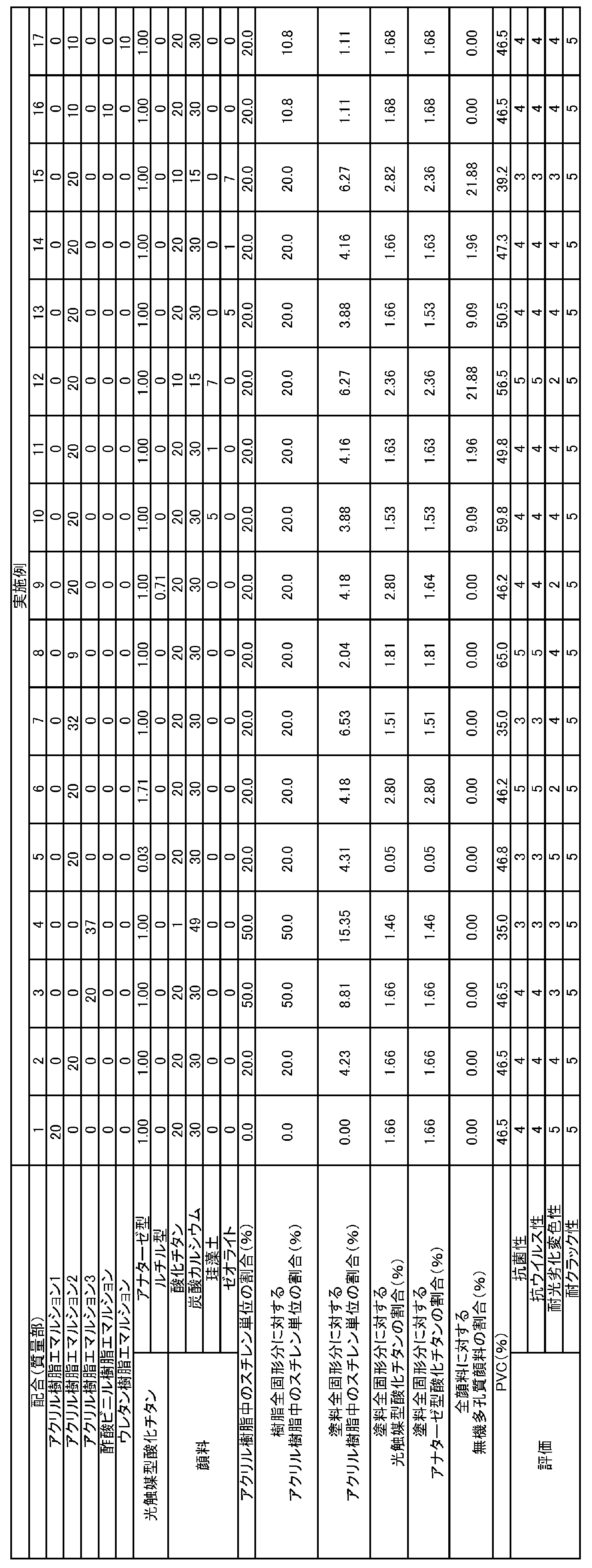
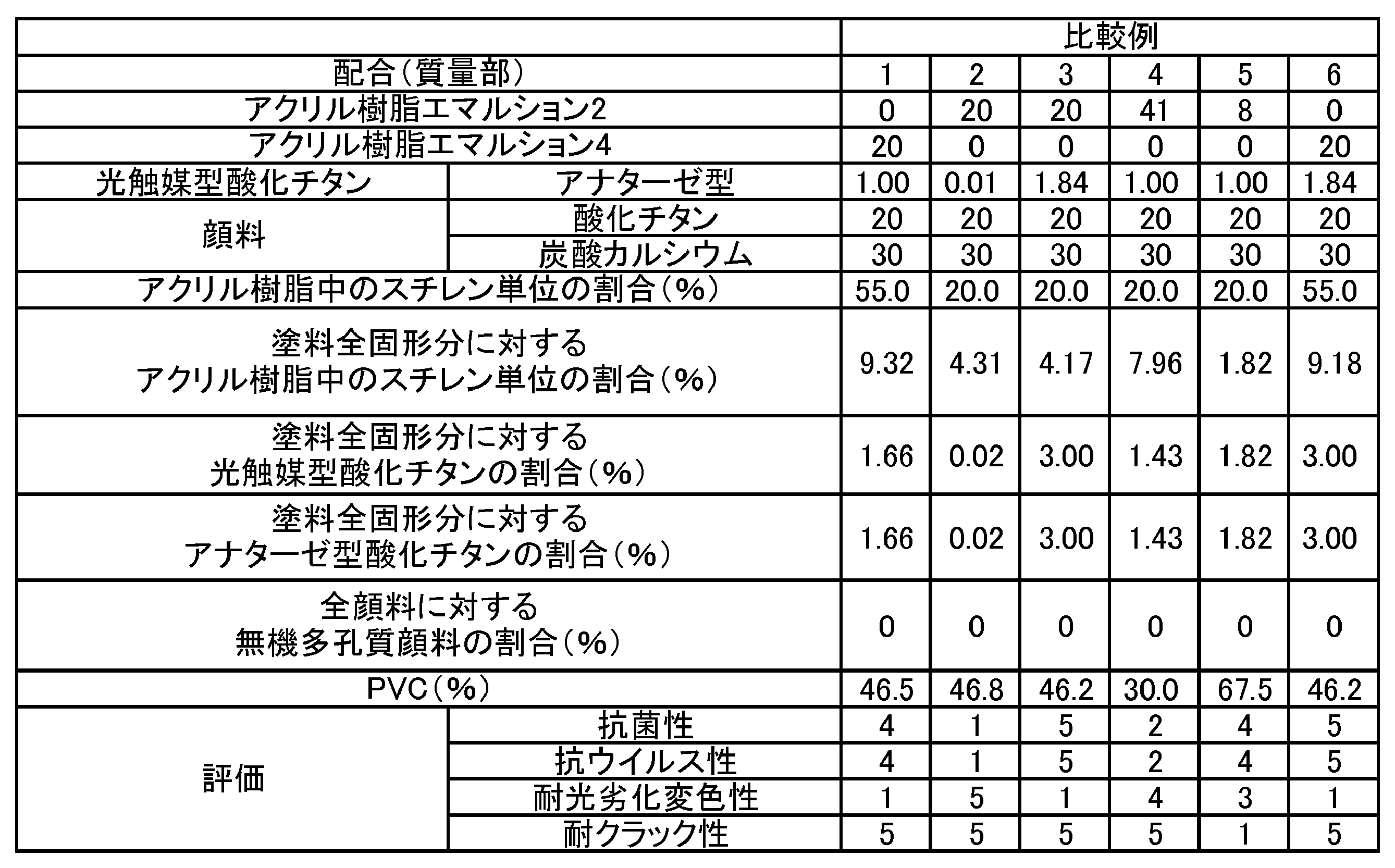
- Examples 1-17 and Comparative Examples 1-6 A coating composition was obtained by mixing each component in the formulation (parts by mass) shown in Tables 2 and 3.
- test plate A coating composition was applied to the surface of a pre-washed soda glass plate by an air spray so that the applied amount was 200 g/m 2 (dry film thickness: 50 ⁇ m). After coating, the glass plate was dried at 23° C. for 7 days to prepare a glass test plate.
- the coating composition was applied to the surface of the mortar plate with a trowel so that the coating amount was 200 g/m 2 (dry film thickness: 50 ⁇ m). After coating, the mortar plate was dried at 23°C for 7 days to prepare a mortar test plate.
- a rating of 3 to 5 is acceptable.
- the evaluation results are also shown in Tables 2 and 3. (Evaluation criteria) Rating 5: V is 4 or more Rating 4: V is 3 or more and less than 4 Rating 3: V is 2 or more and less than 3 Rating 2: V is 1 or more and less than 2 Rating 1: V is less than 1
- the present invention it is possible to provide a coating composition capable of forming a coating film having antiviral properties, antibacterial properties, light deterioration discoloration resistance, and crack resistance.
- a coating composition capable of forming a coating film having antiviral properties, antibacterial properties, light deterioration discoloration resistance, and crack resistance.
- the coating film which has antiviral property, antibacterial property, light-degradation discoloration resistance, and crack resistance can be provided.
- item which has a coating film which has antiviral property, antibacterial property, light-degradation discoloration resistance, and crack resistance can be provided.
Landscapes
- Chemical & Material Sciences (AREA)
- Life Sciences & Earth Sciences (AREA)
- Engineering & Computer Science (AREA)
- Materials Engineering (AREA)
- Wood Science & Technology (AREA)
- Organic Chemistry (AREA)
- Inorganic Chemistry (AREA)
- Dispersion Chemistry (AREA)
- Paints Or Removers (AREA)
Abstract
Description
アクリル樹脂エマルションと、
光触媒型酸化チタンと、
顔料と、を含む塗料組成物であって、
前記アクリル樹脂エマルションのアクリル樹脂中の芳香族ビニル単量体単位の割合が、0~52質量%であり、
前記光触媒型酸化チタンは、金属担持アナターゼ型酸化チタンを含み、
前記金属担持アナターゼ型酸化チタンの含有量は、前記塗料組成物の全固形分100質量部に対して、0.05~2.90質量部であり、
前記顔料の顔料体積濃度(PVC)が、35~65%である、塗料組成物である。これにより、抗ウイルス性および抗菌性と、光触媒型酸化チタンを含む塗膜の光劣化に対する耐変色性と、耐クラック性とを有する塗膜を形成可能である。
本発明に係る塗料組成物は、
アクリル樹脂エマルションと、
光触媒型酸化チタンと、
顔料と、を含む塗料組成物であって、
前記アクリル樹脂エマルションのアクリル樹脂中の芳香族ビニル単量体単位の割合が、0~52質量%であり、
前記光触媒型酸化チタンは、金属担持アナターゼ型酸化チタンを含み、
前記金属担持アナターゼ型酸化チタンの含有量は、前記塗料組成物の全固形分100質量部に対して、0.05~2.90質量部であり、
前記顔料の顔料体積濃度(PVC)が、35~65%である、塗料組成物である。
アクリル樹脂エマルションは、塗膜形成成分であるアクリル樹脂を含む成分である。
1/Tg=M1/T1+M2/T2+・・・Mn/Tn
式中、M1、M2、・・・Mnは、各単量体の質量%であり、T1、T2、・・・Tnは、各単量体の単独重合体のTg(絶対温度)である。各単量体の質量%は、各単量体の配合量(質量部)×100/単量体の合計配合量(質量部)から求める。
光触媒型酸化チタンは、本発明の塗料組成物を用いた塗膜に抗菌性または抗ウイルス性を付与する成分である。本発明では、光触媒型酸化チタンは、後述する顔料には含まれない。
顔料は、本発明の塗料組成物を用いた塗膜に意匠性を付与する成分である。
塗料組成物は、任意に、アクリル樹脂エマルション、光触媒型酸化チタンおよび顔料以外のその他の成分を含んでいてもよい。その他の成分としては、例えば、骨材、繊維、可塑剤、防腐剤、防黴剤、消泡剤、粘性調整剤、レベリング剤、顔料分散剤、沈降防止剤、たれ防止剤、紫外線吸収剤、光安定剤、酸化防止剤、抗菌剤、吸着剤などが挙げられる。これらの成分は、1種単独で、または2種以上を組み合わせて用いてもよい。
塗料組成物の調製方法は、金属担持アナターゼ型酸化チタンの含有量とPVCが所定範囲となるように、上述したアクリル樹脂エマルション、光触媒型酸化チタンおよび顔料を混合すればよく、公知の塗料組成物の調製方法を用いることができる。例えば、樹脂エマルション、光触媒型酸化チタンおよび顔料ならびに任意にその他の成分を、ディスパー、ボールミル、S.G.ミル、ロールミル、プラネタリーミキサーなどで混合して、塗料組成物を調製することができる。
本発明に係る塗膜は、上記いずれかの塗料組成物を用いた、塗膜である。
本発明に係る物品は、上記いずれかの塗膜を有する、物品である。
ポリウレタン樹脂エマルション:三洋化成工業社製の商品名「ユーコート(登録商標)UX-485」、密度1.1(g/cm3)
酢酸ビニルエマルション:日信化学工業社製の商品名「VINYBLAN(登録商標)A68J1」、密度1.1(g/cm3)
金属担持アナターゼ型酸化チタン:光触媒型酸化チタン、酸化銀、酸化銅を担持したアナターゼ型酸化チタン、密度4.1(g/cm3)
金属担持ルチル型酸化チタン:光触媒型酸化チタン、溶解度積が1.5×10⁻¹⁰よりも小さい2価銅化合物を担持した酸化チタン、密度4.1(g/cm3)
酸化チタン:着色顔料、石原産業社製の商品名「TIPAQUE(登録商標)CR-97」、密度4.1(g/cm3)
炭酸カルシウム:体質顔料、丸尾カルシウム社製の商品名「スペシャルライス SSS」、密度2.7(g/cm3)
珪藻土:無機多孔質顔料、丸東社製の商品名「ラヂオライト#100」、平均粒子径12.8μm、密度0.44(g/cm3)
ゼオライト:無機多孔質顔料、東ソー社製の商品名「ゼオラム(登録商標)F-9」、X型ゼオライト、細孔径0.9nm、密度1.8(g/cm3)
反応性乳化剤:アルキルジフェニルエーテルジスルホン酸ナトリウム、花王社製の商品名「ペレックスSS-H」、固形分50%
重合開始剤:過硫酸アンモニウム、5.0%水溶液
基板:ソーダガラス板、寸法50mm×50mm×2mm、TP技研社製の商品名「フロートガラス」
基板:モルタル、寸法70mm×70mm×20mm、TP技研社製の商品名「モルタル」、水:セメント:砂=0.6:1:2(質量比)
白色蛍光灯:20W、東芝ライテック社製の商品名「ネオライン FL20SW」
紫外線カットフィルター:日東樹脂工業社製のアクリル樹脂板、商品名「CLAREX(登録商標)N-169」
照度計:デジタル照度計、トプコン社製の商品名「IM-5」、抗菌性および抗ウイルス性評価で使用
促進耐候性試験機:スガ試験機社製の商品名「スーパーキセノンウェザーメーターSX2-75」
色彩色差計:コニカミノルタ社製の商品名「CR-400」
石膏ボード:吉野石膏社製の商品名「タイガーボード」、JIS A 6901のせっこうボード GB-Rに該当
下地調整剤:メーコー社製の商品名「フィールドパテ」
滴下ロート、還流冷却器、撹拌装置および温度計付きガラス製反応器に、脱イオン水50.50質量部および反応性乳化剤1.50質量部を入れ、内容物の温度を85℃とした。その混合物に表1に示す配合のプレ乳化液と重合開始剤を滴下ロートで2時間かけて一定速度で滴下し、反応させた。滴下終了後、生成物を3時間85℃に保った。次いで生成物を30℃に冷却して、反応器から取り出し、不揮発分47%のアクリル樹脂エマルション1~4をそれぞれ得た。各アクリル樹脂中に反応性乳化剤と重合開始剤が取り込まれているため、アクリル樹脂中のスチレン単位の割合は、反応性乳化剤と重合開始剤を含むアクリル樹脂の質量に対する割合である。

表2~3に示す配合(質量部)で各成分を混合して、塗料組成物を得た。
予め洗浄したソーダガラス板の表面に塗料組成物を、塗着量が200g/m2(乾燥膜厚50μm)となるようにエアースプレーで塗布した。塗布後、そのガラス板を23℃で7日間乾燥させて、ガラス試験板を作製した。
モルタル板の表面に塗料組成物を、塗着量が200g/m2(乾燥膜厚50μm)となるようにコテで塗布した。塗布後、そのモルタル板を23℃で7日間乾燥させて、モルタル試験板を作製した。
作製したガラス試験板を用いて、JIS R1752に準拠して、黄色ブドウ球菌を用いて抗菌試験を実施した。白色蛍光灯を光源として用い、紫外線カットフィルターを通して、380nm以上の可視光を、照度500ルクスで8時間照射した。コントロールは、抗菌加工されていない、すなわち塗料組成物を塗布していないソーダガラス板とした。TB:光照射後の試験板あたりの生菌数(cfu)、UB:光照射後のコントロールあたりの生菌数(cfu)とし、抗菌活性値RをR=Log10(UB/TB)から求めた。そして、各塗膜の抗菌性を以下の評価基準で評価した。評点が大きいほど抗菌性に優れることを示す。評点3~5が合格である。評価結果を表2~3に合わせて示す。
(評価基準)
評点5:Rが4以上
評点4:Rが3以上4未満
評点3:Rが2以上3未満
評点2:Rが1以上2未満
評点1:Rが1未満
作製したガラス試験板を用いて、JIS R 1756(2013)に準拠して、バクテリオファージQβを用いて、抗ウイルス試験を実施した。白色蛍光灯を光源として用い、紫外線カットフィルターを通して、380nm以上の可視光を、照度500ルクスで4時間照射した。TV:光照射後の試験板あたりのバクテリオファージ感染価(pfu)、UV:光照射後のコントロールあたりのバクテリオファージ感染価(pfu)とし、明所の抗ウイルス活性値VをV=Log10(UV/TV)から求めた。そして、各塗膜の抗ウイルス性を以下の評価基準で評価した。評点が大きいほど抗ウイルス性に優れることを示す。評点3~5が合格である。評価結果を表2~3に合わせて示す。
(評価基準)
評点5:Vが4以上
評点4:Vが3以上4未満
評点3:Vが2以上3未満
評点2:Vが1以上2未満
評点1:Vが1未満
作製したモルタル試験板を用いて、JIS K 5600-7-7に記載のキセノンランプ法に従って、促進耐候性試験機で促進耐候性試験を実施した。試験時間は250時間とし、試験時間経過後の塗膜外観をL*a*b*表色系で色彩色差計を用いて数値化した。L*値、a*値、b*値を測色し、試験前の試験板との明度の差(ΔE)を以下の評価基準で評価した。評点が大きいほど塗膜の光劣化による変色が小さく、耐光劣化変色性に優れることを示す。評点2以上が合格である。評価結果を表2~3に合わせて示す。
(評価基準)
評点5:ΔEが2未満
評点4:ΔEが2以上4未満
評点3:ΔEが4以上6未満
評点2:ΔEが6以上8未満
評点1:ΔEが8以上
石膏ボードに下地調整剤を2mmの厚さでコテを用いて塗装し、室温で1日乾燥させる。その後、塗着量が140g/m2となるように塗料組成物をローラーで塗布し、室温で風をあてながら乾燥させる。完全に乾燥したのちの塗膜のワレの具合を目視評価する。クラックなしを5点、クラック有りを1点とする。軽微のクラックもクラック有りと判断し1点とする。評価結果を表2~3に合わせて示す。
Claims (6)
- アクリル樹脂エマルションと、
光触媒型酸化チタンと、
顔料と、を含む塗料組成物であって、
前記アクリル樹脂エマルションのアクリル樹脂中の芳香族ビニル単量体単位の割合が、0~52質量%であり、
前記光触媒型酸化チタンは、金属担持アナターゼ型酸化チタンを含み、
前記金属担持アナターゼ型酸化チタンの含有量は、前記塗料組成物の全固形分100質量部に対して、0.05~2.90質量部であり、
前記顔料の顔料体積濃度(PVC)が、35~65%である、塗料組成物。 - 前記アクリル樹脂が、前記芳香族ビニル単量体単位を含まない、請求項1に記載の塗料組成物。
- 前記芳香族ビニル単量体単位の割合が、前記塗料組成物の全固形分の0~16質量%である、請求項1または2に記載の塗料組成物。
- 前記光触媒型酸化チタンが、金属担持ルチル型酸化チタンをさらに含む、請求項1または2に記載の塗料組成物。
- 請求項1~4のいずれか一項に記載の塗料組成物を用いた、塗膜。
- 請求項5に記載の塗膜を有する、物品。
Priority Applications (1)
| Application Number | Priority Date | Filing Date | Title |
|---|---|---|---|
| AU2022319170A AU2022319170A1 (en) | 2021-07-30 | 2022-07-29 | Coating composition and coating film |
Applications Claiming Priority (2)
| Application Number | Priority Date | Filing Date | Title |
|---|---|---|---|
| JP2021-126232 | 2021-07-30 | ||
| JP2021126232A JP7712135B2 (ja) | 2021-07-30 | 2021-07-30 | 塗料組成物および塗膜 |
Publications (1)
| Publication Number | Publication Date |
|---|---|
| WO2023008583A1 true WO2023008583A1 (ja) | 2023-02-02 |
Family
ID=85086997
Family Applications (1)
| Application Number | Title | Priority Date | Filing Date |
|---|---|---|---|
| PCT/JP2022/029409 Ceased WO2023008583A1 (ja) | 2021-07-30 | 2022-07-29 | 塗料組成物および塗膜 |
Country Status (3)
| Country | Link |
|---|---|
| JP (1) | JP7712135B2 (ja) |
| AU (1) | AU2022319170A1 (ja) |
| WO (1) | WO2023008583A1 (ja) |
Cited By (1)
| Publication number | Priority date | Publication date | Assignee | Title |
|---|---|---|---|---|
| CN120484589A (zh) * | 2025-05-14 | 2025-08-15 | 山东涂瑞新材料有限公司 | 一种基于丙烯酸树脂的多功能涂料及其生产工艺 |
Citations (3)
| Publication number | Priority date | Publication date | Assignee | Title |
|---|---|---|---|---|
| JP2004346201A (ja) * | 2003-05-22 | 2004-12-09 | Toto Ltd | 水性塗料組成物、抗菌性部材及び塗膜形成方法 |
| JP2019011417A (ja) * | 2017-06-29 | 2019-01-24 | 日本ペイント株式会社 | 塗料組成物 |
| CN110003749A (zh) * | 2019-04-24 | 2019-07-12 | 河南建筑材料研究设计院有限责任公司 | 一种高效光催化涂料 |
Family Cites Families (3)
| Publication number | Priority date | Publication date | Assignee | Title |
|---|---|---|---|---|
| JPH10183023A (ja) * | 1996-11-06 | 1998-07-07 | Kansai Paint Co Ltd | 室内汚染対策用塗料 |
| JP3433121B2 (ja) * | 1998-09-21 | 2003-08-04 | 関西ペイント株式会社 | 室内汚染対策用水性塗料 |
| JP2003020438A (ja) * | 2001-07-10 | 2003-01-24 | Dainippon Toryo Co Ltd | 水性エマルション塗料 |
-
2021
- 2021-07-30 JP JP2021126232A patent/JP7712135B2/ja active Active
-
2022
- 2022-07-29 WO PCT/JP2022/029409 patent/WO2023008583A1/ja not_active Ceased
- 2022-07-29 AU AU2022319170A patent/AU2022319170A1/en active Pending
Patent Citations (3)
| Publication number | Priority date | Publication date | Assignee | Title |
|---|---|---|---|---|
| JP2004346201A (ja) * | 2003-05-22 | 2004-12-09 | Toto Ltd | 水性塗料組成物、抗菌性部材及び塗膜形成方法 |
| JP2019011417A (ja) * | 2017-06-29 | 2019-01-24 | 日本ペイント株式会社 | 塗料組成物 |
| CN110003749A (zh) * | 2019-04-24 | 2019-07-12 | 河南建筑材料研究设计院有限责任公司 | 一种高效光催化涂料 |
Cited By (1)
| Publication number | Priority date | Publication date | Assignee | Title |
|---|---|---|---|---|
| CN120484589A (zh) * | 2025-05-14 | 2025-08-15 | 山东涂瑞新材料有限公司 | 一种基于丙烯酸树脂的多功能涂料及其生产工艺 |
Also Published As
| Publication number | Publication date |
|---|---|
| JP2023020709A (ja) | 2023-02-09 |
| AU2022319170A1 (en) | 2024-02-15 |
| JP7712135B2 (ja) | 2025-07-23 |
Similar Documents
| Publication | Publication Date | Title |
|---|---|---|
| JP4673224B2 (ja) | 水性被覆材及びこれを用いた塗膜、並びに塗膜の形成された塗装物 | |
| CN1328332C (zh) | 光催化性涂布剂、光催化性复合材料及其制造方法以及自净化性水性涂料组合物和自净化性构件 | |
| JP4562388B2 (ja) | 水性塗料組成物 | |
| JP5470314B2 (ja) | 水性塗料組成物 | |
| JP4395886B2 (ja) | 水性塗料組成物、抗菌性部材及び塗膜形成方法 | |
| JP7080592B2 (ja) | 塗料組成物 | |
| JP2023035717A (ja) | 塗装体、塗料組成物および塗装体の製造方法 | |
| JP2004346202A (ja) | 水性塗料組成物、抗菌性部材及び塗膜形成方法 | |
| WO2014196108A1 (ja) | 常温硬化型光触媒塗料、常温硬化型塗料組成物及び内装材 | |
| WO2002004569A1 (fr) | Composition de revetement | |
| JPH11116885A (ja) | 低汚染性水性塗料組成物 | |
| CN109601001A (zh) | 二苯甲酮衍生物、水性共聚物分散液和水性涂料组合物 | |
| WO2023008583A1 (ja) | 塗料組成物および塗膜 | |
| CN108291109A (zh) | 涂料组合物 | |
| TW425421B (en) | Multicolor coating composition | |
| JP7123158B2 (ja) | 水系塗料組成物、塗膜及び塗装物品 | |
| JP7368885B2 (ja) | 水性樹脂組成物および塗膜 | |
| JP7178047B2 (ja) | 塗料組成物 | |
| JP7080593B2 (ja) | 塗料組成物 | |
| JP7155027B2 (ja) | 新規エマルション | |
| JP2023066681A (ja) | 水性塗料組成物、塗装体および塗膜形成方法 | |
| JP7210799B1 (ja) | 活性エネルギー線硬化性組成物および塗装体 | |
| JP6797511B2 (ja) | 水性赤外線・紫外線遮蔽コーティング剤、及びこれを利用した赤外線・紫外線遮蔽処理方法 | |
| JP5258141B2 (ja) | 水性樹脂分散体及び製造方法 | |
| JP2020105408A (ja) | 新規エマルション及びこのエマルションを用いた塗料用組成物 |
Legal Events
| Date | Code | Title | Description |
|---|---|---|---|
| 121 | Ep: the epo has been informed by wipo that ep was designated in this application |
Ref document number: 22849643 Country of ref document: EP Kind code of ref document: A1 |
|
| WWE | Wipo information: entry into national phase |
Ref document number: 807808 Country of ref document: NZ Ref document number: AU2022319170 Country of ref document: AU |
|
| ENP | Entry into the national phase |
Ref document number: 2022319170 Country of ref document: AU Date of ref document: 20220729 Kind code of ref document: A |
|
| NENP | Non-entry into the national phase |
Ref country code: DE |
|
| 122 | Ep: pct application non-entry in european phase |
Ref document number: 22849643 Country of ref document: EP Kind code of ref document: A1 |