WO2022260145A1 - 防曇膜付きガラス物品及び防曇膜形成用塗布液 - Google Patents
防曇膜付きガラス物品及び防曇膜形成用塗布液 Download PDFInfo
- Publication number
- WO2022260145A1 WO2022260145A1 PCT/JP2022/023355 JP2022023355W WO2022260145A1 WO 2022260145 A1 WO2022260145 A1 WO 2022260145A1 JP 2022023355 W JP2022023355 W JP 2022023355W WO 2022260145 A1 WO2022260145 A1 WO 2022260145A1
- Authority
- WO
- WIPO (PCT)
- Prior art keywords
- film
- water
- glass
- fogging
- antifogging film
- Prior art date
- Legal status (The legal status is an assumption and is not a legal conclusion. Google has not performed a legal analysis and makes no representation as to the accuracy of the status listed.)
- Ceased
Links
Images




Classifications
-
- C—CHEMISTRY; METALLURGY
- C03—GLASS; MINERAL OR SLAG WOOL
- C03C—CHEMICAL COMPOSITION OF GLASSES, GLAZES OR VITREOUS ENAMELS; SURFACE TREATMENT OF GLASS; SURFACE TREATMENT OF FIBRES OR FILAMENTS MADE FROM GLASS, MINERALS OR SLAGS; JOINING GLASS TO GLASS OR OTHER MATERIALS
- C03C17/00—Surface treatment of glass, not in the form of fibres or filaments, by coating
- C03C17/28—Surface treatment of glass, not in the form of fibres or filaments, by coating with organic material
- C03C17/30—Surface treatment of glass, not in the form of fibres or filaments, by coating with organic material with silicon-containing compounds
-
- C—CHEMISTRY; METALLURGY
- C03—GLASS; MINERAL OR SLAG WOOL
- C03C—CHEMICAL COMPOSITION OF GLASSES, GLAZES OR VITREOUS ENAMELS; SURFACE TREATMENT OF GLASS; SURFACE TREATMENT OF FIBRES OR FILAMENTS MADE FROM GLASS, MINERALS OR SLAGS; JOINING GLASS TO GLASS OR OTHER MATERIALS
- C03C17/00—Surface treatment of glass, not in the form of fibres or filaments, by coating
- C03C17/28—Surface treatment of glass, not in the form of fibres or filaments, by coating with organic material
- C03C17/32—Surface treatment of glass, not in the form of fibres or filaments, by coating with organic material with synthetic or natural resins
-
- C—CHEMISTRY; METALLURGY
- C03—GLASS; MINERAL OR SLAG WOOL
- C03C—CHEMICAL COMPOSITION OF GLASSES, GLAZES OR VITREOUS ENAMELS; SURFACE TREATMENT OF GLASS; SURFACE TREATMENT OF FIBRES OR FILAMENTS MADE FROM GLASS, MINERALS OR SLAGS; JOINING GLASS TO GLASS OR OTHER MATERIALS
- C03C17/00—Surface treatment of glass, not in the form of fibres or filaments, by coating
- C03C17/34—Surface treatment of glass, not in the form of fibres or filaments, by coating with at least two coatings having different compositions
-
- C—CHEMISTRY; METALLURGY
- C03—GLASS; MINERAL OR SLAG WOOL
- C03C—CHEMICAL COMPOSITION OF GLASSES, GLAZES OR VITREOUS ENAMELS; SURFACE TREATMENT OF GLASS; SURFACE TREATMENT OF FIBRES OR FILAMENTS MADE FROM GLASS, MINERALS OR SLAGS; JOINING GLASS TO GLASS OR OTHER MATERIALS
- C03C17/00—Surface treatment of glass, not in the form of fibres or filaments, by coating
- C03C17/34—Surface treatment of glass, not in the form of fibres or filaments, by coating with at least two coatings having different compositions
- C03C17/3405—Surface treatment of glass, not in the form of fibres or filaments, by coating with at least two coatings having different compositions with at least two coatings of organic materials
-
- C—CHEMISTRY; METALLURGY
- C03—GLASS; MINERAL OR SLAG WOOL
- C03C—CHEMICAL COMPOSITION OF GLASSES, GLAZES OR VITREOUS ENAMELS; SURFACE TREATMENT OF GLASS; SURFACE TREATMENT OF FIBRES OR FILAMENTS MADE FROM GLASS, MINERALS OR SLAGS; JOINING GLASS TO GLASS OR OTHER MATERIALS
- C03C17/00—Surface treatment of glass, not in the form of fibres or filaments, by coating
- C03C17/34—Surface treatment of glass, not in the form of fibres or filaments, by coating with at least two coatings having different compositions
- C03C17/42—Surface treatment of glass, not in the form of fibres or filaments, by coating with at least two coatings having different compositions at least one coating of an organic material and at least one non-metal coating
-
- C—CHEMISTRY; METALLURGY
- C09—DYES; PAINTS; POLISHES; NATURAL RESINS; ADHESIVES; COMPOSITIONS NOT OTHERWISE PROVIDED FOR; APPLICATIONS OF MATERIALS NOT OTHERWISE PROVIDED FOR
- C09D—COATING COMPOSITIONS, e.g. PAINTS, VARNISHES OR LACQUERS; FILLING PASTES; CHEMICAL PAINT OR INK REMOVERS; INKS; CORRECTING FLUIDS; WOODSTAINS; PASTES OR SOLIDS FOR COLOURING OR PRINTING; USE OF MATERIALS THEREFOR
- C09D129/00—Coating compositions based on homopolymers or copolymers of compounds having one or more unsaturated aliphatic radicals, each having only one carbon-to-carbon double bond, and at least one being terminated by an alcohol, ether, aldehydo, ketonic, acetal, or ketal radical; Coating compositions based on hydrolysed polymers of esters of unsaturated alcohols with saturated carboxylic acids; Coating compositions based on derivatives of such polymers
- C09D129/14—Homopolymers or copolymers of acetals or ketals obtained by polymerisation of unsaturated acetals or ketals or by after-treatment of polymers of unsaturated alcohols
-
- C—CHEMISTRY; METALLURGY
- C09—DYES; PAINTS; POLISHES; NATURAL RESINS; ADHESIVES; COMPOSITIONS NOT OTHERWISE PROVIDED FOR; APPLICATIONS OF MATERIALS NOT OTHERWISE PROVIDED FOR
- C09D—COATING COMPOSITIONS, e.g. PAINTS, VARNISHES OR LACQUERS; FILLING PASTES; CHEMICAL PAINT OR INK REMOVERS; INKS; CORRECTING FLUIDS; WOODSTAINS; PASTES OR SOLIDS FOR COLOURING OR PRINTING; USE OF MATERIALS THEREFOR
- C09D183/00—Coating compositions based on macromolecular compounds obtained by reactions forming in the main chain of the macromolecule a linkage containing silicon, with or without sulfur, nitrogen, oxygen, or carbon only; Coating compositions based on derivatives of such polymers
- C09D183/04—Polysiloxanes
-
- C—CHEMISTRY; METALLURGY
- C09—DYES; PAINTS; POLISHES; NATURAL RESINS; ADHESIVES; COMPOSITIONS NOT OTHERWISE PROVIDED FOR; APPLICATIONS OF MATERIALS NOT OTHERWISE PROVIDED FOR
- C09D—COATING COMPOSITIONS, e.g. PAINTS, VARNISHES OR LACQUERS; FILLING PASTES; CHEMICAL PAINT OR INK REMOVERS; INKS; CORRECTING FLUIDS; WOODSTAINS; PASTES OR SOLIDS FOR COLOURING OR PRINTING; USE OF MATERIALS THEREFOR
- C09D5/00—Coating compositions, e.g. paints, varnishes or lacquers, characterised by their physical nature or the effects produced; Filling pastes
-
- C—CHEMISTRY; METALLURGY
- C09—DYES; PAINTS; POLISHES; NATURAL RESINS; ADHESIVES; COMPOSITIONS NOT OTHERWISE PROVIDED FOR; APPLICATIONS OF MATERIALS NOT OTHERWISE PROVIDED FOR
- C09D—COATING COMPOSITIONS, e.g. PAINTS, VARNISHES OR LACQUERS; FILLING PASTES; CHEMICAL PAINT OR INK REMOVERS; INKS; CORRECTING FLUIDS; WOODSTAINS; PASTES OR SOLIDS FOR COLOURING OR PRINTING; USE OF MATERIALS THEREFOR
- C09D7/00—Features of coating compositions, not provided for in group C09D5/00; Processes for incorporating ingredients in coating compositions
- C09D7/20—Diluents or solvents
-
- G—PHYSICS
- G02—OPTICS
- G02B—OPTICAL ELEMENTS, SYSTEMS OR APPARATUS
- G02B1/00—Optical elements characterised by the material of which they are made; Optical coatings for optical elements
- G02B1/10—Optical coatings produced by application to, or surface treatment of, optical elements
-
- C—CHEMISTRY; METALLURGY
- C03—GLASS; MINERAL OR SLAG WOOL
- C03C—CHEMICAL COMPOSITION OF GLASSES, GLAZES OR VITREOUS ENAMELS; SURFACE TREATMENT OF GLASS; SURFACE TREATMENT OF FIBRES OR FILAMENTS MADE FROM GLASS, MINERALS OR SLAGS; JOINING GLASS TO GLASS OR OTHER MATERIALS
- C03C2217/00—Coatings on glass
- C03C2217/70—Properties of coatings
-
- C—CHEMISTRY; METALLURGY
- C08—ORGANIC MACROMOLECULAR COMPOUNDS; THEIR PREPARATION OR CHEMICAL WORKING-UP; COMPOSITIONS BASED THEREON
- C08G—MACROMOLECULAR COMPOUNDS OBTAINED OTHERWISE THAN BY REACTIONS ONLY INVOLVING UNSATURATED CARBON-TO-CARBON BONDS
- C08G77/00—Macromolecular compounds obtained by reactions forming a linkage containing silicon with or without sulfur, nitrogen, oxygen or carbon in the main chain of the macromolecule
- C08G77/42—Block-or graft-polymers containing polysiloxane sequences
- C08G77/46—Block-or graft-polymers containing polysiloxane sequences containing polyether sequences
-
- C—CHEMISTRY; METALLURGY
- C08—ORGANIC MACROMOLECULAR COMPOUNDS; THEIR PREPARATION OR CHEMICAL WORKING-UP; COMPOSITIONS BASED THEREON
- C08K—Use of inorganic or non-macromolecular organic substances as compounding ingredients
- C08K5/00—Use of organic ingredients
- C08K5/04—Oxygen-containing compounds
- C08K5/05—Alcohols; Metal alcoholates
- C08K5/053—Polyhydroxylic alcohols
-
- C—CHEMISTRY; METALLURGY
- C08—ORGANIC MACROMOLECULAR COMPOUNDS; THEIR PREPARATION OR CHEMICAL WORKING-UP; COMPOSITIONS BASED THEREON
- C08K—Use of inorganic or non-macromolecular organic substances as compounding ingredients
- C08K5/00—Use of organic ingredients
- C08K5/54—Silicon-containing compounds
- C08K5/5403—Silicon-containing compounds containing no other elements than carbon or hydrogen
-
- C—CHEMISTRY; METALLURGY
- C08—ORGANIC MACROMOLECULAR COMPOUNDS; THEIR PREPARATION OR CHEMICAL WORKING-UP; COMPOSITIONS BASED THEREON
- C08K—Use of inorganic or non-macromolecular organic substances as compounding ingredients
- C08K5/00—Use of organic ingredients
- C08K5/54—Silicon-containing compounds
- C08K5/544—Silicon-containing compounds containing nitrogen
Definitions
- the present invention relates to a glass article with an antifogging film and a coating liquid for forming an antifogging film.
- Glass substrates are required to have various properties. For example, anti-fogging properties are required for glass substrates. In order to obtain an anti-fogging glass substrate, techniques for forming an anti-fogging film on the surface of the glass substrate have been investigated.
- Patent Document 1 describes a windshield in which a water-absorbing material suitable for preventing condensation of water vapor in the optical path space is arranged.
- this windshield for example, it is described that the water-absorbing film disposed on the glass has excellent water-absorbing properties in a high-humidity region.
- an object of the present invention is to provide a novel glass article with an anti-fogging film.
- the present invention comprising a glass substrate and an anti-fog coating on the surface of the glass substrate; It was immersed in water at 25°C for 24 hours and then removed from the water, and the antifogging film was exposed for 30 seconds to water vapor generated from water at 90°C to 100°C which was placed vertically downward from the antifogging film at a distance of 60 mm.
- Can read information of QR code having a size of 40 mm square
- a glass article with an anti-fog coating Provided is a glass article with an anti-fog coating.
- the QR code encodes the character string "Rank: B” as the information according to the Japanese Industrial Standard (JIS) X 0510: 2018, with a symbol size of 21 ⁇ 21 modules and a level H error correction specification. It is a two-dimensional code.
- the present invention provides comprising a glass substrate and an anti-fog coating on the surface of the glass substrate;
- the anti-fogging film contains a water-absorbing polymer, It is immersed in water at 25° C. for 24 hours and then removed from the water, and the anti-fogging film is exposed for 30 seconds to water vapor generated from water at 90° C. to 100° C. placed at a distance of 60 mm vertically downward from the anti-fogging film.
- a transparent continuous film is formed on the surface of the antifogging film exposed to the water vapor when the test is performed.
- a glass article with an anti-fog coating is provided.
- the present invention provides comprising a glass substrate and an anti-fog coating on the surface of the glass substrate;
- the anti-fogging film comprises at least one selected from the group consisting of a silane coupling agent and a crosslinked structure derived from the silane coupling agent, a water-absorbing polymer, a polyether-modified siloxane, and a diol having 2 to 8 carbon atoms.
- a glass article with an anti-fog coating is provided.
- the present invention provides A silane coupling agent, a water-absorbing polymer, a polyether-modified siloxane, and a diol having 2 to 8 carbon atoms, A coating liquid for forming an antifogging film is provided.
- a novel glass article with an anti-fogging film is provided.
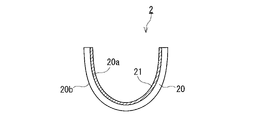
- FIG. 3 is a cross-sectional view showing another example of the glass article with an antifogging film according to the present embodiment.
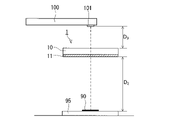
- It is a schematic diagram for demonstrating the outline
- It is another schematic diagram for demonstrating the outline
- It is an example of a QR code (size 10 mm ⁇ 10 mm, recorded information “Rank: SSS”) used for high-temperature steam evaluation.
- a QR code size 15 mm ⁇ 15 mm, recorded information “Rank: SS” used for high-temperature steam evaluation.
- QR code size 20 mm ⁇ 20 mm, recorded information “Rank: S” used for high-temperature steam evaluation. It is an example of a QR code (size 30 mm ⁇ 30 mm, recorded information “Rank: A”) used for high-temperature steam evaluation. It is an example of a QR code (size 40 mm ⁇ 40 mm, recorded information “Rank: B”) used for high-temperature steam evaluation.
- the term "main component” means the component with the highest content.
- the “principal surface” of a plate-like article means two surfaces facing opposite sides separated by a predetermined distance called thickness.
- anti-fogging films are often blended with water-absorbing polymers. As the content of the water-absorbing polymer increases, the antifogging property of the film can be expected to improve. On the other hand, as the water-absorbing polymer content increases, the abrasion resistance of the membrane usually decreases. For this reason, as disclosed in Patent Document 1, an inorganic component, typically a silica component such as colloidal silica, is often added to the antifogging film to compensate for the decrease in abrasion resistance. In contrast, anti-fogging films are not required to have a high level of abrasion resistance, but may be required to have other properties.
- an inorganic component typically a silica component such as colloidal silica
- the anti-fogging film even when the anti-fogging film is exposed to harsh environments for a long period of time, it is sometimes required that the anti-fogging property can be maintained.
- the glass article with an anti-fogging film according to the present embodiment was obtained by further studies from this point of view.
- the anti-fogging film does not scatter light at a high level even when exposed to harsh environments It can exhibit the function of allowing it to pass through.
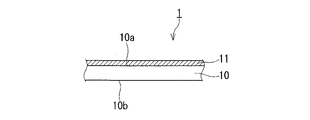
- FIG. 1 is a cross-sectional view showing a glass article with an anti-fogging film according to this embodiment.
- a glass article 1 with an antifogging film includes a plate-like glass substrate 10 , that is, a glass substrate, and an antifogging film 11 formed on the surface of the glass substrate 10 .
- the anti-fogging film 11 is formed on at least part of the surface of the glass substrate 10 , for example, the main surface of the glass substrate 10 .
- the antifogging film 11 may be formed on both main surfaces 10a and 10b of the plate-like glass substrate 10, but as shown in FIG. 1, it is formed only on one main surface 10a. may
- the shape and material of the glass substrate 10 are not particularly limited.
- the glass substrate 10 is, for example, a glass plate.
- the glass composition constituting the glass plate is not particularly limited, and may be soda-lime glass, aluminosilicate glass, borosilicate glass, alkali-free glass, or multicomponent glass called C glass, E glass, or the like.
- the multicomponent glass contains SiO2 as a main component, and a group consisting of components other than SiO2 , such as B2O3 , Al2O3 , MgO, CaO, Li2O, Na2O , and K2O . It further contains at least one oxide selected from the above.
- the glass plate may be made of silica glass.
- the glass plate may be float glass.
- Float glass is formed by a so-called float method. Since float glass is formed in a float bath with one main surface in contact with molten tin, tin diffuses to the main surface. Thus, float glass has a tin-diffused surface layer on one major surface, called the bottom surface, and this surface layer is absent on the other major surface, called the top surface. Stated from another point of view, in float glass, the concentration of tin on one major surface is higher than the concentration of tin on the other major surface.
- the glass plate may be formed by a manufacturing method other than the float method, such as an overflow down-draw method.
- the major surface 10a may be the top surface, but is preferably the bottom surface. Since the bottom surface has more hydroxyl groups than the top surface, it is suitable as a surface for forming an antifogging film with excellent water resistance.
- the thickness of the glass plate is, for example, 0.5 to 7.0 mm, and may be 0.5 to 5.0 mm.
- the thickness of the glass plate which is non-tempered glass, is preferably 3.5 mm or more. However, in the case of tempered glass, if the thickness is 1.8 mm or more, the glass plate can have sufficient impact resistance.
- the tempered glass may be air-cooled tempered glass or chemically tempered glass.
- the glass substrate 10 may be in the shape of a flat plate whose main surface is flat.
- the main surface of the glass substrate may be curved.
- the glass substrate may be obtained by bending a flat glass substrate.
- the glass substrate may be a molded body having a curved surface that is directly molded from a molten material without passing through a flat glass substrate. An example of such a compact is shown in FIG.
- the main surfaces of the glass substrate 20 shown in FIG. 2 are both curved surfaces, one main surface 20a being concave and the other main surface 20b being convex.
- An anti-fogging film 21 is formed on the main surface 20a, which is a concave surface.
- An anti-fogging film may be formed on the main surface 20b, which is a convex surface.
- a base film may be formed on the main surface of the glass substrate.
- the base film is interposed between the surface of the glass base material and the anti-fogging film.
- the base film is not particularly limited, but may be, for example, a barrier film that prevents elution of alkali metals from glass.
- the barrier film is composed of, for example, a silica film.
- a film other than the anti-fogging film may be formed on the other main surface.
- films include antireflection films, water-repellent films, hydrophilic films, colored films, and the like.
- the film thickness of the antifogging films 11 and 21 is not limited to a specific value, and is 0.1 to 10 ⁇ m, preferably 0.5 to 5.0 ⁇ m, particularly preferably 0.8 to 2.0 ⁇ m.
- the antifogging films 11 and 21 contain, for example, a silane coupling agent and/or a crosslinked structure derived from the silane coupling agent, a water-absorbing polymer, a polyether-modified siloxane, and a diol having 2 to 8 carbon atoms. .
- a silane coupling agent and/or a crosslinked structure derived from the silane coupling agent a water-absorbing polymer, a polyether-modified siloxane, and a diol having 2 to 8 carbon atoms. .
- At least one selected from the group consisting of urethane resins, epoxy resins, acrylic resins, polyvinyl acetal resins, and polyvinyl alcohol resins can be exemplified as the water absorbing polymer.
- Urethane resins include polyurethane resins composed of polyisocyanate and polyol.
- Polyols include acrylic polyols and polyoxyalkylene-based polyols.
- epoxy-based resins include glycidyl ether-based epoxy resins, glycidyl ester-based epoxy resins, glycidylamine-based epoxy resins, and cycloaliphatic epoxy resins.
- Preferred epoxy resins are cycloaliphatic epoxy resins.
- a polyvinyl acetal resin hereinafter simply referred to as "polyvinyl acetal", which is a preferred water-absorbing polymer, will be described below.
- Polyvinyl acetal can be obtained by condensation reaction of polyvinyl alcohol with aldehyde to acetalize it.
- Acetalization of polyvinyl alcohol may be carried out using a known method such as a precipitation method using an aqueous medium in the presence of an acid catalyst, or a dissolution method using a solvent such as alcohol.
- Acetalization can also be carried out in parallel with the saponification of polyvinyl acetate.
- the degree of acetalization is preferably 2 to 40 mol %, more preferably 3 to 30 mol %, especially 5 to 20 mol %, and in some cases 5 to 15 mol %.
- the degree of acetalization can be measured, for example, by 13 C nuclear magnetic resonance spectroscopy.
- a polyvinyl acetal having a degree of acetalization within the above range is suitable for forming an anti-fogging film having good water absorption and water resistance.
- the average degree of polymerization of polyvinyl alcohol is preferably 200-4500, more preferably 500-4500.
- a high average degree of polymerization is advantageous for forming an anti-fogging film with good water absorption and water resistance, but if the average degree of polymerization is too high, the viscosity of the solution becomes too high, which may interfere with the formation of the film.
- the degree of saponification of polyvinyl alcohol is preferably 75 to 99.8 mol %.
- Aldehydes that are condensed with polyvinyl alcohol include aliphatic aldehydes such as formaldehyde, acetaldehyde, butyraldehyde, hexylcarbaldehyde, octylcarbaldehyde, and decylcarbaldehyde.
- benzaldehyde 2-methylbenzaldehyde, 3-methylbenzaldehyde, 4-methylbenzaldehyde, other alkyl group-substituted benzaldehyde; chlorobenzaldehyde, other halogen atom-substituted benzaldehyde; hydroxyl group, alkoxy group, amino group, alkyl such as cyano group
- Aromatic aldehydes such as substituted benzaldehyde in which a hydrogen atom is substituted by a functional group other than the group; condensed aromatic ring aldehydes such as naphthaldehyde and anthraldehyde.
- Aromatic aldehydes with strong hydrophobicity are advantageous in forming a water-absorbing film with a low degree of acetalization and excellent water resistance.
- the use of an aromatic aldehyde is also advantageous in forming a highly water-absorbing film while leaving many hydroxyl groups.
- the polyvinyl acetal preferably contains an acetal structure derived from aromatic aldehydes, especially benzaldehyde.
- the content of the water-absorbing polymer in the antifogging film is, for example, 45-95% by mass, preferably 55-85% by mass, more preferably 65-80% by mass.
- the water-absorbing polymer may be the main component of the anti-fogging film.
- the polyether-modified siloxane is a compound having at least one polyether chain selected from molecular chains bonded to the ends of the main chain of siloxane and molecular chains bonded as side chains of the main chain of siloxane.
- Siloxane is a compound having a siloxane bond (Si--O--Si) as a skeleton.
- Constituent units of the polyether chain are not particularly limited, but are, for example, ethylene oxide and propylene oxide.
- strand may contain only 1 type as a structural unit, and may contain 2 or more types.
- the polyether-modified siloxane may be polyether-modified silicone.
- Silicone is a polymer having a siloxane bond (Si--O--Si) as a skeleton.
- Examples of polyether-modified silicones are BYK-345, BYK-347, BYK-349 from BYK-Chemie, and TSF-4440 from Momentive.
- the content of polyether-modified siloxane in the antifogging film is, for example, 2 to 30% by mass, preferably 5 to 25% by mass, more preferably 8 to 20% by mass.
- Diols having 2 to 8 carbon atoms are for example selected from the group consisting of ethylene glycol, diethylene glycol, propylene glycol, dipropylene glycol, butanediol, pentanediol and hexanediol. may include at least one
- the diol may be a diol having 2 to 6 carbon atoms.
- Preferred diols include at least one selected from the group consisting of butanediol, propylene glycol, and dipropylene glycol.
- the antifogging film may contain propylene glycol and/or dipropylene glycol as particularly preferred diols.
- the content of the diol having 2 to 8 carbon atoms in the antifogging film is, for example, 0.01 to 30% by mass, preferably 0.05 to 20% by mass, more preferably 0.1 to 10% by mass.
- a silane coupling agent can be exemplified by a silicon compound having a hydrolyzable group represented by the following formula (I).
- the silicon compound having a hydrolyzable group represented by formula (I) may be used alone or in combination of two or more.
- n represents an integer of 1-3.
- X is a hydrolyzable group or a halogen atom.
- hydrolyzable groups include at least one selected from alkoxyl groups, acetoxy groups, alkenyloxy groups and amino groups.
- Preferred alkoxyl groups include alkoxyl groups having 1 to 4 carbon atoms (methoxy, ethoxy, propoxy, butoxy). Chlorine can be exemplified as a preferable halogen atom.
- Y is an alkyl group having 1 to 3 carbon atoms.
- Preferred alkyl groups are methyl and ethyl groups.
- L is a hydrocarbon group.
- a hydrocarbon group is preferably an alkylene group.
- the number of carbon atoms in the hydrocarbon group is, for example, 1-10, preferably 1-6, more preferably 1-3.
- Preferred examples of hydrocarbon groups are methylene, ethylene, n-propylene, isopropylene, vinylene and propenylene groups.
- R is a substituent or a hydrocarbon group which may have a substituent.
- the number of carbon atoms in this hydrocarbon group is not particularly limited, and is, for example, 4 to 12, but may be 3 or less.
- a substituent may be a reactive functional group.
- the reactive functional group is, for example, at least one selected from the group consisting of an epoxy group, an amino group, a mercapto group, an isocyanate group, an acrylic group, and a methacrylic group, preferably selected from the group consisting of an epoxy group and an amino group.
- Epoxy groups may be included as part of the glycidyl ether group.
- a silane coupling agent having an epoxy group may be described as "epoxysilane".
- the amino group may be a primary amino group, a secondary amino group or a tertiary amino group, preferably a primary amino group and a secondary amino group.
- a silane coupling agent having an amino group is sometimes referred to as "aminosilane
- silicon alkoxides Compounds in which X in formula (I) is an alkoxyl group are called silicon alkoxides.
- n is 2 or 3. That is, the silane coupling agent is preferably a bifunctional silicon alkoxide having a reactive functional group represented by RL-SiY 1 X 2 in formula (I) or RL- It is a trifunctional silicon alkoxide having a reactive functional group represented by SiX3 .
- bifunctional silicon alkoxides having reactive functional groups are glycidoxyalkylalkyldialkoxysilanes and aminoalkylalkyldialkoxysilanes.
- glycidoxyalkylalkyldialkoxysilanes are 3-glycidoxypropylmethyldimethoxysilane and 3-glycidoxypropylmethyldiethoxysilane.
- aminoalkylalkyldialkoxysilanes are N-2-(aminoethyl)-3-aminopropylmethyldimethoxysilane and N-2-(aminoethyl)-3-aminopropylethyldiethoxysilane.
- trifunctional silicon alkoxides having reactive functional groups are glycidoxyalkyltrialkoxysilane and aminoalkyltrialkoxysilane.
- glycidoxyalkyltrialkoxysilanes are 2-(3,4-epoxycyclohexyl)ethyltrimethoxysilane, 3-glycidoxypropyltrimethoxysilane (GPTMS), and 3-glycidoxypropyltriethoxysilane. be.
- aminoalkyltrialkoxysilanes are 3-aminopropyltrimethoxysilane (APTMS), 3-aminopropyltriethoxysilane (APTES), 3-triethoxysilyl-N-(1,3-dimethyl-butylidene)propylamine , 3-(N-phenyl)aminopropyltrimethoxysilane, N-(vinylbenzyl)-2-aminoethyl-3-aminopropyltrimethoxysilane hydrochloride, N-2-(aminoethyl)-3-aminopropyl trimethoxysilane, and N-2-(aminoethyl)-3-aminopropyltriethoxysilane.
- APIMS 3-aminopropyltrimethoxysilane
- APTES 3-aminopropyltriethoxysilane
- APTES 3-triethoxysilyl-N-(1,
- silane coupling agent only at least one selected from the group consisting of a bifunctional silicon alkoxide having a reactive functional group and a trifunctional silicon alkoxide having a reactive functional group may be used, Multiple types may be used.
- a trifunctional silicon alkoxide having a reactive functional group can preferably be used as the silane coupling agent.
- the trifunctional silicon alkoxide having a reactive functional group at least one selected from the group consisting of glycidoxyalkyltrialkoxysilane and aminoalkyltrialkoxysilane may be used alone, or a plurality of types may be used. good.
- trifunctional silicon alkoxides having reactive functional groups 3-glycidoxypropyltrimethoxysilane (GPTMS) and 3-aminopropyltriethoxysilane (APTES) can preferably be used.
- At least part of the silane coupling agent reacts with other components in the antifogging film to form a crosslinked structure.
- Other components include organic components such as water-absorbing polymers, and hydroxyl groups on the substrate surface.
- a particularly preferable combination of silane coupling agents is the combined use of an epoxy group-containing silane coupling agent (epoxysilane) and an amino group-containing silane coupling agent (aminosilane).
- Epoxysilane and aminosilane may be added in a weight ratio of, for example, 1:3 to 3:1, particularly 1:2 to 2:1.
- the content of the silane coupling agent in the antifogging film is, for example, 2 to 35% by mass, preferably 5 to 30% by mass, more preferably 8 to 25% by mass.
- the anti-fogging film may appropriately contain ultraviolet absorbers, infrared absorbers, leveling agents (surface conditioners), light stabilizers, etc., in addition to the components described above. However, these components are desirably added in an amount of 20% by mass or less, more preferably 10% by mass or less, and particularly 5% by mass or less of the antifogging film. Colloidal silica and other silica fine particles may or may not be contained in the antifogging film.
- the content of silica fine particles in the antifogging film may be, for example, 10 to 60% by mass, but may be limited to less than 5% by mass, further less than 3% by mass, and particularly less than 1% by mass.
- the content of oxide fine particles including silica fine particles may also be at the same level as described above for silica fine particles.
- the antifogging film may or may not contain oxide fine particles typified by silica fine particles. However, even if it does not contain silica fine particles, the anti-fogging film may contain siloxane components contained in polyether-modified siloxane, silane coupling agents, and the like.
- the antifogging film according to the present embodiment exerts a function of transmitting transmitted light at a high level without scattering even after being placed in a harsh environment for the antifogging film, for example, in contact with water for a long period of time. sell.
- the anti-fogging film desirably has transparency, water absorbency, water resistance, and hydrophilicity.
- An anti-fogging film with insufficient water resistance may elute its components when in contact with water for a long period of time.
- the anti-fogging film is hydrophilic enough to retain surplus water as a continuous film on its surface when the water absorption by itself reaches a saturated state, transmitted light will not be excessively scattered. permeable.
- the glass article with an anti-fogging film according to this embodiment can transmit transmitted light without excessive scattering.
- the anti-fogging coated glass article may have a haze ratio of, for example, 5% or less, even 3% or less, particularly 1% or less, and in some cases 0.4% or less.
- the haze ratio is specified in JIS K 7136:2018.
- both water resistance and hydrophilicity can be achieved. These properties can be evaluated by a method called hot steam evaluation, which is described in detail in the Examples section.
- hot steam evaluation which is described in detail in the Examples section.
- high-temperature and excessive water vapor is supplied to the anti-fogging film with the anti-fogging film facing vertically downward.
- a transparent continuous film of water is formed on the surface of the anti-fogging film, which is hydrophilic and excellent in water resistance, in the portion directly exposed to water vapor.
- Whether or not it is a "transparent continuous film” can be determined by visually confirming that continuity as a film is ensured and that the film is not clouded. Cloudiness of the film can be caused by whitening of the film due to insufficient water resistance or condensation on the film surface due to insufficient anti-fogging properties.
- On the surface of the film lacking hydrophilicity water is not retained as a continuous film, but is dispersed and deposited as water droplets. A film with insufficient water resistance is observed to be whitened by contact with high-temperature steam, and elution of film components and film defects may occur. Hydrophilicity of a surface is generally evaluated by the contact angle of water.
- the transparent continuous film may cover 80% or more, or even 90% or more of the surface of the antifogging film exposed to water vapor.
- the glass article with an antifogging film according to the present embodiment preferably has a QR code "A” having a size of 30 mm square, more preferably a QR code "A” having a size of 20 mm square, even after being immersed in water at room temperature for 24 hours.
- the coating liquid for forming an antifogging film contains a silane coupling agent, a water-absorbing polymer, a polyether-modified siloxane, and a diol having 2 to 8 carbon atoms.
- a silane coupling agent for example, the compounds described above can be used.
- the content of each component in the coating solution for forming an antifogging film may be appropriately adjusted so that the content of each component in the antifogging film falls within the above-described range.
- the coating liquid for forming an antifogging film may contain other components. Examples of other ingredients are water and alcohols.
- the anti-fogging film is formed by applying a coating liquid for forming the anti-fogging film (coating liquid for forming an anti-fogging film) to the surface of the glass substrate, and heating the glass substrate on which the coating film is formed with the coating liquid. , can be deposited.
- a coating liquid for forming the anti-fogging film coating liquid for forming an anti-fogging film
- Conventionally known materials and methods may be used for the solvent used for preparing the coating liquid and the coating method for the coating liquid. Examples of application methods are spin coating, roll coating, spray coating, dip coating, flow coating, screen printing and brush coating.
- the coating may optionally be dried prior to heating.
- the heating temperature of the glass substrate on which the coating film is formed is not particularly limited, but is, for example, 100 to 180° C., and the heating time is, for example, 5.0 minutes to 1.0 hour.
- FIG. 3A a glass article with an anti-fogging film is placed above a stainless steel heat-retaining cup 80 holding boiled water 70 so that the surface on which the anti-fogging film 11 is formed faces the heat-retaining cup 80 side. 1 was held horizontally. The temperature of water 70 was maintained at 90-100° C. while supplying steam. A distance D 1 between the antifogging film 11 and the water surface was set to 60 mm. The internal space of the heat-retaining cup 80 is cylindrical with an opening having a diameter of 64 mm, and the volume of the water 70 is about 130 cc.
- the antifogging film-attached glass article 1 was held on the heat-retaining cup 80 for 30 seconds, and high-temperature steam was supplied to the antifogging film 11 .
- the heat retaining cup 80 was removed and replaced with a mount 95 on which a predetermined QR code 90 was printed.
- the distance D 2 between the antifogging film 11 and the mount 95 was set to 110 mm.
- the QR code 90 was photographed with the camera 100 from above through the glass article 1 with the antifogging film, and it was confirmed whether the information possessed by the QR code 90 could be read.
- the distance D3 between the glass substrate 10 and the lens 101 of the camera 100 was set to 80 mm. It took less than 30 seconds from the removal of the heat retaining cup 80, that is, the stop of the supply of the high-temperature steam to the photographing of the QR code.
- QR code SSS 10 mm x 10 mm
- information "Rank: SSS” Fig. 4A
- QR code "SS” 15 mm x 15 mm
- information "Rank: SS” Fig. 4B
- QR code "S” 20 mm x 20 mm
- information "Rank: S” Fig. 4C
- information "Rank: A” Fig. 4D
- the QR code "SSS” described in FIG. 4A is based on JIS X 0510:2018, and the above character string is encoded as information according to the symbol size of 25 ⁇ 25 modules and the specification of error correction of level H.
- the QR code "SS” to QR code “B” described in FIGS. 4B to 4E conform to JIS X 0510:2018, and according to the specification of the symbol size of the 21 ⁇ 21 module and the error correction of level H, each of the above characters as information Encoded columns.
- Each character string is composed of half-width characters (1-byte code) instead of full-width characters.
- the camera used was Sony's smartphone "Xperia XZ2" (model name: SO-03K, OS: Android (registered trademark) (ver.10)).
- the QR code reading function of the LINE (registered trademark) application (ver.11.7.2) was used to read the QR code.
- Example 1 (Preparation of coating liquid) Polyvinyl acetal resin-containing solution (“S-Lec KX-5” manufactured by Sekisui Chemical Co., Ltd., solid content 8% by mass, degree of acetalization 9 mol%, including acetal structure derived from benzaldehyde) 48.2% by mass, polyether-modified siloxane (“BYK-345” manufactured by BYK Chemie) 0.5% by mass, 3-aminopropyltriethoxysilane (APTES, “KBE-903” manufactured by Shin-Etsu Silicone Co., Ltd.) 1.0% by mass, 3-glycidoxypropyltrimethoxy Silane (GPTMS, "KBM-403” manufactured by Shin-Etsu Silicone Co., Ltd.) 0.7% by mass, propylene glycol 20.0% by mass, purified water 18.5% by mass, alcohol solvent ("Neoethanol P-7” manufactured by Daishin Chemical Co., Ltd.
- a coating liquid was applied by spin coating (1500 rpm, 10 seconds) to the bottom surface of a float glass (size: 50 mm ⁇ 50 mm, thickness: 1.1 mm) preliminarily washed with alkali to form a coating film.
- the float glass with the coating film formed thereon was heated at 100° C. for 30 minutes to obtain a glass article with an anti-fogging film.
- Example 2 A glass article with an anti-fogging film was obtained in the same manner as in Example 1, except that the raw materials and amounts shown in Table 1 were used in the preparation of the coating liquid.
- the amount of the alcohol solvent was increased by the decrease in the amount of the epoxysilane.
- the amount of alcohol solvent was reduced by the amount of polyether-modified siloxane increased.
- BYK-347, 349, and 3455 are polyether-modified silicones manufactured by BYK-Chemie
- TSF-4440 is a polyether-modified silicone manufactured by Momentive Performance Materials.
- Comparative Examples 1 to 10 A glass article with an anti-fogging film was obtained in the same manner as in Example 1, except that the raw materials and amounts shown in Table 2 were used in the preparation of the coating liquid.
- "A-80" (Rapisol A-80) used in Comparative Example 10 is a product name manufactured by NOF Corporation.
- the amount of the alcohol solvent was increased by the amount of the component that was not added.
- the glass articles with an anti-fog film according to each example had a high-temperature steam evaluation of "SSS" to "S” after the water immersion test.
- the antifogging films of the glass articles according to the examples when the supply of high-temperature water vapor was stopped, a continuous film of water having a uniform thickness was formed on the surface, and the film itself was whitened and fogged due to dew condensation. None of the above was observed, and the transparency of the glass article with the antifogging film was ensured.
- the transparent continuous film evaluated as "SSS" to "S” is 90% or more of the surface of the antifogging film exposed to water vapor, more specifically, substantially all of the above surface. , was covered.
- Comparative Examples 7 to 9 the antifogging film was eluted after the water immersion test.
- Comparative Examples 1 to 6 and 10 when the supply of high-temperature steam was stopped, fogging due to dew condensation was observed, or large water droplets were dispersed and adhered to the surface of the antifogging film. Therefore, even the largest QR code could not be read in these comparative examples.
- Glass articles with anti-fogging films according to the present invention include window glass for vehicles and buildings; glass for facades of buildings; mirrors for houses, housing equipment, vehicles and mobile phones; optical members such as lenses and optical filters; headlights of vehicles; liquid crystal displays with touch panels such as electronic blackboards; head-mounted displays used in VR (virtual reality) goggles and the like.
Landscapes
- Chemical & Material Sciences (AREA)
- Organic Chemistry (AREA)
- Life Sciences & Earth Sciences (AREA)
- Engineering & Computer Science (AREA)
- Materials Engineering (AREA)
- Chemical Kinetics & Catalysis (AREA)
- Geochemistry & Mineralogy (AREA)
- General Chemical & Material Sciences (AREA)
- Wood Science & Technology (AREA)
- Physics & Mathematics (AREA)
- General Physics & Mathematics (AREA)
- Optics & Photonics (AREA)
- Surface Treatment Of Glass (AREA)
- Paints Or Removers (AREA)
- Laminated Bodies (AREA)
- Surface Treatment Of Optical Elements (AREA)
- Materials Applied To Surfaces To Minimize Adherence Of Mist Or Water (AREA)
Priority Applications (5)
| Application Number | Priority Date | Filing Date | Title |
|---|---|---|---|
| CN202280041498.9A CN117858853A (zh) | 2021-06-11 | 2022-06-09 | 带有防雾膜的玻璃物品及防雾膜形成用涂布液 |
| US18/569,088 US20240279110A1 (en) | 2021-06-11 | 2022-06-09 | Antifog-film-attached glass article and coating liquid for forming antifog film |
| EP22820324.6A EP4353695A4 (en) | 2021-06-11 | 2022-06-09 | GLASS ARTICLE COMPRISING AN ANTI-FOG FILM AND APPLICATION LIQUID FORMING AN ANTI-FOG FILM |
| JP2022568664A JP7281608B2 (ja) | 2021-06-11 | 2022-06-09 | 防曇膜付きガラス物品及び防曇膜形成用塗布液 |
| JP2023036737A JP2023085291A (ja) | 2021-06-11 | 2023-03-09 | 防曇膜付きガラス物品及び防曇膜形成用塗布液 |
Applications Claiming Priority (2)
| Application Number | Priority Date | Filing Date | Title |
|---|---|---|---|
| JP2021098342 | 2021-06-11 | ||
| JP2021-098342 | 2021-06-11 |
Publications (1)
| Publication Number | Publication Date |
|---|---|
| WO2022260145A1 true WO2022260145A1 (ja) | 2022-12-15 |
Family
ID=84424608
Family Applications (1)
| Application Number | Title | Priority Date | Filing Date |
|---|---|---|---|
| PCT/JP2022/023355 Ceased WO2022260145A1 (ja) | 2021-06-11 | 2022-06-09 | 防曇膜付きガラス物品及び防曇膜形成用塗布液 |
Country Status (6)
| Country | Link |
|---|---|
| US (1) | US20240279110A1 (https=) |
| EP (1) | EP4353695A4 (https=) |
| JP (2) | JP7281608B2 (https=) |
| CN (1) | CN117858853A (https=) |
| TW (1) | TW202313864A (https=) |
| WO (1) | WO2022260145A1 (https=) |
Families Citing this family (2)
| Publication number | Priority date | Publication date | Assignee | Title |
|---|---|---|---|---|
| US20240279486A1 (en) * | 2021-06-11 | 2024-08-22 | Nippon Sheet Glass Company, Limited | Antifog-film-attached transparent article for security cameras and security camera |
| EP4353693A4 (en) * | 2021-06-11 | 2025-06-25 | Nippon Sheet Glass Company, Limited | GLASS ITEM FOR SECURITY CAMERAS EQUIPPED WITH ANTI-FOG FILM, SECURITY CAMERA AND METHOD FOR MANUFACTURING THE GLASS ITEM FOR SECURITY CAMERAS EQUIPPED WITH ANTI-FOG FILM |
Citations (4)
| Publication number | Priority date | Publication date | Assignee | Title |
|---|---|---|---|---|
| WO2015186360A1 (ja) * | 2014-06-05 | 2015-12-10 | 日本板硝子株式会社 | 防曇膜つき透明物品 |
| JP2016113468A (ja) * | 2014-12-10 | 2016-06-23 | 積水化学工業株式会社 | 防曇性樹脂組成物 |
| WO2018110465A1 (ja) | 2016-12-12 | 2018-06-21 | 日本板硝子株式会社 | ウインドシールド、ウインドシールド用ガラス製品及び防曇部材 |
| WO2020111128A1 (ja) * | 2018-11-30 | 2020-06-04 | ダイキン工業株式会社 | 防曇塗料用組成物 |
Family Cites Families (8)
| Publication number | Priority date | Publication date | Assignee | Title |
|---|---|---|---|---|
| JP6007664B2 (ja) * | 2012-08-14 | 2016-10-12 | 旭硝子株式会社 | 窓ガラスおよびその製造方法 |
| CN103664003A (zh) * | 2013-10-28 | 2014-03-26 | 滁州旭中化工有限公司 | 一种隔热防雾膜剂的制备方法 |
| JP2016017013A (ja) * | 2014-07-08 | 2016-02-01 | 旭硝子株式会社 | 防曇性ガラス物品 |
| JP6539051B2 (ja) * | 2014-11-28 | 2019-07-03 | 日本板硝子株式会社 | 防曇膜つき物品 |
| US20200223188A1 (en) * | 2016-07-20 | 2020-07-16 | Nippon Sheet Glass Company, Limited | Antifog film |
| CN109496205A (zh) * | 2016-07-20 | 2019-03-19 | 日本板硝子株式会社 | 挡风玻璃和挡风玻璃的制造方法 |
| WO2018021499A1 (ja) * | 2016-07-29 | 2018-02-01 | 日本板硝子株式会社 | ウインドシールド及びウインドシールドの製造方法 |
| WO2020044821A1 (ja) * | 2018-08-31 | 2020-03-05 | 富士フイルム株式会社 | 積層体 |
-
2022
- 2022-06-09 CN CN202280041498.9A patent/CN117858853A/zh active Pending
- 2022-06-09 US US18/569,088 patent/US20240279110A1/en active Pending
- 2022-06-09 JP JP2022568664A patent/JP7281608B2/ja active Active
- 2022-06-09 WO PCT/JP2022/023355 patent/WO2022260145A1/ja not_active Ceased
- 2022-06-09 EP EP22820324.6A patent/EP4353695A4/en active Pending
- 2022-06-10 TW TW111121670A patent/TW202313864A/zh unknown
-
2023
- 2023-03-09 JP JP2023036737A patent/JP2023085291A/ja active Pending
Patent Citations (4)
| Publication number | Priority date | Publication date | Assignee | Title |
|---|---|---|---|---|
| WO2015186360A1 (ja) * | 2014-06-05 | 2015-12-10 | 日本板硝子株式会社 | 防曇膜つき透明物品 |
| JP2016113468A (ja) * | 2014-12-10 | 2016-06-23 | 積水化学工業株式会社 | 防曇性樹脂組成物 |
| WO2018110465A1 (ja) | 2016-12-12 | 2018-06-21 | 日本板硝子株式会社 | ウインドシールド、ウインドシールド用ガラス製品及び防曇部材 |
| WO2020111128A1 (ja) * | 2018-11-30 | 2020-06-04 | ダイキン工業株式会社 | 防曇塗料用組成物 |
Non-Patent Citations (1)
| Title |
|---|
| See also references of EP4353695A4 |
Also Published As
| Publication number | Publication date |
|---|---|
| EP4353695A4 (en) | 2025-06-18 |
| JP7281608B2 (ja) | 2023-05-25 |
| CN117858853A (zh) | 2024-04-09 |
| JPWO2022260145A1 (https=) | 2022-12-15 |
| JP2023085291A (ja) | 2023-06-20 |
| US20240279110A1 (en) | 2024-08-22 |
| TW202313864A (zh) | 2023-04-01 |
| EP4353695A1 (en) | 2024-04-17 |
Similar Documents
| Publication | Publication Date | Title |
|---|---|---|
| US10400130B2 (en) | Anti-fogging coated transparent article | |
| US7842753B2 (en) | Composite resin, coating composition containing such resin, and coated article | |
| EP2216379B1 (en) | Photocurable coating composition, film forming method, and coated article | |
| JP7281608B2 (ja) | 防曇膜付きガラス物品及び防曇膜形成用塗布液 | |
| JP6007664B2 (ja) | 窓ガラスおよびその製造方法 | |
| WO2011004873A1 (ja) | 防曇性物品およびその製造方法、防曇膜形成用コーティングキット | |
| JP7281607B2 (ja) | セキュリティカメラ用防曇膜付き透明物品及びセキュリティカメラ | |
| US12528733B2 (en) | Transparent laminate | |
| JP7210812B1 (ja) | 防曇膜付き樹脂基板、防曇膜付き透明物品、及び塗布液 | |
| WO2011090156A1 (ja) | 防曇性物品 | |
| JP2021192090A (ja) | 透明積層体 | |
| EP4353693A1 (en) | Antifog film-equipped glass article for security cameras, security camera, and method for producing antifog film-equipped glass article for security cameras | |
| JP7738383B2 (ja) | 飛行体 | |
| JP7824391B2 (ja) | 鏡 | |
| JP2011153164A (ja) | 耐熱性防曇膜及びその形成方法並びに耐熱性防曇膜形成用塗布剤 | |
| JP2012017220A (ja) | 防曇性物品 | |
| WO2015174373A1 (ja) | 防曇性物品および輸送機器用物品 |
Legal Events
| Date | Code | Title | Description |
|---|---|---|---|
| ENP | Entry into the national phase |
Ref document number: 2022568664 Country of ref document: JP Kind code of ref document: A |
|
| 121 | Ep: the epo has been informed by wipo that ep was designated in this application |
Ref document number: 22820324 Country of ref document: EP Kind code of ref document: A1 |
|
| WWE | Wipo information: entry into national phase |
Ref document number: 202280041498.9 Country of ref document: CN |
|
| WWE | Wipo information: entry into national phase |
Ref document number: 18569088 Country of ref document: US |
|
| WWE | Wipo information: entry into national phase |
Ref document number: 2022820324 Country of ref document: EP |
|
| NENP | Non-entry into the national phase |
Ref country code: DE |
|
| ENP | Entry into the national phase |
Ref document number: 2022820324 Country of ref document: EP Effective date: 20240111 |