WO2022255486A1 - 水中油型乳化組成物 - Google Patents
水中油型乳化組成物 Download PDFInfo
- Publication number
- WO2022255486A1 WO2022255486A1 PCT/JP2022/022652 JP2022022652W WO2022255486A1 WO 2022255486 A1 WO2022255486 A1 WO 2022255486A1 JP 2022022652 W JP2022022652 W JP 2022022652W WO 2022255486 A1 WO2022255486 A1 WO 2022255486A1
- Authority
- WO
- WIPO (PCT)
- Prior art keywords
- oil
- water
- mass
- present
- group
- Prior art date
- Legal status (The legal status is an assumption and is not a legal conclusion. Google has not performed a legal analysis and makes no representation as to the accuracy of the status listed.)
- Ceased
Links
Classifications
-
- A—HUMAN NECESSITIES
- A61—MEDICAL OR VETERINARY SCIENCE; HYGIENE
- A61K—PREPARATIONS FOR MEDICAL, DENTAL OR TOILETRY PURPOSES
- A61K8/00—Cosmetics or similar toiletry preparations
- A61K8/02—Cosmetics or similar toiletry preparations characterised by special physical form
- A61K8/04—Dispersions; Emulsions
- A61K8/06—Emulsions
-
- A—HUMAN NECESSITIES
- A61—MEDICAL OR VETERINARY SCIENCE; HYGIENE
- A61K—PREPARATIONS FOR MEDICAL, DENTAL OR TOILETRY PURPOSES
- A61K8/00—Cosmetics or similar toiletry preparations
- A61K8/18—Cosmetics or similar toiletry preparations characterised by the composition
- A61K8/72—Cosmetics or similar toiletry preparations characterised by the composition containing organic macromolecular compounds
- A61K8/84—Cosmetics or similar toiletry preparations characterised by the composition containing organic macromolecular compounds obtained by reactions otherwise than those involving only carbon-carbon unsaturated bonds
- A61K8/89—Polysiloxanes
- A61K8/891—Polysiloxanes saturated, e.g. dimethicone, phenyl trimethicone, C24-C28 methicone or stearyl dimethicone
- A61K8/894—Polysiloxanes saturated, e.g. dimethicone, phenyl trimethicone, C24-C28 methicone or stearyl dimethicone modified by a polyoxyalkylene group, e.g. cetyl dimethicone copolyol
-
- A—HUMAN NECESSITIES
- A61—MEDICAL OR VETERINARY SCIENCE; HYGIENE
- A61Q—SPECIFIC USE OF COSMETICS OR SIMILAR TOILETRY PREPARATIONS
- A61Q1/00—Make-up preparations; Body powders; Preparations for removing make-up
-
- A—HUMAN NECESSITIES
- A61—MEDICAL OR VETERINARY SCIENCE; HYGIENE
- A61Q—SPECIFIC USE OF COSMETICS OR SIMILAR TOILETRY PREPARATIONS
- A61Q19/00—Preparations for care of the skin
- A61Q19/10—Washing or bathing preparations
-
- D—TEXTILES; PAPER
- D06—TREATMENT OF TEXTILES OR THE LIKE; LAUNDERING; FLEXIBLE MATERIALS NOT OTHERWISE PROVIDED FOR
- D06M—TREATMENT, NOT PROVIDED FOR ELSEWHERE IN CLASS D06, OF FIBRES, THREADS, YARNS, FABRICS, FEATHERS OR FIBROUS GOODS MADE FROM SUCH MATERIALS
- D06M15/00—Treating fibres, threads, yarns, fabrics, or fibrous goods made from such materials, with macromolecular compounds; Such treatment combined with mechanical treatment
- D06M15/19—Treating fibres, threads, yarns, fabrics, or fibrous goods made from such materials, with macromolecular compounds; Such treatment combined with mechanical treatment with synthetic macromolecular compounds
- D06M15/37—Macromolecular compounds obtained otherwise than by reactions only involving carbon-to-carbon unsaturated bonds
- D06M15/643—Macromolecular compounds obtained otherwise than by reactions only involving carbon-to-carbon unsaturated bonds containing silicon in the main chain
- D06M15/647—Macromolecular compounds obtained otherwise than by reactions only involving carbon-to-carbon unsaturated bonds containing silicon in the main chain containing polyether sequences
Definitions
- the present invention relates to a novel emulsifier for oil-in-water emulsification and an oil-in-water emulsion composition containing the same.
- Oil-in-water emulsified compositions are widely used as bases for external skin preparations such as skin cosmetics that are directly applied to the skin because they spread well when applied to the skin and provide a refreshing and fresh feeling. ing.
- lower alcohols have a cooling sensation, a refreshing sensation, a bactericidal action, and a drying promotion action when applied, and also have a function as a solvent for ingredients such as whitening agents. and widely used in hair compositions.
- Patent Document 1 by using a polyether-modified silicone represented by the following general formula (1), which has the property of gelling when it comes into contact with water, as an emulsifier, an oil phase is uniformly dispersed in an external phase mainly composed of a lower alcohol.
- An alcohol/oil-in-water emulsion composition that is stably dispersed has been proposed.
- A is of the general formula: -C 3 H 6 O(C 2 H 4 O) a (C 3 H 6 O) b R' (wherein R' is a hydrogen atom, an acyl group and a A group selected from the group consisting of 4 alkyl groups, a is an integer of 5 to 50, and b is an integer of 5 to 50.) is a polyoxyalkylene group represented by R is a methyl group or a phenyl group, m is an integer of 50-1000, and n is an integer of 1-40. ]
- a one-layer alcohol-containing oil-in-water emulsion composition can be obtained, and in the oil-in-water emulsion composition, a stable emulsified state can be obtained in order to meet the needs of various cosmetics. There is a need for emulsifiers.
- An object of the present invention is to provide a novel emulsifier for oil-in-water emulsification and an oil-in-water emulsion composition containing the same.
- an oil-in-water emulsified composition in which an oil phase is stably dispersed in an aqueous phase can be obtained by using a copolymer having a group and an oxypropylene group (PO) or an oxyethylene group (EO) as an emulsifier.
- PO oxypropylene group
- EO oxyethylene group
- the stability over time is improved by further adding a certain amount of a lower alcohol or a water-soluble thickener to the oil-in-water emulsified composition according to the present invention.
- the present invention (A) a copolymer having silanol groups and oxypropylene groups (PO) or oxyethylene groups (EO); (B) to provide an oil-in-water emulsified composition comprising an oil component;
- the present invention provides an emulsifier for oil-in-water emulsification comprising a copolymer having silanol groups and oxypropylene groups (PO) or oxyethylene groups (EO).
- the invention provides (A) a copolymer having silanol groups and oxypropylene groups (PO) or oxyethylene groups (EO); (B) oil and (C) an emulsion stabilizing component selected from the following, (C-1) a lower alcohol exceeding 20% by mass and less than 62% by mass, and (C-2) a water-soluble thickener, An oil-in-water emulsion composition is provided.
- the present invention uses a copolymer having a silanol group and an oxypropylene group (PO) or an oxyethylene group (EO) as an emulsifier to stably disperse an oil phase in an external aqueous phase. can get things. Further, by further adding a certain amount of lower alcohol or water-soluble thickener to the oil-in-water emulsion composition emulsified by a copolymer having a silanol group and an oxypropylene group (PO) or an oxyethylene group (EO) , can improve emulsion stability.
- a copolymer having a silanol group and an oxypropylene group (PO) or an oxyethylene group (EO) can improve emulsion stability.
- the present invention it is possible to realize an oil-in-water emulsion that has excellent emulsification stability while containing a large amount of alcohol. Moreover, in the emulsified composition of the present invention, when silicone oil is used as the oil component, the effect of reducing the frictional force in the base material to which the emulsified composition is adhered is exhibited. Therefore, according to the emulsified composition of the present invention, a one-layer type spray-type fabric treatment agent is realized for use by adhering to cloth products such as a mask in order to impart a sterilizing effect due to the high alcohol content. can do.
- the oil-in-water emulsion composition according to the present invention comprises (A) a copolymer having a silanol group, an oxypropylene group (PO) or an oxyethylene group (EO), and (B) an oil. .
- A a copolymer having a silanol group, an oxypropylene group (PO) or an oxyethylene group (EO)
- B an oil.
- a copolymer having a silanol group and an oxypropylene group (PO) or an oxyethylene group (EO), which is incorporated in the emulsified composition of the present invention, has a polysiloxane structure and a polyoxyalkylene structure in the main chain of the polymer. and having a side chain having a trialkoxysilane group or a silanol group (hereinafter referred to as "crosslinked silicone POA copolymer" or simply "(A) component").
- the polysiloxane structure constituting the main chain of the crosslinked silicone POA copolymer of the present invention comprises polydialkylsiloxane, preferably polydimethylsiloxane, and some of the alkyl groups (preferably methyl groups) are substituted with phenyl groups.
- the polyoxyalkylene structure constituting the main chain of the crosslinked silicone POA copolymer of the present invention is selected from the group consisting of oxyethylene group (EO), oxypropylene group (PO) and oxybutylene (BO) as repeating units. preferably includes at least one
- the crosslinked silicone POA copolymer in the present invention preferably further has a side chain composed of an organic group.
- the organic group to be a side chain includes a hydrocarbon group (preferably an alkyl group, such as a linear or branched or an alkyl group, or a phenyl group).
- the hydrocarbon group preferably has an amino group, and the hydrogen atom of the amino group may be further substituted with an alkyl group or the like.
- the crosslinked silicone POA copolymer of the present invention preferably further contains a nitrogen atom in its main chain, and preferably the side chain is bonded to the nitrogen atom.
- Polysilicone-29 is defined as a complex silicone compound obtained by the reaction of a glycidoxypropyl-terminated dimethylsiloxane polymer with PEG-13 diglycidyl ether, diethylaminopropylamine and aminopropyltriisopropoxysilane. .
- crosslinked silicone POA copolymer in the emulsified composition of the present invention.
- "Silsoft TM CLX-E” manufactured by Momentive Performance Materials
- this copolymer is a compound belonging to "Polysilicone-29”.
- the copolymer contains a polysiloxane structure, a polyoxyalkylene structure and a nitrogen atom in the main chain, has a side chain having a trialkoxysilane group and a side chain composed of an organic group, and the polysiloxane structure is polydimethylsiloxane or polyoxyalkylene.
- the structure includes polyoxyethylene and polyoxyisopropylene, and has a structure in which side chains are attached to the nitrogen atoms of the main chain.
- "Silsoft TM CLX-E” is a commercial product containing 15% by weight polysilicone-29, dipropylene glycol and water.
- the blending amount of component (A) in the emulsified composition of the present invention is not particularly limited as long as emulsification is obtained.
- the lower limit for the total amount of the composition includes 0.01% by mass or more, 0.03% by mass or more, 0.05% by mass or more, etc.
- the upper limit is , 10% by mass or less, 8% by mass or less, 5% by mass or less, and the like.
- the (B) oil component (hereinafter sometimes simply referred to as "(B) component”) to be blended in the emulsified composition according to the present invention is not particularly limited, but silicone oil, polar oil, Hydrocarbon oils, natural fats and semi-synthetic oils are included.
- silicone oils examples include chain silicone oils such as dimethylpolysiloxane (also known as dimethicone), methylphenylpolysiloxane, diphenylpolysiloxane, methylhydrogenpolysiloxane, diphenylsiloxyphenyltrimethicone, and decamethylcyclopentasiloxane and dodeca
- chain silicone oils such as dimethylpolysiloxane (also known as dimethicone), methylphenylpolysiloxane, diphenylpolysiloxane, methylhydrogenpolysiloxane, diphenylsiloxyphenyltrimethicone, and decamethylcyclopentasiloxane and dodeca
- cyclic silicone oils such as methylcyclohexasiloxane and octamethylcyclotetrasiloxane, and those having a viscosity of 2 to 6,000 cs at 30° C.
- a polar oil is an oil having a high polarity, for example, an oil having a dielectric constant of about 5 or more, preferably about 10 or more, and includes ester oils and oil-soluble ultraviolet absorbers.
- ester oils include tripropylene glycol dineopentanoate, isononyl isononanoate, isopropyl myristate, cetyl octanoate, octyldodecyl myristate, isopropyl palmitate, butyl stearate, hexyl laurate, myristyl myristate, and decyl oleate.
- hexyldecyl dimethyloctanoate cetyl lactate, myristyl lactate, lanolin acetate, isocetyl stearate, isocetyl isostearate, cholesteryl 12-hydroxystearate, cetyl ethylhexanoate, ethylene glycol di-2-ethylhexanoate, dipentaerythritol fatty acid ester, N-alkyl glycol monoisostearate, neopentyl glycol dicaprate, diisostearyl malate, glyceryl di-2-heptylundecanoate, trimethylolpropane tri-2-ethylhexanoate, trimethylolpropane triisostearate, tetra -pentaerythrityl 2-ethylhexanoate, triethylhexanoin (also known as glyceryl tri-2-ethylhe
- oil-soluble ultraviolet absorbers include ethylhexyl methoxycinnamate, octocrylene, dimethicodiethylbenzalmalonate, polysilicone-15, t-butylmethoxydibenzoylmethane, ethylhexyl triazone, hexyl diethylaminohydroxybenzoylbenzoate, bisethylhexyloxyphenol methoxyphenyltriazine, oxybenzone-3, methylenebisbenzotriazolyltetramethylbutylphenol, homosalate, ethylhexyl salicylate, drometrisol trisiloxane and the like.
- Hydrocarbon oils include hydrogenated polyisobutene, liquid paraffin, ozokerite, squalane, squalene, pristane, paraffin, ceresin, heavy liquid isoparaffin, polyisobutylene, and hydrogenated polydecene.
- Natural fats and oils and semi-synthetic oils include avocado oil, linseed oil, almond oil, olive oil, kaya oil, kyunin oil, wheat germ oil, sesame oil, rice germ oil, rice bran oil, sasanqua oil, safflower oil, linagiri oil, Cinnamon oil, soybean oil, tea seed oil, camellia oil, evening primrose oil, corn oil, rapeseed oil, Japanese paulownia oil, germ oil, persic oil, palm oil, red palm oil, palm kernel oil, castor oil, sunflower oil, grape oil, jojoba oil, macadamia nut oil, cottonseed oil, coconut oil, avian coconut oil fatty acid glyceride, peanut oil and the like.
- (B) oil component of the present invention only one selected from the above may be used, or two or more may be used in combination.
- the blending amount of component (B) in the emulsified composition of the present invention may be appropriately determined according to the desired composition, and is not particularly limited.
- the lower limit for the total amount of the emulsified composition is 0.1% by mass or more, 0.5% by mass or more, 1% by mass or more, 2% by mass or more, and the like
- the upper limit is 50% by mass or less, 40% by mass or less, 35% by mass or less, 30% by mass or less, 25% by mass or less, 20% by mass or less, and the like.
- silicone oil as the oil in the emulsified composition of the present invention, the effect of reducing the frictional force in the base material to which the emulsified composition of the present invention is adhered is exhibited.
- ⁇ (C) Emulsion stabilizing component> In the oil-in-water emulsion composition according to the present invention, in addition to the components (A) and (B), from (C) (C-1) a certain amount of lower alcohol and (C-2) a water-soluble thickener Emulsion stability can be improved by further blending a selected emulsion stabilizing component (hereinafter sometimes simply referred to as "(C) component").
- a selected emulsion stabilizing component hereinafter sometimes simply referred to as "(C) component”.
- (C-1) lower alcohol (C-1) lower alcohol (hereinafter sometimes simply referred to as "(C-1) component”) to be blended in the emulsified composition according to the present invention is commonly used in cosmetics It refers to alcohols having 1 to 5 carbon atoms that are used. Specific examples include ethanol, propanol, isopropanol, isobutyl alcohol, t-butyl alcohol and the like. However, polyhydric alcohols such as glycerin and 1,3-butylene glycol are not included in the lower alcohols of the present invention even if they are alcohols having 5 or less carbon atoms.
- the component (C-1) of the present invention one or a combination of two or more selected from the lower alcohols may be used. Among them, it is preferable to use ethanol.
- Component (C-1) when blended in the emulsion composition of the present invention is more than 20% by mass and less than 62% by mass, preferably 25 to 60% by mass, more preferably 30 to 60% by mass, based on the total amount of the emulsion composition.
- the emulsion stability of the emulsified composition of the present invention is improved when 58% by mass is blended.
- aqueous phase which is the external phase
- the emulsion stability of the system tends to be impaired.
- An oil-in-water emulsion composition can be obtained.
- this alcohol/oil-in-water emulsion composition can stably contain a relatively large amount of oil compared to general lotions.
- the (C-2) water-soluble thickener (hereinafter sometimes simply referred to as "(C-2) component”) blended in the emulsified composition according to the present invention is a water-soluble Thickeners, including but not limited to plant-based polymers such as gum arabic, gum tragacanth, galactan, guar gum, carrageenan, pectin, quince seed (quince) extract, brown algae powder and agar; xanthan gum , dextran and microbial polymers such as pullulan; starches such as starch, carboxymethyl starch and methylhydroxy starch; methylcellulose, nitrocellulose, ethylcellulose, methylhydroxypropylcellulose, hydroxyethylcellulose, cellulose sulfate, hydroxypropylcellulose, carboxymethylcellulose , celluloses such as crystalline cellulose and cellulose powder; vinyl polymers such as polyvinyl alcohol, polyvinyl methyl ether, polyvinyl
- the blending amount of component (C-2) may be appropriately determined according to the desired dosage form, and is not particularly limited. Examples include 0.01 to 10% by mass, preferably 0.1 to 5% by mass, based on the total amount of the emulsified composition.
- silicone oil As (B) the oil component, from the viewpoint of improving the emulsion stability, it is preferable to use silicone oil as (B) the oil component. Further, in the emulsified composition according to the present invention, when silicone oil is used as (B) oil, the blending mass ratio of (C-1) lower alcohol to silicone oil (lower alcohol/silicone oil ratio) is 8 to By adjusting it to the range of 21, both the emulsion stability over time and the emulsion stability against vibration can be improved.
- the water to be blended in the composition of the present invention is not particularly limited, and examples thereof include ion-exchanged water, purified water, and natural water.
- the amount of water to be blended may be appropriately determined according to the desired cosmetic, and is not particularly limited.
- the lower limit of the total amount of the emulsified composition is 5% by mass or more, 10% by mass or more, and the like.
- the upper limit is 95% by mass or less, 90% by mass or less, 85% by mass or less, 80% by mass or less, % by mass or less, 70% by mass or less, 65% by mass or less, 60% by mass or less, 55% by mass or less, 50% by mass or less, 45% by mass or less, and the like.
- the emulsified composition of the present invention can obtain sufficient emulsion stability by blending the above components (A) to (C), components other than (A), or components (A) and (C -2)
- the amount of the emulsifier other than the component may be 3% by mass or less, preferably 1% by mass or less.
- embodiments of the emulsified composition of the present invention also include embodiments that do not substantially contain other surfactants as emulsifiers.
- the emulsified composition of the present invention may contain other optional ingredients depending on the purpose, as long as the effects of the present invention are not impaired.
- optional ingredients include moisturizing agents such as glycerin, dipropylene glycol and 1,3-butylene glycol, buffering agents, preservatives such as phenoxyethanol, fragrances, coloring materials, various chemicals, and propellants. Not limited.
- the emulsified composition according to the present invention is obtained by mixing an oily component containing the component (A) and the component (B) of the present invention, and then adding other aqueous components such as water to the mixed solution, followed by stirring. It can be prepared by emulsifying.
- C-1 When a lower alcohol is blended, after mixing the oily component containing the components (A) and (B) of the present invention with the (C-1) lower alcohol, add other It can be prepared by adding the aqueous ingredients and emulsifying in a stirring process.
- the dosage form of the emulsified composition of the present invention is not particularly limited, and any usual cosmetic dosage form can be used. That is, it can be provided in the form of liquid, gel, mousse, emulsion, cream, mist, spray, and the like.
- the emulsified composition of the present invention is prepared to have a low viscosity, it will be suitable for use as a spray, aerosol, or mist.
- Suitable viscosity for spraying or misting is 100000 mPa ⁇ s or less, preferably 10000 mPa ⁇ s or less, more preferably 1000 mPa ⁇ s or less, further preferably 100 mPa ⁇ s or less. This viscosity refers to a value measured with a Brookfield viscometer at 30°C.
- the emulsified composition of the present invention can be used as a base for alcohol-based daily treatment agents, skin lotions, makeup cosmetics, external skin preparations, hair styling agents, or hair treatment agents.
- the emulsified composition of the present invention can exhibit a sterilizing effect due to the high alcohol content, it is used for treating cloth products that imparts a sterilizing effect by spraying it on cloth products including woven fabrics and non-woven fabrics. It is also suitable for use as a composition or as a gel-like composition for sanitizing hands.
- cloth products refer to products whose surfaces are woven and nonwoven, and include masks, clothes, sofas, curtains, and the like.
- the woven or non-woven fibers that make up the cloth product may be those that are usually used as materials for clothing, masks, etc.
- the present invention will be described in more detail below with reference to examples, but the present invention is not limited by these.
- the blending amount is shown in % by mass relative to the system in which the component is blended.
- ⁇ Evaluation method> 1 Evaluation of emulsification immediately after preparation The prepared sample was filled in a screw tube (50 ml), and the emulsified state of the sample immediately after preparation was visually observed at 25°C and evaluated based on the following criteria. A: The oil phase is uniformly dispersed in the water phase. B: Some floating or sedimentation of emulsified particles is observed, but no separation of the aqueous phase and the oil phase is observed. C: Separation of water phase and oil phase occurs.
- Emulsion stability evaluation over time The prepared sample was filled in a screw tube (50 ml) and allowed to stand in a constant temperature bath at 25 ° C. for 24 hours. did.
- Emulsion stability evaluation against vibration A shaking test was performed to evaluate the emulsion stability against vibration. Specifically, 30 ml of the prepared sample was placed in a screw tube (50 ml), and vibration was applied at 10 Hz or higher for 30 minutes. After that, the mixture was allowed to stand, and the state of the emulsified particles was observed with an optical microscope or visually, and evaluated according to the following criteria.
- B Emulsified particles slightly larger than before the test are observed, but more than half of the emulsified particles do not change in size.
- C More than half of the emulsified particles are larger than before the test.
- D Phase separation can be seen from the appearance.
- the composition of Sample 1 is prepared by mixing an emulsifier and an oily component, and then mixing an aqueous component such as water in the mixture while stirring.
- Other samples were prepared by mixing (C-1) a lower alcohol, an emulsifier and an oily component, and then adding an aqueous component such as water to the mixture while stirring.
- oil-in-water emulsion compositions were prepared in which (B) the type and amount of oil and (C-1) the amount of lower alcohol were different, and emulsification was evaluated.
- component (A) of the present invention converts the oil phase into the water phase.
- a uniformly dispersed oil-in-water emulsion composition was obtained.
- oil-in-water emulsion compositions were prepared in which (B) the blending amount of oil was almost constant and (C-1) the blending amount of lower alcohol was different, and the emulsion stability over time was evaluated.
- Formulation example 1 Hand gel (ingredient name) Amount (mass%) Water 37.8 Ethanol 54 Phenoxyethanol 0.5 1,3-butylene glycol 1.4 Dimethicone 2.8 Polysilicone-29 (15% dipropylene glycol aqueous solution) 0.5 (pure content 0.075) (Dimethylacrylamide/Na acryloyldimethyltaurate) cross polymer 3
Landscapes
- Health & Medical Sciences (AREA)
- Life Sciences & Earth Sciences (AREA)
- Public Health (AREA)
- Veterinary Medicine (AREA)
- Animal Behavior & Ethology (AREA)
- General Health & Medical Sciences (AREA)
- Epidemiology (AREA)
- Birds (AREA)
- Chemical & Material Sciences (AREA)
- Dispersion Chemistry (AREA)
- Chemical Kinetics & Catalysis (AREA)
- Engineering & Computer Science (AREA)
- Textile Engineering (AREA)
- Dermatology (AREA)
- Cosmetics (AREA)
Abstract
【課題】本発明は、水中油型乳化用の新規の乳化剤およびそれを含む水中油型乳化組成物を提供することを目的とする。 【解決手段】本発明の水中油型乳化組成物は、(A)シラノール基とオキシプロピレン基(PO)またはオキシエチレン基(EO)とを有するコポリマーと、(B)油分とを含むことを特徴とする、水中油型乳化組成物を提供する。他の態様では、本発明の水中油型乳化組成物は、前記(A)および(B)成分に加え、(C)(C-1)20質量%超かつ62質量%未満の低級アルコールおよび(C-2)水溶性増粘剤から選択される乳化安定化成分を含むことを特徴とする。
Description
本発明は、水中油型乳化用の新規の乳化剤およびそれを含む水中油型乳化組成物に関する。
水中油型乳化組成物は、肌に塗布する際ののびがよく、爽やかでみずみずしい使用感が得られることから、肌に直接適用される皮膚化粧料等の皮膚外用剤の基剤として広く用いられている。
水中油型乳化組成物を基剤として化粧料を調製する際には、外相である水相に水溶性薬剤や低級アルコールを配合することや、乳化物中の油分量を増やすことなどが一般的に行われるが、これら成分は系を不安定にする傾向がある。そこで、水中油型乳化組成物において安定した分散状態を得るための技術が提案されている。
なかでも、低級アルコール類は、適用したときの清涼感や爽快感あるいは除菌作用や乾燥促進作用を有するため、また、美白剤等の配合成分の溶媒としての機能も有するので、皮膚外用組成物および毛髪用組成物に広く用いられている。
しかしながら、低級アルコールは水と油の両方に溶解する性質があるため、乳化物中に低級アルコールを配合すると、乳化が安定しないという問題がある。よって、アルコールを多く含みながら安定に乳化することができる技術が必要とされている。
例えば、特許文献1では、水と接触するとゲル化する性質を有する下記一般式(1)で表されるポリエーテル変性シリコーンを乳化剤として用いることによって、低級アルコールを主体とする外相に油相を均一かつ安定に分散させたアルコール・水中油型乳化組成物が提案されている。
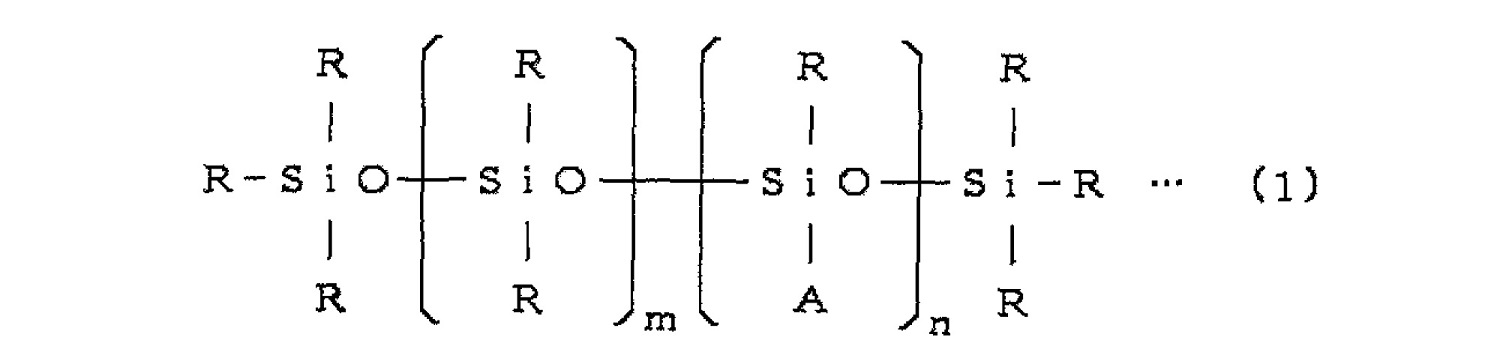
[式中、Aは一般式:-C3H6O(C2H4O)a(C3H6O)bR’(式中、R’は水素原子、アシル基および炭素数1~4のアルキル基からなる群から選択される基であり、aは5~50の整数であり、bは5~50の整数である。)で示されるポリオキシアルキレン基であり、Rはメチル基又はフェニル基であり、mは50~1000の整数であり、nは1~40の整数である。]
上記の技術によれば、一層のアルコール含有水中油型乳化組成物が得られるが、水中油型乳化組成物においては、様々な化粧料としてのニーズに応えるため安定した乳化状態を得ることができる乳化剤が求められている。
本発明は、水中油型乳化用の新規の乳化剤およびそれを含む水中油型乳化組成物を提供することを目的とする。
発明者は、前記の課題を解決すべく鋭意検討を重ねた結果、水中油型乳化物の系において、従来毛髪に対して疎水性付与と低摩擦化効果を有することが知られている、シラノール基とオキシプロピレン基(PO)またはオキシエチレン基(EO)とを有するコポリマーを乳化剤として用いることによって、油相が水相中に安定に分散された水中油型乳化組成物が得られることを見出し、本発明を完成するに至った。また、本発明に係る水中油型乳化組成物に、一定量の低級アルコールまたは水溶性増粘剤をさらに配合することによって、経時安定性が向上することも見出した。
すなわち、本発明は、
(A)シラノール基と、オキシプロピレン基(PO)またはオキシエチレン基(EO)とを有するコポリマーと、
(B)油分と
を含むことを特徴とする、水中油型乳化組成物を提供する。
(A)シラノール基と、オキシプロピレン基(PO)またはオキシエチレン基(EO)とを有するコポリマーと、
(B)油分と
を含むことを特徴とする、水中油型乳化組成物を提供する。
他の態様では、本発明は、シラノール基と、オキシプロピレン基(PO)またはオキシエチレン基(EO)とを有するコポリマーからなる、水中油型乳化用の乳化剤を提供する。
さらなる態様では、本発明は、
(A)シラノール基と、オキシプロピレン基(PO)またはオキシエチレン基(EO)とを有するコポリマーと、
(B)油分と、
(C)以下から選択される乳化安定化成分と
(C-1)20質量%超かつ62質量%未満の低級アルコール、および
(C-2)水溶性増粘剤
を含むことを特徴とする、水中油型乳化組成物を提供する。
(A)シラノール基と、オキシプロピレン基(PO)またはオキシエチレン基(EO)とを有するコポリマーと、
(B)油分と、
(C)以下から選択される乳化安定化成分と
(C-1)20質量%超かつ62質量%未満の低級アルコール、および
(C-2)水溶性増粘剤
を含むことを特徴とする、水中油型乳化組成物を提供する。
本発明は、シラノール基とオキシプロピレン基(PO)またはオキシエチレン基(EO)とを有するコポリマーを乳化剤として用いることにより、外相である水相中に油相を安定に分散させた一層の乳化組成物を得ることができる。また、シラノール基とオキシプロピレン基(PO)またはオキシエチレン基(EO)とを有するコポリマーにより乳化した水中油型乳化組成物に、一定量の低級アルコールまたは水溶性増粘剤をさらに配合することによって、乳化安定性を向上させることができる。
さらに、本発明によれば、アルコールを多く配合していながら、乳化安定性に優れる水中油型乳化物を実現することができる。また、本発明の乳化組成物において、油分としてシリコーン油を用いた場合には、当該乳化組成物を付着させた基材における摩擦力を低減させる効果を発揮する。よって、本発明の乳化組成物によれば、アルコール高配合に起因した除菌効果を付与するためにマスク等の布製品に付着させて用いるための、一層タイプの、スプレー式布処理剤を実現することができる。
本発明に係る水中油型乳化組成物は、(A)シラノール基と、オキシプロピレン基(PO)またはオキシエチレン基(EO)とを有するコポリマーと、(B)油分とを含むことを特徴とする。以下、本発明の組成物を構成する各成分について詳述する。
<(A)シラノール基と、オキシプロピレン基(PO)またはオキシエチレン基(EO)とを有するコポリマー>
本発明の乳化組成物に配合される、(A)シラノール基と、オキシプロピレン基(PO)またはオキシエチレン基(EO)とを有するコポリマーは、ポリマーの主鎖にポリシロキサン構造とポリオキシアルキレン構造とを含み、かつトリアルコキシシラン基またはシラノール基を有する側鎖を持つコポリマー(以下、「架橋型シリコーンPOAコポリマー」あるいは単に「(A)成分」と称する)である。
本発明の乳化組成物に配合される、(A)シラノール基と、オキシプロピレン基(PO)またはオキシエチレン基(EO)とを有するコポリマーは、ポリマーの主鎖にポリシロキサン構造とポリオキシアルキレン構造とを含み、かつトリアルコキシシラン基またはシラノール基を有する側鎖を持つコポリマー(以下、「架橋型シリコーンPOAコポリマー」あるいは単に「(A)成分」と称する)である。
本発明の架橋型シリコーンPOAコポリマーの主鎖を構成するポリシロキサン構造は、ポリジアルキルシロキサン、好ましくはポリジメチルシロキサンからなり、前記アルキル基(好ましくはメチル基)の一部がフェニル基で置換されていてもよい。
本発明の架橋型シリコーンPOAコポリマーの主鎖を構成するポリオキシアルキレン構造は、繰り返し単位として、オキシエチレン基(EO)、オキシプロピレン基(PO)、およびオキシブチレン(BO)からなる群から選択される少なくとも1つを含むものが好ましい。
本発明における架橋型シリコーンPOAコポリマーは、有機基からなる側鎖をさらに有するのが好ましい。側鎖となる有機基としては、アミノ基、水酸基、カルボキシル基等で任意に置換されていてもよい炭化水素基(好ましくはアルキル基、例えば、炭素数1~30程度の直鎖状または分岐状のアルキル基、あるいはフェニル基など)が挙げられる。炭化水素基はアミノ基を有するのが好ましく、当該アミノ基の水素原子はアルキル基等でさらに置換されていてもよい。
本発明の架橋型シリコーンPOAコポリマーは、その主鎖に窒素原子をさらに含むのが好ましく、前記の側鎖が当該窒素原子に結合しているのが好ましい。
架橋型シリコーンPOAコポリマーの具体的な例としては、ポリシリコーン-29(INCI名:Polysilicone-29)が挙げられる。ポリシリコーン-29は、末端にグリシドキシプロピル基を有するジメチルシロキサン重合体とPEG-13ジグリシジルエーテル、ジエチルアミノプロピルアミンおよびアミノプロピルトリイソプロポキシシランとの反応によって得られる複合シリコーン化合物と定義される。
本発明の乳化組成物における架橋型シリコーンPOAコポリマーとしては市販品を用いてもよい。例えば、「SilsoftTM CLX-E」(モメンティブ・パフォーマンス・マテリアルズ社製)が好ましく用いられ、このコポリマーは「ポリシリコーン-29」に属する化合物である。当該コポリマーは、主鎖にポリシロキサン構造とポリオキシアルキレン構造と窒素原子を含み、トリアルコキシシラン基を有する側鎖および有機基からなる側鎖を持ち、ポリシロキサン構造がポリジメチルシロキサン、ポリオキシアルキレン構造がポリオキシエチレンおよびポリオキシイソプロピレンを含み、側鎖が主鎖の窒素原子に結合した構造を有する。「SilsoftTM CLX-E」は、15質量%のポリシリコーン-29とジプロピレングリコールと水を含む商品である。
本発明の乳化組成物における(A)成分の配合量は、乳化が得られる限りにおいて特に限定されない。例えば、(A)成分の純分換算で、組成物全量に対する下限値としては、0.01質量%以上、0.03質量%以上、0.05質量%以上等が挙げられ、上限値としては、10質量%以下、8質量%以下、5質量%以下等が挙げられる。
<(B)油分>
本発明に係る乳化組成物に配合される(B)油分(以下、単に「(B)成分」と称する場合がある)は、特に制限されないが、化粧料に通常用いられるシリコーン油、極性油、炭化水素油、天然油脂類および半合成油が挙げられる。
本発明に係る乳化組成物に配合される(B)油分(以下、単に「(B)成分」と称する場合がある)は、特に制限されないが、化粧料に通常用いられるシリコーン油、極性油、炭化水素油、天然油脂類および半合成油が挙げられる。
シリコーン油としては、ジメチルポリシロキサン(別名:ジメチコン)、メチルフェニルポリシロキサン、ジフェニルポリシロキサン、メチルハイドロジェンポリシロキサン、ジフェニルシロキシフェニルトリメチコンなどの鎖状シリコーン油、および、デカメチルシクロペンタシロキサン、ドデカメチルシクロヘキサシロキサン、オクタメチルシクロテトラシロキサンなどの環状シリコーン油等が挙げられ、30℃における粘度が2~6,000csのものが好ましく使用できる。
極性油とは、油分のなかで極性が高いもの、例えば比誘電率が約5以上、好ましくは約10以上の油を指し、エステル油および油溶性紫外線吸収剤が含まれる。
エステル油の具体例としては、ジネオペンタン酸トリプロピレングリコール、イソノナン酸イソノニル、ミリスチン酸イソプロピル、オクタン酸セチル、ミリスチン酸オクチルドデシル、パルミチン酸イソプロピル、ステアリン酸ブチル、ラウリン酸ヘキシル、ミリスチン酸ミリスチル、オレイン酸デシル、ジメチルオクタン酸ヘキシルデシル、乳酸セチル、乳酸ミリスチル、酢酸ラノリン、ステアリン酸イソセチル、イソステアリン酸イソセチル、12-ヒドロキシステアリン酸コレステリル、エチルヘキサン酸セチル、ジ-2-エチルヘキサン酸エチレングリコール、ジペンタエリスリトール脂肪酸エステル、モノイソステアリン酸N-アルキルグリコール、ジカプリン酸ネオペンチルグリコール、リンゴ酸ジイソステアリル、ジ-2-ヘプチルウンデカン酸グリセリン、トリ-2-エチルヘキサン酸トリメチロールプロパン、トリイソステアリン酸トリメチロールプロパン、テトラ-2-エチルヘキサン酸ペンタエリスリチル、トリエチルヘキサノイン(別名:トリ-2-エチルヘキサン酸グリセリル)、トリオクタン酸グリセリン、トリイソパルミチン酸グリセリン、セチル2-エチルヘキサノエート、2-エチルヘキシルパルミテート、トリミリスチン酸グリセリン、トリ-2-ヘプチルウンデカン酸グリセライド、ヒマシ油脂肪酸メチルエステル、オレイン酸オレイル、アセトグリセライド、パルミチン酸2-ヘプチルウンデシル、アジピン酸ジイソブチル、N-ラウロイル-L-グルタミン酸-2-オクチルドデシルエステル、アジピン酸ジ-2-ヘプチルウンデシル、エチルラウレート、セバシン酸ジ-2-エチルヘキシル、ミリスチン酸2-ヘキシルデシル、パルミチン酸2-ヘキシルデシル、アジピン酸2-ヘキシルデシル、セバシン酸ジイソプロピル、コハク酸2-エチルヘキシル、クエン酸トリエチル等が挙げられる。
油溶性紫外線吸収剤の具体例としては、メトキシケイヒ酸エチルヘキシル、オクトクリレン、ジメチコジエチルベンザルマロネート、ポリシリコーン-15、t-ブチルメトキシジベンゾイルメタン、エチルヘキシルトリアゾン、ジエチルアミノヒドロキシベンゾイル安息香酸ヘキシル、ビスエチルヘキシルオキシフェノールメトキシフェニルトリアジン、オキシベンゾン-3、メチレンビスベンゾトリアゾリルテトラメチルブチルフェノール、ホモサレート、サリチル酸エチルへキシル、ドロメトリゾールトリシロキサン等が挙げられる。
炭化水素油としては、水添ポリイソブテン、流動パラフィン、オゾケライト、スクワラン、スクワレン、プリスタン、パラフィン、セレシン、重質流動イソパラフィン、ポリイソブチレン、水添ポリデセン等が挙げられる。
天然油脂類および半合成油としては、アボカド油、アマニ油、アーモンド油、オリーブ油、カヤ油、キョウニン油、小麦胚芽油、ゴマ油、コメ胚芽油、コメヌカ油、サザンカ油、サフラワー油、シナギリ油、シナモン油、大豆油、茶実油、ツバキ油、月見草油、トウモロコシ油、ナタネ油、日本キリ油、胚芽油、パーシック油、パーム油、レッドパーム油、パーム核油、ヒマシ油、ヒマワリ油、ブドウ油、ホホバ油、マカデミアナッツ油、綿実油、ヤシ油、トリヤシ油脂肪酸グリセライド、落花生油等が挙げられる。
本発明の(B)油分として、上記から選択される1種のみを用いてもよいし、2種以上を組み合わせて用いてもよい。
本発明の乳化組成物における(B)成分の配合量は、所望の組成物に応じて適宜決定されてよく、特に限定されない。例えば、乳化組成物全量に対する下限値としては、0.1質量%以上、0.5質量%以上、1質量%以上、2質量%以上等が挙げられ、上限値としては、50質量%以下、40質量%以下、35質量%以下、30質量%以下、25質量%以下、20質量%以下等が挙げられる。
本発明に係る乳化組成物においては、油分としてシリコーン油を用いることによって、本発明の乳化組成物を付着させた基材における摩擦力を低減する効果を発揮する。
<(C)乳化安定化成分>
本発明に係る水中油型乳化組成物においては、前記(A)および(B)成分に加え、(C)(C-1)一定量の低級アルコールおよび(C-2)水溶性増粘剤から選択される乳化安定化成分(以下、単に「(C)成分」と称する場合がある)をさらに配合することによって、乳化安定性を向上させることができる。
本発明に係る水中油型乳化組成物においては、前記(A)および(B)成分に加え、(C)(C-1)一定量の低級アルコールおよび(C-2)水溶性増粘剤から選択される乳化安定化成分(以下、単に「(C)成分」と称する場合がある)をさらに配合することによって、乳化安定性を向上させることができる。
(C-1)低級アルコール
本発明に係る乳化組成物に配合される(C-1)低級アルコール(以下、単に「(C-1)成分」と称する場合がある)とは、化粧料に通常用いられる炭素数1~5のアルコールを指す。具体例としては、エタノール、プロパノール、イソプロパノール、イソブチルアルコール、t-ブチルアルコール等が挙げられる。ただし、炭素数5以下のアルコールであってもグリセリンおよび1,3-ブチレングリコール等の多価アルコールは本発明の低級アルコールには含まれない。本発明の(C-1)成分として、前記低級アルコールから選択される1種または2種以上を組み合わせて用いてもよい。なかでも、エタノールを用いることが好ましい。
本発明に係る乳化組成物に配合される(C-1)低級アルコール(以下、単に「(C-1)成分」と称する場合がある)とは、化粧料に通常用いられる炭素数1~5のアルコールを指す。具体例としては、エタノール、プロパノール、イソプロパノール、イソブチルアルコール、t-ブチルアルコール等が挙げられる。ただし、炭素数5以下のアルコールであってもグリセリンおよび1,3-ブチレングリコール等の多価アルコールは本発明の低級アルコールには含まれない。本発明の(C-1)成分として、前記低級アルコールから選択される1種または2種以上を組み合わせて用いてもよい。なかでも、エタノールを用いることが好ましい。
本発明の乳化組成物に配合する場合の(C-1)成分は、乳化組成物全量に対して、20質量%超かつ62質量%未満、好ましくは25~60質量%、さらに好ましくは30~58質量%配合すると本発明の乳化組成物の乳化安定性が向上する。
通常、外相である水相にアルコールを多く含むと系の乳化安定性が損なわれる傾向があるが、本発明によれば、低級アルコールを外相に多く配合していながら、乳化安定性に優れるアルコール・水中油型乳化組成物を得ることができる。また、このアルコール・水中油型乳化組成物は一般的な化粧水に比べて比較的多くの油分を安定して配合することができる。
<(C-2)水溶性増粘剤>
本発明に係る乳化組成物に配合される(C-2)水溶性増粘剤(以下、単に「(C-2)成分」と称する場合がある)は、化粧料に通常使用可能な水溶性増粘剤であって、限定するものではないが、例として、アラビアガム、トラガガントガム、ガラクタン、グアガム、カラギーナン、ペクチン、クインスシード(マルメロ)抽出物、褐藻粉末およびカンテン等の植物系高分子;キサンタンガム、デキストランおよびプルラン等の微生物系高分子;デンプン、カルボキシメチルデンプンおよびメチルヒドロキシデンプン等のデンプン類;メチルセルロース、ニトロセルロース、エチルセルロース、メチルヒドロキシプロピルセルロース、ヒドロキシエチルセルロース、セルロース硫酸塩、ヒドロキシプロピルセルロース、カルボキシメチルセルロース、結晶セルロースおよびセルロース末等のセルロース類;ポリビニルアルコール、ポリビニルメチルエーテル、ポリビニルピロリドンおよびカルボキシビニルポリマー等のビニル系高分子;ポリアクリル酸およびその塩およびポリアクリルイミド等のアクリル系高分子;(ジメチルアクリルアミド/アクリロイルジメチルタウリンナトリウム)クロスポリマー、(アクリロイルジメチルタウリンアンモニウム/ビニルピロリドン)コポリマー等のタウレート系高分子;アクリレーツ/ステアレス-20メタクリレート共重合体等のアクリル酸・メタクリル酸アルキル共重合体、アクリレーツ/アクリル酸アルキル(C10-30)クロスポリマー等のアクリレーツ/アクリル酸アルキルクロスポリマー等のアクリレート系高分子;PEG-240/デシルテトラデセス-20/ヘキサメチレンジイソシアネート共重合体等の疎水変性ポリエーテルウレタン;グリチルリチン酸やアルギン酸およびその塩等が挙げられる。本発明の(C)成分として、これらから選択される1種を単独で、あるいは2種以上を組み合わせて用いることができる。
本発明に係る乳化組成物に配合される(C-2)水溶性増粘剤(以下、単に「(C-2)成分」と称する場合がある)は、化粧料に通常使用可能な水溶性増粘剤であって、限定するものではないが、例として、アラビアガム、トラガガントガム、ガラクタン、グアガム、カラギーナン、ペクチン、クインスシード(マルメロ)抽出物、褐藻粉末およびカンテン等の植物系高分子;キサンタンガム、デキストランおよびプルラン等の微生物系高分子;デンプン、カルボキシメチルデンプンおよびメチルヒドロキシデンプン等のデンプン類;メチルセルロース、ニトロセルロース、エチルセルロース、メチルヒドロキシプロピルセルロース、ヒドロキシエチルセルロース、セルロース硫酸塩、ヒドロキシプロピルセルロース、カルボキシメチルセルロース、結晶セルロースおよびセルロース末等のセルロース類;ポリビニルアルコール、ポリビニルメチルエーテル、ポリビニルピロリドンおよびカルボキシビニルポリマー等のビニル系高分子;ポリアクリル酸およびその塩およびポリアクリルイミド等のアクリル系高分子;(ジメチルアクリルアミド/アクリロイルジメチルタウリンナトリウム)クロスポリマー、(アクリロイルジメチルタウリンアンモニウム/ビニルピロリドン)コポリマー等のタウレート系高分子;アクリレーツ/ステアレス-20メタクリレート共重合体等のアクリル酸・メタクリル酸アルキル共重合体、アクリレーツ/アクリル酸アルキル(C10-30)クロスポリマー等のアクリレーツ/アクリル酸アルキルクロスポリマー等のアクリレート系高分子;PEG-240/デシルテトラデセス-20/ヘキサメチレンジイソシアネート共重合体等の疎水変性ポリエーテルウレタン;グリチルリチン酸やアルギン酸およびその塩等が挙げられる。本発明の(C)成分として、これらから選択される1種を単独で、あるいは2種以上を組み合わせて用いることができる。
(C-2)成分の配合量は、所望の剤形に応じて適宜決定されてよく、特に限定されない。例として、乳化組成物全量に対して0.01~10質量%であり、好ましくは0.1~5質量%が挙げられる。
本発明に係る乳化組成物においては、乳化安定性を向上させる観点から、(B)油分としてシリコーン油を用いることが好ましい。
また、本発明に係る乳化組成物においては、(B)油分としてシリコーン油を用いた場合に、シリコーン油に対する(C-1)低級アルコールの配合質量比(低級アルコール/シリコーン油比)を8~21の範囲に調整することによって、経時的な乳化安定性および振動に対する乳化安定性のいずれも向上させることができる。
また、本発明に係る乳化組成物においては、(B)油分としてシリコーン油を用いた場合に、シリコーン油に対する(C-1)低級アルコールの配合質量比(低級アルコール/シリコーン油比)を8~21の範囲に調整することによって、経時的な乳化安定性および振動に対する乳化安定性のいずれも向上させることができる。
<水>
本発明の組成物に配合される水は特に限定されないが、イオン交換水、精製水、自然水が挙げられる。
水の配合量は、所望の化粧料に応じて適宜決定されてよく、特に限定されない。例えば、乳化組成物全量に対する下限値としては5質量%以上、10質量%以上等が挙げられ、上限値としては95質量%以下、90質量%以下、85質量%以下、80質量%以下、75質量%以下、70質量%以下、65質量%以下、60質量%以下、55質量%以下、50質量%以下、45質量%以下等が挙げられる。
本発明の組成物に配合される水は特に限定されないが、イオン交換水、精製水、自然水が挙げられる。
水の配合量は、所望の化粧料に応じて適宜決定されてよく、特に限定されない。例えば、乳化組成物全量に対する下限値としては5質量%以上、10質量%以上等が挙げられ、上限値としては95質量%以下、90質量%以下、85質量%以下、80質量%以下、75質量%以下、70質量%以下、65質量%以下、60質量%以下、55質量%以下、50質量%以下、45質量%以下等が挙げられる。
本発明の乳化組成物は、上記(A)成分~(C)成分を配合することにより十分な乳化安定性を得ることができるので、(A)成分以外、または、(A)成分および(C-2)成分以外の乳化剤の配合量が3質量%以下、好ましくは1質量%以下であってよい。また、本発明の乳化組成物の態様には、乳化剤として他の界面活性剤を実質的に含まない態様も含まれる。
本発明の乳化組成物には、前記の必須成分に加え、目的に応じて本発明の効果を損なわない範囲で、他の任意成分を適宜配合してもよい。任意成分としては、グリセリン、ジプロピレングリコールおよび1,3-ブチレングリコール等の保湿剤、緩衝剤、フェノキシエタノール等の防腐剤、香料、色材、各種薬剤、噴射剤等が例示されるが、これらに限られない。
本発明に係る乳化組成物は、本発明の(A)成分と(B)成分を含む油性成分とを混合した後、前記混合液に水等のその他の水性成分を添加し、攪拌処理にて乳化することによって調製することができる。(C-1)低級アルコールを配合する場合には、本発明の(A)成分と(B)成分を含む油性成分と(C-1)低級アルコールとを混合した後、前記混合液にその他の水性成分を添加し、攪拌処理にて乳化することによって調製することができる。
本発明の乳化組成物の剤形としては、特に限定されず、通常の化粧料の剤形であればいずれのものも利用できる。すなわち、液状、ジェル状、ムース状、乳液状、クリーム状、ミスト状、スプレー状等の形態で提供することができる。
本発明の乳化組成物の剤形としては、特に限定されず、通常の化粧料の剤形であればいずれのものも利用できる。すなわち、液状、ジェル状、ムース状、乳液状、クリーム状、ミスト状、スプレー状等の形態で提供することができる。
本発明の乳化組成物を低粘度に調製すれば、スプレー、エアゾールまたはミスト状に噴霧して使用するのに適したものとなる。スプレーまたはミスト状に噴霧するのに好適な粘度は、100000mPa・s以下、好ましくは10000mPa・s以下、さらに好ましくは1000mPa・s以下、さらに好ましくは100mPa・s以下である。この粘度は、30℃においてB型粘度計で測定したときの値を指す。
本発明の乳化組成物は、アルコールベースの日用品処理剤、スキンローション、メーキャップ化粧料、皮膚外用剤、整髪料または毛髪処理剤の基剤として利用できる。また、本発明の乳化組成物は、高アルコール配合に起因した除菌作用を発揮させることができるため、織物および不織布を含む布製品に吹き付けるなどすることによって除菌効果を付与する布製品処理用組成物として、あるいは、手指の除菌用ジェル状組成物としての利用にも適する。
ここで、布製品とは、表面が織布および不織布である製品を指し、マスク、衣類、ソファ、カーテン等が含まれる。布製品を構成する織布又は不織布の繊維としては、通常衣類やマスク等の材料として用いられるものであればよく、具体的には、麻、絹、パルプ、綿、銅アンモニアレーヨン(別名:キュプラ)、レーヨン、ナイロン、アクリル、ポリウレタン、ポリエステル、ポリ塩化ビニル、ポリエチレン、ポリプロピレン等が挙げられる。
以下に実施例を挙げて本発明をさらに詳述するが、本発明はこれらにより何ら限定されるものではない。配合量は特記しない限り、その成分が配合される系に対する質量%で示す。
<評価方法>
1.調製直後の乳化評価
調製した試料をスクリュー管(50ml)に充填し、調製直後の試料について25℃での乳化状態を目視により観察し、以下の基準に基づいて評価した。
A:水相中に油相が均一に分散されている。
B:多少の乳化粒子の浮上あるいは沈降が見られるが、水相と油相の分離は見られない。
C:水相と油相の分離が生じている。
1.調製直後の乳化評価
調製した試料をスクリュー管(50ml)に充填し、調製直後の試料について25℃での乳化状態を目視により観察し、以下の基準に基づいて評価した。
A:水相中に油相が均一に分散されている。
B:多少の乳化粒子の浮上あるいは沈降が見られるが、水相と油相の分離は見られない。
C:水相と油相の分離が生じている。
2.経時的な乳化安定性評価
調製した試料をスクリュー管(50ml)に充填し、25℃の恒温槽に24時間静置した後、乳化粒子および外観を目視により観察し、以下の基準に基づいて評価した。
A:水相中に油相が均一に分散されている。
B:多少の乳化粒子の浮上あるいは沈降が見られるが、水相と油相の分離は見られない。
C:水相と油相の分離が生じている。
調製した試料をスクリュー管(50ml)に充填し、25℃の恒温槽に24時間静置した後、乳化粒子および外観を目視により観察し、以下の基準に基づいて評価した。
A:水相中に油相が均一に分散されている。
B:多少の乳化粒子の浮上あるいは沈降が見られるが、水相と油相の分離は見られない。
C:水相と油相の分離が生じている。
3.振動に対する乳化安定性評価(シェーキング試験)
振動に対する乳化安定性の評価を行うために、シェーキング試験を行った。具体的には、調製した試料30mlをスクリュー管(50ml)に入れ、30分間、10Hz以上の条件で振動を与えた。その後静置し、乳化粒子の状態を光学顕微鏡あるいは目視により観察し、以下の基準に基づいて評価した。
A:試験前と比較して乳化粒子の大きさに変化がない。
B:試験前よりやや大きい乳化粒子が見られるが、大きさに変化がない乳化粒子が半数以上を占めている。
C:試験前より大きい乳化粒子が半数以上を占めている。
D:外観で相分離していることがわかる。
振動に対する乳化安定性の評価を行うために、シェーキング試験を行った。具体的には、調製した試料30mlをスクリュー管(50ml)に入れ、30分間、10Hz以上の条件で振動を与えた。その後静置し、乳化粒子の状態を光学顕微鏡あるいは目視により観察し、以下の基準に基づいて評価した。
A:試験前と比較して乳化粒子の大きさに変化がない。
B:試験前よりやや大きい乳化粒子が見られるが、大きさに変化がない乳化粒子が半数以上を占めている。
C:試験前より大きい乳化粒子が半数以上を占めている。
D:外観で相分離していることがわかる。
4.動摩擦力低下率の測定
市販マスクの材料であるメルトブローン不織布(材質:ポリオレフィン、サイズ:10cm×5cm)を平板上に固定し、調製した試料を噴霧し、10分間静置した。その後、摩擦測定器(トライボマスター;トリニティーラボ社製)を使用して、50gの重りを乗せ、掃印速度5cm/secで動摩擦力を10回測定し、その平均値を求め、動摩擦力の値とした。何も塗布していない不織布の動摩擦力の値をF0とし、試料を塗布した不織布の動摩擦力の値をF1として、以下の式(I)に従って「動摩擦力低下率」を算出した。
[(F0-F1)/F0]×100 (I)
各組成物について算出した値を表3に記載する。動摩擦力低下率の値が大きいほど摩擦低減効果が高いことを示す。
<実施例>
表1~4に挙げる水中油型乳化組成物のうち、試料1の組成物は、乳化剤と油性成分を混合した後、当該混合物に水等の水性成分を攪拌しながら混合することによって調製した。その他の試料は、(C-1)低級アルコールと乳化剤と油性成分を混合した後、当該混合物に水等の水性成分を攪拌しながら混合することによって調製した。
表1では、(B)油分の種類および配合量と、(C-1)低級アルコールの配合量が異なる水中油型乳化組成物を調製し、乳化評価を行った。
表1~4に挙げる水中油型乳化組成物のうち、試料1の組成物は、乳化剤と油性成分を混合した後、当該混合物に水等の水性成分を攪拌しながら混合することによって調製した。その他の試料は、(C-1)低級アルコールと乳化剤と油性成分を混合した後、当該混合物に水等の水性成分を攪拌しながら混合することによって調製した。
表1では、(B)油分の種類および配合量と、(C-1)低級アルコールの配合量が異なる水中油型乳化組成物を調製し、乳化評価を行った。
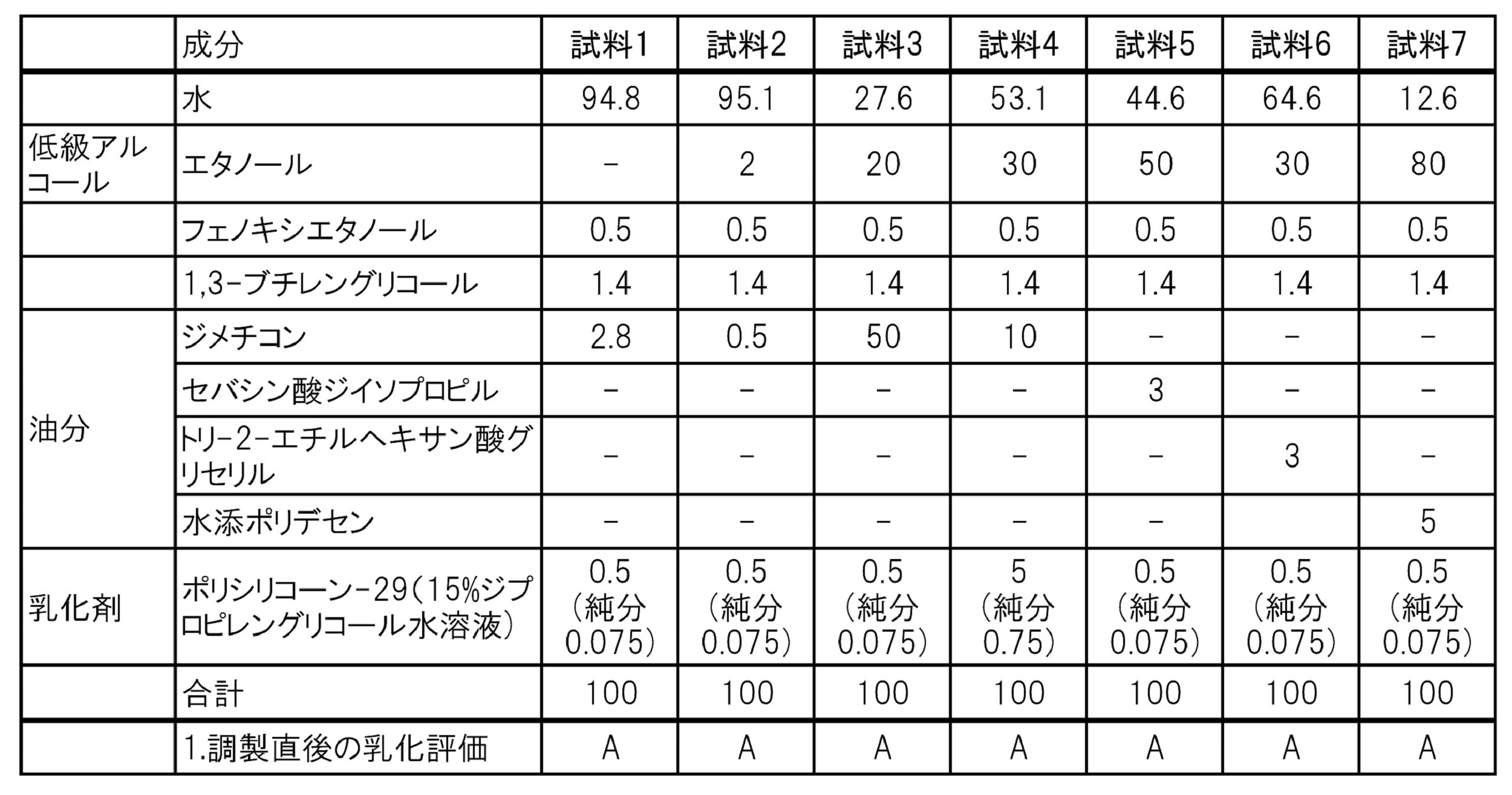
表1に示されるように、(B)油分の種類および配合量ならびに(C-1)低級アルコールの有無および配合量にかかわらず、本発明の(A)成分によって、油相が水相中に均一に分散した水中油型乳化組成物が得られた。
表2では、(B)油分の配合量をほぼ一定にし、(C-1)低級アルコールの配合量が異なる水中油型乳化組成物を調製し、経時的な乳化安定性の評価を行った。
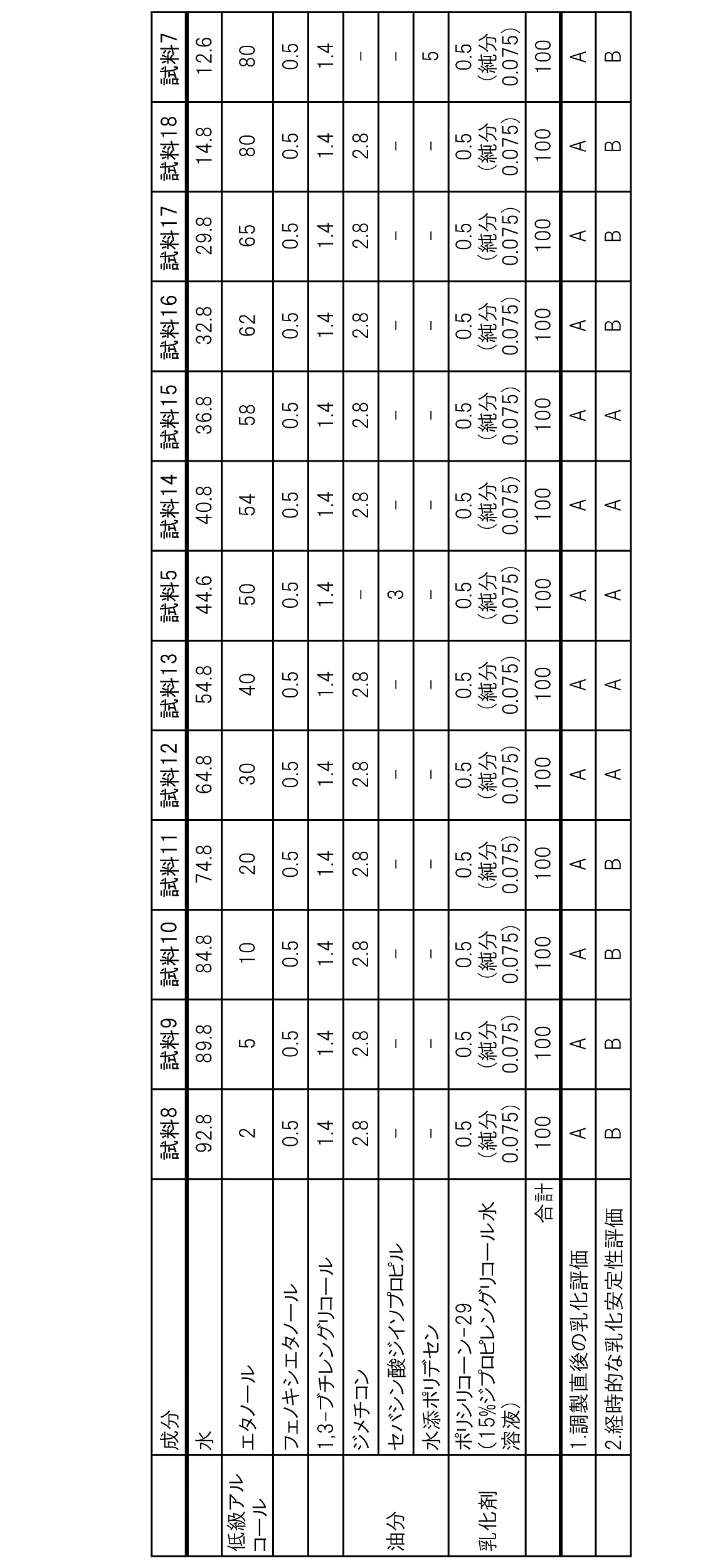
表2に示されるように、(C-1)低級アルコールの配合量にかかわらず、十分に安定性のある水中油型乳化組成物が得られた。なかでも、(C-1)低級アルコールの配合量を20質量%超かつ62質量%未満とすると、経時的な乳化安定性が向上する傾向が確認できた。
表3では、表1および表2に挙げた試料のうち一部の試料について振動に対する乳化安定性の評価を行った。
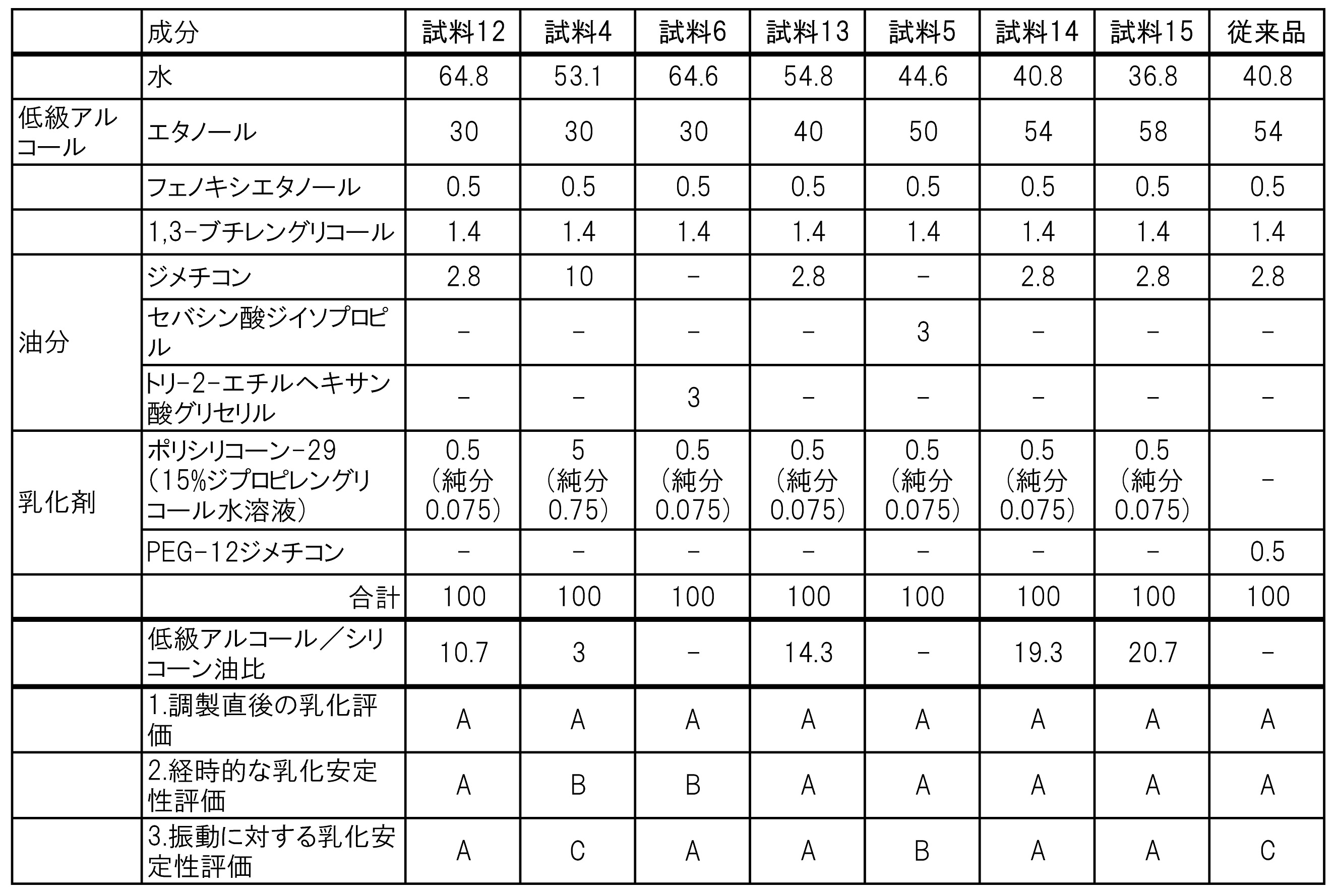
表3に示されるように、(B)油分の配合量が同程度である場合には、シリコーン油を用いた方が乳化安定性に優れる傾向が確認できた。また、油分としてシリコーン油を用いた場合には、低級アルコール/シリコーン油比を8~21の範囲に調整すると経時的な乳化安定性および振動に対する乳化安定性のいずれもが優れることが示された。
一方、アルコール含有水中油型乳化組成物の乳化剤として知られるPEG-12ジメチコンを配合した試料(表中の「従来品」、特許文献1の組成物に類似)を調製し、同様に乳化安定性の評価を行った。本発明によれば、従来品より振動に対する乳化安定性に優れた乳化組成物が得られることが確認できた。
一方、アルコール含有水中油型乳化組成物の乳化剤として知られるPEG-12ジメチコンを配合した試料(表中の「従来品」、特許文献1の組成物に類似)を調製し、同様に乳化安定性の評価を行った。本発明によれば、従来品より振動に対する乳化安定性に優れた乳化組成物が得られることが確認できた。
表4では、シリコーン油の粘度および配合量の異なる水中油型乳化組成物を調製し、動摩擦力低下率を測定した。
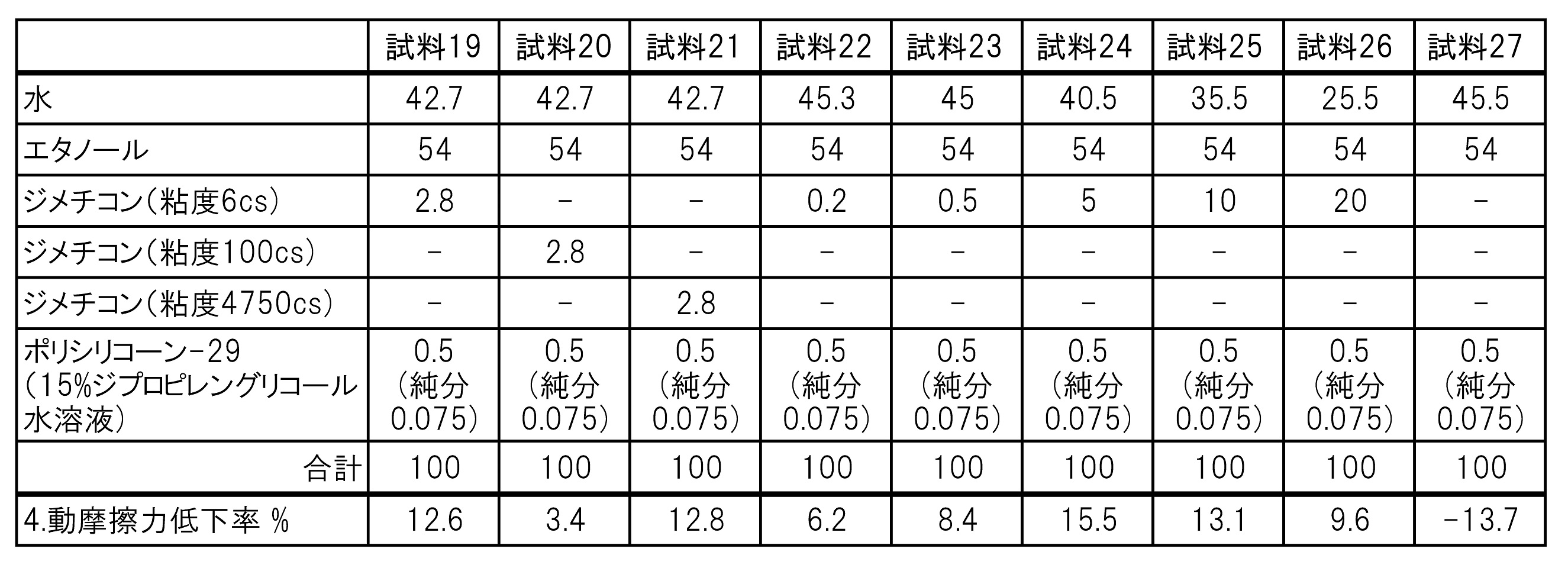
表4に示されるように、シリコーン油を配合していない試料27を塗布した場合には摩擦力が塗布前よりも大きくなった。一方、シリコーン油を配合した試料を塗布した場合には、配合するシリコーン油の粘度および配合量にかかわらず、顕著な摩擦低減効果を示すことが確認された。
以下に、本発明の乳化組成物の処方を例示する。本発明はこれらの処方例によって何ら限定されるものではなく、特許請求の範囲によって特定されるものであることはいうまでもない。なお、配合量はすべて乳化組成物全量に対する質量%で表す。
処方例1:ハンドジェル
(成分名) 配合量(質量%)
水 37.8
エタノール 54
フェノキシエタノール 0.5
1,3-ブチレングリコール 1.4
ジメチコン 2.8
ポリシリコーン-29(15%ジプロピレングリコール水溶液)0.5
(純分0.075)
(ジメチルアクリルアミド/アクリロイルジメチルタウリンNa)
クロスポリマー 3
(成分名) 配合量(質量%)
水 37.8
エタノール 54
フェノキシエタノール 0.5
1,3-ブチレングリコール 1.4
ジメチコン 2.8
ポリシリコーン-29(15%ジプロピレングリコール水溶液)0.5
(純分0.075)
(ジメチルアクリルアミド/アクリロイルジメチルタウリンNa)
クロスポリマー 3
Claims (10)
- (A)シラノール基と、オキシプロピレン基(PO)またはオキシエチレン基(EO)とを有するコポリマーと、
(B)油分と
を含む、水中油型乳化組成物。 - さらに、(C-1)低級アルコールを含む、請求項1に記載の組成物。
- 前記(C-1)低級アルコールの配合量が、組成物全量に対して、20質量%超かつ62質量%未満である、請求項2に記載の組成物。
- 粘度が10000mPa・s以下である、請求項1または2に記載の組成物。
- スプレー式容器用である、請求項1または2に記載の組成物。
- マスクおよび布製品処理用である、請求項1または2に記載の組成物。
- 前記(B)成分としてシリコーン油を含む、請求項1に記載の組成物。
- さらに、(C-2)水溶性増粘剤を含む、請求項1または2に記載の組成物。
- シラノール基と、オキシプロピレン基(PO)またはオキシエチレン基(EO)とを有するコポリマーからなる、水中油型乳化用乳化剤。
- シラノール基と、オキシプロピレン基(PO)またはオキシエチレン基(EO)とを有するコポリマーを乳化剤として含む、マスク処理用組成物。
Priority Applications (1)
| Application Number | Priority Date | Filing Date | Title |
|---|---|---|---|
| JP2023525933A JPWO2022255486A1 (ja) | 2021-06-04 | 2022-06-03 |
Applications Claiming Priority (2)
| Application Number | Priority Date | Filing Date | Title |
|---|---|---|---|
| JP2021-093999 | 2021-06-04 | ||
| JP2021093999 | 2021-06-04 |
Publications (1)
| Publication Number | Publication Date |
|---|---|
| WO2022255486A1 true WO2022255486A1 (ja) | 2022-12-08 |
Family
ID=84322584
Family Applications (1)
| Application Number | Title | Priority Date | Filing Date |
|---|---|---|---|
| PCT/JP2022/022652 Ceased WO2022255486A1 (ja) | 2021-06-04 | 2022-06-03 | 水中油型乳化組成物 |
Country Status (2)
| Country | Link |
|---|---|
| JP (1) | JPWO2022255486A1 (ja) |
| WO (1) | WO2022255486A1 (ja) |
Citations (5)
| Publication number | Priority date | Publication date | Assignee | Title |
|---|---|---|---|---|
| US20120114928A1 (en) * | 2010-11-05 | 2012-05-10 | Momentive Performance Materials Inc. | Durable Non-Fluorine Water Repellent Agent and Process for Preparing Same |
| JP2012524039A (ja) * | 2009-04-16 | 2012-10-11 | エヴォニク ゴールドシュミット ゲーエムベーハー | 化粧品組成物または医薬組成物を製造するためのシリコーン部分が分枝状の有機変性シロキサンの使用 |
| JP2020070272A (ja) * | 2018-11-02 | 2020-05-07 | 株式会社 資生堂 | 毛髪化粧料及びそれを用いた毛髪処理方法 |
| CN111270527A (zh) * | 2020-01-16 | 2020-06-12 | 湖北欣柔科技有限公司 | 一种单面拒水水刺纯棉非织造布的制备方法 |
| US20200405618A1 (en) * | 2019-06-27 | 2020-12-31 | L'oreal | Hair treatment compositions and methods for treating hair |
-
2022
- 2022-06-03 WO PCT/JP2022/022652 patent/WO2022255486A1/ja not_active Ceased
- 2022-06-03 JP JP2023525933A patent/JPWO2022255486A1/ja active Pending
Patent Citations (5)
| Publication number | Priority date | Publication date | Assignee | Title |
|---|---|---|---|---|
| JP2012524039A (ja) * | 2009-04-16 | 2012-10-11 | エヴォニク ゴールドシュミット ゲーエムベーハー | 化粧品組成物または医薬組成物を製造するためのシリコーン部分が分枝状の有機変性シロキサンの使用 |
| US20120114928A1 (en) * | 2010-11-05 | 2012-05-10 | Momentive Performance Materials Inc. | Durable Non-Fluorine Water Repellent Agent and Process for Preparing Same |
| JP2020070272A (ja) * | 2018-11-02 | 2020-05-07 | 株式会社 資生堂 | 毛髪化粧料及びそれを用いた毛髪処理方法 |
| US20200405618A1 (en) * | 2019-06-27 | 2020-12-31 | L'oreal | Hair treatment compositions and methods for treating hair |
| CN111270527A (zh) * | 2020-01-16 | 2020-06-12 | 湖北欣柔科技有限公司 | 一种单面拒水水刺纯棉非织造布的制备方法 |
Also Published As
| Publication number | Publication date |
|---|---|
| JPWO2022255486A1 (ja) | 2022-12-08 |
Similar Documents
| Publication | Publication Date | Title |
|---|---|---|
| JP2010530456A (ja) | 安定した高内相エマルジョンおよびその組成物 | |
| KR102516515B1 (ko) | 겔 페이스트 조성물 및 이 겔 페이스트 조성물을 이용한 화장료 | |
| US20040137025A1 (en) | Water-in-oil emulsion cosmetic composition | |
| EP3357488B1 (en) | Cosmetic material | |
| FR3058050A1 (fr) | Composition comprenant au moins deux esters d’acide gras et de (poly)glycerol, et son utilisation en cosmetique | |
| US11660262B2 (en) | Cosmetic base and skin cosmetic using same | |
| CN103800216A (zh) | 硅油包水型粗滴乳液化妆品组合物 | |
| JP2019023174A (ja) | W/o型乳化物 | |
| TW201827036A (zh) | 水中油型乳化化妝料 | |
| CN109952091A (zh) | 外用组合物及其制备方法 | |
| CN105451819A (zh) | 包含高吸水性聚合物和有机聚硅氧烷弹性体的组合物 | |
| JP2019099469A (ja) | 両連続型マイクロエマルション組成物及び化粧料 | |
| JP6741836B2 (ja) | 水中油型乳化化粧料 | |
| CN106102699B (zh) | 化妆品用调理油组合物及化妆品 | |
| JP6618404B2 (ja) | 乳化保湿化粧料およびその使用方法 | |
| JP2022166758A (ja) | 水中油型乳化化粧料 | |
| JPH11263721A (ja) | 水中油型ゴマージュ化粧料 | |
| EP3831361A1 (en) | Oil-in-water emulsion cosmetic | |
| CN117860596A (zh) | 油包水型乳化化妆品 | |
| JP5072318B2 (ja) | 油性ゲル化剤、ゲル組成物及びこれを含む化粧料 | |
| TW202002935A (zh) | 溫感化妝品 | |
| JP7522736B2 (ja) | 水中油型乳化化粧料 | |
| JP6927833B2 (ja) | 水中油型皮膚化粧料 | |
| TW202604463A (zh) | W/o/w型乳液及其製造方法 | |
| WO2024142847A1 (ja) | 化粧料組成物 |
Legal Events
| Date | Code | Title | Description |
|---|---|---|---|
| 121 | Ep: the epo has been informed by wipo that ep was designated in this application |
Ref document number: 22816231 Country of ref document: EP Kind code of ref document: A1 |
|
| WWE | Wipo information: entry into national phase |
Ref document number: 2023525933 Country of ref document: JP |
|
| NENP | Non-entry into the national phase |
Ref country code: DE |
|
| 122 | Ep: pct application non-entry in european phase |
Ref document number: 22816231 Country of ref document: EP Kind code of ref document: A1 |