WO2022255255A1 - 難燃性布帛及びそれを用いた作業服 - Google Patents
難燃性布帛及びそれを用いた作業服 Download PDFInfo
- Publication number
- WO2022255255A1 WO2022255255A1 PCT/JP2022/021768 JP2022021768W WO2022255255A1 WO 2022255255 A1 WO2022255255 A1 WO 2022255255A1 JP 2022021768 W JP2022021768 W JP 2022021768W WO 2022255255 A1 WO2022255255 A1 WO 2022255255A1
- Authority
- WO
- WIPO (PCT)
- Prior art keywords
- flame
- fibers
- weight
- fiber
- retardant
- Prior art date
- Legal status (The legal status is an assumption and is not a legal conclusion. Google has not performed a legal analysis and makes no representation as to the accuracy of the status listed.)
- Ceased
Links
Classifications
-
- D—TEXTILES; PAPER
- D01—NATURAL OR MAN-MADE THREADS OR FIBRES; SPINNING
- D01F—CHEMICAL FEATURES IN THE MANUFACTURE OF ARTIFICIAL FILAMENTS, THREADS, FIBRES, BRISTLES OR RIBBONS; APPARATUS SPECIALLY ADAPTED FOR THE MANUFACTURE OF CARBON FILAMENTS
- D01F6/00—Monocomponent artificial filaments or the like of synthetic polymers; Manufacture thereof
- D01F6/28—Monocomponent artificial filaments or the like of synthetic polymers; Manufacture thereof from copolymers obtained by reactions only involving carbon-to-carbon unsaturated bonds
- D01F6/40—Modacrylic fibres, i.e. containing 35 to 85% acrylonitrile
-
- A—HUMAN NECESSITIES
- A41—WEARING APPAREL
- A41D—OUTERWEAR; PROTECTIVE GARMENTS; ACCESSORIES
- A41D13/00—Professional, industrial or sporting protective garments, e.g. surgeons' gowns or garments protecting against blows or punches
-
- A—HUMAN NECESSITIES
- A41—WEARING APPAREL
- A41D—OUTERWEAR; PROTECTIVE GARMENTS; ACCESSORIES
- A41D31/00—Materials specially adapted for outerwear
-
- A—HUMAN NECESSITIES
- A41—WEARING APPAREL
- A41D—OUTERWEAR; PROTECTIVE GARMENTS; ACCESSORIES
- A41D31/00—Materials specially adapted for outerwear
- A41D31/04—Materials specially adapted for outerwear characterised by special function or use
-
- A—HUMAN NECESSITIES
- A41—WEARING APPAREL
- A41D—OUTERWEAR; PROTECTIVE GARMENTS; ACCESSORIES
- A41D31/00—Materials specially adapted for outerwear
- A41D31/04—Materials specially adapted for outerwear characterised by special function or use
- A41D31/08—Heat resistant; Fire retardant
-
- D—TEXTILES; PAPER
- D01—NATURAL OR MAN-MADE THREADS OR FIBRES; SPINNING
- D01F—CHEMICAL FEATURES IN THE MANUFACTURE OF ARTIFICIAL FILAMENTS, THREADS, FIBRES, BRISTLES OR RIBBONS; APPARATUS SPECIALLY ADAPTED FOR THE MANUFACTURE OF CARBON FILAMENTS
- D01F6/00—Monocomponent artificial filaments or the like of synthetic polymers; Manufacture thereof
- D01F6/28—Monocomponent artificial filaments or the like of synthetic polymers; Manufacture thereof from copolymers obtained by reactions only involving carbon-to-carbon unsaturated bonds
- D01F6/36—Monocomponent artificial filaments or the like of synthetic polymers; Manufacture thereof from copolymers obtained by reactions only involving carbon-to-carbon unsaturated bonds comprising unsaturated carboxylic acids or unsaturated organic esters as the major constituent
-
- D—TEXTILES; PAPER
- D03—WEAVING
- D03D—WOVEN FABRICS; METHODS OF WEAVING; LOOMS
- D03D15/00—Woven fabrics characterised by the material, structure or properties of the fibres, filaments, yarns, threads or other warp or weft elements used
- D03D15/20—Woven fabrics characterised by the material, structure or properties of the fibres, filaments, yarns, threads or other warp or weft elements used characterised by the material of the fibres or filaments constituting the yarns or threads
-
- D—TEXTILES; PAPER
- D03—WEAVING
- D03D—WOVEN FABRICS; METHODS OF WEAVING; LOOMS
- D03D15/00—Woven fabrics characterised by the material, structure or properties of the fibres, filaments, yarns, threads or other warp or weft elements used
- D03D15/40—Woven fabrics characterised by the material, structure or properties of the fibres, filaments, yarns, threads or other warp or weft elements used characterised by the structure of the yarns or threads
- D03D15/47—Woven fabrics characterised by the material, structure or properties of the fibres, filaments, yarns, threads or other warp or weft elements used characterised by the structure of the yarns or threads multicomponent, e.g. blended yarns or threads
-
- D—TEXTILES; PAPER
- D04—BRAIDING; LACE-MAKING; KNITTING; TRIMMINGS; NON-WOVEN FABRICS
- D04B—KNITTING
- D04B1/00—Weft knitting processes for the production of fabrics or articles not dependent on the use of particular machines; Fabrics or articles defined by such processes
- D04B1/14—Other fabrics or articles characterised primarily by the use of particular thread materials
- D04B1/16—Other fabrics or articles characterised primarily by the use of particular thread materials synthetic threads
-
- D—TEXTILES; PAPER
- D04—BRAIDING; LACE-MAKING; KNITTING; TRIMMINGS; NON-WOVEN FABRICS
- D04B—KNITTING
- D04B1/00—Weft knitting processes for the production of fabrics or articles not dependent on the use of particular machines; Fabrics or articles defined by such processes
- D04B1/22—Weft knitting processes for the production of fabrics or articles not dependent on the use of particular machines; Fabrics or articles defined by such processes specially adapted for knitting goods of particular configuration
- D04B1/24—Weft knitting processes for the production of fabrics or articles not dependent on the use of particular machines; Fabrics or articles defined by such processes specially adapted for knitting goods of particular configuration wearing apparel
-
- D—TEXTILES; PAPER
- D04—BRAIDING; LACE-MAKING; KNITTING; TRIMMINGS; NON-WOVEN FABRICS
- D04B—KNITTING
- D04B21/00—Warp knitting processes for the production of fabrics or articles not dependent on the use of particular machines; Fabrics or articles defined by such processes
- D04B21/14—Fabrics characterised by the incorporation by knitting, in one or more thread, fleece, or fabric layers, of reinforcing, binding, or decorative threads; Fabrics incorporating small auxiliary elements, e.g. for decorative purposes
- D04B21/16—Fabrics characterised by the incorporation by knitting, in one or more thread, fleece, or fabric layers, of reinforcing, binding, or decorative threads; Fabrics incorporating small auxiliary elements, e.g. for decorative purposes incorporating synthetic threads
-
- D—TEXTILES; PAPER
- D04—BRAIDING; LACE-MAKING; KNITTING; TRIMMINGS; NON-WOVEN FABRICS
- D04B—KNITTING
- D04B21/00—Warp knitting processes for the production of fabrics or articles not dependent on the use of particular machines; Fabrics or articles defined by such processes
- D04B21/20—Warp knitting processes for the production of fabrics or articles not dependent on the use of particular machines; Fabrics or articles defined by such processes specially adapted for knitting articles of particular configuration
- D04B21/207—Wearing apparel or garment blanks
-
- A—HUMAN NECESSITIES
- A41—WEARING APPAREL
- A41D—OUTERWEAR; PROTECTIVE GARMENTS; ACCESSORIES
- A41D2400/00—Functions or special features of garments
-
- A—HUMAN NECESSITIES
- A41—WEARING APPAREL
- A41D—OUTERWEAR; PROTECTIVE GARMENTS; ACCESSORIES
- A41D2500/00—Materials for garments
- A41D2500/10—Knitted
-
- A—HUMAN NECESSITIES
- A41—WEARING APPAREL
- A41D—OUTERWEAR; PROTECTIVE GARMENTS; ACCESSORIES
- A41D2600/00—Uses of garments specially adapted for specific purposes
- A41D2600/20—Uses of garments specially adapted for specific purposes for working activities
-
- D—TEXTILES; PAPER
- D01—NATURAL OR MAN-MADE THREADS OR FIBRES; SPINNING
- D01F—CHEMICAL FEATURES IN THE MANUFACTURE OF ARTIFICIAL FILAMENTS, THREADS, FIBRES, BRISTLES OR RIBBONS; APPARATUS SPECIALLY ADAPTED FOR THE MANUFACTURE OF CARBON FILAMENTS
- D01F1/00—General methods for the manufacture of artificial filaments or the like
- D01F1/02—Addition of substances to the spinning solution or to the melt
- D01F1/07—Addition of substances to the spinning solution or to the melt for making fire- or flame-proof filaments
-
- D—TEXTILES; PAPER
- D10—INDEXING SCHEME ASSOCIATED WITH SUBLASSES OF SECTION D, RELATING TO TEXTILES
- D10B—INDEXING SCHEME ASSOCIATED WITH SUBLASSES OF SECTION D, RELATING TO TEXTILES
- D10B2201/00—Cellulose-based fibres, e.g. vegetable fibres
- D10B2201/01—Natural vegetable fibres
-
- D—TEXTILES; PAPER
- D10—INDEXING SCHEME ASSOCIATED WITH SUBLASSES OF SECTION D, RELATING TO TEXTILES
- D10B—INDEXING SCHEME ASSOCIATED WITH SUBLASSES OF SECTION D, RELATING TO TEXTILES
- D10B2201/00—Cellulose-based fibres, e.g. vegetable fibres
- D10B2201/20—Cellulose-derived artificial fibres
- D10B2201/22—Cellulose-derived artificial fibres made from cellulose solutions
-
- D—TEXTILES; PAPER
- D10—INDEXING SCHEME ASSOCIATED WITH SUBLASSES OF SECTION D, RELATING TO TEXTILES
- D10B—INDEXING SCHEME ASSOCIATED WITH SUBLASSES OF SECTION D, RELATING TO TEXTILES
- D10B2321/00—Fibres made from polymers obtained by reactions only involving carbon-to-carbon unsaturated bonds
- D10B2321/10—Fibres made from polymers obtained by reactions only involving carbon-to-carbon unsaturated bonds polymers of unsaturated nitriles, e.g. polyacrylonitrile, polyvinylidene cyanide
- D10B2321/101—Fibres made from polymers obtained by reactions only involving carbon-to-carbon unsaturated bonds polymers of unsaturated nitriles, e.g. polyacrylonitrile, polyvinylidene cyanide modacrylic
-
- D—TEXTILES; PAPER
- D10—INDEXING SCHEME ASSOCIATED WITH SUBLASSES OF SECTION D, RELATING TO TEXTILES
- D10B—INDEXING SCHEME ASSOCIATED WITH SUBLASSES OF SECTION D, RELATING TO TEXTILES
- D10B2401/00—Physical properties
- D10B2401/04—Heat-responsive characteristics
-
- D—TEXTILES; PAPER
- D10—INDEXING SCHEME ASSOCIATED WITH SUBLASSES OF SECTION D, RELATING TO TEXTILES
- D10B—INDEXING SCHEME ASSOCIATED WITH SUBLASSES OF SECTION D, RELATING TO TEXTILES
- D10B2501/00—Wearing apparel
- D10B2501/04—Outerwear; Protective garments
Definitions
- the present invention relates to flame-retardant fabric and work clothes using the same.
- the present invention provides a flame-retardant fabric that has no environmental impact, high flame resistance, excellent washing durability, and texture, and a fabric that uses the same. Provide comfortable work clothes.
- One or more embodiments of the present invention are flame retardant fabrics comprising acrylic fibers and cellulosic fibers, wherein the cellulosic fibers are one or more selected from the group consisting of regenerated cellulosic fibers and natural cellulosic fibers.
- the flame-retardant fabric contains 65 to 90% by weight of the acrylic fiber and 10 to 35% by weight of the cellulosic fiber relative to the total weight of the fabric, and the acrylic fiber is contained inside the fiber. It contains a magnesium compound, and the flame-retardant fabric contains 2.5 to 4.5% by weight of the magnesium compound relative to the total weight of the fabric, and the flame-retardant fabric is combustible based on ISO 15025:2000. It relates to a flame-retardant fabric having an afterflame time of 2 seconds or less and an afterflame time of 2 seconds or less, as measured by a property test.
- One or more embodiments of the present invention relate to work clothes using the flame-retardant fabric.
- the inventors of the present invention have found that a fabric containing acrylic fiber and cellulosic fiber is used in combination with a predetermined amount of acrylic fiber and cellulosic fiber, and by containing a predetermined amount of magnesium compound, it is possible to reduce the impact on the environment. It has been found that, while reducing concerns, excellent flame retardancy is exhibited, afterflame time and afterburn time are shortened in the combustion test, and particularly surprisingly, good washing durability and texture can also be imparted. rice field. In one or more embodiments of the present invention, "afterflame time” and “afterflame time” can each be measured by a flammability test based on ISO 15025:2000. In one or more embodiments of the present invention, wash durability means having good flame retardancy after washing.
- the flame retardant fabrics of one or more embodiments of the present invention comprise magnesium compounds and are substantially free of antimony compounds, thereby reducing environmental impact concerns and reducing costs. .
- substantially free of antimony compounds means that no antimony compounds are intentionally added to the fiber or fabric as a flame retardant.
- the fabric containing a magnesium compound as a flame retardant facilitates the formation of a carbonized layer upon combustion, resulting in good flame retardancy and washing durability.
- the proportion of the magnesium compound relative to the total weight of the fabric is 2.5-4.5 wt%, preferably 2.6-4.5 wt%;2. 7-4.5% by weight, 2.8-4.5% by weight, 2.9-4.5% by weight, 3.0-4.5% by weight, 3.1-4.5% by weight;3. 2-4.5% by weight, 3.3-4.5% by weight, 3.4-4.4% by weight, 3.5-4.4% by weight, 3.6-4.4% by weight;3. 7 to 4.4 wt%, 3.8 to 4.3 wt%, or 3.9 to 4.3 wt%. If the proportion of the magnesium compound is less than 2.5% by weight, sufficient flame retardancy cannot be obtained. , and the fabric strength is impaired.
- the magnesium compound preferably has an average particle size of 0.3 ⁇ m or more, more preferably 0.3 to 2.0 ⁇ m, even more preferably 0.5 to 1.5 ⁇ m. .
- the average particle size is 0.3 ⁇ m or more, the surface area of the magnesium compound particles does not increase excessively, and the generation of static electricity is suppressed in fiber processing steps such as spinning, making processing easier.
- the average particle size is 2.0 ⁇ m or less, the spinneret is not clogged in the spinning process, which is preferable in terms of production.
- the average particle size of the magnesium compound can be measured by, for example, a laser diffraction method in the case of a powder, and a laser diffraction method in the case of a dispersion (dispersion liquid) dispersed in water or an organic solvent. method or dynamic light scattering method.
- the average particle size of the magnesium compound in the fiber can be confirmed, for example, by measuring the particle size of 100 magnesium compound particles in the fiber with a microscope and determining the arithmetic mean size.
- the magnesium compound is contained inside acrylic fibers.
- the acrylic fiber preferably contains 2.8 to 6.9% by weight, more preferably 3.0 to 6.7% by weight, more preferably 3.2 to 6.7% by weight of the magnesium compound relative to the total weight of the fiber. More preferably 5% by weight, most preferably 3.5 to 6.0% by weight. If the content of the magnesium compound is less than 2.8% by weight, the flame retardancy may be insufficient. Insulation resistance increases when carding, static electricity is likely to occur, and problems such as winding during the carding process may occur, making processing difficult.
- magnesium compounds include, for example, magnesium oxide, magnesium peroxide, magnesium hydroxide, magnesium fluoride, magnesium chloride, magnesium bromide, magnesium iodide, magnesium hydride, and diboride.
- magnesium oxide and magnesium hydroxide are preferably used from the viewpoint of ease of handling.
- magnesium hydroxide is preferably used from the viewpoint of Mohs hardness.
- the magnesium compound preferably has a Mohs hardness of less than 5, more preferably 4 or less.
- the Mohs hardness referred to here is an index of mineral hardness.
- a Mohs hardness of 5 is a degree of hardness that can be scratched with a knife, although not easily
- a Mohs hardness of 6 is a degree of hardness that is difficult to scratch with a knife and damages the knife.
- Magnesium hydroxide and magnesium oxide can ensure flame retardancy equivalent to antimony compounds, which are conventional flame retardants.
- fibers containing the magnesium compound can be spun more stably with magnesium hydroxide than with magnesium oxide.
- the Mohs hardness of magnesium hydroxide is about 3
- the Mohs hardness of magnesium oxide is about 7. Since magnesium hydroxide is softer than magnesium oxide, acrylic fibers containing magnesium hydroxide compounds and It is presumed that this is because the abrasion resistance of the cutter blade when cutting the knitted fabric containing the acrylic fiber is lowered, and the abrasion resistance of the machine used for spinning is reduced.
- the minimum value of Mohs hardness is 1.
- the magnesium hydroxide compound is not particularly limited. Powders obtained by treating magnesium hydroxide particles with phosphate, borate, etc., and those obtained by a method of hydrating magnesium oxide to gradually produce magnesium hydroxide, and the like can be mentioned. Furthermore, it may have a coating layer by being adsorbed with an adsorbable substance around the magnesium hydroxide compound particles or surface-treated by surface treatment. Among them, magnesium hydroxide having a coating layer surface-treated with a silane coupling agent is preferable from the viewpoint of suppressing static electricity. The reason why the surface treatment with the silane coupling agent improves the suppression of static electricity is speculative, but is considered as follows.
- the silane coupling treatment of the surfaces of the magnesium hydroxide particles improves the dispersibility of the acrylic fiber and the silane coupling treated magnesium hydroxide, and as a result, the static electricity is suppressed. Furthermore, when a step of attaching an oil agent to the fiber surface is carried out for the purpose of improving workability, the effect of the oil agent is sufficiently applied to the surface of the magnesium hydroxide particles, and the workability is greatly improved.
- the type of the silane coupling agent is not particularly limited as long as it improves the compatibility with the acrylonitrile-based copolymer described later, and there are no particular limitations regarding the crosslinked type or non-crosslinked type.
- the acrylic fiber is an acrylonitrile copolymer obtained by copolymerizing 30 to 85% by weight of acrylonitrile and 15 to 65% by weight of other components. It is preferably composed of As another component, from the viewpoint of flame retardancy, it is preferable to use, for example, one or more halogen-containing monomers selected from the group consisting of halogen-containing vinyl monomers and halogen-containing vinylidene monomers. More preferably, the acrylonitrile content in the acrylonitrile-based copolymer is 40 to 75% by weight.
- the content of the halogen-containing vinyl monomer and/or the halogen-containing vinylidene monomer in the acrylonitrile-based copolymer is 25 to 60% by weight.
- the acrylonitrile-based copolymer may further contain a monomer containing a sulfonic acid group as another component.
- the content of the sulfonic acid group-containing monomer in the acrylonitrile copolymer is preferably 0 to 3% by weight.
- halogen-containing monomer examples include halogen-containing vinyl monomers and halogen-containing vinylidene monomers.
- examples of halogen-containing vinyl monomers include vinyl chloride and vinyl bromide, and examples of halogen-containing vinylidene monomers include vinylidene chloride and vinylidene bromide. These halogen-containing monomers may be used singly or in combination of two or more. Of vinyl chloride monomers and vinylidene chloride monomers, vinyl chloride monomers are more preferred. When a vinyl chloride monomer is used, by selecting a magnesium compound as a flame retardant and blending it in a specific blending amount, it is easy to form a carbonized layer during combustion, and high flame retardancy is exhibited.
- the magnesium compound functions as an intumescent flame retardant and tends to form a carbonized layer, ie, intumescent, during combustion.
- vinylidene chloride if a magnesium compound is selected as a flame retardant, the acrylonitrile copolymer will be colored and its use in clothing will be restricted. Coloring does not progress, which is preferable.
- the monomer containing a sulfonic acid group is not particularly limited, but examples include unsaturated carboxylic acids represented by acrylic acid and methacrylic acid and salts thereof, methacrylic acid esters represented by methyl methacrylate, glycidyl Unsaturated carboxylic acid esters such as methacrylate, vinyl esters such as vinyl acetate and vinyl butyrate, sulfonic acid-containing monomers, and the like can be used.
- the sulfonic acid-containing monomer is not particularly limited, but allylsulfonic acid, methallylsulfonic acid, styrenesulfonic acid, isoprenesulfonic acid, 2-acrylamido-2-methylpropanesulfonic acid, and metal salts such as sodium salts thereof and Amine salts and the like can be used.
- These other copolymerizable sulfonic acid group-containing monomers may be used singly or in combination of two or more.
- a monomer containing a sulfonic acid group is used as necessary. Excellent production stability.
- the acrylonitrile-based copolymer contains 30 to 85% by weight of acrylonitrile and a halogen-containing monomer from the viewpoint of improving the flame retardancy and spinning process properties of acrylic fibers.
- the acrylonitrile-based copolymer contains 30 to 85% by weight of acrylonitrile and 15 to 15% by weight of vinyl chloride from the viewpoint of increasing brightness in addition to flame retardancy and spinning processability of acrylic fibers.
- a monomer containing a sulfonic acid group more preferably 35 to 80% by weight of acrylonitrile, 20 to 65% by weight of vinyl chloride, and a sulfonic acid group Contains 0 to 3% by weight of the monomer containing, more preferably 40 to 75% by weight of acrylonitrile, 25 to 60% by weight of vinyl chloride, and 0 to 3% by weight of a monomer containing a sulfonic acid group. , particularly preferably 40 to 70% by weight of acrylonitrile, 30 to 60% by weight of vinyl chloride and 0 to 3% by weight of a monomer containing sulfonic acid groups.
- the acrylic fiber contains the acrylonitrile copolymer and magnesium compound described above and is used to improve the flame retardancy of the flame retardant fabric. Carbonization at the time of combustion makes the inside of the flame-retardant fabric into an oxygen-deficient state, and has the effect of helping to prevent flames from entering the surface.
- the acrylic fiber contains a magnesium compound inside the fiber, the washing durability of the fabric containing the acrylic fiber, that is, the flame retardancy after washing is good.
- the acrylic fiber contains a magnesium compound
- the generation of carbon monoxide, which is a harmful gas is suppressed during combustion compared to the case of using an antimony compound, and the impact on the environment is reduced. It is possible to obtain a flame-retardant fabric that is excellent in flame-retardant properties while suppressing the amount of coloring and has little coloring (high brightness).
- the acrylic fiber preferably has a single fiber strength of 1.0 to 4.0 cN/dtex, more preferably 1.5 to 3.5 cN/dtex, from the viewpoint of durability. is more preferable.
- the acrylic fiber preferably has an elongation of 15 to 40%, more preferably 20 to 30%, from the viewpoint of practicality. Single fiber strength and elongation can be measured according to JIS L 1015:2010.
- the acrylic fibers are dope-dyed fibers.
- Dope coloring means coloring by adding colorants such as pigments and dyes to raw materials for chemical fibers (spinning dope, solutions containing polymers, polymers). can be done. By undiluted coloring, a desired color can be easily obtained without adding a new manufacturing process, and a fiber that is resistant to color transfer and fading during washing can be obtained.
- acrylic fibers may optionally contain flame retardants other than magnesium compounds that do not have environmental impact due to elution or discharge.
- flame retardants other than magnesium compounds that do not have environmental impact due to elution or discharge.
- other additives such as antistatic agents (also called antistatic agents), heat coloring inhibitors, light resistance improvers, whiteness improvers, devitrification inhibitors, colorants, etc. good too.
- the application method is not particularly limited, and application by spraying or application after cutting may be used.
- the method for producing the acrylic fiber is not particularly limited, but a composition containing an acrylonitrile copolymer (preferably an acrylonitrile copolymer containing acrylonitrile and vinyl chloride) and a magnesium compound It can be manufactured by heat treatment after spinning the material.
- Specific production methods include known methods such as a wet spinning method, a dry spinning method, and a semi-dry and semi-wet method.
- a wet spinning method the above acrylonitrile copolymer is dissolved in an organic solvent, and then a magnesium compound is added to obtain a spinning stock solution.
- It can be produced by extruding a spinning stock solution through a nozzle into a coagulating bath to coagulate it, then drawing, washing with water, drying, heat-treating, crimping if necessary, and cutting. Stretching is performed simultaneously with or before washing with water, or before or after drying. If necessary, an oil may be applied to the fibers before they are crimped or dried.
- the organic solvent include dimethylformamide, dimethylacetamide, acetone, and dimethylsulfoxide, but inorganic solvents such as an aqueous solution of rhodanate salt and an aqueous solution of nitric acid may also be used.
- the flame retardant fabrics of one or more embodiments of the present invention contain 10 to 35% by weight of the total fabric weight of cellulosic fibers for the purpose of providing excellent hand and wash durability. More preferably 15 to 30% by weight, still more preferably 20 to 30% by weight. At least one selected from the group consisting of natural cellulosic fibers and regenerated cellulosic fibers can be used as the cellulosic fibers. Moreover, these fibers may be used alone, or two or more of them may be used in combination.
- natural cellulose fibers include natural cellulose fibers such as cotton fibers, kapok fibers, flax fibers, hemp fibers, ramie fibers, jute fibers, Manila hemp fibers, and kenaf fibers.
- regenerated cellulose fibers include rayon fibers, flame-retardant rayon fibers, lyocell fibers, and flame-retardant lyocell fibers.
- the rayon fiber is obtained by dissolving cellulose xanthate, which is obtained by reacting a cellulose raw material with an alkali and carbon disulfide, in caustic soda and performing wet spinning.
- the lyocell fiber is obtained by dissolving in N-methylmonforine N-oxide and dry-wet spinning without a step of denaturing the cellulose raw material.
- the flame-retardant rayon fibers are preferably rayon fibers containing a phosphorus-based flame retardant.
- the phosphorus-based flame retardant is not particularly limited, and examples thereof include phosphate compounds, halogen phosphate compounds, condensed phosphate compounds, polyphosphate compounds, and polyphosphate compounds.
- the flame-retardant rayon fiber containing the phosphorus-based flame retardant is not particularly limited. % or more, more preferably 0.8% by weight or more.
- the flame-retardant rayon fiber containing the phosphorus-based flame retardant preferably contains 10% by weight or less of phosphorus derived from the phosphorus-based flame retardant with respect to the total weight of the fiber.
- flame-retardant rayon fiber containing the phosphorus-based flame retardant commercially available ones such as flame-retardant lyocell "Lenzing FR" manufactured by Lenzing and flame-retardant rayon "JWELL FR” manufactured by Jilin Kasen may be used. good.
- the phosphorus content can be measured by a fluorescent X-ray analysis method.
- the flame-retardant lyocell fiber is preferably lyocell fiber containing a phosphorus-based flame retardant.
- the phosphorus-based flame retardant is not particularly limited, and examples thereof include phosphate compounds, halogen phosphate compounds, condensed phosphate compounds, polyphosphate compounds, and polyphosphate compounds.
- the flame retardant fabric comprises 65-90% by weight of said acrylic fiber relative to the total weight of the fabric. If the acrylic fiber content is less than 65% by weight, the flame retardance is poor, and if it exceeds 90% by weight, the cellulose fiber content is too low, resulting in poor texture of the fabric.
- the flame-retardant fabric contains 70 to 90% by weight of the acrylic fiber and 10 to 90% by weight of the natural cellulosic fiber in the entire fabric, from the viewpoint of achieving both flame retardancy and texture. It is more preferable to contain 30% by weight, more preferably 80 to 90% by weight of the acrylic fiber and 10 to 20% by weight of the natural cellulosic fiber.
- the flame-retardant fabric may contain 65 to 90% by weight of the acrylic fiber and 10 to 35% by weight of the rayon fiber, and the acrylic fiber 65 to 85% by weight and particularly preferably 15 to 35% by weight of said rayon fibers.
- the flame retardant fabric may contain 65 to 90% by weight of the acrylic fiber and 10 to 35% by weight of the lyocell fiber, and the acrylic fiber and 15 to 35% by weight of said lyocell fibers.
- the flame-retardant fabric may contain 65 to 90% by weight of the acrylic fiber and 10 to 35% by weight of the flame-retardant rayon fiber, and the acrylic It is particularly preferred to contain 70 to 80% by weight of the rayon fiber and 20 to 30% by weight of the flame-retardant rayon fiber.
- the flame-retardant fabric may contain 65 to 90% by weight of the acrylic fiber and 10 to 35% by weight of the flame-retardant lyocell fiber, and the acrylic It is particularly preferred to contain 65-85% by weight of fibers and 15-35% by weight of said flame-retardant lyocell fibers.
- the flame retardant fabric comprises two or more cellulosic fibers selected from the group consisting of rayon fibers, flame retardant rayon fibers, lyocell fibers and flame retardant lyocell fibers. Also good.
- Natural cellulosic fibers and regenerated cellulosic fibers may be used alone or in combination in the flame retardant fabrics of one or more embodiments of the present invention, and when used together, the weight ratio of natural cellulosic fibers to regenerated cellulosic fibers is: A cellulosic fiber ratio of 1:2 to 3:1 is preferred.
- the flame-retardant fabric may contain other fibers in addition to acrylic fibers and cellulosic fibers within a range that does not impair the object and effect of the present invention.
- Other fibers include, for example, conductive fibers, heat-resistant fibers, and high-strength, high-modulus fibers.
- conductive fibers include metal fibers, metal-plated fibers, copper compound-coated fibers, conductive substance-added fibers, etc.
- Heat-resistant fibers include meta-aramid fibers, polyoxadiazole fibers, polyimide fibers, polyamideimide fibers, and high-strength fibers.
- High modulus fibers include nylon fibers, polyester fibers, para-aramid fibers, polyarylate fibers, and the like.
- the flame-retardant fabric may contain other fibers in an amount of 10% by weight or less, 8% by weight or less, or 1% by weight or less, based on the total amount of the fabric.
- the acrylic fiber, the cellulosic fiber, and the other fiber may be short fibers or long fibers, and may be appropriately selected depending on the method of use.
- the single fiber fineness is appropriately selected depending on the application of the work clothes to be used, but is preferably 1 to 50 dtex, more preferably 1.5 to 30 dtex, and even more preferably 1.7 to 15 dtex.
- the cut length is appropriately selected according to the use of the work clothes. Examples thereof include short fibers (eg, fiber length 0.1 to 5 mm), short fibers (eg, fiber length 38 to 128 mm), and long fibers (filaments) that are not cut at all.
- the flame-retardant fabric of one or more embodiments of the present invention is not particularly limited, but from the viewpoint of texture, it preferably has a basis weight of 200 to 400 g/m 2 , more preferably 220 to 380 g/m 2 . , more preferably 250 to 350 g/m 2 .
- the form of the flame-retardant fabric is not particularly limited, and examples thereof include woven and knitted fabrics.
- the weave of the woven fabric is not particularly limited, and may be a plain weave, a twill weave, a satin weave, or the like, or may be a patterned weave using a special loom such as a dobby or jaguar.
- the knitted fabric is not particularly limited, and may be circular knitted, flat knitted, or warp knitted. From the viewpoint of excellent durability, the flame-retardant fabric is preferably a woven fabric, and more preferably a twill woven fabric.
- the flame-retardant fabric has excellent flame retardancy, and has an afterflame time of 2 seconds or less and an afterburn time as measured by a flammability test based on ISO 15025:2000. is 2 seconds or less, preferably the afterflame time is 0 seconds and the afterflame time is 0 seconds.
- the flame-retardant fabric has a limiting oxygen index of 27 or more as measured according to JIS L 1091 E method (E-1): 1999, from the viewpoint of excellent flame retardancy. and more preferably 28 or more, 29 or more, 30 or more, 31 or more, 32 or more, 33 or more, 34 or more, 35 or more, or 36 or more.
- the washing durability is, for example, the limiting oxygen index of a flame-retardant fabric washed by a washing method based on ISO 6330:2012, measured based on JIS L 1091:1999. It may be confirmed by measuring the JIS L 1091 E method (E-1) of the flame-retardant fabric washed 30 times by the washing method based on ISO 6330: 2012: Measured based on 1999
- the limiting oxygen index is preferably 27 or higher, 28 or higher, 29 or higher, 30 or higher, 31 or higher, 32 or higher, 33 or higher, 34 or higher, 35 or higher, or 36 or higher.
- the flame-retardant fabric can be suitably used as a workwear fabric that requires flame-retardant properties.
- work clothes can be manufactured using the flame-retardant fabric described above and by known sewing methods.
- the flame retardant fabric has excellent flame resistance and wash durability
- the workwear also has excellent flame resistance and wash durability.
- the flame-retardant fabric has excellent texture even after repeated washing, the work clothes maintain their flame retardancy and texture even after repeated washing.
- the workwear can be used as workwear for any work requiring flame resistance.
- protective clothing worn by firefighters for example, but not limited to, protective clothing worn by firefighters (firefighting clothing), protective clothing worn at work sites where fires may occur such as petroleum, petrochemical, coal mines, electric power and welding, and dust explosions such as metal processing It can be used as work clothes to be worn at work sites where fires may occur such as petroleum, petrochemical, coal mines, electric power and welding, and dust explosions such as metal processing It can be used as work clothes to be worn at work sites where
- Acrylic fiber I 100 parts by weight of an acrylonitrile copolymer consisting of 49.5% by weight of acrylonitrile, 49.5% by weight of vinyl chloride and 1.0% by weight of sodium styrenesulfonate, and 5 parts by weight of a magnesium compound, the entire fiber Acrylic fiber containing 4.8% by weight of magnesium hydroxide (manufactured by Kyowa Chemical Industry Co., Ltd., product name “Kisuma 5”, average particle size 2 ⁇ m, Mohs hardness 3), single fiber fineness 1.7 dtex, fiber length 51mm, Acrylic Fiber II: Contains 100 parts by weight of an acrylonitrile copolymer consisting of 49.5% by weight of acrylonitrile, 49.5% by weight of vinylidene chloride and 1.0% by weight of sodium styrenesulfonate, and 9.5 parts by weight of antimony pentoxide.
- Examples 1-7, Comparative Examples 1-2, Reference Example 1 A spun yarn having a count shown in Table 1 below is produced by general ring spinning at the blending ratio of the fibers shown in Table 1 below, and using the spun yarn, a knitted fabric having a basis weight shown in Table 1 below is produced. made.
- a phosphorus compound (trade name “Pyrovatex CP NEW”, manufactured by Huntsman, N-methyloldimethylphosphonopropionic acid amide) 400 g / L, a cross-linking agent (trade name “Beccamin J-101”, manufactured by DIC, hexamethoxymethylol type Melamine) 60 g / L, softener (trade name "Ultratex FSA NEW”, manufactured by Huntsman, silicone softener) 30 g / L, 85% phosphoric acid 20.7 g / L, penetrant (trade name "Invazin PBN” , Huntsman) was prepared.
- the flame retardant treatment liquid is squeezed with a dehydrator so that the squeeze ratio is 80 ⁇ 2%, then pre-dried at 110 ° C for 5 minutes, and then dried at 150 ° C. for 5 minutes.
- the knitted fabric is washed with an aqueous sodium carbonate solution and water, neutralized with an aqueous hydrogen peroxide solution, washed with water, dehydrated, and dried at 60 ° C. for 30 minutes using a tumbler dryer to obtain a flame-retardant knitted fabric. Obtained.
- Flame retardant evaluation 1 A flammability test was performed based on ISO 15025:2000 A method, and the afterflame time and the afterflame time were measured. Acceptance criteria for flame retardancy are that the flame does not reach either the top edge or the left or right edge of the test piece, the afterflame time and afterglow time are 2 seconds or less, and there are no holes in the fabric. If the acceptance criteria were met, the flame retardancy was judged to be good.
- LOI limiting oxygen index
- washing durability Washing was performed 30 times based on ISO 6330:2012, and the limiting oxygen index (LOI) of the washed knitted fabric was measured by a method based on JIS L 1091 E method (E-1): 1999. If the LOI value after 30 washes was 27 or more, the washing durability was judged to be good.
- LOI limiting oxygen index
- the knitted fabrics of Examples have excellent flame retardancy and a good texture.
- the knitted fabrics of Examples using acrylic fibers containing a magnesium compound as a flame retardant had good flame retardancy, like the knitted fabric of Reference Example 1 using acrylic fibers containing an antimony compound as a flame retardant.
- the magnesium compound is contained inside the acrylic fiber, the LOI value after 30 washings is the same as before washing, and the washing durability, that is, the flame retardancy after washing was also good.
- the knitted fabric of Comparative Example 1 which does not contain cellulosic fibers, has holes in the flammability test based on the ISO 15025:2000 A method, and has poor flame retardancy (more specifically, flame shielding properties).
- Met. The knitted fabric of Comparative Example 2, which has a low acrylic fiber content and a low magnesium compound content, has an afterflame time value of 54 seconds in a flammability test based on ISO 15025:2000 A method, and is flame retardant (more specifically In general, the flame shielding property) was poor.
- the limiting oxygen index (LOI) measured by the method based on JIS L 1091 E method (E-1): 1999 was only 24, indicating poor flame retardancy.
- the knitted fabric of Comparative Example 3 which does not contain acrylic fibers and magnesium compounds, has good flame retardancy because it contains a phosphorus compound that is a flame retardant, but the phosphorus compound is attached to the fabric (fiber). Therefore, the texture was poor.
- the phosphorus compound is attached to the fiber and is not contained inside the fiber, the LOI value after 30 washings is significantly lower than before washing, and the washing durability, that is, the flame retardancy after washing was inferior.
- a flame-retardant fabric containing acrylic fibers and cellulosic fibers are one or more selected from the group consisting of regenerated cellulosic fibers and natural cellulosic fibers,
- the flame-retardant fabric contains 65 to 90% by weight of the acrylic fiber and 10 to 35% by weight of the cellulose fiber based on the total weight of the fabric,
- the acrylic fiber contains a magnesium compound inside the fiber,
- the flame-retardant fabric contains 2.5 to 4.5% by weight of a magnesium compound relative to the total weight of the fabric,
- the flame-retardant fabric has an after-flame time of 2 seconds or less and an after-dust time of 2 seconds or less, as measured by a flammability test based on ISO 15025:2000.
- the acrylic fiber contains 30 to 85% by weight of acrylonitrile, 15 to 65% by weight of one or more halogen-containing monomers selected from the group consisting of halogen-containing vinyl monomers and halogen-containing vinylidene monomers, And the flame-retardant fabric according to [1], comprising an acrylonitrile-based copolymer containing 0 to 3% by weight of a sulfonic acid group-containing vinyl monomer. [3] The flame-retardant fabric according to [1] or [2], wherein the acrylic fiber contains 2.8 to 6.9% by weight of a magnesium compound inside the fiber.
- the flame-retardant fabric contains 65 to 90% by weight of the acrylic fiber, 10 to 35% by weight of the regenerated cellulose fiber, and 0 to 10% by weight of other fibers, based on the total weight of the fabric.
- the flame-retardant fabric according to any one of [1] to [4].
- the flame-retardant fabric contains 80 to 90% by weight of the acrylic fiber and 10 to 20% by weight of the natural cellulose fiber relative to the total weight of the fabric.
- the flame-retardant fabric according to. [9] The flame-retardant fabric contains 70 to 90% by weight of the acrylic fiber, 10 to 20% by weight of the natural cellulose fiber, and 0 to 10% by weight of other fibers relative to the total weight of the fabric.
- the flame-retardant fabric according to any one of [1] to [4].
- the other fibers include metal fibers, metal-plated fibers, copper compound-coated fibers, conductive substance-added fibers, meta-aramid fibers, polyoxadiazole fibers, polyimide fibers, polyamide-imide fibers, nylon fibers, polyester fibers, and para-aramid fibers. , and polyarylate fibers, preferably meta-aramid fibers, according to [6] or [9].
- the flame-retardant fabric contains the acrylic fiber, the regenerated cellulose fiber, and the natural cellulose fiber, and the weight ratio of the regenerated cellulose fiber and the natural cellulose fiber is: regenerated cellulose fiber: natural cellulose
- the magnesium compound contains one or more selected from the group consisting of magnesium oxide and magnesium hydroxide.
Landscapes
- Engineering & Computer Science (AREA)
- Textile Engineering (AREA)
- Chemical & Material Sciences (AREA)
- Chemical Kinetics & Catalysis (AREA)
- General Chemical & Material Sciences (AREA)
- Health & Medical Sciences (AREA)
- General Health & Medical Sciences (AREA)
- Physical Education & Sports Medicine (AREA)
- Woven Fabrics (AREA)
- Knitting Of Fabric (AREA)
- Artificial Filaments (AREA)
- Professional, Industrial, Or Sporting Protective Garments (AREA)
Abstract
本発明は、アクリル系繊維及びセルロース系繊維を含む難燃性布帛であって、前記セルロース系繊維は、再生セルロース系繊維及び天然セルロース系繊維からなる群から選ばれる1以上であり、前記難燃性布帛は、布帛全体重量に対して、前記アクリル系繊維を65~90重量%、及び前記セルロース系繊維を10~35重量%を含み、前記アクリル系繊維は、繊維内部にマグネシウム化合物を含み、前記難燃性布帛には、2.5~4.5重量%のマグネシウム化合物が含まれており、ISO 15025:2000に基づいた燃焼性試験によって測定した、残炎時間が2秒以下、かつ残じん時間が2秒以下である、難燃性布帛に関する。
Description
本発明は、難燃性布帛及びそれを用いた作業服に関する。
消防士、並びに石油、石化、石炭鉱山、電力、溶接及び金属加工等の作業現場等の火炎の危険にさらされる環境下の作業者は、難燃性を有する作業服を求めている。難燃性を有する作業服用布帛として、様々な構成のものが提案されている。例えば、特許文献1には、40~56重量%の難燃剤としてアンチモン化合物を用いた難燃モダクリル繊維、5~25重量%の天然セルロース系繊維及び20~40重量%の難燃ビスコース繊維を含む難燃性布帛が提案されている。
しかしながら、近年、難燃剤であるアンチモン化合物の溶出や排出による環境への影響が懸念されており、改善が求められていた。さらに、優れた難燃性を確保しつつ、作業服として繰り返し使用する点から、風合い、洗濯耐久性の向上も求められていた。また、コストの観点からも改善の余地があった。
本発明は、上記従来の問題を解決するため、環境への影響が懸念されず、高い難燃性を有し、さらには優れた洗濯耐久性、及び風合いを有する難燃性布帛及びそれを用いた作業服を提供する。
本発明の1以上の実施形態は、アクリル系繊維及びセルロース系繊維を含む難燃性布帛であって、前記セルロース系繊維は、再生セルロース系繊維及び天然セルロース系繊維からなる群から選ばれる1以上であり、前記難燃性布帛は、布帛全体重量に対して、前記アクリル系繊維を65~90重量%、及び前記セルロース系繊維を10~35重量%含み、前記アクリル系繊維は、繊維内部にマグネシウム化合物を含み、前記難燃性布帛には、布帛全体重量に対して、マグネシウム化合物が2.5~4.5重量%含まれ、前記難燃性布帛は、ISO 15025:2000に基づいた燃焼性試験によって測定した、残炎時間が2秒以下、かつ残じん時間が2秒以下である、難燃性布帛に関する。
本発明の1以上の実施形態は、前記難燃性布帛を用いた作業服に関する。
本発明によれば、環境への影響の懸念が低減され、良好な難燃性、洗濯耐久性、及び風合いを有する難燃性布帛及びそれを用いた作業服を提供することができる。
本発明の発明者らは、アクリル系繊維及びセルロース系繊維を含む布帛において、所定量のアクリル系繊維及びセルロース系繊維を併用するとともに、マグネシウム化合物を所定量含有させることで、環境への影響の懸念を低減しつつ、優れた難燃性が発現し、燃焼試験において残炎時間及び残じん時間が短縮されるとともに、特に驚くことに、良好な洗濯耐久性及び風合いも付与し得ることを見出した。本発明の1以上の実施形態において、「残炎時間」及び「残じん時間」は、それぞれISO 15025:2000に基づいた燃焼性試験により測定することができる。本発明の1以上の実施形態において、洗濯耐久性は、洗濯後にも良好な難燃性を有することを意味する。繊維や生地表面に難燃剤を付着させた場合、洗濯時に難燃剤が脱落しやすく、洗濯耐久性が劣るが、本発明の1以上の実施形態の難燃性布帛では、繊維の内部にマグネシウム化合物を含むアクリル系繊維を用いることで、洗濯耐久性が良好になる。
本発明の1以上の実施形態の難燃性布帛は、マグネシウム化合物を含み、実質的にアンチモン化合物を含まないことから、環境への影響の懸念が低減されるとともに、コストも低減することができる。本明細書において、「実質的にアンチモン化合物を含まない」とは、意図的に繊維又は布帛に難燃剤としてアンチモン化合物を添加しないことを意味する。
本発明の1以上の実施形態の難燃性布帛は、マグネシウム化合物を含み、実質的にアンチモン化合物を含まないことから、環境への影響の懸念が低減されるとともに、コストも低減することができる。本明細書において、「実質的にアンチモン化合物を含まない」とは、意図的に繊維又は布帛に難燃剤としてアンチモン化合物を添加しないことを意味する。
本明細書において、数値範囲が「~」で示されている場合、該数値範囲は両端値(上限及び下限)を含む。例えば、「A~B」という数値範囲は、A及びBという両端値を含む範囲となる。また、本明細書において、数値範囲が複数記載されている場合、異なる数値範囲の上限及び下限を適宜組み合わせた数値範囲を含むものとする。
<マグネシウム化合物>
本発明の1以上の実施形態において、布帛が難燃剤としてマグネシウム化合物を含むことにより、燃焼時に炭化層を形成しやすく、難燃性及び洗濯耐久性が良好になる。
本発明の1以上の実施形態において、布帛が難燃剤としてマグネシウム化合物を含むことにより、燃焼時に炭化層を形成しやすく、難燃性及び洗濯耐久性が良好になる。
本発明の1以上の実施形態の難燃性布帛において、布帛全体重量に対するマグネシウム化合物の割合が2.5~4.5重量%であり、好ましくは2.6~4.5重量%、2.7~4.5重量%、2.8~4.5重量%、2.9~4.5重量%、3.0~4.5重量%、3.1~4.5重量%、3.2~4.5重量%、3.3~4.5重量%、3.4~4.4重量%、3.5~4.4重量%、3.6~4.4重量%、3.7~4.4重量%、3.8~4.3重量%、又は3.9~4.3重量%である。マグネシウム化合物の割合が2.5重量%未満の場合、十分な難燃性が得られず、4.5重量%より大きい場合、高い難燃性を得るために良いが、風合い、触感、繊維強度、及び生地強度を損なってしまう。
本発明の1以上の実施形態において、マグネシウム化合物の平均粒子径は0.3μm以上であることが好ましく、より好ましくは0.3~2.0μm、更に好ましくは0.5~1.5μmである。平均粒子径が0.3μm以上であると、マグネシウム化合物粒子の表面積が増大しすぎず、紡績等の繊維加工工程において静電気発生が抑制され、加工しやすくなる。平均粒子径が2.0μm以下であると、紡糸工程にて紡糸口金の閉塞を引き起こすことがなく、製造上好ましい。本明細書において、マグネシウム化合物の平均粒子径は、例えば、粉体の場合は、レーザー回折法で測定することができ、水や有機溶媒に分散した分散体(分散液)の場合は、レーザー回折法または動的光散乱法で測定することができる。繊維中のマグネシウム化合物の平均粒子径は、例えば、顕微鏡で繊維中の100個のマグネシウム化合物粒子の粒子径を測定し、算術平均径を求めることで確認することができる。
本発明の1以上の実施形態において、マグネシウム化合物は、アクリル系繊維の内部に含まれている。アクリル系繊維は、繊維全体重量に対して、マグネシウム化合物を2.8~6.9重量%含むことが好ましく、3.0~6.7重量%含むことがより好ましく、3.2~6.5重量%含むことがさらに好ましく、3.5~6.0重量%含むことが最も好ましい。マグネシウム化合物の含有量が2.8重量%未満の場合、難燃性が不十分となる恐れがあり、一方、マグネシウム化合物の含有量が6.9重量%を超えると、繊維を紡績等の加工する際に絶縁抵抗値が高くなり、静電気が発生しやすくなり、カード工程での巻き付きといったトラブルが発生し加工が困難となる恐れがある。
本発明の1以上の実施形態において、マグネシウム化合物としては、例えば、酸化マグネシウム、過酸化マグネシウム、水酸化マグネシウム、フッ化マグネシウム、塩化マグネシウム、臭化マグネシウム、ヨウ化マグネシウム、水素化マグネシウム、二ホウ化マグネシウム、窒化マグネシウム、硫化マグネシウム、炭酸マグネシウム、炭酸カルシウムマグネシウム、硝酸マグネシウム、硫酸マグネシウム、亜硫酸マグネシウム、過塩素酸マグネシウム、リン酸三マグネシウム、過マンガン酸マグネシウム、リン酸マグネシウム等が挙げられる。中でも取り扱い易さの観点から酸化マグネシウム、水酸化マグネシウムが好適に用いられる。更にはモース硬度の観点から水酸化マグネシウムが好適に用いられる。
本発明の1以上の実施形態において、マグネシウム化合物の好ましいモース硬度は5未満であり、より好ましくは4以下である。ここで言うモース硬度とは鉱物の硬さの指標である。例えばモース硬度5とはナイフで容易ではないものの傷をつけることができる硬さの程度であり、モース硬度6とはナイフで傷つけることが困難でナイフを痛める硬さの程度である。水酸化マグネシウム及び酸化マグネシウムは、従来の難燃剤であるアンチモン化合物と同等の難燃性を確保できる。さらに、当マグネシウム化合物を含む繊維では、水酸化マグネシウムの方が酸化マグネシウムより、安定的に紡績することができる。推測の域をでないが、水酸化マグネシウムのモース硬度は約3、酸化マグネシウムのモース硬度は約7であり、水酸化マグネシウムは酸化マグネシウムよりも柔らかいために、水酸化マグネシウム化合物を含むアクリル系繊維や該アクリル系繊維を含む編物をカットする際のカッター刃の摩耗性が低くなり、紡績に用いる機械の摩耗性が低減するためと推定される。なお、モース硬度の最小値は1である。
本発明の1以上の実施形態において、水酸化マグネシウム化合物としては、特に限定されないが、例えば天然ブルース鉱石を粉砕して得られた粉末、マグネシウム塩水溶液をアルカリで中和して得られた粉末、水酸化マグネシウム粒子をリン酸塩、ホウ酸塩等で処理した粉末、酸化マグネシウムを水和させて徐々に水酸化マグネシウムを生成する方法で得られるもの等が挙げられる。さらに、水酸化マグネシウム化合物粒子の周囲に吸着可能な物質で吸着されている、もしくは表面処理によって表面処理されることにより被覆層を有したものであってもよい。その中でもシランカップリング剤で表面処理されることにより被覆層を有した水酸化マグネシウムが、静電気抑制の観点から好ましい。シランカップリング剤で表面処理することで静電気抑制が向上する理由は推定の域をでないが、以下のように考えられる。水酸化マグネシウム粒子表面をシランカップリング処理することによりアクリル系繊維とシランカップリング処理した水酸化マグネシウムの分散性が向上し、その結果静電気が抑制されると考えられる。さらに、加工性向上を目的に油剤を繊維表面に付着する工程を行うと、水酸化マグネシウム粒子の表面にも油剤の効果が十分に及び、加工性が大いに改善される。シランカップリング剤の種類としては後述するアクリロニトリル系共重合体との相溶性を向上させるであれば特に限定はなく、架橋型、非架橋型に関しても特に限定されるものではない。
<アクリル系繊維>
本発明の1以上の実施形態において、アクリル系繊維は、難燃性の観点から、30~85重量%のアクリロニトリルと、15~65重量%の他の成分とを共重合したアクリロニトリル系共重合体で構成されることが好ましい。他の成分としては、難燃性の観点から、例えば、ハロゲン含有ビニル単量体及びハロゲン含有ビニリデン単量体からなる群から選ばれる1以上のハロゲン含有単量体を用いることが好ましい。前記アクリロニトリル系共重合体におけるアクリロニトリルの含有量は40~75重量%であることがより好ましい。前記アクリロニトリル系共重合体におけるハロゲン含有ビニル単量体及び/又はハロゲン含有ビニリデン単量体の含有量は25~60重量%であることがより好ましい。前記アクリロニトリル系共重合体は、他の成分として、さらにスルホン酸基を含有する単量体を含んでもよい。前記アクリロニトリル系共重合体におけるスルホン酸基を含有する単量体の含有量は0~3重量%であることが好ましい。
本発明の1以上の実施形態において、アクリル系繊維は、難燃性の観点から、30~85重量%のアクリロニトリルと、15~65重量%の他の成分とを共重合したアクリロニトリル系共重合体で構成されることが好ましい。他の成分としては、難燃性の観点から、例えば、ハロゲン含有ビニル単量体及びハロゲン含有ビニリデン単量体からなる群から選ばれる1以上のハロゲン含有単量体を用いることが好ましい。前記アクリロニトリル系共重合体におけるアクリロニトリルの含有量は40~75重量%であることがより好ましい。前記アクリロニトリル系共重合体におけるハロゲン含有ビニル単量体及び/又はハロゲン含有ビニリデン単量体の含有量は25~60重量%であることがより好ましい。前記アクリロニトリル系共重合体は、他の成分として、さらにスルホン酸基を含有する単量体を含んでもよい。前記アクリロニトリル系共重合体におけるスルホン酸基を含有する単量体の含有量は0~3重量%であることが好ましい。
前記ハロゲン含有単量体としては、例えば、ハロゲン含有ビニル単量体、ハロゲン含有ビニリデン単量体等が挙げられる。ハロゲン含有ビニル単量体としては、例えば、塩化ビニル、臭化ビニル等が挙げられ、ハロゲン含有ビニリデン単量体としては、例えば、塩化ビニリデン、臭化ビニリデン等が挙げられる。これらのハロゲン含有単量体は、1種または2種以上を組み合わせて用いてもよい。塩化ビニル単量体及び塩化ビニリデン単量体においては、塩化ビニル単量体がより好ましい。塩化ビニル単量体を用いた場合、難燃剤としてマグネシウム化合物を選択して特定の配合量で配合することで、燃焼時に炭化層を形成しやすく、高い難燃性を発現する。そのメカニズムは明確ではないが、塩化ビニルが存在する場合、マグネシウム化合物はイントメッセント難燃剤として機能し、燃焼時に炭化層、すなわちイントメッセントを形成しやすくなると推測される。また、塩化ビニリデンを用いた場合、難燃剤としてマグネシウム化合物を選択すると、アクリロニトリル系共重合体が着色し衣料用途での使用は制限されるが、塩化ビニルを用いた場合はアクリロニトリル系共重合体の着色が進行せず、好ましい。
前記スルホン酸基を含有する単量体としては、特に限定されないが、例えば、アクリル酸、メタクリル酸に代表される不飽和カルボン酸類及びこれらの塩類、メタクリル酸メチルに代表されるメタクリル酸エステル、グリシジルメタクリレート等に代表される不飽和カルボン酸のエステル類、酢酸ビニルや酪酸ビニルに代表されるビニルエステル類、スルホン酸含有モノマー等を用いることができる。前記スルホン酸含有モノマーとしては、特に限定されないが、アリルスルホン酸、メタリルスルホン酸、スチレンスルホン酸、イソプレンスルホン酸、2-アクリルアミド-2-メチルプロパンスルホン酸並びにこれらのナトリウム塩等の金属塩類及びアミン塩類等を用いることができる。これらの他の共重合可能なスルホン酸基を含有する単量体は1種を単独で用いてもよく、2種以上を組み合わせて用いてもよい。スルホン酸基を含有する単量体は必要に応じて使用されるが、上記アクリロニトリル系共重合体中のスルホン酸基を含有する単量体の含有量が0~3重量%であれば紡糸工程の生産安定性に優れる。
本発明の1以上の実施形態において、アクリロニトリル系共重合体は、アクリル系繊維の難燃性お及び紡糸工程性を良好にする観点から、アクリロニトリルを30~85重量%、ハロゲン含有単量体を15~65重量%、及びスルホン酸基を含有する単量体を0~3重量%含むことが好ましく、より好ましくはアクリロニトリルを35~80重量%、ハロゲン含有単量体を20~65重量%、及びスルホン酸基を含有する単量体を0~3重量%含み、さらに好ましくはアクリロニトリルを40~75重量%、ハロゲン含有単量体を25~60重量%、及びスルホン酸基を含有する単量体を0~3重量%含み、特に好ましくはアクリロニトリルを40~70重量%、ハロゲン含有単量体を30~60重量%、及びスルホン酸基を含有する単量体を0~3重量%含む。
本発明の1以上の実施形態において、アクリロニトリル系共重合体は、アクリル系繊維の難燃性及び紡糸工程性に加え、明度を高める観点から、アクリロニトリルを30~85重量%、塩化ビニルを15~65重量%、及びスルホン酸基を含有する単量体を0~3重量%含むことが好ましく、より好ましくはアクリロニトリルを35~80重量%、塩化ビニルを20~65重量%、及びスルホン酸基を含有する単量体を0~3重量%含み、さらに好ましくはアクリロニトリルを40~75重量%、塩化ビニルを25~60重量%、及びスルホン酸基を含有する単量体を0~3重量%含み、特に好ましくはアクリロニトリルを40~70重量%、塩化ビニルを30~60重量%、及びスルホン酸基を含有する単量体を0~3重量%含む。
本発明の1以上の実施形態において、アクリル系繊維は、上記のアクリロニトリル系共重合体及びマグネシウム化合物を含み、難燃性布帛の難燃性向上のために使用される。燃焼時に炭化することで難燃性布帛の内部を酸素欠乏状態にするとともに、表面の炎の侵入を防ぐのを助ける効果がある。また、アクリル系繊維は、繊維の内部にマグネシウム化合物を含むことから、該アクリル系繊維を含む布帛の洗濯耐久性、すなわち洗濯後の難燃性が良好である。
本発明の1以上の実施形態において、アクリル系繊維がマグネシウム化合物を含有することで、アンチモン化合物を使用した際に比べ燃焼時に有害ガスである一酸化炭素の発生が抑制され、環境への影響を抑えながらも難燃性に優れ、着色の少ない(明度の高い)、難燃性布帛を得ることができる。
本発明の1以上の実施形態において、アクリル系繊維は、例えば耐久性の観点から、単繊維強度が1.0~4.0cN/dtexであることが好ましく、1.5~3.5cN/dtexであることがより好ましい。アクリル系繊維は、例えば実用性の観点から、伸度が15~40%であることが好ましく、伸度が20~30%であることがより好ましい。単繊維強度及び伸度は、JIS L 1015:2010に準じて測定することができる。
本発明の1以上の実施形態において、アクリル系繊維は原液着色できる繊維である。原液着色とは、化学繊維の原料(紡糸原液、重合体を含む溶液、重合体)に顔料や染料等の色材を加えて着色することを意味し、当該アクリル系繊維は、原液着色することができる。原液着色により、所望の色を新たに製造工程を追加することなく容易に得ることができ、さらに洗濯時に色移りしにくく、色褪せにくい繊維を得ることができる。
本発明の1以上の実施形態において、アクリル系繊維は、必要に応じてマグネシウム化合物以外の溶出や排出による環境への影響が懸念されることがない他の難燃剤を含んでもよい。また、必要に応じて帯電防止剤(制電剤ともいう)、熱着色防止剤、耐光性向上剤、白度向上剤、失透性防止剤、着色剤等の他の添加剤を含有してもよい。なお、塗布方法については特に限定されず、スプレーによる塗布でもよくカット後の塗布でもよい。
本発明の1以上の実施形態において、アクリル系繊維の製造方法は、特に限定されないが、アクリロニトリル系共重合体(好ましくはアクリロニトリル及び塩化ビニルを含むアクリロニトリル系共重合体)と、マグネシウム化合物を含む組成物を紡糸した後、熱処理することにより製造することができる。具体的な製造方法としては、湿式紡糸法、乾式紡糸法、半乾半湿式法等の公知の方法等が挙げられる。例えば湿式紡糸法の場合は、前記アクリロニトリル系共重合体を有機溶媒に溶解した後、マグネシウム化合物を添加して得られた紡糸原液を用いる以外は、一般的なアクリル系繊維の場合と同様に、紡糸原液をノズルに通して凝固浴に押出すことで凝固させ、次いで延伸、水洗、乾燥、熱処理し、必要であれば捲縮を付与して切断することで作製することができる。水洗と同時又は水洗の前、或いは、乾燥の前又は乾燥の後において、延伸を行う。また、必要に応じて捲縮を付与する前或いは乾燥する前に繊維に油剤を付与してもよい。前記有機溶媒としては、例えば、ジメチルホルムアミド、ジメチルアセトアミド、アセトン、ジメチルスルホキシドが挙げられるが、ロダン塩水溶液、硝酸水溶液等の無機溶媒を用いても良い。
<セルロース系繊維>
本発明の1以上の実施形態の難燃性布帛は、優れた風合いや洗濯耐久性を与える目的で、セルロース系繊維を、布帛全体重量に対して10~35重量%含む。より好ましくは15~30重量%含み、さらに好ましくは20~30重量%含む。前記セルロース系繊維は、天然セルロース系繊維及び再生セルロース系繊維からなる群から選ばれる少なくとも1を用いることができる。また、こられの繊維を単独で用いてもよいし、2種以上併せて用いてもよい。
本発明の1以上の実施形態の難燃性布帛は、優れた風合いや洗濯耐久性を与える目的で、セルロース系繊維を、布帛全体重量に対して10~35重量%含む。より好ましくは15~30重量%含み、さらに好ましくは20~30重量%含む。前記セルロース系繊維は、天然セルロース系繊維及び再生セルロース系繊維からなる群から選ばれる少なくとも1を用いることができる。また、こられの繊維を単独で用いてもよいし、2種以上併せて用いてもよい。
天然セルロース系繊維としては、例えば、木綿繊維、カポック繊維、亜麻繊維、大麻繊維、ラミー繊維、ジュート繊維、マニラ麻繊維、ケナフ繊維等の天然セルロース繊維等が挙げられる。
再生セルロース系繊維としては、例えばレーヨン繊維、難燃レーヨン繊維、リヨセル繊維及び難燃リヨセル繊維等が挙げられる。
前記レーヨン繊維は、セルロース原料にアルカリと二硫化炭素を反応させたセルロースザンテートをカセソーダに溶解、湿式紡糸することで得られる。
前記リヨセル繊維は、セルロース原料を変性させる工程がなく、N-メチルモンフォリンN-オキシドに溶解、乾湿式紡糸することで得られる。
前記難燃レーヨン繊維は、リン系難燃剤を含有するレーヨン繊維であることが好ましい。前記リン系難燃剤は、特に限定されず、リン酸エステル系化合物、ハロゲンリン酸エステル系化合物、縮合リン酸エステル系化合物、ポリリン酸塩系化合物、ポリリン酸エステル系化合物等が挙げられる。前記リン系難燃剤を含有する難燃レーヨン繊維は、特に限定されないが、例えば、難燃性を高める観点から、繊維の全体重量に対して前記リン系難燃剤に由来するリンを0.5重量%以上含むことが好ましく、0.8重量%以上含むことがより好ましい。一方、例えば、繊維強度等の観点から、前記リン系難燃剤を含有する難燃レーヨン繊維は、繊維の全体重量に対して前記リン系難燃剤に由来するリンを10重量%以下含むことが好ましい。前記リン系難燃剤を含有する難燃レーヨン繊維としては、例えば、Lenzing社製の難燃リヨセル「Lenzing FR」、吉林化繊社製の難燃レーヨン「JWELL FR」等の市販のものを用いてもよい。リンの含有量は、蛍光X線分析方法で測定することができる。
前記難燃リヨセル繊維は、リン系難燃剤を含有するリヨセル繊維であることが好ましい。前記リン系難燃剤は、特に限定されず、リン酸エステル系化合物、ハロゲンリン酸エステル系化合物、縮合リン酸エステル系化合物、ポリリン酸塩系化合物、ポリリン酸エステル系化合物等が挙げられる。
<難燃性布帛>
本発明の1以上の実施形態において、難燃性布帛は、布帛全体重量に対して、前記アクリル系繊維を65~90重量%含む。アクリル系繊維の含有量が65重量%未満の場合、難燃性が劣り、90重量%を超えると、セルロース系繊維の含有量が少なくなりすぎることから、布帛の風合いが劣る。
本発明の1以上の実施形態において、難燃性布帛は、布帛全体重量に対して、前記アクリル系繊維を65~90重量%含む。アクリル系繊維の含有量が65重量%未満の場合、難燃性が劣り、90重量%を超えると、セルロース系繊維の含有量が少なくなりすぎることから、布帛の風合いが劣る。
本発明の1以上の実施形態において、難燃性布帛は、難燃性と風合いの両立の観点から、布帛全体において、前記アクリル系繊維を70~90重量%、前記天然セルロース系繊維を10~30重量%含むことがより好ましく、さらには前記アクリル系繊維を80~90重量%、前記天然セルロース系繊維を10~20重量%含むことがより好ましくい。
本発明の別の1以上の実施形態として、難燃性布帛は、前記アクリル系繊維を65~90重量%、及び前記レーヨン繊維を10~35重量%含んでいてもよく、前記アクリル系繊維を65~85重量%、及び前記レーヨン繊維を15~35重量%含むことが特に好ましい。
本発明の別の1以上の実施形態として、難燃性布帛は、前記アクリル系繊維を65~90重量%、及び前記リヨセル繊維を10~35重量%を含んでいてもよく、前記アクリル系繊維を65~85重量%、及び前記リヨセル繊維を15~35重量%含むことが特に好ましい。
本発明の別の1以上の実施形態として、難燃性布帛は、前記アクリル系繊維を65~90重量%、及び前記難燃レーヨン繊維を10~35重量%を含んでいてもよく、前記アクリル系繊維を70~80重量%、及び前記難燃レーヨン繊維を20~30重量%含むことが特に好ましい。
本発明の別の1以上の実施形態として、難燃性布帛は、前記アクリル系繊維を65~90重量%、及び前記難燃リヨセル繊維を10~35重量%含んでいてもよく、前記アクリル系繊維を65~85重量%、及び前記難燃リヨセル繊維を15~35重量%含むことが特に好ましい。
本発明の別の1以上の実施形態として、難燃性布帛は、レーヨン繊維、難燃レーヨン繊維、リヨセル繊維及び難燃リヨセル繊維からなる群から選ばれる2つ以上のセルロース系繊維を含んでいても良い。
本発明の1以上の実施形態の難燃性布帛において、天然セルロース系繊維及び再生セルロース系繊維を単独で使用しても併用してもよく、併用する場合、重量比で天然セルロース系繊維:再生セルロース系繊維=1:2~3:1が好ましい。
本発明の1以上の実施形態において、難燃性布帛は、本発明の目的及び効果を阻害しない範囲内において、アクリル系繊維及びセルロース系繊維に加えて、他の繊維を含んでもよい。他の繊維としては、例えば、導電性繊維、耐熱性繊維、及び高強度高弾性繊維等が挙げられる。例えば、導電性繊維には、金属繊維、金属メッキ繊維、銅化合物被覆繊維、導電物質添加繊維等、耐熱性繊維には、メタアラミド繊維、ポリオキサジアゾール繊維、ポリイミド繊維、ポリアミドイミド繊維、高強度高弾性繊維には、ナイロン繊維、ポリエステル繊維、パラアラミド繊維、ポリアリレート繊維等が挙げられる。前記難燃性布帛は、布帛全体中、他の繊維を10重量%以下含んでもよく、8重量%以下含んでもよく、1重量%以下含んでもよい。
本発明の1以上の実施形態の難燃性布帛において、強度の観点から、前記アクリル系繊維、前記セルロース系繊維及び前記他の繊維は短繊維でも長繊維でもよく、使用方法において適宜選択することが可能である。単繊維繊度は、使用される作業服の用途により適宜選択されるが、1~50dtexが好ましく、1.5~30dtexがより好ましく、1.7~15dtexがさらに好ましい。カット長は、作業服の用途により適宜選択される。例えば、ショートカットファイバー(例えば、繊維長0.1~5mm)や短繊維(例えば、繊維長38~128mm)、あるいは全くカットされていない長繊維(フィラメント)が挙げられる。
本発明の1以上の実施形態の難燃性布帛は、特に限定されないが、風合いの観点から、目付が200~400g/m2であることが好ましく、より好ましくは220~380g/m2であり、さらに好ましくは250~350g/m2である。
難燃性布帛の形態としては、特に限定されず、例えば織物及び編物等が挙げられる。前記織物の組織については、特に限定されず、平織、綾織、朱子織等の三原組織でもよく、ドビーやジャガー等の特殊織機を用いた柄織物でもよい。また、前記編物の組織も、特に限定されず、丸編、横編、経編のいずれでもよい。耐久性に優れるという観点から、前記難燃性布帛は、織物であることが好ましく、綾織の織物であることがより好ましい。
本発明の1以上の実施形態において、難燃性布帛は、難燃性に優れており、ISO 15025:2000に基づいた燃焼性試験によって測定した、残炎時間が2秒以下、かつ残じん時間が2秒以下であり、好ましくは残炎時間が0秒、かつ残じん時間が0秒である。本発明の1以上の好ましい実施形態において、難燃性に優れる観点から、前記難燃性布帛は、JIS L 1091 E法(E-1号):1999に基づいた測定した限界酸素指数が27以上であり、より好ましくは28以上、29以上、30以上、31以上、32以上、33以上、34以上、35以上、又は36以上である。本発明の1以上の好ましい実施形態において、洗濯耐久性は、例えば、ISO 6330:2012に基づいた洗濯方法にて洗濯された難燃性布帛のJIS L 1091:1999に基づいて測定した限界酸素指数を測定することで確認してもよく、ISO 6330:2012に基づいた洗濯方法にて30回洗濯された難燃性布帛のJIS L 1091 E法(E-1号):1999に基づいて測定した限界酸素指数が27以上、28以上、29以上、30以上、31以上、32以上、33以上、34以上、35以上、又は36以上であることが好ましい。
<作業服>
本発明の1以上の実施形態において、前記難燃性布帛は、難燃性が求められる作業服用布帛として好適に用いることができる。本発明の1以上の実施形態において、作業服は、前記の難燃性布帛を用い、公知の縫製方法により製造することができる。本発明の1以上の実施形態において、前記難燃性布帛が優れた難燃性及び洗濯耐久性を有するため、作業服も、難燃性及び洗濯耐久性に優れる。また、前記難燃性布帛を繰り返し洗濯した後においても優れた風合いを有するため、前記作業服は、洗濯を繰り返しても、その難燃性、風合いが維持される。本発明の1以上の実施形態において、前記作業服は、難燃性が求められるあらゆる作業時の作業服として用いることができる。例えば、特に限定されないが、消防員が着用する防護服(消防服)、石油、石化、石炭鉱山、電力及び溶接等の火災が起こり得る作業現場で着用する防護服、並びに金属加工等の粉塵爆発が想定される作業現場で着用する作業服として使用することができる。
本発明の1以上の実施形態において、前記難燃性布帛は、難燃性が求められる作業服用布帛として好適に用いることができる。本発明の1以上の実施形態において、作業服は、前記の難燃性布帛を用い、公知の縫製方法により製造することができる。本発明の1以上の実施形態において、前記難燃性布帛が優れた難燃性及び洗濯耐久性を有するため、作業服も、難燃性及び洗濯耐久性に優れる。また、前記難燃性布帛を繰り返し洗濯した後においても優れた風合いを有するため、前記作業服は、洗濯を繰り返しても、その難燃性、風合いが維持される。本発明の1以上の実施形態において、前記作業服は、難燃性が求められるあらゆる作業時の作業服として用いることができる。例えば、特に限定されないが、消防員が着用する防護服(消防服)、石油、石化、石炭鉱山、電力及び溶接等の火災が起こり得る作業現場で着用する防護服、並びに金属加工等の粉塵爆発が想定される作業現場で着用する作業服として使用することができる。
以下、実施例により本発明を詳述する。但し、本発明はこれらの実施例に限定されるものではない。
実施例及び比較例において下記の繊維を用いた。
<繊維>
アクリル系繊維I:アクリロニトリル49.5重量%、塩化ビニル49.5重量%及びスチレンスルホン酸ナトリウム1.0重量%からなるアクリロニトリル系共重合体100重量部及びマグネシウム化合物5重量部を含み、繊維全体重量に対して水酸化マグネシウム(協和化学工業株式会社製、品名「キスマ5」、平均粒子径2μm、モース硬度3)を4.8重量%含有するアクリル系繊維、単繊維繊度1.7dtex、繊維長51mm、
アクリル系繊維II:アクリロニトリル49.5重量%、塩化ビニリデン49.5重量%及びスチレンスルホン酸ナトリウム1.0重量%からなるアクリロニトリル系共重合体100重量部及び五酸化アンチモン9.5重量部を含み、繊維全体重量に対して五酸化アンチモンを8.7重量%含有するアクリル系繊維、単繊維繊度1.7dtex、繊維長51mm
難燃リヨセル繊維:レンチング社製の「LenzingFR(登録商標)」、リン系難燃剤含有、単繊維繊度2.2dtex、繊維長51mm
リヨセル繊維:レンチング社製の「Tencel(登録商標)」、単繊維繊度1.3dtex、繊維長51mm
天然セルロース系繊維:カット長31mm以下のコットン繊維
メタアラミド繊維:Yantai Tayho Advanced Materials社製の「Newstar(登録商標)」、繊度1.7dtex、繊維長51mm
アクリル系繊維I:アクリロニトリル49.5重量%、塩化ビニル49.5重量%及びスチレンスルホン酸ナトリウム1.0重量%からなるアクリロニトリル系共重合体100重量部及びマグネシウム化合物5重量部を含み、繊維全体重量に対して水酸化マグネシウム(協和化学工業株式会社製、品名「キスマ5」、平均粒子径2μm、モース硬度3)を4.8重量%含有するアクリル系繊維、単繊維繊度1.7dtex、繊維長51mm、
アクリル系繊維II:アクリロニトリル49.5重量%、塩化ビニリデン49.5重量%及びスチレンスルホン酸ナトリウム1.0重量%からなるアクリロニトリル系共重合体100重量部及び五酸化アンチモン9.5重量部を含み、繊維全体重量に対して五酸化アンチモンを8.7重量%含有するアクリル系繊維、単繊維繊度1.7dtex、繊維長51mm
難燃リヨセル繊維:レンチング社製の「LenzingFR(登録商標)」、リン系難燃剤含有、単繊維繊度2.2dtex、繊維長51mm
リヨセル繊維:レンチング社製の「Tencel(登録商標)」、単繊維繊度1.3dtex、繊維長51mm
天然セルロース系繊維:カット長31mm以下のコットン繊維
メタアラミド繊維:Yantai Tayho Advanced Materials社製の「Newstar(登録商標)」、繊度1.7dtex、繊維長51mm
(実施例1~7、比較例1~2、参考例1)
下記表1に示す繊維の配合割合で、一般的なリング紡績にて下記表1に示す番手の紡績糸を製造し、該紡績糸を用い、下記表1に示す目付を有する天竺編みの編物を作製した。
下記表1に示す繊維の配合割合で、一般的なリング紡績にて下記表1に示す番手の紡績糸を製造し、該紡績糸を用い、下記表1に示す目付を有する天竺編みの編物を作製した。
(比較例3)
天然セルロース系繊維100重量%用い、一般的なリング紡績にて下記表1に示す番手の紡績糸を製造し、該紡績糸を用い、下記表1に示す目付を有する天竺編みの編物を作製した。得られた編物に、以下の加工を施した。
リン系化合物を用い、ピロバテックス加工により難燃化処理を行った。まず、リン系化合物(商品名「ピロバテックスCP NEW」、ハンツマン製、N-メチロールジメチルホスホノプロピオン酸アミド)400g/L、架橋剤(商品名「ベッカミンJ-101」、DIC製、ヘキサメトキシメチロール型メラミン)60g/L、柔軟剤(商品名「ウルトラテックス FSA NEW」、ハンツマン社製、シリコン系柔軟剤)30g/L、85%リン酸20.7g/L、浸透剤(商品名「インバジンPBN」、ハンツマン社製)5ml/Lを含む難燃化処理液(加工薬剤)を調製した。当該編物に難燃化処理液を十分浸透させた後、絞り率が80±2%となるように脱水機で難燃化処理液を絞った後、110℃で5分間前乾燥し、150℃で5分間熱処理した。その後、当該編物を炭酸ナトリウム水溶液と水で洗浄し、過酸化水素水で中和を行い、水洗、脱水の後、タンブラー乾燥機を用いて60℃で30分間乾燥を行い、難燃性編物を得た。
天然セルロース系繊維100重量%用い、一般的なリング紡績にて下記表1に示す番手の紡績糸を製造し、該紡績糸を用い、下記表1に示す目付を有する天竺編みの編物を作製した。得られた編物に、以下の加工を施した。
リン系化合物を用い、ピロバテックス加工により難燃化処理を行った。まず、リン系化合物(商品名「ピロバテックスCP NEW」、ハンツマン製、N-メチロールジメチルホスホノプロピオン酸アミド)400g/L、架橋剤(商品名「ベッカミンJ-101」、DIC製、ヘキサメトキシメチロール型メラミン)60g/L、柔軟剤(商品名「ウルトラテックス FSA NEW」、ハンツマン社製、シリコン系柔軟剤)30g/L、85%リン酸20.7g/L、浸透剤(商品名「インバジンPBN」、ハンツマン社製)5ml/Lを含む難燃化処理液(加工薬剤)を調製した。当該編物に難燃化処理液を十分浸透させた後、絞り率が80±2%となるように脱水機で難燃化処理液を絞った後、110℃で5分間前乾燥し、150℃で5分間熱処理した。その後、当該編物を炭酸ナトリウム水溶液と水で洗浄し、過酸化水素水で中和を行い、水洗、脱水の後、タンブラー乾燥機を用いて60℃で30分間乾燥を行い、難燃性編物を得た。
実施例及び比較例で得られた編物の難燃性、風合い、及び洗濯耐久性を下記のように評価した。その結果を下記表2に示した。
(難燃性評価1)
ISO 15025:2000 A法に基づいて燃焼性試験を行い、残炎時間及び残じん時間を測定した。難燃性の合格基準は、炎が試験片の上端及び左右の端のいずれかに到達してないこと、残炎時間及び残じん時間が2秒以下、及び生地に穴が開いていないことであり、合格基準を満たした場合、難燃性は良好であると判断した。
ISO 15025:2000 A法に基づいて燃焼性試験を行い、残炎時間及び残じん時間を測定した。難燃性の合格基準は、炎が試験片の上端及び左右の端のいずれかに到達してないこと、残炎時間及び残じん時間が2秒以下、及び生地に穴が開いていないことであり、合格基準を満たした場合、難燃性は良好であると判断した。
(難燃性評価2)
JIS L 1091 E法(E-1号):1999に基づいた方法にて編物の限界酸素指数(LOI)を測定した。LOI値が27以上であると、難燃性が良好と判断した。
JIS L 1091 E法(E-1号):1999に基づいた方法にて編物の限界酸素指数(LOI)を測定した。LOI値が27以上であると、難燃性が良好と判断した。
(洗濯耐久性)
ISO 6330:2012に基づいた洗濯を30回を行い、洗濯後の編物の限界酸素指数(LOI)をJIS L 1091 E法(E-1号):1999に基づいた方法にて測定を測定した。洗濯30回後のLOI値が27以上であれば、洗濯耐久性が良好とした。
ISO 6330:2012に基づいた洗濯を30回を行い、洗濯後の編物の限界酸素指数(LOI)をJIS L 1091 E法(E-1号):1999に基づいた方法にて測定を測定した。洗濯30回後のLOI値が27以上であれば、洗濯耐久性が良好とした。
(風合い)
専門官能評価者により、編物の柔らかさの官能評価を行い、下記の基準で風合いを判定した。
良好:編物が柔らかい
不良:編物が硬い
専門官能評価者により、編物の柔らかさの官能評価を行い、下記の基準で風合いを判定した。
良好:編物が柔らかい
不良:編物が硬い

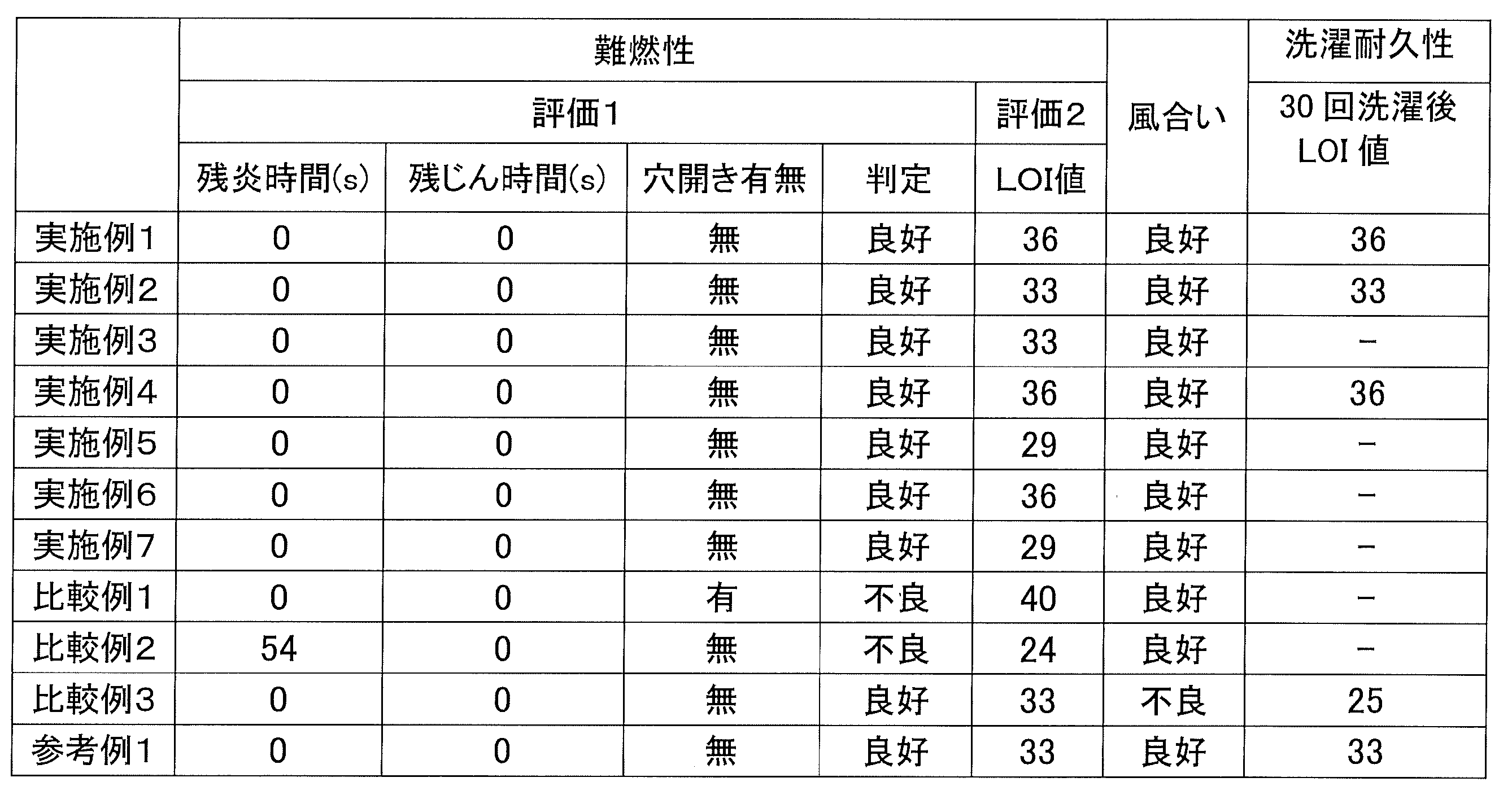
上記表2の結果から、実施例の編物は優れた難燃性を有し、さらに風合いも良好であることが明らかである。難燃剤としてマグネシウム化合物を含むアクリル系繊維を用いた実施例の編物は、難燃剤としてアンチモン化合物を含むアクリル系繊維を用いた参考例1の編物と同様、難燃性が良好であった。また、実施例の編物において、マグネシウム化合物がアクリル系繊維の内部に含まれていることから、洗濯30回後のLOI値は洗濯前と同様であり、洗濯耐久性、すなわち洗濯後の難燃性も良好であった。
一方、セルロース系繊維を含まない比較例1の編物は、ISO 15025:2000 A法に基づいて燃焼性試験にて穴開きが発生し、難燃性(より具体的には炎遮蔽性)が不良であった。
アクリル系繊維の含有量及びマグネシウム化合物の含有量が少ない比較例2の編物は、ISO 15025:2000 A法に基づいて燃焼性試験にて残炎時価が54秒であり、難燃性(より具体的には炎遮蔽性)が不良であった。また、JIS L 1091 E法(E-1号):1999に基づいた方法にて測定した限界酸素指数(LOI)も24しかなく、難燃性が不良であった。
アクリル系繊維及びマグネシウム化合物を含まない比較例3の編物は、難燃剤であるリン系化合物を含むことから難燃性は良好であるが、リン系化合物が布帛(繊維)に付着していることから、風合いが不良であった。また、リン系化合物が繊維に付着しており、繊維内部に含まれていないことから、洗濯30回後のLOI値が洗濯前に比べ格段に低下し、洗濯耐久性、すなわち洗濯後の難燃性が劣っていた。
アクリル系繊維の含有量及びマグネシウム化合物の含有量が少ない比較例2の編物は、ISO 15025:2000 A法に基づいて燃焼性試験にて残炎時価が54秒であり、難燃性(より具体的には炎遮蔽性)が不良であった。また、JIS L 1091 E法(E-1号):1999に基づいた方法にて測定した限界酸素指数(LOI)も24しかなく、難燃性が不良であった。
アクリル系繊維及びマグネシウム化合物を含まない比較例3の編物は、難燃剤であるリン系化合物を含むことから難燃性は良好であるが、リン系化合物が布帛(繊維)に付着していることから、風合いが不良であった。また、リン系化合物が繊維に付着しており、繊維内部に含まれていないことから、洗濯30回後のLOI値が洗濯前に比べ格段に低下し、洗濯耐久性、すなわち洗濯後の難燃性が劣っていた。
本発明は、特に限定されないが、好適には下記の実施形態を含む。
[1] アクリル系繊維及びセルロース系繊維を含む難燃性布帛であって、
前記セルロース系繊維は、再生セルロース系繊維及び天然セルロース系繊維からなる群から選ばれる1以上であり、
前記難燃性布帛は、布帛全体重量に対して、前記アクリル系繊維を65~90重量%、及び前記セルロース系繊維を10~35重量%を含み、
前記アクリル系繊維は、繊維内部にマグネシウム化合物を含み、
前記難燃性布帛には、布帛全体重量に対して、マグネシウム化合物が2.5~4.5重量%含まれ、
前記難燃性布帛は、ISO 15025:2000に基づいた燃焼性試験によって測定した、残炎時間が2秒以下、かつ残じん時間が2秒以下である、難燃性布帛。
[2] 前記アクリル系繊維は、アクリロニトリルを30~85重量%、ハロゲン含有ビニル単量体及びハロゲン含有ビニリデン単量体からなる群から選ばれる1以上のハロゲン含有単量体15~65重量%、及びスルホン酸基含有ビニル単量体を0~3重量%含有するアクリロニトリル系共重合体を含む、[1]に記載の難燃性布帛。
[3] 前記アクリル系繊維は、繊維内部にマグネシウム化合物を2.8~6.9重量%含む、[1]又は[2]に記載の難燃性布帛。
[4] 前記再生セルロース系繊維は、レーヨン繊維、難燃レーヨン繊維、リヨセル繊維及び難燃リヨセル繊維からなる群から選ばれる1以上である、[1]~[3]のいずれかに記載の難燃性布帛。
[5] 前記難燃性布帛は、布帛全体重量に対して、前記アクリル系繊維を65~90重量%、前記再生セルロース系繊維10~35重量%含む、[1]~[4]のいずれかに記載の難燃性布帛。
[6] 前記難燃性布帛は、布帛全体重量に対して、前記アクリル系繊維を65~90重量%、前記再生セルロース系繊維を10~35重量%、及び他の繊維を0~10重量%含む、[1]~[4]のいずれかに記載の難燃性布帛。
[7] 前記再生セルロース系繊維は、リヨセル繊維及び難燃リヨセル繊維からなる群から選ばれる1以上である、[5]又は[6]に記載の難燃性布帛。
[8] 前記難燃性布帛は、布帛全体重量に対して、前記アクリル系繊維を80~90重量%、前記天然セルロース繊維を10~20重量%含む、[1]~[4]のいずれかに記載の難燃性布帛。
[9] 前記難燃性布帛は、布帛全体重量に対して、前記アクリル系繊維を70~90重量%、前記天然セルロース繊維を10~20重量%、及び他の繊維を0~10重量%含む、[1]~[4]のいずれかに記載の難燃性布帛。
[10] 前記他の繊維は、金属繊維、金属メッキ繊維、銅化合物被覆繊維、導電物質添加繊維、メタアラミド繊維、ポリオキサジアゾール繊維、ポリイミド繊維、ポリアミドイミド繊維、ナイロン繊維、ポリエステル繊維、パラアラミド繊維、及びポリアリレート繊維からなる群から選ばれる1以上であり、好ましくはメタアラミド繊維である、[6]又は[9]に記載の難燃性布帛。
[11] 前記難燃性布帛は、前記アクリル系繊維、前記再生セルロース系繊維及び前記天然セルロース繊維を含み、前記再生セルロース系繊維及び前記天然セルロース繊維の重量比は、再生セルロース系繊維:天然セルロース繊維=1:2~3:1である、[1]~[4]のいずれかに記載の難燃性布帛。
[12] 前記アクリル系繊維は原液着色繊維である、[1]~[11]のいずれかに記載の難燃性布帛。
[13] 前記マグネシウム化合物は、酸化マグネシウム及び水酸化マグネシウムからなる群から選ばれる1以上を含む、[1]~[12]のいずれかに記載の難燃性布帛。
[14] 編物である、[1]~[13]のいずれかに記載の難燃性布帛。
[15] [1]~[14]のいずれかに記載の難燃性布帛を用いた作業服。
[1] アクリル系繊維及びセルロース系繊維を含む難燃性布帛であって、
前記セルロース系繊維は、再生セルロース系繊維及び天然セルロース系繊維からなる群から選ばれる1以上であり、
前記難燃性布帛は、布帛全体重量に対して、前記アクリル系繊維を65~90重量%、及び前記セルロース系繊維を10~35重量%を含み、
前記アクリル系繊維は、繊維内部にマグネシウム化合物を含み、
前記難燃性布帛には、布帛全体重量に対して、マグネシウム化合物が2.5~4.5重量%含まれ、
前記難燃性布帛は、ISO 15025:2000に基づいた燃焼性試験によって測定した、残炎時間が2秒以下、かつ残じん時間が2秒以下である、難燃性布帛。
[2] 前記アクリル系繊維は、アクリロニトリルを30~85重量%、ハロゲン含有ビニル単量体及びハロゲン含有ビニリデン単量体からなる群から選ばれる1以上のハロゲン含有単量体15~65重量%、及びスルホン酸基含有ビニル単量体を0~3重量%含有するアクリロニトリル系共重合体を含む、[1]に記載の難燃性布帛。
[3] 前記アクリル系繊維は、繊維内部にマグネシウム化合物を2.8~6.9重量%含む、[1]又は[2]に記載の難燃性布帛。
[4] 前記再生セルロース系繊維は、レーヨン繊維、難燃レーヨン繊維、リヨセル繊維及び難燃リヨセル繊維からなる群から選ばれる1以上である、[1]~[3]のいずれかに記載の難燃性布帛。
[5] 前記難燃性布帛は、布帛全体重量に対して、前記アクリル系繊維を65~90重量%、前記再生セルロース系繊維10~35重量%含む、[1]~[4]のいずれかに記載の難燃性布帛。
[6] 前記難燃性布帛は、布帛全体重量に対して、前記アクリル系繊維を65~90重量%、前記再生セルロース系繊維を10~35重量%、及び他の繊維を0~10重量%含む、[1]~[4]のいずれかに記載の難燃性布帛。
[7] 前記再生セルロース系繊維は、リヨセル繊維及び難燃リヨセル繊維からなる群から選ばれる1以上である、[5]又は[6]に記載の難燃性布帛。
[8] 前記難燃性布帛は、布帛全体重量に対して、前記アクリル系繊維を80~90重量%、前記天然セルロース繊維を10~20重量%含む、[1]~[4]のいずれかに記載の難燃性布帛。
[9] 前記難燃性布帛は、布帛全体重量に対して、前記アクリル系繊維を70~90重量%、前記天然セルロース繊維を10~20重量%、及び他の繊維を0~10重量%含む、[1]~[4]のいずれかに記載の難燃性布帛。
[10] 前記他の繊維は、金属繊維、金属メッキ繊維、銅化合物被覆繊維、導電物質添加繊維、メタアラミド繊維、ポリオキサジアゾール繊維、ポリイミド繊維、ポリアミドイミド繊維、ナイロン繊維、ポリエステル繊維、パラアラミド繊維、及びポリアリレート繊維からなる群から選ばれる1以上であり、好ましくはメタアラミド繊維である、[6]又は[9]に記載の難燃性布帛。
[11] 前記難燃性布帛は、前記アクリル系繊維、前記再生セルロース系繊維及び前記天然セルロース繊維を含み、前記再生セルロース系繊維及び前記天然セルロース繊維の重量比は、再生セルロース系繊維:天然セルロース繊維=1:2~3:1である、[1]~[4]のいずれかに記載の難燃性布帛。
[12] 前記アクリル系繊維は原液着色繊維である、[1]~[11]のいずれかに記載の難燃性布帛。
[13] 前記マグネシウム化合物は、酸化マグネシウム及び水酸化マグネシウムからなる群から選ばれる1以上を含む、[1]~[12]のいずれかに記載の難燃性布帛。
[14] 編物である、[1]~[13]のいずれかに記載の難燃性布帛。
[15] [1]~[14]のいずれかに記載の難燃性布帛を用いた作業服。
Claims (15)
- アクリル系繊維及びセルロース系繊維を含む難燃性布帛であって、
前記セルロース系繊維は、再生セルロース系繊維及び天然セルロース系繊維からなる群から選ばれる1以上であり、
前記難燃性布帛は、布帛全体重量に対して、前記アクリル系繊維を65~90重量%、及び前記セルロース系繊維を10~35重量%を含み、
前記アクリル系繊維は、繊維内部にマグネシウム化合物を含み、
前記難燃性布帛には、布帛全体重量に対して、マグネシウム化合物が2.5~4.5重量%含まれ、
前記難燃性布帛は、ISO 15025:2000に基づいた燃焼性試験によって測定した、残炎時間が2秒以下、かつ残じん時間が2秒以下である、難燃性布帛。 - 前記アクリル系繊維は、アクリロニトリルを30~85重量%、ハロゲン含有ビニル単量体及びハロゲン含有ビニリデン単量体からなる群から選ばれる1以上のハロゲン含有単量体15~65重量%、及びスルホン酸基含有ビニル単量体を0~3重量%含有するアクリロニトリル系共重合体を含む、請求項1に記載の難燃性布帛。
- 前記アクリル系繊維は、繊維内部にマグネシウム化合物を2.8~6.9重量%含む、請求項1又は2に記載の難燃性布帛。
- 前記再生セルロース系繊維は、レーヨン繊維、難燃レーヨン繊維、リヨセル繊維及び難燃リヨセル繊維からなる群から選ばれる1以上である、請求項1~3のいずれかに記載の難燃性布帛。
- 前記難燃性布帛は、布帛全体重量に対して、前記アクリル系繊維を65~90重量%、前記再生セルロース系繊維10~35重量%含む、請求項1~4のいずれかに記載の難燃性布帛。
- 前記難燃性布帛は、布帛全体重量に対して、前記アクリル系繊維を65~90重量%、前記再生セルロース系繊維を10~35重量%、及び他の繊維を0~10重量%含む、請求項1~4のいずれかに記載の難燃性布帛。
- 前記再生セルロース系繊維は、リヨセル繊維及び難燃リヨセル繊維からなる群から選ばれる1以上である、請求項5又は6に記載の難燃性布帛。
- 前記難燃性布帛は、布帛全体重量に対して、前記アクリル系繊維を80~90重量%、前記天然セルロース繊維を10~20重量%含む、請求項1~4のいずれかに記載の難燃性布帛。
- 前記難燃性布帛は、布帛全体重量に対して、前記アクリル系繊維を70~90重量%、前記天然セルロース繊維を10~20重量%、及び他の繊維を0~10重量%含む、請求項1~4のいずれかに記載の難燃性布帛。
- 前記他の繊維は、金属繊維、金属メッキ繊維、銅化合物被覆繊維、導電物質添加繊維、メタアラミド繊維、ポリオキサジアゾール繊維、ポリイミド繊維、ポリアミドイミド繊維、ナイロン繊維、ポリエステル繊維、パラアラミド繊維、及びポリアリレート繊維からなる群から選ばれる1以上である、請求項6又は9に記載の難燃性布帛。
- 前記難燃性布帛は、前記アクリル系繊維、前記再生セルロース系繊維及び前記天然セルロース繊維を含み、前記再生セルロース系繊維及び前記天然セルロース繊維の重量比は、再生セルロース系繊維:天然セルロース繊維=1:2~3:1である、請求項1~4のいずれかに記載の難燃性布帛。
- 前記アクリル系繊維は原液着色繊維である、請求項1~11のいずれかに記載の難燃性布帛。
- 前記マグネシウム化合物は、酸化マグネシウム及び水酸化マグネシウムからなる群から選ばれる1以上を含む、請求項1~12のいずれかに記載の難燃性布帛。
- 編物である、請求項1~13のいずれかに記載の難燃性布帛。
- 請求項1~14のいずれかに記載の難燃性布帛を用いた作業服。
Priority Applications (2)
| Application Number | Priority Date | Filing Date | Title |
|---|---|---|---|
| CN202280031875.0A CN117222786B (zh) | 2021-06-04 | 2022-05-27 | 阻燃性布帛及采用其的工作服 |
| US18/517,287 US12378700B2 (en) | 2021-06-04 | 2023-11-22 | Flame-retardant fabric and work clothing using the same |
Applications Claiming Priority (2)
| Application Number | Priority Date | Filing Date | Title |
|---|---|---|---|
| JP2021-094197 | 2021-06-04 | ||
| JP2021094197A JP2024102391A (ja) | 2021-06-04 | 2021-06-04 | 難燃性布帛及びそれを用いた作業服 |
Related Child Applications (1)
| Application Number | Title | Priority Date | Filing Date |
|---|---|---|---|
| US18/517,287 Continuation US12378700B2 (en) | 2021-06-04 | 2023-11-22 | Flame-retardant fabric and work clothing using the same |
Publications (1)
| Publication Number | Publication Date |
|---|---|
| WO2022255255A1 true WO2022255255A1 (ja) | 2022-12-08 |
Family
ID=84324146
Family Applications (1)
| Application Number | Title | Priority Date | Filing Date |
|---|---|---|---|
| PCT/JP2022/021768 Ceased WO2022255255A1 (ja) | 2021-06-04 | 2022-05-27 | 難燃性布帛及びそれを用いた作業服 |
Country Status (4)
| Country | Link |
|---|---|
| US (1) | US12378700B2 (ja) |
| JP (1) | JP2024102391A (ja) |
| CN (1) | CN117222786B (ja) |
| WO (1) | WO2022255255A1 (ja) |
Cited By (4)
| Publication number | Priority date | Publication date | Assignee | Title |
|---|---|---|---|---|
| CN116446198A (zh) * | 2023-03-27 | 2023-07-18 | 武汉纺织大学 | 一种提高聚芳酯纤维染色色深的方法 |
| WO2024171804A1 (ja) * | 2023-02-15 | 2024-08-22 | 株式会社カネカ | 難燃性布帛、及びそれを含む難燃性作業服 |
| WO2024185346A1 (ja) * | 2023-03-08 | 2024-09-12 | 株式会社カネカ | モダクリル繊維、それを含む難燃性繊維集合体及びその製造方法 |
| WO2024185345A1 (ja) * | 2023-03-07 | 2024-09-12 | 株式会社カネカ | モダクリル繊維、及びそれを含む難燃性繊維集合体 |
Citations (6)
| Publication number | Priority date | Publication date | Assignee | Title |
|---|---|---|---|---|
| JPH1121769A (ja) * | 1997-05-08 | 1999-01-26 | Kanegafuchi Chem Ind Co Ltd | 獣毛様風合を有するアクリル系合成繊維 |
| WO2006043663A1 (ja) * | 2004-10-22 | 2006-04-27 | Kaneka Corporation | 難燃性マットレス |
| JP2009133036A (ja) * | 2007-11-30 | 2009-06-18 | Toyobo Co Ltd | 保温性に優れる編物 |
| JP2013104058A (ja) * | 2011-11-14 | 2013-05-30 | Touki Corp | 粉状難燃剤組成物 |
| CN111850726A (zh) * | 2020-08-06 | 2020-10-30 | 北京富乐喜科技有限公司 | 一种利用富勒烯制备抗菌型纤维布料的方法 |
| WO2021049200A1 (ja) * | 2019-09-10 | 2021-03-18 | 株式会社カネカ | 難燃性繊維複合体及び難燃性作業服 |
Family Cites Families (5)
| Publication number | Priority date | Publication date | Assignee | Title |
|---|---|---|---|---|
| JP4308820B2 (ja) * | 2003-04-28 | 2009-08-05 | 株式会社カネカ | 難燃繊維複合体およびそれを用いて製造した布帛 |
| US7858542B2 (en) | 2004-10-22 | 2010-12-28 | Kaneka Corporation | Flame-retardant mattress |
| JP2007105403A (ja) * | 2005-10-17 | 2007-04-26 | Kaneka Corp | 難燃性不織布およびそれを用いた難燃性マットレス |
| GB0813401D0 (en) | 2008-07-22 | 2008-08-27 | Waxman Fibres Ltd | Flame resistant fibre blends |
| US20130212790A1 (en) | 2008-07-22 | 2013-08-22 | Richard Waxman | Flame resistant blends |
-
2021
- 2021-06-04 JP JP2021094197A patent/JP2024102391A/ja active Pending
-
2022
- 2022-05-27 CN CN202280031875.0A patent/CN117222786B/zh active Active
- 2022-05-27 WO PCT/JP2022/021768 patent/WO2022255255A1/ja not_active Ceased
-
2023
- 2023-11-22 US US18/517,287 patent/US12378700B2/en active Active
Patent Citations (6)
| Publication number | Priority date | Publication date | Assignee | Title |
|---|---|---|---|---|
| JPH1121769A (ja) * | 1997-05-08 | 1999-01-26 | Kanegafuchi Chem Ind Co Ltd | 獣毛様風合を有するアクリル系合成繊維 |
| WO2006043663A1 (ja) * | 2004-10-22 | 2006-04-27 | Kaneka Corporation | 難燃性マットレス |
| JP2009133036A (ja) * | 2007-11-30 | 2009-06-18 | Toyobo Co Ltd | 保温性に優れる編物 |
| JP2013104058A (ja) * | 2011-11-14 | 2013-05-30 | Touki Corp | 粉状難燃剤組成物 |
| WO2021049200A1 (ja) * | 2019-09-10 | 2021-03-18 | 株式会社カネカ | 難燃性繊維複合体及び難燃性作業服 |
| CN111850726A (zh) * | 2020-08-06 | 2020-10-30 | 北京富乐喜科技有限公司 | 一种利用富勒烯制备抗菌型纤维布料的方法 |
Cited By (4)
| Publication number | Priority date | Publication date | Assignee | Title |
|---|---|---|---|---|
| WO2024171804A1 (ja) * | 2023-02-15 | 2024-08-22 | 株式会社カネカ | 難燃性布帛、及びそれを含む難燃性作業服 |
| WO2024185345A1 (ja) * | 2023-03-07 | 2024-09-12 | 株式会社カネカ | モダクリル繊維、及びそれを含む難燃性繊維集合体 |
| WO2024185346A1 (ja) * | 2023-03-08 | 2024-09-12 | 株式会社カネカ | モダクリル繊維、それを含む難燃性繊維集合体及びその製造方法 |
| CN116446198A (zh) * | 2023-03-27 | 2023-07-18 | 武汉纺织大学 | 一种提高聚芳酯纤维染色色深的方法 |
Also Published As
| Publication number | Publication date |
|---|---|
| US20240102206A1 (en) | 2024-03-28 |
| JP2024102391A (ja) | 2024-07-31 |
| CN117222786B (zh) | 2026-04-03 |
| US12378700B2 (en) | 2025-08-05 |
| CN117222786A (zh) | 2023-12-12 |
Similar Documents
| Publication | Publication Date | Title |
|---|---|---|
| CN117222786B (zh) | 阻燃性布帛及采用其的工作服 | |
| EP3425093B1 (en) | Fabric for electric-arc protective clothing, and electric-arc protective clothing | |
| JP4958359B2 (ja) | 難燃性交織織物 | |
| JP5979796B2 (ja) | アーク防護性に優れた水分率の高い糸、布帛および衣服 | |
| TWI512154B (zh) | Halogen-containing flame retardant fibers and methods for their manufacture and flame retardant fiber products using the same | |
| JPH0578936A (ja) | 難燃繊維複合体 | |
| WO2023053802A1 (ja) | 難燃性布張り家具 | |
| CN1653219B (zh) | 防火混纺织物 | |
| CN1653220A (zh) | 高防火混纺织物 | |
| WO2024171804A1 (ja) | 難燃性布帛、及びそれを含む難燃性作業服 | |
| WO2023171288A1 (ja) | 難燃性アクリル系繊維、その製造方法、並びにそれを含む難燃性繊維集合体及び難燃性作業服 | |
| JP7621369B2 (ja) | 難燃性布帛及びそれを用いた防護服 | |
| JPH08226031A (ja) | 難燃性と強力および耐摩耗性に優れた複合繊維糸ならびに布帛 | |
| WO2024004692A1 (ja) | 難燃性布帛及び作業服 | |
| JP3004107B2 (ja) | 難燃繊維複合体 | |
| WO2026048600A1 (ja) | モダクリル繊維、及びその製造方法 | |
| WO2022118413A1 (ja) | 難燃性布帛及びそれを用いた防護服 | |
| WO2024185346A1 (ja) | モダクリル繊維、それを含む難燃性繊維集合体及びその製造方法 | |
| WO2023171286A1 (ja) | 難燃性布帛及び難燃性作業服 | |
| JP2593988B2 (ja) | 衣料用繊維製品 | |
| WO2025088928A1 (ja) | 耐アーク防護服用生地、及びそれを含む耐アーク防護服 | |
| JPH07252735A (ja) | 難燃繊維複合体 | |
| JPH0921029A (ja) | 難燃繊維複合体 |
Legal Events
| Date | Code | Title | Description |
|---|---|---|---|
| 121 | Ep: the epo has been informed by wipo that ep was designated in this application |
Ref document number: 22816005 Country of ref document: EP Kind code of ref document: A1 |
|
| WWE | Wipo information: entry into national phase |
Ref document number: 202280031875.0 Country of ref document: CN |
|
| NENP | Non-entry into the national phase |
Ref country code: DE |
|
| 122 | Ep: pct application non-entry in european phase |
Ref document number: 22816005 Country of ref document: EP Kind code of ref document: A1 |
|
| NENP | Non-entry into the national phase |
Ref country code: JP |