WO2022244348A1 - 核酸分析システム - Google Patents
核酸分析システム Download PDFInfo
- Publication number
- WO2022244348A1 WO2022244348A1 PCT/JP2022/005951 JP2022005951W WO2022244348A1 WO 2022244348 A1 WO2022244348 A1 WO 2022244348A1 JP 2022005951 W JP2022005951 W JP 2022005951W WO 2022244348 A1 WO2022244348 A1 WO 2022244348A1
- Authority
- WO
- WIPO (PCT)
- Prior art keywords
- nucleic acid
- amplification reaction
- acid amplification
- control unit
- analysis system
- Prior art date
- Legal status (The legal status is an assumption and is not a legal conclusion. Google has not performed a legal analysis and makes no representation as to the accuracy of the status listed.)
- Ceased
Links
Images









Classifications
-
- C—CHEMISTRY; METALLURGY
- C12—BIOCHEMISTRY; BEER; SPIRITS; WINE; VINEGAR; MICROBIOLOGY; ENZYMOLOGY; MUTATION OR GENETIC ENGINEERING
- C12Q—MEASURING OR TESTING PROCESSES INVOLVING ENZYMES, NUCLEIC ACIDS OR MICROORGANISMS; COMPOSITIONS OR TEST PAPERS THEREFOR; PROCESSES OF PREPARING SUCH COMPOSITIONS; CONDITION-RESPONSIVE CONTROL IN MICROBIOLOGICAL OR ENZYMOLOGICAL PROCESSES
- C12Q1/00—Measuring or testing processes involving enzymes, nucleic acids or microorganisms; Compositions therefor; Processes of preparing such compositions
- C12Q1/68—Measuring or testing processes involving enzymes, nucleic acids or microorganisms; Compositions therefor; Processes of preparing such compositions involving nucleic acids
- C12Q1/6844—Nucleic acid amplification reactions
- C12Q1/6851—Quantitative amplification
-
- B—PERFORMING OPERATIONS; TRANSPORTING
- B01—PHYSICAL OR CHEMICAL PROCESSES OR APPARATUS IN GENERAL
- B01L—CHEMICAL OR PHYSICAL LABORATORY APPARATUS FOR GENERAL USE
- B01L7/00—Heating or cooling apparatus; Heat insulating devices
- B01L7/52—Heating or cooling apparatus; Heat insulating devices with provision for submitting samples to a predetermined sequence of different temperatures, e.g. for treating nucleic acid samples
-
- C—CHEMISTRY; METALLURGY
- C12—BIOCHEMISTRY; BEER; SPIRITS; WINE; VINEGAR; MICROBIOLOGY; ENZYMOLOGY; MUTATION OR GENETIC ENGINEERING
- C12M—APPARATUS FOR ENZYMOLOGY OR MICROBIOLOGY; APPARATUS FOR CULTURING MICROORGANISMS FOR PRODUCING BIOMASS, FOR GROWING CELLS OR FOR OBTAINING FERMENTATION OR METABOLIC PRODUCTS, i.e. BIOREACTORS OR FERMENTERS
- C12M1/00—Apparatus for enzymology or microbiology
-
- C—CHEMISTRY; METALLURGY
- C12—BIOCHEMISTRY; BEER; SPIRITS; WINE; VINEGAR; MICROBIOLOGY; ENZYMOLOGY; MUTATION OR GENETIC ENGINEERING
- C12Q—MEASURING OR TESTING PROCESSES INVOLVING ENZYMES, NUCLEIC ACIDS OR MICROORGANISMS; COMPOSITIONS OR TEST PAPERS THEREFOR; PROCESSES OF PREPARING SUCH COMPOSITIONS; CONDITION-RESPONSIVE CONTROL IN MICROBIOLOGICAL OR ENZYMOLOGICAL PROCESSES
- C12Q1/00—Measuring or testing processes involving enzymes, nucleic acids or microorganisms; Compositions therefor; Processes of preparing such compositions
- C12Q1/68—Measuring or testing processes involving enzymes, nucleic acids or microorganisms; Compositions therefor; Processes of preparing such compositions involving nucleic acids
-
- C—CHEMISTRY; METALLURGY
- C12—BIOCHEMISTRY; BEER; SPIRITS; WINE; VINEGAR; MICROBIOLOGY; ENZYMOLOGY; MUTATION OR GENETIC ENGINEERING
- C12Q—MEASURING OR TESTING PROCESSES INVOLVING ENZYMES, NUCLEIC ACIDS OR MICROORGANISMS; COMPOSITIONS OR TEST PAPERS THEREFOR; PROCESSES OF PREPARING SUCH COMPOSITIONS; CONDITION-RESPONSIVE CONTROL IN MICROBIOLOGICAL OR ENZYMOLOGICAL PROCESSES
- C12Q1/00—Measuring or testing processes involving enzymes, nucleic acids or microorganisms; Compositions therefor; Processes of preparing such compositions
- C12Q1/68—Measuring or testing processes involving enzymes, nucleic acids or microorganisms; Compositions therefor; Processes of preparing such compositions involving nucleic acids
- C12Q1/6844—Nucleic acid amplification reactions
-
- B—PERFORMING OPERATIONS; TRANSPORTING
- B01—PHYSICAL OR CHEMICAL PROCESSES OR APPARATUS IN GENERAL
- B01L—CHEMICAL OR PHYSICAL LABORATORY APPARATUS FOR GENERAL USE
- B01L2200/00—Solutions for specific problems relating to chemical or physical laboratory apparatus
- B01L2200/14—Process control and prevention of errors
Definitions
- This disclosure relates to a nucleic acid analysis system.
- Nucleic acid amplification processing is performed to analyze nucleic acids contained in biological samples. Nucleic acid amplification procedures are sometimes performed to test for infection by pathogens such as viruses or bacteria. For example, the presence of pathogen-derived nucleic acids in biological samples such as nasal or pharyngeal swabs or saliva is determined by detecting the fluorescent signal produced in the nucleic acid amplification process.
- Patent Document 1 discloses a microchip in which a region into which a solution is introduced is disposed under a negative pressure with respect to the atmospheric pressure.
- Patent Document 2 discloses a microchip comprising a plurality of substrate layers and a bonding layer made of a silicon compound provided at the interface between the substrate layers, wherein at least one of the bonding layers is made of an organic silicon compound. is disclosed.
- Patent Document 3 describes a nucleic acid amplification procedure for obtaining an amplification product by a nucleic acid amplification reaction, a turbidity measurement procedure for measuring the turbidity of the reaction solution of the nucleic acid amplification reaction, and the nucleic acid amplification reaction. and a melting curve analysis procedure for performing a melting curve analysis of the probe nucleic acid strand and the amplification product in the reaction field of .
- JP 2011-163984 A WO2014/010299 JP 2014-082987 A
- a nucleic acid detection method that performs nucleic acid amplification processing is used to detect pathogenic viruses such as the new coronavirus (SARS-CoV2) and influenza virus.
- SARS-CoV2 new coronavirus
- Nucleic acid detection methods currently in use have achieved a certain degree of high test accuracy, but misjudgments still occur in some cases. In particular, misjudgment may occur when the number of copies of the target nucleic acid contained in the specimen is low or when the specimen contains a large amount of impurities. Therefore, an object of the present disclosure is to improve the test accuracy of a nucleic acid detection method.
- the present inventors have found that a nucleic acid analysis system having a specific configuration can improve the test accuracy of nucleic acid detection methods.
- the present disclosure an amplification reaction execution unit that executes a nucleic acid amplification reaction on a biological sample; and A control unit that controls the amplification reaction execution unit, The control unit Determining whether to adjust the nucleic acid amplification reaction based on the detection results of the nucleic acid amplification reaction in one or more positive controls, and configured to generate a determination result for the biological sample based on the one or more positive controls and a detection result of a nucleic acid amplification reaction in the biological sample; A nucleic acid analysis system is provided.
- the control unit generating reference data for determination based on the detection results of the nucleic acid amplification reaction in the one or more positive controls; and Whether to adjust the nucleic acid amplification reaction can be determined based on the reference data for determination.
- the controller can determine whether to adjust the nucleic acid amplification reaction based on the determination reference data and the standard reference data.
- the controller can determine whether to adjust the nucleic acid amplification reaction based on the Tt value or Ct value of the nucleic acid amplification reaction in the one or more positive controls.
- the controller can use a trained model to determine whether to adjust the nucleic acid amplification reaction.
- the control section may adjust the reaction time or the number of reaction cycles of the nucleic acid amplification reaction in adjusting the nucleic acid amplification reaction.
- the control unit can determine that the nucleic acid amplification reaction for the biological sample is invalid when the reference data for determination cannot be generated.
- the control unit can execute a determination result generation process for generating a determination result for the biological sample in response to determining that the nucleic acid amplification reaction is not adjusted.
- the determination result generating process the control unit can determine whether a target nucleic acid is detected in the biological sample.
- the control unit may further execute an incorrect answer judgment process for judging whether the judgment result regarding whether the target nucleic acid is detected in the biological sample is an incorrect answer.
- the control unit can execute the incorrect answer determination process when the detection result of the nucleic acid amplification reaction in the biological sample does not satisfy a predetermined condition.
- the control unit can refer to the detection result of the nucleic acid amplification reaction in the negative sample in the incorrect answer determination process.
- the detection result of the nucleic acid amplification reaction on the negative sample may include the detection result of the nucleic acid amplification reaction performed on another negatively determined sample.
- the control unit can use a trained model to perform the incorrect answer determination process.
- the control unit can output notification data regarding false positive based on the determination result in the incorrect answer determination process.
- the control unit can output a screen regarding whether to perform additional analysis for generating a determination result for the biological sample, based on the determination result in the incorrect answer determination process.
- the nucleic acid analysis system comprises a nucleic acid amplification device comprising the amplification reaction execution unit; an information processing device comprising the control unit; may contain
- the nucleic acid analysis system comprises a nucleic acid amplification device comprising the amplification reaction execution unit; a server device comprising the control unit; may contain
- This disclosure also provides including a control unit that controls a nucleic acid amplification reaction for a biological sample, The control unit Determining whether to adjust the nucleic acid amplification reaction based on the detection results of the nucleic acid amplification reaction in one or more positive controls, and configured to generate a determination result for the biological sample based on the one or more positive controls and a detection result of a nucleic acid amplification reaction in the biological sample;
- a nucleic acid analysis system is also provided.
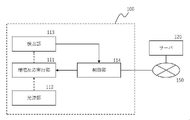
- FIG. 1 is a diagram showing a configuration example of a nucleic acid analysis system according to the present disclosure
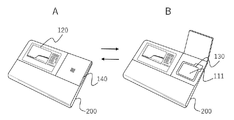
- FIG. FIG. 2 is a diagram showing another configuration example of a nucleic acid analysis system according to the present disclosure
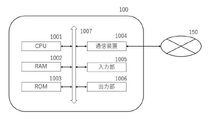
- FIG. It is a figure which shows the structural example of a nucleic acid amplification apparatus. It is a figure which shows the structural example of a control part.
- 1 is a schematic diagram of an example chip
- FIG. FIG. 4 is a diagram for explaining allocation of wells
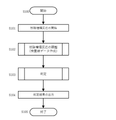
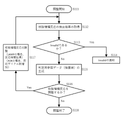
- 4 is an example of a flow diagram of processing executed by the nucleic acid analysis system
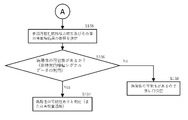
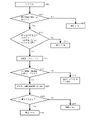
- FIG. FIG. 10 is an example of a flow diagram of adjustment processing for a nucleic acid amplification reaction. It is an example of a flow chart of determination processing.
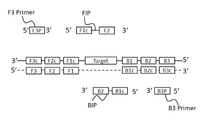
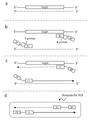
- FIG. 2 is a schematic diagram for explaining primers used in the LAMP method. It is a schematic diagram for demonstrating reaction in LAMP method. It is a schematic diagram for demonstrating reaction in LAMP method.
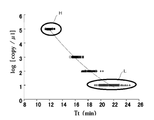
- FIG. 4 is a diagram for explaining primers used in PCR. FIG. 4 is a diagram for explaining variations in Tt values;
- FIG. 10 is a diagram for explaining setting of thresholds;
- FIG. 10 is a diagram for explaining setting of thresholds;
- First Embodiment Nucleic Acid Analysis System (1) Description of First Embodiment (2) Example of Nucleic Acid Analysis System (2-1) Amplification Reaction Execution Unit (2-2) Light Source Unit (2-3) Detection Unit (2-4) Control Unit (2) -5) Container (2-5-1) Example of primer used in LAMP method (2-5-2) Example of primer used in PCR (3) Example of processing performed by nucleic acid analysis system (3-1) Nucleic Acid Amplification Reaction Adjustment Processing (3-2) Determination Processing (3-3) Modification of Determination Processing (4) First Modification of Nucleic Acid Analysis System (5) Second Modification of Nucleic Acid Analysis System (2)
- the Ct value also called Threshold Cycle, Cq value
- Tt value also called Threshold Time
- the threshold line for determining positive (the target nucleic acid is present in the specimen) is set somewhat high.
- the possibility of being judged as false negative also increases.
- fluorescence intensity increases with increasing cycle number for both high template copy number (labeled H) and low copy number (labeled L).
- Ct2 which is higher than Ct1
- Ct value variations between inspections increase, and cases where the Ct value falls below Ct2 occur randomly. In this way, there are cases where the same specimen is judged to be negative or positive.
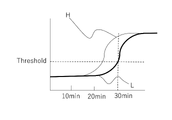
- isothermal nucleic acid amplification As shown in FIG. 19, in both the high template copy number case (labeled H) and the low copy number case (labeled L), as the reaction time for amplification elapses, Although the amount of nucleic acid amplification increases, in the case of a high copy number, an increase in the amount of nucleic acid amplification can be confirmed after 20 minutes have passed, and the amount of nucleic acid amplification exceeds the threshold after 25 minutes have passed. On the other hand, in the case of a low copy number, the amount of nucleic acid amplification exceeds the threshold value in about 30 minutes because of large variations between tests.
- the copy number sensitivity within the range that absorbs the variation is set as the compensation range.
- nucleic acid amplification tests also have the problem that nucleic acid amplification reaction inhibitors contained in the specimen cause a matrix effect.
- nucleic acid amplification tests such as PCR tests and isothermal nucleic acid amplification tests
- samples are pretreated to remove such inhibitors.
- 100% removal of the inhibitor is not possible, so the matrix effect can still affect the test results.
- Matrix effects slow the nucleic acid amplification reaction, ie slow the fluorescence signal rise time, which leads to fluctuations in Ct or Tt values.
- a spike sample In order to eliminate the influence of the matrix effect, it is conceivable to use a spike sample (Internal Control). For example, it is conceivable to prepare a plurality of (for example, three or more) samples for each specimen and add a known amount of standard substance to one of them.
- PCR tests that are actually performed to determine the presence of pathogenic viruses such as the new coronavirus
- nucleic acid amplification tests variations due to pipetting work may occur. Such variations differ from one test to another, and it is difficult to adopt such an accuracy control method for coping with variations in nucleic acid amplification tests in which batch processing is performed.
- copy number sensitivity which is about two orders of magnitude lower than the limit of detection sensitivity (LoD) of the equipment used, may be adopted as the threshold value for identifying positives in nucleic acid amplification tests for pathogenic viruses, for example.
- the threshold value is lowered, the problem of false positives caused by non-specific reaction signals due to self-by-products between primers may occur.
- the nucleic acid analysis system determines whether to adjust the nucleic acid amplification reaction based on the detection results of the nucleic acid amplification reaction in one or more positive controls, and the nucleic acid amplification reaction in the one or more positive controls and the biological sample and a controller configured to generate a determination result for the biological sample based on the detection result of.
- determining whether or not to adjust the nucleic acid amplification reaction it is possible to detect, for example, a delay in the rise of the fluorescence signal due to the matrix effect, and to control the reaction such as extending the nucleic acid amplification reaction time. This makes it possible to create an appropriate calibration curve, and furthermore, to make an appropriate determination based on the created calibration curve.
- the control unit generates determination reference data based on the detection results of the nucleic acid amplification reaction in the one or more positive controls, and determines whether to adjust the nucleic acid amplification reaction based on the determination data.
- the determination reference data is data referred to for determining whether a target nucleic acid is present in a biological sample or for specifying the abundance of the target nucleic acid.
- the control unit determines whether a target nucleic acid is present in the biological sample and/or specifies the abundance of the target nucleic acid based on the detection result of the nucleic acid amplification reaction for the biological sample and the reference data for determination. can be executed.
- the "detection result of nucleic acid amplification reaction” includes detection result data related to signals (especially fluorescence signals) detected when performing nucleic acid amplification reaction.
- the detection result data may be, for example, data that can be output as a plot with the amplification time (in the case of isothermal nucleic acid amplification) or the number of amplification cycles (in the case of PCR) on the horizontal axis and the signal value on the vertical axis.
- positive control refers to a sample known to contain nucleic acids to be amplified when a nucleic acid amplification reaction is performed.
- the nucleic acid may be, for example, a primer used for isothermal nucleic acid amplification or a probe used in a PCR reaction.
- the amount of the nucleic acid contained in the sample may also be known.
- the positive control may refer to wells containing the sample.
- a "negative sample” may be any other sample that tests negative. That is, the "detection result of a nucleic acid amplification reaction in a negative sample” may be the detection result of a nucleic acid amplification reaction performed on another sample that has been judged negative. It may be the detection result of the nucleic acid amplification reaction that is the basis for the detection.
- the "nucleic acid amplification reaction performed on another negatively determined sample” may be a nucleic acid amplification reaction other than the nucleic acid amplification reaction performed on the biological sample to be analyzed. Specifically, it may be another nucleic acid amplification reaction that has already been performed before the nucleic acid amplification reaction performed on the biological sample is started.
- the signal is due to the occurrence of non-specific amplification or the signal is due to fluctuations in the Ct value that can occur in the case of low copy numbers.
- the type of the other nucleic acid amplification reaction is preferably the same as the type of nucleic acid amplification reaction performed on the biological sample.
- the nucleic acid amplification reaction performed on the biological sample is an isothermal nucleic acid amplification reaction (eg, LAMP)
- the other nucleic acid amplification reaction is also an isothermal nucleic acid amplification reaction (eg, LAMP).
- the types of reagents used in the other nucleic acid amplification reaction are preferably the same as the types of reagents used in the nucleic acid amplification reaction performed on the biological sample. It's okay.
- the type of nucleic acid amplification device used to perform the other nucleic acid amplification reaction is preferably also used in the nucleic acid amplification reaction performed on the biological sample. It may be the same as the type of nucleic acid amplification device used. For example, two nucleic acid amplification devices of the same or similar model may be used in the nucleic acid amplification reaction performed on the biological sample and the other nucleic acid amplification reaction, respectively.
- the type of container used for containing the other sample in the other nucleic acid amplification reaction is preferably It may be the same type of container used to contain the biological sample in the amplification reaction.
- chips of the same type and containing the same reagents may be used in these two reactions.
- the other sample and the other nucleic acid amplification reaction may be appropriately selected by a person skilled in the art according to the biological sample and the nucleic acid amplification reaction to be performed on the biological sample.
- the reaction time (in the case of isothermal nucleic acid amplification) or the number of reaction cycles (in the case of PCR) of the other nucleic acid amplification reaction may be different from that of the nucleic acid amplification reaction performed on the biological sample. This is because the reaction time may be adjusted in the analysis using the nucleic acid analysis system of the present disclosure.
- the reference data for judgment preferably includes calibration curve data.
- the calibration curve data may include a formula representing the calibration curve, or may include parameters (eg, one or more coefficients, particularly slope and/or intercept) that make up the formula.
- the control unit may determine whether to adjust the nucleic acid amplification reaction, for example, based on the determination reference data and the standard reference data.
- the standard reference data is standard reference data for determination (in particular, standard calibration curve data), and may be prepared in advance.
- the standard reference data may include, for example, ideal calibration curve data or average calibration curve data generated based on a plurality of determination reference data.
- the control unit compares the determination reference data with the standard reference data to determine whether or not a delay in the nucleic acid amplification reaction (especially a delay in the rise of the fluorescence signal) has occurred due to a matrix effect and the extent of the delay. identified, and may be determined to modulate the nucleic acid amplification reaction.
- the control unit executes determination result generation processing for generating a determination result for the biological sample, and determines whether a target nucleic acid is detected in the biological sample in the determination result generation processing. Executes an incorrect answer determination process for determining whether the determination result of is an incorrect answer.
- the wrong answer determination process may be, for example, a process of determining whether it is a false positive when a positive determination result is obtained, or a negative determination result is obtained. In this case, it may be a process of determining whether it is a false negative.
- control section may be configured to execute the incorrect answer determination process when the detection result of the nucleic acid amplification reaction in the biological sample does not satisfy a predetermined condition.
- the predetermined condition may be set according to, for example, how easily the Ct value or the Tt value varies.
- the predetermined condition may be, for example, a condition that "the amount of target nucleic acid contained in the biological sample is equal to or greater than a predetermined value". When this condition is not satisfied, that is, when the amount of target nucleic acid contained in the biological sample is less than a predetermined value, the controller can execute the incorrect answer determination process.
- the process can be made more efficient by performing the incorrect answer determination process only in such cases. can be done.
- FIG. 1A shows a configuration example of a nucleic acid analysis system according to the present disclosure.
- a nucleic acid analysis system 100 shown in the figure includes an amplification reaction executing section 111 and a control section 114 . Further, when performing nucleic acid analysis by the nucleic acid analysis system, the light source unit 112 that irradiates light toward the sample group to be analyzed and the detection unit 113 that detects light generated in the nucleic acid amplification reaction in the sample group are may be used.
- the amplification reaction execution unit 111 and the control unit 114 may be provided in one nucleic acid amplification device.
- the amplification reaction executing section 111 may be provided in the nucleic acid amplification device, and the control section 114 may be provided in the information processing device.
- the nucleic acid analysis system 100 may be configured to include an amplification reaction execution unit 111, a light source unit 112, a detection unit 113, and a control unit 114, as shown in FIG. 1B. Each of these components is described below.
- the amplification reaction executing section 111 is configured to execute a nucleic acid amplification reaction on a biological sample.
- the amplification reaction executing section 111 may execute temperature control that enables amplification of target nucleic acids that may be contained in the biological sample.
- the nucleic acid amplification reaction may be an isothermal nucleic acid amplification reaction or a PCR (polymerase chain reaction).
- the isothermal nucleic acid amplification reactions include Loop-mediated isothermal amplification (LAMP), Whole Genome Amplification (WGA), Multiple Displacement Amplification (MDA), Strand displacement amplification (SDA), Nicking Endonuclease Amplification Reaction (NEAR), Helicase-dependent amplification ( HDA), Recombinase Polymerase Amplification (RPA), Strand-Invasion Based Amplification (SIBA), Nucleic Acid Sequences Based Amplification (NASBA), and Transcription Mediated Amplification (TMA), especially Loop-mediated isothermal amplification (LAMP).
- Said PCR may in particular be real-time PCR (quantitative PCR).
- the amplification reaction executing section 111 executes temperature control to maintain the temperature of the biological sample at a predetermined temperature.
- the predetermined temperature may be appropriately set by a person skilled in the art according to the type of isothermal amplification reaction.
- the amplification reaction execution unit 111 sets the temperature of the biological sample so that a predetermined cycle (denaturation step, annealing step, and elongation step) is performed a plurality of times. Adjust the temperature of the biological sample so that The temperature of each step included in the cycle may be appropriately selected by those skilled in the art.
- the amplification reaction execution unit 111 may be configured to accommodate, for example, a container containing the biological sample, and may be configured to control the temperature of the biological sample in the container.
- the nucleic acid analysis system 100 may include a nucleic acid amplification device 200 such as those shown in FIGS. 2A and 2B.
- the nucleic acid amplification device 200 includes an amplification reaction execution section 111 , a light source section 112 , a detection section 113 and a control section 114 . That is, in one embodiment of the present disclosure, the nucleic acid analysis system may include a nucleic acid amplification device that includes an amplification reaction executing section 111 and a control section 114 .
- the nucleic acid amplification device may further include a light source section 112 and/or a detection section 113 .
- FIG. 2A shows a state in which the lid 140 of the container housing portion 130 of the apparatus is closed
- FIG. 2B shows a state in which the lid 140 is open.
- the container is accommodated in the container accommodating portion 130, and the lid 140 is closed.
- the amplification reaction execution unit 111 causes the sample group ( Initiate temperature control treatment of the biological sample and one or more positive controls).
- a nucleic acid amplification reaction occurs by the temperature regulation.
- the amplification reaction execution unit 111 includes a temperature control device that controls the temperature of the biological sample in the container.
- the device may be, for example, a transparent conductive film, such as an ITO heater that is light transmissive. Devices known in the art may be employed as temperature control devices.
- the light source unit 112 is configured to irradiate the biological sample with light.
- the light irradiation excites a fluorescent substance for detecting nucleic acid amplification in the biological sample to generate fluorescence.
- the light irradiation excites amplification products in the biological sample, particularly fluorescent substances contained in the amplification products, to generate fluorescence.
- the fluorescence is detected by the detection unit 113 .
- the light source unit 112 includes one or more light sources that irradiate the light.
- the one or more light sources include an excitation light emission light source that emits excitation light for the fluorescent substance.
- the excitation light emitting light source may be, for example, one or more of a laser light source, an LED light source, a mercury lamp, and a tungsten lamp, and these may be used singly or in combination.
- the excitation light emitting light sources are preferably single or plural laser light sources and/or LED light sources.
- the light source unit 112 may include a light source for turbidity measurement that emits light for turbidity measurement in order to perform melting curve analysis, which will be described later.
- the turbidity measurement light source is preferably a light source that emits light with a wavelength that matches the fluorescence wavelength of the fluorescent substance contained in the amplification product or light in a wavelength range that includes the fluorescence wavelength.
- the light source for turbidity measurement may be light in which various wavelengths are mixed, such as emitted from a light source such as a deuterium lamp, a tungsten lamp, a xenon lamp, a mercury lamp, a halogen lamp, etc. Alternatively, it may be a laser light source and/or an LED light source.
- the light for turbidity measurement makes it possible to analyze nucleic acid amplification using turbidity described in Patent Document 3, for example.
- the light source unit 112 may further include a light guide optical system configured to guide the light emitted from the excitation light emission light source to the biological sample.
- the configuration of the light guide optical system may be appropriately designed by those skilled in the art.
- the light guide optical system includes, for example, a light guide member (for example, a light guide plate) into which the light emitted from the light source enters, and various types of optics for advancing the light emitted from the light guide member to the biological sample and condensing the light. Elements (eg, condensing lenses, etc.) may be included.
- the detection unit 113 is configured to detect fluorescence generated from a fluorescent substance for detecting nucleic acid amplification.
- the detection unit 113 may include a photodetector, which may be, for example, an area imaging device such as a CCD or CMOS, a PMT (photomultiplier tube), or a photodiode.
- Light detection for performing melting curve analysis may also be performed by the detection unit 113 configured for fluorescence detection.
- the detection unit 113 may detect scattered light or transmitted light generated by irradiating the biological sample with light from the light source unit 112 .
- the detection unit 113 may further include an optical element for causing light to be detected to reach the photodetector.
- the optical element may be arranged between the biological sample and the photodetector.
- the optical element may be, for example, an optical filter (especially a fluorescence filter) and/or a lens (especially a condensing lens).
- the control unit 114 controls driving of the amplification reaction execution unit 111 , the light source unit 112 and the detection unit 113 .
- the control unit 114 may be configured as a general-purpose computer including, for example, a CPU, memory and hard disk.
- the control unit 114 may be configured to be connectable to the network 150 by wire or wirelessly.
- the control unit 114 may be configured to be able to transmit various data to the server 120 via the network 150 or receive various data from the server 120 via the network 150 .
- the control unit 114 has a CPU (Central Processing Unit) 1001 and a RAM 1002 as shown in FIG.
- the CPU 1001 and RAM 1002 are connected to each other via a bus 1007 and are also connected to other components of the control unit 114 via a bus 1007 .
- the CPU 1001 performs control and/or arithmetic processing executed by the control unit 114 .
- Any processor can be used as the CPU 1001, and examples thereof include Xeon (registered trademark) series, Core (trademark) series, and Atom (trademark) series processors.
- the functions executed by the control unit 114 may be realized by the CPU 1001, for example.
- the RAM 1002 includes, for example, cache memory and main memory, and can temporarily store programs and the like used by the CPU 1001 .
- Control unit 114 may include ROM 1003, communication device 1004, and a drive (not shown). Any of these components may be connected to bus 1007 .
- the ROM 1003 includes an operating system (for example, WINDOWS (registered trademark), UNIX (registered trademark), or LINUX (registered trademark)), which causes a device (nucleic acid amplification device, information processing device, or the like) to execute processing according to the present disclosure. and various other programs, as well as various data (eg, data referred to in this specification such as detection result data and reference data for determination) can be stored.
- the ROM 1003 may be, for example, a semiconductor recording medium such as a flash memory, but is not limited to this.
- the communication device 1004 connects the control unit 114 to the network 150 by wire or wirelessly. Via the communication device 1004 , the control unit 114 can acquire various data (such as video data) via the network 150 . The acquired data can be stored in the ROM 1003, for example. The type of communication device 1004 may be appropriately selected by those skilled in the art.
- the drive can read information recorded on a recording medium and output it to the RAM 1003 .
- the recording medium is, for example, a microSD memory card, an SD memory card, or a flash memory, but is not limited to these.
- the control unit 114 also includes an input unit 1005 and an output unit 1006.
- the input unit 1005 may be configured to receive data input from outside the control unit 114, and its configuration may be appropriately selected by those skilled in the art.
- the output unit 1006 may be configured to output data held by the control unit 114, and may be configured to output data to, for example, a display device or a printing device.
- the output unit 1006 itself may include a display device.
- a nucleic acid amplification device 200 included in a nucleic acid analysis system according to the present disclosure may have display device 120 as output section 1006 .
- the display device 120 displays detection results in the nucleic acid amplification reaction. Further, display device 120 may output determination results generated by information processing according to the present disclosure. Accordingly, the user can easily know the determination result by checking the determination result image displayed by the display device 120 .
- the biological sample may be subjected to a nucleic acid amplification reaction by the amplification reaction executing section 111 while being accommodated in a container such as a chip or well plate.
- the container includes one or more reaction regions in which nucleic acid amplification reactions for one or more positive controls are performed and one or more reaction regions in which nucleic acid amplification reactions for the biological sample are performed.
- the vessel may further include one or more reaction areas in which nucleic acid amplification reactions for one or more negative controls are performed.
- Examples of the container include the microchip described in Patent Document 1 and the microchip described in Patent Document 2. These microchips contain a plurality of wells, and the samples contained in these wells are temperature-controlled to cause a nucleic acid amplification reaction.
- FIG. 1 A chip, which is an example of the container, will be described below with reference to FIG. 4, and the allocation of each reaction area in the chip will be described.
- This figure is a schematic diagram showing the configuration of the chip 1 .
- a of FIG. 1 is a schematic top view, and B of FIG.
- the chip 1 (also referred to as a microchip) shown in FIG.
- Channels 41 to 45 are provided to connect the introduction part 3 and the wells 51 to 55, respectively.
- the five wells supplied with liquid by channel 41 are all described as wells 51, and similarly each of the five wells supplied with liquid by channels 42, 43, 44, and 45 is described as well 51.
- the wells are described as wells 52 , 53 , 54 and 55 .
- the configuration of the microchip is not limited to the number and arrangement of the introduction portion 3, channels 41 to 45, and wells 51 to 55 shown in FIG.
- the microchip includes a plurality of substrate layers and one or more bonding layers made of a silicon compound provided at the interfaces of the substrate layers. At least one of the bonding layers is made of an organic silicon compound.
- the microchip 1 shown in FIG. B comprises, for example, three substrate layers 11 , 12 and 13 .
- Substrate layers 11, 12, and 13 preferably include a non-silicone resin substrate layer and a polydimethylsiloxane substrate layer.
- both surfaces of a substrate layer made of polydimethylsiloxane may be bonded to a substrate layer made of a first non-silicone resin and a substrate layer made of a second non-silicone resin via a bonding layer.
- the substrate layer made of polydimethylsiloxane is referred to as the substrate layer 11, and among the two substrate layers bonded to the substrate layer 11, the "first substrate layer made of non-silicone resin” is referred to as " The substrate layer 12" and the “second substrate layer made of the non-silicone resin” are referred to as the "substrate layer 13".
- the substrate layer 12 has grooves on the bonding surface with the substrate layer 11, and the grooves are the introduction part 3, the channels 41 to 45, and the regions of the wells 51 to 55 into which the biological sample is introduced. corresponds to
- the substrate layer 12 is bonded to the substrate layer 11 via a bonding layer 22b made of a silicon compound.
- the bonding layer 22b may be a bonding layer made of an inorganic silicon compound.
- the substrate layer 13 may have no groove on the bonding surface with the substrate layer 11, and the substrate layer 13 may be bonded with the substrate layer 11 via the bonding layer 22a made of an organic silicon compound.
- the grooves formed in the substrate layer 12 are provided on the bonding surface with the substrate layer 11 . Therefore, the region into which the biological sample is introduced, such as the introduction portion 3 , is not in communication with the outside of the microchip 1 .
- a part of a puncture member such as a needle can pierce the introduction portion 3 from the outside of the microchip 1 through the introduction port 31 formed in the substrate layer 13. be.
- a syringe or the like connected to a needle is filled with a biological sample in advance, and the needle penetrates the substrate layer 11 , so that the biological sample can be introduced into a region such as the introduction portion 3 in the microchip 1 .
- the sealed region is connected only to the inside of the syringe by the puncture by the puncture member, the biological sample can be introduced without air bubbles entering the channels 41 to 45 and the wells 51 to 55. .
- the inside of the chip 1 (that is, wells and channels) may have a negative pressure with respect to the atmospheric pressure.
- the biological sample passes through the channel and reaches each well. Movement of the biological sample may be automatically performed by the negative pressure.
- the substrate layer 11 is made of an elastic material, the self-sealing property of the substrate layer 11 will naturally seal the puncture site when the puncture member is removed from the introduction portion 3 after the liquid is introduced. can.
- the natural sealing of the puncture site of a needle or the like due to elastic deformation of the substrate layer is also referred to as the "self-sealing property" of the substrate layer.
- the substrate layer 11 is preferably made of a self-sealing material.
- the biological sample introduced into the microchip 1 may be a biological sample that may contain the target nucleic acid to be analyzed.
- a target nucleic acid may be DNA or RNA.
- the biological sample may be a swab of the nose or pharynx, or a liquid biological sample such as the swab, saliva, blood, or bodily fluids, or a solution containing these liquid biological samples (eg, diluent, etc.).
- Some of the wells 51 to 55 of the microchip 1 are assigned as wells in which the nucleic acid amplification reaction for the one or more positive controls is performed, and some other wells are targets in the biological sample. All the remaining wells may be assigned as wells for detecting nucleic acid, and all remaining wells as wells in which no nucleic acid amplification reaction occurs when target nucleic acid is present in the biological sample.
- some of the wells 51 to 55 of the microchip 1 are assigned as wells in which the nucleic acid amplification reaction for the one or more positive controls is performed, and some other wells are A well may be assigned as a well for detecting target nucleic acids in the biological sample, and all remaining wells may be assigned as wells for detecting other target nucleic acids in the biological sample.
- some of the wells 51 to 55 of the microchip 1 are assigned as wells in which the nucleic acid amplification reaction for the one or more positive controls is performed, and all other wells are A well may be assigned as a well for detecting a target nucleic acid in a sample.
- wells used as positive controls may contain different copy numbers of primers.
- five wells 51 shown in FIG. 5 are assigned as wells in which nucleic acid amplification reactions for the one or more positive controls are performed, and other wells 52 to 55 are used for nucleic acid amplification reactions of target nucleic acids.
- wells in which the amplification reaction of other target nucleic acids is performed, or wells in which no amplification reaction occurs when the target nucleic acid is amplified also referred to as negative control wells).
- the amount of initial template in the nucleic acid amplification reaction may be adjusted by adjusting the amount (copy number) of the primers contained in the wells assigned as positive controls.
- wells assigned as positive controls may, for example, contain different copy numbers of primers.
- the number of copies of the primer contained in each well can be set, for example, to increase by a predetermined common ratio. For example , for the five wells 51 shown in FIG . and 10 1 copy number primers.
- the primers contained in the positive control wells with different copy numbers are FIP (Forward Inner Primer), F3 primer, BIP (Backward Inner Primer), and four types of B3 primers. and in particular the F3 primer.
- groups of wells having different concentrations of initial template may be prepared to generate a standard curve.
- a plurality of types of primers for amplifying a given nucleic acid are also referred to as a primer set.
- the primer set contained in the positive control well may be a primer set for amplifying nucleic acids known or certain to be present in the biological sample.
- the nucleic acid for example, an endogenous normalizer gene-amplifying nucleic acid commonly used in the art may be employed.
- Examples of the endogenous normalizer gene include ⁇ -actin gene (ACTB), 18S ribosomal RNA gene (rRNA), cyclophilin A gene (CYC), glyceraldehyde phosphate dehydrogenase gene (GAPDH), ⁇ -2-microglobulin gene (B2M), ⁇ -glucuronidase gene (GUS), hypoxanthine ribosyltransferase gene (HPRT), and TATA-Box binding protein gene (TBP).
- Nucleic acid Nucleic acid.
- a primer set contained in a well in which a nucleic acid amplification reaction of a target nucleic acid is performed may be a primer set for amplifying the target nucleic acid.
- the target nucleic acid is, for example, a nucleic acid contained in a virus (such as a coronavirus or an influenza virus) or a bacterium, in particular a nucleic acid specific to the virus or bacterium to be detected.
- a virus such as a coronavirus or an influenza virus
- a bacterium in particular a nucleic acid specific to the virus or bacterium to be detected.
- the target nucleic acid may be appropriately selected by those skilled in the art.
- sequence of primers in the wells constituting the positive control can be appropriately set by those skilled in the art according to the nucleic acid sequence to be amplified in the same well, and software known in the art for designing primer sequences may be used. Similarly, those skilled in the art can appropriately set the sequences of the primers contained in the wells in which the nucleic acid amplification reaction of the target nucleic acid is performed.
- FIG. 13 is a schematic diagram for explaining the primers.
- Figures 14 and 15 are diagrams for explaining the formation of the initial template using the above primers.
- binding sites F3c, F2c, and F1c, and B1, B2, and B3 are set from the 3′ end side around the target nucleic acid (Target). Further, binding sites of F3, F2, F1, and B1c, B2c, and B3c are set around the complementary strand of the target nucleic acid.
- the FIP includes F2 and F1c.
- the F3 primer has the same sequence as F3.
- the BIP includes B2 and B1c.
- the B3 primer has the same sequence as B3.
- the target nucleic acid and the complementary strand dissociate from each other and become single strands.
- FIP complementarily binds to F2c on the 3' side of the target nucleic acid, causing an elongation reaction.
- the F3 primer complementarily binds to the F3c on the 3' side of the target nucleic acid, causing an extension reaction.
- the chain extending from the FIP as a starting point is dissociated from the target nucleic acid.
- the chain extended from the FIP as a starting point may form a loop with F1 and F1c, as shown in FIG. 15d.
- BIP complementarily binds to B2c of the chain extended starting from the FIP, causing an extension reaction.
- the B3 primer binds complementary to B3c and an extension reaction occurs.
- the chain extending from the BIP as a starting point is dissociated to become a single strand.
- At both ends of the single strand there is a complementary combination of F1 and F1c and a complementary combination of B1 and B1c.
- these complementary combinations may combine to form a dumbbell structure as shown in FIG.
- the single strand is used as a template to be amplified in the LAMP method.
- the amount (copy number) of the initial template present at the beginning of the reaction in the nucleic acid amplification reaction in the positive control can be controlled, for example, by the number of the F3 primers. .
- each well may contain two types of a first DNA polymerase for isothermal nucleic acid amplification and a second DNA polymerase for PCR.
- the first DNA polymerase may be an enzyme that is inactivated at a temperature (for example, about 95° C.) at which double-stranded DNA is denatured into single strands by heat denaturation.
- the double strand of the target nucleic acid and its complementary strand shown in b of the figure is extended by the first DNA polymerase.
- the primer sequence BL contained in the B primer is complementarily bound to the target nucleic acid, and the nucleic acid strand is elongated.
- the primer sequence FL contained in the F primer complementarily binds to the complementary strand of the target nucleic acid, and the nucleic acid strand is extended.
- the elongation reaction by the first DNA polymerase can be performed at 63° C., for example. These elongation reactions occur to form the state shown in FIG.
- the FP contained in the F primer is not complementary to the sequence of the strand containing the target nucleic acid and therefore does not bind to that strand.
- the BP contained in the B primer is not complementary to the sequence of the strand containing the complementary strand, and therefore does not bind to the strand.
- thermal denaturation is performed.
- the heat denaturation is performed at a temperature that deactivates the first DNA polymerase.
- it may be 80°C to 100°C, particularly about 95°C.
- Such temperatures deactivate DNA polymerases used in isothermal nucleic acid amplification reactions, but not DNA polymerases used in PCR reactions. That is, the heat denaturation does not inactivate the second DNA polymerase.
- the strand extended from the FL and the strand extended from the BL are dissociated from the template. After the heat denaturation, these two strands form a double strand as shown in d of the figure.
- the duplex may be used as a template in a PCR reaction. Note that the PCR reaction may be performed without forming a double strand.
- the PCR reaction amplifies the target nucleic acid and the amplification is detected, for example, by amplification detection techniques known in the field of quantitative PCR.
- the primers used when PCR is employed include a primer sequence for amplification by an isothermal nucleic acid amplification enzyme (the first DNA polymerase, particularly the LAMP enzyme) and a PCR enzyme (the second DNA polymerase) may contain both primer sequences for amplification by.
- an isothermal nucleic acid amplification enzyme the first DNA polymerase, particularly the LAMP enzyme
- a PCR enzyme the second DNA polymerase
- FIG. 6 is a flow chart of the processing.
- this example is an example using the chip 1 described with reference to FIG. 5 in the above (2) as a container for storing a biological sample.
- chip 1 is assigned as a positive control.
- well 52 is assigned as the well in which an increase in signal is detected when the target nucleic acid is present in the biological sample.
- Wells 53-55 are assigned as wells in which no signal increase is detected when the target nucleic acid is present in the biological sample.
- Each well may contain in advance a group of reagents necessary for causing a nucleic acid amplification reaction. The group of reagents can be appropriately selected by those skilled in the art according to the target nucleic acid to be amplified and the type of nucleic acid amplification reaction.
- step S100 the nucleic acid analysis system 100 starts nucleic acid analysis processing.
- the control unit 114 may start the process when the user presses a start button for the process, for example.
- step S101 the nucleic acid analysis system 100 starts nucleic acid amplification reaction.
- the control section 114 controls the amplification reaction execution section 111 to perform temperature control of the biological sample so that a predetermined nucleic acid amplification reaction occurs.
- the nucleic acid amplification reaction may be an isothermal nucleic acid amplification reaction or may be PCR, as described above.
- step S102 the nucleic acid analysis system 100 executes adjustment processing of the nucleic acid amplification reaction.
- the adjustment process may be performed while the amplification reaction execution unit 111 is executing the nucleic acid amplification reaction.
- the control unit 114 executes a process of generating determination reference data used in step S103.
- the control unit 114 may adjust the nucleic acid amplification reaction according to the generated determination reference data, for example, adjust the reaction time or the number of reaction cycles of the nucleic acid amplification reaction.
- the adjustment of the reaction time is, for example, extension or shortening of the reaction time, particularly extension.
- the adjustment of the number of reaction cycles is, for example, an increase or a decrease in the number of reaction cycles, particularly an increase. The details of the adjustment process will be described below in (3-1) with reference to the flowchart of FIG.
- step S103 the nucleic acid analysis system 100 (especially the control unit 114) executes determination processing.
- the determination process may include a process of determining whether the biological sample contains the target nucleic acid.
- the determination process may include a process of specifying the amount of target nucleic acid contained in the biological sample. The details of the determination process will be described below in (3-2) and (3-3) with reference to the flowcharts of FIGS.
- the nucleic acid analysis system 100 outputs the determination result generated at step S103.
- the nucleic acid amplification device or information processing device included in the nucleic acid analysis system 100 may be provided with an output device (for example, a display device or a printing device), and the output device may output the determination result.
- the nucleic acid analysis system 100 ends the nucleic acid analysis process.
- FIG. 7 shows an example of a flow diagram of processing executed by the nucleic acid analysis system 100 (especially the control unit 114) in step S102 described above.
- step S111 the controller 114 starts nucleic acid amplification reaction adjustment processing.
- the control unit 114 starts the adjustment process after a predetermined time has elapsed from the start of the nucleic acid amplification reaction in step S101 (in the case of isothermal nucleic acid amplification) or after a predetermined number of cycles have been performed (in the case of PCR).
- the control unit 114 acquires the detection result of the nucleic acid amplification reaction (also referred to as "detection result data of the nucleic acid amplification reaction" in this specification).
- the detection result data may be transmitted from the detection unit 113 .
- the detection result data is data relating to light generated from each of the plurality of wells by the detection unit 113, and is particularly light signal data.
- the plurality of wells includes one or more positive control wells and one or more wells in which a nucleic acid amplification reaction of target nucleic acids that may be contained in a biological sample is performed.
- the detection result data may be results obtained by detecting the light at predetermined time intervals or at a plurality of predetermined time points.
- the light is light generated by a nucleic acid amplification reaction, such as fluorescence.
- the control unit 114 acquires detection result data of nucleic acid amplification reactions in the well 51 (positive control well) and the well 52 (biological sample well). These detection result data are used in the following steps.
- the control unit 114 may also acquire detection result data of the nucleic acid amplification reaction in the wells 53 to 55 (wells in which no signal increase is detected when the target nucleic acid is present in the biological sample).
- Control unit 114 can transmit this detection result data to server 120 via network 150 .
- This detection result data can be accumulated in the server 120 .
- This detection result data may be used as a reference negative detection result to be described later.
- step S113 the control unit 114 determines whether the detection result is invalid.
- the control unit 114 makes the determination based on the detection result of the nucleic acid amplification reaction regarding the positive control well. For example, the control unit 114 refers to the detection result of the nucleic acid amplification reaction for at least one positive control well, and determines that the detection result is invalid if the detection result does not satisfy a predetermined condition.
- control unit 114 may refer to only the detection result of well 51-5 (copy number: 10 5 ), or in addition to the detection result of well 51-5, 51-4 (copy number: 10 4 ) or/and 51-3 (copy number: 10 3 ).
- the predetermined condition may be whether or not the detection result data reaches a predetermined threshold value. or the average value of the fluorescence signal over a predetermined time) reaches a predetermined threshold.
- the control unit 114 determines that the detection result is invalid when the detection result of the fluorescence signal in the positive control well is less than a predetermined threshold value (or equal to or less than the threshold value) after a predetermined time has elapsed after the start of the nucleic acid amplification reaction. You can Conversely, the control unit 114 may determine that the detection result is not invalid (or valid) when it is equal to or greater than (or exceeds) the predetermined threshold. If multiple positive control wells are referenced, the detection result may be determined to be invalid if any one, two or all of the positive controls do not meet the predetermined condition.
- step S113 the control unit 114 acquires the detection result of the nucleic acid amplification reaction in the positive control at a predetermined time after the start of the nucleic acid amplification reaction. , the detection result is determined to be invalid.
- the nucleic acid amplification reaction When the nucleic acid amplification reaction is started in step S101, the nucleic acid amplification reaction usually occurs in the positive control, and fluorescence is generated along with the amplification. However, there are cases where the nucleic acid amplification reaction does not occur in the positive control, for example, when a large amount of contaminants (such as blood) is mixed in some treatment performed before the nucleic acid amplification reaction.
- step S113 it is possible to determine that the nucleic acid amplification reaction itself started in step S101 is invalid, and to prevent unnecessary processes from being executed.
- step S113 if the control unit 114 does not determine that the detection result is invalid, the process proceeds to step S114. If the control unit 114 determines that the detection result is invalid, the process proceeds to step S115. Thus, the control unit 114 determines that the nucleic acid amplification reaction for the biological sample is invalid when the reference data for determination cannot be generated.
- the control unit 114 outputs a notification that the determination result is invalid.
- the control unit 114 causes an output device (such as a display device or a printing device) connected to the control unit 114 to output the notification.
- step S114 the control unit 114 may stop the nucleic acid amplification process by the amplification reaction execution part 111, and in particular, the temperature control process of the biological sample.
- the control unit 114 may display a screen asking the user whether to stop the nucleic acid amplification process. Then, in response to receiving an instruction to stop the nucleic acid amplification process through the screen, the nucleic acid amplification process may be stopped.
- step S115 the control unit 114 generates determination reference data based on the detection results of the nucleic acid amplification reaction in one or more positive controls.
- the determination reference data is data referred to for determining whether or not the target nucleic acid is present in the biological sample to be analyzed. Further, the determination reference data may be referred to specify the amount (copy number) of the target nucleic acid in the biological sample.
- the one or more positive controls may be positive control groups with mutually different copy numbers, and in particular may be provided as positive control groups with serially diluted copy numbers.
- the positive control group may be a sample group diluted at a predetermined dilution ratio, for example, a sample group diluted stepwise at any common ratio of 2 to 20 (for example, a common ratio of 10, etc.) good.
- the positive control group comprises 5 samples containing 10 5 , 10 4 , 10 3 , 10 2 , or 10 1 copies of positive control nucleic acid (eg, primers).
- the reference data for judgment preferably includes calibration curve data.
- the controller 114 may generate the calibration curve data based on the Tt value or Ct value of the nucleic acid amplification reaction in the one or more positive controls. In particular, the control unit 114 generates the calibration curve data based on the Tt value or Ct value and the amount of the calibration curve generating nucleic acid (e.g., specific primer) contained in each of the one or more positive controls. do.
- the calibration curve data may be data that enables the determination to be performed, and may not include graphical data such as a calibration curve.
- the calibration curve data may be formula data representing the calibration curve, and may include data relating to coefficients (such as slopes) included in the formula representing the calibration curve.
- control unit 114 may generate the reference data for determination (especially calibration curve data) using a trained model.
- a trained model for example, a plurality of combinations of the detection results of the nucleic acid amplification reaction in the positive control and the judgment reference data (especially the calibration curve data) generated based on the detection results are prepared, and the plurality of combinations are prepared.
- It may be a learned model generated by machine learning used as teacher data.
- the detection result is an explanatory variable
- determination reference data is an objective variable.
- the trained model may be, for example, a trained model generated by deep learning.
- the trained model may be a multilayer neural network, such as a deep neural network (DNN), more specifically a convolutional neural network (CNN).
- DNN deep neural network
- CNN convolutional neural network
- the multi-layer neural network includes an input layer for inputting the detection result of the nucleic acid amplification reaction in the positive control, an output layer for outputting reference data for determination, and at least one layer, for example, two layers provided between the input layer and the output layer. It can have more than one intermediate layer.
- Algorithms other than deep learning may be used as the trained model.
- Algorithms other than deep learning may be used as the trained model.
- the algorithm for example, linear regression, MARS (Multivariate adaptive regression splines), or support vector machine (SVM) may be used.
- step S116 the control unit 114 determines whether to adjust the nucleic acid amplification reaction.
- the control unit 114 determines whether to adjust the nucleic acid amplification reaction based on the detection result of the nucleic acid amplification reaction in the one or more positive controls and/or the determination reference data generated in step S115. good. An example of the determination will be described below.
- the control unit 114 adjusts the nucleic acid amplification reaction (for example, the reaction time is or increase the number of reaction cycles). For example, among the one or more positive controls, in the sample with the lowest initial template copy number, or in the well with the lowest copy number and the well with the second lowest copy number, or in the well with the lowest copy number and the copy number A nucleic acid amplification reaction is determined to be adjusted when no nucleic acid amplification is detected in the wells with the second and third lowest .
- the control unit 114 determines that the non-detection of nucleic acid amplification may mean that the Tt value or Ct value by the amplification reaction is not obtained after the predetermined reaction time has elapsed or after the execution of the predetermined number of reaction cycles, or , may mean that the detected fluorescence signal does not reach a predetermined threshold after a predetermined reaction time or after performing a predetermined number of reaction cycles.
- the controller 114 can determine whether to adjust the nucleic acid amplification reaction based on variation data regarding the Tt or Ct values obtained for each of the one or more positive controls. Variation in Tt or Ct values may reflect matrix effects. As such, the variability data is useful for determining whether a nucleic acid amplification reaction should be adjusted.
- the variation data includes, for example, any one, two, or three of a coefficient of variation, standard deviation, and variance, and particularly includes a coefficient of variation. By using the variation data, it becomes possible to extend the reaction time in consideration of the matrix effect.
- control unit 114 determines whether to adjust the nucleic acid amplification reaction based on the Tt value or Ct value of the nucleic acid amplification reaction in the one or more positive controls. you can
- the control unit 114 can determine whether to adjust the nucleic acid amplification reaction based on the determination reference data generated in step S115.
- the control section 114 may determine whether to adjust the nucleic acid amplification reaction based on the determination reference data and the standard reference data.
- the standard reference data is pre-obtained reference data for determination, such as ideal reference data for determination or average reference data for determination.
- the standard reference data is created based on a plurality of determination reference data.
- the control unit 114 may have the standard reference data in advance prior to the nucleic acid analysis process, or may acquire it from the server 120 via the network 150 while the nucleic acid analysis process is being performed. In this embodiment, the control unit 114 may determine whether to adjust the nucleic acid amplification reaction based on the variation data in addition to the determination reference data and the standard reference data.
- the control unit 114 uses a trained model to determine whether to adjust the nucleic acid amplification reaction.
- the learned model is, for example, the reference data for judgment (especially the calibration curve data, more specifically the slope of the calibration curve) and the variation in the Tt value or Ct value measured when the reference data for judgment was obtained. At least one, preferably a plurality of combinations with data may be prepared, and a learned model generated by machine learning using the plurality of combinations as teacher data.
- the reference data for judgment is an explanatory variable
- the variation data is an objective variable.
- the trained model may be, for example, a trained model generated by deep learning.
- the trained model may be a multilayer neural network, such as a deep neural network (DNN), more specifically a convolutional neural network (CNN).
- DNN deep neural network
- CNN convolutional neural network
- the multi-layer neural network includes an input layer for inputting reference data for judgment, an output layer for outputting variation data regarding the Tt value or Ct value, and at least one layer, for example, two layers provided between the input layer and the output layer. and an intermediate layer as described above.
- Algorithms other than deep learning may be used as the trained model.
- Algorithms other than deep learning may be used as the trained model.
- the algorithm for example, linear regression, MARS (Multivariate adaptive regression splines), or support vector machine (SVM) may be used.
- step S116 when the control unit 114 determines to adjust the nucleic acid amplification reaction, the process proceeds to step S117.
- step S116 when the control unit 114 determines in step S116 not to adjust the nucleic acid amplification reaction, the process proceeds to step S118.
- step S117 the control unit 114 controls the amplification reaction execution unit 111 to adjust the nucleic acid amplification reaction.
- the control unit 114 extends or shortens the time for the nucleic acid amplification reaction by the amplification reaction execution unit 111, that is, the time for maintaining the temperature at which amplification is performed.
- the control section 114 increases or decreases the number of PCR cycles by the amplification reaction execution section 111 . In this manner, the control section 115 may adjust the reaction time or the number of reaction cycles of the nucleic acid amplification reaction in the nucleic acid amplification reaction adjustment process.
- step S117 the nucleic acid amplification reaction is adjusted, and the detection unit 113 further acquires the detection result of the nucleic acid amplification reaction.
- step S117 the control unit 114 returns the process to step S112 and acquires the detection result acquired by the detection unit 113 after the adjustment. Then, the control unit 114 executes steps S112 to S116 based on the detection result obtained before the adjustment and the detection result obtained after the adjustment. Note that after the adjustment, the invalidity determination process in step S113 may be omitted, that is, the control unit 114 may advance the process to step S115 after step S112 is completed.
- step S118 the control unit 114 ends the adjustment process of step S102, and proceeds to the determination process of step S103.
- the control unit 114 may execute determination result generation processing for generating a determination result for the biological sample in response to determining not to adjust the nucleic acid amplification reaction. By generating determination results after confirming that adjustment processing of the nucleic acid amplification reaction is unnecessary in this way, it is possible to generate more appropriate determination results.
- FIGS. 8 and 9 show an example of a flow chart of the process executed by the control unit 114 in step S103.
- control unit 114 starts determination processing regarding the presence and/or amount of the target nucleic acid in the biological sample.
- step S122 the control unit 114 determines whether a target nucleic acid has been detected in the nucleic acid amplification reaction in the biological sample. For the determination, the control unit 114 acquires the detection result of the nucleic acid amplification reaction in the well containing the biological sample. Based on the obtained detection result, the control unit 114 determines whether the target nucleic acid is detected in the nucleic acid amplification reaction in the biological sample.
- control unit 114 among the obtained detection results, if the fluorescence signal at a predetermined time after the start of the amplification reaction (or the average value of the fluorescence signals for a predetermined period) is equal to or greater than a predetermined threshold, It may be determined that the target nucleic acid was not detected in the nucleic acid amplification reaction in the biological sample when it is determined that the target nucleic acid was detected in the nucleic acid amplification reaction in the biological sample and the result is less than a predetermined threshold.
- step S122 the control unit 114 combines the acquired detection result and the determination reference data generated in step S102 (if the determination reference data is generated multiple times in step S102, the last generated determination reference data). reference data), and the amount of target nucleic acid in the biological sample (the amount of target nucleic acid contained in the biological sample before the nucleic acid amplification reaction is performed; also referred to as "the amount of target nucleic acid in the sample"). may be specified. Then, based on the identified amount, it may be determined whether the target nucleic acid has been detected.
- control unit 114 determines that the target nucleic acid is detected in the nucleic acid amplification reaction in the biological sample when the amount of target nucleic acid in the sample is equal to or greater than a predetermined threshold, and when it is less than the predetermined threshold. Alternatively, it may be determined that the target nucleic acid was not detected in the nucleic acid amplification reaction in the biological sample. In this way, in step S122, the control section 114 may be configured to execute the later-described incorrect answer determination process when the detection result of the nucleic acid amplification reaction in the biological sample does not satisfy a predetermined condition.
- control unit 114 can determine whether the target nucleic acid is present in the biological sample based on the fluorescence signal in the well containing the biological sample and the calibration curve data included in the determination reference data. Moreover, the control unit 114 can specify the amount of target nucleic acid in the sample (particularly, the copy number of the target nucleic acid in the biological sample before the nucleic acid amplification reaction) based on the fluorescence signal and the calibration curve data.
- step S122 When it is determined in step S122 that the target nucleic acid does not exist in the biological sample, the control section 114 advances the process to step S123. If it is determined in step S122 that the target nucleic acid is present in the biological sample, the controller 114 advances the process to step S124.
- step S123 the control unit 114 generates a determination result that the biological sample does not contain the target nucleic acid, that is, the biological sample is negative. After generating the determination result, the control unit 114 advances the process to step S104.
- step S124 the control unit 114 determines whether there is a possibility that the determination result in step S122 is an incorrect answer.
- the process of executing the determination is also referred to as "wrong answer determination process”.
- Step S123 is a step that is executed when it is determined that the target nucleic acid is present in the biological sample in step S122 (that is, when it is determined to be positive). It can also be said to be a process of judging With this determination, the possibility of false positives can be reduced, and determination accuracy can be improved.
- An example of the incorrect answer determination process will be described below.
- step S124 the control unit 114 refers to the amount of target nucleic acid in the sample identified in step S122. Then, the control unit 114 determines, for example, whether the amount of target nucleic acid in the sample is equal to or less than a predetermined threshold. If the amount of target nucleic acid in the sample is equal to or higher than the predetermined threshold (or exceeds the threshold), the control unit 114 determines that there is no possibility of an erroneous answer (that is, true positive), and advances the process to step S125.
- control unit 114 determines that there is a possibility of an erroneous answer (that is, there is a possibility of false positive), and the process proceeds to step S126. proceed to
- the predetermined threshold value may be, for example, a value equal to or lower than the copy number in the well with the lowest initial template copy number among the one or more positive controls, or the copy number in the well with the second lowest initial template copy number It can be a number or less.
- the amount of target nucleic acid contained in the biological sample is less than such a threshold (below the threshold)
- the fluorescence signal generated in the nucleic acid amplification for the biological sample is non-specific, not due to the target nucleic acid. It may be an amplified signal (eg, signal from primer-dimer or probe-dimer). Therefore, determination based on such a threshold value is useful for improving inspection accuracy, and can cope with fluctuations in determination when the number of copies is low.
- the control unit 114 determines that there is a possibility of an incorrect answer.
- the control unit 114 detects the result of nucleic acid amplification reaction in the negative sample (referred to herein as " Refer to the negative detection results for reference) to determine if there is a possibility of an incorrect answer.
- Said reference negative detection result may mean a fluorescence signal detection result that is determined to be negative.
- the nucleic acid amplification reaction in the negative sample may be a nucleic acid amplification reaction other than the nucleic acid amplification reaction performed on the biological sample, more specifically, nucleic acid amplification performed on the biological sample. It may be another nucleic acid amplification reaction that has already been performed before the reaction is initiated.
- the control unit 114 may determine whether there is a possibility of an incorrect answer based on the detection result of the nucleic acid amplification reaction in the well containing the biological sample and the reference negative detection result. As an example, if the former detection result is similar to the latter detection result, the control unit 114 determines that there is a possibility of an incorrect answer, and the control unit 114 determines that the former detection result is similar to the latter detection result.
- the control unit 114 may acquire the reference negative detection result from the server 120 via the network 150 . As described above, in the present disclosure, the control unit 114 may refer to the detection result of the nucleic acid amplification reaction in the negative sample in the incorrect answer determination process.
- the control unit 114 detects a nucleic acid amplification reaction in a negative sample when the amount of target nucleic acid in the sample is less than (or equal to or less than) a predetermined threshold value. Refer to the results and judge whether there is a possibility of an incorrect answer.
- the control unit 114 may use the trained model to determine whether there is a possibility of an incorrect answer. Examples of such trained models are described below.
- An example of the trained model is, for example, calibration curve data (especially slope) as an explanatory variable, and a nucleic acid amplification reaction for a sample in which the amount of target nucleic acid in the sample is less than a predetermined threshold (or less than or equal to the threshold).
- Machine learning using at least one, preferably a plurality of data sets having a Tt value or Ct value and negative or positive determination result data for the sample as objective variables, and using the data set as teacher data It is a trained model generated by
- the trained model is, for example, the detection result (e.g., fluorescence signal data) in a nucleic acid amplification reaction for a sample in which the amount of target nucleic acid in the sample is less than (or equal to or less than) a predetermined threshold and the negative for the sample
- the detection result e.g., fluorescence signal data
- it may be a learned model generated by machine learning using at least one, preferably a plurality of combinations with positive determination result data, and using the combinations as teacher data.
- the detection result is an explanatory variable
- the determination result data is an objective variable.
- the trained model may be, for example, a trained model generated by deep learning.
- the trained model may be a multilayer neural network, such as a deep neural network (DNN), more specifically a convolutional neural network (CNN).
- DNN deep neural network
- CNN convolutional neural network
- the multi-layer neural network includes an input layer for inputting reference data for judgment, an output layer for outputting variation data regarding the Tt value or Ct value, and at least one layer, for example, two layers provided between the input layer and the output layer. and an intermediate layer as described above.
- Algorithms other than deep learning may be used as the trained model.
- Algorithms other than deep learning may be used as the trained model.
- the algorithm for example, linear regression, MARS (Multivariate adaptive regression splines), or support vector machine (SVM) may be used.
- a trained model such as the one above is useful for determining the possibility of an incorrect answer.
- step S125 the control unit 114 generates a final positive determination result. After generating the determination result in step S125, the control unit 114 advances the process to step S104.
- step S126 the control unit 114 outputs notification data regarding false positive based on the determination result of the incorrect answer determination process.
- the control unit 114 causes the output device to output a notification that there is a possibility of false positive.
- the control unit 114 causes the display device to display the notification. This allows the user of the system according to the present disclosure to know the possibility of false positives in the determination result based on the nucleic acid amplification reaction.
- the notification output in step S126 may include, for example, a screen asking whether additional analysis should be performed.
- the control unit 114 may output a screen regarding whether or not to perform additional analysis for generating a determination result for the biological sample, based on the determination result in the incorrect answer determination process.
- step S127 the control unit 114 determines whether to perform additional analysis. For example, the control unit 114 determines to perform additional analysis when the user selects to perform additional analysis via the screen output in step S126. If it is determined to perform additional analysis, the control unit 114 advances the process to step S128. On the other hand, the control unit 114 determines not to perform additional analysis when the user selects not to perform additional analysis via the screen output in step S126. If it is determined not to perform additional analysis, the control unit 114 advances the process to step S134.
- step S134 the control unit 114 determines that there is a possibility of false positive, and advances the process to S135.
- step S128, the control unit 114 starts additional analysis.
- the additional analysis is an analysis for confirming whether the amplification product obtained by the nucleic acid amplification reaction for the biological sample is the amplification product of the target nucleic acid.
- the additional analysis is, for example, melting curve analysis, but is not limited thereto.
- the melting curve analysis may be performed, for example, as described in US Pat.
- the control unit 114 causes the amplification reaction execution unit 111 to control the temperature of the biological sample as described below.
- the control unit 114 causes the detection unit 113 to detect fluorescence generated by the temperature control, and obtains data (for example, plot data) regarding changes in fluorescence intensity with respect to temperature changes.
- the control unit 114 performs melting curve analysis based on the data and determines whether the amplification product obtained by the nucleic acid amplification reaction is the amplification product of the target nucleic acid.
- a double strand is formed by hybridizing the amplification product and the probe nucleic acid chain for melting curve analysis in the well of the biological sample.
- the biological sample is cooled below the melting temperature of the probe nucleic acid strand.
- the probe nucleic acid strand hybridizes to the amplification product to form a double strand. Cooling is usually performed from the reaction temperature of the nucleic acid amplification reaction (for example, around 65°C) to room temperature to 40°C.
- the amplification reaction execution unit 111 adjusts the temperature of the biological sample.
- the probe nucleic acid strand may be contained in the well in advance before the nucleic acid analysis process according to the present disclosure is started.
- the probe nucleic acid strand may be appropriately designed by those skilled in the art.
- the probe nucleic acid strand may be designed to have a predetermined melting temperature, as described in Patent Document 3 above, for example.
- the probe nucleic acid strand may be labeled with a predetermined label (fluorescent label) so that fluorescence is produced or extinguished by the formation of a double strand.
- the amplification product (amplified nucleic acid chain) may be thermally denatured before the cooling. Thermal denaturation is usually carried out by heating to 90 to 100°C, preferably around 95°C. The heat denaturation partially dissociates the double-strand forming portion of the amplification product. Then, during the cooling, the probe nucleic acid strand hybridizes to the dissociated portion.
- the temperature of the biological sample is increased.
- the amplification reaction executing section 111 adjusts the temperature of the biological sample. Due to the temperature rise, the double strand melts to become a single-stranded nucleic acid.
- the temperature increase may be performed, for example, from the temperature after cooling to around 90°C.
- the detector 113 detects fluorescence intensity from the biological sample. As a result, data (for example, plot data) regarding changes in fluorescence intensity with respect to temperature changes can be obtained.
- the control unit 114 performs melting curve analysis based on the data and determines whether the amplification product obtained by the nucleic acid amplification reaction is the amplification product of the target nucleic acid.
- step S129 the control unit 114 determines whether the biological sample contains the target nucleic acid based on the result of the additional analysis. If it is determined that the target nucleic acid is contained, the control unit 114 determines that the result is positive, and advances the process to step S130. If it is determined that the target nucleic acid is not contained, the control unit 114 determines that it is not positive, and advances the process to step S131.
- step S130 the control unit 114 generates a positive determination result. After generating the determination result, control unit 114 advances the process to step S104.
- step S131 the control unit 114 determines whether it can be determined as negative based on the result of the additional analysis. This step can prevent an erroneous determination when it is difficult to accurately determine positive or negative even with the additional analysis. If it can be determined to be negative, the control unit 114 advances the process to step S133. If it cannot be determined to be negative, control unit 114 advances the process to step S134.
- step S132 the control unit 114 generates a final negative determination result. After generating the determination result, control unit 114 advances the process to step S104.
- step S133 the control unit 114 determines that the determination by the additional analysis is difficult, and advances the process to step S135.
- step S135 the control unit 114 determines to execute determination processing using the reference negative detection result (negative control data) and the calibration curve data created when the reference negative detection result was obtained, and processes to step S136.
- step S136 the control unit 114 refers to the reference negative detection result and the calibration curve data described above to determine whether there is a possibility of false positive.
- the control unit 114 advances the process to step S137.
- the control unit 114 advances the process to step S138.
- the control unit 114 can compare the reference negative detection result and the detection result of the biological sample, and determine that there is no possibility of false positive when these detection results are similar. Also, if these detection results are not similar, it can be determined that there is a possibility of false positive.
- step S138 the control unit 114 determines that there is a possibility of a false negative, so retesting at a later date or recommending the retesting.
- step S137 the control unit 114 determines that there is a possibility of false positive (or notifies to perform a retest).
- step S221 the control unit 114 starts determination processing regarding the presence and/or amount of the target nucleic acid in the biological sample.
- Step S222 is the same as step S122 described in (3-2) above, and the description of step S122 also applies to step S222.
- step S222 If it is determined in step S222 that the target nucleic acid is present in the biological sample, the control section 114 advances the process to step S223. In the explanation of this flow chart, this case is also referred to as "the case where the determination in step S222 is positive". Moreover, when it is determined in step S222 that the target nucleic acid does not exist in the biological sample, the control unit 114 advances the process to step S232. In the description of this flow chart, this case is also referred to as "the case where the determination in step S222 is negative".
- FIG. 10 shows an example of a flowchart of processing by the control unit 114 when the determination in step S222 is positive, while the control unit 114 when the determination in step S222 is negative. An example flow diagram of the process by is shown in FIG. In the following, first, an example of the processing flow when the determination in step S222 is positive will be described, and then an example of the processing flow when the determination will be negative will be described.
- step S223 the control unit 114 executes an incorrect answer determination process for determining whether the determination result in step S222 is likely to be an incorrect answer.
- the wrong answer determination process is a step that is executed when it is determined in step S222 that the target nucleic acid is present in the biological sample (that is, when it is determined to be positive). It can also be said to be a step of determining whether the With this determination, the possibility of false positives can be reduced, and determination accuracy can be improved.
- Step S223 is the same as step S124 described in (3-2) above, and the description of step S124 also applies to step S223.
- step S224 the control unit 114 generates a final positive determination result. After generating the determination result in step S125, the control unit 114 advances the process to step S104.
- step S225 the control unit 114 can cause the output device to output a notification that there is a possibility of false positive. This allows the user of the system according to the present disclosure to know the possibility of false positives in the determination result based on the nucleic acid amplification reaction.
- the notification output in step S225 may include, for example, a screen asking whether additional analysis should be performed.
- step S226 the control unit 114 determines whether to perform additional analysis. For example, the control unit 114 determines to perform additional analysis when the user selects to perform additional analysis via the screen output in step S225. If it is determined to perform additional analysis, the control unit 114 advances the process to step S227. On the other hand, the control unit 114 determines not to perform additional analysis when the user selects not to perform additional analysis via the screen output in step S225. If it is determined not to perform additional analysis, the control unit 114 advances the process to step S228.
- step S227 the control unit 114 starts additional analysis.
- Step S227 is the same as step S128 described in (3-2) above, and the description of step S128 also applies to step S227.
- step S228, the control unit 114 generates a determination result that there is a possibility of false positive.
- control unit 114 advances the process to step S104.
- the determination result may include a notification prompting to perform the nucleic acid amplification test again, or may include a notification prompting to perform another test. This notification allows the subject to know that there is a possibility of a false positive. Thereby, the subject can be urged to undergo a reexamination.
- step S229 the control unit 114 determines whether the biological sample contains the target nucleic acid based on the result of the additional analysis. If it is determined that the target nucleic acid is contained, the control unit 114 determines that the result is positive, and advances the process to step S231. If it is determined that the target nucleic acid is not contained, the control section 114 determines that the result is negative, and advances the process to step S230.
- step S230 the control unit 114 generates a final negative determination result. After generating the determination result, control unit 114 advances the process to step S104.
- step S231 the control unit 114 generates a final positive determination result. After generating the determination result, control unit 114 advances the process to step S104.
- step S222 If it is determined in step S222 that the target nucleic acid does not exist, the control unit advances the process to step S232.
- step S232 the control unit 114 generates a final negative determination result. After generating the determination result, the control unit 114 advances the process to step S104.
- a modification of the nucleic acid analysis system according to the present disclosure is shown in FIG.
- a nucleic acid analysis system 300 shown in the figure includes an information processing device 301, and the information processing device includes the control unit 114 described above. That is, a nucleic acid analysis system according to the present disclosure may be configured to include only control unit 114 described above.
- a nucleic acid amplification device 302 separate from the information processing device 301 may include the amplification reaction executing section 111, the light source section 112, and the detection section 113.
- FIG. 1 Another modification of the nucleic acid analysis system according to the present disclosure is shown in FIG.
- a plurality of nucleic acid amplifiers 200 (indicated as 200A to 200C in the figure) are connected to a server 120 via a network 150.
- FIG. The number of nucleic acid amplifiers 200 connected to server 120 is not limited to that shown in FIG. 12, and many nucleic acid analyzers may be connected.
- each nucleic acid amplification device may be configured to be able to transmit various data (for example, detection results, determination results, etc.) acquired by each device to the server 120 via the network 150 .
- data for example, detection results, determination results, etc.
- the nucleic acid amplification device 200 can be configured to transmit to the server 120 one or more types of data generated in the process executed by the nucleic acid analysis system described in (3) above.
- the data to be transmitted includes, for example, the detection result data of the nucleic acid amplification reaction acquired in step S112 described above; the determination result in step S113; the reference data for determination generated in step S115; Data on which the determination result is based (e.g., presence or absence of detection of nucleic acid amplification, variation data, determination reference data); detection result acquired in step S122 and determination result based on the detection result (and reference for the determination determination reference data); determination results in steps S124, S136, steps S223, and S232 and data on which the determinations are based; data obtained by additional analysis in steps S128, S227, and S237 and the data may be one or more of the determination results based on, or may be all of them.
- Each data may be associated with or sent to server 120 together with sample identification data (eg, sample ID, etc
- the server 120 may use the accumulated data to generate one or more of the learned models described above.
- the server 120 may store detection results of nucleic acid amplification reactions in negative samples.
- the server 120 may be configured to accumulate the detection results of the nucleic acid amplification reaction in the negative sample transmitted from the control section 114 .
- the learned model described above may be generated using the accumulated detection results.
- the server 120 may also hold standard reference data.
- the server may generate or update standard reference data based on the judgment reference data accumulated as described above.
- the controller 114 is included in the nucleic acid amplification device, but the controller 114 may be included in the server 120 . That is, the server 120 may execute the information processing by the control unit 114 described in (3) above.
- the nucleic acid analysis system of the present disclosure may include a nucleic acid amplification device including amplification reaction executing section 111 and a server apparatus including control section 114 .
- an amplification reaction execution unit that executes a nucleic acid amplification reaction on a biological sample
- a control unit that controls the amplification reaction execution unit
- the control unit Determining whether to adjust the nucleic acid amplification reaction based on the detection results of the nucleic acid amplification reaction in one or more positive controls, and configured to generate a determination result for the biological sample based on the one or more positive controls and a detection result of a nucleic acid amplification reaction in the biological sample; Nucleic acid analysis system.
- the control unit generating reference data for determination based on the detection results of the nucleic acid amplification reaction in the one or more positive controls; and The nucleic acid analysis system according to [1], wherein it is determined whether or not to adjust the nucleic acid amplification reaction based on the reference data for determination.
- the control unit determines whether to adjust the nucleic acid amplification reaction based on the determination reference data and the standard reference data.
- the controller determines whether to adjust the nucleic acid amplification reaction based on the Tt value or Ct value of the nucleic acid amplification reaction in the one or more positive controls.
- nucleic acid analysis system according to any one of [2] to [4], wherein the controller determines whether to adjust the nucleic acid amplification reaction using a trained model.
- control unit adjusts the reaction time or the number of reaction cycles of the nucleic acid amplification reaction.
- control unit determines that the nucleic acid amplification reaction for the biological sample is invalid when the reference data for determination cannot be generated.
- control unit executes a determination result generation process for generating a determination result for the biological sample in response to determining that the nucleic acid amplification reaction is not adjusted.
- the nucleic acid analysis system according to . [9] The nucleic acid analysis system according to [8], wherein in the determination result generating process, the control unit determines whether a target nucleic acid is detected in the biological sample. [10] [9] or [10], in the judgment result generating process, the control unit further executes an incorrect answer judgment process for judging whether the judgment result regarding whether the target nucleic acid is detected in the biological sample is an incorrect answer; ].
- nucleic acid analysis system [11] The nucleic acid analysis system according to [10], wherein the control unit executes the incorrect answer determination process when the detection result of the nucleic acid amplification reaction in the biological sample does not satisfy a predetermined condition.
- the controller refers to a detection result of a nucleic acid amplification reaction in a negative sample in the incorrect answer determination process.
- the detection result of a nucleic acid amplification reaction in the negative sample includes a detection result of a nucleic acid amplification reaction performed on another negatively determined sample.
- the nucleic acid analysis system comprises The nucleic acid analysis system according to any one of [1] to [17], including a nucleic acid amplification device comprising the amplification reaction executing section and the control section.
- the nucleic acid analysis system comprises a nucleic acid amplification device comprising the amplification reaction execution unit; an information processing device comprising the control unit;
- the nucleic acid analysis system comprises a nucleic acid amplification device comprising the amplification reaction execution unit; a server device comprising the control unit;
- the control unit Determining whether to adjust the nucleic acid amplification reaction based on the detection results of the nucleic acid amplification reaction in one or more positive controls, and configured to generate a determination result for the biological sample based on the one or more positive controls and a detection result of
- nucleic acid analysis system 111 amplification reaction execution unit 112 light source unit 113 detection unit 114 control unit
Landscapes
- Chemical & Material Sciences (AREA)
- Life Sciences & Earth Sciences (AREA)
- Organic Chemistry (AREA)
- Health & Medical Sciences (AREA)
- Engineering & Computer Science (AREA)
- Wood Science & Technology (AREA)
- Zoology (AREA)
- Proteomics, Peptides & Aminoacids (AREA)
- Bioinformatics & Cheminformatics (AREA)
- General Health & Medical Sciences (AREA)
- Biochemistry (AREA)
- Biotechnology (AREA)
- Molecular Biology (AREA)
- Genetics & Genomics (AREA)
- General Engineering & Computer Science (AREA)
- Microbiology (AREA)
- Chemical Kinetics & Catalysis (AREA)
- Immunology (AREA)
- Physics & Mathematics (AREA)
- Biophysics (AREA)
- Analytical Chemistry (AREA)
- Clinical Laboratory Science (AREA)
- Medicinal Chemistry (AREA)
- Biomedical Technology (AREA)
- Sustainable Development (AREA)
- Measuring Or Testing Involving Enzymes Or Micro-Organisms (AREA)
- Apparatus Associated With Microorganisms And Enzymes (AREA)
Priority Applications (2)
| Application Number | Priority Date | Filing Date | Title |
|---|---|---|---|
| JP2023522229A JPWO2022244348A1 (https=) | 2021-05-21 | 2022-02-15 | |
| US18/559,835 US20250034632A1 (en) | 2021-05-21 | 2022-02-15 | Nucleic acid analysis system |
Applications Claiming Priority (2)
| Application Number | Priority Date | Filing Date | Title |
|---|---|---|---|
| JP2021086006 | 2021-05-21 | ||
| JP2021-086006 | 2021-05-21 |
Publications (1)
| Publication Number | Publication Date |
|---|---|
| WO2022244348A1 true WO2022244348A1 (ja) | 2022-11-24 |
Family
ID=84140528
Family Applications (1)
| Application Number | Title | Priority Date | Filing Date |
|---|---|---|---|
| PCT/JP2022/005951 Ceased WO2022244348A1 (ja) | 2021-05-21 | 2022-02-15 | 核酸分析システム |
Country Status (3)
| Country | Link |
|---|---|
| US (1) | US20250034632A1 (https=) |
| JP (1) | JPWO2022244348A1 (https=) |
| WO (1) | WO2022244348A1 (https=) |
Cited By (1)
| Publication number | Priority date | Publication date | Assignee | Title |
|---|---|---|---|---|
| EP4624047A1 (en) * | 2024-03-13 | 2025-10-01 | Yokogawa Electric Corporation | Chamber device, hybridization reaction system, nucleic acid analysis system, sealing member, resin chamber device, and sample setting method for resin chamber device |
Citations (2)
| Publication number | Priority date | Publication date | Assignee | Title |
|---|---|---|---|---|
| JP2011220857A (ja) * | 2010-04-09 | 2011-11-04 | Hitachi High-Technologies Corp | 核酸分析装置及び方法 |
| JP2019004814A (ja) * | 2017-06-27 | 2019-01-17 | 東洋紡株式会社 | 解析用プログラムおよび解析装置 |
Family Cites Families (2)
| Publication number | Priority date | Publication date | Assignee | Title |
|---|---|---|---|---|
| EP3714066A4 (en) * | 2018-03-23 | 2020-11-11 | Hewlett-Packard Development Company, L.P. | NUCLEIC ACID TESTS WITH TIMELINE FLUORESCENCE SIGNALS |
| JP7719606B2 (ja) * | 2021-01-15 | 2025-08-06 | シスメックス株式会社 | 核酸分析方法および核酸分析装置 |
-
2022
- 2022-02-15 JP JP2023522229A patent/JPWO2022244348A1/ja not_active Withdrawn
- 2022-02-15 WO PCT/JP2022/005951 patent/WO2022244348A1/ja not_active Ceased
- 2022-02-15 US US18/559,835 patent/US20250034632A1/en active Pending
Patent Citations (2)
| Publication number | Priority date | Publication date | Assignee | Title |
|---|---|---|---|---|
| JP2011220857A (ja) * | 2010-04-09 | 2011-11-04 | Hitachi High-Technologies Corp | 核酸分析装置及び方法 |
| JP2019004814A (ja) * | 2017-06-27 | 2019-01-17 | 東洋紡株式会社 | 解析用プログラムおよび解析装置 |
Non-Patent Citations (3)
| Title |
|---|
| ANONYMOUS: "Life science series", PCR, vol. 7, no. 3, 1 July 2016 (2016-07-01), pages 1 - 7, XP093009073, Retrieved from the Internet <URL:https://web.archive.org/web/20170329053021/http://lifescience.toyobo.co.jp/jikken/pcr92se01.pdf> * |
| ANONYMOUS: "PCR Cycling Parameters–Six Key Considerations for Success", THERMOFISHER SCIENTIFIC INC. PCR, pages 1 - 8, XP055894264, Retrieved from the Internet <URL:https://web.archive.org/web/20210420120915/https://www.thermofisher.com/us/en/home/life-science/cloning/cloning-learning-center/invitrogen-school-of-molecular-biology/pcr-education/pcr-reagents-enzymes/pcr-cycling-considerations.html> * |
| SASAKI, HIROKI ET AL.: "PCR experiment protocols that can be selected according to purpose Tips for experiment operation and condition setting to avoid failure", EXPERIMENTAL MEDICINE SUPPLEMENT, no. Suppl., 2011, JP , pages 53 - 54, XP009541515, ISBN: 978-4-7581-0178-3 * |
Cited By (1)
| Publication number | Priority date | Publication date | Assignee | Title |
|---|---|---|---|---|
| EP4624047A1 (en) * | 2024-03-13 | 2025-10-01 | Yokogawa Electric Corporation | Chamber device, hybridization reaction system, nucleic acid analysis system, sealing member, resin chamber device, and sample setting method for resin chamber device |
Also Published As
| Publication number | Publication date |
|---|---|
| US20250034632A1 (en) | 2025-01-30 |
| JPWO2022244348A1 (https=) | 2022-11-24 |
Similar Documents
| Publication | Publication Date | Title |
|---|---|---|
| US9506112B2 (en) | Increasing multiplex level by externalization of passive reference in polymerase chain reactions | |
| US9417190B2 (en) | Calibrations and controls for droplet-based assays | |
| JP7379548B2 (ja) | 試料内ターゲット分析物を分析する方法及び装置 | |
| EP1059523B1 (en) | Automated real-time analysis of nucleic acid amplification | |
| JP2020534854A (ja) | 診断テストシステムおよび方法 | |
| TWI715997B (zh) | 一種可即時偵測一種以上螢光訊號之聚合酶鏈式反應裝置 | |
| KR102270771B1 (ko) | 표적 분석물질에 대한 데이터 세트의 보정 방법 | |
| JP2005504543A (ja) | 定量的pcrのための適応ベースラインアルゴリズム | |
| JP2014511178A (ja) | 核酸の定量的かつ高度に多重化された検出 | |
| JP2009268432A (ja) | 標的核酸の測定方法 | |
| JP2021532802A (ja) | リアルタイムpcrを実施する方法 | |
| JP2001269196A (ja) | 被検体核酸の定量方法、および被検体核酸の分子数の計数方法 | |
| US20160168623A1 (en) | Analysis | |
| WO2022244348A1 (ja) | 核酸分析システム | |
| US12525322B2 (en) | Method for the qualitative evaluation of real-time PCR data | |
| JP6761093B1 (ja) | リアルタイムpcrによる核酸検出方法 | |
| RU2691763C2 (ru) | Устройство для одновременного контроля в реальном масштабе времени множества амплификаций нуклеиновой кислоты | |
| WO2021167058A1 (ja) | 乾燥濾紙血片を用いた標的核酸の検出方法 | |
| JP5339838B2 (ja) | 遺伝子検査装置 | |
| US20240321400A1 (en) | Optical spectrometry-based method and device for detecting target analyte in sample | |
| CN118451198A (zh) | 用于核酸序列的多重检测的装置和方法 | |
| TWI506139B (zh) | 用於鑑定貓皰疹病毒之專一性引子對、寡核苷酸探針及其鑑定方法 | |
| US20240418649A1 (en) | Device and method for reading positive/negative with respect to target assay substance in sample | |
| KR20230135970A (ko) | 형광 집속 렌즈가 포함된 pcr 칩 및 이를 이용한 pcr 진단 기기 및 진단 방법 | |
| JP2021193942A (ja) | 核酸定量方法及び試薬キット |
Legal Events
| Date | Code | Title | Description |
|---|---|---|---|
| 121 | Ep: the epo has been informed by wipo that ep was designated in this application |
Ref document number: 22804270 Country of ref document: EP Kind code of ref document: A1 |
|
| WWE | Wipo information: entry into national phase |
Ref document number: 2023522229 Country of ref document: JP |
|
| WWE | Wipo information: entry into national phase |
Ref document number: 18559835 Country of ref document: US |
|
| NENP | Non-entry into the national phase |
Ref country code: DE |
|
| 122 | Ep: pct application non-entry in european phase |
Ref document number: 22804270 Country of ref document: EP Kind code of ref document: A1 |