WO2022239811A1 - マレイミド樹脂、アミン樹脂、硬化性樹脂組成物およびその硬化物 - Google Patents
マレイミド樹脂、アミン樹脂、硬化性樹脂組成物およびその硬化物 Download PDFInfo
- Publication number
- WO2022239811A1 WO2022239811A1 PCT/JP2022/019967 JP2022019967W WO2022239811A1 WO 2022239811 A1 WO2022239811 A1 WO 2022239811A1 JP 2022019967 W JP2022019967 W JP 2022019967W WO 2022239811 A1 WO2022239811 A1 WO 2022239811A1
- Authority
- WO
- WIPO (PCT)
- Prior art keywords
- resin
- acid
- parts
- real number
- bis
- Prior art date
- Legal status (The legal status is an assumption and is not a legal conclusion. Google has not performed a legal analysis and makes no representation as to the accuracy of the status listed.)
- Ceased
Links
Images






Classifications
-
- C—CHEMISTRY; METALLURGY
- C08—ORGANIC MACROMOLECULAR COMPOUNDS; THEIR PREPARATION OR CHEMICAL WORKING-UP; COMPOSITIONS BASED THEREON
- C08F—MACROMOLECULAR COMPOUNDS OBTAINED BY REACTIONS ONLY INVOLVING CARBON-TO-CARBON UNSATURATED BONDS
- C08F8/00—Chemical modification by after-treatment
- C08F8/46—Reaction with unsaturated dicarboxylic acids or anhydrides thereof, e.g. maleinisation
-
- C—CHEMISTRY; METALLURGY
- C08—ORGANIC MACROMOLECULAR COMPOUNDS; THEIR PREPARATION OR CHEMICAL WORKING-UP; COMPOSITIONS BASED THEREON
- C08F—MACROMOLECULAR COMPOUNDS OBTAINED BY REACTIONS ONLY INVOLVING CARBON-TO-CARBON UNSATURATED BONDS
- C08F212/00—Copolymers of compounds having one or more unsaturated aliphatic radicals, each having only one carbon-to-carbon double bond, and at least one being terminated by an aromatic carbocyclic ring
- C08F212/02—Monomers containing only one unsaturated aliphatic radical
- C08F212/32—Monomers containing only one unsaturated aliphatic radical containing two or more rings
-
- C—CHEMISTRY; METALLURGY
- C08—ORGANIC MACROMOLECULAR COMPOUNDS; THEIR PREPARATION OR CHEMICAL WORKING-UP; COMPOSITIONS BASED THEREON
- C08F—MACROMOLECULAR COMPOUNDS OBTAINED BY REACTIONS ONLY INVOLVING CARBON-TO-CARBON UNSATURATED BONDS
- C08F212/00—Copolymers of compounds having one or more unsaturated aliphatic radicals, each having only one carbon-to-carbon double bond, and at least one being terminated by an aromatic carbocyclic ring
- C08F212/02—Monomers containing only one unsaturated aliphatic radical
- C08F212/04—Monomers containing only one unsaturated aliphatic radical containing one ring
- C08F212/06—Hydrocarbons
- C08F212/08—Styrene
-
- C—CHEMISTRY; METALLURGY
- C08—ORGANIC MACROMOLECULAR COMPOUNDS; THEIR PREPARATION OR CHEMICAL WORKING-UP; COMPOSITIONS BASED THEREON
- C08F—MACROMOLECULAR COMPOUNDS OBTAINED BY REACTIONS ONLY INVOLVING CARBON-TO-CARBON UNSATURATED BONDS
- C08F212/00—Copolymers of compounds having one or more unsaturated aliphatic radicals, each having only one carbon-to-carbon double bond, and at least one being terminated by an aromatic carbocyclic ring
- C08F212/02—Monomers containing only one unsaturated aliphatic radical
- C08F212/04—Monomers containing only one unsaturated aliphatic radical containing one ring
- C08F212/14—Monomers containing only one unsaturated aliphatic radical containing one ring substituted by heteroatoms or groups containing heteroatoms
- C08F212/16—Halogens
- C08F212/18—Chlorine
-
- C—CHEMISTRY; METALLURGY
- C08—ORGANIC MACROMOLECULAR COMPOUNDS; THEIR PREPARATION OR CHEMICAL WORKING-UP; COMPOSITIONS BASED THEREON
- C08F—MACROMOLECULAR COMPOUNDS OBTAINED BY REACTIONS ONLY INVOLVING CARBON-TO-CARBON UNSATURATED BONDS
- C08F212/00—Copolymers of compounds having one or more unsaturated aliphatic radicals, each having only one carbon-to-carbon double bond, and at least one being terminated by an aromatic carbocyclic ring
- C08F212/02—Monomers containing only one unsaturated aliphatic radical
- C08F212/04—Monomers containing only one unsaturated aliphatic radical containing one ring
- C08F212/14—Monomers containing only one unsaturated aliphatic radical containing one ring substituted by heteroatoms or groups containing heteroatoms
- C08F212/26—Nitrogen
-
- C—CHEMISTRY; METALLURGY
- C08—ORGANIC MACROMOLECULAR COMPOUNDS; THEIR PREPARATION OR CHEMICAL WORKING-UP; COMPOSITIONS BASED THEREON
- C08F—MACROMOLECULAR COMPOUNDS OBTAINED BY REACTIONS ONLY INVOLVING CARBON-TO-CARBON UNSATURATED BONDS
- C08F257/00—Macromolecular compounds obtained by polymerising monomers on to polymers of aromatic monomers as defined in group C08F12/00
- C08F257/02—Macromolecular compounds obtained by polymerising monomers on to polymers of aromatic monomers as defined in group C08F12/00 on to polymers of styrene or alkyl-substituted styrenes
-
- C—CHEMISTRY; METALLURGY
- C08—ORGANIC MACROMOLECULAR COMPOUNDS; THEIR PREPARATION OR CHEMICAL WORKING-UP; COMPOSITIONS BASED THEREON
- C08F—MACROMOLECULAR COMPOUNDS OBTAINED BY REACTIONS ONLY INVOLVING CARBON-TO-CARBON UNSATURATED BONDS
- C08F8/00—Chemical modification by after-treatment
- C08F8/30—Introducing nitrogen atoms or nitrogen-containing groups
-
- C—CHEMISTRY; METALLURGY
- C08—ORGANIC MACROMOLECULAR COMPOUNDS; THEIR PREPARATION OR CHEMICAL WORKING-UP; COMPOSITIONS BASED THEREON
- C08F—MACROMOLECULAR COMPOUNDS OBTAINED BY REACTIONS ONLY INVOLVING CARBON-TO-CARBON UNSATURATED BONDS
- C08F8/00—Chemical modification by after-treatment
- C08F8/30—Introducing nitrogen atoms or nitrogen-containing groups
- C08F8/32—Introducing nitrogen atoms or nitrogen-containing groups by reaction with amines
-
- C—CHEMISTRY; METALLURGY
- C08—ORGANIC MACROMOLECULAR COMPOUNDS; THEIR PREPARATION OR CHEMICAL WORKING-UP; COMPOSITIONS BASED THEREON
- C08L—COMPOSITIONS OF MACROMOLECULAR COMPOUNDS
- C08L25/00—Compositions of, homopolymers or copolymers of compounds having one or more unsaturated aliphatic radicals, each having only one carbon-to-carbon double bond, and at least one being terminated by an aromatic carbocyclic ring; Compositions of derivatives of such polymers
- C08L25/02—Homopolymers or copolymers of hydrocarbons
- C08L25/04—Homopolymers or copolymers of styrene
- C08L25/08—Copolymers of styrene
Definitions
- the present invention relates to a maleimide resin, an amine resin derived from the maleimide resin, a curable resin composition, and a cured product thereof, and is used in electrical and electronic parts such as semiconductor sealing materials, printed wiring boards, and build-up laminates. , carbon fiber reinforced plastics, glass fiber reinforced plastics, and other lightweight high-strength materials and 3D printing applications.
- CPUs central processing units
- SiC semiconductors have begun to be used in trains, air conditioners, and the like, and the encapsulating material for semiconductor elements is required to have extremely high heat resistance.
- Patent Document 1 proposes a composition containing a maleimide resin and a propenyl group-containing phenolic resin.
- phenolic hydroxyl groups that do not participate in the reaction remain during the curing reaction, it cannot be said that the electrical properties are sufficient.
- 3D printing has been attracting attention as a three-dimensional modeling method, and this 3D printing method is applied in fields where reliability is required, such as aerospace, automobiles, and electronic component connectors used in them.
- SLA stereolithography
- DLP digital light processing
- the present invention has been made in view of such circumstances, and exhibits excellent low water absorption, heat resistance, electrical properties, and good curability.
- An object of the present invention is to provide a flexible resin composition and a cured product thereof.
- a cured product of a maleimide resin derived from an amine resin having a specific structure is excellent in low water absorption, heat resistance, and low dielectric properties.
- the present invention has been completed.
- R 1 to R 7 represent a hydrogen atom, a hydrocarbon group having 1 to 10 carbon atoms, or a halogenated alkyl group.
- l and m represent real numbers from 0 to 5
- n and schreib represent real numbers from 0 to 4.
- L and M each independently represent a real number from 0 to 20, and N represents a real number from 1 to 20.
- (a), (b), and (c) are each connected by *, and the repeating positions may be random.
- R 1 to R 7 represent a hydrogen atom, a hydrocarbon group having 1 to 10 carbon atoms, or a halogenated alkyl group.
- l and m represent real numbers from 0 to 5
- n and schreib represent real numbers from 0 to 4.
- L and M each independently represent a real number from 0 to 20, and N represents a real number from 1 to 20.
- (a), (b), and (d) are each connected by *, and the repeating positions may be random.
- R 1 to R 7 represent a hydrogen atom, a hydrocarbon group having 1 to 10 carbon atoms, or a halogenated alkyl group.
- l and m represent real numbers from 0 to 5
- n and schreib represent real numbers from 0 to 4.
- L and M each independently represent a real number from 0 to 20, and N represents a real number from 1 to 20.
- (a), (b), and (d) are each connected by *, and the repeating positions may be random.
- the maleimide resin of the present invention has excellent curability, and the cured product thereof has excellent properties such as high heat resistance and low dielectric properties. Therefore, it is a useful material for sealing electrical and electronic parts, circuit boards, carbon fiber composite materials, and the like. Moreover, it is also one of preferred embodiments that the maleimide resin of the present invention is cured alone.
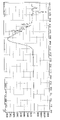
- FIG. 1 shows a GPC chart of Synthesis Example 1.
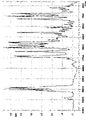
- FIG. 1 H-NMR chart of Synthesis Example 1 is shown.
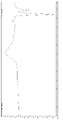
- 1 shows a GPC chart of Example 1.
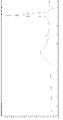
- FIG. 1 H-NMR chart of Example 1 is shown.
- 2 shows a GPC chart of Example 2.
- FIG. 1 H-NMR chart of Example 2 is shown.
- An FT-IR chart of Example 2 is shown.
- 2 shows a GPC chart of Synthesis Example 2.
- FIG. 1 H-NMR chart of Synthesis Example 2 is shown.
- the GPC chart of Example 3 is shown.
- 1 H-NMR chart of Example 3 is shown.
- the GPC chart of Example 4 is shown. 1 H-NMR chart of Example 4 is shown.
- the GPC chart of Example 5 is shown.
- 1 H-NMR chart of Example 5 is shown.
- the GPC chart of Example 6 is shown. 1 H-NMR chart of Example 6 is shown.
- the maleimide resin of the present invention has repeating units of the following formulas (a), (b), and (c).
- R 1 to R 7 represent a hydrogen atom, a hydrocarbon group having 1 to 10 carbon atoms, or a halogenated alkyl group.
- l and m represent real numbers from 0 to 5
- n and schreib represent real numbers from 0 to 4.
- L and M each independently represent a real number from 0 to 20, and N represents a real number from 1 to 20.
- (a), (b), and (c) are each connected by *, and the repeating positions may be random.
- R 1 to R 7 are usually a hydrogen atom, a hydrocarbon group having 1 to 10 carbon atoms, or a halogenated alkyl group, preferably a hydrogen atom or carbon It is a hydrocarbon group of number 1 to 5, more preferably a hydrogen atom or a hydrocarbon group of 1 to 3 carbon atoms.
- R 1 is particularly preferably a methyl group or a hydrogen atom, most preferably a methyl group.
- R 2 and R 3 are particularly preferably a methyl group or a hydrogen atom, most preferably a hydrogen atom.
- l and m are usually 0 to 5, preferably 0 to 2, more preferably 0.
- n and o are usually 0 to 4, preferably 0 to 2, more preferably 0.
- L and M are the average values of the number of repetitions, respectively.
- L and M are 0 to 20, and the lower limit is preferably 1, more preferably 1.1, and particularly preferably 2.
- the upper limit is preferably 10, more preferably 5.
- N is the average number of repetitions. N is 1 to 20, preferably 1.1 as a lower limit, more preferably 2.
- the upper limit is preferably 10, more preferably 5.
- N is at least the above lower limit, the heat resistance is improved as the functional group density is increased.
- the content is equal to or less than the above upper limit, the density of the functional group of the maleimide having polarity decreases, resulting in low water absorption.
- the weight average molecular weight (Mw ) is preferably 200 or more and less than 5,000, more preferably 500 or more and less than 4,000, and particularly preferably 1,000 or more and less than 3,000.
- the number average molecular weight (Mn) is preferably 200 or more and less than 5,000, more preferably 500 or more and less than 3,000, and particularly preferably 1,000 or more and less than 2,000.
- the component (A) can be expressed as the following formula (1).
- R 1 to R 7 represent a hydrogen atom, a hydrocarbon group having 1 to 10 carbon atoms, or a halogenated alkyl group.
- l and m represent real numbers from 0 to 5
- n and schreib represent real numbers from 0 to 4.
- L and M each independently represent a real number from 0 to 20, and N represents a real number from 1 to 20.
- Component (A) is obtained by reacting an amine resin having repeating units of the following formulas (a), (b), and (d) (hereinafter also referred to as component (B)) with maleic acid or maleic anhydride. can get.
- R 1 to R 7 represent a hydrogen atom, a hydrocarbon group having 1 to 10 carbon atoms, or a halogenated alkyl group.
- l and m represent real numbers from 0 to 5
- n and schreib represent real numbers from 0 to 4.
- L and M each independently represent a real number from 0 to 20, and N represents a real number from 1 to 20.
- (a), (b), and (d) are each connected by *, and the repeating positions may be random.
- R 1 to R 7 , l, m, n, o, L, M and N in formulas (a), (b) and (d) are Same as c).
- the average values L, M, and N of the number of repetitions of formulas (a), (b), (c), and (d) are represented by formulas (a), (b), (c), and (d), respectively. It can be calculated from the value of the number average molecular weight (Mn) obtained by GPC measurement of the compound, the area % of the slice data of each peak (detector: differential refractive index detector), and the like.
- the weight average molecular weight (Mw) of component (B) determined by gel permeation chromatography (GPC) is preferably 200 or more and less than 5,000, more preferably 500 or more and less than 4,000. , 1,000 or more and less than 3,000.
- the number average molecular weight (Mn) is preferably 200 or more and less than 5,000, more preferably 500 or more and less than 3,000, and particularly preferably 1,000 or more and less than 2,000.
- the amine equivalent of component (B) is 100 g/eq. Above 3,000 g/eq. It is preferably less than 200 g/eq. 2,000 g/eq. More preferably less than 300 g/eq. 1,000 g/eq. It is particularly preferred when it is less than.
- a polystyrene compound having a chloromethyl group is obtained by polymerizing a styrene monomer having a chloromethyl group and one or more styrenic monomers by radical polymerization, cationic polymerization, anionic polymerization, or the like. Any solvent, polymerization inhibitor, or living radical initiator may be added during this polymerization. Subsequently, the component (B) can be obtained by reacting the obtained polystyrene compound having chloromethyl groups with an aniline compound in the presence of an acidic catalyst.
- Any acid catalyst may be used for this reaction, but if necessary, hydrochloric acid, phosphoric acid, sulfuric acid, formic acid, p-toluenesulfonic acid, methanesulfonic acid, Lewis acids such as aluminum chloride, zinc chloride, etc.
- Activated clay, acid clay, white carbon, zeolite, solid acids such as silica alumina, acidic ion exchange resins, and the like can be used. These may be used alone or in combination of two or more.
- Reusable solid acids activated clay, acid clay, white carbon, zeolite, solid acids such as silica-alumina, acidic ion exchange resins, etc.
- the amount of the catalyst used is generally 0.1-0.8 mol, preferably 0.2-0.7 mol, per 1 mol of the aniline compound used. If the amount of catalyst used is too large, the viscosity of the reaction solution may become too high and stirring may become difficult, and if the amount of catalyst used is too small, the reaction may proceed slowly.
- the ratio of the amount of the solid acid catalyst used to the amount of the aniline compound charged is 1 to 50 wt%, preferably 5 to 40 wt%, more preferably 10 to 30 wt%. be. When the amount of the solid acid catalyst used is more than the above range, it becomes difficult to ensure the fluidity of the reaction solution.
- the reaction will not proceed sufficiently or the reaction time will be prolonged.
- the above reaction may be carried out using an organic solvent such as toluene, xylene, or the like, if necessary, or may be carried out without a solvent.
- an organic solvent such as toluene, xylene, or the like
- water is removed from the system by azeotropy when the catalyst contains water. After that, the reaction is carried out at 40 to 180°C, preferably 50 to 170°C for 0.5 to 20 hours.
- the mixed solution is heated to 180 to 300°C, preferably 190 to 250°C, more preferably 200 to 240°C, while removing water, low-molecular-weight components, etc. generated in the system by azeotropic distillation. and the reaction is carried out for 5 to 50 hours, preferably 5 to 20 hours.
- the acidic catalyst is neutralized with an alkaline aqueous solution, and a non-water-soluble organic solvent is added to the oil layer, and washing with water is repeated until the wastewater becomes neutral. If a reusable solid acid catalyst as described above was used, the catalyst is removed by filtration.
- the softening point of component (B) is preferably 80°C or lower, more preferably 70°C or lower. When the softening point is 80° C. or lower, the viscosity of the maleimidated resin does not become too high, making handling easier.
- the component (B) can be expressed as the following formula (2).
- R 1 to R 7 represent a hydrogen atom, a hydrocarbon group having 1 to 10 carbon atoms, or a halogenated alkyl group.
- l and m represent real numbers of 0 to 5
- L and M each independently represent a real number from 0 to 20, and N represents a real number from 1 to 20.
- Each repeating unit is shown in a specific order for convenience of description. , each repeat position can be random.
- Component (A) is obtained by reacting component (B) with maleic acid or maleic anhydride in the presence of a solvent and a catalyst.
- a solvent and a catalyst for example, the method described in Japanese Patent No. 6429862 may be used to react maleic acid or maleic anhydride with component (B). In that case, it is necessary to remove water generated during the reaction from the system, so a water-insoluble solvent is used for the reaction.
- aromatic solvents such as toluene and xylene
- aliphatic solvents such as cyclohexane and n-hexane
- ethers such as diethyl ether and diisopropyl ether
- ester solvents such as ethyl acetate and butyl acetate
- ketone-based solvents etc., but are not limited to these, and two or more of them may be used in combination.
- An aprotic polar solvent can also be used in combination with the water-insoluble solvent.
- Examples thereof include dimethylsulfone, dimethylsulfoxide, dimethylformamide, dimethylacetamide, 1,3-dimethyl-2-imidazolidinone, N-methylpyrrolidone and the like, and two or more of them may be used in combination.
- an aprotic polar solvent it is preferable to use one having a boiling point higher than that of the water-insoluble solvent used in combination.
- the catalyst is not particularly limited, acidic catalysts such as p-toluenesulfonic acid, hydroxy-p-toluenesulfonic acid, methanesulfonic acid, sulfuric acid, phosphoric acid and the like can be mentioned.
- maleic acid is dissolved in toluene, a solution of N-methylpyrrolidone other than component (B) is added while stirring, p-toluenesulfonic acid is then added, and the water generated is removed from the system under reflux conditions. while reacting.
- the softening point of component (A) is preferably 170°C or lower, more preferably 140°C or lower.
- the softening point is 170° C. or lower, the material can be easily melted by heating and handled easily.
- the viscosity can be lowered by using a diluent solvent, it is not preferable because the use is limited to applications where a solvent can be used.
- the component (A) may contain a polymerization inhibitor.
- Polymerization inhibitors that can be used include phenol-based, sulfur-based, phosphorus-based, hindered amine-based, nitroso-based, and nitroxyl radical-based polymerization inhibitors.
- the polymerization inhibitor may be added during synthesis of component (A) or after synthesis.
- a polymerization inhibitor can be used individually or in combination of 2 or more types.
- the amount of polymerization inhibitor used is usually 0.008 to 1 part by weight, preferably 0.01 to 0.5 part by weight, per 100 parts by weight of the resin component.
- Each of these polymerization inhibitors can be used alone, but two or more of them may be used in combination.
- phenol-based, hindered amine-based, nitroso-based, and nitroxyl radical-based solvents are preferred.
- phenolic polymerization inhibitors include 2,6-di-t-butyl-p-cresol, butylated hydroxyanisole, 2,6-di-t-butyl-p-ethylphenol, stearyl- ⁇ -( 3,5-di-t-butyl-4-hydroxyphenyl)propionate, isooctyl-3-(3,5-di-t-butyl-4-hydroxyphenyl)propionate, 2,4-bis-(n-octylthio) -monophenols such as 6-(4-hydroxy-3,5-di-t-butylanilino)-1,3,5-triazine, 2,4-bis[(octylthio)methyl]-o-cresol;2 , 2′-methylenebis(4-methyl-6-t-butylphenol), 2,2′-methylenebis(4-ethyl-6-t-butylphenol), 4,4′-thiobis(3-methyl-6-t-t
- sulfur-based polymerization inhibitors include dilauryl-3,3'-thiodipropionate, dimyristyl-3,3'-thiodipropionate, distearyl-3,3'-thiodipropionate, and the like. be.
- phosphorus-based polymerization inhibitors include triphenylphosphite, diphenylisodecylphosphite, phenyldiisodecylphosphite, tris(nonylphenyl)phosphite, diisodecylpentaerythritolphosphite, tris(2,4-di-t -butylphenyl)phosphite, cyclic neopentanetetraylbis(octadecyl)phosphite, cyclic neopentanetetraylbi(2,4-di-t-butylphenyl)phosphite, cyclic neopentanetetraylbi(2, Phosphites such as 4-di-t-butyl-4-methylphenyl)phosphite and bis[2-t-butyl-6-methyl-4- ⁇ 2-(oct)
- hindered amine-based polymerization inhibitors include Adekastave LA-40MP, Adekastab LA-40Si, Adekastab LA-402AF, Adekastab LA-87, Adekastab LA-82, Adekastab LA-81, Adekastab LA-77Y, and Adekastab LA.
- nitroso-based polymerization inhibitor examples include p-nitrosophenol, N-nitrosodiphenylamine, ammonium salts of N-nitrosophenylhydroxyamine, (cupferron), and the like, preferably ammonium of N-nitrosophenylhydroxyamine. It is salt (cupferon).
- nitroxyl radical polymerization inhibitors include TEMPO (2,2,6,6,-tetramethylpiperidine 1-oxyl) free radicals, 4-hydroxy-TEMPO free radicals, etc., but are limited to these. not.
- any known material can be used as the curable resin other than the component (A).
- Specific examples include phenol resins, epoxy resins, amine resins, active alkene-containing resins, isocyanate resins, polyamide resins, polyimide resins, cyanate ester resins, propenyl resins, methallyl resins, active ester resins, and the like. may be used in combination.
- the amount of the curable resin used is preferably 10 times or less by mass, more preferably 5 times or less, and particularly preferably 3 times or less by mass, that of component (A). Also, the lower limit is preferably 0.5 times by mass or more, more preferably 1 time by mass or more. If the amount is 10 times by mass or less, the effect of the heat resistance and dielectric properties of the component (A) can be utilized.
- phenol resins epoxy resins, amine resins, active alkene-containing resins, isocyanate resins, polyamide resins, polyimide resins, cyanate ester resins, and active ester resins
- epoxy resins epoxy resins, amine resins, active alkene-containing resins, isocyanate resins, polyamide resins, polyimide resins, cyanate ester resins, and active ester resins
- Phenolic resin phenols (phenol, alkyl-substituted phenol, aromatic-substituted phenol, hydroquinone, resorcinol, naphthol, alkyl-substituted naphthol, dihydroxybenzene, alkyl-substituted dihydroxybenzene, dihydroxynaphthalene, etc.) and various aldehydes (formaldehyde, acetaldehyde, alkylaldehyde, benzaldehyde, alkyl-substituted benzaldehyde, hydroxybenzaldehyde, naphthaldehyde, glutaraldehyde, phthalaldehyde, crotonaldehyde, cinnamaldehyde, furfural, etc.), phenols and various diene compounds (dicyclopentadiene, terpenes, vinylcyclohexene, norbornadiene, vinyln
- Epoxy resins glycidyl ether-based epoxy resins obtained by glycidylating the above phenolic resins, alcohols, etc., 4-vinyl-1-cyclohexene diepoxide, 3,4-epoxycyclohexylmethyl-3,4'-epoxycyclohexane carboxylate, etc. Alicyclic epoxy resins, glycidylamine epoxy resins such as tetraglycidyldiaminodiphenylmethane (TGDDM) and triglycidyl-p-aminophenol, and glycidyl ester epoxy resins.
- TGDDM tetraglycidyldiaminodiphenylmethane
- Amine resins diaminodiphenylmethane, diaminodiphenylsulfone, isophoronediamine, naphthalenediamine, aniline novolak, orthoethylaniline novolak, aniline resin obtained by reaction of aniline with xylylene chloride, aniline described in Japanese Patent No.
- Active alkene-containing resins Polycondensates of the above phenol resins and active alkene-containing halogen compounds (chloromethylstyrene, allyl chloride, methallyl chloride, acrylic acid chloride, allyl chloride, etc.), active alkene-containing phenols (2- allylphenol, 2-propenylphenol, 4-allylphenol, 4-propenylphenol, eugenol, isoeugenol, etc.) and halogen compounds (4,4'-bis(methoxymethyl)-1,1'-biphenyl, 1,4 -Bis(chloromethyl)benzene, 4,4'-difluorobenzophenone, 4,4'-dichlorobenzophenone, 4,4'-dibromobenzophenone, cyanuric chloride, etc.), epoxy resin or alcohol and substituted or non-substituted Polycondensates of substituted acrylates (acrylates, methacrylates, etc.),
- Isocyanate resins p-phenylene diisocyanate, m-phenylene diisocyanate, p-xylene diisocyanate, m-xylene diisocyanate, 2,4-tolylene diisocyanate, 2,6-tolylene diisocyanate, 4,4′-diphenylmethane diisocyanate, naphthalene diisocyanate, etc.
- Aromatic diisocyanates areophorone diisocyanate, hexamethylene diisocyanate, 4,4'-dicyclohexylmethane diisocyanate, hydrogenated xylene diisocyanate, norbornene diisocyanate, lysine diisocyanate and other aliphatic or alicyclic diisocyanates; one or more types of isocyanate monomers or an isocyanate trimerized from the above diisocyanate compound; a polyisocyanate obtained by a urethanization reaction between the above isocyanate compound and a polyol compound.
- Polyamide resin 1 selected from amino acids (6-aminocaproic acid, 11-aminoundecanoic acid, 12-aminododecanoic acid, para-aminomethylbenzoic acid, etc.), lactams ( ⁇ -caprolactam, ⁇ -undecanelactam, ⁇ -laurolactam) A polymer containing at least one species as main raw materials; or a polymer containing one or more diamines and one or more dicarboxylic acids as main raw materials.
- Diamines ethylenediamine, trimethylenediamine, tetramethylenediamine, pentamethylenediamine, hexamethylenediamine, heptamethylenediamine, octamethylenediamine, nonamethylenediamine, decanediamine, undecanediamine, dodecanediamine, tridecanediamine, tetradecanediamine, pentadecanediamine , hexadecanediamine, heptadecanediamine, octadecanediamine, nonadecanediamine, eicosanediamine, 2-methyl-1,5-diaminopentane, 2-methyl-1,8-diaminooctane; cyclohexanediamine, bis - Alicyclic diamines such as (4-aminocyclohexyl)methane and bis(3-methyl-4-aminocyclohexyl)methane; aromatic diamines such as xylylenediamine; Di
- Polyimide resin a polycondensate of the above diamine and tetracarboxylic dianhydride.
- Tetracarboxylic dianhydride 4,4'-(hexafluoroisopropylidene)diphthalic anhydride, 5-(2,5-dioxotetrahydro-3-furanyl)-3-methyl-cyclohexene-1,2 dicarboxylic acid anhydride, pyromellitic dianhydride, 1,2,3,4-benzenetetracarboxylic dianhydride, 3,3′,4,4′-benzophenonetetracarboxylic dianhydride, 2,2′,3 ,3′-benzophenonetetracarboxylic dianhydride, 3,3′,4,4′-biphenyltetracarboxylic dianhydride, 3,3′,4,4′-diphenylsulfonetetracarboxylic dianhydride, 2 ,2′,3,3′
- Cyanate ester resin A cyanate ester compound obtained by reacting a phenolic resin with cyanogen halide.
- Specific examples include dicyanatobenzene, tricyanatobenzene, dicyanatonaphthalene, dicyanatobiphenyl, 2, 2 '-bis(4-cyanatophenyl)propane, bis(4-cyanatophenyl)methane, bis(3,5-dimethyl-4-cyanatophenyl)methane, 2,2'-bis(3,5-dimethyl -4-cyanatophenyl)propane, 2,2'-bis(4-cyanatophenyl)ethane, 2,2'-bis(4-cyanatophenyl)hexafluoropropane, bis(4-cyanatophenyl)sulfone , bis(4-cyanatophenyl) thioether, phenol novolak cyanate, and phenol/dicyclopentadiene cocondensate
- cyanate ester compounds whose synthesis method is described in Japanese Patent Application Laid-Open No. 2005-264154 are particularly preferable as cyanate ester compounds because they are excellent in low moisture absorption, flame retardancy and dielectric properties.
- the cyanate resin may be zinc naphthenate, cobalt naphthenate, copper naphthenate, lead naphthenate, zinc octylate, tin octylate, lead, etc., in order to trimerize the cyanate group to form a sym-triazine ring, if necessary. Catalysts such as acetylacetonate, dibutyltin maleate and the like can also be included.
- the catalyst is usually used in an amount of 0.0001 to 0.10 parts by weight, preferably 0.00015 to 0.0015 parts by weight, per 100 parts by weight of the total weight of the curable resin composition.
- Active ester resin A compound having one or more active ester groups in one molecule can be used as a curing agent for curable resins other than component (A), such as epoxy resin, if necessary.
- Active ester curing agents include compounds having two or more highly reactive ester groups per molecule, such as phenol esters, thiophenol esters, N-hydroxyamine esters, and esters of heterocyclic hydroxy compounds. preferable.
- the active ester curing agent is preferably obtained by a condensation reaction of at least one of a carboxylic acid compound and a thiocarboxylic acid compound and at least one of a hydroxy compound and a thiol compound.
- an active ester curing agent obtained from a carboxylic acid compound and a hydroxy compound is preferable, and an active ester curing agent obtained from a carboxylic acid compound and at least one of a phenol compound and a naphthol compound. agents are preferred.
- carboxylic acid compounds include benzoic acid, acetic acid, succinic acid, maleic acid, itaconic acid, phthalic acid, isophthalic acid, terephthalic acid, and pyromellitic acid.
- phenol compounds or naphthol compounds include hydroquinone, resorcinol, bisphenol A, bisphenol F, bisphenol S, phenolphthalin, methylated bisphenol A, methylated bisphenol F, methylated bisphenol S, phenol, o-cresol, m- cresol, p-cresol, catechol, ⁇ -naphthol, ⁇ -naphthol, 1,5-dihydroxynaphthalene, 1,6-dihydroxynaphthalene, 2,6-dihydroxynaphthalene, dihydroxybenzophenone, trihydroxybenzophenone, tetrahydroxybenzophenone, phloroglucine, Benzenetriol, dicyclopentadiene-type diphenol compound, phenol novolak, and the like.
- dicyclopentadiene-type diphenol compound refers to a diphenol compound obtained by condensing one molecule of dicyclopentadiene with two molecules of phenol.
- the active ester curing agent include an active ester compound containing a dicyclopentadiene type diphenol structure, an active ester compound containing a naphthalene structure, an active ester compound containing an acetylated phenol novolac, and a benzoylated phenol novolac.
- “Dicyclopentadiene-type diphenol structure” represents a divalent structural unit consisting of phenylene-dicyclopentylene-phenylene.
- Active ester curing agents include, for example, active ester compounds containing a dicyclopentadiene type diphenol structure such as "EXB9451”, “EXB9460”, “EXB9460S”, “HPC-8000-65T”, “HPC- 8000H-65TM”, “EXB-8000L-65TM”, “EXB-8150-65T” (manufactured by DIC); “EXB9416-70BK” (manufactured by DIC) as an active ester compound containing a naphthalene structure; acetylated phenol novolac "DC808” (manufactured by Mitsubishi Chemical Corporation) as an active ester compound containing "DC808” (manufactured by Mitsubishi Chemical Corporation) as an active ester curing agent; "EXB-90
- the curable resin composition of the present invention can also be used in combination with a curing accelerator (curing catalyst) to improve curability.
- a curing accelerator curing catalyst
- Radical polymerization initiators that can be used include ketone peroxides such as methyl ethyl ketone peroxide and acetylacetone peroxide, diacyl peroxides such as benzoyl peroxide, dicumyl peroxide, 1,3-bis-(t-butylperoxy Isopropyl)-benzene and other dialkyl peroxides, t-butyl peroxybenzoate, 1,1-di-t-butylperoxycyclohexane and other peroxyketals, ⁇ -cumyl peroxyneodecanoate, t-butyl peroxyneodecanoate, t-butyl peroxypivalate, 1,1,3,3-tetramethylbutylperoxy-2-ethylhexanoate, t-amylperoxy-2-ethylhexanoate, t- Butyl peroxy-2-ethylhexanoate, t
- the amount of the radical polymerization initiator to be added is preferably 0.01 to 5 parts by mass, particularly preferably 0.01 to 3 parts by mass, per 100 parts by mass of the curable resin composition. If the amount of the radical polymerization initiator used is too large, the molecular weight will not be sufficiently elongated during the polymerization reaction.
- a curing accelerator other than a radical polymerization initiator may be added or used in combination with the curable resin composition of the present invention, if necessary.
- curing accelerators include imidazoles such as 2-methylimidazole, 2-ethylimidazole and 2-ethyl-4-methylimidazole, 2-(dimethylaminomethyl)phenol and 1,8-diaza-bicyclo ( 5,4,0) Tertiary amines such as undecene-7, phosphines such as triphenylphosphine, tetrabutylammonium salt, triisopropylmethylammonium salt, trimethyldecanylammonium salt, cetyltrimethylammonium salt, hexadecyltrimethyl Quaternary ammonium salts such as ammonium hydroxide, triphenylbenzylphosphonium salts, triphenylethylphosphonium salts, quaternary phosphonium salts such as
- tin octylate zinc carboxylate (zinc 2-ethylhexanoate, zinc stearate, behene transition metal compounds (transition metal salts) such as zinc compounds such as zinc acid, zinc mystate) and zinc phosphate esters (zinc octyl phosphate, zinc stearyl phosphate, etc.);
- a blending amount of the curing accelerator is 0.01 to 5.0 parts by weight based on 100 parts of the epoxy resin.
- the curable resin composition of the present invention can contain a phosphorus-containing compound as a flame retardancy-imparting component.
- the phosphorus-containing compound may be of a reactive type or an additive type.
- Specific examples of phosphorus-containing compounds include trimethyl phosphate, triethyl phosphate, tricresyl phosphate, trixylylenyl phosphate, cresyl diphenyl phosphate, cresyl-2,6-dixylylenyl phosphate, 1,3-phenylenebis ( dixylylenyl phosphate), 1,4-phenylenebis (dixylylenyl phosphate), 4,4'-biphenyl (dixylylenyl phosphate) and other phosphoric acid esters; 9,10-dihydro-9-oxa -phosphanes such as 10-phosphaphenanthrene-10-oxide and 10(2,5-dihydroxyphenyl)-10H-9-o
- (phosphorus-containing compound)/(total epoxy resin) is preferably in the range of 0.1 to 0.6 (weight ratio). If it is less than 0.1, the flame retardance is insufficient, and if it is more than 0.6, there is a concern that the hygroscopicity and dielectric properties of the cured product may be adversely affected.
- a light stabilizer may be added to the curable resin composition of the present invention, if necessary.
- a hindered amine light stabilizer HALS
- HALS are not particularly limited, but representative ones include dibutylamine/1,3,5-triazine/N,N'-bis(2,2,6,6-tetramethyl-4- Polycondensation product of piperidyl-1,6-hexamethylenediamine and N-(2,2,6,6-tetramethyl-4-piperidyl)butylamine, dimethyl-1-(2-hydroxyethyl)-4-hydroxy succinate -2,2,6,6-tetramethylpiperidine polycondensate, poly[ ⁇ 6-(1,1,3,3-tetramethylbutyl)amino-1,3,5-triazine-2,4-diyl ⁇ ⁇ (2,2,6,6-tetramethyl-4-piperidyl)imino ⁇ hexamethylene ⁇ (2,2,6,6-
- HALS hindered amine light stabilize
- the curable resin composition of the present invention can be blended with a binder resin as necessary.
- Binder resins include butyral resins, acetal resins, acrylic resins, epoxy-nylon resins, NBR (nitrile butadiene rubber)-phenol resins, epoxy-NBR resins, polyamide resins, polyimide resins, and silicone resins. and the like, but are not limited to these.
- the blending amount of the binder resin is preferably within a range that does not impair the flame retardancy and heat resistance of the cured product, preferably 0.05 to 50 parts by mass, more preferably 0.05 to 50 parts by mass based on 100 parts by mass of the resin component. 0.05 to 20 parts by weight are used as needed.
- the curable resin composition of the present invention may optionally contain fused silica, crystalline silica, porous silica, alumina, zircon, calcium silicate, calcium carbonate, quartz powder, silicon carbide, silicon nitride, boron nitride, zirconia. , powders such as aluminum nitride, graphite, forsterite, steatite, spinel, mullite, titania, talc, clay, iron oxide asbestos, glass powder, etc., or inorganic fillers made of spherical or pulverized powders. can be done.
- the amount of the inorganic filler used is usually 80 to 92% by mass, preferably 83 to 90% by mass in the curable resin composition. be.
- additives can be added to the curable resin composition of the present invention as necessary.
- additives that can be used include polybutadiene and its modified products, modified acrylonitrile copolymers, polyphenylene ethers, polystyrene, polyethylene, polyimide, fluororesins, silicone gels, silicone oils, fillers such as silane coupling agents.
- Coloring agents such as surface treatment agents for materials, release agents, carbon black, phthalocyanine blue, and phthalocyanine green.
- the amount of these additives to be added is preferably 1,000 parts by mass or less, more preferably 700 parts by mass or less per 100 parts by mass of the curable resin composition.
- the curable resin composition of the present invention is obtained by uniformly mixing the above-mentioned respective components in a predetermined ratio, usually precured at 130 to 180 ° C. for 30 to 500 seconds, and further cured at 150 to 200 ° C. After curing for 2 to 15 hours at , the curing reaction proceeds sufficiently to obtain the cured product of the present invention. It is also possible to uniformly disperse or dissolve the components of the curable resin composition in a solvent or the like, remove the solvent, and then cure the composition.
- the curable resin composition of the present invention thus obtained has moisture resistance, heat resistance, and high adhesiveness. Therefore, the curable resin composition of the present invention can be used in a wide range of fields requiring moisture resistance, heat resistance and high adhesion. Specifically, it is useful as an insulating material, laminate (printed wiring board, BGA substrate, build-up substrate, etc.), sealing material, resist, and all other materials for electrical and electronic parts. In addition to molding materials and composite materials, it can also be used in fields such as paint materials, adhesives, and 3D printing. Particularly in semiconductor encapsulation, solder reflow resistance is beneficial.
- a semiconductor device has one sealed with the curable resin composition of the present invention.
- semiconductor devices include DIP (dual in-line package), QFP (quad flat package), BGA (ball grid array), CSP (chip size package), SOP (small outline package), TSOP (thin small outline package), and TQFP. (think quad flat package) and the like.
- the method of preparing the curable resin composition of the present invention is not particularly limited, but each component may be mixed uniformly or may be prepolymerized.
- the curable resin of the present invention is prepolymerized by heating in the presence or absence of a catalyst and in the presence or absence of a solvent.
- a curing agent such as an epoxy resin, an amine resin, a maleimide compound, a cyanate ester compound, a phenol resin, an acid anhydride compound, and other additives may be added to form a prepolymer. good.
- Mixing or prepolymerization of each component is carried out by using, for example, an extruder, kneader, rolls, etc. in the absence of a solvent, and by using a reactor equipped with a stirrer in the presence of a solvent.
- the components are kneaded at a temperature within the range of 50 to 100° C. using a device such as a kneader, a roll, or a planetary mixer to obtain a uniform resin composition.
- the obtained resin composition is pulverized and then molded into a cylindrical tablet by a molding machine such as a tablet machine, or formed into granular powder or a powdery molding, or these compositions are placed on a surface support. It can also be melted and molded into a sheet having a thickness of 0.05 mm to 10 mm to form a curable resin composition molding.
- the obtained molded article becomes a non-sticky molded article at 0 to 20°C, and its fluidity and curability hardly deteriorate even when stored at -25 to 0°C for 1 week or longer.
- the resulting molded product can be molded into a cured product using a transfer molding machine or a compression molding machine.
- An organic solvent can be added to the curable resin composition of the present invention to form a varnish-like composition (hereinafter simply referred to as varnish).
- the curable resin composition of the present invention is dissolved in a solvent such as toluene, xylene, acetone, methyl ethyl ketone, methyl isobutyl ketone, dimethylformamide, dimethylacetamide, N-methylpyrrolidone, etc. to form a varnish.
- a solvent such as toluene, xylene, acetone, methyl ethyl ketone, methyl isobutyl ketone, dimethylformamide, dimethylacetamide, N-methylpyrrolidone, etc.
- Polyester fiber, polyamide fiber, alumina fiber, paper, etc. is impregnated into a base material and heat-dried to obtain a prepreg, which is hot-press molded to obtain a cured product of the curable resin composition of the present invention. .
- the solvent is usually used in an amount of 10 to 70% by weight, preferably 15 to 70% by weight in the mixture of the curable resin composition of the present invention and the solvent.
- it is a liquid composition, it is also possible to obtain a curable resin cured product containing carbon fibers by, for example, the RTM (Resin Transfer Molding) method.
- the curable composition of the present invention can also be used as a modifier for film-type compositions. Specifically, it can be used to improve flexibility and the like in the B-stage.
- a film-type resin composition is obtained by applying the curable resin composition of the present invention as the curable resin composition varnish on a release film, removing the solvent under heating, and then performing B-stage. It is obtained as a sheet-like adhesive by This sheet-like adhesive can be used as an interlayer insulating layer in multilayer substrates and the like.
- a prepreg can be obtained by heating and melting the curable resin composition of the present invention, reducing the viscosity, and impregnating reinforcing fibers such as glass fibers, carbon fibers, polyester fibers, polyamide fibers, and alumina fibers with the melted resin composition.
- reinforcing fibers such as glass fibers, carbon fibers, polyester fibers, polyamide fibers, and alumina fibers with the melted resin composition.
- Specific examples thereof include glass fibers such as E glass cloth, D glass cloth, S glass cloth, Q glass cloth, spherical glass cloth, NE glass cloth, and T glass cloth, inorganic fibers other than glass, and poly paraphenylene terephthalamide (Kevlar®, manufactured by DuPont), wholly aromatic polyamides, polyesters; and organic fibers such as polyparaphenylene benzoxazole, polyimides and carbon fibers, but are particularly limited to these.
- the shape of the substrate is not particularly limited, but examples thereof include woven fabric, nonwoven fabric, roving, chopped strand mat, and the like. Plain weave, Nanako weave, twill weave, and the like are known as weaving methods of woven fabric, and it is possible to appropriately select and use from these known methods depending on the intended use and performance.
- a woven fabric subjected to opening treatment or a glass woven fabric surface-treated with a silane coupling agent or the like is preferably used.
- the thickness of the base material is not particularly limited, it is preferably about 0.01 to 0.4 mm.
- a prepreg can also be obtained by impregnating reinforcing fibers with the varnish and heating and drying the varnish.
- the laminate of the present embodiment includes one or more prepregs.
- the laminate is not particularly limited as long as it comprises one or more prepregs, and may have any other layers.
- a method for producing a laminate generally known methods can be appropriately applied, and there is no particular limitation. For example, when molding a metal foil-clad laminate, a multi-stage press machine, a multi-stage vacuum press machine, a continuous molding machine, an autoclave molding machine, etc. can be used, and the above prepregs are laminated and heat-pressed to form a laminate. Obtainable.
- the heating temperature is not particularly limited, but is preferably 65 to 300°C, more preferably 120 to 270°C.
- the pressure to be applied is not particularly limited, but if the pressure is too high, it will be difficult to adjust the solid content of the resin in the laminate and the quality will not be stable. 2.0 to 5.0 MPa is preferable, and 2.5 to 4.0 MPa is more preferable, because it deteriorates.
- the laminate of the present embodiment can be suitably used as a metal-foil-clad laminate described later by including a layer made of metal foil. After cutting the prepreg into a desired shape and laminating it with copper foil or the like if necessary, the curable resin composition is heat-cured while applying pressure to the laminate by a press molding method, an autoclave molding method, a sheet winding molding method, or the like. Electrical and electronic laminates (printed wiring boards) and carbon fiber reinforcing materials can be obtained.
- the cured product of the present invention can be used for various purposes such as molding materials, adhesives, composite materials, and paints. Since the cured product of the curable resin composition according to the present invention exhibits excellent heat resistance and dielectric properties, it can be used as a sealing material for semiconductor elements, a sealing material for liquid crystal display elements, a sealing material for organic EL elements, and a printed wiring board. , electrical and electronic parts such as build-up laminates, and composite materials for lightweight and high-strength structural materials such as carbon fiber reinforced plastics and glass fiber reinforced plastics.
- GPC DGU-20A3R, LC-20AD, SIL-20AHT, RID-20A, SPD-20A, CTO-20A, CBM-20A (all manufactured by Shimadzu Corporation)
- Linking eluent Tetrahydrofuran Flow rate: 0.5 ml/min.
- chloromethylstyrene (CMS-14: manufactured by AGC): a mixture of 24.4 parts) was added dropwise over 2 hours. After continuing the reaction at 25° C. for 2 hours, water was added to stop the reaction, 170 parts of toluene was added, and the mixture was washed with water until the waste water became neutral. Solvent 2 was distilled off from the resulting organic layer under heating and reduced pressure to obtain 62 parts of a polystyrene compound (St-1) having a chloromethyl group as a semi-solid resin (Mn: 684, Mw: 1051). A GPC chart of the obtained compound is shown in FIG. Also, FIG. 2 shows a 1 H-NMR chart (CDCl 3 ) of the obtained compound. A signal derived from a chloromethyl group was observed at 4.45-4.75 ppm in the 1 H-NMR chart.
- CMS-14 manufactured by AGC
- Example 1 A flask equipped with a thermometer, Dean-Stark azeotropic distillation trap, condenser, stirrer, and dropping funnel was added with 25 parts of St-1 obtained in Synthesis Example 1, 25 parts of toluene, and 100 parts of aniline. reacted over time. Using a dropping funnel, 27.9 parts of 35% hydrochloric acid was added dropwise so that the internal temperature did not exceed 80°C. The internal temperature was raised to 205° C. over 2 hours while removing toluene and distilled water. The reaction was carried out at 205° C.
- amine resin (A-1) as a brown solid resin (Mn: 1056, Mw: 1917).
- the amine equivalent is 518 g/eq. Met.
- a GPC chart of the obtained amine resin is shown in FIG. 1 H-NMR data (CDCl 3 ) of the obtained amine resin are shown in FIG. A signal derived from an amino group was observed at 4.85 ppm in the 1 H-NMR chart.
- Example 2 A flask equipped with a thermometer, a Dean-Stark azeotropic distillation trap, a condenser, a stirrer, and a dropping funnel was charged with 4.3 parts of maleic anhydride, 90 parts of toluene, 10 parts of NMP, and 0.3 parts of methanesulfonic acid. was heated to 115°C. Subsequently, an amine resin solution (15 parts of amine resin A-1 obtained in Example 1 and 100 parts of toluene) was added dropwise over 2 hours using a dropping funnel. After the dropwise addition was completed, the reaction was continued for 2 hours under reflux conditions and allowed to cool.
- amine resin solution 15 parts of amine resin A-1 obtained in Example 1 and 100 parts of toluene
- maleimide resin (M-1) as a brown solid resin (Mn: 1199, Mw: 2312).
- a GPC chart of the obtained compound is shown in FIG. 1 H-NMR data (CDCl 3 ) of the obtained maleimide resin is shown in FIG. It was observed that the signal derived from the amino group observed in (A-1) disappeared at 4.85 ppm in the 1 H-NMR chart. Further, FT-IR data (KBr method) of the obtained maleimide resin is shown in FIG. A signal derived from the olefin of the maleimide group was observed at 1145 cm ⁇ 1 on the FT-IR chart, and a signal derived from the carbonyl group of the maleimide group was observed at 1725 cm ⁇ 1 .
- Example 3 Thermometer, Dean Stark azeotropic distillation trap, condenser, stirrer, St-2 obtained in Synthesis Example 2 48.3 parts in a flask equipped with a dropping funnel, 25 parts of toluene, 100 parts of 2,6-dimethylaniline was added and reacted at 65° C. for 2 hours. Using a dropping funnel, 10.4 parts of 35% hydrochloric acid was added dropwise so that the internal temperature did not exceed 80°C. The internal temperature was raised to 210° C. over 2 hours while removing toluene and distilled water. The reaction was carried out at 210° C.
- Example 4 A flask equipped with a thermometer, a Dean-Stark azeotropic distillation trap, a condenser, a stirrer, and a dropping funnel was charged with 6.0 parts of maleic anhydride, 25 parts of toluene, 25 parts of NMP, and 0.5 parts of methanesulfonic acid. was heated to 115°C. Subsequently, an amine resin solution (25 parts of the amine resin A-2 obtained in Example 4 and 25 parts of toluene) was added dropwise over 2 hours using a dropping funnel. After the dropwise addition was completed, the reaction was continued for 2 hours under reflux conditions and allowed to cool.
- Example 5 A thermometer, a Dean-Stark azeotropic distillation trap tube, a condenser, a stirrer, and a flask equipped with a dropping funnel were charged with 25 parts of St-2 obtained in Synthesis Example 2, 25 parts of toluene, and 200 parts of 2,6-diisopropylaniline. and reacted at 65° C. for 3 hours. Using a dropping funnel, 10.6 parts of 35% hydrochloric acid was added dropwise so that the internal temperature did not exceed 80°C. The internal temperature was raised to 210° C. over 2 hours while removing toluene and distilled water. The reaction was carried out at 210° C.
- Example 6 2.5 parts of maleic anhydride, 60 parts of toluene, 20 parts of NMP, and 0.4 parts of methanesulfonic acid were added to a flask equipped with a thermometer, a Dean-Stark azeotropic distillation trap, a condenser, a stirrer, and a dropping funnel. was heated to 115°C. Subsequently, an amine resin solution (a solution of 20 parts of amine resin A-3 obtained in Example 5 and 20 parts of toluene) was added dropwise over 2 hours using a dropping funnel. After the dropwise addition was completed, the reaction was continued for 3 hours under reflux conditions and allowed to cool.
- amine resin solution a solution of 20 parts of amine resin A-3 obtained in Example 5 and 20 parts of toluene
- Example 7 The compound (M-1) obtained in Example 2 and 2E4MZ (2-ethyl-4-methylimidazole, manufactured by Shikoku Kasei Co., Ltd.) as a curing accelerator were blended in the ratio (parts by mass) shown in Table 1, and placed in a metal container. The mixture was heated, melted and mixed, poured into a mold as it was, and cured at 220° C. for 2 hours. Table 1 shows the measurement results.
- Example 8 The compound (M-2) obtained in Example 4 and 2E4MZ (2-ethyl-4-methylimidazole, manufactured by Shikoku Kasei Co., Ltd.) as a curing accelerator were blended in the ratio (parts by mass) shown in Table 2, and a mirror copper foil ( T4X: manufactured by Fukuda Metal Copper Foil Co., Ltd.), and vacuum press-molded, and cured at 220° C. for 2 hours.
- a cushion paper having a thickness of 250 ⁇ m was hollowed out in the center to a size of 150 mm in length and width.
- a laser cutter was used as necessary to cut out a test piece of a desired size, and the evaluation was performed. Table 2 shows the evaluation results.
- ⁇ Heat resistance test> Glass transition temperature: measured by a dynamic viscoelasticity tester, the temperature at which tan ⁇ reaches its maximum value.
- Dynamic viscoelasticity measuring instrument DMA-2980 manufactured by TA-instruments Measurement temperature range: -30 to 280°C Heating rate: 2°C/min Frequency: 10Hz
- Test piece size A piece cut into 5 mm x 50 mm was used (thickness is about 800 ⁇ m)
- a test was performed by the cavity resonator perturbation method using a 1 GHz (10 GHz in Example 8 and Comparative Example 2) cavity resonator manufactured by AET. The sample size was 1.7 mm wide by 100 mm long, and the thickness was 1.7 mm.
- the olefin compound having a styrene structure of the present invention can be used as an insulating material for electrical and electronic parts (highly reliable semiconductor sealing material, etc.), laminates (printed wiring boards, BGA substrates, build-up substrates, etc.), adhesives (conductive adhesives, etc.), CFRP and other composite materials, paints, 3D printing, and other applications.
Landscapes
- Chemical & Material Sciences (AREA)
- Health & Medical Sciences (AREA)
- Chemical Kinetics & Catalysis (AREA)
- Medicinal Chemistry (AREA)
- Polymers & Plastics (AREA)
- Organic Chemistry (AREA)
- General Chemical & Material Sciences (AREA)
- Addition Polymer Or Copolymer, Post-Treatments, Or Chemical Modifications (AREA)
- Macromolecular Compounds Obtained By Forming Nitrogen-Containing Linkages In General (AREA)
- Compositions Of Macromolecular Compounds (AREA)
- Pyrrole Compounds (AREA)
Priority Applications (4)
| Application Number | Priority Date | Filing Date | Title |
|---|---|---|---|
| KR1020237039095A KR102802324B1 (ko) | 2021-05-14 | 2022-05-11 | 말레이미드 수지, 아민 수지, 경화성 수지 조성물 및 그의 경화물 |
| JP2022548391A JP7182343B1 (ja) | 2021-05-14 | 2022-05-11 | マレイミド樹脂、アミン樹脂、硬化性樹脂組成物およびその硬化物 |
| CN202280034960.2A CN117321091B (zh) | 2021-05-14 | 2022-05-11 | 马来酰亚胺树脂、胺树脂、硬化性树脂组合物及其硬化物 |
| US18/290,325 US20240262941A1 (en) | 2021-05-14 | 2022-05-11 | Maleimide resin, amine resin, curable resin composition, and cured product thereof |
Applications Claiming Priority (2)
| Application Number | Priority Date | Filing Date | Title |
|---|---|---|---|
| US202163188688P | 2021-05-14 | 2021-05-14 | |
| US63/188,688 | 2021-05-14 |
Publications (1)
| Publication Number | Publication Date |
|---|---|
| WO2022239811A1 true WO2022239811A1 (ja) | 2022-11-17 |
Family
ID=84029685
Family Applications (1)
| Application Number | Title | Priority Date | Filing Date |
|---|---|---|---|
| PCT/JP2022/019967 Ceased WO2022239811A1 (ja) | 2021-05-14 | 2022-05-11 | マレイミド樹脂、アミン樹脂、硬化性樹脂組成物およびその硬化物 |
Country Status (6)
| Country | Link |
|---|---|
| US (1) | US20240262941A1 (https=) |
| JP (1) | JP7182343B1 (https=) |
| KR (1) | KR102802324B1 (https=) |
| CN (1) | CN117321091B (https=) |
| TW (1) | TWI883326B (https=) |
| WO (1) | WO2022239811A1 (https=) |
Families Citing this family (1)
| Publication number | Priority date | Publication date | Assignee | Title |
|---|---|---|---|---|
| JP7628070B2 (ja) * | 2021-10-07 | 2025-02-07 | 日本化薬株式会社 | 硬化性高分子化合物、及び該化合物を含む樹脂組成物 |
Citations (3)
| Publication number | Priority date | Publication date | Assignee | Title |
|---|---|---|---|---|
| JPS50129649A (https=) * | 1974-04-03 | 1975-10-14 | ||
| JPH0657090A (ja) * | 1992-08-11 | 1994-03-01 | Denki Kagaku Kogyo Kk | 熱可塑性樹脂組成物 |
| JPH06179848A (ja) * | 1992-12-11 | 1994-06-28 | Showa Highpolymer Co Ltd | フッ素系ポリマー用接着剤組成物 |
Family Cites Families (6)
| Publication number | Priority date | Publication date | Assignee | Title |
|---|---|---|---|---|
| US4487855A (en) * | 1983-02-15 | 1984-12-11 | Shih Yen Jer | Colored latexes; methods for making same and colored finely divided products |
| JP4248939B2 (ja) | 2003-06-09 | 2009-04-02 | 三井化学株式会社 | カレンダー成形性を改良したポリオレフィン組成物およびこれを用いた壁紙 |
| CN112105654A (zh) * | 2018-08-06 | 2020-12-18 | 日本化药株式会社 | 硬化性树脂混合物、硬化性树脂组合物及其硬化物 |
| JP7093150B2 (ja) * | 2018-12-06 | 2022-06-29 | 日本化薬株式会社 | 硬化性樹脂組成物及びその硬化物 |
| JP2024129649A (ja) * | 2023-03-13 | 2024-09-27 | 三菱ケミカル株式会社 | 蛍光体、発光装置、照明装置、画像表示装置及び車両用表示灯 |
| JP7689383B2 (ja) * | 2023-03-13 | 2025-06-06 | 小林工業株式会社 | 粉末成形装置および粉末成形体の製造方法 |
-
2022
- 2022-05-11 KR KR1020237039095A patent/KR102802324B1/ko active Active
- 2022-05-11 US US18/290,325 patent/US20240262941A1/en active Pending
- 2022-05-11 WO PCT/JP2022/019967 patent/WO2022239811A1/ja not_active Ceased
- 2022-05-11 JP JP2022548391A patent/JP7182343B1/ja active Active
- 2022-05-11 CN CN202280034960.2A patent/CN117321091B/zh active Active
- 2022-05-13 TW TW111118107A patent/TWI883326B/zh active
Patent Citations (3)
| Publication number | Priority date | Publication date | Assignee | Title |
|---|---|---|---|---|
| JPS50129649A (https=) * | 1974-04-03 | 1975-10-14 | ||
| JPH0657090A (ja) * | 1992-08-11 | 1994-03-01 | Denki Kagaku Kogyo Kk | 熱可塑性樹脂組成物 |
| JPH06179848A (ja) * | 1992-12-11 | 1994-06-28 | Showa Highpolymer Co Ltd | フッ素系ポリマー用接着剤組成物 |
Non-Patent Citations (1)
| Title |
|---|
| ZHOU HUI, ZHANG WEN-ZHEN, WANG YI-MING, QU JING-PING, LU XIAO-BING: "N -Heterocyclic Carbene Functionalized Polymer for Reversible Fixation−Release of CO 2", MACROMOLECULES, vol. 42, no. 15, 11 August 2009 (2009-08-11), US , pages 5419 - 5421, XP093003787, ISSN: 0024-9297, DOI: 10.1021/ma901109j * |
Also Published As
| Publication number | Publication date |
|---|---|
| US20240262941A1 (en) | 2024-08-08 |
| JPWO2022239811A1 (https=) | 2022-11-17 |
| KR102802324B1 (ko) | 2025-04-29 |
| TW202311313A (zh) | 2023-03-16 |
| CN117321091A (zh) | 2023-12-29 |
| JP7182343B1 (ja) | 2022-12-02 |
| TWI883326B (zh) | 2025-05-11 |
| KR20240008320A (ko) | 2024-01-18 |
| CN117321091B (zh) | 2024-06-04 |
Similar Documents
| Publication | Publication Date | Title |
|---|---|---|
| JP7586738B2 (ja) | オレフィン樹脂、硬化性樹脂組成物およびその硬化物 | |
| JP6951829B1 (ja) | 化合物、混合物、硬化性樹脂組成物およびその硬化物、並びに化合物の製造方法 | |
| JP7208705B1 (ja) | マレイミド樹脂、硬化性樹脂組成物およびその硬化物 | |
| JP7241246B2 (ja) | 化合物、混合物、硬化性樹脂組成物およびその硬化物 | |
| WO2020213639A1 (ja) | マレイミド樹脂、硬化性樹脂組成物およびその硬化物 | |
| JP7570484B2 (ja) | オレフィン化合物、硬化性樹脂組成物およびその硬化物 | |
| JP7570241B2 (ja) | 硬化性樹脂組成物およびその硬化物 | |
| US20260109801A1 (en) | Maleimide resin mixture, curable resin composition, varnish, and cured product thereof | |
| JP2023015005A (ja) | 硬化性樹脂組成物、プリプレグおよびその硬化物 | |
| JP2023015004A (ja) | 硬化性樹脂組成物、プリプレグおよびその硬化物 | |
| JP7182343B1 (ja) | マレイミド樹脂、アミン樹脂、硬化性樹脂組成物およびその硬化物 | |
| JP2022176111A (ja) | マレイミド樹脂、硬化性樹脂組成物およびその硬化物 | |
| KR20240082262A (ko) | 아민 화합물, 말레이미드 화합물, 경화성 수지 조성물 및 그 경화물 | |
| JP7628371B2 (ja) | マレイミド樹脂を含有する硬化性樹脂組成物およびその硬化物 | |
| JP7252301B1 (ja) | 硬化性樹脂組成物、プリプレグおよびその硬化物 | |
| JP7360345B2 (ja) | オレフィン樹脂、硬化性樹脂組成物およびその硬化物 | |
| JP7353412B1 (ja) | マレイミド化合物、硬化性樹脂組成物及びその硬化物、並びにアミン化合物 | |
| JP7305290B2 (ja) | 共重合体、硬化性樹脂組成物およびその硬化物 |
Legal Events
| Date | Code | Title | Description |
|---|---|---|---|
| ENP | Entry into the national phase |
Ref document number: 2022548391 Country of ref document: JP Kind code of ref document: A |
|
| 121 | Ep: the epo has been informed by wipo that ep was designated in this application |
Ref document number: 22807510 Country of ref document: EP Kind code of ref document: A1 |
|
| WWE | Wipo information: entry into national phase |
Ref document number: 18290325 Country of ref document: US |
|
| WWE | Wipo information: entry into national phase |
Ref document number: 202280034960.2 Country of ref document: CN |
|
| NENP | Non-entry into the national phase |
Ref country code: DE |
|
| WWE | Wipo information: entry into national phase |
Ref document number: 11202308626W Country of ref document: SG |
|
| 122 | Ep: pct application non-entry in european phase |
Ref document number: 22807510 Country of ref document: EP Kind code of ref document: A1 |
|
| WWG | Wipo information: grant in national office |
Ref document number: 1020237039095 Country of ref document: KR |