WO2022239718A1 - 半導体装置及びモジュール - Google Patents
半導体装置及びモジュール Download PDFInfo
- Publication number
- WO2022239718A1 WO2022239718A1 PCT/JP2022/019620 JP2022019620W WO2022239718A1 WO 2022239718 A1 WO2022239718 A1 WO 2022239718A1 JP 2022019620 W JP2022019620 W JP 2022019620W WO 2022239718 A1 WO2022239718 A1 WO 2022239718A1
- Authority
- WO
- WIPO (PCT)
- Prior art keywords
- substrate
- external electrode
- resin body
- layer
- thickness direction
- Prior art date
- Legal status (The legal status is an assumption and is not a legal conclusion. Google has not performed a legal analysis and makes no representation as to the accuracy of the status listed.)
- Ceased
Links
Images










Classifications
-
- H—ELECTRICITY
- H10—SEMICONDUCTOR DEVICES; ELECTRIC SOLID-STATE DEVICES NOT OTHERWISE PROVIDED FOR
- H10D—INORGANIC ELECTRIC SEMICONDUCTOR DEVICES
- H10D1/00—Resistors, capacitors or inductors
- H10D1/60—Capacitors
- H10D1/68—Capacitors having no potential barriers
- H10D1/692—Electrodes
-
- H—ELECTRICITY
- H01—ELECTRIC ELEMENTS
- H01G—CAPACITORS; CAPACITORS, RECTIFIERS, DETECTORS, SWITCHING DEVICES, LIGHT-SENSITIVE OR TEMPERATURE-SENSITIVE DEVICES OF THE ELECTROLYTIC TYPE
- H01G2/00—Details of capacitors not covered by a single one of groups H01G4/00-H01G11/00
- H01G2/02—Mountings
- H01G2/06—Mountings specially adapted for mounting on a printed-circuit support
-
- H—ELECTRICITY
- H01—ELECTRIC ELEMENTS
- H01G—CAPACITORS; CAPACITORS, RECTIFIERS, DETECTORS, SWITCHING DEVICES, LIGHT-SENSITIVE OR TEMPERATURE-SENSITIVE DEVICES OF THE ELECTROLYTIC TYPE
- H01G4/00—Fixed capacitors; Processes of their manufacture
- H01G4/30—Stacked capacitors
-
- H—ELECTRICITY
- H01—ELECTRIC ELEMENTS
- H01G—CAPACITORS; CAPACITORS, RECTIFIERS, DETECTORS, SWITCHING DEVICES, LIGHT-SENSITIVE OR TEMPERATURE-SENSITIVE DEVICES OF THE ELECTROLYTIC TYPE
- H01G4/00—Fixed capacitors; Processes of their manufacture
- H01G4/33—Thin- or thick-film capacitors (thin- or thick-film circuits; capacitors without a potential-jump or surface barrier specially adapted for integrated circuits, details thereof, multistep manufacturing processes therefor)
-
- H—ELECTRICITY
- H10—SEMICONDUCTOR DEVICES; ELECTRIC SOLID-STATE DEVICES NOT OTHERWISE PROVIDED FOR
- H10D—INORGANIC ELECTRIC SEMICONDUCTOR DEVICES
- H10D84/00—Integrated devices formed in or on semiconductor substrates that comprise only semiconducting layers, e.g. on Si wafers or on GaAs-on-Si wafers
-
- H—ELECTRICITY
- H10—SEMICONDUCTOR DEVICES; ELECTRIC SOLID-STATE DEVICES NOT OTHERWISE PROVIDED FOR
- H10D—INORGANIC ELECTRIC SEMICONDUCTOR DEVICES
- H10D84/00—Integrated devices formed in or on semiconductor substrates that comprise only semiconducting layers, e.g. on Si wafers or on GaAs-on-Si wafers
- H10D84/01—Manufacture or treatment
- H10D84/02—Manufacture or treatment characterised by using material-based technologies
- H10D84/03—Manufacture or treatment characterised by using material-based technologies using Group IV technology, e.g. silicon technology or silicon-carbide [SiC] technology
- H10D84/038—Manufacture or treatment characterised by using material-based technologies using Group IV technology, e.g. silicon technology or silicon-carbide [SiC] technology using silicon technology, e.g. SiGe
-
- H—ELECTRICITY
- H10—SEMICONDUCTOR DEVICES; ELECTRIC SOLID-STATE DEVICES NOT OTHERWISE PROVIDED FOR
- H10W—GENERIC PACKAGES, INTERCONNECTIONS, CONNECTORS OR OTHER CONSTRUCTIONAL DETAILS OF DEVICES COVERED BY CLASS H10
- H10W44/00—Electrical arrangements for controlling or matching impedance
- H10W44/601—Capacitive arrangements
-
- H—ELECTRICITY
- H10—SEMICONDUCTOR DEVICES; ELECTRIC SOLID-STATE DEVICES NOT OTHERWISE PROVIDED FOR
- H10W—GENERIC PACKAGES, INTERCONNECTIONS, CONNECTORS OR OTHER CONSTRUCTIONAL DETAILS OF DEVICES COVERED BY CLASS H10
- H10W70/00—Package substrates; Interposers; Redistribution layers [RDL]
- H10W70/60—Insulating or insulated package substrates; Interposers; Redistribution layers
-
- H—ELECTRICITY
- H10—SEMICONDUCTOR DEVICES; ELECTRIC SOLID-STATE DEVICES NOT OTHERWISE PROVIDED FOR
- H10W—GENERIC PACKAGES, INTERCONNECTIONS, CONNECTORS OR OTHER CONSTRUCTIONAL DETAILS OF DEVICES COVERED BY CLASS H10
- H10W74/00—Encapsulations, e.g. protective coatings
- H10W74/10—Encapsulations, e.g. protective coatings characterised by their shape or disposition
-
- H—ELECTRICITY
- H10—SEMICONDUCTOR DEVICES; ELECTRIC SOLID-STATE DEVICES NOT OTHERWISE PROVIDED FOR
- H10W—GENERIC PACKAGES, INTERCONNECTIONS, CONNECTORS OR OTHER CONSTRUCTIONAL DETAILS OF DEVICES COVERED BY CLASS H10
- H10W90/00—Package configurations
- H10W90/701—Package configurations characterised by the relative positions of pads or connectors relative to package parts
Definitions
- the present invention relates to semiconductor devices and modules.
- a MIM (Metal Insulator Metal) capacitor for example, is known as a typical capacitor element used in a semiconductor integrated circuit.
- a MIM capacitor is a capacitor having a parallel plate type structure in which an insulator is sandwiched between a lower electrode and an upper electrode.
- Patent Document 1 discloses a circuit element formed on a substrate, at least one pair of terminal electrodes connected to the circuit element and arranged opposite to each other on at least one surface, and more than the at least one pair of terminal electrodes. and a support that protrudes from the at least one surface and is provided in a region that does not overlap with the circuit element in a plan view of the at least one surface.
- a lower electrode, a dielectric layer, a first electrode, a first protective layer, a second electrode, a second protective layer, a terminal electrode and a support are arranged in this order on a substrate. Stacked capacitors are described.
- the support protrudes from at least one pair of terminal electrodes arranged to face each other. Since it is formed thicker than the pair of terminal electrodes, the support receives, disperses, and relieves the load applied from the outside, thereby preventing mechanical damage to the electronic component that may occur during mounting. It is said that
- a semiconductor device of the present invention includes a substrate having a first main surface and a second main surface facing each other in a thickness direction, a circuit layer provided on the first main surface of the substrate, and a first resin body.
- the circuit layer includes a first electrode layer provided on the substrate side, a second electrode layer provided facing the first electrode layer, and the first electrode layer and the second electrode in the thickness direction.
- the first resin body is provided between the edge of the substrate and the first external electrode and between the edge of the substrate and the second external electrode in plan view from the thickness direction.
- the tip of the first resin body on the side opposite to the substrate is positioned higher than the tips of the first external electrode and the second external electrode on the side opposite to the substrate;
- the side surface of the first resin body on the side of the first external electrode or the second external electrode extends from the substrate side toward the side opposite to the substrate to form the first electrode.
- a side surface of the first resin body near the end portion side of the substrate and the side surface of the substrate end portion side of the resin body rise steeply from the first main surface of the substrate.
- a module of the present invention includes wiring having a semiconductor device of the present invention, a first land electrically connected to the first external electrode, and a second land electrically connected to the second external electrode. a substrate;
- the present invention it is possible to provide a semiconductor device in which element damage is suppressed even when a load is applied. Further, according to the present invention, it is possible to provide a module including the above semiconductor device.
- FIG. 1 is a schematic plan view showing an example of a capacitor according to Embodiment 1 of the present invention
- FIG. FIG. 1B is a schematic cross-sectional view showing a portion corresponding to a line segment A1-A2 in FIG. 1-1
- FIG. 1-1 is a schematic cross-sectional view showing a portion corresponding to a line segment D1-D2 in FIG. 1-1
- FIG. 4 is a schematic cross-sectional view showing a state in which a load is applied to the first resin body in the capacitor having the structure of the present invention
- FIG. 5 is a schematic cross-sectional view showing a state in which a load is applied to a first resin body in a capacitor having a conventional structure
- FIG. 4 is a schematic plan view showing a modification of the capacitor of Embodiment 1 of the present invention. It is a cross-sectional schematic diagram for demonstrating an example of the process of forming an insulating layer. It is a cross-sectional schematic diagram for demonstrating an example of the process of forming a 1st electrode layer. It is a cross-sectional schematic diagram for demonstrating an example of the process of forming a dielectric layer. It is a cross-sectional schematic diagram for demonstrating an example of the process of forming a 2nd electrode layer. It is a cross-sectional schematic diagram for demonstrating an example of the process of forming a moisture-resistant protective layer. It is a cross-sectional schematic diagram for demonstrating an example of the process of forming a resin protective layer.
- FIG. 1 It is a cross-sectional schematic diagram for demonstrating an example of the process of forming a seed layer. It is a cross-sectional schematic diagram for demonstrating an example of the process of forming a 1st plating layer and a 2nd plating layer. It is a cross-sectional schematic diagram for demonstrating an example of the process of removing some seed layers. It is a cross-sectional schematic diagram for demonstrating an example of the process of forming a photosensitive resin film. It is a cross-sectional schematic diagram for demonstrating an example of the process of forming a 1st resin body. It is a cross-sectional schematic diagram which shows the module of Embodiment 1 of this invention.
- FIG. 1 It is a cross-sectional schematic diagram which shows the module of Embodiment 1 of this invention.
- FIG. 2 is a schematic cross-sectional view showing a state in which mold resin is provided in the module of Embodiment 1 of the present invention.
- FIG. 4 is a schematic plan view showing an example of a capacitor according to Embodiment 2 of the present invention; 7-1 is a schematic cross-sectional view showing a portion corresponding to a line segment D1-D2 in FIG. 7-1; FIG. It is a plane schematic diagram which shows an example of the capacitor of Embodiment 3 of this invention.
- FIG. 8-1 is a schematic cross-sectional view showing a portion corresponding to a line segment D1-D2 in FIG. 8-1; It is a plane schematic diagram which shows an example of the capacitor of Embodiment 4 of this invention.
- FIG. 9-1 is a schematic cross-sectional view showing a portion corresponding to a line segment A1-A2 in FIG. 9-1;
- FIG. FIG. 11 is a schematic plan view showing an example of a capacitor according to Embodiment 5 of the present invention;
- 10A is a schematic cross-sectional view showing a portion corresponding to line segment D1-D2 in FIG. 10-1;
- FIG. It is a plane schematic diagram which shows the modification of the capacitor of Embodiment 5 of this invention.
- FIG. 11B is a schematic cross-sectional view showing a portion corresponding to a line segment D1-D2 in FIG. 11-1;
- It is a plane schematic diagram which shows an example of the capacitor of Embodiment 6 of this invention.
- 12-1 is a schematic cross-sectional view showing a portion corresponding to a line segment D1-D2 in FIG. 12-1;
- a semiconductor device and a module according to the present invention will be described below.
- the present invention is not limited to the following configurations, and can be appropriately modified and applied without changing the gist of the present invention.
- a combination of two or more of the individual preferred configurations of the present invention described below is also the present invention.
- the semiconductor device of the present invention when the embodiments are not particularly distinguished, they are simply referred to as “the semiconductor device of the present invention” and “the module of the present invention”.
- the shape and layout of the semiconductor device, module, and components of the present invention are not limited to the illustrated examples.
- the semiconductor device of the present invention may be a capacitor itself (that is, a capacitor element) or a device including a capacitor.
- a semiconductor device of the present invention includes a substrate, a circuit layer, and a first resin body.
- the first resin body is provided between the edge of the substrate and the first external electrode and between the edge of the substrate and the second external electrode in plan view from the thickness direction.
- the tip of the first resin body on the side opposite to the substrate is positioned higher than the tips of the first external electrode and the second external electrode on the side opposite to the substrate, and is perpendicular to the thickness direction.
- the side surface of the first resin body on the side of the first external electrode or the second external electrode approaches the side surface of the first resin body on the end side of the substrate from the substrate side toward the side opposite to the substrate.
- the side surface of the first resin body on the side of the end portion of the substrate is steep with respect to the first main surface of the substrate.
- the first resin body includes a first outer peripheral portion provided along the edge of the substrate between the edge of the substrate and the first external electrode in plan view from the thickness direction; and a second outer peripheral portion provided along the edge of the substrate between the edge of the substrate and the second external electrode in a plan view from the direction.
- a capacitor of Embodiment 1 of the present invention Such an example will be described below as a capacitor of Embodiment 1 of the present invention.
- FIG. 1-1 is a schematic plan view showing an example of a capacitor according to Embodiment 1 of the present invention.
- FIG. 1-2 is a schematic cross-sectional view showing a portion corresponding to line segment A1-A2 in FIG. 1-1.
- FIG. 1-3 is a schematic cross-sectional view showing a portion corresponding to line segment D1-D2 in FIG. 1-1.
- the length direction, width direction, and thickness direction of a capacitor are indicated by arrow L and arrow W and the direction defined by the arrow T.
- the length direction L, the width direction W, and the thickness direction T are orthogonal to each other.
- the capacitor 1 includes a substrate 10, a circuit layer 20, and a first resin body 30.
- the substrate 10 has a first main surface 10a and a second main surface 10b facing each other in the thickness direction T.
- the first main surface 10a and the second main surface 10b face each other in the thickness direction T. As shown in FIG.
- constituent materials of the substrate 10 include semiconductors such as silicon (Si), silicon germanium (SiGe), and gallium arsenide (GaAs).
- the electrical resistivity of the substrate 10 is preferably 10 ⁇ 5 ⁇ cm or more and 10 5 ⁇ cm or less.
- the dimension in the length direction L of the substrate 10 is preferably 200 ⁇ m or more and 600 ⁇ m or less.
- the dimension in the width direction W of the substrate 10 is preferably 100 ⁇ m or more and 300 ⁇ m or less.
- the dimension (thickness) in the thickness direction T of the substrate 10 is preferably 50 ⁇ m or more and 250 ⁇ m or less.
- the circuit layer 20 is provided on the first main surface 10 a of the substrate 10 .
- the circuit layer 20 includes an insulating layer 21, a first electrode layer 22, a dielectric layer 23, a second electrode layer 24, a moisture resistant protective layer 25, a resin protective layer 26, a first external electrode 27, a 2 external electrodes 28 .
- the circuit layer 20 is provided on the entire surface of the first main surface 10a of the substrate 10, but may be provided on a part of the first main surface 10a of the substrate 10. .
- the circuit layer 20 is preferably provided at a central position on the first main surface 10a of the substrate 10, and at a position where the central axis of the substrate 10 and the central axis of the circuit layer 20 substantially coincide. is preferably provided.
- the dimension in the thickness direction T of the circuit layer 20 is preferably 5 ⁇ m or more and 70 ⁇ m or less.
- the dimension in the thickness direction T of the circuit layer 20 is the surface of the insulating layer 21 on the side of the substrate 10 that is located farthest from the substrate 10 among the outermost surfaces of the first external electrode 27 and the second external electrode 28 . Defined in dimensions up to
- the insulating layer 21 is provided on the entire surface of the first main surface 10a of the substrate 10 .
- the insulating layer 21 may be provided on a part of the first main surface 10a of the substrate 10, but is larger than the first electrode layer 22 and covers the entire area of the first electrode layer 22. need to be established.
- the insulating layer is formed on the entire first main surface 10a of the substrate 10 by oxidizing the first main surface 10a of the substrate 10 by a thermal oxidation method or forming a film by a sputtering method or a chemical vapor deposition (CVD) method.
- the insulating layer 21 can be provided on a portion of the first major surface 10a of the substrate 10 by removing a portion of the insulating layer by an etching method.
- constituent materials of the insulating layer 21 include silicon oxide (SiO, SiO 2 ), silicon nitride (SiN), aluminum oxide (Al 2 O 3 ), hafnium oxide (HfO 2 ), and tantalum oxide (Ta 2 O 5 ). , zirconium oxide (ZrO 2 ), and the like.
- the insulating layer 21 may have a single-layer structure, or may have a multilayer structure including a plurality of layers made of the materials described above.
- the dimension (thickness) of the insulating layer 21 in the thickness direction T is preferably 0.5 ⁇ m or more and 3 ⁇ m or less.
- the first electrode layer 22 is provided on the substrate 10 side of the circuit layer 20 , here, on the surface of the insulating layer 21 opposite to the substrate 10 . Also, the first electrode layer 22 is provided up to a position separated from the edge of the substrate 10 . More specifically, the edge of the first electrode layer 22 is located inside the edge of the substrate 10 . In a plan view shown in FIG. 1-1, the distance between the edge of the first electrode layer 22 and the edge of the substrate 10 is preferably 5 ⁇ m or more and 30 ⁇ m or less. The edge of the first electrode layer 22 may be provided on the surface of the insulating layer 21 up to the edge of the substrate 10 .
- Materials constituting the first electrode layer 22 include, for example, aluminum (Al), silicon (Si), copper (Cu), silver (Ag), gold (Au), nickel (Ni), chromium (Cr), titanium ( Ti) and other metals.
- the constituent material of the first electrode layer 22 may be an alloy containing at least one of the metals described above, and specific examples thereof include aluminum-silicon alloy (AlSi), aluminum-copper alloy (AlCu), and aluminum-silicon. -Copper alloy (AlSiCu) and the like.
- the first electrode layer 22 may have a single layer structure, or may have a multilayer structure including a plurality of conductor layers made of the materials described above.
- the dimension (thickness) in the thickness direction T of the first electrode layer 22 is preferably 0.3 ⁇ m or more and 10 ⁇ m or less, more preferably 0.5 ⁇ m or more and 5 ⁇ m or less.
- the dielectric layer 23 is provided between the first electrode layer 22 and the second electrode layer 24 in the thickness direction T, here, the direction perpendicular to the first main surface 10a of the substrate 10 . Also, the dielectric layer 23 is provided so as to cover the first electrode layer 22 except for the opening, and the end of the dielectric layer 23 extends from the end of the first electrode layer 22 to the end of the substrate 10 . It is also provided on the surface of the insulating layer 21 .
- dielectric layer 23 Materials constituting the dielectric layer 23 include, for example, silicon nitride (SiN), silicon oxide (SiO, SiO 2 ), aluminum oxide (Al 2 O 3 ), hafnium oxide (HfO 2 ), tantalum oxide (Ta 2 O 5 ), zirconium oxide (ZrO 2 ), and the like. Among them, dielectric layer 23 preferably contains at least one of silicon nitride and silicon oxide.
- the dimension (thickness) in the thickness direction T of the dielectric layer 23 is preferably 0.02 ⁇ m or more and 4 ⁇ m or less.
- the second electrode layer 24 is provided facing the first electrode layer 22 . More specifically, the second electrode layer 24 is provided on the surface of the dielectric layer 23 opposite to the substrate 10 and faces the first electrode layer 22 with the dielectric layer 23 interposed therebetween.
- Materials constituting the second electrode layer 24 include, for example, aluminum (Al), silicon (Si), copper (Cu), silver (Ag), gold (Au), nickel (Ni), chromium (Cr), titanium ( Ti) and other metals.
- the constituent material of the second electrode layer 24 may be an alloy containing at least one of the metals described above, and specific examples thereof include aluminum-silicon alloy (AlSi), aluminum-copper alloy (AlCu), and aluminum-silicon. -Copper alloy (AlSiCu) and the like.
- the second electrode layer 24 may have a single-layer structure, or may have a multi-layer structure including a plurality of conductor layers made of the materials described above.
- the dimension (thickness) in the thickness direction T of the second electrode layer 24 is preferably 0.3 ⁇ m or more and 10 ⁇ m or less, more preferably 0.5 ⁇ m or more and 5 ⁇ m or less.
- a capacitor element is composed of the first electrode layer 22 , the dielectric layer 23 and the second electrode layer 24 . More specifically, the capacitance of the capacitor element is formed in the region where the first electrode layer 22, the dielectric layer 23, and the second electrode layer 24 overlap.
- the moisture-resistant protective layer 25 is provided so as to cover the dielectric layer 23 and the second electrode layer 24 except for the openings. By providing the moisture-resistant protective layer 25, the moisture resistance of the capacitor element, particularly the dielectric layer 23, is enhanced.
- constituent materials of the moisture-resistant protective layer 25 include silicon nitride (SiN) and silicon oxide (SiO 2 ).
- the dimension (thickness) in the thickness direction T of the moisture-resistant protective layer 25 is preferably 0.5 ⁇ m or more and 3 ⁇ m or less.
- the resin protective layer 26 is provided so as to cover the first electrode layer 22 and the second electrode layer 24 .
- the resin protective layer 26 is provided on the surface of the moisture-resistant protective layer 25 opposite to the substrate 10 .
- the end of the resin protective layer 26 extends to the end of the substrate 10 , and the resin protective layer 26 has openings for the dielectric layer 23 and the moisture-resistant protective layer 25 (overlapping the first electrode layer 22 ). Openings are provided at positions overlapping the openings) and positions overlapping the openings of the moisture-resistant protective layer 25 (openings overlapping the second electrode layer 24).
- the provision of the resin protective layer 26 sufficiently protects the capacitor element, particularly the dielectric layer 23, from moisture.
- Examples of the constituent material of the resin protective layer 26 include resins such as polyimide resins, polybenzoxazole resins, benzocyclobutene resins, and resins in solder resists.
- the dimension (thickness) in the thickness direction T of the resin protective layer 26 is preferably 1 ⁇ m or more and 20 ⁇ m or less.
- the first external electrode 27 is drawn out to the surface of the circuit layer 20 opposite to the substrate 10 and is separated from the second external electrode 28 . That is, the first external electrode 27 is located on the side of the first electrode layer 22 opposite to the substrate 10 .
- the first external electrode 27 is electrically connected to the first electrode layer 22 . More specifically, openings respectively provided in the dielectric layer 23, the moisture-resistant protective layer 25, and the resin protective layer 26 are extended by communicating along the thickness direction T, and the first external electrode 27 is It is electrically connected to the first electrode layer 22 through the opening.
- the first external electrode 27 is separated from the second electrode layer 24 in the plane along the length direction L and the width direction W (see FIG. 1-1), so that it is electrically connected to the second electrode layer 24. Not connected.
- the first external electrode 27 may have a single layer structure or a multilayer structure.
- the first external electrode 27 has a single-layer structure
- its constituent materials include, for example, gold (Au), silver (Ag), copper (Cu), palladium (Pd), nickel (Ni), and titanium (Ti). , aluminum (Al), alloys containing at least one of these metals, and the like.
- the first external electrode 27 When the first external electrode 27 has a multilayer structure, the first external electrode 27 includes a seed layer 29a and a first plating layer 29b in order from the substrate 10 side, as shown in FIGS. 1-2 and 1-3. , and the second plating layer 29c.
- Examples of the seed layer 29a of the first external electrode 27 include a laminate (Ti/Cu) of a conductor layer made of titanium (Ti) and a conductor layer made of copper (Cu).
- Examples of the constituent material of the first plating layer 29b of the first external electrode 27 include nickel (Ni).
- Examples of the constituent material of the second plating layer 29c of the first external electrode 27 include gold (Au) and tin (Sn).
- the second external electrode 28 is drawn out to the surface of the circuit layer 20 opposite to the substrate 10 and is separated from the first external electrode 27 . That is, the second external electrode 28 is located on the side of the second electrode layer 24 opposite to the substrate 10 .
- the second external electrode 28 is electrically connected to the second electrode layer 24 . More specifically, openings respectively provided in the moisture-resistant protective layer 25 and the resin protective layer 26 are extended by communicating along the thickness direction T, and the second external electrode 28 is connected to the second external electrode 28 through the openings. It is electrically connected to the electrode layer 24 .
- the second external electrode 28 is separated from the first electrode layer 22 in the plane along the length direction L and the thickness direction T (see FIG. 1-3), so that the first electrode layer 22 is electrically connected to the second external electrode 28. Not connected.
- the second external electrode 28 may have a single-layer structure or a multilayer structure.
- the second external electrode 28 has a single-layer structure
- its constituent materials include, for example, gold (Au), silver (Ag), copper (Cu), palladium (Pd), nickel (Ni), and titanium (Ti). , aluminum (Al), alloys containing at least one of these metals, and the like.
- the second external electrode 28 When the second external electrode 28 has a multilayer structure, the second external electrode 28 includes a seed layer 29a and a first plating layer 29b in order from the substrate 10 side, as shown in FIGS. 1-2 and 1-3. , and the second plating layer 29c.
- the seed layer 29a of the second external electrode 28 for example, a laminate (Ti/Cu) of a conductor layer made of titanium (Ti) and a conductor layer made of copper (Cu) can be used.
- Examples of the constituent material of the first plated layer 29b of the second external electrode 28 include nickel (Ni).
- Examples of the constituent material of the second plating layer 29c of the second external electrode 28 include gold (Au) and tin (Sn).
- the constituent material of the first external electrode 27 and the constituent material of the second external electrode 28 may be the same as or different from each other.
- the first resin body 30 is located between the edge of the substrate 10 and the first external electrode 27 and between the edge of the substrate 10 and the second external electrode 27 in plan view from the thickness direction T. They are provided between the electrodes 28 respectively.
- the first resin body 30 is provided on the surface of the circuit layer 20 opposite to the substrate 10 .
- the tip of the first resin body 30 on the side opposite to the substrate 10 in the thickness direction T is the tip of the first external electrode 27 and the second external electrode 28 on the side opposite to the substrate 10. located higher than More specifically, the tip of the first resin body 30 on the side opposite to the substrate 10 in the thickness direction T connects the tips of the first external electrode 27 and the second external electrode 28 on the side opposite to the substrate 10 . It is on the opposite side of the substrate 10 from the line segment (dotted line in FIGS. 1-3).
- the outermost surface of the second external electrode 28 is uneven.
- the portion located on the opposite side is defined as the tip of the second external electrode 28 on the side opposite to the substrate 10 .
- the side surface of the first resin body 30 on the side of the first external electrode 27 or the second external electrode 28 extends from the substrate 10 side to the substrate 10 side.
- the side surface of the first resin body 30 on the end side of the substrate 10 is approached toward the opposite side. That is, the cross-sectional shape of the first resin body 30 is a so-called tapered shape in which the width decreases from the substrate 10 side toward the side opposite to the substrate 10 .
- the side surface of the first resin body 30 on the side of the first external electrode 27 or the second external electrode 28 is the side surface of the first resin body 30 on the edge side of the substrate 10 from the side of the substrate 10 toward the side opposite to the substrate 10 . It may have a curved surface as long as it can be approached.
- the side surface of the first resin body 30 on the edge side of the substrate 10 is positioned with respect to the first main surface 10a of the substrate 10. It is steep.
- the tip of the first resin body 30 opposite to the substrate 10 has an acute angle.
- the tip of the first resin body 30 on the side opposite to the substrate 10 is preferably sharp.
- the side surface of the first resin body 30 on the edge side of the substrate 10 is perpendicular (90°) to the first main surface 10a of the substrate 10, but the side surface of the first resin body 30 is ⁇ It may be inclined by about 5°.
- the side surface on the side of the first external electrode 27 or the second external electrode 28 is the end portion side of the substrate 10 from the substrate 10 side toward the opposite side of the substrate 10. and the side surface on the end side of the substrate 10 is steep with respect to the first main surface 10a of the substrate 10, the tip of the first resin body 30 on the side opposite to the substrate 10 does not have to be sharp and the tip need not be sharp.
- the tip of the first resin body 30 on the side opposite to the substrate 10 may be cut off, or the tip may be rounded.
- FIG. 2-1 is a schematic cross-sectional view showing a state in which a load is applied to the first resin body in the capacitor having the structure of the present invention.
- FIG. 2-2 is a schematic cross-sectional view showing a state in which a load is applied to the first resin body in a capacitor having a conventional structure.
- the first resin body 30 protrudes from the circuit layer 20 , for example, when the capacitor 1 is mounted on a wiring board, the first resin body 30 is wired before the first external electrode 27 and the second external electrode 28 . It comes into contact with the substrate side (for example, the upper surface of the wiring substrate, land, solder, etc.). Therefore, the load is applied to the first resin body 30, and the load applied to the first external electrode 27 and the second external electrode 28 is suppressed. At this time, as shown by the dotted line in FIG. 2-1, the first resin body 30 has a tapered shape and the side surface of the first resin body 30 on the end side of the substrate 10 rises steeply.
- the first resin body 30 is laterally deformed in the direction of the end surface of the substrate 10 (to the left in FIG. 2-1).
- the first resin body 30 having the shape shown in FIG. Since transmission to the layer 23 is suppressed, damage to the capacitor element, particularly damage to the dielectric layer 23 is suppressed.
- Such an effect can be similarly obtained when the capacitor 1 is placed on the flat plate from the circuit layer 20 side.
- the protrusion dimension of the first resin body 30 with respect to the circuit layer 20 is preferably 50 ⁇ m or less.
- the first resin body 30 is a first outer periphery provided along the edge of the substrate 10 between the edge of the substrate 10 and the first external electrode 27 in plan view from the thickness direction T. and a second outer peripheral portion 30b provided along the edge of the substrate 10 between the edge of the substrate 10 and the second external electrode 28 in plan view from the thickness direction T.
- the first outer peripheral portion 30a is provided around the first external electrode 27 along both ends extending along the length direction L of the substrate 10
- the outer peripheral portion 30 b is provided along both ends extending along the length direction L of the substrate 10 around the second external electrode 28 .
- FIG. 3 is a schematic plan view showing a modification of the capacitor of Embodiment 1 of the present invention.
- the first outer peripheral portion 30a is provided around the first external electrode 27 along one end extending along the width direction W of the substrate 10.
- the second outer peripheral portion 30 b is provided along the other end extending along the width direction W of the substrate 10 around the second external electrode 28 .
- the first outer peripheral portion 30a extends along both ends extending along the length direction L of the substrate 10 and along the width direction W around the first external electrode 27.
- the second outer peripheral portion 30 b extends along both ends extending along the length direction L of the substrate 10 and along the width direction W around the second external electrode 28 . It may be provided along the other end. In that case, the portion along the length direction L and the portion along the width direction W of the substrate 10 may be connected or separated.
- the first resin bodies 30 are provided symmetrically in a plan view from the thickness direction T. Since the first resin bodies 30 are provided symmetrically, for example, when the capacitor 1 is mounted on the wiring board, the load is received by the first resin bodies 30 and the substrate 10 and the circuit layer 20 are mounted on the wiring board. can be kept stable. Such an effect can be similarly obtained when the capacitor 1 is placed on the flat plate from the circuit layer 20 side.
- the indentation elastic modulus of the first resin body 30 is preferably lower than the indentation elastic modulus of the dielectric layer 23 .
- the indentation elastic modulus of the first resin body 30 is preferably 20 GPa or less.
- the indentation modulus is measured, for example, by the nanoindentation method.
- the Young's modulus of the first resin body 30 is preferably 20 GPa or less. In this case, since the flexibility of the first resin body 30 is sufficiently high, the load can be easily received by the first resin body 30, and the load applied to the capacitor element can be sufficiently suppressed. Moreover, the Young's modulus of the first resin body 30 is more preferably 0.5 GPa or more and 20 GPa or less.
- Young's modulus is measured, for example, by a tensile test method.
- the first resin body 30 preferably contains at least one resin selected from the group consisting of resin in solder resist, polyimide resin, polyimideamide resin, and epoxy resin.
- the first resin body 30 is preferably a cured product of photosensitive resin.
- FIGS. 1-1, 1-2 and 1-3 which is an example of the capacitor according to the first embodiment of the present invention, is manufactured, for example, by the following method.
- Figure 4-1, Figure 4-2, Figure 4-3, Figure 4-4, Figure 4-5, Figure 4-6, Figure 4-7, Figure 4-8, Figure 4-9, Figure 4-10 and 4-11 are schematic cross-sectional views for explaining an example of a method for manufacturing a capacitor according to Embodiment 1 of the present invention.
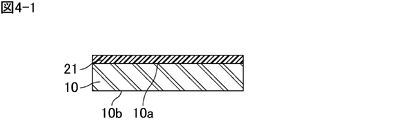
- FIG. 4-1 is a schematic cross-sectional view for explaining an example of the process of forming an insulating layer.
- an insulating layer 21 is formed on the first main surface 10a of the substrate 10 by, for example, thermal oxidation, sputtering, or chemical vapor deposition.
- FIG. 4-2 is a schematic cross-sectional view for explaining an example of the process of forming the first electrode layer.
- a conductor layer made of the constituent material of the first electrode layer 22 is formed on the surface of the insulating layer 21 opposite to the substrate 10 by, for example, sputtering. Thereafter, patterning of the conductive layer is performed by combining photolithography and etching to form the first electrode layer 22 as shown in FIG. 4-2. More specifically, the first electrode layer 22 is formed up to a position separated from the edge of the substrate 10 .
- FIG. 4-3 is a schematic cross-sectional view for explaining an example of the process of forming a dielectric layer.
- a layer made of a constituent material of the dielectric layer 23 is formed so as to cover the first electrode layer 22 by, for example, a sputtering method or a chemical vapor deposition method. This layer is then patterned, for example, by a combination of photolithography and etching to form a dielectric layer 23 as shown in FIG. 4-3. More specifically, the dielectric layer 23 is formed so as to provide an opening that partially exposes the first electrode layer 22 .
- FIG. 4-4 is a schematic cross-sectional view for explaining an example of the process of forming the second electrode layer.
- a conductor layer made of the constituent material of the second electrode layer 24 is formed on the surface of the structure shown in FIG. 4-3 opposite to the substrate 10 by, for example, sputtering. Thereafter, the conductive layer is patterned by, for example, a combination of photolithography and etching to form the second electrode layer 24 as shown in FIG. 4-4. More specifically, the second electrode layer 24 is formed so as to face the first electrode layer 22 with the dielectric layer 23 interposed therebetween.
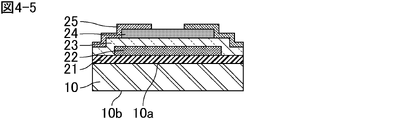
- FIG. 4-5 is a schematic cross-sectional view for explaining an example of the process of forming a moisture-resistant protective layer.
- a layer made of a constituent material of the moisture-resistant protective layer 25 is formed on the surface of the structure shown in FIG. 4-4 opposite to the substrate 10 by, for example, chemical vapor deposition. Thereafter, this layer is patterned by, for example, a combination of photolithography and etching to form a moisture-resistant protective layer 25 as shown in FIGS. 4-5. More specifically, openings are provided at positions overlapping the openings in the dielectric layer 23 for exposing a portion of the first electrode layer 22 and at positions exposing a portion of the second electrode layer 24 .
- a moisture resistant protective layer 25 is formed as follows.
- FIG. 4-6 is a schematic cross-sectional view for explaining an example of the process of forming a resin protective layer.
- a layer made of a constituent material of the resin protective layer 26 is formed, for example, by spin coating on the surface of the structure shown in FIG. 4-5 opposite to the substrate 10 . Thereafter, patterning of this layer is performed by, for example, only photolithography when the constituent material of the resin protective layer 26 is photosensitive, and by photolithography when the constituent material of the resin protective layer 26 is non-photosensitive.
- a resin protective layer 26 is formed as shown in FIGS. More specifically, a position overlapping the opening of the dielectric layer 23 and the moisture-resistant protective layer 25 to expose a portion of the first electrode layer 22 and a moisture-resistant protective layer to expose a portion of the second electrode layer 24 .
- the resin protective layer 26 is formed so that openings are provided at positions overlapping the openings of the layer 25 .
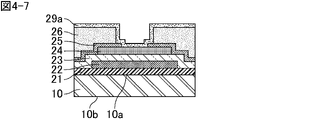
- FIG. 4-7 are schematic cross-sectional views for explaining an example of the process of forming the seed layer.
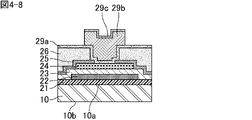
- FIG. 4-8 is a schematic cross-sectional view for explaining an example of the process of forming the first plating layer and the second plating layer.
- FIG. 4-9 is a schematic cross-sectional view for explaining an example of the step of removing part of the seed layer.
- a seed layer 29a is formed on the surface of the structure shown in FIGS.
- a first plating layer 29b and a second plating layer 29c are sequentially formed as shown in FIG. 4-8.
- part of the seed layer 29a is removed by, for example, an etching method.
- the second external electrodes 28 are formed as shown in FIG. 4-9.
- a similar method is used to form the first external electrodes 27 shown in FIGS. 1-3. More specifically, the first external electrode layer 23 is electrically connected to the first electrode layer 22 through openings provided in the dielectric layer 23, the moisture-resistant protective layer 25, and the resin protective layer 26, respectively. An electrode 27 is formed. Also, the second external electrode 28 is formed so as to be electrically connected to the second electrode layer 24 through the openings respectively provided in the moisture-resistant protective layer 25 and the resin protective layer 26 .
- the circuit layer 20 as shown in FIGS. 1-3 the first external electrodes 27 are drawn out to the surface of the circuit layer 20 opposite to the substrate 10 and are separated from the second external electrodes 28 .
- the second external electrode 28 is drawn out to the surface of the circuit layer 20 opposite to the substrate 10 and is separated from the first external electrode 27 .
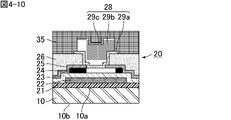
- ⁇ Formation of first resin body> 4-10 are schematic cross-sectional views for explaining an example of the process of forming a photosensitive resin film.
- 4-11 is a schematic cross-sectional view for explaining an example of the process of forming the first resin body.
- a photosensitive resin film 35 is formed on the surface of the circuit layer 20 opposite to the substrate 10 .
- 4-11 is formed on the surface of the circuit layer 20 opposite to the substrate 10 by patterning the photosensitive resin film 35 by photolithography. More specifically, provided between the edge of the substrate 10 and the first external electrode 27 and between the edge of the substrate 10 and the second external electrode 28 in plan view from the thickness direction T, In the thickness direction T, the tip on the side opposite to the substrate 10 is positioned higher than the tips of the first external electrode 27 and the second external electrode 28 on the side opposite to the substrate 10, and from the direction perpendicular to the thickness direction T , the side surface on the side of the first external electrode 27 or the second external electrode 28 approaches the side surface on the edge side of the substrate 10 from the side of the substrate 10 toward the side opposite to the substrate 10, and the side surface of the substrate 10
- the first resin body 30 is formed so that the side surface on the end portion side rises steeply from the first main surface 10 a of the substrate 10 .
- the capacitor 1 is manufactured.
- a module of the present invention includes a semiconductor device of the present invention, a wiring board having a first land electrically connected to a first external electrode, and a second land electrically connected to a second external electrode. , is provided.
- a module including the capacitor of Embodiment 1 of the present invention will be described as a module of Embodiment 1 of the present invention.
- FIG. 5 is a schematic cross-sectional view showing the module of Embodiment 1 of the present invention.
- the module 100 includes a capacitor 1 and a wiring board 50. More specifically, module 100 is obtained by mounting capacitor 1 on wiring board 50 .
- the wiring board 50 has a board 51 , first lands 52 and second lands 53 .
- Various wirings are provided on the substrate 51 .
- Various wirings of the substrate 51 are independently connected to the first land 52 and the second land 53 .
- the first land 52 is provided on the surface of the substrate 51 and electrically connected to the first external electrode 27 . More specifically, the first land 52 is electrically connected to the first external electrode 27 via solder 60 .
- Examples of the constituent material of the first land 52 include metals such as copper (Cu).
- the second land 53 is provided on the surface of the substrate 51 at a position separated from the first land 52 and electrically connected to the second external electrode 28 . More specifically, the second land 53 is electrically connected to the second external electrode 28 via solder 60 .
- Examples of the constituent material of the second land 53 include metals such as copper (Cu).
- the first resin body 30 is not in contact with the wiring board 50 side (eg, the first land 52, the second land 53, the solder 60, etc.). This is believed to be due to, for example, the following mechanism.
- the first mechanism the case where the capacitor 1 is mounted on the wiring board 50 without being displaced will be described.
- the first resin body 30 contacts the solder 60 .
- the solder 60 spreads over the entire first land 52 and the second land 53, the solder 60 avoids the first resin body 30, and as a result, the first land The resin body 30 is prevented from coming into contact with the solder 60.
- the capacitor 1 is mounted on the wiring board 50 in a positionally displaced state.
- the first resin body 30 does not come into contact with the solder 60 due to the self-alignment effect during the reflow process.
- FIG. 6 is a schematic cross-sectional view showing a state in which a mold resin is provided in the module of Embodiment 1 of the present invention.
- the capacitor of Embodiment 1 of the present invention may further include a second resin body.
- the second resin body is provided between the first external electrode and the second external electrode in plan view from the thickness direction, and the tip of the second resin body opposite to the substrate in the thickness direction is It is located higher than the tips of the first external electrode and the second external electrode on the side opposite to the substrate.
- Such an example will be described below as a capacitor of Embodiment 2 of the present invention.
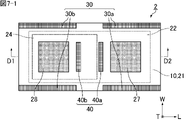
- FIG. 7-1 is a schematic plan view showing an example of a capacitor according to Embodiment 2 of the present invention.
- FIG. 7-2 is a schematic cross-sectional view showing a portion corresponding to line segment D1-D2 in FIG. 7-1.
- the second resin body 40 is provided between the first external electrode 27 and the second external electrode 28 in plan view from the thickness direction T. As shown in FIG. More specifically, in the plan view shown in FIG. 7A, in the length direction L, the second resin body 40 extends along the width direction W from the end of the first external electrode 27 on the second external electrode 28 side. and a normal line extending along the width direction W from the end of the second external electrode 28 on the first external electrode 27 side.
- the second resin body 40 is provided on the surface of the circuit layer 20 opposite to the substrate 10 .
- the tip of the second resin body 40 on the side opposite to the substrate 10 in the thickness direction T is the tip of the first external electrode 27 and the second external electrode 28 on the side opposite to the substrate 10. located higher than
- the first resin body 30 and the second resin body 40 may be connected or separated.
- the load applied during mounting can be received not only by the first resin body 30 but also by the second resin body 40, so that the load can be dispersed.
- the constituent material of the second resin body 40 may be the same as the constituent material of the first resin body 30 . Also, the second resin body 40 may be formed at the same time as the first resin body 30 .
- the tip of the second resin body 40 opposite to the substrate 10 is preferably positioned higher than the tip of the first resin body 30 opposite to the substrate 10 . This makes it possible to shift the timing at which each resin body contacts the wiring board or the like during mounting, so that the load applied to each resin body can be reduced.
- the second resin body 40 is preferably provided at a location surrounding the center of the substrate 10 . As shown in FIGS. 7-1 and 7-2, the second resin body 40 extends in a direction perpendicular to the thickness direction T and from the second external electrode 28 toward the first external electrode 27. Here, It preferably extends in a direction transverse to the length direction L. More specifically, the second resin body 40 preferably extends in a direction orthogonal to both the length direction L and the thickness direction T, that is, the width direction W. As shown in FIG.
- the second resin body 40 includes a first wall portion 40a provided on the first external electrode 27 side and a first wall portion 40a provided on the second external electrode 28 side. and a second wall portion 40b spaced apart.
- the first wall portion 40a and the second wall portion 40b are preferably provided in parallel.
- the substrate 10 and the circuit layer 20 can be sufficiently stably held on the wiring board by the second resin body 40 .
- the first wall portion 40a is provided on one side with respect to the center thereof, and the second wall portion 40b is provided on the other side. 40 allows substrate 10 and circuit layer 20 to be more stably held on the wiring substrate.
- the first outer peripheral portion and the second outer peripheral portion of the first resin body may be provided continuously along the edge of the substrate. Such an example will be described below as a capacitor of Embodiment 3 of the present invention.
- FIG. 8-1 is a schematic plan view showing an example of a capacitor according to Embodiment 3 of the present invention.
- FIG. 8-2 is a schematic cross-sectional view showing a portion corresponding to line segment D1-D2 in FIG. 8-1.
- the first resin body 30 is located between the edge of the substrate 10 and the first external electrode 27 in plan view from the thickness direction T. , and continuously along the edge of the substrate 10 between the edge of the substrate 10 and the second external electrode 28 in plan view from the thickness direction T and a second outer peripheral portion 30b provided. More specifically, in plan view from the thickness direction T, the first outer peripheral portion 30a extends along the length direction L of the substrate 10 and extends in the width direction W around the first external electrode 27. A portion along the length direction L and a portion along the width direction W of the substrate 10 are connected.
- the second outer peripheral portion 30b is formed around the second external electrode 28 along both ends extending along the length direction L of the substrate 10 and the other end extending along the width direction W. A portion along the length direction L and a portion along the width direction W of the substrate 10 are connected.
- the first resin body 30 acts as a barrier. Therefore, short-circuiting between the first external electrode 27 and the second external electrode 28 due to solder splash can be suppressed.
- the second resin body 40 may be provided between the first external electrode 27 and the second external electrode 28 in plan view from the thickness direction T, or the second resin body 40 may not be provided. good. When the second resin body 40 is provided, the first resin body 30 and the second resin body 40 may be connected or separated.
- the first resin body has a first corner, a second corner, a third corner, and a fourth corner provided at four corners of the substrate in a plan view from the thickness direction. good too.
- Such an example will be described below as a capacitor of Embodiment 4 of the present invention.
- FIG. 9-1 is a schematic plan view showing an example of a capacitor according to Embodiment 4 of the present invention.
- FIG. 9-2 is a schematic cross-sectional view showing a portion corresponding to line segment A1-A2 in FIG. 9-1.
- the first resin bodies 30 are provided at the four corners of the substrate 10 when viewed from the thickness direction T in plan. More specifically, the first resin body 30 has a distance between all locations on the top surface of the first resin body 30 and the corners of the capacitor elements (corners of the substrate 10) in a plan view from the thickness direction T. is provided at a position shorter than the shortest distance between the end of the second electrode layer 24 and the outer circumference of the capacitor element (the outer circumference of the substrate 10). That is, the first resin body 30 is provided within a range not exceeding the dotted line extending from the end of the second electrode layer 24 in plan view shown in FIG. 9-1.
- the first resin body 30 is provided on the surface of the circuit layer 20 opposite to the substrate 10 .
- the first resin body 30 includes a first corner 31a, a second corner 31b, a third corner 31c, and a corner 31c provided at four corners of the substrate 10 when viewed in plan from the thickness direction T. It has a fourth corner 31d.
- Each of the first corner portion 31a, the second corner portion 31b, the third corner portion 31c, and the fourth corner portion 31d has an oblique cone shape with the bottom surface located on the substrate 10 side.
- Two side surfaces of the first corner 31a on the side of the first external electrode 27 (surfaces illustrated by right-angled triangles in FIG.
- the first corner portion 31a approaches the opposite surface of the two side surfaces on the edge portion side of the substrate 10 (the surface overlapping the edge portion of the substrate 10 in FIG. 9-1).
- Two side surfaces of the first corner portion 31 a on the edge side of the substrate 10 are steep with respect to the first main surface 10 a of the substrate 10 .
- the two side surfaces of the third corner 31c on the side of the second external electrode 28 (surfaces illustrated as right-angled triangles in FIG. 9-1) each extend from the substrate 10 side toward the side opposite to the substrate 10 to form the third corner 31c.
- the corner 31c approaches the opposite side of the two side surfaces on the edge side of the substrate 10 (the surface overlapping the edge of the substrate 10 in FIG. 9-1).
- Two side surfaces of the third corner portion 31c on the edge side of the substrate 10 are steep with respect to the first main surface 10a of the substrate 10, respectively. The same applies to the fourth corner 31d.
- the first resin body 30 is provided at a position not overlapping the first electrode layer 22 in plan view from the thickness direction T.
- the load per area applied to the first resin bodies 30 is increased, thereby further promoting the lateral deformation of the first resin bodies 30 described with reference to FIG. 2-1. be able to. As a result, damage to the capacitor element, particularly damage to the dielectric layer 23 is further suppressed.
- the path for filling with the mold resin is open when molding with resin after mounting, so that filling defects can be suppressed.
- the second resin body 40 may be provided between the first external electrode 27 and the second external electrode 28 in plan view from the thickness direction T, or the second resin body 40 may not be provided. good.
- the capacitor of Embodiment 4 of the present invention may further include a third resin body.
- the third resin body is provided between the first resin bodies in plan view from the thickness direction. It is located higher than the tip of the second external electrode on the side opposite to the substrate. Such an example will be described below as a capacitor of Embodiment 5 of the present invention.
- FIG. 10-1 is a schematic plan view showing an example of a capacitor according to Embodiment 5 of the present invention.
- FIG. 10-2 is a schematic cross-sectional view showing a portion corresponding to line segment D1-D2 in FIG. 10-1.
- a third resin body 41 is provided between the first resin bodies 30 when viewed from the thickness direction T in plan view. More specifically, in a plan view shown in FIG. 10-1, between the first corner 31a and the second corner 31b, between the second corner 31b and the third corner 31c, and between the third corner A third resin body 41 is provided between the corner 31c and the fourth corner 31d and between the fourth corner 31d and the first corner 31a.
- the third resin body 41 is provided on the outer peripheral portion of the substrate 10 in plan view from the thickness direction T. As shown in FIG.
- the tip of the third resin body 41 opposite to the substrate 10 in the thickness direction T is the tip of the first external electrode 27 and the second external electrode 28 opposite to the substrate 10. located higher than
- the load applied during mounting can be received not only by the first resin body 30 but also by the third resin body 41, so that the load can be dispersed.
- the third resin body 41 acts as a barrier. Therefore, short-circuiting between the first external electrode 27 and the second external electrode 28 due to solder splash can be suppressed.
- the constituent material of the third resin body 41 may be the same as the constituent material of the first resin body 30 . Also, the third resin body 41 may be formed at the same time as the first resin body 30 .
- first resin body 30 and the third resin body 41 are separated from each other at the bottom because the load during mounting is not transmitted from the first resin body 30 to the third resin body 41 .
- the side surface of the third resin body 41 on the side of the first external electrode 27 or the second external electrode 28 extends from the substrate 10 side to the substrate 10 side. may approach the side surface of the substrate 10 of the third resin body 41 toward the opposite side. That is, the cross-sectional shape of the third resin body 41 may be a so-called tapered shape in which the width decreases from the substrate 10 side toward the side opposite to the substrate 10 .
- the side surface of the third resin body 41 on the side of the first external electrode 27 or the second external electrode 28 is the end portion side of the substrate 10 of the third resin body 41 toward the side opposite to the substrate 10 from the substrate 10 side. It may be curved as long as it approaches the side surface of the .
- the side surface of the third resin body 41 on the edge side of the substrate 10 is It can be steep.
- the tip of the third resin body 41 on the side opposite to the substrate 10 may have an acute angle.
- the tip of the third resin body 41 on the side opposite to the substrate 10 may be sharp.
- the tip of the third resin body 41 opposite to the substrate 10 is preferably positioned lower than the tip of the first resin body 30 opposite to the substrate 10 . This makes it possible to shift the timing at which each resin body contacts the wiring board or the like during mounting, so that the load applied to each resin body can be reduced.
- the second resin body 40 may be provided between the first external electrode 27 and the second external electrode 28 in plan view from the thickness direction T, or the second resin body 40 may not be provided. good. When the second resin body 40 is provided, the second resin body 40 and the third resin body 41 may be connected or separated.
- the tip of the second resin body 40 opposite to the substrate 10 in the thickness direction T is the first It is preferably located higher than the end of the resin body 30 on the side opposite to the substrate 10 . This makes it possible to shift the timing at which each resin body contacts the wiring board or the like during mounting, so that the load applied to each resin body can be reduced.
- FIG. 11-1 is a schematic plan view showing a modification of the capacitor of Embodiment 5 of the present invention.
- FIG. 11-2 is a schematic cross-sectional view showing a portion corresponding to line segment D1-D2 in FIG. 11-1.
- the tip of the second resin body 40 opposite to the substrate 10 in the thickness direction T is the tip of the third resin body 41 opposite to the substrate 10. located higher than
- the tip of the second resin body 40 opposite to the substrate 10 in the thickness direction T is located on the side opposite to the substrate 10 of the first resin body 30.
- the tip of the third resin body 41 opposite to the substrate 10 is lower than the tip of the first resin body 30 opposite to the substrate 10 .
- the circuit layer may further have a third electrode layer facing the first electrode layer and separated from the second electrode layer.
- a third electrode layer facing the first electrode layer and separated from the second electrode layer.
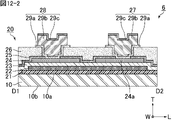
- FIG. 12-1 is a schematic plan view showing an example of a capacitor according to Embodiment 6 of the present invention.
- FIG. 12-2 is a schematic cross-sectional view showing a portion corresponding to line segment D1-D2 in FIG. 12-1.
- the circuit layer 20 further has a third electrode layer 24a.
- the first external electrode 27 is drawn out to the surface of the circuit layer 20 opposite to the substrate 10 and is separated from the second external electrode 28 . That is, the first external electrode 27 is located on the opposite side of the substrate 10 to the third electrode layer 24a. Here, the first external electrode 27 is electrically connected to the third electrode layer 24a. More specifically, openings respectively provided in the moisture-resistant protective layer 25 and the resin protective layer 26 are extended by communicating along the thickness direction T, and the first external electrode 27 is connected to the third electrode via the openings. It is electrically connected to the electrode layer 24a. In addition, the first external electrode 27 is separated from the first electrode layer 22 in the plane along the length direction L and the thickness direction T (see FIG. 12-2), so that the first external electrode 27 is electrically connected to the first electrode layer 22. Not connected.
- the third electrode layer 24a is provided facing the first electrode layer 22 and separated from the second electrode layer 24 . More specifically, the third electrode layer 24a is provided on the surface of the dielectric layer 23 opposite to the substrate 10 and faces the first electrode layer 22 with the dielectric layer 23 interposed therebetween.
- Materials constituting the third electrode layer 24a include, for example, aluminum (Al), silicon (Si), copper (Cu), silver (Ag), gold (Au), nickel (Ni), chromium (Cr), titanium ( Ti) and other metals.
- the constituent material of the third electrode layer 24a may be an alloy containing at least one of the metals described above, and specific examples thereof include an aluminum-silicon alloy (AlSi), an aluminum-copper alloy (AlCu), and an aluminum-silicon alloy. -Copper alloy (AlSiCu) and the like.
- the third electrode layer 24a may have a single-layer structure, or may have a multilayer structure including a plurality of conductor layers made of the materials described above.
- the dimension (thickness) in the thickness direction T of the third electrode layer 24a is preferably 0.3 ⁇ m or more and 10 ⁇ m or less, more preferably 0.5 ⁇ m or more and 5 ⁇ m or less.
- a capacitor element is composed of the first electrode layer 22, the dielectric layer 23, and the third electrode layer 24a. More specifically, the capacitance of the capacitor element is formed in the overlapping region of the first electrode layer 22, the dielectric layer 23 and the third electrode layer 24a.
- the capacitor is formed on the left side, whereas in the configuration of the capacitor 6 shown in FIGS. formed.
- a capacitor having the same capacitance as the capacitor 1 can be formed by reducing the thickness of the dielectric layer 23 by about half.
- the dielectric layer 23 of the capacitor having a small capacitance can be made thinner, and the manufacturing cost can be reduced accordingly.
- the capacitor element is likely to break when a load is applied. However, by making the first resin body 30 steep, damage to the capacitor element can be suppressed.
- the semiconductor device of the present invention is not limited to the above-described embodiments, and various applications and modifications can be made within the scope of the present invention with respect to the configuration, manufacturing conditions, etc. of the semiconductor device such as a capacitor. .
Landscapes
- Engineering & Computer Science (AREA)
- Power Engineering (AREA)
- Microelectronics & Electronic Packaging (AREA)
- Manufacturing & Machinery (AREA)
- Fixed Capacitors And Capacitor Manufacturing Machines (AREA)
Priority Applications (3)
| Application Number | Priority Date | Filing Date | Title |
|---|---|---|---|
| JP2023521005A JP7715190B2 (ja) | 2021-05-10 | 2022-05-09 | 半導体装置及びモジュール |
| CN202280032990.XA CN117242539A (zh) | 2021-05-10 | 2022-05-09 | 半导体装置以及模块 |
| US18/497,049 US20240063252A1 (en) | 2021-05-10 | 2023-10-30 | Semiconductor device and module |
Applications Claiming Priority (2)
| Application Number | Priority Date | Filing Date | Title |
|---|---|---|---|
| JP2021-079847 | 2021-05-10 | ||
| JP2021079847 | 2021-05-10 |
Related Child Applications (1)
| Application Number | Title | Priority Date | Filing Date |
|---|---|---|---|
| US18/497,049 Continuation US20240063252A1 (en) | 2021-05-10 | 2023-10-30 | Semiconductor device and module |
Publications (1)
| Publication Number | Publication Date |
|---|---|
| WO2022239718A1 true WO2022239718A1 (ja) | 2022-11-17 |
Family
ID=84029610
Family Applications (1)
| Application Number | Title | Priority Date | Filing Date |
|---|---|---|---|
| PCT/JP2022/019620 Ceased WO2022239718A1 (ja) | 2021-05-10 | 2022-05-09 | 半導体装置及びモジュール |
Country Status (4)
| Country | Link |
|---|---|
| US (1) | US20240063252A1 (https=) |
| JP (1) | JP7715190B2 (https=) |
| CN (1) | CN117242539A (https=) |
| WO (1) | WO2022239718A1 (https=) |
Citations (4)
| Publication number | Priority date | Publication date | Assignee | Title |
|---|---|---|---|---|
| JP2010157667A (ja) * | 2009-01-05 | 2010-07-15 | Sumitomo Electric Ind Ltd | 検出装置およびその製造方法 |
| JP2012015299A (ja) * | 2010-06-30 | 2012-01-19 | Tdk Corp | 電子部品及び電子デバイス |
| JP2012015333A (ja) * | 2010-06-30 | 2012-01-19 | Tdk Corp | 電子部品及び電子デバイス |
| JP2015038927A (ja) * | 2013-08-19 | 2015-02-26 | 富士通株式会社 | 電子装置及び電子装置の製造方法 |
Family Cites Families (1)
| Publication number | Priority date | Publication date | Assignee | Title |
|---|---|---|---|---|
| WO2016021529A1 (ja) * | 2014-08-06 | 2016-02-11 | 株式会社村田製作所 | 複合電子部品 |
-
2022
- 2022-05-09 CN CN202280032990.XA patent/CN117242539A/zh active Pending
- 2022-05-09 WO PCT/JP2022/019620 patent/WO2022239718A1/ja not_active Ceased
- 2022-05-09 JP JP2023521005A patent/JP7715190B2/ja active Active
-
2023
- 2023-10-30 US US18/497,049 patent/US20240063252A1/en active Pending
Patent Citations (4)
| Publication number | Priority date | Publication date | Assignee | Title |
|---|---|---|---|---|
| JP2010157667A (ja) * | 2009-01-05 | 2010-07-15 | Sumitomo Electric Ind Ltd | 検出装置およびその製造方法 |
| JP2012015299A (ja) * | 2010-06-30 | 2012-01-19 | Tdk Corp | 電子部品及び電子デバイス |
| JP2012015333A (ja) * | 2010-06-30 | 2012-01-19 | Tdk Corp | 電子部品及び電子デバイス |
| JP2015038927A (ja) * | 2013-08-19 | 2015-02-26 | 富士通株式会社 | 電子装置及び電子装置の製造方法 |
Also Published As
| Publication number | Publication date |
|---|---|
| JPWO2022239718A1 (https=) | 2022-11-17 |
| US20240063252A1 (en) | 2024-02-22 |
| CN117242539A (zh) | 2023-12-15 |
| JP7715190B2 (ja) | 2025-07-30 |
Similar Documents
| Publication | Publication Date | Title |
|---|---|---|
| US6255737B1 (en) | Semiconductor device and method of making the same, circuit board, and electronic instrument | |
| US12464740B2 (en) | Semiconductor device and module | |
| TWI766918B (zh) | 貫通電極基板、半導體裝置及貫通電極基板之製造方法 | |
| US7808030B2 (en) | Electronic component manufacturing method and electronic component | |
| CN109923630B (zh) | 电容器 | |
| US12424389B2 (en) | Semiconductor device and capacitance device | |
| US20190206627A1 (en) | Electronic component | |
| WO2022239718A1 (ja) | 半導体装置及びモジュール | |
| JP7647880B2 (ja) | 半導体装置 | |
| JP7683684B2 (ja) | 半導体装置及びモジュール | |
| JP3967964B2 (ja) | 薄膜電子部品 | |
| KR102068809B1 (ko) | 박막 커패시터 및 박막 커패시터의 제조방법 | |
| US20230368964A1 (en) | Inductor component | |
| JP2001345234A (ja) | 薄膜電子部品および積層薄膜電子部品並びに基板 | |
| JP7290513B2 (ja) | 半導体装置 | |
| JP4454174B2 (ja) | 薄膜コンデンサ | |
| WO2025263314A1 (ja) | 受動電子部品及び受動電子部品の製造方法 | |
| WO2024101272A1 (ja) | 集積化受動部品、及び集積化受動部品の製造方法 | |
| JP2003347156A (ja) | 薄膜電子部品 | |
| CN110767626A (zh) | 封装结构及其制造方法 | |
| JPH07135238A (ja) | 半導体装置およびその製造方法 | |
| JP2006344850A (ja) | 電子部品 |
Legal Events
| Date | Code | Title | Description |
|---|---|---|---|
| 121 | Ep: the epo has been informed by wipo that ep was designated in this application |
Ref document number: 22807420 Country of ref document: EP Kind code of ref document: A1 |
|
| WWE | Wipo information: entry into national phase |
Ref document number: 202280032990.X Country of ref document: CN |
|
| WWE | Wipo information: entry into national phase |
Ref document number: 2023521005 Country of ref document: JP |
|
| NENP | Non-entry into the national phase |
Ref country code: DE |
|
| 122 | Ep: pct application non-entry in european phase |
Ref document number: 22807420 Country of ref document: EP Kind code of ref document: A1 |