WO2022239282A1 - 非空気入りタイヤ - Google Patents
非空気入りタイヤ Download PDFInfo
- Publication number
- WO2022239282A1 WO2022239282A1 PCT/JP2021/044159 JP2021044159W WO2022239282A1 WO 2022239282 A1 WO2022239282 A1 WO 2022239282A1 JP 2021044159 W JP2021044159 W JP 2021044159W WO 2022239282 A1 WO2022239282 A1 WO 2022239282A1
- Authority
- WO
- WIPO (PCT)
- Prior art keywords
- pneumatic tire
- resin composition
- mpa
- tire
- resin
- Prior art date
- Legal status (The legal status is an assumption and is not a legal conclusion. Google has not performed a legal analysis and makes no representation as to the accuracy of the status listed.)
- Ceased
Links
Images
Classifications
-
- B—PERFORMING OPERATIONS; TRANSPORTING
- B60—VEHICLES IN GENERAL
- B60C—VEHICLE TYRES; TYRE INFLATION; TYRE CHANGING; CONNECTING VALVES TO INFLATABLE ELASTIC BODIES IN GENERAL; DEVICES OR ARRANGEMENTS RELATED TO TYRES
- B60C7/00—Non-inflatable or solid tyres
- B60C7/10—Non-inflatable or solid tyres characterised by means for increasing resiliency
- B60C7/107—Non-inflatable or solid tyres characterised by means for increasing resiliency comprising lateral openings
-
- B—PERFORMING OPERATIONS; TRANSPORTING
- B60—VEHICLES IN GENERAL
- B60C—VEHICLE TYRES; TYRE INFLATION; TYRE CHANGING; CONNECTING VALVES TO INFLATABLE ELASTIC BODIES IN GENERAL; DEVICES OR ARRANGEMENTS RELATED TO TYRES
- B60C5/00—Inflatable pneumatic tyres or inner tubes
- B60C5/01—Inflatable pneumatic tyres or inner tubes without substantial cord reinforcement, e.g. cordless tyres, cast tyres
-
- B—PERFORMING OPERATIONS; TRANSPORTING
- B60—VEHICLES IN GENERAL
- B60C—VEHICLE TYRES; TYRE INFLATION; TYRE CHANGING; CONNECTING VALVES TO INFLATABLE ELASTIC BODIES IN GENERAL; DEVICES OR ARRANGEMENTS RELATED TO TYRES
- B60C1/00—Tyres characterised by the chemical composition or the physical arrangement or mixture of the composition
-
- B—PERFORMING OPERATIONS; TRANSPORTING
- B60—VEHICLES IN GENERAL
- B60C—VEHICLE TYRES; TYRE INFLATION; TYRE CHANGING; CONNECTING VALVES TO INFLATABLE ELASTIC BODIES IN GENERAL; DEVICES OR ARRANGEMENTS RELATED TO TYRES
- B60C7/00—Non-inflatable or solid tyres
- B60C7/10—Non-inflatable or solid tyres characterised by means for increasing resiliency
- B60C7/14—Non-inflatable or solid tyres characterised by means for increasing resiliency using springs
- B60C7/143—Non-inflatable or solid tyres characterised by means for increasing resiliency using springs having a lateral extension disposed in a plane parallel to the wheel axis
-
- C—CHEMISTRY; METALLURGY
- C08—ORGANIC MACROMOLECULAR COMPOUNDS; THEIR PREPARATION OR CHEMICAL WORKING-UP; COMPOSITIONS BASED THEREON
- C08L—COMPOSITIONS OF MACROMOLECULAR COMPOUNDS
- C08L67/00—Compositions of polyesters obtained by reactions forming a carboxylic ester link in the main chain; Compositions of derivatives of such polymers
- C08L67/02—Polyesters derived from dicarboxylic acids and dihydroxy compounds
- C08L67/03—Polyesters derived from dicarboxylic acids and dihydroxy compounds the dicarboxylic acids and dihydroxy compounds having the carboxyl- and the hydroxy groups directly linked to aromatic rings
-
- C—CHEMISTRY; METALLURGY
- C08—ORGANIC MACROMOLECULAR COMPOUNDS; THEIR PREPARATION OR CHEMICAL WORKING-UP; COMPOSITIONS BASED THEREON
- C08L—COMPOSITIONS OF MACROMOLECULAR COMPOUNDS
- C08L2205/00—Polymer mixtures characterised by other features
- C08L2205/02—Polymer mixtures characterised by other features containing two or more polymers of the same C08L -group
- C08L2205/025—Polymer mixtures characterised by other features containing two or more polymers of the same C08L -group containing two or more polymers of the same hierarchy C08L, and differing only in parameters such as density, comonomer content, molecular weight, structure
-
- C—CHEMISTRY; METALLURGY
- C08—ORGANIC MACROMOLECULAR COMPOUNDS; THEIR PREPARATION OR CHEMICAL WORKING-UP; COMPOSITIONS BASED THEREON
- C08L—COMPOSITIONS OF MACROMOLECULAR COMPOUNDS
- C08L2207/00—Properties characterising the ingredient of the composition
- C08L2207/04—Thermoplastic elastomer
Definitions
- the present invention relates to non-pneumatic tires.
- Patent Literature 1 describes a ring member having an attachment body attached to an axle, an inner cylinder body fitted to the attachment body, and an outer cylinder body surrounding the inner cylinder body from the outside in the tire radial direction. , a plurality of connecting members disposed between the inner cylinder and the outer cylinder along the tire circumferential direction, and connecting these two cylinders to each other so as to be relatively elastically displaceable.
- a pneumatic tire is disclosed.
- a ring member and a connecting member of a non-pneumatic tire are integrally made of a synthetic resin material that specifies the ratio of the bending elastic modulus at -20 ° C. and the bending elastic modulus at 60 ° C. It is disclosed that the formation can improve ride comfort.
- Patent Document 1 has room for improvement in terms of both ride comfort and durability in the case of a small diameter size.
- an object of the present invention is to provide a non-pneumatic tire that solves the above-mentioned problems of the prior art and achieves both ride comfort and durability even with a small diameter size.
- the gist and configuration of the present invention for solving the above problems is as follows.
- a non-pneumatic tire of the present invention is a non-pneumatic tire using a resin composition for a frame member,
- the resin composition has a flexural modulus of 247 MPa or less at ⁇ 20° C. in accordance with ISO 178 and a flexural modulus of 32 MPa or more at 60° C. in accordance with ISO 178,
- the diameter in the tire radial direction is 35 cm or less.
- the flexural modulus is a value obtained by a three-point bending test conforming to "ISO178:2010 A method".
- a non-pneumatic tire of the present invention is a non-pneumatic tire using a resin composition for a frame member.
- the frame member of the non-pneumatic tire is a member that constitutes the tire frame, more specifically, supports the tread member from the inside to the outside of the tire in order to maintain the shape of the tire tread. It means parts. For example, it is a ring member (inner cylinder, outer cylinder) and a connecting member (spoke structure) in a non-pneumatic tire.
- the resin composition used for the skeleton member has a bending elastic modulus of 247 MPa or less at -20 ° C. in accordance with ISO 178, and bending at 60 ° C. in accordance with ISO 178.
- the non-pneumatic tire of the present invention is characterized by having a modulus of elasticity of 32 MPa or more and a diameter of 35 cm or less in the tire radial direction.
- the flexural modulus of a resin composition generally tends to decrease as the temperature rises. The member does not become too soft, and when a vehicle equipped with non-pneumatic tires is driven, the riding comfort is good, and durability can be sufficiently secured.
- the flexural modulus of the resin composition generally tends to increase as the temperature decreases. Since the frame member does not become too hard even at high temperatures, the riding comfort is good. In addition, the frame member does not become too hard and brittle, and is excellent in durability. Therefore, the non-pneumatic tire of the present invention can achieve both ride comfort and durability over a wide temperature range even if the diameter in the tire radial direction is as small as 35 cm or less.
- the bending elastic modulus of the resin composition used for the skeleton member at -20°C is 247 MPa or less, preferably 234 MPa or less, more preferably 170 MPa or less, and usually 80 MPa or more, preferably 90 MPa or more. is. If the flexural modulus at ⁇ 20° C. exceeds 247 MPa, the frame member becomes too hard and vibrations transmitted from the tire become intense, deteriorating ride comfort. Durability also deteriorates. Also, if the bending elastic modulus at -20°C is 90 MPa or more, ride comfort and durability in a low-temperature environment are improved in a well-balanced manner.
- the bending elastic modulus at 60° C. of the resin composition used for the skeleton member is 32 MPa or more, preferably 34 MPa or more, more preferably 36 MPa or more, and usually 90 MPa or less, preferably 70 MPa or less. be. If the flexural modulus at 60°C is less than 32 MPa, the frame member becomes too soft, and when a vehicle equipped with non-pneumatic tires is driven, the ride comfort may deteriorate and the durability may decrease. . In addition, if the bending elastic modulus at 60° C. is 70 MPa or less, ride comfort and durability in a high-temperature environment are improved in a well-balanced manner.
- the bending elastic modulus at 0°C of the resin composition used for the skeleton member is usually 61 MPa or higher, preferably 70 MPa or higher, and usually 159 MPa or lower, preferably 130 MPa or lower. If the bending elastic modulus at 0°C is 70 MPa or more, the riding comfort in a low temperature environment is further improved, and if the bending elastic modulus at 0°C is 130 MPa or less, the riding comfort in a low temperature environment is improved. Balanced durability.
- the bending elastic modulus of the resin composition used for the skeleton member at 23°C is usually 53 MPa or more, preferably 60 MPa or more, and usually 127 MPa or less, preferably 115 MPa or less. If the flexural modulus at 23°C is 60 MPa or more, the ride comfort at room temperature is further improved, and if the flexural modulus at 23°C is 115 MPa or less, the ride comfort and durability at room temperature are balanced. improve well.
- the flexural modulus of the resin composition used for the skeleton member at 40°C is usually 40 MPa or higher, preferably 44 MPa or higher, and usually 96 MPa or lower, preferably 84 MPa or lower. If the bending elastic modulus at 40°C is 44 MPa or more, the riding comfort in a high temperature environment is further improved, and if the bending elastic modulus at 40°C is 84 MPa or less, the riding comfort in a high temperature environment is improved. Balanced durability.
- the resin component of the resin composition used for the skeleton member is preferably a thermoplastic elastomer or a thermoplastic resin, more preferably a thermoplastic elastomer.
- various additives can be added to the resin composition.
- the content of the resin component in the resin composition is preferably 80% by mass or more, more preferably 90% by mass or more.
- thermoplastic elastomers and thermoplastic resins are polymeric compounds that soften and flow as the temperature rises, and become relatively hard and strong when cooled.
- Thermoplastic elastomers are polymeric compounds that soften and flow, become relatively hard and strong when cooled, and have rubber-like elasticity.
- thermoplastics are distinguished as macromolecular compounds that take on a certain state and do not have rubber-like elasticity.
- a "thermoplastic elastomer” is a thermoplastic resin material having a hard segment and a soft segment in the molecule.
- the thermoplastic elastomer in the present invention does not include vulcanized rubber such as natural rubber and synthetic rubber.
- thermoplastic elastomers examples include thermoplastic polyester elastomers (TPC), thermoplastic polyamide elastomers (TPA), thermoplastic polyolefin elastomers (TPO), and thermoplastic polystyrene elastomers (TPS).
- TPC thermoplastic polyester elastomers
- TPA thermoplastic polyamide elastomers
- TPO thermoplastic polyolefin elastomers
- TPS thermoplastic polystyrene elastomers
- polyester-based thermoplastic elastomer is preferable from the viewpoint of durability and cost.
- the polyester-based thermoplastic elastomer is a high-molecular compound having elasticity, and includes a polymer that constitutes a hard segment that is crystalline and has a high melting point, and a polymer that constitutes a soft segment that is amorphous and has a low glass transition temperature. means a thermoplastic resin material composed of a copolymer having .
- Aromatic polyester can be used as the crystalline polyester forming the hard segment of the thermoplastic polyester elastomer (TPC).
- Aromatic polyesters can be formed, for example, from aromatic dicarboxylic acids or ester-forming derivatives thereof and aliphatic diols. Examples of the aromatic polyester forming the hard segment include polyethylene terephthalate, polybutylene terephthalate, polystyrene terephthalate, polyethylene naphthalate, polybutylene naphthalate, etc. Polybutylene terephthalate is preferred.
- One of the suitable aromatic polyesters forming the hard segment includes polybutylene terephthalate derived from terephthalic acid and/or dimethyl terephthalate and 1,4-butanediol, isophthalic acid, phthalic acid, Naphthalene-2,6-dicarboxylic acid, naphthalene-2,7-dicarboxylic acid, diphenyl-4,4′-dicarboxylic acid, diphenoxyethanedicarboxylic acid, 5-sulfoisophthalic acid, or ester-forming derivatives thereof, etc.
- a dicarboxylic acid component ethylene glycol, trimethylene glycol, pentamethylene glycol, hexamethylene glycol, neopentyl glycol, decamethylene glycol, 1,4-cyclohexanedimethanol, tricyclodecanedimethylol, xylylene glycol, bis(p- hydroxy)diphenyl, bis(p-hydroxyphenyl)propane, 2,2-bis[4-(2-hydroxyethoxy)phenyl]propane, bis[4-(2-hydroxy)phenyl]sulfone, 1,1-bis[ Diol components such as 4-(2-hydroxyethoxy)phenyl]cyclohexane, 4,4′-dihydroxy-p-terphenyl, 4,4′-dihydroxy-p-quarterphenyl, and polyesters derived from these It may be a copolymer polyester in which two or more dicarboxylic acid components and diol components are used in combination.
- polymers forming the soft segment of the thermoplastic polyester elastomer include polymers selected from aliphatic polyethers and aliphatic polyesters.
- aliphatic polyether include poly(ethylene oxide) glycol, poly(propylene oxide) glycol, poly(tetramethylene oxide) glycol, poly(hexamethylene oxide) glycol, copolymers of ethylene oxide and propylene oxide, poly(propylene oxide), ) ethylene oxide addition polymers of glycols, copolymers of ethylene oxide and tetrahydrofuran, and the like.
- Examples of the aliphatic polyester include poly( ⁇ -caprolactone), polyenantholactone, polycaprylolactone, polybutylene adipate, and polyethylene adipate.
- poly(tetramethylene oxide) glycol, ethylene oxide addition polymers of poly(propylene oxide) glycol, and poly( ⁇ -caprolactone) are preferred from the viewpoint of the elastic properties of the resulting copolymer.
- polybutylene adipate, polyethylene adipate and the like are preferred.
- the polyester-based thermoplastic elastomer can be synthesized by copolymerizing a hard segment-forming polymer and a soft segment-forming polymer by a known method.
- commercially available products can be used as the polyester-based thermoplastic elastomer.
- Toray DuPont "Hytrel" series for example, 3046, 5557, 5577, 5577R-07, 6347, 4047, 4767, 4767N , 4777, etc.).
- the polyamide-based thermoplastic elastomer is a high-molecular compound having elasticity. means a thermoplastic resin material composed of a copolymer having , and having an amide bond (--CONH--) in the main chain of the polymer constituting the hard segment.
- the polyamide-based thermoplastic elastomer at least the polyamide constitutes a crystalline hard segment with a high melting point, and another polymer (e.g., polyester, polyether, etc.) constitutes an amorphous soft segment with a low glass transition temperature.
- thermoplastic polyamide elastomer examples include polycapramide (nylon-6), poly- ⁇ -aminoheptanoic acid (nylon-7), poly- ⁇ -aminononanoic acid (nylon -9), polyundecaneamide (nylon-11), polylauryllactam (nylon-12), polyethylenediamineadipamide (nylon-2,6), polytetramethyleneadipamide (nylon-4,6), poly Hexamethylene adipamide (nylon-6,6), polyhexamethylene sebacamide (nylon-6,10), polyhexamethylene dodecamide (nylon-6,12), polyoctamethylene adipamide (nylon-8 , 6), aliphatic polyamides such as polydecamethylene adipamide (nylon-10,8), aromatic diamines such as metaxylenediamine and paraxylenediamine, adipic acid, suberic acid, sebacic acid,
- thermoplastic polyamide elastomer examples include polymers selected from polymethylene and aliphatic polyethers.
- examples of the aliphatic polyether include poly(ethylene oxide) glycol, poly(propylene oxide) glycol, poly(tetramethylene oxide) glycol, poly(hexamethylene oxide) glycol, copolymers of ethylene oxide and propylene oxide, poly(propylene oxide), ) ethylene oxide addition polymers of glycols, copolymers of ethylene oxide and tetrahydrofuran, and the like.
- the polyamide-based thermoplastic elastomer can be synthesized by copolymerizing the polymer forming the hard segment and the polymer forming the soft segment by a known method.
- commercially available products can be used as the polyamide-based thermoplastic elastomer. , XPA9055, etc.), Daicel-Eponic's "Vestamide” series (eg, E40-S3, E47-S1, E47-S3, E55-S1, E55-S3, EX9200, E50-R2), and the like.
- thermoplastic polyolefin elastomer is a polymer compound having elasticity, and includes a polymer that constitutes a crystalline hard segment with a high melting point and a polymer that constitutes an amorphous soft segment with a low glass transition temperature. and the polymer constituting the hard segment is a polyolefin such as polypropylene or polyethylene.
- the polyolefin-based thermoplastic elastomer is a material in which at least polyolefin constitutes a crystalline hard segment with a high melting point, and the polyolefin and an olefin other than the polyolefin constitute an amorphous soft segment with a low glass transition point. is mentioned.
- polyolefins forming the hard segment of the thermoplastic polyolefin elastomer include polypropylene, isotactic polypropylene, polyethylene, and poly-1-butene.
- polymer constituting the soft segment of the polyolefin thermoplastic elastomer include ethylene-propylene copolymer, propylene-1-hexene copolymer, propylene-4-methyl-1-pentene copolymer, propylene-1 -butene copolymer, ethylene-1-hexene copolymer, ethylene-4-methyl-pentene copolymer, ethylene-1-butene copolymer, 1-butene-1-hexene copolymer, 1-butene- 4-methyl-pentene and the like.
- the polyolefin-based thermoplastic elastomer can be synthesized by copolymerizing the polymer constituting the hard segment and the polymer constituting the soft segment by a known method.
- the polyolefin-based thermoplastic elastomer commercially available products can be used. etc. can be used.
- the polystyrene-based thermoplastic elastomer is a high-molecular compound having elasticity, and is a copolymer having a polymer that constitutes a hard segment and a polymer that is amorphous and has a low glass transition temperature and constitutes a soft segment. It means a thermoplastic resin material composed of coalescence, wherein the polymer constituting the hard segment is polystyrene or a polystyrene derivative.
- the polystyrene-based thermoplastic elastomer is not particularly limited, but polystyrene constitutes a hard segment and an amorphous polymer is a soft segment having a low glass transition temperature (e.g., polyethylene, polybutadiene, polyisoprene, water copolymers constituting polybutadiene, hydrogenated polyisoprene, poly(2,3-dimethyl-butadiene), etc.).
- a low glass transition temperature e.g., polyethylene, polybutadiene, polyisoprene, water copolymers constituting polybutadiene, hydrogenated polyisoprene, poly(2,3-dimethyl-butadiene), etc.
- the polystyrene-based thermoplastic elastomer can be synthesized by copolymerizing the polymer constituting the hard segment and the polymer constituting the soft segment by a known method such as block copolymerization.
- a known method such as block copolymerization.
- commercially available products can be used as the polystyrene-based thermoplastic elastomer.
- Tufprene (registered trademark) and Tuftec (registered trademark) manufactured by Asahi Kasei Corporation, Septon (registered trademark) manufactured by Kuraray Co., Ltd., etc. are used. be able to.
- thermoplastic resins examples include polyester resins, polyamide resins, polyolefin resins, polystyrene resins, and the like.
- polyester resin is preferable from the viewpoint of durability and cost.
- the polyester resin is a resin having an ester bond in its main chain.
- the polyester resin is not particularly limited, crystalline polyester is preferable.
- An aromatic polyester can be used as the crystalline polyester.
- Aromatic polyesters can be formed, for example, from aromatic dicarboxylic acids or ester-forming derivatives thereof and aliphatic diols. Examples of the aromatic polyester include polyethylene terephthalate, polybutylene terephthalate, polystyrene terephthalate, polyethylene naphthalate, and polybutylene naphthalate, with polybutylene terephthalate being preferred.
- One of the aromatic polyesters includes polybutylene terephthalate derived from terephthalic acid and/or dimethyl terephthalate and 1,4-butanediol, and isophthalic acid, phthalic acid, naphthalene-2,6-dicarboxylic acid.
- dicarboxylic acid component such as an acid, naphthalene-2,7-dicarboxylic acid, diphenyl-4,4′-dicarboxylic acid, diphenoxyethanedicarboxylic acid, 5-sulfoisophthalic acid, or ester-forming derivatives thereof, and a molecular weight of 300
- diols ⁇ for example, aliphatic diols such as ethylene glycol, trimethylene glycol, pentamethylene glycol, hexamethylene glycol, neopentyl glycol and decamethylene glycol; Cyclic diols, xylylene glycol, bis(p-hydroxy)diphenyl, bis(p-hydroxyphenyl)propane, 2,2-bis[4-(2-hydroxyethoxy)phenyl]propane, bis[4-(2- Hydroxy)phenyl]sulfone, 1,1-bis[4-(2-hydroxyethoxy)phenyl]cyclohexane,
- polyester resin commercially available products can be used. 5010R3-2, etc.), Toray's "Toraycon” series (eg, 1401X06, 1401X31, 1401X70, etc.), Toyobo's "Planac” series (eg, BT-1000), and the like.
- Toray's "Toraycon” series eg, 1401X06, 1401X31, 1401X70, etc.
- Toyobo's "Planac” series eg, BT-1000
- the polyamide resin is a resin having an amide bond (--NHCO--) in its main chain.
- the polyamide resin include polycapramide (nylon-6), poly- ⁇ -aminoheptanoic acid (nylon-7), poly- ⁇ -aminononanoic acid (nylon-9), polyundecaneamide (nylon-11), and polylauryllactam.
- nylon-12 polyethylene diamine adipamide (nylon-2,6), polytetramethylene adipamide (nylon-4,6), polyhexamethylene adipamide (nylon-6,6), polyhexamethylene Sebacamide (nylon-6,10), polyhexamethylenedodecanamide (nylon-6,12), polyoctamethyleneadipamide (nylon-8,6), polydecamethyleneadipamide (nylon-10,8 ) and aromatic diamines such as metaxylenediamine and paraxylenediamine with dicarboxylic acids such as adipic acid, suberic acid, sebacic acid, cyclohexanedicarboxylic acid, terephthalic acid and isophthalic acid or derivatives thereof.
- aromatic diamines such as metaxylenediamine and paraxylenediamine with dicarboxylic acids such as adipic acid, suberic acid, sebacic acid, cyclohexanedicarboxylic acid,
- polyamide resin examples include UBESTA (eg, 3014U, 3020U, etc.) manufactured by Ube Industries, and VESTAMID (eg, L1600, L1700, etc.) manufactured by Daicel-Ebonix.
- UBESTA eg, 3014U, 3020U, etc.
- VESTAMID eg, L1600, L1700, etc.
- the polyolefin resin is a polymer whose main chain is an olefin such as ethylene, propylene, or 1-butene.
- examples of the polyolefin resin include polyethylene, polypropylene, polybutene, cycloolefin resins, and copolymers of these resins. Among these, polyethylene, polypropylene and ethylene-propylene copolymers are preferred, and polypropylene and ethylene-propylene copolymers are more preferred.
- polyolefin resin Commercially available products can also be used as the polyolefin resin.
- Prime PP registered trademark
- Novatec PP registered trademark
- Wintech registered trademark
- the polystyrene resin is a polymer of styrene.
- a commercially available product can also be used, for example, Zarek (registered trademark) manufactured by Idemitsu Kosan Co., Ltd., Toyo Styrol (registered trademark) manufactured by Toyo Styrene Co., Ltd., Sebian manufactured by Daicel Polymer Co., Ltd., etc. can be used. can.
- the resin composition preferably contains a thermoplastic elastomer having hard segments and soft segments in its molecule.
- a non-pneumatic tire using a resin composition containing a thermoplastic elastomer having a hard segment and a soft segment in the molecule as a skeleton member has improved ride comfort over a wide temperature range, and also has improved durability.
- thermoplastic elastomer is a polyester-based thermoplastic elastomer.
- a non-pneumatic tire using a resin composition containing a polyester-based thermoplastic elastomer as a skeleton member further improves ride comfort over a wide temperature range and further improves durability.
- the hard segment of the thermoplastic polyester elastomer is polybutylene terephthalate.
- a resin composition containing a polyester-based thermoplastic elastomer whose hard segment is polybutylene terephthalate has high strength. Especially good.
- the resin composition used for the skeleton member may contain additives in addition to the above resin components such as thermoplastic elastomers and thermoplastic resins.
- Additives to be added to the resin composition include weather-resistant anti-aging agents, heat-resistant anti-aging agents, moisture-heat resistant additives, antistatic agents, lubricants, crystal nucleating agents, tackifiers, anti-fogging agents, release agents, plasticizers, agents, fillers, pigments, dyes, fragrances, flame retardants, etc., among these, weather-resistant anti-aging agents, heat-resistant anti-aging agents, moist heat-resistant additives are preferred, and weather-resistant anti-aging agents and heat-resistant anti-aging agents are further preferred. preferable.
- the stability of the resin composition is improved, and a non-pneumatic tire using such a resin composition as a frame member can be used for a long time. Desired properties can be maintained.
- the total content of these additives is preferably 20 parts by mass or less, more preferably 10 parts by mass or less, relative to 100 parts by mass of the resin component.
- the weather antiaging agent is an additive that acts to improve the weather resistance of the resin composition
- the weather antiaging agent is preferably a benzotriazole-based compound or an amine-based compound (hindered amine-based compound).
- the benzotriazole compounds include 2-(2-hydroxy-5-tert-butylphenyl)-2H-benzotriazole, benzenepropanoic acid and 3-(2H-benzotriazol-2-yl)-5-( Octyl 3-[3-tert-butyl-4-hydroxy-5-(5-chloro-2H-benzo mixture of triazol-2-yl)phenyl]propionate and 2-ethylhexyl-3-[3-tert-butyl-4-hydroxy-5-(5-chloro-2H-benzotriazol-2-yl)phenyl]propionate, 2 -(2H-benzotriazol-2-yl)-4,6-bis(1-methyl-1-phenylethyl)phenol
- amine compound examples include bis(1,2,2,6,6-pentamethyl-4-piperidinyl)[[3,5-bis(1,1-dimethylethyl)-4-hydroxyphenyl]methyl] Butylmalonate, a mixture of bis(1,2,2,6,6-pentamethyl-4-piperidyl) sebacate and methyl 1,2,2,6,6-pentamethyl-4-piperidyl sebacate, bis(2,2 ,6,6-tetramethyl-4-piperidyl) sebacate, N,N'-bis(2,2,6,6-tetramethyl-4-piperidyl)-N,N'-diformylhexamethylenediamine, poly[ ⁇ 6-(1,1,3,3-tetramethylbutyl)amino-1,3,5-triazine-2,4-diyl ⁇ ⁇ 2,2,6,6-tetramethyl-4-piperidyl)imino ⁇ Hexamethylene ⁇ (2,2,6,6-tetramethyl
- the amount of the weathering antioxidant to be added is preferably in the range of 1 to 5 parts by mass with respect to 100 parts by mass of the resin component of the resin composition.
- the heat-resistant antiaging agent is an additive having an effect of improving the heat resistance of the resin composition, and the heat-resistant antiaging agent is preferably a phenolic compound (hindered phenolic compound).
- the phenolic compound include 2,6-di-tert-butyl-4-methylphenol, n-octadecyl-3-(3,5-di-tert-butyl-4-hydroxyphenyl)propionate, tetrakis [ methylene-3-(3,5-di-tert-butyl-4-hydroxyphenyl)propionate]methane, 2,4-di-tert-butyl-6-methylphenol, 1,6-hexanediol-bis-[3 -(3,5-di-tert-butyl-4-hydroxyphenyl)propionate], tris(3,5-di-tert-butyl-4-hydroxybenzyl)-isocyanurate, 1,3,5-trimethyl- 2,4,6-tris(3,
- the amount of the heat resistant antiaging agent to be added is preferably in the range of 1 to 5 parts by mass with respect to 100 parts by mass of the resin component of the resin composition.
- the moist heat resistant additive is an additive having an effect of improving the moist heat resistance of the resin composition
- the moist heat resistant additive is preferably a carbodiimide compound or an epoxy compound, more preferably an epoxy compound.
- the carbodiimide compound specifically, any compound having one or more carbodiimide groups in the molecule may be used, for example, N,N'-diisopropylcarbodiimide, N,N'-di(o-toluyl)carbodiimide.
- N,N'-dicyclohexylcarbodiimide, N,N'-bis(2,6-diisopropylphenyl) monofunctional carbodiimide compounds such as carbodiimide; p-phenylene-bis(2,6-xylylcarbodiimide), p-phenylene- Bifunctional carbodiimides such as bis(t-butylcarbodiimide), p-phenylene-bis(mesitylcarbodiimide), tetramethylene-bis(t-butylcarbodiimide), cyclohexane-1,4-bis(methylene-t-butylcarbodiimide) Compound; polyfunctional carbodiimide compounds such as condensates of isocyanate monomers, etc., among which polyfunctional carbodiimide compounds are preferred.
- the polyfunctional carbodiimide compound means a compound having two or more carbodiimide groups.
- the polyfunctional carbodiimide compound include Carbodilite LA-1 (manufactured by Nisshinbo), Carbodilite HMV-8CA (manufactured by Nisshinbo), Carbodilite HMV-15CA (manufactured by Nisshinbo), Elastostab H01 (manufactured by Nisshinbo), and Stabaxol P. (manufactured by Rhein Chemie) and the like, which are generally known as polyfunctional carbodiimide compounds. One or more of these carbodiimide compounds can be used.
- epoxy compound examples include epoxidized soybean oil, epoxidized linseed oil, phenyl glycidyl ether, allyl glycidyl ether, tert-butylphenyl glycidyl ether, and 3,4-epoxycyclohexylmethyl-3′,4′.
- One or more of these epoxy compounds can be used.
- a moisture-heat resistant additive to the resin composition, the moisture-heat resistance of the resin composition is improved, and a non-pneumatic tire using such a resin composition as a frame member maintains desired characteristics over a long period of time.
- the amount of the moist heat resistant additive to be added is preferably in the range of 1 to 15 parts by mass with respect to 100 parts by mass of the resin component of the resin composition.
- the flexural modulus of the resin composition used for the frame member at each temperature can be adjusted to a desired range by adjusting the type and compounding ratio of the resin components used, and the type and amount of additives to be added. can be done. For example, when using a thermoplastic elastomer having a hard segment and a soft segment in the molecule as the resin component of the resin composition, by selecting one with a high ratio of hard segments in the molecule, each component of the resin composition The flexural modulus of the resin composition at each temperature can be increased, while the flexural modulus of the resin composition at each temperature can be decreased by selecting a material having a high soft segment ratio in the molecule.
- the method for preparing the resin composition is not particularly limited.
- the additive may be added, or the resin component and the additive may be mixed at once.
- a plurality of resin components added in advance may be mixed, or a resin component to which an additive has been added and a resin component to which no additive has been added may be mixed.
- the resin composition can be processed into a skeletal member having a desired shape using various molding methods. Here, injection molding is preferable as the molding method.
- the non-pneumatic tire includes an inner cylinder fitted to the wheel, an outer cylinder surrounding the inner cylinder from the outside in the tire radial direction, and the inner cylinder and the outer cylinder.
- a non-pneumatic tire comprising: a connecting member connecting the two cylinders and a tread member provided outside the outer cylinder in the tire radial direction; ,
- the inner cylinder, the outer cylinder, and the connecting member as the skeleton member are made of the resin composition. In this case, it is possible to obtain a non-pneumatic tire with good ride comfort and excellent durability.
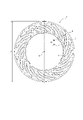
- FIG. 1 is an explanatory diagram viewed from the tire side, schematically showing the configuration of a non-pneumatic tire according to an embodiment of the present invention.
- the scale is appropriately changed in order to make each member recognizable.
- the non-pneumatic tire 1 of this embodiment includes an inner cylinder 2 mounted on a wheel (not shown), an outer cylinder 3 surrounding the inner cylinder 2 from the outside in the tire radial direction, and an inner cylinder
- a plurality of elastically deformable connecting members 4 are arranged between the outer cylinder 2 and the outer cylinder 3 along the tire circumferential direction and connect the inner cylinder 2 and the outer cylinder 3 so as to be relatively displaceable.
- a tread member 5 is fitted to the outer peripheral surface of the outer cylinder 3 .
- This non-pneumatic tire 1 is used for wheelchairs (especially, electric wheelchairs), bicycles, two-wheeled vehicles, golf carts, automobiles, etc. (hereinafter collectively referred to as vehicles).
- the inner cylinder 2, the outer cylinder 3, and the tread member 5 are formed in an annular shape, and their central axes are positioned on a common axis.
- this common axis is called the central axis O
- the direction along the central axis O is called the tire width direction.
- the direction in which the tire rotates about the central axis O is called the tire circumferential direction
- the direction perpendicular to the central axis O is called the tire radial direction.
- the diameter D in the tire radial direction of the non-pneumatic tire 1 of the present embodiment is 35 cm or less, preferably 32 cm or less, more preferably 30 cm or less, and preferably 10 cm or more, more preferably 12 cm or more.
- a tire having a diameter D in the tire radial direction of 35 cm or less is lightweight and suitable for use as a tire for a wheelchair (particularly, an electric wheelchair), for example. Further, when the diameter D in the tire radial direction is 10 cm or more, the tire is highly durable.
- the non-pneumatic tire 1 of this embodiment is preferably used at a running speed of 30 km/h or less, and more preferably at a running speed of 15 km/h or less and 5 km/h or more.
- the non-pneumatic tire 1 of this embodiment has good ride comfort and durability even when used at a running speed of 30 km/h or less.
- the non-pneumatic tire 1, which has good ride comfort and durability when used at a running speed of 30 km/h or less is suitable for use as a tire for wheelchairs (especially electric wheelchairs), for example.
- the inner cylinder 2 is attached to the axle (not shown) of the vehicle via the wheel.
- Metal materials such as aluminum, aluminum alloys, and steel can be used as materials for the wheels and axles.
- the central axes of the inner cylinder 2 and the outer cylinder 3 are arranged coaxially with the central axis O. As shown in FIG.
- the inner cylinder 2, the outer cylinder 3, and the connecting member 4 are arranged in the tire width direction such that their center portions in the tire width direction are aligned with each other.
- the inner cylinder 2, the outer cylinder 3, and the connecting member 4 are integrally formed of a resin composition.
- the inner cylinder 2, the outer cylinder 3, and the connecting member 4 can be molded by injection molding, which is suitable for mass production.
- the inner cylinder 2, the outer cylinder 3, and the connecting member 4 may be formed separately.
- the tread member 5 is made of, for example, vulcanized rubber obtained by vulcanizing a rubber composition containing natural rubber or the like, or a thermoplastic material.
- thermoplastic materials include thermoplastic resins such as polyurethane resins, polyolefin resins, polyvinyl chloride resins, and polyamide resins. From the viewpoint of wear resistance, it is preferable to form the tread member 5 from vulcanized rubber.
- an adhesive layer (not shown) is provided between the outer cylinder 3 and the tread member 5 to interpose the bonding between the outer cylinder 3 and the tread member 5 .
- a commercially available adhesive can be used for the adhesive layer.
- cyanoacrylate-based adhesives or epoxy-based adhesives can be mentioned, and specific examples include Aron Alpha EXTRA2000 (manufactured by Toagosei Co., Ltd.), but are not limited to these.
- the connecting member 4 is formed in the shape of a rectangular plate that is curved as a whole, and has front and back surfaces facing the tire circumferential direction and side surfaces facing the tire width direction.
- the connecting member 4 is made of an elastically deformable material, and connects the outer peripheral surface side of the inner cylinder 2 and the inner peripheral surface side of the outer cylinder 3 so as to be relatively elastically deformable.
- a plurality of connecting members 4 are arranged at regular intervals in the tire circumferential direction. In FIG. 1, the number of connecting members 4 is 30, but in the non-pneumatic tire of the present invention, the number of connecting members 4 is not limited to this.
- the plurality of connecting members 4 each have an inner portion 4a connected to the inner cylinder 2 and an outer portion 4b connected to the outer cylinder 3.
- the inner portion 4a and the outer portion 4b are connected to each other at the central portion of the connecting member 4 in the tire radial direction.
- the frame members correspond to the inner cylinder 2, the outer cylinder 3 and the connecting member 4 of the non-pneumatic tire 1, and the inner cylinder 2, the outer cylinder 3 and the connecting member 4 is the resin composition described above, that is, a resin composition having a flexural modulus of 247 MPa or less at ⁇ 20° C. in accordance with ISO 178 and a flexural modulus of 32 MPa or more at 60° C. in accordance with ISO 178.
- the connecting members 4 are elastically deformed by a load to absorb vibration transmitted from the ground to the vehicle.
- the resin composition described above (that is, a resin composition having a flexural modulus of 247 MPa or less at ⁇ 20° C. in accordance with ISO 178 and a flexural modulus of 32 MPa or more at 60° C. in accordance with ISO 178) is Since the adjacent connecting members 4 can be prevented from rubbing against each other, breakage can be prevented, and as a result, the durability of the non-pneumatic tire 1 can be improved. Therefore, by forming the inner cylinder 2, the outer cylinder 3, and the connecting member 4 as frame members from the resin composition described above, even if the diameter D in the tire radial direction is as small as 35 cm or less, a wide temperature range can be achieved. It is possible to provide a non-pneumatic tire that achieves both ride comfort and durability.
- the inner cylinder 2, the outer cylinder 3, and the connecting member 4 must be made of the resin composition described above. Different resin compositions may be used for the inner cylinder 2 , the outer cylinder 3 , and the connecting member 4 .
- Example 1 The flexural modulus of the resin compositions other than Example 1 was measured at ⁇ 20° C., 0° C., 23° C., 40° C., and 60° C. by a three-point bending test according to ISO178. In addition, Example 1 was estimated from the results of Comparative Examples 1 and 2 and Examples 2 to 6 and the resin composition.
- non-pneumatic tires as samples were produced.
- the non-pneumatic tire of each sample had a diameter D (outer diameter of the tread member 5) in the tire radial direction of 23.4 cm, an outer diameter of the outer cylinder 2 of 23.0 cm, and an inner diameter of the inner cylinder 3 of 14.9 cm.
- the width in the tire width direction (the width of the outer cylinder 2, the inner cylinder 3, and the connecting member 4) is 5.6 cm
- the structure of these non-pneumatic tire samples is shown in the schematic diagram of FIG. It conforms.
- the non-pneumatic tires of each sample differed only in materials constituting the inner cylinder 2, the outer cylinder 3 and the connecting member 4, and the other members were the same.
- Table 1 shows the types and contents of the resin compositions forming the inner cylinder 2, the outer cylinder 3, and the connecting member 4.
- the non-pneumatic tire of each sample produced was evaluated or predicted for initial durability and riding comfort by the following methods.
- Example 5 The sample tire of Example 5 was mounted on a vehicle, and the ride comfort was measured based on each vibration value measured by running at 10 km / h on a dry road surface in each environment of 8 to 9 ° C. and 25 to 30 ° C. evaluated.
- Example 2 a tire having the same structure as Example 5 was mounted on a vehicle, and the ride comfort was evaluated based on the vibration value measured by running on a dry road surface at 10 km/h in an environment of 25 to 30°C. .
- the vibration value is obtained by installing an accelerometer at the feet of the passenger in the vehicle and measuring the vibration when the vehicle runs on the asphalt pavement.
- the measured value (RMS value) was recorded.
- RVS value The measured value
- TPC-1 Polyester-based thermoplastic elastomer whose hard segment is polybutylene terephthalate, manufactured by Toyobo Co., Ltd., trade name “Pelprene P150B” *2
- TPC-2 Polyester-based thermoplastic elastomer whose hard segment is polybutylene terephthalate, manufactured by Toyobo Co., Ltd., trade name “Pelprene P90B” *3 TPC-3: Polyester-based thermoplastic elastomer whose hard segment is polybutylene terephthalate, a resin with a flexural modulus equivalent to Toyobo's product name "Pelprene P90B” *4 TPC-4: Hard segment is polybutylene terephthalate A polyester thermoplastic elastomer with a flexural modulus equivalent to Toyobo's product name "Pelprene P70B” *5 TPC-5: A polyester thermoplastic elastomer with a hard segment
- 1 non-pneumatic tire
- 2 inner cylinder
- 3 outer cylinder
- 4 connecting member
- 4a inner part
- 4b outer part
- 5 tread member
- O center axis
- D diameter in tire radial direction
Landscapes
- Engineering & Computer Science (AREA)
- Mechanical Engineering (AREA)
- Chemical & Material Sciences (AREA)
- Health & Medical Sciences (AREA)
- Chemical Kinetics & Catalysis (AREA)
- Medicinal Chemistry (AREA)
- Polymers & Plastics (AREA)
- Organic Chemistry (AREA)
- Compositions Of Macromolecular Compounds (AREA)
- Tires In General (AREA)
Priority Applications (4)
| Application Number | Priority Date | Filing Date | Title |
|---|---|---|---|
| US18/558,537 US20240217270A1 (en) | 2021-05-13 | 2021-12-01 | Non-pneumatic tire |
| EP21942010.6A EP4338981A4 (en) | 2021-05-13 | 2021-12-01 | NON-PNEUMATIC BANDAGE |
| CN202180098090.0A CN117295619A (zh) | 2021-05-13 | 2021-12-01 | 非充气轮胎 |
| JP2023520755A JPWO2022239282A1 (enExample) | 2021-05-13 | 2021-12-01 |
Applications Claiming Priority (2)
| Application Number | Priority Date | Filing Date | Title |
|---|---|---|---|
| JP2021081922 | 2021-05-13 | ||
| JP2021-081922 | 2021-05-13 |
Publications (1)
| Publication Number | Publication Date |
|---|---|
| WO2022239282A1 true WO2022239282A1 (ja) | 2022-11-17 |
Family
ID=84028070
Family Applications (1)
| Application Number | Title | Priority Date | Filing Date |
|---|---|---|---|
| PCT/JP2021/044159 Ceased WO2022239282A1 (ja) | 2021-05-13 | 2021-12-01 | 非空気入りタイヤ |
Country Status (5)
| Country | Link |
|---|---|
| US (1) | US20240217270A1 (enExample) |
| EP (1) | EP4338981A4 (enExample) |
| JP (1) | JPWO2022239282A1 (enExample) |
| CN (1) | CN117295619A (enExample) |
| WO (1) | WO2022239282A1 (enExample) |
Citations (9)
| Publication number | Priority date | Publication date | Assignee | Title |
|---|---|---|---|---|
| JPS5131402A (enExample) * | 1974-07-05 | 1976-03-17 | Monsanto Co | |
| JPS58401A (ja) * | 1981-06-26 | 1983-01-05 | Yokohama Rubber Co Ltd:The | 充填タイヤ |
| JPH02310102A (ja) * | 1989-05-22 | 1990-12-25 | Uniroyal Goodrich Tire Co:The | 台形断面を有する非空気充填タイヤ |
| WO2014103723A1 (ja) * | 2012-12-26 | 2014-07-03 | 株式会社ブリヂストン | 非空気入りタイヤ |
| WO2019093212A1 (ja) * | 2017-11-10 | 2019-05-16 | 株式会社ブリヂストン | 非空気入りタイヤ |
| WO2019093747A1 (ko) * | 2017-11-08 | 2019-05-16 | 금호타이어 주식회사 | 비공기압 타이어 스포크용 조성물 |
| WO2020105438A1 (ja) * | 2018-11-22 | 2020-05-28 | 株式会社ブリヂストン | タイヤ |
| US20200277012A1 (en) * | 2015-12-16 | 2020-09-03 | Ronald H. Thompson | Track system for traction of a vehicle |
| US20200331221A1 (en) * | 2017-12-21 | 2020-10-22 | Camso Inc. | Wheel comprising a non-pneumatic tire |
Family Cites Families (4)
| Publication number | Priority date | Publication date | Assignee | Title |
|---|---|---|---|---|
| JP5971889B2 (ja) * | 2010-08-25 | 2016-08-17 | 株式会社ブリヂストン | タイヤ |
| WO2014103680A1 (ja) * | 2012-12-26 | 2014-07-03 | 株式会社ブリヂストン | 非空気入りタイヤ |
| CN106457904B (zh) * | 2014-06-16 | 2019-01-22 | 株式会社普利司通 | 轮胎 |
| JP6587923B2 (ja) * | 2015-12-16 | 2019-10-09 | 株式会社ブリヂストン | タイヤ |
-
2021
- 2021-12-01 JP JP2023520755A patent/JPWO2022239282A1/ja active Pending
- 2021-12-01 US US18/558,537 patent/US20240217270A1/en active Pending
- 2021-12-01 EP EP21942010.6A patent/EP4338981A4/en active Pending
- 2021-12-01 CN CN202180098090.0A patent/CN117295619A/zh active Pending
- 2021-12-01 WO PCT/JP2021/044159 patent/WO2022239282A1/ja not_active Ceased
Patent Citations (9)
| Publication number | Priority date | Publication date | Assignee | Title |
|---|---|---|---|---|
| JPS5131402A (enExample) * | 1974-07-05 | 1976-03-17 | Monsanto Co | |
| JPS58401A (ja) * | 1981-06-26 | 1983-01-05 | Yokohama Rubber Co Ltd:The | 充填タイヤ |
| JPH02310102A (ja) * | 1989-05-22 | 1990-12-25 | Uniroyal Goodrich Tire Co:The | 台形断面を有する非空気充填タイヤ |
| WO2014103723A1 (ja) * | 2012-12-26 | 2014-07-03 | 株式会社ブリヂストン | 非空気入りタイヤ |
| US20200277012A1 (en) * | 2015-12-16 | 2020-09-03 | Ronald H. Thompson | Track system for traction of a vehicle |
| WO2019093747A1 (ko) * | 2017-11-08 | 2019-05-16 | 금호타이어 주식회사 | 비공기압 타이어 스포크용 조성물 |
| WO2019093212A1 (ja) * | 2017-11-10 | 2019-05-16 | 株式会社ブリヂストン | 非空気入りタイヤ |
| US20200331221A1 (en) * | 2017-12-21 | 2020-10-22 | Camso Inc. | Wheel comprising a non-pneumatic tire |
| WO2020105438A1 (ja) * | 2018-11-22 | 2020-05-28 | 株式会社ブリヂストン | タイヤ |
Non-Patent Citations (1)
| Title |
|---|
| See also references of EP4338981A4 * |
Also Published As
| Publication number | Publication date |
|---|---|
| EP4338981A1 (en) | 2024-03-20 |
| EP4338981A4 (en) | 2024-10-09 |
| CN117295619A (zh) | 2023-12-26 |
| JPWO2022239282A1 (enExample) | 2022-11-17 |
| US20240217270A1 (en) | 2024-07-04 |
Similar Documents
| Publication | Publication Date | Title |
|---|---|---|
| US11654716B2 (en) | Nonpneumatic tire | |
| CN109195811B (zh) | 轮胎 | |
| JP5521314B2 (ja) | 更生タイヤ用ゴム組成物および更生タイヤ | |
| JP6742893B2 (ja) | タイヤ | |
| JPWO2013129630A1 (ja) | タイヤ | |
| JP6820001B2 (ja) | タイヤ | |
| US11225108B2 (en) | Tire | |
| CN105829128B (zh) | 轮胎内衬层及充气轮胎 | |
| JP2019001359A (ja) | タイヤ用樹脂金属複合部材、及びタイヤ | |
| WO2022239282A1 (ja) | 非空気入りタイヤ | |
| US20210214576A1 (en) | Resin-metal composite member for tire, method of manufacturing the same, and tire | |
| JPWO2019230822A1 (ja) | タイヤ用樹脂金属複合部材、及びその製造方法、並びにタイヤ | |
| CN110753628A (zh) | 轮胎用树脂-金属复合构件和轮胎 | |
| WO2024166496A1 (ja) | 非空気入りタイヤ | |
| US20200114688A1 (en) | Tire | |
| EP4582251A1 (en) | Laminate, method for manufacturing laminate, and tire | |
| JP2020075686A (ja) | タイヤ | |
| JPWO2019070085A1 (ja) | タイヤ用ビード部材、タイヤ、及びタイヤ用ビード部材の製造方法 | |
| JP7425740B2 (ja) | タイヤ | |
| JP2018079899A (ja) | タイヤ | |
| EP3900950A1 (en) | Rubber composition and tire | |
| US20210102048A1 (en) | Resin-rubber composite, tire, and method of producing resin-rubber composite | |
| US20200114689A1 (en) | Tire | |
| JP2019069672A (ja) | タイヤ用ビード部材、及びタイヤ | |
| WO2020095891A1 (ja) | ランフラットタイヤ |
Legal Events
| Date | Code | Title | Description |
|---|---|---|---|
| 121 | Ep: the epo has been informed by wipo that ep was designated in this application |
Ref document number: 21942010 Country of ref document: EP Kind code of ref document: A1 |
|
| WWE | Wipo information: entry into national phase |
Ref document number: 2023520755 Country of ref document: JP |
|
| WWE | Wipo information: entry into national phase |
Ref document number: 18558537 Country of ref document: US |
|
| WWE | Wipo information: entry into national phase |
Ref document number: 202180098090.0 Country of ref document: CN |
|
| WWE | Wipo information: entry into national phase |
Ref document number: 2021942010 Country of ref document: EP |
|
| NENP | Non-entry into the national phase |
Ref country code: DE |
|
| ENP | Entry into the national phase |
Ref document number: 2021942010 Country of ref document: EP Effective date: 20231213 |