WO2022215486A1 - 導電性組成物 - Google Patents
導電性組成物 Download PDFInfo
- Publication number
- WO2022215486A1 WO2022215486A1 PCT/JP2022/012417 JP2022012417W WO2022215486A1 WO 2022215486 A1 WO2022215486 A1 WO 2022215486A1 JP 2022012417 W JP2022012417 W JP 2022012417W WO 2022215486 A1 WO2022215486 A1 WO 2022215486A1
- Authority
- WO
- WIPO (PCT)
- Prior art keywords
- conductive composition
- conductive
- polyamine
- mass
- polyol
- Prior art date
- Legal status (The legal status is an assumption and is not a legal conclusion. Google has not performed a legal analysis and makes no representation as to the accuracy of the status listed.)
- Ceased
Links
Images
Classifications
-
- C—CHEMISTRY; METALLURGY
- C08—ORGANIC MACROMOLECULAR COMPOUNDS; THEIR PREPARATION OR CHEMICAL WORKING-UP; COMPOSITIONS BASED THEREON
- C08G—MACROMOLECULAR COMPOUNDS OBTAINED OTHERWISE THAN BY REACTIONS ONLY INVOLVING UNSATURATED CARBON-TO-CARBON BONDS
- C08G18/00—Polymeric products of isocyanates or isothiocyanates
- C08G18/06—Polymeric products of isocyanates or isothiocyanates with compounds having active hydrogen
- C08G18/28—Polymeric products of isocyanates or isothiocyanates with compounds having active hydrogen characterised by the compounds used containing active hydrogen
- C08G18/30—Low-molecular-weight compounds
- C08G18/32—Polyhydroxy compounds; Polyamines; Hydroxyamines
-
- C—CHEMISTRY; METALLURGY
- C08—ORGANIC MACROMOLECULAR COMPOUNDS; THEIR PREPARATION OR CHEMICAL WORKING-UP; COMPOSITIONS BASED THEREON
- C08G—MACROMOLECULAR COMPOUNDS OBTAINED OTHERWISE THAN BY REACTIONS ONLY INVOLVING UNSATURATED CARBON-TO-CARBON BONDS
- C08G18/00—Polymeric products of isocyanates or isothiocyanates
- C08G18/06—Polymeric products of isocyanates or isothiocyanates with compounds having active hydrogen
- C08G18/28—Polymeric products of isocyanates or isothiocyanates with compounds having active hydrogen characterised by the compounds used containing active hydrogen
- C08G18/30—Low-molecular-weight compounds
- C08G18/32—Polyhydroxy compounds; Polyamines; Hydroxyamines
- C08G18/3203—Polyhydroxy compounds
-
- C—CHEMISTRY; METALLURGY
- C08—ORGANIC MACROMOLECULAR COMPOUNDS; THEIR PREPARATION OR CHEMICAL WORKING-UP; COMPOSITIONS BASED THEREON
- C08G—MACROMOLECULAR COMPOUNDS OBTAINED OTHERWISE THAN BY REACTIONS ONLY INVOLVING UNSATURATED CARBON-TO-CARBON BONDS
- C08G18/00—Polymeric products of isocyanates or isothiocyanates
- C08G18/06—Polymeric products of isocyanates or isothiocyanates with compounds having active hydrogen
- C08G18/28—Polymeric products of isocyanates or isothiocyanates with compounds having active hydrogen characterised by the compounds used containing active hydrogen
- C08G18/30—Low-molecular-weight compounds
- C08G18/32—Polyhydroxy compounds; Polyamines; Hydroxyamines
- C08G18/3225—Polyamines
-
- C—CHEMISTRY; METALLURGY
- C08—ORGANIC MACROMOLECULAR COMPOUNDS; THEIR PREPARATION OR CHEMICAL WORKING-UP; COMPOSITIONS BASED THEREON
- C08G—MACROMOLECULAR COMPOUNDS OBTAINED OTHERWISE THAN BY REACTIONS ONLY INVOLVING UNSATURATED CARBON-TO-CARBON BONDS
- C08G18/00—Polymeric products of isocyanates or isothiocyanates
- C08G18/06—Polymeric products of isocyanates or isothiocyanates with compounds having active hydrogen
- C08G18/28—Polymeric products of isocyanates or isothiocyanates with compounds having active hydrogen characterised by the compounds used containing active hydrogen
- C08G18/40—High-molecular-weight compounds
-
- C—CHEMISTRY; METALLURGY
- C08—ORGANIC MACROMOLECULAR COMPOUNDS; THEIR PREPARATION OR CHEMICAL WORKING-UP; COMPOSITIONS BASED THEREON
- C08G—MACROMOLECULAR COMPOUNDS OBTAINED OTHERWISE THAN BY REACTIONS ONLY INVOLVING UNSATURATED CARBON-TO-CARBON BONDS
- C08G18/00—Polymeric products of isocyanates or isothiocyanates
- C08G18/06—Polymeric products of isocyanates or isothiocyanates with compounds having active hydrogen
- C08G18/70—Polymeric products of isocyanates or isothiocyanates with compounds having active hydrogen characterised by the isocyanates or isothiocyanates used
- C08G18/72—Polyisocyanates or polyisothiocyanates
- C08G18/80—Masked polyisocyanates
-
- C—CHEMISTRY; METALLURGY
- C08—ORGANIC MACROMOLECULAR COMPOUNDS; THEIR PREPARATION OR CHEMICAL WORKING-UP; COMPOSITIONS BASED THEREON
- C08K—Use of inorganic or non-macromolecular organic substances as compounding ingredients
- C08K3/00—Use of inorganic substances as compounding ingredients
- C08K3/02—Elements
- C08K3/08—Metals
-
- C—CHEMISTRY; METALLURGY
- C08—ORGANIC MACROMOLECULAR COMPOUNDS; THEIR PREPARATION OR CHEMICAL WORKING-UP; COMPOSITIONS BASED THEREON
- C08K—Use of inorganic or non-macromolecular organic substances as compounding ingredients
- C08K7/00—Use of ingredients characterised by shape
-
- C—CHEMISTRY; METALLURGY
- C08—ORGANIC MACROMOLECULAR COMPOUNDS; THEIR PREPARATION OR CHEMICAL WORKING-UP; COMPOSITIONS BASED THEREON
- C08L—COMPOSITIONS OF MACROMOLECULAR COMPOUNDS
- C08L75/00—Compositions of polyureas or polyurethanes; Compositions of derivatives of such polymers
- C08L75/04—Polyurethanes
-
- H—ELECTRICITY
- H01—ELECTRIC ELEMENTS
- H01B—CABLES; CONDUCTORS; INSULATORS; SELECTION OF MATERIALS FOR THEIR CONDUCTIVE, INSULATING OR DIELECTRIC PROPERTIES
- H01B1/00—Conductors or conductive bodies characterised by the conductive materials; Selection of materials as conductors
- H01B1/20—Conductive material dispersed in non-conductive organic material
- H01B1/22—Conductive material dispersed in non-conductive organic material the conductive material comprising metals or alloys
-
- C—CHEMISTRY; METALLURGY
- C08—ORGANIC MACROMOLECULAR COMPOUNDS; THEIR PREPARATION OR CHEMICAL WORKING-UP; COMPOSITIONS BASED THEREON
- C08K—Use of inorganic or non-macromolecular organic substances as compounding ingredients
- C08K3/00—Use of inorganic substances as compounding ingredients
- C08K3/02—Elements
- C08K3/08—Metals
- C08K2003/0806—Silver
Definitions
- the present invention relates to flexible conductive compositions and electronic devices.
- FHE flexible hybrid electronics
- Flexible base materials for FHE are inferior in heat resistance to base materials used in existing electronic devices, such as polyethylene terephthalate (PET), polyethylene naphthalate (PEN), polypropylene (PP), and polyurethane (PU).
- PET polyethylene terephthalate
- PEN polyethylene naphthalate
- PP polypropylene
- PU polyurethane
- a substrate may be used. Therefore, a conductive adhesive for joining parts is also required to adhere at a low temperature according to the heat resistance of the base material.
- Patent Document 1 silver powder and/or silver powder and/or silver powder and/or silver powder and/or silver powder are added to a liquid epoxy resin and a liquid phenoxy resin for the purpose of providing a conductive adhesive with excellent conductivity and adhesive strength that is suppressed in thickening at room temperature.
- a technique is disclosed in which a latent glutaric acid-generating compound is added in a fixed amount in combination with a silver-coated metal powder.
- Patent Document 2 a main chain having a repeating unit represented by the formula: —R 1 —O— (wherein R 1 is a hydrocarbon group having 1 to 10 carbon atoms) and a hydrolyzable silyl group
- R 1 is a hydrocarbon group having 1 to 10 carbon atoms
- R 2 is a hydrocarbon group having 1 to 10 carbon atoms
- a technology of a conductive adhesive having good flexibility and high conductivity is disclosed by combining a polyether polymer having a certain terminal group and silver particles.
- Patent Document 3 by combining a polyol, a blocked isocyanate, and a conductive filler having an aspect ratio of 2 or more, a conductive composition that has excellent tackiness before curing and maintains a small change in resistance during stretching after curing. has been disclosed.
- Patent Document 4 a conductive metal having a metal oxide and a lubricant on the surface reacts with an isocyanate component during heat curing, so that the metal oxide and the lubricant are at least partially removed from the conductive metal surface.
- Techniques have been disclosed for increasing the conductivity of conductive compositions by being removed.
- Japanese Patent No. 5200662 JP 2018-48286 A Japanese Patent Application Laid-Open No. 2020-150236 Japanese Patent No. 4467439
- the conductive adhesive used in ordinary electronic devices is excellent in adhesive strength and conductivity, but has a problem of lacking in flexibility.
- the conductive adhesive described in Patent Document 2 is excellent in flexibility and specific resistance, but has a problem of high curing temperature.
- the conductive adhesives using blocked isocyanate as a curing agent described in Patent Documents 3 and 4 can be cured at a low temperature and have excellent conductivity, but their flexibility and adhesiveness have not been sufficiently studied. .
- the present inventors have made intensive studies to develop a conductive composition for obtaining a cured product that is flexible and has high conductivity and adhesive strength at a low curing temperature.
- the inventors have found that a flexible cured product having excellent conductivity and adhesiveness can be obtained by combining blocked isocyanate and specific conductive particles, and have reached the following invention.
- the present invention has the following configurations.
- An electronic device comprising a substrate having wiring and an electronic component, wherein the cured product of the conductive composition according to [8] is interposed between the electronic component and the wiring.
- the substrate is an extendable and/or bendable substrate.
- polyamine and conductive particles having a D50 of 0.4 ⁇ m or more and 2.0 ⁇ m or less are blended.
- the adhesion between the conductive particles and the binder is improved, so that the adhesive force can be improved while maintaining the flexibility of the resulting cured product.
- the conductivity of the resulting cured product can be improved by facilitating the formation of a network by the conductive particles.
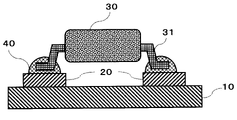
- FIG. 1 is a schematic diagram showing a cross section of an electronic device using the conductive composition of the present invention.
- a conductive composition according to the present embodiment comprises a polyol, a polyamine, a blocked isocyanate, and conductive particles.
- polyols in the present invention include polyether polyols, polyester polyols, polycarbonate polyols, polyurethane polyols, polybutadiene polyols, polyisoprene polyols, polycaprolactone polyols, and castor oil-based polyols. These may be used individually by 1 type, and may be used in combination of 2 or more types.
- polyether polyols examples include aromatic polyether polyols, aromatic/aliphatic copolymer polyether polyols, aliphatic polyether polyols, and alicyclic polyether polyols.
- polyester polyols examples include aromatic polyester polyols, aromatic/aliphatic copolymer polyester polyols, aliphatic polyester polyols, and alicyclic polyester polyols. Among these, aliphatic polyester polyols are preferred from the viewpoint of flexibility. Examples of aliphatic polyester polyols include ethylene glycol, propylene glycol, butanediol, pentanediol, 3-methyl-1,5-pentanediol, hexanediol, heptanediol, decanediol, cyclohexanedimethanol, and caprolactonediol.
- a group polyhydric alcohol and an aliphatic polycarboxylic acid such as succinic acid, adipic acid, sebacic acid, fumaric acid, suberic acid, azelaic acid, 1,10-decamethylenedicarboxylic acid were reacted as essential raw material components. and commercially available products may be used.
- Specific examples of commercially available aliphatic polyester polyols include ODX-2420, ODX-2692 (manufactured by DIC Corporation), Kuraray Polyol P-510, P-1010, P-2050 (manufactured by Kuraray Co., Ltd.), and NIPPOLAN. 4009, 164, 141 (manufactured by Tosoh Corporation) and the like.
- polycarbonate polyols examples include aromatic polycarbonate polyols, aromatic/aliphatic copolymerized polycarbonate polyols, aliphatic polycarbonate polyols, and alicyclic polycarbonate polyols.
- polyurethane polyols examples include aromatic polyurethane polyols, aromatic/aliphatic copolymerized polyurethane polyols, aliphatic polyurethane polyols, and alicyclic polyurethane polyols.
- polyester polyol is preferable because it is easy to improve curability and conductivity. It is also preferable to combine a polyester polyol with a polyol other than polyester polyol.
- the proportion of the polyester polyol in the polyol is preferably 60% by mass or more, more preferably 80% by mass or more, still more preferably 90% by mass or more, particularly preferably 95% by mass or more, and most preferably 98% by mass or more, Alternatively, it may be 100% by mass.
- the hydroxyl value of the polyol is not particularly limited, it is preferably from 50 to 300 KOHmg/g, more preferably from 100 to 250 KOHmg/g, from the viewpoint of improving conductivity and adhesiveness.
- the weight average molecular weight of the polyol is not particularly limited, it is preferably 400 to 2000 g/mol, more preferably 450 to 1500 g/mol, from the viewpoint of improving conductivity and adhesiveness.
- compounds having one hydroxyl group include aliphatic saturated alcohols such as 1-pentanol, octanol and cyclohexaneethanol; aliphatic unsaturated alcohols such as 10-undecen-1-ol; 2-phenylethyl alcohol and benzyl alcohol. aromatic alcohols; and derivatives and modified products thereof.
- the content of the compound having one hydroxyl group is preferably 10 parts by mass or less, more preferably 5 parts by mass or less, still more preferably 3 parts by mass or less with respect to 100 parts by mass of the polyol, and 0 parts by mass. may be
- polyamines used in the present invention include aliphatic polyamines such as linear aliphatic polyamines, cycloaliphatic polyamines, and araliphatic polyamines, alicyclic polyamines, aromatic polyamines, derivatives thereof, and modified polyamines. body. These may be used individually by 1 type, and may be used in combination of 2 or more types.
- the derivatives include alkyl derivatives of polyamines, and examples of modified products include epoxy adducts of polyamines, Mannich reaction products, Michael reaction products, thiourea reaction products, polymerized fatty acid and/or carboxylic acid reaction products. polyamidoamine and the like.
- the aliphatic polyamine is a compound in which at least one amino group is bonded to a chain aliphatic hydrocarbon having 1 or more carbon atoms (excluding compounds having a structure in which an amino group is directly bonded to an aromatic ring).
- An aliphatic ring or an aromatic ring may be bonded to the chain aliphatic hydrocarbon.
- a compound in which an amino group and an aliphatic ring are bonded to a chain aliphatic hydrocarbon is particularly referred to as a cycloaliphatic polyamine, and a compound in which an amino group and an aromatic ring are bonded to a chain aliphatic hydrocarbon is particularly aromatic. They are called cycloaliphatic polyamines.
- aliphatic polyamines include diethylenetriamine, triethylenetetramine, tetraethylenepentamine, norbornanediamine, m-xylenediamine, p-xylenediamine, and isophoronediamine.
- the alicyclic polyamine is a compound in which all amino groups are directly bonded to an alicyclic ring, and specific examples include cyclohexanediamine.
- the aromatic polyamine is a compound in which at least one amino group is directly bonded to an aromatic ring.
- Aminobenzylamine, bisaniline and the like can be mentioned.
- aliphatic polyamines or modified products thereof are preferred because they tend to improve flexibility.
- Specific examples of commercial products of aliphatic polyamines or modified products thereof include Fujicure FXJ-8027-H, FXJ-859-C, FXD-821-F, Tomide 280-C, TXE-524 (T&K TOKA Co., Ltd. ), Jeffamine D-400 (manufactured by Tomoe Kogyo Co., Ltd.), jercure FL11, SA1 (manufactured by Mitsubishi Chemical Corporation) and the like. It is also preferable to combine an aliphatic polyamine or its modified form with a polyamine other than the aliphatic polyamine or its modified form.
- the proportion of the aliphatic polyamine or modified product thereof in the polyamine is preferably 60% by mass or more, more preferably 80% by mass or more, still more preferably 90% by mass or more, particularly preferably 95% by mass or more, and most preferably 98% by mass. % or more, and may be 100% by mass.
- the active hydrogen equivalent of polyamine is preferably 80 g/eq or more, more preferably 85 g/eq or more, from the viewpoint of compatibility between flexibility, adhesiveness, and conductivity. Moreover, from the viewpoint of availability and improvement of adhesiveness, it is preferably 200 g/eq or less, more preferably 190 g/eq or less.
- the active hydrogen equivalent of the polyamine is preferably 80-200 g/eq, more preferably 85-190 g/eq.
- the term "active hydrogen equivalent of polyamine" refers to the molecular weight per active hydrogen group equivalent in polyamine, and the active hydrogen group means an amino group having an active hydrogen group in polyamine.
- the amine value of the polyamine is not particularly limited, it is preferably 150 to 350 KOHmg/g, more preferably 160 to 330 KOHmg/g. When the amine value is within this range, the viscosity increase of the conductive composition is suppressed, making handling easier.
- the viscosity of the polyamine is not particularly limited, it is preferably 2000 mPa ⁇ s or less, more preferably 800 mPa ⁇ s or less, from the viewpoint of easier handling.
- the mixing ratio of polyol and polyamine (polyol/polyamine) in the present invention is preferably 2/8 to 7/3, more preferably 3/7 to 6/4, based on the amount of active hydrogen groups. preferable.
- the ratio of polyamine By increasing the ratio of polyamine, the adhesiveness and conductivity of the resulting cured product can be improved, and by increasing the ratio of polyol, the flexibility of the cured product obtained can be improved.
- the mixing ratio within the above range, the cured product has a better balance of flexibility, adhesiveness, and conductivity.
- the mixing ratio (polyol/polyamine) is obtained based on the following formula.
- Mixing ratio (polyol/polyamine) total amount of active hydrogen radicals contained in polyol/total amount of active hydrogen radicals contained in polyamine
- the "total amount of active hydrogen group substance contained in polyamine” is a value obtained by dividing the total mass (unit: g) of polyamine contained in the conductive composition by the active hydrogen equivalent (g/eq) of the polyamine. means.
- the polyamine is a mixture of two or more kinds, it can be obtained by dividing the mass (unit: g) of each compound by the active hydrogen equivalent (g/eq) of the polyamine and summing them.
- the total amount of active hydrogen group substance contained in the polyol is a value obtained by dividing the total weight (unit: g) of the polyol contained in the conductive composition by the active hydrogen equivalent (g/eq) of the polyol. means.
- the polyol is a mixture of two or more kinds, it can be obtained by dividing the mass (unit: g) of each compound by the active hydrogen equivalent (g/eq) of the polyol and totaling them.
- the "active hydrogen equivalent weight of polyol” refers to the molecular weight per active hydrogen group equivalent in the polyol, and the active hydrogen group means the hydroxy group (--OH) possessed by the polyol.
- the total content of the polyol and polyamine in the present invention is not particularly limited, but it is preferably 1% by mass or more and 50% by mass or less, and 2% by mass or more and 30% by mass or less based on the total amount of the conductive composition. More preferably, it is 3% by mass or more and 15% by mass or less.
- the isocyanate constituting the blocked isocyanate used in the present invention is preferably a compound (polyisocyanate) having a plurality of isocyanate groups in the molecule.
- the polyisocyanate include aliphatic polyisocyanates such as hexamethylene diisocyanate (hereinafter referred to as HDI) and isophorone diisocyanate (IPDI); aromatic polyisocyanates such as diphenylmethane diisocyanate (MDI) and tolylene diisocyanate (TDI); Modified isocyanates such as isocyanurates, adducts, and biurets of isocyanates can be mentioned, and aliphatic polyisocyanates or modified aliphatic polyisocyanates are preferred from the viewpoint of improving flexibility.
- HDI hexamethylene diisocyanate
- IPDI isophorone diisocyanate
- MDI diphenylmethane diisocyanate
- TDI
- Each isocyanate may be a monomer, but is preferably a polymer of each isocyanate or a modified product such as an isocyanurate, an adduct, or a biuret of the polymer.
- the most preferred isocyanate is an aliphatic polyisocyanate polymer such as an HDI polymer, or a modified product thereof.
- the blocking agent that constitutes the blocked isocyanate examples include phenol-based, oxime-based, alcohol-based, lactam-based, active methylene-based, and pyrazole-based blocking agents.
- active methylene-based blocking agents and pyrazole-based blocking agents are preferable in that the reaction temperature can be lowered.
- the blocking agent may contain one kind alone, or may contain two or more kinds. From the viewpoint of curability and storage stability, it is preferable to contain both active methylene-based and pyrazole-based blocking agents.
- active methylene-based blocking agents include malonic acid diesters, and specific examples include dimethyl malonate, diethyl malonate, dibutyl malonate, bis(2-ethylhexyl) malonate, methylbutyl malonate, and malonic acid.
- dialkyl malonate such as diethylhexyl
- diaryl malonate such as diphenyl malonate; and the like.
- pyrazole-based blocking agents examples include pyrazole, 3,5-dimethylpyrazole, 3-methylpyrazole, 4-nitro-3,5-dimethylpyrazole, and the like.
- phenol-based blocking agents examples include phenol, cresol, ethylphenol, and styrenated phenol.
- oxime-based blocking agents examples include formamide oxime, acetaldoxime, acetone oxime, methylethylketoxime, methylisobutylketoxime, cyclohexanone oxime, and the like.
- alcohol-based blocking agents examples include methanol, ethanol, 2-propanol, n-butanol, sec-butanol, tert-butanol, 2-ethyl-1-hexanol, 2-methoxyethanol, 2-ethoxyethanol, 2- butoxyethanol and the like.
- lactam-based blocking agents examples include ⁇ -caprolactam, ⁇ -valerolactam, ⁇ -butyrolactam, and the like.
- the commercial products can also be used as the above-mentioned blocked isocyanate, and the commercial products include Duranate SBN-70D, SBB-70P, TPA-B80E (manufactured by Asahi Kasei Corporation), Desmodur BL3272MPA, BL3475BA/SN, BL3575MPA/SN ( Covestro), Trixene BI7960, BI7982, BI7991, BI7992 (Baxenden) and the like.
- the compounding ratio (NCO group/active hydrogen group) of all the active hydrogen groups possessed by the polyol and polyamine in the present invention and the isocyanate group of the blocked isocyanate is not particularly limited, but is 0.7 or more and 2.0 based on the amount of substance. It is preferably less than, more preferably 0.8 or more and 1.5 or less. Within this range, better adhesiveness can be exhibited while maintaining the flexibility of the cured product.
- the conductive composition in the present invention can further contain a catalyst within a range that does not impair its performance.
- the catalyst is not particularly limited, examples thereof include organic tin compounds, organic bismuth metal compounds, tertiary amine compounds and the like.
- the content of the catalyst is preferably 1.0% by mass or less, more preferably 0.1% by mass or less, relative to the total amount of the conductive composition.
- the conductive particles used in the present invention include particles I (hereinafter referred to as conductive particles I) having an average particle diameter D50 of 0.4 ⁇ m or more and 2.0 ⁇ m or less.
- the average particle diameter D50 of the conductive particles I is more preferably 0.5 ⁇ m or more and 1.5 ⁇ m or less, and most preferably 0.6 ⁇ m or more and 1.2 ⁇ m or less.
- the shape of the conductive particles I is not particularly limited, it may be scaly (also referred to as flake), irregularly aggregated, spherical, massive, or the like. Among them, the scaly shape is preferable from the viewpoint of preventing viscosity reduction during heating.
- the content of the conductive particles I in the present invention is not particularly limited, it is preferably 25% by mass or more and 95% by mass or less, and 30% by mass or more and 90% by mass or less with respect to the total amount of the conductive composition. It is even more preferable to have By setting the amount of the conductive particles within this range, the balance between flexibility and conductivity is improved.
- the conductive particles in the present invention may further include particles II (hereinafter referred to as conductive particles II) having an average particle diameter D50 of 5 ⁇ m or more and 15 ⁇ m or less. Including the conductive particles II in the conductive particles further improves the flexibility.
- the average particle diameter D50 of the conductive particles II is preferably 6 ⁇ m or more and less than 12 ⁇ m.
- the average particle diameter D50 in the present invention indicates the particle diameter at 50% of the cumulative volume basis of the particle diameter measured by the laser diffraction method.
- the shape of the conductive particles II is not particularly limited, but may be scaly, irregularly aggregated, spherical, massive, etc. Among them, the massive is preferred.
- Examples of conductive particles I and conductive particles II include silver, copper, gold, platinum, palladium, aluminum, nickel, indium, bismuth, zinc, lead, tin, and carbon black. These may be used individually by 1 type, and may be used in combination of 2 or more types. Further, the materials of the conductive particles I and the conductive particles II may be the same or different. Among these, from the viewpoint of conductivity, it is preferable to use silver particles as at least one of conductive particles I and conductive particles II (preferably conductive particles I). It is more preferable to use silver particles alone in both conductive particles I and conductive particles II.
- the total content of conductive particles I and conductive particles II in the conductive particles is preferably 80% by mass or more, more preferably 90% by mass or more, still more preferably 95% by mass or more, and particularly preferably 98% by mass or more. and may be 100% by mass.
- the total content of the conductive particles in the present invention is not particularly limited, it is preferably 50% by mass or more and 95% by mass or less, and 60% by mass or more and 90% by mass or less based on the total amount of the conductive composition. It is even more preferable to have By setting the amount of the conductive particles within this range, the balance between flexibility and conductivity is improved.
- the blending ratio of the conductive particles I and conductive particles II is not particularly limited, but from 95/5 to It is preferably 50/50, more preferably 90/10 to 70/30.
- the total content of polyol, polyamine, blocked isocyanate, and conductive particles is preferably 70% by mass or more, more preferably 80% by mass or more, and still more preferably 90% by mass or more, based on the total amount of the conductive composition. , 95% by mass or more, or 100% by mass.
- the conductive composition in the present invention may contain no solvent or may contain a solvent.
- the content of the solvent in the conductive composition is preferably less than 10% by mass, more preferably less than 5% by mass, and may be 0% by mass, or 1% by mass or more. good.
- the type of solvent is not particularly limited, but examples include ethyl acetate, butyl acetate, solvent naphtha, propylene glycol monomethyl ether, dipropylene glycol monomethyl ether, propylene glycol monomethyl ether acetate, and propylene glycol monoethyl ether acetate.
- the conductive composition in the present invention further includes a thermoplastic resin, an inorganic filler, a conductive aid, a pigment, a dye, a dispersant, an antifoaming agent, a leveling agent, a thixotropic agent, a reactive diluent, a flame retardant, Antioxidants, ultraviolet absorbers, hydrolysis inhibitors, tackifiers, plasticizers, and other imparting agents can be blended.
- the content of the imparting agent is preferably 10% by mass or less, more preferably 3% by mass or less, and even more preferably 1% by mass or less, relative to the total amount of the conductive composition.
- the conductive composition in the present invention comprises a binder component of polyol and polyamine, blocked isocyanate, conductive particles, and optionally used components such as a dissolver, a three-roll mill, a rotation-revolution mixer, an attritor, a ball mill, and a sand mill.
- a dissolver a three-roll mill, a rotation-revolution mixer, an attritor, a ball mill, and a sand mill.
- a dissolver a three-roll mill, a rotation-revolution mixer, an attritor, a ball mill, and a sand mill.
- the conductive composition in the present invention can be compatible with flexibility, adhesiveness, and conductivity, so it is suitably used as a conductive adhesive (preferably a conductive adhesive used in flexible hybrid electronics). .
- a conductive adhesive preferably a conductive adhesive used in flexible hybrid electronics.
- By coating or printing the conductive composition of the present invention on a base material and curing the composition it can be used as a substitute for solder for mounting electronic components.
- the process of coating the substrate is not particularly limited, and examples thereof include screen printing, stamping, dispensing, squeegee printing, and the like.
- by curing the conductive composition it can be used for bonding and mounting of semiconductor element chip parts, circuit connection, bonding of crystal oscillators and piezoelectric elements, sealing of packages, and the like.
- the heating temperature during curing is appropriately determined according to the reaction temperature between the active hydrogen group and the blocked isocyanate group and the heat resistance of the base material used.
- the heating temperature may be, for example, 80 to 150.degree. C., or 100 to 130.degree.
- the heating time is not particularly limited, but is, for example, about 10 minutes to 120 minutes, preferably about 30 minutes to 60 minutes.
- the cured product formed using the conductive composition of the present invention preferably has a storage elastic modulus at 25° C. measured using a viscoelasticity measuring device of 50 MPa or more and 600 MPa or less. It is more preferably 150 MPa or more and 500 MPa or less.
- the cured product preferably has a specific resistance of less than 2.0 ⁇ 10 ⁇ 4 ⁇ cm, more preferably less than 1.0 ⁇ 10 ⁇ 4 ⁇ cm.
- the cured product preferably has a shear adhesive strength of 2.0 MPa or more, more preferably 2.5 MPa or more, when an oxygen-free copper plate is used as the adherend.
- the electronic device has a substrate having wiring and an electronic component, and the cured product of the conductive composition is interposed between the electronic component and the wiring.
- the wiring formed on the substrate and the electronic component can be physically and electrically connected.
- FIG. 1 is a schematic cross-sectional view showing an example of the electronic device.
- the electronic device includes a substrate 10, wiring 20 formed on the surface of the substrate 10, and an electronic component 30.
- the wiring 20 and the electronic component 30 (more precisely, electrodes 31 formed on the electronic component 30) are interposed between the cured product 40 of the conductive composition.
- the electronic component 30 and the wiring 20 are electrically connected by the cured product 40 .
- the substrate in the electronic device according to this embodiment may be a stretchable and/or bendable substrate. Since the cured product of the conductive composition has flexibility, it can follow expansion and contraction and bending of the substrate, and the occurrence of peeling and cracking at the connection between the electronic component and the wiring is suppressed. Therefore, the electronic device according to this embodiment has high connection reliability even if it is flexible.
- the stretchable and/or bendable substrate used in the present invention is not particularly limited, but includes fiber structures, resin films, rubber, and the like.
- fiber structures include knitted fabrics, woven fabrics, non-woven fabrics, and paper.
- resin films include polyethylene terephthalate, polyvinyl chloride, polyethylene, polypropylene, polycarbonate, polyethylene naphthalate, polyurethane, polyimide, polymethyl methacrylate, and silicone.
- Examples of rubber include urethane rubber, acrylic rubber, silicone rubber, butadiene rubber, nitrile rubber, nitrile group-containing rubber such as hydrogenated nitrile rubber, isoprene rubber, vulcanized rubber, styrene-butadiene rubber, butyl rubber, ethylene propylene rubber, and the like.
- ⁇ Elastic modulus> The conductive composition was applied onto a Teflon film using a 200 ⁇ m gap applicator. After curing by heating at 130° C. for 60 minutes with a hot air dryer, it was cooled to room temperature. After that, the coating film was cut into a size of 4 mm ⁇ 300 mm and peeled off from the Teflon (registered trademark) film to obtain a test piece for evaluating elastic modulus. Set the test piece in a viscoelasticity measuring device (DVA-200 manufactured by IT Keisoku Co., Ltd.), strain: 0.1%, frequency: 10 Hz, heating rate: 4 ° C./min, measurement temperature range: from -10 ° C. The apparatus was operated under conditions up to 100°C, and the storage modulus at 25°C was determined.
- DVA-200 viscoelasticity measuring device
- the conductive composition was applied onto the PET film using a 50 ⁇ m gap applicator. After curing by heating at 130° C. for 60 minutes with a hot air dryer, it was cooled to room temperature. After that, the coating film was cut into a size of 10 mm ⁇ 35 mm to obtain a test piece for evaluation of specific resistance.
- the film thickness of the test piece was measured with a thickness gauge (SMD-565L manufactured by TECLOCK), and the sheet resistance of the test piece was measured using Loresta-GP (MCP-T610 manufactured by Mitsubishi Chemical Analytic Tech). Four test pieces were measured, and the average value was used to calculate the specific resistance.
- ⁇ Adhesion> In order to evaluate the adhesion of the conductive composition, two oxygen-free copper plates (dimensions: 25 mm x 100 mm x 1 mm, material: C1020P, hardness: 1/2H) were used as adherends. After washing the surface of the adherend with acetone, the conductive composition was applied to one copper plate in an area of 25 mm ⁇ 12.5 mm, and the other copper plate was laminated. After curing by heating at 130° C. for 60 minutes with a hot air dryer, it was cooled to room temperature. Adhesive strength was measured using a precision universal tester (AG-20kNXDplus manufactured by Shimadzu Corporation) at a tensile speed of 10 mm/min in the shear direction under an environment of 23° C. and RH 50%.
- a precision universal tester AG-20kNXDplus manufactured by Shimadzu Corporation
- Examples 1-4, Comparative Examples 1-2 ⁇ Production example of conductive composition> Various components were added according to the compounding ratio shown in Table 1, and after preliminary mixing, the mixture was dispersed in a three-roll mill to form a paste, thereby obtaining a conductive composition.
- Table 1 shows the evaluation results of the obtained conductive composition.
- each component in Table 1 is as follows.
- Polyol Kuraray Co., Ltd. polyester polyol P-510 (active hydrogen equivalent: 250 g/eq, hydroxyl value: 224 KOHmg/g, weight average molecular weight: 500 g/mol)
- Polyamine 1 T&K TOKA Co., Ltd. modified aliphatic polyamine FXJ-859-C (active hydrogen equivalent: 190 g / eq, amine value: 170 KOHmg / g, viscosity: 450 mPa s)
- Polyamine 2 T&K TOKA Co., Ltd.
- modified aliphatic polyamine FXD-821-F active hydrogen equivalent: 85 g / eq, amine value: 300 KOHmg / g, viscosity: 65 mPa s
- Isocyanate Baxenden blocked isocyanate BI7992 (NCO: equivalent weight 456 g/eq)
- Conductive particles 1 Metalor Technologies Japan Co., Ltd.
- Flake silver P791-24 D50: 0.7 ⁇ m
- Conductive particles 2 Metalor Technologies Japan Co., Ltd.
- Massive silver P318-41 D50: 9.0 ⁇ m
- Conductive particles 3 Metalor Technologies Japan Co., Ltd.
- Massive silver P853-11 D50: 8.0 ⁇ m
- Examples 1 to 4 contain polyamine and conductive particles of 0.4 ⁇ m ⁇ D50 ⁇ 2.0 ⁇ m in addition to polyol and blocked isocyanate, so that cured products having flexibility, high conductivity and adhesiveness can be obtained. was made.
- a comparison of Examples 1 and 2 shows that a more flexible cured product can be obtained by reducing the amount of polyamine mixed with polyol.
- Examples 3 and 4 by mixing conductive particles of 5.0 ⁇ m ⁇ D50 ⁇ 15.0 ⁇ m with conductive particles of 0.4 ⁇ m ⁇ D50 ⁇ 2.0 ⁇ m, conductivity and adhesion It can be seen that a more flexible cured product can be obtained while maintaining the
- Comparative Example 1 does not contain polyamine, it is flexible, but its conductivity and adhesiveness are reduced.
- Comparative Example 2 since the silver particles having a size of 0.4 ⁇ m ⁇ D50 ⁇ 2.0 ⁇ m were not included, the adhesiveness was greatly reduced.
- the conductive composition of the present invention can form a flexible cured product having excellent conductivity and adhesiveness at a low temperature. Very suitable as a material.
Landscapes
- Chemical & Material Sciences (AREA)
- Health & Medical Sciences (AREA)
- Chemical Kinetics & Catalysis (AREA)
- Medicinal Chemistry (AREA)
- Polymers & Plastics (AREA)
- Organic Chemistry (AREA)
- Physics & Mathematics (AREA)
- Dispersion Chemistry (AREA)
- Spectroscopy & Molecular Physics (AREA)
- Conductive Materials (AREA)
- Compositions Of Macromolecular Compounds (AREA)
- Adhesives Or Adhesive Processes (AREA)
- Polyurethanes Or Polyureas (AREA)
Priority Applications (3)
| Application Number | Priority Date | Filing Date | Title |
|---|---|---|---|
| KR1020237027178A KR20230170641A (ko) | 2021-04-09 | 2022-03-17 | 도전성 조성물 |
| CN202280011262.0A CN116848193A (zh) | 2021-04-09 | 2022-03-17 | 导电性组合物 |
| JP2023512900A JPWO2022215486A1 (https=) | 2021-04-09 | 2022-03-17 |
Applications Claiming Priority (2)
| Application Number | Priority Date | Filing Date | Title |
|---|---|---|---|
| JP2021066506 | 2021-04-09 | ||
| JP2021-066506 | 2021-04-09 |
Publications (1)
| Publication Number | Publication Date |
|---|---|
| WO2022215486A1 true WO2022215486A1 (ja) | 2022-10-13 |
Family
ID=83546235
Family Applications (1)
| Application Number | Title | Priority Date | Filing Date |
|---|---|---|---|
| PCT/JP2022/012417 Ceased WO2022215486A1 (ja) | 2021-04-09 | 2022-03-17 | 導電性組成物 |
Country Status (5)
| Country | Link |
|---|---|
| JP (1) | JPWO2022215486A1 (https=) |
| KR (1) | KR20230170641A (https=) |
| CN (1) | CN116848193A (https=) |
| TW (1) | TW202248260A (https=) |
| WO (1) | WO2022215486A1 (https=) |
Citations (4)
| Publication number | Priority date | Publication date | Assignee | Title |
|---|---|---|---|---|
| JP2007326967A (ja) * | 2006-06-08 | 2007-12-20 | Sanyo Chem Ind Ltd | スラリー状組成物 |
| WO2009125740A1 (ja) * | 2008-04-07 | 2009-10-15 | 東洋紡績株式会社 | 面状発熱体用導電性ペースト及びこれを用いた印刷回路、面状発熱体 |
| JP2011144358A (ja) * | 2009-12-17 | 2011-07-28 | Sanyo Chem Ind Ltd | 樹脂粒子 |
| WO2015093510A1 (ja) * | 2013-12-17 | 2015-06-25 | 日産化学工業株式会社 | 透明導電膜用保護膜形成組成物 |
Family Cites Families (4)
| Publication number | Priority date | Publication date | Assignee | Title |
|---|---|---|---|---|
| JP4467439B2 (ja) | 2003-03-18 | 2010-05-26 | ダウ・コーニング・コーポレイション | 導電性組成物及び該導電性組成物の使用法 |
| JP5200662B2 (ja) | 2008-05-27 | 2013-06-05 | 藤倉化成株式会社 | 導電性接着剤および電子部品 |
| JP6870258B2 (ja) | 2016-09-23 | 2021-05-12 | 日亜化学工業株式会社 | 導電性接着剤および導電性材料 |
| JP7378029B2 (ja) | 2019-03-15 | 2023-11-13 | パナソニックIpマネジメント株式会社 | 電子機器 |
-
2022
- 2022-03-17 JP JP2023512900A patent/JPWO2022215486A1/ja not_active Withdrawn
- 2022-03-17 WO PCT/JP2022/012417 patent/WO2022215486A1/ja not_active Ceased
- 2022-03-17 KR KR1020237027178A patent/KR20230170641A/ko active Pending
- 2022-03-17 CN CN202280011262.0A patent/CN116848193A/zh active Pending
- 2022-03-29 TW TW111111775A patent/TW202248260A/zh unknown
Patent Citations (4)
| Publication number | Priority date | Publication date | Assignee | Title |
|---|---|---|---|---|
| JP2007326967A (ja) * | 2006-06-08 | 2007-12-20 | Sanyo Chem Ind Ltd | スラリー状組成物 |
| WO2009125740A1 (ja) * | 2008-04-07 | 2009-10-15 | 東洋紡績株式会社 | 面状発熱体用導電性ペースト及びこれを用いた印刷回路、面状発熱体 |
| JP2011144358A (ja) * | 2009-12-17 | 2011-07-28 | Sanyo Chem Ind Ltd | 樹脂粒子 |
| WO2015093510A1 (ja) * | 2013-12-17 | 2015-06-25 | 日産化学工業株式会社 | 透明導電膜用保護膜形成組成物 |
Also Published As
| Publication number | Publication date |
|---|---|
| JPWO2022215486A1 (https=) | 2022-10-13 |
| CN116848193A (zh) | 2023-10-03 |
| TW202248260A (zh) | 2022-12-16 |
| KR20230170641A (ko) | 2023-12-19 |
Similar Documents
| Publication | Publication Date | Title |
|---|---|---|
| JP5499031B2 (ja) | 腐食感受性層に適合する接着剤 | |
| JP4862921B2 (ja) | 回路接続材料、回路接続構造体及びその製造方法 | |
| JP5146567B2 (ja) | 導電性インキ、および導電パターン付き積層体とその製造方法 | |
| JP6536664B2 (ja) | 粘着剤、粘着シート、および積層体 | |
| KR20150035604A (ko) | 경화성 도전성 접착제 조성물, 전자파 쉴드필름, 도전성 접착필름, 접착방법 및 회로기판 | |
| TWI589614B (zh) | Resin composition | |
| JP2019173024A (ja) | 粘着剤、粘着シート、および積層体 | |
| JP2020059860A (ja) | 粘着剤、粘着シート、および積層体 | |
| WO2022215486A1 (ja) | 導電性組成物 | |
| WO2018181546A1 (ja) | 導電粒子の選別方法、回路接続材料、接続構造体及びその製造方法、並びに導電粒子 | |
| WO2023067909A1 (ja) | 導電性組成物 | |
| WO2023067910A1 (ja) | 導電性組成物 | |
| JP4547623B2 (ja) | 導電性ペースト | |
| US20240417606A1 (en) | Electroconductive cured product | |
| JP2011231146A (ja) | 異方導電性フィルム | |
| JP4596856B2 (ja) | 液晶パネル用シール材およびそれを用いた液晶パネル | |
| JPH1161037A (ja) | フレキシブル回路オーバーコート用樹脂組成物 | |
| JPH1171551A (ja) | フレキシブル回路オーバーコート用樹脂組成物 | |
| WO2024048628A1 (ja) | 導電性ペースト、及びこれを用いた多層基板 | |
| JP2015209437A (ja) | 硬化性樹脂組成物 | |
| JP2012129106A (ja) | 異方性導電材料及び接続構造体 |
Legal Events
| Date | Code | Title | Description |
|---|---|---|---|
| 121 | Ep: the epo has been informed by wipo that ep was designated in this application |
Ref document number: 22784471 Country of ref document: EP Kind code of ref document: A1 |
|
| ENP | Entry into the national phase |
Ref document number: 2023512900 Country of ref document: JP Kind code of ref document: A |
|
| WWE | Wipo information: entry into national phase |
Ref document number: 202280011262.0 Country of ref document: CN |
|
| NENP | Non-entry into the national phase |
Ref country code: DE |
|
| 122 | Ep: pct application non-entry in european phase |
Ref document number: 22784471 Country of ref document: EP Kind code of ref document: A1 |