WO2022211006A1 - 架橋ポリマー、物質を分離する方法、物質を分離するためのキット、疾患を検査するためのキット及び物質を分離するための装置 - Google Patents
架橋ポリマー、物質を分離する方法、物質を分離するためのキット、疾患を検査するためのキット及び物質を分離するための装置 Download PDFInfo
- Publication number
- WO2022211006A1 WO2022211006A1 PCT/JP2022/016441 JP2022016441W WO2022211006A1 WO 2022211006 A1 WO2022211006 A1 WO 2022211006A1 JP 2022016441 W JP2022016441 W JP 2022016441W WO 2022211006 A1 WO2022211006 A1 WO 2022211006A1
- Authority
- WO
- WIPO (PCT)
- Prior art keywords
- crosslinked polymer
- group
- physiological saline
- substance
- lipid bilayer
- Prior art date
- Legal status (The legal status is an assumption and is not a legal conclusion. Google has not performed a legal analysis and makes no representation as to the accuracy of the status listed.)
- Ceased
Links
Classifications
-
- C—CHEMISTRY; METALLURGY
- C08—ORGANIC MACROMOLECULAR COMPOUNDS; THEIR PREPARATION OR CHEMICAL WORKING-UP; COMPOSITIONS BASED THEREON
- C08F—MACROMOLECULAR COMPOUNDS OBTAINED BY REACTIONS ONLY INVOLVING CARBON-TO-CARBON UNSATURATED BONDS
- C08F120/00—Homopolymers of compounds having one or more unsaturated aliphatic radicals, each having only one carbon-to-carbon double bond, and only one being terminated by only one carboxyl radical or a salt, anhydride, ester, amide, imide or nitrile thereof
- C08F120/02—Monocarboxylic acids having less than ten carbon atoms; Derivatives thereof
- C08F120/04—Acids; Metal salts or ammonium salts thereof
- C08F120/06—Acrylic acid; Methacrylic acid; Metal salts or ammonium salts thereof
-
- G—PHYSICS
- G01—MEASURING; TESTING
- G01N—INVESTIGATING OR ANALYSING MATERIALS BY DETERMINING THEIR CHEMICAL OR PHYSICAL PROPERTIES
- G01N1/00—Sampling; Preparing specimens for investigation
- G01N1/28—Preparing specimens for investigation including physical details of (bio-)chemical methods covered elsewhere, e.g. G01N33/50, C12Q
- G01N1/40—Concentrating samples
- G01N1/4077—Concentrating samples by other techniques involving separation of suspended solids
-
- B—PERFORMING OPERATIONS; TRANSPORTING
- B01—PHYSICAL OR CHEMICAL PROCESSES OR APPARATUS IN GENERAL
- B01J—CHEMICAL OR PHYSICAL PROCESSES, e.g. CATALYSIS OR COLLOID CHEMISTRY; THEIR RELEVANT APPARATUS
- B01J20/00—Solid sorbent compositions or filter aid compositions; Sorbents for chromatography; Processes for preparing, regenerating or reactivating thereof
- B01J20/22—Solid sorbent compositions or filter aid compositions; Sorbents for chromatography; Processes for preparing, regenerating or reactivating thereof comprising organic material
- B01J20/26—Synthetic macromolecular compounds
- B01J20/265—Synthetic macromolecular compounds modified or post-treated polymers
- B01J20/267—Cross-linked polymers
-
- C—CHEMISTRY; METALLURGY
- C08—ORGANIC MACROMOLECULAR COMPOUNDS; THEIR PREPARATION OR CHEMICAL WORKING-UP; COMPOSITIONS BASED THEREON
- C08F—MACROMOLECULAR COMPOUNDS OBTAINED BY REACTIONS ONLY INVOLVING CARBON-TO-CARBON UNSATURATED BONDS
- C08F220/00—Copolymers of compounds having one or more unsaturated aliphatic radicals, each having only one carbon-to-carbon double bond, and only one being terminated by only one carboxyl radical or a salt, anhydride ester, amide, imide or nitrile thereof
- C08F220/02—Monocarboxylic acids having less than ten carbon atoms; Derivatives thereof
- C08F220/04—Acids; Metal salts or ammonium salts thereof
- C08F220/06—Acrylic acid; Methacrylic acid; Metal salts or ammonium salts thereof
-
- C—CHEMISTRY; METALLURGY
- C08—ORGANIC MACROMOLECULAR COMPOUNDS; THEIR PREPARATION OR CHEMICAL WORKING-UP; COMPOSITIONS BASED THEREON
- C08F—MACROMOLECULAR COMPOUNDS OBTAINED BY REACTIONS ONLY INVOLVING CARBON-TO-CARBON UNSATURATED BONDS
- C08F2810/00—Chemical modification of a polymer
- C08F2810/20—Chemical modification of a polymer leading to a crosslinking, either explicitly or inherently
-
- G—PHYSICS
- G01—MEASURING; TESTING
- G01N—INVESTIGATING OR ANALYSING MATERIALS BY DETERMINING THEIR CHEMICAL OR PHYSICAL PROPERTIES
- G01N33/00—Investigating or analysing materials by specific methods not covered by groups G01N1/00 - G01N31/00
- G01N33/48—Biological material, e.g. blood, urine; Haemocytometers
- G01N33/50—Chemical analysis of biological material, e.g. blood, urine; Testing involving biospecific ligand binding methods; Immunological testing
- G01N33/53—Immunoassay; Biospecific binding assay; Materials therefor
- G01N33/543—Immunoassay; Biospecific binding assay; Materials therefor with an insoluble carrier for immobilising immunochemicals
- G01N33/544—Immunoassay; Biospecific binding assay; Materials therefor with an insoluble carrier for immobilising immunochemicals the carrier being organic
Definitions
- the present invention relates to crosslinked polymers and uses thereof.
- Extracellular vesicles secreted from cells are vesicles that are surrounded by a lipid bilayer and contain proteins, nucleic acids, etc., and function as intercellular communication mediators.
- Examples of extracellular endoplasmic reticulum include exosomes, microvesicles, apoptotic bodies and the like.
- exosomes membrane vesicles with a particle size of 30 to 100 nm
- Proteins and nucleic acids contained in exosomes reflect the state of the cells that secreted them in real time, and are useful as biomarkers for evaluating the state of the original organism and intercellular communication.
- a size fractionation method using an ultracentrifuge is widely used as a method for collecting exosomes from biological samples.
- This method is a method of separating relatively low-density exosomes from other particles using a sucrose density gradient or the like.
- the size fractionation method using an ultracentrifuge has the problem that the exosomes recovered are not sufficiently pure and the operation takes a long time.
- the main object of the present invention is to provide a crosslinked polymer useful for separating substances having a lipid bilayer such as exosomes.
- a crosslinked polymer containing a monomer unit having an acidic group and / or a neutralizing base thereof, which is selected from the group consisting of a cationic group and a hydroxyl group We have found that cross-linked polymers containing compounds with at least one group are useful for the separation of substances with lipid bilayers, such as exosomes.
- the present invention has been completed through further studies based on this finding.
- Section 1 A crosslinked polymer for separating a substance having a lipid bilayer from a biological sample, the crosslinked polymer comprising monomer units having an acidic group and/or its neutralizing base, from the group consisting of a cationic group and a hydroxyl group.
- Section 2. Item 2. The crosslinked polymer according to item 1, wherein the compound has an optionally substituted hydrocarbon group having 12 to 30 carbon atoms.
- Item 3. Item 3.
- the cationic group is —N(R 1 ) 2 (wherein each R 1 independently represents a hydrogen atom or an optionally substituted hydrocarbon group having 1 to 6 carbon atoms); , or -N + (R 2 ) 3 (wherein each R 2 is independently a hydrogen atom or an optionally substituted hydrocarbon group having 1 to 6 carbon atoms),
- the crosslinked polymer according to any one of Items 1 to 3.
- Items 1 to 3. 5.
- Any one of items 1 to 4, wherein the hydrocarbon group having 12 to 30 carbon atoms is an aliphatic hydrocarbon group having 12 to 20 carbon atoms or an alicyclic hydrocarbon group having 20 to 30 carbon atoms.
- the crosslinked polymer according to Item 5 wherein the aliphatic hydrocarbon group is an alkyl group or an alkenyl group, and the alicyclic hydrocarbon group is a group having a steroid skeleton.
- Item 7. The crosslinked polymer according to any one of Items 1 to 6, wherein the pH of a physiological saline solution containing 0.5% by weight of the crosslinked polymer based on the weight of the physiological saline is 7 to 8.
- Item 10 A method for separating a substance having a lipid bilayer from a biological sample, the method comprising the following steps (1) and (2): (1) contacting a biological sample with the crosslinked polymer according to any one of claims 1 to 9 to obtain a polymer gel containing a substance having a lipid bilayer; and recovering material having a lipid bilayer.
- Item 11 A kit for separating a substance having a lipid bilayer from a biological sample, the kit comprising the crosslinked polymer and salt according to any one of items 1 to 9.
- kits for examining diseases using extracellular vesicles comprising the crosslinked polymer and salt according to any one of items 1 to 9.
- Item 13. A device for separating a substance having a lipid bilayer from a biological sample, the device comprising means for carrying out the method according to Item 10.
- Item 14. Item 10. Use of the crosslinked polymer according to any one of Items 1 to 9 for separating a substance having a lipid bilayer from a biological sample.
- the crosslinked polymer of the present invention can be suitably used for separating a substance having a lipid bilayer from a biological sample.
- the separation method of the present invention can increase the purity of the separated substance having a lipid bilayer and shorten the operation time, for example, compared to conventional ultracentrifugation methods.
- the separation method of the present invention can reduce the number of steps and has excellent reproducibility as compared with conventional ultracentrifugation methods.
- Materials with separated lipid bilayers can be used for status assessment (eg, testing or diagnostics) of the original organism.
- Substances having separated lipid bilayers can also be used as carriers for cell-targeted therapeutic drugs and the like.
- crosslinked Polymers contain monomeric units having acidic groups and/or neutralizing bases thereof.
- the term "acidic group neutralizing base” refers to a neutralizing base with any cation.
- Specific examples of cations include metals (such as monovalent or divalent metals) of the formula: NR 4 + (wherein each R is independently a hydrogen atom or an optionally substituted hydrocarbon group, and two or three R's may form a ring together with the adjacent nitrogen atoms), and the like.
- Examples of the monovalent metal include alkali metals such as lithium, sodium, and potassium.
- Examples of the divalent metals include alkaline earth metals such as magnesium, calcium and barium; lead; zinc; and tin.
- the hydrocarbon group is, for example, an alkyl group, a cycloalkyl group, an aryl group, an aralkyl group, or the like.
- alkyl groups include C groups such as methyl group, ethyl group, propyl group (n-propyl group or isopropyl group), butyl group (n-butyl group, isobutyl group, sec-butyl group or t-butyl group).
- a 1-6 alkyl group and the like are included.
- Cycloalkyl groups include, for example, C 5-14 cycloalkyl groups such as cyclopentyl group and cyclohexyl group.
- the aryl group includes, for example, C 6-14 aryl groups such as phenyl group and naphthyl group.
- the aralkyl group includes, for example, C 7-14 aralkyl groups such as benzyl group and phenethyl group.
- substituents that can be substituted on the hydrocarbon group include halogen atoms, hydroxyl groups, and mercapto groups.
- the ring when two or three R form a ring together with the adjacent nitrogen atoms, the ring may be a monocyclic ring such as a pyridine ring or an imidazole ring, It may be a condensed ring such as a quinoline ring.
- the ring may have one or more substituents, and examples of the substituents include halogen atoms, hydroxyl groups, amino groups, alkyl groups, haloalkyl groups, hydroxyalkyl groups, N,N-dialkyl An amino group and the like can be mentioned.
- the number of substituents is, for example, one, two, or three.
- a typical example of a monomer having an acidic group is an unsaturated carboxylic acid.
- Unsaturated carboxylic acids include, for example, unsaturated monocarboxylic acids and unsaturated dicarboxylic acids.
- unsaturated monocarboxylic acids include unsaturated monocarboxylic acids having 3 to 10 carbon atoms such as acrylic acid, methacrylic acid and crotonic acid.
- unsaturated dicarboxylic acids also including anhydrides herein
- unsaturated dicarboxylic acids include unsaturated dicarboxylic acids having 4 to 10 carbon atoms such as maleic acid, fumaric acid, citraconic acid and itaconic acid, and anhydrides thereof. be done.
- monomers having an acidic group include, for example, (meth)acrylic monomers having a sulfonic acid group [for example, sulfoalkyl (meth)acrylates such as 2-sulfoethyl (meth)acrylate, 2-(meth)acrylic acid ) N-sulfoalkyl (meth)acrylic acid amide such as acrylamido-2-methylpropanesulfonic acid], (meth)acrylic monomer having a phosphoric acid group [e.g., 2-((meth)acryloyloxy)ethyl phosphate, etc. (meth)acrylic acid phosphonoxyalkyl ester] and the like.
- (meth)acryl means acryl and/or methacryl
- (meth)acryloyloxy means acryloyloxy and/or methacryloyloxy.
- the monomer having an acidic group may be used singly or in combination of two or more.
- a typical example of a monomer having a neutralizing base for an acidic group is an unsaturated carboxylate.
- unsaturated carboxylic acid salts include alkali metal salts of unsaturated carboxylic acids (e.g., sodium salts, potassium salts), alkylamine salts (e.g., trialkylamine salts such as triethylamine salts), alkanolamine salts (e.g., dialkanolamine salts such as diethanolamine salts, trialkanolamine salts such as triethanolamine salts), ammonium salts, or tetraalkylammonium salts (eg, tetramethylammonium salts, tetraethylammonium salts).
- alkali metal salts of unsaturated carboxylic acids e.g., sodium salts, potassium salts
- alkylamine salts e.g., trialkylamine salts such as triethylamine salts
- monomers having a neutralizing base of an acidic group include, for example, neutralized salts of the above-mentioned (meth)acrylic monomers having a sulfonic acid group, neutralized salts of (meth)acrylic monomers having a phosphoric acid group, and the like. are mentioned.
- neutralized salts include the alkali metal salts described above.
- the monomer having a neutralizing base for an acidic group may be used singly or in combination of two or more.
- the crosslinked polymer of the present invention preferably contains both a monomer unit having an acidic group and a monomer unit having a neutralizing base of the acidic group. That is, in the crosslinked polymer containing monomer units having an acidic group, it is preferable that part of the monomer units having an acidic group be neutralized and substituted with monomer units having a neutralizing base of the acidic group.
- the degree of neutralization [100 x (number of moles of neutralizing base of acidic group)/(total number of moles of acidic group and its neutralizing base)] is not particularly limited, but is, for example, 25 mol% or more, 30 mol% or more. , 35 mol% or more, 40 mol% or more, 45 mol% or more, or 50 mol% or more, and may be 90 mol% or less, 85 mol% or less, or 80 mol% or less.
- the crosslinked polymer of the present invention may contain further monomeric units in addition to monomeric units having acidic groups and/or neutralizing bases thereof.
- Other monomers include, for example, the following monofunctional ethylenically unsaturated monomers.
- Esters of unsaturated carboxylic acids e.g. acrylic acid, methacrylic acid, etc.
- unsaturated carboxylic acids e.g. acrylic acid, methacrylic acid, etc.
- esters methyl ester, ethyl ester, propyl ester, butyl ester, pentyl ester, hexyl ester, heptyl ester, octyl ester, 2-ethylhexyl ester Alkyl esters; hydroxyalkyl esters such as 2-hydroxyethyl ester; haloalkyl esters such as 2,2,2-trifluoroethyl ester; aminoalkyl esters such as 2-aminoethyl ester; 2-(N,N-dimethylamino) (mono- or dialkylamino)alkyl esters such as ethyl esters; cycloalkyl esters such as cyclohexyl esters; aryl esters such as phenyl esters and naphthyl esters; aralkyl esters such as benzyl esters and phenethyl esters; glycidyl esters; -
- ⁇ Olefins e.g., ethylene, propylene, butene, pentene, hexene, etc.
- ⁇ Aromatic vinyl compounds e.g., styrene, ⁇ -methylstyrene, vinyltoluene, hydroxystyrene, etc.
- Heterocyclic vinyl compounds e.g., N-vinylpyrrolidone, etc.
- Other monomers may be used singly or in combination of two or more.
- the solubility in water at 25°C (g/100 g of water) of the monomer constituting the crosslinked polymer is preferably 1 g or more, more preferably 5 g or more. Also, the monomers that make up the crosslinked polymer may be water-miscible.
- the crosslinked polymer of the present invention has a crosslinked structure [a plurality of linear macromolecules (a polymer of a monomer having an acidic group and/or a neutralizing base thereof)]. covalently bonded structure].
- the crosslinked structure may be self-crosslinked when the monomers constituting the crosslinked polymer have a reactive group (for example, a combination of a monomer having a carboxyl group and a monomer having an amino group), but if necessary, any Cross-linking may be performed with a cross-linking agent.
- cross-linking methods using a cross-linking agent include the following methods. 1) A method using the following internal cross-linking agent: The above-mentioned monomer and the internal cross-linking agent are polymerized to directly obtain a crosslinked polymer having a crosslinked structure [for example, JP-A-2003-225565, JP-A-2005- The method described in 075982, etc.] 2) Method using the following surface cross-linking agent: A polymer having the above-mentioned monomer as an essential constituent monomer is cross-linked using a surface cross-linking agent to obtain a cross-linked polymer -165883, JP-A-2003-225565, JP-A-2005-75982, the method described in JP-A-2005-95759, etc.]
- the cross-linking agent (including an internal cross-linking agent and a surface cross-linking agent) is not particularly limited, but includes, for example, the following bifunctional or higher ethylenically unsaturated monomers.
- Dihydric or higher alcohol e.g., alkylene glycol or polyalkylene glycol such as ethylene glycol, polyethylene glycol, propylene glycol, butylene glycol, neopentyl glycol (the preferred number of carbon atoms of the alkylene group is 2 to 4, the preferred number of repetitions of the alkylene oxide 10 to 50
- alkylene glycol or polyalkylene glycol such as ethylene glycol, polyethylene glycol, propylene glycol, butylene glycol, neopentyl glycol (the preferred number of carbon atoms of the alkylene group is 2 to 4, the preferred number of repetitions of the alkylene oxide 10 to 50
- alkenyl ethers e.g., vinyl ethers, allyl ether
- a cross-linking agent having at least two or more functional groups capable of reacting with the substituents (carboxy group, hydroxyl group, etc.) of the above-mentioned monomers can also be used.
- a polyhydric alcohol glycidyl ether for example, an alkylene glycol diglycidyl ether such as ethylene glycol diglycidyl ether, an alkanetriol di- or triglycidyl ether such as glycerin diglycidyl ether, or the like can be used.
- the cross-linking agent may be used singly or in combination of two or more.
- the amount of the cross-linking agent can be appropriately selected according to the desired cross-linking density. well, 0.5 mol % or less, or 0.4 mol % or less.
- the crosslinked polymer of the present invention contains (or supports) a compound having at least one group selected from the group consisting of cationic groups and hydroxyl groups (hereinafter referred to as "compound X"). That is, the crosslinked polymer of the present invention has a form of coexistence with compound X.
- Compound X is preferably present on the surface of the crosslinked polymer of the present invention, and compound X is preferably attached or fixed to the surface of the crosslinked polymer of the present invention by non-covalent bonds such as hydrogen bonds and ionic bonds. It is preferable that a part or all of the surface of the crosslinked polymer of the present invention is coated with the compound X.
- the surface of the crosslinked polymer means the molecular chain of the crosslinked polymer, or when the crosslinked polymer is in the form of particles or pellets, the surface of particles or pellets of the crosslinked polymer.
- the crosslinked polymer of the present invention contains the compound X, for example, by immersing the crosslinked polymer in an appropriate solvent (e.g., a hydrocarbon solvent such as hexane) to liberate the compound X in the solvent, It can be identified by isolation and subjecting it to NMR and gas chromatography.
- an appropriate solvent e.g., a hydrocarbon solvent such as hexane
- Compound X preferably has at least one group selected from the group consisting of a cationic group and a hydroxyl group, and an optionally substituted hydrocarbon group having 2 to 30 carbon atoms, and from the cationic group and the hydroxyl group It is further preferable to have at least one group selected from the group consisting of and an optionally substituted hydrocarbon group having 12 to 30 carbon atoms, and at one end, optionally substituted 12 to 30 carbon atoms More preferably, it has 30 hydrocarbon groups and at least one group selected from the group consisting of cationic groups and hydroxyl groups at the other end.
- the number of hydrocarbon groups, cationic groups, or hydroxyl groups may be 1 or 2 or more.
- the hydrocarbon group having 12 to 30 carbon atoms is any of aliphatic hydrocarbon groups such as alkyl groups and alkenyl groups, alicyclic hydrocarbon groups such as cycloalkyl groups and cycloalkenyl groups, and aromatic hydrocarbon groups.
- the number of substituents on the hydrocarbon group is, for example, 1, 2, 3, 4, or 5.
- the aliphatic hydrocarbon group having 12 to 30 carbon atoms may be either saturated or unsaturated, such as lauryl, myristyl, palmityl, stearyl, oleyl, linoleyl, arachidyl groups, Examples include aliphatic hydrocarbon groups having 12 to 20 carbon atoms.
- lecithin has a C 12-30 acyl group as an optionally substituted aliphatic hydrocarbon group having 12 to 30 carbon atoms, specifically an oleyloxy group and a palmitoyloxy group. More specifically, lecithin has a diacylglycerol skeleton having the acyl group.
- Examples of alicyclic hydrocarbon groups having 12 to 30 carbon atoms include groups having a steroid skeleton.
- a steroid skeleton is represented, for example, by the following formula (1): (Wherein, the dashed line in ring A indicates that any carbon-carbon single bond may be a carbon-carbon double bond, and the dashed line in ring B indicates that the carbon-carbon single bond is carbon- It indicates that it may be a carbon double bond, and each of rings A to D may be substituted. The numbers on the ring are described for convenience to indicate the substitution position of the substituent. is a thing.)
- the substitution position of the substituent is not particularly limited, and examples thereof include 3-position, 7-position, 10-position, 11-position, 12-position, 13-position and 17-position.
- the skeleton represented by formula (1) includes skeletons represented by the following formulas (1-1) to (1-5):
- the alicyclic hydrocarbon group having 12 to 30 carbon atoms is preferably an alicyclic hydrocarbon group having 20 to 30 carbon atoms, More preferably, a group in which an optionally substituted alkylene group (for example, an alkylene group having 2 to 4 carbon atoms such as an ethylene group and a propylene group) is linked to the 17th position of the skeleton represented by formula (1).
- an optionally substituted alkylene group for example, an alkylene group having 2 to 4 carbon atoms such as an ethylene group and a propylene group
- an optionally substituted alkylene group e.g., ethylene group, propylene group, etc. having 2 carbon atoms
- aromatic hydrocarbon groups having 12 to 30 carbon atoms include fluorene, anthracene, phenanthrene, tetracene, pyrene, triphenylene, chrysene, and tetraphenylene.
- the optionally substituted hydrocarbon group having 12 to 30 carbon atoms is preferably a group having a di-C 12-30 acylglycerol skeleton or a group having a steroid skeleton.
- cationic group includes a group that forms a cation by itself, and a group that does not form a cation by itself but can form a cation by proton binding.
- Examples of cationic groups include -N(R 1 ) 2 (wherein each R 1 is independently a hydrogen atom or an optionally substituted hydrocarbon group having 1 to 6 carbon atoms). ), -N + (R 2 ) 3 (wherein each R 2 is independently a hydrogen atom or an optionally substituted hydrocarbon group having 1 to 6 carbon atoms), etc. mentioned.
- hydrocarbon groups having 1 to 6 carbon atoms in R 1 and R 2 in the above formula include alkyl groups such as methyl, ethyl, propyl, butyl, pentyl and hexyl groups.
- substituents that can be substituted on a hydrocarbon group having 1 to 6 carbon atoms include a hydroxyl group, an oxo group, a carboxylic acid group, a sulfonic acid group and the like.
- the group represented by the formula: -N(R 1 ) 2 is preferably -NH 2 or -N(R 11 ) 2 (wherein R 11 represents a hydroxyalkyl group having 1 to 5 carbon atoms ).
- R 11 represents a hydroxyalkyl group having 1 to 5 carbon atoms .
- the hydroxyalkyl group having 1 to 5 carbon atoms include hydroxyethyl group, hydroxypropyl group, hydroxybutyl group, hydroxypentyl group (including pentahydroxypentyl group and the like) and the like.
- -N + (R 2 ) 3 is preferably -N + (CH 3 ) 3 , -N + (CH 3 ) 2 (C 2 H 5 ), -N + (CH 3 ) 2 (C 3 H 7 ) and the like, and these groups may be substituted with, for example, —CO 2 — , —SO 3 — , and the like.
- Preferred compounds X include compounds having an aliphatic hydrocarbon group having 12 to 30 carbon atoms and a cationic group (e.g., lecithin, hexadecyltrimethylammonium chloride), a hydrocarbon group having 12 to 30 carbon atoms and a hydroxyl group.
- compounds having e.g., lauryl alcohol, BIGCHAP
- alicyclic hydrocarbon groups having 12 to 30 carbon atoms, cationic groups and compounds having a hydroxyl group (e.g., CHAPS)
- compounds having a cationic group and a hydroxyl group e.g., triethanolamine
- polymers having cationic groups eg, polylysine, polyethyleneimine
- the lower limit of the molar concentration of the cationic group per 1 mol of compound X (especially when compound X is a polymer having a cationic group) is preferably 1 mol or more, and the recovery amount of the substance having a lipid bilayer is preferably 5 mol or more, more preferably 10 mol or more, from the viewpoint of improving the Moreover, the upper limit of the molar concentration of the cationic group per 1 mol of the compound X is preferably 100 mol or less.
- the lower limit of the chemical formula weight or number average molecular weight of compound X is preferably 300 or more, more preferably 500 or more, from the viewpoint of improving the recovery amount of a substance having a lipid bilayer.
- the upper limit of the chemical formula weight or number average molecular weight of compound X is preferably 10,000 or less.
- the number average molecular weight of compound X can be measured using gel permeation chromatography (GPC) under the following conditions.
- the crosslinker polymer of the present invention has a volume average particle size of 50 ⁇ m or more, 60 ⁇ m or more, 70 ⁇ m or more, 80 ⁇ m or more, 90 ⁇ m or more, 100 ⁇ m or more, from the viewpoint of reducing impurities (such as albumin) in the separation of substances having a lipid bilayer.
- the particles are preferably in the range of 110 ⁇ m or more, 120 ⁇ m or more, 130 ⁇ m or more, 140 ⁇ m or more, or 150 ⁇ m or more.
- the crosslinker polymer of the present invention has a volume average particle size of 2000 ⁇ m or less, 1500 ⁇ m or less, 1000 ⁇ m or less, 500 ⁇ m or less, or 300 ⁇ m or less. is preferably The volume average particle size can be measured by the method described in Examples below.
- the pH of the physiological saline solution containing 0.5% by weight of the crosslinked polymer of the present invention based on the weight of the physiological saline (hereinafter abbreviated as "physiological saline solution pH") is not particularly limited.
- the pH of the physiological saline solution is 6.5 or higher, 7 or higher, or 7.2 or higher in order to reduce negatively charged impurities (such as albumin). is preferably 8.5 or less, 8 or less, 7.9 or less, or 7.5 or less.
- the physiological saline solution pH can be measured by the method described in Examples below.
- the saline solution pH can be adjusted by the degree of neutralization, and if the saline solution pH is too low, increasing the degree of neutralization tends to increase the saline solution pH. If is too high, lowering the degree of neutralization tends to lower the pH of the saline solution.
- the water absorption capacity of the crosslinked polymer of the present invention in physiological saline is preferably 1 g/g or more, and 3 g/g, from the viewpoint of improving the recovery amount of a substance having a lipid bilayer. It is more preferably 5 g/g or more, particularly preferably 5 g/g or more, particularly preferably 10 g/g or more, or most preferably 15 g/g or more.
- the water absorption capacity of the crosslinked polymer of the present invention in physiological saline is too low, increasing the amount of the cross-linking agent tends to increase the absorption capacity.
- the upper limit of the water absorption capacity of the crosslinked polymer of the present invention in physiological saline is not particularly limited. is particularly preferred.
- the absorbency of physiological saline can be measured by the method described in Examples below.
- the molar concentration of the cationic group is 6 ⁇ 10 based on the weight of the crosslinked polymer after drying from the viewpoint of improving the recovery amount of the substance having a lipid bilayer. ⁇ 6 to 1 ⁇ 10 ⁇ 4 mol/g.
- the weight of the crosslinked polymer after drying can be measured, for example, by the following method. 1 g of the crosslinked polymer is placed on a petri dish, covered with filter paper, dried by heating at 130° C. for 60 minutes in a circulating air dryer, and the weight of the residue can be used as the weight of the crosslinked polymer after drying.
- the crosslinked polymer of the present invention is suitable for separating a substance having a lipid bilayer from a biological sample.
- substances having a lipid bilayer include, for example, extracellular vesicles such as exosomes.
- the crosslinked polymer of the present invention can be obtained, for example, by polymerizing (solution polymerization, emulsion polymerization, suspension polymerization, etc.) a composition containing a monomer, a crosslinking agent, a solvent, an initiator, and, if necessary, a neutralizing agent. It can be produced by a method including a step of drying and, if necessary, a step of classifying the polymer.
- a method for separating a substance having a lipid bilayer from a biological sample comprises the following steps (1) and (2): (1) contacting a biological sample with a crosslinked polymer to obtain a polymer gel containing a substance having a lipid bilayer; and (2) mixing the polymer gel with a salt to recover a substance having a lipid bilayer. process.
- the biological sample used in step (1) is not particularly limited as long as it contains a substance with a lipid bilayer.
- biological samples include body fluids such as human or animal blood, plasma, serum, tears, saliva, breast milk, pleural fluid, peritoneal fluid, amniotic fluid, cerebrospinal fluid, and urine; organs, hair, nails, skin, muscles , liquefied products of tissues such as nerves or cells (including cell culture media and their supernatants); extracts from plants, and the like.
- the biological sample may be of one type alone or may be a combination of two or more types.
- the biological sample is preferably a body fluid, more preferably blood, plasma, serum, or urine.
- the same one as described in "(A) Crosslinked polymer” can be used.
- the amount of the crosslinked polymer used is, for example, preferably 1 part by mass or more, 5 parts by mass or more, or 10 parts by mass or more with respect to 100 parts by mass of the biological sample. Alternatively, it is preferably 1000 parts by mass or less.
- the temperature at which the crosslinked polymer is brought into contact with the biological sample is, for example, within the range of 1 to 35°C, preferably within the range of 5 to 30°C. In addition, it is preferable to leave the contact for a predetermined period of time (for example, 1 hour or more, 2 hours or more, or 5 hours or less, or 4 hours or less).
- a substance having a lipid bilayer can be separated into a polymer gel by step (1).
- the salt used in step (2) is not particularly limited as long as it can excrete the substance having a lipid bilayer contained in the polymer gel.
- Salts include, for example, metal salts (monovalent or divalent metal salts, etc.).
- Examples of the monovalent metal salt include alkali metal salts such as sodium salts and potassium salts.
- Examples of the divalent metal salts include alkaline earth metal salts such as magnesium salts, calcium salts and barium salts.
- Examples of the counter anion of the salt include, but are not limited to, halide ions such as chloride ion and bromide ion.
- the salt may be used singly or in combination of two or more.
- the salt is preferably at least one selected from the group consisting of sodium chloride and magnesium chloride.
- the amount of salt used can be, for example, 1 part by mass or more, 5 parts by mass or more, or 10 parts by mass or more with respect to 100 parts by mass of the polymer gel, and can be 2000 parts by mass or less, 1500 parts by mass or less, or 1000 parts by mass. It can be less than or equal to parts by mass.
- the mixing temperature of the polymer gel and the salt is, for example, preferably within the range of 1 to 35°C or within the range of 5 to 30°C. After mixing, it is preferable to leave the mixture for a predetermined time (for example, 1 hour or more, 2 hours or more, or 5 hours or less, or 4 hours or less).
- the mixture of polymer gel and salt may optionally be dialyzed.
- step (2) the substance having a lipid bilayer contained in the polymer gel can be recovered at a high recovery rate.
- Substances having a lipid bilayer to be collected include, for example, extracellular vesicles such as exosomes.
- the method of the present invention can increase the purity of the recovered substance having a lipid bilayer (can reduce the amount of contaminants) and shorten the operation time. can do.
- kits for separating a substance having a lipid bilayer from a biological sample The present invention provides a kit for separating a substance having a lipid bilayer from a biological sample, the kit comprising a crosslinked polymer and a salt. encompasses The configuration of the kit preferably corresponds to the above "(B) Method for separating a substance having a lipid bilayer from a biological sample".
- the kit of the present invention may further include an instruction manual including a method for separating a substance having a lipid bilayer from a biological sample, an instrument for the separation, and the like.
- kits for examining diseases using extracellular vesicles The present invention is a kit for examining (or diagnosing) diseases using extracellular vesicles, the kit comprising a crosslinked polymer and a salt encompasses
- the test subject may be a healthy person or a patient.
- Diseases include, for example, lifestyle-related diseases, chronic kidney diseases, neurological diseases, immune diseases, cancers, infectious diseases, and degenerative diseases.
- the kit separates extracellular vesicles from, for example, samples derived from the test subject (e.g., body fluids such as blood, plasma, serum, tears, saliva, breast milk, pleural fluid, peritoneal fluid, amniotic fluid, cerebrospinal fluid, and urine).
- samples derived from the test subject e.g., body fluids such as blood, plasma, serum, tears, saliva, breast milk, pleural fluid, peritoneal fluid, amniotic fluid, cerebrospinal fluid, and urine.
- a disease may be examined based on extracellular vesicle inclusions.
- the kit is a known kit for testing diseases using extracellular vesicles, which contains a crosslinked polymer and a salt as reagents for separating extracellular vesicles from a sample derived from a test subject, good too.
- kits As the crosslinked polymer and salt in the kit, the same ones as those described in the above "(B) Method for separating a substance having a lipid bilayer from a biological sample" can be used.
- the kit may further include an instruction manual including a method for isolating extracellular vesicles from a test subject, an instrument for the isolation, and the like.
- the present invention provides a device for separating a substance having a lipid bilayer from a biological sample, It includes a device comprising means for carrying out the method of separating a substance having a lipid bilayer from a sample.
- ⁇ Physiological saline solution pH measurement method> In a cylindrical 100 mL beaker with a diameter of 50 mm, physiological saline (salt concentration 0.9% by weight) was added to 0.5 g of the measurement sample to make the total amount 100 g, and a stirrer tip (length 30 mm) was stirred at 60 rpm at 25 ° C. After stirring for 30 minutes, the mixture was allowed to stand at 25°C for 1 minute. After standing, the pH of the supernatant at 25° C. was measured with a pH meter, and the value was defined as the pH of the physiological saline solution.
- aqueous monomer solution was added dropwise using a dropping funnel while stirring using a stirrer, and the polymerization temperature was 80 ° C. for reverse phase.
- Suspension polymerization was carried out, and after the dropwise addition of the aqueous monomer solution was completed, the mixture was further heated for 2 hours to complete the suspension polymerization, and a spherical hydrous gel was obtained in cyclohexane.
- crosslinked polymer (A-1) was obtained by adjusting the crosslinked polymer (X-1) to a particle size of 150 to 300 ⁇ m using sieves with openings of 150 and 300 ⁇ m.
- the volume average particle size of the crosslinked polymer (A-1) was measured with a particle analyzer (CAMSIZER XT manufactured by Retsch) and found to be 220 ⁇ m.
- the absorption capacity of physiological saline was 26 g/g.
- Crosslinked polymer (A-2)> Crosslinked polymer (X-1) was produced in the same manner as in Production Example 1, except that the amount of ethylene glycol diglycidyl ether was 3.0 g (2.6% by weight/acrylic acid). -2) was obtained.
- Crosslinked polymer (A-2) was obtained by adjusting the crosslinked polymer (X-2) to a particle size of 150 to 300 ⁇ m using sieves with openings of 150 and 300 ⁇ m.
- the volume average particle size of the crosslinked polymer (A-2) was measured with a particle analyzer (CAMSIZER XT manufactured by Retsch) and found to be 200 ⁇ m.
- the absorption capacity of physiological saline was 16 g/g.
- crosslinked polymer (A-3) Production of crosslinked polymer (A-3)>
- the crosslinked polymer (X-1) was produced in the same manner as in Production Example 1, except that the amount of ethylene glycol diglycidyl ether was 0.58 g (0.5% by weight/acrylic acid). -3) was obtained.
- Crosslinked polymer (A-3) was obtained by adjusting the crosslinked polymer (X-3) to a particle size of 300 to 500 ⁇ m using sieves with openings of 300 and 500 ⁇ m.
- the volume average particle size of the crosslinked polymer (A-3) was measured with a particle analyzer (CAMSIZER XT manufactured by Retsch) and found to be 410 ⁇ m.
- the absorption capacity of physiological saline was 35 g/g.
- ⁇ Production Example 4 Production of crosslinked polymer (A-4)> 300 g of acrylic acid, 700 g of ion-exchanged water, and 2.0 g of trimethylolpropane triacrylate (0.66% by weight/acrylic acid) as a cross-linking agent were placed in a 2-liter beaker and mixed with stirring to prepare an aqueous acrylic acid solution. , and cooled to 3°C. The acrylic acid aqueous solution was placed in a 2-liter adiabatic polymerization tank, and nitrogen was passed through the acrylic acid aqueous solution to make the dissolved oxygen content in the acrylic acid aqueous solution 0.1 ppm or less.
- the block-shaped crosslinked hydrous gel was taken out from the adiabatic polymerization tank, and the gel was chopped into noodles with a thickness of 3 to 10 mm using a small meat chopper (manufactured by Royal Co.), and then mixed with 40% by weight of water.
- the neutralized shredded gel was dried with a ventilated band dryer ⁇ 150° C., wind speed 2 m/sec ⁇ to obtain a dry product.
- the dried product was pulverized with a juicer mixer (Osterizer Blender manufactured by Oster) to obtain a crosslinked polymer (X-4).
- Crosslinked polymer (A-4) was obtained by adjusting the crosslinked polymer (X-4) to a particle size of 150 to 300 ⁇ m using sieves with openings of 150 and 300 ⁇ m.
- the volume average particle size of the crosslinked polymer (A-4) was measured with a particle analyzer (CAMSIZER XT manufactured by Retsch) and found to be 222 ⁇ m.
- the absorption capacity of physiological saline was 36 g/g.
- ⁇ Production Example 5 Production of crosslinked polymer (A-5)>
- the crosslinked polymer (X-4) obtained in Production Example 4 was adjusted to a particle size of 90 to 150 ⁇ m using sieves with mesh openings of 90 and 150 ⁇ m to obtain a crosslinked polymer (A-5).
- the volume average particle size of the crosslinked polymer (A-5) was measured with a particle analyzer (CAMSIZER XT manufactured by Retsch) and found to be 125 ⁇ m.
- the absorption capacity of physiological saline was 33 g/g.
- ⁇ Production Example 6 Production of crosslinked polymer (A-6)>
- the crosslinked polymer (X-4) obtained in Production Example 4 was adjusted to a particle size of 500 to 710 ⁇ m using sieves with openings of 500 and 710 ⁇ m to obtain a crosslinked polymer (A-6).
- the volume average particle size of the crosslinked polymer (A-6) was measured with a particle analyzer (CAMSIZER XT manufactured by Retsch) and found to be 630 ⁇ m.
- the absorption capacity of physiological saline was 38 g/g.
- Crosslinked polymer (A-7) was obtained by adjusting the crosslinked polymer (X-7) to a particle size of 150 to 300 ⁇ m using sieves with openings of 150 and 300 ⁇ m.
- the volume average particle size of the crosslinked polymer (A-7) was measured with a particle analyzer (CAMSIZER XT manufactured by Retsch) and found to be 220 ⁇ m.
- the absorption capacity of physiological saline was 3 g/g.
- Crosslinked polymer (A-8)> Crosslinked polymer (X-1) was produced in the same manner as in Production Example 1 except that the amount of ethylene glycol diglycidyl ether was 0.2 g (0.17% by weight/acrylic acid). -8) was obtained.
- Crosslinked polymer (A-8) was obtained by adjusting the particle size of crosslinked polymer (X-8) to 150 to 300 ⁇ m using sieves with openings of 150 and 300 ⁇ m.
- the volume average particle size of the crosslinked polymer (A-8) was measured with a particle analyzer (CAMSIZER XT manufactured by Retsch) and found to be 220 ⁇ m.
- the absorption capacity of physiological saline was 100 g/g.
- ⁇ Production Example 9 Production of crosslinked polymer (A-9)>
- the crosslinked polymer (X-1) obtained in Production Example 1 was adjusted to a particle size of 100 to 200 ⁇ m using sieves with openings of 100 and 200 ⁇ m to obtain a crosslinked polymer (A-9).
- the volume average particle size of the crosslinked polymer (A-9) was measured with a particle analyzer (CAMSIZER XT manufactured by Retsch) and found to be 150 ⁇ m.
- the absorption capacity of physiological saline was 21 g/g.
- Crosslinked polymer (A-10) was obtained by adjusting the crosslinked polymer (X-1) obtained in Production Example 1 to a particle size of 250 to 350 ⁇ m using sieves with mesh openings of 250 and 350 ⁇ m.
- the volume average particle size of the crosslinked polymer (A-10) was 300 ⁇ m when measured with a particle analyzer (CAMSIZER XT manufactured by Retsch).
- the absorption capacity of physiological saline was 24 g/g.
- ⁇ Production Example 11 Production of crosslinked polymer (A-11)>
- the crosslinked polymer (X-4) obtained in Production Example 4 was adjusted to a particle size of 250 to 350 ⁇ m using sieves with mesh openings of 250 and 350 ⁇ m to obtain a crosslinked polymer (A-11).
- the volume average particle size of the crosslinked polymer (A-11) was measured with a particle analyzer (CAMSIZER XT manufactured by Retsch) and found to be 288 ⁇ m.
- the absorption capacity of physiological saline was 34 g/g.
- Example 1 Production of crosslinked polymer (C-1-1-a)> To 10 g of the crosslinked polymer (B-1-1), 2 g of a cyclohexane solution of 5% by weight lecithin (manufactured by Fujifilm Wako Pure Chemical Industries, Ltd., derived from soybeans) was added dropwise with a dropper, mixed uniformly, and then heated at 130° C. for 30 minutes. and cooled to room temperature to obtain a crosslinked polymer (C-1-1-a). The volume average particle size of the crosslinked polymer (C-1-1-a) was 220 ⁇ m when measured with a particle analyzer (CAMSIZER XT manufactured by Retsch). The absorption capacity of physiological saline was 22 g/g. The physiological saline solution pH measurement result was 7.4.
- a cyclohexane solution of 5% by weight lecithin manufactured by Fujifilm Wako Pure Chemical Industries, Ltd., derived from soybeans
- Example 2 Production of crosslinked polymer (C-1-2-a)>
- the same procedure as in Example 1 was performed except that the crosslinked polymer (B-1-1) was changed to (B-1-2), and the crosslinked polymer (C-1-2-a) was Obtained.
- the volume average particle size of the crosslinked polymer (C-1-2-a) was measured with a particle analyzer (CAMSIZER XT manufactured by Retsch) and found to be 218 ⁇ m.
- the absorption capacity of physiological saline was 23 g/g.
- the physiological saline solution pH measurement result was 7.1.
- Example 3 Production of crosslinked polymer (C-1-3-a)>
- the same procedure as in Example 1 was performed except that the crosslinked polymer (B-1-1) was changed to (B-1-3), and the crosslinked polymer (C-1-3-a) was Obtained.
- the volume average particle size of the crosslinked polymer (C-1-3-a) was measured with a particle analyzer (CAMSIZER XT manufactured by Retsch) and found to be 218 ⁇ m.
- the absorption capacity of physiological saline was 19 g/g.
- the physiological saline solution pH measurement result was 7.9.
- Example 4 Production of crosslinked polymer (C-1-4-a)>
- the same procedure as in Example 1 was performed except that the crosslinked polymer (B-1-1) was changed to (B-1-4), and the crosslinked polymer (C-1-4-a) was Obtained.
- the volume average particle size of the crosslinked polymer (C-1-4-a) was measured with a particle analyzer (CAMSIZER XT manufactured by Retsch) and found to be 218 ⁇ m.
- the absorption capacity of physiological saline was 22 g/g.
- the physiological saline solution pH measurement result was 7.2.
- Example 5 Production of crosslinked polymer (C-2-1-a)>
- the crosslinked polymer was changed from (B-1-1) to (B-2-1), and the drop weight of 5% by weight lecithin (manufactured by Fujifilm Wako Pure Chemical Industries, Ltd., derived from soybean) cyclohexane solution was 3 g.
- a crosslinked polymer (C-2-1-a) was obtained in the same manner as in Example 1 except that the The volume average particle size of the crosslinked polymer (C-2-1-a) was measured with a particle analyzer (CAMSIZER XT manufactured by Retsch) and found to be 201 ⁇ m.
- the absorption capacity of physiological saline was 11 g/g.
- the physiological saline solution pH measurement result was 7.4.
- Example 6 Production of crosslinked polymer (C-2-1-b)>
- the crosslinked polymer was changed from (B-1-1) to (B-2-1), and 5% by weight lecithin (manufactured by Fujifilm Wako Pure Chemical Industries, Ltd., derived from soybeans) was replaced with 2 g of cyclohexane solution, 5 wt% BIGCHAP (manufactured by Dojindo Laboratories, N,N-bis(3-D-gluconamidopropyl) cholamide) was carried out in the same manner as in Example 1 except that 1 g of cyclohexane solution was used, and a crosslinked polymer ( C-2-1-b) was obtained.
- lecithin manufactured by Fujifilm Wako Pure Chemical Industries, Ltd., derived from soybeans
- 5 wt% BIGCHAP manufactured by Dojindo Laboratories, N,N-bis(3-D-gluconamidopropyl) cholamide
- the volume average particle size of the crosslinked polymer (C-2-1-b) was measured with a particle analyzer (CAMSIZER XT manufactured by Retsch) and found to be 207 ⁇ m.
- the absorption capacity of physiological saline was 11 g/g.
- the physiological saline solution pH measurement result was 7.4.
- Example 7 Production of crosslinked polymer (C-3-1-c)>
- the crosslinked polymer was changed from (B-1-1) to (B-3-1), and 5% by weight lecithin (manufactured by Fujifilm Wako Pure Chemical Industries, Ltd., derived from soybeans) was replaced with 2 g of cyclohexane solution, 5% by weight of hexadecyltrimethylammonium chloride (manufactured by Fujifilm Wako Pure Chemical Industries, Ltd., HDTMA-Cl) was carried out in the same manner as in Example 1 except that 1 g of a cyclohexane solution was used, and a crosslinked polymer (C-3-1-c) was obtained.
- the volume average particle size of the crosslinked polymer (C-3-1-c) was measured with a particle analyzer (CAMSIZER XT manufactured by Retsch) and found to be 420 ⁇ m.
- the absorption capacity of physiological saline was 32 g/g.
- the physiological saline solution pH measurement result was 7.0.
- Example 8 Production of crosslinked polymer (C-4-1-d)>
- the crosslinked polymer was changed from (B-1-1) to (B-4-1), and 5% by weight lecithin (manufactured by Fujifilm Wako Pure Chemical Industries, Ltd., derived from soybeans) was replaced with 2 g of cyclohexane solution, 5% by weight of CHAPS (manufactured by Fujifilm Wako Pure Chemical Industries, Ltd., 3-[(3-cholamidopropyl)dimethylammonio]propanesulfonate) was carried out in the same manner as in Example 1 except that 2 g of a cyclohexane solution was used, and a crosslinked polymer was obtained.
- C-4-1-d The volume average particle size of the crosslinked polymer (C-4-1-d) was measured with a particle analyzer (CAMSIZER XT manufactured by Retsch) and found to be 222 ⁇ m.
- the absorption capacity of physiological saline was 32 g/g.
- the physiological saline solution pH measurement result was 7.0.
- Example 9 Production of crosslinked polymer (C-4-1-e)>
- the crosslinked polymer was changed from (B-1-1) to (B-4-1), and 5% by weight lecithin (manufactured by Fujifilm Wako Pure Chemical Industries, Ltd., derived from soybeans) was replaced with 2 g of cyclohexane solution
- a crosslinked polymer (C-4-1-e) was obtained in the same manner as in Example 1, except that 2 g of a cyclohexane solution of 5% by weight lauryl alcohol (manufactured by Tokyo Chemical Industry Co., Ltd.) was used.
- the volume average particle size of the crosslinked polymer (C-4-1-e) was measured with a particle analyzer (CAMSIZER XT manufactured by Retsch) and found to be 228 ⁇ m.
- the absorption capacity of physiological saline was 28 g/g.
- the physiological saline solution pH measurement result was 7.4.
- Example 10 Production of crosslinked polymer (C-5-1-d)>
- the crosslinked polymer was changed from (B-1-1) to (B-5-1), and 5% by weight lecithin (manufactured by Fujifilm Wako Pure Chemical Industries, Ltd., derived from soybeans) was replaced with 2 g of cyclohexane solution
- a crosslinked polymer (C-5-1-d) was obtained in the same manner as in Example 1, except that 3 g of a 5% by weight CHAPS (manufactured by Fuji Film Wako Pure Chemical Industries, Ltd.) cyclohexane solution was used.
- the volume average particle size of the crosslinked polymer (C-5-1-d) was measured with a particle analyzer (CAMSIZER XT manufactured by Retsch) and found to be 133 ⁇ m.
- the absorption capacity of physiological saline was 30 g/g.
- the physiological saline solution pH measurement result was 7.4.
- Example 11 Production of crosslinked polymer (C-6-1-d)>
- the crosslinked polymer was changed from (B-1-1) to (B-6-1), and 5% by weight lecithin (manufactured by Fujifilm Wako Pure Chemical Industries, Ltd., derived from soybeans) was replaced with 2 g of cyclohexane solution
- a crosslinked polymer (C-6-1-d) was obtained in the same manner as in Example 1, except that 2 g of a cyclohexane solution of 5% by weight CHAPS (manufactured by Fuji Film Wako Pure Chemical Industries, Ltd.) was used.
- the volume average particle size of the crosslinked polymer (C-6-1-d) was measured with a particle analyzer (CAMSIZER XT manufactured by Retsch) and found to be 630 ⁇ m.
- the absorption capacity of physiological saline was 33 g/g.
- the physiological saline solution pH measurement result was 7.8.
- Example 12 Production of crosslinked polymer (C-4-0-a)>
- the same procedure as in Example 1 was performed except that the crosslinked polymer (B-1-1) was changed to (A-1) to obtain a crosslinked polymer (C-4-0-a).
- the volume average particle size of the crosslinked polymer (C-4-0-a) was measured with a particle analyzer (CAMSIZER XT manufactured by Retsch) and found to be 230 ⁇ m.
- the absorption capacity of physiological saline was 25 g/g.
- the physiological saline solution pH measurement result was 6.1.
- Example 13 Production of crosslinked polymer (C-7-1-a)>
- the same procedure as in Example 1 was performed except that the crosslinked polymer (B-1-1) was changed to (B-7-1), and the crosslinked polymer (C-7-1-a) was Obtained.
- the volume average particle size of the crosslinked polymer (C-7-1-a) was measured with a particle analyzer (CAMSIZER XT manufactured by Retsch) and found to be 220 ⁇ m.
- the absorption capacity of physiological saline was 3 g/g.
- the physiological saline solution pH measurement result was 7.4.
- Example 14 Production of crosslinked polymer (C-8-1-a)>
- the same procedure as in Example 1 was performed except that the crosslinked polymer (B-1-1) was changed to (B-8-1), and the crosslinked polymer (C-8-1-a) was Obtained.
- the volume average particle size of the crosslinked polymer (C-8-1-a) was 220 ⁇ m when measured with a particle analyzer (CAMSIZER XT manufactured by Retsch).
- the absorption capacity of physiological saline was 100 g/g.
- the physiological saline solution pH measurement result was 7.4.
- Example 15 Production of crosslinked polymer (C-9-1-a)>
- the same procedure as in Example 1 was performed except that the crosslinked polymer (B-1-1) was changed to (B-9-1), and the crosslinked polymer (C-9-1-a) was Obtained.
- the volume average particle size of the crosslinked polymer (C-9-1-a) was 155 ⁇ m when measured with a particle analyzer (CAMSIZER XT manufactured by Retsch).
- the absorption capacity of physiological saline was 21 g/g.
- the physiological saline solution pH measurement result was 7.4.
- Example 16 Production of crosslinked polymer (C-10-1-a)>
- the same procedure as in Example 1 was performed except that the crosslinked polymer (B-1-1) was changed to (B-10-1), and the crosslinked polymer (C-10-1-a) was Obtained.
- the volume average particle size of the crosslinked polymer (C-10-1-a) was measured with a particle analyzer (CAMSIZER XT manufactured by Retsch) and found to be 297 ⁇ m.
- the absorption capacity of physiological saline was 22 g/g.
- the physiological saline solution pH measurement result was 7.4.
- Example 17 Production of crosslinked polymer (C-1-1-a2)>
- 1 g of a 5 wt% lecithin (manufactured by Fuji Film Wako Pure Chemical Industries, Ltd., derived from soybeans) cyclohexane solution was used in place of 2 g of the 5 wt% lecithin (manufactured by Fuji Film Wako Pure Chemical Industries, Ltd., derived from soybeans) cyclohexane solution.
- a crosslinked polymer (C-10-1-a2) was obtained in the same manner as in Example 1 except for the above.
- the volume average particle size of the crosslinked polymer (C-10-1-a2) was measured with a particle analyzer (CAMSIZER XT manufactured by Retsch) and found to be 222 ⁇ m.
- the absorption capacity of physiological saline was 22 g/g.
- the physiological saline solution pH measurement result was 7.4.
- Example 18 Production of crosslinked polymer (C-1-1-a3)>
- 4 g of a 20 wt% lecithin (manufactured by Fuji Film Wako Pure Chemical Industries, Ltd., derived from soybeans) cyclohexane solution was used instead of 2 g of the 5 wt% lecithin (manufactured by Fuji Film Wako Pure Chemical Industries, Ltd., derived from soybeans) cyclohexane solution.
- a crosslinked polymer (C-1-1-a3) was obtained in the same manner as in Example 1 except for the above.
- the volume average particle size of the crosslinked polymer (C-1-1-a3) was measured with a particle analyzer (CAMSIZER XT manufactured by Retsch) and found to be 231 ⁇ m.
- the absorption capacity of physiological saline was 23 g/g.
- the physiological saline solution pH measurement result was 7.4.
- Example 19 Production of crosslinked polymer (C-11-1-g)>
- the crosslinked polymer was changed from (B-1-1) to (B-11-1), and 5% by weight lecithin (manufactured by Fujifilm Wako Pure Chemical Industries, Ltd., derived from soybeans) was replaced with 2 g of cyclohexane solution
- a crosslinked polymer (C-11-1-g) was obtained in the same manner as in Example 1 except that 2 g of a cyclohexane solution of 5% by weight polylysine (number average molecular weight: 4700) was used.
- the volume average particle size of the crosslinked polymer (C-11-1-g) was measured with a particle analyzer (CAMSIZER XT manufactured by Retsch) and found to be 302 ⁇ m.
- the absorption capacity of physiological saline was 30 g/g.
- the physiological saline solution pH measurement result was 7.9.
- Example 20 Production of crosslinked polymer (C-11-1-h)>
- the crosslinked polymer was changed from (B-1-1) to (B-11-1), and 5% by weight lecithin (manufactured by Fujifilm Wako Pure Chemical Industries, Ltd., derived from soybeans) was replaced with 2 g of cyclohexane solution
- a crosslinked polymer (C-11-1-h) was obtained in the same manner as in Example 1 except that 2 g of a cyclohexane solution of 0.5% by weight polyethyleneimine (number average molecular weight: 600) was used.
- the volume average particle size of the crosslinked polymer (C-11-1-h) was measured with a particle analyzer (CAMSIZER XT manufactured by Retsch) and found to be 288 ⁇ m.
- the absorption capacity of physiological saline was 28 g/g.
- the physiological saline solution pH measurement result was 7.8.
- Example 21 Production of crosslinked polymer (C-4-1-f)>
- the crosslinked polymer was changed from (B-1-1) to (B-4-1), and 5% by weight lecithin (manufactured by Fujifilm Wako Pure Chemical Industries, Ltd., derived from soybeans) was replaced with 2 g of cyclohexane solution
- a crosslinked polymer (C-4-1-f) was obtained in the same manner as in Example 1, except that 2 g of an ethanol solution of 5% by weight triethanolamine (manufactured by Tokyo Chemical Industry Co., Ltd.) was used.
- the volume average particle size of the crosslinked polymer (C-4-1-f) was measured with a particle analyzer (CAMSIZER XT manufactured by Retsch) and found to be 241 ⁇ m.
- the absorption capacity of physiological saline was 27 g/g.
- the physiological saline solution pH measurement result was 7.5.
- the free liquid is collected with a pipette, the collected liquid is sealed in a dialysis tube (manufactured by Fujifilm Wako Pure Chemical Industries, Ltd., Dialysis Membrane Size 20, MWCO: 14000), and desalting is performed at 25 ° C. for 2 hours. Outer vesicles were collected. The weight of the recovered liquid, the amount of exosomes recovered per 1 mL of the specimen, and the recovered amount of albumin per 1 mL of the specimen were as described in Tables 1-4. In addition, the degree of purification was calculated by the following method.
- [Purity] [Amount of exosomes recovered per 1 mL of specimen] / [Amount of albumin recovered per 1 mL of specimen]
- the amount of recovered exosomes was measured using an ELISA kit [manufactured by Cosmo Bio Co., Ltd., CD9/CD63 Exosome ELISA KIt, Human].
- the amount of recovered albumin was measured using an ELISA kit [Human Albumin ELISA Kit manufactured by proteintech].
- the conventional method of ultracentrifugation was performed, and the weight of the recovered liquid, the amount of exosomes recovered per 1 mL of the specimen, the recovered amount of albumin per 1 mL of the specimen, and the degree of purity were the same as above. evaluated.
- 30 mL of human urine specimen was subjected to ultracentrifugation to isolate and collect exosomes. Specifically, centrifugation was continuously performed as follows under conditions of 4°C. A 30 mL human urine specimen was centrifuged at 1200 ⁇ g for 10 minutes, and the supernatant was collected and centrifuged at 10000 ⁇ g for 30 minutes.
- the supernatant was then collected, centrifuged at 70000 ⁇ g for 1 hour, and the supernatant was discarded.
- the sedimented pellet was resuspended in 5 mL of 0.25 M sucrose solution (20 mM HEPES pH 7.2) and the resulting suspension was added to 40 PA containing 30 mL of 0.25 M to 2 M sucrose gradient solution (20 mM HEPES pH 7.2). It was added to the tube and centrifuged at 100,000 xg for 20 hours.
- the liquid in the 40PA tube was sucked up from the bottom, and each 2 mL of the 8 mL to 12 mL fraction was collected into a 5PA tube containing 3 mL of PBS(-).
- the separated liquid was centrifuged at 200,000 ⁇ g for 1 hour, and the sedimented pellet was resuspended in 150 ⁇ L of PBS( ⁇ ) to collect extracellular vesicles.
- the crosslinked polymer of the present invention can be suitably used for separating a substance having a lipid bilayer from a biological sample.
- the separation method of the present invention can increase the purity of the separated substance having a lipid bilayer and shorten the operation time, for example, compared to conventional ultracentrifugation methods.
- the separation method of the present invention can reduce the number of steps and has excellent reproducibility as compared with conventional ultracentrifugation methods.
- Materials with separated lipid bilayers can be used for status assessment (eg, testing or diagnostics) of the original organism.
- Substances having separated lipid bilayers can also be used as carriers for cell-targeted therapeutic drugs and the like.
Landscapes
- Chemical & Material Sciences (AREA)
- Health & Medical Sciences (AREA)
- Chemical Kinetics & Catalysis (AREA)
- Organic Chemistry (AREA)
- Medicinal Chemistry (AREA)
- Polymers & Plastics (AREA)
- Analytical Chemistry (AREA)
- Life Sciences & Earth Sciences (AREA)
- Physics & Mathematics (AREA)
- Biochemistry (AREA)
- General Health & Medical Sciences (AREA)
- General Physics & Mathematics (AREA)
- Immunology (AREA)
- Pathology (AREA)
- Addition Polymer Or Copolymer, Post-Treatments, Or Chemical Modifications (AREA)
- Investigating Or Analysing Biological Materials (AREA)
- Apparatus Associated With Microorganisms And Enzymes (AREA)
- Solid-Sorbent Or Filter-Aiding Compositions (AREA)
Abstract
Description
項1.
生体由来試料から脂質二重層を有する物質を分離するための架橋ポリマーであって、酸性基及び/又はその中和塩基を有するモノマー単位を含む架橋ポリマーであり、カチオン性基及び水酸基からなる群から選ばれる少なくとも1種の基とを有する化合物を含有する架橋ポリマー。
項2.
前記化合物が、置換されていてもよい炭素数12~30の炭化水素基を有する、項1に記載の架橋ポリマー。
項3.
前記化合物が、カチオン性基を有する、項1又は2に記載の架橋ポリマー。
項4.
前記カチオン性基が、-N(R1)2(式中、各R1は、それぞれ独立して、水素原子、又は、置換されていてもよい炭素数1~6の炭化水素基を示す)、又は-N+(R2)3(式中、各R2は、それぞれ独立して、水素原子、又は、置換されていてもよい炭素数1~6の炭化水素基を示す)である、項1~3のいずれか1項に記載の架橋ポリマー。
項5.
前記炭素数12~30の炭化水素基が、炭素数12~20の脂肪族炭化水素基、又は、炭素数20~30の脂環式炭化水素基である、項1~4のいずれか1項に記載の架橋ポリマー。
項6.
前記脂肪族炭化水素基がアルキル基又はアルケニル基であり、前記脂環式炭化水素基がステロイド骨格を有する基である、項5に記載の架橋ポリマー。
項7.
前記架橋ポリマーを生理食塩水の重量に基づいて0.5重量%含有する生理食塩水溶液のpHが、7~8である、項1~6のいずれか1項に記載の架橋ポリマー。
項8.
体積平均粒子径が100~1000μmである、項1~7のいずれか1項に記載の架橋ポリマー。
項9.
前記脂質二重層を有する物質が細胞外小胞である、項1~8のいずれか1項に記載の架橋ポリマー。
項10.
生体由来試料から脂質二重層を有する物質を分離する方法であって、下記の工程(1)及び(2)を含む方法:
(1)生体由来試料を請求項1~9のいずれか1項に記載の架橋ポリマーと接触させ、脂質二重層を有する物質を含有するポリマーゲルを得る工程、及び
(2)前記ポリマーゲルを塩と混合し、脂質二重層を有する物質を回収する工程。
項11.
生体由来試料から脂質二重層を有する物質を分離するためのキットであって、項1~9のいずれか1項に記載の架橋ポリマー及び塩を含むキット。
項12.
細胞外小胞を用いて疾患を検査するためのキットであって、項1~9のいずれか1項に記載の架橋ポリマー及び塩を含むキット。
項13.
生体由来試料から脂質二重層を有する物質を分離するための装置であって、項10に記載の方法を実行する手段を備える装置。
項14.
生体由来試料から脂質二重層を有する物質を分離するための、項1~9のいずれかに記載の架橋ポリマーの使用。
本発明の架橋ポリマーは、酸性基及び/又はその中和塩基を有するモノマー単位を含む。
・不飽和カルボン酸(例えば、アクリル酸、メタクリル酸など)のエステル(例えば、メチルエステル、エチルエステル、プロピルエステル、ブチルエステル、ペンチルエステル、ヘキシルエステル、ヘプチルエステル、オクチルエステル、2-エチルヘキシルエステルなどのアルキルエステル;2-ヒドロキシエチルエステルなどのヒドロキシアルキルエステル;2,2,2-トリフルオロエチルエステルなどのハロアルキルエステル;2-アミノエチルエステルなどのアミノアルキルエステル;2-(N,N-ジメチルアミノ)エチルエステルなどの(モノ又はジアルキルアミノ)アルキルエステル;シクロヘキシルエステルなどのシクロアルキルエステル:フェニルエステル、ナフチルエステルなどのアリールエステル;ベンジルエステル、フェネチルエステルなどのアラルキルエステル;グリシジルエステル;ポリエチレングリコールエステルなど)
・不飽和カルボン酸アミド(例えば、遊離アミド;N-モノアルキルアミド、N,N-ジアルキルアミドなどのN-置換アミドなど)
・不飽和ジカルボン酸イミド(例えば、マレイミド、シトラコンイミド、イタコンイミド、これらのN-アルキル置換体、N-シクロアルキル置換体、又はN-アリール置換体など)
・飽和カルボン酸(例えば、酢酸、プロピオン酸など)のアルケニルエステル(例えば、ビニルエステル、アリルエステルなど)
・不飽和スルホン酸のエステル又はアミド(例えば、上記で例示した不飽和カルボン酸のエステル又はアミドに対応する不飽和スルホン酸のエステル又はアミドなど)
・不飽和アルコール(例えば、アリルアルコール、プロペニルアルコールなど)
・不飽和エーテル(例えば、メチルビニルエーテル、エチルビニルエーテルなどのアルキルビニルエーテル;メチルアリルエーテル、エチルアリルエーテルなどのアルキルアリルエーテル;シクロヘキシルビニルエーテルなどのシクロアルキルビニルエーテル;グリシジルビニルエーテルなど)
・不飽和ニトリル(例えば、アクリロニトリル、メタクリロニトリルなど)
・オレフィン(例えば、エチレン、プロピレン、ブテン、ペンテン、ヘキセンなど)
・芳香族ビニル化合物(例えば、スチレン、α-メチルスチレン、ビニルトルエン、ヒドロキシスチレンなど)
・複素環式ビニル化合物(例えば、N-ビニルピロリドンなど)
他のモノマーは、1種単独であってもよく、2種以上の組合せであってもよい。
1)下記の内部架橋剤を用いる方法:前記のモノマーと内部架橋剤とを重合反応させて、直接、架橋構造を有する架橋ポリマーを得る[例えば、特開2003-225565号公報、特開2005-075982号公報に記載の方法等]
2)下記の表面架橋剤を用いる方法:前記のモノマーを必須構成単量体とするポリマーを、表面架橋剤を用いて架橋し、架橋ポリマーを得る[例えば、特許第3648553号公報、特開2003-165883号公報、特開2003-225565号公報、特開2005-75982号公報、特開2005-95759号公報に記載の方法等]
・2価以上のアルコール(例えば、エチレングリコール、ポリエチレングリコール、プロピレングリコール、ブチレングリコール、ネオペンチルグリコールなどのアルキレングリコール又はポリアルキレングリコール(アルキレン基の好ましい炭素数は2~4、アルキレンオキサイドの好ましい繰り返し数は10~50)、グリセリン、ポリグリセリン、トリメチロールエタン、トリメチロールプロパン、ペンタエリスリトール、ジペンタエリスリトール、ソルビタン)のアルケニルエーテル(例えば、ビニルエーテル、アリルエーテルなど)
・不飽和カルボン酸(例えば、アクリル酸、メタクリル酸など)と2価以上のアルコール(例えば、前記エーテルで例示したものなど)とのエステル
・不飽和カルボン酸(例えば、アクリル酸、メタクリル酸など)のアルケニルエステル(例えば、ビニルエステル、アリルエステルなど)
・ポリカルボン酸(例えば、酒石酸、クエン酸、アジピン酸など)のアルケニルエステル(例えば、ビニルエステル、アリルエステルなど)
・イソシアヌル酸のアルケニルエステル(例えば、トリアリルイソシアネートなど)
・アルキレンビスアクリルアミド(例えば、メチレンビスアクリルアミドなど)
・アルキレンビスメタクリルアミド(例えば、メチレンビスメタクリルアミドなど)
・ジ又はトリアルケニルアミン(例えば、ジアリルアミン、トリアリルアミンなど)
・芳香族ポリビニル化合物(例えば、ジビニルベンゼンなど)


好ましくは、炭素数20~30の脂環式炭化水素基であり、
より好ましくは、式(1)で表される骨格の17位に、置換されていてもよいアルキレン基(例えば、エチレン基、プロピレン基などの炭素数2~4のアルキレン基)が連結した基であり、
さらに好ましくは、式(1-1)~(1-5)のいずれかで表される骨格の17位に、置換されていてもよいアルキレン基(例えば、エチレン基、プロピレン基などの炭素数2~4のアルキレン基)が連結した基である。
なお、化合物Xの数平均分子量は、ゲルパーミエイションクロマトグラフィー(GPC)を用いて、以下の条件等で測定することができる。
<GPC測定条件>
[1]装置:ゲルパーミエイションクロマトグラフィー
[型番「HLC-8120GPC」、東ソー(株)製]
[2]カラム:「TSKgelG6000PWxl」、「TSKgel
G3000PWxl」[いずれも東ソー(株)製]を直列
に連結。
[3]溶離液:メタノール/水=30/70(容量比)に
0.5重量%の酢酸ナトリウムを溶解させたもの。
[4]基準物質:ポリエチレングリコール(以下PEGと略記)
[5]注入条件:サンプル濃度0.25重量%、カラム温度40℃
また、本発明の架橋剤ポリマーは、脂質二重層を有する物質の回収量を向上させる観点から、体積平均粒子径が2000μm以下、1500μm以下、1000μm以下、500μm以下、又は300μm以下の範囲にある粒子であることが好ましい。体積平均粒子径は、後述の実施例に記載の方法により測定することができる。
本発明の架橋ポリマーの生理食塩水中の吸水倍率(生理食塩水の吸収倍率)が低すぎる場合は、前記の架橋剤の量を増やすことで、倍率が上昇する傾向がある。
本発明の架橋ポリマーの生理食塩水中の吸水倍率(生理食塩水の吸収倍率)の上限は、特に限定されないが、例えば、120g/g以下が好ましく、100g/g以下が更に好ましく、50g/g以下が特に好ましい。生理食塩水の吸収倍率は、後述の実施例の記載の方法により測定することができる。
乾燥後の架橋ポリマーの重量は、例えば以下の方法で測定できる。
架橋ポリマー1gを、シャーレに乗せ、濾紙で蓋をし、130℃で60分間、循風乾燥機で加熱乾燥した後の残渣の重量を乾燥後の架橋ポリマーの重量とすることができる。
生体由来試料から脂質二重層を有する物質を分離する方法は、下記の工程(1)及び(2)を含む:
(1)生体由来試料を架橋ポリマーと接触させ、脂質二重層を有する物質を含有するポリマーゲルを得る工程、及び
(2)前記ポリマーゲルを塩と混合し、脂質二重層を有する物質を回収する工程。
本発明は、生体由来試料から脂質二重層を有する物質を分離するためのキットであって、架橋ポリマー及び塩を含むキットを包含する。当該キットの構成は、前記「(B)生体由来試料から脂質二重層を有する物質を分離する方法」に対応するものであることが好ましい。本発明のキットは、さらに、生体由来試料から脂質二重層を有する物質を分離する方法に関する説明を含む説明書、前記分離のための器具などを含んでいてもよい。
本発明は、細胞外小胞を用いて疾患を検査(又は診断)するためのキットであって、架橋ポリマー及び塩を含むキットを包含する。
本発明は、生体由来試料から脂質二重層を有する物質を分離するための装置であって、前記「(B)生体由来試料から脂質二重層を有する物質を分離する方法」を実行する手段を備える装置を包含する。
直径50mmの円柱状の100mLビーカーに、測定試料0.5gに生理食塩水(食塩濃度0.9重量%)を加えて全量を100gとし、25℃にてスターラーチップ(長さ30mm)を60rpmで30分攪拌後、25℃で1分間静置した。静置後、pHメーターにて上清の25℃でのpHを測定した値を生理食塩水溶液pHとした。
目開き63μm(JIS Z8801-1:2006)のナイロン網で作製したティーバッグ(縦20cm、横10cm)に測定試料1gを入れ、生理食塩水(食塩濃度0.9重量%)1000ml中に無撹拌下、1時間浸漬した後、15分間吊るして水切りした。その後、ティーバッグの重量(h1)を測定し次式から生理食塩水の吸収倍率を求めた。
生理食塩水の吸収倍率(g/g)=(h1)-(h2)
使用した生理食塩水及び測定雰囲気の温度は25℃±2℃とした。測定試料を用いない以外は上記と同様にして、ティーバッグの重量を測定し(h2)とした。
1リットルのビーカーにアクリル酸116.5g、イオン交換水272.2g、及び架橋剤としてエチレングリコールジグリシジルエーテル1.5g(1.3重量%/アクリル酸)を入れ混合し架橋剤を溶解させた。ビーカーを氷浴で冷却しながら、48.5重量%水酸化ナトリウム水溶液96.1gを添加し、アクリル酸の一部(72モル%)を中和した。中和したモノマー溶液を5℃に冷却した後、重合開始剤として2重量%過硫酸カリウム水溶液9.3gを添加してモノマー水溶液とした。
攪拌機とコンデンサー(冷却器)を備えた2リットルのセパラブルフラスコに、シクロヘキサン1434g及び分散剤としてレオドールSP-S10V(花王株式会社製、モノステアリン酸ソルビタン)7.1gを入れ、湯浴を用いて内温60℃に加熱し攪拌して、シクロヘキサンに分散剤を溶解させた。
セパラブルフラスコ中の溶液中に窒素を通じてシクロヘキサンの溶存酸素を0.1ppm以下とした後、攪拌機を用いて攪拌しながら、滴下ロートを用いてモノマー水溶液350gを滴下し、重合温度80℃で逆相懸濁重合を行い、更にモノマー水溶液の滴下終了後、更に2時間加熱し、懸濁重合を完結させ、シクロヘキサン中で球状の含水ゲルを得た。 攪拌機の回転を停止し、生成した含水ゲルを沈降させた後、デカンテーションによりシクロヘキサンを除去し、残った含水ゲルを数回シクロヘキサンで洗浄し、含水ゲルに付着した分散剤を除去した。得られた球状の含水ゲルを、離型紙の上に広げ、130℃の減圧乾燥機(減圧度:10000~20000Pa)で1時間乾燥させ架橋ポリマー(X-1)を得た。
この架橋ポリマー(X-1)を、目開き150及び300μmのふるいを用いて150~300μmの粒度に調整することにより、架橋ポリマー(A-1)を得た。
架橋ポリマー(A-1)の体積平均粒子径をパーティクルアナライザー(Retsch社製、CAMSIZER XT)で測定したところ220μmであった。生理食塩水の吸収倍率は26g/gであった。
エチレングリコールジグリシジルエーテルの量を3.0g(2.6重量%/アクリル酸)にしたこと以外は製造例1における架橋ポリマー(X-1)の製造方法と同様に実施し、架橋ポリマー(X-2)を得た。
この架橋ポリマー(X-2)を、目開き150及び300μmのふるいを用いて150~300μmの粒度に調整することにより、架橋ポリマー(A-2)を得た。
架橋ポリマー(A-2)の体積平均粒子径をパーティクルアナライザー(Retsch社製、CAMSIZER XT)で測定したところ200μmであった。生理食塩水の吸収倍率は16g/gであった。
エチレングリコールジグリシジルエーテルの量を0.58g(0.5重量%/アクリル酸)にしたこと以外は製造例1における架橋ポリマー(X-1)の製造方法と同様に実施し、架橋ポリマー(X-3)を得た。
この架橋ポリマー(X-3)を、目開き300及び500μmのふるいを用いて300~500μmの粒度に調整することにより、架橋ポリマー(A-3)を得た。
架橋ポリマー(A-3)の体積平均粒子径をパーティクルアナライザー(Retsch社製、CAMSIZER XT)で測定したところ410μmであった。生理食塩水の吸収倍率は35g/gであった。
2リットルのビーカーに、アクリル酸300g、イオン交換水700g、及び架橋剤としてトリメチロールプロパントリアクリレート2.0g(0.66重量%/アクリル酸)を入れて撹拌混合してアクリル酸水溶液を調製し、3℃に冷却した。
アクリル酸水溶液を2リットルの断熱重合槽に入れ、アクリル酸水溶液に窒素を通じてアクリル酸水溶液中の溶存酸素量を0.1ppm以下とした。この断熱重合層に、1重量%過酸化水素水溶液1.2g、2重量%L-アスコルビン酸水溶液2.3g、及び2重量%2,2’-アゾビス[2-メチル-N-(2-ハイドロキシエチル)-プロピオンアミド]水溶液(和光純薬工業株式会社製、商品名:VA-086)4.5gを添加し、重合が開始するまでアクリル酸水溶液中への窒素通気を継続した。重合が開始し、アクリル酸水溶液の粘度が上昇し始めたのを確認後、窒素通気を停止して6時間重合した。打点温度計でアクリル酸水溶液の温度を測定したところ、最高到達温度は、94℃であった。
ブロック状の架橋された含水ゲルを断熱重合槽から取り出し、小型ミートチョッパー(ローヤル社製)を用いてゲルを3~10mmの太さのヌードル状になるように細断した後、40重量%水酸化ナトリウム(試薬特級)水溶液292g(アクリル酸の中和度70モル%相当)を加え含水ゲルを中和し、次に10重量%亜硫酸ナトリウム水溶液45gを加え、前記小型ミートチョッパーで含水ゲルに均一混練した。
中和後の細断ゲルを通気型バンド乾燥機{150℃、風速2m/秒}で乾燥し、乾燥体を得た。乾燥体をジューサーミキサー(Oster社製OSTERIZER BLENDER)にて粉砕し、架橋ポリマー(X-4)を得た。
この架橋ポリマー(X-4)を、目開き150及び300μmのふるいを用いて150~300μmの粒度に調整することにより、架橋ポリマー(A-4)を得た。
架橋ポリマー(A-4)の体積平均粒子径をパーティクルアナライザー(Retsch社製、CAMSIZER XT)で測定したところ222μmであった。生理食塩水の吸収倍率は36g/gであった。
製造例4で得た架橋ポリマー(X-4)を、目開き90及び150μmのふるいを用いて90~150μmの粒度に調整することにより、架橋ポリマー(A-5)を得た。
架橋ポリマー(A-5)の体積平均粒子径をパーティクルアナライザー(Retsch社製、CAMSIZER XT)で測定したところ125μmであった。生理食塩水の吸収倍率は33g/gであった。
製造例4で得た架橋ポリマー(X-4)を、目開き500及び710μmのふるいを用いて500~710μmの粒度に調整することにより、架橋ポリマー(A-6)を得た。 架橋ポリマー(A-6)の体積平均粒子径をパーティクルアナライザー(Retsch社製、CAMSIZER XT)で測定したところ630μmであった。生理食塩水の吸収倍率は38g/gであった。
エチレングリコールジグリシジルエーテルの量を6g(5.2重量%/アクリル酸)にしたこと以外は製造例1における架橋ポリマー(X-1)の製造方法と同様に実施し、架橋ポリマー(X-7)を得た。
この架橋ポリマー(X-7)を、目開き150及び300μmのふるいを用いて150~300μmの粒度に調整することにより、架橋ポリマー(A-7)を得た。
架橋ポリマー(A-7)の体積平均粒子径をパーティクルアナライザー(Retsch社製、CAMSIZER XT)で測定したところ220μmであった。生理食塩水の吸収倍率は3g/gであった。
エチレングリコールジグリシジルエーテルの量を0.2g(0.17重量%/アクリル酸)にしたこと以外は製造例1における架橋ポリマー(X-1)の製造方法と同様に実施し、架橋ポリマー(X-8)を得た。
この架橋ポリマー(X-8)を、目開き150及び300μmのふるいを用いて150~300μmの粒度に調整することにより、架橋ポリマー(A-8)を得た。
架橋ポリマー(A-8)の体積平均粒子径をパーティクルアナライザー(Retsch社製、CAMSIZER XT)で測定したところ220μmであった。生理食塩水の吸収倍率は100g/gであった。
製造例1で得た架橋ポリマー(X-1)を、目開き100及び200μmのふるいを用いて100~200μmの粒度に調整することにより、架橋ポリマー(A-9)を得た。 架橋ポリマー(A-9)の体積平均粒子径をパーティクルアナライザー(Retsch社製、CAMSIZER XT)で測定したところ150μmであった。生理食塩水の吸収倍率は21g/gであった。
製造例1で得た架橋ポリマー(X-1)を、目開き250及び350μmのふるいを用いて250~350μmの粒度に調整することにより、架橋ポリマー(A-10)を得た。
架橋ポリマー(A-10)の体積平均粒子径をパーティクルアナライザー(Retsch社製、CAMSIZER XT)で測定したところ300μmであった。生理食塩水の吸収倍率は24g/gであった。
製造例4で得た架橋ポリマー(X-4)を、目開き250及び350μmのふるいを用いて250~350μmの粒度に調整することにより、架橋ポリマー(A-11)を得た。
架橋ポリマー(A-11)の体積平均粒子径をパーティクルアナライザー(Retsch社製、CAMSIZER XT)で測定したところ288μmであった。生理食塩水の吸収倍率は34g/gであった。
架橋ポリマー(A-1)50gに50重量%炭酸カリウム水溶液28gをスプレーノズルから噴霧添加し、均一混合した後、130℃で30分間加熱し、室温まで冷却して架橋ポリマー(B-1-1)を得た。架橋ポリマー(B-1-1)の生理食塩水溶液pH測定結果は7.5であった。
製造例12において、50重量%炭酸カリウム水溶液の量を20gに変更したこと以外は製造例12と同様に実施し、架橋ポリマー(B-1-2)を得た。架橋ポリマー(B-1-2)の生理食塩水溶液pH測定結果は7.2であった。
製造例12において、50重量%炭酸カリウム水溶液の量を32gに変更したこと以外は製造例12と同様に実施し、架橋ポリマー(B-1-3)を得た。架橋ポリマー(B-1-3)の生理食塩水溶液pH測定結果は7.9であった。
製造例12において、50重量%炭酸カリウム水溶液の量を25gに変更したこと以外は製造例12と同様に実施し、架橋ポリマー(B-1-4)を得た。架橋ポリマー(B-1-4)の生理食塩水溶液pH測定結果は7.3であった。
製造例12において、架橋ポリマーを(A-1)から(A-2)に変更したこと以外は製造例12と同様に実施し、架橋ポリマー(B-2-1)を得た。架橋ポリマー(B-2-1)の生理食塩水溶液pH測定結果は7.4であった。
製造例13において、架橋ポリマーを(A-1)から(A-3)に変更したこと以外は製造例13と同様に実施し、架橋ポリマー(B-3-1)を得た。架橋ポリマー(B-3-1)の生理食塩水溶液pH測定結果は7.1であった。
製造例12において、架橋ポリマーを(A-1)から(A-4)に変更し、50重量%炭酸カリウム水溶液28gに代えて、48重量%水酸化ナトリウム12.5gを用いたこと以外は製造例12と同様に実施し、架橋ポリマー(B-4-1)を得た。架橋ポリマー(B-4-1)の生理食塩水溶液pH測定結果は7.5であった。
製造例12において、架橋ポリマーを(A-1)から(A-5)に変更し、50重量%炭酸カリウム水溶液28gに代えて、48重量%水酸化ナトリウム12.5gを用いたこと以外は製造例12と同様に実施し、架橋ポリマー(B-5-1)を得た。架橋ポリマー(B-5-1)の生理食塩水溶液pH測定結果は7.4であった。
製造例12において、架橋ポリマーを(A-1)から(A-6)に変更し、50重量%炭酸カリウム水溶液28gに代えて、48重量%水酸化ナトリウム15.6gを用いたこと以外は製造例12と同様に実施し、架橋ポリマー(B-6-1)を得た。架橋ポリマー(B-6-1)の生理食塩水溶液pH測定結果は7.9であった。
製造例12において、架橋ポリマーを(A-1)から(A-7)に変更したこと以外は製造例12と同様に実施し、架橋ポリマー(B-7-1)を得た。架橋ポリマー(B-7-1)の生理食塩水溶液pH測定結果は7.4であった。
製造例12において、架橋ポリマーを(A-1)から(A-8)に変更したこと以外は製造例12と同様に実施し、架橋ポリマー(B-8-1)を得た。架橋ポリマー(B-8-1)の生理食塩水溶液pH測定結果は7.4であった。
製造例12において、架橋ポリマーを(A-1)から(A-9)に変更したこと以外は製造例12と同様に実施し、架橋ポリマー(B-9-1)を得た。架橋ポリマー(B-9-1)の生理食塩水溶液pH測定結果は7.4であった。
製造例12において、架橋ポリマーを(A-1)から(A-10)に変更したこと以外は製造例12と同様に実施し、架橋ポリマー(B-10-1)を得た。架橋ポリマー(B-10-1)の生理食塩水溶液pH測定結果は7.4であった。
製造例12において、架橋ポリマーを(A-1)から(A-11)に変更したこと以外は製造例12と同様に実施し、架橋ポリマー(B-11-1)を得た。架橋ポリマー(B-11-1)の生理食塩水溶液pH測定結果は7.4であった。
架橋ポリマー(B-1-1)10gに5重量%レシチン(富士フイルム和光純薬社製、大豆由来)シクロヘキサン溶液2gをスポイトで滴下して添加し、均一混合した後、130℃で30分間加熱し、室温まで冷却して架橋ポリマー(C-1-1-a)を得た。
架橋ポリマー(C-1-1-a)の体積平均粒子径をパーティクルアナライザー(Retsch社製、CAMSIZER XT)で測定したところ220μmであった。生理食塩水の吸収倍率は22g/gであった。生理食塩水溶液pH測定結果は7.4であった。
実施例1において、架橋ポリマーを(B-1-1)から(B-1-2)に変更したこと以外は実施例1と同様に実施し、架橋ポリマー(C-1-2-a)を得た。
架橋ポリマー(C-1-2-a)の体積平均粒子径をパーティクルアナライザー(Retsch社製、CAMSIZER XT)で測定したところ218μmであった。生理食塩水の吸収倍率は23g/gであった。生理食塩水溶液pH測定結果は7.1であった。
実施例1において、架橋ポリマーを(B-1-1)から(B-1-3)に変更したこと以外は実施例1と同様に実施し、架橋ポリマー(C-1-3-a)を得た。
架橋ポリマー(C-1-3-a)の体積平均粒子径をパーティクルアナライザー(Retsch社製、CAMSIZER XT)で測定したところ218μmであった。生理食塩水の吸収倍率は19g/gであった。生理食塩水溶液pH測定結果は7.9であった。
実施例1において、架橋ポリマーを(B-1-1)から(B-1-4)に変更したこと以外は実施例1と同様に実施し、架橋ポリマー(C-1-4-a)を得た。
架橋ポリマー(C-1-4-a)の体積平均粒子径をパーティクルアナライザー(Retsch社製、CAMSIZER XT)で測定したところ218μmであった。生理食塩水の吸収倍率は22g/gであった。生理食塩水溶液pH測定結果は7.2であった。
実施例1において、架橋ポリマーを(B-1-1)から(B-2-1)に変更し、5重量%レシチン(富士フイルム和光純薬社製、大豆由来)シクロヘキサン溶液の滴下重量を3gに変更したこと以外は実施例1と同様に実施し、架橋ポリマー(C-2-1-a)を得た。
架橋ポリマー(C-2-1-a)の体積平均粒子径をパーティクルアナライザー(Retsch社製、CAMSIZER XT)で測定したところ201μmであった。生理食塩水の吸収倍率は11g/gであった。生理食塩水溶液pH測定結果は7.4であった。
実施例1において、架橋ポリマーを(B-1-1)から(B-2-1)に変更し、5重量%レシチン(富士フイルム和光純薬社製、大豆由来)シクロヘキサン溶液2gに代えて、5重量%BIGCHAP(同仁化学研究所社製、N,N-ビス(3-D-グルコナミドプロピル)コラミド)シクロヘキサン溶液1gを用いたこと以外は実施例1と同様に実施し、架橋ポリマー(C-2-1-b)を得た。
架橋ポリマー(C-2-1-b)の体積平均粒子径をパーティクルアナライザー(Retsch社製、CAMSIZER XT)で測定したところ207μmであった。生理食塩水の吸収倍率は11g/gであった。生理食塩水溶液pH測定結果は7.4であった。
実施例1において、架橋ポリマーを(B-1-1)から(B-3-1)に変更し、5重量%レシチン(富士フイルム和光純薬社製、大豆由来)シクロヘキサン溶液2gに代えて、5重量%ヘキサデシルトリメチルアンモニウムクロリド(富士フイルム和光純薬社製、HDTMA-Cl)シクロヘキサン溶液1gを用いたこと以外は実施例1と同様に実施し、架橋ポリマー(C-3-1-c)を得た。
架橋ポリマー(C-3-1-c)の体積平均粒子径をパーティクルアナライザー(Retsch社製、CAMSIZER XT)で測定したところ420μmであった。生理食塩水の吸収倍率は32g/gであった。生理食塩水溶液pH測定結果は7.0であった。
実施例1において、架橋ポリマーを(B-1-1)から(B-4-1)に変更し、5重量%レシチン(富士フイルム和光純薬社製、大豆由来)シクロヘキサン溶液2gに代えて、5重量%CHAPS(富士フイルム和光純薬社製、3-[(3-コラミドプロピル)ジメチルアンモニオ]プロパンスルホネート)シクロヘキサン溶液2gを用いたこと以外は実施例1と同様に実施し、架橋ポリマー(C-4-1-d)を得た。
架橋ポリマー(C-4-1-d)の体積平均粒子径をパーティクルアナライザー(Retsch社製、CAMSIZER XT)で測定したところ222μmであった。生理食塩水の吸収倍率は32g/gであった。生理食塩水溶液pH測定結果は7.0であった。
実施例1において、架橋ポリマーを(B-1-1)から(B-4-1)に変更し、5重量%レシチン(富士フイルム和光純薬社製、大豆由来)シクロヘキサン溶液2gに代えて、5重量%ラウリルアルコール(東京化成工業社製)シクロヘキサン溶液2gを用いたこと以外は実施例1と同様に実施し、架橋ポリマー(C-4-1-e)を得た。
架橋ポリマー(C-4-1-e)の体積平均粒子径をパーティクルアナライザー(Retsch社製、CAMSIZER XT)で測定したところ228μmであった。生理食塩水の吸収倍率は28g/gであった。生理食塩水溶液pH測定結果は7.4であった。
実施例1において、架橋ポリマーを(B-1-1)から(B-5-1)に変更し、5重量%レシチン(富士フイルム和光純薬社製、大豆由来)シクロヘキサン溶液2gに代えて、5重量%CHAPS(富士フイルム和光純薬社製)シクロヘキサン溶液3gを用いたこと以外は実施例1と同様に実施し、架橋ポリマー(C-5-1-d)を得た。
架橋ポリマー(C-5-1-d)の体積平均粒子径をパーティクルアナライザー(Retsch社製、CAMSIZER XT)で測定したところ133μmであった。生理食塩水の吸収倍率は30g/gであった。生理食塩水溶液pH測定結果は7.4であった。
実施例1において、架橋ポリマーを(B-1-1)から(B-6-1)に変更し、5重量%レシチン(富士フイルム和光純薬社製、大豆由来)シクロヘキサン溶液2gに代えて、5重量%CHAPS(富士フイルム和光純薬社製)シクロヘキサン溶液2gを用いたこと以外は実施例1と同様に実施し、架橋ポリマー(C-6-1-d)を得た。
架橋ポリマー(C-6-1-d)の体積平均粒子径をパーティクルアナライザー(Retsch社製、CAMSIZER XT)で測定したところ630μmであった。生理食塩水の吸収倍率は33g/gであった。生理食塩水溶液pH測定結果は7.8であった。
実施例1において、架橋ポリマーを(B-1-1)から(A-1)に変更したこと以外は実施例1と同様に実施し、架橋ポリマー(C-4-0-a)を得た。
架橋ポリマー(C-4-0-a)の体積平均粒子径をパーティクルアナライザー(Retsch社製、CAMSIZER XT)で測定したところ230μmであった。生理食塩水の吸収倍率は25g/gであった。生理食塩水溶液pH測定結果は6.1であった。
実施例1において、架橋ポリマーを(B-1-1)から(B-7-1)に変更したこと以外は実施例1と同様に実施し、架橋ポリマー(C-7-1-a)を得た。
架橋ポリマー(C-7-1-a)の体積平均粒子径をパーティクルアナライザー(Retsch社製、CAMSIZER XT)で測定したところ220μmであった。生理食塩水の吸収倍率は3g/gであった。生理食塩水溶液pH測定結果は7.4であった。
実施例1において、架橋ポリマーを(B-1-1)から(B-8-1)に変更したこと以外は実施例1と同様に実施し、架橋ポリマー(C-8-1-a)を得た。
架橋ポリマー(C-8-1-a)の体積平均粒子径をパーティクルアナライザー(Retsch社製、CAMSIZER XT)で測定したところ220μmであった。生理食塩水の吸収倍率は100g/gであった。生理食塩水溶液pH測定結果は7.4であった。
実施例1において、架橋ポリマーを(B-1-1)から(B-9-1)に変更したこと以外は実施例1と同様に実施し、架橋ポリマー(C-9-1-a)を得た。
架橋ポリマー(C-9-1-a)の体積平均粒子径をパーティクルアナライザー(Retsch社製、CAMSIZER XT)で測定したところ155μmであった。生理食塩水の吸収倍率は21g/gであった。生理食塩水溶液pH測定結果は7.4であった。
実施例1において、架橋ポリマーを(B-1-1)から(B-10-1)に変更したこと以外は実施例1と同様に実施し、架橋ポリマー(C-10-1-a)を得た。
架橋ポリマー(C-10-1-a)の体積平均粒子径をパーティクルアナライザー(Retsch社製、CAMSIZER XT)で測定したところ297μmであった。生理食塩水の吸収倍率は22g/gであった。生理食塩水溶液pH測定結果は7.4であった。
実施例1において、5重量%レシチン(富士フイルム和光純薬社製、大豆由来)シクロヘキサン溶液2gに代えて、5重量%レシチン(富士フイルム和光純薬社製、大豆由来)シクロヘキサン溶液1gを用いたこと以外は実施例1と同様に実施し、架橋ポリマー(C-10-1-a2)を得た。
架橋ポリマー(C-10-1-a2)の体積平均粒子径をパーティクルアナライザー(Retsch社製、CAMSIZER XT)で測定したところ222μmであった。生理食塩水の吸収倍率は22g/gであった。生理食塩水溶液pH測定結果は7.4であった。
実施例1において、5重量%レシチン(富士フイルム和光純薬社製、大豆由来)シクロヘキサン溶液2gに代えて、20重量%レシチン(富士フイルム和光純薬社製、大豆由来)シクロヘキサン溶液4gを用いたこと以外は実施例1と同様に実施し、架橋ポリマー(C-1-1-a3)を得た。
架橋ポリマー(C-1-1-a3)の体積平均粒子径をパーティクルアナライザー(Retsch社製、CAMSIZER XT)で測定したところ231μmであった。生理食塩水の吸収倍率は23g/gであった。生理食塩水溶液pH測定結果は7.4であった。
実施例1において、架橋ポリマーを(B-1-1)から(B-11-1)に変更し、5重量%レシチン(富士フイルム和光純薬社製、大豆由来)シクロヘキサン溶液2gに代えて、5重量%ポリリジン(数平均分子量:4700)シクロヘキサン溶液2gを用いたこと以外は実施例1と同様に実施し、架橋ポリマー(C-11-1-g)を得た。
架橋ポリマー(C-11-1-g)の体積平均粒子径をパーティクルアナライザー(Retsch社製、CAMSIZER XT)で測定したところ302μmであった。生理食塩水の吸収倍率は30g/gであった。生理食塩水溶液pH測定結果は7.9であった。
実施例1において、架橋ポリマーを(B-1-1)から(B-11-1)に変更し、5重量%レシチン(富士フイルム和光純薬社製、大豆由来)シクロヘキサン溶液2gに代えて、0.5重量%ポリエチレンイミン(数平均分子量:600)シクロヘキサン溶液2gを用いたこと以外は実施例1と同様に実施し、架橋ポリマー(C-11-1-h)を得た。
架橋ポリマー(C-11-1-h)の体積平均粒子径をパーティクルアナライザー(Retsch社製、CAMSIZER XT)で測定したところ288μmであった。生理食塩水の吸収倍率は28g/gであった。生理食塩水溶液pH測定結果は7.8であった。
実施例1において、架橋ポリマーを(B-1-1)から(B-4-1)に変更し、5重量%レシチン(富士フイルム和光純薬社製、大豆由来)シクロヘキサン溶液2gに代えて、5重量%トリエタノールアミン(東京化成工業社製)エタノール溶液2gを用いたこと以外は実施例1と同様に実施し、架橋ポリマー(C-4-1-f)を得た。
架橋ポリマー(C-4-1-f)の体積平均粒子径をパーティクルアナライザー(Retsch社製、CAMSIZER XT)で測定したところ241μmであった。生理食塩水の吸収倍率は27g/gであった。生理食塩水溶液pH測定結果は7.5であった。
実施例1~21で製造した架橋ポリマー並びに以下の比較用の架橋ポリマーを用いて、以下の方法で、細胞外小胞(エクソソーム)の分離回収を実施し、細胞外小胞の回収量及び精製度等を評価した。
なお、比較例1では、比較用の架橋ポリマーとして、製造例1で得た架橋ポリマー(A-1)を用いた。
また、比較例2では、比較用の架橋ポリマーとして、製造例12で得た架橋ポリマー(B-1-1)を用いた。
また、比較例3では、架橋ポリマーを添加せず、実施した。
次いで、70mgの食塩を添加し25℃で30分静置した。その後、ピペットで遊離液を回収し、回収液を透析チューブ(富士フイルム和光純薬社製、ダイアライシスメンブレン サイズ20 MWCO:14000)に封入して、25℃で2時間脱塩を実施して細胞外小胞を回収した。
回収した液の重量、検体1mLあたりのエクソソームの回収量、及び、検体1mLあたりのアルブミンの回収量は、表1~4に記載の通りであった。
また、以下の方法で、精製度を算出した。
[精製度]=[検体1mLあたりのエクソソーム回収量]/[検体1mLあたりのアルブミン回収量]
なお、エクソソームの回収量は、ELISAキット[コスモ・バイオ(株)製、CD9/CD63 Exosome ELISA KIt,Human]を用いて測定した。また、アルブミンの回収量は、ELISAキット[proteintech社製、Human Albumin ELISA Kit]を用いて測定した。
ヒト尿検体30mLを超遠心分離に供し、エクソソームを単離、回収した。具体的には、いずれも4℃条件下、以下のとおり連続的に遠心分離を行った。
ヒト尿検体30mLを1200×gで10分間の遠心分離処理し、上清を回収し、10000×gで30分間遠心分離処理した。次いで上清を回収し、70000×gで1時間遠心分離処理し、上清を廃棄した。沈降したペレットを5mLの0.25Mスクロース溶液(20mM HEPES pH7.2)で再懸濁し、得られた懸濁液を0.25M~2Mスクロースグラジエント溶液(20mM HEPES pH7.2)30mLが入った40PAチューブに添加して、100000×gで20時間の遠心分離処理をした。40PAチューブの液を下部より吸い上げて、8mL~12mLの分画を2mLずつ、3mLのPBS(-)が入った5PAチューブへ分取した。
分取した液を200000×gで1時間遠心処理し、沈降したペレットを150μLのPBS(-)で再懸濁し、細胞外小胞を回収した。

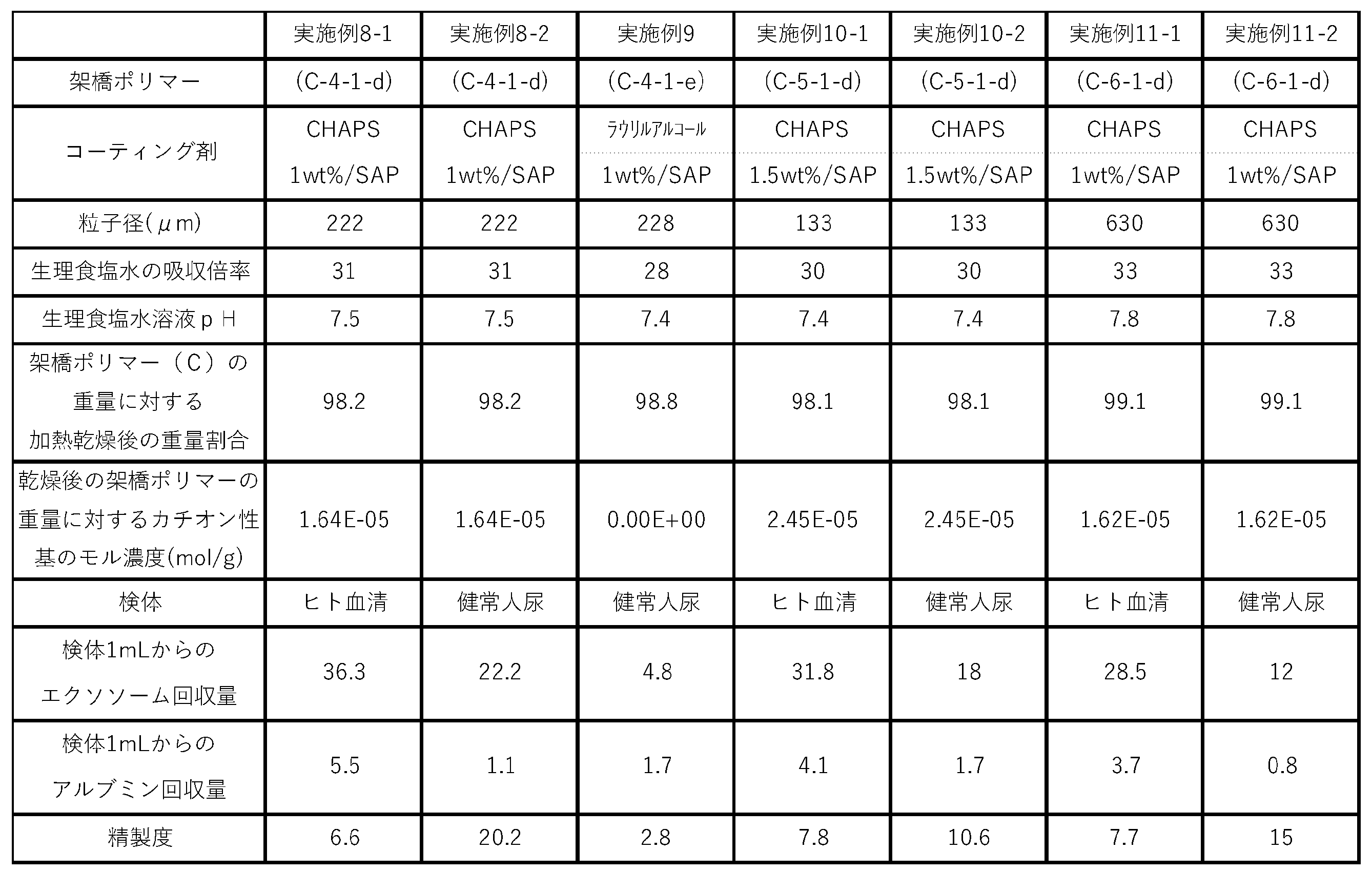
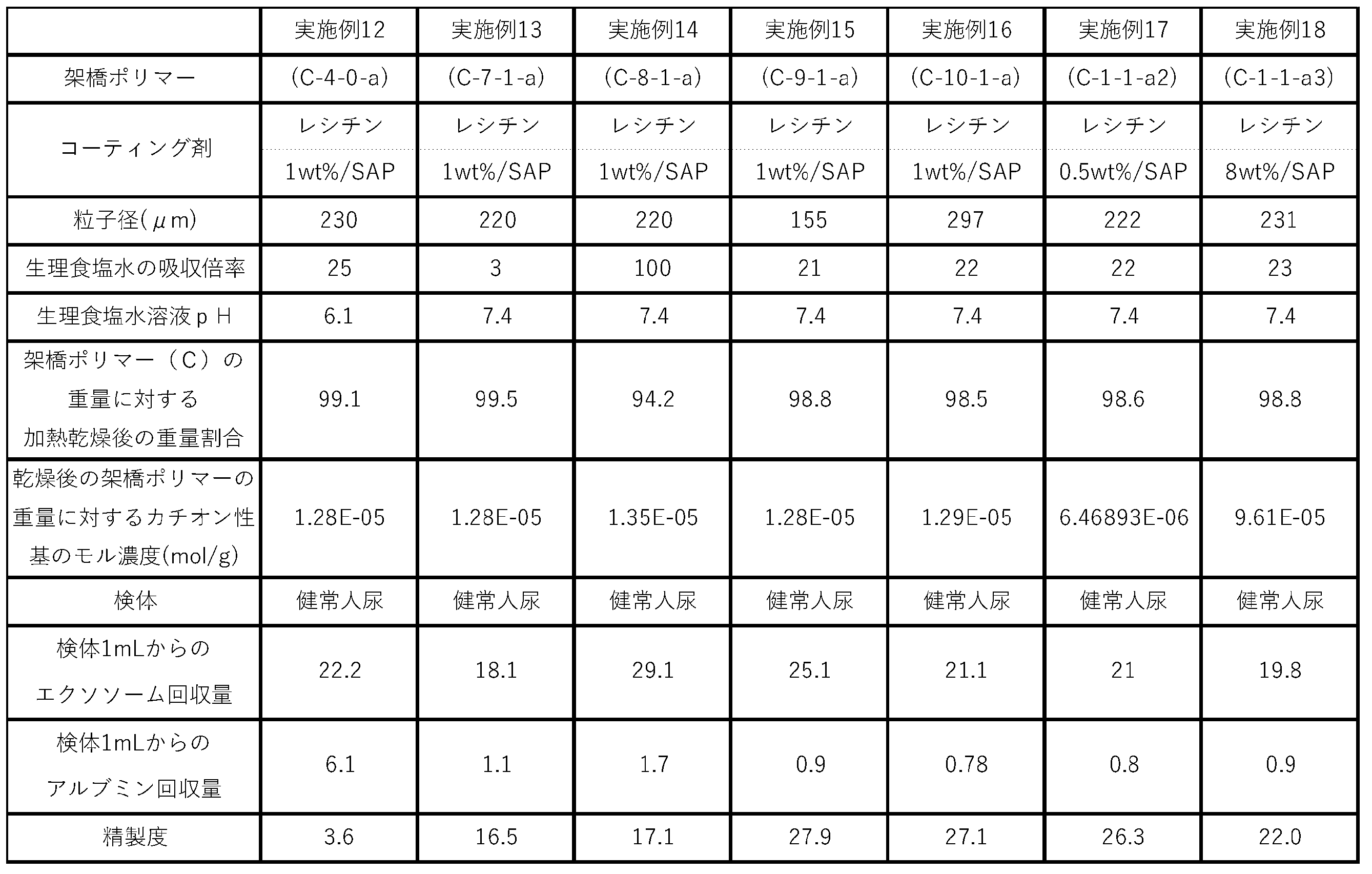

Claims (13)
- 生体由来試料から脂質二重層を有する物質を分離するための架橋ポリマーであって、酸性基及び/又はその中和塩基を有するモノマー単位を含む架橋ポリマーであり、カチオン性基及び水酸基からなる群から選ばれる少なくとも1種の基を有する化合物を含有する架橋ポリマー。
- 前記化合物が、置換されていてもよい炭素数12~30の炭化水素基を有する、請求項1に記載の架橋ポリマー。
- 前記化合物が、カチオン性基を有する、請求項1又は2に記載の架橋ポリマー。
- 前記カチオン性基が、-N(R1)2(式中、各R1は、それぞれ独立して、水素原子、又は、置換されていてもよい炭素数1~6の炭化水素基を示す)、又は-N+(R2)3(式中、各R2は、それぞれ独立して、水素原子、又は、置換されていてもよい炭素数1~6の炭化水素基を示す)である、請求項1~3のいずれか1項に記載の架橋ポリマー。
- 前記炭素数12~30の炭化水素基が、炭素数12~20の脂肪族炭化水素基、又は、炭素数20~30の脂環式炭化水素基である、請求項1~4のいずれか1項に記載の架橋ポリマー。
- 前記脂肪族炭化水素基がアルキル基又はアルケニル基であり、前記脂環式炭化水素基がステロイド骨格を有する基である、請求項5に記載の架橋ポリマー。
- 前記架橋ポリマーを生理食塩水の重量に基づいて0.5重量%含有する生理食塩水溶液のpHが、7~8である、請求項1~6のいずれか1項に記載の架橋ポリマー。
- 体積平均粒子径が100~1000μmである、請求項1~7のいずれか1項に記載の架橋ポリマー。
- 前記脂質二重層を有する物質が細胞外小胞である、請求項1~8のいずれか1項に記載の架橋ポリマー。
- 生体由来試料から脂質二重層を有する物質を分離する方法であって、下記の工程(1)及び(2)を含む方法:
(1)生体由来試料を請求項1~9のいずれか1項に記載の架橋ポリマーと接触させ、脂質二重層を有する物質を含有するポリマーゲルを得る工程、及び
(2)前記ポリマーゲルを塩と混合し、脂質二重層を有する物質を回収する工程。 - 生体由来試料から脂質二重層を有する物質を分離するためのキットであって、請求項1~9のいずれか1項に記載の架橋ポリマー及び塩を含むキット。
- 細胞外小胞を用いて疾患を検査するためのキットであって、請求項1~9のいずれか1項に記載の架橋ポリマー及び塩を含むキット。
- 生体由来試料から脂質二重層を有する物質を分離するための装置であって、請求項10に記載の方法を実行する手段を備える装置。
Priority Applications (4)
| Application Number | Priority Date | Filing Date | Title |
|---|---|---|---|
| JP2023511695A JP7582633B2 (ja) | 2021-03-31 | 2022-03-31 | 架橋ポリマー、物質を分離する方法、物質を分離するためのキット、疾患を検査するためのキット及び物質を分離するための装置 |
| CN202280025748.XA CN117295945A (zh) | 2021-03-31 | 2022-03-31 | 交联聚合物、分离物质的方法、分离物质的试剂盒、检测疾病的试剂盒及分离物质的装置 |
| US18/552,978 US20240201055A1 (en) | 2021-03-31 | 2022-03-31 | Cross-linked polymer, method for separating substance, kit for separating substance, kit for testing for disease, and device for separating substance |
| EP22781216.1A EP4317399A4 (en) | 2021-03-31 | 2022-03-31 | Cross-linked polymer, separation method, separation kit, disease testing kit, and separation device |
Applications Claiming Priority (2)
| Application Number | Priority Date | Filing Date | Title |
|---|---|---|---|
| JP2021060546 | 2021-03-31 | ||
| JP2021-060546 | 2021-03-31 |
Publications (1)
| Publication Number | Publication Date |
|---|---|
| WO2022211006A1 true WO2022211006A1 (ja) | 2022-10-06 |
Family
ID=83456574
Family Applications (1)
| Application Number | Title | Priority Date | Filing Date |
|---|---|---|---|
| PCT/JP2022/016441 Ceased WO2022211006A1 (ja) | 2021-03-31 | 2022-03-31 | 架橋ポリマー、物質を分離する方法、物質を分離するためのキット、疾患を検査するためのキット及び物質を分離するための装置 |
Country Status (5)
| Country | Link |
|---|---|
| US (1) | US20240201055A1 (ja) |
| EP (1) | EP4317399A4 (ja) |
| JP (1) | JP7582633B2 (ja) |
| CN (1) | CN117295945A (ja) |
| WO (1) | WO2022211006A1 (ja) |
Cited By (1)
| Publication number | Priority date | Publication date | Assignee | Title |
|---|---|---|---|---|
| JPWO2025023177A1 (ja) * | 2023-07-27 | 2025-01-30 |
Citations (11)
| Publication number | Priority date | Publication date | Assignee | Title |
|---|---|---|---|---|
| JP2884063B2 (ja) * | 1996-05-07 | 1999-04-19 | 工業技術院長 | 両親媒性重合体 |
| JP2001519836A (ja) * | 1996-12-16 | 2001-10-23 | サントル、ナショナール、ド、ラ、ルシェルシュ、シアンティフィク、(セーエヌエルエス) | 膜タンパク質−両親媒性アクリル重合体の水溶性複合体および診断法への応用 |
| JP2003165883A (ja) | 2001-09-18 | 2003-06-10 | San-Dia Polymer Ltd | 吸水性重合体とこれを用いてなる吸収性物品 |
| JP2003225565A (ja) | 2001-11-20 | 2003-08-12 | San-Dia Polymer Ltd | 吸水剤、その製法、吸水剤を用いた吸収体並びに吸収性物品 |
| JP2005075982A (ja) | 2003-09-02 | 2005-03-24 | San-Dia Polymer Ltd | ビニル重合体の製造方法 |
| JP2005095759A (ja) | 2003-09-24 | 2005-04-14 | San-Dia Polymer Ltd | 吸収剤とこれを用いてなる吸収性物品 |
| JP2019518428A (ja) * | 2016-04-12 | 2019-07-04 | ユニシテ エーファウ アクチェンゲゼルシャフト | 体液試料からの細胞外小胞(ev)の単離 |
| JP2020502067A (ja) * | 2016-12-23 | 2020-01-23 | エクソファーマ リミテッド | 微小胞およびエキソソームの精製または単離のための方法および組成物 |
| WO2020080387A1 (ja) * | 2018-10-17 | 2020-04-23 | 合同会社みらか中央研究所 | 細胞外小胞の回収方法 |
| JP2021007915A (ja) * | 2019-07-01 | 2021-01-28 | 昭和電工マテリアルズ株式会社 | 被覆粒子の製造方法及びカラムの製造方法 |
| WO2021251462A1 (ja) * | 2020-06-12 | 2021-12-16 | 国立大学法人徳島大学 | 粒子を分級するための高吸水性ポリマー、及びそれを用いた分級方法 |
Family Cites Families (3)
| Publication number | Priority date | Publication date | Assignee | Title |
|---|---|---|---|---|
| US20110104052A1 (en) * | 2007-12-03 | 2011-05-05 | The Johns Hopkins University | Methods of synthesis and use of chemospheres |
| CN103167868B (zh) * | 2010-10-14 | 2016-08-03 | 株式会社爱茉莉太平洋 | 包覆有脂质的水凝胶粒子及其制备方法 |
| US9829483B2 (en) * | 2013-09-26 | 2017-11-28 | The General Hospital Corporation | Methods of isolating extracellular vesicles |
-
2022
- 2022-03-31 WO PCT/JP2022/016441 patent/WO2022211006A1/ja not_active Ceased
- 2022-03-31 EP EP22781216.1A patent/EP4317399A4/en active Pending
- 2022-03-31 US US18/552,978 patent/US20240201055A1/en active Pending
- 2022-03-31 CN CN202280025748.XA patent/CN117295945A/zh active Pending
- 2022-03-31 JP JP2023511695A patent/JP7582633B2/ja active Active
Patent Citations (11)
| Publication number | Priority date | Publication date | Assignee | Title |
|---|---|---|---|---|
| JP2884063B2 (ja) * | 1996-05-07 | 1999-04-19 | 工業技術院長 | 両親媒性重合体 |
| JP2001519836A (ja) * | 1996-12-16 | 2001-10-23 | サントル、ナショナール、ド、ラ、ルシェルシュ、シアンティフィク、(セーエヌエルエス) | 膜タンパク質−両親媒性アクリル重合体の水溶性複合体および診断法への応用 |
| JP2003165883A (ja) | 2001-09-18 | 2003-06-10 | San-Dia Polymer Ltd | 吸水性重合体とこれを用いてなる吸収性物品 |
| JP2003225565A (ja) | 2001-11-20 | 2003-08-12 | San-Dia Polymer Ltd | 吸水剤、その製法、吸水剤を用いた吸収体並びに吸収性物品 |
| JP2005075982A (ja) | 2003-09-02 | 2005-03-24 | San-Dia Polymer Ltd | ビニル重合体の製造方法 |
| JP2005095759A (ja) | 2003-09-24 | 2005-04-14 | San-Dia Polymer Ltd | 吸収剤とこれを用いてなる吸収性物品 |
| JP2019518428A (ja) * | 2016-04-12 | 2019-07-04 | ユニシテ エーファウ アクチェンゲゼルシャフト | 体液試料からの細胞外小胞(ev)の単離 |
| JP2020502067A (ja) * | 2016-12-23 | 2020-01-23 | エクソファーマ リミテッド | 微小胞およびエキソソームの精製または単離のための方法および組成物 |
| WO2020080387A1 (ja) * | 2018-10-17 | 2020-04-23 | 合同会社みらか中央研究所 | 細胞外小胞の回収方法 |
| JP2021007915A (ja) * | 2019-07-01 | 2021-01-28 | 昭和電工マテリアルズ株式会社 | 被覆粒子の製造方法及びカラムの製造方法 |
| WO2021251462A1 (ja) * | 2020-06-12 | 2021-12-16 | 国立大学法人徳島大学 | 粒子を分級するための高吸水性ポリマー、及びそれを用いた分級方法 |
Non-Patent Citations (1)
| Title |
|---|
| See also references of EP4317399A4 |
Cited By (3)
| Publication number | Priority date | Publication date | Assignee | Title |
|---|---|---|---|---|
| JPWO2025023177A1 (ja) * | 2023-07-27 | 2025-01-30 | ||
| WO2025023177A1 (ja) | 2023-07-27 | 2025-01-30 | 栄研化学株式会社 | 糞便中の細胞外小胞及び/又は膜小胞の精製方法 |
| JP7713604B2 (ja) | 2023-07-27 | 2025-07-25 | 栄研化学株式会社 | 糞便中の細胞外小胞及び/又は膜小胞の精製方法 |
Also Published As
| Publication number | Publication date |
|---|---|
| CN117295945A (zh) | 2023-12-26 |
| JP7582633B2 (ja) | 2024-11-13 |
| EP4317399A4 (en) | 2025-04-30 |
| EP4317399A1 (en) | 2024-02-07 |
| JPWO2022211006A1 (ja) | 2022-10-06 |
| US20240201055A1 (en) | 2024-06-20 |
Similar Documents
| Publication | Publication Date | Title |
|---|---|---|
| JP6100893B2 (ja) | 無機材料で構成される表面用の表面処理剤、表面が改質された器具および装置、該器具および装置の製造方法 | |
| KR20050083752A (ko) | 소재의 표면 개질 방법 | |
| DK148874B (da) | Fremgangsmaade til fjernelse eller koncentrering af hepatitisvirus fra blandinger af biologiske materialer | |
| TWI549974B (zh) | 一種胺基修飾材料及其應用 | |
| JP7582633B2 (ja) | 架橋ポリマー、物質を分離する方法、物質を分離するためのキット、疾患を検査するためのキット及び物質を分離するための装置 | |
| JP7706168B2 (ja) | 粒子を分級するための高吸水性ポリマー、及びそれを用いた分級方法 | |
| Li et al. | Improving hemocompatibility of polypropylene via surface-initiated atom transfer radical polymerization for covalently coupling BSA | |
| JP5866880B2 (ja) | 生理活性物質固定化用粒子、生理活性物質固定粒子及び糖親和性物質捕捉粒子 | |
| US6294614B1 (en) | Modified polymers containing poly(2-hydroxyethyl(meth)acrylate segment in the molecule | |
| US6093558A (en) | Binding protein of biologically active compositions to an adhesive formulation on a substrate | |
| CN116116385B (zh) | 一种血液中外泌体的提取及其蛋白质组学分析方法 | |
| CN111870731A (zh) | 一种复合海绵及其制备方法和应用 | |
| JPH04233924A (ja) | ポリオキシアルキレン側鎖含有共重合体 | |
| Xin et al. | Rapid isolation of extracellular vesicles using covalent organic frameworks combined with microfluidic technique | |
| CN113388147A (zh) | 一种生物材料磷酸胆碱改性聚氨酯制备方法 | |
| JP5993967B2 (ja) | 細胞内生体分子の検出に用いる標準試料及び細胞内生体分子の検出方法 | |
| JP2025021452A (ja) | 生体由来材料中のコロイド成分濃度を高める方法 | |
| JP7713604B2 (ja) | 糞便中の細胞外小胞及び/又は膜小胞の精製方法 | |
| CN117866214A (zh) | 一种大孔冷冻凝胶介质及其制备方法和应用 | |
| JP2017071772A (ja) | 吸収性樹脂組成物 | |
| CN115040666A (zh) | 一种医用超声耦合剂及其制备方法 | |
| JP3519832B2 (ja) | 生体反応検査方法 | |
| JP2022055881A (ja) | 吸収剤及び吸収剤を用いた濃縮組成物の製造方法 | |
| JP6874390B2 (ja) | 改質セルロース | |
| CN118924682B (zh) | 一种双功能树状脂肽纳米胶束及其制备方法和应用 |
Legal Events
| Date | Code | Title | Description |
|---|---|---|---|
| 121 | Ep: the epo has been informed by wipo that ep was designated in this application |
Ref document number: 22781216 Country of ref document: EP Kind code of ref document: A1 |
|
| ENP | Entry into the national phase |
Ref document number: 2023511695 Country of ref document: JP Kind code of ref document: A |
|
| WWE | Wipo information: entry into national phase |
Ref document number: 202280025748.X Country of ref document: CN |
|
| WWE | Wipo information: entry into national phase |
Ref document number: 18552978 Country of ref document: US |
|
| WWE | Wipo information: entry into national phase |
Ref document number: 2022781216 Country of ref document: EP |
|
| NENP | Non-entry into the national phase |
Ref country code: DE |
|
| ENP | Entry into the national phase |
Ref document number: 2022781216 Country of ref document: EP Effective date: 20231031 |