WO2022210579A1 - 粘着剤組成物、およびそれを用いてなる粘着剤、粘着シート、ならびに積層体 - Google Patents
粘着剤組成物、およびそれを用いてなる粘着剤、粘着シート、ならびに積層体 Download PDFInfo
- Publication number
- WO2022210579A1 WO2022210579A1 PCT/JP2022/015120 JP2022015120W WO2022210579A1 WO 2022210579 A1 WO2022210579 A1 WO 2022210579A1 JP 2022015120 W JP2022015120 W JP 2022015120W WO 2022210579 A1 WO2022210579 A1 WO 2022210579A1
- Authority
- WO
- WIPO (PCT)
- Prior art keywords
- meth
- pressure
- sensitive adhesive
- mass
- adhesive composition
- Prior art date
- Legal status (The legal status is an assumption and is not a legal conclusion. Google has not performed a legal analysis and makes no representation as to the accuracy of the status listed.)
- Ceased
Links
Classifications
-
- C—CHEMISTRY; METALLURGY
- C09—DYES; PAINTS; POLISHES; NATURAL RESINS; ADHESIVES; COMPOSITIONS NOT OTHERWISE PROVIDED FOR; APPLICATIONS OF MATERIALS NOT OTHERWISE PROVIDED FOR
- C09J—ADHESIVES; NON-MECHANICAL ASPECTS OF ADHESIVE PROCESSES IN GENERAL; ADHESIVE PROCESSES NOT PROVIDED FOR ELSEWHERE; USE OF MATERIALS AS ADHESIVES
- C09J11/00—Features of adhesives not provided for in group C09J9/00, e.g. additives
- C09J11/02—Non-macromolecular additives
- C09J11/06—Non-macromolecular additives organic
-
- C—CHEMISTRY; METALLURGY
- C09—DYES; PAINTS; POLISHES; NATURAL RESINS; ADHESIVES; COMPOSITIONS NOT OTHERWISE PROVIDED FOR; APPLICATIONS OF MATERIALS NOT OTHERWISE PROVIDED FOR
- C09J—ADHESIVES; NON-MECHANICAL ASPECTS OF ADHESIVE PROCESSES IN GENERAL; ADHESIVE PROCESSES NOT PROVIDED FOR ELSEWHERE; USE OF MATERIALS AS ADHESIVES
- C09J133/00—Adhesives based on homopolymers or copolymers of compounds having one or more unsaturated aliphatic radicals, each having only one carbon-to-carbon double bond, and at least one being terminated by only one carboxyl radical, or of salts, anhydrides, esters, amides, imides, or nitriles thereof; Adhesives based on derivatives of such polymers
- C09J133/04—Homopolymers or copolymers of esters
-
- C—CHEMISTRY; METALLURGY
- C09—DYES; PAINTS; POLISHES; NATURAL RESINS; ADHESIVES; COMPOSITIONS NOT OTHERWISE PROVIDED FOR; APPLICATIONS OF MATERIALS NOT OTHERWISE PROVIDED FOR
- C09J—ADHESIVES; NON-MECHANICAL ASPECTS OF ADHESIVE PROCESSES IN GENERAL; ADHESIVE PROCESSES NOT PROVIDED FOR ELSEWHERE; USE OF MATERIALS AS ADHESIVES
- C09J7/00—Adhesives in the form of films or foils
- C09J7/30—Adhesives in the form of films or foils characterised by the adhesive composition
- C09J7/38—Pressure-sensitive adhesives [PSA]
Definitions
- the present invention relates to an adhesive composition, and more particularly to an adhesive composition that can be used even in a -10°C freezing environment, such as an adhesive tape for frozen foods.
- the present invention also relates to a pressure-sensitive adhesive, a pressure-sensitive adhesive sheet, and a laminate that are excellent not only at room temperature but also in a frozen state of ⁇ 10° C. and have excellent curved surface adhesion.
- acrylic adhesives are known as adhesives for adhesive tapes or adhesive sheets.
- acrylic adhesive a (co)polymer having a specific alkyl (meth)acrylate as an essential structural unit has been developed.
- acrylic adhesives often use petroleum as a raw material, and carbon dioxide is emitted when they are disposed of after use.
- bio-based raw materials especially plant-based raw materials, which are renewable materials, is recommended.
- Patent Document 1 proposes a pressure-sensitive adhesive composition containing a (co)polymer whose essential component is a (meth)acrylate ester of a renewable resource, 2-alkylalkanol.
- the pressure-sensitive adhesive composition of Patent Document 1 also contains many petroleum-derived components, and it was necessary to use more renewable materials.
- Patent Document 2 proposes a pressure-sensitive adhesive containing 48% by weight or more of structural units derived from acrylic monomers containing 7 to 14 biological carbons and/or vinyl monomers containing 7 to 13 biological carbons. It is
- Patent Documents 1 and 2 are excellent in adhesive strength at room temperature (about 25°C), the adhesive strength at low temperatures is not satisfactory. Furthermore, the adhesiveness on curved surfaces was not taken into consideration, and there was room for further investigation.
- a pressure-sensitive adhesive composition for reducing the amount of petroleum-derived materials used, it has excellent adhesiveness in a frozen state of -10 ° C., and furthermore, forms a pressure-sensitive adhesive that is excellent in curved surface adhesiveness.
- a pressure-sensitive adhesive composition for reducing the amount of petroleum-derived materials used, it has excellent adhesiveness in a frozen state of -10 ° C., and furthermore, forms a pressure-sensitive adhesive that is excellent in curved surface adhesiveness.
- a pressure-sensitive adhesive composition for reducing the amount of petroleum-derived materials used, it has excellent adhesiveness in a frozen state of -10 ° C., and furthermore, forms a pressure-sensitive adhesive that is excellent in curved surface adhesiveness.
- the present inventor is a pressure-sensitive adhesive composition containing an acrylic resin (A) and a tackifier (B), As a copolymerization component (a) of the acrylic resin (A), n-octyl (meth)acrylate (a1) is contained,
- the tackifier (B) contains at least one selected from the group consisting of a polymerized rosin resin (B1), a disproportionated rosin resin (B2), and a hydrogenated rosin resin (B3),
- the tackifier (B) contains at least one selected from the group consisting of a polymerized rosin resin (B1), a disproportionated rosin resin (B2), and a hydrogenated rosin resin (B3),
- the total amount of the polymerized rosin-based resin (B1), the disproportionated rosin-based resin (B2), and the hydrogenated rosin-based resin (B3) is 75% by mass or more of the entire tackifier (B).
- a pressure-sensitive adhesive composition ⁇ 2> The pressure-sensitive adhesive composition according to ⁇ 1>, wherein the acrylic resin (A) contains a functional group-containing (meth)acrylic monomer (a2).
- the functional group-containing (meth)acrylic monomer (a2) contains at least one selected from the group consisting of a carboxy group-containing (meth)acrylic monomer and a hydroxyl group-containing (meth)acrylic monomer.
- ⁇ 5> The adhesive composition according to any one of ⁇ 1> to ⁇ 4>, wherein the acrylic resin (A) has a glass transition temperature of ⁇ 85° C. or higher.
- ⁇ 7> A pressure-sensitive adhesive obtained by cross-linking the pressure-sensitive adhesive composition according to any one of ⁇ 1> to ⁇ 6>.
- ⁇ 8> A pressure-sensitive adhesive sheet comprising a pressure-sensitive adhesive layer comprising the pressure-sensitive adhesive according to ⁇ 7>.
- ⁇ 9> A laminate comprising a pressure-sensitive adhesive layer made of the pressure-sensitive adhesive according to ⁇ 7> and another member laminated on the pressure-sensitive adhesive layer.
- the pressure-sensitive adhesive composition of the present invention while reducing the amount of petroleum-derived materials used, is excellent in adhesion in a frozen state of -10 ° C., and furthermore excellent in curved surface adhesion. .
- (meth)acrylic means acrylic or methacrylic
- (meth)acryloyl means acryloyl or methacryloyl
- (meth)acrylate means acrylate or methacrylate.
- acrylic resin is a resin obtained by polymerizing a polymerizable component containing at least one (meth)acrylate monomer.
- a pressure-sensitive adhesive composition according to one embodiment of the present invention contains an acrylic resin (A) and a tackifier (B). These components will be described in order below.
- the acrylic resin (A) used in the present pressure-sensitive adhesive composition contains n-octyl (meth)acrylate (a1) as the copolymerization component (a), and the monomer of the copolymerization component (a) is It is obtained by polymerization.
- n-octyl (meth)acrylate (a1) examples include n-octyl (meth)acrylate containing biological carbon and n-octyl (meth)acrylate containing petroleum-derived carbon, which may be used alone or in combination. can be used Among them, it is preferable to use n-octyl (meth)acrylate containing biological carbon from the viewpoint of environmental problems.
- the n-octyl (meth)acrylate containing biological carbon can be produced by any method as long as it contains biological carbon.
- fractional distillation of fatty acids obtained by hydrolyzing oils contained in natural oils It can be prepared by an esterification reaction between n-octyl alcohol obtained by hydrogen reduction of caprylic acid extracted by and acrylic acid.
- n-octyl (meth)acrylate (a1) is 50% by mass or more, preferably 60 to 99.9% by mass, more preferably 70 to 99.9% by mass, based on the total copolymer component (a). 8% by mass, more preferably 80 to 99.7% by mass. If the content is too small, adhesive physical properties tend to deteriorate. If the amount is too large, the adhesion to curved surfaces tends to decrease due to a decrease in cohesive strength.
- the acrylic resin (A) used in the pressure-sensitive adhesive composition preferably contains a functional group-containing (meth)acrylic monomer (a2).
- a functional group-containing (meth)acrylic monomer (a2) may be any (meth)acrylic monomer containing a functional group other than the component (a1).
- a hydroxyl group-containing (meth)acrylic monomer for example, a hydroxyl group-containing (meth)acrylic monomer, Carboxy group-containing (meth)acrylic monomers, amino group-containing (meth)acrylic monomers, amide group-containing (meth)acrylic monomers, glycidyl group-containing (meth)acrylic monomers, sulfone group-containing (meth)acrylic monomers, Acetoacetyl group-containing (meth)acrylic monomers, isocyanate group-containing (meth)acrylic monomers, and the like are preferred. These can be used individually by 1 type or in combination of 2 or more types. Among them, it is more preferable to contain at least one selected from the group consisting of a carboxy group-containing (meth)acrylic monomer (a2-1) and a hydroxyl group-containing (meth)acrylic monomer (a2-2).
- the content of the functional group-containing (meth)acrylic monomer (a2) is preferably 0 to 20% by mass, more preferably 0.5 to 15% by mass, based on the total copolymerization component (a). More preferably 1 to 12% by mass, particularly preferably 1.5 to 8% by mass. If the content is too small, the cohesive strength tends to be low and the curved surface adhesion tends to be insufficient. If it is too large, the adhesiveness tends to decrease in a frozen environment.
- Examples of the carboxy group-containing (meth)acrylic monomer (a2-1) include (meth)acrylic acid, dimer acids of acrylic acid such as ⁇ -carboxyethyl acrylate, and the like, and these may be used alone or in combination of two or more. They can be used together. Among them, (meth)acrylic acid is preferably used from the viewpoint of heat resistance and stability during polymerization. Moreover, from the point of view of environmental problems, it is preferable to use a dimer acid of plant-derived acrylic acid, which is friendly to the global environment.
- the content of the carboxy group-containing (meth)acrylic monomer (a2-1) is preferably 0 to 10% by mass, more preferably 0.5 to 8% by mass, based on the total copolymerization component (a). %, more preferably 1 to 5 mass %, particularly preferably 1.5 to 4 mass %. If the content is too small, the cohesive strength tends to be low and the curved surface adhesion tends to be insufficient. If it is too large, the adhesiveness tends to decrease in a frozen environment.
- hydroxyl group-containing (meth)acrylic monomers (a2-2) examples include 2-hydroxyethyl (meth)acrylate, 4-hydroxybutyl (meth)acrylate, 5-hydroxypentyl (meth)acrylate, 6-hydroxyhexyl ( Meth) acrylate, acrylic acid hydroxyalkyl esters such as 8-hydroxyoctyl (meth) acrylate; caprolactone-modified monomers such as caprolactone-modified 2-hydroxyethyl (meth) acrylate; diethylene glycol (meth) acrylate, polyethylene glycol (meth) acrylate, etc.
- Oxyalkylene-modified monomers 2-acryloyloxyethyl-2-hydroxyethyl phthalate, N-methylol (meth)acrylamide, primary hydroxyl group-containing monomers such as hydroxyethylacrylamide; 2-hydroxypropyl (meth)acrylate, 2-hydroxy secondary hydroxyl group-containing monomers such as butyl (meth)acrylate and 3-chloro-2-hydroxypropyl (meth)acrylate; hydroxyl group-containing monomers such as 2,2-dimethyl-2-hydroxyethyl (meth)acrylate;
- hydroxyl group-containing (meth)acrylic monomers (a2-2)
- primary hydroxyl group-containing monomers are preferred in terms of reactivity and versatility with the crosslinking agent described later
- 2-hydroxy group-containing monomers are preferred in terms of stability during polymerization.
- Ethyl (meth)acrylate is preferred
- 4-hydroxybutyl (meth)acrylate is preferably used because of its rapid reactivity with the cross-linking agent (C) and short aging.
- 2-hydroxyethyl (meth)acrylate and 4-hydroxybutyl (meth)acrylate are preferable because they contain few impurities such as di(meth)acrylate during monomer preparation, and high purity products can be obtained, which facilitates production.
- the content of the hydroxyl group-containing (meth)acrylic monomer (a2-2) is preferably 0 to 1% by mass, more preferably 0.05 to 0.5% by mass, based on the total copolymerization component (a). %, more preferably 0.08 to 0.3% by mass. If the content is too small, the cohesive force tends to decrease and the adhesiveness tends to decrease. If the amount is too large, the pot life at the time of blending the cross-linking agent tends to be shortened and the handleability tends to deteriorate.
- amino group-containing (meth)acrylic monomer examples include aminoethyl (meth)acrylate, N,N-dimethylaminoethyl (meth)acrylate, and N,N-dimethylaminopropyl (meth)acrylate.
- amide group-containing (meth)acrylic monomers examples include ethoxymethyl (meth)acrylamide, n-butoxymethyl (meth)acrylamide, (meth)acryloylmorphol, dimethyl (meth)acrylamide, diethyl (meth)acrylamide, (Meth)acrylamide-based monomers such as dimethylaminopropylacrylamide, (meth)acrylamide, N-methylol(meth)acrylamide, and the like.
- Examples of the glycidyl group-containing (meth)acrylic monomer include glycidyl methacrylate and allylglycidyl methacrylate.
- Examples of the sulfone group-containing (meth)acrylic monomer include 2-acrylamido-2-methylolpropanesulfonic acid.
- acetoacetyl group-containing (meth)acrylic monomer examples include 2-(acetoacetoxy)ethyl (meth)acrylate.
- Examples of the isocyanate group-containing (meth)acrylic monomer include, for example, 2-isocyanatoethyl (meth)acrylate, 2-(2-methacryloyloxyethyloxy)ethyl isocyanate, 1,1-(bisacryloyloxymethyl)ethyl isocyanate etc.
- the content of the acrylic monomer and the isocyanate group-containing (meth)acrylic monomer is usually 0 to 10% by mass.
- the acrylic resin (A) used in the pressure-sensitive adhesive composition contains an alkyl (meth)acrylate (a3) having less than 8 alkyl carbon atoms and having no functional group as a copolymer component (a).
- alkyl (meth)acrylates (a3) having no functional group and having less than 8 alkyl carbon atoms include methyl (meth)acrylate, ethyl (meth)acrylate, n-butyl (meth)acrylate, and iso-butyl (meth)acrylate.
- the content of the alkyl (meth)acrylate (a3) having less than 8 alkyl carbon atoms and having no such functional group is 0% by mass or more and less than 30% by mass, preferably less than 20% by mass, more preferably less than 10% by mass, More preferably, it is less than 5% by mass. If the content is too high, the adhesive strength under freezing conditions tends to decrease, and particularly when polyolefin is used as the adherend, the adhesive strength tends to decrease. In addition, the biomass degree of the acrylic pressure-sensitive adhesive composition may decrease.
- the other polymerizable monomer (a4) may be any other polymerizable monomer other than the above (a1), (a2), and (a3), for example, an alkyl (meth)acrylate having 8 or more carbon atoms.
- alkyl (meth)acrylate monomer (a4) examples include 2-ethylhexyl (meth)acrylate, iso-octyl acrylate, iso-decyl (meth)acrylate, n-lauryl (meth)acrylate, and cetyl (meth)acrylate. , n-stearyl (meth)acrylate, iso-stearyl (meth)acrylate, behenyl (meth)acrylate and the like.
- lauryl (meth)acrylate, stearyl (meth)acrylate, and behenyl (meth)acrylate are preferable from the point of easily improving the biomass degree, and lauryl (meth)acrylate is preferable from the point of adhesiveness.
- nitrogen-containing monomer examples include nitrogen-containing monomers having a cyclic structure such as acryloylmorpholine and vinylimidazole.
- Examples of the alicyclic structure-containing monomer include cyclohexyl (meth)acrylate, isobornyl (meth)acrylate, dicyclopentanyl (meth)acrylate, dicyclopentenyl (meth)acrylate, and dicyclopentanyloxyethyl (meth)acrylate. , dicyclopentenyloxyethyl (meth)acrylate, 2-adamantyl (meth)acrylate and other (meth)acrylates having an alicyclic structure. Among them, isobornyl (meth)acrylate is preferable because it is easy to improve the degree of biomass.
- aromatic monomers examples include phenyl (meth)acrylate, benzyl (meth)acrylate, phenoxyethyl (meth)acrylate, phenoxypropyl (meth)acrylate, phenoxydiethylene glycol (meth)acrylate, and phenoxydipropylene glycol (meth)acrylate.
- phenoxy polyethylene glycol (meth) acrylate phenoxy polyethylene glycol (meth) acrylate, phenoxy polyethylene glycol (meth) acrylate, phenoxy polypropylene glycol-(meth) acrylate having one aromatic ring; phenoxybenzyl (meth) acrylate, ethoxylated -o- Examples thereof include (meth)acrylates having two aromatic rings such as phenylphenol (meth)acrylate.
- alkoxy group-containing monomer examples include alkoxyalkyl (meth)acrylate such as 2-methoxyethyl (meth)acrylate, 2-ethoxyethyl (meth)acrylate, 3-methoxybutyl (meth)acrylate, and 2-butoxyethyl (meth)acrylate. meth)acrylate and the like.
- olefinsulfonic acids such as ethylenesulfonic acid, allylsulfonic acid, and methallylsulfonic acid; styrenesulfonic acid or salts thereof; allylacetoacetate;
- the other polymerizable monomer (a4) can be contained within a range that does not impair the effects of the present invention, but is preferably 20% by mass or less, more preferably 10% by mass or less, relative to the total copolymerization component (a). , particularly preferably 5% by mass or less, most preferably 0% by mass.
- ⁇ Method for producing acrylic resin (A)> As a method for producing the acrylic resin (A), conventionally known methods such as solution radical polymerization, suspension polymerization, bulk polymerization, and emulsion polymerization can be used using the copolymerization component (a). Examples thereof include a method of mixing or dropping appropriately selected polymerization components and a polymerization initiator into an organic solvent and polymerizing under predetermined polymerization conditions. Solution radical polymerization is particularly preferable in that the acrylic resin (A) can be obtained in the following manner.
- organic solvent used in the polymerization reaction examples include aromatic hydrocarbons such as toluene and xylene; aliphatic hydrocarbons such as hexane; esters such as ethyl acetate and butyl acetate; n-propyl alcohol and isopropyl alcohol. ketones such as acetone, methyl ethyl ketone, methyl isobutyl ketone, and cyclohexanone; and the like. These organic solvents may be used individually by 1 type, and may use 2 or more types together.
- esters such as ethyl acetate and butyl acetate are preferred from the viewpoints of easiness of polymerization reaction, effect of chain transfer, easiness of drying during coating of the pressure-sensitive adhesive composition, and safety; Ketones such as acetone, methyl ethyl ketone, and methyl isobutyl ketone are preferred, and ethyl acetate is particularly preferred. These can be used alone or in combination of two or more.
- the amount of the organic solvent to be used is usually 10 to 900 parts by weight per 100 parts by weight of the copolymer component (a).
- the polymerization initiator used for such solution radical polymerization includes, for example, 2,2'-azobisisobutyronitrile and 2,2'-azobis-2-methylbutyronitrile, which are ordinary radical polymerization initiators. , 4,4'-azobis (4-cyanovaleric acid), 2,2'-azobis (methylpropionic acid) and other azo initiators; benzoyl peroxide, lauroyl peroxide, di-t-butyl peroxide, cumene Organic peroxides such as hydroperoxide; These polymerization initiators may be used individually by 1 type, and may use 2 or more types together. The amount of the polymerization initiator to be used is usually 0.01 to 5 parts by weight per 100 parts by weight of the copolymer component (a).
- the acrylic resin (A) used in the adhesive composition is obtained.
- the weight average molecular weight (Mw) of the acrylic resin (A) is preferably 100,000 or more, more preferably 100,000 to 1,500,000, still more preferably 150,000 to 1,000,000, and particularly preferably 200,000 to 800,000. If the weight average molecular weight is too small, the cohesive force tends to be insufficient and the adhesiveness tends to decrease. On the other hand, if the weight-average molecular weight is too large, the viscosity tends to be too high, resulting in increased scaling during polymerization and reduced handleability.
- the degree of dispersion [weight average molecular weight (Mw)/number average molecular weight (Mn)] of the acrylic resin (A) is preferably 10 or less, more preferably 7 or less. If the degree of dispersion is too high, the cohesion tends to decrease. The lower limit of the degree of dispersion is usually 1.
- the weight-average molecular weight of the acrylic resin (A) is the weight-average molecular weight in terms of standard polystyrene molecular weight, and is measured using a high-performance liquid chromatograph ("Waters 2695 (body)” and “Waters 2414 (detector)” manufactured by Nippon Waters Co., Ltd.).
- the particle diameter of the agent is 10 ⁇ m), and the number average molecular weight can be measured by the same method. Further, the degree of dispersion can be obtained from the measured values of the weight average molecular weight and the number average molecular weight.
- the glass transition temperature (Tg) of the acrylic resin (A) is preferably ⁇ 85° C. or higher, more preferably ⁇ 80 to 20° C., still more preferably ⁇ 75 to 0° C., particularly preferably ⁇ 70 to ⁇ 10° C., Especially preferred is -65 to -30°C. If the glass transition temperature is too low, the cohesive force tends to decrease and the curved surface adhesion tends to decrease.
- the glass transition temperature is calculated from the following Fox formula.
- Tg glass transition temperature of the polymer (K)
- Tga glass transition temperature of homopolymer of monomer A
- Wa mass fraction of monomer A
- Tgb glass transition temperature (K) of homopolymer of monomer B
- Wb mass fraction of monomer B
- Tgn glass transition temperature (K) of homopolymer of monomer N
- the glass transition temperature of a homopolymer of the monomers constituting the acrylic resin (A) is usually measured by a differential scanning calorimeter (DSC), and is JIS K7121-1987 or JIS K 6240. It can be measured by a method conforming to
- Acrylic resin (A) is the main component of the adhesive composition, preferably 50% by mass or more, more preferably 60 to 98% by mass, still more preferably 70 to 95% by mass, particularly It is preferably 75 to 93% by mass. Outside this range, it tends to be difficult to obtain the effects of the present invention.
- the viscosity of the diluted acrylic resin (A) is preferably 500 to 30000 mPa ⁇ s/25°C, more preferably 1000 to 10000 mPa ⁇ s/25°C. If the viscosity is too low, when a component with a heavy specific gravity is used, the component tends to settle, and the concentration of the component in the acrylic resin (A) tends to become non-uniform.
- the biomass content of the acrylic resin (A) is preferably 40% by mass or more, more preferably 50% by mass or more, and even more preferably 60% by mass or more, from the viewpoint of reducing environmental load.
- the upper limit is 100% by mass.
- the biomass degree may be within the above range as long as it is obtained by any one of the following calculation methods.
- Biomass degree (% by mass) of acrylic resin (A) [(biomass degree of each biological raw material used when producing acrylic resin (A)) ⁇ (when producing acrylic resin (A) Total mass of each bio-derived raw material used for)] / (total mass of acrylic resin (A)) ⁇ 100
- the biomass degree is also referred to as the biogenic carbon content rate, and can also be obtained by analyzing the composition ratio with NMR and calculating the carbon number of the biogenic monomer/the total carbon number.
- Bio carbon contains a certain proportion of radioactive isotopes (C-14), while petroleum-derived carbon contains almost no C-14. Therefore, the biomass degree can also be calculated by measuring the concentration of C-14 contained in the adhesive. Specifically, it can be measured according to ASTM D6866, which is a standard used in many bioplastic industries.
- the tackifier (B) used in the present pressure-sensitive adhesive composition is at least selected from the group consisting of polymerized rosin-based resins (B1), disproportionated rosin-based resins (B2), and hydrogenated rosin-based resins (B3). Contains one. Among them, it is preferable to contain at least one selected from the group consisting of the polymerized rosin-based resin (B1) and the disproportionated rosin-based resin (B2).
- the polymerized rosin-based resin (B1) is a product obtained by polymerizing unmodified rosin (polymerized rosin) and/or a derivative thereof. It is obtained by esterifying a group and a compound containing a hydroxyl group (esterification product of polymerized rosin).
- esterified product of polymerized rosin include methyl ester, triethylene glycol ester, glycerin ester, pentaerythritol ester, and the like of polymerized rosin. These can be used alone or in combination of two or more.
- the softening point of the polymerized rosin-based resin (B1) is preferably 20 to 180°C, more preferably 50 to 160°C, still more preferably 70 to 140°C. If the temperature is too high or too low, the tackiness and curved surface adhesion tend to decrease in a frozen environment.
- polymerized rosin-based resins (B1) biologically-derived polymerized rosin-based resins are preferably used from the viewpoint of reducing the environmental load, and the biomass content of the polymerized rosin-based resin (B1) is preferably 70% by mass or more.
- the disproportionated rosin-based resin (B2) is an unmodified rosin modified by disproportionation (disproportionation rosin) and/or a derivative thereof. and preferably a compound in which a carboxyl group and a hydroxyl group-containing compound in rosin are esterified (esterified product of disproportionated rosin).
- esterified products of disproportionated rosin include methyl esters, triethylene glycol esters, glycerin esters, and pentaerythritol esters of disproportionated rosin. These can be used alone or in combination of two or more.
- the softening point of the disproportionated rosin resin (B2) is preferably 30 to 180°C, more preferably 50 to 160°C, still more preferably 70 to 140°C. If it is too high or too low, the tackiness tends to decrease.
- biomass-derived disproportionated rosins are preferably used from the viewpoint of reducing environmental load. preferable.
- the hydrogenated rosin-based resin (B3) is a modified unmodified rosin by hydrogenation (hydrogenated rosin) and/or a derivative thereof. is an esterified compound containing a carboxy group and a hydroxyl group in rosin (esterified product of hydrogenated rosin).
- esterified products of hydrogenated rosin include methyl esters, triethylene glycol esters, glycerin esters, pentaerythritol esters, and the like of hydrogenated rosin. These can be used alone or in combination of two or more.
- the softening point of the hydrogenated rosin resin (B3) is preferably 30 to 180°C, more preferably 50 to 160°C, still more preferably 70 to 140°C. If it is too high or too low, the tackiness tends to decrease.
- a biologically-derived hydrogenated rosin is preferably used from the viewpoint of reducing the environmental load. preferable.
- the tackifier (B) may contain a tackifier other than the polymerized rosin resin (B1), the disproportionated rosin resin (B2), and the hydrogenated rosin resin (B3).
- the total amount of the polymerized rosin resin (B1), the disproportionated rosin resin (B2), and the hydrogenated rosin resin (B3) is 75% by mass or more of the total tackifier (B).
- Preferably such total amount is at least 80% by weight, particularly preferably at least 90% by weight, most preferably at least 100% by weight. If the content is too small, the effect of the present invention will be difficult to obtain.
- Tackifiers other than the polymerized rosin resin (B1), disproportionated rosin resin (B2), and hydrogenated rosin resin (B3) include rosins other than (B1), (B2), and (B3).
- the content of the tackifier (B) is preferably 0.1 to 50 parts by mass, more preferably 5 to 40 parts by mass, based on 100 parts by mass (solid content) of the acrylic resin (A). More preferably 10 to 30 parts by mass, particularly preferably 15 to 25 parts by mass. If the content is too small, it tends to be difficult to obtain the effects of the present invention.
- the degree of biomass in the tackifier (B) is preferably 70% by mass or more, more preferably 75% by mass or more, still more preferably 80% by mass or more, and particularly preferably 90% by mass or more, from the viewpoint of reducing environmental load.
- the upper limit is 100% by mass. The higher the content, the more preferable it is because it increases the amount of renewable resources.
- the biomass degree may be within the above range as long as it is obtained by any one of the following calculation methods.
- the above biomass degree can also be determined by analyzing the composition ratio with NMR and calculating the carbon number of the biological monomer/the total carbon number.
- Bio carbon contains a certain proportion of radioactive isotopes (C-14), while petroleum-derived carbon contains almost no C-14. Therefore, the biomass degree can also be calculated by measuring the concentration of C-14 contained in the adhesive. Specifically, it can be measured according to ASTM D6866, which is a standard used in many bioplastic industries.
- This pressure-sensitive adhesive composition preferably contains a cross-linking agent (C) in addition to the acrylic resin (A) and the tackifier (B).
- the cross-linking agent (C) is preferable in that it improves the elastic modulus when the pressure-sensitive adhesive is formed, prevents migration of components contained in the substrate or adherend, and improves durability.
- the cross-linking agent (C) is a compound that reacts with the functional groups in the acrylic resin (A) to form a cross-linked structure.
- examples include cross-linking agents, aldehyde-based cross-linking agents, amine-based cross-linking agents, metal chelate-based cross-linking agents, and the like.
- the cross-linking agents (C) may be used singly or in combination of two or more.
- Examples of the isocyanate-based cross-linking agent include aromatic isocyanate-based compounds, alicyclic isocyanate-based compounds, and aliphatic isocyanate-based compounds.
- aromatic isocyanate compounds include tolylene diisocyanate compounds such as 2,4-tolylene diisocyanate and 2,6-tolylene diisocyanate; xylylene diisocyanate compounds such as 1,3-xylylene diisocyanate; diphenylmethane-based compounds such as diphenylmethane-4,4-diisocyanate; naphthalenediisocyanate-based compounds such as 1,5-naphthalenediisocyanate; and the like.
- Examples of the alicyclic isocyanate compounds include isophorone diisocyanate, 1,4-cyclohexane diisocyanate, 4,4′-dicyclohexylmethane diisocyanate, methylcyclohexane diisocyanate, isopropylidenedicyclohexyl-4,4′-diisocyanate, 1,3 -diisocyanatomethylcyclohexane, norbornane diisocyanate, and the like.
- Examples of the aliphatic isocyanate compounds include hexamethylene diisocyanate and trimethylhexamethylene diisocyanate. Adducts, burettes, and isocyanurates of the above isocyanate compounds are also included.
- tolylene diisocyanate-based compounds are preferable in terms of pot life and durability, and xylylene diisocyanate-based compounds and isocyanurate skeleton-containing isocyanate-based compounds are preferable in terms of shortening the aging time, and do not contain aromatic rings.
- Isocyanate-based compounds are preferred in terms of yellowing resistance.
- adduct of at least one isocyanate compound selected from the group consisting of tolylene diisocyanate, xylylene diisocyanate and hexamethylene diisocyanate and trimethylolpropane, and tolylene diisocyanate examples include isocyanurates of trimethylolpropane and at least one isocyanate compound selected from the group consisting of xylylene diisocyanate and hexamethylene diisocyanate, and these adducts and isocyanurates have excellent durability, pot life, and crosslinking speed. It is preferable in that it is excellent in the balance of
- epoxy-based cross-linking agent examples include bisphenol A/epichlorohydrin type epoxy resin, ethylene glycol diglycidyl ether, polyethylene glycol diglycidyl ether, glycerin diglycidyl ether, glycerin triglycidyl ether, 1,6-hexanediol diglycidyl ether. , trimethylolpropane triglycidyl ether, sorbitol polyglycidyl ether, polyglycerol polyglycidyl ether, pentaerythritol polyglycidylerythritol, diglycerol polyglycidyl ether and the like.
- aziridine-based cross-linking agent examples include tetramethylolmethane-tri- ⁇ -aziridinylpropionate, trimethylolpropane-tri- ⁇ -aziridinylpropionate, N,N'-diphenylmethane-4,4 '-bis(1-aziridinecarboxamide), N,N'-hexamethylene-1,6-bis(1-aziridinecarboxamide) and the like.
- melamine-based cross-linking agent examples include hexamethoxymethylmelamine, hexaethoxymethylmelamine, hexapropoxymethylmelamine, hexaptoxymethylmelamine, hexapentyloxymethylmelamine, hexahexyloxymethylmelamine, and melamine resins.
- aldehyde-based cross-linking agents examples include glyoxal, malondialdehyde, succindialdehyde, maleinedialdehyde, glutardialdehyde, formaldehyde, acetaldehyde, and benzaldehyde.
- amine-based cross-linking agents examples include hexamethylenediamine, triethyldiamine, polyethyleneimine, hexamethylenetetramine, diethylenetriamine, triethyltetramine, isophoronediamine, amino resins, and polyamides.
- metal chelate-based cross-linking agents examples include polyvalent metals such as aluminum, iron, copper, zinc, tin, titanium, nickel, antimony, magnesium, panadium, chromium, and zirconium, and coordination agents such as acetylacetone and acetoacetyl ester. A coordination compound with a child and the like can be mentioned.
- the cross-linking agent (C) When the cross-linking agent (C) is used, its content is preferably 0.005 to 30 parts by mass, more preferably 0.01, with respect to 100 parts by mass (solid content) of the acrylic resin (A). 10 parts by mass, more preferably 0.03 to 5 parts by mass, particularly preferably 0.05 to 3 parts by mass. If the content is too small, it tends to be difficult to obtain the effect of improving durability, and if it is too large, the stress relaxation property will decrease, the substrate of the adherend will tend to warp, and long-term aging will be required. tend to become
- the pressure-sensitive adhesive composition may further contain a silane coupling agent (D).
- the silane coupling agent used in the pressure-sensitive adhesive composition is a general term for silane compounds having an alkoxysilyl group and other functional groups.
- the silane coupling agent in the pressure-sensitive adhesive composition preferably has a mercapto group.
- the silane coupling agent (D) may be a monomer type or an oligomer type partially hydrolyzed and condensed.
- the oligomer type or silane coupling agent having a molecular weight of 500 or more is preferable because it evaporates less during drying or heat curing, and because the pressure-sensitive adhesive layer is less likely to generate air bubbles and has good moisture and heat resistance.
- the content is preferably 0.01 to 5 parts by mass, more preferably 0.05 parts by mass with respect to 100 parts by mass of the acrylic resin (A). to 2 parts by mass, more preferably 0.1 to 1.5 parts by mass. If the content is too low, the resistance to moist heat will tend to be low, and if it is too high, the adhesive strength immediately after curing will tend to be low.
- optional components include, for example, conductive agents such as carbon and metals; inorganic fillers such as metal particles and glass particles; fillers; antioxidants; Various additives such as cross-linking accelerators such as ionic compounds, peroxides, and urethanization catalysts; cross-linking retarders such as acetylacetone may also be contained. These may be used individually by 1 type, and may use 2 or more types together.
- the present pressure-sensitive adhesive composition may contain impurities contained in raw materials for manufacturing the constituent components of the pressure-sensitive adhesive composition, etc., as long as the effects of the present invention are not impaired.
- the content thereof is preferably 5 parts by mass or less, more preferably 1 part by mass or less, and still more preferably 0.5 parts by mass with respect to 100 parts by mass of the acrylic resin (A). It is below the department. The lower limit is usually 0 parts by mass. If the content is too high, the effect of the present invention tends to be impaired.
- the pressure-sensitive adhesive composition can be obtained by mixing the acrylic resin (A) and the tackifier (B), optionally a cross-linking agent (C), and optionally optional components. .
- the method of mixing these components is not particularly limited, and there are various methods such as a method of mixing each component at once, a method of mixing an arbitrary component and then mixing the remaining components all at once or sequentially. can be adopted.
- the biomass content of the pressure-sensitive adhesive composition is preferably 30% by mass or more, more preferably 40% by mass or more, still more preferably 50% by mass or more, and particularly preferably 60% by mass or more, from the viewpoint of reducing environmental load.
- an upper limit is 100 mass %.
- the biomass degree of the pressure-sensitive adhesive composition is the ratio of the mass of the biological raw material used in the production of the pressure-sensitive adhesive composition to the total mass of the pressure-sensitive adhesive composition.
- Biomass degree of the adhesive composition (% by mass) [(biomass degree of each biological raw material used when producing the adhesive composition) ⁇ (biological material used when producing the adhesive composition Mass of each raw material)] / (total mass of adhesive composition) ⁇ 100
- the degree of biomass of the pressure-sensitive adhesive composition can also be measured by the above-mentioned method using NMR or the method using natural radioactive carbon C-14.
- the biomass degree should be within the above range as long as the value obtained by any one of the above calculation methods is within the above range.
- the present pressure-sensitive adhesive composition contains a solvent, it can be made into a pressure-sensitive adhesive by drying. Moreover, this adhesive composition can also be made into an adhesive by bridge
- a pressure-sensitive adhesive layer containing this pressure-sensitive adhesive on a substrate such as a plastic film, it is possible to obtain a pressure-sensitive adhesive sheet having a laminate structure of substrate/adhesive layer.
- a laminate having a laminated structure of adherend/pressure-sensitive adhesive layer can be obtained.
- a base material and an adherend are also collectively called a "member.”
- adhesive sheets in addition to adhesive sheets in which an adhesive layer is laminated on a base material, there are base-less double-sided adhesive sheets in which a separator (release sheet) is laminated on both sides of the adhesive layer.
- a double-sided pressure-sensitive adhesive sheet is preferable in this respect.
- the adhesive sheet for example, it can be produced by coating an adhesive composition on a base material and drying it.
- the cross-linking agent (C) When the cross-linking agent (C) is used, the separator is attached to the pressure-sensitive adhesive layer after drying, and at least aging at room temperature (unheated) and aging at a temperature sufficient to prevent the epoxy compound from curing.
- a method of performing an aging treatment by one side, and the like can be mentioned. After applying the pressure-sensitive adhesive composition to a separator and drying it, another separator having a different release force from the separator is laminated, and an aging treatment is performed to produce a substrate-less double-sided pressure-sensitive adhesive sheet. be able to.
- the solvent is not particularly limited as long as it dissolves or disperses the pressure-sensitive adhesive composition.
- ester solvents such as methyl acetate, ethyl acetate, methyl acetoacetate, and ethyl acetoacetate
- ketone solvents such as acetone, methyl ethyl ketone, and methyl isobutyl ketone
- aromatic solvents such as toluene and xylene
- methanol, ethanol, and propyl alcohol alcohol-based solvents such as; Among them, ethyl acetate is preferably used in terms of solubility, drying property, price, and the like.
- Examples of methods for applying the pressure-sensitive adhesive composition include roll coating, die coating, gravure coating, comma coating, and screen printing.
- the thickness of the adhesive layer in the adhesive sheet is preferably 5-250 ⁇ m, more preferably 25-200 ⁇ m, and even more preferably 50-175 ⁇ m. If the pressure-sensitive adhesive layer is too thin, there is a tendency for the thickness accuracy to decrease or the adhesive strength to decrease. tend to protrude and contaminate the roll.
- the gel fraction of the adhesive layer is preferably 0 to 99% by mass, more preferably 20 to 95% by mass, and still more preferably 30 to 80% by mass. If the gel fraction of the pressure-sensitive adhesive layer is too high, when the pressure-sensitive adhesive sheet is attached to a member, sufficient adhesiveness cannot be obtained between the pressure-sensitive adhesive layer and the interface of the member, and the adhesiveness tends to decrease.
- the above gel fraction serves as a measure of the degree of cross-linking (degree of curing), and is calculated, for example, by the following method.
- the adhesive is collected by picking from an adhesive sheet in which an adhesive layer is laminated on the surface of a base material, wrapped in a 200-mesh SUS wire mesh, and placed in ethyl acetate adjusted to 23 ° C. for 24 hours. soak.
- the mass of the adhesive before and after immersion in ethyl acetate is measured, and the difference between the two masses is taken as the mass of the undissolved adhesive remaining in the wire mesh.
- the mass percentage of the undissolved adhesive remaining in the wire mesh with respect to the mass of the adhesive before immersion in ethyl acetate is defined as the gel fraction.
- the biomass degree in the pressure-sensitive adhesive layer is almost the same as the biomass degree in the above-described pressure-sensitive adhesive composition, so the preferred values are the same and can be calculated by the same method.
- the present pressure-sensitive adhesive composition is made of biological (especially plant-derived) raw materials, and the pressure-sensitive adhesive and laminate obtained using such a pressure-sensitive adhesive composition are environmentally friendly. In addition, it is possible to form a pressure-sensitive adhesive that has high adhesive strength even in a freezing environment of -10°C and that has high curved surface adhesiveness.
- the pressure-sensitive adhesive according to one embodiment of the present invention can be used in various applications such as labels for frozen foods, building materials, automotive parts, electronic parts, heat dissipation sheets, FPC manufacturing, semiconductor manufacturing processes, member sealing. It is useful for adhesive applications such as fasteners, aircraft parts, and sporting goods, and is particularly suitable for frozen food labels (adhesive sheets, adhesive tapes).
- nOA n-octyl acrylate
- AAc acrylic acid
- 2-HEMA 2-hydroxyethyl methacrylate
- ⁇ Tackifier (B)> The following were prepared as a tackifier (B).
- B1 Polymerized rosin ester resin (manufactured by Arakawa Chemical Industries, softening point: 120 to 140 ° C., biomass degree: 85 to 90%)
- B2 disproportionated rosin ester resin (manufactured by Arakawa Chemical Industries, Ltd., A-100, softening point: 100 ° C., biomass degree: 99%)
- B3 Hydrogenated rosin ester resin manufactured by Arakawa Chemical Industries, Ltd., KE359, hydroxyl value: 40, softening point: 100°C, biomass degree: 95%)
- B'1 Terpene phenol resin (manufactured by Yasuhara Chemical Co., Ltd., G-150, softening point: 150 ° C., biomass degree: 67%)
- B'2 Hydrogenated petroleum resin (manufactured by Arakawa Chemical Industries, Ltd., M-100, softening point
- Cross-linking agent (C) > The followings were used as the cross-linking agent (C) for acrylic resins.
- - (C-1) an adduct of tolylene diisocyanate and trimethylolpropane (manufactured by Tosoh Corporation, "Coronate L55E”)
- a pressure-sensitive adhesive sheet was produced from the obtained pressure-sensitive adhesive composition according to the procedure described below. After that, evaluation was performed using this pressure-sensitive adhesive sheet.
- the evaluation method and evaluation criteria for each item are as follows. These results are also shown in Table 1 below.
- the pressure-sensitive adhesive composition is applied to a 38 ⁇ m-thick light-release silicon separator (manufactured by Mitsui Chemicals Tohcello, “SPPET01 38BU”) using an applicator so that the thickness after drying is 25 ⁇ m, and 100 ° C. for 5 minutes. It was dried to form an adhesive layer.
- a 38 ⁇ m thick PET film manufactured by Toray Industries, Inc., “Lumirror #38-T60” was laminated on the surface of the adhesive layer, and then aged at 40 ° C. for 3 days to produce an adhesive sheet (light release silicon separator / adhesive layer/PET film laminate).
- ⁇ -10°C adhesive strength> A test piece with a width of 25 mm ⁇ 100 mm was prepared from the adhesive sheet obtained above, and after peeling off the separator, the adherend [SUS304-BA plate, PP (polypropylene) plate, PE (polyethylene) plate] , and a 2 kg rubber roller was reciprocated twice in an atmosphere of 50 RH% to apply pressure, and allowed to stand at -10°C for 30 minutes. After that, according to JIS Z 0237, the 180° peel strength (N/25 mm) was measured at a peel rate of 300 mm/min and evaluated as follows.
- a test piece with a width of 10 mm x 10 mm was prepared from the pressure-sensitive adhesive sheet obtained above, the separator was peeled off, and the test piece was attached to a PP (polypropylene) rod with a diameter of 100 mm under pressure and left at 40°C for 48 hours. After that, the peel width of the test piece from the PP bar was measured and evaluated as follows.
- the pressure-sensitive adhesive is collected from the pressure-sensitive adhesive sheet obtained above by picking, wrapped with a 200-mesh SUS wire mesh, and immersed in ethyl acetate adjusted to 23° C. for 24 hours.
- the mass of the adhesive before and after immersion in ethyl acetate is measured, and the difference between the two masses is taken as the mass of the undissolved adhesive component remaining in the wire mesh.
- the mass percentage of the undissolved adhesive component remaining in the wire mesh with respect to the mass of the adhesive before immersion in ethyl acetate is defined as the gel fraction (%).
- Comparative Example 6 is a pressure-sensitive adhesive that exhibits poor adhesiveness to resin adherends such as PP and PE in a frozen state of -10°C and poor adhesiveness to curved surfaces.
- Comparative Example 6 has the same content ratio of the acrylic resin (A) and the cross-linking agent (C) as in Examples 2 and 3, but the polymerized rosin resin (B1) and the disproportionated rosin resin ( Since the total amount of B2) and hydrogenated rosin (B3) does not satisfy the predetermined ratio in the total tackifier (B), the adhesiveness to the resin adherend at -10 ° C. is inferior, and the curved surface adhesion The result is also inferior in terms of sex.
- the content ratio of the acrylic resin (A) and the cross-linking agent (C) is the same as in Example 4, but the polymerized rosin resin (B1) and the disproportionated rosin resin ( Since the total amount of B2) and hydrogenated rosin (B3) does not satisfy the predetermined ratio in the total tackifier (B), the adhesiveness to curved surfaces is also inferior.
- the adhesive composition of the present invention is made of biologically-derived raw materials, and an environmentally friendly adhesive can be obtained. In addition, it has high adhesive strength even in a freezing environment of -10°C, and also has high adhesiveness to curved surfaces, so it is useful for labels of frozen foods and the like.
Landscapes
- Chemical & Material Sciences (AREA)
- Organic Chemistry (AREA)
- Adhesives Or Adhesive Processes (AREA)
- Laminated Bodies (AREA)
Abstract
石油由来の材料の使用量を低減しながらも、-10℃という冷凍状態での粘着性にも優れ、さらに曲面接着性に優れる粘着剤を形成する粘着剤組成物として下記を提供する。 アクリル系樹脂(A)と粘着付与剤(B)を含有する粘着剤組成物であって、 前記アクリル系樹脂(A)の共重合成分(a)として、n-オクチル(メタ)アクリレート(a1)を含有すると共に、官能基を有しない炭素数8未満のアルキル(メタ)アクリレート(a3)を0質量%以上30質量%未満含有し、 前記粘着付与剤(B)として、重合ロジン系樹脂(B1)、不均化ロジン系樹脂(B2)、および水添ロジン系樹脂(B3)からなる群から選ばれる少なくとも1種を含有し、 前記重合ロジン系樹脂(B1)、不均化ロジン系樹脂(B2)、および水添ロジン系樹脂(B3)の合計量が前記粘着付与剤(B)全体の75質量%以上であることを特徴とする粘着剤組成物。
Description
本発明は、粘着剤組成物に関し、更に詳しくは、冷凍食品用の粘着テープ等、-10℃の冷凍環境下においても使用できる粘着剤組成物に関する。そして、本発明は、常温での粘着性に加えて、-10℃という冷凍状態での粘着性にも優れ、さらに曲面接着性に優れる粘着剤、粘着シートおよび積層体に関する。
従来、粘着テープまたは粘着シート用等の粘着剤としては天然ゴム系粘着剤またはアクリル系粘着剤が知られている。アクリル系粘着剤としては、特定のアルキル(メタ)アクリレートを必須構成単位とする(共)重合体が開発されている。
しかし、アクリル系粘着剤については、その原料に石油を使用することが多く、使用後の廃棄処理により、二酸化炭素が排出されるため、石油資源の枯渇や地球温暖化への影響が懸念され、再生可能な材料である生物由来原料の、中でも植物由来原料の使用が推奨されている。
特許文献1には、再生可能資源である2-アルキルアルカノールの(メタ)アクリレートエステルを必須成分とする(コ)ポリマーを含む感圧接着剤組成物が提案されている。
しかしながら、特許文献1の感圧接着剤組成物には、石油由来の成分も多く含んでおり、再生可能な材料をより多く用いることが必要であった。
しかしながら、特許文献1の感圧接着剤組成物には、石油由来の成分も多く含んでおり、再生可能な材料をより多く用いることが必要であった。
また、特許文献2には生物由来の炭素を7~14個含むアクリルモノマーおよび/または生物由来の炭素を7~13個含むビニルモノマーに由来する構成単位を48重量%以上含有する粘着剤が提案されている。
しかしながら、上記特許文献1および2の開示技術では、常温(25℃程度)での粘着力に優れるが、低温での粘着性については、満足いくものではなかった。さらには、曲面での接着性については考慮されておらず、検討の余地があった。
そこで、本発明ではこのような背景下において、石油由来の材料の使用量を低減しながらも、-10℃という冷凍状態での粘着性にも優れ、さらに曲面接着性に優れる粘着剤を形成する粘着剤組成物、およびそれを用いてなる粘着剤、粘着シート、ならびに積層体を提供する。
本発明者は、アクリル系樹脂(A)と粘着付与剤(B)を含有する粘着剤組成物であって、
アクリル系樹脂(A)の共重合成分(a)として、n-オクチル(メタ)アクリレート(a1)を含有し、
粘着付与剤(B)として、重合ロジン系樹脂(B1)、不均化ロジン系樹脂(B2)、および水添ロジン系樹脂(B3)からなる群から選ばれる少なくとも1種を含有し、
重合ロジン系樹脂(B1)、不均化ロジン系樹脂(B2)、および水添ロジン系樹脂(B3)の合計量が粘着付与剤(B)全体の75質量%以上である粘着剤組成物が、石油由来の材料の使用量を低減しながら、-10℃という冷凍状態での粘着性にも優れ、さらに曲面接着性に優れる粘着剤を得られることを見出した。
アクリル系樹脂(A)の共重合成分(a)として、n-オクチル(メタ)アクリレート(a1)を含有し、
粘着付与剤(B)として、重合ロジン系樹脂(B1)、不均化ロジン系樹脂(B2)、および水添ロジン系樹脂(B3)からなる群から選ばれる少なくとも1種を含有し、
重合ロジン系樹脂(B1)、不均化ロジン系樹脂(B2)、および水添ロジン系樹脂(B3)の合計量が粘着付与剤(B)全体の75質量%以上である粘着剤組成物が、石油由来の材料の使用量を低減しながら、-10℃という冷凍状態での粘着性にも優れ、さらに曲面接着性に優れる粘着剤を得られることを見出した。
すなわち、本発明の要旨は、次の通りである。
<1>
アクリル系樹脂(A)と粘着付与剤(B)を含有する粘着剤組成物であって、
前記アクリル系樹脂(A)の共重合成分(a)として、n-オクチル(メタ)アクリレート(a1)を含有すると共に、官能基を有しないアルキル炭素数8未満のアルキル(メタ)アクリレート(a3)を共重合成分(a)中に0質量%以上30質量%未満含有し、
前記粘着付与剤(B)として、重合ロジン系樹脂(B1)、不均化ロジン系樹脂(B2)、および水添ロジン系樹脂(B3)からなる群から選ばれる少なくとも1種を含有し、
前記重合ロジン系樹脂(B1)、不均化ロジン系樹脂(B2)、および水添ロジン系樹脂(B3)の合計量が前記粘着付与剤(B)全体の75質量%以上であることを特徴とする粘着剤組成物。
<2>
前記アクリル系樹脂(A)が、官能基含有(メタ)アクリル系モノマー(a2)を含有することを特徴とする<1>記載の粘着剤組成物。
<3>
前記官能基含有(メタ)アクリル系モノマー(a2)が、カルボキシ基含有(メタ)アクリル系モノマーおよび水酸基含有(メタ)アクリル系モノマーからなる群から選ばれる少なくとも1種を含有することを特徴とする<2>記載の粘着剤組成物。
<4>
前記アクリル系樹脂(A)の重量平均分子量が10万以上であることを特徴とする<1>~<3>のいずれかに記載の粘着剤組成物。
<5>
前記アクリル系樹脂(A)のガラス転移温度が-85℃以上であることを特徴とする<1>~<4>のいずれかに記載の粘着剤組成物。
<6>
さらに架橋剤(C)を含有することを特徴とする<1>~<5>のいずれかに記載の粘着剤組成物。
<7>
<1>~<6>のいずれかに記載の粘着剤組成物が架橋されてなることを特徴とする粘着剤。
<8>
<7>に記載の粘着剤からなる粘着剤層を有することを特徴とする粘着シート。
<9>
<7>に記載の粘着剤からなる粘着剤層と、前記粘着剤層に積層された他の部材とを備えることを特徴とする積層体。
本発明の粘着剤組成物は、石油由来の材料の使用量を低減しながらも、-10℃という冷凍状態での粘着性にも優れ、さらに曲面接着性に優れる粘着剤を得られるものである。
以下に、本発明を実施するための形態の例に基づいて本発明を説明する。但し、本発明が、次に説明する実施形態に限定されるものではない。
なお、本発明において、「(メタ)アクリル」とはアクリルあるいはメタクリルを、「(メタ)アクリロイル」とはアクリロイルあるいはメタクリロイルを、「(メタ)アクリレート」とはアクリレートあるいはメタクリレートをそれぞれ意味するものである。
また、「アクリル系樹脂」とは、少なくとも1種の(メタ)アクリレート系モノマーを含む重合成分を重合して得られる樹脂である。
また、本発明において「X~Y」(X,Yは任意の数字)と表現する場合、特にことわらない限り「X以上Y以下」の意と共に、「好ましくはXより大きい」または「好ましくはYより小さい」の意も包含する。
また、「X以上」(Xは任意の数字)または「Y以下」(Yは任意の数字)と表現した場合、「Xより大きいことが好ましい」または「Y未満であることが好ましい」旨の意も包含する。
さらに、「yおよび/またはz(y、zは任意の構成)」とは、yおよびzの少なくとも一方を意味するものであって、yのみ、zのみ、yおよびz、の3通りを意味するものである。
本発明の一実施形態に係る粘着剤組成物(以下、「本粘着剤組成物」という場合がある)は、アクリル系樹脂(A)、粘着付与剤(B)を含有する。
以下、かかる構成成分について順番に説明する。
以下、かかる構成成分について順番に説明する。
<アクリル系樹脂(A)>
本粘着剤組成物に用いられるアクリル系樹脂(A)は、共重合成分(a)としてn-オクチル(メタ)アクリレート(a1)を含有するものであり、共重合成分(a)のモノマーを共重合して得られるものである。
本粘着剤組成物に用いられるアクリル系樹脂(A)は、共重合成分(a)としてn-オクチル(メタ)アクリレート(a1)を含有するものであり、共重合成分(a)のモノマーを共重合して得られるものである。
〔n-オクチル(メタ)アクリレート(a1)〕
n-オクチル(メタ)アクリレート(a1)としては、生物由来の炭素を含むn-オクチル(メタ)アクリレート、石油由来の炭素を含むn-オクチル(メタ)アクリレートが挙げられ、これらは単独でもしくは併せて用いることができる。中でも、環境問題の点から、生物由来の炭素を含むn-オクチル(メタ)アクリレートを用いることが好ましい。
n-オクチル(メタ)アクリレート(a1)としては、生物由来の炭素を含むn-オクチル(メタ)アクリレート、石油由来の炭素を含むn-オクチル(メタ)アクリレートが挙げられ、これらは単独でもしくは併せて用いることができる。中でも、環境問題の点から、生物由来の炭素を含むn-オクチル(メタ)アクリレートを用いることが好ましい。
生物由来の炭素を含むn-オクチル(メタ)アクリレートは、生物由来の炭素を含むものであれば製法は問わないが、例えば、天然油脂に含まれる油脂を加水分解し、得られる脂肪酸の分留により取り出したカプリル酸を水素還元して得たn-オクチルアルコールと、アクリル酸とのエステル化反応により調製することができる。
n-オクチル(メタ)アクリレート(a1)の含有量は、全共重合成分(a)に対して、50質量%以上であり、好ましくは60~99.9質量%、より好ましくは70~99.8質量%、更に好ましくは80~99.7質量%である。かかる含有量が少なすぎると粘着物性が低下する傾向がある。多すぎると凝集力の低下により曲面接着性が低下する傾向がある。
〔官能基含有(メタ)アクリル系モノマー(a2)〕
本粘着剤組成物に用いられるアクリル系樹脂(A)には、官能基含有(メタ)アクリル系モノマー(a2)を含有することが好ましい。かかる官能基含有(メタ)アクリル系モノマー(a2)は、上記(a1)成分以外の、官能基を含有する(メタ)アクリル系モノマーであればよく、例えば、水酸基含有(メタ)アクリル系モノマー、カルボキシ基含有(メタ)アクリル系モノマー、アミノ基含有(メタ)アクリル系モノマー、アミド基含有(メタ)アクリル系モノマー、グリシジル基含有(メタ)アクリル系モノマー、スルホン基含有(メタ)アクリル系モノマー、アセトアセチル基含有(メタ)アクリル系モノマー、イソシアネート基含有(メタ)アクリル系モノマー等が好ましく挙げられる。これらは1種を単独でもしくは2種以上を併せて用いることができる。中でも、カルボキシ基含有(メタ)アクリル系モノマー(a2-1)および水酸基含有(メタ)アクリル系モノマー(a2-2)からなる群から選ばれる少なくとも1種を含有することがより好ましい。
本粘着剤組成物に用いられるアクリル系樹脂(A)には、官能基含有(メタ)アクリル系モノマー(a2)を含有することが好ましい。かかる官能基含有(メタ)アクリル系モノマー(a2)は、上記(a1)成分以外の、官能基を含有する(メタ)アクリル系モノマーであればよく、例えば、水酸基含有(メタ)アクリル系モノマー、カルボキシ基含有(メタ)アクリル系モノマー、アミノ基含有(メタ)アクリル系モノマー、アミド基含有(メタ)アクリル系モノマー、グリシジル基含有(メタ)アクリル系モノマー、スルホン基含有(メタ)アクリル系モノマー、アセトアセチル基含有(メタ)アクリル系モノマー、イソシアネート基含有(メタ)アクリル系モノマー等が好ましく挙げられる。これらは1種を単独でもしくは2種以上を併せて用いることができる。中でも、カルボキシ基含有(メタ)アクリル系モノマー(a2-1)および水酸基含有(メタ)アクリル系モノマー(a2-2)からなる群から選ばれる少なくとも1種を含有することがより好ましい。
官能基含有(メタ)アクリル系モノマー(a2)の含有量は、全共重合成分(a)に対して、0~20質量%であることが好ましく、より好ましくは0.5~15質量%、更に好ましくは1~12質量%、特に好ましくは1.5~8質量%である。かかる含有量が少なすぎると凝集力が低下し、曲面接着性が不足する傾向にある。多すぎると冷凍環境下での粘着性が低下する傾向がある。
カルボキシ基含有(メタ)アクリル系モノマー(a2-1)としては、例えば、(メタ)アクリル酸、β-カルボキシエチルアクリレート等のアクリル酸のダイマー酸等が挙げられ、これらは単独でもしくは2種以上併せて用いることができる。中でも、耐熱性の点、重合時の安定性の点で(メタ)アクリル酸を用いることが好ましい。また、環境問題の点で、地球環境にやさしい植物由来のアクリル酸のダイマー酸を用いることが好ましい。
カルボキシ基含有(メタ)アクリル系モノマー(a2-1)の含有量は、全共重合成分(a)に対して、0~10質量%であることが好ましく、より好ましくは0.5~8質量%、更に好ましくは1~5質量%、特に好ましくは1.5~4質量%である。かかる含有量が少なすぎると凝集力が低下し、曲面接着性が不足する傾向にある。多すぎると冷凍環境下での粘着性が低下する傾向がある。
水酸基含有(メタ)アクリル系モノマー(a2-2)としては、例えば、2-ヒドロキシエチル(メタ)アクリレート、4-ヒドロキシブチル(メタ)アクリレート、5-ヒドロキシペンチル(メタ)アクリレート、6-ヒドロキシヘキシル(メタ)アクリレート、8-ヒドロキシオクチル(メタ)アクリレート等のアクリル酸ヒドロキシアルキルエステル;カプロラクトン変性2-ヒドロキシエチル(メタ)アクリレート等のカプロラクトン変性モノマー;ジエチレングリコール(メタ)アクリレート、ポリエチレングリコール(メタ)アクリレート等のオキシアルキレン変性モノマー;2-アクリロイロキシエチル-2-ヒドロキシエチルフタル酸、N-メチロール(メタ)アクリルアミド、ヒドロキシエチルアクリルアミド等の1級水酸基含有モノマー;2-ヒドロキシプロピル(メタ)アクリレート、2-ヒドロキシブチル(メタ)アクリレート、3-クロロ-2-ヒドロキシプロピル(メタ)アクリレート等の2級水酸基含有モノマー;2,2-ジメチル-2-ヒドロキシエチル(メタ)アクリレート等の水酸基含有モノマー;が挙げられる。
上記水酸基含有(メタ)アクリル系モノマー(a2-2)の中でも、後述する架橋剤との反応性と汎用性の点で1級水酸基含有モノマーが好ましく、重合時の安定性の点で2-ヒドロキシエチル(メタ)アクリレートが好ましく、架橋剤(C)との反応性が速くエージングが短くなる点で4-ヒドロキシブチル(メタ)アクリレートを使用することが好ましい。更には、2-ヒドロキシエチル(メタ)アクリレートおよび4-ヒドロキシブチル(メタ)アクリレートは、モノマー調製時にジ(メタ)アクリレート等の不純物が少なく、純度が高いものが得られ製造しやすい点で好ましい。
水酸基含有(メタ)アクリル系モノマー(a2-2)の含有量は全共重合成分(a)に対して、0~1質量%であることが好ましく、より好ましくは0.05~0.5質量%であり、更に好ましくは0.08~0.3質量%である。かかる含有量が少なすぎると凝集力が低下し、粘着性が低下する傾向にある。多すぎると架橋剤配合時のポットライフが短くなってしまいハンドリング性が低下する傾向がある。
上記アミノ基含有(メタ)アクリル系モノマーとしては、例えば、アミノエチル(メタ)アクリレート、N,N-ジメチルアミノエチル(メタ)アクリレート、N,N-ジメチルアミノプロピル(メタ)アクリレート等が挙げられる。
上記アミド基含有(メタ)アクリル系モノマーとしては、例えば、エトキシメチル(メタ)アクリルアミド、n-ブトキシメチル(メタ)アクリルアミド、(メタ)アクリロイルモルホリ、ジメチル(メタ)アクリルアミド、ジエチル(メタ)アクリルアミド、ジメチルアミノプロピルアクリルアミド、(メタ)アクリルアミド、N-メチロール(メタ)アクリルアミド等の(メタ)アクリルアミド系モノマー等が挙げられる。
上記グリシジル基含有(メタ)アクリル系モノマーとしては、例えば、メタクリル酸グリシジル、メタクリル酸アリルグリシジル等が挙げられる。
上記スルホン基含有(メタ)アクリル系モノマーとしては、例えば、2-アクリルアミド-2-メチロールプロパンスルホン酸等が挙げられる。
上記アセトアセチル基含有(メタ)アクリル系モノマーとしては、例えば、2-(アセトアセトキシ)エチル(メタ)アクリレート等が挙げられる。
上記イソシアネート基含有(メタ)アクリル系モノマーとしては、例えば、2-イソシアナトエチル(メタ)アクリレート、2-(2-メタクリロイルオキシエチルオキシ)エチルイソシアネート、1,1-(ビスアクリロイルオキシメチル)エチルイソシアネート等が挙げられる。
上記の、アミノ基含有(メタ)アクリル系モノマー、アミド基含有(メタ)アクリル系モノマー、グリシジル基含有(メタ)アクリル系モノマー、スルホン基含有(メタ)アクリル系モノマー、アセトアセチル基含有(メタ)アクリル系モノマー、およびイソシアネート基含有(メタ)アクリル系モノマーの含有量は、通常、0~10質量%である。
〔官能基を有しないアルキル炭素数8未満のアルキル(メタ)アクリレート(a3)〕
本粘着剤組成物に用いられるアクリル系樹脂(A)は、共重合成分(a)として官能基を有しないアルキル炭素数8未満のアルキル(メタ)アクリレート(a3)を含有する。
官能基を有しないアルキル炭素数8未満のアルキル(メタ)アクリレート(a3)としては、例えば、メチル(メタ)アクリレート、エチル(メタ)アクリレート、n-ブチル(メタ)アクリレート、iso-ブチル(メタ)アクリレート、tert-ブチル(メタ)アクリレート、n-プロピル(メタ)アクリレート、n-ヘキシル(メタ)アクリレート等が挙げられる。これらは単独でもしくは2種以上併せて用いることができる。
本粘着剤組成物に用いられるアクリル系樹脂(A)は、共重合成分(a)として官能基を有しないアルキル炭素数8未満のアルキル(メタ)アクリレート(a3)を含有する。
官能基を有しないアルキル炭素数8未満のアルキル(メタ)アクリレート(a3)としては、例えば、メチル(メタ)アクリレート、エチル(メタ)アクリレート、n-ブチル(メタ)アクリレート、iso-ブチル(メタ)アクリレート、tert-ブチル(メタ)アクリレート、n-プロピル(メタ)アクリレート、n-ヘキシル(メタ)アクリレート等が挙げられる。これらは単独でもしくは2種以上併せて用いることができる。
かかる官能基を有しないアルキル炭素数8未満のアルキル(メタ)アクリレート(a3)の含有量は0質量%以上30質量%未満であり、好ましくは20質量%未満、より好ましくは10質量%未満、更に好ましくは5質量%未満である。
かかる含有量が多くなると、冷凍条件下での粘着力が低下し、特に被着体としてポリオレフィンを用いた場合に粘着力が低下する傾向がある。また、アクリル系粘着剤組成物のバイオマス度が低下することがある。
かかる含有量が多くなると、冷凍条件下での粘着力が低下し、特に被着体としてポリオレフィンを用いた場合に粘着力が低下する傾向がある。また、アクリル系粘着剤組成物のバイオマス度が低下することがある。
〔その他の重合性モノマー(a4)〕
上記その他の重合性モノマー(a4)として、上記(a1)、(a2)、および(a3)以外の、他の重合性モノマーであればよく、例えば、炭素数8以上のアルキル(メタ)アクリレート系モノマー;窒素含有モノマー;脂環構造含有モノマー;芳香族モノマー;アルコキシ基含有モノマー等が挙げられる。これらは単独でもしくは2種以上併せて用いることができる。
上記その他の重合性モノマー(a4)として、上記(a1)、(a2)、および(a3)以外の、他の重合性モノマーであればよく、例えば、炭素数8以上のアルキル(メタ)アクリレート系モノマー;窒素含有モノマー;脂環構造含有モノマー;芳香族モノマー;アルコキシ基含有モノマー等が挙げられる。これらは単独でもしくは2種以上併せて用いることができる。
上記アルキル(メタ)アクリレート系モノマー(a4)としては、例えば、2-エチルヘキシル(メタ)アクリレート、iso-オクチルアクリレート、iso-デシル(メタ)アクリレート、n-ラウリル(メタ)アクリレート、セチル(メタ)アクリレート、n-ステアリル(メタ)アクリレート、iso-ステアリル(メタ)アクリレート、べへニル(メタ)アクリレート等が挙げられる。
中でもバイオマス度を向上させやすい点で、ラウリル(メタ)アクリレート、ステアリル(メタ)アクリレート、べへニル(メタ)アクリレートが好ましく、粘着性の点でラウリル(メタ)アクリレートが好ましい。
中でもバイオマス度を向上させやすい点で、ラウリル(メタ)アクリレート、ステアリル(メタ)アクリレート、べへニル(メタ)アクリレートが好ましく、粘着性の点でラウリル(メタ)アクリレートが好ましい。
上記窒素含有モノマーとしては、アクリロイルモルホリン、ビニルイミダゾール等の環状構造を有する窒素含有モノマー等が挙げられる。
上記脂環構造含有モノマーとしては、例えば、シクロヘキシル(メタ)アクリレート、イソボルニル(メタ)アクリレート、ジシクロペンタニル(メタ)アクリレート、ジシクロペンテニル(メタ)アクリレート、ジシクロペンタニルオキシエチル(メタ)アクリレート、ジシクロペンテニルオキシエチル(メタ)アクリレート、2-アダマンチル(メタ)アクリレート等の脂環構造を有する(メタ)アクリレート等が挙げられる。
中でも、バイオマス度を向上させやすい点で、イソボルニル(メタ)アクリレートが好ましい。
中でも、バイオマス度を向上させやすい点で、イソボルニル(メタ)アクリレートが好ましい。
上記芳香族モノマーとしては、例えば、フェニル(メタ)アクリレート、ベンジル(メタ)アクリレート、フェノキシエチル(メタ)アクリレート、フェノキシプロピル(メタ)アクリレート、フェノキシジエチレングリコール(メタ)アクリレート、フェノキシジプロピレングリコール(メタ)アクリレート、フェノキシポリエチレングリコール(メタ)アクリレート、フェノキシポリエチレングリコール(メタ)アクリレート、フェノキシポリプロピレングリコール-(メタ)アクリレート等の芳香環を一つ有する(メタ)アクリレート;フェノキシベンジル(メタ)アクリレート、エトキシ化-o-フェニルフェノール(メタ)アクリレート等の芳香環を二つ有する(メタ)アクリレート等が挙げられる。
上記アルコキシ基含有モノマーとしては、例えば、2-メトキシエチル(メタ)アクリレート、2-エトキシエチル(メタ)アクリレート、3-メトキシブチル(メタ)アクリレート、2-ブトキシエチル(メタ)アクリレート等のアルコキシアルキル(メタ)アクリレート等が挙げられる。
また、ほかにもエチレンスルホン酸、アリルスルホン酸、メタアリルスルホン酸等のオレフィンスルホン酸;スチレンスルホン酸あるいはその塩、アリルアセトアセテート等が挙げられる。
その他の重合性モノマー(a4)は、本発明の効果を損なわない範囲で含有することができるが、全共重合成分(a)に対して20質量%以下が好ましく、より好ましくは10質量%以下、特に好ましくは5質量%以下、最も好ましくは0質量%である。
<アクリル系樹脂(A)の製造方法>
アクリル系樹脂(A)の製造方法としては、上記共重合成分(a)を用いて、溶液ラジカル重合、懸濁重合、塊状重合、乳化重合等の従来公知の方法を用いることができる。例えば、有機溶媒中に、適宜選択してなる重合成分、重合開始剤を混合あるいは滴下し、所定の重合条件にて重合する方法等が挙げられ、中でも、溶液ラジカル重合、塊状重合が好ましく、安定にアクリル系樹脂(A)が得られる点で、溶液ラジカル重合が特に好ましい。
アクリル系樹脂(A)の製造方法としては、上記共重合成分(a)を用いて、溶液ラジカル重合、懸濁重合、塊状重合、乳化重合等の従来公知の方法を用いることができる。例えば、有機溶媒中に、適宜選択してなる重合成分、重合開始剤を混合あるいは滴下し、所定の重合条件にて重合する方法等が挙げられ、中でも、溶液ラジカル重合、塊状重合が好ましく、安定にアクリル系樹脂(A)が得られる点で、溶液ラジカル重合が特に好ましい。
上記重合反応に用いられる有機溶媒としては、例えば、トルエン、キシレン等の芳香族炭化水素類;ヘキサン等の脂肪族炭化水素類;酢酸エチル、酢酸ブチル等のエステル類;n-プロピルアルコール、イソプロピルアルコール等の脂肪族アルコール類;アセトン、メチルエチルケトン、メチルイソブチルケトン、シクロヘキサノン等のケトン類;等が挙げられる。これらの有機溶媒は、1種を単独で用いてもよく、2種以上を併用してもよい。
これらの有機溶媒の中でも、重合反応のしやすさ、連鎖移動の効果、粘着剤組成物の塗工時の乾燥のしやすさ、安全上の点から、酢酸エチル、酢酸ブチル等のエステル類;アセトン、メチルエチルケトン、メチルイソブチルケトン等のケトン類が好ましく、中でも酢酸エチルが好ましい。これらは単独でもしくは2種以上併せて用いることができる。
有機溶媒の使用量は、通常、共重合成分(a)100質量部に対して10~900質量部である。
有機溶媒の使用量は、通常、共重合成分(a)100質量部に対して10~900質量部である。
また、かかる溶液ラジカル重合に用いられる重合開始剤としては、例えば、通常のラジカル重合開始剤である2,2’-アゾビスイソブチロニトリル、2,2’-アゾビス-2-メチルブチロニトリル、4,4’-アゾビス(4-シアノ吉草酸)、2,2’-アゾビス(メチルプロピオン酸)等のアゾ系開始剤;ベンゾイルパーオキサイド、ラウロイルパーオキサイド、ジ-t-ブチルパーオキサイド、クメンハイドロパーオキサイド等の有機過酸化物;等が挙げられ、使用するモノマーに合わせて適宜選択して用いることができる。これらの重合開始剤は、1種を単独で用いてもよく、2種以上を併用してもよい。
重合開始剤の使用量は、通常、共重合成分(a)100質量部に対して0.01~5質量部である。
重合開始剤の使用量は、通常、共重合成分(a)100質量部に対して0.01~5質量部である。
このようにして、本粘着剤組成物に用いられるアクリル系樹脂(A)が得られる。
<アクリル系樹脂(A)の物性>
アクリル系樹脂(A)の重量平均分子量(Mw)は、10万以上が好ましく、より好ましくは10万~150万、更に好ましくは15万~100万、特に好ましくは20万~80万である。かかる重量平均分子量が小さすぎると、凝集力が不足し粘着性が低下する傾向がある。また、かかる重量平均分子量が大きすぎると、粘度が高くなりすぎ、重合時のスケーリングが多くなったり、ハンドリング性が低下する傾向がある。
アクリル系樹脂(A)の重量平均分子量(Mw)は、10万以上が好ましく、より好ましくは10万~150万、更に好ましくは15万~100万、特に好ましくは20万~80万である。かかる重量平均分子量が小さすぎると、凝集力が不足し粘着性が低下する傾向がある。また、かかる重量平均分子量が大きすぎると、粘度が高くなりすぎ、重合時のスケーリングが多くなったり、ハンドリング性が低下する傾向がある。
また、アクリル系樹脂(A)の分散度[重量平均分子量(Mw)/数平均分子量(Mn)]は、10以下であることが好ましく、より好ましくは7以下である。かかる分散度が高すぎると凝集力が低下する傾向がある。なお、分散度の下限は通常1である。
アクリル系樹脂(A)の重量平均分子量は、標準ポリスチレン分子量換算による重量平均分子量であり、高速液体クロマトグラフ(日本ウォーターズ社製、「Waters 2695(本体)」と「Waters 2414(検出器)」)に、カラム:Shodex GPC KF-806L(排除限界分子量:2×10⁷、分離範囲:100~2×10⁷、理論段数:10000段/本、充填剤材質:スチレン-ジビニルベンゼン共重合体、充填剤粒径:10μm)を3本直列に接続して用いることにより測定することができ、数平均分子量も同様の方法で測定することができる。また分散度は、上記重量平均分子量と数平均分子量の測定値より求めることができる。
アクリル系樹脂(A)のガラス転移温度(Tg)は、-85℃以上が好ましく、より好ましくは-80~20℃、更に好ましくは-75~0℃、特に好ましくは-70~-10℃、殊に好ましくは-65~-30℃である。かかるガラス転移温度が低すぎると、凝集力が低くなり曲面接着性が低下する傾向にあり、高すぎると硬化前のタックが低くなり冷凍環境下での粘着性が低下する傾向がある。
なお、上記ガラス転移温度は下記のFoxの式より算出されるものである。

Tg :重合体のガラス転移温度(K)
Tga:モノマーAのホモポリマーのガラス転移温度(K)
Wa :モノマーAの質量分率
Tgb:モノマーBのホモポリマーのガラス転移温度(K)
Wb :モノマーBの質量分率
Tgn:モノマーNのホモポリマーのガラス転移温度(K)
Wn :モノマーNの質量分率
(Wa+Wb+・・・+Wn=1)
Tga:モノマーAのホモポリマーのガラス転移温度(K)
Wa :モノマーAの質量分率
Tgb:モノマーBのホモポリマーのガラス転移温度(K)
Wb :モノマーBの質量分率
Tgn:モノマーNのホモポリマーのガラス転移温度(K)
Wn :モノマーNの質量分率
(Wa+Wb+・・・+Wn=1)
即ち、アクリル系樹脂(A)を構成するそれぞれのモノマーのホモポリマーとした際のガラス転移温度および質量分率をFoxの式に当てはめて算出した値である。
なお、アクリル系樹脂(A)を構成するモノマーのホモポリマーとした際のガラス転移温度は、通常、示差走査熱量計(DSC)により測定されるものであり、JIS K7121-1987や、JIS K 6240に準拠した方法で測定することができる。
なお、アクリル系樹脂(A)を構成するモノマーのホモポリマーとした際のガラス転移温度は、通常、示差走査熱量計(DSC)により測定されるものであり、JIS K7121-1987や、JIS K 6240に準拠した方法で測定することができる。
アクリル系樹脂(A)は、粘着剤組成物の主成分であり、粘着剤組成物に対し50質量%以上が好ましく、より好ましくは60~98質量%、更に好ましくは70~95質量%、特に好ましくは75~93質量%である。かかる範囲外であると、本発明の効果が得られにくくなる傾向がある。
上記希釈されたアクリル系樹脂(A)の粘度は、500~30000mPa・s/25℃が好ましく、1000~10000mPa・s/25℃がより好ましい。粘度が低すぎると比重の重い成分を用いた場合、その成分が沈降し易くなり、アクリル系樹脂(A)中の成分の濃度が不均一となる傾向がある。
アクリル系樹脂(A)におけるバイオマス度は、環境負荷低減の点から、40質量%以上であることが好ましく、より好ましくは50質量%以上、更に好ましくは60質量%以上である。上限は100質量%である。
また、バイオマス度は、下記に示す算出方法のうち、いずれかの方法により得られる値が上記範囲内であればよい。
また、バイオマス度は、下記に示す算出方法のうち、いずれかの方法により得られる値が上記範囲内であればよい。
(計算方法)
アクリル系樹脂(A)のバイオマス度(質量%)=〔(アクリル系樹脂(A)を製造する際に使用する生物由来の各原料のバイオマス度)×(アクリル系樹脂(A)を製造する際に使用する生物由来の各原料の質量)の総和〕/(アクリル系樹脂(A)の総質量)×100
アクリル系樹脂(A)のバイオマス度(質量%)=〔(アクリル系樹脂(A)を製造する際に使用する生物由来の各原料のバイオマス度)×(アクリル系樹脂(A)を製造する際に使用する生物由来の各原料の質量)の総和〕/(アクリル系樹脂(A)の総質量)×100
また、上記バイオマス度は、生物由来の炭素含有率ともいい、NMRで組成比を解析し、その生物由来モノマーの炭素数/全体の炭素数を計算することによっても求めることができる。
生物由来の炭素には一定割合の放射性同位体(C-14)が含まれるのに対し、石油由来の炭素にはC-14がほとんど含まれない。そのため、上記バイオマス度は、粘着剤に含まれるC-14の濃度を測定することによっても算出することができる。具体的には、多くのバイオプラスチック業界で利用されている規格であるASTM D6866に準じて測定することができる。
<粘着付与剤(B)>
本粘着剤組成物に用いられる粘着付与剤(B)は、重合ロジン系樹脂(B1)、不均化ロジン系樹脂(B2)、および水添ロジン系樹脂(B3)からなる群から選ばれる少なくとも1種を含有する。中でも、重合ロジン系樹脂(B1)および不均化ロジン系樹脂(B2)からなる群から選ばれる少なくとも1種を含有することが好ましい。
本粘着剤組成物に用いられる粘着付与剤(B)は、重合ロジン系樹脂(B1)、不均化ロジン系樹脂(B2)、および水添ロジン系樹脂(B3)からなる群から選ばれる少なくとも1種を含有する。中でも、重合ロジン系樹脂(B1)および不均化ロジン系樹脂(B2)からなる群から選ばれる少なくとも1種を含有することが好ましい。
〔重合ロジン系樹脂(B1)〕
重合ロジン系樹脂(B1)とは、未変性ロジンを重合したもの(重合ロジン)、および/またはその誘導体であり、これらの中でも粘度安定性と色調安定性の理由で、好ましくはロジン中のカルボキシ基と水酸基含有化合物がエステル化されたもの(重合ロジンのエステル化物)である。ここで、重合ロジンのエステル化物としては、例えば、重合ロジンの、メチルエステル、トリエチレングリコールエステル、グリセリンエステル、ペンタエリスリトールエステル等が挙げられる。これらは単独でもしくは2種以上併せて用いることができる。
重合ロジン系樹脂(B1)の軟化点としては、20~180℃であることが好ましく、より好ましくは50~160℃、更に好ましくは70~140℃である。高すぎても低すぎても冷凍環境下での粘着性や曲面接着性が低下する傾向がある。
重合ロジン系樹脂(B1)の中でも、環境負荷低減の点から、生物由来の重合ロジン系樹脂が好ましく用いられ、重合ロジン系樹脂(B1)におけるバイオマス度は、70質量%以上が好ましい。
〔不均化ロジン系樹脂(B2)〕
不均化ロジン系樹脂(B2)とは、未変性ロジンを不均化により変性したもの(不均化ロジン)、および/またはその誘導体であり、これらの中でも粘度安定性と色調安定性の理由で、好ましくはロジン中のカルボキシ基と水酸基含有化合物がエステル化されたもの(不均化ロジンのエステル化物)である。ここで、不均化ロジンのエステル化物としては、例えば、不均化ロジンの、メチルエステル、トリエチレングリコールエステル、グリセリンエステル、ペンタエリスリトールエステル等が挙げられる。これらは単独でもしくは2種以上併せて用いることができる。
不均化ロジン系樹脂(B2)の軟化点としては、30~180℃であることが好ましく、より好ましくは50~160℃、更に好ましくは70~140℃である。高すぎても低すぎても粘着性が低下する傾向がある。
不均化ロジン系樹脂(B2)の中でも、環境負荷低減の点から、生物由来の不均化ロジンが好ましく用いられ、不均化ロジン系樹脂(B2)におけるバイオマス度は、70質量%以上が好ましい。
〔水添ロジン系樹脂(B3)〕
水添ロジン系樹脂(B3)とは、未変性ロジンを水添により変性したもの(水添ロジン)、および/またはその誘導体であり、これらの中でも粘度安定性と色調安定性の理由で、好ましくはロジン中のカルボキシ基と水酸基含有化合物がエステル化されたもの(水添ロジンのエステル化物)である。ここで、水添ロジンのエステル化物としては、例えば、水添ロジンの、メチルエステル、トリエチレングリコールエステル、グリセリンエステル、ペンタエリスリトールエステル等が挙げられる。これらは単独でもしくは2種以上併せて用いることができる。
水添ロジン系樹脂(B3)の軟化点としては、30~180℃であることが好ましく、より好ましくは50~160℃、更に好ましくは70~140℃である。高すぎても低すぎても粘着性が低下する傾向がある。
水添ロジン系樹脂(B3)の中でも、環境負荷低減の点から、生物由来の水添ロジンが好ましく用いられ、水添ロジン系樹脂(B3)における生物由来炭素含有率は、70質量%以上が好ましい。
また、粘着付与剤(B)には、上記重合ロジン系樹脂(B1)、不均化ロジン系樹脂(B2)、および水添ロジン系樹脂(B3)以外の粘着付与剤を含有してもよいが、重合ロジン系樹脂(B1)、不均化ロジン系樹脂(B2)、および水添ロジン系樹脂(B3)の合計量が、粘着付与剤(B)全体の75質量%以上である。好ましくはかかる合計量が80質量%以上、特に好ましくは90質量%以上であり、最も好ましくは100質量%である。かかる含有量が少なすぎると、本発明の効果が得られにくくなる。
上記重合ロジン系樹脂(B1)、不均化ロジン系樹脂(B2)、および水添ロジン系樹脂(B3)以外の粘着付与剤としては、(B1)、(B2)、(B3)以外のロジン系樹脂(B4)、フェノール系樹脂、テルペン系樹脂、変性テルペン系樹脂、炭化水素系樹脂、エポキシ系樹脂、ポリアミド系樹脂、エラストマー系樹脂、ケトン系樹脂等を含有することができる。これらは単独でもしくは2種以上併せて用いることができる。
粘着付与剤(B)の含有量は、アクリル系樹脂(A)100質量部(固形分)に対して、0.1~50質量部であることが好ましく、より好ましくは5~40質量部、更に好ましくは10~30質量部、特に好ましくは15~25質量部である。かかる含有量が少なすぎると、本発明の効果が得られにくくなる傾向がある。
粘着付与剤(B)におけるバイオマス度は、環境負荷低減の点から、70質量%以上が好ましく、より好ましくは75質量%以上、更に好ましくは80質量%以上、特に好ましくは90質量%以上であり、上限は100質量%である。かかる含有量は多ければ多いほど、再生可能資源が増えることから好ましい。
また、バイオマス度は、下記に示す算出方法のうち、いずれかの方法により得られる値が上記範囲内であればよい。
また、バイオマス度は、下記に示す算出方法のうち、いずれかの方法により得られる値が上記範囲内であればよい。
(計算方法)
粘着付与剤(B)のバイオマス度(質量%)=〔(粘着付与剤(B)を製造する際に使用する生物由来の各原料のバイオマス度)×(粘着付与剤(B)を製造する際に使用する生物由来の各原料の質量)の総和〕/(粘着付与剤(B)の総質量)×100
粘着付与剤(B)のバイオマス度(質量%)=〔(粘着付与剤(B)を製造する際に使用する生物由来の各原料のバイオマス度)×(粘着付与剤(B)を製造する際に使用する生物由来の各原料の質量)の総和〕/(粘着付与剤(B)の総質量)×100
また、上記バイオマス度は、NMRで組成比を解析し、その生物由来モノマーの炭素数/全体の炭素数を計算することによっても求めることができる。
生物由来の炭素には一定割合の放射性同位体(C-14)が含まれるのに対し、石油由来の炭素にはC-14がほとんど含まれない。そのため、上記バイオマス度は、粘着剤に含まれるC-14の濃度を測定することによっても算出することができる。具体的には、多くのバイオプラスチック業界で利用されている規格であるASTM D6866に準じて測定することができる。
<架橋剤(C)>
本粘着剤組成物は、上記アクリル系樹脂(A)および粘着付与剤(B)の他に、架橋剤(C)を含有することが好ましい。
架橋剤(C)は、粘着剤を形成した際の弾性率を向上させ、基材や被着体に含まれる成分の移行を防止し、耐久性を向上させる点で好ましい。
本粘着剤組成物は、上記アクリル系樹脂(A)および粘着付与剤(B)の他に、架橋剤(C)を含有することが好ましい。
架橋剤(C)は、粘着剤を形成した際の弾性率を向上させ、基材や被着体に含まれる成分の移行を防止し、耐久性を向上させる点で好ましい。
架橋剤(C)とは、アクリル系樹脂(A)中の官能基と反応し、架橋構造を形成する化合物であり、例えば、イソシアネート系架橋剤、エポキシ系架橋剤、アジリジン系架橋剤、メラミン系架橋剤、アルデヒド系架橋剤、アミン系架橋剤、金属キレート系架橋剤等が挙げられる。これらの中でも被着体との接着性を向上させる点やアクリル系樹脂(A)との反応性に優れる点で、イソシアネート系架橋剤、エポキシ系架橋剤を用いることが好ましく、特にはイソシアネート系架橋剤が好ましい。
架橋剤(C)は、1種を単独でもしくは2種以上を併せて用いることができる。
架橋剤(C)は、1種を単独でもしくは2種以上を併せて用いることができる。
上記イソシアネート系架橋剤としては、例えば、芳香族系イソシアネート系化合物、脂環族系イソシアネート系化合物、脂肪族系イソシアネート系化合物等が挙げられる。
上記芳香族系イソシアネート系化合物としては、例えば、2,4-トリレンジイソシアネート、2,6-トリレンジイソシアネート等のトリレンジイソシアネート系化合物;1,3-キシリレンジイソシアネート等のキシリレンジイソシアネート系化合物;ジフェニルメタン-4,4-ジイソシアネート等のジフェニルメタン系化合物;1,5-ナフタレンジイソシアネート等のナフタレンジイソシアネート系化合物;等が挙げられる。
上記脂環族系イソシアネート系化合物としては、例えば、イソホロンジイソシアネート、1,4-シクロヘキサンジイソシアネート、4,4’-ジシクロヘキシルメタンジイソシアネート、メチルシクロヘキサンジイソシアネート、イソプロピリデンジシクロヘキシル-4,4’-ジイソシアネート、1,3-ジイソシアナトメチルシクロヘキサン、ノルボルナンジイソシアネート等が挙げられる。
上記脂肪族系イソシアネート系化合物としては、例えば、ヘキサメチレンジイソシアネート、トリメチルヘキサメチレンジイソシアネート等が挙げられる。
また、上記イソシアネート系化合物のアダクト体、ビュレット体、イソシアヌレート体等が挙げられる。
これらイソシアネート系架橋剤の中でも、トリレンジイソシアネート系化合物がポットライフと耐久性の点で好ましく、キシリレンジイソシアネート系化合物およびイソシアヌレート骨格含有イソシアネート系化合物がエージング時間短縮の点で好ましく、芳香環非含有イソシアネート系化合物が耐黄変性の点で好ましい。これらの中での具体例としては、例えば、トリレンジイソシアネート、キシリレンジイソシアネートおよびヘキサメチレンジイソシアネートからなる群から選ばれる少なくとも1種のイソシアネート系化合物とトリメチロールプロパンとのアダクト体、およびトリレンジイソシアネート、キシリレンジイソシアネートおよびヘキサメチレンジイソシアネートからなる群から選ばれる少なくとも1種のイソシアネート系化合物とトリメチロールプロパンとのイソシアヌレート体が挙げられ、これらアダクト体およびイソシアヌレート体は、耐久性、ポットライフ、架橋速度のバランスに優れている点で好ましい。
上記エポキシ系架橋剤としては、例えば、ビスフェノールA・エピクロルヒドリン型のエポキシ樹脂、エチレングリコールジグリシジルエーテル、ポリエチレングリコールジグリシジルエーテル、グリセリンジグリシジルエーテル、グリセリントリグリシジルエーテル、1,6-ヘキサンジオールジグリシジルエーテル、トリメチロールプロパントリグリシジルエーテル、ソルビトールポリグリシジルエーテル、ポリグリセロールポリグリシジルエーテル、ペンタエリスリトールポリグリシジルエリスリトール、ジグリセロールポリグリシジルエーテル等が挙げられる。
上記アジリジン系架橋剤としては、例えば、テトラメチロールメタン-トリ-β-アジリジニルプロピオネート、トリメチロールプロパン-トリ-β-アジリジニルプロピオネート、N,N’-ジフェニルメタン-4,4’-ビス(1-アジリジンカルボキシアミド)、N,N’-ヘキサメチレン-1,6-ビス(1-アジリジンカルボキシアミド)等が挙げられる。
上記メラミン系架橋剤としては、例えば、へキサメトキシメチルメラミン、ヘキサエトキシメチルメラミン、ヘキサプロポキシメチルメラミン、ヘキサプトキシメチルメラミン、ヘキサペンチルオキシメチルメラミン、ヘキサヘキシルオキシメチルメラミン、メラミン樹脂等が挙げられる。
上記アルデヒド系架橋剤としては、例えば、グリオキザール、マロンジアルデヒド、スクシンジアルデヒド、マレインジアルデヒド、グルタルジアルデヒド、ホルムアルデヒド、アセトアルデヒド、ベンズアルデヒド等が挙げられる。
上記アミン系架橋剤としては、例えば、ヘキサメチレンジアミン、トリエチルジアミン、ポリエチレンイミン、ヘキサメチレンテトラアミン、ジエチレントリアミン、トリエチルテトラアミン、イソホロンジアミン、アミノ樹脂、ポリアミド等が挙げられる。
上記金属キレート系架橋剤としては、例えば、アルミニウム、鉄、銅、亜鉛、スズ、チタン、ニッケル、アンチモン、マグネシウム、パナジウム、クロム、ジルコニウム等の多価金属と、アセチルアセトンやアセトアセチルエステル等の配位子との配位化合物等が挙げられる。
架橋剤(C)を用いる場合、その含有量は、アクリル系樹脂(A)100質量部(固形分)に対して、0.005~30質量部であることが好ましく、より好ましくは0.01~10質量部、更に好ましくは0.03~5質量部、特に好ましくは0.05~3質量部である。かかる含有量が少なすぎると、耐久性を向上させる効果が得られにくい傾向があり、多すぎると応力緩和性が低下して被着体の基板が反りやすくなったり、長時間のエージングが必要となったりする傾向がある。
<シランカップリング剤(D)>
本粘着剤組成物では、さらにシランカップリング剤(D)を含有してもよい。本粘着剤組成物に用いられるシランカップリング剤とは、アルコキシシリル基とその他の官能基を有するシラン化合物の総称である。
本粘着剤組成物におけるシランカップリング剤はメルカプト基を有することが好ましい。
本粘着剤組成物では、さらにシランカップリング剤(D)を含有してもよい。本粘着剤組成物に用いられるシランカップリング剤とは、アルコキシシリル基とその他の官能基を有するシラン化合物の総称である。
本粘着剤組成物におけるシランカップリング剤はメルカプト基を有することが好ましい。
かかるシランカップリング剤(D)は、モノマータイプであってもいいし、一部が加水分解縮合したオリゴマータイプであってもいい。これらの中でも乾燥時や熱硬化時の揮発が少ない点、粘着剤層に気泡が発生しにくく耐湿熱性が良好な点でオリゴマータイプや分子量が500以上のシランカップリング剤が好ましい。
本粘着剤組成物でシランカップリング剤(D)を用いる場合の含有量は、アクリル系樹脂(A)100質量部に対して、0.01~5質量部が好ましく、より好ましくは0.05~2質量部、更に好ましくは0.1~1.5質量部である。かかる含有量が少なすぎると耐湿熱性が低下する傾向にあり、多すぎると硬化直後の接着力が低下する傾向にある。
<任意成分>
本粘着剤組成物においては、上記各成分の他に、任意成分として、例えば、カーボンや金属等の導電剤;金属粒子やガラス粒子等の無機フィラー;充填剤;酸化防止剤;紫外線吸収剤;イオン性化合物、過酸化物、ウレタン化触媒等の架橋促進剤;アセチルアセトン等の架橋遅延剤等の各種添加剤を含有することもできる。これらは、1種を単独で用いてもよいし、2種以上を併用してもよい。
本粘着剤組成物においては、上記各成分の他に、任意成分として、例えば、カーボンや金属等の導電剤;金属粒子やガラス粒子等の無機フィラー;充填剤;酸化防止剤;紫外線吸収剤;イオン性化合物、過酸化物、ウレタン化触媒等の架橋促進剤;アセチルアセトン等の架橋遅延剤等の各種添加剤を含有することもできる。これらは、1種を単独で用いてもよいし、2種以上を併用してもよい。
なお、本粘着剤組成物は、上記任意成分の他にも、粘着剤組成物の構成成分の製造原料等に含まれる不純物等が本発明の効果を損なわない範囲で含有していてもよい。
上記任意成分を用いる場合、その含有量は、アクリル系樹脂(A)100質量部に対して、5質量部以下であることが好ましく、より好ましくは1質量部以下、更に好ましくは0.5質量部以下である。下限値は通常0質量部である。かかる含有量が多すぎると、本発明の効果を損なう傾向にある。
<粘着剤組成物>
本粘着剤組成物は、上記アクリル系樹脂(A)と粘着付与剤(B)に加え、必要に応じて架橋剤(C)、さらに必要に応じて任意成分を混合することにより得ることができる。
本粘着剤組成物は、上記アクリル系樹脂(A)と粘着付与剤(B)に加え、必要に応じて架橋剤(C)、さらに必要に応じて任意成分を混合することにより得ることができる。
これらの成分の混合方法については、特に限定されるものではなく、各成分を一括で混合する方法や、任意の成分を混合した後、残りの成分を一括または順次混合する方法等、種々の方法を採用することができる。
本粘着剤組成物におけるバイオマス度は、環境負荷低減の点から、30質量%以上が好ましく、より好ましくは40質量%以上、更に好ましくは50質量%以上、特に好ましくは60質量%以上である。なお、上限は100質量%である。
上記粘着剤組成物のバイオマス度とは、粘着剤組成物の総質量に対する粘着剤組成物を製造する際に使用する生物由来の原料の質量の割合であり、例えば、下記の式により求めることができる。
粘着剤組成物のバイオマス度(質量%)=〔(粘着剤組成物を製造する際に使用する生物由来の各原料のバイオマス度)×(粘着剤組成物を製造する際に使用する生物由来の各原料の質量)の総和〕/(粘着剤組成物の総質量)×100
粘着剤組成物のバイオマス度(質量%)=〔(粘着剤組成物を製造する際に使用する生物由来の各原料のバイオマス度)×(粘着剤組成物を製造する際に使用する生物由来の各原料の質量)の総和〕/(粘着剤組成物の総質量)×100
また、上記粘着剤組成物のバイオマス度は、前述のNMRを用いた方法や、天然放射性炭素C-14を用いた方法によっても測定することができる。なお、バイオマス度は、上記の算出方法のうち、いずれかの方法により得られる値が上記範囲内であればよい。
〔粘着剤、粘着シート、および積層体〕
本粘着剤組成物は、溶剤が含まれている場合は乾燥することで粘着剤とすることができる。また、本粘着剤組成物は、架橋することで粘着剤とすることもできる。
この粘着剤を含有する粘着剤層をプラスチックフィルム等の基材に積層形成することにより、基材/粘着剤層の積層構造を有する粘着シートを得ることができる。さらに、この粘着剤層を被着体上に積層することにより、被着体/粘着剤層の積層構造を有する積層体を得ることができる。なお、以下では基材と被着体を総括して「部材」ともいう。
本粘着剤組成物は、溶剤が含まれている場合は乾燥することで粘着剤とすることができる。また、本粘着剤組成物は、架橋することで粘着剤とすることもできる。
この粘着剤を含有する粘着剤層をプラスチックフィルム等の基材に積層形成することにより、基材/粘着剤層の積層構造を有する粘着シートを得ることができる。さらに、この粘着剤層を被着体上に積層することにより、被着体/粘着剤層の積層構造を有する積層体を得ることができる。なお、以下では基材と被着体を総括して「部材」ともいう。
上記粘着シートとしては、基材に粘着剤層が積層された粘着シートの他に、粘着剤層の両面にセパレータ(剥離シート)を積層した基材レスの両面粘着シートがあり、取り扱い易さの点で両面粘着シートが好適である。
上記粘着シートの製造方法としては、例えば、基材上に粘着剤組成物を塗工し、乾燥させることで製造することができる。また架橋剤(C)を用いた場合は、乾燥後に粘着剤層にセパレータを貼合し、常温(加温しない状態)でのエージングおよびエポキシ化合物が硬化しない程度の加温状態でのエージングの少なくとも一方によるエージング処理を行う方法等が挙げられる。なお、粘着剤組成物をセパレータに塗工し、乾燥させた後、当該セパレータと剥離力の異なる他のセパレータを貼合し、エージング処理を行なうことにより、基材レスの両面粘着シートを製造することができる。
上記粘着剤組成物の塗工に際しては、この粘着剤組成物を溶剤で希釈して塗工することが好ましく、固形分濃度は、好ましくは5~65質量%、より好ましくは20~55質量%である。
また、上記溶剤としては、粘着剤組成物を溶解または分散させるものであれば特に限定されない。例えば、酢酸メチル、酢酸エチル、アセト酢酸メチル、アセト酢酸エチル等のエステル系溶剤;アセトン、メチルエチルケトン、メチルイソブチルケトン等のケトン系溶剤;トルエン、キシレン等の芳香族系溶剤;メタノール、エタノール、プロピルアルコール等のアルコール系溶剤;等を用いることができる。中でも、溶解性、乾燥性、価格等の点から酢酸エチルが好適に用いられる。
また、上記溶剤としては、粘着剤組成物を溶解または分散させるものであれば特に限定されない。例えば、酢酸メチル、酢酸エチル、アセト酢酸メチル、アセト酢酸エチル等のエステル系溶剤;アセトン、メチルエチルケトン、メチルイソブチルケトン等のケトン系溶剤;トルエン、キシレン等の芳香族系溶剤;メタノール、エタノール、プロピルアルコール等のアルコール系溶剤;等を用いることができる。中でも、溶解性、乾燥性、価格等の点から酢酸エチルが好適に用いられる。
上記粘着剤組成物の塗工方法としては、例えば、ロールコーティング、ダイコーティング、グラビアコーティング、コンマコーティング、スクリーン印刷等の方法が挙げられる。
粘着シートにおける粘着剤層の厚みは、好ましくは5~250μm、より好ましくは25~200μm、更に好ましくは50~175μmである。上記粘着剤層が薄すぎると、厚み精度が低下したり接着力が低くなったりする傾向があり、上記粘着剤層が厚すぎると、粘着シートをロール状にした際に端部から粘着剤層がはみ出してロールを汚染する傾向がある。
粘着剤層(粘着剤)のゲル分率は、部材との密着性、リワーク性、粘着性の点から、好ましくは0~99質量%、より好ましくは20~95質量%、更に好ましくは30~80質量%である。粘着剤層のゲル分率が高すぎると、粘着シートを部材に貼り合わせる際に、粘着剤層と部材界面との十分な密着性が得られず粘着性が低下する傾向がある。
上記ゲル分率は、架橋度(硬化度合い)の目安となるもので、例えば、以下の方法にて算出される。まず、基材の表面に粘着剤層が積層されている粘着シートから粘着剤をピッキングにより採取し、当該粘着剤を200メッシュのSUS製金網で包み、23℃に調整した酢酸エチル中に24時間浸漬する。酢酸エチル浸漬の前後における粘着剤の質量をそれぞれ測定し、両質量の差を金網中に残存した不溶解の粘着剤の質量とする。酢酸エチル浸漬前における粘着剤の質量に対する、金網中に残存した不溶解の粘着剤の質量百分率をゲル分率とする。
粘着剤層(粘着剤)におけるバイオマス度としては、上記粘着剤組成物におけるバイオマス度とほぼ変わらないことから、好ましい値は同様であり、同様の方法により算出することができる。
本粘着剤組成物は、生物由来(特に、植物由来)の原料でできており、かかる粘着剤組成物を用いて得られた粘着剤および積層体は環境に優しいものとなる。また、-10℃という冷凍環境下でも粘着力が高く、さらには曲面接着性も高い粘着剤を形成することができる。
したがって、本発明の一実施形態に係る粘着剤は、種々の用途、例えば、冷凍食品用ラベル、建材用、車載部品用、電子部品用、放熱シート、FPC製造用、半導体製造工程用、部材封止用、航空部品用、スポーツ用品用等の粘着用途に有用であり、中でも冷凍食品用ラベル(粘着シート、粘着テープ)に好適に用いられる。
以下、実施例を挙げて本発明を更に具体的に説明するが、本発明はその要旨を超えない限り、以下の実施例に限定されるものではない。なお、例中、「部」、「%」とあるのは、質量基準を意味する。
また、下記実施例中におけるアクリル系樹脂(A)の重量平均分子量、分散度、ガラス転移温度、その他の諸物性は前述の方法にしたがって測定した。
まず、実施例に先立って下記の成分を用意した。
また、下記実施例中におけるアクリル系樹脂(A)の重量平均分子量、分散度、ガラス転移温度、その他の諸物性は前述の方法にしたがって測定した。
まず、実施例に先立って下記の成分を用意した。
<アクリル系樹脂(A)>
[アクリル系樹脂(A-1)の調製]
アクリル系樹脂原料モノマーとして以下のものを用意した。
・(a1)n-オクチルアクリレート(以下「nOA」): 大阪有機工業社製、NOAA
・(a2-1)アクリル酸(以下「AAc」):大阪有機工業社製、98%アクリル酸
・(a2-2)2-ヒドロキシエチルメタクリレート(以下「2-HEMA」):三菱ガス化学社製、2-HEMA
[アクリル系樹脂(A-1)の調製]
アクリル系樹脂原料モノマーとして以下のものを用意した。
・(a1)n-オクチルアクリレート(以下「nOA」): 大阪有機工業社製、NOAA
・(a2-1)アクリル酸(以下「AAc」):大阪有機工業社製、98%アクリル酸
・(a2-2)2-ヒドロキシエチルメタクリレート(以下「2-HEMA」):三菱ガス化学社製、2-HEMA
還流冷却器、撹拌器、窒素ガスの吹き込み口および温度計を備えた4ツ口丸底フラスコに、酢酸エチル49.1部、重合開始剤としてアゾビスイソブチロニトリル(AIBN)を0.04部仕込み、加熱して内温が沸点に到達した後、nOA97.8部、AAc2部、2-HEMA0.2部の混合溶液を、沸騰状態を維持したまま2時間にわたって滴下した。モノマー滴下終了から1時間後に重合開始剤(AIBN)0.05部を追加し、2時間反応させた後、さらに重合開始剤(AIBN)0.036部を追加し、1時間反応させた後、酢酸エチル44.4部で希釈して、アクリル系樹脂(A-1)溶液〔固形分濃度44.7%、粘度2900mPa・s/25℃、アクリル系樹脂(A-1):重量平均分子量(Mw)55.6万、分散度(Mw/Mn)6.01、ガラス転移温度(Tg)-61.0℃〕を得た。
<粘着付与剤(B)>
粘着付与剤(B)として以下のものを用意した。
・(B1)重合ロジンエステル樹脂(荒川化学工業社製、軟化点:120~140℃、バイオマス度:85~90%)
・(B2)不均化ロジンエステル樹脂(荒川化学工業社製、A-100、軟化点:100℃、バイオマス度:99%)
・(B3)水添ロジンエステル樹脂(荒川化学工業社製、KE359、水酸基価:40、軟化点:100℃、バイオマス度:95%)
・(B’1)テルペンフェノール樹脂(ヤスハラケミカル社製、G-150、軟化点:150℃、バイオマス度:67%)
・(B’2)水素化石油樹脂(荒川化学工業社製、M-100、軟化点:100℃、バイオマス度:0%)
粘着付与剤(B)として以下のものを用意した。
・(B1)重合ロジンエステル樹脂(荒川化学工業社製、軟化点:120~140℃、バイオマス度:85~90%)
・(B2)不均化ロジンエステル樹脂(荒川化学工業社製、A-100、軟化点:100℃、バイオマス度:99%)
・(B3)水添ロジンエステル樹脂(荒川化学工業社製、KE359、水酸基価:40、軟化点:100℃、バイオマス度:95%)
・(B’1)テルペンフェノール樹脂(ヤスハラケミカル社製、G-150、軟化点:150℃、バイオマス度:67%)
・(B’2)水素化石油樹脂(荒川化学工業社製、M-100、軟化点:100℃、バイオマス度:0%)
<架橋剤(C)>
アクリル系樹脂用架橋剤(C)として、以下のものを用いた。
・(C-1):トリレンジイソシアネートとトリメチロールプロパンのアダクト体(東ソー社製、「コロネートL55E」)
アクリル系樹脂用架橋剤(C)として、以下のものを用いた。
・(C-1):トリレンジイソシアネートとトリメチロールプロパンのアダクト体(東ソー社製、「コロネートL55E」)
<実施例1~4、比較例1~6>
上記の成分を後記の表1にしたがって配合し、酢酸エチルを用いて固形分濃度を33%に調整し粘着剤組成物を得た。
上記の成分を後記の表1にしたがって配合し、酢酸エチルを用いて固形分濃度を33%に調整し粘着剤組成物を得た。
得られた粘着剤組成物を、以下に示す手順にしたがって粘着シートを作製した。その後、この粘着シートを用いて、評価を行った。
各項目の評価方法と評価基準は下記のとおりである。また、これらの結果を後記の表1に併せて示す。
各項目の評価方法と評価基準は下記のとおりである。また、これらの結果を後記の表1に併せて示す。
[粘着シートの作製]
粘着剤組成物を、厚み38μmの軽剥離シリコンセパレータ(三井化学東セロ社製、「SPPET01 38BU」)に、乾燥後の厚みが25μmとなるようにアプリケーターを用いて塗工し、100℃×5分間乾燥し、粘着剤層を形成した。当該粘着剤層の表面に厚み38μmのPETフィルム(東レ社製、「ルミラー #38-T60」)を貼り合わせた後、40℃で3日間エージングを施し粘着シートを作製した(軽剥離シリコンセパレータ/粘着剤層/PETフィルムの積層体)。
粘着剤組成物を、厚み38μmの軽剥離シリコンセパレータ(三井化学東セロ社製、「SPPET01 38BU」)に、乾燥後の厚みが25μmとなるようにアプリケーターを用いて塗工し、100℃×5分間乾燥し、粘着剤層を形成した。当該粘着剤層の表面に厚み38μmのPETフィルム(東レ社製、「ルミラー #38-T60」)を貼り合わせた後、40℃で3日間エージングを施し粘着シートを作製した(軽剥離シリコンセパレータ/粘着剤層/PETフィルムの積層体)。
<-10℃粘着力>
上記で得られた粘着シートから幅25mm×100mmの試験片を作製し、セパレータを剥がしたうえで、被着体〔SUS304-BA板、PP(ポリプロピレン)板、PE(ポリエチレン)板〕に23℃、50RH%の雰囲気下にて2kgのゴムローラーを2往復させて加圧貼付し、-10℃で30分間静置した。その後、JIS Z 0237に準じて、剥離速度300mm/minで180°剥離強度(N/25mm)を測定し、下記の通り評価した。
上記で得られた粘着シートから幅25mm×100mmの試験片を作製し、セパレータを剥がしたうえで、被着体〔SUS304-BA板、PP(ポリプロピレン)板、PE(ポリエチレン)板〕に23℃、50RH%の雰囲気下にて2kgのゴムローラーを2往復させて加圧貼付し、-10℃で30分間静置した。その後、JIS Z 0237に準じて、剥離速度300mm/minで180°剥離強度(N/25mm)を測定し、下記の通り評価した。
(評価基準)
◎(Excellent)・・8.0N/25mm以上
〇(Very good)・・4.0N/25mm以上、8.0N/25mm未満
△(Good)・・3.0N/25mm以上、4.0N/25mm未満
×(Poor)・・3.0N/25mm未満
◎(Excellent)・・8.0N/25mm以上
〇(Very good)・・4.0N/25mm以上、8.0N/25mm未満
△(Good)・・3.0N/25mm以上、4.0N/25mm未満
×(Poor)・・3.0N/25mm未満
<曲面接着性>
上記で得られた粘着シートから幅10mm×10mmの試験片を作製し、セパレータを剥がしたうえで、直径100mmのPP(ポリプロピレン)の棒に加圧貼付し、40℃で48時間静置した。その後、試験片のPP棒からの剥がれ幅を測定し、下記の通り評価した。
上記で得られた粘着シートから幅10mm×10mmの試験片を作製し、セパレータを剥がしたうえで、直径100mmのPP(ポリプロピレン)の棒に加圧貼付し、40℃で48時間静置した。その後、試験片のPP棒からの剥がれ幅を測定し、下記の通り評価した。
(評価基準)
〇(Very good)・・0.1mm未満
△(Good)・・0.1mm以上、1.0mm未満
×(Poor)・・1.0mm以上
〇(Very good)・・0.1mm未満
△(Good)・・0.1mm以上、1.0mm未満
×(Poor)・・1.0mm以上
<ゲル分率>
上記で得られた粘着シートから粘着剤をピッキングにより採取し、当該粘着剤を200メッシュのSUS製金網で包み、23℃に調整した酢酸エチル中に24時間浸漬する。酢酸エチル浸漬の前後における粘着剤の質量をそれぞれ測定し、両質量の差を金網中に残存した不溶解の粘着剤成分の質量とする。酢酸エチル浸漬前における粘着剤の質量に対する、金網中に残存した不溶解の粘着剤成分の質量百分率をゲル分率(%)とする。
上記で得られた粘着シートから粘着剤をピッキングにより採取し、当該粘着剤を200メッシュのSUS製金網で包み、23℃に調整した酢酸エチル中に24時間浸漬する。酢酸エチル浸漬の前後における粘着剤の質量をそれぞれ測定し、両質量の差を金網中に残存した不溶解の粘着剤成分の質量とする。酢酸エチル浸漬前における粘着剤の質量に対する、金網中に残存した不溶解の粘着剤成分の質量百分率をゲル分率(%)とする。
<バイオマス度>
上記で得られた粘着シートの粘着剤層におけるバイオマス度は、粘着剤組成物のバイオマス度と同様であるため、下記により求めた。
粘着剤組成物のバイオマス度(質量%)=〔(粘着剤組成物を製造する際に使用する生物由来の各原料のバイオマス度)×(粘着剤組成物を製造する際に使用する生物由来の各原料の質量)の総和〕/(粘着剤組成物の総質量)×100
上記で得られた粘着シートの粘着剤層におけるバイオマス度は、粘着剤組成物のバイオマス度と同様であるため、下記により求めた。
粘着剤組成物のバイオマス度(質量%)=〔(粘着剤組成物を製造する際に使用する生物由来の各原料のバイオマス度)×(粘着剤組成物を製造する際に使用する生物由来の各原料の質量)の総和〕/(粘着剤組成物の総質量)×100
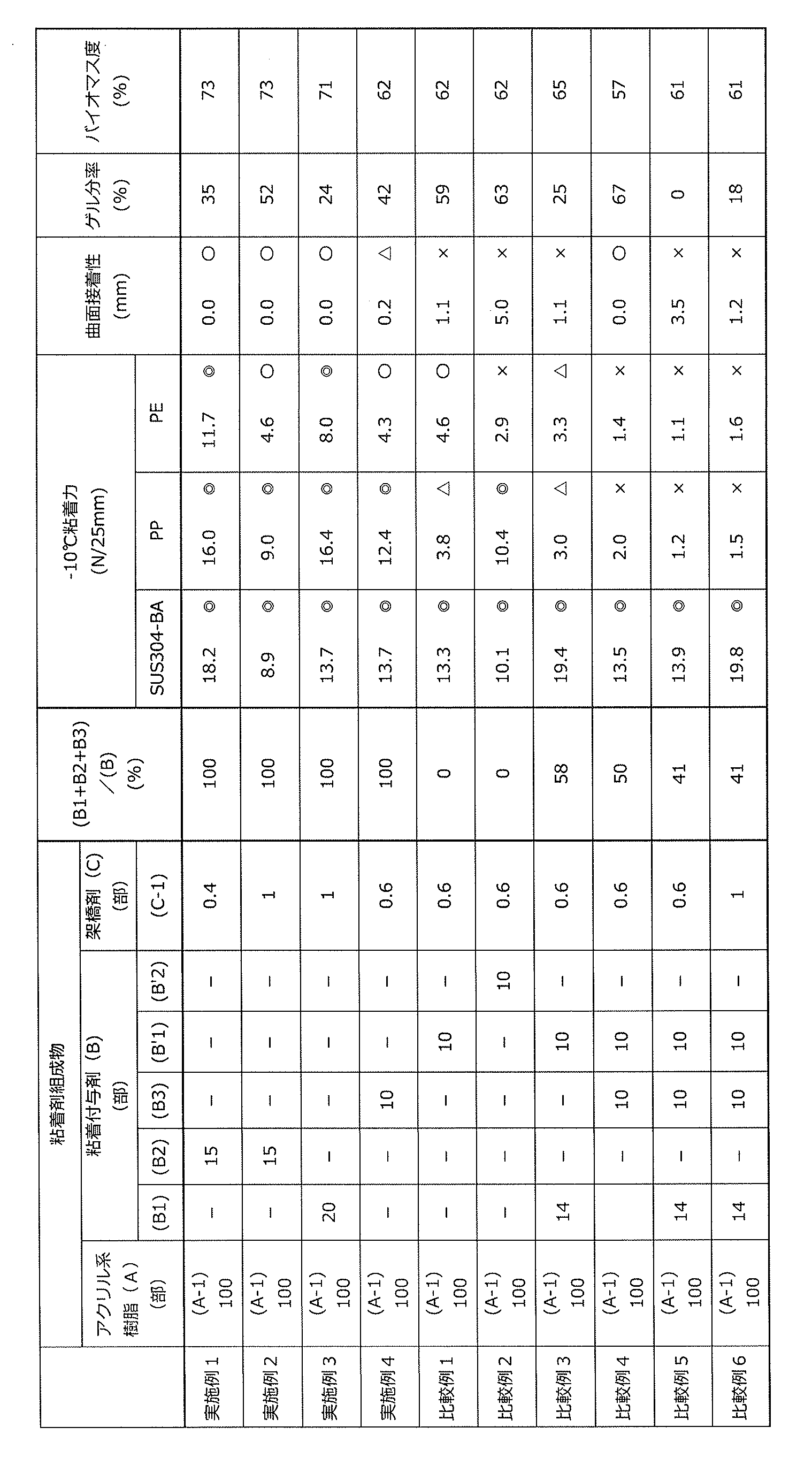
上記結果より、本発明の構成を満たす実施例1~4では、いずれも、石油由来の材料の使用量を低減しながらも、-10℃という冷凍状態での粘着性にも優れ、さらに曲面接着性に優れる粘着剤を形成していることが分かる。
これに対し、重合ロジン系樹脂(B1)、不均化ロジン系樹脂(B2)、および水添ロジン(B3)の合計量が粘着付与剤(B)全体の75%未満である比較例1~6は、PPやPEというような樹脂被着体に対し-10℃という冷凍状態での粘着性に劣ったり、曲面接着性に劣ったりする粘着剤であることが分かる。
中でも、比較例6は、実施例2、3の、アクリル系樹脂(A)と架橋剤(C)の含有割合が同じであるが、重合ロジン系樹脂(B1)、不均化ロジン系樹脂(B2)、および水添ロジン(B3)の合計量が、粘着付与剤(B)全体における所定の割合を満たさないことから、樹脂被着体に対する-10℃での粘着性に劣ると共に、曲面接着性にも劣る結果となっている。
また、比較例3、5は、実施例4の、アクリル系樹脂(A)と架橋剤(C)の含有割合が同じであるが、重合ロジン系樹脂(B1)、不均化ロジン系樹脂(B2)、および水添ロジン(B3)の合計量が、粘着付与剤(B)全体における所定の割合を満たさないことから、曲面接着性にも劣る結果となっている。
したがって、本発明の効果を奏するためには、本発明の構成を有すること、中でも、重合ロジン系樹脂(B1)、不均化ロジン系樹脂(B2)、および水添ロジン(B3)の合計量が、粘着付与剤(B)全体における所定の割合を満たすことが必要であることが分かる。
上記実施例においては、本発明における具体的な形態について示したが、上記実施例は単なる例示にすぎず、限定的に解釈されるものではない。当業者に明らかな様々な変形は、本発明の範囲内であることが企図されている。
本発明の粘着剤組成物は、生物由来の原料でできており、環境に優しい粘着剤が得られる。また、-10℃という冷凍環境下でも粘着力が高く、さらには曲面接着性も高いことから冷凍食品のラベル等に有用である。
Claims (9)
- アクリル系樹脂(A)と粘着付与剤(B)を含有する粘着剤組成物であって、
前記アクリル系樹脂(A)の共重合成分(a)として、n-オクチル(メタ)アクリレート(a1)を含有すると共に、官能基を有しないアルキル炭素数8未満のアルキル(メタ)アクリレート(a3)を共重合成分(a)中に0質量%以上30質量%未満含有し、
前記粘着付与剤(B)として、重合ロジン系樹脂(B1)、不均化ロジン系樹脂(B2)、および水添ロジン系樹脂(B3)からなる群から選ばれる少なくとも1種を含有し、
前記重合ロジン系樹脂(B1)、不均化ロジン系樹脂(B2)、および水添ロジン系樹脂(B3)の合計量が前記粘着付与剤(B)全体の75質量%以上であることを特徴とする粘着剤組成物。 - 前記アクリル系樹脂(A)が、官能基含有(メタ)アクリル系モノマー(a2)を含有することを特徴とする請求項1記載の粘着剤組成物。
- 前記官能基含有(メタ)アクリル系モノマー(a2)が、カルボキシ基含有(メタ)アクリル系モノマーおよび水酸基含有(メタ)アクリル系モノマーからなる群から選ばれる少なくとも1種を含有することを特徴とする請求項2記載の粘着剤組成物。
- 前記アクリル系樹脂(A)の重量平均分子量が10万以上であることを特徴とする請求項1~3のいずれか一項に記載の粘着剤組成物。
- 前記アクリル系樹脂(A)のガラス転移温度が-85℃以上であることを特徴とする請求項1~4のいずれか一項に記載の粘着剤組成物。
- さらに架橋剤(C)を含有することを特徴とする請求項1~5のいずれか一項に記載の粘着剤組成物。
- 請求項1~6のいずれか一項に記載の粘着剤組成物が架橋されてなることを特徴とする粘着剤。
- 請求項7に記載の粘着剤からなる粘着剤層を有することを特徴とする粘着シート。
- 請求項7に記載の粘着剤からなる粘着剤層と、前記粘着剤層に積層された他の部材とを備えることを特徴とする積層体。
Priority Applications (1)
| Application Number | Priority Date | Filing Date | Title |
|---|---|---|---|
| JP2023511289A JP7889514B2 (ja) | 2021-03-29 | 2022-03-28 | 粘着剤組成物、およびそれを用いてなる粘着剤、粘着シート、ならびに積層体 |
Applications Claiming Priority (2)
| Application Number | Priority Date | Filing Date | Title |
|---|---|---|---|
| JP2021055863 | 2021-03-29 | ||
| JP2021-055863 | 2021-03-29 |
Publications (1)
| Publication Number | Publication Date |
|---|---|
| WO2022210579A1 true WO2022210579A1 (ja) | 2022-10-06 |
Family
ID=83459284
Family Applications (1)
| Application Number | Title | Priority Date | Filing Date |
|---|---|---|---|
| PCT/JP2022/015120 Ceased WO2022210579A1 (ja) | 2021-03-29 | 2022-03-28 | 粘着剤組成物、およびそれを用いてなる粘着剤、粘着シート、ならびに積層体 |
Country Status (3)
| Country | Link |
|---|---|
| JP (1) | JP7889514B2 (ja) |
| TW (1) | TWI891992B (ja) |
| WO (1) | WO2022210579A1 (ja) |
Citations (5)
| Publication number | Priority date | Publication date | Assignee | Title |
|---|---|---|---|---|
| JPS5958071A (ja) * | 1982-09-29 | 1984-04-03 | Nitto Electric Ind Co Ltd | 吸湿硬化しうる感圧性接着剤 |
| JP2013523913A (ja) * | 2010-03-26 | 2013-06-17 | スリーエム イノベイティブ プロパティズ カンパニー | 2−アルキルアルカノールから誘導される感圧接着剤 |
| JP2015511260A (ja) * | 2012-02-08 | 2015-04-16 | ハネウェル・インターナショナル・インコーポレーテッド | 高性能水性粘着性アクリル酸系感圧接着剤 |
| JP2016537442A (ja) * | 2013-09-27 | 2016-12-01 | テーザ・ソシエタス・ヨーロピア | 低エネルギー表面又は粗面用感圧接着剤 |
| WO2019244595A1 (ja) * | 2018-06-19 | 2019-12-26 | 積水化学工業株式会社 | 粘着剤、粘着テープ、及び、電子機器部品又は車載部品を固定する方法 |
Family Cites Families (3)
| Publication number | Priority date | Publication date | Assignee | Title |
|---|---|---|---|---|
| JPH1067974A (ja) * | 1996-08-29 | 1998-03-10 | Konishi Kk | アクリル系溶剤型粘着剤およびこれを用いた粘着シートもしくはテープ |
| JP5327499B2 (ja) * | 2007-09-28 | 2013-10-30 | Dic株式会社 | 両面粘着テープ |
| JP2019218458A (ja) * | 2018-06-19 | 2019-12-26 | 積水化学工業株式会社 | 粘着テープ |
-
2022
- 2022-03-28 WO PCT/JP2022/015120 patent/WO2022210579A1/ja not_active Ceased
- 2022-03-28 TW TW111111717A patent/TWI891992B/zh active
- 2022-03-28 JP JP2023511289A patent/JP7889514B2/ja active Active
Patent Citations (5)
| Publication number | Priority date | Publication date | Assignee | Title |
|---|---|---|---|---|
| JPS5958071A (ja) * | 1982-09-29 | 1984-04-03 | Nitto Electric Ind Co Ltd | 吸湿硬化しうる感圧性接着剤 |
| JP2013523913A (ja) * | 2010-03-26 | 2013-06-17 | スリーエム イノベイティブ プロパティズ カンパニー | 2−アルキルアルカノールから誘導される感圧接着剤 |
| JP2015511260A (ja) * | 2012-02-08 | 2015-04-16 | ハネウェル・インターナショナル・インコーポレーテッド | 高性能水性粘着性アクリル酸系感圧接着剤 |
| JP2016537442A (ja) * | 2013-09-27 | 2016-12-01 | テーザ・ソシエタス・ヨーロピア | 低エネルギー表面又は粗面用感圧接着剤 |
| WO2019244595A1 (ja) * | 2018-06-19 | 2019-12-26 | 積水化学工業株式会社 | 粘着剤、粘着テープ、及び、電子機器部品又は車載部品を固定する方法 |
Also Published As
| Publication number | Publication date |
|---|---|
| JPWO2022210579A1 (ja) | 2022-10-06 |
| JP7889514B2 (ja) | 2026-07-14 |
| TWI891992B (zh) | 2025-08-01 |
| TW202300618A (zh) | 2023-01-01 |
Similar Documents
| Publication | Publication Date | Title |
|---|---|---|
| CN108138004B (zh) | 应力分散膜、光学构件、及电子构件 | |
| JP5522438B2 (ja) | 水分散型アクリル系粘着剤組成物及び粘着テープ | |
| TWI617641B (zh) | 感溫性黏著劑 | |
| JP7185479B2 (ja) | 樹脂組成物、樹脂層、および積層シート | |
| JP5561543B2 (ja) | 粘着テープ | |
| JP7074033B2 (ja) | 粘接着剤層、粘接着シート及び積層体 | |
| JP2012007011A (ja) | 両面粘接着テープおよびそれを用いた被着体との接合方法 | |
| JP7327092B2 (ja) | 粘着剤組成物、粘着剤及び粘着シート | |
| JP5561544B2 (ja) | 粘着テープ | |
| JP2023105252A (ja) | 粘接着剤層、粘接着シート及び積層体 | |
| JP7415414B2 (ja) | 粘接着剤組成物、及びそれを用いてなる粘接着剤、粘接着剤シート、ならびに積層体 | |
| JP7346887B2 (ja) | 粘接着剤組成物、粘接着剤、粘接着シート、及び積層体 | |
| JP2019014852A (ja) | 粘着剤組成物、粘着剤および粘着シート | |
| JP7655011B2 (ja) | 粘接着剤組成物、及びそれを用いてなる粘接着剤、粘接着シート、ならびに積層体 | |
| TWI891992B (zh) | 黏著劑組成物、及使用其而成之黏著劑、黏著片、及疊層體 | |
| JP7091996B2 (ja) | 粘接着剤組成物、及びそれを用いてなる粘接着剤、粘接着シート、ならびに積層体 | |
| WO2019130822A1 (ja) | 樹脂組成物、樹脂層、および積層シート | |
| JP2023024312A (ja) | 粘着剤組成物、およびその用途 | |
| JP2022034332A (ja) | 粘接着剤組成物、粘接着シート及び積層体 | |
| JP2018090712A (ja) | 樹脂層、および積層シート | |
| JP2024069114A (ja) | 曲面部材用粘着剤組成物、これを用いた曲面部材用粘着剤、及び積層体 | |
| JP2021042335A (ja) | 粘着剤組成物、粘着剤及び粘着シート | |
| JP7622428B2 (ja) | 粘着剤組成物、これを用いてなるマスキングフィルム用粘着剤、およびマスキング用粘着フィルム | |
| JP7207122B2 (ja) | 粘接着剤組成物、粘接着剤、粘接着シート、及び積層体 | |
| JP2012007012A (ja) | マスキングテープおよびその製造方法 |
Legal Events
| Date | Code | Title | Description |
|---|---|---|---|
| 121 | Ep: the epo has been informed by wipo that ep was designated in this application |
Ref document number: 22780790 Country of ref document: EP Kind code of ref document: A1 |
|
| ENP | Entry into the national phase |
Ref document number: 2023511289 Country of ref document: JP Kind code of ref document: A |
|
| NENP | Non-entry into the national phase |
Ref country code: DE |
|
| 122 | Ep: pct application non-entry in european phase |
Ref document number: 22780790 Country of ref document: EP Kind code of ref document: A1 |