WO2022203086A1 - 積層体 - Google Patents
積層体 Download PDFInfo
- Publication number
- WO2022203086A1 WO2022203086A1 PCT/JP2022/014876 JP2022014876W WO2022203086A1 WO 2022203086 A1 WO2022203086 A1 WO 2022203086A1 JP 2022014876 W JP2022014876 W JP 2022014876W WO 2022203086 A1 WO2022203086 A1 WO 2022203086A1
- Authority
- WO
- WIPO (PCT)
- Prior art keywords
- resin layer
- bis
- cured resin
- laminate
- layer
- Prior art date
- Legal status (The legal status is an assumption and is not a legal conclusion. Google has not performed a legal analysis and makes no representation as to the accuracy of the status listed.)
- Ceased
Links
Images


Classifications
-
- C—CHEMISTRY; METALLURGY
- C09—DYES; PAINTS; POLISHES; NATURAL RESINS; ADHESIVES; COMPOSITIONS NOT OTHERWISE PROVIDED FOR; APPLICATIONS OF MATERIALS NOT OTHERWISE PROVIDED FOR
- C09J—ADHESIVES; NON-MECHANICAL ASPECTS OF ADHESIVE PROCESSES IN GENERAL; ADHESIVE PROCESSES NOT PROVIDED FOR ELSEWHERE; USE OF MATERIALS AS ADHESIVES
- C09J7/00—Adhesives in the form of films or foils
- C09J7/20—Adhesives in the form of films or foils characterised by their carriers
- C09J7/22—Plastics; Metallised plastics
- C09J7/25—Plastics; Metallised plastics based on macromolecular compounds obtained otherwise than by reactions involving only carbon-to-carbon unsaturated bonds
-
- B—PERFORMING OPERATIONS; TRANSPORTING
- B32—LAYERED PRODUCTS
- B32B—LAYERED PRODUCTS, i.e. PRODUCTS BUILT-UP OF STRATA OF FLAT OR NON-FLAT, e.g. CELLULAR OR HONEYCOMB, FORM
- B32B27/00—Layered products comprising a layer of synthetic resin
-
- B—PERFORMING OPERATIONS; TRANSPORTING
- B32—LAYERED PRODUCTS
- B32B—LAYERED PRODUCTS, i.e. PRODUCTS BUILT-UP OF STRATA OF FLAT OR NON-FLAT, e.g. CELLULAR OR HONEYCOMB, FORM
- B32B7/00—Layered products characterised by the relation between layers; Layered products characterised by the relative orientation of features between layers, or by the relative values of a measurable parameter between layers, i.e. products comprising layers having different physical, chemical or physicochemical properties; Layered products characterised by the interconnection of layers
- B32B7/02—Physical, chemical or physicochemical properties
- B32B7/027—Thermal properties
-
- C—CHEMISTRY; METALLURGY
- C09—DYES; PAINTS; POLISHES; NATURAL RESINS; ADHESIVES; COMPOSITIONS NOT OTHERWISE PROVIDED FOR; APPLICATIONS OF MATERIALS NOT OTHERWISE PROVIDED FOR
- C09J—ADHESIVES; NON-MECHANICAL ASPECTS OF ADHESIVE PROCESSES IN GENERAL; ADHESIVE PROCESSES NOT PROVIDED FOR ELSEWHERE; USE OF MATERIALS AS ADHESIVES
- C09J2479/00—Presence of polyamine or polyimide
- C09J2479/08—Presence of polyamine or polyimide polyimide
- C09J2479/086—Presence of polyamine or polyimide polyimide in the substrate
Definitions
- the present invention relates to a laminate including a cured resin layer and an adhesive layer.
- organic insulating materials have come to be used frequently as an insulating layer or the like between them.
- organic insulating materials contribute to weight reduction and flexibility as compared with inorganic insulating materials, but are inferior in heat resistance.
- the element or the like inside the electronic device is affected by the exposure, and the performance of the device is deteriorated due to the occurrence of a short circuit or the like, or the life of the device is shortened. Further, when the underlying layer has unevenness, flattening the uneven surface has not been sufficient.
- an organic insulating layer is formed as an organic insulating material such as acrylic resin or the like. It is disclosed that the polyimide resin is formed by a spin coating method or the like.
- the unevenness of the inorganic insulating layer can be embedded with the liquid organic insulating material, the unevenness is reflected on the surface of the obtained organic insulating layer opposite to the inorganic insulating layer side on the pixel portion. As a result, a short circuit or disconnection may occur between the wirings of the display element, the touch panel, or the like.
- the loss tangent has a peak in a specific temperature range, and after heating at a specific temperature, the loss tangent peak is shifted to the specific temperature range.
- the above problem is solved by forming a laminate including a cured resin layer made of a cured product of a curable resin composition containing a polymer component (A) and a curable monomer (B), and an adhesive layer.
- the present invention was completed after discovering that the problem could be solved. That is, the present invention provides the following [1] to [5].
- a laminate comprising a cured resin layer and an adhesive layer, wherein the cured resin layer is a cured resin composition containing a polymer component (A) and a curable monomer (B) It has a loss tangent peak in the temperature range of 100 to 200 ° C. in dynamic viscoelasticity measurement measured at a temperature increase rate of 3 ° C./min from 25 ° C. After heating at 180 ° C. for 1 hour, A laminate having a loss tangent peak at 220° C. or higher.
- a laminate including a cured resin layer and an adhesive layer, which excels in flattening uneven surfaces and suppresses short circuits and disconnections.
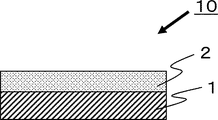
- BRIEF DESCRIPTION OF THE DRAWINGS It is a cross-sectional schematic diagram which shows the basic composition of the laminated body of this invention.
- BRIEF DESCRIPTION OF THE DRAWINGS It is a cross-sectional schematic diagram which shows 1st Embodiment of the laminated body of this invention. It is a cross-sectional schematic diagram which shows 2nd Embodiment of the laminated body of this invention.
- the definition of being preferred can be arbitrarily selected, and it can be said that a combination of the definitions of being preferred is more preferred.
- the description "XX to YY” means “XX or more and YY or less”.
- the lower and upper limits described stepwise can be independently combined. For example, from the statement “preferably 10 to 90, more preferably 30 to 60", combining "preferred lower limit (10)” and “more preferred upper limit (60)” to "10 to 60” can also In this specification, for example, "(meth)acrylic acid” indicates both “acrylic acid” and “methacrylic acid”, and the same applies to other similar terms.
- the laminate of the present invention is a laminate comprising a cured resin layer and an adhesive layer, wherein the curable resin layer comprises a curable resin containing a polymer component (A) and a curable monomer (B). It is a layer made of a cured product of a resin composition, and has a loss tangent peak in the temperature range of 100 ° C. to 200 ° C. in dynamic viscoelasticity measurement measured from 25 ° C. at a heating rate of 3 ° C./min. It is characterized by having a loss tangent peak at 220°C or higher after heating at 1 hour.
- the cured resin layer used in the present invention has a loss tangent peak at each temperature condition specified above, so that it melts at a temperature of, for example, over 180 ° C., and is used for wiring of electronic devices and other layers and other coatings.
- the uneven surface of a base material such as a body (hereinafter sometimes simply referred to as "uneven substrate") is embedded and then heated at 180° C. for 1 hour to complete the curing reaction.
- the uneven shape does not appear on the surface of the adhesive layer, and the surface of the adhesive layer opposite to the uneven surface side can be flattened.
- the laminate of the present invention has adhesiveness, the surface of the adhesive layer opposite to the uneven surface can be easily adhered (laminated) to another adherend, layer, or the like.
- the uneven shape, depth, width, etc. of the "uneven substrate” are not particularly limited as long as the uneven shape can be embedded.
- the material of the uneven substrate is not particularly limited as long as it can maintain the adhesiveness with the resin.
- the laminate of the present invention comprises a cured resin layer and an adhesive layer.
- FIG. 1 is a schematic cross-sectional view showing the basic structure of the laminate of the present invention.
- a laminate 10 is obtained by laminating an adhesive layer 2 on a cured resin layer 1 .
- FIG. 2 is a schematic cross-sectional view showing a first embodiment of the laminate of the present invention.
- the laminate 20 is obtained by laminating the process film 13 on the surface of the cured resin layer 11 opposite to the adhesive layer 12 side, for example.
- FIG. 3 is a schematic cross-sectional view showing a second embodiment of the laminate of the present invention.
- the laminated body 30 is obtained by laminating the concave-convex substrate 23 on the surface of the cured resin layer 21 opposite to the adhesive layer 22 side, for example.
- the cured resin layer used in the present invention is a layer made of a cured product of a curable resin composition containing a polymer component (A) and a curable monomer (B).
- the cured resin layer has a loss tangent peak in the temperature range of 100 to 200 ° C. in dynamic viscoelasticity measurement measured at a temperature increase rate of 3 ° C./min from 25 ° C. After heating at 180 ° C. for 1 hour, the loss tangent has a peak at 220° C. or higher.
- the dynamic viscoelasticity measurement of the cured resin layer measured from 25° C. at a heating rate of 3° C./min, there may be a plurality of loss tangent peaks in the temperature range of 100 to 200° C. If there are a plurality of loss tangent peaks, at least one loss tangent peak should be in the temperature range of 100 to 200.degree.
- the loss tangent has a peak only at less than 100° C., for example, the cured resin layer melts and adheres to the uneven substrate when heated at 190° C., but the loss tangent peak position does not change even after heating at 180° C. for 1 hour.
- the loss tangent peak remains below 100° C., making it unsuitable for processes involving heat treatments at higher temperatures, for example.
- it has a loss tangent peak above 200°C, the cured resin layer will not melt even when heated to 190°C, for example, and cannot be adhered to an adherend or the like.
- the peak loss tangent is preferably 120 to 200°C, more preferably 140 to 200°C, still more preferably 160 to 200°C. When the peak of the loss tangent falls within this range, the cured resin layer melts and is easily adhered to the uneven substrate.
- the loss tangent peak after heating at 180° C. for 1 hour exists only below 220° C., for example, it is difficult to obtain sufficient heat resistance in a process involving heat treatment at a higher temperature.
- the peak of the loss tangent after heating at 180°C for 1 hour exists only at 220°C or higher and does not exist below 220°C.
- the loss tangent peak after heating at 180° C. for 1 hour is preferably 240° C. or higher, more preferably 250° C. or higher, and still more preferably 260° C. or higher.
- the peak of loss tangent after heating at 180° C. for 1 hour is within this range, for example, high heat resistance is exhibited in a process involving heat treatment at a higher temperature.
- the cured resin layer has a loss tangent peak at 200° C. or less, for example, it becomes a rubber state during high-temperature heat treatment (for example, 190° C. for 10 minutes), and easily melts and adheres to the uneven substrate, resulting in unevenness. can be embedded. Further, after melt bonding to the uneven substrate, for example, by heating at 180 ° C. for 1 hour, the curing reaction of the curable monomer (B) proceeds and the loss tangent peak before curing disappears. Post exhibits excellent heat resistance. This provides high heat resistance in processes involving heat treatments at higher temperatures. Furthermore, by providing an adhesive layer on the surface of the cured resin layer opposite to the uneven surface side, the uneven shape does not appear on the surface of the adhesive layer, and the adhesive layer is formed on the opposite side to the uneven surface side. can be flattened.
- the cured resin layer has excellent solvent resistance. Because of its excellent solvent resistance, for example, even when an organic solvent is used to form an adhesive layer on the cured resin layer, the surface of the cured resin layer is hardly dissolved. In this case, since the components of the cured resin layer are less likely to mix into the adhesive layer, the adhesiveness is less likely to deteriorate.
- the gel fraction of the cured resin layer is preferably 80% or higher, more preferably 85% or higher, even more preferably 87% or higher, and particularly preferably 90% or higher.
- a cured resin layer having a gel fraction of 80% or more has excellent solvent resistance, so even when an organic solvent is used, the surface of the cured resin layer hardly dissolves, resulting in a laminate with excellent solvent resistance. can be easily obtained.
- the gel fraction is within this range, a laminate having an adhesive layer formed by direct coating can be obtained.
- the adhesive layer is formed from a coating film, the cured resin layer is not affected by the intrusion of the organic solvent contained in the adhesive layer and deformed, and the adhesive layer has sufficient inherent adhesiveness. can be expressed.
- a coating film is a film obtained by coating a coating material on a base material or an object and, if necessary, performing a treatment such as drying or curing by heating.
- the gel fraction is obtained by, for example, performing the following operations (a), (b), and (c), and measuring the weight of the dried structure before immersion in MEK (methyl ethyl ketone) solvent. calculated by dividing by the weight of (a)
- the cured resin layer was wrapped with a mesh ( ⁇ _UX SCREEN 150-035/380TW manufactured by NBC Meshtec) and stapled to form a structure, and the weight of the structure was measured.
- MEK Methyl ethyl ketone
- the cured resin layer is preferably colorless and transparent. Since the cured resin layer is colorless and transparent, the laminate having the adhesive layer of the present invention can be preferably used for optical applications.
- the cured resin layer has a low birefringence and excellent optical isotropy.
- the in-plane retardation of the cured resin layer is usually 2.0 nm or less, preferably 1.0 nm or less.
- the retardation in the thickness direction is usually ⁇ 500 nm or less, preferably ⁇ 450 nm or less.
- the value (birefringence) obtained by dividing the in-plane retardation by the thickness of the cured resin layer is usually 100 ⁇ 10 ⁇ 5 or less, preferably 20 ⁇ 10 ⁇ 5 or less.
- a laminate having a low birefringence and excellent optical isotropy can be obtained.
- a laminate having an agent layer can be preferably used for optical applications.
- the breaking elongation of the cured resin layer is preferably 2.5% or more, more preferably 3.0% or more, and still more preferably 3.5% or more.
- the breaking elongation of the cured resin layer is 2.5% or more, it becomes easy to adjust the breaking elongation of the laminate to about 2% or more, and as a result, a laminate having excellent flexibility can be easily obtained.
- the thickness of the cured resin layer is appropriately adjusted and determined according to the shape and dimensions of the uneven surface of the uneven substrate.
- the thickness of the cured resin layer is usually 0.1 to 500 ⁇ m, preferably 0.1 to 100 ⁇ m, more preferably 0.1 to 20 ⁇ m, still more preferably 0.1 to 15 ⁇ m, particularly preferably 0.2 to 0.2 ⁇ m. 10 ⁇ m.
- a thermoplastic resin is preferable, and an amorphous thermoplastic resin is more preferable.
- an amorphous thermoplastic resin By using an amorphous thermoplastic resin, it becomes easy to obtain a cured resin layer excellent in optical isotropy, and it becomes easy to obtain a laminate excellent in transparency.
- amorphous thermoplastic resins are generally easily dissolved in organic solvents, the cured resin layer can be efficiently formed using a solution casting method, as will be described later.
- the amorphous thermoplastic resin means a thermoplastic resin whose melting point is not observed in differential scanning calorimetry.
- the Tg of the polymer component (A) is preferably 250°C or higher, more preferably 290°C or higher, still more preferably 320°C or higher.
- Tg is within this range, a laminate having an adhesive layer with sufficiently excellent heat resistance can be obtained.
- the adhesive layer is formed from a coating film, the cured resin layer is not affected by heating during coating of the coating film, causing deformation or peeling. It is possible to express sufficient adhesiveness possessed.
- a coating film is a film obtained by coating a coating material on a base material or an object and, if necessary, performing a treatment such as drying or curing by heating.
- the curable resin composition is applied to an object to be coated such as a process film, and curing treatment is performed by either or both of drying, heating, irradiation of active energy rays, etc. It is a coating obtained by performing
- Tg is the peak temperature of tan ⁇ (loss modulus/storage modulus) obtained by viscoelasticity measurement (measurement in tensile mode in the range of 0 to 250°C at a temperature increase rate of 3°C/min at a frequency of 10Hz).
- the weight average molecular weight (Mw) of the polymer component (A) is preferably 100,000 to 5,000,000, more preferably 150,000 to 4,000,000, still more preferably 200,000 to 350,000. is in the range of Also, the molecular weight distribution (Mw/Mn) is preferably in the range of 1.0 to 5.0, more preferably 1.2 to 3.0.
- a weight average molecular weight (Mw) and a molecular weight distribution (Mw/Mn) are polystyrene equivalent values measured by a gel permeation chromatography (GPC) method. By setting Mw to 100,000 or more, it becomes easy to increase the breaking elongation of the cured resin layer.
- the polymer component (A) is particularly preferably soluble in low-boiling general-purpose organic solvents such as benzene and methyl ethyl ketone (MEK). If it is soluble in a general-purpose organic solvent, it becomes easy to form a curable resin layer by coating.
- general-purpose organic solvents such as benzene and methyl ethyl ketone (MEK). If it is soluble in a general-purpose organic solvent, it becomes easy to form a curable resin layer by coating.
- a particularly preferable polymer component (A) is an amorphous thermoplastic resin having a Tg of 250°C or higher, which is soluble in low-boiling general-purpose organic solvents such as benzene and methyl ethyl ketone.
- the polymer component (A) is preferably a thermoplastic resin having a ring structure such as an aromatic ring structure or an alicyclic structure, more preferably a thermoplastic resin having an aromatic ring structure.
- polymer component (A) examples include polyimide resins and polyarylate resins preferably having a Tg of 250°C or higher. These resins generally have a high Tg and excellent heat resistance, and since they are amorphous thermoplastic resins, they can be formed into a coating film by a solution casting method. Among these, polyimide resins are preferred because they have a high Tg and excellent heat resistance, and are easy to obtain those that are soluble in general-purpose organic solvents while exhibiting good heat resistance.
- the polyimide resin is not particularly limited as long as it does not impair the effects of the present invention.
- aromatic polyimide resin aromatic (carboxylic acid component) - cycloaliphatic (diamine component) polyimide resin, cyclic Group (carboxylic acid component)-aromatic (diamine component) polyimide resins, cycloaliphatic polyimide resins, fluorinated aromatic polyimide resins, and the like can be used.
- a polyimide resin having a fluoro group in the molecule is particularly preferred.
- a polyimide resin obtained through polymerization to polyamic acid and chemical imidization reaction using an aromatic diamine compound and a tetracarboxylic dianhydride is preferred.
- the aromatic diamine compound is a polyimide that is soluble in a common solvent (for example, N,N-dimethylacetamide (DMAC)) and has a certain level of transparency by reacting with the tetracarboxylic dianhydride that is used together.
- a common solvent for example, N,N-dimethylacetamide (DMAC)
- Any aromatic diamine compound can be used as long as it provides the aromatic diamine compound.
- aromatic diamine compounds may be used alone, or two or more aromatic diamine compounds may be used.
- preferable aromatic diamine compounds include 2,2-bis(4-aminophenyl)-1,1,1,3,3,3-hexafluoropropane, 2,2 -bis(3-aminophenyl)-1,1,1,3,3,3-hexafluoropropane, 2-(3-aminophenyl)-2-(4-aminophenyl)-1,1,1,3 ,3,3-hexafluoropropane, 2,2-bis[4-(3-aminophenoxy)phenyl]-1,1,1,3,3,3-hexafluoropropane, 2,2-bis[4- (4-aminophenoxy)phenyl]-1,1,1,3,3,3-hexafluoropropane, 2,2-bis[3-(3-aminophenoxy)phenyl]-1,1,1,3, 3,3-hexafluoropropane,
- tetracarboxylic dianhydride a tetracarboxylic acid that is soluble in a common solvent (eg, N,N-dimethylacetamide (DMAC)) and gives a polyimide having a predetermined transparency, like the aromatic diamine compound.
- a common solvent eg, N,N-dimethylacetamide (DMAC)
- Any dianhydride can be used, and specifically, 4,4′-(1,1,1,3,3,3-hexafluoropropane-2,2-diyl)diphthalic acid di anhydride, pyromellitic dianhydride, 3,3',4,4'-benzophenonetetracarboxylic dianhydride, 1,4-hydroquinonedibenzoate-3,3',4,4'-tetracarboxylic acid Examples include acid dianhydride, 3,3′,4,4′-biphenyltetracarboxylic dianhydride, and 3,3′,4,4′-diphenylethertetracarboxylic dianhydride.
- tetracarboxylic dianhydrides may be used alone, or two or more kinds of tetracarboxylic dianhydrides may be used.
- 4,4′-(1,1,1,3,3,3-hexafluoropropane-2,2-diyl)diphthalic dianhydride and the like from the viewpoint of transparency, heat resistance and solubility in solvents preferably a tetracarboxylic dianhydride having at least one fluoro group.
- Polymerization into polyamic acid can be carried out by reacting the above aromatic diamine compound and tetracarboxylic dianhydride while dissolving in a solvent in which the resulting polyamic acid is soluble.
- Solvents used for polymerization to polyamic acid include solvents such as N,N-dimethylacetamide, N,N-dimethylformamide, N-methyl-2-pyrrolidone, 1,3-dimethyl-2-imidazolidinone, and dimethylsulfoxide. can be used.
- the polymerization reaction to polyamic acid is preferably carried out while stirring in a reaction vessel equipped with a stirring device.
- a method of dissolving a predetermined amount of an aromatic diamine compound in the above solvent, adding tetracarboxylic dianhydride while stirring to react, and obtaining polyamic acid, dissolving the tetracarboxylic dianhydride in the solvent is mentioned.
- the temperature of the polymerization reaction to polyamic acid is not particularly limited, but it is preferably carried out at a temperature of 0 to 70°C, more preferably 10 to 60°C, and even more preferably 20 to 50°C. By performing the polymerization reaction within the above range, it is possible to obtain a high-molecular-weight polyamic acid with little coloration and excellent transparency.
- the aromatic diamine compound and the tetracarboxylic dianhydride used for polymerization to polyamic acid are generally used in equimolar amounts. It is also possible to change the molar amount of /aromatic diamine compound (molar ratio) within the range of 0.95 to 1.05.
- the molar ratio of the tetracarboxylic dianhydride and the aromatic diamine compound is preferably in the range of 1.001-1.02, more preferably 1.001-1.01.
- the degree of polymerization of the resulting polyamic acid can be stabilized, and the unit derived from the tetracarboxylic dianhydride can be It can be placed at the end of the polymer, and as a result, it is possible to obtain a polyimide with little coloration and excellent transparency.
- the concentration of the polyamic acid solution to be produced is preferably adjusted to an appropriate concentration (for example, about 10 to 30% by mass) so that the viscosity of the solution can be properly maintained and handling in the subsequent steps can be facilitated.
- An imidizing agent is added to the resulting polyamic acid solution to carry out a chemical imidization reaction.
- the imidizing agent carboxylic acid anhydrides such as acetic anhydride, propionic anhydride, succinic anhydride, phthalic anhydride, and benzoic anhydride can be used. Preference is given to using acetic acid.
- the equivalent of the imidizing agent to be used is at least the equivalent of the amide bond of the polyamic acid that performs the chemical imidization reaction, preferably 1.1 to 5 times the equivalent of the amide bond, and 1.5 to 4 times. is more preferable. By using the imidizing agent in a slightly excess amount with respect to the amide bond in this way, the imidization reaction can be efficiently carried out even at a relatively low temperature.
- aliphatic, aromatic or heterocyclic tertiary amines such as pyridine, picoline, quinoline, isoquinoline, trimethylamine and triethylamine can be used as imidization accelerators.
- imidization accelerators such as pyridine, picoline, quinoline, isoquinoline, trimethylamine and triethylamine.
- the chemical imidization reaction temperature it is preferably carried out at 10°C or higher and lower than 50°C, more preferably at 15°C or higher and lower than 45°C.
- a poor solvent for polyimide is added to the polyimide solution obtained by the chemical imidization reaction to precipitate polyimide to form powder, which is powderization and drying.
- the polyimide resin it is preferable that it is compatible with low boiling point organic solvents such as benzene and methyl ethyl ketone. In particular, it is preferably soluble in methyl ethyl ketone. When it is soluble in methyl ethyl ketone, a layer of the curable resin composition can be easily formed by coating and drying.
- a polyimide resin containing a fluoro group is particularly preferable from the viewpoint that it is easily dissolved in a general-purpose organic solvent having a low boiling point such as methyl ethyl ketone and that a curable resin layer is easily formed by a coating method.
- the polyimide resin having a fluoro group is preferably an aromatic polyimide resin having a fluoro group in the molecule, and preferably has a skeleton represented by the following chemical formula in the molecule.
- a polyimide resin having a skeleton represented by the above chemical formula has an extremely high Tg exceeding 300°C due to the high rigidity of the skeleton. Therefore, the heat resistance of the cured resin layer can be greatly improved.
- the skeleton is linear and has relatively high flexibility, which facilitates increasing the breaking elongation of the cured resin layer.
- the polyimide resin having the above skeleton can dissolve in general-purpose low-boiling organic solvents such as methyl ethyl ketone due to the presence of fluoro groups. Therefore, the coating can be performed using a solution casting method to form a curable resin layer as a coating film, and the solvent can be easily removed by drying.
- the polyimide resin having a skeleton represented by the above chemical formula includes 2,2′-bis(trifluoromethyl)-4,4′-diaminobiphenyl and 4,4′-(1,1,1,3,3,3 -Hexafluoropropane-2,2-diyl)diphthalic dianhydride can be obtained by polymerization and imidization reaction of the polyamic acid described above.
- a polyarylate resin is a resin made of a polymer compound obtained by reacting an aromatic diol with an aromatic dicarboxylic acid or its chloride.
- Polyarylate resins also have relatively high Tg and relatively good elongation properties.
- the polyarylate resin is not particularly limited, and known ones can be used.
- aromatic diols include bis(4-hydroxyphenyl)methane [bisphenol F], bis(3-methyl-4-hydroxyphenyl)methane, 1,1-bis(4′-hydroxyphenyl)ethane, 1, 1-bis(3'-methyl-4'-hydroxyphenyl)ethane, 2,2-bis(4'-hydroxyphenyl)propane [bisphenol A], 2,2-bis(3'-methyl-4'-hydroxy bis(hydroxyphenyl)alkanes such as phenyl)propane, 2,2-bis(4'-hydroxyphenyl)butane, 2,2-bis(4'-hydroxyphenyl)octane; 1,1-bis(4'- bis(hydroxyphenyl)cyclopentane, 1,1-bis(4'-hydroxyphenyl)cyclohexane [bisphenol Z], 1,1-bis(4'-hydroxyphenyl)-3,3,5-trimethylcyclohexane, etc.
- bisphenol F bis(4-hydroxyphenyl)methan
- phenyl)cycloalkanes bis(4-hydroxyphenyl)phenylmethane, bis(3-methyl-4-hydroxyphenyl)phenylmethane, bis(2,6-dimethyl-4-hydroxyphenyl)phenylmethane, bis(2, 3,6-trimethyl-4-hydroxyphenyl)phenylmethane, bis(3-t-butyl-4-hydroxyphenyl)phenylmethane, bis(3-phenyl-4-hydroxyphenyl)phenylmethane, bis(3-fluoro- 4-hydroxyphenyl)phenylmethane, bis(3-bromo-4-hydroxyphenyl)phenylmethane, bis(4-hydroxyphenyl)-4-fluorophenylmethane, bis(3-fluoro-4-hydroxyphenyl)-4- Fluorophenylmethane, bis(4-hydroxyphenyl)-4-chlorophenylmethane, bis(4-hydroxyphenyl)-4
- aromatic dicarboxylic acids or chlorides thereof include phthalic acid, isophthalic acid, terephthalic acid, 4,4′-biphenyldicarboxylic acid, diphenoxyethanedicarboxylic acid, diphenyl ether 4,4′-dicarboxylic acid, 4,4′- diphenylsulfonedicarboxylic acid, 1,5-naphthalenedicarboxylic acid, 2,6-naphthalenedicarboxylic acid, chlorides thereof, and the like.
- the polyarylate-based resin to be used may be a modified polyarylate-based resin.
- the polyarylate-based resin is preferably a resin composed of a polymer compound obtained by reacting 2,2-bis(4'-hydroxyphenyl)propane with isophthalic acid.
- the polymer component (A) can be used singly or in combination of two or more. Also, the polymer component (A) and the polymer component (A') having a glass transition temperature of less than 250°C may be used in combination. Examples of the polymer component (A′) include polyamide resins and polyarylate resins having a Tg of less than 250° C. Polyamide resins are preferred.
- the polyamide resin one that is soluble in an organic solvent is preferable, and a rubber-modified polyamide resin is preferable.
- a rubber-modified polyamide resin for example, those described in JP-A-2004-035638 can be used.
- polymer component (A) and the polymer component (A') one using a single type of polyimide resin, one using a plurality of different types of polyimide resin, and polyimide resin with polyamide resin and polyarylate resin It is preferable to add at least one of them from the viewpoint of adjusting the elongation characteristics and the viewpoint of solvent resistance.
- the amount of the resin to be added is 100 parts by mass of the polyimide resin from the viewpoint of imparting moderate flexibility while maintaining a high Tg. , preferably 100 parts by mass or less, more preferably 70 parts by mass or less, even more preferably 50 parts by mass or less, still more preferably 30 parts by mass or less, and preferably 1 part by mass or more, more preferably It is 3 parts by mass or more.
- a curable monomer (B) is a monomer having a polymerizable unsaturated bond, and is a monomer that can participate in a polymerization reaction or a polymerization reaction and a cross-linking reaction.
- curing means a broad concept including this "polymerization reaction of monomers” or “polymerization reaction of monomers and subsequent cross-linking reaction of polymers”.
- the cured resin layer By making the cured resin layer a layer made of a cured product of a curable resin composition containing the above-described polymer component (A) and the above-described curable monomer (B), excellent heat resistance and thin curing can be obtained. It becomes easy to form a resin layer. In addition, the use of such a material eliminates optical problems caused by materials having anisotropic molecular orientation, such as polyester films generally used as base materials for laminates. When the Tg of the polymer component is 250° C. or higher, the cured resin layer has heat resistance, and when the adhesive layer is formed from the coating film, the cured resin layer is damaged by heat during coating of the coating film. Deterioration of adhesive performance due to deformation or the like is suppressed.
- the molecular weight of the curable monomer (B) is generally 3,000 or less, preferably 150-2,000, more preferably 150-1,000.
- the number of polymerizable unsaturated bonds in the curable monomer (B) is not particularly limited.
- the curable monomer (B) is a monofunctional monomer having one polymerizable unsaturated bond, or a multifunctional monomer such as a bifunctional or trifunctional monomer having a plurality of polymerizable unsaturated bonds. There may be.
- Examples of the monofunctional monomers include monofunctional (meth)acrylic acid derivatives.
- the monofunctional (meth)acrylic acid derivative is not particularly limited, and known compounds can be used. Examples include monofunctional (meth)acrylic acid derivatives having a nitrogen atom, monofunctional (meth)acrylic acid derivatives having an alicyclic structure, and monofunctional (meth)acrylic acid derivatives having a polyether structure. .
- Examples of monofunctional (meth)acrylic acid derivatives having a nitrogen atom include compounds represented by the following formula.
- R 1 represents a hydrogen atom or an alkyl group having 1 to 6 carbon atoms
- R 2 and R 3 each independently represent a hydrogen atom or an organic group having 1 to 12 carbon atoms
- R 2 and R 3 may combine to form a ring structure
- R 4 represents a divalent organic group.
- the alkyl group having 1 to 6 carbon atoms represented by R 1 include a methyl group, an ethyl group, a propyl group and the like, and a methyl group is preferred.
- Examples of organic groups having 1 to 12 carbon atoms represented by R 2 and R 3 include alkyl groups having 1 to 12 carbon atoms such as methyl group, ethyl group and propyl group; cycloalkyl groups having 3 to 12 carbon atoms; aromatic groups having 6 to 12 carbon atoms such as phenyl, biphenyl and naphthyl groups; These groups may have a substituent at any position. Also, R 2 and R 3 may combine to form a ring, and the ring may further have a nitrogen atom or an oxygen atom in its skeleton. Divalent organic groups represented by R 4 include groups represented by -(CH 2 ) m - and -NH-(CH 2 ) m -. Here, m is an integer of 1-10.
- the (meth)acryloylmorpholine represented by the following formula is preferred as the monofunctional (meth)acrylic acid derivative having a nitrogen atom.
- a cured resin layer with more excellent heat resistance can be formed.
- Examples of monofunctional (meth)acrylic acid derivatives having an alicyclic structure include compounds represented by the following formulas.
- R 1 has the same meaning as above, and R 5 is a group having an alicyclic structure.
- the group having an alicyclic structure represented by R 5 includes cyclohexyl group, isobornyl group, 1-adamantyl group, 2-adamantyl group, tricyclodecanyl group and the like.
- monofunctional (meth)acrylic acid derivatives having an alicyclic structure include isobornyl (meth)acrylate, cyclohexyl (meth)acrylate, 1-adamantyl (meth)acrylate, 2-adamantyl (meth)acrylate and the like. mentioned.
- a cured resin layer with more excellent optical properties can be formed.
- the monofunctional (meth)acrylic acid derivative having a polyether structure includes compounds represented by the following formula.
- R 1 has the same meaning as above, and R 6 represents an organic group having 1 to 12 carbon atoms.
- the organic group having 1 to 12 carbon atoms represented by R 6 include alkyl groups having 1 to 12 carbon atoms such as methyl group, ethyl group and propyl group; A cycloalkyl group; an aromatic group having 6 to 12 carbon atoms such as a phenyl group, a biphenyl group and a naphthyl group; j represents an integer from 2 to 20;
- monofunctional (meth)acrylic acid derivatives having a polyether structure include ethoxylated o-phenylphenol (meth)acrylate, methoxypolyethyleneglycol (meth)acrylate, phenoxypolyethyleneglycol (meth)acrylate, and the like. .
- a cured resin layer with excellent toughness can be formed.
- polyfunctional monomers examples include polyfunctional (meth)acrylic acid derivatives.
- the polyfunctional (meth)acrylic acid derivative is not particularly limited, and known compounds can be used. Examples thereof include di- to hexa-functional (meth)acrylic acid derivatives.
- Bifunctional (meth)acrylic acid derivatives include compounds represented by the following formulas.
- R 1 has the same meaning as above, and R 7 represents a divalent organic group.
- R 7 represents a divalent organic group. Examples of the divalent organic group represented by R 7 include groups represented by the following formulas.
- bifunctional (meth)acrylic acid derivative represented by the above formula examples include tricyclodecanedimethanol di(meth)acrylate, polyethylene glycol di(meth)acrylate, propoxylated ethoxylated bisphenol A di(meth)acrylate. , ethoxylated bisphenol A di(meth)acrylate, 1,10-decanediol di(meth)acrylate, 1,6-hexanediol di(meth)acrylate, 9,9-bis[4-(2-acryloyloxyethoxy) phenyl]fluorene and the like.
- the divalent organic group represented by R7 has a tricyclodecane skeleton, propoxy
- the divalent organic group represented by R7 has a bisphenol skeleton, 9,9-bis [4-(2-Acryloyloxyethoxy)phenyl]fluorene, etc., in which the divalent organic group represented by R 7 in the above formula preferably has a 9,9-bisphenylfluorene skeleton.
- bifunctional (meth)acrylic acid derivatives other than these include neopentyl glycol adipate di(meth)acrylate, neopentylglycol hydroxypivalate di(meth)acrylate, caprolactone-modified dicyclopentenyl di(meth)acrylate, Ethylene oxide-modified phosphoric acid di(meth)acrylate, di(acryloxyethyl)isocyanurate, allylated cyclohexyl di(meth)acrylate and the like can be mentioned.
- Trifunctional (meth)acrylic acid derivatives include trimethylolpropane tri(meth)acrylate, pentaerythritol tri(meth)acrylate, propionic acid-modified dipentaerythritol tri(meth)acrylate, propylene oxide-modified trimethylolpropane tri(meth)acrylate. ) acrylate, tris(acryloxyethyl) isocyanurate, and the like.
- Examples of tetrafunctional (meth)acrylic acid derivatives include pentaerythritol tetra(meth)acrylate.
- Pentafunctional (meth)acrylic acid derivatives include propionic acid-modified dipentaerythritol penta(meth)acrylate.
- Examples of hexafunctional (meth)acrylic acid derivatives include dipentaerythritol hexa(meth)acrylate and caprolactone-modified dipentaerythritol hexa(meth)acrylate.
- a cyclization-polymerizable monomer may be used as the curable monomer (B).
- a cyclization-polymerizable monomer is a monomer that has the property of being radically polymerized while being cyclized.
- Cyclopolymerizable monomers include non-conjugated dienes, for example, ⁇ -allyloxymethyl acrylic acid-based monomers can be used, 2-allyloxymethyl acrylic acid alkyl esters having 1 to 4 carbon atoms, Cyclohexyl 2-(allyloxymethyl)acrylate is preferred, C 1-4 alkyl esters of 2-allyloxymethylacrylic acid are more preferred, and methyl 2-(allyloxymethyl)acrylate is even more preferred.
- the curable monomer (B) can be used singly or in combination of two or more.
- the curable monomer (B) is preferably a polyfunctional monomer because a curable resin layer having excellent heat resistance and solvent resistance can be obtained.
- the polyfunctional monomer a bifunctional (meth)acrylic acid derivative is preferable from the viewpoints that it is easily mixed with the polymer component (A) and that curing shrinkage of the polymer hardly occurs and curling of the cured product can be suppressed.
- the curable monomer (B) contains a polyfunctional (meth)acrylate compound and a cyclopolymerizable monomer.
- the content is preferably 70% by mass or less, more preferably 50% by mass or less, of the total amount of the curable monomer (B). preferable.
- the curable resin composition used to form the curable resin layer contains the polymer component (A), the curable monomer (B), and if desired, the polymerization initiator and other components described later. It can be prepared by dissolving or dispersing in a suitable solvent.
- the total content of the polymer component (A) and the curable monomer (B) in the curable resin composition is preferably 40 to 99 with respect to the total mass of the curable resin composition excluding the solvent. .5% by mass, more preferably 60 to 99% by mass, still more preferably 80 to 98% by mass.
- the mass ratio of the polymer component (A): curable monomer (B) is in such a range, the flexibility of the resulting cured resin layer is more likely to be improved, and curing The solvent resistance of the resin layer tends to be easily maintained.
- the content of the curable monomer (B) in the curable resin composition is within the above range, for example, when the curable resin layer is obtained by a solution casting method or the like, the solvent can be removed efficiently. Therefore, the problem of deformation such as curling and waviness caused by a prolonged drying process can be solved.
- the polymer component (A) when using a combination of a plurality of resins with different solvent solubility, such as a combination of the polyimide resin described above and a polyamide resin or a polyarylate resin, first, the resin is added to a solvent suitable for each. After dissolving, it is preferable to add a solution in which another resin is dissolved to the low boiling point organic solvent in which the resin is dissolved.
- the curable resin composition can optionally contain a polymerization initiator.
- Any polymerization initiator can be used without particular limitation as long as it initiates the curing reaction. Examples thereof include thermal polymerization initiators and photopolymerization initiators.
- Thermal polymerization initiators include organic peroxides and azo compounds.
- organic peroxides include dialkyl peroxides such as di-t-butyl peroxide, t-butylcumyl peroxide and dicumyl peroxide; diacyl peroxides such as acetyl peroxide, lauroyl peroxide and benzoyl peroxide.
- ketone peroxides such as methyl ethyl ketone peroxide, cyclohexanone peroxide, 3,3,5-trimethylcyclohexanone peroxide and methyl cyclohexanone peroxide
- peroxyketals such as 1,1-bis(t-butylperoxy)cyclohexane ; t-butyl hydroperoxide, cumene hydroperoxide, 1,1,3,3-tetramethylbutyl hydroperoxide, p-menthane hydroperoxide, diisopropylbenzene hydroperoxide, 2,5-dimethylhexane-2, Hydroperoxides such as 5-dihydroperoxide; esters; and the like.
- Azo compounds include 2,2′-azobis(4-methoxy-2,4-dimethylvaleronitrile), 2,2′-azobis(2-cyclopropylpropionitrile), 2,2′-azobis(2 ,4-dimethylvaleronitrile), azobisisobutyronitrile, 2,2′-azobis(2-methylbutyronitrile), 1,1′-azobis(cyclohexane-1-carbonitrile), 2-(carbamoylazo ) isobutyronitrile, 2-phenylazo-4-methoxy-2,4-dimethylvaleronitrile and the like.
- Photoinitiators include 2,2-dimethoxy-1,2-diphenylethan-1-one, 1-hydroxy-cyclohexyl-phenylketone, 2-hydroxy-2-methyl-1-phenyl-propan-1-one , 1-[4-(2-hydroxyethoxy)-phenyl]-2-hydroxy-2-methyl-1-propan-1-one, 2-hydroxy-1-[4-[4-(2-hydroxy-2 -methyl-propionyl)-benzyl]phenyl]-2-methyl-propan-1-one, 2-methyl-1-(4-methylthiophenyl)-2-morpholinopropan-1-one, 2-benzyl-2-dimethyl Amino-1-(4-morpholinophenyl)-butanone-1,2-(dimethylamino)-2-[(4-methylphenyl)methyl]-1-[4-(4-morpholinyl)phenyl]-1-butanone Alkylphenone-based photopolymerization initiators such as; -Phosphorus-based
- 2,4,6-trimethylbenzoyl-diphenylphosphine oxide bis(2,4,6-trimethylbenzoyl)-phenylphosphine oxide, ethyl(2,4,6-trimethylbenzoyl)- Phosphorus-based photopolymerization initiators such as phenylphosphinate and bis(2,6-dimethoxybenzoyl)-2,4,4-trimethyl-pentylphosphine oxide are preferred.
- the polymer component (A) is a thermoplastic resin having an aromatic ring
- the polymer component (A) absorbs ultraviolet rays, and as a result, the curing reaction may be difficult to occur.
- a polymerization initiator can be used individually by 1 type or in combination of 2 or more types.
- the content of the polymerization initiator is preferably 0.05 to 15% by mass, more preferably 0.05 to 10% by mass, and still more preferably 0.05 to 5% by mass, relative to the entire curable resin composition.
- the curable resin composition contains a polymer component (A), a curable monomer (B), and a polymerization initiator, as well as triisopropanolamine and photopolymerization such as 4,4′-diethylaminobenzophenone. It may contain an initiation aid.
- the solvent used for preparing the curable resin composition is not particularly limited, and examples thereof include aliphatic hydrocarbon solvents such as n-hexane and n-heptane; aromatic hydrocarbon solvents such as toluene and xylene; and dichloromethane.
- ethylene chloride, chloroform, carbon tetrachloride, 1,2-dichloroethane, monochlorobenzene and other halogenated hydrocarbon solvents methanol, ethanol, propanol, butanol, propylene glycol monomethyl ether and other alcohol solvents; acetone, methyl ethyl ketone, 2 - ketone solvents such as pentanone, isophorone and cyclohexanone; ester solvents such as ethyl acetate and butyl acetate; cellosolve solvents such as ethyl cellosolve; ether solvents such as 1,3-dioxolane;
- the content of the solvent in the curable resin composition is not particularly limited, but is usually 0.1 to 1,000 g, preferably 1 to 50 g, per 1 g of polymer component (A). By appropriately adjusting the amount of the solvent, the viscosity of the curable resin composition can be appropriately adjusted.
- the curable resin composition may further contain known additives such as plasticizers, antioxidants, and ultraviolet absorbers within a range that does not impair the objects and effects of the present invention.
- the method for curing the curable resin composition can be appropriately determined according to the type of polymerization initiator and curable monomer used. The details will be described in the section of the manufacturing method of the laminate to be described later.
- the adhesive layer has adhesive properties and, in the present invention, plays a role of flattening the uneven surface of the uneven substrate with the cured resin layer interposed therebetween.
- the adhesive may be a pressure sensitive adhesive (adhesive) or a heat sealing material.
- Adhesives include acrylic polymers, epoxy polymers, silicone polymers, polyesters, polyurethanes, polyamides, polyvinyl ethers, vinyl acetate/vinyl chloride copolymers, modified polyolefins, epoxy polymers, fluorine polymers, rubber polymers, etc.
- an adhesive having an acrylic polymer as a base polymer or an adhesive having a rubber polymer as a base polymer can also be preferably used as adhesives.
- the material constituting the adhesive layer may contain other optional components as long as the effects of the laminate of the present invention are not impaired.
- Optional components contained in the adhesive include, for example, organic solvents, conductive materials, high thermal conductivity materials, flame retardants, tackifiers, ultraviolet absorbers, antioxidants, preservatives, plasticizers, antifoaming agents, and A wettability modifier and the like can be mentioned.
- the adhesive layer may be a single layer or may be composed of multiple layers.
- the thickness of the adhesive layer is appropriately adjusted and determined depending on the shape and dimensions of the uneven surface of the uneven substrate. 25 ⁇ m, more preferably 3 to 20 ⁇ m, more preferably 5 to 20 ⁇ m.
- the thickness of the laminate is also appropriately adjusted and determined according to the shape and dimensions of the uneven surface of the uneven substrate.
- the substantial thickness of the laminate is preferably 0.1 to 30 ⁇ m, more preferably 0.3 to 20 ⁇ m, more preferably 0.5 to 15 ⁇ m, particularly preferably 0.7 to 10 ⁇ m, from the viewpoint of handleability. is.
- substantially thickness means the thickness in the state of use. That is, the laminate may have a process film, etc. as described above, but the thickness of the portion (process film, etc.) that is removed during use is not included in the "substantial thickness". do not have.
- Laminate manufacturing method A method for manufacturing a laminate including a process film, which is the first embodiment of the present invention, will be described. By using the process film, the laminate can be produced efficiently and easily.
- the method for producing a laminate of the present invention includes the following (Step 1) to (Step 3).
- Step 1) Step of forming a curable resin layer on a process film using a curable resin composition containing a polymer component (A) and a curable monomer (B)
- Step 2) Step Step of curing the curable resin layer obtained in 1 to form a cured resin layer
- step 3) Step of forming an adhesive layer on the cured resin layer obtained in step 2
- the method of applying the curable resin composition onto the process film is not particularly limited, and may be spin coating, spray coating, bar coating, knife coating, roll coating, blade coating, die coating, or gravure coating.
- a known coating method such as a method can be used.
- the method for drying the obtained coating film is not particularly limited, and conventionally known drying methods such as hot air drying, hot roll drying, and infrared irradiation can be used.
- the drying temperature of the coating film is usually 30 to 150°C, preferably 50 to 130°C.
- the curable resin layer obtained in step 1 is cured to form a cured resin layer.
- a method for curing the curable resin layer is not particularly limited, and a known method can be employed.
- the curable resin layer can be cured by heating the curable resin layer. .
- the heating temperature is usually 30 to 150°C, preferably 50 to 130°C.
- the curable resin layer is cured by irradiating the curable resin layer with an active energy ray.
- Active energy rays can be applied using a high-pressure mercury lamp, an electrodeless lamp, a xenon lamp, or the like.
- the wavelength of the active energy ray is preferably 200-400 nm, more preferably 350-400 nm.
- the illuminance of the active energy ray is usually in the range of 50-1,000 mW/cm 2 , preferably 100-600 mW/cm 2 .
- the amount of active energy rays is in the range of 50 to 5,000 mJ/cm 2 , preferably 300 to 4,000 mJ/cm 2 .
- the irradiation time is usually 0.1 to 1,000 seconds, preferably 1 to 500 seconds, more preferably 10 to 100 seconds. In consideration of the heat load of the light irradiation process, the irradiation may be performed multiple times in order to satisfy the aforementioned light amount.
- a filter that absorbs light of wavelengths unnecessary for the curing reaction is interposed, and the active energy rays are applied.
- the curable resin composition may be irradiated.
- the filter absorbs light of a wavelength that is unnecessary for the curing reaction and degrades the polymer component (A). It becomes easy to obtain a resin.
- a resin film such as a polyethylene terephthalate film can be used as the filter.
- the resin film is usually peeled off after step 2.
- the curable resin layer can also be cured by irradiating the curable resin layer with an electron beam.
- the curable resin layer can be cured usually without using a photopolymerization initiator.
- an electron beam accelerator or the like can be used.
- the irradiation dose is usually in the range of 10 to 1,000 krad.
- the irradiation time is usually 0.1 to 1,000 seconds, preferably 1 to 500 seconds, more preferably 10 to 100 seconds.
- the curing of the curable resin layer may be performed under an inert gas atmosphere such as nitrogen gas, if necessary. Curing in an inert gas atmosphere makes it easier to prevent oxygen, moisture, and the like from interfering with curing.
- a desired adhesive layer is formed on the cured resin layer obtained in step 2.
- the coating method described above can be appropriately adopted.
- the laminate When the laminate has a process film, the laminate may have the process film on one side or both sides. In the latter case, it is preferable to use two types of process films and make the process film to be peeled off first easier to peel.
- the process film is preferably sheet-like or film-like.
- sheet-like or film-like includes not only a long one but also a short flat plate-like one.
- Process films include paper base materials such as glassine paper, coated paper, and fine paper; laminated paper obtained by laminating these paper base materials with thermoplastic resins such as polyethylene and polypropylene; Those subjected to filling treatment with alcohol, acrylic-styrene resin, etc.; plastic films such as polyester films such as polyethylene terephthalate, polybutylene terephthalate and polyethylene naphthalate, and polyolefin films such as polyethylene and polypropylene; and glass. Further, the process film may be a paper substrate or a plastic film having a release agent layer provided thereon from the viewpoint of ease of handling.
- the release layer can be formed using conventionally known release agents such as silicone release agents, fluorine release agents, alkyd release agents, and olefin release agents.
- the thickness of the release agent layer is not particularly limited, but is usually 0.02 to 2.0 ⁇ m, more preferably 0.05 to 1.5 ⁇ m.
- the thickness of the process film is preferably 1 to 500 ⁇ m, more preferably 5 to 300 ⁇ m, from the viewpoint of ease of handling.
- the process film is usually peeled off in a predetermined process depending on the use of the laminate.
- the manufacturing method including the above (Step 1) to (Step 3) forms a cured resin layer using a process film, and the laminate obtained by this method has a process film. may or may not have.
- a method for manufacturing a laminate according to the second embodiment of the present invention includes the following (steps A) to (steps C).
- Step A) The surface of the cured resin layer in the laminate (cured resin layer/adhesive layer) obtained in step 3, opposite to the adhesive layer side, faces the uneven surface side of the uneven substrate.
- step B) A step of heating the laminated body having the stuck uneven substrate at more than 180 ° C. and 250 ° C. or less to melt the cured resin layer, and embedding the melt in the uneven part of the uneven substrate
- step C) A step of laminating at 180° C. for 1 hour from the side of the adhesive layer opposite to the side of the cured resin layer, and curing the cured resin layer.
- the method of heating the laminate and the method of laminating in (Step B) and (Step C) can be performed by known methods.
- this manufacturing method it is possible to manufacture a laminate including an uneven substrate in which the uneven surface is embedded with a cured resin layer interposed and the surface of the adhesive layer opposite to the uneven surface side is flattened.
- the laminate according to the first embodiment and the second embodiment, including the laminate having the basic configuration of the present invention can be efficiently, continuously, and easily manufactured. be able to.
- the peak temperature of the loss tangent of the cured resin layer prepared in the example and the polyimide resin film and acrylic resin film used in the comparative example, the heat resistance of each after heat treatment, and the adhesion between the cured resin layer and the adherend Evaluation was performed by the following methods.
- the heating temperature at the convex portion of the loss tangent (loss modulus/storage modulus) curve was taken as the loss tangent peak temperature.
- the laminate was heated at 180° C. for 1 hour using a heating oven (manufactured by ESPEC, model name “SPHH-202”) to complete the curing reaction.
- the loss tangent of the cured resin layer after heat treatment was measured in the same manner as described above.
- the heat resistance after heat treatment was evaluated from the loss tangent peak temperature ((glass transition temperature in Comparative Examples 1 and 2)).
- B The loss tangent peak temperature exists at less than 200 ° C.
- Example 1 Formation of cured resin layer A curable resin composition was prepared as follows.
- PI polyimide resin
- MEK methyl ethyl ketone
- curable monomer (B) tricyclodecanedimethanol diacrylate (manufactured by Shin-Nakamura Chemical Co., Ltd., A-DCP) 120 parts by mass, and as a polymerization initiator, (2,4, 6-Trimethylbenzoyl)-phenylphosphine oxide (manufactured by BASF, Irgacure 819) of 5 parts by mass was added and mixed to prepare a curable resin composition.
- the curable monomer (B) and the polymerization initiator used in this example do not contain a solvent and are all raw materials having a solid content of 100%.
- PET polyethylene terephthalate
- PET100A-4100 thickness 100 ⁇ m
- a curable resin composition was applied to the surface, and the resulting coating film was dried by heating at 90° C. for 2 minutes.
- the illuminance at a light wavelength of 365 nm is 130 mW/cm 2 and the light amount is 700 mJ/cm 2 (manufactured by Heraus, ultraviolet light meter, Under the conditions of UV Power Puck (registered trademark) II), a curing reaction was performed by irradiating ultraviolet rays in a nitrogen atmosphere to form a cured resin layer having a thickness of 5 ⁇ m.
- BA butyl acrylate
- MMA methyl methacryl
- Example 1 (Comparative example 1) Instead of the cured resin layer of Example 1, a polyimide resin film (Mitsubishi Gas Chemical Co., Ltd., L-3430, glass transition temperature 300° C., thickness 50 ⁇ m) was used. The peak temperature of the loss tangent of the polyimide resin film, the heat resistance after the heat treatment, and the adhesion were determined from the physical properties (glass transition temperature) of the polyimide resin film used. Table 1 shows the results.
- Comparative example 2 An acrylic resin film (manufactured by Mitsubishi Chemical Corporation, HBS010P, glass transition temperature 120° C., thickness 50 ⁇ m) was used instead of the cured resin layer of Example 1. The peak temperature of the loss tangent of the acrylic resin film, the heat resistance after the heat treatment, and the adhesion were determined from the physical properties (glass transition temperature) of the acrylic resin film used. Table 1 shows the results.
- Example 1 since the loss tangent peak is at 200 ° C. or less before heat treatment, the resin layer melts when heated at 190 ° C., and adheres to the polyimide resin film that is the adherend. do.
- the curing reaction is completed by heating at 180 ° C. for 1 hour, whereby the loss tangent peak is only 260 ° C. Therefore, for example, even if it is put into a heat treatment process under high temperature, it has high heat resistance. It can be seen that the In Comparative Example 1, since it has a loss tangent peak at 300° C. before heat treatment, the resin layer does not melt when heated to 190° C., and cannot be adhered to the adherend, the polyimide resin film.
- the laminate of the present invention since it is possible to flatten the uneven substrate, it can be expected to be used as an insulating layer for wiring in display devices and semiconductor devices. At the same time, since it has adhesiveness, it can be used for easily laminating another layer on the side of the adhesive layer opposite to the uneven side.
Landscapes
- Chemical & Material Sciences (AREA)
- Chemical Kinetics & Catalysis (AREA)
- Organic Chemistry (AREA)
- Physics & Mathematics (AREA)
- Thermal Sciences (AREA)
- Laminated Bodies (AREA)
Priority Applications (3)
| Application Number | Priority Date | Filing Date | Title |
|---|---|---|---|
| KR1020237032775A KR20230164674A (ko) | 2021-03-26 | 2022-03-28 | 적층체 |
| CN202280024366.5A CN117062716A (zh) | 2021-03-26 | 2022-03-28 | 层叠体 |
| JP2023509354A JPWO2022203086A1 (https=) | 2021-03-26 | 2022-03-28 |
Applications Claiming Priority (2)
| Application Number | Priority Date | Filing Date | Title |
|---|---|---|---|
| JP2021054132 | 2021-03-26 | ||
| JP2021-054132 | 2021-03-26 |
Publications (1)
| Publication Number | Publication Date |
|---|---|
| WO2022203086A1 true WO2022203086A1 (ja) | 2022-09-29 |
Family
ID=83397489
Family Applications (1)
| Application Number | Title | Priority Date | Filing Date |
|---|---|---|---|
| PCT/JP2022/014876 Ceased WO2022203086A1 (ja) | 2021-03-26 | 2022-03-28 | 積層体 |
Country Status (5)
| Country | Link |
|---|---|
| JP (1) | JPWO2022203086A1 (https=) |
| KR (1) | KR20230164674A (https=) |
| CN (1) | CN117062716A (https=) |
| TW (1) | TW202306773A (https=) |
| WO (1) | WO2022203086A1 (https=) |
Families Citing this family (1)
| Publication number | Priority date | Publication date | Assignee | Title |
|---|---|---|---|---|
| KR20250077156A (ko) | 2023-11-23 | 2025-05-30 | 주식회사 엘지에너지솔루션 | 히트 파이프를 포함하는 전지 팩의 냉각 구조 |
Citations (4)
| Publication number | Priority date | Publication date | Assignee | Title |
|---|---|---|---|---|
| JP2006117848A (ja) * | 2004-10-22 | 2006-05-11 | Kaneka Corp | 熱硬化性樹脂組成物およびその利用 |
| WO2013161645A1 (ja) * | 2012-04-27 | 2013-10-31 | リンテック株式会社 | 熱電変換材料及びその製造方法 |
| JP2014215440A (ja) * | 2013-04-25 | 2014-11-17 | 日立化成株式会社 | 感光性樹脂組成物、フィルム状接着剤、接着シート、接着剤パターン、接着剤層付半導体ウェハ、及び半導体装置 |
| WO2020138207A1 (ja) * | 2018-12-27 | 2020-07-02 | リンテック株式会社 | ガスバリア性積層体 |
Family Cites Families (6)
| Publication number | Priority date | Publication date | Assignee | Title |
|---|---|---|---|---|
| JP2003001752A (ja) * | 2001-06-26 | 2003-01-08 | Kanegafuchi Chem Ind Co Ltd | 積層体および多層配線板 |
| WO2013021942A1 (ja) * | 2011-08-08 | 2013-02-14 | Jx日鉱日石エネルギー株式会社 | 透明フィルム、透明導電性積層体、並びに、それを用いたタッチパネル、太陽電池及び表示装置 |
| JP6808956B2 (ja) * | 2016-03-29 | 2021-01-06 | 三菱ケミカル株式会社 | 積層体 |
| JP6906397B2 (ja) | 2017-08-10 | 2021-07-21 | 株式会社ジャパンディスプレイ | 表示装置 |
| JP2019156967A (ja) * | 2018-03-13 | 2019-09-19 | 日東電工株式会社 | 半導体保護用粘着テープ |
| JP7115524B2 (ja) * | 2020-09-29 | 2022-08-09 | 三菱ケミカル株式会社 | ポリイミド樹脂組成物 |
-
2022
- 2022-03-28 TW TW111111730A patent/TW202306773A/zh unknown
- 2022-03-28 CN CN202280024366.5A patent/CN117062716A/zh active Pending
- 2022-03-28 WO PCT/JP2022/014876 patent/WO2022203086A1/ja not_active Ceased
- 2022-03-28 JP JP2023509354A patent/JPWO2022203086A1/ja active Pending
- 2022-03-28 KR KR1020237032775A patent/KR20230164674A/ko active Pending
Patent Citations (4)
| Publication number | Priority date | Publication date | Assignee | Title |
|---|---|---|---|---|
| JP2006117848A (ja) * | 2004-10-22 | 2006-05-11 | Kaneka Corp | 熱硬化性樹脂組成物およびその利用 |
| WO2013161645A1 (ja) * | 2012-04-27 | 2013-10-31 | リンテック株式会社 | 熱電変換材料及びその製造方法 |
| JP2014215440A (ja) * | 2013-04-25 | 2014-11-17 | 日立化成株式会社 | 感光性樹脂組成物、フィルム状接着剤、接着シート、接着剤パターン、接着剤層付半導体ウェハ、及び半導体装置 |
| WO2020138207A1 (ja) * | 2018-12-27 | 2020-07-02 | リンテック株式会社 | ガスバリア性積層体 |
Also Published As
| Publication number | Publication date |
|---|---|
| TW202306773A (zh) | 2023-02-16 |
| KR20230164674A (ko) | 2023-12-04 |
| CN117062716A (zh) | 2023-11-14 |
| JPWO2022203086A1 (https=) | 2022-09-29 |
Similar Documents
| Publication | Publication Date | Title |
|---|---|---|
| JP7724215B2 (ja) | 光学用フィルム、光学用フィルムの製造方法、透明導電フィルム、及び、ガスバリアフィルム | |
| JP7401463B2 (ja) | ガスバリア性積層体 | |
| JP6082354B2 (ja) | 硬化性樹脂組成物、硬化性樹脂成形体、硬化樹脂成形体およびそれらの製造方法、並びに積層体 | |
| JP7225530B2 (ja) | 無溶剤型樹脂組成物 | |
| TW201940337A (zh) | 氣體阻隔性層合體 | |
| KR101903217B1 (ko) | 경화성 수지 조성물, 경화성 수지 성형체, 경화 수지 성형체 및 그들의 제조 방법, 그리고 적층체 | |
| JP7603659B2 (ja) | 透明導電フィルム用積層体、透明導電フィルム、及び、透明導電フィルムの製造方法 | |
| WO2022203086A1 (ja) | 積層体 | |
| KR20210110592A (ko) | 가스 배리어성 적층체 | |
| JP7821614B2 (ja) | 構成体 | |
| JP7828814B2 (ja) | 積層体、透明導電フィルム、及び、透明導電フィルムの製造方法 | |
| WO2023054528A1 (ja) | 積層体 | |
| WO2022203071A1 (ja) | 硬化性樹脂組成物及びそれを用いた硬化樹脂層 | |
| WO2022203067A1 (ja) | 硬化性樹脂組成物及びそれを用いた硬化樹脂層 | |
| JP7765984B2 (ja) | 光学フィルム | |
| JP2023086574A (ja) | 硬化樹脂層 | |
| KR102962160B1 (ko) | 투명 도전 필름용 적층체, 투명 도전 필름, 및, 투명 도전 필름의 제조 방법 |
Legal Events
| Date | Code | Title | Description |
|---|---|---|---|
| 121 | Ep: the epo has been informed by wipo that ep was designated in this application |
Ref document number: 22775867 Country of ref document: EP Kind code of ref document: A1 |
|
| ENP | Entry into the national phase |
Ref document number: 2023509354 Country of ref document: JP Kind code of ref document: A |
|
| WWE | Wipo information: entry into national phase |
Ref document number: 202280024366.5 Country of ref document: CN |
|
| NENP | Non-entry into the national phase |
Ref country code: DE |
|
| 122 | Ep: pct application non-entry in european phase |
Ref document number: 22775867 Country of ref document: EP Kind code of ref document: A1 |