WO2022196396A1 - 水性樹脂分散体、その製造方法及び前記分散体を含有するインク - Google Patents
水性樹脂分散体、その製造方法及び前記分散体を含有するインク Download PDFInfo
- Publication number
- WO2022196396A1 WO2022196396A1 PCT/JP2022/009477 JP2022009477W WO2022196396A1 WO 2022196396 A1 WO2022196396 A1 WO 2022196396A1 JP 2022009477 W JP2022009477 W JP 2022009477W WO 2022196396 A1 WO2022196396 A1 WO 2022196396A1
- Authority
- WO
- WIPO (PCT)
- Prior art keywords
- resin dispersion
- aqueous resin
- acrylic polymer
- meth
- acrylate
- Prior art date
- Legal status (The legal status is an assumption and is not a legal conclusion. Google has not performed a legal analysis and makes no representation as to the accuracy of the status listed.)
- Ceased
Links
Classifications
-
- C—CHEMISTRY; METALLURGY
- C08—ORGANIC MACROMOLECULAR COMPOUNDS; THEIR PREPARATION OR CHEMICAL WORKING-UP; COMPOSITIONS BASED THEREON
- C08F—MACROMOLECULAR COMPOUNDS OBTAINED BY REACTIONS ONLY INVOLVING CARBON-TO-CARBON UNSATURATED BONDS
- C08F283/00—Macromolecular compounds obtained by polymerising monomers on to polymers provided for in subclass C08G
-
- C—CHEMISTRY; METALLURGY
- C09—DYES; PAINTS; POLISHES; NATURAL RESINS; ADHESIVES; COMPOSITIONS NOT OTHERWISE PROVIDED FOR; APPLICATIONS OF MATERIALS NOT OTHERWISE PROVIDED FOR
- C09D—COATING COMPOSITIONS, e.g. PAINTS, VARNISHES OR LACQUERS; FILLING PASTES; CHEMICAL PAINT OR INK REMOVERS; INKS; CORRECTING FLUIDS; WOODSTAINS; PASTES OR SOLIDS FOR COLOURING OR PRINTING; USE OF MATERIALS THEREFOR
- C09D11/00—Inks
- C09D11/02—Printing inks
- C09D11/10—Printing inks based on artificial resins
- C09D11/102—Printing inks based on artificial resins containing macromolecular compounds obtained by reactions other than those only involving unsaturated carbon-to-carbon bonds
Definitions
- the present invention relates to aqueous resin dispersions and inks containing said dispersions.
- Patent Document 1 discloses an acrylic/urethane block co-polymer having a pendant nonionic hydrophilic group and a pendant anionic hydrophilic group on the side chain of a urethane block that crosslinks an acrylic block.
- Patent Document 2 describes a method of using an acrylic/urethane composite resin emulsion in which an ethylenically unsaturated monomer is reacted with a urethane urea resin containing mercapto groups at both ends.
- Patent Document 1 Although the method described in Patent Document 1 has good film formability, a pendant nonionic hydrophilic group and a pendant anionic hydrophilic group are introduced into the side chain of the urethane block in order to impart film formability. Therefore, there is a problem that it is difficult to impart adhesion to low-surface-tension, difficult-to-adhere substrates such as polypropylene substrates.
- Patent Document 2 has excellent ink pigment dispersibility and adhesion to non-polar film substrates, it has an acidic group in the acrylic block, so it is a low-molecular-weight polymer that is widely used as a diluent solvent for water-based inks and the like. It has a problem that it is thickened by alcohol and has poor applicability as a water-based ink.
- An object of the present invention is to provide a water-based resin dispersion which, when used as a raw material for a water-based ink, provides a coating film having low viscosity, excellent coating properties, adhesion to various plastic film substrates, and good gloss, and the above-mentioned An object of the present invention is to provide an ink containing a dispersion.
- the acrylic polymer B contains a urethane polymer A and an acrylic polymer B in the same particle, the acrylic polymer B having a constitutional unit derived from a radically polymerizable monomer having an alicyclic skeleton, and the acrylic polymer B An aqueous resin dispersion having a glass transition temperature of -60°C or higher and lower than 5°C.
- the acrylic polymer B has a structural unit derived from a radically polymerizable monomer having an alicyclic skeleton in an amount of 5% by mass or more relative to the total mass of the structural units constituting the acrylic polymer B, [ 1] The aqueous resin dispersion described above. [3] The aqueous resin dispersion according to [1] or [2], wherein the acrylic polymer B has a glass transition temperature of -40°C or higher and -2°C or lower. [4] The aqueous resin dispersion according to any one of [1] to [3], wherein the acrylic polymer B has a glass transition temperature of -40°C or higher and -6°C or lower.
- the acrylic polymer B contains 5% by mass or more and 95% by mass of structural units derived from a radically polymerizable monomer having an alicyclic skeleton, based on the total mass of the structural units constituting the acrylic polymer B.
- the radically polymerizable monomer in which the acrylic polymer B has an alicyclic skeleton is cyclohexyl (meth)acrylate, 3,4-epoxycyclohexyl (meth)acrylate, isobornyl (meth)acrylate and 4-t- It is preferably at least one selected from the group consisting of butylcyclohexyl (meth)acrylate, more preferably at least one selected from the group consisting of cyclohexyl (meth)acrylate and isobornyl (meth)acrylate.
- the acrylic polymer B contains a structural unit derived from another vinyl-based monomer d copolymerizable with a radically polymerizable monomer having an alicyclic skeleton, and the other vinyl-based monomer Any one of [1] to [8], wherein the content of the structural unit derived from d is more preferably 10% by mass or more and 90% by mass or less, and further preferably 25% by mass or more and 70% by mass or less.
- the other vinyl-based monomer d is an alkyl (meth)acrylate, hydroxyalkyl (meth)acrylate, glycol di(meth)acrylate, or alkylamino (meth)acrylate in which the alkyl group has 1 to 18 carbon atoms.
- a monomer having an acid group dimethylaminoethyl (meth)acrylate methyl chloride salt, allyl (meth)acrylate, trimethylolpropane tri(meth)acrylate, glycidyl (meth)acrylate, styrene, vinyl acetate, vinyl propionate, and (meth) is preferably at least one selected from the group consisting of acrylonitrile; methyl (meth) acrylate, ethyl (meth) acrylate, n-butyl (meth) acrylate, i-butyl (meth) acrylate, t -More preferably at least one selected from the group consisting of butyl (meth)acrylate, 2-ethylhexyl (meth)acrylate, lauryl (meth)acrylate, and stearyl (meth)acrylate; methyl (meth)acrylate, At least one selected from the group consisting of ethyl (meth)
- the content of the acrylic polymer B with respect to the total mass of the urethane polymer A and the acrylic polymer B is preferably 10 to 80% by mass, more preferably 20 to 50% by mass. 12], the aqueous resin dispersion according to any one of items.
- the content of the acrylic polymer B with respect to the total mass of the urethane polymer A and the acrylic polymer B is preferably 20 to 90% by mass, more preferably 50 to 80% by mass. 13], the aqueous resin dispersion according to any one of items.
- the solid content of the aqueous resin dispersion is preferably 30% by mass or more and 60% by mass or less, more preferably 35% by mass or more and 50% by mass or less, relative to the total mass of the aqueous resin dispersion.
- the preferred aqueous resin dispersion according to any one of [1] to [14].
- the hydrodynamic average particle size of the aqueous resin dispersion measured by a dynamic light scattering method is preferably 30 to 150 nm, more preferably 40 to 100 nm, [1] to [15] ]
- An ink containing the water-based resin dispersion is prepared, and the viscosity of the ink at 23° C. is measured using a Zahn Cup No. 3 (manufactured by Tester Sangyo Co., Ltd.), the Zahn cup passage time is preferably less than 10 seconds, more preferably less than 10 seconds and 3 seconds or more, and 9.5 seconds or less and 5.0 seconds or more. is more preferable, the aqueous resin dispersion according to any one of [1] to [16].
- An ink containing the water-based resin dispersion is prepared, the ink is printed on a resin film to form an ink coating film, dried under drying conditions at 25 ° C. for 1 day, and the thickness after drying is 1.
- the glossiness (60°) when the ink film was formed to a thickness of 2 ⁇ m was measured using a variable angle gloss meter (manufactured by Nippon Denshoku Industries Co., Ltd., trade name: GLOSS METER VG7000), and the gloss value was 10.
- the aqueous resin dispersion according to any one of [1] to [17], which is preferably 5 or more and 20.0 or less, more preferably 9.0 or more and 18.0 or less.
- An ink containing the water-based resin dispersion is prepared, the ink is printed on a resin film to form an ink coating film, dried under drying conditions at 25 ° C. for 1 day, and the thickness after drying is 1.
- the glass transition temperature of the acrylic polymer B is preferably -40°C or higher and -2°C or lower, more preferably -40°C or higher and lower than -6°C, further preferably -40°C or higher and lower than -10°C.
- the mass ratio of the urethane polymer A to the acrylic polymer B is preferably 20:80 to 90:10, more preferably 40:60 to 70:30, [1] to [21].
- the particles are core-shell particles having a core layer and a shell layer, wherein the core layer contains the urethane polymer A and the shell layer contains the acrylic polymer, [1] to [22] ]
- the acrylic polymer B is produced by polymerization using a radical polymerization initiator of 0.35% by mass or less with respect to the total amount of the radically polymerizable monomers for constituting the acrylic polymer B [1] ]
- the use according to [30], wherein the ink comprises the aqueous resin dispersion according to any one of [1] to [23].
- [32] Use according to [30] or [31], wherein the ink comprises a pigment paste.
- the water-based resin dispersion when used as a raw material for a water-based ink, has a low viscosity, is excellent in coatability, and provides a coating film having good adhesion to various plastic film substrates and good gloss.
- An ink containing the dispersion can be provided.
- (meth)acrylate is a generic term for acrylate and methacrylate.
- (Meth)acrylic acid is a generic term for acrylic acid and methacrylic acid.
- a “monomer-derived structural unit” means a monomer-derived structural unit constituting a polymer.
- Solid content means non-volatile components at 0.1 MPa and 105°C.
- the aqueous resin dispersion of the present invention contains urethane polymer A and acrylic polymer B within the same particle.
- the aqueous resin dispersion may further contain components such as additives in addition to the polymer A and the polymer B.
- Urethane polymer A is a polymer having urethane bonds obtained by reacting polyol a with polyisocyanate b.
- the urethane polymer A promotes film formation of the aqueous coating composition and imparts adhesion of the obtained coating film to a polar substrate such as polyethylene terephthalate.
- the content of the acrylic polymer B with respect to the total mass of the urethane polymer A and the acrylic polymer B is preferably 10 to 80% by mass, more preferably 20 to 50% by mass. Within the above range, the more the acrylic polymer B, the better the adhesion to the low-polarity substrate, the better the miscibility with the low-molecular-weight alcohol, the lower the viscosity of the aqueous coating composition, and the better the coatability. Tend. In addition, the smaller the content, the more the film-forming property of the coating film, the adhesion to the polar substrate, and the dispersion stability of the aqueous resin dispersion tend to improve.
- urethane polymer A a urethane polymer having an average particle size and molecular weight that can be mixed with the (meth)acrylic monomer used in the synthesis of the acrylic polymer B is preferable.
- the urethane polymer a commercially available aqueous urethane emulsion may be used as it is.
- the polyol a is an organic compound having at least two hydroxyl groups in one molecule, and various polyols can be used.
- specific examples of the polyol a include ethylene glycol, propylene glycol, 1,3-propanediol, 1,4-butanediol, 1,5-pentanediol, 3-methyl-1,5-pentanediol, 1,6 - low molecular weight polyols such as hexanediol, neopentyl glycol, diethylene glycol, trimethylene glycol, triethylene glycol, tetraethylene glycol, dipropylene glycol, tripropylene glycol, hexanediol, cyclohexanedimethanol; and at least one of said low molecular weight polyols; , ethylene oxide, propylene oxide, tetrahydrofuran, etc.; and at least one of the low-molecular-weight polyols,
- Polyester polyol obtained by polycondensation with dicarboxylic acid polyether polyol such as polyethylene glycol, polypropylene glycol, polycaprolactone polyol, polytetramethylene ether polyol, polycarbonate polyol; other polybutadiene polyol, hydrogenated polybutadiene polyol, polyacrylic Examples include acid ester polyols. These may be used individually by 1 type, and may use 2 or more types together.
- the polyisocyanate b is an organic compound having at least two isocyanate groups in one molecule, and various polyisocyanates can be used. Specific examples of the polyisocyanate b include ethylene diisocyanate, tetramethylene diisocyanate, hexamethylene diisocyanate (HDI), dodecamethylene diisocyanate, 1,6,11-undecane triisocyanate, 2,2,4-trimethylhexamethylene diisocyanate, and lysine.
- Diisocyanate 2,6-diisocyanatomethylcaproate, bis(2-isocyanatoethyl)fumarate, bis(2-isocyanatoethyl)carbonate, 2-isocyanatoethyl-2,6-diisocyanatohexanoate, etc.
- isophorone diisocyanate IPDI
- isophorone diisocyanate IPDI
- 4,4′-dicyclohexylmethane diisocyanate hydrogenated MDI
- cyclohexylene diisocyanate methylcyclohexylene diisocyanate
- TDI hydrogenated TDI
- bis(2-isocyanatoethyl)-4 -cyclohexene-1,2-dicarboxylate 2,5-norbornane diisocyanate, 2,6-norbornane diisocyanate and other cycloaliphatic polyisocyanates
- Examples of the method for producing the urethane polymer A include a method in which the polyol a and the polyisocyanate b are reacted in an ether such as dioxane using a catalyst such as dibutyltin dilaurate.
- the acrylic polymer B has structural units derived from (meth)acrylic monomers.
- the polymer B may contain structural units derived from radically polymerizable monomers other than (meth)acrylic monomers.
- Radically polymerizable monomer is a monomer having a radically polymerizable group, radically polymerizable carbon-carbon unsaturated double bond, radically polymerizable carbon-carbon unsaturated triple bond, radical ring-opening Examples thereof include monomers having a polymerizable ring and the like.
- the acrylic polymer B is a component that has the function of improving miscibility with low-molecular-weight alcohols and imparting adhesion of the obtained coating film to low-polarity substrates such as polypropylene.
- the acrylic polymer B has a structural unit derived from the radically polymerizable monomer c having an alicyclic skeleton, and optionally another vinyl-based monomer d copolymerizable with the monomer c. You may have a structural unit derived from.
- the acrylic polymer B preferably has 5% by mass or more, more preferably 10% by mass or more, and preferably 30% by mass or more of a radically polymerizable monomer-derived structural unit having an alicyclic skeleton. More preferred.
- the more structural units derived from the radical polymerizable monomer having an alicyclic skeleton the more the dispersion stability of the aqueous resin dispersion is improved, and the resulting coating film adheres to the low-polarity substrate. tend to endow.
- the miscibility with the low-molecular-weight alcohol of the aqueous resin dispersion improves, and the viscosity of the aqueous coating composition becomes low, resulting in improved coatability. At the same time, the gloss tends to be improved.
- radically polymerizable monomer c having an alicyclic skeleton examples include cyclohexyl (meth)acrylate, 3,4-epoxycyclohexyl (meth)acrylate, isobornyl (meth)acrylate and 4-t-butylcyclohexyl ( meth)acrylate and the like.
- cyclohexyl (meth)acrylate is preferable from the viewpoint of easiness of polymerization when producing the polymer B.
- Another vinyl-based monomer d copolymerizable with the radically polymerizable monomer c having an alicyclic skeleton is a component that adjusts the physical properties and characteristics of the acrylic polymer B.
- Specific examples of the other vinyl-based monomer d include methyl (meth) acrylate, ethyl (meth) acrylate, n-butyl (meth) acrylate, i-butyl (meth) acrylate, t-butyl (meth) acrylate.
- the glass transition temperature (Tg) (unit: °C) of the acrylic polymer B means a value calculated by Fox's formula shown in formula (1) below.
- Tgi Tg (°C) of homopolymer of monomer i
- Tg (°C) Tg (°C) of homopolymer of monomer i
- the glass transition temperature of the acrylic polymer B is -60°C or higher and lower than 5°C, preferably -40°C or higher and -2°C or lower, more preferably -40°C or higher and lower than -6°C, and -40°C or higher and -10°C. Less than is particularly preferred. Within the above range, the blocking resistance tends to improve as the glass transition temperature increases. In addition, the lower the glass transition temperature, the better the adhesion to the low-polarity substrate and the better the gloss tends to be.
- the glass transition temperature of the acrylic polymer B is adjusted by, for example, increasing the ratio of structural units derived from long-chain alkyl (meth)acrylates such as lauryl (meth)acrylate and stearyl (meth)acrylate to lower the glass transition temperature.
- long-chain alkyl (meth)acrylates such as lauryl (meth)acrylate and stearyl (meth)acrylate
- short-chain alkyl (meth) acrylates such as methyl (meth) acrylate and ethyl (meth) acrylate
- (meth) acrylates with rigid structures such as isobornyl (meth) acrylate
- a higher glass transition temperature can be obtained by increasing the ratio of the structural units.
- the glass transition temperature can be lowered by increasing the ratio of structural units derived from butyl acrylate. Higher glass transition temperature values can be obtained by increasing the proportion of units.
- the SP value calculated from the feed ratio of the raw material monomers of the acrylic polymer B by the Fedors estimation formula is preferably from 9.5 to 11.0 (cal/cm 3 ) 1/2 , and from 9.7 to 10.5. 1 (cal/cm 3 ) 1/2 is more preferable.
- the larger the SP value the better the adhesion of the coating film to the polar substrate.
- the smaller the size the better the miscibility with the low-molecular-weight alcohol, and the lower the viscosity of the water-based coating composition, the better the coatability.
- a radical having an alicyclic skeleton is prepared in the presence of an aqueous medium and the urethane polymer A.
- the particles contained in the aqueous resin dispersion liquid obtained by seed polymerization are core-shell particles having a core layer (nucleus) and a shell layer (shell), the core layer containing the urethane polymer A, and the shell layer containing an acrylic resin. Core-shell particles containing a polymer may also be used.
- radical polymerization initiator for the polymerization a conventional radical polymerization initiator may be used.
- Persulfate-based initiators such as sodium persulfate, potassium persulfate and ammonium persulfate, t-butyl hydroperoxide, dilauroyl peroxide, t-butyl peroxy-2-ethylhexanoate, t-butyl peroxy Organic peroxide initiators such as barate can be used.
- a redox polymerization initiator obtained by combining an organic peroxide initiator or a persulfate initiator with a reducing agent such as ascorbic acid, Rongalite or metal sulfite can also be used.
- the amount of the radical polymerization initiator used is preferably 0.01 to 5% by mass, and 0.05 to 2% by mass, based on the total mass of the (meth)acrylic monomer and the other monomer d. % is more preferred.
- the larger the amount of the radical polymerization initiator used the lower the molecular weight of the acrylic polymer B, which tends to improve the wettability to the substrate.
- the smaller the amount of the radical polymerization initiator used the higher the molecular weight of the acrylic polymer B, which suppresses the swelling of the particles due to the low-molecular-weight alcohol, and the lower the viscosity of the aqueous coating composition.
- the molecular weight of acrylic polymer B can be adjusted, for example, by adding an appropriate amount of a chain transfer agent such as n-dodecylmercaptan, 1-octanethiol, or 2-ethylhexyl thioglycolate during polymerization.
- a chain transfer agent such as n-dodecylmercaptan, 1-octanethiol, or 2-ethylhexyl thioglycolate during polymerization.
- the polymerization temperature for the polymerization is preferably 10 to 90°C, more preferably 30 to 70°C. Within the above range, the higher the polymerization temperature, the more the polymerization reaction is accelerated and the amount of low-molecular-weight components can be efficiently reduced. In addition, the lower the polymerization temperature, the more energy required for the polymerization process can be reduced.
- the polymerization is generally almost completed by maintaining the temperature at about 40 to 90° C. for about 30 minutes to 3 hours after the end of heat generation.
- the emulsion can be further stabilized by using an emulsifier as necessary during the polymerization.
- the amount of the emulsifier used is generally preferably 0.05 to 10% by mass, more preferably 0.1 to 5% by mass, based on the total mass of monomers used as starting materials for polymerization. Within the above range, the greater the amount of the emulsifier used, the more the dispersion stability of the dispersion tends to improve. Also, the smaller the amount of the emulsifier used, the more the adhesion to the low-polarity substrate tends to improve.
- Anionic, cationic, and nonionic surfactants can be used as the emulsifier. These may be used individually by 1 type, and may use 2 or more types together.
- anionic surfactant examples include potassium oleate, sodium laurate, sodium dodecylbenzenesulfonate, sodium alkanesulfonate, sodium alkylnaphthalenesulfonate, sodium dialkylsulfosuccinate, sodium polyoxyethylene alkyl ether sulfate, Non-reactive surfactants such as sodium polyoxyethylene alkylallyl ether sulfate, polyoxyethylene alkyl phosphate, polyoxyethylene alkyl allyl phosphate, and alkyl allyl sulfosuccinate (e.g.
- nonionic surfactant examples include non-reactive surfactants such as polyoxyethylene alkyl ethers, polyoxyethylene alkylallyl ethers, polyoxyethyleneoxypropyl block polymers, polyethylene glycol fatty acid esters, polyoxyethylene sorbitan fatty acid esters, and the like.
- Activator ⁇ -hydro- ⁇ -(1-alkoxymethyl-2-(2-propenyloxy)ethoxy)-poly(oxy-1,2-ethanediyl) (manufactured by Asahi Denka Kogyo Co., Ltd.: Adekaria Soap ER- 10, ER-20, ER-30, ER-40), polyoxyethylene alkylpropenyl phenyl ether (Daiichi Kogyo Seiyaku Co., Ltd.: Aqualon RN-20, RN-30, RN-50), polyoxyalkylalkenyl Reactive surfactants such as ethers (manufactured by Kao Corporation: Latemul PD-420, PD-430, PD-450) and the like.
- the acid value of the aqueous resin dispersion containing the urethane polymer A and the acrylic polymer B in the same particles is preferably 3 to 40 mgKOH/g, more preferably 5 to 20 mgKOH/g.
- Including the urethane polymer A and the acrylic polymer B in the same particle can be obtained by staining an ultra-thin section prepared by a general gel embedding method with ruthenium oxide and observing it using a transmission electron microscope. can be determined by
- the hydrodynamic average particle size of the aqueous resin dispersion containing the urethane polymer A and the acrylic polymer B in the same particle is preferably 30 to 150 nm, more preferably 40 to 100 nm. Within the above range, the smaller the hydrodynamic average particle size, the better the pigment dispersibility, and the larger the value, the lower the viscosity of the dispersion and the viscosity of the water-based coating composition, which tends to improve the coatability.
- the "hydrodynamic average particle size” is measured at room temperature using a particle size distribution measuring device using the photon correlation method (for example, a concentrated particle size analyzer FPAR-1000 manufactured by Otsuka Electronics Co., Ltd.), and the cumulant It means the value of the harmonic mean particle size based on the scattered light intensity calculated by analysis.
- a particle size distribution measuring device using the photon correlation method for example, a concentrated particle size analyzer FPAR-1000 manufactured by Otsuka Electronics Co., Ltd.
- the cumulant It means the value of the harmonic mean particle size based on the scattered light intensity calculated by analysis.
- the main solvent of the ink composition containing the water-based resin dispersion is water, it may contain a solvent other than water.
- solvents other than water include alcohol-based solvents, glycol-based solvents, and carbitol-based solvents. These may be used individually by 1 type, and may use 2 or more types together.
- the content of solvents other than water is preferably 3 to 60% by mass, more preferably 5 to 50% by mass, based on the total mass of all solvents. Within the above range, the higher the content of the solvent other than water, the better the film formability of the aqueous coating composition and the better the gloss tends to be. Moreover, the higher the content of the solvent other than water, the more the drying properties of the coating film tend to improve. Also, the smaller the content of the solvent other than water, the lower the viscosity of the aqueous coating composition, which tends to improve the coatability.
- the ink composition containing the water-based resin dispersion can be produced by blending the pigment and the solvent with the water-based resin dispersion of the present invention, and may contain an adjuvant as a compounding component.
- the adjuvant include acrylic pigment dispersing resins, antifoaming agents such as silicone resins, lubricants such as polyethylene waxes, surfactants, leveling agents, and preservatives.
- the ink of the present invention containing the aqueous resin dispersion can be produced by mixing a pigment, a resin and water.
- Examples of the method for producing the ink include a method including the following varnish production step, pigment dispersion step, and product finishing step.
- a pigment dispersion resin and an alcohol-containing aqueous solution are mixed. During the mixing, heating may be performed or may not be performed.
- the concentration of the varnish is preferably 20 to 40% by mass from the viewpoint that the pigment paste has a viscosity that is easy to handle in the following pigment dispersing step.
- the pH of the varnish is preferably 6-9.
- ⁇ Pigment dispersion step> In the pigment dispersion step, first, the pigment and varnish are mixed to produce a premix, and then the obtained premix is kneaded using a disperser. By kneading, the aggregated pigment is dispersed to produce a pigment paste in which the pigment dispersing resin is adsorbed on the surface of the pigment. Dispersers used for kneading include, for example, bead mills, sand mills, ball mills, attritors, and roll mills.
- the pigment paste and the aqueous resin dispersion are mixed to produce an ink composition.
- a diluent containing at least one of water and an organic solvent may be added to adjust the solid content concentration of the ink.
- the adjuvant can also be appropriately blended in the product finishing process.
- the adjuvant can also be blended in a process prior to the product finishing process.
- the ink is suitably used when printing on the surface of a printing medium such as a resin film, a resin molding, or paper.
- a printing medium such as a resin film, a resin molding, or paper.
- methods for printing the ink include gravure printing, offset printing, flexographic printing, inkjet printing, spray coating, roller coating, bar coating, air knife coating, casting, and brush coating. , dipping method. Drying conditions after forming the ink coating film may be appropriately selected according to the printing method or the like. For example, when gravure printing is performed on a resin film, drying is preferably performed at a temperature in the range of 20 to 60° C. for 10 seconds to 10 hours.
- cyclohexyl methacrylate hereinafter abbreviated as CHMA
- BA cyclohexyl methacrylate
- BA cyclohexyl methacrylate
- Adekari Soap SR-1025 Adekari Soap SR-1025
- a pre-emulsion liquid emulsified and dispersed in advance and 1.0 part of deionized water were prepared and stirred for 0.5 hour.
- an aqueous polymerization initiator solution prepared by dissolving 0.3 parts of ammonium persulfate in 3.0 parts of deionized water was added as a polymerization initiator.
- Bihydrol UH2648/1 as a urethane polymer A water-based resin dispersion and the acrylic polymer B water-based resin dispersion are mixed in equal amounts to obtain a urethane polymer A that does not contain urethane polymer A and acrylic polymer B in the same particles. and an aqueous resin dispersion mixture of acrylic polymer B was obtained.
- Table 1 shows the synthesis results of the obtained aqueous resin dispersion mixture and the form of the resin.
- MMA methyl methacrylate
- a dropping pump was used to continuously drop MMA at a rate of 0.24 parts/minute for 75 minutes.
- the total amount of MMA added dropwise was 18 parts.
- the reaction solution was held at 60° C. for 6 hours and then cooled to room temperature to obtain a dispersant having a solid concentration of 10% as a transparent aqueous solution.
- ⁇ Production of pigment dispersion resin 145 parts of deionized water, 0.1 part of sodium sulfate, and 0.25 part of the dispersant (solid concentration: 10%) are placed in a polymerization apparatus equipped with a stirrer, a cooling tube, and a thermometer, and stirred to homogenize. aqueous solution. Next, 13 parts of MMA, 10 parts of styrene (hereinafter abbreviated as St), 67 parts of n-butyl methacrylate (hereinafter abbreviated as n-BMA), and 10 parts of methacrylic acid (hereinafter abbreviated as MAA) are added and stirring is started again.
- St 10 parts of styrene
- n-BMA n-butyl methacrylate
- MAA methacrylic acid
- n-DM 2,2-dimethyl-2,2-diazenediyldibutanenitrile
- n-DM 2,2-dimethyl-2,2-diazenediyldibutanenitrile
- n-DM n-dodecylmercaptan
- 1-octane 1.9 parts of thiol
- OTG 2-ethylhexyl thioglycolic acid
- Example 1 Take 45 g of the varnish of the pigment dispersion resin, 9.0 g of TEGO740 (manufactured by Evonik) as a pigment dispersant, 157.5 g of pigment (titanium oxide manufactured by Ishihara Sangyo Co., Ltd., trade name: CR-90), deionized water 36.0 g, IPA 67.5 g, and glass beads 60.0 g were mixed and stirred in this order to obtain a premix. The premix was kneaded for 3 hours using a rocking shaker to obtain a pigment paste. The dispersity of the pigment paste was evaluated using a particle cage.
- An ink coating film was formed to have a thickness of 1 to 2 ⁇ m.
- the ink coating film was dried at 25° C. for 1 day.
- the smoothness of the ink coating film after drying was evaluated.
- Table 2 shows the evaluation results of the viscosity of the ink, the smoothness of the coating film, the glossiness, and the adhesion to various substrates.
- the evaluation method is as follows.
- a cellophane tape (manufactured by Nichiban Co., Ltd., trade name: CT405AP-12) was attached to the ink coating film having a thickness of 1 to 2 ⁇ m after drying, and a peeling test was performed in the vertical direction.
- Base material adhesion was evaluated according to the standard. (Evaluation criteria) ⁇ : The substrate residual rate of the ink after the peeling test was 80% or more, and the adhesion was excellent. ⁇ : The substrate residual rate of the ink after the peeling test was 25% or more and less than 80%, and the adhesion was good. ⁇ : The substrate residual rate of the ink after the peeling test was 15% or more and less than 25%, which was at a practical level. x: The substrate residual rate of the ink after the peeling test was less than 15%, which did not meet the practical level.
- Examples 2 to 5 and Comparative Examples 1 to 5 Inks were produced in the same manner as in Example 1 except that the aqueous resin dispersions of Synthesis Examples 2 to 10 were used instead of the aqueous resin dispersions of Synthesis Example 1, and the same evaluation items as in Example 1 were evaluated. The evaluation results are shown in Table 2.
- Examples 1 to 5 using the ink of the present invention containing the aqueous resin dispersion of the present invention have low viscosity of the ink and excellent coatability, excellent smoothness and gloss of the ink coating after drying, and OPP Adhesion to the substrate and PET substrate was also good.
- Comparative Examples 1 and 4 in which the acrylic polymer having a glass transition temperature outside the range specified in the present application was used, the gloss of the ink coating film after drying was poor.
- Comparative Examples 2 and 3 using an acrylic polymer having no structural unit derived from a radically polymerizable monomer having an alicyclic skeleton the adhesion of the dried ink film to the substrate and One of the glosses was bad.
- the aqueous resin dispersion of the present invention and the ink containing the dispersion have low viscosity and excellent coatability, and can provide a coating film having good adhesion to various plastic film substrates and good gloss. It can be suitably used as a raw material for aqueous coating compositions such as, and is extremely important industrially.
Landscapes
- Chemical & Material Sciences (AREA)
- Chemical Kinetics & Catalysis (AREA)
- Organic Chemistry (AREA)
- Life Sciences & Earth Sciences (AREA)
- Engineering & Computer Science (AREA)
- Materials Engineering (AREA)
- Wood Science & Technology (AREA)
- Health & Medical Sciences (AREA)
- Medicinal Chemistry (AREA)
- Polymers & Plastics (AREA)
- Paints Or Removers (AREA)
Abstract
Description
本願は、2021年3月16日に、日本に出願された特願2021-042708号に基づき優先権を主張し、その内容をここに援用する。
水性コーティング材向け水性樹脂分散体としては、例えば、特許文献1には、アクリルブロックを架橋するウレタンブロックの側鎖にペンダントのノニオン性親水基及びペンダントのアニオン性親水基を有するアクリル・ウレタンブロック共重合体水性エマルジョンを使用する方法が記載されている。また、特許文献2は、両末端メルカプト基含有ウレタンウレア樹脂に対して、エチレン性不飽和単量体を反応させるアクリル・ウレタン複合樹脂エマルジョンを使用する方法が記載されている。
[1]ウレタン重合体A及びアクリル重合体Bを同一粒子内に含み、前記アクリル重合体Bが脂環式骨格を有するラジカル重合性単量体由来の構成単位を有し、前記アクリル重合体Bのガラス転移温度が-60℃以上5℃未満である、水性樹脂分散体。
[2]前記アクリル重合体Bが脂環式骨格を有するラジカル重合性単量体由来の構成単位を、前記アクリル重合体Bを構成する構成単位の総質量に対し、5質量%以上有する、[1]記載の水性樹脂分散体。
[3]前記アクリル重合体Bのガラス転移温度が-40℃以上-2℃以下である、[1]又は[2]に記載の水性樹脂分散体。
[4]前記アクリル重合体Bのガラス転移温度が-40℃以上-6℃以下である、[1]~[3]のいずれか一項に記載の水性樹脂分散体。
[5]前記水性樹脂分散体の動的光散乱法により計測される流体力学的平均粒子径が120nm以下である、[1]~[4]のいずれか一項に記載の水性樹脂分散体。
[6]前記水性樹脂分散体の固形分が、前記水性樹脂分散体の総質量に対し、35質量%以上である[1]~[5]のいずれか一項に記載の水性樹脂分散体。
[7]前記アクリル重合体Bが脂環式骨格を有するラジカル重合性単量体由来の構成単位を、前記アクリル重合体Bを構成する構成単位の総質量に対し、5質量%以上95質量%以下有することが好ましく、10質量%以上90質量%以下有することがより好ましく、30質量%以上85質量%以下有することがさらに好ましい、[1]~[6]のいずれか一項に記載の水性樹脂分散体。
[8]前記アクリル重合体Bが脂環式骨格を有するラジカル重合性単量体が、シクロヘキシル(メタ)アクリレート、3,4-エポキシシクロヘキシル(メタ)アクリレート、イソボルニル(メタ)アクリレート及び4-t-ブチルシクロヘキシル(メタ)アクリレートからなる群から選択される少なくとも1種であることが好ましく、シクロヘキシル(メタ)アクリレート、及びイソボルニル(メタ)アクリレートからなる群から選択される少なくとも1種がより好ましい、[1]~[7]のいずれか一項に記載の水性樹脂分散体。
[9]前記アクリル重合体Bが、脂環式骨格を有するラジカル重合性単量体と共重合可能な他のビニル系単量体d由来の構成単位を含み、前記他のビニル系単量体d由来の構成単位の含有量は、10質量%以上90質量%以下有することがより好ましく、25質量%以上70質量%以下有することがさらに好ましい、[1]~[8]のいずれか一項に記載の水性樹脂分散体。
[10]前記他のビニル系単量体dが、アルキル基の炭素数が1~18のアルキル(メタ)アクリレート、ヒドロキシアルキル(メタ)アクリレート、グリコールジ(メタ)アクリレート、アルキルアミノ(メタ)アクリレート、酸基を有する単量体、ジメチルアミノエチル(メタ)アクリレートメチルクロライド塩、アリル(メタ)アクリレート、トリメチロールプロパントリ(メタ)アクリレート、グリシジル(メタ)アクリレート、スチレン、酢酸ビニル、プロピオン酸ビニル、及び(メタ)アクリロニトリルからなる群から選択される少なくとも1種であることが好ましく;メチル(メタ)アクリレート、エチル(メタ)アクリレート、n-ブチル(メタ)アクリレート、i-ブチル(メタ)アクリレート、t-ブチル(メタ)アクリレート、2-エチルヘキシル(メタ)アクリレート、ラウリル(メタ)アクリレート、及びステアリル(メタ)アクリレートからなる群から選択される少なくとも1種であることがより好ましく;メチル(メタ)アクリレート、エチル(メタ)アクリレート、n-ブチル(メタ)アクリレート、i-ブチル(メタ)アクリレート、t-ブチル(メタ)アクリレート、及び2-エチルヘキシル(メタ)アクリレートからなる群から選択される少なくとも1種であることがさらに好ましい、[1]~[9]のいずれか一項に記載の水性樹脂分散体。
[11]前記ウレタン重合体Aの光子相関分光法により計測される平均粒子径が30~100nmであることが好ましく、40~80nmであることがより好ましい、[1]~[10]のいずれか一項に記載の水性樹脂分散体。
[12]前記ウレタン重合体AのDIN53019に準拠して測定した20℃における粘度が、10~50mPa・sが好ましく、20~40mPa・sがより好ましい、[1]~[11]のいずれか一項に記載の水性樹脂分散体。
[13]前記ウレタン重合体Aと前記アクリル重合体Bの合計質量に対する前記アクリル重合体Bの含有量は、10~80質量%が好ましく、20~50質量%がより好ましい、[1]~[12]のいずれか一項に記載の水性樹脂分散体。
[14]前記ウレタン重合体Aと前記アクリル重合体Bの合計質量に対する前記アクリル重合体Bの含有量は、20~90質量%が好ましく、50~80質量%がより好ましい、[1]~[13]のいずれか一項に記載の水性樹脂分散体。
[15]前記水性樹脂分散体の固形分が、水性樹脂分散体の総質量に対し、30質量%以上60質量%以下であることが好ましく、35質量%以上50質量%以下であることがより好ましい、[1]~[14]のいずれか一項に記載の水性樹脂分散体。
[16]前記水性樹脂分散体の動的光散乱法により計測される流体力学的平均粒子径が30~150nmであることが好ましく、40~100nmであることがより好ましい、[1]~[15]のいずれか一項に記載の水性樹脂分散体。
[17]前記水性樹脂分散体を含むインクを調製し、前記インクの粘度について23℃における粘度をザーンカップNо.3(テスター産業株式会社製)を用いて測定したときの、ザーンカップ通過時間が10秒未満であることが好ましく、10秒未満3秒以上がより好ましく、9.5秒以下5.0秒以上がさらに好ましい、[1]~[16]のいずれか一項に記載の水性樹脂分散体。
[18]前記水性樹脂分散体を含むインクを調製し、前記インクを樹脂フィルムに印刷してインク塗膜を形成し、25℃、1日間の乾燥条件で乾燥し、乾燥後の厚さが1~2μmのインク塗膜としたときの光沢(60°)について、変角光沢計(日本電色工業株式会社製、商品名:GLOSS METER VG7000)を用いて測定したときの光沢値が、10.5以上20.0以下が好ましく、9.0以上18.0以下がより好ましい、[1]~[17]のいずれか一項に記載の水性樹脂分散体。
[19]前記水性樹脂分散体を含むインクを調製し、前記インクを樹脂フィルムに印刷してインク塗膜を形成し、25℃、1日間の乾燥条件で乾燥し、乾燥後の厚さが1~2μmのインク塗膜とし、セロハンテープ(ニチバン社製、商品名:CT405AP-12)を貼り付け、垂直方向に剥離試験を行い基材密着性を測定した際の、インクの基材残存率が15面積%以上100面積%以下であることが好ましく、20面積%100面積%以下であることがより好ましく、30面積%99面積%以下であることがさらに好ましい、[1]~[18]のいずれか一項に記載の水性樹脂分散体。
[20]前記アクリル重合体Bの原料単量体の仕込み比率からfedorsの推算式で計算されるSP値は9.5~11.0(cal/cm3)1/2が好ましく、9.7~10.1(cal/cm3)1/2がより好ましい、[1]~[19]のいずれか一項に記載の水性樹脂分散体。
[21]前記アクリル重合体Bのガラス転移温度は-40℃以上-2℃以下が好ましく、-40℃以上-6℃未満がより好ましく、-40℃以上-10℃未満がさらに好ましい、[1]~[20]のいずれか一項に記載の水性樹脂分散体。
[22]前記ウレタン重合体A:前記アクリル重合体Bで表される質量比は、20:80~90:10が好ましく、40:60~70:30がより好ましい、[1]~[21]のいずれか一項に記載の水性樹脂分散体。
[23]前記粒子が、コア層とシェル層とを有するコアシェル粒子であって、前記コア層に前記ウレタン重合体Aを含み、前記シェル層に前記アクリル重合体を含む、[1]~[22]のいずれか一項に記載の水性樹脂分散体。
[24]前記アクリル重合体Bを構成するためのラジカル重合性単量体全量に対して0.35質量%以下のラジカル重合開始剤を用いて重合して前記アクリル重合体Bを製造する[1]~[23]のいずれか一項に記載の水性樹脂分散体の製造方法。
[25]前記ウレタン重合体Aをシードとして前記アクリル重合体Bを構成するためのラジカル重合性単量体をシード重合して前記粒子を製造する[1]~[23]のいずれか一項に記載の水性樹脂分散体の製造方法。
[26]前記重合の重合温度は10~90℃が好ましく、30~70℃がより好ましい、[24]又は[25]に記載の水性樹脂分散体の製造方法。
[27]前記重合におけるラジカル重合開始剤の使用量は、前記アクリル重合体Bを構成するためのラジカル重合性単量体全量に対して0.01~5質量%が好ましく、0.05~2質量%がより好ましく、0.10~1質量%がさらに好ましい、[24]~[26]のいずれか一項に記載の水性樹脂分散体の製造方法。[28][1]~[23]のいずれか一項に記載の水性樹脂分散体を含有するインク。
[29]さらに顔料ペーストを含む、[28]に記載のインク。
[30]インクを製造するための、[1]~[23]のいずれか一項に記載の水性樹脂分散体の使用。
[31]前記インクが、[1]~[23]のいずれか一項に記載の水性樹脂分散体を含む、[30]に記載の使用。
[32]前記インクが、顔料ペーストを含む、[30]又は[31]に記載の使用。
「単量体由来の構成単位」とは、重合体を構成する単量体由来の構成単位を意味する。
「固形分」とは、0.1MPa、105℃における不揮発成分を意味する。
ウレタン重合体Aは、ポリオールaとポリイソシアネートbとを反応させて得られるウレタン結合を有する重合体である。
前記ポリオールaの具体例としては、エチレングリコール、プロピレングリコール、1,3-プロパンジオール、1,4-ブタンジオール、1,5-ペンタンジオール、3-メチル-1,5-ペンタンジオール、1,6-ヘキサンジオール、ネオペンチルグリコール、ジエチレングリコール、トリメチレングリコール、トリエチレングリコール、テトラエチレングリコール、ジプロピレングリコール、トリプロピレングリコール、ヘキサンジオール、シクロヘキサンジメタノール等の低分子量ポリオール;前記低分子量ポリオールの少なくとも一種と、エチレンオキサイド、プロピレンオキサイド、テトラヒドロフラン等とを付加重合させて得られるポリエーテルジオール;前記低分子量ポリオールの少なくとも1種と、アジピン酸、セバシン酸、イタコン酸、無水マレイン酸、テレフタル酸、イソフタル酸等のジカルボン酸とを重縮合して得られるポリエステルポリオール、ポリエチレングリコール、ポリプロピレングリコール、ポリカプロラクトンポリオール、ポリテトラメチレンエーテルポリオール、ポリカーボネートポリオール等のポリエーテルポリオール;その他、ポリブタジエンポリオール、水添ポリブタジエンポリオール、ポリアクリル酸エステルポリオール等が挙げられる。
これらは1種のみを単独で使用してもよく、2種以上を併用してもよい。
前記ポリイソシアネートbの具体例としては、エチレンジイソシアネート、テトラメチレンジイソシアネート、ヘキサメチレンジイソシアネート(HDI)、ドデカメチレンジイソシアネート、1,6,11-ウンデカントリイソシアネート、2,2,4-トリメチルヘキサメチレンジイソシアネート、リジンジイソシアネート、2,6-ジイソシアナトメチルカプロエート、ビス(2-イソシアナトエチル)フマレート、ビス(2-イソシアナトエチル)カーボネート、2-イソシアナトエチル-2,6-ジイソシアナトヘキサノエート等の脂肪族ポリイソシアネート;イソホロンジイソシアネート(IPDI)、4,4’-ジシクロヘキシルメタンジイソシアネート(水素添加MDI)、シクロヘキシレンジイソシアネート、メチルシクロヘキシレンジイソシアネート(水素添加TDI)、ビス(2-イソシアナトエチル)-4-シクロヘキセン-1,2-ジカルボキシレート、2,5-ノルボルナンジイソシアネート、2,6-ノルボルナンジイソシアネート等の脂環式ポリイソシアネート;1,3-フェニレンジイソシアネート、1,4-フェニレンジイソシアネート、2,4-トリレンジイソシアネート(TDI)、2,6-トリレンジイソシアネート、4,4’-ジフェニルメタンジイソシアネート(MDI)、2,4-ジフェニルメタンジイソシアネート、4,4’-ジイソシアナトビフェニル、3,3’-ジメチル-4,4’-ジイソシアナトビフェニル、3,3’-ジメチル-4,4’-ジイソシアナトジフェニルメタン、1,5-ナフチレンジイソシアネート、4,4’,4’’-トリフェニルメタントリイソシアネート、m-イソシアナトフェニルスルホニルイソシアネート、p-イソシアナトフェニルスルホニルイソシアネート等の芳香族ポリイソシアネート等が挙げられる。
これらは1種のみを単独で使用してもよく、2種以上を併用してもよい。
前記アクリル重合体Bは、(メタ)アクリル系単量体由来の構成単位を有する。前記重合体Bには(メタ)アクリル系単量体以外のラジカル重合性単量体由来の構成単位を含んでいてもよい。ラジカル重合性単量体とは、ラジカル性重合性基を有する単量体であり、ラジカル重合可能な炭素-炭素不飽和二重結合、ラジカル重合可能な炭素-炭素不飽和三重結合、ラジカル開環重合可能な環等を有する単量体等が挙げられる。

Wi:単量体iの質量分率
Tgi:単量体iの単独重合体のTg(℃)
なお、単独重合体のTgは、「ポリマーハンドブック第4版 John Wiley & Sons著」に記載の数値を用いることができる。なお、前記ポリマーハンドブックに記載のない単独重合体のTgは、示差走査熱量計でTgを実測した値を用いることができる。
前記アクリル重合体Bの原料単量体の仕込み比率からfedorsの推算式で計算されるSP値は9.5~11.0(cal/cm3)1/2が好ましく、9.7~10.1(cal/cm3)1/2がより好ましい。前記範囲内であれば、SP値が大きいほど塗膜の極性基材に対する密着性が向上する傾向がある。また、小さいほど低分子アルコールとの混和性に優れ、水性被覆用組成物が低粘度となって塗布性が良好となる傾向がある。
これらは1種のみを単独で使用してもよく、2種以上を併用してもよい。
前記カチオン性界面活性剤の具体例としては、ステアリルアミン塩酸塩、ラウリルトリメチルアンモニウムクロライド、トリメチルオクタデシルアンモニウムクロライド等の非反応性界面活性剤等が挙げられる。
ここで「流体力学的平均粒子径」とは、光子相関法による粒子径分布測定装置(例えば、大塚電子社製の濃厚系粒径アナライザーFPAR-1000)を用いて室温下にて測定し、キュムラント解析によって算出した散乱光強度基準による調和平均粒子径の値を意味する。
これらは1種のみを単独で使用してもよく、2種以上を併用してもよい。
水以外の溶剤の含有量は、全溶剤の合計質量に対して、3~60質量%が好ましく、5~50質量%がより好ましい。前記範囲内であれば、水以外の溶剤の含有量は、高いほど水性被覆用組成物の成膜性が向上し、光沢が良好となる傾向がある。また、水以外の溶剤の含有量は、高いほど塗膜の乾燥性が向上する傾向がある。また、水以外の溶剤の含有量は、少ないほど水性被覆用組成物が低粘度化し塗布性が向上する傾向がある。
ワニス製造工程では、顔料分散樹脂とアルコールを含む水溶液とを混合する。前記混合の際には、加熱してもよいし、加熱しなくてもよい。
以下の顔料分散工程において顔料ペーストが取扱い易い粘度になる観点から、ワニスの濃度は、20~40質量%が好ましい。また、ワニスのpHは6~9が好ましい。
顔料分散工程では、まず、顔料とワニスを混合してプレミックスを製造し、次いで、得られたプレミックスを、分散機を用いて混練りする。混練りすることにより、凝集していた顔料を分散させ、顔料の表面に顔料分散樹脂が吸着した顔料ペーストを製造する。混練りの際に使用する分散機としては、例えば、ビーズミル、サンドミル、ボールミル、アトライター、ロールミルが挙げられる。
製品仕上げ工程では、前記顔料ペーストと前記水性樹脂分散体とを混合してインク用組成物を製造する。製品仕上げ工程では、必要に応じて、水及び有機溶剤のうちの少なくとも一方を含む希釈剤を添加して、前記インクの固形分濃度を調整してもよい。
前記インクに前記補助剤を含有させる場合には、製品仕上げ工程において、補助剤も適宜配合することができる。また、前記補助剤は製品仕上げ工程より前の工程で配合することもできる。
前記インクの印刷方法としては、例えば、グラビア印刷法、オフセット印刷法、フレキソ印刷法、インクジェット印刷法、噴霧コート法、ローラーコート法、バーコート法、エアーナイフコート法、流延法、刷毛塗り法、ディッピング法が挙げられる。
インク塗膜を形成した後の乾燥条件は、印刷方法等により適宜選択すればよい。例えば、樹脂フィルムにグラビア印刷する場合、20~60℃の温度範囲で10秒~10時間の乾燥条件で乾燥することが好ましい。
攪拌機、還流冷却管、温度制御装置及び滴下ポンプを備えたフラスコに、ウレタン重合体Aとしてアニオン系水系ウレタン樹脂 バイヒドロールUH2648/1(住化コベストロウレタン株式会社製、固形分35.0%)を固形分濃度35.0%の分散液として285.7部(固形分100.0部)と、脱イオン水247部と、シクロヘキシルアクリレート(以下、CHAと略す)79.0部、ブチルアクリレート(以下、BAと略す)21.0部からなる(メタ)アクリル系単量体を仕込み、フラスコを40℃に昇温した。その後、重合開始剤として、t-ブチルヒドロパーオキサイド水溶液(アルケマ吉富株式会社製、商品名:ルペロックスTBH68X、固形分68%)0.02部と、還元剤として硫酸第一鉄0.0002部と、エチレンジアミン四酢酸(EDTA)0.00027部と、イソアスコルビン酸ナトリウム一水和物0.082部と、脱イオン水4部とを添加した。引き続き、0.5℃の重合発熱を確認後、t-ブチルヒドロパーオキサイド水溶液0.03部と、脱イオン水20部を15分間滴下した。重合発熱によるピークトップ温度を確認後、フラスコの内温を60℃に昇温し、t-ブチルヒドロパーオキサイド水溶液0.05部、イソアスコルビン酸ナトリウム一水和物0.082部及び脱イオン水4部を2度に分けて添加した。その後、反応液を冷却し、ウレタン重合体A及びアクリル重合体Bを同一粒子内に含む固形分濃度30%の水性樹脂分散体を得た。得られた水性樹脂分散体の合成結果と樹脂の形態を表1に記載した。
表1に記載した単量体組成比とした以外は合成例1と同様の操作を行うことによりウレタン重合体A及びアクリル重合体Bを同一粒子内に含む固形分濃度30%の水性樹脂分散体を得た。得られた水性樹脂分散体の合成結果と樹脂の形態を表1に記載した。
攪拌機、還流冷却管、温度制御装置及び滴下ポンプを備えたフラスコに、脱イオン水180部とアデカリアソープSR-1025(株式会社ADEKA製、固形分25.0%)固形分濃度25.0%の分散液として3.8部(固形分0.95部)を仕込み、フラスコの内温を80℃に昇温した。温度が安定してから0.5時間後に、シクロヘキシルメタクリレート(以下、CHMAと略す)2.5部、BA2.5部、脱イオン水2.0部及びアデカリアソープSR-1025 0.19部を予め乳化分散させたプレエマルション液と脱イオン水1.0部を仕込み0.5時間攪拌した。その後、重合開始剤として過硫酸アンモニウム0.3部を脱イオン水3.0部に溶解した重合開始剤水溶液を添加した。重合発熱によるピークトップ温度を確認し、内温が80℃に戻った後、CHMA47部、BA47部、脱イオン水38部及びアデカリアソープSR-1025 3.6部を予め乳化分散させたプレエマルション液を2時間30分かけ滴下した。滴下中は内温を80℃に維持した。内温を80℃に維持しながら滴下終了から1時間30分攪拌を続けた後、反応液を冷却し、固形分濃度30%のアクリル重合体B水性樹脂分散体を得た。ウレタン重合体A水性樹脂分散体としてバイヒドロールUH2648/1と、前記アクリル重合体B水性樹脂分散体を等量混合し、ウレタン重合体A及びアクリル重合体Bを同一粒子内に含まないウレタン重合体Aとアクリル重合体Bの水性樹脂分散体混合物を得た。得られた水性樹脂分散体混合物の合成結果と樹脂の形態を表1に記載した。
攪拌機、冷却管、温度計を備えた重合装置中に、脱イオン水900部、メタクリル酸2-スルホエチルナトリウム60部、メタクリル酸カリウム10部及びメチルメタクリレート(以下、MMAと略す)12部を入れて撹拌し、重合装置内を窒素置換しながら、50℃に昇温した。次に、重合開始剤として2,2’-アゾビス(2-メチルプロピオンアミジン)二塩酸塩0.08部を添加し、60℃に昇温した。昇温後、滴下ポンプを使用して、MMAを0.24部/分の速度で75分間連続的に滴下した。前記滴下により添加したMMAの合計量は18部であった。滴下終了後、反応溶液を60℃で6時間保持した後、室温に冷却して、透明な水溶液である固形分濃度10%の分散剤を得た。
撹拌機、冷却管、温度計を備えた重合装置中に、脱イオン水145部、硫酸ナトリウム0.1部及び前記分散剤(固形分濃度10%)0.25部を入れて撹拌し、均一な水溶液とした。次に、MMA13部、スチレン(以下、Stと略す)10部、n-ブチルメタクリレート(以下、n-BMAと略す)67部、メタクリル酸(以下、MAAと略す)10部を加え再度攪拌を開始し、2,2-ジメチル-2,2-ジアゼンジイルジブタンニトリル(以下、AMBNと略す)0.5部及びn-ドデシルメルカプタン(以下、n-DMと略す)1.9部、1-オクタンチオール(以下、n-OMと略す)1.9部、チオグリコール酸2-エチルヘキシルエーテル(以下、OTGと略す)1.9部を加え80℃に昇温し、反応温度を80~85℃を維持するように2時間反応させ、その後95℃に昇温し1時間維持し反応を終了させた。得られた顔料分散樹脂は、分子量8,000、酸価61mgKOH/gであった。
攪拌機、温度計を備えた200mlフラスコ中に前記顔料分散樹脂を90g及びイソプロピルアルコール(以下、IPAと略す)81.3g、脱イオン水120gを投入し攪拌を開始し、ジメチルアミノエタノール(以下、DMAEと略す)8.7gを徐々に添加した。その後、室温(25℃)に2時間温度を維持し溶解を完了し、顔料分散樹脂をジメチルアミノエタノールで中和することで顔料分散樹脂のワニスを得た。
前記顔料分散樹脂のワニスから45gをとり、顔料分散剤のTEGO740(エボニック製)を9.0g、顔料(石原産業株式会社製酸化チタン、商品名:CR-90)を157.5g、脱イオン水を36.0g、IPAを67.5g、ガラスビーズを60.0gの順で混合及び撹拌してプレミックスを得た。前記プレミックスを、ロッキングシェーカーを使用して3時間混練りして顔料ペーストを得た。前記顔料ペーストの分散度を粒ケージを用いて評価した。そして、顔料ペーストから20gをとり、合成例1で得られた水性樹脂分散体を8.6g添加し、よくかき混ぜてインクを作製した。前記インクをIPA10.3g、純水12.6gで希釈した。希釈した前記インクを用いて、グラビア印刷機(イギリスRK製、商品名:GP-100)で、二軸延伸ポリプロピレン(以下、OPPと略す)フィルム(東洋紡社製、商品名:P-2108)及びポリエチレンテレフタレート(以下、PETと略す)フィルム(フタムラ化学社製、商品名:FE2001)のコロナ処理面に印刷した。厚さが1~2μmとなる様に、インク塗膜を形成した。インク塗膜は、25℃、1日間の乾燥条件で乾燥した。乾燥後の前記インク塗膜の平滑性を評価した。インクの粘度並びに塗膜の平滑性、光沢、各種基材への密着性の評価結果を表2に記載した。なお、評価方法は次の通りである。
配合したインクの23℃における粘度をザーンカップNо.3(テスター産業株式会社製)を用いて測定することで、以下評価基準によりインクの粘度を評価した。
(評価基準)
○:ザーンカップ通過時間が10秒未満であり、粘度が低くて塗布性に優れる。
×:ザーンカップ通過時間が10.0秒以上で粘度が高くて塗布性が悪い。
乾燥後の厚さが1~2μmのインク塗膜の光沢(60°)を変角光沢計(日本電色工業株式会社製、商品名:GLOSS METER VG7000)を用いて測定することで、以下評価基準により光沢を評価した。
(評価基準)
◎:光沢値が11.5以上である。
〇:光沢値が11.0以上、11.5未満である。
△:光沢値が10.5より高く、11.0未満である。
×:光沢値が10.5以下である。
乾燥後の厚さが1~2μmのインク塗膜にセロハンテープ(ニチバン社製、商品名:CT405AP-12)を貼り付け、垂直方向に剥離試験をおこない、インクの剥がれた面積の割合から以下評価基準により基材密着性を評価した。
(評価基準)
◎:剥離試験後のインクの基材残存率が80%以上であり、密着性に優れていた。
○:剥離試験後のインクの基材残存率が25%以上、80%未満であり、密着性が良好であった。
△:剥離試験後のインクの基材残存率が15%以上、25%未満であり、実用可能レベルであった。
×:剥離試験後のインクの基材残存率が15%未満であり、実用可能レベルを満たさなかった。
合成例1の水性樹脂分散体の代わりに合成例2~10の水性樹脂分散体を用いたこと以外は実施例1と同様にしてインクを製造し、実施例1と同じ評価項目について評価した。評価結果を表2に記載した。

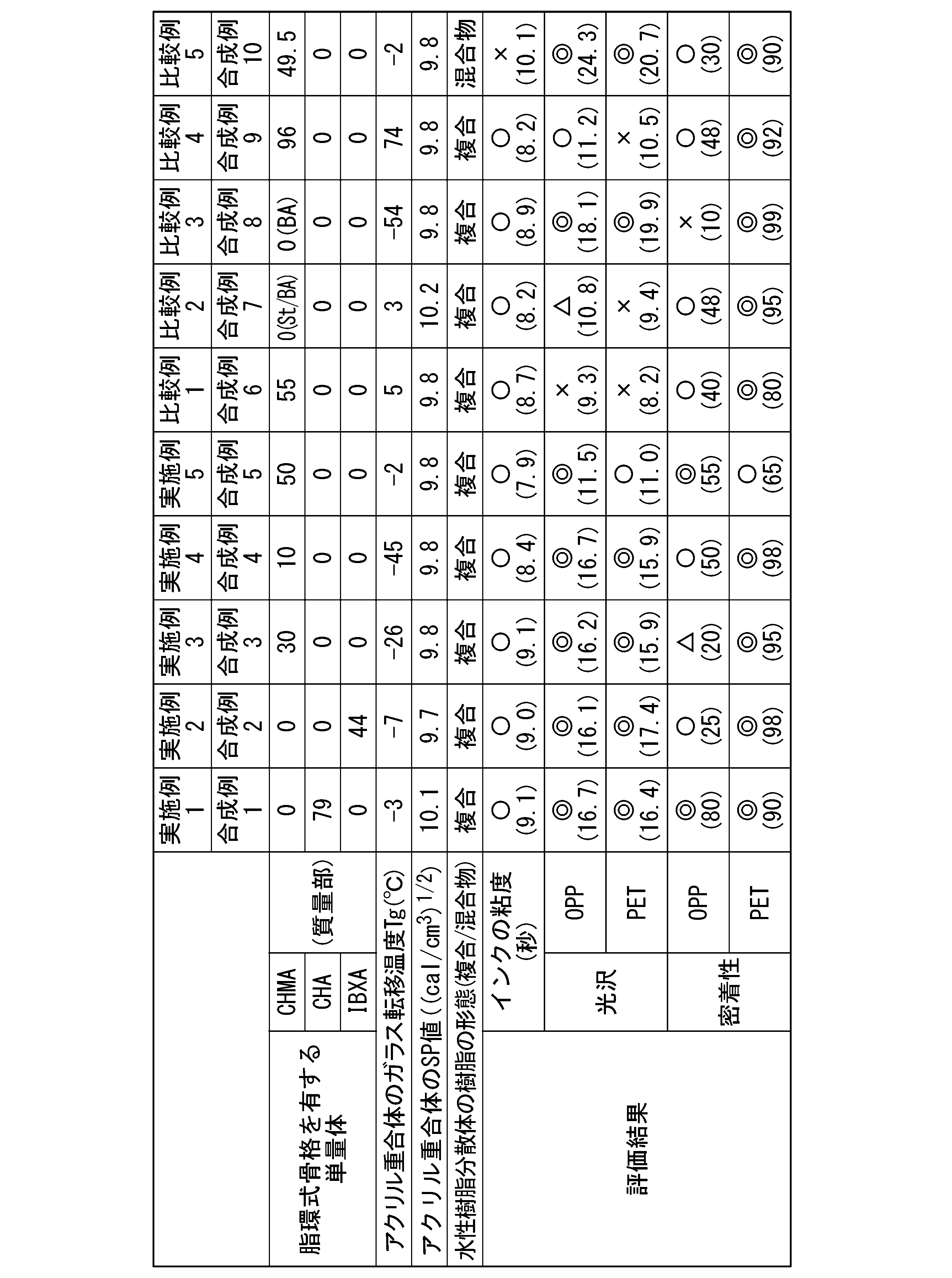
CHMA:シクロヘキシル(メタ)アクリレート
CHA:シクロヘキシルアクリレート
IBXA:イソボルニルアクリレート
BA:n-ブチルアクリレート
St:スチレン
ガラス転移温度が本願規定の範囲外であるアクリル重合体を使用した比較例1及び比較例4は、乾燥後のインク塗膜の光沢が悪かった。
一方、脂環式骨格を有するラジカル重合性単量体由来の構成単位を有さないアクリル重合体を使用した比較例2及び比較例3は、乾燥後のインク塗膜の基材に対する密着性及び光沢のうちのいずれかが悪かった。
ウレタン重合体A及びアクリル重合体Bを同一粒子内に含まない水性樹脂分散体を使用した比較例5は、インクの粘度が高くて塗布性が悪かった。
Claims (9)
- ウレタン重合体A及びアクリル重合体Bを同一粒子内に含み、前記アクリル重合体Bが脂環式骨格を有するラジカル重合性単量体由来の構成単位を有し、前記アクリル重合体Bのガラス転移温度が-60℃以上5℃未満である、水性樹脂分散体。
- 前記アクリル重合体Bが脂環式骨格を有するラジカル重合性単量体由来の構成単位を、前記アクリル重合体Bを構成する構成単位の総質量に対し、5質量%以上有する、請求項1に記載の水性樹脂分散体。
- 前記アクリル重合体Bのガラス転移温度が-40℃以上-2℃以下である、請求項1又は請求項2に記載の水性樹脂分散体。
- 前記アクリル重合体Bのガラス転移温度が-40℃以上-6℃以下である、請求項1~3のいずれか一項に記載の水性樹脂分散体。
- 前記水性樹脂分散体の動的光散乱法により計測される流体力学的平均粒子径が120nm以下である、請求項1~4のいずれか一項に記載の水性樹脂分散体。
- 前記水性樹脂分散体の固形分が、前記水性樹脂分散体の総質量に対し、35質量%以上である請求項1~5のいずれか一項に記載の水性樹脂分散体。
- 前記アクリル重合体Bを構成するためのラジカル重合性単量体全量に対して0.35質量%以下のラジカル重合開始剤を用いて重合して前記アクリル重合体Bを製造する請求項1~6のいずれか一項に記載の水性樹脂分散体の製造方法。
- 前記ウレタン重合体Aをシードとして前記アクリル重合体Bを構成するためのラジカル重合性単量体をシード重合して前記粒子を製造する請求項1~6のいずれか一項に記載の水性樹脂分散体の製造方法。
- 請求項1~6のいずれか一項に記載の水性樹脂分散体を含有するインク。
Priority Applications (2)
| Application Number | Priority Date | Filing Date | Title |
|---|---|---|---|
| JP2023506972A JP7663115B2 (ja) | 2021-03-16 | 2022-03-04 | 水性樹脂分散体、その製造方法及び前記分散体を含有するインク |
| CN202280007853.0A CN116529326A (zh) | 2021-03-16 | 2022-03-04 | 水性树脂分散体、其制造方法及含有所述分散体的油墨 |
Applications Claiming Priority (2)
| Application Number | Priority Date | Filing Date | Title |
|---|---|---|---|
| JP2021042708 | 2021-03-16 | ||
| JP2021-042708 | 2021-03-16 |
Publications (1)
| Publication Number | Publication Date |
|---|---|
| WO2022196396A1 true WO2022196396A1 (ja) | 2022-09-22 |
Family
ID=83320366
Family Applications (1)
| Application Number | Title | Priority Date | Filing Date |
|---|---|---|---|
| PCT/JP2022/009477 Ceased WO2022196396A1 (ja) | 2021-03-16 | 2022-03-04 | 水性樹脂分散体、その製造方法及び前記分散体を含有するインク |
Country Status (3)
| Country | Link |
|---|---|
| JP (1) | JP7663115B2 (ja) |
| CN (1) | CN116529326A (ja) |
| WO (1) | WO2022196396A1 (ja) |
Citations (7)
| Publication number | Priority date | Publication date | Assignee | Title |
|---|---|---|---|---|
| JP2000345092A (ja) * | 1998-09-22 | 2000-12-12 | Nippon Polyurethane Ind Co Ltd | 水系印刷インキ |
| JP2003342313A (ja) * | 2002-05-28 | 2003-12-03 | Hitachi Chem Co Ltd | 水性樹脂組成物及び水性塗料 |
| JP2008111037A (ja) * | 2006-10-30 | 2008-05-15 | Chuo Rika Kogyo Corp | ポリウレタン−ビニル重合体複合樹脂水性分散液 |
| JP2016531169A (ja) * | 2013-07-17 | 2016-10-06 | ビーエーエスエフ コーティングス ゲゼルシャフト ミット ベシュレンクテル ハフツングBASF Coatings GmbH | コポリマーの水性分散液 |
| JP2018080312A (ja) * | 2016-11-18 | 2018-05-24 | 東洋インキScホールディングス株式会社 | 水性複合樹脂分散体とその製造方法、水性インキ組成物、印刷物 |
| JP2019123790A (ja) * | 2018-01-16 | 2019-07-25 | 三菱ケミカル株式会社 | 水性樹脂分散体、水性塗料及び塗装物 |
| JP2019123789A (ja) * | 2018-01-16 | 2019-07-25 | 三菱ケミカル株式会社 | 水性樹脂分散体、水性塗料及び塗装物 |
Family Cites Families (8)
| Publication number | Priority date | Publication date | Assignee | Title |
|---|---|---|---|---|
| JP3499828B2 (ja) | 2001-01-18 | 2004-02-23 | コニシ株式会社 | ウレタン樹脂系硬化性樹脂組成物及びその製造方法 |
| JP4381090B2 (ja) | 2003-10-20 | 2009-12-09 | 日東電工株式会社 | ウレタン−アクリル粒子内混合物水分散体の製造方法 |
| JP6271276B2 (ja) * | 2014-02-06 | 2018-01-31 | 三菱ケミカル株式会社 | 重合体粒子、重合体分散液、水性被覆材および塗装物 |
| WO2014126209A1 (ja) * | 2013-02-14 | 2014-08-21 | 三菱レイヨン株式会社 | 重合体粒子、重合体分散液およびその製造方法、重合体分散液から得られる被覆材および塗装物 |
| JP2016040360A (ja) * | 2014-08-13 | 2016-03-24 | 三菱レイヨン株式会社 | 重合体粒子、重合体分散液、水性被覆材および塗装物 |
| EP3250621A4 (en) | 2015-01-30 | 2018-01-17 | Hewlett-Packard Development Company, L.P. | Polyurethane-based binder dispersion |
| WO2017033871A1 (ja) * | 2015-08-21 | 2017-03-02 | 株式会社日本触媒 | ブロック共重合体 |
| WO2020127105A1 (en) * | 2018-12-21 | 2020-06-25 | Agfa-Gevaert Nv | Aqueous adhesive layer |
-
2022
- 2022-03-04 WO PCT/JP2022/009477 patent/WO2022196396A1/ja not_active Ceased
- 2022-03-04 CN CN202280007853.0A patent/CN116529326A/zh active Pending
- 2022-03-04 JP JP2023506972A patent/JP7663115B2/ja active Active
Patent Citations (7)
| Publication number | Priority date | Publication date | Assignee | Title |
|---|---|---|---|---|
| JP2000345092A (ja) * | 1998-09-22 | 2000-12-12 | Nippon Polyurethane Ind Co Ltd | 水系印刷インキ |
| JP2003342313A (ja) * | 2002-05-28 | 2003-12-03 | Hitachi Chem Co Ltd | 水性樹脂組成物及び水性塗料 |
| JP2008111037A (ja) * | 2006-10-30 | 2008-05-15 | Chuo Rika Kogyo Corp | ポリウレタン−ビニル重合体複合樹脂水性分散液 |
| JP2016531169A (ja) * | 2013-07-17 | 2016-10-06 | ビーエーエスエフ コーティングス ゲゼルシャフト ミット ベシュレンクテル ハフツングBASF Coatings GmbH | コポリマーの水性分散液 |
| JP2018080312A (ja) * | 2016-11-18 | 2018-05-24 | 東洋インキScホールディングス株式会社 | 水性複合樹脂分散体とその製造方法、水性インキ組成物、印刷物 |
| JP2019123790A (ja) * | 2018-01-16 | 2019-07-25 | 三菱ケミカル株式会社 | 水性樹脂分散体、水性塗料及び塗装物 |
| JP2019123789A (ja) * | 2018-01-16 | 2019-07-25 | 三菱ケミカル株式会社 | 水性樹脂分散体、水性塗料及び塗装物 |
Also Published As
| Publication number | Publication date |
|---|---|
| JP7663115B2 (ja) | 2025-04-16 |
| CN116529326A (zh) | 2023-08-01 |
| JPWO2022196396A1 (ja) | 2022-09-22 |
Similar Documents
| Publication | Publication Date | Title |
|---|---|---|
| JP5736369B2 (ja) | 水性インクジェット用インキ組成物 | |
| JP5776249B2 (ja) | 水性インクジェット用インキ組成物 | |
| JP2011012253A (ja) | 水性インクジェットインキ用バインダー樹脂組成物、およびそれを用いたインクジェットインキ | |
| WO2014104319A1 (ja) | 水性インクジェットインク用アクリル系樹脂エマルジョン、およびそれを用いてなる水性インクジェットインク組成物 | |
| WO2014126209A1 (ja) | 重合体粒子、重合体分散液およびその製造方法、重合体分散液から得られる被覆材および塗装物 | |
| JP6399548B2 (ja) | 水性着色ベース塗料組成物及びそれを用いた補修塗装方法 | |
| JP5935464B2 (ja) | 樹脂微粒子 | |
| JP4441847B2 (ja) | 水性粘着剤組成物、その製造方法及び粘着製品 | |
| WO2012169395A1 (ja) | 水性樹脂組成物、水性塗料及びプラスチック成型品 | |
| JP4786789B2 (ja) | 顔料分散用水性樹脂組成物の製造方法 | |
| JP7663115B2 (ja) | 水性樹脂分散体、その製造方法及び前記分散体を含有するインク | |
| JP2006152051A (ja) | アクリル系水性粘着剤組成物及びその製造方法 | |
| JP4678477B2 (ja) | 再剥離型水性粘着剤組成物及び粘着製品 | |
| JP2007056161A (ja) | 水性メタリック塗料及び複層塗膜形成方法 | |
| JP2001342201A (ja) | 樹脂エマルジョンの製造法、塗料組成物および塗装方法 | |
| JP7840129B2 (ja) | グラビア印刷用水性樹脂組成物 | |
| JP3927141B2 (ja) | プラスチック素材の塗膜形成方法および塗装物品 | |
| WO2020085263A1 (ja) | 水性分散体、その製造方法およびその利用 | |
| JP6821919B2 (ja) | 顔料分散体、および積層体 | |
| JP2007084781A (ja) | アクリル系水性粘着剤組成物の製造方法 | |
| JP2000119539A (ja) | カルボジイミド基を有する化合物を含む重合体の水性分散体の製造方法、及びカルボジイミド基を有する重合体の水性分散体の製造方法、並びにそれぞれの製造方法によって得られる重合体の水性分散体の利用 | |
| JP7280263B2 (ja) | 水性塗料組成物 | |
| JP3693054B2 (ja) | 多段重合ポリマーエマルジョン及びその製造方法 | |
| JP2010069372A (ja) | Abs基材の塗装方法及び塗装物品 | |
| JP2000034323A (ja) | 水性ウレタン複合樹脂及び該樹脂を含んでなる水性被覆組成物 |
Legal Events
| Date | Code | Title | Description |
|---|---|---|---|
| 121 | Ep: the epo has been informed by wipo that ep was designated in this application |
Ref document number: 22771150 Country of ref document: EP Kind code of ref document: A1 |
|
| ENP | Entry into the national phase |
Ref document number: 2023506972 Country of ref document: JP Kind code of ref document: A |
|
| WWE | Wipo information: entry into national phase |
Ref document number: 202280007853.0 Country of ref document: CN |
|
| NENP | Non-entry into the national phase |
Ref country code: DE |
|
| 122 | Ep: pct application non-entry in european phase |
Ref document number: 22771150 Country of ref document: EP Kind code of ref document: A1 |