WO2022158287A1 - Evoh抽出剤及びそれを用いたevoh抽出方法、evoh回収方法、evoh抽出剤再生方法 - Google Patents
Evoh抽出剤及びそれを用いたevoh抽出方法、evoh回収方法、evoh抽出剤再生方法 Download PDFInfo
- Publication number
- WO2022158287A1 WO2022158287A1 PCT/JP2022/000107 JP2022000107W WO2022158287A1 WO 2022158287 A1 WO2022158287 A1 WO 2022158287A1 JP 2022000107 W JP2022000107 W JP 2022000107W WO 2022158287 A1 WO2022158287 A1 WO 2022158287A1
- Authority
- WO
- WIPO (PCT)
- Prior art keywords
- evoh
- extractant
- extracting
- extraction agent
- water
- Prior art date
- Legal status (The legal status is an assumption and is not a legal conclusion. Google has not performed a legal analysis and makes no representation as to the accuracy of the status listed.)
- Ceased
Links
Classifications
-
- C—CHEMISTRY; METALLURGY
- C08—ORGANIC MACROMOLECULAR COMPOUNDS; THEIR PREPARATION OR CHEMICAL WORKING-UP; COMPOSITIONS BASED THEREON
- C08J—WORKING-UP; GENERAL PROCESSES OF COMPOUNDING; AFTER-TREATMENT NOT COVERED BY SUBCLASSES C08B, C08C, C08F, C08G or C08H
- C08J11/00—Recovery or working-up of waste materials
- C08J11/04—Recovery or working-up of waste materials of polymers
- C08J11/06—Recovery or working-up of waste materials of polymers without chemical reactions
- C08J11/08—Recovery or working-up of waste materials of polymers without chemical reactions using selective solvents for polymer components
-
- C—CHEMISTRY; METALLURGY
- C08—ORGANIC MACROMOLECULAR COMPOUNDS; THEIR PREPARATION OR CHEMICAL WORKING-UP; COMPOSITIONS BASED THEREON
- C08J—WORKING-UP; GENERAL PROCESSES OF COMPOUNDING; AFTER-TREATMENT NOT COVERED BY SUBCLASSES C08B, C08C, C08F, C08G or C08H
- C08J2329/00—Characterised by the use of homopolymers or copolymers of compounds having one or more unsaturated aliphatic radicals, each having only one carbon-to-carbon double bond, and at least one being terminated by an alcohol, ether, aldehydo, ketonic, acetal, or ketal radical; Hydrolysed polymers of esters of unsaturated alcohols with saturated carboxylic acids; Derivatives of such polymer
- C08J2329/02—Homopolymers or copolymers of unsaturated alcohols
- C08J2329/04—Polyvinyl alcohol; Partially hydrolysed homopolymers or copolymers of esters of unsaturated alcohols with saturated carboxylic acids
Definitions
- the present invention relates to an EVOH extractant, an EVOH extraction method using the same, an EVOH recovery method, and an EVOH extractant regeneration method.
- EVOH ethylene-vinyl alcohol copolymer
- Patent Document 1 Previously, conversion of EVOH dissolved in a water/ethanol mixture to a gel and crushing of the gel to form polymer particles suspended in the liquid have been proposed as methods for recovery of vinyl alcohol polymers. (Patent Document 1). However, it is difficult to sufficiently dissolve the EVOH existing between the multilayer film layers in the water/ethanol mixture.
- Patent Document 2 A method of precipitating a polyvinyl alcohol-based resin containing a filler has been proposed (Patent Document 2). However, this method cannot be used because EVOH is not soluble in water.
- EVOH-based polymer coatings can be removed by alkaline treatment with an aqueous alkali metal hydroxide solution in a process for producing polyolefin renewable materials (US Pat.
- EVOH does not dissolve in an inorganic alkaline aqueous solution, and isolation and recovery of EVOH is not disclosed.
- the present invention is an EVOH extractant containing a polar solvent having an SP value of 9-13 and a quaternary ammonium salt.
- the polar solvent is at least one selected from the group consisting of ethylene glycol monobutyl ether, N-methyl-2-pyrrolidone (NMP), isopropanol, dimethylformamide (DMF), dimethylsulfoxide (DMSO), and phenyl glycol. is preferred.
- the quaternary ammonium salt preferably has a pH of 11.5 or higher in a 1% by mass aqueous solution.
- the present invention also provides an EVOH extracting method for extracting EVOH by applying the EVOH extracting agent to a multi-layered resin molding having an EVOH layer.
- the EVOH extraction method preferably includes a step of immersing a multi-layered resin molding having an EVOH layer in an EVOH extractant solution to extract EVOH.
- the present invention also provides an EVOH recovery method comprising a step of mixing a solution containing EVOH extracted by the above EVOH extraction method with water and/or a lower alcohol to precipitate EVOH, followed by filtration or centrifugation.
- the present invention is also a method for regenerating an EVOH extractant, comprising a step of removing water and/or lower alcohol by distillation from the residual liquid after EVOH is recovered by the EVOH recovery method. It is preferable to have a step of adding a polar solvent and/or water to the residue obtained in the above step.
- the EVOH extractant of the present invention specifically dissolves EVOH from a multi-layered resin molded article containing an EVOH layer, making it possible to extract EVOH from the multi-layered resin molded article. Moreover, the present invention can efficiently recover EVOH. Also, the present invention can efficiently regenerate the EVOH extractant after extracting EVOH.
- the EVOH extractant of the present invention contains a polar solvent having an SP value of 9-13 and a quaternary ammonium salt.
- a polar solvent having a specific SP value and a quaternary ammonium salt, which is an organic alkaline compound are combined to form an EVOH extractant.
- EVOH can then be recovered by a simple method.
- EVOH By using a polar solvent having a specific SP value, EVOH can be dissolved, and furthermore, the dissolution of EVOH existing between layers of the multilayer resin molding is promoted.
- a quaternary ammonium salt it is possible to promote the dissolution of EVOH, and in particular, if the multilayer resin molded article contains other substances, they can be removed. , EVOH can be efficiently extracted.
- the penetration of the EVOH extractant between the layers of the multi-layered resin molding is improved, and the EVOH existing between the layers can be sufficiently dissolved.
- the polar solvent used in the present invention must have an SP value of 9-13.
- the SP value (solubility parameter ( ⁇ )) is a value defined by the regular solution theory introduced by Hildebrand, and is the square root of the heat of vaporization required to evaporate 1 cm 3 of liquid (cal/cm 3 ) 1 /2 .
- the use of a polar solvent having an SP value within this range helps the organic alkaline compound in the EVOH extractant to act on the EVOH existing between the layers of the multilayer resin molded body, and the EVOH is sufficiently removed. can be dissolved in
- the SP value of the polar solvent used in the present invention is preferably 10 or more. On the other hand, the SP value is preferably 12 or less.
- polar solvents having the above SP value include diethylene glycol monobutyl ether (SP value: 9.0), N-methyl-2-pyrrolidone (NMP) (SP value: 11.2), isopropanol (SP value: 11.5), dimethylformamide (DMF) (SP value: 11.9), dimethyl sulfoxide ((DMSO) SP value: 12.0), benzyl alcohol (SP value: 10.8), phenyl glycol (SP value: 12.4) and the like. These may be used alone or in combination of two or more. Among them, NMP is preferable.
- the quaternary ammonium salt used in the present invention preferably has a pH of 11.5 or higher in a 1% by mass aqueous solution. If the pH is within this range, when an adhesive is used in the multi-layered resin molding including the EVOH layer, the adhesive can be dissolved, so that the extract can more easily come into contact with EVOH. There is an advantage that the dissolution of EVOH is hastened.
- quaternary ammonium salts used in the present invention include dimethylbis(2-hydroxyethyl)ammonium hydroxide (pH 12.3 above) and monomethyltris(2-hydroxyethyl)ammonium hydroxide (pH 12.3 above). 1), trimethyl-2-hydroxyethylammonium hydroxide (above pH 12.5), tetraalkylammonium hydroxide having a pH of 11.5 or more in a 1% by mass aqueous solution (eg, tetramethylammonium hydroxide (above pH 12. 9)) and the like. Among them, dimethylbis(2-hydroxyethyl)ammonium hydroxide and the like are preferable.
- the EVOH extractant of the present invention is preferably used as an aqueous solution.
- the content of water in the EVOH extractant aqueous solution is preferably 5% by mass or more. More preferably, it is 10% by mass or more.
- the upper limit is preferably 40% by mass, more preferably 30% by mass. If the water content is within the above range, a uniform state can be maintained when mixed as a solution, and good EVOH solubility can be exhibited.
- the polar solvent is preferably contained in an aqueous solution of EVOH extractant in an amount of 50 to 90% by mass.
- the lower limit of the content is more preferably 60% by mass, still more preferably 65% by mass.
- the upper limit of the content is more preferably 80% by mass, still more preferably 75% by mass.
- the content of the quaternary ammonium salt in the EVOH extractant aqueous solution is preferably 1 to 20% by mass.
- the lower limit of the content is more preferably 3% by mass, still more preferably 5% by mass.
- the upper limit of the content is more preferably 18% by mass, still more preferably 15% by mass.
- the ratio of the polar solvent to the quaternary ammonium salt is preferably 20:1 to 5:1 (mass ratio).
- the EVOH extractant of the present invention preferably contains a surfactant.
- a surfactant By containing a surfactant, if other contaminants are contained, the contaminants remaining in the multilayer resin molding such as a film are emulsified, and the contaminants are removed from the interface through which the extractant permeates. It has the advantage that it can be removed.
- nonionic surfactant a nonionic surfactant is preferable.
- nonionic surfactants with an HLB of 8-18 are preferred.
- nonionic surfactants include ether-type surfactants such as polyoxyethylene alkyl ethers and polyoxyethylene alkylphenyl ethers; Ester types such as glycerin fatty acid ester, sorbitan fatty acid ester, sucrose fatty acid ester, polyglycerin fatty acid ester, propylene glycol fatty acid ester; Ester ether types such as polyoxyethylene glycerin fatty acid ester, polyoxyethylene castor oil, polyoxyethylene hydrogenated castor oil, polyoxyethylene sorbitan fatty acid ester, sorbitan fatty acid ester polyethylene glycol, and the like can be mentioned. Among them, polyoxyethylene alkyl ether, polyoxypropylene alkyl ether and the like are preferable.
- the above surfactants may be used alone or in combination of two or more.
- the content of the surfactant is preferably 0.1 to 5% by mass in the aqueous solution of the EVOH extractant.
- the multi-layered resin molded article to be used in the present invention is not particularly limited, and is a multi-layered resin molded article using an EVOH layer between the layers as a layer having a gas barrier function.
- commonly used materials such as packaging films and sheets, packaging materials such as packaging containers, fuel tanks such as gasoline, hoses for transporting refrigerants, and optical materials can be used.
- EVOH is usually present between layers of a laminate having a three-layer structure or the like together with an olefin resin layer such as polyethylene or polypropylene, a polyester resin layer such as polyethylene terephthalate or polyethylene naphthalate, or a polyamide resin layer.
- the multilayer resin molding is a multilayer film
- unstretched polyethylene (PE) resin film unstretched polypropylene (CPP) resin film
- unstretched polypropylene (CPP) resin film unstretched polypropylene (CPP) resin film
- cyclic polyolefin (COP or COC) resin film co-extrusion of unstretched polyethylene and unstretched polypropylene.
- Olefin film group consisting of films (PE/CPP), polyethylene terephthalate (PET) resin film, polyamide (PA) resin film, polyethylene naphthalate (PEN) resin film, polyacrylonitrile (PAN) resin film, polycarbonate (PC) resin Films, polyimide (PI) resin films, polyvinyl chloride (PVC) resin films, etc. are used. Either may be used in the present invention.
- the multilayer resin molding may be formed by adhering each layer using an adhesive.
- adhesives include commonly used polyurethane adhesive compositions and the like. Since these adhesives are dissolved by the quaternary ammonium salt in the EVOH extractant of the present invention, the extraction of EVOH existing between the layers of the multi-layered resin molding can be performed without any problems.
- EVOH is usually a resin obtained by copolymerizing ethylene and a vinyl ester monomer and then saponifying the copolymer, and vinyl acetate is generally used. Any known polymerization method, such as solution polymerization, suspension polymerization, emulsion polymerization, etc., can be used, but solution polymerization using methanol as a solvent is generally used. Saponification of the obtained ethylene-vinyl ester copolymer can also be carried out by a known method. Such EVOH is mainly composed of ethylene structural units and vinyl alcohol structural units, and contains a small amount of residual vinyl ester structural units that have not been saponified.
- EVOH having an ethylene unit content of preferably 3 to 70 mol %, more preferably 25 to 50 mol %, can be favorably acted on.
- ethylene unit content can be obtained, for example, from 1 H-NMR measurement.
- the degree of saponification of the vinyl ester component in EVOH is not particularly limited as long as it does not affect the gas barrier property of EVOH.
- EVOH may further contain a structural unit derived from a comonomer shown below.
- the comonomers include propylene, isobutene, vinyl acetate, ⁇ -olefins such as ⁇ -octene, ⁇ -dodecene, ⁇ -octadecene, 3-butene-1-ol, 4-penten-1-ol, 3-butene-1, Hydroxy group-containing ⁇ -olefins such as 2-diols, their esters, hydroxy group-containing ⁇ -olefin derivatives such as acylated products, unsaturated carboxylic acids or their salts, partial alkyl esters, complete alkyl esters, nitriles, amides, and anhydrous compounds, unsaturated sulfonic acids or salts thereof, vinylsilane compounds, vinyl chloride, and comonomers such as styrene. Further, it may be an EVOH resin that has been "post
- the EVOH extraction method of the present invention is a method of applying the EVOH extractant of the present invention to a multi-layered resin molding having an EVOH layer to extract EVOH.
- a method of extracting EVOH by immersing a multi-layered resin molding having an EVOH layer in the EVOH extractant solution is suitable.
- the form of the multilayered resin molding having the EVOH layer to be immersed may be set arbitrarily. good.
- the temperature of the solution during EVOH extraction may be room temperature, but is preferably 60 to 100.degree. Alternatively, the extraction may be performed using an autoclave or the like. Further, during the EVOH extraction, it is preferable to stir or vibrate the solution in which the multi-layered resin molding having the EVOH layer is immersed.
- the EVOH extractant of the present invention it is possible to selectively dissolve only the EVOH in the multi-layered resin molding and extract the EVOH.
- the EVOH recovery method of the present invention comprises a step of adding water and/or a lower alcohol to a solution containing EVOH extracted by the above EVOH extraction method to precipitate EVOH, followed by filtration or centrifugation. is. After adding water and/or a lower alcohol, it is preferable to stir, vibrate, or the like.
- EVOH is extracted as described above
- undissolved resin and the like are removed from the aqueous solution by filtration or the like to obtain a solution containing the extracted EVOH.
- the solution is allowed to stand and, if necessary, cooled to precipitate EVOH.
- EVOH is separated from the solution by filtration, centrifugation, or the like, and EVOH is recovered.
- Filtration, centrifugation, or the like may be performed using a general apparatus according to a general method, and the conditions thereof may be appropriately set.
- the recovered EVOH may be dried using a dryer or the like.
- the above water and/or lower alcohol act as a poor solvent when precipitating dissolved EVOH.
- the lower alcohol include ethanol, isopropanol, and butanol. It is preferable to add water and/or lower alcohol so that the ratio of water and/or lower alcohol is 50 to 95% by mass in the extracted EVOH-containing solution. By setting it to such a range, the dissolved EVOH can be favorably precipitated.
- the EVOH recovered as described above has a high purity and can be reused as a raw material for a multi-layered resin molding as a recycled resin.
- the method for regenerating an EVOH extractant of the present invention is a method for regenerating an EVOH extractant, comprising a step of removing water and/or lower alcohol from the residual liquid after recovery of EVOH by distillation.
- the distillation may be carried out according to a general method using a general apparatus, and the conditions may be appropriately set.
- it may have a step of adding a polar solvent and/or water to the residue obtained in the distillation step. That is, by adding a polar solvent and/or water to the residue obtained by distillation and adjusting the respective mixing ratios, it can be used as an EVOH extractant for extraction of EVOH.
- the present invention can be used to regenerate and reuse EVOH and EVOH extractants, which can contribute to global environmental protection and the like.
- Example 1 N-methyl-2-pyrrolidone (NMP) 70% by mass, dimethylbis(2-hydroxyethyl) ammonium hydroxide (manufactured by Yokkaichi Gosei Co., Ltd., AH212-CS (product name), 1% by mass as a quaternary ammonium salt
- NMP N-methyl-2-pyrrolidone
- AH212-CS product name
- An EVOH extractant aqueous solution with a pH of 12.3) 7.5% by mass and 22.5% by mass of water was prepared, and the solubility test of the EVOH film and the lamination containing EVOH in the intermediate layer were performed by the following method. An EVOH extraction test from the film was performed.
- Example 2 to 4 Each test was conducted in the same manner as in Example 1, except that the composition of the aqueous solution of the EVOH extractant was as shown in Table 1. The results are also shown in Table 1.
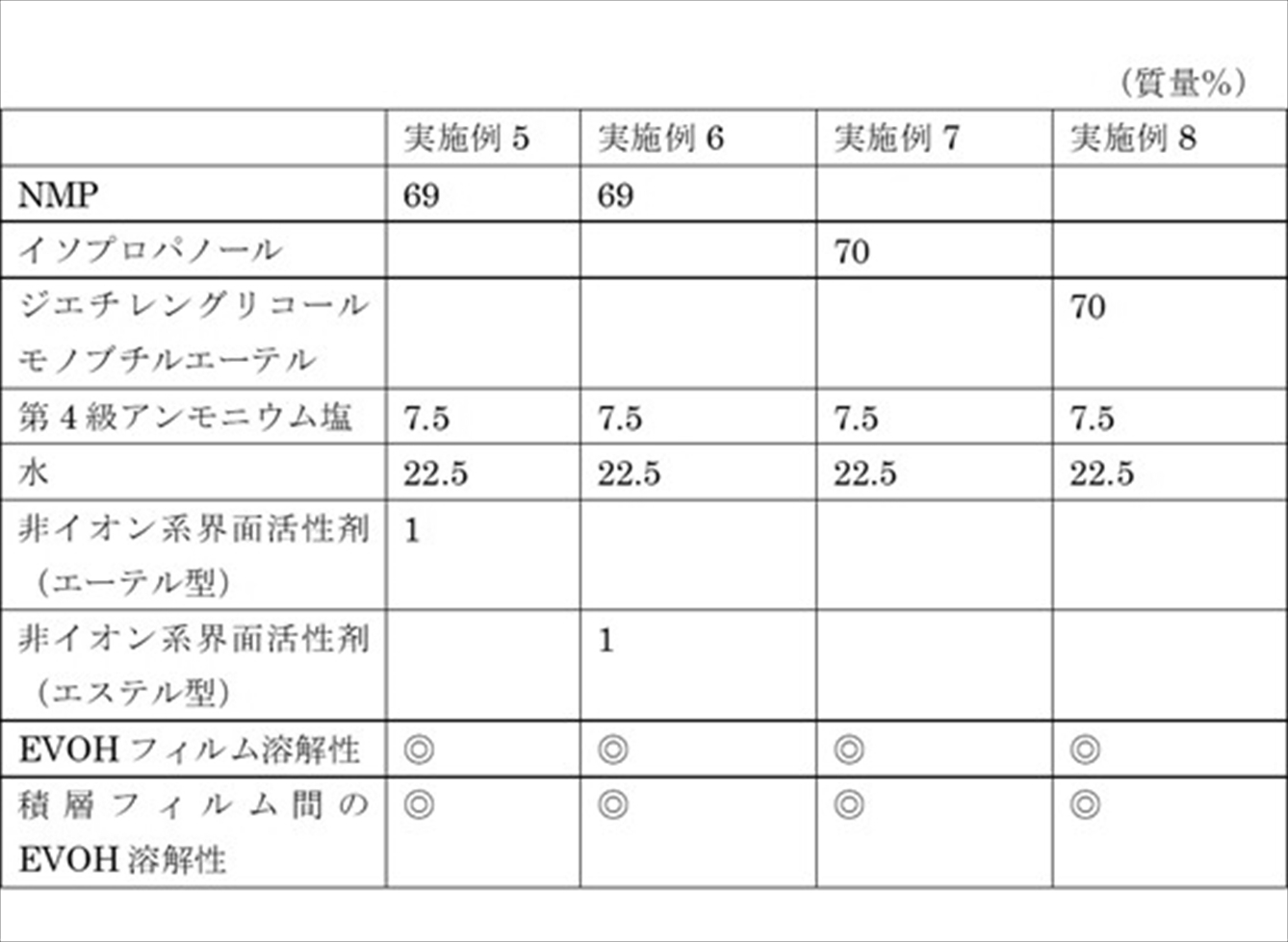
- Examples 5 to 8 Each test was conducted in the same manner as in Example 1, except that the composition of the aqueous solution of the EVOH extractant was as shown in Table 2.
- a nonionic surfactant Noigen XL-80 (manufactured by Dai-ichi Kogyo Seiyaku Co., Ltd., HLB 13.8) (ether type), polyoxyethylene sorbitan monostearate (manufactured by Dai-ichi Kogyo Seiyaku Co., Ltd., Solgen TW-60 , HLB 14.9) (ester type) were used. The results are also shown in Table 2.
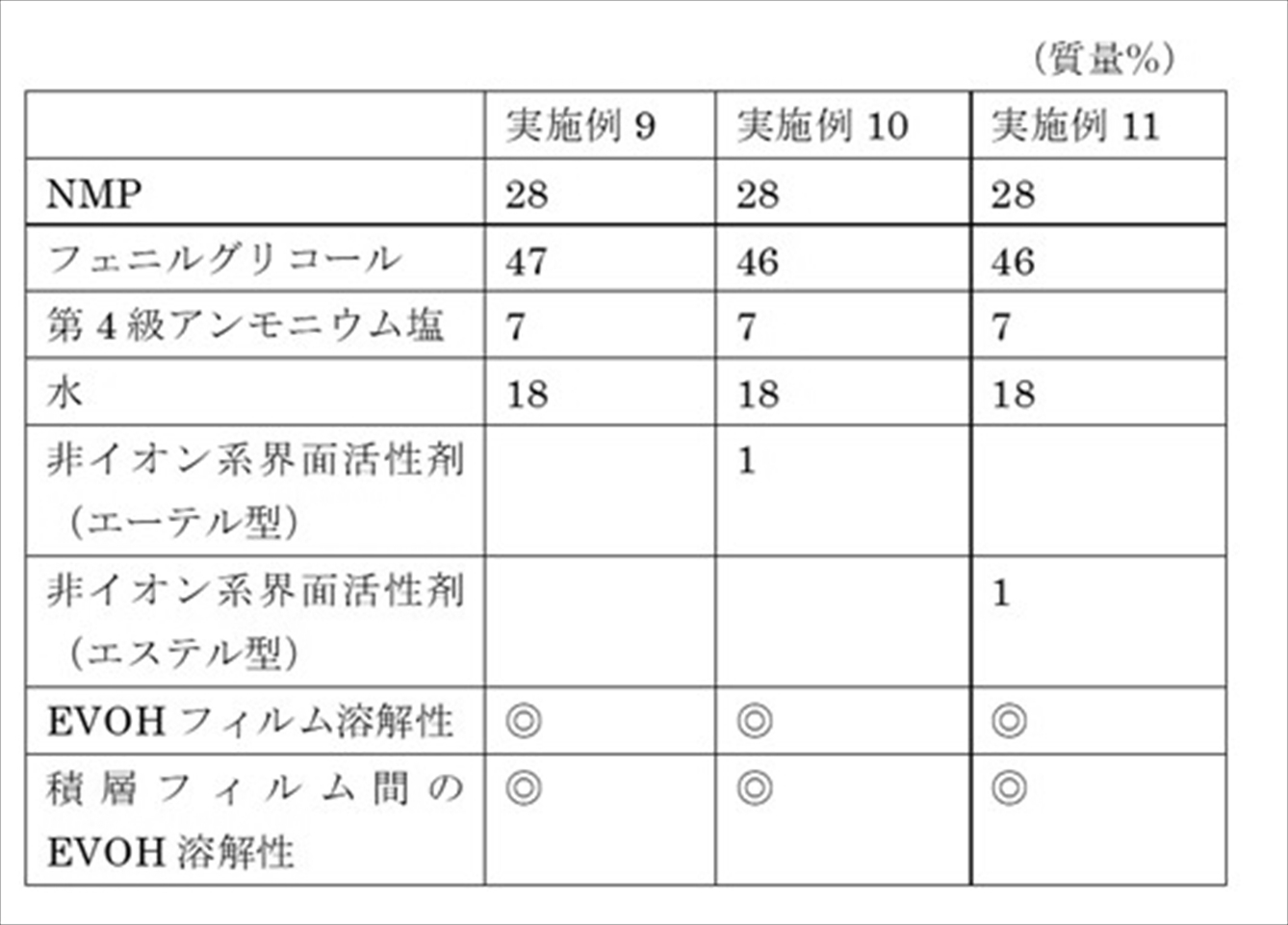
- Example 9 Each test was conducted in the same manner as in Example 1, except that the composition of the aqueous solution of the EVOH extractant was as shown in Table 3. The results are also shown in Table 3.
- Example 12 (Recovery of EVOH) Using the solution in which the EVOH film was dissolved, which was obtained in the solubility test of the EVOH film in Example 1, 45 g of water was added as a poor solvent to 5 g of this solution and mixed, and then the mixed solution was allowed to stand for 90 minutes. Then, EVOH was deposited and precipitated. The solution was then removed by filtering the EVOH precipitated solution. The resulting EVOH was recovered by suction filtration and dried. The recovery of EVOH was 99%.
- Example 13 Regeneration of EVOH extractant
- the poor solvent was removed from this residual liquid by distillation to obtain 3.5 g of residue.
- 1.1 g of water was added to the obtained residue to make an EVOH extractant solution, and a 1 cm square multiple
- the layered film ONY/EVOH/ONY
- an EVOH extraction test was performed according to the method of Example 1.
- the EVOH in the multilayer film dissolved and the ONY film was formed. It was confirmed that they were separated. Since the solution using the residue obtained above extracted EVOH, it was confirmed that the EVOH extractant had been regenerated.
- EVOH and an EVOH extractant can be recycled and reused, thereby contributing to global environmental protection and the like.
Landscapes
- Chemical & Material Sciences (AREA)
- Life Sciences & Earth Sciences (AREA)
- Sustainable Development (AREA)
- Health & Medical Sciences (AREA)
- Chemical Kinetics & Catalysis (AREA)
- Medicinal Chemistry (AREA)
- Polymers & Plastics (AREA)
- Organic Chemistry (AREA)
- Separation, Recovery Or Treatment Of Waste Materials Containing Plastics (AREA)
- Extraction Or Liquid Replacement (AREA)
- Organic Low-Molecular-Weight Compounds And Preparation Thereof (AREA)
- Laminated Bodies (AREA)
Abstract
Description
また、本発明は、EVOH層を含む複層樹脂成形体から、EVOHを効率的に抽出する方法及び回収する方法を提供することを目的とするものである。
また、本発明は、EVOHを抽出した後に、本発明のEVOH抽出剤を再生する方法を提供することを目的とするものである。
上記4級アンモニウム塩は、1質量%水溶液時のpHが11.5以上であることが好ましい。
上記EVOH抽出方法として、EVOH抽出剤溶液に、EVOH層を有する複層樹脂成形体を浸漬し、EVOHを抽出する工程を有することが好ましい。
上記工程で得られた残留物に、極性溶媒及び/又は水を添加する工程を有することが好ましい。
また、本発明は、EVOHを効率的に回収することができるものである。
また、本発明は、EVOHを抽出した後に、EVOH抽出剤を効率的に再生し得るものである。
本発明において、特定のSP値を持つ極性溶媒と有機系アルカリ化合物である第4級アンモニウム塩とを組み合わせて、EVOH抽出剤とすることで、複層樹脂成形体の層間に存在するEVOHを十分に抽出することができ、また、その後簡易な方法でEVOHを回収することができるものである。
SP値(溶解パラメーター(δ))は、ヒルデブラントによって導入された正則溶液論により定義された値であり、1cm3の液体が蒸発するために必要な蒸発熱の平方根(cal/cm3)1/2から計算されるものである。
本発明において、SP値がこの範囲である極性溶媒を使用することで、EVOH抽出剤中の有機系アルカリ化合物が複層樹脂成形体の層間に存在するEVOHに作用することを助け、EVOHを十分に溶解させることができる。
本発明において用いる極性溶媒のSP値は、10以上であることが好ましい。一方、SP値は、12以下であることが好ましい。
中でも、ジメチルビス(2-ヒドロキシエチル)アンモニウムヒドロキシド等が好ましい。
EVOH抽出剤水溶液中の水の含有量は、5質量%以上であることが好ましい。より好ましくは、10質量%以上である。
一方、上限は、好ましくは40質量%であり、より好ましくは、30質量%である。
水含有量が、上記範囲内であれば、溶液として混合した際に均一な状態を保つことができ、かつ良好なEVOH溶解性を発現することが出来る。
なお、本発明において、HLBは、グリフィン法により、次の算出式で定義される値である。
HLB値=20×[親水部の化学式量の総和]/分子量
グリセリン脂肪酸エステル、ソルビタン脂肪酸エステル、ショ糖脂肪酸エステル、ポリグリセリン脂肪酸エステル、プロピレングリコール脂肪酸エステル等のエステル型;
ポリオキシエチレングリセリン脂肪酸エステル、ポリオキシエチレンひまし油、ポリオキシエチレン硬化ひまし油、ポリオキシエチレンソルビタン脂肪酸エステル、ソルビタン脂肪酸エステルポリエチレングリーコール等のエステルエーテル型等が挙げられる。
中でも、ポリオキシエチレンアルキルエーテル、ポリオキシプロピレンアルキルエーテル等が好ましい。
また、界面活性剤の含有量は、EVOH抽出剤の水溶液中、0.1~5質量%であることが好ましい。
EVOHは、通常、ポリエチレン、ポリプロピレン等のオレフィン系樹脂層、ポリエチレンテレフタレート、ポリエチレンナフタレート等のポリエステル樹脂層、ポリアミド系樹脂層と共に、三層構造等の積層体の層間に存在する。
かかるエチレン単位含有率は、例えば、1H-NMR測定から求めることができる。
また、EVOH抽出時には、EVOH層を有する複層樹脂成形体を浸漬した溶液を撹拌したり、振動を与えたり等することが好適である。
水及び/又は低級アルコールを添加した後、撹拌したり、振動を与えたり等、することが好適である。
上記濾過または遠心分離等は、一般的な装置を用い、一般的な方法に従って行えばよく、その条件も適宜設定すればよい。
更に、回収したEVOHを、乾燥機等を用いて乾燥してもよい。
上記低級アルコールとしては、エタノール、イソプロパノール、ブタノール等が挙げられる。
水及び/又は低級アルコールの割合が、抽出したEVOHを含む溶液中、50~95質量%となるように、水及び/又は低級アルコールを添加することが好ましい。
このような範囲とすることで、溶解していたEVOHの析出を良好に行うことができる。
上記蒸留は、一般的な装置を用い、一般的な方法に従って行えばよく、その条件も適宜設定すればよい。
N-メチル-2-ピロリドン(NMP)70質量%、第4級アンモニア塩として、ジメチルビス(2-ヒドロキシエチル)アンモニウムヒドロキシド(四日市合成株式会社製、AH212-CS(製品名)、1質量%水溶液時のpHが12.3)7.5質量%、水22.5質量%のEVOH抽出剤水溶液を調製し、下記方法により、EVOHフィルムの溶解性試験と、EVOHを中間層に含んだ積層フィルムからのEVOH抽出試験を行った。
(1)EVOH抽出剤水溶液10gに、1cm角に切断したEVOHフィルム(エチレン含有率32mol%)を投入した。
(2)(1)のEVOH抽出剤水溶液を80℃に加温した後、5~10分間その状態を維持し、EVOHフィルムが溶解するか確認した。
(3)下記基準により判定した。
<判定基準>
◎:EVOHを5分以内に溶解可能
〇:EVOHを10分以内に溶解可能
△:EVOHが一部溶解するものの溶け残りあり
×:EVOH不溶
(1)EVOH抽出剤水溶液10gに、1cm角に切断した積層フィルム(PP/EVOH/PP)を投入した。
(2)(1)のEVOH抽出剤水溶液を80℃に加温した後、1~3時間その状態を維持し、中間層のEVOHが溶解するか確認した。
(3)下記基準により判定した。
<判定基準>
◎:EVOHを1時間以内に溶解可能
〇:EVOHを3時間以内に溶解可能
△:EVOHが一部溶解するものの溶け残りあり
×:EVOH不溶
判定の結果を表1に示す。
EVOH抽出剤の水溶液の組成を、表1に示すようにした他は、実施例1と同様にして、各試験を行った。
結果を表1に併せて示す。
EVOH抽出剤の水溶液の組成を、表2に示すようにした他は、実施例1と同様にして、各試験を行った。
なお、非イオン系界面活性剤として、ノイゲンXL-80(第一工業製薬社製、HLB13.8)(エーテル型)、ポリオキシエチレンソルビタンモノステアレート(第一工業製薬社製、ソルゲンTW-60、HLB14.9)(エステル型)を使用した。
結果を表2に併せて示す。
EVOH抽出剤の水溶液の組成を、表3に示すようにした他は、実施例1と同様にして、各試験を行った。
結果を表3に併せて示す。
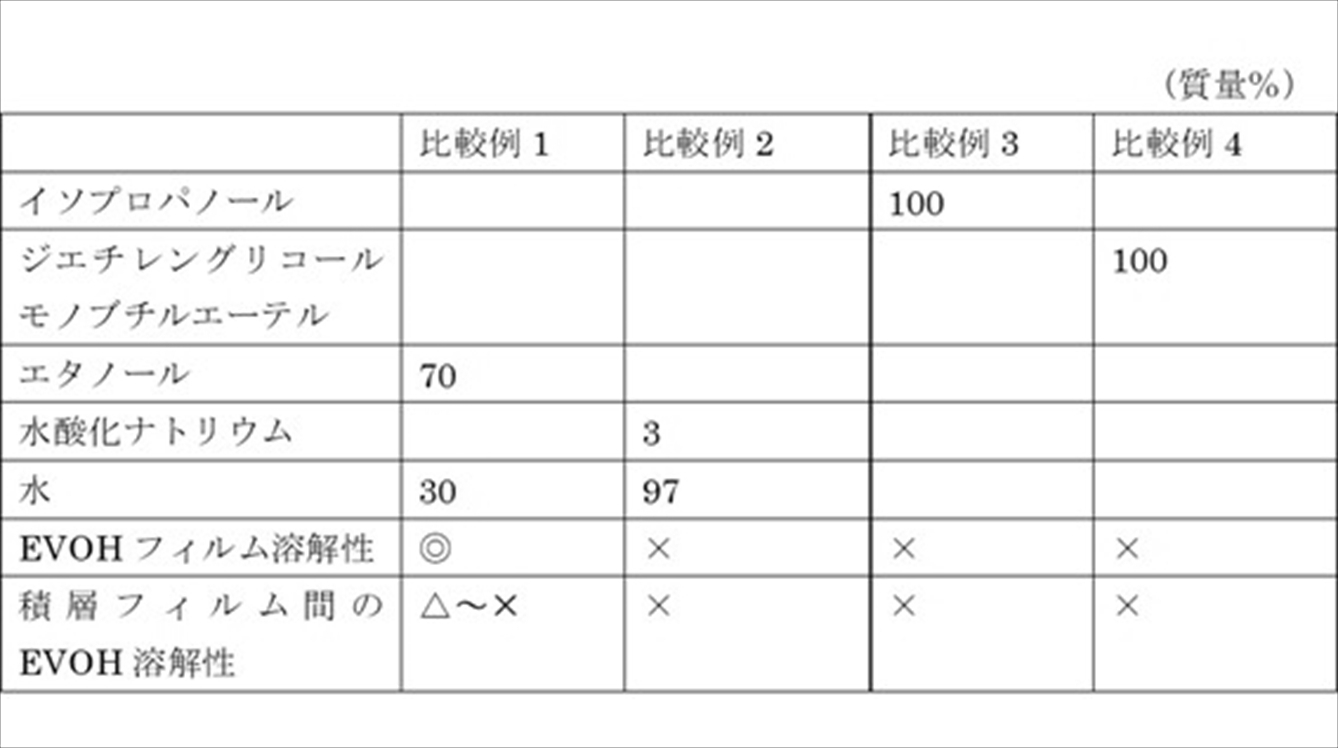
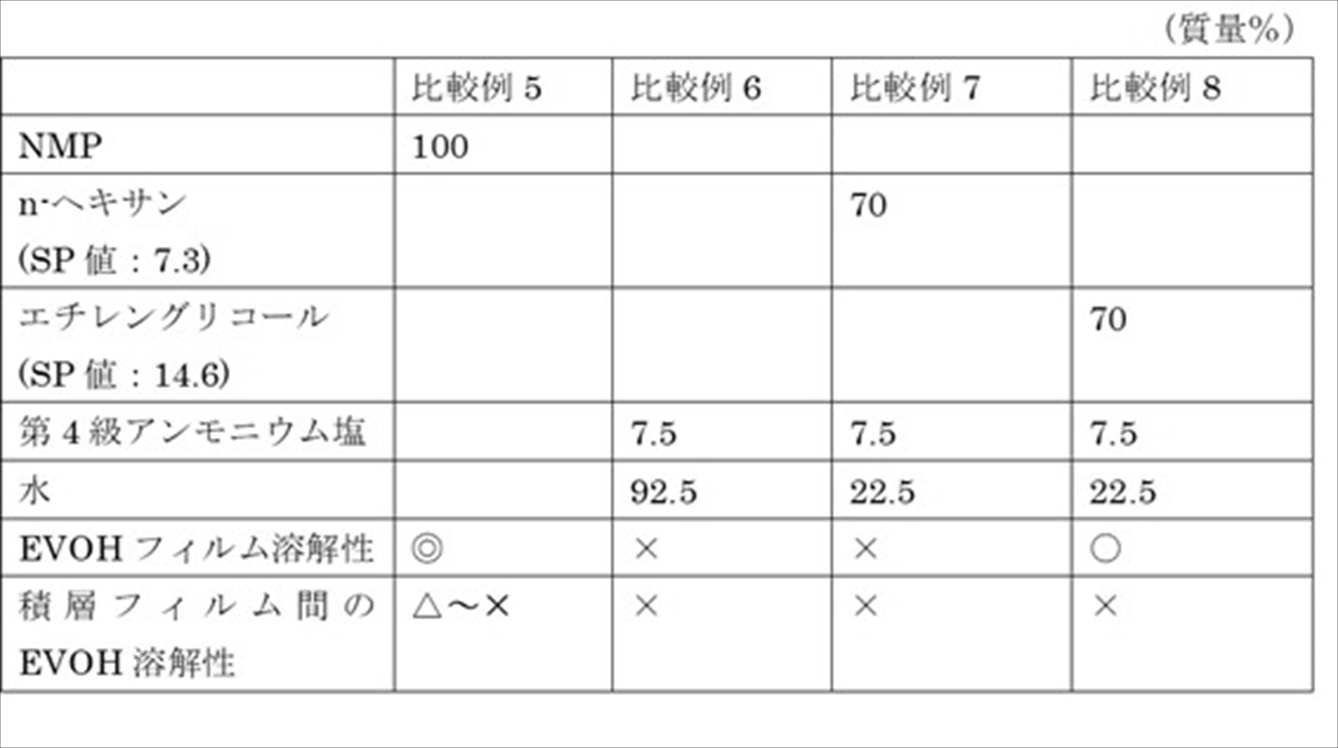
EVOH抽出剤の水溶液の組成を、表4、表5に示すようにした他は、実施例1と同様にして、各試験を行った。
結果を表4、表5に併せて示す。

(EVOHの回収)
実施例1のEVOHフィルムの溶解性試験において得られた、EVOHフィルムが溶解した溶液を用い、この溶液5gに、貧溶媒として、水を45g添加して混合した後、混合溶液を90分間静置し、EVOHを析出・沈殿させた。
次に、EVOHが沈殿した溶液を濾過することにより、溶液を除去した。得られたEVOHを吸引ろ過により回収し乾燥した。EVOHの回収率は、99%であった。
(EVOH抽出剤の再生)
実施例12の濾過後の残液を用い、この残液から貧溶媒を蒸留により除去し、残留物3.5gを得た。
得られた残留物が、NMPと第4級アンモニウム塩とを含むものであることを確認するために、得られた残留物に、水1.1gを添加してEVOH抽出剤溶液とし、1cm角の複層フィルム(ONY/EVOH/ONY)(ONY:延伸ナイロンフィルム)を用いて、実施例1の方法に準じてEVOH抽出試験を行ったところ、複層フィルム中のEVOHが溶解して、ONYフィルムがそれぞれ剥離したことが確認された。上記で得られた残留物を用いた溶液がEVOHを抽出したことから、EVOH抽出剤が再生されていたことが確認された。
Claims (8)
- SP値が9~13である極性溶媒と第4級アンモニウム塩とを含有するEVOH抽出剤。
- 上記極性溶媒が、エチレングリコールモノブチルエーテル、N-メチル-2-ピロリドン(NMP)、イソプロパノール、ジメチルホルムアミド(DMF)、ジメチルスルホキシド(DMSO)、及びフェニルグリコールからなる群から選択される少なくとも1種である請求項1記載のEVOH抽出剤。
- 上記第4級アンモニウム塩は、1質量%水溶液時のpHが11.5以上である請求項1又は2記載のEVOH抽出剤。
- 請求項1~3いずれかのEVOH抽出剤を、EVOH層を有する複層樹脂成形体に付与し、EVOHを抽出するEVOH抽出方法。
- 請求項1~3いずれかのEVOH抽出剤溶液に、EVOH層を有する複層樹脂成形体を浸漬し、EVOHを抽出する工程を有する請求項4記載のEVOH抽出方法。
- 請求項4又は5のEVOH抽出方法により抽出したEVOHを含む溶液と、水及び/又は低級アルコールとを混合してEVOHを析出させ、濾過又は遠心分離する工程を有するEVOH回収方法。
- 請求項6のEVOH回収方法によりEVOHを回収した後の残液から、水及び/又は低級アルコールを蒸留して除去する工程を有するEVOH抽出剤再生方法。
- 更に、請求項7の工程で得られた残留物に、極性溶媒及び/又は水を添加する工程を有する請求項7記載のEVOH抽出剤再生方法。
Priority Applications (3)
| Application Number | Priority Date | Filing Date | Title |
|---|---|---|---|
| US18/260,815 US20240052128A1 (en) | 2021-01-22 | 2022-01-05 | Evoh extractant, evoh extraction method using the same, evoh recovery method, and evoh extractant regeneration method |
| JP2022576591A JP7560897B2 (ja) | 2021-01-22 | 2022-01-05 | Evoh抽出剤及びそれを用いたevoh抽出方法、evoh回収方法、evoh抽出剤再生方法 |
| EP22742412.4A EP4282909A4 (en) | 2021-01-22 | 2022-01-05 | EVOH extractant and method for extracting EVOH therewith, method for recovering EVOH and method for regenerating EVOH extractant |
Applications Claiming Priority (2)
| Application Number | Priority Date | Filing Date | Title |
|---|---|---|---|
| JPPCT/JP2021/002239 | 2021-01-22 | ||
| PCT/JP2021/002239 WO2022157928A1 (ja) | 2021-01-22 | 2021-01-22 | Evoh抽出剤及びそれを用いたevoh抽出方法、evoh回収方法、evoh抽出剤再生方法 |
Publications (1)
| Publication Number | Publication Date |
|---|---|
| WO2022158287A1 true WO2022158287A1 (ja) | 2022-07-28 |
Family
ID=82548820
Family Applications (2)
| Application Number | Title | Priority Date | Filing Date |
|---|---|---|---|
| PCT/JP2021/002239 Ceased WO2022157928A1 (ja) | 2021-01-22 | 2021-01-22 | Evoh抽出剤及びそれを用いたevoh抽出方法、evoh回収方法、evoh抽出剤再生方法 |
| PCT/JP2022/000107 Ceased WO2022158287A1 (ja) | 2021-01-22 | 2022-01-05 | Evoh抽出剤及びそれを用いたevoh抽出方法、evoh回収方法、evoh抽出剤再生方法 |
Family Applications Before (1)
| Application Number | Title | Priority Date | Filing Date |
|---|---|---|---|
| PCT/JP2021/002239 Ceased WO2022157928A1 (ja) | 2021-01-22 | 2021-01-22 | Evoh抽出剤及びそれを用いたevoh抽出方法、evoh回収方法、evoh抽出剤再生方法 |
Country Status (4)
| Country | Link |
|---|---|
| US (1) | US20240052128A1 (ja) |
| EP (1) | EP4282909A4 (ja) |
| JP (1) | JP7560897B2 (ja) |
| WO (2) | WO2022157928A1 (ja) |
Cited By (2)
| Publication number | Priority date | Publication date | Assignee | Title |
|---|---|---|---|---|
| JP7320890B1 (ja) * | 2022-05-18 | 2023-08-04 | 共栄社化学株式会社 | 複層樹脂成形体回収前処理剤及び複層樹脂成形体回収の前処理方法 |
| WO2024248005A1 (ja) | 2023-05-29 | 2024-12-05 | Toppanホールディングス株式会社 | シーラントフィルム、積層体、包装材及び包装袋 |
Families Citing this family (1)
| Publication number | Priority date | Publication date | Assignee | Title |
|---|---|---|---|---|
| NL2035061B1 (en) | 2023-06-09 | 2024-12-19 | Ioniqa Tech B V | A method of removing ethylene vinyl alcohol copolymer from a waste polymer material |
Citations (3)
| Publication number | Priority date | Publication date | Assignee | Title |
|---|---|---|---|---|
| JPS5661430A (en) * | 1979-10-25 | 1981-05-26 | Seitetsu Kagaku Co Ltd | Production of aqueous emulsion/dispersion of ethylene/ vinyl acetate copolymer saponificate |
| US4547329A (en) * | 1983-10-31 | 1985-10-15 | Eastman Kodak Company | Process for forming copolymer particles |
| WO2005111118A1 (ja) * | 2004-05-14 | 2005-11-24 | Sumitomo Seika Chemicals Co., Ltd. | エチレン/ビニルアルコール系共重合体水性分散液の製造方法 |
Family Cites Families (5)
| Publication number | Priority date | Publication date | Assignee | Title |
|---|---|---|---|---|
| US5198471A (en) * | 1989-09-11 | 1993-03-30 | Rensselaer Polytechnic Institute | Polymer recycling by selective dissolution |
| FR2852319B1 (fr) * | 2003-03-14 | 2007-07-06 | Procede pour la recuperation d'un polymere d'alcool vinylique en solution | |
| EP2132259B1 (en) * | 2007-04-11 | 2012-05-02 | Basf Se | Method for removing color from polymeric material |
| JP2010084037A (ja) * | 2008-09-30 | 2010-04-15 | Fujifilm Corp | 有機顔料組成物、それを用いた着色感光性樹脂組成物及びカラーフィルタ |
| EP3072954B1 (en) | 2013-11-18 | 2017-12-20 | Korea Research Institute of Bioscience and Biotechnology | Hericium erinaceum-derived lectin specific for sialic acid linkage |
-
2021
- 2021-01-22 WO PCT/JP2021/002239 patent/WO2022157928A1/ja not_active Ceased
-
2022
- 2022-01-05 US US18/260,815 patent/US20240052128A1/en active Pending
- 2022-01-05 JP JP2022576591A patent/JP7560897B2/ja active Active
- 2022-01-05 EP EP22742412.4A patent/EP4282909A4/en active Pending
- 2022-01-05 WO PCT/JP2022/000107 patent/WO2022158287A1/ja not_active Ceased
Patent Citations (3)
| Publication number | Priority date | Publication date | Assignee | Title |
|---|---|---|---|---|
| JPS5661430A (en) * | 1979-10-25 | 1981-05-26 | Seitetsu Kagaku Co Ltd | Production of aqueous emulsion/dispersion of ethylene/ vinyl acetate copolymer saponificate |
| US4547329A (en) * | 1983-10-31 | 1985-10-15 | Eastman Kodak Company | Process for forming copolymer particles |
| WO2005111118A1 (ja) * | 2004-05-14 | 2005-11-24 | Sumitomo Seika Chemicals Co., Ltd. | エチレン/ビニルアルコール系共重合体水性分散液の製造方法 |
Non-Patent Citations (1)
| Title |
|---|
| See also references of EP4282909A4 * |
Cited By (3)
| Publication number | Priority date | Publication date | Assignee | Title |
|---|---|---|---|---|
| JP7320890B1 (ja) * | 2022-05-18 | 2023-08-04 | 共栄社化学株式会社 | 複層樹脂成形体回収前処理剤及び複層樹脂成形体回収の前処理方法 |
| WO2023223592A1 (ja) * | 2022-05-18 | 2023-11-23 | 共栄社化学株式会社 | 複層樹脂成形体回収前処理剤及び複層樹脂成形体回収の前処理方法 |
| WO2024248005A1 (ja) | 2023-05-29 | 2024-12-05 | Toppanホールディングス株式会社 | シーラントフィルム、積層体、包装材及び包装袋 |
Also Published As
| Publication number | Publication date |
|---|---|
| EP4282909A4 (en) | 2025-04-02 |
| WO2022157928A1 (ja) | 2022-07-28 |
| EP4282909A1 (en) | 2023-11-29 |
| JP7560897B2 (ja) | 2024-10-03 |
| US20240052128A1 (en) | 2024-02-15 |
| JPWO2022158287A1 (ja) | 2022-07-28 |
Similar Documents
| Publication | Publication Date | Title |
|---|---|---|
| JP7560897B2 (ja) | Evoh抽出剤及びそれを用いたevoh抽出方法、evoh回収方法、evoh抽出剤再生方法 | |
| TWI558728B (zh) | Ethylene-vinyl alcohol copolymer resin composition and method for producing the same | |
| JP3268813B2 (ja) | 樹脂組成物及びその製造法 | |
| JP5001207B2 (ja) | エチレン−酢酸ビニル共重合体ケン化物の製造方法 | |
| KR20150135428A (ko) | 투명성이 우수한 조성물 | |
| JP5112701B2 (ja) | エチレン/ビニルアルコール系共重合体水性分散液 | |
| TWI490273B (zh) | 二軸延伸聚醯胺樹脂膜及其製造方法 | |
| CN115697702A (zh) | 多层膜和使用其而得的多层结构体 | |
| WO2003025058A1 (en) | Aqueous dispersion of ethylene/vinyl alcohol copolymer | |
| WO2023054541A1 (ja) | 環状オレフィン系樹脂の回収方法 | |
| JP4705209B2 (ja) | エチレン−酢酸ビニル共重合体ケン化物ペレットの処理方法 | |
| JP7320890B1 (ja) | 複層樹脂成形体回収前処理剤及び複層樹脂成形体回収の前処理方法 | |
| JP5089106B2 (ja) | ガラス積層体 | |
| JP2024519206A (ja) | 溶剤組成物 | |
| CN116457175A (zh) | 多层结构体、其分离方法和再利用方法 | |
| JP7079270B2 (ja) | エチレン-ビニルアルコール共重合体含有樹脂組成物の製造方法 | |
| WO2023223466A1 (ja) | 複層樹脂成形体回収前処理剤及び複層樹脂成形体回収の前処理方法 | |
| CN111344349A (zh) | 树脂组合物、熔融成形用材料、多层结构体及液体包装用材料 | |
| EP4502050A1 (en) | Modified ethylene-vinyl alcohol copolymer composition, pellet, multilayer structure, method for producing modified ethylene-vinyl alcohol copolymer composition, and method for producing multilayer structure | |
| JP2025034389A (ja) | ポリアミドの分離回収方法、及び、フィルムの製造方法 | |
| JP3841941B2 (ja) | 樹脂組成物の製造法 | |
| JP3400128B2 (ja) | 水性組成物および積層体 | |
| JP3131505B2 (ja) | 多層構造体 | |
| JP3228482B2 (ja) | 分散安定剤および水性分散液 | |
| JP3210717B2 (ja) | 水性分散液および分散安定剤 |
Legal Events
| Date | Code | Title | Description |
|---|---|---|---|
| 121 | Ep: the epo has been informed by wipo that ep was designated in this application |
Ref document number: 22742412 Country of ref document: EP Kind code of ref document: A1 |
|
| ENP | Entry into the national phase |
Ref document number: 2022576591 Country of ref document: JP Kind code of ref document: A |
|
| WWE | Wipo information: entry into national phase |
Ref document number: 18260815 Country of ref document: US |
|
| NENP | Non-entry into the national phase |
Ref country code: DE |
|
| ENP | Entry into the national phase |
Ref document number: 2022742412 Country of ref document: EP Effective date: 20230822 |