WO2022145210A1 - パンツ型吸収性物品 - Google Patents
パンツ型吸収性物品 Download PDFInfo
- Publication number
- WO2022145210A1 WO2022145210A1 PCT/JP2021/045884 JP2021045884W WO2022145210A1 WO 2022145210 A1 WO2022145210 A1 WO 2022145210A1 JP 2021045884 W JP2021045884 W JP 2021045884W WO 2022145210 A1 WO2022145210 A1 WO 2022145210A1
- Authority
- WO
- WIPO (PCT)
- Prior art keywords
- stress portion
- pants
- stress
- absorbent article
- low
- Prior art date
- Legal status (The legal status is an assumption and is not a legal conclusion. Google has not performed a legal analysis and makes no representation as to the accuracy of the status listed.)
- Ceased
Links
Images




Classifications
-
- A—HUMAN NECESSITIES
- A61—MEDICAL OR VETERINARY SCIENCE; HYGIENE
- A61F—FILTERS IMPLANTABLE INTO BLOOD VESSELS; PROSTHESES; DEVICES PROVIDING PATENCY TO, OR PREVENTING COLLAPSING OF, TUBULAR STRUCTURES OF THE BODY, e.g. STENTS; ORTHOPAEDIC, NURSING OR CONTRACEPTIVE DEVICES; FOMENTATION; TREATMENT OR PROTECTION OF EYES OR EARS; BANDAGES, DRESSINGS OR ABSORBENT PADS; FIRST-AID KITS
- A61F13/00—Bandages or dressings; Absorbent pads
- A61F13/15—Absorbent pads, e.g. sanitary towels, swabs or tampons for external or internal application to the body; Supporting or fastening means therefor; Tampon applicators
-
- A—HUMAN NECESSITIES
- A61—MEDICAL OR VETERINARY SCIENCE; HYGIENE
- A61F—FILTERS IMPLANTABLE INTO BLOOD VESSELS; PROSTHESES; DEVICES PROVIDING PATENCY TO, OR PREVENTING COLLAPSING OF, TUBULAR STRUCTURES OF THE BODY, e.g. STENTS; ORTHOPAEDIC, NURSING OR CONTRACEPTIVE DEVICES; FOMENTATION; TREATMENT OR PROTECTION OF EYES OR EARS; BANDAGES, DRESSINGS OR ABSORBENT PADS; FIRST-AID KITS
- A61F13/00—Bandages or dressings; Absorbent pads
- A61F13/15—Absorbent pads, e.g. sanitary towels, swabs or tampons for external or internal application to the body; Supporting or fastening means therefor; Tampon applicators
- A61F13/45—Absorbent pads, e.g. sanitary towels, swabs or tampons for external or internal application to the body; Supporting or fastening means therefor; Tampon applicators characterised by the shape
- A61F13/49—Absorbent pads, e.g. sanitary towels, swabs or tampons for external or internal application to the body; Supporting or fastening means therefor; Tampon applicators characterised by the shape specially adapted to be worn around the waist, e.g. diapers, nappies
-
- A—HUMAN NECESSITIES
- A61—MEDICAL OR VETERINARY SCIENCE; HYGIENE
- A61F—FILTERS IMPLANTABLE INTO BLOOD VESSELS; PROSTHESES; DEVICES PROVIDING PATENCY TO, OR PREVENTING COLLAPSING OF, TUBULAR STRUCTURES OF THE BODY, e.g. STENTS; ORTHOPAEDIC, NURSING OR CONTRACEPTIVE DEVICES; FOMENTATION; TREATMENT OR PROTECTION OF EYES OR EARS; BANDAGES, DRESSINGS OR ABSORBENT PADS; FIRST-AID KITS
- A61F13/00—Bandages or dressings; Absorbent pads
- A61F13/15—Absorbent pads, e.g. sanitary towels, swabs or tampons for external or internal application to the body; Supporting or fastening means therefor; Tampon applicators
- A61F13/45—Absorbent pads, e.g. sanitary towels, swabs or tampons for external or internal application to the body; Supporting or fastening means therefor; Tampon applicators characterised by the shape
- A61F13/49—Absorbent pads, e.g. sanitary towels, swabs or tampons for external or internal application to the body; Supporting or fastening means therefor; Tampon applicators characterised by the shape specially adapted to be worn around the waist, e.g. diapers, nappies
- A61F13/496—Absorbent pads, e.g. sanitary towels, swabs or tampons for external or internal application to the body; Supporting or fastening means therefor; Tampon applicators characterised by the shape specially adapted to be worn around the waist, e.g. diapers, nappies in the form of pants or briefs
-
- A—HUMAN NECESSITIES
- A61—MEDICAL OR VETERINARY SCIENCE; HYGIENE
- A61F—FILTERS IMPLANTABLE INTO BLOOD VESSELS; PROSTHESES; DEVICES PROVIDING PATENCY TO, OR PREVENTING COLLAPSING OF, TUBULAR STRUCTURES OF THE BODY, e.g. STENTS; ORTHOPAEDIC, NURSING OR CONTRACEPTIVE DEVICES; FOMENTATION; TREATMENT OR PROTECTION OF EYES OR EARS; BANDAGES, DRESSINGS OR ABSORBENT PADS; FIRST-AID KITS
- A61F13/00—Bandages or dressings; Absorbent pads
- A61F13/15—Absorbent pads, e.g. sanitary towels, swabs or tampons for external or internal application to the body; Supporting or fastening means therefor; Tampon applicators
- A61F13/51—Absorbent pads, e.g. sanitary towels, swabs or tampons for external or internal application to the body; Supporting or fastening means therefor; Tampon applicators characterised by the outer layers of the pads
Definitions
- the present invention relates to pants-type absorbent articles such as pants-type disposable diapers.
- a pants-type disposable diaper which is a kind of pants-type absorbent article, typically includes an absorbent body including an absorbent body and an exterior body arranged on the non-skin facing surface side of the absorbent body, and is a predecessor. Both sides of the body and the back body are joined to each other along the vertical direction to form a pair of side joints, a waist opening, and a pair of leg openings.
- a plurality of elastics fixed laterally extensiblely to the exterior body between the waist opening and the leg opening.
- the members are intermittently arranged in the vertical direction.
- the vertical direction is a direction corresponding to the front-back direction of the wearer
- the horizontal direction is a direction orthogonal to the vertical direction.
- the waist circumference of a pants-type disposable diaper is vertically divided into four zones, a waist zone, a distal abdominal zone, a proximal abdominal zone, and a leg zone, and the tensile stress of each zone is different from each other.
- the tensile stress of the leg zone is 50% or less of the tensile stress of the proximal abdominal zone of the leg in the front body.
- the leg opening can be prevented from slipping off, a good fit, and a comfortable fit can be obtained while keeping the leg easy to move. ..
- the exterior body of the front body of a pants-type disposable diaper is divided into three elastic regions, a first elastic region, a second elastic region, and a third elastic region in the vertical direction from the waist opening to the leg opening. It is described that the correlation between the extension stresses of these three expansion / contraction regions is defined as the second expansion / contraction region ⁇ the first expansion / contraction region> the third expansion / contraction region. According to the diaper described in Patent Document 2, the front body can be brought into close contact with the wearer's body, and the leak-proof property and appearance of excrement are improved.
- the present invention has a longitudinal direction extending from the ventral side of the wearer to the dorsal side through the crotch portion and a lateral direction orthogonal to the longitudinal direction, and has an absorbent body including an absorber and a non-absorbent body. It is provided with an exterior body that is arranged on the side facing the skin and includes an elastic sheet having elasticity in the lateral direction. Pants-type absorbent body in which both side edges of the front body and the back body along the vertical direction are joined to form a pair of side joints, a waist opening, and a pair of leg openings. It is an article.
- the exterior body has a low stress portion having a relatively low lateral elongation stress and a vertical direction sandwiching the low stress portion at least in the front body. It has a pair of high stress parts which are arranged adjacent to the low stress part on both sides of the above and have a relatively high elongation stress.
- the pair of high-stress portions includes a first high-stress portion including a vertical end defining the waist opening side of the pants-type absorbent article. It has a second high stress portion located inward in the vertical direction with respect to the low stress portion.
- FIG. 1 is a perspective view schematically showing a pants-type disposable diaper, which is an embodiment of the pants-type absorbent article of the present invention.
- FIG. 2 is a development plan view schematically showing the diaper shown in FIG. 1 in the unfolded and stretched state with the skin facing surface (inner surface) side partially broken.
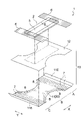
- FIG. 3 is an exploded perspective view schematically showing the diaper shown in FIG. 1 in an exploded manner.
- FIG. 4 is a vertical cross-sectional view schematically showing an I-I line cross section (cross section along the vertical direction) of FIG. 2.
- FIG. 5 is a partially broken perspective view schematically showing an example of the elastic sheet according to the present invention.
- FIG. 6 is a vertical cross-sectional view schematically showing a state in which folds are formed in a part (low stress portion) of the exterior body shown in FIG.
- FIG. 7 is a view corresponding to FIG. 4 of another embodiment of the pants-type absorbent article of the present invention.
- an object of the present invention relates to providing a pants-type absorbent article capable of smoothly performing a pulling operation when worn.
- the pants-type absorbent article of the present invention has a vertical direction (direction indicated by reference numeral "X” in the figure) corresponding to the front-back direction of the wearer, that is, a direction extending from the ventral side to the back side via the crotch portion, and the vertical direction. It has a lateral direction (direction indicated by reference numeral “Y” in the figure) orthogonal to the direction.
- the vertical direction is the vertical direction of the absorbent article or the direction along the vertical direction of its constituent members (for example, an absorber), and the horizontal direction is the horizontal direction of the absorbent article or its constituents. This is the direction along the lateral direction of the constituent members.
- the pants-type absorbent article of the present invention comprises an absorbent body (member indicated by reference numeral “2" in the figure) including an absorbent body (member indicated by reference numeral “4" in the figure) and a non-skin facing surface of the absorbent body. It is provided with an exterior body (member indicated by reference numeral “10” in the figure) including an elastic sheet (member indicated by reference numeral “20” in the drawing) which is arranged on the side and has elasticity in the lateral direction.
- the "skin facing surface” is a surface of the absorbent article or a component thereof (for example, an absorbent main body) that is directed toward the skin side of the wearer when the absorbent article is worn, that is, relatively of the wearer.
- the "non-skin facing surface” is the surface of the absorbent article or its constituents that faces the opposite side of the skin when the absorbent article is worn, that is, relatively from the wearer's skin.
- the distant side means a state in which the normal proper wearing position, that is, the correct wearing position of the absorbent article is maintained.
- both side edges of the front body (the part indicated by the reference numeral “F” in the figure) and the rear body (the portion indicated by the reference numeral "R” in the figure) along the vertical direction of each exterior body are connected to each other.
- FIG. 1 to 4 show a pants-type disposable diaper 1 which is an embodiment of the pants-type absorbent article of the present invention, and the diaper 1 has the above-mentioned configuration.
- the front body F is the ventral side of the wearer's body when worn, with reference to the vertical center line CLx that bisects the unfolded and stretched diaper 1 in the vertical direction X and extends in the horizontal direction Y as shown in FIG.
- the rear body R is a portion that covers the back side (rear side) of the wearer's body.
- the "expanded and extended state" as used herein means that the diaper 1 is separated by the side joint S to be in the expanded state, and the diaper 1 in the expanded state is extended with the elastic members of each part to have design dimensions (the influence of the elastic members is completely affected). It means the state of being expanded until it becomes the same as the dimensions when it is expanded in a plane with it removed.
- the means for joining the exterior bodies 10 to each other in the side joint portion S is not particularly limited, and examples thereof include fusion, adhesive, sewing, etc., depending on the use of the pants-type absorbent article, the material of the exterior body 19, and the like. It can be selected arbitrarily.
- the means of joining the exterior bodies 10 to each other in the side joint portion S of the pants-type disposable diaper is fusion and / or adhesive, and the joining of the exterior bodies 10 to each other in the side joint portion S of the pants-type sanitary shorts.
- the means is sewing.
- the side joint portion S of the present embodiment is a so-called side seal portion in which both side edge portions 10S along the vertical direction X of the exterior body 10 are joined by fusion, and as shown in FIG. 1, the side joint portion S is outward from the peripheral portion. It stands out.
- the diaper 1 of the present embodiment is located between the ventral portion A arranged on the ventral side of the wearer and the dorsal portion C arranged on the dorsal side when worn. It is divided into a crotch part B arranged in the crotch part of the wearer.
- the ventral part A is a part of the front body F
- the dorsal part C is a part of the back body R.
- the inseam B straddles the vertical center line CLx in the vertical direction X, and exists from the front body F to the back body R.
- the ventral portion A and the dorsal portion C are typically portions that are co-located with the side junction S in the longitudinal direction X, respectively.
- the inseam B typically includes a region where leg openings LS, LS, which are constrictions for forming leg openings LH, LH, are formed on both side edges 10S along the longitudinal direction X of the exterior body 10.
- the diaper 1 includes an excretion portion facing portion which is arranged to face the excretion portion such as the wearer's penis when the diaper 1 is worn.
- the ventral portion A, the inseam B, and the dorsal portion C can be each region when the unfolded and extended diaper 1 is divided into three equal parts in the vertical direction X.
- the ventral portion A and the dorsal portion C are the iliac region D2 corresponding to the site from the iliac crest to the superior anterior iliac crest of the wearer, respectively, and the iliac region D2.
- the iliac crest and the anterior superior iliac spine as used herein are anatomical terms.
- the waist region D1 is located on the outermost side of the vertical direction X of each of the ventral side portion A and the dorsal side portion C, and includes the vertical end 1E which is one of both ends of the vertical direction X of the diaper 1.
- the vertical end 1E of the diaper 1 is also the vertical end of the exterior body 10.
- the waist region D1, the iliac region D2, and the waist circumference region D3 have the ventral side A or the dorsal side C (the portion at the same position as the side seal portion S in the vertical direction X) in the vertical direction X. It can be each area when divided into equal parts.
- the ventral portion A and the dorsal portion C are basically configured in the same manner, and the description of either one is applied to the other unless otherwise specified.
- the absorbent main body 2 has a rectangular shape in a plan view as shown by the outline in FIG. 2, and the longitudinal direction thereof coincides with the vertical direction X of the diaper 1 so that the exterior body 10 has a rectangular shape. It is arranged in the central portion in the lateral direction Y and extends in the vertical direction X from the ventral side portion A to the dorsal side portion C.
- the absorbent body 2 is bonded to the exterior body 10 with an adhesive.
- the absorbent body 2 includes an absorbent body 4 and a liquid-permeable surface sheet 3 arranged on the skin-facing surface side of the absorbent body 4.
- the absorbent body 4 contains at least an absorbent core mainly composed of a water-absorbent material such as wood pulp or a water-absorbent polymer, and further, as a liquid-permeable core wrap sheet covering the outer surface of the absorbent core, paper or non-woven fabric. Etc. may be included. Further, as a constituent member of the absorbent main body 2, the non-skin facing surface side of the absorbent body 4, more specifically, with reference to FIG. 4, between the absorbent body 4 and the exterior body 10 (inner layer sheet 12 described later). , A liquid-impermeable or impermeable or water-repellent (that is, leak-proof) back sheet may be arranged.
- constituent members of the absorbent main body 2 those normally used in this kind of absorbent article can be used without particular limitation.
- the surface sheet 3 various non-woven fabrics, perforated films, and the like can be used.
- the back sheet a resin film, a laminate of the resin film and a non-woven fabric, or the like can be used.
- the constituent members of the absorbent main body 2 are integrated with each other by a known joining means such as an adhesive.
- the absorbent body 2 is composed of liquid-resistant or water-repellent and breathable leak-proof cuff forming sheets 50 on both sides along the vertical direction X on the skin-facing surface (surface sheet 3 side).
- a pair of leak-proof cuffs 5 and 5 are provided.
- One or a plurality of thread-shaped elastic members 51 for forming a leak-proof cuff are fixed to the free end of each leak-proof cuff 5 so as to be extendable in the vertical direction X.
- the leak-proof cuff 5 stands up on the wearer's skin side at least at the inseam B due to the contraction of the elastic member 51, whereby the outflow of body fluid in the lateral direction Y is prevented.
- both ends of the absorbent body 2 in the vertical direction X on the skin-facing surface (surface sheet 3 side) are covered with the cover sheet 6 together with the leakage-proof cuff 5.
- the cover sheet 6 straddles the vertical end of the absorbent body 2 in the ventral side A or the dorsal side C in the vertical direction X, and extends over the entire length of the diaper 1 (exterior body 10) in the horizontal direction Y. ..
- the cover sheet 6 plays a role of preventing the water-absorbent material such as a water-absorbent polymer from falling off from the absorbent body 4, absorbing body fluids such as sweat of the wearer, and is made of a liquid-permeable sheet such as a non-woven fabric or paper.
- the pants-type absorbent article of the present invention may not be provided with the leak-proof cuff 5 and the cover sheet 6.
- the exterior body 10 is arranged at a position relatively far from the absorbent body 4, and is arranged at a position relatively close to the outer layer sheet 11 forming the outer surface of the diaper 1 and the absorbent body 4, and the diaper 1 is arranged. It is configured to include an inner layer sheet 12 forming an inner surface of the above.
- the outer layer sheet 11 and the inner layer sheet 12 are joined to each other and integrated via a joining means such as an adhesive.
- the outer layer sheet 11 and the inner layer sheet 12 may be the same type of sheet or different types of sheets.
- the "same type of sheet” means sheets having the same sheet manufacturing process, type of sheet constituent fibers, fiber diameter and length of constituent fibers, sheet thickness, basis weight, etc. do.
- the exterior body 10 has a larger area than the absorbent main body 2 and extends outward from the peripheral edge of the absorbent main body 2.
- the portion corresponding to the lower crotch B (the central region of the vertical direction X) is curved in a convex arc shape toward the center of the horizontal direction Y in the deployed and extended state of the diaper 1 as shown in FIG.
- the portion corresponding to the ventral side A and the dorsal side C (the end region of the vertical direction X) has a rectangular shape in which the length of the horizontal direction Y is longer than that of the vertical direction X, and the exterior is
- the whole body 10 has an hourglass shape.
- the outer layer sheet 11 has a length in the vertical direction X longer than that of the inner layer sheet 12, and has an extension portion 11E extending from the vertical end of the inner layer sheet 12, and the extension portion 11E is as shown in FIG.
- the outer layer sheet 11 is folded back toward the skin-facing surface (inner surface) side.
- the vertical end 1E of the diaper 1 corresponds to the folding curve at the folding of the outer layer sheet 11.
- a two-layer structure of the outer layer sheet 11 is formed by folding back the outer layer sheet 11 at both ends of the exterior body 10 in the vertical direction X.
- the two-layer structure of the outer layer sheet 11 is located in the waist region D1 of each of the ventral side portion A and the dorsal side portion C.
- a plurality of elastic members 7 for forming gathers around the waist are provided in the portions of the exterior body 10 corresponding to the ventral side A and the dorsal side C (waist region D1, ilium region D2, waist circumference region D3). It is arranged so that it can be expanded and contracted in the horizontal direction Y.
- the plurality of elastic members 7 are fixed by an adhesive in an elongated state in the horizontal direction Y between the outer layer sheet 11 and the inner layer sheet 12 constituting the exterior body 10, and are intermittently arranged in the vertical direction X.
- the elastic member 8 is extensiblely fixed between the outer layer sheet 11 and the inner layer sheet 12 by an adhesive.
- a plurality of folds extending in a direction intersecting the contraction direction of the elastic member 8 on the portion constituting the opening edge portion of the leg opening LH in the exterior body 10 due to the contraction of the elastic member 8 ( Gathers) are formed, thereby forming annular leg gathers in which the folds are substantially continuous over the entire circumference of the opening edge of the leg opening LH.
- various known elastic materials usually used for this kind of absorbent article can be used without particular limitation as the materials of various elastic members in the diaper 1, including the elastic members 7 and 8.
- examples thereof include synthetic rubbers such as styrene-butadiene, butadiene, isoprene and neoprene, natural rubbers, EVA, elastic polyolefins and polyurethanes.
- a thread-like (thread rubber, etc.) or string-like (flat rubber, etc.) having a rectangular, square, circular, or polygonal cross section, or a multifilament type thread-like member is preferably used. can.
- the exterior body 10 includes a stretchable sheet having elasticity in the lateral direction Y.
- the stretchable sheet preferably has a maximum elongation of 50% or more in the lateral direction Y, and the elongation recovery rate (that is, 100%) when the sheet is stretched to 100% elongation in the lateral direction and then contracted.
- the elongation recovery rate at the time of elongation) is preferably at least 70% or more.
- the stretchable sheet has a higher maximum elongation and a higher elongation recovery rate in the horizontal direction Y than in the vertical direction X.
- the stretchable sheet preferably has a maximum elongation of 50% or more and an elongation recovery rate of 70% or more in the lateral direction Y and contracts after elongation, but contracts after elongation in the vertical direction X. do not do.
- the elongation recovery rate of the sheet is measured by the following measuring method.
- ⁇ Measurement method of elongation recovery rate Prepare a sample piece having a length of 50 mm and a width of 25 mm from the sheet (expandable sheet) to be measured. A sample piece is fixed between chucks (chuck interval K0) of a tensile tester (“Tencilon” RTC-1150A manufactured by Orientec Co., Ltd.) in a non-stretchable and slack state, and the chuck spacing is expanded at a tensile speed of 300 mm / min.
- a tensile tester (“Tencilon” RTC-1150A manufactured by Orientec Co., Ltd.
- the elastic sheet examples include (1) an elastic non-woven fabric in which an extendable fiber layer is integrated on both sides or one side of an elastic fiber layer, and (2) a fiber that can be extended on both sides or one side of a net-like elastic sheet.
- Stretchable non-woven fabric with integrated layers (3) Elastic non-woven fabric with stretchable fiber layers integrated on both sides or one side of an elastic sheet made of elastic film, (4) One-way without crossing each other
- a stretchable nonwoven fabric or the like in which a large number of elastic filaments arranged so as to extend to the stretchable fiber layer are bonded to an stretchable fiber layer over the entire length thereof in a substantially non-stretchable state can be preferably used.
- the "extensible fiber layer” referred to here is defined as a fiber layer that can be stretched before being integrated with an elastic material, and can be stretched by machining or the like after being integrated with an elastic material. Includes a fibrous layer.
- a method of integrating the elastic fiber layer and the stretchable fiber layer for example, a method of laminating them and entwining the fibers by water flow entanglement or air through, a method of joining by heat embossing, an adhesive, ultrasonic waves or the like. Can be mentioned.
- FIG. 5 shows an elastic sheet 20 which is an example of the elastic sheet.
- the elastic sheet 20 corresponds to the elastic nonwoven fabric of (4) above.
- the elastic sheet 20 includes a fiber layer that can be extended in the lateral direction Y and a plurality of elastic filaments 23 that are joined to one surface of the fiber layer and extend in the lateral direction Y.
- the fiber layer includes two fiber sheets 21 and 22 facing each other, and a plurality of elastic filaments 23 are interposed and arranged between the fiber sheets 21 and 22.
- the stretchable sheet 20 can be manufactured, for example, according to the method described in JP-A-2009-61743.
- the elastic filaments 23 do not intersect each other before solidification. After the elastic filaments 23 are fused to the fiber sheets 21 and 22 so as to be arranged in the direction, both sheets 21 and 22 to which the elastic filaments 23 are fused are stretched along the extending direction of the elastic filaments 23. Thereby, the elastic sheet 20 can be manufactured.
- the entire stretchable sheet 20 has elasticity in the lateral direction Y.
- the pitch P (see FIG. 5) of the elastic filament 23 that imparts elasticity to the elastic sheet 20 in the lateral direction Y is relatively short, and the plurality of elastic filaments 23 are relatively high in the vertical direction X.
- the elastic filaments 23 are arranged in a density, and the entire elastic sheet 20 has elasticity in the lateral direction Y due to the arrangement of the elastic filaments 23.
- the pitch P of the elastic filament 23, that is, the distance P between the centers of any two elastic filaments 23, 23 adjacent to each other in the vertical direction X is preferably 3 mm or less from the viewpoint of imparting elasticity to the entire elastic sheet 20. More preferably, it is 2 mm or less.
- the lower limit of the pitch P of the elastic filament 23 is not particularly limited, but is preferably 0.5 mm or more, more preferably 1 mm or more.
- Both of the two fiber sheets 21 and 22 constituting the elastic sheet 20 can be extended in the same direction as the elastic filament 23 extends (horizontal direction Y).
- the "extensible” here means that (a) the constituent fibers of the fiber sheets 21 and 22 are elongated, and (b) the constituent fibers themselves are not elongated, but the fibers bonded at the intersections are connected to each other. This includes cases where the three-dimensional structure formed by a plurality of fibers is structurally changed due to separation, the fibers are bonded to each other, or the constituent fibers are torn off, and the fiber sheets 21 and 22 are elongated as a whole. ..
- the elastic filament 23 is formed by stretching an elastic resin in a molten or softened state.
- Each of the plurality of elastic filaments 23 is continuously arranged over the entire length of the elastic sheet 20 in the lateral direction Y.
- the plurality of elastic filaments 23 are arranged so as to extend in one direction (horizontal direction Y) without intersecting each other.
- the elastic filament 23 is bonded to the two sheets 21 and 22 in a substantially non-stretched state.
- the elastic filament 23 and the fiber sheets 21 and 22 are joined by fusing to the elastic filament 23 in a state where the constituent fibers (non-elastic fibers) of both sheets 21 and 22 are embedded in the elastic filament 23. It is not made by using an adhesive such as a hot melt type adhesive. Therefore, there is no adhesive between the fiber sheets 21 and 22 (extensible fiber layer mainly composed of inelastic fibers) and the elastic filament 23 bonded to the fiber sheets 21 and 22.
- the elastic sheet 20 can be expanded and contracted in the same direction as the elastic filament 23 extends (horizontal direction Y).
- the elasticity of the elastic sheet 20 is exhibited due to the elasticity of the elastic filament 23.
- the elastic sheet 20 is stretched in the same direction as the elastic filament 23 extends, the elastic filament 23 and the fiber sheets 21 and 22 are stretched.
- the stretchable sheet 20 is released from stretching, the elastic filament 23 contracts, and the fiber sheets 21 and 22 return to the state before stretching as the stretchable sheet 20 shrinks.
- the fiber sheets 21 and 22 are stretched along the extending direction of the elastic filament 23 at the time of manufacture, so that the bonds between the fibers of both sheets 21 and 22 are partially broken.
- the stretchable sheets 21 and 22 are provided with stretch margins, so that when the stretchable sheet 20 is stretched in the extending direction (horizontal direction Y) of the elastic filament 23, the stretchable sheet 20 shrinks in the lateral direction Y. It can be stretched with little so-called width shrinkage.
- the two fiber sheets 21 and 22 constituting the elastic sheet 20 may be short fiber non-woven fabrics, respectively.
- the non-woven fabric include air-through non-woven fabric, heat roll non-woven fabric, spunlace non-woven fabric, spunbond non-woven fabric, melt blown non-woven fabric and the like. Both sheets 21 and 22 may be of the same type or different from each other.
- the elastic filament 23 constituting the elastic sheet 20 is made of, for example, a thermoplastic elastomer, rubber, or the like. In particular, when a thermoplastic elastomer is used as a raw material, melt spinning using an extruder is possible as in the case of a normal thermoplastic resin, and the elastic filament thus obtained is easily heat-fused, so that it is an elastic sheet. 20 is suitable.
- thermoplastic elastomer examples include styrene such as SBS (styrene-butadiene-styrene), SIS (styrene-isoprene-styrene), SEBS (styrene-ethylene-butadiene-styrene), and SEPS (styrene-ethylene-propylene-styrene).
- SBS styrene-butadiene-styrene
- SIS styrene-isoprene-styrene
- SEBS styrene-ethylene-butadiene-styrene
- SEPS styrene-ethylene-propylene-styrene
- Examples thereof include olefin-based elastomers (ethylene-based ⁇ -olefin elastomers, styrene-based elastomers obtained by copolymerizing ethylene, butene, octene, etc.), polyester-based elastomers, polyurethane-based elastomers, etc., and one of these may be used alone or. Two or more types can be used in combination. Further, a core-sheath type or side-by-side type composite fiber made of these resins can also be used.
- the outer layer sheet 11 is composed of the elastic sheet 20, and the outer layer sheet 11 as a whole has elasticity in the lateral direction Y.
- the outer layer sheet 11 may include a sheet other than the elastic sheet, such as the elastic sheet 20, on the premise that the entire outer layer sheet 11 has elasticity in the lateral direction Y.
- the inner layer sheet 12 does not have elasticity and is non-stretchable.
- the non-stretchable inner layer sheet 12 breaks before the elongation recovery rate measured by the above ⁇ measurement method for elongation recovery rate> is 20% or less or 100% elongation.
- the inner layer sheet 12 non-stretchable sheet
- a nonwoven fabric produced by various manufacturing methods can be used, and examples thereof include a spunbonded nonwoven fabric, an air-through nonwoven fabric, and a needle punched nonwoven fabric.
- the inner layer sheet 12 may have a single-layer structure or a laminated structure in which two or more sheets (nonwoven fabrics) are laminated, and is typically a single-layer structure.
- the basis weight of the outer layer sheet 11 (when the outer layer sheet 11 has a laminated structure, the basis weight of the laminated structure) is not particularly limited, but is preferably 20 g / m 2 or more, more preferably 30 g / m 2 or more, and preferably. Is 60 g / m 2 or less, more preferably 55 g / m 2 or less.
- the basis weight of the inner layer sheet 12 (when the inner layer sheet 12 has a laminated structure, the basis weight of the laminated structure) is not particularly limited, but is preferably 13 g / m 2 or more, more preferably 15 g / m 2 or more, and preferably. Is 30 g / m 2 or less, more preferably 25 g / m 2 or less.
- the exterior body 10 has a low stress portion 15 having a relatively low lateral Y extension stress and a low stress portion 15 at least on the front body F. It has a pair of high stress portions 16 and 17 which are arranged adjacent to the low stress portion 15 on both sides of the vertical direction X and have a relatively high elongation stress in the lateral direction Y, and the pair of high stress portions.
- the portions 16 and 17 are located inward in the vertical direction X (closer to the lower crotch B) than the first high stress portion 16 including the vertical end 1E defining the waist opening WH of the diaper 1 and the low stress portion 15.
- a point having a second high stress portion 17 located there can be mentioned.
- the exterior body 10 faces the rear body R as well as the front body F from the vertical end 1E of the diaper 1 toward the inside of the vertical direction X (inseam B).
- the first high-stress portion 16, the low-stress portion 15, and the second high-stress portion 17 are provided in this order.
- the elongation stress is measured by the following method.
- the pants-type absorbent article to be measured is the above-mentioned diaper 1
- the exterior bodies 10 joined by the side joint portion S are peeled off, the diaper 1 is expanded and expanded in a plane, and the measurement target region (low stress portion) is formed along a straight line parallel to the lateral direction Y of the diaper 1. 15.
- High-stress parts 16, 17) are cut out and used as measurement samples. At the time of this cutting, not only the exterior body 10 but also the entire diaper 1 including the absorbent main body 2 and the like is cut.
- Both ends of the measurement sample in the longitudinal direction (horizontal direction Y) (immediately inside the side seal portion S) are sandwiched between chucks of a Tensilon universal tester (RTC-1210A) manufactured by ORIENTEC Co., Ltd., and the measurement sample is placed at 300 mm / min. Elongate in the longitudinal direction at the speed of, and measure the stress (elongation stress) of the measurement sample at that time.
- the inner dimensions of the exterior body 10, more specifically, between the pair of side seal portions S, S in a state where the sheets 11 and 12 constituting the exterior body 10 by the elastic member 7 are not contracted.
- the elongation stress of the measurement sample is calculated as the average elongation stress by converting it into the length of the measurement target region in the longitudinal direction (horizontal direction Y).
- the reason why the return force at the length equivalent to 71 when the inner dimension of the exterior body is 100 is specified as the stress of the measurement sample is around the abdomen of the main infant wearing a diaper such as diaper 1.
- the length of the diaper is about 71% of the inner size of the diaper.
- the length around the abdomen referred to here is an average value around the abdomen measured in a standing position and a sitting position in consideration of the change in the circumference of the abdomen when the posture of the infant changes.
- the boundary in the vertical direction X between the portions of the exterior body 10 having different lateral Y elongation stresses, such as the first high stress portion 16, the low stress portion 15, and the second high stress portion 17, is determined by the following procedure. Will be done.
- the diaper 1 not only the exterior body 10 but also the entire diaper 1 including the absorbent main body 2 and the like are cut.
- the elastic members included in the plurality of measurement samples prepared from the regions. Make sure the number of 7s is the same.
- the elongation stress (unit: cN / 10 mm) of each measurement sample is measured by a method according to the above ⁇ Measurement method of elongation stress>.
- the measured values of elongation stress are compared between two measurement samples adjacent to each other in the vertical direction X, and if one measurement value is less than ⁇ 10% of that of the other, the two measurement samples are used.
- the two measurement samples have different elongation stresses (to different stress parts). To belong). For example, if the measured value of the elongation stress of one of the two measurement samples to be compared is 10 cN / 10 mm, and the other is 9 cN / 10 mm or less or 11 cN / 10 mm or more, the two measurement samples are It is determined that the elongation stresses are different from each other, and the boundary between the two measurement samples is defined as the boundary between the stress portions different from each other.
- the diaper 1 can be divided into a plurality of diapers 1 in the vertical direction X according to the elongation stress in the horizontal direction Y.
- Each category is a stress section such as the first high stress section 16, the low stress section 15, and the second high stress section 17.
- the lateral Y extension stress in the exterior body 10 correlates with the degree of tightening of the diaper 1 on the wearer's body, and the larger the lateral Y extension stress, the stronger the tightening. Therefore, as described above in the exterior body 10, the low stress portion 15 having a relatively low elongation stress is interposed between the pair of high stress portions 16 and 17 having a relatively high elongation stress in the lateral direction Y. If so, the low-stress portion 15, which is weaker in tightening than the peripheral portions (high-stress portions 16 and 17), is easily deformed, and as a result, as shown in FIG.
- the exterior body 10 including the low-stress portion 15 protrudes and deforms to the outside of the diaper 1 from the peripheral portion to form the folds 18.
- the fold 18 includes at least the low stress portion 15, and further, the portion near the low stress portion 15, that is, the portion closer to the low stress portion 15 in the first high stress portion 16 and / or the low stress portion 15 in the second high stress portion 17. It may include a closer part.
- the folds 18 are suitable for being grasped by fingers in the pulling operation when wearing the diaper 1, and the folds 18 of the diaper 1 are from a state in which both feet are passed through the pair of leg openings LH and LH of the diaper 1.
- the waist region D1 is located outside the vertical direction X from the vertical end 4E, which is the outermost end of the vertical direction X of the absorber 4, and the waist region D1 is located.
- the absorber 4 is not arranged in D1, and the low stress portion 15 is continuous over substantially the entire length in the circumferential direction of the waist region D1, which is such an absorber non-arranged region. Therefore, in the present embodiment, the folds 18 formed by the protruding deformation of the low stress portion 15 are continuous over substantially the entire length in the circumferential direction of the waist region D1 of the diaper 1, as shown in FIG.
- the folds 18 may be 1) always formed, or 2) formed only when the specific conditions are satisfied, and may disappear when the specific conditions are not satisfied. Even in the case of 1) above, when the specific condition is satisfied, the size of the fold 18 is larger than that when the specific condition is not satisfied, and the protrusion deformation of a part of the exterior body 10 including the low stress portion 15 is deformed. Differences such as a large degree can be seen.
- the frictional force acts on the region (the surface of the waist region D1) including the low stress portion 15 in the exterior body 10. Such frictional force is generated, for example, during the pulling operation of the diaper 1 toward the crotch portion when the diaper 1 is worn.
- a person who intends to wear the diaper 1 holds the appropriate part of the diaper 1 with his / her fingers from the state where both feet are passed through the pair of leg openings LH and LH of the diaper 1 in a standing posture, and the crotch side.
- the folds 18 are formed during the pulling operation of the diaper 1, disappear when the pulling operation is completed, and are not formed while the diaper 1 is being worn.
- the folds 18 are 1) or 2) is appropriately adjusted by adjusting the difference in elongation stress between the low stress portions 15 and the high stress portions 16, 17 and the rigidity of the stress portions 15, 16 and 17. It can be adjusted by doing.
- the low stress portion 15 and the high stress portions 16 and 17 is synonymous with the difference in frictional force.
- the ratio of the lateral Y elongation stress of the first high stress portion 16 or the second high stress portion 17 to the lateral Y elongation stress of the low stress portion 15 is preferably the former / the latter on the premise of the former> the latter. Is 1.1 or more, more preferably 1.5 or more, and preferably 3.0 or less, more preferably 2.0 or less.
- the first high-stress portion 16 and the second high-stress portion 17 may have the same extension stress in the lateral direction or may be different from each other, but if they are different, the relatively lower lateral direction may occur. It is preferable that the ratio of the elongation stress of Y to the elongation stress of the low stress portion 15 in the lateral direction Y is in the above range.
- the lateral extension stress of the low stress portion 15 is lower than that of the high stress portions 16 and 17, but it is preferably not zero. If the lateral extension stress of the low stress portion 15 in the lateral direction is zero, the low stress portion 15 does not tighten the wearer's body, and the diaper 1 may slip off during wearing. Because there is. Assuming that the lateral Y elongation stress of the low stress portion 15 is lower than that of the high stress portions 16 and 17, it is preferably 0.005 N / mm or more, more preferably 0.010 N / mm or more, and preferably 0.010 N / mm or more. Is 0.044 N / mm or less, more preferably 0.040 N / mm or less.
- the elongation stress in the lateral direction Y of the first high-stress portion 16 is preferably higher than that of the low-stress portion 15. Is 0.010 N / mm or more, more preferably 0.020 N / mm or more, and preferably 0.088 N / mm or less, more preferably 0.080 N / mm or less.
- the elongation stress in the lateral direction Y of the second high-stress portion 17 may be the same as or different from that of the first high-stress portion 16. Often, the latter case may be higher or lower than that of the first high stress section 16. From the viewpoint of preventing the diaper 1 from slipping off while wearing the diaper 1 while reliably forming the folds 18 in the low stress portion 15, the lateral Y extension stress of the second high stress portion 17 is the extension stress of the first high stress portion 16. It is preferably higher than that.
- the ratio of the lateral Y elongation stress of the second high stress portion 17 to the lateral Y elongation stress of the first high stress portion 16 is preferably 1.5 or more as the former / the latter, assuming the former> the latter. , More preferably 2.0 or more, and preferably 3.0 or less, more preferably 2.5 or less.
- the lateral extension stress of the second high stress portion 17 is higher than that of the low stress portion 15 and the first high stress portion 16, it is preferably 0.015 N / mm or more, more preferably 0. It is 030 N / mm or more, preferably 0.200 N / mm or less, and more preferably 0.100 N / mm or less.
- the elongation stress of each of the low stress portion 15 and the high stress portions 16 and 17 in the lateral direction Y contributes to the development of elasticity of the constituent members of the relevant portion such as an elastic member (elastic filament) and a sheet, particularly in the lateral direction Y. It can be adjusted by appropriately adjusting the composition and arrangement of the members (hereinafter, also referred to as “elastic members”).
- the elastic member includes an elastic member
- the lateral extension stress of the portion can be adjusted by appropriately adjusting the number, thickness, pitch, and the like of the elastic member.
- the low stress portion 15 has a laminated structure of an outer layer sheet 11 made of an elastic sheet 20 and a non-stretchable inner layer sheet 12, and is elastic between both sheets 11 and 12.
- the members are not interveningly arranged. That is, in the low stress portion 15, the elastic member is only one elastic sheet 20 (one layer).
- the first high-stress portion 16 includes a two-layer structure of the stretchable sheet 20 by folding back the stretchable sheet 20, and the stretchable member is compared with the low-stress portion 15 in which the stretchable sheet 20 has only one layer. There are many. Therefore, the first high stress portion 16 has a higher elongation stress in the lateral direction than the low stress portion 15. Further, the first high stress portion 16 includes the two-layer structure, but is an elastic member extensiblely fixed to the surface (skin facing surface, non-skin facing surface) of the exterior body 10 (outer layer sheet 11, inner layer sheet 12). (So-called elastic member for forming gathers) is not included.
- the elastic member for forming gathers When such an elastic member for forming gathers is arranged on the exterior body 10, there is a concern that the elastic member excessively tightens the wearer's body and the wearer's body is marked with the tightening mark (so-called rubber mark).
- the first high stress portion 16 since the first high stress portion 16 is configured not to include the elastic member for forming gathers, such a concern is dispelled.
- the first high-stress portion 16 also does not include the elastic member fixed to the surface of the exterior body 10 in an extended state like the low-stress portion 15, and the above-mentioned concern is dispelled.
- the second high stress portion 17 is extensiblely fixed to one (one layer) elastic sheet 20 (outer layer sheet 11) and the surface of the sheet 20 (skin facing surface) as the elastic member. It includes a plurality of elastic members 7. With such a configuration, the second high stress portion 17 has at least a higher elongation stress in the lateral direction than the low stress portion 15 that does not include the elastic member 7. Further, regarding the comparison with the first high stress portion 16, it depends on the elongation ratio, pitch, thickness, number of arrangements, etc. of the elastic member 7 arranged in the second high stress portion 17, but as shown in FIG.
- the elastic member for forming gathers such as the elastic member 7 is not arranged in the first high stress portion 16
- the elastic member 7 is typically fixed to the surface of the one-layer elastic sheet 20 so as to be extensible.
- the second high-stress portion 17 having the above-mentioned structure has a higher elongation stress in the lateral direction Y than the first high-stress portion 16 including the two-layer structure of the elastic sheet 20 but not including the elastic member 7.
- the elongation ratio, pitch, etc. of the elastic member 7 of the second high stress portion 17 will be referred to in the description of another embodiment (diaper 1A) described later.
- the second high stress portion 17 exists in the region 17A that overlaps with the absorber 4 in a plan view (projection view in the thickness direction). More specifically, the second high-stress portion 17 has a larger area than the absorber 4 (absorbent body 2), and has a region 17A that overlaps with the absorber 4 (absorbent body 2) in a plan view, and the absorber 4 (absorbent body 4). A region 17B that does not overlap with the absorbent body 2) is included, and the region 17B is adjacent to the low stress portion 15 in the vertical direction X.
- the region 17A is present in the iliac region D2 and the waist circumference region D3, and the region 17B is present in the waist region D1 and the iliac region D2.
- the second high-stress portion 17 may have a form in which only the region 17A is formed and does not include the region 17B, that is, a form in which the entire second high-stress portion 17 overlaps with the absorber 4 in a plan view.
- the absorber 4 is a member having particularly high rigidity among the constituent members of the diaper 1, the region of the exterior body 10 (outer layer sheet 11, inner layer sheet 12) that overlaps with the absorber 4 in a plan view is the absorber 4. Compared to the non-overlapping region, it is less likely to be deformed due to the influence of the highly rigid absorber 4, and it is difficult to form a deformed portion of the exterior body 10 such as the folds 18. Therefore, it is difficult for the folds 18 to be formed in the region 17A of the second high stress portion 17 that overlaps with the absorber 4 in a plan view even during the pulling operation when the diaper 1 is attached.
- the low stress portion 15 is provided by providing the second high stress portion 17 with a region 17A that overlaps with the absorber 4 in a plan view and intentionally inhibiting the formation of the folds 18 in the second high stress portion 17. It becomes easy to selectively form the folds 18 only, and the inconvenience of forming the folds 18 in a portion other than the low stress portion 15 is effectively prevented. If the folds 18 are formed not only on the low-stress portion 15 but also on the high-stress portions 16 and 17, the tightening of the ventral portion A and the dorsal portion C to the wearer is weak, and the diaper 1 becomes loose.
- the low stress portion 15 exists outside the vertical direction X with respect to the vertical end 4E of the absorber 4. That is, the low stress portion 15 exists in a region that does not overlap with the absorber 4 in a plan view and is located outside the vertical direction X than the absorber 4 (a position closer to the vertical end 1E of the diaper 1 than the absorber 4). ..
- the diaper 1 is vertically located with respect to the vertical end 4E of the absorber 4, which is an appropriate position for gripping with the fingers when pulling the diaper 1 toward the crotch side of the wearer.
- the formation of the folds 18 at the outer position of the direction X is promoted, and the wearing operation of the diaper 1 can be performed more smoothly.
- the first high-stress portion 16 preferably has higher rigidity than the low-stress portion 15.
- the formation of folds 18 in the first high stress portion 16 is hindered, and it becomes easy to selectively form folds 18 only in the low stress portion 15.
- the second high stress portion 17 exists in the region overlapping the absorber 4 in a plan view as described above, the folds 18 are formed only in the low stress portion 15 and are low.
- the rigidity of each part of the diaper 1 can be indexed by the ring crush compressive strength measured by the following method. It can be evaluated that the larger the value of the ring crush compressive strength (unit: N / 30 mm), the higher the rigidity of the portion.
- the pants-type absorbent article to be measured is the above-mentioned diaper 1
- the exterior bodies 10 joined by the side joints S are peeled off, the diaper 1 is unfolded and spread in a plane, and the ring crush compression strength measurement target portion, for example, each of the stress portions 15, 16, 17 described above.
- the length of the diaper 1 in the lateral direction Y is 150 mm, and the length is 150 mm in the vertical direction X (the direction orthogonal to the expansion / contraction direction).
- a rectangular shape in a plan view having a length of 30 mm in the extended state is cut out and used as a test piece. If it is difficult to produce a rectangular test piece having such a size in a plan view because the size of the pants-type absorbent article to be measured is relatively small, the length in the longitudinal direction: the lateral direction
- Each of the test pieces is rolled so that the longitudinal direction of the test piece is the circumferential direction, and the overlapping portion of both ends of the test piece in the longitudinal direction is stretched until the length in the circumferential direction is 5 mm.
- a cylindrical measurement sample is prepared by fastening with a staple such as a 10-1M needle. The direction of the staples should be parallel to the circumferential direction.
- Each of the prepared cylindrical measurement samples is set up in a compression tester such as "RTA-100" manufactured by Orientec Co., Ltd.
- the measurement sample is compressed at a compression rate of 10 mm / min in the axial direction of the cylinder by a circular compression plate having a diameter of 70 mm or more, and the maximum load (N / 30 mm) shown at the time of compression is recorded.
- Five measurement samples are prepared for one type of measurement sample (for example, the measurement sample of the first high stress section 16), the maximum load of each is measured, and the arithmetic mean value of them is used as the ring crush compressive strength of the measurement target site. Let it be the value of.
- the ratio of the rigidity of the first high stress portion 16 to the rigidity of the low stress portion 15 is preferably the former / the latter on the premise that the former> the latter when the ring crush compressive strength is used as an index of the rigidity. Is 1.1 or more, more preferably 1.2 or more, and preferably 3.0 or less, more preferably 2.0 or less.
- the rigidity of the first high stress portion 16 is higher than that of the low stress portion 15, the rigidity is preferably 2.0 cN or more, more preferably 3.0 cN or more, and preferably 30 cN or less, more preferably 20 cN. It is as follows.
- the rigidity of the low stress portion 15 is preferably 1.0 cN or more, more preferably 2.0 cN or more, and preferably 25 cN or less, more preferably 15 cN, on the premise that the rigidity of the low stress portion 15 is lower than that of the first high stress portion 16. It is as follows.
- the first The high-stress portion 16 is the ratio of the squeezed portion to the total area of the portion (stress portion 15 or 16 or 17) as compared with the low-stress portion 15 and the second high-stress portion 17 (hereinafter, “ It is also preferable that the area ratio of the compressed portion is high.
- the portion of the work piece (exterior body 10) that has been squeezed (squeezed part) is more compacted and has higher rigidity than the part that has not been squeezed, so that the area ratio of the squeezed part is higher. It can be said that the higher the value, the higher the rigidity of the portion. Therefore, with respect to the area ratio of the pressed portion, the magnitude relationship of "first high stress portion 16> low stress portion 15, second high stress portion 17" is established as described above, and the folds in the first high stress portion 16 are established. The formation of 18 is more reliably inhibited, and it becomes easier to selectively form folds 18 only in the low stress portion 15.
- the squeezing process method used in this type of absorbent article can be used without particular limitation, and a method involving melting of the exterior body 10 may be used, or the exterior body 10 may be squeezed. A method that does not involve melting of 10 may be used.
- a method involving melting of the exterior body 10 may be used, or the exterior body 10 may be squeezed.
- a method that does not involve melting of 10 may be used.
- known embossing such as heat-embossing and ultrasonic embossing can be exemplified.
- the area ratio of the pressed portion is measured by the following method.
- the case where the pants-type absorbent article to be measured is the above-mentioned diaper 1 will be described as an example.
- the exterior bodies 10 joined by the side joint S are peeled off, and the measurement is performed among a plurality of compressed portions existing in the measurement target area (for example, the low stress portion 15) in the expanded and extended state as shown in FIG.
- a virtual line passing through the center of gravity of each portion is drawn, and the area S1 of a unit region having a closed shape in a plan view with the virtual line as a contour line is measured.
- the total area S2 of the squeezed portion in the unit region is measured, the ratio of the total area S2 of the squeezed portion to the area S1 of the unit region is calculated, and the squeezed portion of the measurement target region (for example, the low stress portion 15) is calculated.
- Area ratio Area ratio.
- the area ratio of the compressed portion of the first high stress portion 16 is preferably 10% or more, more preferably 15% or more, and more preferably 15% or more, assuming that the area ratio of the compressed portion is higher than that of the low stress portion 15 and the second high stress portion 17. It is preferably 50% or less, more preferably 30% or less.
- the area ratio of the squeezed portion of the second high stress portion 17 is higher than that of the low stress portion 15, but lower than that of the first high stress portion 16, which forms the squeezed portion in the second high stress portion 17.
- the elastic member 7 arranged in the second high stress portion 17 is squeezed to prevent an extreme decrease in stress.
- the area ratio of the pressed portion of the second high stress portion 17 is preferably 8% or more, more preferably 12% or more, and preferably 30% or less, more preferably 25% or less.
- the folds 18 are easily formed in contrast to the high stress portions 16 and 17, so that the area ratio of the pressed portion of the low stress portion 15 is preferably low, preferably 20. % Or less, more preferably 15% or less, and may be zero, i.e. not squeezed at all.
- the low stress portion 15 has a longer length in the vertical direction X than the first high stress portion 16.
- the "length of the vertical direction X" here refers to the length of the vertical direction X in the unfolded and stretched state of the diaper 1 and in the state where the folds 18 are not formed in the low stress portion 15.
- such a magnitude relationship length of the low stress portion 15 in the vertical direction X> length of the first high stress portion 16 in the vertical direction X
- the size of the folds 18 formed on the low stress portion 15 becomes easy to be grasped by fingers and conspicuous, and the diaper 1 wearing operation can be performed more smoothly.
- the ratio of the length of the low stress portion 15 in the vertical direction X to the length of the first high stress portion 16 in the vertical direction is preferably 1.2 or more, more preferably 1.2 or more, as the former / the latter, assuming the former> the latter. It is 1.4 or more, preferably 2.0 or less, and more preferably 1.8 or less.
- the length of the low stress portion 15 in the vertical direction X is preferably 10 mm or more, more preferably 20 mm or more, and preferably 40 mm or less, more preferably 40 mm or less, assuming that the length of the low stress portion 15 is longer than that of the first high stress portion 16. It is 30 mm or less.
- the length of the low stress portion 15 in the vertical direction X is preferably 3% or more, more preferably 5% or more, and preferably 10% or less, more preferably 8 with respect to the total length of the vertical X of the diaper 1. % Or less.
- the length of the first high-stress portion 16 in the vertical direction X is preferably 5 mm or more, more preferably 10 mm or more, and preferably 30 mm or less, more preferably 30 mm or less, on the premise that it is shorter than that of the low-stress portion 15. It is 20 mm or less.
- the length of the first high stress portion 16 in the vertical direction X is preferably 2% or more, more preferably 4% or more, and preferably 8% or less, more preferably the total length of the vertical X of the diaper 1. Is less than 6%.
- FIG. 7 shows a main part of the diaper 1A, which is another embodiment of the pants-type absorbent article of the present invention, specifically, the waist region D1 of the ventral side A and its vicinity.
- the diaper 1A a configuration different from that of the above-mentioned diaper 1 will be mainly described, and the same configuration as the diaper 1 will be designated by the same reference numerals and the description thereof will be omitted.
- the description about the diaper 1 is appropriately applied.
- a plurality of elastic members extensiblely fixed not only to the second high stress portion 17 but also to the low stress portion 15 and the first high stress portion 16 in the lateral direction Y. 7 are intermittently arranged in the vertical direction X.
- the magnitude relation of "high stress parts 16, 17> low stress parts 15" particularly " The magnitude relationship of "second high stress portion 17> first high stress portion 16> low stress portion 15” is established so that the predetermined effect of the present invention caused by the formation of the folds 18 can be more reliably achieved.
- the second high stress portion 17 has a higher elongation ratio of the elastic member 7 than the low stress portion 15.
- the formation of the folds 18 in the low stress portion 15 becomes more reliable, and the inconvenience of forming the folds 18 in the portions other than the low stress portion 15 is prevented. The effect of improving the appearance of 1 and the visibility of the folds 18 can be expected.
- the "elongation ratio of the elastic member” referred to here is an index of the tension of the elastic member 7, and what is the length of the elastic member 7 in the natural state (non-extended state) of 100? % Indicates whether it is elongated. For example, when the elastic member 7 is extensiblely fixed and its length is 120, the elongation ratio is 120%.
- the ratio of the elongation ratio of the elastic member 7 of the second high stress portion 17 to that of the low stress portion 15 is preferably 1.1 or more, more preferably 1.3 or more as the former / the latter on the premise of the former> the latter. , And more preferably 2.0 or less, more preferably 1.7 or less.
- the elongation ratio of the elastic member 7 of the second high stress portion 17 is preferably 200% or more, more preferably 250% or more, and preferably 400% or less, assuming that it is higher than that of the low stress portion 15. More preferably, it is 350% or less.
- the elongation ratio of the elastic member 7 of the low stress portion 15 is preferably 180% or more, more preferably 230% or more, and preferably 350% or less, assuming that it is lower than that of the second high stress portion 17. More preferably, it is 300% or less.
- the elongation ratio of the elastic member 7 of the first high stress portion 16 can be set to the same level as that of the low stress portion 15.
- the second high stress portion 17 has the pitch of the elastic members 7 adjacent to each other in the vertical direction X, that is, the elasticity of any two elastic members adjacent to each other in the vertical direction X, as compared with the low stress portion 15. It is preferable that the distance between the centers of the members 7 and 7 is short. The shorter the pitch of the elastic member 7, the stronger the tightening of the arrangement portion of the elastic member 7 to the wearer of the diaper 1. Therefore, regarding the pitch of the elastic member 7, "second high stress portion 17 ⁇ low stress portion 15". By establishing the magnitude relationship, the formation of the folds 18 in the low stress portion 15 becomes more reliable, and the inconvenience of forming the folds 18 in the portions other than the low stress portion 15 is prevented. It can be expected to improve the appearance and visibility of the folds 18.
- the ratio of the pitch P2 of the elastic member 7 of the low stress portion 15 (see FIG. 7) to the pitch P1 of the elastic member 7 of the second high stress portion 17 (see FIG. 7) is based on the premise that pitch P2> pitch P1.
- the P2 / pitch P1 is preferably 1.05 or more, more preferably 1.1 or more, and preferably 2.0 or less, more preferably 1.5 or less.
- the pitch P1 of the elastic member 7 of the second high stress portion 17 is shorter than the pitch P2 of the elastic member 7 of the low stress portion 15, it is preferably 3 mm or more, more preferably 4 mm or more, and preferably 10 mm. Below, it is more preferably 7 mm or less.
- the pitch P2 of the elastic member 7 of the low stress portion 15 is longer than the pitch P1 of the elastic member 7 of the second high stress portion 17, it is preferably 4 mm or more, more preferably 5 mm or more, and preferably 15 mm. Below, it is more preferably 10 mm or less.
- the pitch P3 of the elastic member 7 of the first high stress portion 16 can be set to be about the same as the pitch P2 of the elastic member 7 of the low stress portion 15.
- the second high stress portion 17 has a larger thickness (longer diameter) of the elastic member 7 in the non-stretched state than the low stress portion 15.
- the thicker the elastic member 7 in the non-extended state the stronger the tightening of the arrangement portion of the elastic member 7 with respect to the wearer.
- the formation of the folds 18 in the low stress portion 15 becomes more reliable, and there is an inconvenience that the folds 18 are formed in the portions other than the low stress portion 15. Since it is prevented, the effect of improving the appearance of the diaper 1 and the visibility of the folds 18 can be expected.
- the ratio of the thickness of the elastic member 7 of the second high stress portion 17 in the non-stretched state to that of the low stress portion 15 is preferably 1.05 or more, more preferably 1.05 or more, as the former / the latter, assuming the former> the latter. It is 1.1 or more, preferably 2.0 or less, and more preferably 1.5 or less.
- the thickness (diameter) of the elastic member 7 of the second high stress portion 17 in the non-stretched state is preferably 100 ⁇ m or more, more preferably 200 ⁇ m or more, on the premise that it is thicker (longer) than that of the low stress portion 15. , And more preferably 600 ⁇ m or less, more preferably 500 ⁇ m or less.
- the thickness (diameter) of the elastic member 7 of the low stress portion 15 in the non-stretched state is preferably 30 ⁇ m or more, more preferably 50 ⁇ m or more, on the premise that it is thinner (shorter) than that of the second high stress portion 17. , And more preferably 500 ⁇ m or less, more preferably 400 ⁇ m or less.
- the thickness (diameter) of the elastic member 7 of the first high stress portion 16 can be set to be about the same as the thickness (diameter) of the elastic member 7 of the low stress portion 15.
- the pants-type absorbent article of the present invention is applicable not only to disposable diapers but also to general absorbent articles having a pants-type structure such as disposable shorts and shorts-type napkins, and even those for infants are adults. It may be for.
- the present invention has been described above based on the embodiment, the present invention can be appropriately modified without being limited to the embodiment.
- the exterior body 10 has a continuous shape extending over the ventral side A, the inseam B, and the dorsal side C, but instead, the exterior body 10 has a continuous shape. It is a form divided into a ventral seat member and a dorsal seat member, and the absorbent main body 2 may be bridged and fixed to both seat members.
- all the portions having only one embodiment described above can be mutually used as appropriate. Further, the following additional notes will be disclosed with respect to the above-described embodiment of the present invention.
- ⁇ 1> It has a vertical direction extending from the ventral side of the wearer to the dorsal side through the crotch portion and a lateral direction orthogonal to the vertical direction, and the absorbent body including the absorber and the non-skin facing surface side of the absorbent body. It is provided with an exterior body including an elastic sheet having elasticity in the lateral direction. Pants-type absorbent body in which both side edges of the front body and the back body along the vertical direction are joined to form a pair of side joints, a waist opening, and a pair of leg openings.
- the exterior body is arranged at least on the front body of the low stress portion having a relatively low lateral elongation stress and adjacent to the low stress portion on both sides of the low stress portion in the vertical direction. It has a pair of high stress portions with relatively high elongation stress. The pair of high-stress portions are located inward in the vertical direction with respect to the first high-stress portion including the vertical end defining the waist opening of the pants-type absorbent article and the low-stress portion. A pants-type absorbent article having a second high stress portion.
- the ratio of the lateral elongation stress of the first high stress portion to the lateral elongation stress of the low stress portion is 1.1 or more and 3.0 or less, preferably 1.5 or more and 2.0 or less.
- the ratio of the lateral elongation stress of the second high stress portion to the lateral elongation stress of the low stress portion is 1.1 or more and 3.0 or less, preferably 1.5 or more and 2.0 or less.
- the lateral elongation stress of the low stress portion is 0.005 N / mm or more and 0.044 N / mm or less, preferably 0.010 N / mm or more and 0.040 N / mm or less.
- the lateral elongation stress of the first high stress portion is 0.010 N / mm or more and 0.088 N / mm or less, preferably 0.020 N / mm or more and 0.080 N / mm or less.
- the lateral elongation stress of the second high stress portion is 0.015 N / mm or more and 0.200 N / mm or less, preferably 0.030 N / mm or more and 0.100 N / mm or less.
- ⁇ 7> The ratio of the lateral elongation stress of the second high stress portion to the lateral elongation stress of the first high stress portion is 1.5 or more and 3.0 or less, preferably 2.0 or more and 2.5.
- ⁇ 8> The pants-type absorbent article according to any one of ⁇ 1> to ⁇ 7>, wherein the second high stress portion exists in a region overlapping the absorber in a plan view.
- ⁇ 9> The pants-type absorbent article according to any one of ⁇ 1> to ⁇ 8>, wherein the low stress portion exists outside the vertical direction of the absorbent body in the vertical direction.
- ⁇ 10> The pants-type absorbent article according to any one of ⁇ 1> to ⁇ 9>, wherein the first high-stress portion has higher rigidity than the low-stress portion.
- the first high-stress portion has a higher area ratio of the pressed portion, which is the ratio of the pressed portion to the total area of the portion, as compared with the low-stress portion and the second high-stress portion.
- the first high-stress portion includes a two-layer structure of the stretchable sheet by folding back the stretchable sheet, and does not include an elastic member fixed to the surface of the exterior body in an extended state. > The pants-type absorbent article according to any one of 1.
- a plurality of elastic members extensiblely fixed in the lateral direction are intermittently arranged in the vertical direction in the low stress portion and the second high stress portion.
- the ratio of the elongation ratio of the elastic member of the second high stress portion to the elongation ratio of the elastic member of the low stress portion is 1.1 or more and 2.0 times or less, preferably 1.3 or more and 1.7 times or less.
- ⁇ 19> The pants-type absorbent article according to ⁇ 17> or ⁇ 18>, wherein the elastic member of the second high stress portion has an elongation ratio of 200% or more and 400% or less, preferably 250% or more and 350% or less.
- ⁇ 20> The pants-type absorbability according to any one of ⁇ 17> to ⁇ 19>, wherein the elastic member of the low stress portion has an elongation ratio of 180% or more and 350% or less, preferably 230% or more and 300% or less. Goods.
- a plurality of elastic members fixed in the laterally extended state are intermittently arranged in the vertical direction in the low stress portion and the second high stress portion.
- the ratio of the horizontal pitch of the elastic member adjacent to the vertical direction of the second high stress portion to the horizontal pitch of the elastic member adjacent to the low stress portion in the vertical direction is 1.
- the pants-type absorbent article according to ⁇ 21> which is 05 or more and 2.0 times or less, preferably 1.1 or more and 1.5 or less.
- a plurality of elastic members fixed in the laterally extended state are intermittently arranged in the vertical direction in the low stress portion and the second high stress portion.
- the ratio of the thickness of the low stress portion to the thickness of the elastic member in the non-extended state of the second high stress portion in the non-extended state is preferably 1.05 or more and 2.0 or less. Is 1.1 or more and 1.5 or less, the pants-type absorbent article according to ⁇ 23>.
- the ratio of the vertical length of the low stress portion to the vertical length of the first high stress portion is 1.2 or more and 2.0 or less, preferably 1.4 or more and 1.8 or less.
- the length of the low stress portion in the vertical direction is 3% or more and 10% or less, preferably 5% or more and 8% or less, based on the total length of the pants-type absorbent article in the vertical direction. > Or the pants-type absorbent article according to ⁇ 26>.
- the length of the first high stress portion in the vertical direction is 2% or more and 8% or less, preferably 4% or more and 6% or less, based on the total length of the pants-type absorbent article in the vertical direction.
- the pants-type absorbent article according to any one of ⁇ 25> to ⁇ 27>.
- the elastic sheet is composed of a fiber layer that is stretchable in the lateral direction and a plurality of elastic filaments that are joined to one surface of the fiber layer and extend in the lateral direction.
- the plurality of elastic filaments are intermittently arranged in the vertical direction, and the pitch of the elastic filaments adjacent to each other in the vertical direction is 3 mm or less, preferably 0.5 mm or more and 3 mm or less, and more preferably 1 mm or more and 2 mm or less.
- the pants-type absorbent article according to any one of ⁇ 1> to ⁇ 28>.
- ⁇ 30> The invention according to any one of ⁇ 1> to ⁇ 29>, wherein a part of the exterior body including the low stress portion protrudes and deforms to the outside of the pants-type absorbent article from the peripheral portion to form folds. Pants-type absorbent goods.
- a pants-type absorbent article that can be smoothly pulled when worn.
Landscapes
- Health & Medical Sciences (AREA)
- Epidemiology (AREA)
- Engineering & Computer Science (AREA)
- Biomedical Technology (AREA)
- Heart & Thoracic Surgery (AREA)
- Vascular Medicine (AREA)
- Life Sciences & Earth Sciences (AREA)
- Animal Behavior & Ethology (AREA)
- General Health & Medical Sciences (AREA)
- Public Health (AREA)
- Veterinary Medicine (AREA)
- Absorbent Articles And Supports Therefor (AREA)
Priority Applications (1)
| Application Number | Priority Date | Filing Date | Title |
|---|---|---|---|
| CN202180085773.2A CN116634975A (zh) | 2021-01-04 | 2021-12-13 | 短裤型吸收性物品 |
Applications Claiming Priority (2)
| Application Number | Priority Date | Filing Date | Title |
|---|---|---|---|
| JP2021000047A JP2022105351A (ja) | 2021-01-04 | 2021-01-04 | パンツ型吸収性物品 |
| JP2021-000047 | 2021-01-04 |
Publications (1)
| Publication Number | Publication Date |
|---|---|
| WO2022145210A1 true WO2022145210A1 (ja) | 2022-07-07 |
Family
ID=82260452
Family Applications (1)
| Application Number | Title | Priority Date | Filing Date |
|---|---|---|---|
| PCT/JP2021/045884 Ceased WO2022145210A1 (ja) | 2021-01-04 | 2021-12-13 | パンツ型吸収性物品 |
Country Status (3)
| Country | Link |
|---|---|
| JP (1) | JP2022105351A (https=) |
| CN (1) | CN116634975A (https=) |
| WO (1) | WO2022145210A1 (https=) |
Citations (5)
| Publication number | Priority date | Publication date | Assignee | Title |
|---|---|---|---|---|
| JP2001293030A (ja) * | 2001-02-27 | 2001-10-23 | Kao Corp | 吸収性物品の製造方法 |
| JP2012228307A (ja) * | 2011-04-25 | 2012-11-22 | Kao Corp | パンツ型吸収性物品 |
| JP2018050831A (ja) * | 2016-09-27 | 2018-04-05 | 花王株式会社 | 吸収性物品 |
| WO2019193906A1 (ja) * | 2018-04-02 | 2019-10-10 | 花王株式会社 | パンツ型吸収性物品 |
| JP2019205920A (ja) * | 2019-09-11 | 2019-12-05 | ユニ・チャーム株式会社 | パンツ型吸収性物品 |
-
2021
- 2021-01-04 JP JP2021000047A patent/JP2022105351A/ja active Pending
- 2021-12-13 WO PCT/JP2021/045884 patent/WO2022145210A1/ja not_active Ceased
- 2021-12-13 CN CN202180085773.2A patent/CN116634975A/zh active Pending
Patent Citations (5)
| Publication number | Priority date | Publication date | Assignee | Title |
|---|---|---|---|---|
| JP2001293030A (ja) * | 2001-02-27 | 2001-10-23 | Kao Corp | 吸収性物品の製造方法 |
| JP2012228307A (ja) * | 2011-04-25 | 2012-11-22 | Kao Corp | パンツ型吸収性物品 |
| JP2018050831A (ja) * | 2016-09-27 | 2018-04-05 | 花王株式会社 | 吸収性物品 |
| WO2019193906A1 (ja) * | 2018-04-02 | 2019-10-10 | 花王株式会社 | パンツ型吸収性物品 |
| JP2019205920A (ja) * | 2019-09-11 | 2019-12-05 | ユニ・チャーム株式会社 | パンツ型吸収性物品 |
Also Published As
| Publication number | Publication date |
|---|---|
| JP2022105351A (ja) | 2022-07-14 |
| CN116634975A (zh) | 2023-08-22 |
Similar Documents
| Publication | Publication Date | Title |
|---|---|---|
| JP4767419B2 (ja) | 保持帯域を有する使い捨て吸収性物品 | |
| KR101415547B1 (ko) | 흡수성 물품 | |
| JP5411158B2 (ja) | 機能的な及び部分的に取り囲むウエストバンドを有する吸収性物品 | |
| RU2721980C1 (ru) | Одноразовое впитывающее изделие типа трусов со множеством эластичных областей | |
| JP7028894B2 (ja) | 使い捨ておむつ | |
| JP7059360B2 (ja) | 性別による使い捨てパンツ式吸収性物品の配列 | |
| JP6268475B2 (ja) | パンツタイプ使い捨ておむつ | |
| BRPI0622117A2 (pt) | Artigo absorvente que compreende um laminado elástico. | |
| JP2017532096A (ja) | セル形成構造体及び使い捨て消費者製品におけるその使用 | |
| JP4841475B2 (ja) | パンツ型使い捨ておむつ | |
| JP5632521B2 (ja) | パンツタイプ使い捨ておむつ | |
| JP5238568B2 (ja) | パンツ型吸収性物品 | |
| JP2016154654A (ja) | パンツ型吸収性物品 | |
| JP2016158799A (ja) | パンツ型吸収性物品 | |
| JP4747071B2 (ja) | パンツ型使い捨ておむつ | |
| JP2013070820A5 (https=) | ||
| CN101854896B (zh) | 具有临时联结的侧片的卫生物品 | |
| JP3229304U (ja) | 吸収性物品 | |
| JP6278710B2 (ja) | 使い捨てのパンツ型着用物品 | |
| JP2005287930A (ja) | 使い捨ておむつ | |
| JP7470604B2 (ja) | パンツ型吸収性物品 | |
| JP7437229B2 (ja) | 使い捨ておむつ | |
| WO2022145210A1 (ja) | パンツ型吸収性物品 | |
| JP7274354B2 (ja) | パンツ型吸収性物品 | |
| JP4535980B2 (ja) | パンツ型使い捨ておむつ |
Legal Events
| Date | Code | Title | Description |
|---|---|---|---|
| 121 | Ep: the epo has been informed by wipo that ep was designated in this application |
Ref document number: 21915071 Country of ref document: EP Kind code of ref document: A1 |
|
| WWE | Wipo information: entry into national phase |
Ref document number: 202180085773.2 Country of ref document: CN |
|
| NENP | Non-entry into the national phase |
Ref country code: DE |
|
| 122 | Ep: pct application non-entry in european phase |
Ref document number: 21915071 Country of ref document: EP Kind code of ref document: A1 |