WO2022138159A1 - 共重合体およびその共重合体の製造方法 - Google Patents
共重合体およびその共重合体の製造方法 Download PDFInfo
- Publication number
- WO2022138159A1 WO2022138159A1 PCT/JP2021/045077 JP2021045077W WO2022138159A1 WO 2022138159 A1 WO2022138159 A1 WO 2022138159A1 JP 2021045077 W JP2021045077 W JP 2021045077W WO 2022138159 A1 WO2022138159 A1 WO 2022138159A1
- Authority
- WO
- WIPO (PCT)
- Prior art keywords
- solvent
- copolymer
- resin composition
- structural unit
- monomer
- Prior art date
- Legal status (The legal status is an assumption and is not a legal conclusion. Google has not performed a legal analysis and makes no representation as to the accuracy of the status listed.)
- Ceased
Links
Classifications
-
- C—CHEMISTRY; METALLURGY
- C08—ORGANIC MACROMOLECULAR COMPOUNDS; THEIR PREPARATION OR CHEMICAL WORKING-UP; COMPOSITIONS BASED THEREON
- C08F—MACROMOLECULAR COMPOUNDS OBTAINED BY REACTIONS ONLY INVOLVING CARBON-TO-CARBON UNSATURATED BONDS
- C08F2/00—Processes of polymerisation
- C08F2/44—Polymerisation in the presence of compounding ingredients, e.g. plasticisers, dyestuffs, fillers
-
- C—CHEMISTRY; METALLURGY
- C08—ORGANIC MACROMOLECULAR COMPOUNDS; THEIR PREPARATION OR CHEMICAL WORKING-UP; COMPOSITIONS BASED THEREON
- C08F—MACROMOLECULAR COMPOUNDS OBTAINED BY REACTIONS ONLY INVOLVING CARBON-TO-CARBON UNSATURATED BONDS
- C08F2/00—Processes of polymerisation
- C08F2/46—Polymerisation initiated by wave energy or particle radiation
- C08F2/48—Polymerisation initiated by wave energy or particle radiation by ultraviolet or visible light
- C08F2/50—Polymerisation initiated by wave energy or particle radiation by ultraviolet or visible light with sensitising agents
-
- C—CHEMISTRY; METALLURGY
- C08—ORGANIC MACROMOLECULAR COMPOUNDS; THEIR PREPARATION OR CHEMICAL WORKING-UP; COMPOSITIONS BASED THEREON
- C08F—MACROMOLECULAR COMPOUNDS OBTAINED BY REACTIONS ONLY INVOLVING CARBON-TO-CARBON UNSATURATED BONDS
- C08F220/00—Copolymers of compounds having one or more unsaturated aliphatic radicals, each having only one carbon-to-carbon double bond, and only one being terminated by only one carboxyl radical or a salt, anhydride ester, amide, imide or nitrile thereof
- C08F220/02—Monocarboxylic acids having less than ten carbon atoms; Derivatives thereof
- C08F220/10—Esters
- C08F220/34—Esters containing nitrogen, e.g. N,N-dimethylaminoethyl (meth)acrylate
- C08F220/36—Esters containing nitrogen, e.g. N,N-dimethylaminoethyl (meth)acrylate containing oxygen in addition to the carboxy oxygen, e.g. 2-N-morpholinoethyl (meth)acrylate or 2-isocyanatoethyl (meth)acrylate
-
- C—CHEMISTRY; METALLURGY
- C08—ORGANIC MACROMOLECULAR COMPOUNDS; THEIR PREPARATION OR CHEMICAL WORKING-UP; COMPOSITIONS BASED THEREON
- C08F—MACROMOLECULAR COMPOUNDS OBTAINED BY REACTIONS ONLY INVOLVING CARBON-TO-CARBON UNSATURATED BONDS
- C08F265/00—Macromolecular compounds obtained by polymerising monomers on to polymers of unsaturated monocarboxylic acids or derivatives thereof as defined in group C08F20/00
- C08F265/04—Macromolecular compounds obtained by polymerising monomers on to polymers of unsaturated monocarboxylic acids or derivatives thereof as defined in group C08F20/00 on to polymers of esters
-
- C—CHEMISTRY; METALLURGY
- C08—ORGANIC MACROMOLECULAR COMPOUNDS; THEIR PREPARATION OR CHEMICAL WORKING-UP; COMPOSITIONS BASED THEREON
- C08F—MACROMOLECULAR COMPOUNDS OBTAINED BY REACTIONS ONLY INVOLVING CARBON-TO-CARBON UNSATURATED BONDS
- C08F8/00—Chemical modification by after-treatment
-
- G—PHYSICS
- G02—OPTICS
- G02B—OPTICAL ELEMENTS, SYSTEMS OR APPARATUS
- G02B5/00—Optical elements other than lenses
- G02B5/20—Filters
-
- G—PHYSICS
- G03—PHOTOGRAPHY; CINEMATOGRAPHY; ANALOGOUS TECHNIQUES USING WAVES OTHER THAN OPTICAL WAVES; ELECTROGRAPHY; HOLOGRAPHY
- G03F—PHOTOMECHANICAL PRODUCTION OF TEXTURED OR PATTERNED SURFACES, e.g. FOR PRINTING, FOR PROCESSING OF SEMICONDUCTOR DEVICES; MATERIALS THEREFOR; ORIGINALS THEREFOR; APPARATUS SPECIALLY ADAPTED THEREFOR
- G03F7/00—Photomechanical, e.g. photolithographic, production of textured or patterned surfaces, e.g. printing surfaces; Materials therefor, e.g. comprising photoresists; Apparatus specially adapted therefor
- G03F7/004—Photosensitive materials
-
- C—CHEMISTRY; METALLURGY
- C08—ORGANIC MACROMOLECULAR COMPOUNDS; THEIR PREPARATION OR CHEMICAL WORKING-UP; COMPOSITIONS BASED THEREON
- C08F—MACROMOLECULAR COMPOUNDS OBTAINED BY REACTIONS ONLY INVOLVING CARBON-TO-CARBON UNSATURATED BONDS
- C08F220/00—Copolymers of compounds having one or more unsaturated aliphatic radicals, each having only one carbon-to-carbon double bond, and only one being terminated by only one carboxyl radical or a salt, anhydride ester, amide, imide or nitrile thereof
- C08F220/02—Monocarboxylic acids having less than ten carbon atoms; Derivatives thereof
- C08F220/04—Acids; Metal salts or ammonium salts thereof
- C08F220/06—Acrylic acid; Methacrylic acid; Metal salts or ammonium salts thereof
-
- C—CHEMISTRY; METALLURGY
- C08—ORGANIC MACROMOLECULAR COMPOUNDS; THEIR PREPARATION OR CHEMICAL WORKING-UP; COMPOSITIONS BASED THEREON
- C08F—MACROMOLECULAR COMPOUNDS OBTAINED BY REACTIONS ONLY INVOLVING CARBON-TO-CARBON UNSATURATED BONDS
- C08F220/00—Copolymers of compounds having one or more unsaturated aliphatic radicals, each having only one carbon-to-carbon double bond, and only one being terminated by only one carboxyl radical or a salt, anhydride ester, amide, imide or nitrile thereof
- C08F220/02—Monocarboxylic acids having less than ten carbon atoms; Derivatives thereof
- C08F220/10—Esters
- C08F220/20—Esters of polyhydric alcohols or phenols, e.g. 2-hydroxyethyl (meth)acrylate or glycerol mono-(meth)acrylate
Definitions
- the present invention relates to a copolymer, a resin composition, a color filter, an image display element, and a method for producing a copolymer.
- an image display element such as a liquid crystal display element, an integrated circuit element, and an image image pickup element such as a solid-state image sensor.
- a film such as a color filter, a black matrix, a color filter protective film, a photo spacer, a protrusion for liquid crystal alignment, a microlens, an insulating film for a touch panel, and a fine pattern.
- Patent Document 1 discloses a photosensitive coloring composition containing the following (a) to (e).
- Patent Document 2 discloses a photosensitive composition for a color filter containing a compound containing a frill group, a compound containing a photopolymerizable functional group, a photopolymerization initiator, and a colorant.
- the conventional resin composition has good developability and storage stability when used as a photosensitive material, and does not provide a cured product having excellent solvent resistance when cured at a low temperature. rice field.
- the present invention has been made in view of the above circumstances, has good developability when used as a photosensitive material, has excellent storage stability, and has excellent solvent resistance even when cured at a low temperature. It is an object of the present invention to provide a resin composition for obtaining a cured product, a copolymer useful for preparing the resin composition, and a method for producing the copolymer.
- the present invention provides a color filter having a coloring pattern made of a cured product of a resin composition, which has good developability and a cured product having excellent solvent resistance even when cured at a low temperature, and a color filter thereof. It is an object of the present invention to provide an image display element provided.
- R 1 and R 2 each independently represent an alkyl group having 1 to 10 carbon atoms. * Represents a linking site.
- R 3 represents an alkyl group having 1 to 10 carbon atoms. * Represents a linking site.
- [5] [1] to [4] contain the structural unit (a) in an amount of 1 to 40 mol%, the structural unit (b) in an amount of 1 to 60 mol%, and the structural unit (c) in an amount of 1 to 60 mol%.
- the copolymer according to any one of. [6] The molar ratio of the total amount of ester groups contained in the group represented by the formula (1) or the above formula (2) to the total amount of hydroxy groups contained in the structural unit (b) is 10:90.
- the copolymer (A) is 10 to 90 parts by mass, 30 to 1000 parts by mass of the solvent (B), 10 to 90 parts by mass of the reactive diluent (C), 0.1 to 30 parts by mass of the photopolymerization initiator (D),
- An image display element comprising the color filter according to [12].
- the solvent heating step (I) in which the temperature of the solvent (B-1) is raised to 60 to 90 ° C. to prepare the heated solvent (B-1h), and A solvent (ma) having a group represented by the following formula (1) or the following formula (2), a hydroxy group-containing monomer (mb), and an acid group-containing monomer (mc) are used as a solvent.
- the monomer solution dissolved in B-2) is added dropwise to the heated solvent (B-1h), and the solution is added dropwise.
- a dropping polymerization step (II) in which a polymerization initiator solution in which a polymerization initiator is dissolved in the solvent (B-2) is added dropwise to the solvent (B-1h) to form a mixed solution.
- R 1 and R 2 each independently represent an alkyl group having 1 to 10 carbon atoms. * Represents a linking site.
- R 3 represents an alkyl group having 1 to 10 carbon atoms. * Represents a linking site.
- a resin composition capable of obtaining a cured product having good alkali developability when used as a photosensitive material, excellent storage stability, and excellent solvent resistance even when cured at a low temperature.
- a product, a copolymer useful for preparing the resin composition, and a method for producing the copolymer can be provided.
- An image display element provided with a color filter can be provided.
- the copolymer of the present invention the method for producing the copolymer, the resin composition, the color filter, and the image display element will be described in detail.
- the present invention is not limited to the embodiments shown below.
- the copolymer (A) of the present embodiment is a structural unit (a) having a group represented by the following formula (1) or the following formula (2) (hereinafter, also simply referred to as “constituent unit (a)”).
- a structural unit (b) having a hydroxy group hereinafter, also simply referred to as “constituent unit (b)”
- a structural unit (c) having an acid group hereinafter, also simply referred to as “constituent unit (c)”.
- a structural unit (a) having a group represented by the following formula (1) or the following formula (2) hereinafter, also simply referred to as “constituent unit (a)”.
- a structural unit (b) having a hydroxy group hereinafter, also simply referred to as “constituent unit (b)”
- a structural unit (c) having an acid group hereinafter, also simply referred to as “constituent unit (c)”.
- R 1 and R 2 each independently represent an alkyl group having 1 to 10 carbon atoms. * Represents a linking site.
- R 3 represents an alkyl group having 1 to 10 carbon atoms. * Represents a linking site.
- the structural unit (a) is derived from a monomer (ma) having a group represented by the above formula (1) or the above formula (2) (hereinafter, also simply referred to as “monomer (ma)”). It is a structural unit.
- the group represented by the above formula (1) or the above formula (2) of the structural unit (a) contained in the copolymer (A) is a thermosetting resin composition containing the copolymer (A). By allowing the resin to be exchanged with the hydroxy group of the structural unit (b), a crosslinked structure is formed. Therefore, the resin composition containing the copolymer (A) can be cured at a low temperature of 50 ° C. to 150 ° C. to obtain a cured film having excellent solvent resistance.
- R 1 and R 2 in the above formula (1) are independently alkyl groups having 1 to 10 carbon atoms.
- R 1 and R 2 are each independently preferably an alkyl group having 2 to 6 carbon atoms, more preferably an alkyl group having 2 to 3 carbon atoms, and both R 1 and R 2 are carbon atoms. Most preferably, it is an ethyl group of number 2.
- R 1 and R 2 are ethyl groups, when the resin composition containing the copolymer (A) is thermally cured, R 1 and R 2 are ester-exchanged with the hydroxy group of the structural unit (b) to carry out ethanol. Is generated. Ethanol produced during thermosetting of the resin composition is preferable because it is easily evaporated and removed by heating for thermosetting the resin composition.
- R3 in the above formula ( 2 ) is an alkyl group having 1 to 10 carbon atoms.
- R 3 is preferably an alkyl group having 2 to 6 carbon atoms, more preferably an alkyl group having 2 to 3 carbon atoms, and further preferably an ethyl group having 2 carbon atoms.
- R 3 is an ethyl group
- the monomer (ma) that gives the structural unit (a) is not particularly limited as long as it is a compound that can be copolymerized with the hydroxy group-containing monomer (mb) and the acid group-containing monomer (mc) described later. ..
- the monomer (ma) is, for example, ethylenically unsaturated with the group represented by the above formula (1) or the above formula (2) from the viewpoint of reactivity when synthesizing the copolymer (A).
- Monomers with bonds can be used.
- Specific examples of the group having an ethylenically unsaturated bond include a vinyl group and a (meth) acryloyloxy group.
- Examples of the monomer (ma) having a group represented by the above formula (1) or the above formula (2) and an ethylenically unsaturated bond include an ethylenically unsaturated group-containing isocyanate compound and a malonic acid diester. Alternatively, a reaction product with an acetate acetate may be mentioned. These monomers (ma) may be used alone or in combination of two or more.
- the ethylenically unsaturated group-containing isocyanate compound that produces the monomer (ma) is preferably a compound represented by the following formula (3).
- R 4 represents a hydrogen atom or a methyl group.
- R 5 is -CO-, -COOR 6- (where R 6 is an alkylene group having 1 to 6 carbon atoms. ) Or -COO-R 7 O-CONH-R 8- (Here, R 7 is an alkylene group having 2 to 6 carbon atoms.
- R 8 may have a substituent and has 2 to 2 carbon atoms. It represents 12 alkylene groups or arylene groups having 6 to 12 carbon atoms.
- R4 in the formula (3) represents a hydrogen atom or a methyl group.
- R 5 in the formula (3) represents -CO-, -COOR 6- or -COO-R 7 O-CONH-R 8- .
- R 6 is an alkylene group having 1 to 6 carbon atoms.
- R 7 is an alkylene group having 2 to 6 carbon atoms.
- R 8 is an alkylene group having 2 to 12 carbon atoms or an arylene group having 6 to 12 carbon atoms which may have a substituent.
- R 5 in the formula (3) is preferably ⁇ COOR 6 ⁇ .
- R 6 is preferably an alkylene group having 1 to 4 carbon atoms.
- ethylenically unsaturated group-containing isocyanate compound represented by the above formula (3) include 2-isocyanatoethyl (meth) acrylate, 2-isocyanatopropyl (meth) acrylate, and 3-isocyanatopropyl.
- an equimolar (1 mol: 1 mol) reaction product of a 2-hydroxyalkyl (meth) acrylate and a diisocyanate compound can also be used. ..
- an alkyl group contained in the above-mentioned 2-hydroxyalkyl (meth) acrylate an ethyl group or an n-propyl group is preferable, and an ethyl group is more preferable.
- diisocyanate compound examples include hexamethylene diisocyanate, 2,4- (or 2,6-) toluene diisocyanate (TDI), 4,4'-diphenylmethane diisocyanate (MDI), and 3,5,5-trimethyl-.
- examples thereof include 3-isocyanatomethylcyclohexylisocyanate (IPDI), m- (or p-) xylene diisocyanate, 1,3- (or 1,4-) bis (isocyanatomethyl) cyclohexane, and lysine diisocyanate.
- These ethylenically unsaturated group-containing isocyanate compounds may be used alone or in combination of two or more.
- Examples of the malonic acid diester to be reacted with the ethylenically unsaturated group-containing isocyanate compound include dimethyl malonate, diethyl malonate, di (n-propyl) malonate, di (i-propyl) malonate, and the like. Diethyl malonate or dimethyl malonate is preferable in terms of ease of use, cost, and quality.
- Examples of the acetoacetic ester to be reacted with the ethylenically unsaturated group-containing isocyanate compound include methyl acetoacetate and ethyl acetoacetate.
- the reaction between the ethylenically unsaturated group-containing isocyanate compound and the malonic acid diester or acetoacetic ester can be carried out with or without the presence of a solvent.
- a solvent that is inert to the isocyanato group is used.
- an organometallic salt such as tin, zinc, lead or the like, a tertiary amine or the like may be used as a catalyst.
- the structural unit (b) having a hydroxy group contained in the copolymer (A) does not have a group represented by the above formula (1) or the above formula (2), but has a hydroxy group.
- the structural unit (b) is a structural unit derived from a monomer (mb) having a hydroxy group (hereinafter, also simply referred to as “monomer (mb)”) (however, in the structural unit (a)). Applicable ones are excluded).
- the hydroxy group of the structural unit (b) contained in the copolymer (A) is formed by the formula (1) of the structural unit (a) by thermally curing the resin composition containing the copolymer (A). ) Or ester exchange with the group represented by the formula (2) to form a crosslinked structure.
- the monomer (mb) giving the structural unit (b) may be a monomer having no group represented by the above formula (1) or the above formula (2) and having a polymerizable unsaturated bond and a hydroxy group. It is not particularly limited.
- the monomer (mb) include (meth) acrylic acid ester derivatives having a hydroxy group. Specific examples of such a monomer (mb) include 2-hydroxyethyl (meth) acrylate, 2-hydroxypropyl (meth) acrylate, 2-hydroxybutyl (meth) acrylate, and 2,3-dihydroxypropyl. Examples thereof include (meth) acrylate, 4-hydroxybutyl (meth) acrylate, and 2-hydroxy-3-phenoxypropyl (meth) acrylate. These monomers (mb) may be used alone or in combination of two or more.
- the monomer (mb) among the above-mentioned monomers, the reactivity at the time of synthesizing the copolymer (A) and the low-temperature curability of the resin composition containing the copolymer (A) are available. From the viewpoint of ease, hydroxyalkyl (meth) acrylate is preferable. As the hydroxyalkyl (meth) acrylate, 2-hydroxyethyl (meth) acrylate, 2-hydroxypropyl (meth) acrylate, and 4-hydroxybutyl (meth) acrylate are preferable, and the glass transition temperature of the copolymer (A) is reduced. 4-Hydroxybutyl (meth) acrylate is more preferable from the viewpoint of
- the structural unit (c) having an acid group contained in the copolymer (A) does not have a group represented by the above formula (1) or the above formula (2), and does not have a hydroxy group, but has an acid group.
- the structural unit (c) is a structural unit derived from a monomer (mc) having an acid group (hereinafter, also simply referred to as “monomer (mc)”) (however, the structural unit (a) and the constitutional unit (c)). Excluding those corresponding to unit (b)). Since the copolymer (A) contains the structural unit (c), the alkali developability becomes good when the resin composition containing the copolymer (A) is used as a photosensitive material.
- Examples of the acid group contained in the structural unit (c) include a carboxy group, a sulfo group, a phospho group and the like. Among these acid groups, a carboxy group is preferable as the acid group of the structural unit (c) from the viewpoint of easy availability.
- the monomer (mc) that gives the structural unit (c) does not have a group represented by the above formula (1) or the above formula (2), or a hydroxy group, and has a polymerizable unsaturated bond and an acid group. Any monomer may be used, and is not particularly limited. Examples of the monomer (mc) include unsaturated carboxylic acid or an anhydride thereof, unsaturated sulfonic acid, unsaturated phosphonic acid and the like.
- the monomer (mc) include (meth) acrylic acid, ⁇ -bromo (meth) acrylic acid, ⁇ -frill (meth) acrylic acid, crotonic acid, propiole acid, silicic acid, and ⁇ -.
- Unsaturated carboxylic acids such as cyanosilicate skin acid, maleic acid, maleic anhydride, monomethyl maleate, monoethyl maleate, monoisopropyl maleate, fumaric acid, itaconic acid, itaconic anhydride, citraconic acid, and citraconic anhydride, or their anhydrides.
- the monomer (mc) among these monomers, an unsaturated carboxylic acid is easily available and the resin composition containing the copolymer (A) has excellent alkali developability. It is preferable to use, and it is more preferable to use (meth) acrylic acid.
- the ratio of the structural unit (a), the structural unit (b), and the structural unit (c) contained in the copolymer (A) will be described.
- the ratio of the structural unit (a) contained in the copolymer (A) is not particularly limited, but is preferably 1 to 40 mol%, more preferably 5 to 30 mol%, and most preferably 10 to 20 mol%. Is.
- the ratio of the structural unit (b) contained in the copolymer (A) is not particularly limited, but is preferably 1 to 60 mol%, more preferably 10 to 50 mol%, and most preferably 20 to 40 mol%.
- the ratio of the structural unit (c) contained in the copolymer (A) is not particularly limited, but is preferably 1 to 60 mol%, more preferably 10 to 50 mol%, and most preferably 15 to 40 mol%. Is.
- the copolymer (A) contains 1 to 40 mol% of the constituent unit (a), 1 to 60 mol% of the constituent unit (b), and 1 to 60 mol% of the constituent unit (c). ..
- the copolymer (A) of the present embodiment when the ratio of the structural unit (a) and the structural unit (b) is 1 mol% or more, the resin composition containing the copolymer (A) is thermally cured. As a result, the hydroxy group of the structural unit (b) and the group represented by the formula (1) or the formula (2) of the structural unit (a) are ester-exchanged. Therefore, a sufficiently crosslinked structure is generated.
- the resin composition containing the copolymer (A) containing 1 mol% or more of the structural unit (a) and the structural unit (b), respectively, is a cured product having good solvent resistance even when thermally cured at a low temperature. Is obtained.
- the proportion of the structural unit (a) in the copolymer (A) is 40 mol% or less, the storage stability of the resin composition containing the copolymer (A) becomes better. Further, when the ratio of the constituent unit (a) is 40 mol% or less, it becomes easy to secure the contents of the constituent unit (b) and the constituent unit (c). Therefore, the effect of including the constituent unit (b) and the constituent unit (c) can be easily obtained.
- the ratio of the constituent unit (b) in the copolymer (A) is 60 mol% or less, gelation during the polymerization reaction for producing the copolymer (A) can be prevented. Further, the crosslinked structure is not excessively generated by the transesterification reaction between the structural unit (a) and the structural unit (b), and the storage stability of the resin composition containing the copolymer (A) is better. Will be. Further, when the ratio of the constituent unit (b) is 60 mol% or less, it becomes easy to secure the contents of the constituent unit (a) and the constituent unit (c). Therefore, it becomes easy to obtain the effect of including the constituent unit (a) and the constituent unit (c).
- the resin composition containing the copolymer (A) has a sufficiently high alkaline development rate. ..
- the ratio of the constituent unit (c) in the copolymer (A) is 60 mol% or less
- the alkaline development speed of the resin composition containing the copolymer (A) is appropriately suppressed, so that it is precise. It becomes easier to form a pattern.
- the ratio of the structural unit (c) in the copolymer (A) is 60 mol% or less, it becomes easy to secure the contents of the structural unit (a) and the structural unit (b). Therefore, even when the resin composition containing the copolymer (A) is cured at a low temperature, it becomes easy to obtain a cured product having better solvent resistance.
- the molar ratio of the ester group to the hydroxy group ((a): (b)) is preferably 10:90 to 90:10, preferably 30:70 to 70:30. Is more preferable, and 40:60 to 60:40 is even more preferable.
- the molar ratio of the ester group to the hydroxy group ((a): (b)) is the total amount of the ester groups represented by the above formula (1) or the above formula (2) of the constituent unit (a) and the constituent unit ().
- b) is a molar ratio with the total amount of hydroxy groups contained in b).
- the resin composition containing the copolymer (A) is thermally cured to obtain the hydroxy of the constituent unit (b).
- a crosslinked structure is easily generated by ester exchange between the group and the group represented by the formula (1) or the formula (2) having the structural unit (a). Therefore, a cured product having even better solvent resistance can be obtained.
- the total amount of the content of the structural unit (a) and the content of the structural unit (b) contained in the copolymer (A) is preferably 20 to 80 mol%, preferably 20 to 60 mol%. It is more preferably present, and even more preferably 25 to 40 mol%.
- the resin composition containing the copolymer (A) has more storage stability. It is possible to obtain a cured product having excellent solvent resistance even when cured at a low temperature. Further, since the content of the structural unit (c) can be easily secured, it becomes easy to obtain a resin composition having better alkaline developability when used as a photosensitive material.
- the resin composition containing the copolymer (A) contains a compound having a hydroxy group as the reactive diluent (C) in addition to the copolymer (A), it is contained in the copolymer (A).
- the total amount of hydroxy groups contained in the structural unit (b) is preferably reduced according to the amount of hydroxy groups contained in the reactive diluent (C).
- the molar ratio of the total amount of ester groups in the above formula (1) or the above formula (2) of the structural unit (a) to the total amount of hydroxy groups contained in the resin composition is 10 :. It is preferably 90 to 90:10, more preferably 30:70 to 70:30, and even more preferably 40:60 to 60:40.
- the total amount of hydroxy groups contained in the resin composition is the total of the hydroxy groups contained in the structural unit (b) and the hydroxy groups contained in the reactive diluent (C).
- the resin composition containing the copolymer (A) is thermally cured to contain the hydroxy group contained in the resin composition and the formula (1) having the structural unit (a).
- the crosslinked structure by ester exchange with the group represented by the formula (2) is likely to be generated. Therefore, a cured product having even better solvent resistance can be obtained.
- the copolymer (A) of the present embodiment includes the structural units (a) to (c) as well as other structural units (d) that can be copolymerized with the structural units (a) to (c) (however, the structural units (a) to (a) to the same. (Excluding those corresponding to (c)) may be contained.
- the monomer (md) that provides the other structural unit (d) may not contain a blocking agent such as a compound having a blocking isocyanate group. preferable.
- a resin composition containing the copolymer (A) is put into a cured product obtained by heating and curing after coating, exposure and development. Blocking agents may remain.
- the blocking agent remaining in the cured product may adversely affect the insulating property of the cured product or deteriorate the solvent resistance of the cured product. Further, the blocking agent remaining in the cured product may generate dark spots due to degassing in the image display element provided with the color filter having a coloring pattern made of the cured product.
- the monomer (md) that gives the other structural unit (d) include an aromatic vinyl compound, a cyclic olefin having a norbornene structure, a diene, a (meth) acrylic acid ester, and a (meth) acrylic acid ester.
- examples thereof include (meth) acrylic acid amides, vinyl compounds, unsaturated dicarboxylic acid diesters, monomaleimides, glycidyl (meth) acrylates, (meth) acrylic acid anilides, (meth) acrylonitrile, and achlorine.
- aromatic vinyl compound examples include styrene, ⁇ -methylstyrene, o-vinyltoluene, p-vinyltoluene, o-chlorostyrene, m-chlorostyrene, methoxystyrene, p-nitrostyrene, p-cyanostyrene, and p-acetyl. Amino styrene and the like can be mentioned. Cyclic olefins having a norbornene structure include norbornene (bicyclo [2.2.1] hept-2-ene), 5-methylbicyclo [2.2.1] hept-2-ene, and tetracyclo [4.4.0].
- Pentadeca-4-en and the like can be mentioned.
- diene include butadiene, isoprene, and chloroprene.
- (meth) acrylic acid ester include methyl (meth) acrylate, ethyl (meth) acrylate, iso-propyl (meth) acrylate, tert-butyl (meth) acrylic rate, pentyl (meth) acrylate, and benzyl (meth) acrylate.
- the (meth) acrylic acid amide includes (meth) acrylic acid amide, (meth) acrylic acid N, N-dimethylamide, (meth) acrylic acid N, N-di-isopropylamide, and (meth) acrylic acid anthracenyl.
- examples include amide.
- Examples of the vinyl compound include vinyl chloride, vinylidene chloride, vinyl fluoride, vinylidene fluoride, N-vinylpyrrolidone, vinylpyridine, vinyl acetate, vinyltoluene and the like.
- unsaturated dicarboxylic acid diesters include diethyl citraconic acid, diethyl maleate, diethyl fumarate, and diethyl itaconic acid.
- Examples of the monomaleimide include N-phenylmaleimide, N-cyclohexylmaleimide, N-laurylmaleimide, N- (4-hydroxyphenyl) maleimide and the like.
- (meth) acrylic acid ester as the monomer (md), and from the viewpoint of adjusting the glass transition temperature of the copolymer (A) to 30 ° C. or lower, the glass transition of the homopolymer.
- the temperature is preferably ⁇ 20 ° C. or lower, and it is particularly preferable to use 2-ethylhexyl (meth) acrylate or 4-hydroxybutyl acrylate.
- These monomers (md) may be used alone or in combination of two or more.
- the ratio thereof is not particularly limited, but is preferably more than 0 mol% to 80 mol% or less, and more preferably 10 to 60 mol. %, Most preferably 15 to 50 mol%.
- the copolymer (A) contains the other structural unit (d)
- the properties such as solvent resistance of the cured product of the resin composition containing the copolymer (A) can be appropriately improved.
- the content of the other structural unit (d) is 80 mol% or less, it becomes easy to secure the content of the structural unit (a) to the structural unit (c), and the structural unit (a) to the structural unit (c). ) Is included, and the effect is remarkable.
- the polystyrene-equivalent weight average molecular weight of the copolymer (A) is not particularly limited, but is preferably 1,000 to 50,000, more preferably 3,000 to 40,000.
- the weight average molecular weight of the copolymer (A) is 1,000 or more, the alkali developability when the resin composition containing the copolymer (A) is used as a photosensitive material becomes good, and the pattern is obtained after the alkali development. It becomes difficult for the chip to occur.
- the weight average molecular weight of the copolymer (A) is 50,000 or less, the development time when the resin composition containing the copolymer (A) is used as a photosensitive material becomes appropriate and practical. Is secured.
- the glass transition temperature (Tg) of the copolymer (A) is 30 ° C. or lower, preferably 20 ° C. or lower, and more preferably 0 ° C. or lower. If the glass transition temperature of the copolymer (A) is more than 30 ° C., the curability at a low temperature is adversely affected. Therefore, the glass transition temperature of the copolymer (A) is set to 30 ° C. or lower.
- the glass transition temperature of the copolymer (A) is preferably ⁇ 50 ° C. or higher, more preferably ⁇ 40 ° C. or higher, and even more preferably ⁇ 30 ° C. or higher. When the glass transition temperature of the copolymer (A) is ⁇ 50 ° C. or higher, the resin composition containing the copolymer (A) can obtain a cured film having excellent heat resistance.
- the acid value of the copolymer (A) (JIS K6901 5.3) can be appropriately selected.
- the acid value of the copolymer (A) is preferably 20 to 300 KOH mg / g, more preferably 30 to 200 KOH mg / g when the resin composition containing the copolymer (A) is used as a photosensitive material. g.
- the acid value of the copolymer (A) is 20 KOHmg / g or more, the alkali developability becomes good when the resin composition containing the copolymer (A) is used as a photosensitive material.
- the acid value of the copolymer (A) is 300 KOHmg / g or less
- the resin composition containing the copolymer (A) is used as a photosensitive material
- the exposed portion is exposed portion to the alkaline developer. Since the photocured portion) is difficult to dissolve, the pattern shape becomes good.
- the copolymer (A) contains a group represented by the above formula (1) or the above formula (2) in the molecule.
- the equivalent number of the groups represented by the above formula (1) or the above formula (2) may be appropriately selected, but is preferably 300 to 6000, and more preferably 1000 to 3000.
- the equivalent number of the groups represented by the above formula (1) or the above formula (2) is 300 or more, the hydroxy group is sufficiently present in the resin composition containing the copolymer (A).
- thermosetting this a crosslinked structure by ester exchange between the hydroxy group in the resin composition and the group represented by the formula (1) or the formula (2) having the structural unit (a) is sufficiently obtained. It will be generated. Therefore, a cured product having even better solvent resistance can be obtained.
- the equivalent number of the groups represented by the above formula (1) or the above formula (2) in the copolymer (A) is the above formula (1) or the above formula (2) contained in the copolymer (A). It is the mass of the copolymer (A) per 1 mol of the group represented.
- the equivalent number of groups represented by the above formula (1) or the above formula (2) is the above formula (1) or the above formula (2) in which the mass of the copolymer (A) is contained in the copolymer (A). It is obtained by dividing by the number of moles of the group represented by (g / mol).
- the equivalent number of groups represented by the above formula (1) or the above formula (2) is a theoretical value calculated from the charged amount of the monomer (ma).
- the group represented by the above formula (1) or the above formula (2) in the copolymer (A) is a part thereof.
- the copolymer (A) of the present embodiment can be produced, for example, by using a method in which the solvent heating step (I), the dropping polymerization step (II), and the post-polymerization step (III) shown below are performed in this order.
- solvent heating step (I) The temperature of the solvent (B-1) is raised to 60 to 90 ° C. to prepare the heated solvent (B-1h). In the solvent heating step (I), the temperature may be raised after the chain transfer agent described later is added to the solvent (B-1).
- the concentration of the chain transfer agent in the solvent (B-1) can be, for example, 0.1 to 10% by mass, and is not particularly limited.
- the polymerization initiator solution is added dropwise to the heated solvent (B-1h) together with the monomer solution to obtain a mixed solution.
- the monomer solution includes a monomer (ma) having a group represented by the above formula (1) or the above formula (2), a hydroxy group-containing monomer (mb), and an acid group-containing monomer (mc).
- the monomer (md) used as needed are dissolved in a solvent (B-2).
- the polymerization initiator solution is obtained by dissolving the polymerization initiator in a solvent (B-2).
- either one or both of the solvent (B-1) and the solvent (B-2) contains a hydroxy group-containing solvent.
- the chain transfer agent solution described later may be added while dropping instead of the chain transfer agent that can be added in the solvent heating step (I).
- the chain transfer agent solution is a solution of the chain transfer agent in a solvent (B-2). Further, in the solvent heating step (I), a part of the chain transfer agent used for producing the copolymer (A) is put into the solvent (B-1) and then the temperature is raised, and in the subliquid polymerization step (II). A chain transfer agent solution obtained by dissolving a portion of the chain transfer agent to be used in a solvent (B-2) may be added dropwise to the heated solvent (B-1h).
- solvent (B-1) The solvent (B-1) used in the solvent heating step (I) may be only a hydroxy group-containing solvent, may be only a hydroxy group-free solvent, or may be a hydroxy group-containing solvent and a hydroxy group. It may contain both of the solvents which do not contain.
- the solvent (B-1) preferably contains a hydroxy group-containing solvent containing a hydroxy group, and more preferably only a hydroxy group-containing solvent.
- hydroxy group-containing solvent examples include ethylene glycol monomethyl ether, ethylene glycol monoethyl ether, diethylene glycol monomethyl ether, diethylene glycol mono-n-butyl ether, triethylene glycol monomethyl ether, propylene glycol monoethyl ether, dipropylene glycol monomethyl ether, and tri.
- (Poly) alkylene glycol monoalkyl ethers such as propylene glycol monoethyl ether; methyl 2-hydroxypropionate, ethyl 2-hydroxypropionate, methyl 2-hydroxy-2-methylpropionate, 2-hydroxy-2-methylpropion Hydroxy group-containing carboxylic acid esters such as ethyl acid, ethyl hydroxyacetate, and methyl 2-hydroxy-3-methylbutyrate; 3-methoxy-1-butanol; diethylene glycol and the like can be mentioned.
- hydroxy group-free solvent examples include (poly) alkylene glycol monoalkyl ether acetates such as ethylene glycol monomethyl ether acetate, ethylene glycol monoethyl ether acetate, propylene glycol monomethyl ether acetate, and propylene glycol monoethyl ether acetate; diethylene glycol.
- Ethers such as dimethyl ether, diethylene glycol methyl ethyl ether, diethylene glycol diethyl ether, tetrahydrofuran; ketones such as methyl ethyl ketone, cyclohexanone, 2-heptanone, 3-heptanone; methyl 3-methoxypropionate, methyl 3-ethoxypropionate, ethyl ethoxyacetate , 3-Methyl-3-methoxybutyl acetate, 3-methyl-3-methoxybutyl propionate, ethyl acetate, n-butyl acetate, i-propyl acetate, i-butyl acetate, n-amyl acetate, i-amyl acetate , Esters such as n-butyl propionate, ethyl butyrate, n-propyl butyrate, i-propyl butyrate, ethyl pyru
- ether solvent from the viewpoint of availability, cost and quality, and it is more preferable to use propylene glycol monomethyl ether acetate and diethylene glycol methyl ethyl ether.
- propylene glycol monomethyl ether acetate and diethylene glycol methyl ethyl ether.
- These hydroxy group-free solvents may be used alone or in combination of two or more.
- the content ratio of the hydroxy group-containing solvent in the solvent (B-1) is 10 to 100% by mass. Is more preferable, 20 to 90% by mass is more preferable, and 40 to 80% by mass is further preferable.
- the content of the hydroxy group-containing solvent is 10% by mass or more, the ester group and the monomer (mb) derived from the monomer (ma) in the dropping polymerization step (II) and / or the post-polymerization step (III). ) Sufficiently obtains the effect of inhibiting the ester exchange reaction with the hydroxy group derived from).
- the solvent (B-1) contains a solvent that does not contain a hydroxy group
- the residual amount of the ester group derived from the monomer (ma) in the copolymer (A) is improved, and the resin composition is cured.
- the effect of improving the amount of the cross-linking reaction by the ester exchange reaction between the ester group derived from the monomer (ma) and the hydroxy group derived from the monomer (mb) can be obtained.
- solvent and mixed solution temperature In the production method of the present embodiment, in the solvent heating step (I), the solvent (B-1) is put into the reaction vessel and the temperature is raised to 60 to 90 ° C. Further, in the dropping polymerization step (II) and the post-polymerization step (III), the mixed solution is reacted at 60 to 90 ° C. for 1 to 5 hours while stirring.
- the temperature of the solvent (B-1h) in the solvent heating step (I) and the temperature of the mixed solution in the dropping polymerization step (II) and the post-polymerization step (III) may be the same or different. good.
- the temperature of the solvent (B-1h) in the solvent heating step (I) is 60 ° C. or higher
- the temperature of the mixed solution in the dropping polymerization step (II) and the post-polymerization step (III) is 60 ° C. or higher. Therefore, in the dropping polymerization step (II) and the post-polymerization step (III), the polymerization reaction of the monomers (ma) to (mc) and the monomer (md) used as needed is sufficient. proceed.
- the dropping polymerization is performed.
- the step (II) and the post-polymerization step (III) it is possible to suppress the ester exchange reaction between the ester group derived from the monomer (ma) and the hydroxy group derived from the monomer (mb).
- the temperature is 90 ° C.
- the polymerization initiator solution and the monomer solution are dropped onto the solvent (B-1h) heated to 60 to 90 ° C. in the solvent heating step (I), and polymerized while forming a mixed solution. I do.
- the chain transfer agent solution may be further added dropwise to the heated solvent (B-1h) to prepare a mixed solution containing the chain transfer agent.
- the dropping polymerization step (II) it is preferable to simultaneously drop the polymerization initiator solution and the monomer solution into the heated solvent (B-1h). In this case, the molecular weight of the copolymer (A) can be controlled accurately, and the copolymer (A) in the process of production can be prevented from gelling.
- the chain transfer agent solution is dropped onto the heated solvent (B-1h) in the dropping polymerization step (II)
- the chain transfer agent solution may be dropped at the same time as the polymerization initiator solution and the monomer solution. Further, the chain transfer agent solution may be added dropwise before or after the polymerization initiator solution and the monomer solution are added dropwise.
- the dropping rate of the polymerization initiator solution, monomer solution, and chain transfer agent solution depends on the reaction scale such as the volume of the reaction vessel, the volume of the heated solvent (B-1h) and the polymerization initiator solution, the monomer solution, and the chain transfer agent solution. It can be decided as appropriate.
- the dropping rate of the polymerization initiator solution, the monomer solution, and the chain transfer agent solution is preferably 0.1 to 5 mL / min, for example, when a 1 L reaction vessel is used.
- the dropping time of the polymerization initiator solution, the monomer solution, and the chain transfer agent solution can be, for example, 30 minutes to 1 hour.
- the dropping rate and dropping time of the polymerization initiator solution, the monomer solution, and the chain transfer agent solution may be different from each other, or may be partially or wholly the same.
- the polymerization initiator solution, the monomer solution, and the chain transfer agent solution used as needed are prepared individually.
- the polymerization initiator solution is obtained by dissolving the polymerization initiator in a solvent (B-2).
- the polymerization initiator is not particularly limited, but is, for example, 2,2'-azobis (2,4-dimethylvaleronitrile), azobisisobutyronitrile, azobisisobutyronitrile, benzoyl peroxide, t-butylper. Examples thereof include oxy-2-ethylhexanoate. These polymerization initiators may be used alone or in combination of two or more.
- the concentration of the polymerization initiator in the polymerization initiator solution is preferably a concentration at which a mixed solution having a uniform concentration can be easily obtained, and is, for example, 16 to 50% by mass, and is not particularly limited.
- the amount of the polymerization initiator solution to be used is preferably such that the amount of the polymerization initiator contained in the polymerization initiator solution is 0.5 to 20 parts by mass with respect to 100 parts by mass of the total amount of the monomers charged. More preferably, the amount is 1.0 to 10 parts by mass.
- the total amount of the monomer charged is the mass of the monomer (ma) to the monomer (md) in the monomer solution.
- the monomer solution includes a monomer (ma) having a group represented by the above formula (1) or the above formula (2), a hydroxy group-containing monomer (mb), and an acid group-containing monomer (mc). And the monomer (md) used as needed are dissolved in a solvent (B-2).
- a solvent (B-2) As the monomer (ma) to the monomer (md), those exemplified in the item of the copolymer (A) can be used.
- the monomer solution may be produced by a method in which the monomers (ma) to (md) are individually dissolved in a solvent (B-2) and then mixed, or the monomers (ma) to the monomer solution may be produced. (Md) may be mixed and then dissolved in a solvent (B-2).
- the total concentration of the monomers (ma) to (md) in the monomer solution is preferably a concentration at which a mixed solution having a uniform concentration can be easily obtained, and can be, for example, 50 to 95% by mass. , Not particularly limited.
- the ratio of each of the monomers (ma) to (mc) used in the production of the copolymer (A) is not particularly limited, but the monomer (ma) is 1 to 40 mol% and the monomer (m).
- -B) 1 to 60 mol%, preferably 1 to 60 mol% of the monomer (mc), 5 to 30 mol% of the monomer (ma), 10 to 50 mol% of the monomer (mb), It is more preferably 10 to 50 mol% of the monomer (mc), 10 to 20 mol% of the monomer (ma), 20 to 40 mol% of the monomer (mb), and 15 to 15 mol% of the monomer (mc). It is more preferably 40 mol%.
- the ratio of each of the monomers (ma) to (md) used in the production of the copolymer (A) is not particularly limited. However, 1 to 40 mol% of the monomer (ma), 1 to 60 mol% of the monomer (mb), 1 to 60 mol% of the monomer (mc), and more than 0 to 80 mol% of the monomer (md).
- the content is preferably 5 to 30 mol% of the monomer (ma), 10 to 50 mol% of the monomer (mb), 10 to 50 mol% of the monomer (mc), and 10 to 10 to the monomer (md).
- the monomer (ma) More preferably, it is 60 mol%, 10 to 20 mol% of the monomer (ma), 20 to 40 mol% of the monomer (mb), 15 to 40 ru% of the monomer (mc), and the monomer (m-). d) It is more preferably 15 to 50 mol%.
- the chain transfer agent solution is a solution of the chain transfer agent in a solvent (B-2).
- the chain transfer agent is not particularly limited, but for example, a polyfunctional thiol can be preferably used.
- a polyfunctional thiol is a compound having two or more mercapto groups in the molecule.
- the polyfunctional thiol is not particularly limited, and is, for example, thioglycolic acid, 1,2-ethanedithiol, 1,4-bis (3-mercaptobutyryloxy) butane, tetraethylene glycolbis (3-mercaptopropionate).
- Trimethylolethane (3-mercaptobutyrate), trimethylolpropanetris (3-mercaptobutyrate), trimethylolpropanetris (3-mercaptopropionate), pentaerythritol tetrakis (3-mercaptobutyrate), Pentaerythritol tetrakis (3-mercaptopropionate), 1,3,5-tris (3-mercaptobutyloxyethyl) -1,3,5-triazine-2,4,6 (1H, 3H, 5H) -trion , Tris-[(3-mercaptopropionyloxy) -ethyl] -isocyanurate, dipentaethritol hexakis (3-mercaptopropionate) and the like.
- the chain transfer agents include pentaerythritol tetrakis (3-mercaptobutyrate) and / or thioglycolic acid and pentaerythritol tetrakis (3-mercaptopropio) from the viewpoint of availability, cost and quality. Nate) is preferably used.
- the concentration of the chain transfer agent in the polymerization initiator solution is preferably a concentration at which a mixed solution having a uniform concentration can be easily obtained, and is, for example, 0.1 to 10% by mass, and is not particularly limited.
- the amount of the chain transfer agent solution to be used is preferably such that the amount of the chain transfer agent contained in the mixed solution is, for example, 0.5 to 20 parts by mass with respect to 100 parts by mass of the total amount of the monomer charged. More preferably, the amount is 1.0 to 10 parts by mass.
- the total amount of the monomer charged is, that is, the mass of the monomer (ma) to the monomer (md) in the monomer solution.
- solvent (B-2) As the solvent (B-2) used in the dropping polymerization step (II), the same solvent as the solvent (B-1) used in the solvent heating step (I) can be used. Like the solvent (B-1), the solvent (B-2) may be only a hydroxy group-containing solvent, may be only a hydroxy group-free solvent, or may be a hydroxy group-containing solvent and hydroxy. It may contain both groups-free solvents.
- the solvent (B-2) preferably contains a hydroxy group-containing solvent containing a hydroxy group, and more preferably only a hydroxy group-containing solvent.
- either one or both of the solvent (B-1) and the solvent (B-2) contains a hydroxy group-containing solvent. Therefore, when the solvent (B-1) used in the solvent heating step (I) does not contain a hydroxy group-containing solvent, the solvent (B-2) used in the dropping polymerization step (II) is a hydroxy group-containing solvent. include.
- the content ratio of the hydroxy group-containing solvent contained in the total amount of the solvent (B-1) used in the solvent heating step (I) and the solvent (B-2) used in the dropping polymerization step (II) is 10 to 100. It is preferably by mass, more preferably 20 to 90% by mass, and even more preferably 40 to 80% by mass.
- the content of the hydroxy group-containing solvent is 10% by mass or more, the ester group and the monomer (mb) derived from the monomer (ma) in the dropping polymerization step (II) and / or the post-polymerization step (III). ) Sufficiently obtains the effect of inhibiting the ester exchange reaction with the hydroxy group derived from).
- the copolymer ( A) When one or both of the solvent (B-1) and the solvent (B-2) contain a solvent containing no hydroxy group, when the content ratio of the hydroxy group-containing solvent is 90% by mass or less, the copolymer ( A) The residual amount of the ester group derived from the monomer (ma) in the resin composition is improved to form the ester group and the monomer (mb) derived from the monomer (ma) when the resin composition is cured. The effect of improving the amount of the cross-linking reaction by the ester exchange reaction with the derived hydroxy group can be obtained.
- the solvent (B-1) used in the solvent heating step (I) and / or the solvent (B-2) used in the dropping polymerization step (II) contains a hydroxy group-containing solvent.
- the monomers (ma) (mb) (mc) and, if necessary, the monomer (md) used are polymerized at 60 to 90 ° C.
- the ester group derived from the monomer (ma) easily undergoes an ester exchange reaction with the hydroxy group of the hydroxy group-containing solvent.
- the monomer (ma) has a group represented by the formula (1)
- the produced compound has a group.
- the group that has reacted with R 1 in the formula (1) becomes a steric disorder, and the ester exchange reaction between R 2 and the hydroxy group in the formula (1) is less likely to occur.
- the monomer (ma) has a group represented by the formula (1)
- only a part of the ester groups derived from the monomer (ma) is a hydroxy group contained in the hydroxy group-containing solvent. It is presumed that the ester group derived from the monomer (ma) remains moderately after the ester exchange reaction with the monomer (ma).
- the ester group derived from the monomer (ma) and the hydroxy group contained in the hydroxy group-containing solvent are esterified. Since the exchange reaction occurs, the ester exchange reaction between the ester group derived from the monomer (ma) and the hydroxy group derived from the monomer (mb) is appropriately inhibited. Therefore, in the post-polymerization step (III), it is possible to prevent the copolymer (A) during production from gelling. In addition, the storage stability of the resin composition containing the copolymer (A) is improved.
- the ester exchange reaction in the dropping polymerization step (II) and / or the post-polymerization step (III) is appropriately inhibited to heat the resin composition containing the copolymer (A). It is possible to prevent a decrease in the ester group derived from the monomer (ma) and the hydroxy group derived from the monomer (mb) before curing. Therefore, the copolymer (A) in which the ester group derived from the monomer (ma) and the hydroxy group derived from the monomer (mb) are appropriately left can be obtained.
- the compound produced by transesterification of the ester group derived from the monomer (ma) and the hydroxy group of the hydroxy group-containing solvent has a crosslinked structure by transesterifying with the monomer (mb). Generate. Therefore, by thermosetting the resin composition containing the copolymer (A), the ester group derived from the monomer (ma) and the hydroxy group derived from the monomer (mb) are exchanged with each other. A crosslinked structure is sufficiently produced, and a cured product having good solvent resistance can be obtained.
- the amount of the solvent (B-1) used in the solvent heating step (I) and the solvent (B-2) used in the dropping polymerization step (II) is not particularly limited, but the total amount of the monomer charged (that is, the monomer solution).
- the total amount of the solvent (B-1) and the solvent (B-2) is 30 to 1,000 with respect to 100 parts by mass of the monomer (ma) to the monomer (md) in the mixture. It is preferably parts by mass, more preferably 50 to 800 parts by mass.
- the total amount of the solvent (B-1) and the solvent (B-2) is 1,000 parts by mass or less with respect to 100 parts by mass of the total amount of the monomer charged, the common weight obtained in the post-polymerization step (III) is obtained.
- the viscosity of the reaction solution containing the coalescence (A) becomes appropriate. Further, by setting the total amount of the solvent (B-1) and the solvent (B-2) to 1,000 parts by mass or less, the chain transfer action is performed when the chain transfer agent solution is dropped in the dropping polymerization step (II). It is possible to suppress a decrease in the molecular weight of the copolymer (A) due to the above. Further, by setting the total amount of the solvent (B-1) and the solvent (B-2) to 30 parts by mass or more with respect to 100 parts by mass of the total amount of the monomer charged, abnormal polymerization in the post-polymerization step (III) is performed. The reaction can be prevented and the polymerization reaction can be stably carried out. As a result, it is possible to prevent the copolymer (A) during production from gelling, and the copolymer (A) without coloring can be obtained.
- the mixed solution obtained in the dropping polymerization step (II) is reacted at 60 to 90 ° C. for 1 to 5 hours while stirring.
- the reaction time in the post-polymerization step (III) can be 1 to 5 hours, preferably 1 to 4 hours, and more preferably 2 to 3 hours.
- the copolymer (A) having an appropriate molecular weight can be produced in good yield.
- the copolymer (A) of the present embodiment has a structural unit (a) having a group represented by the above formula (1) or the above formula (2), a structural unit (b) having a hydroxy group, and an acid group.
- the glass transition temperature is 30 ° C. or lower. Therefore, the resin composition containing the copolymer (A) of the present embodiment has good alkali developability when used as a photosensitive material, has excellent storage stability, and is cured at a low temperature. However, a cured product having excellent solvent resistance can be obtained.
- the solvent (B-1) used in the solvent heating step (I) and / or the solvent (B-2) used in the dropping polymerization step (II) is used. It is a solvent containing a hydroxy group-containing solvent.
- the solvent (B-1) is heated to 60 to 90 ° C.
- the post-polymerization step (III) the mixed solution is reacted at 60 to 90 ° C.
- the transesterification reaction between the ester group derived from the monomer (ma) and the hydroxy group derived from the monomer (mb) is carried out. Moderately inhibited.
- the copolymer of the present embodiment sufficiently containing the structural unit (a) having a group represented by the above formula (1) or the above formula (2) and the structural unit (b) having a hydroxy group. (A) is obtained.
- the resin composition of the present embodiment contains the copolymer (A) of the present embodiment and the solvent (B).
- the resin composition of the present embodiment further contains not only the copolymer (A) and the solvent (B), but also the reactive diluent (C) and the photopolymerization initiator (D). May be good.
- Such a resin composition can be preferably used as a photosensitive resin composition.
- the resin composition of the present embodiment may further contain a colorant (E) in addition to the above-mentioned copolymer (A) to the photopolymerization initiator (D).
- Such a resin composition can be preferably used as a material for forming a coloring pattern such as a color filter, a black matrix, and a black column spacer.
- the solvent (B) contains a hydroxy group-containing solvent.
- the solvent (B) may be only a hydroxy group-containing solvent.
- the hydroxy group of the contained solvent undergoes an ester exchange reaction, and the ester exchange reaction between the ester group of the constituent unit (a) and the hydroxy group of the constituent unit (b) is appropriately inhibited, and the storage stability is improved. ..
- the hydroxy group-containing solvent used as the solvent (B) is not particularly limited as long as it is a hydroxy group-containing solvent, and the solvent (B-1) and the solvent (B-) are used in the step of producing the copolymer (A).
- the same as the one that can be used as 2) can be used.
- the content ratio of the hydroxy group-containing solvent in the solvent (B) can be set in the same manner as the content ratio of the hydroxy group-containing solvent in the solvent (B-1) used in the step of producing the copolymer (A).
- the solvent (B) may be the same as or different from the solvent (B-1) and / or the solvent (B-2) used in the step of producing the copolymer (A).
- the resin composition of the present embodiment is the same as the copolymer (A) isolated from the reaction solution containing the copolymer (A) obtained in the post-polymerization step (III) for producing the copolymer (A).
- the reaction solution containing the copolymer (A) obtained when the copolymer (A) is produced may be used as it is. In this case, it is not necessary to isolate the copolymer (A) from the reaction solution.
- the solvent (B-1) and / or the solvent (B-2) used for producing the copolymer (A) is contained in the reaction solution, the solvent (B-1) in the reaction solution is contained.
- And / or the solvent (B-2) can be used as it is as the solvent (B). If necessary, the solvent (B) may be added to the reaction solution.
- the blending amounts of the copolymer (A) and the solvent (B) may be appropriately adjusted according to the purpose of use of the resin composition.
- the resin composition of the present embodiment for example, it is preferable to contain 30 to 1,000 parts by mass of the solvent (B) with respect to 100 parts by mass of the copolymer (A), and more preferably 50 to 800 parts by mass. preferable.
- the content of the solvent (B) is 30 parts by mass or more, the viscosity of the resin composition becomes appropriate.
- the blending amount of the solvent (B) to 30 parts by mass or more, an abnormal polymerization reaction can be prevented, curing as a resin composition can be stably performed, and coloring and gel of the resin composition can be performed. It is possible to prevent the conversion.
- the content of the solvent (B) is 1,000 parts by mass or less, the viscosity of the resin composition can be controlled in an appropriate range.
- the reactive diluent (C) is contained together with the photopolymerization initiator (D), if necessary.
- the reactive diluent (C) is a compound having at least one polymerizable ethylenically unsaturated group as a polymerizable functional group in the molecule.
- the reactive diluent (C) may be a monofunctional monomer or a polyfunctional monomer, and is preferably a polyfunctional monomer having a plurality of polymerizable functional groups.
- Examples of the monofunctional monomer used as the reactive diluent (C) include (meth) acrylamide, methylol (meth) acrylamide, methoxymethyl (meth) acrylamide, ethoxymethyl (meth) acrylamide, propoxymethyl (meth) acrylamide, and butoxymethoxy.
- (Meta) acrylates aromatic vinyl compounds such as styrene, ⁇ -methylstyrene, ⁇ -chloromethylstyrene, vinyltoluene; and carboxylic acid esters such as vinyl acetate and vinyl propionate can be mentioned. These monofunctional monomers may be used alone or in combination of two or more.
- Examples of the polyfunctional monomer used as the reactive diluent (C) include ethylene glycol di (meth) acrylate, diethylene glycol di (meth) acrylate, tetraethylene glycol di (meth) acrylate, propylene glycol di (meth) acrylate, and polypropylene glycol.
- (meth) acrylates such as tri (meth) acrylate of tris (hydroxyethyl) isocyanurate; divinylbenzene, diallylphthalate, diallyl.
- Aromatic vinyl compounds such as benzenephosphonate; dicarboxylic acid esters such as divinyl adipate; triallyl cyanurate, methylenebis (meth) acrylamide, (meth) acrylamide methylene ether, polyhydric alcohols and N-methylol (meth) acrylamide. Examples thereof include the condensate of.
- These polyfunctional monomers may be used alone or in combination of two or more.
- a polyfunctional (meth) acrylate as the reactive diluent (C), and trimethylolpropane tri (meth) acrylate
- the blending amount of each component is the same weight with respect to 100 parts by mass of the total amount of the copolymer (A) and the reactive diluent (C).
- the coalescence (A) is preferably 10 to 90 parts by mass
- the solvent (B) is preferably 30 to 1,000 parts by mass
- the reactive diluent (C) is preferably 10 to 90 parts by mass
- the copolymer (A) is. It is more preferable that the amount is 20 to 80 parts by mass
- the solvent (B) is 50 to 800 parts by mass
- the reactive diluent (C) is 20 to 80 parts by mass
- the copolymer (A) is 30 to 75 parts by mass.
- the solvent (B) is 100 to 700 parts by mass and the reactive diluent (C) is 25 to 70 parts by mass.
- the resin composition has an appropriate viscosity and can be suitably used for various coatings, adhesives, binders for printing inks and the like.
- the photopolymerization initiator (D) is not particularly limited, and is, for example, benzophenones such as benzoin, benzoin methyl ether, benzoin ethyl ether, and benzoin butyl ether; acetophenone, 2,2-dimethoxy-2-phenylacetophenone, 1,1.
- the content thereof is 0.1 to 100 parts by mass with respect to 100 parts by mass of the total amount of the copolymer (A) and the reactive diluent (C). It is preferably 30 parts by mass, more preferably 0.5 to 20 parts by mass, and even more preferably 1 to 15 parts by mass.
- the colorant (E) is contained as needed.
- the colorant (E) is not particularly limited as long as it dissolves or disperses in the solvent (B), and examples thereof include dyes and pigments.
- the colorant (E) may be used alone or in combination of two or more, depending on the color of the cured product of the target resin composition. As the colorant (E), only the dye may be used, only the pigment may be used, or the dye and the pigment may be used in combination.
- the dye examples include acidic dyes having an acidic group such as carboxylic acid and sulfonic acid from the viewpoints of solubility in the solvent (B) and the alkaline developing solution, interaction with other components in the resin composition, heat resistance, and the like. It is preferable to use a salt of the acidic dye with the nitrogen compound, a sulfonamide of the acidic dye, or the like.
- dyes examples include acid alizarin violet N; acid black1, 2, 24, 48; acid blue1, 7, 9, 25, 29, 40, 45, 62, 70, 74, 80, 83, 90, 92, 112, 113, 120, 129, 147; acid chrome violet K; acid Fuchsin; acid green 1, 3, 5, 25, 27, 50; acid orange 6, 7, 8, 10, 12, 50, 51, 52, 56, 63, 74, 95; acid red1, 4, 8, 14, 17, 18, 26, 27, 29, 31, 34, 35, 37, 42, 44, 50, 51, 52, 57, 69, 73.
- dyes it is preferable to use azo-based, xanthene-based, anthraquinone-based or phthalocyanine-based acid dyes. These dyes may be used alone or in combination of two or more, depending on the color of the cured product of the target resin composition.
- pigments examples include C.I. I. Pigment Yellow 1, 3, 12, 13, 14, 15, 16, 17, 20, 24, 31, 53, 83, 86, 93, 94, 109, 110, 117, 125, 128, 137, 138, 139, Yellow pigments such as 147, 148, 150, 153, 154, 166, 173, 194, 214; C.I. I. Pigment Orange 13, 31, 36, 38, 40, 42, 43, 51, 55, 59, 61, 64, 65, 71, 73 and other orange pigments; I.
- a known dispersant may be contained in the resin composition from the viewpoint of improving the dispersibility of the pigment.
- the dispersant it is preferable to use a polymer dispersant having excellent dispersion stability over time.
- polymer dispersants include urethane dispersants, polyethyleneimine dispersants, polyoxyethylene alkyl ether dispersants, polyoxyethylene glycol diester dispersants, sorbitan aliphatic ester dispersants, and aliphatic modified esters. Examples include system dispersants.
- EFKA manufactured by EFKA
- Disperbyk-161 manufactured by Big Chemie
- Disparon manufactured by Kusumoto Kasei Co., Ltd.
- SOLPERSE manufactured by Zeneca. You may use what has been done.
- the type and blending amount of the dispersant may be appropriately set according to the type of pigment to be used and the like.
- the content thereof is 3 to 80 parts by mass with respect to 100 parts by mass of the total amount of the copolymer (A) and the reactive diluent (C). Is preferable, 5 to 70 parts by mass is more preferable, and 10 to 60 parts by mass is further preferable.
- the resin composition containing the copolymer (A) of the present embodiment has excellent storage stability, and a cured product having excellent solvent resistance can be obtained even when cured at a low temperature. Therefore, for example, the content of the colorant (E) can be 20 parts by mass or more with respect to 100 parts by mass of the total amount of the copolymer (A) and the reactive diluent (C). By using the resin composition containing 20 parts by mass or more of the colorant (E) as a material of the color filter, the color reproducibility in the image display element provided with the color filter can be enhanced.
- the resin composition of the present embodiment may contain known additives such as a coupling agent, a leveling agent, and a thermal polymerization inhibitor in order to impart predetermined properties.
- additives such as a coupling agent, a leveling agent, and a thermal polymerization inhibitor in order to impart predetermined properties.
- the blending amount of these additives is not particularly limited as long as it does not impair the effects of the present invention.
- the resin composition of the present embodiment contains the copolymer (A) of the present embodiment, the crosslinking reaction proceeds sufficiently even at a low temperature. Therefore, the resin composition of the present embodiment can be cured at a low temperature. Specifically, the resin composition of the present embodiment is preferably cured at a temperature of 150 ° C. or lower, more preferably 100 ° C. or lower, and most preferably 80 ° C. or lower. When the temperature at which the resin composition is cured is 150 ° C. or lower, the amount of energy required to cure the resin composition is small.
- the resin composition contains a colorant (E) having inferior heat resistance
- deterioration of the colorant (E) due to heat curing can be suppressed, and a cured product exhibiting the original characteristics of the colorant (E) can be obtained. Easy to get rid of. Therefore, as the colorant (E), those made of various materials can be used.
- a cured product is formed by a method of applying a resin composition on a substrate and thermally curing the substrate, the cured product can be formed even if the substrate is made of a material having inferior heat resistance. Therefore, as the substrate, for example, a substrate made of various materials such as a resin for a flexible display can be used.
- the resin composition of the present embodiment is preferably cured at a temperature of 50 ° C. or higher, more preferably 60 ° C. or higher, and even more preferably 70 ° C. or higher.
- the temperature at which the resin composition is cured is 50 ° C. or higher, a crosslinked structure is sufficiently produced by transesterification in a short time, and a cured product having good solvent resistance can be efficiently formed.
- the heating time (curing time) for curing the resin composition of the present embodiment can be appropriately determined according to the size, thickness, curing temperature, etc. of the cured product, and is, for example, 10 minutes to 4 hours. It can be done, preferably 20 minutes to 2 hours.
- the resin composition of the present embodiment can be produced by a method of mixing the above components using a known mixing device.
- the solvent contained in each component used as a raw material in producing the resin composition of the present embodiment can be used as the solvent (B).
- the resin composition of the present embodiment contains components other than the copolymer (A) and the solvent (B), for example, in the resin composition containing the copolymer (A) and the solvent (B) prepared in advance. , The reactive diluent (C), the photopolymerization initiator (D), and the colorant (E) may be added and mixed.
- the resin composition of the present embodiment contains the copolymer (A) of the present embodiment, a cured product having excellent storage stability and excellent solvent resistance even when cured at a low temperature can be obtained. .. Therefore, the resin composition of the present embodiment is, for example, a color filter, a black matrix, a color filter protective film, a photo spacer, a protrusion for liquid crystal alignment, a microlens, an insulating film for a touch panel, and an adhesive for electronic materials around a flexible printed wiring board. It can be preferably used as a material for agents, adhesive sheets and the like.
- the resin composition of the present embodiment contains the copolymer (A) of the present embodiment, the solvent (B), the reactive diluent (C), and the photopolymerization initiator (D), it is alkaline. It can be preferably used as a photosensitive material having good developability. In particular, for organic electroluminescence (EL) displays (for black Pixel Defining Layer (PDL)), liquid crystal displays, charge-coupled devices (CCD), and solid-state imaging devices using complementary metal oxide semiconductor (CMOS) elements. It is suitable as a resist used for a built-in color filter.
- EL organic electroluminescence
- LCD liquid crystal displays
- CCD charge-coupled devices
- CMOS complementary metal oxide semiconductor
- the resin composition of the present embodiment contains the copolymer (A) of the present embodiment, the solvent (B), the reactive diluent (C), the photopolymerization initiator (D), and the colorant (
- E) When E is contained, a colored pattern made of a cured product having excellent solvent resistance can be formed at a low temperature. Therefore, deterioration of the colorant (E) due to heat curing is suppressed, and a coloring pattern in which the original characteristics of the colorant (E) are exhibited can be formed. Therefore, the above resin composition can be preferably used as a photosensitive material for a color filter.
- the color filter of the present embodiment includes a substrate, a plurality of pixels composed of three coloring patterns of a red (R) pattern, a green (G) pattern, and a blue (B) pattern formed on the substrate, and each coloring pattern. It has a black matrix formed at the boundary and a protective film formed on the pixels and the black matrix.
- a known substrate can be adopted, and for example, a glass substrate, a silicon substrate, a polycarbonate substrate, a polyester substrate, a polyamide substrate, a polyamide-imide substrate, a polyimide substrate, an aluminum substrate, a printed wiring board, an array substrate, or the like is used. be able to.
- an organic substrate such as a polycarbonate substrate, a polyester substrate, a polyamide substrate, a polyamide-imide substrate, or a polyimide substrate having a relatively low heat resistant temperature can be used, which is suitable as a flexible substrate. ..
- the black matrix and the three coloring patterns forming each pixel are the copolymer (A) of the present embodiment, the solvent (B), and the reactive diluent (C).
- a coloring pattern comprising a cured product of the resin composition of the present embodiment containing a photopolymerization initiator (D) and a coloring agent (E).
- the protective film is not particularly limited, and a known one can be used.
- a coloring pattern to be a black matrix and three coloring patterns forming each pixel are formed on a substrate.
- a coloring pattern that becomes a black matrix is formed on the substrate, and then a red pattern, a green pattern, and a blue pattern that form each pixel are formed within the range partitioned by the black matrix.
- the order in which the red pattern, the green pattern, and the blue pattern are formed is not particularly limited.
- Each coloring pattern can be formed by a photolithography method using the resin composition of the present embodiment.
- the resin composition of the present embodiment is applied onto the substrate to form a coating film.
- the coating film is exposed through a photomask having a predetermined pattern shape, and the exposed portion is photocured.
- the unexposed portion of the coating film is alkaline-developed with an alkaline aqueous solution and removed.
- the exposed portion of the coating film is heated and cured.
- the method of applying the resin composition for forming the coloring pattern is not particularly limited, and for example, a screen printing method, a roll coating method, a curtain coating method, a spray coating method, a spin coating method, or the like is used. Can be done.
- the solvent (B) contained in the coating film is volatilized by heating the coating film using a heating means such as a circulating oven, an infrared heater, or a hot plate, if necessary. May be removed.
- the heating for removing the solvent (B) in the coating film can be performed at a temperature of, for example, 50 ° C to 120 ° C. Further, heating for removing the solvent (B) in the coating film can be performed, for example, for 30 seconds to 30 minutes.
- the heating temperature and heating time for removing the solvent (B) in the coating film can be appropriately set according to the composition of the resin composition, the thickness of the coating film, and the like.
- a known negative type mask can be used as the photomask.
- active energy rays such as ultraviolet rays and excimer laser light.
- the light source used for the exposure is not particularly limited, and for example, a low-pressure mercury lamp, a medium-pressure mercury lamp, a high-pressure mercury lamp, a xenon lamp, a metal halide lamp, or the like can be used.
- the energy dose to be applied to the coating film can be appropriately selected depending on the thickness of the coating film, the composition of the resin composition, and the like, and can be, for example, 30 to 2000 mJ / cm 2 .
- the alkaline aqueous solution used for alkaline development is not particularly limited, and is, for example, an aqueous solution of sodium carbonate, potassium carbonate, calcium carbonate, sodium hydroxide, potassium hydroxide and the like; amine-based compounds such as ethylamine, diethylamine and dimethylethanolamine.
- An aqueous solution of a p-phenylenediamine-based compound or the like can be used, and can be appropriately selected depending on the composition of the resin composition and the like. If necessary, an additive such as a defoaming agent and a surfactant may be added to these alkaline aqueous solutions. Further, in the present embodiment, it is preferable to wash the substrate with water after alkaline development with an alkaline aqueous solution and before baking to remove the alkaline aqueous solution and dry the substrate.
- the temperature at which the exposed portion of the coating film is heated and cured by baking can be appropriately selected according to the thickness of the coating film, the composition of the resin composition, and the like.
- the coating film is formed by using the resin composition containing the copolymer (A) of the present embodiment, the exposed portion of the coating film can be cured even at a low temperature.
- the temperature for heating the exposed portion of the coating film can be, for example, 210 ° C or lower, 150 ° C or lower, 100 ° C or lower, or even 80 ° C or lower, if necessary.
- a material having low heat resistance such as a substrate having low heat resistance can be used as the material for the color filter.
- the temperature for heating the exposed portion of the coating film is 150 ° C. or lower, the amount of energy required to cure the coating film is small, which is preferable. Further, when the temperature at which the exposed portion of the coating film is heated is set to 150 ° C.
- the coloring pattern containing the coloring agent (E) having inferior heat resistance which has been difficult to use as a material for the coloring pattern in the past, is deteriorated by the coloring agent (E). Can be formed while suppressing.
- the temperature for heating the exposed portion of the coating film is set to 150 ° C. or lower, a coloring pattern can be formed on a substrate having poor heat resistance, which has been difficult to use as a substrate for a conventional color filter.
- the temperature for heating the exposed portion of the coating film is preferably 50 ° C. or higher, more preferably 60 ° C. or higher, and even more preferably 70 ° C. or higher.
- the temperature at which the exposed portion of the coating film is heated is 50 ° C. or higher, the copolymer (A) and the reactive diluent (C) are sufficiently crosslinked, so that the solvent resistance of the coloring pattern becomes good, which is good. A pattern shape is obtained.
- the temperature for heating the exposed portion of the coating film is 50 ° C. or higher, the exposed portion of the coating film can be heated in a short time, and a colored pattern can be efficiently produced.
- the time for heating the exposed portion of the coating film can be appropriately selected depending on the temperature for heating the exposed portion of the coating film, the thickness of the coating film, the composition of the resin composition, and the like, for example, 10 minutes to 4 hours. It can be done, preferably 20 minutes to 2 hours.
- a protective film is formed by a known method on a coloring pattern that becomes a black matrix and three coloring patterns that form each pixel.
- the three coloring patterns and the black matrix forming each pixel are composed of the copolymer (A), the solvent (B), and the reactive diluent (C) of the present embodiment.
- a coloring pattern comprising a cured product of the resin composition of the present embodiment containing a photopolymerization initiator (D) and a coloring agent (E).
- the resin composition of the present embodiment has good alkali developability, and a cured product having excellent solvent resistance can be obtained even when cured at a low temperature. Therefore, in the color filter of the present embodiment, the pixels and the black matrix can be formed by using the method of curing the resin composition at a low temperature, and the selection of materials that can be used for the color filter can be increased.
- the color filter of the present embodiment may have, for example, a pixel and / or a black matrix containing a colorant (E) having a poor heat resistance and having a good pattern shape. Further, by forming the pixels and the black matrix by using a method of curing the resin composition at a low temperature, a color filter having a substrate made of a material having inferior heat resistance can be obtained.
- the temperature at which the exposed portion of the coating film is heated and cured is less than 210 ° C.
- the solvent resistance of the colored pattern, which is a cured product, is insufficient. Therefore, when the coloring pattern is formed using the conventional resin composition, the temperature for heating the exposed portion of the coating film cannot be set to 210 ° C. or lower. Therefore, in the conventional technique, it is difficult to use the colorant (E) having inferior heat resistance as the material of the coloration pattern. Further, it is difficult to use a substrate having inferior heat resistance as the substrate of the color filter.
- the coloring pattern is the copolymer (A) of the present embodiment, the solvent (B), the reactive diluent (C), the photopolymerization initiator (D), and the coloring.
- the case of having a pixel and a black matrix made of a cured product of the resin composition containing the agent (E) has been described as an example.
- the photopolymerization initiator (D) instead of the photopolymerization initiator (D), a resin composition containing a curing accelerator and a known epoxy resin may be used.
- the coloring pattern can be formed by the method shown below.
- the resin composition is applied onto the substrate by an inkjet method to form a coating film having a predetermined pattern shape.
- the coating film is heated and cured.
- a resin composition containing a curing accelerator and a known epoxy resin instead of the photopolymerization initiator (D) can also be cured at a low temperature to obtain a cured product having excellent solvent resistance. Therefore, even in this case, the pixels and the black matrix can be formed by using the method of curing the resin composition at a low temperature, and the choice of materials that can be used for the color filter can be increased.
- the image display element of this embodiment for example, a first substrate having a color filter and a first electrode formed on the surface and a second substrate having a second electrode formed on the surface thereof can be used. Examples thereof include a device in which a first electrode and a second electrode are arranged so as to face each other via a spacer, and a liquid crystal composition is sandwiched between the first substrate and the second substrate.
- the liquid crystal display element of the present embodiment includes the color filter of the present embodiment as the color filter.
- known members other than the color filter can be used.
- the liquid crystal display element of the present embodiment can be manufactured, for example, by using the manufacturing method shown below. First, a color filter and a first electrode are formed on the first substrate in this order.
- the color filter can be formed by using the manufacturing method described above.
- the first electrode can be formed by using a known method.
- the second electrode and the spacer are formed on the second substrate by a known method. After that, the first substrate and the second substrate are arranged and bonded with the first electrode and the second electrode facing each other, and the liquid crystal composition is injected and sealed between the first substrate and the second substrate.
- the liquid crystal display element of the present embodiment can be obtained.
- the liquid crystal display element of the present embodiment includes the color filter of the present embodiment, the pixels of the color filter and the black matrix can be formed by using a method of curing the resin composition at a low temperature. Therefore, as a material that can be used for the liquid crystal display element, it is possible to use a material having inferior heat resistance, and it is possible to increase the choices of usable materials.
- a liquid crystal display element has been described as an example of the image display element of the present embodiment, but the image display element of the present embodiment may include the color filter of the present embodiment. It is not limited to the liquid crystal display element.
- the image display element of the present embodiment may be, for example, an organic EL display element, a solid-state image pickup device using a CCD element / CMOS element.
- 2-Ethylhexyl acrylate (2EHA) (mol%) was dissolved in 60.5 g of propylene glycol monomethyl ether as a solvent (B-2) and then mixed to prepare a monomer solution. After that, the polymerization initiator solution and the monomer solution were added dropwise to the flask containing the solvent (B-1h) heated to 78 ° C. while stirring the solvent (B-1h) in the flask. The drop polymerization was carried out simultaneously by dropping the mixture into a mixed solution (drop polymerization step (II)). The dropping rate was 1.7 ml / min for both the polymerization initiator solution and the monomer solution.
- the mixed solution was reacted at 78 ° C. for 3 hours while stirring to form the copolymer (A) (post-polymerization step (III)).
- Propylene glycol monomethyl ether as the solvent (B) was added to the reaction solution containing the copolymer (A) thus obtained so that the content other than the solvent was 35% by mass, and the weight of Synthesis Example 1 was increased. A coalesced composition was obtained.
- the polymerization initiator solution and the monomer solution were added dropwise to the flask containing the solvent (B-1h) heated to 78 ° C. while stirring the solvent (B-1h) in the flask.
- the drop polymerization was carried out simultaneously by dropping the mixture into a mixed solution (drop polymerization step (II)).
- the dropping rate was 1.7 ml / min for both the polymerization initiator solution and the monomer solution.
- the mixed solution was reacted at 78 ° C. for 3 hours while stirring to form the copolymer (A) (post-polymerization step (III)).
- Propylene glycol monomethyl ether as the solvent (B) was added to the reaction solution containing the copolymer (A) thus obtained so that the content other than the solvent was 35% by mass, and the weight of Synthesis Example 12 was increased. A coalesced composition was obtained.
- (ma) represents a monomer having a group represented by the above formula (1) or the above formula (2).
- (Mb) represents a hydroxy group-containing monomer.
- (Mc) indicates an acid group-containing monomer.
- (D) indicates other monomers that do not correspond to (ma), (mb), and (mc).
- (the equivalent number of the formulas (1) and (2)) is represented by the above formula (1) or the above formula (2) contained in the molecule of the copolymer (A). The number of equivalents of the group is shown.
- MOI-DEM Karens (registered trademark) MOI-DEM (reaction product of 2-isocyanatoethyl methacrylate and diethyl malonate, manufactured by Showa Denko KK)
- AOI-DEM Karenz (registered trademark) AOI-DEM (reaction product of 2-isocyanatoethyl acrylate and diethyl malonate, manufactured by Showa Denko KK) ⁇ 4-Hydroxybutyl acrylate (manufactured by Mitsubishi Chemical Corporation) ⁇ 2-Hydroxyethyl methacrylate (manufactured by Kyoeisha Chemical Co., Ltd.) ⁇ 2-Hydroxyethyl acrylate (manufactured by Kyoeisha Chemical Co., Ltd.) ⁇ 2-Hydroxypropyl acrylate (HOP-A (N)) (manufactured by Kyoeish
- ⁇ 2EHA 2-Ethylhexyl acrylate (manufactured by Toagosei Co., Ltd.) -TCDMA: Tricyclo [5.2.1.0 2,6 ] decanyl-8-methacrylate (manufactured by Hitachi Chemical Co., Ltd.) ⁇ GMA: Glycidyl methacrylate (manufactured by NOF CORPORATION)
- MOI-BP Karenz (registered trademark) MOI-BP (2-[(3,5-dimethylpyrazolyl) carbonylamino] ethyl methacrylate, manufactured by Showa Denko KK)
- MOI-BM Karenz (registered trademark) MOI-BM (2-"0- (1'-methylpropanolamino) carboxyamino] ethylmethacrylate, manufactured by Showa Denko KK)
- ⁇ Weight average molecular weight (Mw)> The weight average molecular weight (Mw) of each of the copolymers (A) contained in the polymer compositions of Synthesis Examples 1 to 12 and Comparative Synthesis Examples 1 to 3 was measured.
- the weight average molecular weight is a standard polystyrene-equivalent weight average molecular weight measured under the following conditions using gel permeation chromatography (GPC).
- Tg Glass transition temperature
- the polymer compositions of Synthesis Examples 1 to 12 and Comparative Synthesis Examples 1 to 3 were applied to a glass substrate and dried at 50 ° C. under reduced pressure for 24 hours. Then, it was redissolved in acetone and dried again at 50 ° C. under reduced pressure for 24 hours.
- DSC differential scanning calorimetry, measuring instrument: Seiko DSC6200
- JIS- JIS- at a temperature rise rate of 10 ° C./min under a nitrogen stream. Measured according to K7121 (midpoint glass transition point). The obtained result was taken as the glass transition temperature (Tg) of the copolymer (A).
- the viscosity increase rate of the viscosity after standing for 3 months with respect to the viscosity before standing in the incubator ⁇ (1- (Viscosity after standing for 3 months / Viscosity before standing) Viscosity)) ⁇ 100 (%) ⁇ was calculated and evaluated according to the criteria shown below.
- ⁇ Thickness increase rate 10% or less
- ⁇ Thickness increase rate 10.1% to 20%
- the polymer compositions of Synthesis Examples 1 to 12 and Comparative Synthesis Examples 1 to 3 all have an evaluation of storage stability of ⁇ or ⁇ , and have excellent storage stability. I was able to confirm that it was done.
- the acid values of the polymer compositions of Synthesis Examples 1 to 12 and Comparative Synthesis Examples 1 to 3 were measured and used as the acid value of the copolymer (A).
- the copolymer (A) shown in Table 4 does not include the amount of the solvent contained in the reaction solution used for producing the copolymer (A).
- the amount of the solvent (B) shown in Table 4 is the sum of the solvent contained in the polymer composition (propylene glycol monomethyl ether) and the solvent added during the production of the resin composition (propylene glycol monomethyl ether acetate). Is.
- the content ratio of the hydroxy group-containing solvent in the solvent (B) shown in Table 4 is 79.1% by mass.
- the resin compositions of Examples 1 to 12 and Comparative Examples 1 to 3 were evaluated for alkali developability and solvent resistance by the methods shown below.
- (1) Alkaline Developability The resin compositions of Examples and Comparative Examples are placed on a square glass substrate (non-alkali glass substrate) having a length of 5 cm and a width of 5 cm, respectively, and have a thickness of 2.5 ⁇ m after exposure.
- the coating film was formed by spin coating as described above. Then, the solvent in the coating film was volatilized and removed by heating at 100 ° C. for 3 minutes.
- a photomask having a predetermined pattern is placed at a distance of 100 ⁇ m from the coating film, and the coating film is exposed to ultraviolet rays having a wavelength of 365 nm at an energy dose of 40 mJ / cm 2 through the photomask to expose the exposed portion. It was photocured. Next, an aqueous solution containing 0.1% by mass of sodium carbonate was sprayed at a temperature of 23 ° C. and a pressure of 0.3 MPa to dissolve and develop the unexposed portion. Then, it was baked at 100 ° C. for 20 minutes to form a predetermined pattern.
- the coating film was exposed to ultraviolet rays having a wavelength of 365 nm at an energy dose of 40 mJ / cm 2 , and the exposed portion was photocured. Then, the coating film was cured by baking at 80 ° C. for 30 minutes or 100 ° C. for 20 minutes to obtain a cured film.
- the prepared cured film was immersed in 20 g of propylene glycol monomethyl ether at 23 ° C. for 15 minutes, and the color change ( ⁇ Eab) before and after the immersion was measured with a spectrophotometer UV-1650PC (manufactured by Shimadzu Corporation). The solvent resistance was evaluated based on the above. The results are shown in Table 5.
- the cured films obtained by curing the resin compositions of Examples 1 to 12 had a good evaluation of alkali developability. Further, in the cured film obtained by curing the resin compositions of Examples 1 to 12, the temperature for curing the coating film was 80 ° C. and the time was 30 minutes, and the temperature was 100 ° C. and the time was 20 minutes. In all of these cases, ⁇ Eab was less than 3, and the solvent resistance was good.
- the cured film obtained by curing the resin compositions of Comparative Examples 1 to 3 had a good evaluation of alkali developability, but when the temperature at which the coating film was cured was 80 ° C. and the time was 30 minutes. ⁇ Eab was 3 or more, and the solvent resistance was insufficient.
- a resin composition capable of obtaining a cured product having good alkali developability when used as a photosensitive material, excellent storage stability, and excellent solvent resistance even when cured at a low temperature.
- a product, a copolymer useful for preparing the resin composition, and a method for producing the copolymer are provided.
- an image display element including the color filter thereof.
- the resin composition of the present invention can be preferably used in a wide range of applications as a material such as a transparent film, a protective film, an insulating film, an overcoat, a photo spacer, a black matrix, a black column spacer, and a resist for a color filter.
Landscapes
- Chemical & Material Sciences (AREA)
- Health & Medical Sciences (AREA)
- Chemical Kinetics & Catalysis (AREA)
- Medicinal Chemistry (AREA)
- Polymers & Plastics (AREA)
- Organic Chemistry (AREA)
- Physics & Mathematics (AREA)
- General Physics & Mathematics (AREA)
- Optics & Photonics (AREA)
- General Chemical & Material Sciences (AREA)
- Addition Polymer Or Copolymer, Post-Treatments, Or Chemical Modifications (AREA)
- Materials For Photolithography (AREA)
Abstract
Description
本願は、2020年12月24日に、日本に出願された特願2020-215472号に基づき優先権を主張し、その内容をここに援用する。
例えば、カラーフィルターは、従来、基板上で樹脂組成物を210~230℃の温度で熱硬化させて形成していた。しかし、樹脂からなるフレキシブル基板上にカラーフィルターを形成する場合には、基板の耐熱性が劣るため、樹脂組成物を80~150℃の温度で熱硬化させて形成することが要求されている。
特許文献1には、以下(a)~(e)を含有する感光性着色組成物が開示されている。(a)メタノール中での365nmの吸光係数が1.0×10³mL/gcm以上である重合開始剤、(b)メタノール中での365nmの吸光係数が1.0×102mL/gcm以下であり、254nmの吸光係数が1.0×103mL/gcm以上である重合開始剤、(c)不飽和二重結合を有する化合物、(d)アルカリ可溶性樹脂、(e)色材。
特許文献2には、フリル基を含む化合物、光重合性官能基を含む化合物、光重合開始剤、および着色剤を含有する、カラーフィルター用感光性組成物が開示されている。
本発明は、上記事情に鑑みてなされたものであり、感光性材料として使用する場合の現像性が良好で、保存安定性に優れ、低温で硬化させた場合であっても耐溶剤性に優れた硬化物が得られる樹脂組成物、この樹脂組成物の調製に有用な共重合体、及び共重合体の製造方法を提供することを目的とする。
また、本発明は、現像性が良好であり、低温で硬化させても耐溶剤性に優れた硬化物が得られる樹脂組成物の硬化物からなる着色パターンを有するカラーフィルター、及びそのカラーフィルターを具備する画像表示素子を提供することを目的とする。
[1] 下記式(1)または下記式(2)で表される基を有する構成単位(a)と、
ヒドロキシ基を有する構成単位(b)と、
酸基を有する構成単位(c)とを含有し、
ガラス転移温度が30℃以下であることを特徴とする共重合体。
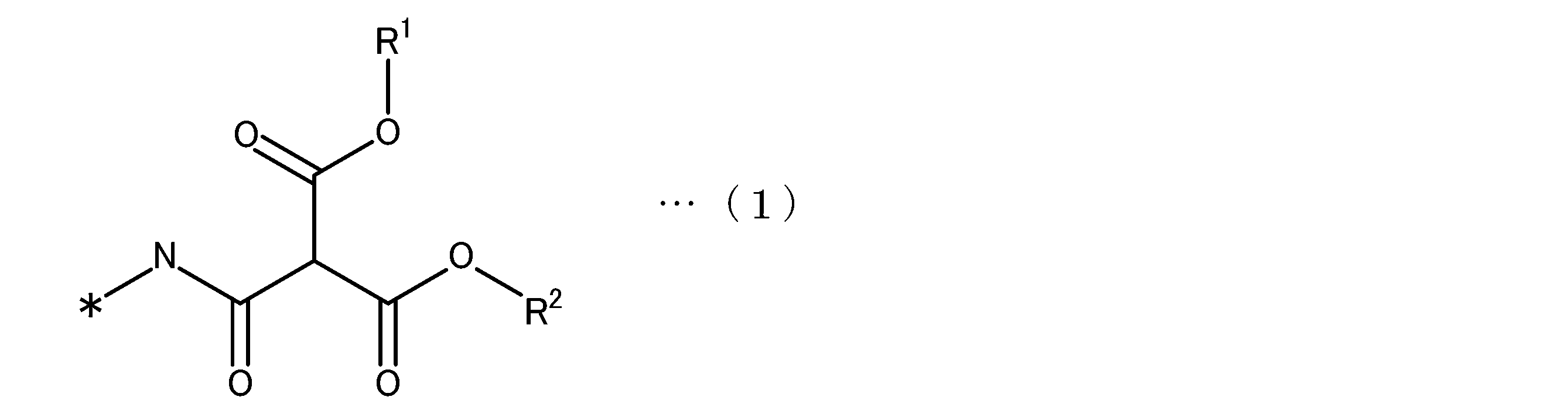

[3] 前記構成単位(c)が、不飽和カルボン酸に由来する構成単位である、[1]または[2]に記載の共重合体。
[4] 前記構成単位(a)が、前記式(1)または前記式(2)で表される基と、(メタ)アクリロイルオキシ基とを有する化合物に由来する構成単位である、[1]~[3]のいずれかに記載の共重合体。
[6] 前記式(1)または前記式(2)で表される基に含まれるエステル基の総量と、前記構成単位(b)に含まれるヒドロキシ基の総量とのモル比率が、10:90~90:10である、[1]~[5]のいずれかに記載の共重合体。
[7] 重量平均分子量が1000~50000である、[1]~[6]のいずれかに記載の共重合体。
[9] 反応性希釈剤(C)および光重合開始剤(D)をさらに含有する、[8]に記載の樹脂組成物。
[10] 着色剤(E)をさらに含有する、[9]に記載の樹脂組成物。
前記共重合体(A)が10~90質量部、
前記溶剤(B)が30~1000質量部、
前記反応性希釈剤(C)が10~90質量部、
前記光重合開始剤(D)が0.1~30質量部、
前記着色剤(E)が3~80質量部含有される、[10]に記載の樹脂組成物。
[13] [12]に記載のカラーフィルターを具備することを特徴とする画像表示素子。
下記式(1)または下記式(2)で表される基を有するモノマー(m-a)と、ヒドロキシ基含有モノマー(m-b)と、酸基含有モノマー(m-c)とを溶剤(B-2)に溶解させたモノマー溶液を、昇温した前記溶剤(B-1h)に滴下するとともに、
重合開始剤を前記溶剤(B-2)に溶解させた重合開始剤溶液を、前記溶剤(B-1h)に滴下して混合溶液とする滴下重合工程(II)と、
前記混合溶液を攪拌しながら、60~90℃で1~5時間反応させる後重合工程(III)とを有し、
前記溶剤(B-1)と前記溶剤(B-2)のいずれか一方または両方が、ヒドロキシ基含有溶剤を含有することを特徴とする共重合体の製造方法。
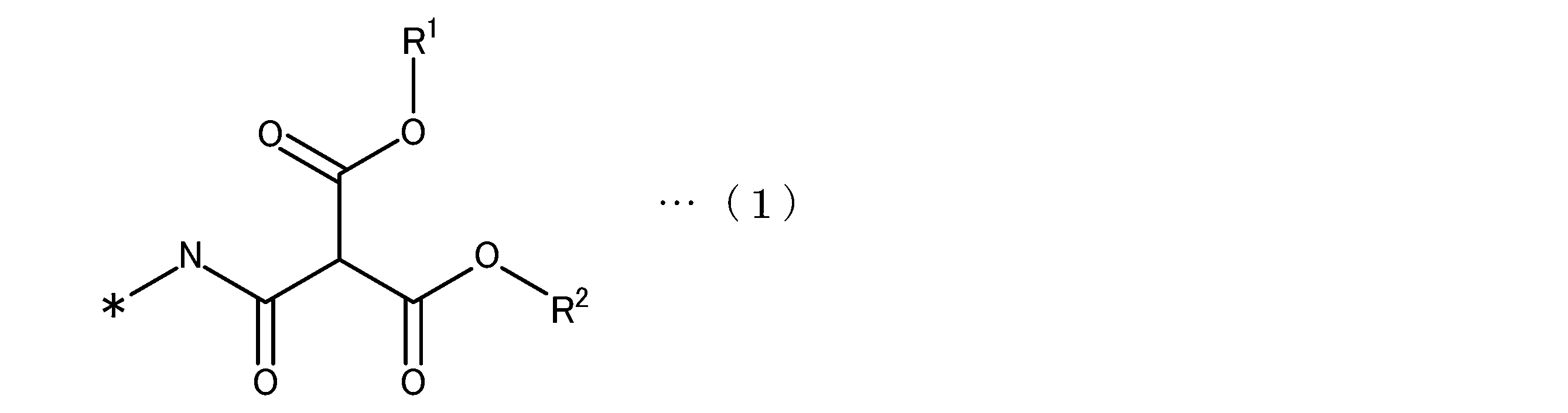

また、本発明によれば、アルカリ現像性が良好であり、低温で硬化させても耐溶剤性に優れた硬化物が得られる樹脂組成物の硬化物からなる着色パターンを有するカラーフィルター、及びそのカラーフィルターを具備する画像表示素子を提供できる。
本実施形態の共重合体(A)は、下記式(1)または下記式(2)で表される基を有する構成単位(a)(以下、単に「構成単位(a)」とも言う。)と、ヒドロキシ基を有する構成単位(b)(以下、単に「構成単位(b)」とも言う。)と、酸基を有する構成単位(c)(以下、単に「構成単位(c)」とも言う。)とを含有する。


構成単位(a)は、上記式(1)または上記式(2)で表される基を有するモノマー(m-a)(以下、単に「モノマー(m-a)」とも言う。)に由来する構成単位である。共重合体(A)に含まれている構成単位(a)の上記式(1)または上記式(2)で表される基は、共重合体(A)を含有する樹脂組成物を熱硬化させることにより、構成単位(b)の有するヒドロキシ基とエステル交換し、架橋構造を生成する。そのため、共重合体(A)を含有する樹脂組成物は、50℃~150℃の低温で硬化させても耐溶剤性に優れた硬化膜が得られる。
R1およびR2がエチル基である場合、共重合体(A)を含有する樹脂組成物を熱硬化させると、R1およびR2が構成単位(b)のヒドロキシ基とエステル交換してエタノールが生成される。樹脂組成物の熱硬化時に生成したエタノールは、樹脂組成物を熱硬化させるための加熱によって、容易に蒸発して除去されるため、好ましい。
R3がエチル基である場合、共重合体(A)を含有する樹脂組成物を熱硬化させると、R3が構成単位(b)のヒドロキシ基とエステル交換してエタノールが生成される。樹脂組成物の熱硬化時に生成したエタノールは、樹脂組成物を熱硬化させるための加熱によって、容易に蒸発して除去されるため、好ましい。
これらのモノマー(m-a)は、単独で用いてもよいし、2種以上を組み合わせて用いてもよい。

式(3)中のR5は、-CO-、-COOR6-又は-COO-R7O-CONH-R8-を示す。ここで、R6は炭素原子数1~6のアルキレン基である。R7は炭素原子数2~6のアルキレン基である。また、R8は置換基を有していてもよい炭素原子数2~12のアルキレン基又は炭素原子数6~12のアリーレン基である。これらの中でも、式(3)中のR5は、-COOR6-であることが好ましい。R5が-COOR6-である場合、R6は、好ましくは炭素原子数1~4のアルキレン基である。
エチレン性不飽和基含有イソシアネート化合物と反応させるアセト酢酸エステルとしては、例えば、アセト酢酸メチル、アセト酢酸エチルなどが挙げられる。
上記反応は、一般に、-20~150℃の温度で行うことができ、25~130℃の温度で行うことが好ましい。上記反応の温度が-20℃以上であると、十分な反応速度が得られる。また、上記反応の温度が150℃以下であると、C=C(二重結合)を有する原料が重合されることによって、反応後に生成する構成単位(a)を与えるモノマー(m-a)がゲル化することを防止できる。
共重合体(A)の含有するヒドロキシ基を有する構成単位(b)は、上記式(1)または上記式(2)で表される基を有さず、ヒドロキシ基を有する。構成単位(b)は、ヒドロキシ基を有するモノマー(m-b)(以下、単に「モノマー(m-b)」とも言う。)に由来する構成単位である(ただし、前記構成単位(a)に該当するものは除く)。共重合体(A)に含まれている構成単位(b)のヒドロキシ基は、共重合体(A)を含有する樹脂組成物を熱硬化させることにより、構成単位(a)の有する式(1)または式(2)で表される基とエステル交換し、架橋構造を生成する。
共重合体(A)の含有する酸基を有する構成単位(c)は、上記式(1)または上記式(2)で表される基、並びにヒドロキシ基を有さず、酸基を有する。構成単位(c)は、酸基を有するモノマー(m-c)(以下、単に「モノマー(m-c)」とも言う。)に由来する構成単位である(ただし、構成単位(a)および構成単位(b)に該当するものは除く)。共重合体(A)に構成単位(c)が含まれていることにより、共重合体(A)を含有する樹脂組成物を感光性材料として使用する場合のアルカリ現像性が良好となる。
構成単位(c)を与えるモノマー(m-c)としては、上記式(1)または上記式(2)で表される基、並びにヒドロキシ基を有さず、重合性不飽和結合と酸基とを有するモノマーであればよく、特に限定されない。モノマー(m-c)としては、例えば、不飽和カルボン酸又はその無水物、不飽和スルホン酸、不飽和ホスホン酸等が挙げられる。
共重合体(A)中に含まれる構成単位(a)の割合は、特に制限はないが、好ましくは1~40モル%、より好ましくは5~30モル%、最も好ましくは10~20モル%である。
共重合体(A)中に含まれる構成単位(b)の割合は、特に制限はないが、好ましくは1~60モル%、より好ましくは10~50モル%、最も好ましくは20~40モル%である。
共重合体(A)中に含まれる構成単位(c)の割合は、特に制限はないが、好ましくは1~60モル%、より好ましくは10~50モル%、最も好ましくは15~40モル%である。
本実施形態の共重合体(A)において、構成単位(a)および構成単位(b)の割合が1モル%以上であると、共重合体(A)を含有する樹脂組成物を熱硬化させることにより、構成単位(b)のヒドロキシ基と、構成単位(a)の有する式(1)または式(2)で表される基とがエステル交換する。そのため、十分に架橋構造が生成される。したがって、構成単位(a)および構成単位(b)をそれぞれ1モル%以上含む共重合体(A)を含有する樹脂組成物は、低温で熱硬化させても、耐溶剤性の良好な硬化物が得られる。
具体的には、構成単位(a)の有する上記式(1)または上記式(2)中のエステル基の総量と、樹脂組成物中に含まれるヒドロキシ基の総量とのモル比率は、10:90~90:10であることが好ましく、30:70~70:30であることがより好ましく、40:60~60:40であることがさらに好ましい。樹脂組成物中に含まれるヒドロキシ基の総量は、構成単位(b)の有するヒドロキシ基と、反応性希釈剤(C)に含まれるヒドロキシ基との合計である。上記モル比率が上記範囲であると、共重合体(A)を含有する樹脂組成物を熱硬化させることにより、樹脂組成物中に含まれるヒドロキシ基と、構成単位(a)の有する式(1)または式(2)で表される基とのエステル交換による架橋構造が生成されやすくなる。このため、より一層耐溶剤性の良好な硬化物が得られる。
本実施形態の共重合体(A)は、必要に応じて、構成単位(a)~(c)と共に、これらと共重合可能なその他の構成単位(d)(但し、構成単位(a)~(c)に該当するものは除く)を含有していてもよい。
芳香族ビニル化合物としては、スチレン、α-メチルスチレン、o-ビニルトルエン、p-ビニルトルエン、o-クロロスチレン、m-クロロスチレン、メトキシスチレン、p-ニトロスチレン、p-シアノスチレン、p-アセチルアミノスチレンなどが挙げられる。
ノルボルネン構造を有する環状オレフィンとしては、ノルボルネン(ビシクロ[2.2.1]ヘプト-2-エン)、5-メチルビシクロ[2.2.1]ヘプト-2-エン、テトラシクロ[4.4.0.12,5.17,10]ドデカ-3-エン、8-エチルテトラシクロ[4.4.0.12,5.17,10]ドデカ-3-エン、ジシクロペンタジエン、トリシクロ[5.2.1.02,6]デカ-8-エン、トリシクロ[4.4.0.12,5]ウンデカ-3-エン、トリシクロ[6.2.1.01,8]ウンデカ-9-エン、テトラシクロ[4.4.0.12,5.17,10.01,6]ドデカ-3-エン、8-エチリデンテトラシクロ[4.4.0.12,5.17,12]ドデカ-3-エン、ペンタシクロ[6.5.1.13,6.02,7.09,13]ペンタデカ-4-エンなどが挙げられる。
ジエンとしては、ブタジエン、イソプレン、クロロプレンなどが挙げられる。
(メタ)アクリル酸エステルとしては、メチル(メタ)アクリレート、エチル(メタ)アクリレート、イソ-プロピル(メタ)アクリレート、tert-ブチル(メタ)アクリルレート、ペンチル(メタ)アクリレート、ベンジル(メタ)アクリレート、イソアミル(メタ)アクリレート、2-エチルヘキシル(メタ)アクリレート、ラウリル(メタ)アクリレート、ドデシル(メタ)アクリレート、シクロヘキシル(メタ)アクリレート、メチルシクロヘキシル(メタ)アクリレート、ロジン(メタ)アクリレート、ノルボルニル(メタ)アクリレート、5-エチルノルボルニル(メタ)アクリレート、ジシクロペンテニル(メタ)アクリレート、ジシクロペンタニル(メタ)アクリレート、ジシクロペンテニルオキシエチルアクリレート、イソボルニル(メタ)アクリレート、アダマンチル(メタ)アクリレート、テトラヒドロフルフリル(メタ)アクリレート、1,1,1-トリフルオロエチル(メタ)アクリレート、パーフルオロエチル(メタ)アクリレート、パーフルオロ-n-プロピル(メタ)アクリレート、3-(N,N-ジメチルアミノ)プロピル(メタ)アクリレート、トリフェニルメチル(メタ)アクリレート、フェニル(メタ)アクリレート、クミル(メタ)アクリレート、4-フェノキシフェニル(メタ)アクリレート、フェノキシエチル(メタ)アクリレート、フェノキシポリエチレングリコール(メタ)アクリレート、ノニルフェノキシポリエチレングリコールモノ(メタ)アクリレート、ビフェニルオキシエチル(メタ)アクリレート、ナフタレン(メタ)アクリレート、アントラセン(メタ)アクリレート、エトキシ化フェニル(メタ)アクリレートなどが挙げられる。
(メタ)アクリル酸アミドとしは、(メタ)アクリル酸アミド、(メタ)アクリル酸N,N-ジメチルアミド、(メタ)アクリル酸N,N-ジ-イソプロピルアミド、(メタ)アクリル酸アントラセニルアミドなどが挙げられる。
ビニル化合物としては、塩化ビニル、塩化ビニリデン、フッ化ビニル、フッ化ビニリデン、N-ビニルピロリドン、ビニルピリジン、酢酸ビニル、ビニルトルエンなどが挙げられる。
不飽和ジカルボン酸ジエステルとしては、シトラコン酸ジエチル、マレイン酸ジエチル、フマル酸ジエチル、イタコン酸ジエチルなどが挙げられる。
モノマレイミドとしては、N-フェニルマレイミド、N-シクロヘキシルマレイミド、N-ラウリルマレイミド、N-(4-ヒドロキシフェニル)マレイミドなどが挙げられる。
共重合体(A)のポリスチレン換算の重量平均分子量は、特に制限されないが、好ましくは1,000~50,000、より好ましくは3,000~40,000である。共重合体(A)の重量平均分子量が1,000以上であると、共重合体(A)を含む樹脂組成物を感光性材料として使用する場合のアルカリ現像性が良好となり、アルカリ現像後にパターンの欠けが発生し難くなる。一方、共重合体(A)の重量平均分子量が50,000以下であると、共重合体(A)を含む樹脂組成物を感光性材料として使用する場合の現像時間が適切になり、実用性が確保される。
共重合体(A)のガラス転移温度(Tg)は、30℃以下であり、20℃以下であることが好ましく、0℃以下であることがより好ましい。共重合体(A)のガラス転移温度が30℃超であると、低温での硬化性に悪影響を及ぼす。このため、共重合体(A)のガラス転移温度を、30℃以下とする。共重合体(A)のガラス転移温度は、-50℃以上であることが好ましく、-40℃以上であることがより好ましく、-30℃以上であることがさらに好ましい。共重合体(A)のガラス転移温度が-50℃以上であると、共重合体(A)を含む樹脂組成物は、耐熱性に優れた硬化膜が得られるものとなる。
共重合体(A)の酸価(JIS K6901 5.3)は、適宜選択できる。共重合体(A)の酸価は、共重合体(A)を含む樹脂組成物を感光性材料として使用する場合には、好ましくは20~300KOHmg/gであり、より好ましくは30~200KOHmg/gである。共重合体(A)の酸価が20KOHmg/g以上であると、共重合体(A)を含む樹脂組成物を感光性材料として使用する場合のアルカリ現像性が良好となる。一方、共重合体(A)の酸価が300KOHmg/g以下であると、共重合体(A)を含む樹脂組成物を感光性材料として使用する場合に、アルカリ現像液に対して露光部分(光硬化部分)が溶解し難いものとなるため、パターン形状が良好となる。
共重合体(A)は、分子中に上記式(1)または上記式(2)で表される基を含んでいる。上記式(1)または上記式(2)で表される基の当量数は、適宜選択すればよいが、300~6000であることが好ましく、1000~3000であることがより好ましい。上記式(1)または上記式(2)で表される基の当量数が、300以上であると、共重合体(A)を含有する樹脂組成物中にヒドロキシ基が十分に存在している場合、これを熱硬化させることにより、樹脂組成物中のヒドロキシ基と、構成単位(a)の有する式(1)または式(2)で表される基とのエステル交換による架橋構造が十分に生成されるものとなる。このため、より一層耐溶剤性の良好な硬化物が得られる。
本実施形態の共重合体(A)は、例えば、以下に示す溶剤加熱工程(I)と滴下重合工程(II)と後重合工程(III)とをこの順に行う方法を用いて製造できる。
(溶剤加熱工程(I))
溶剤(B-1)を60~90℃に昇温し、昇温した溶剤(B-1h)を調製する。溶剤加熱工程(I)においては、溶剤(B-1)に後述する連鎖移動剤を入れてから昇温してもよい。溶剤(B-1)に連鎖移動剤を入れてから昇温することにより、滴下重合工程(II)および後重合工程(III)において合成される共重合体(A)の重合度を制御できる。
溶剤(B-1)中の連鎖移動剤の濃度は、例えば、0.1~10質量%とすることができ、特に限定されない。
昇温した溶剤(B-1h)を攪拌しながら、昇温した溶剤(B-1h)に、モノマー溶液とともに、重合開始剤溶液を滴下して混合溶液とする滴下重合を行う。
モノマー溶液は、上記式(1)または上記式(2)で表される基を有するモノマー(m-a)と、ヒドロキシ基含有モノマー(m-b)と、酸基含有モノマー(m-c)と、必要に応じて用いられるモノマー(m-d)とを溶剤(B-2)に溶解させたものである。
重合開始剤溶液は、重合開始剤を溶剤(B-2)に溶解させたものである。
本実施形態の共重合体(A)の製造方法では、溶剤(B-1)と溶剤(B-2)のいずれか一方または両方が、ヒドロキシ基含有溶剤を含有する。
モノマー溶液および重合開始剤溶液の滴下終了後、前記混合溶液を攪拌しながら、さらに60~90℃で1~5時間反応させる。
溶剤加熱工程(I)において使用する溶剤(B-1)は、ヒドロキシ基含有溶剤のみであってもよいし、ヒドロキシ基を含有しない溶剤のみであってもよいし、ヒドロキシ基含有溶剤とヒドロキシ基を含有しない溶剤の両方を含むものであってもよい。溶剤(B-1)は、ヒドロキシ基を含有するヒドロキシ基含有溶剤を含むことが好ましく、ヒドロキシ基含有溶剤のみであることがより好ましい。
本実施形態の製造方法では、溶剤加熱工程(I)において、反応容器に溶剤(B-1)を入れて、60~90℃に昇温する。また、滴下重合工程(II)および後重合工程(III)において、混合溶液を攪拌しながら、60~90℃で1~5時間反応させる。
溶剤加熱工程(I)における溶剤(B-1h)の温度と、滴下重合工程(II)および後重合工程(III)における混合溶液の温度とは、同じであってもよいし、異なっていてもよい。
滴下重合工程(II)において、連鎖移動剤溶液を昇温した溶剤(B-1h)に滴下する場合、重合開始剤溶液およびモノマー溶液と同時に、連鎖移動剤溶液を滴下してもよい。また、重合開始剤溶液およびモノマー溶液を滴下する前または後に、連鎖移動剤溶液を滴下してもよい。
重合開始剤溶液、モノマー溶液、連鎖移動剤溶液の滴下時間は、例えば、30分~1時間とすることができる。
重合開始剤溶液、モノマー溶液、連鎖移動剤溶液の滴下速度および滴下時間は、それぞれ異なっていてもよいし、一部または全部が同じであってもよい。
(重合開始剤溶液)
重合開始剤溶液は、重合開始剤を溶剤(B-2)に溶解させたものである。
重合開始剤としては、特に限定されないが、例えば、2,2’-アゾビス(2,4-ジメチルバレロニトリル)、アゾビスイソブチロニトリル、アゾビスイソバレロニトリル、過酸化ベンゾイル、t-ブチルパーオキシ-2-エチルヘキサノエートなどが挙げられる。これらの重合開始剤は、単独で用いてもよいし、2種以上を組み合わせて用いてもよい。
重合開始剤溶液の使用量は、重合開始剤溶液中に含まれる重合開始剤が、モノマーの全仕込み量100質量部に対して、0.5~20質量部となる量であることが好ましく、より好ましくは1.0~10質量部となる量である。上記モノマーの全仕込み量は、モノマー溶液中のモノマー(m-a)~モノマー(m-d)の質量である。
モノマー溶液は、上記式(1)または上記式(2)で表される基を有するモノマー(m-a)と、ヒドロキシ基含有モノマー(m-b)と、酸基含有モノマー(m-c)と、必要に応じて用いられるモノマー(m-d)とを、溶剤(B-2)に溶解させたものである。モノマー(m-a)~モノマー(m-d)としては、共重合体(A)の項目で例示したものを使用できる。
モノマー溶液中のモノマー(m-a)~(m-d)の合計濃度は、均一な濃度の混合溶液が得られやすい濃度であることが好ましく、例えば、50~95質量%とすることができ、特に限定されない。
連鎖移動剤溶液は、連鎖移動剤を溶剤(B-2)に溶解させたものである。
滴下重合工程(II)において、連鎖移動剤溶液を滴下することにより、後重合工程(III)において合成される共重合体(A)の重合度を制御できる。したがって、所望の分子量範囲の共重合体(A)を容易に製造できる。
連鎖移動剤としては、特に限定されないが、例えば、多官能チオールを好ましく用いることができる。多官能チオールは、分子内に2個以上のメルカプト基を有する化合物である。
重合開始剤溶液中の連鎖移動剤の濃度は、均一な濃度の混合溶液が得られやすい濃度であることが好ましく、例えば、0.1~10質量%とすることができ、特に限定されない。
滴下重合工程(II)において使用する溶剤(B-2)としては、溶剤加熱工程(I)において使用する溶剤(B-1)と同様のものを用いることができる。溶剤(B-2)は、溶剤(B-1)と同様に、ヒドロキシ基含有溶剤のみであってもよいし、ヒドロキシ基を含有しない溶剤のみであってもよいし、ヒドロキシ基含有溶剤とヒドロキシ基を含有しない溶剤の両方を含むものであってもよい。溶剤(B-2)は、ヒドロキシ基を含有するヒドロキシ基含有溶剤を含むことが好ましく、ヒドロキシ基含有溶剤のみであることがより好ましい。
ヒドロキシ基含有溶剤を含む混合溶液中で、モノマー(m-a)(m-b)(m-c)、必要に応じて用いられるモノマー(m-d)を60~90℃で重合させると、モノマー(m-a)に由来するエステル基は、ヒドロキシ基含有溶剤の有するヒドロキシ基と容易にエステル交換反応する。このことから、滴下重合工程(II)および/または後重合工程(III)においては、モノマー(m-a)の有する上記式(1)または上記式(2)で表される基のエステル基の一部と、ヒドロキシ基含有溶剤の有するヒドロキシ基とが、エステル交換反応する。
次に、本実施形態の樹脂組成物について説明する。
本実施形態の樹脂組成物は、本実施形態の共重合体(A)と、溶剤(B)とを含有する。
本実施形態の樹脂組成物は、共重合体(A)と、溶剤(B)だけでなく、反応性希釈剤(C)と、光重合開始剤(D)とをさらに含有するものであってもよい。このような樹脂組成物は、感光性の樹脂組成物として好ましく使用できる。
本実施形態の樹脂組成物は、上記共重合体(A)~光重合開始剤(D)に加えて、着色剤(E)をさらに含有するものであってもよい。このような樹脂組成物は、カラーフィルター、ブラックマトリックス、ブラックカラムスペーサー等の着色パターンを形成するための材料として好ましく使用できる。
本実施形態の樹脂組成物において、溶剤(B)は、ヒドロキシ基含有溶剤を含む。溶剤(B)は、ヒドロキシ基含有溶剤のみであってもよい。本実施形態の樹脂組成物では、溶剤(B)が、ヒドロキシ基含有溶剤を含むため、共重合体(A)の構成単位(a)の有するエステル基と、溶剤(B)に含まれるヒドロキシ基含有溶剤の有するヒドロキシ基とがエステル交換反応して、構成単位(a)の有するエステル基と構成単位(b)の有するヒドロキシ基とのエステル交換反応が適度に阻害され、保存安定性が向上する。
溶剤(B)は、共重合体(A)を製造する工程において使用した溶剤(B-1)および/または溶剤(B-2)と同じであってもよいし、異なっていてもよい。
本実施形態の樹脂組成物としては、共重合体(A)を製造する際に得られた共重合体(A)を含む反応液をそのまま用いてもよい。この場合、反応液から共重合体(A)を単離する必要はない。また、共重合体(A)の製造に使用した溶剤(B-1)および/または溶剤(B-2)が反応液中に含まれている場合には、反応液中の溶剤(B-1)および/または溶剤(B-2)を、溶剤(B)としてそのまま用いることができる。反応液中には、必要に応じて、溶剤(B)を追加してもよい。
反応性希釈剤(C)は、必要に応じて、光重合開始剤(D)とともに含有される。反応性希釈剤(C)は、分子内に重合性官能基として、少なくとも一つの重合可能なエチレン性不飽和基を有する化合物である。反応性希釈剤(C)は、単官能モノマーであってもよいし、多官能モノマーであってもよく、重合性官能基を複数有する多官能モノマーであることが好ましい。反応性希釈剤(C)を含有する樹脂組成物とすることにより、粘度の調整が容易となる。また、反応性希釈剤(C)を含有する樹脂組成物とすることにより、樹脂組成物の硬化物の基材に対する密着性を向上させたり、樹脂組成物の硬化物における強度を調整したりできる。
光重合開始剤(D)としては、特に限定されないが、例えば、ベンゾイン、ベンゾインメチルエーテル、ベンゾインエチルエーテル、ベンゾインブチルエーテルなどのベンゾイン類;アセトフェノン、2,2-ジメトキシ-2-フェニルアセトフェノン、1,1-ジクロロアセトフェノン、4-(1-t-ブチルジオキシ-1-メチルエチル)アセトフェノン、2-メチル-1-[4-(メチルチオ)フェニル]-2-モルホリノ-プロパン-1-オン、2-ベンジル-2-ジメチルアミノ-1-(4-モルホリノフェニル)ブタノン-1などのアセトフェノン類;2-メチルアントラキノン、2-アミルアントラキノン、2-t-ブチルアントラキノン、1-クロロアントラキノンなどのアントラキノン類;キサントン、チオキサントン、2,4-ジメチルチオキサントン、2,4-ジイソプロピルチオキサントン、2-クロロチオキサントンなどのチオキサントン類;アセトフェノンジメチルケタール、ベンジルジメチルケタールなどのケタール類;ベンゾフェノン、4-(1-t-ブチルジオキシ-1-メチルエチル)ベンゾフェノン、3,3’,4,4’-テトラキス(t-ブチルジオキシカルボニル)ベンゾフェノンなどのベンゾフェノン類;アシルホスフィンオキサイド類;エタノン1-[9-エチル-6-(2-メチルベンゾイル)-9H-カルバゾール-3-イル]-1-(O-アセチルオキシム)などが挙げられる。これらの光重合開始剤(D)は、単独で用いてもよく、2種以上を組み合わせて用いてもよい。
着色剤(E)は、必要に応じて含有される。着色剤(E)としては、溶剤(B)に溶解又は分散するものであれば特に限定されず、例えば、染料や顔料などが挙げられる。着色剤(E)は、目的とする樹脂組成物の硬化物の色に応じて、1種のみ単独で用いてもよいし、2種以上を組み合わせて用いてもよい。着色剤(E)としては、染料のみ用いてもよいし、顔料のみ用いてもよいし、染料と顔料とを組み合わせて用いてもよい。
高分子分散剤の例としては、ウレタン系分散剤、ポリエチレンイミン系分散剤、ポリオキシエチレンアルキルエーテル系分散剤、ポリオキシエチレングリコールジエステル系分散剤、ソルビタン脂肪族エステル系分散剤、脂肪族変性エステル系分散剤などが挙げられる。
分散剤の種類および配合量は、使用する顔料の種類などに応じて適宜設定すればよい。
具体的には、本実施形態の樹脂組成物は、150℃以下の温度で硬化させることが好ましく、より好ましくは100℃以下であり、最も好ましくは80℃以下である。樹脂組成物を硬化させる温度が150℃以下であると、樹脂組成物を硬化させることに必要なエネルギー量が少なくて済む。また、樹脂組成物が耐熱性の劣る着色剤(E)を含む場合、熱硬化に伴う着色剤(E)の劣化を抑制でき、着色剤(E)本来の特性が発揮された硬化物が得られやすい。したがって、着色剤(E)として、様々な材料からなるものを用いることができる。また、基板上に樹脂組成物を塗布して熱硬化させる方法により硬化物を形成する場合、基板が耐熱性の劣る材料からなるものであっても硬化物を形成できる。したがって、基板として、例えば、フレキシブルディスプレイ用の樹脂など様々な材料からなるものを用いることができる。
本実施形態の樹脂組成物を硬化させるための加熱時間(硬化時間)は、硬化物の大きさ、厚み、硬化させる温度などに応じて適宜決定することができ、例えば、10分~4時間とすることができ、20分~2時間とすることが好ましい。
本実施形態の樹脂組成物が、共重合体(A)および溶剤(B)以外の成分を含む場合、例えば、予め製造した共重合体(A)と溶剤(B)とを含む樹脂組成物に、反応性希釈剤(C)と、光重合開始剤(D)と、着色剤(E)とを添加して混合する方法により製造してもよい。
次に、本実施形態のカラーフィルターについて説明する。
本実施形態のカラーフィルターは、基板と、基板上に形成された赤色(R)パターンと緑色(G)パターンと青色(B)パターンの3つの着色パターンからなる複数の画素と、各着色パターンの境界に形成されたブラックマトリックスと、画素およびブラックマトリックスの上に形成された保護膜とを有する。
保護膜としては、特に限定されず、公知のものを用いることができる。
本実施形態のカラーフィルターを製造するには、まず、基板上に、ブラックマトリックスとなる着色パターンおよび各画素を形成する3つの着色パターンを、それぞれ形成する。初めに、基板上にブラックマトリックスとなる着色パターンを形成し、その後、ブラックマトリックスによって区画された範囲内に、各画素を形成する赤色パターンと緑色パターンと青色パターンを、それぞれ形成する。赤色パターンと緑色パターンと青色パターンを形成する順序は、特に限定されない。
具体的には、基板上に、本実施形態の樹脂組成物を塗布し、塗布膜を形成する。次に、所定のパターン形状を有するフォトマスクを介して、塗布膜を露光し、露光部分を光硬化させる。そして、塗布膜の未露光部分を、アルカリ水溶液を用いてアルカリ現像し、除去する。その後、ベーキングを行うことにより、塗布膜の露光部分を加熱して硬化させる。以上の工程により、所定の形状を有し、本実施形態の樹脂組成物の硬化物からなる着色パターンが得られる。
樹脂組成物を塗布した後、必要に応じて、循環式オーブン、赤外線ヒーター、ホットプレートなどの加熱手段を用いて塗布膜を加熱することにより、塗布膜中に含まれる溶剤(B)を揮発させて除去してもよい。
塗布膜中の溶剤(B)を除去するための加熱は、例えば、50℃~120℃の温度で行うことができる。また、塗布膜中の溶剤(B)を除去するための加熱は、例えば、30秒~30分行うことができる。塗布膜中の溶剤(B)を除去するための加熱温度および加熱時間は、樹脂組成物の組成、塗布膜の厚みなどに応じて適宜設定できる。
塗布膜を露光する際には、例えば、紫外線、エキシマレーザー光等の活性エネルギー線を用いることが好ましい。露光に用いる光源としては、特に限定されるものではなく、例えば、低圧水銀ランプ、中圧水銀ランプ、高圧水銀ランプ、キセノンランプ、メタルハライドランプなどを用いることができる。塗布膜に照射するエネルギー線量は、塗布膜の厚み、樹脂組成物の組成などに応じて適宜選択することができ、例えば、30~2000mJ/cm2とすることができる。
これらのアルカリ水溶液には、必要に応じて、消泡剤、界面活性剤の添加剤を添加してもよい。
また、本実施形態では、アルカリ水溶液によるアルカリ現像の後、ベーキングを行う前に、基板上を水洗してアルカリ水溶液を除去し、乾燥させることが好ましい。
塗布膜の露光部分を加熱する時間は、塗布膜の露光部分を加熱する温度、塗布膜の厚み、樹脂組成物の組成などに応じて適宜選択することができ、例えば、10分~4時間とすることができ、好ましくは20分~2時間である。
以上の工程により、本実施形態のカラーフィルターが得られる。
次に、本実施形態の画像表示素子について説明する。
本実施形態の画像表示素子としての液晶表示素子としては、例えば、表面にカラーフィルターと第1電極とが形成された第1基板と、表面に第2電極が形成された第2基板とを、第1電極と第2電極とをスペーサーを介して対向させて配置し、第1基板と第2基板と間に液晶組成物を挟持させたものが挙げられる。
本実施形態の液晶表示素子においては、カラーフィルターとして、本実施形態のカラーフィルターを具備する。本実施形態の液晶表示素子において、カラーフィルター以外の部材については、公知のものを用いることができる。
まず、第1基板上に、カラーフィルターと第1電極とをこの順に形成する。カラーフィルターは、上述した製造方法を用いて形成できる。第1電極は、公知の方法を用いて形成できる。
次に、第2基板上に公知の方法により、第2電極とスペーサーとを形成する。
その後、第1基板と第2基板とを、第1電極と第2電極とを対向させて配置して張り合わせ、第1基板と第2基板と間に液晶組成物を注入し、封止する。
以上の工程により、本実施形態の液晶表示素子が得られる。
攪拌装置、滴下ロート、コンデンサー、温度計及びガス導入管を備えたフラスコに、溶剤(B-1)としての212.5gのプロピレングリコールモノメチルエーテル(三協化学株式会社製)を入れ、窒素ガス置換しながら攪拌し、78℃に昇温した(溶剤加熱工程(I))。
また、41.0g(13モル%)のMOI-DEMと、37.4g(26モル%)の4-ヒドロキシブチルアクリレートと、19.8g(23モル%)のメタクリル酸と、69.9g(38モル%)の2-エチルヘキシルアクリレート(2EHA)とを、溶剤(B-2)としての60.5gのプロピレングリコールモノメチルエーテルに溶解させてから混合し、モノマー溶液とした。
その後、78℃に昇温した溶剤(B-1h)を入れた前記フラスコ中に、フラスコ中の溶剤(B-1h)を攪拌しながら、重合開始剤溶液とモノマー溶液とを、それぞれ滴下ロートを用いて同時に滴下して混合溶液とする滴下重合を行った(滴下重合工程(II))。滴下速度は、重合開始剤溶液およびモノマー溶液ともに1.7ml/分とした。
このようにして得られた共重合体(A)を含む反応液に、溶剤以外の成分が35質量%となるように、溶剤(B)としてのプロピレングリコールモノメチルエーテルを加え、合成例1の重合体組成物を得た。
表1~表3に記載の材料を、表1~表3に記載の割合で使用したこと以外は、合成例1と同様にして、合成例2~11、比較合成例1~3の重合体組成物を得た。
攪拌装置、滴下ロート、コンデンサー、温度計及びガス導入管を備えたフラスコに、溶剤(B-1)としての212.5gのプロピレングリコールモノメチルエーテル(三協化学株式会社製)と、連鎖移動剤としてのチオグリコール酸1.75gを入れ、窒素ガス置換しながら攪拌し、78℃に昇温した(溶剤加熱工程(I))。
また、63.0g(20モル%)のMOI-DEMと、57.6g(40モル%)の4-ヒドロキシブチルアクリレートと、17.2g(20モル%)のメタクリル酸と、36.8g(20モル%)の2-エチルヘキシルアクリレート(2EHA)とを、溶剤(B-2)としての60.5gのプロピレングリコールモノメチルエーテルに溶解させて、モノマー溶液とした。
その後、78℃に昇温した溶剤(B-1h)を入れた前記フラスコ中に、フラスコ中の溶剤(B-1h)を攪拌しながら、重合開始剤溶液とモノマー溶液とを、それぞれ滴下ロートを用いて同時に滴下して混合溶液とする滴下重合を行った(滴下重合工程(II))。滴下速度は、重合開始剤溶液およびモノマー溶液ともに1.7ml/分とした。
このようにして得られた共重合体(A)を含む反応液に、溶剤以外の成分が35質量%となるように、溶剤(B)としてのプロピレングリコールモノメチルエーテルを加え、合成例12の重合体組成物を得た。


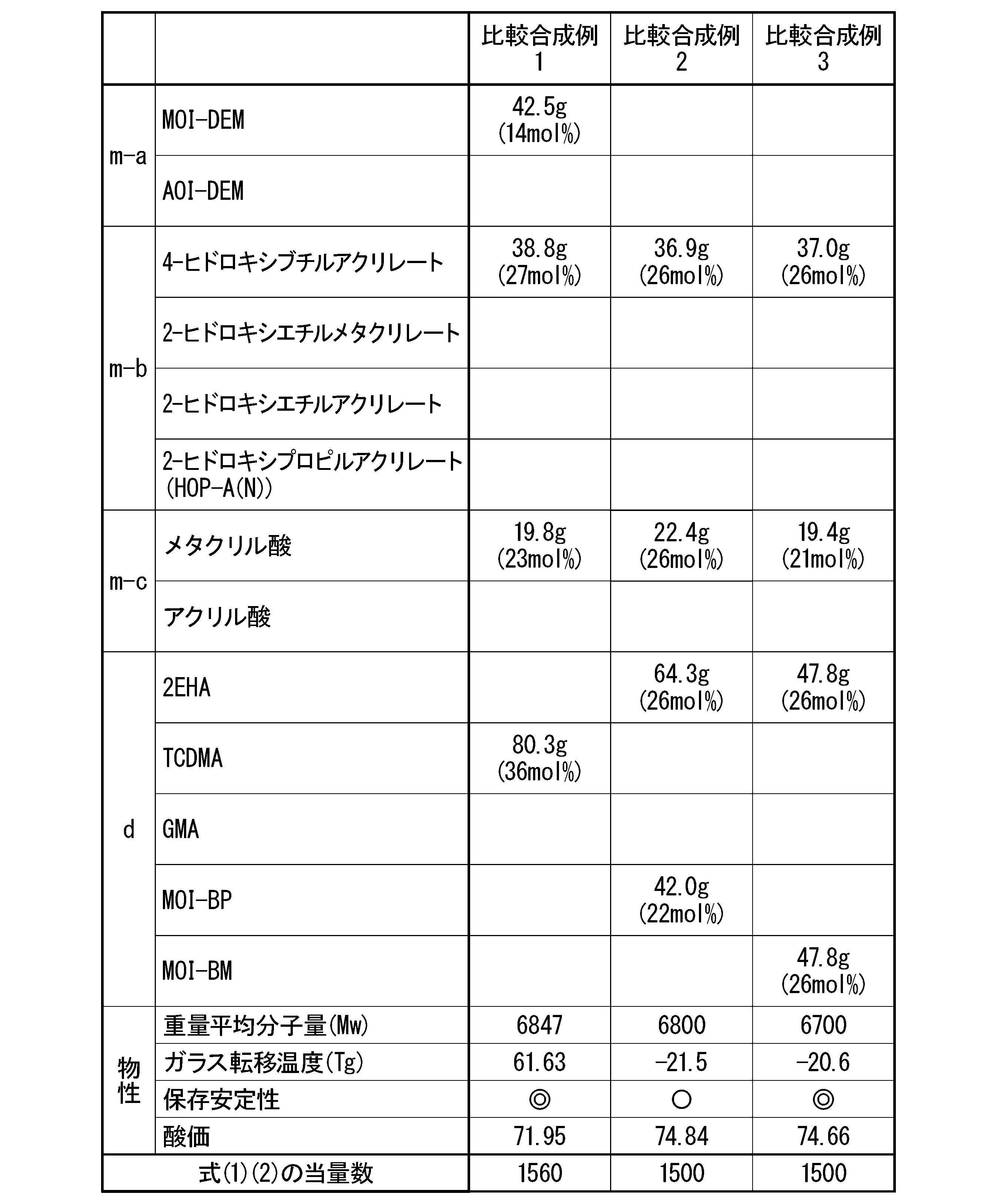
また、表1~表3において、(式(1)(2)の当量数)は、共重合体(A)の分子中に含まれる上記式(1)または上記式(2)で表される基の当量数を示す。
・MOI-DEM:カレンズ(登録商標)MOI-DEM(2-イソシアナトエチルメタクリレートとマロン酸ジエチルとの反応生成物、昭和電工株式会社製)
・AOI-DEM:カレンズ(登録商標)AOI-DEM(2-イソシアナトエチルアクリレートとマロン酸ジエチルとの反応生成物、昭和電工株式会社製)
・4-ヒドロキシブチルアクリレート(三菱ケミカル株式会社製)
・2-ヒドロキシエチルメタクリレート(共栄社化学株式会社製)
・2-ヒドロキシエチルアクリレート(共栄社化学株式会社製)
・2-ヒドロキシプロピルアクリレート(HOP-A(N))(共栄社化学株式会社製)・メタクリル酸(クラレ会社製)
・アクリル酸(東亜合成株式会社製)
・TCDMA:トリシクロ[5.2.1.02,6]デカニル-8-メタクリレート(日立化成株会社製)
・GMA:グリシジルメタクリレート(日油株式会社製)
・MOI-BP:カレンズ(登録商標)MOI-BP(2-[(3,5-ジメチルピラゾリル)カルボニルアミノ]エチルメタクリレート、昭和電工株式会社製)
・MOI-BM:カレンズ(登録商標)MOI-BM(2-「0-(1‘-メチルプロピリデンアミノ)カルボキシアミノ]エチルメタクリラート、昭和電工株式会社製)
合成例1~12、比較合成例1~3の重合体組成物に含まれる共重合体(A)について、それぞれ重量平均分子量(Mw)を測定した。
重量平均分子量は、ゲルパーミエーションクロマトグラフィー(GPC)を用いて、下記条件にて測定した標準ポリスチレン換算の重量平均分子量である。
カラム:ショウデックス(登録商標)LF-804+LF-804(昭和電工株式会社製)
カラム温度:40℃
試料:共重合体の0.2質量%テトラヒドロフラン溶液
展開溶媒:テトラヒドロフラン
検出器:示差屈折計(ショウデックス(登録商標)RI-71S)(昭和電工株式会社製)
流速:1mL/min
合成例1~12、比較合成例1~3の重合体組成物をガラス基板に塗布し、50℃、減圧下にて24時間乾燥させた。その後、アセトンに再溶解し、再度50℃、減圧下にて24時間乾燥させた。このようにして揮発成分を除去した共重合体溶液の固形分について、DSC(示差走査熱量計法、測定機器:セイコーDSC6200)を用いて、窒素気流下、昇温速度10℃/minでJIS-K7121に準拠し測定した(中間点ガラス転移点)。得られた結果を共重合体(A)のガラス転移温度(Tg)とした。
調整後、溶剤以外の成分が35質量%である合成例1~12、比較合成例1~3の重合体組成物をガラス容器に等量ずつ計り取り、ほこりなどが入らないように蓋をし、サンプルとした。各サンプルの粘度を測定した後、それぞれ12℃に保った恒温器の中に3ヶ月間静置した。そして、3ヶ月間静置した各サンプルの粘度を測定した。なお粘度の測定はE型粘度計(RE-80L、東機産業製、コーンNo.3)を使用して25℃、回転数10rpmで行った。
◎:増粘率10%以下
〇:増粘率10.1%~20%
△:増粘率20.1%以上
合成例1~12、比較合成例1~3の重合体組成物の酸価をそれぞれ測定し、共重合体(A)の酸価とした。
JIS K6901 5.3に従って測定した硬化性ポリマーの酸価である。すなわち、酸価は、共重合体1g中に含まれる酸性成分を中和するのに要する水酸化カリウムのmg数を意味する。
表1~表3に示す合成例1~12、比較合成例1~3の重合体組成物と、(B)溶剤としてのプロピレングリコールモノメチルエーテルアセテートと、(C)反応性希釈剤としてのジペンタエリスリトールペンタアクリレートとジペンタエリスリトールヘキサアクリレートとの混合物(カヤラッドDPHA、日本化薬社製)と、(D)光重合開始剤としてのエタノン,1-[9-エチル-6-(2-メチルベンゾイル)-9H-カルバゾール-3-イル]-,1-(o-アセチルオキシム)(BASFジャパン株式会社製)と、(E)着色剤としての染料(VALIFAST BLUE 2620)とを、それぞれ表4に示す割合で混合し、実施例1~12、比較例1~3の樹脂組成物を調製した。

表4に示す溶剤(B)の量は、重合体組成物中に含まれる溶剤(プロピレングリコールモノメチルエーテル)と、樹脂組成物の製造時に添加した溶剤(プロピレングリコールモノメチルエーテルアセテート)とを合算した量である。表4に示す溶剤(B)中におけるヒドロキシ基含有溶剤の含有割合は、79.1質量%である。
(1)アルカリ現像性
実施例および比較例の樹脂組成物をそれぞれ、縦5cm、横5cmの平面視正方形のガラス基板(無アルカリガラス基板)上に、露光後の厚さが2.5μmとなるようにスピンコートして塗布膜を形成した。次いで、100℃で3分間加熱することにより塗布膜中の溶剤を揮発させて除去した。
次に、0.1質量%の炭酸ナトリウムを含む水溶液を23℃の温度及び0.3MPaの圧力でスプレーし、未露光部分を溶解して現像した。その後、100℃で20分間ベーキングすることで所定のパターンを形成した。
○:未露光部分の残渣なし
×:未露光部分の残渣あり
実施例および比較例の樹脂組成物をそれぞれ、縦5cm、横5cmの平面視正方形のガラス基板(無アルカリガラス基板)上に、露光後の厚さが2.5μmとなるようにスピンコートして塗布膜を形成した。次いで、100℃で3分間加熱することにより塗布膜中の溶剤を揮発させて除去した。
作成した硬化膜を、20gのプロピレングリコールモノメチルエーテルに23℃で15分間浸漬し、浸漬前後の色変化(ΔEab)を分光光度計UV-1650PC(株式会社島津製作所製)にて測定し、その結果に基づいて耐溶剤性の評価を行った。その結果を表5に示す。

また、実施例1~12の樹脂組成物を硬化させて得た硬化膜は、塗布膜を硬化させる温度を80℃、時間を30分間とした場合と、温度を100℃、時間を20分間とした場合のいずれにおいても、△Eabが3未満であり、耐溶剤性が良好であった。
また、本発明によれば、アルカリ現像性が良好であり、低温で硬化させても耐溶剤性に優れた硬化物が得られる樹脂組成物の硬化物からなる着色パターン、これを有するカラーフィルター、及びそのカラーフィルターを具備する画像表示素子が提供される。
本発明の樹脂組成物は、透明膜、保護膜、絶縁膜、オーバーコート、フォトスペーサー、ブラックマトリックス、ブラックカラムスペーサー、カラーフィルター用のレジストなどの材料として、幅広い用途に好ましく用いることができる。
Claims (15)
- 下記式(1)または下記式(2)で表される基を有する構成単位(a)と、
ヒドロキシ基を有する構成単位(b)と、
酸基を有する構成単位(c)とを含有し、
ガラス転移温度が30℃以下であることを特徴とする共重合体。
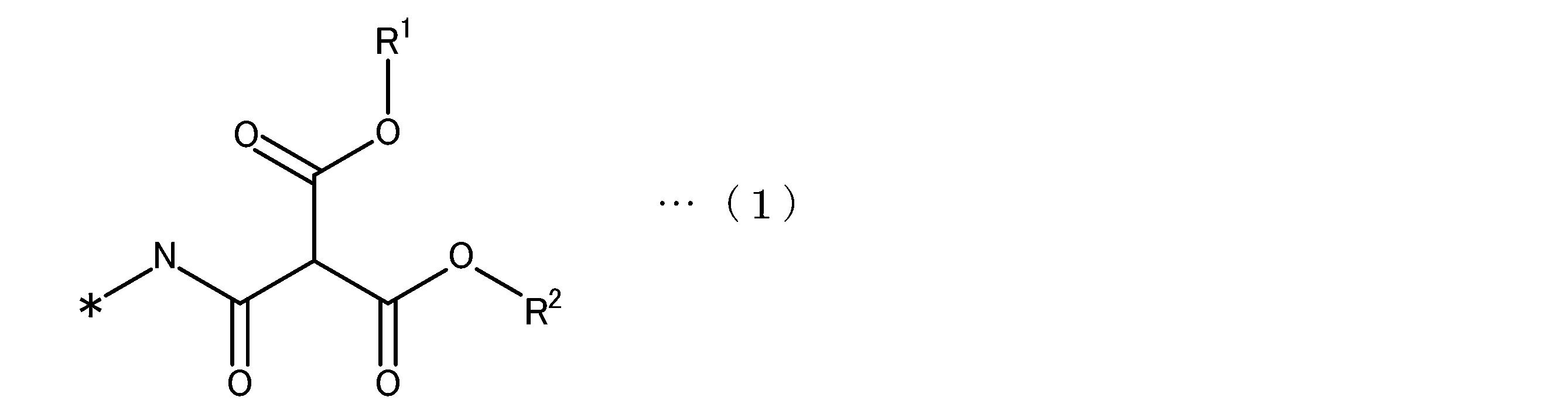
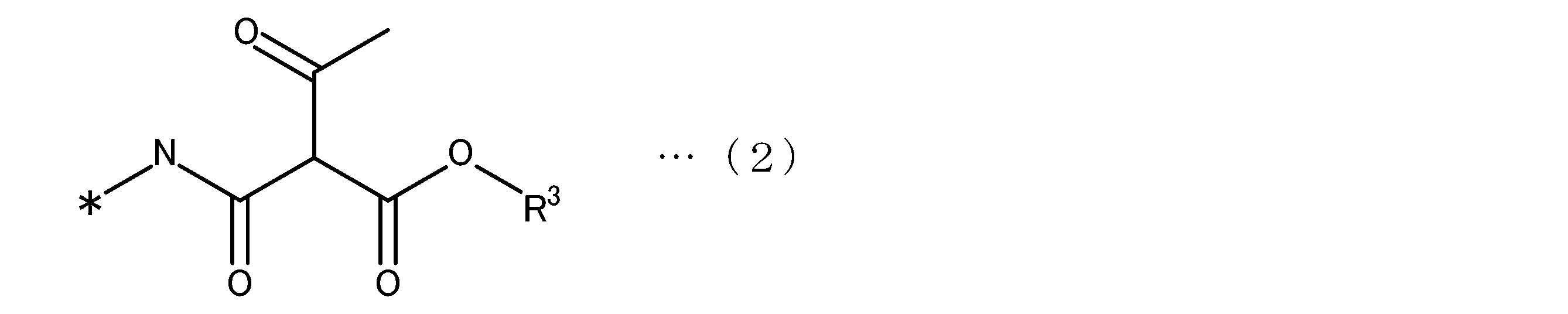
- 前記構成単位(b)が、ヒドロキシアルキル(メタ)アクリレートに由来する構成単位である、請求項1に記載の共重合体。
- 前記構成単位(c)が、不飽和カルボン酸に由来する構成単位である、請求項1または請求項2に記載の共重合体。
- 前記構成単位(a)が、前記式(1)または前記式(2)で表される基と、(メタ)アクリロイルオキシ基とを有する化合物に由来する構成単位である、請求項1~請求項3のいずれか一項に記載の共重合体。
- 前記構成単位(a)を1~40モル%、前記構成単位(b)を1~60モル%、前記構成単位(c)を1~60モル%含有する、請求項1~請求項4のいずれか一項に記載の共重合体。
- 前記式(1)または前記式(2)で表される基に含まれるエステル基の総量と、前記構成単位(b)に含まれるヒドロキシ基の総量とのモル比率が、10:90~90:10である、請求項1~請求項5のいずれか一項に記載の共重合体。
- 重量平均分子量が1000~50000である、請求項1~請求項6のいずれか一項に記載の共重合体。
- 請求項1~請求項7のいずれか一項に記載の共重合体(A)と、溶剤(B)とを含有し、
前記溶剤(B)が、ヒドロキシ基含有溶剤を含むことを特徴とする樹脂組成物。 - 反応性希釈剤(C)および光重合開始剤(D)をさらに含有する、請求項8に記載の樹脂組成物。
- 着色剤(E)をさらに含有する、請求項9に記載の樹脂組成物。
- 前記共重合体(A)と前記反応性希釈剤(C)との合計量100質量部に対して、
前記共重合体(A)が10~90質量部、
前記溶剤(B)が30~1000質量部、
前記反応性希釈剤(C)が10~90質量部、
前記光重合開始剤(D)が0.1~30質量部、
前記着色剤(E)が3~80質量部含有される、請求項10に記載の樹脂組成物。 - 請求項10または請求項11に記載の樹脂組成物の硬化物からなる着色パターンを有することを特徴とするカラーフィルター。
- 請求項12に記載のカラーフィルターを具備することを特徴とする画像表示素子。
- 溶剤(B-1)を60~90℃に昇温し、昇温した溶剤(B-1h)を調製する溶剤加熱工程(I)と、
下記式(1)または下記式(2)で表される基を有するモノマー(m-a)と、ヒドロキシ基含有モノマー(m-b)と、酸基含有モノマー(m-c)とを溶剤(B-2)に溶解させたモノマー溶液を、昇温した前記溶剤(B-1h)に滴下するとともに、
重合開始剤を前記溶剤(B-2)に溶解させた重合開始剤溶液を、前記溶剤(B-1h)に滴下して混合溶液とする滴下重合工程(II)と、
前記混合溶液を攪拌しながら、60~90℃で1~5時間反応させる後重合工程(III)とを有し、
前記溶剤(B-1)と前記溶剤(B-2)のいずれか一方または両方が、ヒドロキシ基含有溶剤を含有することを特徴とする共重合体の製造方法。


- 前記溶剤加熱工程(I)において、前記溶剤(B-1)に連鎖移動剤を入れてから昇温する、請求項14に記載の共重合体の製造方法。
Priority Applications (3)
| Application Number | Priority Date | Filing Date | Title |
|---|---|---|---|
| KR1020237019828A KR20230107324A (ko) | 2020-12-24 | 2021-12-08 | 공중합체 및 그 공중합체의 제조 방법 |
| JP2022572102A JPWO2022138159A1 (ja) | 2020-12-24 | 2021-12-08 | |
| CN202180085824.1A CN116745327A (zh) | 2020-12-24 | 2021-12-08 | 共聚物及该共聚物的制造方法 |
Applications Claiming Priority (2)
| Application Number | Priority Date | Filing Date | Title |
|---|---|---|---|
| JP2020-215472 | 2020-12-24 | ||
| JP2020215472 | 2020-12-24 |
Publications (1)
| Publication Number | Publication Date |
|---|---|
| WO2022138159A1 true WO2022138159A1 (ja) | 2022-06-30 |
Family
ID=82157696
Family Applications (1)
| Application Number | Title | Priority Date | Filing Date |
|---|---|---|---|
| PCT/JP2021/045077 Ceased WO2022138159A1 (ja) | 2020-12-24 | 2021-12-08 | 共重合体およびその共重合体の製造方法 |
Country Status (5)
| Country | Link |
|---|---|
| JP (1) | JPWO2022138159A1 (ja) |
| KR (1) | KR20230107324A (ja) |
| CN (1) | CN116745327A (ja) |
| TW (1) | TW202237676A (ja) |
| WO (1) | WO2022138159A1 (ja) |
Cited By (3)
| Publication number | Priority date | Publication date | Assignee | Title |
|---|---|---|---|---|
| WO2023120364A1 (ja) * | 2021-12-21 | 2023-06-29 | 株式会社レゾナック | 重合体エマルジョンおよびその保管方法、該重合体エマルジョンを用いた二液系熱硬化性樹脂組成物、樹脂硬化膜、ならびに塗膜 |
| WO2024117161A1 (ja) * | 2022-11-30 | 2024-06-06 | 株式会社レゾナック | ブロックイソシアネート組成物、(共)重合体、塗料、硬化物および塗膜 |
| WO2024134926A1 (ja) * | 2022-12-20 | 2024-06-27 | 株式会社レゾナック | 共重合体、感光性樹脂組成物、樹脂硬化膜、及び画像表示素子 |
Families Citing this family (1)
| Publication number | Priority date | Publication date | Assignee | Title |
|---|---|---|---|---|
| CN119912617B (zh) * | 2023-10-30 | 2026-01-06 | 中国石油化工股份有限公司 | 共聚微球及其制备方法 |
Citations (3)
| Publication number | Priority date | Publication date | Assignee | Title |
|---|---|---|---|---|
| JPH10316643A (ja) * | 1997-05-19 | 1998-12-02 | Showa Denko Kk | 重合性マロン酸誘導体および硬化性組成物 |
| WO2019026547A1 (ja) * | 2017-08-03 | 2019-02-07 | 昭和電工株式会社 | 感光性樹脂組成物及びその製造方法 |
| JP2021102759A (ja) * | 2019-12-20 | 2021-07-15 | Jsr株式会社 | 着色組成物、着色硬化膜及びその製造方法、カラーフィルタ、表示素子、受光素子、並びに硬化性組成物 |
Family Cites Families (5)
| Publication number | Priority date | Publication date | Assignee | Title |
|---|---|---|---|---|
| JP6178164B2 (ja) | 2013-08-23 | 2017-08-09 | 富士フイルム株式会社 | 感光性着色組成物、カラーフィルタ、カラーフィルタの製造方法、有機el液晶表示装置 |
| CN107735728A (zh) | 2015-06-15 | 2018-02-23 | 东洋油墨Sc控股株式会社 | 感光性组合物、彩色滤光片用感光性组合物及彩色滤光片 |
| JPWO2018147156A1 (ja) * | 2017-02-07 | 2019-11-21 | 住友化学株式会社 | 高分子化合物の製造方法及び組成物 |
| JP7425407B2 (ja) * | 2019-03-29 | 2024-01-31 | 日油株式会社 | 防曇剤組成物、該組成物から形成される防曇膜を有する防曇性物品 |
| JP7530212B2 (ja) * | 2019-05-31 | 2024-08-07 | 積水化学工業株式会社 | 両面粘着シート及び積層体 |
-
2021
- 2021-12-08 CN CN202180085824.1A patent/CN116745327A/zh active Pending
- 2021-12-08 KR KR1020237019828A patent/KR20230107324A/ko active Pending
- 2021-12-08 JP JP2022572102A patent/JPWO2022138159A1/ja active Pending
- 2021-12-08 WO PCT/JP2021/045077 patent/WO2022138159A1/ja not_active Ceased
- 2021-12-20 TW TW110147689A patent/TW202237676A/zh unknown
Patent Citations (3)
| Publication number | Priority date | Publication date | Assignee | Title |
|---|---|---|---|---|
| JPH10316643A (ja) * | 1997-05-19 | 1998-12-02 | Showa Denko Kk | 重合性マロン酸誘導体および硬化性組成物 |
| WO2019026547A1 (ja) * | 2017-08-03 | 2019-02-07 | 昭和電工株式会社 | 感光性樹脂組成物及びその製造方法 |
| JP2021102759A (ja) * | 2019-12-20 | 2021-07-15 | Jsr株式会社 | 着色組成物、着色硬化膜及びその製造方法、カラーフィルタ、表示素子、受光素子、並びに硬化性組成物 |
Cited By (3)
| Publication number | Priority date | Publication date | Assignee | Title |
|---|---|---|---|---|
| WO2023120364A1 (ja) * | 2021-12-21 | 2023-06-29 | 株式会社レゾナック | 重合体エマルジョンおよびその保管方法、該重合体エマルジョンを用いた二液系熱硬化性樹脂組成物、樹脂硬化膜、ならびに塗膜 |
| WO2024117161A1 (ja) * | 2022-11-30 | 2024-06-06 | 株式会社レゾナック | ブロックイソシアネート組成物、(共)重合体、塗料、硬化物および塗膜 |
| WO2024134926A1 (ja) * | 2022-12-20 | 2024-06-27 | 株式会社レゾナック | 共重合体、感光性樹脂組成物、樹脂硬化膜、及び画像表示素子 |
Also Published As
| Publication number | Publication date |
|---|---|
| TW202237676A (zh) | 2022-10-01 |
| JPWO2022138159A1 (ja) | 2022-06-30 |
| KR20230107324A (ko) | 2023-07-14 |
| CN116745327A (zh) | 2023-09-12 |
Similar Documents
| Publication | Publication Date | Title |
|---|---|---|
| JP7563509B2 (ja) | 硬化塗膜の製造方法 | |
| JP7364020B2 (ja) | 感光性樹脂組成物 | |
| JP7823589B2 (ja) | 樹脂組成物および樹脂組成物の製造方法 | |
| JP2016084464A (ja) | 硬化性樹脂組成物、カラーフィルター、画像表示素子及びカラーフィルターの製造方法 | |
| KR20230107324A (ko) | 공중합체 및 그 공중합체의 제조 방법 | |
| WO2023063022A1 (ja) | 樹脂前駆体、樹脂、樹脂組成物及び樹脂硬化膜 | |
| CN113039216A (zh) | 共聚物及包含该共聚物的树脂组合物 | |
| JPWO2016203905A1 (ja) | カラーフィルター用着色組成物、カラーフィルターおよび画像表示素子 | |
| JP2023060757A (ja) | 樹脂組成物、感光性樹脂組成物、樹脂硬化膜、カラーフィルターおよび画像表示素子 | |
| JP7852652B2 (ja) | 感光性樹脂組成物およびカラーフィルター | |
| WO2024134926A1 (ja) | 共重合体、感光性樹脂組成物、樹脂硬化膜、及び画像表示素子 | |
| WO2022124052A1 (ja) | 感光性樹脂組成物及び感光性樹脂組成物の製造方法 | |
| WO2025163995A1 (ja) | 感光性樹脂組成物、樹脂硬化膜、及び画像表示素子 | |
| WO2024116596A1 (ja) | 共重合体及び感光性樹脂組成物 | |
| WO2024024195A1 (ja) | 感光性樹脂組成物、樹脂硬化膜、及び画像表示素子 | |
| JP2026002190A (ja) | 共重合体の製造方法、感光性樹脂組成物の製造方法、及び画像表示素子の製造方法 | |
| KR20250168244A (ko) | 수지 조성물, 변성 수지 조성물, 및 변성 수지 조성물의 제조 방법 | |
| KR20250169540A (ko) | 수지 조성물, 변성 수지 조성물, 및 변성 수지 조성물의 제조 방법 | |
| CN121285599A (zh) | 树脂组合物、改性树脂组合物及改性树脂组合物的制造方法 | |
| TW202523715A (zh) | 感光性樹脂組成物、感光性著色組成物及濾色器 |
Legal Events
| Date | Code | Title | Description |
|---|---|---|---|
| 121 | Ep: the epo has been informed by wipo that ep was designated in this application |
Ref document number: 21910308 Country of ref document: EP Kind code of ref document: A1 |
|
| ENP | Entry into the national phase |
Ref document number: 2022572102 Country of ref document: JP Kind code of ref document: A |
|
| ENP | Entry into the national phase |
Ref document number: 20237019828 Country of ref document: KR Kind code of ref document: A |
|
| WWE | Wipo information: entry into national phase |
Ref document number: 202180085824.1 Country of ref document: CN |
|
| NENP | Non-entry into the national phase |
Ref country code: DE |
|
| 122 | Ep: pct application non-entry in european phase |
Ref document number: 21910308 Country of ref document: EP Kind code of ref document: A1 |
|
| WWR | Wipo information: refused in national office |
Ref document number: 1020237019828 Country of ref document: KR |
|
| WWR | Wipo information: refused in national office |
Ref document number: 1020237019828 Country of ref document: KR |
|
| WWC | Wipo information: continuation of processing after refusal or withdrawal |
Ref document number: 1020237019828 Country of ref document: KR |